beatXP is set to launch the metallic strap variant of the Unbound Pro smartwatch in India. The Silicone strap option of this smartwatch debuted last month, alongside the beatXP Nuke, and Unbound Era smartwatches.
beatXP Unbound Pro metallic strap variant specs:
Key features of the beatXP Unbound Pro include a classic look with a metallic strap and body, a 1.96-inch square Super AMOLED screen with Always On Display, and Bluetooth Calling functionality for seamless call management directly from the smartwatch.
The smartwatch is equipped with a comprehensive monitoring system covering vital health metrics such as heart rate, sleep patterns, SpO2 levels, and menstrual cycle reminders. It also boasts a multi-functional crown.
Designed for fitness enthusiasts, the Unbound Pro offers an impressive selection of 100 sports modes. Additionally, it features an AI voice assistant for added convenience and support.
Pricing & availability
The metallic strap variant, available in metallic silver and metallic black, has a price tag of Rs 3,999 and is accessible on Amazon, Flipkart, and beatXP’s official site. The Silicone strap option also comes with the same price tag.
Noble Audio has officially launched the Falcon Max True Wireless Stereo (TWS) earbuds, featuring innovative solid-state, all-silicon Micro-Electro-Mechanical Systems (MEMS) based drivers from xMEMS Labs, recognized for their work in “Solid-State Fidelity.”
In collaboration with xMEMS, Noble Audio positions the Falcon Max as one of the early adopters of xMEMS’ MEMS speaker technology, promising premium sound quality, phase coherence, and treble extension.
Remaining true to Noble Audio’s commitment to superior sound quality, the Falcon Max employs a hybrid driver setup. It incorporates the xMEMS Cowell for high frequencies and a 10mm dynamic driver for lows, guaranteeing precise and high-fidelity audio reproduction.
The Falcon Max runs on Qualcomm’s latest chip, the QCC5171, not just improving computing power but also cutting down on power use by 20%, making it more efficient. It supports Bluetooth 5.3, LDAC for high-quality wireless audio, aptX adaptive, AAC, and Qualcomm’s Snapdragon Sound certification. This marks Noble Audio’s move into high-resolution wireless audio.
Professionally tuned by Noble Audio’s acoustic designers, the Falcon Max includes features such as Adaptive Active Noise Cancellation (ANC), multi-point connectivity for two devices, and multi-pairing. The user-friendly control app offers customizable settings and EQ options shared with the Falcon ANC, promising a tailored audio experience.
Noble Audio Falcon Max Pricing
Having already launched, the Falcon Max is now available for purchase, with a competitive MSRP of $270.
The Xiaomi Smart Plug 2 has been unveiled in Europe. The new Xiaomi gadget allows the user to transform regular home appliances into smart home gadgets that can be controlled remotely using an app or voice commands. The Xiaomi Smart Plug 2 is available in a white colorway option.
Features
The Xiaomi Smart Plug 2 supports Google Home, allowing you to control the connected device with Google Assistant Voice commands. The Xiaomi Home app offers another way of remotely controlling a device or checking if a device is switched on. You can also view statistics on your energy consumption, as well as set up a schedule for an appliance. When the built-in power button of the Smart Plug 2 is double-pressed, the countdown timer is activated. You can set your preferred timer length using the app. The countdown timer and schedules will still operate if the device disconnects from the internet. The switch also has a status memory that ensures it resumes its on or off state after a power outage.
There are sensors in the Xiaomi Smart Plug 2 that help to detect overcurrent or overheating and notifications are sent via the app to inform the user. The dimensions of the Smart Plug 2 are 2.4 x 1.6 x 1.3 inches. The compact design of the Smart Plug 2 compares very well with the Kasa Smart Plug, which is also compatible with Google Home.
Pricing & Availability
The Xiaomi Smart Plug 2 is available for purchase in Spain, Italy, and other EU countries for €14.99 ($16). There are no global availability and pricing information for the Smart Plug 2 outside the EU at this time.
The FEVM FN60G mini PC enters the market as a contender in the increasingly popular compact desktop segment. Its 2.5L aluminum alloy chassis houses a range of hardware configurations, including up to Intel 13th Gen processors, 64GB of DDR5 RAM, and a dedicated AMD Radeon RX 550 graphics card.
Key Specifications:
Processors: Intel 12th or 13th Gen, with options ranging from Core i5 to i7.
Graphics: AMD Radeon RX 550 discrete GPU.
RAM: Up to 64GB DDR5.
Storage: Two PCIe 4.0 SSD slots, barebone configuration available.
Ports: Extensive selection, including SD card reader, USB Type-A and Type-C, dual Ethernet, dual DisplayPorts, and dual HDMI.
Performance:
The FN60G’s capabilities cater to both gamers and professionals. While the RX 550 caters to mainstream gaming at moderate settings, the high-end CPU and RAM configurations ensure smooth performance for demanding workloads like video editing and 3D rendering.
Form Factor:
The compact size and sleek design make the FN60G ideal for space-constrained environments. Its aluminum alloy construction offers durability and a premium feel. Not to mention that it looks quite similar to the Apple Mac Studio.
Connectivity:
The FN60G boasts a diverse port selection, enabling users to connect multiple monitors, external drives, and peripherals with ease. The front USB Type-C port supports Apple Studio Display, catering to creative professionals.
Pricing and Availability:
The FN60G starts at CNY2599 (~$366.40) for the barebone kit, with the top-end variant reaching CNY7099 (~$1000). The brand has yet to reveal any plans for a global launch.
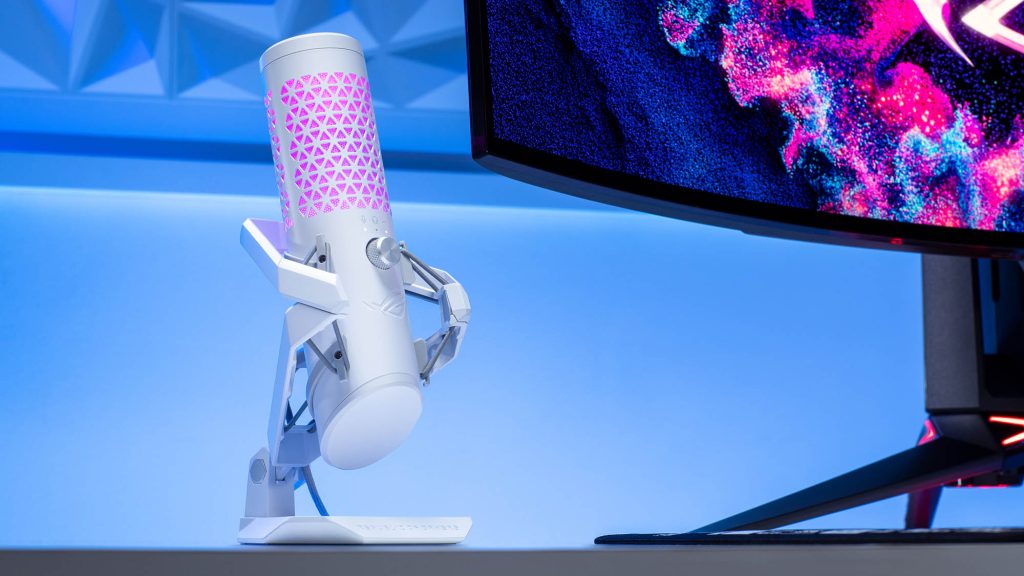
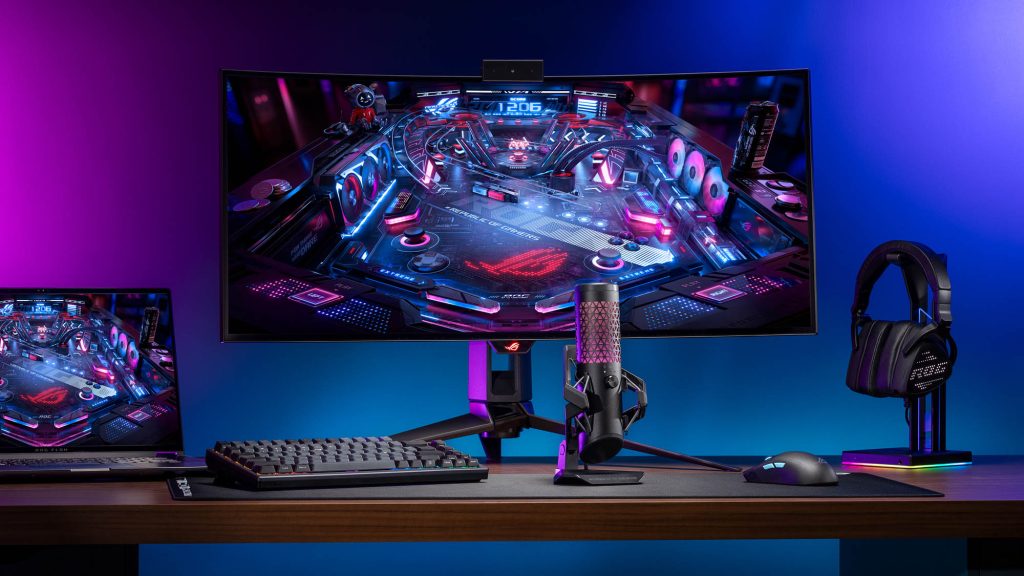
Asus has given us a sneak peek at their upcoming ROG Swift OLED PG32UCDP monitor, which is set to make its debut at CES 2024. What makes this monitor truly groundbreaking is its ability to switch between two display modes: 4K resolution at an impressive 240Hz and Full HD at a whopping 480Hz. It’s likely that Asus is sourcing the OLED panel for this monitor from LG.
LG also revealed their Dual-Hz monitor on the same day
Following Asus’s exciting announcement, LG has also jumped into the ring with its advanced UltraGear OLED gaming monitors. One of the highlights is the 32GS95UE, a 32-inch OLED monitor that supports both 4K at 240Hz and 1080p at 480Hz. This monitor boasts impressive features, including a wide 98.5% DCI-P3 color gamut, an outstanding 1.5 million:1 contrast ratio, and an ultra-fast 0.03ms response time. LG has plans to introduce more dual-mode monitors in the coming year, such as the UltraGear OLED 32GS95UE and 39GS95QE, all falling under their “Dual-Hz” technology lineup.
Earlier this year, Asus introduced the ROG Swift OLED PG32UCDM monitor, featuring a 31.5-inch OLED screen, a dazzling 1000 nits peak brightness, and 4K 240Hz specifications. This monitor is likely to use a Samsung panel. It’s clear that top monitor manufacturers are all vying to offer 32-inch 4K 240Hz OLED monitors, utilizing panels from both LG and Samsung.
As teased in the video, the ROG Swift OLED PG32UCDP monitor will sport a nearly bezel-less 32-inch panel and a robust three-foot stand, possibly with support for DisplayPort 2.1. While the price tag hasn’t been revealed yet, it’s safe to assume that it will be on the higher side due to its innovative technology.
At CES 2023, Asus introduced the ROG Swift Pro PG248QP 540Hz gaming monitor, and it recently became available for purchase in the EU and US markets. This 24.1-inch monitor boasts an astonishing 540Hz refresh rate, an E-TN panel for enhanced responsiveness, NVIDIA G-Sync support, and practical design elements like adjustable stands, making it an ideal choice for optimizing your gaming setup.
In Shanghai, a significant breach of chip technology trade secrets has been uncovered by the local police, leading to the arrest of 14 suspects and the confiscation of seven servers containing sensitive information.
Chip Technology Scandal: Arrests and Corporate Denials in Trade Secret Breach
The case revolves around Zunpai Communications, a company allegedly involved in the infringement, and its founder and CEO, Zhang Kun, who has been missing for several months. It is believed that the technology belonged to Huawei.
Amidst the controversy, Xiaomi Corporation, a notable investor in Zunpai Communications, has firmly denied any direct involvement in the infringement. Xiaomi‘s investment in Zunpai was part of a Pre-A round financing in May 2022.
However, the company clarified that its subsidiary, Hanxing Entrepreneurship Investment Co., Ltd., made the investment as a standard financial activity and not as a strategic corporate move. Xiaomi emphasized its position as one among many investors, including national and local government funds and over 20 financial institutions, without a significant stake or leadership role in the financed company.
The company further stated that it does not participate in the management or operation of the chip company and maintains no technological collaboration or knowledge-sharing with them. Xiaomi has gathered evidence to counter the allegations and reported them to the relevant authorities.
The investigation revealed that the infringement involved former employees of a rights company being lured away by high salaries and equity incentives. They were instructed to steal chip technology from their former employer, leading to the development of chips with over 90% similarity in key technical aspects. The swift action by Shanghai and Jiangsu police thwarted the mass production of the infringing chips.
The principal suspects, including Zhang and Liu, face charges related to trade secret infringement, while others involved have been released on bail. The extent of the losses to the rights company will be evaluated based on the commercial value of the stolen trade secrets.
It’s that time of year again! As the excitement for Christmas Eve builds, Google has launched its annual Santa tracking feature, letting you follow Saint Nick’s magical journey in real time.
For over 20 years, Google has brought this festive tradition to life, keeping both children and adults filled with wonder on Christmas Eve. This year, Santa’s Village transforms into a captivating tracking experience, where you can witness Santa and his reindeer spreading holiday cheer across the globe.
Whether you’re using an iPhone, iPad, Mac, or simply your trusty web browser, you can join Santa’s adventure on Google’s official Santa Tracking website. Here’s what awaits you:
Live Map: See Santa’s current location and his next stop on a dynamic map.
Live Video Feed: Get a glimpse of Santa’s travels through a live video feed.
Estimated Arrival Times: Find out when Santa is expected to arrive in your specific location.
Picturesque Journey: View photos of the places Santa has already visited.
Gift Counter: Keep track of how many presents Santa has delivered so far.
Distance Tracker: See how close Santa is to your own doorstep.
Google’s Santa Tracker isn’t just about following the jolly old elf. It’s a treasure trove of festive fun for everyone:
Interactive Games: Play festive-themed games to keep the holiday spirit alive.
Creative Activities: Get crafty with Christmas-inspired activities.
Entertaining Videos: Watch heartwarming Christmas videos to fill you with joy.
While Google’s Santa Tracker offers a richly interactive experience, other options are available. The NORAD Tracks Santa Claus app and website are popular alternatives, each with their own unique features.
Japanese electronics giant Sharp may be gearing up for the launch of a 100-inch TV in China, with details emerging from an online listing on a Chinese e-commerce platform. While an official announcement is yet to come, the listing offers a glimpse of the upcoming product.
The TV boasts an impressive 288Hz refresh rate for ultra-smooth visuals, alongside 224-zone backlighting for enhanced contrast and HDR performance. Gamers will likely appreciate the support for VRR (Variable Refresh Rate) and ALLM (Automatic Low Latency Mode) for seamless, tear-free gameplay. Connectivity options appear generous, including HDMI 2.1 ports for enabling high frame rate streaming of games directly to the TV.
Under the hood, a quad-core processor paired with 4GB of RAM and 128GB of storage will run the operation. And audio duties will be handled by a built-in 60W speaker system.
The listing reveals a pre-sale price of 29,999 yuan (approximately $4,300) and hints at a launch date of December 31st. While Sharp hasn’t officially confirmed these details, the presence of the listing suggests an imminent announcement could be on the horizon.
Sharp also unveiled two new in November – the Sharp FQ8 and Sharp FQ5. Both are 4K TVs with 120Hz native refresh rate and a peak brightness of up to 500 nits. The TV also has HDR certifications like Dolby Vision, Dolby Vision IQ, HDR10, and HLG.
Moreover, the TV comes pre-installed with Google TV OS. For audio, Sharp offered a 15W speaker and a subwoofer with Dolby Atmos certification.
Honor Smart Living has officially announced the launch of the Haylou Watch, a new addition to their Honor’s Selection of smartwatches, via their Weibo channel. Haylou, which was once an independent brand and part of Xiaomi’s ecosystem, appears to have collaborated with Honor for this product. The Haylou Watch utilizes the Honor Health app and is being marketed and distributed through Honor’s channels.
The smartwatch is priced at 449 yuan ($63), with a special introductory offer of 429 yuan ($60). Let’s check out the key specs of this smartwatch.
Honor Haylou Watch Specifications:
Design-wise, the watch features a sleek 1.95-inch AMOLEDdisplay with a screen-to-body ratio of 75%. The display offers clear and vibrant visuals with its 410 x 502 resolution, 60Hz refresh rate, 550 nits peak brightness, and complete coverage of the NTSC color gamut. Its pixel density of 332PPI ensures smooth and detailed images, enhancing the overall wearing experience.
In terms of functionality, the Haylou Watch excels in health and fitness monitoring. It offers comprehensive tracking features, including heart rate, blood oxygen, and stress monitoring, as well as sleep tracking. Its fitness capabilities are extensive, with 120 sports modes and the ability to automatically recognize and track activities like walking, running, cycling, and more, using advanced sports algorithms.
In terms of customization, the smartwatch offers a variety of over a hundred personalized watch faces, catering to different styles like sports, technology, and cartoons. The watch also supports always-on display mode, allowing watch faces to show information even when the screen is off.
The smartwatch is compatible with the “Honor Sports Health” app, enhancing its functionality. It supports independent satellite positioning and is equipped with NFC for access cards. The watch is water-resistant up to 50 meters, making it suitable for swimming and other water-related activities.
Haylou Watch offers connectivity features like Bluetooth voice calling and an SOS emergency call function. Users can make and receive calls directly from the watch. It boasts an impressive battery life, with a 300mAh battery providing up to 12 days of usage under typical conditions. Additionally, it charges fully in just 1.5 hours, minimizing downtime.
Haylou Watch offers a range of strap options, including silicone and woven straps, all compatible with standard 20mm watch bands.
Amidst the current US restrictions that prohibit Chinese firms from buying advanced chip-making equipment from US companies, there seems to be a shift to other markets. China’s imports of lithography systems from the Netherlands increased tenfold year-on-year last month. China imported 16 units of the machine with a total value of $762.7 million. The bulk of imports of lithography systems in November came from the Netherlands and Japan.
China’s semiconductor manufacturers are getting alternative critical fabrication equipment from markets outside the US in an increasing manner. It also indicates that Chinese firms are not yet completely cut off from buying certain advanced equipment for chip-making. In October, China imported 21 lithography systems valued at $672.5 million, while 16 systems were imported in November at a higher sum of $762.7 million. This means that Chinese firms are getting their hands on more advanced and expensive projection systems. The US has been unrelenting in trying to restrict other countries from also selling advanced equipment to Chinese firms but it is yet to fully stop the inflow.
The Netherlands is home to ASML a leading manufacturer of lithography machines. The country is the biggest exporter of lithography equipment used to make the most advanced chips, followed by Japan. The Netherlands and Japan accounted for the bulk of imports by China for lithography equipment in November 2023. China is still far off the top in terms of technology for advanced lithography systems. It has failed to narrow the gap even with massive investments by the government. It is estimated that less than 5% of lithography systems used in Chinese fabs were made in China as of 2021.
There might be more restrictions ahead, however. Both the Netherlands and Japan have released new guidelines and export controls on chip-making equipment. The two countries acceded to the US request in January. There are new restrictions activated by the US Commerce Department targeting China. The US abolished the so-called de minimis rule which applied to certain deep ultraviolet (DUV) equipment. The new rule kicked in last month and restricts ASML from shipping advanced immersion DUV lithography systems to a few fabs involved in advanced semiconductor manufacturing in China. The spike in imports may be unconnected with the new restrictions, as the equipment shipped in November received their licenses in 2022 or early 2023.
Two senior employees of Chinese smartphone manufacturer Vivo have been arrested in India. The arrest is coming on the heels of the earlier arrest of four executives of Vivo India including a Chinese national for alleged money laundering. A source from Vivo India says the company has vowed to challenge the arrest legally. Vivo, in a statement, said, it was deeply alarmed by the current action of the authorities.
India’s financial crimes agency, the Enforcement Directorate made the arrests but no formal statement has been made yet. The arrest is yet another indication of increased scrutiny of Chinese businesses in the subcontinent since 2020. Vivo says the recent arrests demonstrate continued harassment and induce an environment of uncertainty within the industry landscape. The arrested individuals were arraigned in a Delhi court on Saturday and then sent to the agency’s custody. The unnamed individuals will again appear in court on December 26, according to unnamed inside sources.
Beijing and New Delhi have had a fractious relationship for a while since the deadly border clash in 2020. The Sino-Indian border dispute is an ongoing territorial dispute over the sovereignty of two relatively large and several smaller pieces of territory between China and India. India has ramped up scrutiny of Chinese businesses and investments in India and several arrests have been made previously. Economic relations continue between both countries and India has a large trade deficit that is skewed towards China.
The charges against the accused persons are not yet known. The Enforcement Directorate has not also provided any detail relating to the arrest and subsequent arraignment of the two individuals. The nationality of the arrested persons cannot be ascertained at this time. It is also unclear whether Vivo provided legal representation for the two senior officials in court.
Hot on the heels of their budget-friendly Smart 8, Infinix appears to be prepping another phone in the series: the Smart 8 Pro. Its specs have just surfaced on Google Play Console, giving us a sneak peek at what’s to come.
Infinix Smart 8 Pro Google Play Console listing
The listing reveals a MediaTek Helio P35 processor under the hood, an octa-core chip with a 2.3GHz boost for four of its Cortex-A53 cores. Graphics will be handled by an Imagination PowerVR GE8320 GPU, while 3GB of RAM and the Android 13 complete the picture.
Infinix Smart 8 Pro Google Play Console listing.
The listing also confirms a display with 720×1612 pixels resolution and a screen density of 320 DPI.
While details on other aspects like cameras and battery are still under wraps, the Smart 8 Pro will be a budget-friendly option, just like its non-Pro sibling.
To recap, the Infinix Smart 8 boasts a Unisoc T606 processor combined with Mali G57 graphics. It comes in a single configuration with 3GB RAM and 32GB storage but offers generous expansion options up to 2 TB via microSD card. It runs Android 13 (Go Edition) based XOS 13 custom skin out of the box.
Likewise, its 6.6-inch IPS LCD display boasts a 90Hz refresh rate, 180Hz touch sampling, and a peak brightness of 500 nits. In the camera department, you get a dual-lens setup on the back, featuring a 13MP main sensor and an AI-powered companion. An 8MP selfie camera resides within the punch-hole cutout for selfies. And, there’s even a “Magic Ring” feature inspired by Apple’s Dynamic Island.
Rounding out the package is a capacious 5000 mAh battery with 10W charging, while a side-mounted fingerprint sensor serves as a biometric option.
On Dec. 26, Huawei will unveil the Nova 12 series of smartphones in China. The rumor mill has been leaking the key specs of the Nova 12, Nova 12 Lite, Nova 12 Pro, and Nova 12 Ultra in bits and pieces. In a new Weibo post, tipster Digital Chat Station mentioned the key specifications of the Nova 12 Ultra. Here is a look at what to expect from the device.
Huawei Nova 12 Ultra specifications (rumored)
Huawei Nova 12 ultra front, rear design
According to DCS, the Nova 12 Ultra will have an OLED panel that offers a 1.5K resolution. While it is not mentioned in the leak, it appears that it may support up to a 120Hz refresh rate. Several images of the device have appeared in the recent past, which have confirmed its rear design. The leaker’s aforementioned image provides the first look at the quad-curved display design, which also includes a pill-shaped cutout for the dual selfie camera setup.
The Nova 12 Ultra’s front camera setup is tipped to feature a 64-megapixel main camera and an 8-megapixel portrait lens that supports 2x optical zoom. On the back panel, the device will have a 50-megapixel primary snapper backed by a 1/1.55-inch camera sensor offering f/1.4–f/4.0 physically variable aperture. The leaker did not mention the details of other cameras on the device.
The leak claims that the device has a 5G-enabled Kirin chip onboard, but it does not specify whether it has the Kirin 9000s, which also powers the Mate 60 series. It will pack a 4,600mAh battery with 100W charging. In addition, it will support other features, such as two-way satellite communication, AI air-to-air control, and smart payment.
iQOO is gearing up for the release of its iQOO Neo 9 series smartphones in China, with the launch scheduled for Dec. 27. In recent days, the brand has been steadily unveiling crucial information about the Neo 9 and Neo 9 Pro. In the latest update, iQOO has shared a poster disclosing the specifications of the primary and ultra-wide cameras on the Neo 9 Pro model.
iQOO Neo 9 Pro camera specifications
The iQOO Neo 9 Pro distinguishes itself as a performance-centric sub-flagship smartphone, deviating from the conventional triple-camera setup comprising main, ultra-wide, and macro/telephoto lenses. Instead, it opts for a dual-camera configuration, incorporating the same primary and ultra-wide sensors found in the camera-focused Vivo X100 flagship, unveiled in November in China.
The Neo 9 Pro is set to feature a potent Sony IMX920 50-megapixel primary camera, likely equipped with optical image stabilization (OIS). Complementing this, the device will include a Samsung JN1 50-megapixel camera sensor dedicated to capturing expansive ultra-wide shots.
As per other reports, the iQOO Neo 9 Pro will have a 6.78-inch OLED screen offering a 1.5K resolution and a 144Hz refresh rate. The Dimensity 9300-powered device may have 12 GB / 16 GB of LPDDR5X RAM and 256 GB / 512 GB of UFS 4.0 storage.
iQOO Neo 9 series
The device will pack a 5,160mAh battery with 120W fast charging. It will run on OriginOS 4-based Android 14. It will also have other features, such as an in-screen fingerprint sensor, dual speakers, an IR blaster, and an x-axis linear motor. At present, there is no information about the price of the device. It is expected to come in three shades, such as Flighting Black, Nautical Blue, and Red and White Soul.
Rumors are rife that Nothing’s next smartphone, the Phone (2a), will be announced at the Mobile World Congress (MWC) 2024, which will take place on Feb. 27 in Barcelona, Spain. Well before the launch, Smartprix published a report to leak the display and camera specifications of the Phone (2a), along with its wallpapers. Here are all the new details about the device.
Nothing Phone (2a) display, camera specifications (rumored)
The alleged rear design of the Nothing Phone (2a)
The publication has teamed up with tipster Kamila to reveal that the Nothing Phone (2a) will arrive with a 6.7-inch display on the front. It appears to be an OLED panel supplied by China’s Visionox and BOE that offers an FHD+ resolution of 1080 x 2412 pixels and a 120Hz refresh rate.
The leak further states that the Nothing Phone (2a) will arrive with a 50-megapixel Samsung S5KGN9 primary camera, also available on the Moto G84 5G. A Samsung S5KJN1 ultra-wide lens will accompany it. The device will be equipped with a Sony IMX615 32-megapixel primary camera for selfies. As per other reports, the dual-camera system will be arranged horizontally in a round camera module.
AmbraAzunimOrbiqueNexulVirmarRubraneRuxe
Shown above are the leaked wallpapers of the Nothing Phone (2a) dubbed ‘Ruxe’, ‘Nexul’, ‘Azunim White’, ‘Orbique’, ‘Rubrane Black’, ‘Ambra’, and ‘Virmar.’ The report also states that there will be four SKUs of the device, such as PacmanIND (India), PacmanJPN (Japan), PacmanEEA (Europe), and Pacman (global). The device will come in black and white color options.
As per other reports, the Nothing Phone (2a) will feature the Dimensity 7200 chipset, 8 GB of RAM, and 128 GB of storage. It is expected to ship with Nothing OS 2.5-based Android 14. It will have a redesigned 3-part Glyph interface on the back. In the global market, it is likely to be priced at $400.
Recently, India‘s law enforcement agencies have taken a significant step by arresting two high-ranking employees of the Chinese smartphone giant, Vivo. This action, set against the backdrop of increased scrutiny of Chinese businesses in India, marks a new chapter in the complex relationship between the two countries.
Two high-ranking employees of Vivo were arrested
The arrests, made by India’s Enforcement Directorate, are linked to accusations of money laundering, a charge that Vivo vehemently denies. This isn’t the first time Vivo has faced such challenges in India. Just two months prior, the Directorate arrested four executives, including a Chinese national, from Vivo’s Indian unit on similar charges.
Vivo logo
Vivo’s response to these arrests has been one of strong opposition. The company has expressed deep concern over what it perceives as “continued harassment,” which they believe creates an atmosphere of uncertainty not just for them but for the broader industry landscape in India. Vivo has committed to using all legal means to counter these accusations, underlining the seriousness with which they are approaching this matter.
The tension between India and Chinese businesses isn’t new. It has been escalating, especially after a deadly border clash in 2020. India has since been closely monitoring Chinese investments and companies operating within its borders. These latest developments with Vivo are a continuation of this heightened vigilance.
It’s important to consider what this means for the future of Chinese businesses in India. Will this lead to a tightening of regulations for foreign companies, particularly those from China? Or is it a signal for these businesses to reevaluate their operations and compliance strategies in India?
The industry is watching closely as the situation unfolds and more variables appear. The outcomes of these legal battles could set precedents impacting the operations of international companies in India, potentially reshaping the business landscape. With the Vivo employees set to appear in court again on December 26, all eyes are on how this legal drama will unfold and its broader implications for international business relations in India.
Chinese company Sharge which recently changed its name from Shargeek has launched the Flow Mini portable power bank is now available in the global market. It is a compact portable charger that is the size of a film roll. It has a 5,000mAh battery capacity and features interchangeable charging plugs.
Features
The new Sharge Flow Mini weighs less than 100g and can be easily transported inside the pocket. It is a cable-free charger and features a built-in connector with a 12W output. The Sharge Flow Mini’s interchangeable plugs are for USB-C and lightning connections. You can charge a device without removing cases up to 1.37 inches thick. A second device can be recharged at up to 12W via its integrated USB-C cable, which also serves as a lanyard.
The compact Sharge Flow Mini power bank can recharge your devices for several hours of additional operation. The integrated USB-C cable can charge the power bank at up to 12W power. The dimensions of the Sharge Flow Mini are 77.8 x 33.0 x 25.2mm and the device has a transparent and silver finish with orange accents and LED indicator lights. The power bank can charge various devices including iPhone 15, Google Pixel 8, and Samsung Z Flip, as well as other models.
Pricing & Availability
The Sharge Flow Mini compact power bank is priced at $29.99 on Amazon, but the price is due to an in-page coupon. The original price of the device is $39.99 but the discount regime will run until December 25. The availability of the Sharge Flow Mini is open to various countries globally. However, shipping costs will differ across the markets. More details about the Sharge Flow Mini compact power bank can be viewed on the Sharge website.
A new report from Nikkei says Chinese chipmaker SMIC is developing 3nm fabrication processes despite key equipment difficulties occasioned by US sanctions. The chipmaker has been prevented from accessing advanced chip production equipment from US vend
SMIC is reported to have developed its 2nd-gen 7nm-class process technology that can be used to produce smartphone processors. The new report states that SMIC is pursuing research on 5nm and 3nm-class process technologies. The research is being carried out in-house by the company’s research and development team. The team is led by co-CEO Liang Mong-Song, a renowned semiconductor scientist. The team leader has had stints at TSMC and Samsung. He is rated as one of the most brilliant minds in the semiconductor industry.
The news is quite instructive that the US sanctions regime has not been able to completely halt the progress of SMC in developing advanced chips beyond the 7nm process. It may have seriously slowed down the company, but a combination of factors is working in its favor in overcoming the challenges.
SMIC is currently the fifth-largest contract maker of chips in the industry. It lost access to leading-edge wafer fab tools that severely limited its ability to adopt new process technologies. As a result of the sanctions, SMIC was unable to get extreme ultraviolet (EUV) lithography tools from ASML. It however relied solely on deep ultraviolet (DUV) lithography for its 2nd-gen 7nm-class node.
The ASML Twinscan NXT:2000i lithography machines are the best tools available to SMIC currently. They can etch up to 38nm production resolutions. The level of precision is adequate for printing 38nm metal pitches using double patterning for 7nm-class nodes. Metal pitches shrink to 30-32nm at 5nm and 21-24nm at 3nm, according to AML and IMEC.
Multi-patterning is another option for achieving ultra-small feature sizes that can omit the use of EUV. It is a complicated process that lengthens the cycle times and can affect yields, as well as wear down the fabrication equipment. The cost implications for multi-patterning is also quite high. SMIC is using triple, quadruple, or sometimes, quintuple patterning to achieve lower resolutions. The design of a DUV-only 3nm-class fabrication process is a significant milestone for SMIC. It remains to be seen how the chip will perform in products.
AOC has launched the “24E11XH,” a budget-friendly gaming monitor featuring a 1080P resolution and a 100Hz refresh rate. The monitor is initially priced at 599 Yuan but can be purchased for a discounted price of 529 Yuan ($74). Let’s delve into the key specs of this monitor.
AOC 24E11XH Monitor Specifications:
The monitor boasts a sleek design with a slim 1mm three-sided bezel and houses a 23.8-inch 1080P IPS panel offering 1920×1080 resolution and wide 178-degree viewing angles. It’s suitable for tasks such as casual gaming, web browsing, and video playback.
The 24E11XH model covers 82% of the NTSC color gamut, offering a rich color palette with 16.7 million colors and an 8-bit color depth. This makes it ideal for professional design work, providing true-to-life and vibrant colors. The monitor’s brightness is rated at 300 nits, and it has a contrast ratio of 1000:1, enhancing the overall picture quality.
In terms of performance, the monitor boasts a 4ms GTG response time, which is optimal for gaming and other high-speed content. The 100Hz refresh rate ensures smooth and lag-free visuals, reducing screen stutter and improving the efficiency of office work. Additionally, the monitor is equipped with HDR mode, which enhances color and contrast in both dark and light areas, simulating an HDR effect for SDR content.
For eye comfort, the monitor is TUV-certified for low blue light emissions. It uses a low blue light mode and DC dimming to reduce screen flicker and minimize eye strain, making it suitable for extended use. The monitor also offers various scene modes like Energy-saving, Web, Game, Movie, Sports, and Reading, adaptable to different usage environments.
The 24E11XH supports 100x100mm VESA mounting. For connectivity, the monitor includes an HDMI 1.4 port and a D-Sub port, compatible with a range of devices like laptops and desktops. The monitor’s dimensions are 603x396x130mm, with a gross weight of 3.76kg and a net weight of 2.65kg.
Earlier this month, AOC also introduced two new monitors: the AOC U27G10 gaming monitor featuring a 27-inch 4K Fast-IPS panel with a 160Hz refresh rate, priced at 2499 Yuan ($352), and the AOC Q27E12C monitor with a 27-inch 2K IPS panel boasting a 100Hz refresh rate, available for 999 Yuan ($139).
The Redmi Note 13 5G series is getting ready to launch worldwide, and it’s coming to India at the beginning of next month. Before the official launch, we got a sneak peek at the complete specs and features of three devices, thanks to a leak from tipster Sudhanshu Ambhore. Take a look at what each device has to offer.
Redmi Note 13 5G specs:
Beginning with the Redmi Note 13 5G, it packs up to 8GB LPDDR4X RAM coupled with 256GB UFS2.2 internal storage, expandable up to 1TB via microSD. The device, with dimensions of 161.11mm x 74.95mm x 7.6mm and a weight of 174.5g, features a 6.67-inch AMOLED display boasting a resolution of 2400 x 1080 pixels. This display supports up to 120Hz refresh rate and a sampling rate of up to 240Hz.
Under the hood, it is powered by a MediaTek Dimensity 6080 SoC. The camera setup includes an impressive 108MP main camera, an 8MP ultra-wide-angle camera, and a 2MP macro camera. The front camera is a 16MP shooter. A 5,000mAh battery with 33W fast charging runs the show, and the device operates on MIUI 14 based on Android 13.
Connectivity options include 5G SA/NSA, Bluetooth 5.2, NFC, and dual-SIM support. Noteworthy features encompass a fingerprint sensor in the power button, AI face recognition, and an IP54 certification for water and dust resistance. Additionally, it incorporates a cooling system. In the box, you’ll find a 33W power adapter, USB-C charging cable, SIM tool, user manual, warranty card, and a protective case.
Redmi Note 13 Pro 5G specs:
Moving to the Redmi Note 13 Pro 5G, the device features a sleek design measuring 161.15mm x 74.24mm x 7.98mm and a weight of 187g. It offers a 6.67-inch AMOLED display with a high resolution of 2712 x 1220 pixels. This display supports up to 120Hz refresh rate and a sampling rate of up to 240Hz, with exceptional brightness levels ranging up to 1800 nits.
Powered by the Snapdragon 7s Gen 2 SoC complemented by the Adreno 710 GPU, it comes with up to 8GB of LPDDR5 RAM and 256GB UFS3.1 internal storage. The camera setup is headlined by a 200MP main camera with features like 2x/4x Lossless Zoom, supporting 4K video recording at 30fps. It has an 8MP ultra-wide-angle camera and a 2MP macro camera. The front camera is a 16MP shooter.
Redmi Note 13 Pro 5G renders
A large 5100mAh battery with 67W TurboCharge fuels the device, and connectivity options include 5G SA/NSA, Bluetooth 5.2, NFC, and dual-SIM support. It integrates a fingerprint sensor in the display, AI face recognition, and holds an IP54 certification for water and dust resistance. For audio and video, the device offers a 3.5mm jack, two stereo speakers with Dolby Atmos, supporting various audio and video formats.
Redmi Note 13 Pro+ 5G specs:
Finally, the Redmi Note 13 Pro+ 5G is powered by the MediaTek Dimensity 7200 Ultra SoC, paired with up to 12GB of LPDDR5 RAM and 512GB UFS3.1 internal storage. Without expandable memory, the device maintains a sleek design, measuring 161.4mm x 74.2mm x 8.99mm and weighing 204.5g.
The phone features a 6.67-inch AMOLED Curved Display with a resolution of 2712×1220 pixels, a 20.9 aspect ratio, and supports a refresh rate of up to 120Hz. The display, with TÜV Rheinland certifications for Low Blue Light, and Flicker-free, is protected by 3D Corning Gorilla Glass Victus.
The camera setup has a 200MP main camera with features such as 2x/4x Lossless Zoom and Xiaomi ProCut 2.0. The main camera employs a 7P lens with ALDOIS EIS and supports 4K video recording at 30fps. It has an 8MP ultra-wide lens and a 2MP macro camera. The front camera is a 16MP shooter with 1080P video recording at 30fps.
A 5,000mAh battery powers the device, supporting 120W Hyper Charge, and comes with a 120W power adapter. The network and connectivity options include dual-SIM support, 5G SA/NSA, 4G LTE FDD/TDD, 3G, 2G, Bluetooth 5.3, NFC, and Wi-Fi 6E. The phone incorporates an advanced cooling system with a stainless steel and graphite thermal solution. Security features include an in-display fingerprint sensor, AI face recognition, and an IP68 certification for water and dust resistance.
We use cookies on our website to give you the most relevant experience by remembering your preferences and repeat visits. By clicking “Accept”, you consent to the use of ALL the cookies.
This website uses cookies to improve your experience while you navigate through the website. Out of these, the cookies that are categorized as necessary are stored on your browser as they are essential for the working of basic functionalities of the website. We also use third-party cookies that help us analyze and understand how you use this website. These cookies will be stored in your browser only with your consent. You also have the option to opt-out of these cookies. But opting out of some of these cookies may affect your browsing experience.
Necessary cookies are absolutely essential for the website to function properly. This category only includes cookies that ensures basic functionalities and security features of the website. These cookies do not store any personal information.
Any cookies that may not be particularly necessary for the website to function and is used specifically to collect user personal data via analytics, ads, other embedded contents are termed as non-necessary cookies. It is mandatory to procure user consent prior to running these cookies on your website.