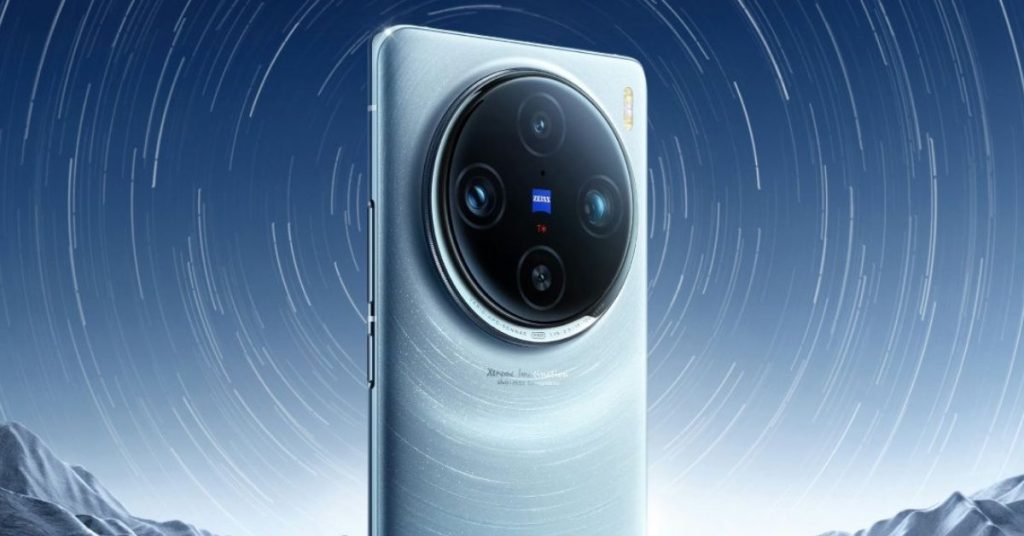
Vivo is gearing up to debut the S18 series of smartphones later this week. These devices will succeed the Vivo S17 series from 6 months back.
The company has been teasing the features of these handsets, namely Vivo S18, Vivo S18 Pro, and Vivo S18e, over the last few days. Similarly, we have been hearing about these products from other sources as well.
Thus, almost everything about them is already known ahead of their official announcement. We have compiled all the things related to these upcoming phones in this article.
Let’s check out what Vivo’s next-gen mid-range smartphones have to offer.
The Vivo S18 series is scheduled to launch in China on December 14. The lineup will be unveiled at a press conference which will begin at 2 PM local time (GMT+8).
The event will be live-streamed on Weibo and other leading Chinese video streaming platforms.
2. Vivo S18 Series Design
The Vivo S18 series is getting a new design. The size of the rectangular camera island on the rear of the Vivo S18 and the Vivo S18 Pro will be almost the same as its predecessors, however, the sensors will be aligned differently.
The module will be equally divided into two segments. Only the top part will include the camera sensors. Whereas, a soft LED light will run along with borders of the bottom part along with a standard dual-tone LED flashlight inside.
The phones will have a feather-like pattern on their rear panels and will be available in four colors, such as purple, green, red, and black.
On the other hand, the Vivo S18e will feature a circular camera module and a flat frame design. It will also arrive in three colors, such as white, black, and violet.
3. Vivo S18 Series Specifications
The Vivo S18e will be the entry-level model in the lineup. It will arrive with a dual camera system and a thickness of 7.69mm. It will be backed by a 4,800mAh battery with support for 80W charging.
The other two handsets, Vivo S18 and Vivo S18 Pro, will be powered by Qualcomm Snapdragon 7 Gen 3 and MediaTek Dimensity 9200 Plus chipsets, respectively. Both of them will have triple rear cameras and will support 80W charging.
The ‘pro’ variant will come with a 50MP Sony IMX920 primary sensor, a 50MP Samsung JN1 ultrawide unit, and a 12MP Sony IMX663 2x telephoto shooter. On the front, it will sport another 50MP snapper accompanied by a dual soft LED flash.
4. Vivo S18 Series Expected Price
The Vivo S18 series will likely cost about the same as the Vivo S17 series or slightly more expensive.
Thus, we can expect the Vivo S18 and Vivo S18 Pro to start around ¥2,499 and ¥3,099, respectively. Whereas, the Vivo S18e should be more affordable than these two.
Infinix is gearing up to unveil a new INBook laptop in the Indian market. The company’s next gen notebook is dubbed the INBook Y2 Plus, which is set to launch in the region soon. This model is already available in another market, so here’s everything we know regarding this laptop.
Infinix INBook Y2 Plus India Launch & Pricing
The known smartphone maker has already launched a couple of thin and light laptops in the regions in the past and the INBook Y2 Plus is the latest addition in its portfolio. As the name suggests, the Y2 Plus model is the direct successor to the INBook Y1 Plus, which launched back in February. According to an official press release, the INBook Y2 Plus will be launching in India soon and will be a budget grade model that could be priced under 30,000 INR (roughly 360 US Dollars).
Despite its affordable price tag, the INBook Y2 Plus features a thin and light body with a brushed metal design. This means that it will offer a premium and robust feel, with its display featuring ultra narrow bezels. Furthermore, the keyboard on the upcoming INBook Y2 Plus offers backlighting as well. Interestingly, Infinix had previously announced the INBook Y2 Plus in Bangladesh, which gives us an idea regarding some of its specifications. The Bangladesh launch came with an 11th Gen Intel Core i5 CPU, 8GB of RAM, and 512GB of SSD.
This model went on sale in the region for 56,990 BDT (roughly 43,000 INR or 518 US Dollars). It was also released in multiple color options, namely Silver, Gray, and Blue. Other notable features include a Full HD 15.6-inch IPS LCD panel, Full HD webcam with Dual Star light for video calls, Windows 12 OS out of the box, twin 2W speakers, and a USB Type-C port. Keep in mind that the Indian variant might arrive with slightly different specifications. So stick around for more updates regarding this matter.
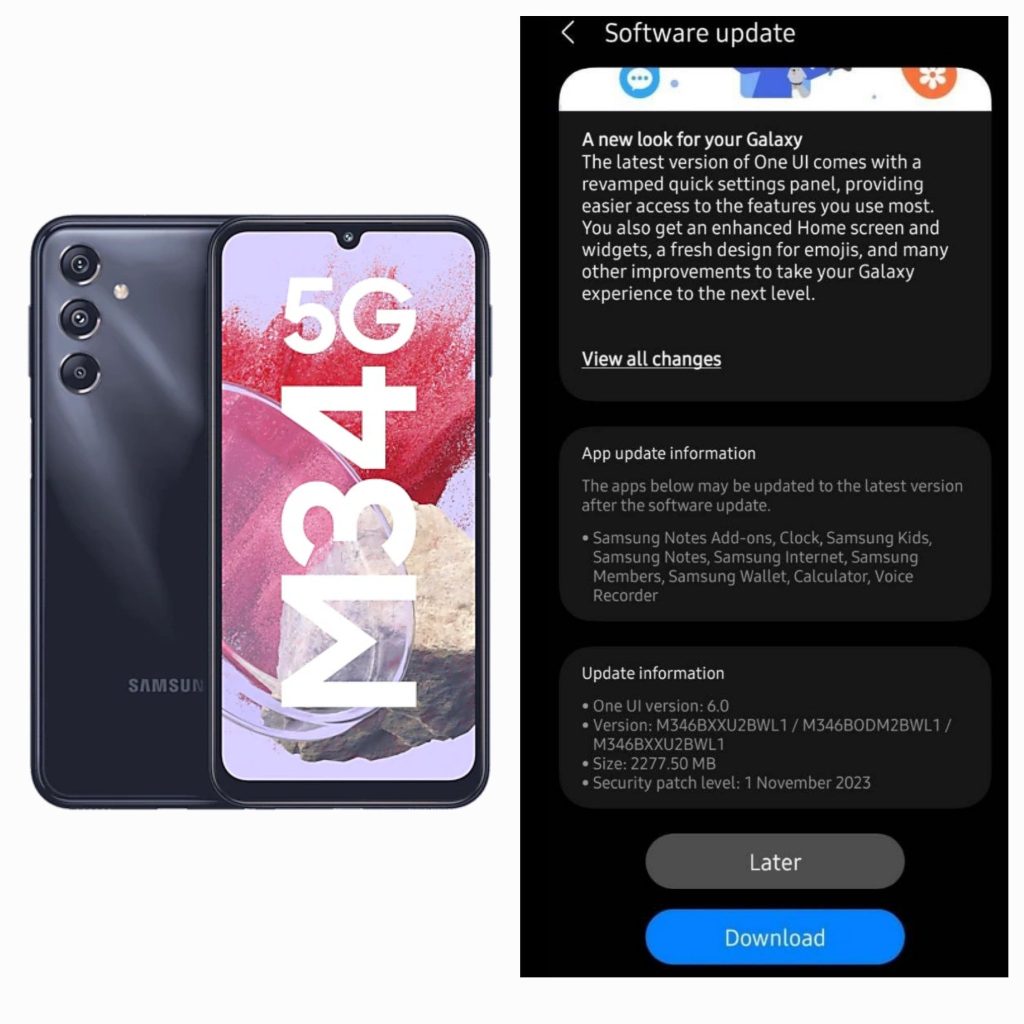
Samsung has been rapidly rolling out its OneUI 6.1-based Android 14 update to eligible devices over the last few weeks in various regions. Now, the South Korean brand is expanding the release of its latest software update to the Galaxy M-series phones. The latest device to receive the OneUI 6.0-based Android 14 is the Galaxy M34 in India that debuted in July this year. It shipped with pre-installed Android 13 out of the box.
Samsung Galaxy M34 5G gets Android 14 in India
The OneUI 6.0-based Android 14 update for the Samsung Galaxy M34 5G has firmware number M346BXXU2BWL1/M346BODM2BWL1/M346BXXU2BWL1. It includes the November 2023 security patch. The latest software version update weighs 2.27GB in size. It’s worth noting that the update is rolled out in a phased manner and it may take some time to arrive on all devices. Users of the smartphone can check for the Android 14 OS update by heading to Settings > Software Update > Check for updates > Download and Install if it’s available.
The Samsung Galaxy M34 5G is eligible for four years of OS updates. With the latest Android 14 now rolling out, the smartphone will be eligible for three more versions up to Android 17.
The OneUI 6.1-based Android 14 update is said to be the biggest from the brand. It brings a lot of changes and new features including redesigned quick settings, new customization controls, enhanced homescreen widgets, new media player, and more. For detailed changes and new features in the OneUI 6.1-based Android 14, head over to this post.
Lava has just shared a teaser for a brand-new smartphone model. The device in question is dubbed the Yuva 3 Pro, with its launch date revealed in a recent teaser trailer. But apart from the official announcement, a tipster has also revealed key details regarding the upcoming Lava Yuva 3 Pro’s specs, pricing, and design. So here are all the details.
Lava Yuva 3 Pro India Launch Date
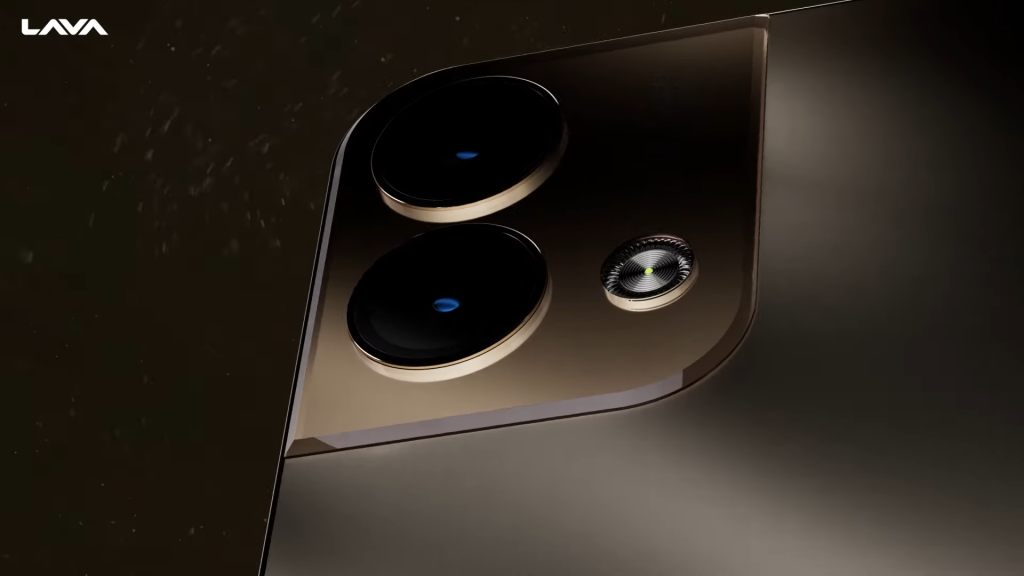
Looking at the official teaser, the Indian smartphone maker shared a video trailer on its YouTube channel. Here, we get a glimpse of the rear design and side profiles of the Yuva 3 Pro. The dual rear camera setup is highlighted as well and the device seems to come with a thin body. While finer details are not revealed in the teaser, the brand confirms that the Lava Yuva 3 Pro 4G will be announced in India on 14th December 2023. The Yuva 3 Pro is also the direct successor to the Yuva 2 Pro, which launched earlier this year.
Lava Yuva 3 Pro Design, Specs, & Pricing
Known tipster Paras Guglani also shared a tweet that showcased the design, specs, and pricing of the upcoming handset. Similar to the trailer, we can see a flat rear design and edges, while the corners are rounded. Meanwhile, the front will reportedly sport a tall 6.5-inch display that has a punch hole cutout, 90Hz refresh rate, and HD+ resolution. Under the hood, the smartphone is equipped with the UNISOC T616 SoC which is paired with 8GB of RAM and 128GB of UFS 2.2 storage.
The leak also reveals that the Yuva 3 Pro is powered by a large 5,000mAh battery pack and also supports 8GB of virtual RAM expansion. The rear features a 50-megapixel primary sensor, while the front houses an 8-megapixel selfie shooter. Other notable features include 18W fast charging, side mounted fingerprint scanner, bottom firing speakers, and Free Home service. Paras Guglani also claimed that the Lava Yuva 3 Pro received an AnTuTu score of over 280,000 points. Lastly, the budget smartphone will have a 10,999 INR price tag (roughly 132 US Dollars).
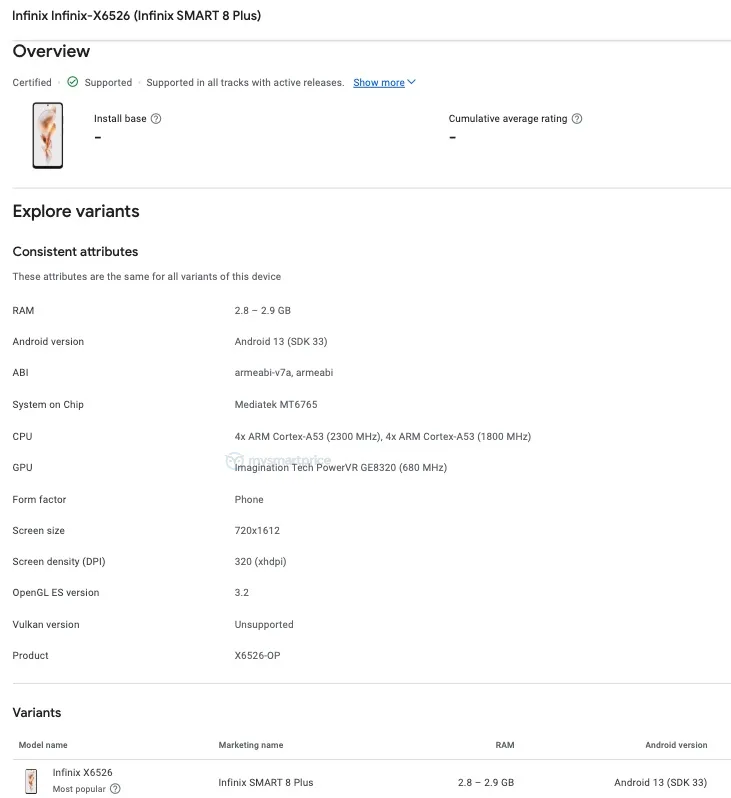
Infinix recently announced the Smart 8 HD (hands-on) smartphone in India. Now the brand is working on another device in the Smart 8 series. It is the Infinix Smart 8 Plus. The phone has been spotted on the Google Play Console certification revealing its key specifications and design. The Smart 8 Plus is listed with a model number X6526.
Infinix Smart 8 Plus Google Play Console listing
The render of the Infinix Smart 8 Plus on the Google Play Console certification reveals a center-aligned punch-hole cutout surrounded by thick bezels and a bottom chin. As per the listing, the device will be equipped with a MediaTek MT6765 processor and it comprises of four Cortex-A53 cores clocked at 2.3GHz and four Cortex-A53 cores ticking at 1.8GHz. The chipset is likely expected to be the Helio P35 under the hood. The smartphone will pack 3GB RAM and it will run on Android 13 OS out of the box.
The Google Play Console listing also reveals that the Infinix Smart 8 Plus will have a display resolution of 720 x 1,612 pixels. It will come with a screen density of 320 xhdpi. The rest of the details of the smartphone remain a mystery.
Meanwhile, the Infinix Smart 8 HD that debuted recently has a 90Hz display with a center-aligned punch-hole cutout and dynamic island-style interactive feature. It has a 13MP rear and 8MP front camera. The device is powered by a UniSoC T606 processor coupled with 3GB RAM and 64GB storage. It is backed by a 5,000mAh battery life.
Nubia‘s upcoming Z60 Ultra is just around the corner, launching on December 19th. Nubia has been building excitement through teasers showcasing the phone’s key features. And today, the company has shared a new teaser video showing the phone’s under-display camera technology.
Just like its predecessor, the Z60 Ultra continues with an under-display camera, virtually eliminating the notch for a truly immersive display-viewing experience.
The video reveals a phone that retains the squared-off design of its predecessor. But the main highlight is ZTE’s fifth-generation under-screen technology. This tech seamlessly blends the front camera beneath the phone’s display, making it practically invisible to the naked eye.
Nubia further confirmed the use of BOE’s advanced display materials and technology. The Z60 Ultra boasts BOE’s Q9+ luminescent material with a blue diamond pixel arrangement, enabling a 2.8µm ultra-large pixel size and a 400 PPI pixel density.
There’s also a dedicated UDC Ultra-independent display chip for color optimization, while the phone also supports 2160Hz PWM dimming. Rumors suggest that the Z60 Ultra will sport a 6.8-inch OLED display with a 1.5k resolution and 120Hz refresh rate.
Likewise, the smartphone will feature a triple-camera setup led by a 50MP primary lens with an 18mm focal length. There’s another 50MP lens with a 35mm focal length and a 64MP periscope telephoto lens with an 85mm focal length. All three cameras will have support for optical image stabilization (OIS).
Moreover, the Nubia Z60 Ultra is confirmed to feature the Snapdragon 8 Gen 3 chipset. The device may ship with up to 16 GB of LPDDR5x RAM and up to 1 TB of UFS 4.0 storage, The battery is expected to come in at 6000mAh battery with 80W fast charging.
In September 2023, Lenovo announced the Lenovo Tab P12, a mid-range tablet in India. It goes without saying that the massive 3K display of the tablet is one of the major selling points. In addition, the tablet comes with support for a stylus and an optional keyboard, making it a device for productivity on the go. Here is a review of what’s in store for the buyers of the P12.
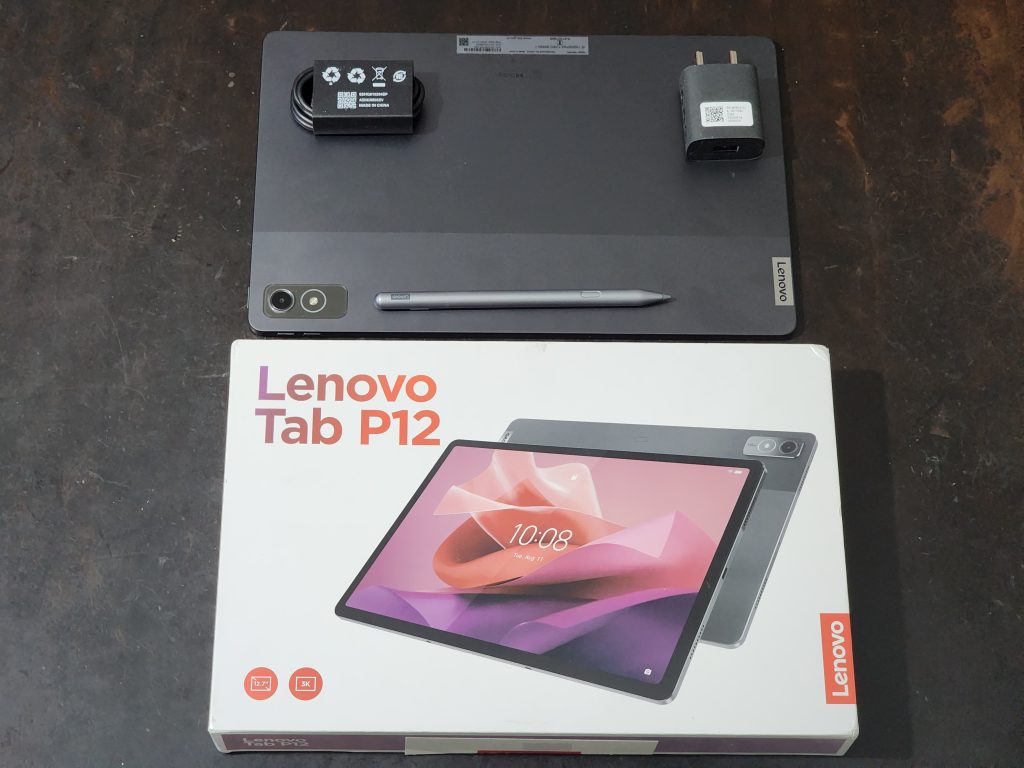
Lenovo Tab P12: What’s in the box?
The retail package of the Lenovo Tab P12 tablet includes:
Lenovo Tab P12 tablet
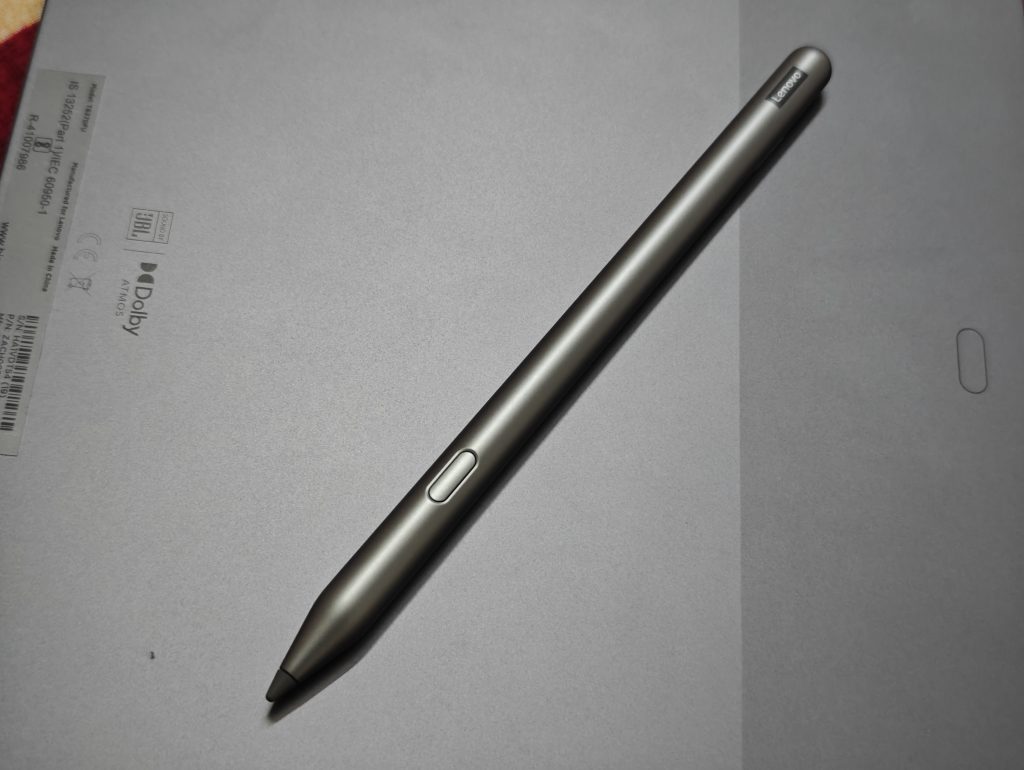
Lenovo Tab Pen Plus
20W charging adapter
USB to USB-C charging cable
MicroSD Tray Pin
Quick Start Guide
Safety Warranty
Design and Display
Dimensions
Display
Size – 190.7.51 x 293.37 x 6.85mm
12.7-inch LTPS LCD display
Weight – 615 grams
2944 x 1840 pixels (3K)
60Hz refresh rate
273ppi pixel density
400 nits brightness
96% DCI-P3 color gamut
Gorilla Glass 3
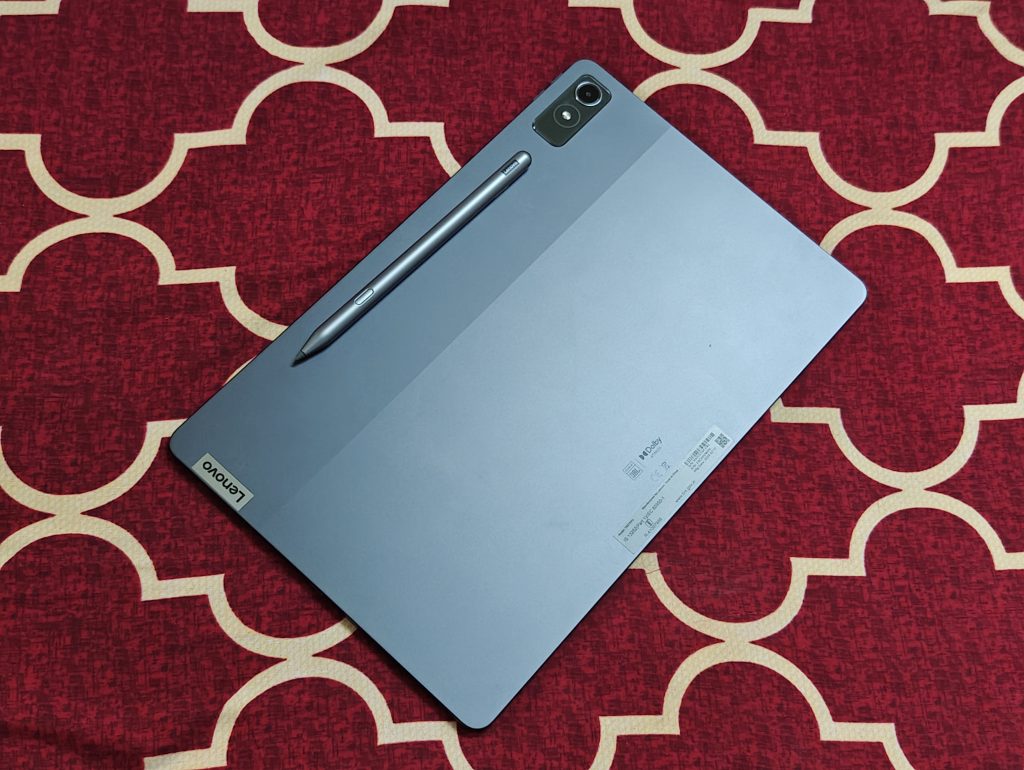
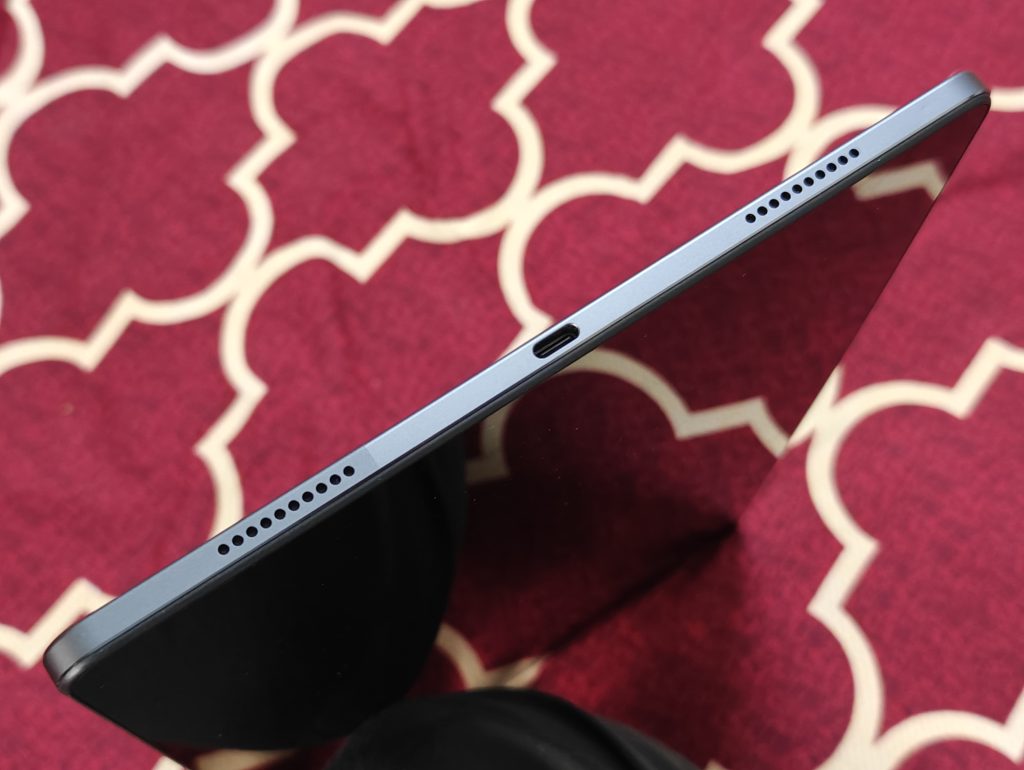
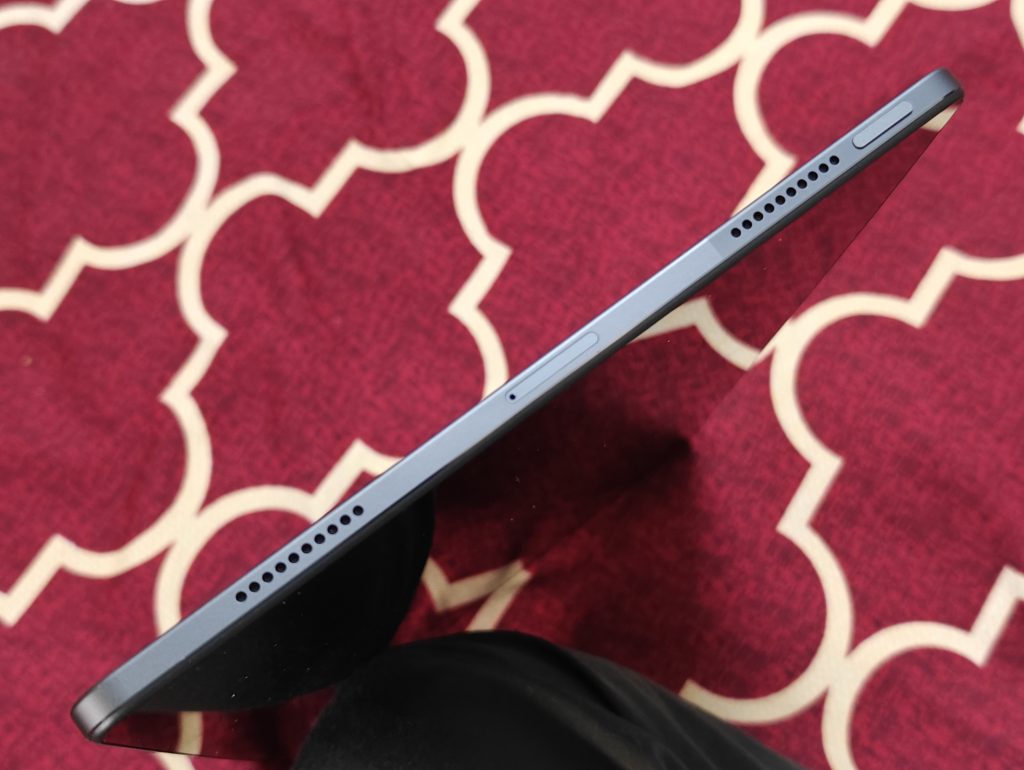
The Lenovo P12 has an aluminum build with a dual-tone design. It weighs 615 grams and has a slim profile of 6.9mm. The top edge of the device has a power key integrated with a fingerprint sensor, a pair of speakers, and a microSD card slot. Its opposite end has a USB-C port placed between two speakers.
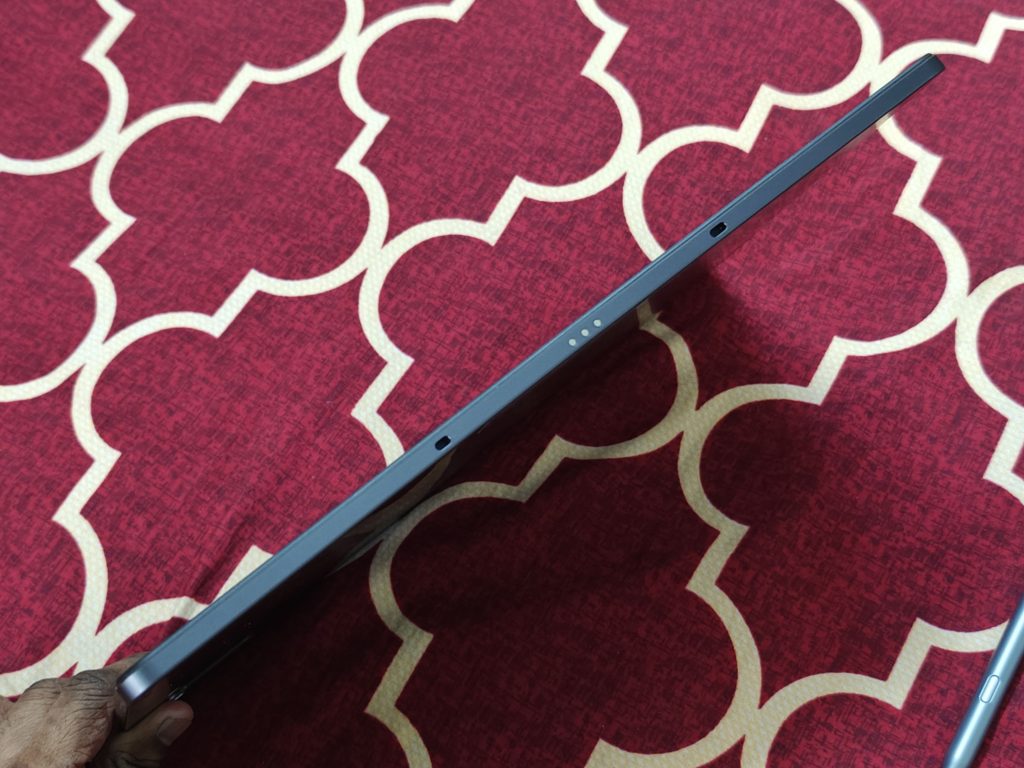
The left edge of the Lenovo Tab P12 has three contact points for attaching the optional keyboard, and its right edge has volume buttons and two microphones. The right bezel on the P12’s screen houses an ultra-wide camera, which means when the tablet is held in landscape mode, the placement is more natural, in contrast to the current iPads, where the selfie camera is placed on the top bezel. So, when the tablet is held in landscape mode and the selfie camera is used, it doesn’t appear as if we are looking off to one side.
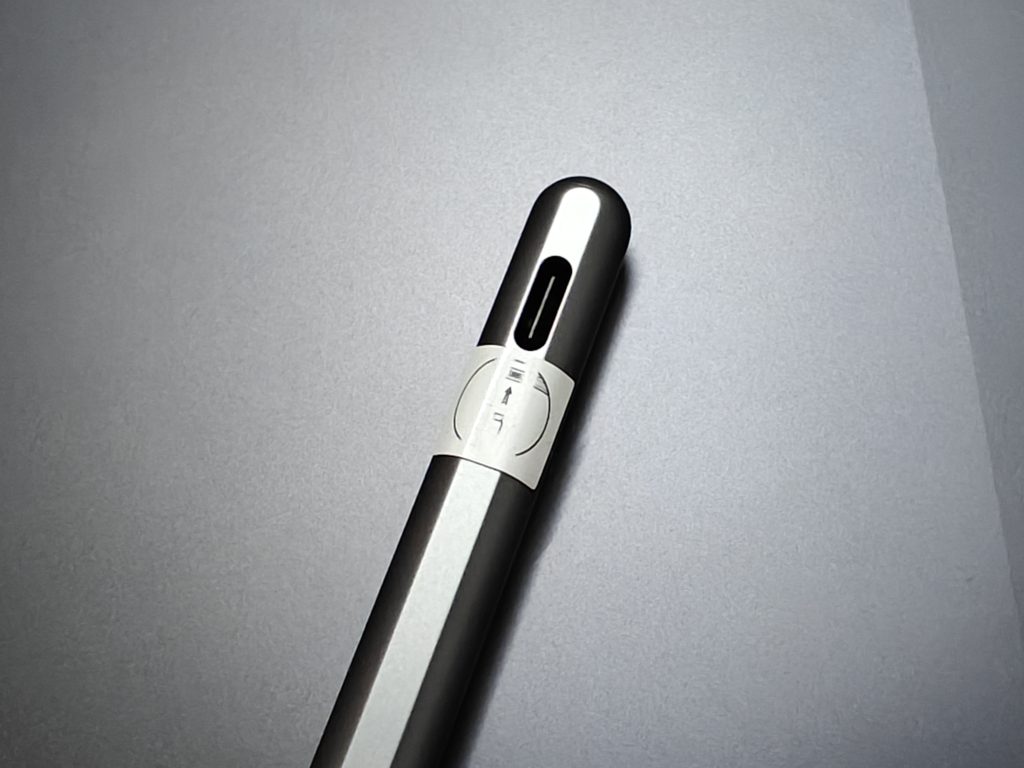
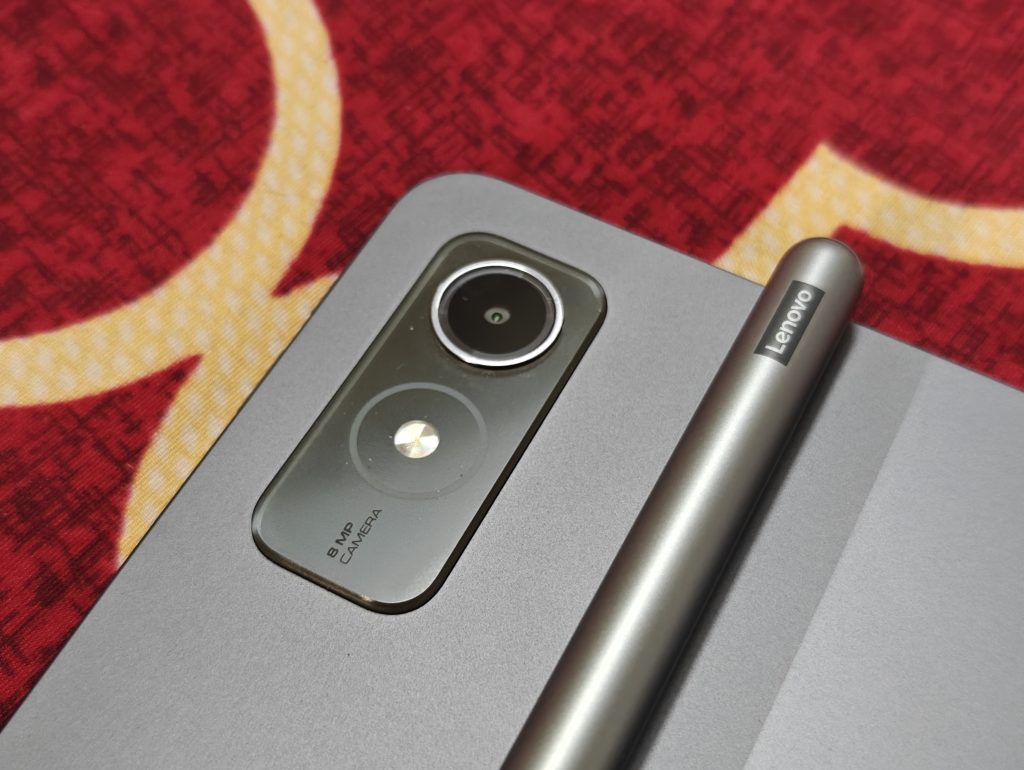
The rear panel houses a single camera with an LED flash. It is followed by a connection point where users can attach Lenovo’s stylus. The right edge, where the keyboard can be connected, can also be used to attach the stylus. However, it’s important to note that neither the connection point on the rear panel nor the one on the right edge for the keyboard/stylus attachment serves as a charging port for the stylus. Speaking of the stylus, it has a dedicated USB-C port onboard for charging.
The 12.7-inch LCD panel of the Lenovo Tab P12 offers a 3K resolution of 2944 x 1840 pixels and a 60Hz refresh rate. There’s support for Widevine L1, which means it can stream HD content from Netflix. The quad-speaker system with Dolby Atmos support product offers an impressive audio experience, and the massive screen makes it a very good device for binge-watching. In addition, it can be used for screen sharing via Miracast. The screen comes with Gorilla Glass 3 protection.
Performance and Software
MediaTek Dimensity 7050
10,200mAh battery
8GB of LPDDR4x RAM
45W charging
256GB of UFS 3.1storage
Android 13 OS, ZUI 15
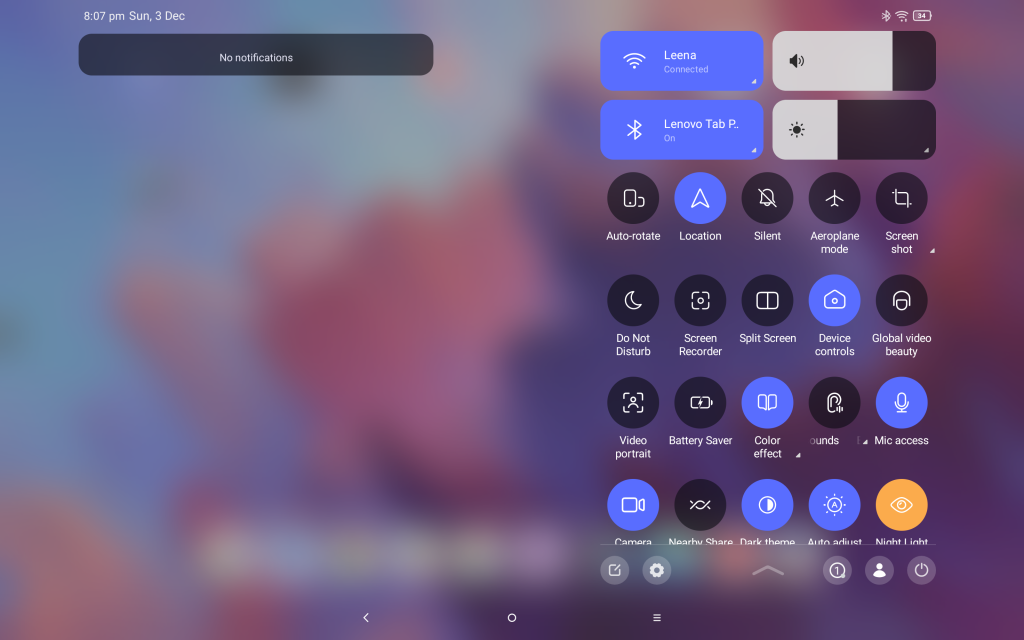
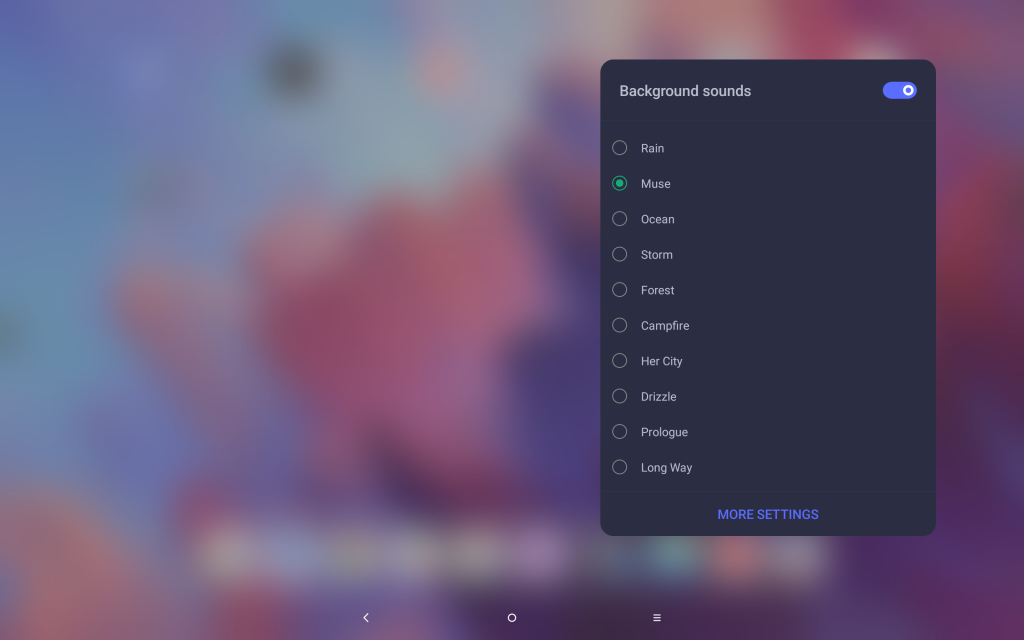
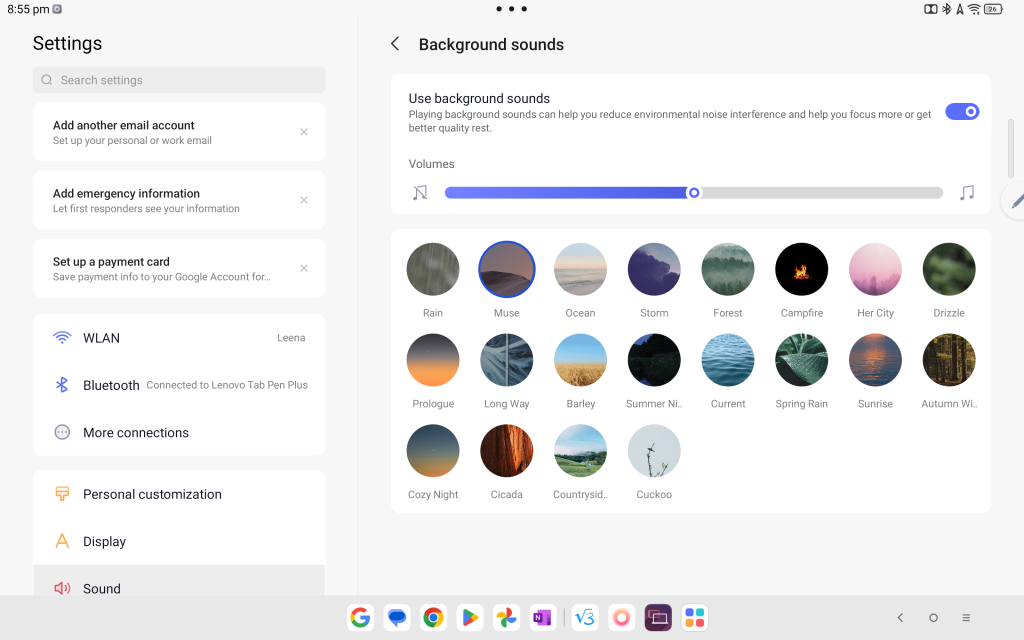
Control CentreBackground Music available via Control CentreBackground Soundshome screen
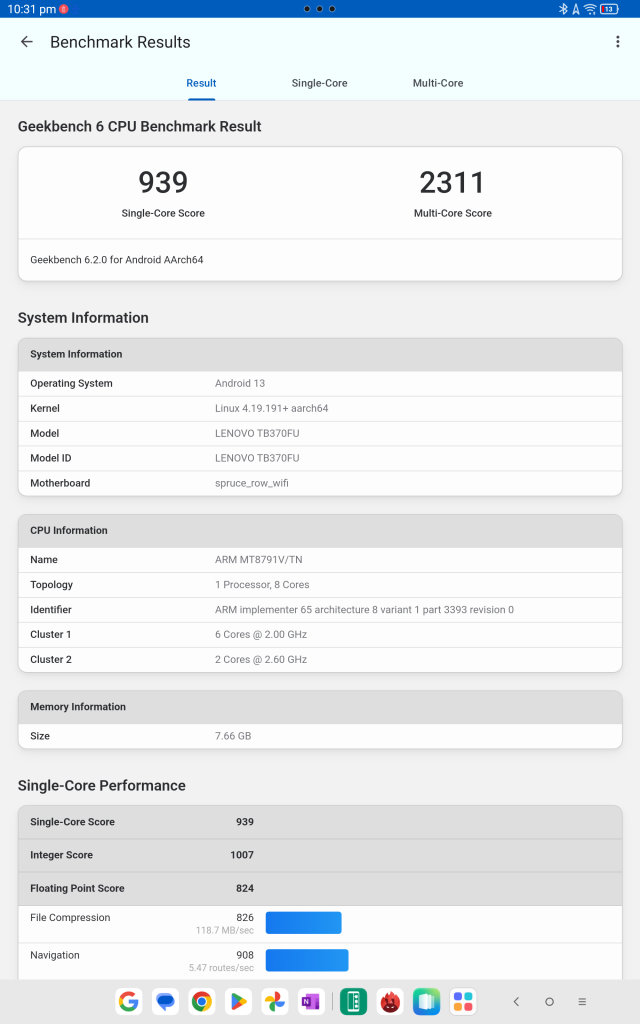
The Lenovo Tab P12 comes preloaded with Android 13, which has Lenovo’s ZUI 15 user interface on top. It is confirmed to receive up to an Android 16 OS upgrade and four years of security updates. The tablet has the Dimensity 7050 processor, which is also used in smartphones like the Oppo Reno 10, Realme 11 Pro series, Lava Agni 2, and Realme Narzo 60 Pro. The device comes with 8 GB of RAM and 256 GB of built-in storage, providing a smooth user experience. It is a 5G-capable chip, but the tablet lacks support for SIM slots.
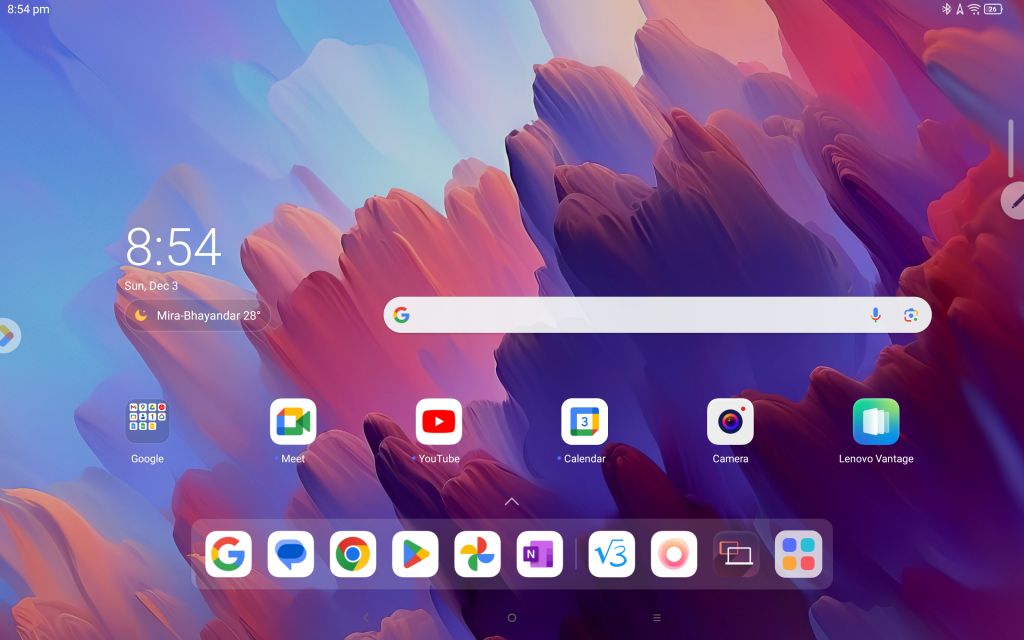
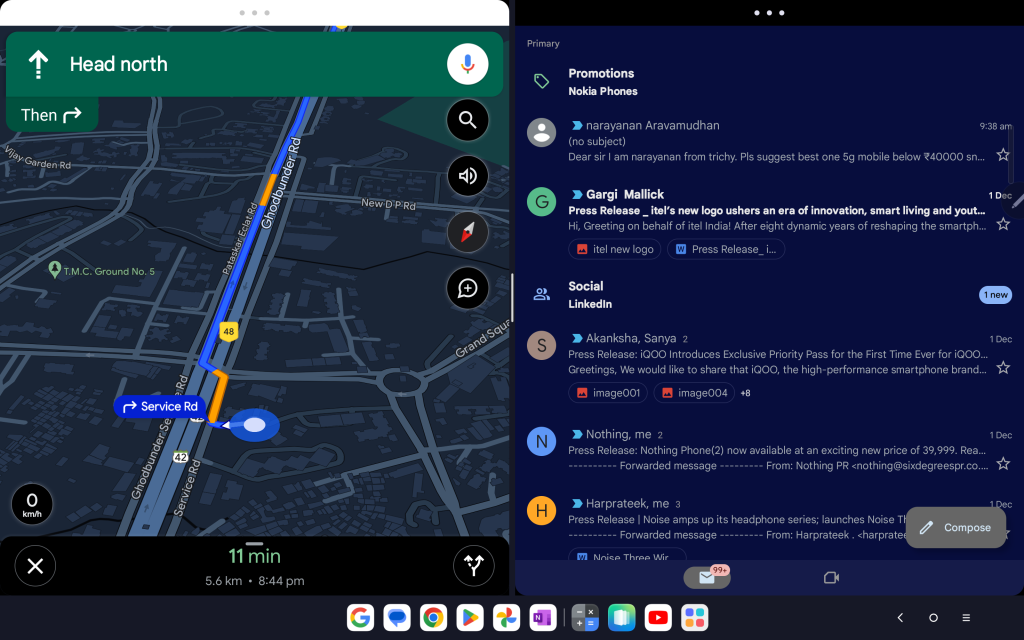
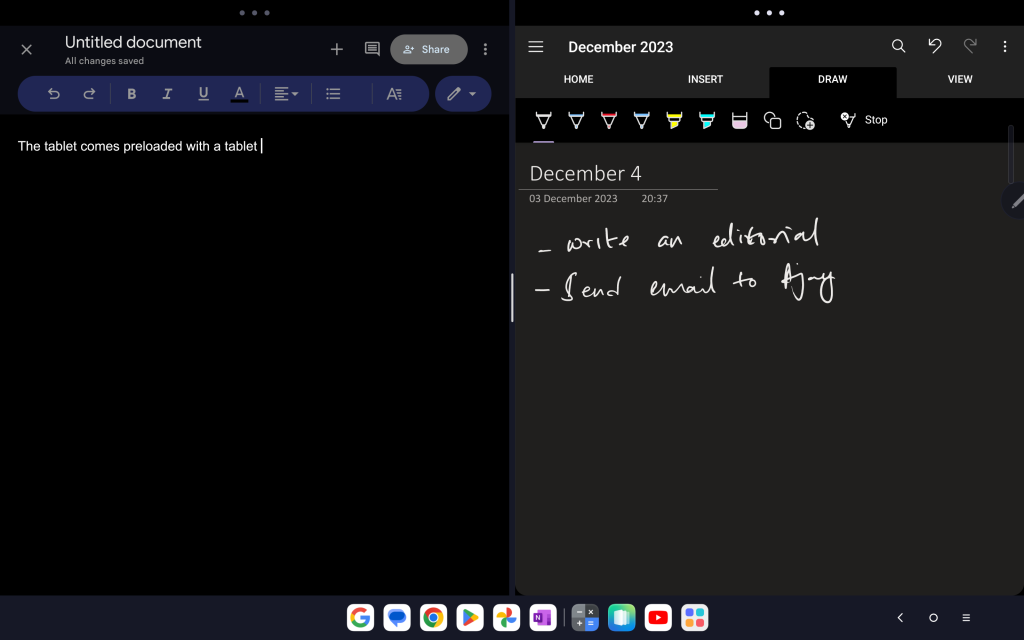
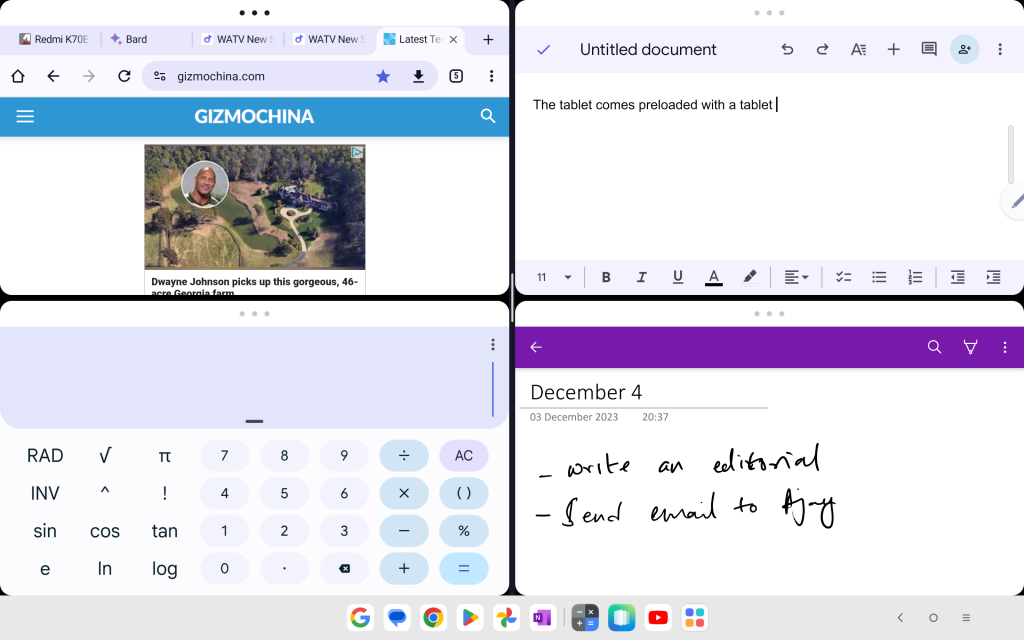
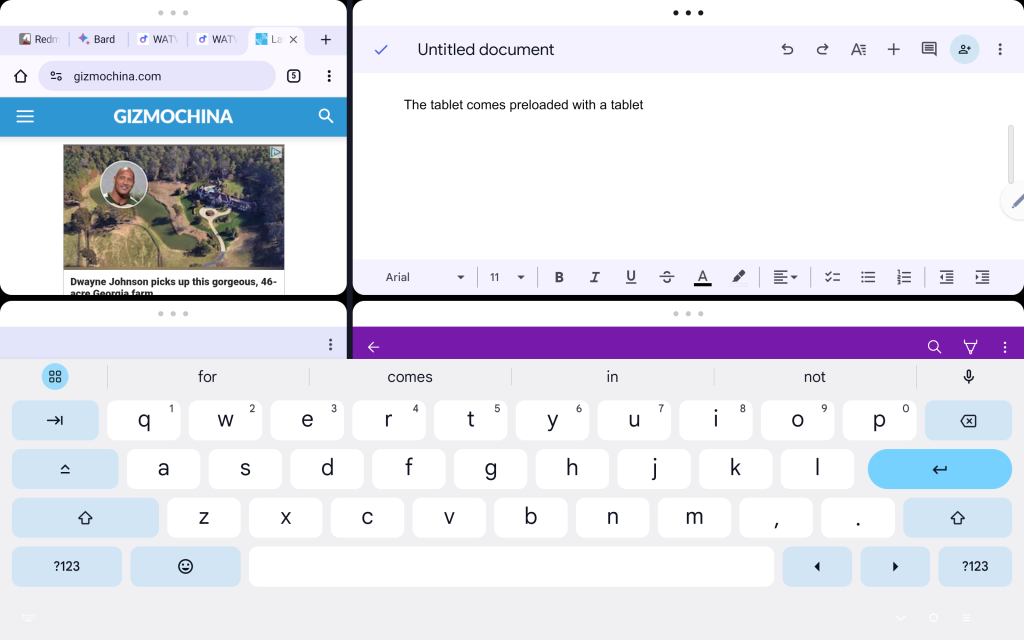
Coming to the software side of the tablet, the user interface offers users an app bar, which shows six apps, three frequently used apps, and an app drawer. When an app is opened, the three-dot menu that shows on top offers options such as full screen, floating windows, split screen, and minimize. In split-screen mode, users can open four apps on the same screen. As can be seen in the fifth image, the size of the left and right panes can be increased or reduced.
Split-screen optionsSplit-screen Split-screen Four apps in one screen equally dividedfour apps in one scene
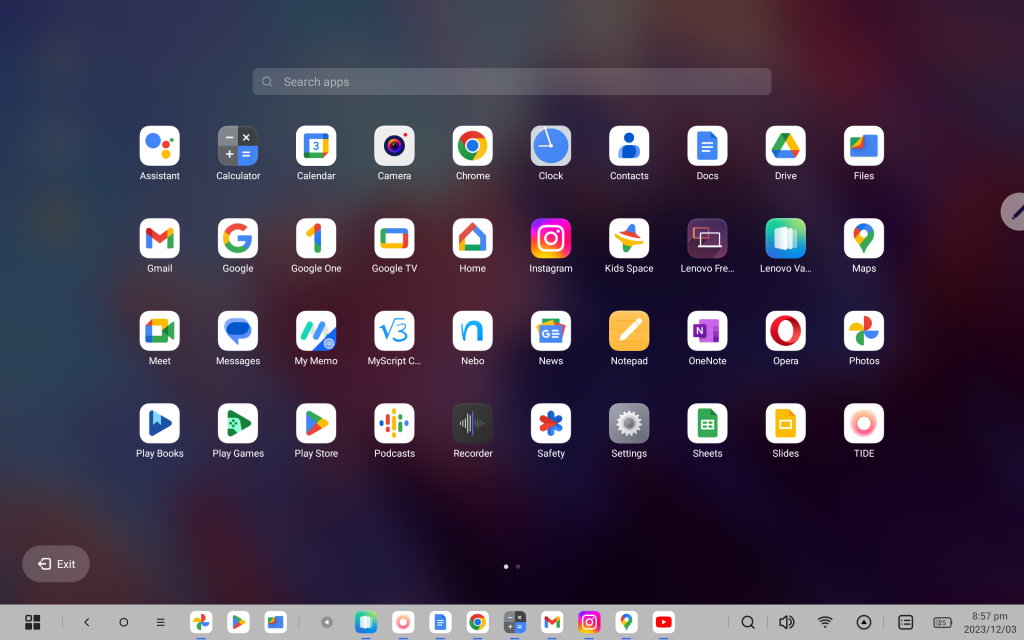
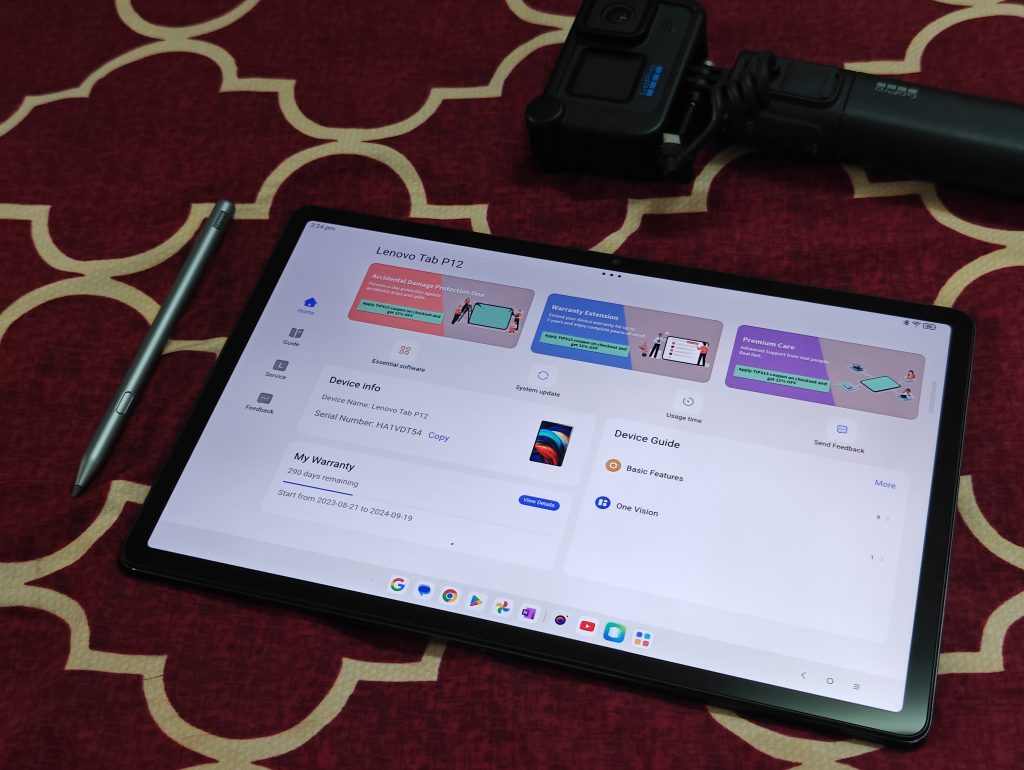
When it comes to preinstalled apps, the Lenovo Tab P12 comes with a handful of Google apps, WPS, and Lenovo’s apps, such as FreeStyle (for connecting and sharing across devices), Vantage (for device info, manual, warranty, etc), MyScript Calculator 2 (handwriting-based calculator), and Nebo (for note-making and drawing).
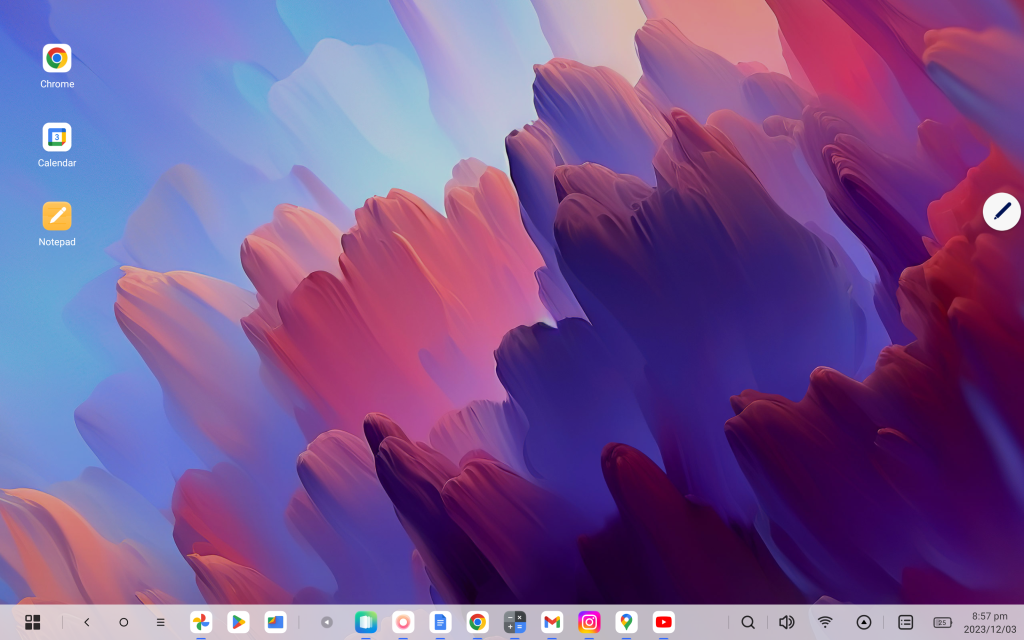
The Lenovo Tab P12 also allows users to create multiple user profiles, and there is a dedicated Kids Space for children-friendly content. In addition, there is a Reading Mode, Background Music with several soothing music options to choose from, and Productivity mode. The latter activates on its own when a keyboard is attached, and even the Tab Plus Pen is attached to the right side of the table’s bottom (when held in horizontal orientation). The Productivity Mode offers a desktop PC-like user interface for a better productivity experience. Since the review unit did not include a keyboard, I am not sure how the experience went, but it should be fine, I believe.
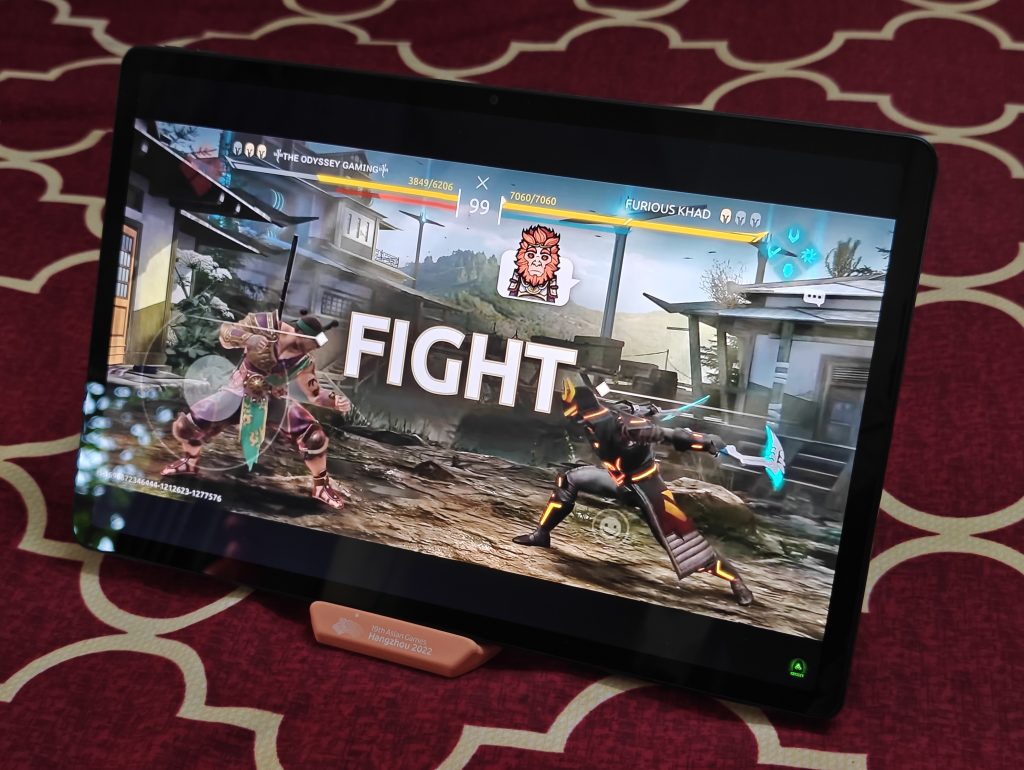
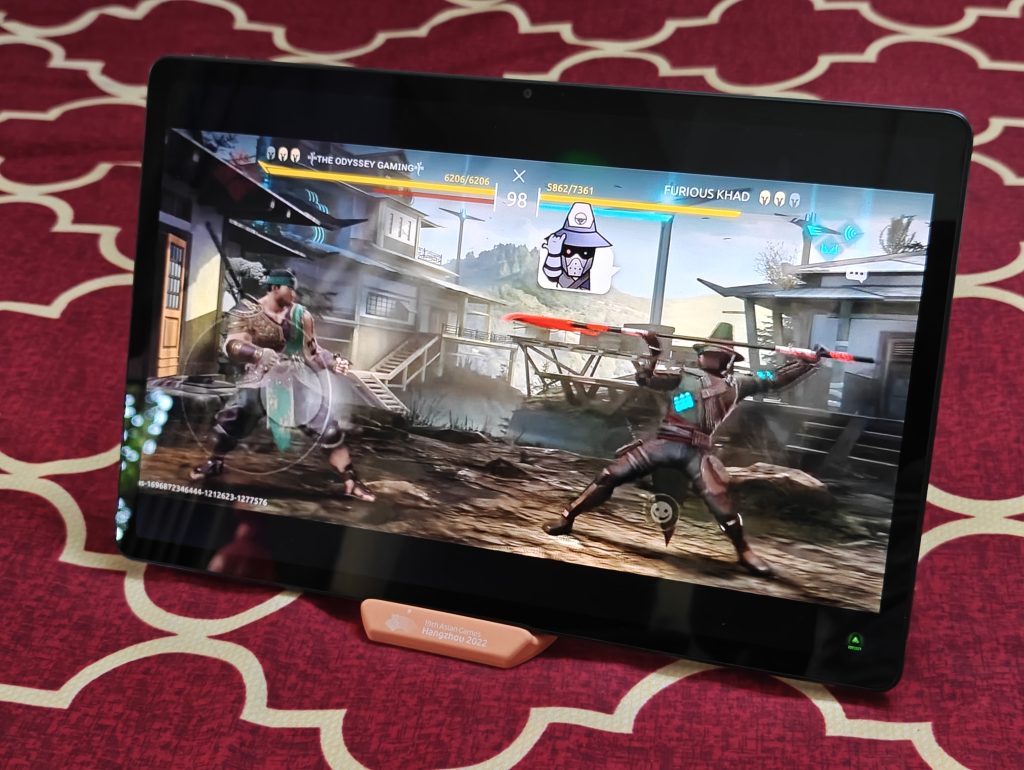
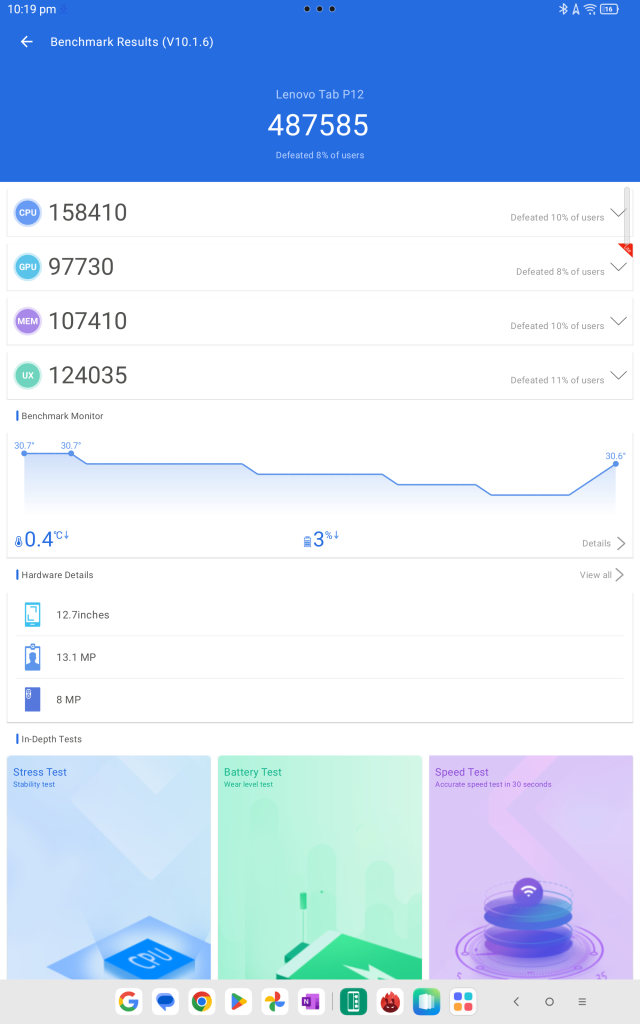
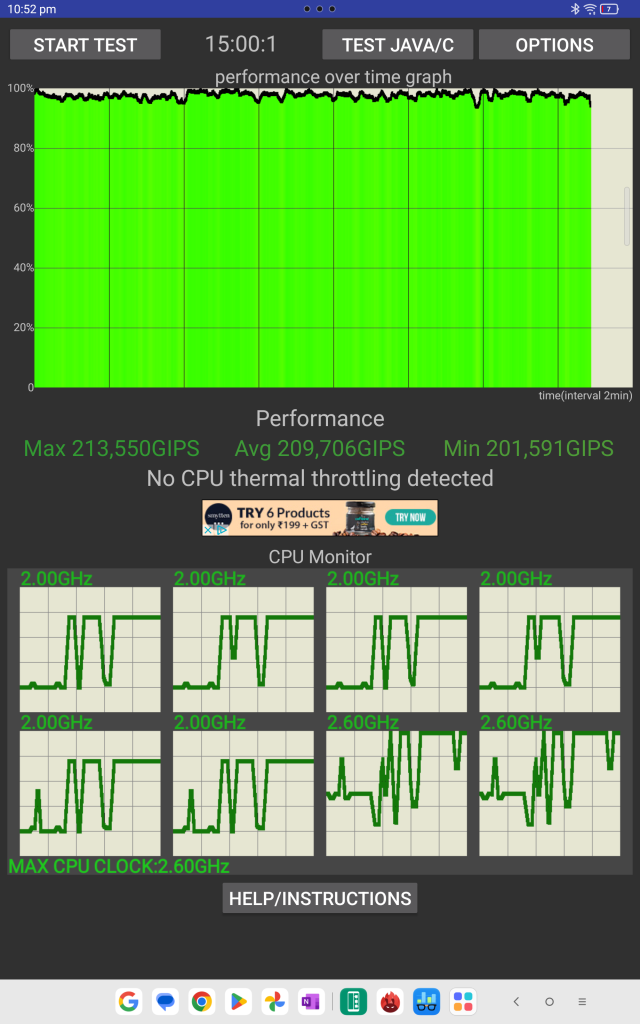
When it comes to gaming, the Lenovo Tab P12’s big size makes it a bit unwieldy to play games. The device is good enough for casual gaming. The P12 has a 10,200mAh battery that supports 45W fast charging. However, the retail package includes a 20W charger. It takes slightly over 2 hours to fully charge the device. Once charged, it can last for around 7 to 8 hours with continuous usage, including work and binge-watching. Here is how it performed on benchmark apps:
Photography and Other Features
Rear Camera
Other features
13MP main camera with LED flash
Side-mounted fingerprint scanner
Face unlock
Front Camera
Wi-Fi 802.11ax
8MP
Bluetooth 5.1
JBL quad stereo speakers with Dolby Atmos
Lenovo Tab P12 specsLenovo Tab P12 front cameraLenovo Tab P12 rear camera
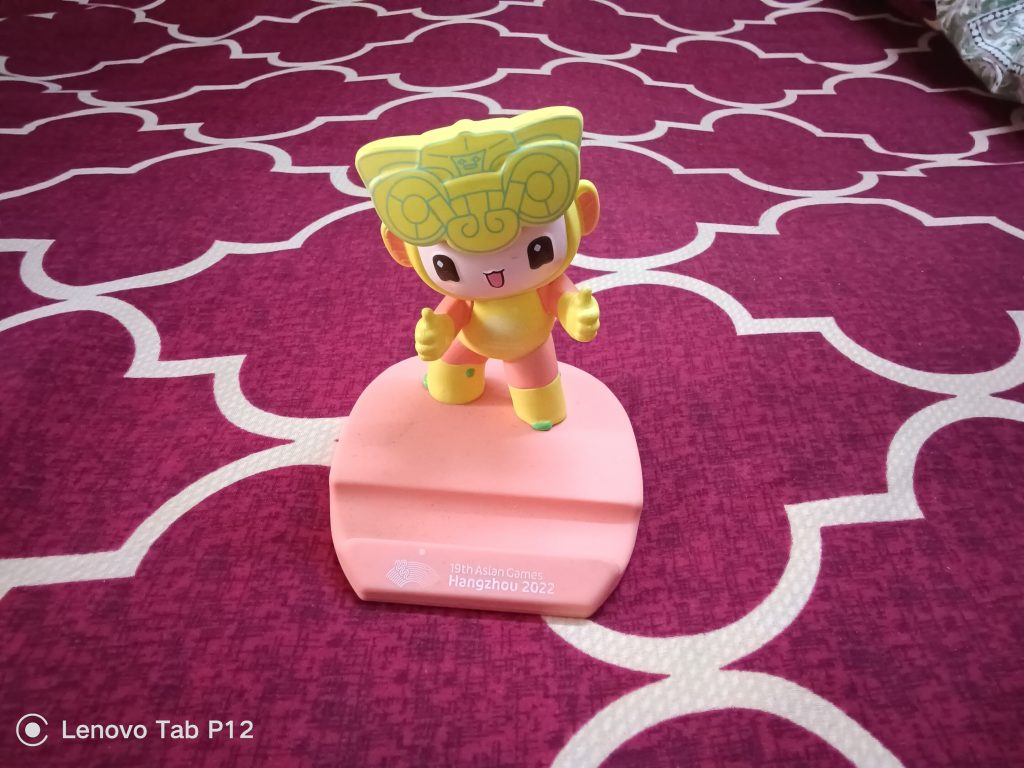
On the front, the Lenovo Tab P12 has a 13-megapixel ultra-wide camera that is good enough for video calls and snaps with good lighting. It can shoot up to 4K 30fps video footage. The back panel of the P12 features an autofocus-enabled 8-megapixel camera that supports up to FHD videos at 30fps. Again, the rear camera can shoot usable snaps only when there is sufficient lighting.
front camera
In terms of connectivity, the Lenovo Tab P12 supports Wi-Fi 802.11ac and Bluetooth 5.2. Additionally, it includes practical connectivity features like face unlock and a side-facing fingerprint sensor, both of which perform reliably.
Verdict
The Lenovo Tab P12 stands out with its massive 3K display, good battery life, and stylus compatibility, making it a compelling option for binge-watchers and productivity seekers. Its quad-speaker system with Dolby Atmos support delivers an immersive audio experience, and the optional keyboard turns it into a decent productivity tool. Another important factor to consider about the Tab P12 is that it comes with longer software support as compared to many other tablets that receive only one or no update at all.
While it is not ideal for demanding games due to its size and processor, it handles casual gaming well. However, the lack of 5G support and a 120Hz refresh rate feel like missed opportunities, and the camera performance could be better. Overall, the Lenovo Tab P12 offers a good value proposition for those seeking a large-screen entertainment and productivity tablet, but it is not without a few ignorable shortcomings.
Price and availability
The Lenovo Tab P12 is listed in two variants on Amazon. The 8GB+128GB and 8GB+256GB variants are priced at Rs 26,999 (~$323) and Rs 28,999 (~$347), respectively. Flipkart is selling only the 8GB+256GB variant. It comes in two shades: Oat and Storm Grey.
Buyers looking forward to purchasing the P12 may also consider some other options. The Xiaomi Pad 6 (8GB+256GB) launched earlier this year is available for Rs 26,999. Those looking for 5G-ready options can look at options like the Lenovo Tab M10 5G and the Samsung Galaxy Tab A9 Plus (both powered by the less powerful Snapdragon 695) that are priced at Rs 24,999 (~$299) and Rs 26,999, respectively.
Disclaimer: All of the opinions in this Lenovo Tab P12 review post are mine and based on my own experiences. There has been no editorial input from Lenovo.
Honor is gearing up for the much-anticipated release of its Magic 6 series devices. Following the 3C certification received by the Honor Magic 6 (code-named BVL-AN00) last month, the Magic 6 Pro, identified as BVL-AN16, has also successfully passed the 3C certification. This confirmation highlights its support for satellite connectivity.
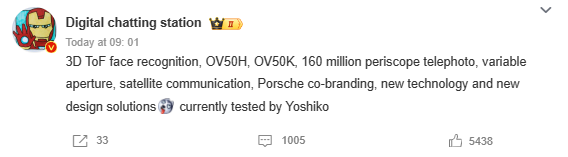
DCS sheds light on a 1″ OV50K main sensor, 3D ToF face recognition, variable aperture, and more
In addition to the 3C certification details, there are now rumors circulating about the specifications of the Magic 6 Pro, courtesy of DCS. These speculations shed light on the device’s advanced technologies, including 3D Time-of-Flight (ToF) face recognition inside the pill-shaped cutout in the middle, OV50H/OV50K image sensors, an impressive 160-megapixel periscope telephoto lens, and variable aperture capabilities. Excitingly, there are rumors of a design collaboration with Porsche.
The mentioned OV50K is a 1-inch camera sensor from OmniVision, signaling an upgrade in the camera system compared to its predecessor, the Honor Magic 5 Pro. The latter featured a 1/1.12-inch main sensor. For the front camera, the same 12-megapixel selfie is expected.
While specific configurations are still under wraps, tech enthusiasts can draw parallels with the Huawei Mate60 series, which supports features like 3D ToF face recognition and variable aperture.
Looking at the predecessor, the Honor Magic 5 Pro, equipped with the Snapdragon 8 Gen 2 processor, it’s reasonable to expect the Honor Magic 6 Pro to feature the latest Snapdragon 8 Gen 3 SoC. The Magic 5 Pro boasted a 6.81-inch quad-curved display panel with a peak brightness of 1,800 nits and a 120Hz LTPO refresh rate. Additionally, it featured a robust 5,450mAh (typical) battery, supporting 66W wired fast charging and 50W wireless charging. Notably, the 3C certification has now confirmed 100W charging support for the Honor Magic 6 Pro.
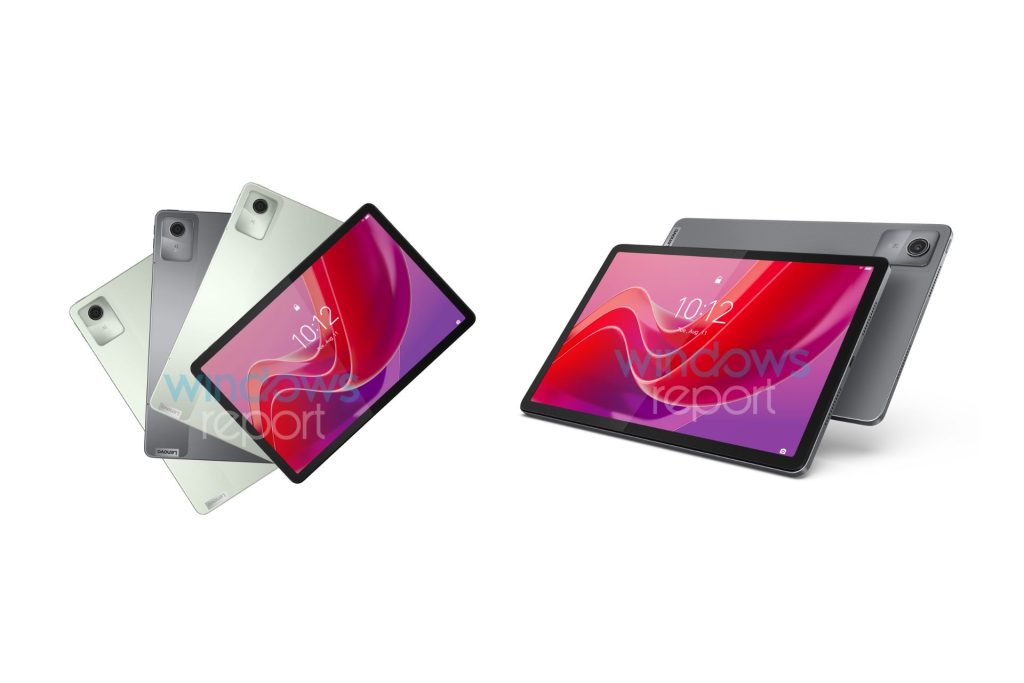
Lenovo has a new lower mid-range tablet launch on the horizon called the Lenovo Tab M11. We already know what it looks like, as well as the majority of its specs thanks to a previous leak. The only remaining mysteries are the price tag and the launch date.
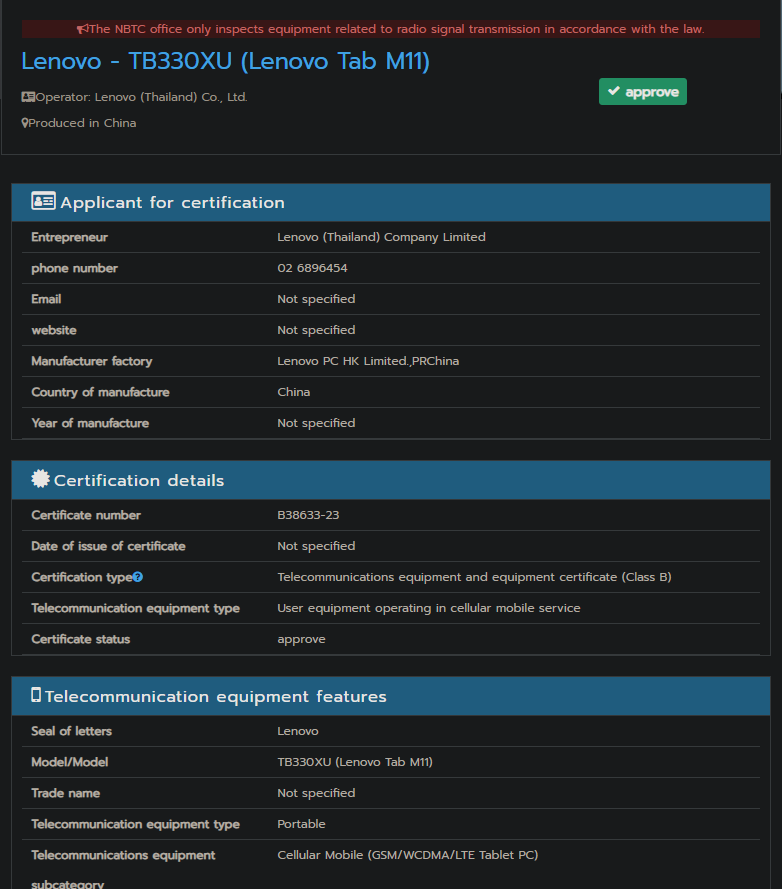
That being said, the tablet has just picked up the NBTC certification, indicating that the global launch might be near. The certification confirms the Lenovo Tab M11 moniker of the device with model number “TB330XU”. It also confirms that the device will have 4G, 3G, and 2G network support. In addition to that, it greenlights the tablet for launch in Thailand. Here’s what else we know about the tablet so far.
Lenovo Tab M11 specs:
The specifications that were leaked earlier, now nearly confirmed by a Google Play Console listing, indicate that the tablet will come equipped with an 11-inch LCD display boasting a resolution of 1920×1200. Powering the device is a MediaTek Helio G88 processor, complemented by three storage configurations: 4GB RAM/64GB, 4GB RAM/128GB, and 8GB/128GB. Additionally, the tablet will support storage expansion of up to 1TB via a microSD card.
In addition to LTE, the tablet will also offer 2.4GHz and 5GHz Wi-Fi for connectivity and will come with Android 13-based ZUI 15.1.028 out of the box. The tablet has also picked up certifications in the UAE and the US, so we can expect it to launch in these regions soon.
In related news, Lenovo recently started selling the Legion Go handheld gaming console in the global market. There are a bunch of features that make this handheld stand out from the crowd, however, one of the main ones is the inclusion of Hall Effect joysticks, which eliminate the chances of stick drift, a major issue commonly encountered in handheld gaming consoles and controllers.
Samsung is quite determined to bring artificial intelligence technologies to our smartphones. The company, which has been struggling in flagship sales for a while and has obtained most of its market share from entry to mid-range models, believes that this technology will change the situation. In this direction, we recently heard about some features such as a more capable voice assistant. Now, some features that Samsung will introduce with the One UI 6.1 update have leaked. Here are the details…
Samsung’s Upcoming Pixel-Inspired AI Features in One UI 6.1 Update
Samsung’s One UI 6.1 update is expected to launch alongside the Galaxy S24 series. However, this new version includes more than just UI design changes and improvements. The company will update users with AI features that will enhance the harmony between the phone and the user, providing a personalized experience. In fact, these features are not entirely new; according to tipster Benit Bruhner, the Korean manufacturer has drawn plenty of inspiration from the artificial intelligence features recently introduced by Google in its Pixel models.
The One UI 6.1 update brings several noteworthy features:
AI-generated Wallpapers: Craft personalized wallpapers tailored to your preferences, similar to the functionality offered by Pixel 8.
Object Relocation and Photo Expansion: Edit photos by moving or removing objects, and expand backgrounds beyond their original boundaries.
Subject Transfer Between Photos: Seamlessly transfer subjects from one image to another for creative photo editing.
Smarter Samsung Notes: Enjoy enhanced note-taking with the ability to auto-format large text blocks into well-organized bullet points.
Live Translation for Calls: Effortlessly communicate across languages during phone calls with real-time translation.
Clearer Calls with Voice Focus: Improve call quality by eliminating background noise, a feature reminiscent of Pixel’s Clear Calling functionality.
Of course, all the new features that the One UI 6.1 update will bring may not be limited to these. However, we have no choice but to wait until the Unpacked event in January to see more.
Amid declining smartphone sales globally, Xiaomi in China has once again proved its prowess on its home turf. According to BCI, Xiaomi and its sub-brands, like Redmi, remained top sellers in November 2023. The company registered around 5.2 million smartphones in the last month alone. It registered 44% growth on a year-on-year basis and enabled the electronics maker to garner an additional market share in China.
Xiaomi stood in the second position in terms of sales in November 2023 in China. However, in a premium market segment, Xiaomi registered 11.8% growth on a YoY basis. Overall, Xiaomi has 18.3% of the total smartphone market share, consisting of sales from its subsidiaries. Meanwhile, Apple remained at the top, while Honor grabbed around 4 million smartphone sales, an increase of 12.6% on a YoY basis.
According to BCI in November 2023, we were a top performer in the Chinese market with 5.2+ million activations, and huge growth in the high-end segment. pic.twitter.com/vJjvHnGlOW
Especially in Week 48 of the Year, aka in the last few days of November, Xiaomi even surpassed Apple with 78.2K shipments in comparison with Apple’s 78.9. Still, there’s a significant gap between Apple and Xiaomi sales if we compare the whole month, but Xiaomi seems to be catching up quite rapidly.
However, Huawei and Vivo stood for the fourth and fifth positions. Huawei also garnered an exceptional 74% growth in comparison with the previous year. However, sales for Vivo declined, while those for the OnePlus and Realme also remained negative.
Most of the brands had a busy last month due to Double Eleven sales in China. We hope the momentum continues this month too, as the festive season remains along with discounts.
In conclusion, Xiaomi’s robust performance in the Chinese smartphone market during November 2023 underscores its resilience and effectiveness in navigating challenging industry conditions. Despite a global dip in smartphone sales, Xiaomi and its sub-brands, notably Redmi, showcased impressive strength within their home market. Xiaomi’s sustained momentum positions the company favorably for continued success in the fiercely competitive Chinese smartphone market.
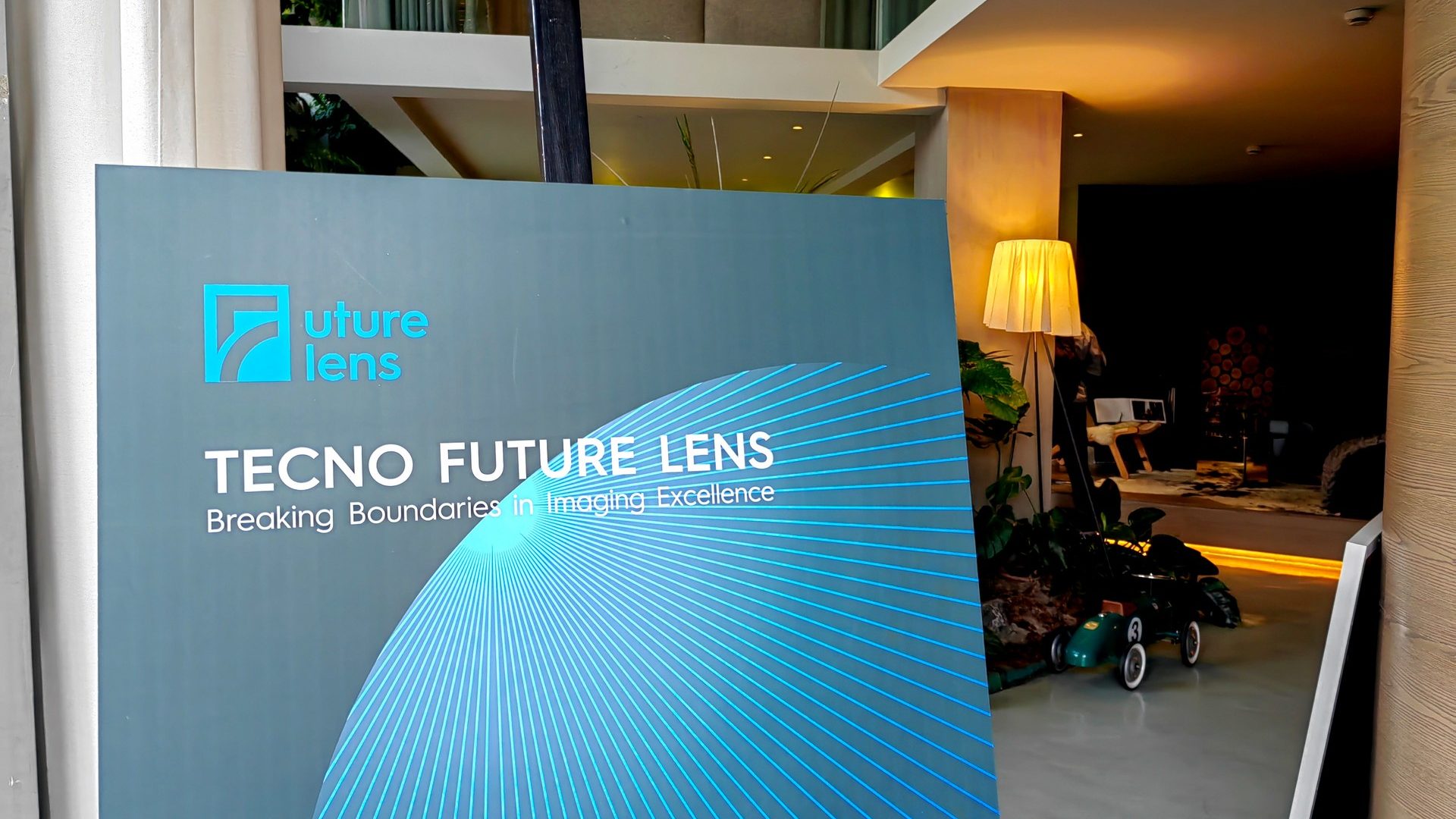
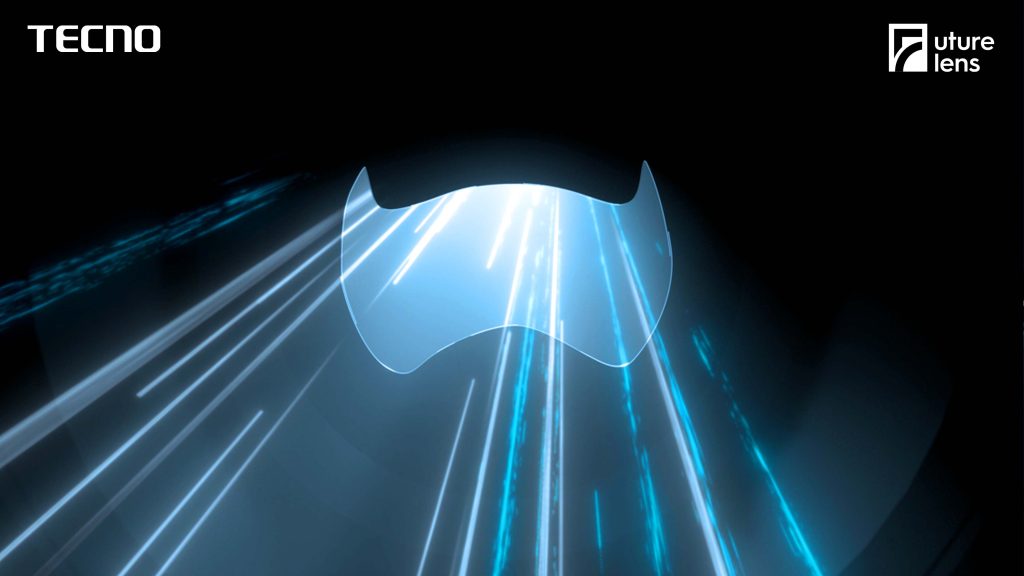
The Future Lens 2023 Event in Shanghai marked a significant milestone for TECNO as they unveiled 3 cutting-edge technologies in smartphone photography, includingW-shaped Variable Aperture, Liquid Telephoto Macro lens, and Universal Tone for human skins. The combination of these advances not only aims to improve the image quality of a single lens but also has the potential to revolutionize the bloated capture experience of smartphone image systems.
Tecno Future Lens Event 2023
Tecno is probably the most special industry leader among Chinese smartphone brands. Its legacy began with the myths it created in Africa, and has been continuing in the past few years, bringing more affordable hardware and software innovations to the global market for wider users.
As someone still keeping an eye on the mobile industry, I’ve realized that some sort of ‘keep on innovating’ is more of a marketing slogan among brands. But The future lens event showed me that Tecno is still on this path, investing in tech innovation about mobile photography. These new technologies make me even more excited to see what Tecno has in store for mobile photography in 2024.
Revolutionary W-Shaped Adjustable Aperture:
This patented technology is a game-changer in managing challenging lighting conditions. It uses the W shape of a cuttlefish’s eye as a template, shifting in aperture size to work better in various lit environments. By allowing manual adjustment of the aperture, it empowers photographers to handle backlight situations with ease, resulting in images that are not just clearer, but also richer in detail and color. This innovation reflects TECNO’s commitment to solving real-world photography problems.
W-SHAPED Variable Physical Aperture – An image shared by Tecno
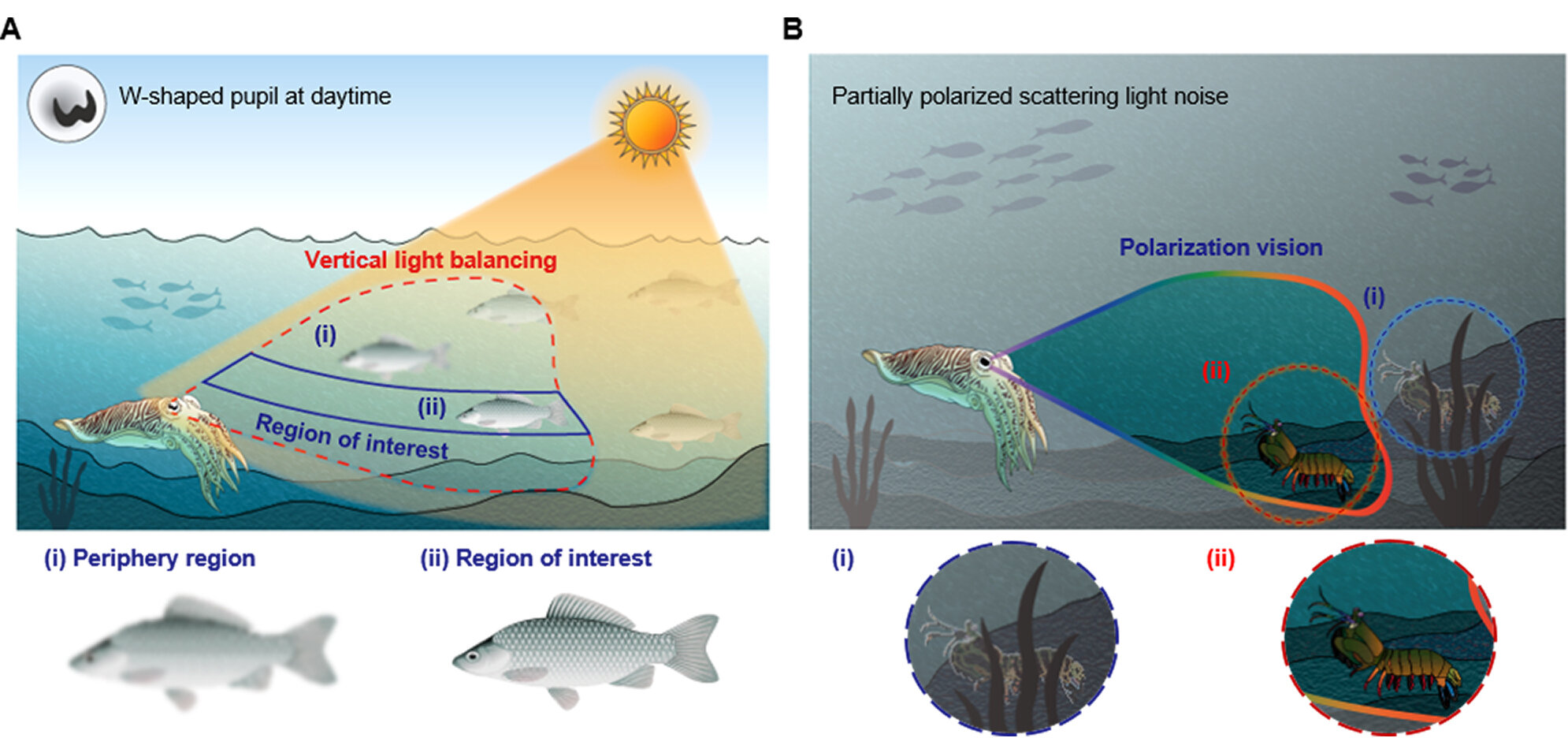
As the first new technologies to be revealed at this event, it did impress me. What I’m surprised about is that the particular bionic shape doesn’t have any precedent for application within the industry. It’s even more of a bold attempt in the human industrial history of visual capture. Prior research has shown that the W-shape helps them to balance out the uneven light levels in their habitat. Cuttlefish live in shallow water with a lot of light at the top of their vision, but it gets dimmer quickly further down.
Eye of the Common Cuttlefish, Sepia officinalis. From Wikipedia.
As a result, they need to deal with a fairly wide range of light intensities at the same time. The combination of horizontal and vertical oriented slits in the pupil brings an overall more even level of illumination across the retina, reducing the contrast between the brightest and darkest parts of the scene.
Optical features of cuttlefish living in the underwater environment. [Image: Kim et al., Sci. Robot. 8, eade4698 (2023)]
More research is already underway, and something like the new bionic ROBOT could be the best vehicle for this. But soon, you may be able to experience the accurate capture of complex lighting on Tecno phones with the bionic variable aperture.
Liquid Telephoto Macro Lens – A Compact Tech:
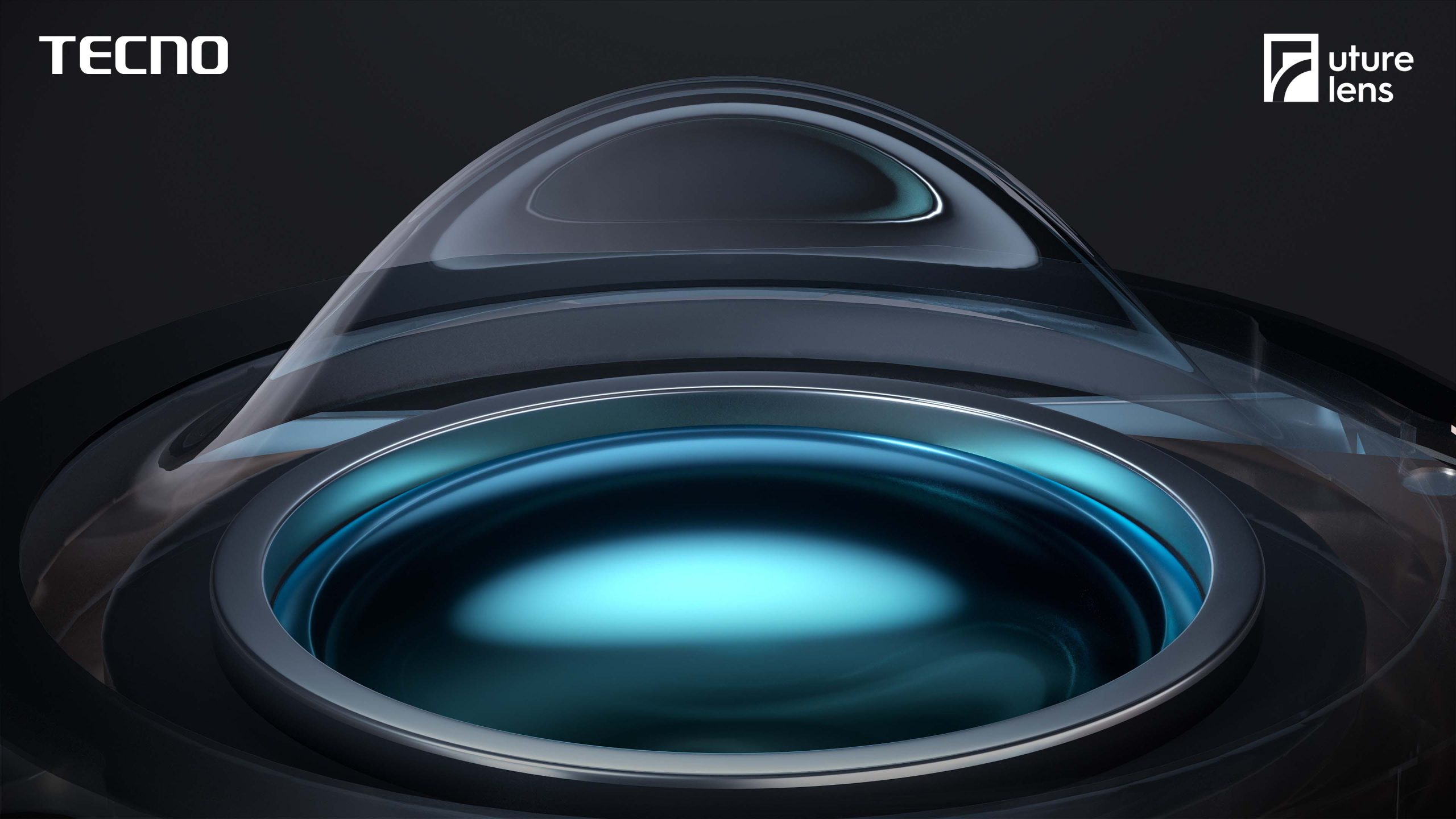
TECNO’s liquid telephoto macro lens combines the power of telephoto and macro lenses in a compact form. This breakthrough uses voltage to alter the lens’s curvature, enabling stunning close-up shots with incredible detail. It’s a significant step forward in making professional-grade photography accessible on a smartphone without compromising on design aesthetics.
Telephoto lenses on phones are caught in a lens structure that makes it difficult to focus on subjects at close range. But we have also seen some phones (e.g. Xiaomi 11) had their lenses especially enable macro shooting with telephoto lenses, while the focus range was limited to a narrow range (e.g. 3-7cm). As a result, the telephoto lens was only for macro shooting but not for distant scenes.
Liquid Telephoto lens – An image shared by Tecno
Liquid lenses are similar to the human eye – well, another bionic application. They can “see close (macro)” and “see far”, but with the solid focal length (angle of view). The transparent fluid wrapped in the film is modeled as the lens, and the voltage motor that controls the fluid curvature is similar to the ciliary muscle of the human eye.
It’s not the first time this technology has appeared in the smartphone industry, but it’s a shame that its precedent hasn’t caught on. I’m still very much looking forward to seeing if Tecno can bring Liquid Lens up to the next level with excellent user experience.
Universal Tone Technology
With the Universal Tone Technology, TECNO is setting new standards in photographic inclusivity. This technology, developed through extensive research, uses AI to accurately render a wide spectrum of skin tones in photographs. It ensures that every portrait is vibrant and true to the subject, a testament to TECNO’s dedication to celebrating diversity through technological excellence.
Universal Tone – An image shared by Tecno
It’s a shame that we only see a relatively uniform standard of skinning beauty on most phone brands. So in that respect, it seems like Tecno is doing a great thing: every shade of skin tone from every corner of the planet can get compliments and affirmation (which, even though, just came from a phone’s camera system), rather than get simply and brutally told what’s ‘right’ for your skin’s aesthetics.
The keynotes and panel discussions at the event underscored the broader implications of these technologies. Industry experts shared insights on how TECNO’s innovations are poised to transform the landscape of mobile photography, setting new benchmarks for what smartphones can achieve in image capturing and processing.
Speakers at Tecno Future Lens Event 2023 – (Left) Tecno’s director of Image R&D Center, Xiaohan Huang; (mid) Sony Semiconductor Solutions (Shanghai)’s director, Jun Zhang & (right) editor-in-chief of Amateur Photographer publication, Nigel Atherton
Mr. Jun Zhang, Director of Sony Semiconductor Solutions (Shanghai), was invited to give a speech on how Sony was continually advancing image sensor technologies, and the value of collaboration with Tecno. He said, “Our image sensors must be closely coordinated with the smartphone manufacturer to achieve the best results. Only through communication with the engineers at the handset manufacturers can Sony develop better image sensors. Therefore, we are very much looking forward to further cooperation with TECNO in the future and will work together to bring the joy of mobile imaging to more consumers around the world.”
Addressing TECNO’s ongoing commitment to putting developing products that meet users’ needs, Director of TECNO’s Image R&D Center, Mr. Xiaohan Huang said: “TECNO’s commitment to user-centric innovation lies at the heart of our technological endeavors. Through relentless dedication to independent research and development, we have consistently pushed the boundaries of imaging technology. Learning from industry leaders, we strive to revolutionize the consumer experience by delivering cutting-edge solutions. TECNO remains steadfast in its pursuit to enhance and redefine the way users engage with technology. The future holds exciting possibilities, and we are poised to continue our unwavering efforts in this journey.”
Photography shot on Tecno Phones
TECNO’s advancements showcased at Future Lens 2023 are a clear indication of the company’s pursuit of leading mobile photography. While we don’t have clear information yet on when these technologies will be applied and integrated debut on which Tecno products. But sources are suggesting that Tecno will launch a new product in spring 2024 (likely to be at MWC in Feb 2024), where we may have a chance to get a glimpse of how these technologies work with an actual phone.
Apple has already expanded its iPhone production to India via different contract manufacturers. Now, it appears that the largest facility for iPhone production will be established by the Tata Group. So here are all the details.
Tata’s new iPhone factory will be set up in Tamil Nadu
For those unaware, the Apple iPhone is manufactured in facilities from other known suppliers like Foxconn and Wistron. Interestingly, the latter recently struck a deal with Tata, which helped the Indian giant become the first homegrown iPhone maker. Tata Group will be constructing the massive iPhone assembly plant in Hosur, Tamil Nadu (South Indian State). This large facility is in line with the Cupertino based giant’s plans to expand iPhone manufacturing in India.
The new Tata iPhone factory is expected to have 20 assembly lines and will create a large number of jobs over the next two years since it could bring in up to 50,000 workers. The new site is expected to become operational within the next 12 to 18 months. Apple is working on expanding its Indian production for iPhones to diversify its supply chain outside of China. The company and its suppliers aim to make over 50 million iPhones annually in India over the course of the next two to three years. Its plans are also bolstered by incentives from the local government.
The PLIs (production-linked incentives) have encouraged key Apple suppliers like Foxconn and Pegatron to increase their foothold in the Indian market. Thanks to such incentives, iPhone assembly in the region has risen significantly, exceeding 7 billion US Dollars in the previous fiscal year and even accounting for 7 percent of Apple’s global production share. The new facility also showcases the growing strategic partnership between Apple and the Tata Group.
Samsung is reportedly gearing up for the launch of the Galaxy A15 4G, alongside its 5G counterpart. While the 5G model’s details have been circulating online, a new leak has revealed the design, color options, and specifications of the Samsung Galaxy A15 4G variant.
First look at Samsung Galaxy A15 4G: Leak reveals design and specs
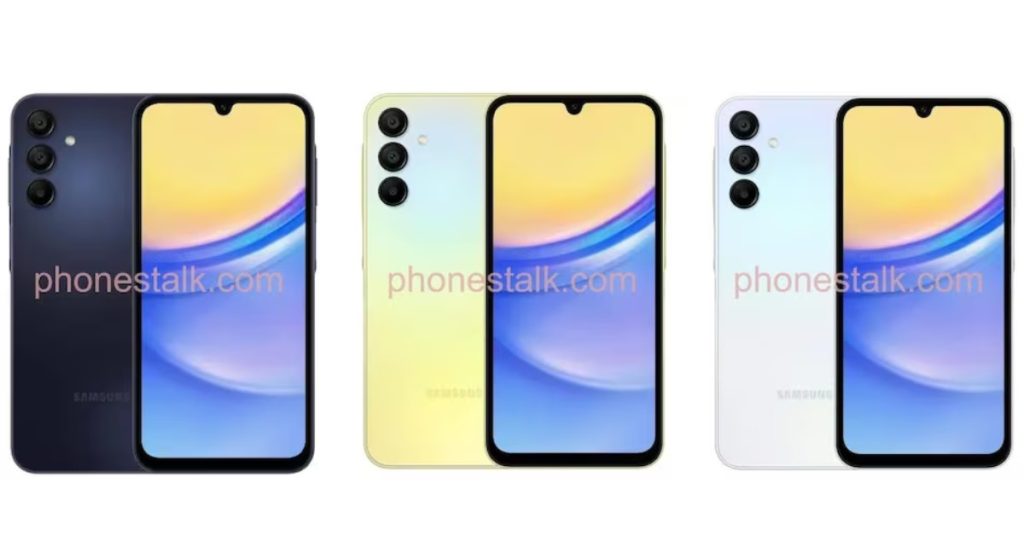
Based on information from Phonestalk, the Galaxy A15 4G will resemble its predecessor, the Galaxy A14 4G, in terms of design. Renders show three rear cameras arranged vertically with an LED flash. The front boasts a waterdrop notch housing the selfie camera. Likewise, the leaked images showcase the phone in black, white, and yellow color options.
Samsung Galaxy A15 4G color options. Image: Phonestalk
Under the hood, the A15 4G is rumored to pack a MediaTek Helio G99 chipset, offering decent performance for everyday tasks. It’s expected to come in various RAM and storage configurations, with one option being 4GB RAM and 128GB storage.
The display size is expected to be 6.5 inches, but details about its resolution and panel type are still unknown. However, since the Galaxy A15 5G is likely to have an OLED display, there’s a good chance the 4G model will also have one.
Likewise, the camera setup is tipped to include a 50MP main sensor, a 5MP ultrawide lens, and a 2MP depth sensor, alongside a 13MP front camera.
Fueling the smartphone is likely to be a 5,000mAh battery, reportedly supported by 25W fast charging. This battery capacity aligns with the rumored specs for the 5G model as well.
While the official launch date remains unknown, rumors are rife that Samsung will announce both the Galaxy A15 4G and A15 5G soon. The 5G model has even been spotted on Walmart recently, with a price tag of $139.
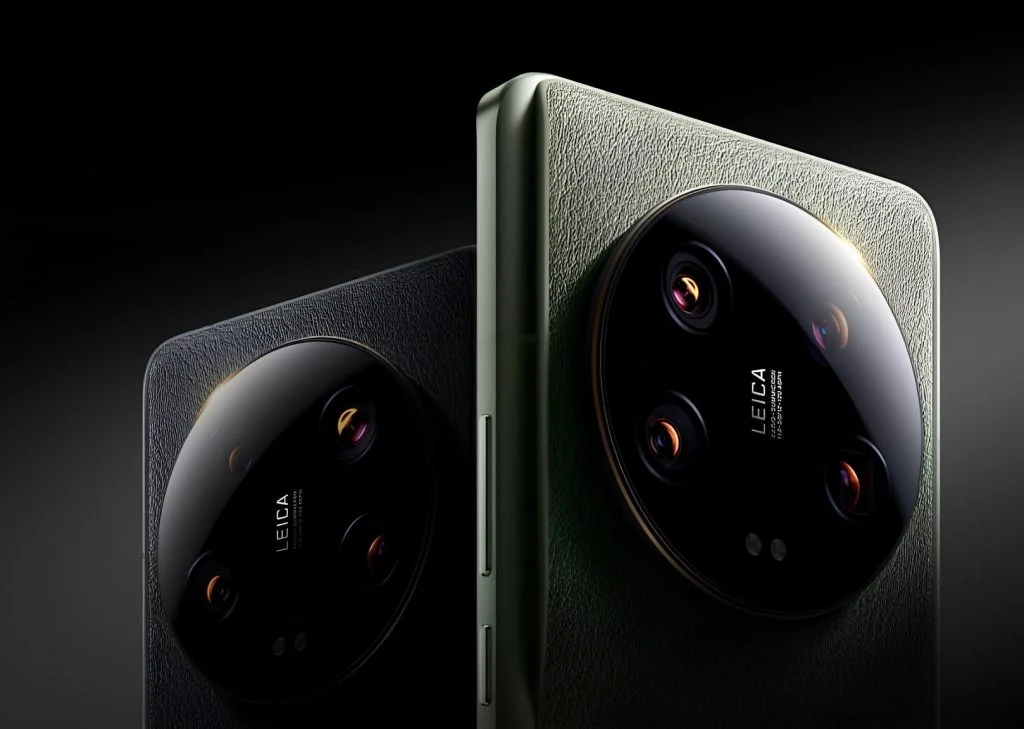
Xiaomi, a prominent player in the smartphone industry, is gearing up to expand its flagship series with the introduction of the Xiaomi 14 Ultra. This new addition follows the successful launches of the Xiaomi 14 and Xiaomi 14 Pro. The Xiaomi 14 series has already made significant inroads in the high-end market segment, with the Xiaomi 14 Ultra poised to elevate the brand’s status further.
Xiaomi 14 Ultra’s Flagship-Level Features (Leaked)
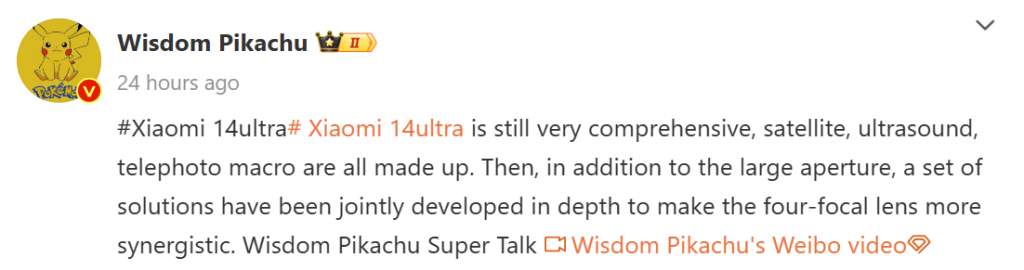
The yet-to-be-revealed Xiaomi 14 Ultra is emerging as a powerhouse in the flagship arena, with several advanced features. According to the tipster Smart Pikachu, the Xiaomi 14 Ultra is expected to feature satellite communication, ultrasonic fingerprint sensor, and telephoto macro functionalities. Additionally, he also said that Xiaomi has partnered to develop an extensive solution aimed at enhancing the performance and coordination of its four focal lengths in terms of imaging.
It’s rumored that the device will feature a quad-camera setup with 50MP sensors and variable apertures ranging from f/1.6 to f/4.0. Digital Chat Station has already provided insight into the impressive camera specifications of the Xiaomi 14 Ultra. The device is said to be equipped with the Sony LTY900 sensor (officially announced today), an upgraded version of the Sony IMX989, featuring a 1-inch primary camera sensor.
In terms of security, the Xiaomi 14 Ultra is reportedly testing a single-point ultrasonic fingerprint solution, making it a unique offering in the Xiaomi 14 series. This technology is likely to be based on the Goodix under-display ultrasonic fingerprint solution.
The Xiaomi 14 Ultra is expected to launch around April of the following year, aligning with the release schedule of competing models like the Vivo X100 Ultra and Huawei P70. As the launch date draws near, we can anticipate more details emerging, providing a clearer picture of this highly anticipated flagship device.
Honor is gearing up to launch new GT series smartphones in China. The brand is expected to position these devices as a separate lineup.
We have been hearing about these performance-focused phones for quite a while now. But still, we don’t have much info on them.
Today, a render of the upcoming Honor 90 GT emerges on the internet. Let’s go through its appearance.
The Honor 90 GT was accidentally listed online for pre-order earlier today. Though the brand has taken down the listing, netizens and media houses have managed to save the image of the handset.
The original render is different from the one that leaked a couple of days back. The device will feature a flat frame design.
The frame will be shiny but it appears to be made of plastic rather than metal. The rectangular camera island on the rear will include two sensors and an LED flashlight.
The phone in the render is blue in color with two racing stripes on its back. It should be available in other color options as well.
As far as specs are concerned, the Honor 90 GT is said to be powered by a Qualcomm Snapdragon 8 Plus Gen 1 chipset. It will come with up to 24GB of RAM.
It is tipped to sport a flat display, which the picture confirms. However, the type of the panel is still not known. It will likely flaunt an OLED screen.
Last but not least, the handset’s main camera is said to offer OIS (optical image stabilization).
We are looking forward to learning more about the Honor 90 GT in the coming days. It could be accompanied by Honor X50 GT. We expect the brand to announce the launch date soon.
A new Honor tablet is rumored to be in the works, and it looks like we may have gotten our first glimpse of the device. Reliable tipster Digital Chat Station in a new leak has shared a schematic of the alleged Honor Pad 9.
The image reveals a fresh design direction for the upcoming Honor tablet. Unlike the Honor Pad 8‘s left-aligned capsule camera housing, the Honor Pad 9 sports a centrally-aligned Oreo-style camera ring on the back.
Honor Pad 9 design schematics (leak).
We feel the design is reminiscent of the OnePlus Pad. The schematic also shows the device’s rounded edges and a prominent Honor logo on the back.
While the schematic doesn’t reveal much else about the Honor Pad 9, it does give us a good idea of what to expect in terms of design.
The tablet has already received 3C certification, confirming 35W charging support. Rumors suggest it will be powered by the Snapdragon 6 Gen 1. The processor was announced in 2022 and is based on Qualcomm’s 4nm manufacturing process. It has a maximum clock speed of 2.2GHz and comes with Adreno 710 GPU.
Honor Pad 8
Further information comes from UAE’s TRDA certification, revealing model number HEY2-W09 and confirming a Wi-Fi-only configuration, similar to its predecessor, the Honor Pad 8.
While specifics are still limited, based on rumors, the Honor Pad 9 seems to be positioned as a mid-range offering, likely carrying on the basic functionality of the Pad 8.
The Pad 8 features a 12-inch 2K LCD screen with a 10:6 aspect ratio, 1 billion colors, and a resolution of 2000 x 1200 pixels. It’s powered by a Snapdragon 680 processor and debuted in July 2022, making a new model long overdue.
We can expect to learn more about the Honor Tablet 9 in the next few weeks, so keep your eyes peeled for updates!
While the global market waits for the official launch of the OnePlus 12 scheduled for January 23, the smartphone has gone live for sale in its domestic market of China.
Despite facing mixed criticism for its increased price in China, the smartphone hasn’t deterred customers, emerging as the second fastest-selling Snapdragon 8 Gen 3 device in the country. It closely trails the Xiaomi 14 Pro, achieving 61% of the Pro’s entire day’s sales volume within just 5 minutes. The brand’s sales performance for the day remains to be seen, raising anticipation. In the meantime, here’s the OnePlus 12’s spec sheet to help you understand the reasons behind the hype.
OnePlus 12 specs & features
The OnePlus 12 boasts a stunning 6.82-inch 3D AMOLED QHD+ display, featuring a crisp 3168×1440 resolution, a smooth 120Hz refresh rate, and LTPO 2.0 technology for efficient power management. With a peak brightness of 1300 nits and HDR10+ support. Under the hood, it is powered by the Qualcomm Snapdragon 8 Gen 3 chipset, coupled with the Adreno 750 GPU.
OnePlus 12
It is available with 12GB, 16GB, and 24GB of LPDDR5X RAM, complemented by internal storage options ranging from 256GB to 1TB of UFS 4.0 storage. For optics, the device features a 50MP primary sensor with optical image stabilization (OIS), a 48MP ultra-wide-angle lens, and a 32MP telephoto unit. The front camera adopts a 16MP sensor with a punch-hole design.
The OnePlus 12 comes with a 5400mAh battery, supporting 100W wired charging and 50W AirVOOC wireless charging. It includes an Ultra Power Saving mode for efficient power management. The device runs on OxygenOS based on Android, with ColorOS 14 and Dark Mode 2.0. Security is enhanced with an in-display fingerprint reader for seamless and secure unlocking.
If you live outside of China and can’t wait till February to get your hands on the OnePlus 12, you can now order the device to your doorstep through Giztop.
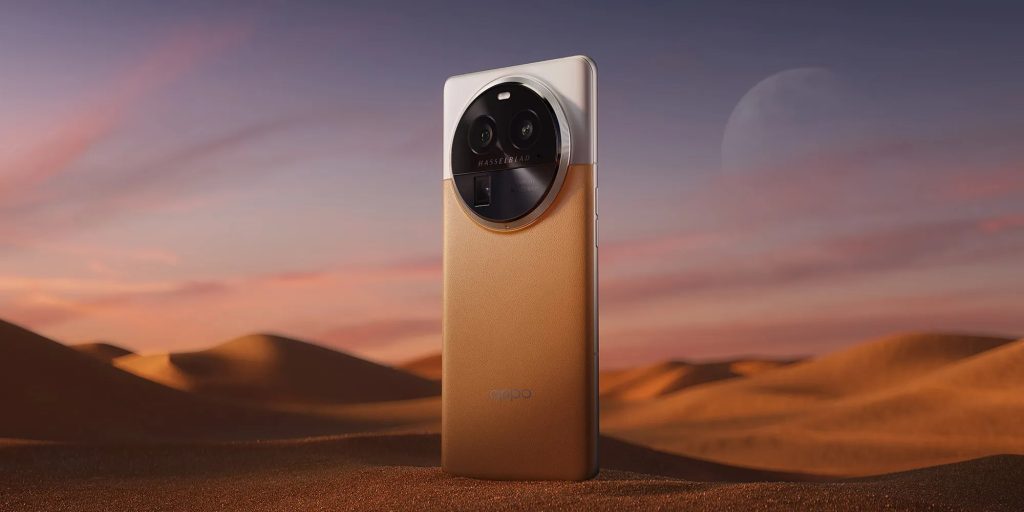
Oppo Find X7 series is all set to launch very soon with some exciting features. There’s already curiosity among Oppo fans about the device, and some features have already been part of the latest leaks and revealed by public certifications. In addition, the upcoming Oppo Find X7 smartphone is leaked again, and this time its camera specifications are revealed along with slight information about its SoC. The smartphone that is set to feature 100W charging will feature Dimensity 9300.
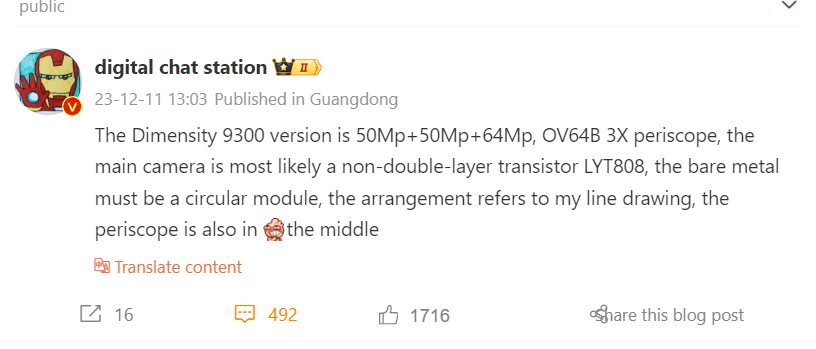
As per the Digital Chat Station, the smartphone appears to bundle a triple-rear camera module. It will consist of a 50MP Sony LYT-808 Primary camera, a 50MP ultrawide sensor, and 64MP OmniVision’s OV64B periscope telephoto lens. Furthermore, it will feature the recently announced Dimensity 9300 SoC, which is built on TSMC’s 4nm process and includes one Cortex-X4 core at 3.25GHz, three Cortex-X4 cores at 2.85GHz, and four Cortex-A720 cores at 2.0GHz.
Apart from the new information, the new series will consist of two new smartphones, which are the Oppo Find X7 and Oppo Find X7 Pro. Both are expected to feature 100W fast charging and are expected to launch alongside the OnePus 12 globally. The Find X7 Pro is expected to bundle the Snapdragon 8 Gen 3 SoC. It could come with a 6.82-inch AMOLED display with 2K resolution and a 120Hz refresh rate. Further, the rumors claim it will feature Sony’s 1-inch LYT900 sensor while featuring a 2x periscope sensor offering 2.7x zoom with the Sony IM890 and 6x zoom with the Sony IMX858 sensor.
Oppo Find X7 and Find X7 Pro Details
On the flip side, the Oppo Find X7 will come with a Dimensity 9300 SoC, as per AnTuTu and Geekbench benchmarks. It will have a 120Hz refresh rate, 16GB of LPDDR5x RAM, and up to 1TB of UFS 4.0 storage. Both smartphones will run Android 14.
The Vivo X100 series was officially announced in China just last month. The company recently revealed the date for the flagship lineup’s global debut, but now, a new report has hinted that the X100 series could be launching in India next month.
Vivo X100 series may launch in India in January 2024
The news arrives from an exclusive 91Mobiles report. Vivo X100 series of high end devices is set to launch in India in early January 2024. Sources close to the matter added that both the X100 and X100 Pro are expected to be launched in the region. Another interesting aspect revealed in the fresh report includes a new camera feature. The Vivo X100 series will feature an exclusive sun shot feature that is powered by AI (Artificial Intelligence).
To elaborate, the camera mode will allow users to capture the brilliance of the sun during sunset and sunrise, with AI algorithms helping bring out the depth and color accuracy of the picture being taken. For those unaware, the global launch for the Vivo X100 lineup is set for 14th December 2023. It is worth noting that the X100 and X100 Pro were announced in China, but the X100 Pro+ model’s release appears to be postponed at the moment.
Talking about the X100 and X100 Pro, both devices sport a tall 6.78-inch LTPO AMOLED display that offers Full HD+ resolution, 120Hz refresh rate, 2160Hz PWM dimming, and 3000 nits of peak brightness. Under the hood, the smartphones are equipped with the MediaTek Dimensity 9300 SoC which is paired with up to 16GB of LPDDR5T RAM and up to 1 TB of UFS 4.0 storage. The base model is powered by a 5,000mAh battery pack with 120W fast wired fast charging report, while the Pro variant is powered by a larger 5,400mAh battery pack that offers 100W wired fast charging and 50W wireless fast charging.
We use cookies on our website to give you the most relevant experience by remembering your preferences and repeat visits. By clicking “Accept”, you consent to the use of ALL the cookies.
This website uses cookies to improve your experience while you navigate through the website. Out of these, the cookies that are categorized as necessary are stored on your browser as they are essential for the working of basic functionalities of the website. We also use third-party cookies that help us analyze and understand how you use this website. These cookies will be stored in your browser only with your consent. You also have the option to opt-out of these cookies. But opting out of some of these cookies may affect your browsing experience.
Necessary cookies are absolutely essential for the website to function properly. This category only includes cookies that ensures basic functionalities and security features of the website. These cookies do not store any personal information.
Any cookies that may not be particularly necessary for the website to function and is used specifically to collect user personal data via analytics, ads, other embedded contents are termed as non-necessary cookies. It is mandatory to procure user consent prior to running these cookies on your website.