Advertisement

Samsung rolls out May 2023 security update for Galaxy Note 20 series in the US

Samsung has recently rolled out the latest security update for carrier-locked models of the Galaxy Note 20 and Galaxy Note 20 Ultra in the United States. This update follows the release of the May 2023 security patch to the Galaxy Note 20 series in Latin American countries earlier this month. The firmware version N98xUSQS4HWE4 includes essential security fixes for over 70 vulnerabilities found in Samsung smartphones and tablets.

Samsung Galaxy Note 20 series

What’s new in this update for Galaxy Note 20 series?

The May 2023 security patch addresses a total of 72 security flaws, with six of them classified as critical vulnerabilities affecting both Android phones in general and Samsung devices specifically. Additionally, 56 security fixes are classified as high, while 10 are categorized as moderate. Notably, Samsung had already addressed two of the security flaws that Google included in their May 2023 security patch in the previous April 2023 security update. Furthermore, one fix provided by Google does not apply to Samsung devices.

Among the vulnerabilities addressed in this update are issues found in the FactoryTest function, ActivityManagerService, kernel pointers exposure in the log file, Theme Manager, GearManagerStub, and the Tips app. The security flaws also extended to components such as the Shannon modem in Exynos processors, bootloader, Telephony framework, call settings components, and AppLock access control. Samsung has diligently fixed all of these vulnerabilities in addition to resolving 58 security flaws addressed by Google.

The May 2023 security update is currently available for carrier-locked Galaxy Note 20 series devices on Sprint and T-Mobile’s networks in the US. Users can check for the update by navigating to Settings > Software update and selecting Download and Install.

The Galaxy Note 20 series, launched by Samsung in late 2020, originally shipped with Android 10. Since then, the devices received updates to Android 11 in late 2020, Android 12 in late 2021, and Android 13 towards the end of 2022. Notable specifications of the Galaxy Note 20 include a 6.7-inch Full HD+ display, Snapdragon 865+ / Exynos 990 SoC, 8GB RAM, a triple rear camera setup, S Pen support, and a 4300mAh battery featuring wired and wireless fast charging.

RELATED:

Lu Weibing says Xiaomi will not give up on chips, regrets Oppo’s Closure

Xiaomi held its financial meeting for Q1 2023 today. During the meeting, the company’s President Lu Weibing expressed regret over the closure of Oppo’s chip business. He also said that Xiaomi’s determination to invest in chips has not wavered, and that the company will continue to invest in the chipsets market.

Oppo gives up on Chips but Xiaomi still standing strong

Earlier this month, Oppo announced the closure of its chip development subsidiary, Zeku, due to economic challenges and a volatile smartphone market. For unaware, the company has been manufacturing imaging chips (Marisilicon X) for its smartphone and it even announced an audio NPU, called Marisilcon Y recently.

Oppo Marisilicon

Lu Weibing expressed regrets over the closure of the chip business by their friends at Oppo, highlighting the challenging nature of developing cores and the difficulty involved. He urged people to show respect for every bold step taken in the industry.

However, the exec made it clear that this closure does not hamper Xiaomi’s endeavors to develop chips. “We are fully aware of the difficulty, long-term nature, and complexity of chip investment. In the future, we must respect the rules of the chip industry and not rush for quick success. We must be prepared for a long-term, protracted war. You cannot run a marathon like it is a 100-meter race,” said Lu.

In the past few years, Xiaomi has developed a number of chips for use in its smartphones, including the Surge S1, Surge S2, Surge V1, P1, and G1. These chips are designed to improve the performance, battery life, and camera quality of Xiaomi smartphones. The company is also developing a number of other chips, including a 5G modem chip and a self-driving chip. Xiaomi is even reported to be recruiting talent from Oppo’s disbanded chip business.

RELATED:

(Via)

Ponomarets Series 1 e-bike with 100kn range and ultra-light design launched for pre-order in the EU

The Ponomarets Series 1 lightweight e-bike is now available for pre-order. The e-bike weighs just 11.3kg and is the first e-bike by the company. The pre-order is available for EU countries presently. The bike has a carbon fiber frame design which combines comfort and aesthetics.

Ponomarets Series 1 e-bike

German company Ponomarets is entering the e-bike market with a sleek offering. The Series 1 e-bike draws inspiration from supercars and aircraft. It is powered by a 250W Mahle motor that delivers a top speed of 25km/h. The range of the lightweight e-bike is 100km. The Ponomarets Series 1 e-bike is of the same weight as the EVO Neo 1 road e-bike. The Mahle X35+ rear hub motor delivers a maximum torque of 40Nm while a 250Wh Panasonic battery offers an assisted range of 100km.

The Ponomarets Series 1 e-bike is equipped with a GRX Shimano RX810 11-speed system. The electric bicycle also features proprietary carbon fiber forks. It also has Magura MT4 FM brakes for control. The Series 1 has a companion app, the Mahle SmartBike app through which you can view ride information. The Mahle IWOC One control button on the bike allows you to adjust the assistance.

Ponomarets Series 1 e-bike

Ponomarets Series 1 e-bike price and availability

The Ponomarets Series 1 e-bike is priced at €9,799 (~$10,556) and the earliest orders will be delivered starting in June 2023. Availability of the Series 1 e-bike is currently tied to the EU but this could be expanded to other markets subsequently. There are limited units of a Founders Edition of the bike with a platinum grey frame and the owner’s name written. There are only 100 units of this customized version and each unit is priced at €10,799 (~$11,633).

RELATED:

(source)

Samsung Galaxy Watch 6 Classic renders leaked with rotating bezels

Samsung is gearing up for the launch of the Galaxy Watch 6 smartwatch lineup, which is expected to take place later this year. Recent leaks have provided a sneak peek into the design of the highly anticipated Galaxy Watch 6 Classic model. CAD-based 3D renders, courtesy of renowned leakster OnLeaks in collaboration with MySmartPrice, reveal the key design elements of the smartwatch.

A sneak peek into the Samsung Galaxy Watch 6 Classic Design

The leaked images showcase the Galaxy Watch 6 Classic in a sleek black color variant. The device sports a durable metal case and a comfortable silicone wristband with a magnetic clasp. Notably, it features a 1.47-inch circular Super AMOLED screen, encircled by a thick rotating bezel, reminiscent of the popular Galaxy Watch 4 Classic.

On the right side of the case, the Galaxy Watch 6 Classic boasts two buttons, while the left side remains clean and unadorned. The rear of the smartwatch houses a heart rate sensor and PPG (Photoplethysmography) sensors, indicating a focus on advanced health monitoring capabilities. Although specific specifications were not disclosed in the leak, industry insiders anticipate that the Galaxy Watch 6 Classic will offer a range of features such as a barometer, body composition analysis, ECG, gyro, GPS, NFC, sleep tracking, and a temperature sensor. Additionally, reports suggest a screen resolution of 470×470 pixels for the upcoming device.

Previous leaks have also hinted at the Galaxy Watch 6 Classic being equipped with the Exynos W980 chipset, manufactured using an improved 5nm fabrication process. This chipset, coupled with the upcoming Wear OS 4 and One UI 5 Watch, is expected to introduce enhanced health-tracking capabilities and a refreshed Material You design.

Samsung will unveil Galaxy Watch 6 series, alongside other highly anticipated devices like the Galaxy Z Flip 5, Galaxy Z Fold 5, and the Galaxy Tab S9 series which is expected to be held in July.

RELATED:

(Source)

Garmin Approach S70 Golf Watch with a bold OLED screen unveiled

The Garmin Approach S70 smartwatch has been launched. The Approach S70 is a golf-focused smartwatch that comes with a bold OLED display and a 42mm/47mm dial. The high-end Garmin Approach S70 golf watch is the successor to the Approach S62. It importantly sports an OLED display unlike the Approach S62.

Garmin Approach S70 Golf Watch

Garmin has already used OLED screens in some of its golf-specific models like the Garmin Marq Golfer. The Approach S70 comes in either a 42mm or 47mm option. The smaller model comes in white and grey colorways while the 47mm model is available in black. The brighter display on Garmin golf-focused smartwatches is very useful when golfing. A brighter display is required when viewing full maps of golf courses. There are 43,000+ golf courses from across the world that could be accessed via the smartwatch.

Garmin Approach S70 Golf Watch

The Approach S70 has a Virtual Caddie that can suggest the club to use based on several factors for optimal performance. The Garmin Golf subscription service provides the complete bouquet of applications available with the Approach S70. The device adds slope direction data which uses maximally the enhanced resolution and color depth of the OLED screen.

Garmin Approach S70 Golf Watch

The Garmin Approach S70 squares up nicely with some of the brand’s premium offerings. The Garmin Forerunner 965 also sports an OLED screen as the Approach S70. The Approach S70 has slightly more advanced materials in its bezel and it is ceramic.

The Approach S70 has 32GB of storage but cannot store topographic maps, unlike the Forerunner 965. It has a 16-day battery life and several health monitoring sensors including heart rate monitoring. The Approach S70 is rated with 5ATM water resistance and it is priced at $649.99.

Related: 

*Please Note: When you buy something using the links in our articles, we may earn a small commission at no cost to you.

Citroen unveils a limited version of the Rugged My Ami Buggy electric car priced at $13k

Citroen has released a rugged version of the compact My Ami electric car. This is a limited edition version known as My Ami Buggy car and it is expected to be available in ten countries.

Citreon My Ami Buggy

The Citroen My Ami Buggy draws inspiration from the Ami electric car. The Ami EV is 2.41 meters long and was launched in April 2020. It was priced at a lowly $6,000 but the My Ami Buggy comes more than double the price of the original model. The compact My Ami Buggy can be driven by anyone easily.

The My Ami Buggy concept was first unveiled in 2021 and it had very impressive feedback from Citroen customers. The company subsequently began production of a limited quantity of the car in France last year. This resulted in 150 units of the model selling out within 20 minutes.

The ultra-compact My Ami Buggy is equipped with an 8HP motor and a 5.4kWh battery. It has a top speed of 45km/h and a range of 74km. It sports a unique design both on the exterior and interior. It has a khaki and black exterior color which gives it a rugged look. The wheels are further highlighted with gold rims and a beautiful accent. The EV does not have doors or windows (it has plastic covers and waterproof fabric inside to protect the passengers). It has an open-air concept that Citroen says, delivers a real sense of freedom.

The new limited-edition My Ami Buggy will have 1,000 units and the starting price is $13,029. It will launch in selected countries in Europe including Spain, France, Italy, and the United Kingdom in June. It will also launch in Morocco and Turkey but not in the US. Citroen is still offering the electric Ami for $10,000 and it says more than 35,000 units have been sold globally.

Related:

(source)

Huawei P60 Pro, Mate X3 Foldable goes on sale in Europe, Check out the pricing

Earlier this month, Huawei debuted the P60 Pro and the Mate X3 Folding smartphone in Europe. A couple of weeks after their launch, the devices finally hit the region’s store shelves.

Huawei

Pricing & availability

The P60 Pro, currently holding the top position in DxOMark smartphone camera rankings, is available for purchase at a price of £1,199 or €1,399. On the other hand, the foldable Mate X3 is priced at €2,200/£2,000.

Huawei Mate X3 specs

The Huawei Mate X3 showcases a tall 7.85-inch primary screen with an OLED panel and a smooth 120Hz refresh rate. Additionally, it offers a 6.4-inch cover display for added convenience.

Underneath the surface, the device houses the powerful Qualcomm Snapdragon 8+ Gen 1 SoC (4G), coupled with 12GB of RAM and a spacious 512GB of internal storage. To keep you powered throughout the day, the Mate X3 is equipped with a large 4,800mAh battery that supports 66W wired fast charging, 50W wireless fast charging, and even 7.5W reverse charging.

In terms of photography, the rear of the device boasts a 50-megapixel triple camera setup, while the front houses an 8-megapixel selfie shooter.

Noteworthy features of the Mate X3 include satellite connectivity, IPX8 water resistance, a weight of 239 grams, a thickness of 11.08mm when folded, and a mere 5.3mm when unfolded. It also incorporates OIS support for the periscope zoom lens, NFC capabilities, dual stereo speakers, and Bluetooth 5.2 technology.

Huawei P60 Pro specs

The Huawei P60 Pro boasts a stunning 6.67-inch FHD+ OLED quad-curved display, providing immersive visuals with its 120Hz refresh rate and LTPO technology. Powering the device is the Qualcomm Snapdragon 8 Gen 1 processor, ensuring smooth performance and responsiveness. Users can choose between 8GB or 12GB of RAM, depending on their preference, and enjoy ample storage options with 128GB, 256GB, or 512GB of internal storage.

Huawei-P60-Pro

When it comes to photography, the P60 Pro excels with its impressive camera setup. The rear cameras feature a 50MP main camera equipped with an RYYB color filter for enhanced image quality, a 48MP ultrawide camera for capturing wider perspectives, a 12MP telephoto camera offering 3x optical zoom capabilities, and an 8MP periscope telephoto camera delivering an impressive 10x optical zoom. On the front, there’s a 13MP camera for high-quality selfies and video calls.

Huawei-P60-Pro

To keep you going throughout the day, the device is equipped with a substantial 5000mAh battery and supports 66W fast charging, ensuring quick and efficient charging times. On the software side, the P60 Pro runs on HarmonyOS 2.0, providing a seamless and intuitive user experience.

In terms of connectivity, the P60 Pro supports 4G connectivity, along with Wi-Fi 6E for fast wireless connectivity. Bluetooth 5.2 enables smooth wireless pairing, while NFC allows for convenient contactless transactions. The device also incorporates an in-display fingerprint sensor and facial recognition for secure unlocking. With stereo speakers, users can enjoy immersive audio experiences, and the IP68 water and dust resistance rating offers protection against the elements.

RELATED:

Keychron launches Q3 Pro SE aluminum keyboard with four dedicated macro keys

Keychron used to be known for its line of relatively affordable wireless mechanical keyboards with some nice-to-have features. But in recent years, the company has also launched some premium keyboards under its Q series. Today, the brand has unveiled yet another model in the lineup called, Keychron Q3 Pro SE. It comes with a weighted aluminum construction and four dedicated macro keys. Here are the details.

keychron Q3 pro SE

Keychron Q3 Pro SE is a sturdy keyboard with neat features

Keychron Q3 Pro SE has a CNC aluminum build with a new appearance. The left side of the keyboard is equipped with a new multimedia knob and four macro keys. You can assign specific commands to each of the macro keys that you can quickly execute with a press of a button. 

The keyboard is versatile and customizable. It supports both Mac and Windows devices and features a QMK and VIA open-source key change system that allows you to easily program each function key on the keyboard. It comes with Bluetooth 5.1 and USB-C wired dual-mode connection and can be connected with up to 3 devices via Bluetooth.

Keychrom Q3 Pro SE

Further, the device is made with durable materials and features unique Keychron KSA height PBT two-color injection keycaps. The PBT material is claimed to more wear-resistant, durable, and dirt-resistant than ABS keycaps. The keyboard also features a self-developed K Pro shaft that supports hot swapping and has a lifespan of up to 50 million times. This could be one of the best keyboards for gaming in 2023.

Keychron Q3 Pro SE is available for purchase in China at a price tag of 1018 yuan ($144). The company also launched Q11 customized mechanical keyboard recently with a unique split design. It can literally be split into two halves

Related:

Project Helix is Nvidia & Dell’s Latest Collaboration to Build Models using Generative AI

In a recent collaboration, Nvidia and Dell unveiled Project Helix, a groundbreaking product aimed at introducing generative artificial intelligence (AI) capabilities to enterprises. The project aims to provide businesses with an easy and efficient way to leverage generative AI, allowing them to build new models or customize existing ones using their own data. Project Helix not only simplifies the process of implementing generative AI but also addresses concerns surrounding intellectual property leakage, which is a major concern for many companies.

Project Helix will harness the power of Generative AI

The primary focus of Project Helix is to create full-stack, in-house generative AI solutions for enterprises. By utilizing their own data, companies can develop and customize generative AI models, avoiding common mistakes and cost overruns associated with such projects. This innovative product empowers businesses to derive value from the vast amounts of underutilized data they possess.

NVIDIA

Jeff Clarke, the vice chairman and co-COO of Dell Technologies, stated, “Project Helix provides businesses with purpose-built AI models that enable them to more quickly and securely derive value from today’s underutilized vast amounts of data.” With scalable infrastructure and high efficiency, companies can now unlock a new wave of generative AI solutions that have the potential to reshape industries.

Nvidia’s recent GTC meeting in March revealed a comprehensive range of software dedicated to generative AI, including industry-specific basic models and enterprise-centric development tools. Notably, Nvidia’s NeMo Large Language Model (LLM) framework and NeMo Guardrails for filtering unwanted topics garnered considerable attention. These models are optimized to run on Nvidia hardware.

Project Helix is the result of a collaborative effort between Nvidia and Dell. Dell has integrated Nvidia’s enterprise AI software into its PowerEdge server systems, while also offering various storage options optimized for AI workloads through its PowerScale and ECS enterprise object storage lines. This comprehensive solution empowers businesses to commence building or customizing generative AI models. Potential customers have the option to choose Nvidia’s base model or select an open-source model from Hugging Face or other technology vendors.

Starting from July 2023, Project Helix products will be available through traditional channels and APEX flexible consumption options. This timely launch brings new opportunities to enterprises seeking to harness the power of generative AI and drive innovation within their organizations.

RELATED:

(Via)

BYD to Set up a New Automobile Manufacturing Plant in Europe

BYD, the renowned Chinese manufacturer of New Energy Vehicles (NEVs), has announced its plans to potentially establish a passenger vehicle plant in Europe. The company is currently evaluating the feasibility of this project and actively searching for a suitable location for the facility.

BYD will also construct a Vehicle Plant in Thailand

Rumors have been circulating that BYD is engaged in discussions with French authorities to establish a manufacturing plant in the country. These reports align with BYD’s strategy of expanding its presence in international markets, as its NEV models continue to gain popularity overseas.

BYD

One significant milestone for BYD in Europe was the agreement signed with German car rental company Sixt in October last year. Sixt committed to purchasing 100,000 electric vehicles from BYD by 2028, showcasing the increasing demand for NEVs in the region.

BYD’s international expansion efforts also include the construction of its first overseas passenger vehicle plant in Thailand. The facility, situated in the coastal province of Rayong, is set to commence vehicle production in 2024 with an annual capacity of 150,000 units. This plant will serve as a crucial hub for BYD’s NEV production and sales not only in Thailand but also in other neighbouring countries within the ASEAN region.

As the leading NEV manufacturer in China, BYD has witnessed impressive growth in recent years. In the first four months of this year alone, the company delivered a staggering 762,371 vehicles, reflecting a remarkable year-on-year increase of 91.83 percent.

The potential establishment of a passenger vehicle plant in Europe demonstrates BYD’s commitment to expanding its global footprint and meeting the growing demand for NEVs. With its successful track record and increasing popularity, BYD is well-positioned to capitalize on the flourishing European NEV market. The company recently showcased a wide range of vehicles at the Barcelona International Motor Show. new As BYD continues to explore new international opportunities, the company’s innovative and eco-friendly vehicles are set to transform the global automotive landscape.

RELATED:

(Via)

Blue color Oppo Watch 3 announced alongside new memory variants of Oppo Pad 2 and Oppo Pad Air

Alongside the Oppo Reno 10 series, the brand also unveiled several other products. One of them is Oppo Enco R2, while the others are new variants of existing devices.

The brand announced new memory configurations for two of its tablets, namely Oppo Pad 2 and Oppo Pad Air. It also took wraps off a new color for Oppo Watch 3 and two new straps.

Oppo Watch 3

Oppo’s entry-level tablet Oppo Pad Air now comes in an 8GB + 256GB version priced at ¥1799. This memory variant can be availed in Star Silver and Fog Gray color options.

This is the highest memory variant for the tablet. Apart from this, it arrives in 4GB + 128GB and 6GB + 128GB versions priced at ¥1,499 and ¥1,699, respectively.

On the other hand, the flagship Oppo Pad 2 gets a lower 8GB + 128GB variant priced at ¥2,699 in Feather Gold and Nebula Gray color options. The tablet was originally announced in 8GB + 256GB, 12GB + 256GB, and 12GB + 512GB memory configurations priced at ¥2,999, ¥3,399, and ¥3,999, respectively.

Oppo Watch 3 Straps

This new version of Oppo Pad 2 is already available in global markets as the base variant of the OnePlus Pad (review). However, it comes in a single Halo Green color, unlike the original product.

Finally, the Oppo Watch 3 can be now availed in blue color priced at ¥1,599. Oppo also released a green-colored leather strap and a popsicle color-inspired fabric strap priced at ¥99 and ¥69, respectively.

The watch straps are up for sale already, while the watch and tablets are available for pre-order. The watch will only go on sale only from June 16 but the tablets will be available for purchase starting June 1.

RELATED:

Oppo Enco R2 wireless earbuds launched with multipoint connection, spatial audio, and more

At the Oppo Reno 10 series launch event, the company also announced a new pair of truly wireless earbuds. This budget audio accessory is officially called Oppo Enco R2.

Though the product looks premium because of its design, it is quite affordable at only ¥349 (~$50). It offers a basic set of features along with a couple of interesting ones.

Oppo Enco R2

Oppo Enco R2 offers stunning design and useful features

First and foremost, the Enco R2 arrives in a single gold-white color option. The charging case resembles a pebble, while the buds look similar to the Apple AirPods. 

The lid part of the case has a bright gold accent compared to the body. On the other hand, the open-ear type buds are white in color.

The earbuds house 13.4mm drivers and feature a Cadence HiFi5 audio processing chip. This chipset enables a spatial audio feature. Being a budget model, the buds only support SBC and AAC audio codecs.

The buds connect to devices via Bluetooth 5.3. They also offer support for multi-point connections. Just like other Oppo earphones, they can seamlessly pair with devices running ColorOS.

The Oppo Enco R2 is rated to last for 6 hours on a full charge. With the charging case, the endurance increases to 25 hours. Finally, it uses a USB Type-C port for charging.

The earbuds are up for pre-order in China. Currently, it’s not known if they will be released in other markets.

RELATED:

Oppo Reno 10 launched with 2x telephoto camera, curved display, 80W charging, and more

As scheduled, Oppo unveiled the Reno 10 series smartphones in China today. The lineup comprises three devices, namely Reno 10, Reno 10 Pro, and Reno 10 Pro Plus.

All the phones share the same design but differ in other aspects. They feature different chipsets and cameras.

For instance, the vanilla model houses a 2-year chip but the other two handsets have much newer chipsets. Similarly, you get the best cameras on the Pro Plus variant, while the Pro shares its cameras with the regular version.

Here in this article, let’s take a detailed look at the standard Oppo Reno 10. You can learn about the Oppp Reno 10 Pro and Oppp Reno 10 Pro Plus here.

Oppo Reno 10

Oppo Reno 10 Specifications

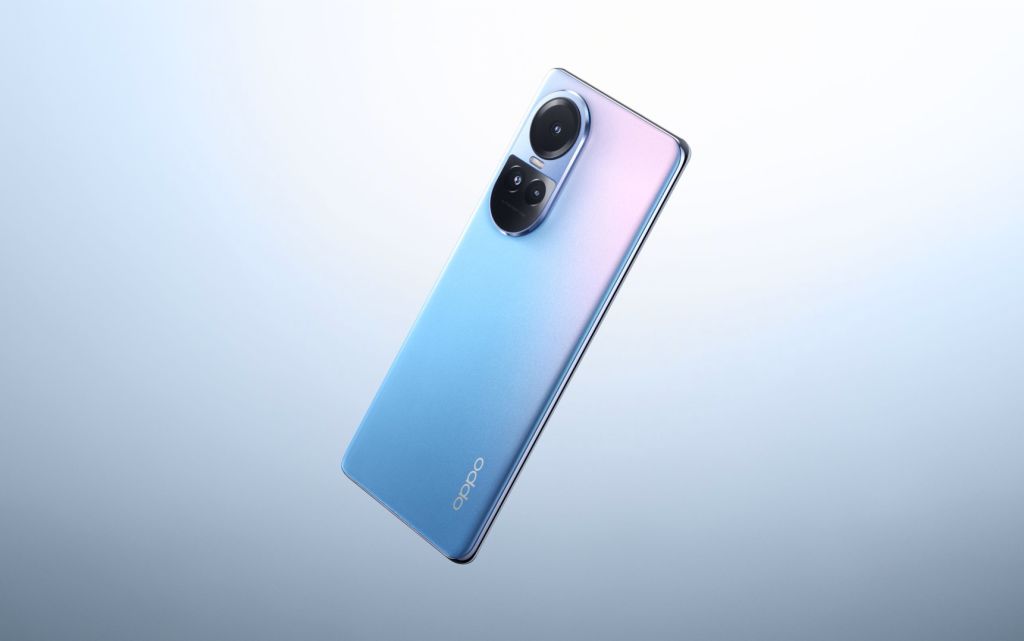
The Oppo Reno 10 sports a curved glass sandwich body with a plastic frame. The camera island is ovular in shape and it protrudes a bit because the device’s body measures only 7.58mm in thickness and weighs 180g.

It is built around a 6.7-inch centered punch-hole curved OLED display with a resolution of 2412 x 1080 pixels (FHD+), 394 PPI, and a 120Hz refresh rate. The 10-bit panel supports up to 950 nits peak brightness level, 2160Hz PWM dimming, and 240Hz touch sampling rate.

The phone is powered by a Qualcomm Snapdragon 778G SoC paired with LPDDR4x RAM and UFS 2.2 storage. The 12GB + 512GB variant comes with faster LPDDR5 RAM and UFS 3.1 storage. On the software front, it boots ColorOS 13.1 based on Android 13.

The handset arrives with a 32MP front-facing camera with autofocus and a triple camera system on the rear. It features a 64MP primary sensor, an 8MP ultra-wide unit, and a 32MP 2x telephoto shooter.

Other features include an in-screen fingerprint sensor, infrared sensor, dual SIM, 5G, WiFi 6, GNSS, and NFC. Finally, the smartphone draws energy from a 4,600mAh battery and carries support for 80W fast wired charging.

Oppo Reno 10 Price and Availability

Oppo Reno 10 will retail at the following price tags in China.

  • 8GB + 256GB – ¥2,499 (~$355)
  • 12GB + 256GB – ¥2,799 (~$400)
  • 12GB + 512GB – ¥2,999 (~$425)

The device can be availed in either Colorful Blue, Moon Sea Black, or Brilliant Gold color options. It is up for pre-order and will go on sale from June 1.

The Reno 10 alongside its siblings Reno 10 Pro and Reno 10 Pro Plus are expected to release in global markets in the coming weeks.

RELATED:

Honor 90 display outperforms 102 other OLED phones in testing

Honor has stepped up on its display game and it was evidenced by the Magic 5 Pro‘s 6.81-inch LTPO OLED screen with a high resolution, 10-bit color depth, 120Hz dynamic refresh rate, and HDR10+ support. Now, the company is set to launch the new Honor 90 series on May 29, and ahead of the release, it has released a video in which it tests the screen of the Honor 90 against 102 current mainstream OLED phones. The video shows that the Honor 90’s screen outperforms the competition in a number of key areas. Here are the details.

Honor 90 Pro

Honor 90 shows the least screen flickering

Honor conducted a test comparing the screen of the Honor 90 with 102 current mainstream OLED phones. You might be aware that OLED panels are commonly used in the majority of mid-range and flagship smartphones. It offers accurate colors and fine picture quality.

Honor highlights that there are also hidden visual health risks associated with OLED screens. These screens can flicker at high frequencies, which, although invisible to the naked eye, can cause eye strain and headaches in some individuals.

Honor 90 display test

In its test, Honor visualized the strobe flicker of all 102 phones by adjusting them to a white screen. The company used a high-speed camera with a shutter speed of 1/800 second to capture the flickering, and the images were displayed on a smart screen for comparison. The results of the test revealed that all mobile phone screens showed varying degrees of stroboscopic flicker.

However, the severity of the flicker is claimed to be dependent on the dimming frequency, with lower frequencies resulting in heavier flickering. Honor’s test reveals that only one screen stood out in the test—the Honor 90. It demonstrated bright performance and showed no stroboscopic flicker under any visual conditions.

Honor 90 will be the first to come with 3840Hz ultra-high frequency PWM dimming. In addition, it has also passed the TÜV Rheinland flicker-free certification, reaching the zero-risk dimming level. More specifications can be found here.

RELATED:

(Via)

Belkin SOUNDFORM Mini On-Ear Wireless Headphones Launched In India

Belkin has launched a kids-centric wireless headphone in India. It is called Belkin SOUNDFORM Mini. The audio device packs a host of features. Read on to know more about it below. 

Belkin SOUNDFORM Mini specifications and features

The Belkin SOUNDFORM Mini is an on-ear wireless headphone. The headbands are adjustable and the earcups feature a cushion. They weigh 240 grams making them suitable for extended use. The headphones are said to be safe and comfortable for kids’ ears. There are power and volume rocker buttons for controlling music on one side of the earcup. The headphones feature spill and accident-proof materials for durability of up to 2 years. 

The Belkin SOUNDFORM Mini is compatible with mobiles, tablets, and laptops as well as learning apps. There is a built-in microphone for communicating with others. The headphones have a volume cap of 85 dB for ensuring the well-being of children during prolonged listening usage. The audio device supports Bluetooth 5 connectivity with a range of 10 meters. 

The Belkin SOUNDFORM Mini is claimed to offer a battery life of up to 30 hours in a single charge. There is a 4-feet 3.5mm auxiliary port cable to connect directly to the device 

The Belkin SOUNDFORM Mini carries a price tag of Rs 3,999. It is offered in Black, Blue, Pink, and White colors. The headphones can be purchased from Amazon and Aptronix and will soon be available from Flipkart and Croma. 

Related: 

Lava Agni 2 unboxing & first impressions

Last week, the Lava Agni 2 5G was officially launched in India, marking it as the first smartphone in the country to be powered by the Dimensity 7050 chipset. This device is the successor to the last year’s Lava Agni 5G, which debuted as the first 5G phone from an Indian brand. With its array of new and exciting features, the Agni 2 has become an enticing choice among smartphones priced around Rs 20,000 (~$241) in India. After using this device over the past weekend, I would like to take this opportunity to share my initial impressions and thoughts on it.

Lava Agni 2
Lava Agni 2

Lava Agni 2 5G design, specifications

Right off the bat, the Lava Agni 2 impresses in the design department. Starting from the front, the smartphone features a massive 6.78-inch AMOLED screen with curved edges, which gives it a premium feel. It produces 10-bit colors, an FHD+ resolution, a 120Hz refresh rate, and up to 950 nits of peak brightness. The screen is shielded with Schott Xensation α Glass screen.

Lava Agni 2
Lava Agni 2

With a peak brightness of 950 nits, Agni 2’s display is quite bright and usable under sunlight. It comes with support for Widevine L1, HDR, HDR10, and HDR10+ makes it an ideal device for watching streaming content on OTT platforms.

The slim bezels surrounding the Agni 2’s screen create a sleek appearance, particularly the bottom bezel, which measures a mere 2.3mm. Hence, it offers an impressive amount of screen space. According to the brand, it offers a screen-to-body ratio of 93.65 percent.  It has a polycarbonate frame and a glass back with a smooth matte finish. The round camera module accentuates the look of the device. The thickness of the device is 8.75mm and it weighs 210 grams.

Lava Agni 2
Lava Agni 2

This Lava phone marks the introduction of an under-display fingerprint scanner, a first for the brand. During the initial period, I observed that the fingerprint scanner took a little longer to unlock the device. However, it is currently functioning properly and without any issues.

The Dimensity 7050 chip, along with 8 GB of RAM and 8 GB of virtual RAM, ensures smooth performance on the device. I haven’t yet tried gaming on the device, but it appears that the chip is good enough for casual gaming. For enhanced gaming, the device is equipped with an x-linear motor, and there is a 2900mm2 vapor chamber cooling unit for heat dissipation. The phone offers a large internal storage of 256 GB (UFS 2.2) and packs a 4,700mAh battery that supports 66W fast charging.

Lava Agni 2
Lava Agni 2

In the photography department, the Lava Agni 2 5G has a 16-megapixel OmniVision OV16A1Q front camera. The rear camera setup of the device is headlined by a 50-megapixel OmniVision OV50A40 main camera, an 8-megapixel ultra-wide lens, and a pair of 2-megapixel cameras for macro and depth shots. There’s only a bottom-firing speaker on the device.

It goes without saying that one of the strengths of Lava Agni 2 is that it comes with a near-stock version of Android 13 OS. Even without a YouTube premium subscription, users can stream YouTube videos in the background through the “Background Stream” option available in the notification bar. Since the device is free of bloatware, there are no unwanted notifications. However, there is no anonymous call recording feature, which can be found on some of the more affordable Lava phones.

The company has promised to offer Android 14 and Android 15 OS upgrades along with quarterly updates for three years. In addition, it comes with support for 14 5G bands and carrier aggregation.

Lava Agni 2 price, after-sales support

Lava Agni 2
Lava Agni 2

Lava Agni 2, which is only aimed at the Indian market, is priced at Rs 21,999 (~$265). It can be purchased through Amazon for as low as Rs 19,999 (~$241) by applying a flat discount of Rs 2,000 (~$24)using all major credit and debit cards as well as EMI transactions.

The Agni 2 introduces an industry-first feature where customers can enjoy the convenience of free home replacement for any hardware issues during the warranty period. According to Lava, to ensure swift resolution, each customer will be assigned a dedicated personal representative called ‘Agni Mitra’ who will prioritize and resolve their issues promptly.

The design, specs sheet, affordable price, and after-sales promise makes the Agni 2 a very enticing device. We will be back with a full review of the Agni 2 in the coming days.

What’s your opinion about the Lava Agni 2? Share your thoughts with us by posting your comments below.

RELATED:             

LG Launches Highly-Anticipated 2023 OLED TV Lineup in India, Offering Diverse Range of Models and Impressive Features

LG Electronics has officially launched its much-anticipated 2023 OLED TV lineup in India. The lineup, initially showcased at CES earlier this year, boasts an impressive range of 21 models across various variants. This includes the 8K OLED Z3 series, OLED evo Gallery edition G3 series, OLED evo C3 series, OLED B3 series, and A3 series televisions.

LG

Catering to different consumer preferences, LG’s 2023 OLED lineup offers a diverse selection of screen sizes. The range starts from the smallest 106 cm (42-inch) display and goes up to an astonishing 246 cm (97-inch) behemoth. Notably, the G3 OLED evo series is available in 139 cm (55-inch), 164 cm (65-inch), and 195 cm (77-inch) options.

The G3 series, featuring the ultra-seamless One Wall Design, enhances the visual appeal of the OLED TVs. Additionally, the latest lineup incorporates the updated webOS version, ensuring a refreshed and personalized user experience.

This year’s OLED TV models come with a redesigned user interface (UI) called All New Home, offering extensive customization options and enhanced convenience. LG continues its support for Dolby Vision and Dolby Atmos, delivering superior image and audio enhancements for an immersive home cinema experience.

The OLED TVs also come equipped with the Game Optimizer feature, allowing users to effortlessly access gaming-specific functions and seamlessly switch between them.

Let’s take a quick look at some specifications of the highlighted models:

  • LG A3 4K Smart OLED TV: Available in sizes of 48″, 55″, and 65″. Features a 4K OLED display, α7 AI Processor 4K Gen6, Dolby Vision/HDR10/HLG support, and 20W audio with Dolby Atmos.
  • LG B3 4K Smart OLED TV: Available in sizes of 55″, 65″, and 77″. Offers a 4K OLED display, α7 AI Processor 4K Gen6, Dolby Vision/HDR10/HLG support, and G-Sync/FreeSync compatibility.
  • LG C3 4K Smart OLED evo TV: Available in sizes of 42″, 48″, 55″, 65″, 77″, and 83″. Features a 4K Ultra HD display, α9 AI Processor 4K Gen6, Dolby Vision/HDR10/HLG support, and 40W audio with Dolby Atmos.
  • LG G3 4K OLED evo TV: Available in sizes of 55″, 65″, and 77″. Offers a 4K OLED display, α9 AI Processor 4K Gen6, Dolby Vision/HDR10/HLG support, and 60W audio with Dolby Atmos.
  • LG Z3 8K Smart Signature OLED TV (Rollable): Comes in an 88″ size and features an 8K OLED display, α9 AI Processor 8K Gen6, Dolby Vision/HDR10/HLG support, and an 80W audio system.
  • LG G2 4K Smart OLED evo TV (Gallery Design): Available in sizes of 55″, 65″, and 97″. Features a 4K OLED display, α9 Gen5 AI Processor 4K, Dolby Vision/HDR10/HLG support, and 60W audio with Dolby Atmos.

Pricing & availability

According to the official announcement, the newly launched LG OLED TVs in India are priced starting from Rs. 1,19,990 for the OLED42C3 model, with the range topping out at Rs. 75,00,000 for the rollable TV. These television models will be accessible for purchase through the LG website and other retail stores within a span of 2 to 3 weeks.

RELATED:

Oppo Reno 10 Pro+ launched with Snapdragon 8+ Gen 1, periscope zoom camera, Reno 10 Pro debuts with Dimensity 8200

Oppo held a launch event today in China to unveil the Reno 10 series of smartphones. Back in 2019, Oppo announced the Reno 10x Zoom with a periscope zoom. Since then, the company has launched several Reno-branded phones, but none of them have featured a periscope telephoto camera. The Find X6 and Find X6 Pro flagship phones, which debuted in March this year, came equipped with a periscope telephoto camera. The Reno 10 Pro Plus that has gone official today is also equipped with the said camera. Here is a look at the specifications, features, and price of the Reno 10 Pro Plus and Reno 10 Pro. Readers can visit this dedicated post to learn about the standard Oppo Reno 10.

Oppo Reno 10 Pro+, Reno 10 Pro specifications and features

OPPO Reno 10 Pro Plus

The Oppo Reno 10 Pro+ and Reno 10 Pro house a 6.74-inch curved OLED panel that offers a 1.5K resolution of 2772 x 1240 pixels and a 120Hz refresh rate. The screen also offers up to a 240Hz touch sampling rate, 10-bit colors, and a peak brightness of 1,400 nits.

The Reno 10 Pro+ and Reno 10 Pro have a 32-megapixel Sony IMX709 front-facing camera. Both smartphones have a triple camera system on the back that includes an 8-megapixel Sony IMX355 ultra-wide lens and a 50-megapixel Sony IMX890 camera with OIS. The Pro+ model is also equipped with an OIS-enabled 64-megapixel OmniVision OV64B periscope zoom camera, which offers 3x optical zoom and up to 120x digital zoom. The Reno 10 Pro’s rear camera setup also includes a 32-megapixel Sony IMX709 telephoto camera with 2x optical zoom. For an enhanced photography experience, both models are equipped with the MariSilicon X NPU.

OPPO Reno 10 Pro

The Snapdragon 8 Plus Gen 1 chip and a 4,700mAh battery power the OPPO Reno 10 Pro+. The Reno 10 Pro, on the other hand, has the Dimensity 8200 chip and a 4,600mAh battery. Both models support 100W fast charging. The Pro models are also equipped with up to 16 GB of LPDDR5 RAM and up to 512 GB of UFS 3.1 storage.

The Oppo Reno 10 series ships with ColorOS 13.1-based Android 13 OS. The Pro models offer other features, such as dual SIM, 5G, Wi-Fi 6E, Bluetooth 5., GPS, NFC, an IR blaster, a USB Type-C port, a power management chip, and an X-axis linear motor.

OPPO Reno 10 Pro+, Reno 10 Pro price and availability

The Reno 10 Pro+ comes in two options, such as 16GB RAM + 256 GB storage for 3,899 Yuan (~$552) and 16 GB RAM + 512 GB storage for 4,299 Yuan (~$609). It comes in three shades: Moon Sea Black, Twilight Purple, and Brilliant Gold.

The Reno 10 Pro also comes in same variants. The base model is priced at 3,499 Yuan (~$495), whereas the higher model costs 3,899 Yuan (~$552). The 10 Pro color variants include Moon Sea Black, Color Blue, and Brilliant Gold.

The entire Reno 10 series is now available for pre-orders through Oppo China’s website and JD.com. Both platforms will carry out the first sales of the Reno 10 trio on June 1.

According to a report, the Reno 10 series will also be released in the global market. It is speculated that all three models may also arrive on the Indian market. The Reno 10 lineup may make its global debut in the third quarter of this year.

RELATED:

Xiaomi Civi 3 will feature 16GB RAM, 1TB of storage, 4500mAh battery

Xiaomi Civi 3, the upcoming selfie-focused smartphone from Xiaomi, is set to make its debut in China on May 25. As the launch date approaches, Xiaomi has been gradually revealing the key features of the Civi 3. Today, the company unveiled the highest configuration of the device which includes impressive specifications.

Xiaomi Civi 3: Dual front cameras, up to 1TB of storage

The Xiaomi Civi 3 was recently spotted in the MIIT certification database, confirming that it will come equipped with 12GB of RAM and 512GB of storage. Additionally, Xiaomi will offer a variant with even more impressive specifications, boasting 16GB of RAM and a whopping 1TB of storage, as revealed in the brand’s latest poster. The company also confirms that the device will house a 4500mAh battery.

In terms of memory technology, the Civi 3 is expected to feature LPDDR5 RAM and UFS 3.1 storage. Alongside the aforementioned configurations, the device may also be available in other options, including 8GB of RAM paired with 256GB of storage, as well as 12 GB of RAM with 256 GB of storage.

The Xiaomi Civi 3 is anticipated to sport a 6.55-inch OLED panel with Full HD+ resolution and a smooth 120Hz refresh rate. Its standout feature lies in its front camera setup, consisting of a 32-megapixel main sensor and a 32-megapixel ultra-wide sensor. On the rear, users can expect a high-resolution 50-megapixel Sony IMX800 primary camera. Its pill-shaped front camera looks more refined than even iPhone 14 Pro.

Under the hood, the Xiaomi Civi 3 will be powered by the Dimensity 8200-Ultra chipset. Notably, the device will support 67W fast charging. It will run on the Android 13 operating system, coupled with Xiaomi’s custom MIUI 14 interface. To address potential heating concerns, the Civi 3 will feature a 4,000mm2 vapor chamber cooling unit, providing efficient heat dissipation during extended usage.

RELATED:

Vivo S17 & S17 Pro launch date confirmed, Here’s all that’s known so far

Vivo has announced the release dates for the remaining two smartphones in the Vivo S17 series, namely the Vivo S17, and Vivo S17 Pro. Following the recent launch of the Vivo S17e, the brand has confirmed that the Vivo S17 and Vivo S17 Pro will be unveiled in China on May 31.


According to the latest information from Digital Chat Station, the upcoming Vivo S17 series smartphones will come with notable specifications. The Vivo S17 is said to be powered by the Snapdragon 782 processor, while the Vivo S17 Pro is expected to feature the Dimensity 8200 processor. A recent leak also indicates that both devices will boast a 50MP front-facing camera. Further details about these smartphones are yet to be revealed.

Vivo S17, S17 Pro specs & features (expected)

According to recent speculations and leaks, the upcoming Vivo S17 and Vivo S17 Pro are anticipated to offer impressive specifications and features. Both devices are rumored to sport a 6.78-inch AMOLED display with curved edges, providing a Full HD+ resolution and a high refresh rate of up to 120Hz. In terms of security, an under-display fingerprint sensor is expected to be included in both handsets.

vivo S17e
Vivo S17e

The Vivo S17 is speculated to be equipped with a Snapdragon 782 processor, while the S17 Pro variant may feature a Dimensity 8200 chipset. The vanilla S17 model could come with options of 8GB or 12GB of RAM and 128GB or 256GB of internal storage. In contrast, the S17 Pro might offer 16GB of RAM and 512GB of internal storage, catering to users’ diverse storage needs.

Vivo S16

Regarding camera capabilities, the Vivo S17 is rumored to house a 64MP primary camera on the rear, featuring optical image stabilization (OIS). On the other hand, the S17 Pro is said to boast a 50MP camera with OIS support. For capturing stunning selfies and engaging in video calls, both devices are expected to sport a 50MP front-facing camera, providing high-resolution self-portraits.

In terms of battery capacity, the Vivo S17 is speculated to pack a 4,500mAh battery, complemented by 66W fast charging support, ensuring efficient power replenishment. On the other hand, the S17 Pro might feature a slightly larger 4,600mAh battery and offer faster 80W fast charging capabilities, allowing for quicker charging times.

RELATED: