Advertisement

WebGPU Brings AI Capabilities Directly to Google Chrome Users

Google I/O took place yesterday. The event, initially was expected to focus on Android and new software developments, but dominated by AI technologies. The company put artificial intelligence at the center of its announcements, even when introducing the new Pixel 7a, Pixel tablet, and revealing new features. However, it appears that it wasn’t enough for the tech giant. According to the latest reports, Google is making strides to integrate AI into its Chrome browser through WebGPU. Here are the details…

Google I/O Unveils AI-Ready WebGPU for Chrome Browser

Artificial intelligence technologies continue to spread and expand their use cases. However, much of the AI technology we use today runs on data centers operated by cloud computing giants like Amazon, Microsoft, and Google. This situation creates a burden on data centers and a significant expense for companies. For example, to reduce this burden, OpenAI charges users $20 per month for GPT-4 and still limits usage to 25 messages within three hours. Google plans to use the recently added WebGPU feature in Chrome to solve this problem.
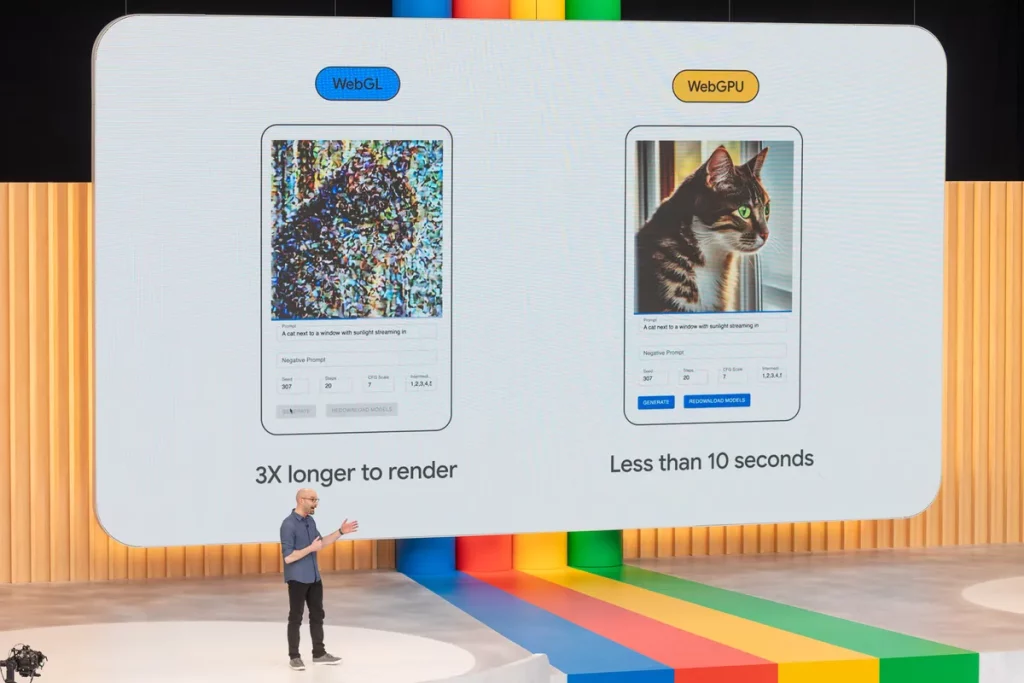
Recently released Chrome 113 comes with many innovations, including the WebGPU feature. This technology is a web standard that enhances graphics processing capabilities in web browsers. It enables more efficient execution of tasks like parallel computing, GPU acceleration, and 3D graphics, making web applications faster and more visually impressive. Another significant contribution is reducing server load by utilizing the power of your local computer.

At the Google I/O conference, it was announced that WebGPU enables web apps on phones or laptops to leverage AI software more directly. We had written the news for you yesterday when the announcement was made. This enhancement can be applied to a wide range of applications, from creative tools to health apps. “WebGPU makes the web AI-ready,” stated Matt Waddell, who leads Chrome’s developer and consumer-focused work. Running AI locally on devices like phones and laptops offers several benefits, including bypassing network issues and enabling better control over data. By doing so, Google aims to reduce the load on data centers and enhance security.

This can be particularly advantageous for businesses with sensitive data and health apps that require privacy for their users. Moreover, this is applicable for large companies as well. For instance, Samsung recently banned its employees from using AI technologies like ChatGPT due to a leak it experienced. Concerns like these could be eliminated with locally running AI tools that do not require a server. However, it remains to be seen when concerns about the increasingly widespread artificial intelligence technology will completely disappear.

RELATED:

(via)
Google rolls out Android 14 Beta 2: Check out the features and eligible devices

During Google’s I/O conference, the tech giant introduced Android 14 Beta 2, showcasing significant improvements across various areas. The latest update brings enhancements to camera and media features, privacy and security settings, system user interface, and tools for developers to boost productivity.

Android 14

Key features of Android 14 (Beta 2):

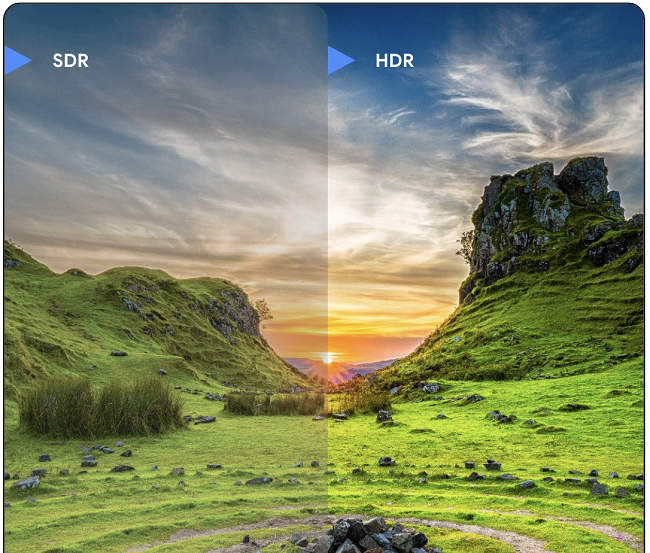
One notable addition is the support for 10-bit Ultra HDR images, offering vibrant colors and enhanced contrast. Android 14 is fully compatible with JPEG, enabling rendering in both standard dynamic range and HDR mode.

Android 14 HDR

Camera Extensions have also received upgrades, including dynamic still capture processing latency estimation, support for capture progress callbacks, extension-specific metadata, postview feature for still capture, and tap-to-focus and zoom during Extension usage. The introduction of in-sensor zoom allows users to control zoom even before other camera controls are ready.

Android 14 Beta 2 introduces support for lossless audio formats for USB-wired headsets, enhancing the audio experience for users. Additionally, advanced graphics features have been implemented, enabling custom meshes with vertex and fragment shaders, as well as a hardware buffer renderer for Canvas, resulting in more efficient drawing with hardware acceleration.

Google has introduced Health Connect, an on-device repository for user health and fitness data. This platform integration allows users to share data between their preferred health apps, with privacy controls seamlessly integrated into the system settings.

Android 14 Health Connect

Enhanced data-sharing updates have been implemented, notifying users when an app shares their location data with third parties. Users will also receive notifications if their apps modify their data-sharing practices. A new location data-sharing updates page is accessible from within the device settings.

Android 14 data sharing updates

To streamline the user experience, Google has limited the apps granted full-screen intent notification permission to those that provide calling and alarms only. This permission will remain enabled for apps installed prior to the Android 14 update, and users can manage this permission as needed.

In terms of developer tools, Google has introduced new Material Component animations and APIs that enable seamless transitions between activities within an app. Developers can now create custom in-app transitions and enable predictive back system animations on a per-Activity basis.

Android 14 (Beta 2) supported devices

The Android 14 Beta 2 update will be available for devices from iQOO, Lenovo, Nothing, OnePlus, OPPO, realme, Tecno, vivo, Xiaomi, and more, further expanding its reach across different smartphone brands.

Here’s the list of all the supported smartphones:

  • Pixel 4a
  • Pixel 5 and 5a
  • Pixel 6 and 6 Pro
  • Pixel 6a
  • Pixel 7 and 7 Pro
  • Pixel 7a
  • Pixel Fold
  • OnePlus 11
  • Nothing phone (1)
  • Xiaomi 12T, Xiaomi 13 and Xiaomi 13 Pro
  • iQOO 11
  • Vivo X90 series
  • Realme GT 2 Pro
  • Oppo Find N2 Flip
  • Lenovo Tab Extreme
  • Tecno Camon 20 series

With Android 14 Beta 2, Google continues to prioritize user experience, privacy, and developer productivity, offering a robust platform for Android users and developers alike.

RELATED:

Canon Launches Its Compact PowerShot V10 Camera For Vloggers and Content Creators In India

Canon has announced the PowerShot V10 camera for vloggers and content creators in the global markets. It has also arrived to the Indian market. It is ideal to meet the needs of users in scenarios where a smartphone is not capable enough and a digital camera is too bulky or expensive. Read on to know what the Canon PowerShot V10 offers out of the box. 

Canon PowerShot V10 specifications

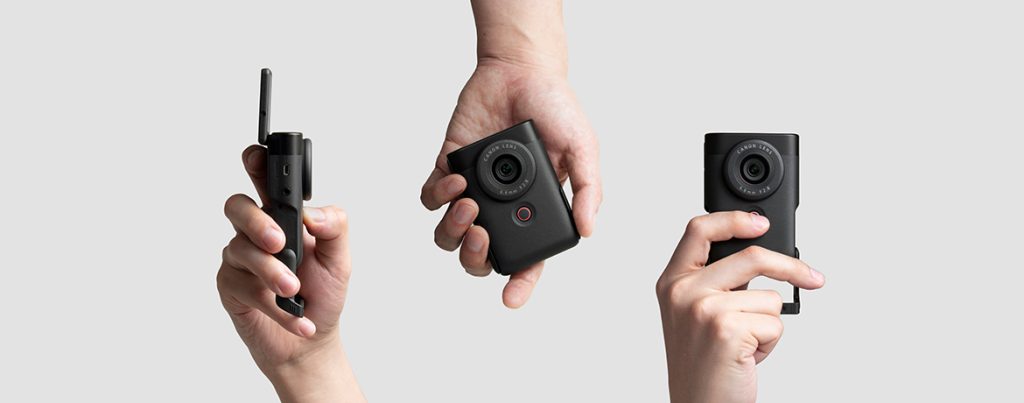
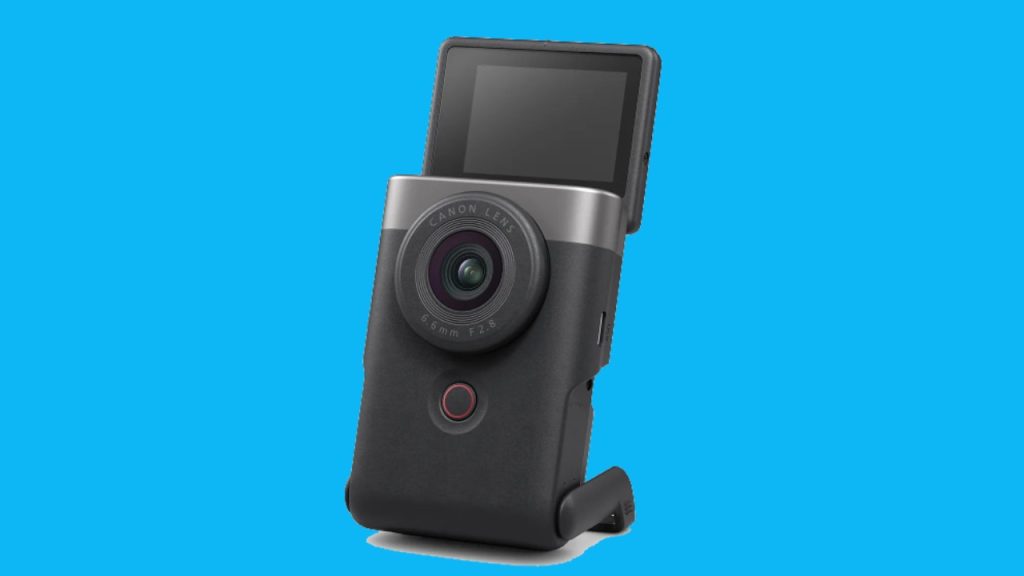
The Canon PowerShot V10 is a compact and lightweight camera that is said to fit in the user’s pocket. It features a retractable and tilted stand that can be attached to the camera body so there’s no need to carry a tripod and shoot steadily from multiple positions. The vertical grip is said to fit both left and right-handed users and make it more stable while holding. The PowerShot V10 also features a small 2-inch screen that can be tilted to adjust the camera angle. There are buttons at the front and rear for recording and making any adjustments. 

As for the specifics, the Canon PowerShot V10 has a 1-inch 20.9MP CMOS sensor that effectively uses 13.1 megapixels for video and 15.2 megapixels for stills. There is a 19mm f/2.8 wide-angle lens for shooting videos. The camera features Canon’s DIGIC X image processor and EOS imaging technology for recording high-quality videos in low-light conditions. The maximum ISO range of 4K filming is 3200 and 1080p movie is 6400. It is capped at 12800 for stills. The maximum shutter speed for stills and movie is 1/2000 and 1/4000 respectively. 

The Canon PowerShot V10 is equipped with a built-in microphone for eliminating noise and capturing clear sound. The camera comes with various features like software-based skin smoothing, a neutral density filter, and face detection autofocus. It is limited to 8-bit recording with MP4 files. Unfortunately, the camera lacks eye detection, log recording, and RAW format. 

The Canon PowerShot V10 is powered by a built-in 1,250mAh battery unit that is rechargeable via a USB-C port. It is claimed to offer a maximum of 1 hour of 4K video recording. It can be used to stream videos live to Facebook or YouTube using the Camera Connect app and a smartphone’s mobile network. Users can also connect it to a computer via a USB-C cable and use it as a webcam. 

Canon PowerShot V10 pricing and availability in India

The Canon PowerShot V10 carries a price tag of Rs 39,995. It will be available for purchase from both online and offline stores across the country starting next month. 

Related: 

Oppo Reno 10 Pro & Reno 10 Pro+ spotted on BIS, launch may be imminent

Oppo is believed to be working on a new generation of Reno 10 series of smartphones. The lineup will include the Reno 10, Reno 10 Pro, and Reno 10 Pro+. Now, it appears that the launch of the Reno 10 series is just around the corner, as the Reno 10 Pro and Reno 10 Pro+ model were just recently spotted on an Indian certification database.

Oppo

Oppo Reno 10 Pro series India launch could be near

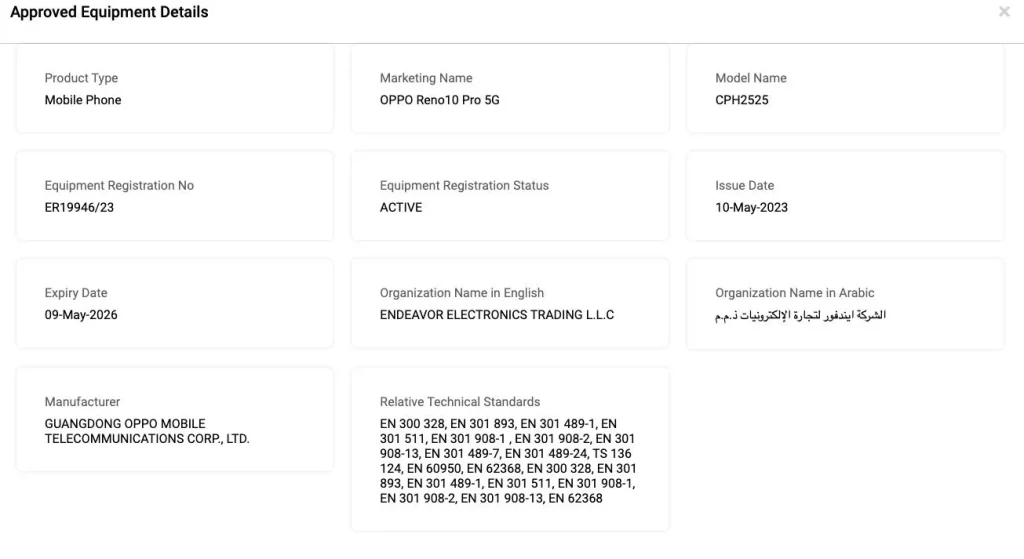
The two Pro models have been sighted on the BIS certification listing (Bureau of Indian Standards). This listing has revealed that the Reno 10 Pro carries the CPH2525 model number, while the Reno 10 Pro+ model number is CPH2521. Unfortunately, the certification did not reveal any other finer details like their specifications. However, we have covered various reports, which includes a GeekBench listing that revealed some of its key specs.

The Reno 10 Pro+ model is expected to launch with the Qualcomm Snapdragon 8 Gen 1 SoC that will be paired with up to 16GB of RAM. In other words, it is a premium grade smartphone. On the other hand, the Reno 10 Pro is believed to be equipped with a MediaTek Dimensity 8200 SoC, which will be paired with up to 12GB of RAM. Furthermore, there have also been render leaks that have given us a detailed look at its design.

Oppo
\

The device will feature a a pill shaped camera module that houses the Reno 10 Pro models’ triple camera setup. On the Reno 10 Pro+ variant, this module consists of a 50 megapixel Sony IMX890 primary sensor, along with an 8 megapixel Sony IMX355 ultra wide angle lens, and a 64 megapixel periscope shooter. Meanwhile, the front will house a 32 megapixel selfie camera. The front sports a 6.74 inch curved AMOLED Full HD+ display with 120Hz refresh rate on the Reno 10 Pro+ model, while the Reno 10 Pro sports a 6.7 inch AMOLED display with Full HD+ resolution and 120Hz refresh rate.

RELATED:

(Via)

Realme Narzo N53 to launch in India on May 18, featuring a design similar to the iPhone 14 Pro

After the recent debut of the Realme 11 series in China, the brand has now shifted its focus to the Indian market, with the intention of launching a value-for-money device in the budget range. It is now confirmed that the brand will be launching the Realme Narzo N53 in India soon.

Realme Narzo N53 looks like the iPhone 14 Pro

Realme Narzo N53

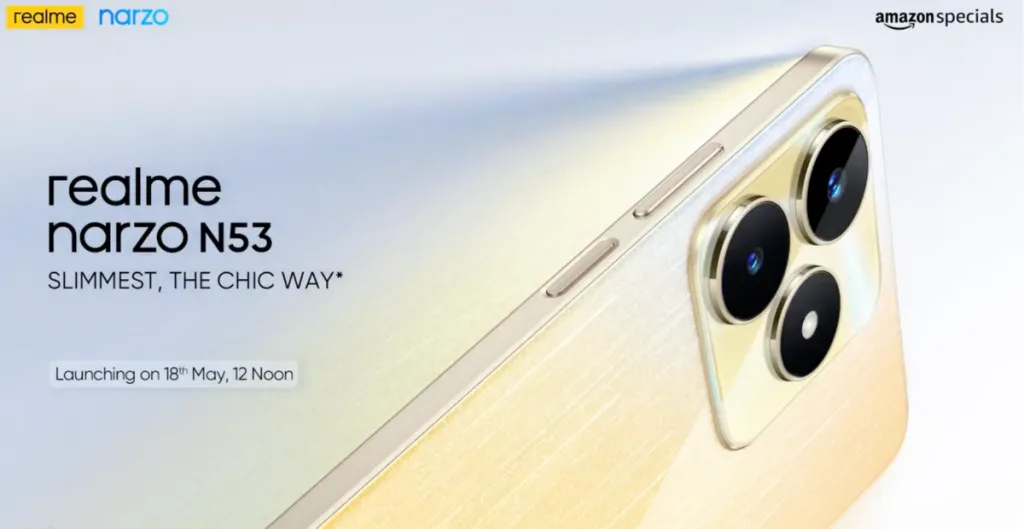
The brand’s official website has revealed that the Narzo N53 will be launching on May 18th, at 12 Noon in India. This will be the second N50-series device in Realme‘s camp after the launch of the Narzo N55 last month (check out Realme N55 review). As for availability, the Realme Narzo N53 will be available via Amazon and Realme e-store as we spotted the device tease page on both websites.

The brand has also teased the design of the divide which is surprisingly similar to the iPhone 14 Pro. It is worth noting that the Narzon N55 features an Apple Dynamic Island-like notification bubble function. So it will be interesting to see if the brand decides to add that feature here too, making it more of an iPhone 14 Pro clone.

Besides that, the brand is also claiming that the Narzo N53 will be the slimmest Realme phone ever. This could mean that we are looking at a width of around 7mm or below. A leak from yesterday revealed that the device will have up to 16GB of Dynamic RAM and feature 33W fast charging support.

According to the report, the phone will come with 5G support and will be offered in Feather Black and Feather Gold color variants. It is speculated that the Feather Gold option might be marketed as the California Sunshine Design, as hinted at in an official teaser. More information is expected to surface as we get closer to the launch. So, stay tuned.

RELATED:

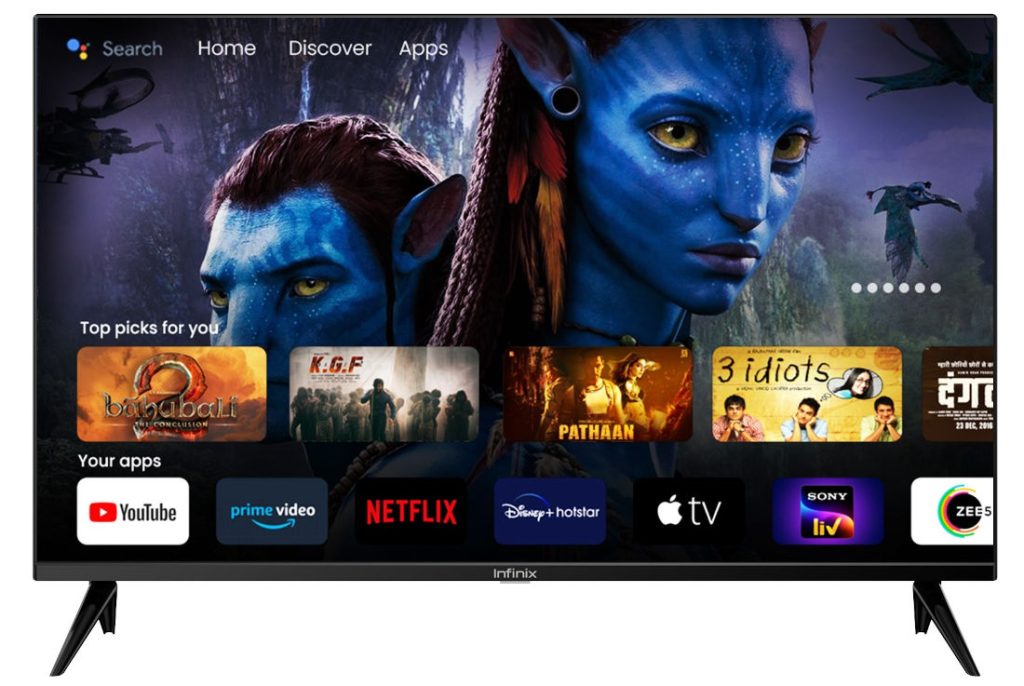
Infinix X3IN 32 And 43-Inch Android TVs Launched In India

Infinix has expanded its range of televisions in India. The brand has announced two new TVs in the X3IN series dubbed the Infinix 32X3IN and 43X3IN. Both the latest offerings carry an affordable price tag. The televisions share the same specifications apart from different display details. Read on to know more below. 

Infinix 32X3IN and 43X3IN specifications and features

The Infinix 32X3IN features a 32-inch display bearing an HD resolution whereas the 43X3IN comes with a 43-inch screen and an FHD resolution. Both televisions feature 250 nits peak brightness, MEMC, HLG, and HDR support. There is Epic Engine for vibrant picture quality. In terms of audio, the newest TVs are equipped with 20W box speakers tuned by Dolby Audio. 

Under the hood, the Infinix 32X3IN and 43X3IN are equipped with a quad-core MediaTek processor. They pack 1GB RAM and 8GB internal storage. The televisions run on Android 11 OS with built-in Google Assistant, Chromecast, and Play Store. The TVs also ship with a bundled Bluetooth-enabled compact remote with hotkeys for Google Assistant, Netflix, Prime Video, and YouTube. 

Connectivity options on the Infinix 32X3IN and 43X3IN include WiFi, Bluetooth, two HDMI ports, two USB ports, and an Ethernet port. 

The Infinix 32X3IN and 43X3IN televisions are priced at Rs 9,799 and Rs 16,999. They will be available for purchase from Flipkart starting May 18th.  

Related: 

Google unveils Magic Editor: Transform your photos with AI-powered editing

During the highly anticipated Google I/O event, a groundbreaking editing tool known as Magic Editor was introduced by Google. This innovative tool harnesses the power of generative artificial intelligence (AI) to revolutionize the process of photo editing, making it more accessible and user-friendly for individuals of all skill levels.

Google Magic Editor

Google Magic Editor features

The Magic Editor offers an experimental editing experience that aims to simplify the often complex and time-consuming task of editing photos. By leveraging advanced AI techniques, including generative AI, this tool empowers users to achieve professional-level edits without requiring extensive editing expertise.

Google Magic Editor GIF

One of the standout features of the Magic Editor is its ability to enhance the composition of photos. Users can effortlessly reposition subjects within their shots, ensuring the perfect framing and overall aesthetic appeal. Whether it’s removing unwanted objects, adjusting the brightness of the sky to match the desired ambiance, or resizing and relocating the subject, the Magic Editor allows users to bring their vision to life.

Google Magic Editor GIF

Generative AI takes center stage in the Magic Editor’s capabilities, enabling users to fill in the gaps seamlessly after repositioning subjects. For example, if a photo captures a boy’s birthday celebration, the Magic Editor can leverage generative AI to create additional elements like benches and balloons to complete the scene. These newly generated elements blend seamlessly into the original photo, resulting in a polished and cohesive final look.

Magic Editor availability

While initially available to a select group of Pixel phone users later this year, Google plans to refine and enhance the Magic Editor based on user feedback. This iterative approach ensures that users receive the best possible editing experience. The upcoming flagships Pixel 8 and Pixel 8 Pro are expected to get this feature first.

The introduction of the Magic Editor marks a significant milestone in the world of photo editing. By combining the power of generative AI with a simplified user interface, Google has made it possible for anyone to effortlessly transform their photos into captivating visual masterpieces. As the Magic Editor continues to evolve, it has the potential to democratize the art of photo editing, empowering users to unleash their creativity and share their unique perspectives with the world.

RELATED:

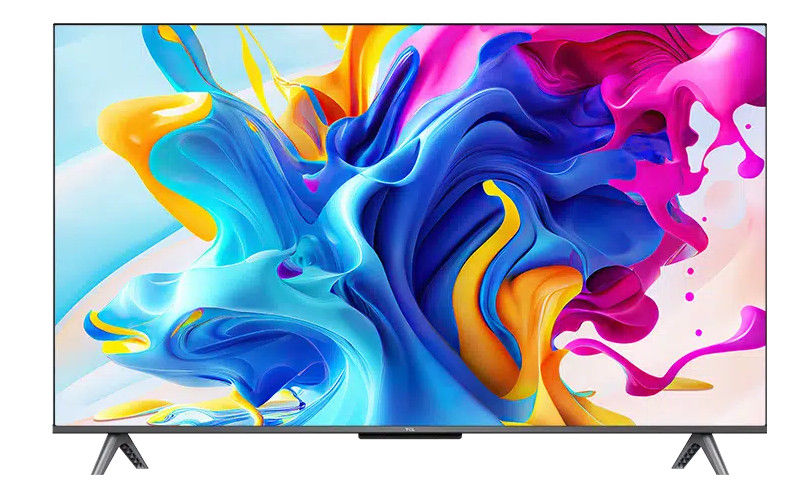
TCL C645 QLED TVs With 4K Display, Google TV Launched In India

TCL has launched new QLED televisions in India. The new range is the TCL C645 4K QLED TV models. They arrive as the successor to the last year’s C635 lineup. The new C645 4K QLED TV range come in five models with all of them packing the same specifications and features apart from different screen sizes. Read on to know what the C645 4K QLED TVs offer out of the box. 

TCL C645 4K QLED TVs specifications and features

As mentioned earlier, the TCL C645 TV series is offered in 43, 50, 55, 65, and 75-inch QLED screen sizes. They offer a 4K display resolution with a 60Hz refresh rate, 300 nits peak brightness, 10-bit color depth, and a 93 percent DCI-P3 color gamut. The televisions support Dolby Vision, HLG, and HDR10+ support. The TCL C645 4K QLED TVs feature a bezel-less design with a slim metallic frame. 

On the audio front, the TCL C645 4K QLED TVs are equipped with two 10W speakers with DTS: Virtual X. There is Dolby Atmos multi-dimensional spatial sound for a cinematic experience. 

The TCL C645 4K QLED TVs feature an AiPQ engine 3.0 algorithm to process content in a high-quality 4K. The televisions come with AMD’s FreeSync technology for a lag-free gaming experience and there is a 120Hz game accelerator. The C645 4K QLED TVs run on Google TV OS and come with a built-in Google Assistant and hands-free voice control. 

Connectivity options on the newly announced TCL TVs include WiFi, Bluetooth 5.0, HDMI 2.1 port, HDMI 2.0 ports, USB 3.0, and an Ethernet port. 

The TCL C645 4K QLED TVs start at Rs 40,990 for the base 43-inch model. The 50 and 55-inch televisions are priced at Rs 48,990 and Rs 56,990 respectively. The 65-inch model costs Rs 79,990. The televisions can be purchased from Reliance Digital, Croma, offline brand and retail stores, and online store

Related: 

Google Pixel 7a Goes On Sale In India: Price, Offers

Yesterday, Google announced the Pixel 7a at its annual I/O Developer conference. The smartphone’s pricing, availability, and offers for the Indian market have been revealed earlier today. The Pixel 7a arrives as the successor to the last year’s Pixel 6a with some notable upgrades. 

Google Pixel 7a India pricing, availability, and offers

Pixel 7a

The Google Pixel 7a is priced at Rs 43,999 in India. The pricing is the same as its predecessor. HDFC Bank cardholders will be eligible for an instant discount of Rs 4,000. This will make the smartphone available for Rs 39,999. There is an additional exchange bonus of up to Rs 4,000 on the base value of an old smartphone. Customers purchasing the Google Pixel 7a can also avail of either the Fitbit Inspire 2 or Google Pixel Buds A TWS earphones at Rs 3,999. Google is also bundling a three-month YouTube Premium and 100GB Google One storage with the purchase of the Pixel 7a. 

The Google Pixel 7a is exclusively available for purchase from Flipkart starting today. It is offered in Sea, Charcoal, and Snow colors. 

Google Pixel 7a specifications and features

The Google Pixel 7a comes with a 6.1-inch OLED screen with FHD+ resolution and a 90Hz refresh rate. It retains the horizontal camera bridge design from its predecessor. The pill-shaped camera cutout houses an OIS-enabled 64MP primary sensor and a 13MP ultra-wide-angle lens. The smartphone is IP67-rated dust and water-resistant. 

Internally, the Google Pixel 7a is powered by a Tensor G2 SoC coupled with 8GB RAM and 128GB internal storage. It is backed by a 4,386mAh battery unit with support for 18W wired and wireless charging. The device runs on Android 13 OS out of the box. 

Related: 

Vivo Y36 surfaces on Google Play Console with Snapdragon 680 launch imminent

Vivo is apparently planning on announcing a new mid range smartphone in the market soon. The Vivo Y36 4G has just recently been spotted, which hints at its imminent launch and reveals some of its key specifications. So let’s have a look.

Vivo Y36 4G may launch soon with Snapdragon 680

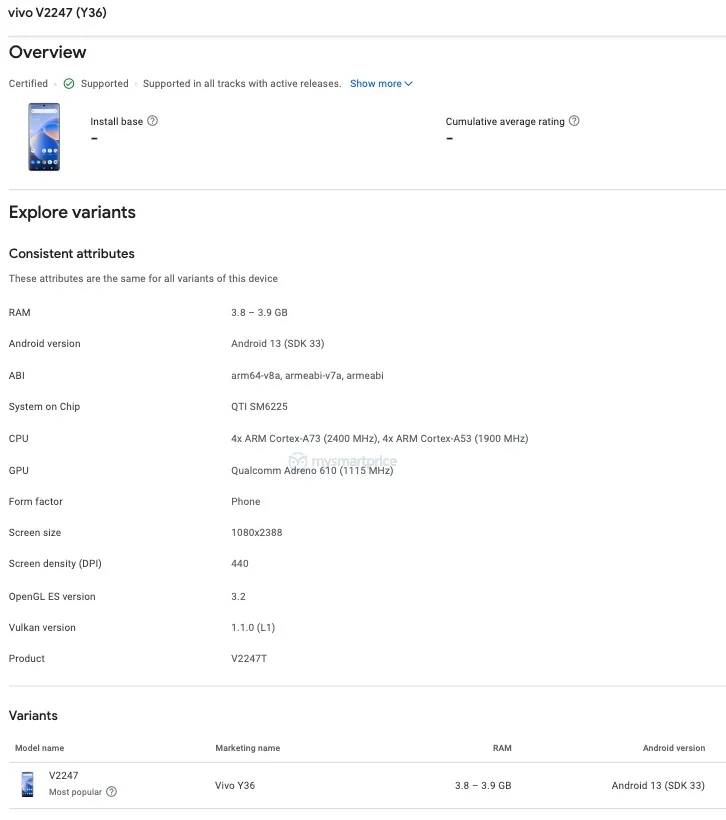
The Chinese smartphone maker’s Y36 model was recently spotted on the Google Play Console database, which reveals some of its specifications and other details. This online listing also implies that the launch of the upcoming smartphone is just around the corner. The Google Play Console listing reveals that the Y36 4G will be equipped with the Qualcomm Snapdragon 680 SoC. This further confirms that the device is a mid range smartphone.

Vivo

Apart from this, the device will also carry the model number V2247. The Google Console Play Console listing also revealed that the Vivo Y36 will launch with at least one variant with 4GB of RAM. Being a mid range model, we can expect one configuration with 128GB of internal storage. The database added that the smartphone will also launch with Android 13 OS based FuntouchOS 13 out of the box.

Other notable details include, a Full HD+ resolution and Adreno 610 GPU. Based on a previous GeekBench sighting, the handset will feature up to 8GB of RAM and Adreno 610 GPU. Other rumors have hinted at a 6.8 inch IPS LCD panel that only supports standard 60Hz refresh rate. Notably, the latest sighting arrives just a day after the smartphone was also surfaced on NBTC and Google Play certification.

RELATED:

(Via)

Canon PowerShot V10: A Compact 4K $429.99 Vlogging Solution for Content Creators

Smartphone cameras are improving with each new model. Nowadays, flagship models feature cameras that can even be used for professional shoots at times. However, if you’re a vlogger, your phone may not be sufficient for your needs. Similarly, professional cameras can be too heavy and expensive for such tasks. So, what should you do in such a scenario? Fortunately, Canon has just the right product for you. Canon is entering the vlogging camera market with the innovative new PowerShot V10. Here are the details…

Canon PowerShot V10 captures 4K video at 30 fps

Canon continues to expand its product lineup. Recently, the company introduced new mirrorless camera models in India, and now they have unveiled the new vlogging camera, PowerShot V102. Priced at $429.99, this compact camera features a retro design and sports a 19mm f/2.8 lens paired with a 20.9-megapixel sensor.

The Canon PowerShot V10 captures 4K video at 30 fps and is perfect for self-recording with its adjustable screen, front and rear record buttons, stereo mics, a 3.5mm mic jack, a Micro HDMI port, and digital image stabilization. Although the 2-inch screen may seem small, it is sufficient for monitoring yourself during recording. The device caters to entry-level vloggers and eliminates the need to invest in professional cameras.

The ISO range is capped at 3200 for 4K filming and 6400 for 1080p. The camera’s sensor effectively uses 13.1 megapixels for video and 15.2 megapixels for stills. It also offers five levels of software-based skin smoothing. The V10 has some useful video features like a built-in neutral density filter and face-detection autofocus. However, it lacks eye detection, log recording, and raw capture for photos. The camera is limited to 8-bit recording with MP4 files.

The PowerShot V10 supports microSD cards and includes a built-in 1,250mAh battery that recharges via USB-C, providing approximately 55 minutes of 4K video recording. The camera is set to launch in June. However, as mentioned earlier, smartphone cameras are also quite suitable for many tasks nowadays. All you need to do is determine your needs and budget and make a purchase accordingly.

RELATED:

(via)
Google introduces AI tools for Play Store developers to enhance app listings

At the annual I/O developer conference, Google unveiled its latest offerings for Play Store developers, aimed at streamlining the process of creating and optimizing app listings. Among the new features announced are generative AI tools and an AI-powered review summary feature. These additions demonstrate Google’s commitment to leveraging artificial intelligence to enhance user experiences within its Android app store.

Transforming App Listings with AI: Google’s New Tools for Play Store

Google Play logo

The generative AI tool, presented as an experimental feature, simplifies the creation of app listings. Developers can now open the AI helper, input audience and key theme prompts, and generate an initial draft that can be further customized, discarded, or used as is. While Google suggests using this tool in collaboration with human copywriters and editors, there is a concern that it may lead to an influx of low-quality text. Nevertheless, this advancement aims to make the listing process more efficient and accessible for developers.

generative AI play store

In addition to aiding listing creation, generative AI will also be employed in conjunction with user reviews. By analyzing and summarizing hundreds or even thousands of app reviews, Google’s AI technology will provide potential users with a concise overview of the general consensus surrounding a particular app. While initially available only in English, Google has plans to expand this feature to support other languages later this year. Furthermore, this development suggests the potential for similar generative AI applications across Google’s various services, including Google Maps.

Alongside the AI-related updates, Google is introducing several other features to assist Play Store developers in listing and promoting their apps. For instance, a Google Translate-powered feature will enable developers to produce listings in ten different languages more efficiently. Additionally, a streamlined process for designing dynamic listings that adapt their content based on the viewer’s profile is being introduced. Lastly, new surfaces for showcasing Play Store apps will provide developers with increased visibility and promotional opportunities.

By leveraging generative AI, Google aims to streamline the listing process, enhance discoverability, and facilitate informed decision-making for users seeking new apps. With these tools and features, developers can focus on creating exceptional applications while leveraging Google’s powerful AI capabilities to reach a wider audience in a more efficient manner. Google has also unveiled its first foldable smartphone Pixel Fold, the much-awaited Pixel 7a, and Pixel Tablet at the event.

RELATED:

(Via)
Oppo F23 India pricing, sale date, & live images leaked ahead of launch

Oppo is all set to launch a new F series smartphone in the Indian market soon. The Oppo F23 5G model will be announced in the region in mere days, but ahead of its launch, the pricing for the device has leaked as well as its first sale date and other key details. So let’s have a look.

Oppo

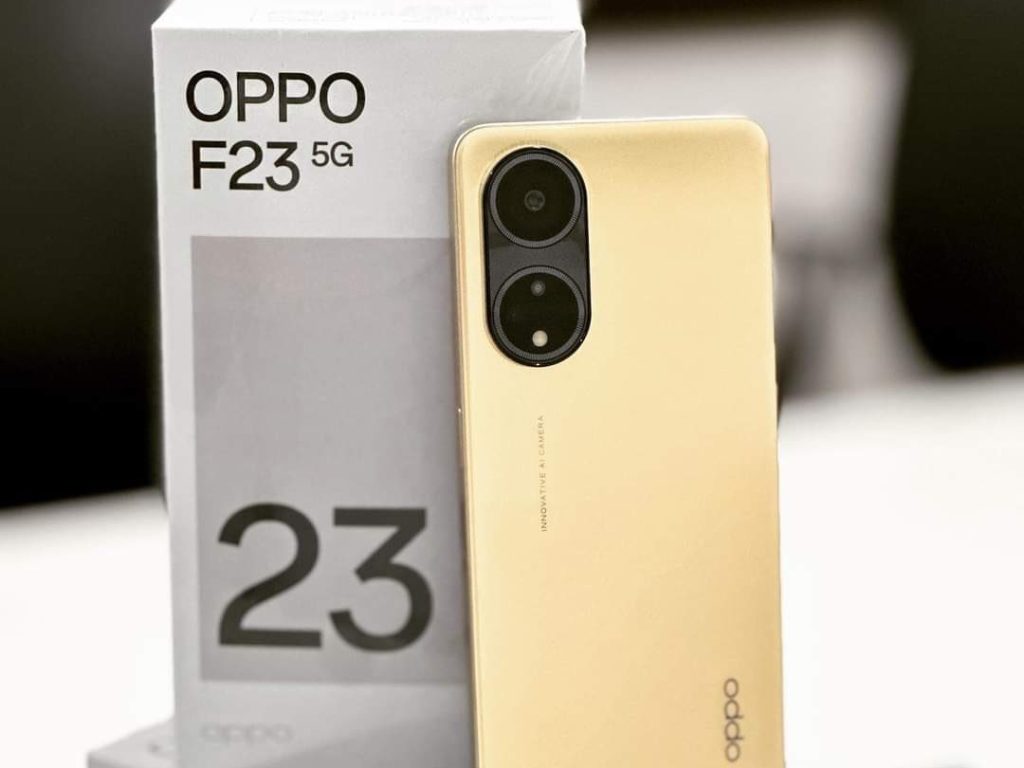
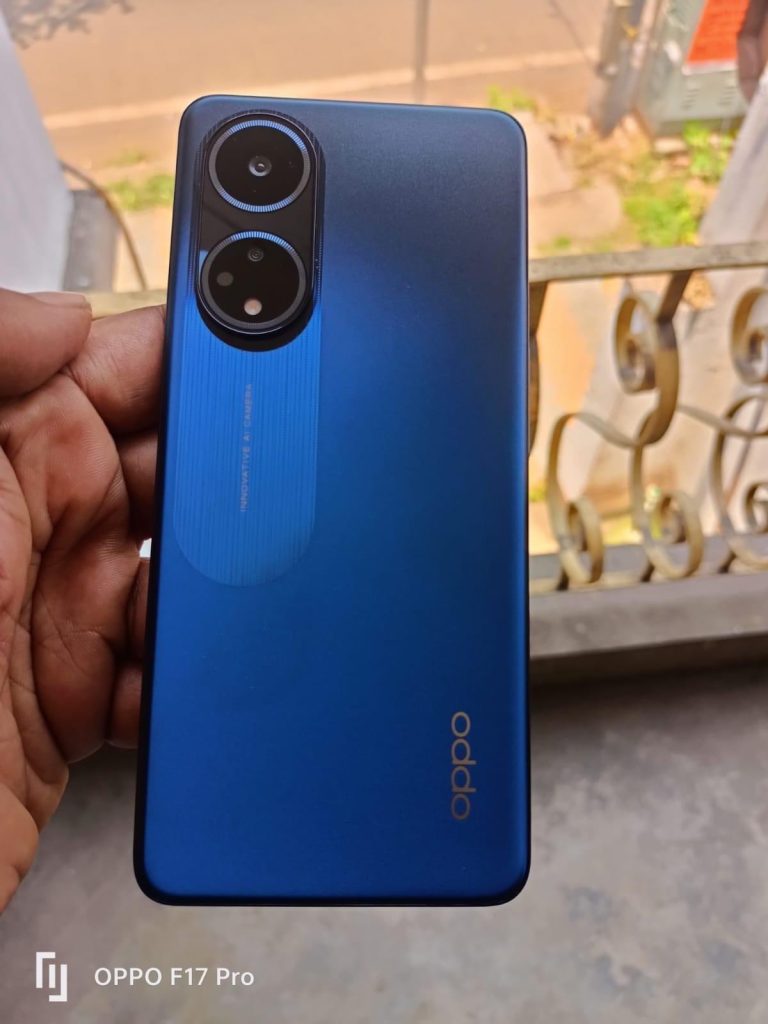
Oppo F23 live image leak confirms triple cameras & two color variants

For those unaware, the Chinese smartphone maker has already confirmed that the F23 will be announced on 15th May 2023 and will be available via Amazon. However, a new leak from tipster Paras Guglani has revealed the sale date of the upcoming smartphone, its pricing, and even some live images as well. These images have revealed its entire design. The front has a center aligned punch hole selfie camera, while the rear has pill shaped camera island with circular modules for its triple camera setup.

Furthermore, the leaked live images is also confirmed to feature a side mounted fingerprint scanner and even reveals two of its color options. This includes a Gold and Blue color variant. Tipster Guglani claims that the smartphone will go on sale starting from May 18, likely from Amazon and other channels. Apart from this, the pricing details were also leaked, and at least one variant of the Oppo F23 5G will carry a price tag of 23,999 INR.

Oppo

Based on what we know so far, the F23 will feature a 64 megapixel triple camera setup. It will be powered by a large 5,000mAh battery pack that supports 67W fast charging. Other confirmed features include 120Hz display, 8GB of RAM, and up to 256GB of internal storage. So stick around for more, as we will be covering the launch event that is set for next week.

RELATED:

Nokia C22 launched in India with IP52 rating & 5000mAh battery for Rs 7999

Nokia has just launched a brand new smartphone in the Indian market. The device is the C22, which is a budget grade handset that arrives with an affordable price tag and Android Go Edition platform. Notably, the launch arrives mere days after the company announced the Nokia XR21 rugged phone. So here are all the details.

Nokia C22 is the brand’s latest budget phone with an HD+ display

The new device has just been launched in India and targets the budget range segment. It sports a tall 6.5 inch HD+ LCD panel that has a waterdrop notch, 20:9 aspect ratio, and toughened 2.5D glass for added protection. On the other hand, the rear is made from polycarbonate materials along with a metallic frame on the sides. Under the hood, the device is equipped with the UNISOC 9863A1 SoC that is paired with up to 4GB of RAM and 64GB of internal storage.

Nokia

Notably, the Nokia C22 also supports virtual RAM expansion by up to 2GB. It is powered by a large 5,000mAh battery pack as well which supports the standard 10W charging. The device runs on Android 13 Go Edition out of the box and the brand promises two years of security updates as well. The rear features a dual camera setup with a 13 megapixel primary sensor and a 2 megapixel macro shooter, while the front houses an 8 megapixel selfie camera.

Other notable features include, IP52 dust and splash resistance, 3.5mm headphone jack, rear mounted fingerprint scanner, microSD card slot for storage expansion, and dual SIM. It is available in three color variants, namely Charcoal, Sand, and Purple options. The device has a starting price tag of 7,999 INR for its 2GB variant, while the 4GB model costs 8,499 INR. Nokia C22 is available for purchase from the brand’s official website and other offline stores.

RELATED:

Revamp your DIY Projects with GearBerry’s Massive Discounts on Laser Engravers and Cutters

GearBerry specializes in helping DIYers save time and money when purchasing industrial equipment, power tools, safety supplies, and other items for home repairs, upgrades, design projects, and arts and crafts. The company focuses on aiding those interested in 3D printers and laser engravers. The brand was born from the passion for do-it-yourself projects and a keen appreciation for top-notch power tools.

The company carefully curates its selection of products to ensure that it only offers the best tools available. GearBerry works directly with manufacturers to ensure that its products are of the highest quality, and it constantly monitors customer feedback to ensure that it is meeting the needs of its customers.

GearBerry provides customers with some of the biggest brands in the industry such as Anycubic, Ortur, and Xtool, all at competitive prices. Additionally, the company offers exceptional after-sale services to ensure customers are satisfied with their purchases.

DEAL:

For a limited period, GearBerry is giving huge discounts on some of its best laser engravers and cutters. The discount can be availed by using the Coupon Code: gearberry20off. Please note that the coupon is valid for all orders above $50 on gearberry.com. Also, products shipped from local US and EU warehouses come with free shipping and tax fee. So let’s check out some of the best offers available on GearBerry lasers and cutters.

SCULPFUN S30 Pro MAX Laser Engraver

Retail Price: $919.99          Discounted Price: $779.99

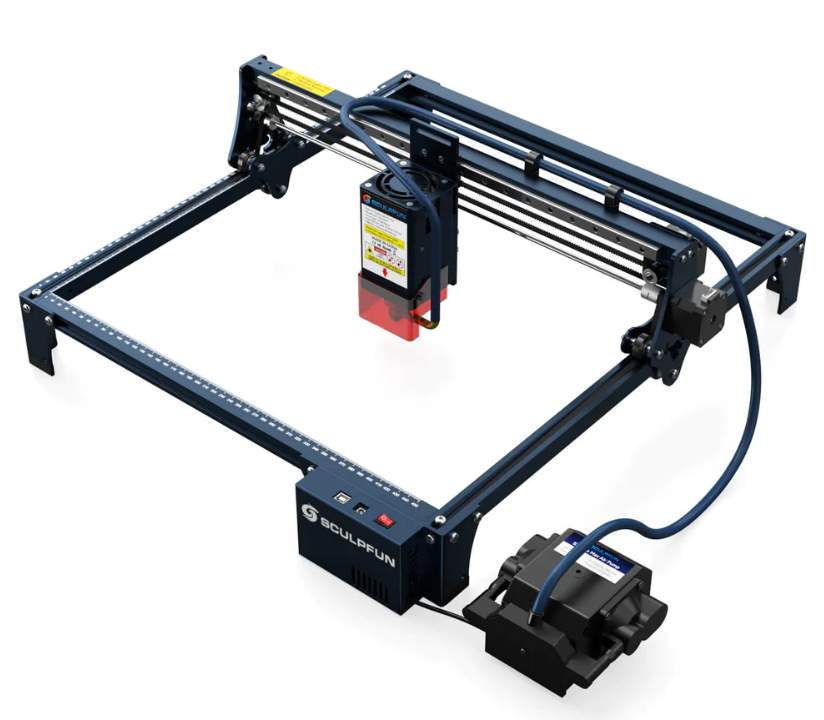
The SCULPFUN S30 Pro Max laser engraving machine is a versatile device that can engrave various materials such as wood, MDF, cardboard, plastic, leather, circuit board, aluminum oxide, stainless steel, ceramics, and dark stone. Additionally, it can cut through materials like black acrylic sheets, cardboard, non-woven fabric, bamboo sheets, certain plastic sheets, leather, and circuit boards, making it an excellent choice for professionals and DIY enthusiasts looking for a reliable and efficient engraving machine.

The SCULPFUN S30 Pro Max Laser Cutter boasts an industrial-grade, non-shaking X-axis guide rail for precise engraving and cutting of various materials. It delivers detailed results with minimal ripple patterns, unlike standard engravers. Its high-pressure air-assisted metal nozzle provides efficient cutting with a 30L/min airflow, removing debris for a clean finish on woodcuts.

The device features a 32-bit automatic air assist motherboard and an air pump controlled by Lightburn software for efficient engraving and cutting. The high-strength aluminum alloy frame can support up to 50kg, and the X and Y axes have exact scale lines for easy measurement of engraved objects.

Ortur Laser Master 3 Laser Engraver

Retail Price: $699.99          Discounted Price: $679.99

ORTUR’s latest laser engraver boasts an actual 10W optical power and utilizes the latest laser coupling technology to enable the cutting of a 10mm pine board with one pass and even 30mm thick black acrylics. The new laser features a focusing spot area that is only 1/3 of previous common lasers, and it is lightweight at only 235g while including integrated air assist, dual fans, and a foldable focal gauge. The machine can perform precision engraving and high-energy cutting at an impressive speed of 20000mm/min, making it faster than similar models and ideal for streamlined and productive endeavors.

The ORTUR Laser Master 3 is equipped with Web UI and is highly compatible with popular engraving software such as LaserGRBL and LightBurn. It supports a wide range of systems, including Windows XP/7/8/10 and Mac (LightBurn), and can handle various engraving file formats, including NC, BMP, JPG, PNG, DXF, and more.

The panoramic filter shield of the laser engraving machine can effectively filter out 97% of harmful UV rays, providing enhanced protection for your eyes. This eliminates the need for you and your colleagues to wear goggles while observing the engraving process, thereby saving on goggles costs and reducing the hassle of wearing them. Moreover, the machine also includes an air-assist nozzle that helps clear smoke and debris while engraving, ensuring a precise and clean output.

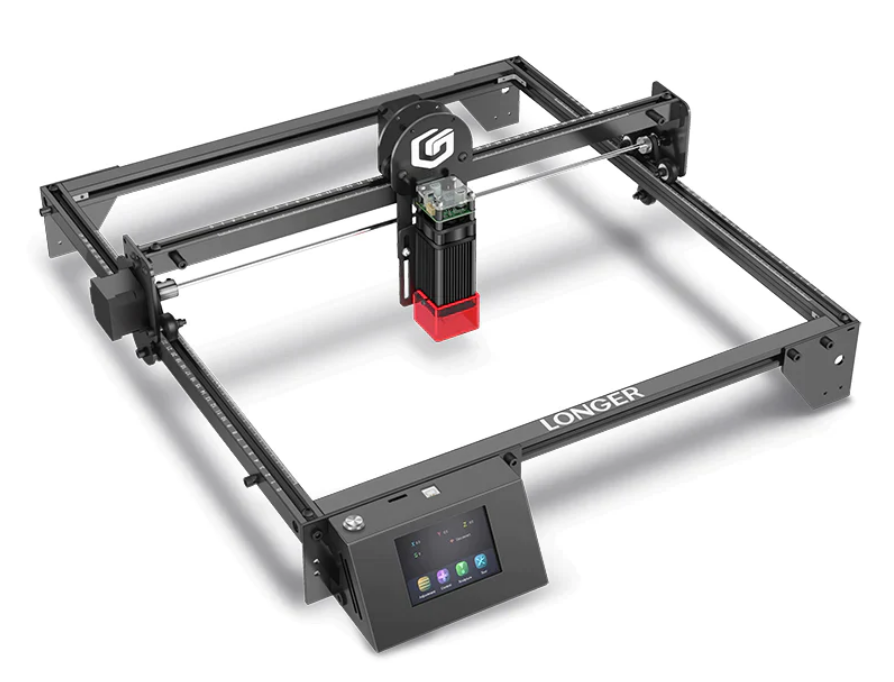
LONGER RAY5 10W Laser Engraver

Retail Price: $649          Discounted Price: $409

The Longer Ray5 10W Laser Engraver is a powerful cutter and engraver used on wood, acrylic, stainless steel, leather, silver, and more. It is one of the most cost-effective engravers available in the market.

The laser comes with dual beam technology and has a 10W intense laser that easily cuts through hard materials like wood. It can easily cut a 0.8”/20mm thick wood board and 1.2”/30mm acrylic material. The device can also be used for engraving at a max 10000mm/min engraving speed.

Longer Ray 5 can be used for beautiful and delicate engraving art, as it features the latest compressed laser technology that generates an ultra-fine laser spot which is two times thinner than ordinary lasers available in the market. This means the device gives you ultra-fine cutting and engraving which is precise, consistent, and crystal clear with thinner lines and delicate texture.

The Longer Ray 5 comes with a thermal sensor that detects accidental flames and automatically stops the laser and starts a buzzing alarm to inform you of the same. Moreover, the device comes with a flame-resistant acrylic laser protective cover for your safety. Other exciting features include a 3.5” touch screen, multiple data transfer options, multiple machine control options, wide software compatibility, etc. 

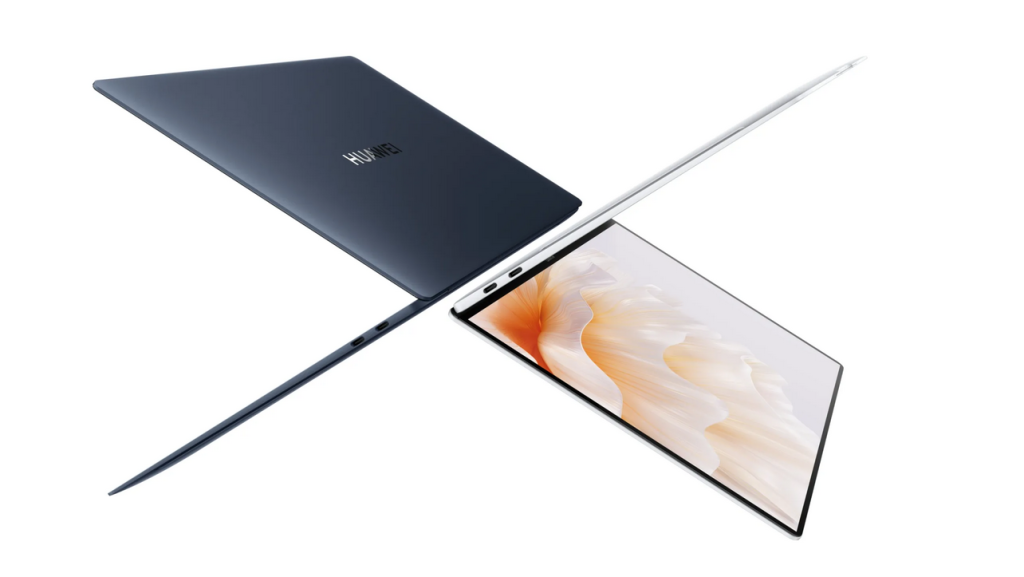
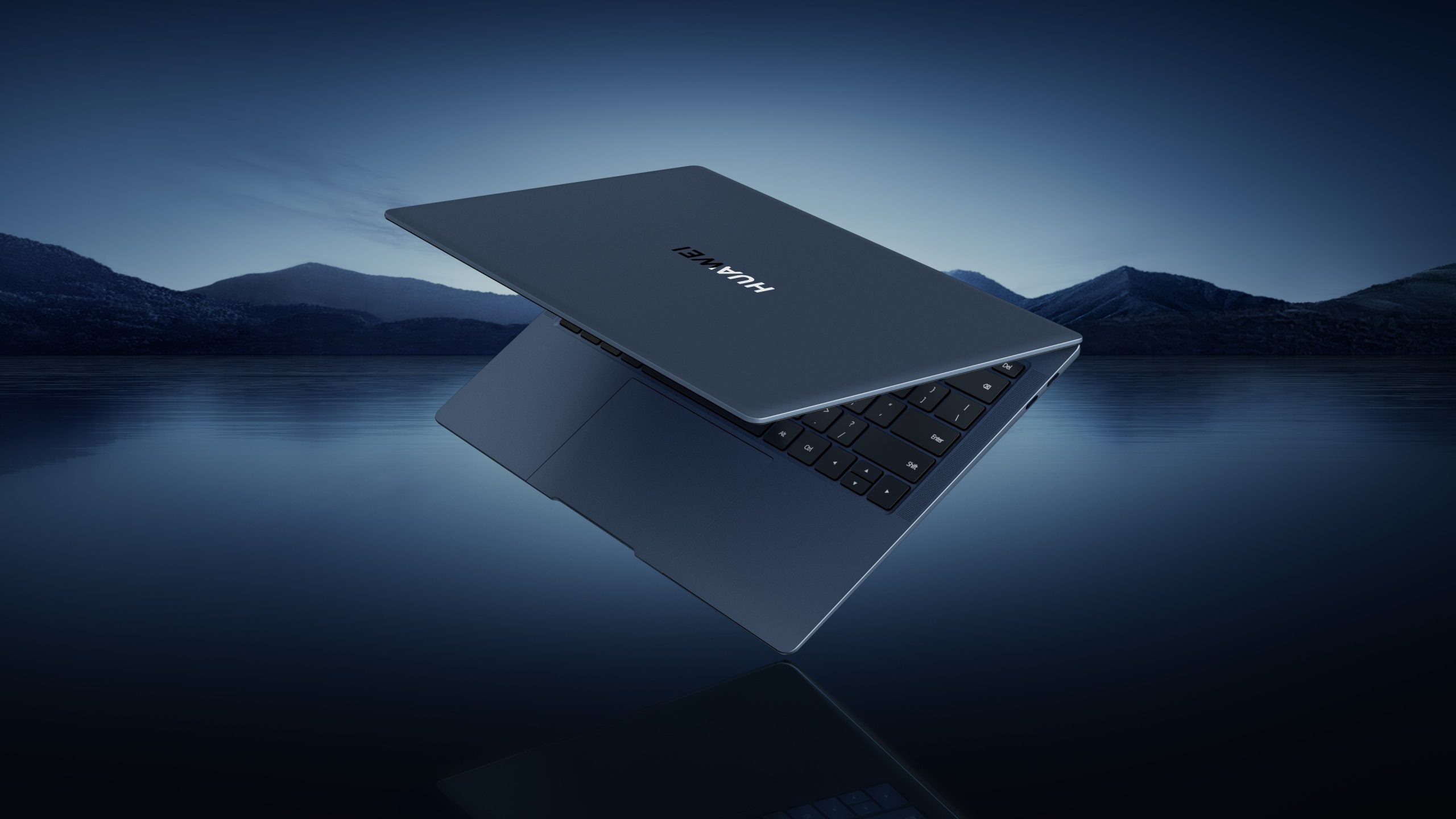
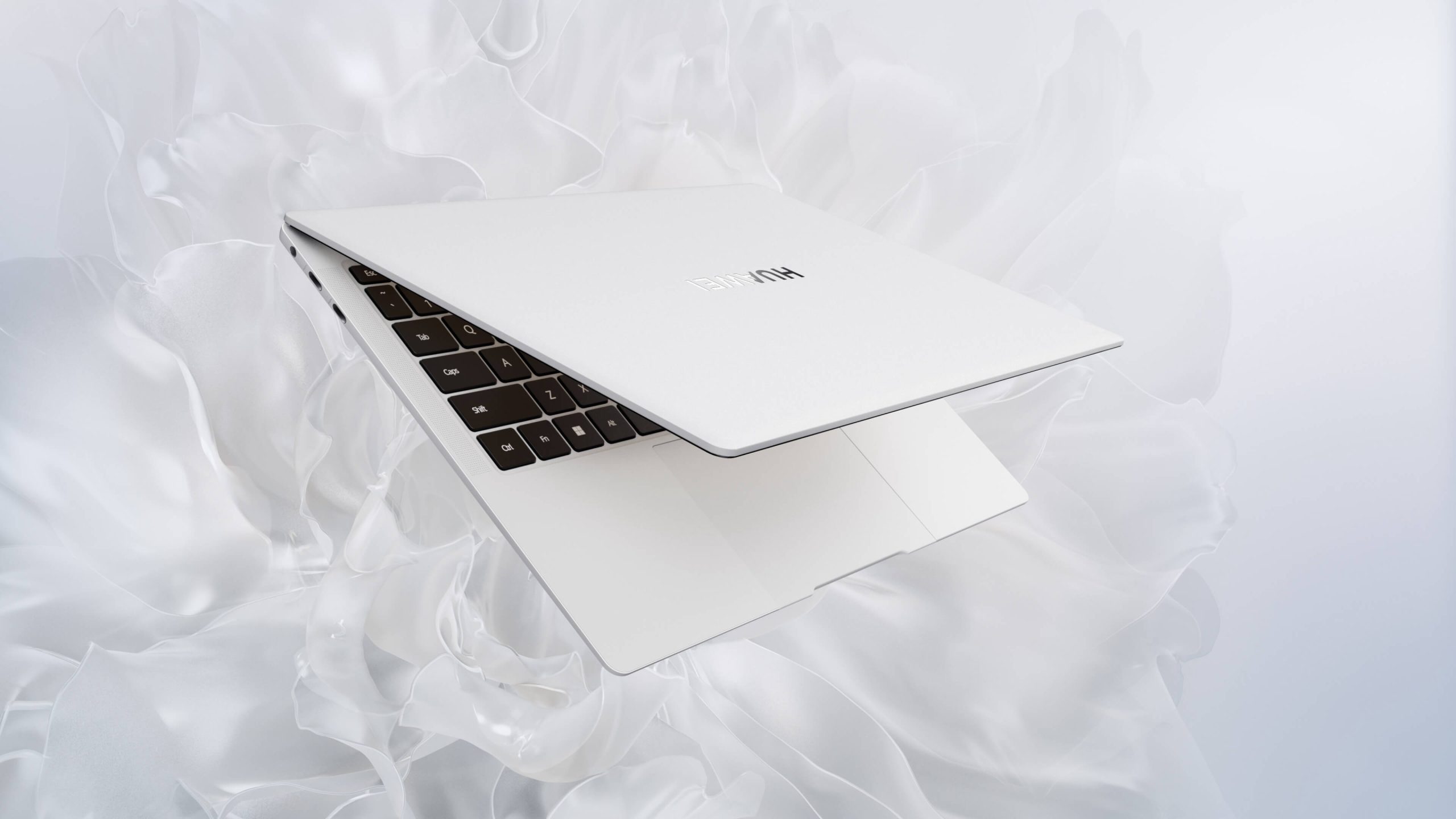
Huawei MateBook X Pro & MateBook 16S 2023 models refreshed with Intel’s 13th Gen CPUs

Huawei has announced the latest versions of its popular MateBook X Pro and MateBook 16S laptops, both of which feature the latest 13th Gen Intel processors. The MateBook X Pro 2023 comes with a choice of Core i5-1340P or i7-1360P, with 16GB or 32GB of RAM and Intel Iris Xe GPU for graphics. Its display is a stunning 14.2-inch touchscreen with a 3:2 aspect ratio, 3120 x 2080 pixel resolution, and 500-nit peak brightness. The laptop weighs a mere 1.26kg and is available in Space Gray, Ink Blue, and White.

Huawei

Similarly, the MateBook 16S 2023 is also equipped with 13th Gen Intel processors, including the i9-13900H, i7-13700H, and i5-13500H. The laptop boasts a 16-inch 3:2 aspect touchscreen display with a 2520 x 1680 resolution, which has improved to 400 nits of brightness. The MateBook 16S 2023 weighs 1.99kg and is available in Space Gray, Mystic Silver, and Starry Black.

Both laptops come with Thunderbolt 4 and USB-C ports, with the MateBook X Pro 2023 featuring four USB-C ports and the MateBook 16S 2023 featuring two. The MateBook X Pro 2023 has a 60Wh battery, while the battery life of the MateBook 16S 2023 has not been revealed.

The Huawei MateBook X Pro 2023 will be available from June 1, starting at €2,199/£1,799, while the MateBook 16S 2023 will also be available from the same date, starting at €1,799/£1,499. Huawei’s latest laptops will appeal to consumers who value portability, performance, and the latest technology.

In related news, the Huawei P60 Pro has been crowned the new king of smartphone cameras by DxOMark. You can read more about it here.

RELATED:

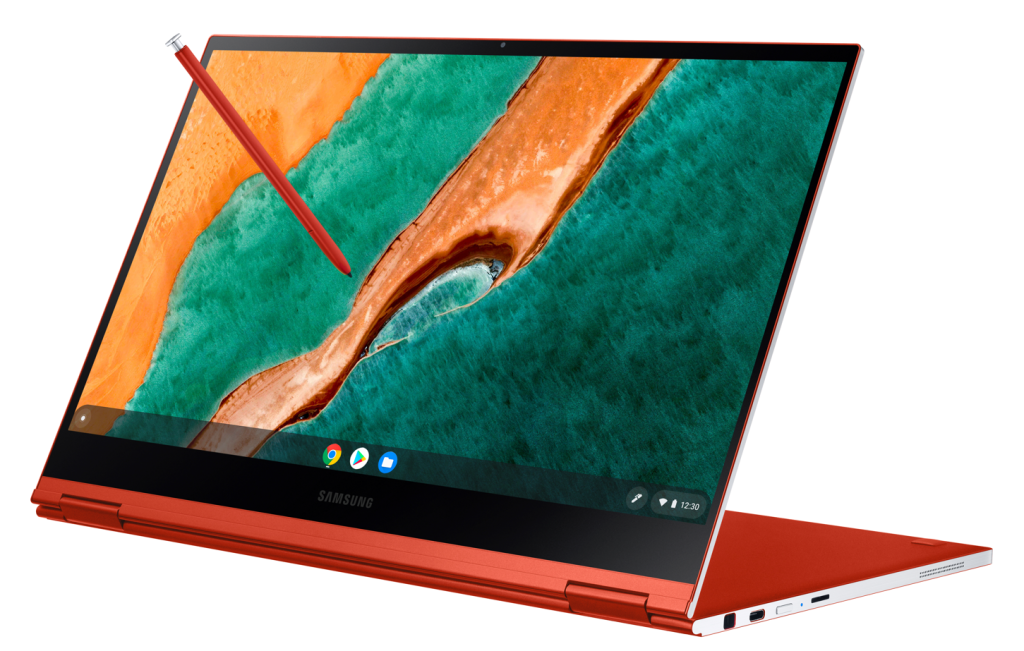
Google Introduces Android App Streaming on Chromebooks

Back in 2021, a feature leaked on the internet that hinted towards synchronization between applications on ChromeOS and Android. Now, almost two years later, a refined version of the feature has made its way into the ecosystem.

App Streaming only works with Android 13 and older versions

The tech giant has now introduced App Streaming Originating to Chromebooks running ChromeOS 114. This feature enables Chromebook users to access and utilize various Android apps from their phones within a dedicated window on their devices. With App Streaming, Google continues its efforts to enhance device interoperability and provide users with a seamless and integrated app experience.

Chromebook

To access the App Streaming feature, Chromebook users must meet a few prerequisites. Firstly, they need to switch to the Beta Channel and install ChromeOS 114, the latest update. Additionally, Phone Hub, the integration platform between Android phones and Chromebooks, must be set up. However, it is crucial to note that App Streaming is currently compatible only with the “Pixel 4A and higher” running Android 13 or later. Non-Pixel users can still enjoy this feature with the Xiaomi 12T, 12T Pro, 13, and 13 Pro, also running Android 13 or later.

According to Google’s support document, both the phone and Chromebook must be connected to the same Wi-Fi network and in close proximity to each other to enable App Streaming. The arrival of App Streaming with the ChromeOS 114 Canary build has given users a glimpse into the future of app integration. Google’s ongoing efforts to enhance cross-device functionality and enable smoother user experiences are commendable.

RELATED:

(Via)
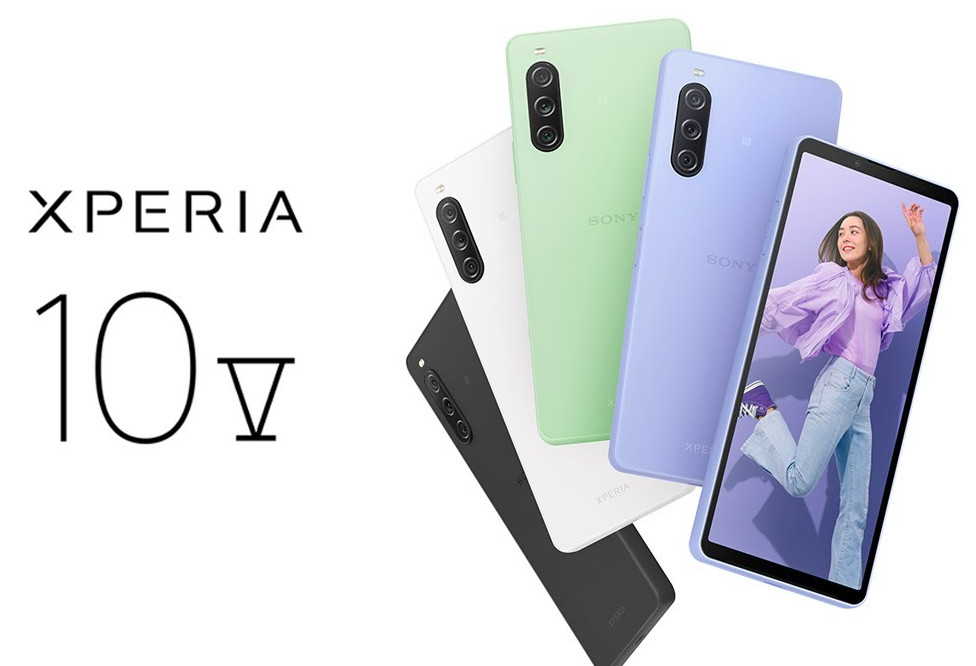
Sony Xperia 10 V launched with 6.1 inch OLED display, 48MP Exmor RS sensor, & more

Sony has just announced its latest generation Xperia 1 V flagship smartphone in the market. And alongside this model, it has also launched a new Xperia 10 V premium mid range model, which features some notable specs and features. So let’s have a look.

Design & Display

The Xperia 10 V from the Japanese tech giant arrives with various improvements over its predecessor, which includes a lighter build overall as well. It weighs just 159 grams thanks to its plastic side frame and rear panel, which is also IP65/68 water and dust resistant. Although, the front is protected via a Gorilla Glass Victus.

Sony

The device sports a 6.1 inch OLED display that unfortunately only offers 60Hz refresh rate with 120Hz touch sampling rate and Full HD+ resolution. This screen also has a 21:9 aspect ratio, 97 percent DCI P3 color gamut, 10 bit tonal gradation, and a rather noticeable chin and top bezel. The company also claims that the display is around 1.5 times brighter than the previous generation.

Specifications

Under the hood, the Sony Xperia 10 V is equipped with a Qualcomm Snapdragon 695 SoC that is paired with 8GB of LPDDR4X RAM and 128GB of UFS 2.1 storage. The memory can be further expanded by up to 1tB via a microSD card slot. The device is powered by a 5,000mAh battery pack as well, which makes this device the lightest 5G enabled smartphone with such a large battery capacity.

This battery pack also supports some form of fast charging, but this detail wasn’t clearly revealed. So we can expect it to be around 30W, which is the same as its predecessor, which supported 21W fast charging. Other notable features include, 3.5mm audio jack, Qualcomm aptX adaptive, NFC, side mounted fingerprint scanner, 60 Reality Audio Certified, 360 Reality Audio Upmix, DSEE Ultimate, and Stereo Recording.

Camera

The cameras are undoubtedly the highlight of this mid range smartphone. The company has just announced the Xperia 1 V, which featured some notable camera improvements and innovations. But the brand is still offering a great photography experience from its Xperia 10 V’s triple camera setup as well. The primary sensor is a 48 megapixel Exmor RS sensor, which is again 1.6 times larger than the previous model thanks to its 1/2.0 inch sensor size. This also supports hybrid OIS/EIS, f/1.8 aperture, and 80° field of view.

Alongside the primary camera, there is an 8 megapixel telephoto lens that offers up to 10x hybrid zoom, f/2.4 aperture, and 1/4.4 inch sensor size. Lastly, the device’s last sensor is an 8 megapixel ultra wide angle lens that has a f/2.2 aperture and 120° ultra wide angle lens. On the other hand, the Xperia 10 V houses an 8 megapixel selfie camera on the front that has a f/2.0 aperture, 1/4 inch sensor size, 1.12μm pixel size, 78° wide angle lens.

Pricing & Availability

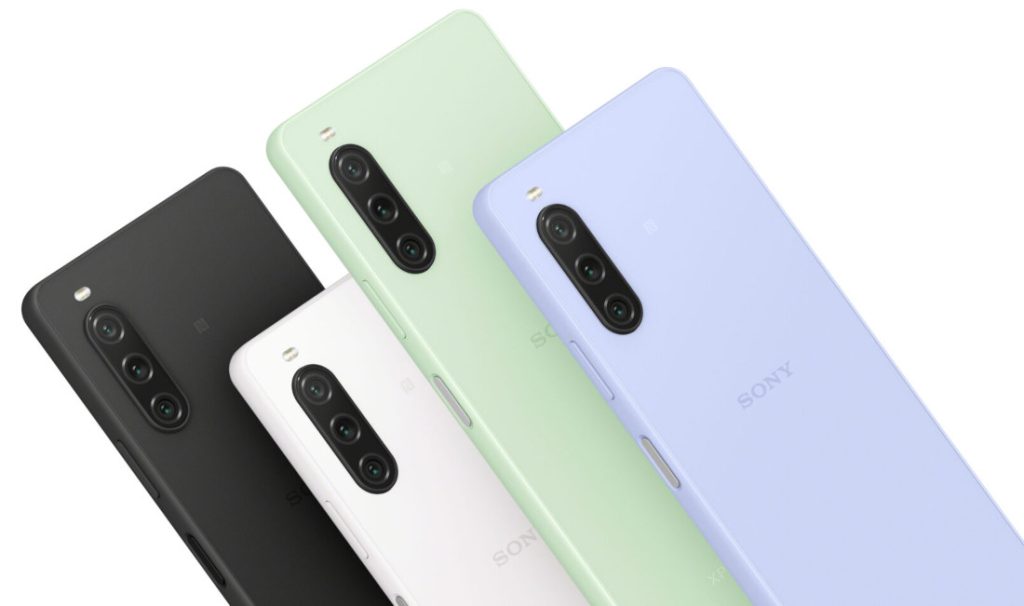
The Sony Xperia 10 V has been launched in multiple color options, which includes a Lavender, Sage Green, White, and Black variants. It has a price tag of 449 EUR or around 493 US Dollars. The smartphone will go on sale in Europe, UK, and a few other regions sometime in the middle of June 2023.

RELATED:

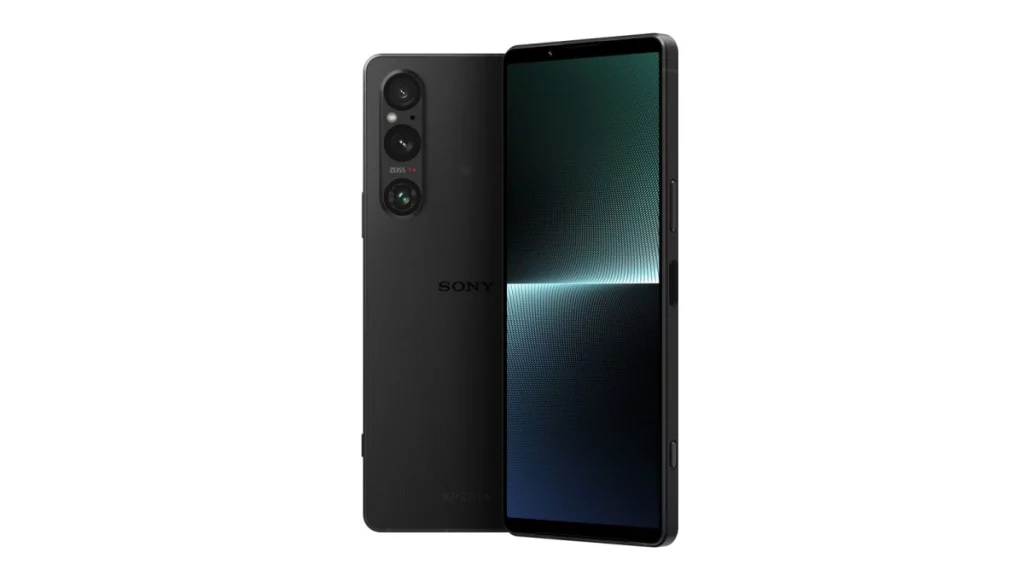
Sony Xperia 1 V launched: New Exmor T camera sensor, 4K OLED display & Snapdragon 8 Gen 2 SoC

Sony has recently introduced its new flagship smartphone, the Xperia 1 V, in global markets, highlighting its unique Exmor T for mobile stacked sensor that promises a significant improvement in low-light photography. Along with this, the device comes with top-tier specifications, including a 4K OLED display and a state-of-the-art Snapdragon chipset. To determine if the device is worth its price tag of €1,399, let’s delve into its features in detail.

Sony

Design and display

Not much has changed in the physical appearance of the Xperia 1 V compared to its predecessor, however, the device is much sturdier and easy to handle this time around.

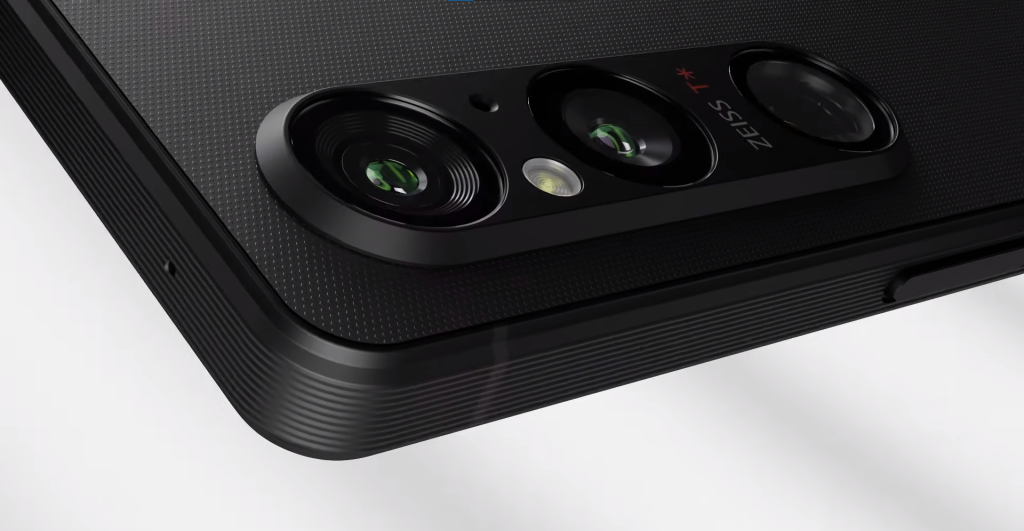
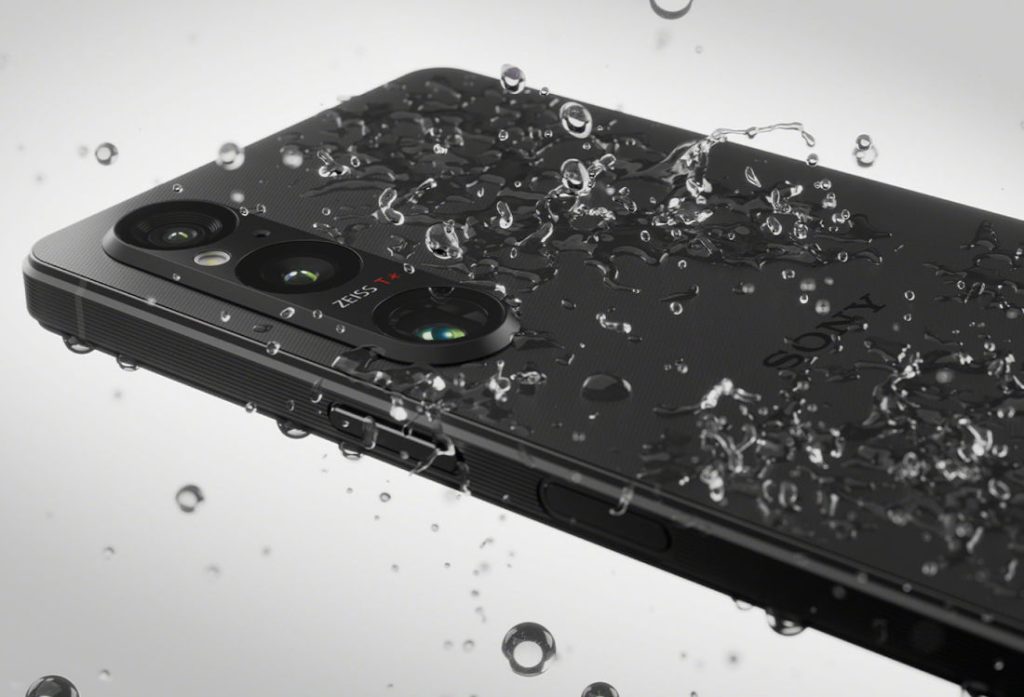
It features a boxy frame with flat edges and a pill-shaped vertical camera island. The back and the front are both covered with Gorilla Glass Victus 2 bringing its toughness to the next level. Along with that, the back and the side frame feature a grippy texture which is always appreciated on an expensive device.

Sony

The device comes with a 6.5-inch 4K OLED display boasting a 120Hz refresh rate and an aspect ratio of 21:9. The display has moderate bezels at the top and bottom, and the front camera is located in the top bezel. The device comes with an IP68 water and dust resistance rating despite featuring a 3.5mm audio jack and a microSD card slot. The device has an improved set of front-facing speakers equipped with a new amplifier to deliver a more dynamic and richer sound.

Performance & software

The Xperia 1 V boasts impressive hardware, including a Snapdragon 8 Gen 2 chipset, 12GB of RAM, and 256GB of storage. What sets Sony apart is their inclusion of a microSD card slot, allowing for easy storage expansion. Large smartphone cameras generate a significant amount of heat, but the Xperia 1 V tackles this issue with a 60% larger heat diffusion sheet volume than its predecessor.

Sony

With a 5,000mAh battery, the Sony Xperia 1 V supports 30W wired charging, which can recharge the device to 50% in 30 minutes. The smartphone also features wireless charging and reverse wireless charging. According to Sony, the battery will retain a minimum of 80% of its capacity after three years of use.

Sony

Out of the box, the phone runs on Android 13 and has minimal bloatware. Instead, Sony has included its pro-grade creator-centric apps such as Photography Pro, Videography Pro, Cinema Pro, and Music Pro. Sony has introduced a convenient change in its Photo Pro and Video Pro apps, allowing their user interfaces to be displayed vertically. This modification will enhance the user experience of taking pictures and videos in portrait mode.

Camera

As always, the flagship Xperia’s key selling point is the camera system, and this time around it is quite special. The primary camera onboard is a 52MP unit with an F/1.9 lens and a 1/1.35” sensor. Sony calls it the Exmor T stacked sensor and it is 70% larger than its predecessor. The photos however are shot in 48MP due to the 4.3:3 aspect ratio, which gets further binned to 12MP images in normal mode.

Sony Xperia 1 V
Source: Sony

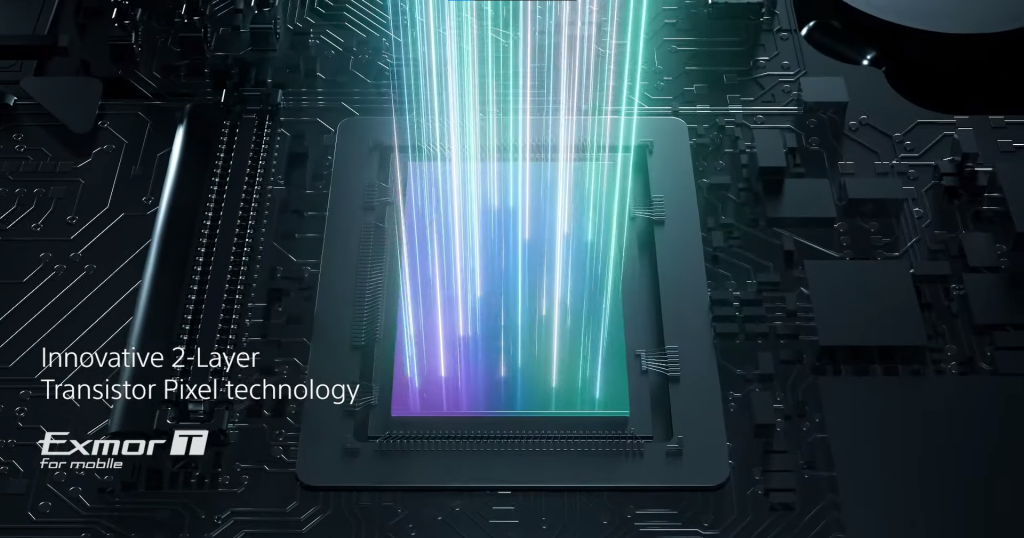
Sony has separated the photodiode and transistor, placing them on distinct layers that are stacked upon one another. This has allowed the company to independently adjust the size of each component, resulting in a significant improvement in the amount of light captured and reduced noise levels. According to Sony, the new camera sensor can perform twice as well in low light compared to its predecessor.

Sony
Source: Sony

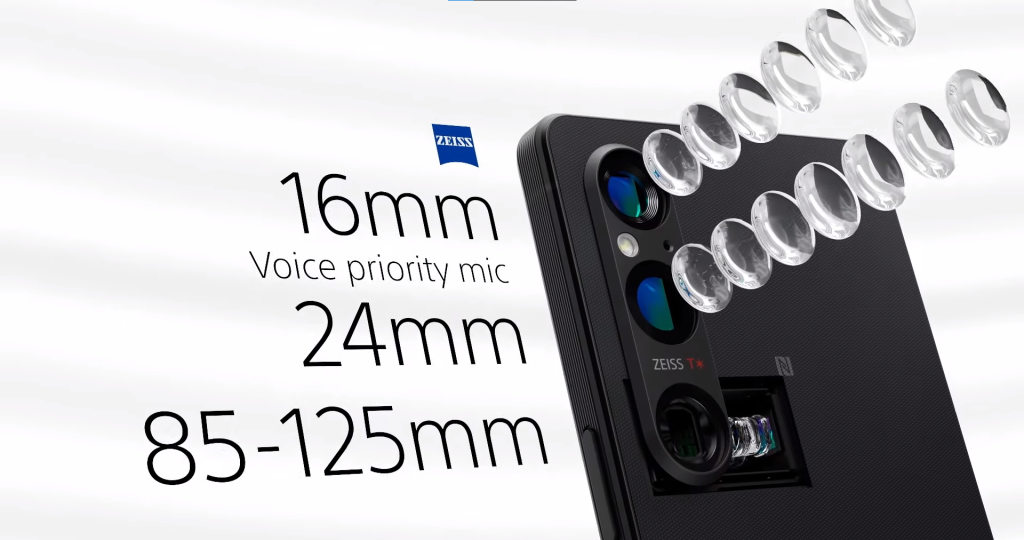
In addition to the primary camera, the Xperia 1 V retains the same 85-125mm F/2.3-F/2.8 12MP telephoto camera with continuous zoom as its predecessor. Alongside this, there is a 12MP sensor supporting the 16mm ultrawide camera, which features autofocus. The Time-of-Flight (TOF) sensor has been removed and replaced by AI algorithms for focusing purposes. The AI algorithms are also said to boost performance in modes such as Night Portrait, Daylight Portrait, and Night View.
Sony has introduced S-Cinetone for mobile mode, which enables users to capture videos using pre-set cinematic modes that generate professional, authentic colors without the requirement for post-recording color-grading. While on the topic of videos, the camera phone is able to record up to 4K videos in 120 frames per second. Sony’s Alpha camera features have also been included on the Xperia 1 V like the high-performance real-time AF, real-time Eye-AF, burst shooting, etc. Last but not least, the selfie camera has a 1/2.9” sensor capable of taking 12MP images.

Price & availability

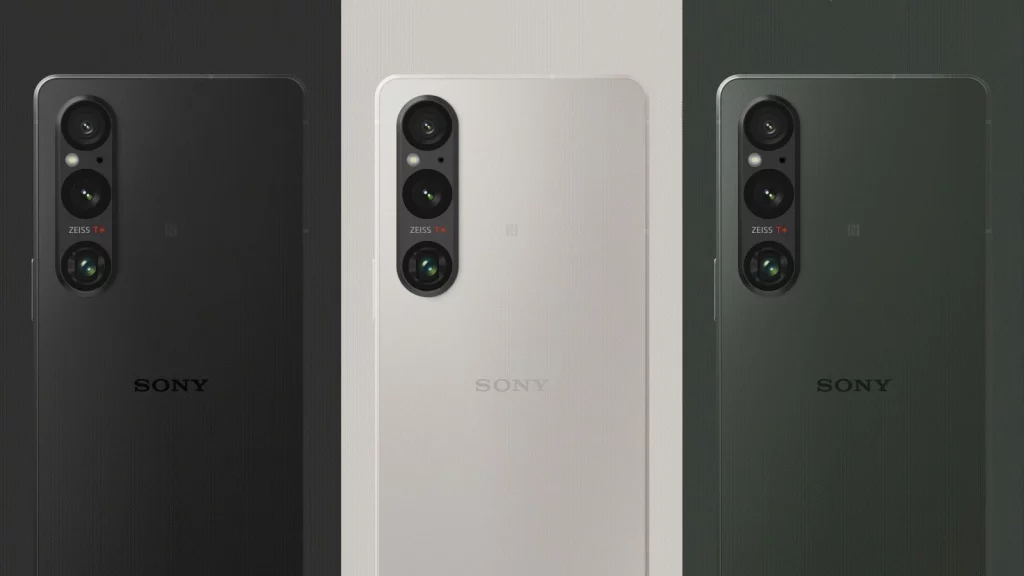
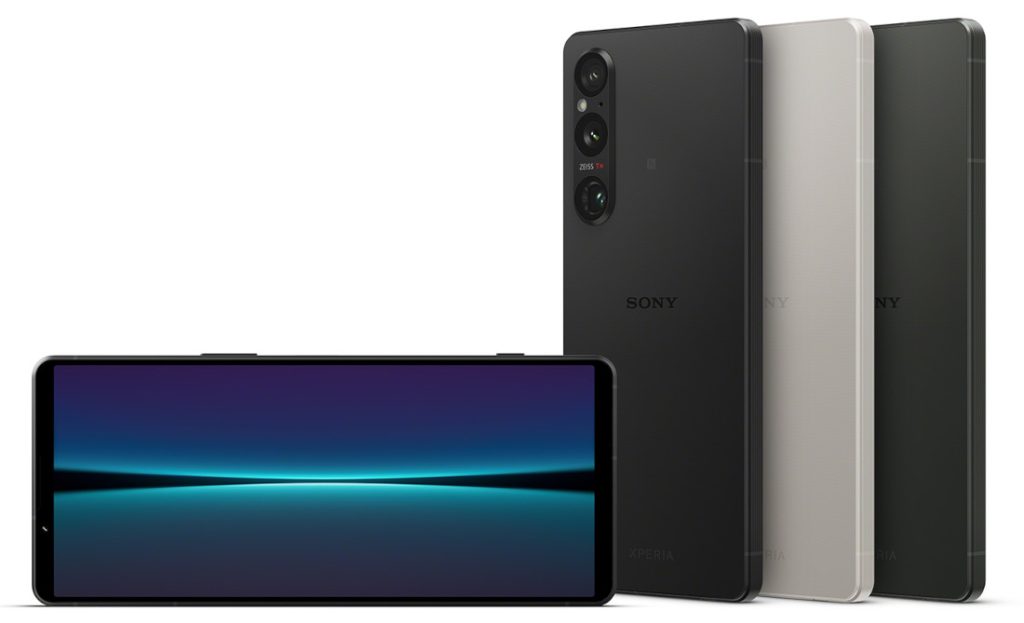
Sony’s latest flagship smartphone, the Xperia 1 V, will be released in black, platinum silver, and khaki green color options in late June. Specific market availability details are yet to be announced. The phone is priced at €1,399 in continental Europe and £1,299 in the UK. The cost for the US market is still to be confirmed.

RELATED:

Periscope lens to be Apple iPhone 15 Pro Max exclusive, rumored again

As the much-anticipated launch of the iPhone 15 series approaches, new leaks are stirring up excitement. A new leak suggests that the top-tier iPhone 15 Pro Max is set to receive a significant camera upgrade, with the introduction of a periscope lens.

Earlier rumors suggested that the iPhone 15 Pro and Pro Max models would both feature periscope lenses, but reliable analyst Ming-Chi Kuo has said that only the Pro Max model will have it. Twitter user @URedditor, with a reliable track record, also claimed that only the iPhone 15 Pro Max would feature the periscope camera.

Sources also revealed that Apple has partnered with LG Innotek and Jahwa Electronics to source 70% and 30% of OIS actuators for the periscope module, respectively.

Better Zoom Capabilities Expected with iPhone 15 Pro Max’s Camera

Apple iPhone 15 Pro Max periscope lens

The enhanced telephoto camera aims to replace the 3x optical zoom lens found in the current iPhone 14 Pro Max, potentially offering up to 6x optical zoom. This would be a substantial upgrade, despite still falling behind the Samsung Galaxy S23 Ultra’s 10x optical zoom.

The new periscope lens is part of a slew of improvements that Apple seems to be making in the camera department. Along with the new lens, the iPhone 15 Pro models are also said to use a new Sony IMX903 48MP sensor with a larger sensor size of 1/1.14-inch. This enhancement is expected to capture more light and detail compared to the Sony IMX803 sensor found in the iPhone 14 Pro models.

In addition to the camera upgrades, the past leaks hint at other noteworthy changes in the iPhone 15 Pro models. Notably, the use of titanium materials for the chassis and the replacement of the Mute switch with a multi-tasking button similar to the Action Button in the Apple Watch Ultra.

The iPhone 15 Pro Max will retain its 6.7-inch OLED display with ProMotion support for up to 120Hz and super thin bezels, and it will get the USB Type-C port. It is also expected to run on the new A17 Bionic SoC.

While the company had been rumored to replace physical buttons with solid-state buttons, technical issues have reportedly delayed this change. The physical buttons are now expected to be replaced in next year’s Pro models.

RELATED:

(Source)