Advertisement

Lenovo Yoga Slim 6 Ultrabook with AMD Ryzen 7000 series CPUs and USB4 connector announced

Lenovo has announced the Yoga Slim 6 ultrabook with AMD Ryzen 7000U processors. The new Lenovo laptops come in three screen options and also feature USB4 connectivity. The models also come with fast RDNA 3 GPUs and a 180º hinge. The Yoga Slim 6 has a 14-inch FHD+ OLED screen for an expansive view.
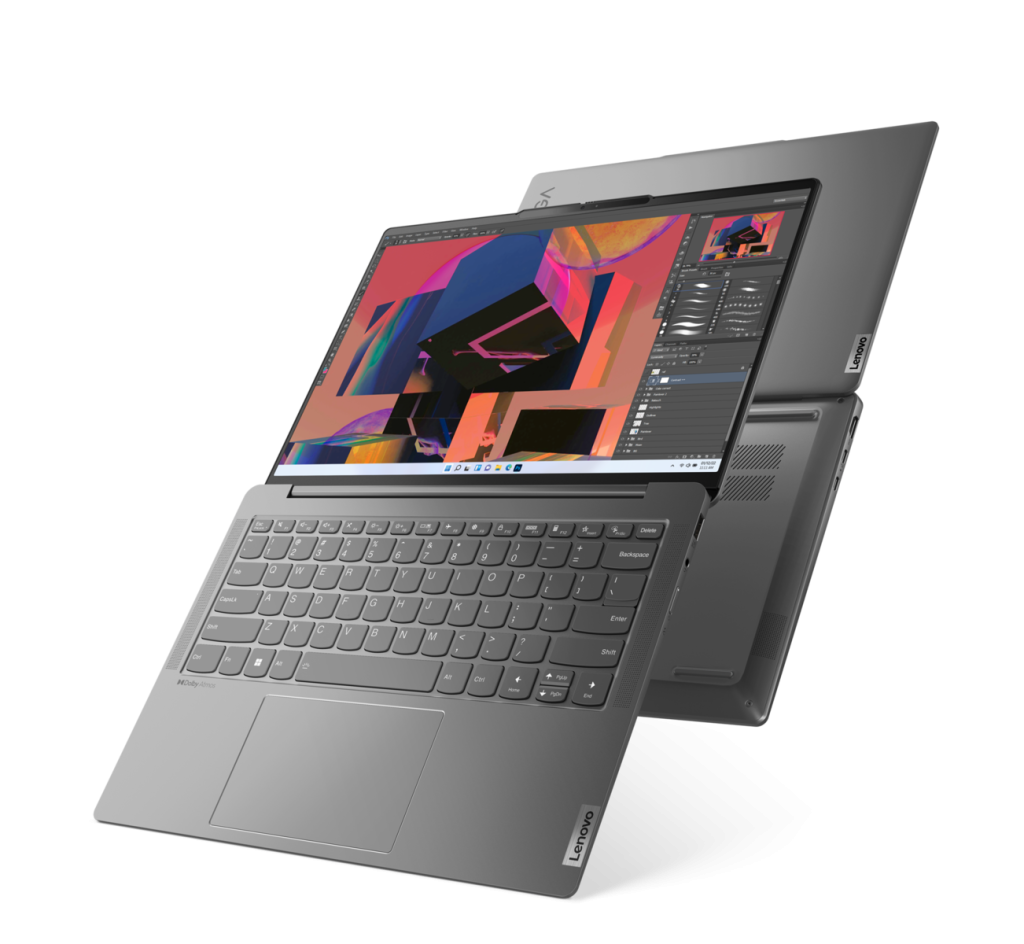
Lenovo Yoga Slim 6 Ultrabook

You can choose between the AMD Ryzen 7 7840U and Ryzen 5 7540U processors with 28W TDP and RDNA 3 integrated graphics card. The laptops offer up to 16GB of LPDDR5 dual-channel RAM combined with up to 1TB of storage. The USB4 connector provides high-speed data transfer.

The three display options for the 14-inch Lenovo Yoga Slim 6 ultrabook deliver either 300 or 400 nits of maximum brightness. Apart from the FHD+OLED screen, there is also a 2.8K, as well as a 2.2K panel. Refresh rates hover between 60Hz and 120Hz for the three options and they all feature Dolby Vision and have low blue light certification. The models offer 100% sRGB/ DCI-P3 color gamut coverage and matte finish.
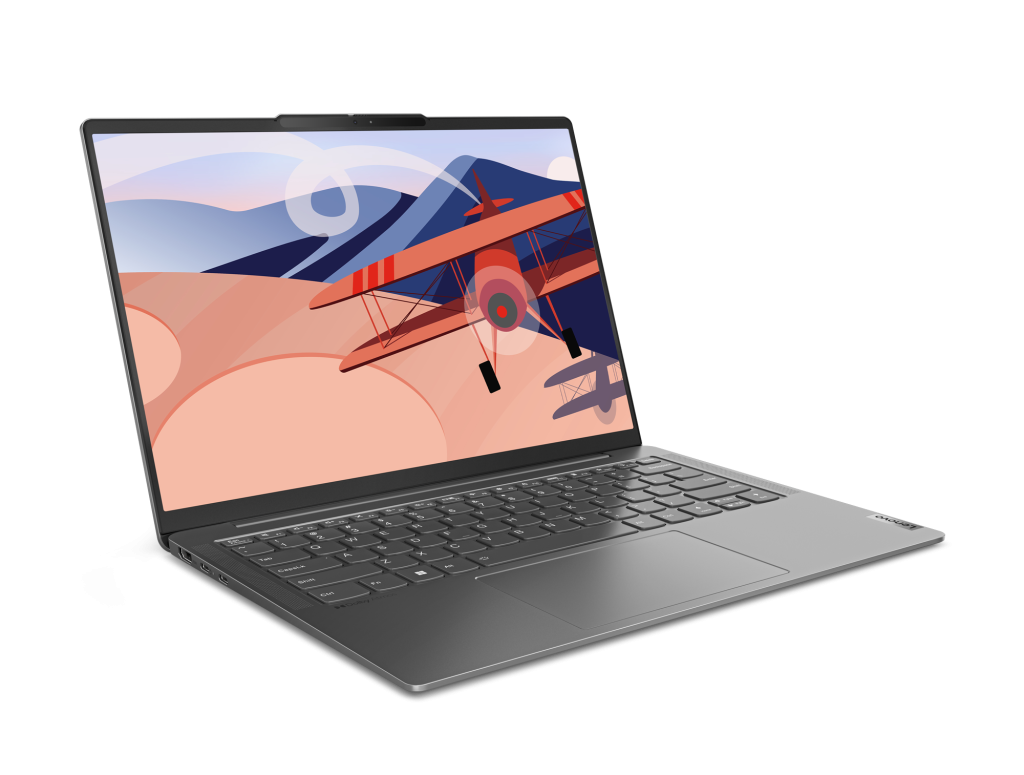
Lenovo Yoga Slim 6 Ultrabook

Apart from the USB4 connector, the Lenovo Yoga Slim 6 ultrabooks have USB-C 3.2, USB-A 3.2, and HDMI 2.1 ports, as well as an audio combo jack. Both Wi-Fi 6/E and Bluetooth 5.1 were also supported in the models. Two 2W Dolby Atmos speakers are also present on the laptop. The FHD webcam of the Yoga Slim 6 has an IR sensor and camera shutter. A dual-array microphone is also part of the mix.

The Lenovo Yoga Slim 6 is available in Storm Grey and Misty Grey color variants and the laptop weighs just 1.31kg. The Lenovo Yoga Slim 6 ultrabook is expected to enter the market by June 2023. There are no release details yet but it could be priced from €899 (~$975) in Europe.

Related:

Microsoft Unveils OpenAI-based Chat Tools for Bolstering Cybersecurity

Microsoft has announced the launch of new AI-driven chat tools designed to assist cybersecurity teams in preventing and mitigating cyberattacks. Leveraging OpenAI’s cutting-edge GPT-4 language system and security-specific data, these tools, known as “Copilots,” aim to streamline and simplify threat analysis for security professionals.

Microsoft unveils OpenAI-based chat tools for fighting cyberattacks

The new AI technologies enable rapid analysis and allow users to pose plain English questions, making it accessible to employees with limited expertise in security or AI. This is particularly significant given the current scarcity of skilled workers in the field. According to Vasu Jakkal, Microsoft’s vice-president for security, compliance, identity, and privacy, cyberattacks have significantly increased in speed and frequency since the pandemic.

o

With the Security Copilot, users can ask questions such as, “How can I contain devices that are already compromised by an attack?” or request a list of individuals who sent or received an email with a dangerous link. The tool can also generate reports and summaries of incidents and responses with ease.

Microsoft will initially grant access to the tool for a select group of customers, with plans to expand availability later. The Security Copilot utilizes data from government agencies and Microsoft’s researchers, who monitor nation-states and cybercriminal organizations. The assistant is designed to work with Microsoft

RELATED:

(via)

BenQ GP500 projector with 1,500 ANSI Lumens brightness released in Europe and the US

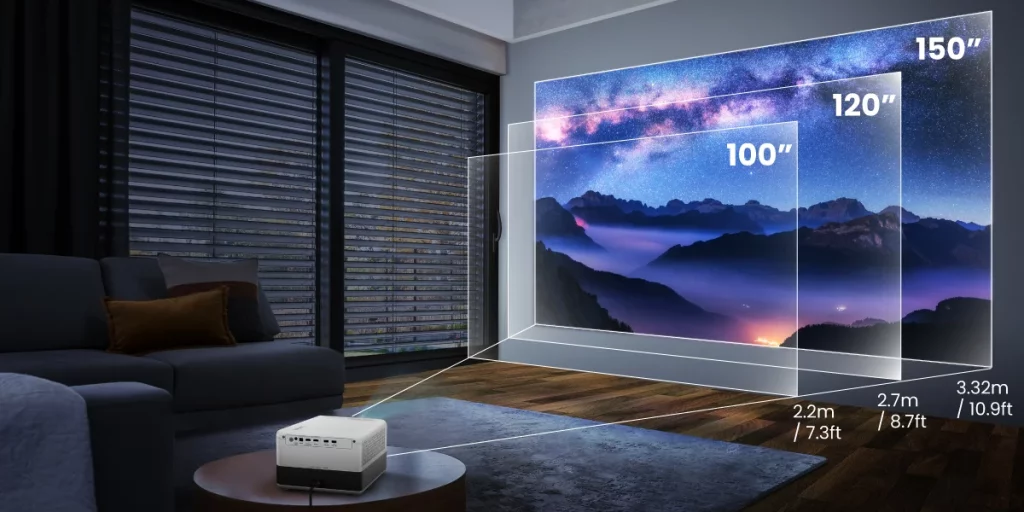
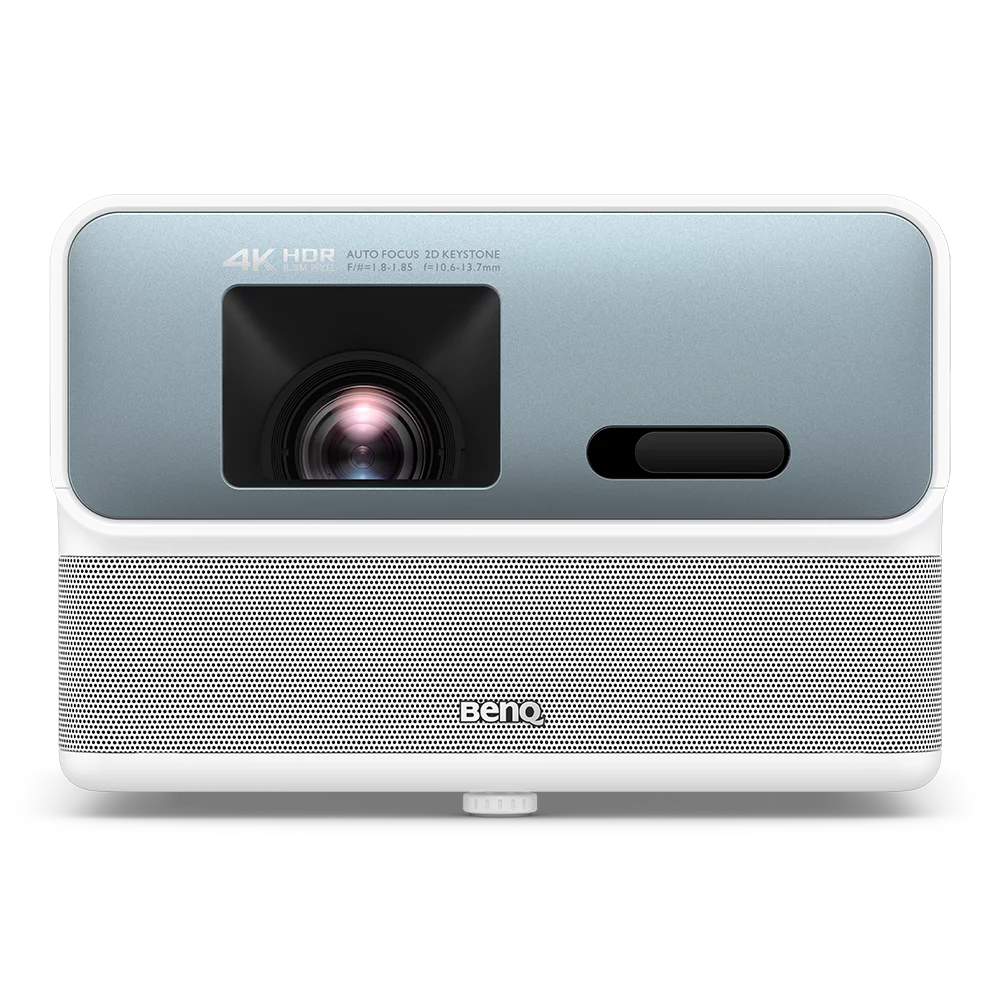
BenQ has released its latest projector in the European market. The BenQ GP500 projector is now available in the UK, EU, and the US. The new projector outputs a maximum brightness of 1,500 ANSI lumens and can throw images up to 150 inches wide.

BenQ GP500 projector

The BenQ GP500 was showcased during CES 2023. It can project its maximum image at a distance between 3.3 and 4.3 meters with its 1:1.3 throw ratio. It comes with a LED light source that can last for up to 30,000 hours in ECO mode. The projector outputs 4K content and allows 1.3X zoom. It also has a 90% DCI-P3 color gamut coverage and supports HDR10 and HLG.

The new BenQ projector has Android TV built-in, so the user can watch content from popular platforms like YouTube and Prime Video. The projector can also cast content from your mobile device using Google Chromecast or Apple AirPlay. The GP500 has an HDMI ARC and USB-A port for wired connectivity. The sound system of the projector delivers 20W 360º audio output. Its 5.1 channel audio out port also allows you to connect external speakers to the projector.

BenQ GP500 projector

The BenQ projector can be controlled via voice commands using Google Assistant while the autofocus, screen fit, and object avoidance tools help to output perfect images. The dimensions of the projector are 10.2 x 10.5 x 7.2 inches. The gadget retails in the UK for £1,699 (~$2,093) directly from the BenQ store or £1,901.22 (~$2,342) via Amazon. The product retails in the US and EU for $1,799 and €1,799 respectively.

RELATED:

(source)

GPD Win Mini tipped to launch with a clamshell design and larger battery than the Steam Deck

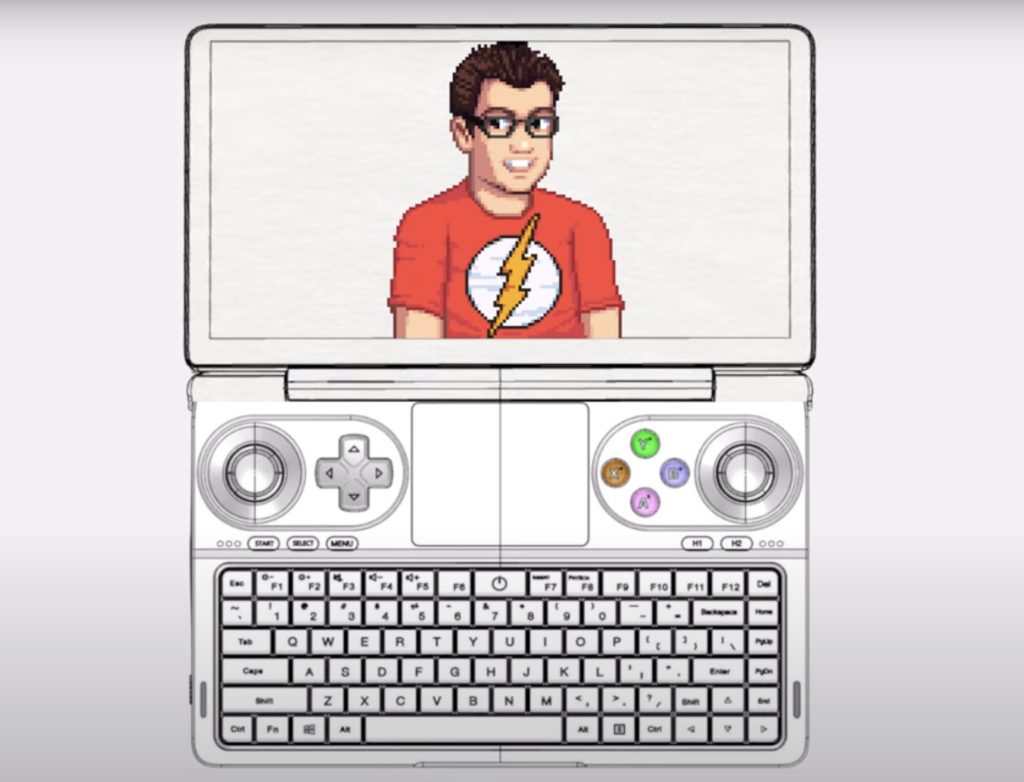
The GPD Win Mini gaming handheld will come with a clamshell form factor, new details reveal. The Win Mini will come with a 7-inch, 1080p display and a clamshell form factor while its 45 Wh battery allows the user an unfettered gaming time. The model is designed as a refreshed version of Win 2 but falls short of an improvement over Win 4.

GPD Win Mini gaming handheld

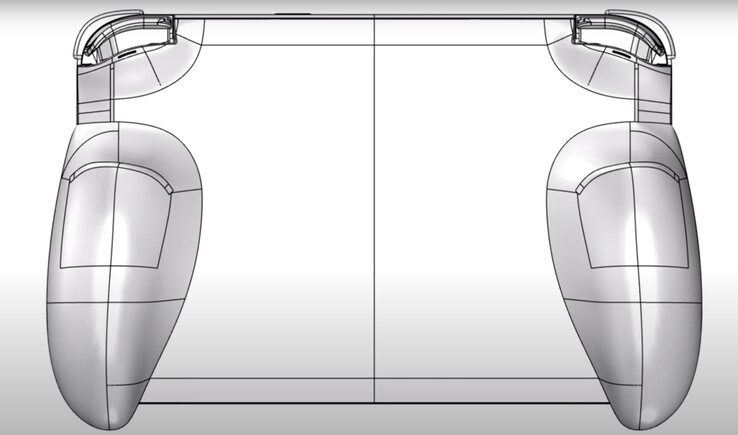
The GPD Win Mini is slightly wider and taller than the GPD Win 2. It has a 45 Wh battery which is possibly 12% larger than the Steam Deck. The display of the new Win Mini will have a 1080 pixels resolution and a 16:9 aspect ratio. The gaming handheld will come with a full complement of analog triggers and front-mounted H1 and H2 programmable buttons. It offers a bottom plate grip for more comfortable use and ergonomics. The bottom plate is however not removable, as it is fixed to the handheld’s body.

GPD Win Mini gaming handheld

The GPD Win Mini has been speculated previously to come with AMD Ryzen 7 7840U APU. However, the latest details by Phawx indicates that the Win Mini could feature the Ryzen 5 7540U. The Win Mini will reportedly launch via Indiegogo sometime in July 2023. The crowdfunding campaign will conclude before the earliest deliveries by October 2023. There are no pricing details and full specs for the Win Mini at this time. Expectedly, GPD will release more optics about the Win Mini as the Indiegogo launch date draws closer.

RELATED:

(source)

OnePlus Nord CE 3 Lite will Feature a 108MP camera, a First in the series

OnePlus recently unveiled the OnePlus 11 and 11R flagships. However, not everyone is in the market for a higher-end smartphone. Some just want an affordable smartphone with well-rounded specifications. Catering to this segment, the brand is all set to release the Nord CE 3 Lite on April 4. The upcoming smartphone has been generating a lot of buzz with its teasers, and the latest one reveals an exciting detail about its camera setup.

According to a teaser posted by OnePlus on Twitter, the upcoming OnePlus Nord CE 3 Lite will debut with a 108MP primary camera on its rear. This will be the first time a Nord-branded smartphone will feature such a powerful camera sensor. While the brand did not reveal the other two sensors of the device, reports suggest there will be a 2MP macro shooter and a 2MP depth sensor. On the front, it may get a 16MP selfie camera.

OnePlus Nord CE 3 Lite

The brand has already revealed the design of the smartphone through high-resolution renders. It will feature a flat back with two rings enclosing the camera sensors. The handset will get slightly curved sides, with the right edge featuring the power button and the left one housing the volume keys. The Nord smartphone features a flat display with a waterdrop notch. There’s also a 3.5mm headphone jack on its bottom.

A recent report revealed the Nord CE 3 Lite 5G will be powered by a Qualcomm Snapdragon 695 SoC, paired with 8GB of RAM and 128GB of storage. It will boast a 6.72-inch flat screen with a Full HD+ resolution of 2400 x 1080 pixels and a 120Hz refresh rate. Fueled by a 5000mAh battery, it may support for 67W SuperVOOC charging and run on Android 13 with Oxygen OS 13.1 on top.

RELATED:

(Source)

Motorola Edge 40 detailed Press Images and Pricing leaked

Motorola has launched several affordable smartphones in the international market recently but we haven’t seen many flagships from the brand. That may change soon as the Lenovo-owned company is reportedly gearing up to launch the Moto Edge 40 series globally. While we wait for an official announcement, a new report has leaked the press images as well as the pricing of the Vanilla Moto Edge 40, which will debut alongside the Moto Edge 40 Pro. Here are the details.

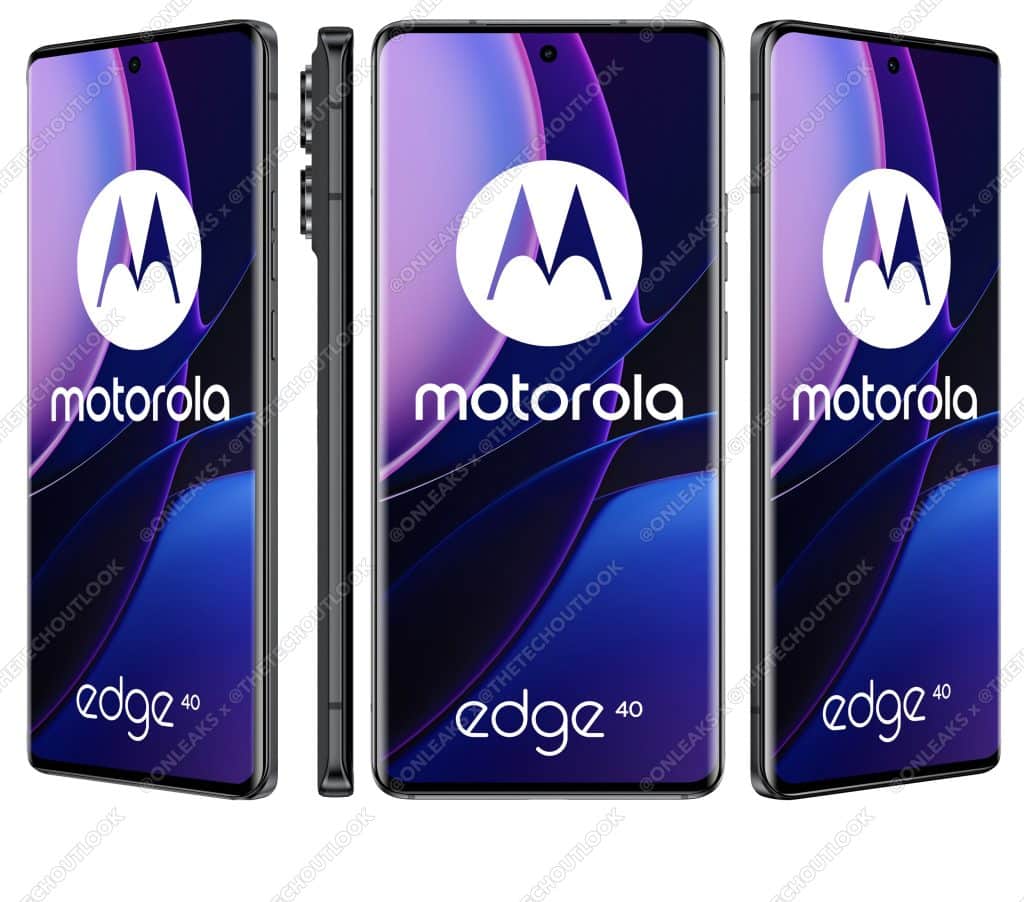
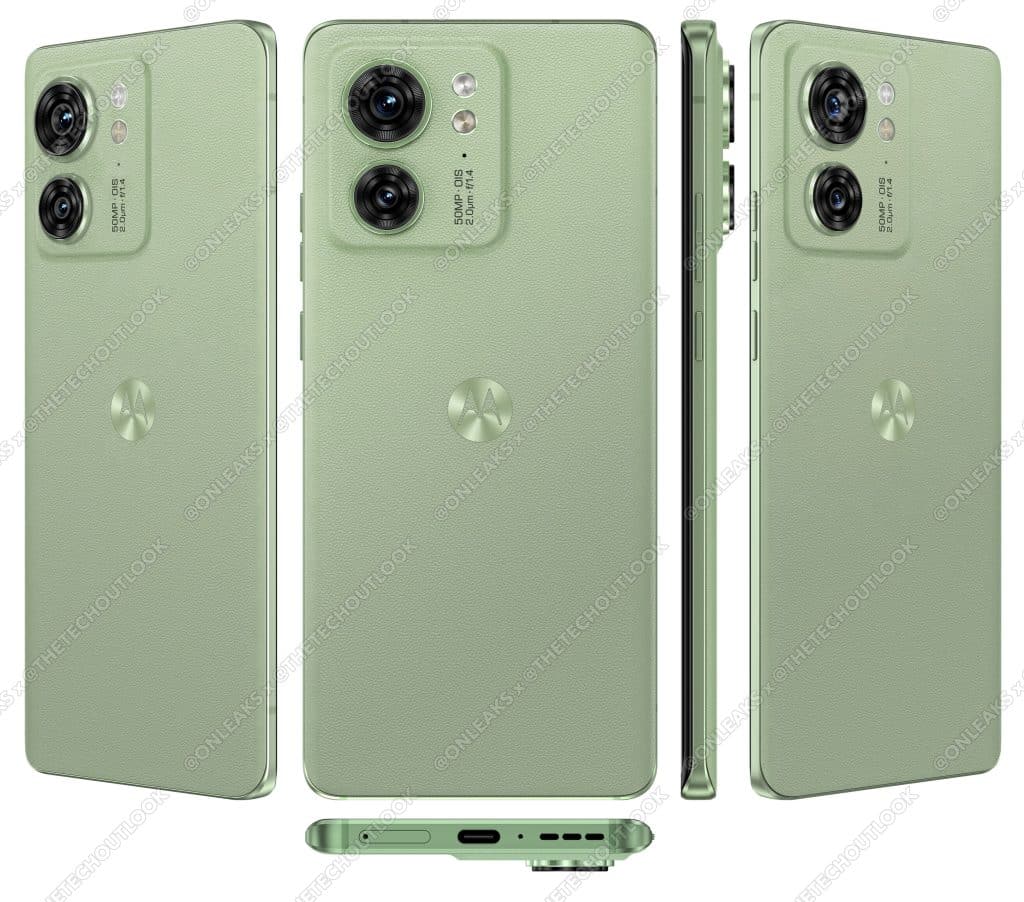
The Tech Outlook, in collaboration with OnLeaks, has shared some detailed renders of the upcoming Motorola Edge 40. It boasts a subtly curved back, complemented by a squircle-shaped camera module. The camera module encloses two sensors, with one of the rings being noticeably larger than the other. The display of the phone also has a curved design, with a small waterdrop notch situated at the top center of the screen.

Further, the publication claims that Motorola Edge 40 will be priced at $650 for the base 8 GB RAM and 128 GB storage version. This pricing appears to be for Europe. The handset may cost lesser in Asian markets. For reference, the higher-end Edge 40 Pro may cost around $975 in Europe for the base storage version.

Additionally, the report corroborates the specs of the Motorola Edge 40, revealing it will sport a 6.55-inch AMOLED display with a Full HD+ resolution and a 144Hz refresh rate. Powered by the upcoming Dimensity 8020 chipset, it will pack 8 GB of RAM and 128 GB / 256 GB of storage. The Smartphone could be fueled by a 4,400mAh battery with 68W TurboPower charging and 15W wireless charging.

In the rear camera department, there may be a 50-megapixel main camera with OIS and a 13-megapixel ultra-wide lens. For selfies, the handset may get a 32-megapixel shooter on the front. It will likely run on Android 13 and feature an under-display fingerprint scanner.

RELATED:

(Source)

Stop Artificial Intelligence as it is a threat to Human Civilization says Musk and 1000 other experts

More than 1000 Artificial Intelligence experts around the world including Elon Musk have signed an open petition to halt the development and research of AI systems and programs more powerful and advanced than GPT 4. The letter asks for a six-month break in all work related to advanced AI as experts feel that this development can be a potential threat to human society. 

The open letter titled ‘Pause Giant AI Experiments’ was issued by Future Of Life Institue a nonprofit organization that works to reduce global catastrophic and existential risks facing humanity, particularly the existential risk from advanced artificial intelligence. The letter is signed by famous dignitaries, AI scientists and professors, and experts like the Turing Prize winner Yoshua Bengio, Berkeley Professor of Computer Science Stuart Russell, Apple co-founder Steve Wozniak, Author of Homo Sapiens Yuval Noah Harari, Stability AI CEO Emad Mostaque, and more. 

The letter states that AI systems with human-competitive intelligence pose profound risks to society and humanity and top AI labs have also acknowledged this potential risk.  It further stated that recent AI development has seen a race to develop and deploy more powerful digital minds that may be difficult to control and such powerful AI systems should be developed only once their positive effects and risks can be confidently managed.

Finally, the petition calls for a 6-month pause on training AI systems more powerful than GPT-4. It asks all AI labs and independent experts to develop shared safety protocols that ensure systems are safe beyond a reasonable doubt and says that  AI developers must work with policymakers to accelerate the development of robust AI governance systems. 

Gary Marcus, a professor at New York University who is also a signatory of the letter said that the letter though isn’t perfect, is right in spirit and until we understand the ramifications of AI, it is better to slow down. He further added that the big players are becoming increasingly secretive about what they are doing, which makes it hard for society to defend against whatever harms may materialize and AI can cause serious harm to humans.

Across the globe, many institutions and governments have voiced their concerns regarding the ethical and legal issues created by advanced AI like ChatGPT. Recently Europol cautioned about the possible exploitation of AI systems like ChatGPT for cybercrime, phishing attempts, and spreading disinformation. Many governments are working on legal policies and regulatory frameworks to control AI. 

Many educational institutions and universities have also raised their concerns regarding ChatGPT and similar AI programs. For instance, several  New York colleges have decided to prohibit students from using ChatGPT to complete their homework. To enforce this measure, the universities have blocked access to the ChatGPT website through their servers. The education department has also supported this move by restricting access to ChatGPT due to concerns over its potential negative impact on student learning and the accuracy and safety of the content.

Related:


(via)

Redmi Note 12 Turbo uses Tianma-made display, brings Lifelike Colors with 12-bit Depth

Redmi recently unveiled the Note 12 Turbo, its latest mid-range smartphone, featuring an immersive 6.67-inch OLED display with a resolution of 2400×1080 and a refresh rate of 120Hz. What’s particularly noteworthy is that the display has been developed in partnership with Tianma, a lesser-known China-based microelectronics company.

When it comes to smartphone displays, it’s common to see major players like BOE or Samsung providing panels for popular devices. Some Chinese brands have also opted for displays made by TCL. However, Tianma is another established name in the industry, known for developing immersive panels used in smartphones, tablets, and TVs.

Redmi Note 12 Turbo

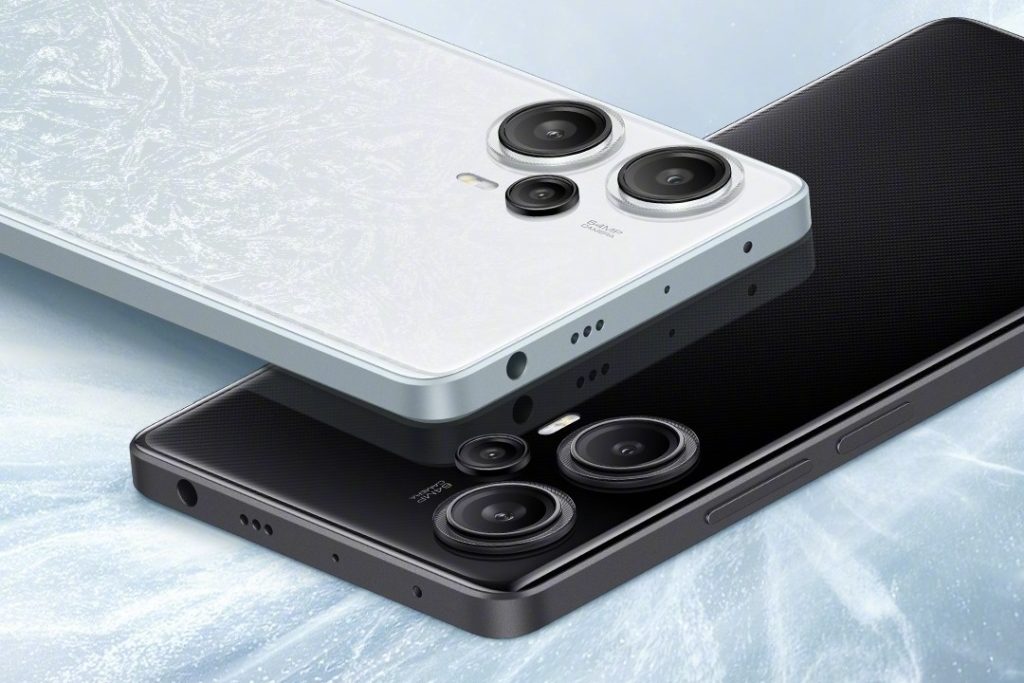
The Tianma-made display used in the Redmi Note 12 Turbo comes with top-notch specs. According to Redmi, this screen has a resolution of 2400×1080, a peak brightness of 1000nit, and support for 12-bit color depth. The panel can display 68.7 billion colors and adopts a windmill-shaped pixel array layout, which is claimed to be more energy efficient.

The display on the Redmi Note 12 Turbo boasts several impressive features, including SGS low blue light certification, support for 1920Hz high-frequency PWM dimming, and dual-mode eye protection (conventional and paper) for an effective eye-protection experience.

In addition, the display features a flagship four-narrow-edge design without a screen bracket, with the left and right bezels measuring just 1.42mm and the top bezel measuring 1.95mm. The compact design of the bottom of the screen, combined with a reduction in the bending radius and strengthened process control, enables an ultra-narrow bottom frame of just 2.22mm, resulting in an impressive screen-to-body ratio of 93.4%.

Redmi Note 12 Turbo also brings the Snapdragon 7+ Gen 2 chipset and various other impressive specifications. You might check out our launch coverage for more details.

RELATED:

(Via)

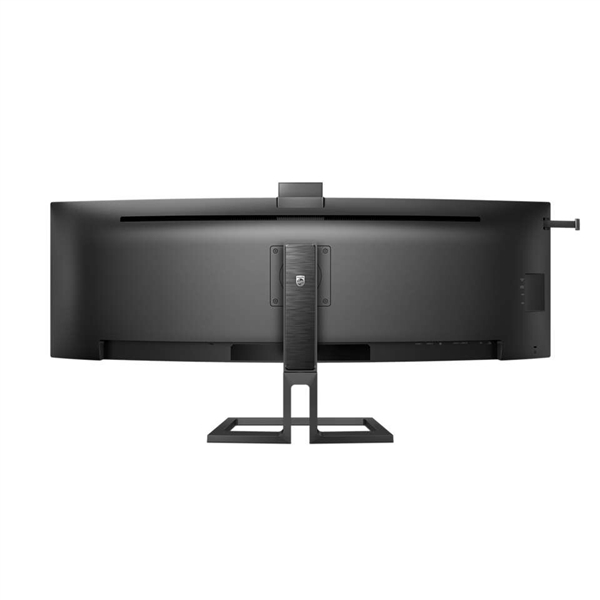
Philips 45B1U6900C SuperWide Curved Monitor with a 44.5-inch Fish eye display launched

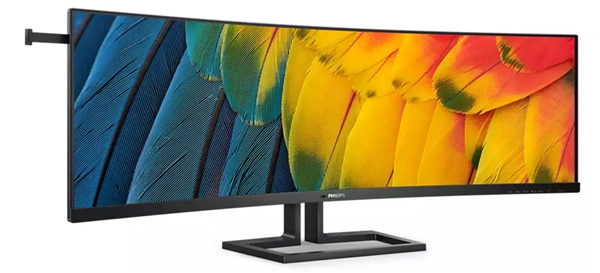
The Philips 45B1U6900C SuperWide Curved Monitor has been launched. The display is a flagship commercial model that offers an immersive viewing experience and a range of features that cater to professionals and businesses. The monitor has a large 44.5-inch VA curved screen with a display ratio of 32:9, which provides a panoramic view that is ideal for multitasking, gaming, and video editing. Its high resolution of 5120×1440 ensures sharp and detailed visuals, while its 75Hz refresh rate and 4ms GTG response time ensure smooth and responsive motion.

Philips 45B1U6900C SuperWide Curved Monitor

The Philips 45B1U6900C monitor features a large 1500R curvature, which matches the natural curve of the human eye and provides an immersive viewing experience. The curvature also helps reduce eye strain and makes it easier to focus on the screen for long periods. The monitor has a maximum brightness of 450 nits, which makes it suitable for use in bright environments, and its static contrast ratio of 3000:1 ensures deep blacks and bright whites.

The monitor covers 107% DCI-P3 color gamut and 123% sRGB color gamut, which means it can display a wide range of colors accurately and vividly. It has passed VESA DisplayHDR 400 and TUV Rheinland certification, which means it meets high standards for brightness, color gamut, and contrast. The monitor also supports Adaptive-Sync technology, which synchronizes the monitor’s refresh rate with the graphics card’s output, eliminating screen tearing and stuttering.

Philips 45B1U6900C SuperWide Curved Monitor

The monitor has an ergonomic adjustable stand that allows +/-45° rotation and -5~15° tilt adjustment, which makes it easy to find a comfortable viewing angle. The monitor also has a telescopic hook on the left side that can hold headphones, which is a convenient feature for gamers and content creators who use headphones frequently.

Philips 45B1U6900C SuperWide Curved Monitor

Further, the fish eye monitor has a wide range of interfaces, including two HDMI 2.0 interfaces, one DP1.4 interface, one USB Type-C interface (with support for 100W power supply and DisplayPort Alt), one USB Type-B upstream interface, and four USB 3.2 Gen1 Type-A interfaces. It also has a Gigabit Ethernet interface and a 3.5mm audio interface. The monitor is equipped with dual 5W speakers, which provide decent audio quality.

The monitor is presently priced at £939.99 in the UK.

Related:

(source)

Vivo X Fold 2 Launching in April, more Specifications emerge

Vivo X Fold 2 has been leaking a lot recently and today the company finally confirmed its existence, revealing it will be unveiled next month. The X Fold 2 will be the brand’s latest foldable, succeeding last year’s X Fold Plus. It is expected to debut as the world’s first folding phone with the Qualcomm Snapdragon 8 Gen 2 SoC.

Vivo’s Vice President of Products, Huang Tao, revealed in a Weibo post that the upcoming Vivo X Fold 2 will be showcased at the Boao Forum 2023. He added that leaks and live images of the foldable may emerge ahead of its launch in April. The exact launch date of the new Vivo smartphone is still a mystery.

Vivo-X-Fold

Additionally, popular tipster Digital Chat Station tipped off several key specifications of the handset. The tipster revealed the X Fold 2 will be powered by the latest Snapdragon 8 Gen 2 processor under the hood, making it the first in its category to debut with this new chipset. This places the X Fold 2 ahead of Samsung’s upcoming foldable line, which should be released in August.

The upcoming phone is anticipated to be powered by a 4,800 mAh battery that supports 120W fast charging. Additionally, it is expected to sport a camera with a Sony IMX866 sensor, OIS, and V2 ISP, which is the same as the 50MP shooter found on the Vivo X90 and iQOO 11 Pro.

According to reports, Vivo is planning to launch the foldable device, along with the Vivo X Flip and Vivo Pad 2, in its domestic market. However, there are speculations that only the Vivo X Flip will be released in the global market, leaving the other two products exclusive to the Chinese market.

RELATED:

(Source 1,2) (Via)

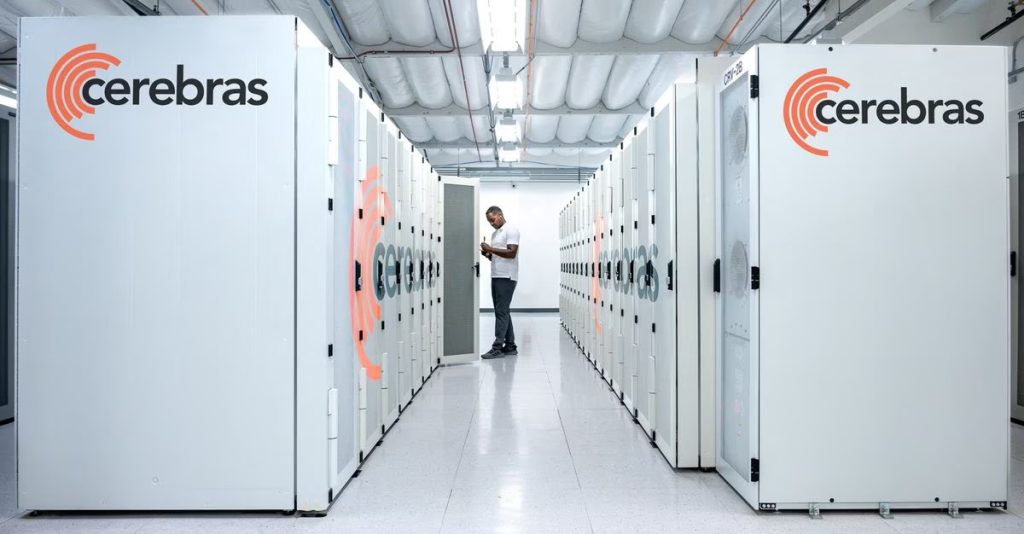
Cerebras Systems Unveils Open Source ChatGPT-like AI Models

Silicon Valley-based artificial intelligence (AI) computing startup, Cerebras Systems, announced the release of seven open source ChatGPT-like AI models. The move aims to encourage collaboration and innovation within the research and business communities. The models, all trained on Cerebras’ AI supercomputer Andromeda, range from smaller 111 million parameter language models to a massive 13 billion parameter model. Here are the details…

Cerebras Systems Unveils Open Source ChatGPT-like AI Models

Andrew Feldman, founder and CEO of Cerebras, emphasized the importance of open source in the AI community, attributing much of its progress to the collaborative environment. He acknowledged that while there has been a recent trend towards closing off open source AI projects due to their commercial potential, maintaining openness is crucial for continued innovation.

Cerebras’ range of models allows for deployment on various devices. Smaller models can be run on smartphones or smart speakers, while larger models require PCs or servers. This flexibility caters to different needs and applications, but for more complex tasks, such as large passage summarization, bigger models are necessary.

Though larger models typically offer more advanced generative functions, Karl Freund, a chip consultant at Cambrian AI, points out that size isn’t everything. He cites recent research showing that smaller models can be just as accurate if trained more effectively, suggesting a trade-off between size and training quality.

Feldman revealed that their biggest model took just over a week to train, a process that would usually take months. This acceleration can be attributed to the unique architecture of the Cerebras system, which features a chip the size of a dinner plate specifically designed for AI training.

Currently, most AI models are trained on Nvidia Corp’s chips, but an increasing number of startups like Cerebras are entering the market to claim their share. Feldman confirmed that models trained on Cerebras machines can be used on Nvidia systems for additional training or customization, offering users flexibility and adaptability.

RELATED:

(via)

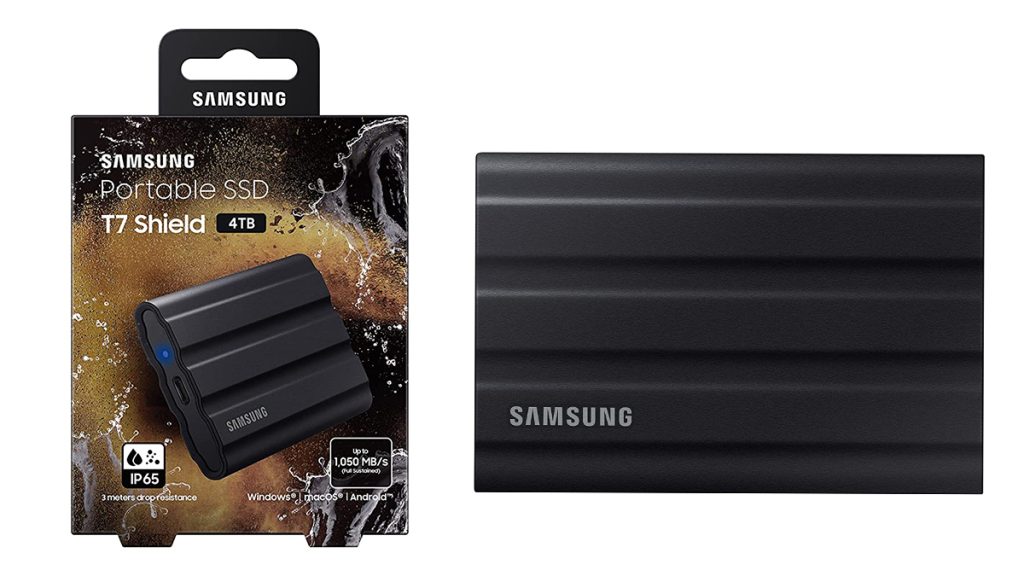
Samsung T7 Shield Portable SSD 4TB Variant Launched In India

Samsung launched the T7 Shield SSD in April last year. It was available in 1TB and 2TB storage sizes in India. Now the South Korean brand has announced a higher storage variant of the device. The Samsung T7 Shield Portable SSD is now available in a 4TB storage option. Apart from the storage bump, the device has the same features and specifications as the other storage variants. 

The Samsung T7 Shield Portable SSD boasts a rugged external that is resistant to water, dust, and shock. It is IP65 certified and ideal for people who are always on the go. The storage device is the size of a credit card and weighs just 98 grams. 

The Samsung T7 Shield SSD packs a storage capacity of 4TB for storing high-quality pictures, games, 4K and 8K videos etc. It is also available in 1TB and 2TB options. The device features read and write speeds of up to 1,050 and 1,000 MB/s respectively. It is claimed to reduce laptop download time to just 8 seconds for a 4K quality video of 5GB. It is said to be 9.5 times faster than external hard disk drives and also reduces concerns about inconsistent performance. The Samsung T7 also has a 256-bit AES along with hardware encryption to protect consumer data even if the device gets lost. There is Samsung Magician software letting users to conveniently manage the drive. 

The Samsung T7 Shield Portable SSD has a 3-year warranty and is offered in Blue, Grey, and Red colours. The 4TB variant is priced between Rs 30,000 – Rs 35,000 and can be purchased from the brand’s online and offline stores, Amazon, and consumer electronics stores. 

Related:

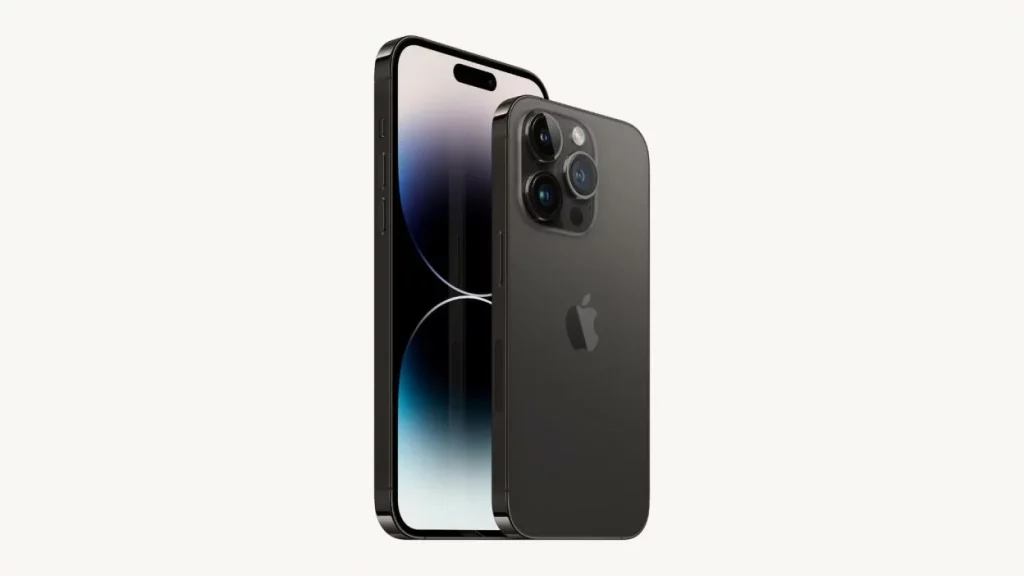
The Painful Reality of Repairing the iPhone 14 Pro Max: A YouTuber’s Experience

The complexity of repairing the iPhone 14 Pro Max has come into the spotlight after a YouTuber’s painful experience while attempting to repair the device. According to Hugh Jeffreys, the teardown of the iPhone 14 Pro Max took almost four and a half hours, highlighting the difficulties that arise when attempting to repair the most expensive iPhone model in the market.

iPhone 14 Pro Max

During the teardown, Jeffreys mentioned that while Apple has made improvements in the scope of repairing iPhone 14 and its variants, the same hasn’t been implemented on the iPhone 14 Pro Max. The teardown revealed that no single kind of screw holds the iPhone 14 Pro Max together and that different tiny components need to be removed and stored carefully. Additionally, the device’s software did not recognize the new display as genuine, which further complicated the process.

The video highlights the importance of the right to repair one’s smartphone and other technological devices. While major companies like Apple and Microsoft claim to support this right, the difficulty in repairing the iPhone 14 Pro Max shows that more needs to be done. Jeffreys’ experience emphasizes the need for companies to make repairing devices easier for users, as the intricate and complicated process can lead to further damage or even render the device unusable.

The video has sparked discussions among tech enthusiasts and consumers about the scope of repairing devices and the level of support that companies provide to users. As the cost of devices continues to rise, it’s essential that users have the right to repair their devices easily and without risking further damage.

Companies need to take steps to make repairing devices easier and more accessible for users to ensure that they can get the most out of their devices without incurring exorbitant costs.

RELATED:

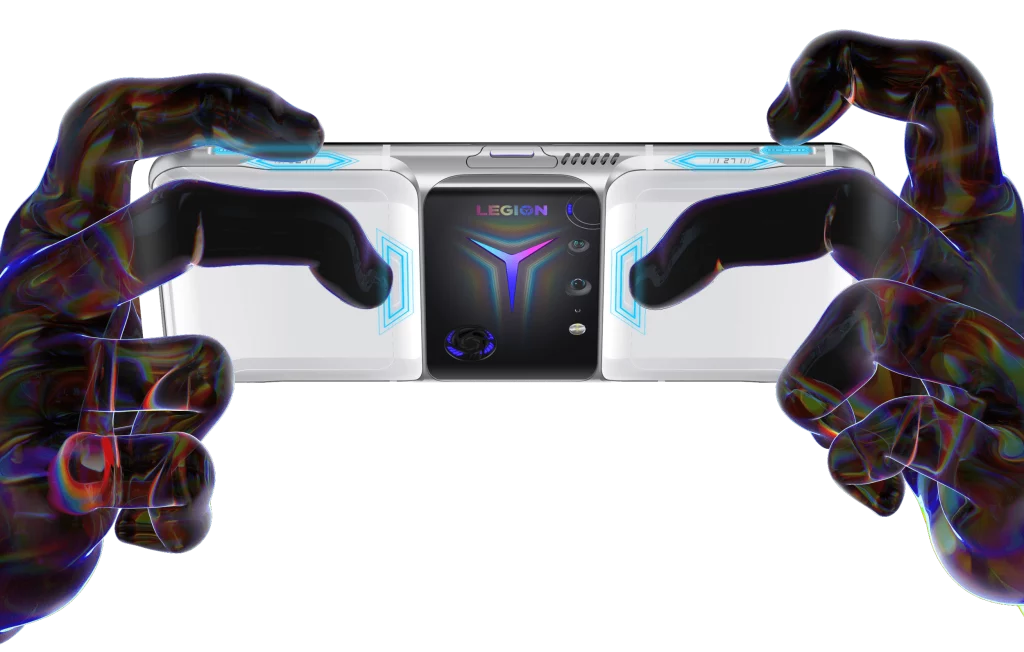
Lenovo Shuts Down Its Legion Gaming Phone Business

Last week, we reported that Lenovo could be killing off its Legion smartphone business. Now, this is indeed official as a Lenovo spokesperson has confirmed the development in a statement to Android Authority. The company is shutting down its Legion gaming phone business as a part of a wider business transformation and gaming portfolio consolidation. 

The Lenovo spokesperson said in a statement ‘As a leader in gaming devices and solutions, Lenovo is committed to advancing the gaming category across form factors, as well as focusing on where it can bring the most value to the global gaming community.’

Lenovo entered the gaming smartphone segment way back in 2020 with the first Legion Pro. The company launched the Legion Phone Duel 2 in 2021 and the Legion Y70 was introduced in August last year. The smartphones packed some innovative features including side-mounted pop-up selfie cameras, dedicated cooling fans, and dual charge ports. As per reports, Lenovo has laid off some workers at its facility while others have been transferred to business lines such as Lenovo’s tablet division. 

With the departure of Lenovo’s Legion phones, the gaming smartphone industry is left with the ASUS ROG Phone series, Nubia Red Magic series, and Xiaomi’s Black Shark phones. Even Black Shark seems to be struggling but ASUS is going strong as it is gearing up for the launch of ROG Phone 7 globally on April 13th. 

The bridge between specialized gaming smartphones and mainstream flagship phones is getting narrower in terms of hardware firepower. However, gaming phones still pack features like dedicated trigger buttons, a heat dissipation system, and more. 

Related:

ASUS ROG Phone 7D AnTuTu Benchmark Listing Reveals 16GB LPDDR5X RAM and 512GB UFS 4.0 Storage

ASUS ROG Phone 7 is set to launch in the global markets on April 13th. It remains to be seen how many models the Taiwanese brand will announce in the ROG Phone 7 series. It’s predecessor had the ROG Phone 6, 6D, and 6 Ultimate. It is speculated that only two devices will launch this time. Earlier this month, the ASUS ROG Phone 7D was spotted on Geekbench benchmarking platform. Now it has appeared on AnTuTu benchmark listing. 

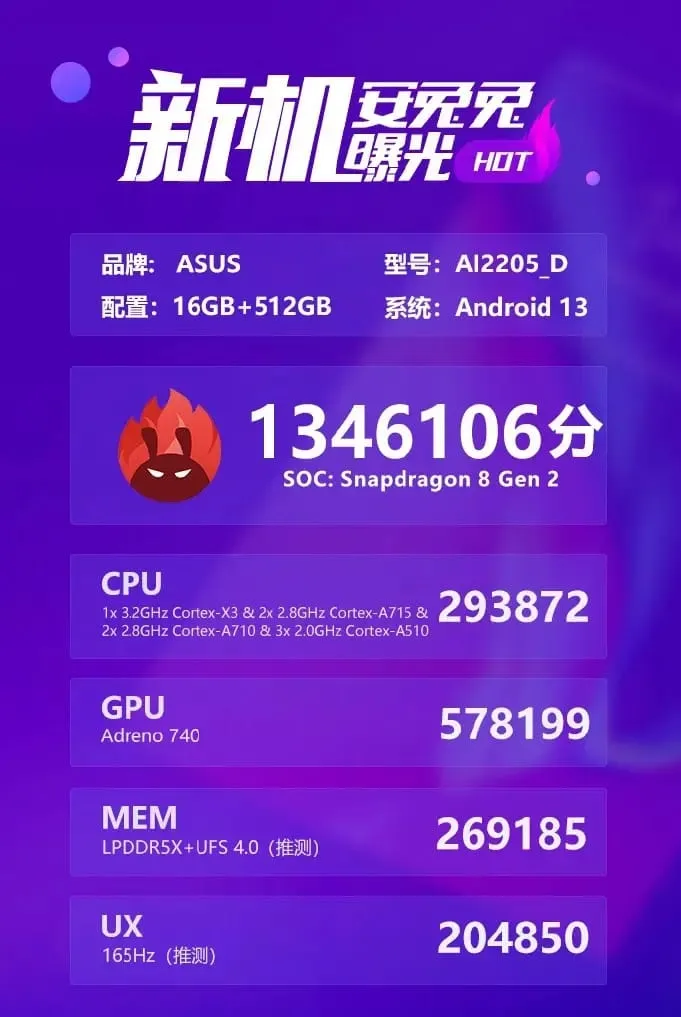
The ROG Phone 7D is listed with the model number AI2205_D on AnTuTu which is also the same as the Geekbench database. The AnTuTu listing reveals the same processor and RAM detail as per the benchmarking platform i.e. Snapdragon 8 Gen 2 processor and 16GB LPDDR5X RAM. The upcoming offering will pack 512GB UFS 4.0 storage technology and it will run on Android 13 OS out of the box. 

The ASUS ROG Phone 7D scores overall 13,46,106 points in the AnTu Tu benchmark test result. In the CPU, GPU, and memory tests, the device scores 2,93,872, 5,78,199, and 2,69,185 points respectively. 

Other details about the ROG Phone 7D remain unknown at the moment. Earlier today, tipster Digital Chat Station revealed that the ROG Phone 7 will sport a 6.78-inch E4 AMOLED display bearing an FHD+ resolution and a 165Hz refresh rate. It will feature a 32MP selfie snapper and a 50MP triple rear camera setup. The upcoming offering will reportedly be backed by a 6,000mAh battery unit with support for 65W wired fast charging. 

Related:

Xiaomi India and Vi Announce Partnership To Offer 5G Connectivity: Check List Of Supported Devices

5G was launched in India in October last year. Airtel and Jio started rolling out the latest generation cellular network in the same month. Both telcos continue to expand their 5G circle across the country. However, apart from Airtel and Jio, Vodafone Idea (Vi) is the only private telecom yet to roll out 5G services in India. 

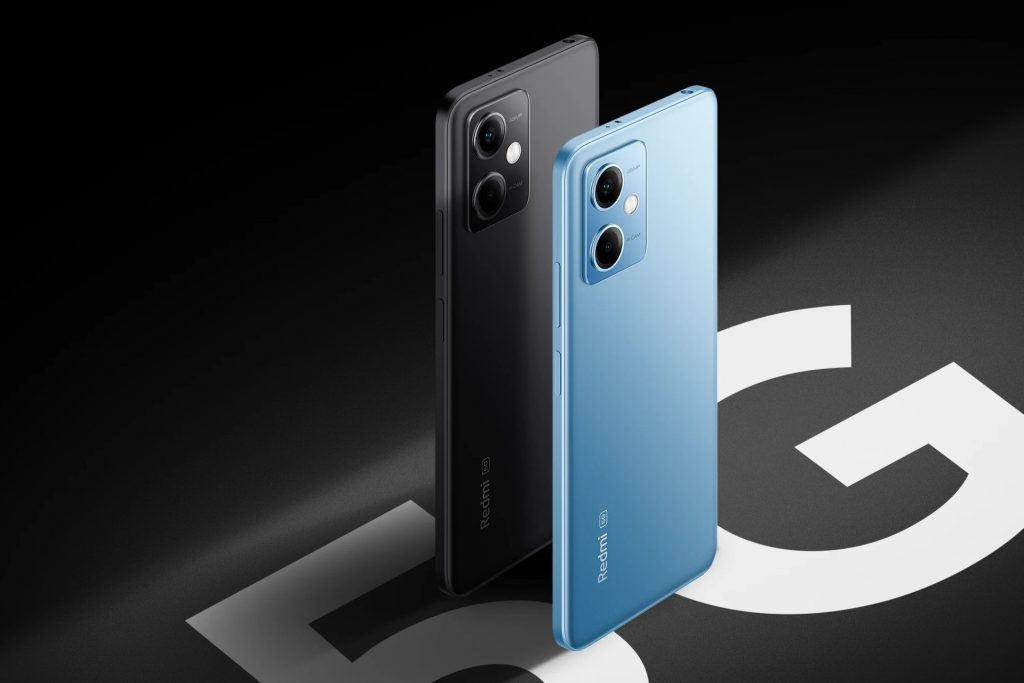
Now Vi and Xiaomi India has announced a strategic partnership to provide 5G connectivity on the latter’s smartphones once the 5G services are launched by the operator. Eighteen devices under the Xiaomi and Redmi portfolio are said to be extensively tested on Vi 5G network in New Delhi. The company said that the phones will support the network post-FOTA updates. Once Vi launches 5G commercially, Xiaomi and Redmi smartphone users will just have to toggle their network connectivity settings from 4G to 5G. 

Here’s a list of 18 Xiaomi and Redmi devices to support Vi 5G:

  1. Xiaomi 13 Pro
  2. Redmi Note 12 Pro 5G
  3. Redmi Note 12 Pro+ 5G
  4. Redmi Note 12 5G
  5. Xiaomi 12 Pro
  6. Mi 11 Ultra
  7. Mi 11X Pro
  8. Xiaomi 11T Pro 5G
  9. Xiaomi 11 Lite NE 5G
  10. Redmi 11 Prime 5G
  11. Redmi K50i
  12. Redmi Note 11T 5G
  13. Redmi Note 11 Pro 5G
  14. Mi 11X
  15. Mi 10
  16. Mi 10T
  17. Mi 10T Pro
  18. Mi 10i

Previously, Vi had partnered with Motorola for 5G support on several phones from the Lenovo-owned brand. It’s likely that the telecom operator will soon roll out services in the coming weeks. 

Related:

Redmi Note series global sales cross 320 million units

The Redmi Note series is one of the best-selling smartphone lineups worldwide. In early December, Xiaomi revealed that it had sold over 300 million units to date.

Just three months later, the company discloses that it has now sold even more Redmi Notes. Let’s check out what it has to say.

Redmi Note 12 5G
Redmi Note 12 5G

At the Redmi Note 12 Turbo launch event yesterday, Xiaomi revealed that the sales of the Redmi Note lineup exceeded 320 million units globally. In other words, the company managed to sell 20 million units in the last three months.

It also boasted that Redmi Note 11 was one of the top 10 best-selling smartphones worldwide in 2022. As per Canalys, 18 million units of Redmi Note 11 were sold last year. It is tied with iPhone 14 Pro and iPhone 14 Pro Max.

Unfortunately, though the sales figure seems high, the overall shipments have been dropping since the last few quarters. For instance, Xiaomi sold over 40 million units of Redmi Notes in just 5 months in 2021.

Unlike earlier years, Xiaomi now sells a wide variety of devices spread across different price segments under the Redmi Note series. Even so, it couldn’t catch up with its previous sales records.

The global smartphone market is now saturated. Consumers are sticking with their old phones for a longer time than ever. The current economic condition is not helping either.

RELATED:

Sharp and E Ink announce 42-inch “ePoster” zero-power digital poster display

Sharp and E Ink Holdings have announced the launch of a 42-inch Black and White Electronic Paper Digital Poster Display (ePoster) that requires zero power consumption during display. The product uses reflective display technology to reflect ambient light to display images. The brighter the environment, the better the display effect.

Sharp Electronic Paper Digital Poster Display (ePoster)

The ePaper poster display is just 3 cm thick and weighs about 8 kg, with a thin and light design. The black and white screen requires maximum power consumption of about 40W to drive the ink particles when refreshing. As a comparison, Sharp’s same-sized LCD screen has a power consumption of 115W.

Unlike traditional digital displays, this ePaper poster display can continue to display even if the power is turned off, making it an eco-friendly alternative to traditional digital billboards.

The estimated selling price of the Sharp 42-inch ePaper poster display is around 550,000 yen (approximately $4,163 USD). The product can be used for in-store signs in retail stores such as clothing stores and can also be used for evacuation guidance at disaster sites.

Sharp plans to use its expertise in the installation and operation of digital billboards, as well as its service network throughout Japan, to replace paper posters in areas where it was difficult to install digital billboards with electronic paper digital posters.

The ePaper poster display is the result of a three-year cooperation between E Ink and Sharp, with the goal of contributing to the era of carbon neutrality through the popularization of electronic paper digital posters. In the future, the two companies plan to not only focus on the development of large-size or color e-paper displays but also expand the global e-paper billboard business. Sharp will launch this 42-inch Black and White Electronic Paper Digital Poster Display (ePoster) in the Japanese market in early April 2023.

RELATED:

Samsung Galaxy Z Fold 5 US Variant Appears On Geekbench

Continuing its tradition, Samsung is expected to unveil its fifth-generation foldables in August this year. The Galaxy Z Fold 5 has been subject to various leaks and rumors in the past. Now, the US version of the foldable phone has been spotted on the benchmarking platform Geekbench. It reveals the key specifications of the device. 

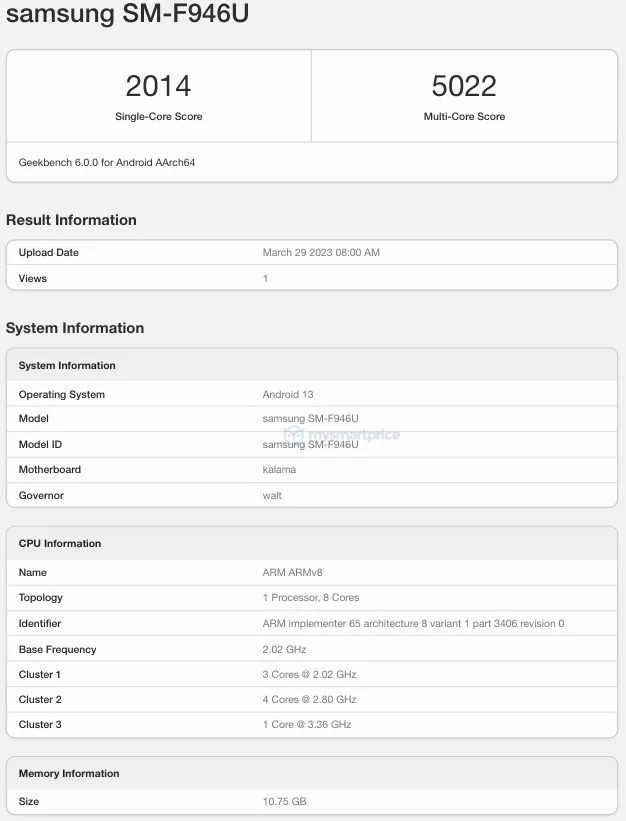
The Samsung Galaxy Z Fold 5 is listed with the model number SM-F946U on the benchmarking database. The listing mentions the motherboard codenamed ‘kalama’ comprising of three cores at 2.02GHz, four cores at 2.80GHz, and a primary core clocked at 3.36GHz. The foldable phone is listed with 12GB RAM and we can expect more RAM and storage configurations at launch. Software-wise, it runs on Android 13 OS out of the box. 

The Samsung Galaxy Z Fold 5 scores 2,014 and 5,022 points in the Geekbench’s single-core and multi-core test results. Apart from this, the benchmark database does not reveal any additional information. 

Past leaks suggest that the Samsung Galaxy Z Fold 5 will be equipped with a new water droplet hinge technology as well as a screen technology. Due to the implementation of the new hinge, the gap between the panel when folded is expected to reduce. It will also reportedly weigh 254 grams which is less than the Fold 4. On the imaging front, the Galaxy Z Fold 5 will reportedly feature a 50MP main sensor with a 12MP ultra-wide-angle lens, and a 10MP telephoto unit. 

Related:

Via

Windows 12 Rumors: A Modern OS with AI, Faster Updates, and Better Security

Rumors about Microsoft’s upcoming Windows 12 operating system are buzzing, as leaks of its system requirements surface. Just two years after Windows 11’s release, the company seems to be gearing up for its successor. Windows 12 is expected to bring major platform upgrades, modernizing the OS with AI, quicker updates, and enhanced security. Here are the details…

Microsoft plans major platform upgrades for “Windows 12” that will modernize the OS with AI, faster updates, and better security

For years, Microsoft aimed to modernize the Windows platform. Windows Core OS was an attempt to create a lightweight, secure, and fast-to-update platform. However, Microsoft never launched a version for traditional PC form factors. Windows 10X, the last attempt, was canceled in 2021 after extensive testing and development.

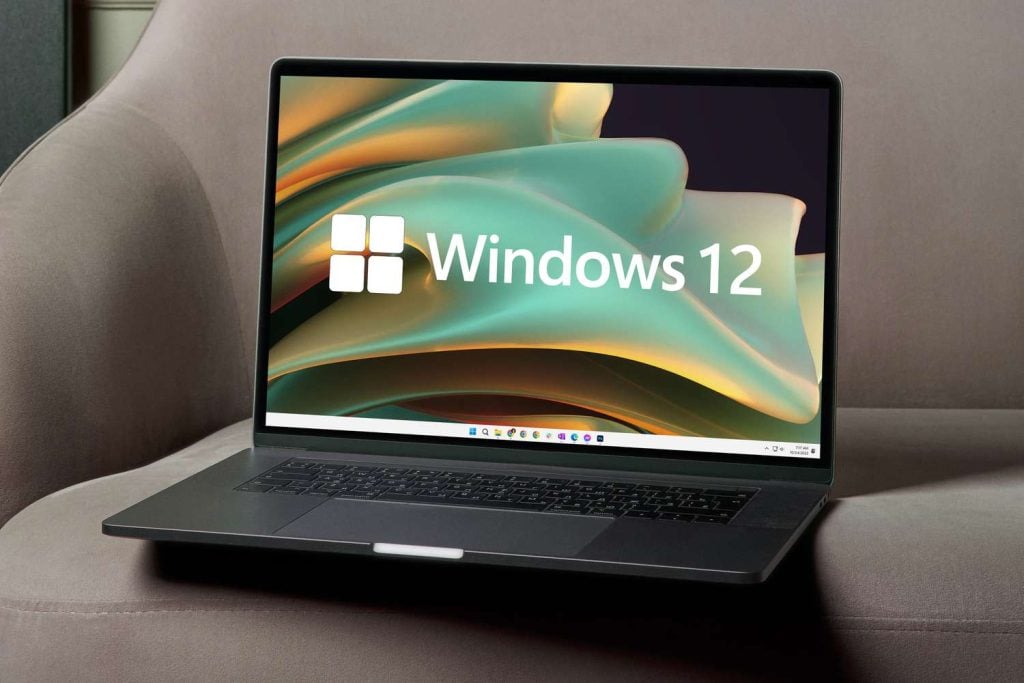
Windows 12

Sources familiar with Microsoft’s plans indicate that the company is working on a new project called CorePC. This project intends to modernize the Windows platform with similar innovations as Windows Core OS, but with a focus on compatibility for legacy Win32 applications. CorePC is designed to be modular and customizable, allowing Microsoft to configure different “editions” of Windows with various feature and app compatibility levels.

CorePC is rumored to implement state separation, allowing for faster updates and a more secure platform by creating read-only partitions. State separation also enables quicker and more reliable system reset functionality, crucial for competing with Chromebooks in the education sector. Microsoft’s approach with CorePC is to deconstruct the full Windows desktop into a modular, adaptable system while maintaining support for legacy apps and workflows as needed. This strategy could enable Microsoft to deliver a Windows version that rivals Chromebooks in terms of OS size, performance, and features.

Microsoft is also reportedly exploring a “silicon-optimized” version of CorePC, focusing on AI capabilities and vertically integrated hardware and software experiences, similar to Apple Silicon. AI-driven features under development include context-aware prompts, object and text recognition within images, and dedicated hardware support for specific AI functions. As plans and features may change before the launch, tech enthusiasts and industry experts eagerly await further announcements and developments regarding the much-anticipated Windows 12.

RELATED:

(via)