The CES 2023 event brought the announcement for a number of innovative new technologies. Now, Lenovo has unveiled the new Project Chronos, which is a new motion capture system that works without a dedicated wearable device. So here are all the details.
The new device is a concept machine from the Chinese PC maker. As per official notes, Project Chronos is a ‘glasses free, full body movement driven experience.’ In other words, the technology does not require users to wear a dedicated headset/glasses or use motion capture enabled controllers. In a way, this makes it similar to Acer and ASUS’ new announcements for glass free 3D solutions, but the emphasis here is on motion capture rather than 3D gaming.
Project Chronos employs RGB depth cameras to replicate actions that the users make in a virtual. Following this process, the device outputs via a DisplayPort or HDMI to an external display. Lenovo did state that Project Chronos will also be compatible with HDMI, although its units lack any dedicated HDMI ports. The concept device has three DisplayPort connections along with four additional mini DisplayPorts. Chronos also houses a twin 6W speaker system and its camera can rotate by 180 degrees as well.
Under the hood, the Lenovo Project Chronos relies on an Intel Core i7 processor from the Raptor Lake series. Furthermore, it is also equipped with discrete GPU, up to 32GB of RAM and a 512GB of internal storage. The device runs on Windows 10 OS with an in house Chronos pre-installed. This model weighs around 3.54 kilograms with its other dimensions being 284 x 275 x 60.6mm. Unfortunately, this is still a concept device so it is unclear if the company plans on launching such a model anytime soon.
Since Xiaomi’s flagship phones have become more and more expensive, Redmi has taken on the mission of being the “Flagship Killer”. Their K series, in particular, is even more worthy than Xiaomi’s flagship series. And this year’s K60 looks really appealing. Come on, let’s see how much impact this $360 phone can really bring to the cell phone market in 2023.
Design
K60 is not much outstanding in design and looks rather ordinary. That’s why we purposely bought this blue vegan leather version. The vegan leather back panel has a stitched texture that looks a bit like the Vivo X Note. The vegan leather material really makes the budget phone look like a flagship, also lighter.
But it’s really confusing that this vegan leather is only available in the standard version, but not in the more expensive Pro version. From the top frame, there are IR emitters and dual speakers, but no headphone jack. The speakers are relatively loud and the volume is consistent from left to right. Even without the Harman Kardon tuning, I think it’s still great. The sound quality you can hear for yourself in the video.
Display
If I’m right, you bought the K60 for the screen, right? Indeed, this screen, like the K50, is unbeatable in its price range. And you can only get to know how good the super high resolution and straight screen are by getting it in your hand. Look at these specs, I couldn’t believe it till right now.
The difference with the K50 is that the manufacturer of the screen this time is China Star Optoelectronics Technology, not Samsung. The advantage is that the peak brightness is higher, and there is no side view color shift problem like Samsung E5 or E6 panels. The higher frequency PWM dimming also means less eye irritation. The downside is that the peak brightness is not as good as the latest Samsung E6 panel, and the screen protection glass on this K60 is no longer Corning Victus. So all in all, the K50 and K60 screens are about the same level.
Benchmark & Gaming
This time the K60 Standard Edition is no longer MediaTek’s mid-range chip, but Snapdragon’s previous generation flagship chip, Snapdragon 8+ Gen 1. I’ve laid out all its Benchmark scores, and you can see that except for Antutu, all other scores are a little lower for the K60. Sadly, this is not an error. According to the official website, the K60’s largest core frequency is a bit lower than even last year’s 8+ Gen 1 phones. Yes, that’s the reason for its low score, you can think of the K60 as having an 8+ Gen 1 Lite processor instead of the regular 8+ Gen 1.
But don’t be too sad, the good news is that the gaming performance is still strong. From the test results, the Genshin Impact performs in line with the normal 8+ Gen 1 phone performance. And because of that extra-large VC heat sink inside the K60, not only does it not overheat in games but so does in the CPU Throttling test, which is even more stable than the Xiaomi 12S Ultra. In other words, the K60’s 8+ Gen 1 looks different from other phones, but it works the same. So don’t get too hung up on the processor frequency issue, it’s still a good gaming phone.
Camera
Although Redmi says that the K60 series has an upgraded camera system this time, they are talking about the Pro version and the standard version still performs average. Let me quickly summarize its camera performance with you. The colors are rich and have high contrast in most scenes. Clarity is also good, and it doesn’t blur even when zoomed in 2x when there’s enough light. The dynamic range of both lenses will be substantially improved after the night mode is on. But with the ultra-wide angle camera at night the clarity is significantly reduced, like other budget phones.
All in all, the main camera can handle most scenes, the ultra-wide angle camera is only recommended for use during the day.
The rear camera still supports 8K 24fps for the main camera and 1080P 30fps for the ultra-wide camera. the main camera image quality is not bad, stable and clear, but the ultra-wide image quality really makes me not want to use it to record video twice. The front camera is interesting, supporting up to 1080P 60fps. Much better than the Xiaomi 13.
Battery & Charging
The battery capacity and charging power is the same as last year’s K50, both 67w and 5500mAh. Although the charging power is the same as the Xiaomi 13, the larger battery makes it take longer to fully charge.
But the big battery has its advantages. When compared to the 12S Ultra, which also uses 8+ Gen 1, the benefits of a larger battery are obvious. If you adjust the resolution to FHD+ and down the refresh rate, you get a high-performance phone that can be used for two days without charging.
Since there are more new phones released recently and I took some time off because of COVID, we didn’t have time to do K60E’s Full review. Here is a table that compares in detail the differences between it and other K series phones. In fact, considering that the price difference between K60E and K60 is not much, and Dimensity 8200 is not much improved compared to 8100, I would recommend other K series phones. And this K60, with its low enough price, I believe it will be the best-selling model in the Redmi family for a long time.
A couple of months ago, Oppo launched its premium Reno 9 series in the Chinese market. The smartphone is yet to make its debut in the Indian market. While some reports indicate that we might see the devices launch in Q1 2023, others indicate that it will not launch in India at all.
A new report from 91mobiles states that Oppo will skip the Reno 9 series launch in India and will directly jump to the Oppo Reno 10 series. The report cites tipster Sudhanshu Ambhore as its source, who claims that the Reno 10 series will launch in India around the first or second week of February.
Currently, it is unclear if these devices will be a rebranded version of the Reno 9 series or if they will be entirely new smartphones. However, considering the fact that the Reno 9 series launched on November 24, 2023, it is highly likely that India will be getting a rebranded model. On the off that these are not rebranded devices, let’s take a look at what’s known about the Reno 10 series so far.
OPPO Reno10 Pro+ specifications (expected)
The Reno10 Pro+ is claimed to have the model number PHU110, while the exact specifications are currently unclear. The device will probably include an OLED screen with a 120Hz refresh rate. A Qualcomm Snapdragon CPU or a MediaTek Dimensity 5G-capable chipset may power the phone. The device will probably boot a bespoke ColorOS skin based on Android 13 right out of the box.
There are many rumors about the phone’s cameras, including the possibility of a 50MP primary camera, an 8MP ultrawide camera, and an unidentified periscope camera. Details about the front camera are currently unknown. A 4,700mAh battery with 80W fast charging capabilities is most likely included in the phone.
Lenovo Yoga Book 9i has been announced alongside a slew of other Lenovo devices at the CES 2023 tech exhibition. It’s a great laptop with two OLED touchscreen displays that can work as two monitors with two taskbars or as a single large display that takes up both screens.
Lenovo Yoga Book 9i
The two displays can be kept in landscape or portrait orientation. It comes equipped with a Bluetooth-enabled detachable keyboard. It even allows users to type using the on-screen keyboard via the second display instead of the physical keyboard. Users can also use Lenovo’s stylus on the device. Here is a look at the specifications of the device.
Lenovo Yoga Book 9i specifications and features
The Lenovo Yoga Book 9i has a pair of 13-inch OLED panels that offer a 2.8K resolution, up to 400 nits of brightness, a 60Hz refresh rate, and a 100 percent DCI-P3 color gamut. The device is powered by 13th-generation Intel i7-1355U and i5-1335U processors with Iris XE graphics.
Lenovo Yoga Book 9i
The dual-display notebook offers 16 GB of LPDDR5x RAM and 512 GB / 1 TB of PCIe 4.0 NVMe SSD storage. It packs an 80Wh battery that promises 10 hours of battery life in dual display mode. In single-screen mode, it offers 14 hours of battery life.
On the connectivity front, the Yoga Book 9i offers Wi-Fi 6E, Bluetooth 5.2, and three Thunderbolt 4 connectors, out of which one can be used for charging. Other features include Bowers & Wilkins quad speakers with Dolby Atmos and a Full HD webcam with an IR sensor and privacy shutter. The notebook measures 15.96mm and weighs around 1.38 kg.
ATEZR P20 Plus Engraver is available at a heavily discounted price on Amazon. The engraver cum laser cutter which generally retails for $1299 is now available for $899.99 only. This super deal ends on February 2, 2023.
ATEZR P20 Plus is a laser cutter cum engraver that can be used for engraving your favorite designs, quotes, and images on 100-plus materials including wood and acrylic. It uses an advanced physical optics-based spot compression technology and an innovative laser coupling method that can penetrate 100+ materials, cut 15mm solid wood, up to 40mm black acrylic, and 28mm wood.
The powerful device comes with a 120W laser cutter that supports KA Air assist. The 30L+/min air assist blows away the high-temperature smoke generated during laser operation through the unique air duct built into the laser module, which in turn helps to engrave more delicate models.
P20 plus features fine engraving precision. The spot area reaches 0.08*0.06mm. 529 DPI can automatically identify the grayscale of the picture material which helps to reduce distortion without compromising on speed and quality. The device uses POM wheel tracks for the X and Y axis, making your engraving work more stable and less noisy. The machine is made of high-density industrial-grade aluminum alloy. It can ensure engraving accuracy and stability even at a high speed of 24,800mm/min and save nearly 40%-80% of working time. It comes with a working area of 17” x 17” (430mmz) which means you can engrave large images.
ATEZR P20 Plus comes with a strong fuselage structure. It features a stable machine frame that can bare 200 to 300 kgs and a high-precision laser head that does not shake or move even under high-speed printing. The attached metal sliding gears improve work efficiency and reduce the machine’s wear and tear. The machine provides 30000 plus working hours and supports metal color engraving. You can engrave any design and text of your choice by using the ATEZR app. To ensure your safety and security, the device comes with flame-retardant filter glass that blocks ultraviolet rays and protects your eyes. It also comes with a limit switch, precise anti-collision positioning, and an emergency stop button.
Generally retailing for $1299, you can now buy the ATEZR P20 Plus Laser Cutter cum Engraver for a discounted price of $899.99 onlyon ATEZR official website.
Razer has announced a bunch of new products at the CES 2023 event. The brand has announced the Razer Blade 16 and Blade 18 laptops alongside the Razer Leviathan V2 Pro Soundbar. The Leviathan V2 Pro is surely an innovative product launched by the brand at the event. It uses motion to track the user’s head and then optimizes the sound output accordingly. The soundbar is not meant for every day-to-day user, rather it’s aimed at providing compact, low-profile audio for PC gamers.
Razer says that the Leviathan V2 Pro, developed in collaboration with THX and Audioscenic, can surround a user with “3D audio” by fusing beamforming surround sound with head-tracking AI technology. The soundbar can optimise sound by adjusting the audio beams to the listener’s position in real-time thanks to an integrated IR camera that can detect the user’s location. The 3D audio capability has two modes: THX Spatial Audio Virtual Speakers for multi-channel audio that fills a room like a home theatre system and THX Spatial Audio Virtual Headset for stereo material that reportedly simulates positional audio commonly heard in headsets.
It also has configurable Chroma RGB lighting effects spread across 30 distinct lighting zones. A subwoofer is also included with the Razer Leviathan V2 Pro to improve bass. On the back of the soundbar, there is a dedicated 3.5mm input for the subwoofer, a second 3.5mm connection for headphones, a power adapter connector, and a single USB-C port for connecting to your PC. The Leviathan V2 Pro is also Bluetooth 5.0 compatible.
Coming down to the price, the Razer Leviathan V2 Pro is priced at a whopping $399. The gadget will go on sale in February 2023. What are your thoughts on the product? Do let us know by dropping a comment in your words down below. Thanks for sticking with us all the way till the end.
Ever since its launch back in 2020, the PlayStation 5 has been quite elusive for customers looking to buy one. Many factors played a role in this lack of availability ranging from supply chain issues and chip shortages, all the way to scalpers buying up the available stock and reselling them at huge markups.
Recently, the console has seen better availability in the market, but it is still far from ideal. However, according to Sony, the PlayStation 5 shortage is finally over. At the recent CES keynote, Sony Interactive Entertainment CEO and chairman Jim Ryan said that “Everyone who wants a PS5 should have a much easier time finding one at retailers globally, starting from this point forward.”
The company also announced that it has sold around 30 million units of PlayStation 5 consoles. This indicates that the company has been able to sell around 5 million consoles since November 2022. Ryan commended PlayStation users for their patience during the presentation, saying that the company has “handled tremendous demand amid global challenges over the past two years.”
Interestingly, the consoles are still out of stock with major US retailers like Best Buy and GameStop. Other markets around the globe still have these consoles in pretty short supply. Let’s wait and see if the availability improves in the coming months.
In related news, Sony is gearing up to launch the PlayStation VR2 in February. Let’s hope the VR2 doesn’t face the same availability issues as the PS5 has for all these years.
Lenovo has announced its gorgeous-looking Lenovo Yoga AIO 9i desktop. It boasts several interesting parameters, such as a built-in wireless charger for smartphones at the base and additional outlets to ensure a tidy and clean experience. To give the device a flagship appearance, metals and plastic were used in its construction. “It is a structural marvel beautifully constructed to serve as a spectacular centrepiece for practically any workspace, with the power and graphics to support a range of artistic hobbies,” the brand claims.
The Lenovo Yoga AIO 9i comes with a top-notch 31.5-inches three-sided borderless display with up to UHD+ 4K resolution and 100% sRGB colour gamut. The display is fitted inside a slim panel that comes with a metallic hinge and the user can tilt the display at the desired angle. Coming down to its base, it has got seven different ports along with air ventilation. One of the most interesting features of the gadget is that base has a built-in wireless charger, using which one can easily charge the device while being at work. The gadget is really a true space saver.
It is equipped with the latest 13th Generation Intel Core i9 processors, which can be coupled with up to a desktop GPU from NVIDIA’s GeForce Next generation. The device supports Dolby Atmos Spatial Audio and has four speakers tuned by Harmon Kardon. a smart login feature and an embedded 5MP infrared (IR) webcam with an electric shutter. In order to improve the user experience, Lenovo has also added compatibility for a number of voice assistants.
Additionally, according to the manufacturer, the specialised keyboard’s top and bottom covers are made of 65% post-consumer recycled ABS plastic and 75% recycled aluminium respectively. That’s all there was to the Lenovo Yoga AIO 9i. As of right now, we don’t know the device’s cost or availability. I appreciate you sticking with me until the end.
CES 2023 has been going quite interesting till now. Multiple brands have showcased their top-notch innovations and new products at the event. Razer, a known lifestyle brand for gamers, has also announced its Razer Blade 16 and Blade 18 laptops in the market. The new laptop comes upgraded set of specifications along with powerful hardware. The Blade 18 has also got a huge 18-inch screen. Anyways, let’s dive deep into the information.
The Razer Blade 16 flaunts a 16-inch and the Blade 18 flaunts an 18-inch HDR-capable dual-mode mini-LED display that boasts 1000 nits peak brightness and less than 3ms response time. The display also comes with dual native mode switching, allowing seamless selection between Creator and Gamer modes to fit the desired application. The Gamer mode switches the resolution to FullHD+ and the refresh rate to 240Hz while the Creator mode pushes the resolution to UHD+ and the screen refresh rate to 120Hz. Apart from screen sizes, both laptops share the same display specifications.
The latest 13th generation Intel Core i9 HX chipset, the RTX 40 series graphics processors from NVIDIA, which have a TGP of up to 175W, and upgradeable DDR5 5600MHz memory powers up the new Razer Blade 16 and Blade 18. Razer’s unique vapour chamber cooling technologies have also been introduced by the brand to ensure that the gadget stays cool and operates to its maximum potential. The laptop features Razer’s classic thin and light chassis which gives it a handsome look.
In terms of costs and availability, the Razer Blade 16 costs $2699, while the Blade 18 costs $2899. Starting in the first quarter of 2023, both devices will be accessible in selected markets via Razer.com, Razer stores, and select official retailers. Our story about the Razer Blade laptops’ launch comes to an end here. We appreciate your time reading this article all the way to the end. Please leave a comment below to share your thoughts about the laptops.
At last year’s CES, Samsung unveiled the Smart Monitor M8, which is intended for home and office usage. Now, at CES 2023, we get a refreshed Samsung Smart Monitor M8 monitor that comes with mouse support, a new webcam, pivot functionality, and more. Let’s take a more detailed look at this monitor.
Samsung Smart Monitor M8
The Smart Monitor M8, a monitor that Samsung debuted last year, has been improved. With a Tizen-derived OS and game and movie streaming apps, the Smart Monitor M8, which is marketed as a bit of an all-rounder, can be used as both a traditional external monitor and a Smart TV. To that purpose, Samsung included a tiny remote that looked like an Amazon Fire TV Stick and added speakers to the original Smart Monitor M8.
In contrast to the original 32-inch size of the Smart Monitor M8, Samsung has now released a 27-inch model. The smaller Smart Monitor M8 keeps the same 4K resolution as last year’s model, giving it a greater pixel density. Both come with a height-adjustable stand with tilt support and are also available in Daylight Blue, Spring Green, Sunset Pink, or Warm White. Additionally, the new Smart Monitor M8 series has supports that can tilt up to 90 degrees, which was not present in the 32-inch model originally. In addition, all sizes come with VESA mounts in case you’d rather not utilize the included stand.
Additionally, unlike the model from the previous year, the Smart Monitor M8 series enables mouse control functionality within SmartThings and Smart Hub in addition to other apps. Samsung claims to have also included a new My Contents function that may quickly display details like impending calendar entries.
The updated SlimFit camera that comes with this year’s Smart Monitor M8 monitor will also run at 2K and work with video conferencing programs like Google Meet. Samsung has not yet provided information on pricing or availability.
Lenovo has unveiled several new products at the ongoing CES 2023 tech event. One of its major products, the Motorola ThinkPhone, has also gone official. The company has also unveiled a new tablet called the Lenovo Tab Extreme at CES 2023. Without further ado, here is all the information on the specifications, features, price, and availability of the Tab Extreme.
Lenovo Tab Extreme Specifications and Features
Lenovo Tab Extreme
The Lenovo Tab Extreme has a big 14.5-inch OLED display that offers a resolution of 3000 x 1876 pixels and up to a 120Hz refresh rate. It supports Dolby Vision and HDR10+. The tablet comes with support for the Precision Pen 3, and separately sold accessories like the Tab Extreme Keyboard and the Tab Extreme Folio.
Under the hood, the Tab Extreme has the Dimensity 9000 chipset, 12 GB of RAM, 256 GB of storage, and a massive 12,300mAh battery that promises up to 12 hours of video playback. The device comes equipped with a 68W charger.
The Lenovo Tab Extreme has a 13-megapixel ultra-wide camera with an RGB sensor on the front. Its back panel has a 13-megapixel main camera with autofocus support and a 5-megapixel fixed-focus auxiliary camera.
Lenovo Tab Extreme
The Tab Extreme offers connectivity features like Wi-Fi 6E, Bluetooth 5.3, a USB-C 3.2 Gen 1 port for charging, Display Out, reverse charging, and audio. Speaking of audio, the tablet is equipped with octa JBL speakers with Dolby Atmos support. For additional storage, it has a microSD card slot. The device measures 327.8 x 210.8 x 5.85mm and weighs around 740 grams.
Lenovo Tab Extreme Price and Availability
The Tab Extreme is scheduled to arrive in the US by late 2023. It will be priced at $1,199 and comes in Storm Grey color only. There is no word on its availability in other markets.
Realme will unveil the Realme GT Neo 5 in February in China. What’s most interesting about this device is that it will arrive with support for 240W rapid charging, which is the fastest charging solution in the smartphone industry. There have been some speculations that the GT Neo 5 will also arrive in a 150W variant. It appears what the rumors have revealed will turn out to be true, as both variants have been certified by the 3C (via. TechGoing) and TENAA authorities of China.
Realme GT Neo 5 150W
Realme GT Neo 5 RMX3706 TENAA images
The Realme RMX3706 handset has been spotted with a 150W charger (model number VCK8HACH) at 3C. This device is likely to be the Realme GT Neo 5 150W and is likely to pack a 5,000mAh battery. Rumors are rife that this model will pack a 5,000mAh battery. The TENAA images of this variant show that it has a punch-hole display on the front.
The greyish rear shell of the device has a big camera block at the top, which has two camera rings and an LED flash strip. The top one seemingly houses the primary snapper, while the second has the other two cameras. It has a power button on the right and a volume rocker on the left. The design matches the leaked render of the phone, which surfaced in December.
Realme GT Neo 5 3C listings
Realme GT Neo 5 240W
Realme GT Neo 5 RMX3708 TENAA images
The RMX3708, which has been spotted with a 240W charger (model number VCB7CACH, appears to be the Realme GT Neo 5 240W. This variant is rumored to feature a 4,600mAh battery. It has a punch-hole display, a power button on the right spine, and volume buttons on the left side. The 240W variant has a squarish camera module, which houses a triple camera unit and an LED flash like the 150W variant.
Realme GT Neo 5 specifications (Rumored)
The listings do not say anything about the other specs of the Realme GT Neo 5. Reports have revealed that it will be powered by the Snapdragon 8 Plus Gen 1 chipset, LPDDR5 RAM, and UFS 3.1 storage. The highest model may offer 16 GB of RAM and 256 GB / 512 GB of storage.
Realme GT Neo 5 leaked render
On the front, it will have a 6.7-inch AMOLED display, which will have a 1.5K resolution and a refresh rate of 144Hz. It will be equipped with a 16-megapixel selfie camera and a 50-megapixel (Sony IMX890, with OIS) + 8-megapixel (ultra-wide) + 2-megapixel (macro) triple camera. It is likely to come with other specs like the Android 13 OS with Realme UI 4.0 on top, RBG lights, and an in-screen fingerprint scanner.
Razer, a company known for making gaming products, has now launched its new handheld gaming device at the ongoing Consumer Electronics Show (CES 2023), dubbed Razer Edge.
The device is essentially a tablet with a detachable Razer Kishi V2 Pro controller and when clubbed together, it offers a compact, Switch-like gaming handheld device that can play Android and cloud-based games.
Razer Edge
The Razer Edge features a 6.8-inch AMOLED display with a screen resolution of 2400 x 1080 pixels and a 144Hz refresh rate. Under the hood, the device is powered by the Qualcomm Snapdragon G3X Gen 1 processor, which is built for gaming purposes and promises active cooling during prolonged game sessions.
It is currently the only device in the market to come powered by this new chipset. The device packs 8GB of LPDDR5 RAM and 128GB of UFS 3.1 internal storage, which can be further expanded up to 2TB using a microSD card.
There’s a 5-megapixel camera sensor on the front side of the device with 1080p support at 60fps. It also supports 2-way speakers with two digital microphones and THX Spatial Audio.
On the software front, the device runs the Android 12L operating system, offering access to millions of apps and games from the Google Play Store. As the handheld device is focused on cloud gaming, it comes pre-installed with launchers for Xbox Cloud Gaming, Nvidia GeForce Now, and Steam Link, and more.
The device comes in two models — Razer Edge (Wi-Fi) and Razer Edge 5G. The Wi-Fi model, priced at $399.99, will be exclusively available for purchase in the US through Razer.com and RazerStore locations. On the other hand, the 5G model, priced at $599.99, will be exclusively available through Verizon. The device is all set to go on sale in the United States from 26th January.
Samsung appears to be gearing up to launch a number of smartphones soon. February 1 is said to be the launch date for the Galaxy S23 series of flagship devices, while the mid-range A-series could debut soon after. Going by last year’s patterns, we could expect the A-series to drop around March.
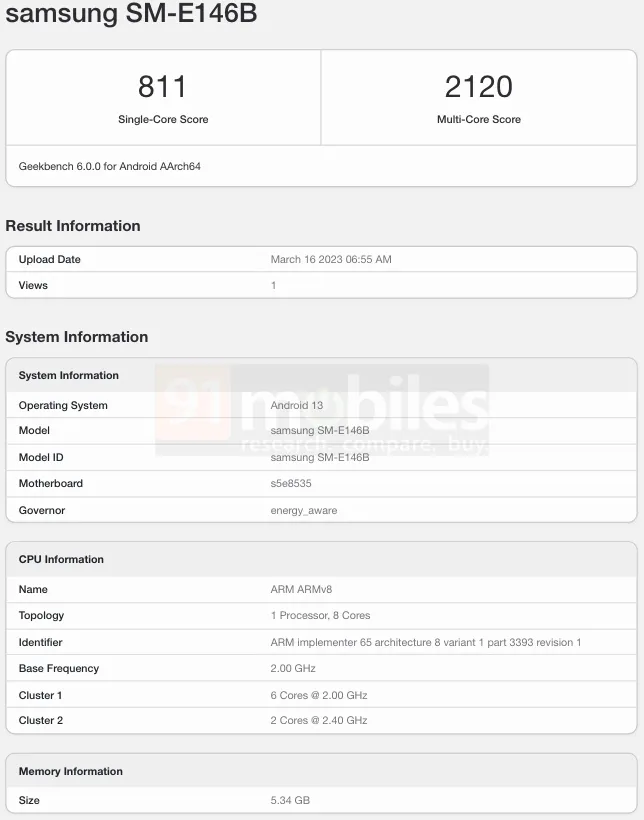
Ahead of the upcoming launch, the Galaxy A54 5G, which is said to be the top of the line in this year’s A-series devices has appeared on the Bureau of Indian Standards website. Previously, the device has made appearances on Geekbench revealing some key specs. This time, the device appeared on BIS bearing the model number SM-A546E/DS. Unfortunately, the listing does not reveal any specifications.
The Galaxy A54 recently appeared on the website Geekbench with an octa-core processor codenamed “S5E8835”. Four of the SoC’s cores are clocked at 2.40GHz, and the other four are at 2.0GHz. Moreover, it has a Mali G68 GPU onboard. These specifics lead us to believe that the phone has an Exynos 1380 processor. The smartphone will contain at least 6GB of RAM, according to Geekbench.
According to earlier rumors, the phone will include three cameras on the back, including a 50MP primary camera. It is claimed to have a 5100mAh battery and 25W charging capability. The smartphone could include a 6.4-inch Full HD+ AMOLED screen with a refresh rate of 120Hz. It will run Android 13 OS under the hood, with One UI 5.0 on top.
Giztop is giving a $100 discount coupon for the latest Oppo Find N2 Foldable phone. The phone which generally retails for $1499 can be now bought for a discounted price of $1399 by using the coupon code: N2100. Please note that the coupon expires on January 10, 2023.
Oppo Find N2 the foldable flagship, features a 7.1” E6 AMOLED inner display and a 5.54” AMOLED outer display. The smartphone runs on the Snapdragon 8+ Gen 1 Octa-Core processor and comes with Adreno 730 GPU. It comes in multiple memory variants viz: 12GB / 16GB LPDDR5 RAM and 256GB / 512GB internal storage.
Oppo Find N2 comes with a triple rear camera setup with a 50MP main camera and 48MP and 32MP secondary cameras. At the front, you have a 32MP selfie camera on both the inner and outer display. The smartphone is fueled by a 4520mAh battery and supports 67W wired fast charging. The phone comes in three color variants viz: Green, White, and Black.
Oppo Find N2 foldable smartphone runs on Android 13 based Color OS 13 and supports Dual 5G mode. You can now get the foldable phone for a discounted price of $1399 only on Giztop. This price is applicable to the base variant only.
For more information on such exciting deals and offers check out our deals hub.
Along with a slew of new laptops, Lenovo has also announced a new tablet at the ongoing CES 2023, dubbed Lenovo Smart Paper. The device is a global version of the Lenovo YOGA Paper launched in China.
The device features an E-Ink display and comes with a low-powered SoC and support for a battery-less stylus. It is priced at $400 and will be available for purchase later this year.
Lenovo Smart Paper
The Lenovo Smart Paper features a 10.3-inch E-Ink display that offers a screen resolution of 1872 x 1404 pixels and 227 PPI pixel density. It has 24 brightness levels with 24 adjustable temperature zones.
It also comes with support for a battery-less stylus and the EMR pen technology having 4,096 pressure levels with tilt detection. The device is powered by a Rockchip RK3566 chipset, coupled with 4GB of RAM and 64GB of internal storage.
The Smart Paper Pen that comes with the device is designed to minimize lag, offering latency as low as 23 milliseconds. There are nine different pen settings, including pencil, ballpoint, and marker, as well as several notepad templates, including a blank slate, lined paper, and music manuscript.
It can convert handwritten notes into text and allows for keyword searches to find content. There’s also support for organizing notes, placing them in folders, and deleting them. The device also grants access to millions of ebooks and searches saved books and articles that are already on the Smart Paper.
There’s also support for recording voice notes and writing notes at the same time, which then gets synced. The device has an application for smartphones and Windows PCs that can translate text and audio recordings into other languages.
The device runs the Android 11 operating system out-of-the-box and comes with support for Bluetooth 5.2 BLE and Wi-Fi 802.11 ac. As for the battery, the company says that it lasts 7,000 pages of reading or 170 pages of note-taking on a single charge.
ASUS has previously announced its Zenbook 14X OLED and Zenbook Pro 16X OLED at the CES 2023 event. Alongside that, the brand has also launched the Zenbook 14 Flip OLED and Zenbook Pro 14 OLED. Both laptops boast some interesting set of specifications and features. The 14 Flip OLED has also got a hinge that is as much 360-degree rotatable. It is probably the most powerful 14-inch laptop coming from the house ASUS.
A 14-inch OLED display with a 2.8K resolution, 16:10 aspect ratio, TÜV certification, and a 100% DCI-P3 gamut is included on the ASUS Zenbook 14 Flip OLED. It supports an optional ASUS Pen 2.0 MPP 2.0 stylus, which users may use to take notes, draw pictures, and more because of the laptop’s 360° any-position hinge. It weighs only 1.5 kg. The laptop includes Intel Iris Xe integrated graphics, up to 1 TB PCIe NVME SSD, and 16 GB of DDR5X RAM in addition to 13th Gen Intel Core CPU.
A long-lasting 75 Wh battery and essential ports are both features of the Zenbook 14 Flip OLED. A USB 3.2 Type-A port, an HDMI 2.1 (TMDS) port, and two Thunderbolt 4 connections are included. In terms of wireless connectivity, users can expect WiFi 6E (802.11ax). Users can once again use the ASUS ErgoSense keyboard and touchpad, as well as the optional ASUS NumberPad 2.0. Additionally, a Harman Kardon-certified audio system is included, and the laptop has undergone the harshest MIL-STD-810 US military-grade testing to guarantee its longevity.
Coming down the ASUS Zenbook Pro 14 OLED, is equipped with a studio-grade NVIDIA GeForce RTX 40 Series Laptop GPU and the newest 13th Gen Intel Core i9-13900H processor, which are paired with 16 GB of quick DDR5 RAM, a slot for up to 32 GB, and a 2 TB SSD. Additionally, it includes the most recent WiFi 6E technology, which ASUS WiFi Master Premium enhances even further. The 14-inch 2.8K 120Hz OLED NanoEdge Dolby Visions display is used on the Zenbook Pro 14 OLED. Additionally, it has a 100% DCI-P3 colour gamut and is Pantone Validated for colour accuracy.
The ASUS DialPad for simple app management, ASUS Pen 2.0 support, and a full set of 1/0 ports are just a few of the innovative features found in the Zenbook Pro 14 OLED that increase productivity and creativity. 76 Wh battery power-ups the device. So that was all about the recently launched Zenbook Pro 14 OLED and Zenbok 14 Flip OLED. Thanks for reading till the end.
Redmi Watch 3 is now available for just $99 on Giztop. The watch comes in Black and White color variants and supports both English and Chinese languages.
Redmi Watch 3 features a 1.75-inch AMOLED display and supports 390 x 450p resolution. The watch is powered by a 289mAh battery and gives up to 12 days of battery life under normal usage and 7 days under heavy usage. It comes with advanced health management features like a 24-hour Heart rate sensor, SpO2 sensor to monitor blood oxygen, sleep, stress tracker, breathing exercise, women’s menstrual cycle monitor, etc.
The watch comes with 120 sports modes and a built-in GPS that can track outdoor activities. Other interesting features include Bluetooth 5.2, NFC connectivity, built-in Xiao AI voice assistant, etc. The watch supports Android 6.0 and iOS 12 and above versions.
The watch is 5ATM waterproof and can be used in pools and baths. You can now buy the Redmi Watch 3 for $99 only on Giztop.
For more information on such exciting deals and offers check out our deals hub.
Qualcomm has partnered with Iridium for a new service announced at CES 2023, dubbed Qualcomm Snapdragon Satellite, which will add new functionality to Android smartphones.
As the name itself indicates, it brings support for satellite communication during emergencies, a feature similar to what Apple recently introduced as Emergency SOS via Satellite.
The Snapdragon Satellite feature will be available in smartphones that pack Qualcomm Snapdragon 8 Gen 2 processor and the Snapdragon X70 modem system, along with some additional radios.
The company says that smartphones with support for this new feature should be launched in select regions starting in the second half of this year. It added that there are several manufacturers working on adding this feature to their devices.
It’s likely that Snapdragon Satellite will be limited to premium flagship smartphones as the company is only supporting its flagship processor and modem for now. Companies that want to add it to their phones will work directly with Qualcomm without having to build new relationships with Iridium.
Initially, the feature will be limited to use in emergency situations, allowing users to contact someone for help even in a remote area without cell service. When the user sends an SOS, “response coordinators immediately see the customer’s Latitude/Longitude in their proprietary mapping and response coordination software to determine the appropriate agency to coordinate the rescue.”
Qualcomm says that it will eventually support “premium messaging,” which will likely cost extra and will have to be implemented by OEMs, cell carriers, or other over-the-top service providers.
When it’s available, users will be able to use the service with the existing phone numbers. The company says that the emergency service will be free or very cheap, but it hasn’t provided any details about the pricing.
ASUS has launched a bunch of its new laptops including the Zenbook 14X OLED, Zenboox Pro 16X OLED, Zenbook 14 Pro OLED and Zenbook 14 Flip OLED. The latest devices have got a bunch of new upgrades to their specifications. Speaking about the Zenbook 14X OLED, the device has a 14.5-inch 2.8K (2,880*1,800) OLED display with a refresh rate of 120 Hz. Additionally, the 16:10 display has Delta E <2 factory colour calibration, DisplayHDR True Black 600 certification, and supports touch inputs and 100% of the DCI-P3 colour space.
The Zenbook 14X OLED from ASUS now features Intel Raptor Lake CPUs, with the Core i9-13900H being the most powerful choice for the 14-inch laptop. In addition, ASUS upgraded the Zenbook 14X OLED from the RTX 2050 to the RTX 305. The new Zenbook 14X OLED also includes a 70 Wh battery, 32 GB of LPDDR5-4800 RAM, and up to 1 TB of PCIe 4.0 storage. Twin Thunderbolt 4 ports, one USB 3.2 Gen 2 Type-A port, and an HDMI 2.1 (TMDS) port are all included.
Coming down to the Zenbook Pro 16X, ithas got a 16-inch OLED screen which combines 3.2K resolution with a 120Hz refresh rate. The display has got up to 550 nits of peak brightness, 100% DCI-P3 colour gamut, 1,000,000:1, VESA CERTIFIED Display HDR True Black 500, 1.07 billion colours, 70% less harmful blue light, TÜV Rheinland-certification, SGS Eye Care Display, Touch screen, Stylus support, Screen-to-body ratio of up to 90%.
The gadget is powered up using the Intel Core i9-13905H with ASUS Supernova SoM Design. The brand has included NVIDIA GeForce RTX 4080 Laptop GPU with NVIDIA Studio drivers. Moreover, it has got up to 32GB of LPDDR5X RAM with up to 7500MHz memory frequency and up to 1TB M.2 NVMe PCIe 4.0 SSD. It has got Backlit Chiclet Keyboard Per-Key RGBW with N-key Rllover. As for the connectivity, the laptop has 1X USB 3.2 Gen 2 Type-A, 2X Thunderbolt™ 4 supports display/power delivery, 1X HDMI® 2.1 FRL, 1 x 3.5mm Combo audio jack, 1X DC-in and SD Express 7.0 card reader.
The laptop packs a 96WHrs battery. It measures the dimension of 35.50*25.10*1.69 ~ 1.78 cm weighs 2.40 kg. The device will boot up on Windows 11 Pro right out of the box. Further, it includes an FHD camera with an IR function to support Windows Hello and Privacy shutter. So that was it about the recently launched Zenbook laptops. Do let us know your thoughts in the comment section down below. Thanks for sticking with us till the end.
We use cookies on our website to give you the most relevant experience by remembering your preferences and repeat visits. By clicking “Accept”, you consent to the use of ALL the cookies.
This website uses cookies to improve your experience while you navigate through the website. Out of these, the cookies that are categorized as necessary are stored on your browser as they are essential for the working of basic functionalities of the website. We also use third-party cookies that help us analyze and understand how you use this website. These cookies will be stored in your browser only with your consent. You also have the option to opt-out of these cookies. But opting out of some of these cookies may affect your browsing experience.
Necessary cookies are absolutely essential for the website to function properly. This category only includes cookies that ensures basic functionalities and security features of the website. These cookies do not store any personal information.
Any cookies that may not be particularly necessary for the website to function and is used specifically to collect user personal data via analytics, ads, other embedded contents are termed as non-necessary cookies. It is mandatory to procure user consent prior to running these cookies on your website.