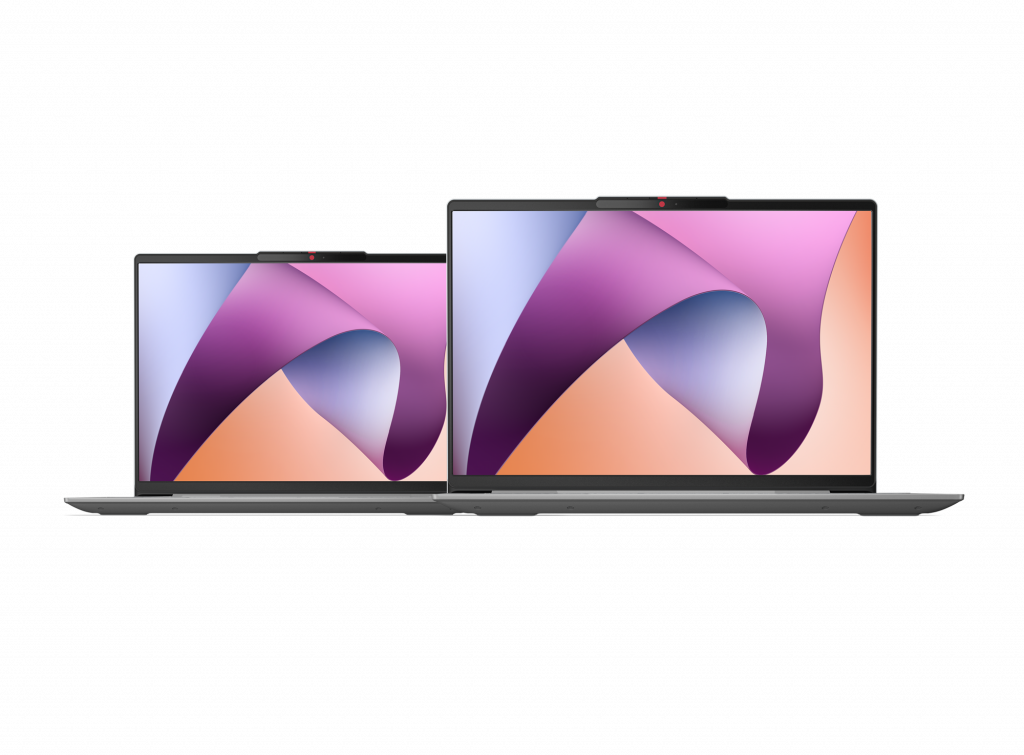
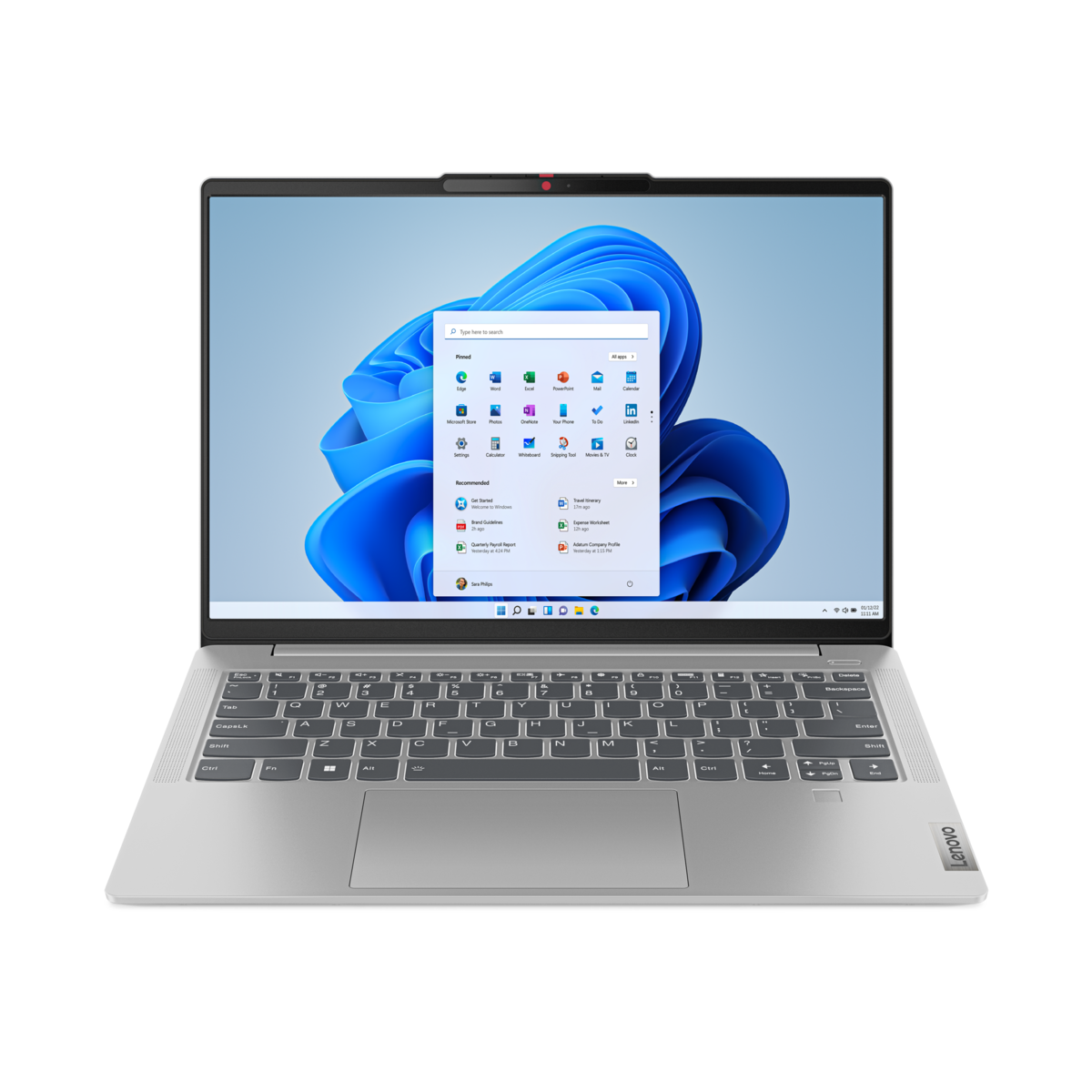
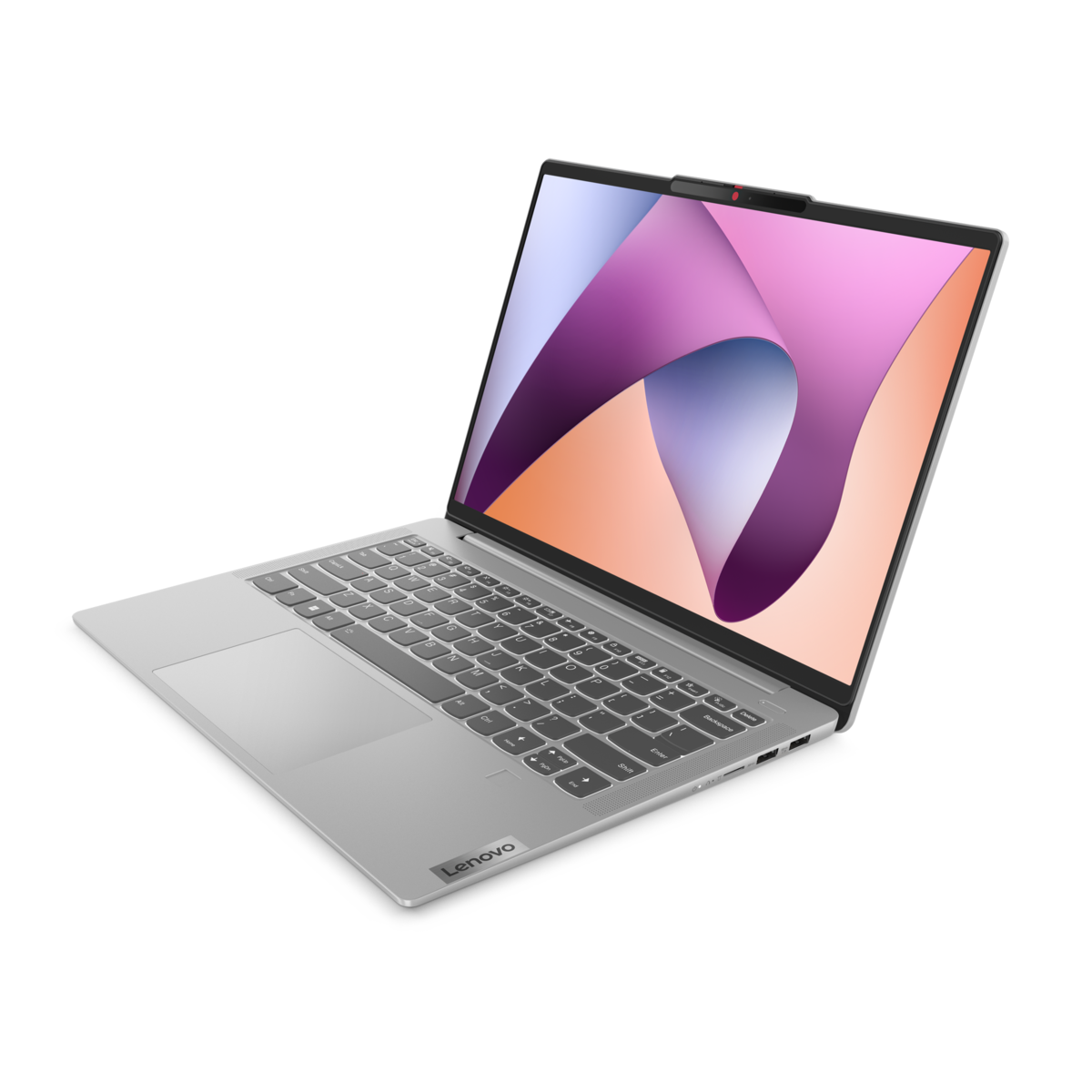
Lenovo has recently launched a bunch of new laptops and accessories like the Ideapad Flex 3i, Ideapad Pro 5 series laptops, new ThinkVision mini-LED monitors, a 4K Pro webcam, and more. The brand has also unveiled the specifications, pricing, and shipping window of the latest-gen IdeaPad Slim 5i laptops.
The new Ideapad Slim 5 lineup from the brand comes with AMD Ryzen 7000 U-series processors and IPS LCD as well as OLED screen options. The new Slim 5 models, which come in 14-inch and 16-inch sizes, also contain additional security measures and an AI Engine Smart Power function that improves battery life and dynamically adjusts performance. Let’s examine their specifications in more depth.
Lenovo IdeaPad Slim 5 14 / 16 specs
There are three different Ryzen processor options: Ryzen 7 7730U, Ryzen 5 7530U, and Ryzen 3 7330U versions, all of which combine Zen 3 cores with RX Vega graphics. Both 8 and 16 GB of DDR4 RAM and up to 1 TB of PCIe NVMe SSD storage can be used with them.
The 14-inch model includes an OLED option in addition to two IPS options for displays, whereas the 16-inch model only offers two IPS options. The 14-inch OLED is notable for its 400 nits of brightness, 1920 x 1200 resolution, 100% DCI-P3 color gamut, and 60 Hz refresh rate.
Additionally, there is a 1920 x 1200 IPS screen with a 45% NTSC color gamut and a 2240 x 1400 IPS panel with a 60 Hz refresh rate, 300 nit brightness, and 100% sRGB color gamut. Lenovo offers two IPS displays in the 16-inch size: a 2560 x 1600 IPS with 350 nit brightness and 100% sRGB color gamut, and a 1920 x 1200 IPS with 300 nit brightness, 60 Hz refresh rate, and 45% NTSC color gamut. TÜV low blue light and SGS Eye Care display certifications are included with every display.
Other features of the laptops include an FHD webcam with IR and ToF sensors plus a privacy shutter, an optional fingerprint sensor, 2 x 2 W Dolby Audio speakers, and Wi-Fi 6E + Bluetooth 5.1 connectivity. Ports offered on the laptops include 2x USB-C 3.2 Gen 1 (full function), 2x USB-A 3.2 Gen 1, HDMI 1.4 video out, combo audio jack & a miniSD card reader.
Depending on the model, the laptop will feature a 47 / 56.6 / 75.4 Wh battery. The 16-inch model can weigh up to 4.39 lbs, while the 14-inch tops out at 3.51 lbs. The new IdeaPad Slim 5 laptops from Lenovo will be available starting in May 2023 for a starting price of €799 for both sizes.
Samsung’s operating profit in the fourth quarter of 2022 could be in trouble, according to a new estimate by Goldman Sachs. The global investment and banking firm has lowered its operating profit estimate for Samsung Electronics to KRW 5.8 trillion ($4.5 billion) for the fourth quarter, a decrease of 25.6% from its previous estimate of KRW 7.8 trillion. If the estimate turns out to be accurate, it would represent a 58.3% drop in Samsung’s operating profit from the same quarter in 2021.
Goldman Sachs forecasts sharp drop in Samsung’s profit
The decrease in the estimate is largely due to a forecast of a slashed operating profit in Samsung’s semiconductor business unit. Goldman Sachs estimates that Samsung will reap KRW 1.5 trillion in operating profit from its chip-making business in the fourth quarter, a massive 83% drop from the company’s operating profit from the semiconductor unit in the fourth quarter of 2021. This would be the lowest operating profit for the semiconductor business since 2009.
Goldman Sachs’ earnings estimates for Samsung differ from those of local brokerage firms, which have projected more optimistic numbers. The global investment bank attributed the downward adjustment to weakened performances in the global memory chip sector and Samsung’s decreased shipments of smartphones and TV sets. It also expects Samsung to post a larger fall in operating profit next year due to the global market’s memory chip down cycle.
While some local analysts predict a turnaround for the memory chip market in 2024, the near-term outlook for Samsung is not looking good. The company will likely face a challenging fourth quarter in 2022 and a difficult year in 2023 due to decreased demand for semiconductor chips and other factors. It remains to be seen how Samsung will navigate these challenges and if it will be able to bounce back in the future.
We already know that Honor is planning on launching a new smartphone in the Chinese market soon. But prior to its official announcement, the company has teased the Honor 80 GT. So let’s have a look.
For those unaware, the Honor 80 GT is set to be unveiled in China on December 26. This device is a high end model from the company and will be equipped with a Qualcomm Snapdragon 8+ Gen 1 SoC. On the rear, it will sport a 54 megapixel triple camera setup and support 66W fast charging rate as well. Finer details are still at large, but previous leaks have hinted at a punch hole OLED display with a Full HD+ resolution and 120Hz refresh rate.
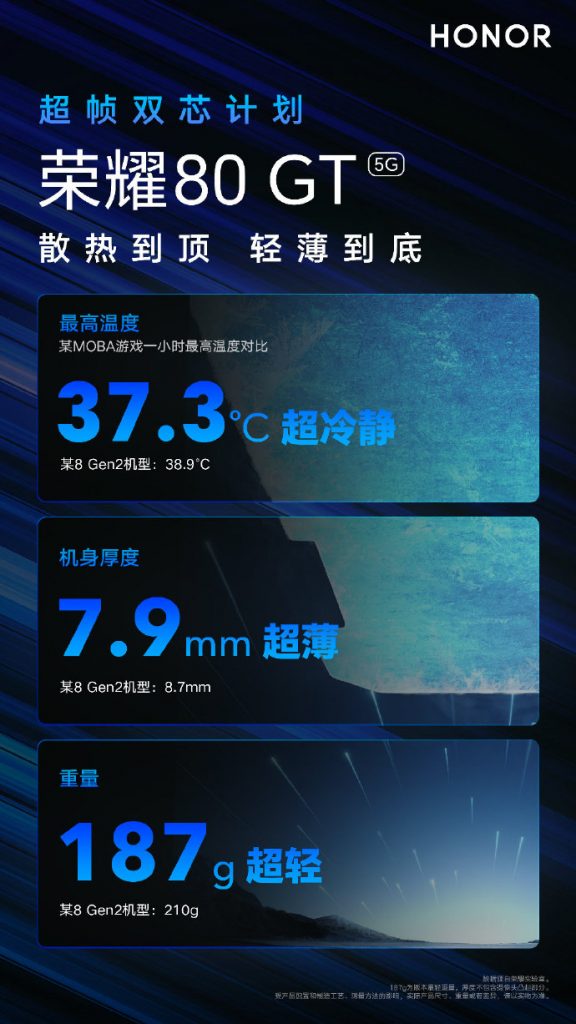
Apart from this, we can expect the device to run on Android 13 OS based MagicOS 7 software. The Honor 80 GT is the company’s latest flagship model, but it will still feature a plastic frame to keep the cost low. But under the hood, it seems like the brand has placed an emphasis on keeping thermals in check. In the new teaser, the Chinese smartphone maker revealed that the device will arrive with a VC (vapor chamber) liquid cooling mechanism.
The device will also house a large 74mm thermal materials to help keep the temperatures in check as well. The company also shared some other interesting details regarding the cooling performance of the handset. While playing MOBA titles, the device is capable of running at a cool 37.3 degree Celsius. Furthermore, it was also revealed that the Honor 80 GT will be 7.9mm in thickness and weigh just 187 grams.
OnePlus, is expected to launch its first keyboard in February, alongside the OnePlus 11 5G. The keyboard, which is being developed in collaboration with Keychron, is part of the “OnePlus Featuring” lineup, which involves products developed through collaborations with other companies. Lastly, design of the keyboard has leaked.
OnePlus Nord Keyboard live image reveals design
OnePlus has confirmed to launch its first keyboard in India and other markets soon. The company teased some of the features and design elements of the keyboard recently. Now, The design of the keyboard has leaked. According to latest leaks, the keyboard, which is expected to be branded as the “OnePlus Nord Keyboard,” will have a sleek and modern design, with an aluminium and plastic body that is both durable and lightweight.
Source: MySmartPrice
The keyboard will feature a rotary encoder knob on the top right, which can be used to adjust volume or navigate through media playback, and will not have dedicated numeric keys on the right side. One of the standout features of the OnePlus Nord Keyboard is its compatibility with multiple operating systems, including Windows and Mac. This means that users will be able to easily switch between different devices and platforms, without having to worry about compatibility issues.
The keyboard will also support Bluetooth 5.2, allowing for a stable and reliable connection with compatible devices. In addition to this, the keyboard will have both USB Type-C and USB Type-A ports, making it easy to connect to a range of devices and peripherals. The OnePlus Nord Keyboard will also have the option of being used in both wired and wireless modes, depending on the user’s preference. This means that users will be able to choose between the convenience of a wireless connection or the faster data transfer speeds and lower latency of a wired connection.
While no official pricing information has been released, it is expected that the OnePlus Nord Keyboard will be priced between INR 8,000 and INR 10,000 (approximately $108 to $135) in India. It is not yet clear what the pricing will be in other markets. Overall, the OnePlus Nord Keyboard looks to be a promising addition to the company’s lineup of products, offering a combination of modern design, versatility, and functionality. It will be interesting to see how it compares to other keyboards on the market and how well it is received by users when it is officially released in February.
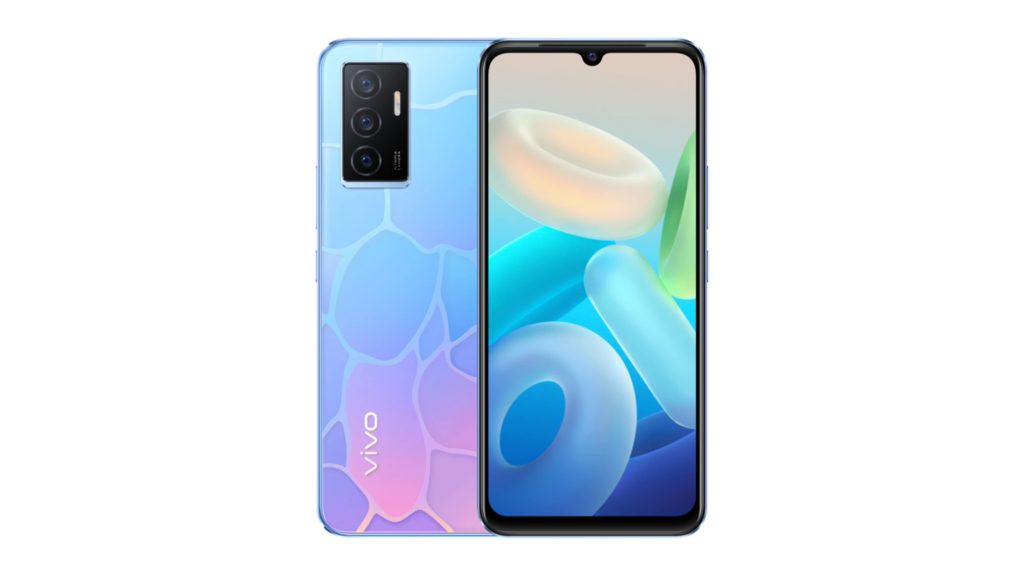
The Vivo Y75 was launched in India in May. Seven months after its release, the smartphone gets a price cut in the country.
The company is also offering bank discounts on this device as part of its year-end sale. Let’s check out all the details.
The Vivo Y75 debuted in India at ₹20,999 for the sole 8GB + 128GB memory configuration. Since the brand has now slashed the price of the phone by ₹1,000, it currently retails at ₹19,999.
Additionally, as part of Vivo’s Celebrate Joyful festive offers, customers can get a cashback of up to ₹1,500 on transactions via cards issued by ICICI Bank and SBI. Hence, the effective price of the smartphone drops down to ₹18,499.
Talking about specs, the Vivo Y75 sports a 6.44-inch AMOLED display with a resolution of 2400 x 1080 pixels and a dewdrop notch. It is powered by a MediaTek Helio G96 SoC and boots Funtouch OS 12 based on Android 12.
It comes with a triple camera system on the rear comprising a 50MP primary shooter, an 8MP ultra-wide unit, and a 2MP macro snapper. On the front, it has a 44MP shooter with autofocus support.
The 4G-only handset offers dual-band WiFi, Bluetooth 5.2, GNSS, a USB Type-C port, and an in-screen fingerprint sensor. Last but not least, it draws power from a 4,050mAh battery and carries support for 44W wired charging.
KOSPET is a growing smartwatch brand that was established in 2018. Through its relatively short time in the market, it has already made its presence in over 70 countries around the globe. Though the brand sells a large variety of wearables, it is best known for its rugged smartwatches.
The brand is offering attractive discounts on two of its recently launched rugged smartwatches called the KOSPET Tank T2 and the KOSPET Tank M2. These feature-rich smartwatches are tough as nails and are made to survive in extreme conditions where most of their rivals can’t operate. So let’s check out these smartwatches in more detail and explore the offers.
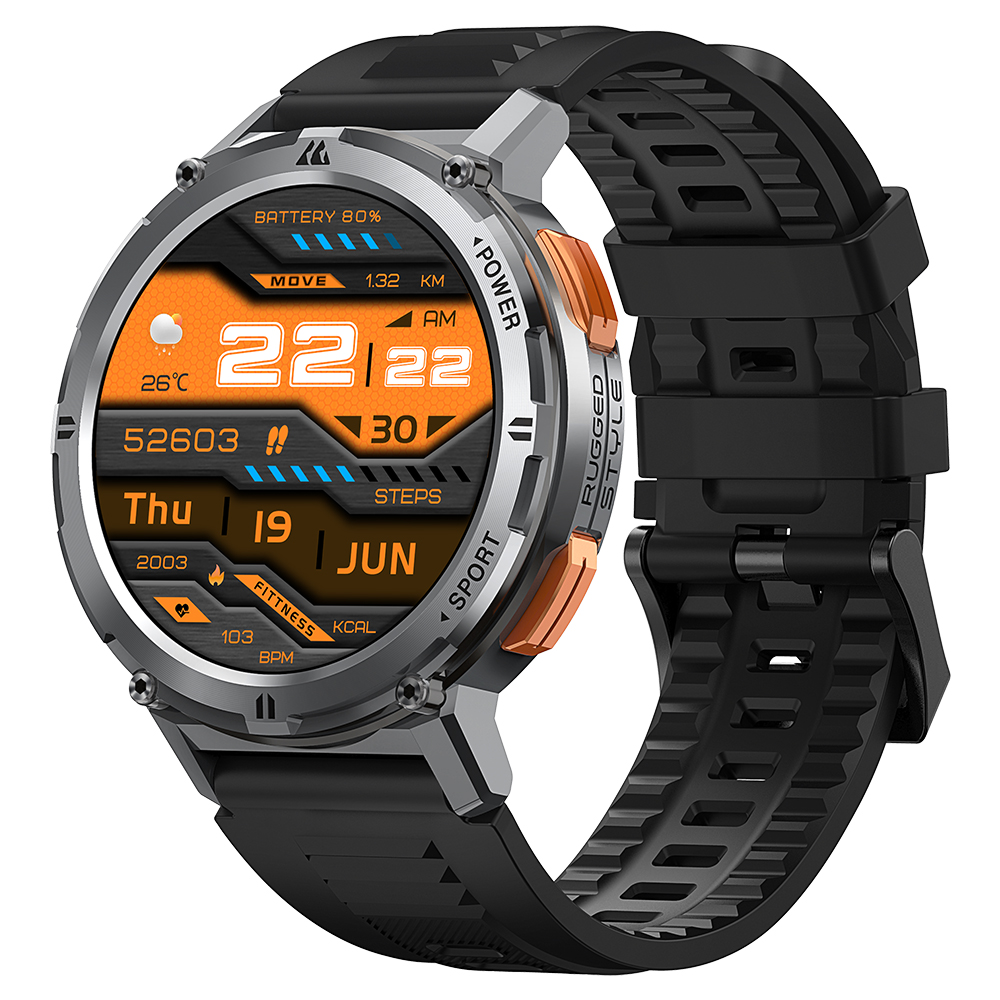
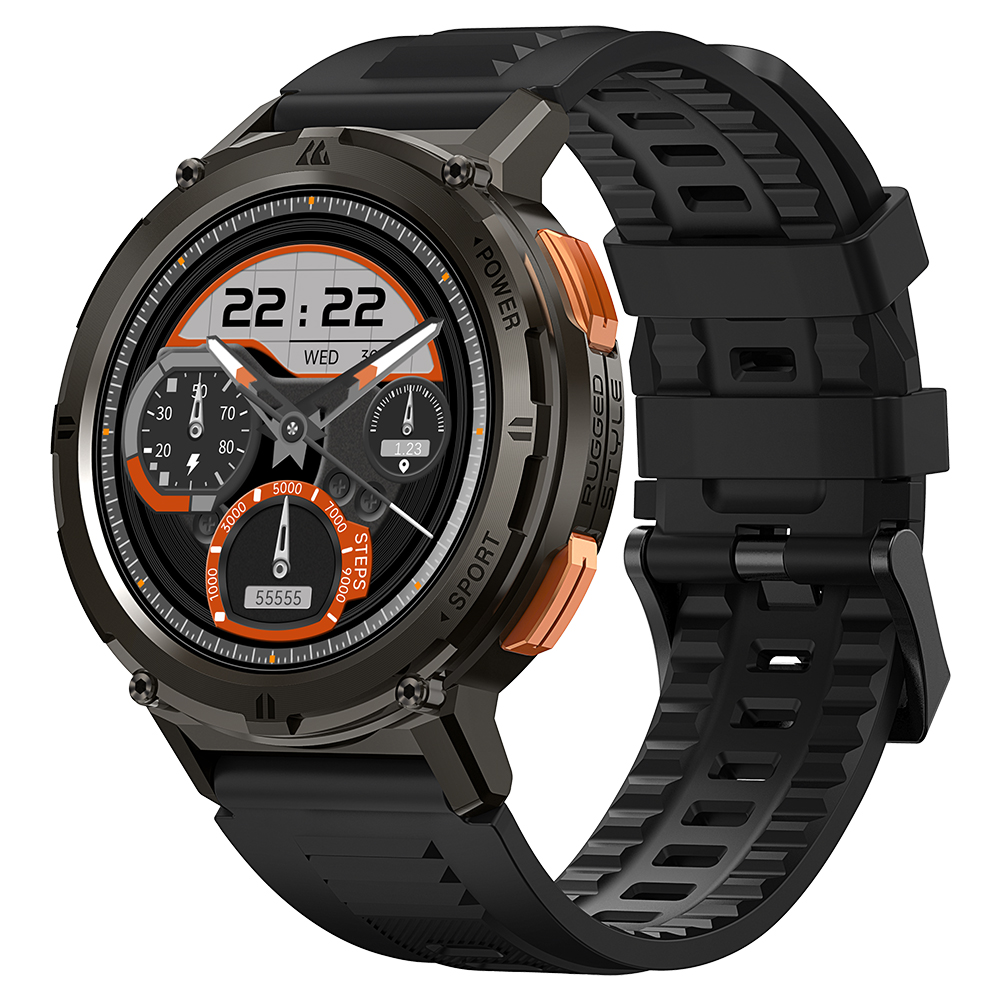
KOSPET Tank T2
Starting off with the Tank T2, the smartwatch has a circular dial surrounded by a full metal body. Its display features a With 1.43-inch AMOLED screen with an Always-on function which will help users quickly glance over the time and notifications without the need of pressing any buttons.
The 12 US MIL-STD-810H tests, the IP69K rating, and the 5ATM waterproof rating all attest to the toughness of this smart wearable. Additionally, watertight speakers and a microphone are also included on the smartwatch allowing it to receive calls and play music. A sizable 410 mAh battery with a long life span of up to 15 days of daily use is also included. The watch also offers support for sleep tracking, blood oxygen tracking, and heart rate monitoring. It is also ideal to track your workouts as the smartwatch offers 70 sports modes.
The KOSPET Tank T2 usually retails at $129.99, however, it is currently being offered for just $99.99 under the special Xmas promotion. The promotion will last till January 15, 2023. So, claim the offer before it’s gone!
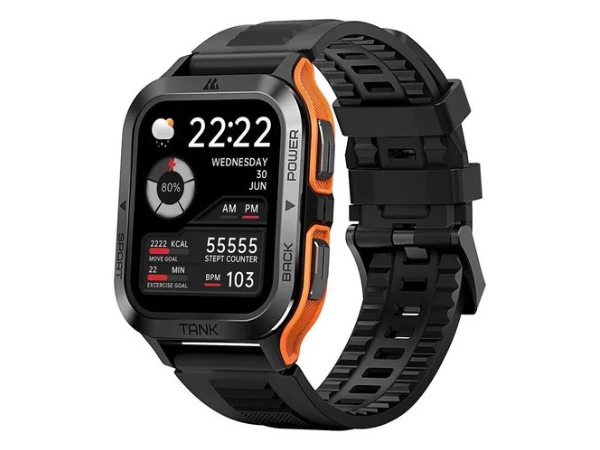
KOSPET Tank M2
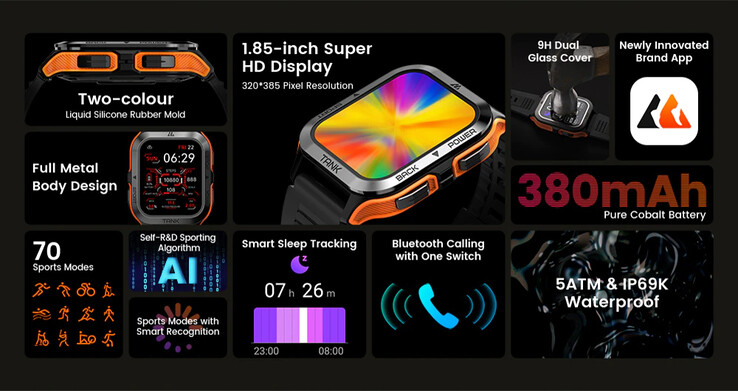
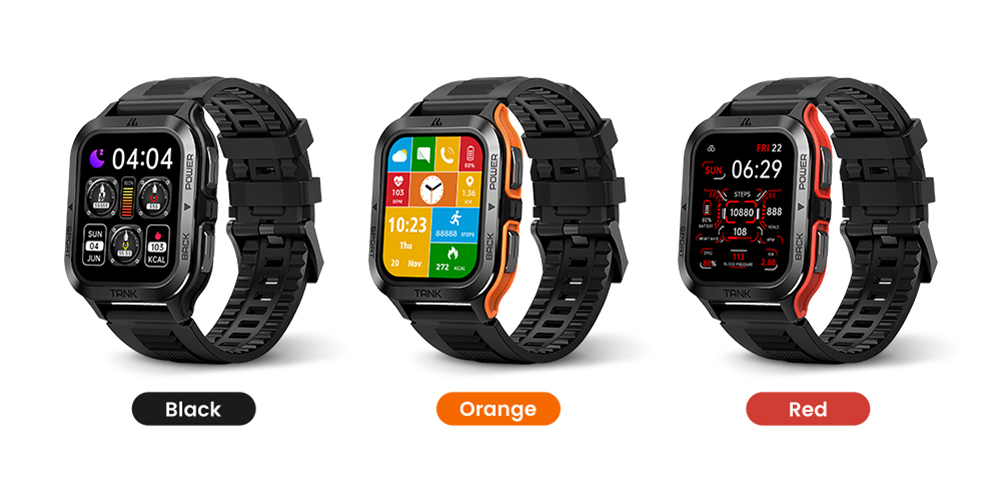
The KOSPET Tank M2 comes with a rectangular design, having a metal body, but this time around, it is layered with a liquid silicone rubber mold giving it a more sporty look. The display of the smartwatch is protected by bezels made of high-strength metals and the back of the watch comes with stainless steel protection.
The KOSPET Tank M2 sports a 1.85-inch rectangular IPS LCD display with a 320 x 385 resolution. Similar rugged features include an IP69K certification, passing all 12 US MIL-STD-810H tests, and 5 ATM waterproofing comes standard on the Tank M2. Both the watch’s side buttons and voice commands can be used to control it. Walking, cycling and running are among the six exercise activities that the smartwatch can automatically measure. It also contains an alarm clock, a basic calculator, and the ability to deliver weather information.
The smartwatch has a large 380mAh battery that can power the smartwatch for up to 60 days on standby. With regular use, the smartwatch lasts for around 15 days This is made possible by its power-efficient processor and smart software algorithms that save power when the watch is not in use. Health monitoring is provided by BioTracker PPG optical sensor and 70 sports modes are available as well. Last but not the least, the smartwatch comes with a Bluetooth calling feature.
The KOSPET Tank M2 is currently available at a $30 discount, bringing its price down to $89.99. This Xmas special price is valid till January 15, 2023, after which, the price will go back up to $129.99.
Motorola’s latest flagship smartphone, dubbed Moto X40, was announced a few days ago in China and after being made available for pre-order in the country, the device is now officially on sale.
The Moto X40 is now available for purchase in the Chinese market with a starting price of 3,399 yuan (roughly $487) for the base model that comes packed with 8GB RAM and 128GB of internal storage.
Apart from the base model, there are three other models — 8GB RAM and 256GB storage, 12GB RAM and 256GB storage, and 16GB RAM with 512GB of internal storage, costing 3,699 yuan (~$530), 3,999 yuan (~$573), and 4,299 yuan (~$616), respectively. The phone is offered in two color options — Black and Blue.
Coming to the specifications, the Moto X40 features a 6.7-inch AMOLED display with a Full HD+ screen resolution and a 165Hz refresh rate. There is a center-aligned punch-hole camera cutout and curved edges, and the phone has an under-display fingerprint sensor.
Under the hood, the device is powered by the Qualcomm Snapdragon 8 Gen 2 processor, coupled with up to 16GB of LPDDR5x RAM and up to 512GB of UFS 4.0 storage. The device is equipped with a three-dimensional liquid cooling system to keep the phone’s temperature in check.
In the camera department, the triple-camera setup on the back features a 50MP primary sensor, a 50MP ultra-wide angle lens, and a 12MP telephoto lens. On the front side, there’s a 60MP snapper for taking selfies and video calling.
The smartphone runs the Android 13 operating system out-of-the-box with the company’s own My UI 5.0 custom interface on top. It is powered by a 4,600mAh battery with support for 125W fast charging and 15W wireless charging.
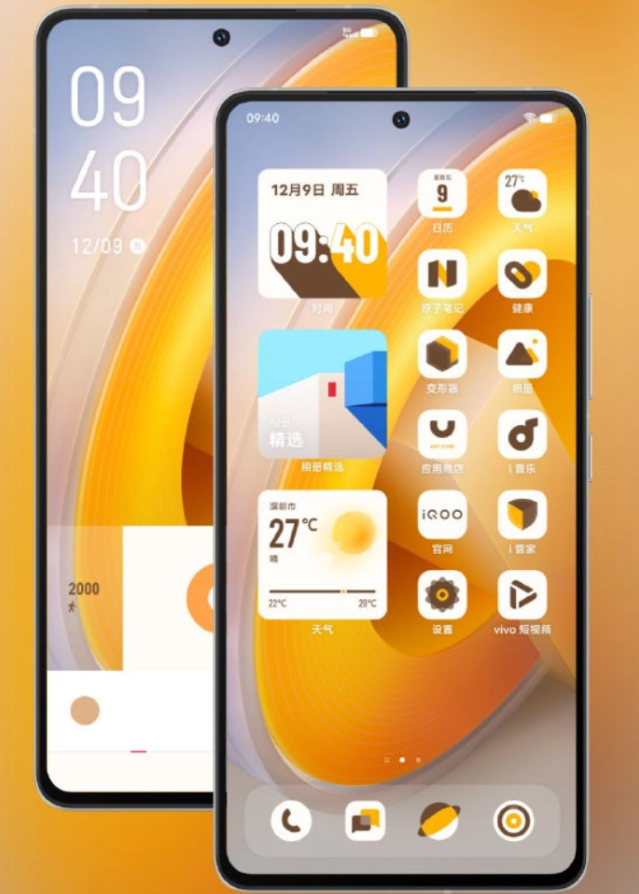
The same OriginOS or FunTouchOS software that the Vivo uses is preinstalled on iQOO devices. The user interfaces of both smartphone companies have remained essentially the same. A new set of exclusive themes, wallpaper, and a new font have now been made available for iQOO’s devices. By using this theme, you can get a somewhat different appearance from the stock UI. The iQOO logo serves as the basis for the entire theme. Users who want an exclusive appearance and feel from iQOO can download the theme and install it on their smartphones.
The brand’s future speed aesthetic design is in sync with the new official theme of iQOO, which is built on light and lines with high-saturation visual elements. The entire theme is created in a way that either directly or indirectly symbolises the iQOO and its own flavour. Additionally, each and every component of the new theme is based on the iQOO official colour scheme. The theme is further customizable to a limited extent.
The brand has created a new font to go along with the new look. The typeface will change throughout the UI if you apply the new font. When combined with the new theme, the new “iQOO Type” font creates a completely distinctive look from Vivo’s stock user interface. The upcoming iQOO smartphones may come with this theme already installed as the default theme. That was everything that there was to know about the recently released themes by iQOO.
To apply the theme and typeface, respectively, interested users can search “iQOO theme” and “iQOO font” inside the I theme apps. The theme is presently only available to users in China, however, this may soon change with the official release of the theme worldwide. However, nothing has been said regarding the theme’s current global accessibility.
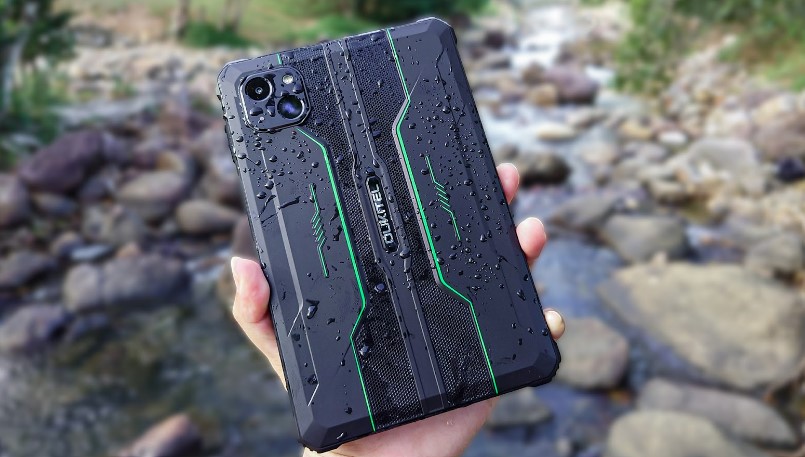
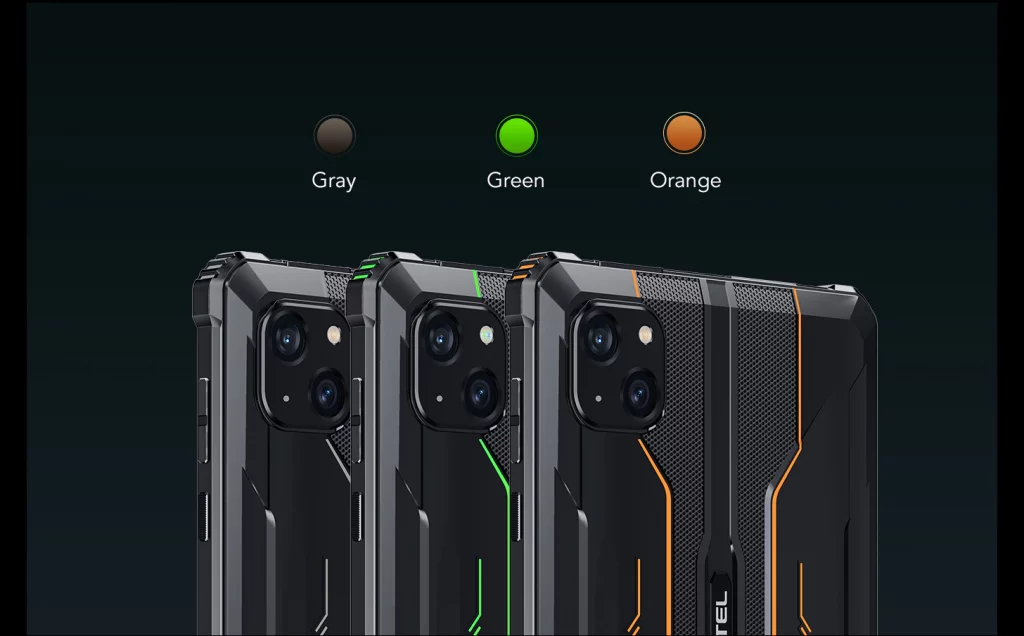
Oukitel has launched its first 8-inch tablet in the market called the Oukitel RT3. The mini-tablet comes with a rugged chassis and is capable of working in extreme and harsh conditions. Let’s take a look at its details, pricing & availability.
Oukitel RT3 specs & features
The Oukitel RT3 has an 8-inch, 400-nit, scratch-resistant IPS touchscreen display. The gadget has a rubber casing that provides additional protection. The tablet is waterproof, dustproof, shockproof, drop-resistant, and vibration-resistant thanks to its IP68/IP69K and MIL-STD-810H certifications. The tablet can withstand 1.5-meter drops and is waterproof up to 1.5 meters deep for up to 30 minutes.
The tablet has an octa-core MediaTek Helio P22 processor, 4GB of RAM, and 64GB of internal storage that can be expanded to 1 TB. It features twin rear cameras with a 16MP Sony IMX519 primary sensor and an LED flash, perfect for producing amazing pictures in both bright and low-light situations, and it runs on Android 12 OS. You have an 8MP front camera sensor for taking selfies.
Other interesting features include BeiDou, GPS, GLONASS, and Galileo. Dual speakers, Bluetooth 5.3, 4G/5G Wi-Fi, barcode scanning, OTG, and toolbag compatibility are all included. The device has cellular capability and can use two nano SIM cards or one nano SIM card and one microSD card simultaneously. The Oukitel RT3 weighs 538.1g and has dimensions of 209 x 136.6 x 14 mm.
Pricing & availability
On AliExpress, Oukitel has set the RT3’s starting price at US$499.98; however, a handy launch-window discount of 70% lowers that to a much more alluring US$149.99 from now until December 25, 2022.
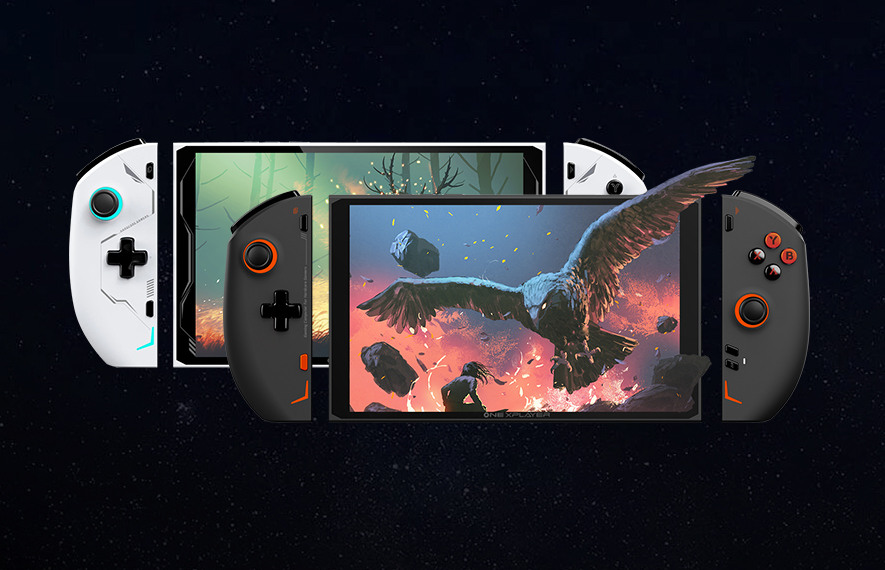
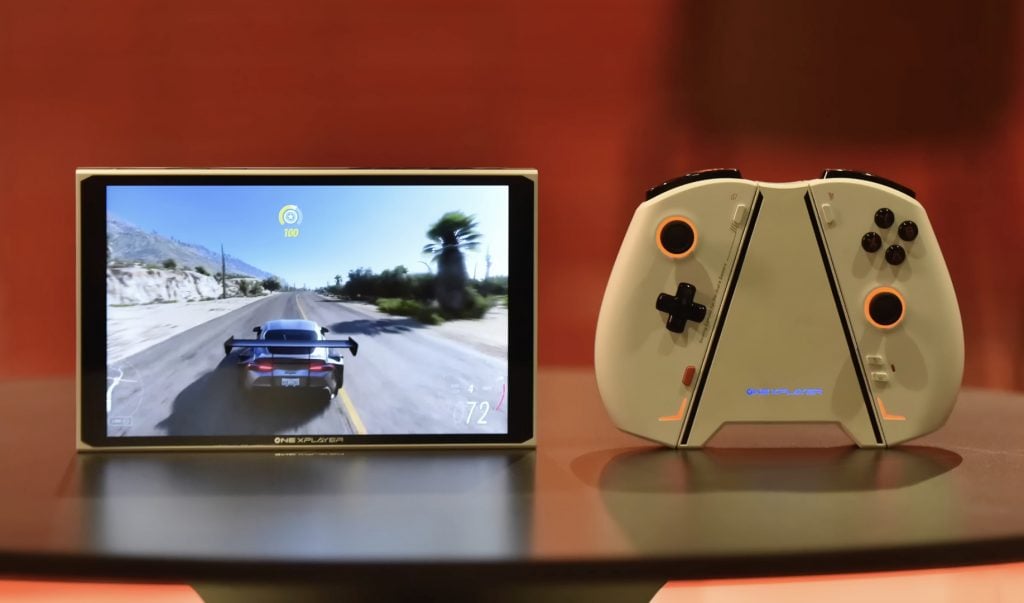
Last month, One-Netbook announced that it would soon launch the successor to the OneXPlayer, the OneXPlayer 2. The brand has already revealed a majority of the specifications of this device. Now, One-Netbook has finally made the handheld console available for purchase via Indiegogo.
The ONEXPLAYER 2 campaign has earned approximately $580,000 from backers as of the time of writing, with prices starting at US$899. The following are the ONEXPLAYER 2 early bird prices:
16 GB RAM/512 GB storage – US$899
16 GB RAM/1 TB storage – US$999
16 GB RAM/2 TB storage – US$1,099
32 GB RAM/1 TB storage – US$1,099
32 GB RAM/2 TB storage – US$1,299
OneXPlayer 2 specs & features
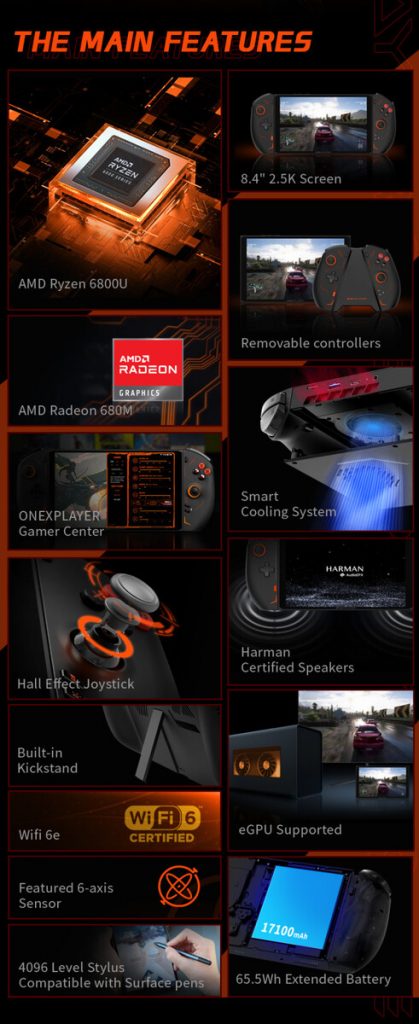
The Ryzen 7 6800U APU, an 8.4-inch 2.5K display, and a 65.5 Wh battery are all included with the ONEXPLAYER 2. The gadget also boasts interchangeable controllers, a built-in kickstand, and support for pen input with 4096-level pressure levels.
It has a dual speaker system certified by Harman, and it provides smart cooling, intaking air from the rear panel and dissipating heat from the top panel. For connectivity, the console features WiFi 6e and it even has eGPU support if you need more graphics power than what the Ryzen 7 6800U APU can provide. Lastly, the device features a 65.5Wh battery.
Currently, ONEXPLAYER 2 units are expected to begin shipping to backers in March 2023, according to One-netbook. This shipment date also applies to its magnetic keyboard, portable connector, and stylus, which are each sold separately for US$39, US$29, and US$39.
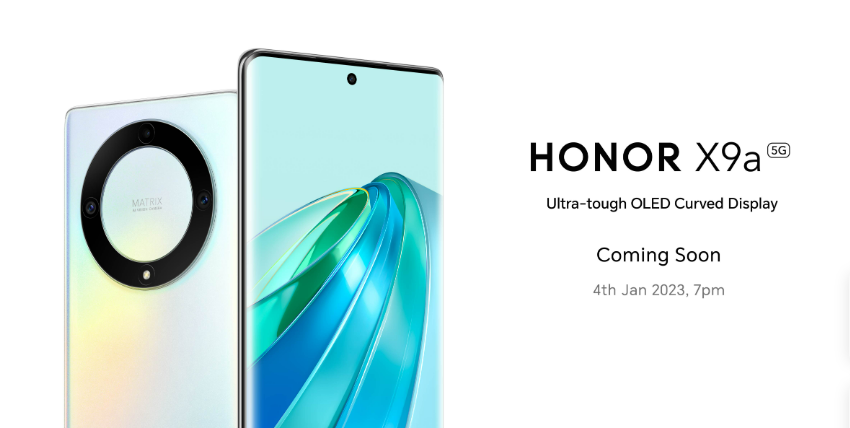
Honor has been teasing the arrival of the Honor X9a in Malaysia for the past few weeks. Finally, it has confirmed its launch date. Honor Malaysia’s official page states that the X9a will be unveiled at 7 pm (local time) on Jan. 4, 2023.
Reports have suggested that the Honor X9a will be a rebranded version of the Honor X40, which is already available in China. The X9a will be the third X9-branded phone in the Chinese market. So far, the company has released the Honor X9, featuring the Snapdragon 680 SoC, and the Honor X9 5G, powered by the Snapdragon 695 chip.
Honor X9a
Honor X9a specifications
The Honor X9a is expected to feature a 6.67-inch AMOLED curved-edge display with a centrally aligned punch-hole. It will support a Full HD+ resolution of 1080 x 2400 pixels and a refresh rate of up to 120Hz. For security, it will come equipped with an under-display fingerprint scanner.
The X9a will come equipped with a Magic UI based Android 12 OS. The Geekbench appearance of the device has revealed that it is likely to come equipped with the Snapdragon 695 chipset. It will arrive with 8 GB of RAM and 128 GB or 256 GB of internal storage. The device will lack support for external storage.
The X9a will be equipped with an 8-megapixel camera for selfies. The round-shaped camera module on the phone’s back will have a 50-megapixel primary camera, a 2-megapixel macro snapper, and an LED flash. It will pack a 5,100mAh battery that supports 40W wired charging. At present, there is no word on the price of the device.
In related news, Honor’s next launch event for the Chinese market will take place on Dec. 26. The event will see the arrival of multiple products, such as the Honor 80 GT, the Honor 80 Pro’s new flat display variant, and the Honor Pad V8 Pro.
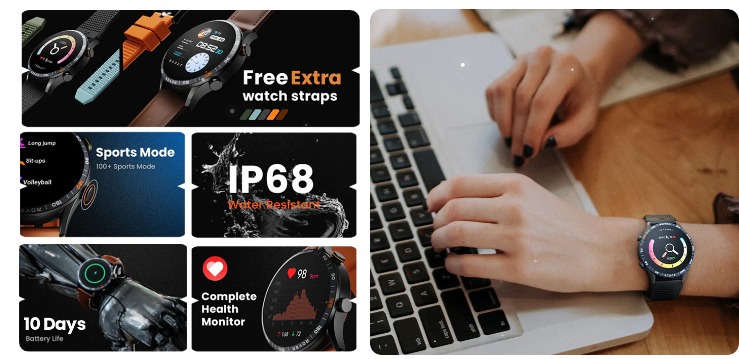
The Indian electronics and AIoT brand Boult Audio has launched a new smartwatch called the Boult Audio Rover. The smartwatch offers a bright 600nits display, a long 10-day battery life, and more.
Boult Audio Rover specs & features
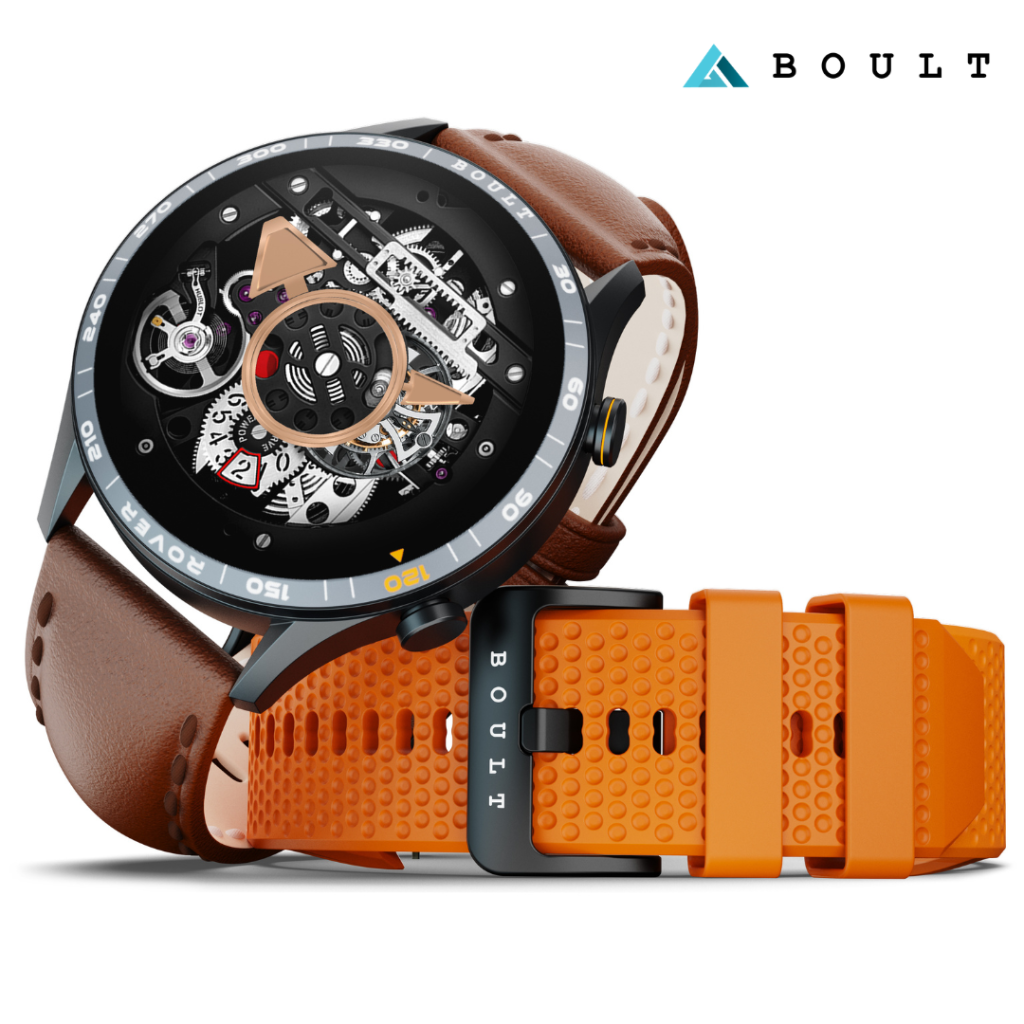
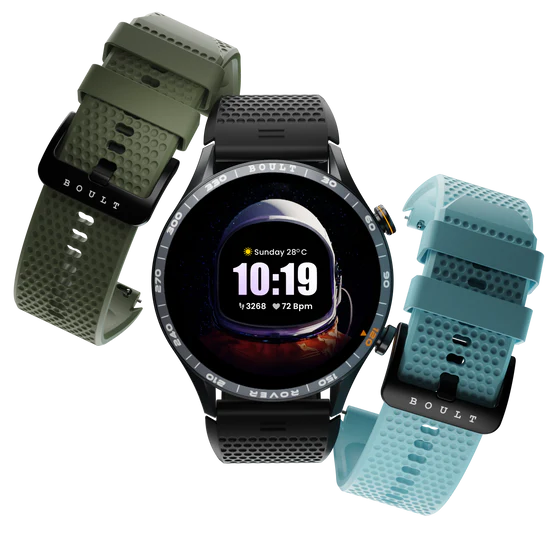
The Boult Audio Rover features a 1.3-inch AMOLED HD display with a brightness of 600 nits and support for over 150 cloud-based watch faces. The device has two physical buttons on the sides which helps in navigation, while the body of the smartwatch is made with zinc alloy.
The Rover is available in two designs, Classic Switch and Flip, and has a circular dial. A complimentary brown leather primary strap and an orange leather secondary strap are included with the Classic Switch model. Black is the standard strap color for the Flip version, and free green and blue straps are also included.
Additionally, it has Bluetooth calling capabilities facilitated by an inbuilt speaker and a mic. A heart rate sensor, a SpO2 sensor, a sleep monitor, a period tracker, and other health sensors are all readily available.
For tracking physical activities like running, swimming, walking, yoga, rope skipping, and more, the Rover smartwatch offers about 100 sports settings. Additionally, it enables voice assistant functionality for some activities and smart notifications from apps.
The watch’s battery life is up to 10 days, and a full charge takes roughly 2.5 hours. Additionally, it features an IP68 classification for protection from dust and water.
Price and Availability
The Boult Rover costs Rs. 2,999 and is available in Classic Switch and Flip versions. The Boult website already has this watch for sale, and Flipkart will soon have it as well.
Nubia‘s brand for gaming products, Red Magic, has already announced that the company will be launching its next-generation Red Magic 8 Pro flagship smartphone at a launch event on 26th December.
Ahead of the official launch of the gaming smartphone in the coming days, the company has started teasing some of the key features and specifications of the device. In a new teaser, the company has revealed the cooling technology used in the Red Magic 8 Pro smartphone.
The teaser shared by the brand reveals that the Red Magic 8 Pro will come equipped with the industry’s first 3D ice-level dual-pump VC liquid cooling technology. It is said to have the largest volume of VC cooling in the company’s history, up to 2068mm³, which is touted to be 100% higher than the traditional VC thermal conductivity.
The phone is also equipped with the company’s self-developed Red Core R2 gaming chip, which is said to be able to accurately adjust the control links, such as shoulder keys, vibration, touch, and sound effects, to offer a multi-in-one and immersive control experience.
It will come powered by the Qualcomm Snapdragon 8 Gen 2 chipset, making it the first gaming smartphone to come powered by this new SoC. The device features the world’s first under-screen flexible straight screen, which is jointly customized with BOE. The display on the phone offers a 93.7 percent screen-to-body ratio with ultra-narrow edges.
The company has also revealed that the smartphone will offer the best sound effects in the history of its gaming phones, thanks to the 1115K+1216 ultra-linear stereo double speakers and large sound chamber. Red Magic is also packing Snapdragon Sound on the device for 96KHz lossless sound quality and 48ms ultra-low latency, as well as reduced power consumption.
Some of the leaks have revealed that the phone features a 6.8-inch OLED screen. In the camera department, there’s a 50MP + 8MP + 2MP triple-camera setup on the back and an 8MP snapper on the front side. We expect the company to reveal more details about the flagship gaming smartphone in the coming days through teasers.
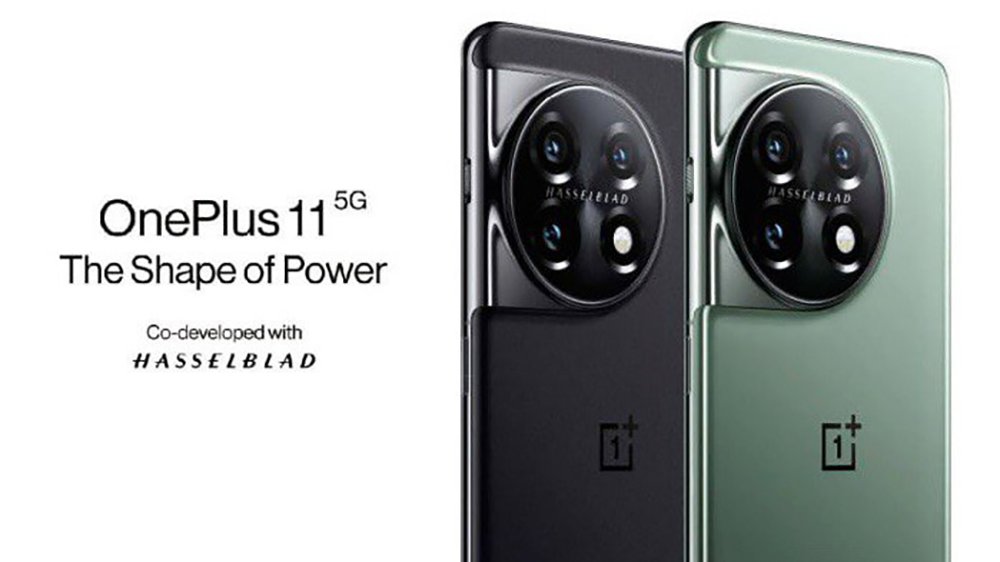
The OnePlus 11 is expected to launch soon in China. It was recently spotted on the 3C certification site and has also been seen on benchmarking sites like AnTuTu and Geekbench. The flagship phone has now appeared on Geekbench with some of its entire specifications. The specs of the OP11 have already leaked in the past. Let us have a look at the TENAA listing to find out whether it is in line with the leaked specs.
OnePlus 11 specifications (rumoured)
The OnePlus 11 has a 6.7-inch AMOLED display that offers a Quad HD+ resolution of 3216 x 1440 pixels, 10-bit colors, and an under-screen fingerprint scanner. It is expected to support a refresh rate of up to 120Hz. The device is expected to run on ColorOS 13-based Android 13 in China.
OnePlus 11 5G leaked poster
The Snapdragon 8 Gen 2 chip powers the OnePlus 11. It will arrive with 12 GB / 16 GB of RAM and 256 GB / 512 GB of storage in the home market. It packs a 5,000mAh dual-cell battery (single cell – 2,435mAh rated value) that reportedly supports 100W charging.
The OnePlus 11 has a 16-megapixel camera for selfies and video calls. On the back, it has a 50-megapixel primary camera, a 48-megapixel (ultra-wide) snapper, and a 32-megapixel telephoto camera. The TENAA listing states that the device supports only 2x optical zoom. It measures 163.1 x 74.1 x 8.53mm and weighs around 205 grams.
The OnePlus 11 has surfaced with the model number PHB110 at Geekbench, AnTuTu, 3C, and TENAA. Its global edition has the CPH2451 model number. With TENAA certification under its belt, the OP11 is likely to launch either by the end of this month or early January in China. It will be debuting in India on Feb. 7.
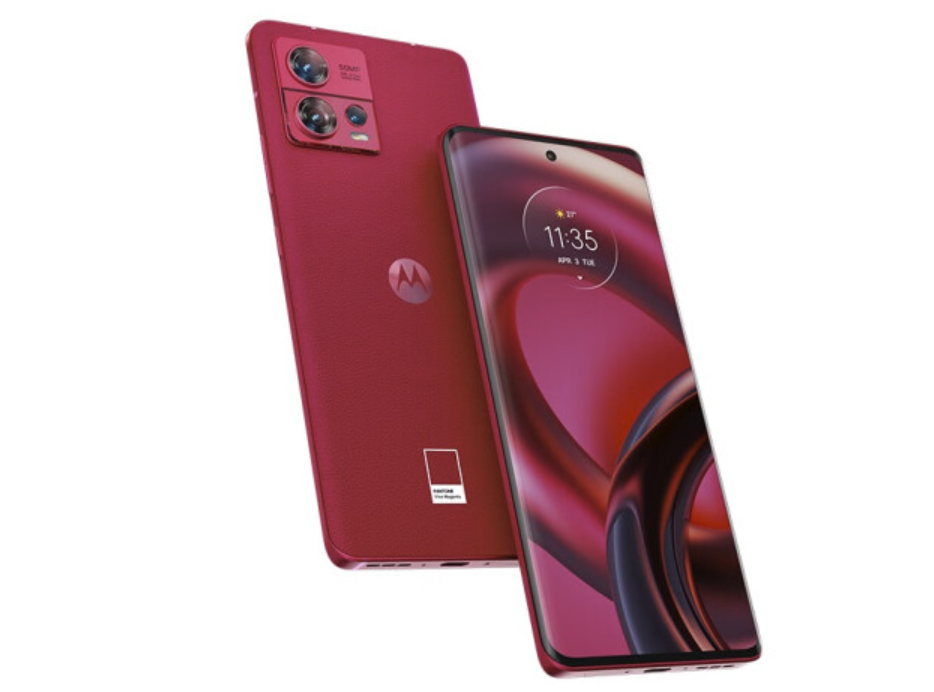
A few days ago, Lenovo-owned Motorola announced a new Limited Edition smartphone, dubbed Moto S30 Pro Pantone Edition, that comes in a unique Magenta colored body, and the device is now on sale in China.
The Moto S30 Pro Pantone Edition smartphone, which packs 12GB of RAM and 512GB of internal storage, is now available for purchase in the Chinese market for the price of 2,699 yuan, which is about $387.
Moto S30 Pro Pantone Edition
Pantone, which is a color consulting agency, has announced Viva Magenta or Extraordinary Magenta as the 2023 Color of the Year. The color is a relatively purple-pink shade in the red color spectrum and is said to be inspired by the natural red dye inside the cochineal insect.
The Moto S30 Pro Pantone Edition is basically a Moto Edge 30 Fusion smartphone available globally. It features a 6.55-inch centered punch-hole 10-bit curved OLED display with Full HD+ resolution, up to 144Hz refresh rate, and 360Hz touch sampling along with support for HDR10+, DCI-P3 color gamut, and DC Dimming.
Under the hood, the device comes powered by a relatively older Qualcomm Snapdragon 888 Plus chipset, coupled with LPDDR5 RAM and UFS 3.1 internal storage. There’s also a VC liquid cooling system to keep the phone’s temperature in check during intense workloads.
In the camera department, the smartphone features a triple camera system on the back, comprising a 50MP OmniVision OV50A primary sensor, a 13MP ultra-wide unit with auto-focus for macro, and a 2MP depth sensor. On the front side, there’s a 32MP snapper for taking selfies and video calling.
The phone, which has an in-display fingerprint sensor for added security, runs the Android 12 operating system out-of-the-box with the company’s MyUI custom interface on top. It is powered by a 4,270mAh battery that supports 68W fast charging.
The Asus Zenbook 17 Fold OLED has been available in the US and Canada since October this year. When it arrived in India in November, I got the opportunity to lay my hands on India’s first laptop with a foldable screen. I am writing this review after using it as my primary device for over a month. I had planned to post by early December but delayed it to see if the Zenbook 17 Fold OLED’s foldable screen would get any creases. I can say that I am quite impressed with Asus’ first iteration of a foldable screen laptop. In fact, I felt the void when I had to return to the review unit. Here’s my review of the Asus Zenbook 17 Fold OLED.
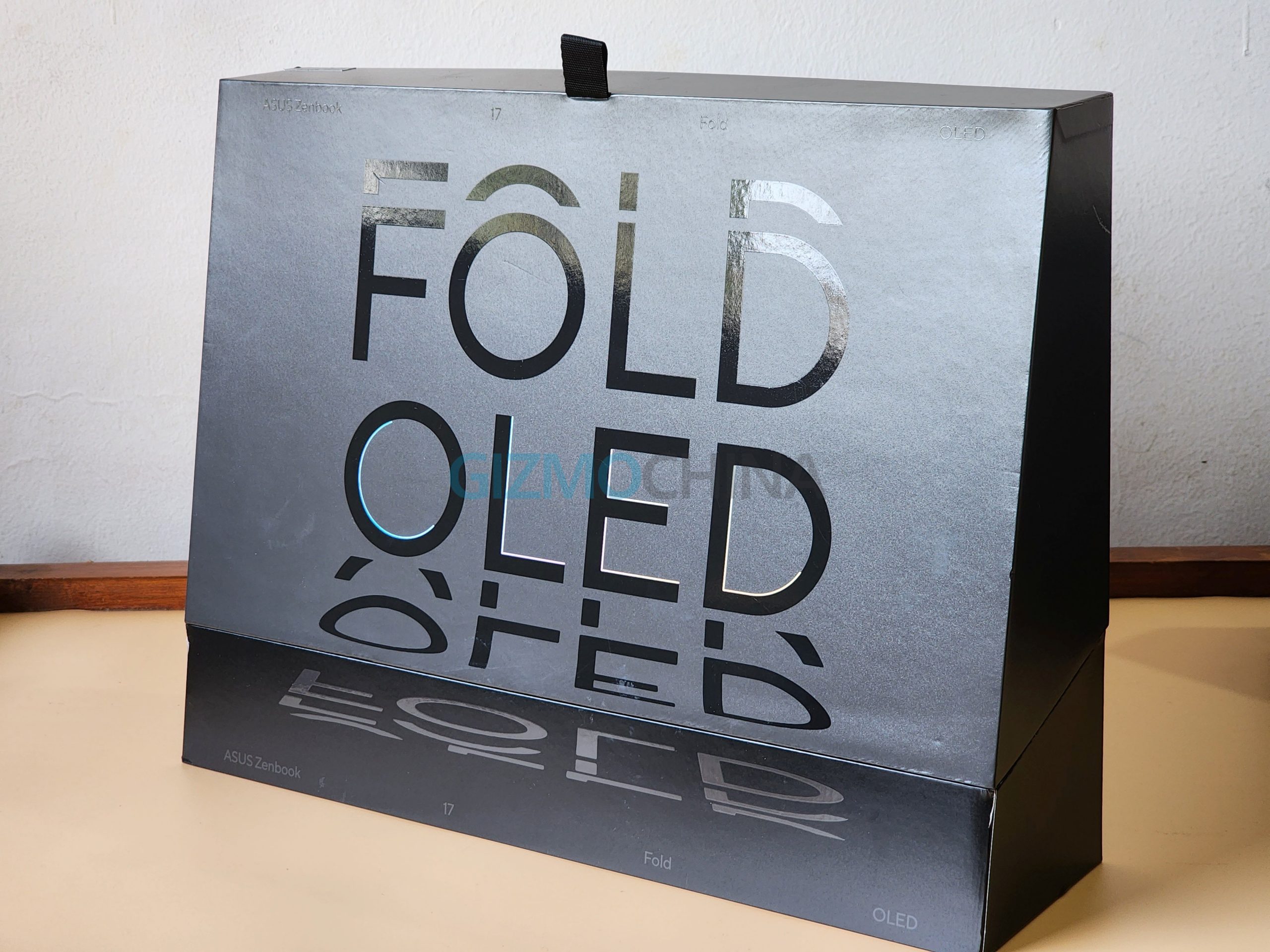
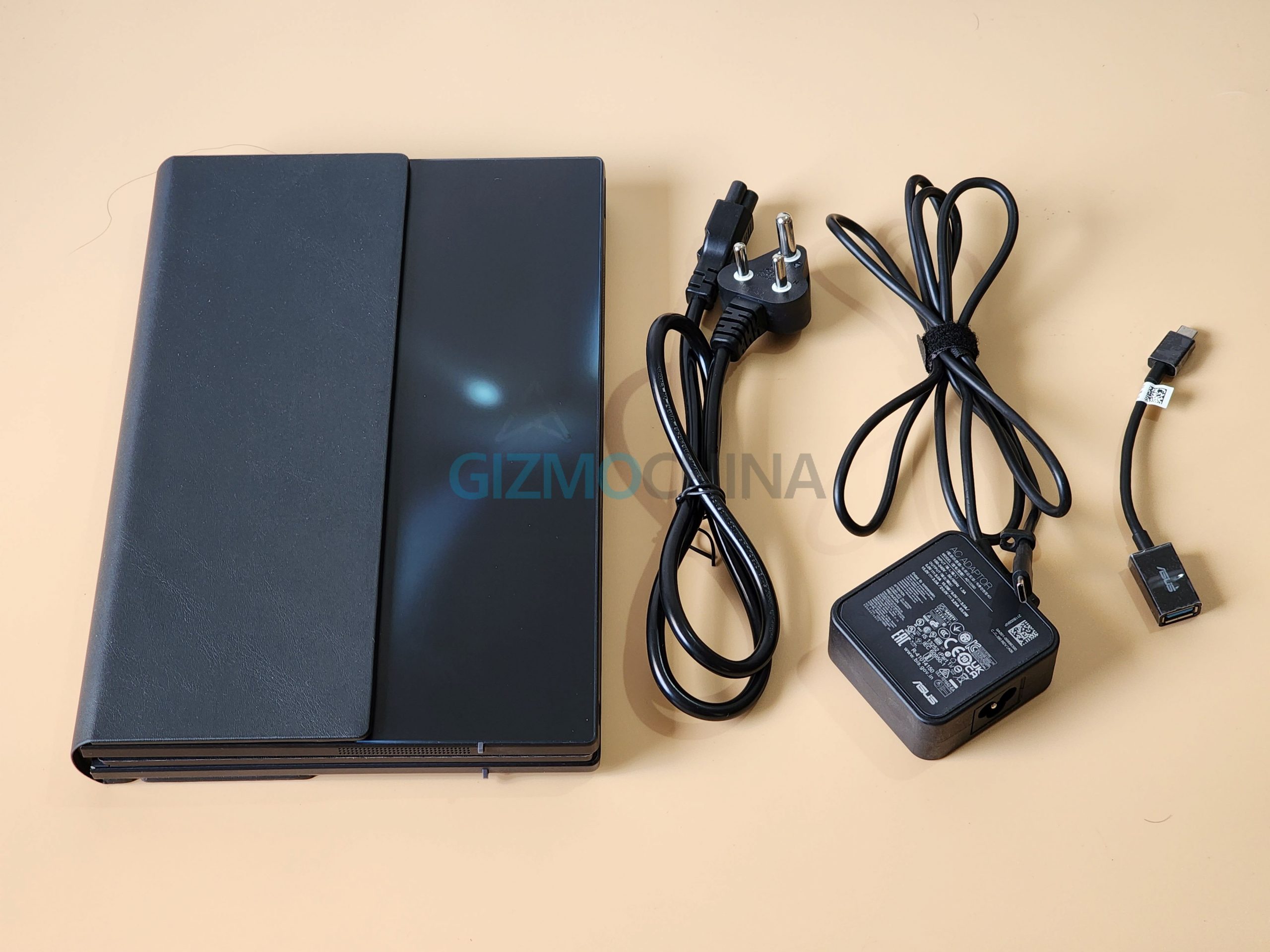
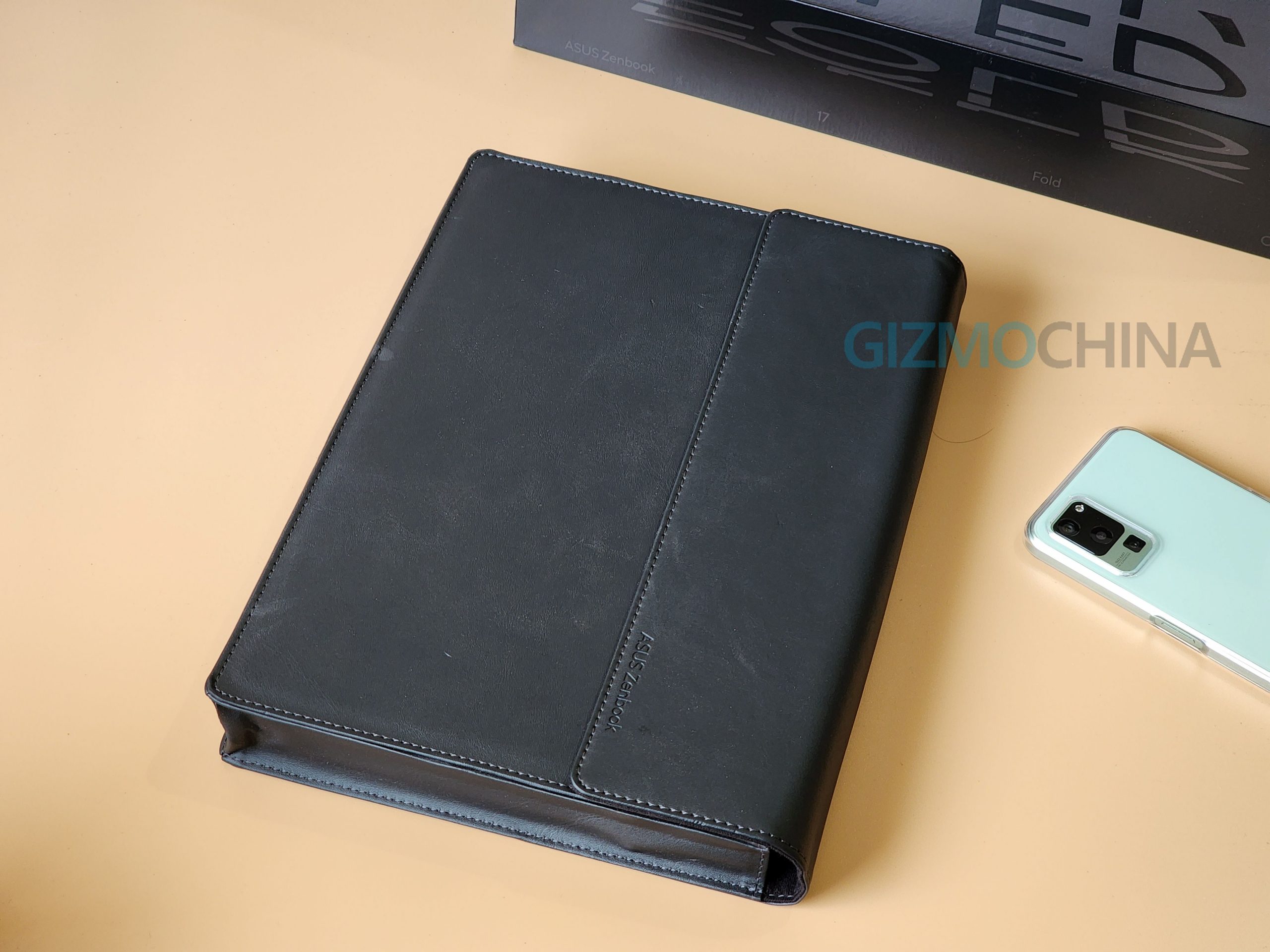
The Zenbook 17 Fold OLED comes in a big retail package. Inside it is a uniquely designed box (which can be seen below), which houses the following items:
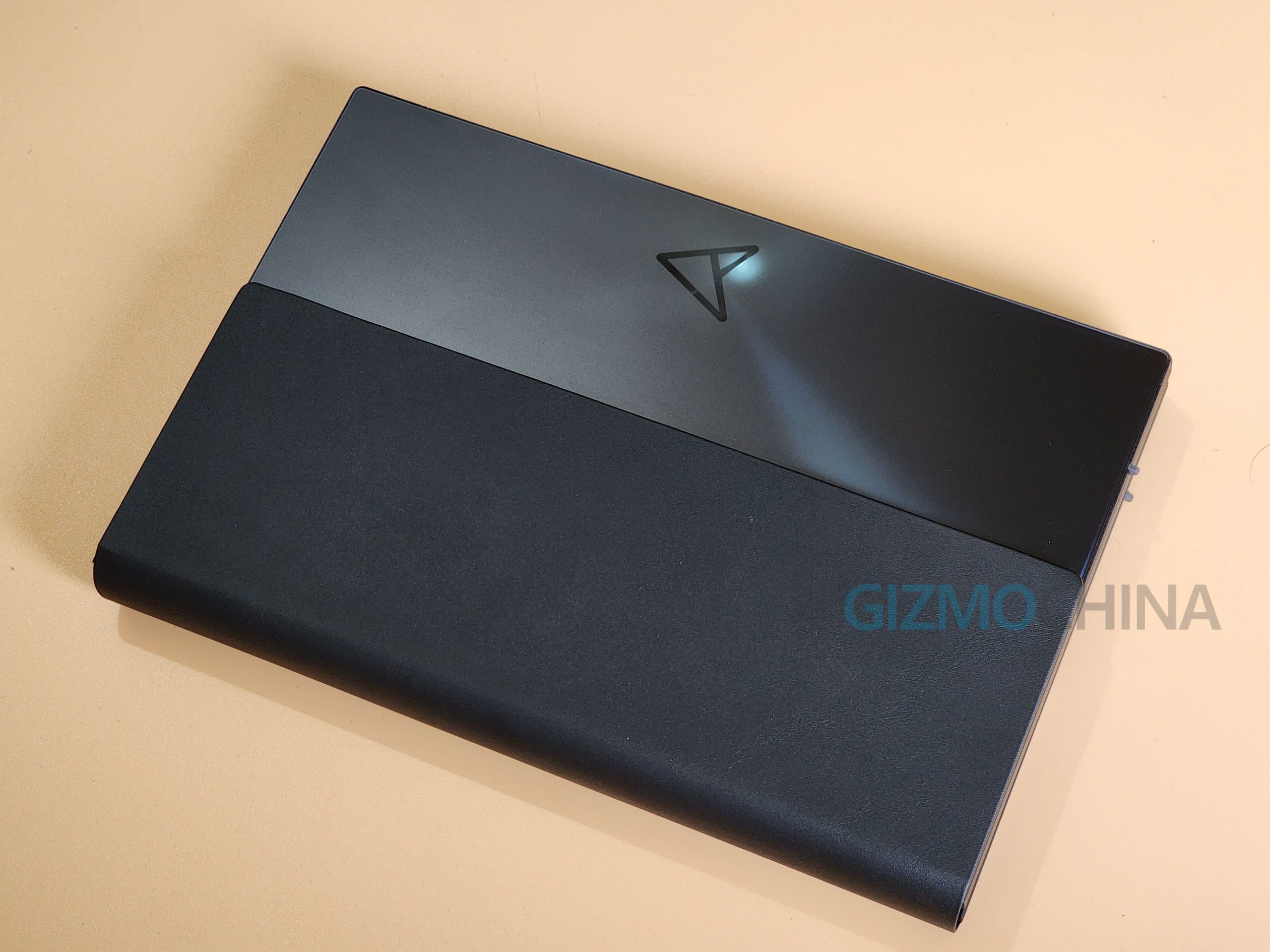
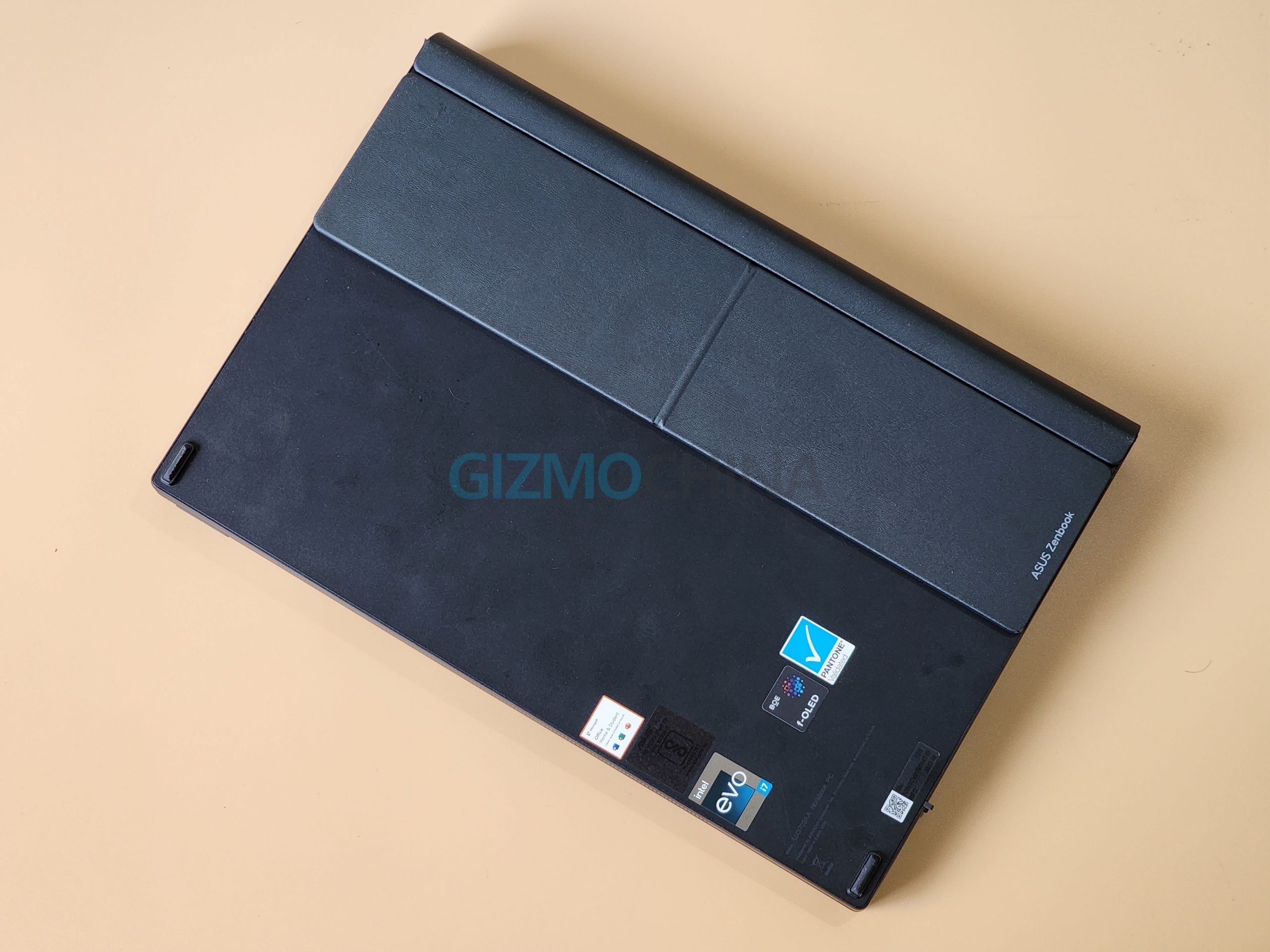
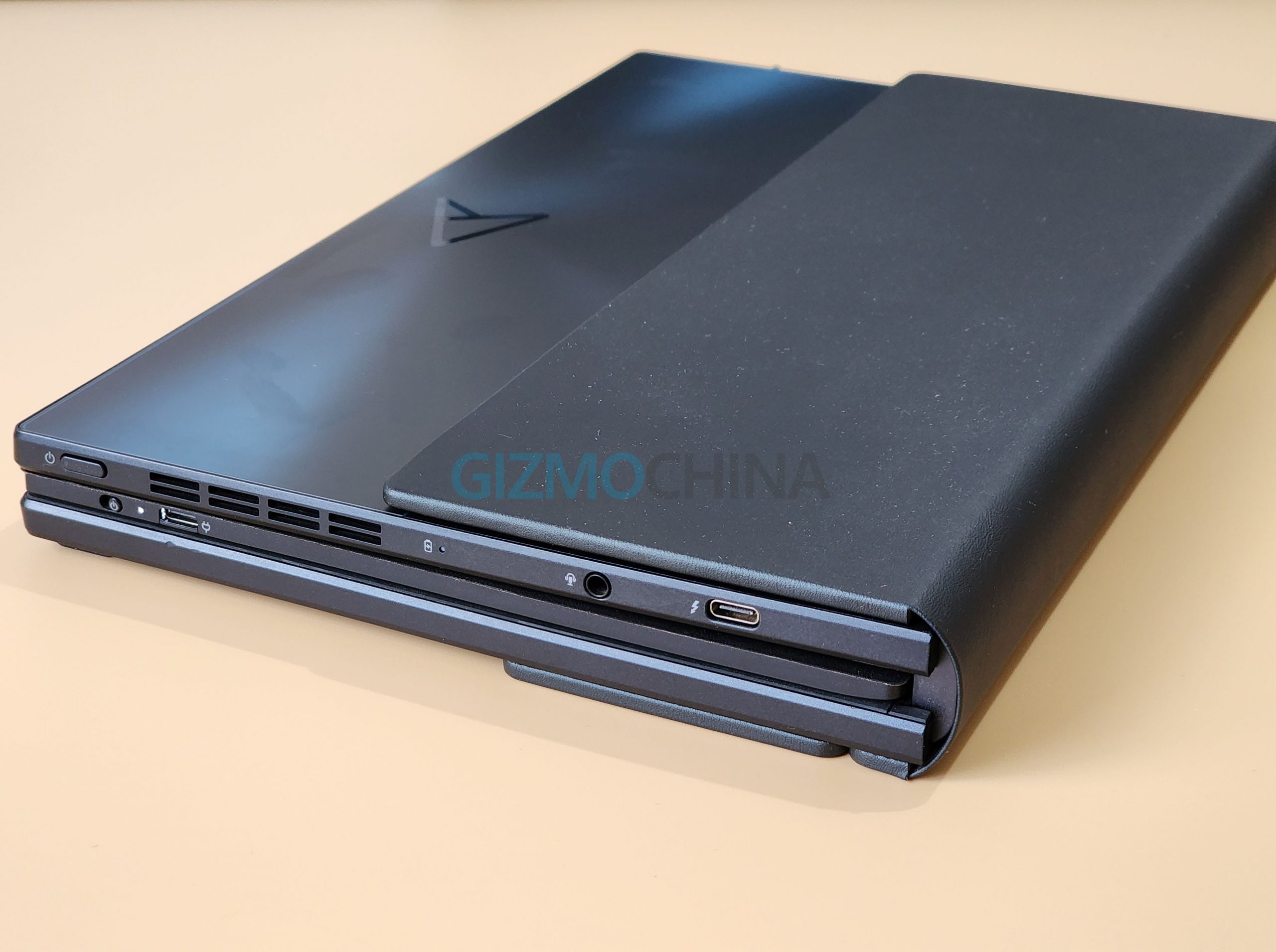
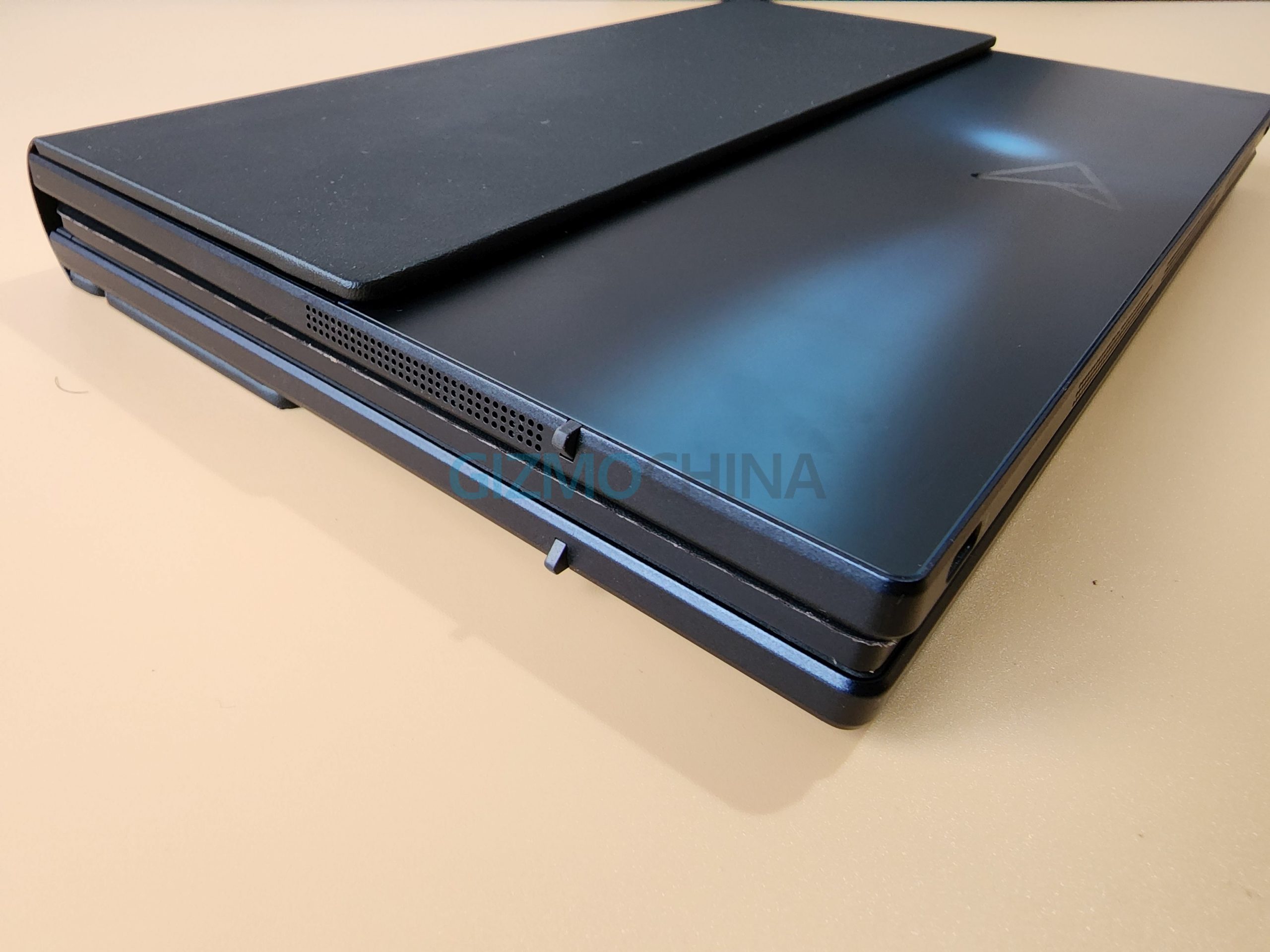
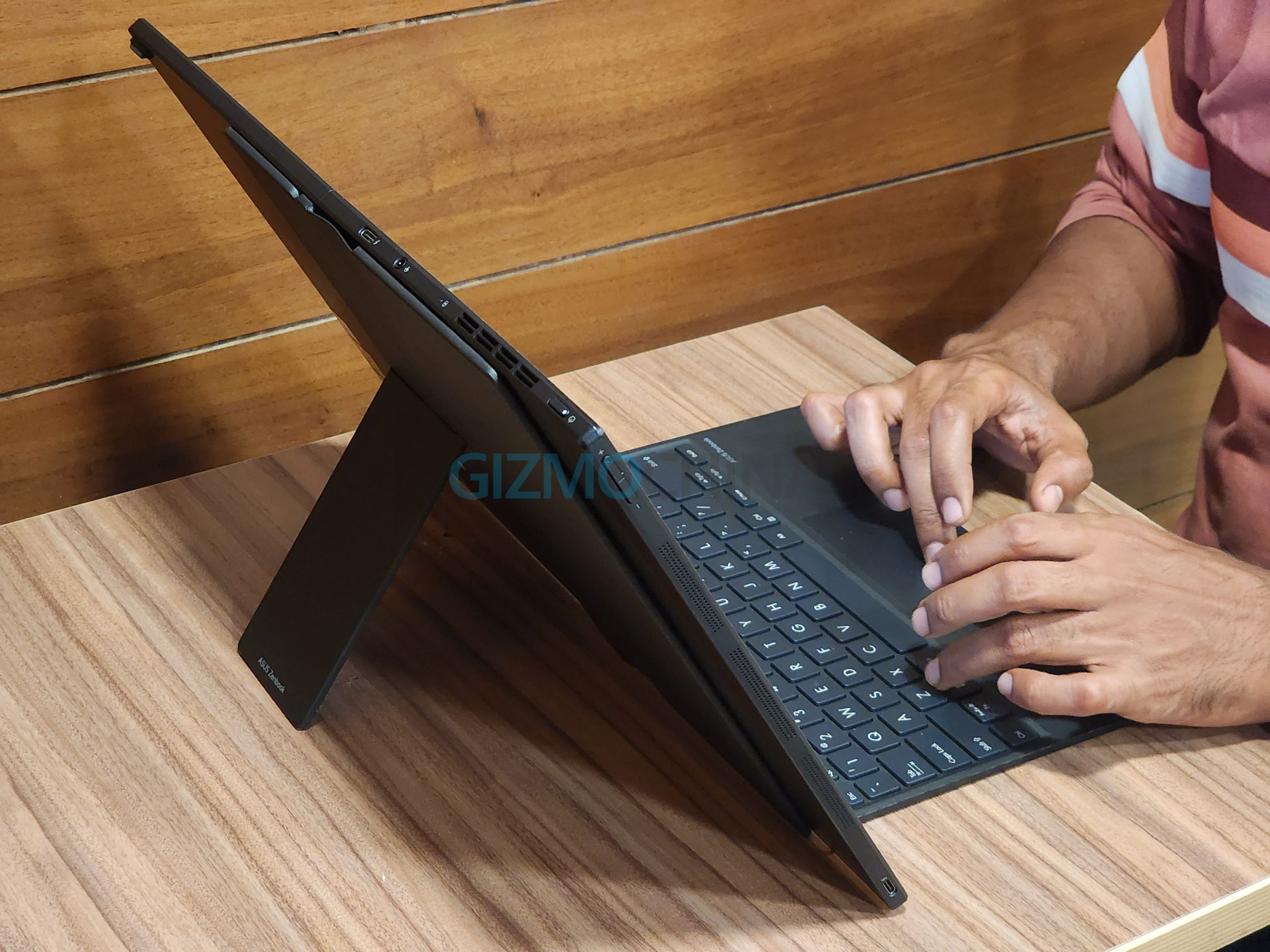
The Zenbook 17 Fold OLED has a sturdy build, with a combination of magnesium alloy for the Asus arrow logo and dark green (almost black) faux leather on the remaining back. The latter protects the hinge and houses a kickstand. There is no need for a rear camera on such a device. Hence, it does not have one. In the folded state, the Bluetooth keyboard can be placed between the two halves of the device.
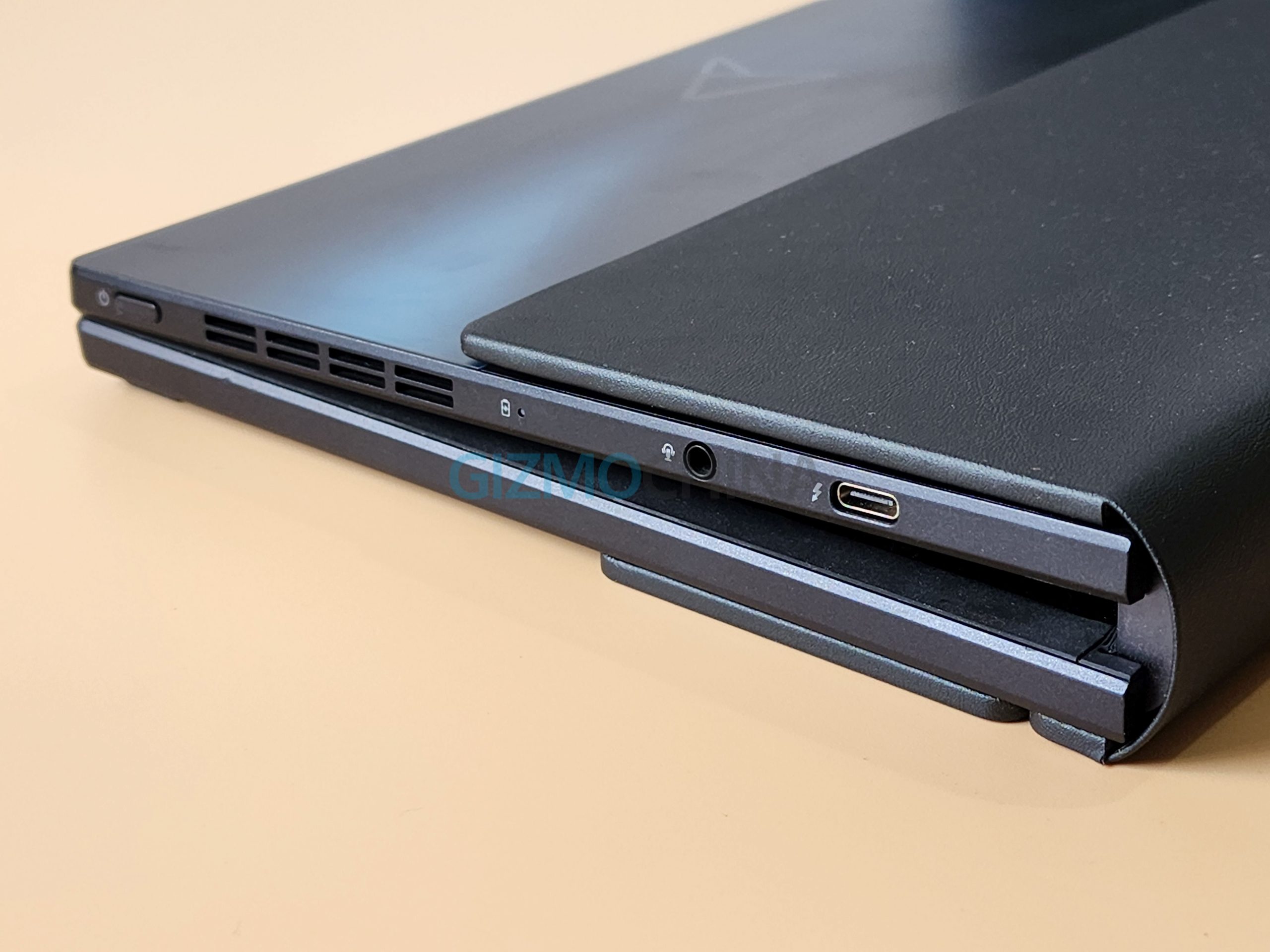
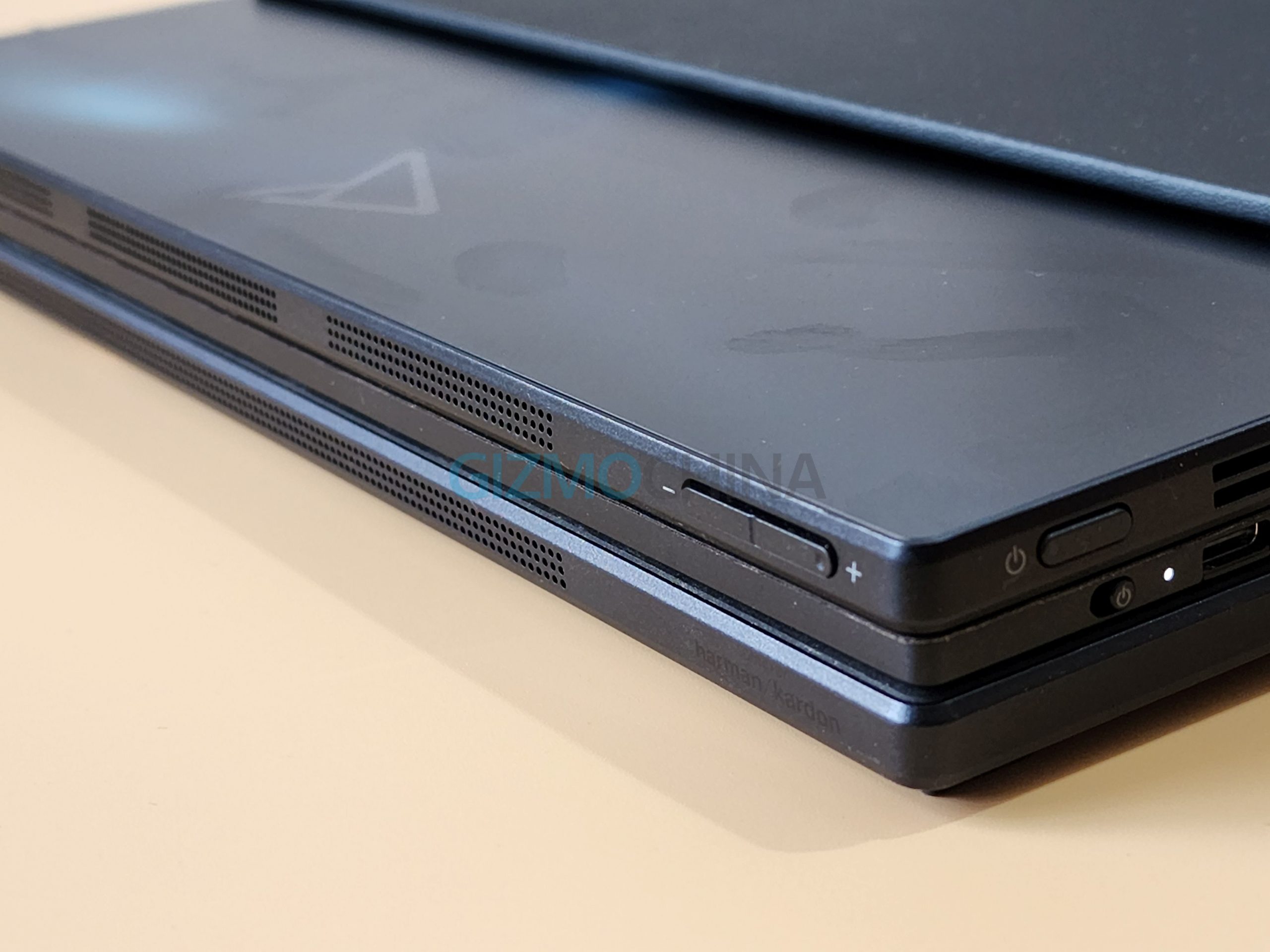
When unfolded, the topside of the device features a power key with an LED, air vents, a battery charger indicator, a 3.5mm headphone / audio jack, and a Thunderbolt 4 port (for data transfer / charging). On the bottom, it has other air vents. The speakers are available on the right and the left. The right side also features the Dolby Vision Atoms and Harman / Kardon logos, whereas the left side also has another Thunderbolt 4 port and a volume button.
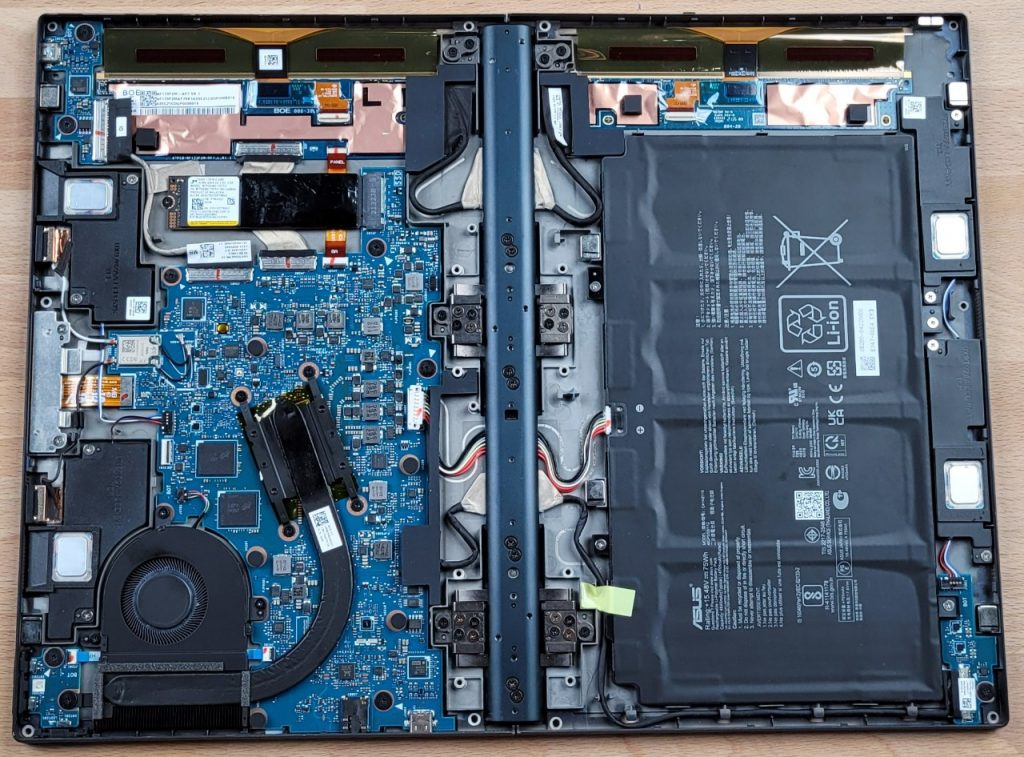
Internally, the upper half of the Zenbook 17 Fold OLED packs the motherboard, processor, RAM, SSD storage, cooling fan, and other components. Asus’ proprietary hinge is in the middle, and the other half packs the battery.
Internal view of the Zenbook 17 Fold OLED
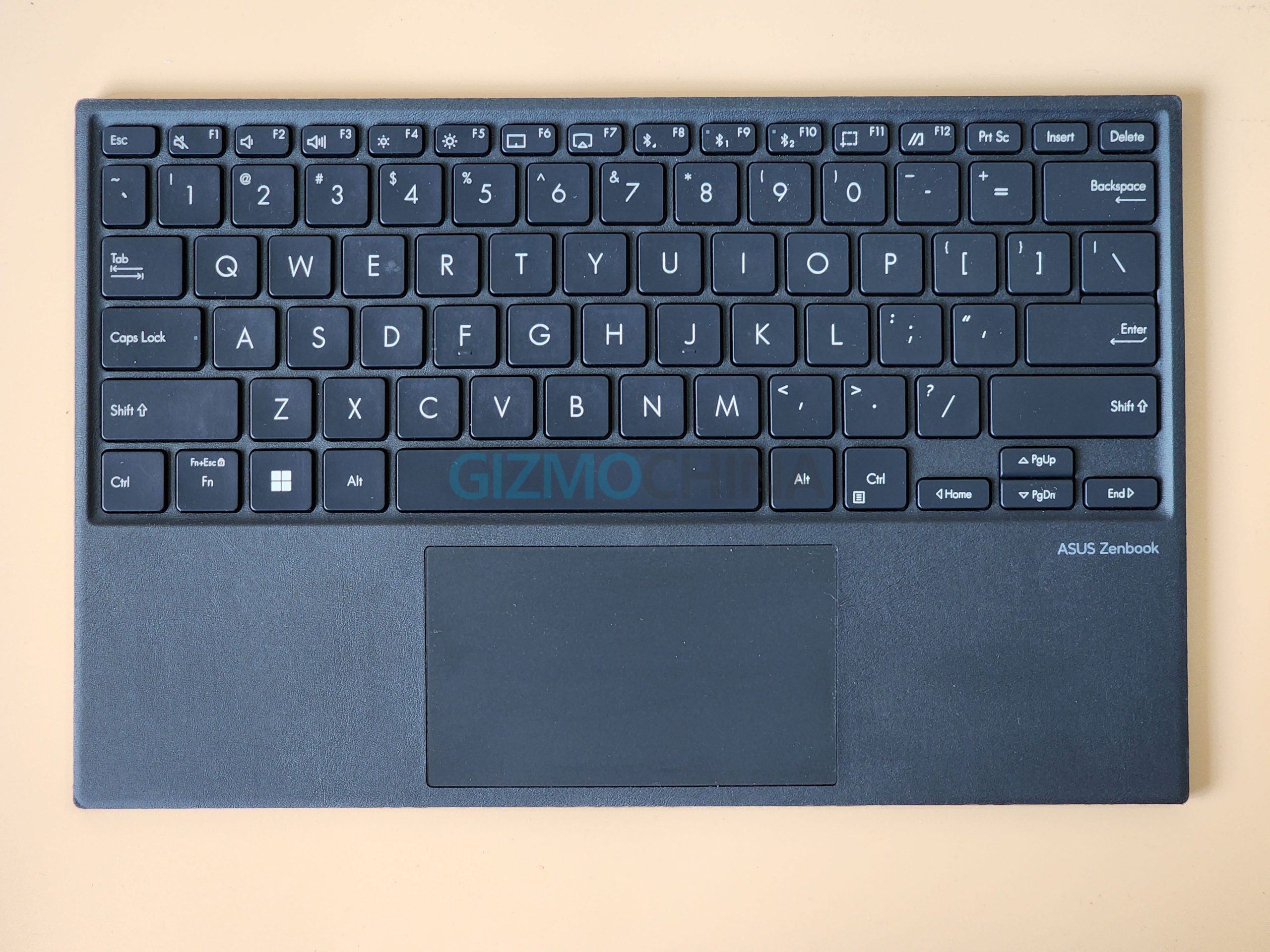
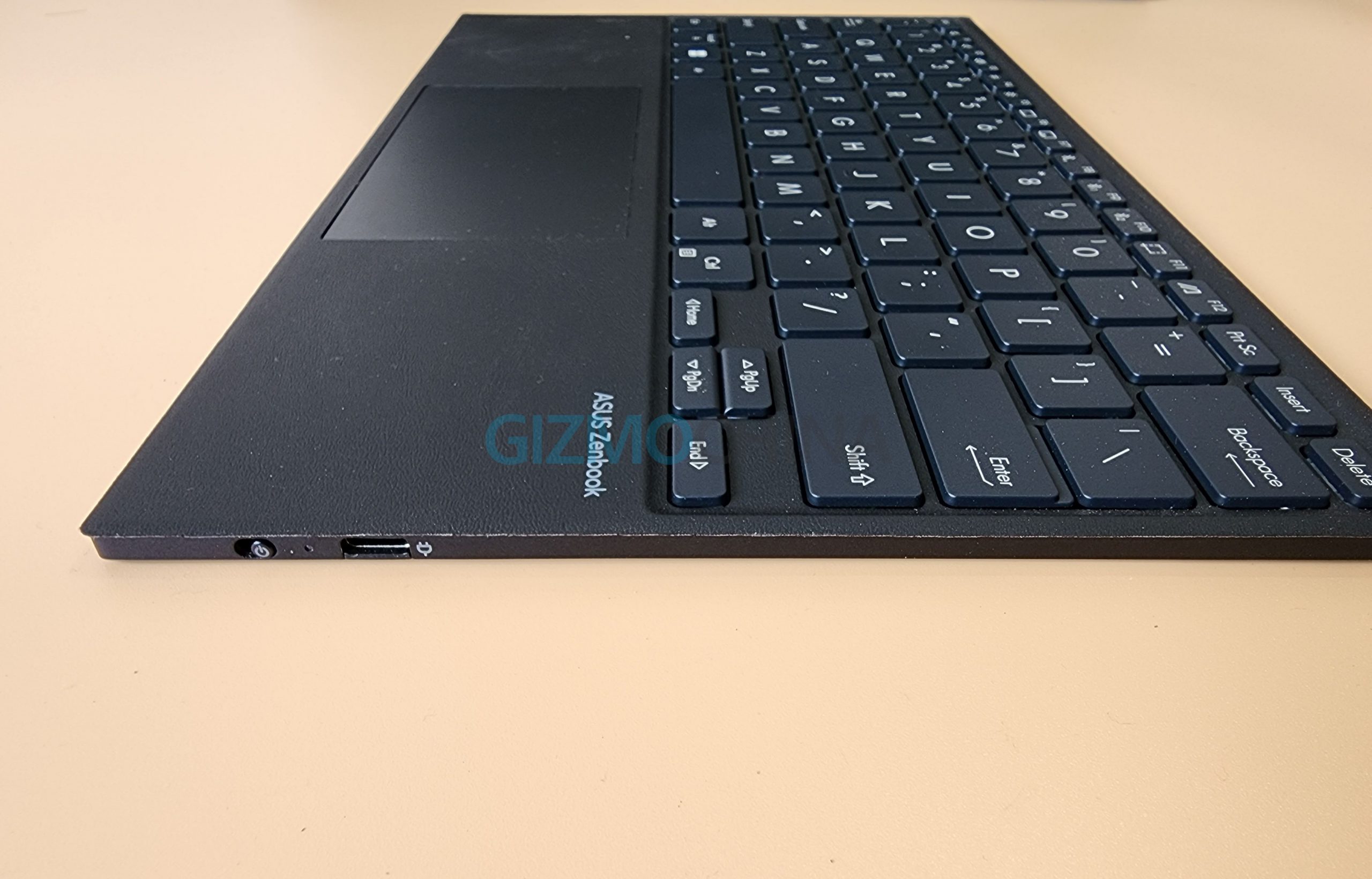
The Ergosense Bluetooth keyboard comes equipped with a trackpad. It has a power switch, a charging indicator, and a USB-C port for charging. More on the keyboard a bit later in the review. Including the keyboard, the device weighs around 1.8kg, which makes it quite bulky. When unfolded, the device has a thickness of 8.7mm. The keyboard is also quite slim, measuring only 5.5mm in thickness.
What about the durability of the Zenbook 17 Fold OLED? Asus claims that the hinge of the device has been tested for 30,000 opening and closing cycles. In addition, it meets the MIL-STD-810H standard for reliability and durability, which means it is built to withstand the toughest environments, including extreme altitudes, temperatures, and humidity.
Foldable Display and Crease
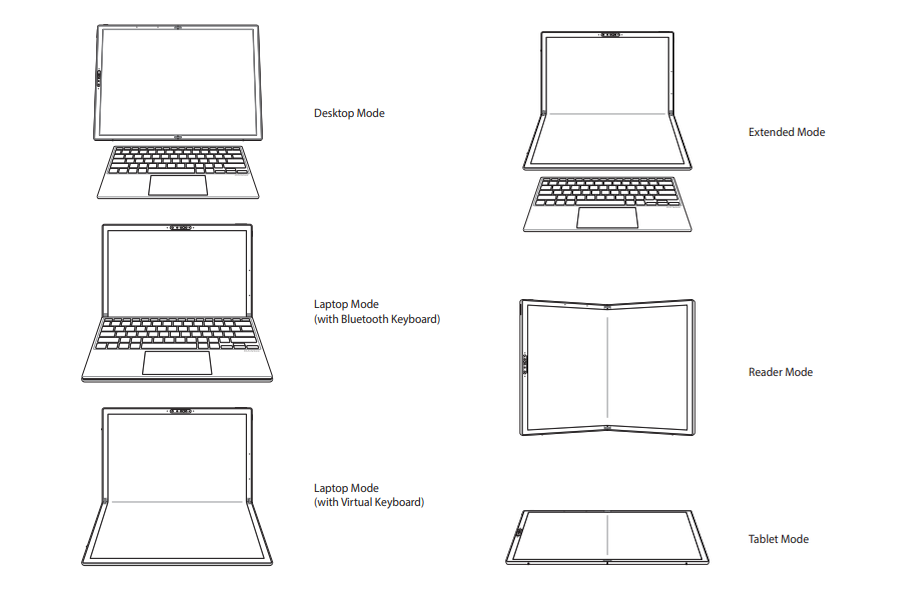
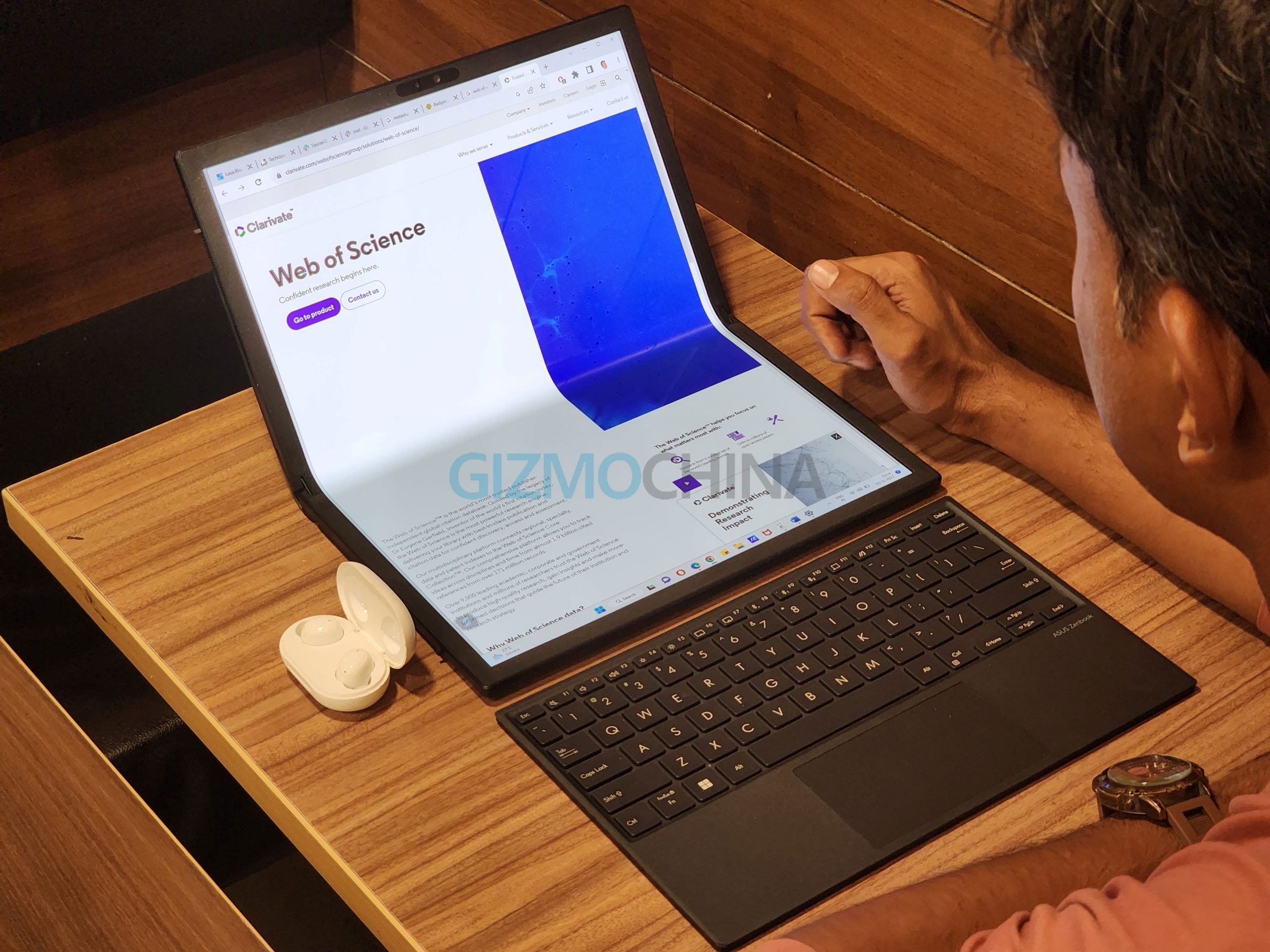
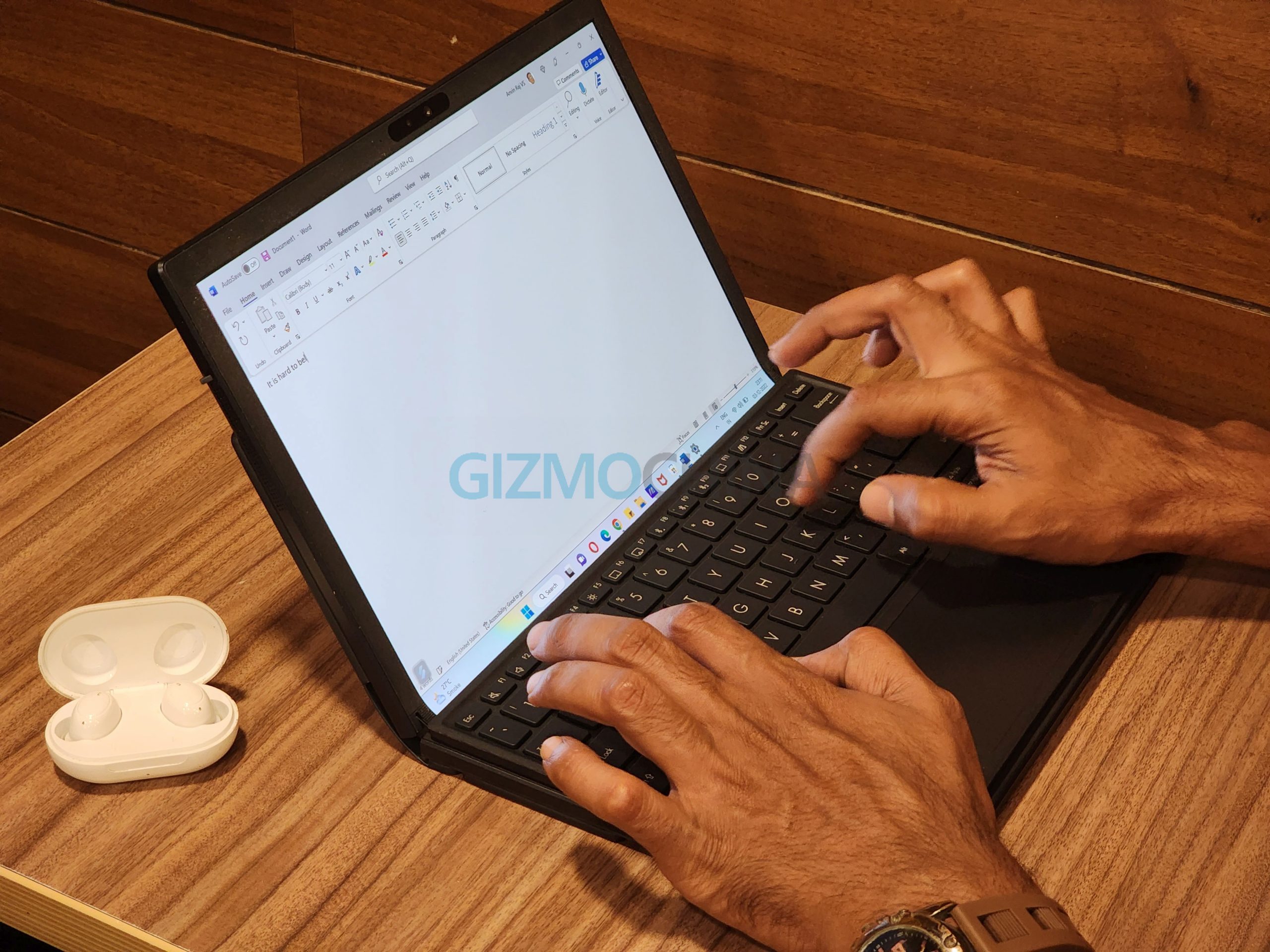
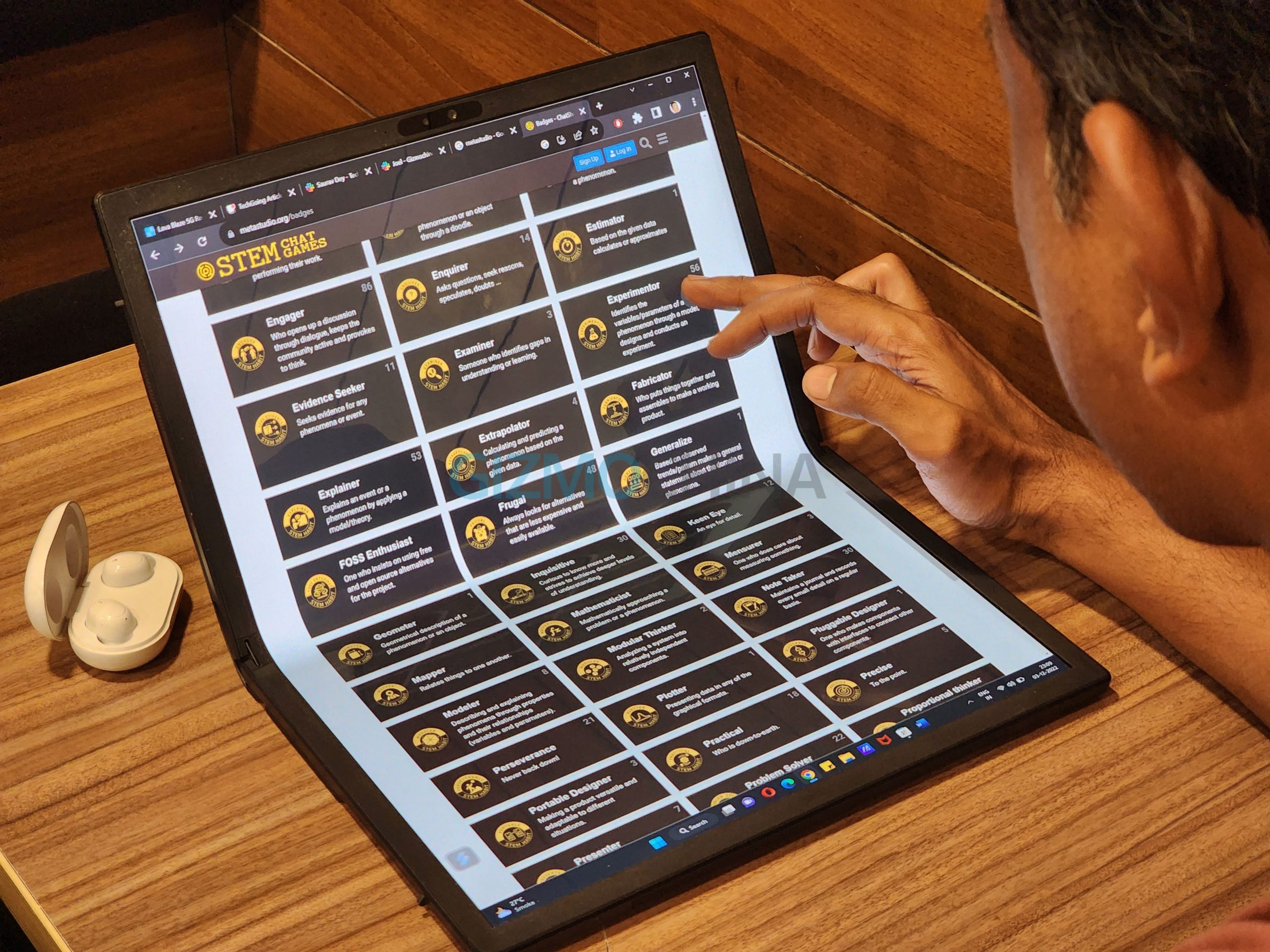
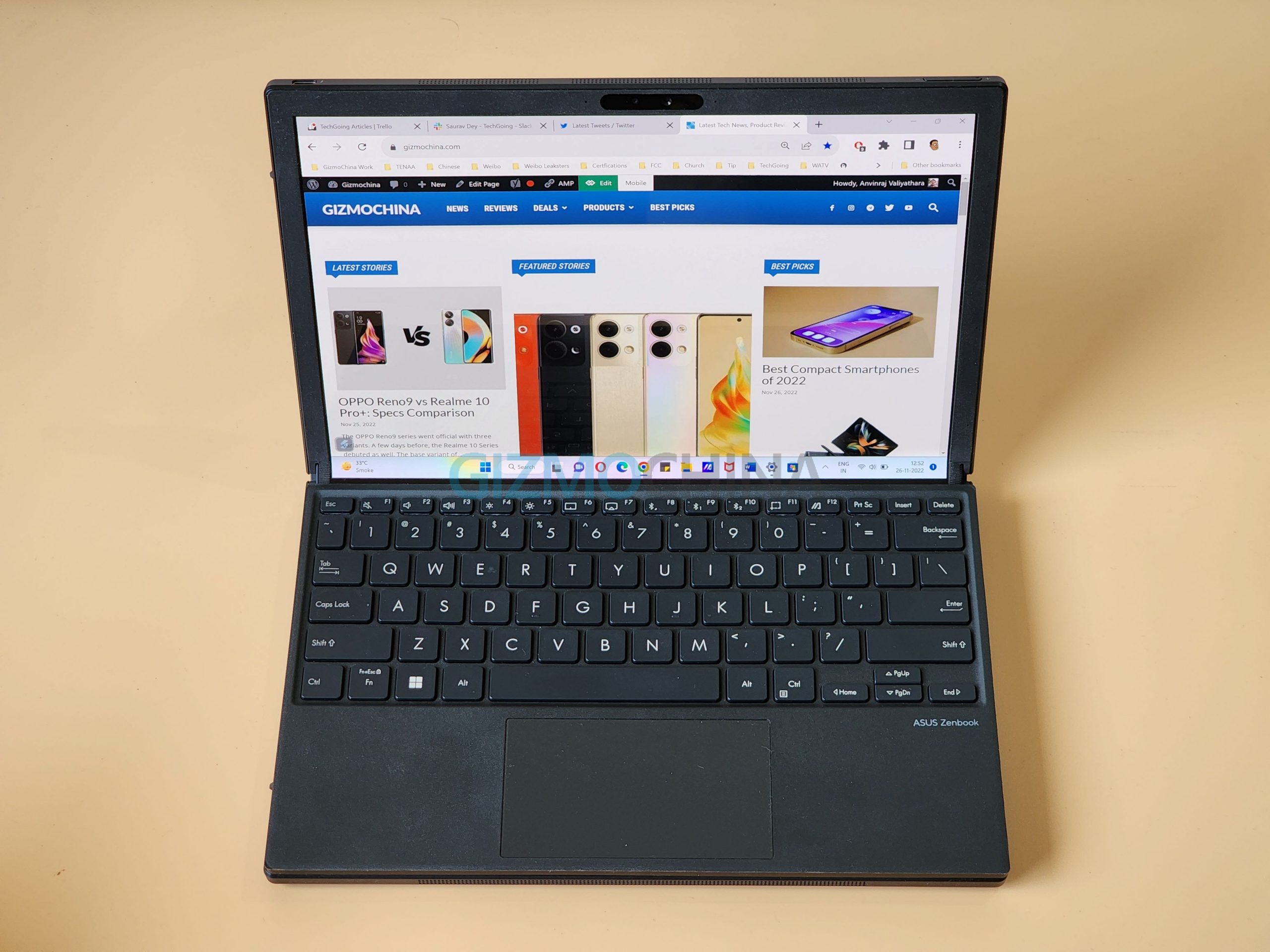
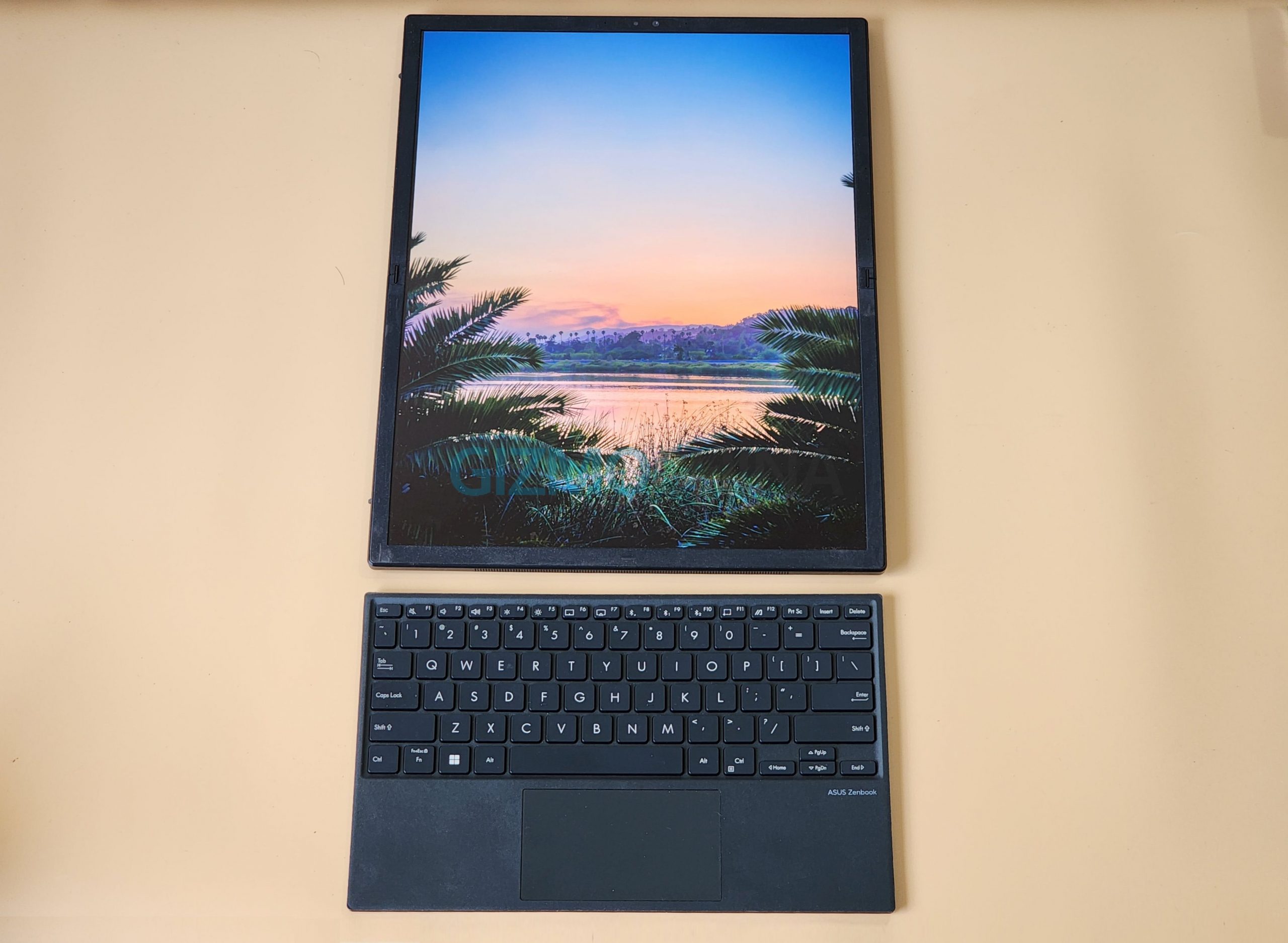
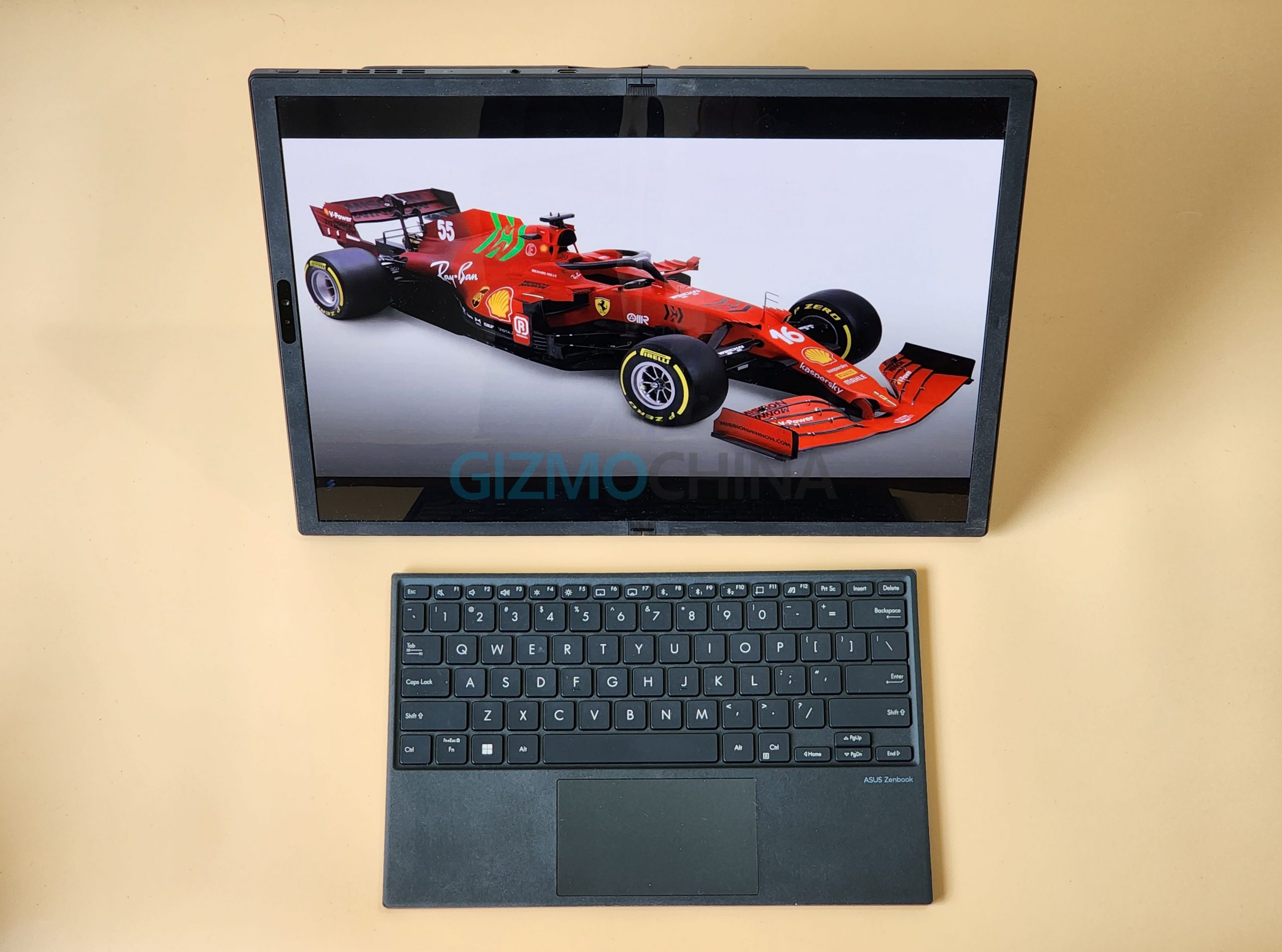
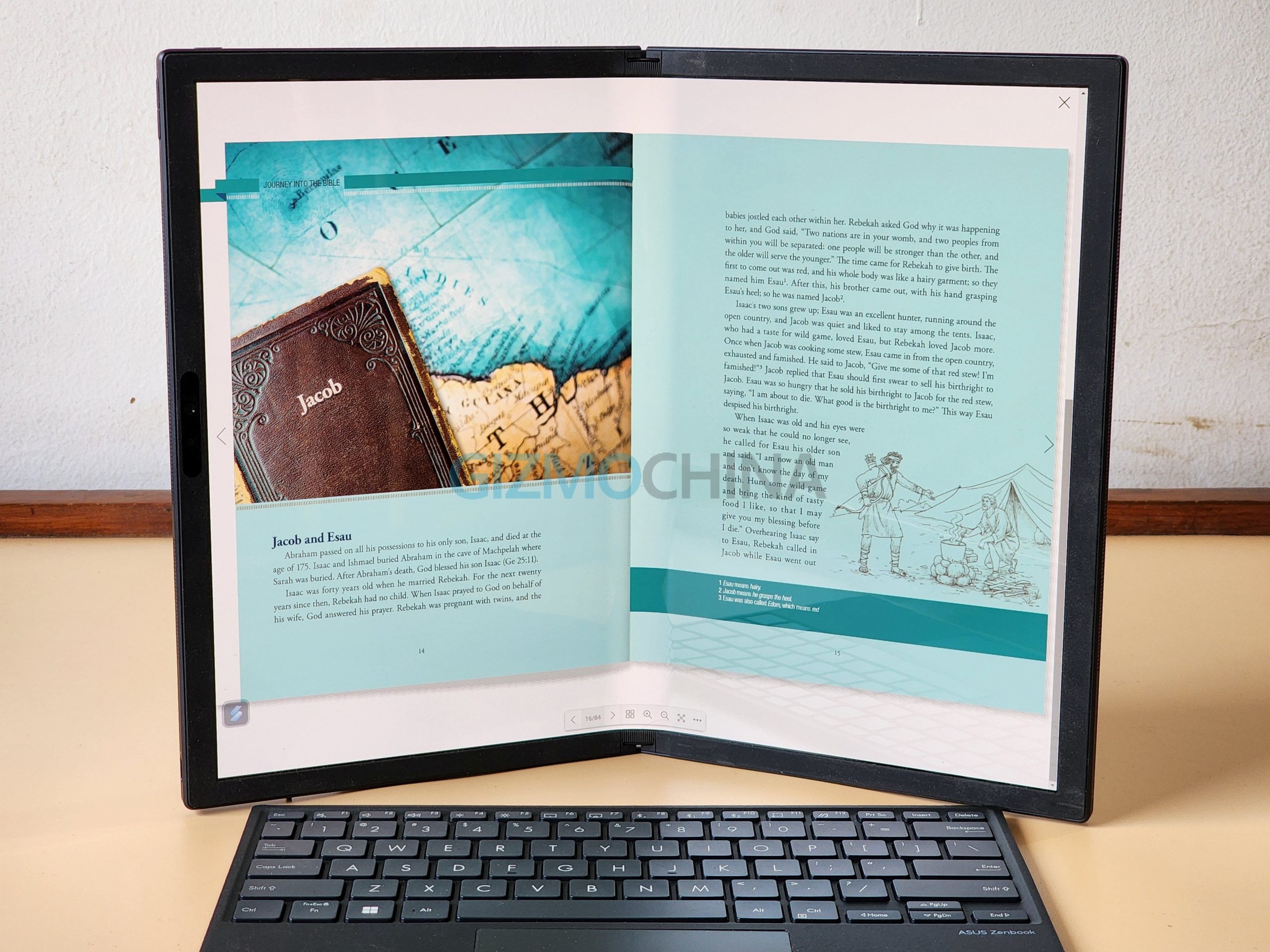
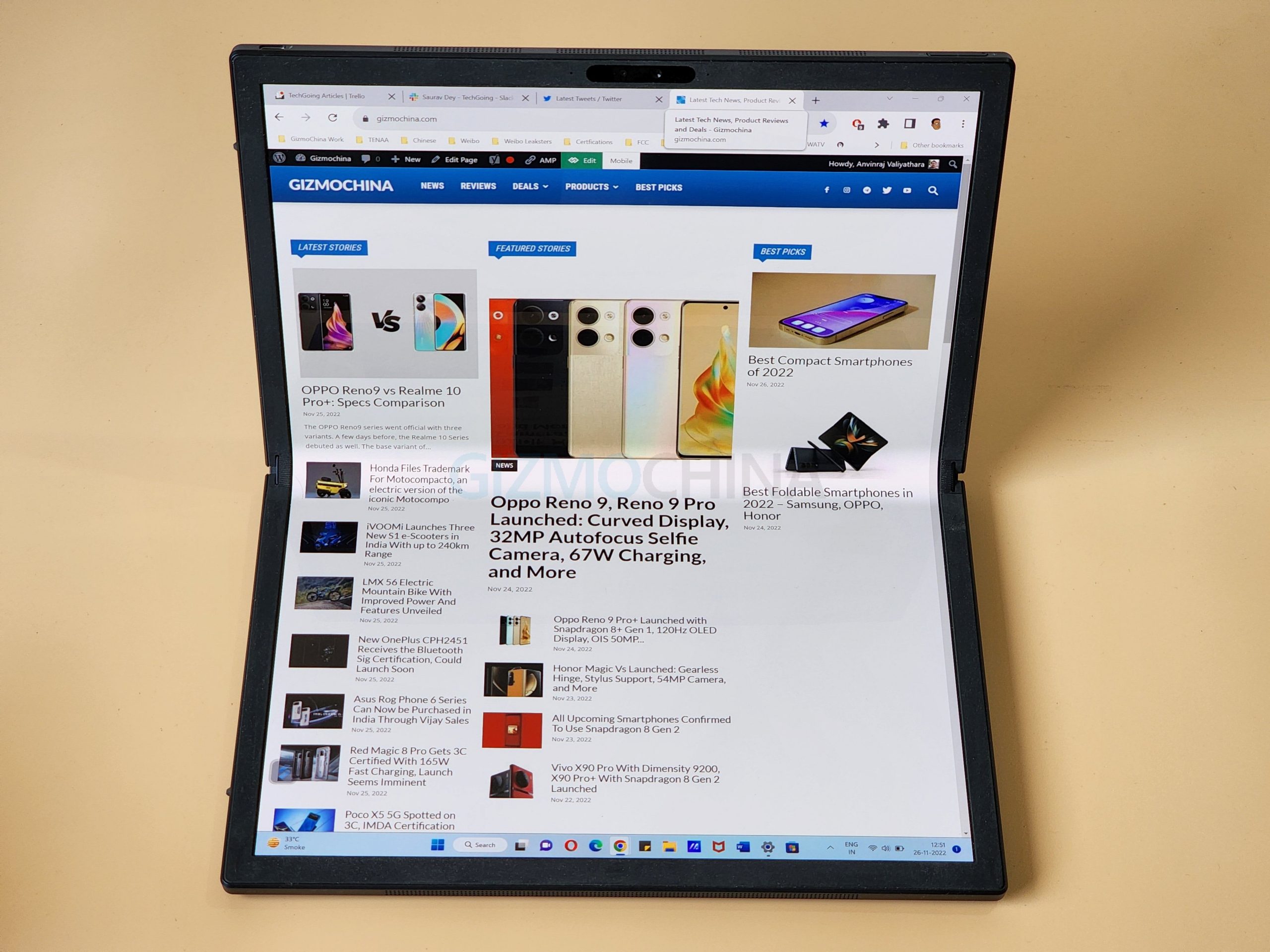
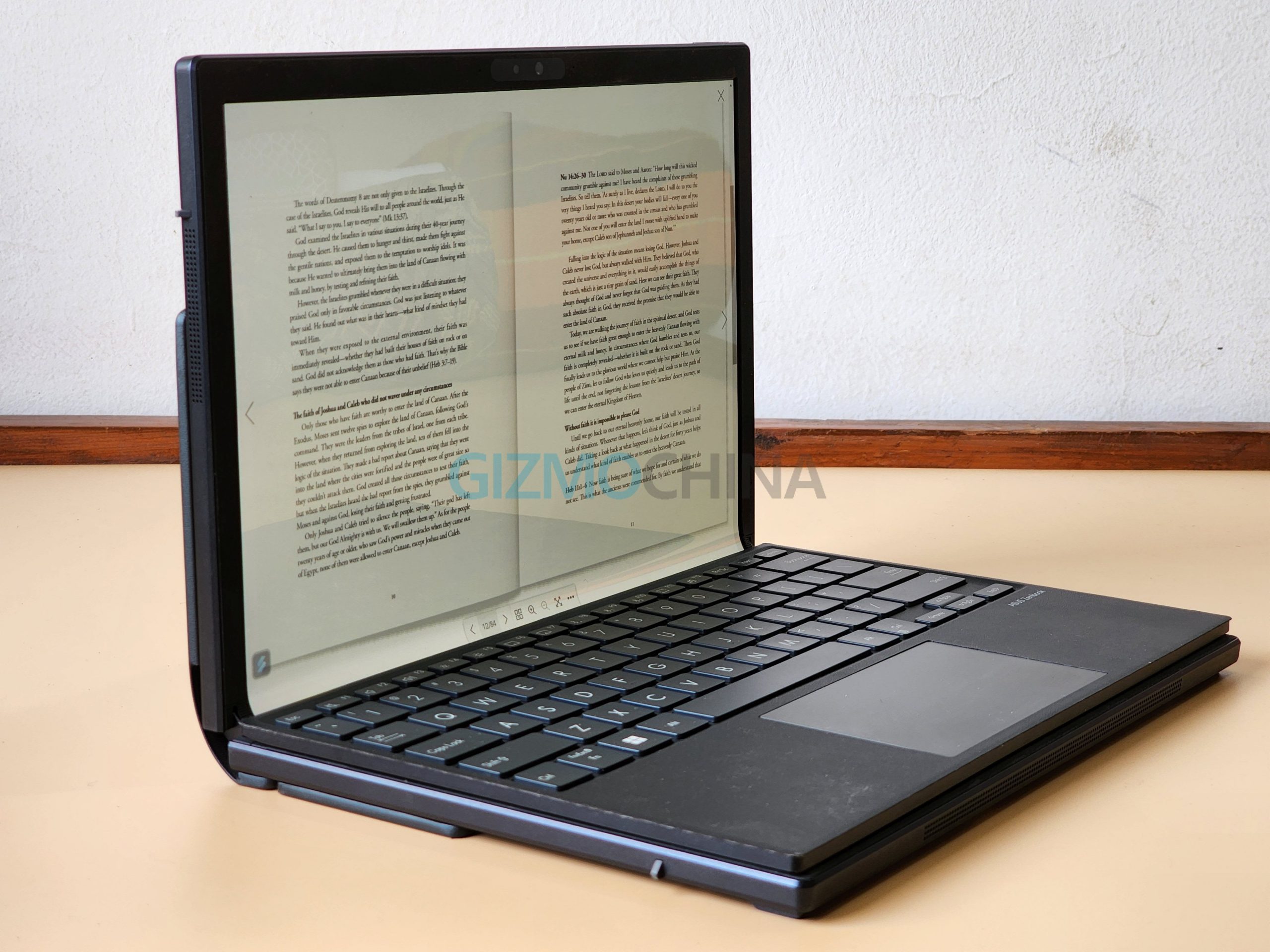
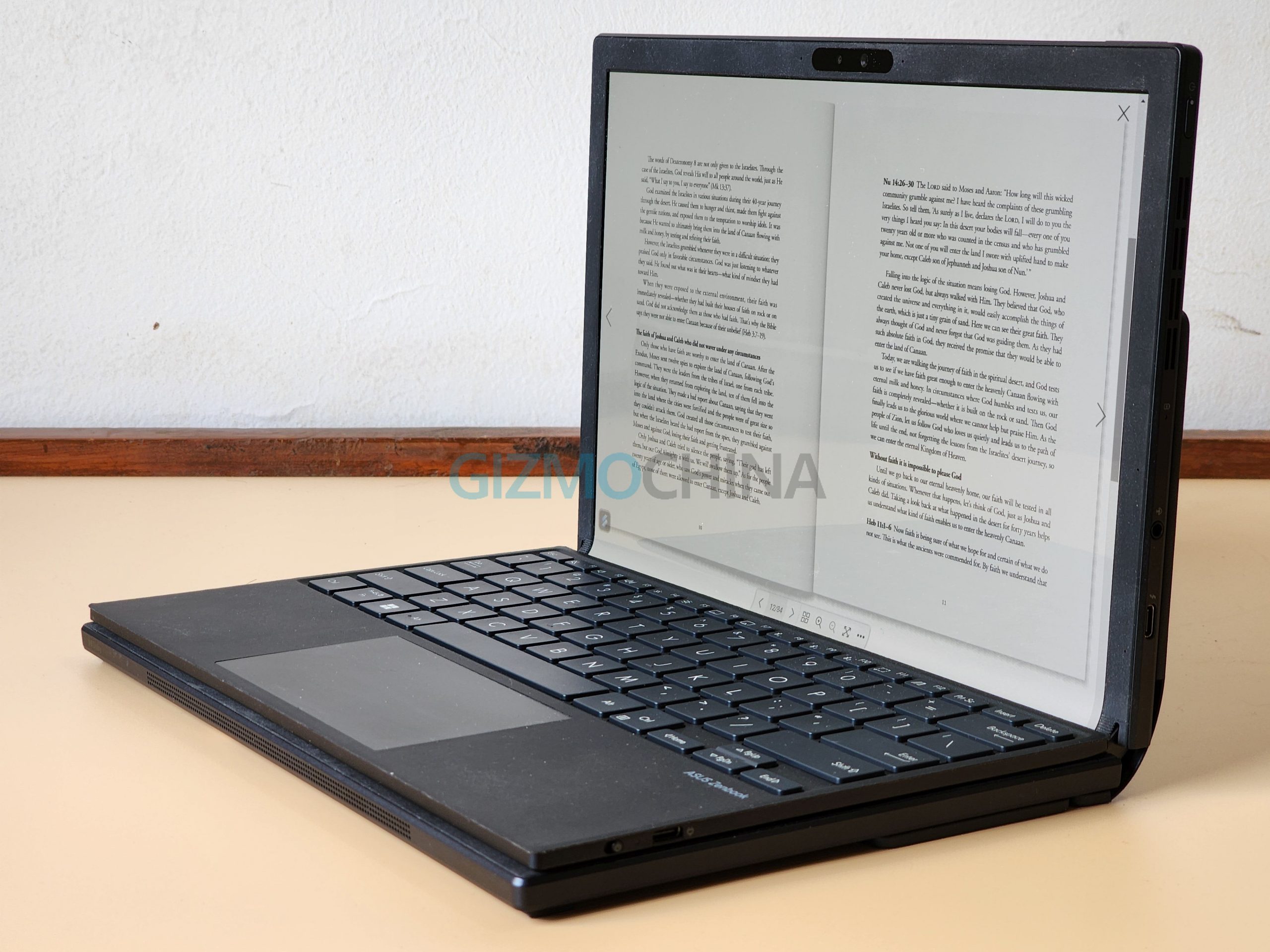
The Zenbook 17 Fold OLED can be used in multiple modes, such as desktop mode, laptop mode (with Bluetooth keyboard), laptop mode (with on-screen keyboard), extended mode, reader mode, and tablet mode.
Asus Zenbook 17 Fold
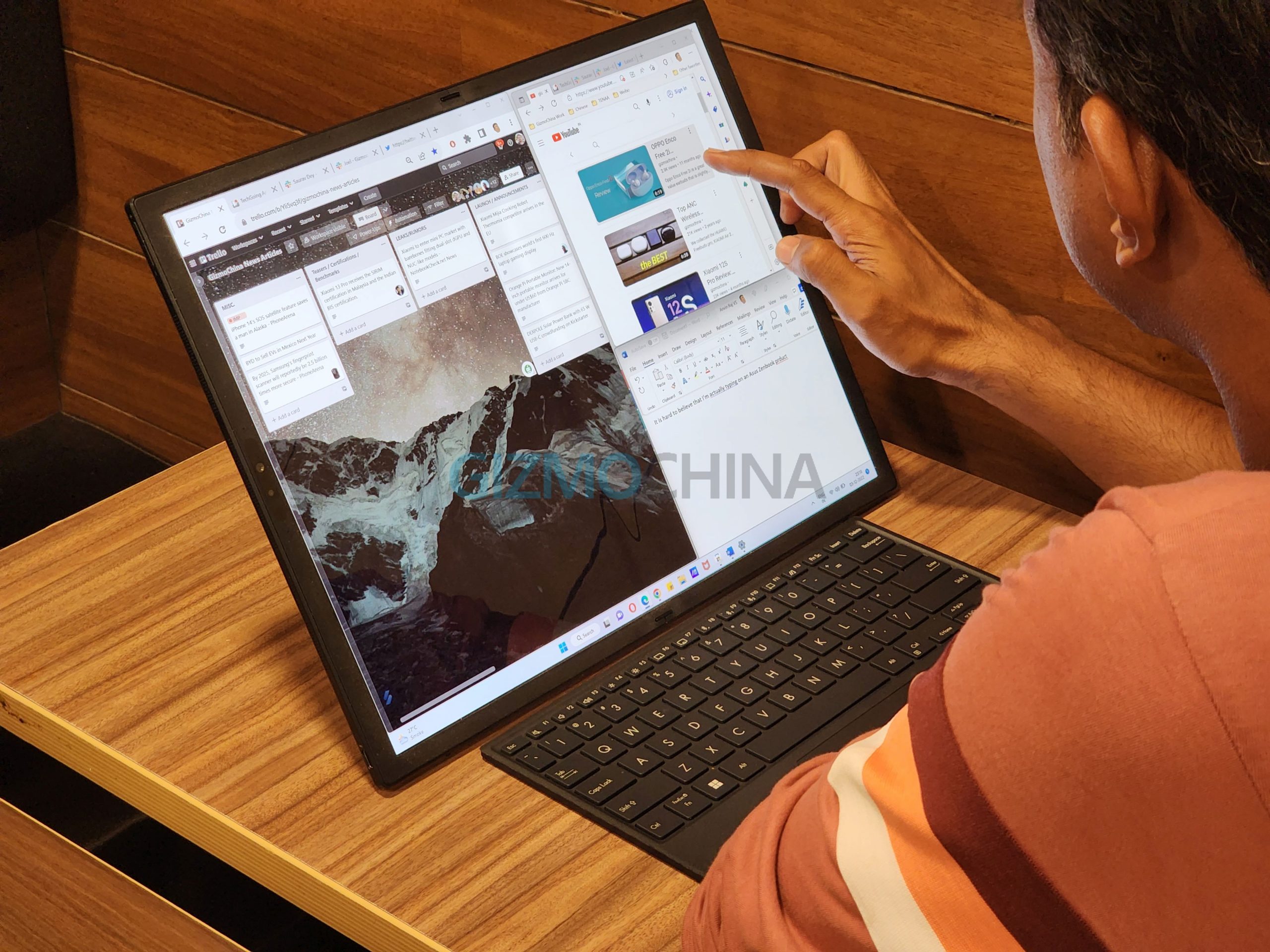
When fully unfolded and used in desktop mode, the device offers a 17.3-inch screen with a 2560 x 1920 pixels resolution, and a 4:3 aspect ratio. The bezels were not too thick in my opinion, but they are not as thin as those found on some flagship laptops. The left bezel (in desktop mode) houses the webcam with IR sensors. When folded and used in laptop mode, it offers a 12.5-inch screen space, 1920 x 1080 pixels resolution, and a 3:2 aspect ratio.
I mostly used the Zenbook 17 Fold OLED in desktop mode for working, and I even watched a couple of F1 races on it. While travelling or in a café, I switch to laptop mode. I truly liked working on this device. The bright OLED panel produces realistic colors. In addition, it supports Dolby Vision and HDR.
The display crease is visible when the device is off, and when it is turned on, the crease is slightly visible when viewed from the right or left. It can also be felt when the screen is touched at the center. However, it does not affect its use at all. In fact, it was never visible when I worked on it. Since I got the chance to use it for more than four weeks, neither the display crease nor the underlying hinge developed any issues.
desktop modedesktop modeextended modelaptop modelaptop mode with virtual keyboard
So, what issues did I face with the foldable screen? I mostly used the screen with a brightness setting of around 34 percent. However, when I connected a charger, the display would go off and come back in a second. I am not really sure whether this issue is specific to the review unit I received. Every time it happened, the display would come back brighter as if it were set at 80 percent brightness, even though it was actually set at 35 percent. The brightness would then gradually decrease on its own. It’s not a major problem, and it could be resolved with a software update. The other thing that I felt was that the screen should have offered a higher refresh rate.
Even when the display brightness is high, the foldable OLED panel does not cause eye fatigue. According to Asus, the screen produces 70 percent less harmful blue light than an LCD display.
It would have been good if the Zenbook 17 Fold OLED had supported a stylus. The footnote on the official page of the device reads, “When using the device, please avoid using a stylus or sharp items to touch the display, as they might damage the display.” The reason for this is that foldable screens are not made of glass, but of plastic, which is sensitive to scratches and damage. Also, there is no protective layer like the UTG (ultra-thin glass), which is available on Samsung’s Galaxy Z Fold-series foldable smartphones.
The Bluetooth keyboard is designed to be placed inside the Zenbook 17 Fold OLED. Hence, it has a slim profile of only 5.5mm and weighs 300 grams. This seems to be the reason why it offers 1.4mm key travel and has no backlight. A good thing about the Bluetooth keyboard, which comes with Bluetooth 5.2 connectivity, is that it can be paired with up to two devices. The full-sized keyboard is comfortable to use, and I did not experience any lag while using the keyboard. The Fn key can be used to access additional features like volume increase / decrease, brightness increase / decrease, access webcam, turn on / off touchpad, print screen, and more.
The touchpad comes with a hydrophobic and anti-fingerprint coating. It is clickable and supports gesture control. However, I preferred using the touchscreen to navigate around. When the device is in laptop mode, the webcam half is on top. The Bluetooth keyboard can be magnetically attached only to the other half of the device. It frequently happened that I would forget to turn off the keyboard, and it would just lose its battery juice. While in use, it can last for up to two days. It takes up to four hours to charge the keyboard. It would have been better if the keyboard could be charged while it was attached to the device. By doing so, there would have been no need to separately charge the keyboard.
Performance and Battery Life
12th generation Intel Core i7-1250U processor
1TB M.2 NVMe PCIe 4.0 SSD storage
Intel Xe graphics
75Whr (4-cell Li-Ion), 65W USB-PD charging
16GB of LPDDR5 RAM
Windows 11 Home / Pro
extended modelaptop modereader modelaptop mode with virtual keyboard
The Zenbook 17 Fold OLED features a 12th-generation Intel Core i7-1250 processor, which has a TDP (Thermal Design Power) of 9W. The processor is paired with 16GB of RAM, which is soldered on the motherboard. There are not many laptops powered by the same processor available on the market. The same processor is used in the HP Envy X360 13 and Dell XPS 9315, both of which cost around Rs 130,000 ($1,570) in India.
The U-series i7 chip is designed for professional use. However, since Asus has used it to power the Zenbook 17 Fold OLED, it appears that it has taken a conservative approach, meaning it is not a very powerful notebook. Nonetheless, I had no problems using three browsers at the same time: Chrome, Edge, and Opera. However, users are going to encounter hiccups in performance if intensive tasks like video editing as it does not feature a discrete GPU.
The ZenFold 17 Fold OLED can be used for light gaming. For heat dissipation, it has a cooling fan and a heatpipe. The 1TB storage space is sufficient for this device. Users can expand the device’s storage, but it is best to do so by contacting Asus technical support.
It runs on Windows 11 Home / Pro and there are some preloaded apps like Disney+, McAfee LiveSafe (trial version), and Microsoft Office Home & Student 2021. Asus’s own apps, such as MyAsus, ScreenXpert 3, and GlideX, also come preinstalled on the device. MyAsus can be used to optimize the performance of the device as well as contact Asus for support. ScreenXpert 3, which stays as a small icon on all screens, provides features like app switching, navigating between opened apps, and a camera / microphone privacy switch. The GlideX app can be used for wired or wireless cross-device screen sharing. These Asus apps are handy, but I seldom use them.
The Zenbook 17 Fold OLED took about 1:30 hours to fully charge. On average, it lasted me around 6 hours in desktop mode. In laptop mode, it offered around 1-2 hours of additional usage time.
Connectivity and Other Features
5MP HD webcam
Wi-Fi 6E
HD infrared camera
Bluetooth 5
Harman / Kardon quad-speakers
2 x Thunderbolt 4 ports
Dolby Atmos support
1 x 3.5mm combo audio jack
laptop modelaptop mode
When the Zenbook Fold 17 OLED is used a laptop mode, the 5-megapixel camera is at the top, and the image appears in portrait mode. When it is used in desktop mode, the camera sits on the left side of the screen. The video quality is for video calls. The noise-cancelling array microphones do a pretty good job of making the voice output better.
The HD infrared camera onboard brings support for Windows Hello authentication. It automatically locks the laptop when the user moves away from it. It dims the screen when the user looks away from it. The device lacks a fingerprint scanner. A color sensor is also built into the camera unit. This sensor helps adjust the display’s brightness and color temperature.
The Harman / Kardon quad-speaker system with Dolby Atmos support produces an impressive audio output, that is free of distortion, at the loudest setting. I did not face any issues while connecting to Wi-Fi and Bluetooth on the device.
Verdict
I really loved the experience of using India’s first foldable screen notebook—the Zenbook 17 Fold OLED. The versatile design of the device, which allows it to be used as a compact laptop as well as a desktop PC, is quite impressive.
The two things that I hope Asus improves with the next iteration of the Zenbook 17 Fold OLED, apart from the hefty price, are the keyboard and weight. Because Asus is selling it for Rs 3,29,900 ($3,499 in the US), it is clear that the company is not targeting people looking to buy a device in the mid-range or high-end segment.
The Zenbook 17 Fold OLED can be enticing to people who work in different environments like office, home, travelling, and relaxing. It appears only enthusiasts will be ready to pay such a hefty amount to purchase it. With the company getting almost everything right with its first-generation foldable screen laptop, it is certain that its future foldable screen will certainly offer a better experience. It appears that it will take a couple of years for such a device to become a mass-market product.
Disclaimer: The opinions expressed in this Asus Zenbook 17 Fold OLED review are solely mine based on my experience, and there has been no editorial input from Asus.
Let’s start with the conclusion that Xiaomi 13 series is very likely to become another memorable model in the Xiaomi digital series. Especially for the Xiaomi 13 Pro, it’s no longer like previous Pro models and looks embarrassing sandwiched between the standard and the Ultra variants. The new Pro finally has the potential to beat the 12s Ultra and win the gold belt as the strongest Xiaomi Phone for this moment, although it still looks a bit ordinary and not so ‘Leica-like’ compared to the Ultra.
It’s not an easy task to surpass Xiaomi’s heaviest product of this year. The reason we’re so bullish on the Pro model is actually simple: in addition to the regular performance upgrades, the ordinary-looking camera module puts a lot of pressure on the Ultra, knowing that the camera performance is the proudest part of the Ultra model.
But this is a truly full review of the Xiaomi 13 Pro, so we decided to divide it into two parts. This video will include most specs of the new phone except for its cameras, and next video we will talk about its camera performance. In some parts, we will compare it with another start model from Xiaomi, the 12s Ultra, such as performance and camera.
Design
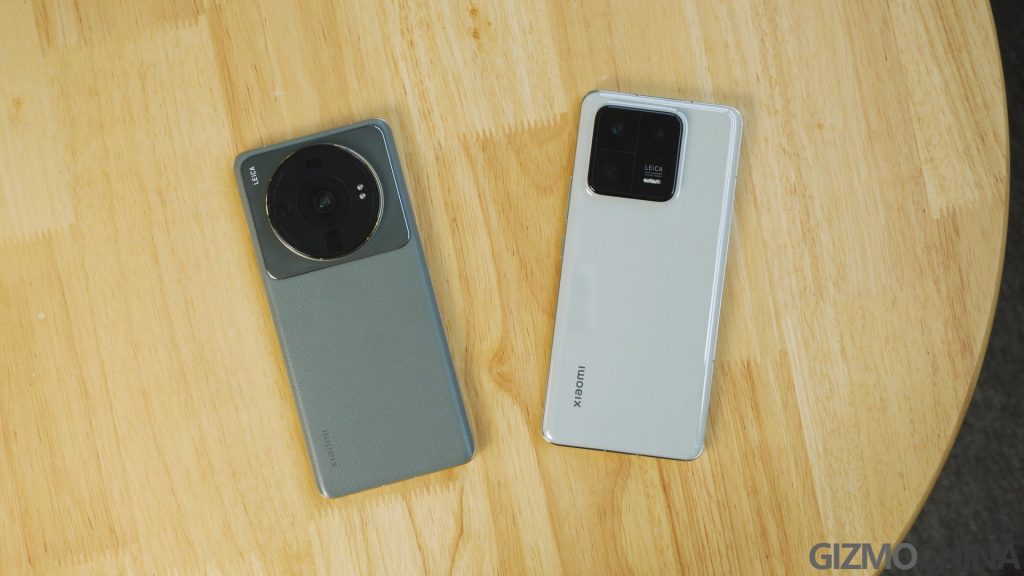
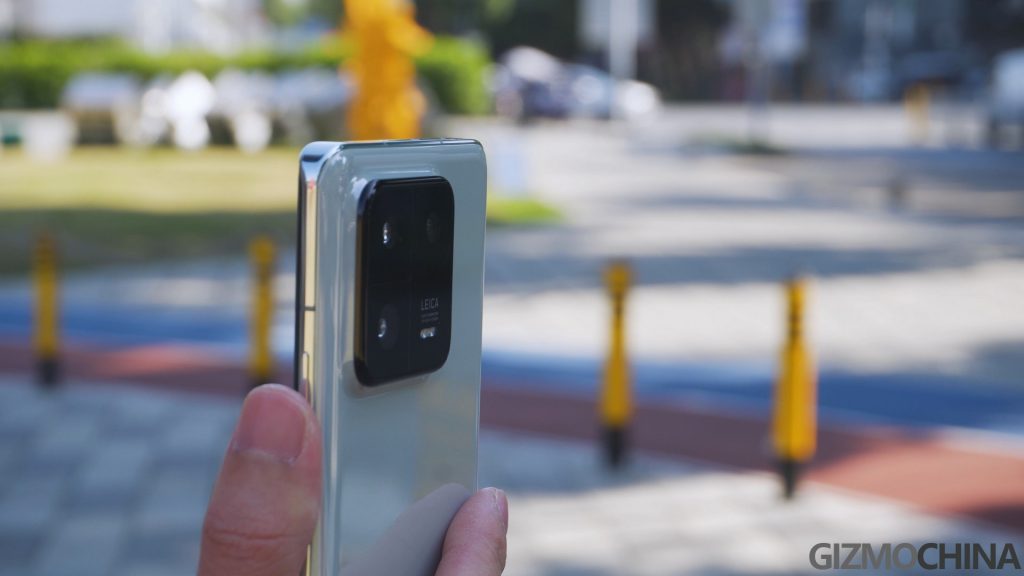
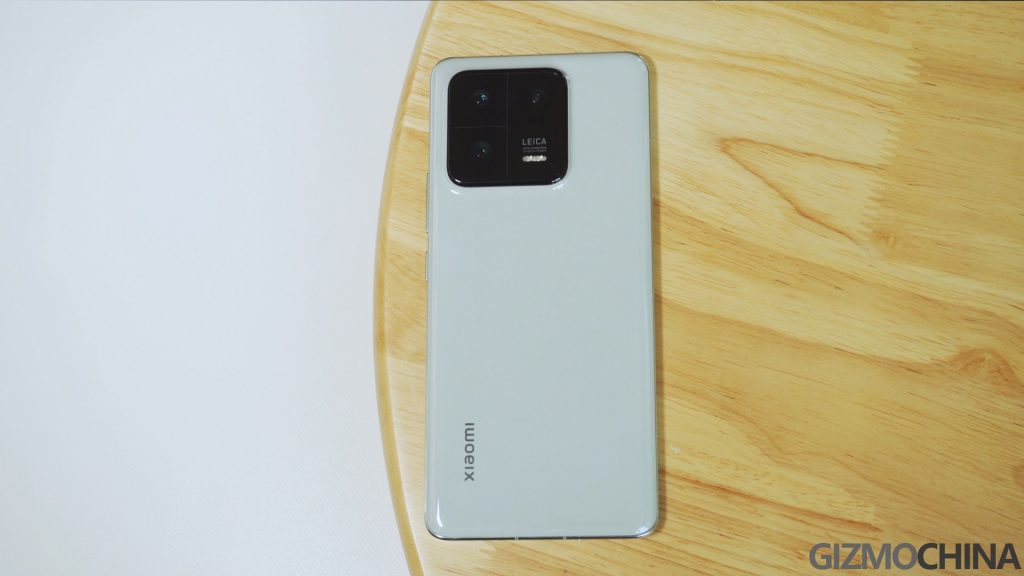
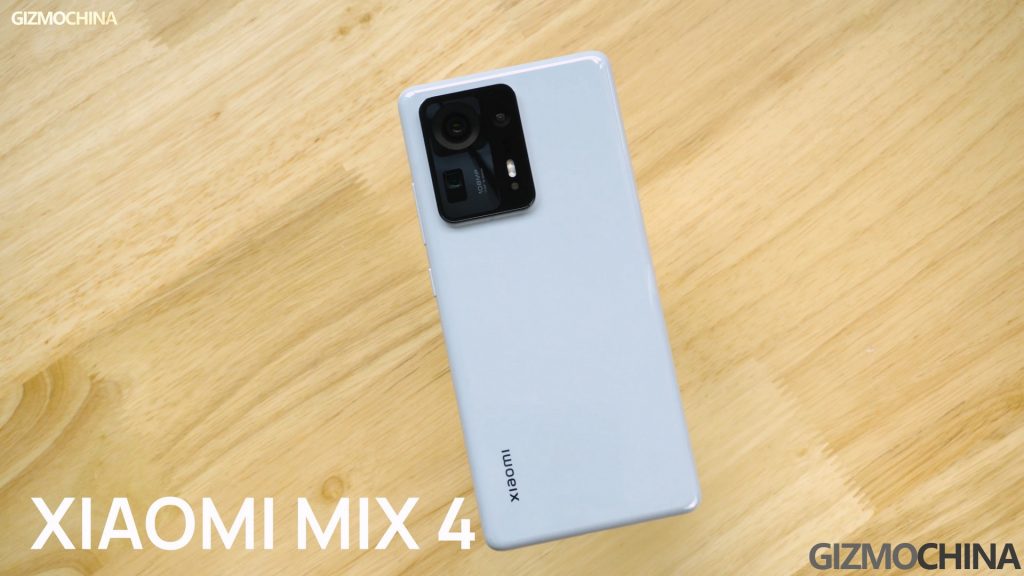
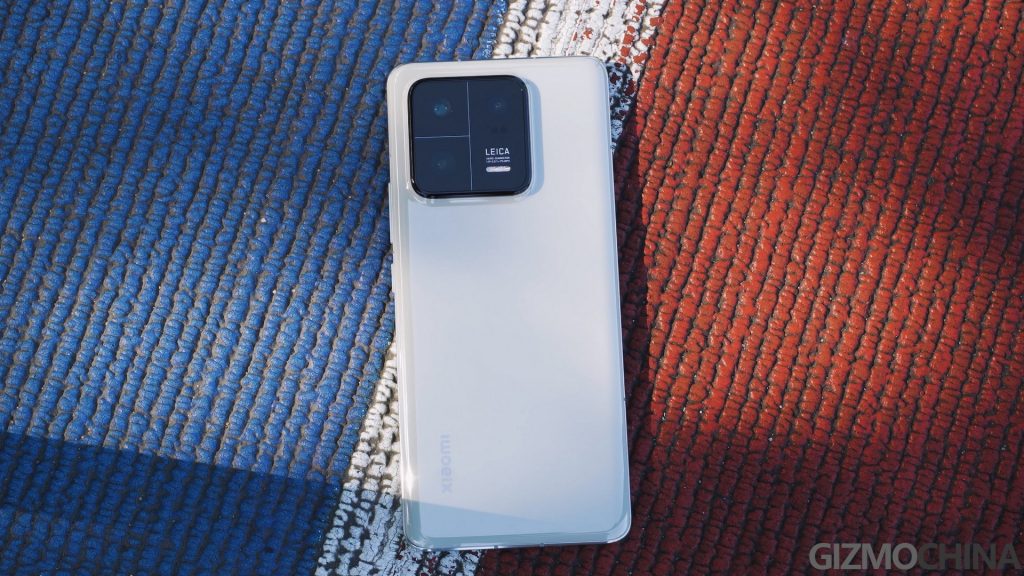
Anyway, let’s start with its design. Well compared with the Standard variant, the Xiaomi 13 Pro doesn’t give us much surprise. It looks not really different from the flagships that we reviewed last few years. But Xiaomi did add something to the Pro model, such as the ceramic back cover and the bigger square camera module. But meanwhile, it also reminds us of the Xiaomi Mix 4. They both have a ceramic back cover and a square camera module.
Xiaomi 13 Pro
Xiaomi Mix 4
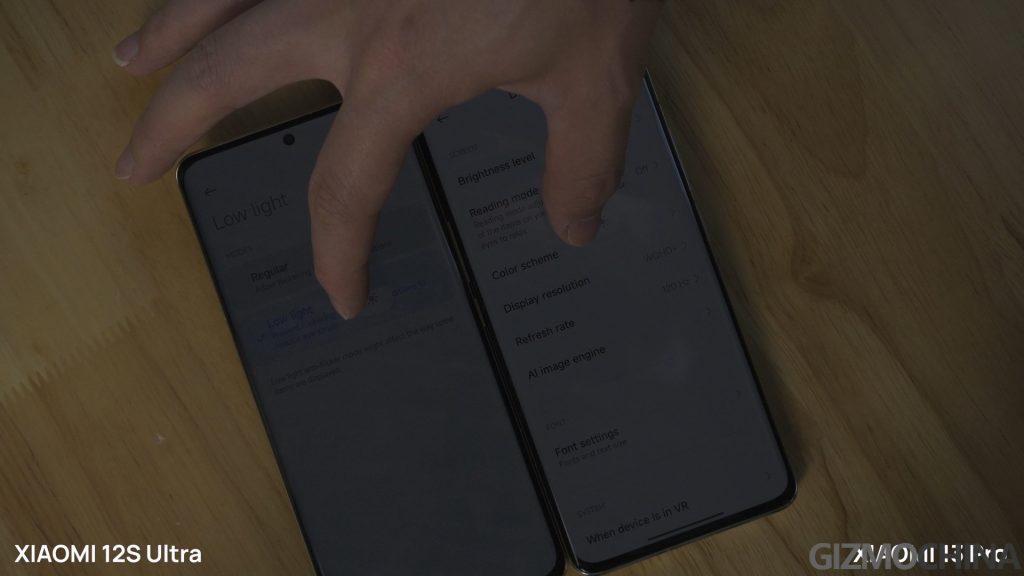
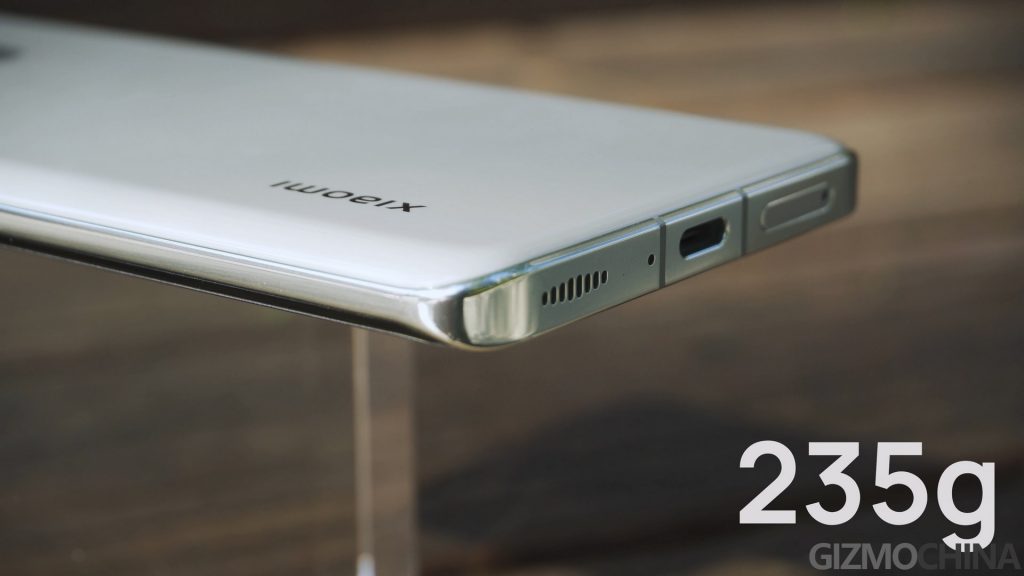
But unfortunately, as a result, it weighs about 235g, which is truly heavy in hand. Unlike the Xiaomi 13, the Pro still uses an edge-curved design, which does make it feel more comfortable to hold. And I have to say that the light-green ceramic is the most pleasing material that we’ve had on a Xiaomi phone, though it unavoidably makes the phone weigh more. But it actually feels a bit thinner and lighter than the Xiaomi 12s Ultra.
Display
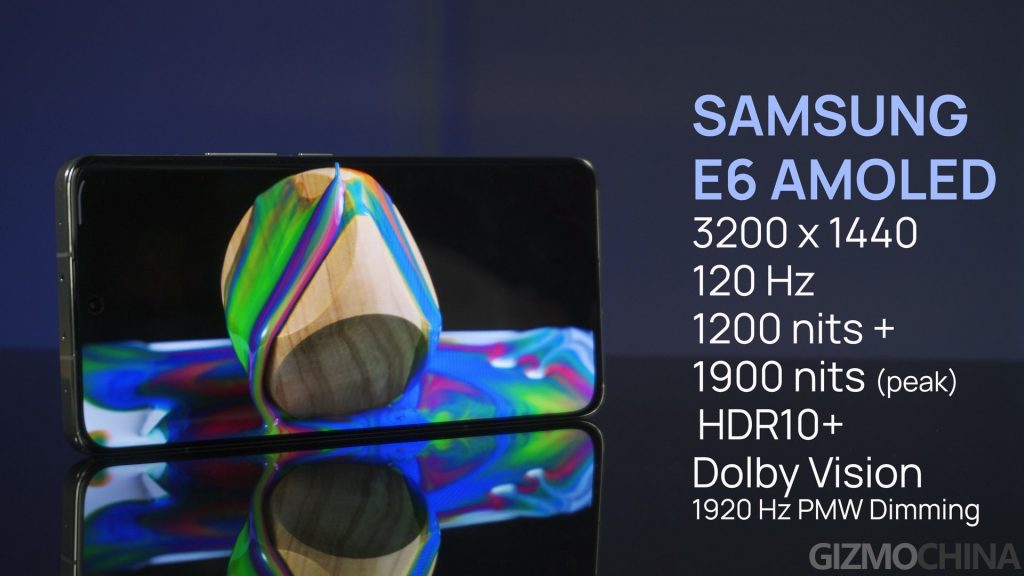
The front face is covered with an upgraded 6.67-inch AMOLED display. It’s a 2K 120Hz panel that comes from Samsung, which is added with new features like high-frequency PMW dimming and higher boosted window brightness of up to 1900 nits, while manually adjustable brightness still remains at a maximum of around 530 nits. But the global brightness can go up to 1220 nits.
Like the Vivo X90 series, its high-frequency PMW dimming can also offer an anti-flicker effect for eye protection.
Xiaomi is still the same Xiaomi, IR Remote and the USB2.0 charging port are still not absent, so wired projection is still not available. The dual speaker units sound good as usual, but there’s no tunning certification of Harman Kardon. The difference is not that obvious, so you can check it out by yourself here.
A delightful experience during daily use is the strong and tense haptic vibration, which is even more interesting and stronger than the X90 that we reviewed before. Xiaomi offers various vibrating effects that simulate different feedbacks in reality. It’s pretty fresh when it vibrates in a new way that you never experienced before.
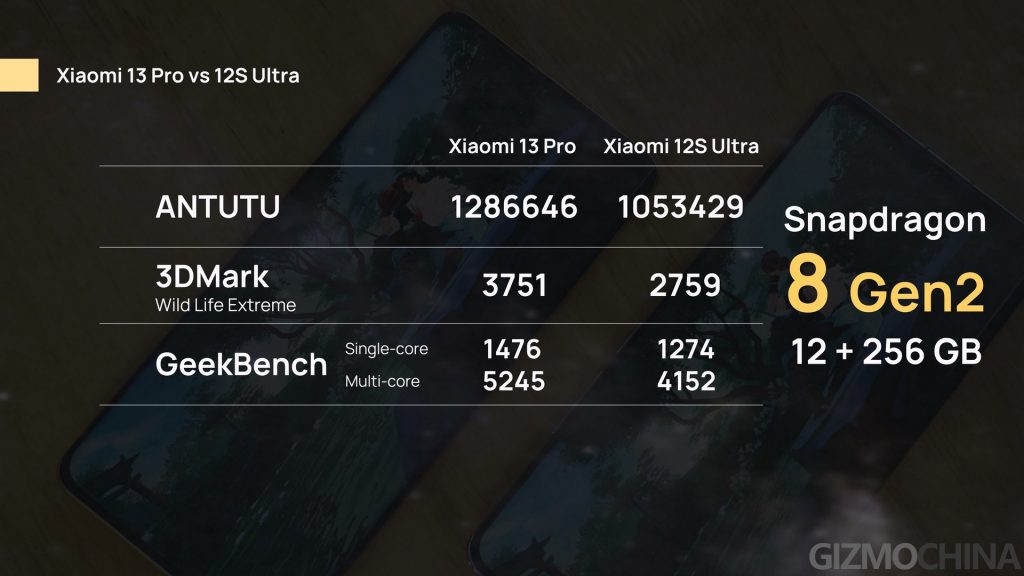
And now let’s seriously talk about the Snapdragon 8 Gen 2 chipset inside the Xiaomi 13 Pro. Qualcomm finally changed its mind and decided not to fool mobile users. After all the tests, we strongly believe that the 8 Gen 2’s performance will eventually be remembered and mentioned in the future. It’s so powerful that we can hardly show you its full picture by simply posting the benchmarks and gaming results here.
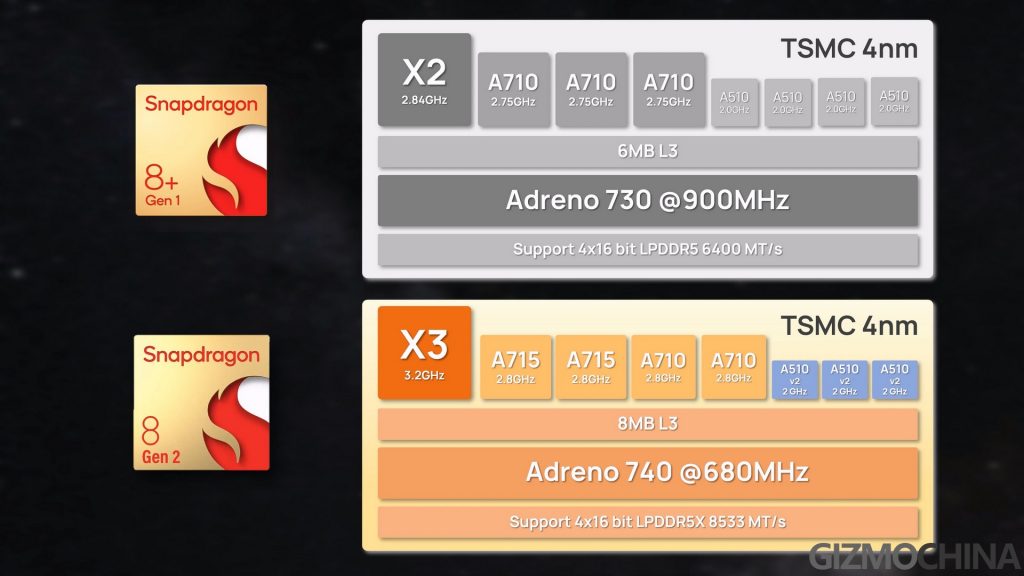
In addition to the increase in peak performance, its improvement is also reflected in the change in CPU architecture, no longer 3 A710 Middle cores but a new combination of 2 new A715 and 2 A710 mid cores. It leads to a powerful optimization of heavy or mid-running with much better thermal performance, and more efficient power consumption as well.
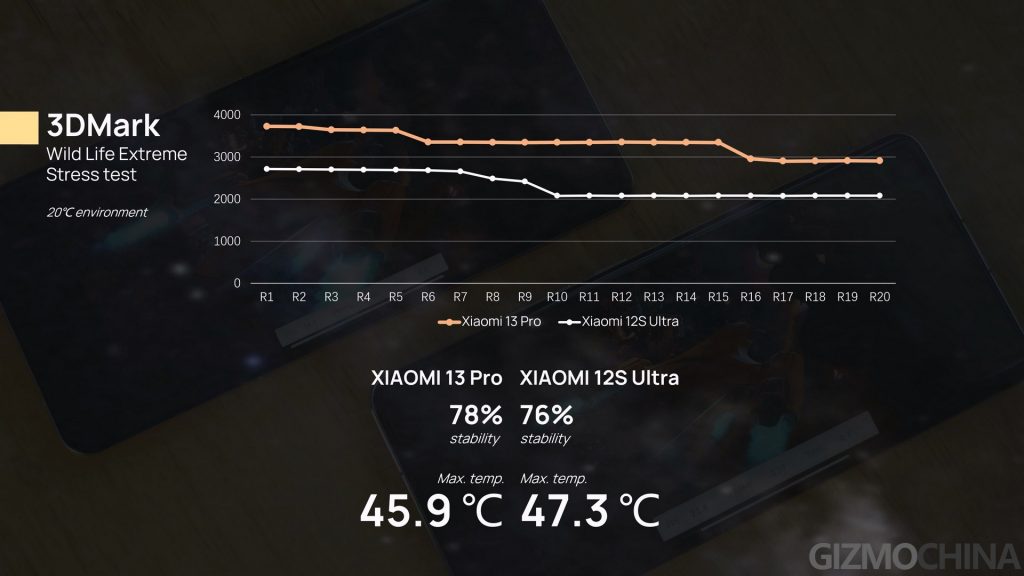
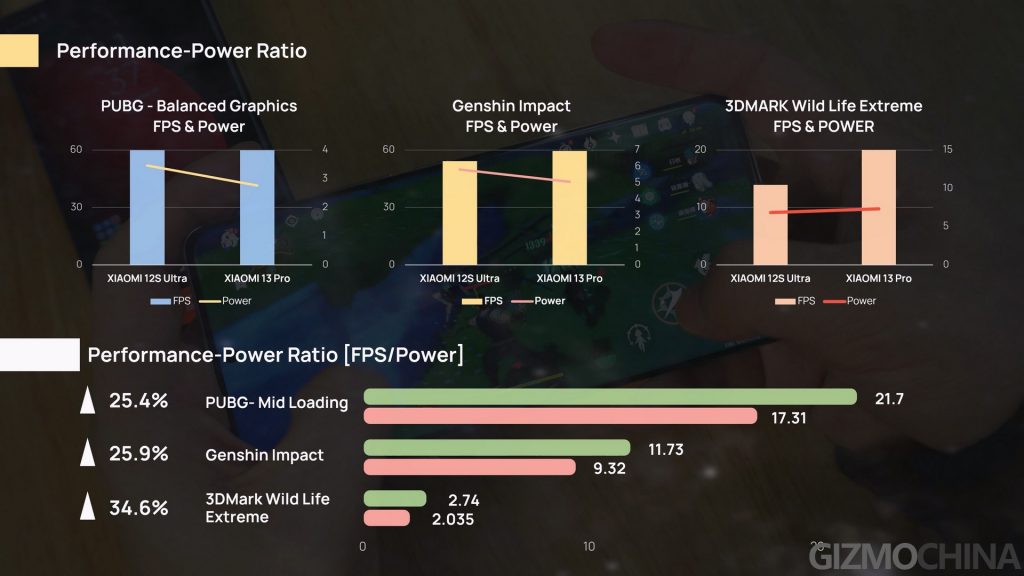
For example, in 3DMark Wild Life extreme stress test, the 13 Pro completed the 20-min test with a higher peak score; the stability of 78% is even slightly better than the Xiaomi 12s Ultra, while it didn’t get overheated at the same time. And the framerate power ratio is also significantly higher than the 12S ultra.
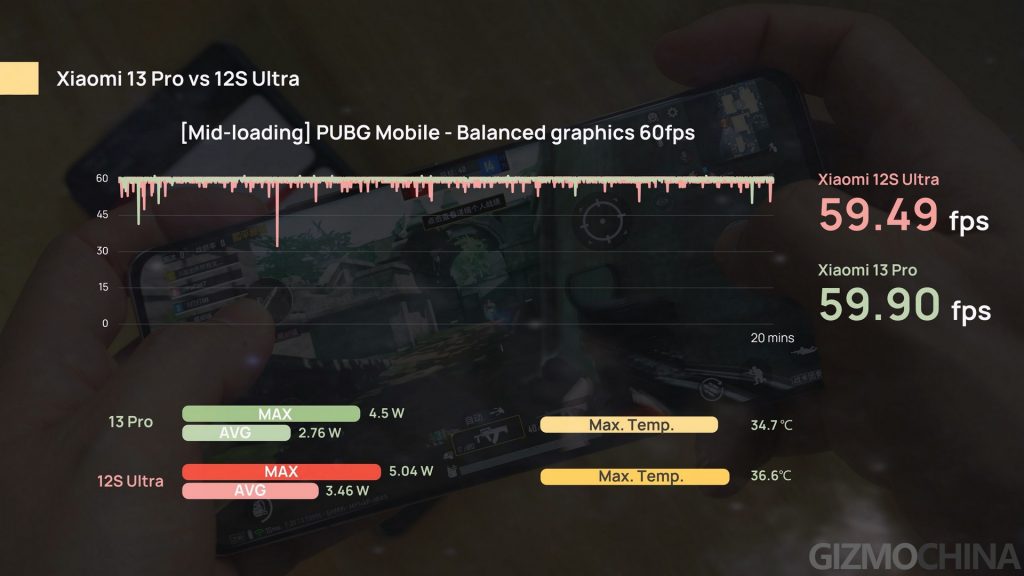
And then we moved to the PUBG mobile to simulate a mid-loading environment. With consistent graphical settings, both of them could achieve 59.9fps. But the new model only required 2.76W power output on average and a maximum power of 4.5W, both of which are much lower than the 12s Ultra’s power output.
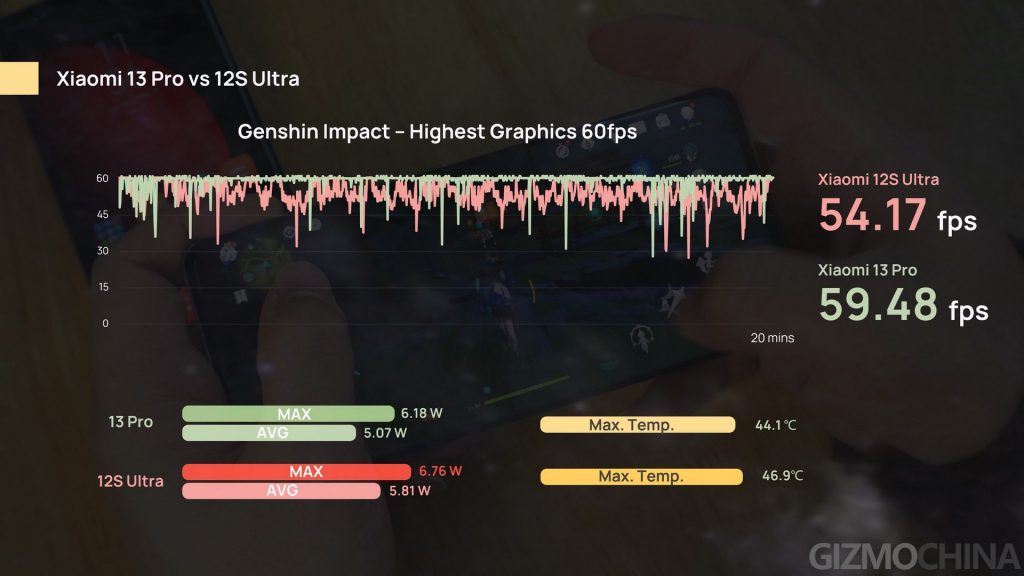
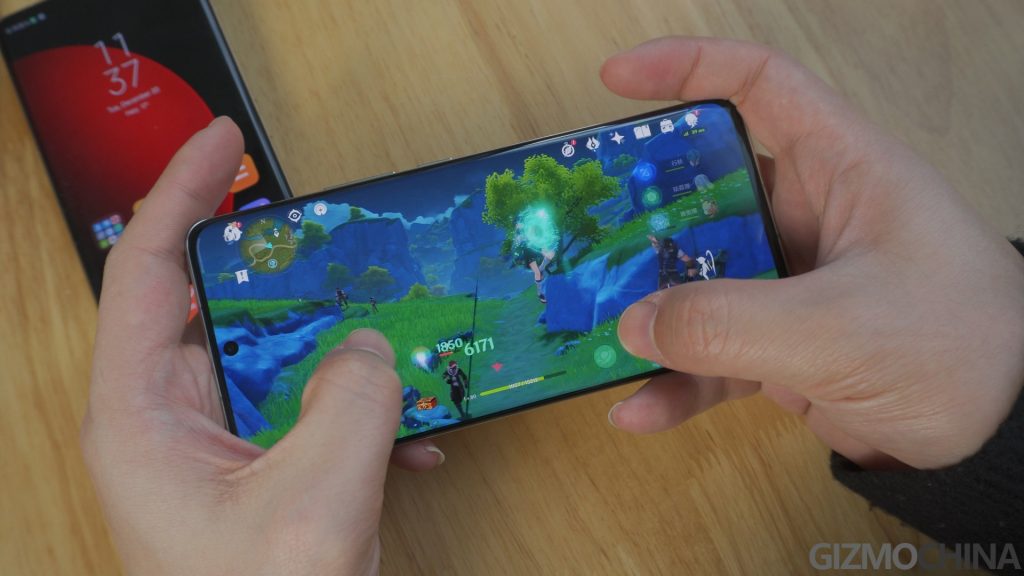
Then we did a gaming test in Genshin Impact. Under the same highest graphic settings. The Xiaomi 13 Pro also achieved better results in both framerate and power output, which is close to what we got on the Vivo X90 Pro +. It’s almost the best result you can achieve on a mobile phone.
And it completed the test with ease, only requiring 5.07W of power support and being heated up to 44.1℃. This means that when you play Genshin Impact, you not only get better performance but also longer battery life.
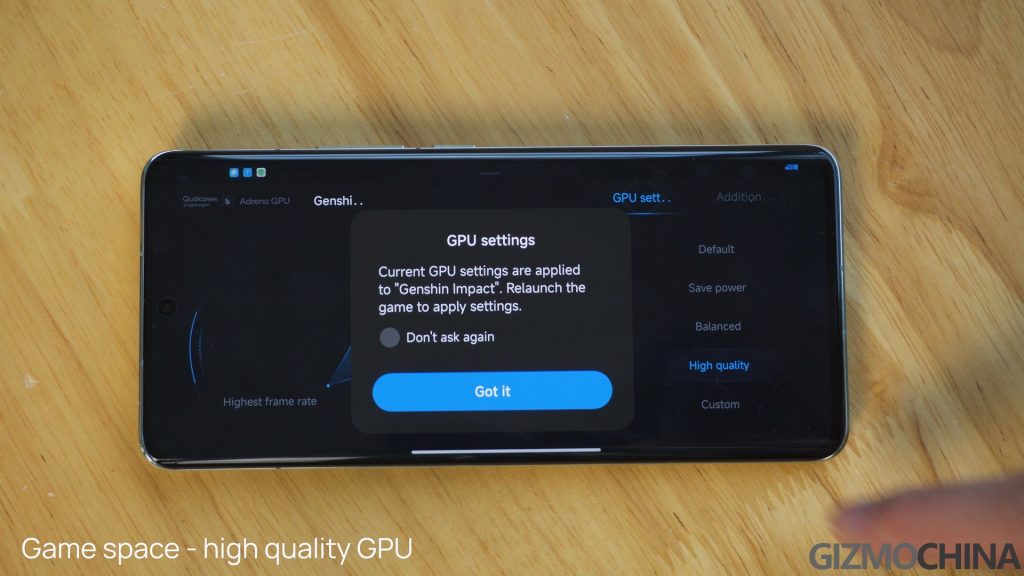
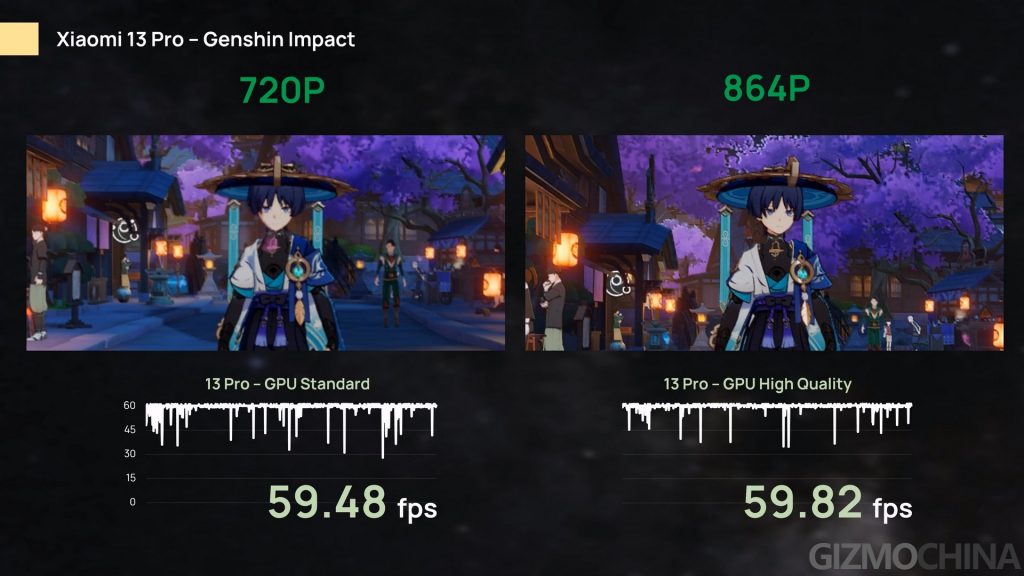
Another surprise of the Xiaomi 13 Pro for playing Genshin Impact is hidden in Game Turbo. You can adjust the game’s GPU option to the High-quality mode in the Game space, and then you will find the gaming graphics get sharper and clearer. Because the gaming resolution just got boosted from 720P to 864P, which is a 20% improvement. And we also tested the high-resolution mode. The phone can still achieve an average framerate of 59.8 without any throttling issue, which means that we still haven’t been able to touch the upper limit of this chipset.
There’s no doubt that the 8Gen 2 chipset has been the most powerful chipset for mobile gaming at the moment. Compared to its predecessors, its CPU performance can have a 15%-30% improvement, and from the tests we did, its performance power ratio also can achieve a 25% to 35% efficiency increase, which is also attributed to the GPU upgrade.
And I believe that phones like Xiaomi 13 Pro have even overshadowed many game phones. But I still have to remind you that if you’re only using phones for light applications, you might hardly feel the gap we showed here since its low-frequency running didn’t get as much improved as its heavy-loaded performance.
And by the way, the phone also comes with a combination of UFS4.0 storage and LPDDR5X memory, which also speeds up the system response and game loading.
Battery & Charging
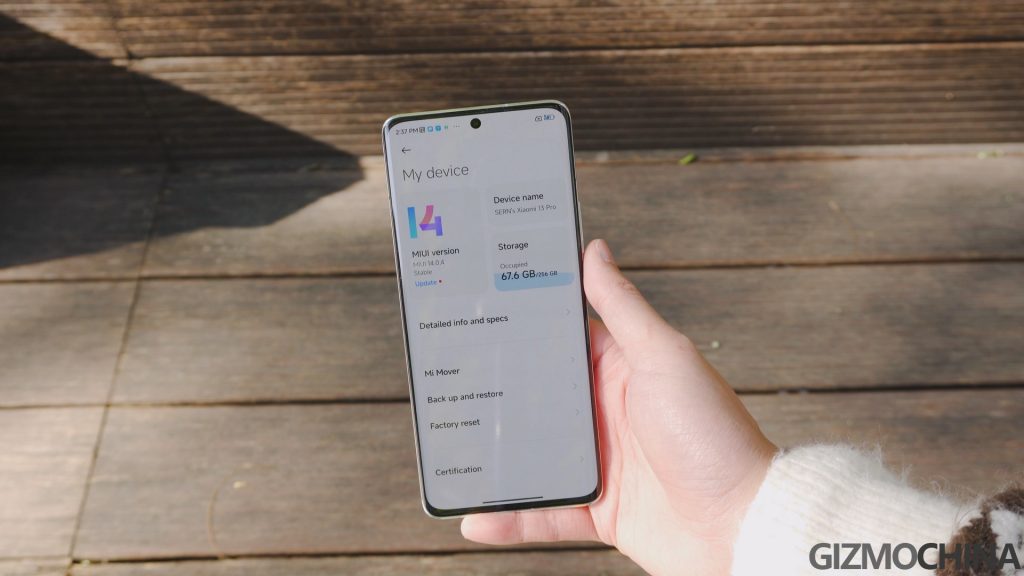
I’m not a fan of MIUI OS, but one has to admit that the OS is one of the smoothest and most stable mobile systems with rich features. And it seems that Xiaomi is considering giving up the strategy of adding features, but more working on building a lightweight system. On the Xiaomi 13 series, now you can remove almost all pre-installed apps except for several essential apps. In addition, compared to its predecessors, it’s quite surprising that the new OS is pretty stable. Is this still the latest Xiaomi phone? Shouldn’t it be selling phones while fixing a bunch of bugs?
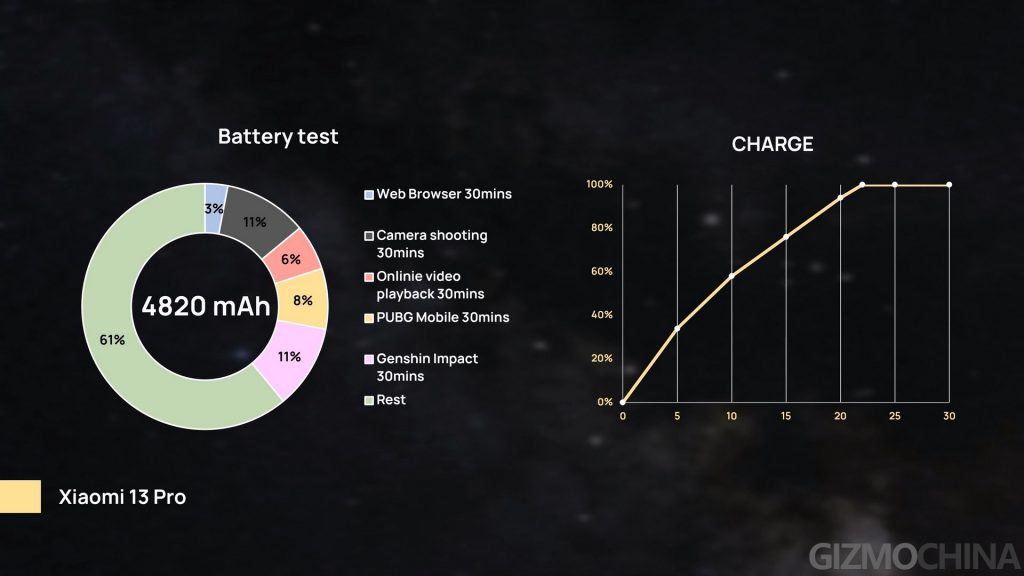
As for battery and charging, the new Pro model comes with a 4820mAh battery and supports 120W fast charging. The battery performance did get improved and get a better result compared to the 12s Ultra. And it can be fully charged in just 22 mins with the 120W fast charger.
Verdict
So that’s all we want to share in the first part of the full review. The Xiaomi 13 Pro is possibly the best and most balanced Xiaomi phone in these few years. In addition to the explosive performance, the next part of the camera review probably will let you better understand what I mean.
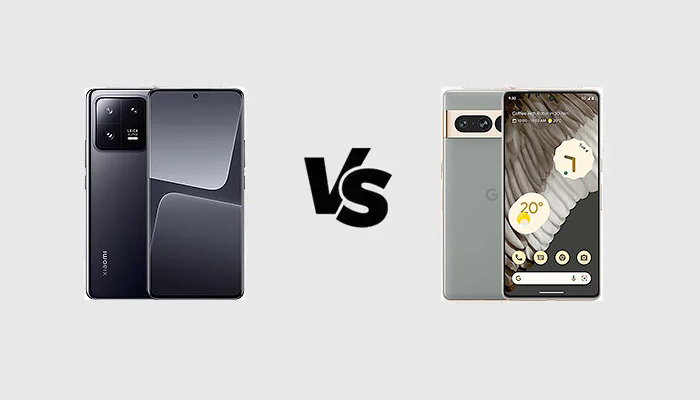
Xiaomi just launched the brand-new top-tier flagship Xiaomi 13 Pro in the Chinese market. While waiting for its global launch, it is time to let you understand whether or not this is the best flagship out there by comparing it to the best devices from the other brands. So, welcome to our comparison article on the Xiaomi 13 Pro and the Google Pixel 7 Pro. In this article, we will be taking a closer look at these two popular smartphones and comparing their specifications and overall performance. Both of these devices have received a lot of attention for their impressive cameras, sleek designs, and powerful processors, but which one is the better option for you? Read on to find out.
Both Xiaomi 13 Pro and Google Pixel 7 Pro have an original design, but the latter is definitely more interesting. It does not look like the iPhones at all and it comes with a unique horizontal camera module. The phone is made with a glass back and an aluminum frame, and it is waterproof with the IP68 certification. It also comes with a very high screen to body ratio and a centrally-placed punch hole. With the Xiaomi 13 Pro, you get a curved display at the sides, as well as a special color option with a ceramic back. If we consider this color option, I would prefer it to the Pixel, but for the remaining ones, the Google phone looks more interesting to me. Do you agree or do you have a different idea?
Display
The displays of these two phones are more or less at the same level, so you would better focus on the other specifications. These are amazing displays, among the best ones you can get on a phone. The Xiaomi 13 Pro has an OLED panel with a diagonal of 6.73 inches, one billion colors, LTPO technology enabling an adaptive refresh rate from 1 to 120 Hz, a Quad HD+ resolution of 1440 x 3200 pixels, Dolby Vision support, HDR10+ certification, and an in-display fingerprint reader. With the Google Pixel 7 Pro, you get an AMOLED display with a diagonal of 6.7 inches, a Quad HD+ resolution of 1440 x 3120 pixels, a 120 Hz refresh rate with the LTPO technology, HDR10+ certification, and an in-display fingerprint reader.
Specs & Software
The hardware setup of the Xiaomi 13 Pro is definitely better if compared to the Google Pixel 7 Pro. It is powered by the Snapdragon 8 Gen 2 mobile platform built with a 4 nm production process and sporting an octa-core architecture. It is composed of a Cortex X3 performance core running at 3.2 GHz, two Cortex A715 cores running at 2.8 GHz, two Cortex A710 cores running at 2.8 GHz, and three Cortex A510 cores running at 2 GHz. Alongside the chipset, there are up to 12 GB of RAM and up to 512 GB of native storage. Unfortunately, the Google Pixel 7 Pro has an inferior chipset: we are talking about the Tensor G2, nothing more than a rebrand of the latest Exynos. The memory configuration is the same. Both phones ship with Android 13, but the Pixel will get more updates and for a longer time.
Camera
On the paper, the Xiaomi 13 Pro looks to have a superior camera department, with three 50 MP cameras co-engineered with Leica. But the Google Pixel 7 Pro is amazing too with its triple camera composed of a 50 MP main sensor, a 48 MP telephoto lens, and a 12 MP ultrawide shooter. Which one will shoot the best photos?
The Google Pixel 7 Pro is equipped with a bigger battery and it will most likely last more on a single charge in several scenarios: the battery capacity is 5000 mAh. On the other hand, the Xiaomi 13 Pro charges a lot quicker thanks to 120W fast charging and 50W wireless charging.
Price
The Google Pixel 7 Pro starts from $680/€641, while the Xiaomi 13 Pro starts from $899/€848 (prices vary depending on the market). Which one would you pick?
A consumer survey conducted by Counterpoint Research has shown that Transsion Holdings subsidiary itel is the preferred brand in the sub-Rs. 8,000 category of the mobile phone market in India. The Chinese brand enjoys the highest proportion of repeat users among first-time handset buyers in the segment. Counterpoint Research claims that it conducted both offline and face-to-face interviews in 23 Indian cities with mobile users in the sub-Rs. 8,000 price category while compiling the report.
The report shows that 55% of respondents whose first mobile phone was an itel branded phone have upgraded to another device from the same brand. Samsung and Lava also ranked second and third respectively in terms of first-time mobile phone users who have stuck to the same brand while upgrading to a new model.
It is estimated that half of current Itel mobile subscribers purchased their first phone from Itel. However, that has not translated to brand satisfaction as the report also shows that itel consumers were the least satisfied (1%) with their existing phones among the top three brands in this sector in terms of current mobile phone ownership. This may not be unconnected with the not-so-impressive battery life that is associated with itel mobile phones, especially smartphones.
However, the survey revealed that the majority of users sampled selected itel as their next choice brand based on brand trust, cost, after-sales services, appearance, and durability, according to the report. An estimated 76% of current itel consumers expect to recommend the brand to friends based on their overall experience.
In another aspect, itel ranks third in terms of market share in the sub-Rs. 8000 segment.
Till 2019, the Galaxy J series acted as the cornerstone of Samsung‘s plans for the mid-range market. However, the role was later passed on Galaxy A lineup, which consists of some decent value-for-money smartphones like Galaxy A53, A23, and more. There are also the more premium Galaxy A72 and A73. However, it seems the company will not launch the Galaxy A74.
A new Galaxyclub report suggests Samsung might be planning to discontinue the Galaxy A7x series, which means there will be no Galaxy A74 in 2023. The publication points out that the upcoming A-series smartphones, such as the Galaxy A54 and Galaxy A14, have been leaking a lot recently but there’s no sign of the Galaxy A74. The device has not surfaced on any certification sites yet and there are no firmwares either.
However, the report is based on assumptions and there’s no official confirmation from the brand yet. It’s very well possible that Samsung Galaxy A74 is in development and may launch sometime next year.
To recall, the Galaxy A72 and A73 are midrange smartphones that fall between flagships and affordable models. They pack an immersive display, decent cameras, and a mediocre processor. Although these phones are not exactly performance-oriented, they are still powerful enough for regular usage.
Separately, Samsung is working on the Galaxy A54, which is expected to debut soon. The handset recently appeared on the Geekbench website with an Exynos 1380 processor and scored 776 points in the single-core test and 2599 points on the multicore test. It is rumored to pack a 50MP primary camera along with a 5100mAh battery and 25W fast charging. It will run One UI 5 based on Android 13 out of the box.
We use cookies on our website to give you the most relevant experience by remembering your preferences and repeat visits. By clicking “Accept”, you consent to the use of ALL the cookies.
This website uses cookies to improve your experience while you navigate through the website. Out of these, the cookies that are categorized as necessary are stored on your browser as they are essential for the working of basic functionalities of the website. We also use third-party cookies that help us analyze and understand how you use this website. These cookies will be stored in your browser only with your consent. You also have the option to opt-out of these cookies. But opting out of some of these cookies may affect your browsing experience.
Necessary cookies are absolutely essential for the website to function properly. This category only includes cookies that ensures basic functionalities and security features of the website. These cookies do not store any personal information.
Any cookies that may not be particularly necessary for the website to function and is used specifically to collect user personal data via analytics, ads, other embedded contents are termed as non-necessary cookies. It is mandatory to procure user consent prior to running these cookies on your website.