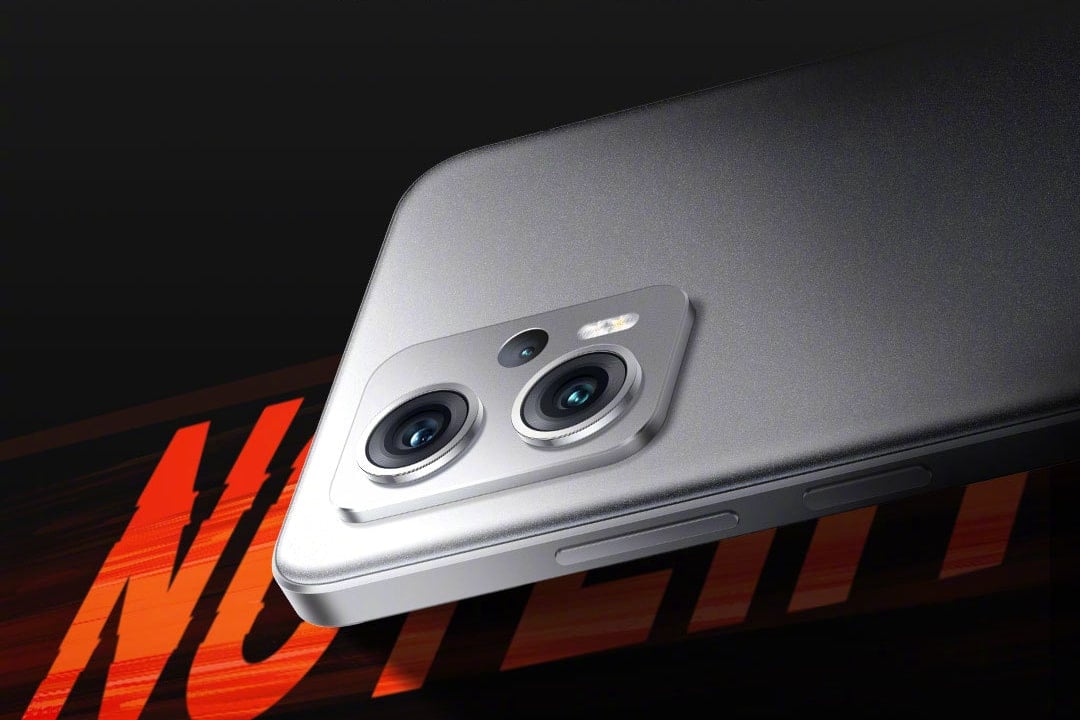
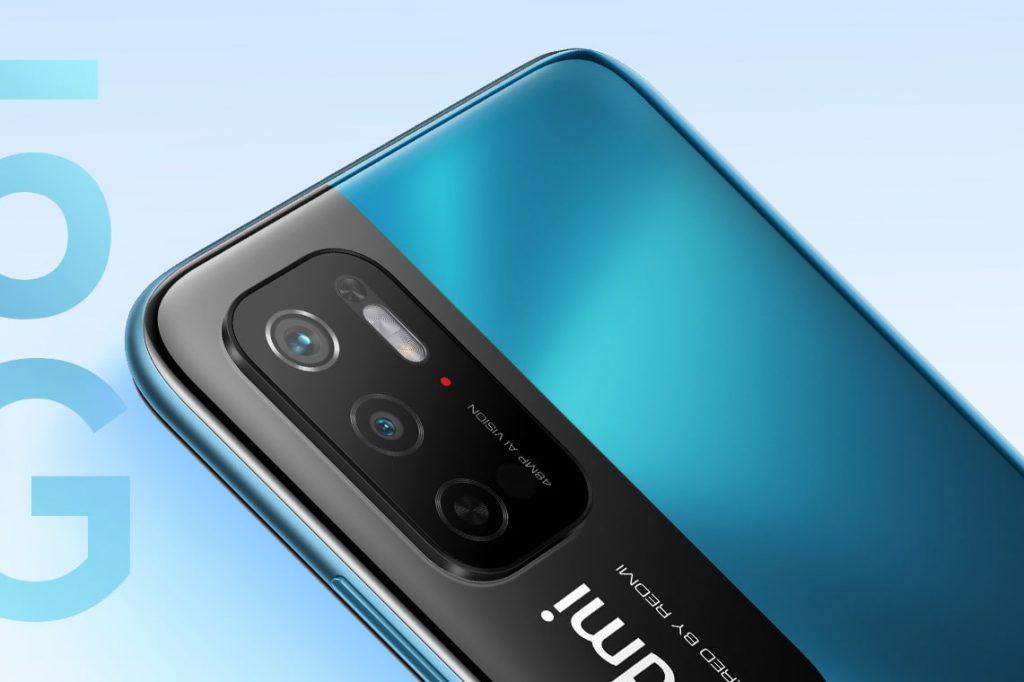
Redmi Note 11T Pro and Note 11T Pro+ was just announced in the Chinese market yesterday. But now, a new report has suggested that these smartphones might be rebranded under the POCO family for their global release.
Note 11T Pro+
The news arrives from tipster Kacper Skrzypek who stated that the Note 11T Pro series will be rebranded to the POCO X4 GT lineup. In other words, the Redmi Note 11T Pro will be rebadged to the POCO X4 GT while the Note 11T Pro+ will be the POCO X4 GT Pro for the global market. The tipster further added that there will also be slight changes as well, with the POCO X4 GT Pro featuring a 108 megapixel primary sensor compared to the Note 11T Pro+’s 64 megapixel sensor.
If this report is true, then we can assume the base POCO X4 GT to sport a 6.6 inch FHD+ display with a 144Hz pixels resolution, Dolby Vision, DC Dimming, and more. Under the hood, a MediaTek Dimensity 8100 SoC will power the device along with a large 5,080mAh battery pack that supports 67W fast charging. On the other hand, the POCO X4 GT Pro will feature a 6.6 inch FHD+ IPS LCD display with a FHD+ pixels resolution, 20.5:9 aspect ratio, DC Dimming, a 144Hz refresh rate, and A+ DisplayMate rating as well.
xaga Redmi Note 11T Pro POCO X4 GT xagapro Redmi Note 11T Pro+ POCO X4 GT Pro – 108 Mpx camera xagain Redmi K50i xagainpro Redmi K50i Pro – 108 Mpx camera
This model also runs on the same Dimensity chipset, but with a 4,400mAh battery pack that has a whopping 120W fast charging support. Both models will likely run on Android 12 OS based MIUI 13 custom skin and feature a triple camera setup on the back. So stick around for more, as we will be providing updates when additional information is available regarding this matter.
If you know anything about Windows laptops, you’ve probably heard about the Dell XPS lineup. It includes some popular 2-in-one laptops that can be flipped, transformed, and bent but Dell has now taken its quest for 2-in-ones too far and designed a hybrid laptop with a completely detachable screen.
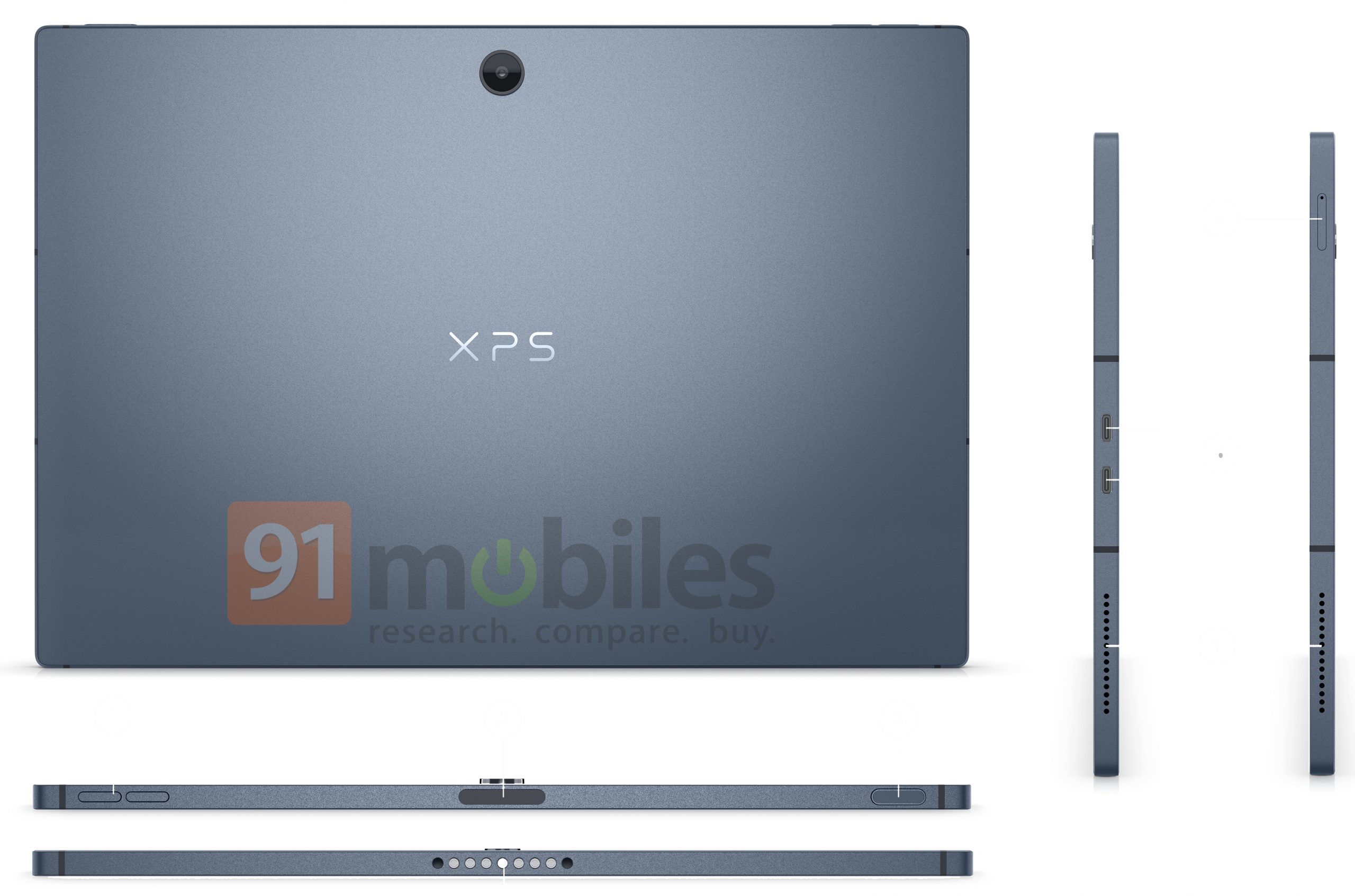
According to a report by 91mobiles, Dell has an upcoming laptop, dubbed XPS 9315t, that features a completely detachable display making it a 13-inch tablet. Dell is not exactly known for tablets so it will be interesting to see what they do with this upcoming product.
As seen in the images, the hybrid screen has a single rear camera and 2 USD Type-C port along with the speaker grill on the side. In one of the images, an outline of a sim-tray slot is also visible indicating that it can be a cellular device.
As per the pub lication, Dell has been working on this product since last year, and it’s expected to hit the markets soon. The report revealed the design and appearance of the upcoming product but it did not contain any details about its specifications.
Dell is not new to the 2-in-one laptop segment. In fact, in 2019, the company completely destroyed this segment with its XPS 13 2-in-1 laptop. The laptop was so good it didn’t really leave a lot of room for improvement.
In other news, Dell recently launched the G15 and G15 SE gaming laptops in the Indian market. Both laptops come with a number of gaming-focused features that will likely interest gaming enthusiasts in the subcontinent. Both models have the latest 12th Gen Intel Core i5 and i7 processors paired with NVIDIA GeForce RTX GPU. Both laptops also sport 15.6-inch screens but with different display configurations.
The Dell G15 5520 has an FHD IPS display with support for 165Hz refresh rate. On the contrary, the G15 5521 SE has a Quad+HD IPS display with a 240Hz refresh rate.
Earlier this week, the long-standing collaboration between Huawei and Leica came to an end, and at the same time, the Chinses smartphone giant announced the beginning of its new partnership with the Germany-based camera company.
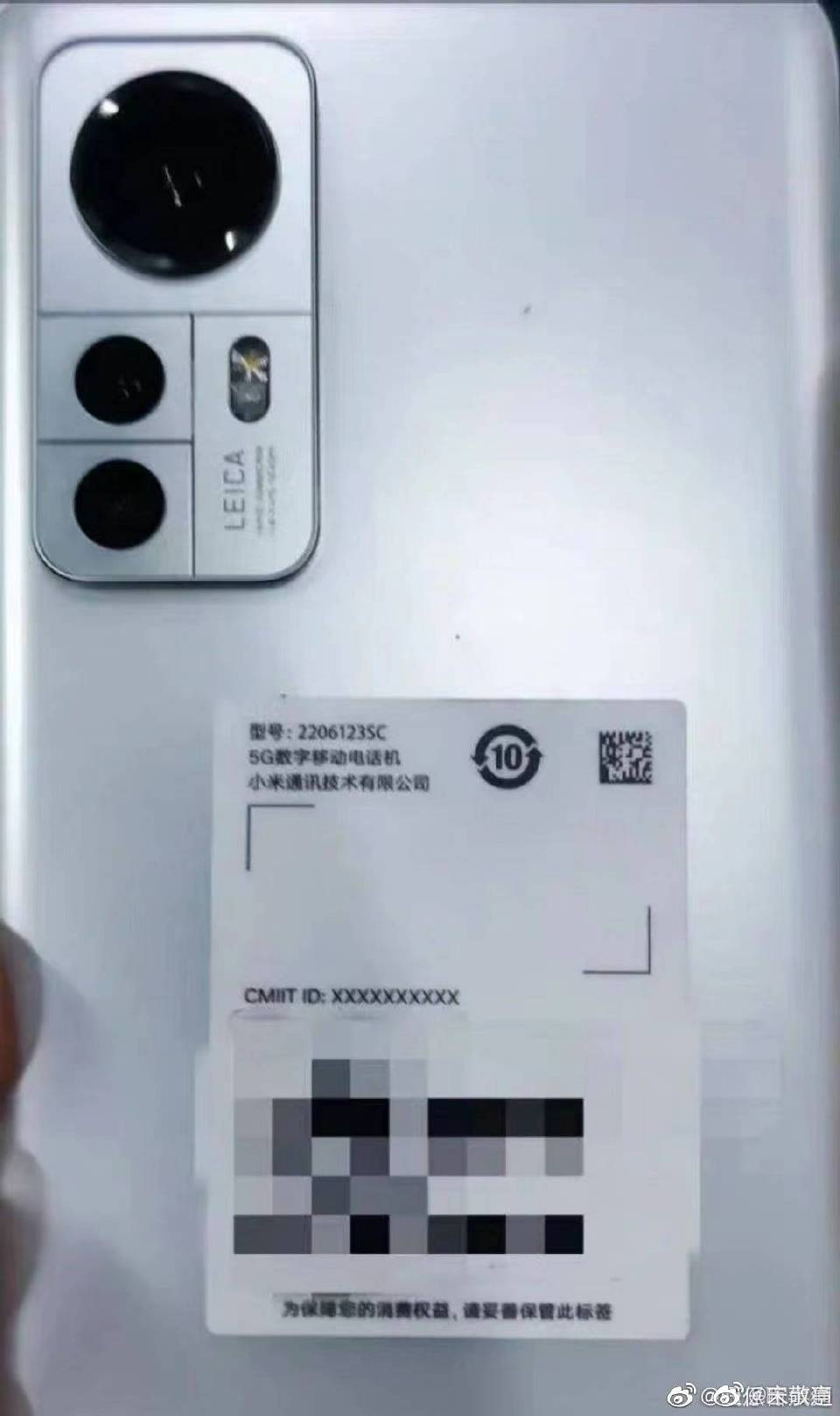
Now, just days after the official announcement, a leaked image has emerged online revealing that Xiaomi already has a new device with Leica’s camera technology ready to launch at any moment.
The leak comes from a Weibo tipster and reveals a Xiaomi smartphone, allegedly the Xiaomi 12S, with a Leica branding on the camera module. The back panel of the device looks pretty similar to the already launched Xiaomi 12 Pro and the only difference appears to be the Leica branding in place of the “50MP” etched on the camera module.
Leaks state that we could see the first Leica branded Xiaomi flagship launching in June, which also corroborates the earlier leaks stating that the Xiaomi 12S series is scheduled for June. So let’s take a look at the specs and features of the upcoming devices.
Xiaomi 12S and 12S Pro Specs (Rumored)
The Xiaomi 12S is said to come with a Full HD+ resolution curved panel featuring a 120Hz refresh rate, centered punch-hole, and will be smaller in size. The device will sport a triple camera setup headlined by a 50-megapixel primary camera. It is expected to come powered by the recently announced Snapdragon 8+ Gen 1 SoC.
The Xiaomi 12S Pro on the other hand is expected to offer a 2K display panel and launch with SoC variants. These will likely be the Snapdragon 8+ Gen 1 and the Dimensity 9000 SoC.
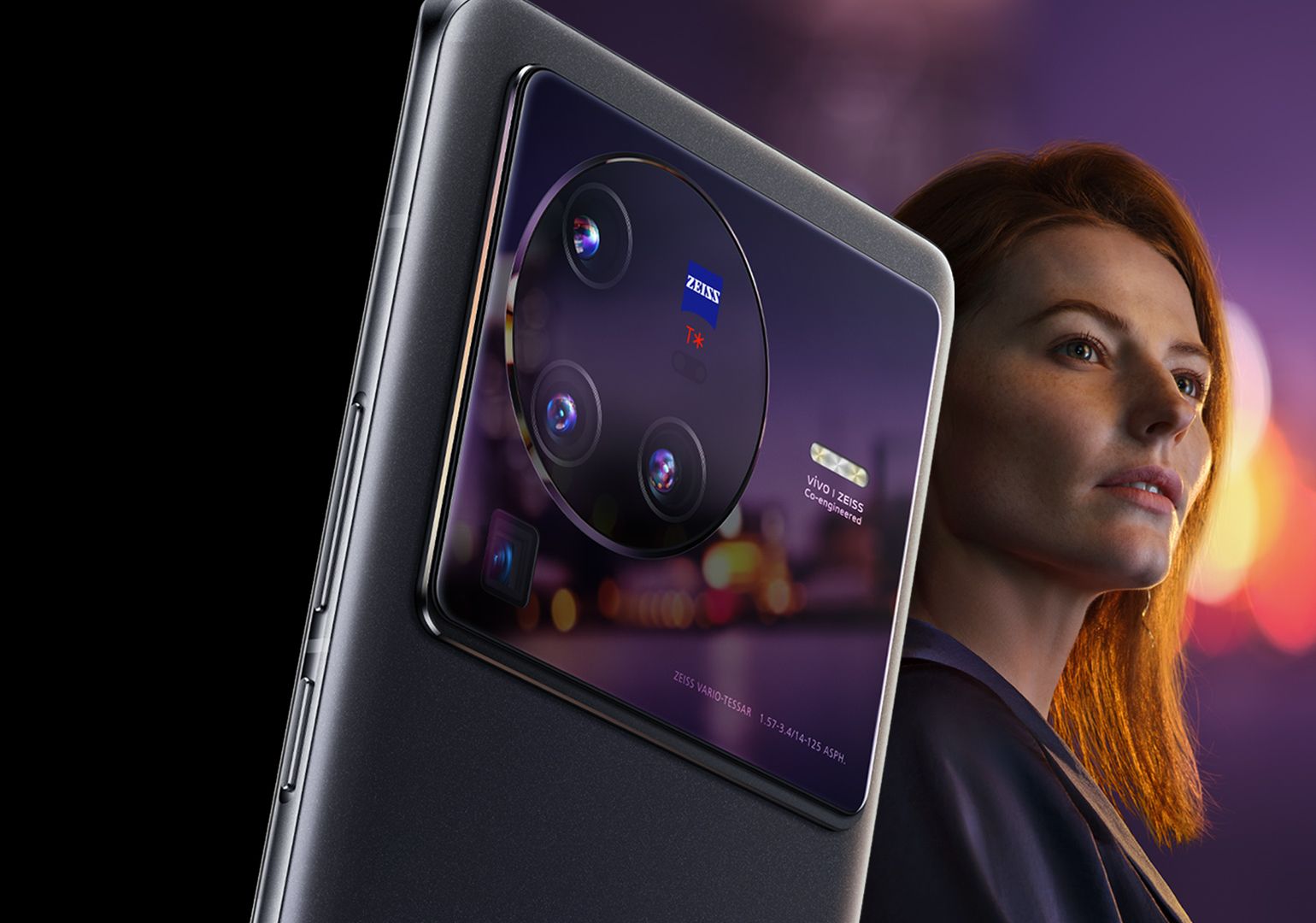
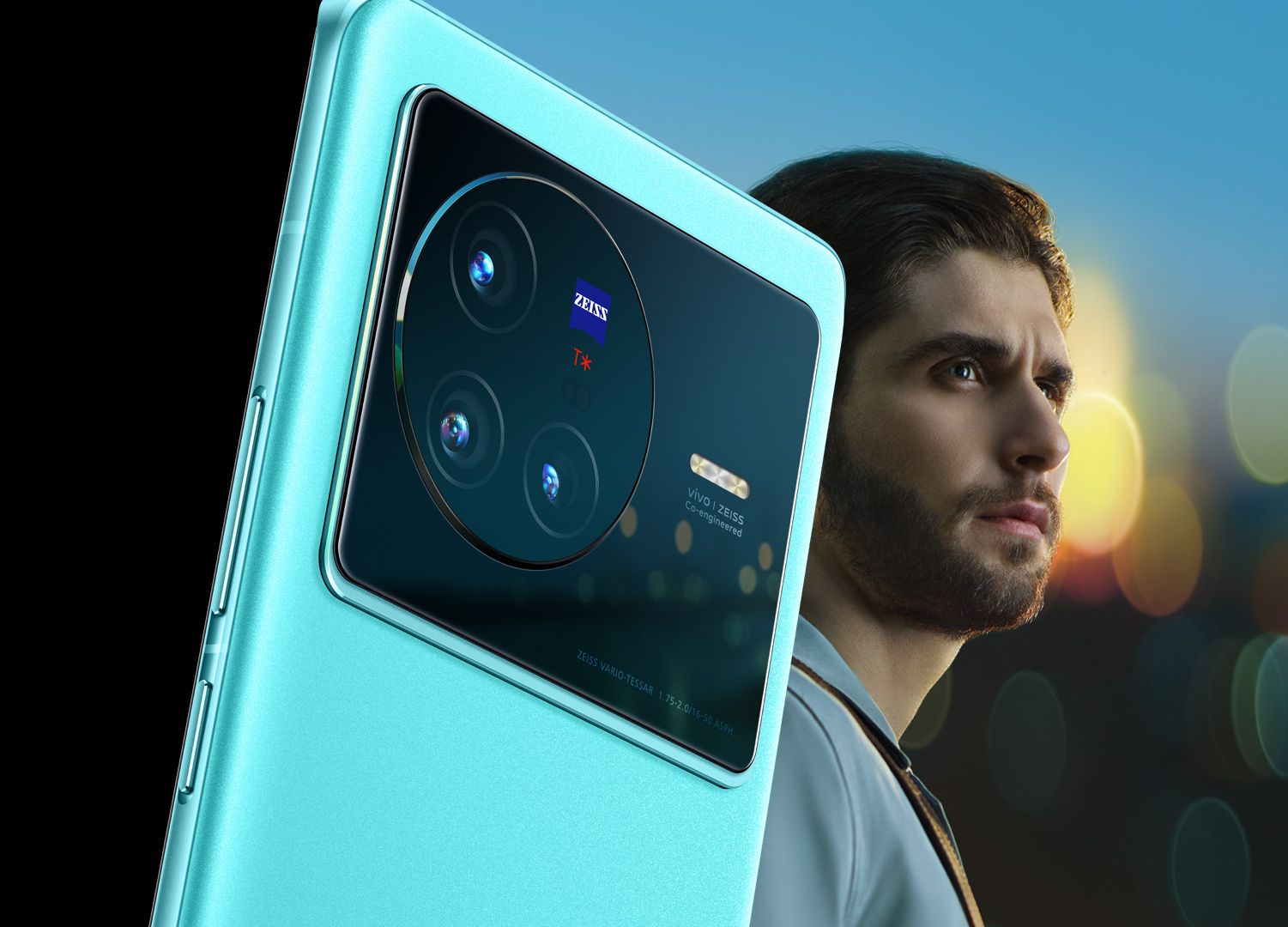
Vivo X80 series was announced for the Indian market earlier this month. Now, the company has made the X80 and X80 Pro models now available for purchase in the region.
X80 Pro
Talking about the base model first, the Vivo X80 sports a 6.78 inch E5 AMOLED display that has a Full HD+ resolution and 120Hz refresh rate. Under the hood, the device is equipped with a MediaTek Dimensity 9000 SoC that is paired with up to 12GB of RAM and 256GB of internal storage. A 4,500mAh battery pack powers this handset that supports 80W fast charging. It features a triple camera setup on the rear, which includes a 50 megapixel primary sensor, 12 megapixel telephoto lens, and a 12 megapixel ultra wide angle lens. Meanwhile, the front packs a 32 megapixel selfie shooter.
The X80 Pro variant sports a larger 6.78 inch AMOLED panel that has a 2K resolution and 120Hz refresh rate. This model is powered by the Qualcomm Snapdragon 8 Gen 1 SoC that is also paired with 12GB of RAM and 256GB of internal storage. A larger 4,700mAh battery pack runs the device and supports 80W fast charging. It also features a triple camera setup on the rear, with the primary sensor being a 50 megapixel shooter, paired with a 48 megapixel ultra wide angle lens, and a 12 megapixel portrait sensor. The front has a 32 megapixel selfie camera.
X80
The X80 is available in two storage configurations, while the Pro model is only available in a single model in India. Vivo X80 in Urban Blue color option is priced at 53,999 INR for the 8GB + 128GB configuration while the 12GB + 256GB variant is priced at 59,999 INR. The higher end X80 Pro has a price tag of 79,999 INR for its sole 12GB + 256GB option and arrives in a Cosmic Black color option. The series is currently listed on Flipkart and other retail stores. For an introductory offer, Vivo is offering up to 7,000 INR discount for customers with HDFC bank cards.
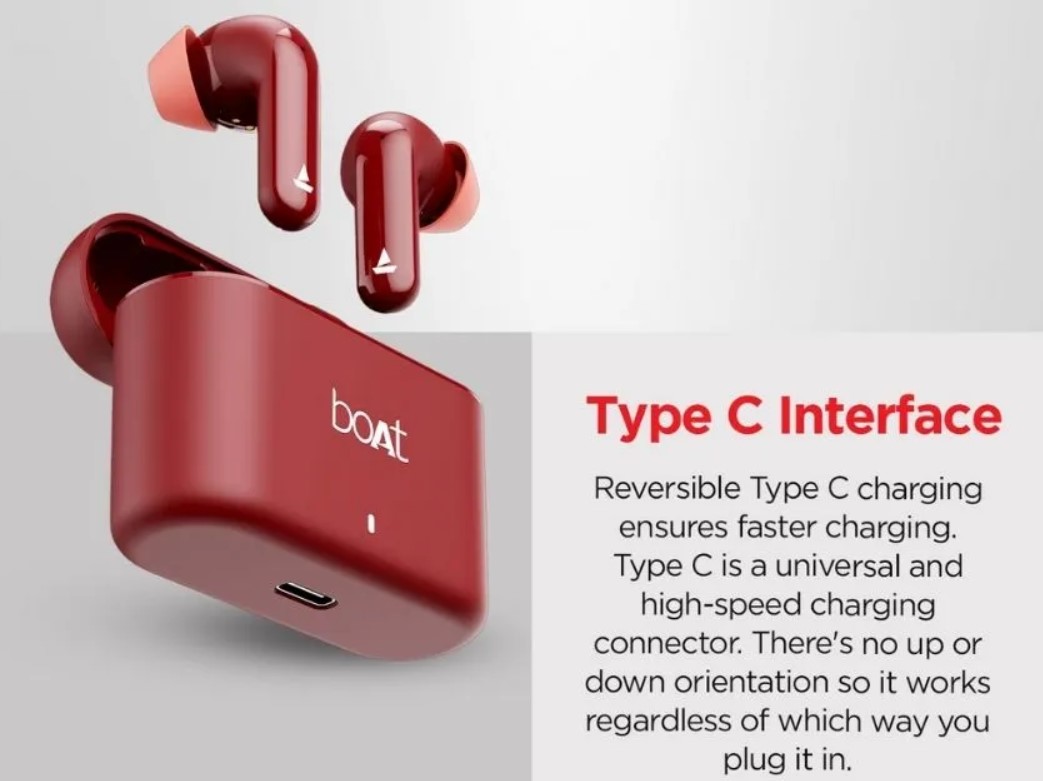
boAt has just launched a new pair of truly wireless earbuds in India. It is the new Airdopes 175 TWS that arrive in the budget segment. These earbuds were first spotted listed on Amazon earlier this month and have now finally gone on sale in the region.
The Airdopes 175 TWS earbuds feature a 10mm audio driver setup that promises to offer a balanced and immersive sound quality. Furthermore, these new earbuds feature an in ear design along with a stem as well. It also houses a quad mic setup that helps enable a clear audio calling experience. Since these are wireless earphones, it also supports the Bluetooth 5.2 standards.
Talking about the battery life, the company’s latest Airdopes 175 TWS can last for up to 35 hours on a single full charge. The earbuds can last for up to 8 hours while the charging case offers an additional 27 hours of endurance. Charging for just 5 minutes can also offer audio playback for up to 75 minutes as well. The charging case houses a USB Type C port for charging.
Other features include IWP technology for seamless device pairing, IPX4 water and sweat resistance, and support for voice assistants like Siri. The new boAt Airdopes 175 are available in multiple color options. This includes a Red, Blue, White, and Black variant. The earbuds is priced at 1,699 INR (roughly 22 US Dollars) and will officially go on sale in the region starting from May 27.
While the Apple iPhone 13 Pro series arrived with ProMotion display that had 120Hz refresh rate, it seems that this year’s iPhone 14 Pro models will also feature this display technology along with some upgrades that would expand its functionalities.
For those unaware, the iPhone 13 Pro series sported LTPO panels that had variable refresh rates that allowed for better power efficiency. The ProMotion displays was basically able to preserve battery life by only producing fast frame rates when needed. However, the iPhone 13 Pro and iPhone 13 Pro Max’s ProMotion displays only supported refresh rates between 10Hz and 120Hz.
On the other hand, offerings from brands like Oppo and Samsung can drop as low as 1Hz. Known display analyst Ross Young believes that the next gen iPhones will use a ProMotion panel that can also drop to 1Hz refresh rate as well. This would mean that the iPhone maker might soon be able to offer better features as well as improves its battery life on the upcoming smartphones as well. One of these better features, include the Always On Display.
An example of this being Apple Watch Series 7 models that also use LTPO displays that enables the smartwatch to offer up to 18 hours of battery life. This was higher than previous entries in this series, despite offering ALways on Display. In other words, next gen iPhone 14 Pro series might soon also offer this feature, which will help display information like time, date, and notifications without turning on the display.
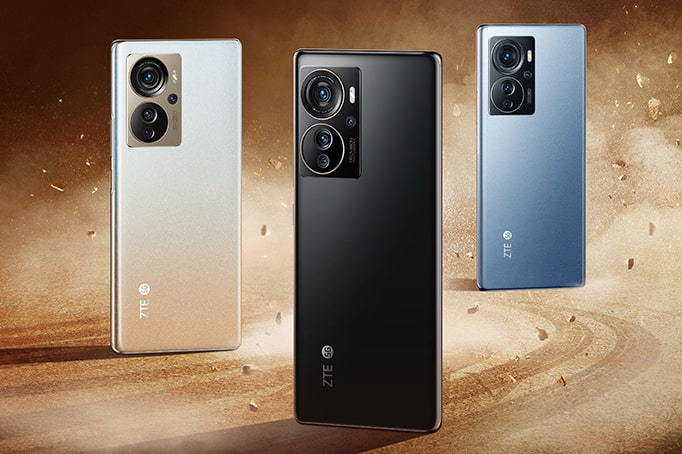
A few days ago, ZTE officially launched its next-generation Axon series flagship smartphones under the ZTE Axon 40 lineup. Today, the ZTE Axon 40 Pro smartphone officially goes on sale in China.
The 8GB RAM and 256GB storage model costs 2,998 yuan (~$450), while the 12GB RAM and 256GB model is priced at 3,298 yuan (~$495). The top-end model with 12GB RAM and 512GB internal storage is priced at 3,798 yuan, which is about $570.
The ZTE Axon 40 Pro features a 6.67-inch flexible curved AMOLED display with a screen resolution of 2400 x 1080 pixels and 10-bit color depth. It supports up to a 144Hz refresh rate, 360Hz touch sampling rate, and 1000 nits of peak brightness level.
Under the hood, the device is powered by the Qualcomm Snapdragon 870 processor, coupled with LPDDR5 RAM and UFS 3.1 storage. The handset features a graphene-based cooling (thermal management) system.
In the camera department, there’s a quad-camera setup on the back. It comprises a 108MP primary sensor measuring 1/1.52-inch, an 8MP 120° ultra-wide-angle unit, a 2MP 4cm macro snapper, and a 2MP depth sensor. On the front side, there’s a 16MP snapper for taking selfies and video calling.
The ZTE Axon 40 Pro smartphone runs the Android 12 operating system out-of-the-box with MyOS 12 custom user interface on top. It is powered by a 5,000mAh battery and comes with support for 66W fast charging.
The aforementioned products had already been confirmed before yesterday’s event. But what wasn’t revealed prior to the conference was the Redmi Note 11 SE. Though the phone sounds new, it is nothing but a Redmi Note 10 5G redux.
A year after its debut, Redmi has once again released this handset under a new name — Redmi Note 11 SE. However, unlike the previous three variants, this one doesn’t feature the third 2MP macro camera on the rear. Further, its design is near-identical to the Poco M3 Pro 5G instead of the Redmi Note 10 5G.
The phone arrives in two memory configurations, such as 4GB + 128GB and 8GB + 128GB. They are priced at ¥1,099 ($165) and ¥1,399 ($210) respectively, The device can be availed in either Shadow Black or Deep Sea Blue color options.
The handset is up for pre-order and will be available for purchase starting May 31. For a limited time, as part of the 618 promotions, the base model will cost only ¥999 ($150).
Though the pricing sounds cheap, it actually isn’t. The original Redmi Note 10 5G was also introduced at the same price and it was also available at ¥999 for a limited time.
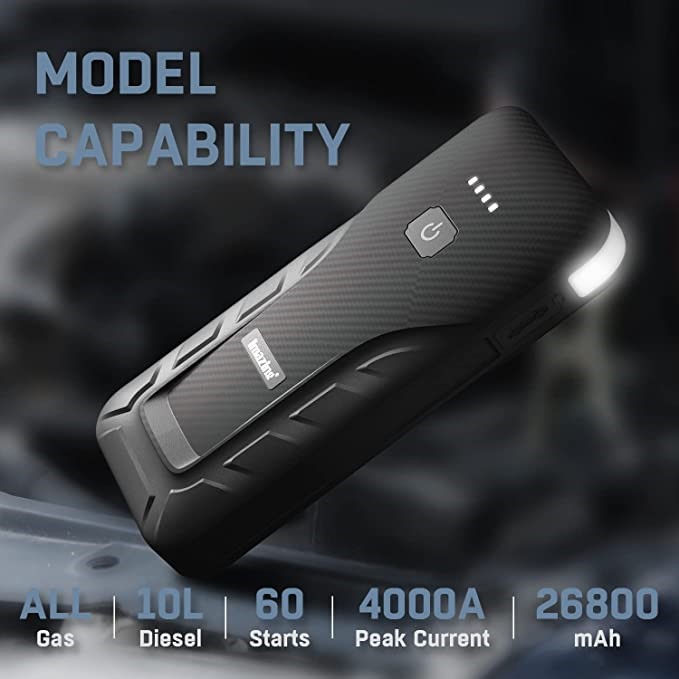
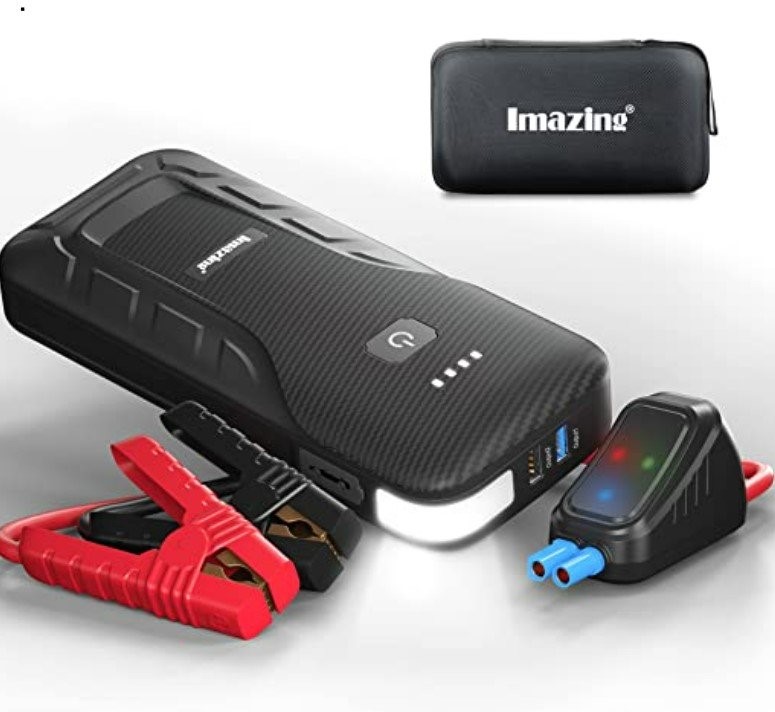
Imazing’s new Car Jump Starter, IM 39, comes with a 26800mAh battery and 4000A peak current which helps you to jumpstart (Up to ALL Gas or 10.0L Diesel) 12V cars, motorcycles, ATVs, UTVs, lawnmowers, snowmobiles, boats, and more. You can jumpstart your device up to 60 times on a full charge. The comparatively lightweight and portable design makes it easy to carry around while traveling and camping. Thus you never have to worry about being stuck in the middle of nowhere with a dead vehicle as long as you carry the Imazing Car Jump starter.
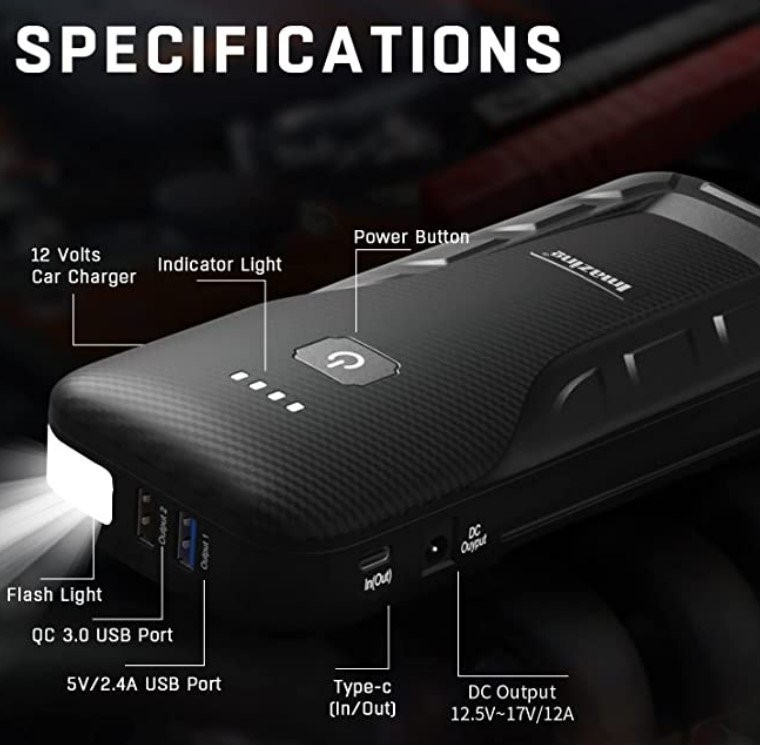
Featuring 2 x USB output ports and 1 x Type-C in(out) port, the device provides fast charging and is compatible with almost all USB charging devices, including phones, tablets, cameras, kindles, etc. This means you can use the device not only as a car jump starter but also as a power bank. Moreover with an in-built LED flashlight with three life-saving modes viz. Flashlight, SOS, and strobe, you can count on this device to help you in emergencies when you are stuck outdoors.
Key Features:
-Small Size, Huge Power:
IM 39 has only about 9.65 x 3.86 x 1.81 inches size, but it’s amperage can peak at 4000A, which means it can jump starter most 12V cars, motorcycles, ATVs, UTVs, lawn mowers, snowmobiles and etc.
IM 39 also has as large as 26800mAh, or 100 watt-hour capacity. That enables the unit to jump start vehicles at least 60 times on a full charge.
-Dual Protection:
With UL2743 standard certification and the F19 Smart clamp of 8 advanced safety protection technologies, Imazing jump starter provides ultimate protection for your safety.
-Portable Power Bank:
Designed with dual USB output ports and one type-c port, the quick-charge 3.0 USB port provides the fastest charging speed and is compatible with almost all USB charging devices, including phones, tablets, cameras, kindles and etc.
-Outdoor Lighting:
With Flashlight, SOS, and strobe the 3 modes of Imazing lighting functions, IM 39 can handle most outdoor problems due to lacking lights. It can be a life-saver when encountering some emergencies.
Imazing is giving a limited-time 78% off for this IM 39 portable jump starter.
Use the code: 6DZYKRIL to enter this insane deal on Amazon US ONLY.
Featuring 2 x USB output ports and 1 x Type-C in(out) port, the device provides fast charging and is compatible with almost all USB charging devices, including phones, tablets, cameras, kindles, etc. This means you can use the device not only as a car jump starter but also as a power bank. Moreover with an in-built LED flashlight with three life-saving modes viz. Flashlight, SOS, and strobe, you can count on this device to help you in emergencies when you are stuck outdoors.
Generally retailing for $249.99, it is now 50% off, on Amazon US. What’s more, you can get an extra 28% discount with the code: 6DZYKRIL. Thus you can buy Imazing IM39 portable jump starter for $89.99 only. Please note that this is a limited-time offer that ends on May 29th.
For more information on such exciting deals and offers check out our deals hub.
Dangbei, an emerging brand in the projector space, released its flagship projector in March this year: the Dangbei Mars Pro. We’ve been using it for a while, and I can tell you our verdict in advance: skip this if you have high requirements for image size and quality, and you want to use it during the day. But if you don’t want to spend too much money, the Mars Pro is definitely your cup of tea.
I’ll explain what makes Mars Pro so great.
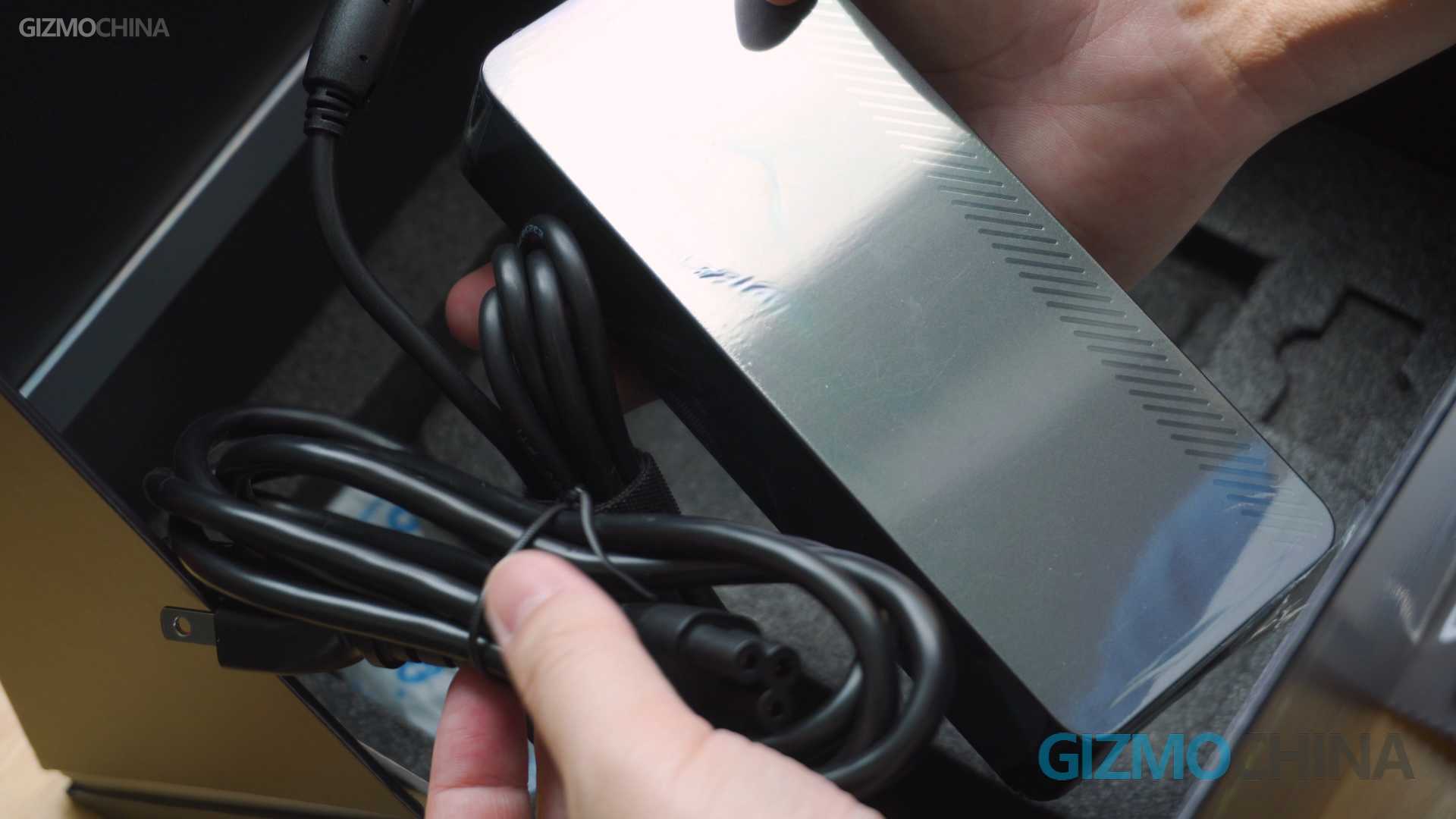
Let’s start with the unboxing. All the accessories are under the projector. Take the projector out, there is a Power Adapter and a power cable, a remote control, an instruction manual, a PTZ washer, and a lint cloth for cleaning.
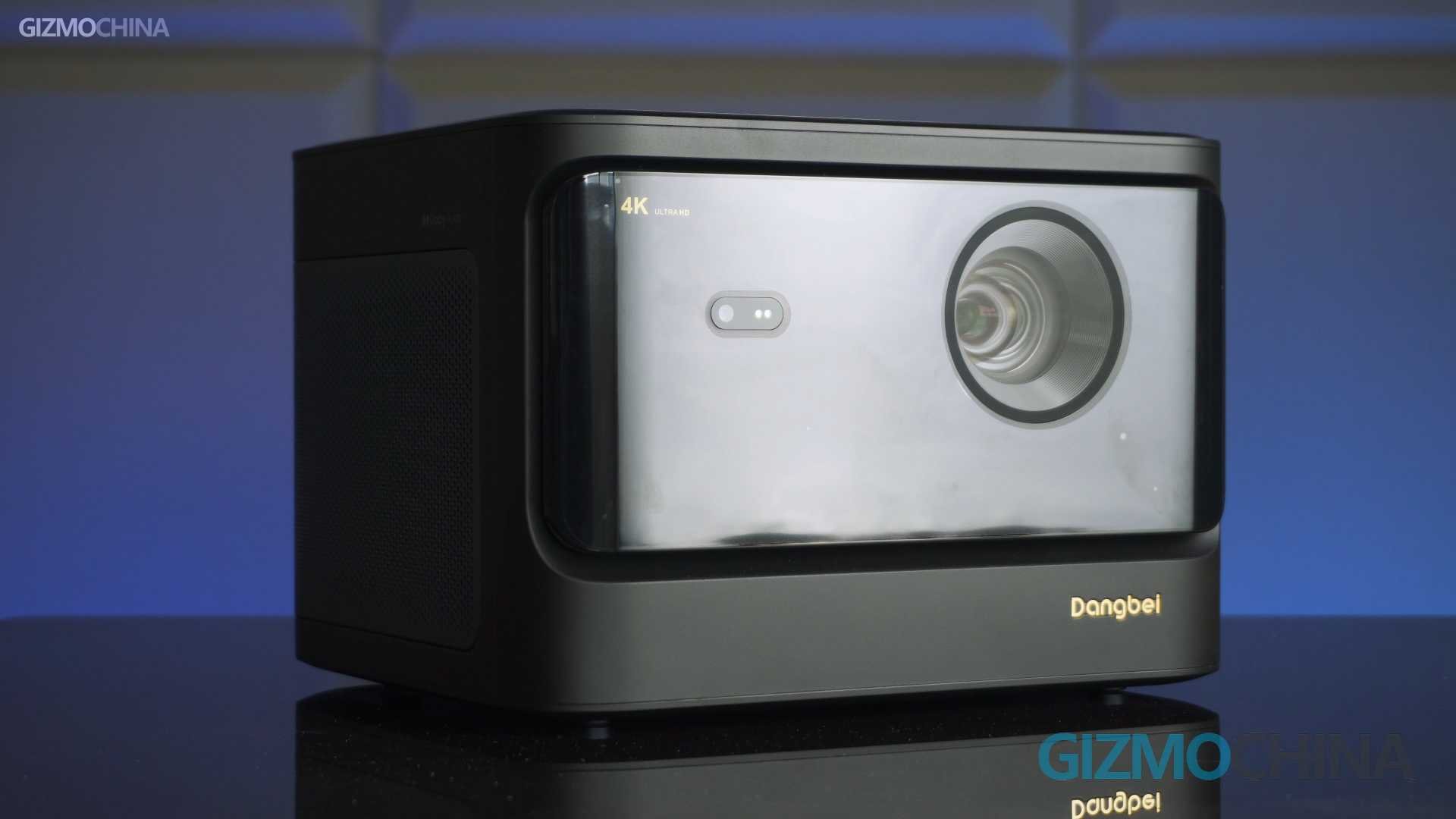
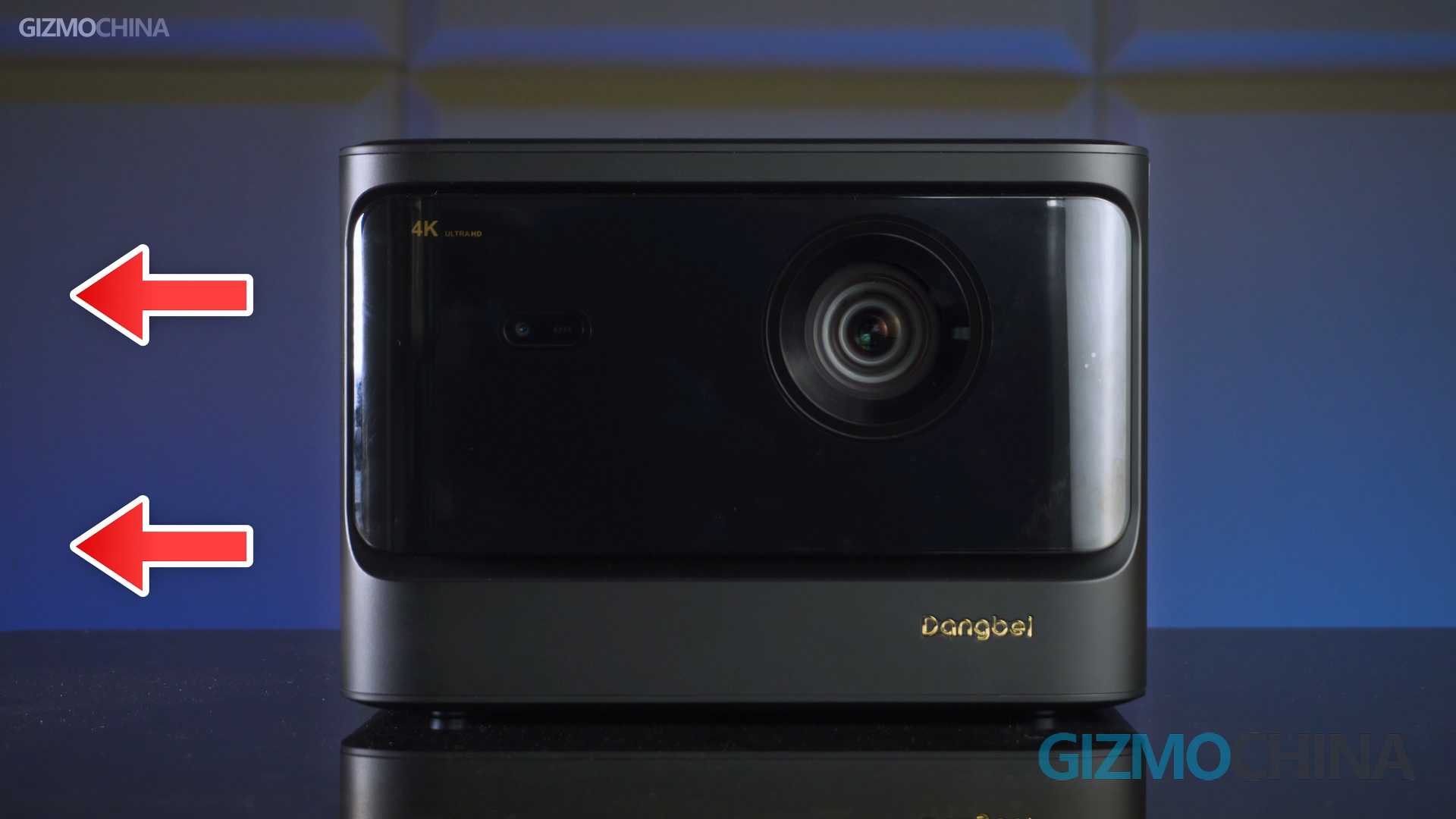
The Dangbei Mars Pro is designed with a taller body than most projectors. The larger size means you can put better hardware inside and better cooling performance. Because the body material is made of all metal, it looks and feels great. On the front, in addition to the large lens, there is a camera and a laser focus element. There is only one non-pushable button on the top. To prevent scratching of the glass panel during long time use, Dangbei has also thoughtfully applied a film to the front and top. The buttons, laser hole, and lens position of the film are all open, so don’t worry about affecting the image quality and operation. It has speakers on both sides and an active cooling fan. The wind blows in from the right and out from the left. Thanks to the larger body, the fan does not need to be very fast, so it is not very noisy.
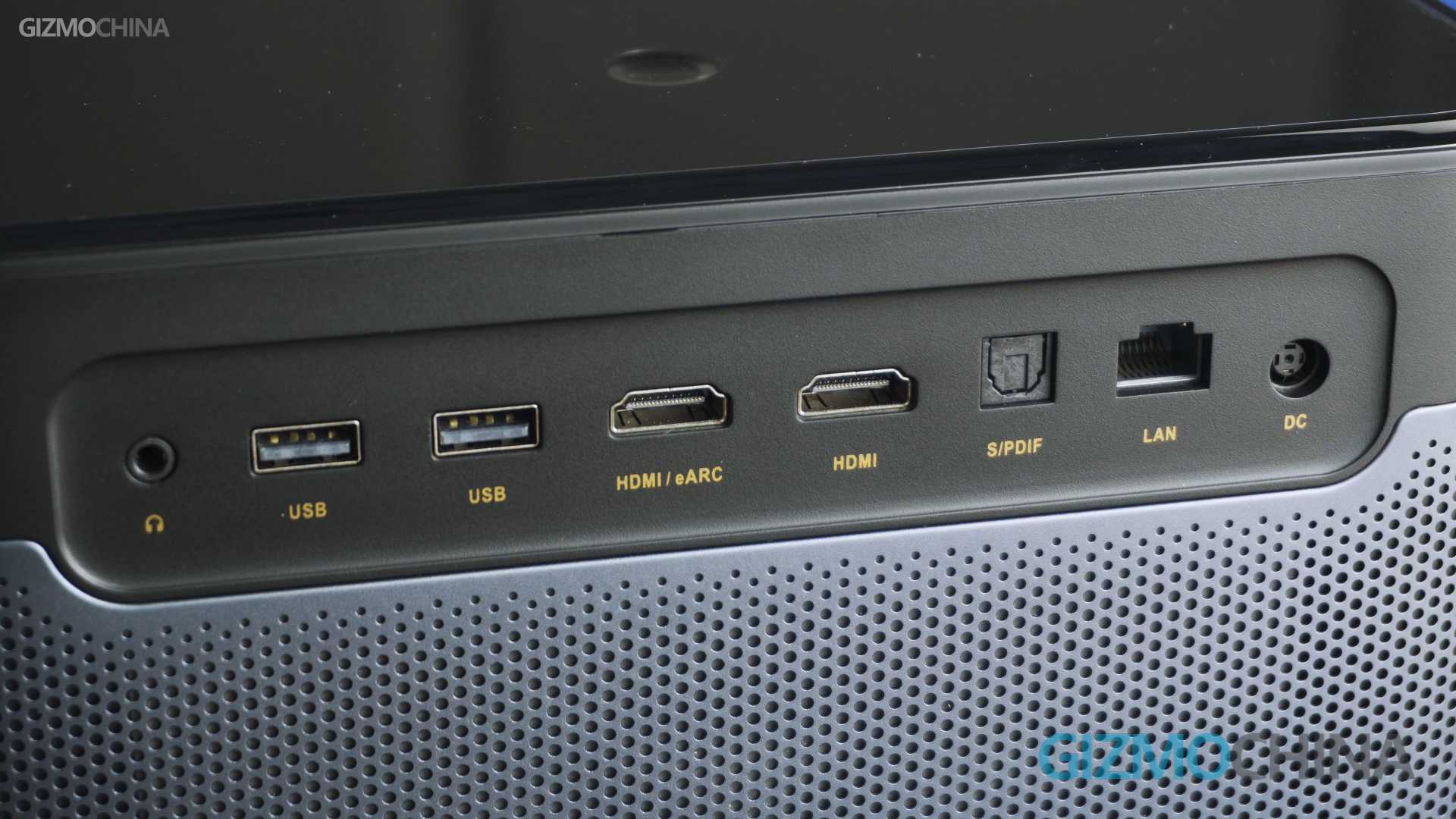
The back has a full complement of I/O ports. One headphone jack, two USB ports, two HDMI ports, one of which supports ARC, one LAN port, one S/PDIF and a power port. It also supports Bluetooth, 2.4G and 5G Wi-Fi, so whether you want to connect a PC, PS4 or Bluetooth headphones, or whatever, the Mars Pro supports them all very well.
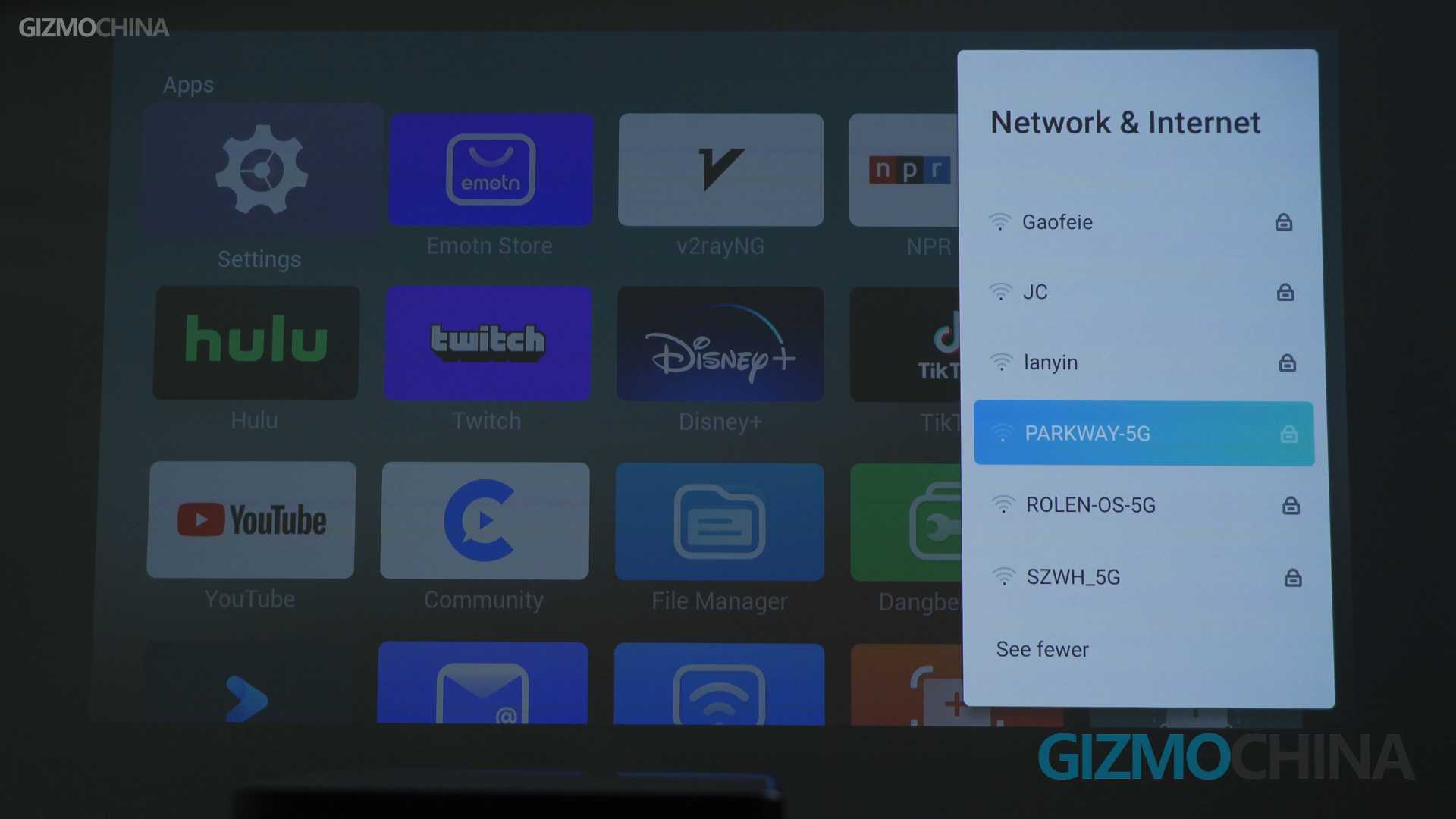
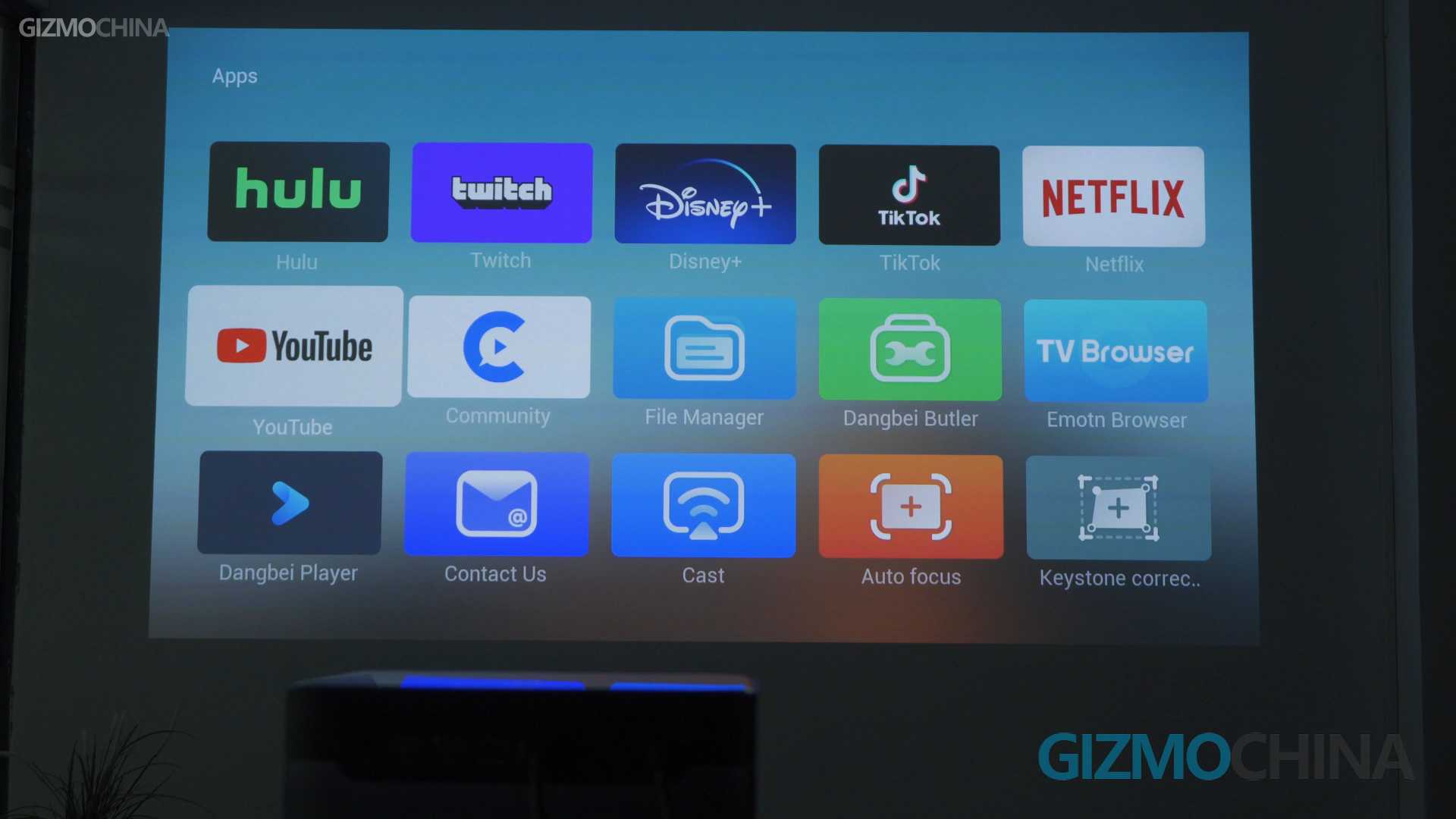
Before we talk about its image quality, let’s take a look at Mars Pro’s Emotn OS, which has a simple UI design for its appearance. The main functions and applications are at the bottom, pulling down the drawer like an Android phone, which contains all the applications. The Mars Pro’s remote control has an interesting button, a long press to call out the mouse, so you can operate it like a PC.
The Mars Pro uses an MT9669 processor. The operation is smooth without lag. Maybe you think 4+128GB storage is not good enough, but I want to tell you the truth: most projectors actually have less than 64GB of storage space, and 128GB is a huge amount of storage space in a smart projector. The Emotn store has major streaming platform apps such as YouTube, Netflix, and twitch, so you don’t need to download the APK on your PC and then copy it to the projector. Even if the app is not available in the store, it can jump to the web with one click, which is very convenient.
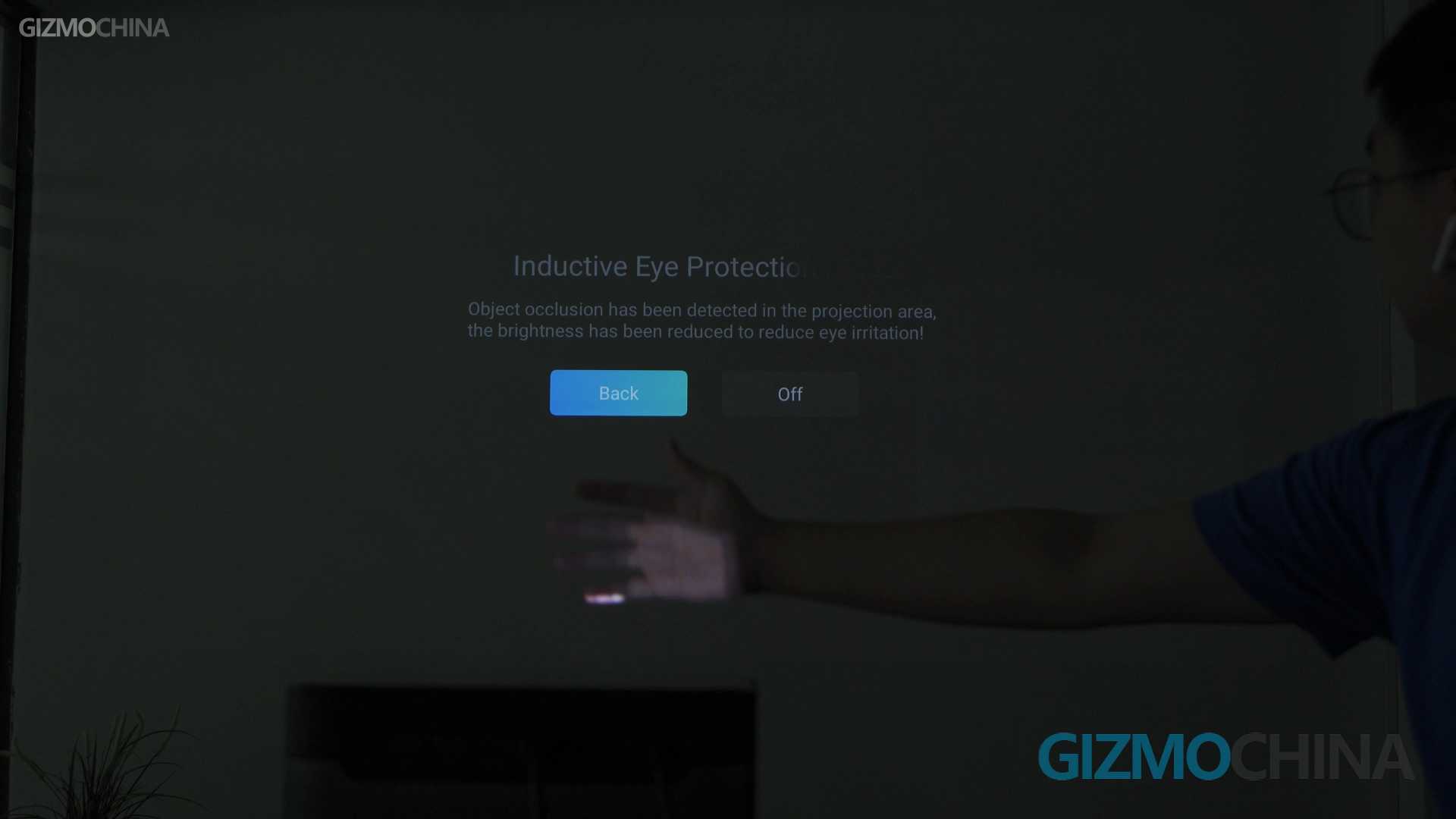
Many of the auxiliary features exclusive to projectors, such as Auto Focus and Auto Keystone Correction, are also available on the Mars Pro. And there are many features that other projectors don’t have, such as Intelligent Obstacle detection, where the screen can intelligently avoid objects on the wall. There is also this Intelligent Screen Alignment, which can automatically cast the image on the screens. To protect your eyes, if the camera detects an object close to the front of the lens, it will also quickly reduce the brightness to avoid hurting your eyes. I have to say, Dangbei is very focused on the user experience.
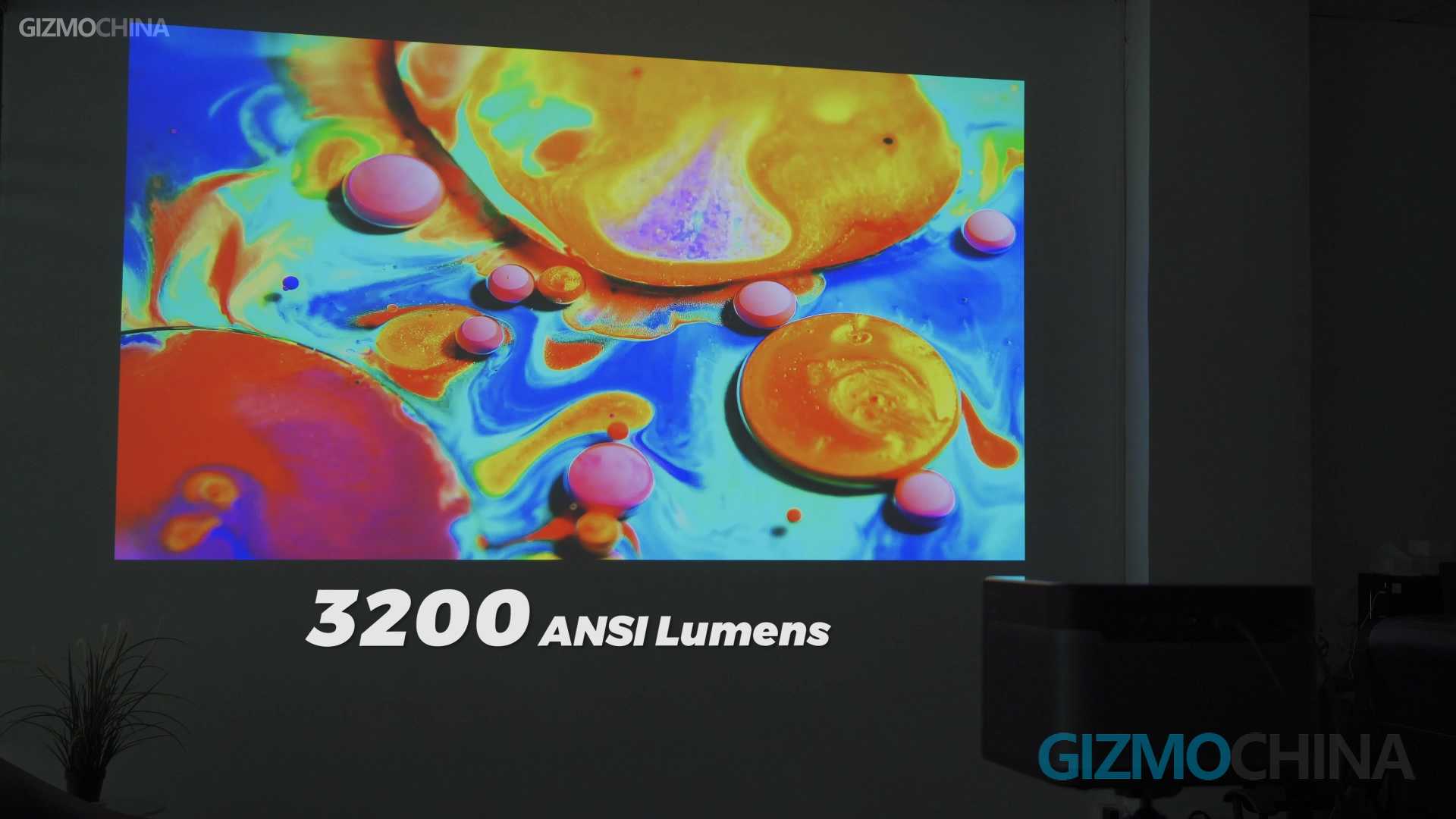
The Mars Pro is not only a 4K projector but also has a maximum brightness of 3200 ANSI Lumens. The most important specification of a projector is its maximum brightness. To achieve such brightness, Mars Pro uses ALPD Laser Technology. With such high brightness, even if you turn on the lights like we do and project directly on a white wall, you can still see the content of the picture clearly. Of course, no matter which projector you use, we recommend you use it with the lights off to get the best effect. The color uniformity is good and there are no noticeable color blocks in any area. Laser projectors are brighter than regular LED projectors for higher contrast. It also has a longer lifespan and is cheaper than Lamp projectors. I think Laser projectors should be the mainstream type in the projector market in the future.
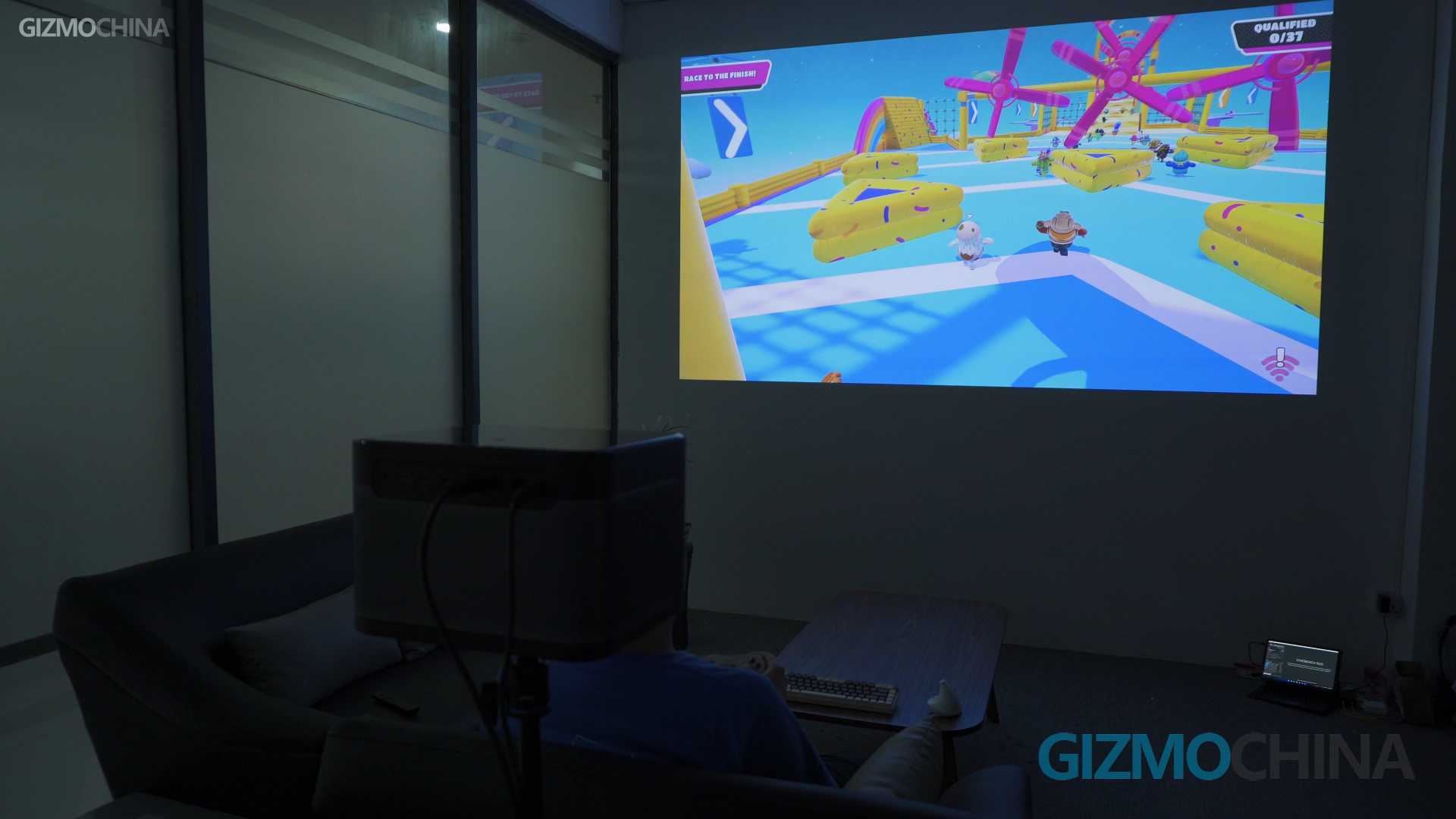
Mars Pro also supports a 120Hz refresh rate and MEMC, so it should be good for gaming. So, let’s take a look at the latency first. Increasing the shutter speed to take a picture of the timer will give you a rough idea of its HDMI input latency level. The Mars Pro has Game mode, which can significantly improve the responsiveness of the image. While it may not compare to a monitor in terms of latency, it will give you a more impactful image that will immerse you in the world of gaming. After all, it can project more than 100 inches. It also performs well with its 10w stereo speakers, supporting Dolby Audio and DTS HD certification. Now, you guys can listen to its viewing and gaming performance for yourself from the video review below.
Dangbei is bringing pretty interesting products to the projector industry. Their Mars Pro comes in at around $1600 with a full metal body and 4k 120hz. Most importantly, they have brought down the price of the Laser light source projector.
If you are looking for a cheap Laser projector, then the Dangbei Mars Pro is definitely one projector you can’t go wrong with.
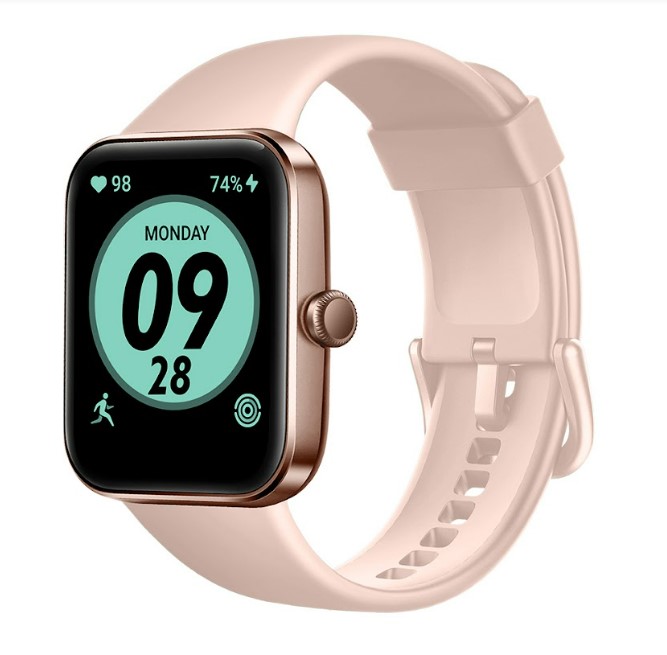
SKG is giving a huge discount on its latest SKG V7 Smartwatch. The watch which generally retails for $49.99 is now available at a heavily discounted price of $33.99 by using the 15% OFF Coupon Code: SKGV7PRO and a $10 OFF page discount coupon. Please note that you can use both the page coupon and discount coupon code together. The deal starts on 23 May, 0:00 PDT, and ends on 31 May 2022, 23:59 PDT.
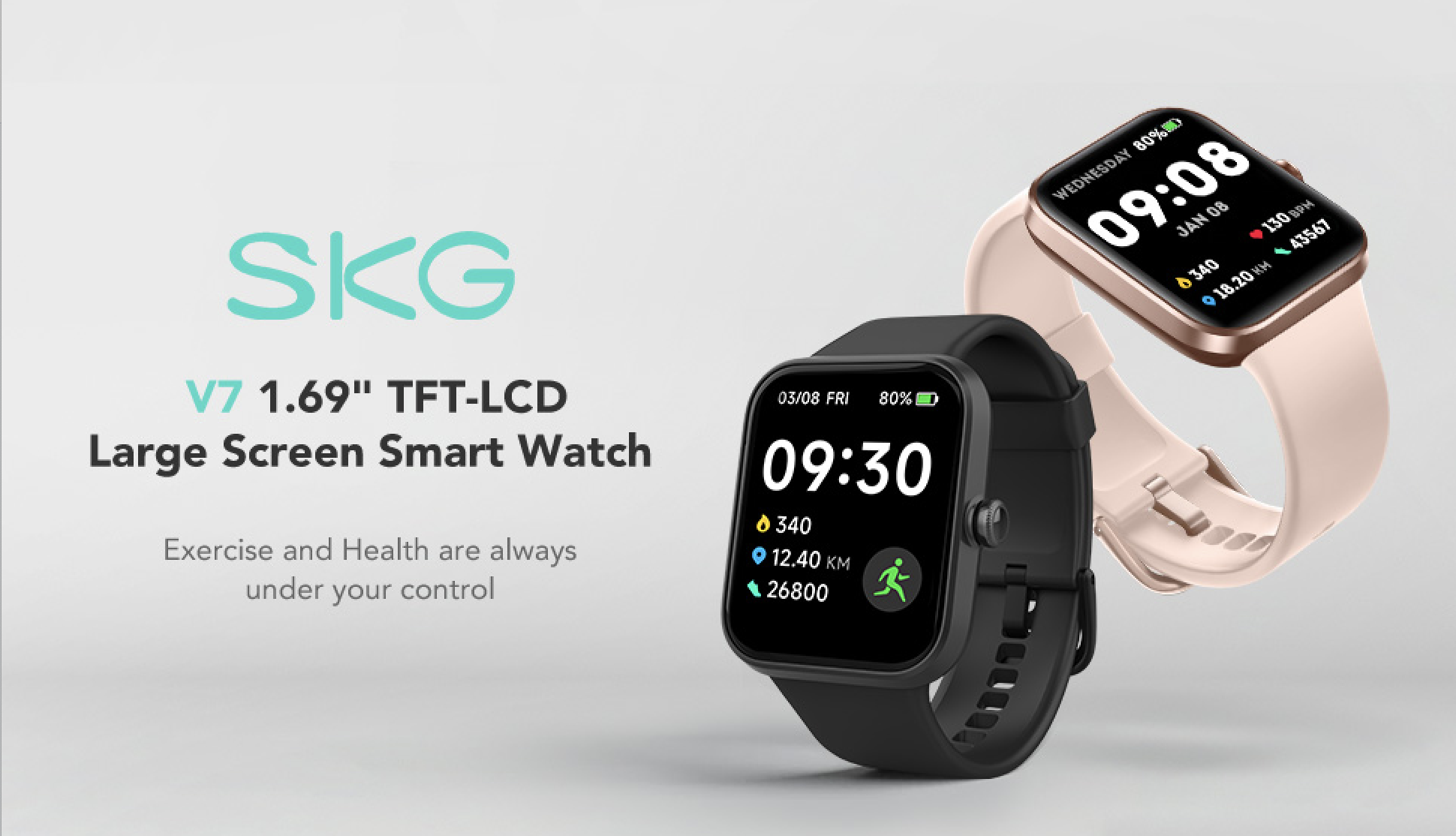
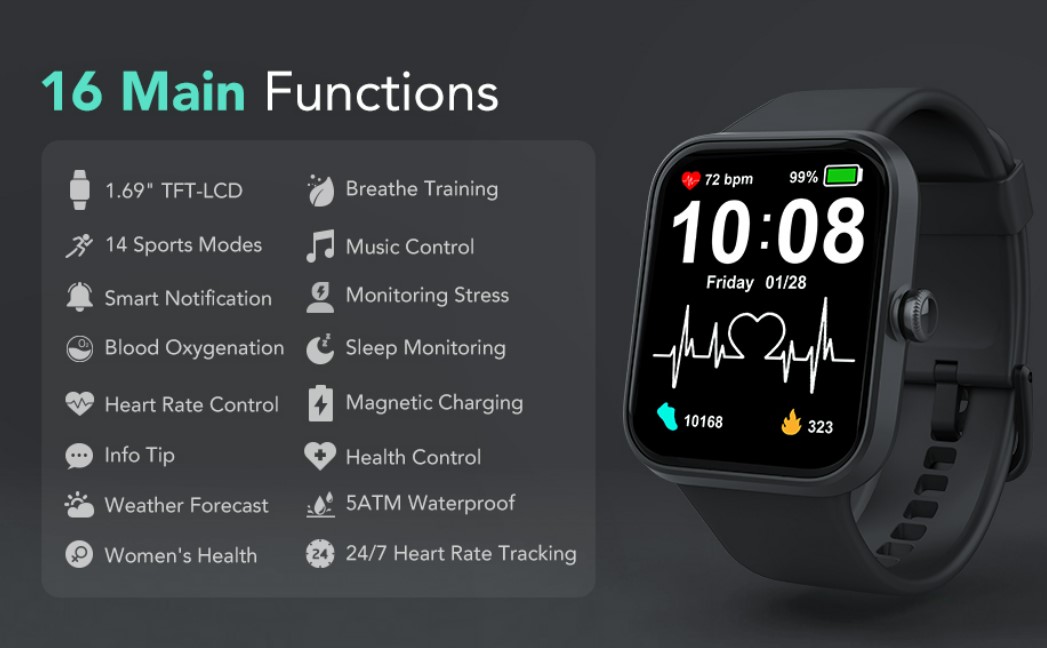
SKG V7 Smartwatch features a 1.69” large TFT LCD square display with an 80% screen-to-body ratio and weighs just 1.37 ounces. The watch is built to manage your fitness at your fingertips and can monitor your physical activities and condition all day long.
The SKG V7 smartwatch comes with a 24 x 7 heart rate monitor, blood oxygen monitor, auto sleep monitor, Female health tracker, etc. You have 14 sports modes including running and swimming and GPS enabled route tracking function. The watch is 5ATM waterproof and can be used for water sports and underwater activity monitoring.
SKG V7 Smartwatch comes with impressive battery life on standard mode and is compatible with both iOS and Android devices. Available in Black and Pink color variants, you can now get the SKG V7 Smartwatch at a discounted price of $33.99 only on Amazon.
Please note that this discount is available only after using the page coupon and coupon code together. The deal ends on 31 May. So place your order before the deal expires.
About SKG:
Founded in 2007, SKG is an R&D company specializing in developing wearable health devices. SKG combines the best of fashion and technology and packs everything great into beautifully-designed massage products that enable a healthier lifestyle. SKG’s products have received recognition from the international design community, including the Red Dot Design Award and IF Design Award. In a modern world of fast living and full of stress, SKG is committed to delivering health and relaxation products that help people live healthier, longer, and better lives.
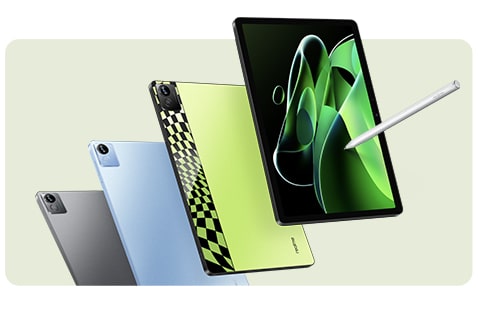
Realme Pad X could be making its debut in the Indian market soon. The launch details are yet to be officially announced by the Chinese smartphone maker, but the Realme Pad X has reportedly received certification from the Bureau of Indian Standards (BIS), hinting that it may arrive in the country soon. Realme has already confirmed that it will unveil its new tablet on May 26 in its home country, China.
Tipster Mukul Sharma who goes by the username @stufflistings spotted a Realme Pad X device on BIS with model number RMP2108. There is no clarity on when the Realme tablet will launch in India. The company has not shared any information regarding Realme Pad X’s India variant yet, however, it is expected that specifications will be the same as the Chinese variant launching tomorrow.
Lucky for us, the major specifications of the Realme Pad X have already been confirmed. Let’s check it out.
Realme Pad X Specifications
Yesterday, Xu Qi Chase, Vice President at Realme, shared some major specifications of the Realme Pad X on the Chinese microblogging website Weibo. According to Chase, the upcoming tablet from Realme will house an 11-inch ultra-clear large screen with 2K resolution. He mentioned that the tablet will come with a four-speaker setup with Dolby Atmos support. Chase also revealed that the tablet will come with a hardware-level anti-blue light for eye protection, with TUV Rheinland’s eye protection certification on top.
The Realme Pad X will pack an 8,340mAh battery with 33W charging support. It is claimed that the tablet can be used for a week on a single charge. The tablet’s storage can be expanded with the help of a MicroSD card. Realme is yet to announce the details about the chipset powering the smartphone.
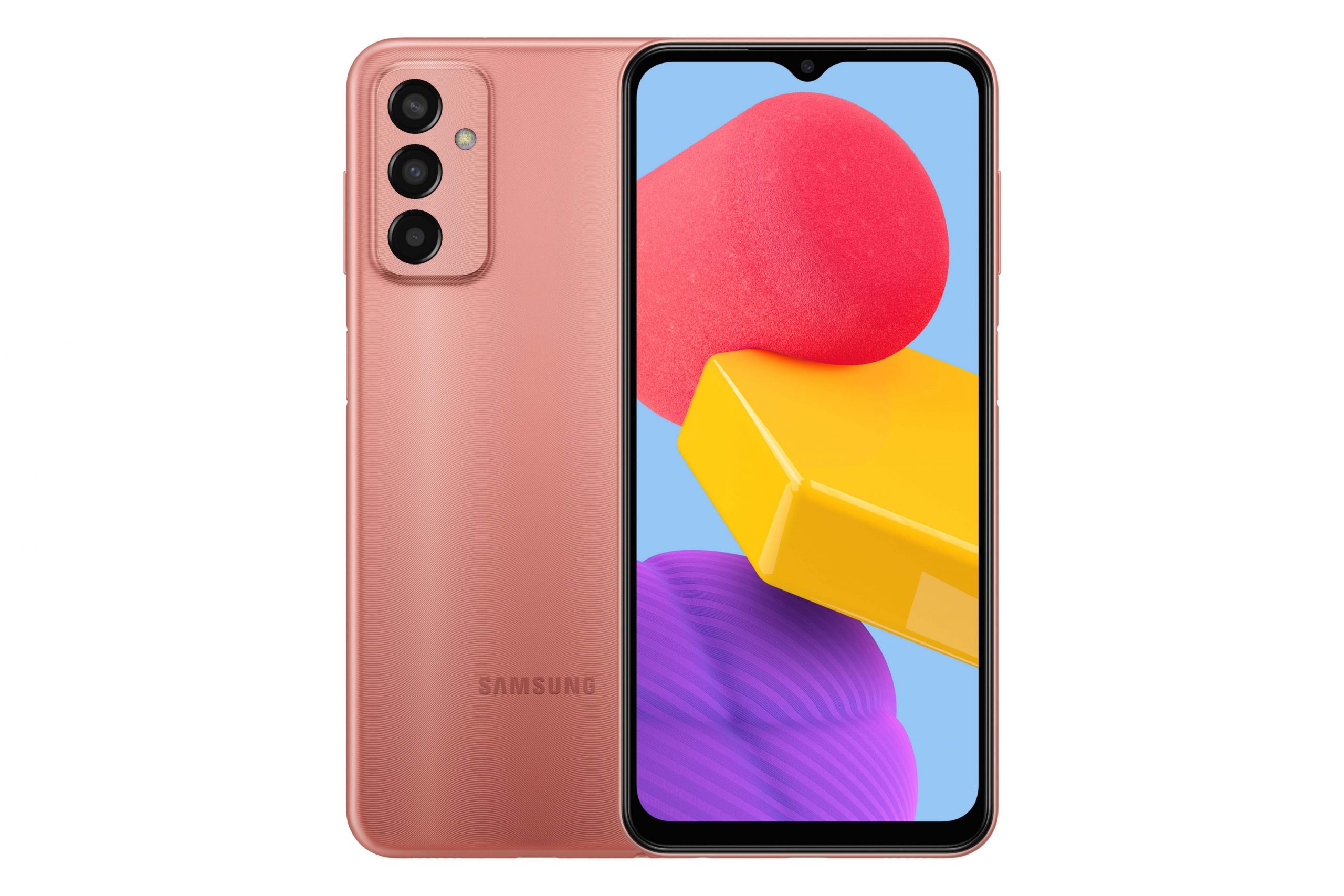
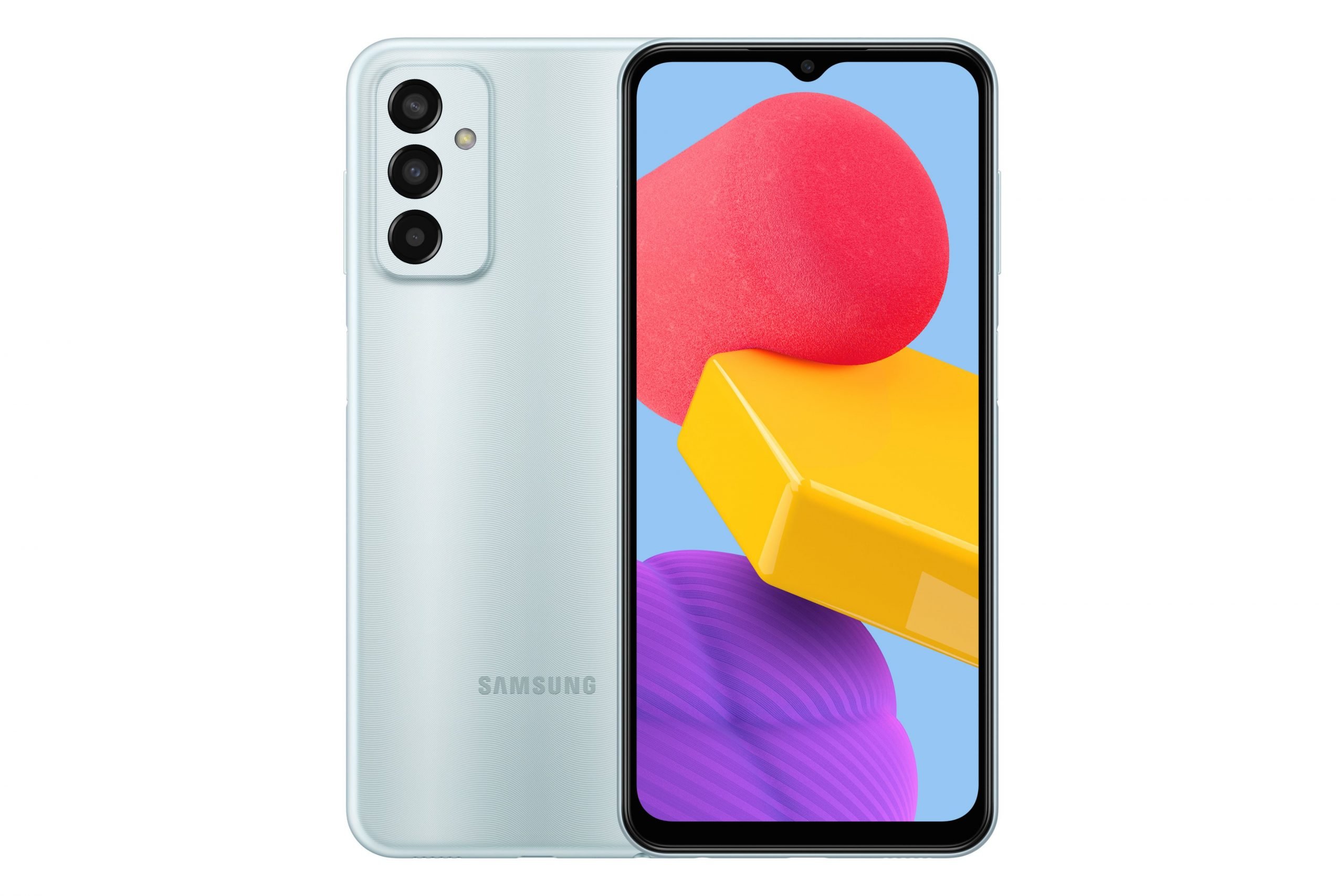
Samsung is expected to announce the Galaxy M13 mid-range phone soon in different markets. Recently, the device was spotted at TUV, Bluetooth SIG, and FCC certification platforms. A support page for the handset went live on Samsung UK’s website last week. Now, Evan Blass, a well-known tipster, has shared high-resolution renders of the Galaxy M13 to show how it looks and what colours it will come in.
The Galaxy M13 images show that it will be available in at least three colors such as dark green, white, and peach. The front of the device is flanked by a waterdrop notch screen, which has a thick bottom bezel.
1 of 3
Samsung Galaxy M13
Samsung Galaxy M13
Samsung Galaxy M13
Samsung Galaxy M13
Samsung Galaxy M13
Samsung Galaxy M13
Previous reports have claimed that the Galaxy M13 has a dual-camera unit on the back. However, the leaked renders suggest that it is equipped with a triple camera unit and an LED flash. The right side of the device features a volume rocker and a power button, which is integrated with a fingerprint scanner.
Samsung Galaxy M13 specifications (rumored)
Reports have revealed that the Galaxy M13 will be equipped with a 6.5-inch IPS LCD screen that offers an HD+ resolution. There is no word on the front camera of the device. Its rear shell is expected to feature a 50-megapixel main camera and a 2-megapixel depth sensor. The battery size of the Galaxy M13 is not known yet, but it is expected to carry support for 15W fast charging.
Other features of the Galaxy M13 include a dual-SIM slot, Wi-Fi, a microSD card slot, and a 3.5mm audio jack. The handset may debut as early as this month.
Xiaomi introduced the Redmi K50 series smartphones in the Chinese market a couple of months ago, in March this year. Now, the standard Redmi K50 is getting a new variant and a new color in China.
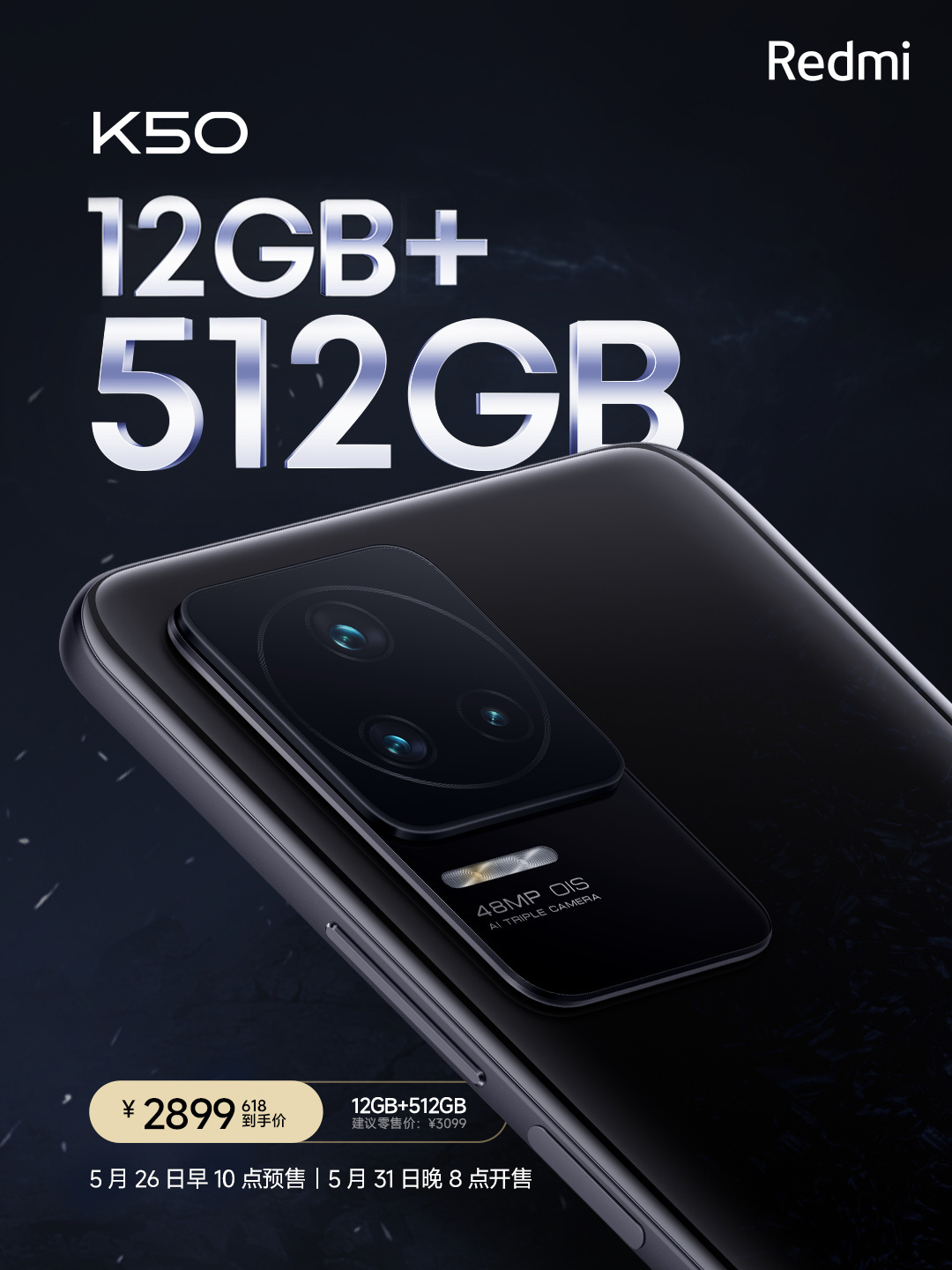
The company has introduced the Redmi K50 smartphone, which packs 12GB of RAM and 512GB of internal storage. This new model is priced at 2,899 yuan, which roughly converts to $435. It is now up for pre-order in China and will go on sale from 26th May.
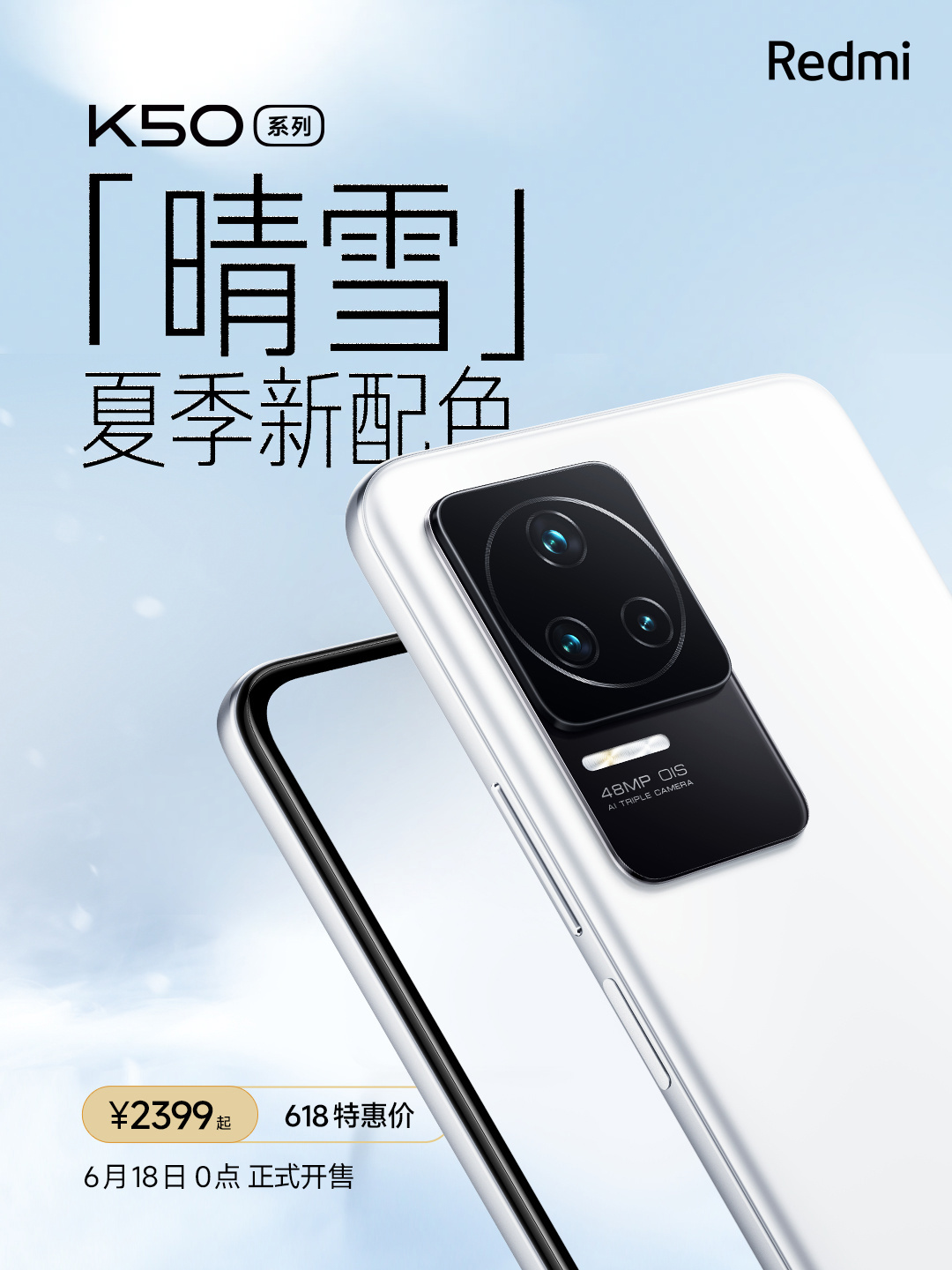
Along with that, the company has introduced a new color option for the Redmi K50 series, dubbed Qingxue, which comes with a matte white back panel. It will be officially available for purchase from 18th June, with a starting price of 2,399 yuan (~$360).
Coming to the specifications, the Redmi K50 features a 6.67-inch AMOLED QHD+ display that offers a 120Hz screen refresh rate. Under the hood, it is powered by the MediaTek Dimensity 8100 processor.
The devices pack up to 12GB of LPDDR5 RAM and 512GB of UFS 3.1 internal storage. In the camera department, the Redmi K50 has a triple-camera setup on the back that includes a 48MP primary sensor, an 8MP ultra-wide lens, and a 2MP macro sensor. On the front side, there’s a 20MP snapper for taking selfies and video calling.
It runs the Android 12 operating system out-of-the-box with the company’s own MIUI 13 custom user interface on top. The device is powered by a 5,500mAh battery that comes with support for 67W fast charging.
Several reports have revealed that Motorola’s next clamshell device, having the “Maven” codename, will be equipped with a flagship chipset. Since the final marketing name of the device is not known, it is being tentatively called the Motorola Razr 3 by the rumor mill. Earlier this month, 91mobiles released two leaked shots of the Razr 3. Now, reputed tipster Evan Blass shared an 8-second video clip of the Razr 3 to give a good look at its front and rear design.
Motorola Razr 3 hands-on video
The “Maven” device can be seen with the inner foldable screen turned on. Since the phone is working, it appears to be a late prototype or a retail version of the phone. This indicates that the launch of the Razr 3 may not be far away.
The previous Razr models had a notch for the front-facing camera, but the upcoming model has a hole-punch cutout for the selfie camera. Moving to the back, it has a horizontally arranged dual-camera system. It also houses a bigger secondary display and a side-facing fingerprint sensor. The video reveals that the device is running on a MyUX flavored Android 12 OS. However, it has no new information on the specs of the device.
Motorola Razr 3 specifications (rumored)
The Motorola Razr 3 will come with a 6.7-inch FHD+ 120Hz inner foldable screen and a 3-inch cover display. It will feature a 32-megapixel selfie camera and a 48-megapixel (main) + 13-megapixel (ultrawide) dual-camera setup.
The device is said to come in both Snapdragon 8 Gen 1 and Snapdragon 8+ Gen 1 chipset variants. The device may offer up to 12 GB of RAM and up to 512 GB of built-in storage. It will pack a 2,800mAh battery. At present, there is no word on the price of the device. It may debut in late July or August and come in colors like Quartz Black and Tranquil Blue.
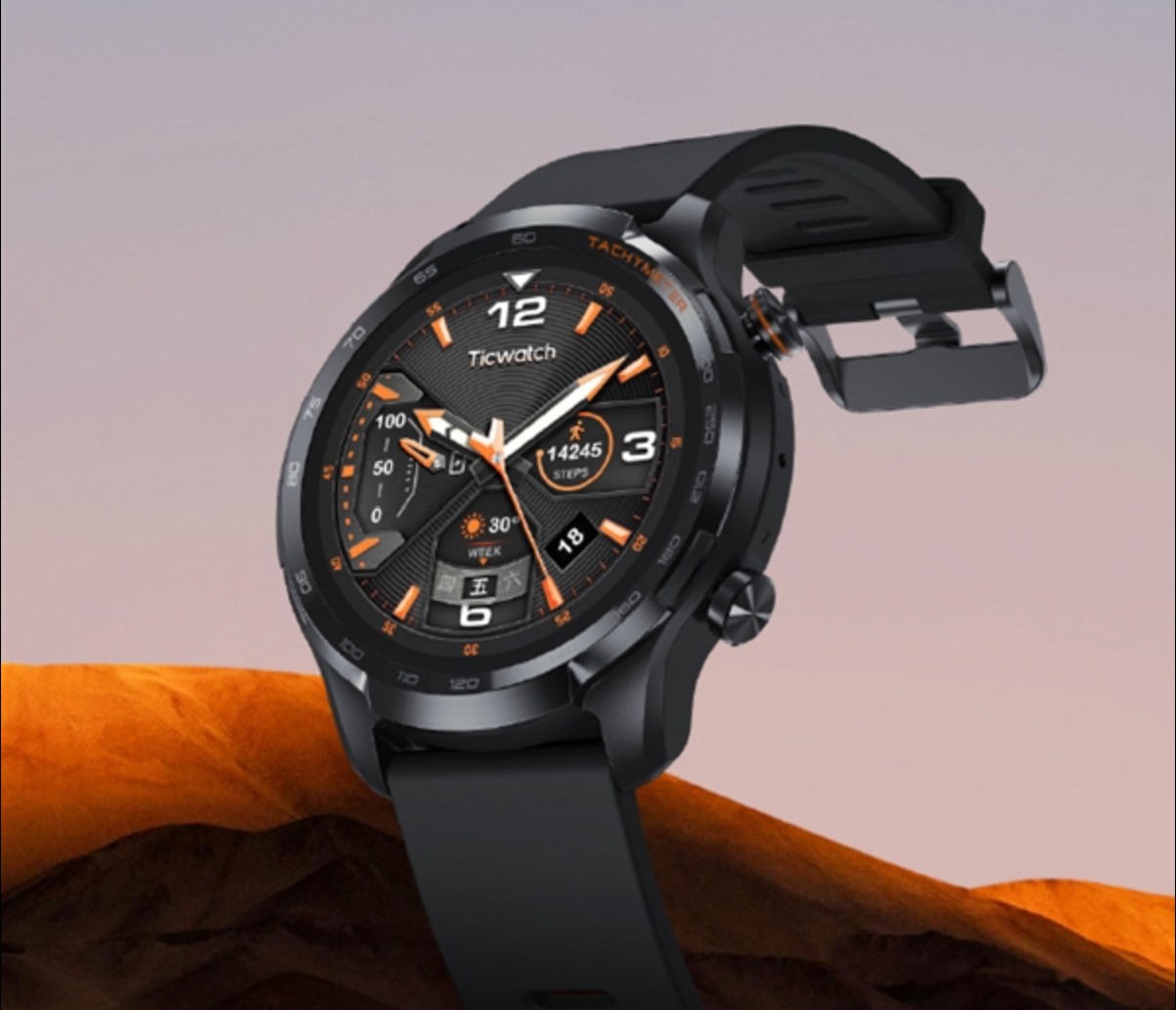
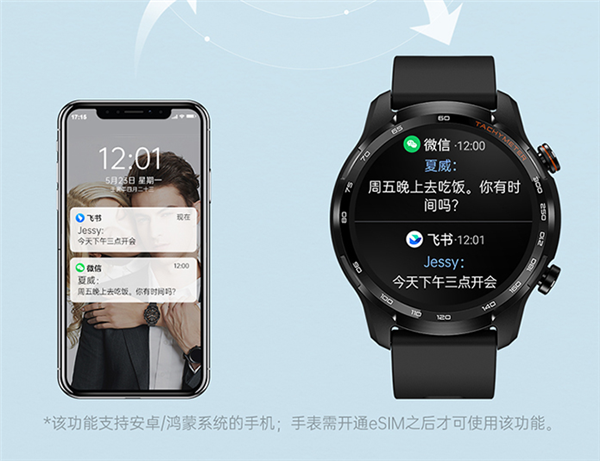
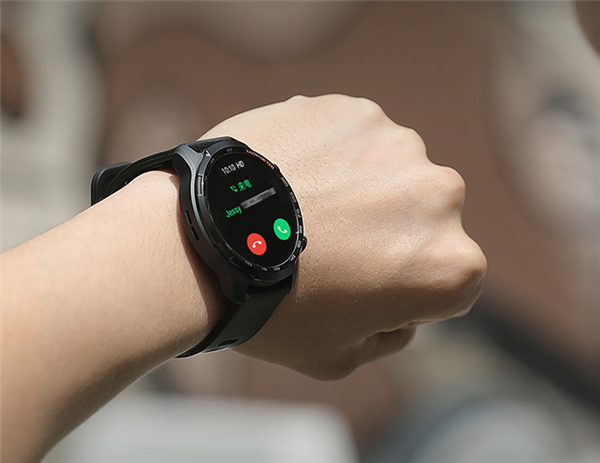
Chinese smartwatch maker Mobvoi has launched a new affordable smartwatch that features support for 4G calls. The TicWatch GTW eSIM carries a decent price tag of 999 yuan ($150) in the brand’s home market. It is presently up for pre-orders via Jingdong (JD.com).
The TicWatch GTW eSIM as you can guess supports an autonomous eSIM calling function. Thus, users don’t need to go out with their smartphones and can make calls while running outdoors in the morning, walking downstairs with the dog, or picking up couriers.
In terms of design, the GTW eSIM features a 1.39-inch retina-level AMOLED covered by a wear-resistant and scratch-resistant glass. The watch weighs 38.5g and uses a 22mm textured silicone strap which is comfortable to touch, is breathable and dries off easily.
Just all Mobvoi smartwatches, the TicWatch GTW eSIM comes with support for over 100 sports modes including rock climbing, sailing, cycling, and many others. Equipped with the self-developed TicMotion Al algorithm, the watch can automatically recognize when the user is walking, running, or riding. It also features support for basic functions such as heart rate monitoring, sleep monitoring, and bus access control.
The watch features support for IP68 waterproof protection. There is also Bluetooth support allowing users to pair a headphone, making it possible to listen to your favorite music while out exercising without a companion smartphone.
One of the interesting features is the 30 days of battery life under regular usage. Under extreme usage, the watch can last up to 7 days.
Earlier this month, Motorola announced the Moto E32 without any fanfare in Europe. Now, the company has unveiled a new variant of the phone called the Moto E32s. Here is all the information on the specifications, features, and price of the E32s.
Moto E32s specifications and features
The Moto E32s has a 6.5-inch screen with a punch-hole design and a thick chin. It offers an HD+ resolution of 720 x 1600 pixels and a 90Hz refresh rate. It has an 8-megapixel camera on the front for video calls and selfies. Its rear camera setup has a 16-megapixel main camera, a 2-megapixel depth sensor, and a 2-megapixel macro camera.
The E32s is powered by the MediaTek Helio G37 chipset. It comes with 3 GB / 4 GB of RAM and 32 GB / 64 GB of built-in storage. The device comes preloaded with the Android 12 OS. It packs a 5,000mAh battery that supports 18W fast charging.
Moto E32s
The handset features a side-facing fingerprint scanner and supports face unlock. It comes with other features such as Wi-Fi, VoLTE, and Bluetooth 5.0. The handset measures 163.95 x 74.94 x 8.49mm and weighs around 185 grams.
The specifications and design of the Moto E32s are almost identical to the Moto E32. The only noticeable difference is in the chipset department. The E32 is equipped with the Unisoc T606 chip, while the E32s come with the Helio G37.
Moto E32s price and availability
The Moto E32s is priced at 149 euros. It can be purchased in Misty Silver and Slate Gray colors. The handset is expected to launch on May 27 in India.
Nothing Phone (1) launch date seems to be fast approaching. According to the German publicationAll Round PC, Nothing’s first smartphone will be announced in July. The report not only mentions its launch date but also hints at its pricing.
OnePlus co-founder Carl Pei left the company in September 2020 to launch the Nothing brand. Last year, the company launched the Ear (1) TWS earbuds as its first product. In March this year, the company confirmed that it is working on its first smartphone called the Nothing Phone (1). At that time, Pei had revealed that the smartphone would be announced in summer 2022, which indicated that it may debut between June and September.
According to the German publication, it has learnt through a European dealer, the Nothing Phone (1) will launch on July 21 this year. However, the publication is unclear whether the company will be holding a launch event or carrying out its first sale on the said date.
Unfortunately, there is no information yet on the specifications of the Nothing Phone (1). However, the publication claims that the brand is targeting a price range of around 500 euros. The pricing suggests that the Nothing Phone (1) may not be a flagship device. It could be an attractively priced mid-range phone with a transparent design. A tweet released by Pei suggests that the device may arrive with support for wireless charging.
Me: what’s this? Design Team: it’s Massimo Vignelli’s New York subway map Me: okay I like it Picasso
Some rumors that are floating around claim that the Nothing Phone (1) has the Snapdragon 7 Gen 1 onboard. The device will come preinstalled with the Nothing OS. The device will be treated with 3 years of OS upgrades and 4 years of security updates. Hopefully, more details about the Nothing Phone (1) will surface in the next few days.
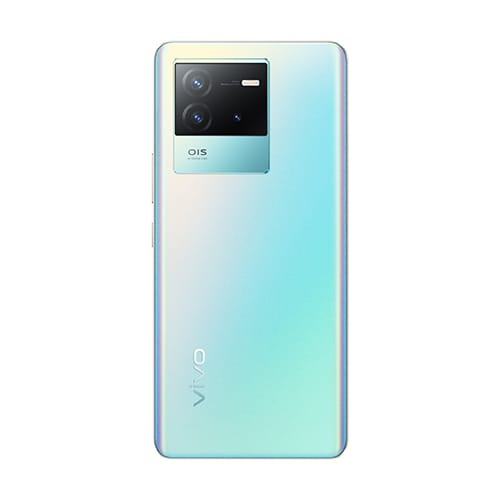
Vivo T2 5G is going to launch on June 6 in China. The handset was previously scheduled to debut on May 23 in the country. However, due to force majeure, the company postponed its launch to the next month. The company has already confirmed its key specifications, and now some more details have emerged through its China Telecom product listing. The listing (via) has revealed the variants and pricing of the device.
Vivo T2 5G
The Vivo T2 5G is confirmed to arrive with an E4 AMOLED display that offers a 120Hz refresh rate. It will feature an OIS-assisted 64-megapixel main camera. It will be powered by the Snapdragon 870 chipset and will carry support for 80W fast charging.
The China Telecom listing of the device has revealed that it will be equipped with a 6.62-inch display that produces a Full HD+ resolution of 1080 x 2400 pixels. It will feature a 16-megapixel front camera and a 64-megapixel + 8-megapixel + 2-megapixel triple camera unit. It boots to the Android 12 OS and will pack a 4,700mAh battery. Its dimensions are 163 x 76.16 x 8.54mm and it weighs around 190 grams.
Vivo T2 5G
The Snapdragon 870 powered device will be arriving in China in three options: 8 GB RAM + 128 GB storage, 8 GB RAM + 256 GB storage, and 12 GB RAM + 256 GB storage. These variants are listed for 2,199 Yuan (~$330), 2,499 Yun (~$375), and 2,699 Yuan (~$405), respectively. The handset will be available in black and blue colors. Readers are advised to digest the pricing of the device with a pinch of salt as it is yet to go official.
The Vivo T2 5G has a V2199GA model number, whereas the iQOO Neo 6 SE that debuted earlier this month in China has a V2199A model number. Both are packed with identical specs. Hence, the Vivo T2 will be arriving as a rebranded version of the Neo 6 SE.
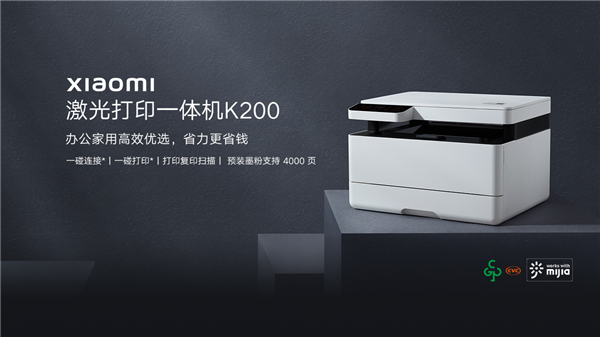
Xiaomi has unveiled its first-ever all-in-one laser printer, the K200. The Xiaomi K200 laser printer comes with several impressive features including a built-in NFC chip that supports one-touch operations. The laser printer K200 supports one-touch inking and one-touch printing, as well as three-in-one operations.
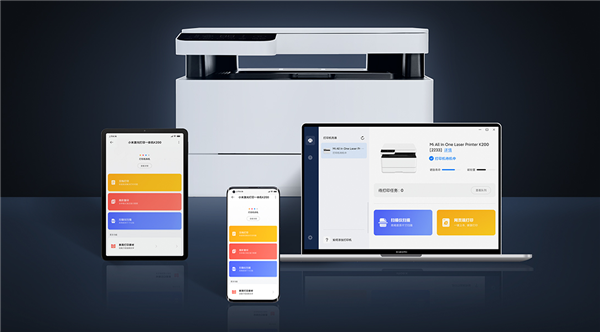
The Xiaomi K200 offers printing, photocopying, and scanning functionalities. It is available for pre-order with a 50 yuan (~$8) reservation deposit but the full cost is 1,499 yuan (~$225). The K200 supports USB connections and can also be accessed via the Mijia app or Mi Printing app.
The Xiaomi K200 is also compatible with wireless connections of multiple platforms via Android, iOS, Windows, or Mac devices. The Air Tap touch transfer is at the heart of the one-touch connection and printing available in the all-in-one laser printer.
The Xiaomi laser printer K200 supports drag-and-drop printing of Xiaomi Print Web Edition. This does not require the installation of the device driver. You just need to drag and drop the document to the identification bar of the Print Web Edition. A high-quality toner is deployed in the Xiaomi laser printer K200. This in turn yields great prints and copies anytime. A toner separation structure is also present, which allows separate replacement of the toner cartridge with a single pull.
The original toner in the Xiaomi K200 is capable of producing up to 4,000 pages of print, while the toner cartridge supports up to 8,000 pages of print or copy. There are no details yet on the global availability of the Xiaomi laser printer K200.
We use cookies on our website to give you the most relevant experience by remembering your preferences and repeat visits. By clicking “Accept”, you consent to the use of ALL the cookies.
This website uses cookies to improve your experience while you navigate through the website. Out of these, the cookies that are categorized as necessary are stored on your browser as they are essential for the working of basic functionalities of the website. We also use third-party cookies that help us analyze and understand how you use this website. These cookies will be stored in your browser only with your consent. You also have the option to opt-out of these cookies. But opting out of some of these cookies may affect your browsing experience.
Necessary cookies are absolutely essential for the website to function properly. This category only includes cookies that ensures basic functionalities and security features of the website. These cookies do not store any personal information.
Any cookies that may not be particularly necessary for the website to function and is used specifically to collect user personal data via analytics, ads, other embedded contents are termed as non-necessary cookies. It is mandatory to procure user consent prior to running these cookies on your website.