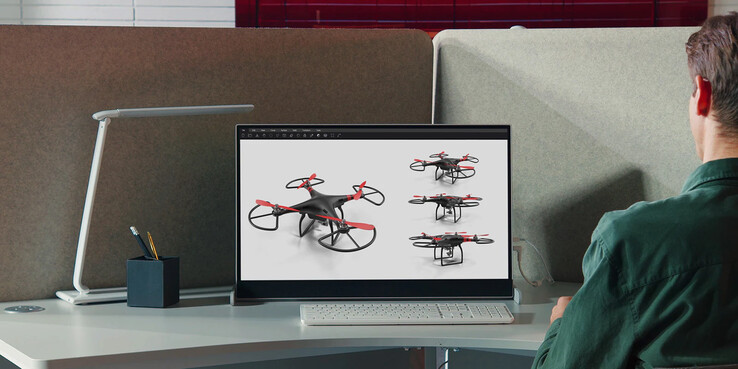
Multi-use monitors are fast becoming popular in various markets. The latest LG monitor packs some great functionality in addition to a detachable webcam. The LG Libero 27BQ70QC is a 27-inch model that can be mounted in several ways and delivers 2.5K video content. The Libero joins a raft of LG UltraGear gaming monitors announced in Europe this week.
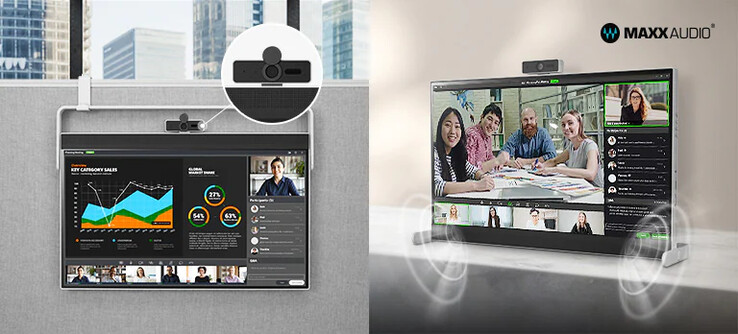
The Libero 27BQ70QC can be used in the office or at home. There are several options for using the monitor. It can be positioned as a Smart TV, hung on two wall brackets, or used with a stand. A detachable FHD webcam is part of the accessories of the Libero monitor for making conference video calls.
The LG Libero 27BQ70QC is adaptable to any orientation, thanks to advanced software in the monitor. Hence, there’s no need to adjust your device’s system settings to switch the display orientation.
On the display end of the monitor, it offers a resolution of 2,560 x 1,440 pixels and HDR 10 capability. The LG Libero’s display delivers up to 350 nits of brightness and a 1,000:1 contrast ratio. The Libero has HDMI and USB-C ports. The Smart Monitor can charge a connected device at up to 65W, which is impressive. There are still some details that are lacking for the LG Libero 27BQ70QC including its price.
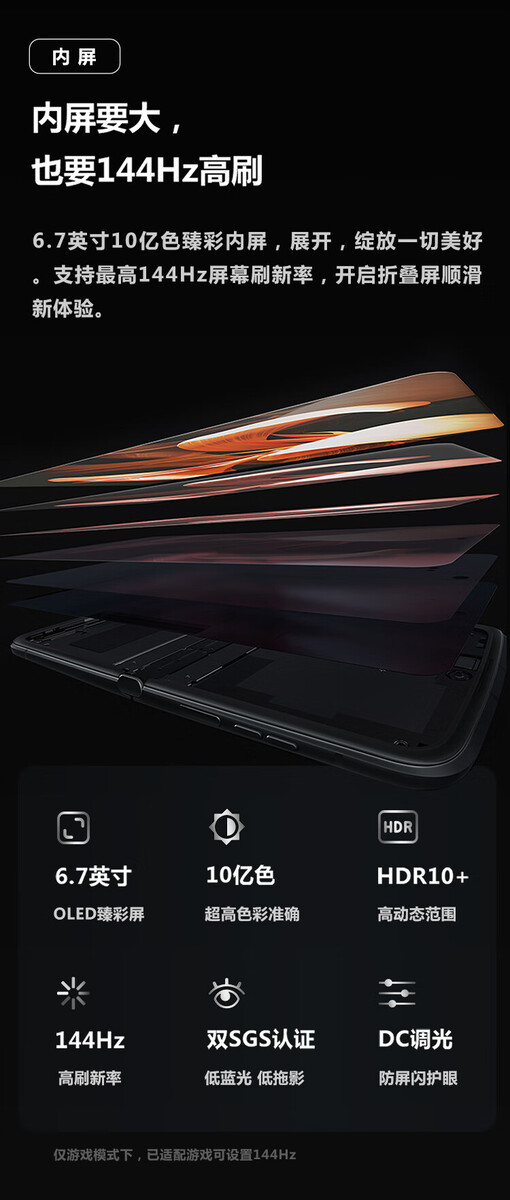
The Motorola Razr 2022 will launch this month and some of the significant improvements on the clamshell foldable smartphone have been released. The device will come with the highest refresh rate for a clamshell foldable at 144Hz. The launch of the Razr 2022 is billed for August 14 and Motorola has already placed a placeholder page for the device on its Chinese portal.
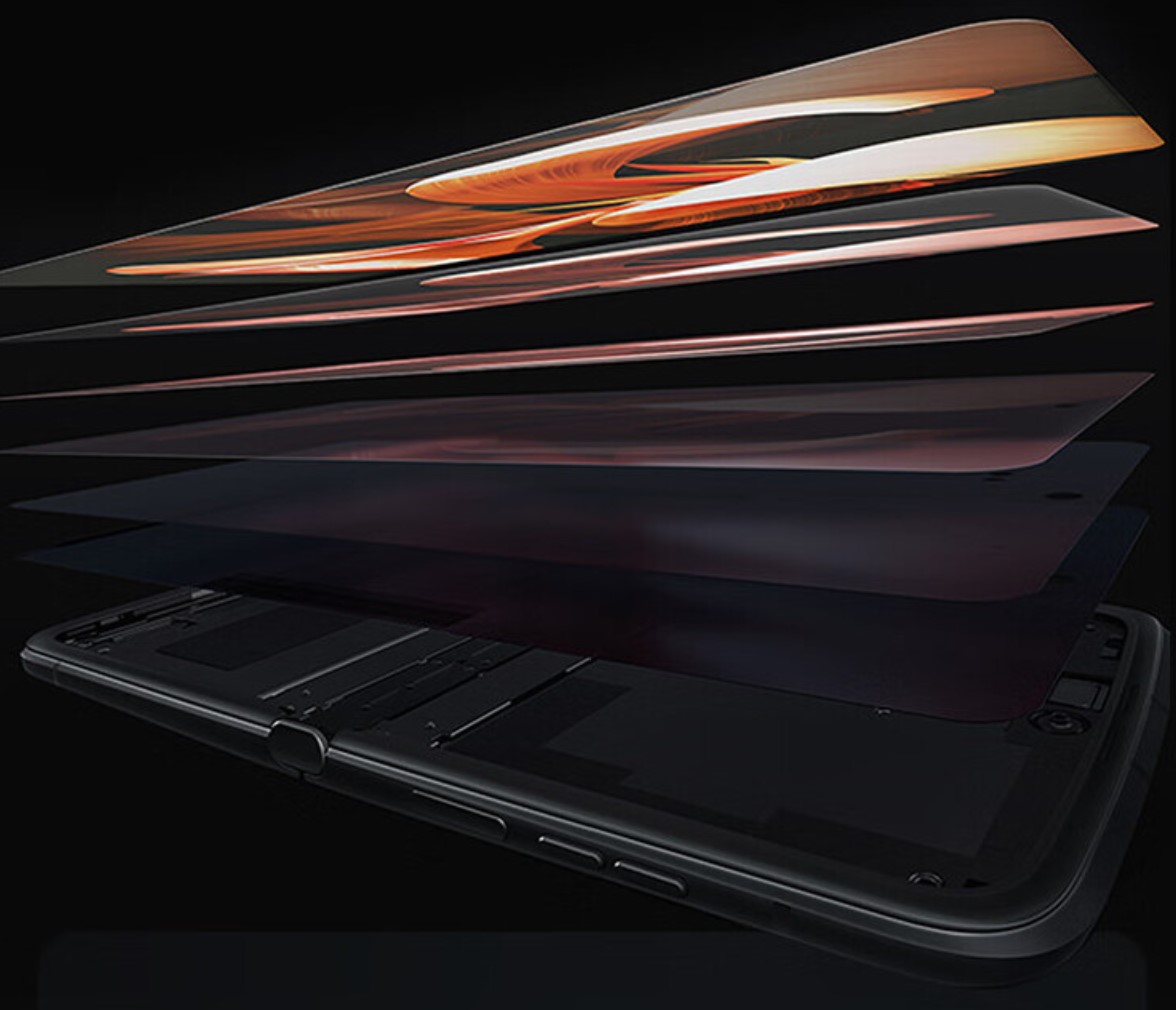
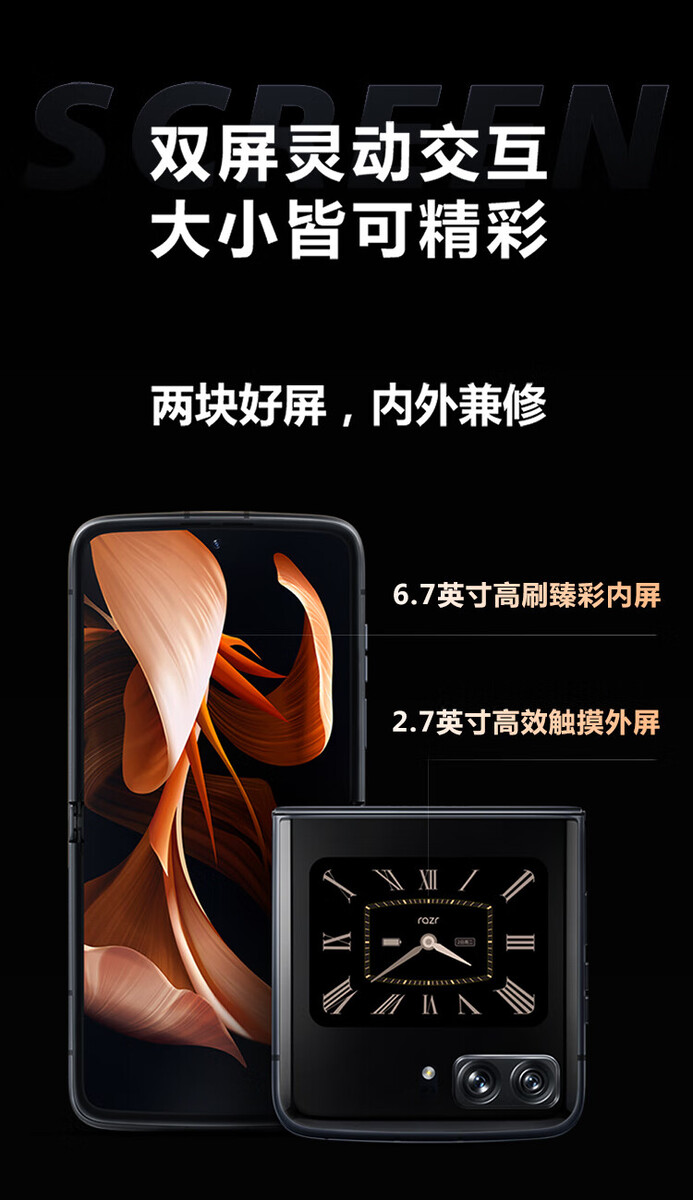
The Motorola Razr 2022 placeholder page provided some stunning details of the new clamshell that hopes to compete with the Galaxy Z Flip lineup. It has a 6.7-inch OLED with a 144Hz display refresh rate. The Razr 2022’s high refresh rate could even surpass that of the Galaxy Z Flip4 by several notches.
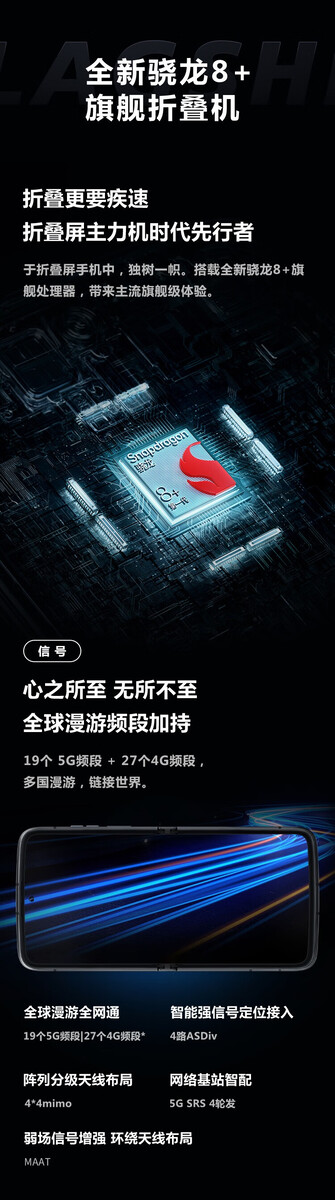
To match its industry-leading high refresh rate, the Razr 2022 will be powered by the flagship Snapdragon 8+ Gen 1 chip. The smartphone’s display offers 10-bit color, HDR 20+, DC dimming, and excellent eye care support. The details also show that the Razr 2022 squares up nicely with the Motorola Edge 30 Pro in terms of its display capabilities.
Motorola Razr 2022
1 of 3
The specs sheet of the Motorola Razr 2022 is quite impressive and mouth-watering. It is primed to challenge some of the leading current and upcoming models in the segment including the Galaxy Flip3, Galaxy Flip4, and the Moto X30 Pro. The excellent Moto X30 Pro has a world-leading camera system, it should be stated. Further details about the Razr 2022 will emerge as we inch closer to its launch next week.
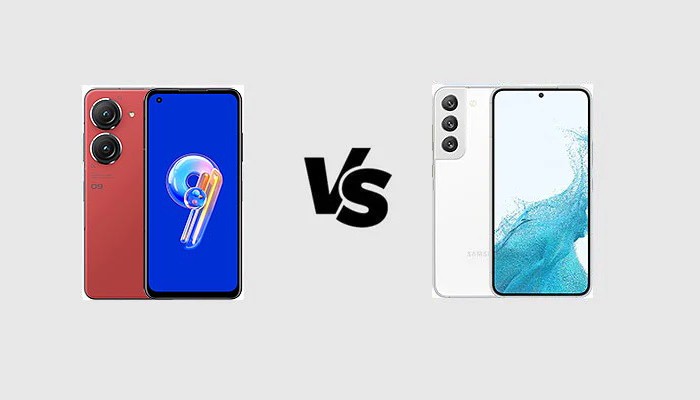
After releasing the amazing gaming phones ROG Phone 6 and ROG Phone 6 Pro, Asus came up with another flagship, but this time it is a traditional phone, not gaming-oriented. However, the Asus Zenfone 9 still has a distinctive feature: it is one of the most compact flagships of this year. Thanks to its small display, it provides very small dimensions and it is very comfortable to use with one hand and to keep in a pocket. However, it has a few rivals to face and one of them comes from the leader of the smartphone market. We are obviously talking about the Samsung Galaxy S22, another of the most compact flagships out there. This is a comparison between the main specifications of the Asus Zenfone 9 and the Samsung Galaxy S22 which will hopefully help you to find the best compact phone for your actual needs.
Asus Zenfone 9 vs Samsung Galaxy S22
Asus Zenfone 9
Samsung Galaxy S22
DIMENSIONS AND WEIGHT
146.5 x 68.1 x 9.1 mm,
169 g
146 x 70.6 x 7.6 mm,
167 g
DISPLAY
5.9 inches, 1080 x 2400 pixels (Full HD+), Super AMOLED
The Asus Zenfone 9 and the Samsung Galaxy S22 come with distinctive designs. The former has two big and circular camera modules, while the latter has a more classic camera module stuck on the upper left corner of the device and containing three sensors, with a LED flash on the right. These phones are made with premium materials, but the Samsung Galaxy S22 has a superior build quality. It comes with a glass back protected by Gorilla Glass Victus and an aluminum frame, as well as a front glass with the same Gorilla Glass Victus protection. The Asus Zenfone 9 has an aluminum frame and a rear side made of polymer, with the glass only on the front side, protected by Gorilla Glass Victus as well. Both the handsets are waterproof thanks to the IP68 certification making them dust and water resistant.
Display
When it comes to the displays, these devices are very close to each other and it is very hard to pick a winner. The Asus Zenfone 9 has the smallest panel, with a diagonal of just 5.9 inches. It is the only Android flagship from a mainstream brand released in 2022 with a display sporting a diagonal inferior to 6 inches. The Samsung Galaxy S22 has an AMOLED display just like the Asus, but with a bigger 6.1-inch diagonal. It comes with slightly higher peak brightness (up to 1,300 nits against just 1,100 nits), but for the rest, they are pretty much the same. The displays have a Full HD+ resolution of 1080p, a 120 Hz refresh rate, the HDR10+ certification, and an in-display fingerprint reader. However, you should consider that the Galaxy has an ultrasonic fingerprint reader providing better performance and allowing to unlock the device even with wet or dirty fingers.
Specs & Software
The hardware department of the Asus Zenfone 9 is more advanced compared to its rival. It is powered by the Snapdragon 8+ Gen 1 mobile platform, currently the best SoC released by Qualcomm to date. It is a processor built with a 4 nm production process and with an octa-core architecture composed of a Cortex X2 CPU running at a max frequency of 3.19 GHz, three Cortex A710 CPUs running at 2.75 GHz, four Cortex A510 CPUs running at 1.8 GHz, and an Adreno 730 GPU. The SoC is paired with up to 16 GB of RAM and up to 256 GB of UFS 3.1 internal storage. With the Samsung Galaxy S22, you get either a Snapdragon 8 Gen 1 mobile platform (inferior to its Plus variant found on the Zenfone) or a Samsung Exynos 2200 chipset (even worse than the Snapdragon 8 Gen 1), as well as 8 GB of RAM and up to 256 GB of UFS 3.1 native storage. Obviously, both the handsets run Android 12 out of the box and they have customized user interfaces.
Camera
The most complete camera phone in this comparison is the Samsung Galaxy S22. On the rear side, it sports a triple camera composed of a 50 MP main sensor with OIS, a 10 MP telephoto lens with 3x optical zoom, and a 12 MP ultrawide camera. The Asus Zenfone 9 lacks a telephoto sensor, while the remaining cameras come with the same resolutions.
The Asus Zenfone 9 is equipped with a bigger battery and it surely lasts more on a single charge: its capacity is 4300 mAh against just 3700 mAh provided by the Samsung Galaxy S22. It even charges quicker thanks to 30W fast charging, while the Samsung charges at 25W. On the other hand, the Galaxy S22 is the only one with wireless charging (the power is 15W).
Price
The Asus Zenfone 9 debuted a few days ago in the European market with a starting price of €729/$730, while you can currently find the Samsung Galaxy S22 for less than €700/$700 thanks to online street prices. The Samsung Galaxy S22 features wireless charging and better cameras, as well as better build quality, while the Asus Zenfone 9 provides a superior chipset and a bigger battery. Which one would you pick?
Asus Zenfone 9 vs Samsung Galaxy S22: PRO and CONS
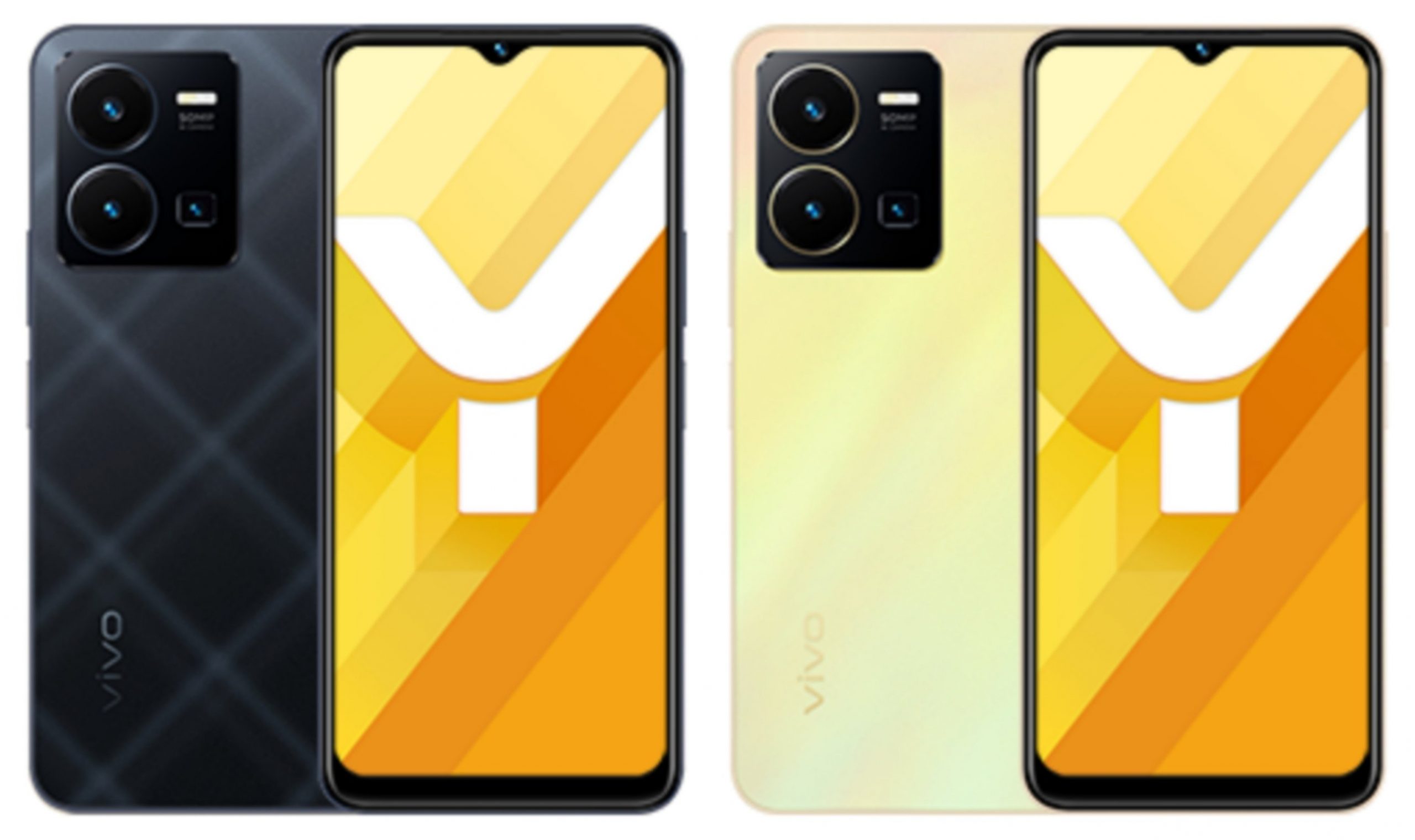
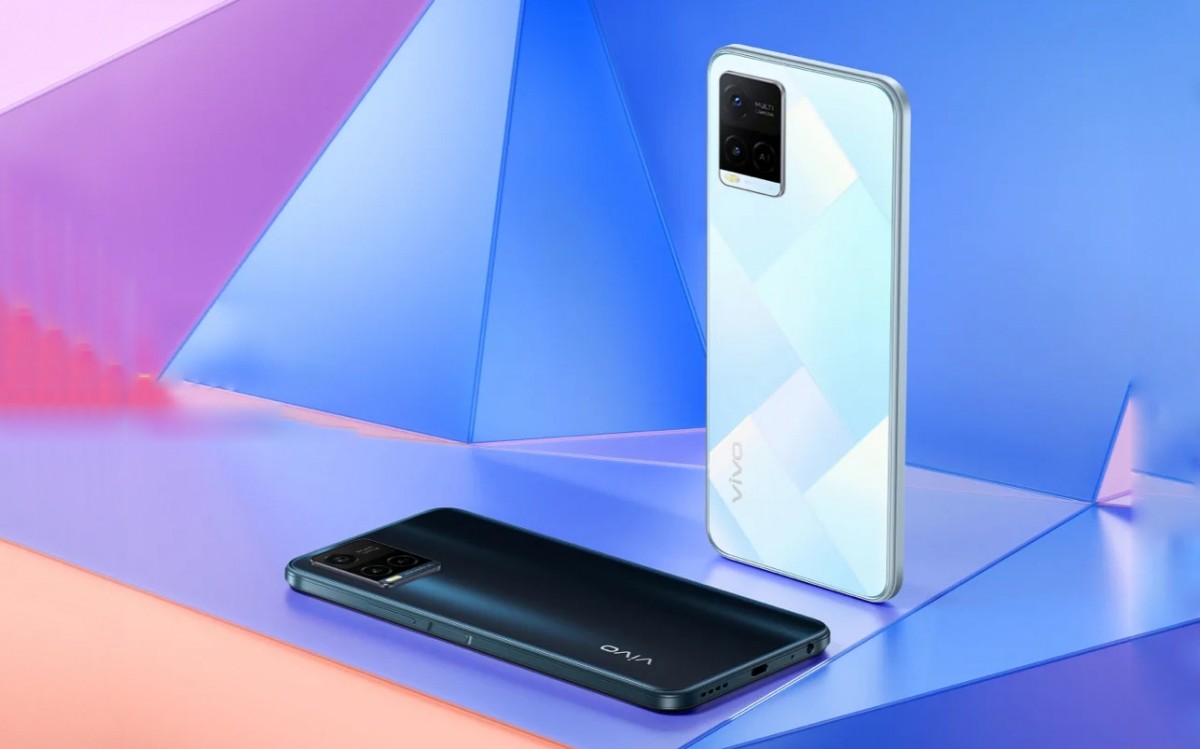
Vivo is confirmed to launch the new Vivo Y35 4G in Malaysia on August 11. Ahead of the launch, the device has been spotted BIS website hinting that it may also make its way to the Indian market. Vivo Y35 is rumored to be a mid-range handset featuring a Snapdragon 680 SoC, 50MP main camera, 5000mAh battery, and more.
According to a report by MySmartPrice, Vivo Y35 4G smartphone with the model number V2205 has been listed on the BIS website. As usual, the listing does not reveal any details about the RAM and storage configurations, or specifications of the handset but it hints that the Vivo Y35 4G may also launch in India.
As mentioned, the device is scheduled to launch in Malaysia on August 11. Its specifications have already leaked online. The device is rumored to flaunt a 6.58-inch Full HD+ IPS LCD offering a standard 60Hz refresh rate. It will have a generic design with a waterdrop notch and thin bezels on all sides and a thick chin.
The Vivo Y35 4G is said to be powered by a Snapdragon 680 SoC paired with up to 8GB RAM and 256GB of internal storage. As far as the camera is concerned, the device could feature a 50MP main camera sensor accompanied by a 2MP macro camera and a 2MP depth sensor. On the front, it may have a 16-megapixel shooter for selfies and video calls.
It will likely be backed up by a 5000mAh battery with support for 10W charging. The device is said to be 8.28mm thick and weigh about 188 grams. It may also have a dedicated microSD card slot and come with support for Bluetooth 5.0 and dual-band Wi-Fi. On the software front, it will likely run Android 12-based Funtouch OS 12 out of the box.
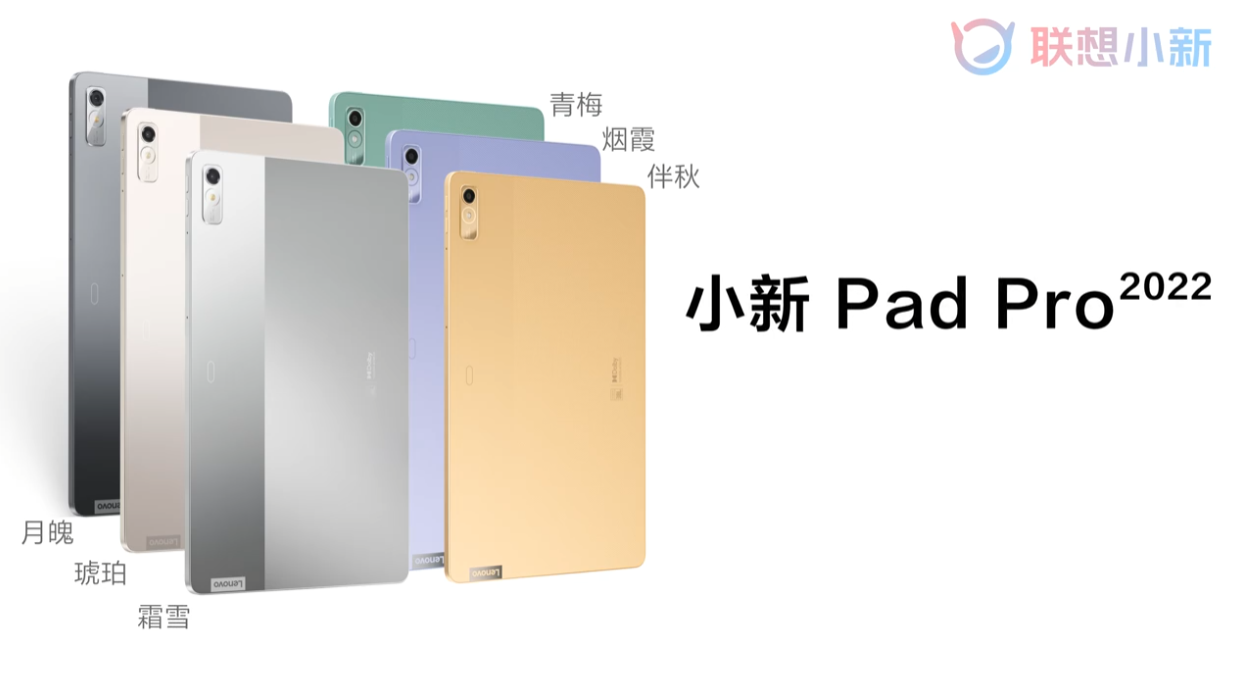
Lenovo is scheduled to host a launch event on August 11 where it is expected to launch a bunch of new products including the Lenovo Xiaoxin Pad Pro 2022. Just days ahead of the rumored launch, the company has revealed some new details about the tablet’s display and connectivity ports.
The launch of the Lenovo Xiaoxin Pad Pro is near the horizon and the company has started teasing the device online. In a new teaser, Lenovo revealed the screen parameters of Xiaoxin Pad Pro 2022. The tablet is now confirmed to be equipped with an 11.2-inch 2.5K OLED screen that supports 600nits excitation brightness, 120Hz refresh rate, 360Hz touch sampling rate, and 1920Hz high-frequency PWM dimming.
Moreover, the device is claimed to have TÜV Global Eye Protection Certification 2.0. The company also revealed that the device will be equipped with four JBL speakers and support Dolby Atmos and SmartPA.
Further, the Lenovo Xiaoxin Pad Pro 2022 is confirmed to have a USB-C interface that supports the USB 3.2 Gen1 standard enabling smooth data transfer. In addition, it will support up to 4K video signal output making it easier to watch movies on a large screen.
As mentioned, the new Lenovo pad may launch on August 11. It is said to launch in two processor variants- MediaTek Kompanio 1300T and Snapdragon 870. It is expected to pack a massive 8200mAh battery and support up to 68W fast charge. It will have a single camera setup on both the front and back.
Do note that Lenovo’s Xiaoxin series is exclusive to China. However, the company may launch the tablet in the global market as a rebrand. The pricing details of the tablet are still unknown.
Foldable smartphones are the talk of the town these days. Samsung and Motorola will be dropping their brand new foldables in a few days. And rumors are rife that Xiaomi will also be bringing its latest contender, dubbed Xiaomi Mix Fold 2 into the wild. The phone is said to debut this month and ahead of the launch, its display specs have leaked online. Let’s have a look at all the details.
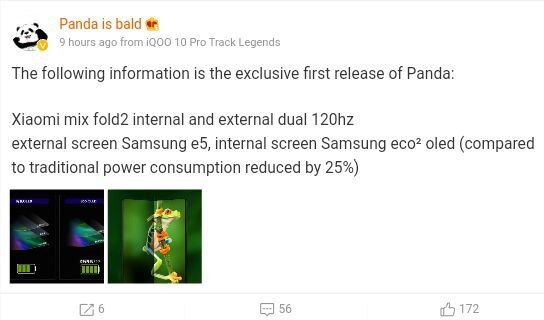
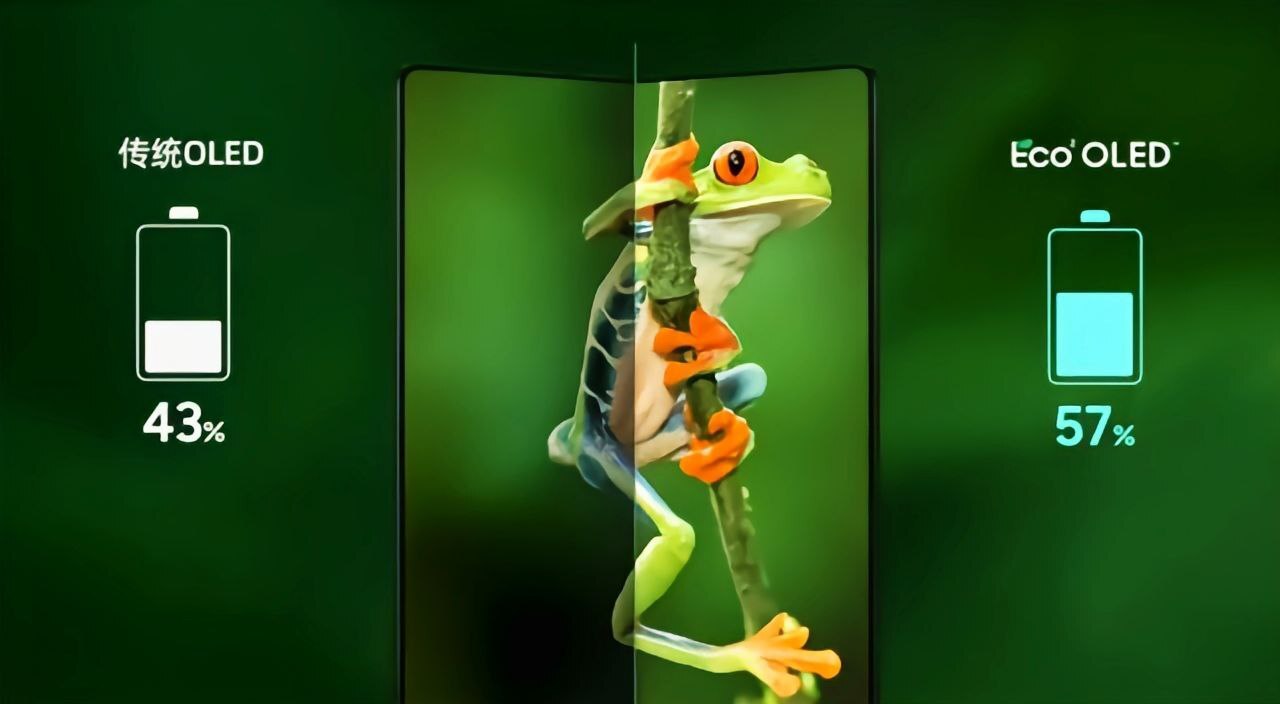
Chinese Tipster Panda claims that the Xiaomi Mix Fold 2 will be equipped with an internal and external 120Hz panel. Moreover, the external display is said to use Samsung’s E5 panel, whereas the internal screen is claimed to flaunt Samsung’s new Eco² OLED display.
As compared to previous displays, the new Eco² OLED display is claimed to reduce power consumption by 25% and increase light transmittance by 33%. The same display was also used in Samsung Galaxy Fold 3 and we all know it performed really well.
In a separate leak, the tipster Digital Chat station reveals that Xiaomi Mix Fold 2 will have an improved screen ratio. As per Mr. Chat station, the device will offer a 2520 x 1080-pixel resolution with a screen ratio of 21:9. For reference, the previous gen Mix Fold had a screen ratio of 21:7 and folks dubbed it as a “remote control”.
Xiaomi Mix Fold 2 is said to launch pretty soon. Lei Jun, the company’s CEO and founder, is scheduled to hold his annual speech on August 11 and that’s when we can expect the Xiaomi Mix Fold 2 to debut.
Xiaomi’s new foldable is expected to carry significant upgrades. It is rumored to be powered by the latest Snapdragon 8+ gen1 Soc, a 50-megapixel main camera, and Xiaomi’s proprietary imaging chip called the Surge C1. We can expect it to go head to head with Samsung’s upcoming Galaxy Z Fold 4.
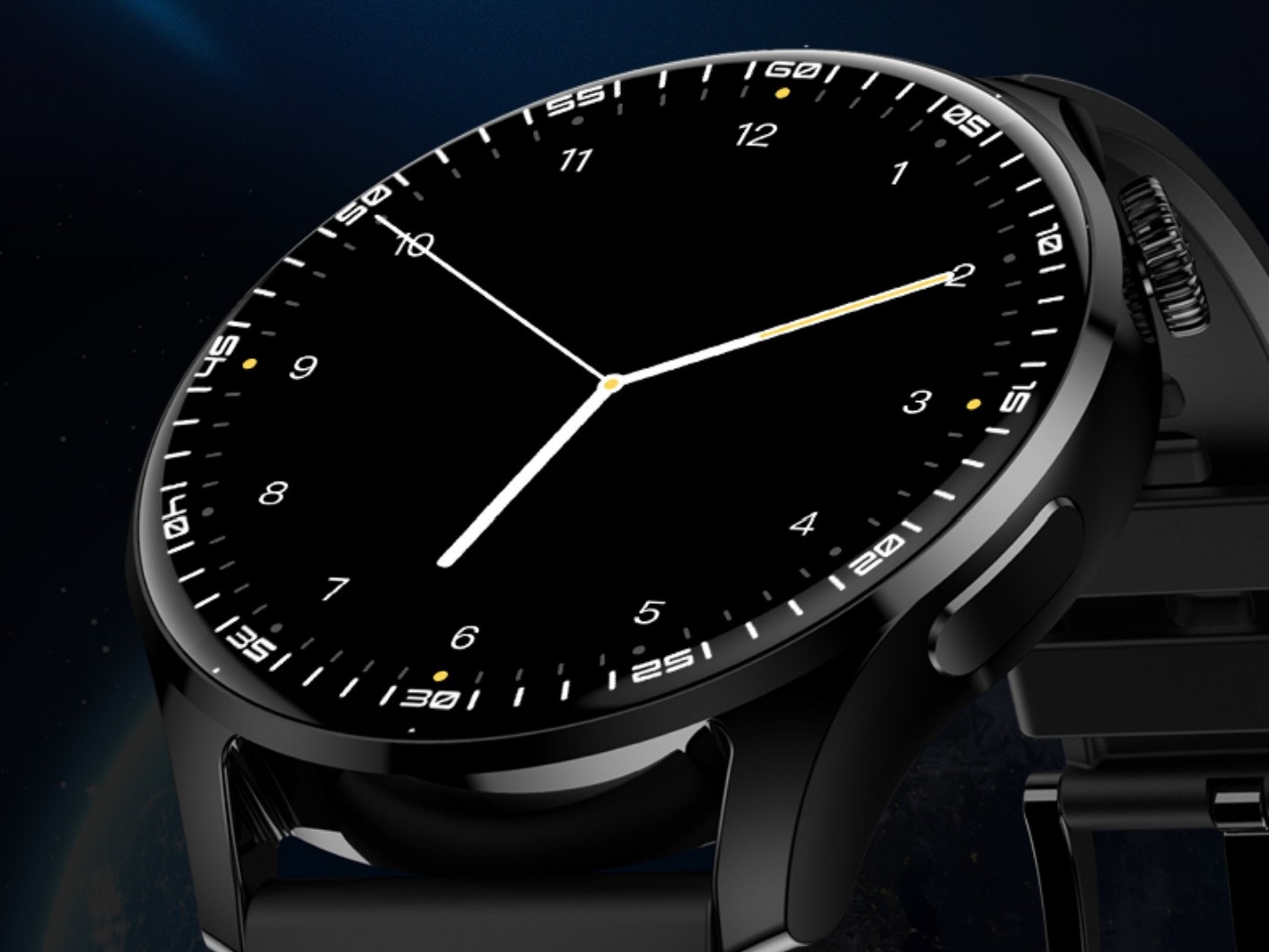
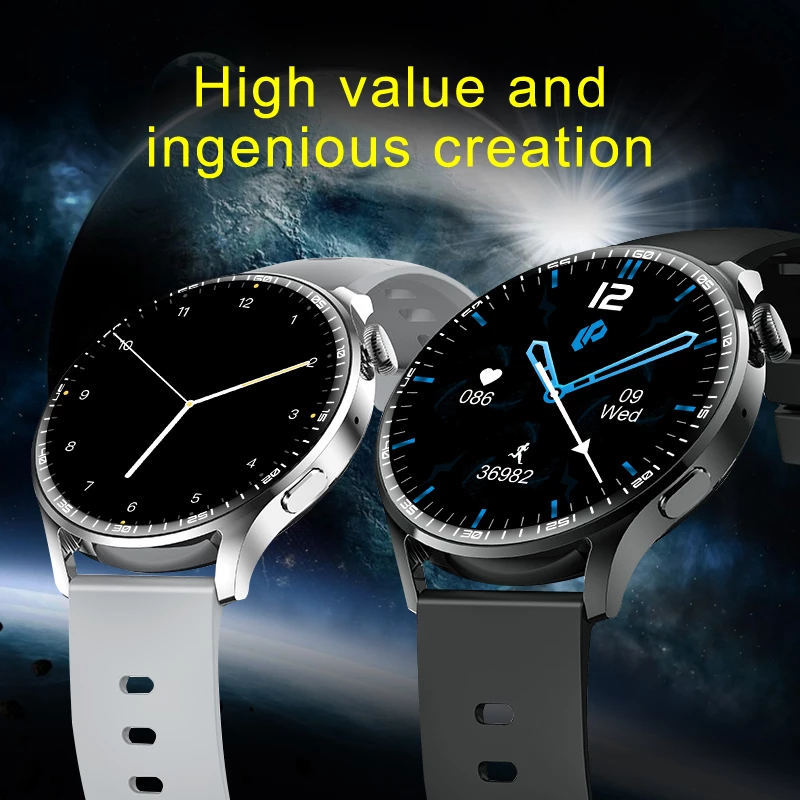
The WS3 PRO smartwatch with Bluetooth calling, electrocardiogram (ECG), and blood pressure monitoring has been launched. It is a low-price smartwatch from China that provides a rich suite of health and fitness functionality while retaining a classic design.
The WS3 PRO has a built-in speaker and microphone for Bluetooth calling and has up to 7 days of battery life. The new smartwatch is compatible with both Android and iOS devices. It has a 1.28-inch IPS panel with a display resolution of 240 x 240 pixels. The 2.5D glass screen and curved edges further accentuate the gadget. The new smart wearable offers blood oxygen tracking, ECG, blood pressure, and more throughout the day. Other features are sleep tracking, a calorie calculator, and a step counter.
The WS3 PRO has IP67 rating for slight water resistance. An NFC reader is also present in the device and two side buttons. Apart from the touchscreen and side buttons, you can also use voice commands to control the smartwatch. The watch comes in a silicone strap and weighs just 50g.
The smartwatch is available in black and silver colors and can be ordered via AliExpress for $21.11. The earliest deliveries outside China are expected within 4 weeks and shipping charges will vary globally. It is unclear whether the global availability of the WS3 PRO will be scaled up to other retailers outside China.
Though smartphone sales have declined worldwide in the past few quarters, companies keep releasing new models. Hence, we are back again with our monthly upcoming smartphone list for August 2022.
There are going to be at least 17 new phone releases this month. It is worth noting that some of them are already official handsets making their way to India.
Almost all major brands are expected to debut new smartphones, except for Xiaomi and Poco. There are no solid rumor or leak regarding them announcing new phones this month as of writing this article. However, their sister brand Redmi along with competitors are anticipated to launch new handsets.
With that out of the way, let’s take a look at all the smartphones that are either confirmed or expected to launch in August 2022.
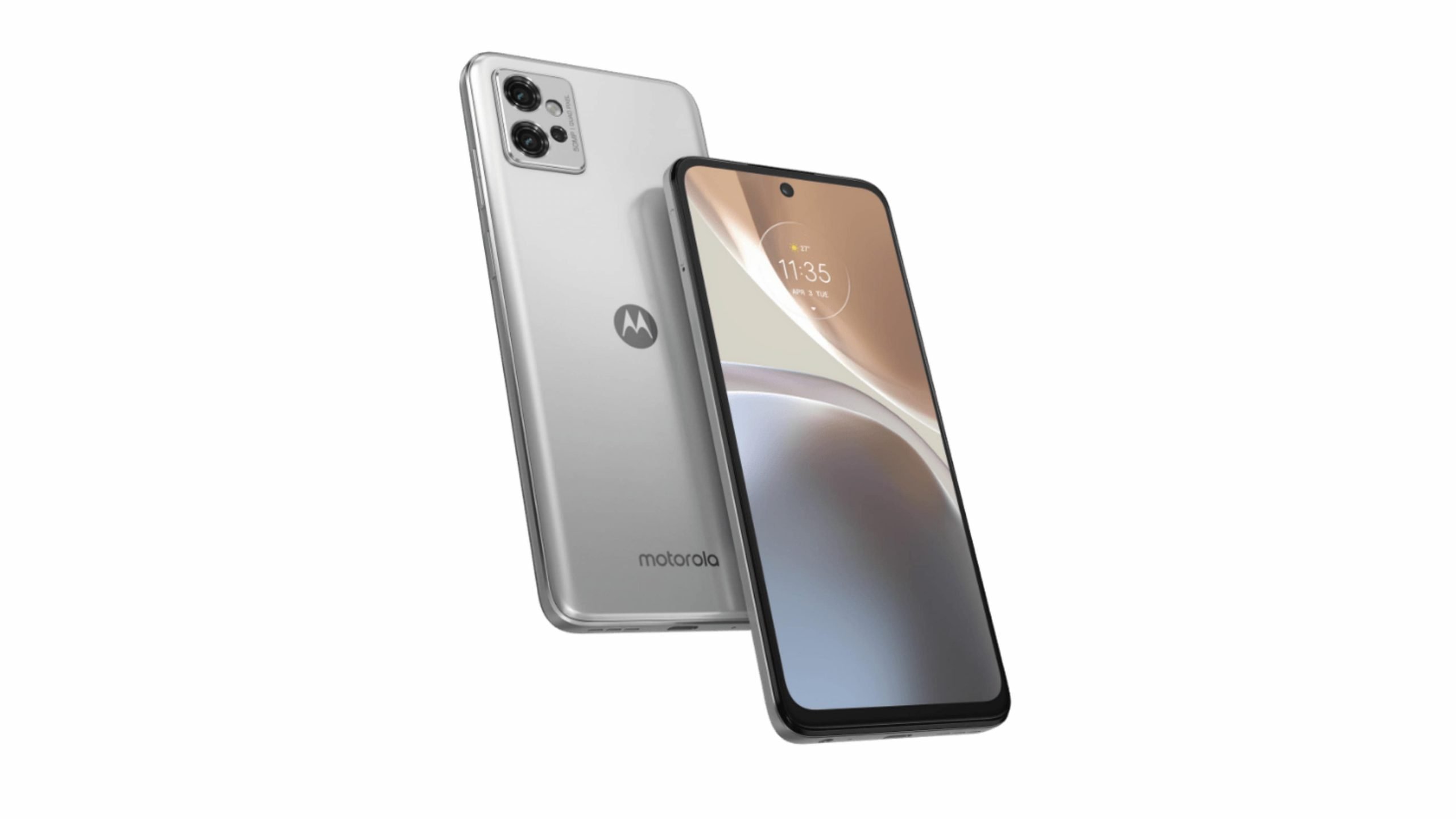
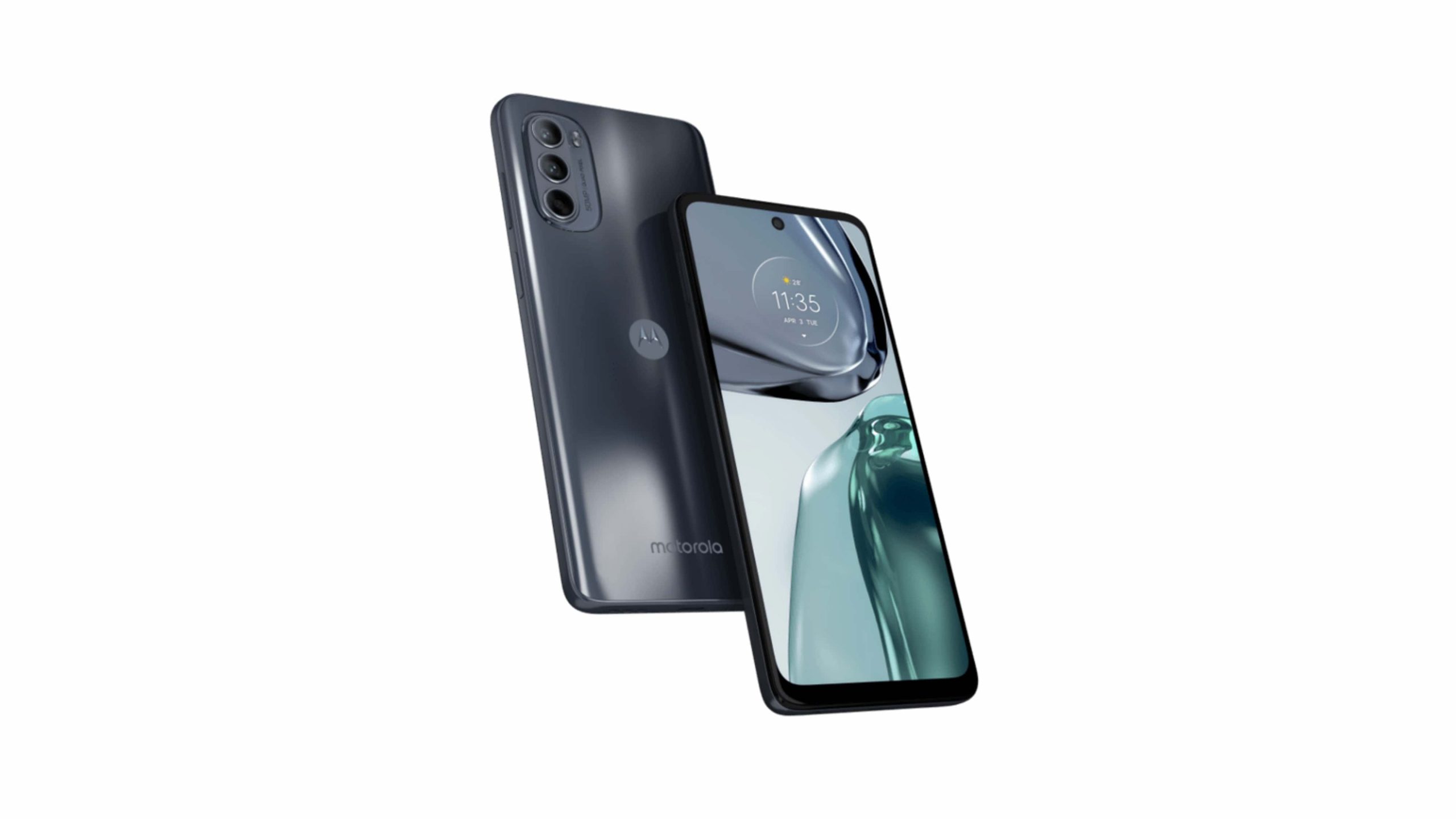
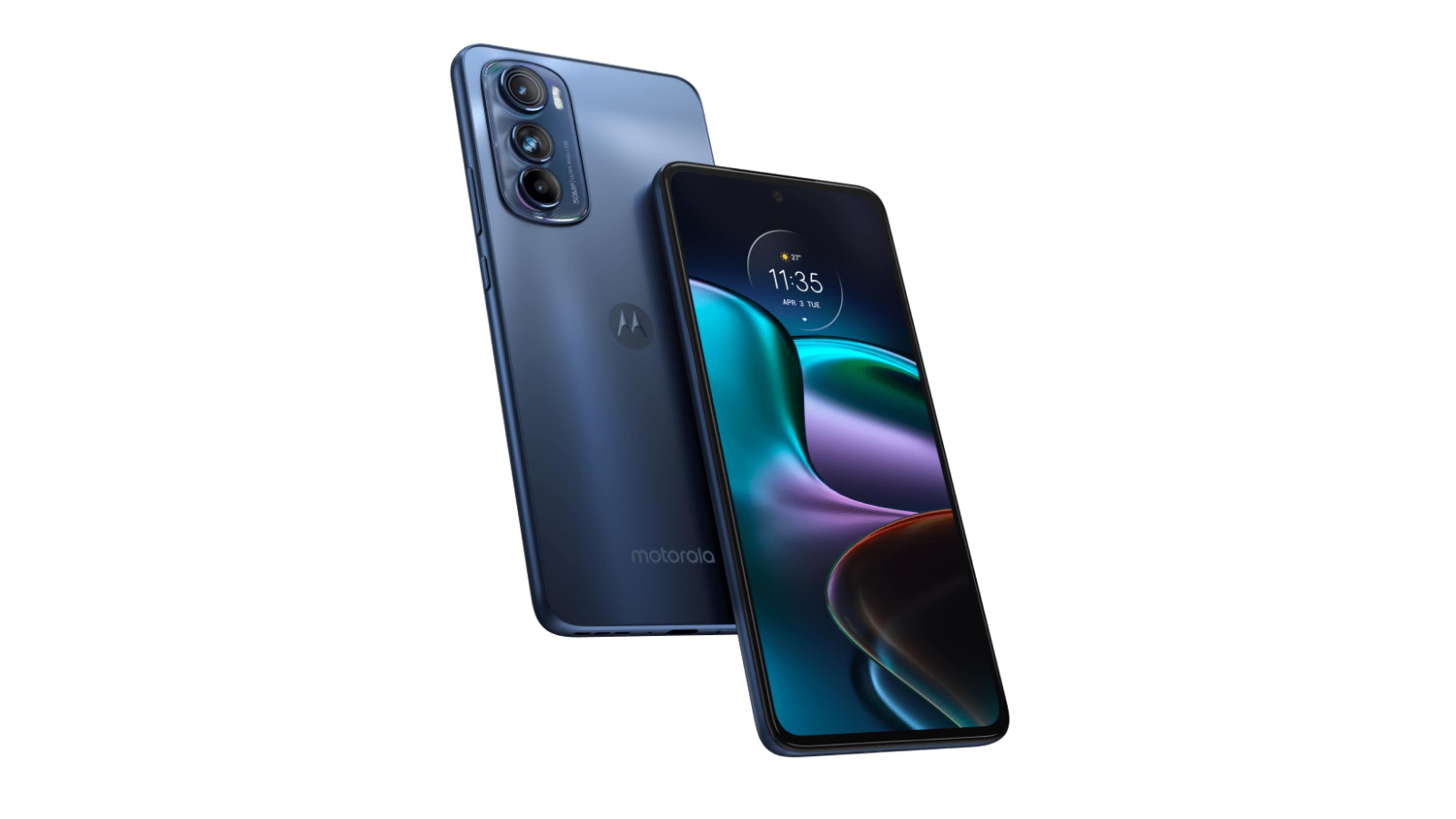
The Motorola Moto G32 was first announced in Europe at the end of July. The smartphone has been now confirmed to launch in India at 12 PM on August 9.
The device offers features like a 6.5-inch HD+ 90Hz display (LCD), Qualcomm Snapdragon 680 chip, 50MP + 8MP + 2MP triple camera system, 16MP selfie camera, 5,000mAh battery, 30W fast wired charging support, and more.
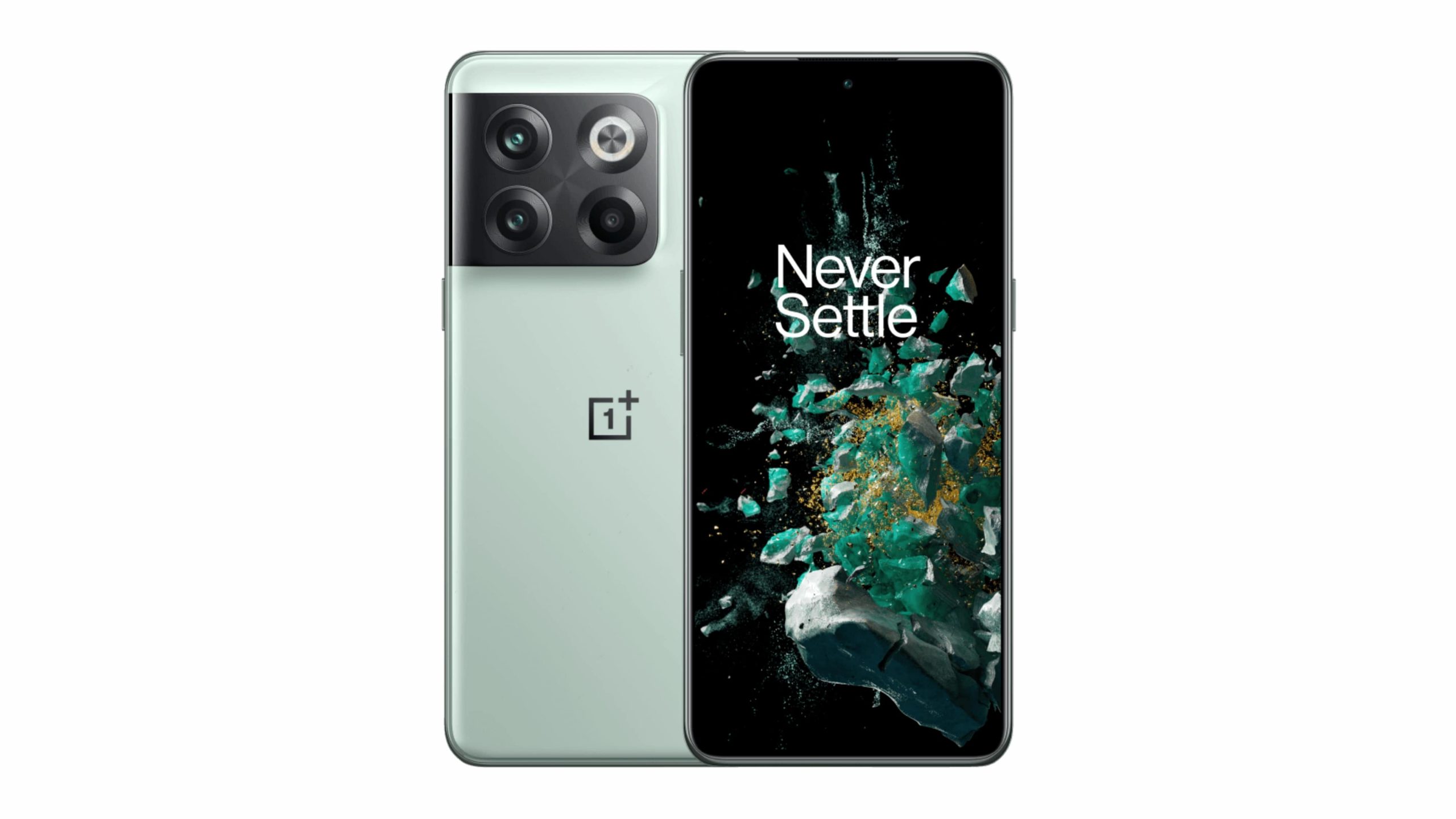
2. OnePlus Ace Pro
OnePlus 10T
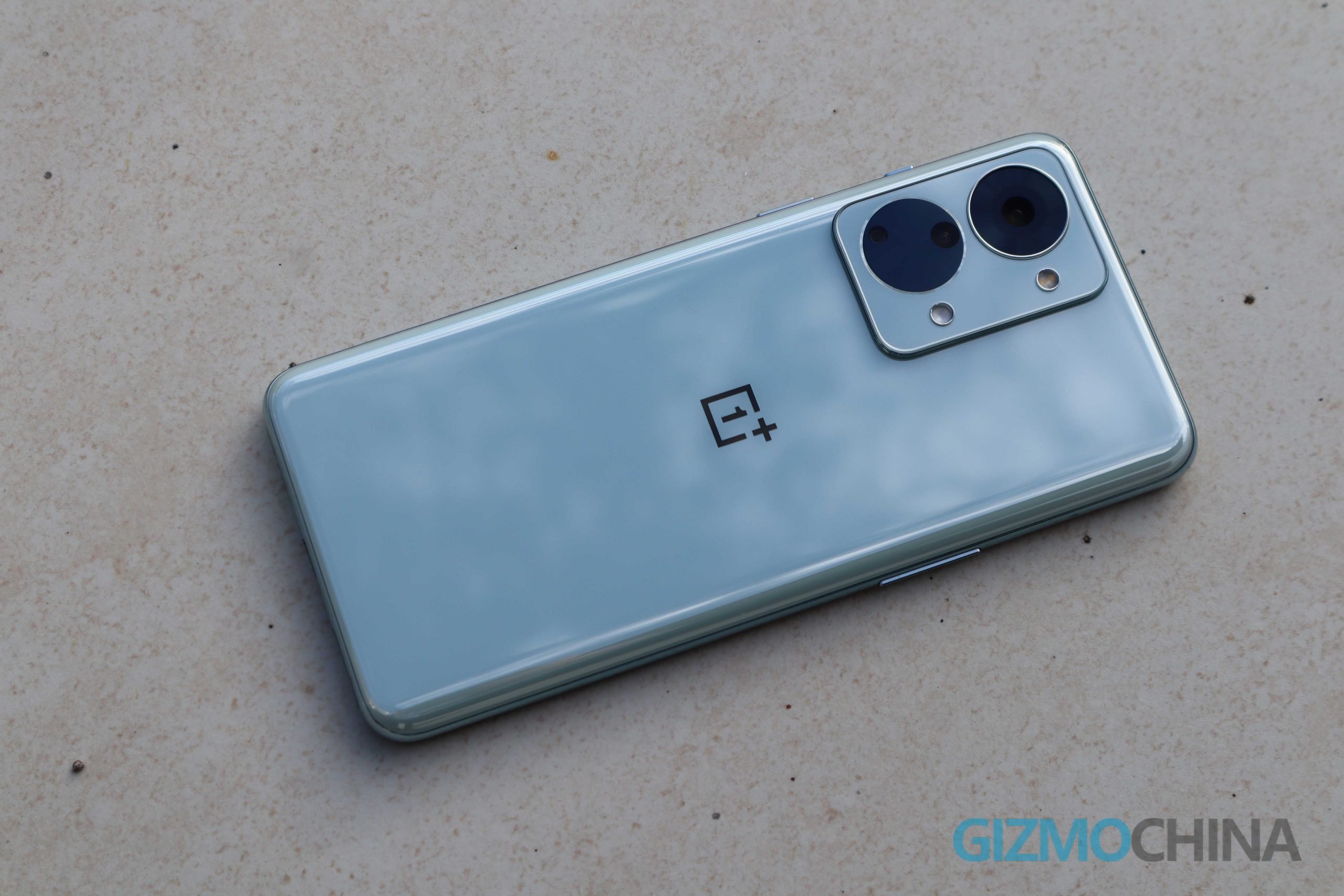
The OnePlus Ace Pro was supposed to launch in China on August 3 but it got postponed. However, its international version (OnePlus 10T) was announced as planned, and therefore, everything about the phone is already out.
The OnePlus Ace Pro is now scheduled to go official on August 9. The event will begin at 7 PM CST and can be live-streamed on Weibo and other popular Chinese video streaming platforms.
The handset will come with a 6.7-inch 120Hz AMOLED display, Qualcomm Snapdragon 8 Plus Gen 1 chipset, 50MP (wide) + 8MP (ultra-wide) + 2MP (macro) triple camera setup, no alert slider, 4,800mAh battery, 150W fast wired charging support, and more.
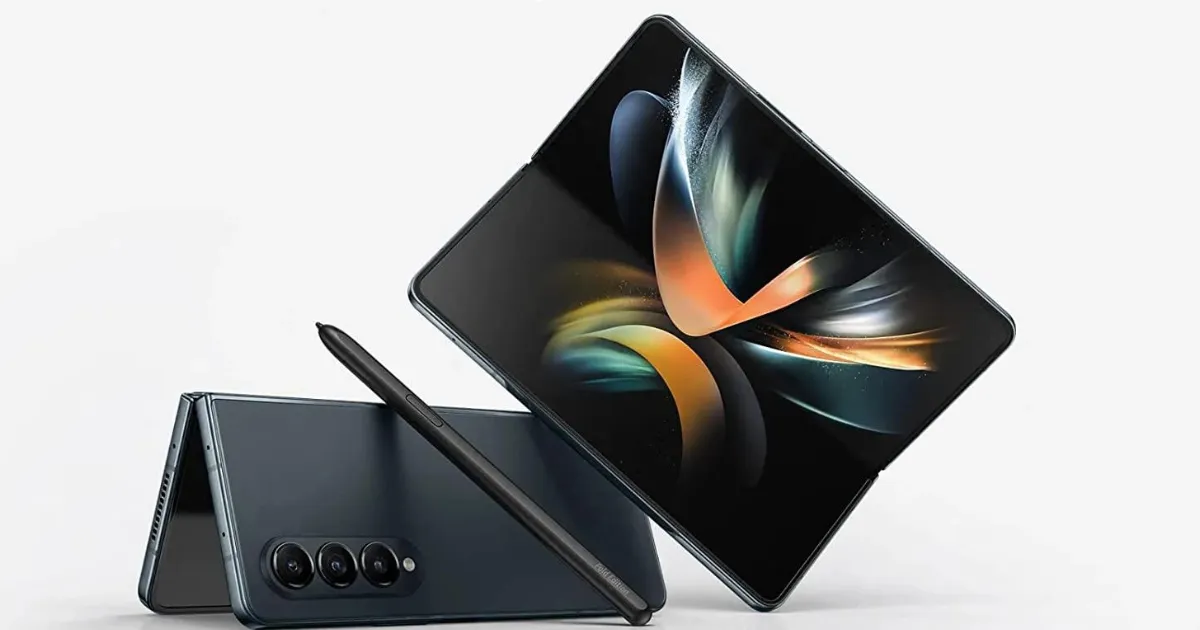
3. Samsung Galaxy Z Fold 4
Samsung Galaxy Z Fold 4
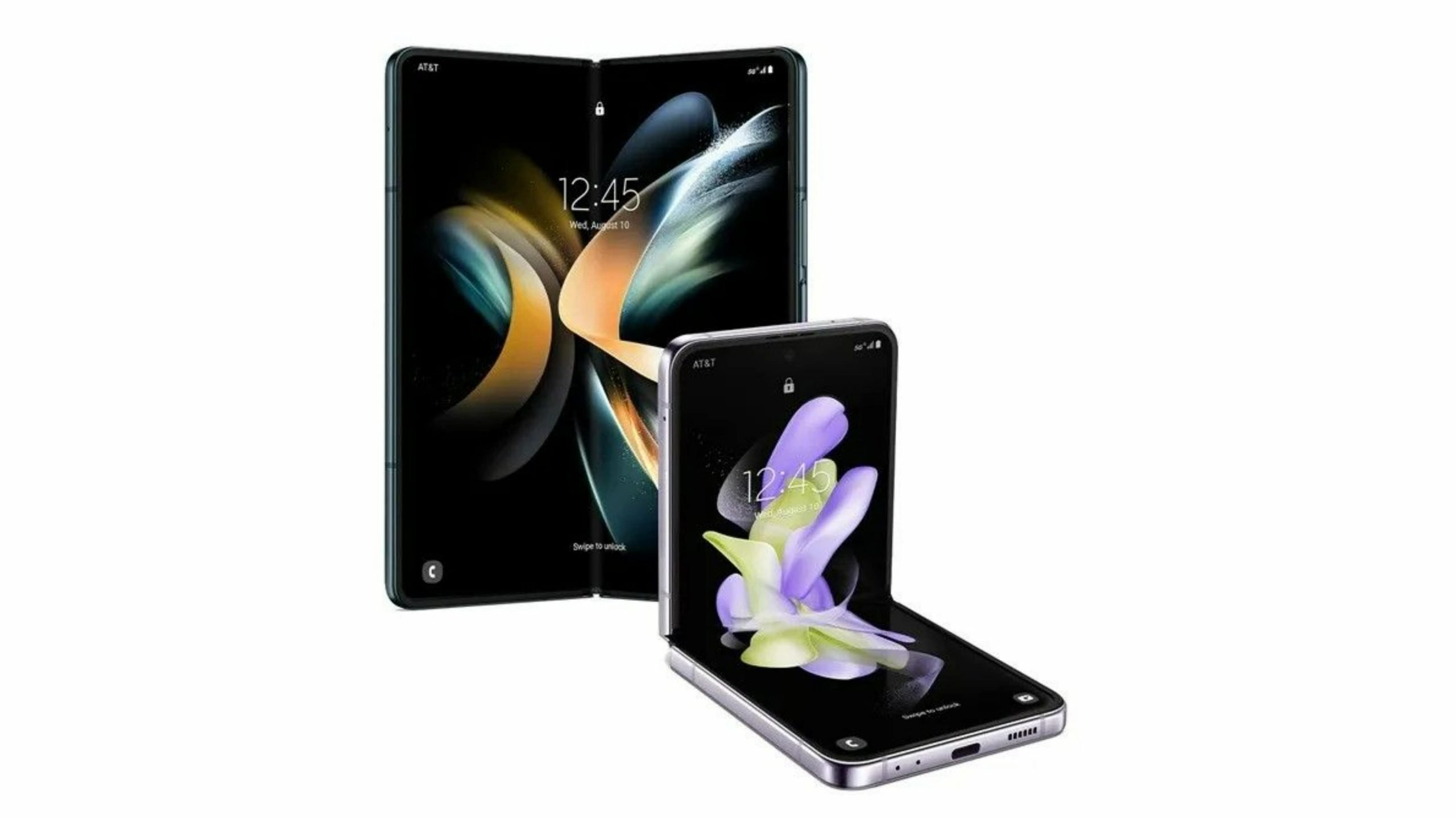
Samsung has confirmed to debut its next-gen Galaxy Z Fold series foldable phone (Galaxy Z Fold 4) on August 10. The conference will be live-streamed on YouTube starting from 9 AM ET. The event can be also experienced in the metaverse (Samsung 837x).
Samsung may drop the Z branding for its foldables. Hence, the device could be simply called Galaxy Fold 4.
According to leaks and rumors, it will be shorted but wider and thicker than its predecessor. It will arrive with a single hinge and a new rear camera layout. Finally, it is said to feature Qualcomm Snapdragon 8 Plus Gen 1 chip, 4,400mAh battery with support for 25W wired charging, 50MP (wide) + 12MP (ultra-wide) + 12MP (3x telephoto) triple camera system, 10MP front-facing camera, and a 4MP under-display camera.
4. Samsung Galaxy Z Flip 4
Samsung Galaxy Z Flip 4
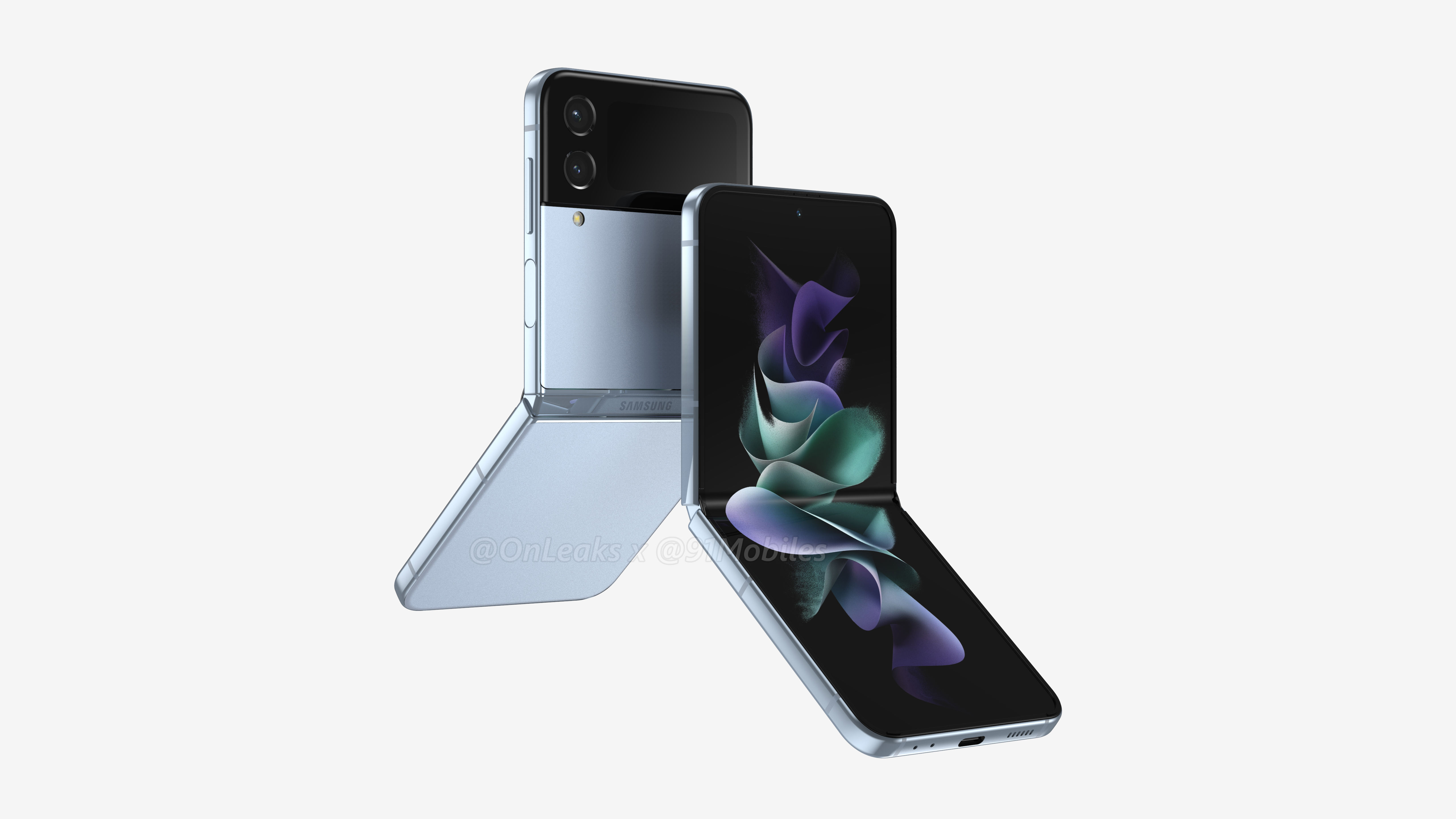
The Samsung Galaxy Z Flip 4 will be announced alongside the Galaxy Z Fold 4 on August 10. It could go official as Galaxy Flip 4 without the Z branding.
The handset is said to be almost identical to its predecessor with some minor changes. It will be slightly smaller but thicker as well. Further, the hinge will be thinner and the crease will be a little less noticeable.
Last but not least, it is expected to arrive with a Qualcomm Snapdragon 8 Plus Gen 1 SoC, 3,700mAh battery with support for 25W wired charging, 12MP + 12MP dual camera setup, 10MP front-facing camera, a 6.7-inch 120Hz main display, and a 1.9-inch cover screen.
5. Motorola Moto G62 5G
Motorola Moto G62 5G
The Motorola Moto G62 5G went official in western markets in June. It has been now confirmed to launch in India on August 11 at 12 PM. This model will come with a different chipset.
The Indian variant of Moto G62 5G will be powered by a Qualcomm Snapdragon 695 SoC instead of a Snapdragon 480 Plus SoC. Other than this, it will have the same specs as the original version.
Hence, the device will arrive with a 6.5-inch FHD+ 120Hz display (LCD), 50MP (wide) + 8MP (ultra-wide, depth) + 2MP (macro) triple camera system, 16MP selfie camera, Dolby Atmos-supported dual stereo speakers, 5,000mAh battery, and more.
6. Motorola Razr 2022
Motorola Moto Razr 2022
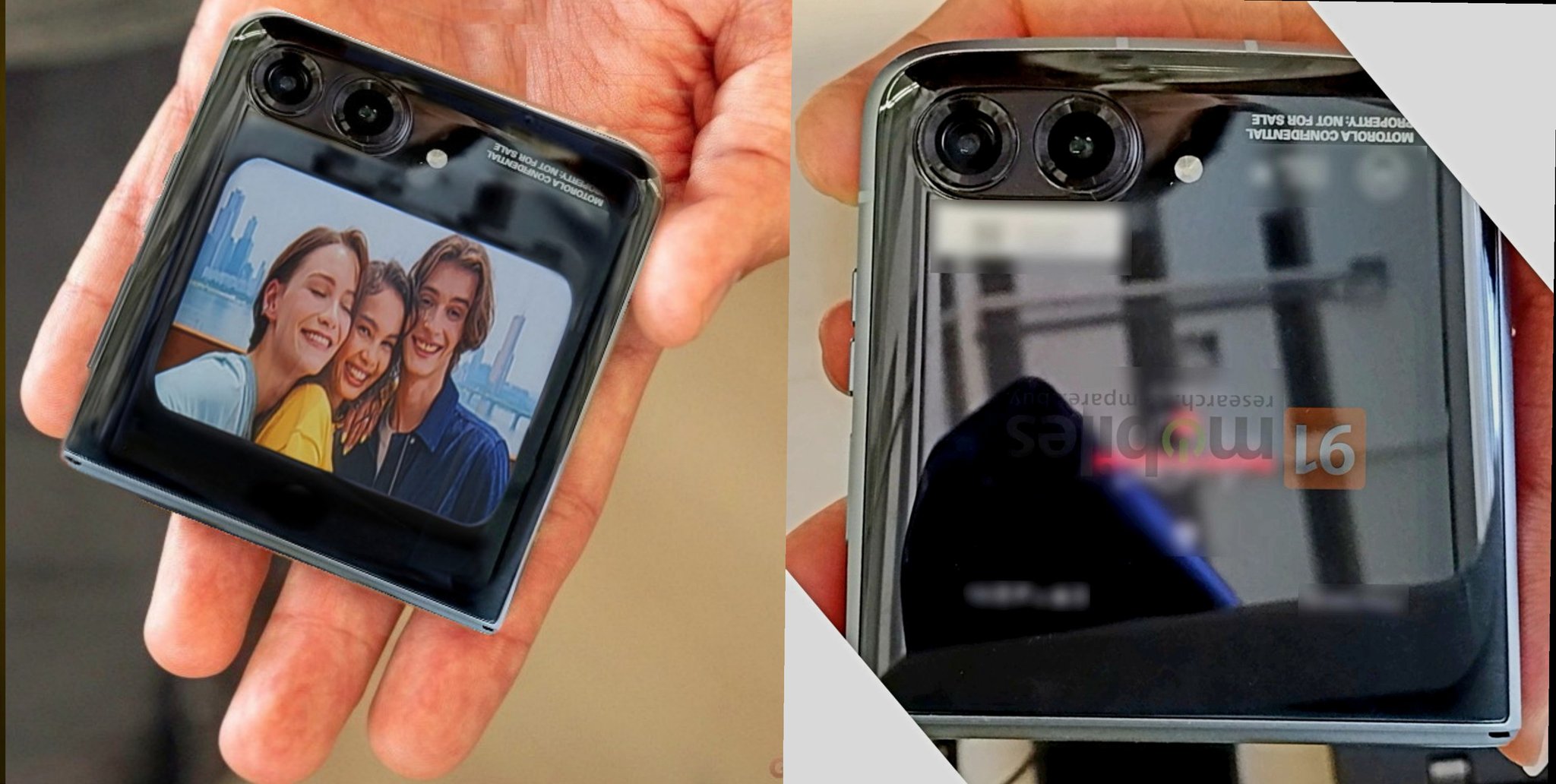
The Motorola Razr 2022 was originally scheduled to launch on August 2. But the event was postponed and it is now planned to go official on August 11. The conference will begin at 2 PM CST and will be live-streamed on Weibo and other leading video streaming platforms.
According to leaks, rumors, and teasers, the third-gen foldable smartphone from the Lenovo-owned company will arrive with a new design, Qualcomm Snapdragon 8 Plus Gen 1 chip, 50MP (wide) + 13MP (ultra-wide) dual camera setup, 32MP selfie camera, a larger cover display, 120Hz main screen, 3,500mAh battery, and more.
The Razr 2022 is expected to go head to head with the Galaxy Z Flip 4.
7. Motorola Moto Edge X30 Pro
Motorola Moto Edge X30 Pro
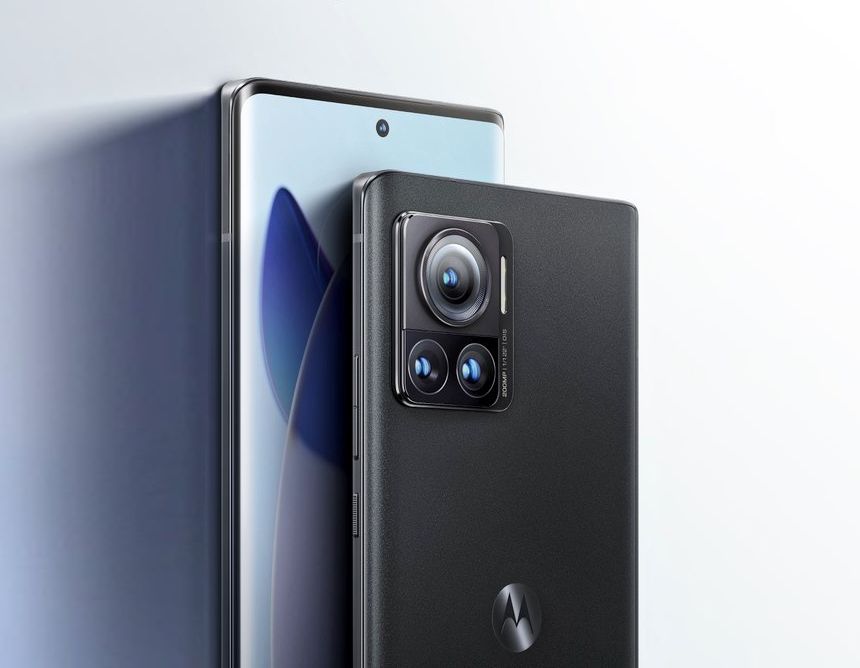
The Motorola Moto Edge X30 Pro will be presented alongside the Razr 2022 on August 11. It will go official as the world’s first smartphone with a 200MP Samsung ISOCELL HP1 primary camera.
As per multiple reports, the device will come with a Qualcomm Snapdragon 8 Plus Gen 1 chipset, 6.73-inch FHD+ 144Hz pOLED display, 4,450mAh battery, 125W fast wired charging support, dual stereo speakers, and more.
The Moto Edge X30 Pro is expected to release as Motorola Edge 30 Ultra outside mainland China.
8. Motorola Moto S30 Pro
Motorola Moto S30 Pro
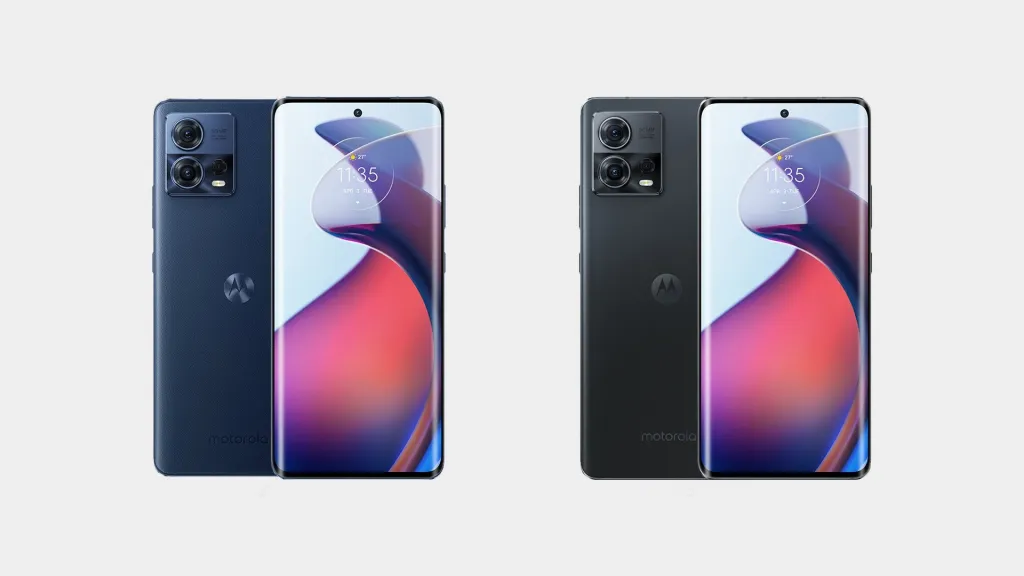
The Motorola Moto S30 Pro will be also announced alongside the Razr 2022 and the Moto Edge X30 Pro at the August 11 event in China. This upper mid-range smartphone is said to be powered by a Qualcomm Snapdragon 888 Plus chip.
Reports say that it will arrive with a 6.55-inch FHD+ curved OLED display, 50MP triple camera setup, 4,270mAh battery, and 68.2W fast wired charging support. It is expected to launch as Motorola Edge 30 Fusion in international markets.
9. Realme 9i 5G
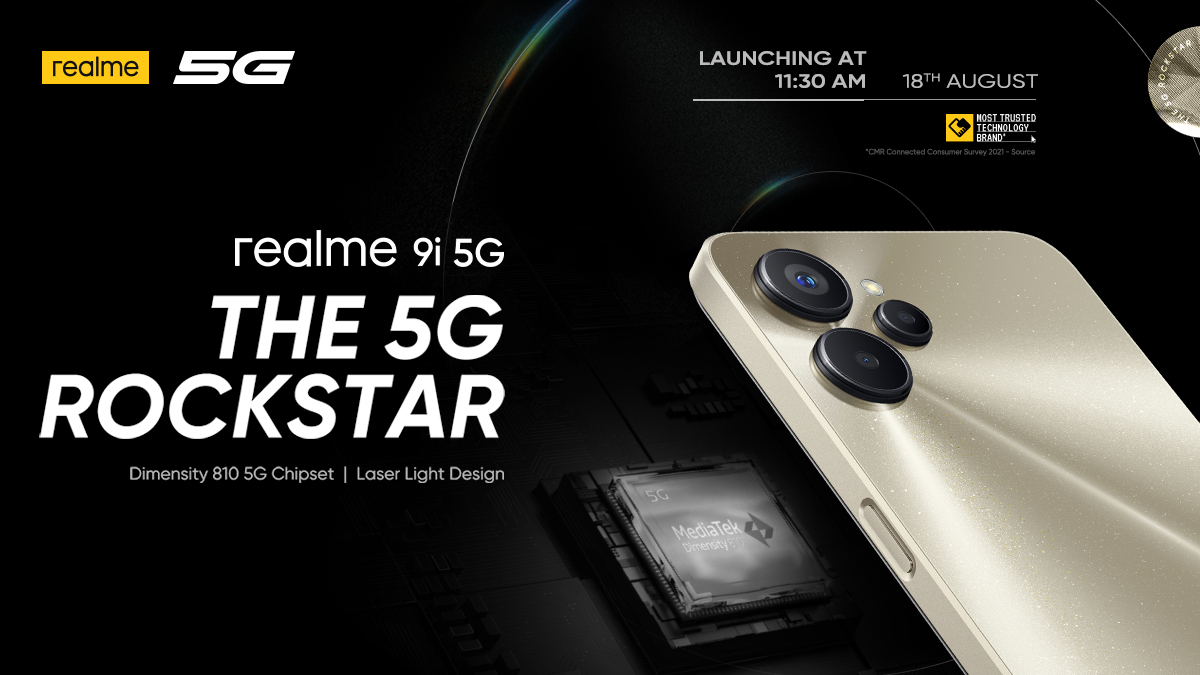
The Realme 9i 5G has been confirmed to launch in India on August 18. The device will be announced in a live stream, which is scheduled to begin at 11:30 AM IST.
The handset will be powered by a MediaTek 810 chipset. It will come with a triple camera system and a flat frame. Finally, it is teased to cost under ₹15,000.
Unfortunately, that’s all the information available about this phone as of now.
10. Vivo V25 Pro
Vivo V25 Series
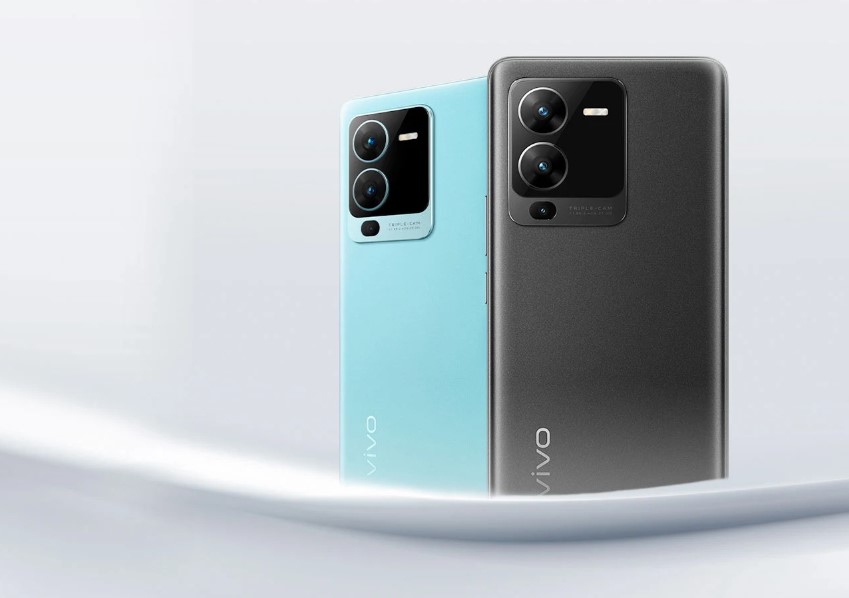
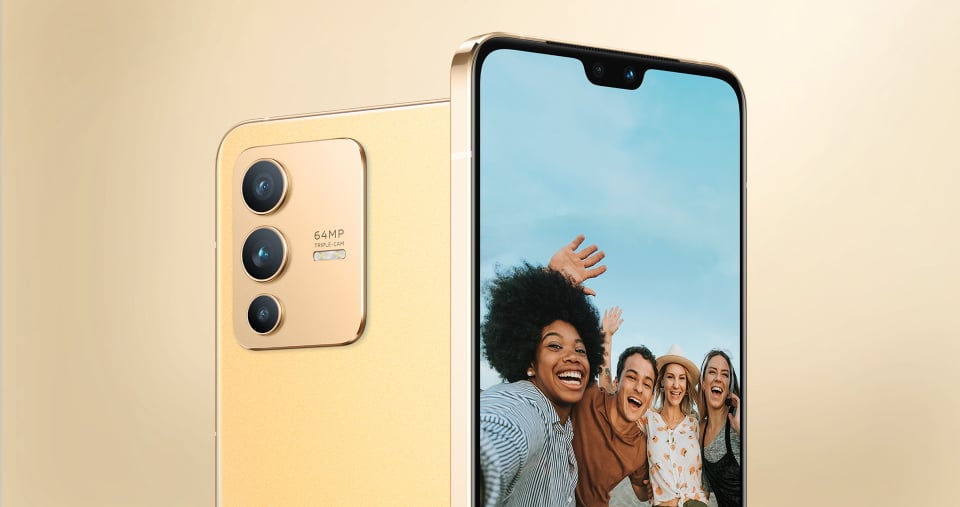
The Vivo V25 Pro is tipped to launch in India on August 15 and will go on sale from August 25. As of writing this article, the company had also officially started teasing the arrival of the smartphone.
According to leaks and teasers, the device will come with a MediaTek Dimensity 1300 chip, 120Hz curved display, 64MP triple camera setup, 32MP selfie camera, 4,830mAh battery, and 66W fast wired charging support.
Just like its predecessor Vivo V23 Pro, it will also feature a color-changing Fluorite AG Glass panel on its back.
11. Vivo V25
Vivo V25 Series
The Vivo V25 is expected to go official in India alongside the Vivo V25 Pro on August 15. It will be most likely almost similar to its predecessor Vivo V23 in terms of specs and features.
As of now, the handset is said to be powered by a MediaTek Dimensity 900 SoC paired with 8GB RAM. It is expected to come in 128GB and 256GB storage variants.
12. Realme GT Neo 3T
Realme GT Neo 3T
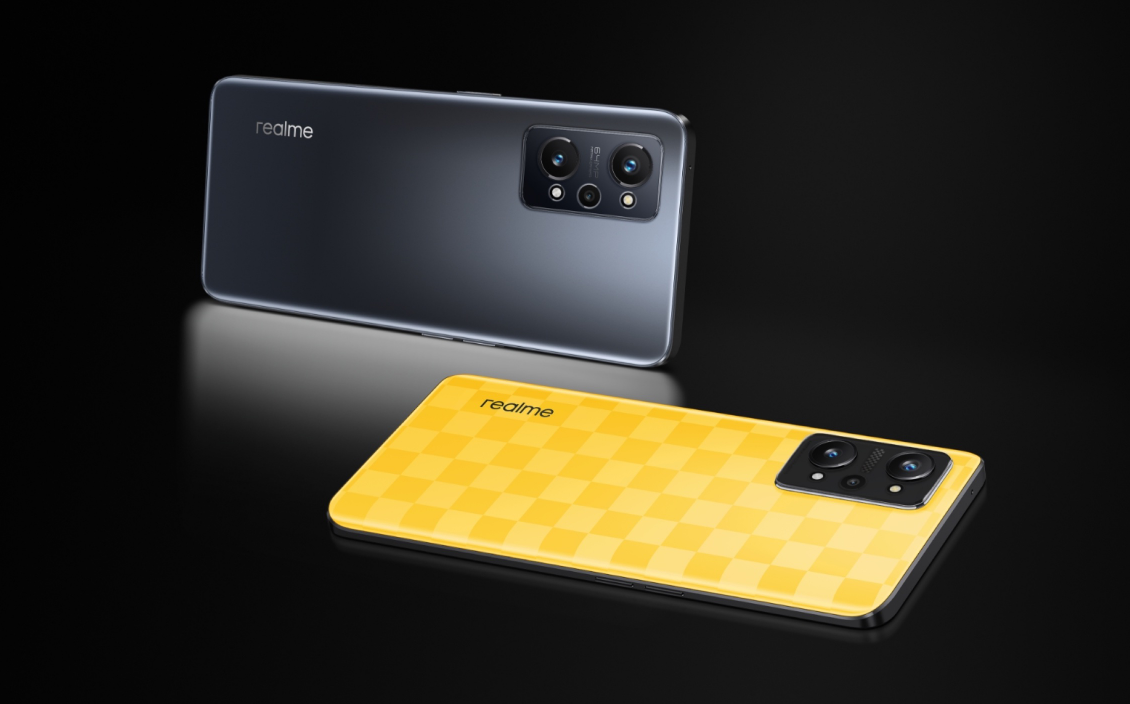
The Realme GT Neo 3T has been officially confirmed to launch in India in August 2022. However, the brand is yet to reveal the exact launch date.
The Realme GT Neo 3T is a rebranded Realme Q5 Pro from China. The device made its initial debut in Indonesia in June.
It offers features like a 6.62-inch FHD+ 120Hz AMOLED display, Qualcomm Snapdragon 870 chipset, 64MP (wide) + 8MP (ultra-wide) + 2MP (macro) triple camera system, 16MP selfie camera, dual stereo speakers, 5,000mAh battery, 80W fast wired charging support, and more.
13. Realme C33
Realme C35
Realme C33 is tipped to launch in India soon. There’s a high chance it may happen this month itself.
So far, we only know that the phone will come in three memory configurations (3GB + 32GB, 4GB + 64GB, 4GB + 128GB) and three colors (Sandy Gold, Aqua Blue, Night Sea).
It will likely arrive with a large display (LCD) and a UNISOC or a MediaTek chip.
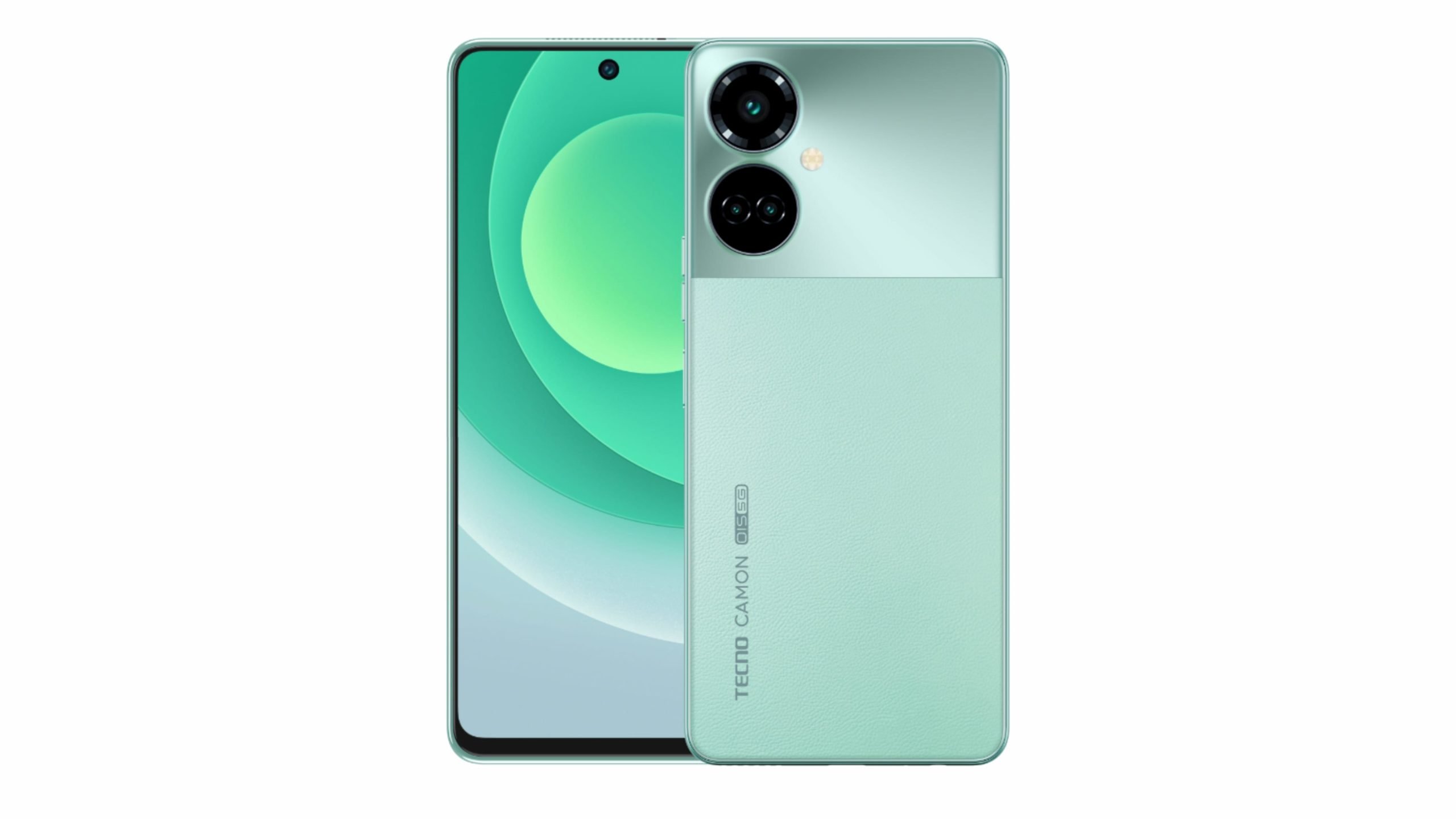
14. Tecno Camon 19 Pro 5G
Tecno Camon 19 Pro 5G
The Tecno Camon 19 Pro 5G made its global debut in June. The handset is now being teased to launch in India soon. It will most likely make its way to the region in August.
The device arrives with a MediaTek Dimensity 810 chipset, 6.8-inch 120Hz display (LCD), 64MP (wide) + 2MP (macro) + 2MP (depth) triple camera system, 16MP front-facing camera, side-mounted fingerprint sensor, 5,000mAh battery, 33W fast wired charging support, and more.
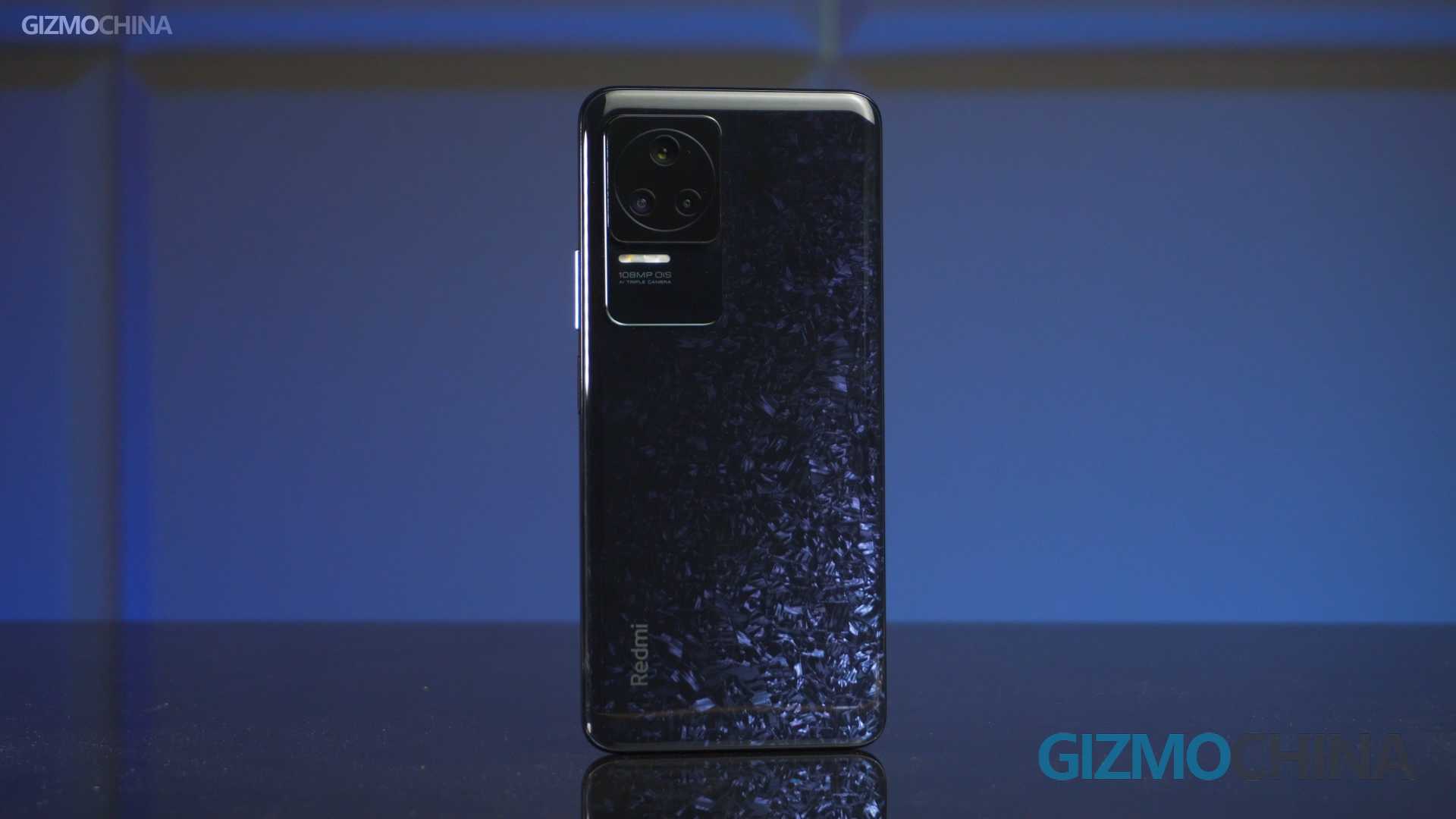
15. Redmi K50 Extreme Edition
Redmi K50 Pro
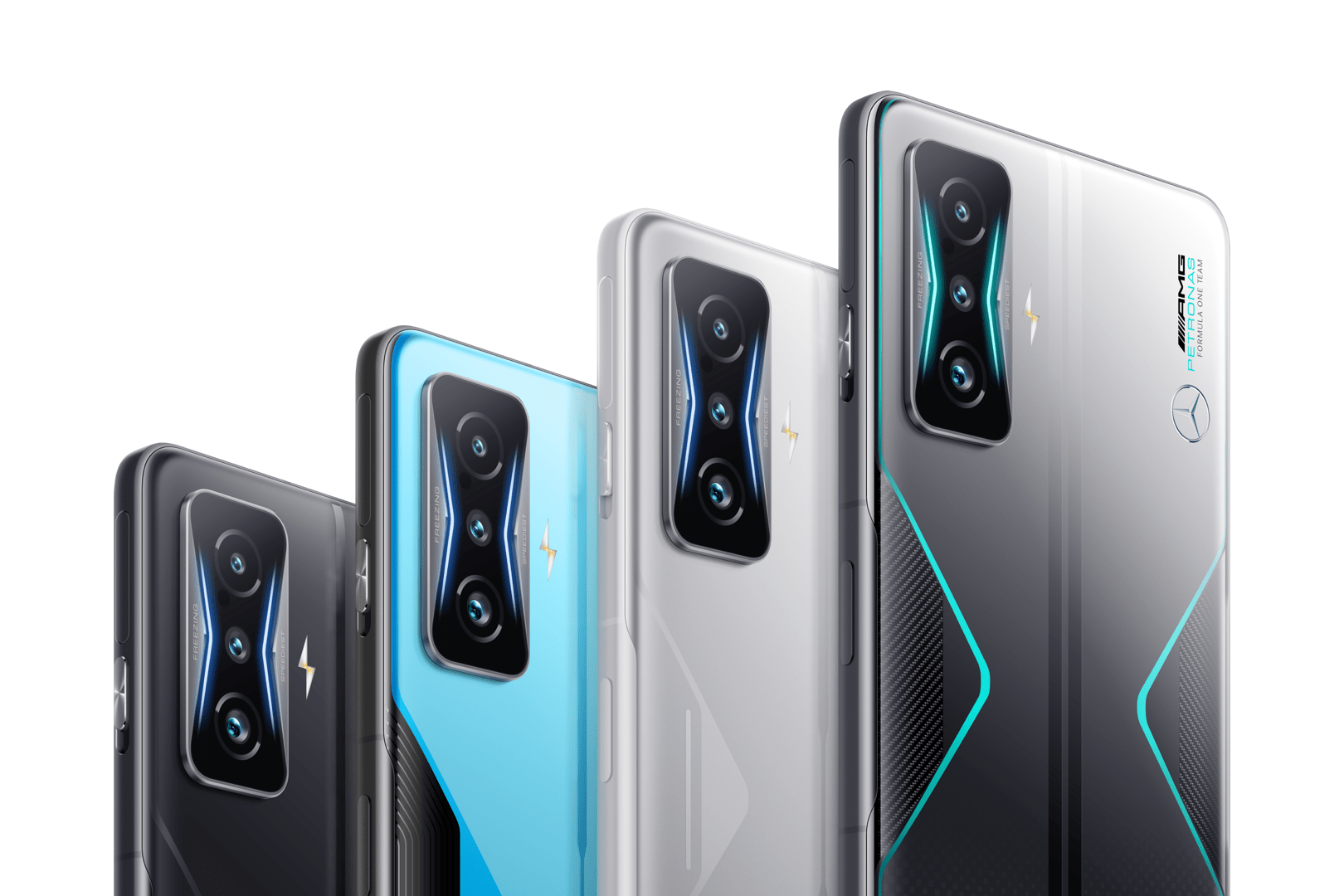
Redmi is gearing up to launch a new Redmi K series smartphone in China powered by a Qualcomm Snapdragon 8 Plus Gen 1 SoC. This phone is rumored to go official as either Redmi K50S Pro or Redmi K50 Ultra. As of now, the brand officially teases it as Redmi K50 Extreme Edition.
According to leaks and certifications, it will come with a 6.7-inch FHD+ AMOLED display, in-screen fingerprint sensor, 108MP (wide) + 8MP (ultra-wide) + 2MP (macro) triple camera setup, 20MP front-facing camera, 5,000mAh battery, and 120W fast wired charging support.
The handset will be available in 8GB + 128GB and 12GB + 256GB memory configurations. It is expected to release as Xiaomi 12T Pro outside mainland China.
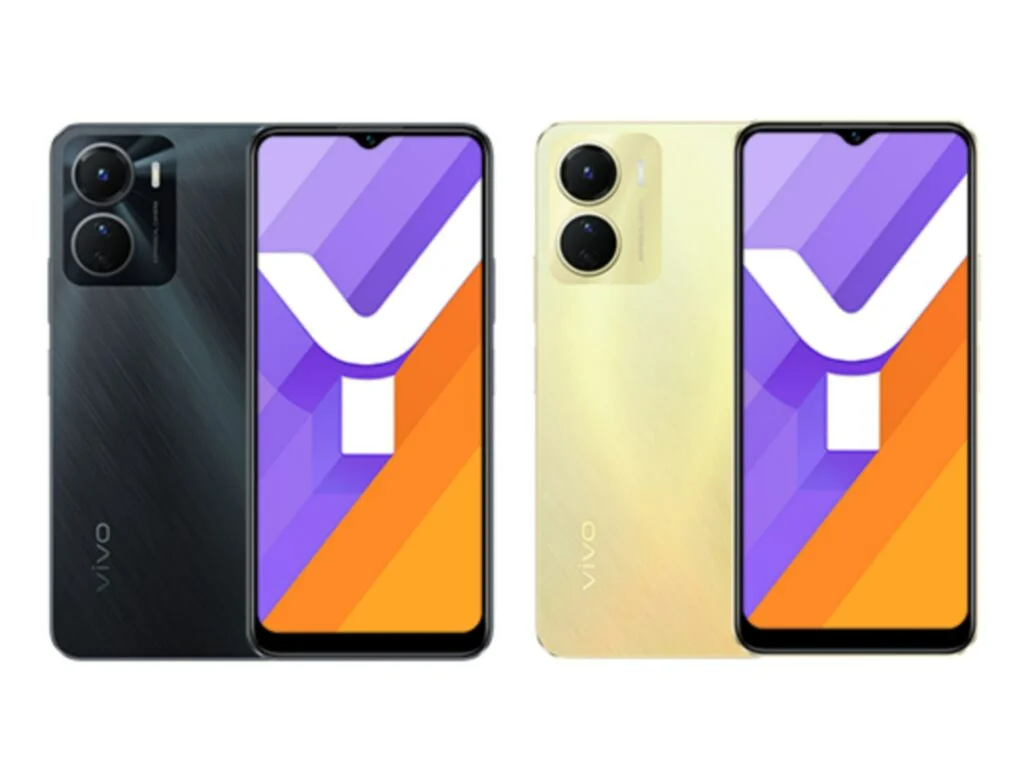
16. Vivo Y22 and Vivo Y22s
Vivo Y21G
The Vivo Y22 and the Vivo Y22s are tipped to launch in India soon. They are said to come in 4GB + 64GB and 6GB + 128GB memory variants respectively.
The duo is said to flaunt an HD+ display (LCD). In addition to more RAM and storage, the ‘s’ valiant may also come with a 90Hz refresh rate.
Finally, these phones will likely arrive with a side-mounted fingerprint sensor, 5,000mAh battery, and 18W wired charging support.
17. Vivo Y16
Vivo Y16
The Vivo Y16 is expected to launch this month in India. Most of the handset’s specifications have already leaked.
It is tipped to arrive with a 6.51-inch HD+ display (LCD), MediaTek Helio G35 chipset, 13MP (wide) + 2MP (macro/depth) dual-camera system, 5MP selfie camera, 4GB RAM, 64GB/128GB storage, side-mounted fingerprint sensor, 5,000mAh battery, 10W wired charging, and more.
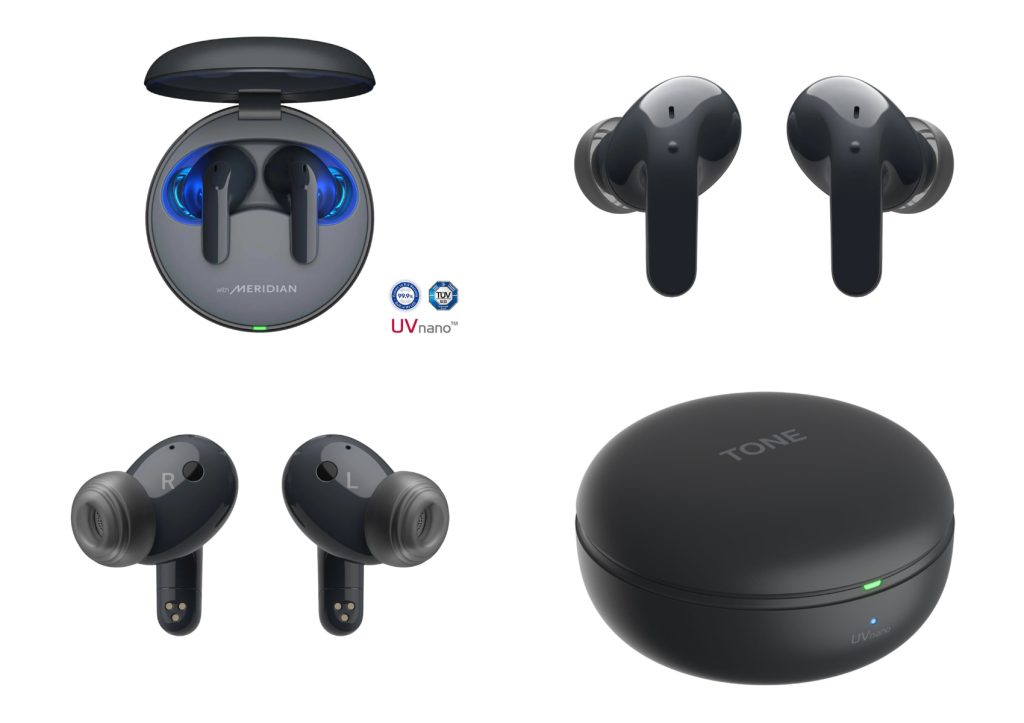
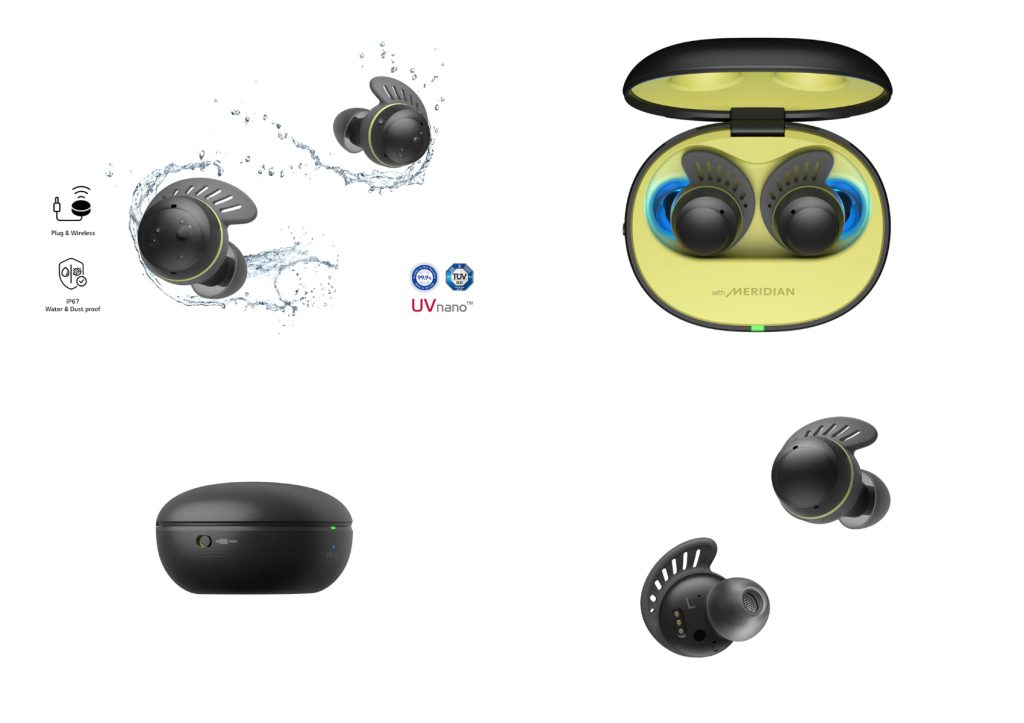
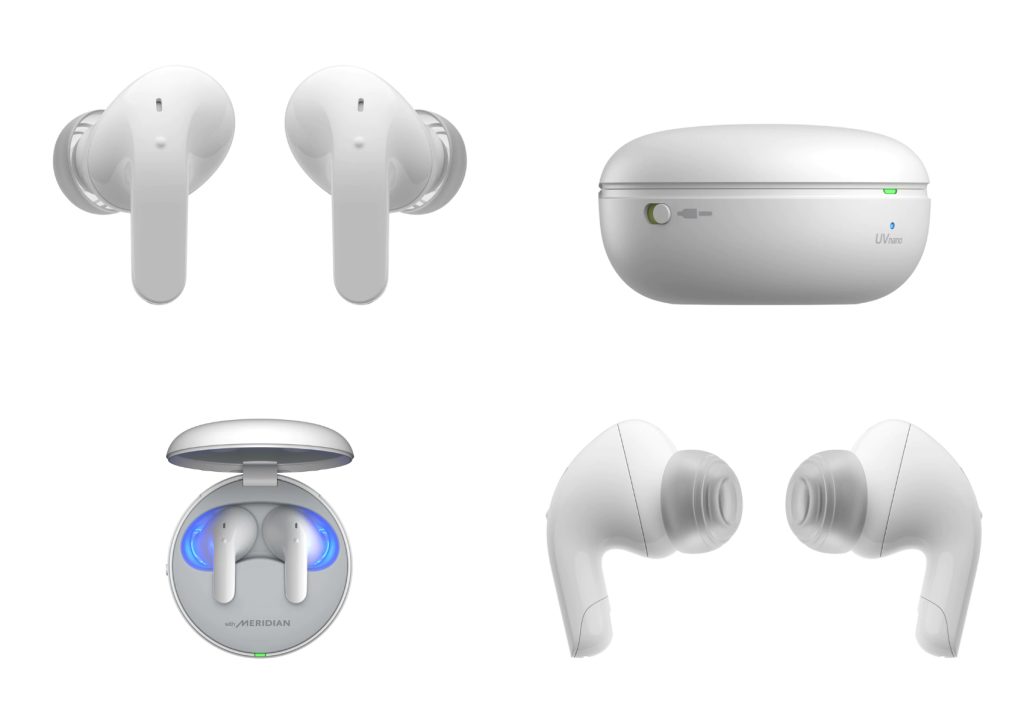
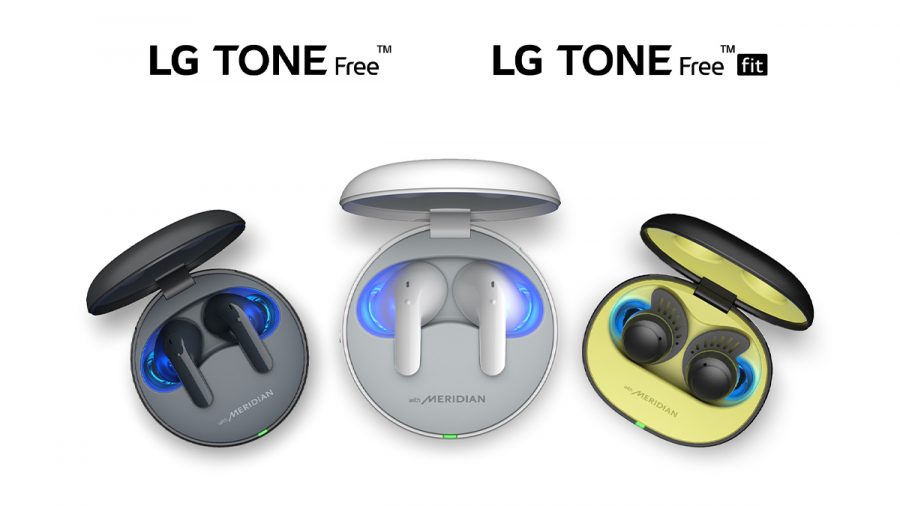
True Wireless earbuds are entering the market with greater audio quality and affordability. LG is latching to the growing demand for such products by releasing its Tone Free lineup of TWS earbuds. The 2022 lineup includes the Tone Free T90, Tone Free T60, Free Fit TF7, and Free Fit TF8 models. LG says the new products offer a great audio experience while retaining comfort and other advanced features.
The LG Tone Free T90 has powerful drivers for a deeper bass output, modulated by Graphene. It offers a dynamic, balanced, and sharp audio output. The T90 uses Meridian Headphone Spatial Processing (HSP) technology to deliver a natural sound stage. This provides a surround experience similar to listening to a stereo system. The HSP technology also maintains tonal balance when the volume is modulated. The T90 features Dolby Atmos and Dolby Head Tracking to recalibrate the sound according to a user’s head movement. The T90 can also be deployed in gaming applications, and they feature Dolby audio virtualizer.
The Tone Free T90 earbuds offer up to 27 hours of playtime overall. It supports wireless charging and the device comes with Snapdragon Sound Technology. The Double Step ANC and a Real-Time ANC Optimizer combine to deliver crisp and clear audio always. The LG Tone Free T60 has a lightweight design at just 5.6g. It also features the Meridian HSP technology as well as improved ANC functionality. The T60 can detect and eliminate ambient noise to deliver a crisp audio output. It comes with powerful drivers for fuller bass output. LG introduced UV sanitization using the T60’s UV nano charging case. Together with its charging case, the T60 can deliver up to 29 hours of activity.
LG Tone Free T90
The LG Tone Free Fit TF7 and TF8 are designed for persons with an active lifestyle. They offer a secure and comfortable fit even during intense physical activity like working out at the gym. The earbuds come with improved airflow and SwivelGrip technology. This keeps the earbuds in place during intense or strenuous physical activities.
The TF7 and TF8 also feature the Meridian HSP technology and advanced ANC for clear spatial sound outputs. Their UV nano charging case and hypoallergenic ear gels ensure ear hygiene at every use. Both earbuds are IP67-rated and up to 30 hours of battery life is featured. It is also possible to connect the TF8 to a treadmill for a more entertaining gym session.
The new LG lineup of Tone Free TWS earbuds is currently available in Korea but global availability will be at the end of the month. The T90 is priced at $229.99, while the T60 is priced at $200. The LG Tone Free Fit TF7 retails at $183.99 while the TF8 retails at $200.
The Indian smartphone market is dominated by budget and mid-range smartphones manufactured by Xiaomi, OPPO, and their Chinese peers. However, it seems that the Indian government is going to rectify that very soon. As per a report, India is planning to restrict Chinese OEMs from selling devices cheaper than Rs. 12,000 ($150).
A Bloomberg report suggests that the reason behind this move is to kickstart the failing domestic smartphone industry. Indian OEMs like Micromax and Lava once had a strong position in the Indian smartphone market but after the arrival of Chinese manufacturers like Xiaomi, OPPO, and Vivo, they barely saw any rise in their sales. While this move may strengthen the domestic manufacturers, it will definitely land a huge blow to the Chinese OEMs who dominate the entry-level segment in the country.
In recent years, Xiaomi and other Chinese OEMs have been hugely dependent on India to fuel growth as their home market suffers from a series of Covid-19 lockdowns that have severely hampered consumption. A third of India’s smartphone sales were under $150 in the quarter through June 2022, with Chinese companies accounting for up to 80% of those shipments, according to market research firm Counterpoint.
While this decision will definitely land a huge blow to the Chinese OEMs, Samsung and Apple may not be affected at all because the companies don’t focus on the entry-level segment.
Currently, there has been an official announcement from the Indian Government regarding this move. We are unsure if a new policy will be implemented in this regard or if Delhi will use informal ways to convey its preference to the Chinese companies. The smartphone brands have not commented on this news either. We hope to learn more about it in the near future.
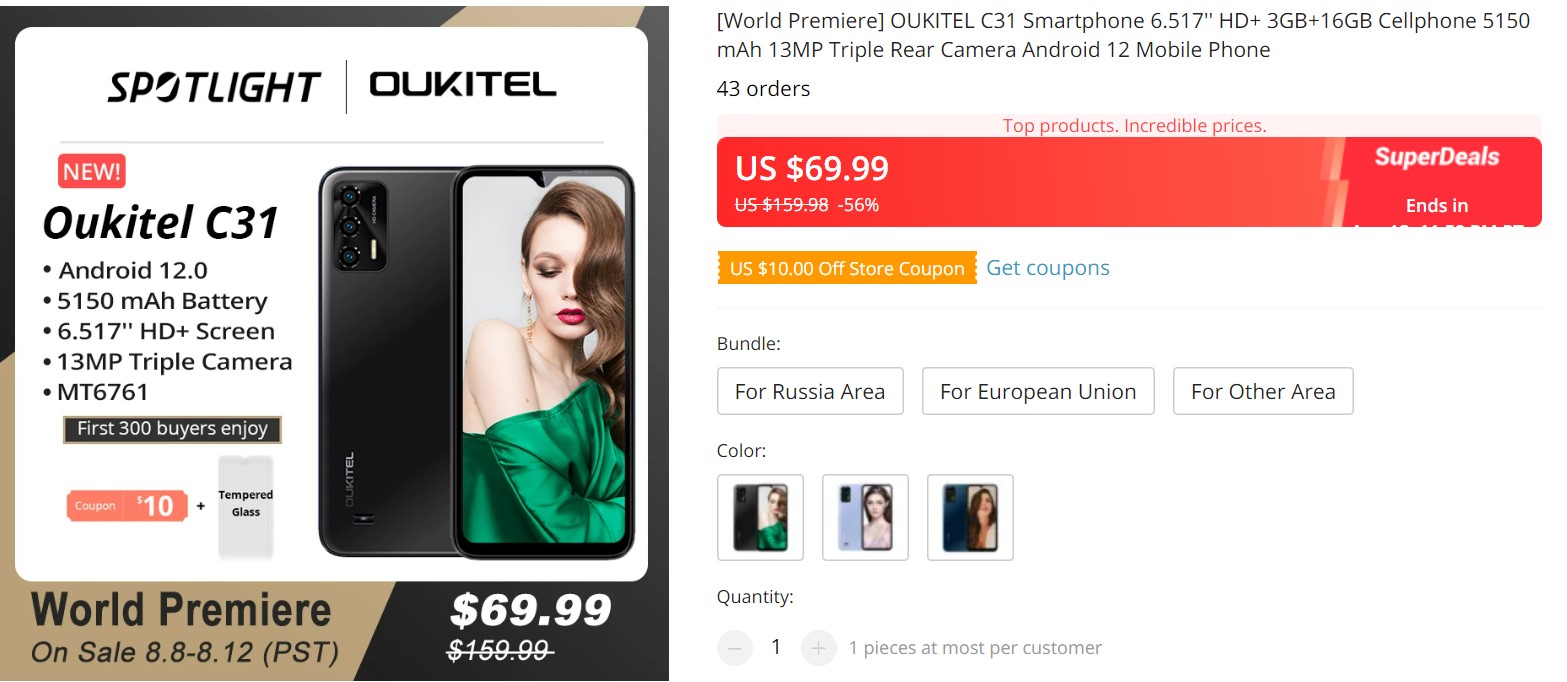
Oukitel is launching its latest smartphone the Oukitel C31 at a heavily discounted price on AliExpress. The smartphone which generally retails for $159.99 is now available at a massively discounted price of $69.99 under the world premiere deal. Please note that this is the lowest price offered for this smartphone. This deal will end on August 12, 2022.
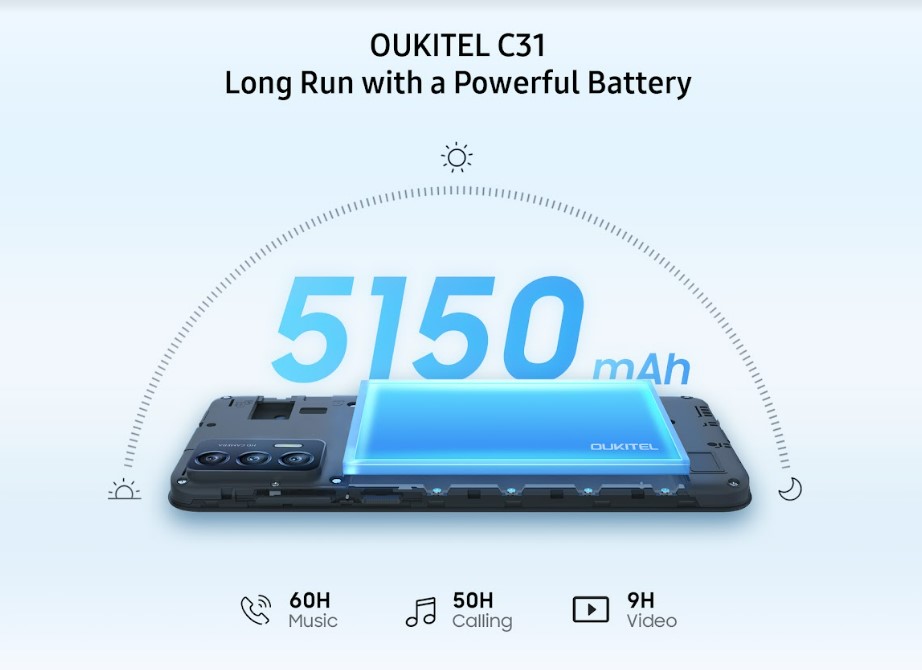
Oukitel C31 is the latest entry-level smartphone launched by the brand. The phone comes with a lightweight and trendy design and affordable price but does not compromise its features. It boasts a massive 5150mAh battery that supports 50 hours of calling time, 60 hours of music, and 520 hours of standby.
The phone features a 6.517-inch HD+ display and supports 1600 x 720p resolution and a 20:9 aspect ratio. It is powered by MediaTek Helio A22 quad-core processor and comes with 3GB RAM and 16GB internal storage expandable up to 256GB. Oukitel C31 features a triple rear camera setup with a 13MP primary camera and 0.3MP + 0.3MP secondary sensors. For selfies, you have a 5MP sensor in the front. The camera features advanced modes like Pro, Bokeh, Night mode, etc.
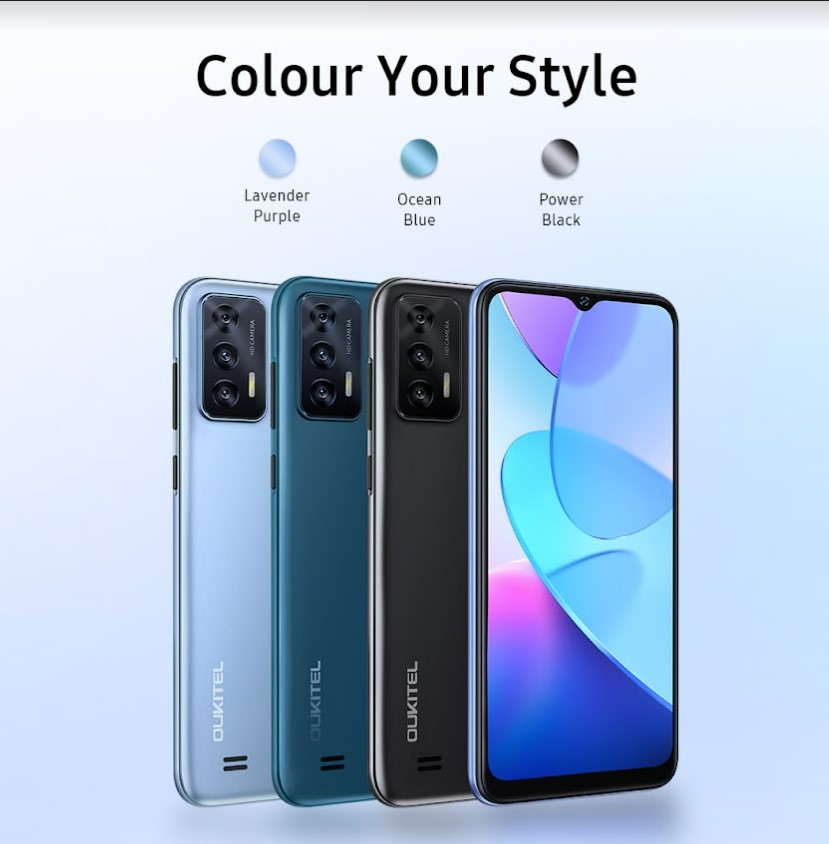
Oukitel C31 runs on Android 12 OS and comes in Black, Purple, and Blue color variants. Generally retailing for $159.99 you can now buy Oukitel C31 for $69.99 only at the World Premiere sale on AliExpress. This sale ends on August 12, 2022. So place your order before the deal expires.
Please note that the above price is region-specific and the final price may vary according to your shipping region, warehouse, and regional taxes.
For more information on such exciting deals and offers check out our deals hub.
OPPO has officially announced that it will launch a new wireless earbud at the upcoming launch event scheduled to be held on August 10. The product is dubbed OPPO Enco Air 2i and is presently up for pre-orders.
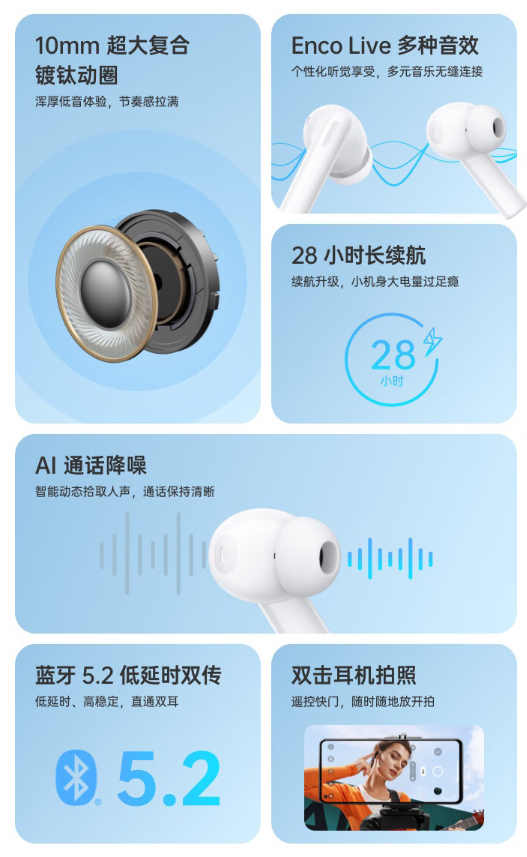
The OPPO Enco Air 2i TWS earbuds come with little difference from the previous models, the likes of the Enco Air 2. However, for a model that looks like a trimmed-down version of the Enco Air 2, it packs a built-in 40mAh battery, which can last up to 7 hours of music playback on a single charge and up to 28 hours when used with the charging case. The storage case packs a decent 460mAh battery. It should be noted that the battery life is an increase of 4 hours compared to the previous generation – Enco Air 2.
In addition, the new earphones are equipped with a super large 10mm composite titanium-plated sound unit each, making them more powerful. The special sound cavity combined with the high magnetic flux magnetic circuit will make the low-frequency performance better.
It is worth mentioning that the new product, like the OPPO Enco Air2, supports AI call noise reduction, and users can make clear calls even in the outdoors full of complex ambient sounds. With Bluetooth 5.2, the delay can be further reduced and the call stability can be improved.
In terms of price, the previous generation OPPO Enco Air2 is priced at 199 yuan, and the arrival price is 159 yuan. The price of the new product is also expected to be around 199 yuan but the company has yet to reveal the recommended retail price.
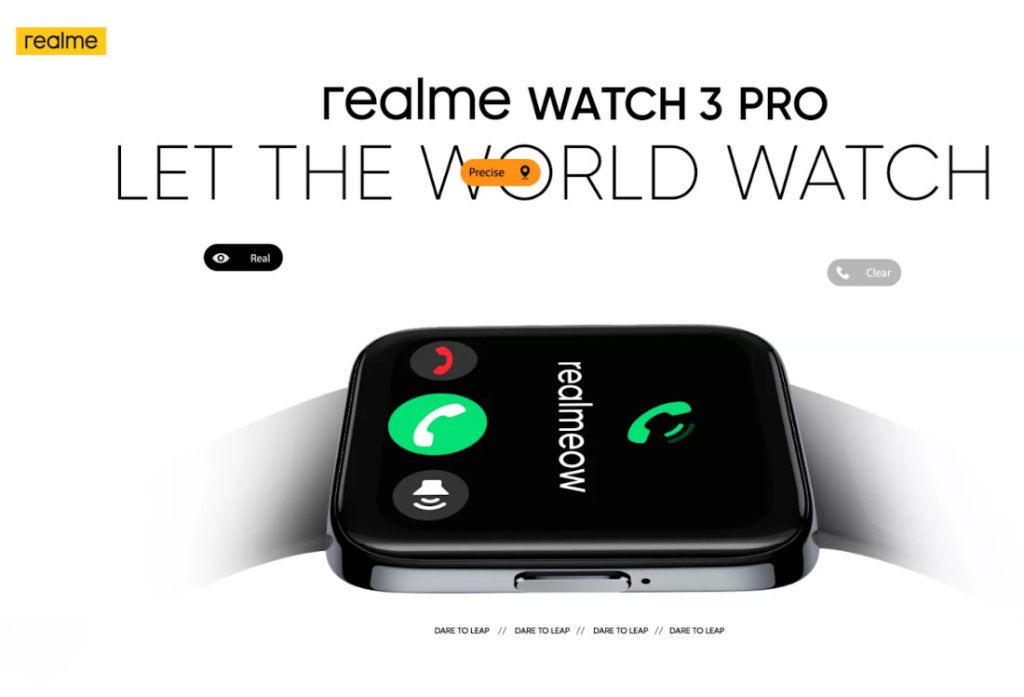
Realme Watch 3 Pro is teased to launch in India soon. The company has put up a microsite of the upcoming offering on its official website. The Realme Watch 3 Pro will arrive as the successor to the Watch 2 Pro that debuted last year. Although Realme has not revealed the exact launch date of the upcoming smartwatch, we expect it to debut alongside the Realme 9i 5G smartphone on August 18th.
The microsite reveals only a few features of the Realme Watch 3 Pro. The company claims it to be a flagship smartwatch. The upcoming offering is seen with a metal body and a physical button on the right side. There is also a small cutout that we assume to be a microphone. The wearable device has a square dial with an AMOLED display panel compared to the LCD on its predecessor. The smartwatch is teased to come with a large screen.
The Realme Watch 3 Pro is confirmed to come with Bluetooth voice calling capabilities. It will also feature a built-in GPS.
Realme recently launched the Watch 3 in India. The upcoming Watch 3 Pro will arrive as an upgraded variant of the regular model. We can expect more features compared to the Watch 3 as well as the Watch 2 Pro on the upcoming offering. Additionally, the Watch 3 Pro’s price may also be on the higher side.
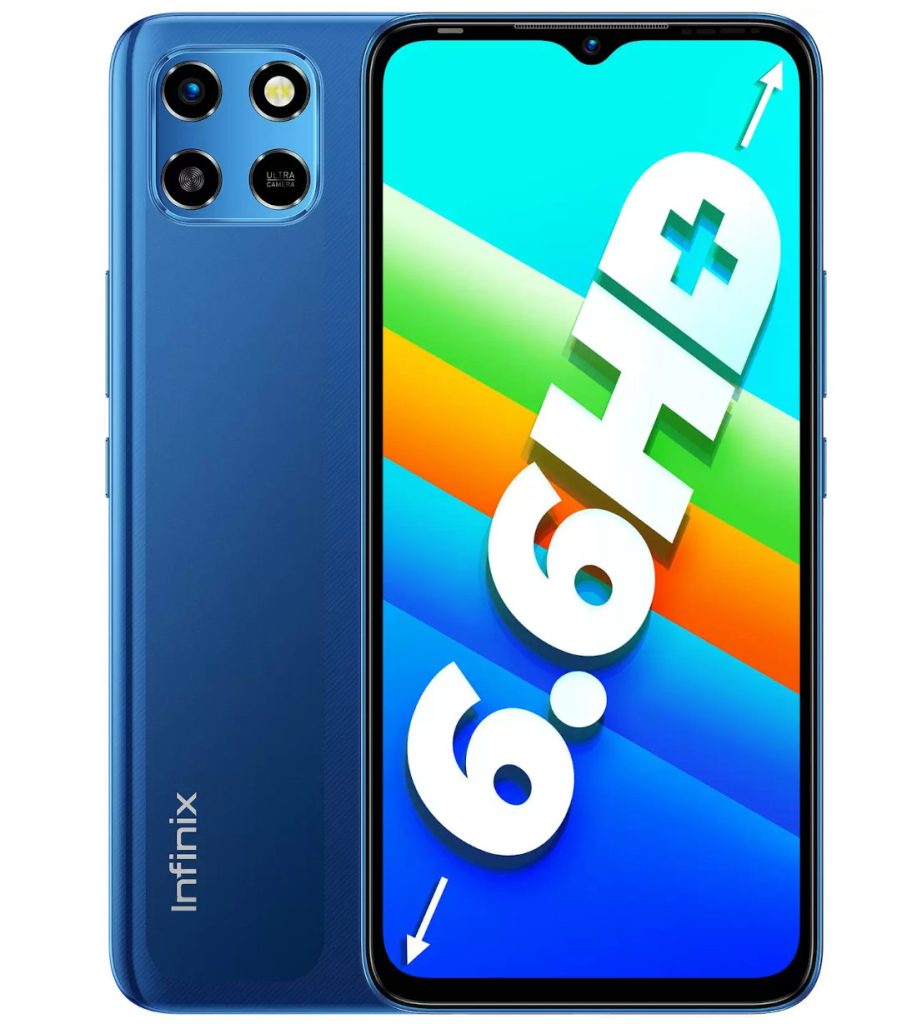
Infinix Smart 6 HD has been launched in India today. It is a budget smartphone under the Rs 7,000 price bracket. The device comes with decent specifications and runs on Android Go OS. It is ideal for first-time smartphone users or those on a tight budget. Read on to know what the Infinix Smart 6 HD offers out of the box.
The Infinix Smart 6 HD comes with a 6.6-inch display bearing an HD+ resolution and a waterdrop notch. It offers 500 nits brightness and an 89 percent screen-to-body ratio. The device lacks a fingerprint scanner and there is a square rear camera module. The smartphone features an 8MP rear camera paired with an LED flash and a 5MP front-facing selfie snapper.
Internally, the Infinix Smart 6 HD is equipped with a MediaTek Helio A22 processor. It packs 2GB RAM onboard and a 2GB extendable RAM feature. There is 32GB internal storage expandable up to 512GB via a microSD card slot. Software-wise, the smartphone runs on Android 11 Go edition out of the box. The Infinix Smart 6 HD draws its power from a 5,000mAh battery unit with support for 10W charging.
Connectivity options on the Infinix Smart 6 HD include dual-SIM, dual 4G VoLTE, WiFi, Bluetooth, and a micro USB port.
Infinix Smart 6 HD pricing and availability
The Infinix Smart 6 HD is offered in Aqua Sky, Force Black, and Origin Blue colours. It carries a price tag of Rs 6,799 and will be available for purchase from Flipkart starting August 12th.
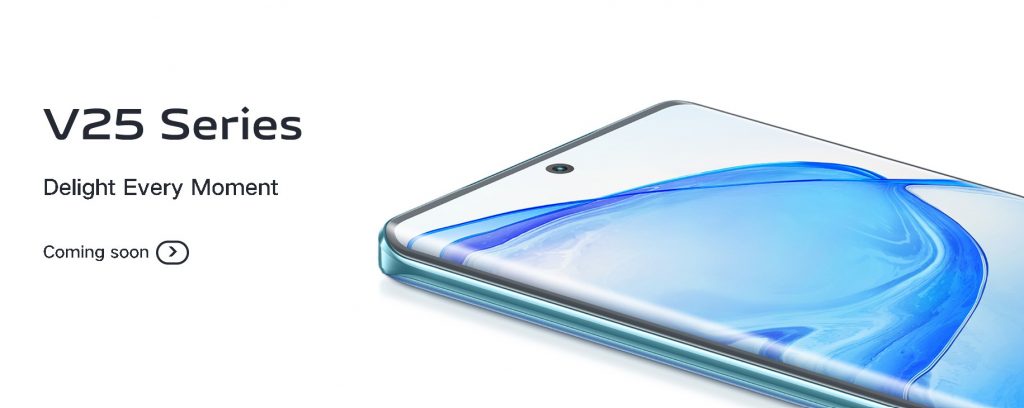
Vivo V25 series is confirmed to launch in India soon. The lineup will comprise a regular V25 and V25 Pro variants. The company has put up a microsite of the upcoming offerings on the official website. The Vivo V25 series will arrive as the successor to the Vivo V23 series that debuted earlier this year. The smartphone’s Flipkart availability has also been confirmed.
The landing page of the Vivo V25 series on the brand’s website reveals key specifications of the Pro variant. On the display front, it will feature a centre-aligned punch-hole cutout with a 3D curved screen and a 120Hz refresh rate. The device will come with a rectangular camera module and a colour-changing back panel technology. The upcoming offering is confirmed to sport a triple rear camera setup comprising a 64MP main sensor with OIS support. It will also pack features like hybrid image stabilisation, super night mode, bokeh flare portrait etc.
Under the hood, the Vivo V25 Pro is confirmed to be equipped with a MediaTek Dimensity 1300 processor. It will pack 8GB of extendable virtual RAM technology. The smartphone will draw its power from a 4,830mAh battery unit with support for 66W fast charging.
Apart from the aforementioned details, the landing page does not reveal any additional specifications of the upcoming V25 Pro. As per leaks, Vivo is expected to unveil the V25 series in India on August 17th. Since the microsite is now live, we can expect the brand to announce the launch date in the coming days.
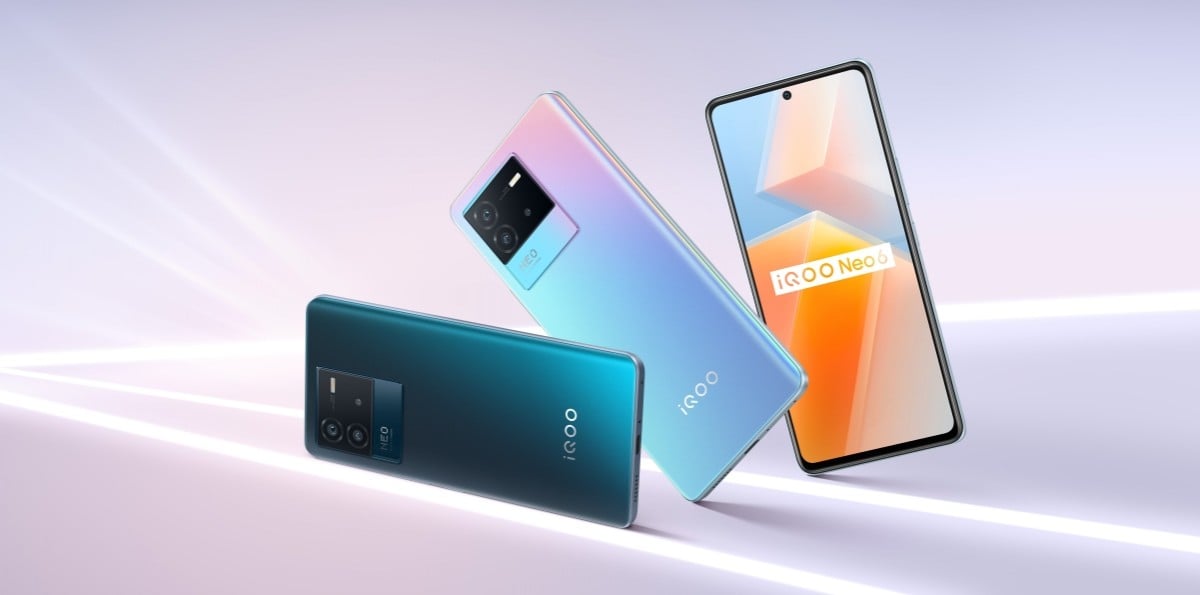
In this price range, the iQOO Neo 6 is undoubtedly one of the best options a prospective buyer can consider when buying a phone under 30,000 INR. It sports a 6.62 inch FHD+ AMOLED display that has a 120Hz refresh rate. But, its most notable feature is the inclusion of a flagship Qualcomm Snapdragon 870 SoC that is paired with up to 12GB of RAM and up to 256GB of internal storage. The device runs on Android 12 OS and is powered by a large 4,700mAh battery that supports 80W fast charging as well.
iQOO Neo 6
For cameras, the Chinese company is offering a 64 megapixel triple camera setup on the rear. So all in all, its a pretty solid pick in this price tag thanks to its great specifications and relatively affordable price tag. It is currently listed on Amazon India for a price of 29,999 INR for the 8GB + 128GB model. Another iQOO phone that you can consider is the iQOO 7 that has a similar price tag and also feature the Snapdragon 870. However, this variant is a bit older so the newer model will have longer software support.
Motorola has had a strong performance in the mid range segment and its latest Edge 30 is another great option for those that prefer a stock Android experience with their smartphones. It sports a 6.55 inch pOLED display that has a FHD+ resolution and 144Hz refresh rate. Under the hood, the device is equipped with a Qualcomm Snapdragon 778G+ SoC and it runs on Android 12 OS out of the box.
Motorola Edge 30
The rear packs a triple camera setup with a 50 megapixel primary and another 50 megapixel ultra wide angle lens, along with a 2 megapixel depth sensor. Apart from its stock Android experience, it also features an attractive design with a slim body that measures just 7.4mm and a rear panel made from polycarbonate, which helps in keeps its weight low, measuring just 155 grams. The smartphone has a price tag of 27,999 INR (roughly 360 US Dollars) and is currently listed on Flipkart.
Thanks to its Nord series of smartphones, OnePlus has established a strong presence in the mid range segment, and the new Nord 2T is another great offering in this price range. It is equipped with a MediaTek Dimensity 1300 SoC that is paired with up to 12GB of RAM and 256GB of internal storage. On the front it sports a 6.43 inch AMOLED HDR10+ display that has a FHD+ resolution and a 90Hz refresh rate.
The smartphone packs a triple camera setup on the rear, with the primary sensor being a 50 megapixel Sony IMX766 sensor, an 8 megapixel ultra wide angle lens, and a 2 megapixel macro sensor. This camera is typically found in more pricier models, so the Nord 2T can be a great choice for those that use their phones for photography often. It is currently listed on Amazon India and starts for a price tag of 28,999 INR for its 8GB + 128GB configuration.
Within the 30,000 INR segment, flagship smartphones aren’t as common and we already listed the iQOO Neo 6, which had some top notch specs. Although, Vivo has a handset that offers a premium experience through its design. The Vivo V23 features a Fluorite AG Glass that glitters when light is reflected on it. This rear panel is surrounded by a metallic frame. On the front, the smartphone sports a 6.44 inch FHD+ AMOLED display that has a 90Hz refresh rate and HDR10+ support.
Vivo V23 5G
Under the hood, the device packs the Dimensity 920 SoC that is paired with up to 12GB of RAM and 256GB of internal storage. The rear features a triple camera setup that includes a 64 megapixel primary sensor, an 8 megapixel ultra wide angle lens, and a megapixel depth sensor. The front also includes a 50-megapixel dual camera setup. So for those looking to carry around a device that turns head, this might the one for you. It is currently listed on Flipkart for 29,990 INR.
The Samsung Galaxy M52 is another worthy option in the sub-30 K category. Its Galaxy M series has always been popular in this price range and one of the latest includes the M52, which offers a Qualcomm Snapdragon 778G SoC and a massive 5,000mah battery pack that supports 25W fast charging (although, the box only includes a 15W charger).
Samsung Galaxy M52 5G
On the front, it sports a large 6.7 inch Super AMOLED panel that has a 120Hz refresh rate, FHD+ resolution, and a Gorilla Glass 5 protection. The rear packs a 64 megapixel triple camera setup, so all things considered, the offering from the South Korean tech giant is quite decent at this price range. It is currently available on Amazon India, with its 6GB + 128GB configuration costing 29,999 INR.
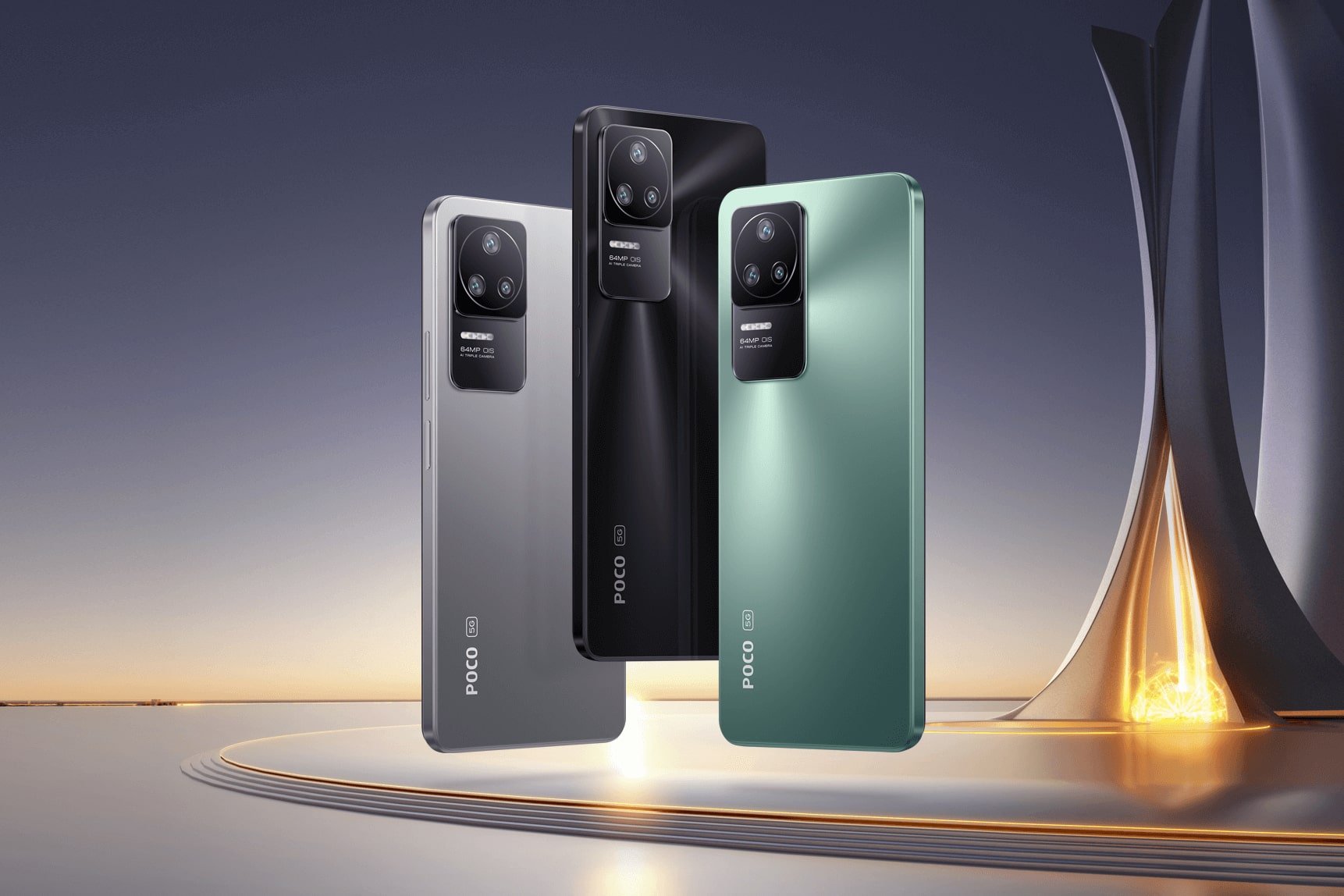
The POCO F4 is easily one of the best smartphones under this price segment. It arrives with a 6.67 inch E4 AMOLED display that has a Full HD+ resolution, a 120Hz refresh rate, 1300 nits peak brightness, and even HDR10+ and Dolby Vision support. The company has also placed an emphasis on its design with a gradient rear panel that also features a triple camera setup on a rectangular shaped module. The module houses the 64 megapixel primary sensor that has OIS support, along with the 8 megapixel ultra wide angle lens, and a 2 megapixel depth camera. Meanwhile, the front houses a 20 megapixel selfie shooter.
Under the hood, the device houses a Qualcomm Snapdragon 870 SoC that is paired with up to 12GB of RAM and 256GB of internal storage. In other words, it is equipped with some top notch specs. So, for gamers and regular power users, this device should be able to handle anything you throw at it. It is available for purchase on Flipkart for a price tag of 27,999 INR for its 6GB + 128GB variant. Although, you can also consider the 8GB + 128GB variant that costs 29,999 INR.
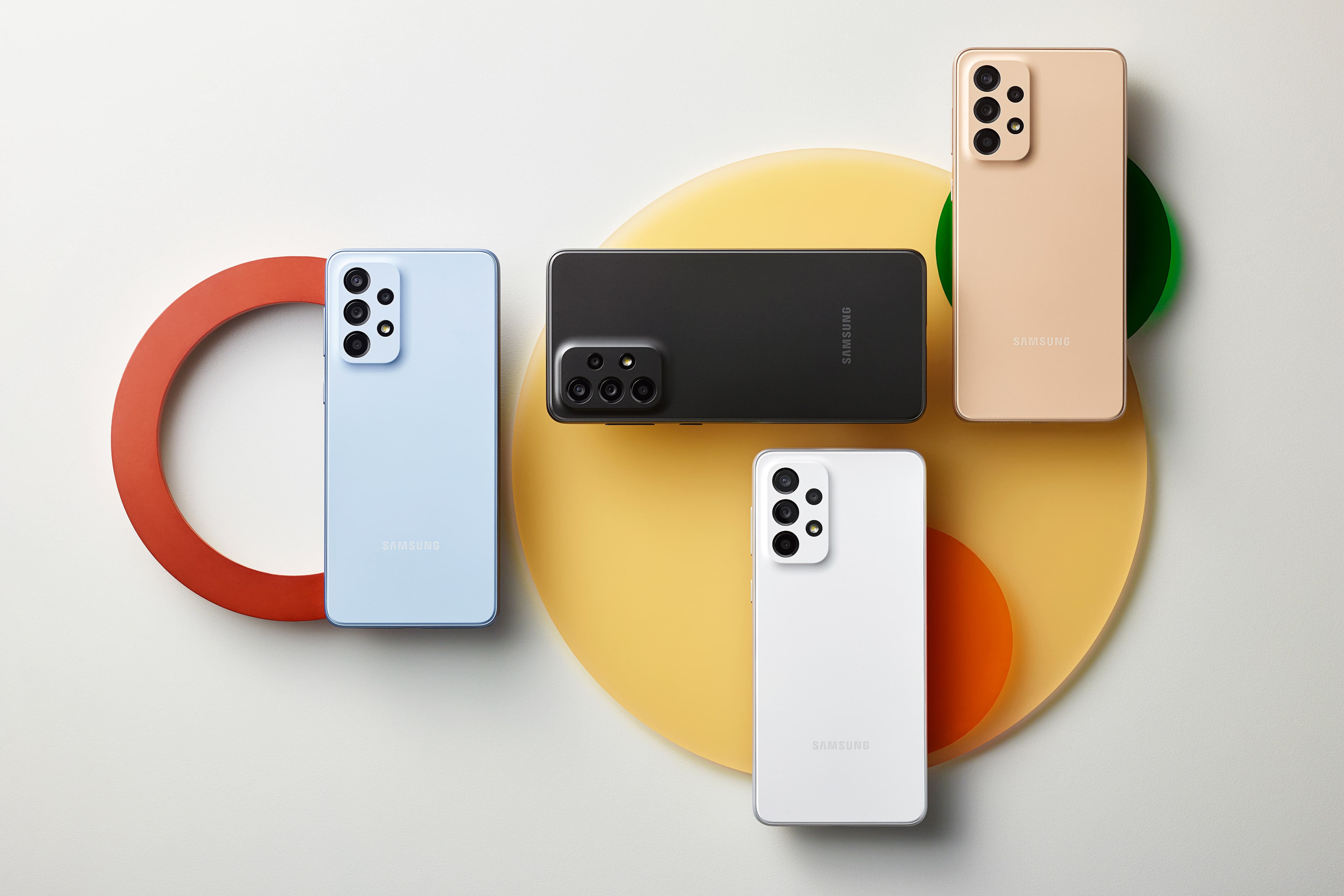
Rounding up the list, we have another Samsung smartphone. Our last pick is the Galaxy A33 that was launched recently. It has a 6.4 inch Super AMOLED display on the front that has a 90Hz refresh rate and FHD+ resolution. Under the hood, the device is equipped with a Exynos 1280 SoC paired with up to 8GB of RAM and up to 256GB of internal storage. The handset is powered by a 5,000mAh battery pack that supports 25W fast charging.
Samsung Galaxy A53 5G
On the rear, it features a 48 megapixel quad camera setup. The smartphone runs on the Android 12 OS-based One UI 4.1 custom skin out of the box. While this model might not be particularly eye catching, it has decent specs and even offers up to 4 years of software update. So for those looking to have a device that stays updated for long can consider this as their next upgrade option.
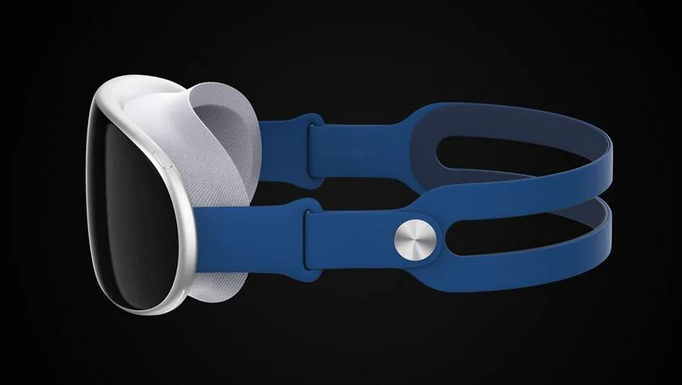
We have already covered a number of reports regarding Apple launching its first ever mixed reality headset. And now, the latest information regarding this product has revealed that the new AR/VR headset might be launching at the start of next year, but it may tear a hole through your wallet.
The news arrives from known analyst Ming-Chi Kuo. In a new tweet, Kuo claimed that the Cupertino based giant is planning on releasing its “next revolutionary consumer electronics product after the iPhone” next year. For those unaware, the mixed reality headset will apparently offer both Augmented Reality and Virtual Reality functionality. But unfortunately, it will also be quite expensive as well. It will reportedly launch with a hefty price tag between 2,000 to 2,500 US Dollars.
Furthermore, the analyst added that the mixed reality headset could launch sometime as early as January 2023. The announcement of this headset will also focus on three aspects as per Kuo. This includes its applications, the software/service/development ecosystem, and end with hardware specifications. Interestingly, the mixed reality device isn’t the only headset that the brand is working on, as he claims that Apple will also launch an AR exclusive headset as well.
Apart from this, the company will apparently also launch affordable version of its headset products sometime by early 2025. Unfortunately, this is all the information shared by the analyst on Twitter. Even if this report is true, the announcement for the product is still months away. Although, we can expect additional leaks to surface in the near future, so stick around for more updates.
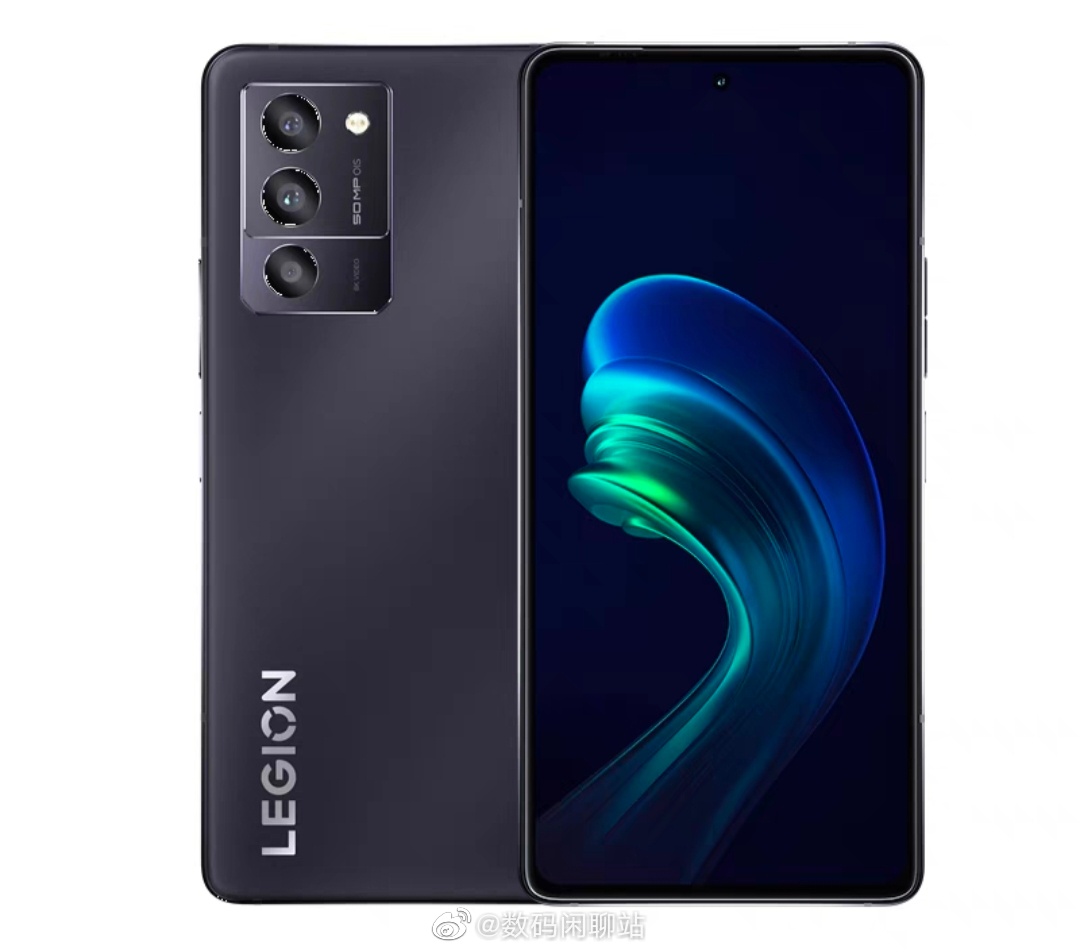
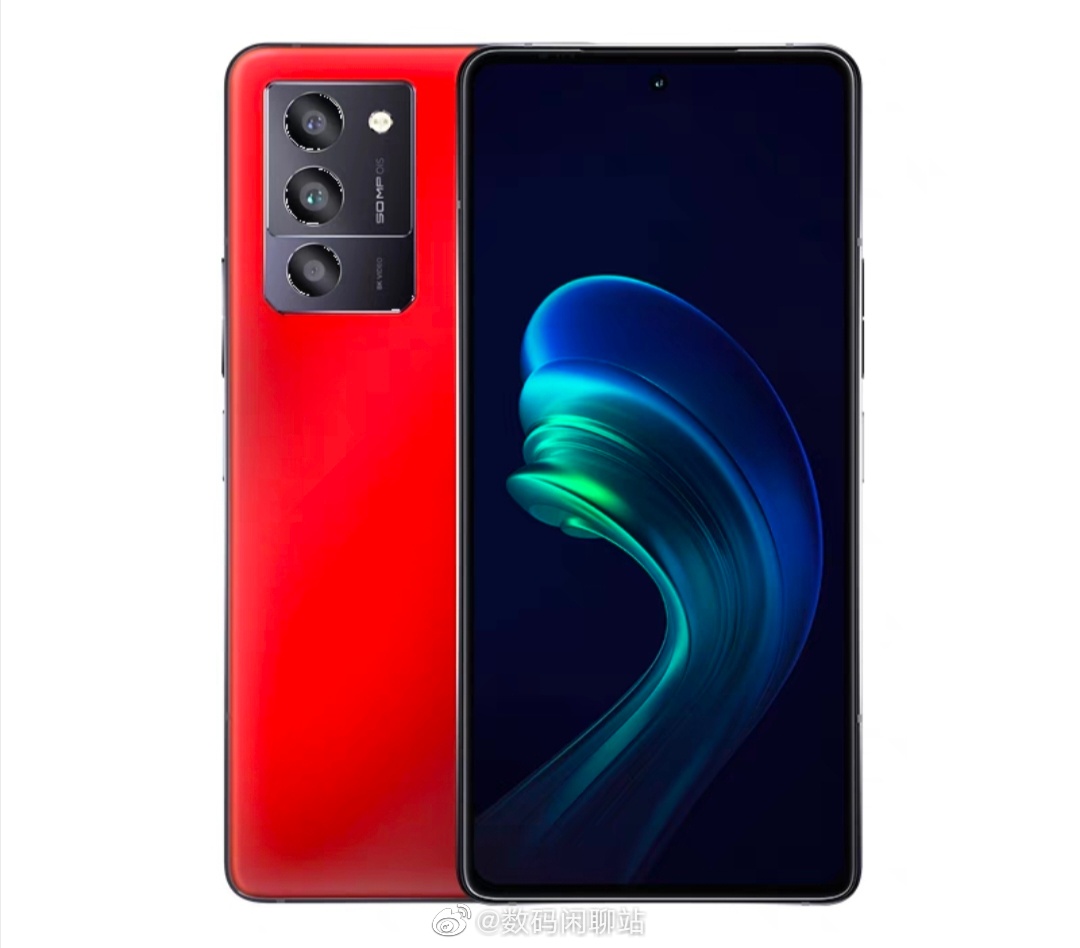
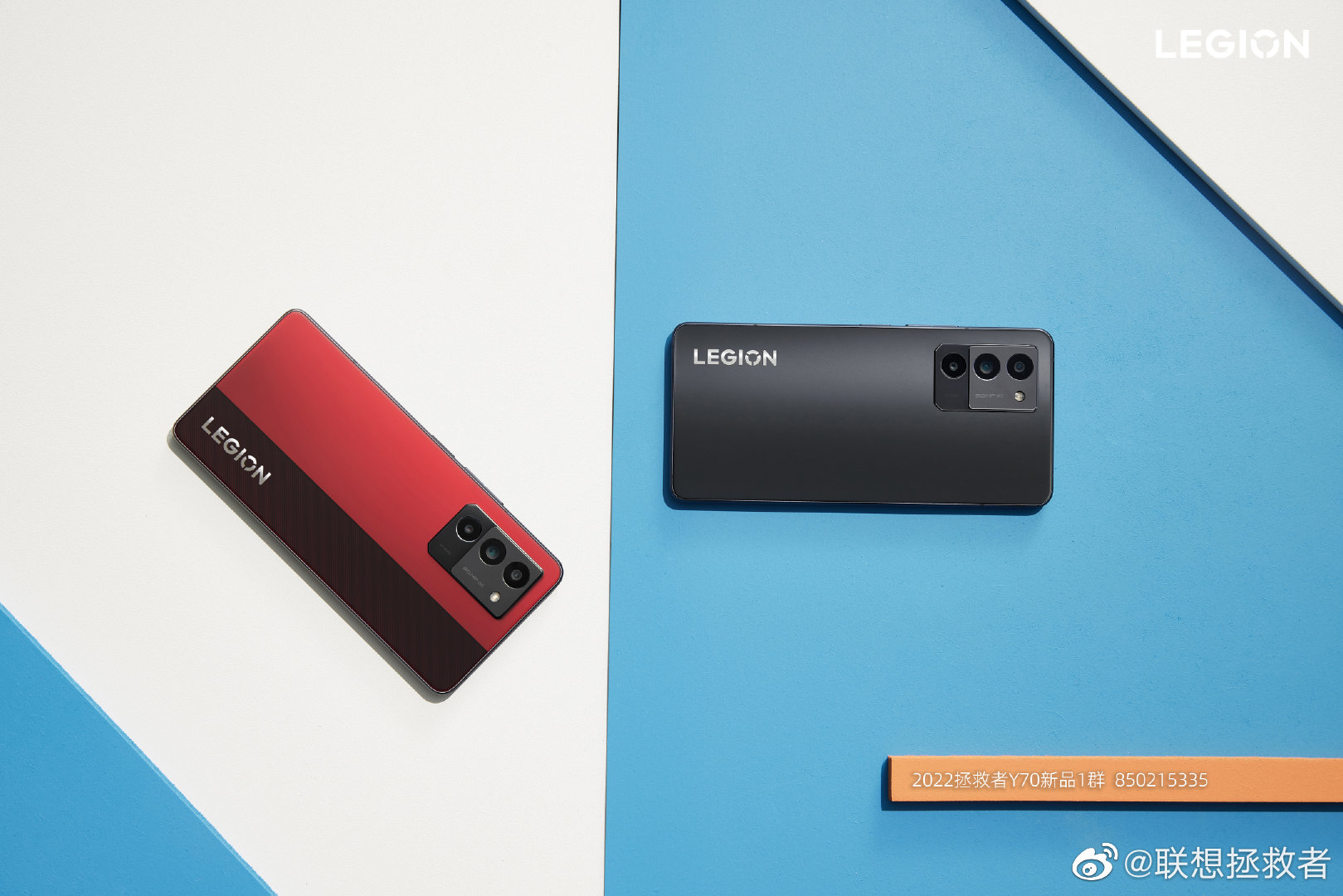
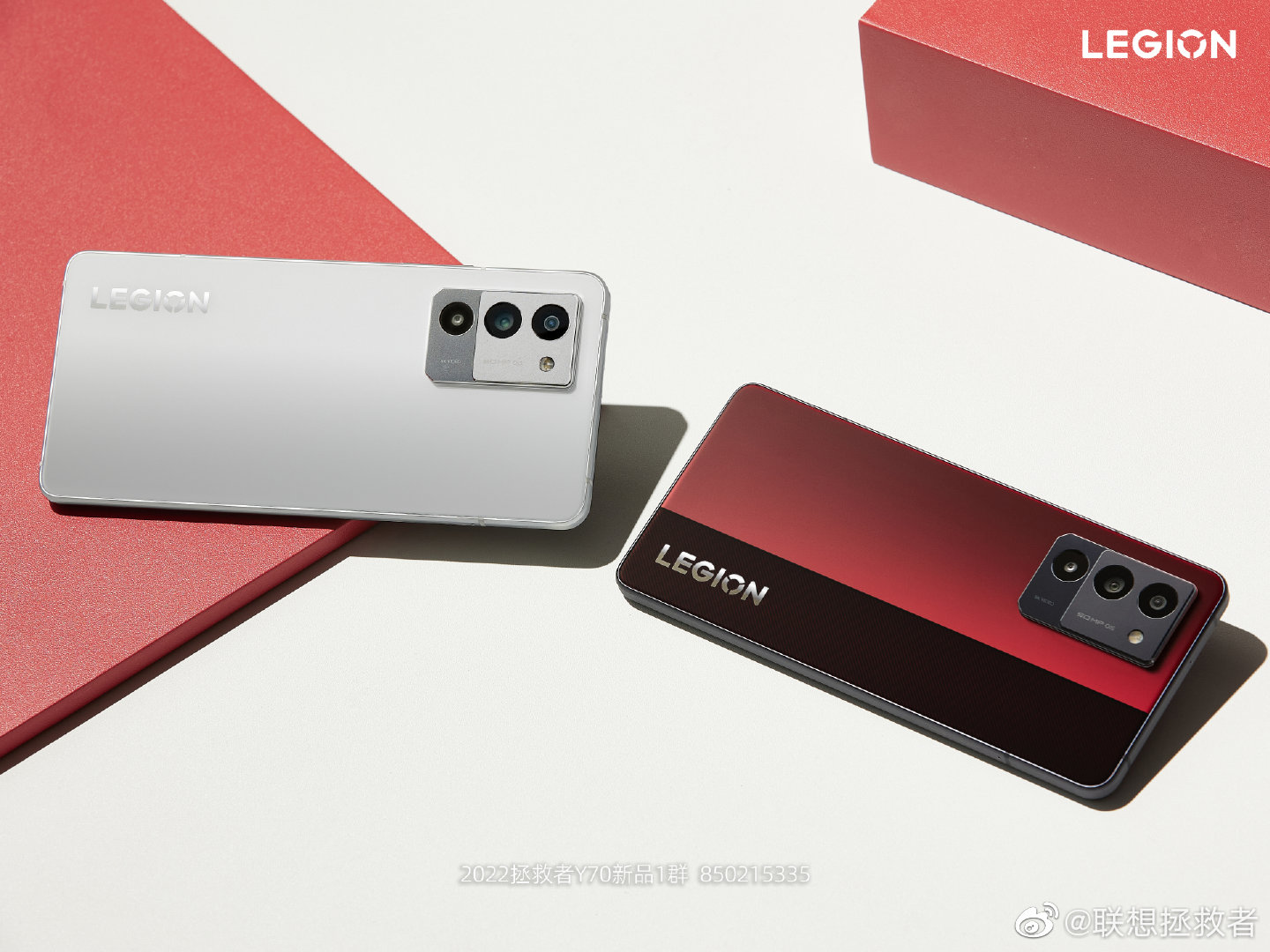
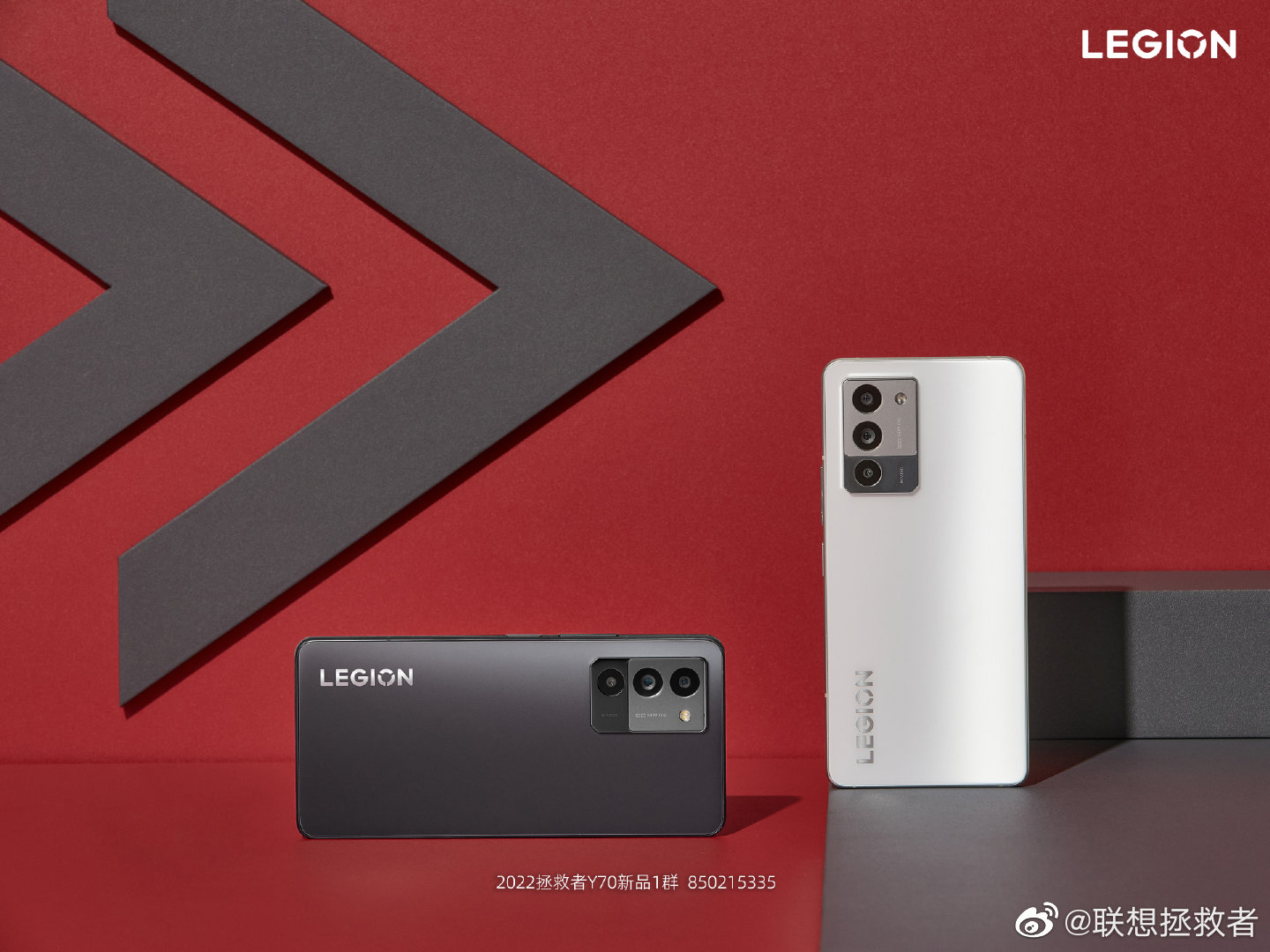
The Legion branding reveals that the Legion Y70 will be a gaming phone. However, its images show that it will be a toned-down device as compared to the Legion Y90 that debuted in March 2022. The Chinese manufacturer has confirmed that the Y70 will come in three colors: Ice Soul White, Titanium Crystal Grey, and Flame Red. Among the three, the red variant sports a dual-tone design.
1 of 3
To recall, the middle portion of the Y90’s back panel features a dual-camera setup and an RGB light panel. However, the Y70 sports a regular design with a triple camera unit placed at the top-left corner. The camera setup comprises a 50-megapixel main camera with OIS support, a 13-megapixel ultra-wide camera, and a 2-megapixel macro snapper.
1 of 4
The Legion Y70 features a punch-hole display at the front. Its previous TENAA listing has revealed that it will have a 6.58-inch AMOLED FHD+ display. It will probably support a high refresh rate of up to 144Hz. It will feature a 13-megapixel front-facing camera.
The Snapdragon 8+ Gen 1 chipset will power the Legion Y70. The device is expected to ship with up to 16 GB of LPDDR5 RAM and up to 512 GB of UFS 3.1 storage. It will draw power from a 4,800mAh battery, which carries support for 68W rapid charging. Its other features include an in-screen fingerprint scanner and Android 12 OS with a ZUI custom skin on top. At present, there is no information on the price of the Y70.
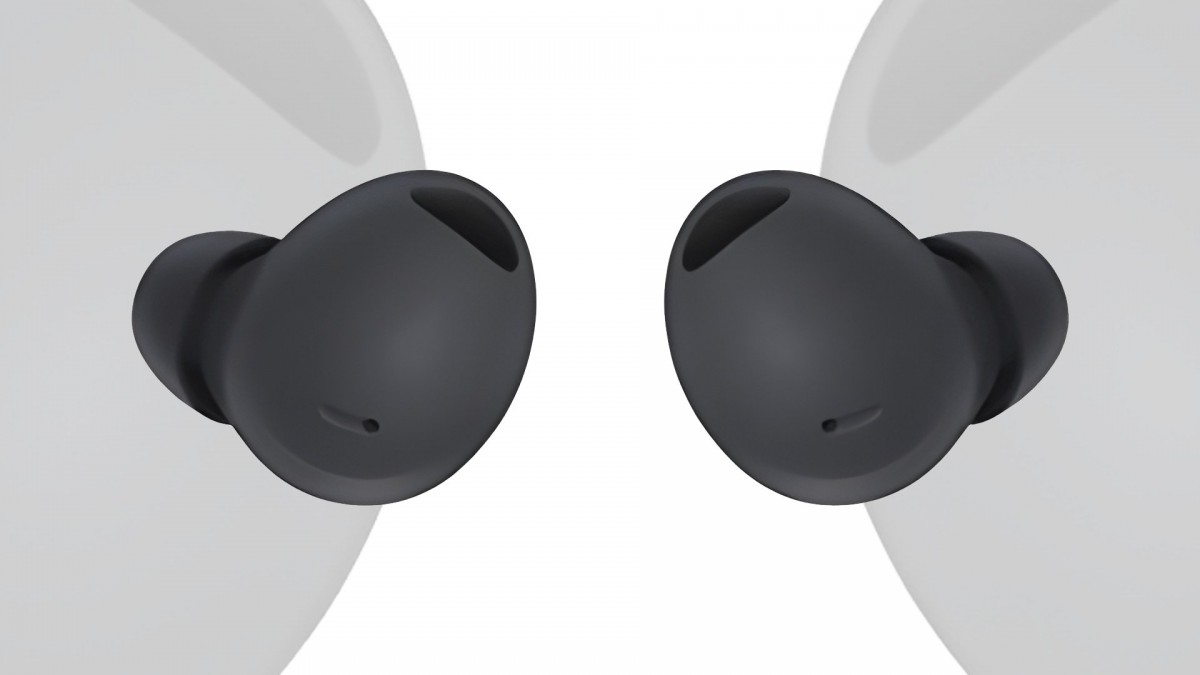
Despite the Samsung Galaxy Unpacked 2022 event being just around the corner, there have been a number of new rumors and reports regarding the upcoming products that will be unveiled during this conference. Now, the pricing for the Galaxy Z Fold 4, Galaxy Z Flip 4, and even the Galaxy Buds 2 Pro has been revealed.
The news arrives from a tweet from known tipster Sudhanshu. The post on Twitter has revealed the pricing for the South Korean tech giant’s next gen foldable smartphones as well as the new premium TWS earbuds, which is the Galaxy Buds 2 Pro. For those unaware, the company will be announcing these three products during the Galaxy Unpacked event on August 10. We had just recently covered the leaked storage configurations for the Galaxy Z Fold 4 and Galaxy Z Flip 4 for the Indian market.
And now, we even have their pricing. As per the tipster, the Galaxy Z Fold 4 starts from 1,879 Euros (roughly 1,916 US Dollars) for its base 12GB + 256GB model. Meanwhile, the higher end 12GB + 512GB variant will apparently be available for purchase for a price tag of 1,999 Euros (roughly 2,039 US Dollars). On the other hand, the clamshell folding Galaxy Z Flip 4 will start from 1,149 Euros (roughly 1,172 US Dollars) for its base 8GB + 128GB model while the higher end 8GB + 256GB variant will cost around 1,199 Euros (roughly 1,222 US Dollars).
Galaxy Buds 2 Pro renders
The top end 8GB + 512GB version will cost 1,329 Euros (roughly 1,355 US Dollars) as per the tipster. Lastly, the tipster also revealed the possible pricing for the Galaxy Buds 2 Pro model as well. These latest generation premium truly wireless earbuds will have a 229 Euros price tag (roughly 233 US Dollars). Keep in mind that this is still just an unconfirmed report so take this news with a pinch of salt.
The Redmi K50 Extreme Edition launch date will be confirmed soon for China. Ahead of the launch, the rumor mill is working hard to reveal details of the smartphone. A new leak from Panda is Bald has revealed the screen resolution of the K50 Extreme Edition. The device has also been seen on Geekbench, which shows some of its other specs. In all likelihood, Redmi may market it as the Redmi K50 Ultra after launch.
Previous reports have revealed that the Redmi K50 Extreme Edition will be equipped with a 6.7-inch AMOLED display. A recent leak revealed that it would be the first K50 series phone to have an under-display fingerprint scanner. Today’s leak reveals that its display will support 2712 x 1220 pixels resolution.
Redmi K50 Gaming Edition
Previous leaks had claimed that the Redmi K50 Extreme Edition would be Xiaomi’s first phone with a 200-megapixel camera. However, the tipster has further revealed that the smartphone will not have a 200-megapixel lens but a 108-megapixel Samsung ISOCELL HM6 primary camera. It will be assisted by an 8-megapixel ultra-wide camera and a 2-megapixel macro / depth assist lens.
The Redmi K50 Extreme Edition is already confirmed to feature the Snapdragon 8+ Gen 1 chipset. Its TENAA listing is yet to be populated with its entire specifications. However, preliminary details available on TENAA reveal that it will arrive in 8 GB RAM + 128 GB storage and 12 GB RAM + 256 GB storage variants.
The K50 Extreme Edition will pack a 5,000mAh battery with 120W fast charging support. For selfies, it will feature a 20-megapixel front-facing camera. The phone will come preloaded with MIUI 13based Android 12 OS. It is expected to be released with the Xiaomi 12T Pro moniker in the global market.
We use cookies on our website to give you the most relevant experience by remembering your preferences and repeat visits. By clicking “Accept”, you consent to the use of ALL the cookies.
This website uses cookies to improve your experience while you navigate through the website. Out of these, the cookies that are categorized as necessary are stored on your browser as they are essential for the working of basic functionalities of the website. We also use third-party cookies that help us analyze and understand how you use this website. These cookies will be stored in your browser only with your consent. You also have the option to opt-out of these cookies. But opting out of some of these cookies may affect your browsing experience.
Necessary cookies are absolutely essential for the website to function properly. This category only includes cookies that ensures basic functionalities and security features of the website. These cookies do not store any personal information.
Any cookies that may not be particularly necessary for the website to function and is used specifically to collect user personal data via analytics, ads, other embedded contents are termed as non-necessary cookies. It is mandatory to procure user consent prior to running these cookies on your website.