Samsung is expected to launch the Galaxy A23 4G smartphones in India. Pricebaba’srecent report has revealed that it will be arriving in two variants. The report has also tipped the Galaxy A23 pricing for the offline markets in India.
According to the publication, the Galaxy A23 4G will be arriving in two options such as 6 GB RAM + 128 GB storage and 8 GB RAM + 128 GB storage. Both models are likely to be priced at Rs 19,499 (~$256) and Rs 20,999 (~$275), respectively, in offline stores across India.
Samsung Galaxy A23 specifications
The Galaxy A23 houses a 6.6-inch LCD screen with a teardrop notch. The screen produces a Full HD+ resolution and a 60Hz refresh rate. For security, it has a side-facing fingerprint scanner. The device runs on Android 12 OS and One UI 4.1.
Samsung Galaxy A23
The Snapdragon 680 chipset powers the Galaxy A23. It has 8 GB of RAM and 128 GB of internal storage. The device packs a 5,000mAh battery that supports 25W rapid charging.
The Galaxy A23 has an 8-megapixel front-facing camera. Its rear camera setup has a 50-megapixel primary camera and a pair of 2-megapixel sensors for macro and depth shots. For durability, the Galaxy A23 is equipped with Gorilla Glass 5 to protect its screen.
A recent report revealed that the South Korean company is also planning to launch the Galaxy A13 4G in India. The device is speculated to arrive in three options, such as 4 GB RAM + 64 GB storage, 4 GB RAM + 128 GB storage, and 6 GB RAM + 128 GB storage. These variants are likely to cost Rs 14,999 (~$197), Rs 15,999 (~$210), and Rs 17,499 (~$228) in offline markets in India.
Qualcomm announced the Snapdragon 8 Gen 1 back in December 2021. Recent reports have claimed that the company is working on a ‘Plus’ edition of the SD8G1. It is speculated that Qualcomm’s rumored chip with the SM8475 part number may debut as the Snapdragon 8 Gen 1 Plus chipset. A new report by Onsitegocites tipster Yogesh Brar as the source and shares the launch timeframe of Qualcomm’s next flagship chip.
The Snapdragon 8 Gen 1 is built on Samsung’s 4nm process, whereas the Snapdragon 8 Gen 1+ will be based on the Taiwan-based TSMC’s 4nm semiconductor fabrication process. It is speculated that the Plus edition will be more efficient than the regular version.
The report claims that Qualcomm will announce the Snapdragon 8 Gen 1+ in early May. The US-based chip maker is also expected to unveil the new Snapdragon 700-series around the same time. The first smartphones powered by the SD8G1+ are expected to debut as early as June 2022.
Snapdragon 8 Gen 1
Some of the brands that are expected to launch flagship phones powered by the SD8G1+ include Lenovo, Motorola, OnePlus, and Xiaomi. A report from January revealed that the upcoming Lenovo Legion phone, codenamed “Halo’ could be one of the first phones to debut with the SD8G1+ chip. It is expected to arrive with specs such as a 6.67-inch OLED FHD+ 144Hz screen, a 16-megapixel front camera, and a 50-megapixel + 13-megapixel + 2-megapixel triple camera unit. It may come with up to 16 GB of LPDDR5 RAM, up to 256 GB of UFS 3.1 storage, and a 5,000mAh battery with 68W fast charging support.
A Motorola flagship with ‘Frontier’ codename and SD8G1+ is also in the works. It is expected to arrive with a 6.75-inch P-OLED FHD+ 144Hz screen, a 6-megapixel front camera, a 194-megapixel + 50-megapixel + 12-megapixel triple camera unit, up to 12 GB of LPDDR5 RAM, up to 256 GB of UFS 3.1 storage, and a 4,500mAh battery with 125W fast charging and 50W wireless charging support.
In addition, the Samsung Galaxy Z Flip4 and Galaxy Z Fold4 later this year are also expected to feature the Snapdragon 8 Gen 1+ SoC.
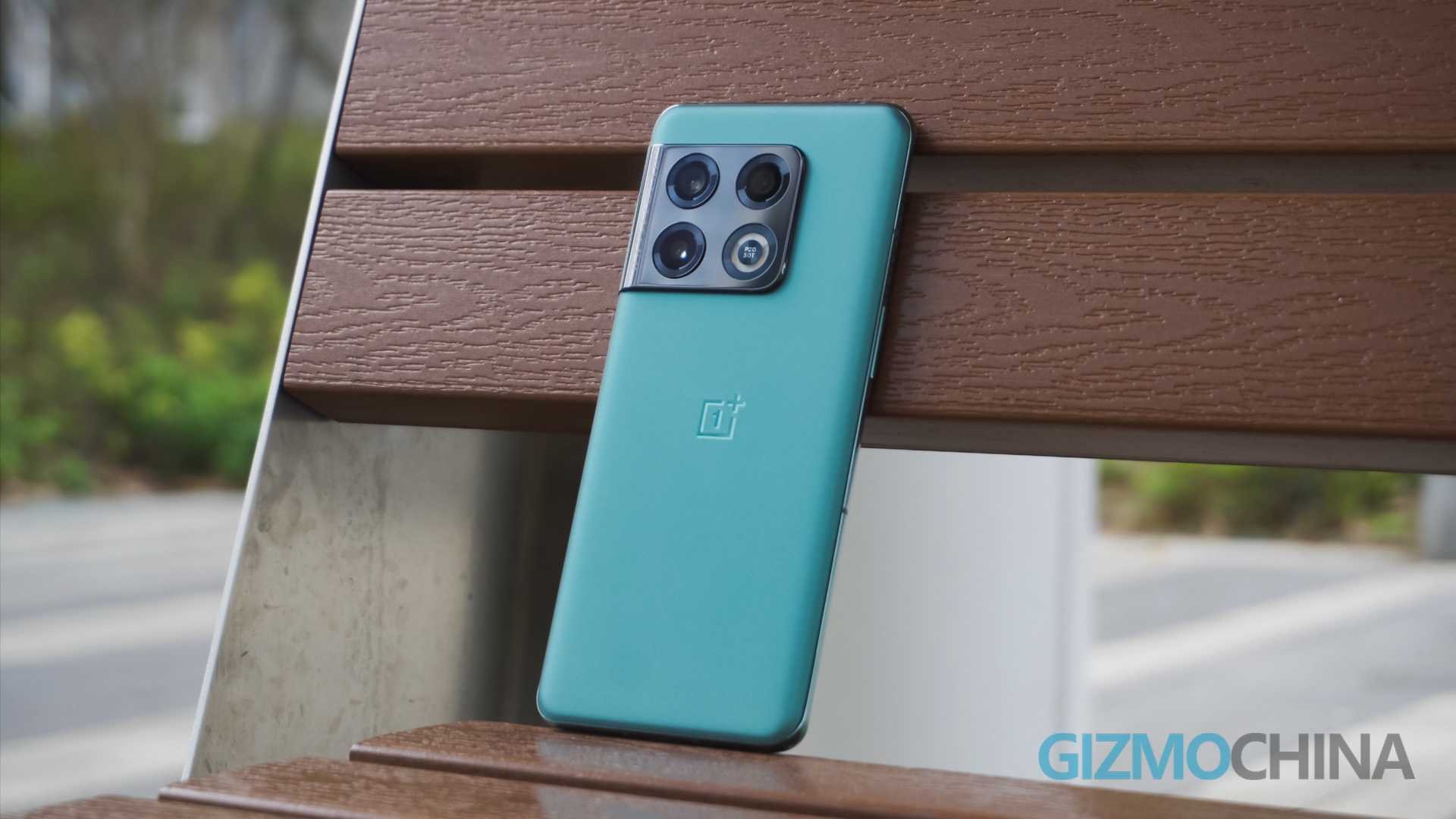
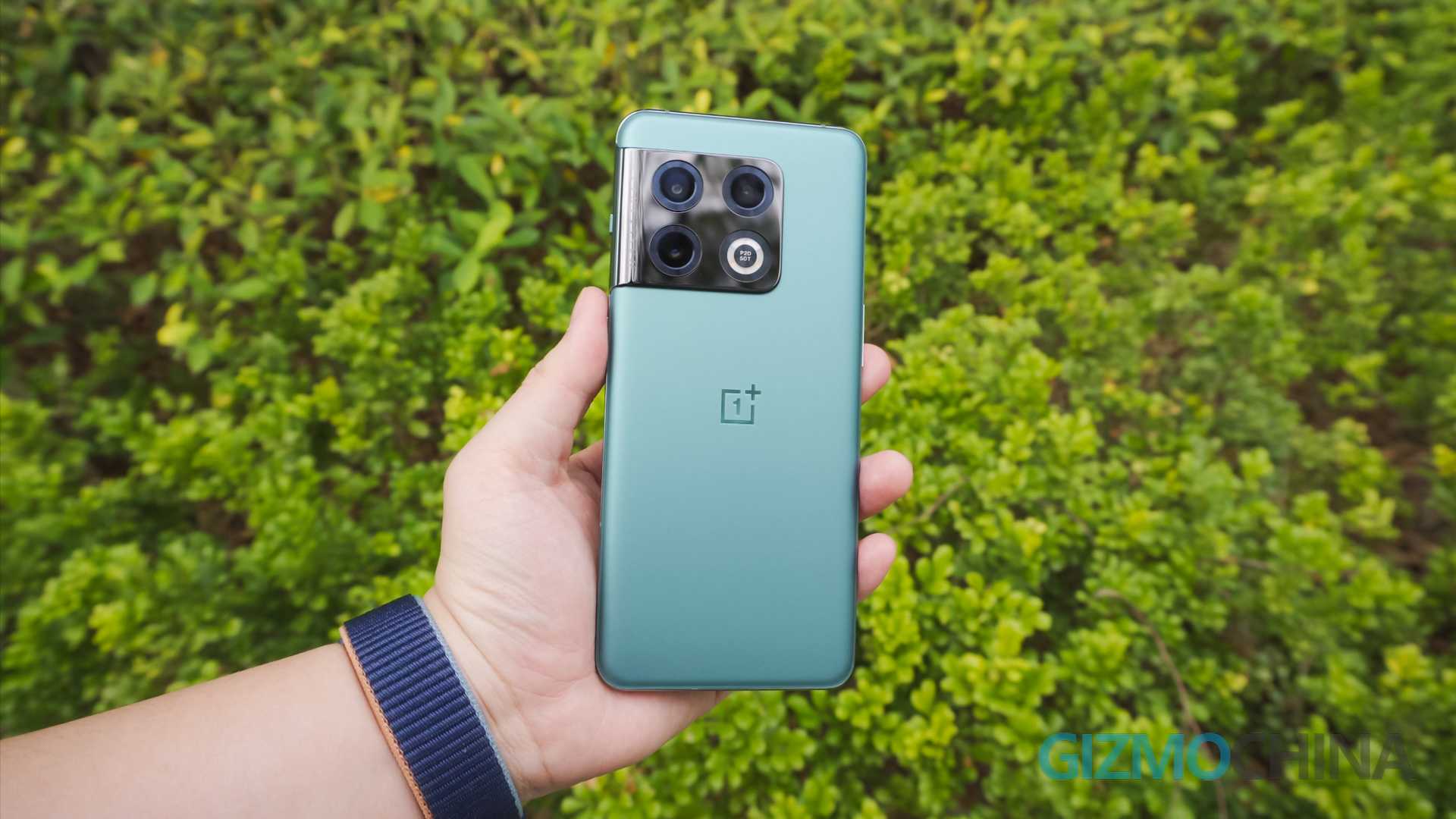
OnePlus has officially announced that its flagship smartphone of the year, the OnePlus 10 Pro, will be launched globally on 31st March. The company has revealed that the event will kick off at 10:00 AM EDT or 7:30 PM IST.
For those who are unaware, the OnePlus 10 Pro flagship smartphone was first announced in the Chinese market in the month of January and has been available for purchase in the country ever since its debut.
Just days ahead of the official launch globally, the company has also started taking reservations for the OnePlus 10 Pro smartphone in the United States.
The customer needs to pay a deposit of $1 to reserve a chance to grab the hands on the flagship smartphone early. It has also been revealed that those who pre-order the device will get OnePlus Buds Pro wireless earphones for free.
The window for reserving a unit of the OnePlus 10 Pro smartphone in the United States closes on 30th March. The customer will need to make a full payment for the device before it’s shipped out. While the company has not yet announced the pricing details, we expect the pricing for the OnePlus 10 Pro to be revealed soon.
The OnePlus 10 Pro features a 6.7-inch LTPO AMOLED screen with a variable refresh rate from 1Hz to 120Hz. It supports a screen resolution of 3216 x 1440 pixels and has Gorilla Glass Victus protection. The device is powered by the Qualcomm Snapdragon 8 Gen 1 SoC paired with 12GB of LPPDR5 RAM and 256GB of UFS 3.1 internal storage.
In the camera department, it has a Hasselblad triple camera system at the rear with a 48MP Sony IMX789 sensor with OIS support, a 50MP ultra-wide lens with 150-degree FOV, and an 8MP 3.3x telephoto sensor with OIS. The phone also features a 32MP Sony IMX615 selfie shooter.
The smartphone is running the Android 12 operating system out-of-the-box with OxygenOS custom user interface on top. It is powered by the It packs a 5,000mAh battery and has an 80W SuperVOOC, 50W AirVOOC fast charging technology, and reverse wireless charging.
Recently, a Vivo phone with model number V2190A was spotted with full specifications at the TENAA certification. Soon after its appearance, some Chinese tipsters claimed that it could be an S-series phone. Now, a new report by PassionateGeekzclaims that the Vivo V2190A will debut soon with the Vivo S13E moniker.
By sharing the below image, which appears to be a screengrab of some sort of source code, the publication has claimed that the Vivo V2190A could be called the Vivo S13E in the Chinese market. While the TENAA listing of the phone has revealed all its major specs, its images haven’t yet appeared on the Chinese certification platform.
Vivo S13E specifications (rumored)
The Vivo V2190A measures 159.7 x 73.6 x 8.49mm and weighs 190.8 grams. The device has a 6.44-inch AMOLED screen that produces a Full HD+ resolution of 1080 x 2400 pixels and a 20:9 aspect ratio. For security, it has an in-screen fingerprint scanner.
Placed on the front side of the alleged Vivo S13E is a 16-megapixel camera. Its back panel has a 50-megapixel primary camera, an 8-megapixel snapper, and a 2-megapixel camera. It is expected to come preinstalled with the Android 12 OS and OriginOS UI.
The device is powered by an unknown 2.8GHz octa-core processor. It is likely to arrive with up to 12 GB of RAM and up to 512 GB of storage in China. The device lacks a microSD card slot. It packs a 4,605mAh (rated value) battery. It is likely to carry support for 44W fast charging.
Vivo is expected to announce the Vivo X Fold and Vivo X Fold flagship phones and the Vivo Pad tablet in the first half of April. Since the Vivo S13E has bagged TENAA certification, it is expected to debut at some point in the same month.
Vivo has released a new teaser of an upcoming device. The teaser image suggests that the company could be teasing its foldable smartphone, which is rumored to debut as the Vivo X Fold. It is speculated that the Vivo X Note premium flagship phone and the Vivo Pad tablet may debut along with the X Fold in the first half of April.
Vivo’s latest Weibo post tells that it will be making a new announcement on March 28. Probably, the launch date for the X Fold, X Note, and Pad will be confirmed on the coming Monday.
Vivo X Fold specifications (rumored)
VIvo X Fold, X Note, Vivo Pad launch teaser
The Vivo X Fold is likely to feature a 6.53-inch OLED FHD+ 120Hz cover display, an 8-inch foldable OLED QHD+ 120Hz screen, and Snapdragon 8 Gen 1. It may house a 4,600mAh battery with 80W fast charging and 50W wireless charging. Its rear may feature a 50-megapixel + 48-megapixel + 12-megapixel + 8-megapixel quad-camera unit. Both displays are likely to feature an ultrasonic in-screen fingerprint scanner.
Vivo X Note specifications (rumored)
Vivo X Note leaked render by WHYLAB
The Vivo X Note may arrive with a 7-inch AMOLED QHD+ 120Hz display, an ultrasonic in-display fingerprint sensor, Snapdragon 8 Gen 1 chipset, and a 5,000mAh battery with 80W fast charging and 50W wireless charging. It may feature the same quad-camera unit that will be available on the X Fold.
Vivo Pad specifications (rumored)
Vivo Pad alleged render
The Vivo Pad is expected to feature an 11-inch display that offers a 120Hz refresh rate and 2560 x 1600 pixels. However, it is unclear whether it features an LCD or OLED screen. The Snapdragon 870 chipset may power the device along with an 8,040mAh battery. The device may carry support for 44W fast charging. It may feature an 8-megapixel front camera and a 13-megapixel + 8-megapixel dual-camera system. All three devices are expected to run on Android 12 OS.
Fast-expanding Chinese tech powerhouse Xiaomi has presented its financial results for 2021 and it is quite impressive. The company, according to the released statistics, experienced a 70% growth YoY in its adjusted net profits for 2021. The financials also indicate a growing diversification of the company which is also reflected in the earnings structure.
The audited consolidated financial statement of the company for the year ended December 31, 2021, was presented via a press statement. The outlook indicated a robust growth trajectory of Xiaomi’s overseas operations as it continues to have a chunk of the market in global smartphone shipments. Despite the challenges in the global market, the company was able to ride on the waves to deliver another strong performance for 2021.
As per the financial results, Xiaomi recorded a 33.5% growth in total revenue for the year 2021 while the adjusted net profits rose by 69.5% from 2020. The corresponding figures were 328.3 billion yuan ($51.6 billion) in total revenue and 22 billion yuan ($3.45 billion) in adjusted net profit for 2021.
The financial results for 2021 indicate that Xiaomi has moved stoutly to fill the void left by Huawei in the wake of US sanctions on the former Chinese powerhouse. Xiaomi had undertaken a vigorous campaign that has seen it in a leading position in global smartphone shipments.
The Xiaomi ecosystem of consumer products continues to find itself in far-flung places as evidence of the progress the company has made on several fronts. According to the data released by the company, emerging markets sustained strong growth momentum in Latin America and Africa. Xiaomi indeed rose to third place in both regions in terms of smartphone sales.
The company expects to sustain these impressive statistics for the year 2022, as it continues to pursue diversification of its earning trajectory with its fast-expanding tech product offerings.
Apple has been busy upgrading its Mac devices and after launching the new Mac Studio, it appears that the Cupertino-based technology giant has yet another device that will soon make its debut.
A new report coming from Display Supply Chain Consultants claims that Apple is developing a 15-inch MacBook Air which is expected to get launched next year, i.e. in 2023.
As of now, not much information is available about this new MacBook Air that is expected to launch next year but analyst Ross Young says that it could go official along with a slightly-larger 13-inch MacBook Air.
This isn’t the first time reports about a 15-inch MacBook Air have surfaced online as Mark Gurman of Bloomberg had reported last year that Apple could be working on a MacBook Air with a larger display.
Apple had considered a larger 15-inch MacBook Air as early as 2008 but the company didn’t move forward with that and instead, went with the 13-inch model and so far, it has been available in that screen size only.
On the other hand, the MacBook Pro comes in three different sizes — 13-inch, 14-inch, and 16-inch but out of these three models, the 14-inch and 16-inch models come packed with more powerful configurations compared to the 13-inch model.
This year, the company is expected to launch a redesigned 13-inch MacBook Air with more color options to choose from and a new M2 chipset. The device was rumored to get announced this month but now it is expected to get launched in the coming months.
Google is gearing up to launch its next Pixel series smartphone and this time, it’s going to be a budget version of the Pixel 6 series, dubbed Google Pixel 6a, which as the name indicates, will be a successor to the Pixel 5a.
A new report coming from Jon Prosser claims that the technology giant could launch the Pixel 6a smartphone on 28th July. He says that the device could be officially announced at the upcoming Google I/O in May but the launch in many regions has been pushed.
The Google Pixel 6a has reportedly been codenamed “Bluejay” and is said to become in three color options — Black, White, and Green. We expect to know more information about the device’s pricing and availability in the coming weeks or months.
Coming to the specifications, previous leaks have indicated that the smartphone will feature a 6.2-inch OLED display and will feature an under-display fingerprint sensor. Similar to the Pixel 6 and 6 Pro, this one too will be powered by the Google Tensor chipset and have 128GB of internal storage.
In the camera department, there will be a 12.2-megapixel Sony IMX363 primary sensor and a 12-megapixel Sony IMX355 ultra-wide angle lens. The front-facing camera on the device will be housed inside a punch-hole cutout.
The report also reveals that the next-generation Google Pixel 7 series smartphones could get launched in October this year, along with the company’s own Pixel Watch. It is being speculated that the Pixel Watch could be teased at the Google I/O event.
A few weeks back, Samsung announced the Galaxy S-Series flagships for the year. Now, the company is reportedly gearing for the release of its foldable phones for this year, possibly called the Samsung Galaxy Z Fold4 and Z Flip4. Ice Universe has now tipped the chipset of these phones, and additionally, also revealed a third foldable device that could debut soon.
According to the tipster, Samsung will go with the yet-to-be-released Snapdragon 8 Gen 1 Plus SoC for both the Galaxy Z Fold4 and Z Flip4. The new chipset will be made by TSMC and will be based on the 4nm process.
While this isn’t a surprise, what’s actually is, is the debut of a third foldable phone. The tipster says that Samsung is all set to release a third foldable phone. It will most likely be a scroll screen phone and is reportedly codenamed “Diamond”.
Although key details of this third foldable device are unknown, the tipster reveals that the phone could be launched in H2 2022. This scroll device is expected to be a rollable phone.
via Ice Universe
Samsung has showcased some major designs of such rollable devices in the past. This new scroll screen phone could employ a design from one of the company’s uncountable patents. Samsung is already strong in its display segment and is already pioneering in the same. However, there are a lot of challenges that the company could face with this technology. Now it remains to be seen, what actually do we see from the company later this year.
To recall, Oppo had showcased a prototype of a rollable/scroll screen phone back in 2020. The device is yet to be commercialized. In fact, no scrollable phone is yet commercial and selling successfully in the market. The upcoming Samsung scroll phone could be the new commercial rollable phone, who knows?
What do you think about the upcoming Samsung rollable phone? Do let us know in the comments below.
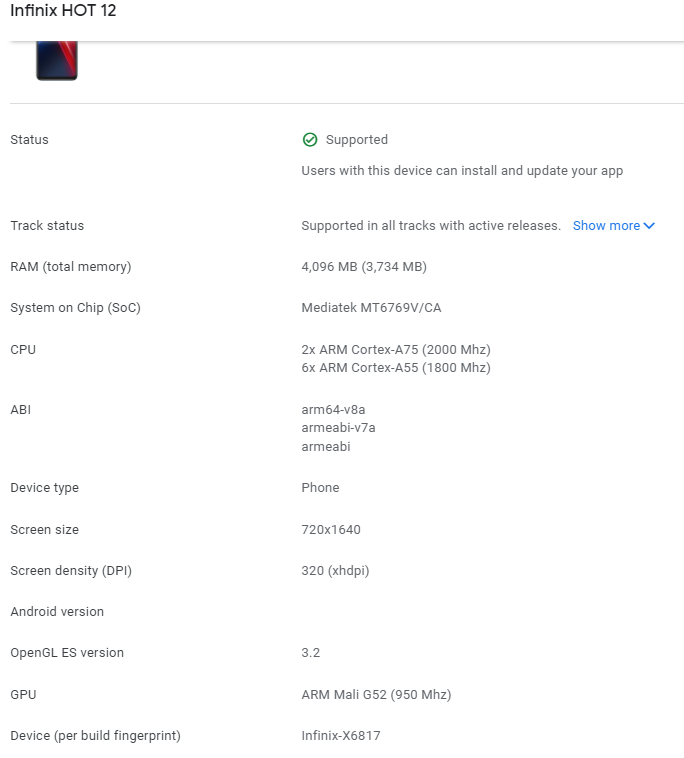
Back in December, it was reported that Infinix is working on a successor of the Hot 11 smartphone dubbed the Infinix Hot 12. However, recent news showed us a device with the moniker Infinix Hot 11 2022. Now, the tipster Paras Guglani has shared the Google Play Console listing of the previously reported Infinix Hot 12 with model number X6817.
The purported Infinix Hot 12 or the X6817 has a punch-hole panel with 720 x 1640 pixels resolution. The screen has a screen density of 320 DPI.
1 of 2
The smartphone has the MediaTek MT6769V chipset that’s the MediaTek Helio G85 SoC and it is paired with 4GB of RAM. We expect the phone to have 64GB or 128GB of storage variant.The device boots on Android 12 OS out of the box.
Apart from this, there’s no other detail about the upcoming Infinix Hot 12. But given that the phone has passed the Play Console certification, we expect the phone to be official in the coming months. We might as well see some more certifications on the phone soon.
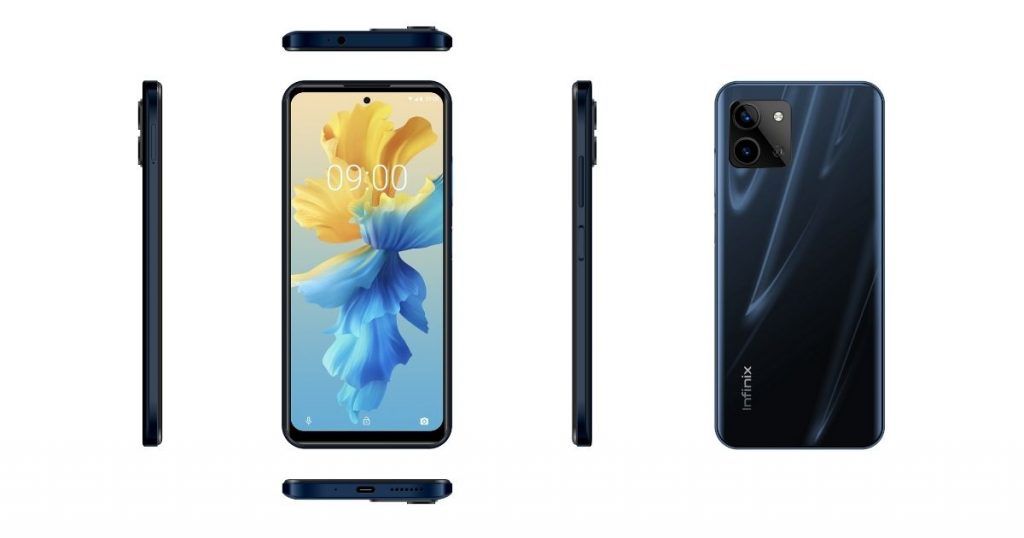
In related news, the Infinix Hot 11 2022 was recently leaked online. The smartphone’s renders were surfaced in Aurora Green, Sunset Gold, and Polar Black. We learn that the device has a punch-hole display, which is expected to be a 6.8-inch 90Hz panel. It is said to be an IPS LCD screen with FHD+ resolution.
Infinix Hot 11 2022
At the back, the phone has a dual-camera system placed vertically. It is expected to be a 48MP primary sensor. Other specs of the phone were rumored. The device is expected to pack a 5,000mAh battery with 18W fast charging support. The phone is tipped to have UNISOC T700 SoC and 4GB RAM, 128GB of internal storage. The device is expected to run on Android 11 OS.
Unlike what a lot of people think, the Redmi K50 series is composed of three phones. Besides the vanilla Redmi K50 and the Pro variant launched this month, there is also the Redmi K50 Gaming Edition released last month. But the Gaming Edition is not the only perfect phone for gaming in the lineup: the whole trio is great for gamers and power users. They all come with flagship-class specifications offered at an affordable price if we consider their specs sheet. But which one is better between the Gaming Edition and the Pro variant? A lot of people are asking such a question and we decided to answer through a specs comparison between the Redmi K50 Gaming Edition and the Redmi K50 Pro.
Redmi K50 Pro full review:
Xiaomi Redmi K50 Gaming Edition vs Xiaomi Redmi K50 Pro
Triple 64 + 8 + 2 MP, f/1.7 + f/2.2 + f/3.3
20 MP front camera
Triple 108 + 8 + 2 MP, f/1.8 + f/2.2 + f/2.4
20 MP front camera
BATTERY
4700 mAh, fast charging 120W
5000 mAh, Fast Charging 120W
ADDITIONAL FEATURES
5G, dual SIM
5G, dual SIM
Design
The Redmi K50 Gaming Edition has a very original design. It has a gaming-centric look and is specifically targeted at young people, but it also comes with amazing build quality. It is built with a glass back, an aluminum frame, and it has a front glass protected by Gorilla Glass Victus by Corning. The design of the Redmi K50 Pro is more sober and anonymous, so better for casual users and for those who do not want a gaming-centric device. Besides a glass back and a display protected by Gorilla Glass Victus, the Pro variant comes with the IP53 certification making it dust resistant and splash resistant. If you are a gamer, you will appreciate the K50 Gaming Edition a lot more because it features physical magnetic pop-up gaming triggers on the right side: these retractile physical keys can offer big advantages in competitive games.
Display
The display of the Redmi K50 Pro is superior to the one found on the Gaming Edition. First of all, it has a higher Quad HD+ resolution with 1440 x 3200 pixels (the Gaming variant has a Full HD panel with 1080 x 2400 pixels). Further, it adds the Dolby Vision support improving the image quality. For the rest, these two displays are more or less the same. They come with a diagonal of 6.67 inches, one billion colors, the HDR10+ certification, and the OLED technology providing brilliant colors and very deep blacks. Unfortunately, despite having OLED displays, these phones do not have an in-display fingerprint reader but a side-mounted one.
Specs & Software
The Redmi K50 Gaming Edition and the Redmi K50 Pro are powered by the best processors by Qualcomm and MediaTek. The former comes with the Snapdragon 8 Gen 1 paired with up to 12 GB of RAM and up to 256 GB of UFS 3.1 internal storage, while the latter has a MediaTek Dimensity 9000 paired with up to 12 GB of RAM and up to 512 GB of UFS 3.1 native storage. According to most of the benchmarks, the MediaTek Dimensity 9000 (built at 4 nm and running at a max frequency of 3.05 GHz) provides higher performance than the Snapdragon 8 Gen 1. But the differences are just marginal as they are the best SoCs in the Android world. The two Redmi flagships run Android 12 customized by MIUI 13.
Camera
If you are looking for a high-end camera phone, you should not opt for these handsets, but their cameras are still good if compared to the other mid-rangers. They both come with a triple camera, but the main sensor is different: the Redmi K50 Pro has a better 108 MP main camera with 4K video recording capabilities, while the Gaming Edition has an inferior 64 MP sensor. The secondary sensors are exactly the same: an 8 MP ultrawide camera and a 2 MP macro lens. Even the front camera does not change: it is a 20 MP snapper with 1080p video recording.
The Redmi K50 Pro is equipped with a bigger battery coming with a capacity of 5000 mAh, but there is also to consider that its components are less energy-efficient: the display, for example, has a higher resolution, so a higher energy consumption as well. Both the phones feature 120W fast charging, but the Gaming Edition will obviously charge quicker due to its smaller 4700 mAh battery.
Price
The starting price of the Redmi K50 Gaming Edition is €460/$505, while the Pro variant starts from €430/$473. In a few words, Gaming Edition adds those physical buttons which are very good for gamers, but the Redmi K50 Pro wins the overall comparison because it has a better camera, bigger battery, and superior display.
Xiaomi Redmi K50 Gaming Edition vs Xiaomi Redmi K50 Pro: PRO and CONS
Astro Gaming has launched a new headset for gamers. The Astro A10 gaming headset is an affordable and classy-looking headset that packs a great audio experience for users of the device. The surge in online meetings via Zoom and other applications has seen an increase in the demand for headsets for an enhanced audio experience. The Astro A10 is however sporting a different design than that of traditional headsets. It is classy and affordable.
Astro has continued to carve a niche for itself in the gaming headset segment and the addition of the A10 will further expand its reach. For sure, the Astro A10 looks a distance away from the premium A50. The Astro A50 headset is a wireless device that comes with a base station for charging. The A50 is priced at $300 while the A10 is being offered at just $60. Of course, the Astro A10 is a wired headset having a flexible flip-to-mute microphone and in-line volume control.
The Astro A10 is ergonomically designed for maximum comfort anytime it is being used. The well-padded ear pads and headband do not interfere with the user’s hair and provide a comfortable experience. The band of the A10 is also very flexible as it can be twisted without any tears or cracks. The A10 is quite rugged and can drop without any damage to the device.
Five color variants of the Astro A10 are black, white, grey, lilac, and mint. The A10 will provide a compelling gaming experience for gaming enthusiasts while also meeting the demands of online engagements via Zoom.
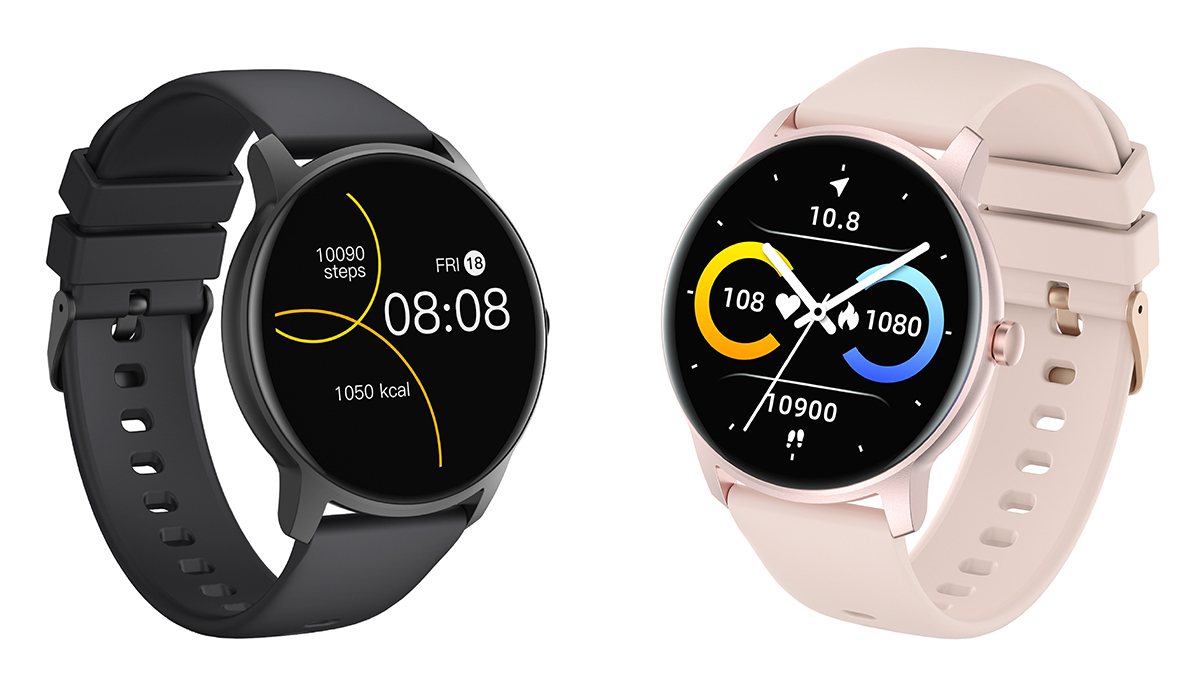
The FitShot Surge smartwatch has been added to the fast-expanding lineup of smartwatches produced by Ambrane. The Ambrane FitShot Surge is priced at an affordable Rs. 1,999 ($26) in India. The Ambrane FitShot Surge comes with some impressive features including a 2.5D OGS curved 1.28-inch display, over 75 watch faces, IP68 water resistance, and a raft of health and fitness monitoring sensors.
The FitShot Surge has a rust-proof body, a circular display, features heart rate monitoring, blood oxygen monitoring, blood pressure, sleep, and stress monitoring. The device can track your sleep and fitness activity all day and it is also capable of remotely controlling your smartphone camera. The Ambrane FitShot Surge has a battery life of about 7 days on a single charge and fair usage.
The Ambrane FitShot Surge smartwatch in India is available in two color variants namely rose pink and Jade black. It has a sturdy body and adjustable straps which guarantees a comfortable use of the smartwatch even for extended periods.
Ambrane FitShot Surge smartwatch
1 of 4
Ambrane FitShot Surge smartwatch
The Ambrane FitShot Surge smartwatch comes with a 1-year warranty and is available in India via Flipkart. Ambrane says it will continue to deliver high-octane user experiences with its smartwatches which strike a chord with customer demands and expectations.
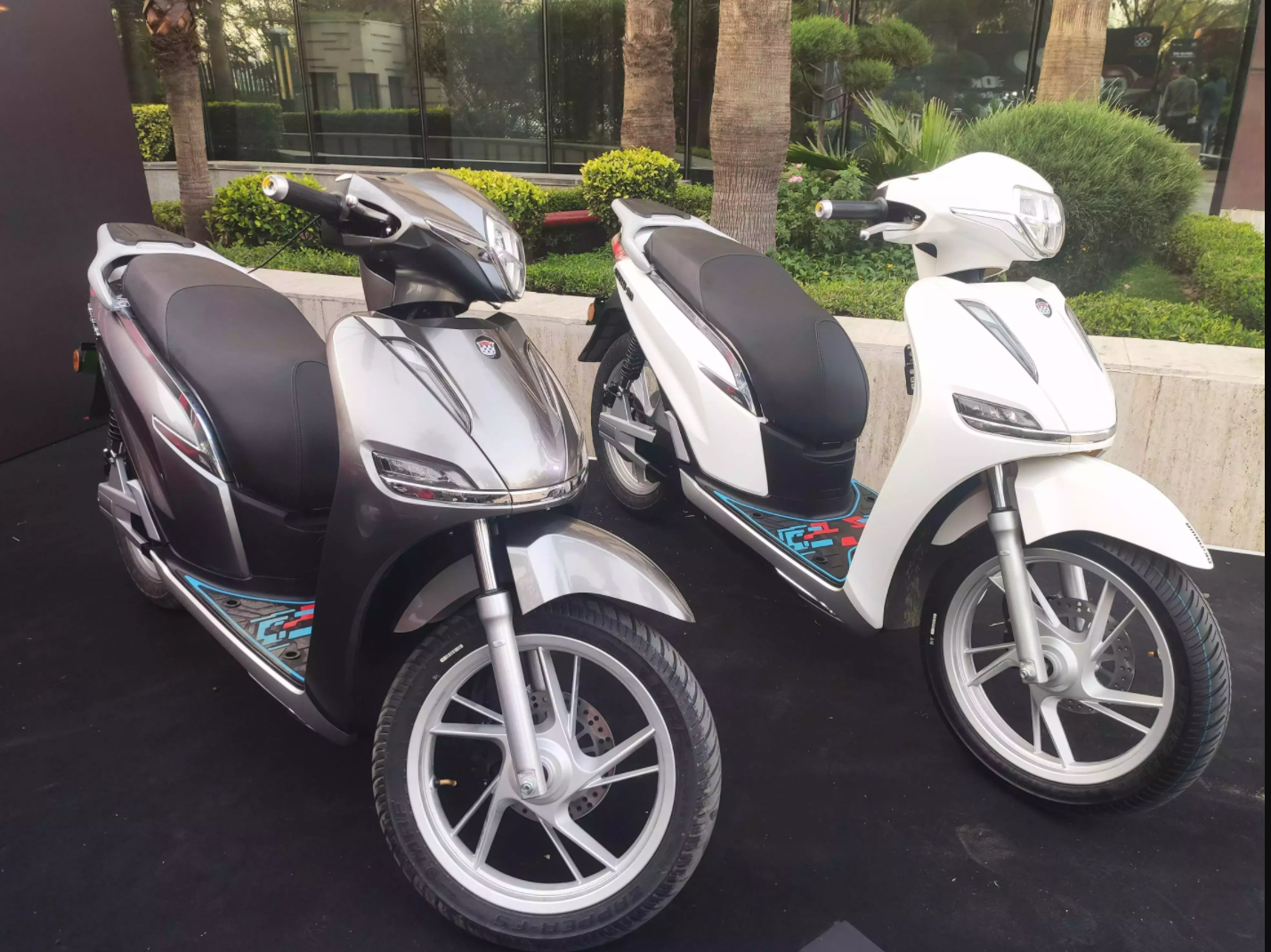
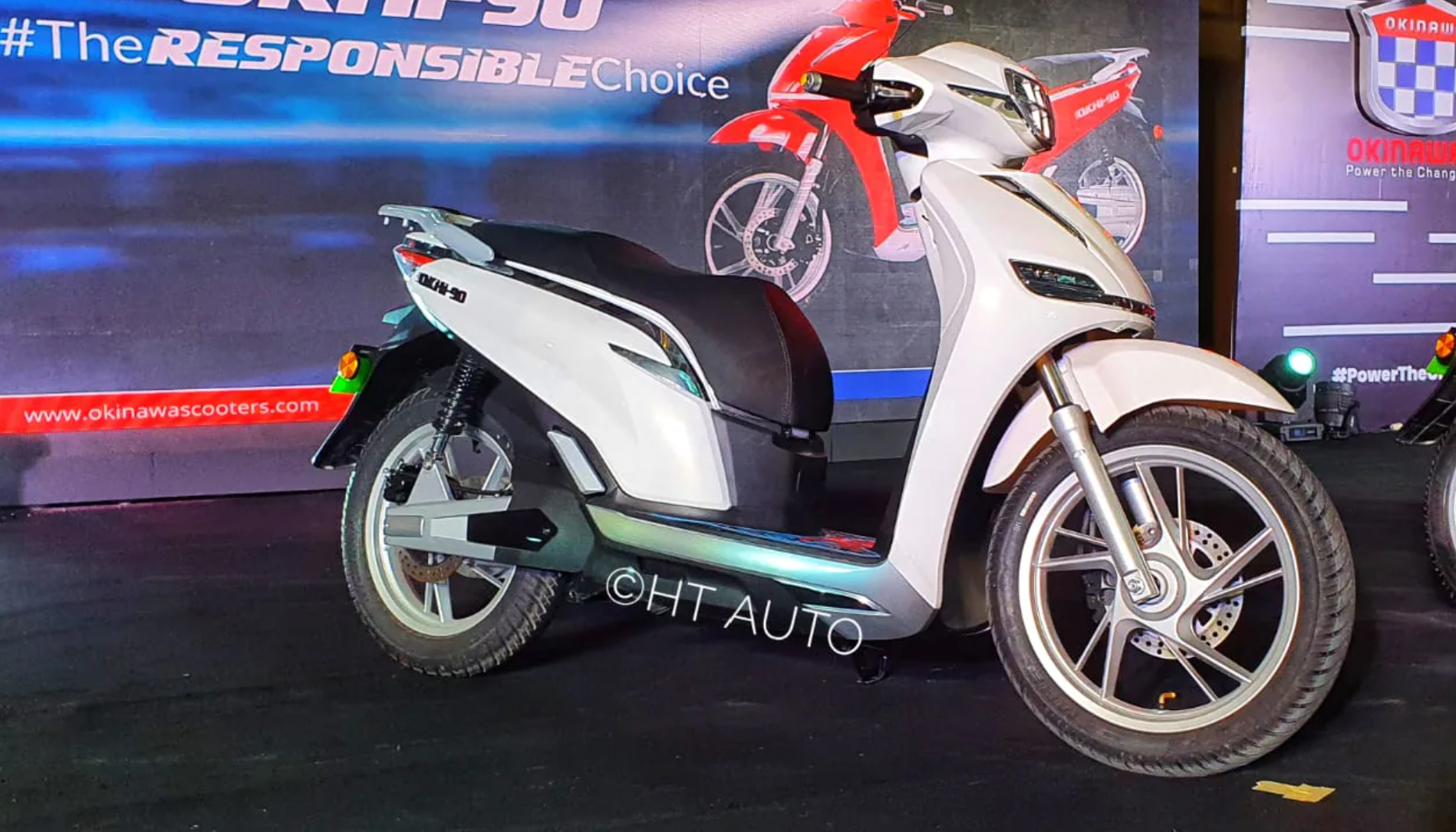
Indian electric scooter manufacturer Okinawa has finally unveiled its latest electric scooter for the domestic market. The product dubbed Okinawa Okhi 90 e-scooter comes with a price tag of ₹1.22 lakh (~$1600). The Okhi-90 has been a long time coming and has featured in leaks and teasers for a long time. There were speculations that the e-scooter will come with a range of 200km but in reality, Okinawa says the Okhi 90 has a maximum range of 160km which is still impressive.
The Okinawa Okhi-90 features a compact front cushion and a pair of 16-inch tires. front cushion. It also comes with a curvy front apron with LED DRLs and turn signals, a chrome trim, an LED headlamp with chrome trim. Other design features include aluminum levers, chrome rearview glass, a wide step-up seat, chrome trim for the side panels, LED taillight, and a grab rail integrated with the frame.
Powering the Okhi-90 is a 3.6 kWh removable battery pack that powers an electric motor with a peak power of 5 bhp. As a result of this powerful setup, the Okhi 90 is capable of hitting a top speed of 90 km/h in 10 seconds. The e-scooter offers a riding range of 160 km per charge in Sports mode.
And as for charging, the Okhi-90 can be charged from zero to 80 per cent in one hour but fully charging that battery takes around four hours.
Okinawa Okhi-90 comes with an LED screen as standard but buyers get the option of a colored digital instrument cluster. The instrument cluster shows essential riding parameters such as battery voltage information, speed, range traveled, etc. The e-scooter also comes with key-less remote, regenerative braking system, boot light, USB port, automatic key locking system, parking mode, Eco and Sports riding modes, and side-stand sensor with start inhibitor.
There is a smart app called Okinawa Connect app which gives users access to several features and functions right from the scooter. This gives access to features such as geo-fencing, vehicle location, and navigation, trip history, speeding alerts, SOS alert, curfew alert, ride diagnostics, and several others.
Earlier today, Realme unveiled the Realme C31 budget smartphone in Indonesia, featuring a UNISOC SoC, a 6.5-inch display, and a big battery. Now, tipster Yogesh Brar has tipped the Indian launch date of the smartphone along with the spec sheet of the Indian variant.
According to Brar, the smartphone will launch in India on March 31. The official specs, design, and features of the smartphone have already been revealed earlier at the Indonesian launch event.
Realme C31 Specifications
The Realme C31 sports a 6.5-inch LCD display with an HD+ resolution. It is a water-drop notch panel with a 120Hz touch sampling rate. Realme claims that the screen has 16.7 million colors and has an aspect ratio of 88.7%. The phone has a triple camera system at the rear with a 13MP main lens, a macro sensor, and a B&W sensor. It has a 5MP selfie camera on the front.
It is powered by the UNISOC T612 processor, which is based on the 12nm process. The device comes with 3GB/4GB of LPDDR4X RAM and 32GB/64GB of internal UFS 2.2 storage. It has a microSD card slot for additional storage of up to 1TB. It packs a 5,000mAh battery with support for 10W fast charging technology.
The phone has a side-mounted fingerprint scanner for security and boots on Realme UI R Edition based on Android 11 OS. The 4G smartphone has dual-SIM support, Bluetooth 5.0, and Wi-Fi 2.4Ghz + 5GHz support. It has a USB Type-C port and a 3.5mm headphone jack at the bottom.
The device has debuted in Indonesia at a starting price of IDR 1,599,000(~$111) for the 3GB RAM + 32GB storage variant and it comes in two color variants namely Dark Green and Light Silver.
The latest electric scooter offering by Crayon Motors in India is the 2022 Crayon Envy e-scooter. It is a premium, low-speed, and budget electric two-wheeler that is priced at Rs. 64,000 (~$837). The current starting price of Rs. 64,000 ($837), according to the company, will vary according to region.
The latest e-scooter from the stable of Crayon Motors features keyless start, reverse assist, and large luggage space. The 2022 Crayon Envy e-scooter comes in four color variants namely black, white, silver and blue. Some of its additional features include geo-tagging, central lock, digital odometer, and mobile charging. The dual headlights of the Crayon Envy e-scooter provide a powerful lion-like presence in nighttime commutes.
The Crayon Envy has a top speed of 25km/h and as per local regulations, the rider does not require a license to operate the vehicle. It is suitable for short intra-city commutes and it has a 160km range for the topmost variant. The 2022 Crayon Envy e-scooter has a 250W electric motor that enables its top speed of 25km/h. The tubeless tires and disc brake system offer the needed control for the EV.
In the words of the company, the Crayon Envy e-scooters are eco-friendly and are developed in-house within India. There is a two-year warranty on its motor and controller and the e-scooter will be available in several retail outlets across the subcontinent. The Crayon Envy is designed and manufactured in the company’s Ghaziabad plant.
Infinix has officially launched a new smartphone in Nigeria, dubbed the Infinix Smart 6 Plus. The device has a similar design to the Smart 6, but has a different chipset, under the hood.
The Infinix Smart 6 Plus costs N60,990 (~$147), but it will be available for a limited time for N58,400 (~$144). It comes in Purple, Ocean Blue, Light Sea Green, and Polar Black shades. The phone can be purchased from authorized online and offline stores in the country.
Infinix Smart 6 Plus Specifications
The Infinix Smart 6 Plus sports a 6.6-inch water-drop notch display. It has a 20:9 aspect ratio and an HD+(720 x 1600 pixels) resolution. The phone’s notch holds a single 5MP camera for selfie shots. The device has a dual camera at the rear with an 8MP main lens and a QVGA sensor. The rear camera is capable of shooting 1080p videos at 30fps.
Powering the device is the MediaTek Helio A22 SoC, which clocks at 2GHz. It is coupled with 2GB of RAM and 32GB of internal storage. The phone has a microSD card slot with up to 128GB of expandable storage.
The device packs a 5,000mAh non-removable battery. It has a micro-USB port and a 3.5mm headphone jack. As for security, the device has a rear-mounted fingerprint scanner. The phone has dual-SIM support and has a DTS speaker setup. Lastly, the phone runs on Android 11 Go Edition.
A few months back, OnePlus launched the OnePlus 10 Pro flagship smartphone in China with a refreshed design and the latest hardware. The device is now arriving in the Indian, European, and North American markets this month.
OnePlus has officially announced that the OnePlus 10 Pro will be launched on March 31 (7:30 PM IST) in the aforementioned markets. The flagship phone will be accompanied by the OnePlus Buds Pro in the new Radiant Silver color. Interestingly, the Indian region will also get the OnePlus Bullets Wireless Z2.
OnePlus 10 Pro Specifications
The OnePlus 10 Pro global model is expected to have the same specs as the Chinese model. The device comes with a new design sporting a 6.7-inch LTPO 2.0 AMOLED display with 2K resolution. It has a variable refresh rate from 1Hz to 120Hz. The screen has 1300 nits of peak brightness, Gorilla Glass Victus protection, and a 92.7% screen-to-body ratio.
The smartphone is powered by the Qualcomm Snapdragon 8 Gen 1 SoC, paired with LPDDR5 RAM and UFS 3.1 internal storage. It has an under-display fingerprint scanner for added security. The device has a triple camera system at the rear with a 48MP Sony IMX789 sensor with OIS support.
It has a 50MP Samsung ISOCELL J1 secondary lens, and lastly, an 8MP telephoto lens with OIS and 3.3x optical zoom support. This time around, the cameras on the flagship are co-tuned by Hasselblad. It packs a 5,000mAh battery and has 80W SuperVOOC wired fast charging and 50W AirVOOC wireless fast charging support. The phone boots on the Android 12 OS in China.
OnePlus Buds Pro and Bullets Wireless Z2 Features
The OnePlus Buds Pro has 11mm drivers and supports Bluetooth v5.1. It has Active Noise Cancellation support and packs a 37mAh battery. The TWS earbuds offer up to 7 hours of music playback without ANC and the charging case. With the charging case, it offers up to 38 hours of battery life with ANC disabled.
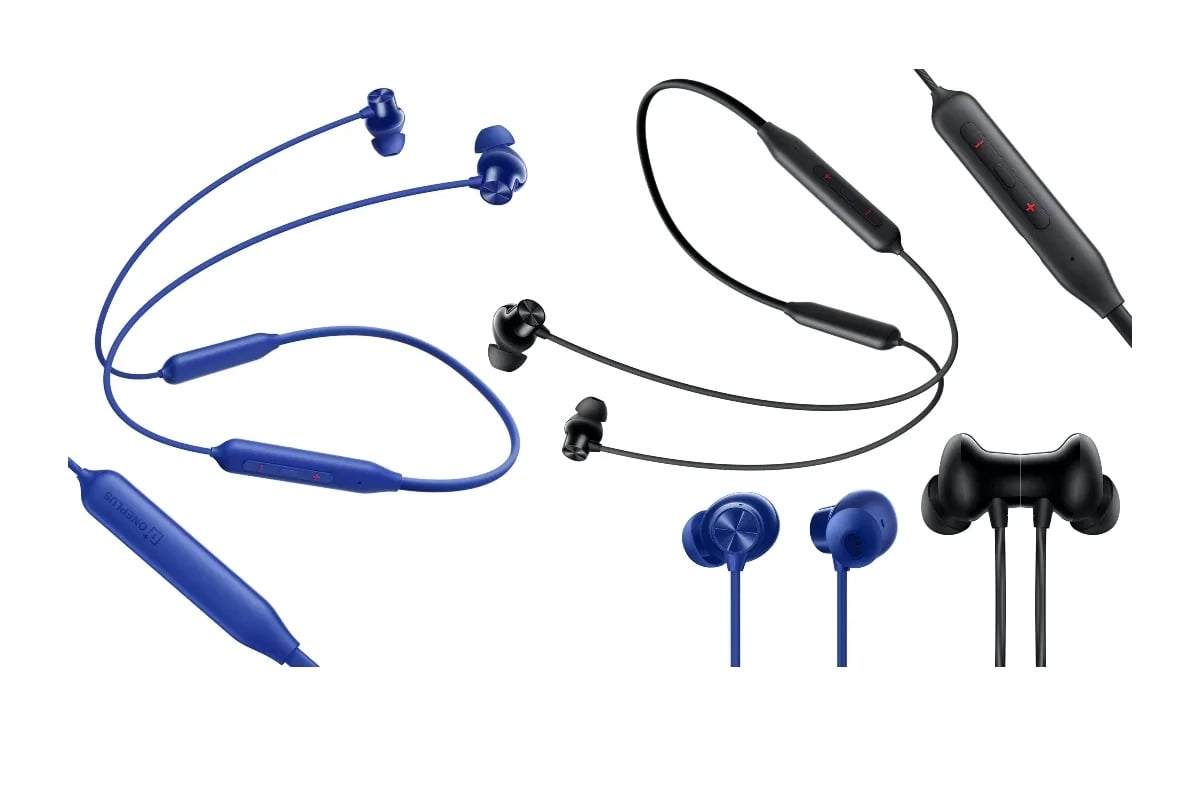
The OnePlus Bullets Wireless Z2 was leaked recently. The necback-style earbuds are tipped to come in Blue and Black colors. The earbuds will come with 12.4mm dynamic drivers and offer a battery life of up to 30 hours. It will have a fast charging support that will offer up to 20 hours of playback with just 10 minutes of charge.
Image Courtesy – PriceBaba
It will have Bluetooth v5.0 and an IP55 water and dust resistance rating. The earbuds are expected to come with magnetic controls.
Realme has officially launched the Realme C31 budget smartphone in Indonesia. The smartphone comes with a new design as opposed to its predecessor and has a UNISOC SoC. Some of its highlights are a 6.5-inch display and a big battery.
The Realme C31 is priced at IDR 1,599,000(~$111) for the 3GB RAM + 32GB storage variant. The 4GB RAM + 64GB variant costs IDR 1,749,000(~$122). The phone comes in Dark Green and Light Silver colors.
Realme C31 Specifications
The Realme C31 sports a 6.5-inch LCD display with an HD+ resolution. It is a water-drop notch panel with a 120Hz touch sampling rate. Realme claims that the screen has 16.7 million colors and has an aspect ratio of 88.7%. The phone has a triple camera system at the rear with a 13MP main lens, a macro sensor, and a B&W sensor. It has a 5MP selfie camera on the front.
It is powered by the UNISOC T612 processor, which is based on the 12nm process. It packs a 5,000mAh battery with support for 10W fast charging technology. It has up to 4GB of LPDDR4X RAM and 64GB of UFS 2.2 internal storage. It has a microSD card slot for additional storage of up to 1TB.
The phone has a side-mounted fingerprint scanner for security and boots on Realme UI R Edition based on Android 11 OS. The 4G smartphone has dual-SIM support, Bluetooth 5.0, and Wi-Fi 2.4Ghz + 5GHz support. It has a USB Type-C port and a 3.5mm headphone jack at the bottom.
Last week, Redmi debuted the highly anticipated Redmi K50 and Redmi K50 Pro smartphones in China. The devices come with impressive spec sheets and feature new SoCs from MediaTek, so we at the Gizmochina team got our hands on these new devices as fast as we could to share with you our first impressions.
Redmi K50 and Redmi K50 Pro Unboxing:
Redmi K50 Pro full review:
The devices come with similar minimalist packaging to the previous generation and have the K50 and K50 Pro model names printed on the box. On the side, the box informs us of the charging capabilities and the screen resolution of the devices. Redmi’s fire-breathing dinosaur mascot Kino greets you when you open the box, and below it, we find the smartphones themselves. The box also includes USB type-C cables and a 67W charger for the K50 and a relatively bigger 120W charger for the K50 Pro.
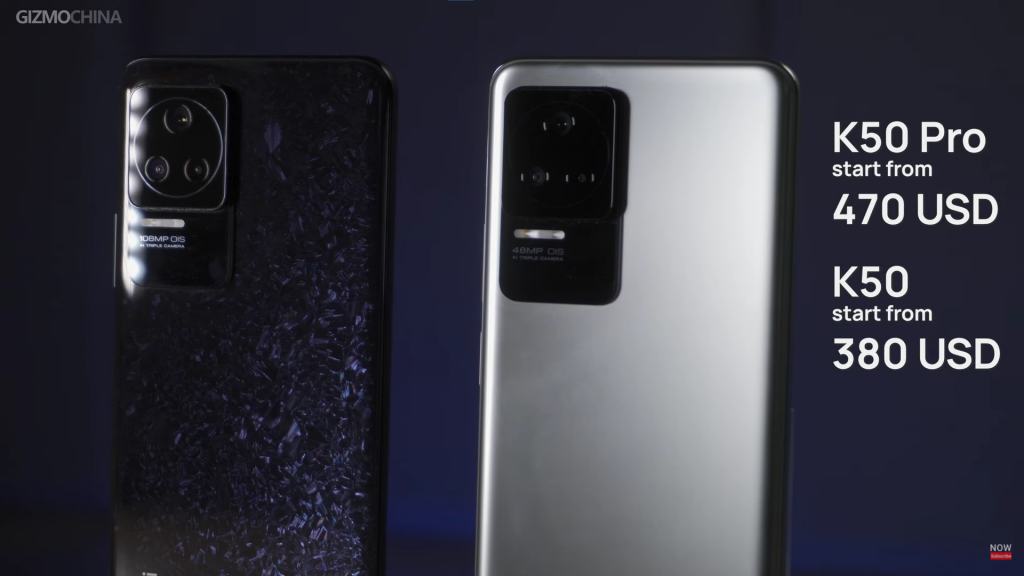
Coming to the phones themselves, the K50 and the K50 Pro look very similar to each other in terms of screen and design. The only thing that differentiates the two is the main sensor’s camera resolution, which is written below the camera module. Additionally, the camera module looks pretty similar to devices like the iQOO 8 series and the Xiaomi CIVI but with a different camera arrangement. The devices feel pretty comfortable in the hand. However, it is worth mentioning that the side frames of the devices are made of plastic, which doesn’t feel as good as the metal frames.
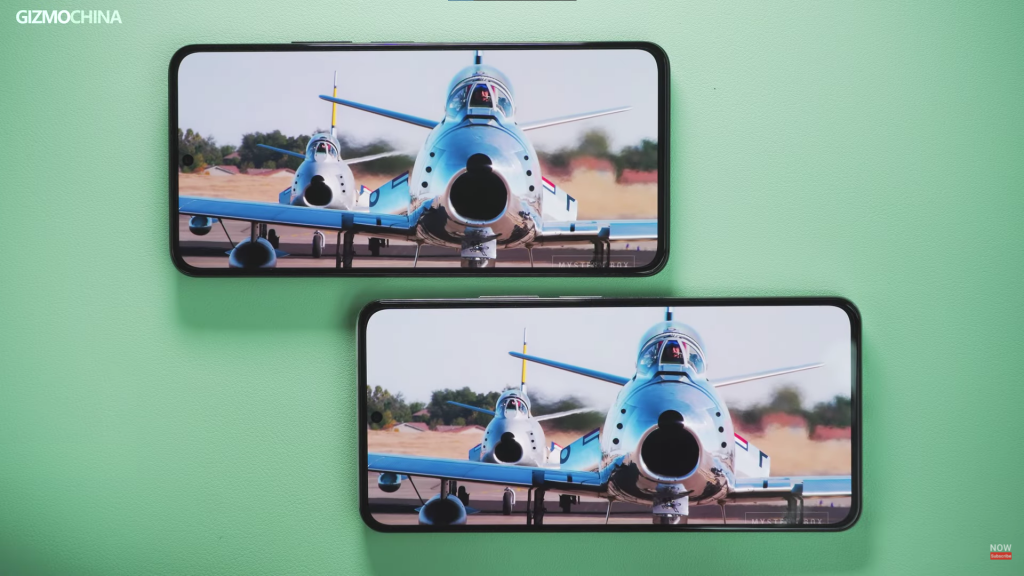
On the front, the two devices are indistinguishable as they both feature a flat 6.7-inch 2K (3200x1400p) 120Hz Samsung AMOLED display with pretty narrow bezels and a small punch hole for the selfie camera centered at the top. The phones slightly disappoint as they don’t have an in-display fingerprint sensor and are rather fitted with a side-mounted one on the power button.
The 2K display on the vanilla K50 makes it especially attractive as it also offers Dolby Vision and supports HDR content with a max brightness of 1200nits just like the Pro variant. Both the K50 and K50 Pro have Gorilla Glass Victus protection for their screens. The devices get a dual speaker setup for stereo audio output that comes certified by Dolby Atmos.
Coming to what’s under the hood, the K50 comes with the newly launched MediaTek Dimensity 8100 SoC, which has been receiving much praise as of late. The SoC is based on TSMC’s 5nm node, which gives it better thermals and power efficacy than the Snapdragon 870, while the SoC is churning out performance close to that of the Snapdragon 888.
The K50 Pro, on the other hand, houses a Dimensity 9000 chipset which goes head to head with Qualcomm’s Snapdragon 8 Gen 1 chip while outperforming it in various metrics.
Redmi K50 & K50 Pro benchmark results
1 of 2
3DMark Wild Life
Geekbench 5
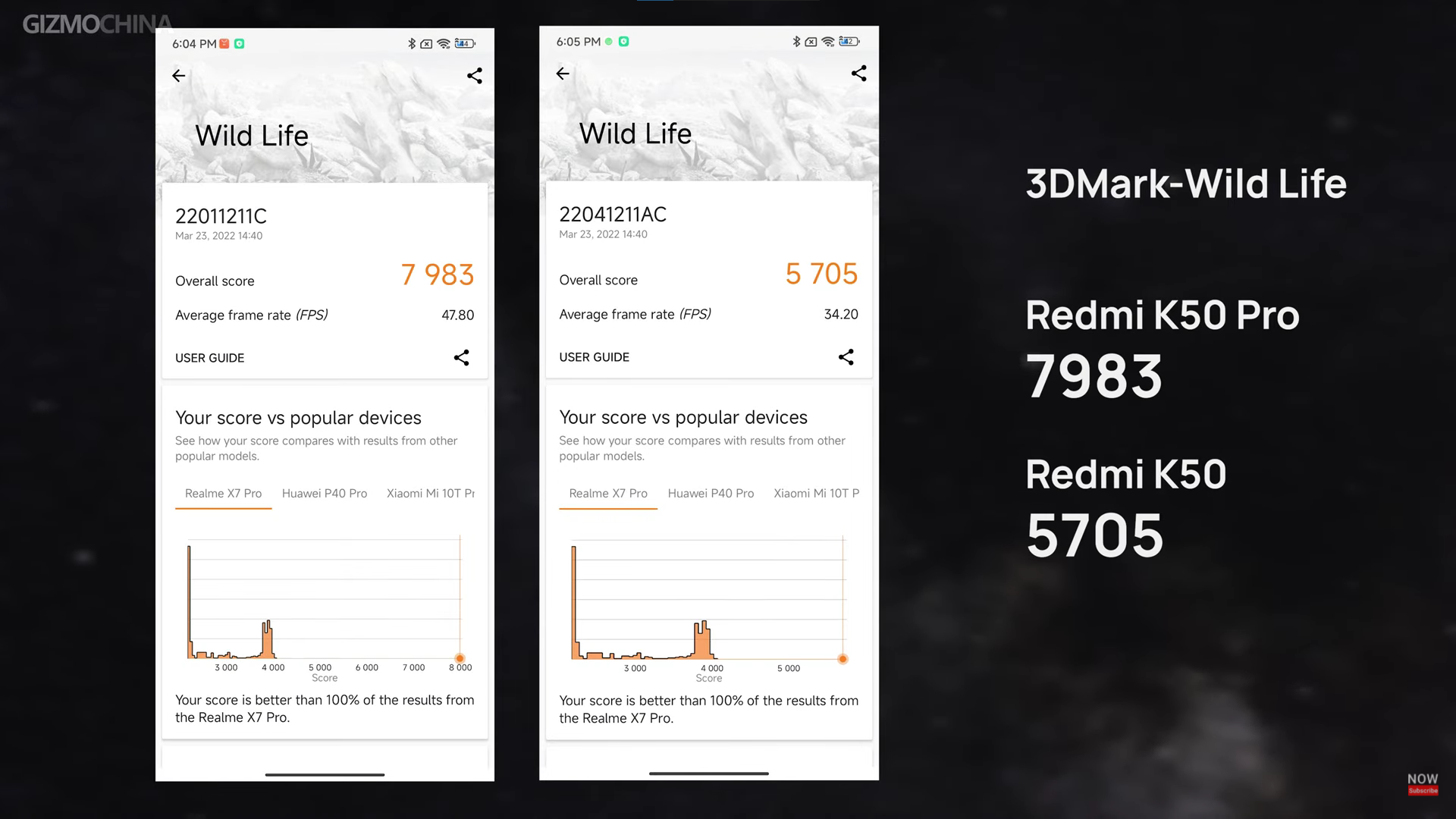
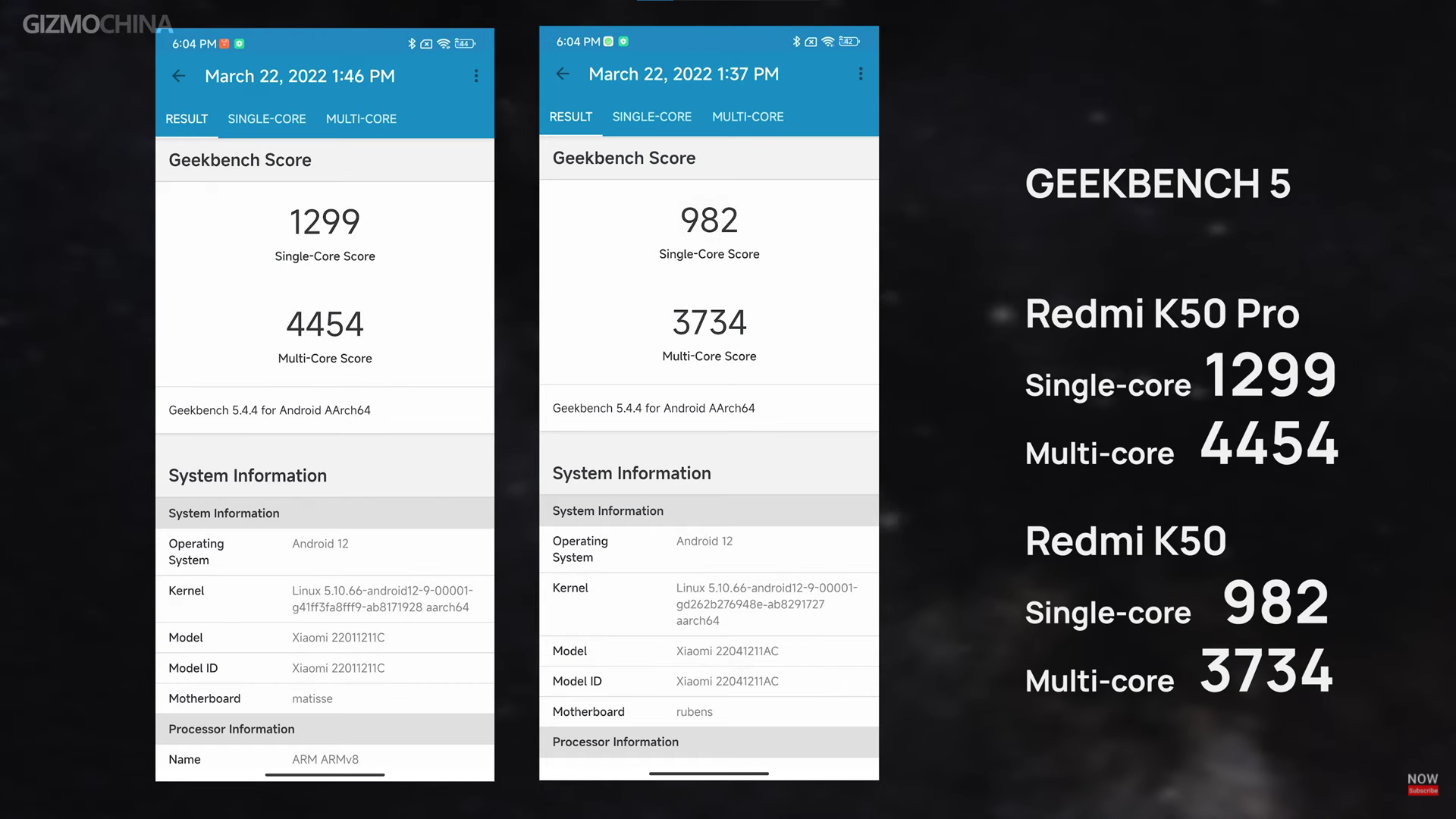
We quickly ran some benchmarks on the two devices to get an idea of their performance. In the 3DMark Wild Life test, the Redmi K50 Pro scored 7983 points while the vanilla K50 managed a score of 5705 points. In the more CPU-intensive Geekbench 5 tests, the K50 Pro scored 1299 on the single-core test and 4454 on the multicore test. Coming back to the vanilla K50, it scored 982 points on the single-core test and 3734 points on the multi-core test.
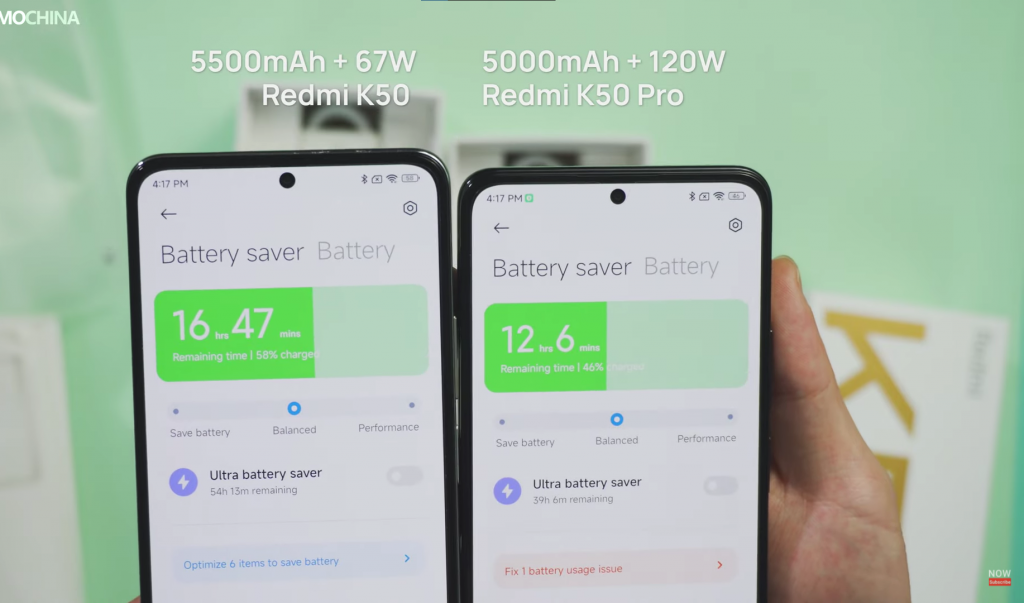
The power solution on these devices is also interesting, as the K50 gets a bigger 5500mAh battery with a comparatively slower 67W fast charging support, the K50 Pro features a 5000mAh battery with super-fast 120W charging.
Last but not the least, the camera setup on both devices feature optical image stabilization for the main lenses. The Pro version features a 108MP primary snapper accompanied by an 8MP ultra-wide camera and a 2MP macro camera. The vanilla version gets a 48MP primary coupled with an 8MP ultrawide and a 2MP macro shooter.
The smartphones genuinely seem quite amazing as far as first impressions go, and they might turn out to be true flagship killers of the current generation of smartphones. However, we would like to conduct more tests on it, like testing out the battery performance, the performance of the devices under prolonged use, the camera quality in various scenarios, and also the sound quality of their stereo speakers. For all this and more, stay tuned for the upcoming detailed review of the Redmi K50 and K50 Pro devices.
We are also giving away the Redmi AirDots 3 Pro Genshin Impact limited edition TWS earbuds, so if you are interested, you can participate by following this link.
We use cookies on our website to give you the most relevant experience by remembering your preferences and repeat visits. By clicking “Accept”, you consent to the use of ALL the cookies.
This website uses cookies to improve your experience while you navigate through the website. Out of these, the cookies that are categorized as necessary are stored on your browser as they are essential for the working of basic functionalities of the website. We also use third-party cookies that help us analyze and understand how you use this website. These cookies will be stored in your browser only with your consent. You also have the option to opt-out of these cookies. But opting out of some of these cookies may affect your browsing experience.
Necessary cookies are absolutely essential for the website to function properly. This category only includes cookies that ensures basic functionalities and security features of the website. These cookies do not store any personal information.
Any cookies that may not be particularly necessary for the website to function and is used specifically to collect user personal data via analytics, ads, other embedded contents are termed as non-necessary cookies. It is mandatory to procure user consent prior to running these cookies on your website.