The Vivo Y76 will feature a 6.58-inch LCD panel that produces a Full HD+ resolution and a 60Hz refresh rate. It will feature a 16-megapixel front-facing camera and its rear camera setup has a 50-megapixel main camera, a 2-megapixel bokeh, and a 2-megapixel macro shooter.
Vivo Y76 Cosmic Aurora
The Dimensity 700 chip will be powering the Vivo Y76. It will be accompanied by 8 GB of RAM and 4 GB of extended RAM. The device will offer 128 GB of internal storage.
Vivo Y76 Midnight Space
The device will come preinstalled with FunTouch OS and Android 11. It has a 4,100mAh battery that will carry support for 44W FlashCharge technology. The device will offer other features such as a side-facing fingerprint scanner and a 3.5mm audio jack.
There is no information on the pricing of the Vivo Y76. As shown above, it will be available in two colors such as Cosmic Aurora and Midnight Space.
Recent reports have claimed Xiaomi is working on at least two phones powered by the Snapdragon 870l. One of them is expected to carry Redmi branding, while the other one is coming as a Xiaomi device. Fresh information leaked by tipster Kacper Skrzypek reveals that the latter will debut with the Xiaomi 12X moniker. The tipster has also shared the key specifications of the device.
Several reports in the past have claimed that one Xiaomi 12 series phone is codenamed as Psyche. The model number of this device for the Chinese market is 2112123G and for the global market is 2112123AC. It has been found through the IMEI database listing that the global edition will be launching as the Xiaomi 12X in the global markets.
Xiaomi Mi 10S
The Xiaomi 12X was spotted at TENAA and 3C certification platforms recently. The TENAA listing is yet to be populated with its specs, but 3C certification has revealed that it is likely to carry support for 67W fast charging. While India is one of the major markets for smartphones, it seems that the company does not have any plans to launch the 12X in the country.
Xiaomi 12X Specifications (Rumored)
According to Kacper, the Xiaomi 12X will feature a 6.28-inch AMOLED display that offers a Full HD+ resolution of 1080 x 2400 pixels. It also supports a 120Hz refresh rate, HDR10, and in-screen fingerprint scanner.
The Snapdragon 870 chip fuels the Xiaomi 12X. It has a 50-megapixel main camera on the back. The other specs of the device are yet to be revealed. Lastly, it seems to measure 145.4 x 65.4 mm.
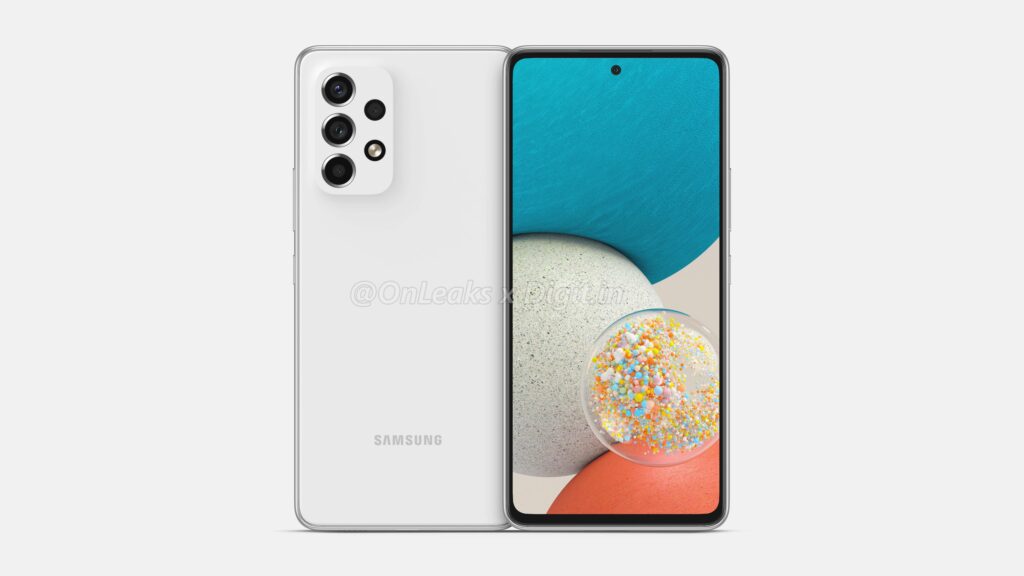
Samsung is expected to launch the Galaxy A53 early next year as the successor of the popular Galaxy A52 series. This smartphone is in the news for the past few days. The latest information about the handset reveals its battery capacity and an alleged official picture in low quality.
Samsung Galaxy A53 | Source: @OnLeaks via Digit
According to GalaxyClub, the upcoming Samsung Galaxy A53 will get its juice from a 5,000mAh battery with model number EB-BA536ABY as compared to a smaller 4,500mAh battery inside the Galaxy A52 series. This battery has a rated capacity of 4,860mAh. Although the publication does not mention the source of these details, we think they come from Saftey Korea, just like the battery specs of Galaxy A33.
Further, tipster @FrontTron has shared a low-quality image on Twitter allegedly showcasing all four colors of the smartphone. A previous report had already stated that the device will be available in black, white, blue, and orange hue options.
Alleged Samsung Galaxy A53 in all four colors | Source: @FrontTron
A few days back, 3D CAD renders by @OnLeaks have confirmed that the phone will be only slightly different than the Galaxy A52/A52 5G/A52s 5G and will lack a 3.5mm headphone jack. Other reports have revealed that the handset will feature a 64MP primary camera and will be powered by an Exynos chipset.
Last but not least, we can expect the Galaxy A53 to retain all the goodies from the Galaxy A52 series, like 3 OS upgrades, 4 years of security updates, water resistance, stereo speakers, OIS, and Samsung Pay.
Apple’s most-awaited self-driving electric car was in the news a few months ago and now once again, the upcoming vehicle from the technology giant, which has not yet been officially announced, is in the news, hinting at the Apple Car roadmap.
A new report coming from Bloomberg, citing sources aware of the development, claims that the upcoming Apple Car — an electric vehicle with support for a fully autonomous self-driving feature — will debut by 2025.
It is being reported that this Apple Car project from the Cupertino-based tech giant, which is called Project Titan, being headed by Kevin Lynch, will be a fully automated self-driving offering without any pedals or steering.
Earlier, it was claimed that the company was stuck between two different developments paths — a traditional EV with some enhanced driver-assist features, or a more sophisticated EV capable of truly autonomous driving with no input from its passengers. It now seems that the technology giant has chosen the latter option.
However, there’s a possibility of Apple adding some kind of an emergency takeover mode for the car, which is still being discussed internally. It is said to have open-concept seating and a larger iPad-like infotainment system.
The company has still not locked in the business model for this project. The Bloomberg report hints about Apple considering to have its own fleet of self-driving cars operating like Uber or Lyft instead of selling the cars to individuals. However, it is more likely that Apple will sell its car to individuals.
Apple is reportedly not looking to develop a proprietary charging system for the car as the company could make it compatible with the “combined charging system” or CCS standard so that it is possible to charge the vehicle at most public fast-charging stations.
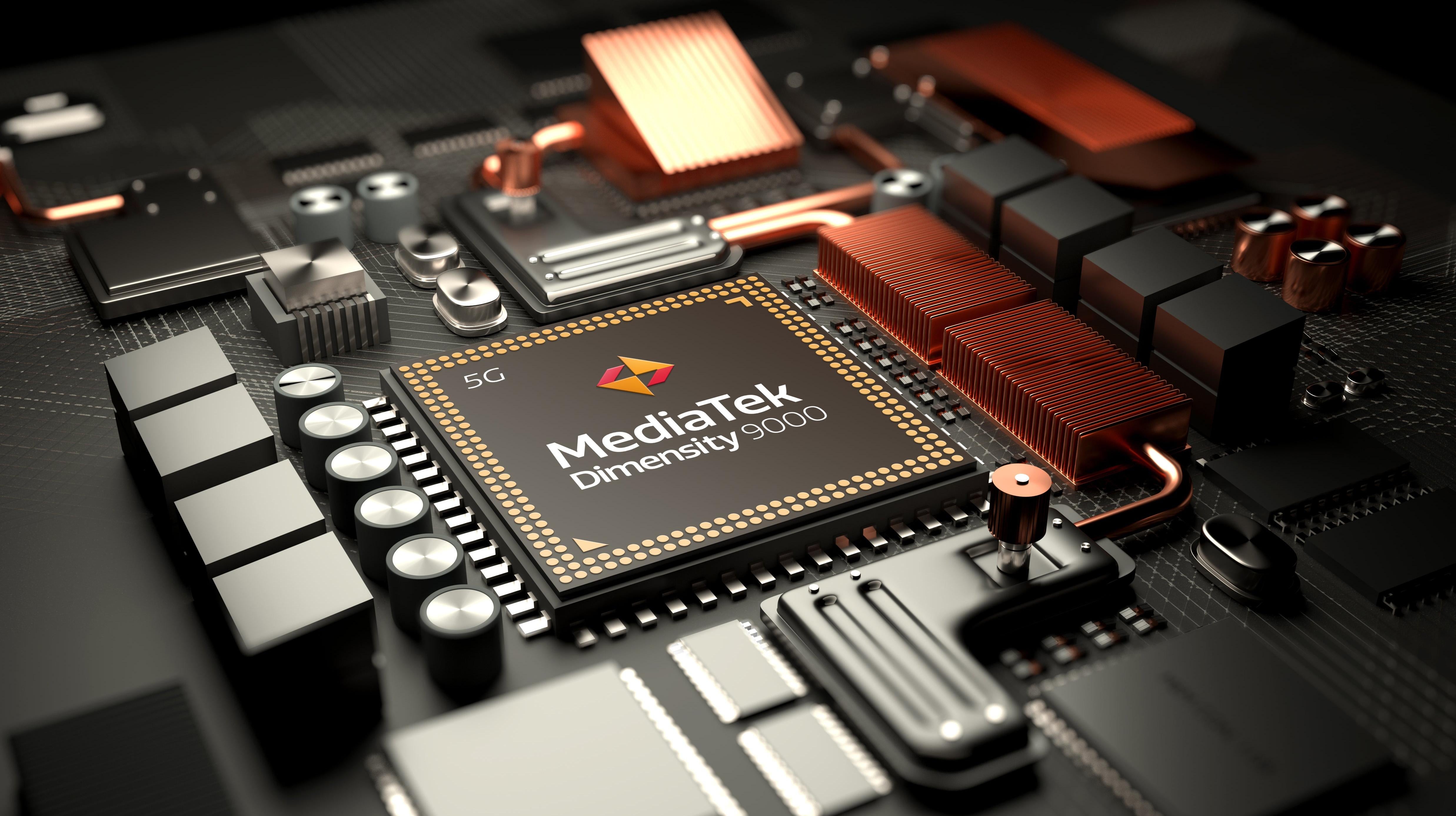
MediaTek has announced its latest flagship smartphone processor — the Dimensity 9000 which is the company’s most powerful chip so far and is aiming to compete against the best chips from companies like Qualcomm and Samsung.
The MediaTek Dimensity 9000 is the world’s first chipset to be manufactured using TSMC’s 4nm process and is also the first to use ARM’s new v9 architecture. Not just that, it is also the first chipset announced with ARM’s new core designs.
It comes with a single Cortex-X2 performance core clocked at 3.05GHz, three Cortex-A710 cores at 2.85GHz, and four Cortex-A510 efficiency cores at 1.8GHz. For graphics, the chipset features a 10-core Arm Mali-G710.
There’s also MediaTek’s fifth-generation APU with six total cores for AI processing. It is claimed by the company to offer four times the performance and power efficiency compared to its previous generation.
The Dimensity 9000 will support LPDDR5x memory at bandwidths of up to 7,500 Mbps. It is also said to be able to handle screens with up to a 180Hz refresh rate at FHD+ resolutions.
Coming to the photography department, the chipset supports the first 18-bit image signal processor, which offers the ability to capture 4K HDR video using up to three cameras at the same time, or still photos using up to a massive 320MP sensor.
For connectivity, the Dimensity 9000 supports Wi-Fi 6E as well as Bluetooth 5.3. There’s no integrated modem with mmWave 5G support but the company says it supports 3CC carrier aggregation for sub-6HZ 5G with top data speeds of up to 7Gbps.
Devices powered by this new Dimensity 9000 SoC are expected to be available in the market as soon as the first quarter of 2022. To know for sure how the chipset performs, we will have to wait to test a real smartphone powered by this new SoC.
The launch of the MediaTek Dimensity 9000 flagship chipset comes when the Taiwan-based company has seen impressive results in the year 2020 and 2021 and is now the world’s largest smartphone chipset maker with around 40 percent of the market share. It is also claimed to be growing at 28 percent in the 5G SoC market.
Motorola surprised everyone by launching an amazing flagship killer powered by the latest flagship chipset released by Qualcomm. We are talking about the Moto G200 5G, the successor of the G100 with even more impressive specifications. Placed in the €600 price range and launched in the global market where it will be available starting from the coming weeks, this device is the perfect rival for the latest Xiaomi flagship: the Xiaomi 11T Pro. This comparison will highlight the differences between the two flagships and let you understand which one is worth buying for your actual needs.
Motorola Moto G200 5G vs Xiaomi 11T Pro
Motorola Moto G200 5G
Xiaomi 11T Pro
DIMENSIONS AND WEIGHT
168.1 x 75.5 x 8.9 mm,
202 g
164.1 x 76.9 x 8.8 mm,
204 g
DISPLAY
6.8 inches, 1080 x 2460 pixels (Full HD+), LCD
6.67 inches, 1080 x 2400 pixels (Full HD+), AMOLED
Triple 108 + 8 + 2 MP, f/1.9 + f/2.2 + f/2.4
16 MP f/2.2 front camera
Triple 108 + 8 + 5 MP, f/1.8 + f/2.2 + f/2.4
16 MP f/2.5 front camera
BATTERY
5000 mAh, fast charging 33W
5000 mAh, Fast Charging 120W
ADDITIONAL FEATURES
5G, dual SIM, water-repellent
5G, dual SIM, IP53 splash resistant
Design
The design of the Motorola Moto G200 5G is unconventional but very attractive: on the rear side, it does not sport a classic camera module like the other last generation phones, but it has sensors placed directly in the rear cover. However, it does not shine in terms of material: it is made of polycarbonate like budget phones, but it has a water-repellent body. The Xiaomi 11T Pro is actually better because it is built with premium materials: it has a glass back and an aluminum frame, and it is dust resistant and splash resistant with the IP53 certification. Further, it is a more compact phone due to the presence of a smaller display.
Display
The display found on the Xiaomi 11T Pro is way better than the panel of the Moto G200 5G. It is an AMOLED display with one billion colors, Dolby Vision, the HDR10+ certification, and a 120 Hz refresh rate sporting a Full HD+ resolution, the Gorilla Glass Victus protection, and a diagonal of 6.67 inches. The Motorola Moto G200 5G has a wider 6.8-inch panel with a higher 144 Hz refresh rate, but it is just an LCD display with less impressive image quality. Further, note that Xiaomi 11T Pro comes with stereo speakers tuned by Harman Kardon, while the Moto G200 5G has just a traditional mono speaker.
Specs & Software
The Motorola Moto G200 5G is equipped with the best processor by Qualcomm: the octa-core Snapdragon 888+ running at a max frequency of 2.99 GHz, which is actually better than the Snapdragon 888 mobile platform offered by the Xiaomi 11T Pro. However, the Xiaomi 11T Pro offers more RAM in its high-end configuration: up to 12 GB, while you get just 8 GB with the Moto G200 5G. The RAM difference is more noticeable than the difference between Snapdragon 888 and 888+, that is why we still recommend the Xiaomi 11T Pro. Both the phones run Android 11 but the Moto G200 5G will only get one major Android update, while Xiaomi 11T Pro will get two.
Camera
On the rear side, the Xiaomi 11T Pro has a superior camera department: the 108 MP main camera is the same, and the 8 MP ultrawide camera too, but the Xiaomi 11T Pro has a better 5 MP macro camera and, unlike the Motorola Moto G200 5G, it is able to record videos with 8K resolution and 4K videos at 60 fps. On the other hand, the Moto G200 5G provides a better front camera thanks to a brighter focal aperture.
The battery capacities of Xiaomi 11T Pro and Motorola Moto G200 5G are exactly the same: 5000 mAh. But the 11T Pro should last more on a single charge in most of the scenarios because it comes with an AMOLED display. Further, it supports faster charging thanks to a power of 120W, while Moto G200 5G stops at 33W.
Price
Currently, it is not hard to find the Xiaomi 11T Pro for €600/$680, and the Motorola Moto G200 5G will be available in the coming weeks with the same starting price tag. Given that the price is the same, the differences between their specifications are very important. Despite the Moto G200 5G having a better chipset, the Xiaomi 11T Pro wins this comparison because of its great AMOLED display, faster 120W charging technology, and its premium design.
Motorola Moto G200 5G vs Xiaomi 11T Pro: PRO and CONS
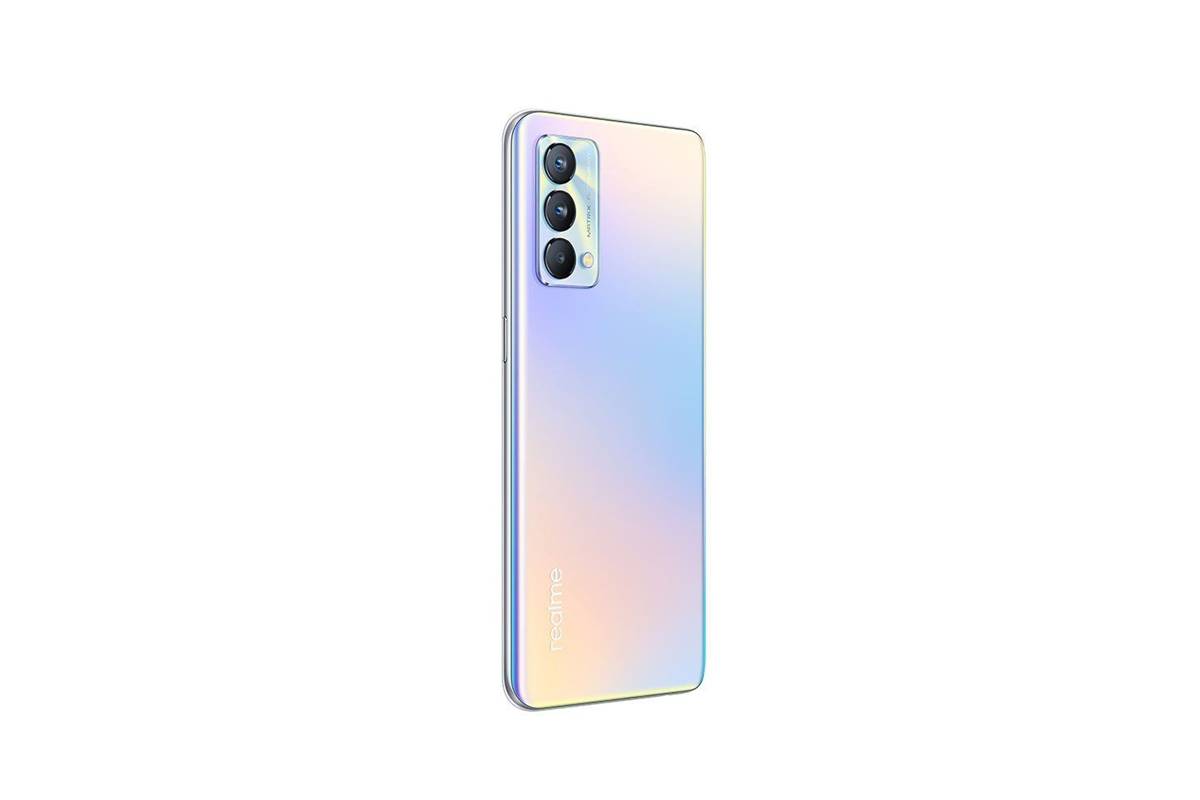
In August this year, Realme launched the GT Master Edition smartphone in the Indian market. Initially, at the launch, the device was available in Voyager Grey, Luna White, and Cosmos Black. Now, an exclusive report from 91mobiles reveals that there will soon be a new colour in the palette.
According to the report, the Realme GT Master Edition will get the Daybreak Blue colour variant. The Daybreak Blue seems to be a fancy gradient color with a mix of blue and daylight. It is worth noting that this colour is already available in other regions like Malaysia where it was available from its launch.
In terms of the launch date, the report suggests that the Realme GT Master Edition Daybreak Blue will be available in India by the end of November or early December. The color will be launched in two configurations – 6GB RAM + 128GB storage variant and an 8GB RAM + 128GB storage variant.
The Realme GT Master Edition comes with a 6.43-inch display featuring a 120Hz refresh rate. The AMOLED screen has FHD+ resolution and holds a 32MP selfie sensor at the top of the screen. At the rear, it has a 64MP main, an 8MP ultra-wide, and a 2MP macro sensor.
Under the hood, the Master Edition is powered by the Qualcomm Snapdragon 778G SoC and has a 4,300mAh battery. It has support for 65W fast charging as well. The 5G phone boots on Android 11 out of the box and has Realme UI on top of it.
Earlier this month, Vivo unveiled the Y76s smartphone in the Chinese market with impressive specs like 50MP cameras and 44W fast charging support. Today, the company has revealed that another device with a similar moniker will debut soon. The smartphone will be called the Vivo Y76 5G and it has just got teased.
Vivo Malaysia on its Facebook page has teased the upcoming Vivo Y76 5G smartphone. The device will debut on November 23 in the Malaysian market. It will be available for purchase from Lazada and Shopee.
As of now, there’s very little detail that we have learned since the device has not passed any major certifications. However, it is worth noting that it does look similar to the recently launched Vivo Y76s. Not just that, the teaser also reveals a similar camera setup. The smartphone will come with a 50MP main sensor, just like the Y76s, but, will have two more lenses – a 2MP portrait, and a 2MP macro lens.
For those who are unaware, the Y76s has only two sensors, a 50MP main and a 2MP macro. That said, the Y76 5G will bring an extra lens for the fancy portrait images.
Apart from this, the device passed the NCC, IMDA, SIRIM, and NBTC certifications which revealed its design and minor specs. The smartphone will come with NFC support and have fast charging technology similar to the Y76s.
The Y76s is fueled by the MediaTek Dimensity 810 SoC and has a 4,100mAh battery. Rumours have it that the Y76 5G will have the same internals as the Y76s, majorly because the Y76s is limited to China, and Vivo may cover its global presence with the upcoming Y76 5G.
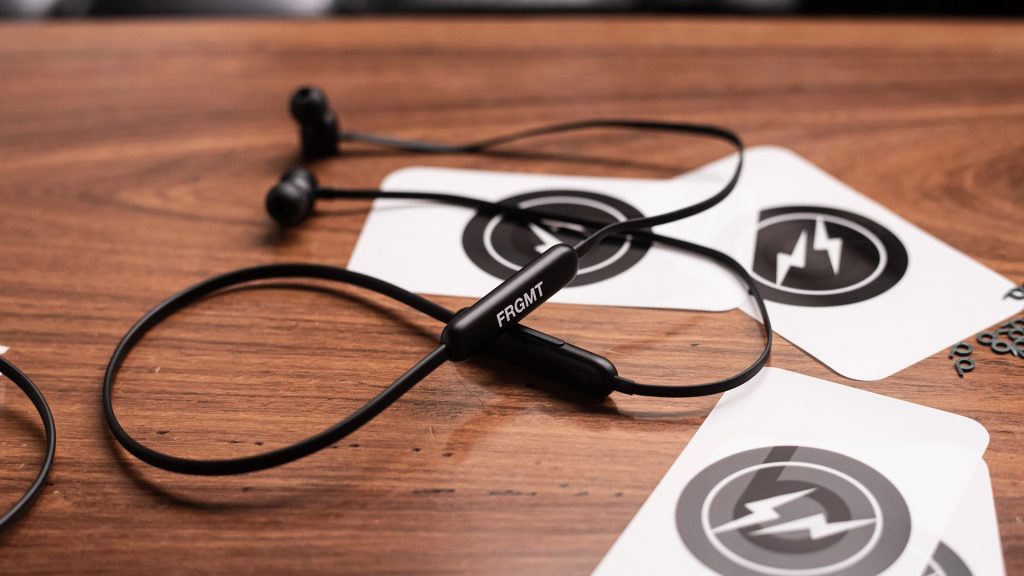
Apple Beats has launched a new special edition earbud. The new Beats Flex earbuds special edition is the culmination of a partnership between Japanese musician/ designer Hiroshi Fujiwara and fashion retailer SSENSE. The limited-edition Beats Flex earbuds come with a minimalist, tonal black design and are not different hardware-wise from the original Beats Flex earbuds.
The new Beats Flex earbuds special edition is adorned with Fujiwara’s fragment design logo which is a twin-lighting icon on the earbuds. This is the first such partnership between Beats and Fujiwara’s company. Beats says its collaboration with Fujiwara comes as the musician and designer named the Beats Flex as his favorite product in the Beats portfolio.
The original Beats Flex earbuds had caught the fancy of Fujiwara who said he likes the lightweight neckband for listening to music. Fujiwara also says that the new black-on-black design of the Beats Flex earbuds special edition is extremely sophisticated and refined. He also said that the new Beats Flex special edition will have an instant appeal in the market.
The Apple company Beats has had some previous engagements with Fujiwara and he has always added his touch of innovation and design excellence. On the other hand, apart from Apple, retailer SSENSE will be the sole retailer of the Beats Flex earbuds special edition, and the product is priced at $69.99.
Global tech powerhouse Samsung is redistributing its production capacity across its seven manufacturing sites. The moves are part of plans by the company to ensure that no facility exceeds more than 30% of the overall production numbers. The move by Samsung will see its two manufacturing plants in Vietnam scale down its current production of about 182 million units to 163 million units annually.
Samsung’s move is part of the company’s long-term aim of risk redistribution. The expansion of Samsung’s India production facility will see it producing 108 million smartphones by 2026, although the expansion trajectory could see the Indian plant becoming Samsung’s largest by 2024.
Samsung has manufacturing facilities in India, Indonesia, Vietnam, and Brazil, outside its home market of Korea. The capacities of the production facilities will probably remain unchanged this year, while the changes will start to be noticed from 2022. The focus seems to be on the huge customer base offered by the Indian market. The scaling up of Samsung’s operations in India will help it to shore up its numbers in the subcontinent. The production redistribution will see India accounting for 25% of the total production in 2026, while Vietnam will have 20%, Indonesia, 14%, and Brazil, 6%.
Samsung continues to firm up its operations and has factored some degree of uncertainty into its production, as there is room for an additional 20% of units produced as a reserve in the situation of a surge in demand beyond the projected numbers.
Recently, scams have been running rampant on e-commerce websites in India, be it the incident of a person receiving a bar soap instead of an iPhone or an old DVD drive in place of a CPU.
Another such scam has come to light via 91mobiles in which a customer who purchased a phone from Amazon received a notification from Flipkart that the device would be blocked due to non-payment. Let’s take a deeper look at the story to understand what happened.
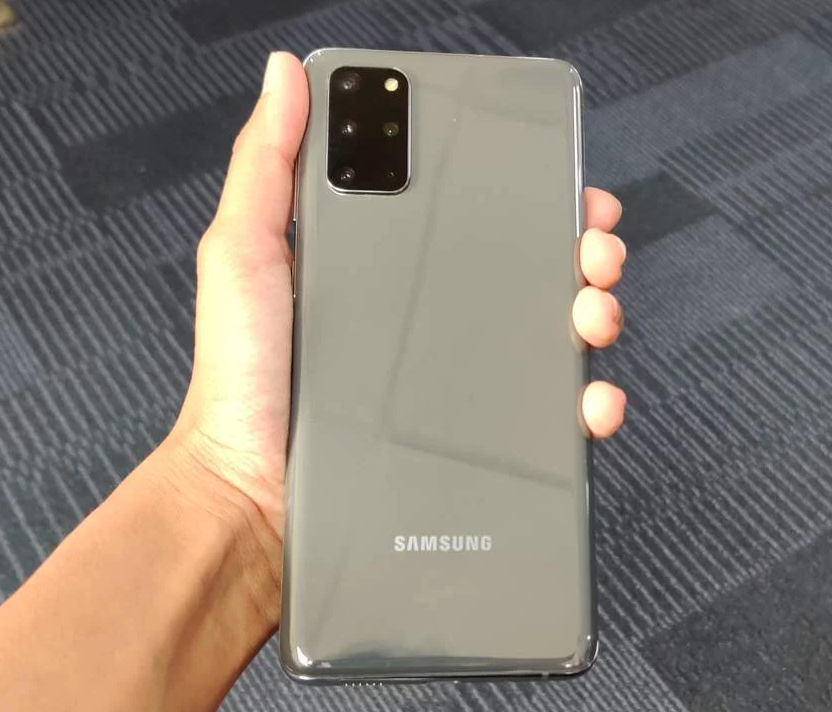
A customer bought a Samsung S20+ via Amazon for ₹57,449 in Nov '20 (I've seen the invoice). Seller Divine India of Mumbai appears to have recycled a phone bought from Flipkart under its part-payment 'Smart Upgrade Plan'. Flipkart is now going to block the handset! https://t.co/tVYnk1MWFN
According to Twitter user @JBhattacharji, she purchased the SamsungGalaxy S20+ from Amazon India. The smartphone was sold by seller Divine India on Amazon for Rs 57,449 ($775) in November 2020. Twelve months after the purchase, the customer is getting a prompt from Flipkart (another major e-commerce website in India) asking her to pay the remaining amount or upgrade the smartphone. The prompt warns the user that Flipkart will block the smartphone if the customer fails to pay the remaining amount.
After contacting Flipkart and Amazon, the customer was informed that the smartphone was initially bought from Flipkart under the Smart Upgrade Plan, which the seller later sold on Amazon. According to the customer, Flipkart has denied providing any support, while Amazon has made no comments on the issue so far.
Under the Smart Upgrade plan, Flipkart gives customers an option to pay the 70% of the smartphone’s value and pay the remaining 30% after 12 months of purchase if they intend to keep the smartphone. But, if you want to upgrade to a new smartphone, you need to return the smartphone and get a new one from Flipkart valued at more than the 30% amount of old smartphone. For example, let’s say a customer buys a smartphone for $1000. They only need to pay 70% of the price, i.e. $700. Then after 12 months, you get a choice to either return the smartphone and upgrade to some other model whose value is more than $300 (your remaining balance on the previous purchase) or you can pay the remaining $300 to Flipkart and keep your device.
The seller, Divine India, appears to have bought the phone off of Flipkart at 70% value and resold it on amazon for full value pocketing the difference. The customer who purchased this phone is getting a prompt from Flipkart that says she needs to pay the remaining Rs 15000 ($202) or upgrade to a phone that is worth more than Rs 15000 ($202) before November 21st under their Smart Upgrade plan or her device will be locked. In a later tweet, the customer said that Amazon had contacted her, clarifying that it was a scam and are looking into the matter.
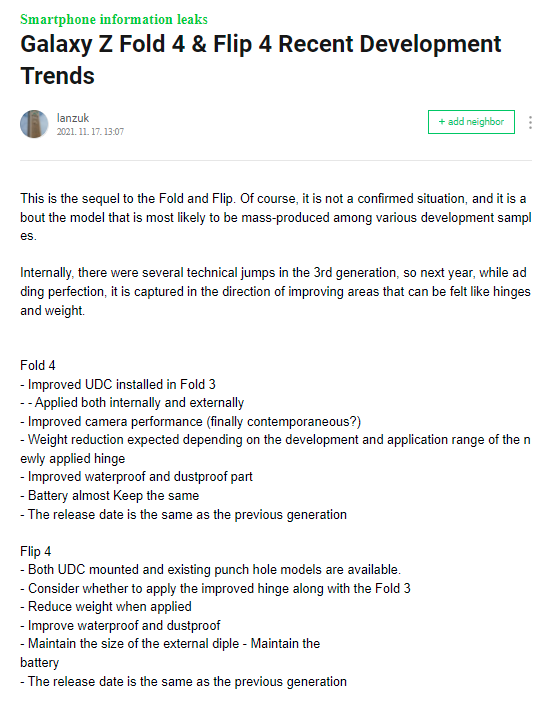
With the significant improvements of the Samsung Galaxy Z Fold3 over its predecessors, the Korean tech giant is looking to make it’s upcoming Galaxy Z Fold4 even more appealing to premium consumers.
A Naver tipster, lanzuk, has revealed some of Samsungs plans for the upcoming Galaxy Z Fold4. In his blog post, the tipster revealed that Samsung is gearing up to launch their next-gen Fold4 around Q3 of 2022 with an improved Under display camera (UDC) on both the internal and external screens. The overall primary camera setup is also getting an upgrade to bring the Galaxy Z Fold4 on par with the camera quality offered by the current flagship in the market.
The Fold 4 may also get a new hinge which might reduce weight. The new hinge will also bring improved water resistance and a dust-resistant certification that was previously absent from the Galaxy Z Fold lineup.
The tipster also hinted that the display size and battery size (4400mAh) would remain the same as the previous generation. The Galaxy Z Fold4 is also rumored to have a lower starting price which Samsung will try to achieve by bringing down per unit cost with mass production. Samsung has previously announced to triple the production and sales of the Galaxy Z fold lineup in 2022. If these rumored improvements are true, the Galaxy Fold series could see a significant increase in popularity and customer base.
The global chip shortage remains a very critical issue in a wide array of manufacturing fields as companies grapple with meeting their production targets amidst the continuing chip shortage. General Motors have had some of its key components like heated seats and heated steering wheels dropped as a temporary measure.
General Motors had confirmed a few days back that it will not be offering heated and ventilated seats or heated steering wheels on some Chevrolet, Cadillac, Buick, and GMC vehicles due to lack of supplies of the relevant chips to automate these components. The temporary measures will affect vehicles on the 2022 lineup, as the company seeks ways to overcome the semiconductor shortage and prevent production from stalling.
On the surface, it seems these changes are just minor adjustments that should not significantly affect the comfort of passengers in these vehicles. However, heated seats are among the very popular features and options that attract the attention of new buyers. General Motors insist that the changes are temporary pending when the company’s chip supplies improve substantially. Although GM was silent on how long the new approach will last, industry watchers had projected that the global chip shortage could extend deep into 2022, across all segments of the tech ecosystem.
The changes are not across all trims; hence some vehicles will still adorn these features. The changes will also reflect in the price of the models, as they will be priced lower than the models sporting these features. Shoppers will see the changes on the vehicle’s label and a credit on the price for the missing feature. General Motors says it has had significant improvements in its chip supplies and its plants across the US are working, some overtime to clear the production backlog. A few other features which were excluded previously like the side blind zone alert and Super Cruise have now been restored.
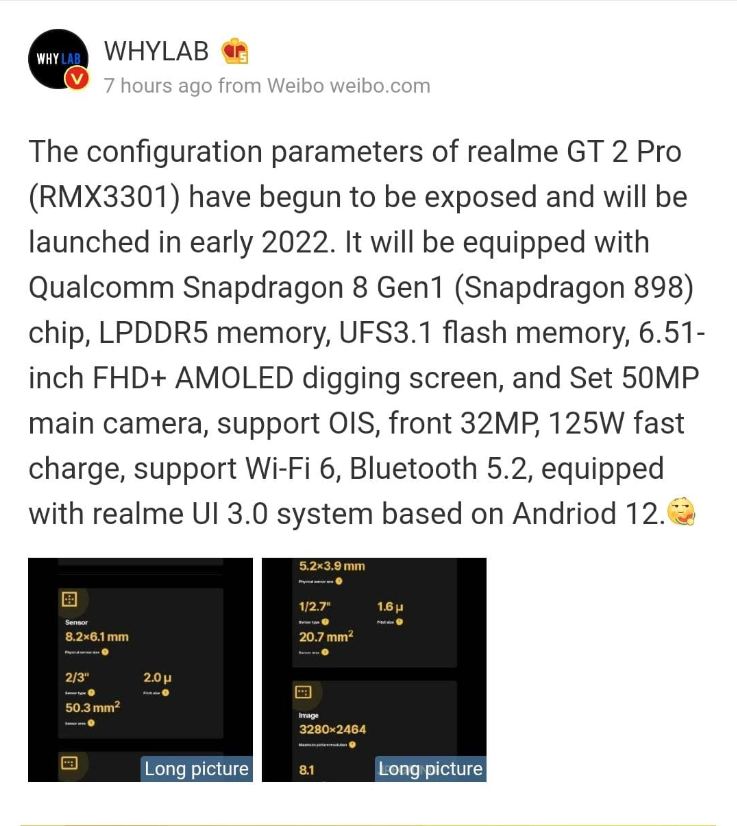
Earlier this week, key specs of the upcoming Realme GT 2 Pro were revealed in an unconfirmed leak. The device was said to house a Qualcomm Snapdragon 888 SoC and a 108 or 50mp camera. And now, a new leak has revealed some changes.
According to a post made by WHYLAB, a reliable tipster on Weibo (a Chinese microblogging site), the Realme GT 2 pro, model number RMX3301, will be launched in early 2022. Contrary to previous reports, the device is said to house a Qualcomm Snapdragon 8 Gen1, aka the Snapdragon 898. The smartphone will be equipped with LPDDR5 memory (RAM) and UFS 3.1 flash memory. The screen will reportedly be a 6.51-inch FHD+ AMOLED with a punch-hole display and an in-screen fingerprint scanner. It is expected to offer a high refresh rate and 404ppi pixel density. And the phone is also said to support the latest 125w fast charging feature.
For photography, it may feature a 50-megapixel + 8-megapixel + 5-megapixel triple camera unit and a 32-megapixel front camera. It will also support autofocus, OIS, and EIS. It appears that the 4-in-1 pixel binning technology will allow it to capture 50-megapixel shots.
The device is expected to be powered by a 5000mAh battery and the RAM and storage capacity are expected to be 8 and 128 GB respectively. The GT 2 Pro is likely to come preinstalled with Realme UI 3.0 based Android 12.
With Realme’s earlier announcement to enter the ultra-premium smartphone segment, it will be interesting to see how the company will position the release of its flagship killer against the upcoming major flagship releases like the Samsung Galaxy S22.
The next generation of OPPO flagships smartphones hav been rumored to support the super-fast 125W charging technology unveiled earlier by the brand. However, more leaks have surfaced, suggesting that might not be the case.
Earlier today, the famous tipster, Digital Chat Station, posted on Weibo (a Chinese microblogging site) that the upcoming Find lineup by OPPO might feature 80W fast charging in contrast to its earlier predictions of the 125W feature.
It is too early to tell if the 80W fast charging feature will be available in all the upcoming OPPO Find series phones. Although, if we are to go by the current market trends, the feature will most likely be reserved for the flagship Find X4 Pro variant.
Earlier reports from Digital Chat Station have claimed the OPPO Find X4 Pro will come with a 6.7-inch display with a resolution of 3216 x 1440. It’ll feature a 120Hz refresh rate, much like the Find X3 and Find X3 Pro. In addition to this, Digital Chat Station has also tipped that one phone from the Find X4 line will come with a 50MP Sony IMX766 primary camera, a 13MP telephoto camera capable of up to 2x optical zoom, and a 3MP microscopic camera.
We also expect the upcoming OPPO flagship to feature the upcoming QualcommSnapdragon 898 chipset, which we’re hoping to see revealed before the end of 2021. The Oppo Find X4 series of smartphones is expected to launch in early 2022, alongside the Samsung Galaxy S22 and Xiaomi 12 launches.
Kia’s latest electric vehicle the EV9 concept car is a big car with a range close to 500 km. The Kia EV9 SUV is built on Hyundai’s Electric-Global Modular Platform (E-GMP), which is being primed as the platform of choice for an extensive lineup of electric vehicles by the carmaker.
The E-GMP is a scalable electric architecture that underpins a list of upcoming EVs like the Ioniq 5, Kia EV6, and Genesis GV60. The EV9 reflects a big leap from the EV6 and it seems primed to win over Telluride and Cadillac Escalade customers with its aggressive dimensions and expansive interiors.
The EV9 is 194 inches long, 81 inches wide, 70 inches in height, and has a wheelbase diameter of 122 inches. It is indeed as huge an SUV as you can get. It also eclipses the size of previous Kia models and there is a strong chance that it could proceed into production subsequently.
The EV9 SUV concept car made its debut at the LA Auto Show 2021 and combines a beautiful angular design with a great and expansive body.
The Kia EV9 will have an 800-volt architecture that allows it to accept DC fast charging at speeds up to 350 kilowatts. Kia says the EV9’s battery can charge from 10–80 percent within 30 minutes.
The interior of the Kia EV9 is serenaded by a massive 27-inch central touchscreen. The steering wheel is a pop-up steering pad, but it’s unclear what concept is behind the shape.
Although there are no definitive details on when production could commence for the EV9, it could be within the next year or two. The company has stated its plans to release several EVs by 2027.
Hyundai revealed a new concept EV at the 2021 Los Angeles Auto Show named ‘Seven’, and it’s a great demo of how the automobile maker’s scalable EV platform can be stretched to accommodate large SUVs. The SUV is built on E-GMP (Electric-Global Modular Platform), which is also being used in the upcoming Ioniq 5, Kia EV6, and Genesis GV60 EVs.
The Hyundai Seven is one of the largest-ever concept vehicles from the company with a wheelbase that stretches 10.5 feet (via The Verge). For comparison, the Cadillac Escalade’s wheelbase stands at 9.6 feet. The vehicle’s battery is capable of being filled up from 10 percent to 80 percent in just 20 minutes using a 350kW charger. A range of over 300 miles (483km) is also being targeted.
Features such as coach-style doors, adjustable seating, and retractable controls are also being offered, giving us a look into Hyundai’s offerings from the future. All in all, the interior is not unlike a little living room with furniture that can be moved around. Other car companies like BMW, Volvo, and Audi, have already projected similar ideas with car interiors transformed into “third places” in which one can work, eat, socialize, and even sleep.
1 of 4
Hyundai has also put a lot of emphasis on hygiene with the Seven to help people keep their cars sanitized in a post-pandemic world. Accordingly, the interior uses plenty of renewable and recycled materials like bamboo, along with copper and hygienically treated fabric. There even are UVC lights that sterilize everything once everyone leaves the vehicle.
The Hyundai Seven is obviously just a concept and will not be going into production anytime soon. However, considering the company does have a good record converting concepts into reality, seeing the Seven on the road in the coming years isn’t too far-fetched. For reference, Hyundai’s 45 concept had eventually become the Ioniq 5.
Apple will soon be launching its first retail store in India. The company’s first online store went live only last year but a retail store will now be opening in the country for the first time. Tim Cook had confirmed last year that the company was seeking approval from the government. Apple has also begun hiring employees for the offline retail stores, as spotted by 9to5Mac on LinkedIn.
A post on the same by Nidhi Sharma, a recruiter at Apple, reads:
“Today marks one of the major milestones in creating History for Apple Retail in India… 🥳🥳🥳. We are now LIVE 🇮🇳 and we are bringing our very 1st 2 stores to India in Mumbai & Delhi! 🎊🙌🏻🤩.”
The recruiter has also confirmed that the first two stores will be opening in Mumbai and Delhi. There have been openings for various roles subsequently including Store Leader, Operations Expert, Senior Manager, Manager, Market Leader, and others. The listings do not contain any joining date as of yet though, so there’s still no clue about when the stores will be opening.
Still, we can expect them to go live in early 2022 if not 2021.
It was previously reported that the first-ever Apple retail store in India will be opening on August 15, 2021, which did not happen. The delay can be owed to the pandemic or simply a hitch in the approval process.
Regardless, it is great to see that rumors and leaks about an Apple store in the country are finally being realized, which is great news for Apple fans. The Cupertino-based company has also been rumored to soon set up another retail store in Bengaluru.
Google has done an appreciable job with the amalgamation of Pixel 6 and machine learning. Each feature on the smartphone is enhanced and furnished with the help of AI. On top of that, the Google Tensor chipset further improvises some features and the performance of the overall smartphone. Among the exciting Pixel 6 features, Live Translate is another useful feature that is currently exclusive for the Pixel 6 series. However, a little workaround can help you get in a feature on your old Pixel smartphone. Let’s see how in the guide below
The Pixel 6 exclusive feature – Live Translate, is now easily available for old Pixels. Unlike what Google said at the Pixel 6 launch event, the Live Translate feature works flawlessly on Pixel 4a without Google Tensor. Magic Eraser was also acclaimed to be optimized by Google Tensor on Pixel 6, but it also worked on previous Pixel devices without any problem.
You can easily install the ASI – Android System Intelligence ported from Pixel 6 to grab the feature without any additional setting. As revealed by Twitter user @abhinav_937, the feature runs without any flaw on a non-rooted device. He tested it on the Pixel 4a by installing the latest Pixel 6 ASI apk.
What is Live Translate on Pixel 6?
Google Translation is already a productivity tool, having millions of daily users communicating across languages. It’s been widely used across the globe via different platforms including Twitter, YouTube, and other important services to ease communications. The search giant is actively working to improve its communication and translation services with the advent of new techniques and ways.
In such a step, Google introduced Live Translate with Pixel 6 series to translate the text across different third-party apps. Using the Google Tensor AI prowess, the app offers automatic translation of text messages on Google Messages, WhatsApp, and another conversation app in your native or default language. It works two-way, as Google Translate even translates your reply into the sender’s native language. Live Translate works in sync with Gboard while typing the reply and further enhances the functionality.
It is a full overhaul of Google Translate capabilities in a more integrated manner. Live Translate feature can even transcribe the audio in a video to your native language in real-time. The offline capability of Live Translate is an additional advantage that boosts its overall usability.
Steps to get Live Translate on Old Pixels
It is quite easy to enable the Live Translate feature on your old Pixel smartphone. Precisely follows the steps below:
Download the Pixel 6 latest ASI ( Android System Intelligence) from here.
Install the APK on the old Pixel device without any additional settings.
Now go to Settings > System > Live Translate will be available.
Download the preferred language, and see it working in your favorite messaging app. Note. It is working on messaging app only.
Enjoy!!
Currently, the feature is working, but we’re not sure about the future as Google may switch it off on old Pixels via the backend. If you found it working apart from the ASI version, then do let us know via the comments below.
Earlier today, OPPO launched the OPPO A55s in the Japanese market. The smartphone is tailored for the Japanese market, with specific features usually not found in budget OPPO smartphones sold globally, like IP68 rating.
OPPO A55s Specs and Features
The OPPO A55s features a 6.5-inch full HD+ LCD display with a 90Hz refresh rate and 180HZ touch sampling rate. The phone also features an IP68 rating, making it resistant to dust and submersion up to a maximum depth of 1.5m underwater for up to thirty minutes.
Under the hood, the OPPO A55s houses a QualcommSnapdragon 480 SoC, with 4GB RAM and 64GB onboard storage. The device is capable of memory expansion via a microSD card slot. The phone runs Android 11 out of the box with OPPO’s own ColorOS 11 custom skin and packs a 4000mAh battery with support for up to 18W fast charging.
OPPO A55s camera
In terms of camera, the OPPO A55s sports a dual-camera setup on the back, with a primary 13-megapixel camera with an f/2.2 aperture paired with a 2-megapixel depth sensor and a LED flash. There is an 8-megapixel camera on the front for video calls and selfies. The camera app offers various modes like Ultra Night Mode, Portrait Mode, AI Scene Enhancement, and AI beauty filters.
Other features
In terms of connectivity options, the OPPO A55s offers Bluetooth 5.0, dual-band Wi-Fi, 4G with VoLTE, and, of course, 5G. The device also has NFC with support for NTT DoCoMo Osaifu-Keitai and Sony FeliCa. The phone also provides an accelerometer, proximity sensor, compass, gyroscope, a USB-C port for charging and data transfer alongside a 3.5mm headphone jack.
Price and availability
OPPO A55s is priced at JPY 33,800 ($296). The phone will be going on sale in Japan starting November 26, but pre-orders for sale started earlier today. The phone is available in two color variants, namely Green and Black. The phone could launch in other markets in South Asia, but OPPO has not made any announcements regarding the device’s launch outside Japan yet.
We use cookies on our website to give you the most relevant experience by remembering your preferences and repeat visits. By clicking “Accept”, you consent to the use of ALL the cookies.
This website uses cookies to improve your experience while you navigate through the website. Out of these, the cookies that are categorized as necessary are stored on your browser as they are essential for the working of basic functionalities of the website. We also use third-party cookies that help us analyze and understand how you use this website. These cookies will be stored in your browser only with your consent. You also have the option to opt-out of these cookies. But opting out of some of these cookies may affect your browsing experience.
Necessary cookies are absolutely essential for the website to function properly. This category only includes cookies that ensures basic functionalities and security features of the website. These cookies do not store any personal information.
Any cookies that may not be particularly necessary for the website to function and is used specifically to collect user personal data via analytics, ads, other embedded contents are termed as non-necessary cookies. It is mandatory to procure user consent prior to running these cookies on your website.