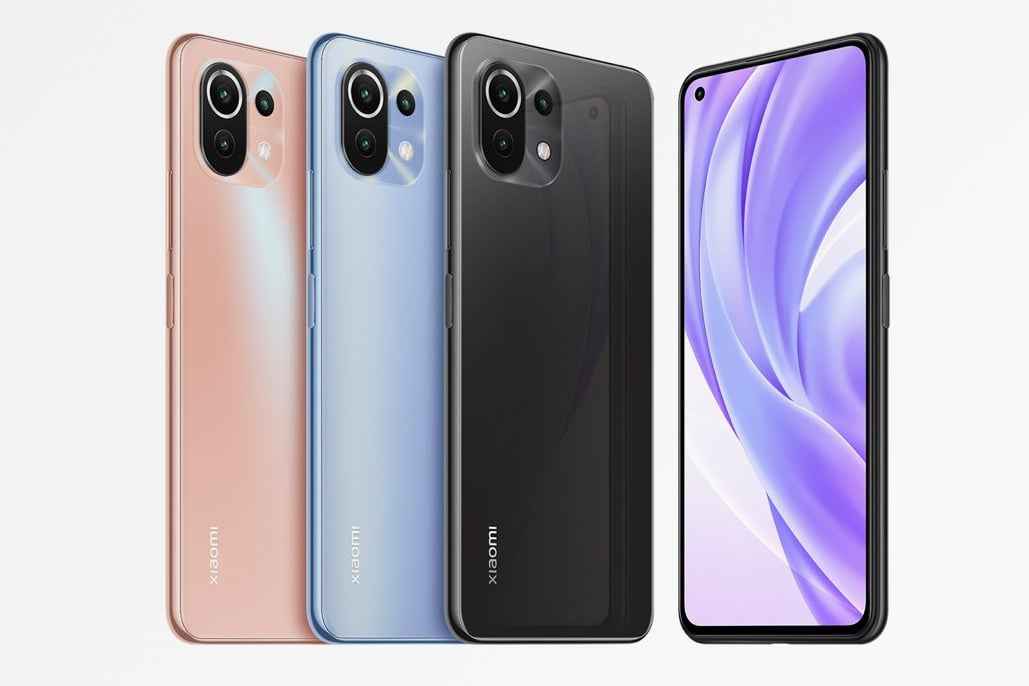
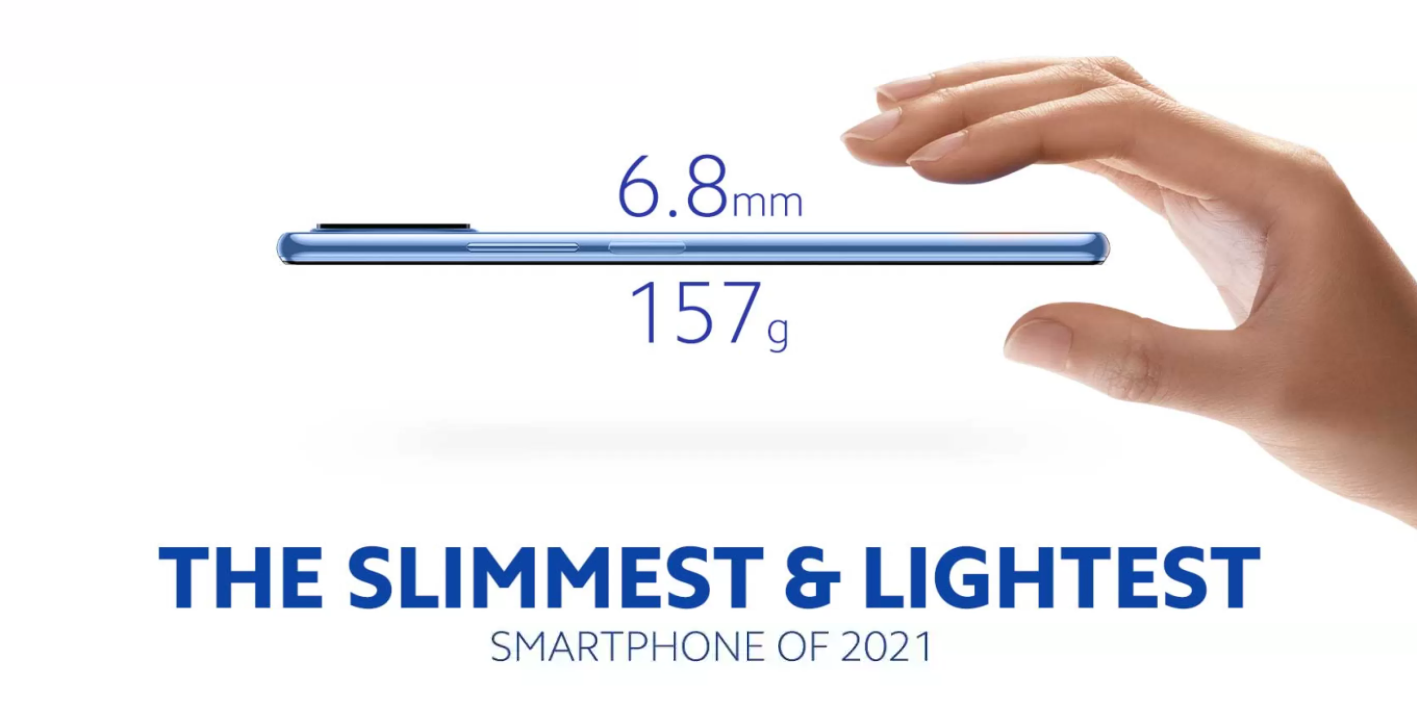
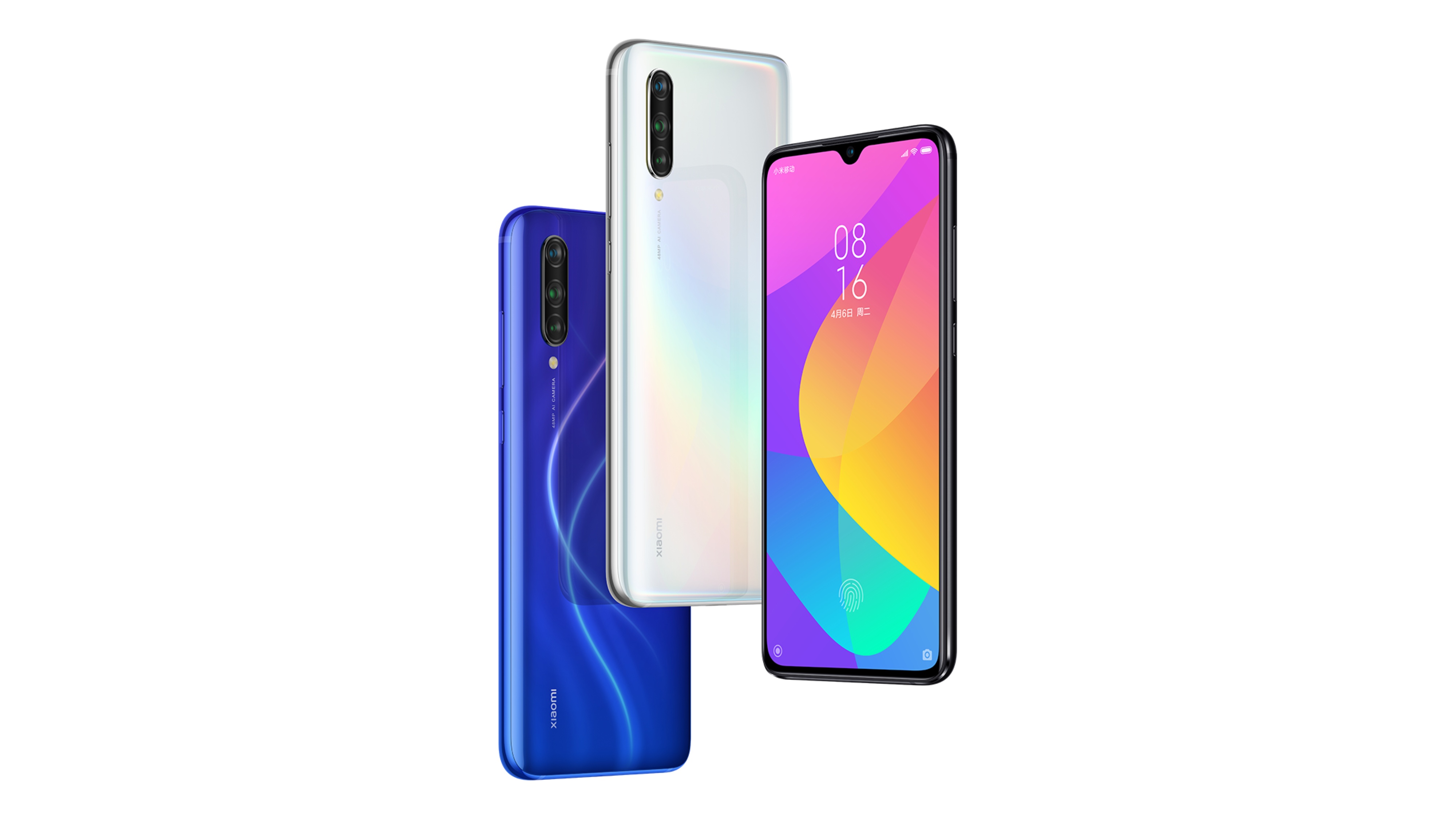
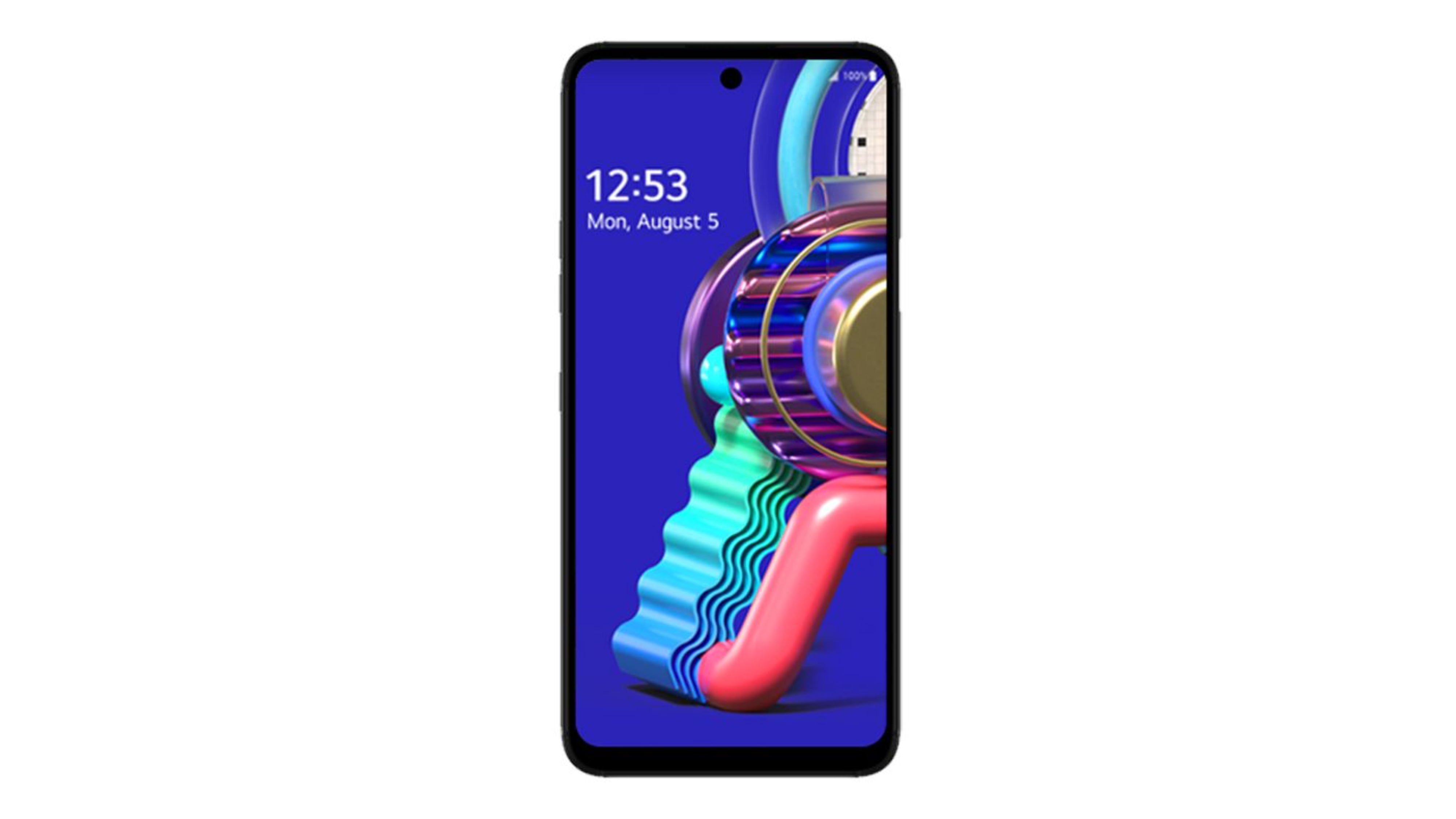
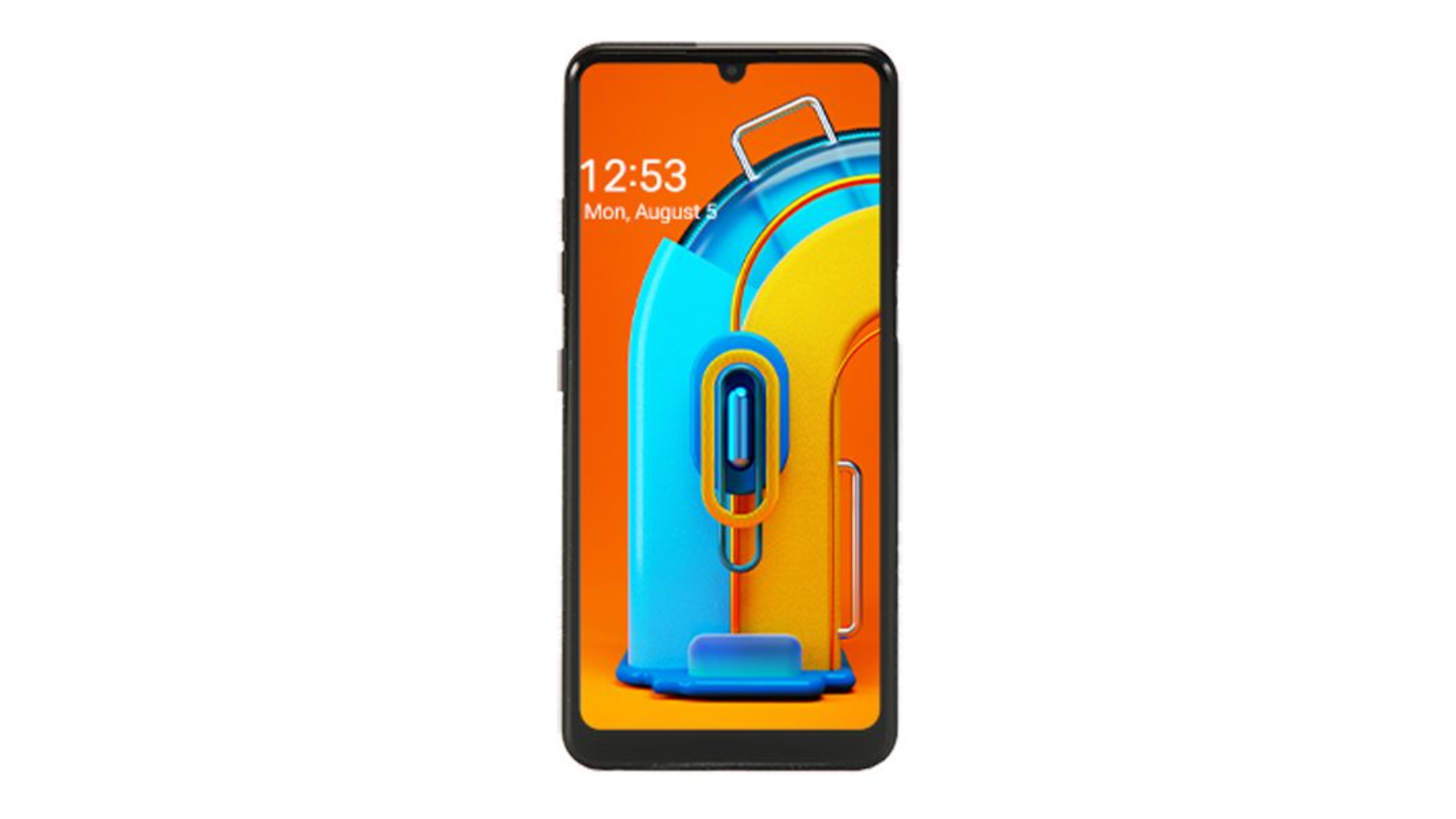
Xiaomi will be announcing the Xiaomi Mi 11 Lite smartphone in India on June 22. It will be arriving as the lightest and thinnest smartphone of 2021. After the announcement, it will be available for purchase through the Flipkart retailer site in the country. Xiaomi has recently confirmed that the Mi 11 Lite will be offered in three colors.
The Xiaomi Mi 11 Lite will land in India in shades like Tuscany Coral, Jazz Blue, and Viny Black. Past reports have revealed that the device will be available in three options such as 6 GB RAM + 64 GB storage, 6 GB RAM + 128 GB storage, and 8 GB RAM + 128 GB storage. The handset is likely to be priced at around Rs 20,000 (~$270).
We're very excited to reveal 3 beautiful color variants of #Mi11Lite 😍
🟤 Tuscany Coral 🔵 Jazz Blue ⚫️ Vinyl Black
These colors are inspired by a region in Italy, a music genre & phonographic records
The Mi 11 Lite has a 6.55-inch AMOLED FHD+ display, and it runs on MIUI 12 based Android 11 OS. The Snapdragon 732G mobile platform drives the smartphone.
The rear camera setup of the Mi 11 Lite has a 64-megapixel main camera, an 8-megapixel ultrawide lens, and a 5-megapixel macro camera. The smartphone is fitted with a 16-megapixel selfie camera.
xiaomi Mi 11 Lite 4G
The Mi 11 Lite has a 4,520mh battery that supports 33W rapid charging. For security, it has a side-mounted fingerprint scanner.
The Chinese manufacturer will be launching the Mi Watch Revolve Active smartwatch alongside the Mi 11 Lite on June 22. With an additional SpO2 sensor, it is likely to arrive as an enhanced edition of the Mi Watch Revolve.
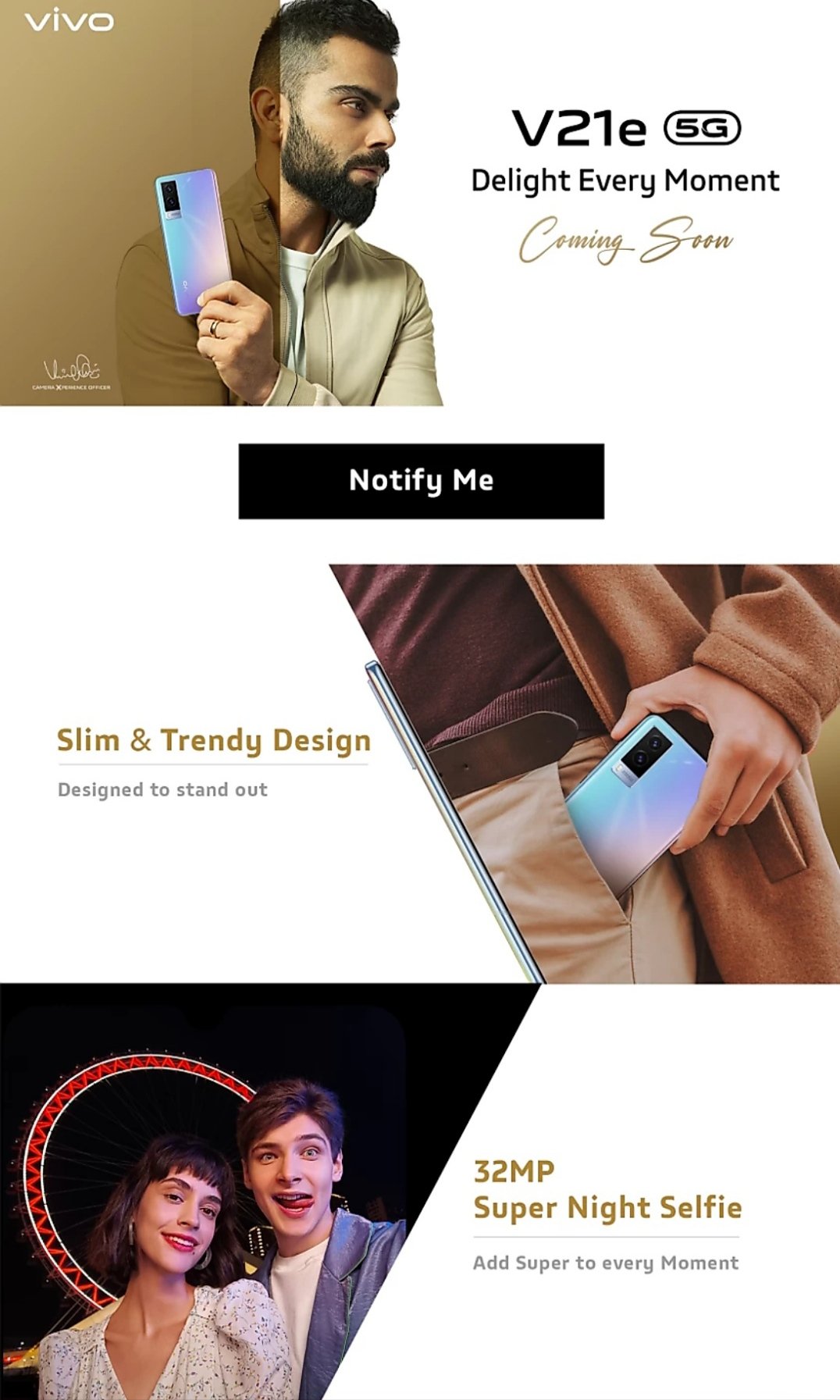
Last week, Vivo India confirmed that the Vivo V21e 5G phone will be coming soon to India. Now the product page of the handset has gone live on Flipkart. After the Vivo V21 5G that debuted in April, it will be the second V21-series phone to land in India. It goes without saying that the V21e 5G will be priced lower than the more powerful V21 5G.
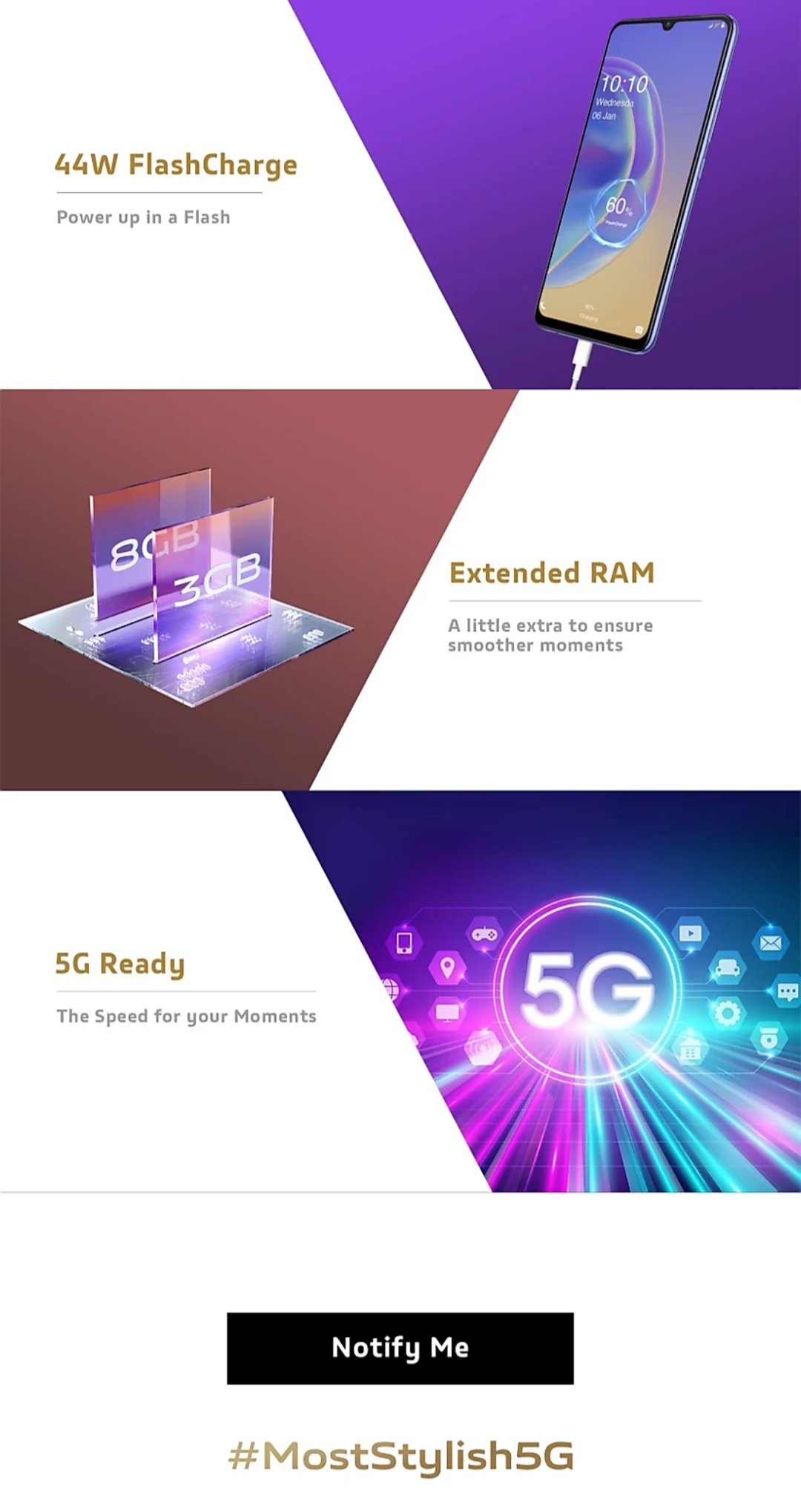
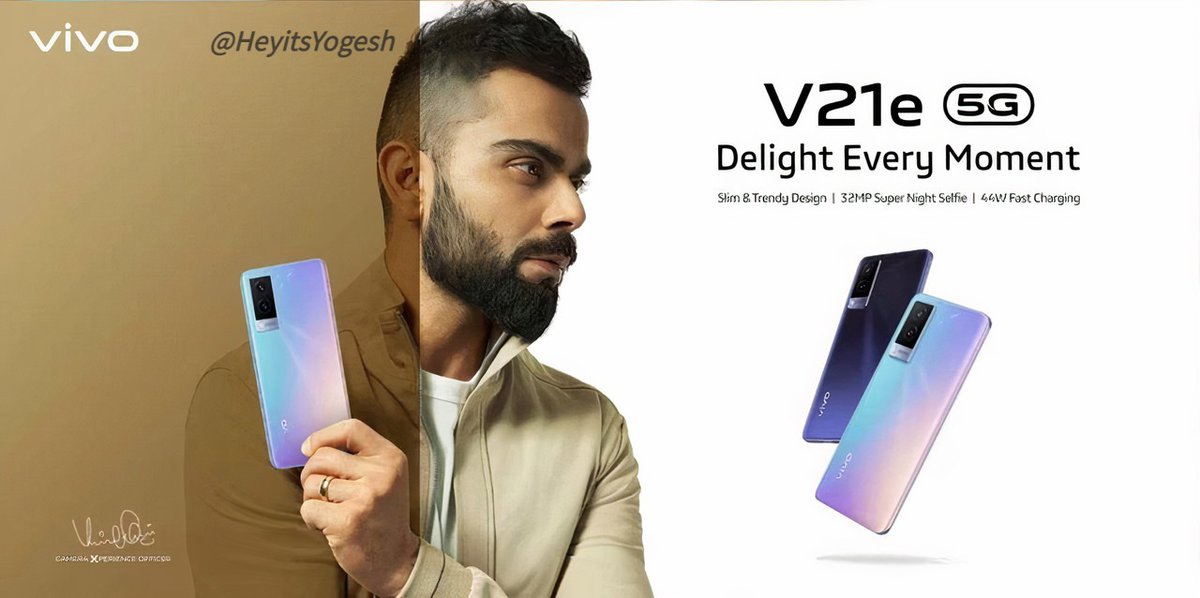
The microsite of the Vivo V21e 5G has revealed that it will be sporting a slim and trendy design. For capturing selfies, it will be equipped with a 32-megapixel front camera. The 5G-capable phone will come with other features like 8 GB of RAM, 3 GB of extended (virtual) RAM, and 44W rapid charging. The front view of the phone reveals that it has a waterdrop notch display and a noticeable chin.
Vivo V21e 5G specifications (Rumored)
Reports have revealed that the Vivo V21 5G has a 6.44-inch AMOLED panel that delivers FHD+ resolution. It has a 32-megapixel front camera, and its rear camera setup has a 64-megapixel primary lens along with an 8-megapixel ultrawide snapper.
1 of 2
Vivo V21e 5G microsite 2
The Dimensity 700 chip powers the device with 8 GB of RAM. It has 128 GB of internal storage and a microSD card slot. The phone runs on FunTouch OS 11.1 and Android 11 OS.
The V21e 5G is backed by a 4,000mAh battery that supports 44W rapid charging. For security, it has an in-screen fingerprint reader. The handset weighs 7.67mm and weighs 165 grams.
Vivo V21e 5G price in India (Rumored)
According to a tipster, the Vivo V21e 5G with 8 GB of RAM and 128 GB of storage will be priced at Rs 24,990 (~$337) in India. Currently, the Dimensity 800U powered V21 5G is available with a starting price of Rs 29,990 (~$404) in the country. The V21e 5G is expected to launch on June 24 in India.
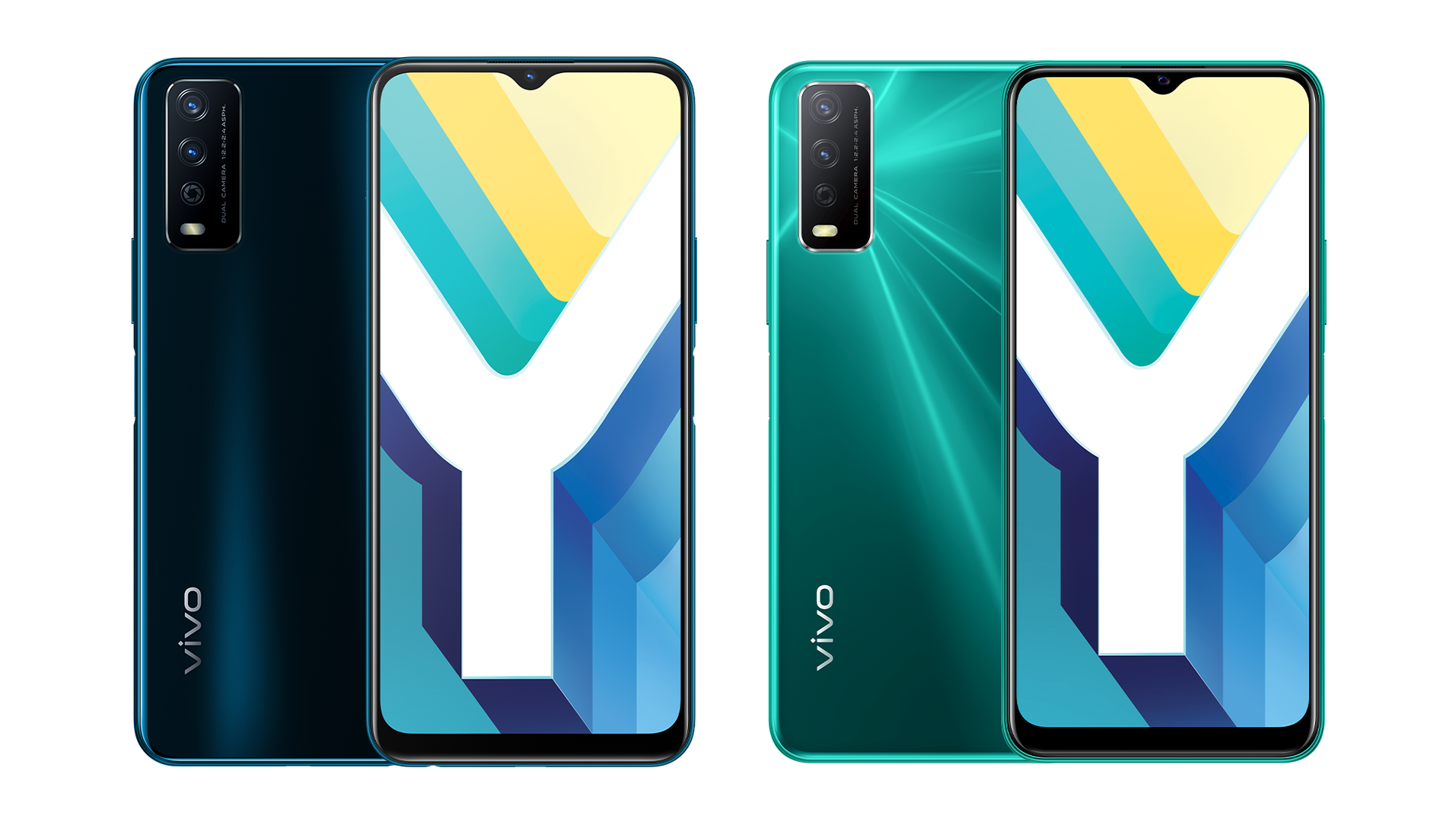
The affordable Vivo Y12A has been launched in Singapore and Thailand. It is a new addition to Vivo’s Y12 family that includes Vivo Y12, Vivo Y12i, Vivo Y12s, and Vivo Y12s 2021. The Y12A that has gone official in the above-mentioned markets appears to be a rebadged version of the Y12s 2021, which debuted in Vietnam last month.
Vivo Y12A specifications and features
The Vivo Y12A features a 6.51-inch IPS LCD screen with a teardrop notch, which delivers an HD+ resolution of 720 x 1600 pixels and a 20:9 aspect ratio. For snapping selfies, it has a front camera of 8-megapixel.
The rear panel of the device has a 13-megapixel primary camera and a 2-megapixel auxiliary lens. The device is backed by a 5,000mAh battery that carries support for 10W charging and 5W reverse charging. For security, the device features a side-facing fingerprint scanner.
Vivo Y12A
The Snapdragon 439 chip and 3 GB of RAM power the device. For storage, it has a built-in storage of 32 GB and a microSD card slot. The other specs of the phone include dual SIM support, 4G VoLTE, Wi-Fi, Bluetooth, GPS, a microUSB port, and a 3.5mm audio jack.
Vivo Y12A pricing and availability
The Vivo Y12A is priced at 4,499 Baht (~$143) in Thailand, and it comes in two colors: green and blue.
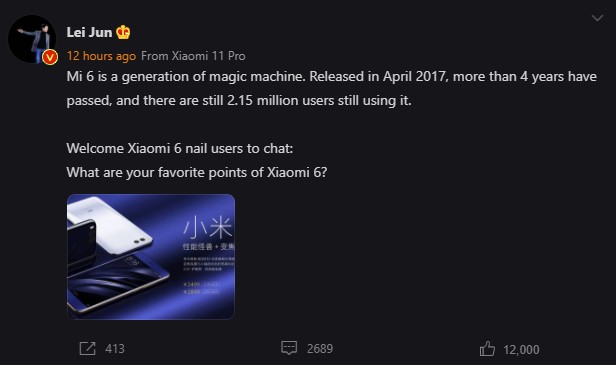
The Mi 6 was announced in 2017 and is one of Xiaomi’s most popular Mi flagship phones. Last year, there were rumors that Xiaomi had plans to relaunch the phone with newer internals and a revamped design but unfortunately, that never happened. Today, Lei Jun, the CEO of Xiaomi, revealed an interesting fact about the Mi 6.
The top executive took to Weibo to announce that there are 2.15 million current users of the Mi 6. That is a significant number of users for a phone that is more than 4 years old, most especially an Android one.
The Mi 6 launched with a 5.15-inch FHD LCD screen with a 16:9 aspect ratio. It had a Snapdragon 835 processor, up to 6GB of RAM, and up to 128GB of non-expandable storage. For its cameras, Xiaomi included two 12MP sensors – one served as the primary camera while the other was a telephoto camera with 2x optical zoom. The front-facing camera was an 8MP sensor.
Under its glass (or ceramic) back, the Mi 6 packed a 3350mAh battery capacity with support for 18W fast charging. It didn’t have an official IP rating but it had a water-repellent coating. Xiaomi also didn’t include an audio jack but it had stereo speakers. It also had an IR blaster and NFC.
The Mi 6 launched in April 2017 with Android 7.1 Nougat and its last Android update was to Android 9 Pie.
Do you still use/own a Mi 6? Do let us know in the comment box below.
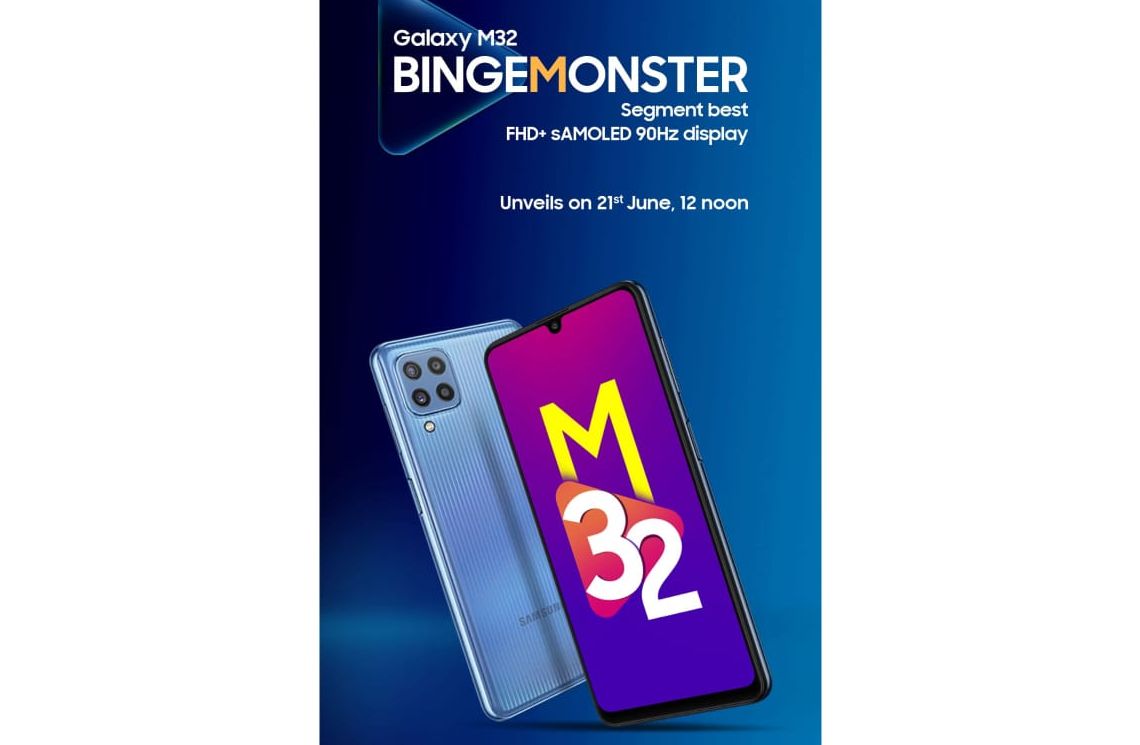
The Galaxy M32 is scheduled to launch on June 21 in India. The mid-range phone will be sold on Amazon and the promotional page has revealed some of its key specs. Now, a new leak has filled in the missing specs and also includes a price range.
We already know that the Galaxy M32 will have a 6.4-inch sAMOLED display with an FHD+ resolution. The screen has a 90Hz refresh rate and a waterdrop notch that houses the front-facing camera. Samsung has settled for Corning’s Gorilla Glass 5 for protection against scratches.
Indian leaker, Yogesh, revealed in a tweet that the phone will have an Helio G85 processor powering it. There will be up to 6GB of RAM available and up to 128GB of eMMC storage.
For its cameras, a 64MP main camera will be paired with an 8MP sensor (ultrawide) and two 2MP sensors. The camera is a downgrade considering its predecessor, the M31, has a 64MP + 8MP + 5MP + 5MP quad-camera setup. It also has a 32MP camera in front which has now been replaced by a 20MP sensor. While the front-facing camera might have better quality, we are pretty certain the 5MP depth and macro cameras of the M31 are better than the 2MP sensors they have been replaced with.
Users will be happy to know that the 6000mAh battery capacity from the Galaxy M31 has been carried over, though it still supports just 15W fast charging. With respect to price, the source says the device will start at under INR 15,000 (~$202). The Galaxy M32 should run Android 11 out of the box.
Chinese tech giant Huawei has launched a new tablet targeted at young children. The slate dubbed MatePad T 10 Kids Edition is a trimmed-down version of the MatePad T 10 which was launched a couple of months back in Japan. It equally shares the same processor with the MatePad T 10s.
The MatePad T 10 Kids Edition features a 9.7-inch IPS LCD display with a resolution of 1,280 x 800 pixels. The display also has a pixel density of 156 ppi. The tablet is powered by a Hisilicon Kirin 710A chipset paired with 2GB of RAM and there is 16GB and 32GB storage options with a microSD slot for expansion.
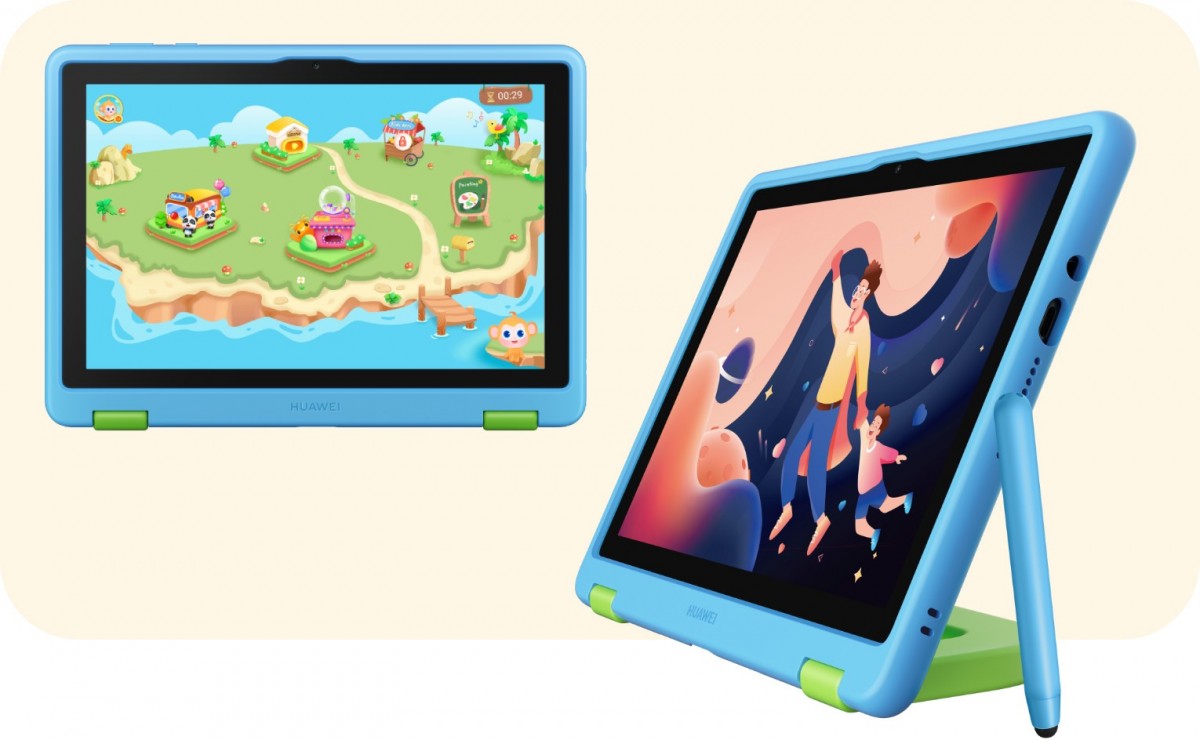
The exterior and internal software design of the MatePad T 10 Kids Edition confirms that the tablet is indeed designed and programmed for kids. For one, the tablet’s exterior is covered with a brightly-colored anti-shock case made using food-grade silicone. Thus, it won’t cause any toxicity if a child decides to chew the silicone. The case is also removable, leaving you with a sleek plastic body.
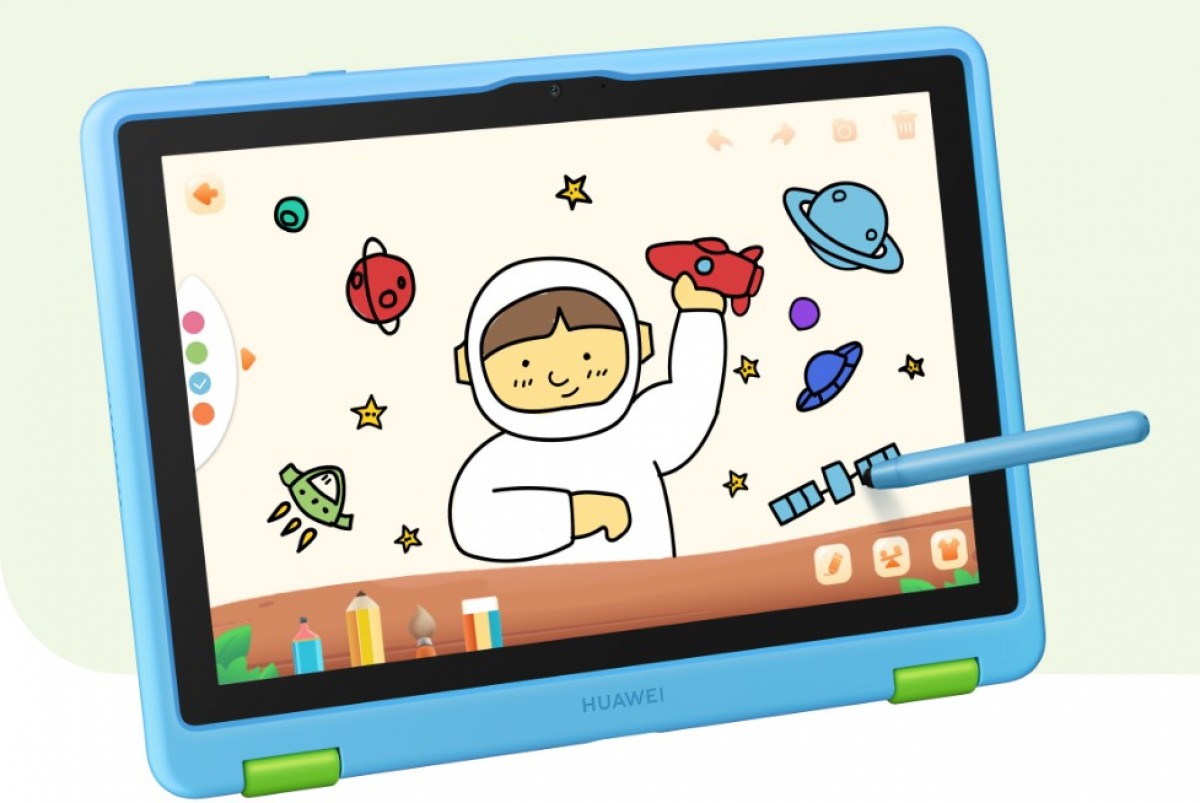
Another addition is a useful kickstand that will make it easy to keep the tablet erect while watching a video. The kickstand also doubles as a handle for the slate. There is also a stylus pen attached to the case. The tablet also features a single 5MP camera at the back which supports 1080p video recording. The front of the display houses a 2MP selfie camera.
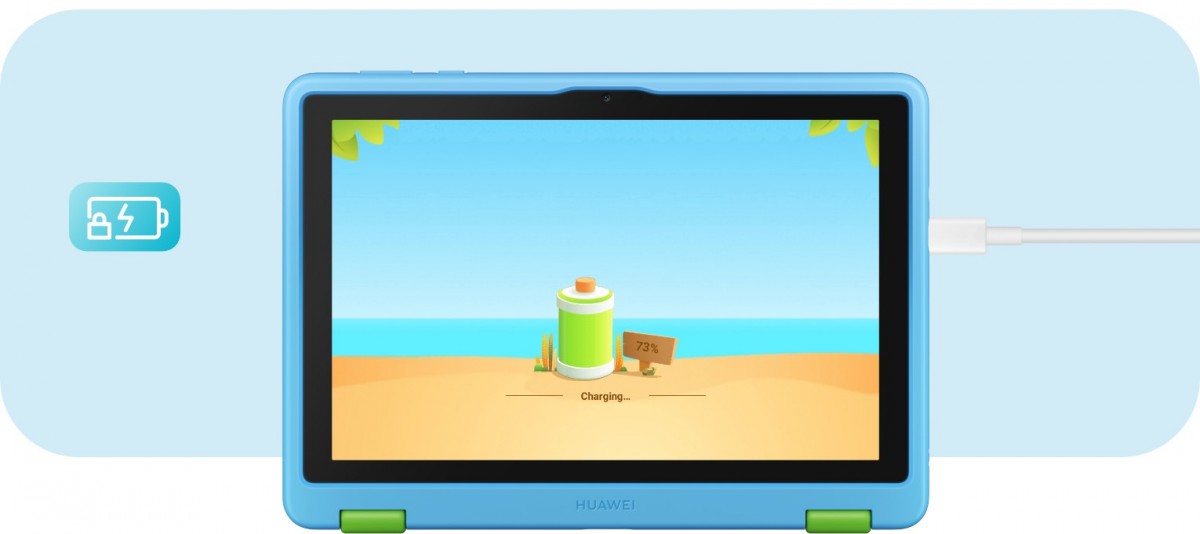
Crammed under the hood is a decent 5100mAH battery that charges via a 5W charger but the phone uses a USB-C port. For safety reasons, the tablet can’t be used while it is charging. This would ensure that kids do not stay close to electrical outlets too often. For connectivity, the MatePad T 10 Kids Edition comes with support for Bluetooth 5.1, Wi-Fi 5, GPS, and LTE.
The slate runs EMUI 10.1 based on Android 10 but you’re surely not getting Google Mobile Services onboard this one. The tablet comes with several apps and features specifically designed for kids. There is a Kids Corner that provides different Time, Application, and Content Management features to keep the kids from accessing the wrong content. Huawei is also offering users a free 12-month subscription to Azoomee which offers a catalog of age-appropriate puzzles, games, and inspirational videos.
As for the price, the Huawei MatePad T 10 Kids Edition will retail for IDR 2,900,000 (~$200) in Indonesia. The tablet is already available for pre-order in the country. There is no word yet on when it will be available in other regions.
Nothing is the new electronics startup founded by Carl Pei, the former OnePlus co-founder who exited the company last year. Last month, it was announced that Nothing’s first product, a pair of earbuds dubbed the “ear (1)” will launch this month, but that will no longer be the case.
Carl Pei has taken to Twitter to announce that the ear (1) will no longer arrive this June as promised due to a few unfinished things. Due to this, the wireless earbuds will now arrive later this summer. There is no specific launch date but we expect it to be announced in late July or August.
Considering this is the company’s first product, it is understandable why there may be hiccups. Even older companies postpone product announcements, so this should not be seen as a sign of trouble for Nothing. At least, we have not heard anything to indicate that.
It has been reported that the Nothing ear (1) will differ from most of the earbuds on the market right now. As seen in the image above, the earbuds have a long stem connected to the head by a thinner piece. That sure is an unusual design. Regardless, the earbuds will have to stand out in more ways than just from the way they look. They should also offer competitive features and value for money in a space as competitive as the earbuds market.
Next week is an important one for Windows users as Microsoft has a major Windows-related announcement. Realme will also be bringing its Narzo 30 phones to India, while Xiaomi has a new smartwatch scheduled to launch. Here are the key announcements for the fourth week of June.
Mi 11 Lite 4G and Mi Watch Revolve Active – June 22
Xiaomi has a launch event scheduled for June 22 in India. The tech giant plans to launch its upper mid-range phone, the Mi 11 Lite as well as a new smartwatch, the Mi Watch Revolve Active.
Realme Narzo 30 5G
Realme Narzo 30 – June 24
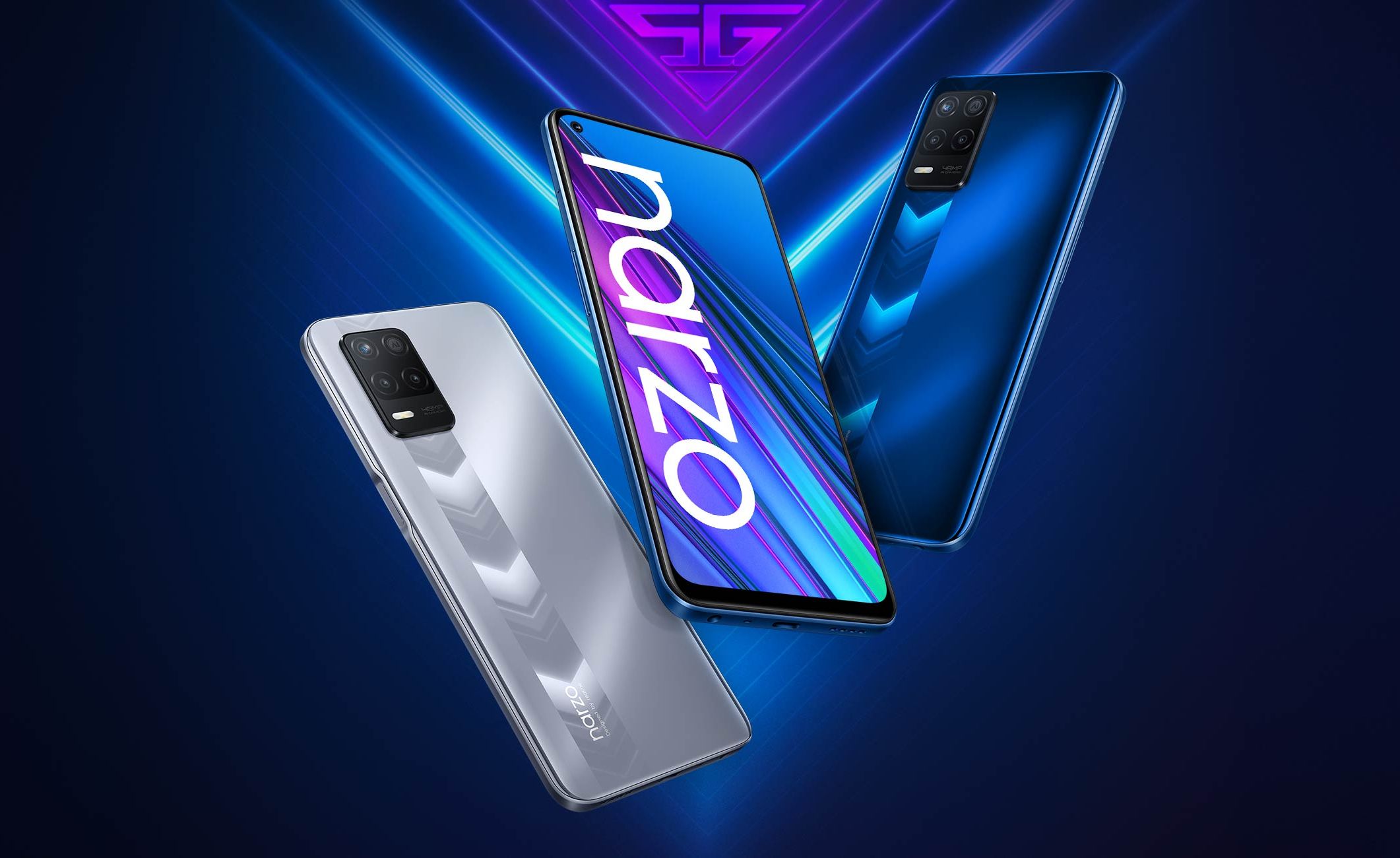
Months after launching the Narzo 30A and the Narzo 30 Pro 5G, realme is ready to bring the Narzo 30 to India. The manufacturer has already confirmed that the phone will be available in 4G and 5G versions. Realme will also announce a 32-inch smart TV alongside the new phones.
Vivo also has a launch scheduled for June 24 in India. The manufacturer plans to announce the Vivo V21e 5G, a mid-range 5G phone on that day. Vivo already sells a 4G version of the device powered by the Snapdragon 720G processor for a little over $400, so expect this to cost a bit more.
Xiaomi is rumored to announce MIUI 13 very soon. However, the company is yet to release MIUI 12.5 update for eligible devices. The latest smartphones to get the current latest MIUI versions are the popular Redmi Note 8 Pro and the POCO F2 Pro.
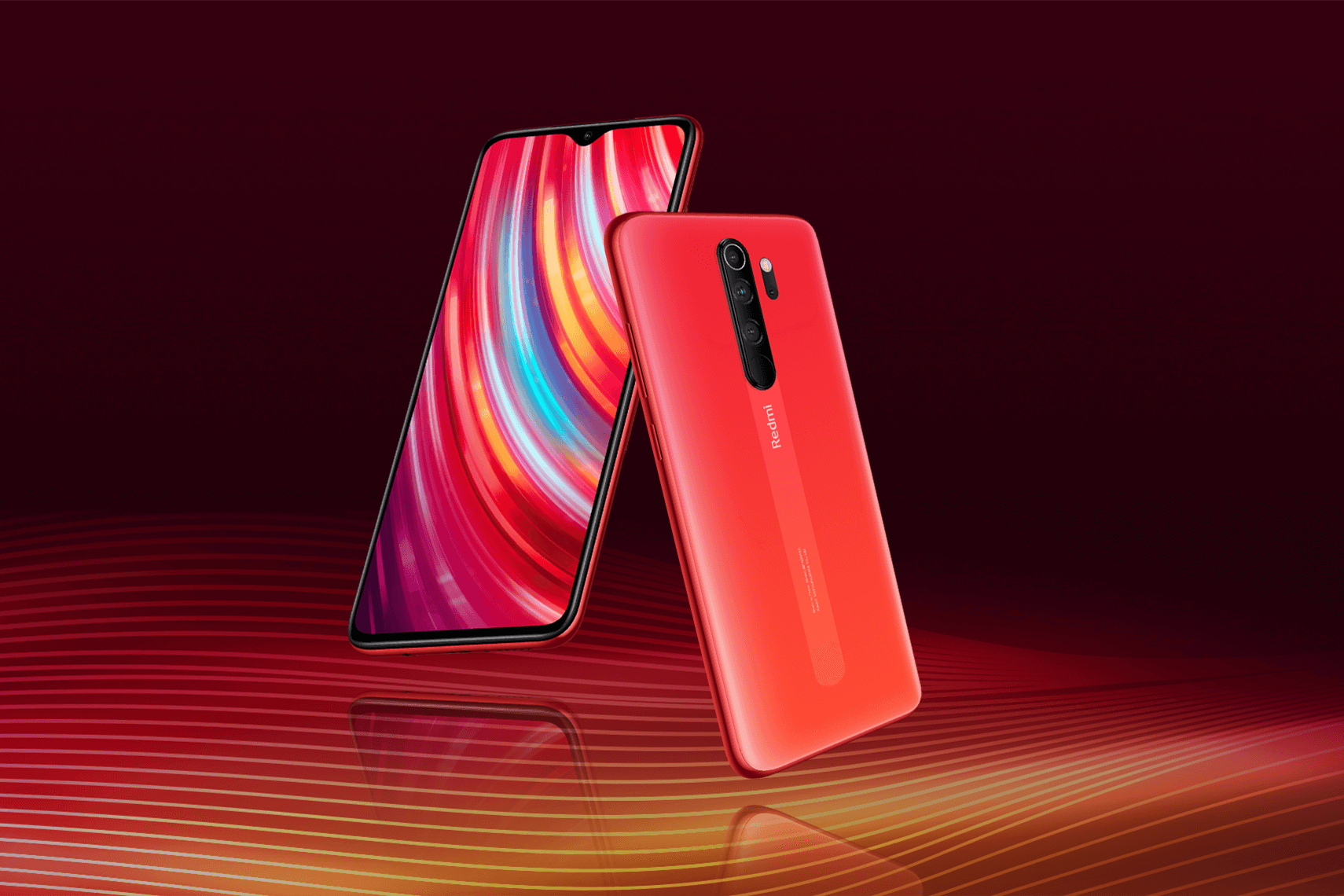
Redmi Note 8 Pro
The Redmi Note 8 Pro was the first Redmi Note series smartphone to use a MediaTek chipset after a very long time. The device debuted with the then-new Helio G90T SoC. It was released with MIUI 10 based on Android 9.0 Pie.
The handset received two MIUI updates (MIUI 11, MIUI 12) and was even promoted to Android 10. Now, Xiaomi has started rolling out MIUI 12.5 update along with Android 11. Unfortunately, the update is only live in China with build number V12.5.1.0.RGGCNXM. But it should hit the remaining regional variants soon.
The POCO F2 Pro, on the other hand, is a rebranded Redmi K30 Pro. The original phone received the MIUI 12.5 update in May. Hence, the POCO F2 Pro was expected to get it soon.
Right now, the POCO F2 Pro MIUI 12.5 update is only available for the EEA variant with build number V12.5.1.0.RJKEUXM. Anyway, the update should reach other regional variants in the coming weeks.
Unlike the above handset, this one launched with MIUI 11 based on Android 10. It was updated to MIUI 12 as well as Android 11 months after its release.
Xiaomi is long rumored to launch the next-gen Mi CC series smartphone. But even after months, the company is yet to introduce the new device. Instead, we are still only hearing rumors. That said, a new word on the street finally sheds some light on the target audience of the upcoming Mi CC series phone.
Xiaomi Mi CC9
According to DSP-Charles (blogger) on Weibo, the new Mi CC series handset will be a designer smartphone with an emphasis on camera performance. In other words, it will be similar to its predecessor.
Further, the blogger says that this device will compete against the likes of OPPO Reno6 Pro and vivo X60 Pro. Also, he adds that this phone will be a better Mi 11 Lite 5G.
On the other hand, Digital Chat Station suggests that the new Mi CC series handset bears model number K9D and it has received Chinese radio certification recently.
Since the device has now begun to get certifications, we expect to learn more about it in the coming days. As always, Xiaomi itself should start teasing the smartphone as we reach closer to the release date.
What do you expect from the forthcoming Mi CC series phone? Do you think Xiaomi will launch it outside mainland China? Do let us know your thoughts in the comment section below.
Three new upcoming Samsung budget 5G smartphones have been certified by Bluetooth SIG. The certification of these devices reveals them to be the same phone with different names. Let’s take a look at what handsets they are.
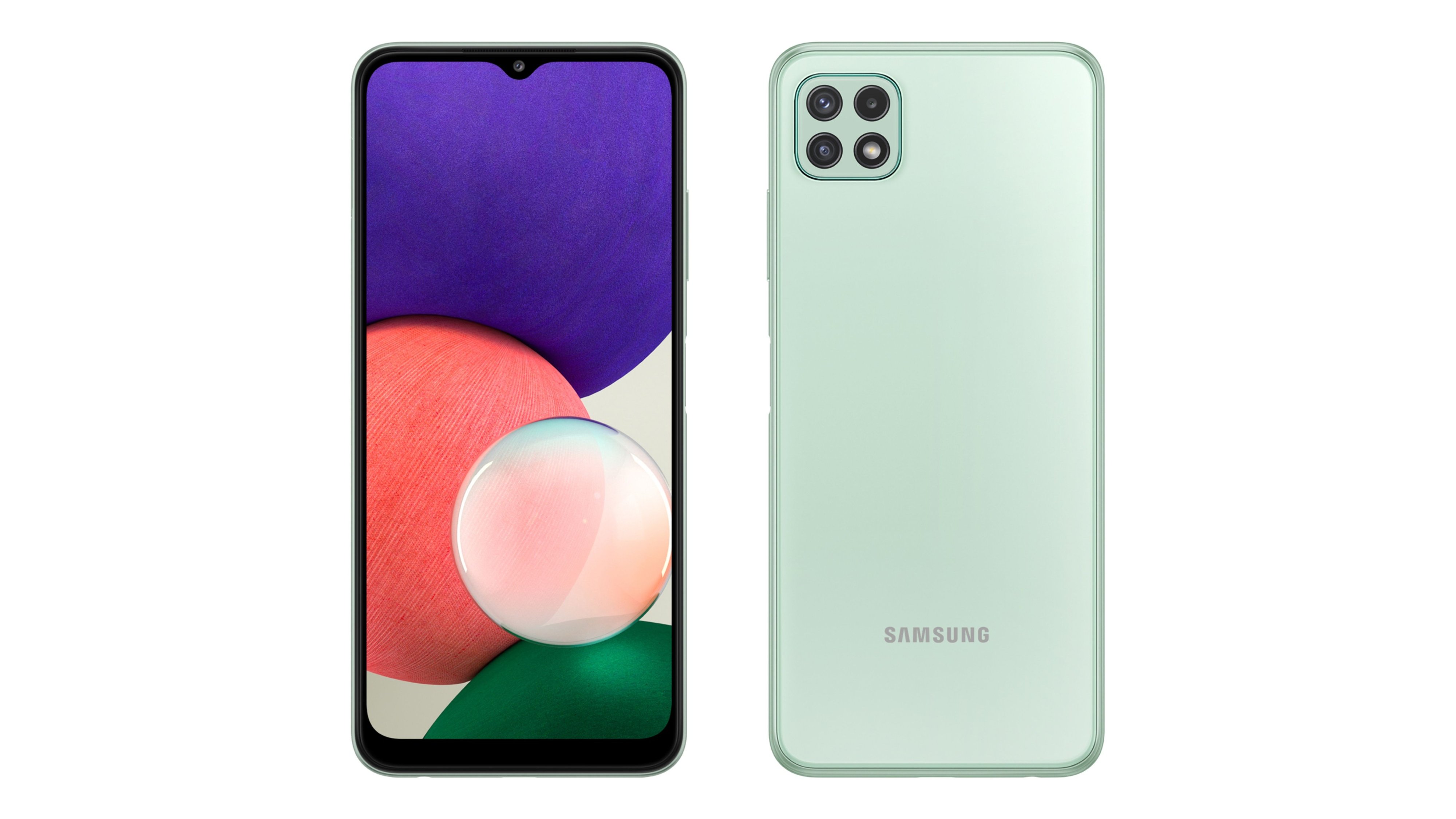
Samsung Galaxy A22 5G
Earlier this month, Samsung announced the Galaxy A22 5G alongside the Galaxy A22 4G variant. The LTE model was recently certified by Bluetooth SIG as Galaxy F22. Now, a few days later, the 5G version has been listed by the same certification agency with three different names.
According to the updated Bluetooth certification (via SamMobile) of the Galaxy A22 5G, the device will be also launching as Galaxy Buddy (SM-A226L), Galaxy Wide5 (SM-E426S), and Galaxy F42 5G (SM-E426B). Going by the names, the first two models should be exclusive to a specific carrier or region.
For those unaware, just last month, Samsung launched a similarly named device called Galaxy Jump in South Korea. This phone is nothing but a rebranded Galaxy A32 5G in Red color. Hence, the Galaxy Buddy and the Galaxy Wide5 could sport a unique paint job instead of featuring regular Galaxy A22 5G colors.
Whereas, the Galaxy F42 5G could debut in markets like India where the Galaxy F series is exclusive to one of the two largest online retailers in the country – Flipkart.
Unfortunately, the launch dates of these three smartphones are a mystery. Anyway, we expect them to go official sooner than later.
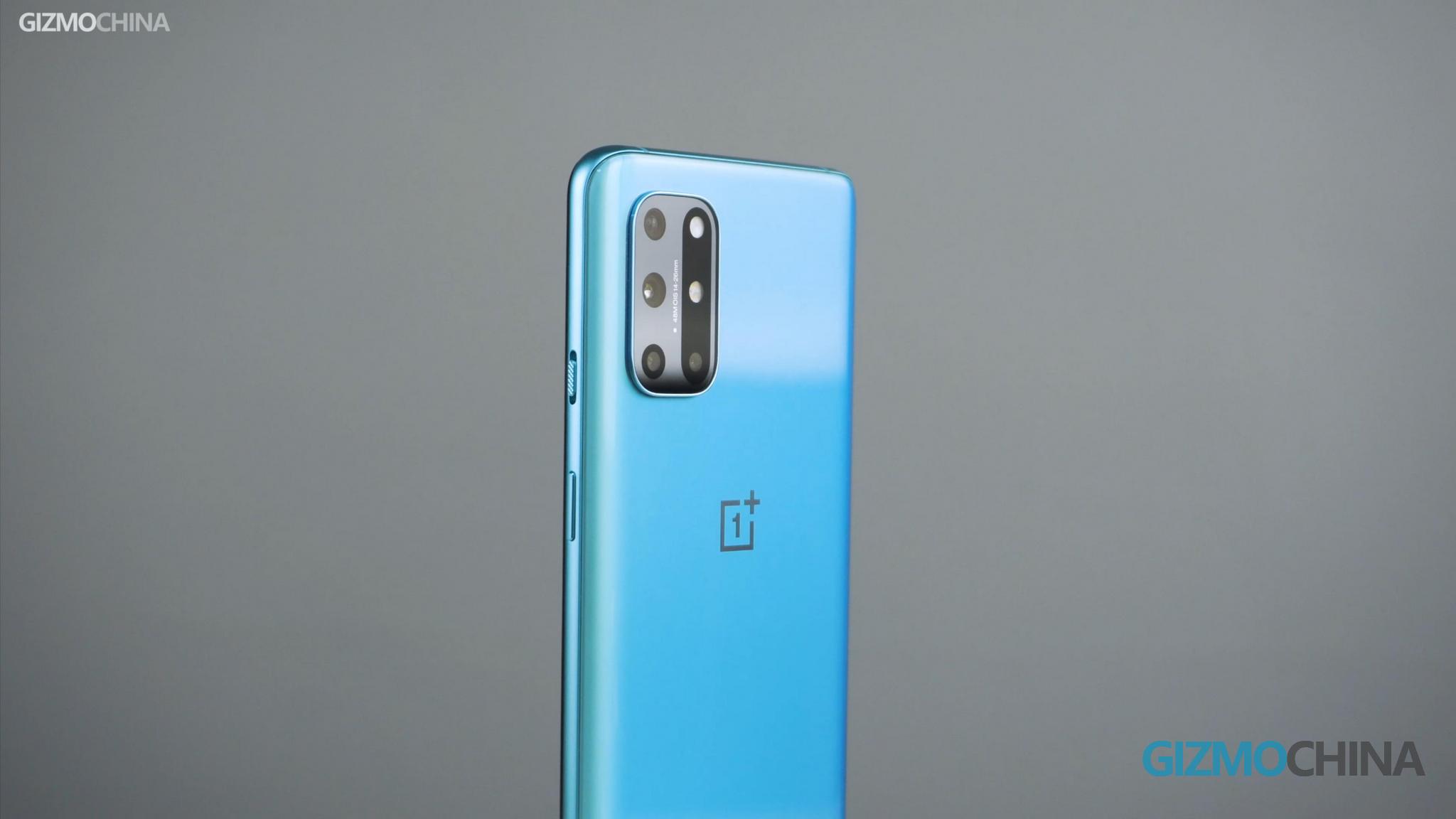
Just last week, OnePlus rolled out a new OxygenOS stable update for the OnePlus 8, OnePlus 8 Pro, and OnePlus 8T. A few days later, these three smartphones are now receiving an OxygenOS Open Beta update.
OnePlus 8T
The latest OxygenOS Open Beta update for the OnePlus 8 and the OnePlus 8 Pro arrives as OxygenOS 11 Open Beta 11. Whereas, the very same update for the OnePlus 8T as OxygenOS 11 Open Beta 6.
According to the official announcementposts on the OnePlus Community, the new pubic beta update for the 2020 OnePlus flagship smartphones brings updated security patches, a new feature, a fix, and some improvements.
First and foremost, the latest beta update bumps up the security patch level to June 2021. Further, it adds a screenshot function for AOD (Always-on Display) and fixes the occasional WiFi connection failure issue.
Lastly, the update comes with improvements for power consumption, audio experience with OnePflus Watch as well as OnePlus Buds, and the OnePlus Share UI visual effect.
The latest public beta for OnePlus 8, Oneplus 8 Pro, and OnePlus 8T is being currently seeded out via OTA for the units already running the previous beta build. Users on the stable channel can also manually download and install this update.
OnePlus 8, 8 Pro, 8T OxygenOS 11 Open Beta 11/6 Official Changelog
System
Improved the power consumption performance to extend battery life
Newly added the screenshot function for AOD
Updated Android security patch to 2021.06
Phone
Improved the audio experience when the phone is connected with the OnePlus Watch and OnePlus Buds
OnePlus Share
Improved the UI visual effect on the sharing page
Network
Fixed the occasional failure to connect to Wi-Fi network
Most smartphone batteries are lithium-ion batteries and it deteriorates over time, leading to a decline in the battery performance. We all must have a story to tell of how our once durable smartphones that can last an entire day on a single charge suddenly can’t do more than two hours without a recharge. Xiaomi recognizes the desire of fans to get a feature that will help them to monitor the battery health of their smartphones. Enters MIUI Battery Health Indicator.
The Chinese tech giant has started rolling out the MIUI Battery Health Indicator to some of its smartphones. The feature was first rolled out on the Redmi Note 10. Right now, the company is testing this new feature on more models such as the Mi 11 Ultra, Mi 11 Pro, Mi 11, Mi 11 Lite, Mi 10 Extreme Commemorative Edition, Mi 10 Pro, Mi 10, Redmi K40 Pro+, Redmi K40 Pro, Redmi K40, and Redmi K40 Game Enhanced Edition.
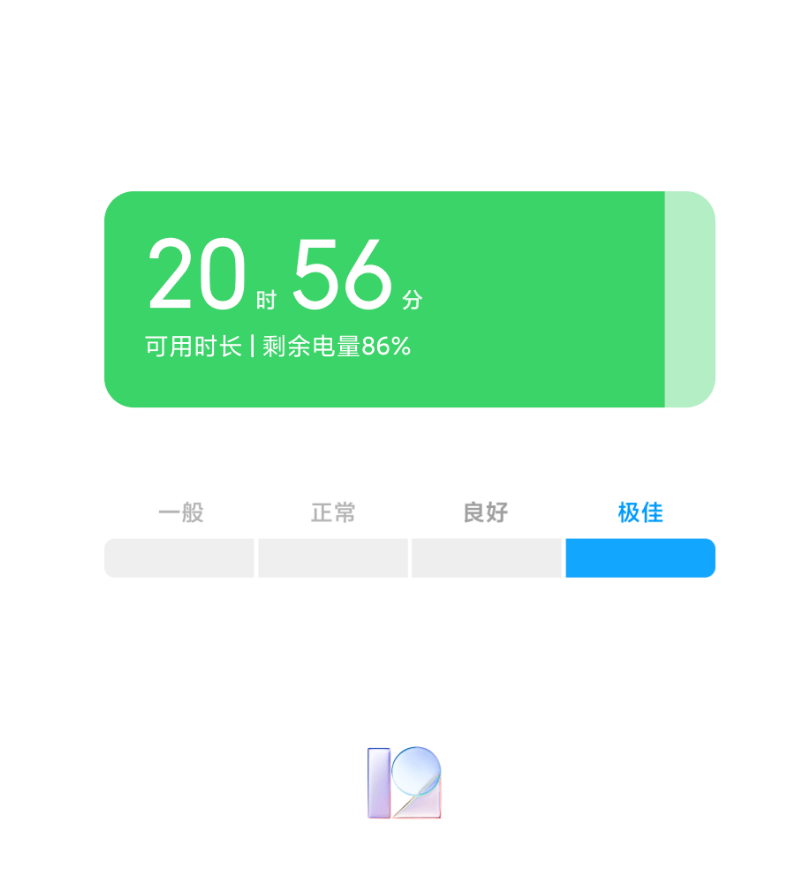
The Xiaomi Battery Health Indicator can estimate the battery health status based on complex battery aging factors. There are several factors that affect the battery aging process of the mobile phone battery such as use time, cycle times, storage temperature, storage capacity, and others. The Xiaomi Battery Health Indication will convert the battery health into a corresponding scale based on the aging impedance, temperature, and capacity so that you can get the current battery health at a glance.
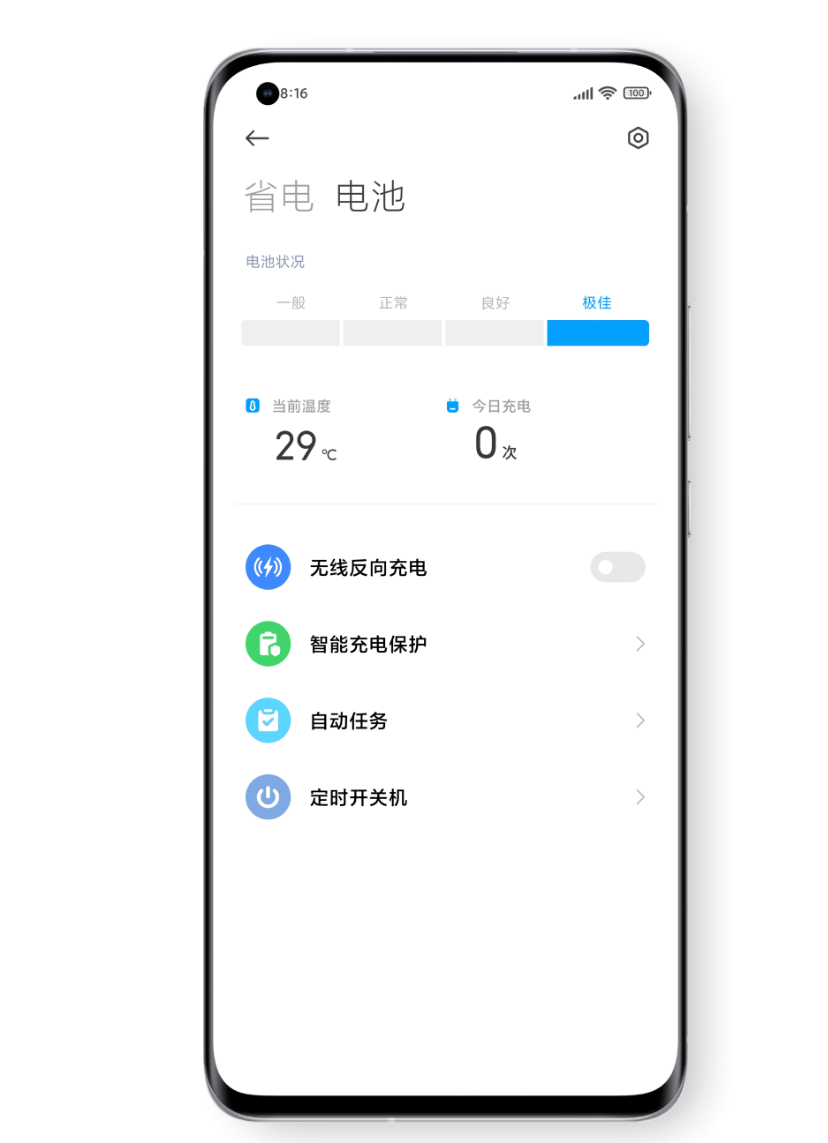
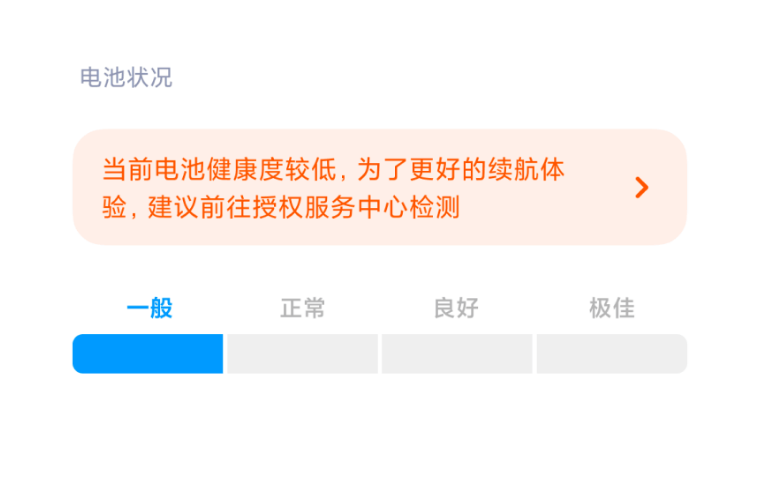
The battery health interface can be accessed on the eligible Xiaomi phones by heading over to the System Settings> Power Saving and Battery> Battery page. In order to help prolong the battery life, the system will alert the user when the battery is deteriorating so that they can take the phone to a service center on time in order to maintain optimum battery performance.
We expect Xiaomi to roll out this feature to more models when the stable version is ready. But before then, you can help prolong your phone’s battery life by ensuring it is used within the optimal temperature range. If the phone is consistently operated under extremely high or extremely low-temperature conditions, the battery deterioration will be accelerated.
You should also pay attention to the optimal battery capacity usage range. Maintaining the battery level in a fully charged state or a very low battery state for too long will reduce the battery life. Experts say 40%~80% power is the best power usage range to maintain battery life. Finally, it is advised that you unplug the charger after the phone is fully charged in order to keep the battery in the best working power range to extend battery life.
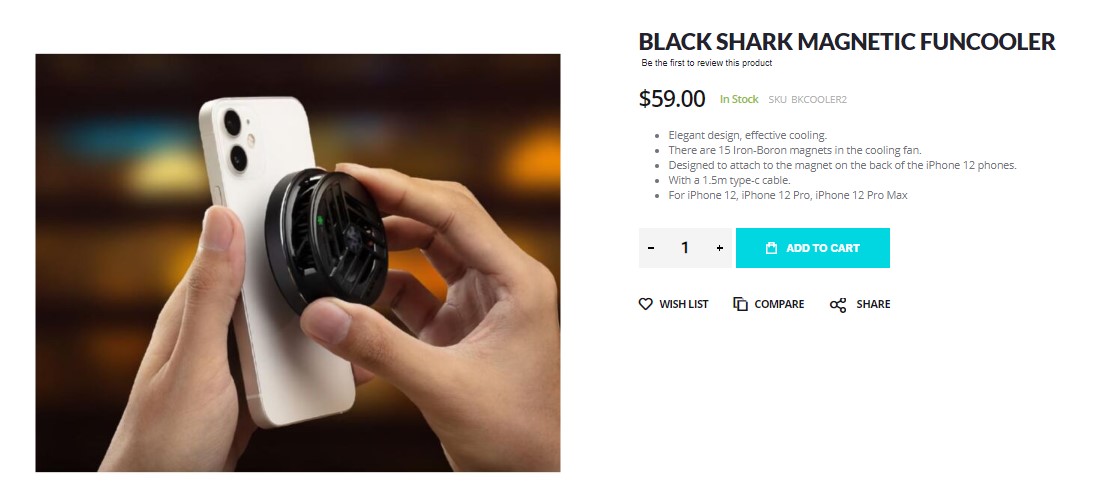
Xiaomi’s smartphone gaming arm – Black Shark is continuously bringing new gaming smartphones and accessories to enhance the overall smartphone gaming experience. The company’s very own Black Shark magnetic Funcooler 2 to dissipate the heating on a smartphone is on sale for $59 via Giztop. The smart utility is specifically designed for the iPhone 12 series.
Black Shark Magnetic Funcooler 2 comes with a powerful fan that can spin at a 7200 rpm high-speed fan. It can efficiently reduce the heat while playing games for longer times. The thermally conductive cooling columns help in improving the performance despite extensive usage of the hardware.
There are around 15 Iron-Boron Magnets on the Funcooler 2 which helps in a secure attachment to the smartphone. It just weighs 73 grams and measures 22mm thick and 62mm wide. Moreover, it houses a dual interface design consisting of two ports for charging the phone while using it.
Black Shark Magnetic Funcooler 2 is among the smallest cooling fans throughout the world. The interested users can get the useful utility for the price of $59 from Giztop.
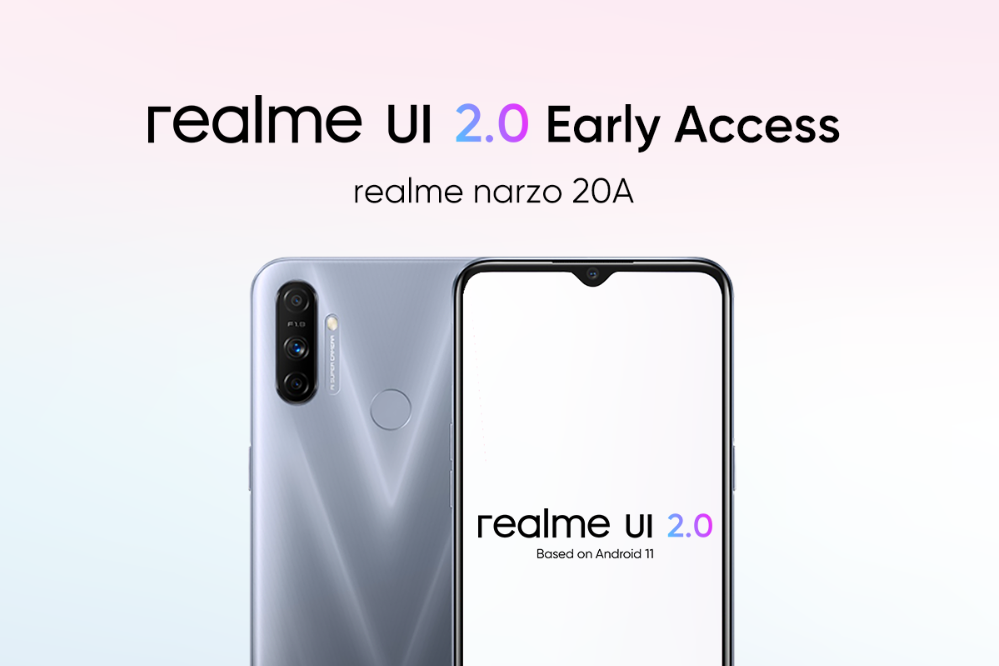
Smartphone maker realme announced realme UI 2.0 based on Android 11 in September 2020. Since then, the company has been trying to update eligible devices to the latest software. However, it has managed to deliver the stable update to only a few phones. Anyway, most of the supported devices at least have beta builds. The latest handset to join the beta initiative (Early Access) is realme narzo 20A.
As per the official schedule, the realme narzo 20A is supposed to get realme UI 2.0 Early Access update in Q2 2020. As promised, the brand has opened registrations for interested users.
In order to enroll, users must be running either of these two firmwares – RMX2050EX_11.A.29 and RMX2050EX_11.A.31. If they are, then they can register themselves for the program. Interestingly, realme has not set any deadline for registrations but the company does mention limited seats. It also confirms that there will be multiple batches.
To enroll themselves for the Android 11-based realme UI 2.0 Early Access initiative, realme narzo 20A users will have to head over to Settings > Software Update > Gear Icon > Trial Version > Apply Now and follow the on-screen instructions.
Selected applicants should get the Android 11 beta build via OTA. Similarly, all users should receive the stable update in the coming weeks.
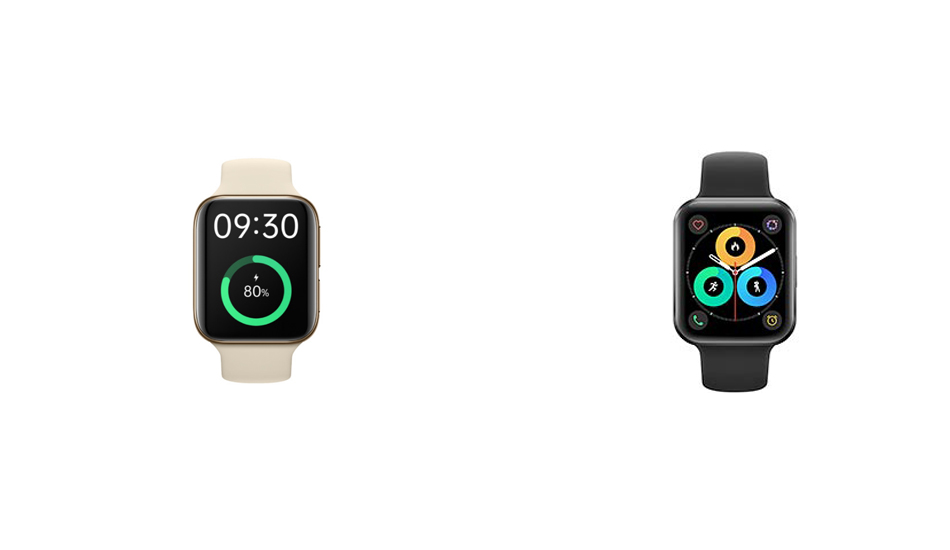
If you want to buy the best Android smartwatch in China released from a smartphone manufacturer, you have two great choices: the first smartwatch by Meizu and the first by OPPO. We are naturally referring to the Meizu Watch and the OPPO Watch, two wearables bundled with very smart features and advanced specifications. OPPO Watch is sold all around the globe, while Meizu Watch is only present in the Chinese market.
If you live in China, you will have a hard time choosing the best among these two smartwatches as they come with very similar specifications and even the same form factor. We hope that this comparison between their specifications can help you by recommending the best wearable for your needs.
As mentioned above, Meizu Watch and OPPO Watch come with the same form factor. Given their square design and their borderless displays, they look very similar to the latest Apple Watch. The OPPO Watch comes in two variants: a smaller 41 mm version which is more recommended for women and a 46 mm which is actually better for men and it also provides a bigger display as well as a longer battery life.
The Meizu Watch only comes in one single version which sits in the middle between OPPO Watch 46 mm and 41 mm. The OPPO Watch is built with a glass front, an aluminum or stainless steel frame depending on the variant, and a ceramic/sapphire or plastic back. With the Meizu Watch, you get a ceramic back and an aluminum frame. Both the smart watches are waterproof, but the OPPO Watch offers better water resistance up to 5 ATM.
Note that the OPPO Watch is slightly thinner than Meizu Watch and it has two physical keys on the side instead of just one. Both the wearable support the eSIM technology which allows using cellular data without having a physical SIM inside and without using the phone’s connection.
Display
OPPO Watch and Meizu Watch come with stunning AMOLED displays showing vibrant colors and very deep blacks. The 46 mm version of the OPPO Watch has a slightly higher resolution and a wider panel with a diagonal of 1.91 inches, as well as complete DCI P3 coverage. The Meizu Watch is more compact than the 46 mm version with its 1.78-inch display, but the display looks inferior. Meizu Watch and the 41 mm of the OPPO Watch are protected by Gorilla Glass, while the 46 mm version has different protection for the glass called Schott Glass. Note that OPPO Watch has a higher screen-to-body ratio, which means narrower bezels around the display.
Specs & Software
The Meizu Watch is equipped with a more recent and powerful SoC: the Snapdragon Wear 4100 is actually a big improvement over the chip found on the OPPO Watch. The OPPO smart watch is powered by the Snapdragon Wear 3100 in the global market and by the even weaker Snapdragon Wear 2500 in the Chinese market. The memory configurations are the same with one gig of RAM and 8 GB of internal storage for music and more.
Both the wearables have a speaker and a microphone for calls and vocal commands. Further, both run a modified version of Android for wearables: the Flyme UI and the ColorOS Watch, respectively. The ColorOS Watch looks a bit more advanced than Flyme at first glance. In the global market, OPPO Watch ditches the ColorOS Watch in favor of Wear OS which includes Google services, apps, and Google Assistant.
Sensors and connectivity
With the Meizu Watch, you actually get more sensors and sport modes than OPPO Watch. It has a SpO2 sensor, unlike its rival, which allows monitoring the blood oxygen level. Further, it features more than 10 sport modes, while the OPPO wearable has just 5 modes you can choose from. For the rest, they look similar if we exclude the user interface. They both feature GPS, an accurate heart rate sensor, WiFi, and Bluetooth 5.2.
The Meizu Watch and the 46 mm version of the OPPO Watch come with the same battery capacity: 430 mAh. However, the Meizu Watch should last a bit more because its chip is more efficient (it is built at 12 nm instead of the 28 nm of the Snapdragon Wear 3100 and 2500) and the display is smaller (1.78 inches vs 1.91 inches). The 41 mm version of the first OPPO smart watch is a bit disappointing when it comes to battery life and it is not able to compete with the Meizu Watch.
Price
The prices of the Meizu Watch and OPPO Watch 46 mm in China are similar: the former costs about €190/$225 at the actual change, while the latter costs €205/$245. If you live in China, Meizu Watch is a better option because of its better chipset and SpO2 sensor, but for the global market, OPPO Watch is a better choice because it runs Wear OS and includes Google services.
The global chip shortage isn’t going away soon, according to a recent report. As manufacturers jostle for the limited supply of chips, the shortage is about taking a new dimension. News emanating from Hong Kong indicates that cargo thieves are beginning to target the chip supply chain.
According to a Hong Kong-based media Wen Wei Po report, cargo thieves intercepted a batch of chip that was to be delivered. The report hinted that the robbery occurred in Tuen Mun, Hong Kong around 3 pm on June 16. A logistics company was hired to deliver a batch of high-priced electronic chips (14 boxes) worth about HK$5 million (~$644,000) to the manufacturer’s warehouse.
Interestingly, the chip was only being transferred to a warehouse on the 8th floor of the same industrial building. The truck driver assistant was accosted in the elevator by three men who attacked him as soon as the elevator door closed, leaving him with some degree of injuries. The boy notified his colleagues who then called the police but the thieves could not be tracked down despite the police mounting roadblocks on major arterial roads around the crime site.
Earlier this month, a research report by market analysis firm “TrendForce Consulting” showed that the semiconductor industry has benefitted tremendously from the rising demand for a number of terminal applications, leading to an increase in their stock prices. The increase in demand compared to supply has also led to a rise in the prices of wafer and adjustment to the product mix to ensure profitability. The high demand could lead to an increase in the theft of chip cargoes and thus, foundries may need to increase their security level.
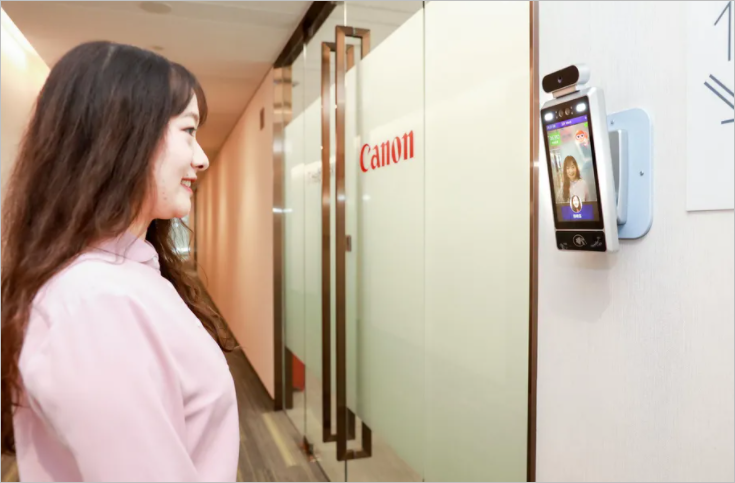
Canon‘s Chinese subsidiary Canon Information Technology has reportedly installed cameras using artificial intelligence in its offices across China that recognize smiling faces only. In other words, the camera will only allow workers who put up a smile into the facilities. The camera utilizes AI-enabled “smile recognition” technology in its China offices.
The cameras are installed with the intent of ensuring that all employees are 100 percent happy all the time. Staff will only be allowed into rooms, or book meetings when they put up a smile. However, we doubt if the technology will in any way achieve the purpose for which it was installed. All an unhappy employee has to do is fake a smile to gain the required access.
Last year, China surpassed the United States in the number of artificial intelligence patent filings. Thus, it is no wonder that the Japanese multinational corporation chose China as a testbed for this new technology. The smile recognition technology was first announced last year by the company as a component of its latest workplace management tools. However, it hasn’t gained any traction and we doubt if it will ever gain wide acceptance.
The technology might face stiff hurdles in the U.S and other regions where it might be viewed as an invasion of privacy. Workplace cameras are generally legal if they are installed in a public place and the employees are aware of it. Also, the company will need to show that there is a legitimate need to film under the law in some countries. In this case, we can’t figure out the need that would require a “smile recognition” camera.
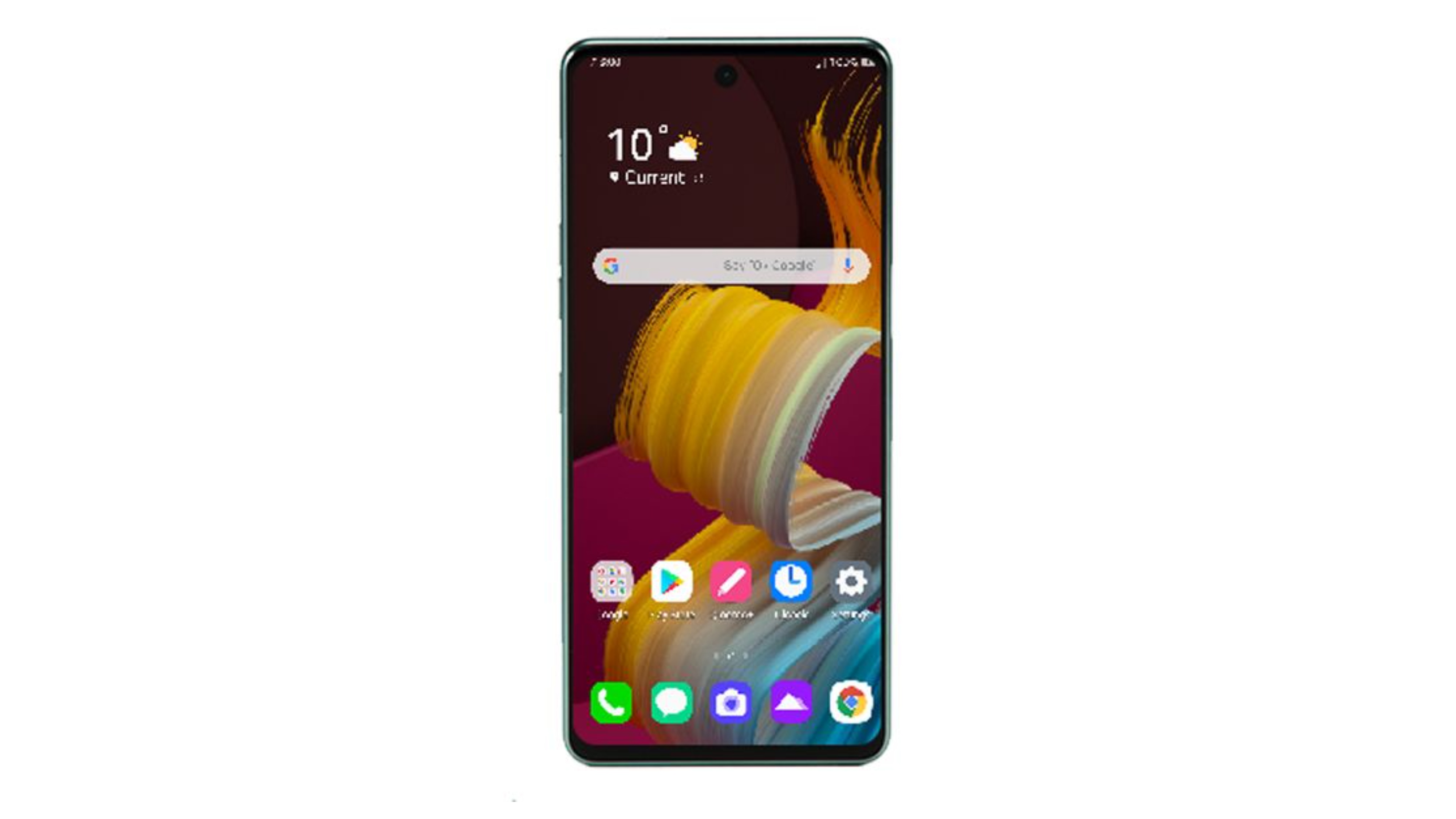
LG announced its exit from the mobile phone business in early April. Hence, unsurprisingly, the company canceled its upcoming devices. Some of these handsets are LG VELVET 2 Pro, a true flagship smartphone from the South Korean electronics giant after a very long time, and the firm’s first rollable smartphone. The other three are LG Stylo 7, LG K33, and LG K35. Their specs and front design have been revealed now.
LG Stylo 7 | Source: Google Play Console (via @evleaks)
Yesterday, popular leaker Evan Blass (@evleaks)shared the Google Play Console listings of four canceled LG smartphones, namely LG VELVET 2 Pro, LG Stylo 7, LG K33, and LG K35. We already know everything about the first phone on the list, thanks to multiple leaks. This handset and the LG Rollable were also sold to a select few LG employees recently.
On the other hand, the renders of LG Stylo 7 leaked in December 2020. The device was even spotted at Bluetooth SIG in mid-March. However, we are hearing about the LG K33 and K35 for the first time.
As per the listings, the LG Stylo 7 features an FHD+ (1080 x 2460 pixels) punch-hole display, Qualcomm Snapdragon 662 chipset, 4GB RAM, and Android 11. Whereas, the LG K33 and K55 sport an HD+ (720 x 1600 pixels) display, MediaTek Helio P35 SoC, 3GB RAM, and Android 11. The only difference between the two is dewdrop notch on the former and punch-hole on the latter.
1 of 2
LG K35 | Source: Google Play Console (via @evleaks)
LG K33 | Source: Google Play Console (via @evleaks)
It’s not known if these handsets ever made into the mass-production stage. Even if they did, they will be not going on sale for the public. Maybe, LG might arrange a special sale for its employees if there are some units.
Apple has just been hit with another lawsuit earlier this week. XR Communications filed a lawsuit against the company alleging that a number of its products infringed on its MIMO wireless technology patent.
The firm filed a complaint with the US District Court for the Western District of Texas (Via AppleInsider) against the Cupertino based giant for infringing on a single patent granted in 2020. In the lawsuit, a number of products were mentioned, including the iPhone 6s and higher, every iPad model from the first generation, iPad Air and iPad mini 2, all Mac models launched since 2016, and the Apple TV 4K. XR Communication cited the infringement of US Patent No. 10,715,235 for ‘Directed wireless communication.’
While the technology cited in the lawsuit is specific, the system described in the complaint is used by a large number of manufacturers in the market that offer devices with Wi-Fi capabilities. The patent in question was developed by now defunct WiFi infrastructure specialist Vivato Technologies, which was founded back in 2000. While the iPhone maker already owns a number of patents related to MIMO communications and related technologies, XR Communications lawsuit, filing as Vivato, is seeking damages for past and ongoing royalty, court fees, and injunctive relief in its case.
We use cookies on our website to give you the most relevant experience by remembering your preferences and repeat visits. By clicking “Accept”, you consent to the use of ALL the cookies.
This website uses cookies to improve your experience while you navigate through the website. Out of these, the cookies that are categorized as necessary are stored on your browser as they are essential for the working of basic functionalities of the website. We also use third-party cookies that help us analyze and understand how you use this website. These cookies will be stored in your browser only with your consent. You also have the option to opt-out of these cookies. But opting out of some of these cookies may affect your browsing experience.
Necessary cookies are absolutely essential for the website to function properly. This category only includes cookies that ensures basic functionalities and security features of the website. These cookies do not store any personal information.
Any cookies that may not be particularly necessary for the website to function and is used specifically to collect user personal data via analytics, ads, other embedded contents are termed as non-necessary cookies. It is mandatory to procure user consent prior to running these cookies on your website.