Advertisement

Xiaomi Pad 8 Pro debuts with Snapdragon 8 Elite, 11.2″ 3.2K display & 9200mAh battery

At the 2025 Lei Jun Annual Speech, Xiaomi launched the Pad 8 and Pad 8 Pro alongside the Xiaomi 17 series. The Pad 8 Pro features a Snapdragon 8 Elite chip, a high-end display, and a Matte Edition with nano-etched anti-glare glass for a paper-like feel. Let’s check out its specs and pricing details.

Xiaomi Pad 8 Pro

Xiaomi Pad 8 Pro Specifications

The Xiaomi Pad 8 Pro comes with an 11.2-inch 3.2K LCD (3200 × 2136, 3:2) display offering up to 144Hz refresh rate, 12-bit color, 345 PPI, and 800 nits peak brightness. It supports HDR10, Dolby Vision, and HDR Vivid, with TÜV eye protection and DC dimming for comfort. The Matte Edition uses AG nano-texture etching and AR coating to cut 99% stray light and lower reflectivity by 70%.

The Pad 8 Pro runs on Qualcomm’s Snapdragon 8 Elite, a 3nm chip with an octa-core CPU up to 4.32GHz and Adreno GPU, delivering desktop-grade performance for multitasking, 4K editing, and native-resolution gaming. It scores over 3 million on AnTuTu, proving its strength for demanding apps and PC game engines.

The tablet runs HyperOS 3, optimized for large screens with enhanced split-screen multitasking, a dock with app previews, and a PC-style browser. It also brings AI wallpapers, refreshed UI, and support for WPS, CAJViewer, and ZW CAD to boost productivity.

Xiaomi Pad 8 Pro

For optics, the Pad 8 Pro carries a 50MP rear camera with f/1.8 aperture and 4K 60fps video recording. Up front, it has a 32MP ultra-wide camera with auto-centering, fill light, gesture controls, and beauty modes, making it well-suited for video calls and meetings. Both cameras are supported by a quad-mic setup with AI voiceprint noise reduction.

The device houses a 9200mAh high-density battery with 67W fast charging and 22.5W reverse wired charging. Xiaomi claims up to 10.5 hours of gaming, 14 hours of video playback, and over 20 hours of online meetings. It supports multiple charging protocols including QC3+, PD3.0, and Mi FC2.0.

In terms of connectivity, the Pad 8 Pro offers Wi-Fi 7, Bluetooth 5.4, and USB 3.2 Gen1 (5Gbps), along with support for AAC, LDAC, LHDC 5.0, and Auracast audio codecs.

It comes with quad speakers tuned for Dolby Atmos and Hi-Res audio. The tablet includes a side fingerprint scanner, IR remote, hall sensor, ambient light sensor, and gyroscope.

For accessories, Xiaomi provides the Focus Pro stylus with advanced gestures and haptic feedback, as well as a floating magnetic keyboard with a precision touchpad.

Xiaomi Pad 8 Pro

Pricing & Availability

The Xiaomi Pad 8 Pro starts at 2,799 yuan ($392) for the 8GB+128GB variant. Here is the full pricing breakdown:

  • 8GB + 128GB: 2,799 yuan ($392)
  • 8GB + 256GB: 3,099 yuan ($434)
  • 12GB + 256GB: 3,399 yuan ($476)
  • 12GB + 256GB (Matte Edition): 3,599 yuan ($505)
  • 12GB + 512GB: 3,699 yuan ($519)
  • 12GB + 512GB (Matte Edition): 3,899 yuan ($547)
  • 16GB + 512GB: 3,899 yuan ($547)
  • 16GB + 512GB (Matte Edition): 4,099 yuan ($574)

The tablet comes in Black, Turquoise Green, and Ice Crystal Blue. The Xiaomi Focus Pro stylus and floating magnetic keyboard are sold separately, with the keyboard priced at 699 yuan ($98).

For more daily updates, please visit our News Section.

Stay ahead in tech! Join our Telegram community and sign up for our daily newsletter of top stories! 💡

Xiaomi 17 launches as first Snapdragon 8 Elite Gen 5 flagship with 7,000 mAh battery

Xiaomi has unveiled the Xiaomi 17 in China, skipping the “16” branding entirely and going straight to its latest flagship. The device arrives as the first phone powered by Qualcomm’s Snapdragon 8 Elite Gen 5, the chipmaker’s newest high-end processor announced earlier this week.

The Xiaomi 17 weighs 191g and features a 6.3-inch flat display with very slim 1.18mm bezels. The screen uses Xiaomi’s Dragon Crystal Glass for protection and supports peak brightness of up to 3,500 nits. It’s also IP66, IP68, and IP69 certified, meaning it can handle both dust and water exposure. Four color options will be available at launch.

One of the main talking points is the battery. Despite the compact size, Xiaomi has fitted a 7,000mAh unit inside. The company claims this allows more than 12 hours of short-video playback, which it says outlasts even the iPhone 17 when paired with a 5,000mAh magnetic power bank.

Cooling has also been upgraded. The phone introduces a new three-dimensional ring cold pump system, which Xiaomi says is three times more efficient than traditional vapor chambers. This should help sustain performance during longer gaming or AI workloads.

The rear camera setup includes a 1/1.31-inch Light Hunter 950 main sensor, alongside 50MP ultra-wide and telephoto cameras. On the front, a 50MP sensor handles selfies.

Pricing and availability:

Pricing starts at 4,499 yuan (about $630) for the 12GB/256GB model. Higher configurations are priced as follows:

12GB + 512GB – 4,799 yuan (about $672)
16GB + 1TB – 4,999 yuan (about $700)

The Xiaomi 17 launches alongside Pro and Pro Max models, but this smaller version is clearly aimed at users who want flagship performance in a lighter, more compact body. Pre-orders are already live in China, with sales beginning at 10:00 AM local time on September 27. While no global launch date has been officially revealed yet, the phones are expected to cross borders sometime in early 2026.

Don’t miss a thing! Join our Telegram community for instant updates and grab our free daily newsletter for the best tech stories!

For more daily updates, please visit our News Section.

(Source)

Xiaomi 15T Pro vs Galaxy S25 – Performance vs Compact Power , What Will You Choose?

Xiaomi 15T Pro vs Samsung Galaxy S25 showdown represents one of the most important flagship battles of 2025. Both phones target premium users but with very different philosophies, Xiaomi pushing raw power, gaming, and camera innovation, while Samsung focuses on compact design, long-term software support, and ecosystem features. This comparison matters because it highlights two distinct approaches to the flagship experience, helping buyers decide whether performance-heavy specs or refined usability and updates matter more.

1. Design and Display

Xiaomi 15T Pro
Xiaomi 15T Pro

Build and Feel:
The Xiaomi 15T Pro features a robust glass front with Gorilla Glass 7i, an aluminum frame, and a glass fiber back, offering a solid feel and premium touch. It is IP68 certified for 3 meters up to 30 minutes, giving extra water resistance. The Galaxy S25 has Gorilla Glass Victus 2 front and back, with an aluminum frame, also IP68 certified but rated for 1.5 meters. While the S25 is lighter and more compact, the Xiaomi 15T Pro feels sturdier for larger hands and prolonged use. The slightly larger and heavier Xiaomi gives a sense of robustness, whereas the Galaxy S25 prioritizes pocketability and comfort.

Display Quality:
Xiaomi 15T Pro’s 6.83-inch AMOLED display with 144Hz refresh, 3200 nits peak brightness, Dolby Vision, HDR10+, and 68B colors delivers vivid, bright visuals and ultra-smooth scrolling. Galaxy S25 has a 6.2-inch Dynamic LTPO AMOLED 2X panel with 120Hz, 2600 nits peak, HDR10+, and 480Hz PWM. Xiaomi’s higher refresh rate and brightness make it more suitable for gaming and media consumption, whereas Samsung’s smaller panel is easier for one-handed use and has slightly sharper pixel density.

Verdict:
Xiaomi 15T Pro wins in display vibrancy, refresh rate, and gaming immersion, while Galaxy S25 excels in portability and handling. For media and gaming enthusiasts, Xiaomi is superior; for compact convenience, Samsung is preferable.

2. Specifications 

Samsung Galaxy S25
Galaxy S25

Performance:
Xiaomi 15T Pro runs on MediaTek Dimensity 9400+ (3 nm) with Immortalis-G925 GPU, optimized for high-end gaming and multitasking. Galaxy S25 uses Snapdragon 8 Elite with Adreno 830 GPU, providing top-tier performance with excellent energy efficiency. Both handle demanding apps smoothly, but Xiaomi’s higher RAM and aggressive CPU cores provide a slight edge for extended gaming sessions, while Samsung offers a slightly more power-efficient setup with long-term OS support.

Battery and Charging:
Xiaomi 15T Pro has a 5500 mAh battery with 90W wired and 50W wireless charging, achieving a full charge in under an hour. Galaxy S25 has a smaller 4000 mAh battery, 25W wired, 15W wireless, and 4.5W reverse wireless, taking longer to recharge. Xiaomi clearly dominates in longevity and charging speed, making it ideal for heavy users and gamers.

Verdict:
Xiaomi 15T Pro outperforms in raw performance and battery endurance, while Galaxy S25 offers slightly better efficiency and faster UI responsiveness. Xiaomi is the better choice for high-performance and long-lasting use.

3. Camera

Xiaomi 15T Pro
Xiaomi 15T Pro

Main and Secondary Lenses:
Xiaomi 15T Pro sports a triple Leica setup: 50 MP wide, 50 MP periscope telephoto (5x zoom), and 12 MP ultrawide. Galaxy S25 has a 50 MP wide, 10 MP telephoto (3x zoom), and 12 MP ultrawide. Xiaomi’s periscope zoom and Leica tuning offer better detail and color accuracy in long-range shots, whereas Samsung maintains balanced performance with Super Steady video for action shots.

Selfie Camera:
Xiaomi has a 32 MP front camera capable of 4K video with HDR10+, compared to Galaxy’s 12 MP selfie sensor. Xiaomi offers higher resolution and richer detail, making it better for video calls and content creation. Samsung’s camera is more optimized for natural colors and fast focus.

Verdict:
Xiaomi 15T Pro leads in versatility, detail, and zoom capabilities, while Galaxy S25 provides reliable, stable imaging. For photography enthusiasts, Xiaomi is preferable; for casual users, Samsung is sufficient.

4. Pricing

Verdict:
Xiaomi 15T Pro is priced around $900, offering higher performance, better display, larger battery, and more advanced cameras than Samsung Galaxy S25, which is around $800. While Samsung is slightly cheaper, Xiaomi’s upgrades justify the price difference for power users and gamers.

5. Specs Comparison

CategoryXiaomi 15T ProSamsung Galaxy S25
Build & DurabilityGorilla Glass 7i, aluminum frame, glass fiber back, IP68 (3m/30min)Gorilla Glass Victus 2 front & back, aluminum frame, IP68 (1.5m/30min)Xiaomi more durable; Samsung lighter & sleeker
Display6.83″ AMOLED, 144Hz, 3200 nits, Dolby Vision, HDR10+, 68B colors6.2″ Dynamic LTPO AMOLED 2X, 120Hz, 2600 nits, HDR10+Xiaomi better for gaming/media; Samsung better one-hand use
Chipset & PerformanceMediaTek Dimensity 9400+ (3nm), Immortalis-G925 GPUSnapdragon 8 Elite (3nm), Adreno 830 GPUXiaomi stronger gaming cores; Samsung more efficient & future-proof with updates
RAM & StorageUp to 1TB, UFS 4.1Up to 512GB, UFS 4.0Xiaomi has higher capacity; Samsung slightly faster memory interface
Main Cameras50MP wide + 50MP periscope (5x zoom) + 12MP ultrawide (Leica optics)50MP wide + 10MP telephoto (3x zoom) + 12MP ultrawideXiaomi offers better zoom & Leica tuning; Samsung focuses on stability
Selfie Camera32MP, 4K@30fps, HDR10+12MP, 4K@60fps, HDR10+Xiaomi better resolution; Samsung smoother video
Battery5500 mAh4000 mAhXiaomi lasts longer
Charging90W wired (36min full), 50W wireless25W wired, 15W wireless, 4.5W reverse wirelessXiaomi charges much faster; Samsung supports reverse charging
Unique FeaturesLeica lens system, IR blaster, 144Hz display, huge batterySamsung DeX, Wireless DeX, 7 Android upgrades, compact designXiaomi excels in performance; Samsung in ecosystem & updates
Price (approx.)$900$800

6. Conclusion

Samsung Galaxy S25
Galaxy S25

Xiaomi 15T Pro highlights include Leica-tuned cameras, ultra-fast 144Hz AMOLED, 5500 mAh battery with 90W charging, and advanced gaming features. Samsung Galaxy S25 stands out with a compact premium design, LTPO 2X display, Samsung DeX support, and up to 7 Android upgrades.

Verdict:
Xiaomi 15T Pro is ideal for gamers, multimedia users, and photography enthusiasts seeking raw performance. Samsung Galaxy S25 suits those who prefer compact design, efficient power usage, and ecosystem features like DeX. Overall, Xiaomi 15T Pro offers more value for performance-oriented users, while Galaxy S25 appeals to practical, compact device seekers.

Read More:

Alibaba Just Dropped a 1 Trillion Parameter AI Model to Take On ChatGPT and Gemini

So, Alibaba just released something that’s got the AI world talking. Meet Qwen3-Max, their latest and greatest language model that’s basically saying “Hey OpenAI, Google, and Anthropic, we’re here to play too.”

Alibaba Qwen3 Max

The Trillion Parameter Leap

Here’s the thing that caught everyone’s attention: this model has over 1 trillion parameters and was trained on a staggering 36 trillion tokens. That’s a massive jump that puts them squarely against GPT-5, Gemini 2.5 Pro, and Claude Opus 4. But here’s what’s really cool, they didn’t just make it bigger for bragging rights.

They used Mixture-of-Experts (MoE) architecture, which is like having a really smart team where only the right experts jump in when needed. Instead of activating the entire trillion-parameter network every time, it only fires up specific subsets during each forward pass. It’s way more efficient than just throwing raw compute at the problem.

But here’s where the engineering gets impressive: they implemented something called “global-batch load balancing loss” to keep training stable. The result? Their loss curve stayed smooth throughout the entire training process, no spikes, no need to restart, no mid-training data shuffling. Anyone who’s trained large models knows how rare that is.

Efficiency Breakthroughs

Now this is where things get really technical, and honestly, pretty impressive:

Training Speed: They developed PAI-FlashMoE, which is basically a multi-stage parallel pipeline optimization strategy. The result? 30% better training throughput compared to Qwen2.5-Max-Base. That’s not just a small improvement, that’s the difference between months and weeks of training time.

Long Context Magic: For handling really long documents, they created something called ChunkFlow strategy. This thing delivers 3x faster throughput than traditional sequence parallelism when dealing with long contexts. We’re talking about a 1 million-token context window here, that’s in the same league as Claude Opus 3 and Gemini 1.5 Pro.

Reliability Engineering: They built systems called SanityCheck and EasyCheckpoint that reduced hardware failure downtime to one-fifth of what they experienced with Qwen2.5-Max. When you’re running massive compute clusters, this kind of reliability engineering is absolutely crucial.

Performance

Qwen3-Max-Instruct (the version you can actually use) is putting up some seriously impressive numbers:

LMArena Leaderboard: Ranked #3 overall, and get this, it’s ahead of GPT-5-Chat. That’s genuinely impressive performance.

Qwen3-Max-LMArena text leaderboard

Real-World Coding: Scored 69.6 on SWE-Bench Verified, which tests whether AI can actually solve genuine GitHub issues and programming problems. That beats DeepSeek V3.1 and is competitive with Claude Opus 4.

Tool Usage: Hit 74.8 on Tau2-Bench, which measures how well models can actually use APIs and external tools. This beat both Claude Opus 4 and DeepSeek V3.1, which is honestly surprising.

Qwen3-Max-benchmarks

But here’s where it gets really wild: they’re working on Qwen3-Max-Thinking, a reasoning-focused variant that’s still in training. In early tests that included tool usage and parallel compute during inference, it scored perfect 100% on both AIME 25 and HMMT, two of the most brutal mathematical reasoning benchmarks in AI. This version comes with an integrated code interpreter and focuses on complex logical problem-solving.

Multilingual and Multimodal Story

While the current public release focuses heavily on reasoning and coding, Alibaba built Qwen3-Max to handle multilingual tasks with particular strength in English and Chinese. The improvements are significant across instruction-following, mathematical reasoning, scientific tasks, and, this is important, it produces fewer hallucinations than previous versions.

The model shows major improvements in areas that actually matter for real-world deployment: better logic, more accurate math, stronger scientific reasoning, and more reliable responses overall.

How to Actually Use This Thing

For Regular Users: Qwen3-Max-Instruct is available right now through the Qwen app (iOS/Android) and their website. The app defaults to using Qwen3-Max, but you can manually switch if you want to compare with other versions.

For Developers: You can access it via API through Alibaba Cloud’s Model Studio, which means you can integrate it directly into your applications, tools, or services.

The Bigger Picture

Here’s what’s really significant: Alibaba isn’t just trying to match existing models, they’re pushing the technical frontier in specific areas like long-context processing, training efficiency, and system reliability. The engineering details show genuine innovation, not just scaling up existing approaches.

The upcoming Qwen3-Max-Thinking variant, with its focus on reasoning and tool integration, suggests they’re aiming to build something that can function as a genuine autonomous agent, not just a better chatbot.

Should You Care?

If you’re a casual user, this gives you another top-tier model to experiment with, especially if you need long-context processing or multilingual capabilities.

If you’re a developer, the API access and technical capabilities make it worth serious evaluation against your current toolchain.

If you’re interested in AI progress generally, this represents a real milestone: we now have multiple organizations capable of building and deploying trillion-parameter models with genuinely different technical approaches and capabilities.

The AI landscape just got a lot more competitive, and frankly, a lot more interesting.

In related AI news, researchers developed an AI-designed virus that targets bacteria, raising safety concerns, and Huawei unveiled its powerful Atlas 950 and 960 SuperPoDs to challenge Nvidia.

For more daily updates, please visit our News Section.

Stay ahead in tech! Join our Telegram community and sign up for our daily newsletter of top stories! 💡

Oppo A6 Pro 5G & A6 Pro 4G Launched Globally: Big Battery, IP69, & 120Hz Display

Oppo has unveiled its latest A6 Pro lineup globally, releasing both 5G and 4G variants designed to cater to different connectivity needs and budgets. Apart from slight differences, both models offer a large battery pack, great resistance against the elements, smooth displays, and more for an affordable price tag.

Oppo A6 Pro 5G

Talking about the more expensive model first, the Oppo A6 Pro 5G sports a 6.57-inch AMOLED display with an FHD+ resolution, 120Hz refresh rate, 240Hz touch sampling rate, 100 percent DCI P3 color gamut, and 1400 nits of peak brightness. Under the hood, this device is equipped with MediaTeks’ Dimensity 7300 SoC, which is paired with up to 12GB of RAM and 256GB of internal storage.

Oppo A6 Pro 5G
Oppo A6 Pro 5G

A massive 7,000mAh battery pack powers the Oppo A6 Pro 5G, which supports 80W wired fast charging. For photography, the rear has a 50MP main camera and a 2MP monochrome sensor, while the front houses a 16MP shooter for selfies and video calls. Other notable features include an in display fingerprint scanner, Bluetooth 5.4, WiFi 5, NFC, reverse wired charging, AI powered features, and an IP69 rating for water and dust resistance.

Oppo A6 Pro 4G

Many of the features of the Oppo A6 Pro 4G model are similar to its 5G sibling. So you still get a 6.57-inch AMOLED screen with an FHD+ resolution, a 120Hz refresh rate, and 240Hz touch sampling rate, 100 percent DCI P3 color gamut, and 1400 nits of peak brightness. But unlike the 5G enabled Dimensity chip, Oppo packs the 4G A6 Pro with the MediaTek Helio G100, which is often seen in entry level smartphones and tablets.

Oppo A6 Pro 4G
Oppo A6 Pro 4G

The processor is coupled with up to 8GB of RAM and 256GB of internal storage. Although, you still get a massive 7000mAh cell under the hood with 80W wired fast charging. The rear features a 50MP dual camera setup, while the front gets the same 16MP selfie shooter. Connectivity features like WiFi, NFC, and Bluetooth remain the same as the 5G model, while the AI functions, military grade shock resistance, and IP69 rating also make a return. There are plenty of AI powered tools as well. Other notable features include dual stereo speakers, 1.67mm infinite Edge, and an in display fingerprint scanner.

Pricing and Availability

The Chinese tech giant announced the Oppo A6 Pro 4G and Oppo A6 Pro 5G in four color options, namely Stellar Blue, Rosewood Red, Lunar Titanium, and Coral Red. Oppo just unveiled the A6 Pro 5G in Malaysia with a starting price of RM 1,199 (roughly 285 US Dollars) for the 8GB + 256GB option. On the other hand, the Oppo A6 Pro 4G is listed for VND 8,290,000 (roughly 314 US Dollars) in Vietnam for the 8GB + 256GB variant. The pricing might seem off, but pricing depends on the different regions.

For more daily updates, please visit our News Section.

Tech enthusiast? Get the latest news first! Follow our Telegram channel and subscribe to our free newsletter for your daily tech fix! ⚡

Caviar just turned the iPhone 17 Pro and iPhone Air into $10,000 works of art

Caviar has announced its new lineup of customized iPhone 17 Pro and iPhone Air models. The company has focused on premium materials such as 24K gold, aerospace-grade titanium, and genuine crocodile leather. Each phone is designed as a one-of-a-kind luxury item, with prices varying based on the chosen storage configuration.

Apple introduced the iPhone 17 series on September 9, featuring brighter colors for the Pro and Pro Max models. The shift received mixed reactions, with some users praising the vibrant look while others criticized the absence of classic tones. Caviar responded by updating its Rich Colors collection to reintroduce deeper shades and traditional finishes.

Caviar iPhone 17 Pro and Air rich colors collection

The new Cosmic Fire model uses Hermès Epsom orange leather along with chocolate tones and black steel. It features a PVD-coated scratch-resistant frame that enhances durability. Caviar positions this version as a bold reinterpretation of Apple’s bright orange design. Pricing begins at $10,490.

The Black Orange variant includes a titanium body finished in black, paired with crocodile leather inlays and orange detailing. This model emphasizes sharp contrasts and geometric precision. Prices for this model start at $10,630.

The Gold Navy model features blue crocodile leather and 24K gold accents. Caviar designed it to reflect elegance and status. It is available from $10,770.

Silver Black uses polished titanium with black crocodile leather. It follows a minimalist design and targets customers who prefer a more understated look. The starting price is $10,340.

Caviar iPhone Air Black

The iPhone Air receives a dedicated variant named Air Black. It combines black titanium and crocodile leather in a thinner, more refined form factor. This model returns the classic black finish and starts at $7,900.

Caviar treats each of these custom iPhones as luxury items rather than regular consumer devices. While the internal hardware remains unchanged from Apple’s original models, the outer design transforms the phone into a personalized piece of high-end craftsmanship. The Rich Colors collection is now available on Caviar’s official website.

In related news, Caviar recently introduced a weapon-inspired iPhone 17 lineup with gold accents, starting at $9,415, and also debuted a $49,000 iPhone featuring a built-in Omega Seamaster watch worn by James Bond.

For more daily updates, please visit our News Section.

Stay ahead in tech! Join our Telegram community and sign up for our daily newsletter of top stories! 💡

(Caviar)

Xiaomi opens first official German store in Essen with launch offers on 15T series

Xiaomi is opening its first official store in Germany tomorrow, September 26, at the Limbecker Platz shopping center in Essen. The opening will run as a nine-day event through October 4 and marks a significant step in the company’s expansion across Europe.

The Essen store will give customers the chance to try out Xiaomi’s full product range, from smartphones and tablets to wearables and smart-home devices. It also brings localized support and hands-on service, something that has helped the brand gain ground in markets like China, where it already operates more than 10,000 retail outlets.

To mark the launch, Xiaomi is offering a series of promotions tied to the recently announced Xiaomi 15T and 15T Pro, unveiled earlier this week in Munich. Priced from €649 and €799, the phones feature MediaTek’s Dimensity 8400 and 9400+ chips, Leica-branded cameras with a 5x periscope zoom, and up to 1TB of storage. Buyers at the Essen store will be able to add a bundled product worth up to €400 for just €1. Options include the Xiaomi Robot Vacuum X20, the Electric Scooter 4 Lite 2nd Gen, the Redmi Pad 2 Pro in Lavender Purple, or the Xiaomi Sound Party speaker.

Xiaomi is also cutting the price of the Redmi Note 14 Pro 5G for the occasion. Reportedly limited to 30 units per day, the phone will sell for €299.90 instead of its usual €529.90. The device offers a 200MP camera, a 5,110mAh battery, and will be available in Midnight Black, Frost Blue, and Lavender Purple.

For Xiaomi, the Essen store is not just a retail outlet but also a way to strengthen its presence in Germany and connect more directly with local customers.

Don’t miss a thing! Join our Telegram community for instant updates and grab our free daily newsletter for the best tech stories!

For more daily updates, please visit our News Section.

Tim Cook Hugs Pokemon, Calls Japan a Gamer’s Paradise at Apple Ginza Reopening

Apple CEO Tim Cook visited Tokyo to attend the reopening of Apple Ginza, the company’s first retail store outside the U.S. Originally opened in 2003, the store was temporarily relocated in 2022 during renovations and now returns to its original site with modern features. The reopened store includes an Apple Pickup station, Genius Bar, seating for Apple Vision Pro demos, spaces for Today at Apple sessions, limited-edition gift cards, and exclusive wallpapers for Apple devices.

During his visit, Cook engaged with Japanese pop culture, meeting boy band Number_i and hugging the iconic Pokémon character Pikachu. He also visited Bandai Namco headquarters to play the new iOS game Dragon Ball Gekishin Squadra, highlighting Apple’s focus on gaming and developer engagement. On social media, Cook called Japan a “gamer’s paradise.”

Beyond Japan, Cook recently visited the U.K. and India. In the U.K., he attended a state banquet emphasizing Apple’s role in global tech partnerships. In India, he met Prime Minister Modi to reinforce Apple’s market presence and supply chain strategy. These visits signal Apple’s focus on international expansion, cultural engagement, and strong relationships with governments and developers worldwide.

Cook’s trip reflects Apple’s strategy of combining technology, culture, and business. By reopening a historic flagship store and supporting gaming innovation in Japan, while strengthening ties in other key markets, Apple continues to expand its global influence and connect with consumers and developers on multiple levels.

Read More:

Source: (via)

Xiaomi 15T vs Xiaomi 15T Pro: Key Differences and Upgrades Explained

Xiaomi 15T and 15T Pro are among the most talked-about mid-premium flagships of 2025, aiming to balance cutting-edge performance with value. Xiaomi has positioned the 15T series to challenge rivals like the Galaxy S25 and OnePlus 13 lineup, offering features such as high-brightness AMOLED panels, Leica camera tuning, and big batteries at competitive prices.

The regular 15T appeals to users who want flagship-level performance without overspending, while the 15T Pro pushes further with extra power, premium design, faster charging, and superior zoom photography. This comparison matters because both models sit at the sweet spot between affordability and flagship luxury, making them compelling options for anyone upgrading this year.

1. Design and Display

Xiaomi 15T
Xiaomi 15T

Build and Feel

The Xiaomi 15T uses a plastic frame with a glass fiber back, while the 15T Pro upgrades to an aluminum alloy frame, offering greater rigidity and a more premium hand feel. The Pro also boasts higher structural durability with reinforced frame strength, making it more suitable for long-term durability. Both devices are IP68-rated, ensuring resistance to water and dust.

Verdict: The Pro feels more premium and durable, ideal for users prioritizing build quality.

Display Quality

Both models use a large AMOLED panel with 68B colors, HDR10+, Dolby Vision, and up to 3200 nits brightness. However, the Pro pushes ahead with a smoother 144Hz refresh rate versus the 120Hz on the 15T, improving motion clarity in gaming and scrolling. Resolution remains the same, ensuring sharp visuals on both.

Verdict: The Pro has a display edge for gamers and those who value ultra-smooth performance.

Verdict

The 15T Pro clearly takes the lead in design and display, offering a sturdier build and smoother refresh rate. The 15T is still premium for its price, but the Pro is better suited for power users who value refinement and fluidity.

Please Note: When you buy something using the links in our articles, we may earn a small commission at no cost to you.

2. Specifications 

Xiaomi 15T Pro
Xiaomi 15T Pro

Performance

The 15T runs on the MediaTek Dimensity 8400 Ultra, while the 15T Pro uses the more advanced Dimensity 9400+, delivering stronger CPU and GPU performance. The Pro also offers an Immortalis-G925 GPU with better ray-tracing capabilities, enhancing gaming and demanding applications. Both models support UFS 4.1 storage, though the Pro offers an additional 1TB option.

Verdict: The Pro is significantly more powerful and better for gaming and multitasking.

Battery and Charging

Both devices have a 5500 mAh battery, but charging is where the Pro takes a leap. The 15T supports 67W wired charging, reaching 100% in about 50 minutes. In contrast, the Pro delivers 90W wired charging (100% in 36 minutes) and adds 50W wireless charging, a notable convenience upgrade.

Verdict: The Pro excels in charging speed and wireless capability, making it more versatile.

Verdict

The Xiaomi 15T Pro stands out in performance and charging, making it the superior choice for power users and heavy gamers. The 15T, while capable, suits those who want efficiency without needing maximum speed.

3. Camera

Xiaomi 15T
Xiaomi 15T

Main and Secondary Lenses

The 15T packs a capable triple-camera system with a 50MP wide, 50MP telephoto (2x), and 12MP ultrawide. The Pro, however, upgrades the wide sensor to a larger 1/1.31″ unit for improved low-light performance and replaces the 2x telephoto with a periscope 5x optical zoom lens. This makes the Pro far more versatile for zoom photography, while also supporting 8K video recording compared to the 15T’s 4K max.

Verdict: The Pro is a clear winner for photography enthusiasts.

Selfie Camera

Both phones carry a 32MP wide-angle front camera with 4K recording support. The imaging capabilities are nearly identical, with HDR and consistent sharpness across both.

Verdict: This category is a tie, as selfie performance remains the same.

Verdict

The Pro dominates the rear camera department with its superior sensor and 5x zoom, making it a better pick for serious photographers. The 15T still offers Leica lenses and solid imaging, but its zoom range is limited.

4. Pricing

Xiaomi 15T Pro
Xiaomi 15T Pro

The Xiaomi 15T is priced around $760, while the 15T Pro starts at $900. For the extra $140, buyers gain a sturdier design, faster performance, wireless charging, and a significantly more capable zoom camera.

Verdict: The Pro justifies its higher price for enthusiasts, while the 15T remains a strong value option for those who don’t need advanced photography or maximum performance.

Disclaimer:
Prices are approximate and may vary based on country, region, and applicable taxes.

5. Specs Comparison

FeatureXiaomi 15TXiaomi 15T Pro
BuildGlass front (Gorilla Glass 7i), plastic frame, glass fiber back, IP68Glass front (Gorilla Glass 7i), aluminum frame, glass fiber back, IP68, reinforced alloy frame
Display6.83″ AMOLED, 120Hz, 3840Hz PWM, Dolby Vision, HDR10+, 3200 nits peak, 1280 × 2772 px6.83″ AMOLED, 144Hz, 3840Hz PWM, Dolby Vision, HDR10+, 3200 nits peak, 1280 × 2772 px
ChipsetMediaTek Dimensity 8400 Ultra (4 nm)MediaTek Dimensity 9400+ (3 nm)
CPUOcta-core (1×3.25 GHz Cortex-A725 & 3×3.0 GHz Cortex-A725 & 4×2.1 GHz Cortex-A725)Octa-core (1×3.63 GHz Cortex-X925 & 3×3.3 GHz Cortex-X4 & 4×2.4 GHz Cortex-A720)
GPUMali-G720 MC7Immortalis-G925
Memory / Storage12GB + 256GB, 12GB + 512GB (UFS 4.1)12GB + 256GB, 12GB + 512GB, 12GB + 1TB (UFS 4.1)
Main Camera Setup50MP wide (OIS) + 50MP 2x telephoto + 12MP ultrawide50MP wide (OIS) + 50MP 5x periscope telephoto (OIS) + 12MP ultrawide
Rear Video4K@30/60fps, 1080p@30/60/120/240/960fps, HDR10+8K@30fps, 4K@30/60/120fps, 1080p@30/60/120/240/960fps, HDR10+
Selfie Camera32MP, 4K@30fps, 1080p@30/60fps32MP, 4K@30fps, 1080p@30/60fps
Battery5500 mAh5500 mAh
Charging67W wired, 100% in 50 min90W wired (100% in 36 min), 50W wireless (100% in 56 min)
ConnectivityWi-Fi 6e, Bluetooth 6.0, NFC (region dependent), IR blasterWi-Fi 7, Bluetooth 6.0, NFC (region dependent), IR blaster
AudioStereo speakers, Dolby Atmos, Hi-Res audio, no 3.5mm jackStereo speakers, Dolby Atmos, Hi-Res audio, no 3.5mm jack
SoftwareAndroid 15, HyperOS 2Android 15, HyperOS 2
Price (approx.)€649 / $760€799 / $900
Key UpgradesStronger aluminum frame, 144Hz display, faster Dimensity 9400+ chip, Immortalis GPU, 1TB storage option, 5x periscope zoom camera, 8K video, 90W wired + 50W wireless charging, Wi-Fi 7

6. Conclusion

Xiaomi 15T
Xiaomi 15T

The 15T Pro stands out with its 144Hz display, Dimensity 9400+ chipset, periscope 5x zoom camera, wireless charging, and stronger aluminum frame. The 15T still brings a premium AMOLED panel, strong performance, and solid cameras at a lower cost, making it competitive in its segment.

Verdict

The Xiaomi 15T is ideal for users wanting flagship features at a more accessible price, while the 15T Pro is the better investment for those prioritizing premium build, gaming power, and advanced camera versatility. In essence, the Pro caters to power users and photography fans, while the standard 15T balances price and performance efficiently.

Read More:

HyperOS 3 global rollout schedule is here: check when it’s coming to your device

Xiaomi HyperOS 3 global rollout timeline

HyperOS 3 was unveiled in China last month, and a month later, it has now been announced for the rest of the world. This major upgrade, based on Android 16, introduces a host of new features, AI tools, and refinements, making Xiaomi devices more exciting and useful than ever before. (more on that later)

Besides HyperOS 3 goodies, the brand also announced its rollout plan, which begins next month, starting with the Xiaomi 15 series. The rollout will quickly expand to the Redmi Note 14 series, Poco X7, and Poco F7 series. According to the official timeline, all eligible Xiaomi, Redmi, and Poco devices should receive the HyperOS 3 update by March 2026. Review it below to find out when yours is getting this major upgrade.

Here’s the official HyperOS 3 rollout schedule

Between October and November 2025

(Phones)

  • Xiaomi 15 Ultra
  • Xiaomi 15
  • Xiaomi 15T Pro
  • Xiaomi 15T
  • Xiaomi MIX Flip
  • Redmi Note 14 Pro+ 5G
  • Redmi Note 14 Pro 5G
  • Redmi Note 14 Pro
  • Redmi Note 14
  • Poco F7 Ultra
  • Poco F7 Pro
  • Poco F7
  • Poco X7 Pro
  • Poco X7 Pro Iron Man Edition
  • Poco X7

(Tablets)

  • Xiaomi Pad 7 Pro
  • Xiaomi Pad 7
  • Xiaomi Pad Mini

(Wearables)

  • Xiaomi Watch S4 41mm
  • Xiaomi Smart Band 10 Glimmer Edition
  • Xiaomi Smart Band 10 Ceramic Edition
  • Xiaomi Smart Band 10

Between November and December 2025

(Phones)

  • Xiaomi 14 Ultra
  • Xiaomi 14
  • Xiaomi 14T Pro
  • Xiaomi 14T
  • Redmi Note 13 Pro
  • Redmi 15
  • Redmi 14C
  • Redmi 13
  • Redmi 13x
  • Poco F6 Pro
  • Poco F6
  • Poco X6 Pro
  • Poco M7
  • Poco M6 Pro
  • Poco M6
  • Poco C75

(Tablets)

  • Xiaomi Pad 6S Pro 12.4
  • Redmi Pad 2 Pro
  • Redmi Pad 2 Pro 5G
  • Redmi Pad 2
  • Redmi Pad 2 4G

Between December 2025 and March 2026

(Phones)

  • Xiaomi 13 Ultra
  • Xiaomi 13 Pro
  • Xiaomi 13
  • Xiaomi 13T Pro
  • Xiaomi 13T
  • Xiaomi 13 Lite
  • Xiaomi 12 Pro
  • Xiaomi 12
  • Xiaomi 12T Pro
  • Redmi Note 14 5G
  • Redmi Note 14S
  • Redmi Note 13 Pro+ 5G
  • Redmi Note 13 Pro 5G
  • Redmi Note 13 5G
  • Redmi 15 5G
  • Redmi 15C 5G
  • Redmi 15C
  • Poco F5 Pro
  • Poco F5
  • Poco X6
  • Poco M7 Pro 5G
  • Poco C85

(Tablets)

  • Redmi Pad Pro
  • Redmi Pad Pro 5G
  • Redmi Pad SE 8.7
  • Redmi Pad SE 8.7 4G
  • Poco Pad

HyperOS 3 key features

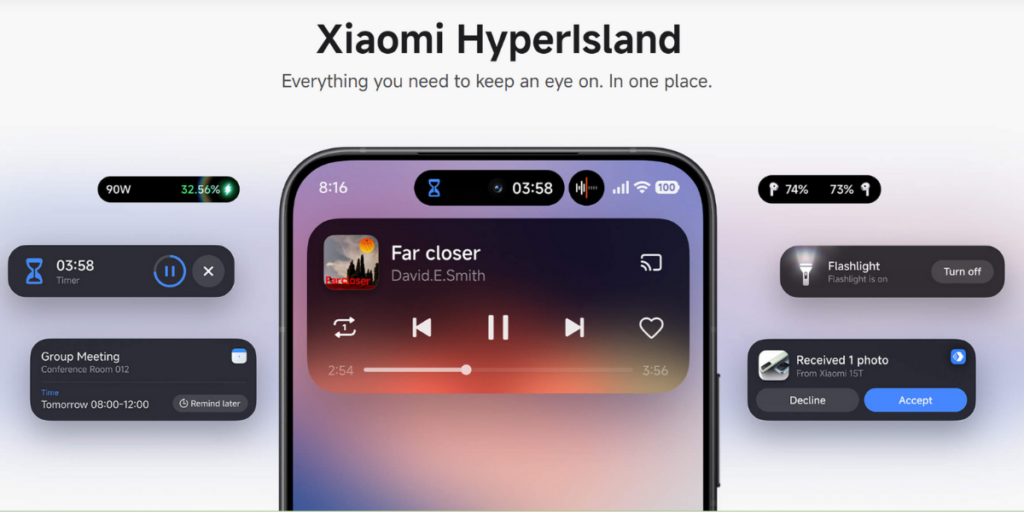
HyperOS 3 introduces Xiaomi HyperIsland (hello, Apple), which makes it easier to manage notifications and improves multitasking. It shows live activities directly in the taskbar, so you don’t need to open the app to see how far your food order or cab is. This feature supports up to three islands and allows users to switch between them easily. Users can swipe down an island to open it in a floating window.

There’s also dynamic notifications for calls, music, charging, and schedules. The HyperOS 3 also brings the AI Cinematic Lock Screen and AI Dynamic Wallpapers that transform a traditional lock screen experience into an immersive, cinematic visual display. Users would also appreciate the new centralized lock screen editing interface, which should make customization more enjoyable and intuitive.

HyperOS 3 introduces a new suite of AI features assisted by Xiaomi HyperAI, including smart screen recognition and DeepThink mode. Users can write social media captions for images, generate insights using the DeepThink feature, and choose from four different writing styles.

Xiaomi also adds AI Speech Recognition with the ability to reduce background noise, convert speech to text while recording, and generate an instant summary of a recording. The AI Search feature enables users to summarize search results and search on-device content. You can also ask specific questions, such as someone’s birthday or upcoming meetings.

There’s also the AI Translate tool, which enables simultaneous interpretation for calls and conferences, as well as the transcription and translation of audio into bilingual subtitles, and offline, face-to-face translation. The Gallery app also integrates AI, now allowing users to search for a specific image within 10 categories.

HyperOS 3 - Touch to Share

HyperOS 3 focuses on improving cross-ecosystem interconnectivity, particularly with Apple devices. The touch-to-share feature now works with Apple devices as well. Furthermore, HyperOS 3 enables users to run Xiaomi apps on iPad, run multiple apps from Xiaomi phones on a Mac in desktop-style windows, and unlock a Xiaomi phone with Touch ID or Face ID. The iPhone can now locate a Xiaomi phone by connecting to a Xiaomi hotspot.

Xiaomi has also introduced a host of under-the-hood improvements to make HyperOS 3 faster, smoother, and more stable.

You can regularly visit our Xiaomi section to stay up-to-date with the latest updates. Also, don’t forget to join our Telegram channel to never miss big any breakthroughs and product launches in tech.

Apple responds to iPhone 17 Pro “Scratchgate” issue

The iPhone 17 Pro has been on shelves for only a few weeks, but early buyers and store visitors have already raised concerns about durability. Some demo units have been spotted with visible marks on their aluminum frames, and the issue has quickly earned the nickname “Scratchgate” online.

The problem appears most often around the sharp edges of the new camera housing. This year, Apple replaced last year’s titanium frame with a lighter aluminum design to reduce weight and improve heat management. While that change has been welcomed by some, durability tests from iFixit and YouTuber JerryRigEverything have shown that the anodized coating on the aluminum can chip when scratched with metal objects, leaving bare spots.

Apple has pushed back on the idea that these marks are actual scratches caused by normal usage. In a statement shared with 9to5Mac, the company said the scuffs on demo units are caused by “material transfer” from the MagSafe stands used in retail displays. According to Apple, the residue can be wiped off and does not represent permanent damage. The company also noted that this kind of transfer can appear on older iPhones or any other Apple product with an anodized aluminum surface, not just the iPhone 17 series.

Not everyone is convinced. iFixit’s testing shows that normal use can wear down the paint layer around the sharp edges of the camera housing within days. Using the phone without a case — which Apple actively promotes — means everyday contact with pocket lint or dust on a table can cause visible marks, and that’s hardly unusual for most users. Not to mention this coating loss goes beyond the kind of removable residue Apple describes.

And for those curious about the new aluminum body’s durability, there’s also a drop test comparison with the Galaxy S25 Ultra.

Don’t miss a thing! Join our Telegram community for instant updates and grab our free daily newsletter for the best tech stories!

For more daily updates, please visit our News Section.

(Source)

Redmi’s latest Bluetooth speaker with an IP67 rating, 5 hours of playback, costs just $14

Xiaomi has quietly launched its latest portable audio product, the Redmi Bluetooth Speaker 2, in China. It comes in three playful colors—matte black, mist green, and coral orange—and is priced at just 99 yuan (about $14). Here’s what it offers for the money.

Redmi Bluetooth Speaker 2 Overview

The speaker has a circular design wrapped in fabric mesh on the front, with a glossy waistline that adds a hint of polish. Its round shape keeps it simple and portable, weighing roughly the same as an apple. Xiaomi even includes a detachable metal hook, so users can clip it to a backpack or belt loop.

Under the hood, the Redmi Bluetooth Speaker 2 packs a 1.5-inch, 5W full-range driver paired with a large passive radiator, which Xiaomi says boosts bass while keeping the sound balanced. You can also pair two speakers to create a stereo setup.

Redmi claims the speaker can deliver up to five hours of playback on the built-in 1000mAh cell. It charges via USB-C and can even double as a USB sound card when connected to a computer. There’s also a microSD card slot for direct music playback, so you don’t need a phone at all.

The speaker is also built to last. It has an official IP67 rating, meaning rain, splashes, or dusty trails won’t be an issue. On the connectivity side, it uses Bluetooth 5.3.
The speaker is available for purchase in China through JD.com.

For more daily updates, please visit our News Section.

Stay ahead in tech! Join our Telegram community and sign up for our daily newsletter of top stories.

Poco confirms a Snapdragon 8 Elite Gen 5 phone in the making

Qualcomm finally pulled the curtains off the Snapdragon 8 Elite Gen 5, its latest mobile chip that will power Android flagships of 2026. Xiaomi is rolling it out first with the Xiaomi 17 series, which launches later today in China. Now, Poco has also confirmed that its upcoming flagship will ship with the same processor.

In a post today, Poco confirmed that its “next-gen flagship smartphone” will feature the Snapdragon 8 Elite Gen 5. The company is still keeping the phone’s actual name a secret, but all signs point toward the upcoming Poco F8 series. 

Poco Snapdragon 8 Elite Gen 5 phone

Poco F8 Ultra or Pro?

The Poco F7 Ultra carried the Snapdragon 8 Elite Gen 5’s predecessor, so by that logic, the new chip should debut on the Poco F8 Ultra. However, not much is known about the device yet.

The Poco F8 Pro is expected to be a rebrand of the Redmi K90 instead. The latter is rumored to feature a 6.59-inch flat RGB OLED LTPS panel with 2K resolution and a 120Hz refresh rate, along with an ultrasonic in-display fingerprint sensor for security.

As for performance, it could be powered by the Snapdragon 8 Gen 5, which Qualcomm has yet to release. The device is also said to pack a 7,100mAh battery with 100W fast charging. Other details include dual stereo speakers, a premium metal mid-frame, and an x-axis linear motor for improved haptics.

If the Poco F8 is indeed a Redmi K90 rebrand, we can expect these specs to carry over. For now, we’ll have to wait for the official announcement to know exactly which Poco phone will debut with the Snapdragon 8 Elite Gen 5.

For more daily updates, please visit our News Section.

Stay ahead in tech! Join our Telegram community and sign up for our daily newsletter of top stories.

Honor X9d launches with 8300mAh battery, IP69K certifications

Honor has officially launched the X9d 5G in Malaysia. The phone’s standout feature is its massive 8,300mAh battery, but the rest of the hardware sits firmly in the mid-range category. It runs on Qualcomm’s Snapdragon 6 Gen 4 chipset and carries specs that don’t quite match the battery’s headline-grabbing size.

Honor X9d Specifications

Up front, the phone features a 6.79-inch AMOLED display with a resolution of 2640 × 1200 pixels. The panel supports HDR-level brightness, peaking at 6000 nits in certain conditions, along with eye-comfort and dynamic-dimming technologies. Honor has also used aluminosilicate glass for extra durability.

The X9d 5G is powered by Qualcomm’s Snapdragon 6 Gen 4 chipset paired with an Adreno 810 GPU. On the software side, it ships with Android 15 running Honor’s MagicOS 9.0. Memory options include 12GB RAM with 256GB storage or 12GB RAM with 512GB storage.

The camera setup features a 108MP dual rear system with optical image stabilization, 4K video recording, and 10x digital zoom. On the front, there’s a 16MP selfie camera tucked into a punch-hole cutout.

One of the biggest talking points of the X9d is its 8,300mAh battery. It supports 66W fast wired charging and even offers reverse wired charging to top up other devices.

The X9d 5G also comes with a long list of durability and connectivity features: IP66, IP68, IP69, and IP69K certifications, drop and dust resistance, Wi-Fi 6, Bluetooth 5.2, NFC, stereo speakers, and a USB-C port. The device weighs 193 grams and measures 7.76mm thick. Color options include Reddish Brown, Forest Green, Sunrise Gold, and Midnight Black.

Honor X9d Price and Availability

In Malaysia, the X9d 5G is priced at MYR 1,499 for the 256GB model and MYR 1,699 for the 512GB version. 

The device is currently on pre-order phase from September 24 to October 9, 2025, through Honor’s official site and retail partners such as Lazada, Shopee, and Harvey Norman. Customers who preorder will also receive free gifts worth MYR 1,146, including an Honor Pad X7 and extended warranty packages.

Don’t miss a thing! Join our Telegram community for instant updates and grab our free daily newsletter for the best tech stories!

For more daily updates, please visit our News Section.

Snapdragon 8 Elite Gen 5 announced with 20% higher performance, 35% higher efficiency, and new 5G modem

Qualcomm has taken the wraps off its latest mobile platform, the Snapdragon 8 Elite Gen 5, during its annual Snapdragon Summit in Maui, Hawaii. The new chip is positioned as a significant leap over last year’s Snapdragon 8 Elite, which powered devices like the Galaxy S25 Ultra and OnePlus 13 (review). With significant gains in CPU, GPU, and AI performance, the Gen 5 is set to power Android phones from over a dozen brands, including Xiaomi, iQOO, OnePlus, Honor, ROG, Nubia, Oppo, Realme, Poco, Redmi, RedMagic, Samsung, Sony, Vivo, and ZTE.

What’s changed

At the heart of the chip is Qualcomm’s third-generation Oryon CPU, featuring a prime core clocked at up to 4.6GHz. Qualcomm claims a 20% performance boost and up to 35% better efficiency. Early Geekbench results from devices like the standard Xiaomi 17 back this up, showing scores of 3,705 in single-core and 11,228 in multi-core tests—comparable to Apple’s A19 Pro in single-core and slightly ahead in multi-core.

The Adreno GPU sees a 23% jump in graphics performance, with higher clock speeds aimed at smooth ray-traced gaming. AI capabilities also receive a major bump, with the Hexagon NPU promising 37% more throughput for on-device AI tasks, including generative editing. Camera performance should benefit too, with improvements in Qualcomm’s Spectra ISP.

Connectivity is handled by the new X85 5G modem, offering both sub-6GHz and mmWave support. Creators will also appreciate Qualcomm’s push into video, as the Gen 5 becomes the first mobile platform to support the Advanced Professional Video (APV) codec, enabling near-lossless 8K capture.

More than a dozen manufacturers are lined up to use the chip, including Samsung, Xiaomi, OnePlus, Vivo, iQOO, Oppo, Realme, and Asus ROG. Xiaomi’s 17 series will be the first to ship with the Snapdragon 8 Elite Gen 5, followed soon by models like the iQOO 15 and OnePlus 15.

With this launch, Qualcomm is making a clear play to match or even surpass Apple’s latest silicon—not just in benchmarks, but in sustained real-world performance.

Don’t miss a thing! Join our Telegram community for instant updates and grab our free daily newsletter for the best tech stories!

For more daily updates, please visit our News Section.

(Source)

iPhone 17 Pro Max (Aluminum) vs Galaxy S25 Ultra (Titanium): Drop test highlights durability trade-offs

Durability is always a hot topic when new flagships launch, and this year the conversation has centered on Apple’s switch back to aluminum for the iPhone 17 Pro Max. Samsung, on the other hand, has stuck with titanium on the Galaxy S25 Ultra. A new drop test from YouTube channel PhoneBuff puts the two side by side to see how the materials hold up in real-world falls.

The test used a robotic drop rig to ensure consistency, dropping both phones from 1 and 1.5 meters onto a rough sidewalk-like surface. First up was a drop on the back. Both devices cracked, but in different ways. The S25 Ultra’s rigid titanium frame transferred shock across the entire glass panel, resulting in widespread shattering and even damage around the cameras. The iPhone’s softer aluminum frame absorbed some of the impact, limiting cracks mostly to the smaller glass section, leaving its cameras intact.

Corner drops told a different story. The Galaxy’s titanium held firm with only light scuffing, while the iPhone dented more noticeably—evidence of aluminum’s softer nature. On face-down drops, both screens broke, though Apple’s Ceramic Shield showed some improvement compared to previous models.

At the higher 1.5-meter drops, damage became more severe. The S25 Ultra’s rear glass and camera lens covers were almost completely shattered, while the iPhone picked up additional cracks but still managed to keep its camera lenses intact on the outside.

Apple has previously warned that vibrations—like those from high-powered motorcycle engines—can affect iPhone cameras, and that seems to show here as well. Although the lenses appeared fine on the surface, the main camera lost its ability to focus after the impact.

PhoneBuff scored Samsung slightly ahead overall, but called the result a near tie: aluminum absorbs impacts better across surfaces, while titanium is tougher at pressure points. The takeaway is clear: neither device is immune to drops, and at these prices, a good case remains the best insurance.

Don’t miss a thing! Join our Telegram community for instant updates and grab our free daily newsletter for the best tech stories!

For more daily updates, please visit our News Section.

(Source: PhoneBuff)

Steal Samsung Galaxy Watch 6 Classic for just ₹10,499

Brace yourself for an incredible discount on the Samsung Galaxy Watch 6 Classic 43mm BT+LTE variant. At just ₹10,499, the smartwatch can be all yours, thanks to the ongoing Great Indian Festival on Amazon. It was launched back in 2023, and even today it’s very useful and appealing. Check below how you can avail this steal deal.

Samsung Galaxy Watch6 Classic deal

The original offer price is ₹14,499, listed on Amazon. The deal gets interesting with the additional savings you can avail. Apply coupon code W643MMLTE1K at checkout for ₹1000 off, bringing it to ₹13,499. SBI credit card users can unlock an additional ₹3000 instant discount, sealing the deal at ₹10,499. Literally, the lowest price since its launch!

Please Note: When you buy something using the links in our articles, we may earn a small commission at no cost to you.

The Samsung Galaxy Watch6 Classic 43mm LTE blends a classic look with modern tech. Featuring a rotating bezel for cool navigation and a crisp 1.3-inch Super AMOLED display, it shines perfectly. The Exynos W930 processor powers smooth operation, while LTE support lets you handle calls, notifications, and apps independently. Health features like ECG, heart rate, blood oxygen, and sleep analysis keep your wellness in check, all wrapped in a durable sapphire crystal build.

Galaxy Watch 6 Classic is a premium smartwatch supporting GSM, HSPA, and LTE network technologies with 2G bands, 3G bands, and 4G bands for reliable connectivity. It also features a Wi-Fi 802.11 a/b/g/n dual-band, Bluetooth 5.3 with A2DP/LE, and GPS/GLONASS/GALILEO/BDS positioning. The Galaxy Watch 6 Classic is packed with a 425mAh (47mm) and 300mAh (43mm) Li-Ion battery that supports 10W wireless charging. It is available in black and silver color options.  

As the festive season is here, there will be many sales out there with huge discounts. To know and get these discounts on your favourite products, just keep track of our deals section. Talking about the Galaxy Watch 6 Classic deal, don’t forget to apply the coupon and pay with your SBI card for maximum value. Stocks rush out on crazy deals like this within the blink of an eye, so save big now!

Asus teases PCIe power breakthrough: 250W GPUs without the cable clutter

PC builders have long struggled with the mess of wires that snake across their systems, especially the bulky GPU power connectors. Asus is now hinting at a solution that could clean up builds dramatically: graphics cards powered directly through the PCIe slot, no visible cables required.

Asus has already pushed toward tidier setups with its BTF (Back to the Future) motherboards, which move connectors to the rear of the board and can feed up to 600W to certain Asus GPUs via a port near the PCIe slot.

The company’s new concept goes a step further. By modifying the PCIe 5.0 x16 slot, the motherboard can deliver up to 250W—far beyond the standard 75W limit. That means many mid-range cards could run entirely without a separate power cable. To make this possible, Asus routes additional power through an 8-pin connector on the motherboard itself, shifting the cable out of sight while keeping compatibility intact.

A 250W ceiling would be plenty for GPUs like Nvidia’s GeForce RTX 5060 Ti, while high-end cards would still need extra connectors. Asus also noted that these prototype GPUs will remain backward-compatible, falling back to traditional 8-pin connectors if installed in non-BTF motherboards.

For now, the design is only a proof of concept, with no release date or pricing. But if Asus moves forward, it could reshape how future GPUs are powered. Cleaner builds with fewer cables hanging across the case could soon be more than a dream—especially if other manufacturers follow Asus’s lead.

Don’t miss a thing! Join our Telegram community for instant updates and grab our free daily newsletter for the best tech stories!

For more daily updates, please visit our News Section.

(Source)

Xiaomi Watch S4 41 mm launches globally with heart rate module, dual-band GNSS, and HyperOS 2 software

Xiaomi has launched the Watch S4 41 mm in markets outside China, following its release in June 2025. In the EU, it is priced at €159.99, while the Milanese Strap version costs €219.99.

The Watch S4 41 mm has a 1.32-inch AMOLED display with a resolution of 466 x 466 pixels and peak brightness of 1,500 nits. It has a compact build but includes several health and fitness features.

The smartwatch uses a redesigned heart rate module that provides more accurate readings, especially during workouts. It also offers sleep tracking and a 21-day sleep optimization program to help users build better sleep habits.

Xiaomi Watch S4 41mm

For outdoor activities, the watch includes a dual-band GNSS module for precise GPS tracking. It supports more than 150 sports modes, such as swimming and skiing. Skin temperature tracking is also available, which supports enhanced female cycle prediction.

The device works with platforms like Suunto and Health Connect, giving users access to detailed fitness and health data. The Watch S4 41 mm runs on Xiaomi’s HyperOS 2 instead of Google’s Wear OS.

Battery life is rated at up to 8 days with light use. Other features include customizable widgets, a rotating crown for easier navigation, a vlog mode that allows remote camera control on a paired smartphone, and an SOS button for emergencies.

In other news, Xiaomi has also debuted its 15T series smartphones today, as well as the Xiaomi Pad Mini, the Redmi Pad 2 Pro and the Xiaomi OpenWear Pro earbuds at its recent launch event held in Munich.

For more daily updates, please visit our News Section.

Don’t miss a thing! Join our Telegram community for instant updates and grab our free daily newsletter for the best tech stories!

iPhone 17 Pro edges Vivo X200 Ultra in DxOMark rankings

DxOMark’s latest camera test results have stirred debate in the smartphone world, with Apple’s new iPhone 17 Pro climbing into the global top three. The device earned third place overall, just one point ahead of the Vivo X200 Ultra, but the result has sparked criticism over how the rankings are calculated.

According to DxOMark’s preliminary findings, the iPhone 17 Pro (and Pro Max) sits just behind the Oppo Find X8 Ultra and Huawei Pura 80 Ultra. Apple’s strong showing comes despite Vivo’s clear advantage in photo performance, suggesting the iPhone’s video strengths carried more weight in the scoring system.

In photos, Vivo continues to lead with a sub-score of 173 compared to the iPhone’s 168. It captures superior detail, dynamic range, and low-light performance. DxOMark’s own sample comparisons confirm this, with the iPhone producing flatter, more neutral images compared to Vivo’s vibrant results and Huawei’s balance of detail and color. For those who prioritize still photography, Vivo and Huawei remain top recommendations.

Video is where the tables turn. The iPhone 17 Pro achieved the highest-ever video score, overtaking the iPhone 16 Pro Max. Testers praised its consistent exposure, accurate white balance, and smooth HDR even in challenging lighting. Its upgraded 48MP telephoto lens also delivered strong hybrid zoom performance, closing the gap with rivals that rely on dedicated periscope sensors.

Still, not everyone agrees with the outcome. Some argue Vivo’s photo lead should outweigh Apple’s video advantage, but DxOMark’s scoring system gives video a heavy share of the final result. The full test report is still pending, meaning final scores could shift slightly. For now, though, Apple’s iPhone 17 Pro stands out as the best option for creators who value video as much as photography.

Interested readers can check out our camera tests of the Vivo X200 Ultra and the Oppo Find X8 Ultra here.

Don’t miss a thing! Join our Telegram community for instant updates and grab our free daily newsletter for the best tech stories!

For more daily updates, please visit our News Section.

Source: DXOMARK)