Vivo already has three NEX phones – the NEX A, the NEX S, and the recently launched NEX Dual Display. However, a new trademark listing has revealed that Vivo has more NEX phones in the pipeline.
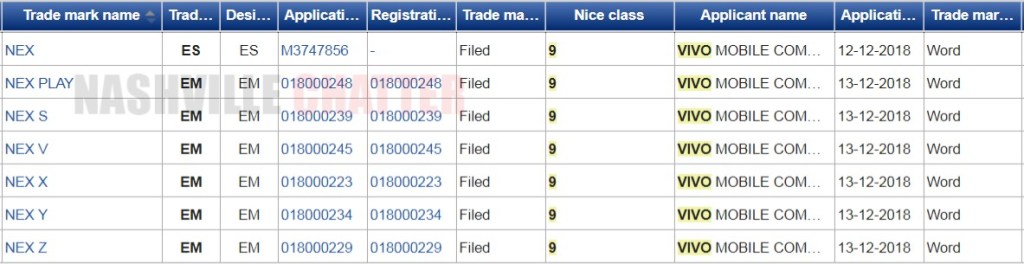
The Chinese smartphone maker trademarked a bunch of names last week at the European Union Intellectual Property Office. The documents reveal the company has trademarked the names NEX S, NEX V, NEX X, NEX Y, NEX Z, and NEX PLAY.
The NEX S already exists as it is the Snapdragon 845-powered version of the NEX A released back in June. The others are practically unreleased models. The NEX Play is presumed to be the first gaming phone in the series that will compete against phones like the Nubia Red Magic, Black Shark Helo, Razer Phone 2 and the ASUS ROG Phone.
Known as one of China’s best online electronic stores, GearBest is offering tech buffs a lot to cheer about in the form of its recently kicked-off promo dubbed ‘2018 Xmas Tech Deals.’
The aforesaid promo comprises a Flash Sale that will be valid for a wide range of computer gears that have been split into multiple categories to simplify the search process. For instance, the Mai Benben Jinmai 5 Laptop that usually sells for $619.43 is currently available for a reduced price of $459.99 on GearBest.
This 26% discount will be valid for the platinum color version of the laptop for a limited period of time.
Likewise, you can avail a 26% off on the Mi Pad 4 Tablet PC that would normally set you back a pretty penny on online as well as offline stores. As a result, you can now buy this Xiaomi-branded tablet PC for a reduced price of just $209.99. Moreover, you can choose between black and gold color versions. While the aforesaid products have been included in the ‘New Arrivals’ section, a slew of other well-received laptops and tablet PCs have been added in the following section called ‘Best Sellers.’ It is worth noting that all items featured in this category carry heavily discounted price tags.
The ‘Flash Sale’ section, on the other hand, is brimming with TV boxes and mini PCs that you can now buy without breaking the bank. Brand conscious buyers can head straight to the next section called ‘Top Brands’ where top-end electronic items from ALLDOCUBE, Onda, Jumper, Tanix, Motospeed, and XGIMI are up for grabs for unbeatable prices.
Similarly, GearBest is doling out big discounts on computer accessories like the Colorful iGame 1050Ti Gaming Video Graphics Card and eekoo 120G SSD Solid State Drives SATA3 3.0 6GB/s Support in the category called ‘Accessories.’ There are other items that are added to the ‘5 Days Arrival’ and the concluding ‘More Deals’ categories.
You can click here to visit the promotion page to check out all the products and take full advantage of the promo before it comes to an end.
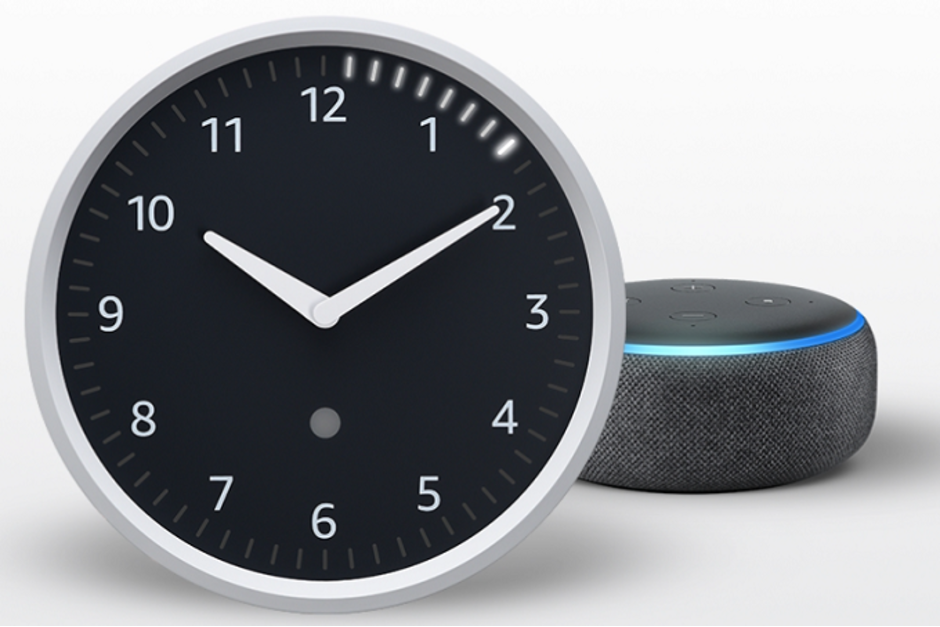
Thinking of what you can get for someone this festive holiday? Especially for someone who already owns an Amazon Echo smart speaker? How about considering the Echo Wall Clock priced at $29.99 on Amazon? The wall clock has a digital 60- LCD display which can display one or multiple timers that you’ve set using a paired Echo smart speaker and the analogue clock will show the time of the day. For Instance, when you tell Alexa to set a timer for 35 minutes, you’ll be able to watch the movement of the timer on the clock with the display of each passing minute becoming brighter.
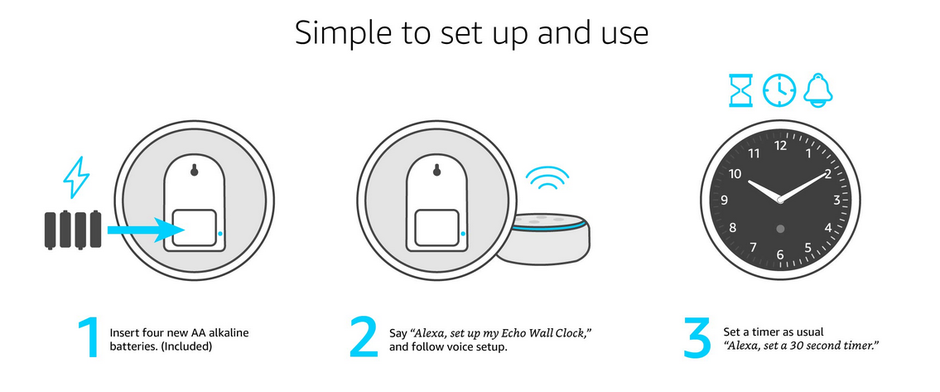
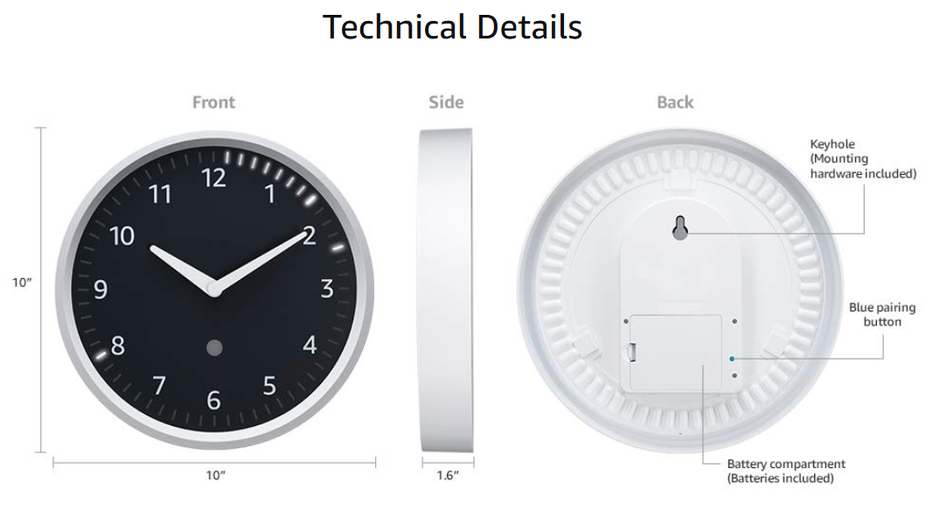
The clock will adjust automatically when Daylight Saving Time rolls around and also the Echo Wall Clock set the time automatically by syncing with the Echo speaker. Furthermore setting up the clock is as simple as just saying “Alexa, set up my Echo Wall Clock.” The Echo wall clock will work with any of the Echo models including the Amazon Echo, Echo Show, Echo Spot, Echo Dot, Echo Plus, or Echo Input smart speaker. The Wall Clock has a white bezel and is 10-inches in diameter. It utilises four AA batteries which are needed to power the timepiece and includes all of the hardware you need to mount it. There is also a Bluetooth pairing button for pairing the gadget to the Echo speaker.
Unfortunately, the Echo Wall Clock won’t be in stock until December 24 but you can place an order on Amazon now and have it delivered when it is in stock. That might be too close to Christmas but you can always tell your family members, friends, loved ones, business associate or substantial other that their gift is on the way.
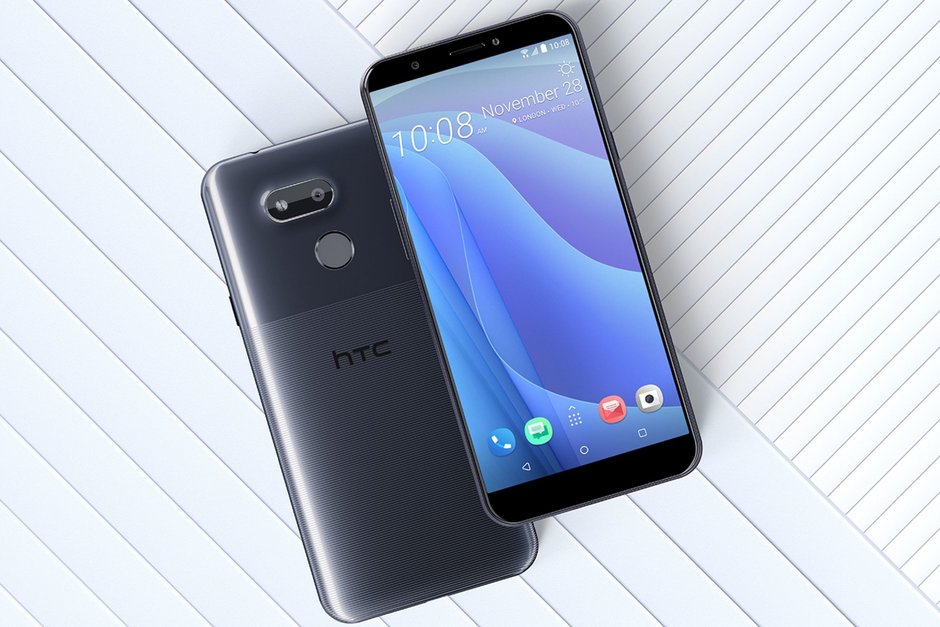
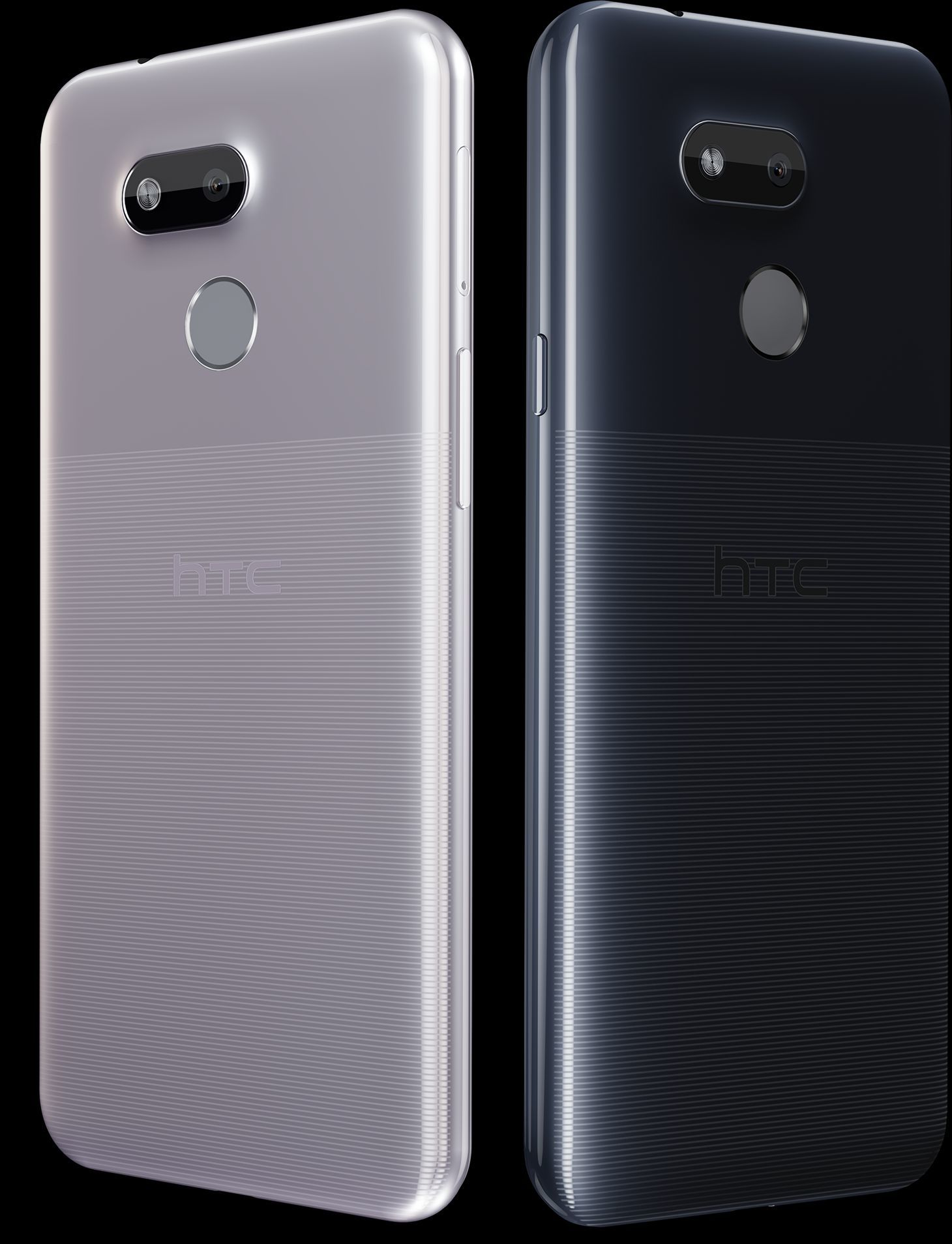
Taiwanese smartphone giant HTC Monday came out with a new phone announcement – the Desire 12s which follows the same design language of the U12 Life. HTC may not have given up entirely on the smartphone market just yet as it holds the belief that 5G connectivity and blockchain technology will in some way get the ailing company back in its feet. However, before that happens, the budget HTC Desire 12s has just been formally launched and commercially released in Taiwan.
This is the tech’s first giant “mainstream” device n several months and seeing the wide availability of the Desire 12 and 12+ in Europe, an extension out of Asia definitely doesn’t feel out of the question for the HTC Desire 12s. There’s definitely no reason, neither do you necessarily need to own cryptocurrency to be able to afford this modest “5.7-incher”, which begins at the reasonable equivalent amount of $195 or so in HTC’s domestic market. Alas, you don’t get a lot of features for your bucks, as the entry-level configuration includes 3GB RAM and 32 GB of internal storage. A 4GB+64GB variant is around the equivalent of $225.
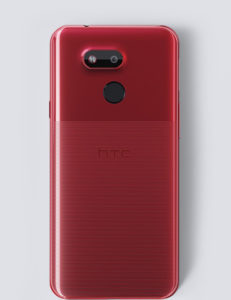
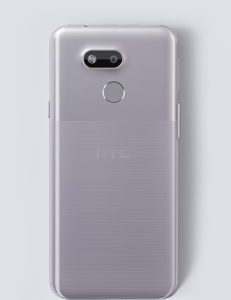
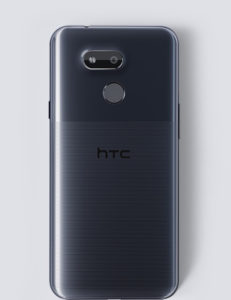
The Desire 12s borrows the two-tone design from the U12 Life and this is certainly an awesome, magnificent touch for an otherwise unsurprising product, attempting to give the best of both worlds with an original Glossy texture and Matte finish blend.
The Desire 12s features a 5.7-inch display with HD+ resolution of 720 x 1440pixels and 18:9 aspect ratio. There’s no notch and judging by the renders, the side bezels are really thin while the upper and lower ones are decent for an entry-level phone too. The 12s packs a modest Qualcomm Snapdragon 435 processor.
Further, the device packs a rear-mounted fingerprint scanner and surprisingly there is only a single camera at the front and rear. Both rear and selfies sensors are 13MP cameras. Interestingly, it is easy to confuse the rear camera for a dual setup whereas it is a single sensor with the LED flash by its side. The device gets its interface from Android 8.1 Oreo software and is powered by a 3,075 mAh battery with no support for fast charging.
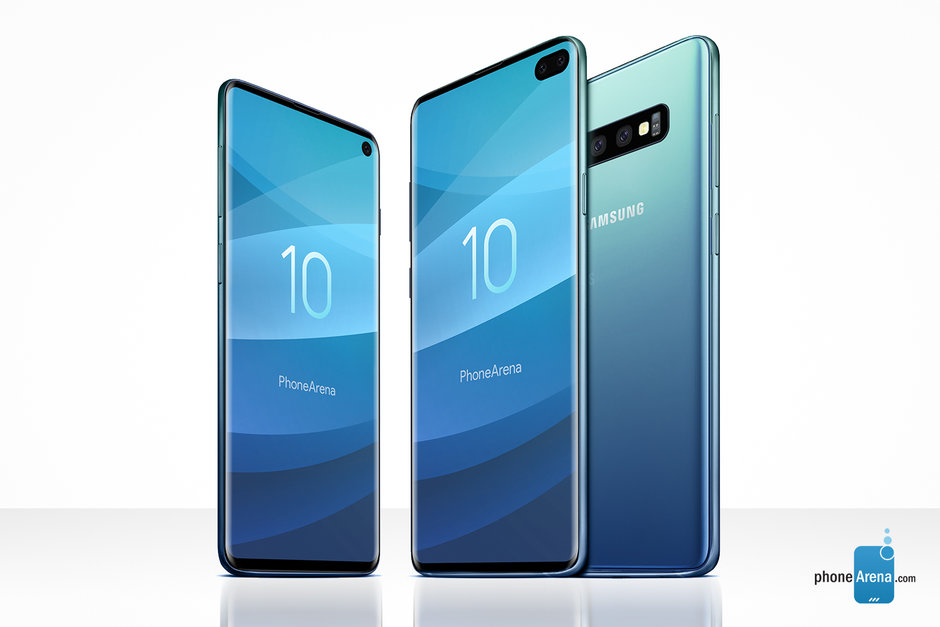
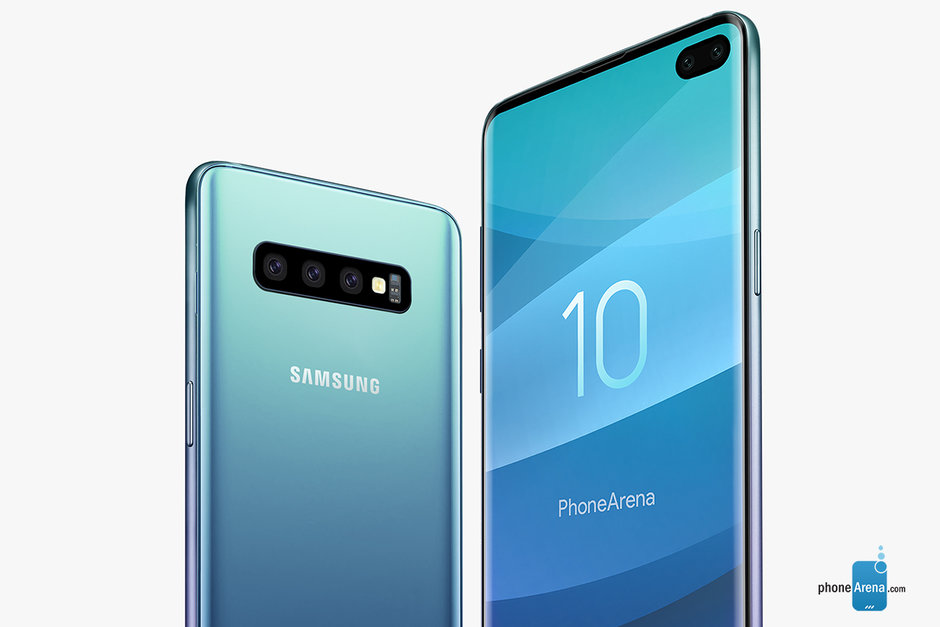
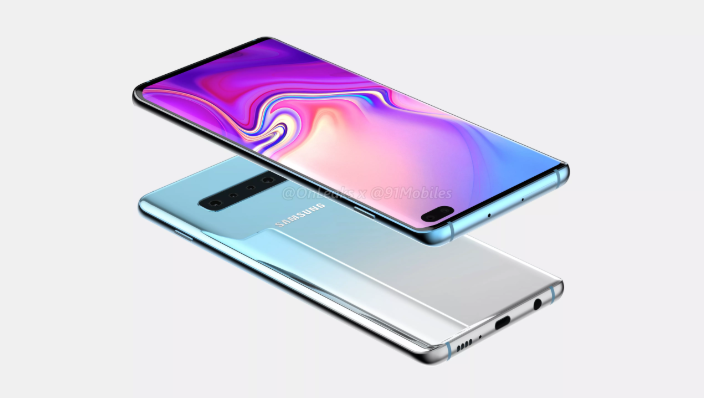
The Galaxy S10 series will be debuting next year as Samsung’s 10th anniversary Galaxy S-series smartphones. The Galaxy S10 will be arriving in Lite, regular and Plus models. These models will be respectively equipped with 5.8-inch, 6.1-inch and 6.4-inch S-AMOLED screens. The S10 Lite will have dual rear cameras while the other models will be equipped with triple camera sensors on the rear. PhoneArena has received more information about the upcoming Galaxy S10 and Galaxy S10+ models including their marvelous renders. Here is all the latest information about the S10 and S10+ phones.
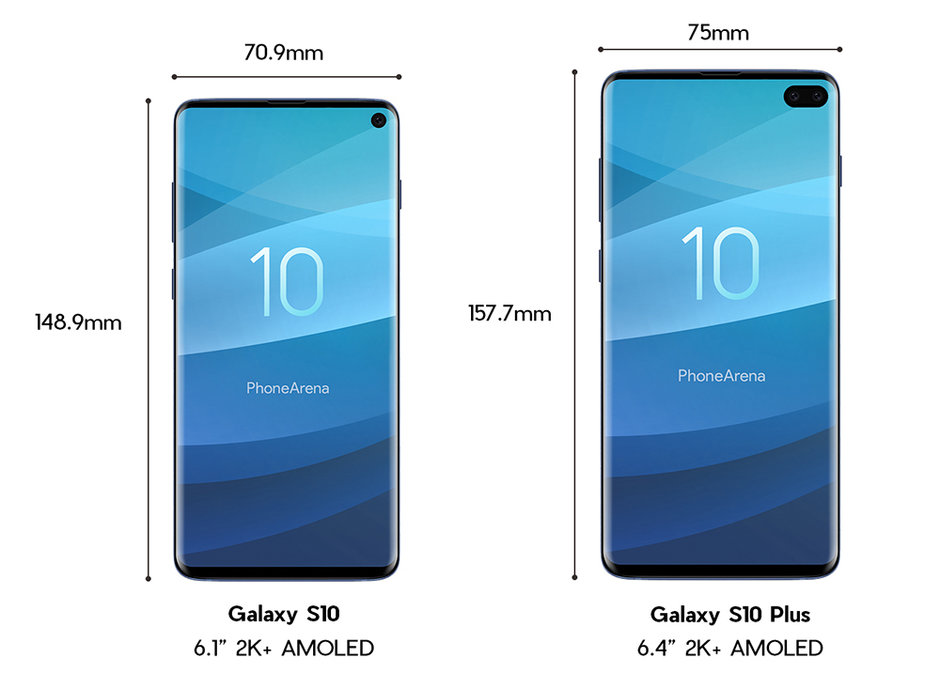
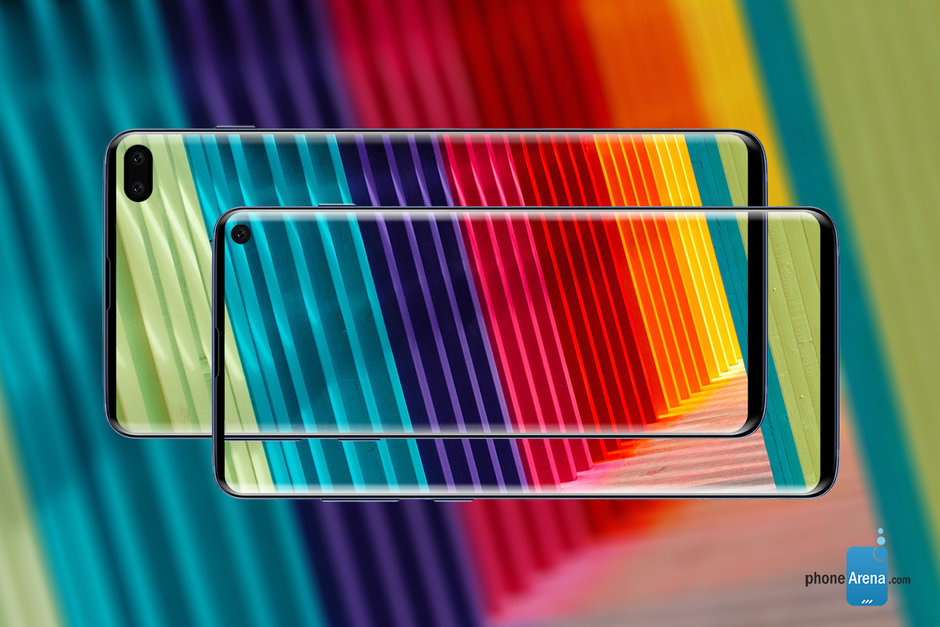
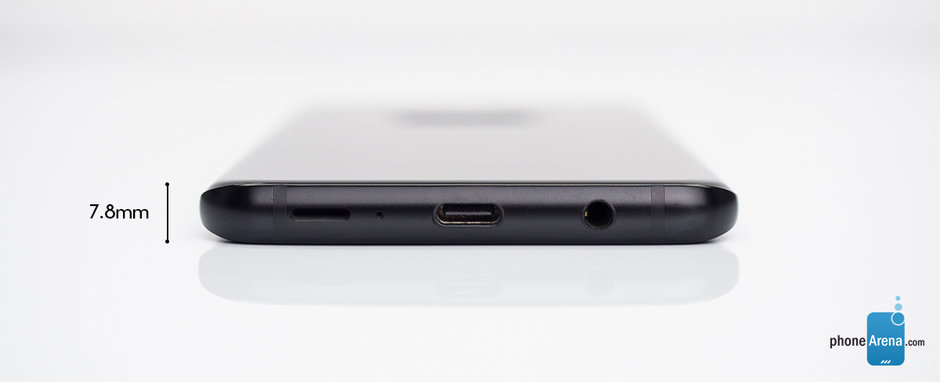
The Galaxy S10 will be featuring 148.9 x 70.9 x 7.8mm. It will be featuring a 6.1-inch Infinity-O AMOLED display that has a small hole for the front-facing camera. On the other hands, the dimensions of the S10+ are 157.7 x 75 x 7.8mm. It houses a 6.4-inch AMOLED screen that features a slightly large oval cutout for housing dual front-facing cameras. Both smartphones will carry support for Quad HD+ resolution. The new display design will certainly allow the S10 and S10+ to offer a very screen-to-body ratio.
The Galaxy S10 and Galaxy S10+ that will feature triple camera setups will be arriving identical primary cameras. The Galaxy S10 Lite will be arriving with a regular flat AMOLED screen with Infinity Display design. Its selfie shooter will be available on its top bezel. Previous reports have claimed that the S10 and S10+ will support 19:9 aspect ratio whereas the S10 Lite will support 18.5:9 aspect ratio.
The Galaxy S10, S10 Plus and S10 Lite are expected to arrive in different markets in Snapdragon 845 and Exynos 9820 chipset variants. All the Galaxy S10 models will be featuring 3.5mm audio jack.
Rumors surrounding the Galaxy S10 series claim that Samsung will an Unpacked event for unveiling it on Feb. 20. In the U.K, it is expected to be available for pre-orders from the same date and its sales are likely to begin on March 8. The S10 Lite, s10 and S10 Plus are rumored to be available with respective starting prices of 699 pounds (~$883), 799 pounds (~$1,009) and 899 pounds (~$1,135).
The Nubiav X is a revolutionary flagship phone that offers notch-less viewing experience through a large-sized display. However, the major USP of the smartphone is the rear-mounted secondary display which sets it apart from all the other flagship smartphones (except for the newly introduced Vivo NEX Dual Display edition. GizmoChina’s YouTube channel now includes the video review of the Nubia X smartphone. Have a look at the video below to know what’s hot and not about the Nubia X.
Nubia X Review Video
Nubia has removed the selfie camera from the Nubia X phone because of which the handset sports a notch-less front screen with a very high screen-to-body ratio. The handset has curved edges on the rear. Its secondary screen cannot only show of the front display when flipped, but also it can show high-resolution always-on content when the device is locked. The secondary also functions as a viewfinder while shooting selfies from the dual rear cameras.
There are two side-mounted fingerprint scanners on the Nubia X. When pressed together, it can let the rear screen can show whats being shown displayed on the front. One of the major gripes of the Nubia X is that it lacks support for Google services. To get the desired apps, one needs to access Nubia’s app center.
The box package of the device includes the handset, some paperwork, USB-C cable, charger adapter, USB-C to 3.5mm adapter and SIM ejector tool.
Nubia X Specifications
At the front side of the Nubia X is IPS LCD display of 6.26 inches which supports Full HD+ resolution. The second display on the rear is a 5.5-inch OLED screen that produces HD+ resolution. Both displays are shielded by Gorilla Glass 4. The Android 8.1 Oreo comes loaded on the smartphone with Nubia UI 6.0 placed over it.
The Snapdragon 845 chipset is the brain of the Nubia X which is assisted by 8 GB / 6 GB of RAM. The handset offers up to 512 GB of internal storage. There is no selfie shooter on the device. On the rear is the 16-megapixel + 24-megapixel dual camera setup. It receives power to perform from 3,800mAh battery.
The Nubia X is exclusively available in China with a starting price of 3299 yuan (~$478). It comes in slew of colors such as Blue Gold, Ser Blue, Black Gold, Deep Gray and Starry Night
Do you think that the Nubia X is certainly one of the desirable smartphones? Are you of the opinion that the secondary screen of the phone is just a gimmick? Do you think that no Google services on the Nubia X is a deal breaker? Share us your views by posting your comments below.
Huawei Nova 4 and Samsung Galaxy A8s are the first smartphones ever to feature a hole-punch display. Thanks to the fact that the display integrates the front camera in a small hole, they do not need a notch, neither a slider or a pop-up front camera, in order to deliver extremely narrow bezels on three sides and a screen-to-body ratio close to 100 percent. Will they be considered the best solution to get rid of notches? Only time will give us the answer. Meanwhile, here is an in-depth specs comparison.
Triple 48 + 16 MP + 2 MP f/1.8 and f/2.2 and f/2.4
25 MP f/2.0 front camera
Triple 24 + 10 + 5 MP f/1.7 and f/2.2
24 MP f/2.0 front camera
BATTERY
3750 mAh
Fast charging 18W
3400 mAh, Fast Charging
ADDITIONAL FEATURES
Hybrid Dual SIM slot, in-display camera
Hybrid Dual SIM slot, in-display camera
Design
Huawei has been able to make a more impressive design with the new Huawei Nova 4. Indeed, the handset features a higher screen-to-body ratio as well as a smaller hole for the front camera, at least from what the first official renders are showing. Further, the rear side is more attractive as well thanks to the reflective back available in gradient color variants. Samsung Galaxy A8s is a slightly thinner phone, but on the other hand, it is a bit taller.
Display
Samsung always provides better displays for most of its handsets, but it is not the case when it comes to the new Samsung Galaxy A8s. It is the only last-gen phone from the Galaxy A series to sport an IPS LCD display instead of a Super AMOLED panel. Huawei Nova 4 has an IPS display too and the same resolution, so we expect a very similar viewing quality. However, we will have to test them personally to give a final judgment about their displays.
Specs & Software
Huawei Nova 4 wins when it comes to performance because of its better hardware. Indeed, it comes with a high-end processor, the Kirin 970 which is the same found on the Huawei P20 Pro, paired with 8 GB of RAM and 128 GB of internal storage. It delivers blazing speeds as well as a great adaptability to multi-tasking. Samsung Galaxy A8s will provide very nice performances, but it remains an upper mid-ranger with its Snapdragon 710 chipset. Both the phones come with Android Pie out of the box customized with the companies’ proprietary user interfaces.
Camera
Besides their punch-hole display, cameras are the main focus of Huawei Nova 4 and Samsung Galaxy A8s. On the paper, the former looks more impressive because it is the first to come with the new Sony sensor sporting a resolution of 48 Megapixels, in a triple camera setup. However, Samsung Galaxy A8s is an outstanding camera phone as well with its triple camera and a very bright f/1.7 aperture. We are yet to see how each device performs in the most demanding scenarios to express an opinion.
We can not give a final verdict about battery life as well. Huawei Nova 4 has a much bigger battery, but usually, Samsung optimizes its batteries in a better way, so the battery life of these devices might be similar.
Price
Overall, at least on the paper, I am more impressed by the Huawei Nova 4 because of its more beautiful design and a higher-end hardware. It just debuted in China with a price tag of about €500 for the high version with the 48 MP triple camera (there is also a standard version with a lower-end camera), while the price of Samsung Galaxy A8s is still shrouded into mystery.
The Honor FlyPods Pro was announced alongside the Honor Magic 2 back in October. The wireless earbuds which share the same design with the Huawei FreeBuds 2 packs interesting features including one that lets you use your voice to unlock your phone and make payments.
The feature is called Bone ID and it uses bone conduction technology to match the pattern of the voice of the user. Apparently, each person has a unique bone sound pattern and with Bone ID, owners can simply use their voice to unlock their phone or authorize payment transactions just as you would do with Touch ID or Face ID.
The feature wasn’t available right out of the box but a new update rolling out to the Honor Magic 2 activates the feature. The update brings the phone’s version to B150 which brings the feature to the phone thus allowing owners to set up Bone ID on their device. The Bone ID settings can be found under Security and Privacy under the main settings. All you have to do is follow the instructions.
News of a custom version of the Lenovo Z5s surfaced yesterday. The phone which is called the Lenovo Z5s Ferrari Superfast is expected to launch alongside the regular variant. An in-store advert has now revealed more details of the phone.
The ad does confirm there is a Ferrari-custom version of the phone that will have a Snapdragon 845 processor and 12GB of RAM. It also reveals the phone will have a customized back (most likely Ferrari’s logo), a camera-in-hole display, and that it will launch tomorrow.
There is no info about the cameras, so it should be the same as the regular variant which will have three vertically arranged cameras. What we are not sure of is if it will have an in-display fingerprint scanner or a rear-mounted fingerprint scanner.
Lenovo signed a multi-year partnership with Scuderia Ferrari at the beginning of the year. Now the PC giant’s logo can be seen on the uniform of the racing team as well as on their cars. The partnership also includes Lenovo providing its ThinkPad laptops and Miix tablets for use by the team on and off the track. So it doesn’t come as a huge surprise that Lenovo’s own phone will have Ferrari’s logo.
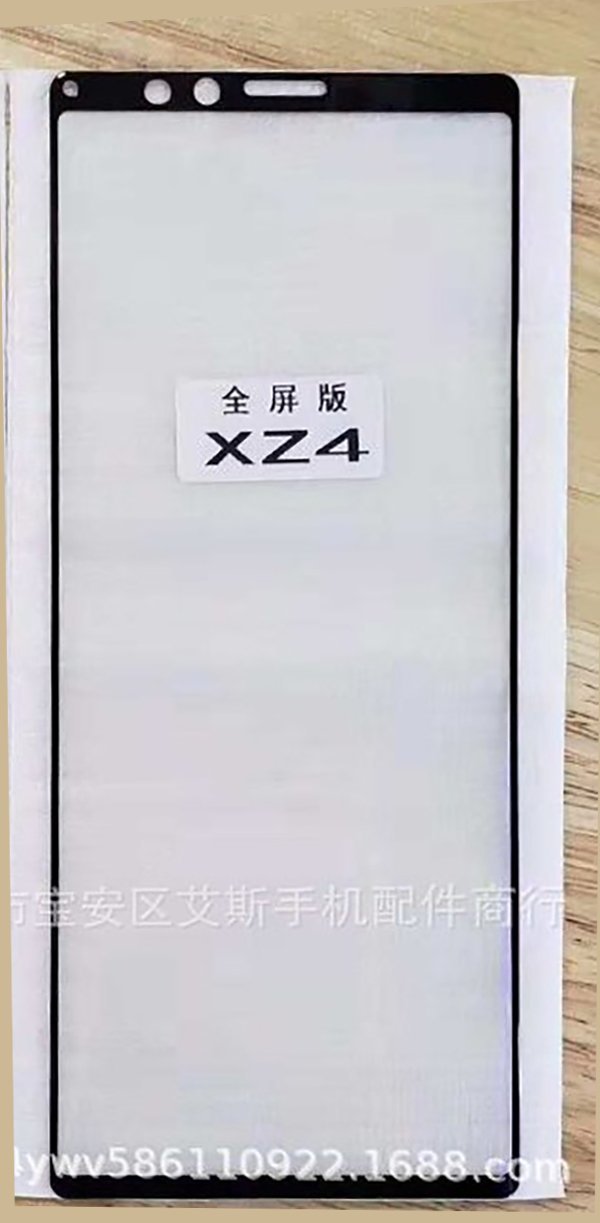
The Sony Xperia XZ4 leaked specifications that had surfaced earlier this month had revealed that the smartphone could be equipped with 21:9 aspect ratio display. Now popular tipster and designer Benjamin Geskin has shared an image of the front panel that belongs to the alleged Xperia XZ4 phone. It corroborates on the rumors that it will be featuring a 21:9 aspect ratio screen.
The Xperia XZ4 front panel image matches with the CAD renders of the phone from the previous month. The side bezels of the smartphone are extremely thin. The lower bezel is also very thin and the one sitting at the top of the display is slightly thick enough to house an earpiece, a front-facing and some other sensors.
Previous reports have revealed that the Sony Xperia Z4 will be featuring a display supplied by LG. The 21:9 aspect ratio display of the XZ4 is rumored to measures 6.55 inches.
The Sony Xperia XZ4 will be of the one of the first phones to debut with Snapdragon 855 chipset. The SoC could be coupled with 6 GB of LPDDRX RAM. The smartphone is likely to hit the market in 64 GB and 256 GB storage options. For more storage, it will be featuring a microSD card slot.
The backside of the Xperia XZ4 is expected to feature a triple camera system on the rear. The exact configurations of the triple sensors are not known. However, it could be featuring 48-megapixel 1/2.3-inch Sony IMX586 sensor with support for OIS. It will come installed with the latest Android 9.0 Pie OS.
The handset is expected to feature glass and metal combination body and sport a thin profile of around 8mm. The CAD renders leak had revealed that it will be measuring 166.9 x 72.4 x 8.2mm. It will be featuring side-mounted fingerprint scanner.
The pricing of the Sony Xperia XZ4 is under the wraps. The smartphone is expected to go official at the Mobile World Congress (MWC) 2019 tech expo in February. The Japanese tech giant is also rumored to debut the Xperia XZ4 Compact alongside the Xperia XZ4 phone.
Facial recognition is cropping up everywhere. From shopping malls to the workplace, it’s likely you get your face scanned by something daily. But rather than intruding your privacy, facial recognition is supposed to protect digital life from pries. Forbes has newly used a 3D printed head modelled after the author’s head to test different series of smartphone face-recognition systems. The 3D head model was printed at Backface in Birmingham, U.K., in a dome-like studio that contains 50 cameras. Altogether, they combine to take a single shot which makes up a full 3D image. It took a few days to produce a final model which cost over £300.
If you’re an Android customer, though, look away from your screen now. We tested four of the hottest handsets running Google’s Android operating systems and Apple’s iPhone to see how convenient it’d be to penetrate into them. It was achieved with just a 3D-printed head. All of the Androids unlocked with the fake model. But however, Apple’s phone was impenetrable. The Android phones tested included the Samsung S9, Samsung Note 8, LG G7 ThinQ, and OnePlus 6.
The facial recognition on many Android phones is less secure when compared to Apple’s Face ID system. Just a simple photograph has been used to trick some of those face recognition systems. Apple’s Face ID, however, uses an infrared camera, an attention awareness technology, a depth sensor and a dot projector to map out 30,000 points on your face creating an artificial 3D scan and making it more secure. With the attention awareness feature alone, this is enough to explain the inability for a static 3D printed head to unlock the iPhone X. That said, the iPhone X’s Face ID has been fooled in the past with more complex printed 3D heads. Thus, it is best not to rely on Face ID entirely for digital security.
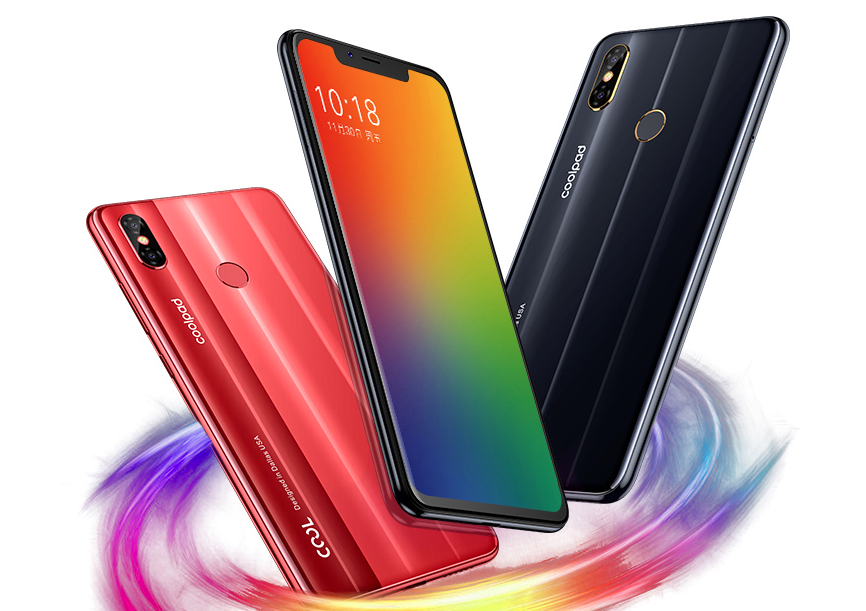
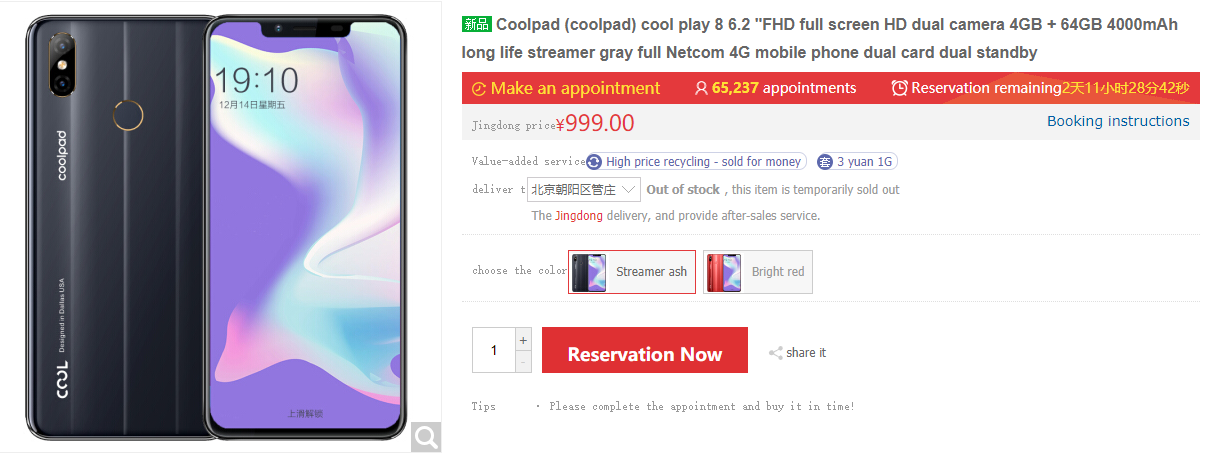
Coolpad has announced the Coolpad 8 smartphone in China. The handset is fitted with a notched screen and it is equipped with dual rear cameras. The handset will be available for buying later this week through Jing Dong Mall. Currently, the Chinese retailer is receiving the reservations of the smartphone.
Coolpad 8 Specifications and Features
The Coolpad 8 features a 3D glass back and a metallic frame. It measures 155.5 x 74.8 x 8.5mm and weighs 177 grams. A notched InCell IPS LCD display of 6.26 inches seated on the frontside of the Coolpad 8. It carries support for full HD+ resolution ofCoolpad 8 launched with 6.26-inch notched, dual cameras and 999 Yuan (~$145) pricing 2246 x 1080 pixels. The rear side of the smartphone features a fingerprint scanner for securely locking and unlocking the device.
The MediaTek MT6750 chipset coupled with 4 GB of RAM is present under the hood of the device. It has an inbuilt storage of 64 GB. A 4,000mAh battery is packed inside the phone. It supports fast charging through USB-C which makes it possible to completely the charge the handset in 120 minutes.A vertical dual camera setup featuring 16-megapixel and 2-megpixel sensors is available on the rear of the Coolpad 8. For capturing selfies, it has a front-facing camera of 8-megapixel. The exact version of the Android OS is not mentioned on the JD listing of the smartphone. The Android OS is customized with the company’s Cool UI 9.0 skin. The other features of the Coolpad 8 include dual-SIM support, 4G VoLTE, Wi-Fi, Bluetooth, GPS and 3.5mm audio jack.
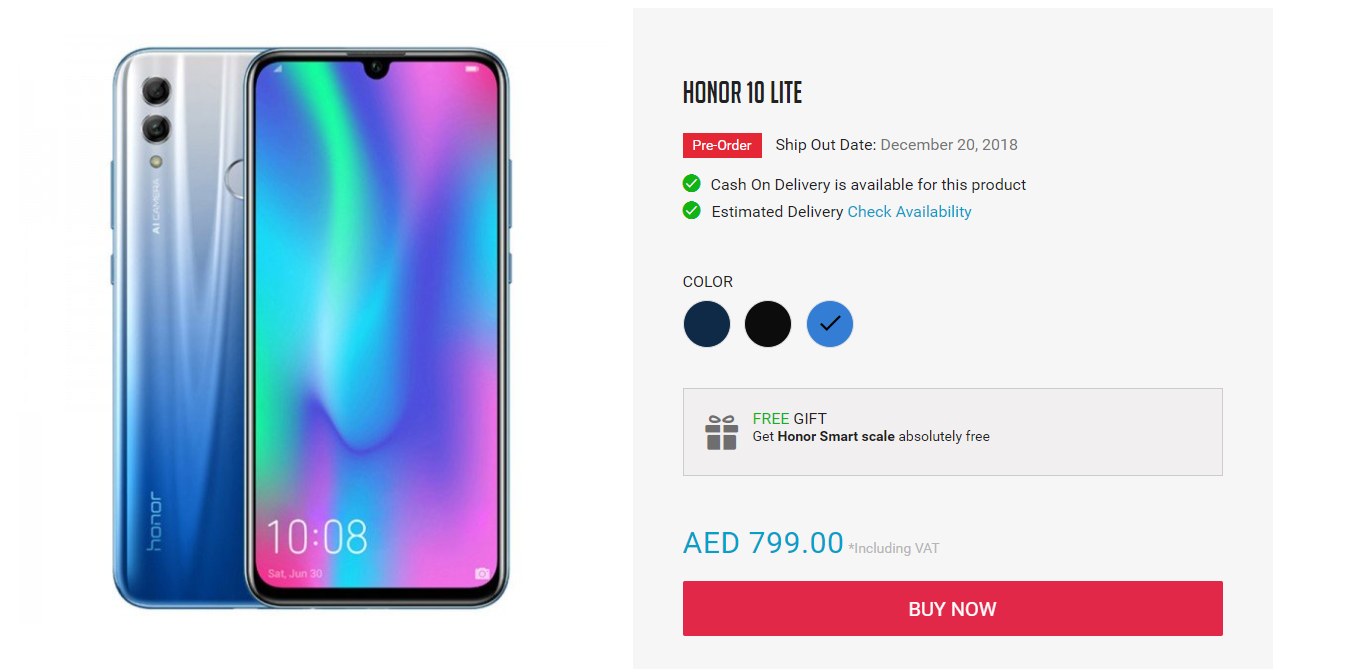
The Honor 10 Lite is making its way to more countries following its launch in China. Honor took to Twitter to announce the phone will launch on Thursday, December 20. However, the phone is already available for pre-order in a few countries.
The Honor 10 Lite will be available in Pakistan, the United Arab Emirates, and Saudi Arabia. In Pakistan, it will be sold by Daraz for PKR 38,999 (~$280) and will be available in Sapphire Blue and Midnight Black. Delivery will start on the 25th of December and those who pre-order will get a free Bluetooth speaker.
In the UAE and Saudi Arabia, both phones will be sold for AED 799 (~$217) and SAR 749 (~$200) respectively. It will be available in Sapphire Blue, Midnight Black, and Sky Blue and be sold on the official Honor online store. Those who pre-order the phone in the UAE will get a free Honor Smart Scale worth AED 136 (~$37). Those in Saudi Arabia will get a free 10,000mAh power bank. In both Middle Eastern countries, delivery will begin on December 20.
The Honor 10 Lite sold in all three countries will have 3GB of RAM and 64GB of storage.
The Honor 10 Lite has a 6.21-inch Full HD+ (2340 x 1080) dewdrop notch display with a 19.5:9 aspect ratio. The display is certified as safe by TÜV Rheinland thanks to its unique eye comfort mode. The phone is powered by a Kirin 710 processor.
In a bid to make deeper in-roads in India’s smartphone market, China-based smartphone manufacturer Oppo has today announced that it is setting up a new Research and Development (R&D) facility in Hyderabad.
This first R&D centre in India from Oppo will be the company’s largest facility outside its home country. The facility will contribute towards bringing exciting innovation and advanced technologies to India, says the company.
Currently, the site has 50 people on the development side and another 50 on quality control. However, the company says that it plans to increase the workforce to about 500 in the next three to five years. Further, the company has revealed that its first R&D centre in India will focus on Artificial Intelligence (AI), camera, fast charging technology, and 5G.
It appears that Oppo is seeing Research & Development as a key to the company’s plans to dominate the global smartphone market. The company has increased its focus on innovation and R&D and recently announced a global investment of RMB 10 billion towards the R&D space for 2019. Oppo currently has 3000 engineers working at its R&D centres across all locations.
Tasleem Arif, Vice-President and R&D Head, Oppo India, said that the company will mainly emphasis on deeper consumer insight. He added that the new R&D centre in India will work on a number of local features that will help improve the experience on its phones, including User Experience (UX). In a statement, he said:
The opening of our R&D centre in Hyderabad will help us implement innovative and exciting technologies in future products that we introduce in India as well as help us build a local ecosystem for smartphone devices. As India is an extremely important market for us we aim to drive innovation locally through the R&D centre in Hyderabad to deliver an insightful revolutionary, and seamless smartphone experience that caters to the demands of our consumers. We are looking forward to filing new patents for new technologies for our consumers to truly experience the best of technology.
With this new local facility in Hyderabad, India, Oppo has now become the third smartphone player, after Samsung and Huawei, to have the Research & Development centre in India. Another Chinese brand OnePlus too is planning to setup the R&D centre in India.
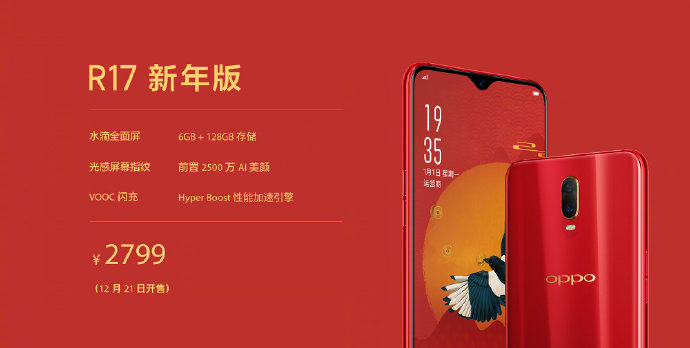
As OPPO had confirmed in the previous week, it has launched the New Year’s editions for OPPO R17 and R17 Pro smartphones through a dedicated event in Shanghai today. In terms of specifications, both phones carry the same specs as their regular versions. However, the R17 and R17 Pro New Year’s Edition have unique design since they sport red bodies that symbolize the New Year. According to the Chinese calendar, 2019 is the year of pig. Hence, the Chinese manufacturer has engraved a golden logo of a piglet on the bottom of the rear shells of both phones. Also, these phones are running on the specialized designed New Year themed UI.
The glass rears of the OPPO R17 and OPPO R17 Pro New Year’s Edition have warm red color with gradient effect. The paintjob has been inspired by the traditional paper-cutting art of China while the golden of the piglet has a floating effect.
The OPPO R17 New Year’s edition is fitted with a 6.4-inch AMOLED display that produces FHD+ resolution of 2340 x 1080 pixels. It is fueled by Snapdragon 670 chipset. The waterdrop notch of the display is the home for the front-facing 25-megapixel selfie camera. The rear shell of the phone has a 16-megapixel + 5-megapixel dual camera setup. The handset is backed by a 3,500mAh battery and it includes 6 GB of RAM and 128 GB of storage. Other features of the smartphone include support for VOOC charging and Hyperboost technology.
The OPPO R17 Pro New Year’s edition is equipped with a 6.4-inch AMOLED waterdrop notch screen. It is driven by the Snapdragon 710 chipset. On the front is a selfie shooter of 25-megapixel. A 12-megapixel + 20-megapixel dual camera setup resides on the backside on the backside of the phone. It receives power from 3,700mAh battery and is packed with 8 GB of RAM and 128 GB of native storage. The OPPO R17 Pro New Year’s edition also features NFC, SuperVOOC charging and HyperBoost technology.
The OPPO R17 New Year’s edition carries a price tag of 2,799 Yuan (~$409) in China. On the other hand, the OPPO R17 Pro New Year’s Edition is priced at 4,299 Yuan (~$624) in the home market. These handsets are China exclusive devices. The official sales of the R17 and R17 New Year’s edition smartphone will begin at 10 AM on Dec. 21. Following are the images of the handset and retail package of the OPPO R17 Pro New Year’s edition.
Xiaomi’s Mijia has released a poster that says it will unveil a new smart air conditioner on Thursday, December 20. The new air conditioner comes five months after the first Mijia Air Conditioner.
The poster has the figure 1 written in green. Some say that it may mean the air conditioner has a level 1 energy efficiency rating. However, we think it may mean the Air Conditioner has a 1HP compressor. The model released back in July has a 1.5HP compressor.
The design is expected to be similar – a white anti-UB abs polymer resin body and a circular LED display. If it has a lower power rating, that means its cooling capacity will be less. Just like the original, Xiaomi may also include a heater so it serves a dual function.
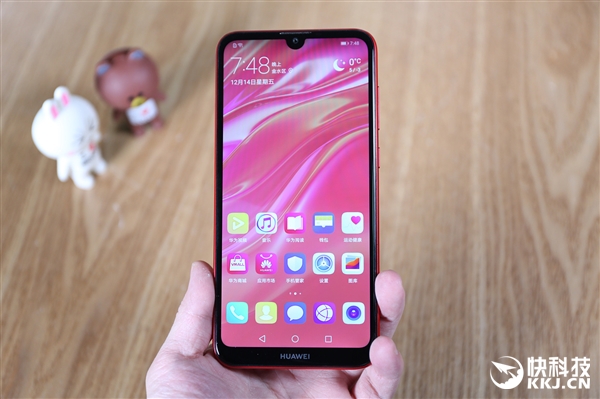
During the Nova 4 launch event, Huawei also officially launched a budget smartphone which goes by the moniker Enjoy 9. Details of the Huawei Enjoy 9 had first been spotted on VMall sometime last week but the pricing wasn’t disclosed. The device has now been shown to be a thousand yuan machine as its pricing starts at 999 yuan (~$145) for the base variant.
Specs wise, the Enjoy 9 features a 6.26-inch 720x1520pixel IPS LCD display. The device has a waterdrop notch design which houses the selfie camera. The device packs a Snapdragon 450 chipset onboard instead of Huawei’s custom Kirin chipset. However, the chipset is a low-end chipset that won’t offer so much in terms of firepower. The processor is paired with a 3GB of RAM and 4GB of RAM on some models. The device also comes with 32GB of internal storage while the 4GB RAM variant has a 64GB storage onboard.
On the camera end, the Enjoy 9 sports a 13MP f/1.8 + 2MP f/2.4 depth-sensing dual camera setup at the rear while for selfies, there is an 8MP f/2.0 selfie camera. The device comes with Face scanner using the front camera but there is no physical fingerprint button at the rear. One outstanding feature onboard the Huawei Enjoy 9 is the 4,000mAh battery that will definitely deliver an extended usage period. On the software aspect, the device runs Android 8.1 Oreo-based EMUI 8.2. In addition, the device comes with three slots, two SIM slots and a third one for microSD card. The Enjoy 9 comes in Black, and three gradient Aurora colors – Blue, Red and Purple.
Huawei Matebook 13
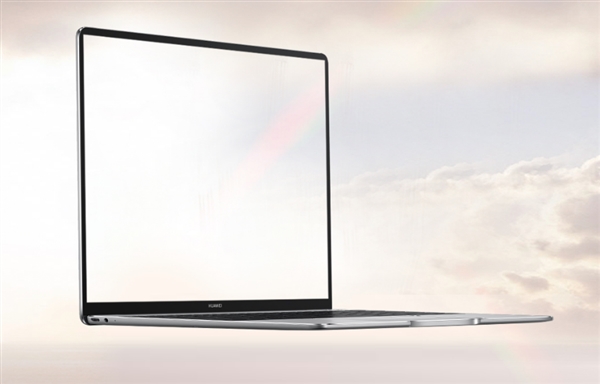
Huawei’s notebook model is presently categorised into four series – Matebook X Pro, X, D, and E. In early November, Huawei announced the new full-screen, ultra-slim and lightweight MateBook 13 (WRT-W29E) which is a new series entirely. More details of the Matebook 13 was also revealed today during the Nova 4 launch.
According to the details announced, Huawei MateBook 13 adopts Huawei’s family-style full-screen design, with narrow bezels around it. The left and right-side bezels are just 4.4 mm while the laptop has a screen ratio of 88%. As the name implies, it packs a 13-inch IPS glossy screen with a resolution of 2160×1440 pixels (3:2). The display has a 178-degree wide-angle view, 1000:1 contrast, typical brightness of 300nits and minimum of 240nit, but the screen does not support touch control. The laptop has a thin 14.9mm metal body and weighs just 1.28kg. The body is manufactured using diamond cutting technology, supplemented by delicate sandblasting technology with well-chamfered edges.
The Mateboo 13 is powered by the latest eighth-generation Intel Core i7-8568U (Whiskey Lake) processor with the lower model utilising an Intel Core i5-8265 chipset. Both SoCs are Quad-core eight thread chipsets. The processor also has a power consumption of 15W. The laptop is also equipped with an NVIDIA MX 150 discrete graphics, 2GB GDDR5 independent graphics memory, thermal design power consumption 25W, with LPDDR3 memory, NVMe solid state drive.
On the internals, it has a shark fin fan 2.0 smart cooling system, dual fan separation heat source, seven sensors real-time temperature control. The battery capacity is 41.838Whr (3670mAh/11.4V), the theoretical battery life is about 10 hours, and it can be used for 2.5 hours after charging for 15 minutes. The interface has only two USB-Cs with data transfer and charging on the left side, data transfer and DisplayPort output on the right side, and a 3.5mm headset. Other aspects, it packs a full-size island chocolate keyboard, power button which also doubles as a fingerprint sensor, dual-band 802.11ac Wi-Fi and Bluetooth 5.0, 1MP camera, dual speaker, dual microphone, Dolby Atmos sound.
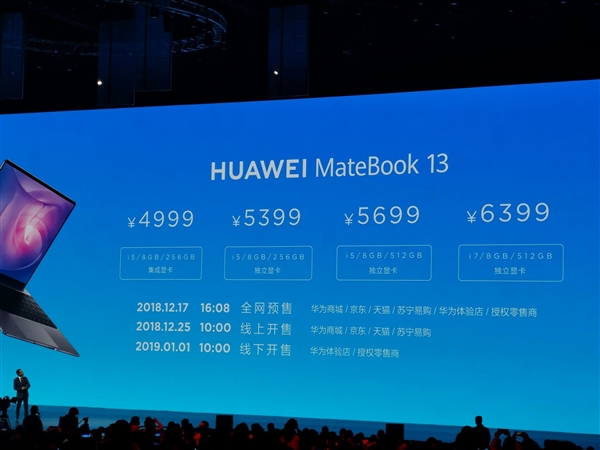
The Matebook 13 comes in three colours of Deep Gray Ash, Cherry Powder and Gold. As for the pricing, the Intel Core i7 version is priced at 6399 yuan. However, the Core i5 variant with 8GB RAM and 256 storage is priced at 4999 yuan. It will go on sale on January 1 but pre-sale will start on December 25.
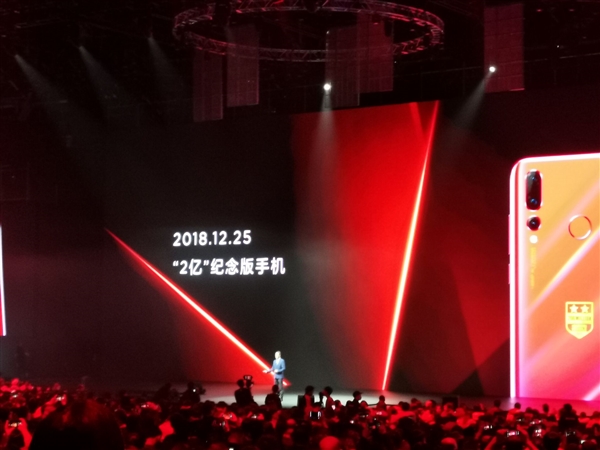
Apart from the slew of products it announced today at its event, Huawei also disclosed its shipments for the year. According to Huawei’s president of mobile division, He Gang, the company is set to cross 200 million units in shipments by December 25, 2018.
Back in July when Huawei unveiled the Nova 3, Huawei’s CEO, Yu Chengdong, revealed they had shipped 100 million smartphones this year. This means Huawei has been able to double that figure in just five months.
This year has been a bag of mixed blessings for Huawei. At the beginning of the year, it was supposed to launch its first phone on America’s network AT&T, but the deal fell through. The reason behind the failure was said to have been due to security concerns raised by the US Senate. So what would have been a big deal for Huawei didn’t pan out.
The brick wall it met at the beginning of the year might have slowed it down but it didn’t stop it from becoming the second largest smartphone company in the world in August, pushing Apple to third place in terms of market share.
Recently, Huawei suffered another setback as its Chief Financial Officer, Sabrina Meng Wanzhou, who is also the daughter of the company’s founder, Ren Zhengfei, was arrested in Canada based on US fraud allegations. She has now been granted bail but will appear in court in February.
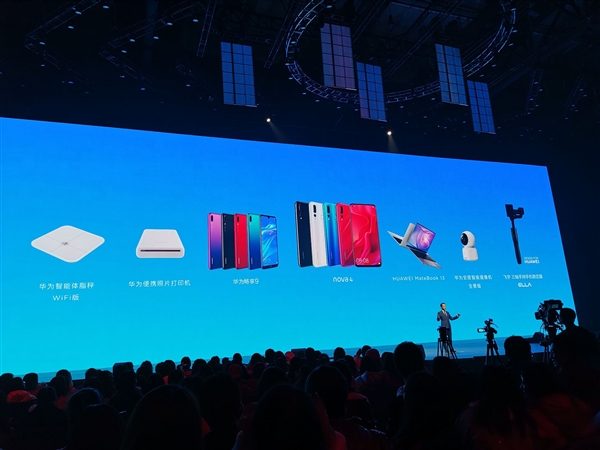
Huawei held a power-packed launch event today in China where the main attraction was the Huawei Nova 4 with its in-hole selfie camera. Apart from the Nova 4, several new products that were announced. The company unveiled the Enjoy 9, Matebook 13 and a slew of smart products such as a smart body fat scale, portable photo printer, security camera (panoramic version) and a three-axis phone gimbal.
Huawei Portable Photo Printer
Huawei’s portable photo printer uses a compact body that is the same size as a power bank. With ZINK inkless printing technology, it is convenient and environmentally friendly, and photo paper can be pasted. The portable printer also supports Huawei Share 3.0 which functions as data transfer protocol to different devices. However, in this case, Huawei Share 3.0 supports direct printing of pictures or data by connecting to the printer with a mobile phone. In addition, Huawei portable photo printer also supports AR photos, printing video keyframes, scanning of the printed photos to play AR video.
The portable photo printer comes with a price tag of 599 yuan ($86).
Huawei Smart Body Fat Scale (WiFi version)
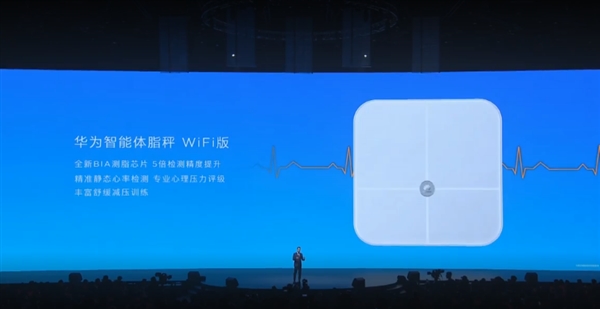
Huawei already has a smart body fat scale to its name but this is the WiFi version with more advanced features. The Huawei Smart Body Fat Scale doesn’t just detect your weight but also detects your body fat and heart rate. It comes with a comprehensive understanding of your physical conditions with 9 body composition analysis in 1 detection. Apart from weight, the smart scale also calculates the body mass index (BMI), Body Fat in percentage, protein, visceral fat, muscle fat, body water, bone mass, and BMR. The smart scale adopts high precision BIA chip, 4 pressure sensors, and 360° adjustable scale feet to achieve accurate & convenient measurement. The WiFi version will ensure that the data is readily available even when the user is not at home and perhaps, reminders can be delivered. The new Huawei Smart Body scale also detects the heart rate. It will sell for a price of 199 yuan ($28).
Huawei Smart Panoramic Security Camera
The new Huawei Panoramic security camera is equipped with dual silent motors and has a 360-degree panoramic view. The camera supports 1080p/30fps high-definition picture quality. It also comes with invisible infrared fill light and is equipped with a silent night vision recording feature. The smart camera is also equipped with artificial intelligence (AI) detection system which distinguishes it from ordinary cameras. It can accurately detect and notify about movements through humanoid recognition and can also track and capture motion. Thus, if the homeowner is outside, the alarm won’t sound based on facial recognition. The AI also enable the gadget to understand the environment at home. Further, the smart camera can provide real-time alarms for abnormal situations, and video messages can be pushed in real time.
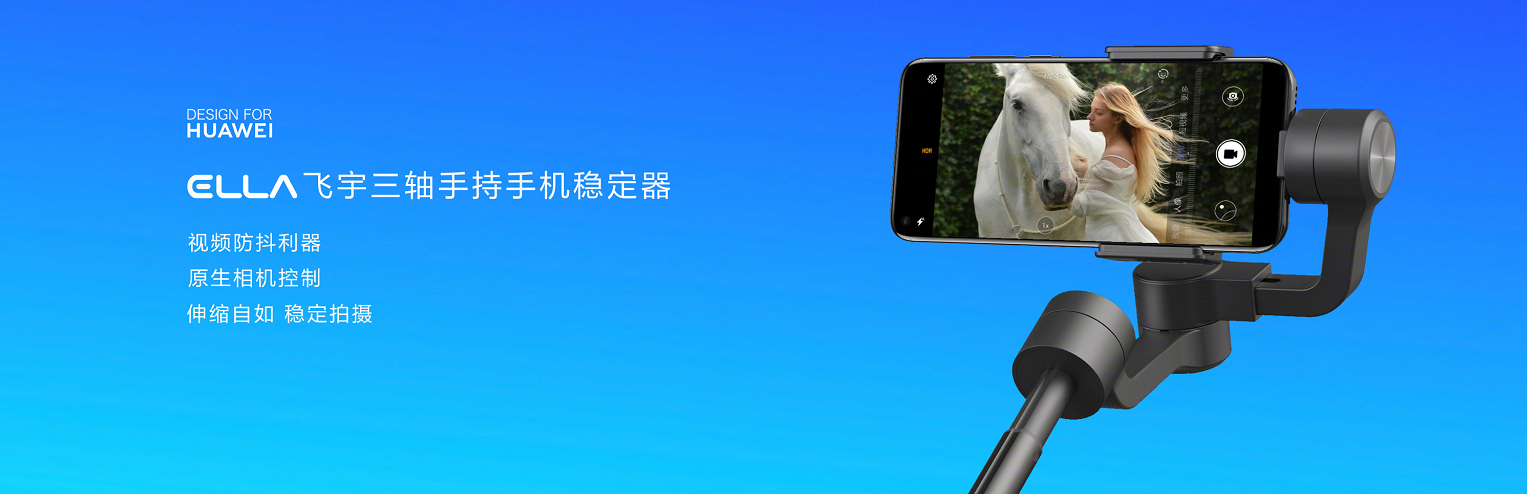
Huawei Handheld Phone Gimbal Stabilizer
Huawei also unveiled a new three-axis handheld gimbal stabilizer for mobile phones that can be used as a selfie stick as well.
Samsung is set to launch its upcoming flagship lineup — Galaxy S10 ahead of Mobile World Congress in February. Now, a new report from South Korea suggests that the company will also showcase its 5G smartphone during the MWC 2019 in Barcelona, Spain.
This isn’t surprising given that MWC is one of the biggest annual tradeshows for mobile devices and there were rumors suggesting that the South Korean giant could unveil a 5G smartphone at the event. The report also adds that the Galaxy S-series will be marking its 10th anniversary at the event.
The said 5G smartphone is expected to be a variant of Galaxy S10. However, it’s noteworthy that not all the Galaxy S10 models are 5G compatible. It appears that the idea behind announcing the 5G smartphone during Mobile World Congress 2019 is to mark the brand’s entry as one of the first companies to launch a 5G smartphone.
Samsung Galaxy S10 will have three models — Galaxy S10, S10 Lite, and S10 Plus and another variant made of ceramic which will be 5G-enabled. This 5G smartphone may only be produced in limited numbers and released in select markets.
Initially, the 5G phones from Samsung could be limited to its home country South Korea and the United States given that commercial 5G networks are expected to go live in South Korea and the US in the first half of 2019.
An earlier report hinted that the Samsung’s 5G phone will come with a 6.7-inch display and is tipped to feature a rear-mounted quad camera setup, a selfie camera, and a 3D sensing ToF camera. Powered by SD855 SoC, the phone may have up to 12GB RAM and 512GB internal storage. As for the color options, the phone will be available in Black and White colors.
Samsung has already confirmed a 5G smartphone for both Verizon and AT&T. Also, the company has confirmed another 5G device for AT&T arriving in the second half of 2019, which is likely to be the next Galaxy Note-series smartphone.
We use cookies on our website to give you the most relevant experience by remembering your preferences and repeat visits. By clicking “Accept”, you consent to the use of ALL the cookies.
This website uses cookies to improve your experience while you navigate through the website. Out of these, the cookies that are categorized as necessary are stored on your browser as they are essential for the working of basic functionalities of the website. We also use third-party cookies that help us analyze and understand how you use this website. These cookies will be stored in your browser only with your consent. You also have the option to opt-out of these cookies. But opting out of some of these cookies may affect your browsing experience.
Necessary cookies are absolutely essential for the website to function properly. This category only includes cookies that ensures basic functionalities and security features of the website. These cookies do not store any personal information.
Any cookies that may not be particularly necessary for the website to function and is used specifically to collect user personal data via analytics, ads, other embedded contents are termed as non-necessary cookies. It is mandatory to procure user consent prior to running these cookies on your website.


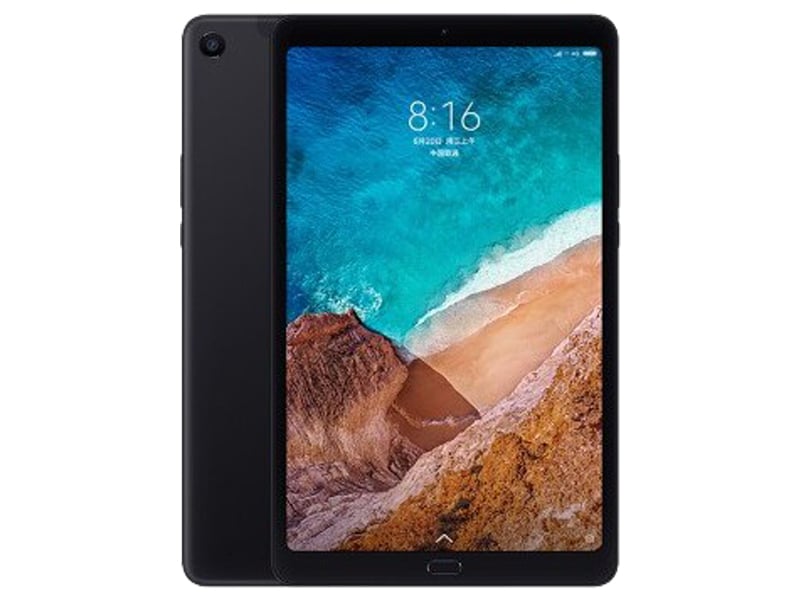 While the aforesaid products have been included in the ‘New Arrivals’ section, a slew of other well-received laptops and tablet PCs have been added in the following section called ‘Best Sellers.’ It is worth noting that all items featured in this category carry heavily discounted price tags.