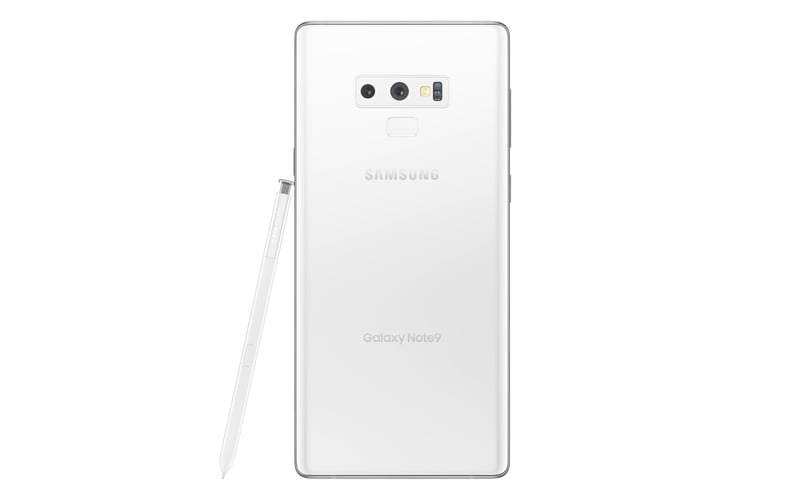
Last month, we reported that Samsung is gearing up to unveil a new color variant of its flagship phone Galaxy Note 9. After launching the new First Snow White color variant in Taiwan a few days ago, the company is all set to bring it to the Indian shores.
The Samsung Galaxy Note 9 was launched in India in August this year and is currently available in three color options — Metallic Copper, Midnight Black, and Ocean Blue. The Lavender Purple color is still not available in India. Now, it is expected to get the First Snow White color variant by the end of this month.
Teasing the upcoming color variant of the Samsung Galaxy Note 9, the company posted a teaser video on Twitter with the caption “A warm welcome for the coolest color of the year! Stay tuned.” Further, the teaser mentions “the color of the season” and the animation has snowflakes along with an outline of the phone and S Pen stylus.
To remind you of the phone’s specifications, the Samsung Galaxy Note 9 features 6.4-inch S-AMOLED screen with Infinity Display design, which carries support for Quad HD+ resolution that’s protected by a layer of Gorilla Glass 5. Qualcomm’s Snapdragon 845 octa-core processor is powering the device in some markets while in other markets, it is powered by the company’s own Exynos 9810 chipset.
The phone comes in two models — one with 6GB RAM and 128GB internal storage while another packs 8GB RAM and 512GB internal storage. It is not clear which variant will come in First Snow White color option, if not both.
As for the optics, the Galaxy Note 9 features a dual camera setup consisting of two 12-megapixel snappers. There’s an 8-megapixel front-facing snapper for taking selfies and video calling. It runs Android Oreo operating system out-of-the-box with the company’s own custom Samsung UX on top. The IP68 rated device is powered by a 4,000mAh battery that also supports fast charging technology.
A report from the previous month had claimed that the 5G smartphone from OnePlus arriving next year won’t be the successor of the OnePlus 6T. In other words, the OnePlus 7 won’t be launching as the first 5G phone from the company. During Qualcomm’s Snapdragon Tech Summit 2018 event in Hawaii, OnePlus CEO and founder Carl Pei confirmed that it will be the first company to launch a 5G smartphone. It indicates that the unnamed OnePlus 5G phone will be fueled by Snapdragon 855. The first market to receive the smartphone will be Europe.
Thrilled to announce our strategic partnership with EE on 5G – together with Qualcomm we look forward to launching the first 5G device in Europe! #OnePlus#EE#Qualcommpic.twitter.com/UnKMpGT5Pg
Through a tweet, Pei has confirmed that the company’s strategic partnership with EE carrier in the U.K and Qualcomm will result in the launch of the first 5G device in Europe. Recent reports have claimed that the 5G phone from the company will belong to a new lineup. Since it will be fueled by Snapdragon 855, it will be featuring the X50 LTE modem for 5G connectivity.
Through an official tweet, OnePlus has confirmed that it 5G ready smartphone will be announced in early 2019. It is being speculated that the OnePlus 5g phone may debut at the Mobile World Congress (MWC) tech expo in February. Three months ago, OnePlus confirmed that it would be announcing something on Jan. 15, 2019. Probably, the Chinese manufacturer will unleash the OnePlus 5G phone on the said date.
In an interview with The Verge, Pei claimed that the OnePlus 5G phone will be costing $200 or $300 more than the OnePlus 6T smartphone. The reason why OnePlus is launching the 5G phone early is that it wants its engineers to work on the nuances of 5G which will assist in launching 5G phones in future.
The 5G network of EE will be available cross 19 cities. The OnePlus 5G phone will deliver slower 5G speeds through sub-6 spectrum used by EE, but it will be available in wider markets. The 5G connectivity offered by EE will be slower than the speedier 5G network from AT&T and Verizon. After arriving in the Europe, the OnePlus 5G phone may land in the U.S. through the aforementioned carriers.
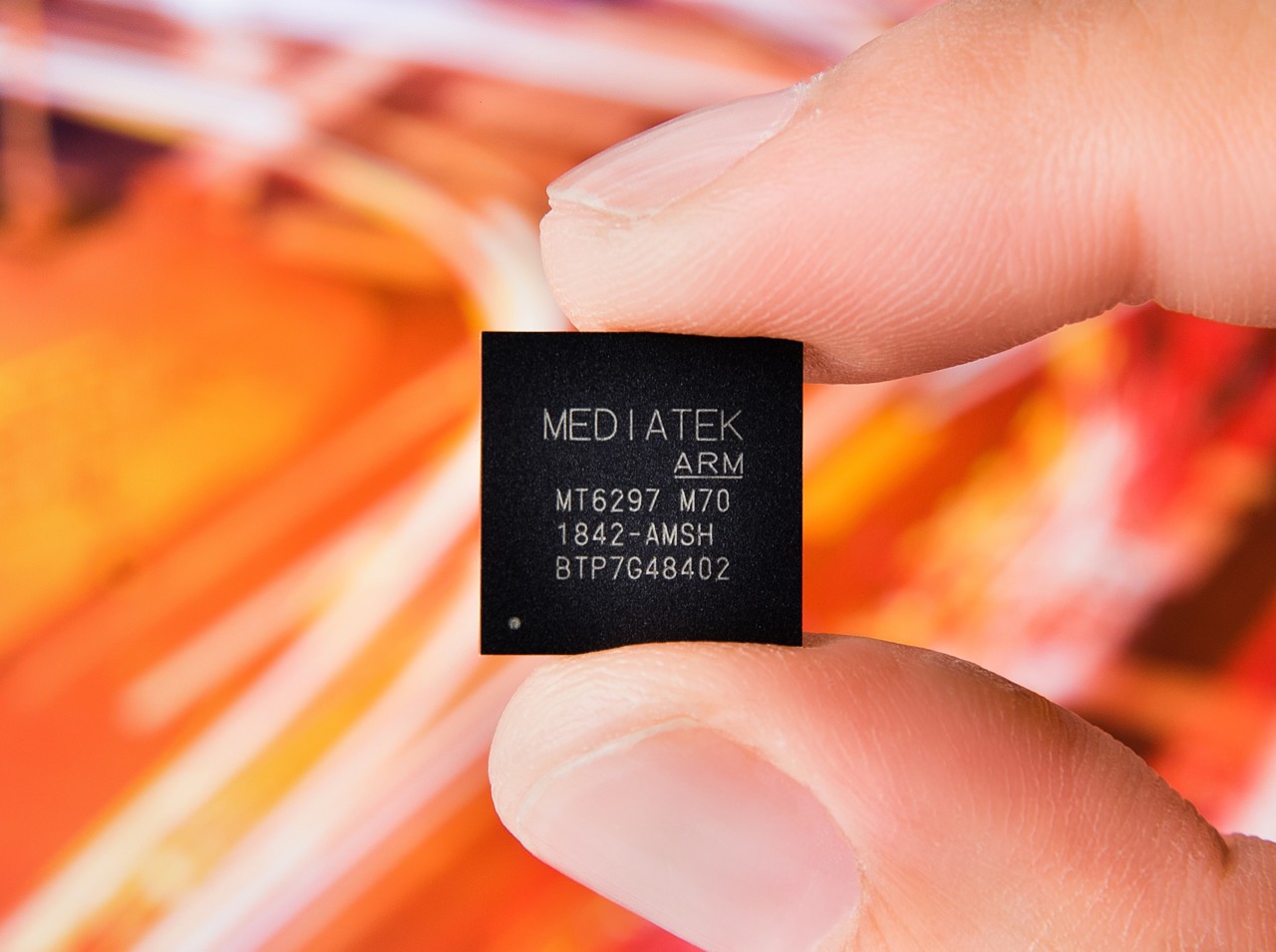
Soon after Qualcomm announced its latest flagship mobile chipset — Snapdragon 855 — with support for 5G connectivity, its rival MediaTek has now officially announced the MediaTek Helio M70 5G baseband chipset in China, which was first announced in Taiwan earlier this year.
The MediaTek Helio M70 is a multimode chipset with support for 2G/3G/4G/5G-enabled connectivity. It supports 5G radio (NR), along with the standalone (SA) and non-standalone (NSA) network architectures, the sub-6GHz frequency band, high power user equipment (HPUE), and other key 5G technologies.
The company says that the chipset is designed in compliance with the 3GPP Rel-15 new specifications with 5 Gbps data rate, leading the industry to support carrier aggregation. TL Lee, General Manager of MediaTek Wireless Communications Division, said:
MediaTek is committed to promoting the adoption of the latest technologies. With the commercialization of the first 5G baseband chipset, Helio M70, consumers will be able to enjoy the exciting 5G experience from a mature and complete solution. In the future, 5G and AI application areas will continue to grow, enhancing the connected experience for users in areas such as mobile phones or smart living.
The chipset aims to deliver an improved experience for customers and end users. For this, the MediaTek Helio M70 baseband chipset supports LTE and 5G dual connectivity (EN-DC) and ensures that the mobile devices are backward compatible with 4G/3G/2G in the absence of 5G networks.
According to MediaTek, the Helio M70 is able to design a 5G terminal device with a slim design advantage, helping manufacturers to design smaller, lower power mobile devices. MediaTek has announced that the Helio M70 baseband chipset is now available and is expected to ship in devices in the second half of 2019.
Being a member of the “5G Device Forerunner Initiative”, MediaTek’s 5G solutions will be powering industry partners to drive forward the development of 5G devices. For the development of 5G technology, the company collaborated with industry leaders including China Mobile, Huawei, Nokia, NTT DOCOMO, and others to establish a 5G industry ecosystem.
In the past few months, Xiaomi has improved the camera on its smartphones to a considerable extent. The company’s devices launched this year have garnered excellent ratings from DxOmark. The latest device to acquire this kind of rating is Xiaomi Mi Mix 3 which carries 12 megapixels +12 megapixel primary camera on the rear side while a 24 megapixel + 2-megapixel sensors sit on the front side. Now, Xiaomi has posted its new algorithm DeepExposure AI which helps to restore poorly exposed photos.
Most of the mobile cameras have the problem of poorly exposing photos if the light is brighter or if it is too dark. Hardly, except few manufacturers, no one has got any success of eliminating the poorly exposed photos. Today, Xiaomi has introduced DeepExposure AI algorithm which will help balance your photos with accurate lights and details.
Xioami has employed AI to fix this issue to over or underexposed photos. Xiaomi’s DeepExposure balance the exposure by dividing the photo into subfragments and then the exposure value of each fragment is adjusted separately. Finally, different parts are merged to form the final image. You can have a look at the overall process in the image below.
“The accurate exposure is the key of capturing high-quality photos in computational photography, especially for mobile phones that are limited by sizes of camera modules,” the researchers wrote. “Inspired by luminosity masks usually applied by professional photographers, in this paper, we develop a novel algorithm for learning local exposures with deep reinforcement adversarial learning.”
The new algorithm divides the whole process into image segmentation and “action-generation” stage. After segmentation, the second part starts with input low-resolution, sub-images, and direct fusion of the image takes place. All the photos are processed with each’s local and global exposures.
While the market is brimming with laptops, phablets, and tablets that boast an impressive array of features, these devices usually carry steep price tags. If you’re looking for a cost-effective tablet or a laptop that doesn’t cost a bomb, we got good news for you. GeekBuying has teamed up with top brands that manufacture high-end mobile devices and laptops in a bid to offer cost-conscious buyers an opportunity to get their hands on these devices without emptying their pockets. So without further ado, let’s delve straight into the details.
Teclast X6 Pro 2 in 1 Tablet PC
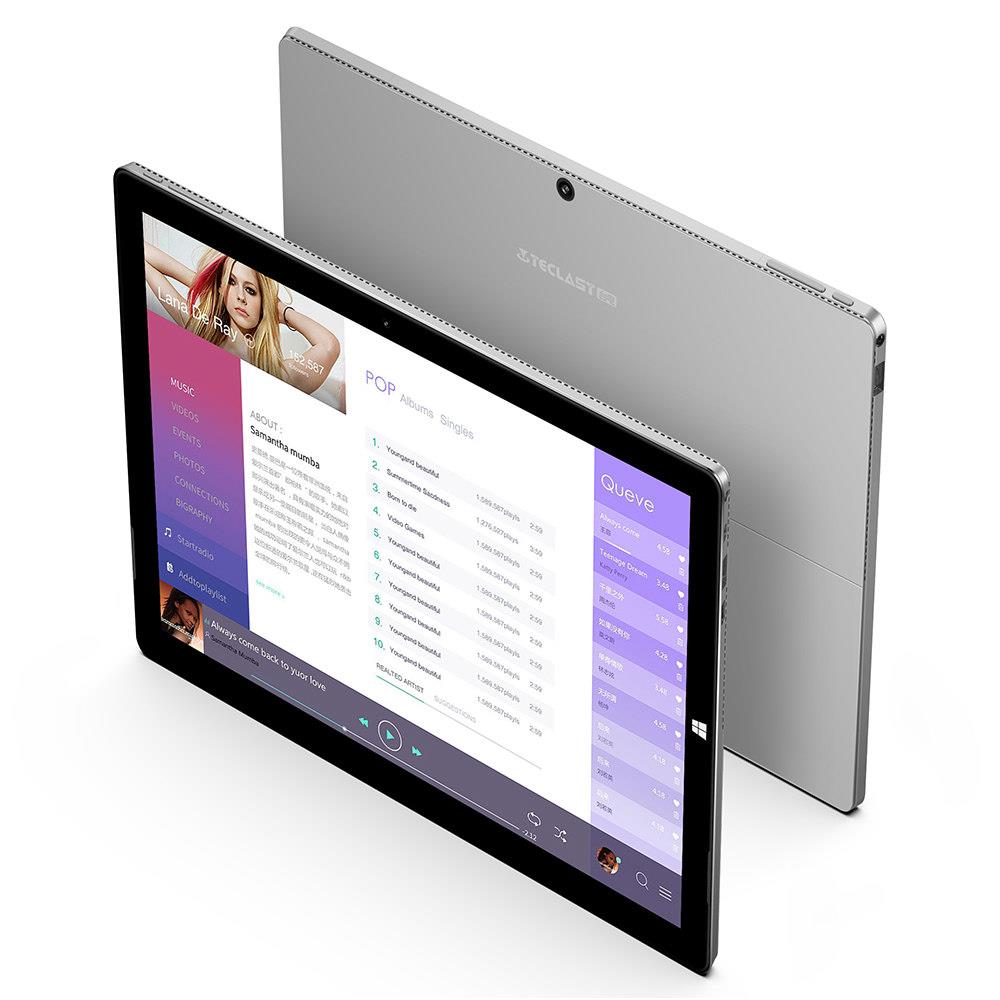
The X6 Pro is an irresistible tablet PC that packs the powerful Intel Core m3-7Y30 Dual Core processor along with a highly competent Intel HD Graphics 615 GPU, under the hood. It ships with 8GB of RAM and offers a hearty 256GB of onboard storage.
Moreover, the X6 Pro sports an eye-catching 12.6-inches 3K display with a screen resolution of 2880 x 1920 pixels. While you’d normally associate a steep price tag with a tablet PC offering comparable features, the X6 Pro has gone up for sale carrying a lowered price tag of just $479.99 on GeekBuying. This a noteworthy 27% reduction in the device’s original asking price of $654.99. In addition to taking advantage of this discount, you can use coupon code GIZ_ZUCLPILO to get an extra $55 off before you proceed to checkout.
In other words, you can bring your already lowered grand total further down to just $474.99 simply by applying the aforesaid coupon, which is likely to expire soon. Since the promo was on the verge of wrapping up at the time of writing, you can head straight to this link to avail the discount without wasting time.
Teclast M20 4G Phablet
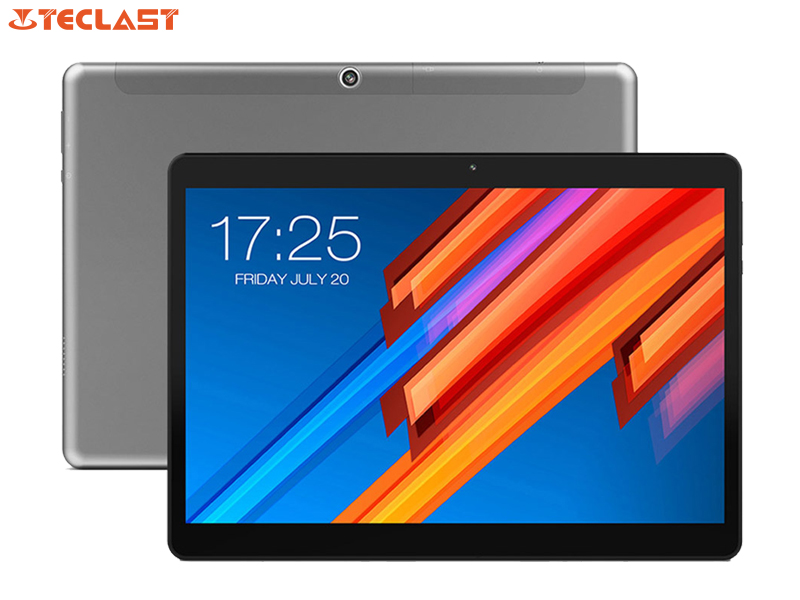
The M20 phablet from Teclast has features worthy of your attention too. It sports an extra large 10.1-inch Retina display with a screen resolution of 2560 x 1600 pixels for a superior video watching experience.
Moreover, it is powered by MediaTek MT6797, Deca Core 2.3GHz processor and has a Mali-T880MP4 graphics processor that delivers higher quality images, seamless casual gaming and photo editing experience. It comes with 3GB of RAM and 32GB of internal storage. The M20 normally sells for $233.99, but in a bid to make this feature-laden 4G phablet available to cost-conscious buyers, Teclast is now offering a 38% off on the device’s original asking price. As a result, the M20 can now be yours if you’re willing to shell out just $145.89 on GeekBuying.
You can use coupon code GIZ_GKB127T to get an extra $23 off before placing your order. Your cart total drops down to $142.99 once you apply this coupon. However, it is imperative for you to bear in mind that this discount is valid only for a limited period of time. If you’re interested in receiving this discount, you can visit this link.
Teclast P10 4G LTE Phablet
The P10 phablet is a great choice for playing popular games, watching your favorite movies and performing various other tasks simultaneously. It is powered by MTK6737 Quad Core processor and it uses Mali-T720 graphics processing unit to breathe new life into your photos and videos.
As a phablet, the P10 features a mammoth 10-inch HD display with 1280 x 800 pixels resolution for your visual enjoyment. This slim phablet is housed in a durable metal body and can easily be carried everywhere you go as it weighs in at only 550 g. Its dimensions are 239mm ×166.9mm ×8.9mm. Much to the delight of those living on a tight budget, the Teclast P10 is now available for a heavily discounted price of only $119.99 on GeekBuying. This is a 20% decrease in the device’s original selling price of $149.99.
On top of that, you can save an extra $15 simply by applying coupon code GIZ_GKB126T clicking on the ‘Place Your Order’ button. As soon as you apply the above-mentioned coupon, your cart value reduces to just $104.99.
You can follow this link to grab the discount before the promotion comes to an end.
YEPO 737A Laptop
While there’s no dearth of high-end laptops in the market, these devices would normally set you back a pretty penny. If you are looking for a feature-rich laptop that you can buy without breaking the bank, the YEPO 737A might just fill the bill.
Featuring a 13.3-inches display with a screen resolution of 1920 x 1080 pixels, the 737A laptop provides an enhanced overall experience of watching videos, browsing the web and playing games. It is equipped with Intel Celeron J3455, Quad Core, up to 2.3GHz processor along with 6GB of RAM and 256GB of onboard storage.
Moreover, the YEPO 737A laptop runs Microsoft’s latest Windows 10 operating system and is backed by a built-in 4000mAh Li-ion battery that delivers longer battery life. The device’s body is made using high-quality metal but it is still 0.6cm thin and weighs in at only 1.22kg, making it extremely light and portable. This YEPO-branded laptop normally carries a $380.99 price sticker, but you can now buy it for just $284.99 on GeekBuying. Moreover, you can extend this 25% discount to save $34 more by applying coupon code GIZ_GKB125T. Your grand total reduces to only $275.99 after using the aforesaid coupon.
You can head straight to this link to avail this big discount, which is valid for the gold color version of the laptop and use the coupon before it expires. Note that the promotion is slated to end in 5 days.
According to reports, the Honor View 20 will launch on January 22, 2019, in Paris. The phone is expected to come with a hole in its display for the front camera and a Kirin 980 processor. More specs have now surfaced thanks to its UAProf.
Details revealed by the UAProf include its screen resolution and Android version. The Honor View 20 which has model number PCT-L29 will have a 2310 x 1080 display. It will also run EMUI 9.0 based on Android Pie out of the box.
The phone has already been certified by the European by the EEC and it will also launch in Honor’s home country with model numbers PCT-AL10 and PCT-TL10.
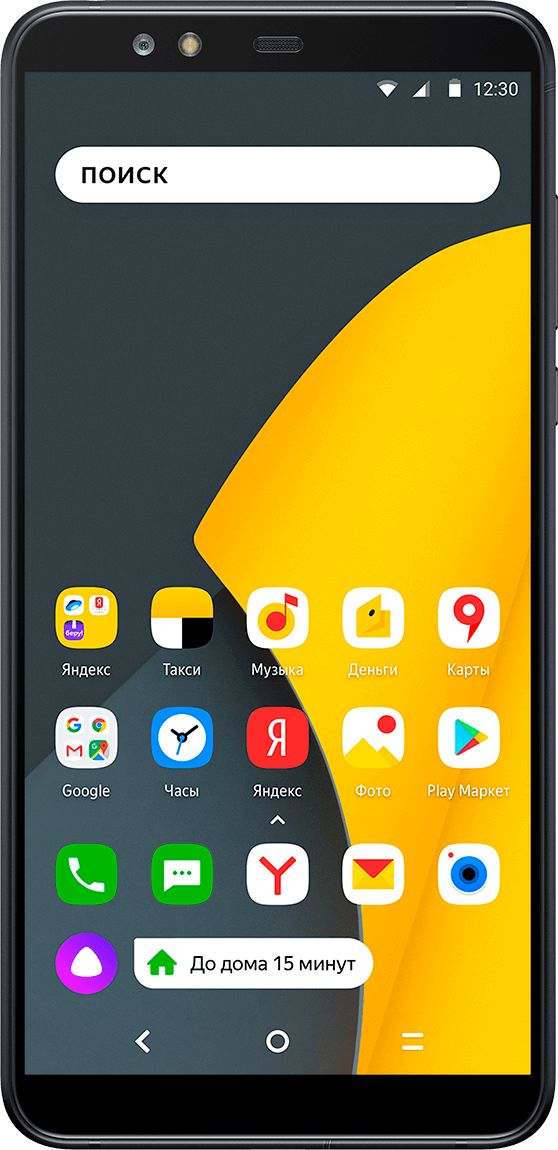
Google may be the most popular search engine in the world but in some countries, it takes the back seat. For example, in Russia, the popular search engine is Yandex. The latest news is that Yandex has launched its first smartphone, the Yandex Telephone and it comes with its own voice assistant pronounced Alissa (sounds familiar?) but translates to Alice.
When it comes to specs, the Yandex Telephone can’t hold a candle to Google’s new Pixel smartphones. It has a 5.65-inch FHD+ LCD display, a Snapdragon 63. processor and 4GB of RAM. Built-in storage is 64GB and a hybrid dual SIM slot will let you use a MicroSD card for adding up to an extra 128GB.
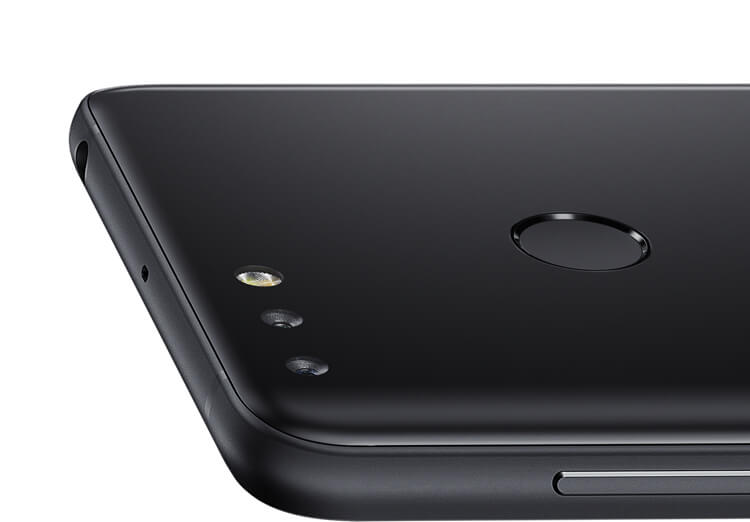
On its rear is a 16MP + 5MP dual camera combo and a fingerprint scanner while the front is home to a 5MP camera with its own LED flash for brighter selfies.
The Yandex Telephone has an audio jack on top and Qualcomm Aqstic™ on board for better audio quality. There is NFC for contactless payment and it works with Yandex.Money, the search engine’s version of Google Pay.
The phone has a 3,050mAh battery with support for Quick Charge 3.0, a USB-C port and dual-SIM dual LTE support,
Another main feature of the phone is its own voice assistant, Alissa/Alice which can do a lot of stuff such as identify songs, set reminders and alarms, give directions, make calls, and tell you about the weather etc.. You can also chat with it and play games with it if you are bored.
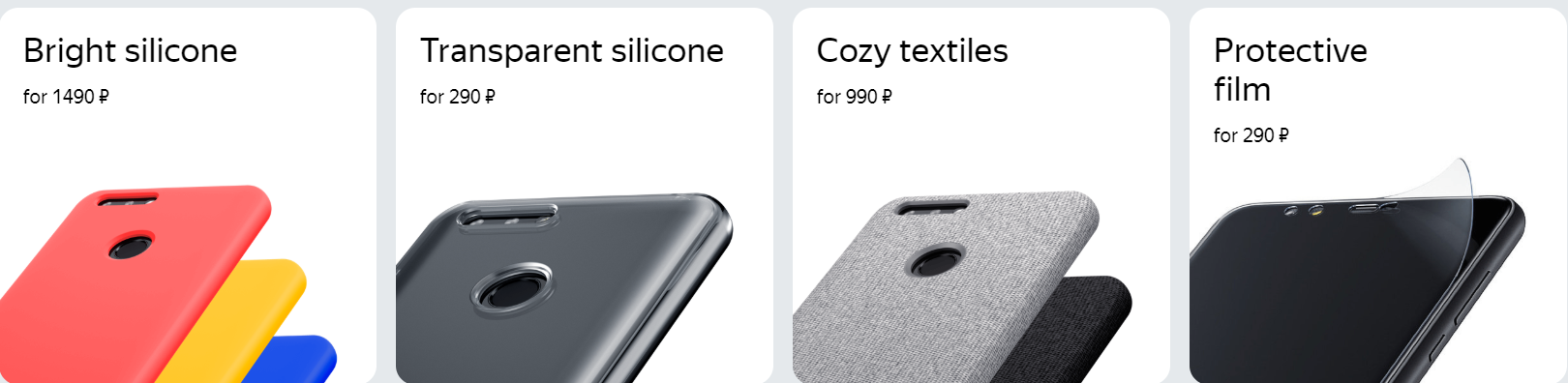
Yandex also says the phone has unlimited photo and video storage backup just like the Pixels. There are also some bunch of official cases made from different materials including silicone and fabric and a protective film to cover the screen.
ASUS will be announcing the ZenFone Max Pro M2 and ZenFone Max M2 in certain markets like India and Indonesia on Dec. 11. However, both the phones have gone official in Russia since they have been found listed on the Russian edition of the company’s website. The official listings of the phone have not only revealed their specs, but also their pricing.
The ASUS ZenFone Max M2 has a 6.3-inch IPS LCD screen that offers 19:9 aspect ratio. The notched screen offers HD+ resolution of 1520 x 720 pixels. The Snapdragon 632 chipsets the phone. It includes 3 GB of RAM and 32 GB of native storage. It is equipped with a dedicated microSD card slot. For photography, there is an 8-megapixel + 2-megapixel vertical dual camera setup on the rear and a front-facing camera of 13-megapixel. The handset features a 4,000mAh battery.
The ASUS ZenFone Max Pro M2 has the same-sized notched display as the Max M2, but it carries support for Full HD+ resolution of 2280 x 1080 pixels. It features a smaller than the M2 handset. The Snapdragon 660 chipset powers the phone along with 4 GB of RAM. It has a native storage of 64 GB. A dual camera setup featuring 12-megapixel and 5-megapixel sensors are available on the backside of the Max Pro M2. It is also equipped with a 13-megapixel selfie snapper. Its packed with a massive 5,000mAh battery.
Both phones are loaded with stock version of Android 8.1 Oreo OS. The Taiwanese company has already confirmed that the ZenFone Max Pro M2 will be the first mid-range phone to feature Gorilla Glass 6 protection. As it can be seen in the above renders, the ZenFone Max M2 has a metal unibody whereas the Max Pro M2 has a glass rear.
A third party Russian retailer is offering the ZenFone Max Pro M2 in 4 GB RAM + 64 GB storage and 4 GB RAM + 128 GB storage versions. The official online store will begin the pre-orders of the Max Pro M2 from Dec. 12. It will be priced at RUB 17,990 (~$270) for the base model. The ZenFone Max M2 costs RUB 12,990 ($195) in Russia. These handsets are respectively available in Black and Blue colors in the country.
If you’ve restlessly been waiting to get your tech-greedy hands on smartphones that boasts an impressive array of features and top-end specs, you’ve come to the right place.
Known for offering the best bang for your buck, Banggood is now doling out big discounts on select mobile devices that have garnered huge popularity among Xiaomi fans and tech buffs after hitting the store shelves.
We’ll not only divulge more details about the discounts but also show how you can save extra money during the checkout process.
Xiaomi Redmi 6A Global Version (2GB RAM+16GB ROM)
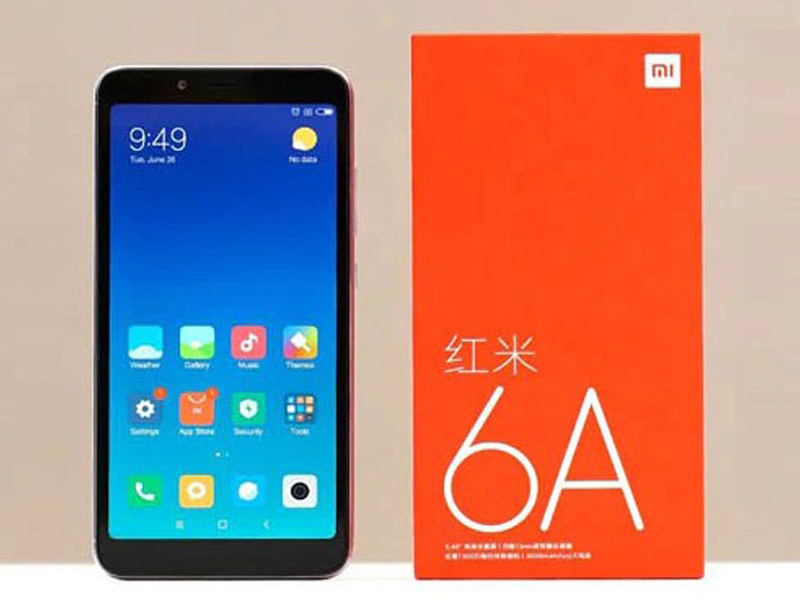
Xiaomi made the long-awaited Redmi 6A smartphone available to the public in June this year. Following in the footsteps of its well-received predecessors, the handset became an instant hit among smartphone lovers.
Taking its popularity into consideration, Xiaomi is now offering the Redmi 6A smartphone for a considerably lowered price of $105.99 on Banggood. This is a 19% drop in the device’s original asking price of $129.99 and you can even extend further by using coupon code 12BGR6A1. The aforesaid coupon helps you bring your already lowered grand total further down to just $94.33 before you proceed to check out. In other words, the coupon helps you get an extra $11.66 off without breaking much of a sweat.
You can avail this discount on the black and gold color versions of the Redmi 6A smartphone by heading straight to this link before the promo ends.
Xiaomi Mi 8 Global Version (6GB RAM+128GB ROM)
After floating around the rumor mill and making several appearances online in the form of leaks, the Mi 8 was finally launched earlier this year. While the phone is loaded with awe-inspiring features and packs top-end specifications, it doesn’t come cheap.
In fact, the global version of the Xiaomi Mi 8 smartphone would normally set you back $648.99 on online or offline stores. If you have been waiting to buy this Xiaomi-branded smartphone without emptying your pockets, it might interest you to know that the Mi 8 is now up for sale carrying a dropped price tag of $428.28 on Banggood.
This is a 34% reduction in the black color version of Mi 8 smartphone’s original selling price. Alternatively, you can go for the blue color version of the smartphone if you’re willing to shell out $438.28. Note that the blue-tinted Mi 8 smartphone usually sells for $658.99.
Aside from taking full advantage of this discount, you can use coupon code 12BGM8CL to get an extra $38.55 off on the phone’s already lowered retail price. As a result, you end up paying just $389.73 for this power-packed Mi 8 smartphone from Xiaomi.
You can follow this link in order to ensure you do not miss this opportunity to buy the well-received black and blue color versions of the Xiaomi Mi 8 smartphone at unbeatable prices.
Xiaomi Mi 8 Pro Global Version (8GB RAM+128GB ROM)
The Mi 8 Pro was launched in September this year and grabbed everyone’s attention with its expansive screen and high screen to body ratio. While the smartphone’s impressive features completely justify the steep price tag it carries, you can now get your hands on the Mi 8 Pro for only $599.99 on Banggood.
This is a significant 27% decrease in the phone’s original asking price of $816.31. But if that doesn’t impress you much, you can use coupon code BGM8PG to save a considerable amount of extra money before placing your order.
The above-mentioned coupon helps you get your already reduced cart total further down to just $509.99. As a result, you end up getting an extra $90 off on this feature-laden smartphone’s retail price.
You can head straight to this link to check out the full specifications of the Mi 8 Pro and grab the discount, which is currently valid for the phone’s transparent black color version before the promo wraps up. Note that the coupon is also likely to expire soon.
While big-screen mobile devices continue to garner huge popularity among those who fancy watching their favorite videos and playing popular games in full-screen mode, these devices don’t come cheap. Capable of breathing new life into your videos and photos with its extra large 6.41 inches Super AMOLED capacitive touchscreen display, bearing a screen resolution of 1080 x 2340 pixels and an aspect ratio of 19.5:9, the Vivo V11 was launched earlier this year.
Aside from sporting a bigger display than most mobile devices available in the market today, the V11 boasts an impressive array of other features that make it an irresistible phablet. Before we divulge more details about the phablet’s high-end specs and features, it might interest you to know that the V11 has gone up for sale carrying a heavily discounted price tag on GearBest.
While the Vivo V11 phablet would normally set you back a pretty penny on online as well as offline stores, you can now buy it for just $449.99 on the popular Chinese online electronics store. This is a significant 18% reduction in the device’s original asking price of $547.44. An absolute bargain at this price, the V11 packs a powerful Qualcomm Snapdragon 660 processor along with a highly competent Adreno 512 GPU, under the hood. It ships with 6GB of RAM and offers a hearty 128GB of onboard storage that can be expanded further up to 256GB so that you can save your favorite content without worrying about running out of space.
On the photography front, the V11 houses a 12.0MP+5.0MP dual camera setup on the back and a 25.0MP selfies shooter with useful features like Face Beauty, Face Detection, and Panorama Shot. It runs Funtouch OS 4.5-based Android 8.1 Oreo operating system and is backed by a built-in 3400mAh battery.
The dual-SIM phablet comes with numerous sensors including E-compass, Fingerprint Sensor (under display), Gravity Sensor, Light Sensor, and Gyroscope. Moreover, you can get the aforesaid discount on the phablet’s popular blueberry blue color version.
If the Vivo V11 4G phablet has stirred your interest, all you need to do is to follow this link without wasting time since the promo is slated to end soon.
Looking for the best gift for someone who loves photography this Christmas? Banggood’s got your back!
As part of its latest ‘Christmas Photography and Camera Accessories Sale’ promo, the Chinese online store is giving users an opportunity to get up to 63% off on a wide selection of high-end cameras and various accessories. So without further ado, let’s check out the details.
The promo has been split into multiple categories so that users can easily find what they’re looking for. The ‘Digital Cameras’ section is brimming top-branded digital cameras that would be great gifts for professional photographers as well as kids.
More importantly, the cameras featured in the aforesaid section are up for grabs carrying unbeatable prices. For instance, there’s a 23% off on the Pink Blue 5MP F3.1 Mini Children Kids 16MB Memory 2.0 TFT Screen Camcorder DV Camera that normally sells for S$20.88. Thanks to the discount, you can now buy this compact camera for a lowered price of just $15.99. It is worth noting though that the discount will only be valid on the pink and blue color versions of the camera until December 13th.
If you are an adventure junky who fancies capturing the memorable moments during your adventurous outdoor activities, you might want to take a gander at the ‘Sports Camera & Accessories’ section. Not only is this section brimming with amazing cameras and accessories, but these items are also available for heavily discounted prices.
Likewise, the ‘Camera Accessories’ category is brimming with creative and useful gadgets for photography lovers. All items included in this section carry noteworthy discounts that you can take advantage of for a limited period of time.
The ‘Flash & Accessories,’ ‘Lenses&Accessories,’ and the ‘Studio Equipments’ are all packed with essential accessories for shooting superior videos and capturing amazing photos with your camera.
If you prefer using your mobile phone for videos and photos, you can head straight to the ‘Mobile Phone Photography’ section where you can find various accessories that can be used to take better photos and videos using a mobile phone.
You can click here to visit the promotion page and grab these amazing discounts without wasting time.
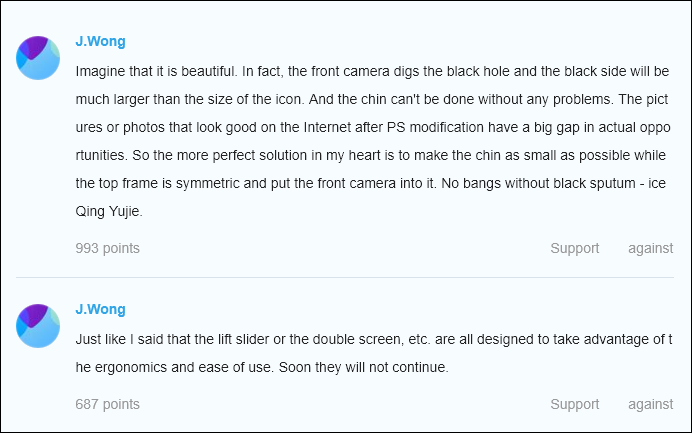
Meizu’s president Jack Wong has been a strong critique of the different display designs OEMs have severally adopted to help trim off the bezels on top of their phone’s display. J. Wong who is also known as Huang Zhang is an ardent fan of symmetrical design on smartphones. So, it shouldn’t surprise you that he has at one time criticized the notch design and even the waterdrop notch that recently featured on the OnePlus 6T and a couple of other smartphones.
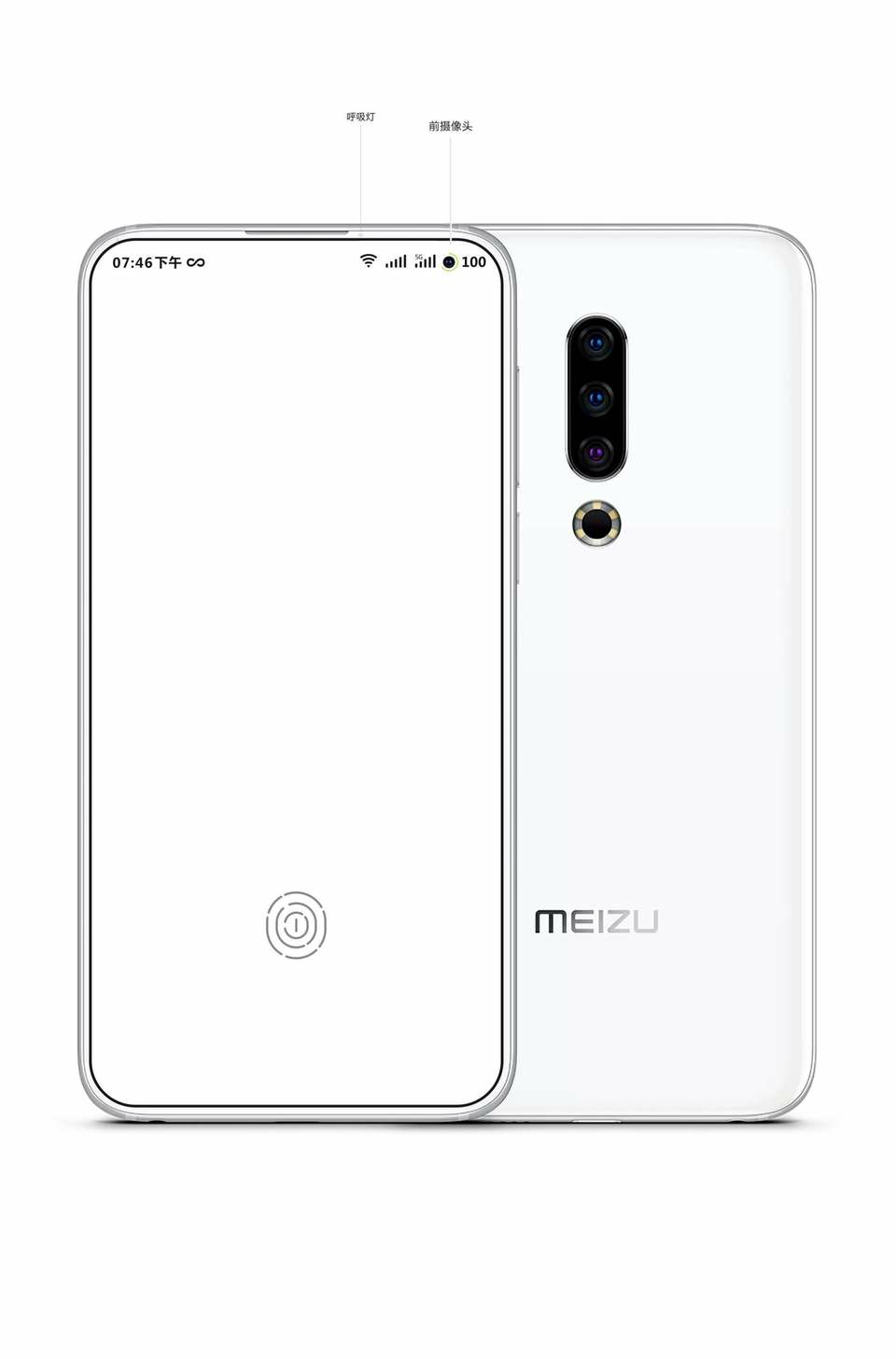
Recently, Samsung and Huawei were reported to be working on a hole-in display design for their next-gen flagship models. The Meizu founder has shared is thought once again on the design style which will soon go official on the Galaxy A8s and the Huawei Nova 4. A fan had shared the render of a Meizu phone with the hole-in display design, having the camera sensor inserted on the same plane with the status bar. The render also shows the device packs an in-display fingerprint sensor. Huang Zhang was quick to respond, pointing out that the size of the sensor and the dark spot will be bigger than the size of the icons on the status bar. So, it can’t look that cool in real life. Huang Zhang still reiterated his earlier opinion that trimming the bezels on the chin and then inserting the camera on the top bezels with both ends symmetrical, still is the best option at the moment.
This is the design style Meizu utilized on the Meizu 16th and from all indications, the company will retain this design on the Meizu 16s series expected to be launched in May next year. As Meizu’s 2019 flagship, the Meizu 16s series may be equipped with the Qualcomm Snapdragon 855 mobile platform. The platform is equipped with the fourth-generation multi-core AI engine which provides a highly intuitive machine-backed AI experience. Compared with the previous generation Snapdragon 845, the Snapdragon 855 AI performance will be increased by 3 times.
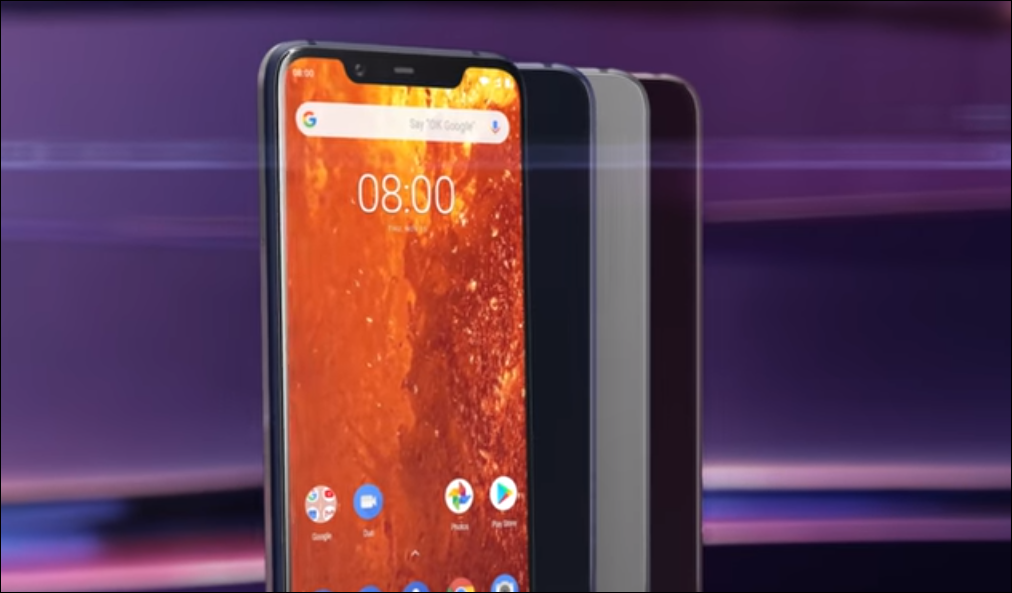
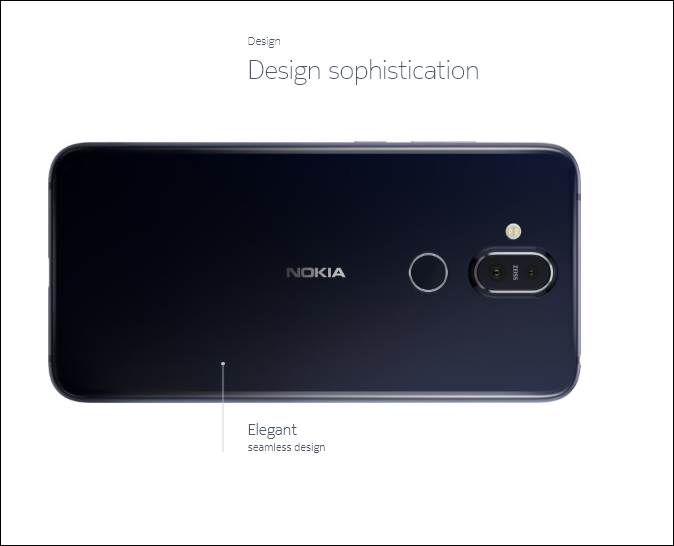
HMD Global’s much-anticipated event was held today in the Dubai, United Arab Emirates (UAE). The Finnish company was expected to launch the Nokia 3.1 Plus, 5.1 Plus and Nokia 8.1 for the global market. Surprisingly, the event was devoted exclusively to Nokia 8.1 as no mention of the duo of Nokia 3.1 Plus and 5.1 Plus was made during the event. The Nokia 8.1 has been officially unveiled and just as expected, it is the global version of the Nokia X7 which was announced in China not too long ago.
The Nokia 8.1 strives to fit in as a successor of the Nokia 7 Plus. The device comes with a premium design and a very decent hardware, including the latest Android 9.0 Pie software. It features a metallic body forged from a series-6000 magnesium alloy frame wrapped with glass panels on both the front and rear end w-th a copper rim. This gives the device a premium look. The Nokia 8.1 utilises the latest display technology which HMD calls Pureview display technology. It is actually a 6.18-inch IPS LCD screen with a notch at the top and an 18.7:9 aspect ratio. The display features an FHD+ resolution of 2246 x 1080 pixels and an impressive 86.5-percent screen ratio. The Nokia 8.1’s display also comes with a 96-percent NTSC color gamut, DCI-P3 color gamut, HDR video playback, 1500:1 contrast ratio and 500nits of brightness.
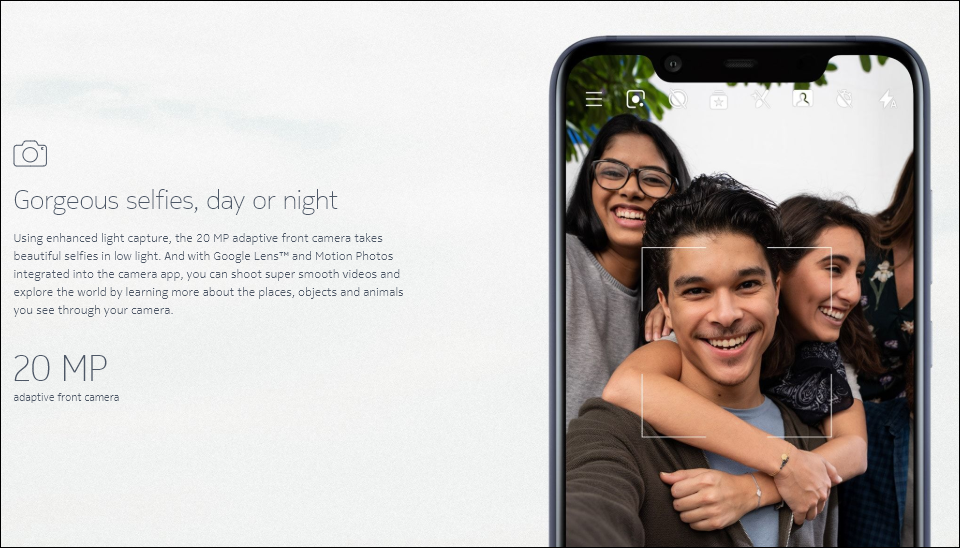
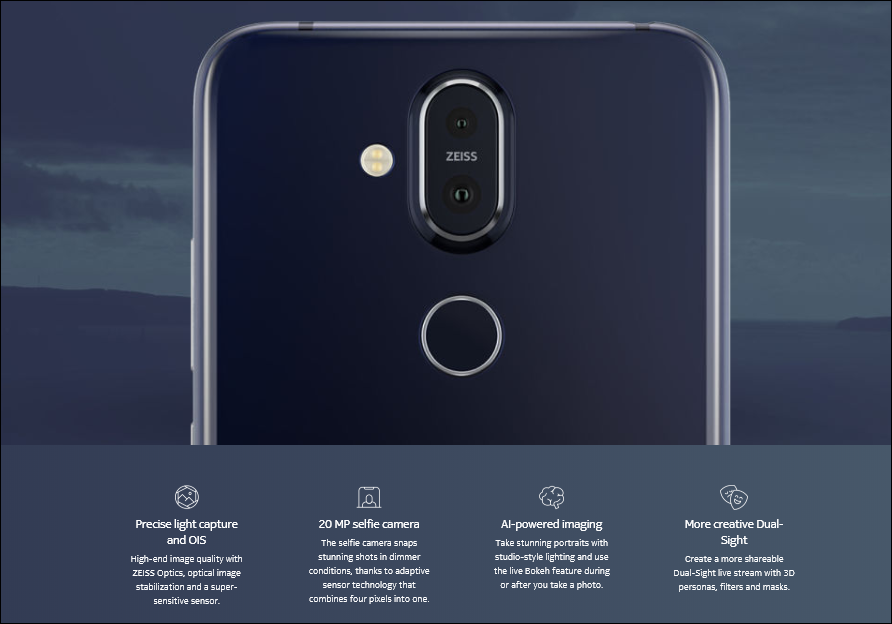
The device is powered by the latest 10nm based Snapdragon 710 chipset paired with 4GB of RAM and 64GB of expandable storage. The memory options could be expanded to include the 6GB RAM variant in other markets. The device is dropping under the Android One program and runs Android 9.0 Pie out of the box. Perhaps, the most outstanding feature on the device is the photography capabilities. The device packs a dual camera setup at the rear. The main sensor is a 12MP Sony IMX363 sensor paired with aa 13MP depth sensor. The rear camera comes with features such as Optical Image Stabilization, Electronic Image Stabilization, dual PDAF, AI scene detection and optimization for low-light photography. Up at the front, housed on the notch alongside an earpiece and other sensors, is a large 20MP selfie shooter.
The Nokia 8.1 packs a 3500mAh battery which Nokia claims can deliver up to two days of battery power. You also get a rear-mounted fingerprint sensor, Quik Charge 3.0, dual-SIM support, 4G VoLTE, Wi-Fi 802.11ac, Bluetooth 5.0, GPS, USB-C and 3.5mm audio jack.
Pricing and Availability
The new Nokia 8.1 will be available in three colours; Blue Silver, Steel Copper and Iron Steel. The device is announced with a retail price of 399 Euros and will go on sale in the UAE on December 15 and other parts of the Middle East on December 20. However, it is now open for pre-order for the Middle East market. The device is also billed to enter other markets like India in no distant time.
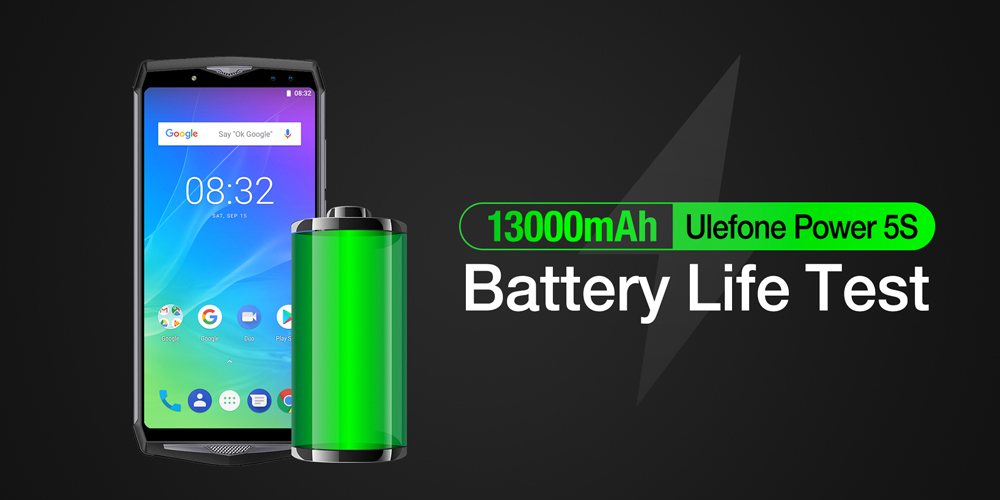
Ulefone recently launched a smartphone with massive 13000 mAh battery for full throttle usage throughout 2-3 days. In a recently posted video of its battery life test, Ulefone has managed to score pretty well in terms of usage and its impact on battery life. In the video below, you can have a look at the different tests that the company performed to showcase its 13000 mAh battery life usage.
At the beginning of the video, you can see a full half an hour session for 4G online music streaming via its external speakers. Later, a 30 minutes video playing is done, in a combined effort. Overall, the smartphone dropped only 8% maintaining 92% battery life after using it for 90 minutes. As touted by the company, Ulefone A5 can sustain a week-long battery life with moderate usage.
Additionally, Ulefone Power 5s powered by an octa-core processor and is coupled with 4GB RAM and 64 GB internal storage. It features a 6.0-inch display with an aspect ratio of 18:9. In the camera department, Ulefone Power 5S packs a dual camera module of 21 megapixels + 5-megapixel shooters on the rear side while another dual shooter of 13 megapixels and 5 megapixels has made its appearance on the front side for selfies and better video calls.
In connectivity, it carries WiFi, Bluetooth, WiFi, face unlock and fingerprint ID. It runs on the Android 8.1 Oreo and includes a Light sensor, Proximity sensor, Accelerometer, Compass, Gyroscope. Its battery can charge other devices also as it supports reverse charging. In order to fasten up the charging process of this huge 13000 mAh battery, Ulefone has added 5V/5A fast charging technique. It helps the user to save a lot of time in charging up 13000 mAh battery.
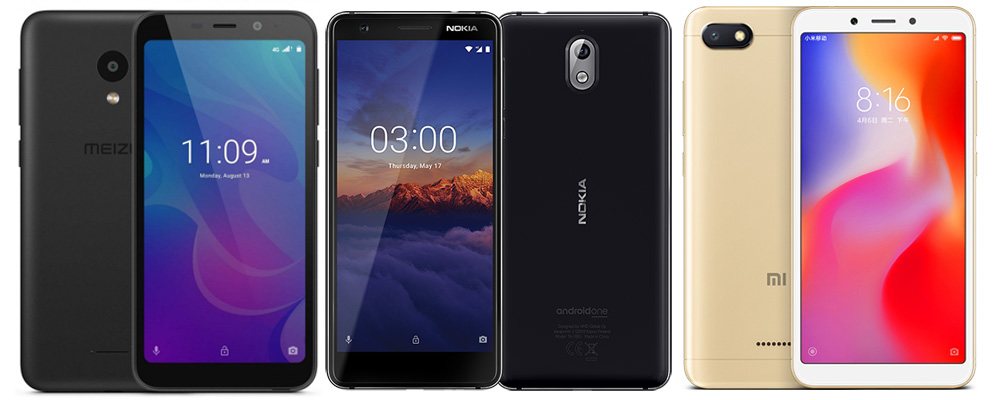
Meizu just unveiled a brand new entry-level smartphone in India. Its name is Meizu C9 and for the first week, you can get it for just $50. It belongs to the lowest price range, so it is a perfect rival of the other cheapest devices out there. Here, we compared it with two devices we believe to be the best low-end handsets currently available: Nokia 3.1 and Xiaomi Redmi 6A, in order to see if it is worth getting a unit of the C9 or not.
Meizu C9 has the cleanest and most interesting design, with narrower bezels around the display, but Nokia 3.1 is the most compact phone. All of these handsets are made of polycarbonate and do not feature a premium design, so you should make a choice based on your tastes. Xiaomi Redmi 6A is similar to full metal unibody phones and some may like it, but it is just plastic. On the other hand, it has the thinnest body with just 8.3 mm.
Display
Thanks to the IGZO technology, Meizu C9 can provide a better display quality which results in a high brightness, a fast response and less energy consumption. Nokia 3.1 has a smaller display which makes the phone more compact and easy to use with just one hand, and it is also the only one to feature the Gorilla Glass protection by Corning making it more resistant. Xiaomi Redmi 6A’s display has really nothing special, it is just a sufficient IPS entry-level panel.
Specs & Software
When it comes to hardware, the champion is definitely Xiaomi Redmi 6A because it is equipped with a more powerful SoC. We are talking about the Helio A22 by MediaTek running at a max frequency of 2 GHz and realized with a 12 nm production process. Further, Xiaomi Redmi 6A has a dedicated micro SD slot. Nokia 3.1 comes with a sufficient MediaTek SoC, while Meizu C9 has the new Unisoc SC9832E which does not seem so convincing with its 1.3 GHz. Note that while Xiaomi Redmi 6A and Meizu C9 have custom user interfaces (MIUI and Flyme OS), Nokia 3.1 comes with the stock Android One updated in a faster and more constant way directly by Google.
Camera
The most impressive camera department is the one on board of the Nokia 3.1. It features a rear 13 MP sensor with a f/2.0 and an 8 MP front camera with exactly the same aperture as well as the HDR technology. It is able to shoot better photos and selfies, but it still remains an entry-level camera phone. At the second place, we put Meizu C9 because of its pretty nice front camera for a device sold at just €60. The worst one seems to be the Xiaomi Redmi 6A because of its average selfie camera.
Battery
All of these devices provide more or less the same battery capacity and they can reach one day with a moderate use thanks to their well-optimized energy consumptions. We still did not test the Meizu C9, but the results obtained by Nokia 3.1 convinced us slightly less because it does not last very long in some scenarios. Usually, Xiaomi optimizes its phones better in terms of consumption, but we still have to see how Meizu C9 performs.
Price
After the first week, Meizu C9 will cost about €90, while Nokia 3.1 are available at prices of €90 and €150. The phone with the best value for money is currently the Xiaomi Redmi 6A, I would pick it for its good performance, its micro SD dedicated slot, and its long-lasting battery. But if you want a stock and bloatware-free operating system which gets faster updates, Nokia 3.1 is better. Even if it does not have the best hardware, the stock Android experience on a small and entry-level might make the difference for some users.
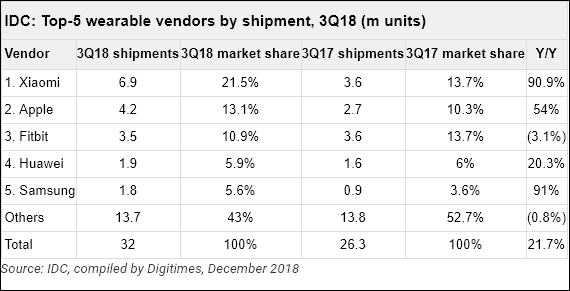
Latest data released by IDC indicates that the global shipments of wearable devices reached 32 million units in the third quarter of 2018, up 21.7% from the previous year. The data shows that the astronomical rise in shipments YoY is due to a sporadic increase in the number of new wearable devices OEMs introduced during the quarter. Specifically, new products from the likes of Fitbit, Garmin, and Huawei were shown to have helped the basic wearables category return to growth during the quarter.
The data also showed that growing demand in markets like Asia-Pacific (excluding Japan) was another driving factor and this accounted for more than half of all shipments. The growth in these markets was up to 21.4% higher than the previous year, according to IDC. The US market transitioning from one driven by new users to one that relies on replacement devices and upgrades and so, the market declines 0.4% Year on Year.
In the third quarter under review, Xiaomi grabbed the top position, thanks to the success of the Mi Band 3 and its significant expansion beyond its home country of China. Though typically China accounts for well over 80% of Xiaomi’s shipment volume, this quarter that share fell to 61% as the company managed to grow its presence in other markets such as India, Europe, and Middle East and Africa.
Closely following, is Apple which managed to launch its Series 4 Watch, its first watch approved for medical use, towards the end of the quarter. The new design and sizes along with the latest version of Watch OS were welcome changes although the latest series only accounted for less than 20% of all Apple Watch shipments. The reduced price on the still affable Series 3 accounted for the majority of Apple’s shipments during the quarter.
On the third spot is Fitbit whose latest devices, including the Versa, Charge 3, and the Ace, helped the company slow its decline compared to previous quarters. The success of the Versa catapulted the company back into reckoning as the second largest smartwatch vendor. IDC expects this to continue in the near term. Furthermore, Huawei edged Samsung to maintain its number four position worldwide but the majority of the firm’s wearable devices were sold in China. On the other hand, the Honor sub-brand introduced a new set of earphones that tracks heart rate during workouts.
The fifth spot is occupied by Samsung which stretched its lead past other contenders. Samsung’s product arsenal isn’t too broad and it relies on the Gear S3 and Fear Fit wristbands to drive sales volumes. The company also launched its next-generation smartwatch, the Galaxy Watch, marking the first time that a wearable device moved away from its traditional “Gear” moniker to the “Galaxy” sub-brand, alongside its smartphones and tablets.
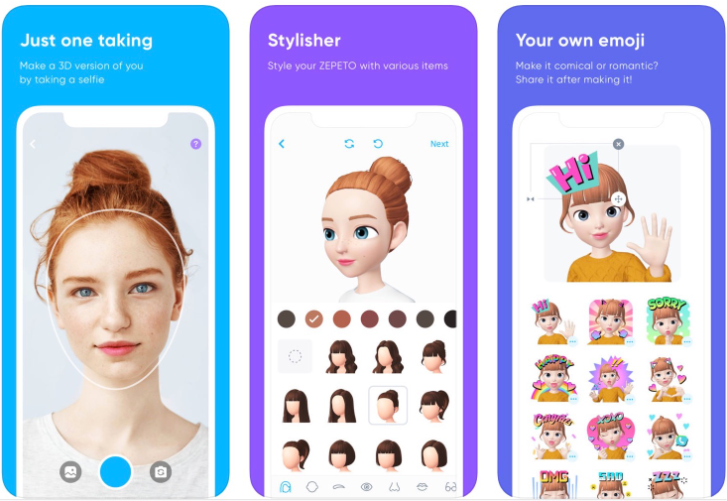
A relatively lesser known 3D avatar app from Korea, Zepeto, recently became a hot trend in some regions of Asia and even in the US. Following that, the app is also now getting a lot of attention in China. According to Tech Node, the hashtag #玩zepeto停不下来# (“can’t stop playing Zepeto”) is being hit hundreds of millions of times on Weibo. Moreover, Baidu searches for the term “Zepeto” have grown exponentially in the last few days. The app has no Chinese version and the recent surge in popularity is also causing trouble for the platform servers, said Zepeto’s official Weibo account.
Zepeto was previously in the news after suspicions and rumors that it was tracking user location. The 3D avatar creator developed by Snow Corporation lets users make 3D avatars of themselves allowing them to meet randomly or through chat rooms and even take virtual selfies. Avatars can be given many different facial features and can be dressed in all sorts of attire. The app itself is free, but like many others, serves ads to keep itself sustainable.
The Korean version isn’t quite Chinese-friendly but it is still in trend right now. After the new surge in popularity, Snow Corporation has agreed to launch a China-specific app called Zaizai by the end of this year. After that happens, Chinese users with the global version will be given the option to migrate to the new app. Zepeto’s creator, Snow Corporation is also behind popular messaging app Line that is used widely in certain Asian countries.
Huawei is set to announce the Nova 4, its first phone with a hole in its display on December 17. Its sub-brand, Honor, has now announced it will launch its own about a month later in Paris, France.
According to AndroidHeadlines, Honor has confirmed that it will hold a global product launch on January 22 in France. It also revealed the phone will be powered by the Kirin 980 processor, the same chipset inside the Magic 2.
The poster for the event shows the silhouette of the upper part of a phone with a camera hole in the top left corner. The poster also has the tagline “See The Unseen”.
Honor already confirmed that it is working on successors to the Honor V10 (View 10) and Honor 10, so there is a high chance it is one of these devices. The Honor View 20 should launch this month but Honor confirmed it is being delayed. We believe that delay has led to it being pushed to January.
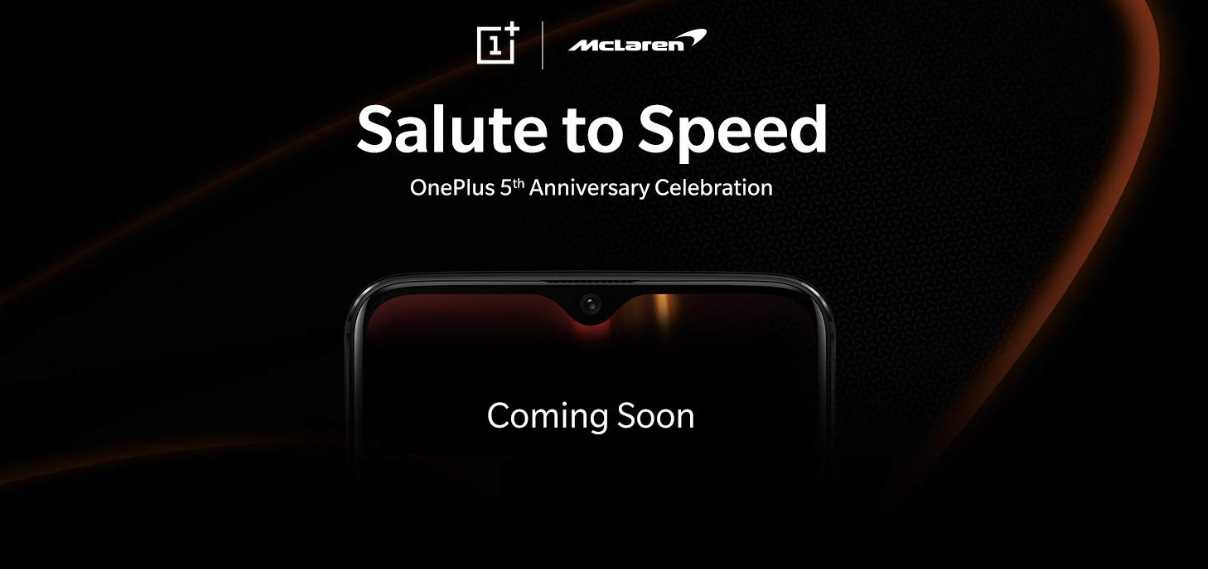
Soon after OnePlus introduced the Thunder Purple variant of the OnePlus 6T, the Chinese smartphone maker announced that it would be releasing a special OnePlus 6T McLaren Edition. The handset is the result of a collaboration between OnePlus and popular automotive maker McLaren. The OnePlus announcement follows OPPO’s recent move to release a special Lamborghini Editon Find X as well as Huawei’s Porsche Editon Mate devices being released for a few years. Now, pre-registration for the handset has kicked off in India and potential buyers can visit Amazon India to get notified about future updates regarding the upcoming device.
The OnePlus 6T McLaren Edition is arriving in India on December 12 when the company also celebrates its fifth-anniversary ‘Salute to Speed’ event will be held at Richardson and Cruddas Limited and passes for the venue can be purchased from OnePlus at a cost or Rs 799 via Oneplus.in starting December 6 at 10 am IST. The special edition OnePlus 6T will go on sale the very same day in the country and those present at launch will be able to get hands-on at the experience zones set up at the venue.
The brand will also be making the special edition debut in China on December 14. As for what extra the special edition will offer, it should come with a new paint job like previous OnePlus special edition phones. It is also expected to house 10GB of RAM and 256GB of onboard storage. This also warrants an expensive price tag and there could likely be McLaren branded accessories as well with the device. Head over to the source link below to register for the device.
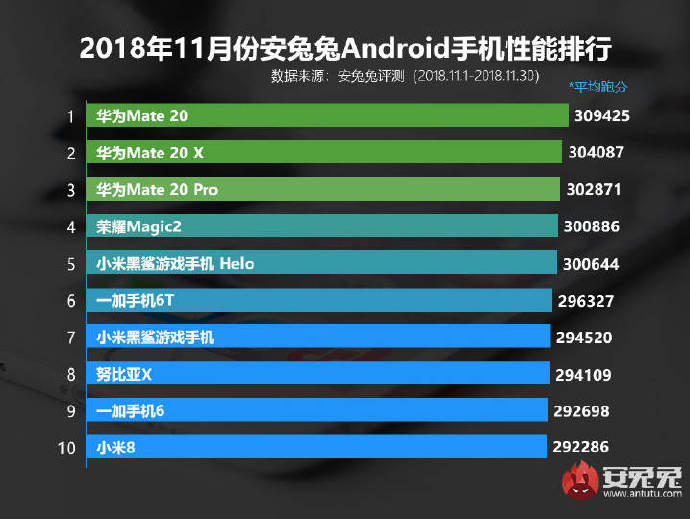
November ended a few days ago and as it has become a norm, AnTuTu has released the list of its top 10 most powerful devices (Android) for the month. And just like the list for October, the Kirin 980-powered phones are at the top of the list.
The Mate 20 is at the top of the list with 309,425 points though it is lower than its score in October. Second on the list is the Mate 20 X with 304,087 points. In October’s list, the Mate 20 Pro was second but it has now been overtaken by the Mate 20 X. The Honor Magic 2 grabs the fourth spot with 300,886 making it the fourth Kirin 980-powered device on the list.
We use cookies on our website to give you the most relevant experience by remembering your preferences and repeat visits. By clicking “Accept”, you consent to the use of ALL the cookies.
This website uses cookies to improve your experience while you navigate through the website. Out of these, the cookies that are categorized as necessary are stored on your browser as they are essential for the working of basic functionalities of the website. We also use third-party cookies that help us analyze and understand how you use this website. These cookies will be stored in your browser only with your consent. You also have the option to opt-out of these cookies. But opting out of some of these cookies may affect your browsing experience.
Necessary cookies are absolutely essential for the website to function properly. This category only includes cookies that ensures basic functionalities and security features of the website. These cookies do not store any personal information.
Any cookies that may not be particularly necessary for the website to function and is used specifically to collect user personal data via analytics, ads, other embedded contents are termed as non-necessary cookies. It is mandatory to procure user consent prior to running these cookies on your website.



 GeekBuying has teamed up with top brands that manufacture high-end mobile devices and laptops in a bid to offer cost-conscious buyers an opportunity to get their hands on these devices without emptying their pockets. So without further ado, let’s delve straight into the details.
 This a noteworthy 27% reduction in the device’s original asking price of $654.99. In addition to taking advantage of this discount, you can use coupon code GIZ_ZUCLPILO to get an extra $55 off before you proceed to checkout.
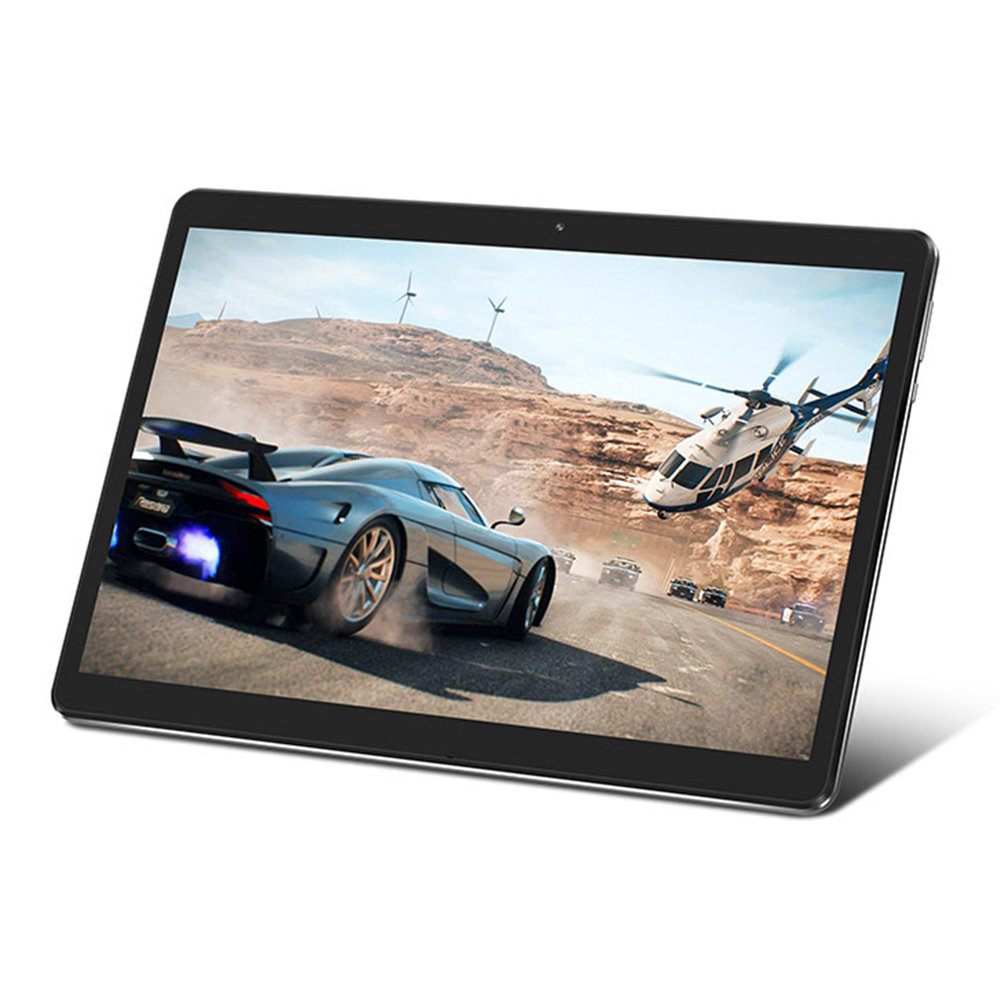 The M20 normally sells for $233.99, but in a bid to make this feature-laden 4G phablet available to cost-conscious buyers, Teclast is now offering a 38% off on the device’s original asking price. As a result, the M20 can now be yours if you’re willing to shell out just $145.89 on GeekBuying.
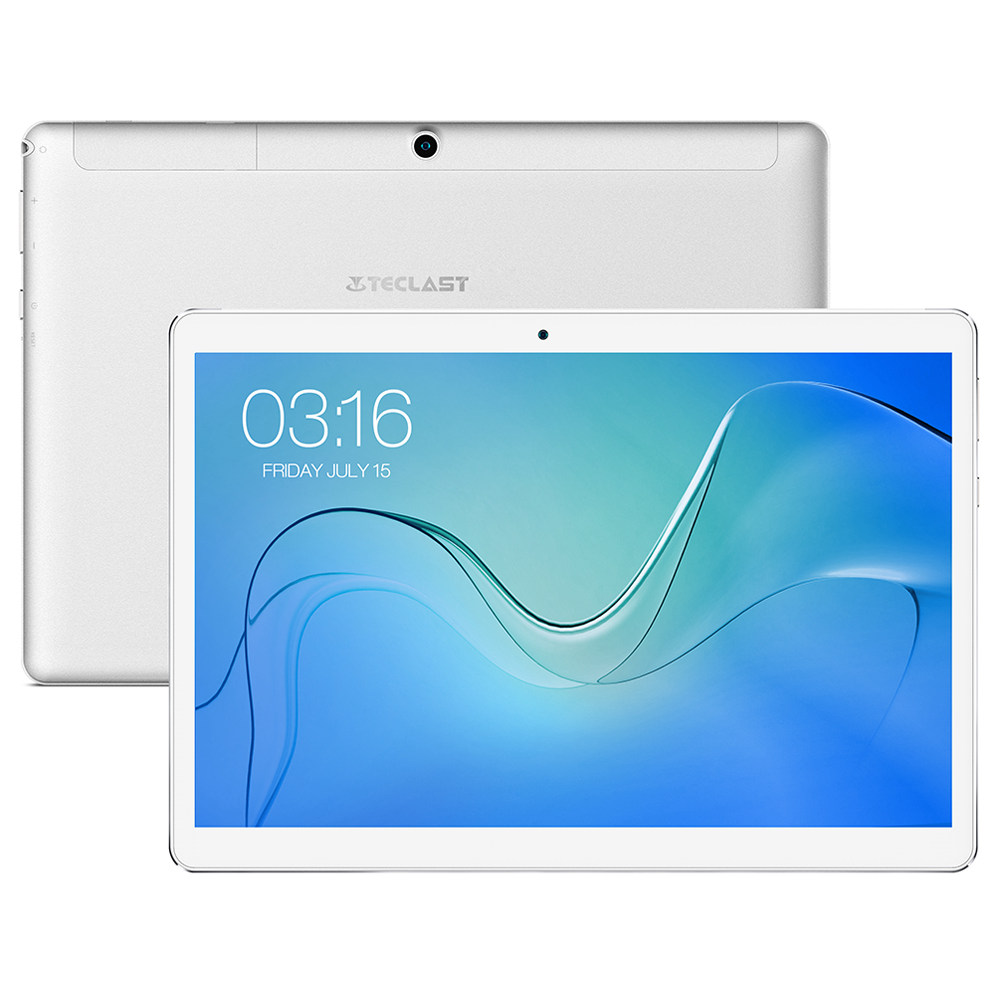 Much to the delight of those living on a tight budget, the Teclast P10 is now available for a heavily discounted price of only $119.99 on GeekBuying. This is a 20% decrease in the device’s original selling price of $149.99.
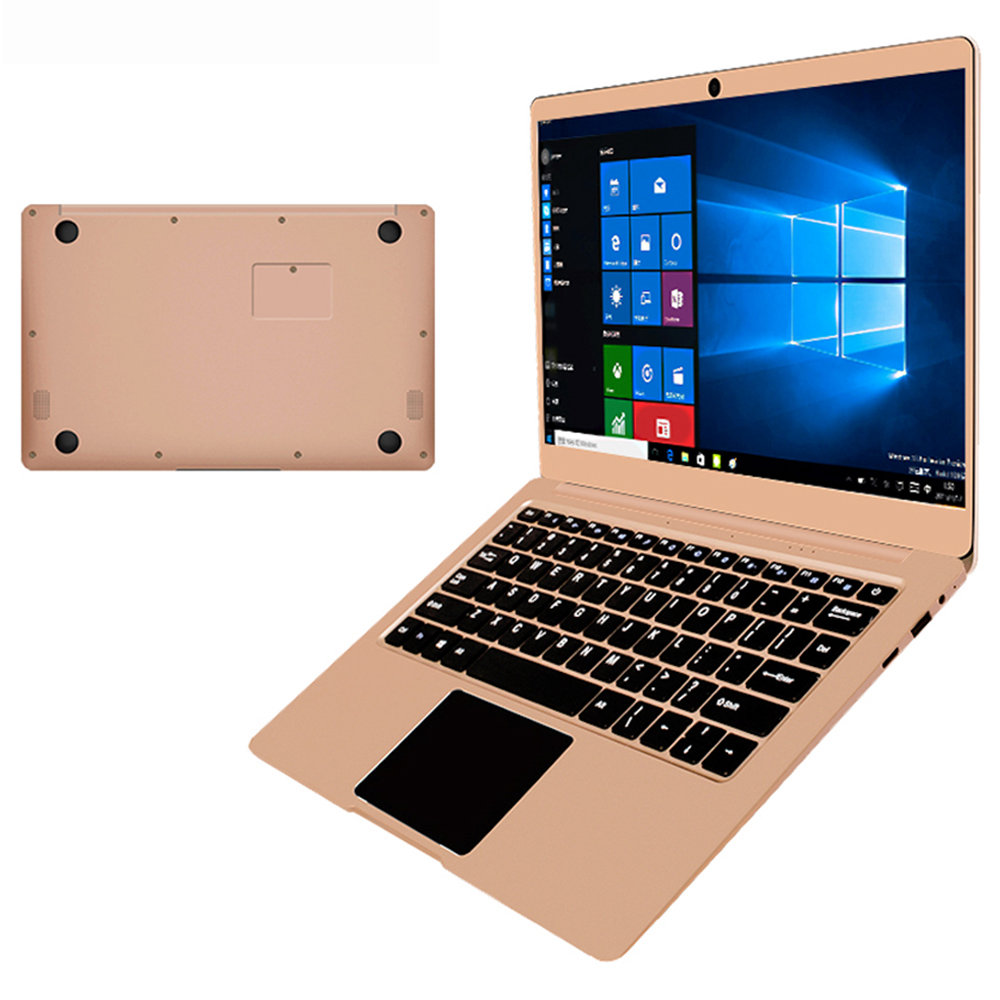 This YEPO-branded laptop normally carries a $380.99 price sticker, but you can now buy it for just $284.99 on GeekBuying. Moreover, you can extend this 25% discount to save $34 more by applying coupon code GIZ_GKB125T. Your grand total reduces to only $275.99 after using the aforesaid coupon.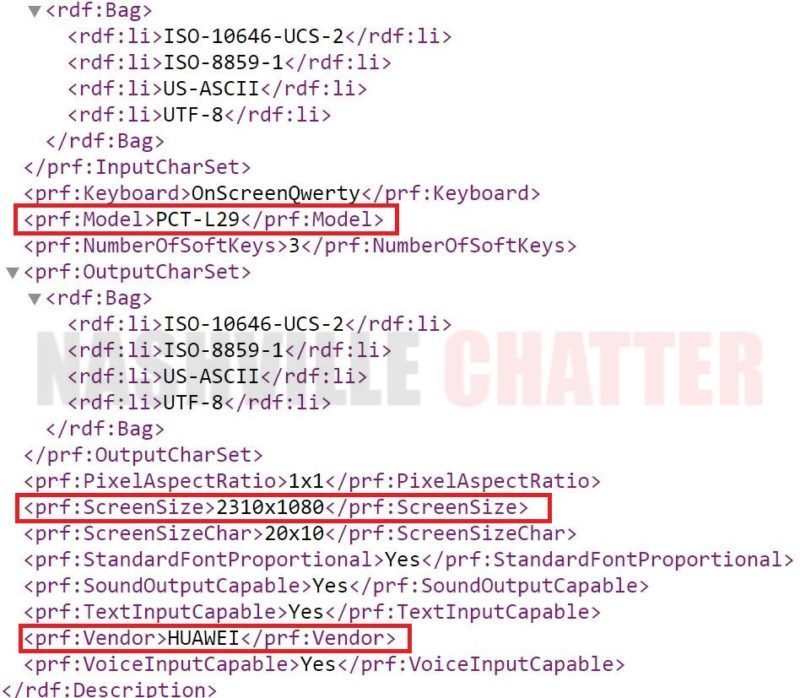


 Known for offering the best bang for your buck, Banggood is now doling out big discounts on select mobile devices that have garnered huge popularity among Xiaomi fans and tech buffs after hitting the store shelves.
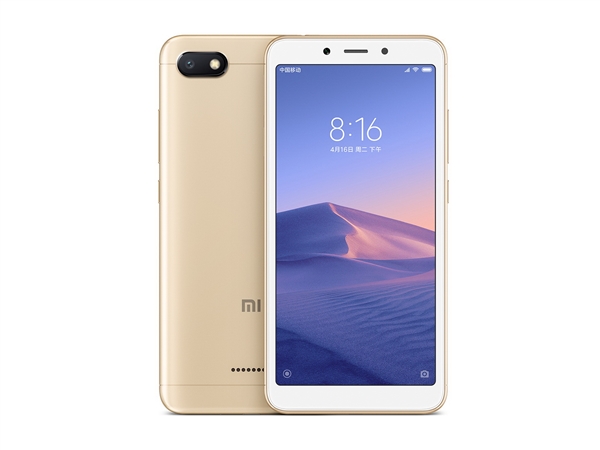 The aforesaid coupon helps you bring your already lowered grand total further down to just $94.33 before you proceed to check out. In other words, the coupon helps you get an extra $11.66 off without breaking much of a sweat.
 This is a 34% reduction in the black color version of Mi 8 smartphone’s original selling price. Alternatively, you can go for the blue color version of the smartphone if you’re willing to shell out $438.28. Note that the blue-tinted Mi 8 smartphone usually sells for $658.99.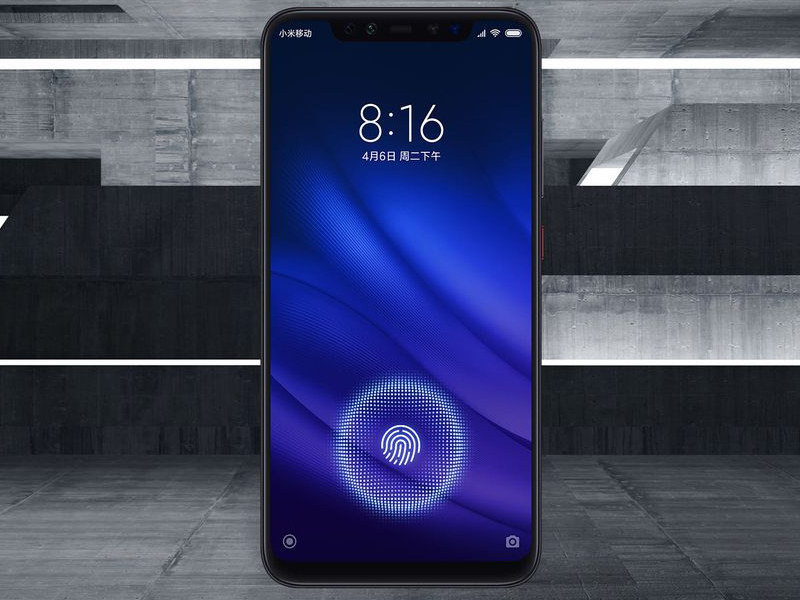
 Capable of breathing new life into your videos and photos with its extra large 6.41 inches Super AMOLED capacitive touchscreen display, bearing a screen resolution of 1080 x 2340 pixels and an aspect ratio of 19.5:9, the Vivo V11 was launched earlier this year.
 An absolute bargain at this price, the V11 packs a powerful Qualcomm Snapdragon 660 processor along with a highly competent Adreno 512 GPU, under the hood. It ships with 6GB of RAM and offers a hearty 128GB of onboard storage that can be expanded further up to 256GB so that you can save your favorite content without worrying about running out of space.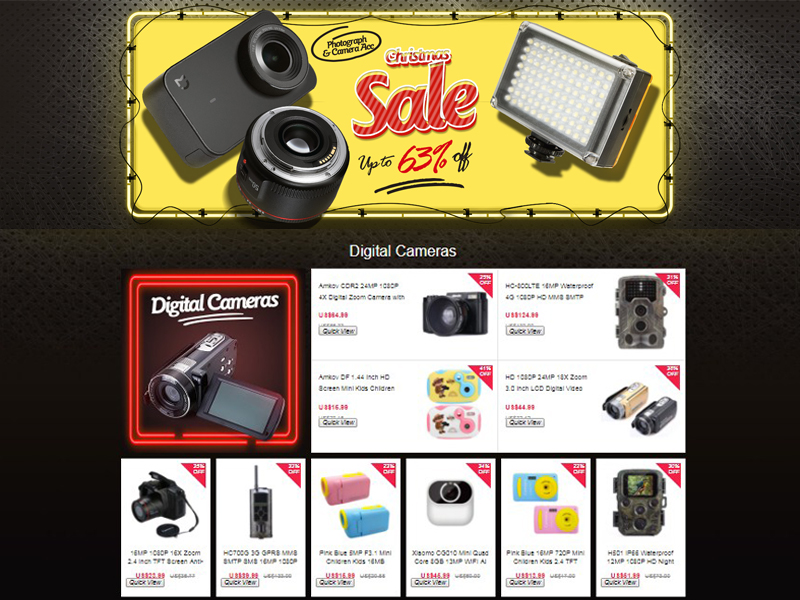
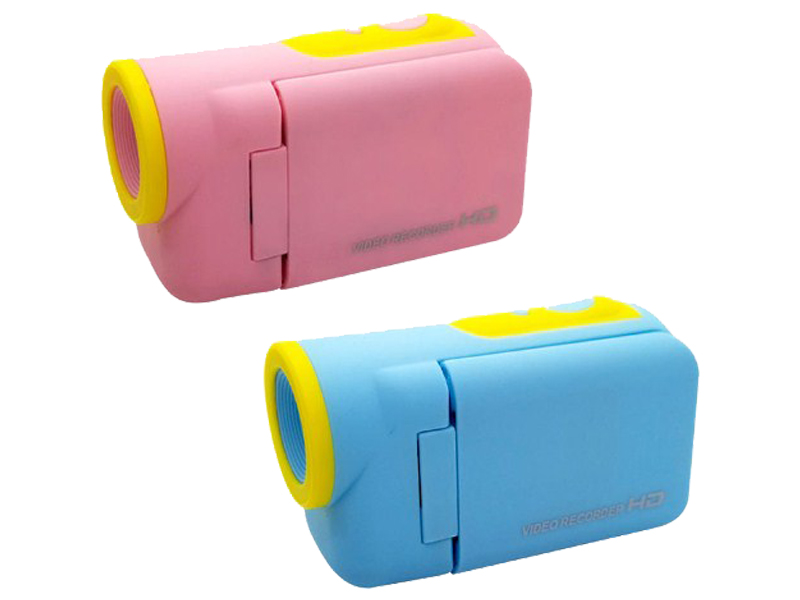 Thanks to the discount, you can now buy this compact camera for a lowered price of just $15.99. It is worth noting though that the discount will only be valid on the pink and blue color versions of the camera until December 13th.