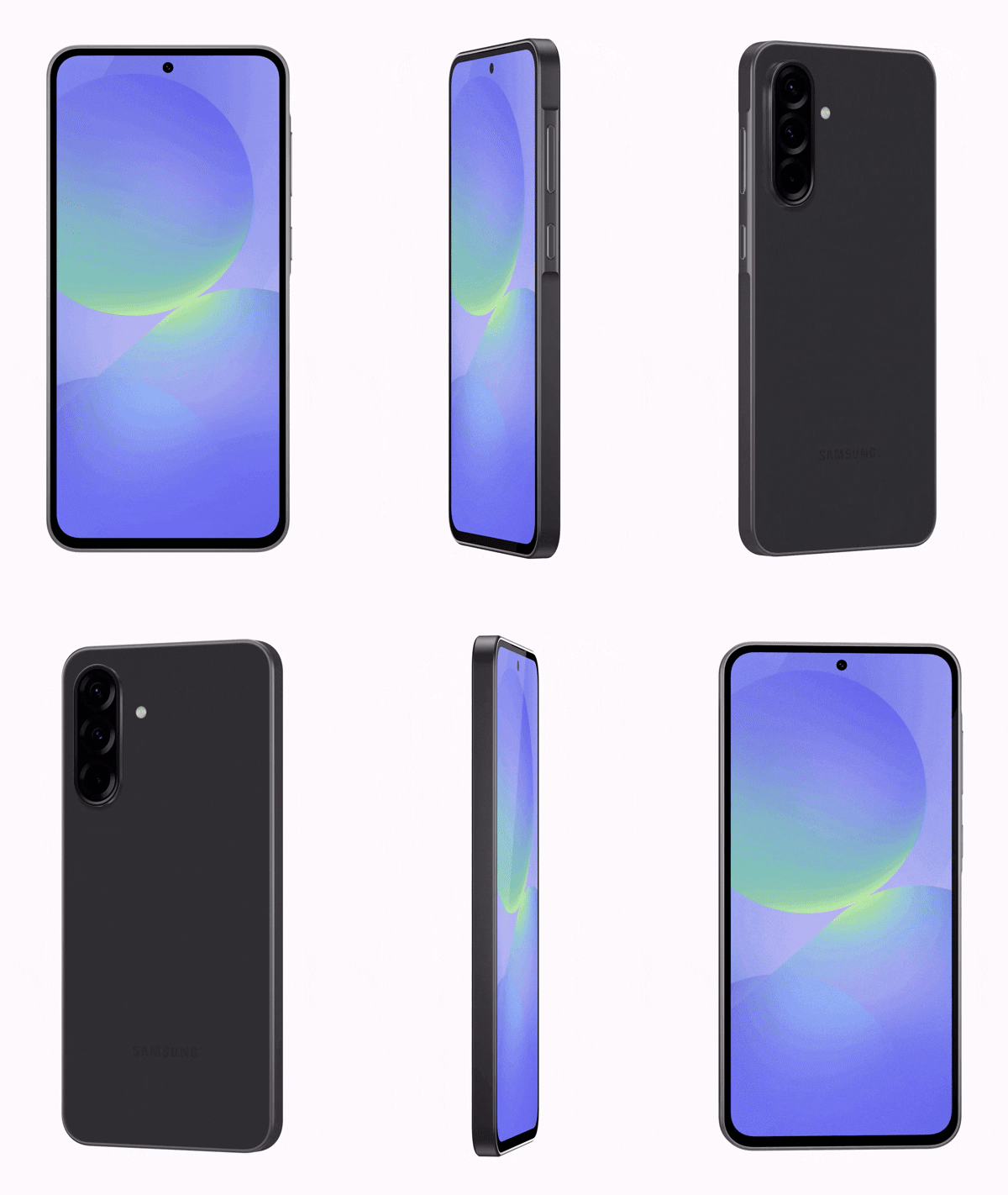
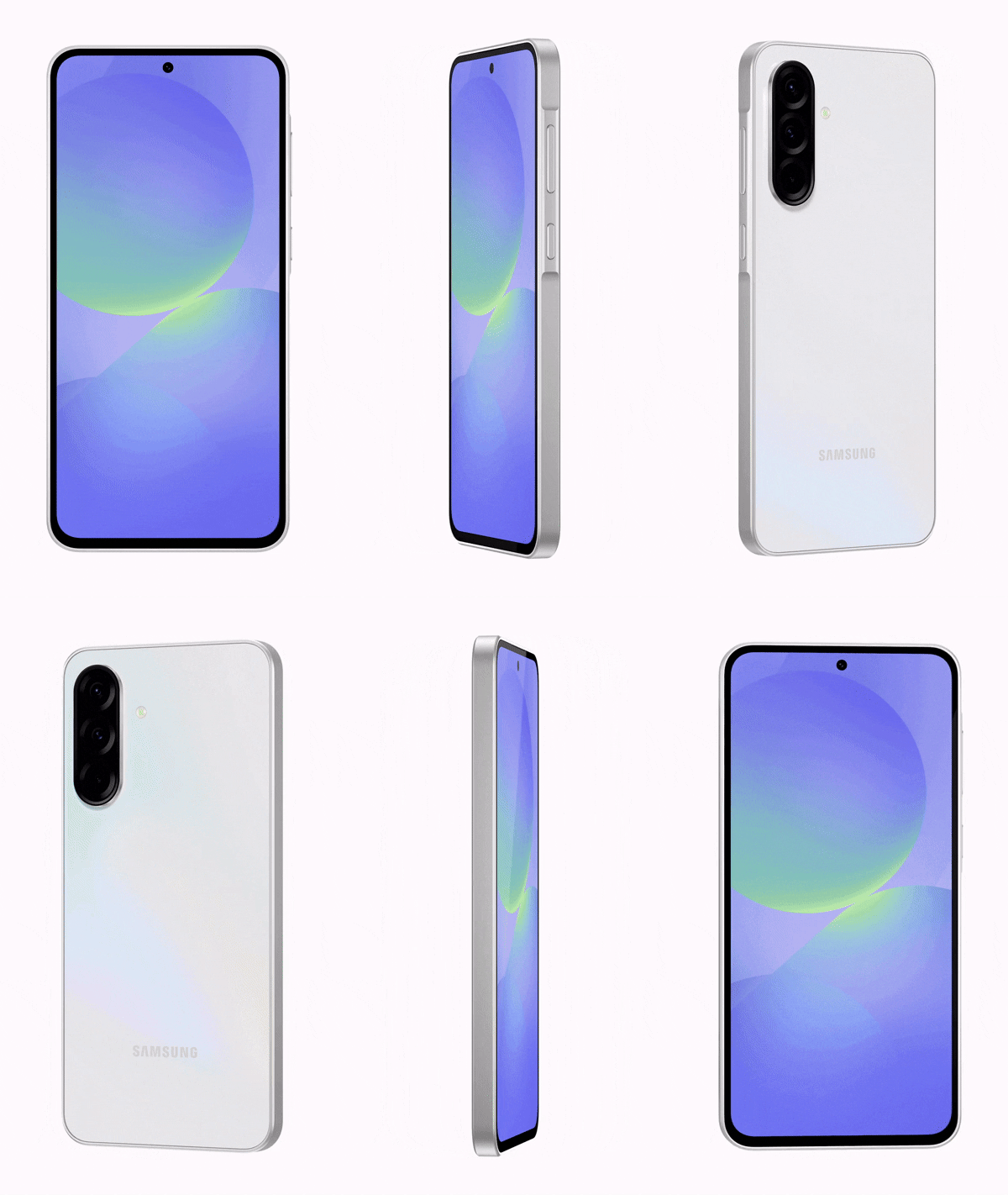
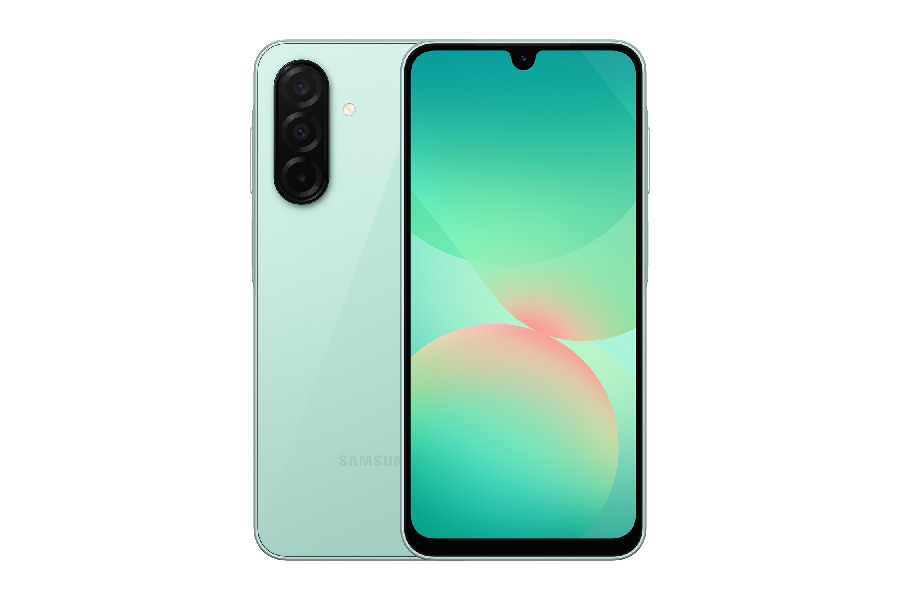
An upcoming mid range Samsung smartphone has just been spotted in a fresh leak. A new set of CAD renders recently surfaced of the Galaxy A26, revealing its complete design from the front and back. So let’s have a look.
Samsung Galaxy A26 Renders
The South Korean tech giant’s Galaxy A26 was previously spotted on GeekBench with an Exynos 1280 processor. But now, the new mid range smartphone has its entire design revealed (Via AndroidHeadlines). The front has noticeable bezels and an Infinity-U screen. Meanwhile, the rear has a triple camera setup in an oval shaped module. The Galaxy A26 measures 164 x 77.5 x 7.7mm in dimensions, which makes it thinner than its predecessor. To recall, the Galaxy A25 was announced with a 161 x 76.5 x 8.3mm body.
Samsung Galaxy A26
Unfortunately, this was all the information that was shared in these leaked CAD renders. In the previous benchmark listing, the Samsung Galaxy A26 was spotted with 6GB of RAM, but there’s a chance that there might be an 8GB variant as well. The Galaxy A26 will run on the Android 15 OS based One UI 7 custom skin out of the box. While it’s still unclear, the Galaxy A26 could also arrive with 6 years of OS updates and 6 years of security updates.
The company has yet to make an official announcement regarding its launch. But rumours have hinted that the Galaxy A26 is expected to be introduced sometime in December 2024 or January 2025. It will likely have a similar price tag as the Galaxy A25 5G. Camera specifications are still at large, but the new phone could bring back the 50MP primary camera and an 8MP ultra wide angle lens on the rear. A large 5,000mAh battery should power this model as well, which could support 25W wired fast charging.
Motorola has not officially announced a list of devices that will be upgraded to Android 15. However, it is constantly updating the support pages of its devices to include details about the next major software update.
When we published a similar story last month, 22 devices were confirmed to receive the Android 15 upgrade. Since then, Motorola has updated the support pages for many devices, confirming their Android 15 eligibility.
So, here’s an updated list of Motorola devices that are confirmed to receive Android 15 update:
Motorola Razr phones:
Motorola Razr+ (2024) / Razr 50 Ultra
Motorola Razr (2024) / Razr 50
Motorola Razr 50s
Motorola Razr+ (2023) / Razr 40 Ultra
Motorola Razr (2023) / Razr 40
Motorola Razr 40s
Motorola Edge phones:
Motorola Edge (2024)
Motorola Edge (2023)
Motorola Edge+ (2023)
Motorola Edge 50 Ultra
Motorola Edge 50 Pro
Motorola Edge 50 Neo
Motorola Edge 50 Fusion
Motorola Edge 50
Motorola Edge 40
Motorola Edge 40 Neo
Motorola Edge 40 Pro
Motorola Edge 30 Ultra
Motorola Moto G series phones:
Motorola Moto G Power 5G (2024)
Motorola Moto G Stylus 5G (2024)
Motorola Moto G 5G (2024)
Motorola Moto G85
Motorola Moto G75
Motorola Moto G55
Motorola Moto G45
Motorola Moto G35
Motorola Moto G34 5G
Other Motorola phones:
ThinkPhone by Motorola
ThinkPhone 25
You’ll quickly note that many Motorola devices that should be on the list are missing. The most notable omissions are the Moto G64 and Moto G (2024). Both were released this year and were supposed to get the Android 15 update.
The above list isn’t final, as it has been curated based on the devices’ support pages. More devices will be added to the list later. So, if your Motorola phone isn’t on the list, wait for the final list for better clarity.
Motorola is already making the beta version available on many devices, including the Edge 50 Fusion. You can join Motorola’s beta program to have a chance of getting early access to the latest software.
What’s new in Android 15?
1. Private space
Android 15 introduces private space, a separate space for keeping important apps under an additional layer of security. It’s hidden from recent apps, settings, and the rest of the device, thus being the safest place to hide your finance or dating apps.
2. App archiving
Android phones already support app archiving, which lets users uninstall an app while keeping the user data. However, this feature was restricted to apps installed via the Google Play Store. The upcoming Android 15 has this feature baked in, which means it will also support apps installed outside the Google Play Store.
The app archiving feature is designed to save storage by archiving apps you don’t want to use for a short period. When you reinstall the app, you don’t need to sign in again or reconfigure it.
3. Better multitasking
Android 15 improves multitasking, especially on larger devices such as foldables and tablets. It allows you to create app pairs for quicker access to your favorite apps in split-screen mode.
To create an app pair, open apps in the split-screen mode, tap the app icons at the top, and choose Save app pair. You’ll see a new shortcut icon for this split-screen app pair on your home screen.
Android 15 also has a foldable-specific addition that allows users to continue using an app on the cover display after closing the primary (inner) screen without unlocking the device.
You can now pin or unpin the taskbar on foldable and tablets to quickly access frequently used apps.
The latest version of Android also brings real-time widget preview, theft detection, and satellite connectivity support, to name a few. The animations have improved greatly, as has the overall software experience.
What are your thoughts on Motorola’s software distribution? Write them down in the comments below.
OnePlus launched its latest flagship, the OnePlus 13, in China last month. And the brand is expected to bring it to international markets soon. While we are familiar with the phone’s specs and features thanks to its Chinese launch, the company seems to be tweaking the color and storage options for its global release.
A leak from tipster Arsene Lupin reveals that the OnePlus 13 will launch internationally in two configurations: 12GB of RAM with 256GB of storage and 16GB of RAM with 512GB of storage.
Interestingly, the base 12GB/256GB model will come only in Black Eclipse, a more muted name compared to the China-exclusive colors—Moonlight Black, Misty Blue, and Glacial White. The higher-end variant will offer the more vibrant Midnight Ocean and Arctic Dawn color options.
OnePlus 13R color, memory options
The tipster also shared details about the OnePlus 13R, revealing it will come in a single configuration with 12GB of RAM and 256GB of storage. Color options are expected to include Nebula Noir and Astral Trail.
According to the leak, both the OnePlus 13 and OnePlus 13R are likely to launch globally soon. So we are expecting the phone will debut in international markets at the same time.
OnePlus 13R is likely a rebrand of the Chinese Ace 5, which is expected to come with a 1.5K resolution OLED flat display from BOE. It will run on last year’s Snapdragon 8 Gen 3 chipset, combined with LPDDR5x RAM and UFS 4.0 storage.
For selfies, the phone will include a 16-megapixel front-facing camera, while the rear will be home to a triple camera setup with a 50-megapixel main, 8-megapixel ultrawide, and 2-megapixel macro lens.
The device reportedly packs a 6000mAh battery with support for 100W wired fast charging, though there will be no wireless charging support.
Oppo has long been rumored to be working on a new tablet model. The Oppo Pad 3 was spotted in recent leaks and reports, but now this tablet has officially been teased by the brand. We finally have a proper look at the Oppo Pad 3, so here’s what we know.
Oppo Pad 3 Teased in China
The Chinese tech giant shared a fresh teaser of the Oppo Pad 3 ahead of its November 25 launch. Looking at the fresh teaser image poster, the Oppo Pad 3 will arrive with a premium design thanks to an all-metal body. The rear also has an atmospheric color scheme. The brand has also confirmed that the tablet will come in three color options, namely Silver, Blue, and Purple. Notably, we can even see that the upcoming tablets will feature support for the stylus.
Oppo Pad 3
Oppo has even confirmed the storage configurations of the new tablets. It will be available in 8GB + 128GB, 8GB + 256GB, 12GB + 256GB, and 12GB + 512GB variants. Pre-orders for the Reno 13 series and Pad 3 are currently live in China. While this was all the information that was shared, more details of the Oppo Pad 3 have been confirmed by recent leaks. Based on what we know so far, the Oppo Pad 3 sports a tall 11.6-inch LCD display with a 2.8K resolution and a 144Hz refresh rate.
Under the hood, it might be equipped with the MediaTek Dimensity 8350 SoC. A large 9,510mAh battery pack powers this device, which supports 67W wired fast charging. This model has an ultra slim 6.29mm and weighs 533 grams. So this is a more affordable tablet compared to the higher end Oppo Pad 3 Pro, which launched with Snapdragon 8 Gen 3 Leading Version chipset. The device will be launching alongside the Reno 13 series, so stick around for more updates.
OnePlus 50W Magnetic Wireless Charger is designed to provide fast, efficient charging with a sleek, convenient design. Offering up to 50W of peak power, this charger is specifically optimized for the OnePlus 13, but it’s also compatible with other smartphones that support wireless charging, including iPhones. With its magnetic adsorption feature, this charger ensures your device stays securely in place while charging, even if you use a magnetic case. You can now get the OnePlus 50W Magnetic Wireless Charger for $69.99 at Geekwills.
Magnetic Adsorption for Secure Charging
One of the standout features of the OnePlus 50W Magnetic Wireless Charger is its automatic magnetic adsorption. Thanks to the strong suction power, your phone stays firmly attached to the charger, reducing the risk of disconnections or falls during charging. Whether you’re using your OnePlus 13 with a magnetic case or charging it without one, the charger holds your device securely in place.
Fast Charging with Up to 50W Output
With its maximum output of 50W, the OnePlus Magnetic Wireless Charger is designed to charge your OnePlus 13 from 1% to 100% in just 75 minutes. This is a significant improvement over standard wireless chargers, offering you a faster and more convenient charging experience. Additionally, it supports a wide range of fast-charging protocols, including SUPERVOOC, VOOC, PD, PPS, and QC, making it a versatile choice for Android and iOS devices alike.
Efficient Cooling System
To ensure safe and reliable charging, the OnePlus 50W Magnetic Wireless Charger features an advanced cooling system. This includes a centrifugal fan core, TEC cooling, heat-dissipating fins, a silicone pad, and an aluminum sheet. This comprehensive cooling solution helps manage the temperature of the charger and your device, ensuring that charging remains efficient and your phone stays cool, even during high-speed charging.
Compatibility with iPhones
While designed for OnePlus devices, the charger is also fully compatible with iPhones that support wireless charging. It even supports Apple’s Standby mode, providing a better and more stable wireless charging experience for iPhone users.
Key Specs:
Model: OnePlus Magnetic 50W Wireless Charger
Charging Port: Type-C
Charging Protocols: SUPERVOOC, VOOC, PD, PPS, QC
Product Size: Φ 65.5 x 20.96mm
Weight: 87g
Input: 5-11V⎓9.1A Max
Max Output: 50W
OnePlus 50W Magnetic Wireless Charger offers a fast, efficient, and reliable way to charge your devices, with advanced features like magnetic adsorption, fast charging, and enhanced cooling. Whether you use an Android or iOS phone, it provides a great charging experience.
The gaming phone market is heating up with the imminent arrival of the Asus ROG Phone 9 series and the recent launch of the Nubia Red Magic 10 Pro and 10 Pro+ in China. The ROG Phone 9 series is scheduled to launch in multiple markets on Nov. 19, whereas the Red Magic 10 Pro series is currently limited to the Chinese market. Likely, only the Pro model may arrive in the global market in December like its previous generation.
Both brands are known for pushing the boundaries of mobile gaming, offering top-tier specs and innovative features. But how will the upcoming ROG Phone 9 stack up against the Red Magic 10 Pro? Let’s delve into the anticipated differences based on available information.
Asus ROG Phone 9 (left) and Red Magic 10 Pro (right)
The ASUS ROG Phone 9 and the Red Magic 10 Pro each offer impressive displays, but there are distinct differences. The Red Magic 10 Pro sports a 6.85-inch BOE Q9+ OLED display with a resolution of 2688 x 1216 pixels. It supports a 144Hz refresh rate, 2,000 nits peak brightness, and 2592Hz PWM dimming. The advantage with Red Magic 10 Pro series is that since it is equipped with an under-display selfie camera, there is no camera cutout on the screen, which allows it to offer truly full-screen experience for immersive gaming.
In contrast, the Aus ROG Phone 9 has a slightly smaller 6.78-inch FHD+ Flexible Samsung AMOLED display with a resolution of 2400 x 1080 pixels. It has a lower refresh rate of 120Hz but compensates with a higher peak brightness of 2,500 nits and HDR10 support. There’s a possibility that the Pro variant in the series may support a 185Hz refresh rate. The Corning Gorilla Glass Victus 2 protection on the ROG Phone 9 adds extra durability, making it resistant to scratches and drops.
2. Performance and Hardware
Under the hood, both devices feature the latest Snapdragon 8 Elite chipset. The Red Magic 10 Pro’s chip is paired with LPDDR5X RAM and UFS 4.1 storage. It also features a self-developed R3 chip that enhances gaming performance, particularly for 2K resolution at 120fps gaming. The Red Magic 10 Pro’s battery is substantial at 6,500mAh with 80W charging, ensuring long gaming sessions without frequent recharging. It also supports 50W wireless charging.
The Red Magic 10 Pro+ variant, which is likely to remain exclusive to the Chinese market, has 24GB of LPDDR5x RAM, 1TB of UFS 4.0 storage, and a 7,050mAh battery with 120W fast charging. The Red Magic 10 Pro series, running Android 15 with Red Magic OS 10 UI, introduces major improvements like the Red Magic AI Cube 2.0 for a smoother and smarter interface. Key features include the AI Game Model for game commentary, win rate prediction, and gameplay assistance. The Red Magic Assistant, Mora, offers conversational AI for chatting and smart responses. The X Gravity Platform 2.0 supports AR/VR devices, cloud gaming, console streaming, and various peripherals, enhancing the mobile gaming experience.
On the other hand, the Asus ROG Phone 9 is expected to have a powerful chipset that supports up to 24GB LPDDR5X RAM and 1TB UFS 4.0 storage. This extensive memory and storage configuration is ideal for gaming and multitasking. Its 5,800mAh battery supports 65W fast charging, slightly lower than the Red Magic 10 Pro, but still impressive for quick power-ups. It is also expected to support 15W wireless charging.
The ROG Phone 9 series will also run on Android 15 and the company teased some AI features, which might include gaming-related enhancements, adding another layer of sophistication to its gaming performance.
3. Camera Capabilities
Camera capabilities also show notable differences. The Red Magic 10 Pro features a triple rear camera setup: a 50-megapixel OmniVision OV50E40 main sensor with OIS, a 50-megapixel OV50D ultra-wide sensor, and a 2MP OV02F10 macro sensor. The front camera is a 16-megapixel under-display OmniVision OV16A1Q sensor, designed to be unobtrusive for a seamless display experience.
In contrast, the ASUS ROG Phone 9 has a 50-megapixel Sony Lytia 700 primary camera, a 13-megapixel ultra-wide camera, and a 32-megapixel telephoto camera with f/2.4 aperture, OIS, and 3X optical zoom. For selfies, it boasts a 32-megapixel front camera. The ROG Phone 9’s camera setup, particularly the telephoto lens with optical zoom, offers more versatility for photography enthusiasts.
4. Design and Other Features
In terms of design, the Red Magic 10 Pro maintains its gaming-centric aesthetics with an active cooling fan and a 10,000mm²-level VC for thermal management. It includes a 3.5mm audio jack, dual 0815 x-axis linear motors, and triple microphones, enhancing the gaming and multimedia experience. The phone is available in Dark Knight and Day Warrior colors, with Deuterium Front Transparent Black and Silver Wing options offering a premium look with transparent elements. Weighing 229g and measuring 8.9mm in thickness, it is designed to be robust yet ergonomic.
The Aus ROG Phone 9, revealed in Phantom Black with a textured back panel, sports a more subtle design compared to its predecessors. It includes a punch-hole display and a small rear camera island, housing a triple-camera setup. The AeroActive Cooler X accessory helps keep the phone cool during intense gaming sessions. The phone is also expected to come in White, offering a sleek alternative. It features an in-display fingerprint sensor, dual stereo speakers, Wi-Fi 7, Bluetooth 5.3, and a 3.5mm headphone jack. The inclusion of accessories like the Clear Case, Aero Case, and AeroActive Cooler X Pro in the box adds value and enhances the overall user experience.
5. Pricing and Availability
In terms of pricing, the Red Magic 10 Pro starts at around $690 for the 12GB+256GB variant, going up to $800 for the 12GB+512GB model. The Red Magic 10 Pro+ variant offers higher RAM and storage options, priced up to $1,040 for the top model with 24GB RAM and 1TB storage.
To recall, the 16GB+512GB edition of the Red Magic 9 Pro was priced at $799 globally. Likely, the same version of the Red Magic 10 Pro may arrive with a $50 to $100 price hike. A recent report revealed that the 12GB+512GB edition of the ROG Phone 9 will be priced at around €1,320 (~$1,390) in Denmark.
6. Final Thoughts
The Red Magic 10 Pro has a clear edge in terms of its hard-core gaming design, featuring a full-screen experience thanks to the under-display camera, and a larger battery with faster charging capabilities. It also retains the classic 3.5mm audio jack, a feature increasingly missing from other flagships, which will appeal to users who still value wired audio.
That said, the ROG Phone 9 is no slouch with its versatile camera and expected accessories, making it a strong contender. Ultimately, the best choice will depend on individual preferences and priorities. The Red Magic 10 Pro’s name also sounds more advanced, with “10” appearing a generation ahead of “ROG Phone 9,” and it’s likely to be more affordable globally.
Earlier this week, iQOO began teasing the arrival of the iQOO Neo 10 series of smartphones in China. Today, the brand released the following image to confirm its design. At the same time, some tech bloggers from China have leaked key details about the Neo 10 series.
iQOO Neo 10 series design revealed
iQOO Neo 10 series
The orange-grey dual-tone finish of the iQOO Neo 10 series is undeniably stunning. The new generation clearly resembles the Neo 9 series from last year.
The Neo 10 lineup is now available for reservations in China through multiple platforms, such as Vivo’s online store, JD, Tmall, and Pinduoduo. However, none of these official listings have revealed anything significant about the Neo 10 series.
iQOO Neo 10 series’ details shared by DCS
Tipster Digital Chat Station revealed that the iQOO Neo 10 series has an anti-glare glass back, with the mid-frame constructed using new technology and materials. Previously, the tipster claimed that the Neo 10 series has a plastic frame. However, as can be seen in the image, it has a brushed metal finish.
DCS added that the entire series will come with 8T LTPO displays, ensuring smoother performance and improved power efficiency. Additionally, all the models will feature a 6,100mAh battery with 120W fast-charging support. The Neo 10 series will have a dual-chip setup featuring the processor and a dedicated chip for graphics.
iQOO Neo 10 series’ camera details leaked
As per reports, the iQOO Neo 10 will have the Snapdragon 8 Gen 3 onboard. On the other hand, the Neo 10 Pro is expected to feature the latest Dimensity 9400 SoC. Another leaker revealed that the Neo 10 Pro will feature a 50-megapixel Sony IMX921 primary camera with OIS support and a 50-megapixel Samsung JN1 ultra-wide lens, whereas the Neo 10 will feature a 50-megapixel + 8-megapixel dual-camera setup. The leaker did not share camera sensor details about the standard model. As far as launch is concerned, the Neo 10 series is expected to launch by the end of this month.
Motorola has been consistently expanding its smartphone lineup, and recent certifications indicate the upcoming release of the Moto G Power 5G (2025). Building on the success of its predecessor, the Moto G Power 5G (2024), which launched exclusively in North America, this new model is expected to debut in the coming months with an extended regional rollout. Here’s what the certification listings and recent patents reveal about the future of Motorola’s smartphone releases.
Leaked renders from August have revealed a familiar design for the Moto G Power 5G (2025). The device is expected to sport a square camera module on the back with an LED flash and Motorola’s signature dimple. The right edge will house the volume rocker and power button. The front of the device will feature a centrally placed punch-hole cutout for the selfie camera, with flat edges and reasonably slim bezels. The renders have showcased the phone in an attractive purple color, which could appeal to users looking for a stylish option in the mid-range segment.
2. Certification Details
The Moto G Power 5G (2025) has surfaced on several certification platforms recently, including the FCC, TUV Rheinland, and UL Demko. According to the FCC listing, this device will carry the model number XT2515-1, with additional regional variants labeled XT2515-2, XT2515-3, and XT2515V. These models are likely tailored for different markets, though the certifications confirm no notable differences in specifications among them. While the Moto G Power 5G (2024) was limited to North American markets, the expanded model lineup suggests the 2025 version might target a broader global audience.
3. Battery
The Moto G Power 5G (2025) will feature a battery model labeled RW50 with a 4850mAh rated capacity (5000mAh typical), identical to its predecessor. While the capacity remains the same, Motorola might introduce a more efficient chipset to potentially enhance the overall battery performance. This improvement could extend usage time without the need for a larger battery.
4. Connectivity & Charging
The FCC listing confirms a comprehensive range of connectivity features, including 5G support, 4G LTE, dual-band Wi-Fi (2.4GHz and 5GHz), Bluetooth BR/EDR/LE, and NFC. The device is also expected to support GNSS, FM radio, and Wireless Power Transfer (WPT) capabilities.
Speaking of charging, UL Demko’s certification lists a 20W charger for the Moto G Power 5G (2025). Although slightly slower than the 30W wired charging supported by the 2024 model, the 2025 version retains wireless charging support. This makes the device versatile, offering both decent wired and wireless charging options, although users looking for ultra-fast charging might find the 20W speed modest.
5. Motorola’s Patent in Rollable Display
Beyond the Moto G series, Motorola is pushing boundaries with innovative technologies. A recent patent filing reveals a concept for a rollable display smartphone with an integrated full-screen fingerprint sensor. This new patent builds on the Moto Rizr rollable concept phone, showcased in 2023, which featured a flexible display that could extend from 5 inches to 6.5 inches. Now, Motorola aims to elevate the user experience with a full-screen fingerprint sensor, allowing users to unlock the device from any part of the display.
This patent showcases Motorola’s commitment to developing devices that merge convenience and flexibility. While there’s no guarantee this concept will hit the market soon, the possibility of a rollable phone with all-screen fingerprint sensing highlights Motorola’s dedication to innovative design.
6. The Road Ahead for Motorola
Looking forward, Motorola is expected to continue expanding its G series in 2025, with models like the Moto G 5G, Moto G Stylus 5G, Moto G45 5G, and Moto G64 5G.
If you’ve made it this far, you might also enjoy reading this article on why a Motorola gaming phone would be amazing.
Realme is scheduled to launch the Realme GT 7 Pro on November 26 in India. A recent report revealed that it will not be the company’s last phone for this year in the Indian market, as it is reportedly planning to announce the Realme 14 Pro Lite in December. Now, a new report claims that the brand is also working on a Narzo phone dubbed the Narzo 50 Curve, which is also expected to go official before the end of this year.
Publication 91mobiles has learned from industry sources that Realme will announce the Reale Narzo 70 Curve in December in India. If the information is true, it will be the fourth Narzo 70 series phone this year after the Narzo 70x, Narzo 70, and Narzo 70 Turbo.
The report further states that the Narzo 70 Curve will debut by the end of December in India. According to its moniker, the device will feature a curved-edge screen and bear a resemblance to other phones in the Naro 70 series. However, there is no clarity whether it will have a round camera module like the Narzo 70 and 70x or a square camera island like the Narzo 70 Turbo.
The Narzo 70 Curve is likely to retail for between Rs 15,000 and Rs 20,000. The report does not mention it, but like other Narzo models, Amazon is likely to sell the device.
In related news, as mentioned above, the Realme 14 Pro Lite is also in the works for India. The handset is expected to arrive in multiple configurations, such as 8GB+128GB, 8GB+256GB, 12GB+256GB, and 12GB+512GB. It may arrive in color options, such as Emerald Green, Monet Purple, and Monet Gold. Unfortunately, nothing else is known about the device.
Vivo has confirmed that it will announce the Vivo Y300 5G in India on Nov. 21. While the company already has the phone’s rear design and color options, it hasn’t revealed anything about its specifications. A new report by 91mobilesHindi has revealed the complete specifications of the phone, along with its expected price, just a week before the launch.
Vivo Y300 5G specifications (rumored)
Vivo Y300 5G
The Vivo Y300 5G will arrive as a successor to the Snapdragon 4 Gen 1-powered Vivo Y200 5G, which debuted in May 2024. The new leak reveals that the Y300 will have improvements in departments like battery, rapid charging, front and rear cameras, AI features, sound output, and IP rating.
According to the new report, the Snapdragon 4 Gen 2 chipset and a 5,000mAh battery with 80W fast charging will power the Y300. For photography, the Y300 will feature a 32-megapixel front-facing camera and a Sony IMX882 50-megapixel + 2-megapixel (bokeh) dual-camera system on the back.
The Y300 also features an AI Aura Light Ring LED flash with support for 3-level brightness as well as color and warm color adjustment. Vivo’s AI suite of AI-driven features, the details of which are not yet known, will also equip the device. For audiophiles, the Y300 will include a pair of speakers for stereo output. The report also reveals that the Y300 will feature a 6.7-inch AMOLED panel that offers a 120Hz refresh rate, a peak brightness of 1200 nits, and an in-screen fingerprint sensor.
In comparison, the Y200 packs a smaller 4,800mAh battery with 44W charging support, has a 16-megapixel front camera, lacks a Sony camera sensor, has a single speaker, and lacks an IP rating. The Y200 features a 6.67-inch AMOLED FHD+ 120Hz screen with 800 nits of peak brightness.
Vivo Y300 5G price in India (rumored)
According to the report, the Vivo Y300 5G will be available in two options, such as 8GB+128GB and 8GB+256GB. The base variant is likely to cost Rs 21,000 to Rs 22,000, whereas the higher model could be priced at Rs 24,000 to Rs 25,000. The phone will be available in three shades: Titanium Silver, Phantom Purple, and Emerald Green.
AOC has introduced its latest gaming monitor, the AGON AG276FK, designed to meet the needs of competitive eSports players seeking top-tier visual performance. Featuring a 520Hz refresh rate and ultra-low response times, this 27-inch monitor is likely among the most capable eSports monitors money can buy.
Key Features of the AGON AG276FK
The AG276FK’s 520Hz refresh rate is a standout feature, designed to appeal to pro gamers and enthusiasts looking to optimize their setups. Higher refresh rates contribute to smoother visuals, making fast-paced gameplay more fluid and responsive.
The monitor pairs this high refresh rate with a Fast IPS panel and a 1ms Grey-to-Grey (GtG) response time, minimizing motion blur and ghosting. This clarity is important for games that demand quick reactions and precise accuracy.
Features Built for Gamers
The AG276FK offers more than just speed, incorporating features that enhance both gaming performance and comfort:
Adaptive Sync: This technology synchronizes the monitor’s refresh rate with the frame rate output from the graphics card to reduce screen tearing and stuttering, providing a smoother gaming experience.
Low Input Lag: The monitor includes a low input lag mode, reducing visual processing to provide a more immediate connection between commands and on-screen action.
HDR 400 Certification: Equipped with VESA-Certified DisplayHDR 400, the AG276FK enhances color vibrancy and contrast, giving gamers an improved visual experience in high-contrast scenarios.
Ergonomic and Customizable Setup: The monitor includes an adjustable stand, enabling users to raise, lower, tilt, and swivel the screen to their preference. Customizable RGB lighting on the back also allows for personalizing the setup with various colors and lighting effects.
Convenient Design for Gamers
The AG276FK addresses practical needs with features like a USB hub for easy peripheral connections and a gamepad for straightforward on-screen display (OSD) navigation. AOC’s G-Menu software also allows users to fine-tune settings from their PC for added customization.
Pricing and Availability
The AGON AG276FK is set to launch in the Eurozone at €659 ($700) and in the UK for £499.99 ($530). U.S. pricing has not yet been confirmed, but AOC expects availability in the region later this month.
It’s been quite a while since Tecno launched the Spark 30 series smartphones. The line is home to five devices: Spark 30, Spark 30 Pro, Spark 30C, Spark 30C 5G, and Spark 30 5G.
Though these devices are budget to low-mid-range successors to previous models, this year’s Spark series is a bit special as the company has collaborated with Hasbro’s Transformers for limited editions of the Spark 30 and Spark 30 Pro.
The Spark 30 features a Bumblebee-inspired design, while the Pro model takes Optimus Prime’s (my favorite) iconic colors — red, blue, and silver — in the hood. Fortunately, our review team got their hands on this exact model, and we now have a hands-on review and initial impressions video available on our YouTube channel.
Hands-on of a Optimus Prime phone
The phone’s box content isn’t anything to get excited about, as the company includes the standard white power adapter and USB-C cable. It does come with wired earphones (also in plain white), which is something you don’t often see included with other brands these days.
The phone itself, however, clearly reflects its Prime genes. The back design is painted in Optimus Prime’s red, blue, and silver colors, while the software features customized themed wallpaper and icons.
Its specs remain the same as the regular Spark 30 Pro, as expected. It features a 6.78-inch AMOLED display that refreshes at 120Hz and has 10-bit color depth. Running the mechanics underneath is a MediaTek Helio G100 processor paired with up to 8GB of RAM and 256GB of storage.
For the camera, the phone includes a 108MP primary sensor with support for 3x lossless zoom and up to 10x digital zoom. Tecno has also added its AI camera features, such as AIGC portrait, AI Eraser, and AI Artboard. The device starts at around $200 for the 8/128GB version and about $220 for the 8/256GB option.
Vivo is gearing up to launch its highly anticipated X200 series in Malaysia on November 19th, 2024. This confirmation follows recent leaks suggesting a November 28th launch in Thailand and an Indian debut next month.
The series is expected to include two models: The Vivo X200 and the X200 Pro. In China, the brand has also launched a third model called the Vivo X200 Pro mini, however, it looks like the brand is not bringing that model over to the International market. As for specifications, the X200 and X200 Pro global models are expected to be identical to the Chinese models.
Vivo X200 series specifications (Chinese model)
The Vivo X200 features a 6.67-inch OLED display with a 120Hz refresh rate and a peak brightness of 4,500 nits. The Pro version has a slightly larger 6.78-inch display with similar specs, adding an ultrasonic fingerprint sensor under the screen for enhanced security.
Both models run on the MediaTek Dimensity 9400 chipset, with LPDDR5x RAM and UFS 4.0 storage. The X200 includes a triple-camera setup with three 50MP lenses for wide, ultrawide, and 3x zoom shots. The X200 Pro model upgrades the telephoto lens to a 200MP sensor, offering a 3.7x zoom for greater detail.
The X200 is powered by a 5,800mAh battery, while the Pro version has a 6,000mAh battery. Both support 90W wired charging, with the Pro model adding 30W wireless charging.
In related news, Vivo’s X200 Ultra smartphone, which is expected to debut next year is said to feature a 1-inch main sensor. Additionally, the X200 Ultra will reportedly feature a triple-camera setup with a 200MP telephoto lens with a 1.4” sensor and a 50MP ultrawide sensor. Vivo may also include the Snapdragon 8 Elite chip and satellite connectivity.
HMD Global, the company behind Nokia‘s presence in the smartphone market, appears ready for another launch. Following their recent feature phone releases (the 2024 models Nokia 108, Nokia 110 4G, and Nokia 125 4G), a leak from @smashx_60 hints that a new smartphone, the Pulse 2 Pro, is on the way.
This could be a timely update for the original Pulse Pro, which launched in April and is currently priced at around $199 on Amazon. However, based on leaked details, the Pulse 2 Pro doesn’t seem to bring a significant upgrade.
HMD Pulse 2 Pro Specifications
For the display, HMD appears to keep the familiar 6.65-inch IPS panel with 720p resolution. The good news is that the 90Hz refresh rate and peak brightness of up to 600 nits (HBM) are expected to remain.
The camera setup also reportedly stays similar, with a 50MP main sensor, a 2MP depth sensor, and a matching 50MP selfie camera. A reliable 5,000mAh battery, 20W wired charging, and RAM options of 6GB or 8GB are also likely to return.
The most notable upgrade seems to be in storage. Unlike the Pulse Pro’s 128GB limit, the Pulse 2 Pro might offer up to 256GB. Under the hood, the leak suggests a switch from the Unisoc T606 to the Unisoc T612 processor.
While these specs suggest a modest upgrade, it’s worth noting that the Pulse Pro was already a decent budget option. This minor refresh could make the Pulse 2 Pro appealing for those seeking a large display, decent cameras, and a long-lasting battery in a budget-friendly package.
However, the launch date details are still under wraps. With no official word from HMD, it’s anyone’s guess when we might see the Pulse 2 Pro hit the market. We’ll be keeping an eye out for further developments and update you as soon as we know more.
Xiaomi has officially announced the global rollout timeline of HyperOS 2, a new operating system based on Android 15, which debuted in China with the Xiaomi 15 series. The announcement came via a post shared on X (formerly Twitter) by Xiaomi CEO Lei Jun.
Here’s a look at Xiaomi’s rollout strategy, and what users can expect from the new system in the coming months.
Xiaomi also has plans to make this new operating system available for its tablets and wearables. The Xiaomi 6S Pro 12.4 and the Xiaomi Smart Band 9 Pro will be getting the update in November. The tablets mentioned below will get the Android 15 update in December.
Xiaomi’s HyperOS 2 will offer a connected, AI-driven ecosystem with updates in performance, connectivity, AI features, and privacy. At its core is HyperCore, an optimized in-house kernel that boosts speed, reduces CPU idle time, and enhances graphics, benefiting both general use and gaming. It also has HyperConnect which allows seamless data and app transfer across Xiaomi devices and introduces Apple compatibility in China, enabling file sharing with Apple products.
HyperAI offers user-centered tools like adaptive lock screens, AI Anti-Fraud protection, and enhanced content creation features, including voice-to-text transcription and real-time translation. HyperOS 2 also debuts a redesigned desktop with customizable widgets, dynamic animations, and a 3D weather system. To ensure privacy, it incorporates end-to-end encryption, a Trusted Execution Environment (TEE) for secure data handling, and enhanced data control via the Xiao Ai assistant, providing users with transparency and control over their digital footprint. There are many other updates in this new operating system, which you can explore by following this link.
Ahead of its official launch next week, the anticipated ASUS ROG Phone 9 has made waves online with a leaked price listing on a Danish retailer’s website, hinting at a price increase for the new gaming device. The leak also suggests that the ROG Phone 9 will include a Pro variant, both of which were recently spotted on Geekbench, showing off benchmark performance stats that reveal powerful new hardware.
ROG Phone 9 leaked pricing
The ROG Phone 9, listed by retailer ComputerSalg in Denmark, was shown in a Storm White color with 12GB RAM and 512GB storage. This version carries a price of DKK 9,838, roughly €1,320. For comparison, the ROG Phone 8 started at $1,099 or €1,099 for a configuration with 16GB RAM and 256GB storage, which is a larger memory configuration.
If ASUS has indeed increased the price while reducing RAM, it could mean a noticeable hike for the new model lineup. Based on this price information, the ROG Phone 9 Pro, when launched, is likely to carry an even higher price tag.
What to expect from the ROG 9?
The ROG Phone 9 received approval from the Wireless Power Consortium, indicating that it will support 15W wireless charging. With the ROG Phone 8 boasting a 5,500mAh battery and 65W wired charging, users can likely expect a similar or slightly upgraded battery and charging.
ASUS has confirmed that the ROG Phone 9 will closely resemble its predecessor in terms of design, with the primary difference being a redesigned ROG logo. Instead of the illuminated ROG logo seen on previous models, the new phone will feature ROG text alongside ASUS AniMe LED paneling. ASUS also mentioned “AI ON, GAME ON” regarding the device on their official website suggesting AI-driven features that could be game-changers for the gaming experience. However, specific details remain under wraps.
The device is expected to be powered by the Qualcomm Snapdragon 8 Elite processor, a significant upgrade from the Snapdragon 8 Gen 3. For those unfamiliar, the new chip brings a 45% improvement in both single-core and multi-core performance and a 30% boost in GPU performance than the Snapdragon 8 Gen 3, thanks to its all-big-cores architecture. This will enable the ROG Phone 9 to handle even the most demanding mobile games with ease, given that ASUS attaches the chip with a similarly capable or upgraded cooling system.
Oppo has opened pre-orders in China for its Reno 13 series and Pad 3 tablet, with exclusive perks for early buyers. The Reno 13 series is expected to officially launch on November 25, following the recent release of the Find X8 and Find X8 Pro in the Chinese market.
Oppo Reno 13 series real-image
Pre-Order Benefits and Exclusive Rewards
The pre-order event for the Reno 13 series brings an array of exclusive benefits for early customers. Those who pre-order can avail a 50% discount voucher for a customized phone case priced at just 1 yuan, exclusive mystery merchandise, and a seasonal Tencent Video VIP membership.
In addition to the Reno 13 phones, the Oppo Pad 3 tablet is also up for pre-orders with enticing benefits, including a gift box for an added 29.9 Yuan ($4.13), an original stylus, and a magnetic protective case. The case suggests that the Pad 3 will retain the centered camera design.
Oppo Reno 13 Series Specifications (Rumored)
The Reno 13 series promises a refined design, enhanced by Oppo’s innovative materials and construction. Recently, leaker Digital Chat Station shared a comparison of the Reno 13 and iPhone 15, highlighting the Reno’s seamless, cold-carved glass camera island, which mimics the smooth, polished look of the iPhone.
According to industry sources, the Reno 13 and Reno 13 Pro are expected to feature micro-quad-curved displays, with the Reno 13 measuring 6.59 inches and the Pro model at 6.83 inches. Both displays will support 1.5K resolution, a smooth 120Hz refresh rate, and an in-screen optical fingerprint sensor.
Under the hood, the Reno 13 Pro is rumored to feature MediaTek’s upcoming Dimensity 8350 chipset. The series is expected to run on Android 15-based ColorOS 15, offering an enhanced user experience. It is anticipated to include dust and water resistance, dual speakers, an x-axis linear motor for improved haptics, and a slim, lightweight design for added durability and usability.
The Pro model is expected to have a 50MP primary camera with OIS, an 8MP ultra-wide lens, and a 50MP telephoto or periscope lens. Both models are likely to include a 50MP front camera for selfies and video calls.
The standard Reno 13 may include a 5,600mAh battery, while the Pro could offer a larger 5,900mAh battery, with both models supporting fast wired and wireless charging.
The Red Magic 10 Pro has arrived, and at first glance, you might be forgiven for mistaking it for its predecessor, the Red Magic 9 Pro. Nubia seems to have adopted an “if it ain’t broke, don’t fix it” philosophy, carrying over much of the 9 Pro’s design DNA. But don’t let the seemingly identical appearance fool you. Under the hood, the 10 Pro boasts several subtle yet significant upgrades that differentiate it from the 9 Pro. Let’s explore the seven key areas where these two gaming phones are nearly twins while highlighting the crucial distinctions that set them apart.
While both phones flaunt a 6.85-inch AMOLED display with 1B colors, the Red Magic 10 Pro takes the lead with its 144Hz refresh rate, surpassing the 120Hz of the Red Magic 9 Pro. Additionally, the new phone supports a higher 1.5K resolution of 2688 x 1216 pixels instead of 2480 x 1116 pixels. Nubia claimed peak brightness of 1600 nits and a high-frequency dimming of 2160Hz for the Red Magic 9 Pro. The successor edition promises a maximum brightness of 2000 nits and 2592Hz PWM high-frequency dimming.
2. Performance and Storage Enhancements
While both phones are powered by flagship Snapdragon processors, the 10 Pro features the latest Snapdragon 8 Elite. This newer chip promises a considerable boost in performance and efficiency compared to the 9 Pro’s Snapdragon 8 Gen 3. Furthermore, Nubia has integrated its upgraded Red Core R3 chip in the 10 Pro, which brings support for 2K resolution 120fps gaming.
Interestingly, while the Red Magic 9 Pro offered configurations with 8GB or 12GB of RAM, the 10 Pro comes exclusively with 12GB, ensuring smoother multitasking and demanding gaming sessions. The 10 Pro also upgrades the storage to UFS 4.1 from the UFS 4.0 found in the 9 Pro, resulting in faster app loading speeds, quicker file transfers, and improved overall responsiveness.
The Red Magic 10 Pro retains the 6,500mAh battery with 80W charging and the ICE 12.0 cooling system, a hallmark of the Red Magic series. This advanced cooling solution incorporates a built-in turbofan and multiple layers of heat-dissipating materials to ensure optimal performance even during extended gaming sessions.
3. Upgraded Camera System
The camera setups appear nearly identical on paper, with both phones featuring a triple rear camera array. However, the 10 Pro utilizes different sensors from OmniVision instead of the Samsung sensors found in the 9 Pro. Specifically, the 10 Pro uses the OV50E40 for the main camera, OV50D for ultrawide, and OV02F10 for macro, while the 9 Pro employed the Samsung GN5 for the primary sensor and Samsung JN1 for ultrawide. This change in sensor manufacturers could lead to noticeable differences in image quality, color reproduction, and low-light performance.
4. New OS Experience
The Red Magic 10 Pro ships with Android 15 and Red Magic OS 10 UI. The new operating system brings a host of significant improvements. At the forefront is the Red Magic AI Cube 2.0, which offers a more fluid and intelligent interface. One standout feature is the AI Game Model, which includes AI-powered game commentary, win rate prediction, and assistance with gameplay, training, and even playing on behalf of the user, making expert-level gaming support easily accessible.
The Red Magic Assistant, Mora, provides a companionable presence, offering conversational AI for chatting, watching, and smart responses, ensuring users never feel alone. Furthermore, the X Gravity Platform 2.0 supports connections with mainstream AR and VR devices, enabling seamless cloud gaming and console streaming on the phone. It also supports various peripherals like keyboards, mice, and game controllers, transforming mobile gaming into a console-like experience.
5. Refined Design
From the active cooling fan and vapor chamber cooling system to the placement of buttons, ports, and speakers, the 10 Pro closely resembles the 9 Pro in terms of design. Even the dimensions and weight remain virtually unchanged. However, subtle refinements in the overall aesthetics and build quality contribute to a more premium feel.
Pricing differences
The Red Magic 10 Pro comes with a slightly higher price tag compared to the 9 Pro. The base model of the 10 Pro with 12GB RAM and 256GB storage is priced at 4,999 Yuan (~$690), while the equivalent variant of the 9 Pro costs 4,799 Yuan (~$675).
The top-end model of the 10 Pro, featuring 12GB RAM and 512GB storage, is priced at 5,799 Yuan (~$800), compared to the 5,199 Yuan (~$750) for the 9 Pro.
Vivo is set to unveil its latest 5G offering, the Y300 5G, on November 21st in India. The company has officially confirmed the launch date and revealed the phone’s design, which closely resembles the globally launched V40 Lite.
The teaser image showcases a device with identical color options (Titanium Silver, Dynamic Black, and Emerald Green) and a strikingly similar aesthetic to the Vivo V40 Lite. This strong resemblance suggests that the Y300 5G could be a rebranded version of the V40 Lite tailored for the Indian market.
Vivo V40 Lite 5G
The V40 Lite boasts a 6.67-inch 120Hz AMOLED display powered by the Snapdragon 4 Gen 2 chipset. The Y300 5G is said to house a 50MP primary camera with the Sony IMX882 and AI Aura Light. It could also feature an 8MP ultrawide lens and a 32MP selfie camera. The device will likely also feature an in-display fingerprint sensor, IP64 water and dust resistance, stereo speakers, and a 5000mAh battery with 80W fast charging.
While the core specifications are likely to remain unchanged, the RAM and storage configurations are uncertain. The Y300 5G will be the second addition to the lineup, as last month, the brand unveiled the Vivo Y300+, featuring a 6.78-inch curved FHD+ AMOLED display with a 120Hz refresh rate, along with a Snapdragon 695 SoC, 50MP dual-camera setup and 5,000mAh battery with 44W fast charging.
The Y300 5G will be available for purchase through Flipkart, the vivo India e-store, and authorized retail outlets across the country. Pricing details of the device have yet to be confirmed, however, its sibling, the Y300+ was launched with a starting price of INR 23,999.
This week, Samsung launched a new ad campaign called “Simon Says,” which takes aim at Apple by mocking what Samsung perceives as a lack of innovation in recent iPhone releases. The ad uses satire to question Apple’s commitment to groundbreaking technology and to highlight Samsung’s own innovations.
However, the response has been mixed, with many people pointing out that Samsung’s recent innovations are nowhere near as substantial as the ad suggests.
The ad closes with a bold statement: “Nobody should wait for innovation.”
The advertisement follows a humorous storyline: a consumer eagerly lines up to buy the latest iPhone, only to ask, “What’s new?” Another voice responds with a dismissive, “Who cares?”—hinting at the idea that Apple fans are willing to buy new products even without significant upgrades. Samsung then contrasts this with the distinct features of its Galaxy lineup, showcasing the Galaxy Z Flip 6’s flip screen with translation capabilities, the Galaxy S24 Ultra’s S Pen stylus, and Samsung’s AI-driven image editing technology.
While Samsung’s ad aims to position the Galaxy phones as fresh alternatives to Apple’s products, the ad’s tone has stirred up some criticism online. Many comments under the ad pointed out that Samsung itself hasn’t introduced substantial changes in recent years and questioned whether it should focus on its own innovation rather than targeting Apple.
This isn’t the first time
Over the years, Samsung has frequently taken jabs at its main competitor, with notable examples like the “Ingenius” ad campaign in 2018, where Samsung highlighted the Galaxy Note 9’s unique features. Ironically, Samsung has often ended up adopting features it once mocked Apple for, with the removal of the headphone jack and the exclusion of the power adapter being just a few of them.
As for Samsung’s recent innovations, they include Galaxy AI and some helpful features built around it. However, aside from AI additions and a continued shift toward Apple-inspired flat design, there isn’t much new to explore or talk about. Just take a look at the closeup renders of the upcoming Galaxy S25 Ultra.
C. Scott Brown from Android Authority also noted that Samsung’s approach of directly attacking Apple may have lost some impact, especially in 2024 when Samsung’s own product evolution seems relatively restrained.
We use cookies on our website to give you the most relevant experience by remembering your preferences and repeat visits. By clicking “Accept”, you consent to the use of ALL the cookies.
This website uses cookies to improve your experience while you navigate through the website. Out of these, the cookies that are categorized as necessary are stored on your browser as they are essential for the working of basic functionalities of the website. We also use third-party cookies that help us analyze and understand how you use this website. These cookies will be stored in your browser only with your consent. You also have the option to opt-out of these cookies. But opting out of some of these cookies may affect your browsing experience.
Necessary cookies are absolutely essential for the website to function properly. This category only includes cookies that ensures basic functionalities and security features of the website. These cookies do not store any personal information.
Any cookies that may not be particularly necessary for the website to function and is used specifically to collect user personal data via analytics, ads, other embedded contents are termed as non-necessary cookies. It is mandatory to procure user consent prior to running these cookies on your website.