Xiaomi India recently announced a major internal change: its current president, Muralikrishnan B, will step down from his role at the end of 2024.
Additionally, Xiaomi has confirmed the upcoming launch of the Redmi A4 and Redmi Note 14 series in the Indian market. The company shared this timeline in an exclusive interview with Business World.
Redmi A4, Redmi Note 14 series India launch
The report confirms that Xiaomi will launch the Redmi A4 in the Indian market in November. This phone will be the first to feature Qualcomm’s new Snapdragon 4s Gen 2 processor. Xiaomi has already showcased the device’s design at the India Mobile Congress (IMC) in October.
Building on the momentum of the festive season, Xiaomi plans to follow up with the Redmi Note 14 series in December 2024. This will mark the first time since the pandemic that Xiaomi launched two Note series devices in the same year.
Xiaomi used to release two generations of the Note series six months apart. This schedule changed due to COVID-19, but it seems things are returning to normal. For example, the Redmi Note 13 series launched in India in June. And we are getting its successor in December.
Xiaomi’s Chief Marketing Officer for India, Anuj Sharma, explained the rationale behind the accelerated release cycle:
“After 2022, we slowed down to an annual cycle… now, with improved efficiency and manufacturing alignment, we’re ready to return to a dual-launch approach.”
The Redmi Note 14 series features a revamped camera design and upgraded chipsets, including a rumored 200MP sensor in some models. It also offers larger batteries and faster charging capabilities.
While Xiaomi hasn’t confirmed pricing details for the Indian market, the series is expected to target various mid-range segments, ranging from under Rs 20,000 to potentially exceeding Rs 30,000.
Adding another layer of intrigue, rumors suggest a global launch of the Redmi Note 14 Pro 4G variant, which has not yet been released in China. The phone has appeared on several certification websites, hinting at a potential launch in the near future.
Earlier this week, a report suggested that MediaTek’s upcoming Dimensity 8400 SoC might adopt an all-big-core design similar to the more powerful Dimensity 9400. Now, it seems that rumor might be accurate if a fresh tip from tech insider Digital Chat Station (DCS) is to be believed.
Today, DCS shared details on the CPU architecture of the upcoming SoC, and we are looking at a core structure loaded with ARM’s high-performance cores.
MediaTek Dimensity 8400 CPU/GPU Details
The Dimensity 8400 is said to feature an octa-core CPU with a 1+3+4 design, built on TSMC’s 4nm process. At the heart of it is ARM’s Cortex-A725 core, clocked at over 3GHz.
Interestingly, it’s not just one Cortex-A725 at play; MediaTek will reportedly include three more, each clocked close to 3GHz but slightly lower than the main prime core.
For lighter tasks, MediaTek is reportedly using three ARM Cortex-A720 cores, which are “premium efficiency” cores—a notable upgrade from the Cortex-A510 cores in the Dimensity 8300. These A720 cores should operate efficiently around the 2.0GHz range to manage everyday processes with ease. Note that even Dimensity 9400 takes these cores in use.
The graphics department might see some familiarity. The Dimensity 8400 reportedly uses the same GPU IP – the Arm Immortalis-G925 – as its bigger brother, the Dimensity 9400.
Whether it’ll have the same number of cores remains a mystery for now. DCS also mentions that the chipset’s performance is still under optimization, so final clock speeds and performance figures might change.
It’s still unclear which phone will be the first to feature the Dimensity 8400. However, speculation leans toward either a model from the upcoming Redmi K80 series or Oppo’s Reno 13 lineup. More details about these devices, along with the final specs of the Dimensity 8400, are likely to surface in the coming weeks. We will keep you updated on that.
Xiaomi has launched a brand new device, called the Smart Home Screen Mini in China. It’s a compact hub designed to control smart home gadgets. With a built-in speaker and Bluetooth support, it’s perfect for users already invested in Xiaomi’s ecosystem. Here’s a closer look at what it offers.
Xiaomi Smart Home Screen Mini Specifications
As the name suggests, this device is indeed compact, measuring only 113 x 78 x 54 mm (or 4.4 x 3.1 x 2.1 inches). It opens to a customizable home screen, allowing you to place your most frequently used smart home devices for quick access.
The Smart Home Screen Mini seamlessly integrates with Xiaomi’s ecosystem and lets you control everything from lights to thermostats and other compatible devices.
Beyond basic control, the Smart Home Screen Mini integrates with compatible Xiaomi security cameras and video doorbells. When triggered, the device can display live video feeds directly in it.
It lacks a built-in camera itself, but the Mini leverages Xiaomi’s voice assistant, Xiao AI, for hands-free control. Users can interact with their smart home devices through voice commands to simplify everyday tasks.
For personalization, the Mini offers over 40 desktop wallpapers and a photo gallery option. Users can tailor the device’s appearance to match their preferences.
Under the hood, the Smart Home Screen Mini runs on Xiaomi HyperOS and features Bluetooth 5.1 connectivity alongside dual-band 2.4GHz/5GHz Wi-Fi. Powering this compact hub is a USB-C port.
Price and Availability
Currently, the Smart Home Screen Mini is only available for purchase within China at a discounted price of CNY 249 (approximately $35 USD). The regular retail price is set at CNY 269 (approximately $38 USD).
As of today, there are no official announcements regarding a global rollout, including markets like the EU, where older Xiaomi smart home products like the Smart Home Hub 2 are currently available.
Qualcomm and Apple make some of the best smartphone chips. Hence, it’s always exciting to put them to the test. The Snapdragon 8 Gen 3, announced in late 2023, is already powering high-end phones from many brands such as Xiaomi, Samsung, OnePlus, Vivo, and more. The Apple A18, on the other hand, is a newer chip released in September. It is the driving force behind the iPhone 16 and 16 Plus.
Both Snapdragon 8 Gen 3 and Apple A18 make big performance claims over their predecessors. But how do the two chips stack up against each other? We’ll look at the benchmark data and key differences to pick the correct winner.
Snapdragon 8 Gen 3
Apple A18
Announced
October 2023
September 2024
Process node
4nm
3nm
Manufacturer
TSMC
TSMC
CPU cores
8
6
CPU architecture
1 x 3.3GHz — Cortex-X4 3 x 3.15GHz — Cortex-A720 2 x 2.96GHz — Cortex-A720 2 x 2.27GHz — Cortex-A520
2 x 4.04GHz (High-performance) 4 x 2GHz (Energy-efficient)
GPU
Adreno 750 GPU Hardware-accelerated ray tracing Support for Unreal Engine 5.2 Lumen Snapdragon Elite Gaming features
Apple 5-core GPU Hardware-accelerated ray tracing
NPU
Hexagon NPU engine Run AI models up to 10B parameters
16-core neural engine 35 TOPS
Memory
LPDDR5X, up to 4800MHz Up to 24GB RAM
LPDDR5X, up to 7500MHz Up to 8GB
Connectivity
Wi-Fi 7 Bluetooth v5.4 Downlink: 10Gbps Uplink: 3.5Gbps
Wi-Fi 7 Bluetooth v5.3 Downlink: 10Gbps Uplink: 3.5Gbps
Snapdragon 8 Gen 3 vs Apple A18: Benchmark
[Note: For benchmark results, we tested the Samsung Galaxy S24 Ultra (Snapdragon 8 Gen 3) and Apple iPhone 16 (A18).]
Geekbench
Geekbench is a popular benchmarking tool for measuring CPU capabilities of a device. Here, the Snapdragon 8 Gen 3 has scored 2,287 single-core points and 6,992 multi-core points. The Apple A18 leads with 3,258 single-core points and 7,894 multi-core points.
As far as the raw CPU performance is concerned, the Apple A18 is ahead of the Snapdragon 8 Gen 3.
Snapdragon 8 Gen 3
Apple A18
Single core
2,287
3,258
Multi core
6,992
7,894
AnTuTu
AnTuTu measures the overall capabilities of a device, while also detailing performance numbers of CPU, GPU, memory, and UX.
The Snapdragon 8 Gen 3 scored 1,805,437 AnTuTu points, whereas the Apple A18 fell short with 1,762,656 AnTuTu points.
If you look at the AnTuTu score breakdown in the table below, the Apple A18 has a stronger CPU. However, the Snapdragon 8 Gen 3 has significantly better GPU and memory scores, which makes it an AnTuTu winner.
Snapdragon 8 Gen 3
Apple A18
AnTuTu score
1,805,437
1,762,656
CPU
452,262
449,432
GPU
663,679
711,513
Memory
402,251
230,885
UX
287,245
370,826
Snapdragon 8 Gen 3 vs Apple A18: Key differences
The Snapdragon chip has 8 CPU cores, whereas the Apple A18 has only 6 cores. Despite this, the A18 is leading the CPU chart on benchmarks. There are multiple reasons for this, one key reason being a higher peak frequency on the Apple A18 (4.04GHz vs. 3.3GHz on Snapdragon 8 Gen 3).
The process technology also affects the chip’s performance and efficiency. The Snapdragon 8 Gen 3 is built using TSMC’s 4nm process, while the Apple A18 uses TSMC’s 3nm cutting-edge technology, which yields better performance and power efficiency.
Both chips have excellent GPUs: Adreno 750 on the Snapdragon 8 Gen 3 and a 5-core GPU on the Apple A18. Both support hardware-accelerated ray tracing, while the Adreno 750 also has Snapdragon Elite Gaming features to enhance the gaming experience.
For machine learning and AI tasks, the Snapdragon 8 Gen 3 integrates a hexagon NPU engine with support for up to 10B parameters. The Apple A18, on the other hand, has a 16-core neural engine that can handle up to 35 trillion operations per second (TOPS).
Although both chips support LPDDR5X RAM, the Apple A18 has a higher peak frequency of 7500MHz (vs. 4800MHz on the Snapdragon 8 Gen 3). For connectivity, both support Wi-Fi 7 and have the same peak upload/download speeds, with one difference being a newer Bluetooth standard on the Snapdragon chip.
Snapdragon 8 Gen 3 vs Apple A18: Verdict
Both are high-performance chips and can smoothly handle day-to-day tasks and resource-intensive tasks, such as editing and gaming. However, from the benchmark data, it’s clear that the Apple A18 has better CPU performance, whereas the Snapdragon 8 Gen 3 excels in GPU and memory performance.
There isn’t likely to be a massive performance gap between the Snapdragon 8 Gen 3 and Apple A18 Pro. However, the latter should be more power-efficient because of the smaller transistor. The Apple A18 should offer better CPU performance and power efficiency. However, the Snapdragon 8 Gen 3 might be a better choice for high-end gaming.
Xiaomi has launched the Mijia Automatic Soap Dispenser Line Friends Limited Edition in the Chinese market. The soap dispenser is available for crowdfunding on Xiaomi Mall and Xiaomi Youpin at a price of 119 Yuan ($17), with the official launch on November 6.
Mijia Automatic Soap Dispenser Specifications
The Mijia Automatic Soap Dispenser features a practical, compact design with a charming Sally-themed look, created in collaboration with Line Friends. Its cute yellow chick design adds a delightful touch.
It features touch-free operation, dispensing foam in 0.25 seconds to enhance hygiene and reduce cross-contamination. Its dense foam, with a 12:1 air-to-liquid ratio, creates a rich, easy-to-rinse lather that’s gentle on the skin.
This soap dispenser promotes family health with a 99.9% antibacterial formula, shown in lab tests to effectively inhibit common bacteria such as E. coli, Staphylococcus aureus, and Candida albicans. Its mildly acidic formula, close to the skin’s natural pH, includes dual moisturizing ingredients, providing a smooth and hydrating experience gentle on hands.
Adding to the experience is a fresh, layered lime fragrance that brings a hint of zest to the daily routine. Starting with notes of lime and grapefruit, the scent gradually reveals juicy orange, cassis, lily, and a subtle mango finish, creating an enjoyable and refreshing scent.
The soap dispenser features a Type-C rechargeable battery with up to six months of use per charge. Xiaomi has integrated a large-capacity lithium battery and high-efficiency motor to minimize energy consumption, making this soap dispenser both eco-friendly and convenient. Additionally, the dispenser is rated IPX5 for waterproofing, with sealed components that resist splashes, ensuring durability in various environments.
The dispenser’s 220mL refillable bottle allows for around 300 uses, making it ideal for extended family use with fewer refills. Its sealed design and precise foam outlet help prevent external contamination, ensuring clean, fresh foam with every use.
Earlier this year, Xiaomi also launched a very similar washing kit offering 99.9% antibacterial protection, a 180-day battery, IPX5 waterproofing, and touch-free foaming for 149 yuan ($21).
The budget truly wireless earbuds segment is quite competitive in the Indian market and boAt is a known brand in the region. So now, we are bringing you a list of some of the best budget boAt TWS earbuds that fall under the Rs 2,000 price bracket.
Kicking off the list, the boAt Airdopes ProGear brings a unique design to the TWS market. boAt is marketing it as Bluetooth earbuds built for workouts. For Rs 1,999 on Amazon, you’re getting Open Wearable Stereo earbuds that offer an impressive 100 hour battery life. It houses 4 microphones with AI-ENx tech for background noise reduction for clearer calls. Thanks to its design, the Airdopes ProGear offers a secure fit around the users’ ears to ensure a snug and comfortable fit. So for those who are physically active, these won’t be falling off your ears as you jog or workout.
2. boAt Airdopes Drift
boAt Airdopes Drift
Continuing with a catchy design, boAt recently unveiled the Airdopes Drift with Blazing LEDs. The charging case almost looks like a futuristic car from an angle. That’s not all, it supports Bluetooth 5.4 with support for 40ms super low latency mode. The Airdopes Drift features 40 hours of battery life and a quad mic setup for ENC as well. Same as the ProGear, you’re not getting any ANC (Active Noise Cancellation) with its unique aspect undoubtedly being its design. The earbuds is listed on Flipkart for Rs 1,599.
3. boAt Immortal Airspeed Pro
boAt Immortal Airspeed Pro
Unlike the other two models, the boAt Immortal Airspeed Pro features ANC technology, offering up to 32dB of noise reduction. Blending Airdopes Drift’s design, this TWS earbuds also house Blazing LEDs as well. For gamers, there is a 40ms super low latency mode as well. boAt’s Signature Sound, 40 hours of audio playback, and Quad Mics with ENx technology also make a return here. You can find these on Flipkart for Rs 1,599.
4. boAt Airdopes 191 ANC
boAt Airdopes 191 ANC
Another boAt earbuds with a funky design is the Airdopes 191 ANC. This model is built with transparent materials, which are featured on both the charging case as well as the earbuds. It houses 32dB ANC along with in-ear detection. On a single full charge, it can last for up to 60 hours. You can buy this on Amazon for Rs 1,799 in multiple bright color options. The TWS gets ENC via Quad Mics and ENx technology, Insta Wake N’Pair (IWP), Bluetooth 5.3, and IPX5 splash resistance.
5. boAt Airdopes 301
boAt Airdopes 301
The boAt Airdopes 301 TWS earbuds is one of the recent launches from the company. It is listed on Myntra or the brand’s official website for Rs 1,399. For this price, buyers get 75 hours of audio playback, 50ms low latency for gamers, IPX5 splash resistance, Quad Mics with ENx tech, boAt Signature Sound, and fast charging. This carries a more traditional design but makes up for it with an affordable price tag.
Xiaomi India has announced that Muralikrishnan B, the current President, will be stepping down at the end of 2024 to pursue academic research, specifically an Executive Doctorate in Management focused on “Consumer Behaviour on Technology Platforms.”
Murali, who joined Xiaomi India in 2018 and served as COO before his promotion to President in 2022, played a pivotal role in strengthening Xiaomi’s brand and strategic direction in India. Adam Zeng, Xiaomi’s Senior Vice President, praised Murali’s contributions, highlighting his success in connecting millions of Indians with innovative products.
Reflecting on his tenure, Murali expressed gratitude for Xiaomi’s supportive environment and dedication to core values like sincerity and passion, which resonated with him throughout his leadership. He thanked Xiaomi’s leadership, colleagues, partners, and Xiaomi fans for their role in the brand’s success.
Despite this leadership transition, Xiaomi India remains committed to its growth in the Indian market. The company has a solid leadership team, with Sudhin Mathur, an industry expert with over 30 years of experience, continuing as COO. Mathur’s extensive background includes roles as Managing Director of Motorola Mobility India, Country Head of Lenovo Mobile Business Group, and significant contributions at Sony Ericsson and LG Mobile.
Alongside Mathur, other senior leaders like Sameer Rao (CFO), Varun Madan (CPO), and Anuj Sharma (CMO) will help Xiaomi stay on course to deliver high-quality technology and further strengthen its position in India. The company aims to expand its product ecosystem, introduce innovative offerings, and maintain its status as a leader in consumer electronics.
Talking about the Indian smartphone market, Q3 2024 saw a 3% year-on-year increase in shipments, while its market value surged by 12% due to a growing demand for premium devices and EMI-driven affordability. Xiaomi captured the second position in volume share, showcasing a 3% YoY growth. This growth is attributed to Xiaomi’s balanced approach across both online and offline sales channels, helping the brand maintain strong visibility and consumer reach.
Xiaomi continues to capitalize on the broader shift towards premiumization, benefiting from the demand for 5G smartphones, which constituted 81% of total shipments this quarter. This trend was particularly notable in the Rs. 10,001-Rs. 15,000 segment, where 5G penetration hit 93%, spurred by the availability of more affordable 5G models.
The OnePlus 13 is among the first batch of flagship smartphones that is powered by Qualcomm’s Snapdragon 8 Elite. But it’s only available in China at the moment, so should you wait for this premium model or buy Samsung’s budget flagship, the Galaxy S24 FE right now?
Unlike the Samsung Galaxy S24 FE, the OnePlus 13 is a full fledged flagship phone. This device arrives with cutting edge technology from its display to performance. On the other hand, the Galaxy S24 FE has plenty of cut corners. But this doesn’t mean that it’s simply worse than the OnePlus 13. All of these areas where the OnePlus 13 excels come with a cost, so the Galaxy S24 FE is more affordable.
In the US, Samsung’s budget friendly flagship is listed for 649 US Dollars for its starting 8GB + 128GB storage configuration. Interestingly, the OnePlus 13 was announced in China for 4,499 Yuan or roughly 631 US Dollars. But it is worth noting that this isn’t its global pricing. Last year’s OnePlus 12 was launched in the US for around 800 US Dollars. In other words, there is a 150 US Dollars gap in the global and Chinese pricing. The newer model might even get a price hike over its predecessor, so it could be more expensive as well.
2. So what do you get with the higher price?
Samsung Galaxy S24 FE
The OnePlus 13 has a tall 6.82-inch BOE X2 OLED display with a 2K resolution, a 120Hz refresh rate, and Sun Display technology with a peak brightness of 4500 nits. This device also has the “Crystal Shield Super Ceramic Glass” for improved durability. The screen has also been received by DisplayMate with an A++ rating, which supports Glove touch and Rain touch.
Samsung’s Galaxy S24 FE has a competent display, but it is outclassed by the former. The newest FE model sports a 6.7-inch Dynamic AMOLED 2X display with a 1.5K resolution, 1900 nits of peak brightness, and Gorilla Glass Victus+ for protection. Samsung has always offered good displays on its S series models, but the OnePlus 13 has some cutting edge technology on its flagship.
Similarly, the OnePlus 13 is also a powerhouse, being one of the fastest Android phones in the market right now. It is equipped with the Snapdragon 8 Elite, which promises notable leaps in performance compared to its predecessors. Meanwhile, the Galaxy S24 FE packs an Exynos 2400e, which is an underclocked version of the Exynos 2400. The device isn’t slow, but definitely not in the same class as the Snapdragon 8 Elite.
Similar improvements can also be seen with the cameras, with the Galaxy S24 FE having a 50MP (Main) + 12MP (Ultrawide) + 8MP (Telephoto), while the OnePlus 13 features three 50MP sensors for the same functions. These are more advanced image sensors as well. Lastly, a 4,700mAh battery pack with 25W wired fast charging support is offered on the S24 FE. But the OnePlus 13 houses a massive 6,000mAh cell with 100W wired fast charging.
3. Verdict
The Samsung Galaxy 24 FE is fine if you’re in the market with a limited budget and need a device quickly. But there are still better alternatives right now. With the launch of the Galaxy S25 series, the OnePlus 13 will have a fairer competition against Samsung’s true flagship next year, which is also when the OnePlus 13 is expected to launch globally.
Acer has expanded its tablet lineup in India with the new Iconia series, now available in 8.7-inch and 10.36-inch display sizes. These tablets are designed for people looking for flexible devices that are great for streaming, gaming, and getting work done.
Iconia iM9-12M (8.7-inch)
Built for portability, the iM9-12M is lightweight with a durable metal back. Its 8.7-inch WXGA IPS display delivers vivid visuals, offering 16 million colors and 400 nits of brightness.
Powered by a MediaTek Helio P22T octa-core processor clocked at 2.3 GHz, this model comes with 4GB of RAM and 64GB of internal storage, expandable up to 1TB via microSD. A 5100 mAh battery provides up to 8 hours of video playback, and a dual stereo speaker setup enhances audio quality. It features an 8MP rear camera and a 5MP front camera for video calls and casual photography.
Iconia iM10-22 (10.36-inch)
For users who prefer a larger screen, the iM10-22 includes a 2K display with 1200 x 2000 resolution and up to 480 nits brightness. The PureVoice quad-speaker system delivers rich audio for movies and games.
This model runs on a MediaTek Helio G99 processor clocked at 2.2 GHz, ideal for multitasking. Storage options include 6GB RAM with 128GB storage or 8GB RAM with 256GB storage, both expandable via microSD. Enhanced security features include face recognition and fingerprint login. The camera setup features a 16MP rear camera and an 8MP front camera for sharper images and videos.
A 7400 mAh battery supports up to 10 hours of video playback. Like the iM9-12M, the iM10-22 operates on Android 14 and supports dual-band Wi-Fi, Bluetooth 5.2, and Dual SIM 4G LTE. Both models come with a 1-year warranty.
Pricing and Availability
As an introductory offer, the tablets are available at the following prices in INR:
Samsung appears to be gearing up for the launch of its Galaxy S25 series, expected in early 2025, likely around January. While the Galaxy S25 Ultra is almost confirmed to feature the latest Snapdragon 8 Elite chipset, the standard Galaxy S25 and Galaxy S25+ models may use different processors.
The latest update came from the benchmarking platform Geekbench, where a Samsung Galaxy S25+ model powered by the Exynos 2500 was recently spotted. Listed under model number SM-S936B for the European market, the Galaxy S25+ achieved a single-core score of 2,359 and a multi-core score of 8,141 on Geekbench 6. This configuration includes 12GB of RAM and runs Android 15, providing a glimpse into the phone’s hardware specifications.
The Exynos 2500 powering the device has a 10-core CPU architecture, clocked up to 3.3GHz. This chipset also features Samsung’s Xclipse 950 GPU, based on AMD’s RDNA architecture, suggesting a focus on improved graphics performance.
In terms of raw performance, the Exynos 2500’s multi-core score puts it in close proximity to the top-tier Snapdragon 8 Elite. However, Exynos 2500 lags significantly behind the 8 Elite chip, when it comes to the single core performance.
For instance, an earlier test on the Galaxy S25 Ultra recorded scores of 3,096 for single-core and 9,080 for multi-core. Not to mention, a phone with the latest Exynos chip may lag behind most of its competitors with the Snapdragon 8 Elite or the Dimensity 9400 chip, in resource-intensive tasks like gaming or recording with high resolution or frame rate.
Galaxy S25 Ultra Geekbench
Additionally, readers should remember that this is just a benchmark result. These tests typically take only a couple of minutes to complete—often not enough time for the phone to overheat. Moreover, several brands have been known to apply targeted optimizations aimed at achieving impressive numbers in these tests, which often don’t reflect real-world performance. So, take these numbers with a pinch of salt as we await the company’s unveiling of its new flagship devices in January.
Xiaomi has initiated the rollout of the stable Android 15 update for its flagship Xiaomi 14 smartphone in both global and European Economic Area (EEA) regions. That said, the update comes with a twist.
As we know, Xiaomi recently launched the Xiaomi 15 series smartphone, along with its HyperOS 2 operating system in China. However, the brand has yet to officially launch the new operating system in the global market. So Xiaomi is basically providing the Android 15 update with the HyperOS 1.1 overlay.
Xiaomi 14 Android 15 update (image via STECHGUIDE)
The update, identified by the build numbers OS1.1.4.0.VNCEUXM for Europe and OS1.1.3.0.VNCMIXM for global users, is currently being distributed to a select group of Mi Pilot users who participate in early access programs. This phased rollout allows Xiaomi to gather valuable user feedback and address any potential issues before a wider release.
Key Improvements in Android 15 for Xiaomi 14:
Home Screen:
Enhanced Folder Icon Display: Improved visibility and clarity of folder icons.
Optimized Layout: Addressed the issue of excessive blank space at the top of the screen, resulting in a more efficient and visually appealing layout.
Stability: Implemented fixes to prevent instances where the Home screen would unexpectedly cease to function.
Lock Screen:
Addressed Flickering Issue: Resolved the issue of screen flickering during adjustments to Always-on Display settings, ensuring a seamless user experience.
Recents Menu:
Smoother App Card Reordering: Improved the responsiveness and fluidity of app card reordering, eliminating any jarring animations.
Other Improvements:
Fixed Black Screenshot Issue: Addressed the problem of black screenshots in certain applications, ensuring accurate capture of content.
The Android 15 update for the Xiaomi 14 is available via OTA from the Experience Enhanced Beta, with a size of approximately 127MB for global users and 125MB for EEA users.
In related news, third-party sellers have begun offering the Xiaomi 15 smartphones internationally. Vendors such as Giztop have listed the device starting at $749, though the brand has not yet announced an official global launch date.
OnePlus 13 and OnePlus Ace 3V have managed to take the top spot in AnTuTu’s recent rankings list. The October 2024 lists the best performing flagship smartphones and mid range devices, with the OnePlus 13 and Ace 3V leading both lists respectively. So let’s check it out.
OnePlus 13 & OnePlus Ace 3V: Leaders in AnTuTu’s October Rankings
The next generation of flagship smartphones have launched with Qualcomm and MediaTek’s Snapdragon 8 Elite and Dimensity 9400 respectively. Looking at AnTuTu’s October rankings (Via 91Mobiles), the OnePlus 13 with the Snapdragon 8 Elite, 24GB of RAM, and 1TB of internal storage achieved the best performing flagship phone with a score of 2,926,664 points. This model is followed closely by the iQOO 13 which got a score of 2,906,489 points, and the Vivo X200 Pro that got 2,843,812 points.
Oppo’s Find X8 Pro and Find X8 round of the top 5 in the AnTuTu’s flagship rankings. Surprisingly, the Xiaomi 15 and Xiaomi 15 Pro were positioned in the seventh and ninth spot respectively. A month back, the iQOO 13 was the model that managed to get the highest score among Snapdragon 8 Elite powered high end smartphones. With more flagship smartphones set to launch in China soon, so we can expect these rankings to see changes in next month’s AnTuTu list.
Talking about the AnTuTu’s upper mid range smartphones list, another OnePlus smartphone led this ranking. The OnePlus Ace 3V with the Snapdragon 7+ Gen 3, 12GB of RAM, and 512GB of internal storage scored 1,398,811 points. The Realme GT Neo 6 SE came in second, while the Redmi K70E was third. The Redmi GT Neo 5 SE and Note 12 Turbo took the fourth and fifth spots. Notably, the Red Magic Nova tablet also outperformed every rival in AnTuTu’s October 2024 rankings.
AUTO-VOX Solar Wireless Backup Camera makes reversing simpler and safer with its quick setup, crystal-clear visuals, and robust design. Ideal for cars, trucks, SUVs, vans, trailers, and small RVs, this versatile device enhances visibility and ensures a smooth, stress-free backup experience.
Discount and Availability:
AUTO-VOX Solar Wireless Backup Camera is available on Amazon for $149.99, featuring a generous 34% discount. Additionally, by using the exclusive code 11gizmochina, you can unlock an extra discount on top of the already reduced price, along with possible page discounts offered on Amazon. This limited-time offer provides multiple ways to save, making it the perfect opportunity to upgrade your vehicle’s safety features at a remarkable value
Simple and Fast Installation in 2 Minutes
The AUTO-VOX backup camera is designed for a quick and simple DIY installation. It can be mounted to your vehicle’s license plate using just a single screwdriver in as little as two minutes. There’s no need for wiring, drilling, or connecting to car lights, making installation hassle-free and saving you time and money. Additionally, the device includes an anti-theft screw, keeping the camera secure and easy to remove when needed.
Reliable Wireless Signal with Strong Anti-Interference
The AUTO-VOX backup camera system features a high-performance digital receiver that ensures a strong wireless connection. The digital receiver uses advanced frequency-hopping technology, offering stable, lag-free, and clear visuals without dropped frames or delays. This system maintains a reliable wireless signal for up to 52 feet, making it perfect for a range of vehicles.
Clear 1080P HD Display and Night Vision
Equipped with a 5” HD 1080P monitor, the AUTO-VOX backup camera provides sharp, true-to-life images for confident parking and reversing. The monitor’s vivid display makes details visible, whether during the day or at night. It even performs excellently in complete darkness, ensuring safe reversing even in low-light conditions.
Extended Battery Life with Solar Assistance
This camera features an upgraded 5000mAh battery that lasts up to 3-4 months on a single charge. The low-power consumption mode, along with solar panel assistance, keeps the camera powered without frequent recharging or battery replacements. This setup means you can rely on the camera for longer, ensuring dependable usage over extended periods.
Dual-Channel Split Screen for Versatile Monitoring
One of the unique features of the AUTO-VOX system is its split-screen dual-channel capability. This allows users to install cameras on multiple parts of the vehicle—front, rear, or sides—to monitor blind spots, pets, or cargo. The split-screen setup makes it suitable for trailer hitch viewing, blind spot checks, and monitoring road conditions around your vehicle.
IP69K Waterproof for All-Weather Durability
Rain or shine, the AUTO-VOX backup camera is built to withstand the elements. With an IP69K waterproof rating, it can endure rain, snow, and washing without compromising performance. The camera’s wide temperature tolerance, from -4°F to 149°F, is ready for any season or environment.
Flexible Installation for Enhanced Accessibility
The compact design of the AUTO-VOX backup camera offers flexible installation options, whether above or below the license plate. It is designed to avoid obstructing the license plate light or door handle, making it an unobtrusive addition to your vehicle.
Key Specs:
Installation: DIY in 2 minutes, no wiring or drilling
Signal Range: Up to 52 feet with anti-interference technology
Monitor: 5” HD 1080P with night vision capability
Battery: 5000mAh, lasts 3-4 months on a single charge, solar panel assist
Dual-Channel: Split-screen option for front/rear/side monitoring
Waterproof Rating: IP69K, suitable for all weather conditions
Operating Temperature: -4°F to 149°F
Compatibility: Suitable for cars, vans, SUVs, trucks, trailers, and small RVs
The AUTO-VOX Solar Wireless Backup Camera is a practical solution for those seeking a straightforward, high-quality backup camera with excellent visual clarity, reliability, and durability.
Red Magic 10 Pro Series: A True Full Screen Experience
The teaser was for the Red Magic 10 Pro lineup, which showcased its new Wukong screen. Red Magic claims that this is the industry’s first 1.5K true full screen. This basically means that there is no notch or punch hole cutout on the front. The selfie shooter is housed under the display to have a seamless display. The panel is also surrounded by minimal bezels, with the image poster teasing an ultra-high screen-to-body ratio of 95.3 percent.
Red Magic 10 Pro Series Wukong Display
The upcoming OLED screen was supplied by known display maker BOE. This Wukong Screen will debut with the Red Magic 10 Pro series, with the Nubia Z70 Ultra set to also receive this display technology later on. Just recently, the Red Magic 10 Pro flexed its performance with the Snapdragon 8 Elite in a GeekBench listing. Based on what we know so far, the Red Magic 10 Pro + is expected to sport a tall 7-inch+ OLED display with a 2688 x 1216 pixel resolution, a 144Hz refresh rate, and an under display selfie camera.
The Red Magic 10 Pro series are also expected to house a dedicated gaming chip and a PC level cooling system for improved heat dissipation. A massive 7,050mAh battery pack is expected to power this device, which may support 120W wired fast charging. The Red Magic 10 Pro models also surfaced on 3C certification a couple of days ago. Back in October, the Red Magic 10 Ultra was spotted in a leaked image, showcasing a redesign over its predecessor.
Just over 24 hours since the Realme GT7 Pro launched, it has broken the company’s record for first-day sales across all new product launches. Priced at 3,599 Yuan (around $500) in China for the 12GB RAM and 256GB storage variant, the GT7 Pro’s popularity reflects its exceptional value, particularly given its impressive specifications.
The GT7 Pro is also available for import outside China through platforms like Giztop, where it’s priced at $619.
Realme GT7 Pro details:
This includes the latest Snapdragon 8 Elite processor, a 6,500mAh Si-C battery with ultra-fast 120W charging, and a customized Samsung eye-protection display that offers a higher global peak brightness than most of its competitors. The device also stands out for its 3D Qualcomm ultrasonic fingerprint scanner, which is rare in this price range.
The Realme GT7 Pro boasts cutting-edge specs tailored for both performance and media enthusiasts. The device features a customized 6.78-inch Samsung Eco² OLED Plus display with 2K resolution, offering crisp visuals and smooth scrolling at a 120Hz refresh rate. This new display panel reportedly reduces power consumption by up to 52%, making it suitable for extended use without sacrificing quality. Notably, the display includes eye-protection technology to reduce strain during prolonged use.
As for the performance, the Snapdragon 8 Elite offers a significant improvement across CPU, GPU, and NPU capabilities over its predecessor. This is paired with Realme’s 11480mm² dual VC cooling system, promising what the company calls the “strongest heat dissipation experience” in real-world usage.
While initial tests have revealed thermal throttling issues while running benchmarks, that turned out to be due to an inappropriate software optimization, and could be fixed in a future software update.
With record-breaking first-day sales and appealing features, the GT7 Pro is proving to be a strong contender in the cost-effectiveness segment of the Chinese smartphone market.
The camera setup includes a 50MP primary sensor with optical image stabilization (OIS), a 3x periscope zoom lens, and additional ultra-wide and macro options, delivering versatile photography capabilities. The phone, with an IP69 dust and water resistance rating, also supports underwater photography, which is a nice-to-have feature for even top-of-the-line flagships.
Its large 6,500mAh battery, paired with 120W charging, minimizes downtime by charging the phone up to 50% within only 14 minutes.
Overall, the Realme GT7 Pro combines high-end components with affordability, which has contributed to its record-breaking sales. With import availability, its appeal extends beyond China, offering users globally an attractive option in the premium mid-range market.
Honor has recently unveiled plans to expand its smartphone lineup with the upcoming Magic 7 RSR. Ahead of the launch, tipster Digital Chat Station (DCS) has shared some key details about the Magic 7 RSR along with a new GT device.
Honor Magic 7 RSR details
A recent teaser unveiled that the Honor Magic 7 RSR is slated for a December 2024 release. Expected to follow the design language of its predecessor, it will feature a distinctive hexagonal-shaped camera module.
As per details shared by DCS, the Honor Magic 7 RSR will boast a robust camera system, including a 50MP primary camera with variable aperture support for optimal light capture in diverse conditions. A powerful 200MP periscope telephoto lens will also tag along, enabling impressive zoom capabilities. The third camera, likely an ultrawide lens, is speculated to be a 50MP sensor, mirroring the configuration of the Magic 7 Pro.
Honor’s Next-Gen GT Device
As for the GT series device, the tipster claims that it could challenge the dominance of Redmi and iQOO in the performance-oriented smartphone segment. The device is expected to feature a stunning 1.5K straight display along with a larger battery capacity. The device could be powered by last year’s flagship Snapdragon 8 Gen 3 processor.
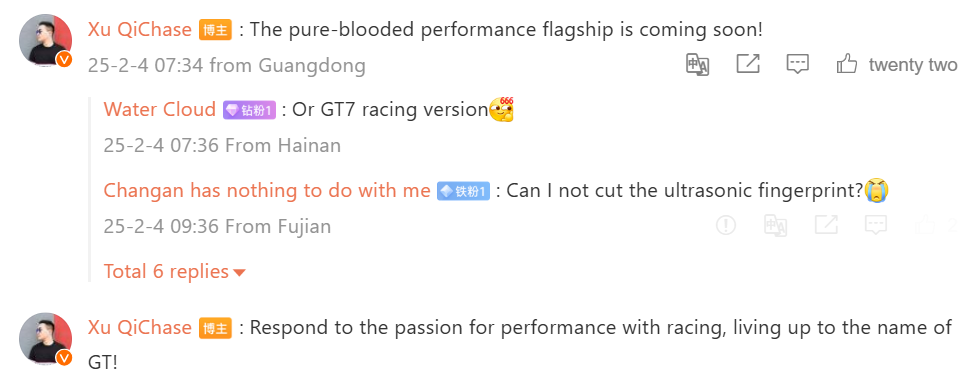
Given its specifications and anticipated launch timeline, the device is likely to succeed the Honor 90 GT. It is expected to directly compete with the Redmi K80 series and iQOO Neo 10 series. More details are expected to arrive in the coming days.
In the meantime, Realme has launched its performance-oriented flagship called the Realme GT 7 Pro, powered by the latest Snapdragon 8 Elite chipset with a starting price of ¥3,599 (~$506) in China, making it a value-for-money device for gamers who are also looking for a daily driver.
Oppo has introduced its 2024 flagship smartphones, the Find X8 and Find X8 Pro, in China, boasting upgraded designs and significant camera advancements.
While they aren’t yet officially available outside China, enthusiasts worldwide can still import these models through sites like Giztop and TradingShenzhen.
These retailers are among the first to offer the devices internationally, allowing fans to get early access to the latest releases while they are officially exclusive to China.
However, imported versions come with a few software limitations, such as a lack of Android Auto support and potential compatibility issues with some banking and contactless payment apps. Nonetheless, Google Play Services are included, meaning most apps should function without issues.
Price tag for those willing to import
Giztop offers the Find X8 and Find X8 Pro at starting prices of $699 and $899, respectively, for the 12 GB RAM and 256 GB models.
TradingShenzhen, while generally priced higher, also sells the regular and Pro models, starting around $725 and $920 for the 12GB+256GB variant.
These options provide global Oppo fans with access to the latest flagship hardware, although careful consideration of import limitations is advised.
Under the hood, both phones are powered by MediaTek’s Dimensity 9400 chipset, a robust alternative to Snapdragon 8 Elite. The Dimensity 9400, built on a 3nm process, boasts improved CPU architecture that delivers substantial boosts in both single-core and multi-core speeds, along with a 40% enhancement in power efficiency, which helps extend battery life significantly. This chipset also includes a next-gen AI engine, optimized for on-device AI applications and high-quality video generation.
Furthermore, its 12-core GPU offers advanced ray tracing capabilities and hyper-realistic visuals, delivering up to a 40% improvement in gaming performance and graphics quality. In contrast, the Snapdragon 8 Elite holds an edge in certain AI tasks and efficiency, but MediaTek’s enhancements in the Dimensity 9400 make it a compelling choice for high-performance devices that don’t break the bank. For more on the Dimensity 9400’s performance, you can check our detailed comparison.
Huawei’s Mate series of flagship phones, known for offering top-notch specifications and cameras, has always received positive reception from critics and general users. The Mate 60 series, launched last year, saw a remarkable market response, with phones selling out immediately after release. However, due to US sanctions, Huawei phones are now limited to the Chinese market, and the Mate 60 remained confined to China.
Recently, the company confirmed that it will announce the Mate 70 series of smartphones later this month in China. The Mate 70 series is generating significant buzz in the tech world, with leaks and rumors hinting at a compelling lineup of flagship smartphones. While Huawei remains tight-lipped about the official details, here’s what we can anticipate based on the available information:
The Mate 70 series is expected to retain the iconic circular camera module, housing four camera sensors arranged in a square formation. However, the module might be integrated into a circular or elliptical island, adding a unique visual element.
Rumors suggest a special “Ultimate Design” (UD) variant will replace the Mate 60 RS, possibly drawing inspiration from the Mate XT, which debuted a few weeks ago as the world’s first tri-foldable phone. So, the lineup may include multiple models, such as the Mate 70, Mate 70 Pro, Mate 70 Pro+, and Mate 70 Ultimate Design.
It is almost certain that the Mate 70 will feature a large, high-resolution curved-edge display with a 120Hz refresh rate, providing smooth visuals and an immersive viewing experience. The Mate 70 is expected to have a single punch-hole display, while the higher models may adopt a triple camera punch-hole design, similar to their predecessors.
2. Performance and Hardware
A new Kirin 9000-series chipset, possibly based on a 5nm process, is likely to power the Mate 70 series. This should translate to significant performance gains and improved power efficiency.
Speculations suggest the Mate 70 series might launch with HarmonyOS Next as the primary operating system, but with the intriguing possibility of dual-booting Android for greater app compatibility.
While specific details are scarce, the Mate 70 series is expected to arrive with a cutting-edge camera system, possibly featuring improved sensors, enhanced zoom capabilities, and advanced image processing algorithms. Likely, the Pro models may come equipped with a 1-inch primary camera. Huawei’s proprietary XMAGE branding will likely continue to play a prominent role, highlighting the company’s focus on mobile imaging excellence.
4. Other Features
With the current trend of offering silicon-carbon batteries with larger capacities in the smartphone industry, it is likely that Huawei may also join the bandwagon. Except for the standard model, the Mate 60 series offered 6,000mAh batteries with 88W rapid charging. There’s a possibility that the Mate 70 series may pack larger batteries along with 88W rapid charging. The entire lineup may support 50W wireless charging and up to 20W reverse wireless charging.
Rumor has it that the display will house an upgraded ultrasonic fingerprint sensor, providing faster and more reliable biometric authentication. Despite ongoing challenges, 5G connectivity is likely to be a standard feature across the Mate 70 lineup.
5. Launch and Availability
While Huawei has officially confirmed that the Mate 70 series will debut in November, it has yet to announce a specific launch date. There are rumors suggesting an announcement on Nov. 19. The release of the Mate 70 series in markets outside of China remains unclear.
The Huawei Mate 70 series promises to be a strong contender in the flagship smartphone market, with a compelling combination of design, performance, and camera capabilities. While the ongoing US sanctions continue to pose challenges for Huawei, the company’s commitment to innovation and technological advancement is evident in the rumored features of the Mate 70 lineup. As the official launch date approaches, we can expect more concrete details to emerge, shedding further light on Huawei’s latest flagship offerings.
Xiaomi 15 is a high-performance smartphone designed to elevate the mobile experience with its advanced specs. Featuring a 6.36-inch 1.5K OLED display with a 144Hz refresh rate, HDR10+, 12-bit color depth, Dolby Vision, and 1900 nits peak brightness, it delivers vivid visuals and smooth interactions—ideal for gaming and multimedia. Powered by the Qualcomm Snapdragon 8 Elite processor, with up to 12GB LPDDR5 RAM, it offers powerful, efficient performance for multitasking and gaming.
The device boasts a Leica-powered triple camera system, including a 50MP main sensor, a 50MP telephoto lens with optical stabilization, and a 50MP ultra-wide lens. Video capabilities are impressive, supporting up to 8K recording at 30fps, slow-motion at 1920fps, and a 32MP front camera with 4K video recording. Running on Xiaomi’s Hyper OS, the interface is optimized for smooth, fast performance with multi-language support.
A 5400mAh battery ensures all-day power, and with 90W wired and 50W wireless charging, users can recharge quickly. Xiaomi 15 supports the latest 5G bands, WiFi 7, NFC, dual-frequency GPS, and features an in-display fingerprint sensor for secure access.
Xiaomi 15 is available at Giztop starting at just $749.00. Use the coupon code: XAM30 at checkout to enjoy an additional $30 discount. This deal offers exceptional value for a flagship phone with top-tier features like the OLED display, Snapdragon 8 Elite processor, and Leica camera system.
OnePlus has just launched the OnePlus 13 equipped with the best chipset and top-notch cameras in China. For those looking for affordable flagship phones, the brand is said to be working on the Ace 5 series of smartphones. Rumors have revealed that the Ace 5 will feature last year’s Snapdragon 8 Gen 3 chip, whereas the Pro model will come equipped with the latest Snapdragon 8 Elite chipset. In a new leak, the tipster has shared the key specifications of the Ace 5 and he has also revealed what to expect from the Pro model.
OnePlus Ace 5 Pro could be the cheapest Snapdragon 8 Elite phone
OnePlus Ace 5 Pro to feature Snapdragon 8 Elite
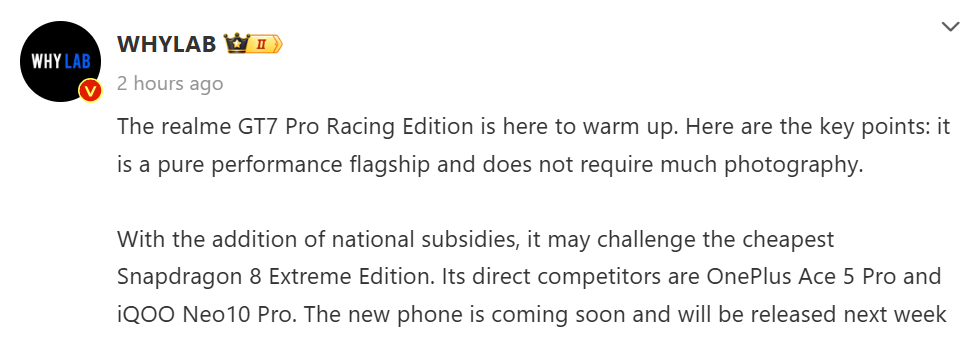
At present, the Realme GT 7 Pro, which has a starting price of 3,599 Yuan (~$505), is the most affordable Snapdragon 8 Elite phone in China. DCS has revealed that the upcoming OnePlus Ace 5 Pro will compete to be the cheapest Snapdragon 8 Elite phone this year. This indicates that its base model could be priced at around 3,300 Yuan (~$465).
According to a recent leak, the OnePlus Ace 5 Pro is expected to feature the same screen as the Ace 5, and its rear camera setup could potentially include a 50-megapixel Sony IMX906 primary camera and a 50-megapixel Samsung JN1 telephoto camera.
OnePlus Ace 5 specifications (rumored)
OnePlus Ace 5 specs leak
According to DCS, the OnePlus Ace 5 will arrive with a 6.78-inch flat 8T OLED panel. The BOE X2 panel will support a 1.5K resolution and a 120Hz refresh rate.
Under the hood, the Ace 5 will feature the Snapdragon 8 Gen 3 chipset, up to 16 GB of LPDDR5x RAM, and up to 512 GB of UFS 4.0 storage. It is expected to pack over a 6,000mAh battery with 100W fast charging support. A previous leak by the same source revealed that the Ace 5 series will have a 6,300mAh – 6,500mAh battery.
For selfies, the Ace 5 will have a 16-megapixel front-facing camera. The back panel of the device will have a 50-megapixel + 8-megapixel + 2-megapixel triple camera configuration. There’s a possibility that it may feature the same primary camera as the Ace 5 Pro.
The Ace 5 series is expected to debut in November or December in China. The Pro version might stay exclusive to the Chinese market, while the Ace 5 might undergo a global rebranding as the OnePlus 13R.
We use cookies on our website to give you the most relevant experience by remembering your preferences and repeat visits. By clicking “Accept”, you consent to the use of ALL the cookies.
This website uses cookies to improve your experience while you navigate through the website. Out of these, the cookies that are categorized as necessary are stored on your browser as they are essential for the working of basic functionalities of the website. We also use third-party cookies that help us analyze and understand how you use this website. These cookies will be stored in your browser only with your consent. You also have the option to opt-out of these cookies. But opting out of some of these cookies may affect your browsing experience.
Necessary cookies are absolutely essential for the website to function properly. This category only includes cookies that ensures basic functionalities and security features of the website. These cookies do not store any personal information.
Any cookies that may not be particularly necessary for the website to function and is used specifically to collect user personal data via analytics, ads, other embedded contents are termed as non-necessary cookies. It is mandatory to procure user consent prior to running these cookies on your website.