Advertisement

Apple Watch import ban takes effect in U.S. following regulatory decision

The US International Trade Commission (ITC) has enforced a ban on specific models of the Apple Watch, following a patent infringement dispute with Masimo, a health tech company. This decision affects the Apple Watch Series 9 and Apple Watch Ultra 2, which are said to infringe on patents related to pulse oximetry technology used to measure blood oxygen levels.

apple-watch-series-6-blood-oxygen-wrist

ITC Enforces Ban on Apple Watch Models Over Masimo’s Pulse Oximetry Patents

Despite having a 60-day review period, U.S. Trade Representative Katherine Tai upheld the ITC’s decision on December 26, 2023, making it final. Consequently, the import and sales of the affected Apple Watch models have been restricted in the United States. This comes after an October 2023 ruling by the ITC that found Apple guilty of infringing on two patents owned by Masimo and Cercacor Laboratories.

In response, Apple has filed an emergency request with the U.S. Court of Appeals for the Federal Circuit to temporarily halt the ban. The company argues that the ITC’s decision is incorrect and seeks a postponement of the ban until U.S. Customs and Border Protection determines if redesigned versions of the watches infringe Masimo’s patents. This decision is expected by January 12th.

Apple, which strongly opposes the ITC’s decision, has already removed the affected models from its official U.S. website. However, these models are still available through third-party retailers like Amazon, Best Buy, and Walmart, which have existing stocks.

The entry-level Apple Watch SE model is not affected by this ban and continues to be available for sale. Apple’s legal strategies include potentially overcoming the issue with a software fix, though Masimo believes this wouldn’t circumvent their hardware-based patents.

This situation is notable as it’s the first time since 2013 that a U.S. presidential administration has not vetoed an ITC ruling involving Apple. The ban’s impact on Apple’s wearables, home, and accessories sector, which generated $8.28 billion in revenue in the third quarter of 2023, remains to be seen.

RELATED:

(Via)

Samsung Launches Phone App for Windows, Enabling PC Calls

Following the launch of the Galaxy Book 4 series laptops, Samsung has recently introduced its Phone app for Windows PCs. With this software, Samsung is likely trying to recreate the cohesive ecosystem seen in the Apple realm, offering users seamless integration comparable to that between an iPhone and a Mac.

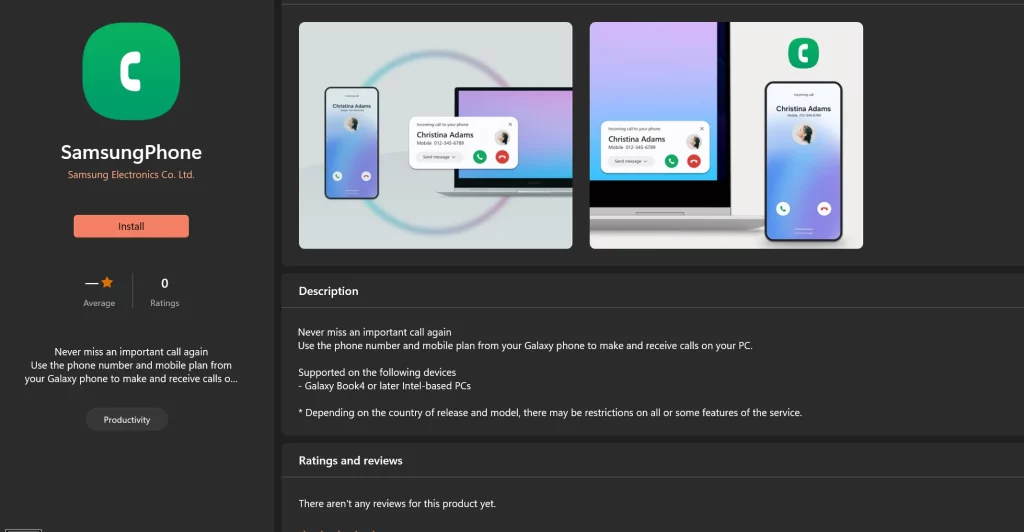
Samsung Phone app

The real game-changer here is the seamless management of Galaxy smartphones directly from Windows PCs. No more toggling between devices – with the Samsung Phone app, users can effortlessly make calls, check messages, receive notifications, and transfer files.

The Samsung Phone app goes beyond mere mirroring, offering direct access to a phone’s gallery, contacts, and Samsung Notes from the desktop. This means seamless multitasking and collaboration across devices, with the added perk of Samsung DeX mode, turning the phone into a PC-like experience when hooked up to a monitor.

Samsung Phone app

That being said, it looks like the app is currently limited to Samsung laptops only, more specifically, the Galaxy Book 4 series laptops that recently broke cover in South Korea. This new feature can make the new laptops more appealing to Samsung smartphone users as it will basically offer the same ecosystem features as its number 1 competitor, Apple.

Out of all the features, the calling feature is the most intriguing as the app description reads, “Never miss an important call again. Use the phone number and mobile plan from your Galaxy phone to make and receive calls on your PC.” This raises quite a few questions. Since there is no eSIM support on the new Galaxy Book laptops, it is unclear how users will be able to use the same number and mobile plan for their laptops.

RELATED:

(Source, via 1, 2)

A Fresh Persona 3 Reload Trailer Unveils New RPG Adventures for Gamers

Fans of Atlus’ iconic series have a reason to get excited – Persona 3 Reload is nearly here, and it’s shaping up to be more than just a nostalgia trip. This remake isn’t just a visual upgrade; it’s a reimagining that bridges the gap between the original Persona 3 and the more recent Persona 5.

The game is designed around a stylized school life experience

At the heart of Persona 3 Reload is the enhanced school life experience. Imagine being a student at Gekkoukan High School, not just battling shadows but also diving deep into everyday school activities. The new trailer throws light on these day-to-day experiences – from answering questions in class to receiving text messages from friends. These might seem like small details, but they add a layer of realism and immersion to the game.

Persona Reload Game

But what really stands out in Persona 3 Reload is the social link system. Here, you’re not just a student or a shadow hunter; you’re part of a living, breathing world. The choices you make in interactions matter, shaping your journey and relationships. It’s a dynamic world where responding to a text message or choosing to hang out with friends can unlock new possibilities.

What’s exciting is the blend of the old and the new. Fans will appreciate the nods to the original game, like the return of familiar characters and scenes. But there’s also something new to discover, like the revamped social link with Elizabeth and reanimated date events. It’s like meeting an old friend and finding out they have new stories to tell.

Atlus has been teasing us with information since the game’s announcement, but each new reveal adds another layer to our anticipation. From the system requirements that promise a smooth experience on modern PCs to the unique collaboration with Hyte for gaming gear, everything points to a game that respects its roots while embracing the future.

As the release date inches closer, it’s clear that Persona 3 Reload isn’t just a remake. It’s a tribute to a classic, reimagined for a new generation of gamers. Whether you’re a long-time fan or new to the series, there’s something for everyone in this blend of social simulation, dungeon exploration, and rich storytelling.

RELATED:

(Via)

Beijing Unveils Powerful AI Computing Platform Amid Semiconductor Tensions

Recent reports have stated that Beijing has introduced a state-of-the-art computing platform. This initiative, known as the Beijing AI Public Computing Platform or the Shangzhuang project, comes at a crucial time when global semiconductor tensions, especially with the US, are intensifying.

The project intends to resolve a shortage of computing power in Beijing

Operated by Beijing Energy Holding (BEH), the Shangzhuang project is designed to resolve a critical shortage of computing power in Beijing. This shortage has been particularly challenging for universities, research centers, and small and medium-sized businesses. The new platform is not just a technical advancement but also a strategic step in China’s endeavor to become a leader in AI technology.

China

BEH’s computing platform boasts an impressive 500 petaflops of power in its initial phase. To put this in perspective, the world’s most powerful supercomputer, the US’s Frontier, has a peak performance of 1,194 petaflops. BEH isn’t stopping there, though. They plan to triple this capacity to 1,500 petaflops in the near future.

Another noteworthy aspect of the Shangzhuang project is its commitment to sustainability. BEH has expressed intentions to eventually power the platform entirely with green energy, aligning with global environmental goals.

The platform’s inauguration was marked by significant collaborations. BEH signed agreements with major Chinese tech firms, including Alibaba Cloud and AI startup Zhipu AI. These partnerships aim to explore various sectors, from green energy to digital economy development.

This initiative is part of a broader strategy by Beijing’s municipal government. Earlier this year, the government announced plans to pool computing resources to bolster AI development. Beijing, already hosting a third of China‘s core AI startups, is rapidly solidifying its status as a hub for AI innovation.

RELATED:

(Via)

Apple’s iPhone Designer Resigned for AI Hardware Project with Sam Altman

When it comes to Apple products, design is as important a factor as hardware. The company is usually positions its products as desired objects, making it easy to sell anything at a high price. The name behind this success was Jonathan Paul Ive. He was the chief designer at Apple from 1996 until 2019. Ive left Apple in 2019 to start his own company, and thus began “Apple’s period of instability”. In the past four years, the company changed its chief designer twice. It seems Apple might have to find another one because Tang Tan, who took the role at the beginning of the year, also disappointed Tim Cook. Here are the details…

Apple’s iPhone Designer Joins Jony Ive and Sam Altman for AI Hardware Project

According to a recent report by Bloomberg’s Mark Gurman, Tang Tan, who was appointed as Apple’s new chief designer, has resigned. While the reason for the resignation remains unclear, Tan’s next destination is reportedly LoveFrom. LoveFrom is a design firm founded by Jony Ive, the legendary designer of Apple that we mentioned above. Apparently, Tan will be involved as a hardware designer in an artificial intelligence project alongside Ive and Sam Altman from OpenAI.

Of course, it is very usual for someone to leave a job and seek a new role elsewhere. However, Tang Tan was responsible for designing Apple’s major products, including the iPhone. Resigning from the role responsible for creating the world’s most popular product at the world’s largest tech company is somewhat surprising. Moreover, along with this resignation, everyone from Jony Ive’s design team in 2019 has also left the company. This signals a potential problems within the company.

There is, of course, another and simple possibility. The project that Ive and Altman proposed working on might have captured Tang Tan’s interest more than the iPhone. Unfortunately, the project they are working on remains a mystery for now. However, already sounding like more than just a simple product. It is currently unknown who will take over Tan’s position as Apple’s new lead designer.

RELATED:

iQOO TWS 1e launched with 44-hour battery life, ANC, and more

At the iQOO Neo 9 series launch event, the brand also announced some accessories. One of them was iQOO TWS 1e.

The latest wireless earbuds from the brand are a watered-down version of iQOO TWS 1 from earlier this year. This product is a rebranded version of the recently released Vivo TWS 3e.

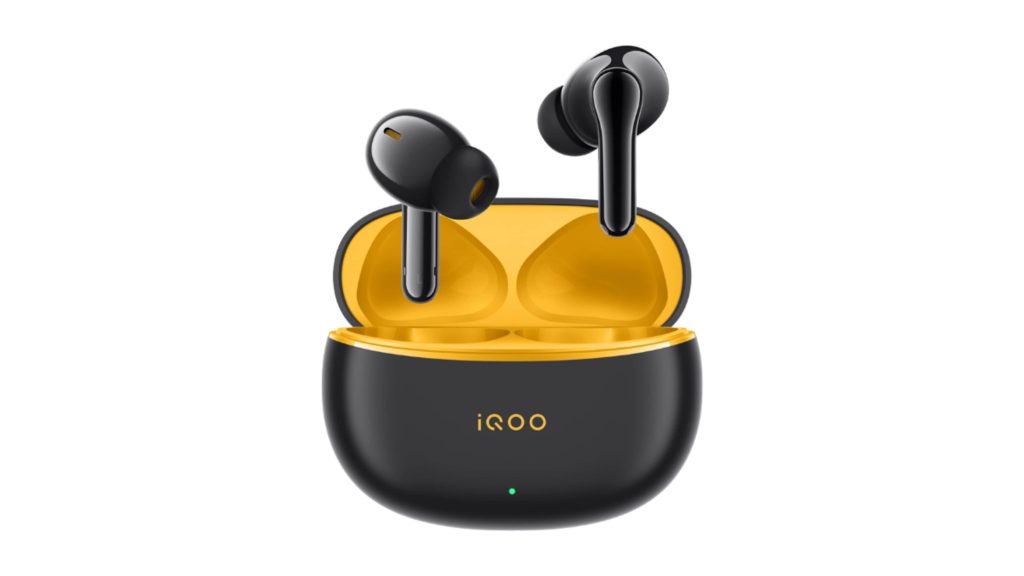
The iQOO variant only differs in terms of color. It comes in black color with yellow accents, in addition to a standard white color.

iQOO TWS 1e

iQOO TWS 1e Specifications

The iQOO TWS 1e wireless earphones feature an Apple AirPods-like design. The buds are in-ear type and use silicone ear tips.

They house 11mm drivers and connect via Bluetooth 5.3. They support multiple sound effects, such as DeepX 3.0 stereo, 3D panoramic audio, and Monster Sound for gaming.

The buds are IP54-rated for splash resistance. They offer touch gesture controls and pair seamlessly with Vivo and iQOO devices.

The earbuds offer a low latency of up to 55ms for gaming sessions. They also come with an intelligent ANC (active noise cancellation) for media playback and AI call noise reduction.

The accessory is rated to last for 44 hours on a full charge (along with the charging case) with ANC turned off. The buds themselves can operate for 11 hours on a single charge. 

iQOO TWS 1e Price

The iQOO TWS 1e is priced at ¥179 (~$25) in China. For a limited time, it is being sold at a discounted price tag of ¥159 (~$22).

The wireless earphones can be purchased in either Star Pearl Yello or Mecha White color options.

RELATED:

iQOO Watch With 1.43-inch Display, eSIM Support Launched In China

Alongside the launch of the iQOO Neo 9 series smartphones, iQOO has also announced a new smartwatch and a TWS earphone. The iQOO Watch is the Vivo sub-brand’s first-ever smartwatch. However, it is also a rebadged version of the Vivo Watch 3 that launched in China last month. Both devices pack the same specifications apart from a different pricing. 

iQOO Watch specifications and features 

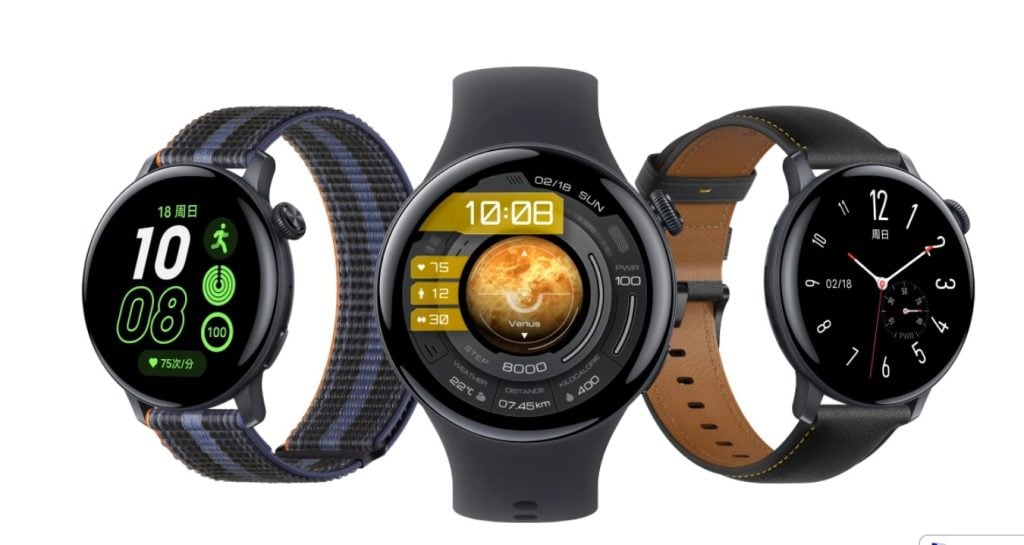
The iQOO Watch sports a circular dial with a 1.43-inch display bearing a resolution of 466 x 466 pixels. There are various watch faces and always-on display mode. The smartwatch has a rotating crown and a physical button on the right side.

On the health and fitness front, the iQOO Watch is equipped with a 24-hour heart-rate monitor and a SpO2 sensor. It offers four major warnings when the user’s heart rate and blood oxygen levels are high or low. There are also warnings for high-altitude reminders. The smartwatch features sleep tracking with interference-free infrared monitoring at night. The wearable device is also capable of monitoring stress levels, high noise detection, and menstrual cycle tracker for women. It alerts the user when they have been idle for a long time. The iQOO Watch comes with support for more than 100 sports modes along with AI running coach. 

The iQOO Watch runs on BlueOS. It comes with eSIM support, a speaker, and a microphone for hands-free voice calling. There are various features like QR code payment, NFC car keys, camera and music control, and more. The smartwatch is backed by a 505mAh battery unit that is claimed to offer 7 days of usage on a single charge. 

The iQOO Watch is offered in soft rubber, genuine leather, and nylon woven colors. The standard version is priced at CNY 1,099 (~$153) whereas the eSIM variant costs CNY 1,299 (~$183). The smartwatch can be purchased starting today.

Related:

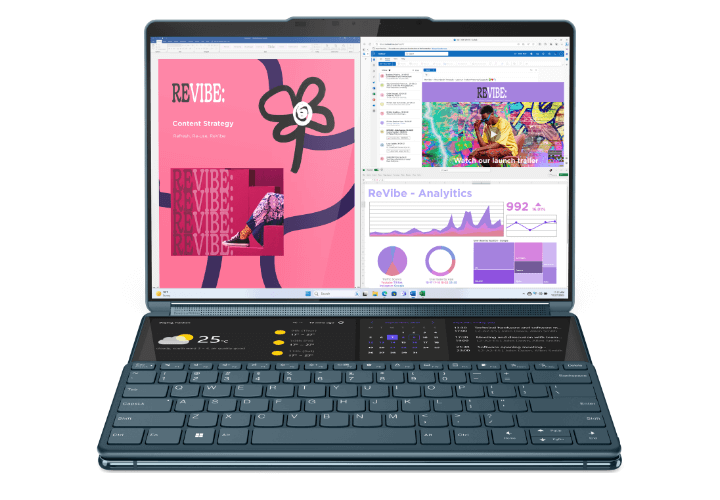
Lenovo Yoga Book 9i (9th Gen) design leaked, features dual displays

Back in July, Lenovo unveiled the Yoga Book 9i with a dual screen design. Now, a new leak hints that the successor to this model is in the works with a fresh leak revealing images of the next generation Yoga Book 9i laptop. So here are all the details.

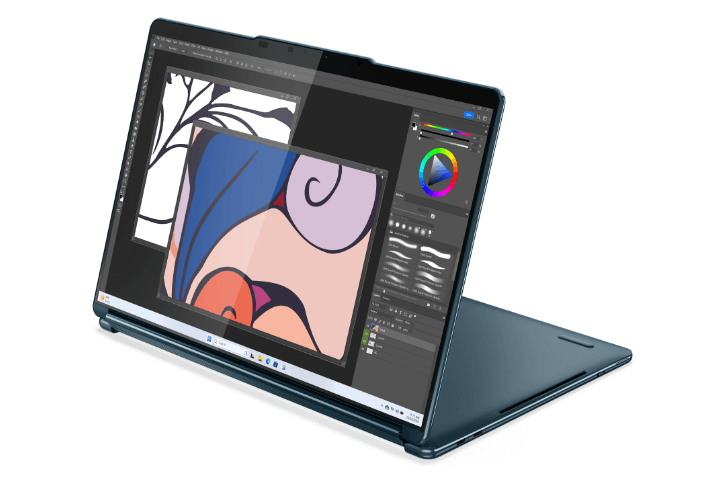
Lenovo Yoga Book 9i

Lenovo Yoga Book 9i (9th Gen) Leaked

The leak arrives from known tipster Evan Blass who shared images of the 9th Gen Yoga Book 9i on X (formerly Twitter). Looking at his tweet, we can see the upcoming thin and light laptop’s dual screen design. The device’s hinge also offers 360 degree support and the panel is likely a touch screen enabled panel for the tablet mode. Similar to its predecessor, the upcoming Yoga Book 9i likely also targets creative professionals since it also supports a stylus.

The images reveal that the Yoga Book 9i will feature a keyboard with a hidden touchpad, similar to the last gen model. Its primary display is the large front display, while the secondary screen is a smaller panel, which is housed above the keyboard and near the hinge mechanism of the device. Unfortunately, the leak does not reveal any finer details regarding the Yoga Book 9i except for confirming one color option.

On the sides, two Thunderbolt 4 ports can be seen along with. The previous iteration launched with 13th Gen Intel Core processors, so the newer model will likely offer a more updated refreshed specs or possible the Intel Core Ultra CPUs as well. Keep in mind that this is still just speculation at the moment so stick around for more updates regarding this matter.

RELATED:

OnePlus Nord 2T Gets OxygenOS 14 update based on Android 14 in India

The anticipated OxygenOS 14 stable update for the OnePlus Nord 2T (Review) is now officially rolling out. Initially, it will be available to users who actively participated in the Closed Beta and Open Beta versions with an expansion to a wider user base.

OnePlus Nord 2T

This comprehensive update, marked as version CPH2401_14.0.0.200(EX01) for the IN region, brings several noteworthy enhancements across various aspects of the user experience.

With the Smart Efficiency feature transferring content between applications and devices becomes easier through the drag-and-drop interface of the File Dock. Cross-device connectivity is also improved with a Shelf that provides widget recommendations for added convenience.

Regarding security and privacy, OxygenOS 14 has introduced management of photo and video-related permissions. This ensures access by applications. Performance optimization is another focus bringing enhancements to system stability app launch speed and overall animation smoothness.

One of the standout features of OxygenOS 14 is the Aquamorphic Design upgrade. It introduces a gentle and clearer color style that enhances the visual experience. From Aquamorphic-themed ringtones to revamped system notification sounds and even smoother animations this update aims to elevate the aesthetics of the OnePlus Nord 2T.

The User Care segment introduces a carbon tracking Always-On Display (AOD) feature, offering a visual representation of the carbon emissions saved by choosing to walk instead of driving.

For users in India, the update has already begun its journey through the IN region. However, if you can’t wait longer applying for the upgrade is a process.

Make sure that your phone is running on version CPH2401_11.C.30. To do this go to Settings and tap on “About device.” Next select “, up, to date”. Tap the icon located at the right corner of the screen. From there choose “beta program ” follow the provided steps to apply and finally check for any updates.

RELATED:

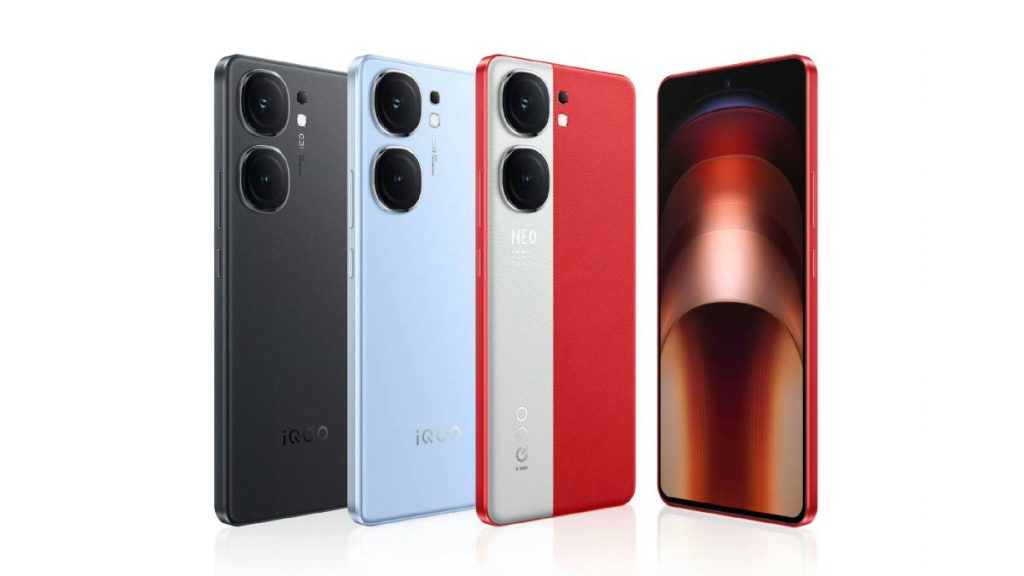
iQOO Neo 9, Neo 9 Pro With 144Hz Display, 120W Charging Launched In China

iQOO held an event in China today where it announced new products. These include smartphones, TWS earphone, and a smartwatch. The latest phones from the Vivo sub-brand are the iQOO Neo 9 and Neo 9 Pro. These arrive as the successors to the last year’s iQOO Neo 8 series. Both the newest devices pack premium specifications. They are also almost similar to each other. Read on to know more about them below.

iQOO Neo 9, Neo 9 Pro specifications

iQOO Neo 9 series
iQOO Neo 9 series

The iQOO Neo 9 and Neo 9 Pro come with an OLED display bearing a 1.5K resolution and measuring 6.78 inches. They offer a 144Hz refresh rate, and HDR10+ support, and the screen is integrated with a fingerprint scanner. There is also iQOO Q1 dedicated chip for enhanced viewing and gaming experience. Design-wise, the iQOO Neo 9 duo has a flat frame and two camera rings on the back panel. 

On the imaging front, the iQOO Neo 9 series feature a 50MP OIS-enabled Sony IMX920 primary camera which is found on the Vivo X100. The ultra-wide-angle lens on the standard and pro variants are 8MP and 50MP respectively. Both phones have a 16MP front-facing selfie snapper.

Under the hood, the iQOO Neo 9 is equipped with a Snapdragon 8 Gen 2 processor whereas the Neo 9 Pro is powered by a Dimensity 9300 chipset. Both phones pack up to 16GB LPDDR5 RAM and 1TB UFS 4.0 storage. The devices also feature a 6K VC liquid cooling 3D heat dissipation system onboard. The iQOO Neo 9 and Neo 9 Pro are backed by a 5,160mAh battery unit with support for 120W fast charging. 

Other features on the iQOO Neo 9 series include dual speakers, IR Blaster, X-Axis linear motor, WiFi-7, and more. Software-wise, the smartphones ship with OriginOS 4-based Android 14 out of the box, 

The iQOO Neo 9 and 9 Pro are offered in Red and White Soul (with a dual-tone leather textured back panel), Nautical Blue, and Fighting Black colors. The standard variant starts at CNY 2,299 (~$321) for the 12GB + 256GB variant. The 16GB + 256GB, 16GB + 512GB, and 16GB + 1TB configurations are priced at CNY 2,499 (~$349), CNY 2,799 (~$391), and CNY 3,199 (~$447) respectively. On the other hand, the iQOO Neo 9 Pro in 12GB + 256GB and 12GB + 512GB options are priced at CNY 2,999 (~$419) and CNY 3,299 (~$461) respectively. The 16GB + 512GB and 16GB + 1TB variants cost CNY 3,599 (~$503) and CNY 3,999 (~$559).

Related:

Samsung Galaxy S24 visits IMDA ahead of January launch

With the Samsung Galaxy S24 series launch being right around the corner, there have been various reports and leaks that have surfaced online. Now, the latest sighting is in a Singaporean certification platform. So here are all the details.

Samsung Galaxy S24 spotted on IMDA certification

The South Korean tech giant is expected to release the Galaxy S24, Galaxy S24+, and Galaxy S24 Ultra on 17th January 2024. But ahead of this launch date, the base S24 model surfaced on Singapore’s IMDA database. The device was listed on the certification platform carrying the SM-S921B/DS model number. While the finer details were not revealed on IMDA, the listing confirms NFC, Bluetooth, and WiFi connectivity support.

Samsung Galaxy S24

Recently, the Samsung Galaxy S24 series has been spotted on various rumors and leaks. Just earlier today (27th December 2023), the Galaxy S24 and Galaxy S24+ color options were revealed via leaked SIM tray images. This showcased Orange, Purple, and White color options. We covered the entire spec sheet of the Galaxy S24 series as well in a fresh report. This revealed that the Galaxy S24 series will launch with the Exynos 2400 SoC worldwide, with the US and Canadian markets being an exception with the Snapdragon 8 Gen 3 chipset.

To recall, the Galaxy S24 sports a 6.2-inch Dynamic AMOLED 2x display that has a 120Hz refresh rate and Full HD+ resolution. The device features a 50-megapixel triple camera setup on the rear, while the front houses a 12-megapixel selfie shooter. A 4,000mAh battery pack is expected to power this device which also supports 25W fast charging. So stick around for more as we will be providing updates when additional information is available regarding this matter.

RELATED:

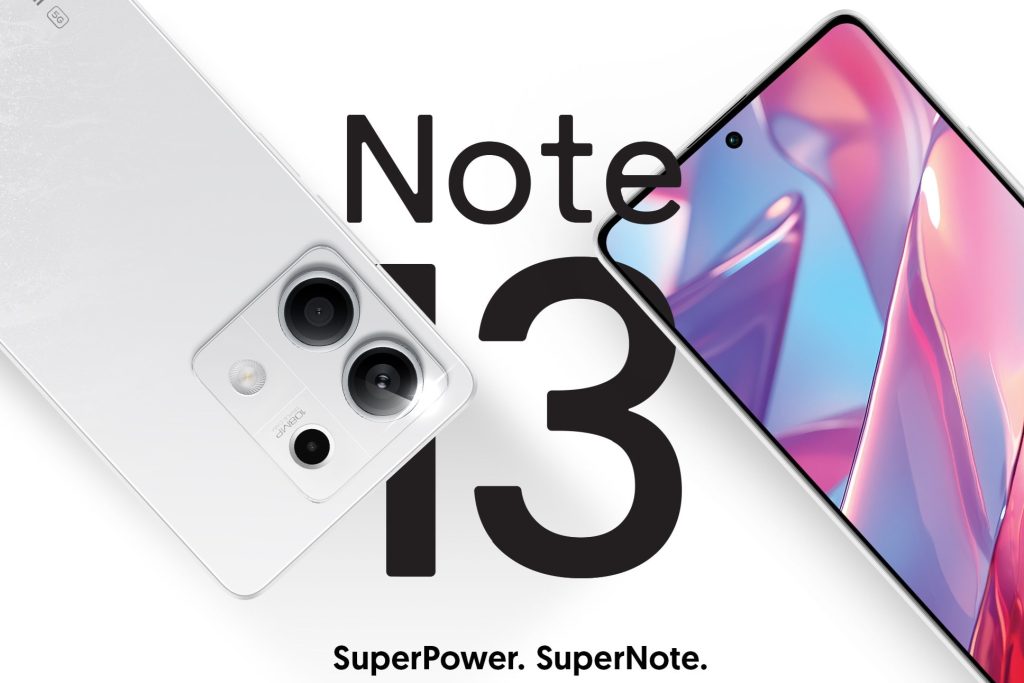
Redmi Note 13 5G confirmed to launch in India next week

Xiaomi is holding its first global launch event on January 4. It will take place in India and the company has confirmed to debut the Redmi Note 13 series.

For the last few days, the firm has been gradually revealing the devices that will be unveiled. At the same time, it has been also teasing their features.

Today, the company has disclosed the third and probably the last phone to launch at the event.

Redmi Note 13 5G

Xiaomi will launch the Redmi Note 13 5G in India on January 4. It will be presented alongside the Redmi Note 13 Pro Plus 5G and Redmi Note 13 Pro 5G.

The teaser poster shared by the firm confirms that the international version of Redmi Note 13 5G will be slightly different from the Chinese variant. It will feature three rear cameras instead of two as revealed by renders earlier.

As per a recent leak, the triple camera system will consist of a 108MP primary sensor, an 8MP ultrawide unit, and a 2MP macro snapper. For comparison, the Chinese model lacks the ultrawide cameras and sports a 2MP depth sensor instead of the macro shooter.

The rest of the specs will be the same. The global variant will flaunt a 6.67-inch centered punch-hole FHD+ 120Hz AMOLED display. It will be powered by a MediaTek Dimensity 6080 chip paired with LPDDR4x RAM and UFS 2.2 storage.

The IP54-rated phone will come with a side-mounted fingerprint sensor, dual stereo speakers, a 3.5mm headphone jack, and a MicroSD card slot. It will be backed by a 5,000mAh battery with support for 33W charging.

Last but not least, the handset will boot Android 13-based MIIU 14. It might get three Android updates and four years of security updates.

RELATED:

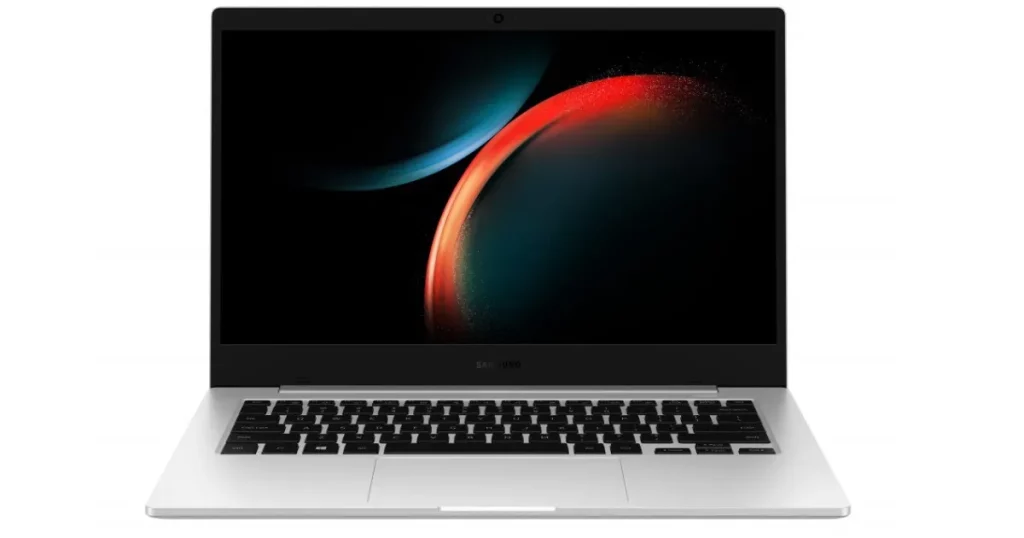
Samsung Galaxy Book 3 Go 5G With Snapdragon 7c+ Gen 3, 45W Charging Launched

Samsung launched the Galaxy Book 4 series laptops in its home market earlier this month. Now, the South Korean brand has announced a new laptop which is not an additional model in the Book 4 lineup. The latest offering is the Samsung Galaxy Book 3 Go 5G. It arrives as the successor to the Galaxy Book 2 Go that debuted earlier in January this year. Read on to learn more about the Book 3 Go 5G.

Samsung Galaxy Book 3 Go 5G specifications

The Samsung Galaxy Book 3 Go 5G features a 14-inch IPS display with anti-glare coating bearing an FHD resolution. It has a 720p webcam. On the audio front, the device is equipped with dual 1.5W stereo speakers with Dolby Atmos. The laptop weighs just 1.43kg and is just 15.5mm thin. 

On the hardware front, the Samsung Galaxy Book 3 Go 5G is powered by a Snapdragon 7c+ Gen 3 chipset based on 6nm process. It has an Adreno GPU onboard. The laptop packs 4GB RAM and 128GB storage. The Book 3 Go 5G is backed by a 42.3WHr battery unit with support for 45W charging that is said to offer 8 hours of usage with 30 minutes of charging. 

Software-wise, the Samsung Galaxy Book 3 Go 5G runs on Windows 11 OS. Samsung users can enjoy several Galaxy ecosystem features including Quick Share, Second Screen, Buds Auto Switch, and Multi Control. Connectivity options on the laptop include WiFi-6E, Bluetooth 5.1, two USB-C ports, SD card, and a 3.5mm jack. 

The Samsung Galaxy Book 3 Go 5G is priced at KRW 557,700 (~$430) in South Korea. It can be purchased in the sole Silver color from Samsung stores and three Korean carriers starting January 2. 

Related:

Microsoft Copilot app now available on Android

In September, Windows 11 replaced Cortana with Copilot, its new AI-powered assistant. Last month, Microsoft integrated OpenAI’s GPT-4 Turbo into Copilot, and now, Copilot is available for Android users.

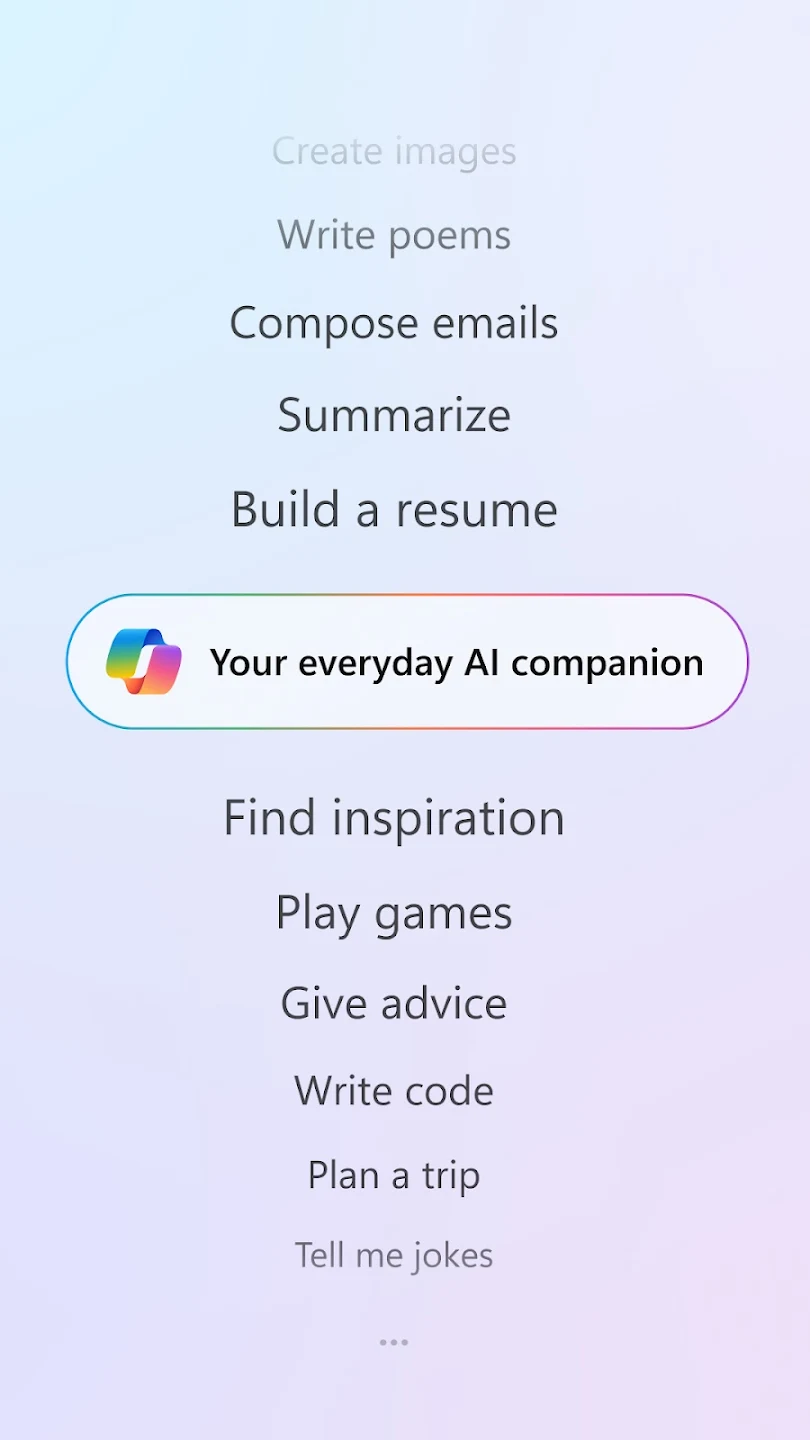
Microsoft recently introduced the Copilot AI-Powered Chat Assistant on Android, utilizing OpenAI’s GPT-4 and DALL·E 3 models. This app ensures rapid and accurate responses while generating visually appealing content from basic text inputs.

You can download Copilot for free on the Google Play Store, allowing you to draft emails, compose stories, perform language translation, proofread, and plan travel itineraries. The Image Creator, driven by DALL·E 3, streamlines design processes by turning text prompts into high-quality visuals. While the Android version is now accessible, Microsoft hasn’t officially confirmed plans for an iOS release. There’s speculation about a potential 2024 launch, but details are unconfirmed.

This development follows Microsoft’s rebranding of Bing Chat to Copilot. Copilot on Android closely mirrors its ChatGPT counterpart, offering chatbot capabilities, image generation, and text drafting. For iOS users eagerly awaiting Copilot, current access to features remains available through the Bing app. Microsoft’s venture into the mobile app arena highlights Copilot’s transformation into a versatile tool.

In related news, Suno, recognized for its AI algorithms in music composition, has partnered with Microsoft Copilot to introduce an easy-to-use tool for effortlessly crafting songs. The process is straightforward: users provide a text prompt, and the algorithm takes the reins, producing fully realized songs with accompanying lyrics and singing voices.

RELATED:

SenseTime launches Yuanluobo AI Chess Robot Go version in Japan

SenseTime, a Chinese AI company, introduced the “Yuanluobo AI Chess Robot” in June last year in China. This innovative robot is designed for the ancient game of Go (Weiqi) and has now made its entry into the Japanese market. The robot, carrying the model name RG2W-P, is a part of SenseTime’s Yuanluobo brand. It is poised to revolutionize the way Go is played and learned in Japan.

Bridging Tradition and AI in the World of Board Games

Sensetime Yuanluobo AI Chess Robot

Go, the game at the heart of Yuanluobo’s technology, is an ancient Chinese abstract strategy board game. It’s one of the oldest continuously played board games, dating back over 2,500 years. The objective is to surround more territory than the opponent. This game has attracted major tech companies’ attention, notably with Google’s AI program Alpha Go defeating a human Go world champion in 2016, a significant milestone in AI development. Go is a deterministic strategy game with perfect information, categorized with chess, checkers, and Othello in combinatorial game theory, emphasizing its strategic depth and complexity.

Coming to the product, the AI Chess robot stands out due to its ability to customize the initial chess skill levels and gradually unlock more challenging levels. This feature allows players to engage with the robot at over 20 different skill levels, offering a versatile and adaptive learning experience for Go enthusiasts of varying proficiencies.

The entry of the Yuanluobo AI Chess Robot into the Japanese market is a strategic move, considering the rich historical ties between China and Japan in the context of Go. Mr. Shi Jun, Vice President of SenseTime Technology and President of the Asia-Pacific Business Group, emphasizes this cultural significance, viewing the robot’s introduction as a continuation of the long-standing cultural exchange between the two countries.

Pricing and Availability

This AI-powered chess robot is set to be available at various locations across Japan, including Go clubs, Go classrooms, Takashimaya department stores, and Amazon, starting from January 5, 2024.

The pricing details for the Yuanluobo AI Go robot in Japan are currently uncertain. However, in China, it is available with a standard version priced at 3,799 yuan (US$531) and a premium version that includes a case and power bank, priced at 4,999 yuan ($699).

RELATED:

OnePlus Buds 3 Also Arriving On January 4, Design Revealed

OnePlus announced that it will launch the Ace 3 smartphone in China on January 4. The brand is also confirmed to launch a TWS earphone alongside at the same event. The upcoming offering is the OnePlus Buds 3. A teaser poster shared by OnePlus on the Chinese microblogging platform Weibo gives us an official look at the TWS earphone. 

OnePlus Buds 3 to arrive on January 4

The poster reveals the OnePlus Buds 3 has a semi-in-ear design with a glossy finish stem and the silicone ear tips having a matte finish. The TWS earphones ditch the dual-tone design found on the previous flagship OnePlus Buds Pro and Buds Pro 2. The upcoming audio device retains the same squarish-shaped design for its storage and charging case. 

The OnePlus Buds 3 will be offered in Space Grey and Clear Sea Blue color options. The poster claims to “popularize flagship sound quality and be the first choice for OnePlus users”. It is touted to be a true wireless noise-cancelling earphone.  The upcoming TWS earphone is up for pre-orders in China from Tmall, JD, and OPPO Mall. 

As for the core specifications, the OnePlus Buds 3 will reportedly be equipped with a 10.4mm woofer and a 6mm tweeter. It will pack 48dB noise cancellation and come with Google Fast Pair as well as dual connectivity. The earphones will have an IP55 rating. Additionally, tipster Digital Chat Station also reveals that the OnePlus Buds 3 will feature 3D spatial audio, LHDC 5.0, and a massive 44-hour battery life. 

Related:

POCO X6 series in India may feature Dimensity 8300 Ultra, hints teaser

POCO is preparing to announce a brand-new X series smartphone in the Indian market soon. The lineup in question is the POCO X6 series, and now, a new teaser hints at the chipset that could power the device. So let’s have a look.

POCO X6 to debut with Dimensity 8300 Ultra

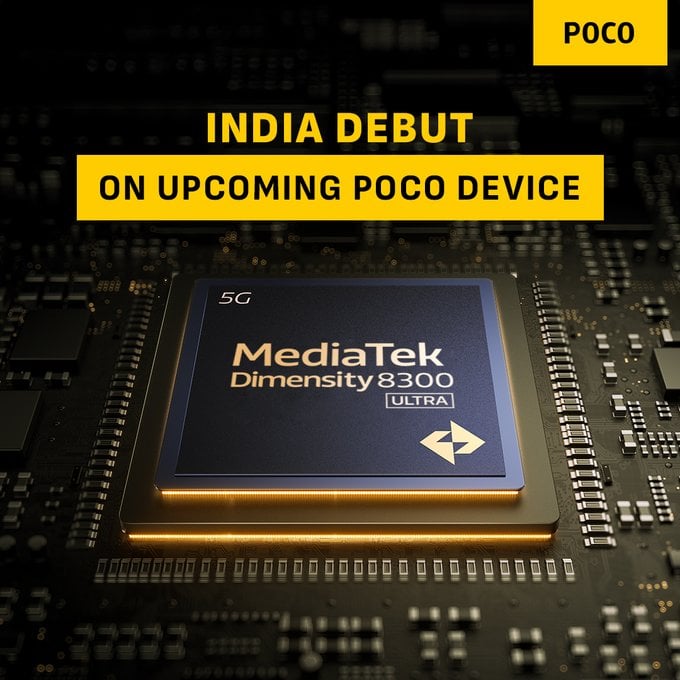
In an official X post, the Chinese smartphone maker shares an image poster that states that an upcoming POCO smartphone will debut with the MediaTek Dimensity 8300 Ultra SoC. The company adds that the chipset will be the most powerful chipset for its segment. For those unaware, the Dimensity 8300 Ultra is somewhat comparable to the Qualcomm Snapdragon 8 Gen 2 SoC.

POCO X6 series

While the latest teaser doesn’t specifically state that the Dimensity 8300 Ultra will be equipped on the POCO X6, the company’s India head Himanshu Tandon previously shared a teaser for the POCO X6 series earlier this week. In other words, it is likely the POCO X6 lineup, which was previously rumored to come with a Snapdragon 7s Gen 2. The POCO X6 5G surfaced on the TDRA and NBTC earlier this month as well. An FCC listing also confirms that the X6 Pro arrives with 8GB + 256GB and 12GB + 512GB storage configurations.

Based on what we know so far, the POCO X6 Pro model sports a tall 6.67-inch AMOLED display with FHD+ resolution, HDR10+, Dolby Vision, 120Hz refresh rate, and more. Under the hood, a large 5,500mAh battery pack powers this device, which supports 67W fast charging support. The rear packs a 64-megapixel triple camera setup, while the front houses a 16-megapixel selfie shooter. So stick around for more as we will be providing more updates.

RELATED:

Lenovo launches the ThinkPad Z13 / Z16 Gen 2 laptops in China, starting at 10,999 Yuan ($1,538)

Lenovo has recently launched its ThinkPad Z series laptops in China, which include the ThinkPad Z13 Gen 2 and ThinkPad Z16 Gen 2 models. These laptops were initially showcased at MWC 2023 and are currently available for purchase in the Chinese market.

Specifications and Pricing

Lenovo ThinkPad Z13 Gen 2 starts at 10,999 Yuan ($1,538) and features an AMD R7 Pro 7840U processor for high-performance computing. It’s impressively lightweight at 1.24kg and slim at 13.99mm, emphasizing portability without compromising performance.

In terms of display, the Z13 laptop is equipped with a 13-inch 2.8K OLED panel, offering a resolution of 2880 x 1800. This high-quality display supports a 100% DCI-P3 color gamut, a brightness level of 400 nits, and 10-point touch control.

As for the ThinkPad Z16 Gen 2, it is priced higher at 14,999 Yuan ($2,098). This model steps up with an AMD R7 Pro 7840HS processor, coupled with an RX 6550M dedicated graphics card. It is slightly heavier and bulkier than the Z13, weighing 1.84kg with a thickness of 15.8mm, but offers a more robust set of features for users who need more power and a larger screen.

The Z16’s display is a standout, featuring a larger 16-inch WQUXGA 4K OLED panel with a higher resolution of 3840 x 2400. Like the Z13, it also supports the 100% DCI-P3 color gamut and 400 nits brightness, along with 10-point touch control.

Both laptops come equipped with 32GB LPDDR5X-6400 memory and a 1TB SSD, ensuring fast and efficient storage and multitasking capabilities. The Z13 includes dual USB4 ports and an audio interface, while the Z16 adds to this with an additional USB-C port and an SD card slot.

Both laptops prioritize security with facial recognition and fingerprint scanning. Additionally, both laptops incorporate eco-friendly materials and manufacturing processes, making them environmentally responsible choices.

Both models also focus on enhancing the videoconferencing experience, with FHD infrared cameras and AI-based audio for crisp and clear online meetings. They also meet the US Department of Defense’s MIL-STD 810H standards, assuring their durability and reliability in tough conditions.

RELATED:

Samsung Galaxy S24 series leak confirms Exynos 2400 for global market, excluding US & Canada

The Samsung Galaxy S24 series is set to be unveiled next month. Now, a new leak has revealed the entire spec sheet of the flagship smartphone lineup via a leaked infographic. This shares some key details regarding the upcoming launch, so let’s have a look.

Samsung Galaxy S24 series to launch with Exynos 2400 worldwide

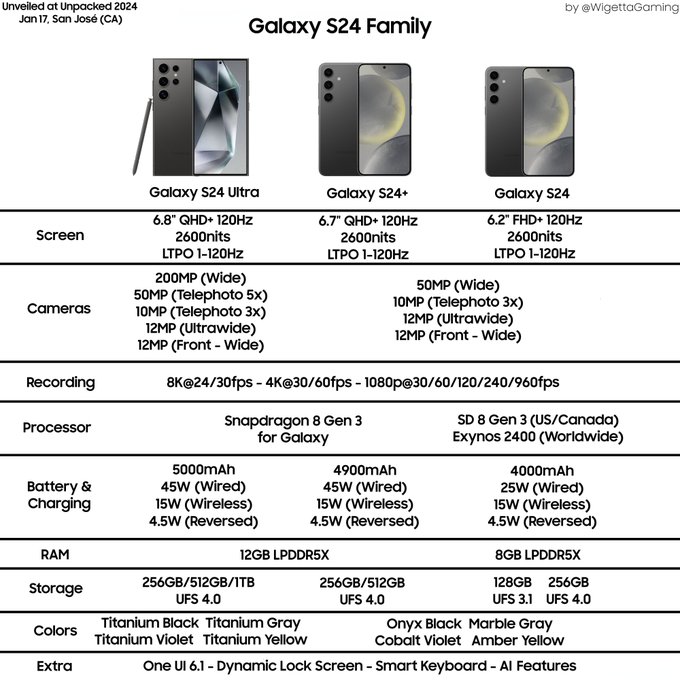
The South Korean tech giant’s Galaxy S24 lineup infographic was shared on X (formerly Twitter) via WigettaGaming. In the specs sheet, we can see that the Galaxy series will feature the Exynos 2400 for the global markets. Although, the Galaxy S24, Galaxy S24+, and Galaxy S24 Ultra are said to ship with the Qualcomm Snapdragon 8 Gen 3 SoC for the US and Canada. In other words, it is going to back to its usual cycle again of launching its devices with Snapdragon processors in the US while the rest of the world gets the Exynos variants.

Samsung Galaxy S24 series

Apart from this, the infographic confirms that the entire lineup will launch with the AMOLED LTPO display that has a variable refresh rate ranging from 1-120Hz. The Galaxy S24 sports a 6.2-inch FHD+ panel, while the Galaxy S24+ and Galaxy S24 Ultra arrive with 6.7-inch and 6.8-inch QHD+ panels respectively. The Ultra variant has a 200-megapixel quad camera setup, while the base and Plus models feature a 50-megapixel triple camera.

The Exynos and Snapdragon processors are paired with 8GB of LPDDR5X RAM on the Galaxy S24 and Galaxy S24+ and 12GB of LPDDR5X RAM on the Galaxy S24 Ultra. Other notable features include Android 14 OS based One UI 6.1 custom skin out of the box, Dynamic Lock Screen, Smart Keyboard, and various AI features. Earlier today (27th December 2023), we also covered the color options of the Galaxy S24 and S24+, confirming Orange, Purple, and White variants.

RELATED:

Get the OnePlus 12 For $699 at GeekWills

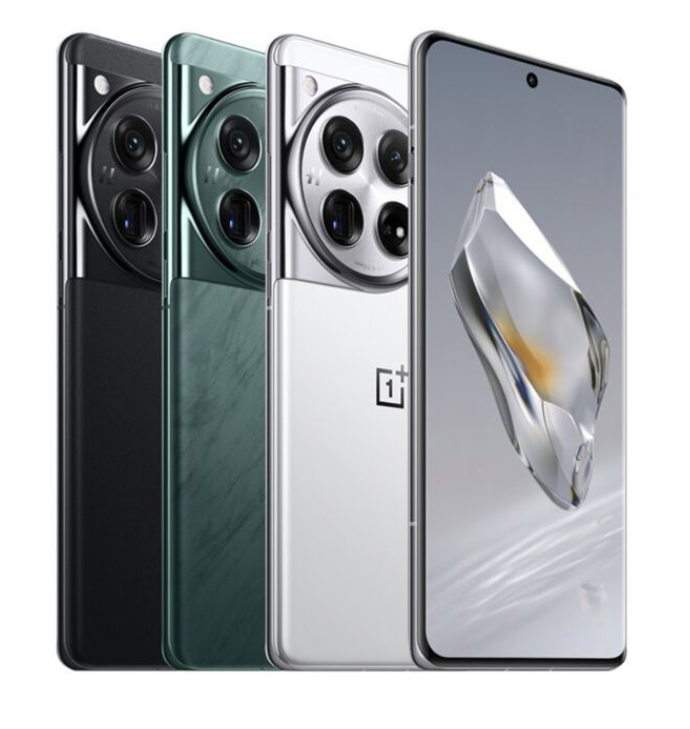
OnePlus 12, is a cutting-edge smartphone designed to redefine your mobile experience. You can now get the smartphone for $699 only at GeekWills. The phone comes in multiple memory variants and you can choose from Black, Green, and white color options.

WHERE TO BUY

Boasting a massive 6.82-inch 3D AMOLED QHD+ display with a resolution of 3168×1440 pixels, the phone offers stunning visuals and vibrant colors. The HDR10+ and 120Hz refresh rate ensure a smooth and immersive viewing experience, complemented by a peak brightness of 4500 nits.

At the heart of the OnePlus 12 is the Qualcomm Snapdragon 8 Gen 3 chipset paired with the Adreno 750 GPU, delivering maximum frame rates and low latency. Under the hood, the OnePlus 12 is equipped with up to 24GB of LPDDR5X RAM and up to 1TB of UFS 4.0 internal storage, ensuring seamless multitasking and providing ample space for your apps, photos, and videos.

The camera setup is a photography enthusiast’s dream, featuring a triple rear camera system. The 50MP primary sensor with OIS ensures crisp and clear images, while the 64MP telephoto lens supports 3x optical zoom, 6x optical quality zoom, and an impressive 120x digital zoom. The 48MP ultra-wide-angle lens with 114° FOV and 3.5cm macro shooting support adds versatility to your photography. On the front, the 32MP selfie camera with f/2.0 aperture captures stunning self-portraits and supports 1080p video recording at 30fps.

The device runs on ColorOS 14, based on Android, offering a fresh and fast platform. Dark Mode 2.0 enhances visibility and reduces eye strain, making it ideal for prolonged usage.

Powering the OnePlus 12 is a robust 5400mAh battery, supporting 100W SuperVOOC wired charging and 50W AirVOOC wireless charging. The Ultra Power Saving mode conserves battery life by turning the screen to black and white while shutting down unnecessary features.

Security is paramount with the in-display fingerprint reader, ensuring quick and secure access to your device. The OnePlus 12 caters to a global audience with support for 20+ languages, making it a versatile and user-friendly smartphone for individuals around the world.

OnePlus 12 combines cutting-edge technology, powerful performance, and advanced camera capabilities to deliver a comprehensive smartphone experience for users who demand the best in mobile technology.