Advertisement

Redmi Note 12 Turbo is Almost Here

We have been hearing about the Redmi Note 12 Turbo (aka Redmi Note 12T) since January. In the last few weeks, more details about this smartphone have emerged.

Today, a new report reveals that the device may go official very soon. Let’s check out what this reliable source has to say.
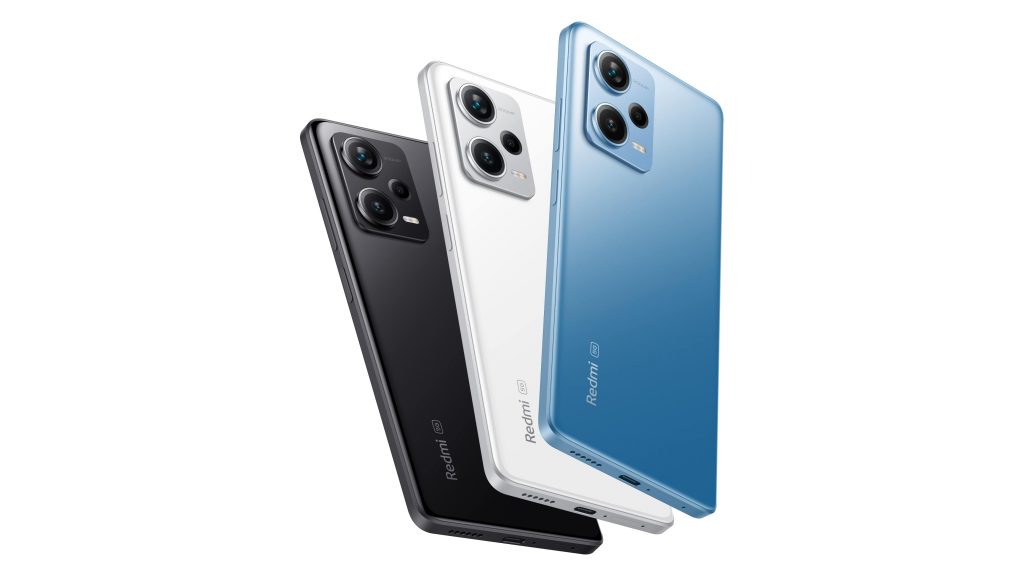
Redmi Note 12 Pro Plus

According to Xiaomiui, the software for the upcoming Redmi Note 12 Turbo is ready. The handset will ship with MIUI 14 based on Android 13. The last internal MIUI build for this phone bears firmware version V14.0.2.0.TMRCNXM.

Since the product will be making its initial debut in China, Redmi may start teasing its arrival in the coming days. As usual, the brand may disclose all the main features before the smartphone’s official announcement.

The Redmi Note 12 Turbo, which is codenamed ‘marble’, is expected to release outside mainland China as Poco F5. But unfortunately, the software for the Poco model is not ready yet.

But the source has revealed that there will be three variants of Poco F5 for international markets. They are Global, EEA, and India.

According to other reports, there’s going to be a Poco F5 Pro as well. That device is nothing but a rebranded Redmi K60 featuring a Qualcomm Snapdragon 8 Plus Gen1 chipset.

As far as the Remdi Note 12 Turbo (Poco F5) is concerned, it is tipped to arrive with a new Snapdragon 7 series chip (either Gen 2 or plus variant of Gen1), a 6.67-inch 120Hz OLED display, a 50MP + 8MP + 2MP triple camera system, an in-screen fingerprint sensor, a 5,500mAh battery, and 67W charging support.

RELATED:

Amazon Launches 5th Gen Echo Dot in India

Amazon has just launched the latest generation of its Echo Dot smart speaker in the Indian market. The new model is the 5th generation and arrives two years after its 4th Gen variant with various improvements across the board. So let’s have a look.

Amazon

The e-commerce giant has just announced the new Echo Dot that promises to offer deeper bass and clearer vocals than its older versions. Furthermore, the new device also features built in motion detection and temperature sensor, which enables the gadget to automatically turns on a light when you enter the room and can also switch on the AC if the room is too warm. For privacy, this model features a mic off button as well.

The new Echo Dot houses a 1.73 inch speaker, which is larger than the 1.6 inch on the previous model. Despite some of these changes, the smart speaker still features a similar design with a spherical shape and circular ring of LED on the bottom. The Echo Dot is built with the same fabric finish exterior like the older models. Although, this model does not feature a 3.5mm port.

Amazon

Other notable features include, Dual band WiFi support, Bluetooth Low Energy Mesh, and Matter controller. The new Amazon Echo Dot 5th Gen model is available in three color options, namely Black, Blue and White. The device has an official price tag of 5,499 INR (roughly 66 US Dollars) but is available on Amazon for a discounted price tag of 4,999 INR (roughly 60 US Dollars) as an introductory offer.

RELATED:

Oppo’s Prototype Zero-Power Tags Don’t Need Batteries to Track Objects

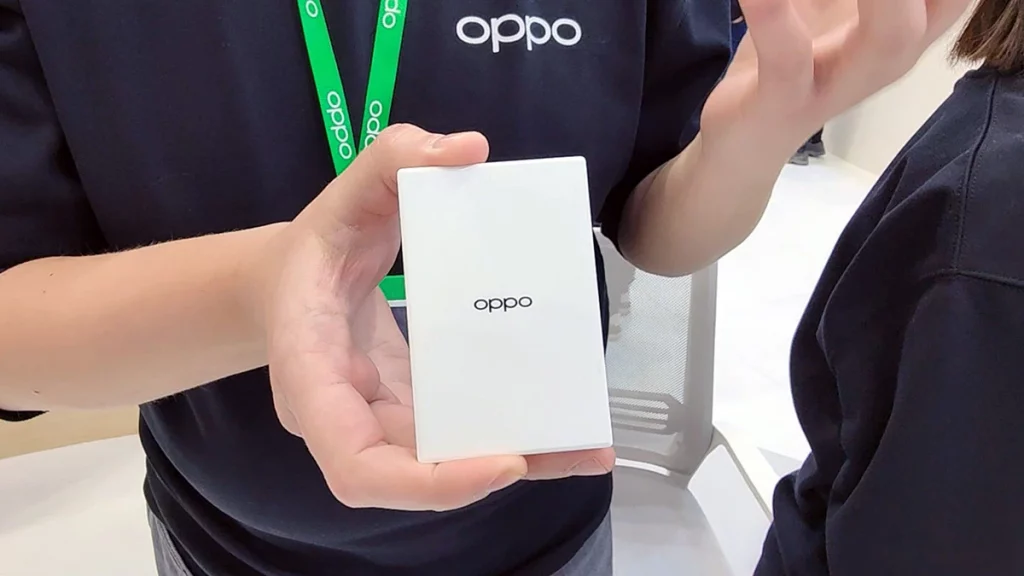
Oppo’s groundbreaking Zero-power Communication technology, which was outlined in a white paper last year, has resulted in the development of a functioning Zero-Power Tag prototype. The cutting-edge device is being showcased at the MWC 2023 expo. 

OPPO zero power tag
OPPO zero power tag

What sets the Zero-Power Tag apart is its ability to operate without a battery, a feat made possible by its utilization of key technologies such as RF signal harvesting, backscattering, and low-power computing. By extracting energy from the surrounding environment, the device can function independently and communicate wirelessly, catering to the diverse needs of IoT in the 6G era some years down the line. 

Zero-Power devices are designed to derive energy from ambient radio signals emitted by sources such as FM radio towers, TV towers, cellular base stations, and WiFi access points. The harvested energy is then used to modulate ambient radio signals with the device’s own information, which can then be transmitted outwards via backscattering communication. 

In the not-too-distant future, IoT devices may be able to draw energy directly from Bluetooth, WiFi, and cellular signals, resulting in smaller, more durable, and more cost-effective devices. Electronic tags, for example, could be utilized for item tracking without the need for battery replacement or recharging. The Zero-Power Tag prototype we examined was a plastic rectangle with an embedded chip, although Oppo informed us that it might ultimately take the form of a sticker that can be attached anywhere.

One potential use case that was mentioned involved monitoring the migratory habits of endangered birds using the device. Oppo’s Zero-Power Tag represents a paradigm shift in the world of IoT, where the use of harmful batteries could be drastically reduced. Apple AirTags, for example, rely on coin batteries that last only a year. However, innovative solutions like the Zero-Power Tag could prevent millions of batteries from being disposed of in landfills, and can be a sustainable step towards eradicating miniature battery waste on a large scale.

RELATED:

(Source)

Intel & Microsoft Are Preparing for Windows 12 as Per Latest Leaks

Recently, rumors have surfaced about Intel and Microsoft seemingly gearing up for the launch of Windows 12, which has not yet been officially announced. @leaf_hobby, a known hardware leaker who previously revealed the specs of Intel’s Xeon chips, has disclosed information about Intel’s Meteor Lake desktop platform, which is expected to support Windows 12. However, Intel and Microsoft have declined to comment on these rumors.

While Microsoft has not announced any plans for Windows 12, there are indications that the company is looking to incorporate AI-powered features in future versions of Windows. Yusuf Mehdi, Microsoft’s head of consumer marketing, recently commented on the potential for AI in the Windows experience. Mehdi discussed the latest Windows 11 update, which includes AI-powered features such as Bing integration and recommended content for business users. Microsoft is also reportedly working on AI-powered smart snapping features for Windows 11.

If Microsoft intends to make more extensive use of AI in the next version of Windows, it would need to work closely with hardware partners such as Intel and AMD to optimize chips that can handle AI workloads. AMD has recently launched its Ryzen 7000 mobile processors, which are the first x86 chips to contain a dedicated AI engine that can support Microsoft’s Windows Studio Effects. Similarly, Intel’s Meteor Lake is expected to include AI capabilities similar to those introduced by AMD in its Ryzen 7000 mobile CPUs.

Both AMD and Intel are racing to catch up to Apple and its latest M2 chips, which have a dedicated AI chip that can handle 15.8 trillion operations per second. Microsoft has reportedly shifted back to a three-year release cycle for Windows, meaning that the next major version of Windows could be due in 2024.

Microsoft has also begun to focus on updating Windows 11 more frequently than the original annual updates it promised at the launch of the operating system in 2021. The latest update includes AI-powered Bing integration, improvements to widgets, touch mode, screen recording, and more.

RELATED:

(Via)

Bharti Airtel to Raise Prices of Mobile Service Across All Plans in India

Bharti Airtel Chairman Sunil Bharti Mittal has recently confirmed the company’s plan to increase mobile phone call and data rates across all plans in 2023. The minimum recharge for the 28-day mobile phone service plan has already been increased by 57% to ₹155 in eight circles. Mittal explained that the return on capital in the telecom business is low, and a tariff hike is expected this year. He emphasized that the increase would be across the board, but the rise would be low compared to the spending people are making on other things.

Mittal also highlighted the need for a robust telecom company in India, with the dream of India being digital and economic growth fully realized. He mentioned that the government and regulator are conscious of the situation, and people are also aware of the changes that need to happen. He added that the focus on digital infrastructure in particular is reaping benefits for India, and companies operating in this environment have a lot to gain.

Regarding the impact of inflation and the global macroeconomic situation on the company, Mittal said that India is moving very fast, and all sectors of the Indian economy are getting a lot of attention from the government and investors. He stated that the government has done a lot to make telecom industry infrastructure healthy with support to BSNL and Vodafone Idea.

Mittal also discussed the company’s focus on the rollout of the 5G network, saying that monetization would happen after the network base is ready. He also mentioned that the company would not shut down 2G services until the entire customer base migrates to 4G or 5G. Mittal further confirmed that the company’s payments bank is moving well, and it has become profitable, providing financial inclusion for over 65 million customers.

Overall, Mittal’s announcement of the tariff hike came across as pragmatic, with the need for sustainable operations being the driving force behind the decision. He conveyed the message that while the hike was necessary, it would be implemented in a manner that was low and manageable, and would not create an undue burden on consumers.

RELATED:

(Via)

Upcoming Xiaomi Smartwatch May Run on Google’s Wear OS 3

Companies have been focusing extensively on smartwatches recently since portable technology is attracting more and more customers. Xiaomi, the Chinese electronics giant known for its extensive portfolio of smartphones, wearables, and other tech products, has exciting news for fans of smartwatches. While the company has been releasing watches on its own proprietary system, it seems to be preparing to launch a new smartwatch that runs on Google’s Wear OS 3.

The upcoming Xiaomi Watch will be managed by the same “Mi Fitness (Xiaomi Wear)” app that the company’s wearables use today, making it familiar and easy to use for brand fans. It will also release under the same “Xiaomi Watch” branding as the existing lineup of non-Wear OS watches, providing consumers with the same sleek and stylish design they have come to expect and love.

While details on the upcoming watch are slim at the moment, it has been confirmed that it will run on Wear OS 3, a significant upgrade from the current MIUI Watch OS used in Xiaomi’s higher-end models. This means that users can expect to enjoy some of the exclusive features and capabilities made possible by Google’s apps and services. It’s worth noting that Fossil smartwatches also feature Wear OS 3.

However, one potential downside for fans of the Xiaomi Watch series is that Wear OS is not known for its long-lasting battery life. Xiaomi Watches are known for lasting multiple days without charging, but it remains to be seen how the upcoming Wear OS-powered Xiaomi Watch will fare in this regard.

While the release date for the new Xiaomi Watch is still uncertain, development is reportedly lining up for a launch sometime in 2023. Overall, the shift to Wear OS 3 is an exciting development for Xiaomi and its fans, and we look forward to seeing how the company incorporates this new technology into its smartwatch lineup.

RELATED:

(Via)

Sony Unveils New LED TV Lineup with Enhanced Image Processing

Sony has unveiled its 2023 Bravia XR lineup, which includes a range of televisions with iterative refinements and modest improvements. While a QD-OLED television leads the launch line, the company is still showcasing its image processing as a major selling point. Sony’s Cognitive Processor XR is said to be what sets its TVs apart from the competition, and this year, the company is introducing XR Clear Image, a feature that automatically adjusts picture quality based on the source material.

With the increase in popularity of high-end consoles, such as the Sony Playstation 5 and the Xbox Series X, Sony has also focused on enhancing the gaming experience. All of its TVs are capable of 4K gaming at 120Hz, although only two HDMI 2.1 ports are available, with the other two being HDMI 2.0. Sony’s integration with the PS5 remains strong, but new gaming software features will also extend to Xbox.

The X90L is a full-array local dimming LED TV designed to offer excellent performance at an affordable price point. To add a premium detail to the TV, Sony has updated the bezel from plastic to aluminum and increased local dimming zones and peak brightness by up to 60% and 30%, respectively. It’s also the largest screen size amongst the new lineup, clocking in at a 98-inch display. 

The A80L OLED comes in an 83-inch size, with upgrades including slightly better dialogue clarity and 10% brighter performance. However, it is otherwise very similar to 2022’s A80K WRGB OLED TV. Lastly, the QD-OLED A95L is the most impressive TV in the new lineup, promising up to 200% better peak brightness than its predecessor, the A95K, and offering strong competition to LG’s C2 and C3.

Software-wise, Sony is also introducing an Eco Dashboard to promote eco-friendly options and energy-saving techniques, which is accessible from the home screen. Additionally, there is a settings menu tailored to gaming, allowing for easy toggling of VRR, motion blur reduction, black equalizer, contrast adjustments, and an on-screen crosshair.

In summary, while Sony’s 2023 lineup of Bravia XR TVs offers modest improvements compared to their predecessors, the company’s focus on image processing and gaming capabilities, along with the introduction of an Eco Dashboard and gaming settings menu, will provide customers with an enhanced viewing experience.

RELATED:

(Via)

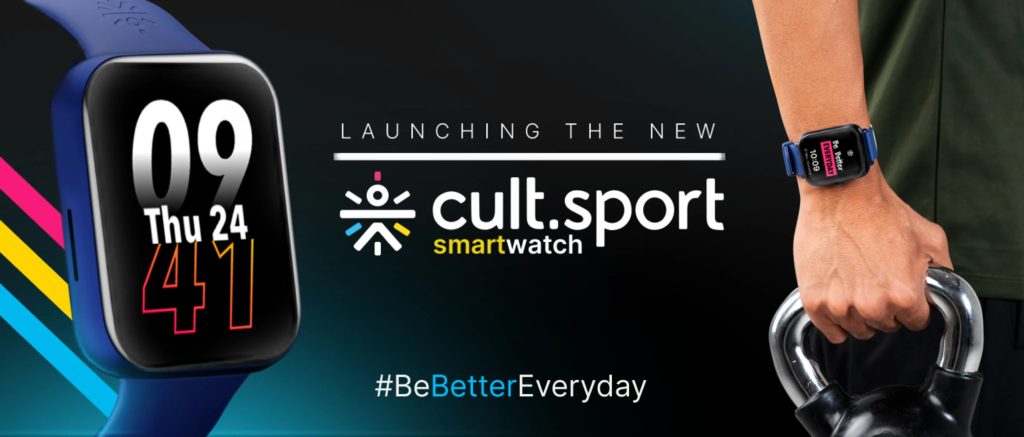
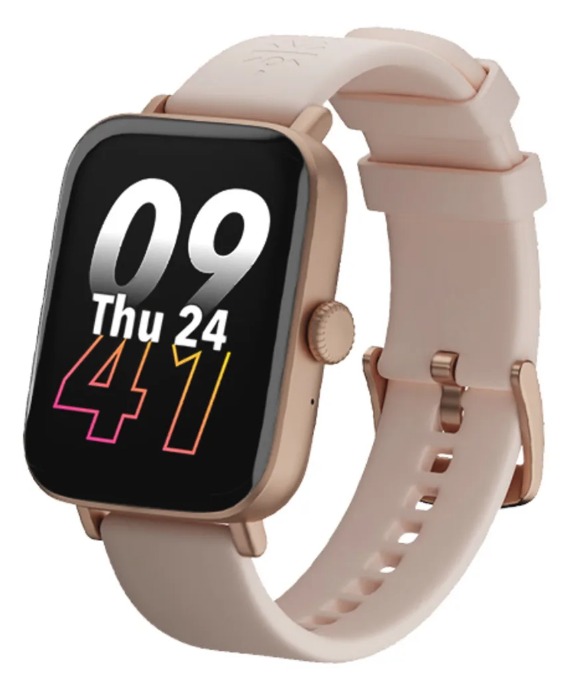
Cult.sport Unveils Beats & Burn Smartwatches for Indian Market

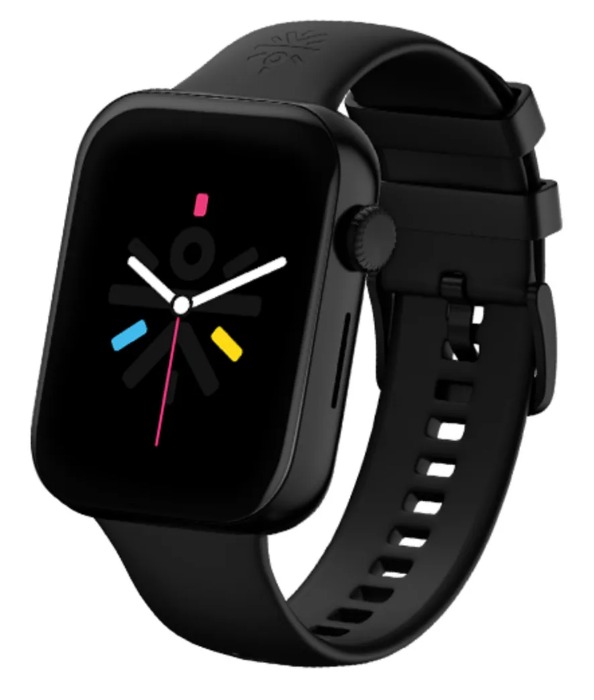
Cult.sport, a known fitness brand, has made its way into the Indian smartwatch arena by unveiling two new smartwatches: Beats and Burn. The Beats model boasts a square dial sporting a high-definition 1.85-inch screen, while the Burn smartwatch features a 1.78-inch AMOLED display on a square-shaped dial. With inbuilt speakers, both watches allow Bluetooth calling. It’s exciting to see how Cult.sport is expanding its product line to cater to the evolving needs of fitness enthusiasts in India.

Cult.sport

Cult.sport Beats & Burn Smartwatch features

The Cult.sport Beats smartwatch boasts a generous 1.85-inch HD LCD display with a brightness of 600 nits, akin to the Apple Watch design. It’s equipped with a physical button on the right, allowing for easy operation. With Bluetooth calling capabilities, the smartwatch can store up to seven frequently contacted individuals for quick access. Moreover, it features a built-in mic and speaker for seamless calling.

On the other hand, the Cult.sport Burn smartwatch features a 1.78-inch high resolution AMOLED display with 550 nits peak brightness and the Always-On display feature.

Boasting an impressive 250mAh battery, both smartwatch offers an extended battery life of up to seven days with general usage. The battery charges rapidly, from 0 to 100%, within a mere one hour and 30 minutes. The Beast smartwatch also boasts over 115 sports modes and is IP67 water-resistant, making it a perfect workout companion. The Burn smartwatch only comes with 60 sports modes.

Health features of both smartwatches include continuous 24-hour heart rate monitoring, SPO2, and BP monitoring, sleep and step tracking, calorie counting, drinking water and sedentary reminders, and menstrual cycle tracking.

In addition to its health and fitness features, the smartwatches also offer numerous other functionalities such as weather updates, a calculator, camera, and music controls, find my phone/watch, functional crown control, AI voice assistant, 80+ watch faces, and music storage that can hold up to 60 songs.

Price & availability

The Cult.sport Beats and Burn smartwatches are available in an array of color options, including Black, Rose Gold, and Dark Blue. Priced affordably, the Beats model is available for Rs. 2,199, while the Burn variant costs Rs. 3,299. Interested buyers can purchase both smartwatches from the Cult.sport website or Flipkart.

RELATED:

Google to Release Pixel Buds Series in New Sky Blue Color to Match Pixel 7a

A new leak has just revealed that Google is planning on launching new color variants of its Pixel Buds Pro and Pixel Buds A series of truly wireless earbuds to better match the upcoming Pixel 7a.

Google

The news arrives from known leaker Kuba Wojciechowski who shared pictures of the new color variants on Twitter. Looking at the leaked images, we can see that the Search Engine giant is working on a new “Sky” or “Arctic” blue color option for both the high end Buds Pro and the more affordable Buds A earbuds. For those unaware, the company is gearing up to launch the new Pixel 7a, which will be its latest entry from its A series of mid range handsets.

Google

Based on the new leak, Google is planning on launching new versions of the Pixel Buds Pro and Pixel Buds A to go with the Pixel 7a’s new “arctic blue” color option. Kuba Wojciechowski added that we can expect the new SKUs to release sometime at the Google I/O along with the new Pixel phones. The leak shares some renders that showcase the earbuds and its charging case in the new color variant. It appears that the blue hue will be for the earbuds and the inside of the charging case while the outer cover is still white.

RELATED:

OnePlus Ace 2V Will Equip Game Cloud Computing Tech to Enhance Gaming Experience

OnePlus is set to unveil its latest smartphone, the OnePlus Ace 2V, on March 7 in China. The company has been teasing its features on Weibo, including the new “Game Cloud Computing Private Network Technology” which was first introduced in the OnePlus 11. This technology will solve network-related problems while playing games and reduce high latency times by almost 44% in weak network environments and 75% in congested online games.

The technology is powered by eight major cloud computing centers around the world and more than 100,000 self-owned servers. The game data runs on a nanosecond level to complete all relative tasks, such as data identification, calculation, fusion, transmission, and more. This requires a powerful cloud computing structure to effectively complete these tasks.

OnePlus teased that the device supports 120 frames in the popular mobile game, “League of Legends,” with an average of 119.14 frames per hour without sacrificing brightness. This means that gamers can enjoy a near-full frame stable and high frame experience, enhancing their gameplay and overall user experience.

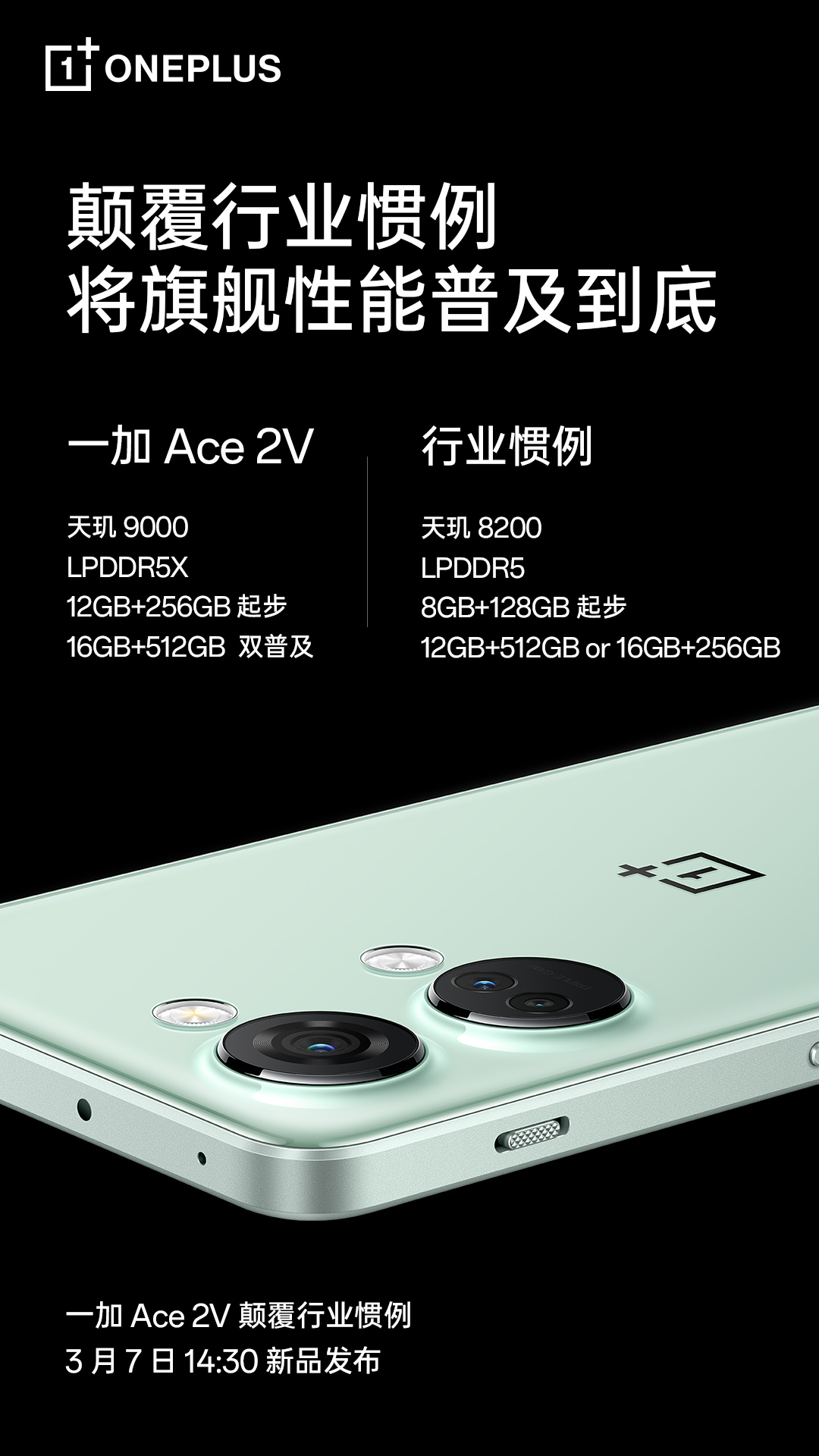
According to reports, the Ace 2V equips Dimensity 9000 chipset, LPDDR5x RAM, and UFS 3.1 storage. Its base variant will come with 12GB of RAM and 256GB of storage, while the highest configuration will have 16GB of RAM and 512GB of storage.

The phone will have a 6.74-inch OLED screen with a 1.5K resolution, 120Hz refresh rate, a 5,000mAh battery with 100W charging, and a 16-megapixel front camera and OIS-enabled 64-megapixel triple rear cameras. The device will ship with OxygenOS 13-based Android 13 OS.

It is speculated that the base model of the Ace 2V could be priced at CNY 2,399 ($349). While the global market will not be getting the Ace 2V, recent leaks suggest that the phone will be rebranded as the OnePlus Nord 3 for the global market and will be announced in July.

Overall, the OnePlus Ace 2V promises to deliver a standard gaming experience to its users over its predecessors. With its powerful cloud computing structure and network-dedicated line, it aims to provide a smooth and uninterrupted gaming experience, even in weak network environments.

RELATED:

Realme GT Neo 5 SE Specs Leak, Also Spotted on 3C Database With 100W Fast Charging

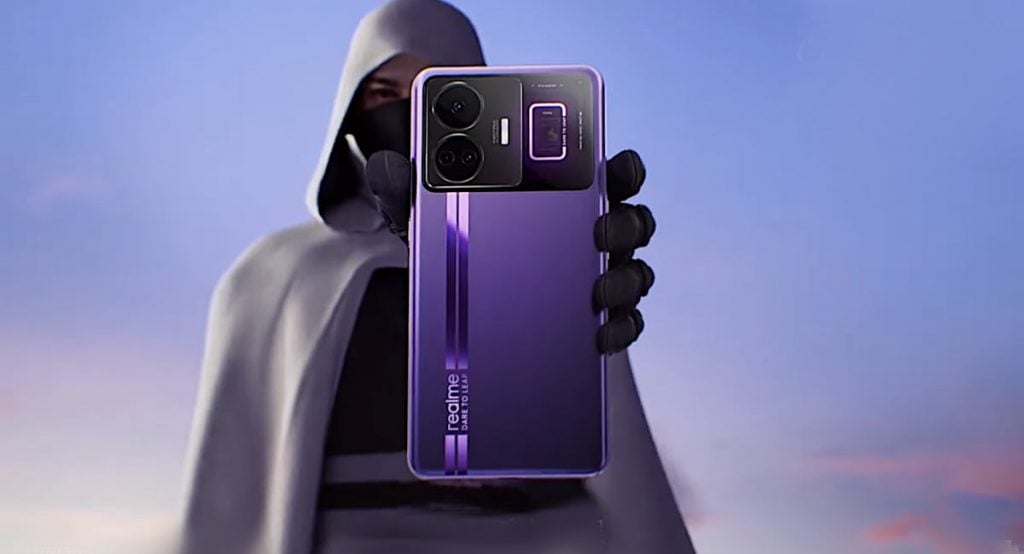
Realme recently unveiled the Realme GT 3 smartphone at the ongoing Mobile World Congress 2023 event. The same device was earlier launched as the Realme GT Neo 5 in China. The brand is planning to add another device to the lineup which could be called the Realme GT Neo 5 SE. Previously, some leaks have revealed the specifications of this upcoming device. Now, it has made an appearance on the 3C certification website.

Realme

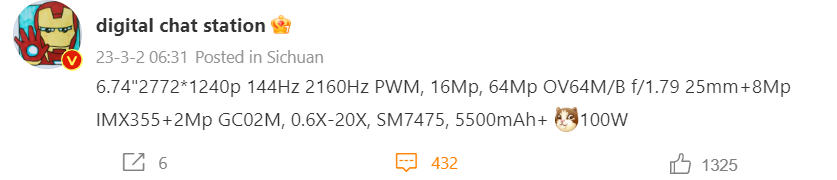
As per the 3C listing, the upcoming Realme GT Neo 5 SE (RMX3700) will have 100W fast charging support along with 5G connectivity. In addition to that, popular Weibo tipster DCS has shared the key specs of the alleged GT Neo 5 SE.

According to the report, the smartphone will feature a 6.74-inch flat OLED display panel that offers 2772 x 1240p resolution, 144Hz refresh rate, 2160Hz PWM dimming, and 1100 nits peak brightness.

Realme GT Neo 5
Realme GT Neo 5

The tipster further states that the device will have a 16MP front camera, along with a 64MP OmniVision primary camera that has f/1.79 aperture. It will also have an 8MP Sony IMX355 ultra-wide sensor along with a 2MP sensor.

The device will feature a Qualcomm Snapdragon 7+ Gen 1 processor (SM7475) which will draw power from a large 5,500mAh battery. Previous reports mentioned that the smartphone could launch with the upcoming Snapdragon 7 Gen 2 SoC, however, if the leaks are accurate, that won’t be the case. As mentioned above, the battery is capable of 100W fast charging.

RELATED:

(source)

Redmi 12C Bags BIS & TRDA Certifications, Could Launch Soon

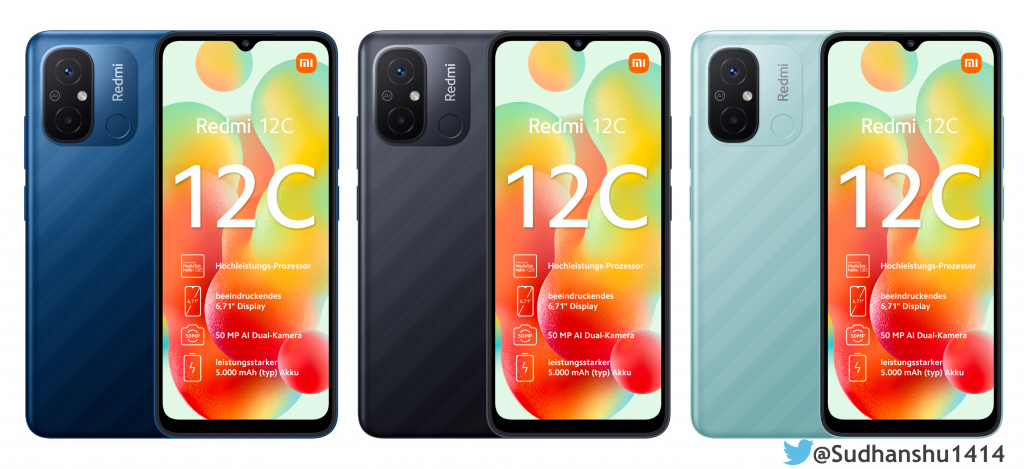
Redmi is expected to soon launch a new smartphone in the budget range called the Redmi 12C. This device has already appeared in a unboxing video and was recently certified on the EEC database. Now, it has appeared on TRDA and BIS certification websites alluding to an impending launch in India and the UAE.

The BIS listing shows the model number of the device as 22120RN86I, while the TRDA listing for the global version has it as 22120RN86G. However, neither of these listings provides any information about the device’s specifications. Therefore, let’s examine the available details regarding the Redmi 12C.

Redmi 12C specs

Redmi 12C global

Based on the available information, the Redmi 12C is rumored to feature a 6.71-inch IPS LCD display with an HD+ resolution of 720 x 1650 pixels, 500 nits of brightness, and a 20.6:9 aspect ratio. It is speculated to be equipped with a MediaTek Helio G85 chipset, LPDDR4x RAM, and eMMC 5.1 storage. Leaks suggest that the phone will come in various configurations, including 3 GB RAM + 32 GB storage, 3 GB RAM + 64 GB storage, and 4 GB RAM + 128 GB storage.

Additionally, the Redmi 12C is rumored to sport a 50MP rear camera and a 5MP front-facing camera. It is expected to be powered by a 5,000mAh battery with support for 10W charging. The phone’s starting price is rumored to be EUR 149, while the top configuration may cost up to EUR 199.

RELATED:

(via)

Samsung No Longer Branded as ‘Galaxy’ in Japan, Regains Brand Name Status

Samsung has recently made a significant change to its branding in Japan. As of February 28th, the company’s online store and social media platforms will no longer go by the name “Galaxy” but rather, will bear the Samsung name. This move has brought Japan in line with the rest of the world, where Samsung has always been recognized under its original brand name.

This move marks a shift away from the company’s decision in 2015 to distance itself from its corporate branding in Japan, as it adopted the “Galaxy” name for its products and services in a bid to better compete with its rival, Apple. The political tensions between Japan and South Korea at that time also played a role in this decision, as Samsung was cautious not to use its real name in the country.

However, with the changing times, Samsung now appears to be comfortable enough to embrace its original brand name in Japan once again. Customers can now request assistance from Samsung’s customer care centers, which were previously labeled as “Galaxy Customer Centers.” The Galaxy S23 series has also been rebranded to include the Samsung name, allowing customers in Japan to enjoy the same level of service and support as other customers around the world.

To celebrate this milestone, Samsung’s rebranded online shop is offering special deals on its Galaxy Care service, which interestingly has not been rebranded as Samsung Care. This move demonstrates Samsung’s renewed confidence in its brand identity and its commitment to providing customers in Japan with the same high-quality products and services as those enjoyed by customers across the globe.

RELATED:

(Via)

Redmi Watch 3 Lite Spotted on SIRIM Certification Website, Could Launch Soon Globally

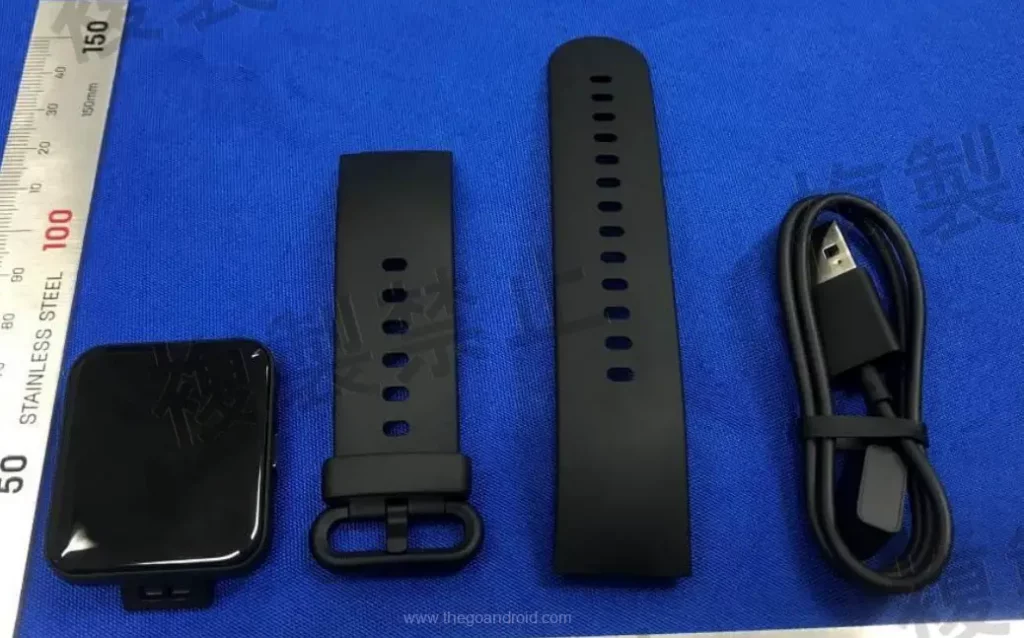
We recently reported citing a mysterious Redmi smartwatch with model number M2247W1 on South Korea’s NRRA certification website. The listing revealed the design of the smartwatch along with some other key details. Now, the same device has been spotted on the SIRIM database bearing the Redmi Watch 3 Lite Moniker.

Redmi Watch 3 Lite SIRIM

According to the SIRIM listing, the Redmi M2247W1 smartwatch is called the Redmi Watch lite. The listing does not reveal any further information, however, it is clear that Realme is gearing up to launch the smartwatch globally in the coming days.

Last month, the Redmi Watch 3 Lite was spotted on the EEC certification website with a 2.87V Polymer Li-ion built-in battery along with support for Bluetooth v5. From the previous NRRA listing, we know that the Redmi Watch 5 Lite has a rectangular dial, will feature a single button on the side, and will also have detachable straps.

Redmi Watch 3 Lite NRRA certification image

Located at the bottom of the device are a heart rate sensor and a magnetic charging port. It appears that the wearable does not include a microphone, indicating the absence of a Bluetooth calling function. Let’s take a look at the Redmi Watch 3 to get an idea of what to expect from the Lite version.

Redmi Watch 3 specs

The Redmi Watch 3, which launched back in December boasts a 1.75-inch AMOLED display with a square dial, offering an HD resolution and a 60Hz refresh rate. It has a peak brightness of 600 nits. It is waterproof up to a depth of 50 meters and features a button on the right side.

Redmi Watch

Equipped with various health monitoring features, the Redmi Watch 3 comes with a heart-rate monitor, SpO2 sensor, sleep and stress tracker, breather exercise, and women’s menstrual cycle monitor. The wearable supports over 120 exercises and comes with a built-in GPS for tracking outdoor activities.

The Redmi Watch 3 also offers Bluetooth voice calling, an emergency SOS mode, and other convenient features. It is powered by a 289mAh battery that provides up to 12 days of usage on a single charge.

RELATED:

(via)

TikTok Automatically Sets Screen Time Limit To One-hour for Teens

TikTok, one of the most popular short video social media platforms, has announced that users under the age of 18 will have a one-hour screen time limit by default. This is one of the most aggressive moves by the Chinese giant in an effort to reduce criticism about teens’ endlessly scrolling the platform’s feed.

When the 60-minute or one-hour time limit is reached, then the user will be prompted to enter a passcode on the device to continue scrolling through the videos on the platform. This will create a sort of barrier to endless scrolling and bolster the digital wellbeing of young users.

TikTok

Cormac Keenan, TikTok’s head of trust and safety, said that the company consulted researchers and experts from the Digital Wellness Lab at Boston Children’s Hospital to decide the time limits to set for teen users. He added, “While there’s no collectively-endorsed position on how much screen time is ‘too much’, or even the impact of screen time more broadly, we recognize that teens typically require extra support as they start to explore the online world independently.”

While the one-hour screen time limit feature will be enabled by default in TikTok’s mobile application, the user will be able to disable this new feature from the app’s settings. Nonetheless, it’s a good move from the company to enable the feature by default and have the user take action to disable the feature.

TikTok has also updated the Family Pairing feature, which allows parent or guardian to link their TikTok account to and set controls. They can also filter videos with words or hashtags, set a custom daily screen time limit, and set a custom schedule to mute TikTok notifications.

The development comes at a time when TikTok, as well as other social media platforms, have been facing scrutiny over the impact of prolonged usage of such platforms, especially on young users. Further, TikTok’s parent company is also facing pressure from the US government and others over concerns about security because of the company’s ties in China.

RELATED:

OnePlus Ace 2V Configurations Revealed, LPDDR5x RAM, UFS 3.1 Storage Confirmed

On March 7, the OnePlus Ace 2V will be unveiled in China. To keep its audience intrigued, the company has been using its Weibo account to confirm the phone’s significant features. The company has already confirmed that the Ace 2V has the Dimensity 9000 chipset and large heat dissipation. In a Weibo poster, the company confirmed that it has LPDDR5x RAM and UFS 3.1 storage. Li Jie Louis, the president of OnePlus China, also shared a poster that showed the Ace 2V’s basic and best configurations (via. TechGoing).

In contrast to other mid-range phones in the market, the OnePlus Ace 2V’s base variant will have 12GB of RAM and 256GB of storage, and the company has confirmed that it will not be offering an 8GB+128GB configuration. This information was released by the company on its Weibo account. Additionally, the highest configuration of the phone will have 16GB of RAM and 256GB of storage. It is unclear whether the Ace 2V will be offered in other configurations.

The OnePlus Ace 2, which was launched in China in February and is powered by Snapdragon 8 Plus Gen 1, also comes in 12GB + 256GB and 16GB + 256GB configurations.

It is likely that the Ace 2V with the Dimensity 9000 chipset will be positioned lower than the Ace 2. The Ace 2’s base model is priced at 2,799 Yuan (~$407). This has sparked speculation that the base model of the Ace 2V could be priced at CNY 2,399 (~$349).

Reports have revealed that the OnePlus Ace 2V has a 6.74-inch OLED screen with a 1.5K resolution and a 120Hz refresh rate. The device will have a 5,000mAh battery with 100W charging. The Ace 2V will also come with a 16-megapixel front camera and OIS-enabled 64-megapixel triple rear cameras. The device will ship with OxygenOS 13-based Android 13 OS.

It seems that the global market will not be getting the Ace 2V. Instead, the phone will be rebranded as the OnePlus Nord 3 for the global market, according to recent leaks. The Nord 3 is rumored to be announced in July.

RELATED:

[Update] Moto G73 5G to Launch on March 10 in India

Update: The Moto G73 5G landing page is now live on Flipkart. It confirms that the device will launch on March 10.

Original story continues…

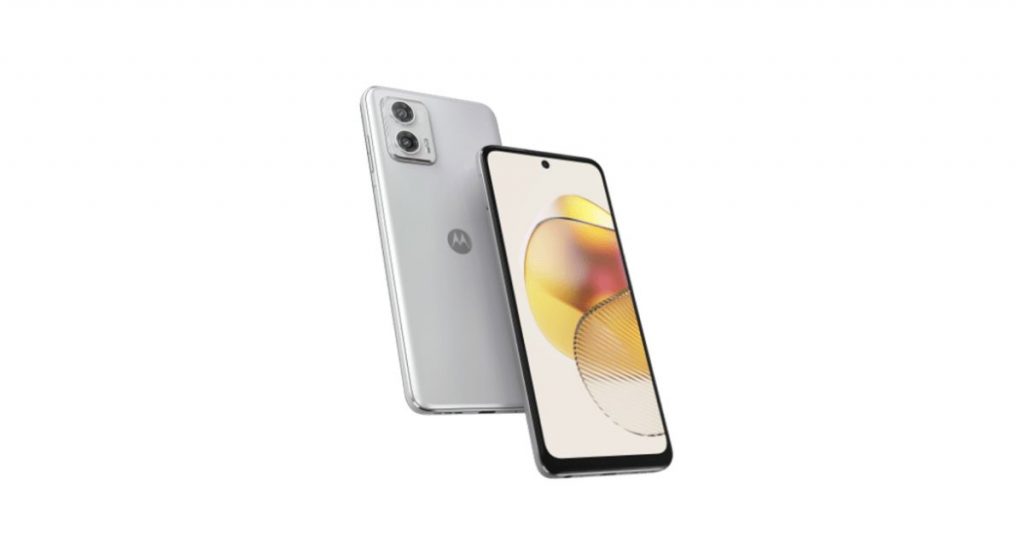
The Moto G73 is tipped to launch in India soon. This information has been leaked by tipster Abhishek Yadav. The Moto G73 will be the successor to last year’s Moto G72, and it is expected to come with some impressive features and specifications.

The specifications of the G73 are no secret since it has already launched on the global market in January. While the predecessor was a 4G phone, the G73 is a 5G-enabled device.

Moto G73 specifications (expected)

Moto G73
Moto G73

The Moto G73 5G has a 6.5-inch IPS LCD screen with a centred punch-hole screen. It has a Full HD+ resolution and a 120Hz refresh rate. The G73 features a 50-megapixel primary camera and an 8-megapixel ultra-wide snapper. It is fitted with a 16-megapixel front-facing camera.

The Moto G73 has a 5,000mAh battery, which can be charged using a 30W TurboCharger. The Dimensity 930 chipset is what powers the device. The global edition of the phone has 8 GB of RAM and 256 GB of internal storage.

There is a shared SIM slot onboard for additional storage. The other features of the smartphone include Android 13 OS with MyUX, a side-facing fingerprint scanner, dual stereo speakers, a 3.5mm audio jack, a side-facing fingerprint scanner, and a water-resistant design.

In Europe, the Moto G73 is priced at 299 euros and comes in two shades, such as Lucent White and Midnight Blue. At present, there is no information on its price for the Indian market. It remains to be seen whether it will be priced around Rs 20,000. At launch, the Moto G72 was priced at Rs 15,999. Since the G73 is tipped to launch in India soon, it is likely that it may go official in March.

RELATED:

(source)

Samsung Galaxy A54 5G, Galaxy A34 5G Launch Date Could be Set in March 3rd Week

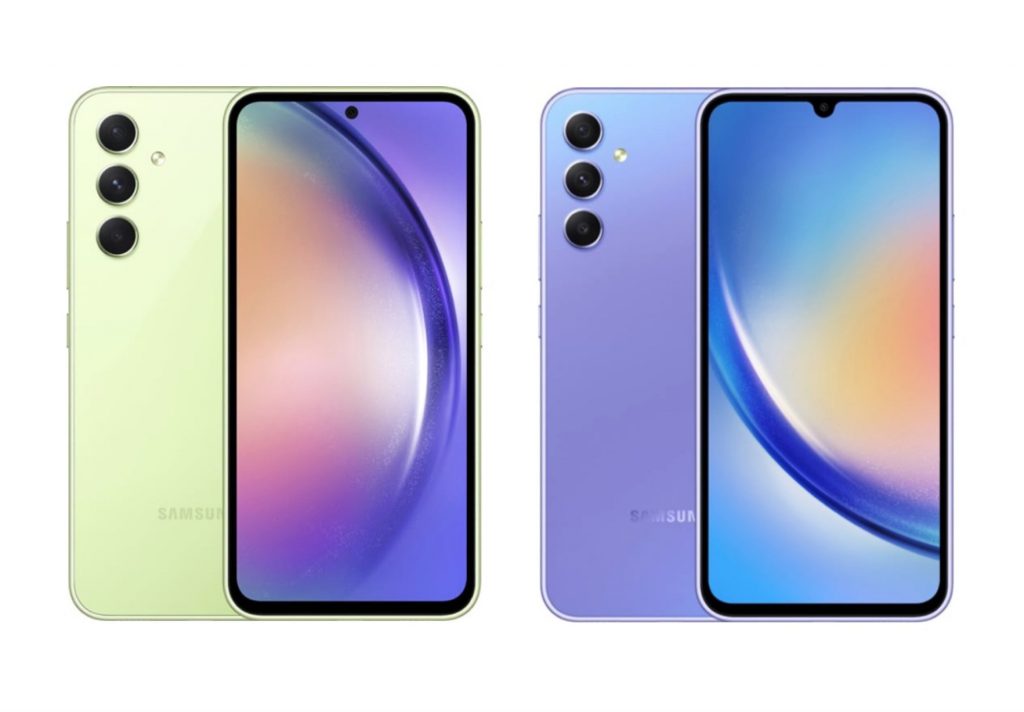
Since the last quarter of 2022, the rumour mill has been actively leaking information on the specifications of the Samsung Galaxy A54 5G and the Galaxy A34 5G. It is now being speculated that the device may go official this month in multiple markets. Now, reliable tipster Steve Hemmerstoffer (aka OnLeaks) has tipped the launch date for the A5 and A34.

The tipster has claimed that he has learned from a reliable source that the Galaxy A54 5G and A34 5G will debut on March 15. This seems possible since the rumour mill has leaked almost everything about the two phones.

Galaxy A54 5G specifications (rumored)

Samsung Galaxy A54 and Galaxy A34

The Galaxy A54 5G is set to launch with a 6.4-inch, 120Hz OLED panel. It will be powered by the new Exynos 1380 chipset. The device is expected to arrive with memory options that go up to 8 GB RAM and 256 GB storage. The phone will draw power from a 5,000mAh battery with 25W fast charging support.

The phone’s camera system will feature a 50-megapixel main shooter, along with a 12-megapixel ultra-wide snapper and a 5-megapixel macro camera. The front-facing camera will include a 32MP sensor for stunning selfies. The device will have an IP67 certification against water and dust and retain the 3.5mm audio jack.

Galaxy A34 5G specifications (rumored)

The Galaxy A34 5G is rumored to have a 6.6-inch, 120Hz OLED screen. It is likely to be powered by the Dimensity 1080 chipset, with memory options up to 8GB RAM and 256 GB storage. Like the A54, the A34 will have a 5,000mAh battery with 25W fast charging support.

The camera setup on the back will have a 48-megapixel primary shooter, an 8-megapixel ultra-wide lens, and a 5-megapixel macro camera. For selfies, it will have a 13-megapixel front-facing camera.

The Galaxy A54 and A34 will run on OneUI 5.0-based Android 13. There is a possibility that both phones may launch with the newer OneUI 5.1. Both A-series handsets will have an under-display fingerprint scanner and IP67-rated chassis.

RELATED:

(source)

Vivo Pad 2 Chipset Leaked, Likely to Rival Oppo Pad 2

Recent rumours say that Vivo is making a new tablet to replace the Vivo Pad, which came out in April 2022. A reliable source, Digital Chat Station, says that this new tablet, which is likely to be called the Vivo Pad 2, will have the Dimensity 9000 chipset. This is the same chipset that will likely run the OnePlus Pad and the OPPO Pad 2 when they come out. Unfortunately, there are no other specifications available at this time.

It is believed that the Vivo Pad 2 will be released alongside two other devices, the Vivo X Fold 2 and the Vivo X Flip, at an event in April this year. The Vivo X Fold 2 is expected to be the first foldable phone to use the Snapdragon 8 Gen 2 mobile platform, while the Vivo X Flip is expected to use the Snapdragon 8 Plus Gen 1 chipset.

Vivo Pad
Vivo Pad

The original Vivo Pad had an 11-inch IPS LCD screen with a 1600 x 2560 pixels resolution, a 16:10 aspect ratio, and a 120Hz refresh rate. It was powered by the Snapdragon 870 mobile platform with 8 GB of RAM and 128 GB / 256 GB of UFS 3.1 storage.

The Vivo Pad also had four speakers for audio. It had a front camera with an 8-megapixel resolution and a back camera with a 13-megapixel main camera and an 8-megapixel ultra-wide snapper. The tablet had an 8,040mAh battery that supported 44W fast charging. It ran on OriginOS for Pad-based Android 12 OS.

It remains to be seen what other features and specifications the Vivo Pad 2 will have. However, it is expected to be a worthy successor to the original Vivo Pad. 

RELATED:

(source)

Fleksy Approaches Nothing for Customized Keyboard

One of the most prominent aspects of Android phones is their open structure. Manufacturers continue to work and collaborate in different areas to offer a more unique experience on their phones through the agreements they make. Recently, the CEO of Nothing received an offer on Twitter about potential collaborations in this area.

Fleksy Approaches Nothing for Customized Keyboard

Recently, Carl Pei founder of Nothing tweeted about the Mobile World Congress currently taking place in Barcelona, saying, “MWC was so much more fun 5 years ago!” Olivier, CEO of Fleksy, replied to the tweet, suggesting that they meet outside the MWC. He proposed to power the custom Nothing typing experience with the DM.

Carl Pei seemed interested in the proposal and asked, “What’s custom about it vs. users downloading from Play Store?” Olivier explained that the Fleksy keyboard is more advanced, supports swipe input, is fully customizable, and can come branded with Nothing’s font. Furthermore, it can be fully customized by one Android engineer or Fleksy as they own 100% of the product.

While it is not yet known whether there will be an agreement between the two companies, the idea of a Nothing keyboard customized by Fleksy is intriguing. Custom keyboards are not new, but Fleksy’s expertise in this field could create something unique and functional for Nothing users.

Customization is essential for any device, especially a smartphone. With so many devices and apps out there, users want to personalize their experiences as much as possible. The Fleksy keyboard is a well-regarded keyboard app with many features that could add value to a customized Nothing keyboard. Moreover, the partnership could also benefit Fleksy, as they could gain access to a new user base through Nothing’s brand.

RELATED: