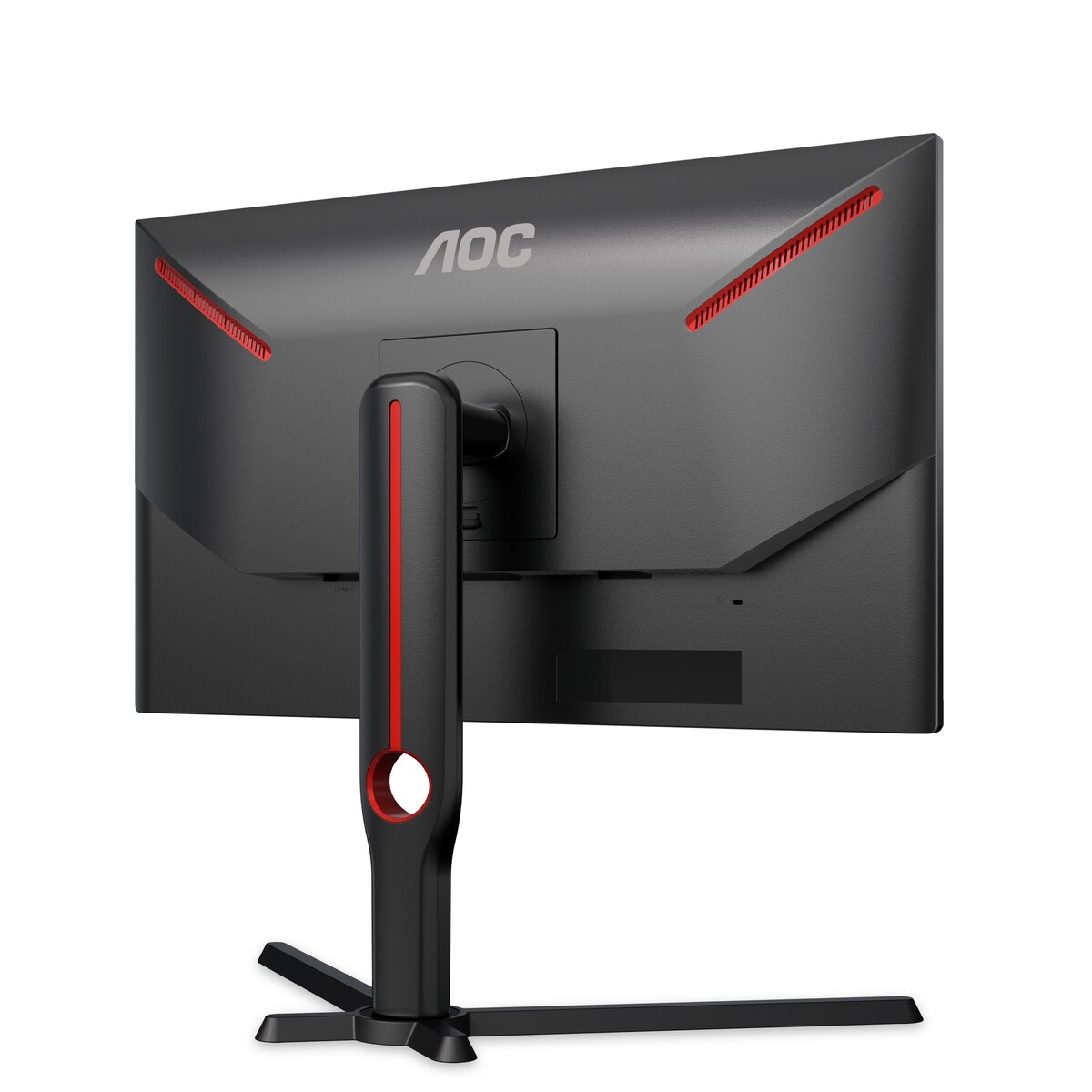
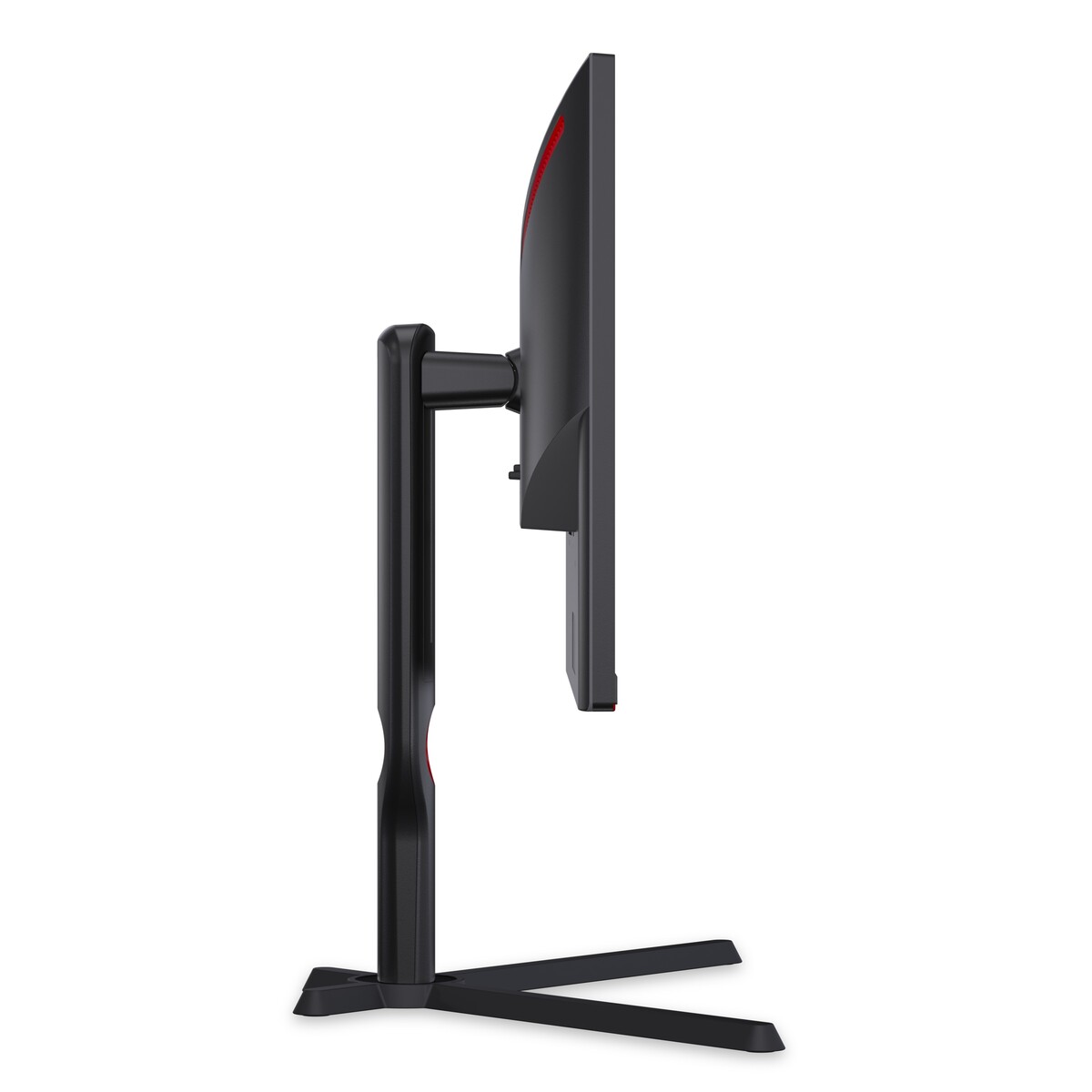
The Taiwanese electronics manufacturer AOC, best known for its gaming monitors, has launched a new monitor catered towards gamers called the AOC Gaming 25G3ZM/BK.
The new monitor utilizes a 24.5-inch VA panel that offers a 1,920 x 1,080 pixels resolution and 16:9 aspect ratio. AOC states that the panel has been coated with an antiglare layer for a better viewing experience. The monitor has WLED backlights and 178/178 viewing angles (CR10). The brightness goes up to 300 nits and users will get the typical 3,000:1 static contrast ratio from this display.
Additionally, according to AOC, the monitor’s single DisplayPort 1.2 or dual HDMI 2.0 connectors enable it to operate at between 48 and 240 Hz and give 0.5 ms MPRT and 1 ms GtG response times. To avoid screen tearing upwards of 120Hz, the company has included support for AMD FreeSync Premium. Similar to this, the display provides customized game modes to enhance image reproduction when playing, among other things, FPS, racing, or RTS games. AOC says that the AOC GAMING 25G3ZM/BK has 100% sRGB color space coverage and 92% DCI-P3 color space coverage, respectively.
The monitor comes bundled with a 4-legged stand that supports 130 mm height, pivot (90° portrait), swivel, and tilt adjustments. It also has a cable management opening to keep your setup looking clean and clutter-free. If you prefer a third-party stand, the monitor comes with a 100 x 100 mm VESA mount. The AOC GAMING 25G3ZM/BK will be available later this month for £189.99.
The OnePlus Ace Pro was made official in August in China. It is a rebranded version of the OnePlus 10T, which is available in the global market. The Chinese company has confirmed that the special OnePlus Ace Pro Genshin Impact Limited Edition will be announced on Oct. 24 at 7 pm (local time) in China.
OnePlus is yet to share the details of the OnePlus Ace Pro Genshin Impact Limited Edition. It is likely that the phone will incorporate some elements from the game. It may come in a special retail package and the device may feature a theme based on the game.
In China, the OnePlus Ace Pro comes in three configurations, such as 12 GB RAM + 256 GB storage, 16 GB RAM + 256 GB storage, and 16 GB RAM + 512 GB storage. These models are priced at 3,499 Yuan (~$485), 3,799 Yuan (~$527), and 4,299 Yuan (~$596), respectively. It can be purchased in green and black colors.
The OnePlus Ace Pro has a 6.7-inch Fluid AMOLED display that produces an FHD+ resolution and a 20:9 aspect ratio. The screen comes with an in-screen fingerprint scanner and Gorilla Glass 5 protection. The device runs on the ColorOS 12.1-based Android 12 OS.
The Snapdragon 8+ Gen 1 chipset is at the helm of the OnePlus Ace Pro. The handset offers up to 16 GB of LPDDR5 RAM and up to 256 GB of UFS 3.1 storage. It packs a 4,800mAh battery that supports 150W fast charging.
For selfies, the OnePlus Ace Pro has a 16-megapixel front-facing camera. The back panel of the device has a 50-megapixel primary camera, an 8-megapixel ultra-wide snapper, and a 2-megapixel macro camera.
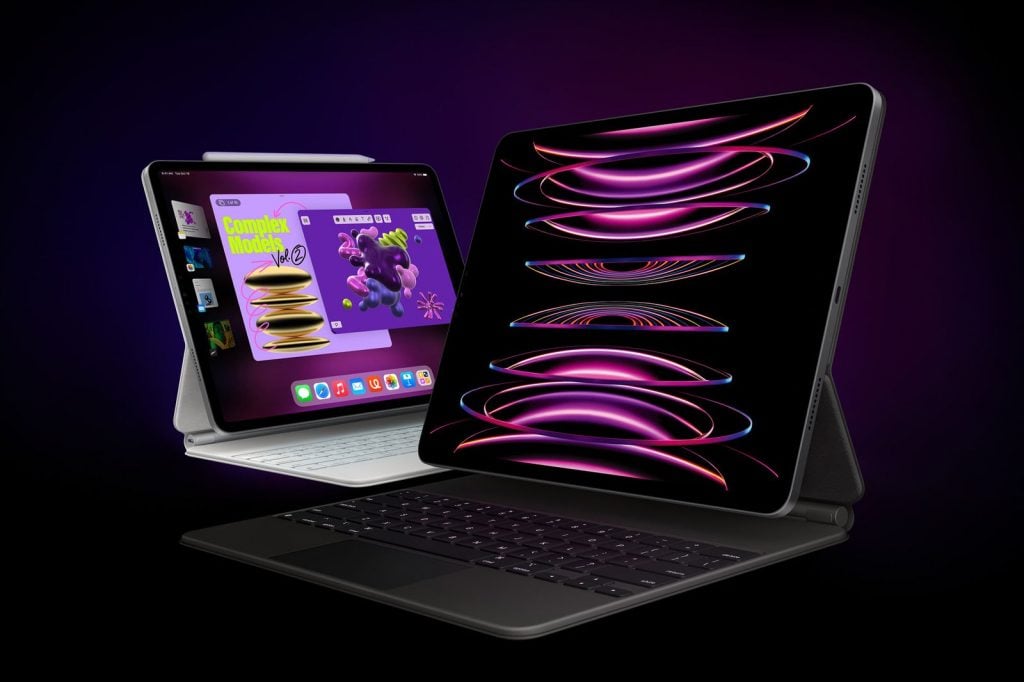
Apple has officially announced the latest iPad Pro tablet along with the 10th generation iPad and the new Apple TV 4K. The new tablet comes with an upgraded processor and better connectivity features.
It keeps the same two different screen sizes as previous models — 11-inch and 12.9-inch, both featuring ProMotion support and an adaptive refresh rate of 120Hz. The 11-inch model has 600 nits brightest, while the 12.9-inch model offers 1,000 nits brightness.
Apple iPad Pro 2022
The newly announced iPad Pro comes powered by Apple Silicon’s M2 processor, which the company claims offers 15 percent faster CPU performance through the 8-core CPU and up to 35 percent faster graphics performance with the 10-core GPU. The company also adds that the chipset can carry out 40 percent more operations per second than the M1 SoC.
It also comes with a new media engine and an image signal processor, allowing support for the ProRes video capture feature that too for the first time on an iPad. The company adds that the tablet will be able to transcode ProRes footage up to three times faster than in the past. It also packs five studio-quality mics for sharp audio recording.
In the camera department, there’s a 12-megapixel ultra-wide sensor on the front with support for Center Stage. On the back side, the device features a 12-megapixel wide camera sensor and a 10-megapixel ultra-wide sensor.
Apple has also added support for Wi-Fi 6E connectivity, making it the first device from the brand to support Wi-Fi 6E. The company claims that it can reach a download speed of up to 2.4Gbps, twice the previous generation model. There’s also support for 5G cellular connectivity which will work around the globe, but the mmWave support is limited to the United States.
Coming to the battery life, the company claims that the tablet offers 10 hours of web browsing and video usage over Wi-Fi connectivity for both models, but the usage time drops to nine hours when using cellular connectivity. In the software department, it will have all the features of the iPadOS 16.
The newly announced Apple iPad Pro has a starting price of $799 for the Wi-Fi-only 11-inch model, while the Wi-Fi version of the 12.9-inch model starts at $1,299. The tablet comes in five storage options — 128GB, 256GB, 512GB, 1TB, and 2TB and is offered in two colors — Silver and Space Gray. Both models are now up for pre-order and will be available for purchase from 26th October.
In November 2021, MediaTek unveiled the 4nm Dimensity 9000 chipset. Its enhanced version, dubbed the “Dimensity 9000 Plus,” was made official in June this year. Reliable tipster Digital Chat Station recently claimed that the Dimensity 9200 chipset would be announced in November this year. The first phones featuring the D200 chip are expected to launch by the end of this year in China. It is speculated that the Vivo X90 series may feature the upcoming D9200 SoC.
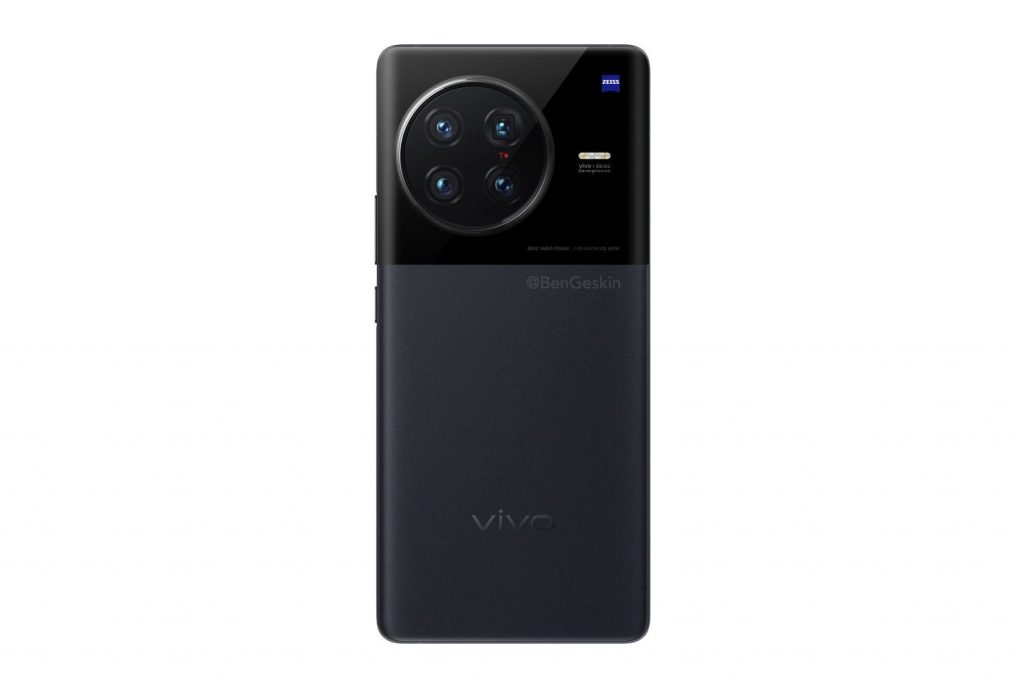
Tipster WHY LAB has hinted that the Vivo X90 series will be equipped with the Dimensity 9200 chipset. The Vivo X80 Pro made its debut in China in April of this year. It came with both the Snapdragon 8 Gen 1 and the Dimensity 9000 chipset options. Recent reports have claimed that the Vivo X90 Pro+, which is expected to break cover in December this year, will come in Snapdragon and Dimensity chip variants.
Vivo X90 Pro Plus render created by Ben Geskin
Qualcomm is also expected to announce the Snapdragon 8 Gen 2 flagship chipset in November. Hence, it appears that the X90 Pro+ will arrive in Snapdragon 8 Gen 2 and Dimensity 9200 chipset variants in the home market.
There have been rumors about the Vivo X90ro+ that it will have an AMOLED LTPO display with a Quad HD+ resolution and a refresh rate of up to 120Hz. The screen is likely to be integrated with an under-display fingerprint scanner.
The Snapdragon 8 Gen 2 / Dimensity 9200 chip is likely to be accompanied by LPDDR5x RAM and UFS 4.0 storage. It may pack a 5,000mAh dual-cell battery with 100W or 120W fast charging support. The device may also support at least 50W wireless charging. The rear camera setup of the X90 Pro+ will have a 1-inch camera sensor, an ultra-wide lens, and a 64-megapixel telephoto camera with 5x optical zoom. The X90 Pro+ will also have the Vivo V2 ISP for an optimized photography experience.
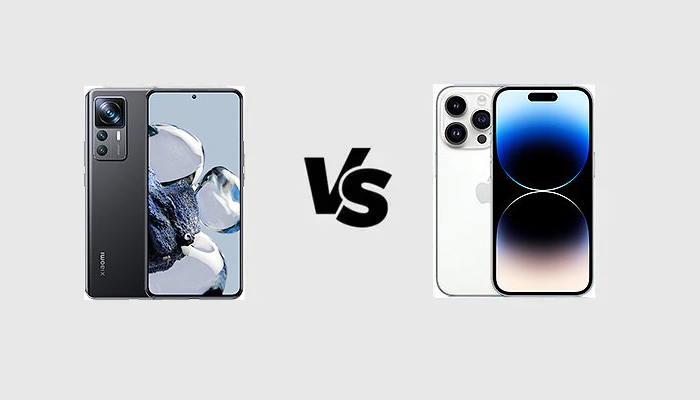
Xiaomi launched a new flagship for the global market: it is the Xiaomi 12T Pro. Announced alongside the vanilla version from the same lineup, this is one of the world’s first phones with a 200 MP camera and it also comes with the most advanced chipset by Qualcomm. However, its price tag is quite affordable if compared to the other top-tier flagships out there. After reading its listing price, a lot of people are wondering whether or not this device stands a chance against the iPhone 14 Pro, which is the latest Apple flagship. The price difference is huge, but is it the same when it comes to the specifications? We decided to give you an answer through this article: here is a comparison between the main specifications of the Xiaomi 12T Pro and the Apple iPhone 14 Pro.
Xiaomi 12T Pro vs Apple iPhone 14 Pro
Xiaomi 12T Pro
Apple iPhone 14 Pro
DIMENSIONS AND WEIGHT
163.1 x 75.9 x 8.6 mm, 205 g
147.5 x 71.5 x 7.9 mm, 206 g
DISPLAY
6.67 inches, 1220 x 2712 pixels (Full HD+), AMOLED
6.1 inches, 1179 x 2556p (Full HD+), Super Retina XDR OLED
If your goal is to get the most beautiful design, there is no doubt about the fact that you should go for the Apple iPhone 14 Pro. First of all, it is built with better materials: glass for the back and stainless steel for the frame. It is very beautiful and also very compact; further, it introduces for the first time the new Dynamic Island: a pill-shaped punch hole acting like a secondary display to show important information. It also comes with the IP68 certification proving that it is waterproof and dustproof. The Xiaomi 12T Pro is bigger and chunkier, there is no way for it to compete with the iPhone. However, it is still built with premium materials including a glass back and an aluminum frame. It has the IP53 certification making it dust resistant and splash resistant, but it is not a waterproof device.
Display
If you are looking for the best display, you should go for the iPhone 14 Pro without thinking twice. It has a Super Retina XDR OLED panel with a diagonal of 6.1 inches, a Full HD+ resolution of 1179 x 2556 pixels, the LTPO technology enabling an adaptive refresh rate from 1 to 120 Hz, HDR10 certification, Dolby Vision support, and a peak brightness of 2,000 nits. The display is protected by Ceramic Shield and, as mentioned above, it includes Dynamic Island which contains the hardware sensors for 3D facial recognition. The Xiaomi 12T Pro has a high-end display, but it is not comparable to Apple. It is an AMOLED panel with a diagonal of 6.67 inches, a 1,5K resolution of 1220 x 2712 pixels, a 120 Hz refresh rate, HDR10+ certification, Dolby Vision support, a peak brightness of 900 nits, and an in-display fingerprint reader, protected by Gorilla Glass 5. The only advantage of the Xiaomi is the wider diagonal: 6.67 inches instead of just 6.1 inches, but for the rest, the display of the iPhone 14 Pro is superior.
Specs & Software
The iPhone 14 Pro and the Xiaomi 12T Pro are two phones with flagship-class hardware, so you will get the highest level of performance you can get with Android and iOS by choosing these devices. The iPhone 14 Pro is powered by the new Apple A16 Bionic mobile platform: a chipset built with a 4 nm production process and sporting an hexa-core architecture with two Everest CPUs running at a max frequency of 3.46 GHz, four Sawtooth CPUs running at 2.02 GHz, and a 5-core Apple proprietary GPU. The chipset is paired with 6 GB of RAM and up to 1 TB of native storage. If the iPhone has the best Apple chipset, the Xiaomi 12T Pro comes with the best Qualcomm chipset: the Snapdragon 8+ Gen 1 built with a 4 nm production process and sporting an octa-core architecture composed of a Cortex X2 CPU running at 3.19 GHz, three Cortex A710 CPUs running at 2.75 GHz, four Cortex A710 CPUs running at 2 GHz, and an Adreno 730 GPU. Alongside the chipset, there are up to 12 GB of RAM and up to 256 GB of UFS 3.1 internal storage. Do not get fooled by the RAM because iOS has better optimization than Android: the iPhone 14 Pro is able to provide better performance. These phones run iOS 16 and Android 12, respectively.
Camera
The iPhone 14 Pro wins the camera comparison in all of the scenarios. It is equipped with the first 48 MP camera ever seen on an iPhone, a 12 MP telephoto sensor, and a 12 MP ultrawide lens. With the Xiaomi 12T Pro you get an excellent 200 MP main camera with OIS, but the secondary sensors are midrange-class: an 8 MP ultrawide lens and a 2 MP macro shooter.
The Xiaomi 12T Pro is able to last more on a single charge in several scenarios thanks to its bigger 5000 mAh and it even charges faster thanks to 120W fast charging, but, unlike the iPhone 14 Pro, it does not support wireless charging.
Price
You need either $1000 or €1300 to purchase the iPhone 14 Pro globally, while the Xiaomi 12T Pro starts from €899 or $899. The iPhone 14 Pro wins the comparison thanks to a better display, cameras, build quality, and wireless charging.
A new Xiaomi flagship is on the shelves on the global market, and it is again a flagship killer. We are referring to the Xiaomi 12T Pro, a new variant of the Xiaomi 12 lineup focused on the quality price ratio. Earlier this year, the Chinese giant released the Xiaomi 12 Pro and a lot of people are thinking that the new device is actually an upgrade of the older one, but it is not so. The Xiaomi 12T Pro has a few better specifications, but it also comes with a few downgrades over its predecessor. That is the reason why a lot of people are confused about these two devices. This is a comparison between the main specifications of the Xiaomi 12 Pro and the Xiaomi 12T Pro which will hopefully clear your ideas in regards and let you understand which of these phones is the best for your actual needs.
Xiaomi 12T Pro vs Xiaomi 12 Pro
Xiaomi 12T Pro
Xiaomi 12 Pro
DIMENSIONS AND WEIGHT
163.1 x 75.9 x 8.6 mm, 205 g
163.6 x 74.6 x 8.2 mm, 204 g
DISPLAY
6.67 inches, 1220 x 2712 pixels (Full HD+), AMOLED
4600 mAh, Fast Charging 120W and Qi wireless charging 50W
ADDITIONAL FEATURES
5G, dual SIM
5G, dual SIM, reverse wireless charging
Design
Even though it is an older device, the design of the Xiaomi 12 Pro looks a lot more attractive than the one found on the Xiaomi 12T Pro. It is entirely built with premium materials including glass for the back protected by Gorilla Glass Victus and aluminum for the frame. Further, it has a higher screen to body ratio as the display covers almost 90 percent of the front panel, while the Xiaomi 12T Pro has thicker bezels. On the other hand, the recent flagship has the IP53 certification making it dust resistant and splash resistant.
Display
The display of the Xiaomi 12 Pro is actually better than the one found on its younger sibling. It is an AMOLED panel able to show up to one billion colors with a wider diagonal of 6.73 inches and a Quad HD+ resolution of 1440 x 3200 pixels. It supports the LTPO technology enabling an adaptive refresh rate from 1 to 120 Hz, it has the HDR10+ certification, Dolby Vision support, and a peak brightness of 1,500 nits, as well as an in-display fingerprint scanner. The Xiaomi 12T Pro has an inferior display, but it remains a very interesting panel as it is the first display with a 1.5K resolution of 1220 x 2712 pixels. We are talking about an AMOLED panel with a diagonal of 6.67 inches, 68 billion colors, a 120 Hz refresh rate, HDR10+ certification, Dolby Vision support, a peak brightness of 900 nits, and an in-display fingerprint reader. Both phones feature stereo speakers tuned by Harman Kardon for an improved audio experience.
Specs & Software
The hardware setup of the Xiaomi 12T Pro wins the comparison because of the presence of a stronger chipset. The Snapdragon 8 Plus Gen 1 found on this device is actually an upgrade of the Snapdragon 8 Gen 1 found on the Xiaomi 12 Pro. It is a chipset built with a 4 nm production process and sporting an octa-core architecture composed of a Cortex X2 CPU running at a max frequency of 3.19 GHz, three Cortex A710 CPUs running at 2.75 GHz, four Cortex A510 running at 2 GHz, and an Adreno 730 GPU. Instead, the Snapdragon 8 Gen 1 has lower frequencies for the cores. In both cases, the chipsets are paired with up to 12 GB of RAM and up to 256 GB of UFS 3.1 internal storage. These handsets were released in different periods, but they both run Android 12 out of the box, customized by MIUI 13.
Camera
If we talk about the main cameras, then the Xiaomi 12T Pro is a superior phone thanks to the presence of the world’s first 200 MP camera for a mobile device. But the secondary sensors are just midrange-class: an 8 MP ultrawide camera and a 2 MP macro shooter. The Xiaomi 12 Pro has flagship-class secondary sensors: a telephoto lens with a 50 MP resolution and 2x optical zoom, and another 50 MP sensor for ultrawide shots. The 12 Pro also features a better front camera with a 32 MP resolution.
If your goal is to get the longest battery life on a single charge, then you should go for the Xiaomi 12T Pro. It sports a bigger 5000 mAh battery and, given that the other components are not so different, it is definitely sure that it will provide longer battery life. On the other hand, the Xiaomi 12 Pro is the only one featuring wireless charging, as well as reverse wireless charging.
Price
The Xiaomi 12 Pro hitten the global market with a very high listing price: €1100 or $1100 for the European market. The Xiaomi 12T Pro is way more affordable as it hitten the shelves with a starting price tag of €899 or $899. So the 12T Pro has a higher value for money, but overall, the Xiaomi 12 Pro is a better phone. It sports a superior display, a better camera department, and wireless charging.
Back in November 2021, MediaTek released the Dimensity 9000 as the world’s first SoC fabbed on TSMC’s 4nm process node. It was also the first to use ARM’s high-performance Cortex-X2 core. Later in June, the company announced the Dimensity 9000+ to go head-to-head with Snapdragon 8+ Gen 1 SoC. Now, a popular tipster has revealed the details of the upcoming Dimensity 9200 and shared its launch timeline. Let’s look at the details.
According to Chinese tipster Digital Chat Station, the MediaTek Dimensity 9200 will debut in November, but before the Snapdragon 8 Gen 2. It is reported to use ARM Cortex-X3 cores and an Immortalis G715 GPU. ARM Cortex-X3 is claimed to offer a 25% performance boost over the Cortex-X2. While the clock speed and architecture have not yet been announced, the performance of the chipset is said to be much higher than expected.
The chipset will still be based on TSMC’s 4nm process node and could use the same Cortex-A710 and Cortex-A510 cores as before. It is said to power the upcoming devices in Vivo’s X90 series and OPPO’s Find X series.
The upcoming Dimensity 9200 SoC is expected to give a tough fight to the Snapdragon 8 Gen 2 SoC, which is slated to debut in November. It is expected to appear on various phones from Vivo and Oppo in December 2022, much sooner than its predecessor.
In related news, MediaTek recently unveiled a new mid-tier chipset called, Dimensity 1080. It brings improved performance, better efficiency, and enhanced camera support as compared to its predecessor— the Dimensity 920. It can even handle image data from sensors of up to 200MP with the Imagiq ISP.
The LIVALL PikaBoost electric bike converter has been announced. The device uses a regenerative system to boost the battery charge. It is suitable for all bicycles and can be easily mounted without tools.
The LIVALL PikaBoost weighs about 3kg and comes with a 234Wh battery with an assisted range of 30km. The electric bike converter can be mounted between the bicycle’s seat and the wheel. It is suitable for various surfaces and has an IP66 waterproof rating. The converter also has an integrated terrain change detection system for a more comfortable ride. It can maintain an average speed based on the terrain and provides additional assistance during steep inclines.
The new LIVALL electric bike converter features three riding modes. The Sports mode provides more resistance for pedal activity. The built-in regenerative system uses downhill movement to boost power and provide an extended battery life. The regenerative system provides unlimited battery life for the device. The LIVALL electric bike converter is eco-friendly and does not need to be charged via mains electricity supply.
The LIVALL PikaBoost features an auto-sensing red light which is activated when you are slowing down. The red light can also be set to be on during the night. The PikaBoost can be locked wirelessly via Bluetooth and provides anti-theft safety. The converter has dimensions of 26 x 13.3 x 5.1 inches and can be easily fitted on any bike.
The LIVALL Pikaboost will retail originally for $599 but a 49% discount is being offered via Kickstarter. LIVALL says that there is a limited super Early bird reward leading to the $299 price tag.
Back in August, OnePlus started the OxygenOS 13 closed beta program for the OnePlus 8 series. Now, after months of closed testing with a limited number of users, the company has finally opened the Android 13-based software for public testing in India. Users of the OnePlus 8, 8 Pro, and 8T can now try out the OxygenOS 13 on their devices.
According to the official announcement, OxygenOS 13 Open Beta program is now live for the OnePlus 8, OnePlus 8 Pro, and OnePlus 8T users. The program is currently limited to Indian users, but the company should extend it to more regions in the coming weeks.
If you wish to get the latest beta update successfully, make sure that your device is in the latest OxygenOS 12 version (C.35). Also note that this is beta software and is not as stable as the official OTAs.
Some of the known issues on the OnePlus 8 series include an abnormal charging prompt under screen lock, the inability to send video below 300K resolution recorded by the camera via MMS, and more function icons in the editing interface of the control center displayed incorrectly.
Changelog
Aquamorphic Design
• Adds Aquamorphic Design theme colors for enhanced visual comfort.
• Applies the Aquamorphic Design philosophy to animations to make them natural and vivid.
• Adds Shadow-Reflective Clock, with shadow simulating the orientation of the sun and moon.
• Upgrades to Quantum Animation Engine 4.0, with a new behavior recognition feature, which recognizes complex gestures and provides optimized interactions.
• Optimizes UI layers for a clearer and neater visual experience.
• Applies real-world physical motions to animations to make them look more natural and intuitive.
• Adapts responsive layouts to accommodate different screen sizes to improve readability.
• Optimizes the widget design to make information easier and quicker to find.
• Optimizes fonts for better readability.
• Optimizes system icons by using the latest color scheme to make the icons easier to recognize.
• Enriches and optimizes illustrations for features by incorporating multicultural and inclusive elements.
Efficiency
• Adds Meeting Assistant to enhance the meeting connecting and note-taking experience and introduces an option to make notifications more subtle and less distracting.
• Adds large folders to the Home screen. You can now open an app in an enlarged folder with just one tap and turn pages in the folder with a swipe.
• Adds media playback control, and optimizes the Quick Settings experience.
• Adds more markup tools for screenshot editing.
• Upgrades Doodle in Notes. You can now draw on graphics to take notes more efficiently.
• Optimizes Shelf. Swiping down on the Home screen will bring up Shelf by default. You can search content online and on your device.
Seamless interconnection
• Optimizes earphone connectivity to deliver a more seamless experience.
Personalization
• Optimizes Bitmoji to offer more Always-On Display animations.
• Adds Omoji to let you fully express yourself with customized avatars
• Optimizes Insight Always-On Display, with more personalized Always-On Display settings available.
• Optimizes Canvas Always-On Display, with more drawing tools and line colors available.
Security & privacy
• Adds an automatic pixelation feature for chat screenshots. The system can identify and automatically pixelate profile pictures and display names in a chat screenshot to protect your privacy.
• Adds regular clearing of clipboard data for privacy protection.
• Optimizes Private Safe. The Advanced Encryption Standard (AES) is used to encrypt all files for enhanced security of private files.
Health & Digital wellbeing
• Adds Kid Space, providing screen time limit, ambient light reminders, and Eye-protecting display features.
Gaming experience
• Upgrades to HyperBoost GPA 4.0 to stabilize the frame rate and balance the performance and power consumption in key scenarios.
• Optimizes the pre-launch capabilities of Quick startup to load games faster.
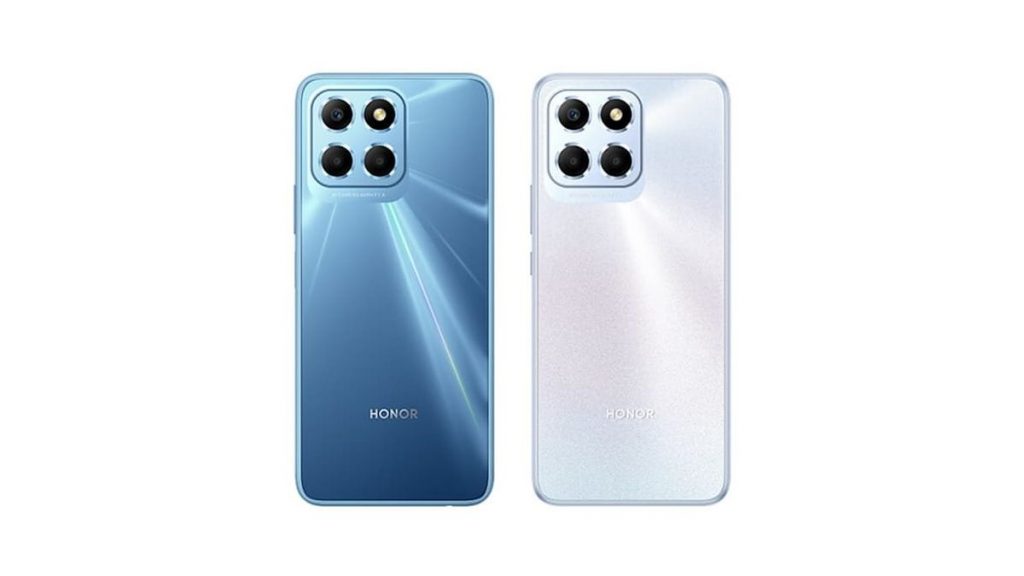
The Honor X6s has gone official in the global market. It is a new variant of the Honor X6, which went official in September. In terms of design, the X6s looks similar to the X6 as it features a waterdrop notch display and a square-shaped camera module on the back. Here is all the details on the specifications, features, and price of the X6s.
Honor X6s specifications and features
Honor X6s
The Honor X6s houses a 6.5-inch IPS LCD display that offers an HD+ resolution of 720 x 1600 pixels. The phone runs on the Magic UI 6.1 flavored Android 12 OS. A fingerprint scanner is integrated under the power button, which is available on the right edge of the phone.
The Helio G25 chipset is present under the hood of the Honor X6s. The SoC is coupled with 4 GB of RAM. The device comes with 64 GB and 128 GB of storage. It draws power from a 5,000mAh battery with 10W charging.
Honor X6s
On the front, the Honor X6s has a 5-megapixel front camera. Its rear camera setup has a 50-megapixel main camera with an f/1.8 aperture, a 2-megapixel macro camera, and a 2-megapixel depth assist lens.
The Honor X6s comes with other features, such as face unlock, dual SIM support, 4G LTE, Wi-Fi 802.11ac, Bluetooth 5.1, NFC, USB-C, and a 3.5mm headphone jack. The device measures 163.66 x 75.13 x 8.68m and weighs 194 grams.
Honor X6s price and availability
Honor is yet to confirm the price of the Honor X6s. It comes in two colors: Ocean Blue and Titanium Silver.
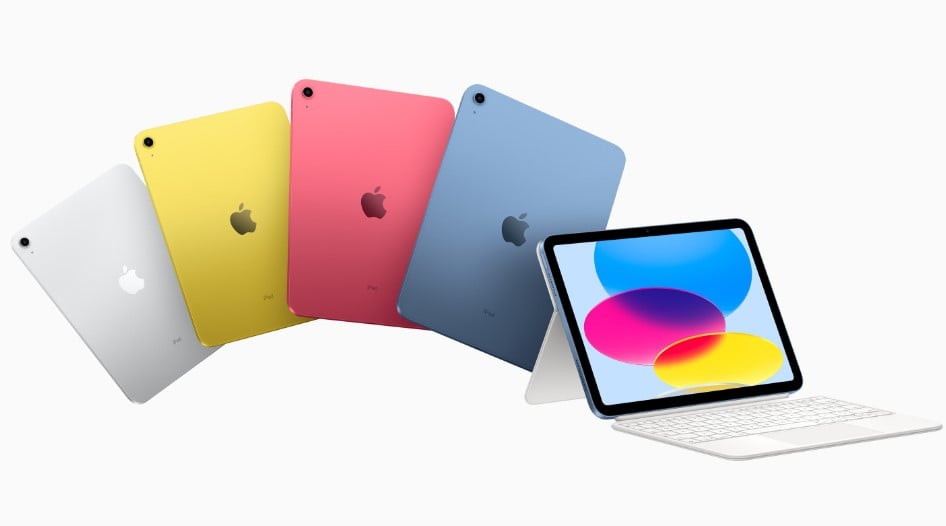
As rumoured, Apple has silently announced two new iPads. These include the iPad Pro 2022 and iPad 10th generation. Both the latest offerings arrive as the successors to the iPad Pro 2021 and iPad (9th gen) that debuted last year. The iPad (10th gen) comes with an all-new design and upgrades over its predecessor. Read on to know what it offers out of the box.
The iPad (10th gen) features a larger 10.9-inch LED screen bearing a resolution of 2,360 x 1,640 pixels and offering 500 nits brightness along with True Tone technology. It comes with a fingerprint-resistant oleophobic coating. There is a circular 12MP camera on the back as well as a 12MP front-facing snapper. The tablet also packs 1080p video recording, facetime, centre stage, dual mics, and stereo speakers.
The most noticeable change on the iPad (10th gen) is that it looks similar to the iPad Air. The display is surrounded by symmetrical bezels on all four sides. Apple has ditched the Touch ID located at the bottom bezel of the display and now it is embedded in the power button located at the top of the device. The volume rocker buttons are located at the top right edge of the device.
Under the hood, the iPad (10th gen) is equipped with Apple’s A14 Bionic chipset. It comprises a 6-core CPU and quad-core GPU with a 16-core neural engine. The tablet packs up to 256GB of storage onboard. The RAM and battery details of the tablet remain unknown.
The Apple iPad (10th gen) runs on iOS 16. The Cupertino-based brand says that It is compatible with the new Magic Keyboard Folio and first-gen Pencil. Connectivity options on the tablet include WiFi-6, Bluetooth 5.2, and USB-C port.
In the US, the iPad (10th gen) 64GB WiFi-only version starts at $449 whereas the 256GB option costs $599. The WiFi+LTE variants of the same configurations are priced at $599 and $799 respectively. On the other hand, in India, the tablet carries a price tag of Rs 44,900 and Rs 59,990 for 64GB and 256GB WiFi-only variants. The WiFi+ Cellular models of the same configurations are priced at Rs 59,990 and Rs 74,990 respectively.
The iPad (10th gen) is available in Silver, Blue, Pink, and Yellow colour options. It is up for pre-orders in most countries with shipments commencing from October 28th.
Nothing is gearing up to launch a new pair of wireless earbuds later this month. It has been teasing the new earbuds for a few weeks now, and has also confirmed that it will launch its second TWS earbuds, called Nothing Ear (stick), on October 26. However, just a week ahead of it, Nothing has announced almost 50% price increase for its first earbuds—the Nothing Ear (1). Here are the details.
Nothing’s CEO Carl Pei took to Twitter to announce that Nothing Ear (1) will get a 50% price hike later this month. From October 26, the earbuds will be available for purchase at $149. Currently, the Nothing Ear (1) is available for $99. Justifying the price hike, Pei said, “When we started developing it, we only had 3 engineers.” A year later, we have 185. During this time, the Ear (1) has received 15 firmware and tuning updates and is a completely different product to when we launched it. The price increase is also due to rising inflation and a weaker pound sterling.
On October 26, we'll be raising the prices for Ear (1) to $149 due to an increase in costs. pic.twitter.com/jJDlaXzzJ6
The new price of Ear (1) will likely make the shoppers reconsider their choices. Chances are that many buyers will go for other options, like the Galaxy Buds 2 or the Pixel Buds A-series. There are several other TWS earbuds that are significantly better than the Nothing Ear (1), both in terms of audio quality and price.
To recall, the Nothing Ear (1) earbuds come with a stem design and weigh 4.7 grams each. They are equipped with an 11.6mm speaker driver and support ANC (active noise cancellation). The TWS earbuds are claimed to offer up to 5 hours of listening time with the earbuds and an additional 34 hours of playback with the charging case. Ear (1) carries support for wireless charging and comes with IPX4 sweat and water resistance.
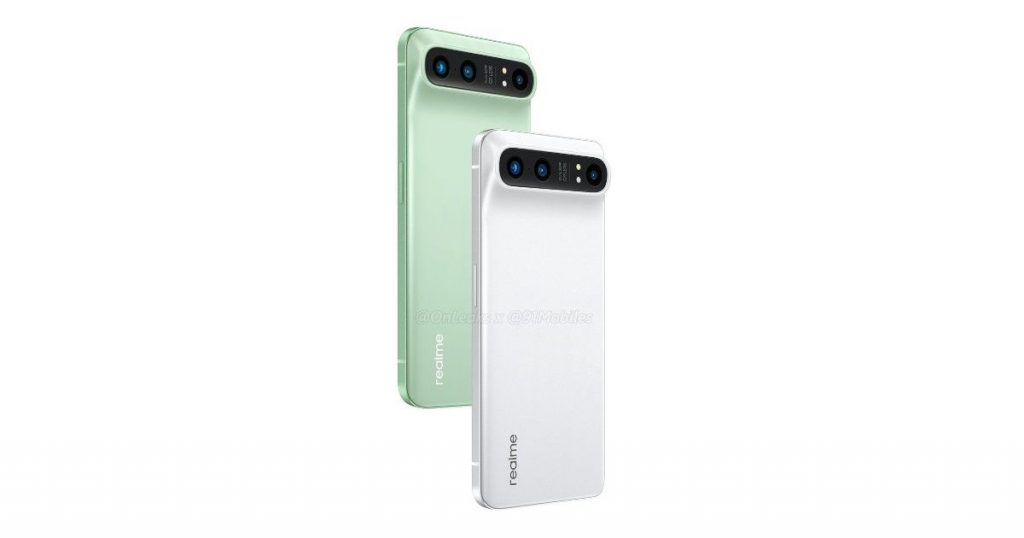
Back in December 2021, OnLeaks shared renders of a rather interesting smartphone from Realme with a horizontal camera design, somewhat similar to Google’s Pixel 6 lineup. The handset was rumored to be a camera-centric version of Realme GT 2 Pro, and the firm even confirmed its existence via a Tweet. However, today, the brand’s VP revealed that the device has been canceled. Here are the details.
Realme’s VP Chase Xu revealed through Weibo that the company has canceled the camera-centric Realme GT 2 Pro (via OnLeaks). The executive did not mention why Realme axed the plan to bring this device to the market. The handset could have performed pretty well since it generated a lot of hype due to its unusual but interesting design.
Even though the device won’t be released anymore, let’s take a moment to admire its design. As can be seen in the renders, the handset has a premium look. Its biggest highlight is the horizontal camera bar on the back, that looks like an amalgamation of Pixel 6’ and Galaxy S10’s camera islands. The module features triple cameras and dual-LED flash cutouts. The engraving in the module suggests the Realme GT 2 Pro could have had GR lenses. For the uninitiated, the GR Lens offers outstanding shooting performance in a small camera body.
In related news, Realme is reportedly gearing up to launch the Realme 10 series of smartphones in a few weeks. Initially, the lineup may include two smartphones— the Realme 10 and the Realme 10 Pro+ 5G. However, the firm may announce other models later. The handsets will likely debut as solid mid-rangers.
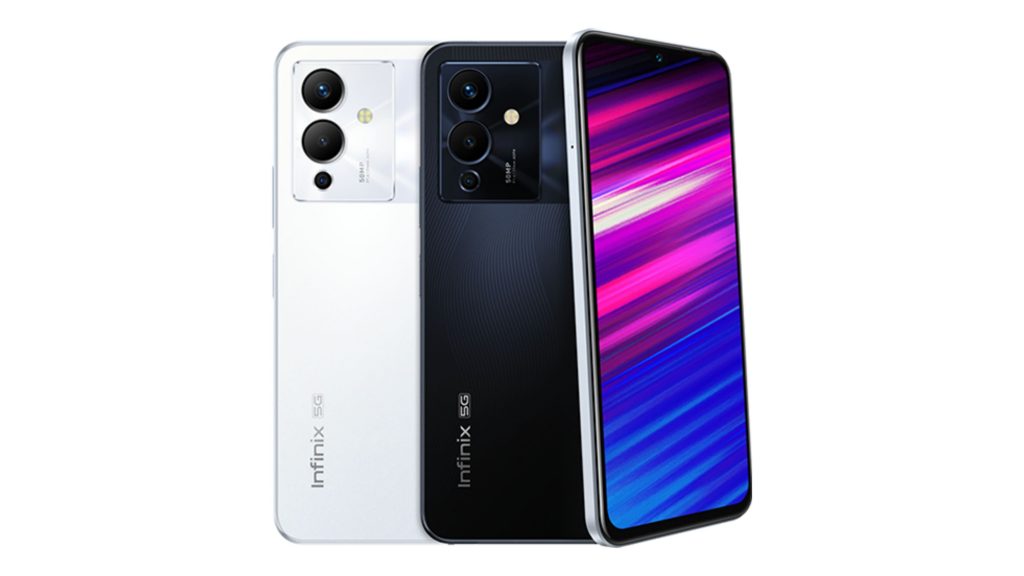
There are more affordable 5G smartphones in India than ever before. However, the cheapest models still lack certain sought-out features found on the similarly-priced 4G handsets.
But Infinix Note 12 5G is different from other affordable 5G phones. Unlike the competition, it offers almost the same or even better specs than the 4G smartphones retailing in the price segment.
It can be called an underrated product as most people don’t even know about its existence. Before we talk more about this handset, we would like to clarify that this is not a sponsored article. The opinions stated here are the author’s alone.
Infinix along with its sister brands Tecno and Itel enjoy popularity in tier 2 and tier 3 cities across India. But the same cannot be said for other parts of the country.
Hence, a feature-packed device like Ininfix Note 12 5G stays under the radar even 3 months after its release. With that out of the day, let’s take a look at what this phone has to offer.
Infinix Note 12 5G
How Infinix Note 12 5G is Different From Other Budget 5G Smartphones?
Almost all affordable 5G handsets sport LCD screens. Whereas, the Infinix Note 12 5G flaunts an AMOLED display.
The panel comes with a resolution of 2400 x 1080 pixels (FHD+). But it is worth noting that it has a dewdrop notch and older Corning Gorilla Glass 3 protection.
Also, the refresh rate is capped at 60Hz. Most LCD panel-equipped competitors provide at least a 90Hz refresh rate.
Though we cannot say that OLED is better than LCD, it is no denying that smartphone OEMs are switching to OLED across their portfolio.
At this moment, the Infinix Note 12 5G is the only 5G smartphone under ₹15,000 to feature an AMOLED display.
2. Better Chipset
Most 5G smartphones under ₹15,000 still house a MediaTek Dimensity 700 SoC. There are also some models with Snapdragon 450.
On the other hand, the Infinix Note 12 5G comes powered by a MediaTek Dimensity 810 SoC. A more powerful chip that is commonly found in phones priced above ₹15,000.
The only other device with this same chip in this segment is the Poco M4 Pro 5G. However, it does not offer an AMOLED display.
3. The Pricing
The Infinix Note 12 5G is sold in India in a single 6GB + 64GB memory configuration priced at ₹14,999. But during sales, the device is usually discounted by up to ₹2,000. Additionally, customers can avail of bank discounts.
At this price, it is unbeatable in terms of raw specs. Also, if you crave a 108MP main camera, there’s an expensive variant called Infinix Note 12 Pro 5G with 8GB + 128GB memory configuration priced at ₹17,999. That one usually retails at ₹15,999 during sales with additional bank discounts.
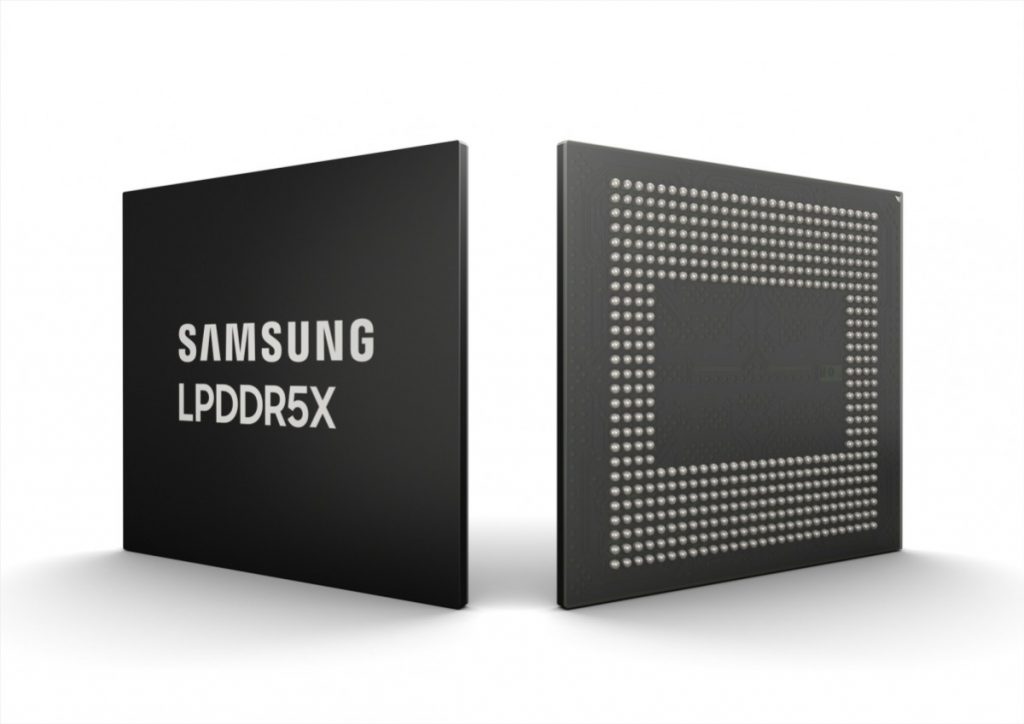
Samsung is close to releasing its LPDDR5X DRAM chips, which have gone through several stages of development. Samsung has now announced that the LPDDR5X DRAM has completed its validation process. The new chip has already achieved an industry milestone of 8.5 Gbps since March 2022.
The LPDDR5X DRAM is a significant improvement of the LPDDR5 and it’s a culmination of a partnership between Samsung and Qualcomm. The Samsung-Qualcomm collaboration certainly fast-tracked the development of the new chip. Its speed surpassed the previous maximum speed for DRAM which was 7,5Gbps.
Although the LPDDR5X technology is not new, it has seen some innovations even with the minimal internal redesign. The LPDDR5X technology is currently used in some smartphones but the new chips expand the utility and performance of the technology. It is a low-power consumption technology that delivers high performance. The LPDDR5X memory will achieve higher speeds with minimal internal redesigning. It is well suited for applications outside smartphones like PCs, servers, automobiles, and more.
Both Samsung and Qualcomm are excited about the completed validation of the LPDDR5X DRAM chip. Daniel Lee, EVP of the Memory Product Planning Team at Samsung, and Ziad Asghar, VP of Product Management at Qualcomm were both upbeat about the development. Samsung says the market availability of the chips was accelerated by more than a year following its collaboration with Qualcomm. There are no fine details yet for the release of the LPDDR5 DRAM commercially, but this could be very close.
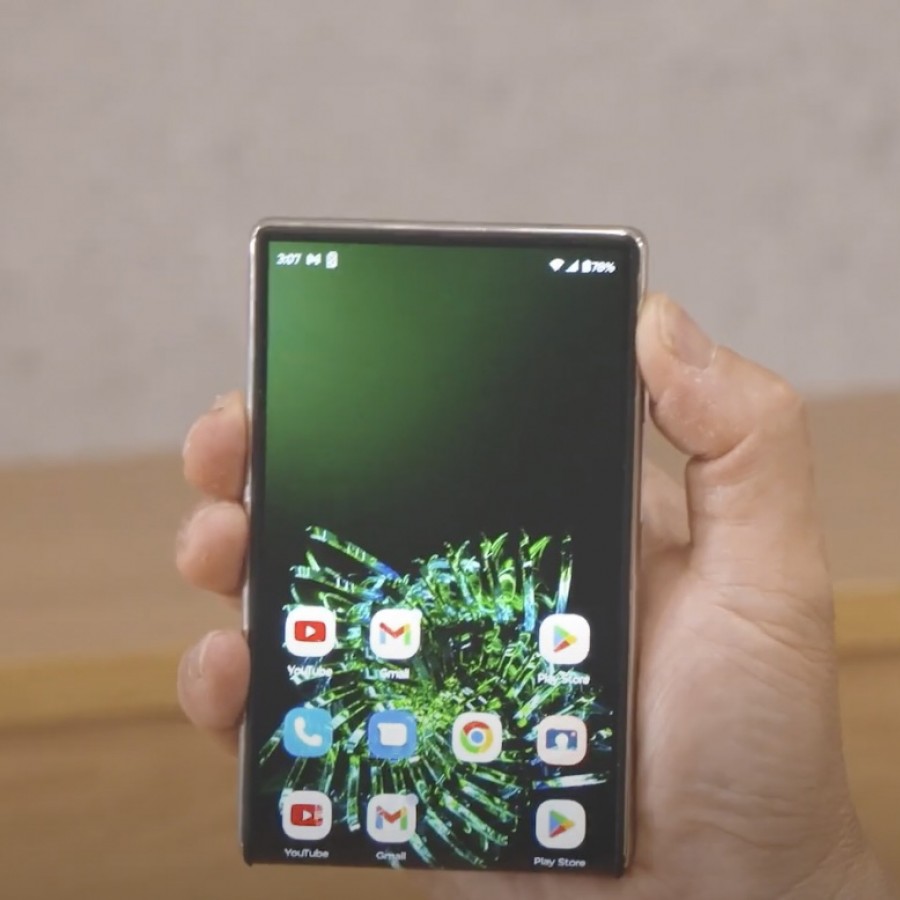
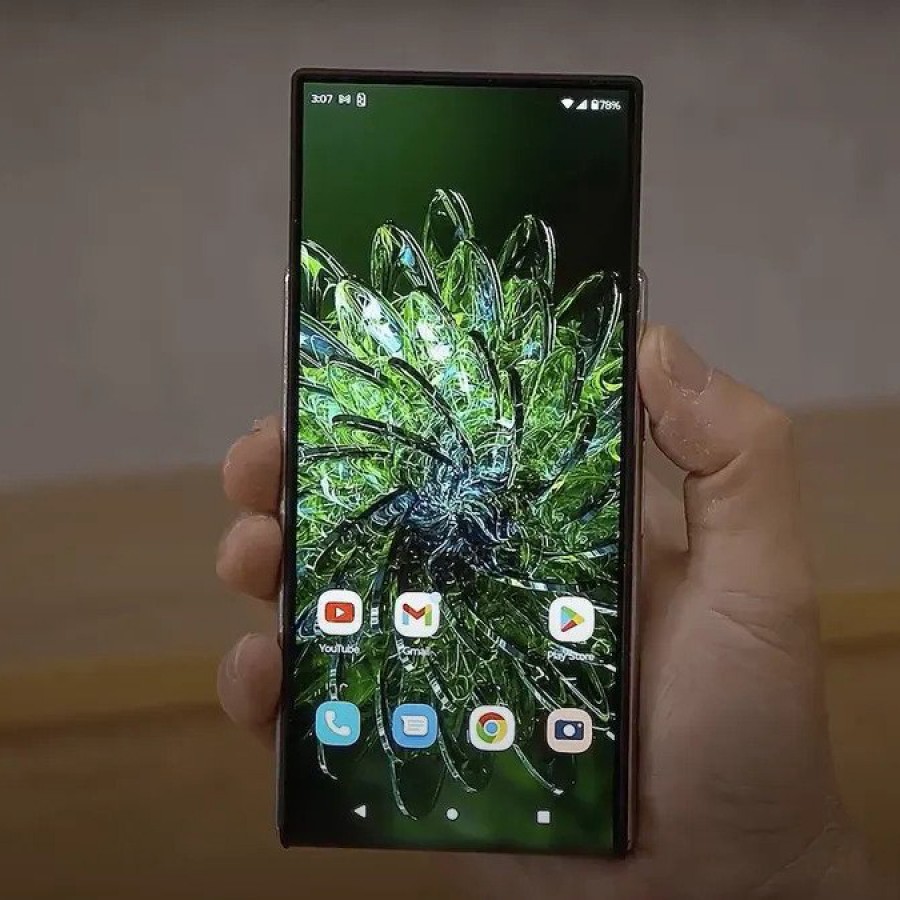
A Motorola rollable phone concept is part of the exciting concepts that have been showcased during Lenovo Tech World 2022. The conference is a gathering of innovative and futuristic concepts.
The Motorola Rollable Concept phone can expand vertically from a 5-inch slate to a 6.5-inch screen. The transformation is achieved using a physical button on the phone’s side. The rollable phone display has been propped up earlier by LG, but that won’t happen since LG has exited the smartphone market. The new Motorola rollable will be an improvement over previous similar concepts. It shows that there is great flexibility with OLED panels, as shown in some of the Motorola/Lenovo lineups. Content on the rollable smartphone, when rolled, will also dynamically adjust to expand the screen. The rollable phone market abounds with possibilities. We expect Lenovo and Motorola to continue research in that direction.
The possibilities of new form factors and potential use cases are quite outstanding. A rollable Lenovo laptop is in the works, and it will have a vertically expanding screen for multitasking, browsing, and other functions. Some important details of the upcoming rollable smartphones and laptops are still lacking.
The rollable OLED concept is a highly innovative and deeply involving research effort. We may be years away from seeing an actual phone with a rollable display. The optics shown by Motorola and Lenovo, however, indicate we are getting close. Some earlier models, like the ThinkPad X1 Fold 2022 and the Moto Razr series show this is a product that will likely be unveiled in no distant time.
OPPO has teased the launch of a limited edition Reno 8 Pro 5G in India. The smartphone debuted in July this year. Now the Chinese company has teamed up with HBO’s drama series House of Dragon to announce a special edition variant of the device. For those unaware, it is a prequel to the popular HBO series ‘Game of Thrones’.
The OPPO Reno 8 Pro House of Dragon Limited Edition is confirmed to be available from Flipkart. The brand has explicitly not revealed the launch date of the smartphone. Additionally, the details of the limited edition variant also remain under wraps. However, the e-commerce portal Flipkart has put up a teaser page giving us a glimpse of the upcoming offering.
For starters, the OPPO Reno 8 Pro House of Dragon Limited Edition will come in a Black coloured customised box. We see a Dragon egg and a House Targaryen symbol badge in Gold colours. There’s also an additional goodie that seems unclear for now. As for the smartphone, it is also seen with leather textured Black back panel cover. It has a huge protruding camera island. The back cover also has a House Targaryen badge.
The rest of the details of the Reno 8 Pro House of Dragon Limited Edition remain a mystery. We can expect the device to come with the same specifications as the regular variant. These include a 6.7-inch AMOLED display with 120Hz refresh rate, Dimensity 8100-Max SoC coupled with 12GB RAM and 256GB storage, a 50MP+8MP+2MP camera setup, and a 4,500mAh battery with 80W charging.
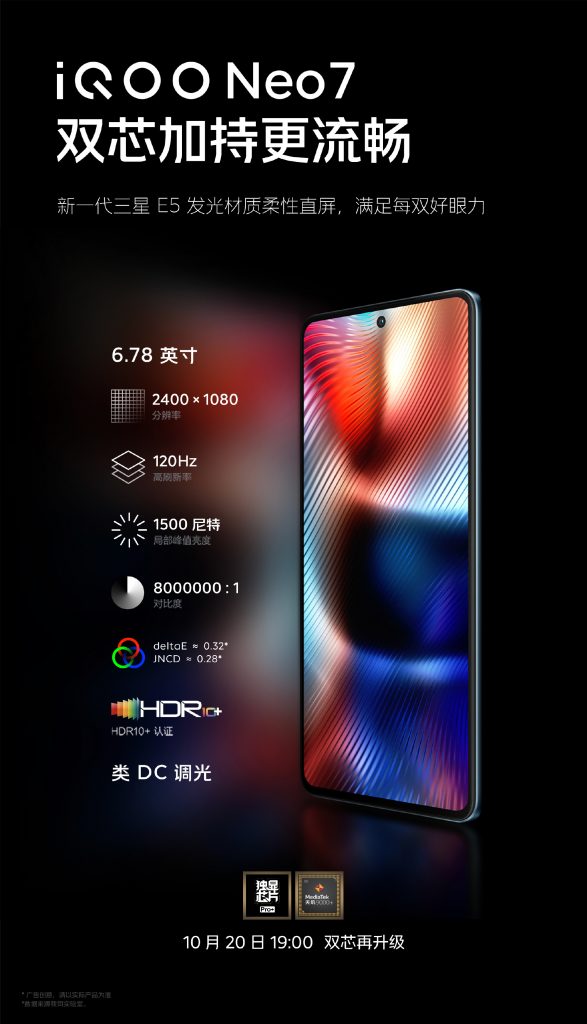
iQOO is gearing up to launch the iQOO Neo 7 series smartphone in the Chinese market. The device is confirmed to debut on October 20th at 7 PM local time. Ahead of the launch, the brand has already confirmed a number of key specs of the Neo 7. Now, the new teaser has revealed the complete details of the display on the smartphone.
The new teaser revealed that the iQOO Neo 7 will have a 6.78-inch display panel with 2400 x 1080p resolution and 120Hz refresh rate. As confirmed before, this is an E5 AMOLED panel, that has a contrast ratio of 8000000:1 and a peak brightness of 1,500 nits. The panel has high color accuracy with a DeltaE < 1, supports HDR10+, and offers DC dimming. Additionally, the display will be powered by a separate display chip Pro+ which should help lower power consumption and keep stable frame rates during games.
Other than that, the device is confirmed to feature a MediaTek Dimensity 9000 Plus SoC. This chipset is made using TSMC’s latest 4nm process and comes with a Cortex-X2 prime core running at up to 3.20 GHz. The chipset will be paired with LPDDR5 RAM and UFS 3.1 storage. It will boot Android 13 with OriginOS skin. The phone will likely debut in three configurations – 8GB + 128GB, 8GB + 256GB, and 12GB + 256GB.
For photography, the device will feature a triple-camera system on the rear headlined by a 50MP Sony IMX766V sensor. The front will likely have a 16MP sensor for selfies and video calls. Last but not least, the iQOO Neo 7 will be powered by a 5,000mAh battery that supports 120W fast wired charging.
Lenovo‘s latest wireless Bluetooth headset is the ThinkBook UC100. The product has been unveiled in China but is only up for reservation at the moment. The Lenovo ThinkBook UC100 neckband earbud has all the bells and whistles of decent headphones but isn’t a premium device.
In terms of design, the ThinkBook UC100 neckband headphones feature a streamlined collar made of a skin-friendly soft rubber material. The material makes wearing the headset for a long period of time comfortable. The design also includes an inclined ear tube design to eliminate the pressure on the ear. The left and right earbuds are designed with magnetic suction to prevent entanglement and are more convenient to carry.
One of the impressive features of the ThinkBook UC100 is that it supports dual connection. This means that it can be connected to a computer and a mobile phone at the same time. The usage can be switched according to the priority of applications such as calls, conferences, and music.
In terms of sound, the ThinkBook UC100 has a built-in 13mm large moving coil sound unit with appreciable sound quality. With a high-sensitivity noise-canceling microphone, it can effectively filter noise and make calls clearer.
At the same time, the headset uses a Bluetooth 5.0 chip, with a standby time of up to 100 hours and audio playback of up to 10 hours. At the same time, it supports fast charging and can be fully charged in just 2 hours.
In addition, the new product is equipped with a computer-specific receiver, which is Plug and Play. The wearable device equally comes with IPX5-level waterproof protection, making it usable during workouts and other activities that could see it get splashed. It also supports quick control which allows users to carry out functions such as turning off the microphone, answering calls, and hanging up the call with the press of a button.
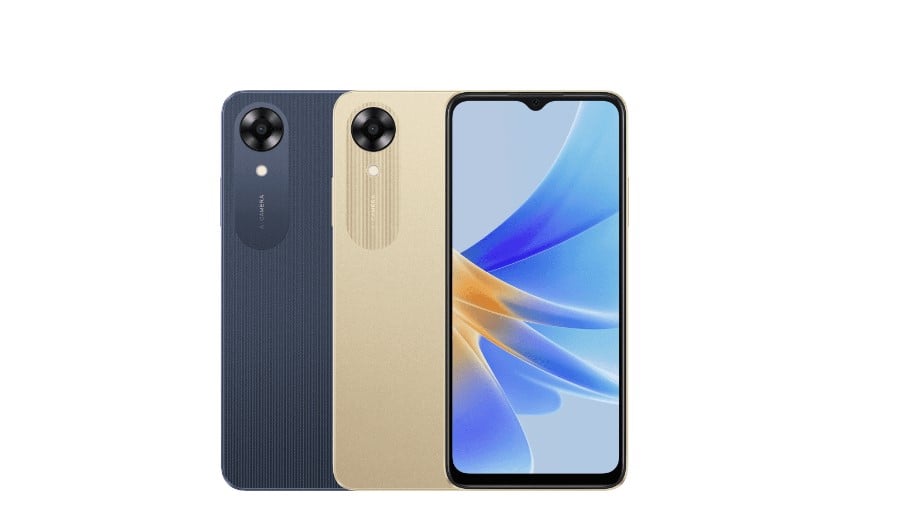
OPPO has quietly launched a new A-series budget device in India. It is dubbed the A17k. The latest offering arrives as the successor to the A16k that debuted in January this year. The smartphone falls under the sub-Rs 11,000 price bracket. It competes against the likes of the Realme C35, Redmi A1+, Moto E32, and more in the market. Read on to know what the newest OPPO device offers out of the box.
The OPPO A17k features a 6.56-inch display bearing an HD+ resolution and a waterdrop notch. It offers a 60Hz refresh rate and 600 nits peak brightness. There is a side-mounted fingerprint scanner embedded in the power button. The back panel of the smartphone has a pill-shaped flatter camera design where the module isn’t protruding. The device is IPX4 water-resistant.
The OPPO A17k has an 8MP rear camera and a 5MP front-facing selfie snapper. There are various camera-related features onboard.
Internally, the OPPO A17k is equipped with a MediaTek Helio G35 processor. It packs 3GB RAM along with 4GB virtual RAM technology. There is 64GB onboard storage expandable up to 1TB via a microSD card slot. The smartphone draws its power from a 5,000mAh battery unit. It runs on ColorOS 12.1 based on Android 12 out of the box.
The OPPO A17k costs Rs 10,499 for the sole 4GB + 64GB variant. It is offered in Gold and Navy Blue colours. The smartphone can be purchased from the brand’s website, and online as well as offline stores across the country.
We use cookies on our website to give you the most relevant experience by remembering your preferences and repeat visits. By clicking “Accept”, you consent to the use of ALL the cookies.
This website uses cookies to improve your experience while you navigate through the website. Out of these, the cookies that are categorized as necessary are stored on your browser as they are essential for the working of basic functionalities of the website. We also use third-party cookies that help us analyze and understand how you use this website. These cookies will be stored in your browser only with your consent. You also have the option to opt-out of these cookies. But opting out of some of these cookies may affect your browsing experience.
Necessary cookies are absolutely essential for the website to function properly. This category only includes cookies that ensures basic functionalities and security features of the website. These cookies do not store any personal information.
Any cookies that may not be particularly necessary for the website to function and is used specifically to collect user personal data via analytics, ads, other embedded contents are termed as non-necessary cookies. It is mandatory to procure user consent prior to running these cookies on your website.