Advertisement

OnePlus Nord wired earphones with 9.2mm driver, IPX4 rating launched in India for Rs 799

OnePlus Nord wired earphones have launched in India today. The company has expanded its range of audio products under the Nord branding. The latest offering are the first Nord branded wired earphones. The Nord wired earphones compete against the likes of other earphones offered by brands like Sennheiser, boAt, Noise, Sony, JBL, and more in the market under the sub-Rs 1,000 price segment. 

OnePlus Nord wired earphones

The OnePlus Nord wired earphones borrow design cues from the OnePlus Bullets Wireless Z. They feature an angular ear tip for a comfortable fit and an inline mic with buttons for controlling calls, media playback, and triggering voice assistant. The earbuds can be magnetically stuck together when not in use. The music will be automatically paused or resumed once they are separated or clipped together. OnePlus offers three pairs of interchangeable silicone tips in S, M, and L sizes. The audio device is also IPX4 certified water and sweat-resistant. 

On the audio front, the OnePlus Nord wired earphones are equipped with a 9.2mm dynamic driver and a 0.42cc sound cavity for bigger bolder audio. It offers driver sensitivity of 110±2dB and 102dB sound pressure.  

The OnePlus Nord wired earphones are said to connect everything from laptops to portable gaming consoles and Nord phones with the 3.5mm headphone jack. 

The OnePlus Nord wired earphones carry a price tag of Rs 799 and are offered in a sole Black colour option. The audio device can be purchased from Amazon and OnePlus.in starting September 1st. 

Related:

Samsung’s One UI 5.0 based on Android 13 said to release in October

Google announced the Android 13 OS earlier this month and many OEMs have already joined the party with their respective Android skins. OnePlus has already rolled out the OxygenOS 13 beta to the OnePlus 10 Pro. Samsung is not behind either, the company recently started beta testing One UI 5.0, the latest iteration of its skin based on Android 13. Now a new leak suggests One UI 5.0 public release may take place in mid-October.

Twitter user @RoderSuper claims that Samsung’s One UI 5.0 based on Android 13 will be released officially on either October 17 or October 19 (Via Sammobile). The update will initially roll out to the Galaxy S22 series which includes the Galaxy S22, S22+, and S22 Ultra smartphones.

Samsung Galaxy S22 Series by Evan Blass

One UI 5.0 beta program started a couple of weeks ago, so October seems like a pretty reasonable time for the company to release the finalized version. There is still more than a month to the expected launch, which means Samsung will get enough time to fix any unforeseen bugs and issues.

There’s no official word on the release of One UI 5.0 and the source of this news does not have a proven track record, so we suggest you take the info with a pinch of salt.

One UI 5.0 is expected to bring loads of customization, security, and accessibility features. With the new version, users will be able to choose from 16 preset color themes based on their wallpaper. It will have an option to stack widgets on top of each other in order to save some space on the homescreen.

Further, the OS will enable multilingual users to set different preferred languages per app. Also, it will carry advanced controls for blocking distracting notifications from apps.

RELATED: 

Snapdragon 6 Gen 1 complete spec sheet leaked – 4nm, 5G support & more

Last year, Qualcomm launched the Snapdragon 8 Gen 1 chipset along with the Snapdragon 7 Gen 1 SoC. The company later launched a refresh to the flagship SoC called the Snapdragon 8+ Gen 1. These are the company’s latest offerings based on the cutting-edge 4nm node and are meant for Premium and mid-range smartphones respectively.

Qualcomm Snapdragon Logo Featured

Now, it appears that the company is working on a new 4nm-based lower-end chipset that will succeed the Snapdragon 600 series of chipsets. Reliable tipster Evan Blass has shared the complete specifications and features of the upcoming Snapdragon 6 Gen 1 mobile platform which will likely succeed the Snapdragon 695 chipset.

Snapdragon 6 Gen 1 specs & features

Snapdragon 6 Gen 1

According to the leak, the Snapdragon 6 Gen 1 will be based on a 4nm node and will come with part number SM6450. It will have Qualcomm Kyro CPU with clock speeds of up to 2.2GHz. It will support USB 3.1 and up to 12GB of LPDDR5 RAM clocked at up to 2750MHz.

For connectivity, the chipset will feature the Snapdragon X62 5G modem offering 5G mmWave and sub-6GHz bands.

Devices coming with this new chipset will offer up to FHD+ resolution at a 120Hz refresh rate. On the WiFi side, it will have the Qualcomm FastConnect 6700 WiFi 6E, and Bluetooth 5.2 will also be supported.

Coming to cameras, smartphone manufacturers will be able to utilize a triple camera array with 13 megapixels, a twin camera array with 25 + 16 megapixels, and a single camera with 48 megapixels. 4K HDR video capture at 30FPS and Slow-mo video capture at 270p resolution and 240FPS will also be supported.

The leak does not reveal a launch timeframe for the new chipset, however, we can expect it to debut in the coming months along with the upcoming Snapdragon 8 Gen 2 chipset.


RELATED:


Chuwi HiPad Max with a Snapdragon 680 chip, 7000mAh battery launched

Chinese electronics manufacturer Chuwi has launched an Android 12-enabled tablet powered by the Qualcomm Snapdragon 680 processor. The Chuwi HiPad Max, as it is named, offers dual SIM connectivity and comes with a 7,000mAh battery for extended use. Chuwi HiPad Max

In terms of specifications, the Chuwi HiPad Max packs a 10.36-inch display with a peak brightness of 400 nits and a resolution of 2,000 x 1,200 pixels. The tablet has a screen-to-body ratio of 84% with 7mm bezels on all its sides. It also comes with Wildevine L1 certification for streaming HD videos. It is unclear how correct the claims of Chuwi on the display bezel thickness are as per the marketing images released. Chuwi HiPad Max The Qualcomm Snapdragon 680 chipset powers the tablet. The Snapdragon 680 is a mid-range chipset that is also featured in the Moto G42, Moto G52, and Redmi Note 11. The chipset is a Quad-core chip with four ARM Cortex-A73 and Cortex-A53 cores, as well as an Adreno 610 GPU. The tablet has 8GB of RAM as well as 128GB of expandable storage. The tablet can connect to wireless networks via Wi-Fi 802.11, weighs 440g, and has dimensions of 246.5 x 156.25 x 8 mm.Chuwi HiPad Max Chuwi HiPad Max is currently available exclusively on AliExpress. It currently retails for $199.99 but will revert to its original price of $399.98 after the flash sales on August 26. The slate runs on Android 12 out-of-the-box and that makes it to draw comparisons with the Blackview Tab 13. However, it is unclear how the reception might be with its high post-launch price of $399.98.

RELATED:


(source)


Anker’s Soundcore Space Q45 headphones & Space A40 earbuds unveiled

Anker’s Soundcore has introduced two new products under its Soundcore lineup. The Space Q45 headphones and A40 earbuds come at an affordable price, active noise cancellation (ANC), and long battery life. According to the company, both products deliver a solid blend of sound quality and features for a reasonable price.Anker Soundcore Space Q45 headphones

The Space Q45 uses four microphones in its hybrid ANC setup and can achieve up to 98% noise reduction. The headphones feature an adaptive noise-canceling functionality based on ambient sound. This is in addition to a pass-through mode that allows the environmental sound to be heard.Anker Soundcore Space Q45 headphones

The Space Q45 offers up to 65 hours of playtime when ANC is inactive. However, with ANC active, the device yields up to 50 hours of battery life. The headphones also offer fast charging support with five-minute charging delivering up to four hours of playtime. The Q45 can be connected to two devices simultaneously and they support high-resolution audio.

Anker Soundcore Space A40 earbuds

The Space A40 offers similar ANC functionality to the Q45. It has a one-touch transparency mode, adaptive noise cancellation, Hear ID Sound, and wireless hi-res audio. The model is more compact than previous Soundcore earbuds but still has 10mm drivers for a great bass/ treble output. Up to 50 hours of playtime can be gotten from the A40 together with its charging case. Ten minutes of charging will provide up to 4 hours of playtime and dual pairing is supported. The Space A40 has IPX4 protection and can be charged wirelessly.

The Space Q45 debuted with a black variant at $150 but navy blue and white variants will be released later. The Space A40 is available in black, white, and navy-blue colors and is priced at $100.

RELATED:

*Please Note: When you buy something using the links in our articles, we may earn a small commission at no cost to you.

LeTV Smart Door lock X1 with 3D face ID, AI technology launched

The LeTV Smart Door lock X1 has been unveiled in China. The new product from LeEco’s Smart ecosystem is capable of 3D face recognition to open the door within seconds. It can adapt to a variety of facial postures even with eyeglasses or a change of hairstyle. The smart door lock X1 uses artificial intelligence and 3D face recognition technology to accurately identify faces.LeTV Smart Door lock X1

The identification technology is secure enough to prevent intrusion through facial masks, photos, and videos. The 3D smart door lock X1 can generate in-depth information in a variety of situations whether day or night. The 3D infrared night vision supplementary light recognition is a key feature in the new door lock.

It is also equipped with an HD screen with 1080 pixels resolution, a 160-degree wide-angle view, and a remote video intercom. The smart door lock can also capture snapshots and offers cloud storage capability. There are eight methods of unlocking the door and ten safety protection measures.LeTV Smart Door lock X1

The LeTV Smart Door lock X1 has a 4,200mAh battery that provides extensive use for the gadget. The product is being offered at an introductory price of 1,699 yuan (~$247). There are no details yet on global availability and the duration of the introductory offer.LeTV Smart Door lock X1

The product is not LeEco’s first smart door lock and it builds on the security and safety features of its predecessors. There are however some concerns about the fidelity of the device in terms of accuracy. The first few weeks in the market will reflect the kind of reception the LeTV 3D smart door lock X1 gets.

RELATED: 


(via)


Zebronics Zeb-Octave 340W Tower speakers with Dolby Audio launched in India

The Zeb-Octave 340W Tower speakers by Zebronics have been unveiled in India. The new Zebronics tower speakers feature Dolby Audio making it the first Indian brand to use the technology in the tower speaker category. The launch of the Zeb-Octave follows the recent launch of the Zebronics ZEB-Juke Bar 4050 75W soundbar.Zebronics Zeb-Octave 340W Tower speakers

The Zeb-Octave is a powerful 340W speaker that aligns with Zebronics’ Premium for the Masses slogan. It has a 3-way output that will deliver the ultimate audio experience. It comes with a black and gold case, touch controls, and an LED screen on the front side. The Dolby and Virtual 3D audio provide an excellent and realistic audio output. It has double mid-range drivers, powerful subwoofers, and tweeters combining to produce surreal sound.Zebronics Zeb-Octave 340W Tower speakers

The Zeb-Octave also provides a karaoke function with its two wireless microphones. Four equalizer options can be chosen using the accompanying remote control. You can connect the speakers via multiple options including HDMI, USB, Optical, Coaxial, AUX, and Bluetooth. The new Zebronics tower speakers are compatible with Smart TVs, PCs, and TVs.

Zebronics is also offering a 1-year warranty on the product which is priced at Rs. 24,999 (~$313). The Zeb-Octave tower speakers can be purchased from the company’s official website or Flipkart.

RELATED:


Samsung is reportedly working on next-gen Tensor, Exynos 1380 processors

Last year, Samsung manufactured Google’s first Tensor chip on its 5nm node process. The chipset was used in the Pixel 6 series and offered some decent performance. Now a new report suggests the South Korean company is working on Google’s next generation Tensor as well as its own Exynos 1380 SoC.

As per a report by GalaxyClub, Samsung is testing a next-gen Tensor chipset. The chipset with model number S5P9865 is said to be the third-generation Google Tensor chipset that will power the Pixel 8 series. The development board of the chipset has the code name ‘Ripcurrent’ and the chip itself is codenamed ‘Zuma’. The first-generation Tensor SoC also had a similar model number (S5P9845), so it is assumed that the mentioned chipset is a Samsung-manufactured Tensor Soc.

google tensor featured

Reports have suggested that Tensor 2 would be developed on a developer board called “Cloudripper,” which means the newly discovered model number (S5P9865) would likely be the third generation of Tensor SoC.

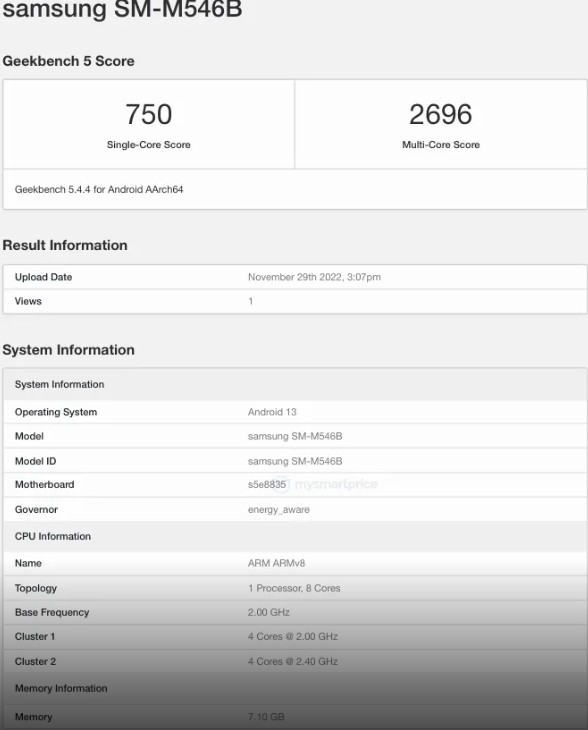
The rumored Exynos 1380 SoC, on the contrary, is expected to be the successor to Exynos 1280 SoC which was launched in April this year. As per the report, the Exynos 1280 Soc is being developed and tested under the product code S5E8835. The Exynos 1280 is found on the Galaxy A53, so we can expect its successor to power Samsung Galaxy A54.

Samsung is yet to confirm any details about the development of new SoCs. The information above is based on speculations, so we suggest you take it with a pinch of salt. We hope to learn more details in the coming days.

RELATED: 

Vivo Y16 hands-on video, live images leaked online ahead of launch

Vivo is on a launch spree. The company has launched a bunch of Y and V series smartphones recently. A new Vivo Y16 smartphone is also on the way and today a hands-on video, as well as some live images, have leaked online, which reveal its color options and design. The device was earlier tipped to come with a MediaTek Helio G35 SoC, 5000mAh battery, dual camera setup, and more.

Pricebaba has shared live images of the retail box of the Vivo Y16 along with a hands-on video showcasing the gold color variant of the Vivo Y16. The publication has only shared images of the gold variant however, the smartphone will also be available in a black color option.


It can be seen to have a flat back with a dual rear camera setup. The video reveals that the device will have a 3.5mm headphone jack as well as a speaker grille on the bottom. Moreover, the size of the retail box suggests that the device will come with a bundled adaptor.

A recent report revealed the complete specifications of the device. Let’s look at it to get a better idea of what to expect from the upcoming Vivo Y16.

Vivo Y16 specifications (rumored)

The Vivo Y16 will come with a 6.51-inch IPS LCD panel offering an HD+ resolution of 720 x 1600 pixels. It will be powered by the Helio G35 chipset paired with  4 GB of RAM, and 64 GB / 128 GB of built-in storage. On the software front, it will run Android 12 with Funtouch OS on top.

For photography, it will have a dual-camera setup available on the back consisting of a 13-megapixel main camera, a 2-megapixel depth / macro lens, and an LED flash. While on the front, it will feature a 5-megapixel camera for selfies and video calls. The Vivo Y16 will be backed by a 5,000mAh battery, which may support 10W charging. For security, it will have a side-facing fingerprint scanner.

RELATED:

Xiaomi launches the MIJIA Smart Curtain Motor 1S with voice control

Xiaomi has officially unveiled the MIJIA Smart Curtain Motor 1S in China. You have a variety of options to regulate your draperies thanks to the smart home device. To start the motor, for instance, you can use the Xiao AI voice commands, the MIJIA app, the included remote control, or a light tug.MIJIA Smart Curtain Motor 1S

You can connect the product to your network and connect the curtain motor with other devices if it supports the MIJIA smart home system. For instance, the Xiaomi Smart Home Screen 10 allows you to control the curtains. A variety of curtain settings are adjustable, including the time the curtains should close and the location at which they should open.MIJIA Smart Curtain Motor 1S

The system’s DC motor makes it possible for the curtains to move softly. Your preferred curtain fabric can be utilized with the Smart Curtain Motor 1S, which can support up to 50 kg (110 lbs) of weight. You can operate the curtains while away from home thanks to a built-in wifi module, which may come in handy when traveling.MIJIA Smart Curtain Motor 1S

The product moves the curtains at a speed of 12 cm per second and measures 53.5 x 260 mm (about 2.1 x 10.2 in). In addition, users can set the curtain to open up slowly for 35 minutes before their desired wake-up time.MIJIA Smart Curtain Motor 1S

With a 50 yuan (about $7) deposit, you can pre-order the Xiaomi Mijia Smart Curtain Motor 1S in China. Customers who pre-order the product can do so for 699 yuan (US$102); the retail price of the smart home appliance will eventually be 799 yuan (US$117).

RELATED;


DJI Avata FPV drone with a 48MP CMOS sensor, 18 minutes flight time launched

DJI‘s replacement for the FPV drone dubbed Avata has been officially unveiled by the company. The DJI Avata, which was the sole product revealed at the “Born to Fly” hardware launch event held on Thursday, improves on its predecessor with a more durable body and a major camera upgrade. Additionally, as several leaks hinted would be the case, the updated goggles for the new first-person view (FPV) drone are available for purchase.DJI Avata

The DJI Avata, a consumer drone DJI released this year, weighs 410 g, which is much more than the Mini 3 Pro. As anticipated, the DJI Avata uses the same 48 MP CMOS sensor with a 1/1.7-inch optical format and a 155-degree field-of-view as the Mini 3 Pro. According to DJI, the Avata’s sensor delivers 100–25,600 ISO, 4-in-1 pixel binning, and shutter speeds that range from 1/50s to 1/8,000s.

The DJI Avata can also record videos in 2.7K at 120 FPS or 4K at 60 FPS. Micro-OLED screens in the new DJI Goggles 2 work at 1080p and 100 frames per second. According to rumors, the DJI Avata and DJI Goggles 2 interact with a latency of only 30 ms, making it feasible to execute complex maneuvers with ease. As expected, the battery life is very short; DJI claims that the Avata has an 18-minute flight time at a speed of 27 meters per second. The DJI Avata should be able to travel 11.6 km in that period, to put it briefly.

Without a remote control or goggles, the DJI Avata costs $629 at launch. The DJI Motion Controller, DJI FPV Remote Controller 2, and DJI FPV Goggles V2 are all compatible with the FPV Drone. As an alternative, DJI offers the Fly Smart Combo, which costs $1,168 and contains both the DJI Motion Controller and the DJI FPV Goggles V2. In contrast, the Pro-View Combo costs $1,388 and includes both the DJI Motion Controller and the DJI Goggles 2. Pre-ordered units will start shipping from August 30.

RELATED:


Samsung Galaxy A04 Core, Galaxy M04 Spotted on BIS website, India launch seems imminent

Samsung Galaxy A04 Core and Galaxy M04 have appeared on the Bureau of Indian standard (BIS) website, hinting at an imminent launch. The Galaxy A04 will likely be the stripped-down version of the Galaxy A04 that was unveiled a few days back. While the Galaxy M04 is expected to be an entry-level smartphone.

As per a recent report by MySmartPrice, two new Samsung smartphones, dubbed Galaxy A04 Core and Galaxy M04, have been spotted on the BIS website. The listing indicates that the devices will come with model number SM-A042F/DS and SM-M045F/DS, respectively. As usual, the BIS listing did not reveal any specifications of the upcoming smartphones. However, it suggests the devices may launch very soon in India.

Samsung Galaxy A04
Samsung Galaxy A04

As mentioned, the Galaxy A04 Core is likely going to be a more affordable version of the Galaxy A04 which was launched recently. For reference, the Galaxy A04 comes with a 6.5-inch LCD panel with an Infinity-V notch. It carries support for HD+ resolution.

The device has a 5-megapixel selfie camera on the front, while on the back it features a dual camera setup consisting of a 50-megapixel main camera with an f/1.8 aperture and a 2-megapixel depth sensor. The handset runs on Android 12 OS with One UI Core 4.1 on top. It is powered by an octa-core processor, which appears to be the Exynos 850. The device offers up to 8 GB of RAM and 128 GB of storage.

If we talk about the Galaxy M04, it is expected to be an entry-level M-series smartphone with decent specs and a big battery. Details about both devices are still pretty short, and the company is yet to confirm any details. We hope to learn more details about them in the coming days.

RELATED: 

LG UltraGear OLED gaming monitor and Ultrafine Display Ergo AI with 4K resolution launched

LG has unveiled UltraGear 240Hz curved OLED gaming monitor and UltraFine Display Ergo AI. The devices have model numbers 45GR95QE and 32UQ890. The company also confirmed its presence at the upcoming event after a two-year break due to the pandemic. 

LG UltraGear OLED monitor and Ultrafine Display

The LG 45GR95QE has a curved OLED display panel with a 240Hz refresh rate. This is perfect for gamers as it provides visual performance, speed, and functionality. The monitor has a 21:9 aspect ratio, a WQHD display resolution, and an 800R curvature. The screen is surrounded by thin bezels and it also comes with anti-glare and low reflection coating. The monitor features a 98 percent DCI-P3 colour gamut and HDR10 support. It offers picture-by-picture and picture-in-picture modes for multitasking. Connectivity options on the monitor include two HDMI 2.1 ports, a display 1.4 port, and USB 3.0 ports. 

As for the LG 32UQ890, the Ultrafine Display Ergo AI is said to be the company’s first monitor that automatically adjusts for comfort. It features a built-in camera and a powerful AI that continuously assesses the user’s posture and makes changes to the screen height as well as tilt to prevent users from remaining in the same position for long period. The LG Ultrafine Display Ergo AI comes with a 31.5-inch IPS screen bearing a 4K video resolution. It offers 95 percent DCI-P3 colour gamut and HDR support. 

Both the LG Ultragear OLED gaming monitor and UltraFine Display Ergo AI will be showcased at the IFA event in Berlin from September 2nd to 6th. 

Related:

HP Dragonfly Folio G3 with pull forward design, 12th generation Core i7 SoC launched

At HP Amplify Executive forum, the company announced the HP Dragonfly Folio G3 and HP 34-inch AIO desktop. They are said to offer support to individuals thriving in the hybrid work environment. Read on to know more about what the two computing products offer out of the box.

HP Dragonfly Folio G3

The HP Dragonfly Folio G3 is a two-in-one laptop that is aimed at creators. It can be used as a tablet and the screen can be pulled forward near the trackpad. The device supports touch functionality and is compatible with stylus pen. The Folio G3 features a 13.5-inch display in either OLED or IPS panel. It comes with a spill-resistant full sized keyboard and an 8MP RGB+IR web camera. On the audio front, the laptop is equipped with quad speakers tuned by Bang and Olufsen.  

Under the hood, the HP Dragonfly Folio G3 is equipped with up to 12th generation Core i7 processor coupled with Intel Iris Xe GPU. It packs up to 32GB DDR5 RAM onboard and 2TB SSD storage. The laptop is powered by a 53WHr battery and runs on Windows 11 OS out of the box. Connectivity options on the device include two Thunderbolt ports, WiFi-6E, Bluetooth 5.2, as well as optional 5G and 4G LTE versions. 

The HP Dragonfly Folio G3 carries a starting price tag of $2,379. The exact availability remains unknown, but we can expect it to arrive in the coming months.

Related:

China Mobile’s NZONE 50 Pro to launch in China on August 29

Earlier today (26th August 2022), China Mobile’s NZONE announced the launch date for its upcoming smartphone, the NZONE 50 Pro. The smartphone will be announced next week. So let’s have a look at its features.

From what we know so far, the new smartphone will be equipped with a 5G enabled Qualcomm Snapdragon processor. On the front, it will sport a 6.7 inch LCD panel that has a Full HD+ resolution, 90Hz refresh rate, 270Hz touch sampling rate, and a punch hole cutout for the front facing camera. It will be powered by a large 5,000mAh battery pack that supports 40W fast charging that can charge the device up to 50 percent in just 30 minutes.

NZONE

On the rear, the NZONE 50 Pro model will feature a triple camera setup that includes a 50 megapixel primary sensor, a 2 megapixel depth of field lens, and another 2 megapixel macro shooter. Meanwhile, the front will house an 8 megapixel selfie camera. Other features include Bluetooth 5.0, USB 2.0, 3.5mm headphone hack, NFC support, side mounted fingerprint scanner, and Android operating system. The company will be announcing the smartphone in China on 29th August 2022 in the afternoon. So stick around for more updates.

RELATED:


OnePlus 10T [Ace Pro] vs Redmi K50 Ultra: Real Flagship Killer in 2022

OnePlus 10T & Redmi K50 Ultra

3 months ago, we did a full comparison of the Realme GT Neo 3 and the Redmi K50, and they were probably the best Android phones with great value for money to buy in the first half of the year. Today, we’ll find out the best phones to buy under $500 in 2022 with a matchup, and now let’s give a passionate welcome to today’s two cowboys: the Redmi K50 Ultra and the Oneplus ACE Pro, the latter of which is available outside China as the OnePlus 10T.

[embedyt] https://www.youtube.com/watch?v=xrfrzs7ylZU[/embedyt]

Design

OnePlus 10T and Redmi K50 Ultra 17

The design of both phones obviously comes from their flagship products, and if you have already had a Xiaomi 12 or OnePlus 10, you will definitely feel familiar. So both of them didn’t really work on their appearance design.

But if have to say something, I slightly prefer the design of the OnePlus model, which has a new texture on the back cover, providing a unique touch and greatly preventing fingerprints.

OnePlus 10T

In terms of available color variants, Oneplus offers two different styles to choose from, I think most Oneplus fans will still go for the black version because it has a really cool surface texture, while Redmi offers richer options. The AMG co-branded model really looks different, but the other variants are pretty boring actually since we’ve seen enough Xiaomi 12 and 12s. As claimed, they’ll release a White variant later this year, but I think it won’t change anything.

Redmi K50 Ultra

They are very similar in size and weight, but when you hold them in your hands, you’ll immediately notice that the ACE Pro feels better in your hands and your fingers won’t snag while playing games because there is a smoother curved transition between the camera module and the back cover.

OnePlus 10T and Redmi K50 Ultra 13

Another detail I want to point out is that OnePlus has placed the volume buttons and the power button on each side of the phone, so it is easier to achieve some operations by using a combination of buttons with one hand, such as taking a screenshot with them.

Display

display - OnePlus 10T vs Redmi K50 Ultra 43

The screen upgrade is a major selling point of the K50 Ultra. And they called it in a super strange way, the new 1.5K-resolution display.

This sounds really confusing and doesn’t really make sense, but actually all you need to know is that it’s a resolution a little lower than QHD but a little higher than FHD, which is not exactly an innovation for smartphone displays. Actually, we’ve seen that the Huawei P50 Pro also uses a similar resolution, but never heard of the word ‘1.5K’.

display pixel - OnePlus 10T vs Redmi K50 Ultra 43

so why can’t Xiaomi just call it FHD+ Display? Make it look like the Apple Style for advertisement? Anyway, compared to the ACE Pro, the K50 Ultra looks slightly sharper when displaying small text, and it also has a higher screen brightness. so leave the strange 1.5K alone, and the K50 Ultra indeed offers a better display here no matter for indoor or outdoor uses.

But what I must say is that the higher resolution and brightness are not the most important thing, what really deserves your attention is that the K50 Ultra supports high-frequency PWM dimming, which means it can effectively avoid damaging flicker issues at low screen brightness.

display - k50 ultra

The fact is that you can’t see these flickers with the naked eye, but they are real and some of you might easily feel them. so at least in terms of the screen, I can say that the K50 Ultra completely beats the ACE Pro.

Performance & Gaming

The power and efficiency of Snapdragon 8+ are undeniable, but since we’ve tested more and more phones with the Snapdragon 8+ platform, we’ve discovered that even though Qualcomm has returned to the arms of TSMC, if you want to build a phone that can play any mobile game without worry, you still have to put some effort into the thermal design.

From these gaming tests, we can see that the framerates are very close, and it is clear that current mobile games are no longer a threat to the Snapdragon 8+. The real difference lies in the phone’s temperature. perhaps due to the larger VC Vapor Chamber inside, the ACE Pro’s surface temperature during gaming is significantly lower than that of the K50 Ultra.

Now let’s go back and look at the benchmark, I was expecting they would perform closely on benchmarks. And yes they are, as you can see they both achieved very close results to each other, and other Snapdragon 8+ phones as well.

Stability

But when I ran the 3DMark Wild Life Extreme test on the K50 Ultra, the test was terminated due to overheating and the phone closed all background applications. Not just once, but three times I tried, and the K50 Ultra just couldn’t complete the test, either in balanced or performance mode with the latest software version.

overheated - redmi k50 ultra

This means that if there are future mobile games that require higher performance, this K50 Ultra may be easier to knock out by heated issues. Also in this hottest summer, the ACE Pro can provide a more stable experience. I don’t know if Xiaomi will be able to fix this in a future software update, but at least for today, I would vote for the ACE Pro.

heating - OnePlus 10T vs Redmi K50 Ultra

Cameras

Now let’s talk about the camera, for these two budget phones we only need to focus on their main camera, trust me you really won’t use the other two lenses on both of them, especially their 2 MP macro lenses. but luckily at least their main lenses are still good.

cameras - OnePlus 10T vs Redmi K50 Ultra

The 108MP CMOS on the K50 Ultra looks stronger than the 50MP CMOS on the ACE Pro, but in reality, you can hardly tell which is better in terms of detail from the samples we shot here.

What’s even more embarrassing is that when you turn on full pixel mode in the K50 Ultra, you’ll find that the photos are still not as sharp as the ACE Pro, even though it has only half the pixels of the K50 Ultra. Considering that one of the longest things Apple has stuck with over the years is using Sony’s sensors, it’s probably not hard to understand such a result here.

When it comes at night, the ACE Pro takes even more impressive photos and we can see better dynamic range and colors. No one knows exactly how many IMX766 the OPPO Group purchased from Sony, but as the saying goes, what goes around comes around, and in terms of photographing, they really beat competitors at the budget level with this sensor.

Battery & Charging

The ACE Pro supports greater charging power than the K50 Ultra, and as a compromise, it has a smaller battery, but from using it these days, I found that both the performance of their battery life and charging speed are very close, with the ACE Pro being faster in the first ten minutes of charging. Considering that they don’t support wireless charging either, you really don’t need to get too tangled up in the power solution.

Conclusion

In my opinion, the ACE Pro finally wins the trophy. And at the $500 pricing, OnePlus made the better choice, with the better design, better main camera, insane cooling solution, and most importantly, up to 16GB of RAM storage for options, which makes the ACE Pro really a new flagship killer.

It can stay with you for a long time. As for the K50 Ultra, until the end of this video, I still can’t figure out why Xiaomi didn’t bring them on the 12S, no matter the 2K screen on the K50 or the 1.5K screen on this Ultra version. For the Redmi K series, they really should have spent the money on the camera and cooling solution as it should have been a flagship killer.

Buy the K50 Ultra @Giztop here, or the OnePlus ACE Pro [OnePlus 10T] here


Sony is hiking the PlayStation 5 pricing in selected markets

Sony has just recently announced that it will be increasing the pricing for its PlayStation 5 game console. These price hikes is not worldwide and will only affect select markets. So let’s have a look.

The Japanese tech giant officially announced the new price changes for various regions across the globe. So now, the PS5 will be more expensive in Europe, the UK, Japan, China, Australia, Canada, and Mexico as well. The brand stated that the main reason for the price hike is due to high global inflation rates and poor currency trends that have been affecting many industries as well as the consumers. Other regions like India have fortunately not seen a rise in price. Interestingly, the PS5 becoming more costlier arrives after Microsoft had also raised the prices for its Xbox Series X and S series of consoles, along with their controller and headset prices as well.

Sony PlayStation 5

According to Sony Interactive Entertainment President and CEO Jim Ryan “We’re seeing high global inflation rates, as well as adverse currency trends, impacting consumers and creating pressure on many industries. Based on these challenging economic conditions, SIE has made the difficult decision to increase the recommended retail price (RRP) of PlayStation 5 in select markets across Europe, Middle East, and Africa (EMEA), Asia-Pacific (APAC), Latin America (LATAM), as well as Canada. There will be no price increase in the United States.”

RELATED:


Tecno Pova Neo 2 specs leaked ahead of India launch

Tecno is gearing up to launch a new smartphone in India soon. The device in question is expected to be a part of its Pova series and will be dubbed the Pova Neo 2. But prior to its official launch, the specs of the device have been leaked. So let’s take a look.

According to tipster Paras Guglani, the company is planning on launching the Tecno Pova Neo 2 4G smartphone for the Indian and global market soon. Furthermore, he also revealed some of the key specifications of the upcoming smartphone on Twitter. Looking at his tweet, he claims that the brand will be launching the Pova Neo 2 in two color options, namely Cyber Blue and Uranolith Gray.

The tipster even revealed that the new handset will feature a behemoth 7,000mAh battery pack that will support standard charging rate. On the front, the device will sport a 6.82 inch display that has a Full HD+ resolution, although, its unknown whether its an LCD or AMOLED panel. Under the hood, it will reportedly be equipped with a MediaTek Helio G85 SoC that will be paired with up to 6GB of RAM and 128GB of internal storage.

Tecno POVA Neo
POVA Neo

On the rear, the Pova Neo 2 will feature a 16 megapixel dual camera setup, with a 2 megapixel secondary sensor. Meanwhile, the front will house an 8 megapixel selfies shooter. Looking at these specs, its clear that the upcoming smartphone will likely be priced under 15,000 INR.

RELATED:


Vivo V25e spotted on GeekBench, with Helio G99 SoC and 8GB RAM

The Vivo V25 Pro was launched earlier this month in India. Now, it appears that the company is gearing up to launch another V25 series smartphone as well, which is the V25e model.

Vivo V25e render

But prior to its official release, the smartphone was spotted on a popular benchmarking platform called GeekBench. For those unaware, the Vivo V25e was previously also spotted on Google Play Console, which revealed some of its key specifications. Now, the listing on GeekBench has also confirmed some of these features as well. Looking at the benchmark results, we can see that the smartphone will run on the Android 12 OS out of the box.

Furthermore, the GeekBench listing shows that the handset will be equipped with the MediaTek Helio G99 SoC that will be paired with a Mali G57 MC2 graphics and 8GB of RAM. In the benchmarking tests, the V25e managed to achieve a score of 539 points in the single core test and 1812 points in the multi core test. From what we know so far, the Vivo V25e is also expected to feature around 128GB or 256GB of internal storage as well.

Vivo

The front will likely sport a Full HD+ display while the rear is expected to feature a triple camera setup. The smartphone is also believed to launch in two color options, namely Orange and Black. Unfortunately, finer details regarding this smartphone is still unknown, so stick around for more updates regarding this matter.

RELATED:


Say Goobye to “No Cell Service”, SpaceX Announces Industry-Changing Starlink V2 Satellites

If you were to ever wander into the deep woods or traveled to the middle of an ocean, chances are that you will have no cellular signal, meaning you can’t access the Internet and you can’t make calls unless you have a satellite communicator with you. And the main reason for the lack of cellular signals in places like the forest and the ocean is because telecommunications providers don’t have cell towers built in the area to provide you cell service to access the Internet or to make calls.

However, in 2022, technology has matured far enough that humans have finally found a solution to tackle the problem of providing cell service even in remote places that were previously unreachable by traditional cell signals. 

Tmobile-spacex-Coverage-Above-Beyond
Source: T-Mobile

In a live event today, US telecommunications provider, T-Mobile alongside the globally renowned aerospace company, SpaceX, introduced Starlink V2, the satellites that can directly transmit cell signals to mobile phones and Tesla cars from space.

The announcement today was mainly focused on Starlink V2’s implementation in the US with telecommunications provider T-Mobile. Under the new plan which they dubbed Coverage Above and Beyond, both companies will establish a new network using T-Mobile’s existing mid-band spectrum across the United States. 

The main advantage of using an existing spectrum is that the majority of smartphones on its existing network will be able to connect to the new network without any need for new equipment.

Leveraging on SpaceX’s Starlink V2 satellites, the new network aims to eliminate cellular dead zones across the country. Whether it be from the middle of Death Valley to the Great Smokey Mountains, the newly established network aims to provide cell phone connectivity every time, everywhere.

Starlink Logo

Chief Engineer of SpaceX, Elon Musk says that for the new network, the deployment of Starlink V2 satellites will work great for texting and voice calls but not for usages that require high bandwidth. This is mainly because each cell zone under the new network can only deliver 2 to 4Mbps. 

Although SpaceX’s Starlink V2 technology is only currently implemented in the USA, both SpaceX and T-Mobile shared their vision for expanding Coverage Above and Beyond globally, issuing an open invitation to the world’s carriers to collaborate for truly global connectivity. And in a tweet posted by SpaceX CEO himself, Elon Musk, the man hopes to be able to eliminate cellular dead zones once and for all, worldwide.


RELATED:

(Source 1, Source 2)