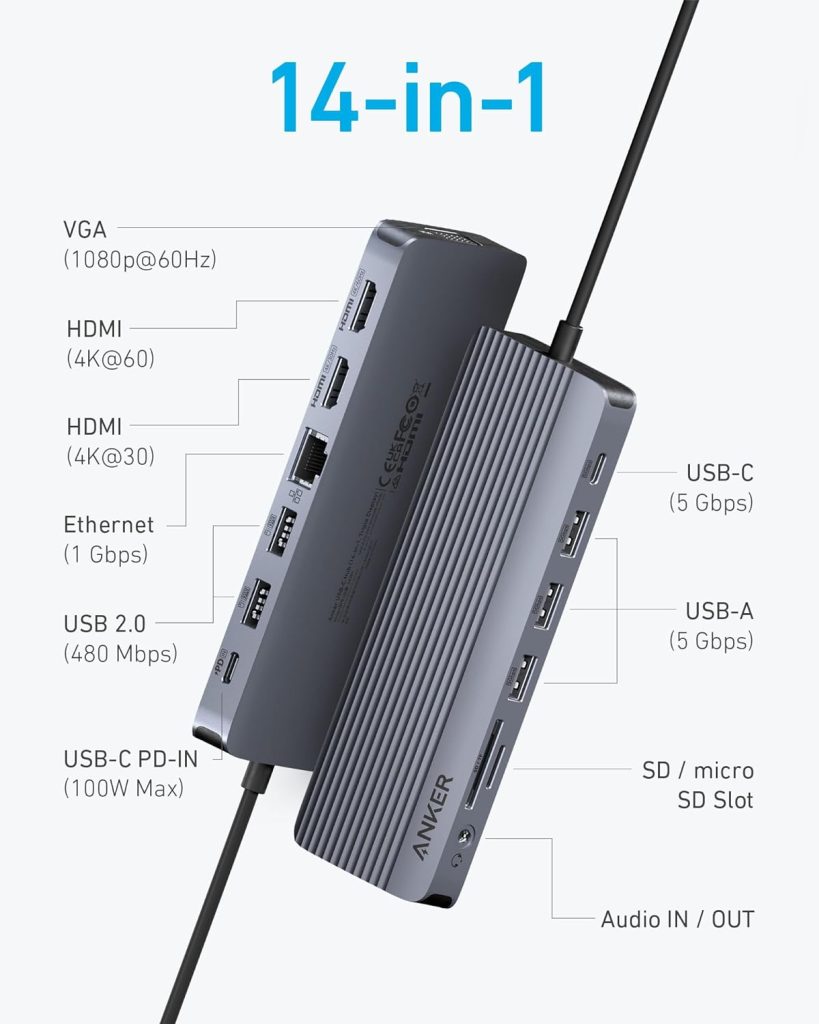
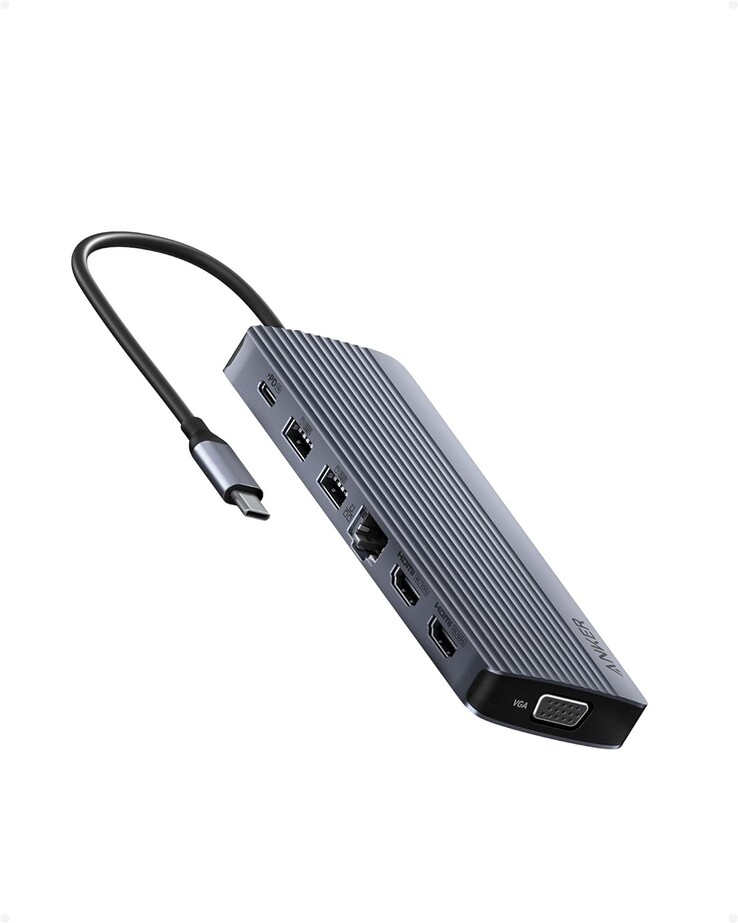
Chinese accessories manufacturer Anker recently launched the Triple Display USB-C Hub (14-in-1) in the US and UK. The Anker Triple Display 14-in-1 USB-C Hub allows you to connect up to three monitors and has an assortment of ports. The company has now launched the model in several European markets.
Features
The Anker Triple Display USB-C Hub (14-in-1) delivers 80W pass-through charging and has a Gigabit Ethernet plus 5Gbps USB-C ports. The gadget is powered through a 100W USB-C input with 14 interfaces available for use. There are also three USB-A ports (@ 5Gbps) and two USB 2.0 (@ 480Mbps) ports. There are two HDMI ports and a VGA port for connecting to an external monitor. The VGA ports support 1080p resolution with a 60Hz refresh rate while the HDMI outputs 4K@60Hz and 4K@30Hz displays.
The maximum resolution of the Anker Triple Display USB-C Hub drops to 1080p@60Hz when all three displays are active simultaneously. The hub lacks support for multi-display extended mode on macOS systems, however. The gadget also features microSD and SD card slots and audio in/out ports. It has dimensions of 15 x 5.4 x 1.7 cm.
Pricing & Availability
The Anker Triple Display 14-in-1 USB-C Hub can be purchased in France, Germany, or Italy for €79.99 (~$84). There is an in-page coupon on the Anker website that is valid until November 5 and offers a 20% discount on the product. There is no availability information for the Anker Triple Display USB-C Hub (14-in-1) in other EU markets at this time.
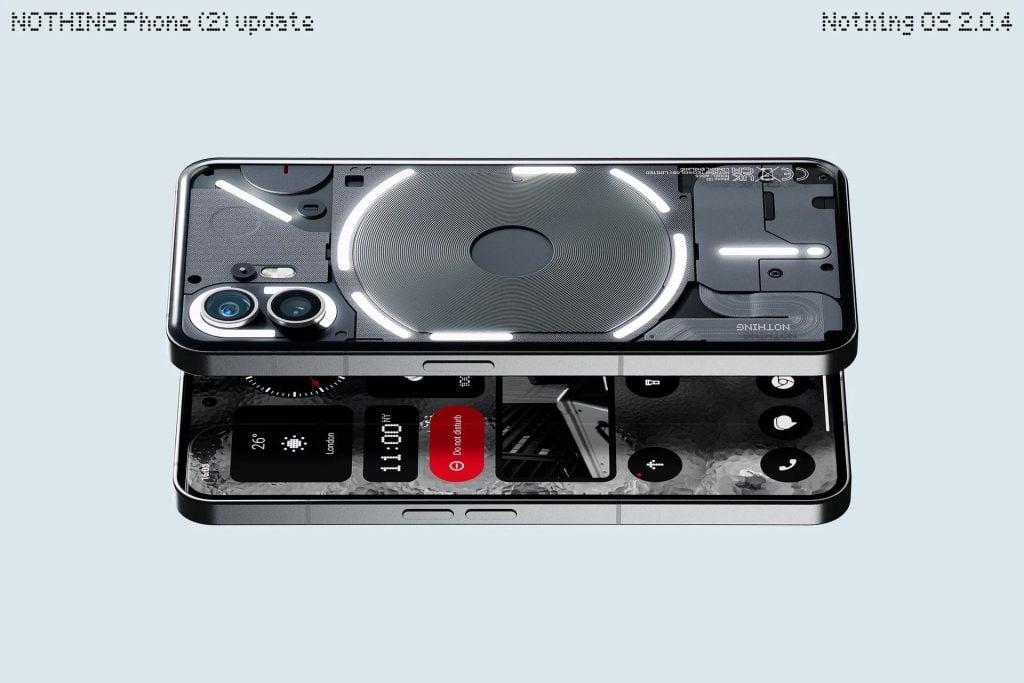
Last month, Nothing began the Open-beta testing of the Nothing OS 2.5 on the Phone (2), which is based on the newly launched Android 14. However, users of the device will have to wait a bit more for the stable update as the brand has begun seeding the Nothing OS 2.0.4 update for the Phone (2).
This new update comes with some new features, however, the improvements and bug fixes are the main focus here as it appears that Nothing has managed to fix the speaker volume bug. You can find the complete changelog below.
Nothing OS 2.0.4 update changelog
What’s new
New Photos widget, allowing you to display your favourite photos on your home or lock screen.
Updated the widgets library interface to now display Nothing widgets in categories.
Added the option to hide app icons in the app drawer. Simply swipe right in the app drawer to reveal the hidden app icons.
Improvements & Bug fixes
Made processing improvements for scenes with bright back lighting.
Improved zoom consistency between previewed footage and captured footage.
Improved speaker volume for specific scenarios.
Optimised sound when simultaneously connecting to a smart watch and earbuds via Bluetooth.
Updated to Google’s October Security Patch.
The update will be distributed in phases, so Indian Nothing Phone (2) owners can expect to receive it in the coming days. Alternatively, you can manually check for the update by going to Settings, then selecting System, followed by System update, and finally, Download and Install.
The tech space is on a spree of development with a raft of innovative products and features introduced. A new report indicates that Google is tinkering with the possibility of adding heart-monitoring capability to ANC earbuds.
Currently, a pair of wireless earbuds does not have heart rate monitoring capabilities. Google says it is possible that ANC earbuds could monitor your heart rate on the go without any additional sensors. The Audioplethysmography tech sends out a low-intensity ultrasound signal from the earbud’s speaker. Thereafter the microphones on the earbud pick up the response. This then enables the earbuds to analyze the heart rate. There are a series of mathematical principles underpinning the technology and these were highlighted in the research article.
The possibility of having wireless earbuds having heart rate monitoring features is an exciting one. It offers the opportunity for persons averse to wearing smartwatches and the ability to measure their heart rate on the go. There are lots of mechanical watch enthusiasts unwilling to exchange their traditional timepieces for a tech-rich smartwatch. The technology will utilize hardware already present in current wireless earbuds and will not require any significant changes. It may just require a software update for the heart rate monitoring functionality to be activated.
There are no indications yet when the new heart rate monitoring feature will be available in ANC earbuds. The tech will however have to go through all the layers of regulatory approval before it is cleared for commercial use.
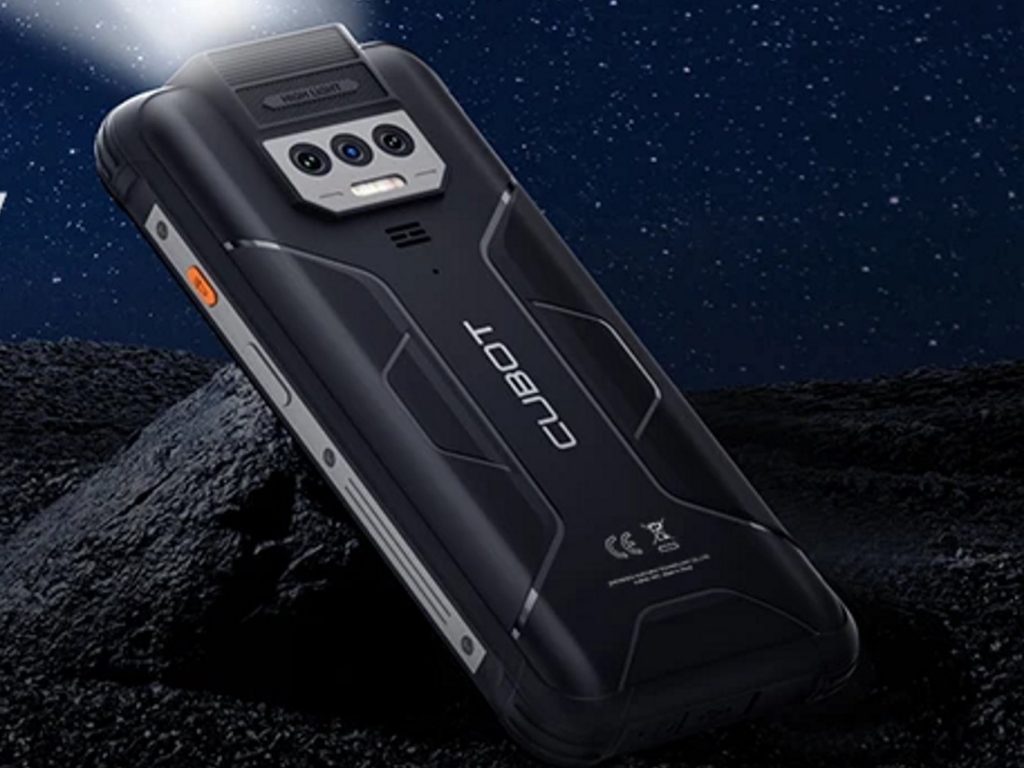
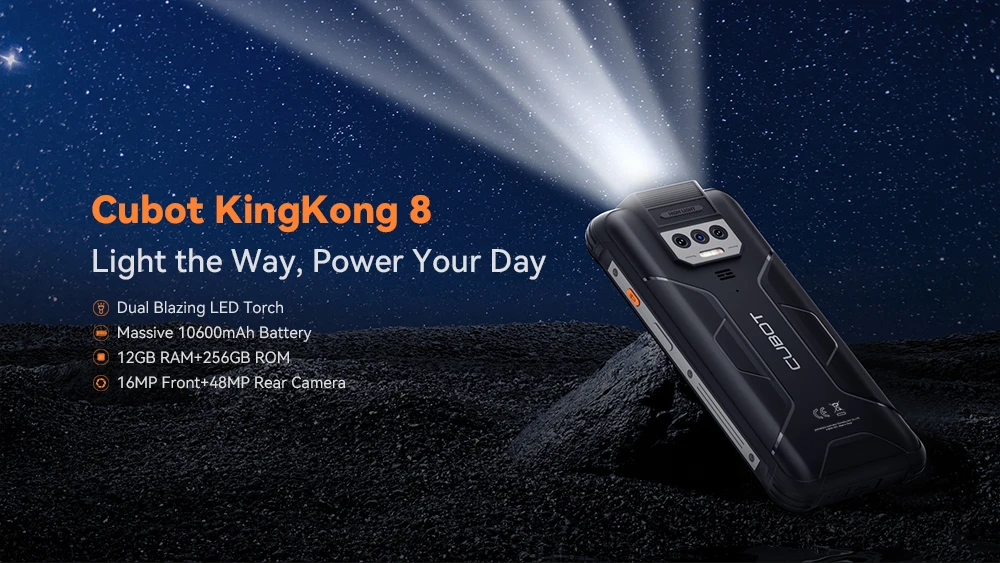
The KingKong 8 is the latest rugged smartphone offering from Cubot. It comes with two additional LEDs that make it deliver a powerful flashlight. It also offers extended battery life and several other impressive features.
Features
The maximum brightness capability of the new Cubot KingKong 8 is 6,000 lumens while the battery has a capacity of 10,600mAh. The smartphone is 20mm thick and measures 169.9 x 80.2 mm. It weighs 0.382kg and is powered by the MT8788 chipset. There are four Cortex A73 cores combined with four Cortex A53 cores in the model. The KingKong 8 has a RAM capacity of 6GB and an internal storage of 256GB. The storage is expandable but there is a tradeoff between extra storage and having a dual SIM setup.
The Cubot KingKong 8 is a rugged smartphone but lacks 5G capability. It has a 6.53-inch screen with a resolution of 1612 x 720 pixels. It has a 48MP main camera and a 16MP front-facing camera. The smartphone’s GNSS module supports GPS, GLONASS, and Galileo functionality. Both 2.4GHz and 5.0GHz Wi-Fi networks are also supported on the Cubot KingKong 8. Being a rugged smartphone, the KingKong 8 is certified IP68 and IP69K and also supports NFC. The phone runs on Android 13 and has a fingerprint sensor on the side.
Pricing & Availability
The Cubot KingKong 8 is available for purchase in Europe via AliExpress for €235 (~$248). It is already specified that the model ships to Germany. There will be price differentials that could depend on the destination.
WhatsApp is undoubtedly the world’s most popular instant messaging application today. However, this popularity brings along some risks. For instance, when someone adds you on WhatsApp, they can see your profile picture, stories, and status. Some of this information may not be suitable for professional settings. Fortunately, WhatsApp’s Alternate Profile feature aims to address these issues. Here are the details…
WhatsApp’s Latest Feature: Alternate Profiles for Privacy
WhatsApp Alternate Profile aims to provide users with the privacy they desire. This feature, which the company has been working on for some time, allows users who set their account to private to create a secondary profile. With this, only a selected secondary profile picture is visible to the other person, keeping your personal information private.
This way, you can keep both your spouse happy and present a more professional image in the business world using the same profile. Unfortunately, the feature is still quite new and in the development stage. Therefore, it is currently unclear how it will work or what you need to do to allow others to see your primary profile.
Of course, this feature has sparked some debates. Some users find WhatsApp’s Alternate Profile feature useful, while others believe it could cause problems in both professional and personal relationships. Some even prefer to label this feature as “aiding scammers” and “destroying relationships.” In the end, how you use it is entirely up to you.
It’s worth noting that this feature is different from the Multi-Account Support feature, which was recently introduced, allowing you to use two WhatsApp accounts on a single device. In this case, you are not using two separate accounts but different profiles associated with your account.
Eight years ago, Mercedes dipped its toes into the world of electric performance cars with the SLS AMG Electric Drive. It was more of a whisper than a roar, with only nine cars ever making it to customers. But times have changed, and it looks like Mercedes is gearing up for a full-fledged electric assault.
Each motor weighs merely 53 pounds but delivers almost 500hp
It all starts with the AMG.EA platform, a platform that’s set to shake the EV market. Spied testing recently, the platform is primed for a 2025 launch. While the specifics remain a closely-guarded secret, reports suggest that we’re looking at a game-changer. Mercedes’ recent acquisition, Yasa, spilled the beans on the car’s insane specs. We’re talking about an electric motor that weighs a mere 53 pounds but delivers a jaw-dropping 480 horsepower and 590 pound-feet of torque. And get this—there will be two of these motors. Do the math, and you’re staring at close to 1,000 horsepower, not too far off from AMG One’s 1,049 horsepower.
What’s crazy is that this sedan could churn out torque numbers that reach a staggering 1,000 pound-feet, delivering instant acceleration. This could make the term “family sedan” synonymous with “supercar-like performance.”
The AMG.EA platform isn’t just a rival to internal combustion engines; it could also set new benchmarks within the electric performance car sector. For perspective, BMW has the tech for a 1,341-horsepower EV but is holding back for its future M models, which are projected to have around 700 horsepower.
As we look towards an electrified future, Mercedes seems intent on making sure performance doesn’t take a backseat. If the AMG.EA platform delivers on its promises, the idea of a 1,000-horsepower family sedan might just become the new normal. Is this overkill or the natural evolution of the electric car? Either way, it looks like Mercedes is pulling out all the stops.
And so, as we inch closer to 2025, it’s clear that the electric future will be anything but dull. Stay tuned for more EV-centric conversations at Gizmochina!
While e-bikes have become synonymous with city commutes and leisure rides in the park, Lectric has decided to throw a curveball into the industry with its newest model, the XPeak. This e-bike isn’t just a new product; it’s a paradigm shift for Lectric, a brand predominantly associated with urban electric folding bikes.
The Stealth M24 motor barely makes any noise while operating
Gone are the foldable frames, replaced by a rugged structure that echoes the aesthetic of a mountain bike. The Minnesota-based company designed the XPeak with adventure enthusiasts in mind, equipping it with all-terrain capabilities. Its front suspension fork and four-inch wide fat tires signal its readiness to tackle more than just paved roads.
Performance-wise, the XPeak isn’t lacking either. A 750-watt hub motor with a peak output of 1,310 watts powers this beast. What does that mean in layman’s terms? A top speed of 28 mph and the flexibility to operate in Class 1, 2, or 3 modes. The Stealth M24 motor even operates silently, ensuring your off-road experience isn’t disturbed by mechanical whirring.
When it comes to convenience, the XPeak has an edge. The 48-volt, 14-ampere-hour battery isn’t just integrated into the frame, but it’s also removable for easy charging. And for those days when you don’t feel like pedaling? The e-bike has a thumb throttle that basically turns it into a mini electric motorbike. Add to that a seven-speed derailleur drivetrain and hydraulic disc brakes, and you’ve got yourself a ride that’s reliable and safe. Speaking of safety, this e-bike has undergone rigorous ISO M4210-10 testing, meeting the quality standards of even premium brands.
Let’s be honest – YouTube ads are annoying for most of us as they interrupt the viewing experience. The popular video-sharing platform lets users enjoy the content for free. The only solution to ad-free viewing along with other benefits is getting a paid YouTube Premium subscription. However, there are plenty of ad-blocking tools that let viewers bypass the ads. This is all set to end as YouTube has confirmed that it is expanding the crackdown on ad-blockers.
YouTube confirms crackdown on ad-blockers
YouTube started blocking ad-blockers earlier this year as a part of its small experiment. The popular video-sharing platform is now intensifying its global effort to take a stance against the practice of blocking ads via various tools. Despite receiving backlash from users during the small experiment, YouTube aims to convince users to either go for a Premium subscription or disable ad-blockers.
In a statement to The Verge, YouTube Communications Manager Christopher Lawton said “The use of ad blockers violates YouTube’s Terms of Service. Ads support a diverse ecosystem of creators globally and allow billions to access their favorite content on YouTube.”
If a user uses ad-blockers, they will get a notice that says “video playback is blocked unless YouTube is allowlisted or the ad blocker is disabled”. Users will also be prompted to allow ads or try YouTube Premium. Additionally, the video-sharing platform will warn that the video player will be blocked entirely if users continue to use ad-blockers after three videos.
YouTube’s stance on ad blockers is understandable considering that ad revenue is the biggest source of revenue for the platform. The company introduced 30-second unskippable ads to its TV app earlier this year and also experimented with longer but less frequent ad breaks on TV.
The digital arena in Southeast Asia is feeling the heat, and not just from its tropical climate. While the internet economy is still growing, the pace has slackened considerably. Recent research from Google, Temasek Holdings, and Bain & Co suggests the internet economy will grow only 11% this year to hit $218 billion, the slowest rate since 2017. That’s – a little concerning.
Over 70% of online spending is thanks to the top 30% high-value users
But that’s not the entire story. What’s truly interesting is the unequal distribution of this digital spending. Over 70% of all online spending comes from the top 30% high-value users, who are primarily concentrated in big cities. In simpler terms, if you’re an internet company targeting the Southeast Asian market, you’re likely fishing in a small, albeit wealthy, pond.
In a region that’s home to more than 650 million people, why is the digital economy so skewed towards the urban elite? One reason could be rising inflation and interest rates, making consumers more cautious with their wallets. But that doesn’t entirely explain the digital divide. The investment climate also mirrors this caution. Private funding for companies in Southeast Asia has nosedived to a six-year low. Investors who hopped on the Southeast Asia bandwagon five to seven years ago are now seeing only a 4% return on average, a far cry from the 50% in China and 40% in the U.S.
So, where does that leave internet giants like Grab, Sea, and GoTo? Facing intense competition in urban markets while still struggling to tap into the vast yet untapped rural consumer base. With e-commerce estimated to reach just $186 billion by 2025, these companies may have to rewrite their growth strategies.
The digital landscape in Southeast Asia is more than just numbers and percentages; it’s a tale of a growing divide, a challenge to innovators, and a test for investors. And for now, it’s the big cities taking home the lion’s share of the digital pie.
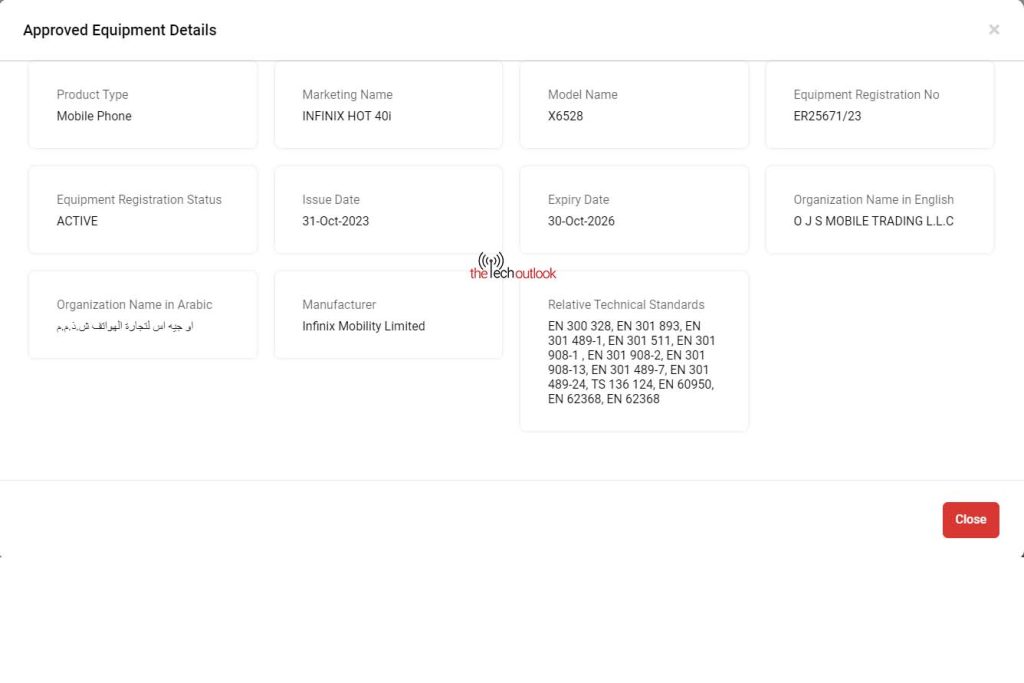
Infinix is reportedly working on the Hot 40 series comprising of the Hot 40 and Hot 40i models. Both are expected to arrive as the successors to the Hot 30 and Hot 30i respectively. Last month the Infinix Hot 40 duo passed the FCC certification site. Now, the Hot 40i has appeared on the TDRA certification in UAE. It hints at an imminent launch of the smartphone in the country.
Infinix Hot 40i bags TDRA certification
On UAE’s TDRA certification, the Infinix Hot 40i is listed with the model number X6528B. It has an equipment registration number ER25671/23. The device is categorized as a mobile phone and the certification is valid till October 30, 2026. Apart from this, the TDRA listing does not reveal any additional details of the smartphone.
Meanwhile, the Infinix Hot 40i surfaced on FCC with the same model number as the TDRA certification. The former revealed more details including a schematic of the smartphone. It has a squarish camera module housing two sensors and an LED flash unit. The power and volume rocker buttons are located on the right side. The certification also mentioned the device with 8GB RAM and 128GB storage. However, we can expect more configurations at launch.
Apart from the Infinix Hot 40i, the Hot 40 is listed on FCC with 4G LTE support, triple rear cameras, and support for 33W fast charging. It will be offered in a Starlight Black color option.
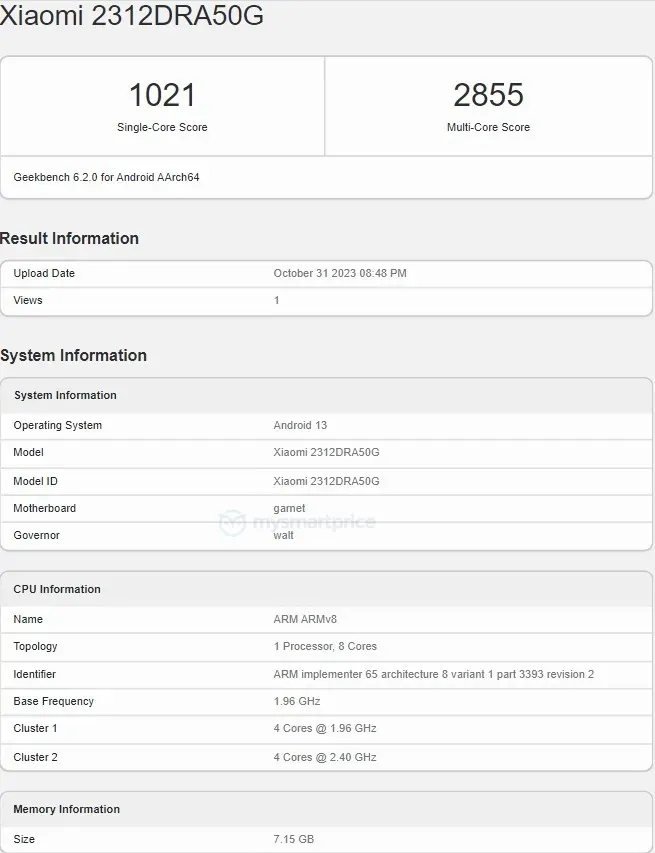
Redmi launched its Note 12 series in China in September. The lineup comprising of the standard, pro, and pro plus models are soon expected to make their way to the global markets. The Note 13 Pro was recently spotted on the FCC certification database. Now, the global variant of the device has appeared on the Geekbench database hinting at its imminent launch. The specifications mentioned on the benchmarking platform are also similar to the smartphone’s China variant.
Redmi Note 13 Pro Geekbench
On Geekbench, the Redmi Note 13 Pro carries a model number 2312DRA50G. The motherboard is codenamed gamet and it has four cores clocked at 1.96GHz and other four cores ticking at 2.40GHz. This corresponds to the Snapdragon 7s Gen 2 processor. The device is listed with 8GB RAM on the benchmarking platform. Software-wise, it will ship with Android 13 OS out of the box.
The Redmi Note 13 Pro bags 1,021 and 2,855 points in Geekbench’s single-core and multi-core test results respectively. Meanwhile, the FCC listing of the device revealed a 5,020mAh battery unit under the hood.
Rumors are rife that the Redmi Note 13 Pro may debut in the global markets as a POCO phone. The global launch timeline of the Redmi Note 13 series remains unknown. Considering that the Note 13 models have started bagging various certifications, we can expect them to launch in the coming months.
To recall, in China, the Redmi Note 13 Pro features a 6.67-inch OLED display with a 1.5K resolution, a 120Hz refresh rate, 1800 nits peak brightness, Dolby Vision, and an integrated fingerprint scanner. It has a 200MP main OIS-enabled camera sensor coupled with 8MP and 2MP lenses. The smartphone is backed by a 5,000mAh battery cell with support for 67W fast charging.
Lenovo continues to expand its product lineup, aiming to reach a broader market and cater to a larger user base. As part of this effort, the company recently launched the Legion H7 gaming earphones in China for 249 Yuan. However, Lenovo isn’t limiting itself to just catering to gamers. In a unique move, Lenovo is collaborating with three fashion designers to create the Lenovo Tab Wear Collection, which is set to impress both tech enthusiasts and fashion-forward individuals. Here are the details…
Lenovo Gets on the Fashion Trend with Designer Tab Wear Collection
The tech world isn’t a stranger to collaborations, but Lenovo’s latest venture is turning heads. In a surprising move, the company has teamed up with three fashion designers to create the Lenovo Tab Wear Collection. This unique collection goes beyond mere fashion. The collaboration with RANRA, Kit Wan Studios, and MAIUM to create unique and modern clothing inspired by Lenovo’s “me-time” idea, which means having your personal time wherever you go.
Lenovo x RANRA
RANRA, a label known for sustainable transitional outerwear, and Lenovo have co-designed an anorak with a packable tablet harness. It’s lightweight, windproof, waterproof, and features an isolation hood for noise cancellation. Privacy on the go? It might just work.
Lenovo x Kit Wan Studios
Kit Wan Studios, an independent menswear designer inspired by manga and high-tech aesthetics, joined forces with Lenovo. Their creation is a modular exoskeleton-like piece with a 3D-printed design. It’s a bold statement for those who appreciate cutting-edge fashion.
Lenovo x MAIUM
MAIUM, an Amsterdam-based techwear and fashion brand, collaborated with Lenovo to create a versatile jacket. With a front pocket for your tablet and the ability to transform into an inflatable hammock, it’s an everyday, outdoor-friendly choice.
All three pieces emphasize the fusion of fashion and tech while using sustainable materials. RANRA uses recycled textiles, Kit Wan collaborates with small-batch collaborators, and MAIUM employs recycled polyester with an eco-conscious finish.
In a groundbreaking ruling, Tesla emerged victorious in the first U.S. trial involving a fatal crash allegedly caused by its Autopilot system. The case revolved around a tragic 2019 incident where a Tesla Model 3, driven by Micah Lee, careened off a highway, colliding with a palm tree and bursting into flames, resulting in Lee’s death and severe injuries to passengers, including a young boy.
The lawsuit, filed by plaintiffs Lindsay Molander and her son, claimed Tesla’s Autopilot was at fault. However, Tesla staunchly denied liability, contending that Lee had consumed alcohol before driving, and it remained unclear if Autopilot was engaged. The jury, by a 9-3 majority, ruled in favor of Tesla, stating that the crash was not a result of the company’s driver-assistance software, but rather, the responsibility fell on the driver.
This verdict holds significant implications, as it marks the first time a fatal crash attributed to Tesla’s Autopilot system was absolved of blame. The decision challenges the perception that Tesla’s technology was at fault, potentially impacting similar pending cases and shaping consumer attitudes towards Tesla vehicles.
Criticism had previously been leveled at Tesla CEO Elon Musk for allegedly exaggerating the capabilities of Autopilot and Full Self-Driving, despite the systems requiring drivers to remain engaged and prepared to assume control. The plaintiffs, Molander, and her son, cited internal documents indicating a software defect, but Tesla’s defense centered on human error, specifically Lee’s alcohol consumption, as the cause of the accident.
The jury’s ruling emphasized that the vehicle lacked a manufacturing defect, bolstering Tesla’s position. This outcome mirrors a prior trial in Los Angeles, where jurors sided with Tesla, acknowledging the company’s warnings about the system and attributing the accident to driver distraction involving a Model S.
Tesla’s legal triumph underscores the ongoing debate surrounding autonomous driving technology, reaffirming the crucial role of human responsibility even in the age of advanced driver-assistance systems.
Tecno is expected to launch the POP 8 smartphone in India soon. The company is also working on another budget smartphone in the country. It is said to be the Tecno Spark Go 2024. It will likely arrive as the successor to the Spark Go 2023 that was announced earlier this year in January. Now, tipster Paras Guglani has shared the marketing material of the Spark Go 2024 revealing its key specifications.The device had also surfaced on Google Play Console last month. Read on to know all the details below.
As per the leaked material, the Tecno Spark Go 2024 has a slightly boxy design with a squarish camera module. The power button will double up as a fingerprint scanner. On the front, the phone has a centre-aligned punch-hole cutout with a feature called Dynamic Port. It will work similarly to Apple’s Dynamic Island and show information like caller ID, charging status etc. The device will have a 6.6-inch LCD display bearing an HD+ resolution and a 90Hz refresh rate.
The Tecno Spark Go 2024 will come with a 13MP primary rear camera coupled with an AI lens. There will be an 8MP selfie snapper. The device will be equipped with dual stereo speakers with DTS audio.
Internally, the Tecno Spark Go 2024 will reportedly be powered by a UniSoC T606 octa-core processor. It will pack 8GB RAM with memory fusion technology and have 128GB storage expandable up to 1TB. As per the leaked marketing material, the smartphone will be backed by a 5,000mAh battery unit with charging via USB-C port.
The tipster adds that the Tecno Spark Go 2024 will carry a price tag of Rs 6,999.
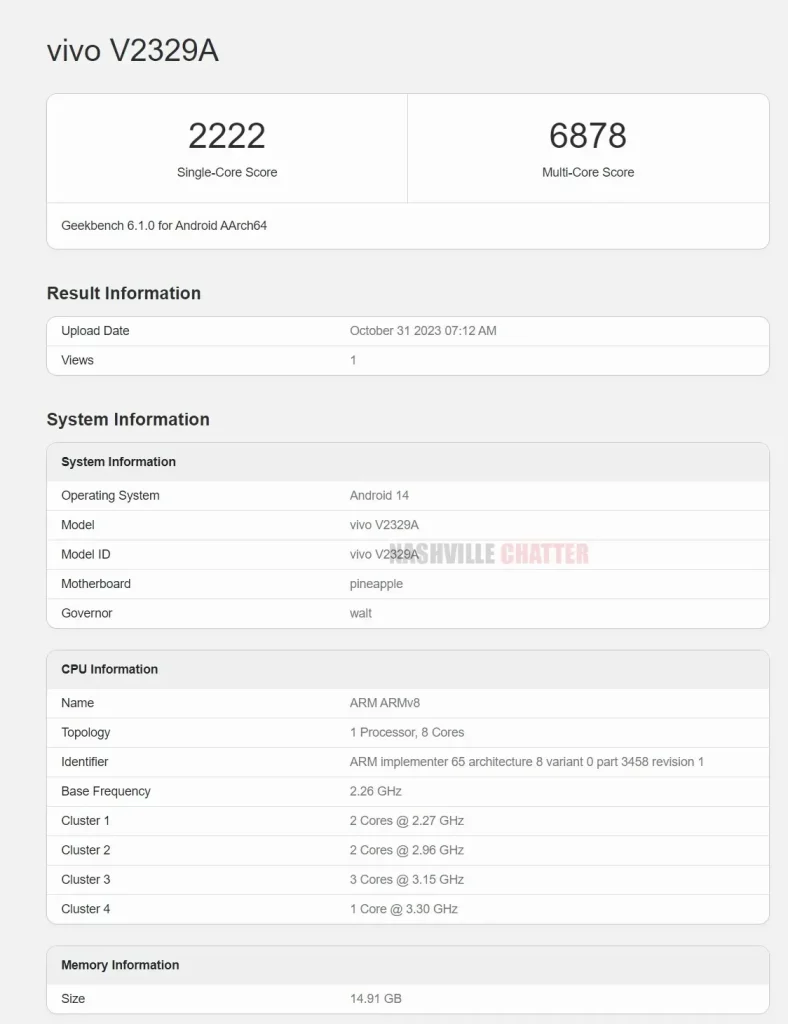
iQOO is gearing up to announce the iQOO 12 and 12 Pro smartphones in China on November 7. Earlier today, the Vivo sub-brand also announced the launch date of the standard variant in India. iQOO has been dropping teasers about its upcoming offerings on its official Weibo handle. Now, ahead of next week’s launch, the iQOO 12 Pro has been spotted on the Geekbench benchmarking platform.
iQOO 12 Pro appears on Geekbench
The iQOO 12 Pro is listed on the Geekbench database with model number V2329A. It mentions the motherboard codenamed Pineapple and it comprises two cores clocked at 2.27GHz, two cores at 2.97GHz, three cores ticking at 3.15GHz, and a primary core at 3.30GHz. The setup corresponds to Qualcomm’s flagship Snapdragon 8 Gen 3 processor which is already confirmed to power the iQOO 12 series. The benchmark listing reveals 16GB RAM onboard and it will ship with Android 14 OS out of the box.
In the Geekbench’s single-core and multi-core test results, the iQOO 12 Pro scored 2,222 and 6.878 points respectively. The benchmark database does not reveal any additional information about the device. As per the recent 3C certification, the smartphone will support 120W wired and 50W wireless charging.
As per teasers, the iQOO 12 series will feature the same design with a squarish protruding camera module with slightly curved edges. It will have three camera sensors including a periscope lens. The upcoming offerings are also teased to feature a Q1 e-sports dedicated display chipset to enhance the gaming performance.
Today I got my hands on something I’m really excited about, an External GPU from SGWZONE – the Gaming & AI BOX.
We were pretty lucky to get an early sample with full features, while the commercial version may be a bit more refined in appearance. But that couldn’t take away from the fact that we love it, this gadget is so cool that it pretty much accomplishes everything we’ve ever imagined for a graphics card box.
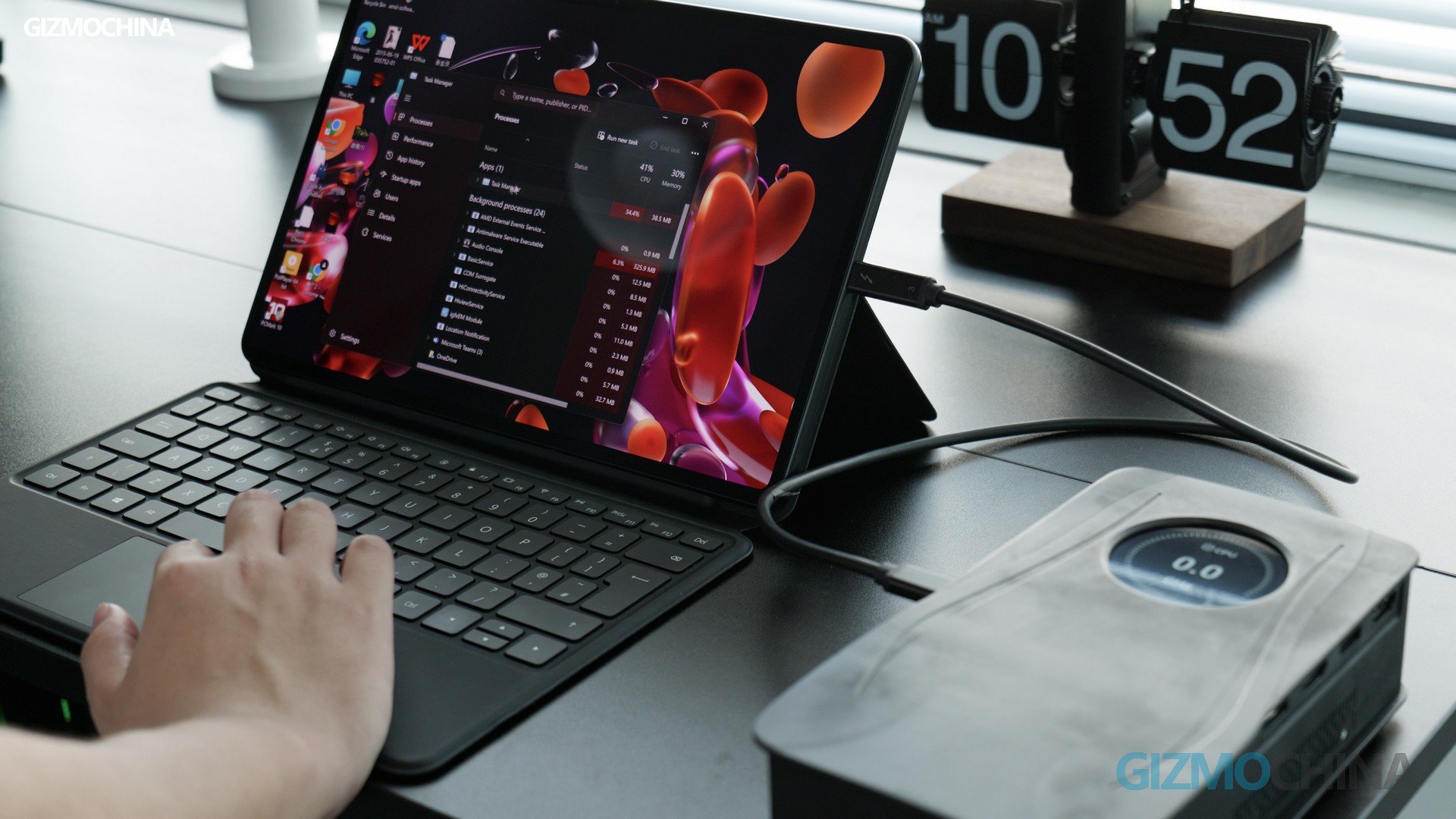
The version I got is powered by an AMD Radeon RX 6600M graphics card with an 80W TDP and 8GB VRam, which you might have heard about on some gaming laptops. Well, unlike those bulky eGPU products on the market, the Gaming & AI BOX surprisingly has a very compact size with a built-in 240w GaN power supply. Its compatibility is awesome, supporting devices with Thunderbolt 3 & 4 or USB4 ports. Thunderbolt ports used to be only seen on expensive laptops, while now thanks to USB-4, we can already see the future of normal laptops and mini-PCs getting modularized with such a compact but powerful graphic card.
Unbox
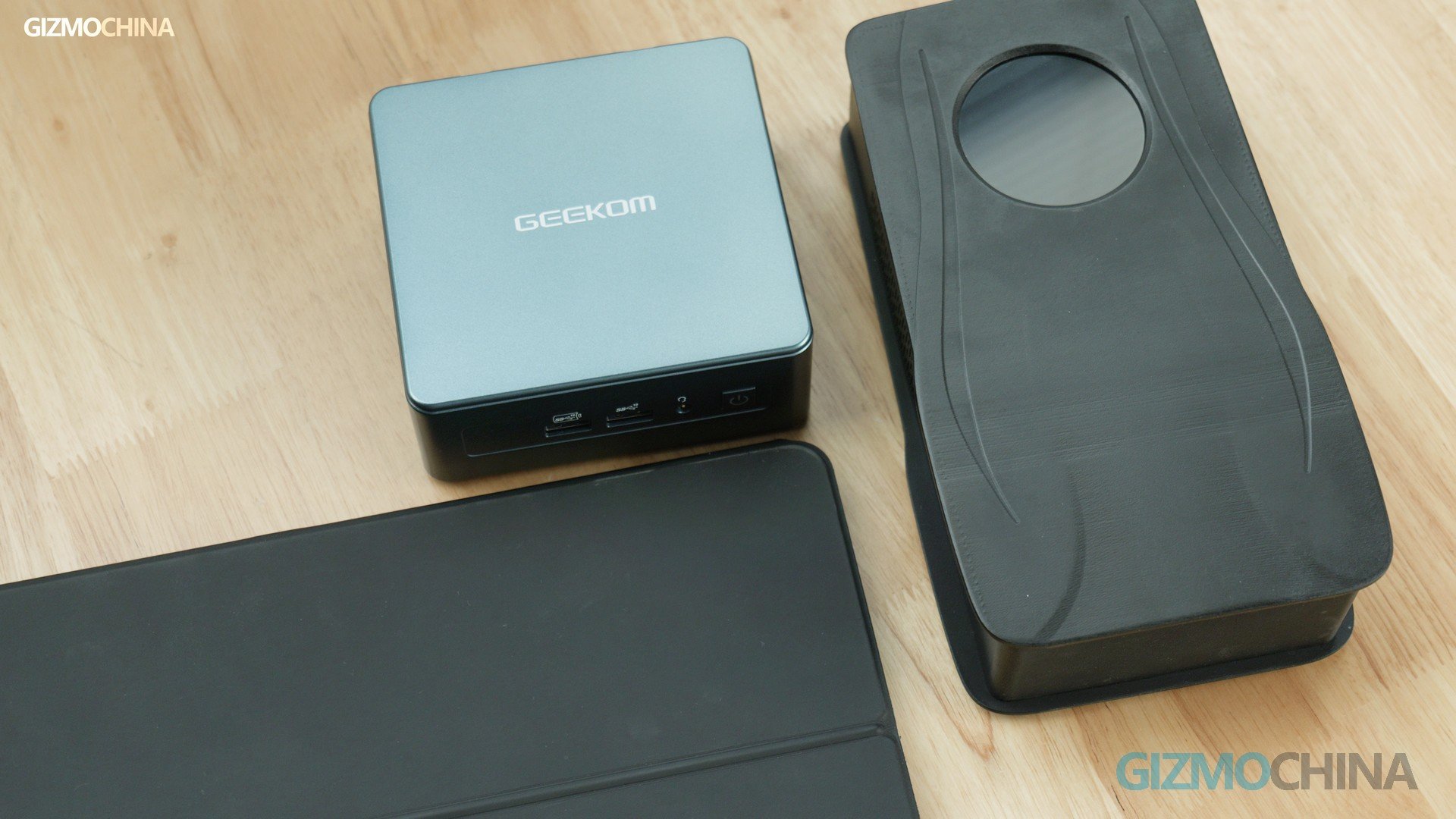
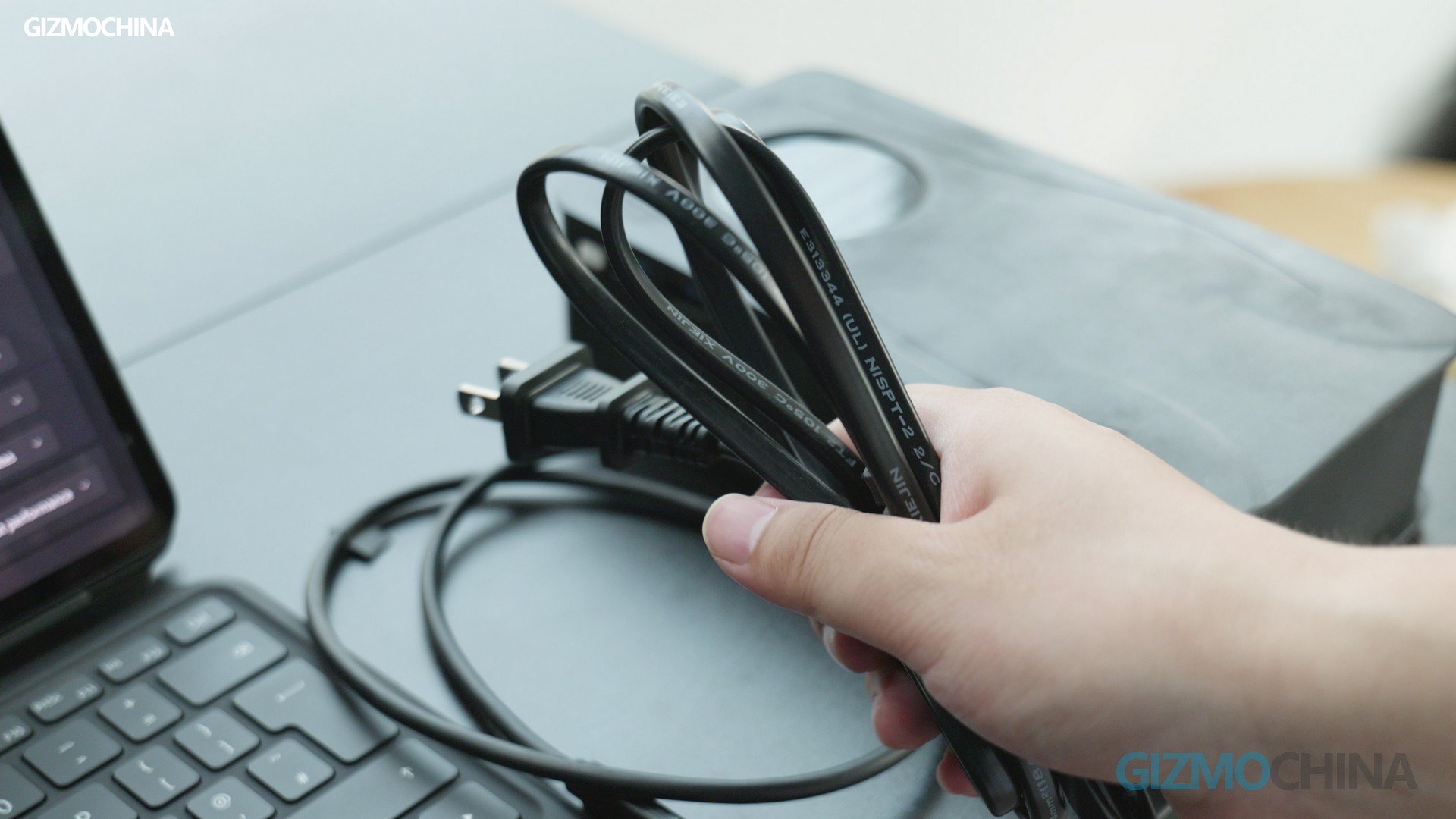
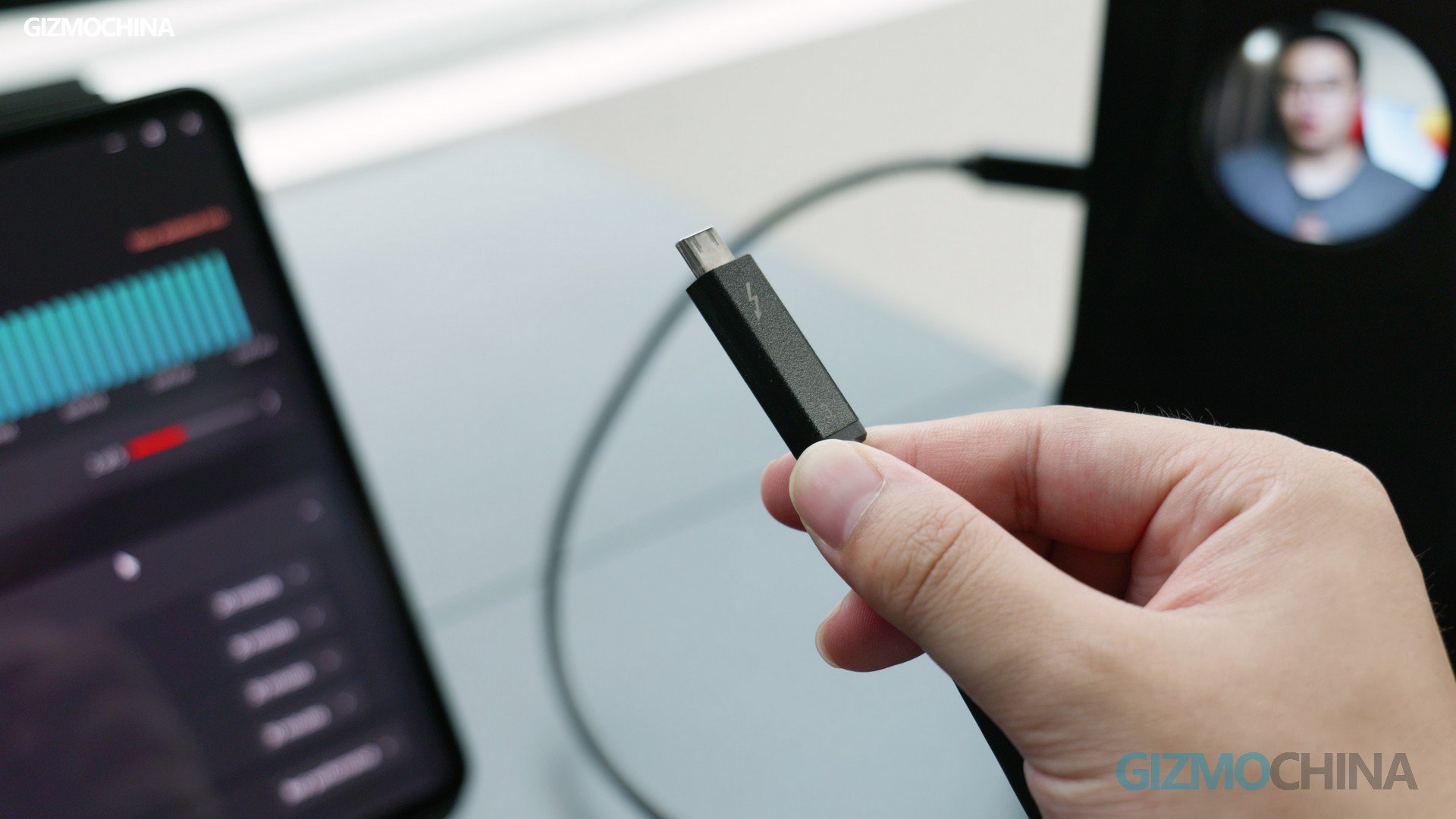
There’s no Unboxing this time, and since we got an early sample, the packaging is obviously not informative. What we got is just a Type-C cable compatible with Thunderbolt and a power cable apart from the eGPU model. But here I have to remind you guys: besides the version I got, SGWZONE also released another RTX 3070 version with a 120W TDP. which is pretty insane. But I still prefer the 6600m version because the 6600M can also work with Mac devices that are powered by Intel chips. And it’s driver-free to conveniently plug and play.
Design
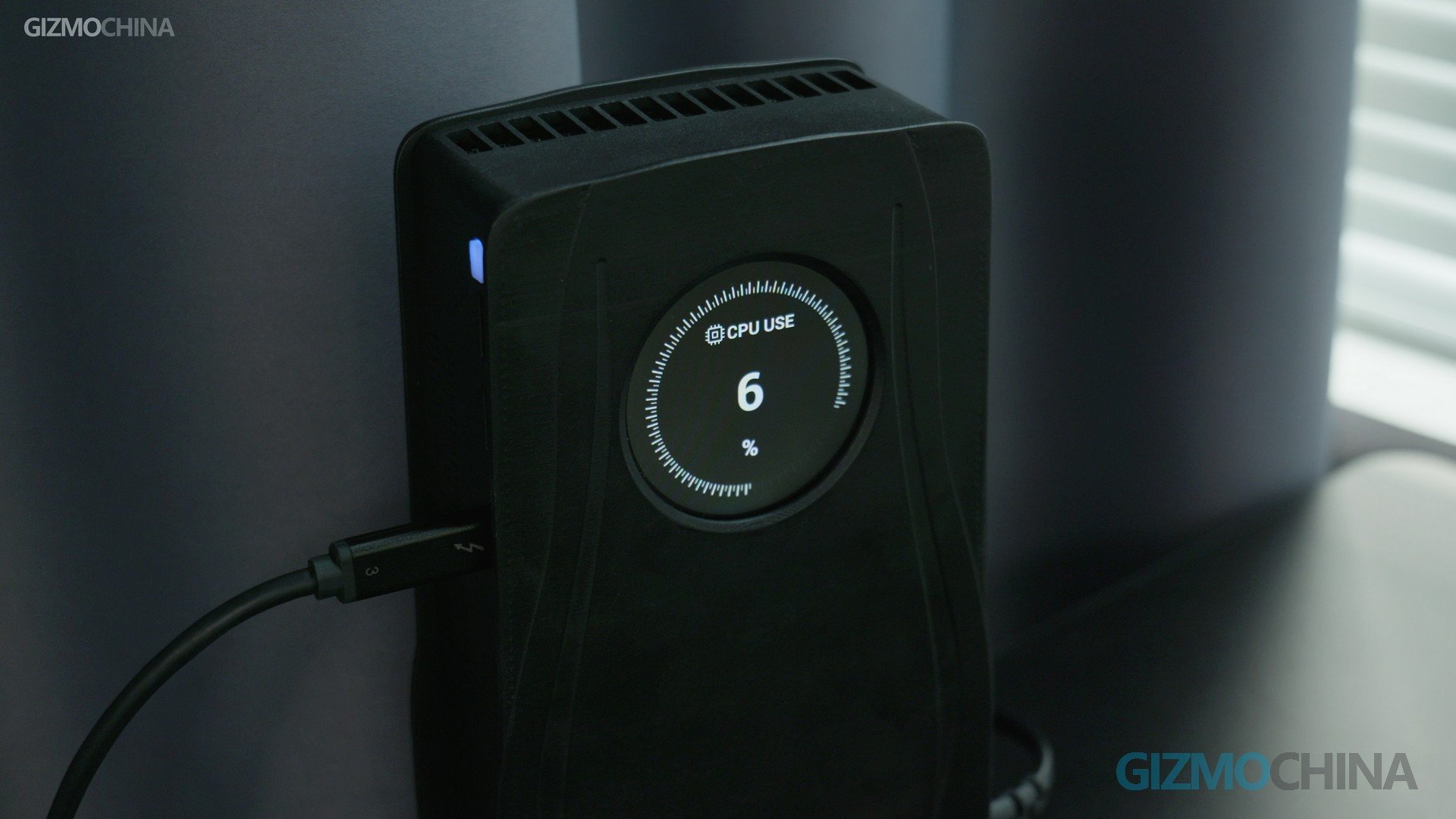
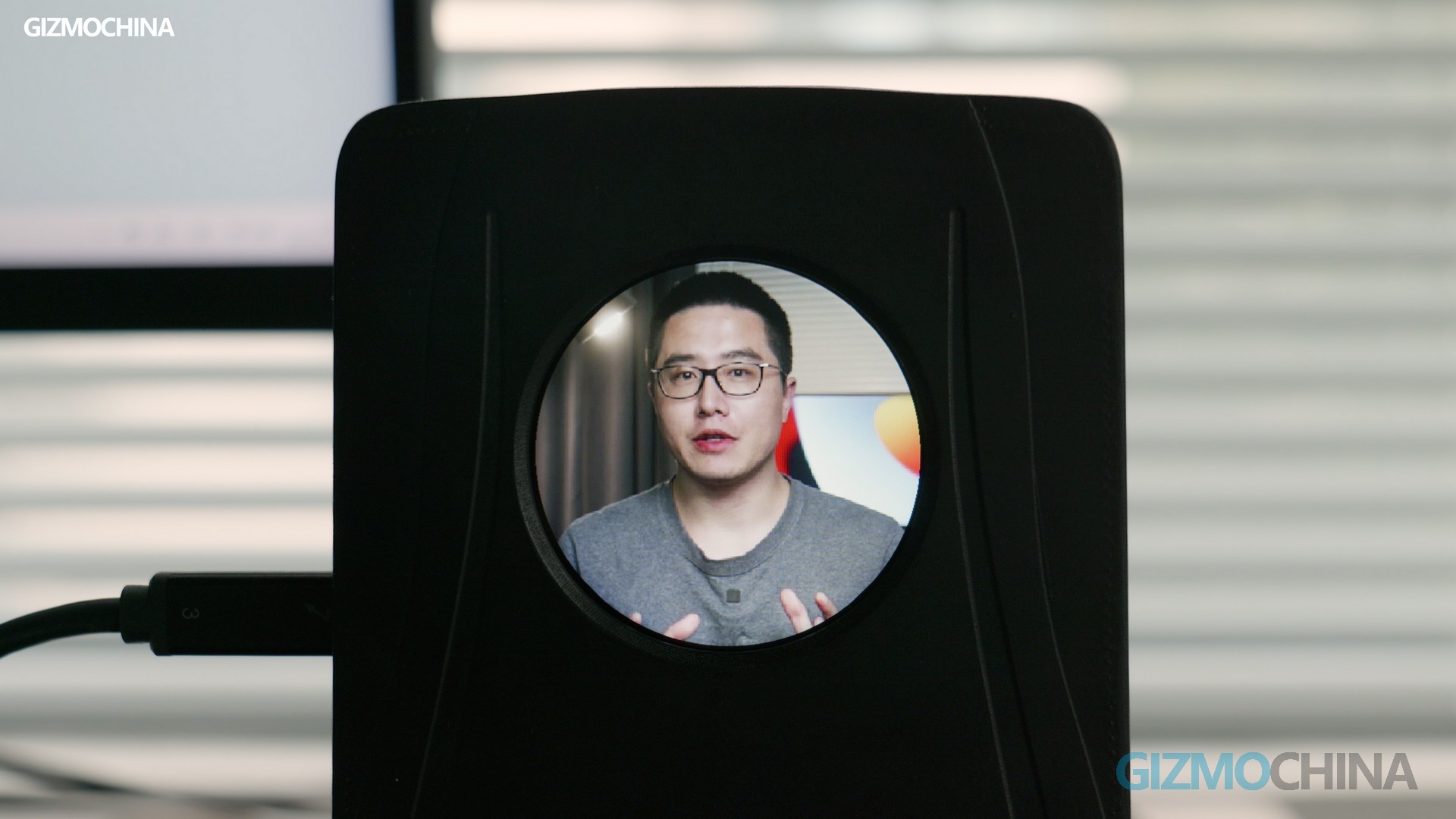
In terms of design, since I got the early version, The Gaming & AI BOX uses a 3D printed black case, which will be updated in the later official products, but of course, the super-cool round screen here will remain the same. It can be quite informative to display some performance parameters of the connected devices, such as temperature, clocking, and so on. And what’s interesting is that you can also showcase your own pictures or videos here as a geeked deco.
Well, emmm..pretty weird, right?
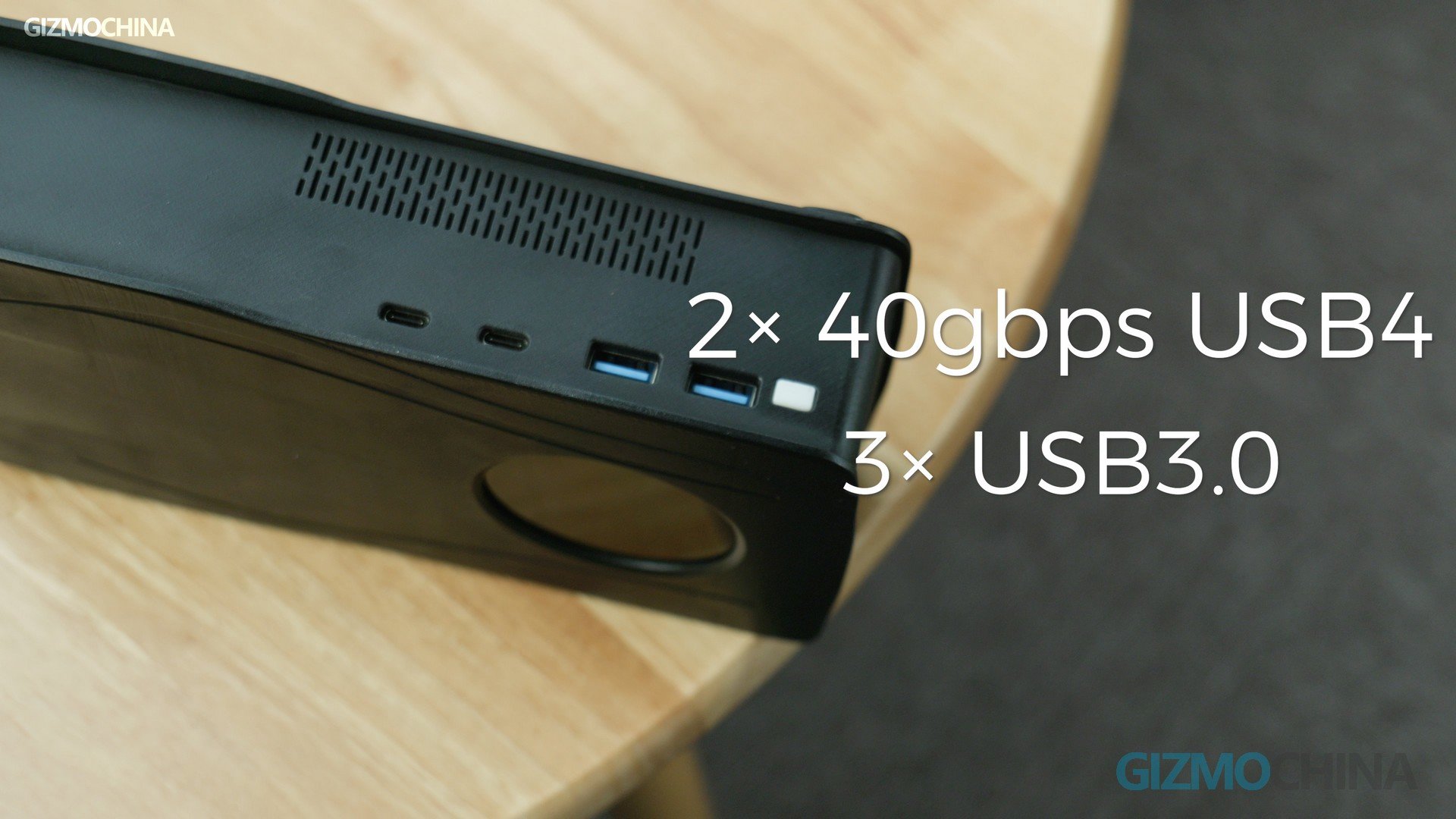
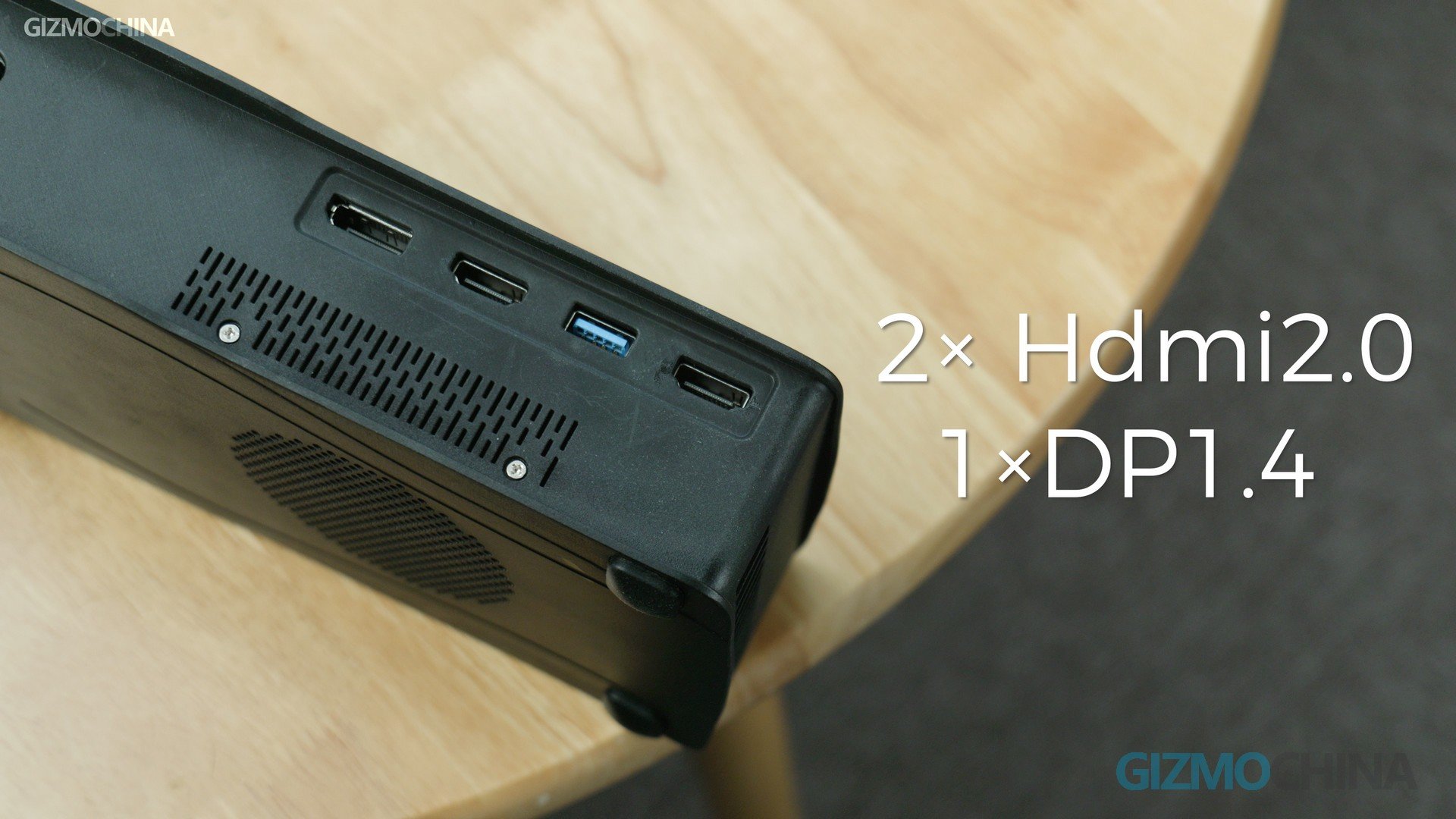
Compared with some regular eGPU products, The graphic box offers a lot more ports, there are 2 HDMI 2.0 and a DP1.4 for video output. and there are also two 40Gbps Thunderbolt-compatible USB4 ports. In addition, you even can find the other three USB3.0 ports. So to speak, this EGPU can even act as a docking station in addition to providing additional graphics performance.
The USB-4 UFP port even can support an extra 85W PD power supply for connected devices, which means you can even power up and strengthen graphic performance with a single cable for the laptop. This graphics box gets a maximum of 240W power, which is more than enough to provide an extra 85W of charging in addition to its own power supply!
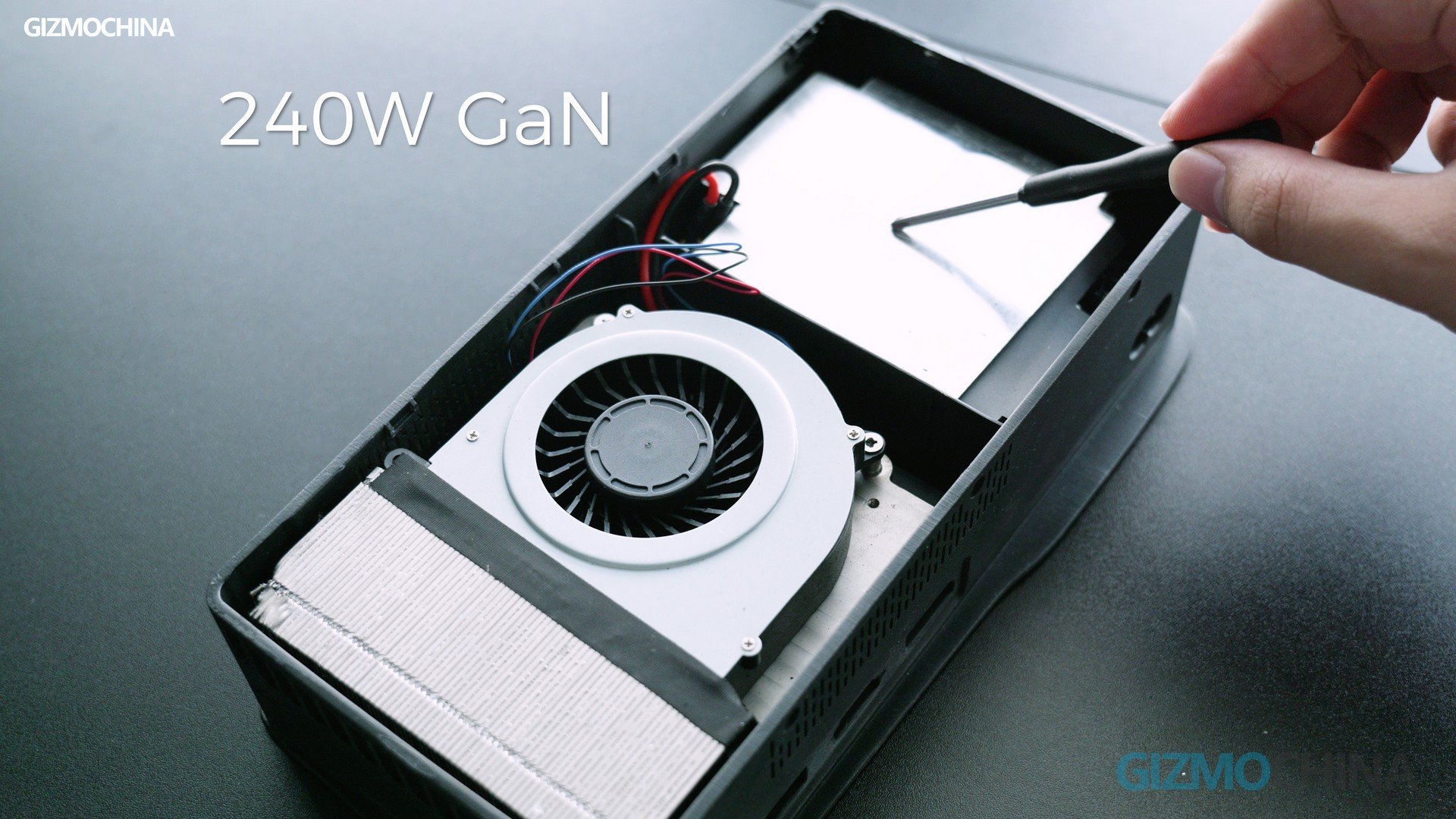
Of course I did a simple disassembly of this EGPU, the internal structure is quite neat, a part of the power supply, the GPU module, and the whole cooling solution. It’s good to see the power supply part has a metal layer for shielding, I did not disassemble it further for safety reasons. But it’s worth noting that the 6600M graphics card uses the standard MXM interface, which means that this graphics card can be replaced for upgrade. This is amazing and also one of the most attractive things about the Gaming & AI BOX to me. And SGWZONE admits to releasing a 40 series card in the future for users to upgrade.
On top of that, there is a triple heatpipe cooler and a centrifugal fan on top of the GPU for cooling. Temperatures in gaming are great, only around 75°C at full power on the GPU.
In daily use, the noise level is not annoying at all. But when the GPU is fully loaded, the fan would accordingly speed up to guarantee stable running, then the noise will become a bit more perceivable. But here the brand also got their reason. SWGzone explains that because the model will be upgradeable in the future, it’s designed to be more thermally robust to handle higher power output of more powerful GPUs. Well, That’s really the way engineers think.
Of course, the size of the Gaming & AI BOX is perfect for me. Well, of course, there’re small-sized eGPUs on the market, but the funny thing about them is that they are often equipped with an external power adapter, bulky and silly. So it’s very smart of the graphics BOX to use the built-in GaN power supply.
How to use
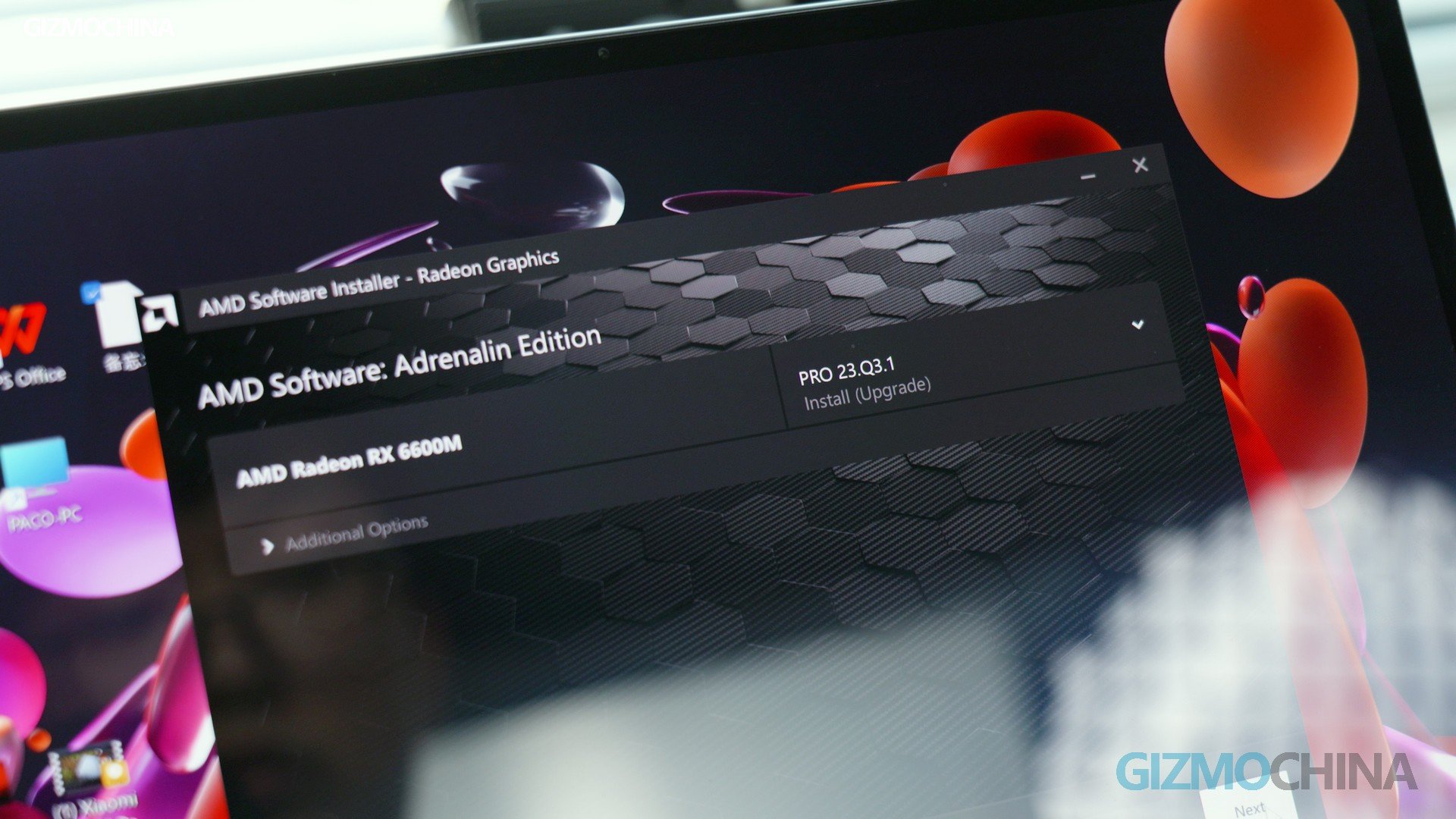
It’s extremely easy to use. Make sure you get the right connection, USB-4 or Thunderbolt. For first use, just connect the EGPU to the PC and then install the graphics driver. After that, power on the PC and the eGPU, set the cable connection. DONE, very simple right? And the driver will also prompt you that you have successfully connected the external GPU. And if your PC supports a PD power supply, all you need is just a compatible Type-C cable between them.
Performance
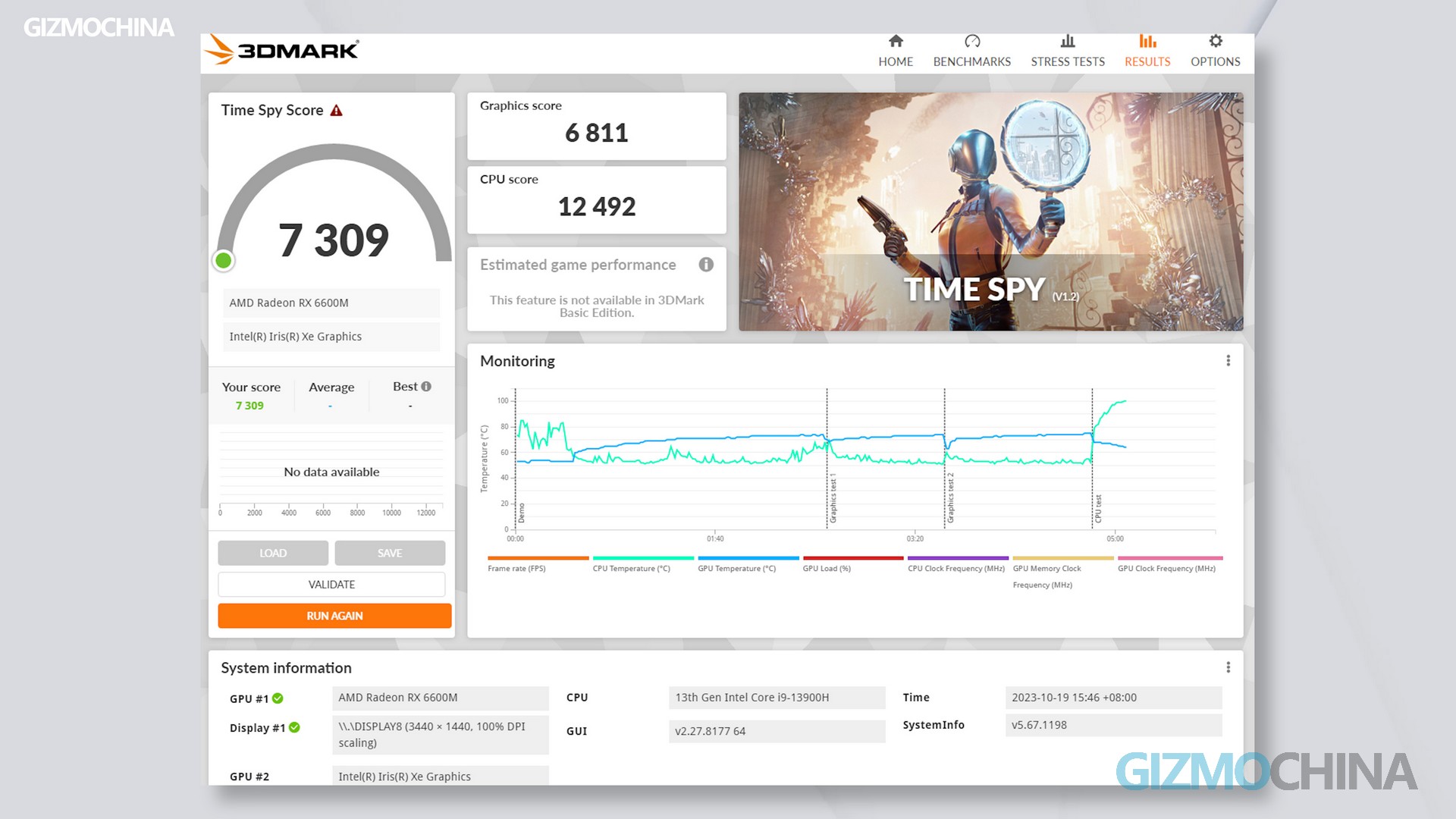
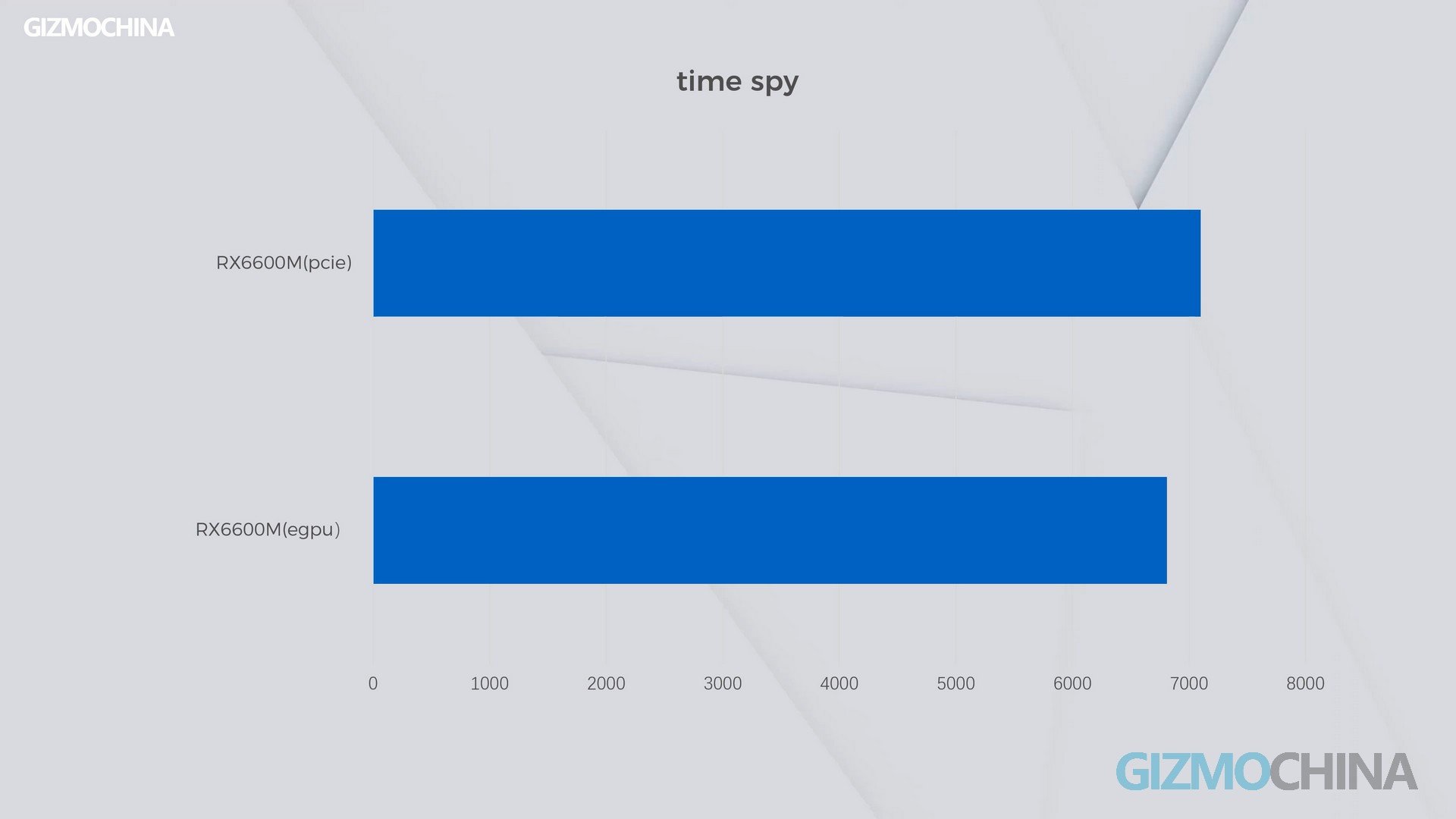
Finally, let’s talk about performance. The first question here: is there any performance loss? Well yes, there is but not much really. Taking the 6600M as an example, in the 3Dmark time-spy test, the graphics scored 6811
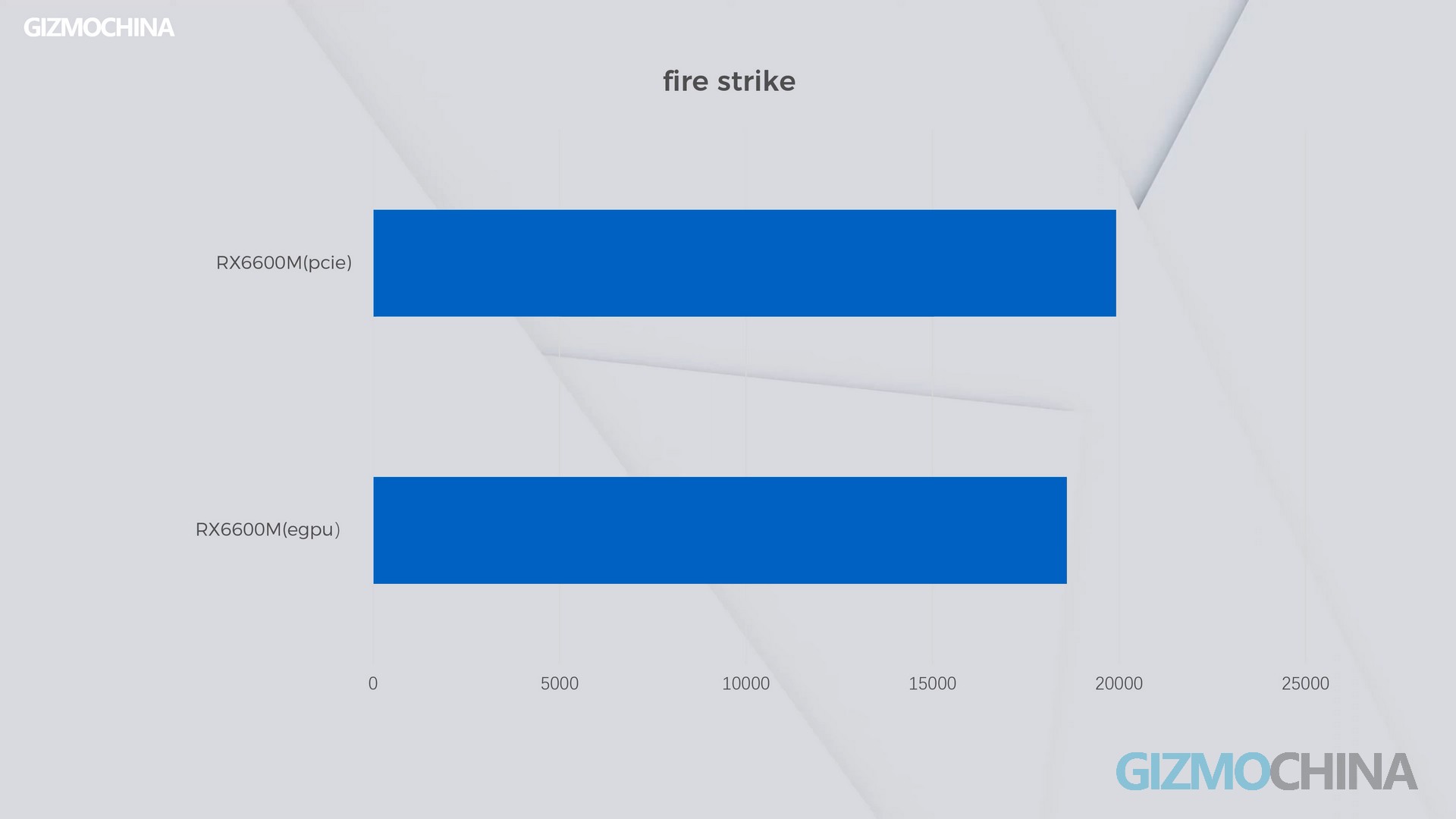
which is almost a 4% performance loss compared to the 7101 score of the direct PICE connection. Similarly in the fire strike test, compared to the 19,919 scored by the direct connection to PICE, there was a 6% performance loss. This is perfectly acceptable with such a simple connection. Personally, I wouldn’t be complaining over it.
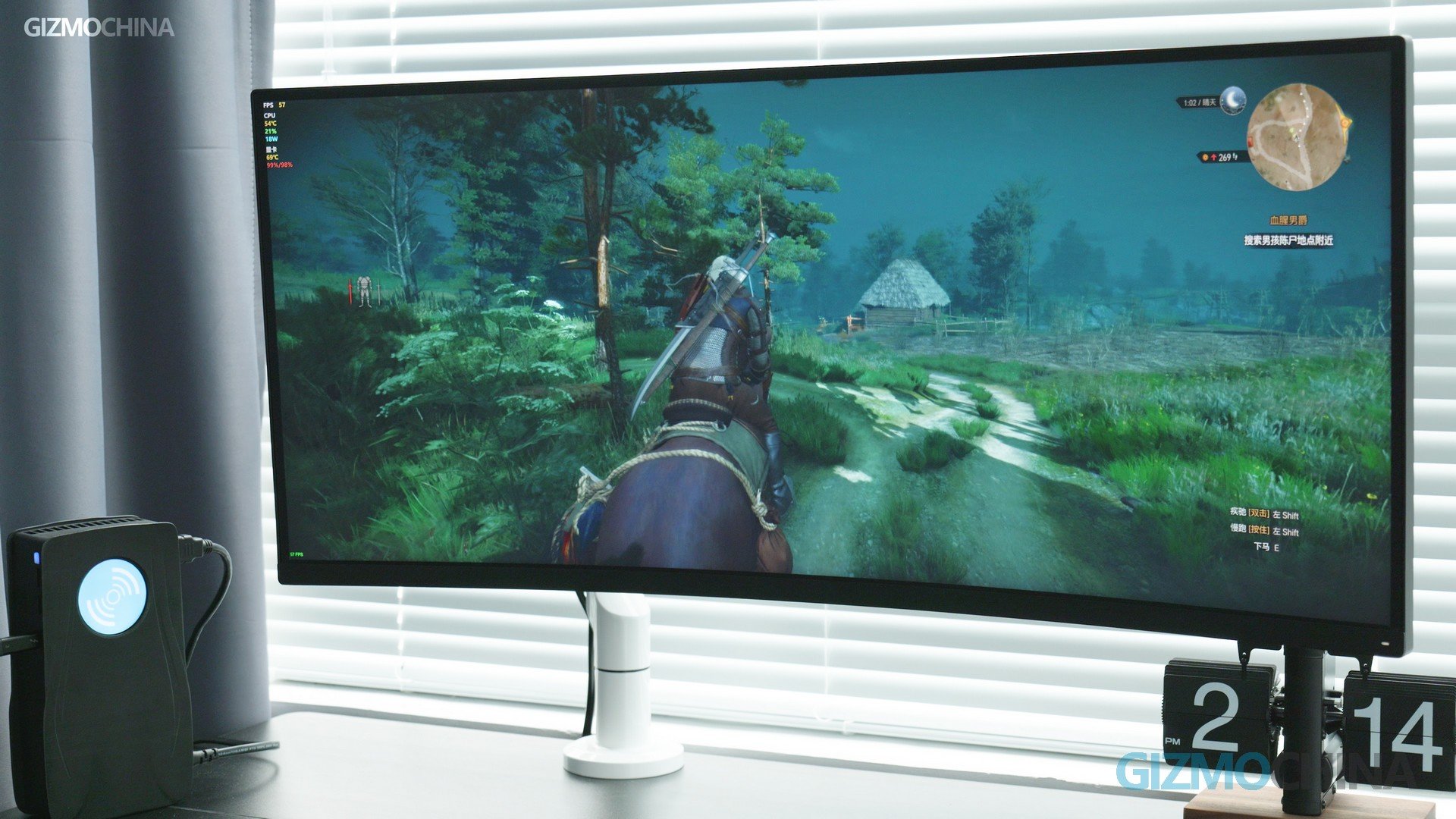
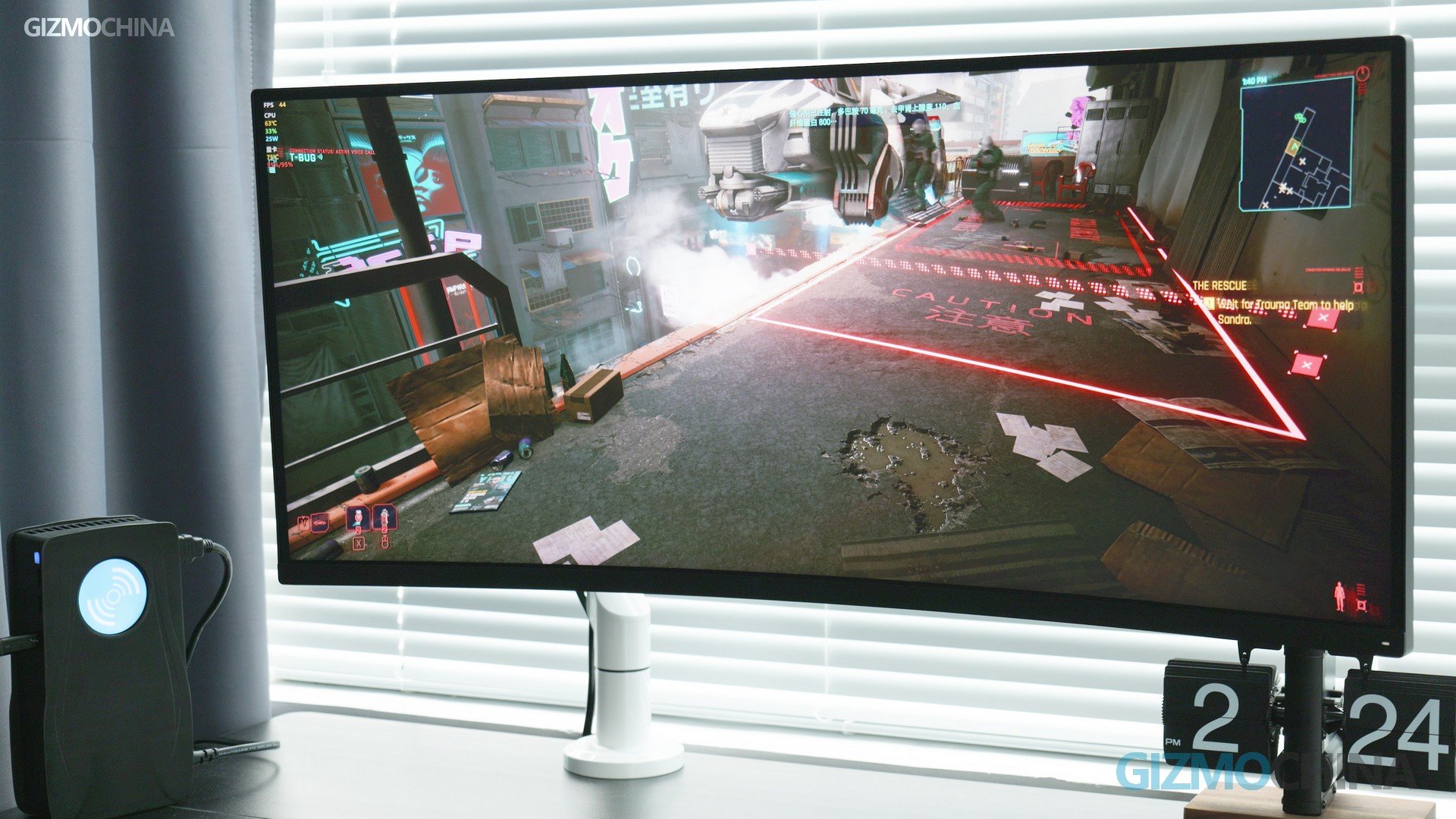
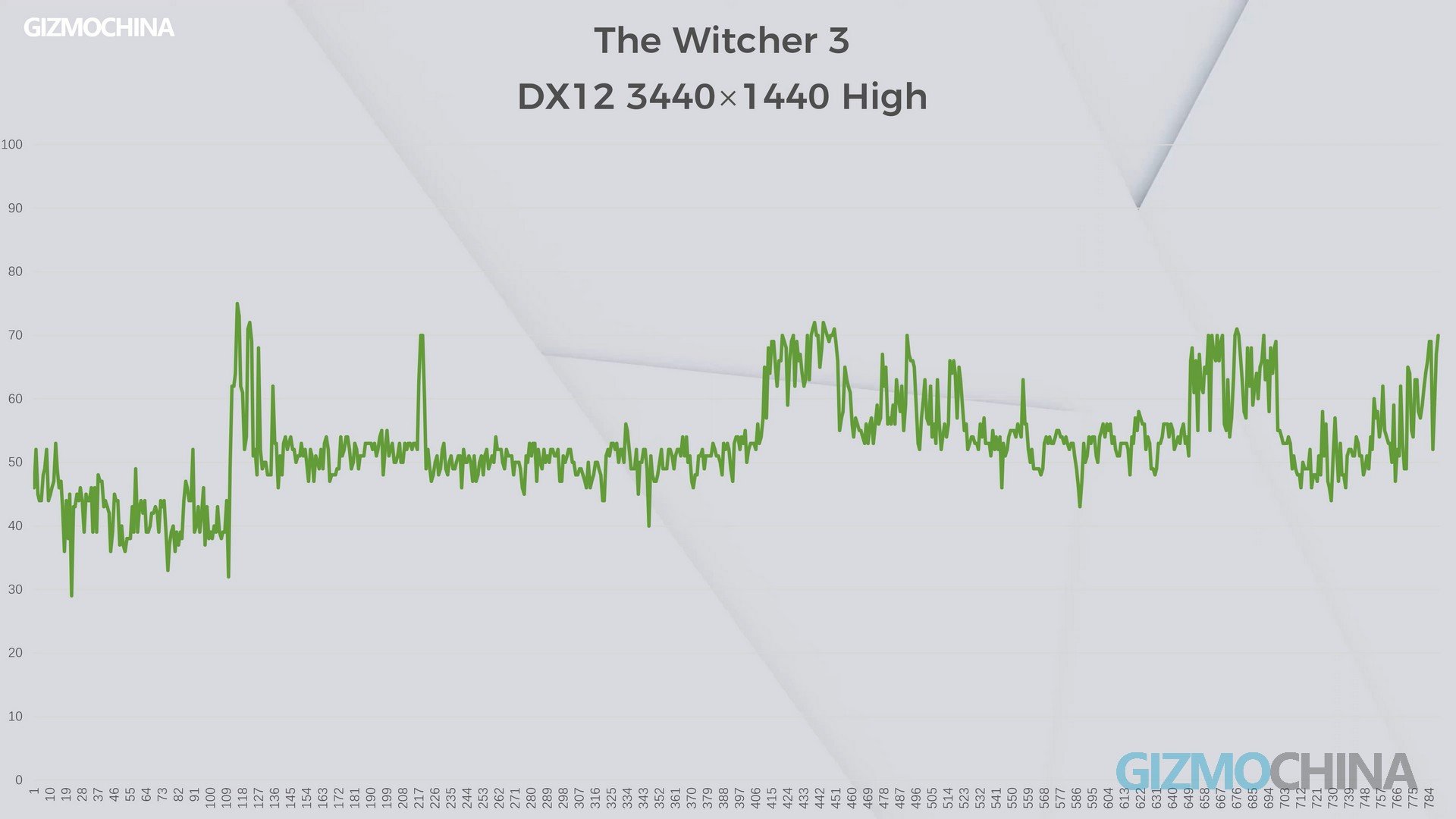
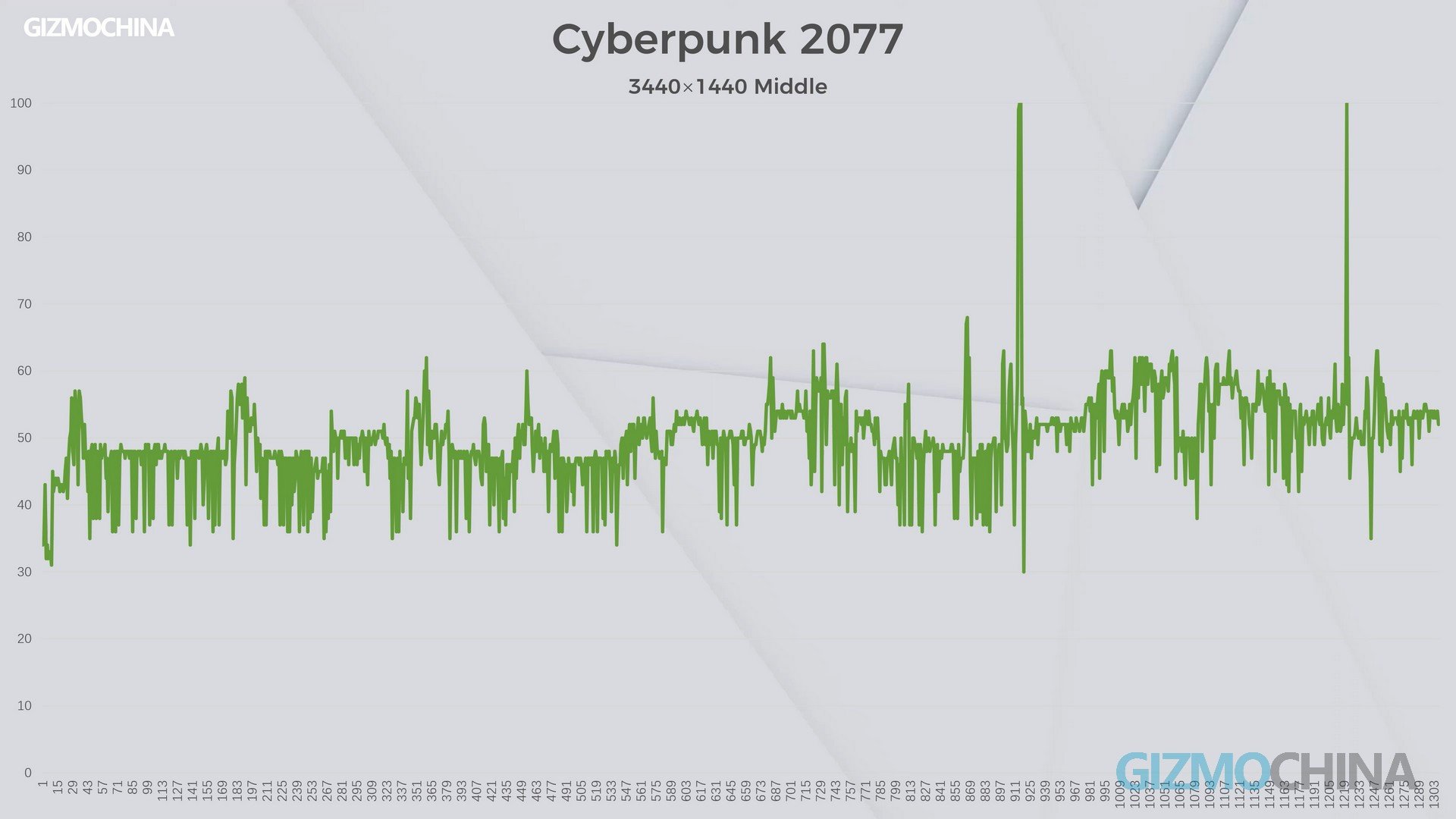
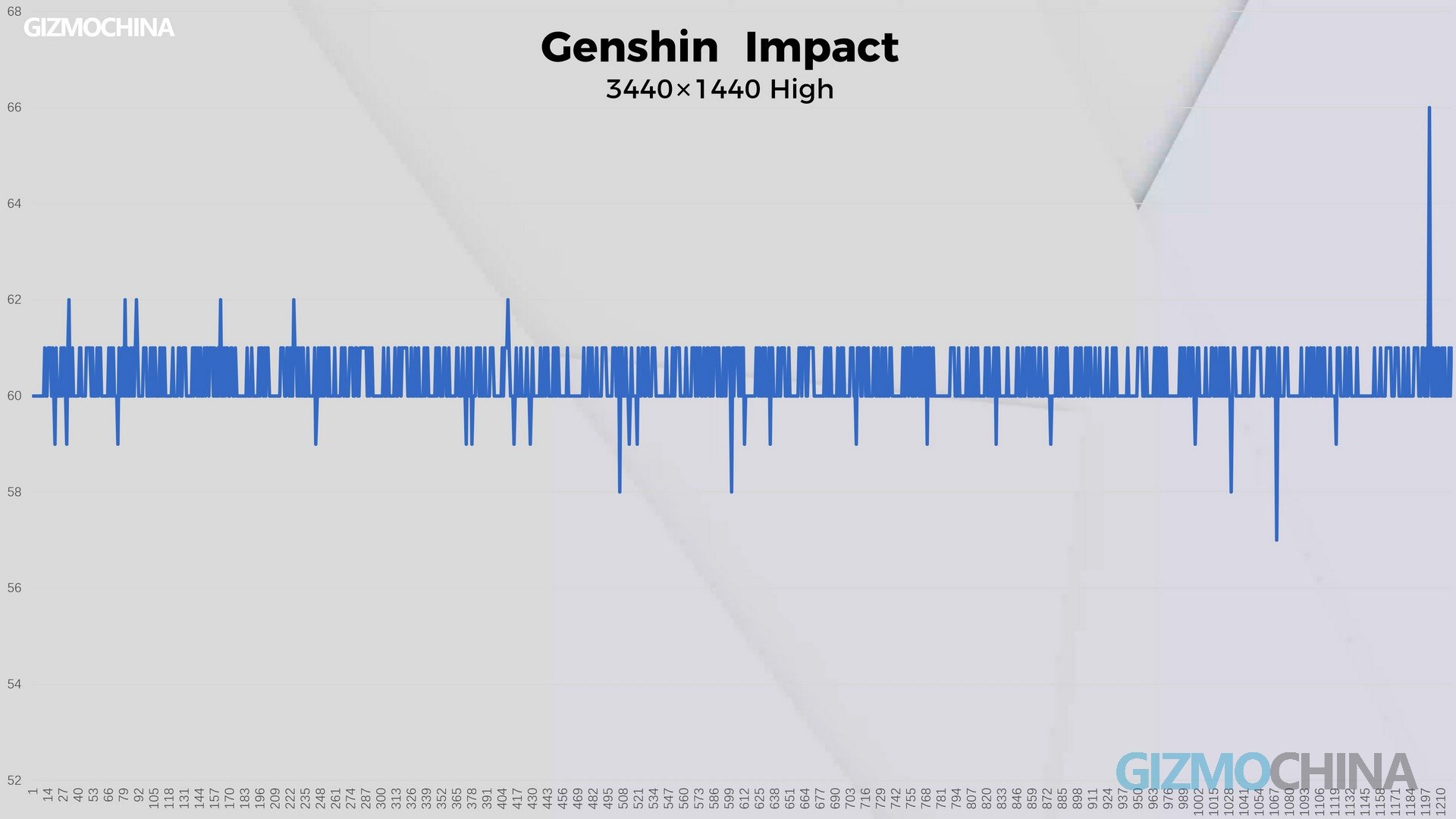
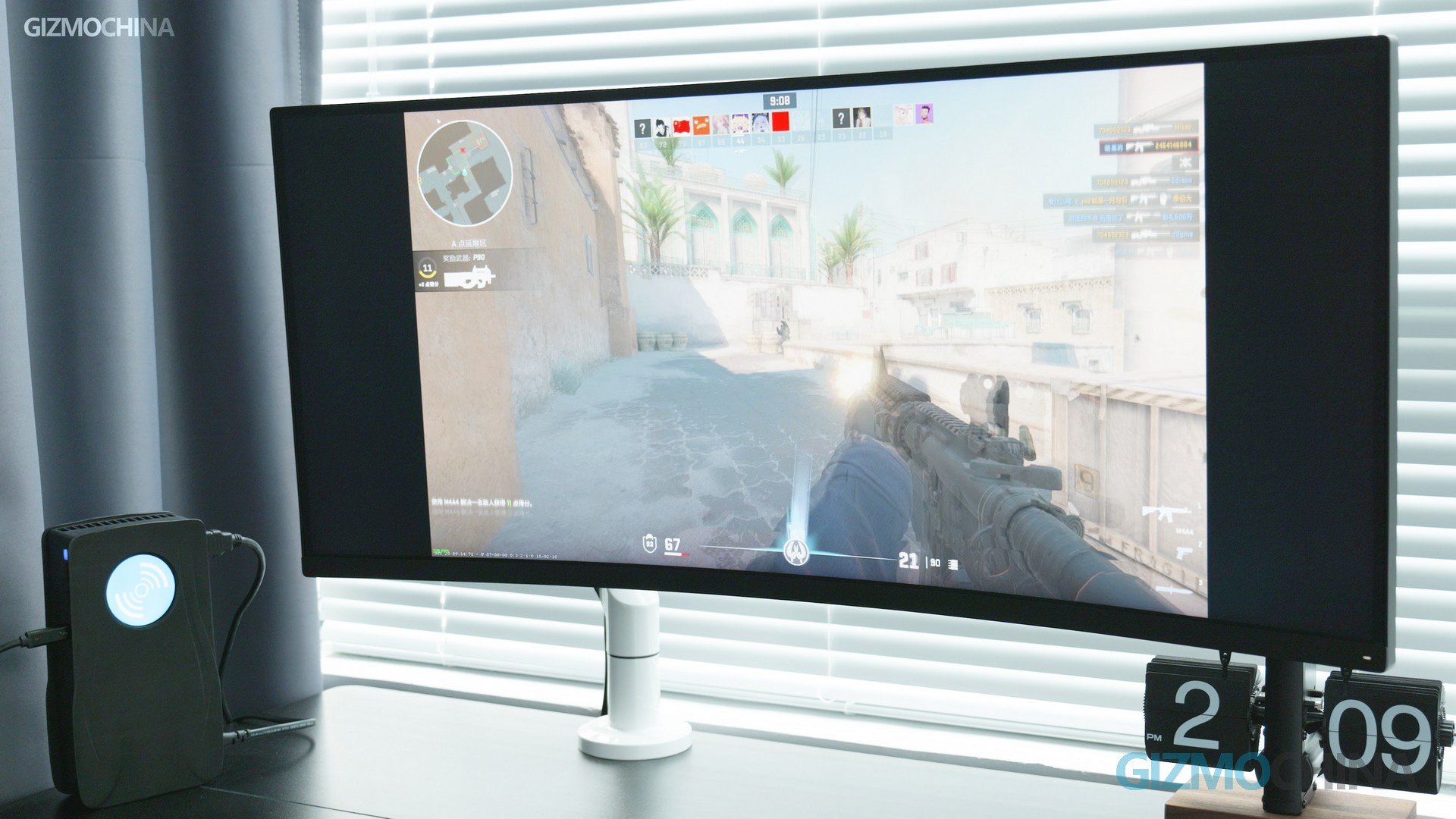
For gaming tests, I realize that most people who would consider buying an eGPU product are probably using Integrated GPUs, so I used the most common 96eu xe graphics card for the comparison tests. And mainly having fun with the graphic cards is the Geekom mini IT13 that we reviewed before and a Xiaomi gaming monitor with 21:9 ratio.
In The Witcher 3 Remastered, using 3440×1440 and high quality, it averaged 52fps, a very good performance. The xe GPU only had 10fps, a huge improvement in the gaming experience.
In Cyberpunk 2077, using 3440×1440 resolution with medium graphics the Gaming & AI BOX game ran at an average of 49fps. with the same graphics settings. the xe graphics card was just under 10fps.
I also tried my favorite game Genshin Impact and at high graphics, this eGPU could maintain 60fps at high quality, compared to the 20fps of the Xe graphics, I can only say that this eGPU is really perfect for gamers.
I also tested some e-sport games, in Counter-Strike2, the average fps was around 160, if you pair it with a high refresh rate screen, you can get a truly E-sport level gaming experience on a portable device.
AI & Video Production
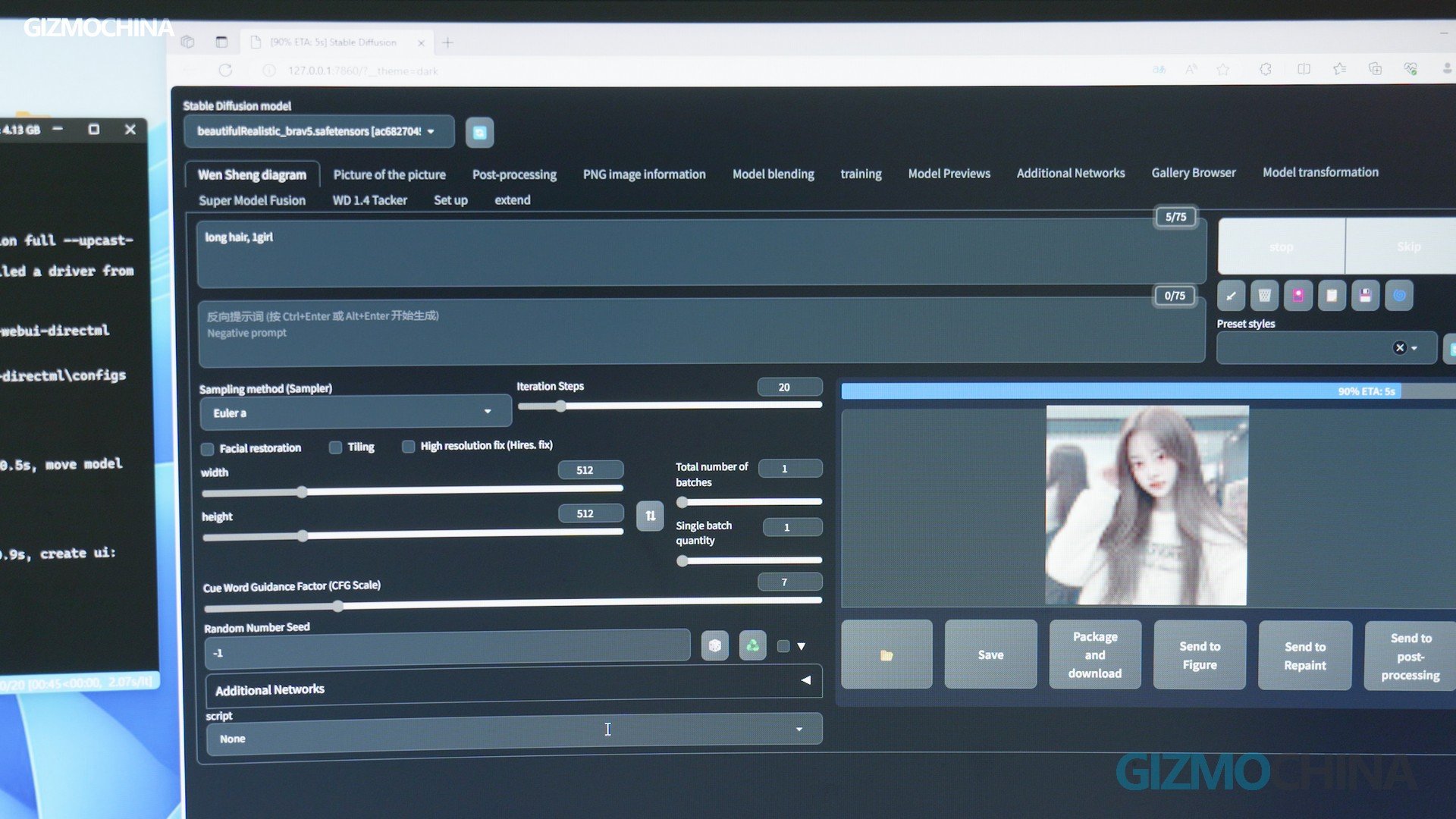
Outside of gaming, I also tried to run some AI apps on this eGPU, setting the resolution to 512×512 and steps to 20 in stable diffusion, typing in some simple keywords, and generating an image took about 25s, the 8GB vRam clearly has good performance in AI.
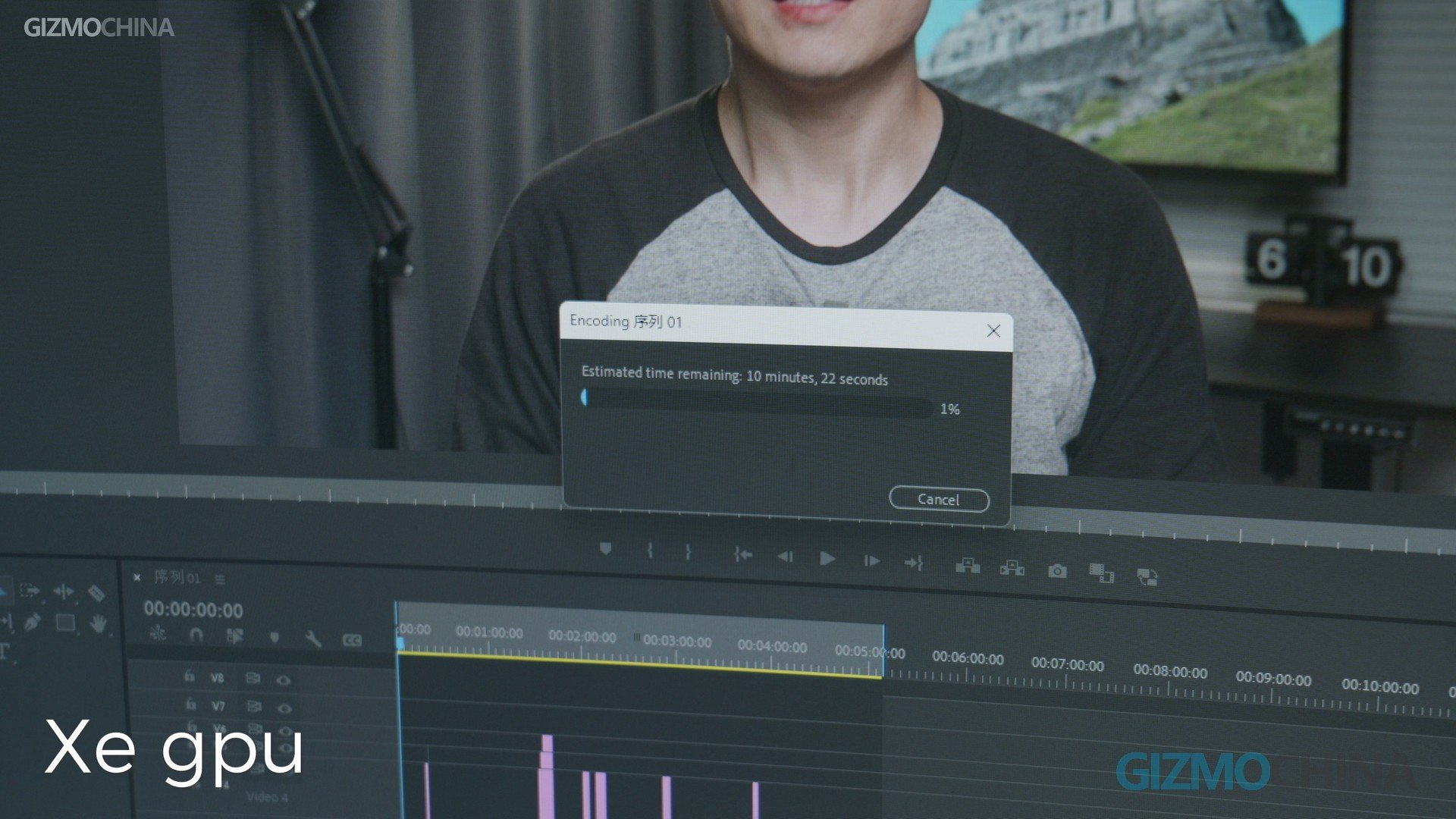
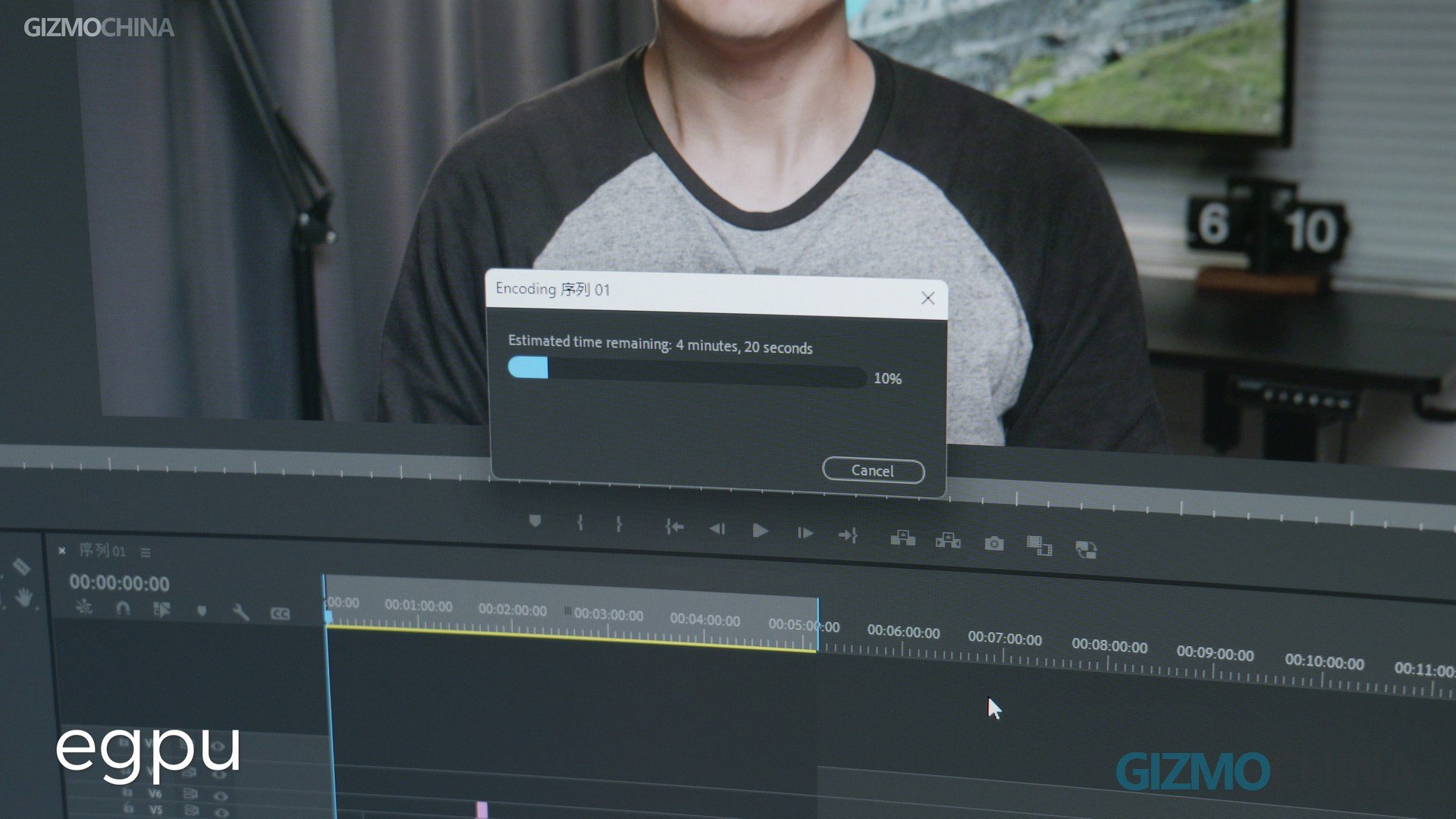
I also tested the speed of the Gaming & AI BOX video export. The same 5-minute 4k 25 fps video exported in Premiere took 6 minutes with the eGPU, while it took 11 minutes with the Xe Integrated GPU. This is very impressive and almost doubles the speed of the exported video. Of course, this improvement is not limited to Premiere. In software such as Photoshop, Lightroom, and DaVinci Resolve, The eGPU will bring a significant performance improvement.
Conclusion
Overall, The Gaming & AI BOX is really impressive, with its mini size and built-in GaN power supply compared to traditional eGPU products. Compared to some smaller eGPU products, The Gaming & AI BOX has a universal MXM graphics card and USB-4 connectivity, which means it has excellent upgradability and good compatibility. Also, I think the price of this product is very competitive. So if you are in to it, please check out the link down below. It might change the way you work and play. Thank you for watching. This is Will from Gizmochina. See you soon!
Now the eGPU Dock is running a campaign on Indiegogo, where you might find something more than what we tested. And if you are a passionate player, SGWZONE also set up an official Facebook Group, which should take care of all the queries.
Xiaomi India has officially announced an upgrade for one of its existing air purifier product. The company’s Smart Air Purifier 4 models will be the first in India to arrive with Allergy Care Certification. So here’s everything that you need to know.
Xiaomi Smart Air Purifier 4 gets Allergy Care Certification
Earlier this year, the Chinese tech giant launched the Smart Air Purifier 4 and Smart Air Purifier 4 Lite in the Indian market. These came with notable features that allowed the products to help clear out harmful substances from the air around the user. The air purifiers housed a Triple Layer Filtration System. The Smart Air Purifier 4 series is capable of removing particles that are 0.3 microns small as well.
Xiaomi’s Smart Air Purifier 4 lineup have been certified by TÜV Rheinland, being capable of filtering out allergens. So the devices don’t just help clean out the air, but make sure that users’ allergies don’t act up in certain seasons. An example is the negative ion generator that can clear out pollen and dust to allow for better respiratory health.
Other notable features include a 360 degree Filtration along with a True HEPA Filter, the base model can handle up to meter cubic per hour, the Lite variant has a CADR of 360 meter cubic per hour. For those interested, you can check out our review of the Smart Air Purifier 4 by clicking on this link here.
A new POCO smartphone is making its way to the global market. The new device in question is the POCO C65, which has recently been spotted on various certification platforms. Now, the latest sighting in UAE’s TDRA certification. So here are all the details.
POCO C65 surfaces on TDRA
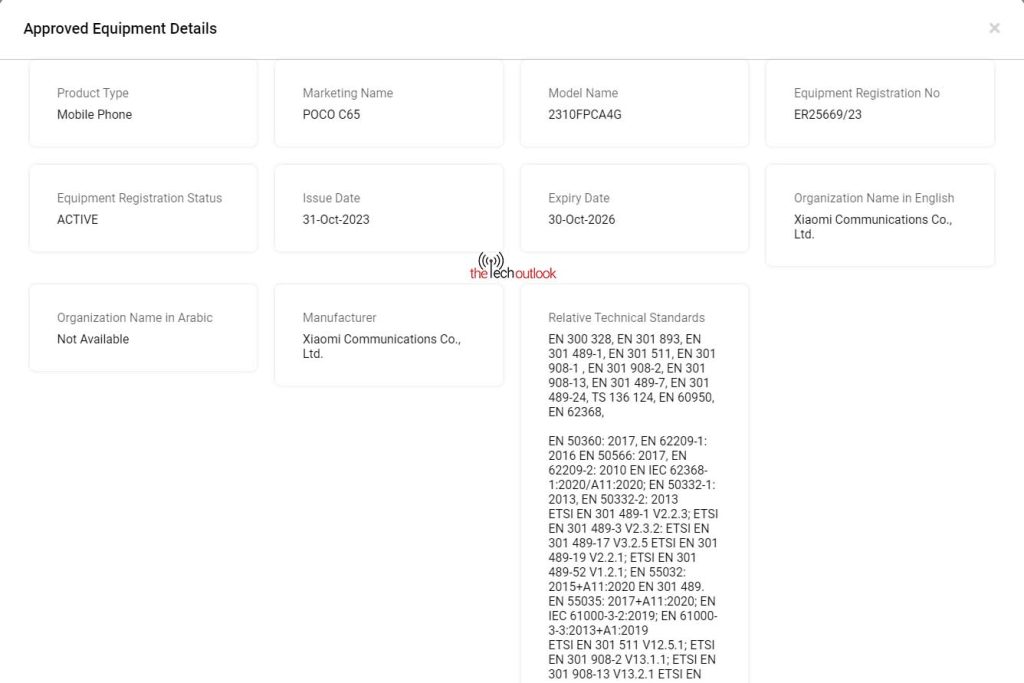
The Chinese smartphone maker’s upcoming smartphone was spotted on the TDRA database carrying the model number 2310FPCA4G. Previously, we had reported on this smartphone being spotted on IMDA and FCC last month. These certification sightings hint that the POCO C65 could be launching soon. Unfortunately, no finer details regarding the new smartphone were revealed on this certification platform.
The FCC listing confirmed that the device will support 4G networking and it will run on the MIUI 14 custom skin, which is based on the Android 13 OS. Furthermore, this model is also confirmed to support WiFi, Bluetooth, and NFC. For those unaware, the POCO C65 is expected to be a rebranded version of the Redmi 13C. A listing on the IMEI database revealed the global variant and Indian version of the device carry the 2310FPCA4G and 2310FPCA4I model numbers respectively.
If this is true, then the C65 model will sport a tall 6.74-inch display that offers a 90Hz refresh rate and a water drop notch. A large 5,000mAh battery pack would likely power this device that may offer 18W fast charging. The rear is rumored to feature a 50MP AI triple camera setup. It is worth noting that these are still just rumors, so take this report with a pinch of salt.
In a major blow to Nvidia, the renowned American chip manufacturer, its shares experienced a significant downturn of approximately 5 percent, reaching a nearly five-month low this Tuesday. This drastic fall followed a report from the Wall Street Journal, indicating that the company might be forced to cancel advanced chip orders worth up to $5 billion from major Chinese technology giants.
Nvidia’s stock price plummeted to $392.30, marking a 4.7 percent decrease and hitting its lowest point since mid-June. Previously, Nvidia’s stock had been a driving force behind the Nasdaq index’s 22 percent gain this year.
However, it has now dropped by almost 20 percent from its peak closing price of $493.55 on August 31. Market experts and investors are closely monitoring the situation as the repercussions of these export restrictions send shockwaves throughout the global technology industry.
Nvidia received a notification last week, stating that AI chip orders slated for delivery to prominent Chinese companies like Alibaba Group Holding, ByteDance, and Baidu in the coming year are now subject to the latest export restrictions imposed by the US Commerce Department.
These restrictions have immediate and tangible consequences for Nvidia’s business operations. The company had completed its deliveries of advanced AI chips to China for this year and was in the process of expediting some 2024 orders before the new regulations were set to take effect in mid-November.
However, the US government informed Nvidia that the export limitations on high-end chips, including sales to China, were effective immediately. Consequently, Nvidia now faces the challenging task of potentially canceling billions of dollars worth of orders for its advanced chips to China.
This development carries wide-reaching implications, impacting not only Nvidia but also critical AI resources for Chinese tech companies. Orders from leading Chinese firms for the upcoming year exceeded $5 billion, making this setback a substantial blow to the tech giant’s revenue projections.
These new export controls on AI chips are part of a broader effort by the Biden administration to limit China’s access to advanced technologies, aimed at curbing China’s progress in military and cyberwarfare capabilities.
This move underscores the ongoing tensions between the United States and China, further intensifying the competition between multinational chipmakers. The situation remains fluid as stakeholders anxiously await further developments in this high-stakes tech industry battle.
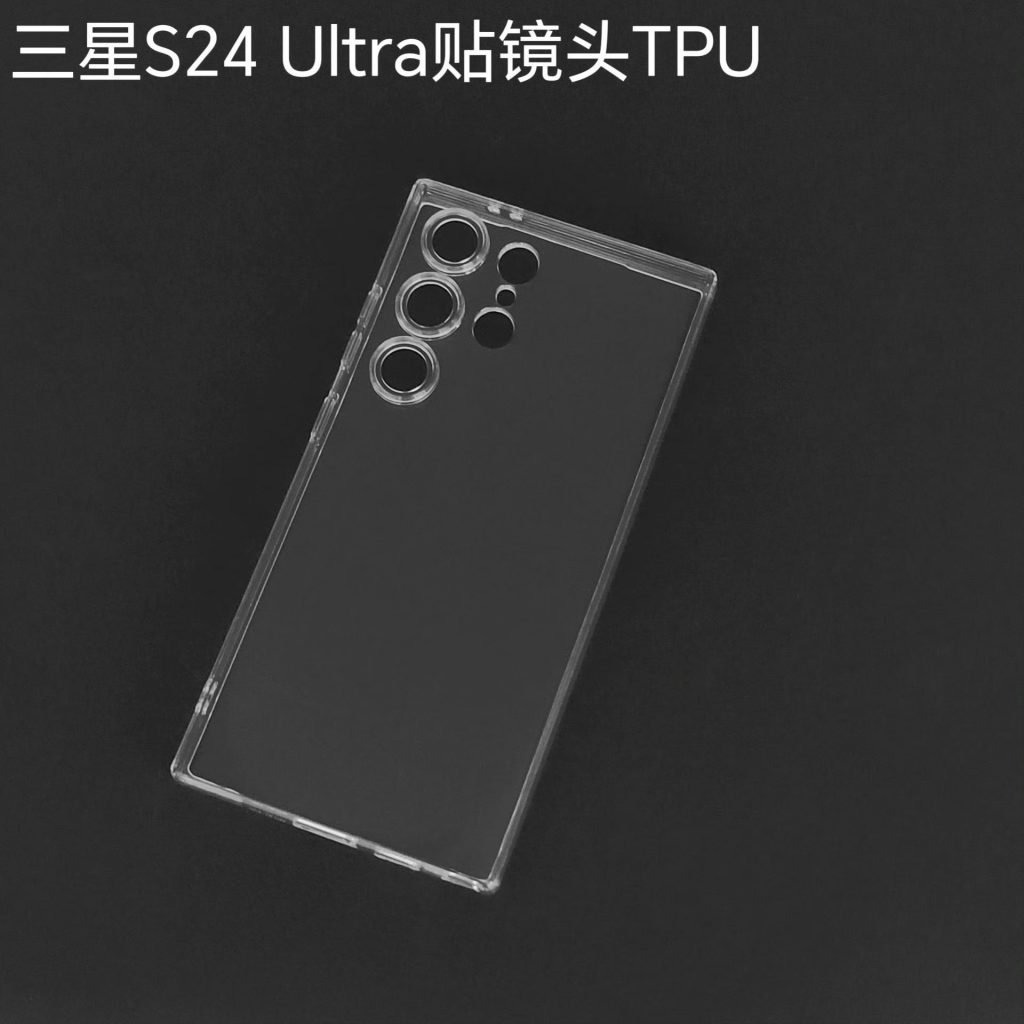
The Samsung Galaxy S24 series launch is still a while away. However, there are various rumors and reports that have already started surfacing. Now, the latest leak has revealed the protective cases for the upcoming flagship devices. This also showcases the design of the new smartphones, so let’s have a look.
Samsung Galaxy S24 series TPU covers leaked
The images of the TPU protective covers were leaked by known tipster Ice Universe, who shared the information on Weibo (a Chinese microblogging website). Looking at the images, the South Korean tech giant’s next gen flagship phones won’t feature any notable changes in design over its predecessors. In other words, the Galaxy S24 lineup will feature similar design elements as the Galaxy S23 series.
Notably, the TPU covers are also in line with the leaked CAD renders that were shared by another tipster, OnLeaks. The Galaxy S24 Ultra’s rear camera module retains the familiar vertical stacked image sensors. For those unaware, the triple camera setup on the rear features the ISOCELL HP2SX 200-megapixel primary camera, which is paired with an ultra wide angle lens, and a periscopic telephoto shooter.
Although, there will be slight enhancements in design. The Galaxy S24 Ultra will feature thinner bezels compared to last year’s Galaxy S23 Ultra. Overall, the body of the top end Samsung flagship model will have a flatter design. There are also rumors of the Galaxy S24 Ultra using titanium, which would help lower its weight.
We use cookies on our website to give you the most relevant experience by remembering your preferences and repeat visits. By clicking “Accept”, you consent to the use of ALL the cookies.
This website uses cookies to improve your experience while you navigate through the website. Out of these, the cookies that are categorized as necessary are stored on your browser as they are essential for the working of basic functionalities of the website. We also use third-party cookies that help us analyze and understand how you use this website. These cookies will be stored in your browser only with your consent. You also have the option to opt-out of these cookies. But opting out of some of these cookies may affect your browsing experience.
Necessary cookies are absolutely essential for the website to function properly. This category only includes cookies that ensures basic functionalities and security features of the website. These cookies do not store any personal information.
Any cookies that may not be particularly necessary for the website to function and is used specifically to collect user personal data via analytics, ads, other embedded contents are termed as non-necessary cookies. It is mandatory to procure user consent prior to running these cookies on your website.