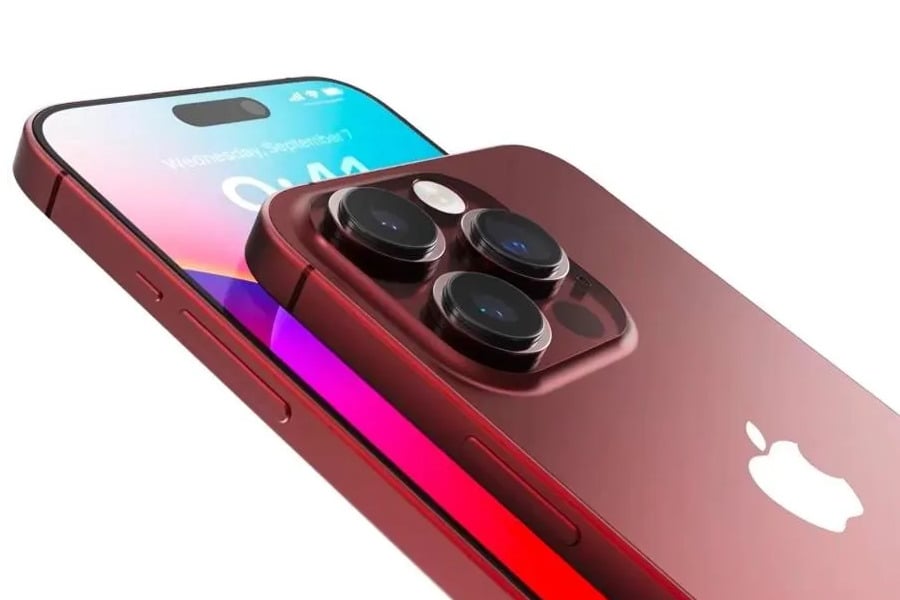
The iPhone 15 series is about to launch, and there are many rumors about the phone. They are expected to be released in the second week of September and will be available for purchase a week later. Now, according to analyst Ming-Chi Kuo, the iPhone 15 Pro Max is expected to be the best-selling model in the lineup, even though it will be more expensive.
Kuo predicts that the iPhone 15 Pro Max will account for 35 to 40 percent of all iPhone 15 shipments. This is a 10-20 percent increase over the iPhone 14 Pro Max, which was the most popular iPhone in the second half of 2023, as per Omdia’s H1 2023 global smartphone shipment stats.
One of the main reasons for the iPhone 15 Pro Max’s popularity is expected to be its periscope lens camera, which will offer 5x–6x optical zoom, compared to the 3x optical zoom on current models. The periscope lens camera will be exclusive to the Pro Max model this year, but it is expected to be available on the smaller iPhone 16 Pro next year.
However, the periscope lens costs 3-4 times more than a traditional high-end lens, so Apple is rumored to increase the price of the iPhone 15 Pro models by at least $100.
There were rumors that the iPhone 15 Pro Max would be delayed due to the availability of the periscope lens. However, as per Kuo, mass shipments of the model have begun this week, so it is likely to be released alongside the rest of the new lineup, although there may be some early supply constraints.
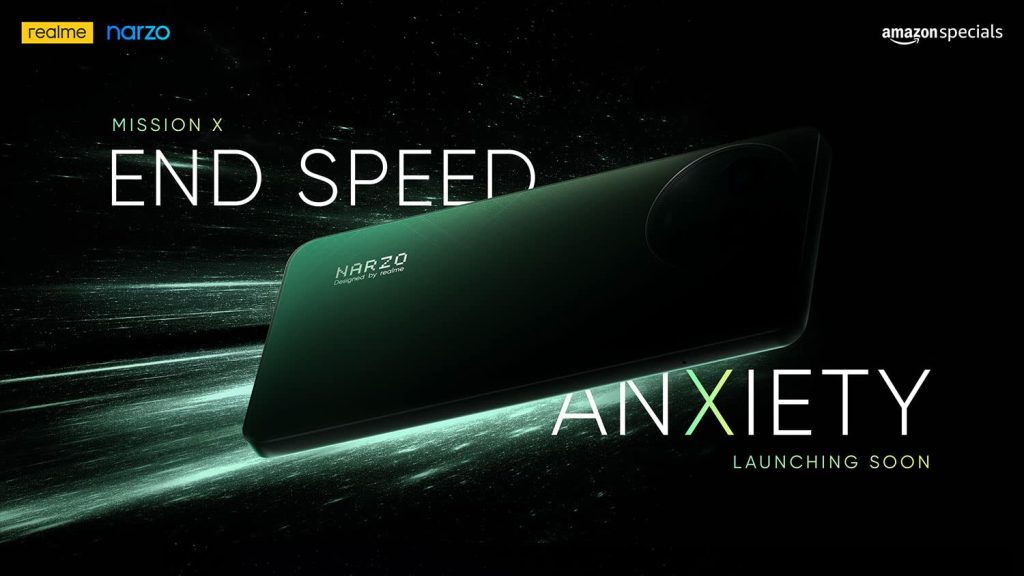
Realme has officially announced the launch date of the Realme C51 in India as Sept. 4. Additionally, a fresh teaser from the company indicates the imminent release of a new smartphone under the Narzo brand. The microsite for this upcoming phone is now live on Amazon, confirming that it will be selling the device once announced.
Realme Narzo 60x could be launching in September
Realme Narzo 60x teaser
Rumors have claimed that the next Narzo phone will be called the Narzo 60x when it arrives on the market. However, there is no official confirmation of the name of the device. The sub-brand has so far launched the Narzo 60 and Narzo 60 Pro smartphones. Hence, it appears that the brand could be teasing a Narzo 60-series phone. In addition, the use of the letter “X” in the teasers suggests that the device could indeed be called the Narzo 60x.
With the August month almost coming to an end, it appears that the Narzo 60x could be launched in September. There is a possibility that it could be a rebranded version of the Realme 11x 5G, which is available for purchase through Flipkart in India. Here is a look at the specifications of the Realme 11x 5G.
Realme 11x 5G specifications
The Realme 11x has a 6.74-inch IPS LCD display that offers Full HD+ resolution and a 120Hz refresh rate. It has an 8-megapixel front camera and a 64-megapixel (main, with OIS) + 2-megapixel (depth) dual-camera system. The device runs Realme UI 4.0-based Android 13 and has a side-mounted fingerprint scanner.
The Realme 11x has the Dimensity 6100 Plus chipset. It has 6 GB / 8 GB of RAM and 128 GB of storage. The phone packs a 5,000mAh battery with 33W fast charging. it has a starting price of Rs 14,999 (~$181).
The CEO of Amazon is apparently against the concept of remote working. A new report has found that the executive believes that remote employees should come back to the office since working from home is “probably not going to work out”.
Amazon CEO pushes back against remote working
According to an Insider report, Amazon CEO Andy Jassy said, “It’s not going to work out for you,” which was directed toward its remote employees. The statement was made during a meeting call earlier this month. For those unaware, the e-commerce giant has ordered its employees to return to the office for three days per week starting in May. However, many were unhappy with this decision and thousands of workers signed a petition against this rule.
But despite the protest and staged walkouts, Amazon’s view on this matter hasn’t changed. Jassy told employees, “It’s past the time to disagree and commit,” he further added that “if you can’t disagree and commit… it’s probably not going to work out for you at Amazon because we are going back to the office at least three days a week.”
The report adds that Jassy’s decision was more of a “judgement call” and the employees that won’t comply can leave if they want to. Jassy stated that “It’s not right for all of our teammates to be in three days a week and for people to refuse to do so”. Reports have suggested that Amazon is cracking down on employees who are refusing to return to the office, forcing a “voluntary resignation” on them.
Earlier this week, Realme introduced the Realme Buds T300 earbuds in China and Indonesia, with notable features like active noise cancellation and 360-degree spatial audio. It seems that the brand is gearing up for a broader global release, as they have secured essential regional certifications.
The Realme Buds T300 has received certifications from TDRA and BIS, and it’s listed with the model number RMA2302. This signifies the approval for the Buds T300 to be launched in the UAE and India. However, it will be interesting to observe Realme’s marketing strategy in India, especially considering their recent launch of the Buds Air 5 and Buds Air 5 Pro. Both of these models offer 50dB ANC and high-end features at a price below Rs. 5,000.
For context, the Realme Buds T300 launched in China for 199 yuan ($27), which roughly translates to Rs 2,231. So it is possible that the T300 is priced below Rs. 2,500 in India.
Realme Buds T300 specs
The Realme Buds T300 comes with 12.4mm drivers for clear sound quality, accompanied by 30dB active noise cancellation. The earbuds also hold an IP55 rating for protection against dust and water. These earbuds utilize four microphones to cancel environmental noise during calls.
The T300 offers a premium feature called 360-degree spatial audio. They use Bluetooth 5.3, offer a low latency mode, and deliver an impressive 40-hour battery life. Additionally, a quick 10-minute charge provides 7 hours of playback time.
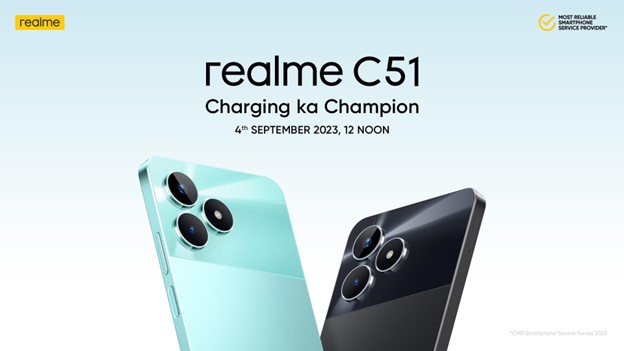
Realme is all set to welcome a new member i.e. the Realme C51 to its “Champion” C series in India. The smartphone is already available in Taiwan, Indonesia, and some other countries. The mid-range smartphone will be unveiled on September 4, 2023 at 12 Noon. The digital launch will take place via Realme’s Social media platforms.
The smartphone ships with a 6.7-inch IPS LCD display with HD+ resolution and 90Hz refresh rate. it offers 560 nits of peak brightness. Realme C51 comes powered with UNISOC T612 Octa-Core 12nm processor and Mali-G57 GPU. It is available with 4GB LPDDR4X RAM, 64GB storage, and 2TB expandable storage support via a microSD card.
The dual-SIM smartphone with a dedicated microSD slot supports nano SIM in both slots. In the camera department, the Realme C51 bundles a 50MP rear camera with f/1.8 aperture and a depth sensor along with an LED flash. There’s a 5MP front camera with f/2.0 aperture.
Realme C51 houses a side fingerprint sensor and a 5000 mAh battery with 33W SueprVOOC fast charging. There’s support for a 3.5mm audio jack, 4G LTE, WiFi (2.4GHz + GHz), Bluetooth 5.0, GPS+ GLONASS, and USB Type-C in the smartphone’s connectivity.
The smartphone is launched in Mint Green and Carbon Black color. It is retailing for NT$ 3,990 (Rs 10,430 aka USD 127) in Taiwan for a 4GB + 64GB storage variant. We expect a similar pricing for its India launch.
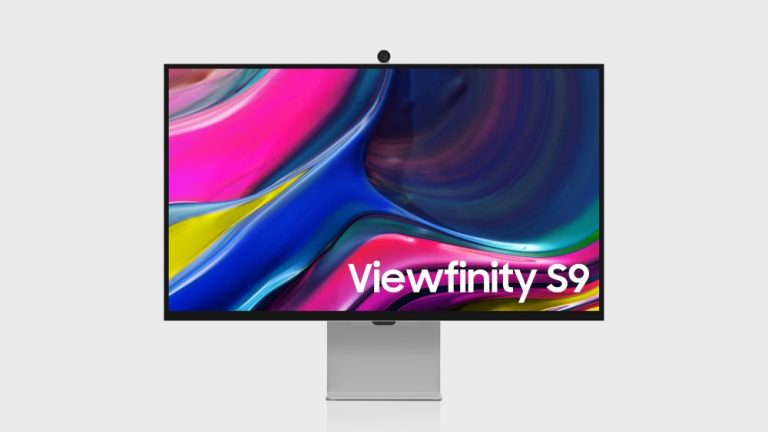
Samsung’s new ViewFinity S9 5K Display is now available in the United States. The monitor was first unveiled at CES this year, and it went up for pre-order on Amazon last week. The monitor is now finally officially available for purchase in the US. Here are the specifications, price, and availability of the Samsung ViewFinity S9 5K Monitor.
Samsung ViewFinity S9 5K Specs and Price
The Samsung ViewFinity S9 is a 27-inch 5K monitor designed for creative professionals. It has a high resolution of 5,120 x 2,880, a wide color gamut of 99% DCI P3, and an average Delta E ≦21 color accuracy, making it ideal for editing photos and videos.
The monitor also features a built-in Color Calibration Engine and the Samsung Smart Calibration application, which allow users to fine-tune the color and brightness settings for even more accurate color reproduction. The matte display minimizes reflections and glare, providing a comfortable viewing experience.
As for the connectivity options, the ViewFinity S9 is equipped with USB Type-C, Thunderbolt 4 ports, and a Mini DisplayPort. It can output up to 90 watts of power to devices connected to the Thunderbolt 4 port.
The monitor also has a removable 4K SlimFit webcam with tilt adjustments and Auto Framing, which keeps subjects in the center of the shot even when they move around. It also has built-in speakers with Adaptive Sound+, which automatically adjusts the sound output based on the ambient noise level.
Moreover, the monitor is preloaded with built-in Smart TV apps and a remote control, so you can use it as a TV even without connecting it to a computer. This means you can watch streaming apps, play games, and do other things without having to switch devices.
Samsung’s new ViewFinity S9 5K Display is now available for purchase in the United States from Samsung.com or Amazon. The price is $1,599.99.
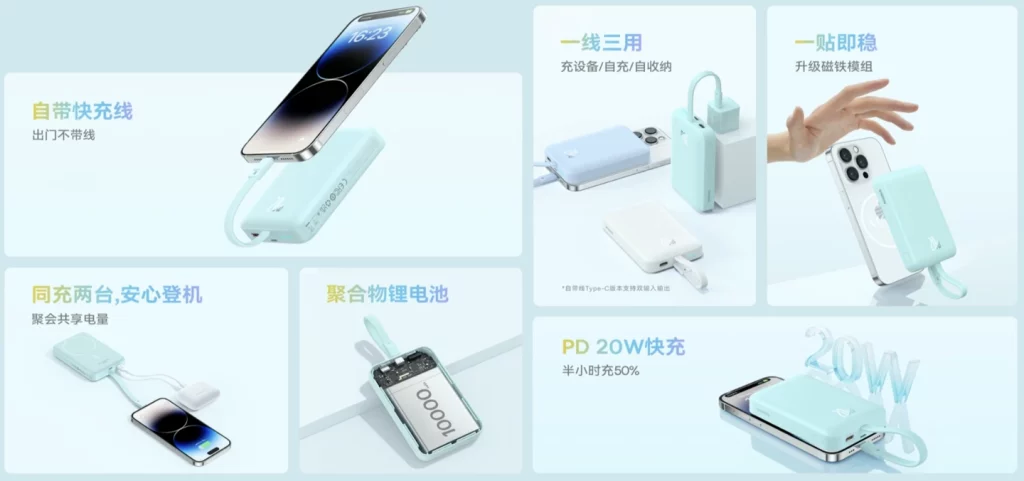
Baseus is a popular electronic accessory maker from China, with a decent presence in the global market. Recently, the brand launched an interesting pair of semi-in-ear earbuds as well as a transparent GaN5 folding charger. Now, Baseus has launched a new power bank in China with a built-in cable, a 10000mAh battery, and wireless charging support. It supports magnetic attraction and can be directly attached to the back of a phone. Here are the details.
The new Baseus power bank is advertised as a wireless charging power bank with a built-in cable (which is rather ironic). The power bank has a 10,000mAh battery and supports 20W two-way fast charging. The built-in cable is available in USB-C and Lightning versions. The USB-C version of the cable supports two-way fast charging, so you can charge the power bank directly with the built-in cable.
Although the power bank is named “wireless charging,” the release page does not mention its wireless charging power. It only mentions that the power bank supports magnetic attraction. Similar to the Apple MagSafe charger, it can be directly attached to the back of a phone. The 20W fast charging can charge an iPhone to 50% in half an hour. The power bank can charge two devices at the same time.
The new Baseus wireless charging power bank comes with a price tag of 179 Yuan ($24) in China. It is already up for purchase in the country, however, the power bank is not yet available in the global market. We are not sure if it will ever make it out of China.
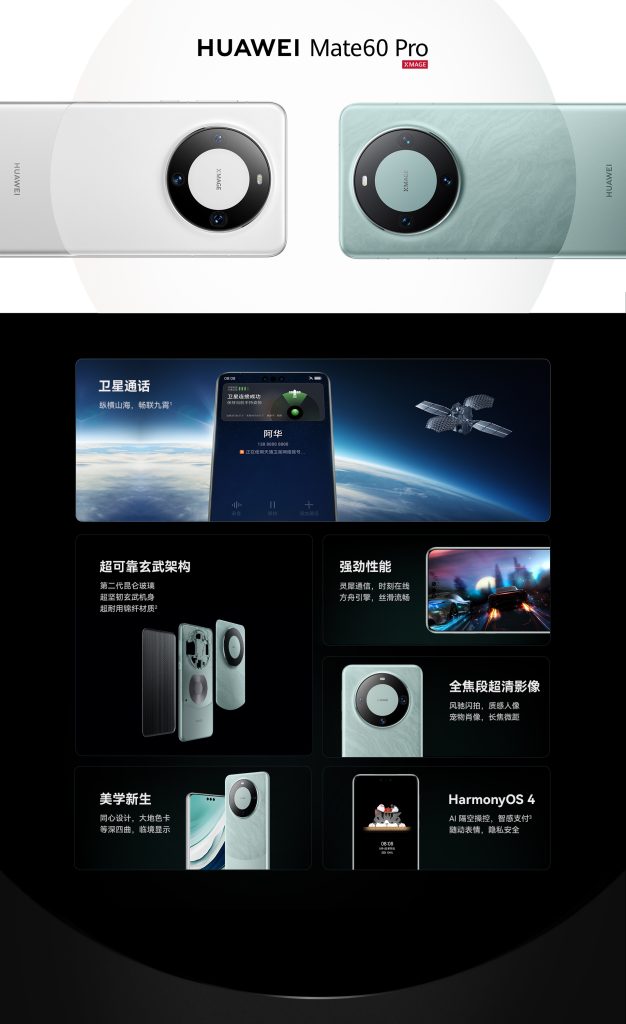
After numerous leaks and rumors, Huawei silently launched the Huawei Mate 60 Pro Smartphone in China. The smartphone bundles high-end features and a circular camera module on the rear side. The 12GB+ 512GB storage variant is retailing via Huawei’s Vmall in China for 6999 Yuan which roughly translates to $960. Huawei Mate 60 Pro is available in four different color options Green, Sivler, Purple, and Black.
Update: Huawei Mate 60 Pro unboxing and first impression:
Huawei Mate 60 Pro unboxing review
Huawei Mate 60 Pro Specifications
The smartphone bundles some exciting features and specifications consisting of a 6.82-inch Full HD+ OLED LTPO display with 1-120Hz adaptive refresh rate and 1440Hz PWM dimming. It is well-protected with Huawei’s “unbreakable” Kunlun glass.
Huawei Mate 60 Pro houses a triple-rear camera module featuring a 50MP primary sensor with OIS capability, a 12MP ultrawide sensor, and a 48MP telephoto OIS lens that supports 3.5x Optical zoom and 100x digital zoom. The rear camera supports variable aperture. The XMAGE camera system supports Super Night Mode, Super Macro, Macro PiP, Pro Mode, Slow Motion, Multi Camera, and AI photography mode. Further, it includes a 4D predictive focus tracking, so that images don’t get blurred, and several other modes. On the front, there’s a 13MP camera with HDR support for selfies and video calling.
Huawei Mate 60 Pro comes with a 5000 mAh battery that supports up to 88W fast wired charging 50W wireless charging and 20W reverse wireless charging. It features an IP68 rating, which means it will be waterproof up to a depth of 1.5 meters for 30 minutes, and is protected from dust – all without the need for extra cases or covers.
The new smartphone ships with 12GB RAM and 256GB/ 512GB /1 TB storage option. It even supports expandable storage of up to 256GB via an NM memory card.
In connectivity, the Huawei Mate 60 Pro comes with a USB 3.1 Gen 1 port, Wi-Fi 5/Wi-Fi 6, Bluetooth 5.2, NFC, Satellite Calling, and GPS. It measures 163mm x 79mm x 8.1mm and weighs 225 grams.
Apart from the compelling hardware, the smartphone features refined software aka HarmonyOS 4.0 OS including features such as 3D face recognition, AI-based camera intelligence, and some state-of-the-art photo processing software. There’s also support for AI Remote, Wireless Payments, and Always-on-Display. Huawei’s own Pangu 3.0 AI model makes the overall system more smarter and interactive.
It is Huawei’s maiden smartphone that supports satellite connectivity.
Pricing and Availability
Huawei Mate 60 Pro is now available in China via Huawei’s Vmall store. The smartphone is available in four different colors Green, Silver, Purple, and Black.
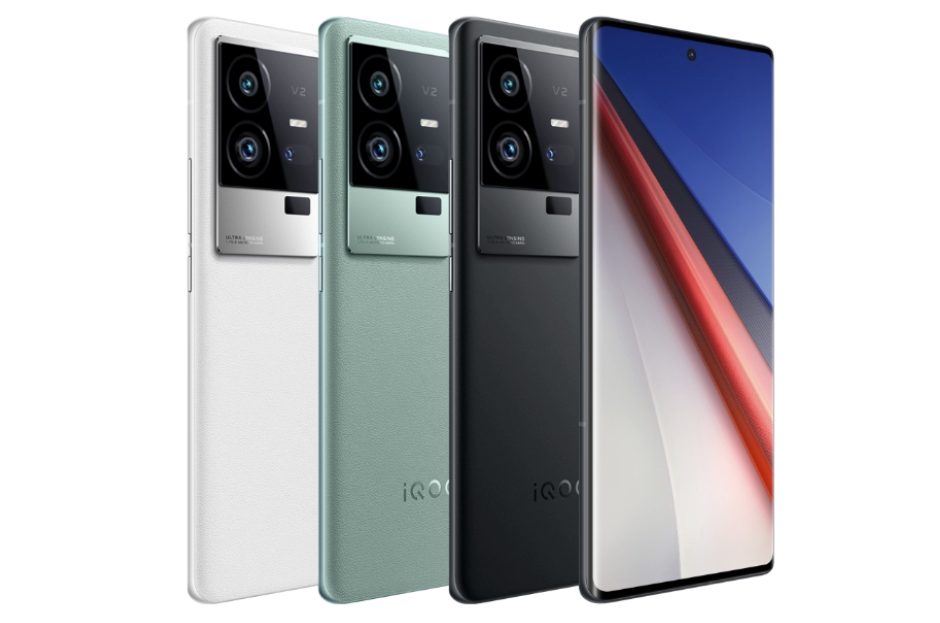
The latest trend in the realm of flagship smartphones is to incorporate a periscope telephoto camera to provide users with enhanced optical zoom capabilities. A new leak suggests that the iQOO 12 Pro could be the first phone to feature a periscope telephoto camera.
iQOO 12 Pro camera specifications (rumored)
iQOO 11 Pro
According to a leak by popular tipster Digital Chat Station, iQOO has tested the OmniVision OV64B 64-megapixel periscope zoom camera. While the tipster did not specifically mention it, the said camera could be available on the iQOO 12 Pro.
The leak suggests that the iQOO 12 Pro’s camera setup will include the OV64B periscope zoom camera and an OV50H 50-megapixel primary camera. There is a possibility that the camera setup may also inherit the ultra-wide lens from the iQOO 11 Pro, which is a 50-megapixel snapper with autofocus and a 150-degree field of view (FOV). Vivo is expected to introduce its all-new Vivo V3 imaging chip on the Vivo X100 Pro and X100 Pro+ smartphones this year. It is likely that the sub-brand iQOO may also use the V3 chip on the iQOO 12 Pro.
As far as other specifications are concerned, the iQOO 12 Pro is most likely to feature the Snapdragon 8 Gen 3 chip, which will launch in October. It is very likely that the topmost configuration of the device will have 24 GB of LPDDR5x RAM and 1 TB of UFS 4.0 storage.
The device is said to feature a 6.78-inch curved-edge AMOLED panel that offers a Quad HD+ resolution and a 144Hz refresh rate. It may support 200W fast charging and 50W wireless charging. It is expected to run on Android 14 and OriginOS 4.0.
I know, you guys have been waiting for this K60 Ultra Full review for a bit long. In this video, you’ll not only see all about the K60 Ultra, but you’ll also see who’s better compared to the OnePlus Ace 2 Pro. So let’s get right to it without further ado.
https://youtu.be/9cnFDPRlmb0
Design
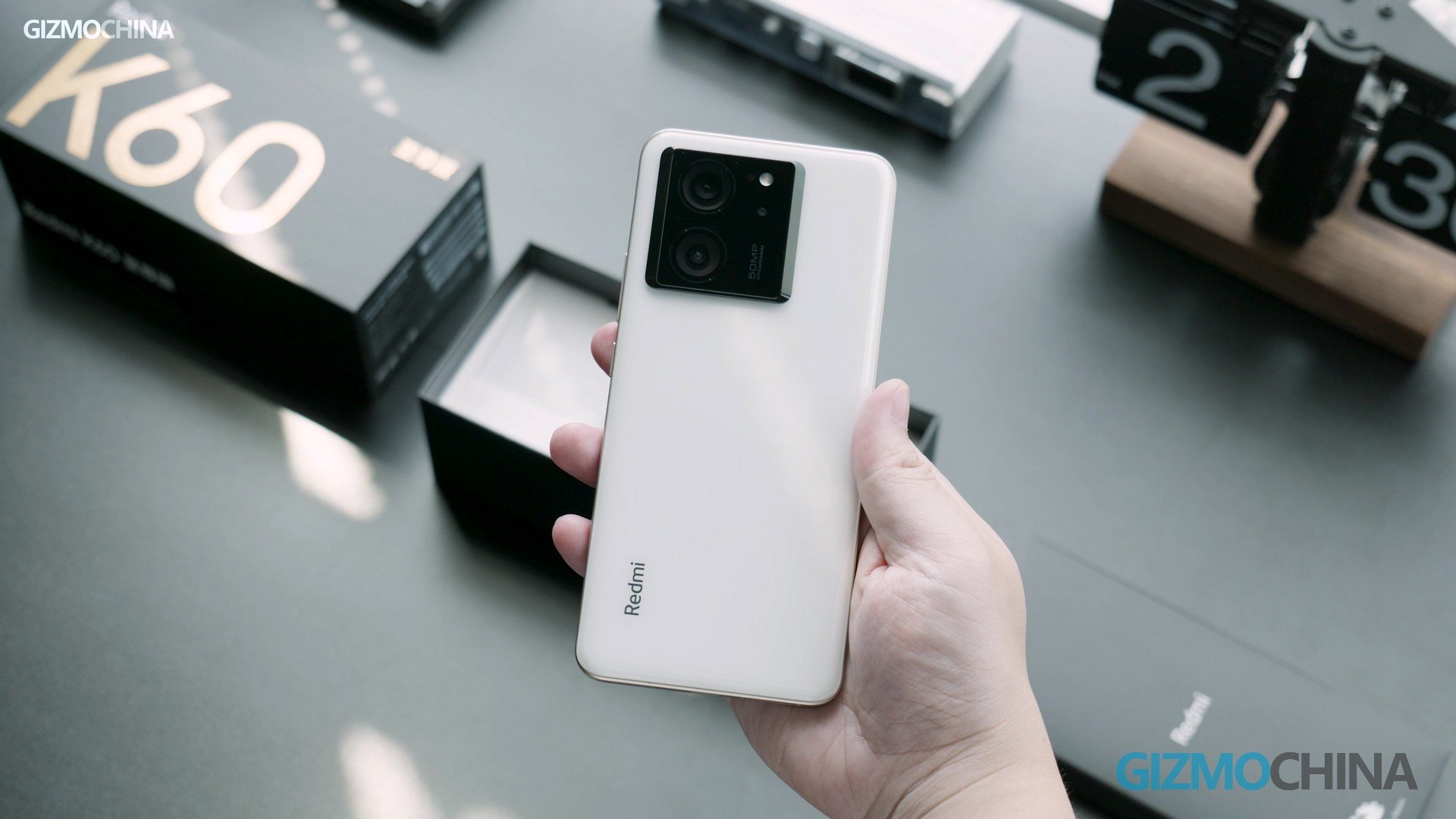
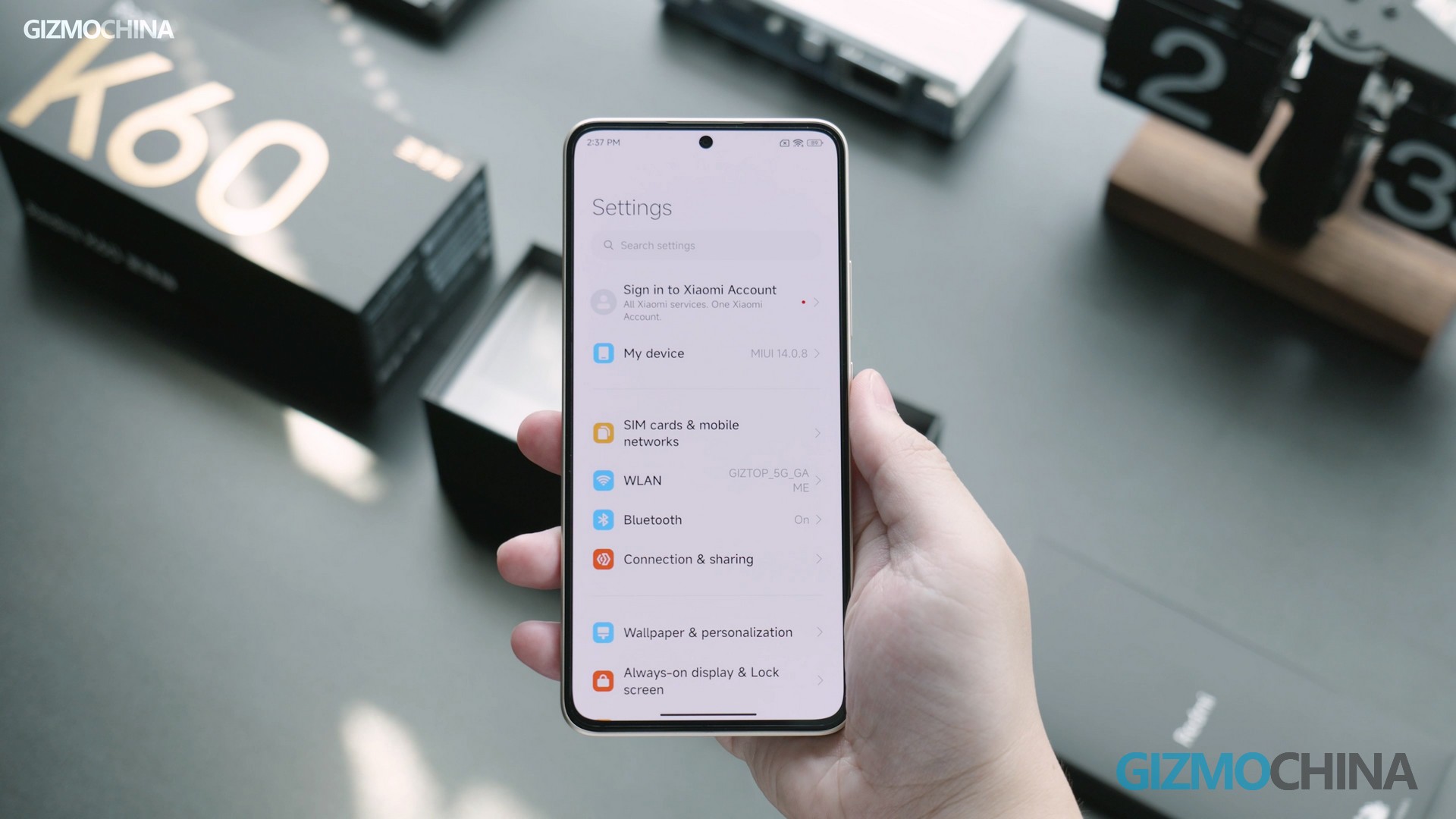
I would prefer the design of the K60 Ultra over the unchanged Ace 2 Pro. As I said in the Unboxing video, the K60 Ultra looks more premium than the Pro version. And this white back panel looks a bit like ceramic, which makes me not believe it’s a Redmi phone.
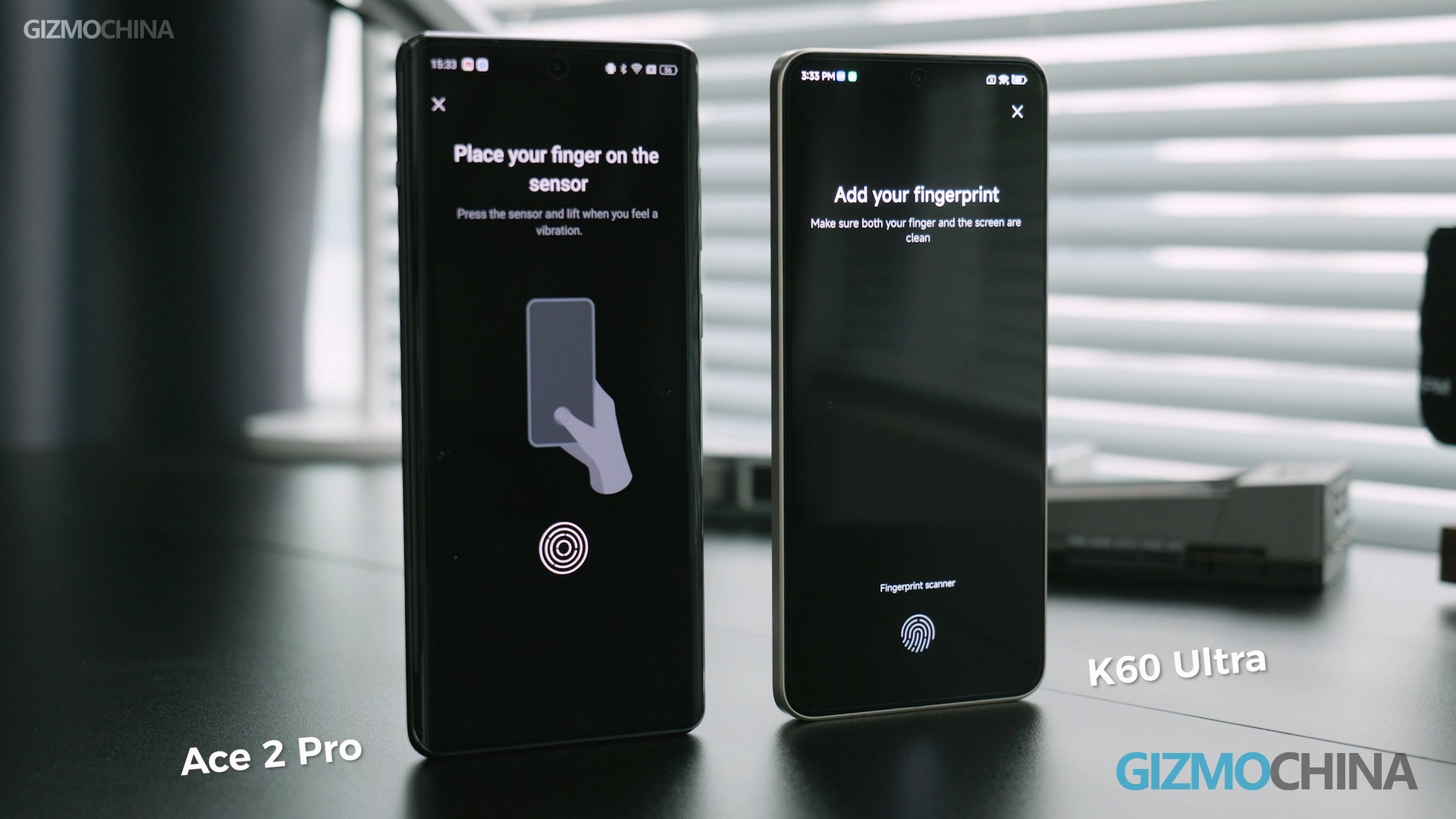
Everyone has a unique taste in design, but feature-wise, the K60 Ultra is not as good as the Ace 2 Pro. About the vibration motor and the placement of the fingerprint, the Ace 2 Pro wins effortlessly. But that’s what you deserve for paying $55 more.
Display
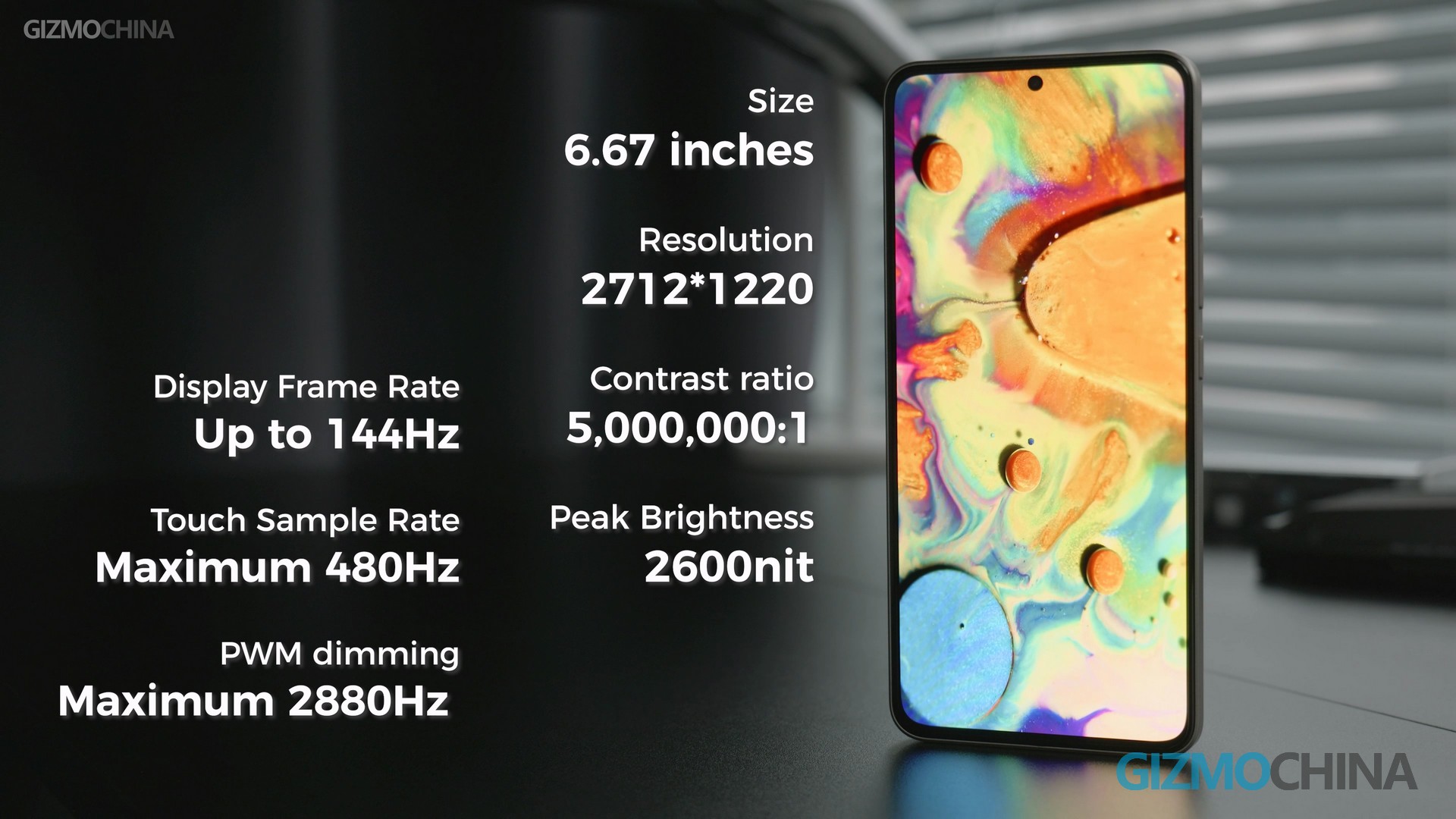
The K60 Ultra is cheap, but the screen doesn’t look like what a $360 phone should have, even the more expensive Xiaomi 13 and Ace 2 Pro can’t beat it. It’s top-notch in terms of refresh rate, peak brightness, and PWM dimming.
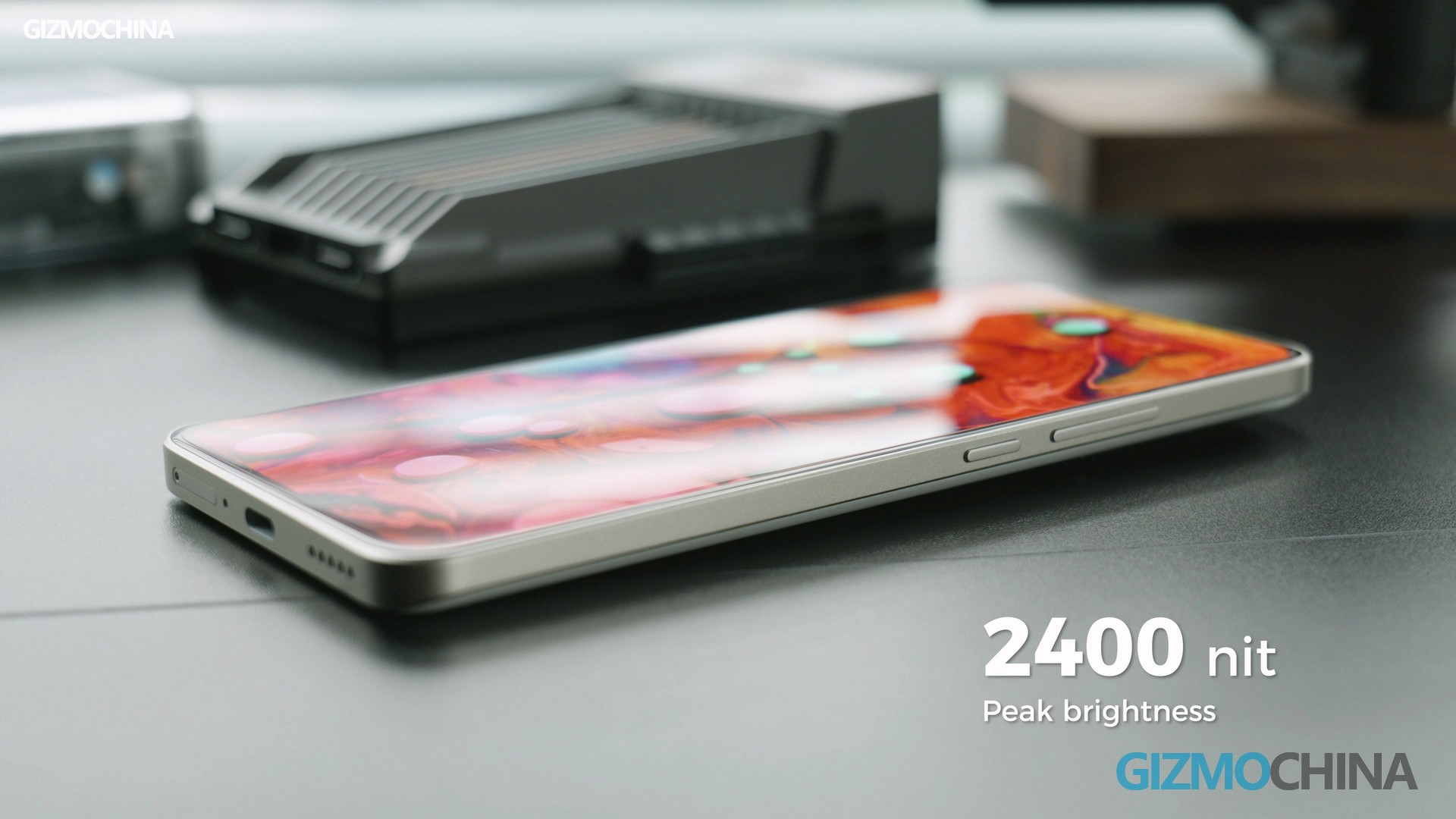
The high-frequency PWM dimming and DC can automatically switch based on brightness, this setting doesn’t need to be turned on manually. One tip about the screen brightness of the Xiaomi family: although they all have very high peak brightness if you manually adjust it to the highest, it is probably only about 500 nit, and you won’t feel that it’s as bright as it can be. It’s only when watching HDR video under the sunlight will force K60 Ultra reaches its peak at around 2400 nit, which is closer to its advertised 2600 nit.
Unlike the Ace 2 Pro, the K60 Ultra is not operatable when there’s water on the screen, but it is IP68 certified. There are no rainbow lines when you look at the phone at some angles. And most importantly, it’s a straight screen, I’ll have to admit, I prefer a straight screen a bit more.
So apart from the resolution not reaching 2K and the bezels not being narrow at all, the screen of the K60 Ultra is unbeatable.
Performance & Gaming
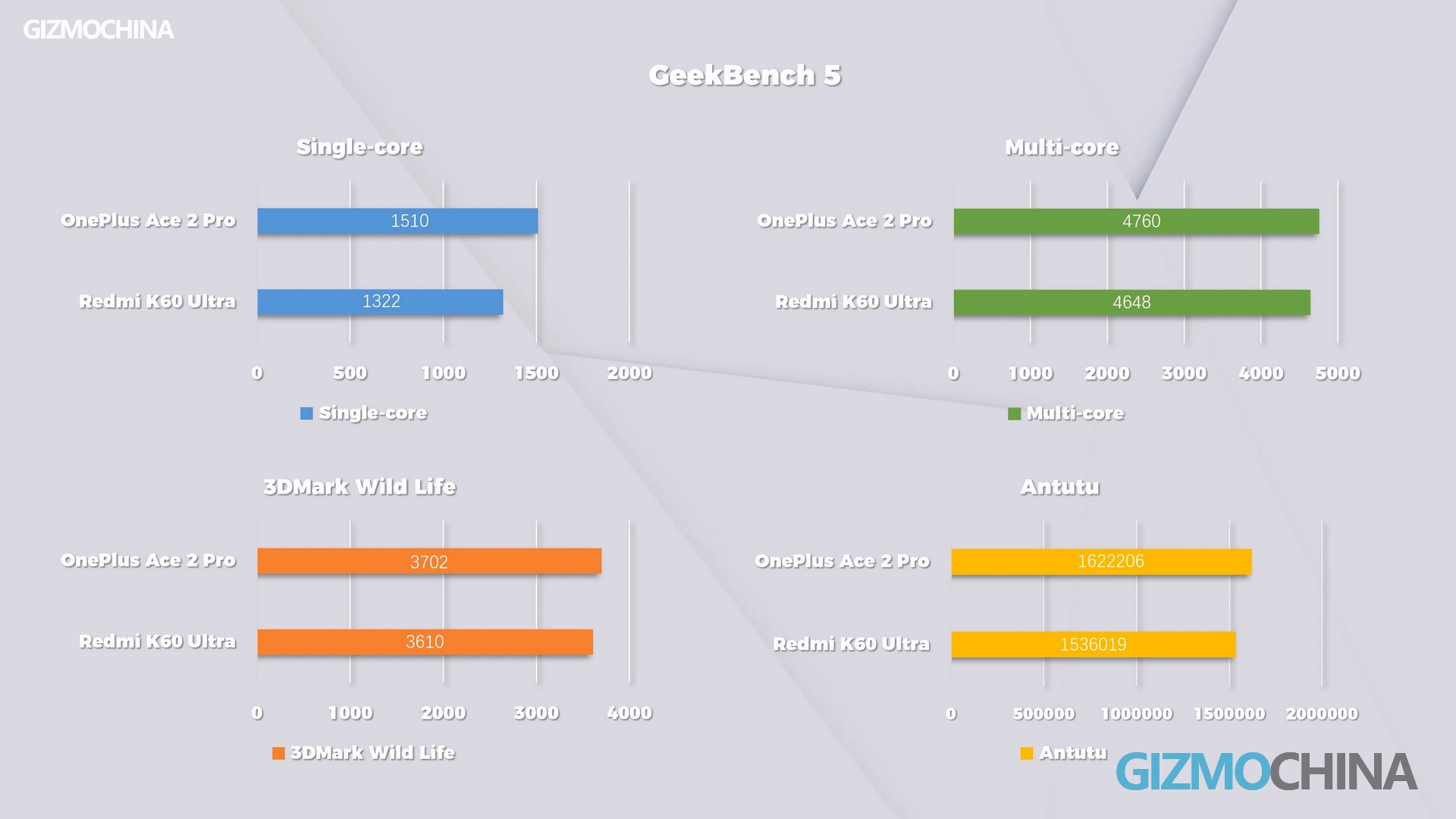
You guys must be wondering if the Dimensity 9200+ can actually beat the Snapdragon 8 Gen 2, and I’m curious too. Looking at the Benchmark, it doesn’t look like there’s much of a gap between it and the 8 Gen 2 anymore.
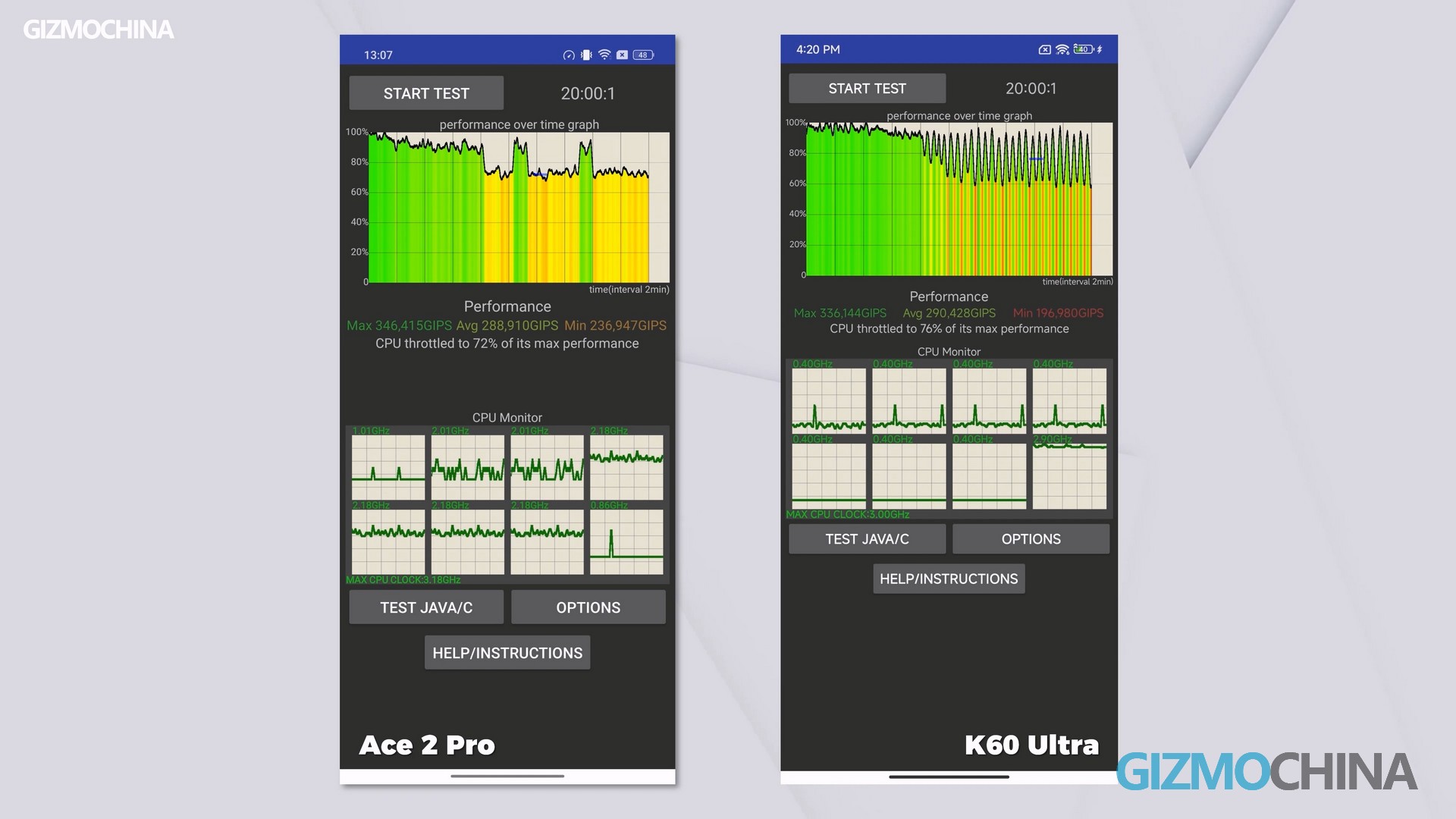
Don’t get too happy so quickly, I mean MTK’s chips are famous for peak performance, but it’s always the heat that needs to be worried about. During the stress test sessions, we can see that the K60 Ultra is trying to do its best very hard. It would love to maintain full power output, but it can’t. It’s at the same level as Ace 2 Pro.
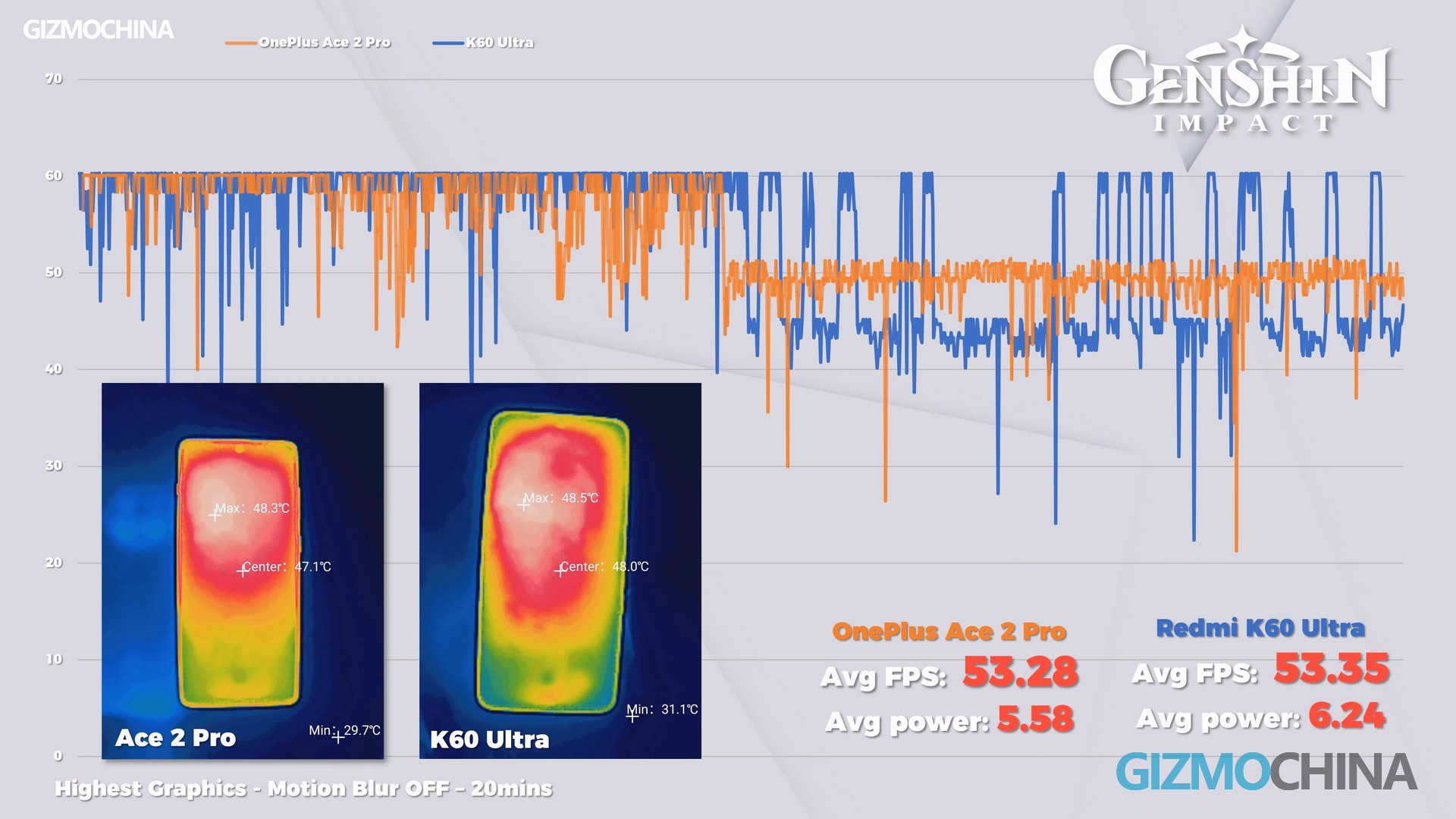
In the gaming session, the K60 Ultra performed almost the same as the stress test. After 10 minutes of playing Genshin, it tried very hard to keep the frame rate at 60fps, but it would immediately overheat and the frame rate would suddenly drop. Although the maximum resolution is a little bit higher than the Ace 2 Pro, the stability of the frame rate is more important, it seems that Redmi still doesn’t know the truth: sometimes knowing how to give up is a wise choice.
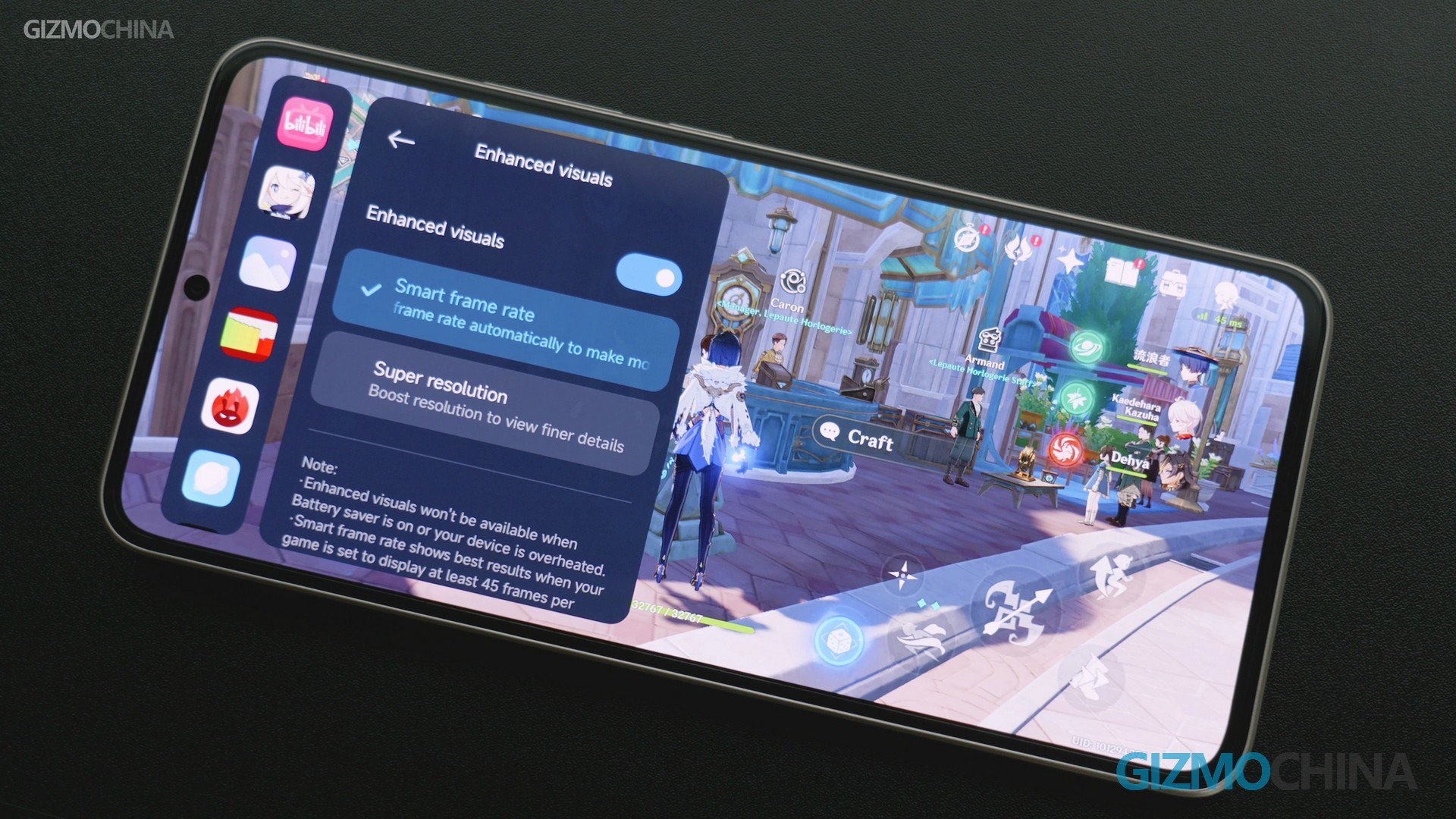
It seems like this is the first time in a whole long history that the Redmi phone comes with a frame insertion chip. Like the Ace 2 Pro, videos and some games on K60 Ultra can have the display frame rate increased, but there’s latency as well. But even if the phone has become very hot, it still enables frame interpolation for games, which is better than the Ace 2 Pro. Overall, if you’re a heavy gamer, the Ace 2 Pro will probably be better for you.
Camera
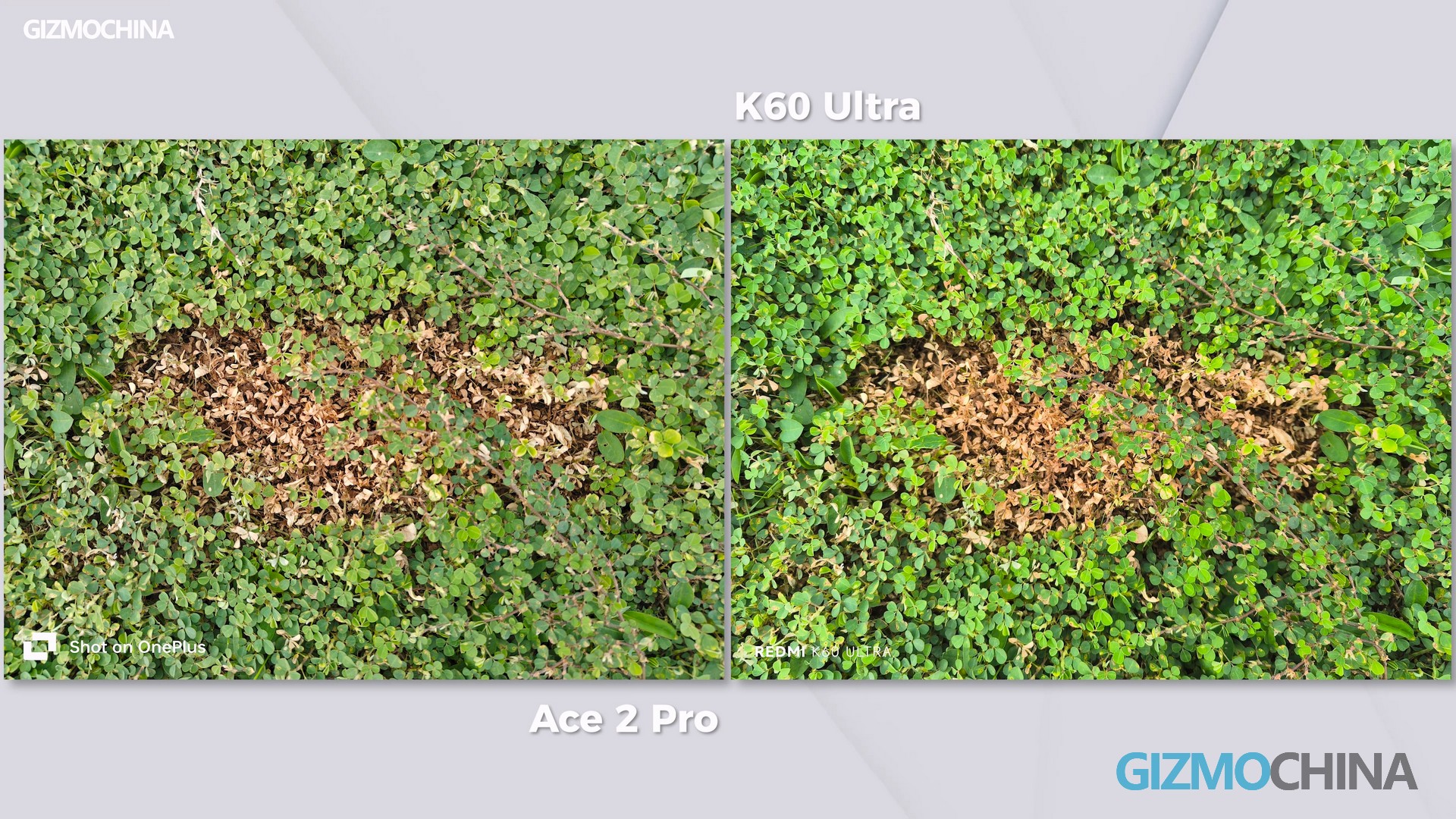
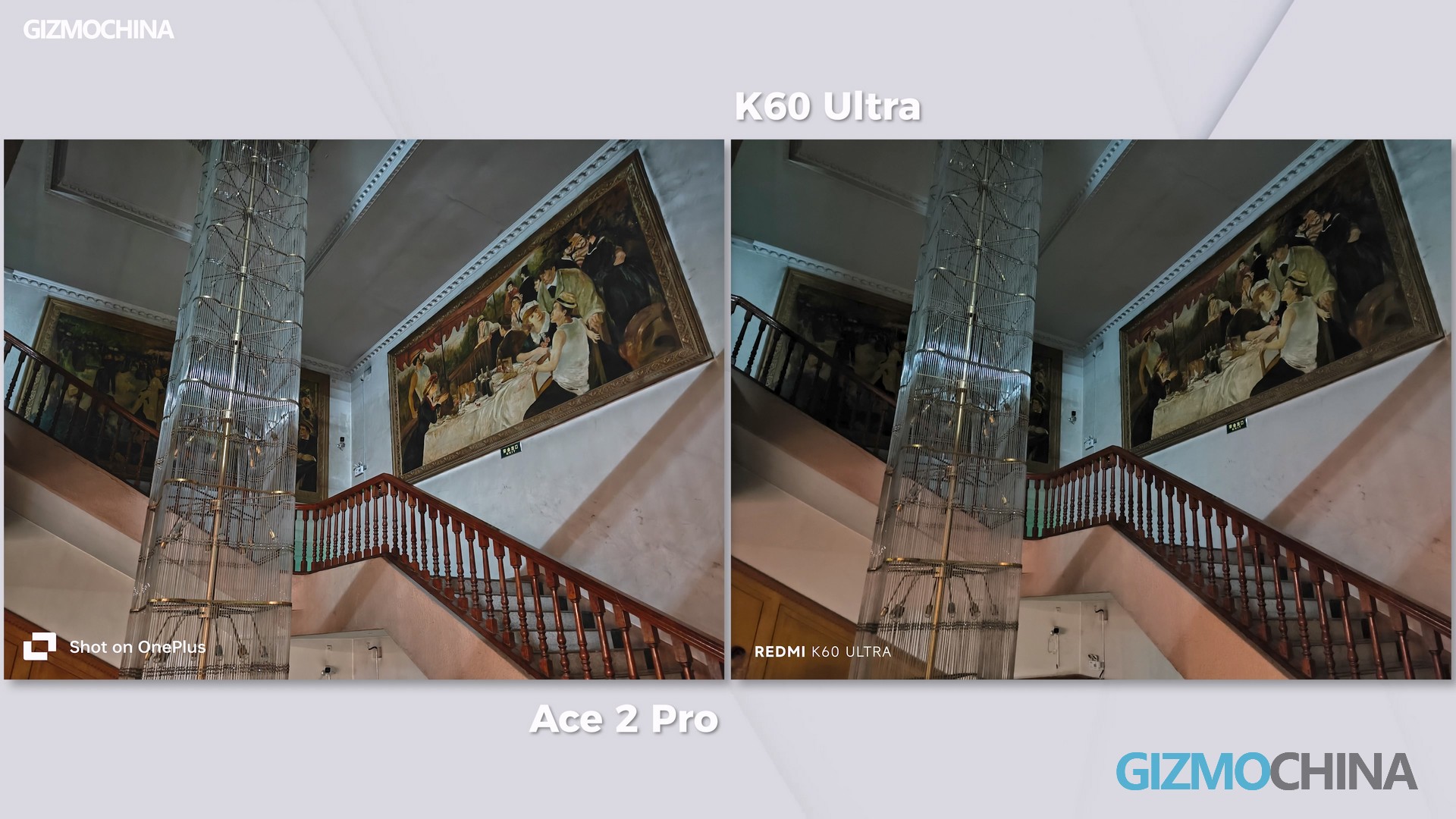
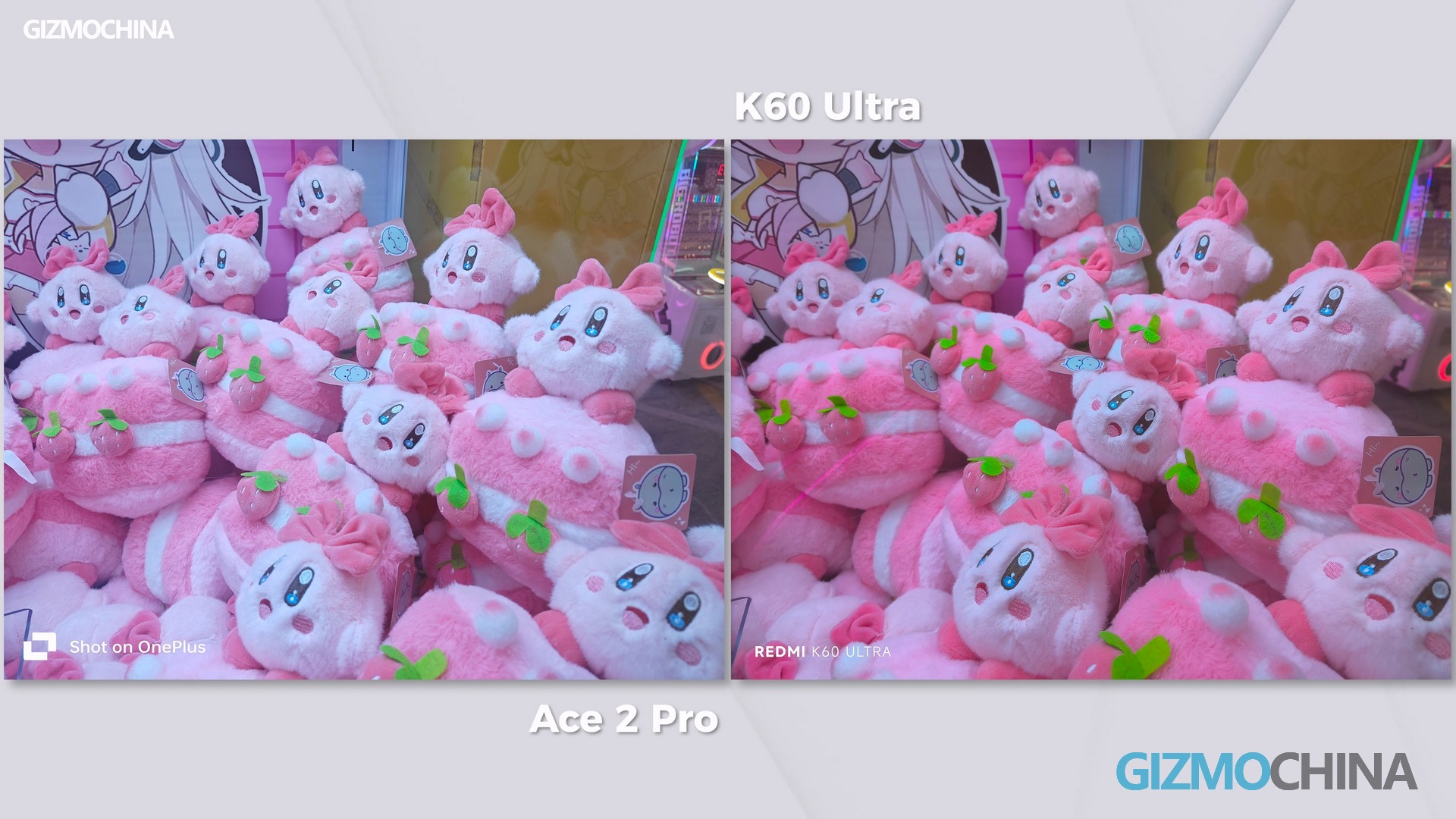
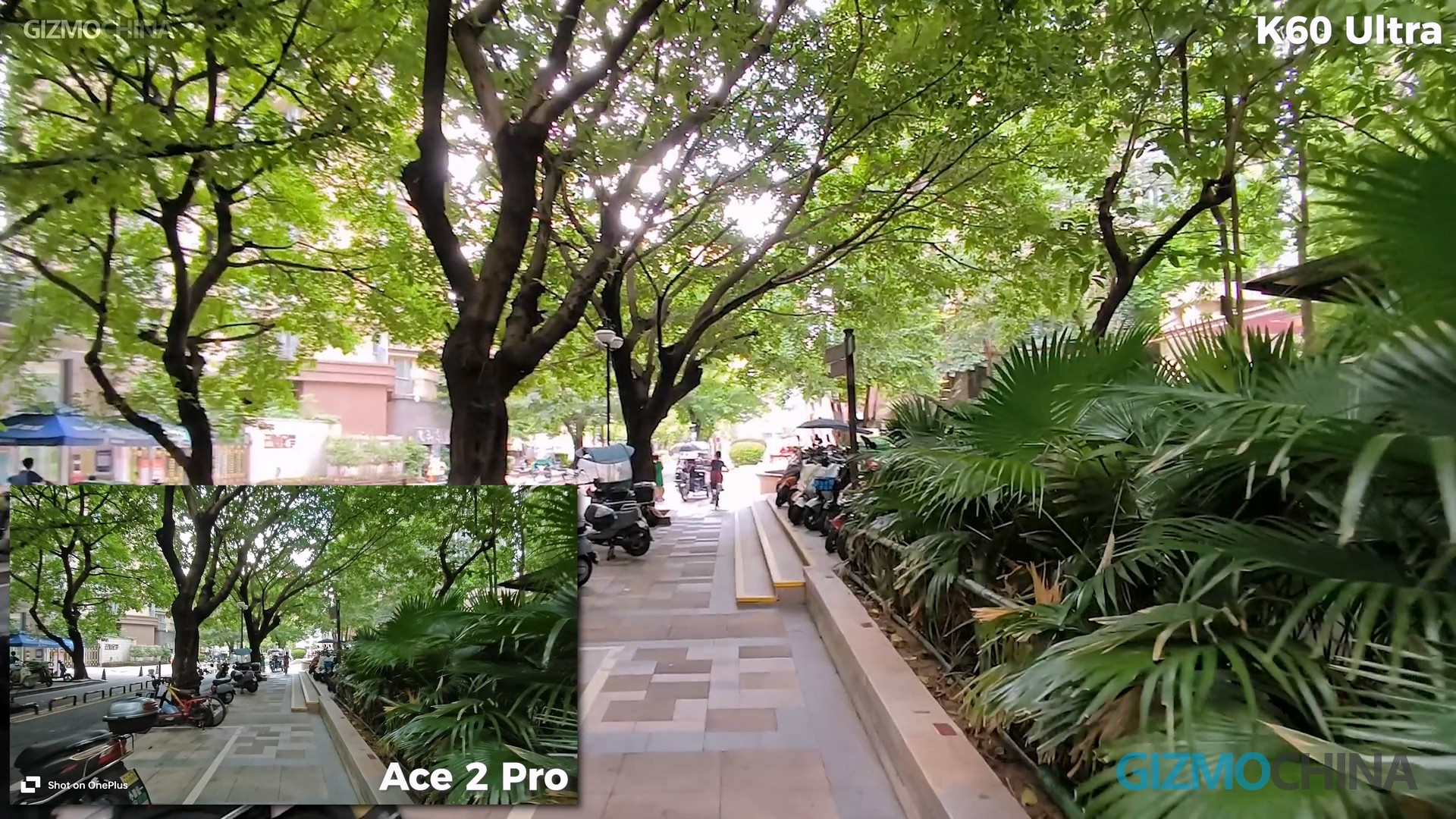
The K60 Ultra’s camera isn’t as good as Xiaomi’s flagship’s, though there’s a bit of Leica style in the color tones. Most of the time the photos have very high contrast, with dark areas being very dark and not looking as bright as the Ace 2 Pro’s photos.
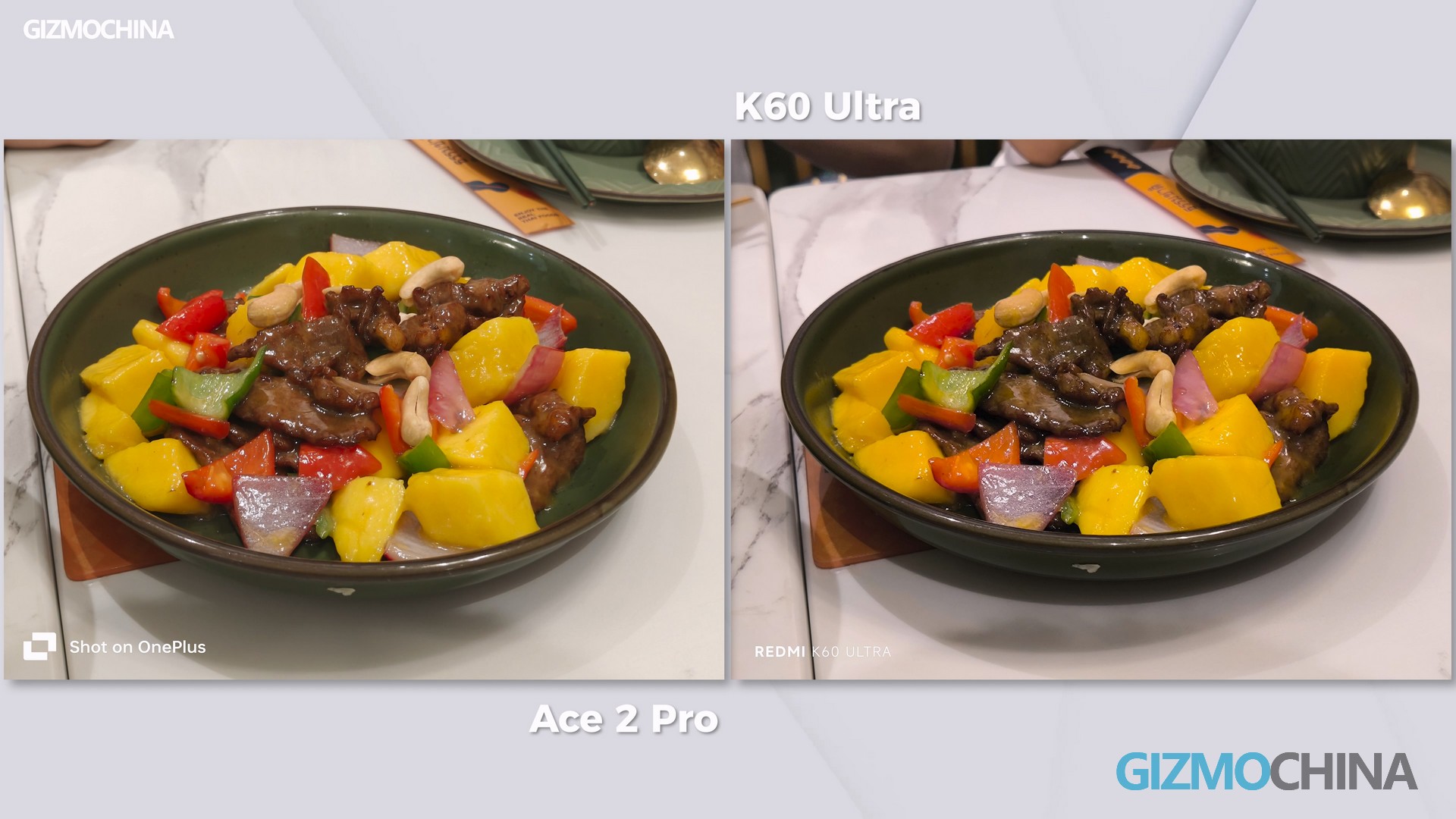
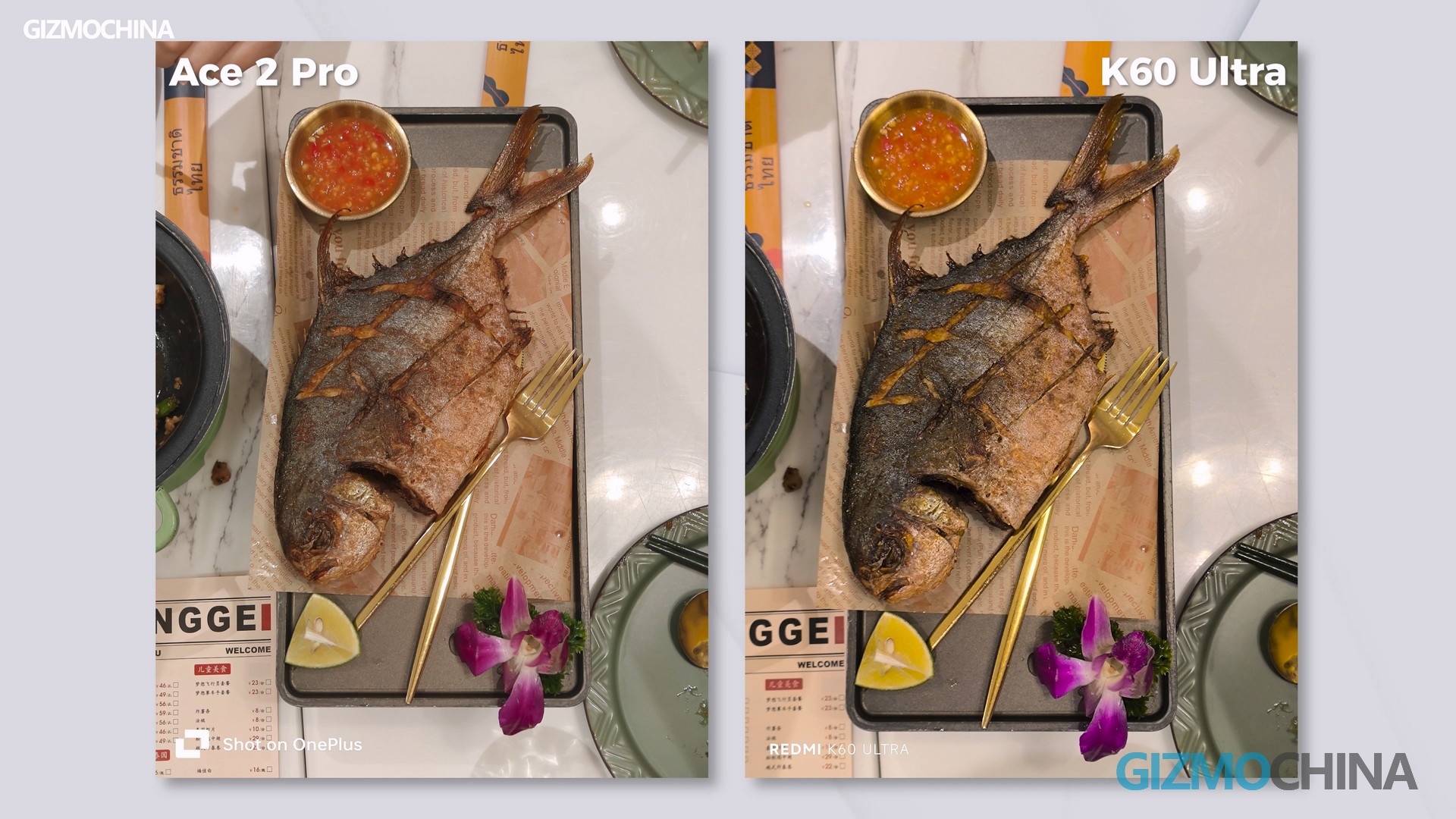
The color temperature is accurate in most scenes, like this photo of the lamp, it’s yellow and the Ace 2 Pro’s shot is white. When shooting food with Ace 2 Pro, photos look better, the ones taken by K60 Ultra look like the food is a bit burnt. Other than what I just showed you, they perform almost identically in other parts. It’s hard for me to say which one is better, it’s more of a color style difference.
The K60 Ultra supports up to 4K 60fps for the main camera and up to 1080p 30fps for the ultra-wide camera. The video quality of the main camera is about the same for both, they are quite good. The ultra wide-angle cameras on them are also similar, both are quite bad. The only difference is that the K60 Ultra’s ultra-wide camera’s purple-fringing issue is a bit more obvious.
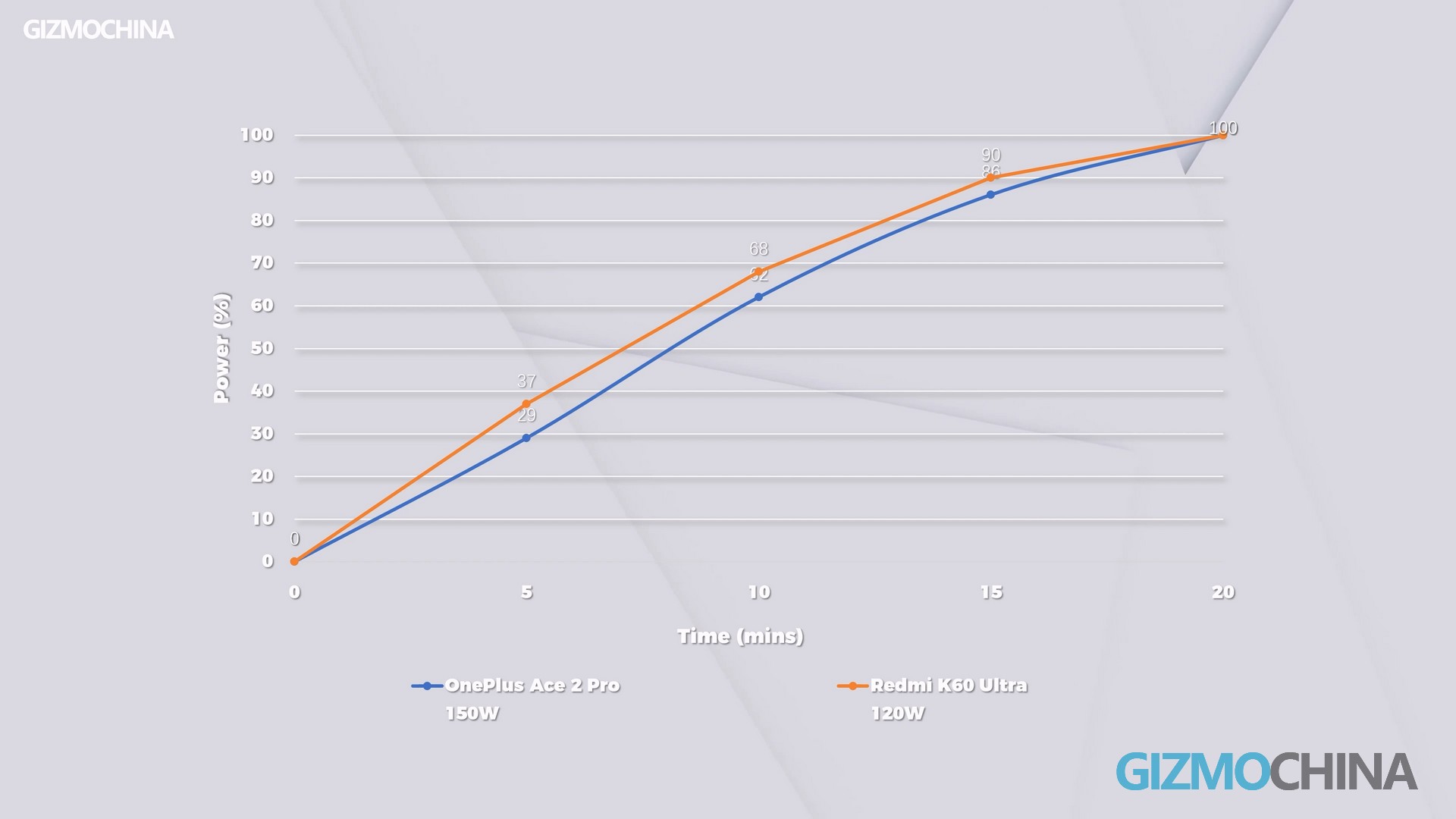
The 120W wired charging doesn’t look as good as the 150W Ace 2 Pro, but a full charge takes both of them about 20 minutes. The K60 Ultra, however, does not support wireless charging, which is not as good as the K60 Pro or the standard version.
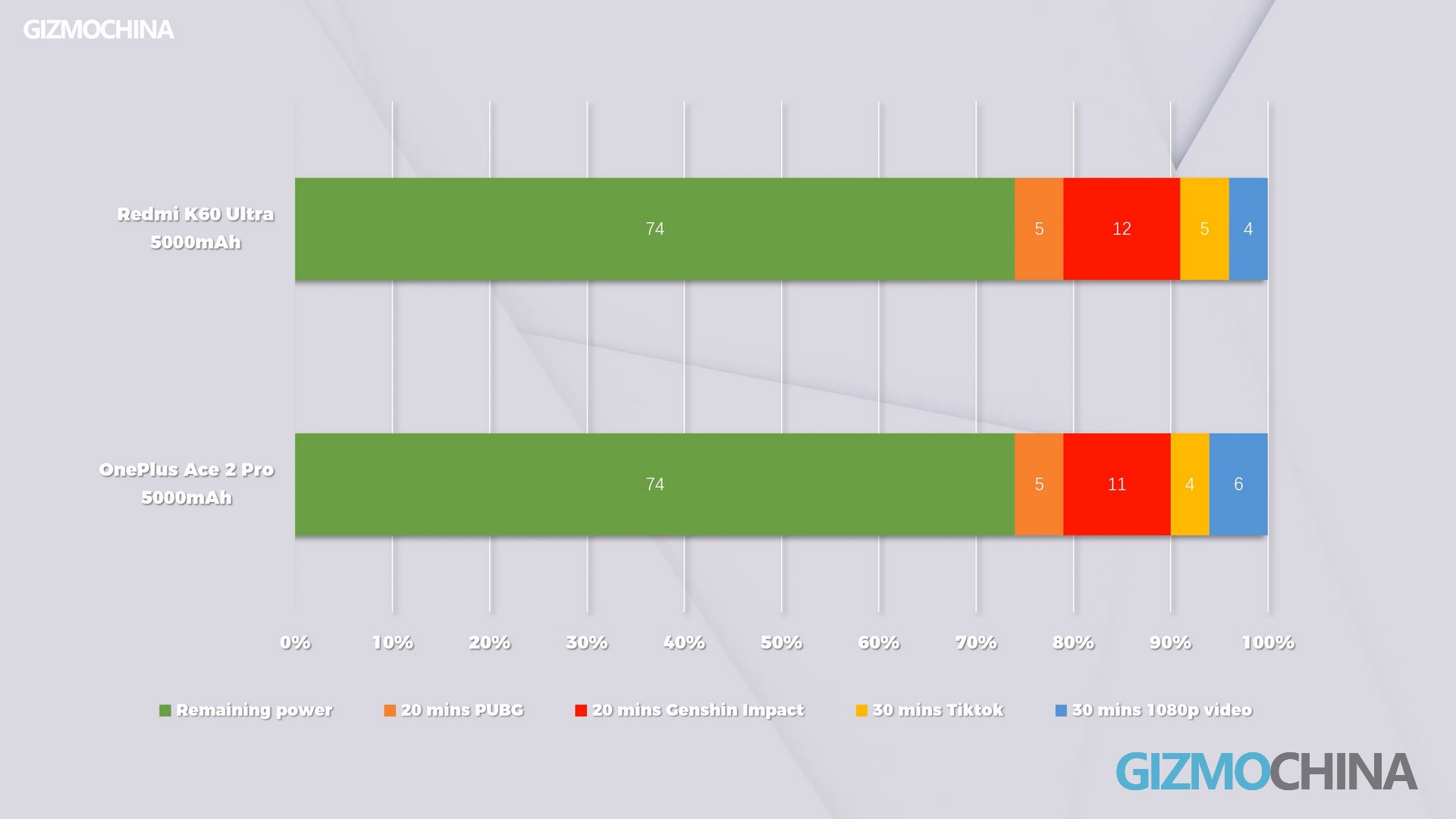
The battery capacity didn’t surprise us, but the battery life did. It’s about the same as an 8 Gen 2 phone in daily use, which is good enough for MTK.
Regarding the speakers, the Ace 2 Pro wins by having a larger soundstage. Instruments are better differentiated from each other, while the K60 Ultra is very average.
Conclusion
The K60 Ultra is cheaper, but it has a great display and isn’t that bad in other aspects. The Ace 2 Pro’s strong points are the performance and the vibration motor. Both phones are actually worth buying, it all depends on what you need. They don’t beat each other on this battlefield, they are both winners.
Realme introduced the Realme Buds Air 5 and Buds Air 5 Pro TWS earbuds to the Indian market last week. The standard Buds Air 5, equipped with 50dB ANC, is already on sale in India. Furthermore, starting from today, consumers can also buy the Realme Buds Air 5 Pro.
Realme Buds Air 5 Pro first sale
Priced at Rs. 4,999, the Buds Air 5 Pro will have a special introductory offer during its initial sale, where it will be available for just Rs. 4,499. Customers can choose between two color variants: Astral Black and Sunrise Beige. These earbuds can be purchased through various channels, including realme.com, Amazon.in, Flipkart, and physical retail stores.
Realme Buds Air 5 Pro specs
The Realme Buds Air 5 Pro features an 11mm bass driver and 6mm tweeter, delivering excellent audio quality. They include 50dB active noise cancellation and environmental noise cancellation with three microphones on each earpiece for clear calls. They also support Spatial audio and the LDAC codec for superior audio.
In terms of battery life, they offer a total of 40 hours with the case and earbuds combined. Each earbud can last up to 10 hours without ANC and up to 7 hours with ANC. They provide a quick 10-minute charge for 7 hours of playback and have a low latency of 40ms. They are IPX5 water-resistant, making them suitable for workouts and rain. The Dual-device Connection 2.0 adds versatility, making them suitable for various scenarios.
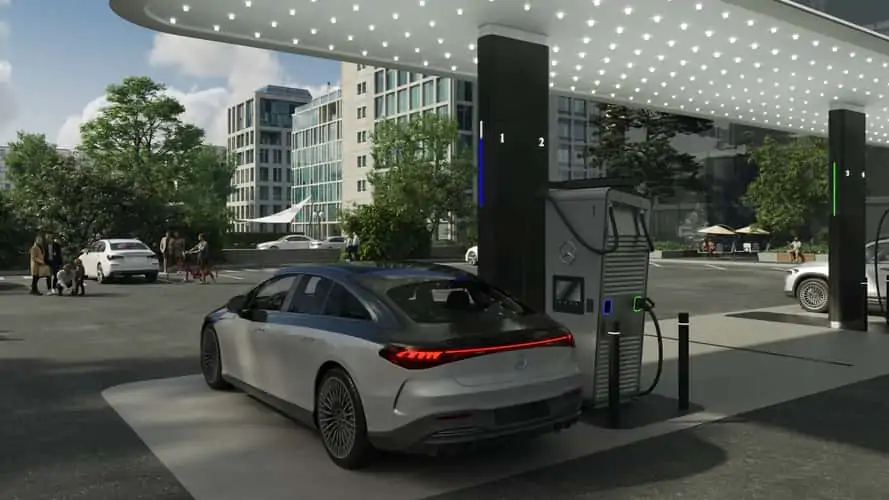
In a bid to reshape the landscape of electric vehicle (EV) charging, Mercedes-Benz is hitting the fast lane. This fall, the company is set to debut its own fast-charging stations, termed as Mercedes-Benz Charging Hubs. With the first trio coming up in Atlanta, Chengdu, and Mannheim, Mercedes-Benz is no longer just a player on the road but also a contender in the charging game.
Mercedes-Benz EV Chargers look like the Starbucks of the Charging world
While other car manufacturers are content partnering with existing networks, Mercedes-Benz aims to be the Starbucks of EV charging. Picture this: you drive into a charging hub, conveniently located near a major roadway or even a Mercedes-Benz dealership, plug in, and within minutes, your car is charged. Meanwhile, you grab a snack, maybe use the restroom, and head back on your journey. It’s convenience that goes beyond miles per charge.
Unlike most charging stations, these hubs aren’t just about juicing up your car. They’re designed as comprehensive pit-stops, offering not just chargers but amenities like refreshments and restrooms. You can even expect intelligent light poles at select locations, doubling up as LED indicators for charger availability and your vehicle’s charging status. Of course, the tech is no slouch either. The charging units will offer power outputs of up to 400 kilowatts, allowing rapid charging for all kinds of electric vehicles. Plus, they’re open to all brands, although Mercedes-Benz owners can get dibs on reservations to avoid the wait.
By the end of 2030, Mercedes-Benz plans to set up more than 10,000 such points, mainly focused on North America, Europe, and China. And here’s the cherry on top: all the electricity used will be 100% renewable. Mercedes-Benz isn’t ditching its other partnerships. It’s still aligned with Ionity in Europe and is part of a joint venture with six other manufacturers in North America. But with its solo venture, the company is offering something far more audacious: turning the mundane act of charging into a premium, highly convenient experience.
It seems Mercedes-Benz is not just electrifying cars, but also the very experience of owning one.
This Tuesday, Google is setting a new standard for sustainability tech with its freshly minted suite of environmental APIs. Unveiled at the Google Cloud Next event, these APIs are about to be a game-changer for businesses and local governments, making it easier than ever to adapt to the increasing demands of climate change.
The interest in rooftop solar panels increased by 60% last year, which is impressive
Building upon its 2015 Project Sunroof, Google is introducing the Solar API that modernizes the solar evaluation process. The API covers a whopping 320 million buildings in 40 countries, making the task of evaluating a property’s solar energy potential practically a breeze. Google’s VP of Geo Sustainability, Yael Maguire, highlighted that interest in rooftop solar panels jumped by 60% last year alone, showcasing the growing market need for streamlined solar solutions.
But Google isn’t stopping at solar. Recognizing the immense public health value, Google is also launching an Air Quality API, which proved instrumental during California’s 2021 wildfires. This new API will analyze multiple data sources, from meteorological sensors to traffic conditions, offering precise air quality insights for over 100 countries.
And let’s not forget about the Pollen API, an upgraded version of its existing Maps layer. Given the increase in temperature and greenhouse gas emissions, more pollen-producing plants are popping up around the world. This API aims to make daily life easier for people suffering from seasonal allergies by providing detailed allergen information and heatmaps.
These APIs represent Google’s commitment to reduce a gigaton of carbon equivalent emissions by 2030. According to Maguire, the new tools are poised to give “individuals, cities, and partners” the information they need to make greener choices. Starting August 29, developers can integrate these APIs into their services, giving them the power to be part of a larger environmental change.
So, here’s the takeaway: Google is taking real-time environmental data mainstream, giving us the tools to tackle climate change one API at a time. And if you’re a developer, you’ve got a unique opportunity to be part of this transformative journey.
Hyundai Motor Group is shifting gears in its strategy for electric vehicle (EV) charging, planning to build its own high-speed DC chargers rather than relying solely on external vendors. Hyundai Kefico Corp., a subsidiary mainly focused on engine and transmission components, is on the cusp of rolling out its Blue Plug-branded chargers capable of delivering a staggering 350 kilowatts.
Hyundai is ending a year-long partnership with Daeyoung Chaevi, which operated Chargers
Initially, these in-house chargers will power the E-pit ultra-fast charging network in South Korea. Launched in April 2021, the E-pit network is still in its infancy, featuring 36 stations, a modest number when compared to Tesla’s 106 Supercharging sites in the country. One obstacle to E-pit’s expansion has been the substantial cost of procuring chargers from third-party suppliers.
Hyundai is aiming to eliminate this bottleneck by making its own chargers. Industry estimates suggest an average cost of $113,000 for an individual fast charger, a figure that Hyundai hopes to slash by controlling the entire manufacturing process. While the brand has not confirmed if these chargers will be exported, it’s clear that this move aligns Hyundai with Tesla’s successful strategy of in-house charger production.
While this pivot makes sense for Hyundai, it spells potential trouble for existing E-pit suppliers like SK Signet and EVSIS Co. It also hints at deeper shifts within the company’s electrification strategy, especially considering the recent end of a year-long partnership with Daeyoung Chaevi, which operated E-pit systems and chargers.
Ultimately, the decision to go in-house with charger production could be a game-changer for Hyundai, helping it to quickly ramp up its E-pit network and be more competitive in the EV space. With existing expertise in power electronics, Hyundai is well-equipped to venture into this territory and possibly shift the balance of power in the South Korean EV market.
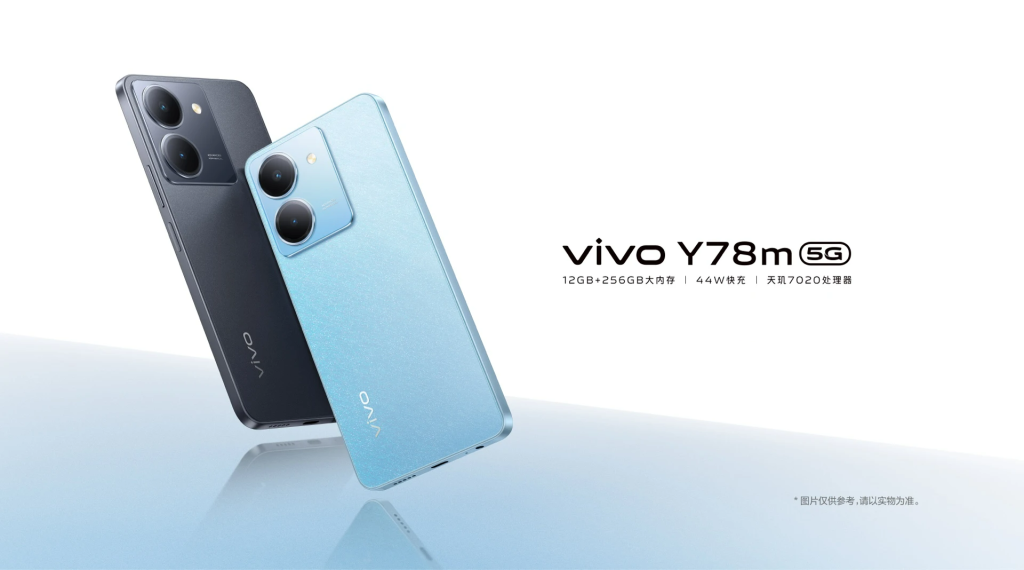
The Vivo Y78m has silently gone official in China. It is a new addition to the Y78 series, which already includes devices such as the Vivo Y78 and Y78+. The newly announced Vivo Y78m is identical to the Y78, which was announced in May this year. Both phones seem to mainly differ in color options and configurations.
Vivo Y78m specifications and features
Vivo Y78m
The Vivo Y78m houses a 6.64-inch LCD panel that offers an FHD+ resolution of 1080 x 2388 pixels, a 19.9:9 aspect ratio, a 1500:1 contrast ratio, a DCI-P3 color gamut, a 120Hz refresh rate. The brand claims that the device offers a screen-to-body ratio of 91.06 percent.
On the front, the Vivo Y78m has an 8-megapixel selfie camera. Its rear shell has a 50-megapixel main camera and a 2-megapixel portrait lens. The device runs on Android 13 and FunTouch OS 13 and is equipped with a side-facing fingerprint sensor.
Under the hood, the Vivo Y78m features the Dimensity 7020 chipset (Dimensity 930’s rebranded version). The Y78 is available in three variants: 8 GB RAM + 128 GB storage, 8 GB RAM + 256 GB storage, and 12 GB RAM + 256 GB storage. On the other hand, the all-new Y78m comes in 12 GB RAM + 256 GB storage configuration only.
The Y78 has a 5,000mAh battery with 44W fast charging support. It offers other features, such as dual SIM, 5G, Wi-Fi 6, Bluetooth 5.2, GPS, NFC, a USB-C port, and a 3.5mm audio jack.
Vivo Y78m price and availability
In China, the Vivo Y78m is priced at 1,999 Yuan (~$275) for the sole 12GB+256GB edition. It is not yet available for purchase on the Chinese market. When available, buyers will be able to choose from other color options like black and blue. In comparison, the Y78 is available in black, green, and gold.
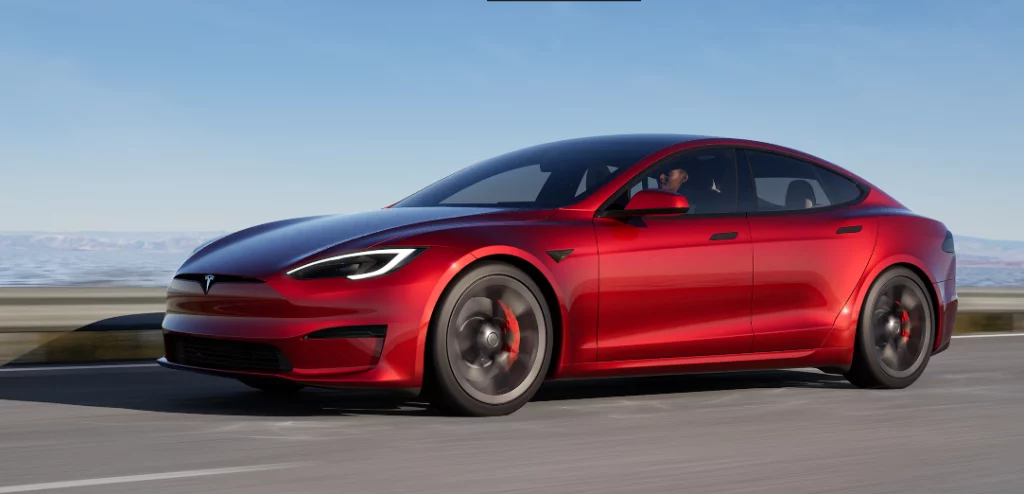
Tesla finds itself in legal hot water with two upcoming trials that raise questions regarding the safety of its Autopilot system in fatal accidents. The cases could have ripple effects on public trust in self-driving technologies.
Tesla’s full driving and self driving technologies have a lot of gray areas that need to be addressed
The first lawsuit will unfurl this September in California. It centers around the tragic loss of Micah Lee, whose Tesla Model 3 veered off a highway, collided with a palm tree, and caught fire. The plaintiffs, which include injured passengers and Lee’s estate, argue that Tesla knew about Autopilot’s flaws but didn’t address them.
Tesla counters that Lee had been drinking and it’s uncertain if Autopilot was engaged during the accident in 2019.
A second case in Florida next October adds fuel to the fire. It involves another fatal accident where Stephen Banner’s Model 3 went under a truck’s trailer, tearing off the car’s roof. The claimants assert that Autopilot failed to take evasive action. Internal documents suggest that Elon Musk and his team were aware of Autopilot’s issues but did not rectify them. Tesla has continually defended its technology, asserting that when supervised by humans, Autopilot is safe.
The public, however, is skeptical. Critics argue that the terminology—“Autopilot” and “Full-Self Driving” (FSD)—is misleading. Though Musk has repeatedly promised fully autonomous driving, the reality has fallen short. Tesla’s Autopilot and FSD are only Level 2 driver assistance features, not fully autonomous systems.
The upcoming trials are more than a legal obstacle for Tesla; they’re a moment of reckoning for the self-driving tech industry. While Tesla pushes forward with its FSD Version 12 software, claiming it enables autonomous driving without human input, the question remains: How safe is “safe enough” when human lives are at stake?
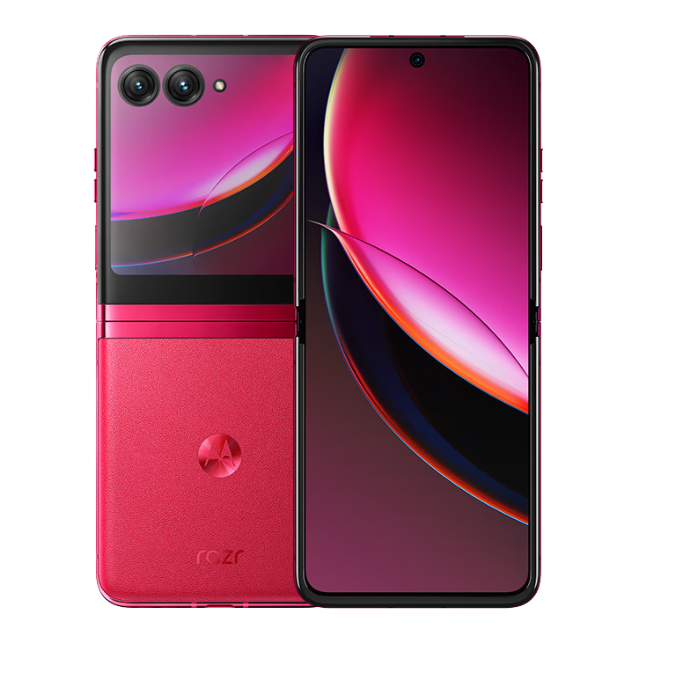
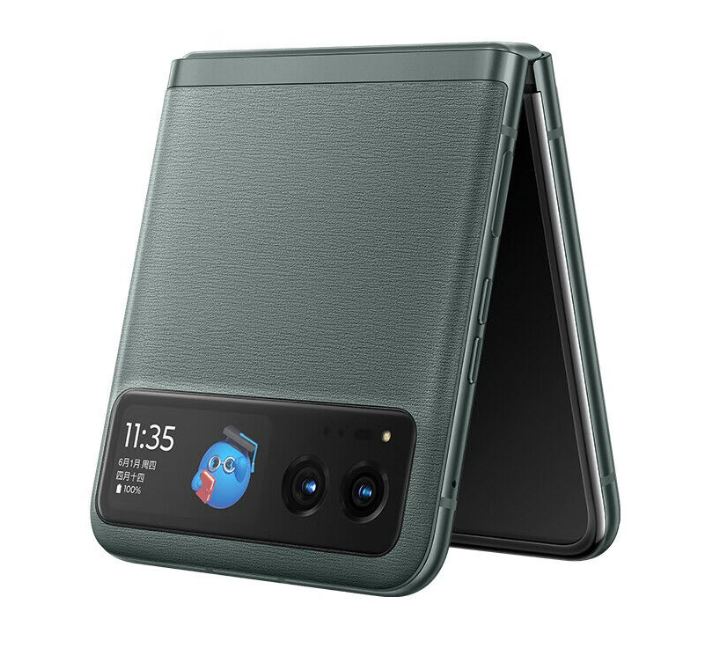
Discover the Motorola Razr 40 series at unbeatable prices exclusively on Giztop. Experience the Motorola Razr 40, starting at just $599, and seize the extraordinary Razr 40 Ultra, beginning at only $799. Hurry, as this exceptional deal is available for a limited time only. Don’t miss out!
The Motorola Razr 40 Ultra emerges as a symbol of cutting-edge design and technological advancement. With its seamless blend of aesthetics and performance, this device offers a new dimension to mobile experiences.
At the heart of the Razr 40 Ultra lies a powerful Snapdragon 8+ Gen 1 processor, paired with an Adreno 730 GPU. This dynamic duo ensures unparalleled performance and efficiency, empowering users to effortlessly navigate through tasks, apps, and entertainment. The choice between 8GB or 12GB LPDDR5 RAM, combined with 256GB or 512GB UFS 3.1 internal storage options, allows for customizable configurations to suit diverse needs.
Unfold the future with the 6.9-inch foldable P-OLED 165Hz FHD+ inner screen, redefining visual excellence with its seamless display and smooth refresh rate. Complementing the experience is the 3.6-inch P-OLED external display, providing quick access to notifications and functions without the need to unfold the device.
Capture moments with precision using the dual rear camera system, featuring a 12MP main sensor and a 13MP wide-angle lens. From sweeping landscapes to intricate details, the Razr 40 Ultra’s camera setup offers versatility in every shot. For stunning selfies, the 32MP front sensor delivers crisp and vivid self-portraits.
Underpinning the experience is a robust 3800mAh battery, providing the energy required for a full day of use. And when it’s time to recharge, the 33W fast charging support ensures you’re back in action swiftly.
Security and convenience come together with the side-mounted fingerprint scanner, offering easy access to your device while ensuring your data remains protected. Connectivity reaches new heights with Wi-Fi 6E, enabling faster and more stable connections to incompatible networks. The device is enhanced by MYUI 6.0, an intuitive interface that streamlines the user experience.
The Motorola Razr 40 Ultra transcends the ordinary, embodying the brand’s legacy of innovation and elegance. By seamlessly fusing technology and design, it paves the way for a new era of mobile possibilities. With its foldable display, robust performance, and versatile camera capabilities, the Razr 40 Ultra is a testament to Motorola’s commitment to redefining the future of smartphones.
The Motorola Razr 40 emerges as a true marvel of engineering, seamlessly blending cutting-edge technology with sleek design. This remarkable device is poised to redefine the way we interact with our digital world.
At the heart of the Razr 40 lies its 6.9-inch foldable P-OLED screen, boasting a Full HD+ resolution of 1080 x 2400 pixels. This innovative display supports a staggering 144Hz refresh rate, ensuring fluid visuals that bring content to life. With support for 10-bit colors, HDR10+, and DC dimming, the inner screen delivers an immersive viewing experience. Complementing this is a 15-inch P-OLED outer screen, offering a resolution of 1066 x 1056 pixels and the same impressive 144Hz refresh rate.
Powering the Razr 40 is the Snapdragon 7 Gen 1 processor, built on a 4nm architecture. Its octa-core prowess, clocked at 2.5GHz, ensures seamless multitasking and smooth performance. Paired with up to 12GB LPDDR5 RAM, the device is primed for effortless app navigation and multitasking.
Storage is a non-issue with the Razr 40, offering configurations of 128GB or 256GB UFS 2.2 storage, ready to accommodate your files, photos, apps, and more. The camera setup is equally impressive, with a dual rear system featuring a 64MP main camera and a 13MP super wide-angle macro lens. The 32MP selfie camera captures stunning self-portraits.
Battery life is optimized with a 4200mAh battery, supporting 33W wired fast charging and 5W wireless charging. Unlocking the device is intuitive with the side-mounted fingerprint scanner, while connectivity options including 5G, Wi-Fi 6E, Bluetooth 5.3, NFC, and a USB-C port provide seamless integration into your digital ecosystem.
The Razr 40 introduces an array of user-centric features, including desktop mode, object recognition, and a split-screen feature, effortlessly activated by swiping the fingerprint scanner. Additionally, the device can serve as a mobile hotspot, enabling you to share your 4G/5G data connection with other wireless devices. The dual nano-SIM slot offers flexibility depending on device memory and network availability.
Motorola continues its legacy of innovation with the Razr 40, a device that’s not just a smartphone, but a window into a smarter and more connected world. Through a blend of exceptional design, advanced technology, and user-centric features, the Razr 40 invites you to experience a new era of mobile functionality.
For more information on such exciting deals and offers, check out our deals hub.
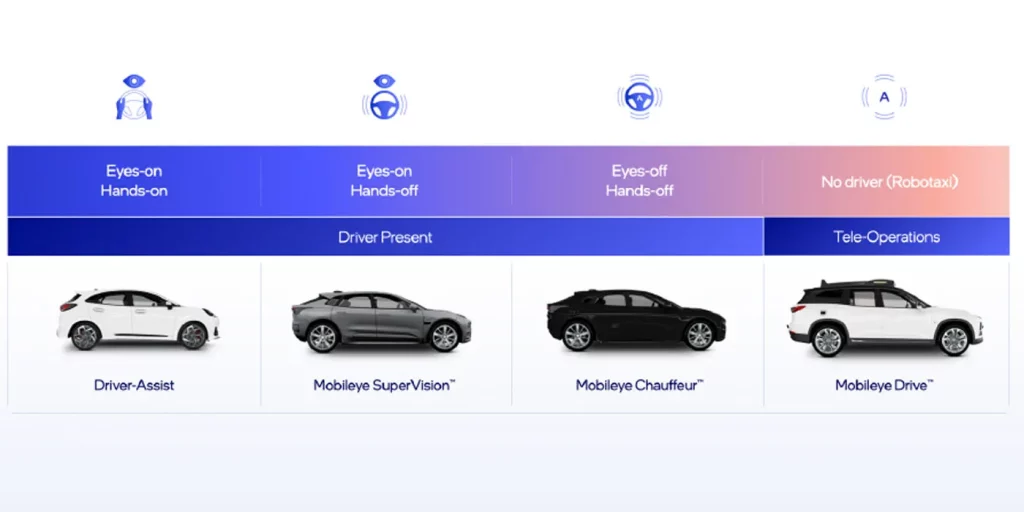
Polestar will debut the ADAS tech for hands-free, eyes-off driving in the Polestar 4 EV. The ADAS tech is a culmination of the partnership between Polestar and Mobileye. The new Polestar SUV coupe will launch soon and will have autonomous driving on offer. Mobileye is the proprietary owner of the Chauffeur platform ADAS.
Mobileye is an autonomous vehicle solutions company and has provided its ADAS tech to over 150 million vehicles globally. The company has a long trajectory of providing ADAS and autonomous vehicle technology since its inception in 1999. It has entered partnerships previously with Tesla, BMW, and some other heavy hitters in the industry. It recently inked an agreement with Porsche to integrate its SuperVision technology platform in Porsche cars. The Polestar-Mobileye collaboration will deliver a more advanced platform than SuperVision, called Chauffeur.
The collaboration will see Mobileye adding autonomous technology to the Polestar 4 EV. The goal will include scaling up the technology to accommodate other Polestar vehicles. The Mobileye Chauffeur will allow drivers to enjoy hands-off and eyes-off, point-to-point autonomous driving on highways. The eyes-on automated driving will be applicable in other designated environments. The platform will be manufactured and implemented by ECARX and features the EyeQ systems-on-chip, REM-powered Mobileye Roadbook maps, 360-degree camera system, and more.
Mobileye’s CEO Amnon Shashua says the Mobileye Chauffeur will offer consumers a safer and more accessible way to enjoy autonomous vehicles as the next revolution in personal transportation. Professor Shashua says the Chauffeur is the pinnacle of its two-decade experience applying AI to millions of vehicles worldwide. The Polestar 4 will roll out with the SuperVision-based ADAS with most of the stated functionality. The Mobileye Chauffeur, when it arrives, will offer the EyeQ6 system-on-chip with modern radar and LiDAR sensors. The Polestar 4 SUV coupe will enter the global market in 2024 but has already berthed in China.
Google is ready to step into the emergency services arena with its upcoming Android 14, taking a cue from Apple’s iPhone 14, which has already introduced a Satellite SOS feature. But there’s a twist: Google seems to be eyeing a global audience by potentially teaming up with Garmin, a well-known name in GPS and satellite communication.
Apple’s Satellite SOS service is only limited by its reach as of now
The information comes courtesy of a Twitter user, Neïl Rahmouni, who noticed some changes in Google Messages app’s user interface. These changes hint at the incorporation of satellite messaging features and suggest Garmin’s involvement. Rahmouni, however, advises caution, saying the collaboration isn’t confirmed until Google makes an official announcement.
Why Garmin, you ask? Unlike Apple’s Satellite SOS, available only in a few countries, Garmin’s satellite services span more than 150 nations, covering every continent. This could give Google an edge in offering emergency services that are as universal as they are critical, making technology truly accessible in times of dire need.
While Apple has made strides with its Emergency SOS feature, its reach is still limited. Google, by possibly joining forces with Garmin, could fill this gap and extend life-saving technology to far-flung areas of the globe. And with Android 14’s release just around the corner, all eyes are on Google to reveal its next move.
What remains to be seen is whether this alliance materializes, and if so, how it will reshape the technology landscape in terms of emergency services. The satellite SOS feature could potentially be a game-changer, offering more people the safety net they deserve, no matter where they are.
So, it’s not just about staying connected anymore; it’s about staying safe, globally.
Spotify, the global streaming giant, recently updated its widget offerings for Android users. This development not only serves as a win for widget enthusiasts but also repositions widgets as indispensable tools in today’s fast-paced digital age.
Users can update the app to see the new Widgets on their home screen
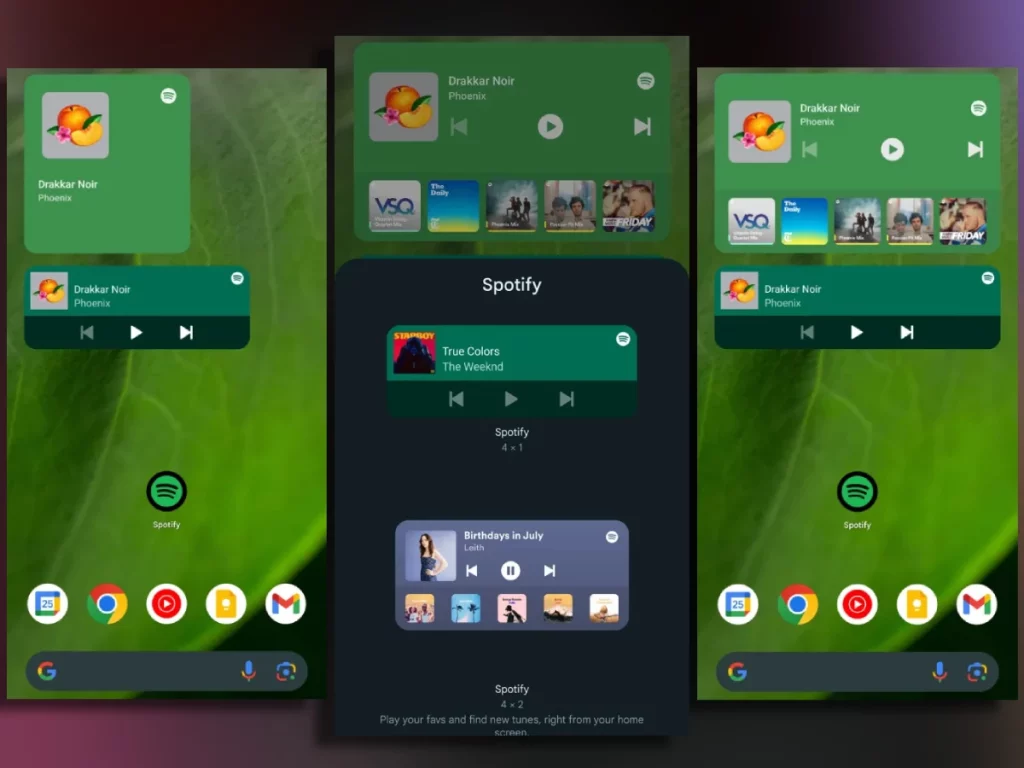
After a two-year hiatus on widget updates, Spotify rolled out two new variants designed to make life easier for its millions of users. The first, a ‘basic’ widget, fulfills standard needs—it shows the currently playing track, and its album art, and offers basic media controls.
The second widget is where the magic happens. Not only does it show what’s currently playing, but it also offers personalized recommendations—ranging from songs and albums to podcasts and audiobooks—based on user preferences. The widget can expand up to a 5×2 size, displaying up to five personalized suggestions below the currently playing track.
These new widgets were launched with version 8.8.50, and if you haven’t updated your Spotify app yet, you might want to hit that update button soon.
This move by Spotify also opens up a dialogue on the relevance of widgets in our day-to-day digital interactions. If you own a tablet used as a centralized media and smart home control, Spotify’s new widgets could offer a streamlined, user-friendly experience, all available at a single touch on your home screen.
In a world quick to embrace the ‘new,’ Spotify’s widget update serves as a reminder that some traditional features, like widgets, still have a lot to offer. The update is not merely a feature rollout; it’s a counter-argument to the growing perception that widgets have lost their utility. So, are widgets here to stay? If Spotify’s bold move is anything to go by, the answer is a resounding yes.
We use cookies on our website to give you the most relevant experience by remembering your preferences and repeat visits. By clicking “Accept”, you consent to the use of ALL the cookies.
This website uses cookies to improve your experience while you navigate through the website. Out of these, the cookies that are categorized as necessary are stored on your browser as they are essential for the working of basic functionalities of the website. We also use third-party cookies that help us analyze and understand how you use this website. These cookies will be stored in your browser only with your consent. You also have the option to opt-out of these cookies. But opting out of some of these cookies may affect your browsing experience.
Necessary cookies are absolutely essential for the website to function properly. This category only includes cookies that ensures basic functionalities and security features of the website. These cookies do not store any personal information.
Any cookies that may not be particularly necessary for the website to function and is used specifically to collect user personal data via analytics, ads, other embedded contents are termed as non-necessary cookies. It is mandatory to procure user consent prior to running these cookies on your website.