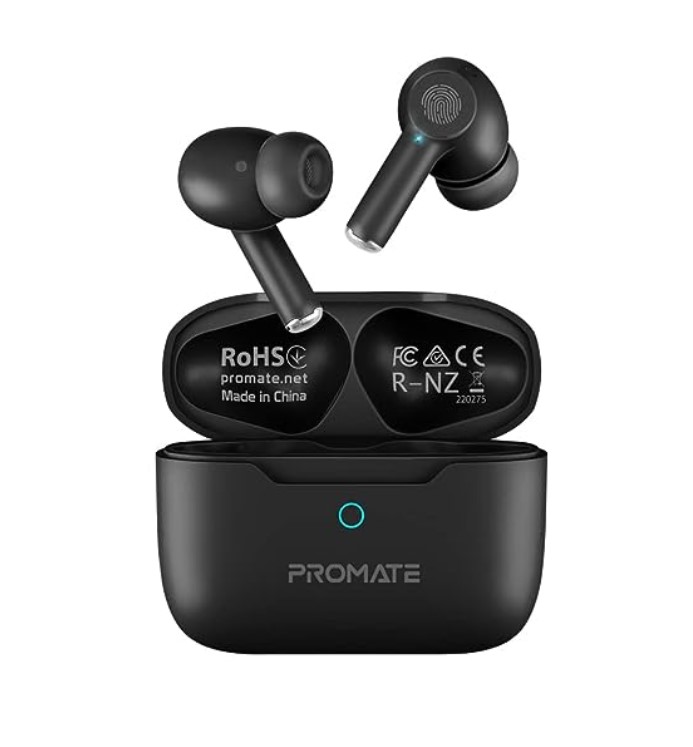
Promate has launched a new audio device in India. The company had launched the ACME-PD20 power bank in the country last month. The latest TWS earphones from the brand are dubbed the Promate ProPods. They pack some impressive features and are priced under Rs 3,000 segment. The earbuds compete against the likes of other brands like boAt, Noise, Realme, OnePlus, and more in the market. Read on to know more below.
Promate ProPods specifications and features
The Promate ProPods are in-ear TWS earphones with a stem and angled ear tips. They offer a comfortable fit for extended usage. Users can perform various functions by tapping on the earbuds. They come with support for Siri and Google Assistant.
On the audio front, the Promate ProPods are said to offer high-fidelity audio with dynamic drivers. The earbuds feature active noise cancellation technology up to 25dB for eliminating background noise. There is also environmental noise cancellation for clear quality on calls. The earphones also pack ambient sound mode.
The Promate ProPods are backed by a 400mAh battery cell that is claimed to offer up to 60 hours of battery life. Each earbud has a 40mAh battery unit claimed to offer 25 hours of playback time. The TWS earphones support Bluetooth 5.3 connectivity and they can be connected automatically to a device.
The Promate ProPods carry a price tag of Rs 2,999. They are offered in Black and Blue colors. The earphones are already available for purchase from Amazon.
pTron has expanded its range of audio devices in India. The brand has launched a new TWS earphone. They are dubbed the pTron Zenbuds Ultima. The audio device packs some impressive specifications and features. Commenting on the launch, pTron said “Zenbuds Ultima is an example of advanced products with its exceptional premium feature and with affordable pricing”.
Read on to know what it offers out of the box.
pTron Zenbuds Ultima specifications and features
The pTron Zenbuds Ultima are in-ear TWS earphones with a dual-tone design. The stem has a glossy finish whereas the angled earbuds have a matte finish. The storage and charging case also have a Black and Blue color design. The earphones are IPX5 water-resistant.
In terms of audio, the pTron Zenbuds Ultima are equipped with a 13mm dynamic driver. They feature hybrid active noise cancellation up to 35dB. The earphones feature four mics and trutalk technology for environmental noise cancellation ensuring clear quality on calls. There is also a transparency mode for staying aware of your surroundings. The audio device packs 40ms low latency mode.
The pTron Zenbuds Ultima are powered by a 500mAh battery unit that is claimed to offer up to 50 hours of battery life. The earbuds support Bluetooth 5.3 connectivity with a 10m range.
The pTron Zenbuds Ultima are priced at Rs 1,499 and offered in Black and Blue colors. They are available for purchase from Amazon
Xiaomi has officially announced its much-anticipated foldable phone, the MIX Fold 3, set to hit the market in August. One of the key highlights of this device is the Leica optical full-range quad camera, making it the first foldable phone from Xiaomi to sport four rear cameras. This collaboration aims to bring significant advancements in mobile imaging, focusing on miniaturization to achieve top-tier imaging performance within a slim and lightweight chassis.
Xiaomi MIX Fold 3 specifications (rumored)
The camera specs are yet to be disclosed, but the quad-camera setup is rumored to include a primary Sony IMX800 sensor, an ultra-wide lens, a telephoto snapper with 3.2x optical zoom, and a periscope telephoto lens with 5x zoom. Currently, only Vivo and Huawei offer foldable devices with four cameras on the rear, featuring wide, ultrawide, and 2 telephoto cameras, one with a periscope lens.
The MIX Fold 3 boasts a stylish white curved glass body and will feature an 8.02-inch foldable AMOLED QHD+ 120Hz main display, along with a 6.56-inch AMOLED FHD+ 120Hz cover screen. There are also rumors about an under-display camera integrated into the internal display, adding to the phone’s appeal. The device will also implement the new waterdrop hinge to maintain a slim profile and enhance durability.
Under the hood, the phone is expected to be powered by a Snapdragon 8 Gen 2 chipset, coupled with up to 16 GB of LPDDR5x RAM and potentially up to 1 TB of UFS 4.0 storage. Operating on Android 13 with the MIUI Fold 14.1 overlay, the MIX Fold 3 promises an optimized foldable experience.
The upcoming Xiaomi device is expected to come with a 4,800mAh battery supporting 67W fast charging and 50W wireless charging, as per the 3C certification. Additionally, recent MIIT certification confirms the device will support 5G connectivity.
The MIX Fold 3 follows its predecessor, the MIX Fold 2, which features a Snapdragon 8+ Gen 1 processor, a 6.56-inch external screen, an 8.01-inch internal screen, and a Leica imaging system.
The MIX Fold 3 will be manufactured in Xiaomi’s intelligent factory located in Beijing’s Yizhuang. This facility utilizes intelligent manufacturing systems to enhance production precision and reliability during the manufacturing process.
Overall, the MIX Fold 3 looks to be an exciting addition to the foldable phone market. As the launch date approaches, more details are expected to surface, so stay tuned for further updates. OnePlus is also gearing up to launch its first foldable phone dubbed as OnePlus Open.
OnePlus has seemingly confirmed the name of its first-ever foldable phone. The brand shared a tweet yesterday. It came around the time when Samsung unveiled its fifth generation Galaxy Z Fold 5 and Galaxy Z Flip 5. The upcoming OnePlus foldable phone has already surfaced in leaked renders and specifications. Read on to know more about it below.
OnePlus Open is the name of the brand’s first foldable
The tweet shared by OnePlus reads ‘We OPEN where other FOLD’. This means that the foldable phone may indeed be called OnePlus Open although there is no direct confirmation. There have been speculations about the same name of the upcoming offering for some time. Previously, the brand’s foldable device was tipped to be called the OnePlus Fold or OnePlus V Fold.
Other details about the OnePlus Open remain a mystery. Earlier today, the brand announced that it will launch the Ace 2 Pro smartphone in China next month. The foldable phone is already confirmed to debut in the third quarter of this year. It’s quite a possibility that the device may be announced alongside the Ace 2 Pro.
As per leaked renders, the OnePlus Open has a tall form factor and a slim profile. The leather back panel has a protruding circular camera module with Hasselblad branding and it houses two 48MP sensors along with a 64MP periscope lens. As for the core specifications, the foldable phone is said to feature a 6.3-inch exterior and a 7.8-inch interior displays, both with AMOLED panels and a 120Hz refresh rate. The OnePlus Open is tipped to be powered by a Snapdragon 8 Gen 2 processor paired with up to 16GB RAM and 256GB storage. It will reportedly be backed by a 4,800mAh battery with support for 67W charging.
Earlier this year, Honor released the MagicBook X Pro laptops in China in 14-inch and 16-inch screen sizes. These laptops were equipped with Intel Core i5-13500H processors. Now, the company is teasing the launch of the new Honor MagicBook X Pro Ryzen Edition, which will be powered by the Zen 4-based R7 7840HS series processors. Other specifications of the laptop might remain the same. Let’s look at the details.
Honor MagicBook X Pro Ryzen Edition
Honor MagicBook X Pro Ryzen Edition has been teased to launch in China in the coming days, however, the company didn’t mention the exact date yet. The new notebook will be powered by an R7 7840HS series chipset based on Zen 4 architecture. For the unknown, AMD Zen 4 is the codename for a CPU microarchitecture designed by AMD. It is the successor to Zen 3 and uses TSMC’s N5 process for CCDs.
The rest of the laptop’s specifications are not yet known. However, the Honor MagicBook X 14 Pro Intel edition debuted in March 2023 with a Core i5-13500H processor. This sleek laptop weighs 1.34 kg and is 15.9 mm thick. It has an integrated metal hinge, a 14-inch 2.2K screen, supports e-book mode, and has received the Rheinland eye protection certification.
The laptop is equipped with a solid-state hard drive of up to 1TB. The storage can also be expanded to 2TB. The Honor MagicBook X Pro series supports the MagicOS smart interconnection. The laptop retails in China at a starting price of 4,499 yuan (~$649).
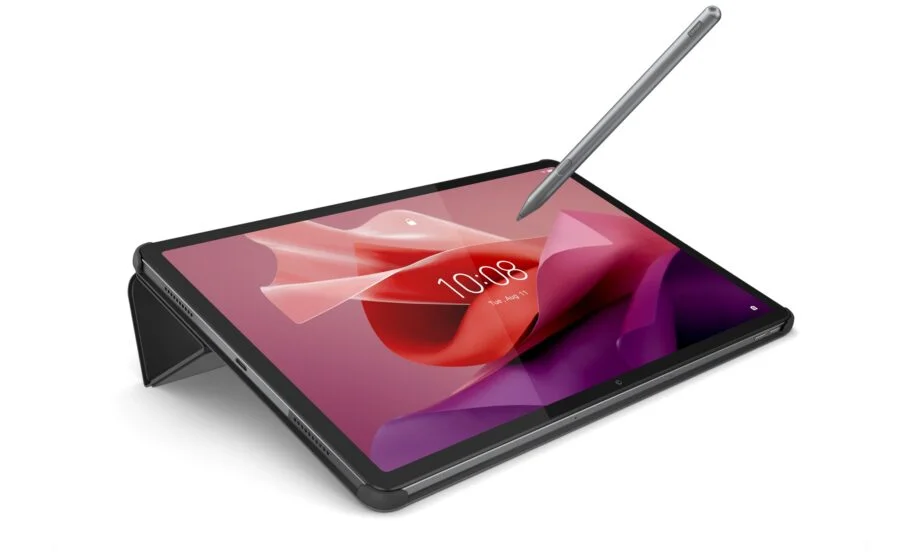
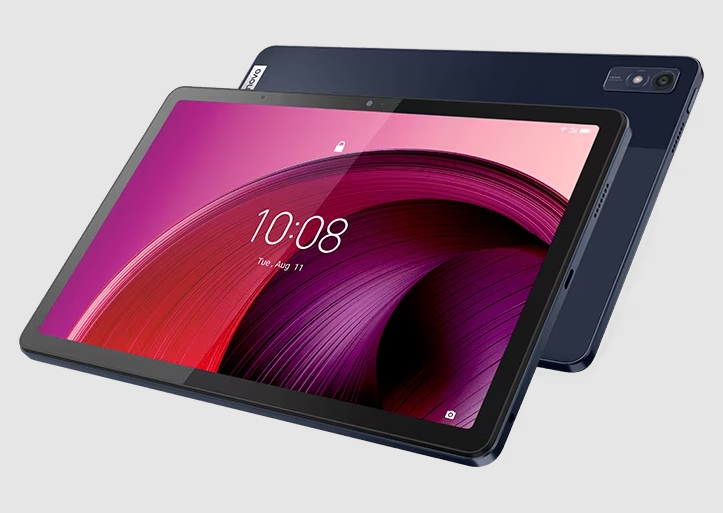
Following its initial debut of the Tab P12 Pro in 2021, Lenovo has recently introduced the Lenovo Tab P12. Additionally, the brand has launched the Tab M10 5G in Europe, following its release in India earlier this month.
Lenovo Tab P12 specs
The Lenovo Tab P12 boasts a 12.7-inch LTPS LCD screen featuring a resolution of 2944 x 1840 and a refresh rate of 60Hz, delivering a pixel density of 273ppi. For an immersive audio experience, the tablet comes equipped with Quad JBL speakers. On the camera front, it sports a 13MP front-facing camera with an RGB sensor and ultra-wide field of view, while the rear setup consists of an 8MP autofocus camera accompanied by a Flash LED.
Powering the device is the MediaTek Dimensity 7050 processor, which features an octa-core configuration comprising 2 x ARM Cortex-A78 cores clocked at 2.6GHz and 6 x ARM Cortex-A55 cores running at 2.0GHz. Operating on Android 13, the Tab P12 offers a promising software experience with the assurance of two years of OS updates and four years of security patches. It comes in two memory variants: 4GB RAM with 128GB storage and 8GB RAM with either 128GB or 256GB storage options. The tablet supports expandable storage via a MicroSD card.
Various sensors are included on the tablet like an accelerometer G sensor, RGB sensor, gyroscope, E-compass, and a hall sensor. A fingerprint sensor is integrated into the power key for added security. Connectivity options include Wi-Fi 6 and dual-band Wi-Fi, along with Bluetooth v5.1. The tablet comes with a USB Type-C 2.0 port. The device houses a powerful 10200mAh battery, offering up to 10 hours of video playback. It is available in two elegant colors, Storm Grey and Oat. It measures 293.3 x 190.7 x 6.9 mm and weighs 615g.
Lenovo Tab M10 5G specs
The Lenovo Tab M10 5G features a 10.61-inch 2K display with a resolution of 1200×2000 pixels, offering a 15:9 aspect ratio and a smooth 90Hz refresh rate. The tablet is equipped with 1 microphone, 2 speakers, and a 3.5mm audio jack, providing an immersive audio experience with Dolby Atmos support. It comes with an 8MP front-facing camera and a 13MP autofocus rear camera accompanied by a Flash LED.
The Tab M10 5G is powered by the Snapdragon 695 5G Mobile Platform, featuring a Kryo 660 processor with 2x Gold cores clocked at 2.2GHz and 6x Silver cores running at 1.8GHz. Running on Android 13 T, the tablet offers a year of OS updates and 3.5 years of security patches. It is available in two memory configurations: 4GB RAM with 128GB uMCP4x storage and 6GB RAM with 128GB uMCP4x storage. The tablet also supports expandable storage through a MicroSD card.
The device comes with various sensors, including an accelerometer G sensor, ambient light sensor, gyroscope, hall sensor, vibrator, and SAR sensor. For connectivity, the tablet offers dual-band Wi-Fi and Bluetooth v5.1. The ports include a USB Type-C 2.0 port for charging, which supports QC3.0/PD3.0, as well as a MicroSD card slot and a Nano SIM card slot for 5G connectivity. With dimensions of 252.74 x 160.34 x 8.3 mm and weighing 490g, it is designed to be sleek and lightweight. The tablet houses a powerful 7,700mAh battery, offering up to 12 hours of video playback or up to 9 hours of video playback when using 5G. The Tab M10 5G comes in the color Abyss Blue, providing a stylish and appealing choice for users.
Price & availability
The Lenovo Tab P12, which includes a keyboard and Lenovo Tab Pen Plus, starts at €499 with VAT and will be available in select markets from July 2023. Alternatively, the Lenovo Tab P12, with just the Lenovo Tab Pen Plus included, starts at €399 with VAT and will also be available in select markets starting July 2023. On the other hand, the Lenovo Tab M10 5G starts at €399 with VAT and is set to launch in select markets from August 2023.
The launch timeline of the highly anticipated successor to the Nintendo Switch might have been revealed. A new financial report from a Chinese media site has hinted at a 2024 launch for the Switch 2.
Nintendo Switch 2 is hinted to launch in 2024 again
Earlier this month, we reported on the Switch 2’s launch being months away based on documents from the Microsoft and FTS case. Now, a financial report from another source has also hinted at a 2024 launch timeline. The report arrives from one of Nintendo’s partners, PixArt Imaging, who stated that the Japanese gaming giant’s next-gen console will be launching early next year. If this report is accurate, then it is probably the most reliable news regarding the Switch 2’s launch as it comes from the “supply chain”.
While the financial report did not directly mention Switch 2, it stated that the “Japanese game machine will be launched early next year, which has been absent for many years”. Since they specifically mention a Japanese game machine, it might even be referring to the Project Q handheld console from Sony.
For those unaware, PixArt has previously worked with Nintendo for the Wii and even the first Switch handheld console. So it won’t be surprising that the gaming company will work with its partner which has proven to be reliable. But keep in mind that this is still just an unconfirmed report, so take this news with a pinch of salt for now.
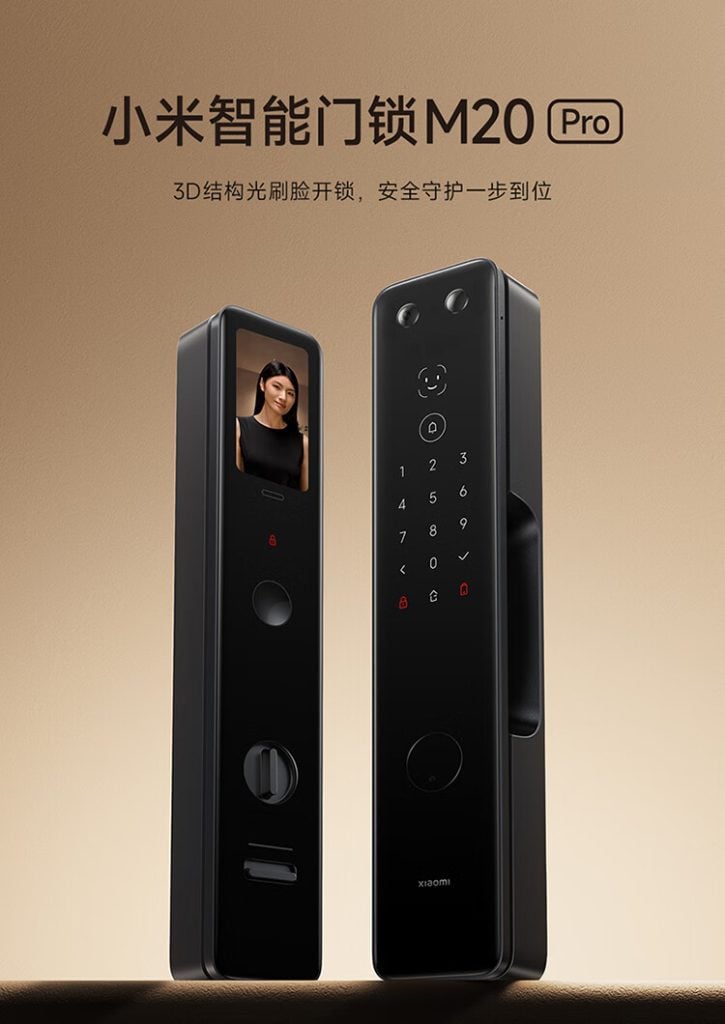
Xiaomi has released the Smart Door Lock M20 Pro, an advanced smart lock featuring AI-driven 3D structural light facial recognition for enhanced security and precise identification. The M20 Pro is an upgraded version of the standard M20 model launched earlier this year.
Xiaomi Smart Door Lock M20 Pro features:
The 3D structural light facial recognition technology is renowned for its adaptability and accuracy, commonly used in secure systems like financial payments, access control systems, and high-end digital devices. The dual-core AI chip, combined with the 3D structural light module, enhances the device’s accuracy and resistance against attempts to unlock using photos, videos, or masks. This lock system complies with financial payment-grade security standards, as certified by BCTC.
The M20 Pro Smart Lock offers a user-friendly and practical unlocking experience. Upon the user’s approach, the smart door lock automatically recognizes the user’s face, capturing 30,000 light spots to map unique facial features, resulting in a false recognition rate of less than 0.0001%. The intelligent lock can function efficiently under various lighting conditions, including daylight and darkness. This automated recognition process makes the lock easy to use for children, adults, and the elderly without the need for fingerprints.
The AI-powered smart cat-eye with 180° ultra-wide-angle camera feature provides real-time monitoring of the area in front of the door and enables timely alerts. The lock’s built-in display screen allows users to check who is at the door. The doorbell light and internal screen automatically turn on when a visitor approaches and rings the doorbell. This smart lock also supports multi-screen linkage, remote viewing via smartphones, and visual intercom functionality, thus enhancing home security and convenience.
The M20 Pro supports various unlocking methods, from facial recognition, password input, fingerprint scanning, temporary passwords, Bluetooth, NFC cards, and emergency keys, to Xiaomi’s smartwatches and fitness bands. It features a 5000mAh internal battery that can last for 12 months. Emergency power can be supplied via wireless reverse charging from a smartphone or a Type-C data cable in case of complete battery depletion.
The Xiaomi Smart Door Lock M20 Pro is priced at 2999 yuan ($419), but during the pre-sale period, it is available at a special price of 2799 yuan ($391). The device will be officially available for purchase starting from August 1st.
Last week, Xiaomi‘s Redmi brand launched the Redmi Smart TV A series 2024 models made up of the Smart TV A32, the A43, and A65 models with the numbers representing their display sizes. The Chinese tech giant has now added two more models to the lineup. The Redmi Smart TV A70 2024 and Smart TV A55 2024 have now been announced in China.
As their names imply, the Redmi Smart TV A70 2024 features an expansive 70-inch display size while its counterpart – the A55, comes with a 55-inch display size. The smart TVs keep up with the affordable pricing which the Redmi Smart TV models are known for. The A55 is priced at 1449 yuan while the A70, which is the largest model among the lot, is priced at 2299 yuan ().
Just like the other models, the Redmi Smart TV A55 and A70 both feature a display resolution of 3840×2160 pixels. The smart TV utilizes a metal unibody design with an ultra-high screen-to-body ratio of up to 97.1%. The smart TV also supports a 60Hz refresh rate and a 1.07 billion color display. The A series models are powered by a Quad-core A35 CPU and a G31 MP2 GPU for the graphics. The processor is backed by 1.5GB RAM while there is 8GB storage available.
The TV supports 2.4GHz Wi-Fi and infrared and crams two 10W stereo speakers. It also comes with two HDMI ports, an AV port, two USB ports, an analog signal/DTMB interface, an Ethernet interface, and an audio output S/DPIF interface. The smart TV runs on the MIUI TV OS and comes with a built-in XiaoAI voice assistant allowing users to integrate the smart TV with other smart home devices.
Xiaomi has officially confirmed the global debut of its upcoming Redmi 12 5G. The upcoming smartphone will be first unveiled globally in India at the start of next month. So here are all the details.
Redmi 12 5G India Launch
The Chinese tech giant shared a tweet on X (formerly Twitter) which confirmed the global launch date of the Redmi 12 5G. The device will first be announced in the Indian market, with a new microsite also also being launched on the company’s official website. As per the teaser, the new handset will ‘Join the 5G Revolution’. The tweet also carries a short video that showcases the Redmi 12 5G from the sides.
Redmi Note 12R
Redmi 12 5G Specifications
Based on what we know so far, the smartphone will sport a flat rear panel and sides. It will also come in multiple color options, including Moonstone Silver, Pastel Blue, and Jade Black. Redmi 12 5G recently surfaced on GeekBench as well carrying the Qualcomm Snapdragon 4 Gen 2 SoC. This processor was paired with 8GB of RAM and the device was listed running on Android 13 OS.
The wait is over, #XiaomiFans! Witness the global debut of #Redmi12 5G in India on 1st August 23'!
Join the #5GRevolution as we reshape connectivity and unleash a new era of possibilities!
Other storage options might include a 6GB + 128GB configuration, which will reportedly cost around 13,999 INR. The global version of the Redmi 12 5G is expected to be rebranded version of the Redmi Note 12R, which is also available in China. Apart from this model, the brand is also gearing up to launch the new Redmi 12 4G, Redmi Watch 3 Active, and Xiaomi Smart TV X Series in India.
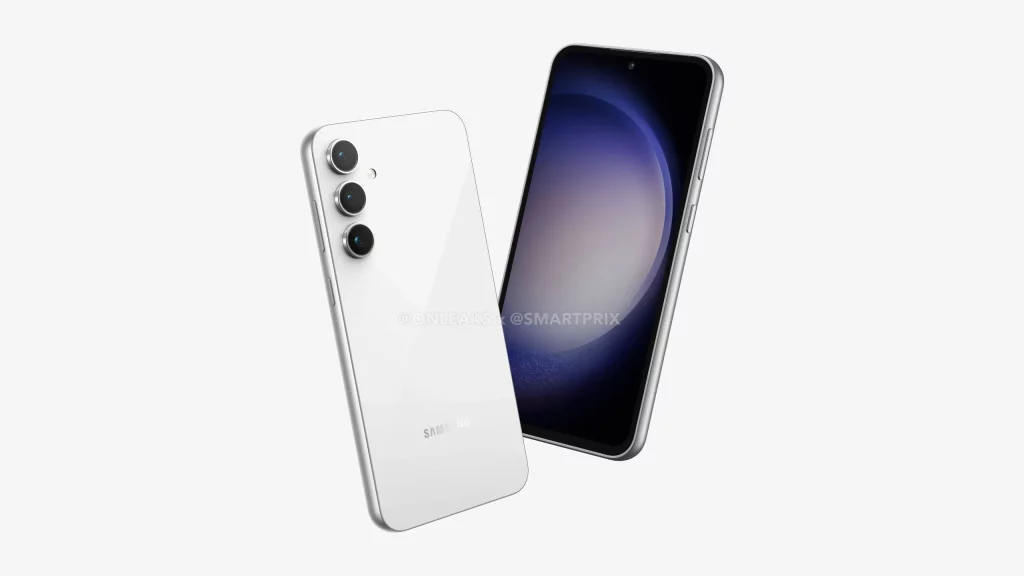
In an interview with Android Authority, Justin Hume, the vice president of mobile for Samsung South Africa, addressed the gap between the Galaxy A54 5G and the Galaxy S23. When asked about the difference in size between the two models, he acknowledged the existence of an FE-sized gap at the moment. However, he alluded to an upcoming announcement for the S23 FE.
When Samsung did not launch a successor for the Galaxy S21 FE, which went official in January 2021, reports claimed that it may have axed the Fan Edition smartphone lineup. Samsung did not release an official statement as to why it did not launch the Galaxy S22 FE However, now it is certain that the brand is gearing up to launch the S23 FE.
Samsung Galaxy S23 FE CAD renders by SmartPrix / OnLeaks
As per recent leaks, the Galaxy S23 Fan Edition will be gradually released in different parts of the world. It is expected to launch in some countries within this quarter of the year, which indicates that it may launch in August or September. The other countries may receive it in the remaining months of the year in the first quarter of 2023.
Samsung Galaxy S23 FE specifications (rumored)
According to recent reports, the Galaxy S23 FE is expected to feature a 6.4-inch S-AMOLED display with FHD+ resolution and a 120Hz refresh rate. In terms of camera specifications, the smartphone will sport a 32-megapixel front camera, and the back will house an OIS-assisted 50-megapixel triple camera setup.
According to rumors, the Exynos 2200 chip powers the Galaxy S23 FE. However, there is a possibility that some countries may receive a variant with the Snapdragon 8 Gen 1hchipset instead. The device is expected to come with two RAM options, 6GB and 8GB of LPDDR5 RAM, along with 256GB of UFS 3.1 storage.
The smartphone is said to pack a 4,500mAh battery and support 25W wired charging, 15W wireless charging, and reverse wireless charging. On the software side, the Galaxy S23 FE will run on One UI 5.1.1 based on Android 13, providing users with a seamless and feature-rich user experience.
Yesterday, Samsung held a global launch event to announce its newest foldable phone, the Galaxy Z Fold 5. Just a couple of hours before the launch, OPPO released a tweet (shown below) to tease the arrival of its next foldable phone, which appears to be the Oppo Find N3.
In all likelihood, the Oppo Find N3 will debut in August in different markets. Previous reports claimed that the Find N3 will be only available in China like the original Find N and the Find N2. However, its appearance on certification platforms, such as Thailand and Indonesia, has revealed that these markets will also receive the Find N3.
Rumors are rife that the OnePlus Open, the first foldable phone by OnePlus will debut on Aug. 29. It is speculated that the Open will be a rebranded version of the Find N3. At present, there is no clarity on whether there will be any difference between Oppo Find N3 and OnePlus Open.
The Galaxy Z Fold 5 has arrived with a starting price of $1,799 in the global market. It is likely that the Find N3 / Open will be priced lower than the Z Fold 5. It is likely that Oppo will soon confirm the key details of the Find N3 in the next few days.
Oppo Find N3 specifications (rumored)
According to rumors, the Oppo Find N3 will arrive with a 6.5-inch AMOLED FHD+ 120Hz screen on the outside and a larger 8-inch AMOLED 2K 120Hz display on the inside. Powering the device will be a substantial 4,805mAh battery, which supports both 80W wired and 50W wireless charging.
Under the hood, the Find N3 will run on the 3.36GHz Snapdragon 8 Gen 2 chipset like the Z Fold 5. It will be paired with 16 GB of LPDDR5x RAM and 1 TB of UFS 4.0 storage. On the software side, the Find N3 is expected to run on ColorOS 13.1 and Android 13. As for the cameras, the foldable phone will have a 32-megapixel front camera. Internally, it may house either a 32-megapixel or 20-megapixel camera. On the back, the rear camera setup will comprise an OIS-enabled 50-megapixel Sony IMX890 main camera, a 48-megapixel ultra-wide lens, and a 32-megapixel periscope telephoto camera.
AYANEO has been on a roll with a bunch of announcements. The company recently unveiled new gaming handheld devices like the Air 1S and Pocket Air. Now, the latest one is pretty unique since it is the world’s first Windows gaming handheld with an RGB backlit keyboard.
AYAONEO Slide resembles old phones with QWERTY keypads
Unlike some of its more recent reveals, the company has shared more key details regarding the Slide model. AYANEO’s upcoming gaming handheld will feature a 6-inch IPS LCD panel that offers Full HD resolution and outputs 400 nits of peak brightness. Notably, the screen also covers 85 percent DCI-P3 and 120 percent sRGB color gamut.
For ports, you can expect to find two full function USB4 ports, an M.2 slot for PCIe 4.0 drives, and an SD 7.0 standard microSD card slot for memory expansion. Under the hood, the AYANEO Slid appears to be powered by an AMD Zen 4 and RDNA 3-based APU. This will be the world’s first Windows gaming handheld with an RGB backlit keyboard, which is something that is usually found in gaming rigs like gaming notebooks.
Apart from this, the device also features an x-axis linear motor, a six-axis gyroscope, and Hall effect joysticks and triggers. Unfortunately, this is all the information we have at the moment. So stick around for more, as the company has teased that a surprise pre-order campaign and official launch event is just around the corner.
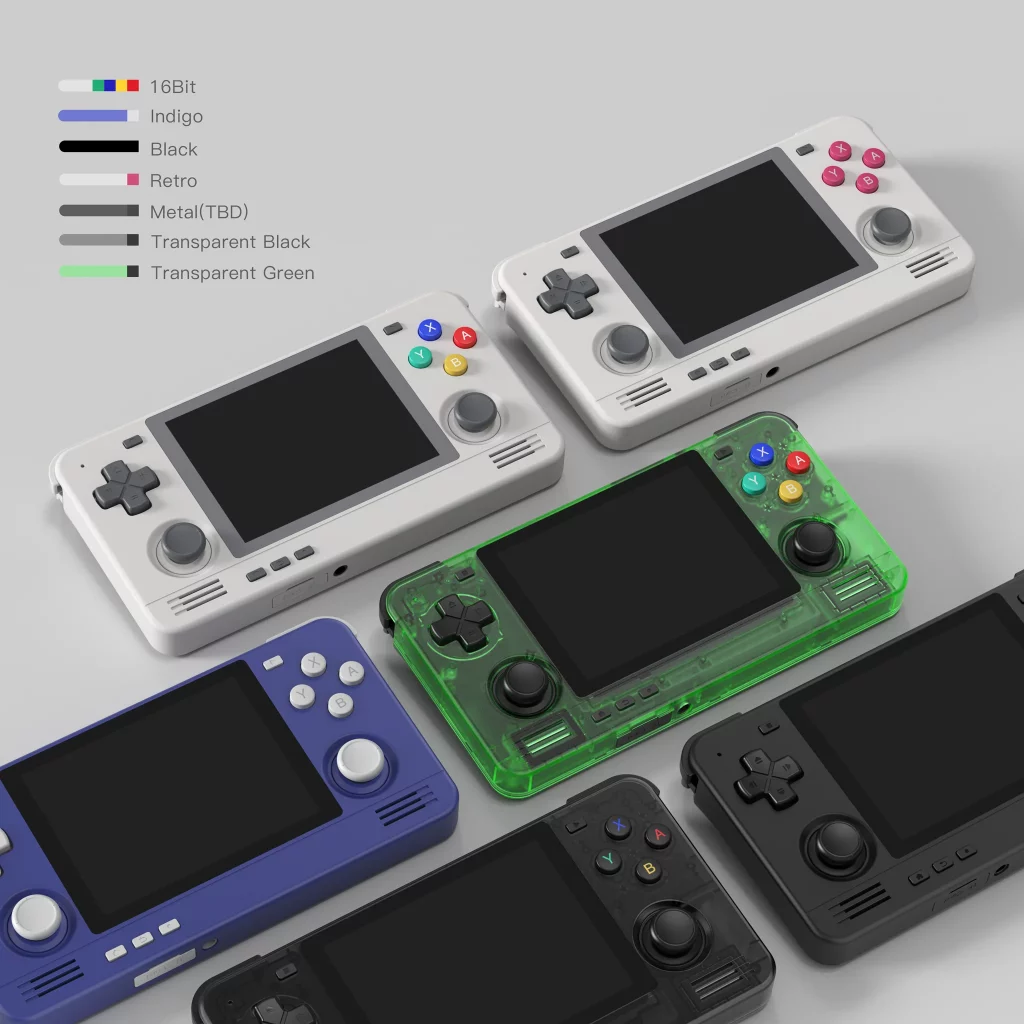
The resurgence of handheld gaming consoles has captured the attention of gamers once more, thanks to impressive offerings like the Steam Deck, ROG Ally, ONEXPLAYER 2 Pro, and more. Alongside high-end consoles, brands are also introducing low-powered ones tailored for playing classic NES-era games. One such console is the Pocket 2S, launched by Retroid.
Affordable Hall Effect retro gaming console
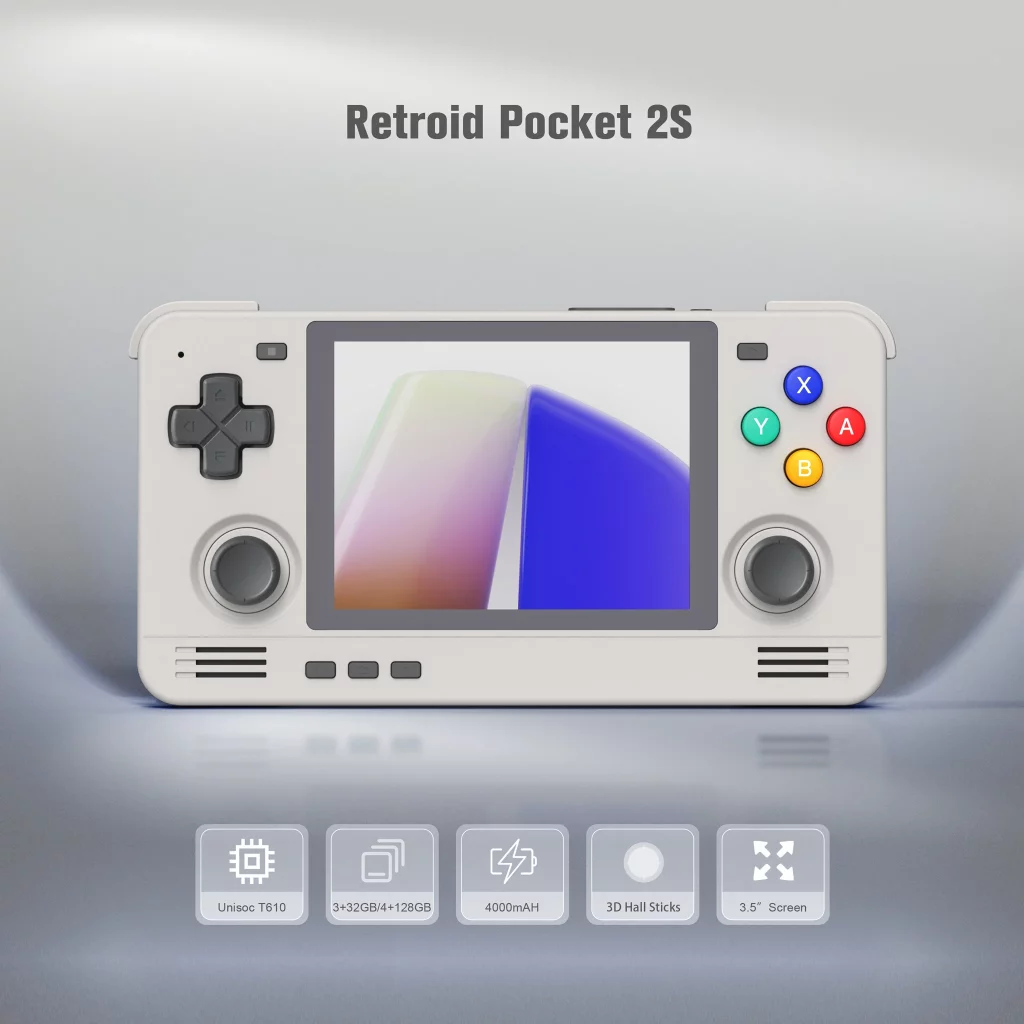
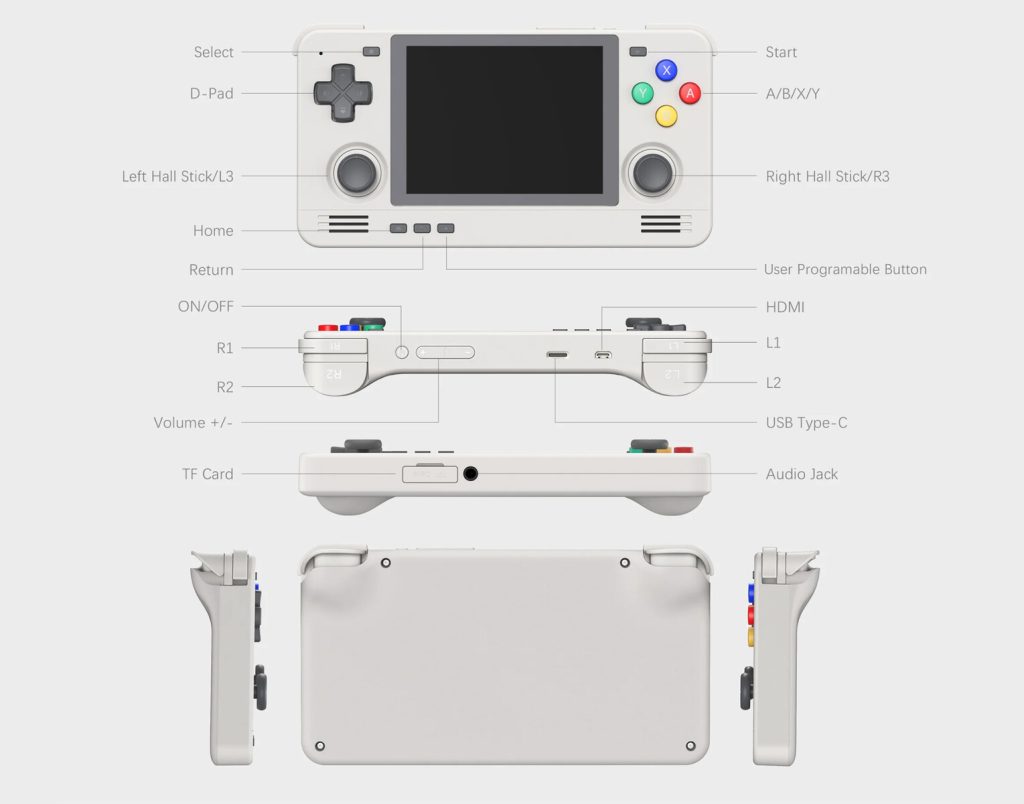
Despite not being as powerful as its counterparts, the Pocket 2S has its unique strengths. Its retro aesthetics evoke a strong sense of nostalgia, and it boasts 3D hall effect joysticks, ensuring gamers won’t have to worry about stick drift issues. Hall effect joysticks use magnets and sensors to detect movement. They are more durable and accurate than traditional joysticks, and they do not have any moving parts that can wear out.
The Retroid Pocket 2S handheld gaming console comes in a compact and portable design, with dimensions of 155 x 80.6 x 28 mm and a weight of 200 grams. Powering the device is the Unisoc Tiger T610 SoC which has a Mali-G52 MC2 GPU to handle the graphics processing.
Gaming on the Pocket 2S is facilitated by its 3.5-inch touchscreen display, boasting a resolution of 640 x 480 pixels and a classic 4:3 aspect ratio. The console is equipped with a 4,000 mAh battery, ensuring sufficient playtime without frequent charging. Users have the option to choose between 32 GB or 64 GB of storage, and it comes with either 3 GB or 4 GB of RAM for smooth gaming performance.
Running on Android 11, the Pocket 2S provides access to a wide range of games and apps. The device is attractively priced at $99 for the 3 GB/32 GB variant and $119 for the 4 GB/64 GB variant, making it an affordable option for gamers seeking a portable retro gaming experience. Retroid has announced that the shipping of Retroid Pocket 2S pre-orders will commence on August 10.
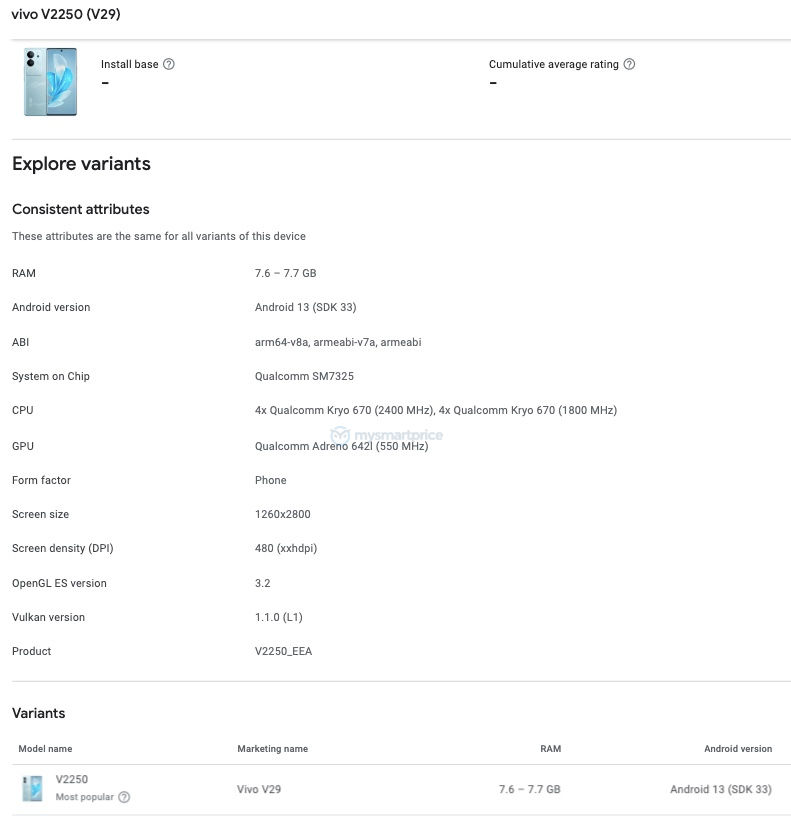
The Vivo V29 series is expected to debut soon in multiple markets. The vanilla was spotted with model number V2250 in the Google Supported Devices list recently. Now, a listing of the phone has appeared in the Google Play Console. As usual, it has revealed the key specifications, including the processor of the device. In addition, the listing has an image that reveals its front and rear designs.
Vivo V29 Google Play Console listing
Vivo V29 Google Play Console listingVivo V29
As per the Google Play Console listing, the Vivo V29 is powered by a Qualcomm chip that includes four Kyro 670 CPU cores operating 2.4GHz, four Kyro 670 CPU cores clocking at 1.8GHz, and Adreno 642L GPU. These details suggest that the device could feature the Snapdragon 778G chip. The listing further reveals that the device is equipped with 8 GB of RAM and Android 13, which is likely to be overlaid with FunTouch OS 13.
The image of the phone shown in the Play Console listing reveals that it has a curved-edge AMOLED display and a triple camera unit with a ring LED flash. It seems to be equipped with an under-display fingerprint scanner. The phone is equipped with volume buttons and a power key on the right.
The previously seen FCC listing of the device revealed that the Vivo V29 will pack a 4,505mAh battery and offer 80W charging. It will offer 5G and NFC, among other connectivity features.
It is speculated that the Vivo V29 could be equipped with a 50-megapixel front camera and an OIS-enabled 64-megapixel triple camera unit on the back. As far as the display of the V29 is concerned, the V29 may feature a 6.78-inch AMOLED panel that offers an FHD+ resolution and a 120Hz refresh rate.
Excited about the Snapdragon 778G-powered Vivo V29? We want to hear your thoughts! Share your opinions and expectations about the Vivo V29 in the comments below.
Samsung recently held its Galaxy Unpacked event where it unveiled a bunch of new anticipated products. One of the announcements included the latest flagship Galaxy Tab S9 series of tablets. And now, the Indian pricing for these large-screen devices has been revealed.
Samsung Galaxy Tab S9 Series Pricing & Availability
The South Korean tech giant’s new tablets arrive in two color options, namely Graphite and Beige. These will also come with no-cost EMI options for up to 18 months. As of right now, the Galaxy Tab S9 series is available for pre-orders in India from the Samsung Online Store and other major online and offline stores. So let’s have a look at the pricing:
Samsung Galaxy Tab S9
128GB (Wi-Fi only) – 72,999 INR
128GB (5G) – 85,999 INR
256GB (Wi-Fi only) – 83,999 INR
256GB (5G) – 96,999 INR
Samsung Galaxy Tab S9+
256GB (Wi-Fi only) – 90,999 INR
256GB (5G) – 1,04,999 INR
Samsung Galaxy Tab S9 Ultra
256GB (Wi-Fi only) – 1,08,999 INR
256GB (5G) – 1,22,999 INR
512GB (Wi-Fi only) – 1,19,999 INR
512GB (5G) – 1,33,999 INR
Notably, there are also bank cashback offers and upgrade bonus discounts, which will bring down the effective price tag of these tablets by up to 20,000 INR. Samsung’s Galaxy Tab S9 series are premium models that are powered by Snapdragon 8 Gen 2. All three models also feature a 120Hz AMOLED display and feature IP68 water and dust protection and an S Pen.
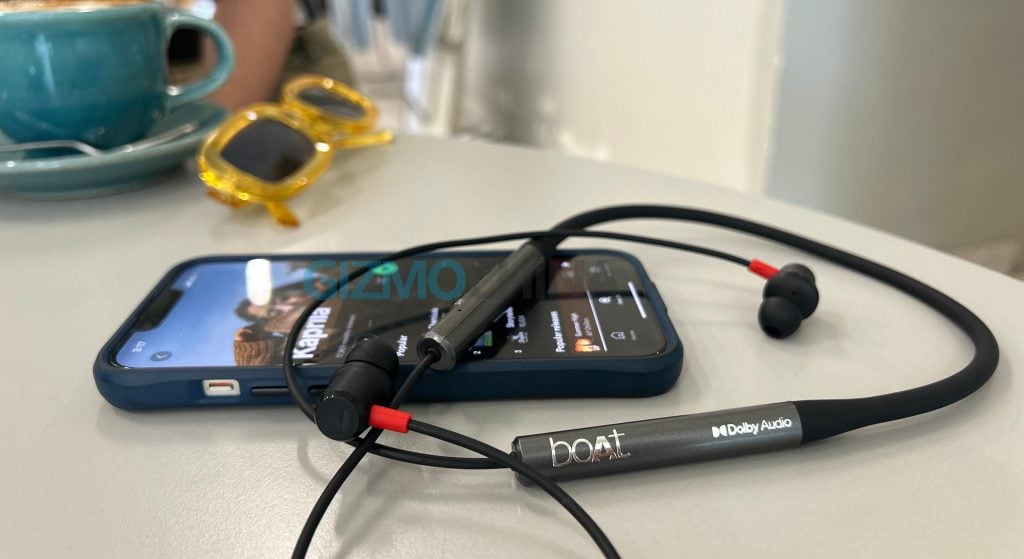
boAt held its first-ever tech launch event last month where it unveiled the Nirvana 525 ANC. During this event, the company made a lot of noise for these neckband earphones and even showcased some of its notable features like Hybrid Active Noise Cancellation in a special booth. But is it overpriced at 2,799 INR (roughly $34)? And do the world’s first Dolby Audio-powered neckband earphones actually sound good? Find out in our comprehensive review to see if they’re worth the hype.
What’s in the Box?
The hearables arrive in a surprisingly premium packaging box that opens up like a book. On the inside, you can find the wireless neckband earphones along with a 1-year warranty card, extra silicon tips, USB Type-C charging cable, and boAt stickers.
Design
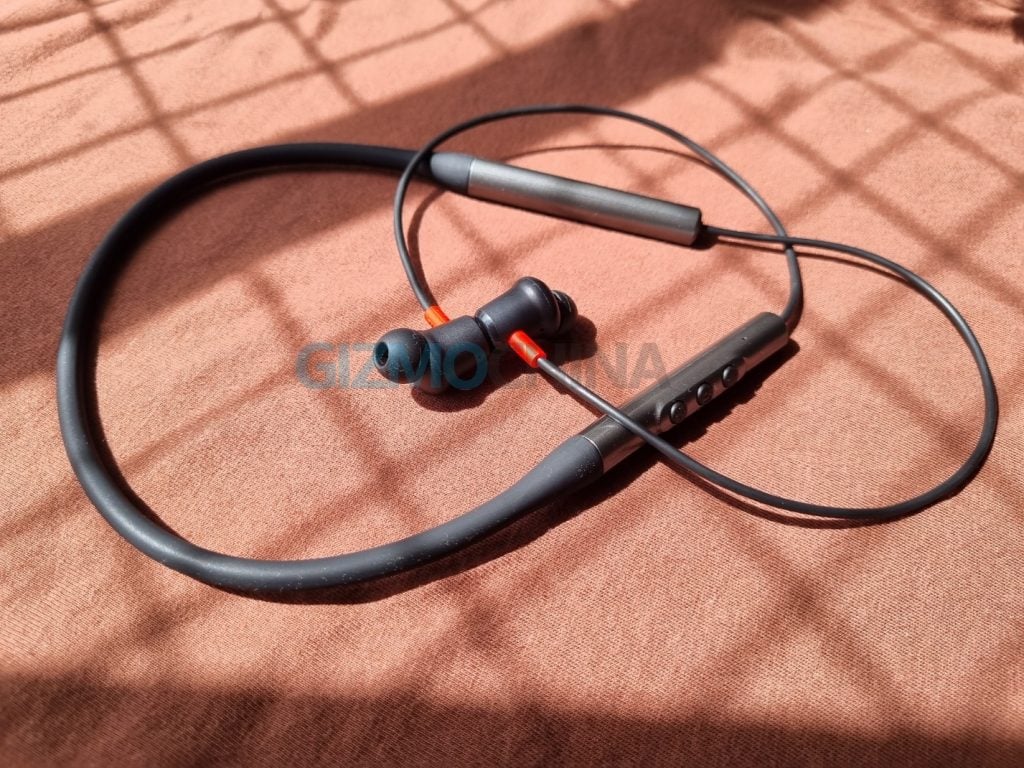
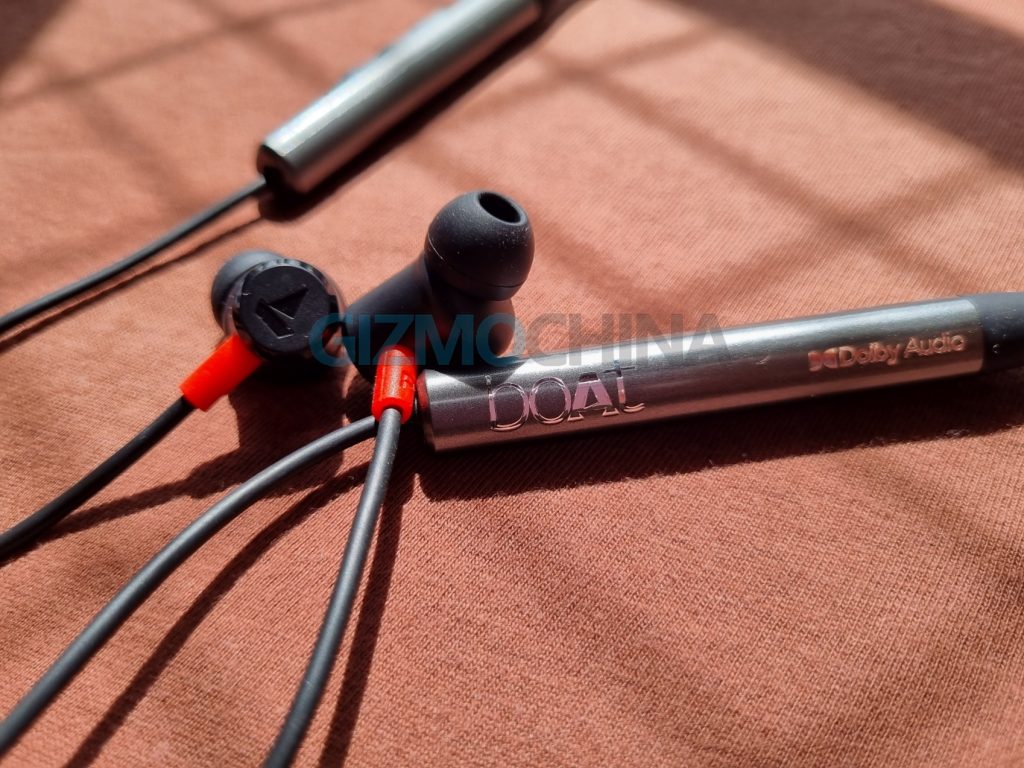
The Nirvana 525 ANC arrives in three color options, namely Space Black, Cosmic Grey, and Celestial Blue. We reviewed the black variant, which also features red accents just below the earbuds. Since it features a neckband design, the company primarily employs silicon for the portion that wraps around your neck.
The ends of the silicone band on the right feature plastic that houses the buttons which include the volume rockers, the power button, the USB-Type C port, and the button dedicated to switching between the various modes. These buttons feel tactile and responsive and support custom mapping for additional functionalities.
The build quality won’t offer a premium feel, but the earphones do not feel cheap or flimsy at all and have a sleek look. As they offer a snug fit, you can expect good noise isolation even without ANC enabled. It was comfortable with longer periods of use as well, and the magnetic tips on the earbuds helped prevent the earphones from falling off when not in use.
But one feature that was sorely missed was the magnetic pairing feature. In recent neckband earphones, the device goes on pairing mode when the earbuds are separated and turn off when connected together. This can be found in earphones that are much cheaper, so it is odd that this wasn’t included.
Sound & Call Quality
For the Nirvana 525 ANC, boAt partnered up with Dolby to bring the world’s first Dolby Audio-powered neckband earphones. The signature boAt sound profile makes its way to these earphones as well, which basically means that bass heads are going to love this one. boAt always placed an emphasis on offering punchy and powerful bass and the 11mm drivers on the Nirvana 525 ANC delivers. Thankfully, the bass did not drown out the vocals, which were clear and stood out.
However, I found the highs of the Nirvana 525 ANC to be slightly distorted and compressed at higher levels while mids just blended in with the bass. The earphones had a one-of-a-kind sound profile, as the songs I listened to had pronounced vocals and an emphasis on bass and lows. Meaning, audiophiles might not appreciate this model, but bass lovers in India are in for a treat as the beats on their favorite tracks will have new energy in them. These were also quite loud and I rarely crossed 60 percent volume levels.
I tested out the earphones while mainly using the Dolby Audio mode out of the box. Although, you can also play around with the EQ from the boAt Wearables app. The Adaptive EQ on this app brings intelligent tests to create a personalized EQ profile for you, which is a nice feature to have. But apart from this, there are two custom presets, namely Natural mode and Movie mode. Note that selecting either of the two will disable Dolby Audio.
By default, the Nirvana 525 ANC runs on an SBC codec, so you’ll need to manually switch to AAC for higher quality. It supports Bluetooth 5.2 as well as dual pairing which is handy when switching between two different devices.
The calling experience from the Nirvana 525 ANC was solid with no issues in terms of audio clarity or connection. The ENx technology from boAt was also great in cutting out noise when in an outdoor environment. So the people on the other side were never bothered by traffic or any other jarring noises during calls. But there were times when the audio from Nirvana’s mic was muffled if the background noise got too loud.
Active Noise Cancellation
The Nirvana 525 ANC features good ANC (Active Noise Cancellation) for its sub-3000 INR price tag. As per official notes, it can lower sound by up to 42 decibels and the ANC was undoubtedly one of its strong suits. The Hybrid Active Noise Cancellation feature is powered by 4 microphones. Whenever I’m on a flight, my go-to audio product is a pair of over-the-ear headphones that feature ANC. These help in drowning out the engine sound or any crying babies on the flight.
But this time around, I tested the Nirvana 525 ANC in the same situation. Even without a track playing, the earphones made me a lot more comfortable by tuning out the noise while the ambient sound completely disappeared after the music started playing. The earphones feature an Ambient mode, which was decent but I recommend not using it on a busy street. A dedicated button lets you cycle through ANC, Ambient, or turn off both of them.
Battery
The company claims a battery life of 40 hours of battery life on a single full charge and I managed to get around 25 to 30 hours with ANC turned on. The fast charging feature is also pretty nifty since a few minutes of charging can get you a couple of hours of playback easily. I was never really worried about it being out of juice and small bursts of charging were always good enough for the day. It charges via a USB-Type C port that is housed right next to the buttons, under a protective flap.
Verdict
With a price tag of 2,799 INR, the boAt Nirvana 525 ANC may not be for everyone. If you’re looking for a more balanced audio listening experience, the earphones aren’t for you since the songs’ audio quality gets muddled at high volumes. However, boAt is cleverly leveraging the Indian market, since many in the region prefer loud bass over everything else. Just make sure to tinker with the equalizer to get the most out of these earphones.
To conclude, as I said before, this is going to be a hit with bass fans. But personally, I feel these earphones might have been a better deal if they cost around 2,000 INR. Dropping Dolby Audio might have helped in reducing cost since it isn’t too effective either.
You can get the boAt Nirvana 525 ANC earphones for around 2499 on Amazon right now.
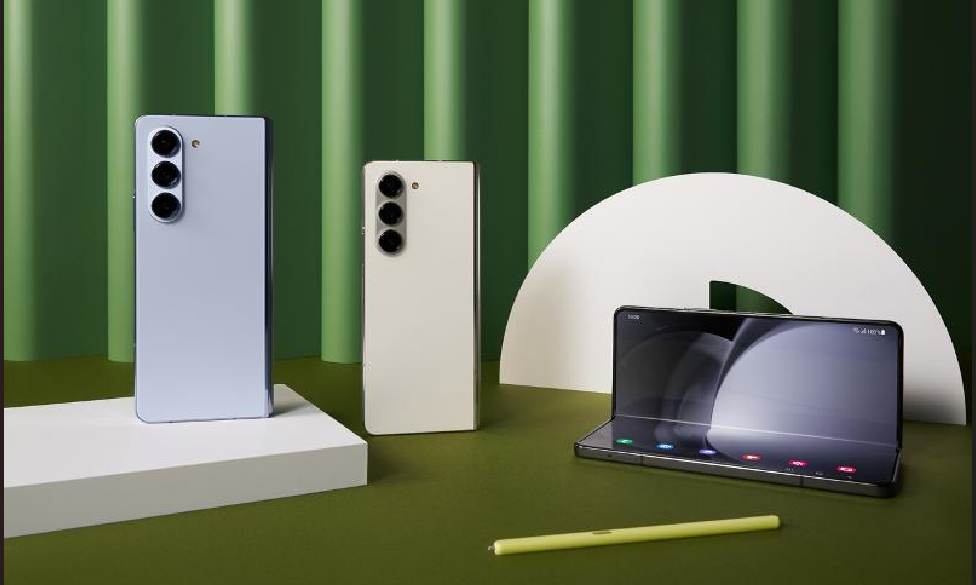
Samsung recently unveiled its latest offerings, the Galaxy Z Fold 5 and the Z Flip 5, in addition to a range of other gadgets such as newtablets and smartwatches. The company has now disclosed the pricing for these foldable devices in India.
Samsung Galaxy Z Fold 5 & Flip 5 pricing in India
Samsung has officially announced the pricing and availability details for its much-anticipated devices, the Galaxy Z Fold 5 and the Z Flip 5, in India. Here’s a breakdown of the pricing:
Galaxy Z Fold 5:
The base variant with 12GB RAM and 256GB storage: Rs 1,54,999
12GB RAM and 512GB storage model: Rs 1,64,999
Top variant with 1TB storage and 12GB RAM: Rs 1,84,999
Color options:
Icy Blue, Phantom Black, and Cream (for the 12GB+256GB and 12GB+512GB models)
Icy Blue (exclusive color for the 1TB variant)
Galaxy Z Flip 5:
8GB RAM and 128GB storage model: Rs 99,999
8GB RAM and 512GB storage model: Rs 1,09,999
Color options:
Mint, Graphite, Cream, and Lavender
Both devices will be available for purchase starting August 17, 2023. Pre-orders are now open and can be made through offline as well as online stores across India.
Samsung is offering attractive pre-booking offers, including benefits worth Rs 20,000 for the Z Flip 5 and Rs 23,000 for the Z Fold 5.
Samsung Galaxy Z Fold 5 & Flip 5 specs
The Galaxy Z Fold 5 boasts a 7.6-inch QXGA+ Dynamic AMOLED main display with a 120Hz adaptive refresh rate, offering a resolution of 2176 x 1812 pixels and a peak brightness of 1750nits. Additionally, it features a 6.2-inch HD+ AMOLED cover display with the same refresh rate, providing 2316 x 904 pixels resolution and 402ppi. Powering the device is the Qualcomm Snapdragon 8 Gen 2 processor, clocked at up to 3.36GHz Octa-Core. It comes with a generous 12GB LPDDR5X RAM and storage options of 256GB, 512GB, or a whopping 1TB UFS 4.0.
Running on the latest One UI 5.1.1 based on Android 13, the Galaxy Z Fold 5 offers a versatile camera setup with a 50MP main camera (f/1.8, OIS), a 12MP ultra-wide lens (f/2.2), and a 10MP telephoto camera (f/2.4, OIS, PDAF) capable of 3x optical zoom and 30X space zoom. For selfies, there’s a 10MP front camera, and an additional 4MP under-display camera enhances the overall photography experience. The device is packed with features such as S Pen support, IPX8 water resistance rating, a side-mounted fingerprint scanner, NFC, stereo speakers with Dolby Atmos, a Type-C port, and eSIM support. The Galaxy Z Fold 5 is fueled by a 4,400mAh battery and supports 25W wired charging and 15W wireless charging.
On the other hand, the Galaxy Z Flip 5 offers a 6.7-inch Full-HD+ Dynamic AMOLED main display with a 120Hz adaptive refresh rate, providing a resolution of 2640 x 1080 pixels and 425ppi. It also comes with a 3.4-inch AMOLED cover display with a 60Hz adaptive refresh rate and 720 x 748 pixels resolution. Like its counterpart, it is powered by the Qualcomm Snapdragon 8 Gen 2 processor, with 8GB LPDDR5X RAM and storage options of 256GB or 512GB UFS 4.0.
Running on the same software, One UI 5.1.1 based on Android 13, the Galaxy Z Flip 5 features a 12MP main camera (f/1.8, OIS) and a 12MP ultra-wide lens (f/2.2) for photography needs. The front camera is a 10MP shooter, and the device shares several features with the Z Fold 5, including IPX8 water resistance rating, a side-mounted fingerprint scanner, NFC, stereo speakers with Dolby Atmos, a Type-C port, and eSIM support. The battery capacity is also the same at 4,400mAh, with support for 25W wired charging and 15W wireless charging.
In a significant blow to Meta Platforms, the parent company of Facebook, an Australian court has ordered the tech giant to pay fines amounting to $20 million ($14 million) for unlawfully acquiring user data through a smartphone application that misleadingly claimed to prioritize user privacy while covertly harvesting personal information.
The Federal Court of Australia also ruled that Meta, along with its subsidiaries Facebook Israel and the now-defunct app Onavo, must bear the legal costs of $400,000 payable to the Australian Competition and Consumer Commission (ACCC), the body that initiated the civil lawsuit against the company.
The ACCC’s legal action against Meta stemmed from its investigation into the data practices of the social media conglomerate, revealing that the Onavo app, marketed as a tool to protect user privacy, was surreptitiously collecting and mining users’ personal data without proper disclosure or consent.
This landmark ruling by the Australian court sends a stern message to tech companies about the importance of transparency and compliance with privacy regulations. The court’s decision is seen as a significant step towards safeguarding user privacy in the digital era, as it sets a precedent for holding tech giants accountable for their data collection practices.
In response to this case and the growing concerns about digital privacy, the Australian government, under the leadership of Prime Minister Anthony Albanese, has unveiled a series of proposed amendments to the Privacy Act. The proposed changes aim to modernize the legislation, bringing it in line with the evolving landscape of digital technology and the need to protect individuals’ personal information from unauthorized exploitation.
The fines and legal costs imposed on Meta Platforms not only serve as a financial penalty but also highlight the importance of transparency and accountability in the tech industry. With governments worldwide increasingly focusing on data protection and privacy concerns, this ruling may prompt other countries to review their own privacy laws and take necessary steps to hold tech giants accountable for mishandling user data.
Recently, Apple unveiled the anticipated 15-inch model of the MacBook Air, which is similar to the regular 13-inch model of the MacBook Air but with a bigger screen.
While the device was highly anticipated for a couple of years, customers’ actual demand for the 15-inch MacBook Air is not matching up. In fact, the sales numbers are so low that the company is cutting production.
According to the latest report coming from DigiTimes, sources in the supply chain claim that sales for the new 15-inch MacBook Air are as much as 50 percent lower than the Cupertino-based tech giant’s predictions.
The report further adds that because of the low demand, the company is scaling back production, but it is not yet known if Apple has made the move to lower the production numbers or is still in consideration.
This is the first model of the Apple MacBook Air to feature a larger 15-inch display. Prior to this, users would need to purchase the more expensive MacBook Pro models if they wanted a larger than 13-inch screen.
Apple’s new 15-inch MacBook Air, launched last month at WWDC, carries a starting price of $1,299. It continues with the same design and M2 chip as the regular model but with a larger display and two extra speakers.
We use cookies on our website to give you the most relevant experience by remembering your preferences and repeat visits. By clicking “Accept”, you consent to the use of ALL the cookies.
This website uses cookies to improve your experience while you navigate through the website. Out of these, the cookies that are categorized as necessary are stored on your browser as they are essential for the working of basic functionalities of the website. We also use third-party cookies that help us analyze and understand how you use this website. These cookies will be stored in your browser only with your consent. You also have the option to opt-out of these cookies. But opting out of some of these cookies may affect your browsing experience.
Necessary cookies are absolutely essential for the website to function properly. This category only includes cookies that ensures basic functionalities and security features of the website. These cookies do not store any personal information.
Any cookies that may not be particularly necessary for the website to function and is used specifically to collect user personal data via analytics, ads, other embedded contents are termed as non-necessary cookies. It is mandatory to procure user consent prior to running these cookies on your website.