As scheduled, the ZTE Axon 50 Ultra has been unveiled in China today. As the name suggests, it is the company’s latest premium flagship smartphone.
However, it does not come with the newest powerful chipset or a high-end mobile camera system. But it arrives with a feature that’s currently only offered by two consumer brands, namely Apple and Huawei.
The ZTE Axon 50 Ultra is built around a 6.67-inch flexible curved OLED display. The 10-bit panel offers a resolution of 2400 x 1080 pixels (FHD+) and a 144Hz refresh rate.
The device is powered by a Qualcomm Snapdragon 8+ Gen 1 chip. Thus, it is limited to UFS 3.1 storage but uses LPDDR5x RAM.
On the rear, the handset sports a triple camera system. The setup includes an OIS-assisted 64MP Sony IMX787 primary sensor, a 50MP ultra-wide unit, and a 50MP telephoto snapper.
The main highlight of the phone is that it carries support for Beidou’s two-way satellite communication system. Thus, users can send and receive emergency messages when they are out of network coverage.
The smartphone houses DTS: X Ultra-supported dual stereo speakers. Finally, it draws energy from a 5,000mAh battery and can charge at a maximum speed of 80W.
Weirdly, ZTE hasn’t revealed the pricing and availability of its new handset.
The fierce competition between Xbox and PlayStation continues unabated. After lagging behind its rivals in the eighth-generation consoles, Microsoft has made a comeback in the ninth generation with successful products. However, the company aims to stand out more with its services and offerings rather than just hardware. One of the most interesting services among these is Game Pass. Not content with limiting this service to just gaming consoles, Microsoft launched what could be described as the “Netflix of games” for PCs as well. Now, Xbox PC Game Pass expands to 40 new countries, nearly doubling its global availability. Here are the details…
Xbox PC Game Pass Expands to 40 New Countries
Xbox has announced the expansion of its PC Game Pass service to 40 additional countries, taking the total number of countries covered to 86. This significant expansion primarily focuses on regions in Europe, the Middle East and North Africa (MENA), and Central and South America. The move comes after Xbox began testing the PC Game Pass in these new territories back in February 2023.
To celebrate the expansion, Xbox is offering a limited-time special welcome offer for new users, with pricing varying by territory. Furthermore, members of the Xbox Insider Program in these new regions will receive two months of PC Game Pass for free. This ensures that new users will have the same suite of benefits as existing PC Game Pass subscribers, such as access to Xbox Game Studios releases on day one, Bethesda’s back catalog, an EA Play membership, and exclusive content in Riot Games’ titles.
The cloud gaming service offered by PC Game Pass enables players to access games on less powerful hardware, reducing the upfront costs associated with playing PC games. The newly added territories that can now fully access PC Game Pass include Albania, Algeria, Bahrain, Bolivia, Bosnia and Herzegovina, Bulgaria, Costa Rica, Croatia, Cyprus, Ecuador, Egypt, El Salvador, Estonia, Georgia, Guatemala, Honduras, Iceland, Kuwait, Latvia, Libya, Liechtenstein, Lithuania, Luxembourg, Malta, Moldova, Montenegro, Morocco, Nicaragua, North Macedonia, Oman, Panama, Paraguay, Peru, Qatar, Romania, Serbia, Slovenia, Tunisia, Ukraine, and Uruguay.
This expansion reaffirms Xbox’s commitment to broadening its global reach and making gaming more accessible to players worldwide. With the addition of these 40 new countries, the gaming community can expect an even more diverse and rich experience on the Xbox PC Game Pass platform.
Google’s work on artificial intelligence Bard continues at full speed. The company, which has been lagging behind ChatGPT, developed by OpenAI for a while, is preparing to change this situation with new features and updates. Recently, the company announced an ‘experiment updates’ page, where it will share innovations, developments, and fixes related to Google Bard. Here are the details…
Google Bard’s New “Experiment Updates” Page Offers Transparency on AI Development
The Google Bard, which was announced earlier this year, has been in a constant state of development. While Google has been actively tweaking its AI models, it has been challenging for users to know exactly what the service is capable of due to the lack of a centralized information hub.
Addressing this issue, Google has recently launched a new “experiment updates” page to keep users informed about the latest developments in Bard, including new features and bug fixes. The update page offers a brief description of “what” and “why” for each posted update. According to Google, this page aims to provide “an easy place to see the latest Bard updates for users to test and provide feedback.”
This move towards openness is seen as a step in the right direction for the company, which aims to be more transparent about the development process of its AI technology. In the same post, Google has made two additional announcements. Firstly, they have introduced new search options when users click “Google it.” Secondly, the company has acknowledged issues with Bard’s math and logic skills, revealing that the AI doesn’t always provide the correct answers.
Google is currently working on fixing these issues, following the recent upgrade to a more advanced language model for Bard. Although the updates on the page are short and lack detailed information on how Google is implementing these changes, the transparency demonstrates the company’s commitment to keeping users informed about its AI development.
In a time when concerns about unregulated advancements in AI technology are growing, Google’s openness is likely to earn them trust points from both industry professionals and the general public.
Samsung India has apparently seen three of its public policy executives quit in India within a single week. The news arrives from sources close to the matter, so here are all the details regarding this matter.
The sources told Reuters that the South Korean tech giant has seen three of its executives quit that were a part of its public policy team. However, this news also comes as Samsung is facing regulatory issues in the Indian market. For those unaware, a public policy team play an integral role in tech companies since they help the firms to balance local regulation issues in any given nation. As of right now, Narendra Modi’s government (Indian Prime Minister) is pushing for domestic electronics manufacturing.
Furthermore, they have also been implementing stricter regulations on tech giants that operate within the country. As per sources close to the matter, Binu George that worked with the company’s corporate affairs and strategy, Surabhi Pant who worked with policy and public affairs, and Nikhil Kaura from the same team have resigned from Samsung within the last week. The three were a part of a seven member team that is headed by Aggarwal, who is a former bureaucrat that joined the company back in December.
He had previously also led public policy at Meta and Uber in India. These three executives have yet to respond to Reuters’ request for a comment. Similarly, Samsung has also decline to respond to this matter as well. The reason for the three execs quitting is still unclear, but it adds to the challenge that Samsung is facing in the region.
The much-awaited Huawei Nova 11 series is all set to be launched on April 17. Nova 11 Ultra variant is spotted in a live image which showcases a stunning design with the all-new “nova” embossing on the background panel, featuring an eye-catching green color. The camera module is arranged with a triple vertical lens and a unique large ring in the middle.
Huawei Nova 11 will consist of three variants: Nova 11, Nova 11 Pro, and Nova 11 Ultra. Popular leakster Digital Chat Station has leaked the detailed specifications sheet of all the Nova 11 models.
The Huawei Nova 11 will come in four colors and a 6.7-inch OLED panel. With a thickness of 6.88mm, it packs a 4500mAh battery with 66W Turbocharge 1.0. The phone has a punch-hole design with a 60MP front-facing camera that enables 4K selfie video recording. The phone features a triple rear camera system with a 50MP RYYB main lens, an 8MP ultra-wide-angle, and laser autofocus.
The Huawei Nova 11 Pro version sports a 6.78-inch OLED screen with curved edges and is 7.99mm thick. Similar to the standard version, it features a triple camera system and dual 60MP + 8MP ultra-wide-angle cameras on the front. The Pro version also comes with a 4500mAh battery powered by 100W Turbocharge 2.0.
The Huawei Nova 11 Ultra is identical to the Pro version in terms of specs, except for a few unique features. The Nova 11 Ultra comes with variable aperture technology, enabling immersive 10-stop aperture control, which helps to capture beautiful bokeh and bright images with a super-large aperture. Additionally, the Nova 11 Ultra features a satellite communication SMS feature, although it is yet to confirm whether it’s one-way or two-way.
All three models of the Huawei Nova 11 series feature Kunlun glass versions that offer drop resistance performance in all scenarios for increased durability.
The Huawei Nova 11 has 128GB/256GB/512GB storage options, while the Pro version comes with 256GB and 512GB storage. The Ultra version has only one option of 512GB storage.
Huawei is set to launch a new mid-range phone, the Enjoy 60X, in the Chinese market on April 17, and details of its specifications and design have already been leaked. As it bears the Enjoy branding, it is expected to be an affordable option for buyers.
The Huawei Enjoy 60X is believed to be the STG-AL00 model that recently appeared on China’s TENAA certification database. Leaks have revealed that the phone will feature a large display and a powerful battery, placing it above the recently launched Enjoy 60. Here’s what we know about the phone so far.
The smartphone’s dummy unit image shows it will have a wide notch and a 6.95-inch LCD display, 7,000mAh battery, and 512GB of storage. Previous leaks have mentioned that the display with be TFT LCD with a resolution of 720 x 1600 pixels and a 20:9 aspect ratio. The device will come pre-installed with HarmonyOS, which should enhance the phone’s user experience. The rear camera design features a round camera module, housing a 50-megapixel primary camera, an unknown auxiliary camera, and an LED flash.
According to other leaks, the Huawei Enjoy 60X will be equipped with the Kirin 710F chipset and will support 22.5W charging. The phone is expected to come in multiple configurations with 8GB RAM and 128GB, 256GB, or 512GB of storage. However, the price of the Enjoy 60X has not been disclosed yet.
We have previously covered a report that mentions that the Huawei Enjoy 60X will feature a 48MP primary sensor and a 2MP depth sensor, along with an 8MP selfie camera on the front.
Being a budget-mid range device, the smartphone is expected to be priced between CNY1,999 to CNY2,199 ($337). Stay tuned for the official announcement and release of the Huawei Enjoy 60X.
WhatsApp is rolling out a new feature called the Companion Mode for all of the beta users on the Android platform. The company had first introduced this feature back in 2022, and it is currently being tested.
The popular chat messaging platform is rolling out the new feature of its app for Android beta users that are running the version 2.23.8.2 or newer. For those unaware, the Companion Mode basically adds another layer on the existing multi device support. This feature let you connect your WhatsApp account to another smartphone for easier access to your chats. It works even if your main device doesn’t have an active internet connection.
As of right now, Companion Mode is only available for the Android platform and let’s you connect a secondary Android device. To try this feature out, users need to download either the WhatsApp Messenger or Business app beta on their secondary Android phone. Following this step, you can select the option to ‘Link a device’ in the app while also running the app on their primary phone as well as going to Settings and then go to Linked devices.
Scanning a QR code from this screen from your secondary phone will finally link the two devices. So now, you can access your chat history on both devices seamlessly. Keep in mind that this feature is still in the beta state. In other words, some aspects of the new feature is still unavailable. At the moment, you can can link up to four devices.
MIUI is the oldest surviving Android skin. For the unaware, it is Xiaomi’s first-ever product. Despite being on the market for years, it still does not offer longer support than newcomers like Samsung’s One UI.
Anyways, the company has now properly optimized the software for most devices, especially flagship and mid-range models. It even lets you uninstall more system apps than on any Android skin.
But now, for some reason, Xiaomi has decided to bundle not one but three browsers on select handsets. Let’s go through the details.
Redmi Note 12 Pro
Yesterday, I manually installed MIUI 14 on a Redmi Note 12 Pro Plus review unit loaned by Xiaomi India. To my surprise, the software is still based on Android 12.
However, I was more puzzled to notice the uninstallable Opera Browser in the app drawer. Then, earlier today, I came across this article by Xiaomiui citing Kacper Skrzypek as the source.
That’s when I realized that Xiaomi seems to have inked a deal with Opera to bundle the browser on its phones. Interestingly, this browser is limited to devices running Indian and Global versions of MIUI.
Thus, Xiaomi users in India now have to deal with two pre-installed browsers (Chrome and Opera) on their smartphones that are uninstallable.
On the other hand, the situation is slightly different for ‘Global’ users as they get three browsers, the third one being Mi Browser. But on this version of MIUI, Opera Browser can be uninstalled.
So it looks like the uninstallable Opera Browser acts as a replacement for Mi Browser in India where the latter was banned in the country in 2020.
Do let us know your thoughts on these changes made by Xiaomi in the comment section below.
OpenAI, the maker of ChatGPT, has recently announced a bug bounty program to reward individuals who find flaws and bugs in the software. The company has teamed up with Bugcrowd, a bug bounty platform, to launch the program that offers rewards ranging from $200 for low-severity bugs to $20,000 for exceptional bug discoveries.
ChatGPT is an AI chatbot that uses natural language processing to simulate conversations with users. Despite its advanced technology, it is still prone to bugs and other flaws. OpenAI understands this and believes that transparency and collaboration are essential in addressing this reality.
The bug bounty program is an initiative that invites the global community of security researchers, ethical hackers, and technology enthusiasts to help identify and address vulnerabilities in ChatGPT’s system. By incentivizing testing and offering rewards for bug discoveries, OpenAI hopes to attract more individuals to participate in the program.
Last month, the company had to temporarily shut down ChatGPT after a bug allowed some users to see the titles of other users’ chat histories. This incident highlights the importance of identifying and addressing vulnerabilities before they cause more significant issues.
For those who use ChatGPT extensively and have encountered bugs in the software, the detailed guidelines and rules for participation in the bug bounty program can be found on OpenAI’s bug bounty program page. The guidelines provide information on how to report bugs, the severity levels, and the rewards for each level.
Bug bounty programs have become increasingly popular in recent years, with companies such as Google, Microsoft, and Facebook offering similar programs. The main goal of these programs is to encourage security researchers to identify and report security vulnerabilities in software products.
By launching its bug bounty program, OpenAI is taking a proactive approach to identify and address vulnerabilities in ChatGPT’s system. This initiative shows the company’s commitment to maintaining the security and integrity of its software and the data of its users.
Asus has announced that the brand will be holding a global launch event on April 13 for its ROG Phone 7 series flagship gaming smartphones. So far, we know about the existence of the ROG Phone 7, 7 Pro, and 7D through various leaks and certifications. Now, a new NBTC certification listing has confirmed the existence of the ROG Phone 7 Ultimate.
The certification database recently revealed the Asus ROG Phone 7 Ultimate with the model number AI2205_D, which had previously been mistaken for the ROG Phone 7D in the AnTuTu benchmark. The new information confirms that the AI2205_D belongs to the ROG Phone 7 Ultimate, and not the 7D as previously thought. Interestingly, the AI2205_D is powered by the Snapdragon 8 Gen 2 chipset, while the expected chipset for the ROG Phone 7D was the Dimensity 9200. This new revelation provides more clarity on the specifications of the upcoming phones.
According to its listing, the smartphone is set to include 16GB of LPDDR5X memory and 512GB of UFS 4.0 storage, indicating top-of-the-line performance capabilities. Additionally, the listing suggests that the device will boast an impressive 165Hz refresh rate display, making for a smooth and responsive user experience.
It is tipped to measure 173 x 77 x 10.3mm in thickness and weighs 239 grams. The smartphone is expected to feature a 6,000mAh battery. The camera setup could feature a Sony IMX766 main sensor paired with a 13MP ultra-wide-angle lens and an 8MP macro unit. Up front, there could be a 32MP selfie snapper.
Realme has just launched a new budget model from its Narzo series of smartphones. The device in question is the Narzo N55 that has just been announced for the Indian market. It features some notable specs and features, so here are all the details.
Talking about its design first, the front features a punch hole cutout for the selfie camera while the rear features a two large camera modules that are slightly raised over the glossy upper half. The Narzo N55 sports a tall 6.72 inch IPS LCD panel that offers Full HD+ resolution and 90Hz refresh rate. Under the hood, the smartphone is equipped with the MediaTek Helio G88 SoC that is paired with up to 6GB of LPDDR4X RAM and up to 128GB of UFS 2.2 internal storage.
For photography, the budget handset features a 64 megapixel primary shooter, which is a first in the Narzo lineup that is paired with a 2 megapixel depth sensor. On the other hand, the front houses an 8 megapixel selfie camera. The Narzo N55 is powered by a large 5,000mAh battery pack that supports 33W SuperVOOC fast charging. Other notable features include, Android 13 OS based Realme UI, side mounted fingerprint scanner, and USB Type C port for charging and data transfer.
The Realme Narzo N55 will be exclusively available for purchase on the Chinese smartphone maker’s official website and on Amazon. It arrives in two storage configurations, which includes a 4GB + 64GB and 6GB + 128GB variant, as well as Prime Blue and Prime Black color options. The former has a price tag of 10,999 INR, while the latter costs 12,999 INR. Realme is also offering a 500 INR discount as a part of its introductory offer while the 6GB model will get a 1,000 INR discount.
Today we’re reviewing this phone: the Meizu 20 Standard Edition.
Why Meizu didn’t launch the Meizu 19, they really haven’t announced any new phones for a whole year. We’ve been waiting for so long, the Meizu 20 should be a big surprise for us, right? You are right, it did give us a “big surprise”.
Display
Its biggest “surprise” is the display. Although this screen looks good, 144Hz, ultra-narrow bezel, straight screen with DC dimming, and super-fast, also very well-placed ultrasonic fingerprint recognition, this should be many people’s dream display. But there are a lot of details you can’t see that are not well done, such as clarity.
6.55-inch screen has only FHD+ resolution, its pixels are RGB-Delta Structure. This means you’ll feel more blurry than other phones when reading text. The maximum brightness is also not as high as other Samsung panel phones, and watching HDR videos is not stunning enough.
Its lower bezel is narrow enough, but you can still see that it’s a bit wider compared to the other three sides. It’s wider than the Xiaomi 13, and is the same width as the Redmi Note 12 Turbo. Simply put, the screen is blurry and not bright enough, and the lower bezel isn’t particularly narrow. If the Meizu 20 cost $300, I’d forgive it. But at $435 for a phone with this screen, I can’t accept it.
Benchmark & Gaming
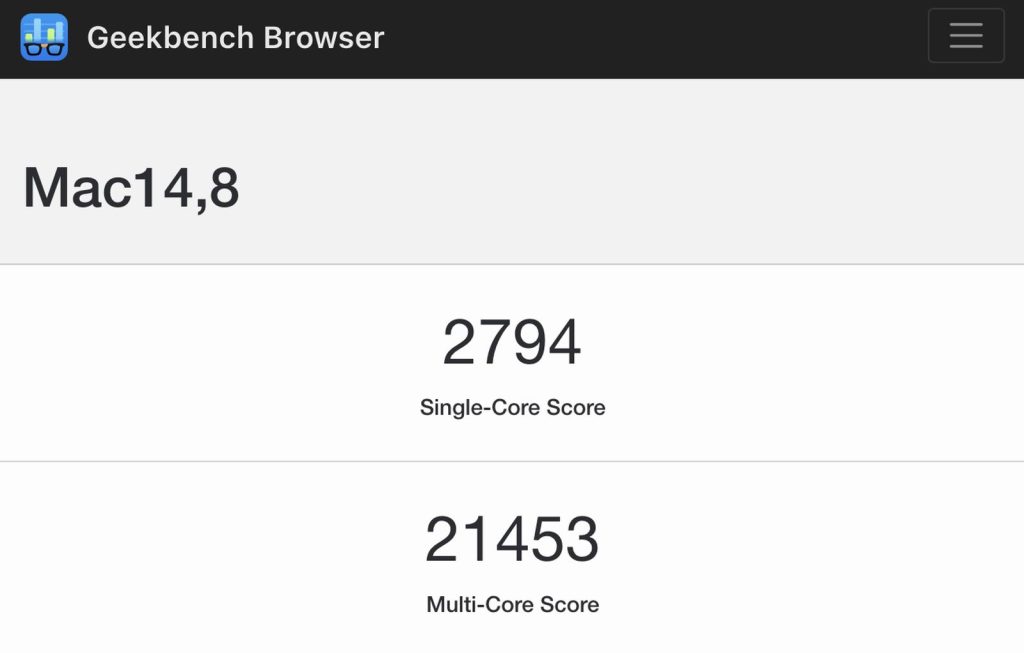
Let me guess, if you want to buy the Meizu 20, it must be because it’s really cheap for a Snapdragon 8 Gen 2 phone. So is it worth buying it just for the performance? I don’t think it’s a good idea. Looking at various Benchmarks, the Meizu 20 is not that satisfying. Even if Antutu can run to a high score of 1.3 million, Geekbench shows that its Muti-Core is much worse than other phones, only about 8+ Gen 1 level. The CPU Throttling Test performance was also disappointing.
This is not a good sign. Let’s play the game. Although the frame rate curve is not as bad as the score and the temperature is not too high, it is not a very good performance either. The frame rate drops quickly during battles. So, if you want a cheap but powerful phone, why don’t you check out the Nubia Z50?
Camera
The Meizu 20’s camera performance is fine. The main camera is similar to the Xiaomi 13 during the daytime, except that the white balance is cool, otherwise, there is nothing wrong with it. The colors are more realistic, and the saturation is not too high when shooting flowers. The dynamic range is also better, so the contrast will look lower. It has a small problem at night, the highlighted area tends to be overexposed. The performance of the main camera is generally in line with my expectations for a phone at this price point.
The ultra-wide camera performs about as well as the main camera in daylight. Both phones have the Purple-Fringe issue, which isn’t a big deal considering the Meizu 20 is much cheaper than the Xiaomi 13. The biggest problem with the super wide camera is that the auto mode is often underexposed. As long as there is not enough light, the image will be very dark. Turning on night mode solves this problem, but the image quality is still not as good as the Xiaomi 13.
Although the Meizu 20’s third camera uses a 5 MP depth-of-field lens, it’s not completely useless either. In portrait mode, the recognition of objects will be a little more accurate. A glass table, for example, would be defocused by a phone without a depth-of-field camera, and the Meizu 20 would be able to get a clear shot of the table. It’s also easier to recognize glasses when taking portraits.
All in all, the Meizu 20’s camera system isn’t bad, but you wouldn’t buy it for the camera either.
The Meizu 20 supports up to 8k 30fps recording specs, and the ultra-wide camera also supports 4k resolution video recording. The image quality and stability are quite good. I think its biggest selling point is the front camera, which supports 4k 60fps and EIS, so I think this phone should be great for vlogging.
Design
I think its real “surprise” should be the design. The flat screen with a flat frame looks pretty good. This year’s standard version is no longer a small 6.2-inch phone, which means there’s one less brand in the world that makes small phones.
Seeing this lens module, I know what you’re thinking. And it’s not the first time they’ve done this. Meizu has been copying the design of Samsung’s flagship phones for a long time before. But Samsung’s phones are really beautiful, and Meizu at least didn’t copy the wrong phone. And it also has better build quality than any other phone in the sub-$500 range.
If you need a lower-priced S23, you can try the Meizu 20. To be clear, I’m not mocking it, this is a real compliment. The Samsung S series has what I consider to be the top CMF in Android phones, so looking like that isn’t a bad thing sometimes.
Battery & Charging
It only has 67w of charging power. After all, it’s the standard version, so we can’t ask for too much. Although it takes longer to fully charge than the Xiaomi 13, the battery capacity is also larger than the Xiaomi 13, so the speed is actually about the same.
Although there is no wireless charging, the good news is that the free charger is 80w and supports a lot of protocols. The phone also supports third-party chargers for fast charging, nice.
The battery life is similar to the Xiaomi 13, but I wish the Meizu 20, with its larger 200mAh battery, could last a little longer.
Flyme OS
In fact, the biggest advantage of Meizu is actually Flyme OS, which is one of the best experiences among many Chinese brands. It is very similar to MIUI in terms of its advantages, and the operation logic is very much in line with comfort.
For example, this floating window function works very well. Like launching Google Assistant, swipe up from the bottom corner to open the floating window of any app. Close the floating window also does not need to click any button, just click anywhere outside the floating window.
Mention Flyme, we have to talk about mBack. Touch the home button to go back, and press heavy to back to the desktop. 8 years ago they were the first to bring this operation logic from iOS to Android, and 8 years later you can still see this feature on Meizu 20. And gesture control is unaffected. For those of you who still wish your phone had a home button, except for that old iPhone SE 2022, only Meizu might be able to grant your wish. So if you like MIUI, then you’ll love Flyme, and if you hate MIUI, then Flyme shouldn’t be for you either.
A long time ago, I bought a Meizu phone. Even though it was not very powerful and the camera was not good. I had a small budget and liked Flyme, so I bought it anyway. I never expected that today’s Meizu 20 would be in the exact same situation as the phone I had.
I only recommend it to those who like Flyme and don’t have much budget for a flagship phone, otherwise you have too many other better options. Let’s give them some time, as long as they don’t die, maybe the next phone will be better.
Apple analyst Ming-Chi Kuo has revealed some interesting new information about the upcoming iPhone 15 Pro and iPhone 15 Pro Max models. According to Kuo, Apple has decided to abandon the solid-state button design in favor of the traditional physical button design, due to unresolved technical issues before mass production.
The solid-state buttons were initially intended to provide haptic feedback to simulate the feeling of pressing the buttons, without them physically moving. However, it seems that the new design presented too many challenges for the company, and they have decided to revert to the traditional design.
It is still unclear whether the physical button design will include two volume buttons or a single elongated volume button, as was previously rumored. However, Kuo believes that there is still time for Apple to make modifications to the iPhone 15 Pro’s design, given that the device is still in the EVT (Engineering Validation Test) development stage.
While the change is not expected to have a significant impact on the mass production schedule and shipments for the Pro models, it may be unfavorable for key suppliers of Taptic Engine-related components for iPhones, such as Cirrus Logic and AAC Technologies.
According to tech analysts Jeff Pu and Shelly Chou at Hong Kong-based investment firm Haitong International Securities, the solid-state button design may be delayed until the iPhone 16 series in 2024.
Recent reports suggest that the iPhone 15 Pro will feature a titanium frame with a rounder-edged design, new buttons, and a giant camera bump. The individual camera protrusions are expected to increase once again, with the entire hump thickening. Meanwhile, the iPhone 15 Pro Max will have a smaller camera protrusion, rumored to house a periscope zoom lens.
Both devices are expected to have “all-new sensor technology that will capture more light and reduce overexposure or underexposure in certain settings”. Furthermore, the USB-C port is expected to be included in all iPhone 15 versions, but the fastest charging will be limited to USB-C cables certified by Apple.
3D bioprinting is a cutting-edge technology that enables the fabrication of living tissues and organs using a specialized 3D printer. It involves the precise layer-by-layer deposition of biomaterials and living cells to create complex three-dimensional structures that mimic the architecture and function of natural tissues and organs. This technology has the potential to revolutionize the fields of regenerative medicine, drug discovery, and personalized healthcare by allowing researchers to create functional tissues and organs for transplant, drug testing, and disease modelling. However, another new implication of 3D bioprinting has come to light.
Printing electronic devices inside the human body is no longer just a thing of science fiction. Scientists have demonstrated a breakthrough in 3D printing technology by creating conductive circuits inside living organisms. The discovery was made by John Hardy at Lancaster University in the UK and his colleagues, who published their research in the latest issue of “Advanced Materials Technology”.
In experiments with Caenorhabditis elegans, a tiny worm with a simple nervous system, metal nanoparticles were deposited in circuits or patterns using a custom-made 3D printer and a weak electric current, while fluorescent dyes were added to the nanoparticles to enable the circuit to glow.
The technology could enable the creation of electronic devices inside living organisms, such as brain-computer interfaces or neurostimulators. The devices could be used to treat neurodegenerative or nervous system-related disorders, and to monitor physiological signals or chemical reactions within the body. Further development and testing are required, but the breakthrough has enormous implications for medical research and treatment.
Lenovo has recently introduced a range of new laptops, comprising of the latest Legion gaming machines and Yoga Slim and lightweight laptops, for worldwide release. The company has now unveiled another ultrabook named Slim 7i, equipped with Intel’s Raptor Lake-P and Alder Lake-P processors. Here are the particulars of this new device.
Lenovo has launched the Yoga Slim 7i ultrabook, a slim and lightweight laptop designed for high-performance computing. This laptop offers a 14-inch LCD touchscreen display that boasts a 120 Hz refresh rate, along with other display options such as OLED and IPS. The device is equipped with last year’s i5-1240P and i7-1260P processors, as well as the new i5-1340P and i7-1360P models. However, only the Raptor Lake-P models with a touchscreen are currently available. The RAM capacity is fixed due to the slim chassis, with 8 GB or 16 GB options available.
On the storage side, users can choose between 512 GB or 1 TB PCIe 4.0 NMVe SSDs. The latest models feature LPDDR5-5200 modules, while the Alder Lake-P models will come with LPDDR5-4800. The device is fitted with a limited range of ports, including 2x Thunderbolt 4, 1x USB-A 3.2 Gen 2, an HDMI 2.1 video output, and an audio combo jack. Additionally, the device only provides Wi-Fi 6E + BT 5.1 card for internet connectivity.
The Yoga Slim 7i also features a biometric security system with an IR sensor integrated into the FHD webcam, which comes with a privacy shutter. It is powered by a 65 Wh battery, which provides long battery life and makes the laptop weigh around 1.31 kg (2.9 lbs).
Pricing for the Raptor Lake-P models with touchscreen starts at US$1,180 for the i5-1340P model with 16 GB of RAM and 1 TB storage. The i7-1360P model comes with 16 GB RAM and 512 GB storage for US$1,602. Lenovo has stated that the Alder Lake-P models will start at US$730 and only come with 8 GB of RAM.
Reign, a spy application with destructive capabilities comparable to Pegasus, was discovered by the Citizen Lab of the Munk College of the University of Toronto, as reported on April 12 by IT Home. The app is capable of transmitting data after infecting devices, without the user knowing about it.
The spyware has mainly targeted dignitaries, journalists, and others, with at least 5 cases having been identified so far. Reign uses a vulnerability called “Endofdays” to attack iPhone devices running iOS 14.4 and iOS 14.4.2 updates.
Like Pegasus, after infecting an iPhone, Reign can access various components of iOS and iPhone functions. The spyware can record calls and microphone input, take pictures with the camera, extract or remove content from the keychain, generate iCloud 2FA passwords, search files and databases on the device, track the device’s location, and clean software traces to minimize detection possibilities.
Spyware is a growing concern in the digital age. In the wrong hands, it can be used to gather sensitive information or control devices without users’ knowledge or consent. Devices infected with spyware can become tools for criminal activities such as identity theft, financial fraud, and espionage.
It is crucial for phone users to take measures to protect themselves from spyware attacks. This includes keeping their devices updated with the latest security patches and avoiding downloading apps from unknown sources. Additionally, users should be wary of suspicious emails, messages, or phone calls that may contain phishing links or malicious attachments.
Samsung is planning to introduce its new range of flagship Android tablets in the second half of 2023. The lineup is expected to feature three tablets: Galaxy Tab S9, Tab S9 Plus, and Tab S9 Ultra. While the Ultra variant has already had a bunch of leaks, not much is known about the Plus model. Now, the Galaxy Tab S9 Plus has made an appearance on Geekbench.
The Tab S9 Plus appeared on Geekbench with the model number SM-X818U. The listing has revealed its performance along with some key specifications. The model number reveals that the device is meant for the US market. It features an octa-core processor with a 1 + 3 + 4 core configuration. The codename “Kamala” reveals that it is a Qualcomm Snapdragon 8 Gen 2 processor.
What’s interesting is the peak clock speed, which is more than what the stock Snapdragon 8 Gen 2 chip comes with. This all but confirms that the chipset inside this tablet is the special Snapdragon 8 Gen 2 for Galaxy. The same chip is used in the Galaxy S23 flagship smartphone lineup. The device is expected to come with a whopping 12GB of RAM and will run on the latest Android 13 operating system out of the box.
The Samsung flagship tablet put up an impressive performance during the Geekbench 5 benchmark test, achieving a single-core score of 2049 points and a multi-core score of around 5492 points. While this is a commendable feat, it remains to be seen if the tablet can maintain this level of performance over time. Furthermore, it will be intriguing to observe how this added processing power translates to tackling demanding tasks on the device.
Elon Musk, the tech entrepreneur known for his innovative ideas and bold statements, has reportedly purchased 100,000 GPUs for Twitter’s in-house artificial intelligence project. The move comes after Twitter hired two former DeepMind researchers and suggests that the company is moving forward with an ambitious plan to create a generative AI that can be trained on its vast trove of data. While the project’s specific goals are unknown, sources suggest that the AI could be used to improve Twitter’s search functionality or advertising business.
GPUs, or graphics processing units, can perform a large number of calculations in parallel, making them ideal for machine learning and artificial intelligence tasks that require a lot of computation power. GPUs can accelerate the training of deep learning models by processing large amounts of data in a short amount of time, making them a critical component in AI research and development.
As per past reports, Musk has been critical of OpenAI‘s for-profit subsidiary and reportedly left the organization after a power struggle with fellow co-founders. According to reports, Musk promised to provide OpenAI with roughly $1 billion but stopped payments after his departure, leaving the organization scrambling to raise cash. OpenAI later secured a $1 billion investment from Microsoft and announced the creation of a for-profit subsidiary.
Twitter can benefit from an AI model in several ways. As mentioned previously, the company could use AI to improve its search functionality, which would make it easier for users to find the content they are looking for. Additionally, Twitter could use AI to better understand the needs and preferences of its users, which would allow the company to provide more personalized content and recommendations. AI could also help Twitter to rebuild its advertising business by making it easier for advertisers to reach their target audiences and measure the effectiveness of their campaigns.
Samsung is expected to launch multiple premium devices in the second half of 2023. This will include the Galaxy Z Fold 5, the Galaxy Z Flip 5, and the Galaxy Tab S9 series. Specs of the flagship Galaxy Tab S9 Ultra has already leaked, and the tablet has also appeared on Geekbench revealing its performance. Now, a new leak has tipped the storage variants of the flagship tablet.
A Twitter tipster going by Revengnus has claimed that the Galaxy Tab S9 Ultra will be released in three variants, differing in RAM and storage capacities: 8GB RAM and 128GB storage, 12GB RAM and 256GB storage, and 16GB RAM and 512GB storage. Other than the storage and RAM options, let’s take a look at the other leaked specs of the Tab S9 Ultra.
Samsung Galaxy Tab S9 Ultra specs (leaked)
The Galaxy Tab S9 Ultra, the upcoming Android tablet from Samsung, is set to feature impressive specifications. It will have a WQXGA+ display measuring 14.6 inches and the same dimensions as its predecessor, the Tab S8 Ultra, with a thickness of 5.5mm and a weight of approximately 737 grams.
The tablet’s battery will be a powerful 11,200mAh, capable of supporting 45W fast charging, although it is unlikely that a charger will be included in the package. The device will also boast an upgraded performance unit, with a Qualcomm Snapdragon 8 Gen 2 SoC, which has a clock speed of 3.36GHz, similar to that of the Galaxy S23 series. Additionally, it is anticipated to offer up to 16GB of LPDDR5X RAM.
In terms of durability, the Galaxy Tab S9 Ultra will have an IP68 rating, meaning that it will be both water and dust resistant. The device will be able to withstand immersion in water up to 1.5 meters deep for up to 30 minutes, making it ideal for use outdoors or in challenging environments.
[Update] In the previous version of this post, it was incorrectly mentioned that there are two configurations of the Phantom V Fold. The article has been updated to state that it comes in a single 12+256GB version only.
Original story continues…
Tecno held a launch event in India yesterday (April 11) to announce the Phantom V Fold, which is the company’s first foldable smartphone. The said device was showcased at MWC 2023 earlier this year. Starting today, it will be available for purchase in India.
Tecno Phantom V Fold price in India, offers
The Tecno Phantom V Fold comes in a single variant that offers 12 GB of RAM and 256 GB of storage, which is priced at Rs 88,888. The device comes in black and white colors variants.
Tecno Phantom V Fold
Customers who pre-book the Tecno Phantom V Fold at offline stores will receive a free trolley bag worth Rs. 5,000, but this offer is only available while supplies last. The offline stores will start receiving pre-booking of the Phantom V Fold on April 22.
For those who purchase the Phantom V Fold, Tecno is offering a free protection plan worth Rs 8,888, which includes a one-time screen replacement within 6 months, free pick-up and drop service, and a 1-year extended warranty. HDB Financial Services is also offering a cashback offer of Rs 5000.
For early bird buyers, the Phantom V Fold will be available at a special price of Rs 77,777 during the early access sale starting from April 12 (today) via Amazon India. However, please note that this offer is also available only for limited stock.
Tecno Phantom V Fold specifications
The Tecno Phantom V Fold has a 7.85-inch AMOLED LPTO foldable screen that offers a 2K+ resolution, a 120Hz refresh rate, and an 8:7 aspect ratio. On the front, it has a 6.42-inch AMOLED cover display with support for a Full HD+ resolution, a 120Hz refresh rate, and a 21:9 aspect ratio. It runs on Android 13 OS and HiOS 13 Fold UI.
Under the hood, the Phantom V Fold has the Dimensity 9000 Plus chipset, LPDDR5x RAM, up to 9 GB of virtual RAM, and UFS 3.1 storage. It packs a 5,000mAh battery with 45W fast charging support.
The Phantom V Fold has a 32-megapixel front-facing camera and a 16-megapixel camera on the foldable screen. Its rear camera setup has a 50-megapixel primary camera with an f/1.8 aperture, a 13-megapixel ultra-wide lens, and a 50-megapixel telephoto camera with 2x optical zoom.
We use cookies on our website to give you the most relevant experience by remembering your preferences and repeat visits. By clicking “Accept”, you consent to the use of ALL the cookies.
This website uses cookies to improve your experience while you navigate through the website. Out of these, the cookies that are categorized as necessary are stored on your browser as they are essential for the working of basic functionalities of the website. We also use third-party cookies that help us analyze and understand how you use this website. These cookies will be stored in your browser only with your consent. You also have the option to opt-out of these cookies. But opting out of some of these cookies may affect your browsing experience.
Necessary cookies are absolutely essential for the website to function properly. This category only includes cookies that ensures basic functionalities and security features of the website. These cookies do not store any personal information.
Any cookies that may not be particularly necessary for the website to function and is used specifically to collect user personal data via analytics, ads, other embedded contents are termed as non-necessary cookies. It is mandatory to procure user consent prior to running these cookies on your website.