Advertisement

Chen Nanxiang Charts a Path for China’s Semiconductor Future Amid US Restrictions

Recent shifts in the global semiconductor landscape have placed China in a rather precarious position. The election of Chen Nanxiang, chairman of Yangtze Memory Technologies Corp (YMTC), as the new head of the China Semiconductor Industry Association (CSIA) comes at a crucial time when US sanctions have further tightened their grip on the industry.

Chen seems to be directing the CSIA into a more proactive role

Chen, who was elected in Wuhan where YMTC is based, laid out a plan that focuses on unity and consensus within the industry. His leadership couldn’t be timelier. The US just expanded export restrictions, including a ban on certain less advanced deep ultraviolet (DUV) immersion lithography systems. These new rules have not only complicated YMTC’s plans for capacity expansion but also raised questions among Dutch lawmakers about the US‘s unilateral actions.

China

Chen seems to be directing the CSIA into a more proactive role, advocating for a better decision-making process and a stronger execution team. “It must build industry consensus and become a value contributor to the development of China’s semiconductor industry,” he emphasized. This suggests a more cohesive strategy to navigate the complex geopolitical climate and technological challenges the industry faces.

Also noteworthy was the attendance of Qiao Yueshan from the Ministry of Industry and Information Technology at the election. Yueshan’s presence could signify that the government is keen on having a more vocal and unified industry front.

Although YMTC recently got hit with a spot on the US trade blacklist, this new leadership role for Chen could mean more emphasis on domestic partnerships. The company had already been working closely with domestic suppliers like Naura Technology Group, a pattern we might see more frequently as the trade sanctions continue to pinch the country.

RELATED:

(Via)
Crossbeats Nexus smartwatch powered by ChatGPT unveiled

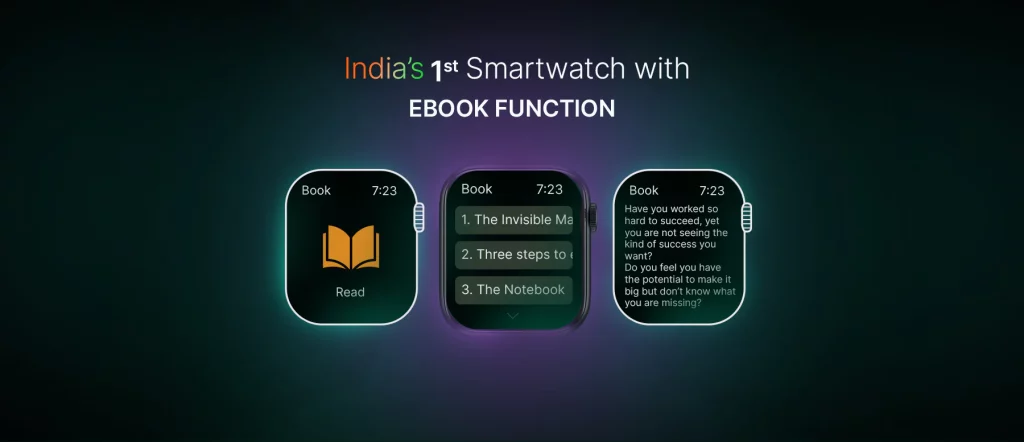
Crossbeats has launched a new smartwatch in the Indian market called the Crossbeats Nexus. What sets this watch apart from the majority of smartwatches available on the market is its integration with ChatGPT.

Crossbeats Nexus

While the complete range of the smartwatch’s capabilities with integrated ChatGPT hasn’t been disclosed by the brand, it’s confirmed that the watch comes equipped with a built-in E-Book reader.

Crossbeats Nexus

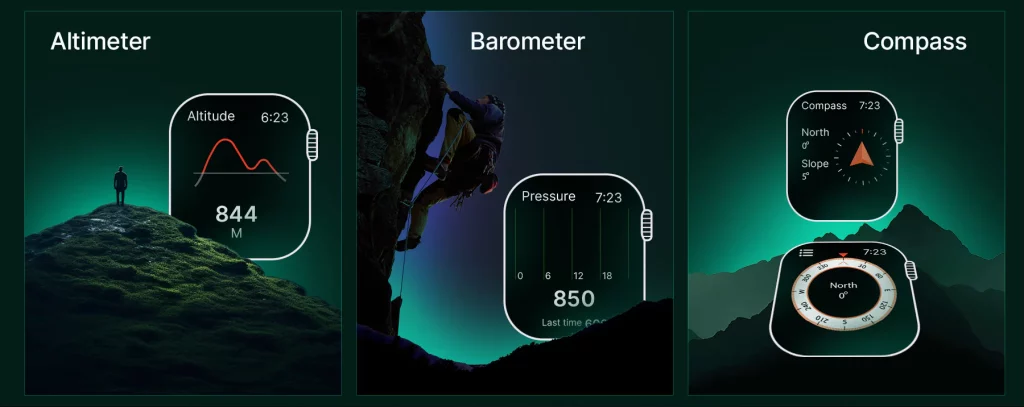
It features a 2.1-inch AMOLED display and over 500 customizable watch faces. It has a rotating crown that helps in navigating the UI. Additionally, it comes with GPS Dynamic Route tracking and Dynamic Island, making it an excellent choice for outdoor activities. The smartwatch has an Altimeter, Barometer, and Compass onboard.

Crossbeats Nexus

For health-related features, the Nexus offers comprehensive health monitoring, including heart rate, SpO2, sleep tracking, and blood pressure monitoring. It has a 7-day battery life, which is quite good considering the features. Lastly, the smartwatch comes with Bluetooth calling support, which could impact the projected battery life.

Pricing & availability

You can now pre-order the Crossbeats Nexus with a CROSSBEATSONE VIP PASS for just Rs. 999 on the official website. This amount will be deducted from the total purchase price. When you pre-order, you’ll get some extras:

  • You’ll receive a merchandise item signed by SKY for free.
  • A free screen guard for your Nexus watch.
  • An extra 6 months of warranty at no extra cost.
  • 25% OFF on selected TWS products priced above Rs. 1999.
  • An additional 5% discount on the Nexus watch on the day of your purchase.

The Crossbeats Nexus is scheduled to be released during Diwali and will cost Rs. 5,999. It comes in two colors: Silver and Black.

RELATED:

(via)

Satya Nadella Says Shutting Down Microsoft’s Mobile Business Was A Mistake

There was a time when Microsoft was widely known in the smartphone market. The Redmond-based tech giant forayed into the smartphone segment way back in 2010 with Lumia devices running on Windows OS. The company competed against Android and iOS smartphones. However, it was short-lived as in 2017, Microsoft said that it would not develop any feature or hardware for Windows 10 mobiles. Now, in an interview with Business Insider, Satya Nadella, the CEO of the software giant has admitted the mistake of giving up on mobile business. However, he is also not the first CEO of the company to reveal this. 

Satya Nadella admits shutting down Microsoft’s smartphone business

Satya Nadella took over former CEO Steve Ballmer in 2014. Just over a year later, he wrote off $7.6 billion related to Microsoft’s acquisition of the Nokia phone business. When asked about any real strategic mistake or wrong decision in the interview, the CEO stated “The decision I think a lot of people talk about – and one of the most difficult decisions I made when I became CEO – was our exit of what I’ll call the mobile phone as defined then” 

The executive also added that Microsoft’s mobile phone business could have been handled better. The company could have reinvented the category of computing between PCs, tablets, and phones. 

Nadella admitting his mistake in shutting down Microsoft’s phone business doesn’t come as a surprise. Former CEO Bill Gates revealed that the company did not end up doing the mobile OS well enough. Steve Ballmer also confessed that he regretted not focussing on the phone quite earlier. 

Microsoft tried its hands multiple times in the smartphone business however, it failed to garner any success. Even after acquiring Nokia’s smartphone division, the company could not break the duopoly of Android and iOS. The Redmond-based company has Android-based Surface Duo and Surface Duo 2 foldable phones launched a few years ago, however, their future remains uncertain. 

Related:

Baidu’s Xiaodu Tiantian Casa ARIA Smart Speaker debuts with transparent design, premium audio features

Xiaodu Technology, a subsidiary of Baidu, specializes in AI-powered smart devices, including smart speakers and displays, enhancing user experiences through Baidu’s DuerOS. They integrate advanced AI technologies, contribute to Baidu’s smart home ecosystem, and have achieved leadership in the Chinese market with substantial funding and valuation growth.

Earlier today, Xiaodu introduced its latest Tiantian Casa ARIA smart speaker in China which is now available for pre-order on JD.com.

The speaker is initially priced at 3199 yuan ($437) and it features a transparent casing with white borders and 67 smart ambient lights. These lights can synchronize with different light effects, shadows, and color schemes, making it ideal for ambient lighting. The speaker also includes a rotary button on the bottom right that serves as a time display.

Xiaodu Tiantian Casa ARIA Smart Speaker Key Features:

The smart speaker uses LHDC high-resolution audio encoding and decoding technology, earning it dual gold certifications in HiRes and HiRes Wireless quality for exceptional audio performance.

Inside its transparent casing, there’s a custom 15W full-range speaker designed to resonate with the acoustic structure. The speakers have a frequency range of 60Hz to 20KHz and a 3300CC sound cavity. It also integrates with major music platforms like QQ Music, Kugou Music, Kuwo Music, and NetEase Cloud Music. Connectivity is seamless with Bluetooth 5.2+LHDC high-speed transmission, and it includes a 3.5mm audio input for traditional audio connections.

The speaker offers control options with a power button, rotary knob, and two additional buttons. The speaker weighs 3.21 kg and measures 287mm x 215mm x 104mm.

The speaker is powered by Baidu’s DuerOS 7.0 system, enabling intelligent voice interactions for tasks like setting alarms, checking the weather, or answering general knowledge questions.

RELATED:

(Via)
Samsung Galaxy SmartTag 2 with up to 700 days battery life launched in India

After launching the Galaxy SmartTag 2 in the global market earlier this month, Samsung has now brought the item tracker to the Indian market. Compared to the previous version, the SmartTag 2 features a revamped Compass View functionality. This feature displays directional arrows, indicating the location and distance of the SmartTag 2 concerning your position. It seamlessly pairs with any UWB-supported Galaxy smartphone.

Samsung Galaxy SmartTag 2

The SmartThings Find app has also seen improvements. It integrates newly registered SmartTags, offering a full-screen map view and an intuitive interface, making tracking more straightforward.

But what truly sets the SmartTag 2 apart is its battery life. Thanks to the Power Saving Mode, it can last an impressive 700 days on a single charge. Even in Normal Mode, it outperforms previous models, offering up to 500 days of tracking, a 50% improvement.

Samsung Galaxy SmartTag 2

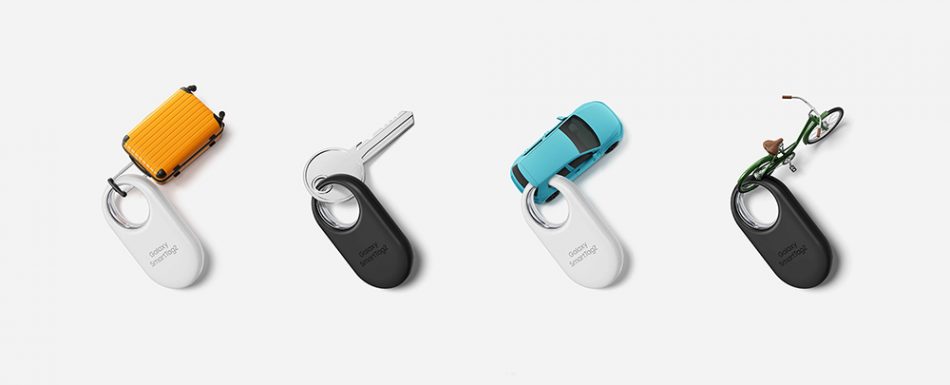
It also includes a metal loop for accessories. Plus, its IP67 rating for water and dust resistance ensures it’s ready for challenging environments. The tag is quite tiny measuring just 28.8 x 52.44 x 8.0 mm and weighing only 13.75 grams.

Pricing & availability

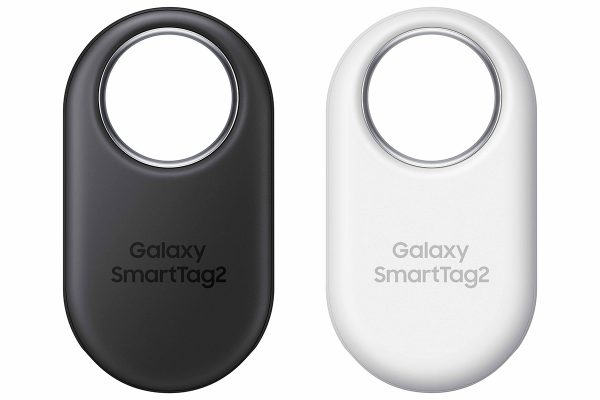
The Samsung Galaxy SmartTag2 comes with a price tag of Rs. 2,799 and is available in two classic colors, Black and White. It is available to purchase from various outlets, including the Samsung Online Store, Samsung Exclusive Stores, and Amazon.in.

RELATED:

Microsoft Patents Multi-Device Virtual Web Browser, Could Revolutionize the Way We Use the Internet

Cloud technology is advancing rapidly, making it more and more popular. For example, services like Nvidia GeForce Now allow us to play AAA games on almost any device, without needing any specific hardware. But gaming is just the beginning. In the near future, we’ll be able to do almost anything by streaming our tasks in a virtual environment. Microsoft has already taken a step in this direction by securing a patent for a multi-device virtual web browser. Here are the details…

Microsoft’s Virtual Web Browser Patent Could Make the Internet More Accessible

Patent offices play a critical role in helping us anticipate the future moves of technology companies. Recently, Microsoft submitted a patent application for a technology that describes a virtual web browser capable of running on any device. For those who might not be familiar, a virtual browser is a web browser that operates within a virtual machine. This essentially means that the browser runs in an isolated environment, separate from the host operating system and other applications, creating a secure and isolated space.

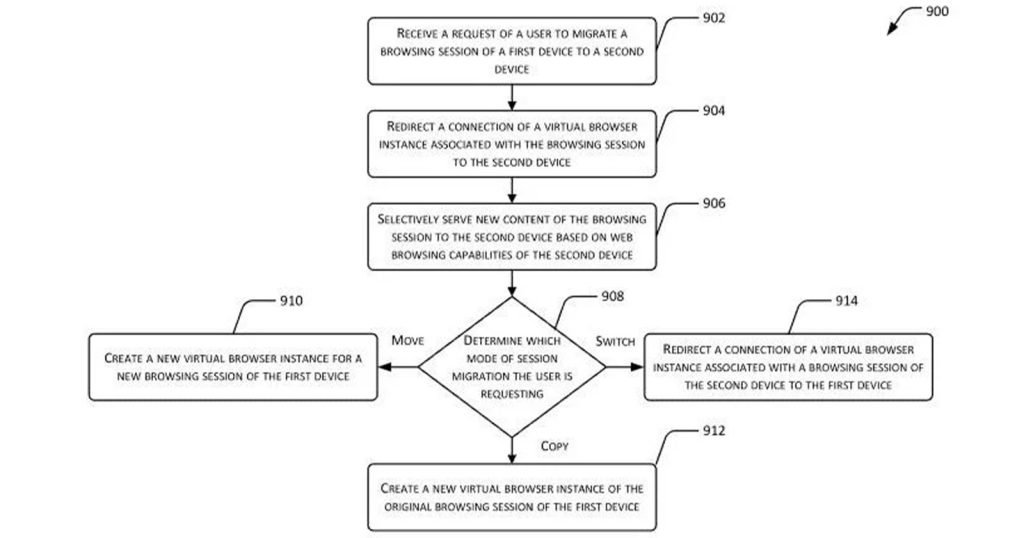
For instance, this approach allows you to use Chrome without worrying about the technical specifications and RAM of the device you are using. Whether you have an old laptop or a smartwatch with limited hardware, thanks to Microsoft’s virtual web browser patent, you’ll be able to browse the internet as you please. According to the company’s application, here’s how it will work.

  1. The system uses a virtual browser located on a proxy server. This virtual browser does all the heavy lifting – retrieves, renders, and encodes web pages for all devices.
  2. The devices themselves only need to be able to decode and display the web pages. They don’t need to have their own web browsers or be able to handle user inputs.
  3. The system also includes a touch controller that can be a remote control for devices with limited or no user input capabilities.

However, the fact that the company is getting a patent in this area doesn’t necessarily mean we’ll see a multi-device virtual web browser anytime soon. Technology companies obtain hundreds, even thousands of patents every year. Unfortunately, while many of these may seem like great ideas at first glance, only a few of them actually materialize.

RELATED:

(via)

Lava Blaze 2 5G To Launch In India On November 2, Design And Color Options Revealed

Lava announced the Blaze 5G (review) smartphone in India in November. Now the homegrown brand is gearing up to launch its successor i.e. the Blaze 2 5G. The company has announced the launch date of the upcoming smartphone. There is also a microsite on Lava’s official website revealing the Blaze 2 5G’s design and color options. The device has already been leaked recently. Read on to know more details below. 

Lava Blaze 2 5G launch date announced 

The Lava Blaze 2 5G is set to debut in India on November 2, Thursday at 12 pm. The launch event will be livestreamed on the company’s official YouTube channel. The company is teasing the phone as the Lord of 5G. The teaser video and the microsite reveal the upcoming offering with a slightly boxy design and protruding circular camera module. It confirms the presence of a 50MP main sensor paired with another lens and a LED flash unit. T

Additionally, the Lava Blaze 2 5G is also seen with a unique feature called Ring Light on the circular camera module that could possibly act as a notification LED. The volume rocker and power buttons are located on the right side with the latter doubling up as a fingerprint scanner. The upcoming smartphone is confirmed to be available in Black, Light Blue, and Purple color options. 

Recent leak revealed that the Lava Blaze 2 5G will be powered by a Dimensity 6020 processor. It will be offered in 4GB + 64GB and 6GB + 128GB configurations. As for pricing, it is tipped to carry a starting price tag between Rs 9,000 to Rs 10,000 thus making it the most affordable 5G phone in India. 

Related:

Xpeng unveils Futuristic Innovations: Autonomous Driving, Flying Cars, and Humanoid Robots take center stage

In a bold move to stay ahead in the fiercely competitive smart-driving landscape, Chinese electric vehicle startup Xpeng Motors has announced ambitious plans to expand its advanced driver assistance system (ADAS) across mainland China. 

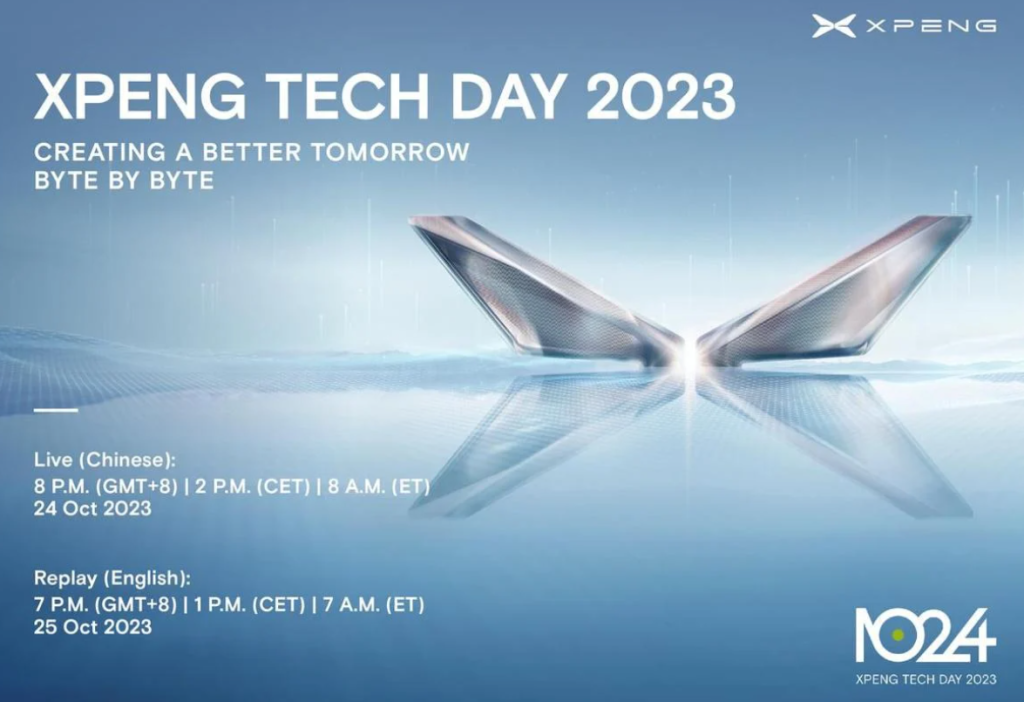
At the company’s annual Tech Day event, CEO He Xiaopeng unveiled Xpeng’s X NGP (Navigation Guided Pilot) software, currently operational in five mainland Chinese cities, which will be introduced in 20 more cities next month and an additional 25 by December. This expansion will enable some of Xpeng’s models, including the P7, G9, P5, and G6, to navigate autonomously following an over-the-air software upgrade.

He Xiaopeng stated “We are highly confident of our [self-driving] technology. The expansion pace will accelerate. Xpeng will deliver on its promise to make semi-autonomous cars available in more urban areas.” The company aims to have its ADAS available in 50 cities by December, with a nationwide rollout across China and Europe by 2024.

At the event, Xpeng showcased its groundbreaking X9, touted as the world’s first multi-purpose vehicle model equipped with rear-wheel steering as a standard feature. This innovation allows the seven-seater, three-row van to handle similar to a regular-sized sports utility vehicle. The X9, Xpeng’s entry into the Chinese MPV segment, will be officially launched at the Guangzhou Motor Show on November 17.

Notably, Xpeng is embracing a cost-effective approach to self-driving technology. The company is transitioning to a more affordable hardware suite by relying heavily on cameras and artificial intelligence, a move reminiscent of Tesla’s strategy. Xpeng has incorporated advanced occupancy networks, featuring deep neural networks that predict occupancy in three-dimensional space, enabling collision avoidance. This technology allows for the removal of certain sensors while maintaining high-definition spatial positioning and longer-range visibility.

Additionally, Xpeng’s cutting-edge XOS smart cabin system, powered by Qualcomm’s 8295 processor, will debut in the X9. This system offers a split-screen mode, allowing drivers and passengers to run different applications simultaneously for efficient multitasking.

In a bid to diversify its offerings, Xpeng teased the future of electric vehicles by revealing its first multi-purpose vehicle model and highlighting its progress in bringing flying cars closer to reality. The company also showcased a working prototype of its humanoid robot, echoing Tesla’s earlier introduction of its Optimus bot.

Xpeng surprised audiences at its Tech Day event by unveiling two prototype electric vertical takeoff and landing vehicles (eVTOLs). One model, featuring a foldable design, integrates wings and components into the vehicle body, although CEO He Xiaopeng acknowledged the need to address safety concerns. The second prototype, designed on a modular system, allows for the separation of flight and automobile components. This innovative model boasts a roomy interior with five seats on the road and functions on an extended-range hybrid engine, capable of recharging its aircraft component while driving. In the air, it operates in an all-electric mode, accommodating two passengers.

Alongside these groundbreaking developments, Xpeng showcased its humanoid robotic prototype, the PX5, which demonstrated impressive abilities in navigating diverse terrains and picking up hand-held objects like pens. He Xiaopeng said that he envisions a future where these AI-powered machines could play roles in Xpeng’s factories or even engage with customers at showrooms, possibly within the next year.

With these groundbreaking developments, Xpeng Motors remains at the forefront of the smart-driving revolution, poised to revolutionize the future of transportation in China and beyond.

Related:

(via)

OPPO Snapdragon 8 Gen 3 Processor On The Next-Generation Find X7 Series, Might Be For The Pro Variant

Qualcomm held its annual Snapdragon Sumit where it announced chipsets for various devices. These include the flagship Snapdragon 8 Gen 3 processor for smartphones, Snapdragon X Elite for laptops, and Snapdragon S7 Pro Gen 1 for audio devices. A little after Qualcomm’s announcement, a host of smartphone brands took to microblogging platforms to reveal their plans to launch devices with the latest Snapdragon 8 Gen 3 chipset. These include iQOO, Redmi, OnePlus, and more. 

OPPO announces next Find X series chipset details

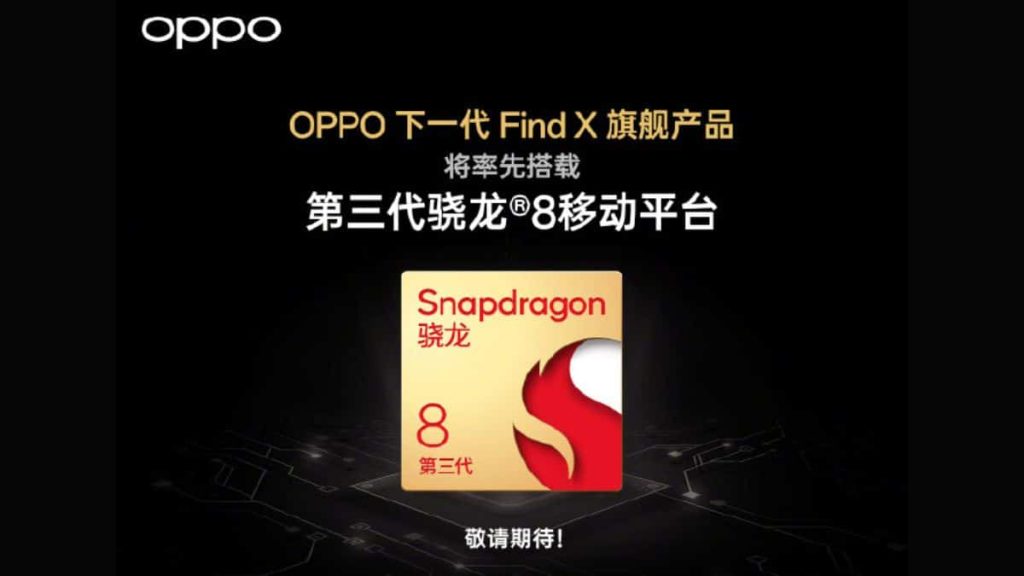
Alongside a host of brands, OPPO also announced its plans to launch a Snapdragon 8 Gen 3-powered smartphone. The company shared the news on microblogging platform Weibo. It revealed that the next generation of the Find X series will be equipped with the latest Qualcomm chipset. It is expected to be the Find X7 series, however, the exact launch timeline remains unknown. Additionally, it remains to be seen which model will get the Snapdragon 8 Gen 3 processor. 

OPPO launched the Find X6 series earlier in March this year. It comprises the Find X6 and X6 Pro (review) with only the latter powered by Snapdragon 8 Gen 2. Hence it’s likely that only the Pro model in the upcoming Find X7 series may get Qualcomm’s latest chipset. The standard Find X7 may be equipped with a MediaTek SoC. A Geekbench listing of the same had revealed Dimensity 9300 with 16GB RAM. 

As per previous reports, the OPPO Find X7 Pro is tipped to support 100W wired and 50W wireless charging. It will reportedly come with 2K curved display. 

Related:

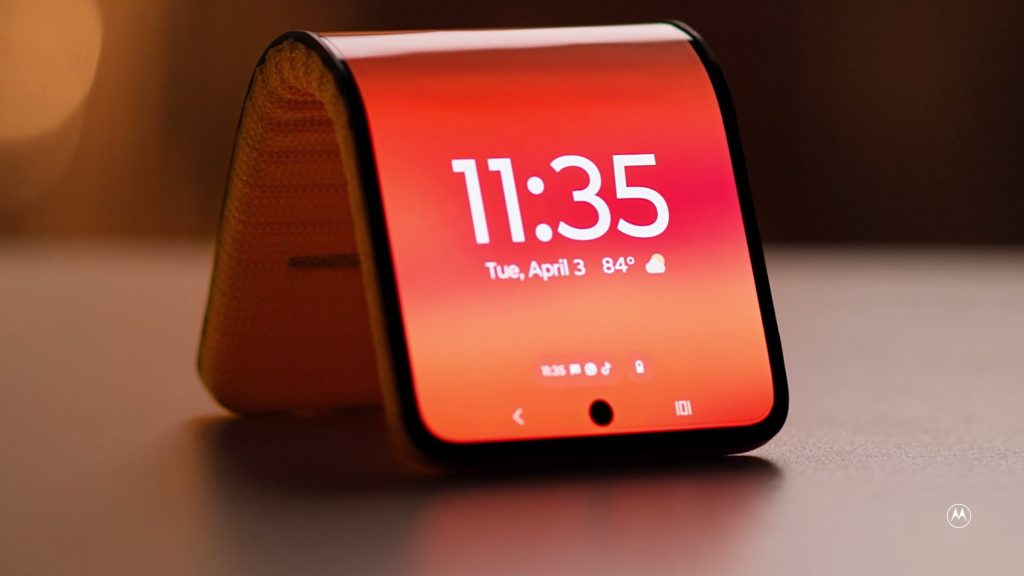
Motorola unveils a flexible smartphone concept that can wrap around your wrist

From the inception of bulky mobile phones to the recent innovations in foldable displays and smart wearables, the evolution of mobile technology has been astounding. The current trajectory suggests that foldable screens might dominate the future, spanning across smartphones, laptops, and tablets. Tech leaders worldwide are exploring these foldable concepts. Now, envision a future where you can just slap your smartphone on your wrist and use it as a full-fledged smartphone.

Motorola flexible smartphone concept

The Flexible Concept Phone Can Curl, Wrap, and Even Stand

Taking a significant step in this direction, Motorola, which has been a subsidiary of Lenovo since 2014, recently unveiled an innovative “adaptive display” smartphone at the 2023 Lenovo Tech World event.

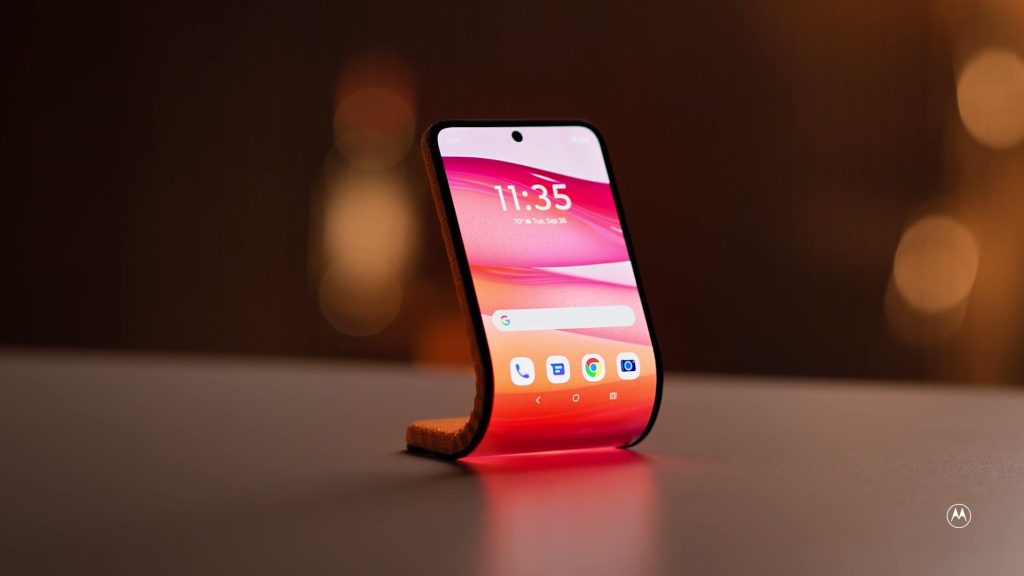
This prototype boasts a flexible 6.9-inch OLED screen with FHD+ resolution, offering more than just the ability to fold; it can also curl, wrap, and even stand. What’s particularly impressive is that when curled, the device’s software seamlessly adjusts the display to a compact 4.6-inch, representing a significant advancement from Lenovo’s earlier CPlus model introduced in 2016. Interestingly, the CPlus model also had a 4.6-inch display but the bezels were very thick.

The prototype also offers some unique features. When used as a stand, it can capture the user’s outfit and use generative AI to create matching wallpaper, enhancing its smartwatch-like appearance. Additionally, the device can be adjusted to provide an ergonomic viewing experience, making it ideal for video calls and vertical browsing by bending its top half upwards.

Motorola showcased several AI-powered concepts at the event. Users can capture or upload pictures of their attire to generate unique AI-generated images for device wallpapers. They are also developing MotoAI, a privacy-focused voice/text assistant for PCs and smartphones, leveraging a large language model for personalization. Additionally, Motorola is working on improving document scanning with smartphones, reducing wrinkles and shadows to produce clearer images.

Despite the intrigue around Motorola’s new shape-shifting phone, its commercial viability remains a topic of discussion, with concerns related to its durability, comfort of wear, and the potential for casing solutions. It’s evident that with this prototype, Motorola is positioning itself as an innovator in a market inching towards foldable designs, looking to redefine user experience with AI at its core.

RELATED:

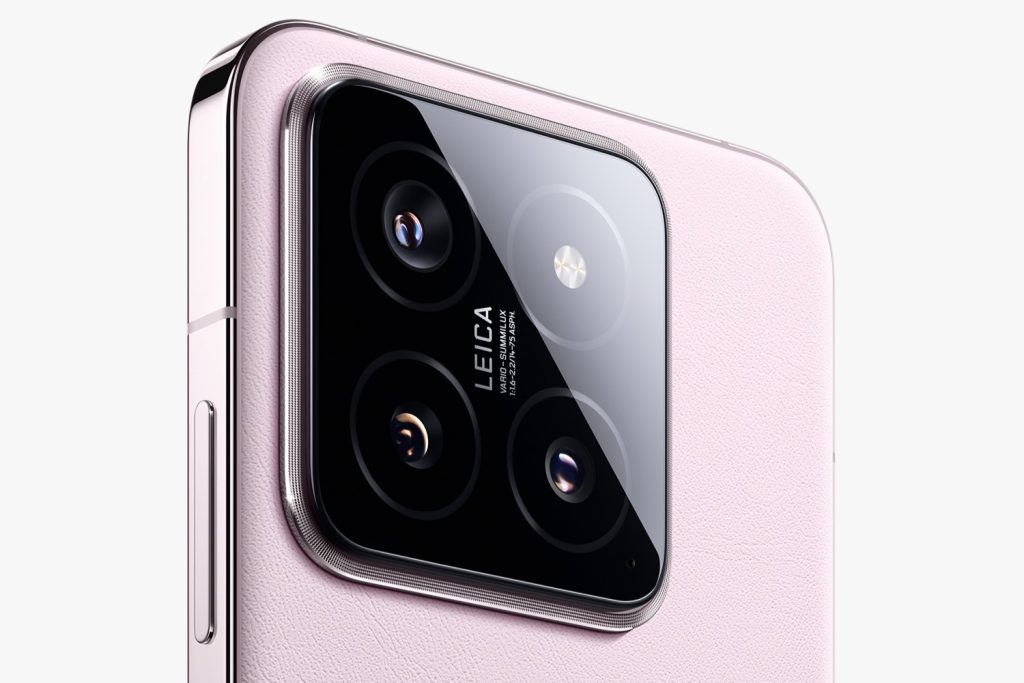
Special Xiaomi 14 series sale announced for launch day

The Xiaomi 14 series is set to go official tomorrow. The company’s latest flagship smartphones will be unveiled at the conference which will begin at 7 PM GMT+8.

Ever since the company revealed the launch date on Monday, it has been teasing the features of these phones. Now, just a day before the launch, Xiaomi has announced a special sale for these handsets.

Xiaomi 14

Xiaomi says that one of its online retail partners, JD.com, will hold a special sale event for the Xiaomi 14 series as soon as the keynote ends tomorrow. A total of 2,000 units will be up for grabs.

The exact memory configurations and color variants eligible for purchase will be only revealed when the sale begins. However, it has been confirmed that 1,000 units each of Xiaomi 14 and Xiaomi 14 Pro will be on sale.

Customers who manage to order either of the two smartphones will receive a Xiaomi City Backpack 2nd Gen for free and a ¥50 JD voucher. They can also avail of up to 24 months of no-cost EMI, an exchange offer of up to ¥1,400, and an official warranty extension at 40% off.

The Xiaomi 14 and the Xiaomi 14 Pro will be unveiled tomorrow as the world’s first Qualcomm Snapdragon 8 Gen 3 smartphones. Almost everything about these handsets is out via multiple sources. You can learn about them here.

The company will be also announcing HyperOS, Xiaomi Watch S3, and Xiaomi TV S Pro MiniLED 85-inch.

WHERE TO BUY
Buy Xiaomi 14 and Xiaomi 14 Pro from $699 @Giztop

RELATED:

Qualcomm unveils Snapdragon X Elite SoC for laptops, Claims better performance than Apple M2 Max

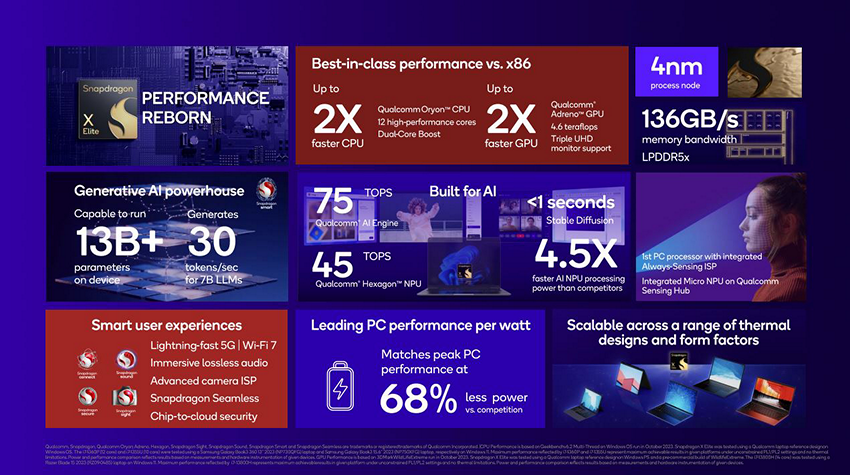
At the Snapdragon Summit, Qualcomm has introduced the latest addition to its PC processor lineup, the Snapdragon X Elite. This represents a significant leap in premium computing, with a focus on delivering exceptional CPU performance, advanced AI capabilities, and impressive energy efficiency, ensuring prolonged battery life.

Snapdragon X Elite

Exceptional Performance and Efficiency

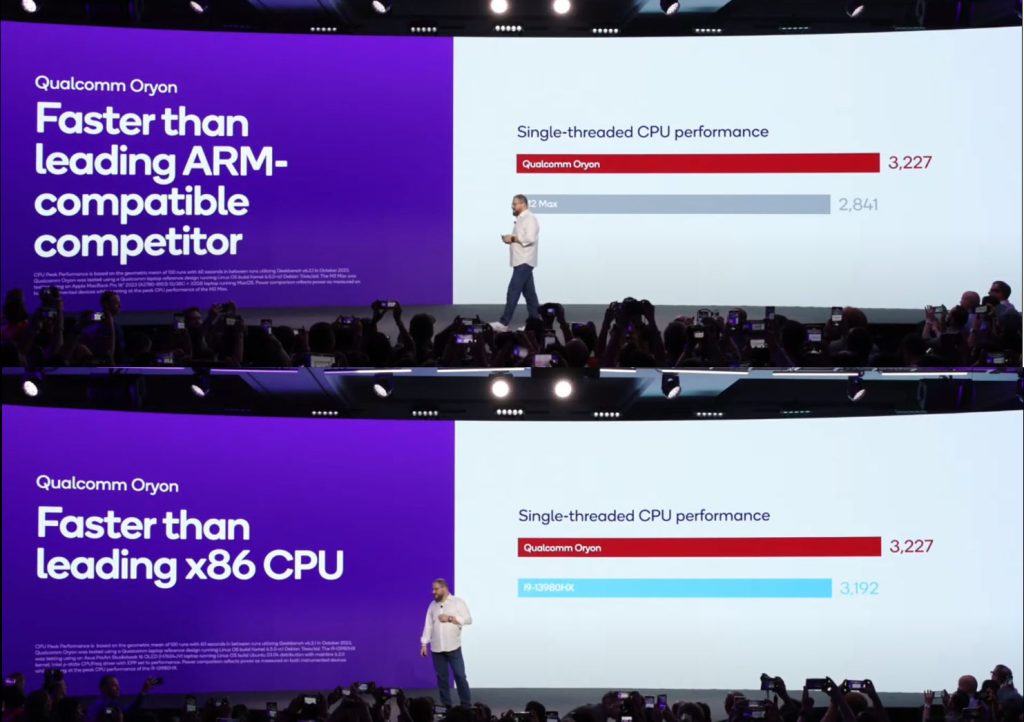
The Snapdragon X Elite boasts a state-of-the-art 4nm System-on-a-Chip design, housing a formidable 12-core Qualcomm Oryon CPU, renowned for its Dual-Core Boost feature that guarantees rapid responsiveness. In comparative terms, Qualcomm states that the CPU surpasses rivals like the Apple M2 Max and Intel I9-13980HX while consuming considerably less power, especially under peak performance conditions.

For example, the Qualcomm Oryon CPU exhibits impressive single-threaded CPU performance, outpacing both the Apple M2 Max and Intel I9-13980HX. Notably, it consumes 30% less power than the Apple M2 Max and a remarkable 70% less power than the Intel I9-13980HX under peak loads.

The integrated Qualcomm Adreno GPU, while providing impressive graphics for immersive entertainment, maintains a focus on low power consumption.

Snapdragon X Elite

AI Integration at the Core

The Snapdragon X Elite incorporates the industry-leading Qualcomm AI Engine, featuring the integrated Qualcomm Hexagon NPU, enabling transformative experiences in fields like creativity, video conferencing, security, and productivity. The processor efficiently handles generative AI LLM models with over 13 billion parameters at blazing speeds and supports a diverse range of AI-accelerated applications and experiences.

Snapdragon X Elite

Additionally, the Micro NPU within the low-power Qualcomm Sensing Hub strengthens security, login, and privacy features, even during sleep mode, ensuring that sensitive data remains secure on the device.

Enhanced User Experiences

The Snapdragon X Elite brings mobile experiences directly to your PC, supporting lightning-fast 5G and Wi-Fi 7 with HBS Multi-Link for seamless, jitter-free cloud connectivity. This allows users to stream, download, and sync from virtually anywhere. The Snapdragon Seamless feature ensures smooth device-switching experiences.

Users can also enjoy high-fidelity music and entertainment with wireless headphones using the Snapdragon Sound Technology Suite. The processor is fortified with intelligent security features, protecting your PC from chip to cloud.

In related news, Qualcomm has also unveiled the new Snapdragon 8 Gen 3 flagship smartphone SoC along with the Qualcomm S7 & S7 Pro Gen 1 Sound Platforms for audio products.

Snapdragon X Elite Specs:

  • CPU: Qualcomm Oryon, 12 cores up to 3.8 GHz, Single and Dual-Core Boost up to 4.3 GHz
  • GPU: Qualcomm Adreno, 4.6 TFLOPS, DirectX 12
  • NPU: Qualcomm Hexagon, 45 TOPS
  • Memory: LPDDR5x, 16-bit, 8 channels, 8533 MT/s, 136 GB/s, up to 64 GB
  • VPU: Qualcomm Adreno VPU, encoding resolution: 4K @ 60 Hz, encoding bit depth: 10-bit, encoding formats: H.264, AV1, H.265, decoding resolution: 4K @ 120 Hz, decoding bit depth: 10-bit, decoding formats: H.264, VP9, AV1, H.265, concurrency: decode: 4K @ 60 Hz / encode: 2x 4K @ 30 Hz
  • Process Node and Technology: 4 nm
  • Display: Qualcomm Adreno, maximum on-device display resolution: 4K Ultra HD @ 120 Hz, maximum external display resolution: 4K Ultra HD @ 60 Hz, HDR10, up to 31 concurrent displays, DisplayPort 1.42
  • Camera: Qualcomm Spectra, dual ISP, 18-bit, dual camera: 36+36 MP, single camera: up to 64 MP, 4K video capture, H.264, H.265 video capture formats, HDR video capture
  • Storage: SD 3.0, NVMe, UFS 4.0
  • Audio: Qualcomm Aqstic technology support, Qualcomm aptX audio technology support
  • Cellular Modem-RF: Snapdragon X65 5G Modem-RF System, peak download speed: 10 Gbps, peak upload speed: 3.5 Gbps, 300 MHz bandwidth (sub-6 GHz), 1000 MHz bandwidth (mmWave), Qualcomm AI-Enhanced Signal Boost adaptive antenna tuning, Qualcomm Smart Transmit technology, Qualcomm 5G PowerSave, Qualcomm Wideband Envelope Tracking, 5G NR, HSPA, sub-6 GHz, Dynamic Spectrum Sharing (DSS), LTE, WCDMA, CBRS, mmWave
  • Wi-Fi: Qualcomm FastConnect 7800, Wi-Fi 6, Wi-Fi 6E, Wi-Fi 7, 802.11b, 802.11g, 802.11n, 802.11ac, 802.11a, 802.11ax, 802.11be, 6 GHz, 5 GHz, 2.4 GHz, up to 4 spatial streams, 4K QAM, Multi-Link Operation (MLO), Passpoint, TDLS, OFDMA (UL/DL), Wi-Fi QoS Management, MU-MIMO (UL/DL), Wi-Fi Optimized Connectivity, Wi-Fi Location, Miracast, Voice-Enterprise, High-band Simultaneous (HBS), 8×8 Sounding, Target Wake Time
  • Bluetooth: Bluetooth 5.4, Bluetooth Low Energy
  • USB: 3x USB-C, USB 4.0
  • Interfaces: Platform Extensions: 5G4, Wi-Fi4

RELATED:

(Source)

Lawmakers in Netherlands criticize US Export restrictions on ASML Chip Machines

The unilateral imposition of new export regulations by the United States on Dutch tech giant ASML Holding’s chipmaking machines has sparked a heated debate among Dutch lawmakers. Trade Minister Liesje Schreinemacher faced challenging questions in the parliamentary session, where concerns were raised regarding the US’s approach to regulating the export of ASML’s Twinscan NXT1930Di and Twinscan NXT1980Di machines to China.

During the debate, Minister Schreinemacher expressed the Dutch Cabinet’s willingness to comply with the new US regulations but emphasized the need for a more cohesive European strategy to address the issue. The recent US rules grant Washington the authority to restrict the export of ASML’s advanced lithography machines containing any US components, a move widely seen as part of the US strategy to curb China’s technological and military advancements.

In response to the US government’s recent announcement on advanced computing and semiconductor manufacturing equipment export controls, ASML, headquartered in Veldhoven, Netherlands, expressed a commitment to careful assessment. They acknowledged the forthcoming regulations, expecting their application to be limited to select semiconductor facilities in China. CEO Peter Wennink noted that the Twinscan NXT1980Di tool, capable of producing both advanced and older computer chips, could fall under the US export control restrictions.

ASML assured stakeholders that these measures are not anticipated to significantly impact their financial forecasts for 2023, 2025, and 2030, as outlined during their Investor Day in November 2022. While acknowledging potential regional effects on sales, the company stressed compliance with all relevant laws, including export control legislation, and indicated plans to seek further clarification from US authorities on the regulations’ scope. 

China, accounting for a significant portion of ASML’s sales, remains a crucial market for the company. Wennink expressed confidence in the resilience of demand from Chinese chipmakers despite the growing challenges posed by export restrictions imposed by both the US and Dutch governments. The Netherlands, acknowledging US security concerns, has supported the need for export restrictions while emphasizing the sovereign right of every nation to make decisions concerning exports.

ASML’s compliance with the US rules comes after continuous pressure from the United States on the Dutch government since 2019, urging restrictions on the export of advanced chipmaking machines to China. In response, the Dutch government introduced its licensing requirements earlier this year, targeting slightly less advanced machines. However, the newly announced US regulations have raised questions about the extent of cooperation and consent between the US and Dutch governments in imposing these restrictions.

As the situation continues to unfold, Dutch lawmakers remain engaged in discussions, exploring options for a unified European response to navigate the challenges posed by the evolving landscape of international trade and technology transfer.

Related:

(via)

Snapchat users cross the 400 million mark

Snapchat is a massively popular social media platform. It has been a big hit since its early years, and now, it has achieved a new milestone as its user numbers have crossed the 400 million mark. So here are all the details.

Snapchat users are over 400 million strong

In its latest earnings report for Q3 2023, Snap announced that the user base of Snapchat has grown to more than 400 million. The social media app achieved this notable milestone by bringing in 9 million new users in just the last quarter alone. This brings up its total daily active users (DAUs) count to 406 million to be exact, marking a rise of around 12 percent when compared to last year.

Snapchat

Interestingly enough, the company managed to hit the new user high despite laying off around 20 percent of its workforce last year. For those unaware, Snap had downsized its staff and employees to cut losses as advertising revenue had fallen. However, following these layoffs and recent product feature additions, Snapchat has managed to bring in fresh users to its platform. Earlier this month, Snapchat released a new update that let users embed content and even introduced AI powered fill features. Although, it even faced scrutiny from the UK regulator for how its Snap My AI chatbot was interacting with minors.

In the latest financial report, the social media giant announced 1.19 billion US Dollars in revenue for the quarter. This showed an increase of 5 percent compared to the same period from last year. Snap also attributed the growth to its Snapchat+ subscription service as an additional source of revenue. For a monthly fee of just 4 US Dollars, subscribers get access to exclusive and experimental features. Snapchat currently has over five million users subscribed to its premium service.

RELATED:

(Via)

Vivo X100 series will be the world’s first to feature LPDDR5T RAM: Tipster

Vivo is set to launch its next generation of flagship smartphones in its home market of China soon. The Vivo X100 series will feature top notch specs and features. But ahead of its announcement, a leak has claimed that the lineup will be the first in the world to feature LPDDR5T RAM.

Vivo X100 Series

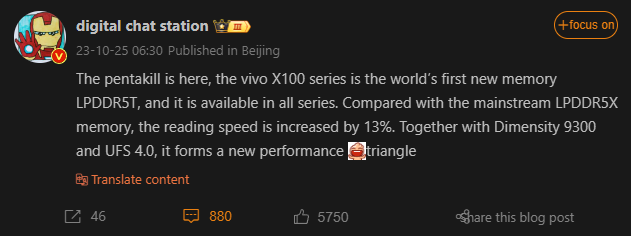
According to known tipster Digital Chat Station, the Chinese tech giant’s entire flagship X100 lineup will feature the new LPDDR5T memory technology. For those unaware, SK Hynix announced the LPDDR5T RAM at the start of this year. This is currently the world’s fastest mobile DRAM module. The LPDDR5T memory is around 13 percent faster in terms of read speeds when compared to the LPDDR5X RAM. It saw speeds of up to 9.6Gbps.

Vivo X100 series

Interestingly enough, the LPDDR5T module was also recently tested by MediaTek, which saw it outperform Samsung’s LPDDR5X RAM. The newer and faster memory is expected to be paired with the chipmaker’s flagship Dimensity 9300 SoC as well as UFS 4.0 storage. The Dimensity 9300 will be announced on November 6, with the Vivo X100 series being one of the first to feature the processor.

In other words, the X100 lineup will consist of various cutting edge technology. It is worth noting that the base Vivo X100 and X100 Pro are rumored to feature MediaTek’s Dimensity 9300 chipset. Meanwhile, the top end Vivo X100 Pro+ was confirmed to feature the Qualcomm Snapdragon 8 Gen 3 platform that was just recently announced.

RELATED:

Instagram contributes to Youth Mental Health issues like Depression and Anxiety, alleges Lawsuit

In a significant legal development, 33 U.S. states, including California and New York, have filed a lawsuit against Meta Platforms, the parent company of Instagram and Facebook. The lawsuit accuses Meta of fueling a youth mental health crisis by creating addictive social media platforms. According to the complaint filed in a federal court in California, Meta allegedly misled the public about the dangers of its platforms, knowingly inducing young children and teenagers into addictive and compulsive social media use.

This development follows a series of lawsuits against social media giants, including Meta, ByteDance’s TikTok, and Google’s YouTube, concerning the addictive nature of their platforms. Meta, the parent company of Instagram, faces civil penalties ranging from $1,000 to $50,000 for each violation of state laws, potentially amounting to significant financial repercussions due to the millions of young users on Instagram.

At the core of these accusations is the allegation that Meta prioritizes profit over the safety and well-being of its users, particularly young individuals. The lawsuits highlight Meta’s alleged knowledge that social media engagement, particularly through features like “likes,” triggers addictive responses in young users due to dopamine-related pleasure. 

Additionally, Meta’s attempts to expand these harmful practices into virtual reality, including platforms like Horizon Worlds, WhatsApp, and Messenger, have come under scrutiny. The legal action by these states aims to address the regulatory gaps left by the U.S. Congress, emphasizing the urgent need to address the mental and physical health risks posed by social media platforms.

The lawsuit contends that Meta has profoundly impacted the psychological and social realities of young Americans by employing technologies designed to entice and ensnare youth for profit. The platforms are accused of maximizing children’s and teenagers’ screen time through psychologically manipulative features, leading to detrimental outcomes such as depression, anxiety, insomnia, and interference with education and daily life.

Instagram, the third-most-popular social media platform among teenagers, with 62% of teenagers aged 13 to 17 reportedly using it, has come under intense scrutiny. Meta is alleged to have used deceptive tactics, claiming their products were safe while engaging in practices that encouraged addictive behavior in young users. Meta responded to the lawsuit expressing disappointment, stating that instead of collaborating with the industry to establish clear, age-appropriate standards, the attorney general had chosen legal action.

This lawsuit follows a trend of legal challenges against social media companies regarding the harm their platforms may inflict on younger users. As the case unfolds, it raises questions about the ethical responsibility of tech giants in safeguarding the well-being of their youngest users amid the digital age’s growing influence.

Related:

(via)

Vivo Y100 key specs revealed, features 5000mAh battery, 120Hz display, and more

The Vivo Y200 and Y55t were recently launched by the company. But it appears that another Y series announcement is just around the corner. The device in question is the Vivo Y100 model, which had some of its key specifications officially revealed.

Vivo Y100 Teaser Reveals Key Specs

The brand shared teaser image posters on its official Weibo account (a Chinese microblogging website), which confirms some of its specs and features. Under the hood, the Y100 model is powered by a large 5,000mAh battery pack. Vivo claims that the smartphone will come with a thin design (7.49mm in thickness and weighs 181 grams) despite having such a large battery. Meanwhile, the rear will pack a dual camera setup, with the primary sensor having a 64-megapixel resolution and OIS support (Optical Image Stabilization).

This wasn’t all as the company also confirmed that the Vivo Y100 will launch with up to 12GB of RAM and 512GB of internal storage. The memory of the device can even be further expanded via virtual RAM expansion by another 12GB. We already know that the front sports a tall curved AMOLED display, but another teaser confirmed that the panel will offer a smooth 120Hz refresh rate.

It is worth noting that the upcoming Chinese variant of the Vivo Y100 is different from the Indian version of the device with the same name. To recall, this model offered a flat 6.38-inch AMOLED panel and was equipped with the MediaTek Dimensity 900 SoC. The Chinese Y100 variant will be announced on 27th October 2023 at 2:30 pm CST in China. So stick around for more, as we will be covering the launch event.

RELATED:

Tecno Spark 20 spotted on Google Play Console with Helio G85

Tecno is gearing up to launch new models from its Spark series of smartphones. One of these devices is expected to be the Spark 20, which was recently spotted on a certification platform. So here are all the details.

Tecno Spark 20 Surfaces on Google Play Console

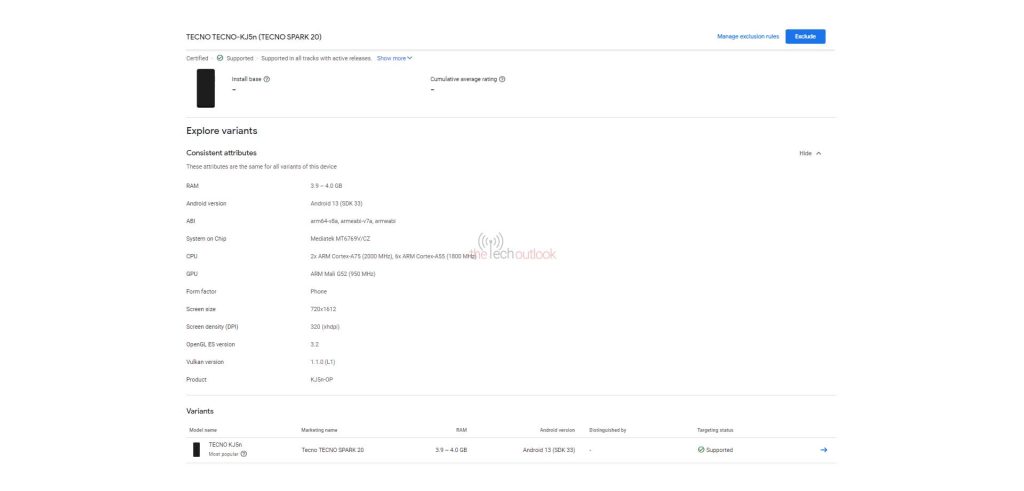
The smartphone maker’s Spark 20 model was sighted on the Google Play Console platform carrying two model numbers, namely TECNO-KJ5 and TECNO-KJ5n. Furthermore, the listing also reveals some of its key specifications. Tecno’s Spark 20 was spotted with the MediaTek Helio G85 SoC, which is a 4G processor and is paired with the ARM Mali G52 GPU.

Tecno Spark 20

The Google Play Console listing confirms that the upcoming device will run on Android 13 OS out of the box and will house 4GB of RAM. Some of the display specifications have been revealed as well. The screen will have a 1612 x 720 pixel resolution (HD+) and a pixel density 320ppi pixel density. On the certification listing, we are offered a glimpse of the Tecno Spark 20’s front design.

The device features a flat display with a center aligned punch hole cutout for the selfie camera. On the right side, we can see the volume rockers and a power button. Another Spark series device is the Sparo Go 2024, which also surfaced on the Google Play Console database. There is even a Spark 20C model in the works that was sighted on the FCC platform. So stick around for more, as we will be providing more updates.

RELATED:

(Via)

Realme GT 5 Pro to launch with SD8 Gen 3 chip and Sony triple cameras

Relame GT 5 Pro is anticipated to be the brand’s next-gen flagship smartphone. We have been hearing about this device for quite a while now.

Yesterday, the brand officially hinted at the launch of this phone. Today, it has confirmed the chip powering it. At the same time, a reliable source has revealed the camera specs.

Let’s go through everything that’s known about this upcoming premium phone from Realme.

Realme GT 5 Pro Snapdragon 8 Gen 3 Chip Confirmation

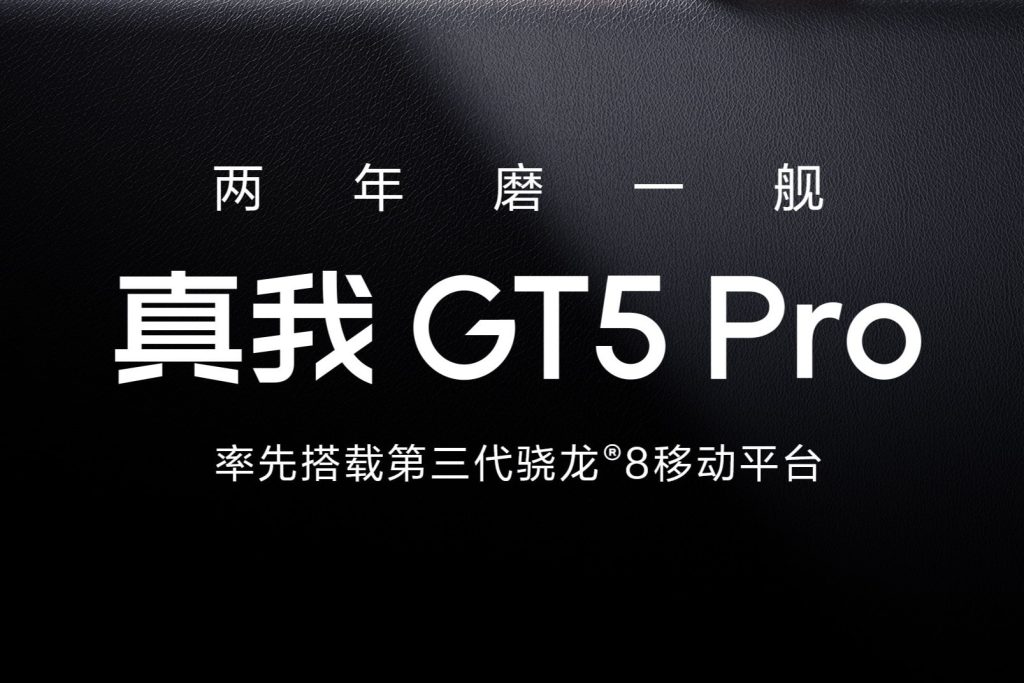
Realme has officially confirmed that the Realme GT 5 Pro will be powered by a Qualcomm Snapdragon 8 Gen 3 chip. For the unaware, Qualcomm’s latest flagship mobile platform was just announced a few hours back.

The Xiaomi 14 and Xiaomi 14 Pro will be the first handsets to use this chip. They are scheduled to launch tomorrow, followed by the iQOO 12 series on November 7.

Realme is yet to disclose the launch date, however, we know a few things about its product.

According to Digital Chat Station, the Realme GT 5 Pro will flaunt a curved screen supplied by a Chinese display maker. This panel will offer a 1.5K resolution.

Further, he says that the device will arrive with a triple camera system featuring Sony sensors. The setup will include an IMX966 primary sensor, an IMX581 ultrawide unit, and an IMX890 3x telephoto shooter (could be periscope).

As per previous leaks, the handset will be available in a vegan leather option. It is expected to come with a 10,000mm² VC liquid cooling system and a 5,400mAh battery. Finally, it is said to carry support for 100W wired charging and 50W wireless charging.

RELATED:

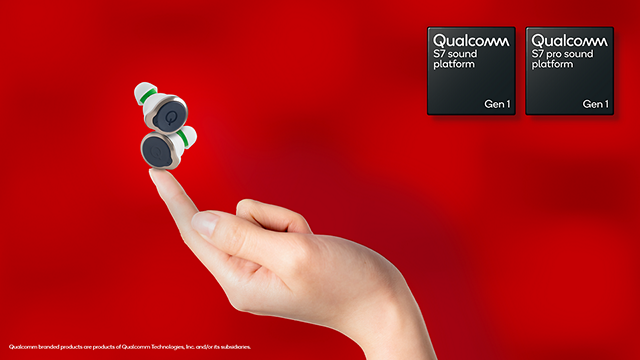
Qualcomm S7 & S7 Pro Gen 1 Sound Platforms unveiled for future audio products

At the recent Snapdragon Summit, Qualcomm introduced its latest audio technology – the Qualcomm S7 and S7 Pro Gen 1 Sound platforms. These new chips aim to revolutionize the audio landscape for earbuds, headphones, and speakers, promising enhanced performance, power efficiency, and advanced connectivity.

Qualcomm S7

These platforms bring a robust on-device AI, making them smarter than their predecessors. With six times more computing power and nearly 100 times more AI capacity, they promise better audio without draining your device’s battery.

The S7 Pro Sound platform introduces Qualcomm’s XPAN tech and micro-power Wi-Fi. Essentially, this new tech makes use of low-power Wi-Fi to extend the reach of Bluetooth earbuds, speakers, and headphones. It can detect how well a Bluetooth connection is working and smoothly switch over to Wi-Fi when you go beyond Bluetooth’s range. Qualcomm XPAN also offers high-quality audio at 48 kHz and 96 kHz without losing any quality. They also make sure there’s less delay when you’re watching or listening.

Qualcomm S7

The S7 and S7 Pro Gen 1 Sound platforms make improvements in quick-response noise cancellation, support for multiple audio channels, and energy-efficient operation. For users, this means the best noise cancellation performance yet, especially in noisy places like offices or cafes. The noise cancellation adjusts automatically to stay effective even if the earbud shifts or the surrounding noise changes suddenly.

Qualcomm S7 & S7 Pro Gen 1 Sound Platform features

• All new platform architecture unlocks a new tier of performance,
maintaining ultra-low power performance
• Almost 100x more AI power than the Qualcomm S5 Gen 2 Sound
Platform
• 3x more memory than the Qualcomm S5 Gen 2 Sound Platform
• A step-change in DSP – 1.5 GHz total audio compute (50%+
improvement on previous S5 Gen 2 Sound Platform)
• Dedicated AI core to provide higher performance and lower power
for ML applications compared to using the DSP
• Dedicated cores for audio curation including hearing loss
compensation, ANC, transparency, and noise management
• Hi-Fi-grade stereo audio codec
• 4th Generation Qualcomm Adaptive Active Noise Cancellation
112 biQuad filters combined with fully programmable 3uSec low
latency DSP to enable personalized and responsive audio curation
• Bluetooth 5.4 radio and Bluetooth LE Audio experiences, including
Auracast Broadcast Audio
• USB High Speed PHY at 480 Mbps which unlocks enhanced Audio
Development workflows
• Non-invasive, low-level debug through use of Qualcomm USB-EUD
• Enhanced memory and peripheral data sharing across subsystems
for lower latency and higher throughputs
• DMIC, I2S, TDM, and Soundwire digital audio interfaces
• Fully integrated system including PMU, charger, mic bias, and
external supply support
• High-performance audio combined with low power consumption,
designed for Snapdragon Sound

Qualcomm S7 Pro Gen 1 Additional Features

• Support for Wi-Fi connectivity at micro-power
• Support for whole home and building coverage with
Qualcomm XPAN Technology
• Seamless transitions to Wi-Fi from Bluetooth
• Data rates of up to 29 Mpbs, supporting Snapdragon Sound and
delivering up to 24-bit 192 kHz lossless music streaming over Wi-Fi

In related news, Qualcomm has also unveiled its new Snapdragon 8 Gen 3 chip for upcoming flagship smartphones. You can read more about it by clicking the link.

RELATED:

(Source)