To enhance safe gameplay and cater to the Indian audience, Free Fire India has introduced features like parental supervision verifications, set gameplay limits, and periodic ‘take a break’ reminders.
Free Fire India has also integrated Indian cultural touchpoints. Notably, Indian cricket superstar MS Dhoni will be both the brand ambassador and a playable character named “Thala.” Joining him are sports luminaries such as football skipper Sunil Chhetri, badminton ace Saina Nehwal, tennis maestro Leander Paes, and kabaddi prodigy Rahul Chaudhari, who will also be available as in-game characters.
A crucial part of Garena’s commitment to India is data security. Thus, Yotta, under the Hiranandani Group, will provide local cloud hosting and storage solutions, ensuring all user data remains within Indian borders. This partnership is not just about data; Yotta will be actively supporting Garena’s esports ventures in India.
Speaking of esports, the Free Fire India Championship (FFIC) is just around the corner. Sponsored by both Garena and Yotta and with the backing of the Uttar Pradesh government, this championship will see local teams vying for a chance to showcase their skills on the global stage at the Free Fire World Series in Thailand later this year.
From September 5th, Indian gamers can download Free Fire India, with more announcements about esports initiatives expected to follow shortly. This exclusive version not only promises a safer and more enjoyable gaming environment but also one that resonates with the Indian spirit.
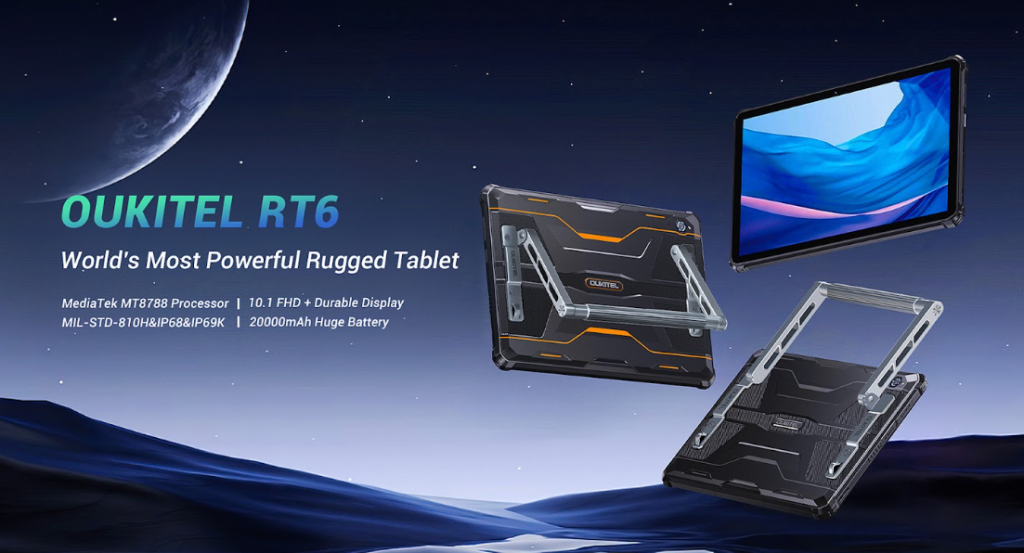
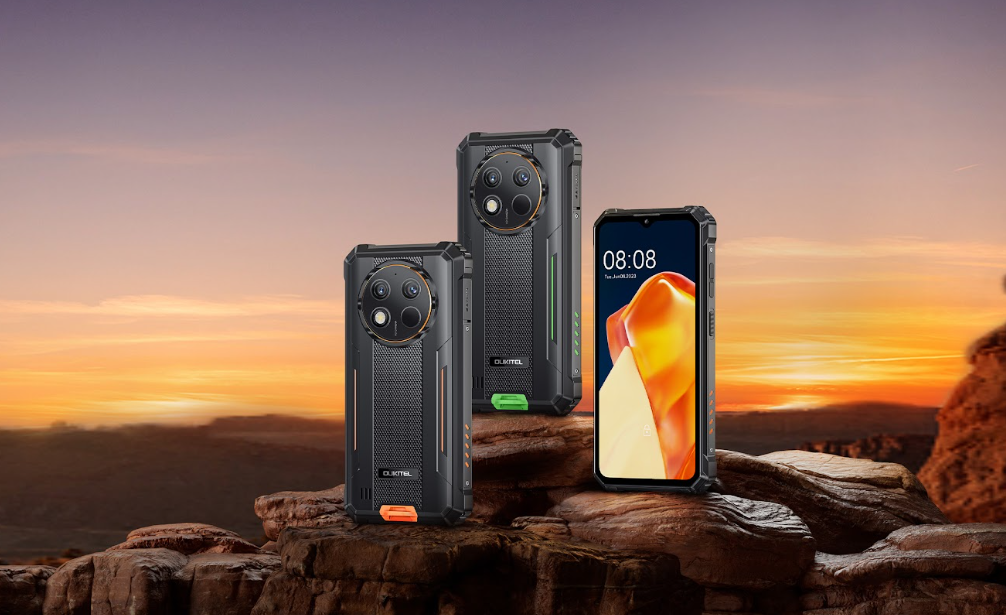
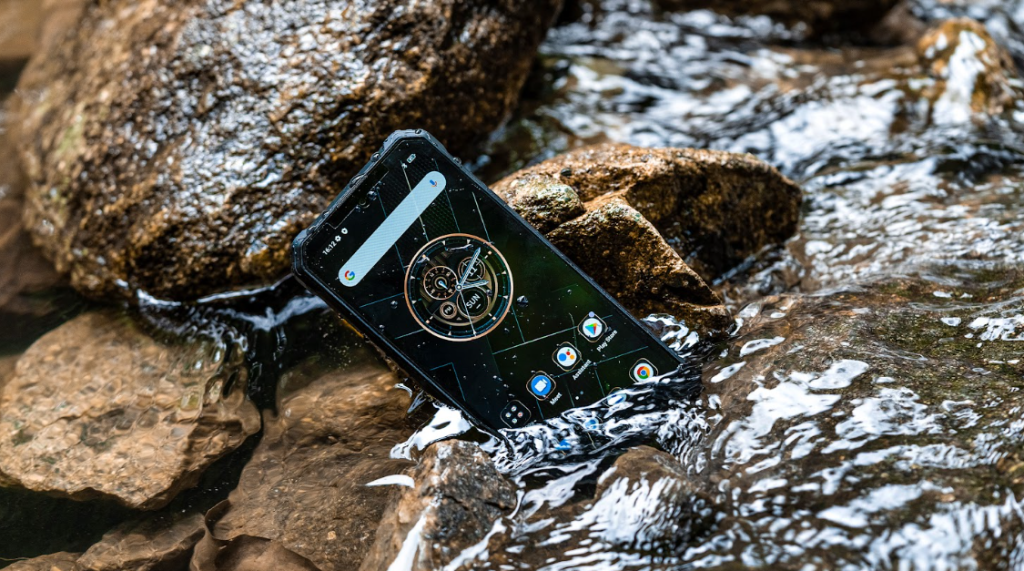
Gear up for the OUKITEL Back to School Sale and enjoy a fantastic 20% discount on the cutting-edge RT6 Tablet and the robust WP28 Smartphone. OUKITEL, a distinguished name in the realm of rugged technology, has proudly unveiled its latest offerings to enhance your rugged device experience. The RT6 tablet and WP28 smartphone, powered by the latest Android 13, are the stars of this promotion, exclusively available at the OUKITEL Official Store.
Embrace the durability and innovation that OUKITEL is renowned for, and seize this opportunity to save big on devices that are built to withstand the demands of your active lifestyle. Whether you’re a student gearing up for the school year or anyone in search of reliable, rugged devices, the Back to School Sale is the perfect occasion to score these high-performance gadgets.
Oukitel RT6
Oukitel RT6 Rugged Tablet is a formidable companion built to conquer the most demanding terrains while catering to your productivity needs. Engineered with unwavering durability and powerful performance, this device stands out as the ultimate solution for both work and leisure.
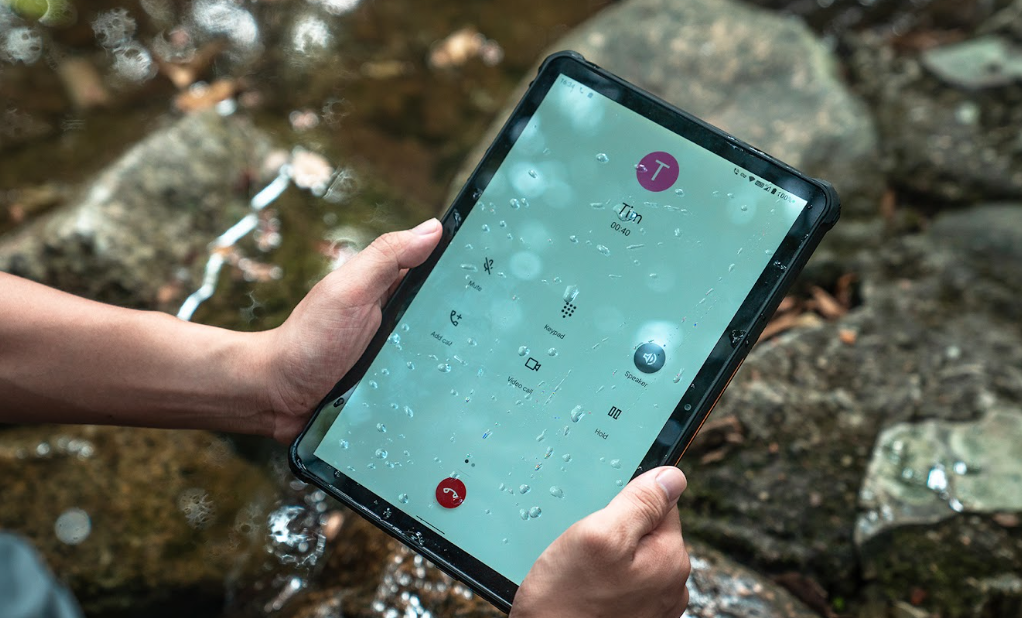
Equipped with an imposing 20000mAh battery, the RT6 ensures uninterrupted operation even in challenging conditions. Boasting an impressive 2250 hours of standby time, as well as 15 hours of continuous video playback and gaming, it effortlessly keeps pace with your dynamic lifestyle. Certified by IP68, IP69K, and MIL-STD-810H standards, it provides exceptional safeguarding against shocks, extreme temperatures, and water immersion, ensuring reliable performance under any circumstance.
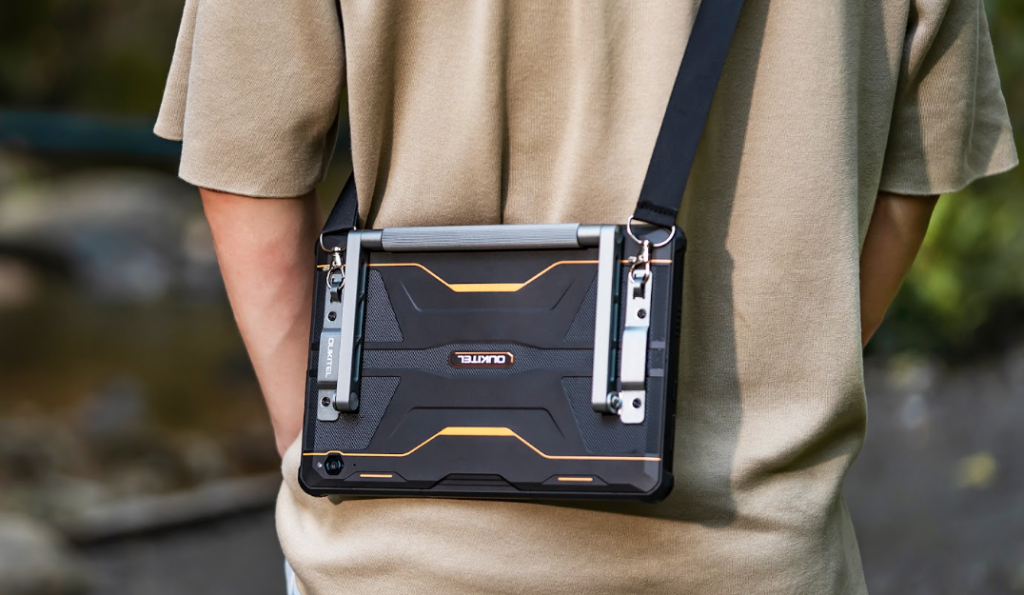
The RT6’s 10.1’’ FHD+ screen delivers a comfortable viewing experience with its 400 nits of brightness. Its MediaTek MT8788 processor, coupled with 8GB RAM and 256GB ROM (expandable up to 14GB RAM and 1TB ROM), empowers seamless multitasking and efficient data management. With the inclusion of adaptable accessories like an aluminum stand, hand strap, and shoulder strap, users can tailor their usage to specific requirements.
Running on the latest Android 13 OS, the RT6 ensures an intuitive interface and access to Google’s latest enhancements. The 10.1-inch FHD+ IPS display showcases sharp visuals with a resolution of 1200×1920, ideal for media consumption, gaming, and productivity tasks.
The tablet’s support for dual Nano SIM cards or a combination of one SIM card and a TF card provides versatile connectivity and storage options. Bluetooth 4.2 facilitates easy peripheral connections, while GPS, Glonass, Beidou, and Galileo support ensure seamless navigation.
The RT6 isn’t just rugged, it’s equipped with practical features like a compass for outdoor exploration. Its compact dimensions viz. 249.1mm in height, 167.8mm in width, and 17.3mm in thickness, ensuring effortless portability and handling. This tablet is a robust blend of durability, performance, and utility, designed to thrive wherever you venture.
Oukitel WP28 Rugged Smartphone is a fusion of robust engineering and high-performance technology. Designed to excel in the harshest environments, this device offers exceptional capabilities while catering to your outdoor needs.
Certified with IP68, IP69k, and MIL-STD-810H standards, it guarantees top-tier protection against water, shocks, and dust. Corning Gorilla Glass 5 shields the screen, reinforcing it against drops and scratches. With a 5MP front camera, a 48MP rear camera, and a colossal 10,600mAh battery, the WP28 delivers impressive photography prowess and enduring power.
Built around a potent T606 CPU, the Oukitel WP28 excels in seamless multitasking. The extensive 10,600mAh battery capacity ensures extended usage, eliminating concerns of running out of power during crucial moments. Whether you’re navigating the wilderness, working remotely, or unwinding on a long outing, the WP28 stands steadfast with its prolonged battery life.
Featuring an ample 8GB of RAM and 256GB of internal storage, it accommodates your apps, media, and files. Running on the latest Android 13 OS, the WP28 ensures an intuitive interface and access to Google’s latest innovations. The 6.52-inch HD+ display, with its 720×1600 resolution, delivers crisp visuals and vibrant hues – perfect for entertainment, gaming, and browsing.
The 48MP rear camera captures intricate details, while the 5MP front camera facilitates selfies and video calls, ensuring you remain connected to loved ones.
With dual SIM card slots (Nano+Nano or Nano+TF), you can efficiently manage personal and work contacts. Bluetooth 5.0, GPS, Glonass, Beidou, and Galileo support guarantee seamless navigation and peripheral connectivity. The NFC feature adds a layer of convenience, enabling secure transactions via Google Pay.
The Oukitel WP28 prioritizes both durability and security and benefits from the added security of Face ID, ensuring exclusive access. The SOS feature provides peace of mind, allowing emergency calls. Despite its rugged build, it maintains a sleek profile, measuring only 17.1mm in thickness. Its compact, ergonomic design ensures effortless portability in pockets or bags, without bulkiness. The Oukitel WP28 redefines ruggedness while offering a myriad of features tailored to your lifestyle.
You can secure the Oukitel RT6 rugged tablet at an incredible price of $296, down from its regular retail price of $369.99, by using the discount code “20%OFF“. Similarly, the WP28 rugged smartphone is now attainable for just $167.2, a significant reduction from its usual retail price of $209. This limited-time opportunity to acquire these devices at a discounted rate is exclusively available on the official Oukitel store. Don’t miss out on this chance to own them at exceptional value.
About Oukitel:
“Shenzhen Yunji Intelligent Technology Co., LTD,” headquartered in Shenzhen, China, is the driving force behind the tech-savvy brand known as OUKITEL. This corporation seamlessly integrates research, design, production, sales, and post-sales service. With a global network of over 130 dealers spanning across 60 countries, OUKITEL products reach enthusiasts and users across Europe, Asia, North America, and South America.
The smartphone market is growing every day. However, not everyone needs phones that can zoom up to 120x to the surface of the Moon, communicate via satellite, and have a 2K display that can capable of projecting 3D images. Some people simply want a mobile phone for communication and don’t want to spend their entire day watching 60-second videos on TikTok. Moreover, it seems that the number of these people is increasing. According to a report by Counterpoint, feature phones are making a comeback in the US market. Here are the details…
Feature Phones Make a Comeback as Gen Z and Millennials Seek Digital Detox
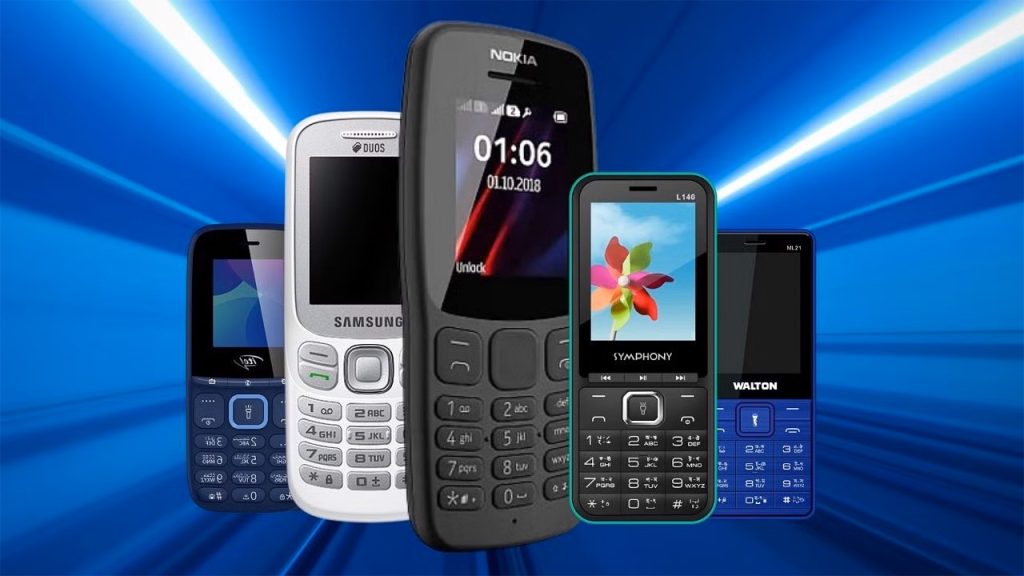
Feature phones or dumb phones as some call them, are making a comeback in the US market. This is being driven by a number of factors, including the growing popularity of digital detoxes, the affordability of feature phones, and the increasing demand for ruggedized devices.
One of the main reasons of the feature phone comeback is the growing popularity of digital detoxes. More and more people are realizing the negative effects of excessive smartphone use, such as anxiety, depression, and sleep deprivation. Feature phones offer a way to escape from the constant stimulation of smartphones and reconnect with the real world.
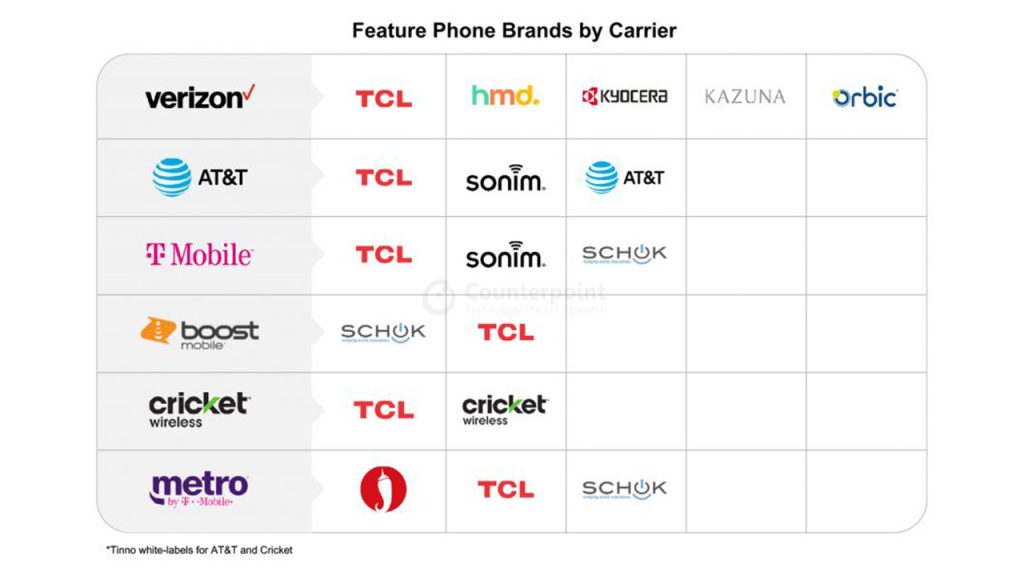
According to the Counterpoint, the US feature phone market is still relatively small, but it is growing rapidly.Shipments in the US are expected to reach 2.8 million in 2023. The two leading OEMs in the US feature phone market are TCL and HMD. TCL is the market leader, with a 43% share, followed by HMD with a 26% share.
Other players in the market include Sonim, Kyocera, Schok, and Tinno. Although feature phones are expected to remain a niche market in the U.S., their popularity is likely to continue rising in the years to come. This is partly due to a growing interest in devices that facilitate digital detoxing, as well as the availability of feature phones that come with up to date functionalities.
Earlier today, iQOO announced the Z7 Pro smartphone in the Indian market. Now the Vivo sub-brand has launched the Z8 series in China. It comprises the iQOO Z8 and Z8x. Both phones arrive as the successors to the Z7 and Z7x that debuted earlier this year. The newest Z8 duo have an identical design but different specifications under the hood. They are mid-range offerings. The Z8 is also the more premium model among the two devices. Read on to know what the devices offer out of the box.
iQOO Z8, Z8x specifications and features
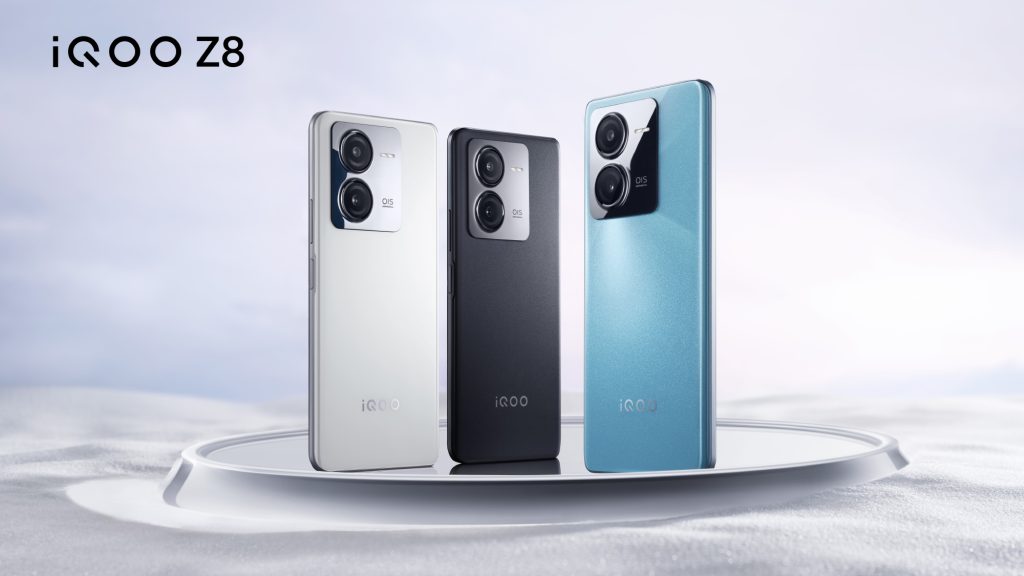
The iQOO Z8 and Z8x have a compact design with a slim profile. The back panel is curved and there is a side-mounted fingerprint scanner embedded in the power button. The rear panel also sports a squarish camera module in glossy Black color giving the phones a dual-toned look. The iQOO Z8 duo features a 6.64-inch centre-aligned punch-hole display bearing an FHD+ resolution and a 120Hz refresh rate.
In the photography department, the iQOO Z8 and Z8x have dual rear cameras. The setup on the former comprises a 64MP OIS-enabled main sensor paired with a 2MP depth unit whereas the Z8x has a 50MP main lens and a 2MP bokeh sensor. Up front, the Z8 and Z8x have a 16MP and 8MP selfie snappers respectively.
Under the hood, the iQOO Z8 is powered by a MediaTek Dimensity 8200 processor whereas the Z8x is equipped with a Snapdragon 6 Gen 1 chipset. Both phones pack up to 12GB RAM and up to 512GB storage. The devices also feature a VC cooling chamber for heat dissipation. The Z8 is backed by a 5,000mAh battery with support for 120W fast charging whereas the Z8x is fuelled by a 6,000mAh cell with support for 44W charging.
The iQOO Z8 duo runs on OriginOS 3 based on Android 13. Connectivity options on the devices include 5G, WiFi, Bluetooth, and USB-C port.
The iQOO Z8 and Z8x are offered in Moon Porcelain White, Hoshino Green, and Yaoye Black colors. The former starts at CNY 1,699 ($233) for the base 8GB+256GB option whereas the 12GB + 256GB and 12GB + 512GB are priced at CNY 1,799 (~$246) and CNY 1,999 (~$274) respectively. On the other hand, the 8GB + 128GB, 8GB + 256GB, and 12GB+ 256GB RAM and storage configurations of the iQOO Z8x are priced at CNY 1,299 (~$178), CNY 1,399 (~$191), and CNY 1,499 (~$205). Both phones are up for pre-orders in China with sales commencing from September 7.
Sony has announced the upcoming PlayStation Plus games for September. These games will include Saints Row, Black Desert Traveler Edition and Generation Zero from September 5 to October 2. Here is what you can expect from these titles:
Image by Sony PlayStation
Saints Row (2022)
Saints Row 2022 is an action-adventure game developed by Volition and published by Deep Silver. Deep Silver wanted to return to the classic play style of the open-world adventure and rebooted the entire franchise with the 2022 instalment. This time, your character forms his gang to take over the city with the help of a few friends. The game also supports co-op mode, where you can invite friends and start progressing through the story. There are numerous funny emotes and execution styles, which makes the game more fun.
Generation Zero
Generation Zero is an open-world stealth-action shooter game in a world where machines have taken over. You can collaborate with your friends to explore a vast open world map inspired by the Swedish Cold War era. With a seamless co-op mode, combine your skills with friends and help each other participate in the resistance. Scavenge parts from fallen machines to gain experience and grow stronger. The game progresses by building and fortifying your bases across the island.
Black Desert Traveler Edition
Black Desert is an open-world MMORPG(Massively Multiplayer Online Role-Playing Game). You will spawn as an adventurer who has lost all his memories, and you will journey through the world to uncover the truth. Team up with your friends and work through the role you want to play to fight back against the forces that threaten your world. For those wondering what this Traveler edition has to offer, the contents of this bundle are provided below:
Tecno launched its first foldable phone, the Phantom Fold V earlier in March this year. It is still the cheapest horizontal folding phone in the market. The foldable phone segment also comprises clamshell folding phones and they seem to be more popular as many brands have launched devices in such a form factor. Notable mentions include the Samsung Galaxy Z Flip 5, OPPO Find N3 Flip, Motorola Razr Ultra, Vivo X Flip etc. Now Tecno is also expected to join the bandwagon with a clamshell folding phone called the Phantom V Flip
Tecno Phantom V Flip spotted on Google Play Console
The Tecno Phantom V Flip appeared in leaked renders as well as a hands-on image earlier this month giving us a look at the device. The upcoming offering also bagged Bluetooth SIG and FCC certifications revealing few details. Now the clamshell foldable phone has appeared on the Google Play Console listing.
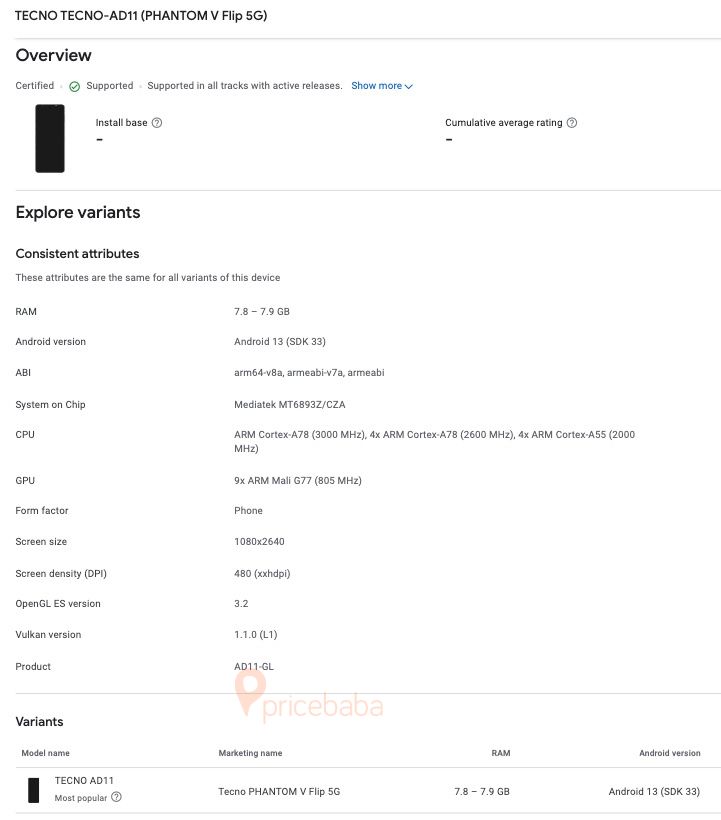
The Tecno Phantom V Flip is listed on Google Play Console with model number AD11 which is the same as other certifications. It reveals that the device will feature an FHD+ resolution of 1,080 x 2,460 pixels and have a 480 dpi screen density. Under the hood, the certification listing mentions a MediaTek MT6893Z/CZA system-on chip which could be the Dimensity 1300. It will be paired with a Mali-G77 GPU onboard. The Tecno Phantom V Flip is listed with 8GB RAM and it will ship with Android 13 OS out of the box.
As per past reports, the Tecno Phantom V Flip is rumored to feature a large 6.9-inch AMOLED display. As per leaked renders, the device has a circular module on the rear panel that accommodates a 1.39-inch secondary screen and a camera ring that houses 64MP and 13MP sensors. The brand seems to be taking a unique approach unlike the conventional separation of cameras and the display. Additionally, the FCC certification of the Phantom V Flip revealed that it will be backed by 1,165 mAh and 2,735 mAh battery cells with support for 45W fast charging.
Google Translate is a popular language translation app that has been helping people communicate across cultures for years. The latest version of the app, 7.12, introduces some exciting new features that make it even more helpful. The latest was rolled out earlier this week, so these features are not yet available to everyone. But Android enthusiast @AssembleDebug has shared details about them on Twitter.
Google Translate version 7.12 Update
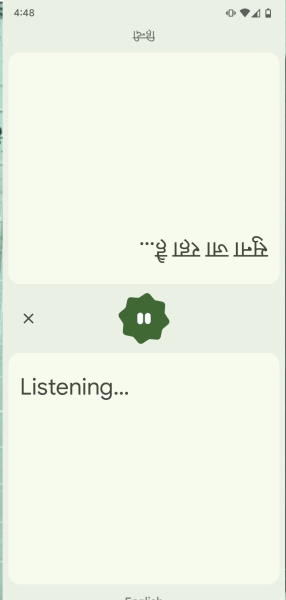
Arguably, one of the most notable features in the new update is Face-to-Face mode. In this mode, the upper half of the app’s UI will turn upside down so that the other person can see the translated text instantly while you speak, and vice versa. Of course, the feature is added in the Conversation mode.
Image: AssembleDebug via X
This is a great way to communicate with someone who is not fluent in the language you speak. You can simply open the app, and start talking. There is no need to rotate or shuffle the phone to show the translated text.
Likewise, the update includes a few visible changes to the user interface. The Conversation mode icon in the bottom-left corner has been replaced with a Handwrite input button. This button allows you to write text in a foreign language, and the translated text will appear above it.
On the other hand, Conversation mode can now be accessed by pressing the mic button. After tapping it, you will see a “message box” icon in the upper right corner which will enable the Conversation mode. On a side note, the mic button also has a new animated design.
Image: AssembleDebug via X
Likewise, auto playback will now instantly vocalize translations after a user speaks. This can be helpful for clarification or pronunciation guidance. Google is also adding automatic language detection for spoken input. This means that the app will automatically detect the language that you are speaking, so you don’t have to manually select it.
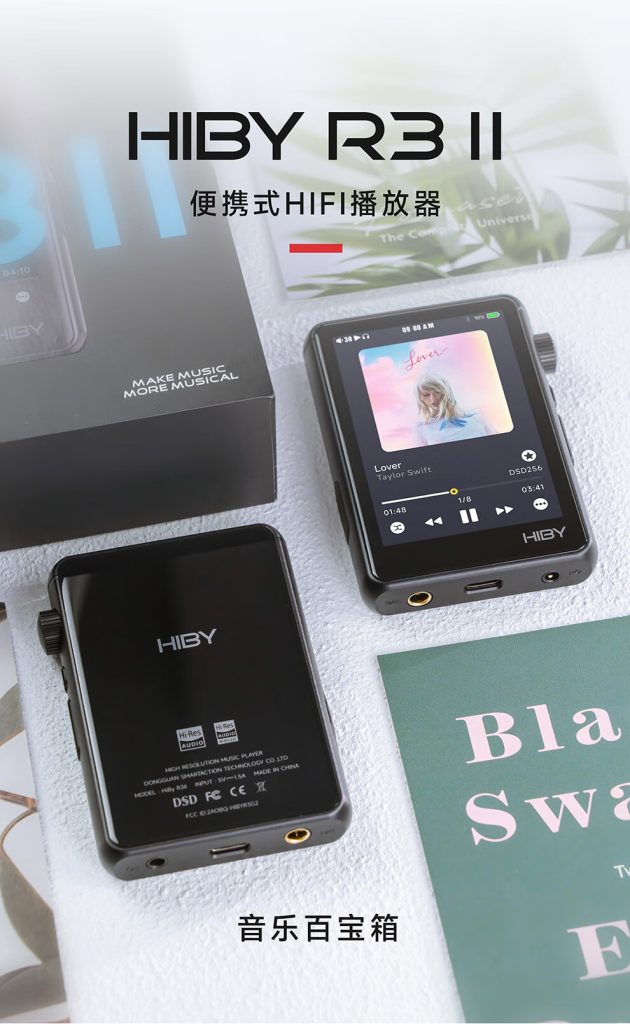
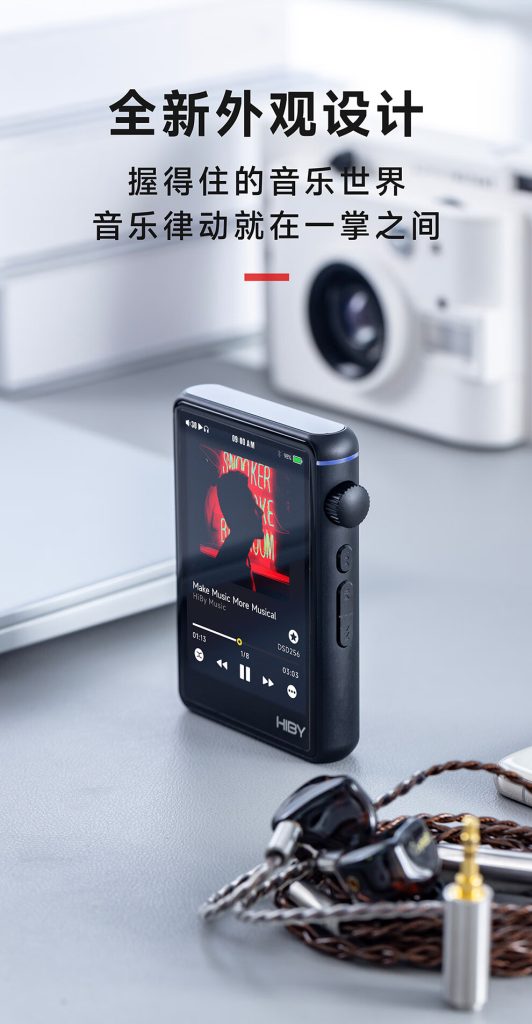
You may think music players are a thing of the past but no as HiBy Music is set to release the HiBy R3 (Second Generation) music player on September 6th at 8:00 pm. Priced at 998 yuan ($137), this advanced device offers sophisticated features for music enthusiasts.
HiBy R3 (2nd gen) Music Player key features:
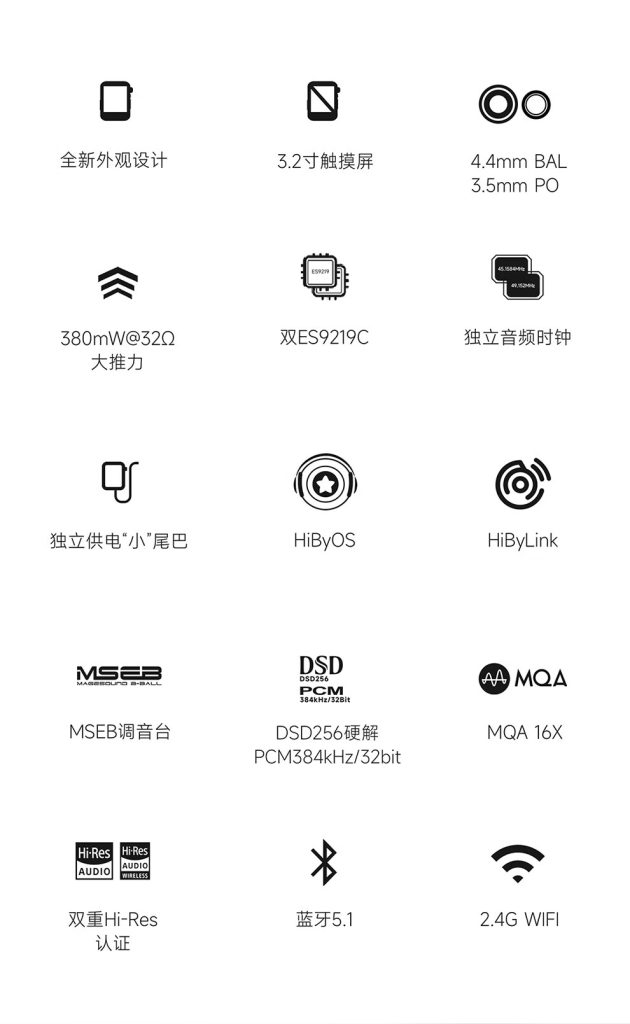
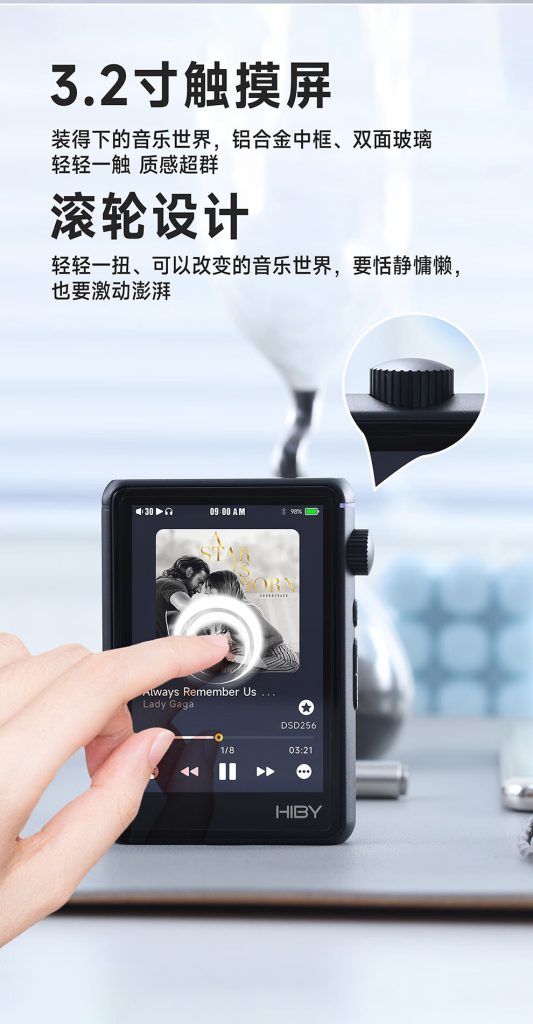
The upcoming HiBy R3 (Second Generation) music player introduces notable features like a unique side scroll wheel, a 3.2-inch (320×480 resolution) touchscreen, and an elegant design with aluminum alloy and dual-sided glass components. These elements combine style and functionality in the new player.
Among its standout features are the dual ES9219C DAC chips, enhancing the sound quality by minimizing jitter and phase noise. The player utilizes two low-phase-noise active oscillators that adjust automatically, optimizing the system clock signals for various sampling rates.
The HiBy R3 (Second Generation) music player has a distinctive feature where it can function as a smartphone “tail” or USB DAC mode. In this mode, the player’s battery works independently, reducing external power source noise and conserving the smartphone’s battery.
In terms of output options, the player boasts a 4.4mm balanced output, pushing an impressive 380mW at 32Ω, and a standard 3.5mm single-ended output.
The music player offers seamless device integration with Bluetooth 5.1 and 2.4GHz Wi-Fi. It can also function as a computer Bluetooth sound card. Powered by HiBy OS, it provides remote control features via smartphones for an enhanced user experience.
The music player is lightweight at 118g and houses a 2000mAh battery, offering more than 15 hours of continuous music playback.
The trade war between China and the United States is in full swing. Both countries are striving to outdo each other, particularly in the area of technology development and manufacturing. However, this competition and the resulting tension are paving the way for another rising star: India. Especially since the Covid-19 pandemic, India has become a global production hub, attracting increasing attention from various companies. Most recently, India announced that Dell, HP, and 32 other companies have applied to manufacture laptops locally. Here are the details…
India Emerging as Laptop Manufacturing Hub as Dell, HP, and Others Apply to Make Locally
The production of technology in India is increasing every day. We previously mentioned how smartphone production in the country grew 14 times in 8 years thanks to Make in India initiative. Now, according to a recent announcement, at least 32 international electronics companies have applied to India’s incentive program to manufacture laptops in the country. Notably, this list of producers includes major brands like Dell, Asus, HP, and Lenovo.
If there are those who do not know, “Make in India” is a program initiated by the Indian Government to encourage companies to design, manufacture, and assemble their products within India. This program also aims to attract investments specifically into the manufacturing sector. Launched by Prime Minister Narendra Modi in September 2014, the initiative has primarily focused on smartphones and other electronic products.
Earlier this month, the Indian Government announced new licensing requirements for the import of laptops, tablets, and personal computers. Naturally, tech companies already eager to manufacture in India jumped at this opportunity. According to initial reports, 32 of the world’s largest laptop manufacturers have applied to take advantage of local production incentives. The minister stated that this move is expected to attract an incremental investment of 24.3 billion rupees (approximately $294.24 million) and is likely to generate 75,000 direct jobs.
Following the previous works on OneUI 4, Samsung has polished One UI Watch, primarily, the health, sleep, and wellness features on the Galaxy Watch 6. The same set of features are now rolling out to the Galaxy Watch 5 via the OneUI Watch 5 update. The stable channel update is now available on some units and may take time for the broader rollout.
There were already reports about the OneUI Watch 5 rollout this week, and finally, it has started to make its way on Galaxy Watch 5 models. Some users have taken to X.com (formerly Twitter.com) to share the updated information.
Galaxy Watch 5 Firmware Details
The update on Galaxy Watch 5 is rolling out via the firmware versions R920XXU1BWH3/R920OXM1BWH3 and it weighs 1.7GB in size. The users must switch to a Wi-Fi network as it may consume all their carrier data.
OneUI Watch 5.0 Features
There are some major improvements on the OneUI Watch 5 that will enhance the health and sleep monitoring on your Galaxy Watch 5 and Galaxy Watch 4 units. The tiny improvements in the UI will surely enhance the usability and accessibility of some most used features on the watch. There are some new animations that make everything look smoother and clear.
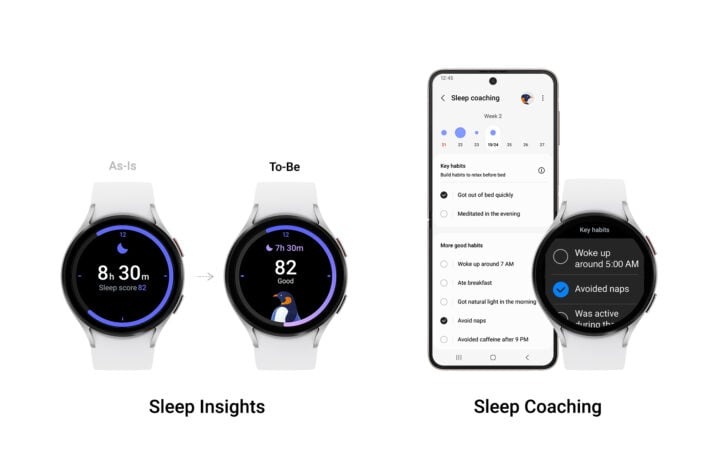
Further, there are new watch faces and tiles, access to personalized heart rate zones, volume control for incoming calls, and the ability to mute them. The OneUI Watch 5 bundles new sleep analysis capabilities with sleep consistency readings, sleep animal symbols, sleep coaching, etc. It can now ping notifications for irregular heart rhythms. There’s an addition of Track Run and custom workout features including access to the GPX File database for new routes.
There are several other improvements including the Time App tile, the ability to arrange and create new folders, and the Galaxy Buds Tile to enable 360 Audio.
Interested users can head over to the Watch Settings > Watch Software Update and then tap Download and Install to grab the latest update. If you don’t see the update, then you have to wait for some time as it is a staggered rollout. It will first roll out to a small number of users and then will see a broader rollout upon successful stability verification of the new firmware.
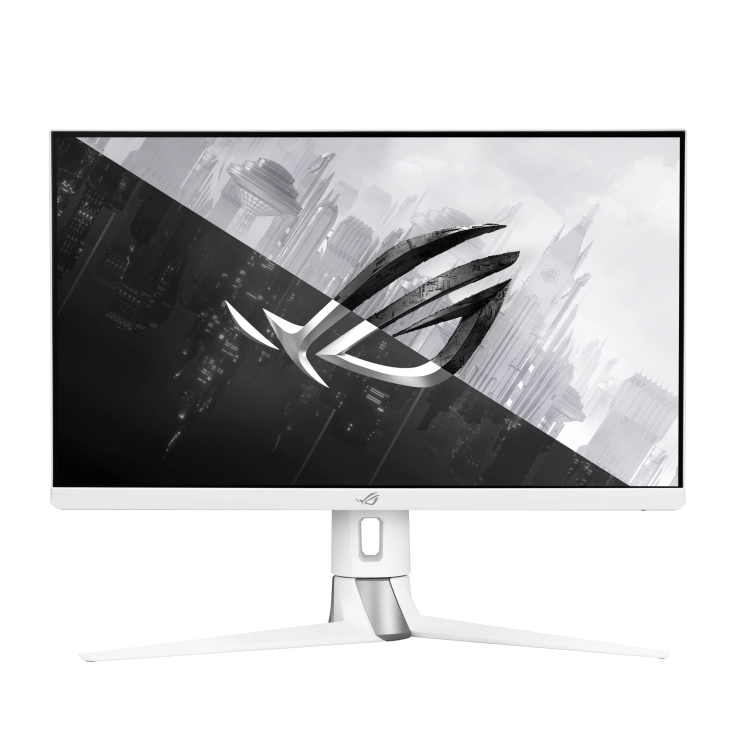
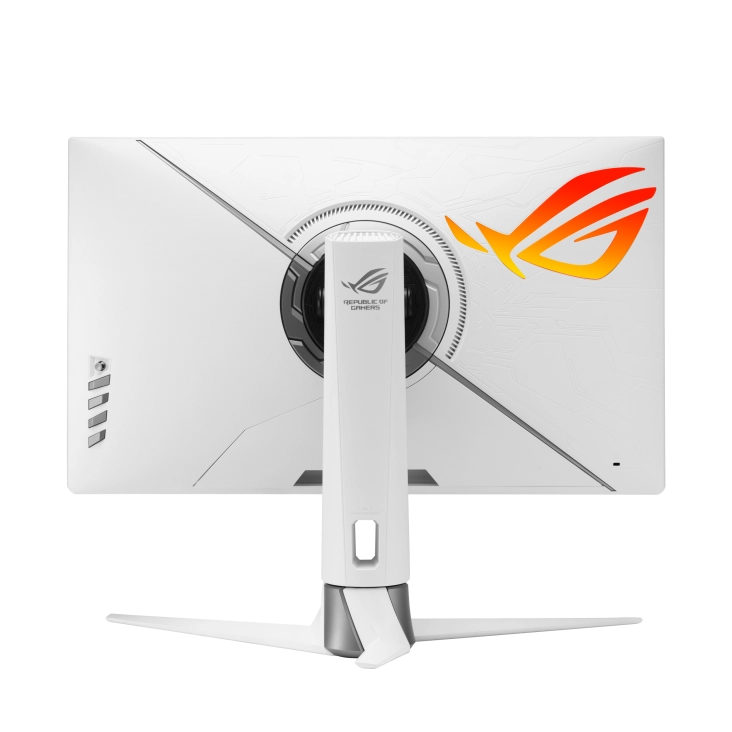
Asus ROG (Republic of Gamers) has unveiled the white edition of the PG27UQR monitor, featuring a 27-inch 4K UHD display, an impressive 160Hz refresh rate, and HDR600 certification. This stylish and high-performance monitor is aimed at users looking for top-notch gaming and display capabilities. The monitor was originally launched earlier this year.
ROG PG27UQR key features:
The PG27UQR monitor features a 27-inch non-glare FAST IPS UHD panel, offering vivid visuals. Its standout features include a 4K resolution (3840 x 2160) and an impressive 160Hz refresh rate, suitable for gaming and professional graphics. With a 1ms (GTG) response time and 95% DCI-P3 color gamut, the monitor provides accurate colors and rapid response, catering to competitive gaming and detailed design.
The monitor maintains brightness and clarity with 400cd/㎡ brightness for clear visuals in well-lit environments. DisplayHDR600 certification enhances dynamic range, while a 1000:1 contrast ratio offers deeper imagery with improved blacks and whites.
The PG27UQR monitor offers ample connectivity options, including two DP1.4 ports, two HDMI 2.1 ports, and four USB-A ports, ensuring compatibility with various devices and easy peripheral connectivity.
The original model of the monitor is currently sold for 3999 yuan ($548) on JD.com.
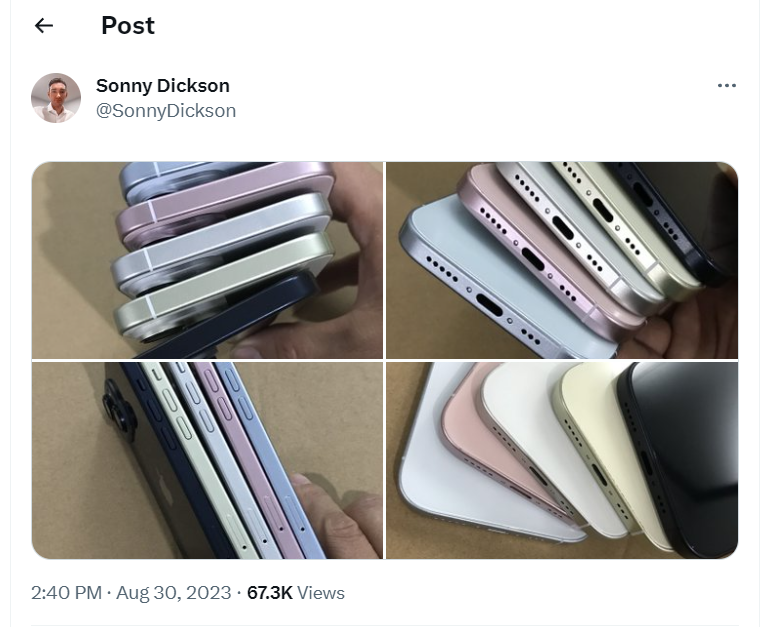
Apple has officially announced their launch event on September 12. The iPhone 15 series is expected to be announced at the same event. Ahead of its launch, live images of the dummy iPhone 15 have surfaced online. Let’s go ahead and take a look at the post.
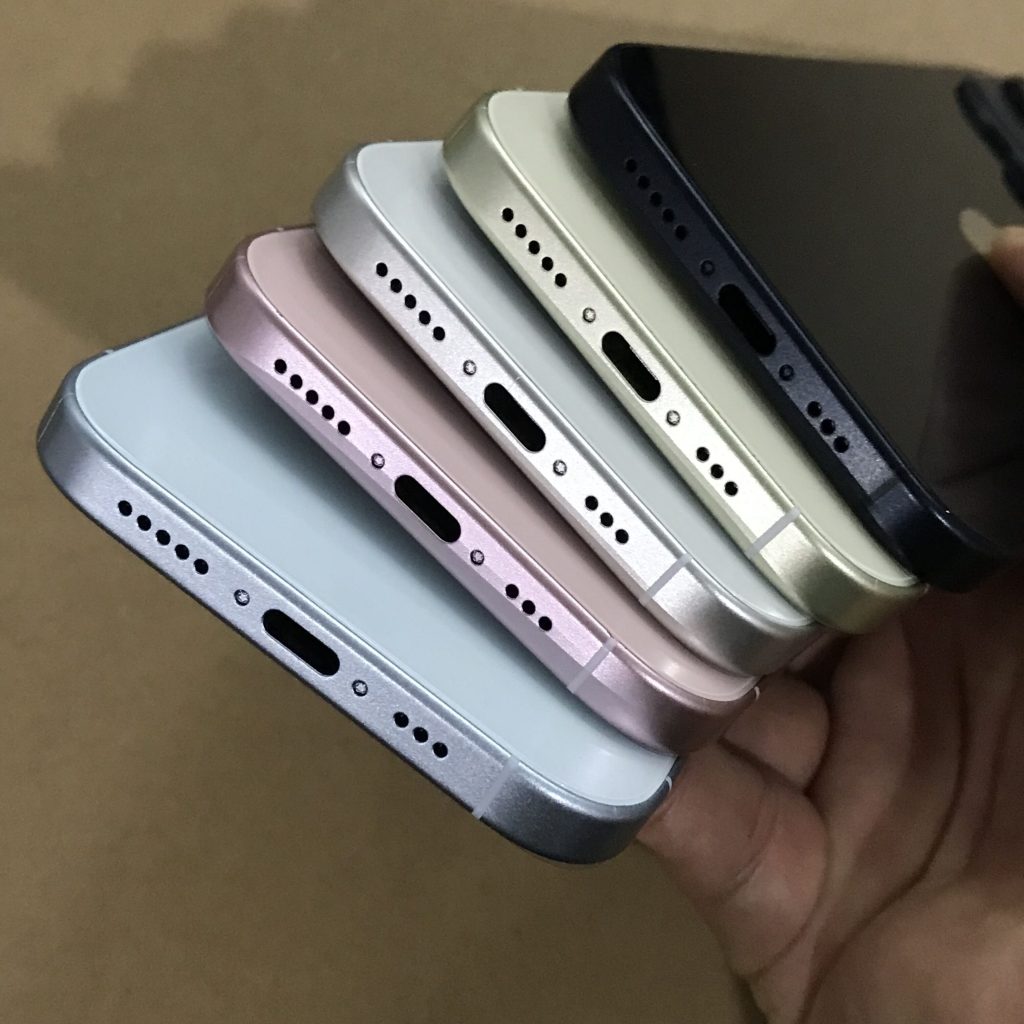
Sonny Dickson’s recent post reveals multiple pictures of dummy models of the iPhone 15. These images display different color options for the iPhone 15 models, such as Pink, Grey, Black, White, and Green. This is in line with our earlier report about the launch event. We previously speculated that the Apple logo invitation hinted at Black, Blue, and Grey colors. This led us to believe these would be the rumored iPhone 15 Pro color options.
Aside from showcasing the various colours, Sonny Dickson’s images also shed light on the leaks surrounding the iPhone 15’s potential switch from a lightning port to a USB-C port. It’s worth noting that iPhones have utilized a lightning port for quite some time. In the tweet, the iPhone 15 model can be seen with the USB-C port, which indicates that the company might be switching to a USB-C port completely.
In related news, a Bloomberg report revealed that Apple will also announce AirPods with USB-C charging case on 12 September. The full report can be found on our website by clicking here.
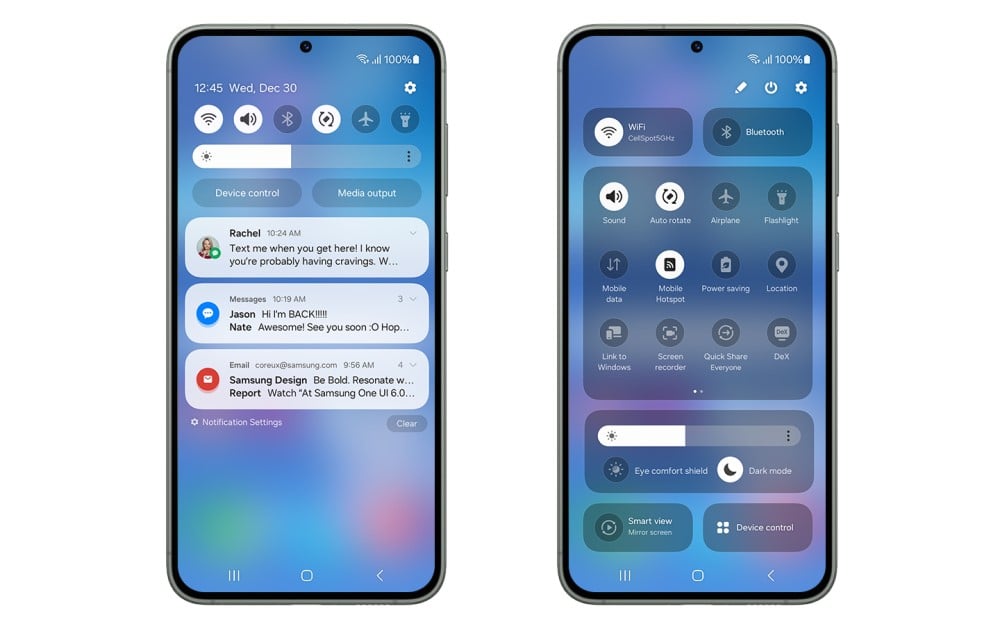
Samsung kicked off the Android 14 OS-based One UI 6 beta earlier this month for the Galaxy S23 series in select regions. The One UI 6 Beta 2 was set to roll out on August 29, but it has now been delayed by another week.
Samsung Galaxy S23 lineup to receive One UI 6 Beta 2 in September
According to an official announcement, the South Korean tech giant is planning to include China, India, Poland, and the United Kingdom. These regions will receive the update on 4th September 2023. On the other hand, the second beta for the next-gen Android operating system might be released in Germany, South Korea, and the US later today (31st August 2023).
The company shared the announcement on its official Chinese Community Forum, which announced the second delay to September. It likely postponed the beta release over bug issues. The first iteration of the early One UI 6 build did feature minor issues like animation stutters or apps and widgets disappearing from the home screen. So it isn’t surprising that Samsung is taking its time to polish its Android 14 custom skin for better stability in the second beta.
For those unaware, beta programs are early versions of the stable release, which most users get eventually. One UI 6 will bring a more user-friendly experience along with other quality of life changes and design improvements. So stick around for more updates regarding this matter.
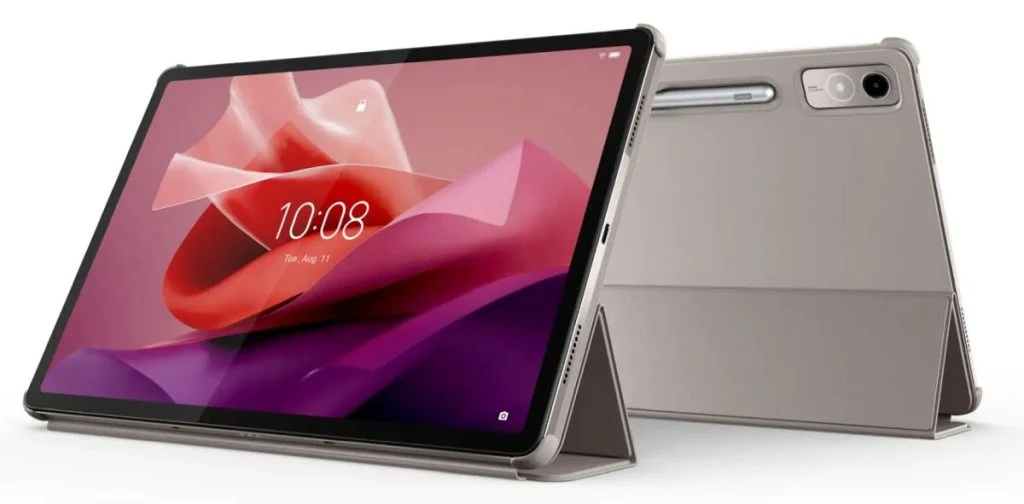
The Lenovo Tab P12 has finally been unveiled in India. The company launched this tablet model in Europe last month, and now, this device has finally made its way to the Indian market. So let’s have a look and its specs, pricing, and more.
Lenovo Tab P12 Pricing & Availability
The Chinese tech giant’s new Tab P12 model will go on sale from the company’s official website and Flipkart with limited time special offers. It carries a price tag of 34,999 INR and will be available in a single Storm Gray color option. Lenovo is also offering a stylus pen, which can be purchased separately.
Lenovo Tab P12 Specs
The Lenovo Tab P12 sports a tall 12.7-inch LTPS LCD panel that offers 400 nits of peak brightness, 3K resolution (2944x1840px), 96 percent DCI-P3 color gamut, and Corning Gorilla Glass 3 protection. The front also houses a 13-megapixel selfie shooter, while the rear features an 8-megapixel camera with LED flash. Talking about its design, the rear features a metallic panel with the tablet weighing around 615 grams and measuring just 6.9mm in thickness. Under the hood, the Tab P12 is equipped with the MediaTek Dimensity 7050 SoC, which is paired with 8GB of LPDDR4X RAM and 256GB of UFS 2.2 storage.
Buyers can further expand storage by another 1TB storage using a MicroSD card slot. For audio, the tablet features a quad speaker setup from JBL, which includes Dolby Atmos support. A massive 10,200mAh battery pack powers this device, which supports standard charging speeds. On a single full charge, Lenovo is claiming 10 hours of video playback. Other notable features include Wi-Fi 6 and dual-band Wi-Fi, Bluetooth 5.1, Android 13 OS, and a fingerprint sensor housed in the power button.
Chinese electric vehicle (EV) manufacturer BYD has experienced a remarkable surge in profits during the second quarter, with a staggering 145% increase, attributed largely to record-breaking deliveries. This growth occurs amidst an ongoing EV price war in China that is constraining margin expansion across the sector.
Outpacing renowned automaker Volkswagen earlier this year, BYD has retained its position as China’s best-selling car brand throughout the first half of the year. The second quarter was particularly noteworthy, marked by the delivery of an unprecedented 703,000 new energy vehicles (EVs and PHEVs), a remarkable 98% surge compared to the previous year. These impressive numbers have propelled BYD’s revenue up by 67%, exceeding $21.4 billion.
The surge in deliveries has been a driving force behind BYD’s profits, which more than doubled during Q2, reaching $933 million. This represents the company’s second-highest quarterly profit, second only to the fourth quarter of 2022 when it recorded $1 billion.
In addition to its financial achievements, BYD has also extended its lead in China’s EV market, resulting in a net income growth of 204.7% for the first half of the year. July marked another milestone for the company, as it achieved a new monthly sales record for the third consecutive month. This growth was fueled in part by the popularity of its Dynasty and Ocean brands, with a year-on-year increase of 54%.
However, despite its remarkable achievements, BYD has yet to surpass Tesla as the world’s largest manufacturer of battery-electric vehicles. In the first half of the year, BYD reported net earnings of $1.5 billion, an impressive surge from the $493 million recorded during the same period in 2022. Notably, the company’s profit leaped by an impressive 144% in the second quarter alone, following a fivefold increase in the first quarter.
The first half of 2023 saw BYD selling a total of 1,255,637 passenger EVs and PHEVs. Of these, 352,162 were battery-electric vehicles, while 348,081 were plug-in hybrids. Out of the total battery-electric vehicles sold, 10% were exported. Despite these remarkable figures, Tesla maintains its lead in the EV sales race, having sold 889,015 vehicles in the first half of the year.
BYD’s exceptional growth in profits and deliveries underscores its rising prominence in the EV market, solidifying its position as a formidable player in the industry.
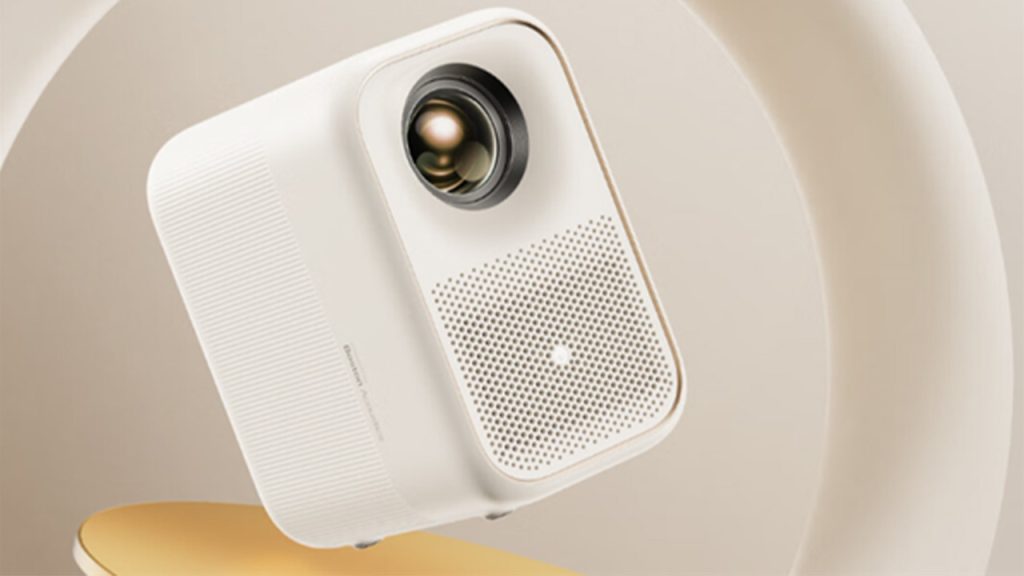
Display technology is getting better every day. That’s why we see really good screens, especially on our smartphones. But no matter how good the picture is on a phone, tablet, or even laptop, they can’t give you the joy of watching something on a big screen. Knowing this, Xiaomi has released a new projector called Q3 Pro for sale. Here are the details…
Xiaomi Q3 Pro Projector: 1080p Resolution, 120Hz Refresh Rate, and 500 Lumens Brightness
Xiaomi continues to expand its product range. In addition to smartphones, the company operates in various other markets and has recently introduced its new projector, the Q3 Pro. This projector features MEMC motion compensation technology, which is typically only found in more expensive projectors priced over $400-$500. It also comes equipped with a high-end Amlogic T982 TV chip. Thanks to this chip the Xiaomi Q3 Pro promises smooth frame rates while watching sports and gaming, ensuring a lag-free experience.
The Xiaomi Q3 Pro also features a 1080p resolution, 2GB of RAM, and 32GB of storage. It is equipped with dual 5W speakers and has ports for HDMI 2.1, USB 3.0, DC power, and a 3.5mm headphone jack. Of course, 1080p may not seem like a very high resolution at first glance. However, it’s important to remember that this is an affordable projector. Also, the new 3-lens optical system increases the resolution by six times, resulting in clear and uniform images that address the common issue of blurry corners in LCD projectors.
The refresh rate of 120Hz meets current market standards, making the display smooth and responsive. The projector’s brightness has been increased to 500 lumens, compared to the previous model , and its contrast ratio is now 2,000:1. However, this level of brightness is on the lower to middle end for projectors. Based on this, we can estimate that the ideal screen size for this projector is between 50 to 60 inches.
The Q3 Pro uses FengOS 3.0. One of its standout features is the absence of ads, as well as a unique screen mirroring feature that is also free of ads. The projector offers access to more than 100,000 hours of streaming content. Plus, it uses a recommendation algorithm similar to TikTok’s, which helps deliver personalized content to users.
Price & Availability
The Xiaomi Q3 Pro projector is priced at 1,699 Yuan in China. It is available for purchase on the Xiaomi website and through authorized retailers on September 1.
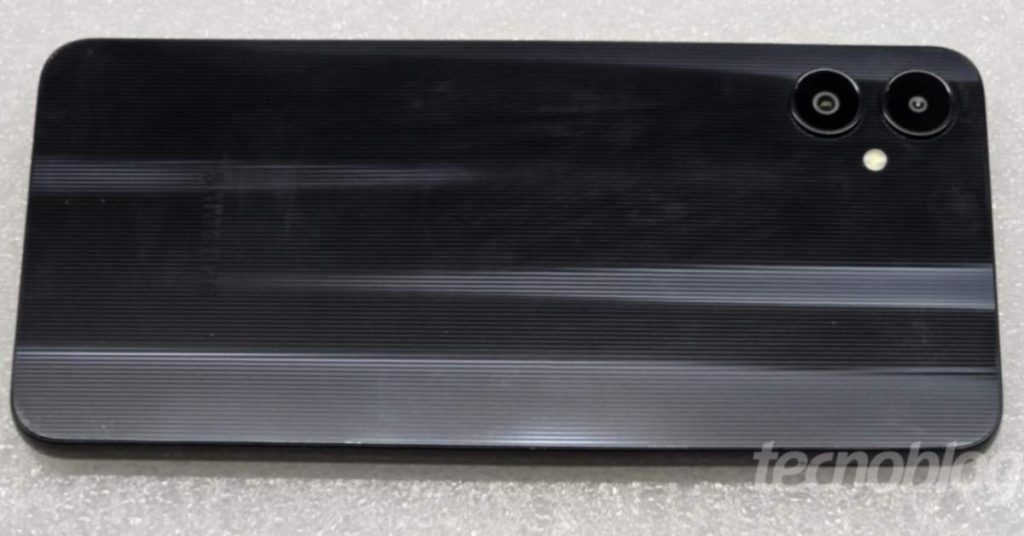
Samsung is about to release its newest budget smartphone, the Galaxy A05. The device has already bagged multiple certifications, including TDRA and BIS. Now, the first live images of the Samsung Galaxy A05 phone have been leaked online.
Samsung Galaxy A05 images surface online
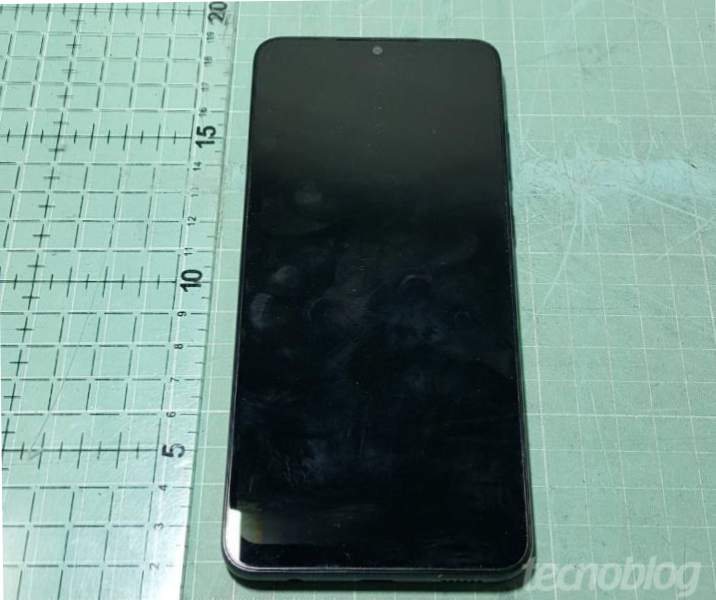
The photos show the A05 from the front and back. Unlike the Galaxy A04, the A05 has flat sides, which is in line with the design language of other Galaxy smartphones this year.
The back of the phone has two camera cutouts, suggesting a dual-camera system. And there is no camera bump. The A05 also has a glossy finish with a stripe-like pattern on the back.
On the front though, the device still shares similarities with its predecessor. The photo revealed a v-shaped notch and thick bezels at the bottom.
As for the specifications, the Samsung Galaxy A05 is expected to have a 5,000 mAh battery and the Helio G85 processor. The G85 is an entry-level processor with eight cores—two of them being performance cores that can clock up to 2.0 GHz, while the other six are efficiency cores that clock at 1.8 GHz.
The phone is likely to have 4 GB of RAM. However, there is no information yet about the storage capacity of the Galaxy A05. Also, the phone does not have 5G connectivity since the Helio G85 processor does not support it.
There is no official release date for the Galaxy A05 yet, but Samsung is likely gearing up for a release soon. The phone has been spotted at regulatory agencies around the world, which is a sign that it is nearing launch.
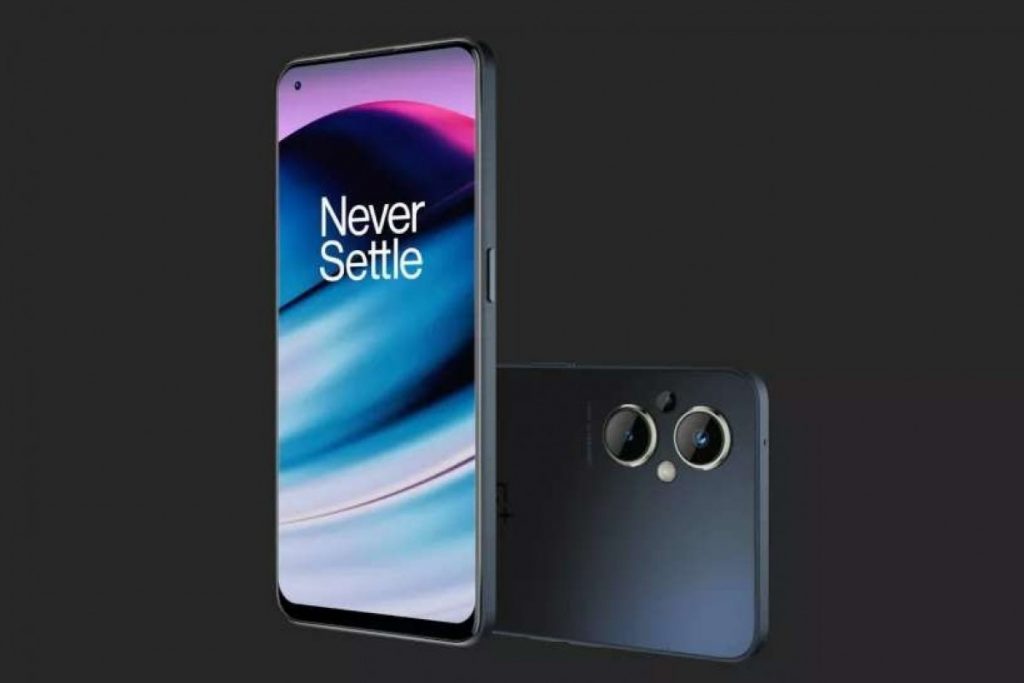
OnePlus Nord N200 dropped in the US market in 2021, followed by OnePlus Nord N20 in 2022. The Nord N200 arrived with a Snapdragon 480 and 4GB RAM, while the Nord N20 came with a Snapdragon 695 and 6GB RAM. Both devices are budget-friendly smartphones, and according to a recent announcement, these phones will start receiving August security updates in North America.
OnePlus Nord N20
As per the recent post on the OnePlus community page by Winkey W. (software team), the company has started rolling out OxygenOS C.15 (for the OnePlus Nord N20) and OxygenOS C.25 (for the OnePlus Nord N200) in North America. For those wondering, this patch focuses on security enhancement to protect the devices from security breaches. With smartphones storing sensitive data, security breaches have become a real threat. Thus, the company is actively working on security patches to protect the devices from security vulnerabilities.
Additionally, these updates were released for a small percentage of users on 30 August, and the company will begin a broader rollout in a few days.
The update for Nord N20 will be displayed as NA: CPH2459_11.C.15, and for Nord N200, the update will be released as NA: DE2117_11.C.25. If you wish to submit feedback, you can follow the thread or submit this form.
In related news, the OnePlus Ace 2 Pro was sold out in just 3 minutes, which disappointed many customers in China. Li Jie (President of OnePlus China) officially responded to people’s feedback with the help of a Weibo post. The full report can be found by clicking on this article.
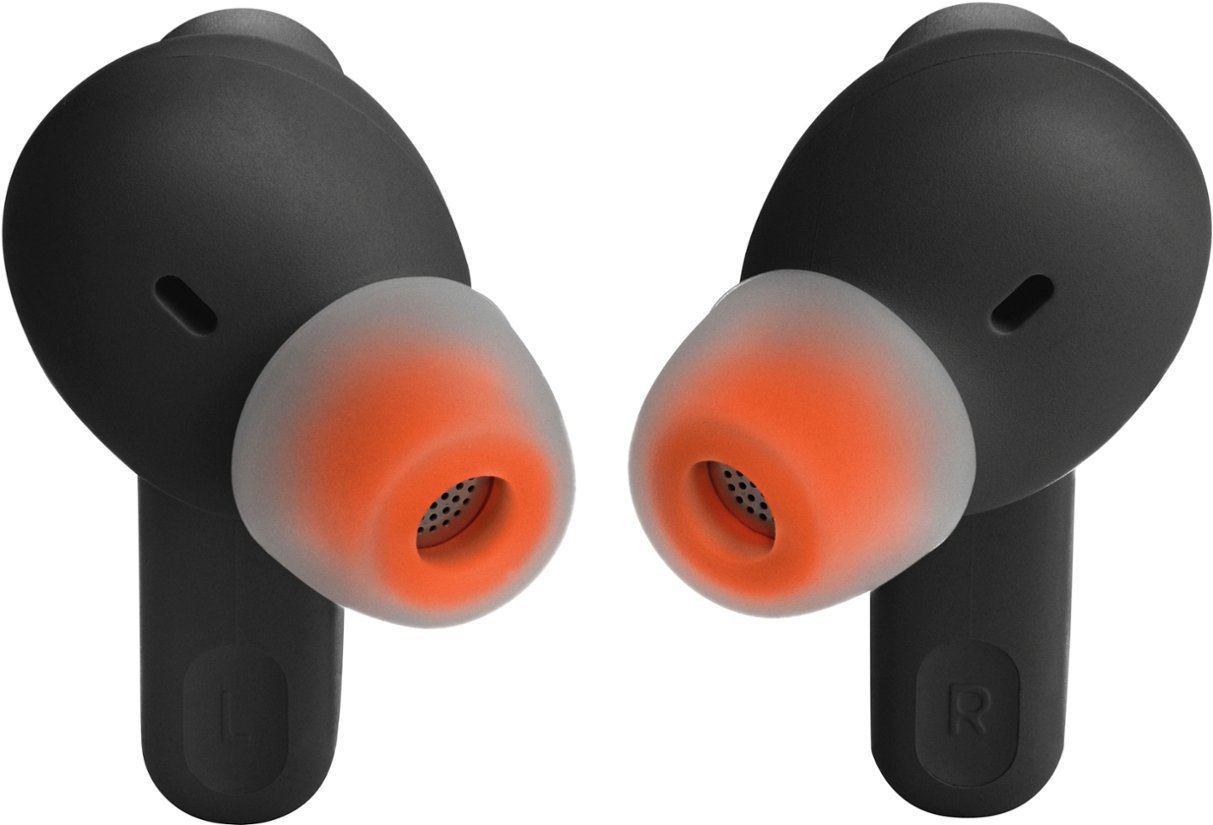
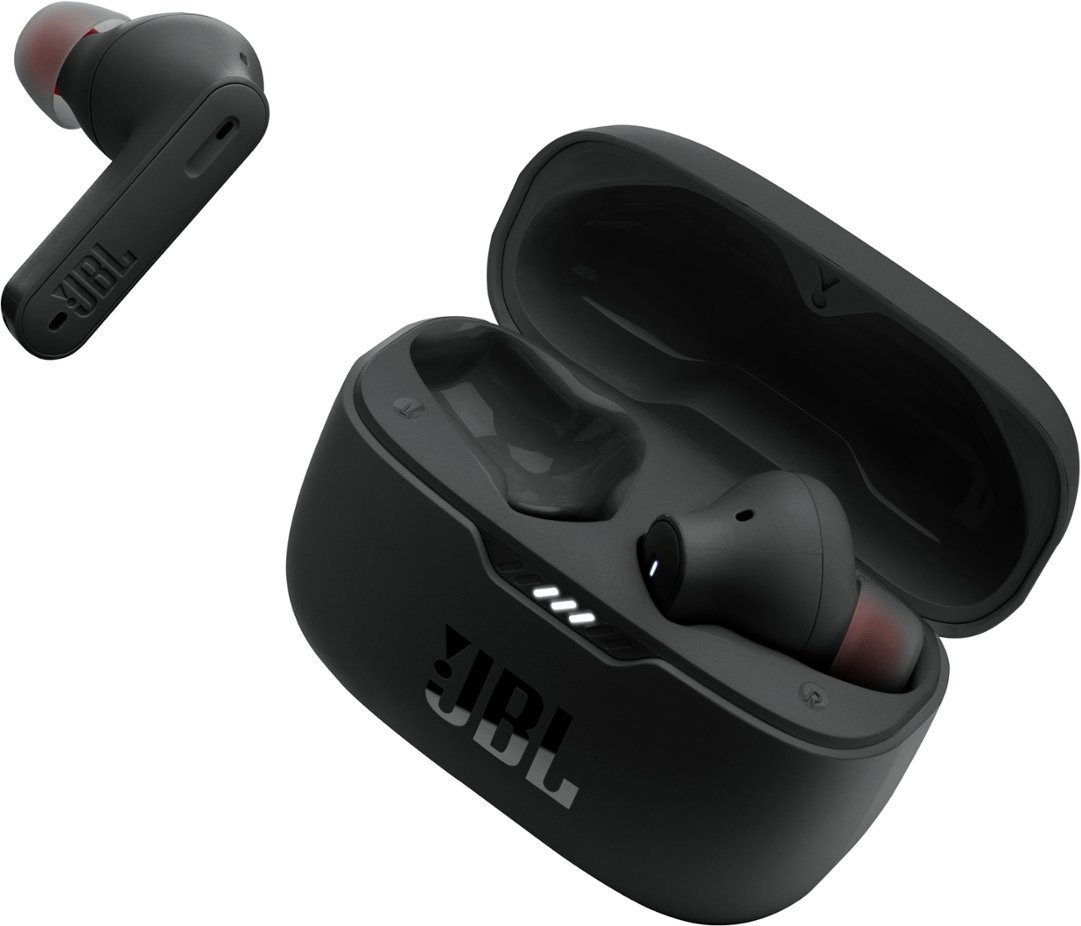
JBL launched the Tune Beam and Tune Buds TWS earphones a couple of months ago in India. Now, it has introduced the Tune 235NC earbuds in the county. These earbuds come with active noise cancellation, along with a long battery life and fast charging tech.
As per the official announcement by the brand, the JBL Tune 235NC earbuds will be available on Amazon.in from September 5th at 12 PM for the price of Rs. 4,999.
JBL Tune 235NC specs
The JBL Tune 235NC earbuds feature 6mm drivers with JBL’s Pure Bass Sound. They use Bluetooth version 5.2 for seamless wireless connectivity.
Notably, they come with Active Noise Cancelling (ANC) technology, utilizing dual microphones to block background noise. Additionally, they offer Ambient Aware and TalkThru functions for awareness and quick conversations without removing the earbuds.
These earbuds have an impressive battery setup – 70mAh for each earbud and a 750mAh charging case. This provides up to 40 hours of usage, with a 10-minute charge delivering 2 hours of playtime via Speed Charge. Voice Assistant integration is available for added convenience.
They’re also compatible with the JBL Headphones App and are IPX4-rated, ensuring resistance to splashes and sweat. The earbuds weigh just 5.1 grams each, and the charging case is 47.3 grams, offering lightweight and comfortable use.
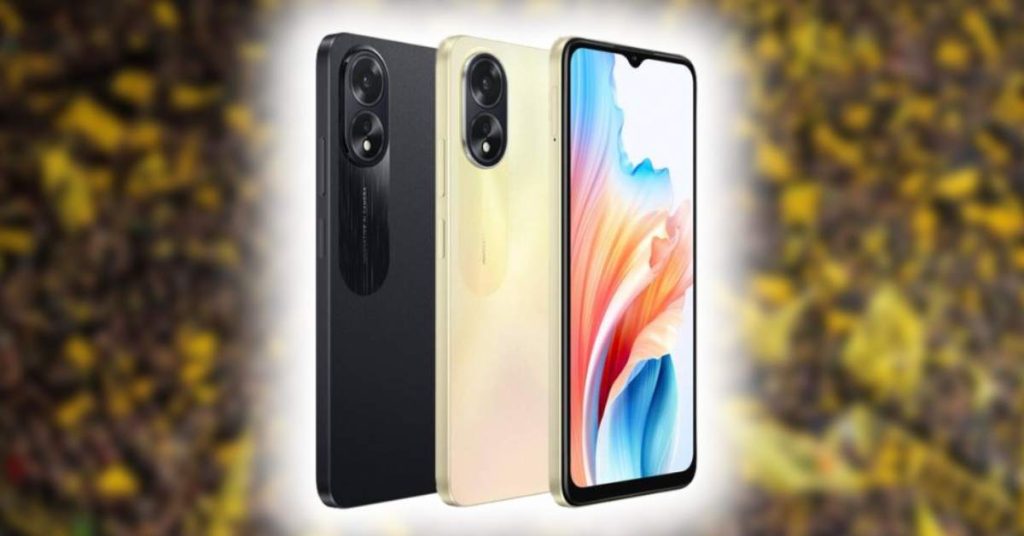
Oppo’s upcoming A-series smartphone, A38 has been certified by multiple organizations, including TDRA, SIRIM, NBTC, and GCF. The key specifications of the device have also been leaked. The only thing we’re waiting for now is the launch. A new leak now suggests that the Oppo A38 will be launched in India in September.
The leak comes from @Stufflistings, who also shared that the India launch of an OPPO tablet and the OPPO Find N3 Flip is also imminent. The Find N3 Flip was launched in China a couple of days back, and the company has recently confirmed that it will be available globally, including in India.
[Exclusive] OPPO A38 will launch in India in September. Plus, the India launch of an OPPO tablet and the OPPO Find N3 Flip is also right around the corner.#OPPO#OPPOA38#OPPOFindN3Flip
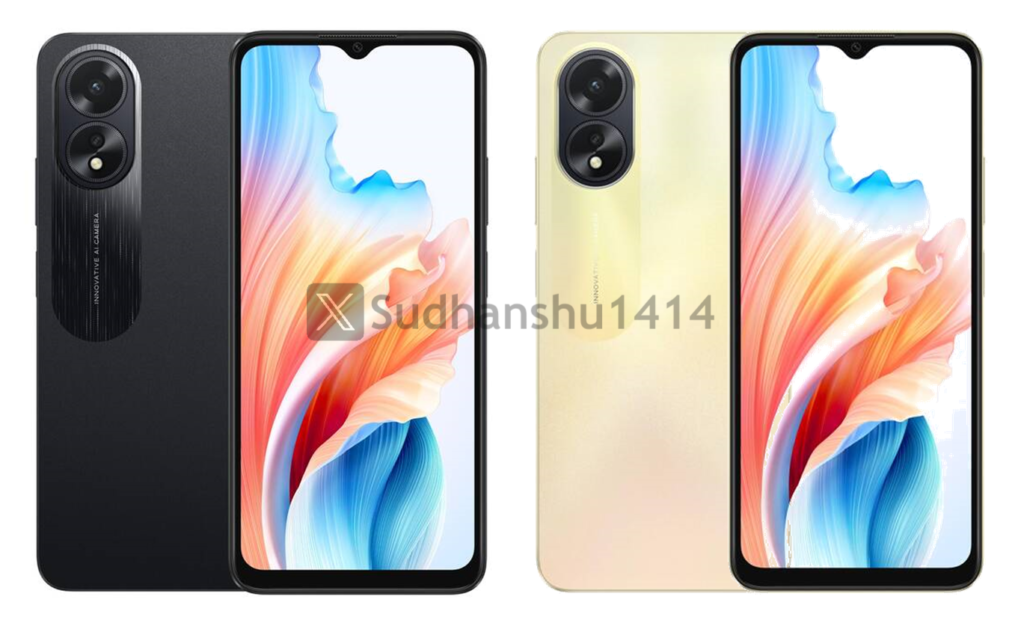
Regardless, according to a recent leak, the Oppo A38 will have a 6.56-inch HD+ display with a 90Hz refresh rate. It will have a pill-shaped camera module with a 50MP main sensor and a 2MP secondary lens. The phone will be powered by a 5,000mAh battery, 128GB of storage, and run on Android 13 out of the box.
The device has also been listed on Geekbench recently, revealing the model number CPH2579 and the MediaTek Helio G85 processor. The Geekbench listing also shows that the phone has 4GB of RAM, but we can expect more RAM options at launch.
The Oppo A38 is rumored to be available in black and gold colors and is expected to be priced at EUR 159.
We use cookies on our website to give you the most relevant experience by remembering your preferences and repeat visits. By clicking “Accept”, you consent to the use of ALL the cookies.
This website uses cookies to improve your experience while you navigate through the website. Out of these, the cookies that are categorized as necessary are stored on your browser as they are essential for the working of basic functionalities of the website. We also use third-party cookies that help us analyze and understand how you use this website. These cookies will be stored in your browser only with your consent. You also have the option to opt-out of these cookies. But opting out of some of these cookies may affect your browsing experience.
Necessary cookies are absolutely essential for the website to function properly. This category only includes cookies that ensures basic functionalities and security features of the website. These cookies do not store any personal information.
Any cookies that may not be particularly necessary for the website to function and is used specifically to collect user personal data via analytics, ads, other embedded contents are termed as non-necessary cookies. It is mandatory to procure user consent prior to running these cookies on your website.