Earlier this month, Honor unveiled the Snapdragon 680 powered Honor X8 handset announced in Saudi Arabia. Now, the company has unveiled the more powerful Honor X9 in Malaysia. The new Honor phone offers key features such as a massive display with a 120Hz refresh rate support, Snapdragon 695 mobile platform, a 4,800mAh battery, and 48-megapixel triple cameras. The Honor X9 has arrived as the global version of the Honor X30, which debuted in China in December 2021.
Honor X9 specifications and features
The Honor X9 has a 6.81-inch IPS LCD panel with a centrally positioned punch-hole. It offers a Full HD+ resolution of 1080 x 2388 pixels and a 120Hz refresh rate. For selfies, it has a 16-megapixel front camera, and its back panel has a 48-megapixel (main) + 2-megapixel (macro) + 2-megapixel (depth) triple camera unit.
Honor X9
The Snapdragon 695 chipset is present under the hood of the Honor X9. The device comes with 8 GB of RAM and 182 GB of storage. It boots to Android 11 OS with Magic UI 4.2 on top. It packs a 4,800mAh battery that supports 66W fast charging.
For security, it supports face unlock and comes equipped with a side-mounted fingerprint scanner. The device carries support for other features such as dual SIM support, 5G, Wi-Fi 802.11ac, Bluetooth 5.1, GPS, and a USB-C port.
Honor X9 pricing and availability
At present, there is no information available on the pricing of the Honor X9. When available, users can purchase it in color options such as Midnight Black, Titanium Silver, and Ocean Blue. Rumors have it that the company is also planning to launch the Honor X7 soon in global markets. It is likely to be a rebranded version of the China-exclusive Honor X30i.
The Realme 9 series debuted last month with three different variants: Realme 9 Pro, 9 Pro+, and 9i. Right after, this month, the Chinese giant announced two more variants from the new Number Series: the vanilla Realme 9 5G and the Realme 9 SE 5G (where SE stands for Speed Edition). If you read our previous comparison, you should know all the differences between the first three variants. But what are the differences between the Realme 9 5G and its Speed Edition? This is a comparison between the specifications of these two new affordable phones which will let you find out in a few minutes.
Triple 48 + 2 + 2 MP f/1.8, f/2.4 and f/2.4
16 MP f/2.1 front camera
Triple 48 + 2 + 2 MP, f/1.8 + f/2.4 + f/2.4
16 MP f/2.1 front camera
BATTERY
5000 mAh, 18W fast charging
5000 mAh, fast charging 30W
ADDITIONAL FEATURES
Dual SIM slot, 5G
Dual SIM slot, 5G
Design
They are two variants from the same series, but the Realme 9 5G and the Speed Edition 5G come with different designs. The main difference is the camera module coming with a different shape and different elements positioning: the cameras are placed in a 2×2 matrix, while the Speed Edition’s camera module is more like a semaphore with two sensors and the flash LED placed vertically and a smaller macro camera on the right. The Realme 9 5G is a more compact phone thanks to its smaller display, so it is easier to use with one hand and to keep in a pocket. Both the phones are built with polycarbonate and they do not come with premium materials, but their designs are pretty good with their modern look and their punch holes.
Display
Unfortunately, you do not get AMOLED displays with these two handsets. If you want an AMOLED panel, you should go for the Pro variants of the same lineup, announced in February. These two devices come with IPS LCD displays, so they are not exactly the best phones in terms of image quality. But thanks to their Full HD+ resolutions of 1080 x 2400 pixels, they provide a good level of detail. The Realme 9 Speed Edition 5G comes with a higher 144 Hz refresh rate: one of the highest refresh rates you can find on a mobile phone, great for gaming. The vanilla version has a lower 90 Hz refresh rate but is still above average. Both the handsets are equipped with side-mounted fingerprint readers and they feature mono speakers, as well as a 3.5 mm audio jack for wired earphones.
Hardware/Software
As its name suggests, the Realme 9 Speed Edition 5G offers a more powerful hardware department. First of all, it is powered by the Snapdragon 778G mobile platform providing higher CPU and GPU performance than the Mediatek Dimensity 810 found on the vanilla version. It even offers a higher amount of RAM: up to 8 GB, while the vanilla version stops at 6 GB. The maximum internal storage is the same: 128 GB, but the Speed Edition has a UFS 2.2 native storage, while the Realme 9 5G has a UFS 2.1 storage. The handsets run Android 11 customized by Realme UI 2.0 and they will get the update to Android 12 and Realme UI 3.0.
Camera
The camera departments between the two variants remain unchanged. Both the phones come with a 48 MP main camera sporting an f/1.8 focal aperture, a 2 MP macro lens with f/2.4 aperture, and a 2 MP depth sensor with the same f/2.4 aperture, as well as a 16 MP front snapper with an f/2.1 aperture. The rear camera and the front camera are able to record videos with a 1080p resolution at 30 fps.
Battery
Even the battery capacities remain the same: 5000 mAh. The battery life should be very similar as well because the components should have similar efficiencies. Note that the Realme 9 Speed Edition 5G features faster charging technology with a power of 30W, while the vanilla version stops at 18W.
Realme 9 5G vs Realme 9 Speed Edition 5G: Price
The starting price of the Realme 9 5G roughly translates into €180/$198, while the Speed Edition 5G begins at €240/$264. If you want the best phone, go for the Realme 9 SE 5G because it features a higher refresh rate, a better processor, more RAM, and faster charging. But if you do not care about these features, then the vanilla version can let you save a lot of money.
Besides the Nintendo Switch and gaming on smartphones, the concept of gaming on the go has always fascinated gamers and tech enthusiasts alike. In recent years, technology has now made it possible to play PC games via a new category of tech, called “gaming handhelds” that are equipped with laptop processors and can run PC games but are in a smartphone-tablet-like form factor for portability.
GPD Win 3(2021)
GPD, the Shenzhen-based startup in the gaming handheld market, is known for its best-sellers such as its GPD Win 3, and GPD Win Max. However, both models were released quite some time ago and since then, a fierce competitor has arrived on the scene, the Steam Deck. Thus in 2022, GPD has decided to announce the GPD Win Max 2, a 14-Core Intel Alder Lake Windows gaming handheld beast that is looking to shake the industry.
In its official announcement post today, GPD reveals that the Win Max 2 is featuring a 10-inch 1920×1200 Full HD or a 2560×1600 QHD display, a major leap in the industry considering its predecessor, the Win Max, only had an 8-inch with 1280×800 pixels.
GPD Win Max 2 (Source: GPD)
Despite the increase in screen size, the dimensions of the Win Max 2 are only jumping from 207 × 145mm to 228 x 160mm. GPD mentions that they were able to keep the device compact with much slimmer bezels on all sides. GPD has also shared an official sketch of the device. However, the sketch only shows off a very simplified build of the device, without the keyboard, colours or gamepad of the device. GPD mentions that they will be revealing more details of the device nearer when it’s ready for launch.
Under the hood, the GPD Win Max 2 is a handheld gaming powerhouse. It is equipped with Intel’s 12th Gen Core i7-1280P, which features 14 cores and 20 threads in a compact form factor. The CPU boosts up to 4.80 GHz, has 24MB Smart Cache, and eats between 20 and 64 watts. The device is also configurable with up to 32GB RAM, up to 2TB PCIe 4.0 SSD in one of the two M.2 slots.
Steam Deck (Source: Valve)
Compared to its main rival, the Steam Deck which only maxes out at 512GB with a Zen 2 AMD processor, the GPD Win Max 2 may take over Valve’s throne soon.
The device is also juiced with a 65Wh battery, a surround sound quad-speaker setup, one Thunderbolt 4 port, 3x USB 3.2 Gen 2 ports, a built-in webcam, and a QWERTY keyboard with backlight. Price and availability have not been announced yet by GPD, but we expect GPD to share more details about the device soon by the end of 2022.
OnePlus has officially scheduled to launch the OnePlus 10 Pro on March 31 in global markets. including India. Ahead of its launch, the tipster Abhishek Yadav has revealed the Indian pricing of the smartphone and also shared the first sale date.
According to the tipster, the OnePlus 10 Pro will be priced at Rs. 66,999(~$878) for the base variant and Rs. 71,999(~$944) for the top-end variant in India. The device is reported to go up for its first sale on April 5.
Just for comparison, the predecessor OnePlus 9 Pro was launched at a starting price of Rs. 64,999(~$852).
Coming to the specifications, the OnePlus 10 Pro sports a 6.7-inch LTPO 2.0 AMOLED panel with a 2K resolution and up to 120Hz refresh rate. The smartphone has a Gorilla Glass Victus protection and a 92.7% screen-to-body ratio.
It is powered by the Qualcomm Snapdragon 8 Gen 1 SoC and has up to 12GB LPDDR5 RAM and 256GB of UFS 3.1 internal storage. The phone equips a triple camera system at the rear holding a 48MP Sony IMX789 sensor with OIS support. It has a 50MP Samsung ISOCELL J1 ultra-wide lens and an 8MP telephoto unit with OIS and 3.3x optical zoom support.
It has an in-display fingerprint scanner for added security. The phone packs a 5,000mAh battery with 80W SuperVOOC wired fast charging and 50W AirVOOC wireless fast charging support. The phone runs on Android 12 OS out of the box.
A few days back, a tipster revealed that Xiaomi is working on a compact notebook dubbed Xiaomi Book S 12.4 and it has gone on internal testing in Asian countries. Now, the Book S 12.4 notebook has passed the Geekbench and Bluetooth SIG certification sites revealing key details.
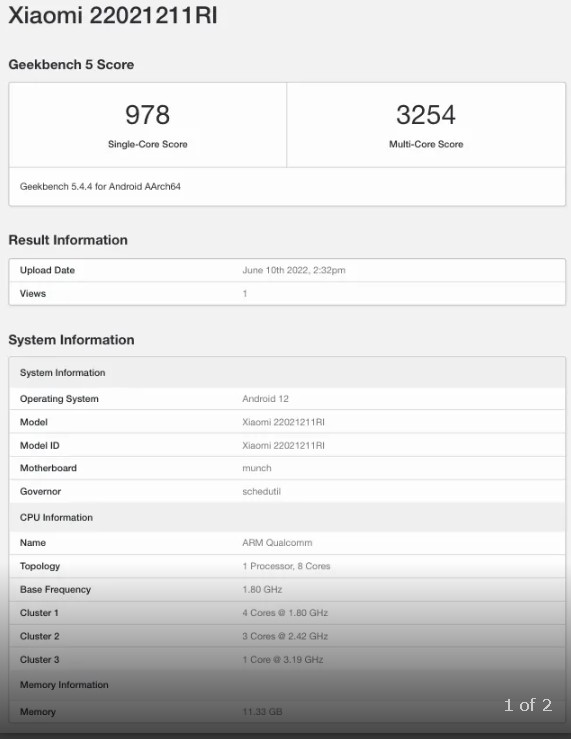
The Xiaomi Book S 12.4 has emerged on the Geekbench certification with impressive scores. The device has 758 points in the single-core department and 3014 points in the multi-core department. It is powered by the Qualcomm Snapdragon 8cx Gen 2 chipset clocked at a base frequency of 3.00GHz. The laptop has 8GB of RAM and it runs on the latest Windows 11 Home 64-bit OS.
The Bluetooth SIG certification confirms that the notebook has Bluetooth v.1 support. Apart from this, there are no other details to discuss. However, because the laptop has already passed two of these tests, we can expect further leaks and certifications in the coming days.
Xiaomi hasn’t officially revealed any details of the notebook yet, but this could change with an announcement soon.
Other than this, the brand has recently launched the Redmi Book Pro 15 in the Chinese market. It comes with the latest 12th generation Intel Core i5, i7 processor and has up to NVIDIA RTA 2050 GPU. The laptop has a 15-inch 3.2k screen and a 90Hz refresh rate. It has 130W fast charging support that is claimed to charge the laptop from 0% to 100% within an hour.
A few days back, it was reported that the OnePlus 10R has gone on private testing in India. Soon after that, the phone’s design was leaked through computerized images. Now, 91Mobiles have revealed the specifications of the smartphone.
The Oneplus 10R will be the successor of the OnePlus 9R that launched last year. The smartphone is tipped to come with a 6.7-inch E4 AMOLED display with a Full-HD+ resolution. It will have a 120Hz refresh rate and HDR10+ support.
OnePlus 10R Render via PriceBaba
Under the hood, the device is said to employ the new MediaTek Dimensity 8100 SoC paired with 8GB / 128GB of LPDDR5 RAM, and 128GB / 256GB of UFS 3.1 internal storage. It is said to come with a triple camera system at the rear with a 50MP Sony IMX766 main lens, an 8MP IMX355 ultra-wide lens, and a 2MP macro sensor. Upfront, it will equip a 16MP S5K3P9SP lens for selfies.
The phone is touted to house a 4,500mAh battery with 150W fast charging support. This will be similar to the recently launched Realme GT Neo3. It is also expected to come in another variant with a 5,000mAh battery and 80W fast charging support.
It will reportedly run on Android 12 OS and have OxygenOS 12 on top. Unfortunately, the phone will not have the alert slider and a 3.5mm headphone jack. It will have NFC support and a stereo speaker setup tuned by Dolby Atmos.
Itel has officially launched the Vision 3 smartphone in the Indian market. One of the major highlights of the device is the 18W fast charging support. The phone also has AI dual cameras and an octa-core chipset.
The Itel Vision 3 is priced at Rs. 7,999(~$105) for the only variant with 3GB of RAM and 64GB of internal storage.
The device has Deep Ocean Black, Jewel Blue, and Multi Green color variants. The smartphone can be purchased from Amazon and Flipkart in the country.
Itel Vision 3 Specifications
The Itel Vision 3 comes with a 6.6-inch water-drop notch display with HD+ resolution. It is an IPS LCD panel with a modern aspect ratio. The smartphone has a 5MP camera on the front for selfies and features a dual-camera system at the rear.
Itel Vision 3
The rear setup goes by an 8MP main camera with AI support. The company hasn’t revealed the details of the secondary lens present alongside the main sensor. The rear camera has multiple modes like AI Beauty mode, Portrait mode, Panorama mode, HDR mode, and low-light mode.
It is powered by an unknown octa-core chipset clocked at 1.6GHz. It is paired with 3GB of RAM and 64GB of internal storage. It has a microSD card slot for additional storage up to 128GB. The phone packs a 5,000mAh battery and has 18W fast charging support. As per the company, the phone charges fully in 150 minutes. As for security, it has a rear-mounted fingerprint scanner and supports facial unlock. Lastly, the phone runs on Android 11 OS.
Earlier this month, Russia blocked Facebook and Twitter after the platforms placed restrictions on Russia’s state-backed media outlets. The Meta-owned platforms Facebook and Instagram were later banned by Russia, stating that they were “carrying out extremist activities.” This ban was issued after Meta confirmed it was relaxing its policies on hate speech towards Russian soldiers and Vladimir Putin in relation to the country’s invasion of Ukraine.
Now, according to a Reuters report, Spotify will be shutting down its streaming service in Russia in response to the country’s new media law. Previously, the audio streaming platform closed its office in Russia indefinitely citing what it described as Moscow’s “unprovoked attack on Ukraine.”
On the current development, the streaming platform stated that “Spotify has continued to believe that it’s critically important to try to keep our service operational in Russia to provide trusted, independent news and information from the region,” Spotify said in a statement. “Unfortunately, recently enacted legislation further restricting access to information, eliminating free expression, and criminalizing certain types of news puts the safety of Spotify’s employees and the possibility of even our listeners at risk.”
According to a knowledgeable source on the matter, the audio streaming platform is expected to end its service in Russia in early April.
Another streaming service, Netflix, also pulled its services from Russia earlier this month after stating that it had no plans to add state-run channels to its Russian service. For those unaware, Russia’s communications regulator announced earlier in January that it will mandate foreign streaming services to also offer 20 local federal television channels to their userbase.
Earlier this week, Samsungteased the upcoming launch of the Galaxy M33 5G smartphone, and now, the device has officially received an April 2nd release date. The Amazon India landing page of the device states that it will launch at 12 noon on April 2nd.
Other than the launch date, the landing page also reveals that the Galaxy M33 will come with a 5nm processor, a massive 6000mAh with 25W fast charging, and support for reverse charging, and 6GB and 8GB virtual RAM support for the 6GB and 8GB variants respectively. Earlier this month, Samsung officially unveiled the Galaxy M33 5G via a press release, so we know almost all of the specifications of this device.
Samsung Galaxy M33 5G specs and features
The smartphone features a 6.6-inch TFT FHD+ (1080 x 2408) LCD display. For photography, Samsung has offered a quad-camera setup on the back of the device with a 50MP f/1.8 primary camera, a 5MP f/2.2 ultra-wide camera, a 2MP f/2.4 depth sensor, and a 2MP f/2.2 macro shooter. For selfies, we get an 8MP f/ 2.2 snapper.
Under the hood, the Galaxy M33 5G comes with an octa-core SoC which according to previous Geekbench listings, should be the 5G enabled Exynos 1280 octa-core SoC. It is offered in two RAM variants, 6GB and 8GB and the internal storage available is 128GB. This, however, can be expanded by up to 1TB with a Micro-SD card. The device gets a 6000mAh battery and will boot Android 12 based One UI 4.1 out of the box.
The sensors present in the device are an accelerometer, fingerprint sensor (side-mounted), gyro sensor, geomagnetic sensor, virtual light sensor, virtual and proximity sensor. The device measures 165.4 x 76.9 x 9.4mm and weighs 215 grams.
The Chinese smartphone manufacturer Vivo is gearing up to debut its first tablet dubbed, the Vivo Pad in the domestic market. The brand recently revealed real-life images of the device, leaving nothing to the imagination in terms of design. Now, a majority of its specs have been leaked online by tipster Abhishek Yadav.
According to the tipster, the Vivo Pad will come with a 2.5K display with Dolby Vision support. It is not clear if the brand will offer an OLED display or an LCD display on the Vivo Pad.
The tablet will have a metal body and is said to house a Snapdragon 870 SoC with 8GB RAM. The device will run OriginOS based on Android 11 and will offer stylus support for the Vivo Pencil. Abhishek also reveals that the tablet will come with a dual-camera and a quad-speaker setup.
Other than that, earlier leaks have revealed that the Vivo Pad has an 11-inch 120Hz LCD display, supports 44W fast charging, and has a 7,860mAh battery. Last month, some leaks also surfaced claiming that the tablet will feature a 13-megapixel main camera and an 8-megapixel lens on the rear. The front side is said to get an 8-megapixel camera placed in a punch-hole.
Vivo has already revealed the design of the upcoming Vivo Pad tablet. Based on teasers, the Vivo Pad will have a flat edge design with a metal back panel. The tablet is confirmed to offer a dual-rear camera setup which will reside on the top left corner of the back panel. The bottom side of the device will house a USB-Type C port and the right edge will house the power button and volume rockers.
The device is expected to debut along with the Vivo X Fold and the Vivo X Note on March 28.
There are going to be 7 smartphone launch events next week. But only 2 of them will be for new devices. Whereas, the remaining conferences will be for handsets making their way to new markets. Interestingly, all the events will be from different brands, namely Samsung, POCO, Redmi, Black Shark, realme, Infinix, and OnePlus. With that out of the way, let’s take a look at all the phones that are scheduled to debut next week one by one.
Samsung has confirmed to launch a new mid-ranger called Galaxy M53 5G in Vietnam on March 27 (Sunday). The device will be the successor of the Galaxy M52 5G. Per multiple reports, It will come with an interesting set of features.
The handset will reportedly arrive with a 6.7-inch FHD+ 120Hz Super AMOLED display, MediaTek Dimensity 900 SoC, 8GB RAM, 128GB/256GB storage, 108MP (wide) + 8MP (ultra-wide) + 2MP (macro) + 2MP (depth) quad-camera system, 32MP selfie camera, One UI 4.1 based on Android 12, 5,000mAh battery, 25W fast charging (no in-box charger).
2. POCO X4 Pro 5G
POCO X4 Pro 5G
After making its debut in multiple international markets, the POCO X4 Pro 5G is making its way to India on March 28 (Monday). The phone will be announced for the country in a live stream, which is scheduled to start at 12:00 PM on the brand’s official YouTube channel.
According to reports, the POCO X4 Pro 5G heading to India will sport a 64MP primary camera instead of a 108MP sensor and will lack NFC. Other than these two differences, the remaining specs will be the same.
Hence, the device will come with a 6.67-inch FHD+ 120Hz AMOLED display, Qualcomm Snapdragon 695 SoC, LPDDR4x RAM, UFS 2.2 storage, 8MP ultra-wide camera, 2MP macro camera, 16MP selfie camera, dual stereo speakers, side-mounted fingerprint sensor, MIUI 13 based on Android 11, 5,000mAh battery, and 67W fast charging.
3. Redmi Note 11 Pro+ 5G
Redmi Note 11 Pro+ 5G
Xiaomi has scheduled a global launch event for March 29 (Tuesday). The conference will be live-streamed on the company’s official YouTube channel from 8 PM GMT+8. It is expected to announce the Redmi Note 11 Pro+ 5G.
Going by multiple reports, the Redmi Note 11 Pro+ 5G set to release in international markets will be the same as the one sold in China. The handset also goes by the name of Xiaomi 11i HyperCharge.
Hence, the phone will sport features like a 6.67-inch FHD+ 120Hz AMOLED display, MediaTek Dimensity 920 SoC, LPDDR4x RAM, UFS 2.2 storage, 108MP (wide) + 8MP (ultra-wide) + 2MP (macro) triple camera system, 16MP selfie camera, dual stereo speakers, side-mounted fingerprint sensor, MIUI 12.5 based on Android 11, 4,500mAh battery, and 120W fast charging.
4. Black Shark 5 Series
Black Shark has revealed to unveil the Black Shark 5 series on March 30 (Wednesday). The event will begin at 7 PM CST. It will be live-streamed on Weibo and other popular Chinese video platforms.
The brand is expected to announce three models, namely Black Shark 5, Black Shark 5 Pro, and Black Shark 5 RS. They are said to be powered by Qualcomm Snapdragon 870 and Snapdragon 8 Gen 1 chipsets.
Unfortunately, not much is known about these gaming smartphones, except that they will be retaining the magnetic shoulder keys. We are looking forward to learning more about them via official teasers in the coming days.
5. realme C31
realme C31
The realme C31 is set to go official in India on March 31 (Thursday). It will be unveiled in live steam, which is planned to begin at 12:30 PM IST. The device was first announced in Indonesia on March 24.
The budget smartphone offers features like a 6.5-inch HD+ display (LCD), UNISOC T612 chipset, LPDDR4x RAM, UFS 2.2 storage, 13MP (wide) + 2MP (macro) + 2MP (monocrhome) triple camera septup, 5MP selfie camera, realme UI 2.0 based on Android 11, 5,000mAh battery, and 10W charging.
6. Infinix HOT 11 2022
Infinix HOT 11 2022 is rumored to launch in India on March 31 (Thursday). It is said to be priced between ₹10,999 and ₹11,999 in the country.
The handset will reportedly have features like a 6.8-inch FHD+ 90Hz display (LCD), UNISOC T700 chip, 4GB RAM, 128GB storage, 48MP dual-camera system, 8MP selfie camera, Android 11, 5,000mAh battery, and 18W fast charging.
7. OnePlus 10 Pro
OnePlus 10 Pro
The OnePlus 10 Pro will be finally unveiled for the international markets on March 31 (Thursday). The conference will begin at 7:30 PM IST and can be live-streamed on the brand’s official YouTube channel.
Since the phone is already official in China, we know everything about it. Its highlights include a 6.7-inch 120Hz LTPO AMOLED display, Qualcomm Snapdragon 8 Gen 1 chipset, LPDDR5 RAM, UFS 3.1 storage, 48MP (wide) + 50MP (ultra-wide) + 8MP (3.3x telephoto) triple camera system, 32MP selfie camera, OxygenOS 12.1 based on Android 12, 5,000mAh battery, 80W fast wired charging, 50W fast wireless charging, and reverse wireless charging.
The Black Shark 5 and Black Shark 5 Pro have appeared on Geekbench, showing off their Snapdragon 870 and Snapdragon 8 Gen 1 chips, respectively, ahead of their Chinese launch scheduled for March 30th.
Among them, the Black Shark 5 Pro has managed to achieve peak scores of 1,237 points and 3,750 points for single-core and multi-core tests, respectively. The Black Shark 5, on the other hand, seems to hover around the 3,000 and 1,000 points mark, which although isn’t too impressive for a gaming phone, should be improved once the series is released.
Additionally, the official Black Shark Weibo handle today showed off the phones’ shoulder buttons with a demo video. Dubbed “Magnetic Lifting Shoulder Button 2.0,” the dedicated keys allow greater control when gaming, whether it’s FPS or racing games. They seem to have a “U-shape” for optimal grip.
The Black Shark 5 Pro is equipped with a 6.67-inch OLED with a 2400 × 1080 resolution and a refresh rate of 144Hz. The Snapdragon 8 Gen 1 under the hood will be assisted by 16GB of RAM and will be powered by a 4650mAh battery with 120W fast charging support.
Meanwhile, the Black Shark 5 is equipped with a 6.67-inch OLED screen with a resolution of 2400 × 1080 pixels and a refresh rate of 144Hz. Under the hood, there’s the Qualcomm Snapdragon 870 processor paired with 12GB of RAM that will get its juice from a 4650mAh battery with 120W fast charging support.
The realme GT NEO 3, which was launched on March 22nd in China as the world’s fastest charging phone, is now headed to India and Malaysia as indicated by its new country-specific certifications.
Tipster Abhishek Yadav through a tweet today showed off the BIS and SIRIM certificates for the device. The former stands for Bureau of Indian Standards while the latter refers to the Standard and Industrial Research Institute of Malaysia.
Abhishek expects the realme GT NEO 3 to launch in April or May in India, which is quite plausible considering Chinese phones typically do take a month or two to reach the global market following their domestic launches.
The realme GT NEO 3 comes in three colors, two of which have Le Mans-inspired racing stripes, which makes it extremely attractive. On the front, it sports a 6.7 inch OLED display that has an FHD+ resolution with 120Hz refresh rate and 360Hz touch sampling rate support. Under the hood, it features MediaTek’s newly announced Dimensity 8100 SoC, which is fabricated by TSMC’s 5nm process.
For photography, the smartphone houses a triple camera setup on the rear, with a 50-megapixel Sony IMX766 sensor. This is joined by an 8-megapixel ultrawide angle lens and another 2-megapixel macro sensor. On the front, there is a 16-megapixel selfie shooter.
But perhaps the best part is its 4,500mAh battery that can be charged up to 50 percent in just 5 minutes thanks to industry-leading 150W charging support.
The realme GT NEO 2 is now receiving the Android 12-based realme UI 3.0 update in China with a bunch of new features. The phone is a recent launch and shipped with realme UI 2.0 based on Android 11 out of the box.
realme UI 3.0 is a fairly major update integrating multiple Android 12-specific features into the skin such as dynamic wallpaper-based theming, the new Privacy Dashboard, and mic and camera status bar indicators. These are topped with realme optimizations such as AI Smooth Engine for better animations and system performance and Floating Window 2.0.
The official update changelog was frankly a bit too long so we cut it down a bit, showing only the important parts:
Design
[New] Smart assistant card, providing smart and efficient application cards, key information is clear at a glance, and key functions can be reached at a touch
[New] Reconstructed page layout, noise reduction and white space, and differentiated primary and secondary information by color, and the core information is more focused
[New] Three-dimensional icon design, introducing new materials, unifying light and shadow and layers, and experiencing the joy of color
[Optimization] Quantum animation engine 3.0, centered on “quality”, simulates real physical motion, optimizes 300+ animation details, and brings a more natural interactive experience
[Optimization] Richer screen styles, support for real strange cats, and portrait painting AOD, make self-expression more unique
Performance optimization
[New] Intelligently predict frequently used applications and load them in advance, the application opens faster
[New] Display the power consumption record in the form of graphs to quickly understand the details of battery consumption
[Optimized] When switching WLAN, Bluetooth, airplane mode, NFC, the response speed is faster
[Optimization] The loading speed of high-frequency scenes of third-party applications is improved, and browsing Weibo and watching videos is more enjoyable
System
[Optimized] Automatic brightness adjustment algorithm, optimized intelligent scene detection, more comfortable to browse the screen
Obviously, the changelog for the global variant of the realme GT NEO 2 will look a lot different. The update should take a while to reach outside China, though, since a realme official said that the complete rollout in China may take up to 15 days (via IT Home). It is likely that the global release will only start afterward.
PC giant Dell has just launched the 2022 refresh of its XPS 15 and XPS 17 laptops, making them available for purchase starting today. Compared to the last generation, the devices come with upgraded Intel Alder Lake-H 12th gen CPUs.
The XPS 15 and XPS 17 laptops both offer three different configurations when it comes to CPU namely Core i5-12500H (12 cores), Core i7-12700H (14 cores), and Core i9-12900HK (14 cores). The laptops will come with support for DDR5-4800 RAM configurable up to 64GB while storage onboard will be of the PCIe4 x4 SSD variety and will max out at 4TB.
The screen options available across both the 15-inch and 17-inch variants are the 3840 x 2400p IPS touchscreen and the second is the old-school 1920 x 1200p non-touch display. The 15-inch version will also offer an OLED 3456 x 2160p touchscreen panel.
The laptops will offer options between Intel’s integrated graphics and a discrete graphics card. Both the XPS 15 and XPS 17 will be offered with variants fitted with an Nvidia GeForce RTX 3050 GPU. However, the 15-inch laptop will top out at an RTX 3050Ti while the 17-inch model will be offered with up to a GeForce RTX 3060. Dell has stated that the RTX 3060 clad SKUs will be made available for purchase sometime in April.
As per a report by GSMArena, the new 2022 Dell XPS 15 starts at $1,449 for the Core i5 CPU model with 8GB RAM and 256GB storage. XPS 17 starts from $1,849.
In the aftermath of the end of car production activities in its Sakahogi, Japan plant, Mitsubishi Motors has inked a deal to sell the facility to a paper manufacturing company. This is the culmination of a chain of events that was signposted by the company’s decision to axe the Pajero from its production line last year. Retail sales have been below expected and the Pajero had been last redesigned more than 15 years back.
The loss of the plant was therefore inevitable for the Japanese automaker, and the current deal to sell the facility to Daio Paper was aimed to retain some jobs within the local economy. The deal is worth 4 billion yen ($33 million) and will see the new owners retooling the facility to produce paper products like tissue and toilet paper. The plant’s location in central Japan will offer Daio the flexibility to effectively supply Tokyo and Greater Osaka regions, which are major economic centers in the country. Daio holds a 30% share of the facial and toilet tissue market in Japan, and the new facility could see it expanding its reach.
There are mixed opinions relating to the future of the Pajero – an SUV with a rich history in Japan and across the world. The Australian market got the last glimpse of the SUV when the Final Edition of the model was presented in 2021. Up to 800 units were delivered at the time. There is also the talk of a possible collaboration between Mitsubishi and Nissan with the next-generation model underpinned by previous models. It is also rumored to come with a redesign by 2924 at the earliest.
Apple has made significant investments in its goal of significantly reducing its carbon footprint in manufacturing its various products. Apple’s Green Bonds project has gulped about $4.7 billion since 2019 when it commenced and some great dividends are now becoming visible. It has been announced that the Cupertino-based company will be deploying aluminum produced through a new and carbon-free smelting process in the manufacture of the iPhone SE.
According to Apple, the new technology will produce aluminum without creating any direct carbon emissions, unlike the current aluminum smelting processes. The new aluminum production process is being powered by Elisys at its Quebec facility. The production process is itself driven by hydropower. Elisys is a joint partnership between Rio Tinto and Alcoa. Apple says it is committed to leaving the planet better than it met it and the Green Bonds project is a key tool for achieving its environmental renewal efforts.
The Green Bond investment is advancing leading to breakthrough technologies needed to reduce the carbon footprint of materials used in production. Apple says its goal is to use only recyclable and renewable materials in production and there are already great gains in that direction. An Apple facility in Denmark is using renewable energy for the entire production process.
The potential of producing commercial purity primary aluminum that is carbon-free is quite remarkable for the environment. The byproduct of the production process is oxygen, unlike current smelting processes that yield a raft of greenhouse gases. There are therefore possibilities that the Elisys production process could make lasting changes to the environment by fundamentally altering how aluminum is produced. Apple ha$1s not put any timeline yet on the potential release date of the iPhone SE produced from carbon-free aluminum.
Samsung Galaxy S22 Ultra users are facing GPS issues with the device. The affected consumers have raised complaints on social media and Samsung Community forums.
Consumers have complained that the GPS signal is not available when using navigation apps such as Google Maps and Waze.
@SamsungMobile 10 days into using the s22 Ultra and there is a major issue with the GPS not working with maps etc. Looking at the samsung forums it's a common problem. Samsung sort this out ASAP otherwise you'll be having a lot of products returned, including mine.
According to user reports the GPS issues are largely impacting consumers in Europe, and the affected Galaxy S22 Ultra models appear to have an Exynos SoC and it is not yet confirmed if the same issue is being faced by users with the Snapdragon version. The phone shows searching for networks when users try to use Google Maps or Waze.
Samsung is aware of the GPS issue with the Galaxy S22 Ultra and is said to be working on fixing the issue. But, the company has not yet provided a concrete timeline as to when the problem will be fixed.
A Samsung forum moderator said that “the company is aware of the problems and is working on fixing them through a software update.”
Some users have been able to fix the issue temporarily by following regular troubleshooting methods like switching on and off the phone. However, it appears to be a temporary fix as the issue appears again after some time.
Oppo unveiled the Find X5 Pro was unveiled in China back in February 2022 and it is the latest flagship offering from the Chinese company. It has an impressive cooling mechanism but Oppo has added a lightweight Ice-Skin cooling case for the model. The Ice-Skin cooling case for the Find X5 Pro will further reduce heating by up to 3 degrees Celsius in the premium smartphone.
The Oppo Find X5 Pro is powered by Qualcomm Snapdragon 8 Gen 1 chipset and it has an advanced cooling system. The new Ice-Skin cooling case however sports a revolutionary technology based on the Glacier-Mat hydrogel layer. The hydrogel layer in the cooling case reabsorbs moisture from the air consistently to create a circular cooling system. The technology was developed by researchers at Wuhan University.
The Ice-Skin cooling case of the Find X5 Pro is slim and lightweight, making it seamlessly fit with the smartphone without feeling the additional weight. It is similar to a regular protective case for the smartphone. The Ice-Skin cooling case is part of the package for customers who pre-ordered the Find X5 Pro in China. There are no details yet on the global availability of the Find X5 Pro and the Ice-Skin cooling case.
There are hints that Google could be working on a new Nest Hub with a detachable tablet form factor slated for release later this year. According to reports on the product which is still under development, the screen is detachable from the speakers.
The second-generation Nest Hub was released in 2021 with a smart display and starts at $99. The larger Nest Hub Max was released in 2019 and is priced at $229. It features a 10-inch screen, a more powerful audio output, and can function as a videoconferencing device. The next Nest Hub device is reported to have a removable tablet that is attached to the base speaker. It presents a conventional-looking smart home device.
The new Nest Hub will provide more interface options and elements. Swiping up or down will reveal some of the items on offer via its screen. It also includes a feature-rich browser but it is unclear what operating system will run on the new Nest Hub. It is unlikely that the Chrome OS will be deployed in the new Nest Hub due to its high power requirements and possible cost implications. The option of Android OS for the new Nest Hub could expand the functionality of the device and open it to Play Store resources.
There is no definitive statement from Google on the possible launch of the next Nest Hub. The coming weeks will reveal the possible trajectory of the Nest Hub.
We use cookies on our website to give you the most relevant experience by remembering your preferences and repeat visits. By clicking “Accept”, you consent to the use of ALL the cookies.
This website uses cookies to improve your experience while you navigate through the website. Out of these, the cookies that are categorized as necessary are stored on your browser as they are essential for the working of basic functionalities of the website. We also use third-party cookies that help us analyze and understand how you use this website. These cookies will be stored in your browser only with your consent. You also have the option to opt-out of these cookies. But opting out of some of these cookies may affect your browsing experience.
Necessary cookies are absolutely essential for the website to function properly. This category only includes cookies that ensures basic functionalities and security features of the website. These cookies do not store any personal information.
Any cookies that may not be particularly necessary for the website to function and is used specifically to collect user personal data via analytics, ads, other embedded contents are termed as non-necessary cookies. It is mandatory to procure user consent prior to running these cookies on your website.