Advertisement

Mercedes-Benz’s 2022 AMG SL Roadster features a flappable touchscreen

There is an increasing move towards larger and more functional touchscreens and instrument clusters in dashboards in the current premium cars, emphasizing functionality and entertainment by automakers. German automaker, Mercedes-Benz is introducing an 11.9-inch portrait touchscreen that is flippable on its latest Roadster, the 2022 AMG SL convertible.

The touchscreen in the latest Mercedes Benz luxury wheels sits in front of the dashboard and will help to limit glare that has been a common complaint while using touchscreens located on the dashboard. The new touchscreen can be flipped in the perfect direction that prevents any glare from affecting visibility. The AMG SL Roadster also features a 12.3-inch digital instrument cluster behind the steering wheel, tucked away in a manner that reflects Mercedes-Benz’s concept of recreating an aviation experience while driving the convertible. The digital instrument cluster is a screen embedded deep into the dashboard as an anti-glare move.Mercedes-Benz 2022 AMG SL Roadster
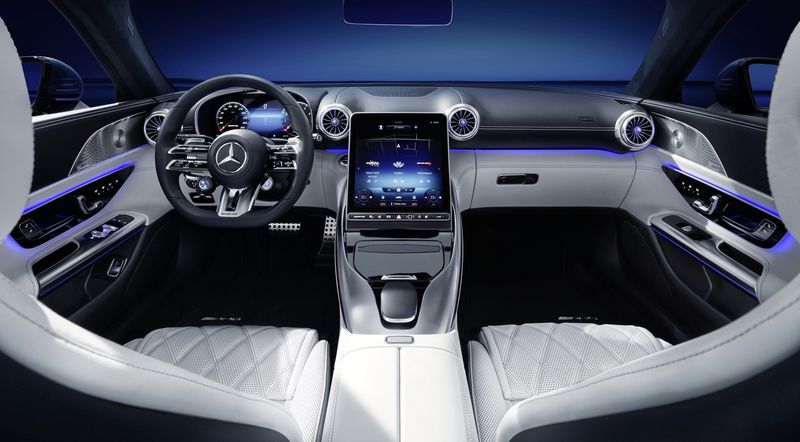
The flipping touchscreen design that is debuting with the AMG SL Roadster is an innovative move by Mercedes-Benz. It provides a larger and easier-to-reach display that would also come with some additional functionality and features and create new problems. Although we expect the device not to be wobbly (which would defeat its conceptualisation), the strength and flexibility of the hinges could also determine its workability. However, this could also spell a new direction for larger and more versatile displays, especially for luxury vehicles in the Mercedes-Benz 2022 AMG SL Roadster mold.

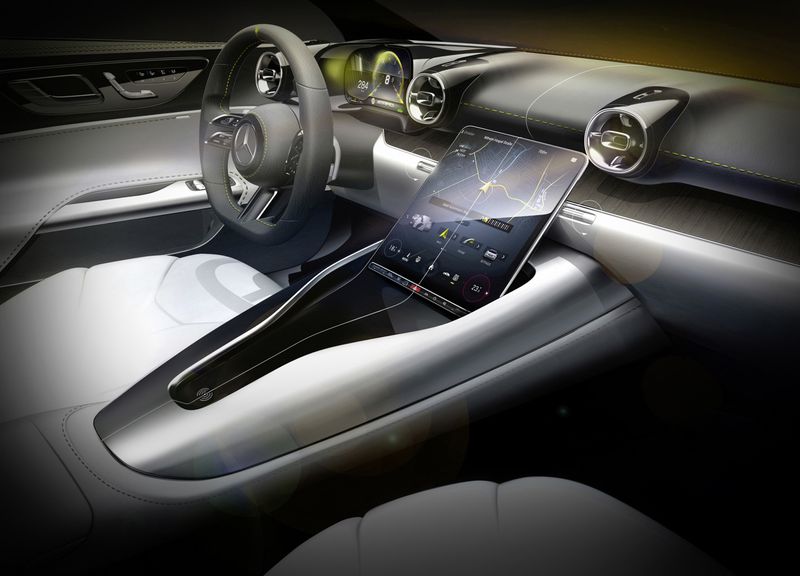
The 2022 AMG SL Roadster has a really impressive and high-tech cabin and an expansive, leather-lined interior with four seats that reflects a 2 x 2 layout. It is a very sporty two-door convertible and is primed to have a massive reception when it finally comes on board. It is indeed a completely unique automobile, having a scanty semblance with its predecessor. We await its arrival later this year with enthusiasm and suspense.

RELATED;


Samsung Galaxy A12s pricing tipped, launch could be near

Samsung is working on a new version of the Galaxy A12 that went official back in November. The new edition is expected to debut as the Galaxy A12s. Ahead of the launch, reliable tipster Sudhanshu Ambhore has tipped the pricing of the smartphone.

Galaxy A12s price (Rumored)

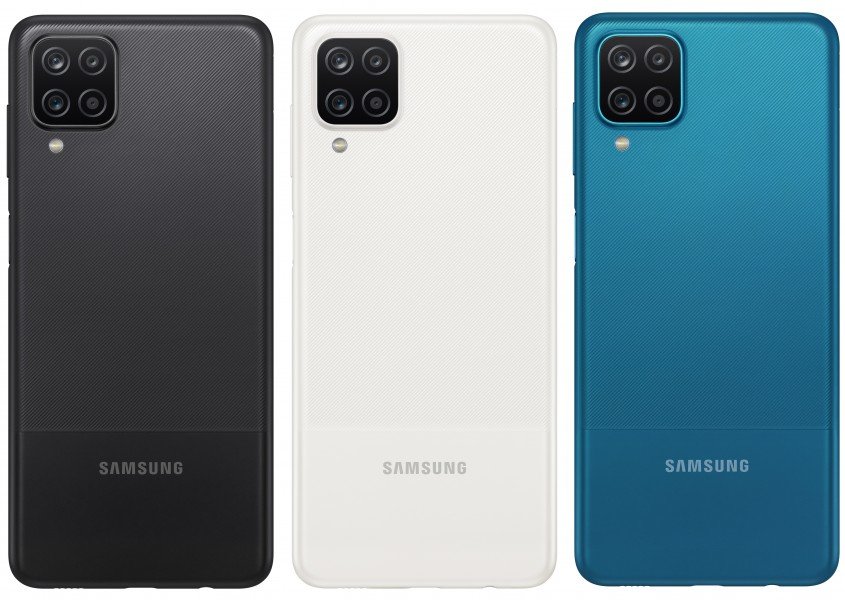
The tipster claimed that the Galaxy A12s will be arriving in two variants such as 4 GB RAM + 64 GB storage and 4 GB RAM + 128 GB storage. These models will be priced at 180 euros and 200 euros, respectively. It is expected to arrive in three colors such as black, white, and blue.

Samsung Galaxy A12

Galaxy A12s specifications (Rumored)

The leak further reveals that the Galaxy A12s will be equipped with the Exynos 850 chipset and will run on Android 11 OS. Its other specs are expected to remain similar to the A12.

The Galaxy A12 has a 6.5-inch PLS IPS panel that delivers an HD+ resolution of 720 x 1600 pixels. It is an Helio P35 powered phone with up to 6 GB of RAM and up to 12 GB of storage. It has a front camera of 8-megapixel, and its rear camera system has a 48-megapixel + 5-megapixel + 2-megapixel + 2-megapixel quad-camera unit. The handset is backed by a 5,000mAh battery that supports 15W charging.

The Galaxy A12s has been spotted at Bluetooth SIG and Google Play Console. Its support page is also live on one of the regional websites of Samsung. Hence, it is expected to debut as early as this month.

RELATED:

Vivo S10 series Photochromic back panel took 3 years to develop: Official

Vivo has just recently held a new online product launch conference. In this, the company announced the Vivo S10 series, which debuted with the new photochromic process on its rear panels that apparently took three years to develop.

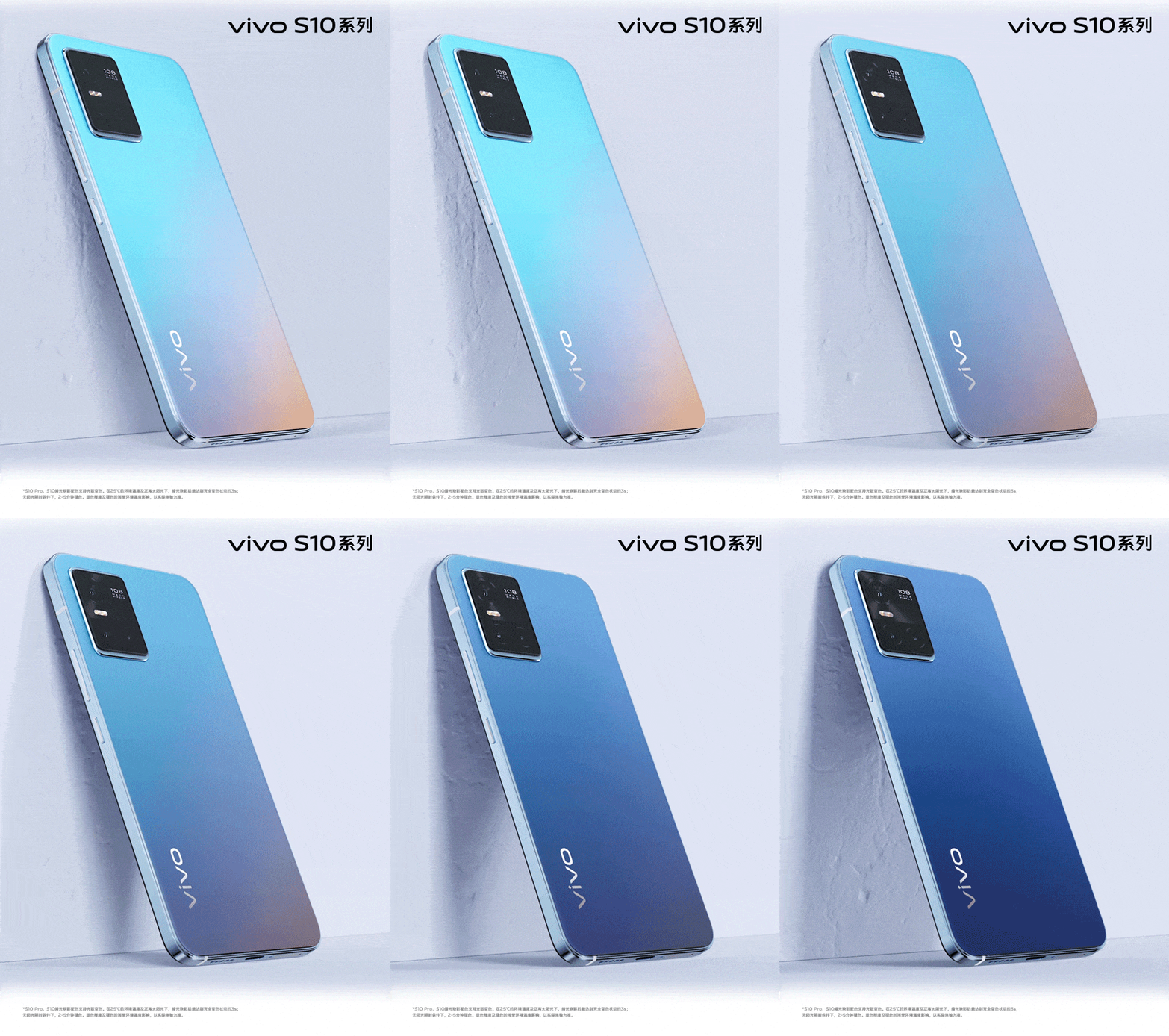
As per official notes, the S10 series uses the new photochromic technology that enables it to change from its ice blue color with an orange hue to “Klein blue” in just three seconds under direct sunlight. Although, once the device is taken away from sunlight, it gradually reverts back to its original color. Now, the Chinese smartphone maker’s product manager, Han Boxiao has revealed that this process has been in development since the previously launched X27 series.

Vivo

In other words, the brand has been working on this technology for around three years. So, we might also see the company include this technology in its future offerings. Other vendors could possibly also include this feature sometime in the near future as well. Talking about the S10 series, the device sports a MediaTek Dimensity 1100 SoC under the hood, with a 44 megapixel dual camera sensor on the front and is powered by a 4,050mAh battery pack that supports 44W fast charging.

RELATED:


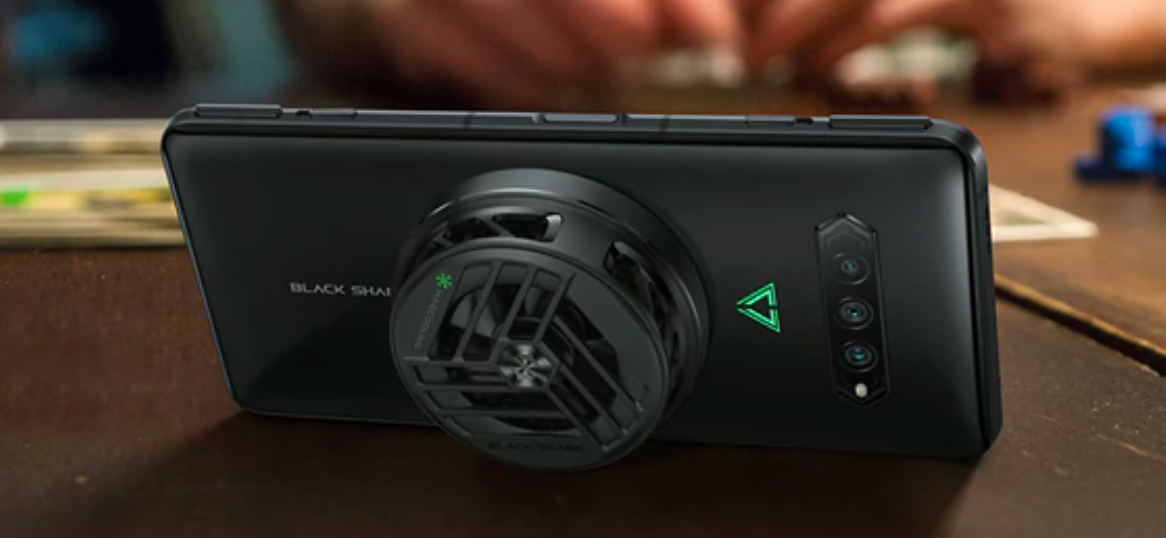
Deal: Get Black Shark Magnetic Cooler for $58

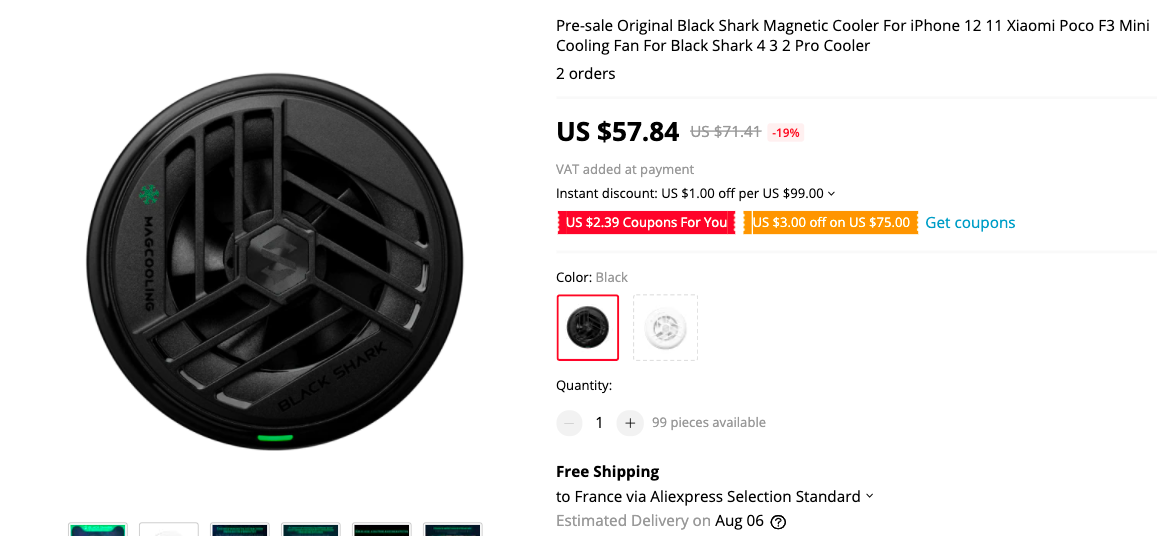
Black Shark Magnetic Cooler which generally retails for $60 is now available at a discounted price of $57.84 only at AliExpress. 

WHERE TO BUY
Black Shark Magnetic Cooler at $57.84 @AliExpress

Black Shark Magnetic Cooler

Black Shark Magnetic Cooler

Black Shark Magnetic Cooler

Key Features:

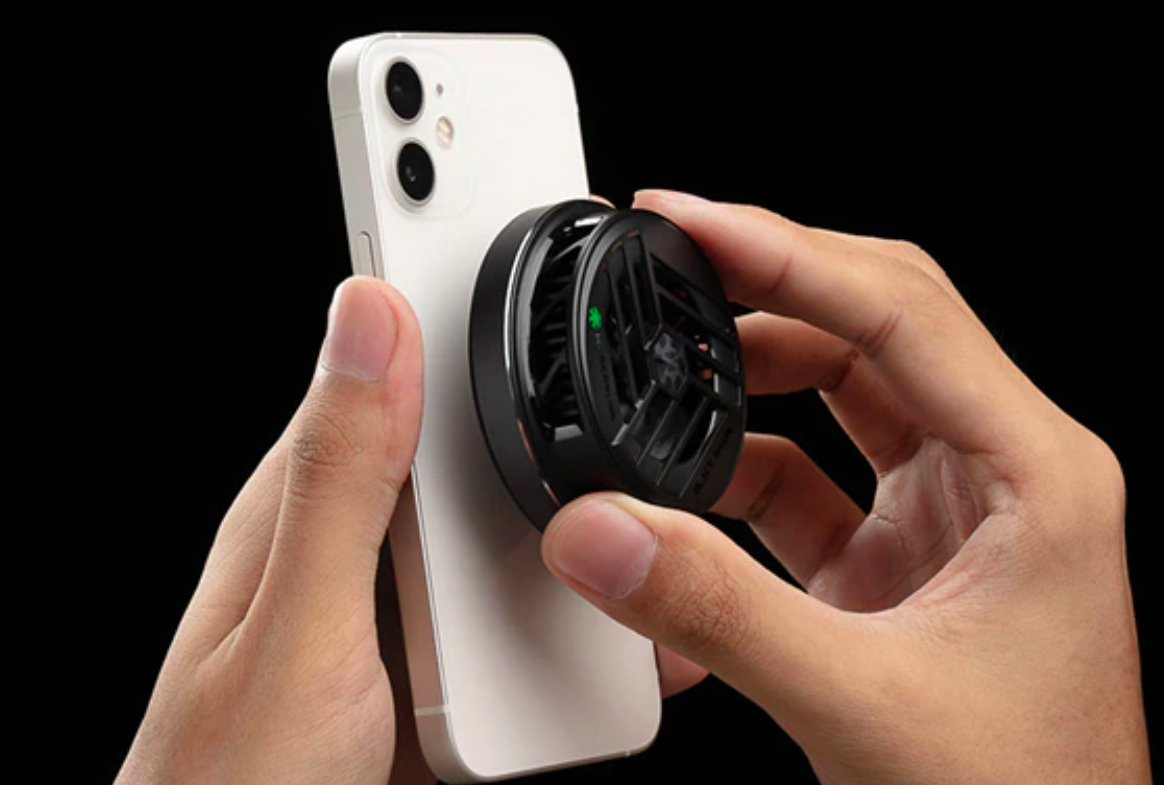
  • Super magnetic attraction design
  • No clamping
  • Cools as soon as you stick it
  • Fits perfectly on your smartphone
  • Rapid cooling technology
  • 7200RPM high-speed fan
  • High energy efficiency refrigeration clip
  • Lightweight and portable design
  • Compatibility: iPhone 12 series
  • Compatible with almost all models by adding heat conductive magnetic sheet, except phones with wireless charging function and non-planar back cover

Black Shark Magnetic Cooler

Generally retailing for $60, you can now buy Black Shark Magnetic Cooler at a discounted price of $57.84 only at AliExpress. Please note that the heat conductive magnetic sheet needs to be purchased separately and is not included in this deal. 


For more information on such exciting deals and offers check out our deals hub.

* Please Note: When you buy something using the links in our articles, we may earn a small commission at no cost to you.


Xiaomi Mi MIX 3, Redmi 10X 4G receive MIUI 12.5 update

Last month, Xiaomi confirmed the MIUI 12.5 update for some of its older flagship smartphones. The Mi MIX 3 was one of those and it has now finally started receiving the said update. Similarly, the budget Redmi 10X 4G from last year has also begun to receive the update.

Xiaomi Mi MIX 3 Jade Green Featured
Xiaomi Mi MIX 3

The MIUI 12.5 update for the Mi MIX 3 and the Redmi 10X 4G is currently live in China with build numbers V12.5.1.0.QEECNXM and V12.5.2.0.RJOCNXM respectively. These software builds are being rolled out in batches. Hence, they are labeled as ‘Stable Beta’.

Anyway, the update should be available in all the regions. For those unaware, the Redmi 10X 4G is known as Redmi Note 9 in international markets. Hence, that device will also get the latest version of MIUI in the coming days.

Xiaomi launched the Mi MIX 3 in late 2018. The handset debuted with MIUI 10 based on Android 9.0 Pie. It was updated to Android 10, MIUI 11, and MIUI 12 respectively. Unfortunately, it is not eligible for Android 11 but it is at least getting the MIUI 12.5 update.

On the other hand, the Redmi 10X 4G was released last year with MIUI 11 based on Android 10. So far, the device has received MIUI 12 and Android 11. Xiaomi is seeding out MIUI 12.5 update right now and it will likely get MIUI 13, unlike the Mi MIX 3.


RELATED


TSMC confirms Japan factory plans, Arizona site to begin production in 2024

Earlier this week, TSMC confirmed that it is planning on building its first chip production plant in Japan to expand overseas manufacturing while its site in Arizona is expected to start mass production in the first quarter of 2024.

TSMC Featured

According to a NikkeiAsia report, the world’s largest contract chipmaker is currently working on determining the feasibility of the chip facility in Japan. For those unaware, we had previously reported on rumors/reports (1,2) of the company eyeing plans for a chip plant in the region. Now, the news has been officially confirmed with the TSMC Chairman Mark Liu stating that “We are in the due diligence process now to have a specialty technology fab in Japan. It is still early to disclose the decision because it will be based on our customer needs, operating efficiency evaluation, and cost economics.”

Furthermore, Liu also confirmed that the 12 billion US Dollars factory that it is building in Arizona, US, will begin mass production in 2024. Its operations will start sometime in the first quarter of 2024 and its first batch of engineers hired in the US to staff this facility have also arrived in Taiwan back in April for training. Mark Liu added that “We will continue to compress our schedule as much as we can.”

TSMC

This facility will be capable of producing semiconductors based on the Taiwan Semiconductor Manufacturing Company’s 5nm process. This advanced process has been featured in various consumer electronics products like smartphones and more. A notable example being Apple and its A14 Bionic chip for its iPhone 12 series.

RELATED:


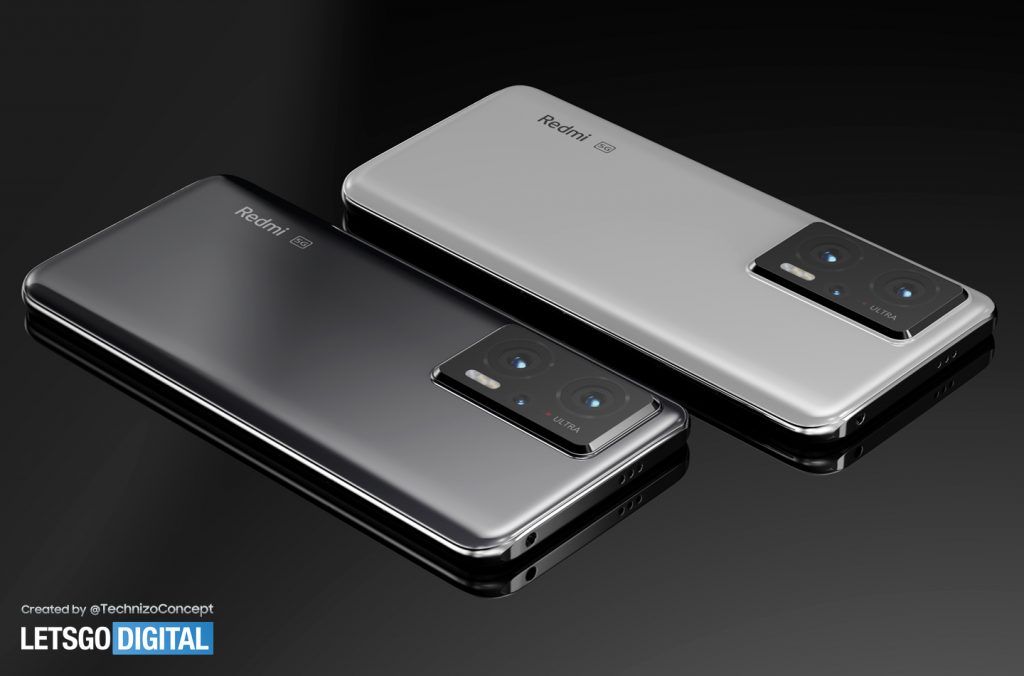
New Concept render offers first look at the Redmi Note 11 Pro

While the Redmi Note 11 Pro 5G is still months away from launch, a new concept render for the smartphone has just surfaced online, which offers us a glimpse of what the device could possibly look like.

LetsGoDigital collaborated with graphic designer Technizo Concept, who also posted a new video on his official YouTube channel. In this video, the Chinese tech giant’s Note 11 Pro 5G concept render was shared. From the front, the device is quite similar to its predecessor, with a center-aligned punch-hole selfie shooter and a display surrounded by narrow bezels on all sides. However, the difference between the Note 10 Pro and the Note 11 Pro is evident on the back panel.

On the rear, the ‘Redmi’ branding along with ‘5G’ can be seen vertically placed on the left region of the panel while the camera module has been overhauled as well. It sports a triple camera setup on the top left corner, with two shooters being large image sensors and the third one being smaller in comparison. In other words, the first two cameras might have an identical sensor while the third is a black and white/macro sensor. While the exact camera specifications are unknown as of right now, it is possible that the device may feature a 200 megapixel sensor made by Samsung on the rear.

Redmi

Keep in mind, this is just a concept render and is not an official first look at the device at the moment. Furthermore, the Redmi Note 11 Pro is expected to launch sometime in the first quarter of next year, likely in March 2022, so there is still quite a while to its announcement. So stay tuned for more updates regarding this upcoming smartphone.

RELATED:


Nokia XR20 image spotted, reveals ruggedized and waterproof design

HMD Global will be announcing a rugged phone on July 27. Rumors surrounding it have claimed that the company will be unveiling a mid-range handset called the Nokia XR20. Fresh information (via. Love Nokia) that it seems that Nokia Mobile had inadvertently placed a banner image of the Nokia XR20 on the Nokia Community forum. The image is no longer available showing on the forum site as it has been replaced by an old teaser.

The Nokia XR20 can be seen with water droplets in the image, which indicates that it may come with an IP68 rating. This handset is expected to arrive as a new variant of the existing Nokia X20 phone.

The XR20 came to be seen sporting a square-shaped camera module for its dual-camera setup. The camera island bears the ZEISS branding and a pair of LED flash units. Its bottom edge is populated with a 3.5mm audio jack, a microphone, a USB-C port, and a speaker grille.

Nokia XR20
Nokia XR20

Nokia XR20 specifications (Rumored)

Past reports have revealed that the Nokia XR20 will be sporting a 6.67-inch FHD+ IPS LCD panel that offers a 20:5.9 aspect ratio. The Snapdragon 480 chip is present under the hood of the device with 6 GB of RAM and 128 GB of built-in storage. For additional storage, it has a microSD card slot.

It has a front camera of 8-megapixel, and its rear camera setup has a 48-megapixel main camera and a 13-megapixel ultrawide lens. The device houses a 4,630mAh battery with fast charging support.

RELATED:

POCO X3 GT MIUI 12.5 builds go live before official launch

Redmi, the sub-brand of Xiaomi, launched the Redmi Note 10 Pro 5G in China at the end of May. This smartphone is reported to release in international markets as POCO X3 GT. Ahead of the device’s official announcement, its MIUI 12.5 builds are already live on the company’s server.

Redmi Note 10 Pro 5G Featured H
Redmi Note 10 Pro 5G

It’s a known fact that smartphones from all the three Xiaomi Group brands, namely Mi, Redmi, and POCO run MIUI. The software for the handsets differs slightly based on the regions they are sold in. Hence, some devices have multiple regional MIUI builds.

According to Xiaomi Firmware Updater, the upcoming POCO X3 GT will have at least three regional MIUI software builds – ‘Global’, ‘Turkey’, and ‘Indonesia’. This information confirms that the phone will be available in the latter mentioned two countries.

The handset will most likely release in all the markets where POCO has its presence. However, the MIUI builds for those regions are yet to go live.

Since the forthcoming POCO X3 GT is merely a rebranded Redmi Note 10 Pro 5G. It should have the exact same set of specifications.

Therefore, we can expect features like a 6.6-inch FHD+ 120Hz LCD screen with a 240Hz touch sampling rate and Corning Gorilla Glass Victus protection, MediaTek Dimensity 1100 SoC, LPDDR4x RAM, UFS 3.1 storage, 64MP (wide) + 8MP (ultra-wide) + 2MP (macro) triple camera setup, 16MP selfie camera, side-mounted fingerprint sensor, dual stereo speakers, IP53 rating for splash resistance, MIUI 12.5 based on Android 11, 5,000mAh battery, and 67W fast charging.


RELATED:


Samsung Galaxy M21 2021 Edition listed on Amazon India’s landing page

Last week, we learned the specifications of the Samsung Galaxy M21 Prime Edition smartphone. Today, Amazon has revealed its key highlights. Additionally, its moniker is also confirmed – Samsung Galaxy M21 2021 Edition, and it will hit the markets on July 21 at 12 PM IST.

According to a fresh listing of Amazon India, the Samsung Galaxy M21 2021 Edition a.k.a. the Galaxy M21 Prime Edition will pack a mammoth 6,000mAh battery. The phone is also touted to feature an FHD+ sAMOLED screen and a 48MP primary camera.

Samsung Galaxy M21 2021 Edition listed on Amazon India's landing page


Moreover, Amazon India’s landing page reveals the design of the smartphone. The Galaxy M21 2021 Edition will have a rear design with a textured back panel. It will have a rear-facing fingerprint scanner at the upper half of the rear, and the main camera island will be divided into two parts.

Corroborating the listing with previous leaks, the phone will feature triple rear cameras. It will be led by a 48MP main sensor, an 8MP ultrawide lens, and a 5MP depth sensor. While the landing page does not reveal anything about its chipset, we’ve got leaks revealing Exynos 9611 processor inside the phone. It is said to come in a 6GB RAM and 128GB storage variant and is expected to go on sale in the Amazon Prime Day Sale (July 26).


RELATED:


Realme GT Explorer Master Edition has Snapdragon 870, officially confirmed

Realme is all set to announce the Realme GT Master Edition series on July 21 in China. Recent reports have revealed that the lineup will have two phones such as GT Master Edition and GT Explorer Master Edition. Today, the company confirmed that the latter will come equipped with the Snapdragon 870 chip.

China’s TENAA certification database has two new Realme phones such as Realme RMX3366 and RMX3361. A recent leak by OnLeaks revealed that the RMX3366 will be the GT Explorer Master Edition model, while the latter will be the GT Master Edition phone.

Realme GT Master Edition with Snapdragon 870Realme GT Master Edition with Snapdragon 870The RMX3366’s TENAA listing that was spotted last month revealed that it is equipped with a 3.2GHz octa-core processor. Later, multiple leaks claimed that the device could be equipped with the Snapdragon 870. Today, the company finally confirmed that the phone will indeed feature the SD870 chip. The image shared by the company shows the phone sporting a dual-curved edge display with a punch-hole design.
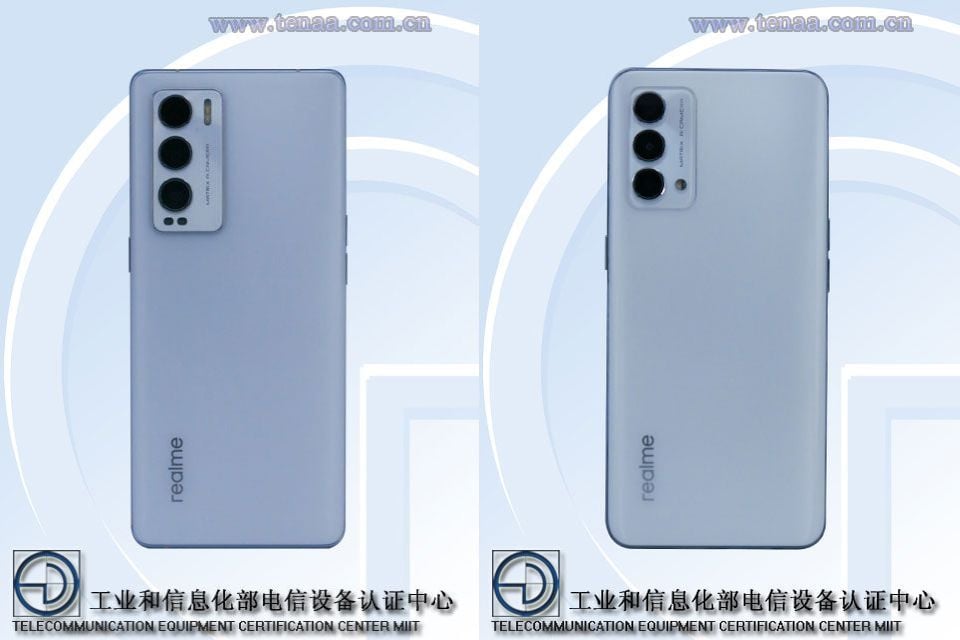

While it is not confirmed yet, the RMX3361 is likely to arrive as Realme’s first phone powered by the Snapdragon 778G chipset. The RMX3366 and RMX3366 are packed with different specs and there is some difference in the design of both devices as in can be seen below.

Realme RMX3366 vs RMX3361
Realme RMX3366 (left) and RMX3361 (right)

The Realme RMX3361 has a 6.43-inch AMOLED FHD+ display, an in-screen fingerprint sensor, a 32-megapixel front camera, a 64-megapixel triple camera unit, SD778G chip, and a 4,300mAh battery with 65W fast charging. The Explorer model (RMX3366) has a 6.55-inch AMOLED FHD+ screen, an in-display fingerprint sensor, a 32-megapixel selfie camera, a 50-megapixel triple camera unit, and a 4,500mAh battery with 65W charging support.

RELATED:

Xiaomi overtakes Apple to become the world’s second largest smartphone company

Xiaomi has become the world’s second-largest smartphone company in the second quarter of this year, overtaking the tech giant Apple. The report from Canalys Research says that the Chinese company saw a massive 83 percent jump in shipments.

This is the first time Xiaomi is breaking into the top two positions globally when it comes to smartphone shipments. For those who are unaware, the top two positions have historically been dominated by Samsung and Apple.

Xiaomi Logo

Huawei had briefly grabbed the second position, overthrowing Apple but soon after that, it started facing sanctions by the United States. The company eventually withdrew from the high-end premium phones market and Xiaomi rushed to fill the gap by launching smartphone switch top-of-the-line specifications and aggressive pricing.

According to Canalys Research, Samsung remained the leading smartphone brand globally with a 19 percent share in the second quarter of this year while Xiaomi managed to increase its market share to 17 percent in Q2 2021. Apple comes in third with 14 percent of the market share in terms of smartphone shipments. OPPO and Vivo are positioned fourth and fifth with a 10 percent market share each.

Canalys Research Q2 2021 Global Smartphone Shipments

Ben Stanton, Canalys Research Manager says that the average selling price for Xiaomi is around 40% and 75% cheaper when compared to Samsung and Apple respectively. So, the company managed to grow sales for its high-end devices, such as Mi 11 Ultra.

However, it remains to be seen if Xiaomi manages to keep its position from rivals like OPPO and Vivo which also have the same objective — offering high-end smartphones at an affordable price point. Another advantage that Vivo and OPPO have against Xiaomi is that they are spending a lot of capital on marketing efforts.

Canalys report adds that the Mi 11 series maker has managed to increase shipments by more than 300% in Latin America, 150% across Africa, and 50% in Western Europe.

RELATED: 

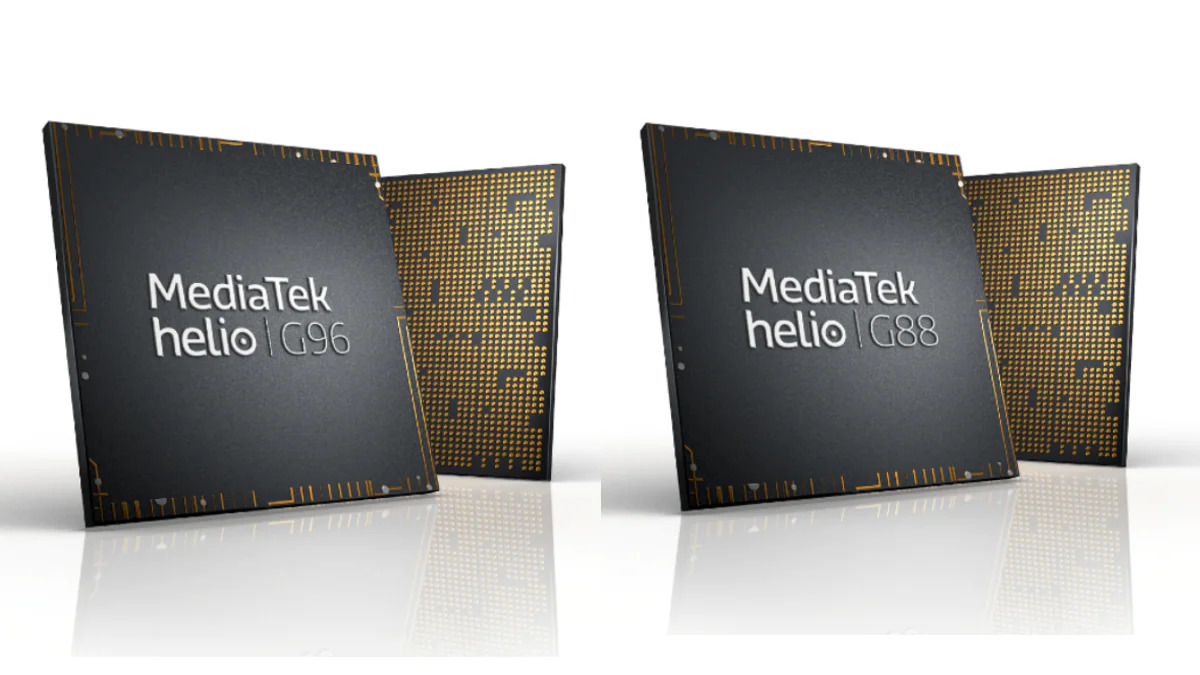
MediaTek announces Helio G96 and Helio G88 chips focusing on mobile photography

Last year, MediaTek had announced Helio G95 SoC featuring the company’s HyperEngine game technology for optimizing CPU, GPU, and RAM along with connectivity. Now, the company has launched its successor — MediaTek Helio G96.

Along with the Helio G96, the company has announced another G-series chipset, dubbed MediaTek Helio G88. Both the chips are designed with a focus on mobile photography.

MediaTek Helio G96 and MediaTek Helio G88

The MediaTek Helio G96 offers support for 120Hz displays with up to Full-HD+ screen resolution. It supports both LCD and AMOLED panels without limitation in DDIC supply, C-phy or D-phy interface. To take care of the gaming needs, the company has also added HyperEngine 2.0 Lite technology.

The chipset features two Arm Cortex-A76 CPUs operating at up to 2.05GHz. There’s also LPDDR4X memory and UFS 2.2 storage. It supports 108-megapixel cameras, fast Cat-13 4G LTE WorldMode modem integration, dual 4G SIM and VoLTE and ViLTE services, as well as the company’s Intelligent Resource Management Engine and Networking Engine.

On the other hand, the MediaTek Helio G88 supports Full HD+ screen resolution (1080p+) at a 90Hz refresh rate. It comes packed with an octa-core CPU that features two Arm Cortex-A75 CPUs operating at up to 2.0GHz and Mali-G52 MC2 GPU.

It has support for up to 64-megapixel main cameras, a hardware depth engine for dual-camera bokeh captures, a Camera Control Unit (CCU), Electronic Image Stabilization (EIS), and Rolling Shutter Compensation (RSC) technologies.

MediaTek hasn’t revealed anything about the pricing and availability for either of the chipsets and the upcoming devices powered by them. It seems like we will have to wait a bit longer to get information about the phones powered by these two chips.

RELATED: 

Honor Magic 3 specifications and render leaked

Honor will be launching the Honor Magic 3 series of smartphones on Aug. 12. A fresh leak by Digital Chat Station has revealed the key specs of the Magic3. In addition, a leaked render that is a glimpse of the Magic3’s rear design has also appeared.

The tipster revealed that the upcoming Magic 3 series of smartphones could be codenamed as Elizabeth. It appears that the ELZ-AN00, ELZ-AN10, and ELZ-AN20 phones that have emerged in the database of the TENAA certification platform belong to the Magic 3 family. Shown below is a rear render of the alleged Magic 3, which shows that a quad-camera setup is placed at the center of the top half of the phone’s back.

Honor Magic 3 render

The tipster claimed that the engineering prototype of the Magic3 features a 6.76-inch OLED waterfall screen that has extremely curved edges. The screen will feature a pill-shaped cutout, which indicates that it will come equipped with dual front-facing cameras. The screen is expected to offer a resolution of 2772 x 1344 pixels.

It could one of the first smartphones to feature the Snapdragon 888 Plus chipset, which is overclocked version of the Snapdragon 888 SoC. The standard model in the Magic 3 lineup may come with a 66W charger, whereas the higher model could be equipped with a 100W charger and 50W wireless charger.

Shown above is a designer and tipster Benjamin Geskin’s render of the Magic 3. It shows that the camera setup has a 48-megapixel camera with a 1/1.5-inch sensor and it carries support or 100x zoom.

RELATED:

OnePlus Buds Pro confirmed to come with adaptive noise cancellation

A few days ago, the OnePlus itself confirmed that the company will be launching its latest true wireless earphones — OnePlus Buds Pro on 22nd July along with OnePlus Nord 2 5G. It seems that the brand is looking to compete against the likes of Apple AirPods Pro with its upcoming earphones.

Now, the China-based company has revealed a new feature of the TWS earphones, confirming that it will come with “adaptive noise cancellation” technology support. The OnePlus Buds come with “environmental noise cancellation” but don’t offer active noise cancellation to compete against high-end offerings from other brands.

OnePlus Buds Pro

The company has confirmed that the Buds Pro will come with three microphones of their own to “monitor exterior noises” and “intelligently produce noise-canceling counter frequencies.” However, we will know about the actual performance of the earphones once they get officially launched.

Another major part OnePlus aims to address with the Buds Pro is the battery life. It has been announced that the battery has been upgraded and should offer an impressive battery life of no less than 38 hours (with ANC turned off). Further, a 10-minute wired recharge of the Buds Pro’s case will provide 10 hours of battery life.

In terms of design, It will reportedly come in matte black color with a glossy metallic covering on the steems to offer a better operating experience and resist sweat and dust. They are likely to be quite similar to the Apple AirPods Pro. Even the original Buds from the company look the same as Apple AirPods and the shipment of the same was seized by US Customs for being counterfeit AirPods.

When launched, the OnePlus Buds Pro will compete against the likes of Apple AirPods Pro and Galaxy Buds 2, among others. We expect the pricing to be under $150 but to know for sure, we will have to wait for the official launch.

OnePlus co-founder Carl Pei, who left the company earlier this year and founded a new brand named Noting is also set to launch its first-ever product, true wireless earphones called Nothing Ear (1) later this month, which will be priced at $99.

RELATED: 

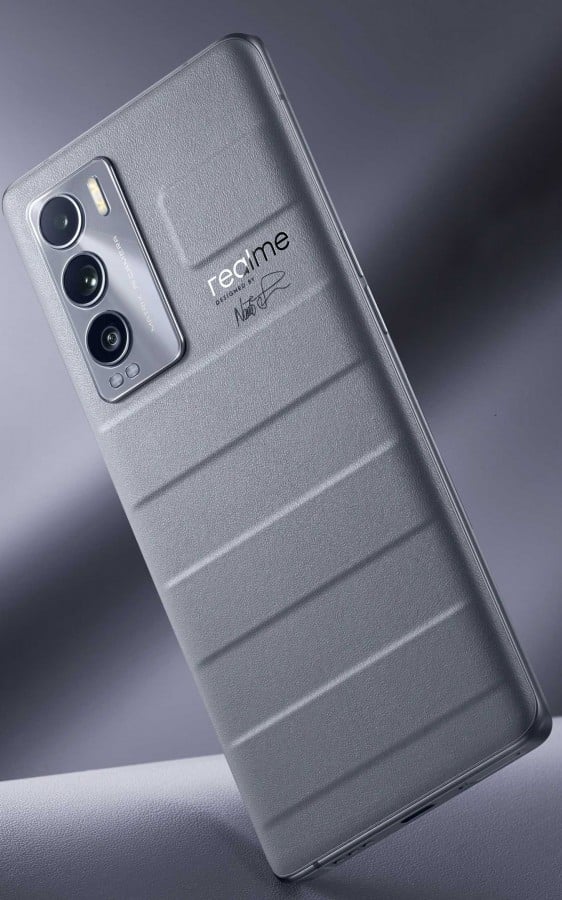
Fresh Realme GT Master Edition Leaks trailer released, Two Versions spotted

After numerous leaks, we finally learned the launch date of the Realme GT Master Edition to be July 21st. Yesterday, the phone was seen in promo images along with a short teaser video. Today, the phone has appeared in a new trailer video that showcases the partnership between Realme and Naoto Fukasawa (Japan’s famous designer). It also reveals a new piece of information about the phone.

While the trailer video showcases the phone from all angles, the fresh teasers of the phone shared by Realme’s CMO look enticing. Surprisingly, both phones are said to be the upcoming Realme GT Master edition, but their rear camera islands have different designs.


According to the trailer video, the Realme GT Master Edition has a triple camera system along with a single LED flash. While the images shared by Realme’s CMO reveal that the phone has a pill-shaped LED flash and two separate LED units beneath the camera lenses.

While there’s no explanation on the same, it clearly hints at two versions of the smartphone. It is also worth noting that an unknown Realme phone with model number RMX3366 appeared in the leaks, and it could be the other version of the Realme GT Master Edition. It could be the Pro version that was tipped a few days back.

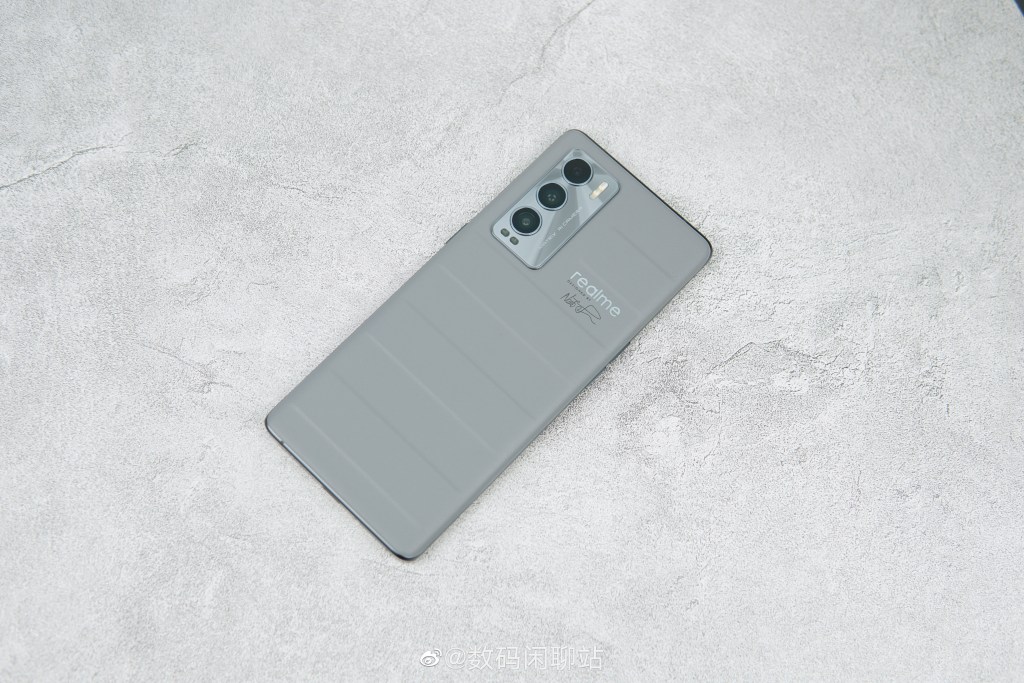
As of now, there’s nothing much to discuss other than the sturdy look of the phone. The smartphone has a taller form factor with a single-punch hole display at the front. It has horizontal bars at the back, which refers to a suitcase. It further suggests that the GT Master edition could be a good travel smartphone.

Realme GT Master Edition Specifications  

Other than this, the phone’s specs were previously leaked. It is expected to come with an AMOLED display featuring a 120Hz refresh rate and 360Hz touch sampling rate. It is said to boast a 32MP Sony IMX615 selfie camera and 64MP triple rear cameras.

Fresh Realme GT Master Edition Leaks reveal two versions

The smartphone will come powered by the Qualcomm Snapdragon 778G mid-range processor, paired with up to 8GB of RAM and 256GB of onboard storage. It is expected to house a 4,300mAh battery with support for 65W fast charging technology. The phone was recently seen in certifications running on Android 11 out of the box.

RELATED:

Samsung Galaxy Watch4’s new Exynos W920 chip and larger storage tipped

The Galaxy Watch4 and Galaxy Watch4 Classic are the next smartwatches from Samsung. All the predecessor models dating back to 2018 were fueled by the Exynos 9110 chip. According to Sammobile, the upcoming Galaxy Watch4 series will feature a new and more powerful chip. The publication also claimed that the Watch4 models will come with massive internal storage.

Predecessor models such as Galaxy Watch, Galaxy Watch Active, Galaxy Watch Active 2, and Galaxy Watch3 were powered by the Exynos 9110 chip. The 5nm Exynos W920 chip that will be available on the Galaxy Watch4 and Watch4 Classic will offer 1.25 times faster processing and 8.8 times smoother graphics performance than the Exynos 9110. In addition, the Watch4 duo will be equipped with 1.5 GB of RAM. To recollect, the Galaxy Watch3 came with 1 GB of RAM.

Another report reveals that the Galaxy Watch4 will be arriving with 16GB of internal storage. It is two times more than the built-in storage of the Watch3.

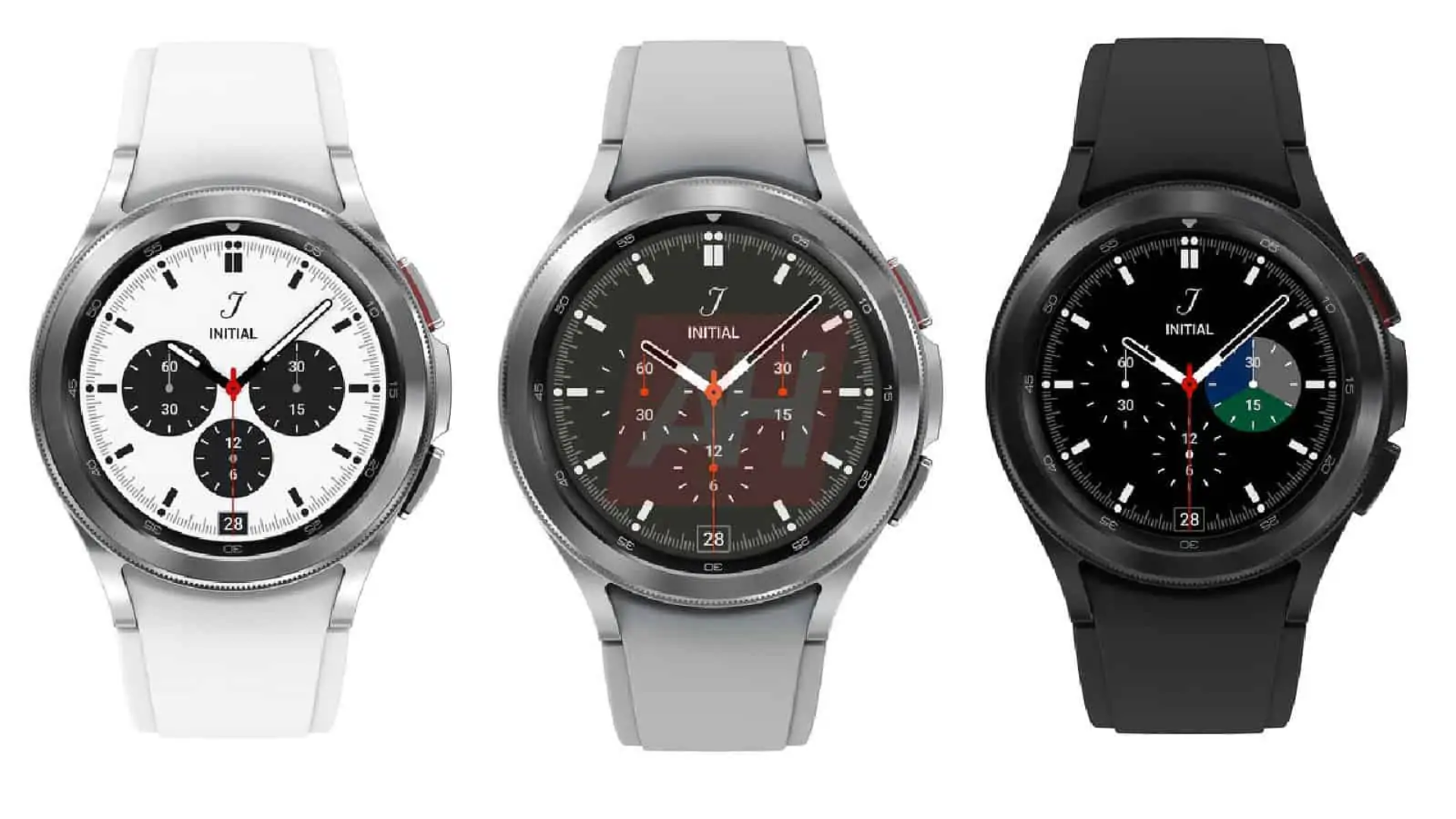
Samsung Galaxy Watch4 Classic renders
Samsung Galaxy Watch4 Classic renders by AndroidHaedlines

It is believed that Samsung is offering a more powerful processor and larger storage on the Galaxy Watch4 series because of the new One UI Watch, which the company has developed with Google as a customized version of the Wear OS.

One of the features of the One UI Watch is that it will let the Watch4 automatically download a smartwatch version of the app that is installed by the user on his/her phone. Hence, the 8 GB space that was made available on predecessor models will not be enough on the Watch4 lineup. The Exynos W920 chip will provide all the power that is needed to run such apps that users will get from the Play Store.

The Watch4 and Watch4 Classic are expected to debut along with Galaxy Z Fold3 and Galaxy Z Flip3, and Galaxy Buds2 on Aug. 11. The Galaxy Watch4 may start at 269 euros and the Watch4 Classic may start at 369 euros.

RELATED:

Valve’s Steam Deck is a handheld gaming PC priced at $399

The gaming handheld space just got a new member in form of Valve’s Steam Deck, a handheld console with specs that blow all the Nintendo Switch models out of the water.

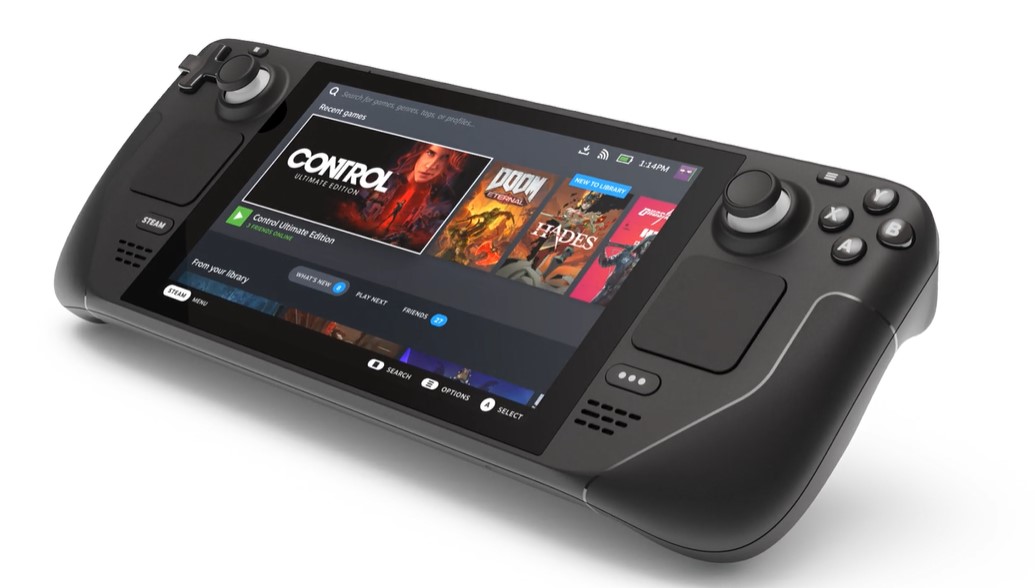
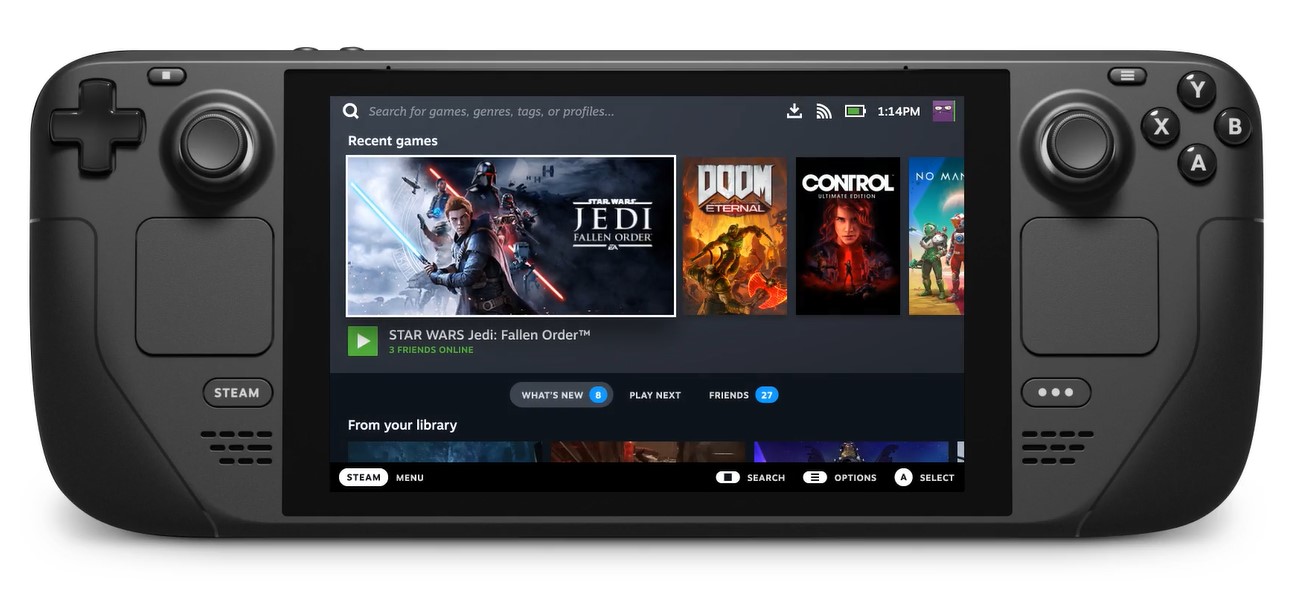
Steam Deck front

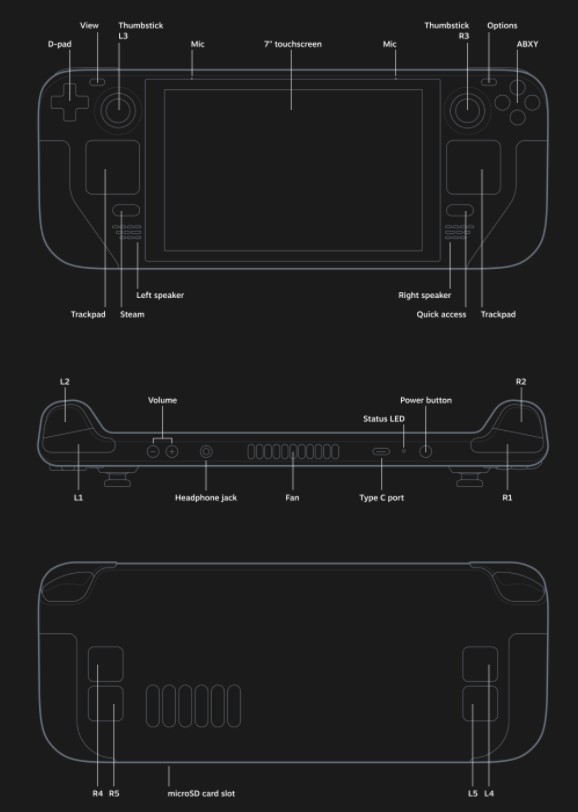
With a starting price of $399, users get a device with a 7-inch 1280 x 720p touchscreen. The display is flanked on each side by two thumbsticks and two touchpads. There is also a D-pad next to the left joystick while ABXY action buttons are on the right. The device has two front-facing speakers, a Steam button, and a Quick Access button. Alongside two shoulder buttons on each side, you also get two back buttons on the back.

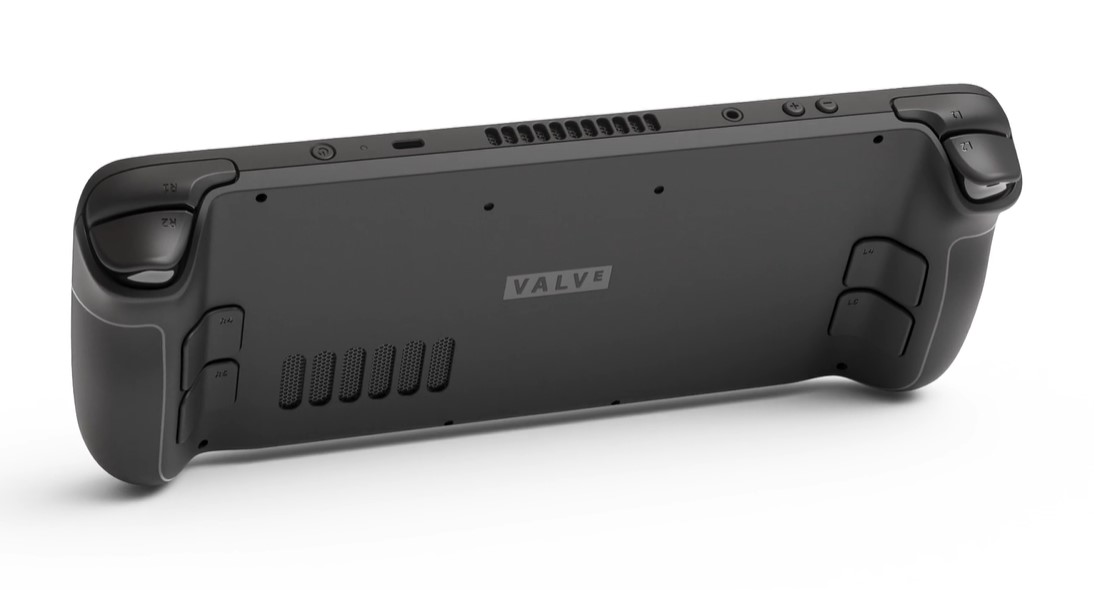
The Steam Deck has its volume buttons on top just like the Nintendo Switch Lite. There is also an audio jack a few millimeters from the buttons and not too far on the same side is the vent for the fan, a USB-C port, a status LED, and the power button.

Steam Deck buttons and ports

The console is powered by an AMD APU with a quad-core Zen 2 CPU with 8 threads and an 8 RDNA 2 CUs GPU. It has 16GB of LPDDR5 RAM and comes in three storage versions – 64GB eMMC (PCIe Gen 2 x1), 256GB NVMe SSD (PCIe Gen 3 x4), and 512GB NVMe SSD (PCIe Gen 3 x4). All variants have a MicroSD expansion slot.

The Steam Deck has support for Bluetooth 5.0, and unlike the Nintendo Switch, you can pair controllers, input devices, and audio accessories. It also has dual-band Wi-Fi and the USB-C port supports display output at 8K at 60Hz and 4K at 120Hz. There is an official dock that allows it to be connected to an external display. The dock has 2x USB-A 2.0 ports, 1x USB-A 3.1 port, a DisplayPort 1.4, an HDMI 2.0 port, a USB-C Power Delivery passthrough input port, and an ethernet port. There is also a 6” USB-C captive cable with a 90º connector that connects to the Steam Deck.

Steam Deck UI

Valve says there is a 40Whr battery inside the device and it will provide between 2 to 8 hours of gameplay depending on the games you play. It comes bundled with a  45W Power Delivery 3.0 charger.

The Steam Deck runs SteamOS 3.0 but because it is a PC, you can install third-party software and operating systems. Once you are logged in, your Steam Library appears. The Quick Access button brings up a dedicated space for your notifications, friends, important settings, and peripherals. Apart from being able to access the games from your library on your device, you will also be able to stream from your PC to the Steam Deck via Valve’s Remote Play feature.

Steam Deck rear

Reservation for the Steam Deck is already available for customers in Canada, European Union, U.S., and the U.K. and it will begin shipping in December. Valve says that once inventory is available, buyers will be notified in the order that they made their reservation. You will not be able to reserve more than one unit and you can’t change the model once you are able to purchase. There is a $5 reservation fee but it counts towards the final price you pay.

The Steam Deck is priced at $399 for the 64GB version, $529 for the 256GB version, and $649 for the 512GB version.


RELATED:

OPPO Reno6 Pro vs Vivo X60 Pro: Specs Comparison

The OPPO Reno6 Pro 5G finally hitten the global market with its high-end specifications offered at a pretty affordable price. But this year there is another Chinese device that can compete with the Reno series in the global market: the Vivo X60 Pro. It is the first flagship by Vivo to hit the European market and it will be joined by the OPPO Reno6 Pro 5G in Europe soon. Which of these devices should you buy and which offers the best features for the money asked? This comparison between their specifications will hopefully clear your ideas in regards.

OPPO Reno6 Pro vs Vivo X60 Pro

OPPO Reno6 Pro 5G Vivo X60 Pro
DIMENSIONS AND WEIGHT 160 x 73.1 x 7.6 mm, 177 g 158.6 x 73.2 x 7.6 mm, 179 g
DISPLAY  6.55 inches, 1080 x 2400p (Full HD+), AMOLED  6.56 inches, 1080 x 2376p (Full HD+), AMOLED
PROCESSOR Mediatek Dimensity 1200, octa-core 3 GHz Qualcomm Snapdragon 870, octa-core 3.2 GHz
MEMORY 8 GB RAM, 128 GB – 12 GB RAM, 256 GB 12 GB RAM, 256 GB
SOFTWARE  Android 11, ColorOS  Android 11, Funtouch OS
CONNECTIVITY  Wi-Fi 802.11 a/b/g/n/ac/ax, Bluetooth 5.2, GPS  Wi-Fi 802.11 a/b/g/n/ac, Bluetooth 5.1, GPS
CAMERA Quad 64 + 8 + 2 + 2 MP, f/1.7 + f/2.2 + f/2.4 + f/2.4
32 MP f/2.4 front camera
Triple 48 + 13 + 13 MP, f/1.5 + f/2.5 + f/2.2
32 MP f/2.5 front camera
BATTERY  4500 mAh, fast charging 65W  4200 mAh, fast charging 33W
ADDITIONAL FEATURES Dual SIM slot, 5G Dual SIM slot, 5G

Design

The Reno Glow finish which distinguishes the OPPO Reno6 Pro 5G from the other phones is simply amazing. The handset has an opaque rear side but it still shines thanks to a special finish which required a very long process for its production. On the other hand, the Vivo X60 Pro is more compact despite it has the same display size. Both the phones are built with premium materials including a glass back and both feature an elegantly curved screen at the sides, but the Vivo X60 Pro seems to have a more premium body with its aluminum frame and the Gorilla Glass 6 protection by Corning. Both are awesome phones in terms of aesthetics and both are very thin and lightweight, so whatever you choose, you will make a great choice.


Display

The OPPO Reno 6 Pro 5G and the Vivo X60 Pro are very close when it comes to the display. They both feature AMOLED panels with the HDR10+ certification, an in-display fingerprint reader, a Full HD+ resolution, a high brightness, and a high-end image quality. Even the size is almost the same: 6.55 inches and 6.56 inches, respectively. An important difference is the refresh rate: OPPO Reno6 Pro 5G has 90 Hz, while Vivo X60 Pro comes with a higher 120 Hz refresh rate.


Specs & Software

The Vivo X60 Pro wins the hardware comparison because it is powered by a stronger chipset: the Snapdragon 870 by Qualcomm. Despite the Dimensity 1200 by MediaTek is built with a better production process (6 nm), the Snapdragon 870 is actually more powerful and it is the chipset with the highest clock frequency in the Android world. The SoC is paired with 12 GB of RAM and 256 GB of UFS 3.1 internal storage and this is the only memory configuration of the Vivo X60 Pro. Note that, in China, the Vivo X60 Pro comes with a different processor: the Exynos 1080 by Samsung.


Camera

Besides having a superior chipset, the Vivo X60 Pro also comes with a better camera. The phone packs a triple camera including a 48 MP main sensor with gimbal stabilization, a 13 MP telephoto lens with 2x optical zoom, a 13 MP ultrawide sensor, and Carl Zeiss optics. Unfortunately, OPPO Reno6 Pro 5G lacks a telephoto sensor and it has inferior stabilization. The two handsets are both equipped with a 32 MP selfie camera, so you should not notice big differences when it comes to selfies quality.


Battery

An important advantage of the OPPO Reno6 Pro 5G is the presence of a bigger battery: 4500 mAh vs 4200 mAh. Alongside the 6 nm production process of its chipset, the bigger capacity allows the handset to provide a longer battery life. Further, the OPPO Reno6 Pro 5G has a faster charging technology with a power of 65W and it ships together with a compact 65W charger.


Price

The OPPO Reno6 Pro 5G is priced at Rs. 39,990 in India in the base configuration with 8 GB of RAM and 128 GB of storage, while Vivo X60 Pro costs Rs. 49,990 (€799 in the European market) in the configuration with 12 GB of RAM and 256 GB of storage. The Vivo X60 Pro is a superior phone because it packs better cameras and the amazing Snapdragon 870 chipset, but with the OPPO Reno6 Pro 5G, you can save money while getting a bigger battery and faster charging. If you do not need that awesome camera you can find on the Vivo X60 Pro, then OPPO Reno6 Pro 5G is a more intelligent choice for your needs and you should opt for it.


OPPO Reno6 Pro vs Vivo X60 Pro: PRO and CONS

OPPO Reno6 Pro 5G

PRO

  • Good price
  • Bigger battery
  • ColorOS 11.3
  • Faster charging

CONS

  • Inferior cameras


Vivo X60 Pro 5G

PRO

  • Better chipset
  • Superior cameras
  • More compact
  • Wider availability (for now)

CONS

  • Smaller battery

RELATED

Check the latest videos from our YouTube channel and subscribe:

Xiaomi is the biggest beneficiary of Huawei’s exit from the mid-range phone segment in Europe

Huawei endured a turbulent 2020 in Europe and the United States especially. The stringent sanction regime initiated by the US-led to similar restrictions across Europe, especially in the 5G segment, where the company had already established a seemingly unassailable lead. These moves significantly affected the company’s outlook, but recent research by Counterpoint Research has also shown that consumers in Europe may have also been hurt by the exit of the company, as mid-range 5G smartphones average prices from Europe reflected.

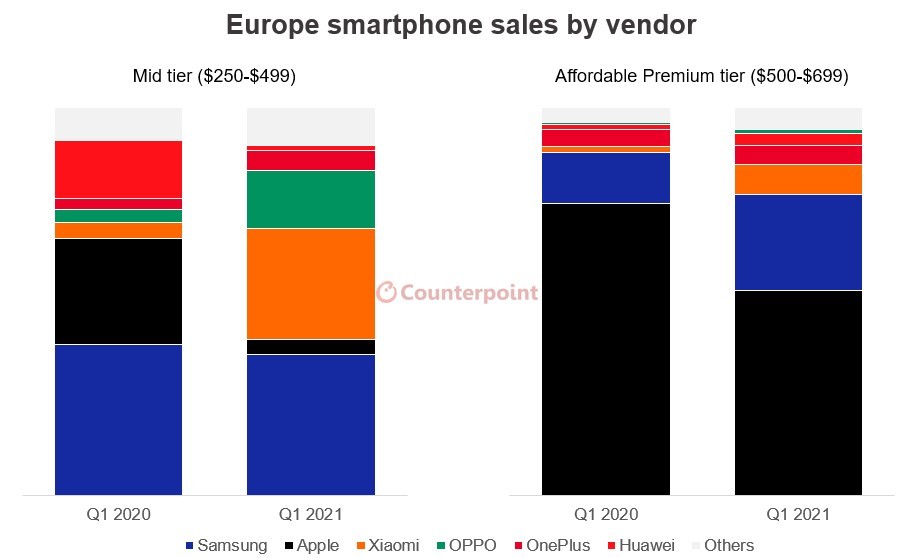
The European market did not have any mid-range 5G smartphones as of Q1 2020. Still, the scenario gradually changed so that, by the third quarter of 2020, 5G mid-rangers accounted for about 20% of the segment, and this has risen steeply to 50% of all smartphones sold in Europe at the end of the first quarter of 2021.

The price range considered by the researchers at Counterpoint Research was the $250-$500 range. Huawei enjoyed a great degree of prominence in the mid-range segment of Europe before the decline last year, with its market share virtually extinguished by Q1 2021. Of all the listed vendors, Xiaomi saw the biggest YoY growth in the mid-tier segment, obviously due to its robust offering and aggressive marketing.

Huawei’s loss also translated to growth for other Chinese brands like Oppo, who moved swiftly to bridge the gap resulting from Huawei’s exit. These brands have recorded massive improvements in their European operations. Xiaomi, Oppo, Vivo and other brands on the fringes of the 5G market in Europe are all pursuing robust strategies to break into the mid-range and premium segment of the 5G market in Europe with some flagship offerings.

However, Apple and Samsung remain the clear leaders across the 5G segments in Europe, although the Chinese contingent continues to pursue a share of the spoils in the highly lucrative market.

RELATED:


(source)