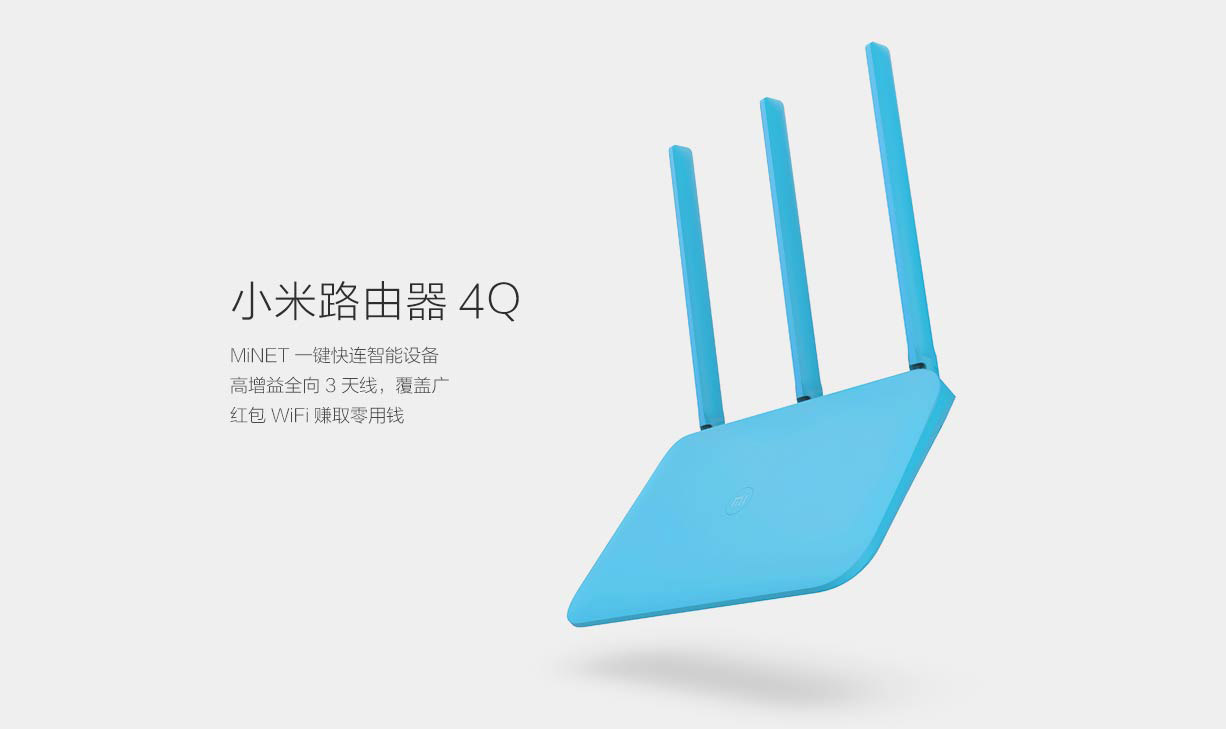
Xiaomi has a plethora of routers already but it never stops launching more. Its latest one is the Mi Router 4Q, a cheaper version of the Mi Router 4 announced about a month ago.
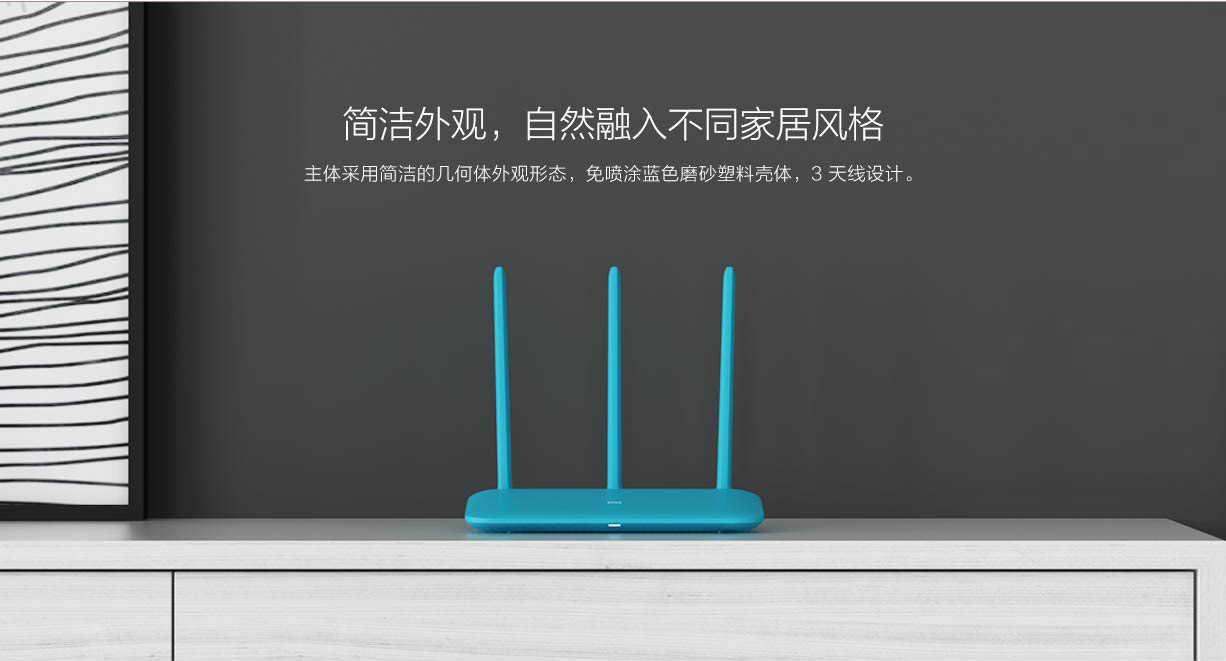
The Mi Router 4Q has a bright blue body that will make it stand out in your home or office. It measures 200 x 134.86 x 178.98 mm and has three omnidirectional high-gain antennas. It has a 775MHz QCA9561 processor with 64MB of RAM and 16MB of built-in storage.
Unlike the Mi Router 4, the 4Q only supports single-band Wi-Fi (2.4GHz) and 3×3 MIMO with a maximum speed of 450mbps. For security, it supports WPA-PSK and WPA-PSK2 encryption, and SSID hiding. It also has a MiNET button for easy and fast one-click connection for Xiaomi and Mijia smart devices.
Xiaomi has launched a new backpack under the Youpin platform. The backpack is manufactured by the Shanghai Runmi Technology company also known as 90 points but has the Mi branding. For clarity, 90 Points is Xiaomi’ line for lifestyle products. Some of the products released under the line include suitcases, smart running shoes, backpacks, and t-shirts.
The new Mi Backpack is available in a range of colourful options, eight (8) different colours in total. The backpack comes with a 10L capacity which is enough to hold a tablet computer, cameras, cups, even small umbrellas and other items. The compact size ensures it doesn’t take enough space and is easy to carry. The size also ensures it can be carried inside a large backpack or suitcase.
In terms of dimension, the new Mi backpack measures 34 x 22.5 x 13cm and weighs just 165g. The fabric is made of 100% polyester material. The fabric is treated with a water-repellent coating which makes the bag suitable for use in the rains. The backpack is available in Black, Pink, Yellow, Navy Blue, Orange, Mint Green, Red and Bright Blue.
The Mi backpack comes with a 29 yuan ($4) price tag and is presently available on the Youpin website. The backpack will also be available outside China from online retailers like GearBest and Banggood.
Aiming to expand its presence in fast-growing Asian markets, search engine giant Google announced that it is investing $550 million in Chinese e-commerce powerhouse JD.com. As a part of this transaction, Google will receive 27.1 million newly issued JD.com Class A ordinary shares at an issue price of $20.29 per share.
With this investment, Google will have less than a 1 percent stake in JD.com, said a spokesman for JD. The companies have described the investment as one piece of a broader partnership that will include the promotion of JD.com products on Google’s shopping service.
This move is expected to help JD.com to expand beyond its base in China and Southeast Asia in order to establish a meaningful presence in U.S. and European markets. Both companies also said that they would work together to develop retail infrastructure that can better personalize the shopping experience and reduce friction in a number of markets.
Commenting on this development, Philipp Schindler, Google chief business officer, said in the statement:
We are excited to partner with JD.com and explore new solutions for retail ecosystems around the world to enable helpful, personalized and frictionless shopping experiences that give consumers the power to shop wherever and however they want.
JD.com is competing with giant Alibaba Group Holding Ltd., which has been more focused on forging domestic retail tie-ups. Jianwen Liao, JD.com’s chief strategy officer, in a statement, “This partnership with Google opens up a broad range of possibilities to offer a superior retail experience to consumers throughout the world.”
Google seems to be focused on stepping up its investments across Asia, which has become a battleground for the US and China-based giants because of rapidly growing middle class and a lack of infrastructure. Google recently took a stake in Indonesian ride-hailing firm Go-Jek and is reportedly going to invest in Indian e-commerce startup Flipkart which was recently acquired by Walmart.
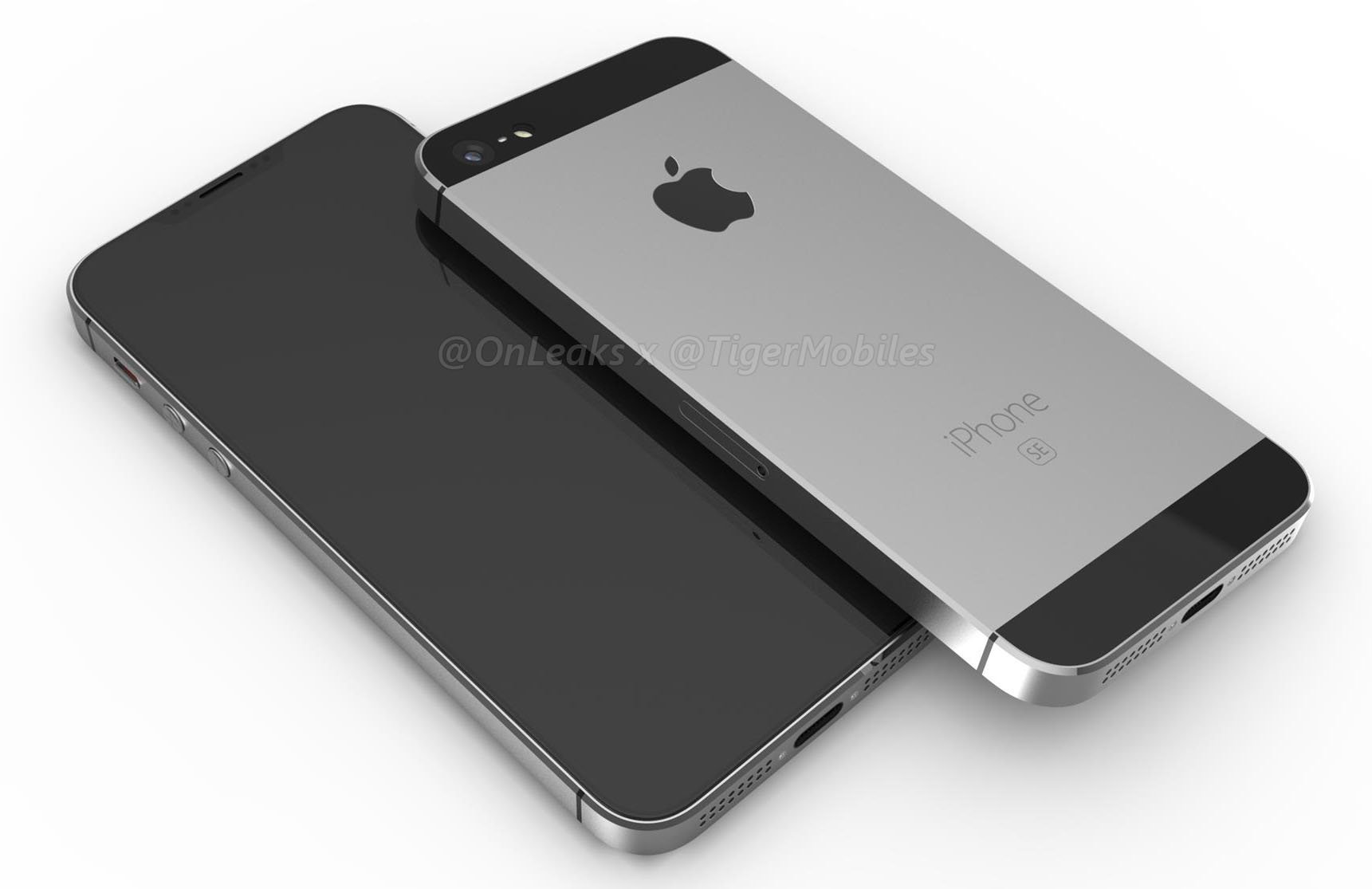
The iPhone SE 2 was rumored to debut at the Worldwide Developers Conference (WWDC) event that was held at the beginning of this month. However, Apple did announce the highly anticipated successor device for the iPhone SE from 2016. Popular case maker Olixar had claimed in the recent past that the iPhone SE 2 will be arriving with iPhone X-like design. However, citing information coming from its sources, the accessory manufacturer has now claimed that since Apple is concentrating on the large-sized iPhones arriving later this year, it won’t be launching the iPhone SE 2 this year.
In the recent months, accessory makers and CAD renders had revealed that Apple would be launching the iPhone SE 2 as a successor for the iPhone SE. However, the Cupertino company has always been silent on its existence.
In the previous month, Olixar had reportedly started the official line of accessories for the iPhone S2. However, now that the device is said to be cancelled, the case maker has halted the production. This suggests that the original iPhone SE was a one-off device from the company to check the market response.
Rumors had claimed that the iPhone SE 2 would be having a size similar to the predecessor. However, it would still be housing a larger display because of the slim-sized bezels. The display of the phone was also expected to feature a notch like the iPhone X. It was speculated to borrow specs from the iPhone 8. Some reports had even claimed that the smartphone would be called iPhone X Mini.
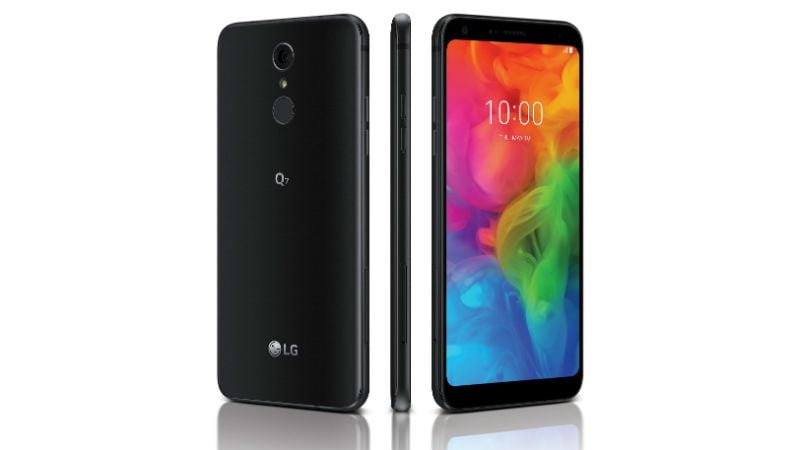
The Motorola Moto X4 available on Project Fi from 2017 and the newly unveiled Nokia 6.1 smartphones are few Android devices are available in the U.S. Fresh information reveals that LG is prepping an Android One variant of the Q7 smartphone for the U.S.
According to XDA Developers, the LG Q7 Android One edition would be exclusively available through T-Mobile in the U.S. The evidence of an unidentified LG Android One phone along with its model number was found through the kernel source code of the LG Stylo 4 that will be launching in the U.S. tomorrow.
The source code of the device includes terms like “mcv5a”, “tmo”, “us” and “sprout.”. It has been confirmed through the Google’s list of Play certified devices that “cv5a” is the model number of LG Q7 that was launched recently and terms “tmo” and “us” suggest that it is a T-Mobile device heading to U.S.
Lastly, “sprout” codename is always used for an Android One device. Hence, the newly spotted LG device seems to be Android One edition of LG Q7.
The source code has also revealed some of the key specs of the alleged LG Q7 Android One phone. It has been found that the handset features a 5.5-inch 18:9 LCD display that supports FHD+ resolution of 2160 x 1080 pixels. The Snapdragon 450 is present under the hood of the phone. Other specs of the phone include Android 8.1 Oreo, NFC, USB-C, Hi-Fi ES9218P audio DAC borrowed from LG V30 and 3,000mAh battery. The handset lacks a fingerprint reader.
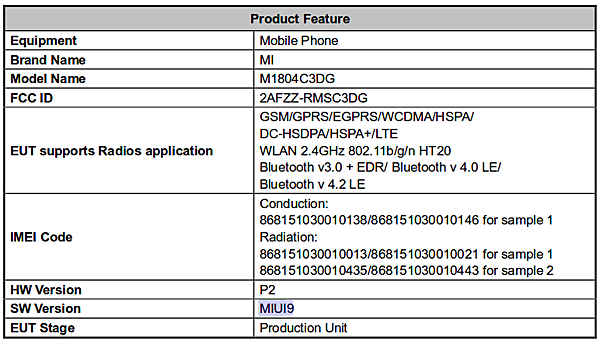
Xiaomi has recently released the Mi 8, Mi 8 Explorer Edition, Mi 8 SE, Redmi 6 and Redmi 6A smartphones in China and it is slated to unleash the Mi Max 3 phone in July. A recent report has revealed that the company may debut Redmi 6 Pro and Mi Pad 4 alongside the Mi Max 3. Apart from these devices, two new Xiaomi models have been certified by Federal Communications Commission (FCC) in the U.S. The listings reveal that these devices are running on MIUI 9.
The model numbers of the two Xiaomi devices that have been certified by FCC agency are M1804C3DG and M1804C3CG. It appears these could be the two variants of an upcoming Xiaomi phone.
The listing reveals that the device is loaded with MIUI 9 and carries support for Bluetooth 4.2 LE and Wi-Fi 802.11 b/g/n. FCC documents also suggest that the device may arrive in 32 GB storage + 3 GB RAM and 64 GB storage + 4 GB RAM variants. This indicates that the M1804C3DG/M1804C3CG could be a mid-range phone. As of this writing, there is no information available on the identity of the newly spotted Xiaomi devices.
The Xiaomi Mi Max 3 that is expected to debut soon has a model number of M1807E8S. A recent report has revealed that the model number of the forthcoming Mi Pad 4 tablet is M1806D9W. Also, the rumored Redmi 6 Pro phone has a model number of M1805D1SE. Since the M1804C3DG/M1804C3CG model numbers does not seem to belong to Mi Max 3, Mi Pad 4 or Redmi 6 Pro, there is a possibility that those devices could be the two variants of the upcoming Xiaomi Mi A2 Android One phone or some other Xiaomi device.
8848 is a Chinese company known for releasing very expensive and original luxury phones. The latest handset released by the Chinese company is the M4 Titanium, one of the most refined smartphones in terms of aesthetics. It features a titanium alloy, head layer cowhide, a sapphire glass for the display, ceramic and more.
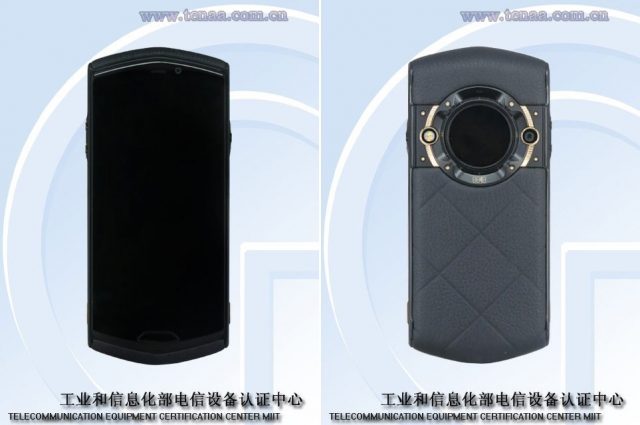
Now it looks like this device released in 2017 has a successor. A new handset dubbed 8848 M5 Titanium has just been certified by TENAA. The Chinese regulatory handset has published the images and the main specs of the upcoming flagship. It is not so different from its predecessor as it retains its hexagonal form factor as well as a leather back and a dual display. The main display is a TFT panel with a size of 5.65 inches and a Full HD+ resolution of 1080 x 2016 pixels, while the secondary display is placed on the back — it is circular and it resembles a watch.
Indeed, the M4 is able to show time and the most important notifications on the back. 8845 M5 comes with a quad-core SoC running at a frequency of 2 GHz, 6 or 8 GB of RAM and 128 or 256 GB of internal storage depending on the configuration. It also packs a 16 MP main camera, a 12 MP camera, Android 8.1 Oreo and a 3450 mAh battery.
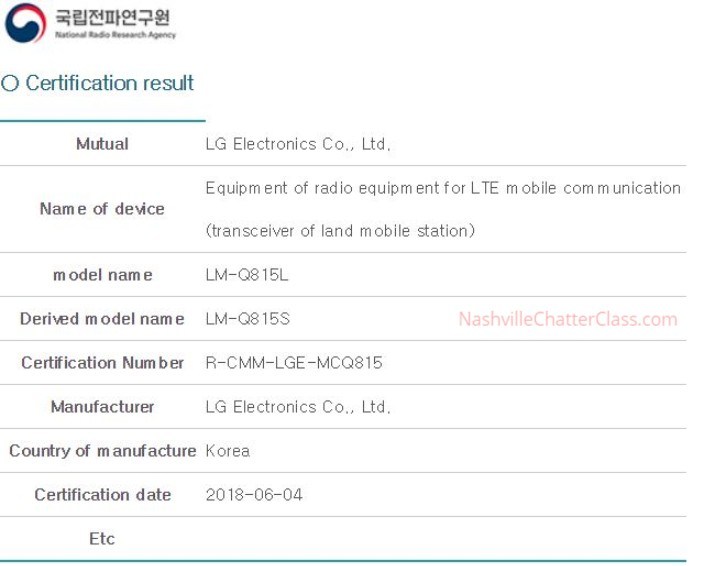
The Q-series of LG is composed of devices which can be defined as affordable variants of its major flagships. The first devices of the line-up are Q6 and Q8 which are, respectively, cheap versions of the G6 and V20. Recently, the South Korean company launched the Q7 trio to offer cheap alternatives to people who can not afford its latest flagship G7. Now, it seems that it is readying the LG Q8+, which is expected to come as an affordable version of the V30. Earlier this month, the handset surfaced on a KCC listing (the Korean equivalent of the American FCC) in two variant identified by the codenames LM-Q815S and LM-Q815L.
Now the name of the handset has popped up again on a list of devices which support Google Play confirming its existence. The listing mentions LG Q8+ and its codename cv7an in the modding community. The first of the two variants has also been certified by Wi-Fi Alliance. However, despite these sightings, specs of the handset hasn’t been revealed. So, at the moment, the only thing we can do is recap the main specs of the original Q8 which is a high-end handset even though it is more affordable than devices from the G and V-series.
The original LG Q8 has a full metal unibody design and an IP67 certification making it dustproof and water-resistant (up to 1m for 30 mins). It has a main display with a size of 5.2 inches and a Quad HD resolution of 1440 x 2560 pixels, as well as a secondary Always On display to show notifications with a 1.8-inch size and a resolution of 160 x 1040 pixels. Under the hood, it has a quad-core Qualcomm Snapdragon 820 chipset, 4 GB of RAM and 32 GB of internal storage. It even sports a wide-angle dual camera with a 16 MP resolution.
After the X20 Plus UD, the Vivo X21 is the second Vivo’s smartphone to feature an in-display fingerprint reader. Thanks to a very innovative chip released by Synaptics, if you own this phone you can unlock it through fingerprint recognition by simply touching the display. So, the sensor is embedded right into the display as there is no space for a Home key due to the full bezel-less design. However, in-display fingerprint readers are slower and less efficient than the traditional fingerprint readers which often put them at an operational disadvantage.
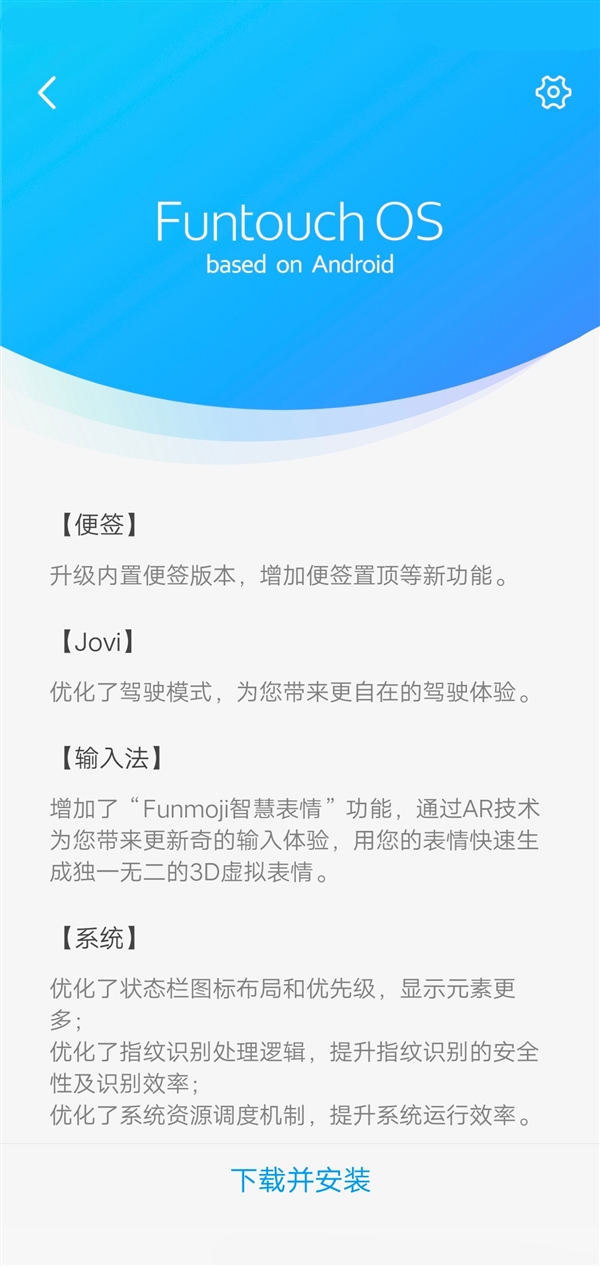
A new update which has just been rolled out on the Vivo X21 is now improving the fingerprint reader experience by making it safer and more efficient. According to the official changelog released, the new update will improve the fingerprint reader processing logic, improving the security and efficiency of the authentication process. The improvements to the fingerprint reader are not the only ones implemented through this new update of Funtouch OS (the customized Android fork made by Vivo). With this update, the company has added sticky notes and made some optimizations to the driving mode making it more user friendly.
Further, the update brings Funmoji, a set of customized emojis working through AR. In a similar way to Apple’s Animoji, the user can create emojis based on its facial expressions. The update rolled out on Vivo X21 also contains optimizations to the system layout and to the icons’ priority in the status bar. There are also some improvements with regards to the system resource scheduling mechanism and the system stability and efficiency. Given its size, we suggest you to download the update while you are connected to a Wi-Fi network.
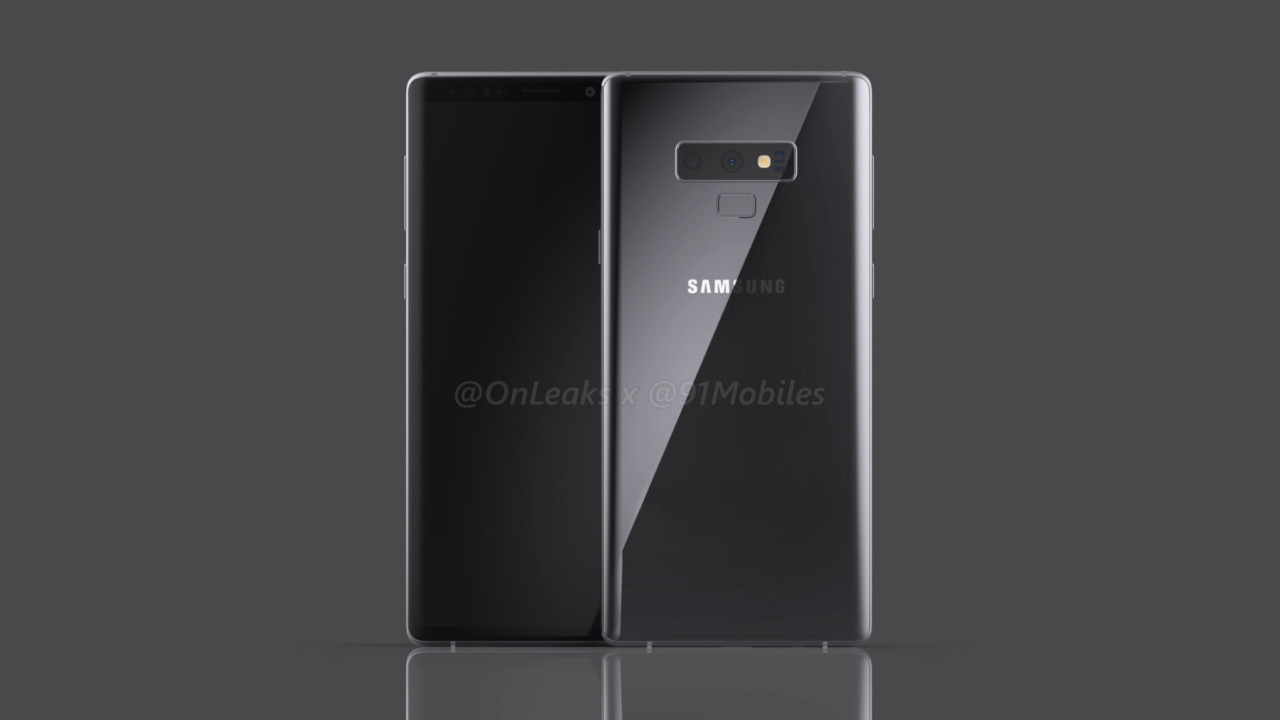
Samsung, after launching Galaxy S9 series flagship smartphone earlier this year, is now gearing up to launch the next-generation Note series flagship — Samsung Galaxy Note 9. Earlier, there were reports claiming that the company could launch a 512GB internal storage model of the Galaxy Note 9.
Now, the latest report suggests that the 512GB internal storage model will be exclusive to the South Korean and Chinese markets only in the initial phase. However, the report adds that the company could launch the variant in other regions at a later date.
Currently, it’s not known if the company plans to make any other change in the phone’s specs apart from the storage capacity. If not, then the Galaxy Note 9’s top-end model with 512GB onboard storage could come with 6GB or 8GB RAM, powered by the company’s own Exynos 9810 octa-core processor.
According to the reports, the Samsung Galaxy Note 9 will come with a 6.3-inch display having QHD+ screen resolution and 18.5:9 aspect ratio. The smartphone will be powered by the latest and Samsung Exynos 9810 or upgraded Qualcomm Snapdragon 845 SoC, depending on the region.
Concept renders of the Samsung Galaxy Note 9 suggests that there won’t be a major difference in terms of design compared to its S-series siblings. The front side of the phone will be dominated by the Infinity Display, with thin bezels on the top and bottom. The volume rocker, as well as the power button, has been placed on the left side and towards the right, there’s the dedicated Bixby button.
The company has also decided to retain the 3.5mm headphone jack, which sits beside the USB Type-C port on the bottom. On the back, one of the major change is the placement of the fingerprint scanner. According to these renders, the fingerprint sensor has now been moved below the camera module, which should make it more convenient to use.
The flagship smartphone is also expected to come with an upgraded camera system, though we believe that the phone will continue to offer the same dual-aperture primary camera, similar to the Samsung Galaxy S9 Plus.
In the software department, the device is expected to come with a redesigned interface from Samsung, which is dubbed as Crown UX and will be based on Android Oreo operating system out of the box. Further, the phone is also expected to come powered by a larger battery rated at 3,850mAh.
As for the phone’s availability, the Samsung Galaxy Note 9 is expected to be announced on 9th August at an event in New York and is expected to be available on pre-order shortly after that. The reports indicate that the shipments could start from two weeks after the phone’s launch.
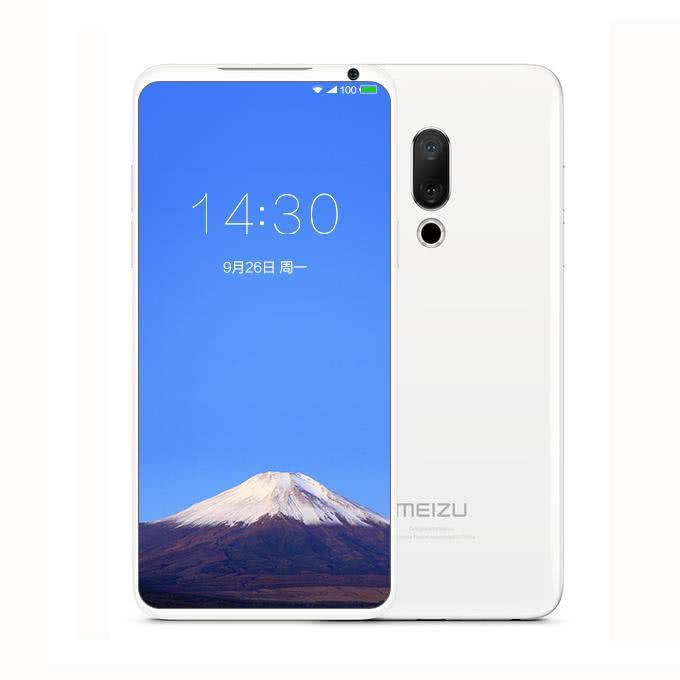
Recently, Meizu launched its Meizu 15 series smartphones and now the China-based company is preparing to launch its successor — Meizu 16. Earlier, Meizu’s founder Jack Wong (Huang Chang) had claimed that the Meizu 15 series is just a test product and the upcoming Meizu 16 series will be more powerful and futuristic.
He had also revealed that the Meizu 16 series smartphones will be launched in August this year but the launch date is not yet known. Now, more details about the upcoming smartphone from the company has surfaced online.
According to the report, the Meizu 16 will be launched in two variants. While one variant will be powered by Qualcomm‘s Snapdragon 845 processor, the other variant will be powered by Qualcomm’s recently launched Snapdragon 710 processor.
The variant with Snapdragon 845 SoC will pack up to 8GB of RAM and will also have an under-display fingerprint sensor, similar to what we saw on Vivo NEX and Xiaomi’s Mi 8. The smartphone is expected to come with Full HD screen resolution. It is speculated that both Meizu 16 series smartphones will feature notch-less OLED screens with 3D Press and mEngine.
A recent leak suggested that the phones will be equipped with 12-megapixel + 20-megapixel dual camera setup. However, a contradictory leak reveals that the dual camera setup will be available only on the Meizu 16 while the Meizu 16 Plus may come equipped with 12-megapixel + 12-megapixel + 20-megapixel triple camera system. Both the phones are rumored to arrive with 20-megapixel front-facing snapper.
In terms of software, the upcoming smartphones are expected to be running an improved version of Flyme OS and OneMind 2.5, but the exact version of the Android operating system is not yet known. The Flyme OS 7.5 comes with support for full-screen gestures, 3D Press, NFC, AI capabilities and more.
The Meizu 16 is likely to house a 3,080mAh battery with 24W charging (8V/3A). On the other side, the Meizu 16 Plus is expected to not only house a bigger battery of 3,600mAh capacity along with faster 32W charging (8V/4A), but also it is expected arrive with 10W wireless charging.
Based on the previous leaks, the Meizu 16 will have two variants — 64GB storage + 6GB RAM and 128GB storage + 6GB RAM. New information reveals that the phone will be available in 6GB RAM + 128GB storage and 8GB RAM with 128GB storage for 3,398 Yuan ($528) and 3,598 Yuan ($559) respectively.
On the other hand, the Meizu 16 Plus model was reported to have 128GB storage + 6GB RAM and 256GB storage + 8GB RAM. According to the new reports, it will have three models — 6GB RAM + 128GB storage, 8GB RAM + 128GB storage and 8GB RAM + 256GB storage priced at 3,598 Yuan ($559), 3,798 Yuan ($591) and 4,288 Yuan ($667) respectively.
Motorola has not yet announced the second-generation Moto C series but renders of the Moto C2 and C2 Plus leaked last month. Now, there are reports that the Moto C2 may launch as an Android Go phone.
There is no proof to back up the report but seeing as the phone will come with 1GB of RAM and 16GB of storage according to FCC documents, it may as well just launch with Android Oreo (Go Edition) instead of the regular Android Oreo.
The Moto C2 has the model number XT1920 and already received approval in Europe and Asia a while back. Now that it has been seen at the FCC, we expect it to launch in North America too. The documents also reveal it will have a battery of between 2000mAh and 2100mAh and should have a screen size between 5 and 5.2-inches judging from its 147.88 x 71.22 dimensions.
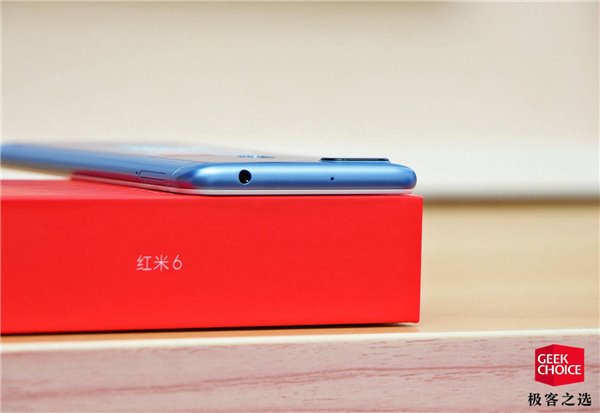
The infrared sensor is a feature Xiaomi has included in all its phones for a couple of years now. The small but useful addition allows users to control a wide range of electronics with their phone. Sadly, Xiaomi has decided not to include it in the Redmi 6 and Redmi 6A.
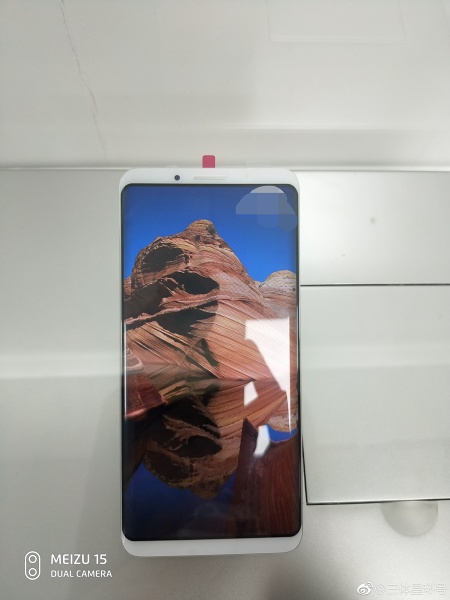
We first noticed the IR sensor was missing in hands-on photos of the Redmi 6 posted on ITHome. Then we decided to confirm on the official website and found out that Xiaomi didn’t include it in the Redmi 6A too.
It is sad to see Xiaomi has removed a feature that has sort of become associated with the brand. We do not know if this will continue with future devices or if it is just the Redmi 6 and Redmi 6A. If this is a feature you find you can’t live without, you may want to overlook these two phones and settle for Xiaomi’s older models.
Apart from the missing sensor, the Redmi 6A and Redmi 6 offer great value for money. Both devices come with a 5.45-inch screen with an 18:9 aspect ratio and HD+ resolution. The Redmi 6 is powered by MediaTek’s new Helio P22 SoC which should offer slightly more performance and power management when compared to the Snapdragon 625. It also has dual cameras, face unlock, and a fingerprint scanner.
The OnePlus 6 went on sale in China last month but availability has been limited to just the 6GB RAM + 64GB ROM Mirror Black model. Starting tomorrow, buyers will be able to purchase any model and color variant including the limited Avengers edition.
All the variants will be available on JD.com and the official OnePlus China website. The Avengers edition OnePlus 6 which has 8GB of RAM and 256GB of storage will sell for ¥4199 (~$652) while the 8GB RAM + 128GB ROM variant which is available in Silk White, Mirror Black, and Midnight Black will sell for ¥3599 (~$559).
The 8GB + 256GB Midnight Black model will sell for ¥3999 (~$621). OnePlus will also have its new Bullet wireless earphones available for ¥399 (~$62). You should be able to grab the phones for a lesser price on JD.com since tomorrow is 618 shopping festival.
The OnePlus 6 has a 6.28-inch AMOLED display with a 19:9 aspect ratio and a Full HD+ resolution. It is powered by the Snapdragon 845 processor and packs a 3300mAh battery. A 20MP+16MP dual camera combo sits on its back. There is also another 16MP camera positioned inside the notch.
One of the trends we expect to see in the phone industry in the coming years is the foldable smartphone. There are a number of top manufacturers like Samsung and Apple that have been developing one for years. However, ZTE, another top manufacturer beat them to it with its Axon M dual-screen foldable phone released last year.
For Samsung, there have been lots of patents and leaks giving us a glimpse of what they are working on, but for the first time, we get to see a live photo, albeit a canceled version of one Samsung’s early prototypes.
[envira-gallery id=”196568″]
While in development, the device was referred to as Project V and its model number was SM-G929F. What is striking about Project V is its design. It is the same type ZTE used for its Axon M. I think we can cut ZTE some slack now.
The device has two screens joined together by a hinge in the middle. The screen on the right is home to the old front-mounted fingerprint scanner pre-Galaxy S8. It also has capacitive navigational and multi-tasking buttons flanking it. At the top is the earpiece, a LED flash, and a camera. This is the only camera on the device.
A picture of the phone from another angle shows us the ports are attached to the screen on the right and it is also home to the device’s battery judging from its thickness. There is a speaker grille, a MicroUSB port, and a 3.5mm audio jack at the bottom. The SIM tray (and probably microSD slot) sits at the top.
There is no info on the specs of the device but some sources have said the phone was in development between 2015 and 2016, so its internals should be similar to Samsung flagships released in those years.
A leaked commercial that surfaced recently revealed that the Find X will be arriving with a notch-less display. It contradicted other rumors that claimed that the smartphone features a notched screen. Moreover, OPPO also teased that the Find X has a screen-to-body ratio of more than 90 percent. Today, well-known tipster Ice Universe has revealed an image on Twitter to reveal that the Find X will deliver a huge screen of 93.8 percent.
As it can be seen in the below image, the Find X is rumored to arrive with a tri-bezeless notch-less design. The render looks outstanding as it shows a presence of a very thin-sized chin and the other bezels appear almost non-existent. The screen-to-body ratio of 93.8 percent reveals that it would be offering a higher screen space than Vivo NEX that has a screen-to-body ratio of 91.24 percent.
Vivo and OPPO along with OnePlus are smartphone brands that belong to China’s BBK Electronics. Earlier this year, OPPO and Vivo both introduced notched display design on their smartphones. Even OnePlus joined the league by launching OnePlus 6 with same design. Now that Vivo has launched Vivo NEX with a marvelous notch-less screen with a very high screen space, there is a probability that OPPO will also offer a similar experience on the upcoming Find X flagship. This suggests that even the forthcoming OnePlus 6T or OnePlus 7 may also deliver a very high screen space to their users.
The TENAA listing of the Find X had revealed that it features a 6.4-inch display that supports 2K resolution of 2340 x 1080 along with an aspect ratio of 19.5:9. The handset measures 156.7 x 74.3mm which is just a bit taller than OPPO R15 that measures 155.1 x 75.2mm and features a 6.28-inch display.
The other rumored features of the Find X are Snapdragon 845, 8 GB of RAM, 128 GB / 256 GB internal storage, Android 8.1 Oreo, 3,645mAh or 3,730mAh battery. The leaked commercial of the smartphone has revealed that it has a glass rear with a curvy M-shaped black band that houses dual cameras separated by an LED flash. The handset is likely to arrive in colors like burgundy and blue. It is also expected to be packed with some advanced features like 5x loseless zoom, Super VOOC fast charging, in-display fingerprint scanner and 3D facial recognition.
The Find X is slated to go official on June 19 through an unveil event in Paris, France.
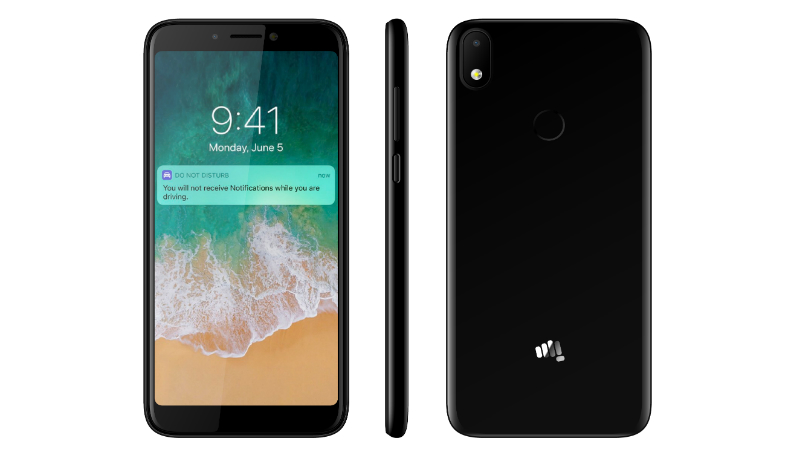
Micromax, the Indian mobile phone manufacturer, has launched its new smartphone in the Indian market — Micromax Canvas 2 Plus. The smartphone, priced at Rs. 8,999 (approximately $131), seems like an upgraded model of the Canvas 2 (2018) that was announced earlier this year.
The phone features a 5.7-inch HD+ 2.5D curved glass display with screen resolution of 1440 x 720 pixels, 18:9 aspect ratio, and 450 nits brightness. Under the hood, the device is powered by a 1.3GHz quad-core processor but the company has not yet revealed the specific chipset used in the device.
The smartphone packs 3GB RAM and 32GB internal storage, along with a microSD card slot which enables users to further expand the phone’s storage capacity. Coming to the camera specs, the device 13MP rear camera with LED Flash, 1.12um pixel size, 80-degree FOV, LED flash and an 8MP front-facing snapper for taking selfies and video calling.
Connectivity options include 4G VoLTE, WiFi 802.11 b/g/n, Bluetooth 4.0, and GPS. There’s a fingerprint sensor on the back of the phone as well as support for Face Unlock feature for added security. Running on Android 7.0 Nougat operating system out of the box, the smartphone is powered by a 4,000mAh battery.
The Micromax Canvas 2 Plus is available in two color options — Matte Black and Jet Black colors. The smartphone is priced at Rs. 8,999, which roughly converts to $131 and is now available for purchase through offline retailers across the country.
Further, the company has also listed Canvas 2 (2018) on the official website with similar specifications, but with 2GB RAM and 16GB storage which is also expected to be available soon.
OPPO’s Find X launches in just a few days and while there is a lot we already know about the specs, its overall design is still a mystery. A new teaser poster and TV ad have appeared online, giving us a glimpse of what to expect.
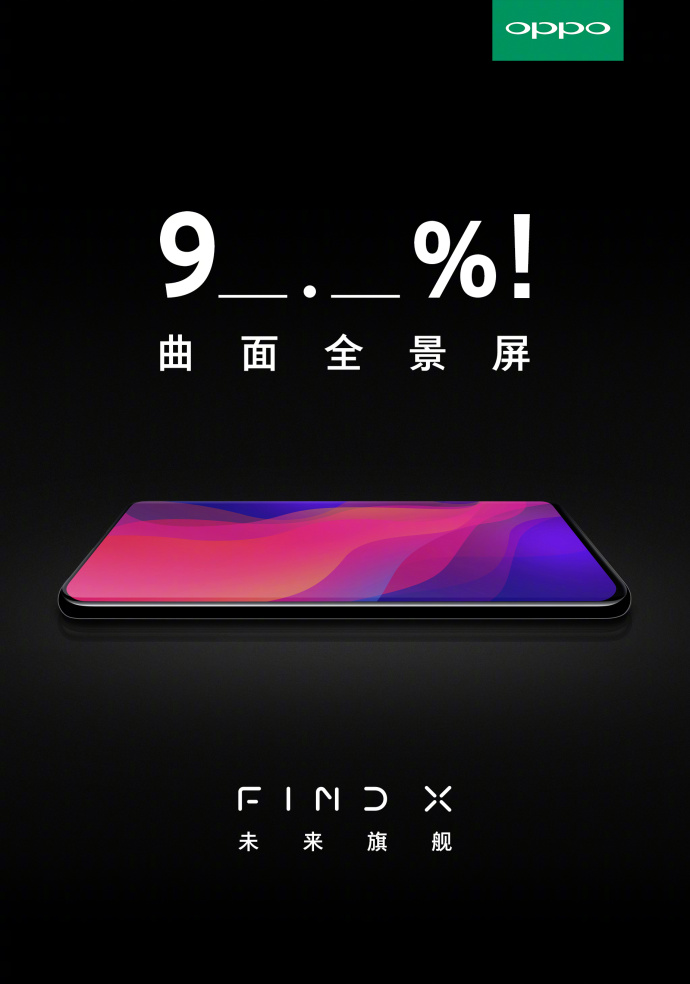
First, let’s examine the teaser poster. The image was shared on Weibo by the official OPPO account. It shows the Find X with a display that covers nearly all the front, save for a small bezel at the bottom. There is also no notch at the top.
Other than a picture of the phone, the poster also teases the phone’s screen-to-body ratio which should be over ninety percent seeing as the first figure is nine. To sum it up, the OPPO Find X should have a similar design to the Vivo NEX.
Next is the TV ad which was shown on one of China’s own state TV CCTV-1. The device has the same front design as the phone in the teaser poster above – a notch-less screen with a small bezel at the bottom. The interesting part of the ad is when we get to see the rear of the phone.
The back is covered in glass but has a black band in the shape of an M at the top. Within that black band sits dual rear cameras separated by a LED flash. The design is unlike what we have seen in recent phones and will surely make the Find X stand out from the crowd. The video also reveals the phone will come in two color variants – burgundy and blue.
The BlackBerry KEY² was announced in China on June 8. However, only the 6GB RAM + 64GB model has been available for purchase. If you have been waiting for the 128GB model, you can now pre-order it on Jingdong (JD.com) before it goes on sale on Monday, 18th of June.
The 128GB BlackBerry KEY² will sell for ¥4499 (~$699), about $78 more than the 64GB model which is priced at ¥3999 (~$621). Nevertheless, these prices are lesser than those of other markets.
The BlackBerry KEY² has a 4.5” screen, a Snapdragon 660 processor, and dual 12MP rear cameras. It also has an 8MP front-facing camera, a 3500mAh battery, and runs Android 8.1 Oreo.
BlackBerry has redesigned the keyboard by making the keys bigger and also including a new key called the Speed Key. The Speed Key is sort of like a function key which launches preset apps when you press it along with another key. BlackBerry says it should make multi-tasking faster.
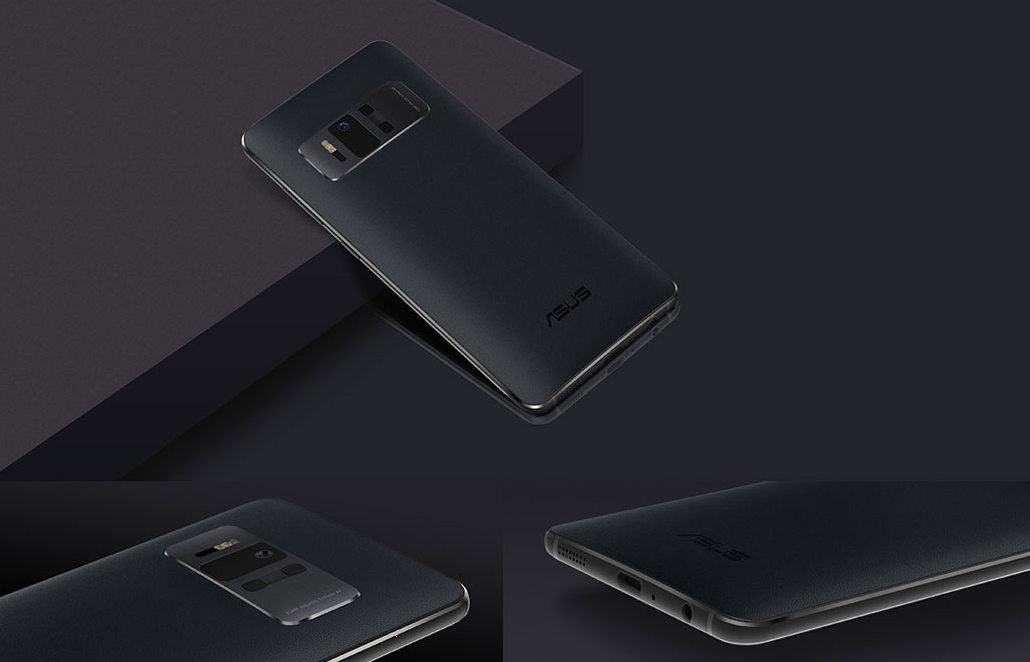
What do you do if you are trying to clear stock of an old and expensive phone? Rename it, slash the price, and pray that people don’t notice the difference or maybe they do and shouldn’t care since the new phone is selling for less. The above is what ASUS has done with the Zenfone AR which has been relaunched as the Zenfone Ares.
The Zenfone Ares is the Zenfone AR which is why ASUS didn’t bother to waste money having a launch event. The Zenfone AR, for those who don’t remember, was announced last year at CES as the first smartphone with 8GB of RAM and the first phone to support Google’s now abandoned Project Tango as well as Daydream VR.
The Zenfone Ares has a 5.7-inch Super AMOLED 2K display with a 1440 x 2560 resolution and Corning Gorilla 4. It is powered by the Snapdragon 821 which is paired with 8GB of RAM and 128GB of expandable storage.
The rear camera is a 23MP f/2.0 sensor (Sony IMX318) with 4-axis OIS and EIS, laser AF, and tons of shooting modes. It also has depth and motion tracking. Sitting above the display is an 8MP f/2.0 sensor.
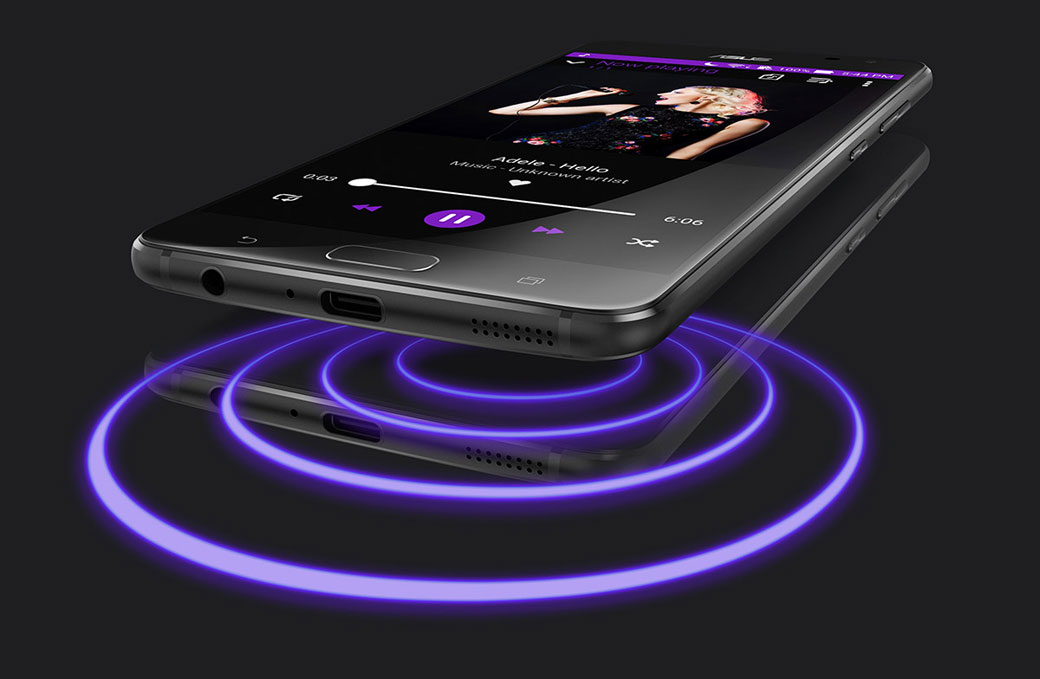
The Zenfone Ares has dts-HD support, a built-in NXP smart amplifier, and ASUS’ SonicMaster 3.0 for hi-res audio. It also has a 3.5mm audio jack. Its battery is 3300mAh with support for Quick Charge 3.0. There is a USB-C port with Display Port support, dual-band Wi-Fi, and Bluetooth 4.2 for connectivity. It also has a fingerprint scanner that doubles as the home button. Sadly, it still runs Android Nougat. It would have made more sense if it ran Android Oreo out of the box.
We use cookies on our website to give you the most relevant experience by remembering your preferences and repeat visits. By clicking “Accept”, you consent to the use of ALL the cookies.
This website uses cookies to improve your experience while you navigate through the website. Out of these, the cookies that are categorized as necessary are stored on your browser as they are essential for the working of basic functionalities of the website. We also use third-party cookies that help us analyze and understand how you use this website. These cookies will be stored in your browser only with your consent. You also have the option to opt-out of these cookies. But opting out of some of these cookies may affect your browsing experience.
Necessary cookies are absolutely essential for the website to function properly. This category only includes cookies that ensures basic functionalities and security features of the website. These cookies do not store any personal information.
Any cookies that may not be particularly necessary for the website to function and is used specifically to collect user personal data via analytics, ads, other embedded contents are termed as non-necessary cookies. It is mandatory to procure user consent prior to running these cookies on your website.