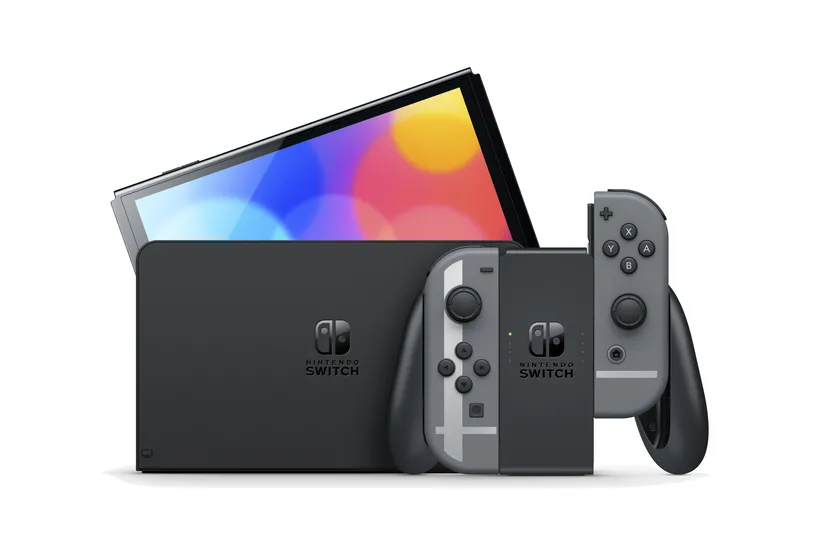
In a recent statement, Nintendo President Shuntaro Furukawa confirmed plans to unveil the successor to the popular Nintendo Switch console by the end of March 2025. This announcement marks a significant milestone, as it will have been over nine years since the original Switch debuted in March 2015.
Despite speculation surrounding the upcoming Nintendo Direct event scheduled for June, Furukawa clarified that the presentation will solely focus on software updates for the existing Nintendo Switch platform. This move aims to manage expectations and avoid disappointing fans eagerly anticipating news about the Switch successor.
The decision to confirm the announcement of the Switch successor ahead of the Nintendo Direct event is notable, signaling Nintendo’s commitment to transparency and its strategy for transitioning to next-generation hardware. However, Furukawa emphasized that details about the new console will not be discussed until a later date.
source: Nintendo.com
Recent rumors circulating within gaming communities suggest that the new console, often dubbed ‘Switch 2’, may feature innovative Joy-Con-style controllers that magnetically attach to the console. While no official specifications have been released, anticipation continues to build as fans await further updates from Nintendo.
In financial terms, Nintendo reported impressive performance for the fiscal year 2024, with sales of 15.7 million Switch consoles, generating 1.7 trillion yen in revenue and a net profit of 490.6 billion yen. However, the company forecasts a slight decline in sales for the current fiscal year, with an estimated 13.5 million Switch units expected to be sold, resulting in projected net sales of 1.35 trillion yen and net profit of 300 billion yen.
Despite the anticipated decline in hardware sales, Nintendo remains optimistic about its software offerings, with expectations to sell 165 million software units in the current fiscal year. Announced upcoming titles include highly anticipated releases such as “Paper Mario: The Thousand-Year Door” and “Luigi’s Mansion 2.”
Nintendo’s shares closed up 2.4% ahead of its earnings report, reflecting investor confidence in the company’s prospects despite uncertainties surrounding the transition to next-generation hardware. With the official announcement of the Switch successor expected within the current fiscal year, gaming enthusiasts worldwide eagerly await further details about Nintendo’s latest innovation.
Samsung is on the cusp of a major mobile chip breakthrough. Their first high-performance chip built on a cutting-edge 3nm GAA (Gate-All-Around) process is nearing mass production within the next few months. This marks a significant leap for Samsung Foundry, paving the way for faster, more efficient processors in future Galaxy devices.
Estimates suggest that these new chips will have a 300MHz clock speed increase
This complex chip, designed for high-end phones, boasts a CPU, GPU, and various modules. Samsung collaborated with Synopsys, who provided AI-powered design tools (Synopsys.ai) to optimize the chip’s performance and yield. Early estimates suggest these tools led to a potential 300MHz clock speed increase and a 10% power reduction.
The new GAA design specifically tackles past issues of high power consumption experienced with previous Samsung chips. While details are scarce, speculation suggests the chip might utilize Samsung’s second-generation 3nm GAA process (SF3) for better handling of intricate smartphone chip requirements. This first 3nm Exynos chip is expected to power upcoming Galaxy Watch 7 or Galaxy S25 series phones, and its mass production will be a crucial test of the GAA design’s effectiveness in addressing past shortcomings.
As per recent reports, Sonos is set to debut its first wireless headphones, the Ace, targeting the premium market currently dominated by Sony, Apple, and Bose. With a rumored price tag of $450, the Ace boasts features like active noise cancellation and transparency modes that rival the best.
The headphones also deliver spatial audio content via Bluetooth
The headphones offer lossless audio via Bluetooth and dynamic head tracking for spatial audio content. They can also deliver spatial audio for Dolby Atmos content when paired with a Sonos soundbar for TV audio passthrough. Similar to AirPods Max, the Ace features detachable magnetic ear cushions for easy replacement. While some metal construction ensures durability, the design prioritizes a lightweight fit for long listening sessions. Battery life matches Sony’s 1000XM5 at 30 hours.
A key question remains: how deeply will the Ace integrate with Sonos’ whole-home audio system? While private TV audio listening is confirmed, it’s unclear if Wi-Fi streaming or multi-room functionality is available. Wired options include 3.5mm and USB-C cables for lossless audio.
An official announcement is expected soon, possibly in June. Sonos might reveal further details on the Ace and their future hardware plans during their second-quarter earnings call today.
Sigma is rumored to be releasing a second-generation 24-70mm F2.8 lens on May 16th. Leaked images from SonyAlphaRumors point towards the fact that the lens will be available in E/L mount options.
The current iteration of this Sigma lens was released in November 2019
This new lens is expected to boast improvements over the first generation, including better optical quality, a more compact and lightweight design, and enhanced focusing and tracking capabilities.
The current Sigma 24-70mm F2.8 DG DN lens, released in November 2019, features 19 elements in 15 groups (including 6 FLD lenses, 2 SLD lenses, and 3 aspherical lenses) for impressive image quality. It has a constant f/2.8 aperture, minimum aperture of f/22, 11 aperture blades, and a minimum focusing distance of 18-38cm. The filter size is 82mm and it weighs 830g (E mount) or 835g (L mount).
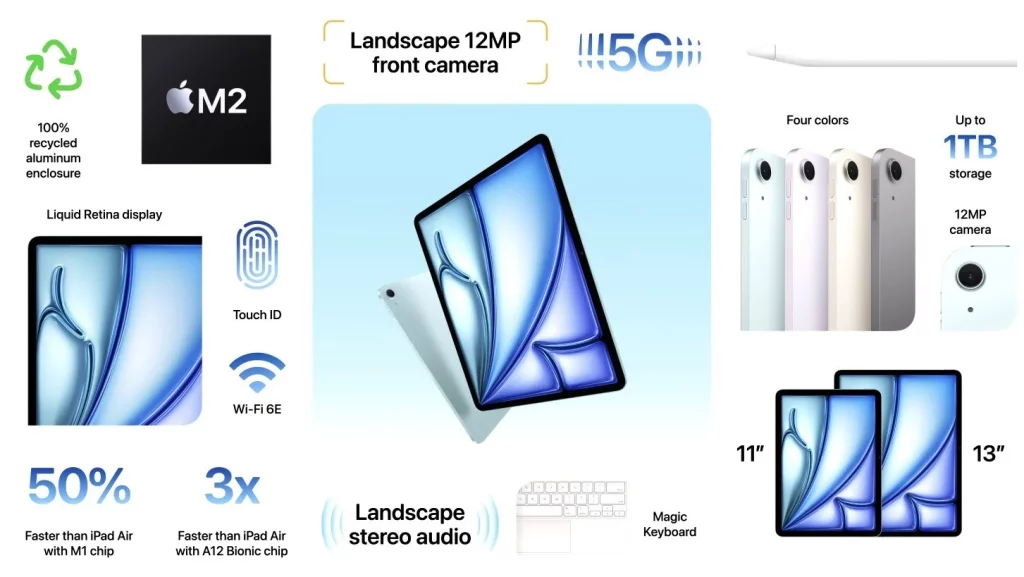
After a delayed launch as well as plenty of leaks and rumors, Apple has finally unveiled the next-generation iPad Pro and iPad Air tablets at the Let Loose event. The former packs significant upgrades over its predecessor and probably since the 2018 iPad Pro models. Meanwhile, the iPad Air 6th Gen arrives as the successor to the two-year-old iPad Air 5th Gen that debuted way back in 2022. The latest offerings come with much-needed upgrades along with a slightly new design. It now comes in a large 13-inch display size variant alongside the standard 11-inch model. Read on to know what the iPad Air 6th gen offers out of the box.
iPad Air 6th Gen unveiled
Alongside the standard 11-inch variant, Apple is introducing a larger 13-inch model for the first time with the iPad Air 6th gen. Both variants feature a Liquid Retina IPS LCD display. The 13-inch variant has a resolution of 2732×2048 pixels and 600 nits peak brightness.
The iPad Air 6th Gen retains the same overall design as its predecessor with a flat frame, a Touch ID button at the top, and volume rocker keys on the right side. One noticeable change is that the front camera sensor is now moved to the right side i.e. when the tablet is held in landscape mode. The stylus called as the Apple Pencil is still magnetically attachable on the right frame of the tablet. The latest iPad Air will also be compatible with the newly announced Pencil Pro. It also gets Pencil Hover feature that was limited to the Pro models.
The iPad Air 6th Gen retains the same cameras as its predecessor. There is a 12MP rear camera and a 12MP front-facing selfie snapper. The former supports Smart HDR and 4K video recording.
Under the hood, the iPad Air 6th gen houses Apple’s M2 processor. It is touted to be 50 percent faster than the M1 Air. Both variants now start at 128GB storage configuration which is bumped from the previous generation. The tablet supports WiFi-6E and 5G connectivity.
iPad Air 6th Gen pricing and availability
The iPad Air 6th Gen starts at $599 (~Rs 59,990 )for the 11-inch base model whereas the 13-inch variant starts at $799 (~Rs 79,990). It comes in four color options including Blue, Purple, Starlight, and Space Grey. Pre-orders for the tablet start today with sales commencing from April 15.
Sony has now confirmed a launch event for May 15, where the company intends to debut a new Xperia product. This news was shared through the brand’s official X (formerly Twitter) account. This launch event will be live-streamed on YouTube on May 15, 2024, at 16:00 Japan time / 9:00 CEST.
Go beyond your curiosity, a new Xperia is coming… Set a reminder for our big announcement on SonyXperia YouTube, 15th May, 2024 (Wed) – 16:00 Japan time / 09:00 CEST#SonyXperia#ProductAnnouncement#NextXperia
Although the brand has not revealed the exact model it intends to launch on May 15, it is expected to be the flagship Sony Xperia 1 VI. There is also a chance that the Xperia 5 VI and the Xperia 10 VI are also introduced at this launch event.
Recent leaks suggest that the Xperia 1 VI could debut with a 2K display with a 19.5:9 aspect ratio, 120Hz refresh rate, and BRAVIA HDR technology. The panel is also said to offer a 240Hz touch sampling rate.
Under the hood, it is likely to be powered by the flagship Snapdragon 8 Gen 3 processor, paired with a large 5,000mAh battery. For optics, the device is said to feature a 24mm primary lens with an Exmor T for mobile” stacked CMOS image sensor. It will also feature a 16mm lens and an 85-170mm telephoto zoom lens with up to 7X zoom capabilities. More details will likely be shared on May 15, so stay tuned for our coverage of the Sony Xperia launch event.
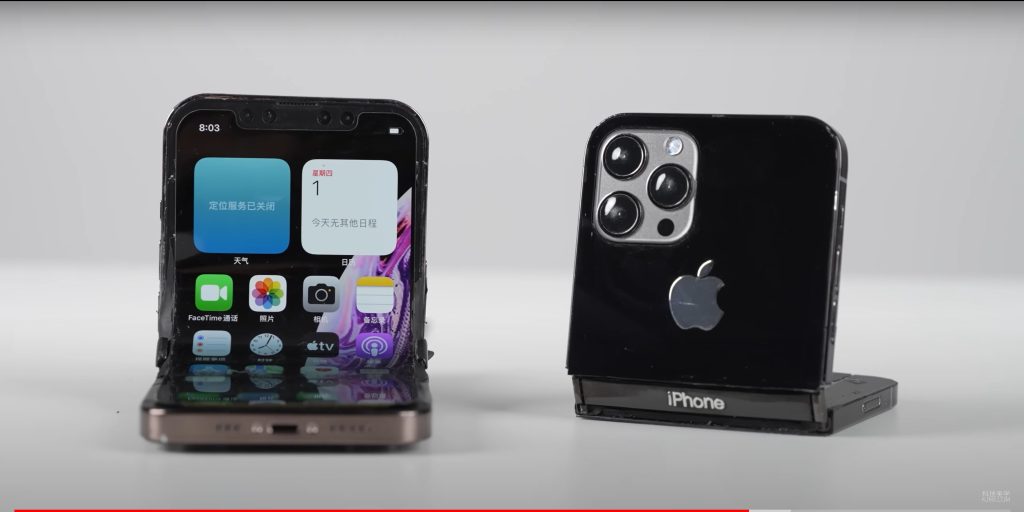
Apple is known to be working on a foldable iPhone for quite a while. The company filed a patent with the US Patent and Trademark Office (USPTO) last October. USPTO has now published the patent application, which reveals the key features of the hinge of Apple’s foldable device.
The company’s first foldable iPhone appears to be a flip-style device similar to the Samsung Galaxy Flip series. Apple’s hinge mechanism is rumored to offer a “greater range of motion”.
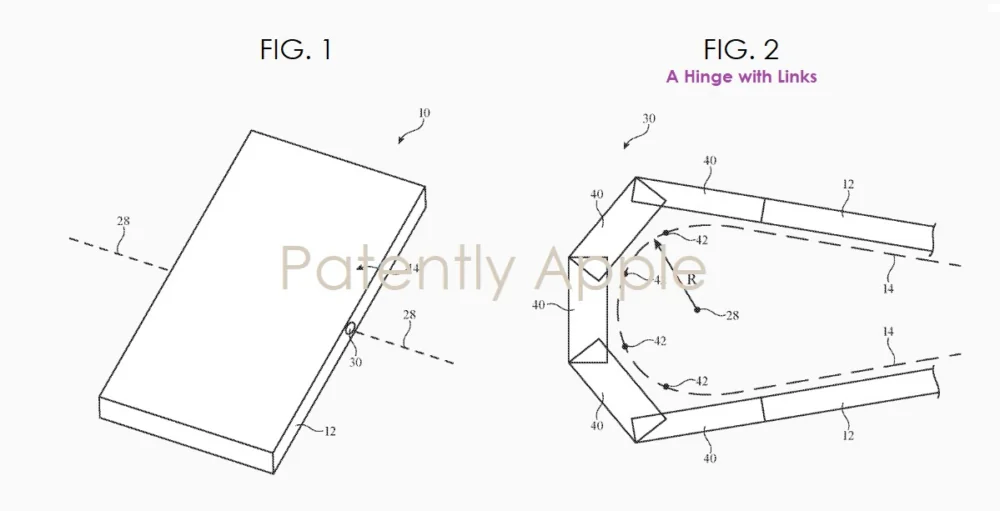
The FIG.1 represents a foldable Apple device, which according to the company, is a cellular phone, a computer, or other portable electronic device. So, Apple might be working on other devices such as a foldable iPad as well alongside foldable iPhones. Notably, Apple analyst Ming-Chi Kuo expected a hybrid foldable iPad-MacBook to go into mass production in 2027.
The FIG. 2 is a side view of a portion of an illustrative electronic device having a hinge with links. According to the company, the display may fold in both directions (inwards and outwards) with this hinge design. While it will be a one-of-a-kind device on the market, the company didn’t confirm that it will happen in the near future.
The patent images reveal that the foldable devices from the company will equip synchronization gear plates with interlocked teeth. It will allow for “synchronized rotational movement between the left and right halves of the hinge.” The hinge may have multiple interconnected points that may be coupled to each other for rotational motion.
Nonetheless, you should note that companies including Apple file multiple patents every about the technologies they are working on. However, only a few of them make their way to an end product. So, there’s practically no guarantee that a folding iPhone or another Apple device will hit the shelves with the patented technologies.
Earlier today, Realme announced that the GT Neo 6 smartphone is set to launch in China on May 9. Now the company’s India branch has shared an announcement from CEO Sky Li. It confirms the comeback of the Realme GT series smartphones in the country. Realme India has also started teasing the arrival on its official X (formerly Twitter) handle.
Realme GT 6 series confirmed to launch in India soon
The legend returns! 🔥
Our founder and CEO, Sky Li, has something every realme fan has been waiting for.
To mark its sixth-year anniversary, Li in a note said that Realme is excited to bring back its most loved flagship series. It is the sixth generation of the GT series. The exact name of the upcoming offering has not been revealed. It’s pretty confirmed that the Realme GT 5 would be skipped and the brand will instead launch the device under the GT 6 series moniker. It remains to be seen if the Realme GT Neo 6 SE or the forthcoming GT Neo 6 will arrive in India as a rebadged GT 6.
The note says that Realme aims to target the mid-premium market segment by delivering flagship-level performance. The GT series is a testament to the company’s pursuit of innovation, its relentless quest for superior quality, and its unwavering commitment to customers.
The teaser shared by Realme India shows a smartphone with a slim profile with power and volume rocker buttons located on the side. The former seems to double up as a fingerprint scanner.
The Realme GT Neo 3 was the last smartphone in the GT lineup that launched way back in 2022.
iQOO has confirmed that it intends to launch the iQOO Z9x 5G on May 16 in India. Ahead of the launch, the brand has confirmed that it will come powered by the Snapdragon 6 Gen 1 processor.
The Snapdragon 6 Gen 1 processor was launched back in September 2022, offering around 35% and 40% performance boost in GPU and CPU departments. The teaser also reveals an image of the upcoming smartphone, which looks quite similar to the iQOO Z9x which recently made its debut in China.
iQOO Z9x 5G (China)
If it does turn out to be identical to the Chinese model, then we can expect it to come with a 6.72-inch LCD FHD+ display with a 120Hz refresh, offering a peak brightness of 1000 nits. The Snapdragon 6 Gen 1 chip could be coupled with LPDDR4x RAM and UFS 2.2 storage, as well as a 6,000mAh battery with 44W fast charging.
For optics, we can expect the phone to come with a 50-megapixel Samsung S5KJNS primary sensor, along with a 2-megapixel GalaxyCore GC02M1B depth sensor, and an an 8-megapixel Samsung S5K4H7 front camera sensor. These specifications are still unconfirmed, so we suggest readers take it with a pinch of salt for the time being and stay tuned for more.
ASUS recently announced the MD200 SmartO mouse in India. Now, the Taiwanese brand has launched a new laptop under its ExpertBook series that is catered towards enterprise users. The latest offerings from ASUS is the ExpertBook B3 series which includes the B3404 CVA and B3604CVF. Both models have identical specifications apart from a few differences. Let’s take a look below.
ASUS ExpertBook B3 series specifications and features
The ASUS ExpertBook B3 series is MIL-STD 810H certified and military-grade durable with a metal internal chassis. Both models have a fingerprint scanner and a 720p HD IR webcam with a privacy shutter. The laptops have a 180-degree hinge, a spill-resistant backlit keyboard, and a large trackpad. The B3604 model features a full-sized numberpad.
The ASUS ExpertBook B3 series is offered in-touch and non-touch display options and an optional ASUS Pen 2.0 stylus. The B3404CVA features a 14-inch screen whereas the B3604CVF comes in a 16-inch display with both offering a WXGA resolution and a 120Hz refresh rate. Audio-wise, the laptops are equipped with 2W stereo speakers with Dirac Audio. There is a built-in microphone array and AI-powered noise cancellation.
Under the hood, the ASUS ExpertBook B3 series is equipped with up to 13th generation Core i7 U and P-series processor options. The U-series chipsets are coupled with up to RTX 2050 GPU onboard. The laptops pack up to 64GB RAM and 1TB SSD storage. They are offered in either 50Wh or 63Wh battery variants with support for fast charging via the bundled 65 or 90W charger. The machines are claimed to offer a battery life of up to 10 hours.
The ASUS ExpertBook B3 series has connectivity options like WiFi 6E, Bluetooth 5.3, Thunderbolt port, and USB-C.
The ASUS ExpertBook B3 series pricing will be announced at a later date. The laptops will be available on ASUS’s website as well as online and offline channels.
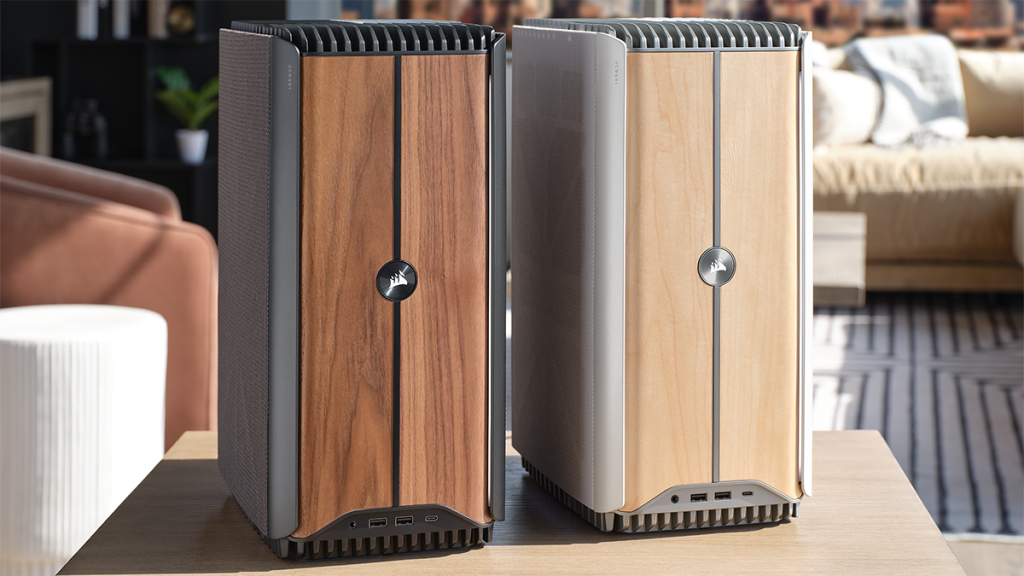
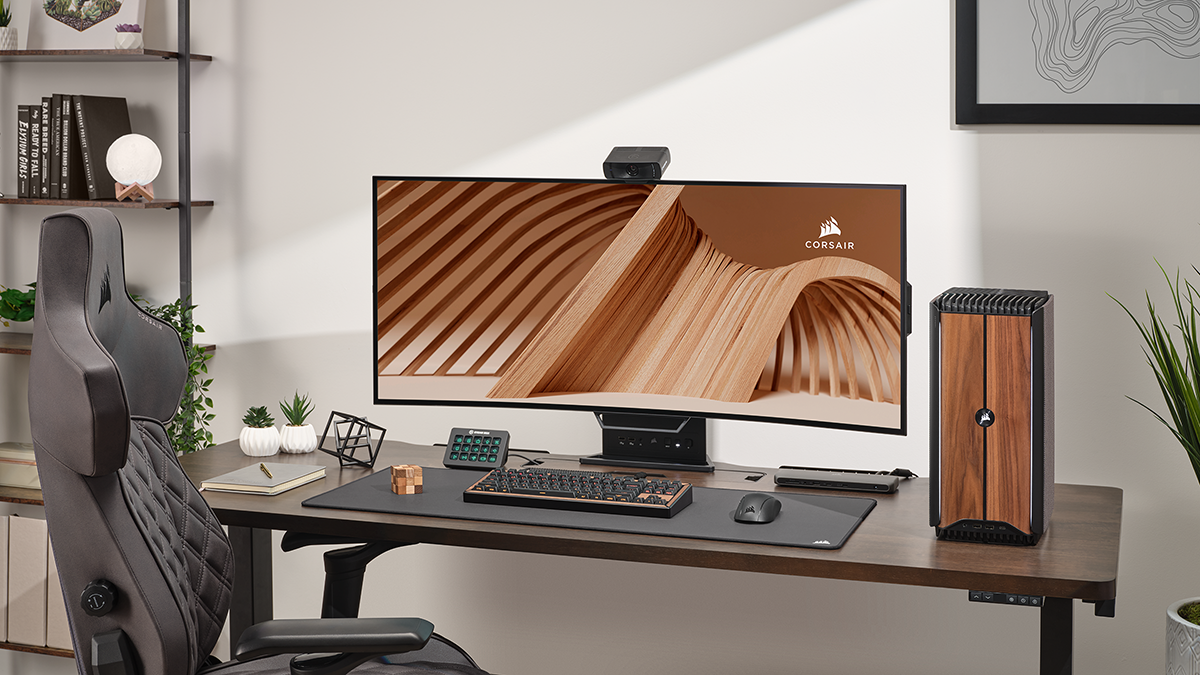
Corsair has refreshed its ONE i500 pre-build desktop PC. Despite being 30% smaller than a standard desktop, the Corsair ONE i500 is equipped with top-tier hardware components, including an Intel Core i9-14900K processor and an NVIDIA GeForce RTX 4090 graphics card, both featuring advanced liquid cooling technology.
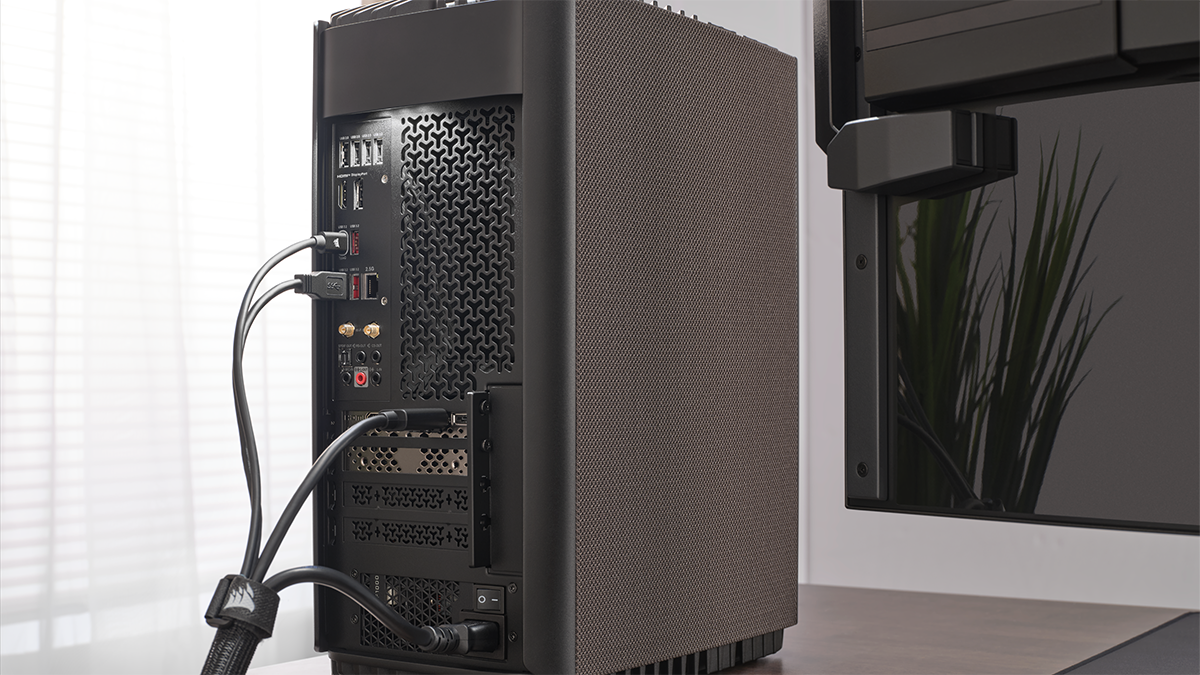
The Corsair ONE i500 has a sturdy aluminum body with front panels made of real wood, available in either maple or walnut. It also includes customizable RGB lighting and a touch-sensitive LED on the back to light up the ports. The sides feature magnetically attached dust filters for easier cleaning.
The PC comes with cutting-edge DDR5 memory and 2TB of NVMe SSD storage, which means faster loading times and plenty of space for files and applications. It also allows for upgrades with options for up to 192GB of RAM and 24TB of storage.
Pricing & availability
Available directly from Corsair’s online store, the ONE i500 starts at $4699.99 and comes in two colors: light gray with light wood or dark gray with dark wood, both with 64 GB of DDR5 RAM and a 2TB M.2 SSD.
The Moto Edge 50 Ultra debuted in the global market last month. It will launch as a rebranded Moto X50 Ultra in China. The device was recently spotted on the 3C platform with 125W charging support. Now, it has appeared on TENAA certification website. It reveals the key specifications including the RAM and storage configurations. It’s worth noting that the Lenovo-owned brand is yet to reveal the launch date of the X50 Ultra.
Moto X50 Ultra appears on TENAA
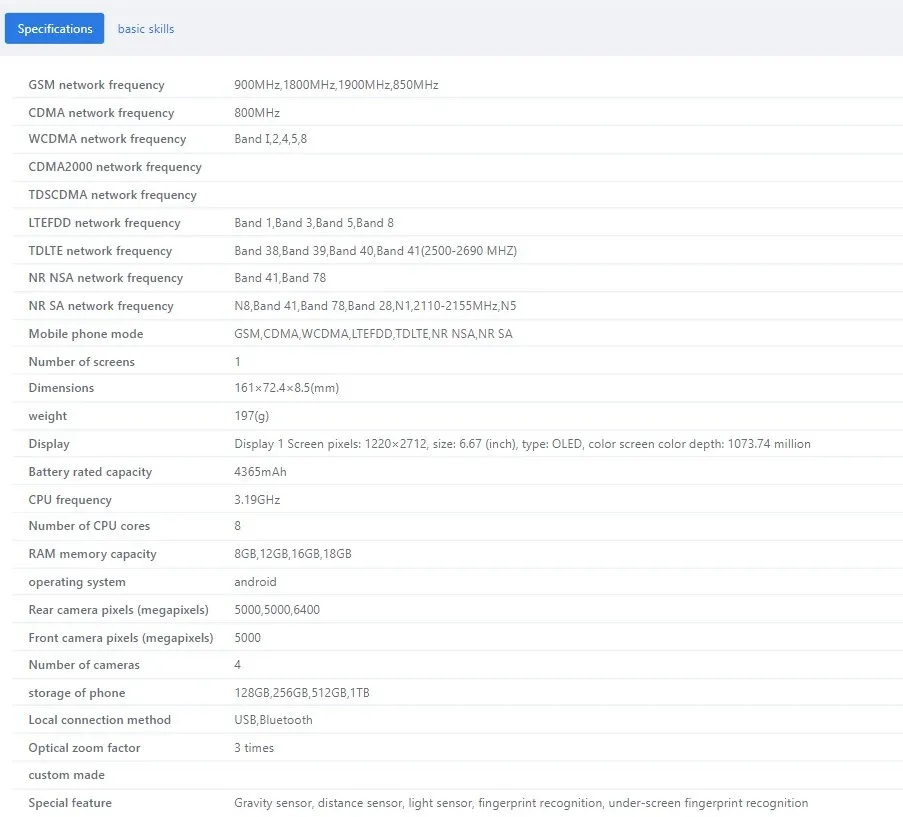
The Moto X50 Ultra carries a model number XT2401-2 on the TENAA site. The images of the device reveal a curved display with a centre-aligned punch-hole cutout and a squarish camera module housing two 50MP sensors and a 64MP lens that could be a periscope unit.
As per the certification website, the Moto X50 Ultra will feature a 6.67-inch OLED display bearing a resolution of 1,220 x 2,712 pixels. It will be powered by an octa-core 3.19GHz processor that is the Snapdragon 8s Gen 3 which is already confirmed by the brand. The upcoming smartphone is listed with 8GB, 12GB, 16GB, and 18GB RAM options. The storage options are said to be 128GB, 256GB, 512GB, and 1TB. As per TENAA, the Moto X50 Ultra will be backed by a 4,365mAh battery which is smaller than the global Edge 50 Ultra. It’s likely that Motorola will advertise it as 4,500mAh on the X50 Ultra.
Motorola has already teased AI features on the upcoming X50 Ultra. However, it remains to be seen what these features are. Notably, this is also expected to be the key difference between the China and global variants.
OnePlus‘ popular Nord lineup is expected to get a new mid range handset soon. The Nord CE 4 Lite is the device in question and it may offer a number of upgrades over its predecessor. So here’s everything you need to know about this smartphone.
OnePlus Nord CE 4 Lite could be a rebranded Oppo A3
The brand’s upcoming device was just recently spotted in a leak. Tipster Sanju that it will be equipped with the Qualcomm Snapdragon 6 Gen 1 SoC. This is a noticeable upgrade over its predecessor, the Nord CE 3 Lite. To recall, the older model launched with the Snapdragon 695 SoC. So we can expect the Nord CE 4 Lite to offer improved performance overall.
This is a respectable mid range chipset that can handle most tasks and even gaming to a degree. Interestingly, the chip is also featured on the Honor X9b. The Nord CE 4 Lite is also expected to offer 8GB or 12GB of RAM along with up to 256GB of internal storage.
2. CE Lite now features AMOLED
OnePlus unveiled the Nord CE 3 Lite back in 2023 with a tall 6.72-inch IPS LCD panel that offered Full HD+ resolution and 120Hz refresh rate. But the tipster has claimed that the Nord CE 4 Lite will come with a bunch of upgrades over its predecessor, and the display is one of them. Apparently, the newer device will feature an AMOLED display. Although, it is slightly shorter, measuring 6.67 inches but is rumored to retain a 120Hz refresh rate and FHD+ resolution. The screen will also house an in-display fingerprint scanner.
3. Larger battery for better endurance
OnePlus may boost the battery life as well on the Nord CE 4 Lite. While the 5,000mAh battery pack on the Nord CE 3 Lite was respectable, it seems like the brand is opting to offer more longer battery life to its users. The Nord CE 4 Lite is expected to be powered by a larger 5,500mAh cell. Rumors have hinted that its an Oppo A3 rebrand, so its fast charging might be limited to just 33W, down from the 67W on the Nord CE 3 Lite.
4. New Cameras
It is unclear whether the newer mid range handset will offer a triple camera setup as well, since the leak only revealed two cameras. Although, the image sensors are getting a change as well. The Nord CE 4 Lite will feature a 50-megapixel primary camera and a 2-megapixel secondary lens. Meanwhile, the front may house a 16-megapixel selfie shooter. For those unaware, its predecessor came with a 108-megapixel triple camera setup and a 16-megapixel selfie shooter.
5. Indian launch confirmed?
Earlier this week, the yet-to-be-released smartphone was spotted on the Bureau of Indian Standards (BIS) database. It was seen carrying the CPH2619 model number. Finer details like the launch date or specs weren’t revealed in this certification, but it basically confirms that it will be available in the Indian market.
Xiaomi has launched a new thermal flask under its Mijia sub-brand, the Mijia Light Enjoy Thermal Flask. The flask is designed to cater to the everyday needs of individuals seeking a reliable beverage container. It is priced at just 99 yuan (roughly $14) and is now available on Xiaomi Youpin Mall and JD.com.
This product features a 316L stainless steel inner liner, renowned for its durability and resistance to heat and corrosion. The inner liner is impressively thin at 0.12mm, achieved through a process of uniform thickness treatment and spiral thinning. It’s particularly suitable for various beverages, ensuring the drink’s purity is maintained.
This thermal flask offers a substantial capacity of 500ml, making it a practical choice for both travel and office use. The flask is designed to be portable and lightweight, with an overall weight of about 215 grams and dimensions of 65 x 65 x 217 mm, making it easy to carry around.
The thermal flask comes with advanced thermal insulation capabilities. It is engineered to keep liquids warm at 68 degrees Celsius for up to 6 hours and can keep them cold at 10 degrees Celsius for the same duration. This is achieved through a multi-layer insulation system that includes an ultra-microwave copper plating technology.
The design of the flask also emphasizes convenience and user comfort. It features a cup lid with a built-in 360-degree silicone sealing ring that prevents leakage, even when the flask is inverted. The outer surface is treated with a skin-friendly paint finish, providing a comfortable and secure grip.
It also includes a threaded screw cap for efficient sealing, a PP drinking mouth that is safe and odorless, and a silicone bottom pad that adds durability and provides a non-slip grip.
The Mijia thermal flask is available in White, Navy Blue, and Misty Blue colors, each designed to complement a stylish aesthetic.
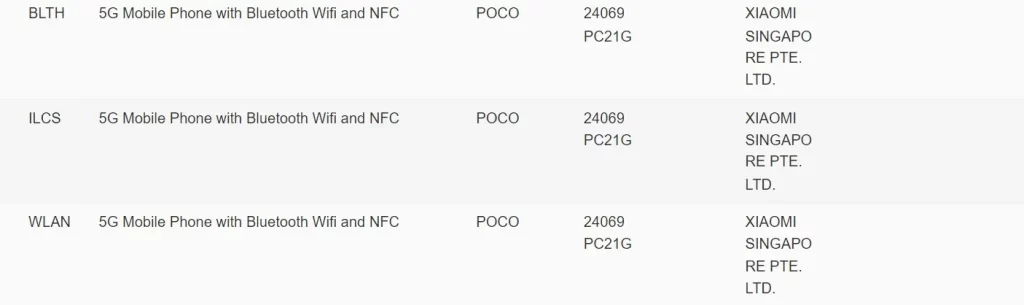
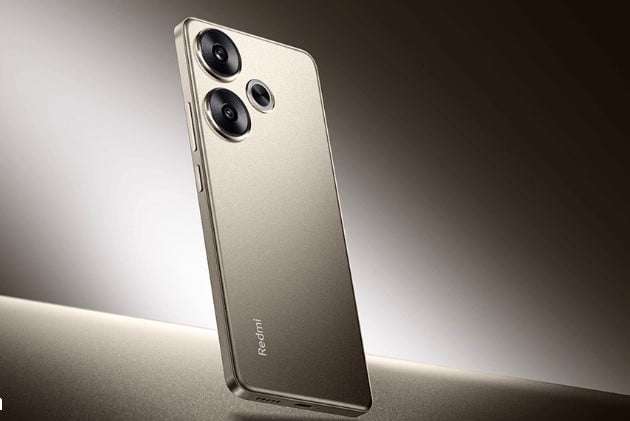
Poco is gearing up to launch its F series smartphones in the global market soon. We recently reported on the launch timeline of the Poco F6 Pro, and now, the vanilla Poco F6 has emerged on Singapore’s IMDA certification, indicating that the launch is near.
The Poco F6 has been spotted with model number 24069PC21G on Singapore’s IMDA certification database. We know this model number belongs to the Poco F6 as a previous NBTC database sighting has already confirmed the moniker.
While these listings do not reveal specifications, the Poco F6 will reportedly be a rebranded version of the Redmi Turbo 3. With that in mind, we can expect the Poco F6 to come with a 6.67-inch AMOLED display featuring 1.5K resolution, and a 120Hz refresh rate.
Under the hood, it could feature a Snapdragon 8s Gen 3 chip, paired with 12 GB of LPDDR5x RAM and up to 512 GB of UFS 4.0 storage. For optics, a 50-megapixel main sensor (Sony IMX882) with OIS and an 8-megapixel ultra-wide sensor (IMX355). It could also feature a 5,000mAh battery and support 90W fast charging.
In an accidental listing, Asus has seemingly confirmed the upcoming launch of 14 new laptops powered by AMD’s next-generation Strix Point processors.
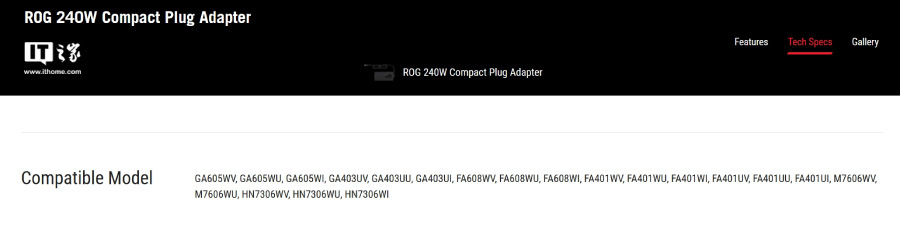
Chinese media outlet IT Home caught wind of this when Asus accidentally included the model numbers of these laptops in the compatibility list for the Asus ROG 240W Compact Plug power adapter. However, when we checked, the listing had already been taken down.
While there isn’t much info out there about the upcoming Strix Point processors, leaks suggest they will feature an upgraded XDNA 2 NPU compared to the current Ryzen 8040 (Hawk Point) lineup. AMD has previously claimed this new NPU will deliver three times faster performance.
The chip maker will likely share more details about the silicon at the upcoming Computex 2024 event in June.
As for the laptops, IT Home suggests the upcoming Asus laptops with “W” suffixes will have the new Strix Point APUs. Conversely, models with “U” suffixes are expected to retain the current Hawk Point processors.
Here’s a breakdown of the leaked Asus laptops based on the model numbers:
Asus TUF Gaming (A14 Series):
FA401WU: Strix Point APU with RTX 4050 GPU
FA401WI: Strix Point APU with RTX 4070 GPU
FA401WV: Strix Point APU with RTX 4060 GPU
FA401UI: Hawk Point APU with RTX 4070 GPU (currently available ROG Zephyrus G14 price: $1,349.99 on Best Buy)
FA401UV: Hawk Point APU with RTX 4060 GPU
FA401UU: Hawk Point APU with RTX 4050 GPU
Asus ROG Zephyrus G16 (AMD Edition):
GA605WI: Strix Point APU with RTX 4070 GPU
GA605WU: Strix Point APU with RTX 4050 GPU
GA605WV: Strix Point APU with RTX 4060 GPU
Asus TUF Gaming (A16 Series):
FA608WI: Strix Point APU with RTX 4070 GPU
FA608WV: Strix Point APU with RTX 4060 GPU
FA608WU: Strix Point APU with RTX 4050 GPU
ASUS Creator ProArt X13:
HN7306WI: Strix Point APU with RTX 4070 GPU
HN7306WV: Strix Point APU with RTX 4060 GPU
HN7306WU: Strix Point APU with RTX 4050 GPU
Asus Creator ProArt P16:
M7606WV: Strix Point APU with RTX 4060 GPU
M7606WU: Strix Point APU with RTX 4050 GPU
The pricing and availability details of these laptops are under wraps. We can expect Asus to shed more light on these new laptops in the coming weeks, possibly at the Computex 2024.
Android 15 testing is in full swing, with multiple developer preview and beta builds already out for the testing purpose. And more beta builds are in the pipeline until Google is done making all the changes and fixing known issues. While we are nowhere near the Android 15 stable release, there’s a lot of interest among Motorola users in knowing if their device will get the Android 15 update.
Unlike the previous two iterations of the OS, Android 13 and Android 14, the yet-to-be-released Android 15 will be an exciting upgrade. The early builds have revealed many exciting features of the OS, which I’ll tell you about in the later part of this post. For now, let’s look at which Motorola devices are eligible for the next Android upgrade.
Motorola hasn’t yet published a list of devices planned for the Android 15 upgrade. However, the brand rolls out three major Android updates to select mid-range and flagship devices. While entry-level and budget phones only get one major OS update. Based on these data, we have curated the above list of Motorola devices that should get the Android 15 update.
It’s not a final list by any means. We’ll regularly update it based on the latest Android 14 information. Hence, regularly visit the page for fresh information.
When Will Motorola Start Rolling Out the Android 15 Update?
Android 15 is currently going through the beta phase, which should last until June 2024. In this phase, Google tests new features and resolves existing bugs and problems. Once the beta phase is over, the new OS enters the platform stability phase for refinements and bug fixing to prepare it for the final release.
Last year, Google released the Android 14 in October, alongside the Pixel 8 series. And the tech industry is expecting the same with Android 15. So, the Android 15 might come in October. Around the same time, Google will also unveil its next flagship smartphone series – Pixel 9. These could be the first phones to come with Android 15 out of the box.
Motorola doesn’t have a good software rollout history. The brand started rolling out the stable Android 14 update earlier this year when other brands such as Samsung and OnePlus had already released it for dozens of their phones. Hopefully, Motorola will do better this time with Android 15, but in all likelihood, we aren’t expecting the stable rollout to begin soon after the Android 15 release, at least not until December.
However, you might be able to get an early taste of Android 15 by installing the beta builds. As you already know, newer high-end phones are given priority in anything related to software rollout.
What’s New in Android 15?
These are some of the best features discovered in the Android 15 developer preview and beta builds:
Satellite Connectivity Support
This feature has been spotted in Android 15 developer builds and is expected to be released as a part of Android 15. If that’s true, all Android 15-supported devices will have satellite connectivity support.
Android 15 supports satellite connectivity for SMS apps and RCS apps for sending and receiving messages. In other words, the satellite connectivity on Android 15 might not be limited to emergency uses only.
Partial Screen Sharing
Android 15 makes screen sharing better and more privacy-focused by introducing the partial screen sharing feature. You’ll be able to share the screen for a single app rather than the entire screen. This feature also works with screen recording. Android 14 or older devices record everything displayed on the screen.
Notification Cooldown
Android 15 introduces the “Notification cooldown” feature, which lowers the notification volume of successive notifications coming from the same app. This could be an important feature if an app sends you too many notifications in a small period.
Universal Keyboard Vibration Control
Android 15 will let you universally disable keyboard vibration. The new “keyboard vibration” toggle, when turned off, overrides individual keyboard app settings. However, you will be able to control the haptics of each keyboard app by disabling it.
Sensitive Notifications
The “Sensitive Notifications” feature is a much-needed addition to Android 15 that will prevent codes from being read by other apps. Malicious third-party apps with access to SMS permission can read your OTPs and other important details, which could cost you big. Android 15’s sensitive notifications feature aims to make them more secure.
Edge-to-Edge Apps
All apps in Android 15 might be forced into edge-to-edge display by default. This should result in a more immersive experience and better readability. This feature is already present in iPhones, which adds to a better user experience. Finally, Android is bringing it into its arsenal.
High-Quality Webcam
Android 14 QPR 1 for Google Pixel phones added a feature to use your Android phone as a webcam for a PC, but the output quality was basic. Android 15 resolves this problem by adding a high-quality webcam mode that disables power optimizations.
This feature has been spotted in Android 15 Developer Preview 2, where a new “HQ” symbol appears in the webcam preview. As it disables power optimizations, expect some battery drain.
It’s rumored that Google might include a new Powered Off Finding API to allow users to find their Android 15 smartphones even if they’re powered off. If true, this could be a big change for Android smartphones. Read more about it here in detail.
The setting in a video game is an important aspect of the immersion for gamers. The Tomb Raider franchise has always taken us to exotic locations and the next adventure might be set in the diverse land of India. The last game starring Lara Croft was released quite a while back. But now, a fresh leak has hinted at a major shift to open world adventure.
Lara Croft rides into Open World on a motorbike in India
Crystal Dynamic first announced the upcoming next Tomb Raider game two years ago. While details were sketchy, the studio confirmed that it will be based on the Unreal Engine 5 game engine. However, a fresh leak from V Scooper has given us more details regarding this upcoming Lara Croft title. The tipster claims that the franchise is moving to open world, which will have Lara traverse the large map using new traveling mechanics.
This includes a new motorbike and a parachute. The former confirms large distances across open roam areas and the parachute gives us an idea of tall elevations. The leaker adds more details regarding the setting, enemy faction, and gameplay. Apparently, a natural disaster caused havoc in northern India and uncovered the ancient ruins of emperor Ashoka. These ruins contain various artifacts, but Lara isn’t the only one after them.
She is rumored to face off against a Society of Raiders. It is unclear if they are an opposing side or a neutral party altogether. However, one interesting gameplay aspect is the recruiting feature to build teams by strategically selecting allies for missions. Gamers are facing a burn out with open world games, so it remains to be seen how the Tomb Raider franchise handles this tiring genre.
Rumored for October launch, there’s enough time for Google to cook its Pixel 9 series smartphones. The lineup this year is expected to include three smartphones compared to two on the predecessor — the Pixel 9, Pixel 9 Pro, and Pixel 9 XL.
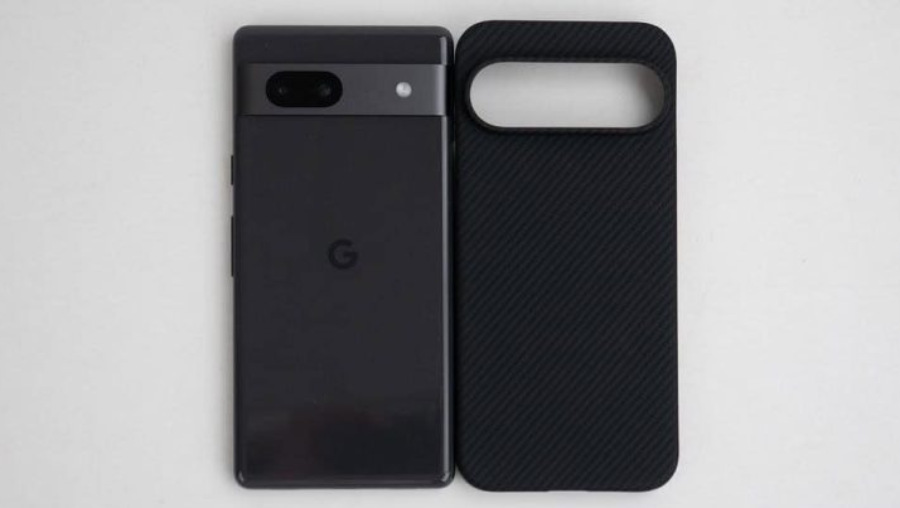
A fresh leak from Android Centraladds weight to reports of Google releasing three Pixel 9 phones. Allegedly, the publication has received cases for all the Pixel 9 models from case maker Thinborne.
The cases reveal some physical details about the Pixel 9 design. They reveal flat sides and smooth corners for the phones, a shift from the curved design of the Pixel 8.
They still keep the signature camera bar on the back, but there are rumors that it may adopt rounded ends this time around. Renders of all the devices in the Pixel 9 series have been leaked which shows similar changes hinted at by the cases.
As far as the specs go, the Pixel 9 phones are expected to be powered by the Tensor G4 chip. A leak last month revealed that the Pixel 9 Pro will come packed with up to 16GB of LPDDR5X RAM and 128GB storage. We can expect a similar memory configuration for the Pixel 9 XL as well.
The base Pixel 9 is expected to stick with the dual-camera setup as its predecessor. Pixel 9 Pro and 9 Pro XL will likely have a triple camera setup on the back.
Moreover, a rumor last month revealed that Google might rename the upcoming Pixel Fold 2 as the Pixel 9 Pro Fold. There might also be Pixel 9a which may debut in 2025. So that means the Pixel 9 line will technically have five devices in its portfolio.
Nintendo Switch continues to shatter sales records. Released in 2017, the hybrid console has sold over 140 million units in its lifetime, closing in on the PlayStation 2’s all-time record. As the company celebrates this success, it is also carefully planning its next generation of hardware.
At the center of these plans is, of course, the highly anticipated Nintendo Switch 2. Rumors regarding the console’s release date have been swirling for a long time, with speculation ranging from immediate availability to an imminent launch. However, Nintendo President Shuntaro Furukawa has yet to announce a release date for the Switch 2. Here are the details…
When Will Nintendo Switch 2 Be Released?
The question of “When will the Nintendo Switch 2 be released?” has been on everyone’s mind for a long time. However, during a meeting with shareholders, Nintendo President Shuntaro Furukawa provided an answer.
In his speech, Furukawa stated that they would announce the release of the Nintendo Switch 2 within this fiscal year, guaranteeing its release before April 2025. Nintendo’s fiscal year ends on March 31st.
Furukawa also emphasized that they would host an event in June, but it would solely focus on Nintendo games, with no details about the Switch 2. The Nintendo Switch 2 is expected to debut between July 2024 and March 2025.
Expectations for the new console include stronger graphics, better battery life, a smoother experience with technologies like DLSS, and more. While it’s still unclear how many of these expectations the company will meet, we’ll likely have a clearer picture after the June event.
We use cookies on our website to give you the most relevant experience by remembering your preferences and repeat visits. By clicking “Accept”, you consent to the use of ALL the cookies.
This website uses cookies to improve your experience while you navigate through the website. Out of these, the cookies that are categorized as necessary are stored on your browser as they are essential for the working of basic functionalities of the website. We also use third-party cookies that help us analyze and understand how you use this website. These cookies will be stored in your browser only with your consent. You also have the option to opt-out of these cookies. But opting out of some of these cookies may affect your browsing experience.
Necessary cookies are absolutely essential for the website to function properly. This category only includes cookies that ensures basic functionalities and security features of the website. These cookies do not store any personal information.
Any cookies that may not be particularly necessary for the website to function and is used specifically to collect user personal data via analytics, ads, other embedded contents are termed as non-necessary cookies. It is mandatory to procure user consent prior to running these cookies on your website.