After updating the Blaze 5G and Yuva 2 smartphones last week, Lava has now started pushing a new update for its most popular 5G smartphone, aka the Lava Agni 2.
Lava has officially announced the release of the latest security update for the Lava Agni 2 smartphone, aimed at enhancing the overall security of the device. This update incorporates the October 2023 security patch, addressing potential vulnerabilities and fortifying the device against security threats. It is crucial to update to this latest version as Google has fixed a total of 53 vulnerabilities with the October patch, two of which were actively being exploited.
Additionally, the update includes fixes for certain bugs, contributing to an improved and more stable user experience. To ensure that your Lava Agni 2 is equipped with the latest security enhancements, you can easily initiate the update process by navigating to the Settings menu, followed by System, Advance, and finally, System Update. Keep your device up to date to benefit from the latest security measures and performance improvements.
Lava Agni 2 5G specs:
The Agni 2 5G sports a 6.78-inch Full HD+ AMOLED display with a 120Hz refresh rate, HDR10+, and a 105% NTSC color gamut. It is powered by the MediaTek Dimensity 7050 processor and runs on Android 13. Camera-wise, it features a 50MP quad-camera setup on the rear and a 16MP front camera. Connectivity options include 5G support, in-display fingerprint sensing, and a 66W fast-charging battery via the USB-C port.
In related news, Lava is said to be working on a new smartphone called the Lava Agni 2S. This device will offer similar specifications to the Agni 2 5G, however, it will have a different processor.
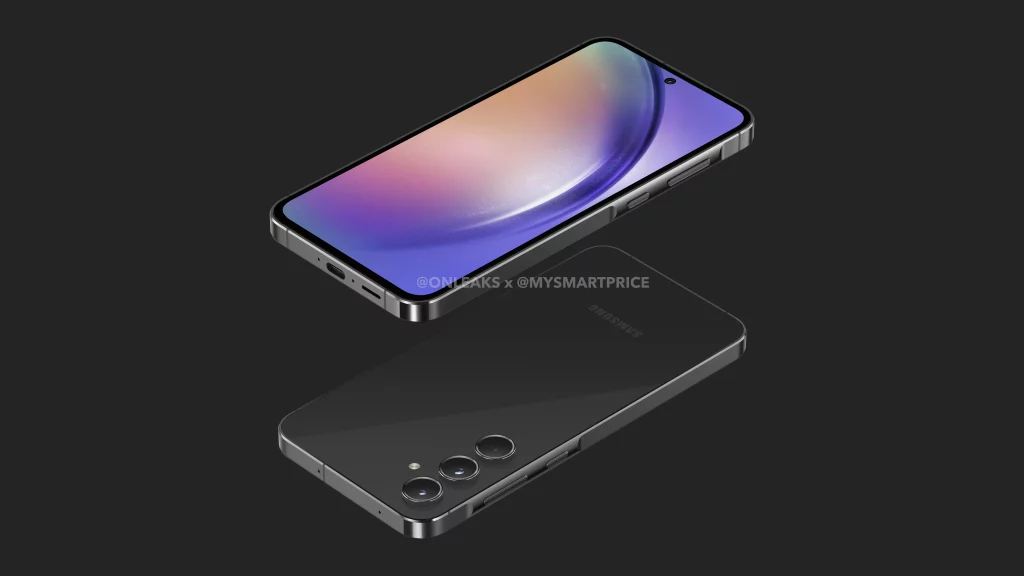
Samsung is expected to launch its next-generation Galaxy A-series smartphones next year. So far, we have already gotten a look at the Galaxy A35 5G, Galaxy A15, and the Galaxy A25 5G in the form of leaked renders. Now, the Samsung Galaxy A55 has also surfaced in CAD-based leaked renders revealing its design from all angles. The device is expected to arrive as the successor to the Galaxy A54 that was announced in March this year.
Samsung Galaxy A55 emerges in leaked renders
Right off the bat, the Samsung Galaxy A55 is seen with a boxy form factor. We can notice a protrusion on the right frame where the power and volume rocker buttons are located. It’s safe to say that the South Korean brand is making this design mainstream on the upcoming Galaxy A phones as it has also been spotted on the Galaxy A35 and A15. The back panel of the device has three vertically stacked triple rear cameras.
The bottom port of the Samsung Galaxy A55 has a USB-C port and a speaker grille. There is a SIM card tray on the top edge. The renders do not reveal a 3.5mm jack. On the front, the smartphone has a centre-aligned punch-hole cutout display measuring 6.5 inches. The screen is surrounded by thin bezels. Dimension-wise, the Galaxy A55 will measure 161.1 x 77.3 / 77.9 x 8.2mm. The Galaxy A55 is seen in a Black color option.
A report from earlier today revealed that the Samsung Galaxy A55 as well as the A35 will boast a metal unibody replacing the plastic ones from their predecessors. This will give both phones a premium look. Past reports suggest that the Galaxy A55 will be powered by the unannounced Exynos 1480 processor with support for AMD GPU. The 3C certification of the device revealed support for 25W fast charging.
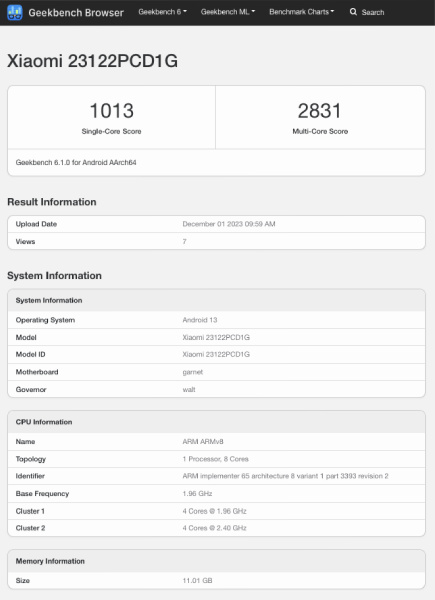
The Poco X6 series is expected to launch soon, with at least two phones in the lineup: the Poco X6 and the Poco X6 Pro. The phones have already been spotted on multiple certification websites, suggesting that a launch is imminent. The Poco X6 has now been listed on Geekbench, revealing some of its key specifications.
Poco X6 Geekbench listing
The Geekbench listing reveals that the Poco X6 scored 1013 in the single-core test and 2865 in the multi-core test. It also confirms that the phone will be powered by an octa-core processor with a maximum CPU clock speed of 2.40GHz.
This is most likely the Snapdragon 7s Gen 2 chipset. The chipset is paired with Adreno TM 710 GPU. Additionally, the phone is running on Android 13 OS and packs 12GB of RAM.
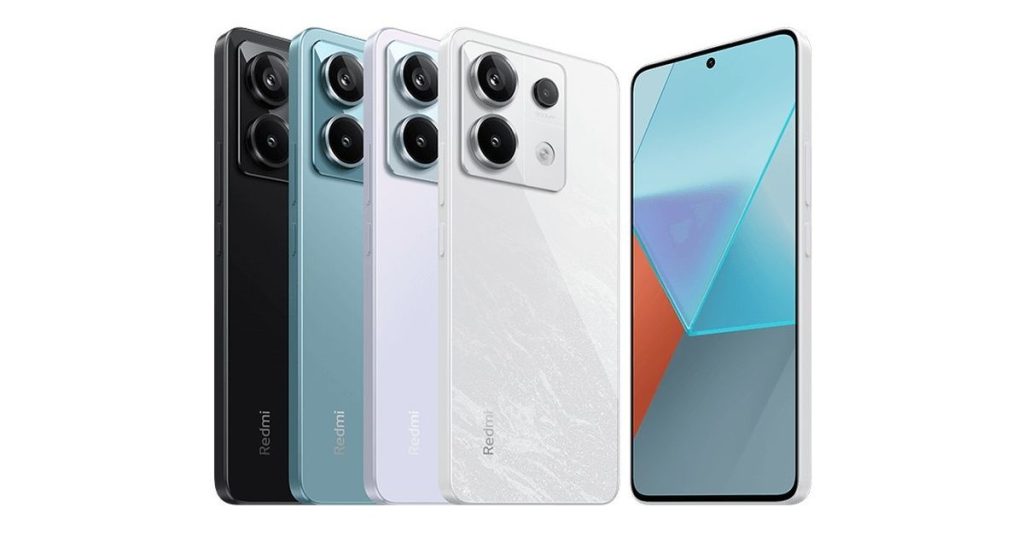
Interestingly, the smartphone’s codename, “Garnet,” is the same as the Redmi Note 13 Pro, further fueling the notion that the Poco X6 could be a rebranded version of the Redmi Note 13 Pro (China).
If that’s the case, the smartphone will have a 6.67-inch OLED panel with a 1.5K resolution of 1220 x 2712 pixels resolution and a 120Hz refresh rate.
Redmi Note 13 Pro
The Poco X6 will likely have a triple camera system on the back, with a 200-megapixel (main, with OIS) + 8-megapixel (ultra-wide) + 2-megapixel (macro) setup. There could also be a 16-megapixel front camera.
However, rumors suggest that the global model could have a 64-megapixel primary camera instead of the 200-megapixel sensor. Likewise, the phone will likely have a 5,100mAh battery with 67W fast charging.
The exact specifications and launch date of the Poco X6 series have not yet been announced by the company, but we expect to learn more soon.
Oppo is preparing to unveil its next flagship smartphone, the Find X7 Pro. Rumors about the device have been circulating for some time, and now a recent leak has revealed a teaser image showcasing the phone’s camera module.
While the leaker didn’t explicitly state that the image belongs to the Find X7 series, they alluded to it as Oppo’s upcoming flagship, leading us to believe it’s the Find X7 Pro. The teaser hints at a quad-camera setup and a continuation of Oppo’s partnership with Hasselblad for color calibration.
The leaked image suggests the Find X7 Pro will feature four camera sensors, one more than its predecessor, the Find X6 Pro. The presence of the Hasselblad logo indicates that Oppo will continue to collaborate with the renowned camera brand for color optimization.
Reports indicate that the Find X7 Pro’s rear camera setup will include an OIS-enabled 50-megapixel Sony LYT-900 primary camera, believed to be a modified version of the 1-inch Sony IMX989 sensor. It is likely to be accompanied by a 50-megapixel ultra-wide camera and two periscope telephoto cameras.
One periscope telephoto camera may employ a 50-megapixel IMX890 sensor with 2.7x optical zoom, while the other may utilize a 50-megapixel IMX858 sensor with 6x optical zoom.
While the device is expected to feature the Snapdragon 8 Gen 3 chipset, its other specifications remain undisclosed. The Find X7, the standard variant of the series, is expected to be powered by the Dimensity 9300 chipset.
The Oppo Find X7 series is anticipated to debut by the end of January or early February 2024. Stay tuned for more updates as they become available.
Samsung is set to give its Galaxy A55 and Galaxy A35 smartphones a premium makeover next year, with metal frames replacing the plastic ones used in previous models.
This is according to tipster Revegnus, who claims that the Galaxy A55 will feature a metallic frame, likely aluminum, while the Galaxy A35 will get the same upgrade. This is a pleasant surprise as no model in this lineup has ever featured a metallic frame.
The Galaxy A35 and A55 have upgraded their cases from plastic to metal, giving them a very premium look~
In addition to the metal frame upgrade, the Galaxy A35 is also expected to get a design refresh. Renders of the phone have been leaked by tipster Onleaks, and they show a phone with a similar design to its predecessor. However, there are a few key changes, including a center-aligned punch-hole cutout on the front instead of a U-notch.
Leaked renders of the phone show a vertically stacked triple-camera setup with an LED flash on the rear. The phone is expected to measure 161.6 x 77.9 x 8.2 mm.
On the other hand, the Galaxy A55 is also expected to receive some internal upgrades. The phone has been reportedly spotted in testing with the unannounced Exynos 1480 chip. It is rumored that the Exynos 1480 will be supported by an AMD graphics unit.
Samsung is expected to launch the Galaxy S24 flagship lineup in January 2024. The Galaxy A35 and A55 are rumored to follow soon after. We’ll be sure to keep an eye out for more leaks and rumors about the Galaxy A35 and Galaxy A55 in the coming months.
Samsung is leaving no stone unturned by bringing the stable One UI 6 update to most compatible smartphones. Following the update on Galaxy S23, Galaxy A54, Galaxy S22, Galaxy Z Fold/Flip 5 Series, and other smartphones, the One UI 6 Open Beta program is still up for mid-range and low-end smartphones. The users on the beta build of One UI 6 are having some issues with the One UI Home Launcher.
Specifically, the One UI Home v15.05.005 is crashing on the One UI 6 Beta builds. As per the official thread on the Samsung Korea Community, “Users of the first beta version have recently released “One UI Home” If you download and install the app (Launcher 15.0.05.005), you will be unable to touch the home screen and run the app through the quick panel/edge panel.”
However, the officials suggest updating their devices to the official stable version of the One UI, as most smartphones have already received it. However, in the process, the users on the Beta build may need to update multiple times to get the official stable build of One UI 6.0.
One UI 6.0 Update Program and Features
The Samsung Galaxy Smartphones are receiving the One UI 6.0 update bundling several new features. The Korean giant pushed the One UI 6.0 update for Galaxy S23, Galaxy S22, Galaxy S21 in some countries, Galaxy Z Flip/Fold 5, and several other smartphones. It is even surfacing on the mid-range Galaxy A54 and Galaxy A34 5G smartphones.
Samsung One UI 6.0 improves user interaction via numerous changes. A modern emoji design lets users express themselves with new emoticons. Sharing is easier with picture and video previews in the Share panel and more options. Pop-up windows allow seamless transitions after leaving the Recents screen, boosting multitasking. A free-standing lock screen clock and streamlined app icon labels on the home screen provide users with more options. The latest weather upgrades include a widget, interactive map view, and improved visuals.
A redesigned widget, enhanced watermark alignment options, and rapid resolution settings improve camera performance. The update improves Calendar, Reminder, and Samsung Internet. Quick actions for apps in Finder search results, storage recommendations in My Files, smarter Airplane mode, an Auto Blocker to protect against unfamiliar programs, and configurable Bixby text call greetings are also available. New magnification and cursor thickness choices improve accessibility. Samsung One UI 6.0 improves both form and function.
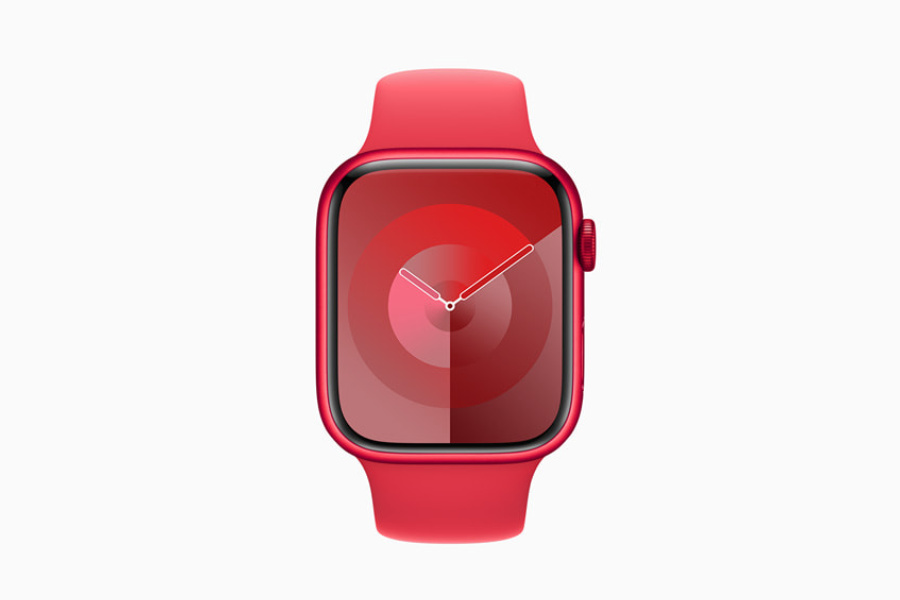
Apple has introduced a new (Product) Red color option for its latest smartwatch, the Apple Watch Series 9. The new color joins Apple’s lineup of products supporting (RED)’s global fight against HIV/AIDS.
The new smartwatch features a red aluminum case and a matching red Sport Band. Apple is also debuting new red watch faces, including Solar Analog, customized specially for World AIDS Day. These exclusive faces complement the (Product)Red Series 9’s vibrant colorway.
The rest of the smartwatch specifications are similar to the standard model. That is, it features a new S9 chip and quad-core neural engine, providing faster processing and improved performance. It has an 18-hour battery life, 25% better dictation accuracy, and 30% faster speed than the previous Series 8.
The maximum brightness is up to 2000 nits, twice that of the Series 8. The Series 9 brings a new double-tap gesture that lets wearers control Watch functions without touching the screen.
The Apple Watch Series 9 (Product) Red is available for purchase through Apple’s online store and retail stores. Pricing starts at Rs 41,900 in India and $399 in the US.
A portion of the proceeds from the sale of smartwatch will be donated to the Global Fund, which provides funding for HIV/AIDS programs in sub-Saharan Africa.
The company has been partnering with (RED) since 2006. The new Apple Watch Series 9 (Product) Red joins the existing (Product) Red variants for the iPhone 14, iPhone 14 Plus, iPhone 13, and iPhone SE.
It’s been nearly two months since OnePlus announced its first-ever foldable phone. It has been well-received by critics. The device also witnessed record one-day sales in India and North America. Now, the OnePlus Open has undergone famous YouTuber JerryRigEverything’s gruesome durability test. The results should give OnePlus fans a sigh of relief because, if you can recollect correctly, the brand didn’t have success with the durability of its past number series flagships more specifically the OnePlus 10 Pro, OnePlus 10T, and even this year’s OnePlus 11. This is because the OnePlus 10 duo snapped into half with Zack’s bare hands whereas the OnePlus 11 survived but still didn’t come out unscathed completely.
OnePlus Open durability test gives a sigh of relief
The OnePlus Open’s external screen is shielded by Ceramic Guard and is said to be 20 percent more impact-resistant compared to Gorilla Glass Victus. It gets minor scratches at level 6 with deeper grooves at level 7 on the Mohs hardness scale. The internal screen has ultra-thin glass that is commonly found on foldable phones and hence it develops scratches and deeper grooves at level 2 and 3 respectively. The display is also prone to fingernail marks.
The OnePlus Open’s side frame is made up of aluminium and in the scrape test, it takes scratches all all sides. The foldable phone’s back panel is also quite resistant to scratches. The YouTuber proceeded to pouring a lot of dust and dirt on the internal screen and the device couldn’t fold completely flat. The dirt also gets visibly accumulated around the crease of the internal screen. In the burn test, the OnePlus Open’s external OLED screen is subjected to an open flame for 10 seconds after which the pixel turns White. However, the YouTuber says that it lasts for 25 seconds. Meanwhile, the internal display gets dead pixels in under 10 seconds after coming in contact with flame.
The OnePlus Open’s side-mounted fingerprint scanner couldn’t authenticate properly but Zack attributes it to the minor razor scratches, accumulated dirt on the sensor, and his non-existent thumbprint which are considered to be valid reasons.
Finally, the moment of truth. The OnePlus Open is touted to survive 1 million folds. In what is considered to be the most intense and stressful test usually, the foldable phone appears to be built solidly as it doesn’t budge a bit when bent from either direction in the folded state. Surprisingly, Zack tries bending the device from the opposite direction when it is unfolded. The OnePlus Open bends slightly but most importantly holds its ground and avoids getting snapped.
The YouTuber adds that the OnePlus Open has certainly passed its durability test.
Vivo has cut down the price of its Vivo Y56 5G smartphone in India. In addition to that, the brand has also dropped the pricing of the Vivo T2 5G in the country.
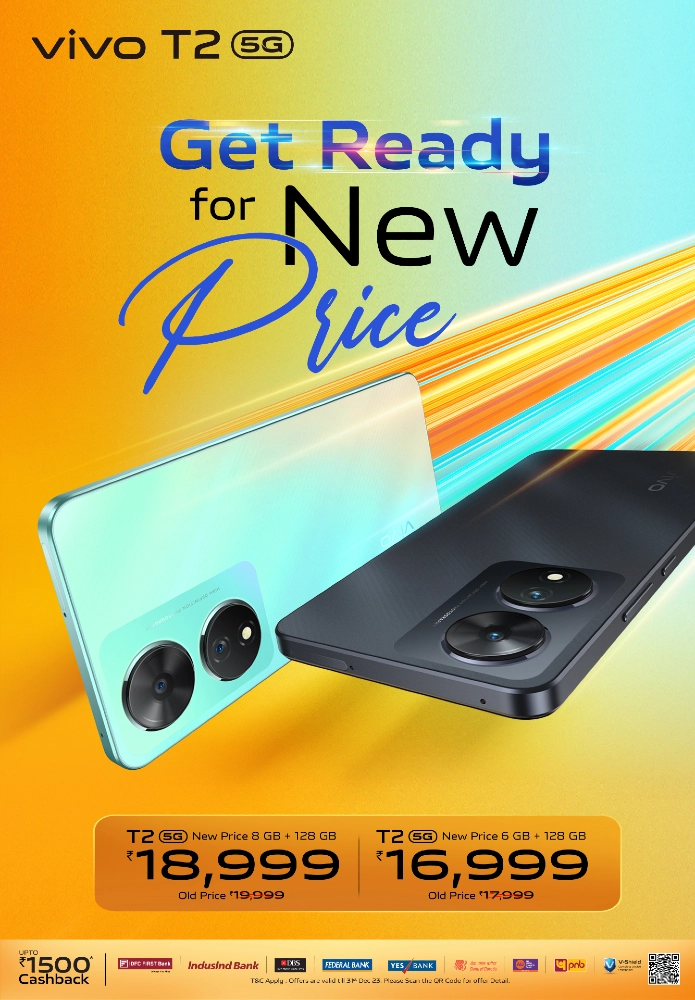
Vivo T2 5G discounted pricing:
The Vivo T2 5G debuted with a price tag of Rs 18,999 for the 6GB/128GB variant and Rs 20,999 for the 8GB/128GB model. As part of a promotional discount, the smartphone will now be accessible at Rs 16,999 for the 6GB/128GB configuration and Rs 18,999 for the 8GB/128GB version. Additionally, customers have the opportunity to enjoy cashback of up to Rs 1,500 on the Vivo T2 when using select banks, such as IndusInd Bank, Yes Bank, Federal Bank, Bank of Baroda, and others.
Vivo T2 5G specs:
The Vivo T2 5G features a 6.38-inch FHD+ AMOLED display with a 90Hz refresh rate, offering clear images at 2400×1080 pixels resolution and 1300nits brightness. Powered by a Qualcomm Snapdragon 695 SoC with Adreno 619GB GPU, the Vivo T2 comes with 6GB/8GB RAM and 128GB storage (expandable via microSD card). On the software front, the phone runs on Funtouch OS, based on Android 13.
The camera setup is noteworthy, featuring a 64MP primary sensor with OIS and EIS and a 2MP bokeh sensor on the back. The front camera is a 16MP snapper. For connectivity, the phone supports 5G, dual-band Wi-Fi, Bluetooth, GPS, and USB Type-C. Lastly, it has a 4,500mAh battery and 44W fast charging.
The Samsung Galaxy S24 Ultra is expected to arrive in January 2024, and leaks have already given us a glimpse of its design. Now, thanks to the FCC, we have a closer look at the phone’s S-Pen.
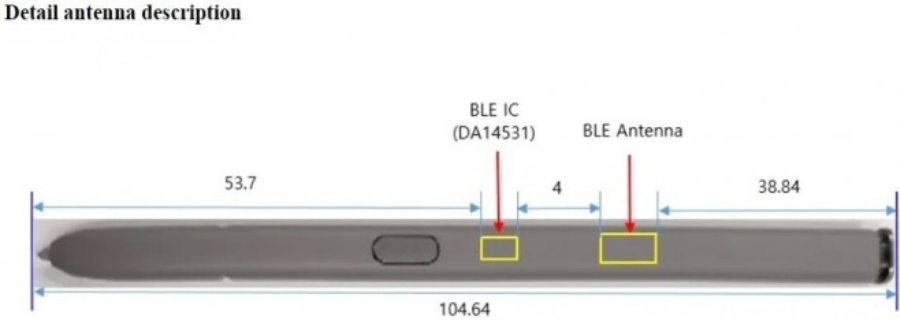
The FCC certification website now includes information about the S Pen, identified by the EJ-PS928 model number. The listing reveals that the S Pen’s design is similar to the one seen in the Galaxy S23 Ultra, featuring a left-side button and a clicky push button on the top.
The S Pen will operate within a 2402-2480MHz frequency range, which is the specific range of radio frequencies that the S Pen uses to communicate with the Galaxy S24 Ultra. This data includes information about the S Pen’s position, pressure, and orientation. This information is used by the Galaxy S24 Ultra to provide different features, such as handwriting recognition, air gestures, and remote control.
The stylus measures 104.64mm in length, but its weight remains unknown. Additionally, its IP rating is yet to be confirmed.
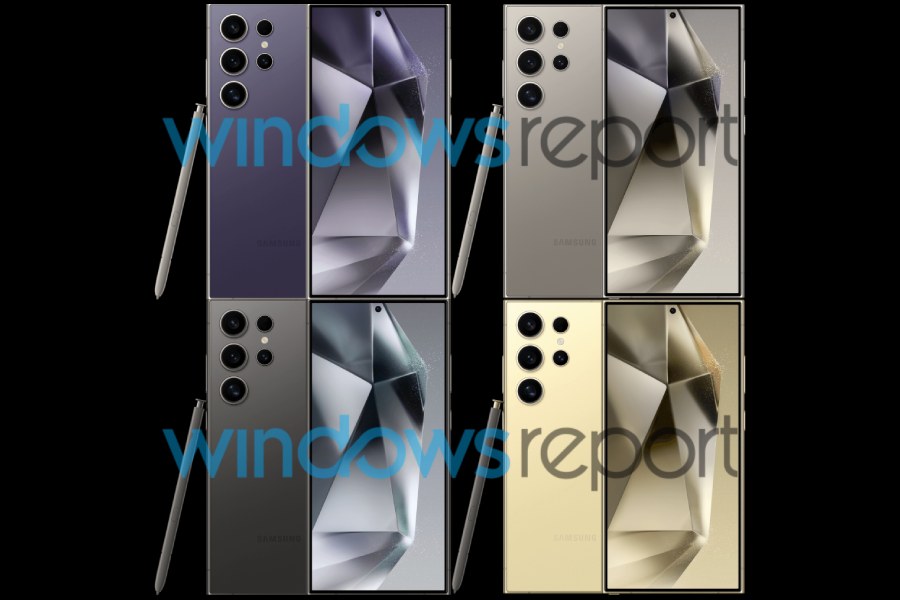
A new report by Windows Reporthas also shed light on the phone’s specifications and design. Reportedly, The Galaxy S24 Ultra boasts a sleek, squarish design with almost flat edges and a flat-screen. It will be powered by the Snapdragon 8 Gen 3 processor and packs a generous 12GB of RAM. Storage options range from 256GB to 1TB.
Samsung has also significantly enhanced the Galaxy S24 Ultra’s cooling capabilities with a 1.9x larger vapor chamber than its predecessor.
The quad-camera setup on the back remains, featuring a 200MP primary sensor, a 12MP ultrawide lens, a 10MP telephoto camera with 3x optical zoom, and a 50MP telephoto camera with 5x optical zoom.
Likewise, the device will be fueled by a 5000mAh battery with support for 45W charging.
Intense competition is unfolding in the premium segment, with the Red Magic 9 Pro+ fueled by Snapdragon 8 Gen 3, and the Vivo X100, powered by Dimensity 9300, engaging in a close race for the AnTuTu performance crown. Meanwhile, noteworthy developments are occurring in the mid-range sector. Here are the top 10 best-performing mid-range smartphones of November.
AnTuTu Top 10 mid-range smartphones (November 2023):
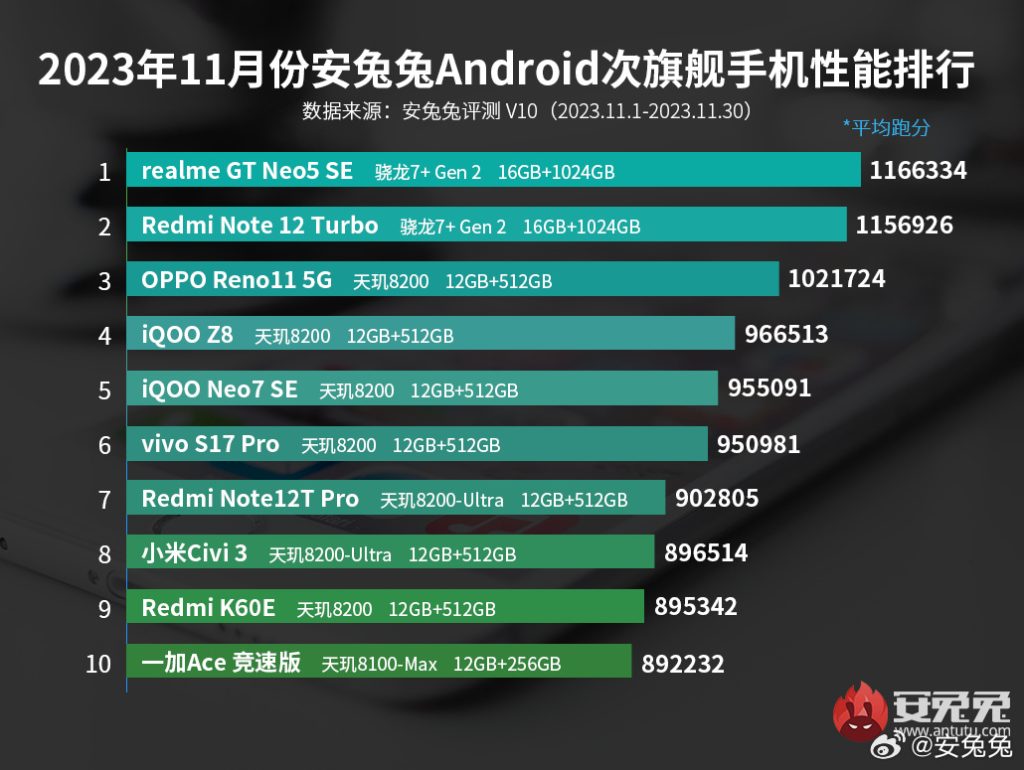
Realme GT Neo 5 SE (Snapdragon 7+ Gen 2, 16GB+1TB): 1,166,334
Redmi Note 12 Turbo (Snapdragon 7+ Gen 2, 16GB+1TB): 1,156,926
OnePlus Ace Racing Edition (Dimensity 8100 Max, 12GB+256GB): 892,232
The Realme GT Neo 5 SE has retained its status as the mid-range performance king for the second month. It is followed closely by the Redmi Note 12 Turbo. Both of these devices use the Snapdragon 7+ Gen 2 SoC, which has been quite a rare sight on smartphones. Oppo’s recently launched Reno 11 5G has taken the third spot, with a score of 1,021,724 points.
OPPO Reno 11 – Fluorite Blue
The next three entries on the list, namely the iQOO Z8, the iQOO Neo 7SE, and the Vivo S17 Pro are all powered by the Dimensity 8200 chip. The remaining four smartphones are powered by Dimensity 8200 Ultra and the 8100 Max chips.
So by the looks of it, the Snapdragon 7+ Gen 2 chip still appears to be dominating the mid-range segment in terms of performance. However, that might change soon a new generation of devices equipped with the latest Snapdragon 7 Gen 3 and Dimensity 8300 chips are beginning to arrive in the market. The Snapdragon 7 Gen 3-clad Honor 100 and the Redmi K70E equipped with the Dimensity 8300-Ultra have already made their debut in the market. It would be interesting to see these new generation chips go head to head in the December 2023 edition of AnTuTu’s top 10 mid-range list.
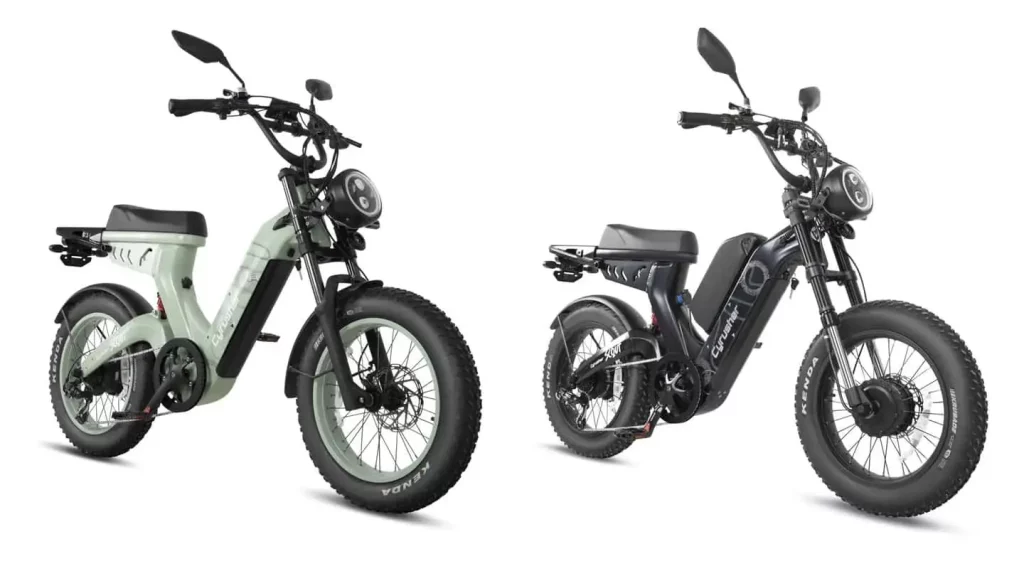
Electric bikes are revolutionizing the way we think about travel, and Cyrusher is at the forefront with its new Scout e-bike. This bike isn’t just another entry in the e-bike market; it’s a standout, especially the Pro model with its dual motors.
The bike can travel 112 miles on a single charge
The Scout e-bike comes in two models: the standard and the Pro. The standard model is a competent e-bike, but the Pro is where Cyrusher really shines. It features two 750-watt motors, combining for a total of 1,500 watts. This power isn’t just for show – it’s for performance, giving riders the ability to effortlessly transition from urban landscapes to off-road adventures.
One of the most impressive aspects of the Scout Pro is its range. With two batteries, it can travel around 112 miles on a single charge. This is a major plus for long-distance riders or those who prefer fewer charging interruptions. The standard Scout, with a 56-mile range, is also practical for daily commutes.
Cyrusher has also put great thought into the design of the Scout. Its low-step aluminum frame is both stylish and functional, suitable for riders of various heights. Comfort is further enhanced by features like the extended saddle and a suspension system, making rough terrains more bearable.
Safety and user-friendliness are key. The Scout boasts a bright LED lighting system, a seamless Shimano seven-speed drivetrain, and dependable Tektro hydraulic brakes.
What’s also attractive is the pricing. The standard Scout is priced at $2,999, while the Pro model is offered at $3,999. Considering the Pro’s features, it’s an excellent value for those looking for an e-bike that can handle both urban and off-road challenges.
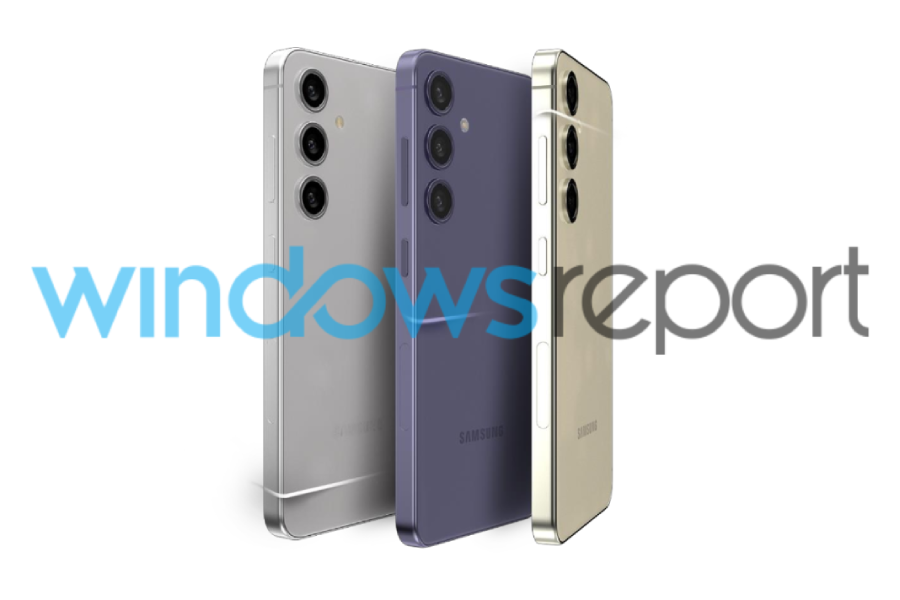
Samsung‘s highly anticipated Galaxy S24 series is likely to be unveiled in mid-January 2024. However, thanks to leaked official renders, we don’t have to wait until then to get a glimpse of these upcoming devices.
The renders, published by Windows Report, showcase the Galaxy S24, Galaxy S24+, and Galaxy S24 Ultra in all their glory. They also provide insights into the full specifications of these smartphones.
Galaxy S24 Ultra Renders and Specifications
As expected, the Galaxy S24 Ultra will be the top-of-the-line model in the upcoming lineup. The phone will feature a squarish frame with almost flat sides and a flat screen. It will come in four colors: Titanium Black, Titanium Gray, Titanium Violet, and Titanium Yellow.
The S24 Ultra will be powered by the Snapdragon 8 Gen 3 processor and will come with 12GB of RAM. Storage options will include 256GB, 512GB, and 1TB.
To address overheating concerns, Samsung has reportedly incorporated significantly larger vapor chamber heat dissipation systems into the Galaxy S24 series. The Galaxy S24 Ultra gets the biggest improvement with a 1.9x larger vapor chamber cooling system than the one in the Galaxy S23 Ultra.
Likewise, the phone continues to sport four cameras on the rear: a 200MP primary sensor, a 12MP ultrawide lens, a 10MP telephoto camera with 3x optical zoom, and a 50MP telephoto camera with 5x optical zoom.
The Galaxy S24 Ultra will also feature a range of AI and Generative AI features, thanks to the latest advancements in this field. It will also upgrade to Wi-Fi 7. All three models will offer 5G connectivity, Bluetooth 5.3, and a USB Type-C port.
Battery-wise, the Galaxy S24 Ultra will retain the same 5,000mAh battery capacity as its predecessor, along with 45W fast charging.
Below is a list of full specs shared by WindowsReport for Samsung Galaxy S24 Ultra.
5,000 mAhSuper Fast Charging 2.0Fast Wireless Charging 2.0/Wireless PowerShare
Connectivity
Bluetooth 5.3, Wi-Fi 7, Ultra Wide Band
Protection
Corning Gorilla Armor or Titanium
Galaxy S24/S24+ Renders and Specifications
The Galaxy S24 and Galaxy S24+ will feature extremely thin and symmetrical bezels and unlike the S24 Ultra, they may not get the Titanium finishing. The color options will be Amber Yellow, Cobalt Violet, Marble Grey, and Onyx Black.
The S24 and S24+ will also come with a Snapdragon 8 Gen 3 processor. However, some variants of the Galaxy S24 and Galaxy S24+ will utilize the Exynos 2400 chipset in some countries.
There are also improvements in the thermals of the vanilla models. The Galaxy S24 features a 1.5x larger vapor chamber compared to its predecessor, while the Galaxy S24+ boasts a 1.6x larger vapor chamber system.
Moreover, the Galaxy S24 packs a 4,000mAh battery with 25W charging, while the Galaxy S24+ carries a larger 4,900mAh battery and supports 45W fast charging.
Here are the leaked specs again for Samsung Galaxy S24 and Galaxy S24+.
Galaxy S24
Galaxy S24 Plus
Display
6.2″ FHD+ with up to 120 Hz refresh rate
6.7″ QHD+ with up to 120 Hz refresh rate
Processor
Exynos 2400
Snapdragon 8 Gen 3
Battery
4000 mAh with Super Fast Charging
4900 mAh with Super Fast Charging 2.0
Main camera
12 MP (Ultra Wide)50 MP (Wide)10 MP (Telephoto with up to 3x optical zoom)
12 MP (Ultra Wide)50 MP (Wide)10 MP (Telephoto with up to 3x optical zoom)
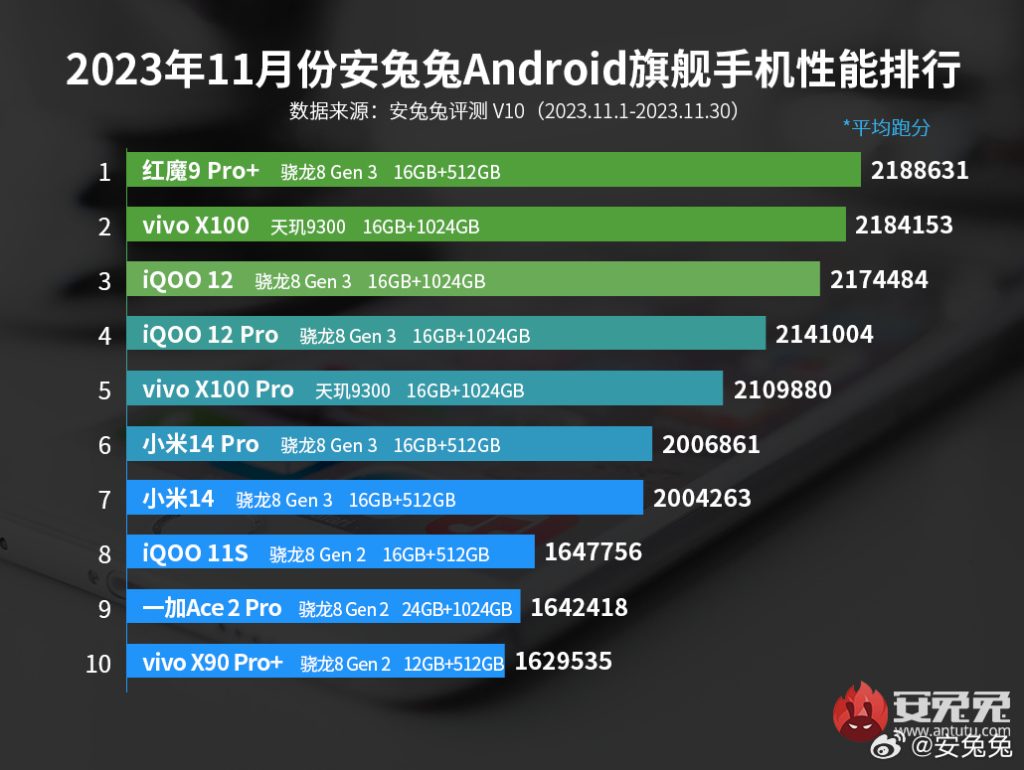
A new generation of flagship Android smartphones have arrived clad with the latest and greatest processors. And so, AnTuTu has officially released its November 2023 list of the top-performing devices. While some entries on the list were expected, there are a few surprises packed in as well.
AnTuTu Top 10 (by performance) in November 2023:
Red Magic 9 Pro+ (Snapdragon 8 Gen 3, 16GB+512GB): 2,188,631
Vivo X100 (Dimensity 9300, 16GB+1TB): 2,184,153
iQOO 12 (Snapdragon 8 Gen 3, 16GB+1TB): 2,174,484
iQOO 12 Pro (Snapdragon 8 Gen 3, 16GB+1TB): 2,141,004
vivo X100 Pro (Dimensity 9300, 16GB+1TB): 2,109,880
Xiaomi 14 Pro (SD8 Gen 3, 16GB+512GB): 2,006,861
Xiaomi 14 (Snapdragon 8 Gen 3, 16GB+512GB): 2,004,263
iQOO 11S (Snapdragon 8 Gen 2, 16GB+512GB): 1,647,756
OnePlus Ace 2 Pro (SD8 Gen 2, 24GB+1TB): 1,642,418
Vivo X90 Pro+ (SD8 Gen 2, 12GB+512GB): 1,629,535
It comes as no surprise that the recently launched Red Magic 9 Pro+ has taken the performance crown with 2,188,631 points since performance is kind of the bread and butter of the brand. The phone comes equipped with the beefiest cooling system on the list that gives more headroom to squeeze out more performance without throttling due to heat.
Vivo X100
That being said, the most surprising thing on this list is the Dimensity 9300 clad Vivo X100 capturing the second spot with 2,184,153 points. The difference between it and the X100 and the Red Magic 9 Pro+ is just around 4500 points, which people familiar with the AnTuTu benchmark know is almost nothing. It makes us wonder if Red Magic decided to release a Dimensity 9300 version of the Red Magic 9 series device, what the performance on it be like.
iQOO 12
Moving on to the third position, the iQOO 12 has also shown impressive performance achieving an average of 2,174,484 points. iQOO is also known for making performance-oriented devices with top-notch cooling systems so it is no surprise that the device can push the processor to its limits without running into heating issues.
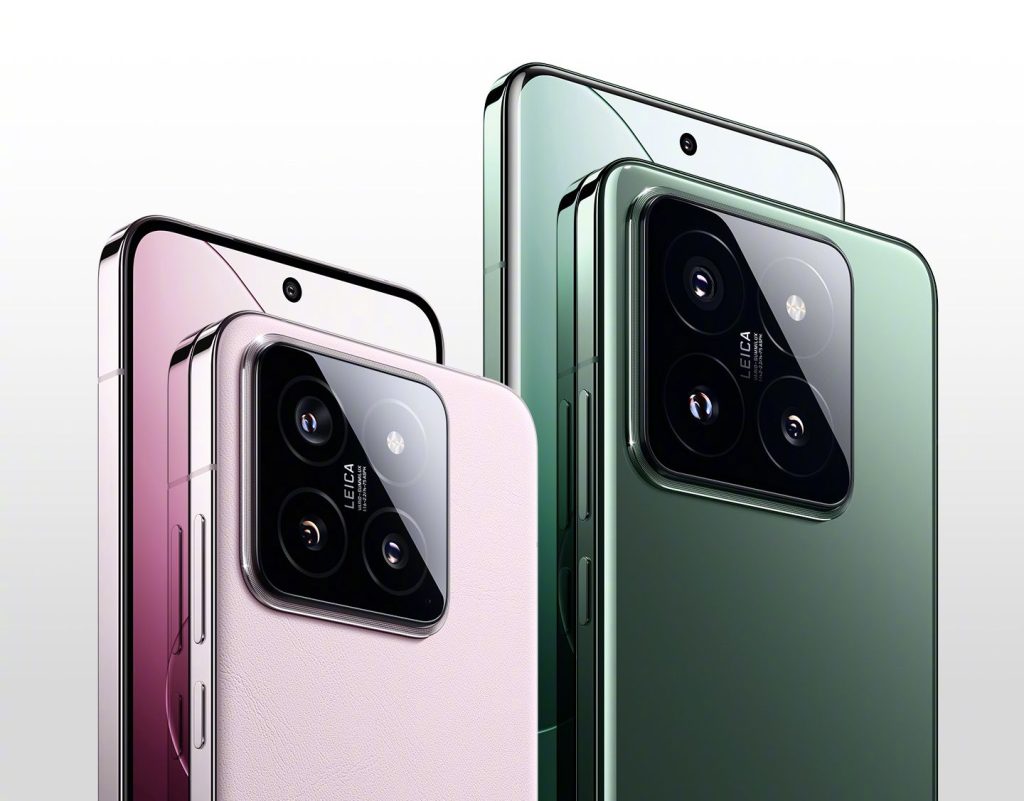
Xiaomi 14 series
The Xiaomi 14 and Xiaomi 14 Pro, previously holding the top two positions last month, have now surpassed the 2 million point mark this month. While this marks an improvement from their performance in the previous month, they have now slid down to the 6th and 7th positions. The enhanced performance is likely attributed to refinements, possibly overlooked in the rush to claim the title of the first smartphone featuring the Snapdragon 8 Gen 3 chip. We can expect the performance to improve even more in the coming days.
The last three positions are currently occupied by the iQOO 11S, the OnePlus Ace 2 Pro, and the Vivo X90 Pro+, all of which use the Snapdragon 8 Gen 2 chip. With the launch of the OnePlus 12 and other flagships on the horizon, we can expect a couple of these devices to vanish from the December top 10 list.
Speaking of the OnePlus 12, the brand boldly declares that the device could hit an impressive 2,333,033 points, placing it in the running for the AnTuTu performance crown. However, the real litmus test is consistency. All eyes are on December 5 to discern if this claimed performance is a one-time showstopper or a sustained feat. Here’s the OnePlus 12 roundup to fill you in on everything known about the device so far.
After much anticipation, OnePlus is set to introduce its latest flagship smartphone, the OnePlus 12, following the success of the well-received OnePlus 11. With high expectations surrounding the upcoming release, here’s a comprehensive overview of everything you should know about the OnePlus 12 ahead of its scheduled launch in China on December 5.
Design & display
OnePlus is opting for a relatively straightforward approach without introducing significant alterations to the current design. The phone retains its quad-cutout circular camera module, albeit with notable internal detailing. The brand indicates drawing inspiration from classic timepieces, evident in the grooves encircling the camera module, resembling minute lines on a clock. The power button and volume rockers are still on the left side, and the right side features the power button and an alert slider.
The brand has unveiled three color options through official teasers, namely Blank (white), Green, and Rock Black. In addition to that, a recent leak claimed that the phone could come with a wood texture back, paying homage to the OG OnePlus One Walnut Wood Edition.
On the front, the phone will showcase a large 6.82-inch BOE AMOLED Display, boasting a resolution of 3168 x 1440 pixels and a smooth 120Hz refresh rate. The 2K+ display gently curves towards the edges, incorporating advanced features like 2160Hz PWM dimming and a pixel density of 510, facilitated by a diamond-shaped pixel arrangement.
According to the brand, the phone achieves an impressive maximum brightness of 4500 nits, surpassing the current flagship standard ranging between 2400-2600 nits. Oppo’s Display P1 chip is integrated into the device, promising enhanced quality and efficiency for an optimized viewing experience. A teaser also talks about a new in-screen fingerprint scanner which is slimmer and more responsive than previous iterations. Lastly, the phone’s display will feature OnePlus’s Rain Water Touch feature which eliminates ghost touches and false touches.
Performance & specs
The OnePlus 12 will be powered by the cutting-edge Snapdragon 8 Gen 3 chip out of the Qualcomm camp. The processor comes with some noteworthy improvements to its performance thanks to the new chip structure and a peak clock speed of 3.3GHz. It also has a new Adreno 750 GPU onboard that helps improve graphics performance.
The brand has shared an insane AnTuTu benchmark score of 2,333,033 points which will put it in contention for the best-performance smartphones. However, sustained performance is usually the key, and for that, the brand plans to incorporate a massive 9140mm² vapor chamber cooling system. Overall, the cooling system will cover a vast 38,547mm² area, making sure that the high-power chip can sustain its performance without throttling.
The phone will be available in multiple LPDDR5x RAM and UFS 4.0 storage configurations including a 24GB + 1TB option. The battery will be getting a boost in capacity, bumping it up to 5,400mAh. 3C certification has revealed 100W wired and 50W wireless charging support. There will also be a new vibration motor onboard which the brand is calling the “Bionic Vibration Motor Turbo”. It claims to be 18% more powerful and 60% faster. As for software, the phone will debut with Android 14-based ColorOS 14 (OxygenOS 14 in the global market).
Camera
Camera is another department that’s getting major upgrades. Moving on from the IMX890 sensor of the OnePlus 11, the OnePlus 12 will debut with the shiny new 50MP Sony Lytia dual-layer stacked camera sensor. This sensor is said to be a collaboration between OnePlus and Sony, however, other reports have mentioned that the device will feature a 50MP Sony LYT-T808 sensor with an aperture of f/1.6 and a focal length of 23mm. One thing is for sure users can expect some significant improvements over last year’s camera.
Other than the primary sensor, the phone will feature a 48-megapixel Sony IMX581 ultra-wide lens with an aperture of f/2.2 and a focal length of 14mm and a 64-megapixel OmniVision OV64B periscope telephoto camera, with aperture of f/2.6 and a focal length of 70mm, enabling 3x optical zoom.
Global availability
While the China launch is happening on December 5, customers outside of China will have to wait a bit more. A recent report has mentioned that the OnePlus 12 will start its global journey with its launch in India on January 23. Stay tuned for our coverage of the OnePlus 12 launch on December 5. In the meantime, you can check out our ColorOS 14 review, which is the operating system onboard the OnePlus 12.
Earlier this year, Vivo recently unveiled its budget-friendly smartphone, the Vivo Y56 5G. Later in September, the phone got an even more affordable 4GB RAM + 128GB storage variant. Now, it has announced revised pricing for both versions in India.
Vivo Y56 5G new price point
The 8GB+128GB variant, formerly priced at Rs.18,999, has now been marked down to Rs.17,999. Similarly, the 4GB+128GB variant, originally available for Rs.16,999, is now offered at a reduced rate of Rs.15,999 for Indian consumers. For those considering a purchase, there’s an added incentive as interested buyers can avail themselves of an instant cashback of Rs.1000. This cashback promotion is applicable for transactions made through ICICI, IDFC First Bank, One Card, IndusInd, Yes Bank, and DBS. It’s worth noting that this cashback offer is valid until December 31, 2023.
Vivo Y56 5G specs:
Featuring a 6.58-inch IPS LCD display with a waterdrop notch, the Vivo Y56 5G boasts a resolution of 2408 x 1080 pixels, a 20:9 aspect ratio, a 60Hz refresh rate, and an expansive 90.6 percent screen-to-body ratio. the phone is powered by the Dimensity 700 chipset and offers configurations of 4 GB or 8 GB of RAM coupled with 128 GB of storage. On the software side, it has an Android 13 with FunTouch OS 13 overlay.
The front of the device hosts a 16-megapixel camera, while the rear camera setup comprises a 50-megapixel primary lens (Samsung JN1) and a 2-megapixel bokeh lens. A robust 5,000mAh battery fuels the device, supporting 18W charging. Notable features include dual SIM capability, 5G connectivity, Wi-Fi 802.11ac, Bluetooth 5.1, GPS, a USB-C port, and a 3.5mm audio jack. Security is ensured with a side-facing fingerprint scanner, and the phone boasts IP54-rated dust and water resistance for added durability.
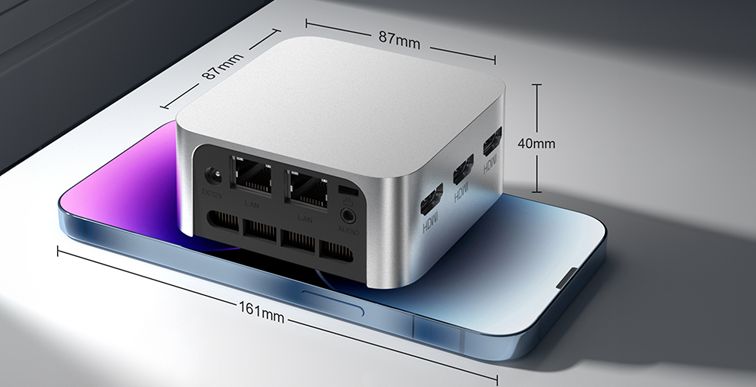
The AOOSTAR T-Box mini PC is powered by the Intel N100 CPU. It is a palm-sized mini computer which is also versatile. The petite-looking T-Box has two Gigabit Ethernet ports, three HDMI ports, three USB 3.1 Type-A ports, and a 3.5mm audio jack. The AOOSTAR T-Box, apart from its petite design, comes with an affordable price tag.
The Palm-sized mini PC carries a decent $149 Price tag
The T-Box can be used as a digital signage or media center. It can simultaneously accommodate three displays in addition to a networking device, and a small computer. The AOOSTAR T-Box is equipped with the Intel N100 processor with a 6W quad-core chip based on the Alder Lake-N architecture. The Intel N100 processor is designed for small laptops and mini PCs and the mini PC is a low-power device. The cooling system of the AOOSTAR T-Box consists of a heat sink with a copper tube and a fan.
The T-Box mini PC’s major talking points are its compact size, low power consumption, and affordable price. The flip side of the T-Box is that it has underwhelming wireless capabilities. It supports Bluetooth 4.2 connectivity and WiFi 5 wireless connection. The T-Box is listed on Amazon in three marginally different sizes. These are 89 x 89 x 45mm, 87 x 87 x 40mm, and 84 x 80 x 45mm. The dimensions indicate that the AOOSTAR T-Box is quite small but it is not the smallest model available.
The AOOSTAR T-Box is equipped with 8GB of LPDDR5-4800 RAM and 256GB of PCIe 3.0 NVMe solid-state storage. The memory is attached to the motherboard and cannot be upgraded by the user. The attached SSD is however upgradeable. The AOOSTAR T-Box mini PC is available from Amazon at an affordable price tag of $149.
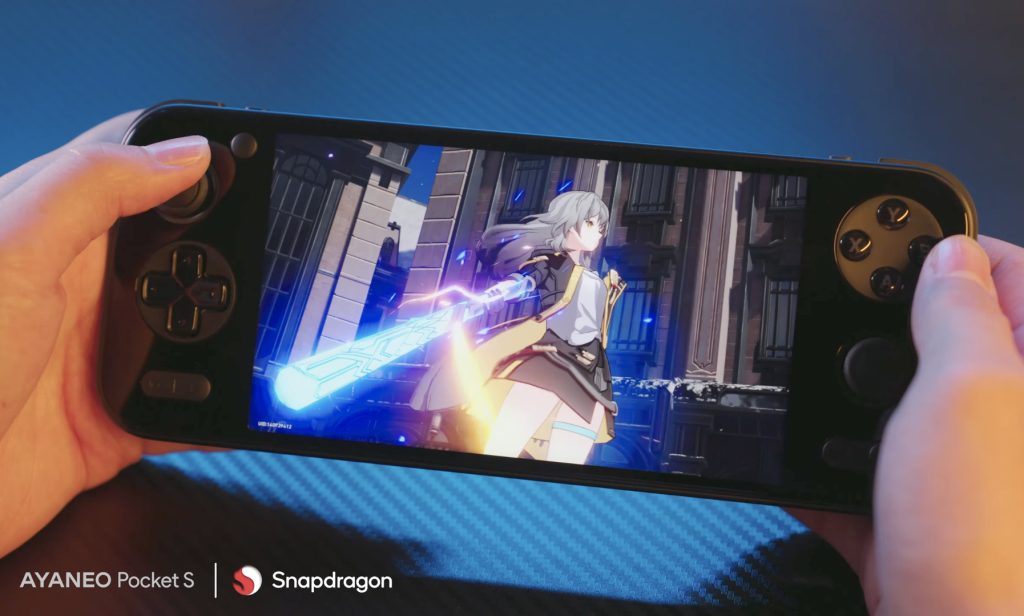
Chinese gaming handheld manufacturer AYANEO seems to be firing on all cylinders at the moment. Not too long after the launch of the brand’s first mini-PC, the company has now teased the AYANEO Pocket S gaming handheld powered by the Snapdragon G2x Gen2 chipset. The latest AYANEO gaming handheld is scheduled to be released early next year. Ahead of its release, AYANEO has released gameplay footage from the handheld. The AYANEO Pocket S has been scheduled for release this month. The new footage indicates all is set for its release anytime soon.
AYANEO has been quite busy as the year runs to the end. The AYANEO AM01 mini-PC and AYANEO SLIDE gaming handheld were released last month. Other products released by AYANEO were the Retro Power Bank, the Pocket DMG, the FLIP KB, and the FLIP DS. The AYANEO Pocket S will be available in a couple of color options at the least – black or white.
Although the AYANEO Pocket S is still in its prototype stage, the gameplay optics are positive. The AYANEO Pocket S was previewed back in August 2023. The company described the model it showcased as a prototype and an engineering sample. It is an Android gaming handheld with a Snapdragon G3x Gen2 chipset which will offer greater performance and reliability than models with Snapdragon 8 Gen2. The more powerful chipset presented in the AYANEO Pocket S will also translate to higher pricing for the model.
The optics from the 8.44-minute-long video of the AYANEO Pocket S in action are nice. Being a prototype, the production version of the model could come with some changes. It is however being projected as a high-end Android flagship gaming handheld. The graphics from the gameplay look exquisite while the handheld itself comes sleek and beautiful. The gaming community is already expecting the release of the AYANEO Pocket S gaming handheld.
Indian electronics manufacturer Noise ended November with the launch of the Noise Three wireless headphones. The brand has kicked off December 2023 with the launch of a new smartwatch called the NoiseFit Endeavour. The watch comes with a tough-looking exterior and features a round AMOLED display.
NoiseFit Endeavour specs:
The NoiseFit Endeavour smartwatch boasts a vibrant 1.46-inch always-on AMOLED screen that captivates users with striking visuals, heightened by an impressive 600 nits brightness. Its round dial design, complemented by a functional crown and push-button, seamlessly blends functionality with style, exuding a sporty appeal. Offering broad usability, the smartwatch is compatible with both Android and iOS platforms. With an IP68 rating, it stands resilient against water and dust, ensuring durability across various environments.
Driven by Noise Tru Sync technology, the Bluetooth calling feature of the NoiseFit Endeavour ensures swift pairing and low power consumption, delivering effortless connectivity. The smartwatch presents an extensive selection of 100+ sports modes for fitness enthusiasts, syncing seamlessly with the NoiseFit App for detailed insights into diverse physical activities. Intelligent notifications keep users informed, covering display notifications, weather updates, reminders, alarm, camera control, music control, and even a built-in calculator.
The Noise Health Suite takes health monitoring to the next level, encompassing 24×7 heart rate tracking, SpO2 measurement, sleep tracking, stress management, and a female cycle tracker. Prioritizing user safety, the smartwatch incorporates an Emergency SOS feature, providing an additional layer of security. Users can express their style through over 100 customizable watch faces. The rapid health monitoring feature ensures quick access to essential health metrics.
Price & availability:
The NoiseFit Endeavour is priced at Rs. 2,999 and comes in many captivating shades including Camo Black, Jet Black, Vintage Brown, Teal Blue, and Fiery Orange. Starting December 5th at 12 PM, the watch will be available via Noise website and Amazon.in.
Artificial intelligence technologies are increasingly prevalent, finding applications across various industries. Many companies are incorporating AI into their products and services, enhancing overall quality and efficiency. While this trend brings about positive advancements, it also raises certain concerns.
You may have come across statements predicting that “AI will take over your job.” Recently, meteorologists have joined the ranks of those potentially facing unemployment, as NASA and IBM collaborate on an AI model designed to monitor the Earth’s climate 24/7. Here are the details…
NASA and IBM AI Partnership for Climate Observation
NASA and IBM are jointly developing an AI model focused on weather and climate observation. This technology is expected to bring revolutionary changes compared to existing meteorological applications. Although AI is already in use in this field, the current models are task-specific, akin to technologies like ChatGPT, functioning as simple emulators, as per IBM’s description.
NASA and IBM, however, aspire to go beyond accurate predictions. Their collaborative effort aims to create an AI system that continuously observes the Earth’s climate and weather conditions around the clock. Anticipated features of this AI model include predicting meteorological events, extracting high-resolution information from low-resolution data, and forecasting occurrences ranging from aircraft turbulence to forest fires.
The shared objective of both institutions is to enhance the accuracy of weather predictions and mitigate potential disasters. For instance, this technology could predict forest fires caused by extreme heat, prevalent in various parts of the world, including our country, during the summer months. While achieving 100% accuracy may be challenging, the AI model is expected to be highly beneficial for implementing preventive measures.
The integration of this technology into our daily lives, drawing on data from NASA satellites and IBM technologies, remains uncertain.
We use cookies on our website to give you the most relevant experience by remembering your preferences and repeat visits. By clicking “Accept”, you consent to the use of ALL the cookies.
This website uses cookies to improve your experience while you navigate through the website. Out of these, the cookies that are categorized as necessary are stored on your browser as they are essential for the working of basic functionalities of the website. We also use third-party cookies that help us analyze and understand how you use this website. These cookies will be stored in your browser only with your consent. You also have the option to opt-out of these cookies. But opting out of some of these cookies may affect your browsing experience.
Necessary cookies are absolutely essential for the website to function properly. This category only includes cookies that ensures basic functionalities and security features of the website. These cookies do not store any personal information.
Any cookies that may not be particularly necessary for the website to function and is used specifically to collect user personal data via analytics, ads, other embedded contents are termed as non-necessary cookies. It is mandatory to procure user consent prior to running these cookies on your website.