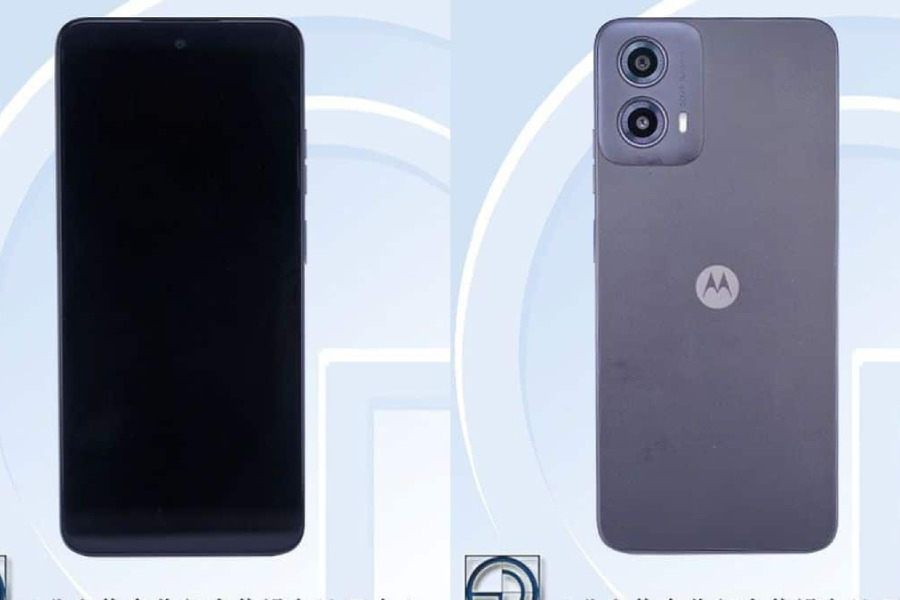
Several new Motorola phone designs have been leaked online recently, but it seems one of them might actually be launching soon. A TENAA certification listing has surfaced for a new Motorola phone with model number XT2363-4, featuring a dual-camera setup on a back panel. This design closely resembles leaked renders of the Moto G34 5G, leading us to speculate that the XT2363-4 might be the same device.
Motorola XT2363-4 specifications
Anyway, the listing shows that the XT2363-4 dimensions come in at 6.4″ x 2.9″ x 0.3″, with a comfortable 180-gram weight. The front flaunts a 6.5-inch OLED screen with HD+ resolution and a smooth 120Hz refresh rate, all secured by a side-mounted fingerprint scanner.
Motorola XT2363-4 image via TENAA listing.
While the listing keeps the processor mum and only shows the CPU’s 2.2GHz frequency, a recent Geekbench visit of Motorola XT2363-4 may have spilled the beans.
The smartphone appeared on Geekbench with a Snapdragon 695 SoC, featuring six CPU cores running at 1.8GHz and two cores that have a 2.21GHz clock speed. Surprisingly, RAM options range from 6GB to a whopping 18GB, alongside storage variations between 64GB and 512GB.
Moto G34 5G renders.
Camera-wise, we’re looking at a 50MP main sensor on the back, backed by a 2MP macro lens for close-ups. Selfies and video calls get an 8MP camera to play with.
Moreover, a sizable 5000mAh battery with 20W fast charging keeps the phone going. Additionally, the XT2363-4 will run on Android 14 with Motorola’s My UX software on top.
There’s no official word from Motorola yet, but with this TENAA listing, it seems the G34 5G might be closer than we think.
ASUS is all set to unveil the ROG Phone 8 series in China on January 16. Anticipated to include three models – ROG Phone 8, ROG Phone 8 Pro, and ROG Phone 8 Ultimate, these gaming flagship smartphones will go up against the Red Magic 9 Pro series.
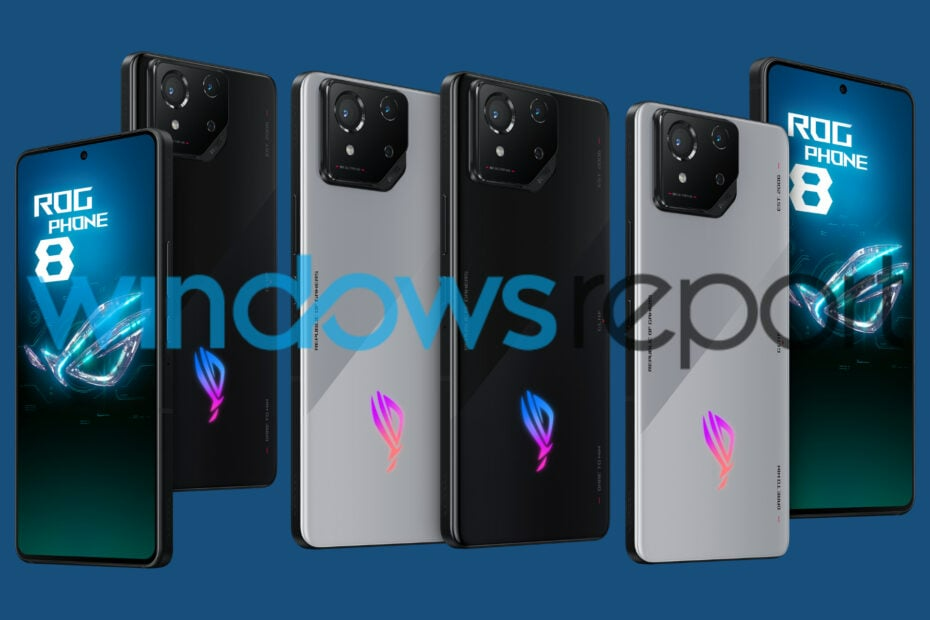
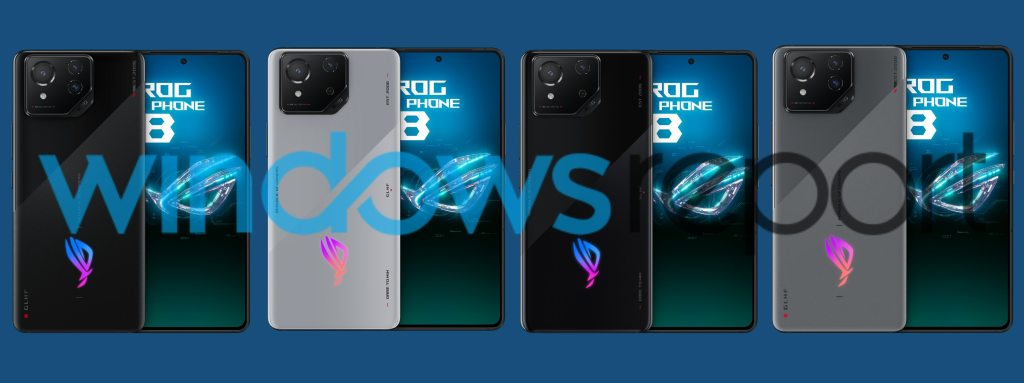
Recent leaks from Windows Report spilled the beans on the ROG Phone 8 and ROG Phone 8 Pro. Now, these devices have emerged on Geekbench revealing the performance, while also confirming some key specs.
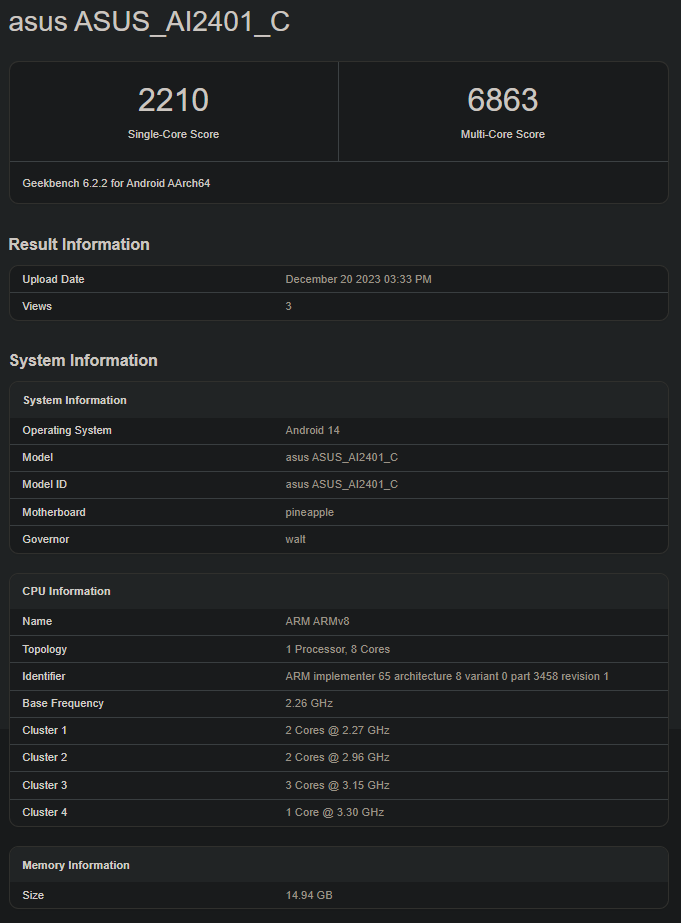
ASUS ROG Phone 8/8 Pro Geekbench
According to Geekbench, both ROG Phone 8 and ROG Phone 8 Pro, identified as AI2401_C, will be powered by the Snapdragon 8 Gen 3 SoC and will run on Android 14. Boasting 16GB of RAM, these devices scored 2210 and 6863 points in single-core and multi-core tests.
ASUS ROG Phone 8 series specs:
As per the previously leaked details, the devices will have a 6.78-inch AMOLED screen with Full HD+ resolution and a 120Hz refresh rate. Storage options vary, with ROG Phone 8 offering up to 12GB of RAM and 256GB storage, while the Pro model might feature a 16GB/24GB RAM configuration and 512GB/1TB storage.
ASUS ROG Phone 8 series leaked renders by WindowsReport
The ROG Phone 8 Ultimate, also fueled by Snapdragon 8 Gen 3 SoC, is speculated to offer up to 24GB of RAM and support 65W fast charging, as indicated by the 3C certification.
Camera capabilities on the Pro model are rumored to include a 50MP rear camera (Sony IMX890 sensor), a 13MP ultra-wide lens, and a 32MP telephoto lens. Selfie enthusiasts can expect a 32MP front camera. Both models may carry an IP68 rating for water and dust resistance.
We can expect more details to emerge soon. Although the China launch is happening on January 16, the smartphones will be unveiled prior to that at CES on January 8. Asus is also cooking up the Zenfone 11 series compact smartphones as well. Although the chances are quite slim, the brand could showcase or tease the Zenfone 11 series at the CES 2024 event as well.
Vivo is expected to introduce its flagship phone, the Vivo X100 Pro+, during the first half of 2024, with a potential debut in the second quarter. Recent reports suggest that Oppo is opting to skip the Find X7 Pro branding, instead naming the device the Find X7 Ultra. Similarly, there are speculations that the X100 Pro+ might be referred to as the Vivo X100 Ultra upon its market release. Although the final name of the device is yet to be officially confirmed, the latest leaks today provide insights into the display and primary camera features of the X100 Ultra.
Vivo X100 Pro+ display, primary camera leak
The Vivo X100 and X100 Pro are equipped with BOE-supplied OLED panels. According to a new Weibo post by tipster Digital Chat Station, the X100 Pro+ (or X100 Ultra) will come equipped with the Samsung E7 AMOLED display that offers a 2K resolution and possibly a 120Hz refresh rate. The X100 and X100 Pro, on the other hand, offer a 1.5K resolution.
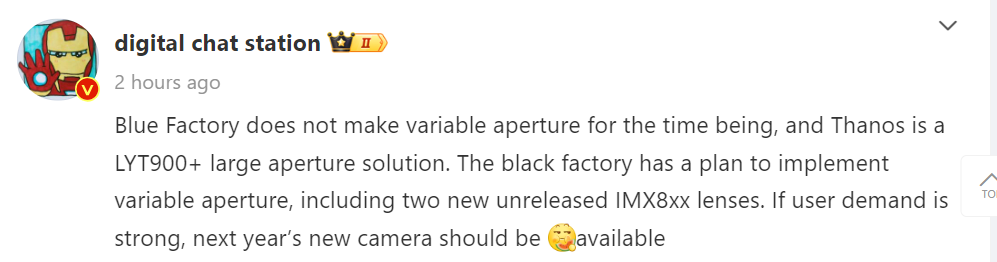
In another Weibo post, the tipster claimed that the Vivo X100 Pro+ will be equipped with the LYT-900 50-megapixel primary camera, which has a large aperture. The same camera will be seen on the Oppo Find X7, which is expected to debut first in the second week of January. The Xiaomi 14 Ultra, which is expected to launch in Q2 2024, is also said to be equipped with the same camera sensor.
Other reports have claimed that the rear camera setup consists of an IMX589 50-megapixel ultra-wide lens, an IMX758 50-megapixel portrait lens, and a 200-megapixel periscope telephoto camera. The device will run on Android 14 and Origin OS 4. The X100 Pro has a 5,400mAh battery with 100W wired and 50W wireless charging support. It remains to be seen whether the X100 Pro+ will also offer the same battery and charging capabilities. Top of Form
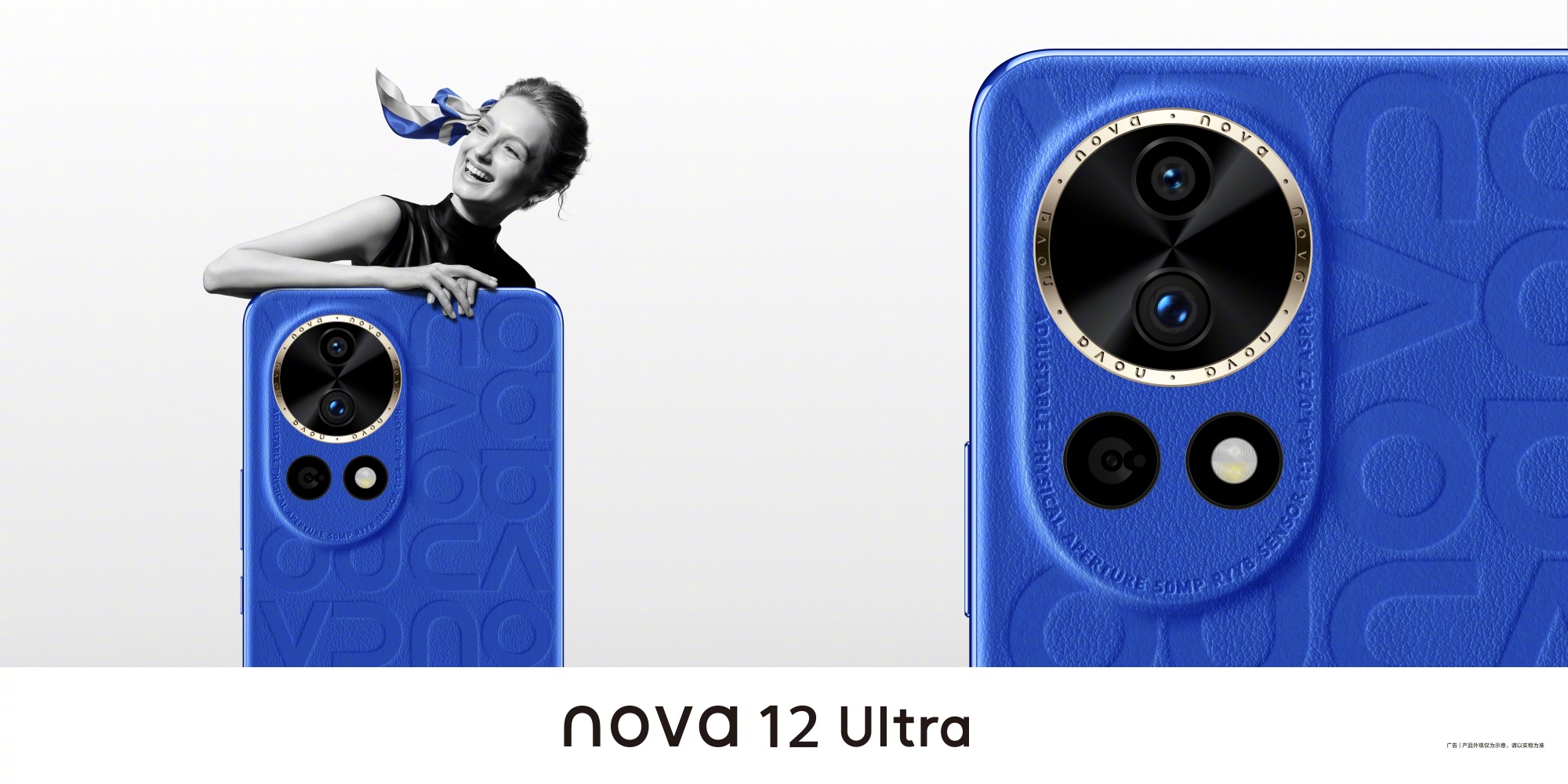
On December 26, Huawei will launch the Nova 12 series of smartphones in China. The series will consist of the Huawei Nova 12 Lite (Vitality Edition), Nova 12, Nova 12 Pro, and Nova 12 Ultra. Following leaks and rumors, the new smartphone is officially teased to come in three color options: Signature Blue, White, and Black. The company took to Weibo to officially tease the upcoming smartphone.
Along with the colors, the new posters showcase the camera module consisting of three camera sensors and an LED flash. Precisely, the posters reveal the presence of a 50 MP RYYB primary sensor offering a physical aperture from f/1.0 to f/4.0.The “Nova” engraving on the leather rear side of the smartphone is quite evident.
Huawei Nova 12 Series Specifications (Expected)
Previous reports suggest that the Huawei Nova 12 will feature a flat LCD protected by Huawei Kunlun glass. It may ship with Huawei’s own Kirin 830 or Kirin 9000s SOC. There will be a 45,000 mAh battery with 66W fast charging support. It could debut in two storage options, 12+256Gb and 12+512GB for the price of 2,999 Yuan and 3,499 Yuan, respectively. However, the battery remains the same with improved 100W charging on the Pro variant, but there will be a 2nd Gen Kunlun Glass which could bring a new OV50H primary sensor.
Huawei Nova 12 Ultra could also come with 2nd generation Kunlun glass protection and 100W charging. However, details about the battery capacity are not yet available to us. A recent leak suggests that it would feature the Kirin 9000 SoC, which was the newly launched Huawei Mate 60 flagship series. The smartphone seems to feature a 12 GB + 512 GB version, which will retail for 4,999 yuan.
Huawei Nova 12 Lite is also expected to come with a Kirin 9000s SoC and will feature the same 50MP primary rear sensor. Other details are currently not available.
Besides all the differences, the Nova 12 series will have plastic frames, a z-axis vibration motor, a side-mounted fingerprint, and a 60MP front camera
Today, Xiaomi officially announced that it will unveil the Xiaomi Civi 3 Disney Strawberry Bear limited edition on December 22 in China. The company also shared images to showcase the design and features of this special edition Civi 3 model.
Xiaomi Civi 3 Disney Strawberry Bear limited edition
Xiaomi had previously marked Disney’s 100th anniversary with the Civi 3 Mickey limited edition. Now, in collaboration with Disney, they are introducing the Civi 3 Disney Strawberry Bear limited edition. While the Mickey edition came with a price tag of 2,899 Yuan (~$405), the pricing for the Strawberry Bear model will be confirmed by the company tomorrow.
In terms of specifications, the Xiaomi Civi 3 features a 6.55-inch curved-edge OLED panel with an FHD+ resolution and a 120Hz refresh rate. The Dimensity 8200-Ultra powered device ships with up to 16 GB of LPDDR5 RAM and up to 1 TB of UFS 3.1 storage. It packs a 4,500mAh battery with 67W fast charging support.
For photography, the Xiaomi Civi 3 features a pair of 32-megapixel cameras with LED flash on the front, and a 50-megapixel (main, with OIS) + 8-megapixel (ultra-wide) + 2-megapixel (macro) triple camera unit on the back. The Xiaomi Civi 3 offers other features, such as dual SIM, 5G, an IR blaster, NFC, an in-screen fingerprint sensor, and MIUI 14-based Android 13.
The upcoming Samsung Galaxy S24 series has been a hot topic for quite a while now, with numerous leaks and rumors sharing details ranging from the device’s design to its specifications. Thanks to the reliable tipster Evan Blass, we now know when the Samsung Galaxy Unpacked event for 2024 will be.
Leaked teaser shows Galaxy Unpacked 2024 event date
In a recent leak, Evan Blass shared a short GIF image that not only disclosed the launch date for the Galaxy S24 series but also dropped hints about what to expect from the event. The teaser confirms that the Galaxy Unpakced 2024 event is set for January 18, 2024, at 3:00 AM KST (Korean Standard Time). For people in other time zones, that’s 7:00 PM GMT, 1:00 PM EST, and 11:30 PM IST.
The timing falls within our expected launch window, but this Unpacked promises something a little different. The event teaser hints at a deeper integration with AI, featuring a tagline that reads “Galaxy AI is coming.” Interestingly, the accompanying icon bears a striking resemblance to Google Bard’s logo.
This could mean that Samsung might be integrating Bard technology into the Galaxy S24 series. However, it’s also possible that Samsung is simply using a similar aesthetic for its AI branding.
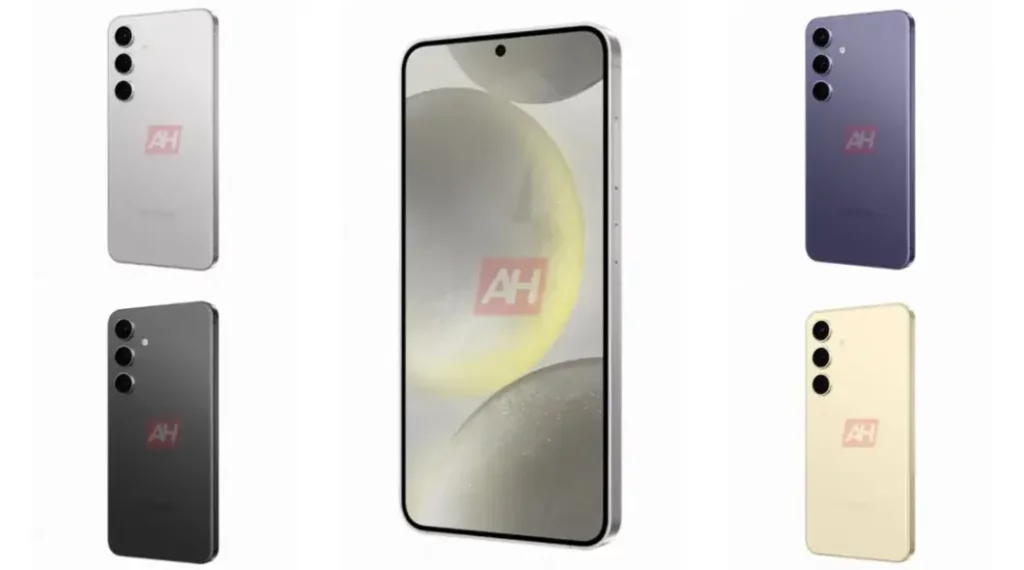
Leaks about the Galaxy S24 series have been pouring in, and one of the latest reveals official-looking renders of the Galaxy S24 in new color options. Twitter/X tipster @MysteryLupin has also shared a bunch of images showcasing phones from all angles, giving us a good glimpse of their sleek design. You can check out the tweet below for a closer look:
Since @Androidheadline x MrQ wanted a little battle, here you go 😉
Under the hood, the Galaxy S24 series is rumored to be powered by the Snapdragon 8 Gen 3 processor, except for the base Galaxy S24 in some regions, which might come with the Exynos 2400. The Galaxy S24 Ultra is also expected to get a durability boost with a titanium body.
After the anticipated release date of Samsung‘s upcoming Galaxy S24 series is revealed, official renders of the standard Galaxy S24 surface on the internet. The device will reportedly be available in four colors: purple, gray, yellow, and black. This is in contrast to the previously reported platinum and green colors.
This is in contrast with the previously reported platinum and green options.
Galaxy S24: purple, gray, yellow, and black
The overall design language of the Galaxy S24 maintains continuity with the previous generation, featuring a vertical three-camera arrangement on the back and flat sides with a flat display on the front. The LED flash assembly is positioned on the right side of the camera module. The display houses similar bezels on all four sides with reportedly the narrowest chin or lower bezel on a Samsung device.
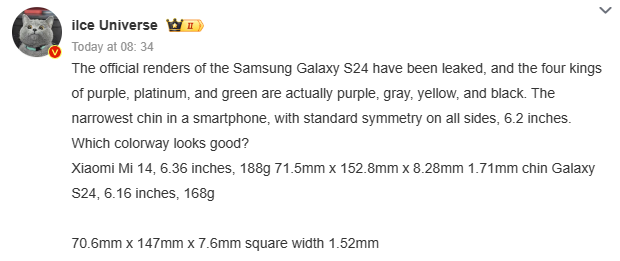
Renowned tipster @IceUniverse stated that the Galaxy S24 boasts a 6.16-inch screen, weighs 168g, and measures 70.6mm x 147mm x 7.6mm. Notably, it incorporates a 1.52mm chin design with equal width on all four sides. For context, the Xiaomi 14, launched in late October this year, offers a slightly bigger 6.36-inch screen, weighs around 188g, and boasts a 1.71mm chin.
The base Galaxy S24 has already emerged on FCC certification platform. There have been reports that the Galaxy S24 Ultra will ship with the latest Snapdragon 8 Gen 3 chip all over the world, while Galaxy S24 and Galaxy S24 Plus could bring Samsung’s in-house Exynos 2400 chip. Notably, the Exynos 2400 this time reportedly outperforms the A17 Pro. However, it will also be important to check if it finally outperforms the A14 in power efficiency.
Moving to other aspects, the standard model is expected to feature a rear camera setup comprising 50MP + 12MP + 10MP lenses, an FHD display (1080P), a 4000mAh battery, and 25W charging support, as confirmed by the 3C certification platform form China. In contrast, the S24+ will offer a higher-resolution QHD display, a 4900mAh battery, and 45W charging support.
iQOO will hold its next launch on Dec. 27 in China. The event will see the arrival of multiple products, such as the iQOO Neo 9 series, the iQOO Watch, and the iQOO TWS 1e earbuds. The rumor mill has already leaked many details about the iQOO Neo 9 series. Today, Vivo’s Vice President for Brand and Product Strategy, Jia Jingdong, took to Weibo to share the key specifications of the Neo 9 and Neo 9 Pro. Here is all the information about the two phones that have been officially confirmed.
iQOO Neo 9, Neo 9 Pro key specifications
iQOO Neo 9 series
The iQOO Neo 9 will be equipped with the Snapdragon 8 Gen 2 processor, while its counterpart, the Neo 9 Pro, will feature the Dimensity 9300 chipset. Both phones share commonalities, including LPDDR5x RAM and UFS 4.0 storage. While there is no official confirmation, it appears that the series may ship with up to 24 GB of RAM and 1 TB of storage, like the Neo 8 series.
The Neo 9 and Neo 9 Pro will have an OLED panel that offers a 144Hz refresh rate. As per other reports, the two phones will feature a 6.78-inch Visionox OLED panel that offers a 1.5K resolution. Both devices incorporate the iQOO Q1 chip for an enhanced viewing and gaming experience. These smartphones will have a 5,160mAh battery and 120W charging capability.
For efficient thermal management, the Neo 9 series will integrate a 6K VC liquid-cooled 3D heat dissipation system. Both smartphones will inherit the OIS-enabled 50-megapixel Sony IMX920, which is available on the Vivo X100 smartphone. The thickness of the series will be 7.99mm, and both devices will come in three shades, such as Red and White Soul, Nautical Blue, and Fighting Black.
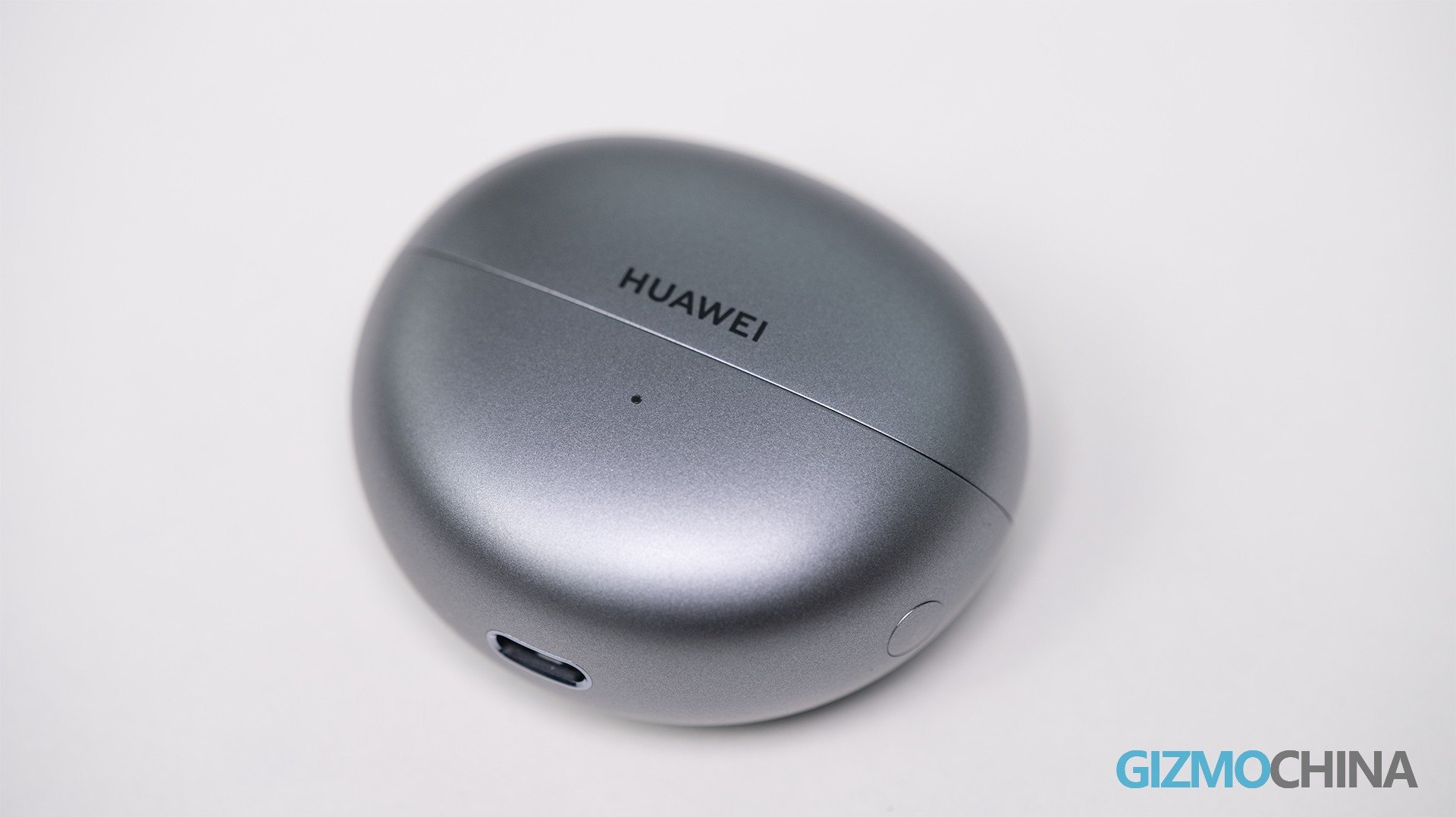
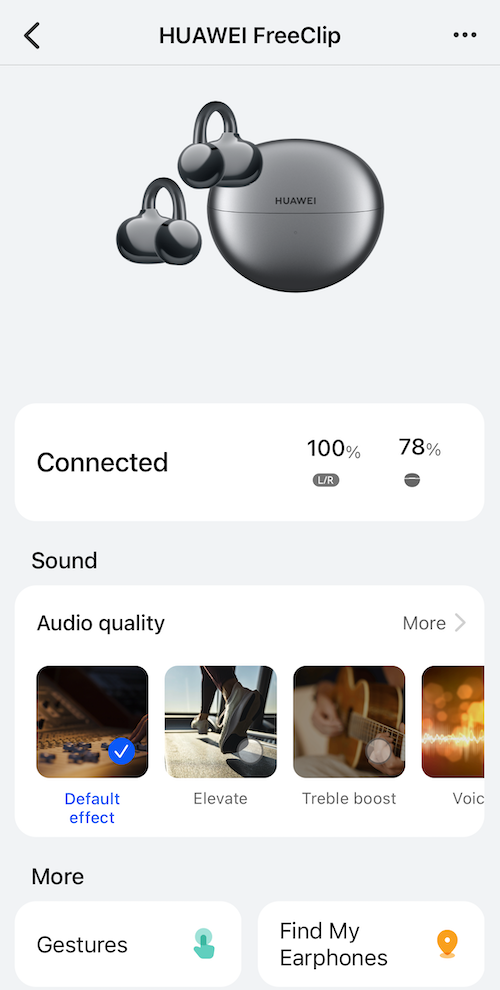
Here we have the FreeClip Openear Earbuds from HUAWEI, this is the perfect example of creating something unique and innovative, just to provide a new choice for customers who need a new pair of earbuds. We’ve reviewed quite a lot of wireless earbuds, but this is the first time I have taken a deep look at the C-bridge form. It was not mainstream until 2023, and now you can see the trend that a lot of manufacturers carried on the new-shape earbuds.
Design
The whole design of the earbuds is rather peculiar, especially when it comes to a brand like HUAWEI. I mean Huawei has its own design in both open-ear and in-ear designs, so I guess they might strike a better balance between wearing comfort and security. Anyway, it’s still worth a round of applause for such an act of pushing the innovation forward.
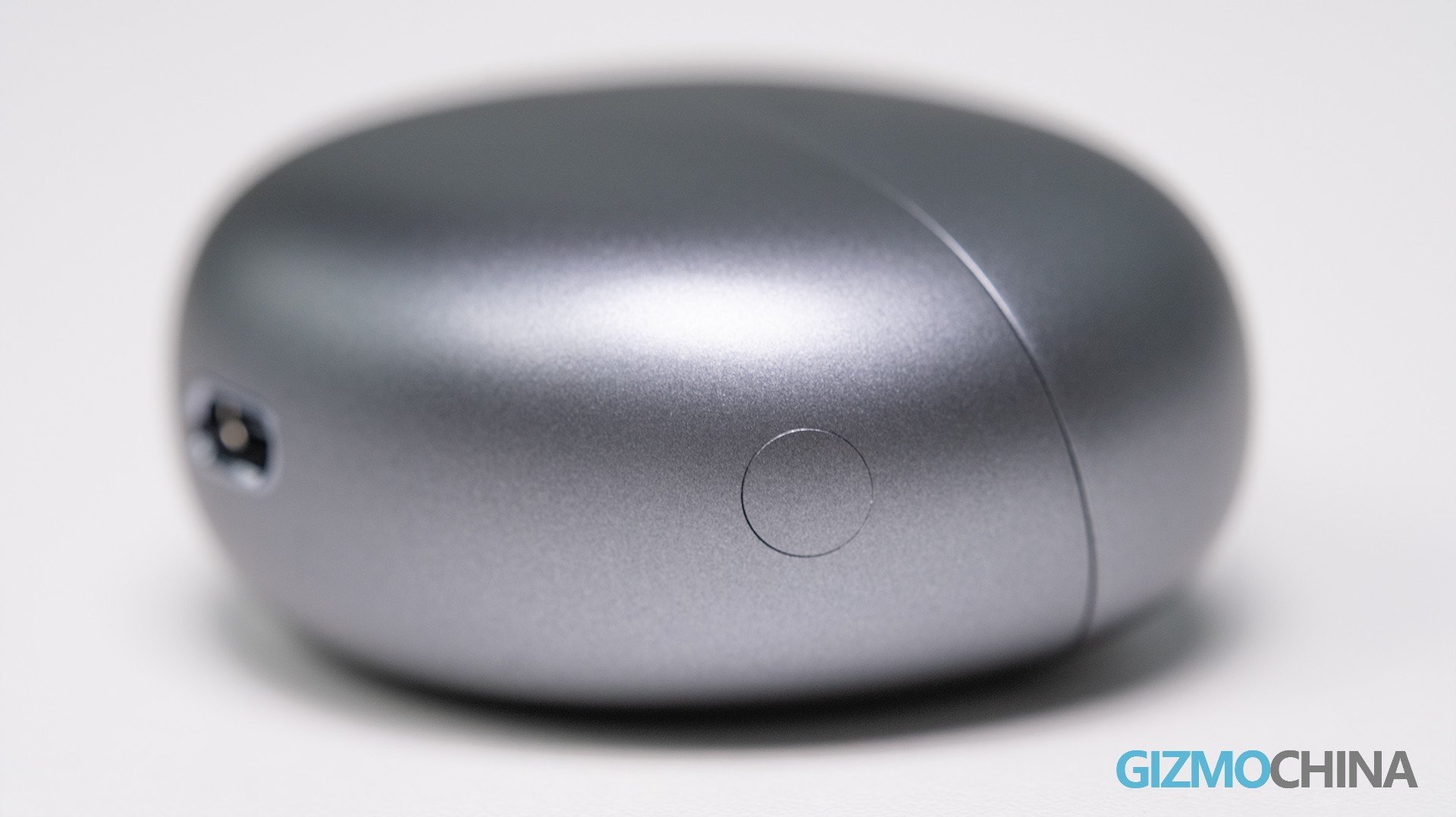
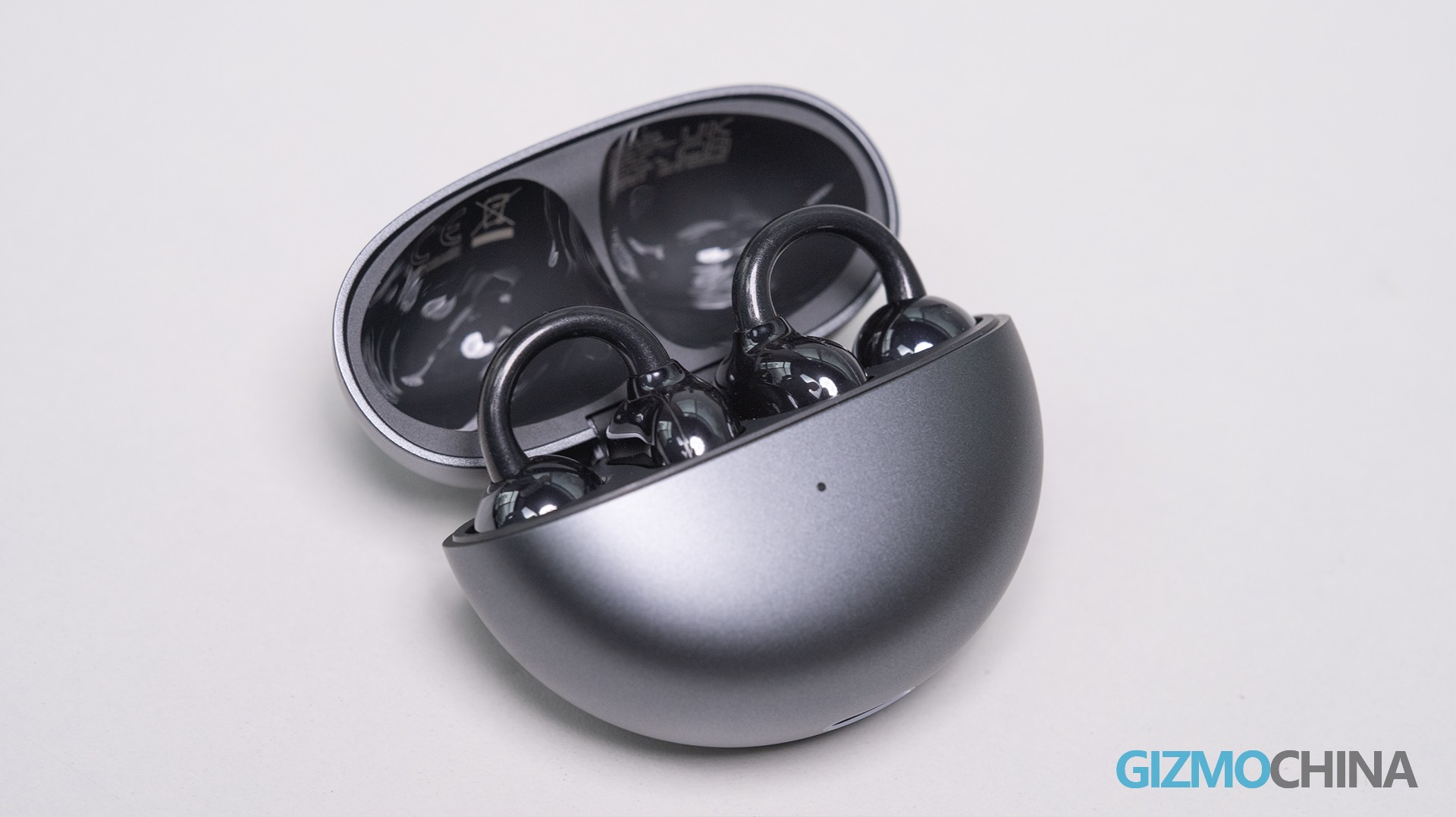
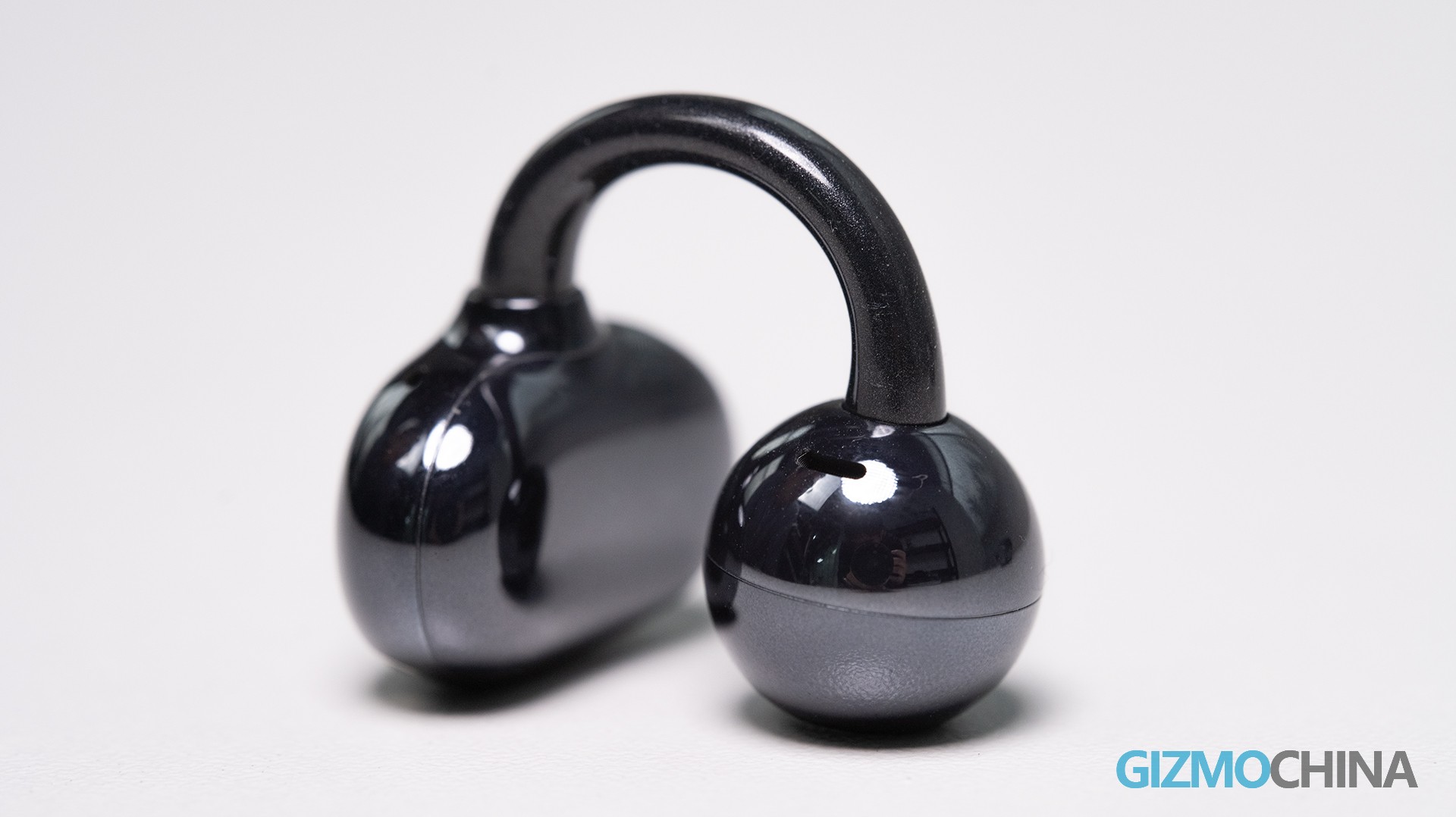
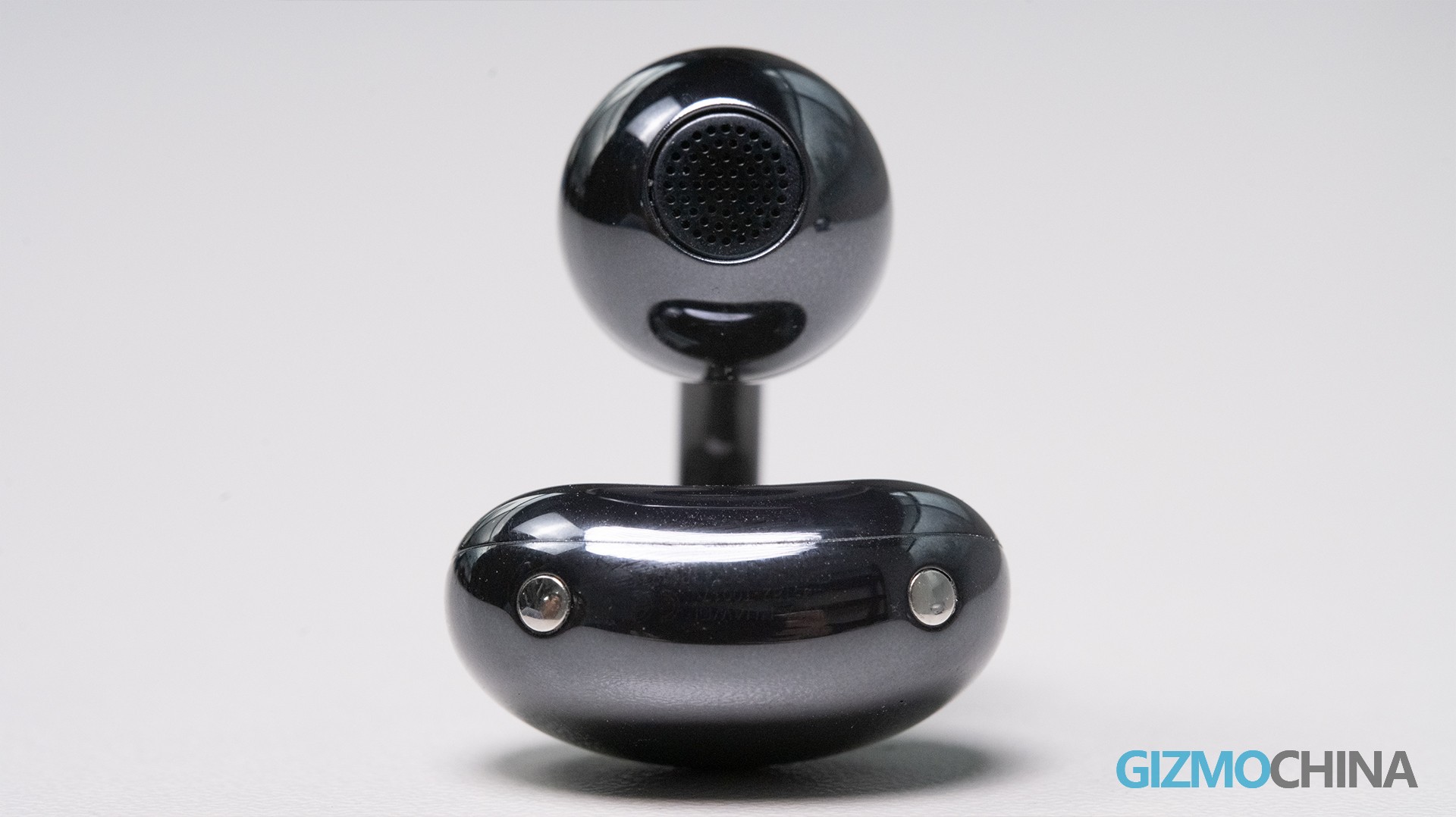
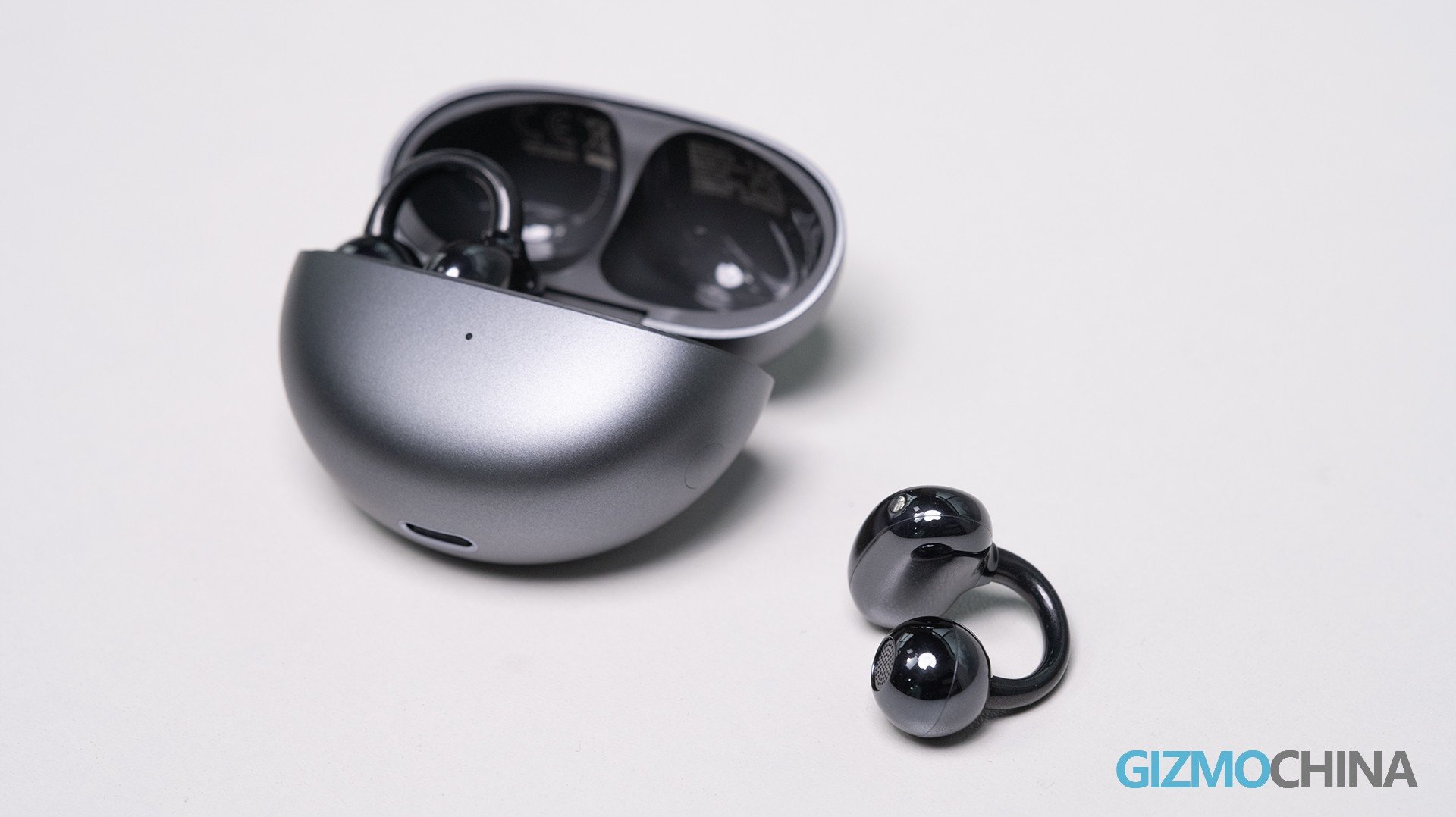
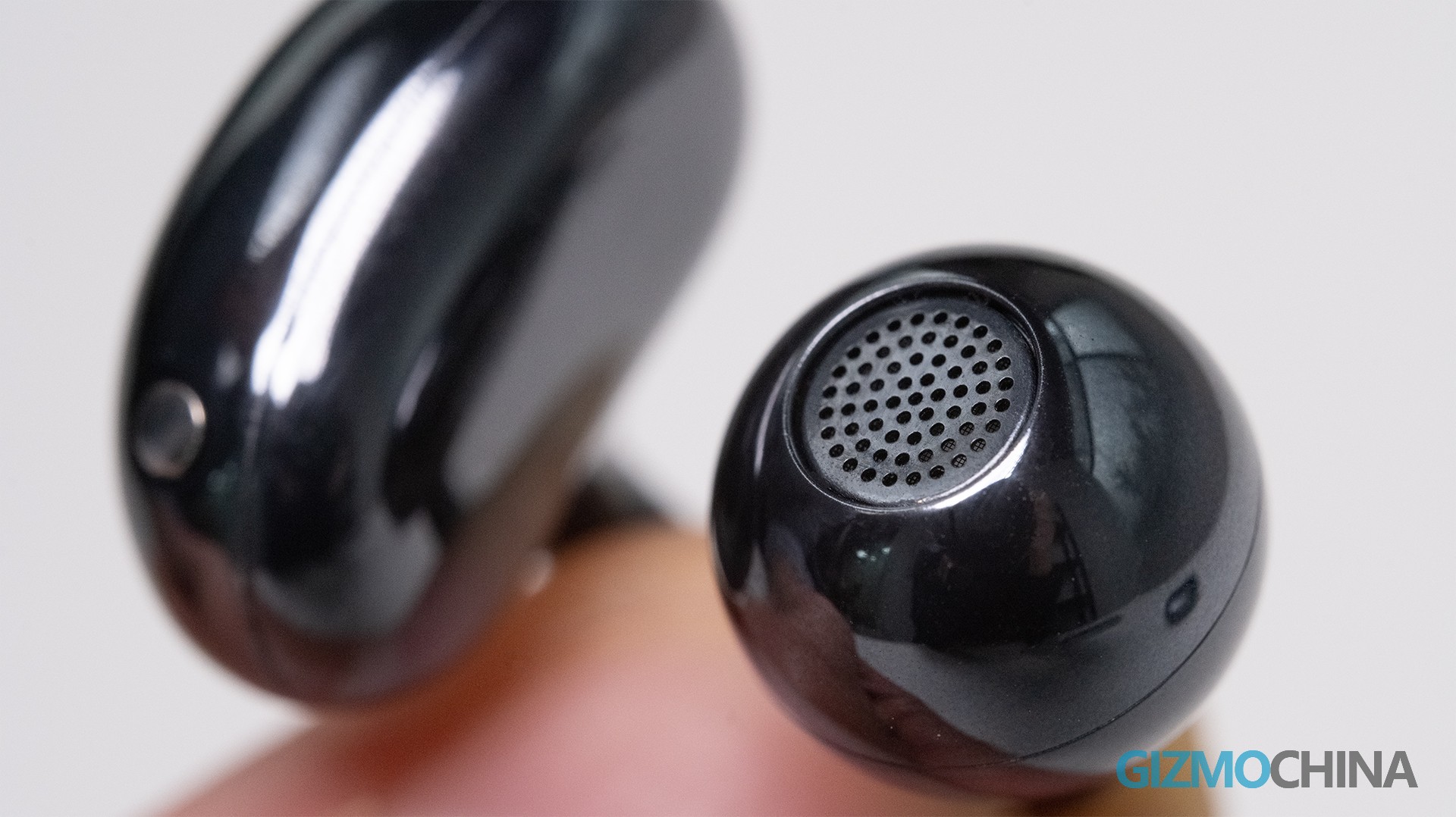
When I first got the earbuds, I was surprised actually. The earphone case is not much different, it is still a pebble style, one thing I have to mention right now is that the button is at the side, not in the center or anywhere that looks more thoughtful. When I opened the lid, those arches were the first thing that came to my eyes, they are genuinely unique. And then you see the buds on each side are not in the same shape, so you will have the will to take them out to find out why. Once you take them out, the real design reveals itself. On one side, there is a bean-shaped little piece that has a slight curve inside, and on the other side is a round little ball that has the driver built-in. Together with the arch, they are the whole profile of the product.
There isn’t any button or indicator anywhere, so it must be a touch control, which we will talk about later. So overall I would say it is a very chic design, the surface is shiny just like a piece of earring, although if there is some makeup on your face, it will get on them easily. After all, it can be a good choice for girls, and there is another purple color in the collection, that’s another option you have.
Wearing Comfort
We often praise open-ear earbuds as better wearing comfort over normal earbuds, and that largely depends on the ear tips not going into the ears. The HUAWEI FreeClip is also made the same way, but that’s just part of the story, the other half is about how it clings on your ears to solve the security issues.
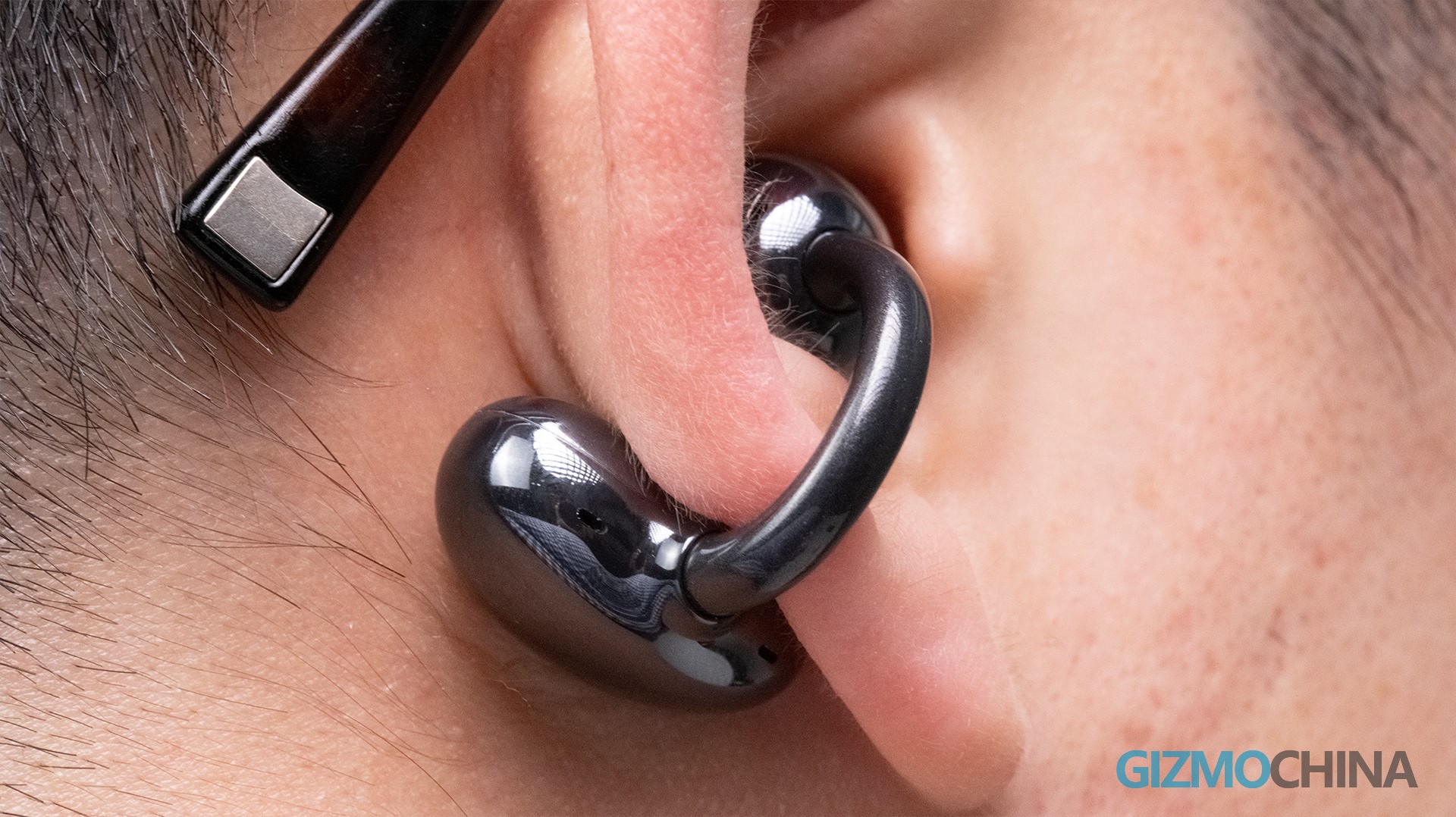
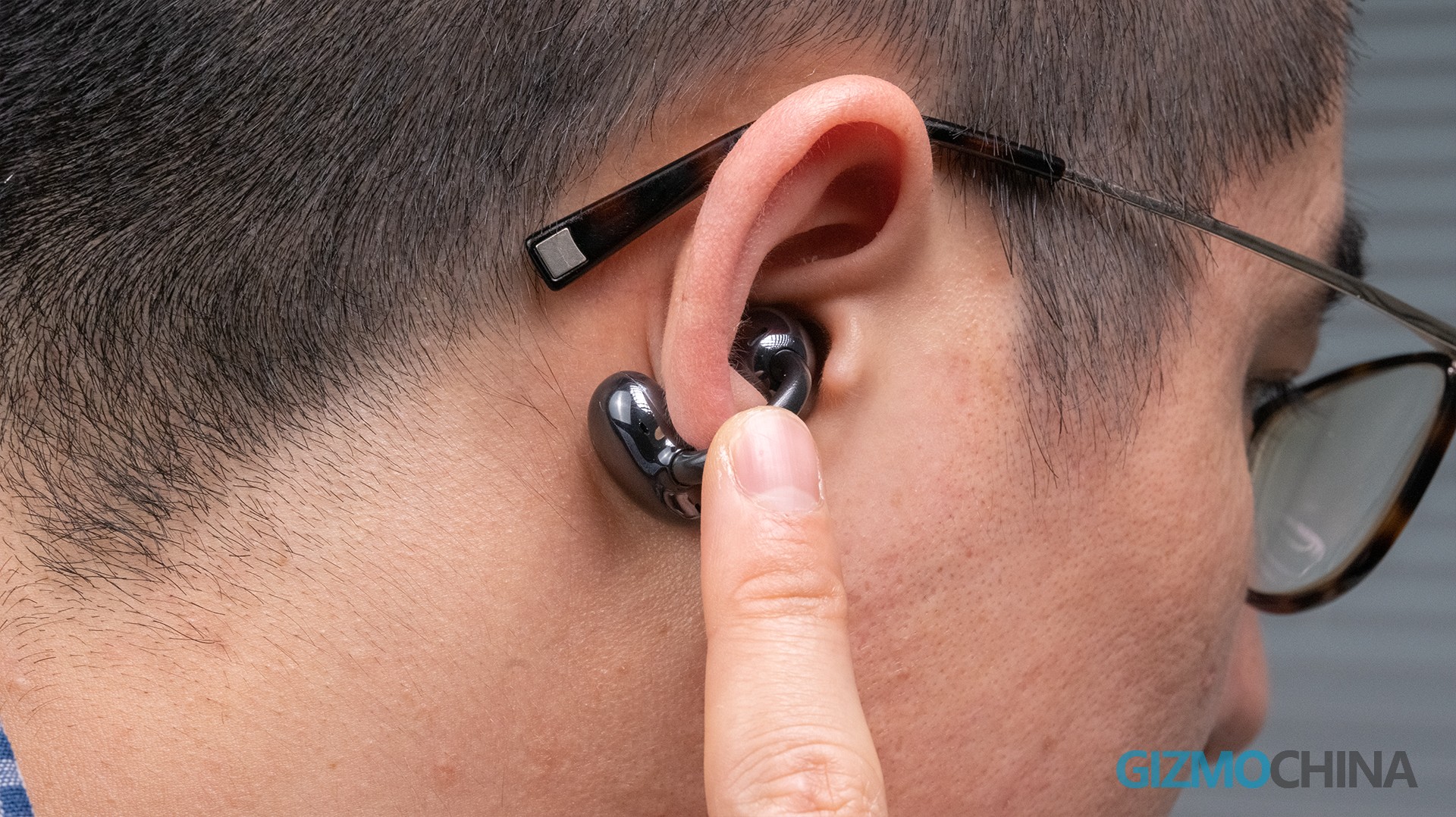
Basically, the way it works is to clip the driver ball and the comfort bean to your ear, without pinching your ears of course. The “C-bridge” in between is made of nickel-titanium (Ni-Ti) memory alloy, it has high elasticity, and high durability, and can secure the fit really well.
Personally, it solves my biggest complaints on open-ear earbuds in two ways. First, it reduces a lot of weight compared to others. Normally open-earbuds would put a huge driver or battery into the product, to compensate for the sound loss and slightly short battery life, but it always causes a bit of trouble in weight distribution. When you go for a run, the whole unit shakes in all directions, so it would not fit on your ears that snugly. But these earbuds only weigh 5.6g each, that’s a significant weight reduction, therefore, you won’t be worn down after a long time wearing them. Second, the bridge does not conflict with the legs of my glasses, this is a huge release for people like me. One more thing here, the travel of the C-bridge is also shorter than others, so a simple clip just gets the job done.
The last thing the Freeclip did is the perfect long-time wearing comfort, at first I doubt it, but once I clip them on, there isn’t much feel of me wearing anything. The “magic bean” is wide and curved, so it stays on the ear very comfortably, and the pressure created by the whole unit is overwhelmingly the right amount, I mean it’s there to give you the secure-fit feel, but not too much to cause discomfort. So wherever you want to wear them, they are just perfect, and certainly you can recommend them to your sports lover friends or outdoor hikers.
Sound Quality
At the moment when we have these earbuds, there isn’t any info about the specs of the drivers, what we do know is that there are high-sensitivity dual magnetic circuit moving coil units and large amplitude drives, preserving the clarity of sound. The dual-magnet high-sensitivity driver increases the magnetic induction intensity, thus increasing the driving capability of the speakers.
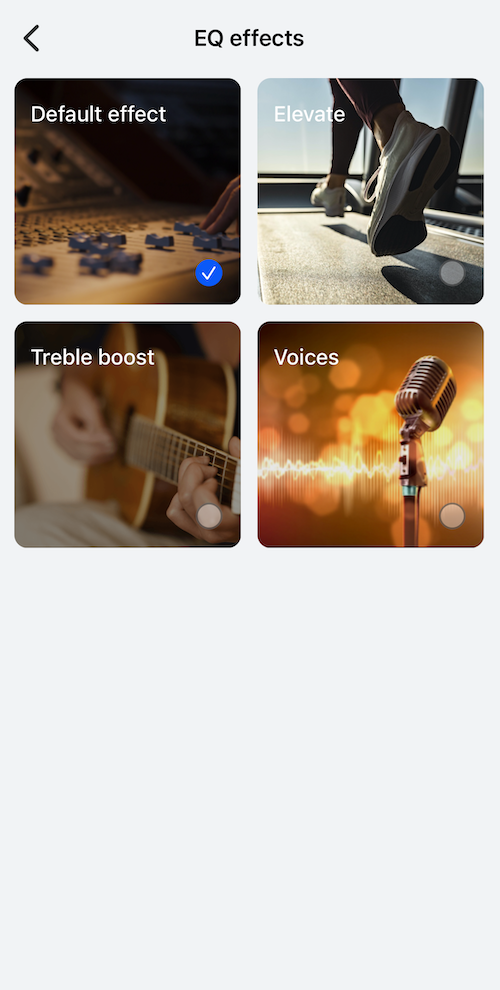
The sound experience is pretty good, far better than what I expected from a pair of open earbuds. The low-frequency sounds are more powerful without too much dampening than most of its kind. But since it didn’t securely block the ear canal, it didn’t go as deep as the Freebuds Pro series.
The treble sounds are bright and not harsh, and I can clearly feel the resonance of the drums and cymbals in the background. In my favorite R&B tracks, The melody is in good dynamics, and the low-frequency drumbeats are surging in a light but more comfortable way. In some music with highlighted vocals, I can feel the enhancement of vocal parts in the mid-tones, making the singer’s voice sound more vivid than in most open earbuds. And there’s also good soundstage reproduction for live performances.
While it has an open-ear design for the experience we had with such earbuds this year, we noticed that the peak volume of open-ear earbuds is higher than the ones in previous years, so you might not be able to hear your surroundings as well than before. So keep in mind, if you want to be safe while running on the street, we recommend turning the volume down a bit.
Other features
The HUAWEI FreeClip has the ability of sound leakage reduction, wind protection, and call noise reduction. While testing them out, they do perform well. Thanks to its enhancement in sound volume, it can easily deliver clear calls in noisy environments; And we also tested it for privacy issues, too.
Even when putting the volume at 70%, people besides me can barely hear what I was listening to, so if you were to talk to people over the phone, your privacy is better protected for sure.
Surprisingly, it supports touch control in three areas, either on the driver part, the bean part, or even the C-bridge. Honestly, I can’t figure out how they make that happen on the bridge, but it’s very good to have such a feature. Also, since the shape of the left and right is identical, you don’t need to worry about wearing them right or wrong, it will adjust them automatically.
The FreeClip also supports 8 hours of use on a full charge, 36 hours with the case, type-C quick charging, wireless charging, and IP54 water resistance. So the bonus features here just make it versatile as well.
Verdict
As I mentioned initially, we weren’t expecting such a product from HUAWEI, and even some advanced features others don’t have. The clip-on way of wearing earbuds is the best so far, and it does not put any pressure on your ears. Upon these features, the sound quality is also amazingly good. If you want to have both open-ear experiences, while still with good sound quality, this HUAWEI FreeClip is the best one. If you are interested in trying the new form out, just check it on Huawei Official here.
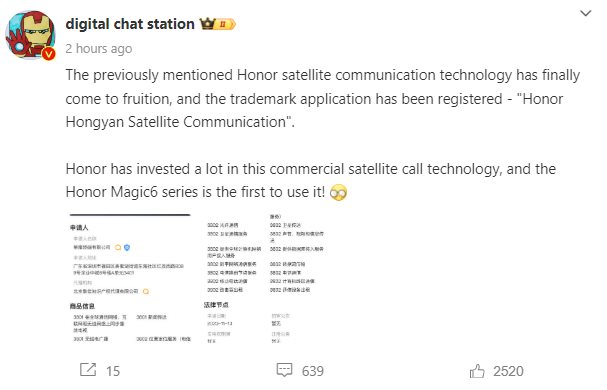
There have been reports about the presence of satellite communication on the upcoming Honor Magic 6. The rumors got wind after Honor CEO Zhao Ming confirmed details about the inclusion of satellite communication in the upcoming devices. The new Flagship from Honor is highly anticipated to launch by the second week of January. The company is unveiling the Honor 90 GT and Honor Pad 9 today in China.
The new information reveals that Honor has applied for the “Honor Hongyan” trademark for satellite communication with the authorities. As reported by the Digital Chat Station on Weibo, it could debut via the upcoming Honor Magic 6. There are few details available at the moment about the new feature. However, we expect more information in the coming time.
Honor Magic 6 Series Specifications (Rumored)
Previous leaks state that the Honor Magic 6 Series will launch, comprising the Honor Magic 6 Pro, Magic 6 Porche Design Edition, standard Magic 6 Pro, and Magic 6 Lite. The smartphones are said to feature high-end specifications and features.
A recent leak claims that the Honor Magic 6 will feature a quad-curved OLED panel with 2840 PWM dimming. The smartphone is protected with the Oasis eye-protection feature, along with a better display and glass protection than its predecessor, the Magic 5. It will house the Snapdragon 8 Gen 3 SoC with the radio enhancement chip C1, which supports satellite communication.
The Honor Magic 6 will feature a 5800 mAh battery with 66W fast charging support. In the camera department, it will feature a 1-inch 50MP primary sensor with OIS support, a 50MP ultra-wide lens, and a 50MP periscope telephoto lens. It will run Magic 8-based Android 14. Following the trend, the Magic 6 Pro will use an AI model with 7 billion parameters, enhancing critical intelligence among apps.
China is soaring into the future with its rapidly evolving low-altitude economy, a sector that experts believe could add a staggering US$700 billion to its economy by 2025. This innovative field isn’t just about aircraft; it represents a diverse range of industries from drone manufacturing to aerial services, promising to revolutionize everyday life.
Drones are slowly becoming a part of our daily logistics
Imagine a world where drones aren’t just a hobby but a key part of daily logistics, delivering your packages and even your dinner. In China, this is fast becoming a reality. The country’s push for the low-altitude economy is not just about technology but also about creating new ways to travel and transport goods. Futuristic concepts like winged taxis and sightseeing helicopters are on the verge of becoming commonplace for the Chinese public.
This growth is supported by significant governmental backing. The low-altitude economy has been recognized as a strategic industry, receiving attention and investment to ensure its success. The numbers are already showing impressive progress: over 1.11 million civilian drones registered and more than 182,000 drone pilot licenses issued. This rapid expansion signals a shift in how China envisions its economic and technological future.
But it’s not just about the numbers. The low-altitude economy encapsulates a broader vision. It represents a leap into the digital age, harnessing the power of information technology and intelligent systems. This sector is becoming a key driver of investment, offering high returns and promising to break new ground in urban development. With cities becoming increasingly congested at ground level, the sky offers a new frontier for growth and innovation.
As China continues to lead in drone manufacturing, holding over 70% of global sales, the low-altitude economy is more than an emerging market. It’s a testament to the country’s commitment to technological advancement and its role in shaping the future of global transport and logistics. With the implementation of new regulations and an increasing number of provinces joining the fray, the sky’s the limit for China’s low-altitude economic ambitions.
Valve has rolled out a beta update for its Steam client, just in time for the Christmas season. This update brings long-awaited privacy features and more versatile shopping cart options, enhancing the user experience on the popular gaming platform.
Users can opt into the beta client to use the new features
For two decades, Steam users have requested the ability to keep certain games private in their libraries. Valve has finally responded with a beta feature that lets players mark games as private. This means that users can hide games from their library, along with associated achievements and playtime. It’s a significant step for Steam, which started as a simple launcher for Counter-Strike in 2003 and has since evolved into a comprehensive gaming service.
To use this new privacy feature, Steam users need to opt into the beta client. This involves a simple process of changing settings in the Steam client, after which users can select games to mark as private. This feature is especially useful for those who prefer to keep their gaming habits discreet or for games they might not want publicly displayed.
Another notable addition is the improved shopping cart functionality. With the festive season in full swing, this feature is timely for users buying gifts. The updated shopping cart allows for inline gifting, enabling users to buy multiple gifts in one transaction, a convenience for those looking to gift games to friends. Additionally, the unified shopping cart syncs across all devices, ensuring a seamless shopping experience.
These updates come ahead of the Steam Winter Sale, a much-anticipated event for gamers. With these new features, Steam is showing its commitment to evolving and catering to its users’ needs. The introduction of privacy settings and streamlined gifting options indicates Valve’s dedication to enhancing user privacy and convenience, setting the stage for more user-centric updates in the future. Steam’s evolution continues to impress, solidifying its position as a leading digital gaming platform.
Electric bicycles (e-bikes) are increasingly reshaping urban mobility, especially in Europe, where they are essential daily transportation tools. German brand Schindelhauer’s new e-bikes, Heinrich and Hannah, exemplify this shift towards combining style and functionality.
Both bikes operate silently and are low-maintenance
E-bikes have evolved beyond being mere recreational gadgets. They are now a vital part of the urban landscape, offering an eco-friendly alternative to traditional transportation. Schindelhauer’s latest offerings maintain the brand’s minimalist aesthetic while incorporating significant power, courtesy of the Bosch Performance Line CX motor. This motor, typically seen in high-end electric mountain bikes, delivers a punch with 85 Nm of power and a nominal output of 250 watts, adhering to European e-bike regulations.
The Heinrich and Hannah models cater to the contemporary European commuter. Both bikes feature a Gates CDX drive belt, known for its silent operation and low maintenance. Schindelhauer’s focus on technology is evident in features like the Bosch eBike Flow app, which allows riders to manage ride modes, create personalized profiles, and plan routes. The built-in GPS and ConnectModule offer real-time bike tracking, a boon for urban cyclists.
In design, Schindelhauer stays true to its classic style. The Heinrich boasts a sporty frame and sleek lines, ideal for a city gentleman’s cruiser. The Hannah, with its sloping lines and step-through design, offers elegance and practicality. Both models come with the option of saddlebags, enhancing their utility. Thick tires on both bikes ensure a comfortable ride on city streets, though they are less suited for rougher terrains.
The bikes also feature the innovative Automatiq Gear Hub from Enviolo, allowing smooth and automatic gear changes, and the optional Racktime luggage rack for added versatility.
In terms of pricing, Schindelhauer’s e-bikes are available in single-speed and Enviolo Automatiq versions, with the latter being slightly more expensive. The Heinrich and Hannah represent more than just e-bikes; they symbolize a movement towards sustainable, efficient, and stylish urban travel, catering to the needs of the modern city dweller.
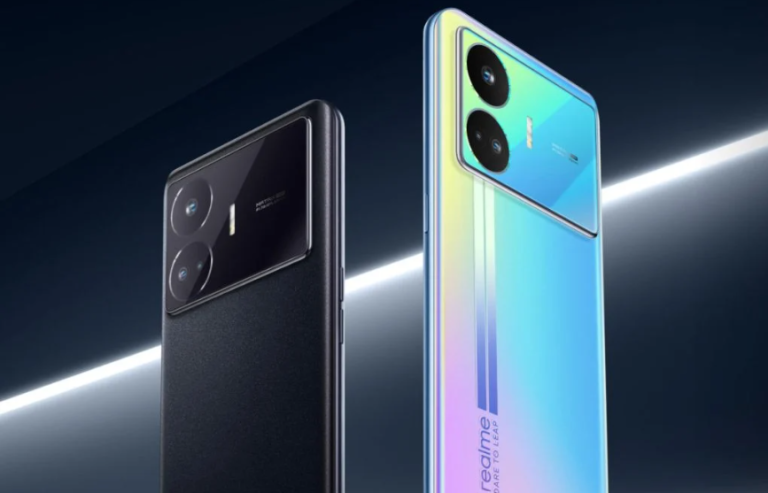
Realme GT Neo5 SE is an exciting mid-range smartphone launched early this year while running Realme UI 4.0 in China. The smartphone is now receiving the Realme UI 5.0 Public Beta Update in China bringing several new features and enhancements. Anyone interested can participate in the program and can hand on the latest Android 14-based RealmeUI 5.0 on Realme GT Neo5 SE. Realme is already bringing the Realme UI 5.0 to various smartphones including the Relame 10 Pro+ 5G, Realme C55, Realme Narzo N60 5G, Realme GT 2 Pro, and others.
Realme GT Neo 5 SE
Realme UI 5.0 Features on Realme GT Neo5 SE
The new update seems to feature several new improvements in security, privacy, design, performance, and efficiency. Other changes are as follows:
Security & privacy boosts:
Enhanced photo/video permission management for safer app access.
Improved system stability for a more secure experience.
Performance Optimizations:
Faster app launches and smoother animations.
Increased overall system stability.
Aquamorphic Design Enhancements:
Natural, gentle, and clearer color style.
New ringtones and revamped notification sounds.
Cloud Interaction:
Real-time reminders in diverse formats.
Instant access to crucial info.
Smart Car Space:
Introducing Car+ for seamless screen casting.
Elevate driving experiences with smart cross-end services.
Smart & Efficient Features:
Filedrop feature to drag-and-drop content transfer.
Enhanced cross-device synchronization for office productivity.
Improved text recognition now supports handwritten text in select languages.
Swift mobile phone relocation and data migration.
How to Apply for Realme UI 5.0 Public Beta
Prerequisites:
Make sure your phone has at least 15 GB of free storage.
Your Device should not be rooted
Backup important data from the device
Third-party applications may not work perfectly.
It may impact daily usage and affect battery life for a couple of days until the phone gets used to the new software.
Steps:
Charge your battery at least up to 60%.
Now, update the Realme GT Neo5 SE phone to the RMX3700_13.1.0.120, RMX3700_13.1.0.121 firmware.
Apply for the Early Access program by heading to Settings → About device → Click on the “realme UI 4.0” banner at the top → Click on the three dots in the top right corner → Beta program →Early Access →Apply Now → Submit
Realme has unlimited quotes for the testing, so any user can apply for the program. For more information, users can head over to the official thread.
The stable Realme UI 5.0 update will eventually become available within a month or two for the Realme GT Neo5 SE in China.
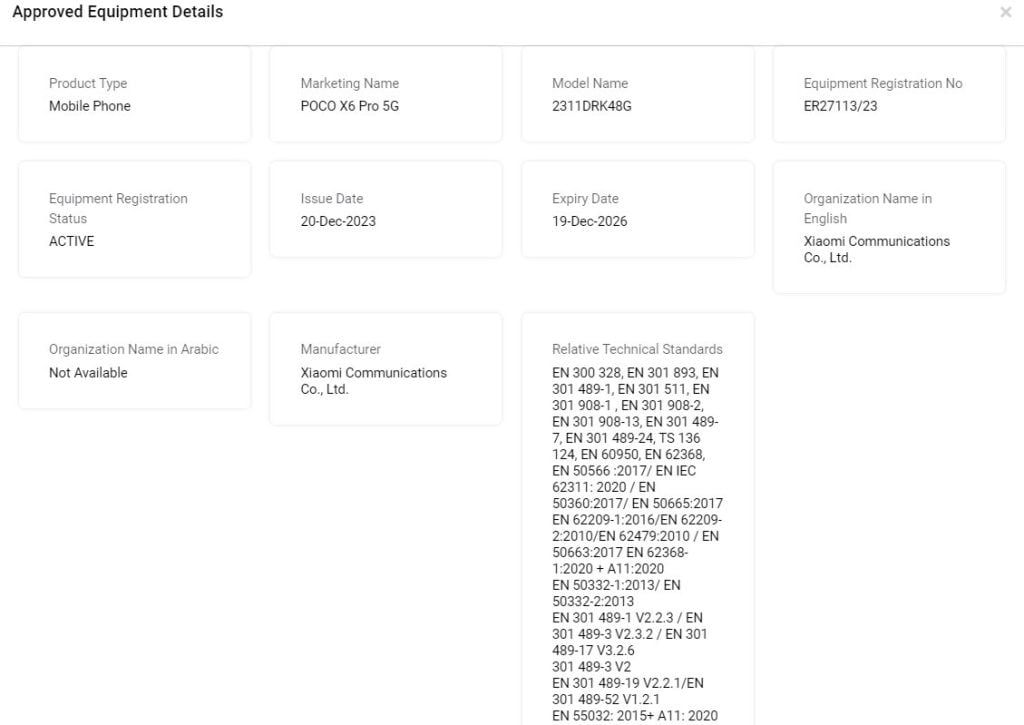
Following the Poco X6 5G, the Poco X6 Pro 5G also appeared on the UAE’s TDRA certifications. Believing leaks, the details about the upcoming smartphone are already out, yet the certifications confirm these leaks. The device has already appeared on the FCC, NBTC Indonesia, BIS India, and IMDA. The Poco X6 Series is set to launch, comprising the Poco X6 and Poco X6 Pro.
The Poco X6 Pro 5G’s TDRA listing confirms the smartphone’s upcoming launch. There’s hardly any information about the device’s specifications or features. We have to wait for some official confirmation of the features, launch, and pricing details.
Poco X6 Series Features and Specifications (Expected)
Along with the Poco X6 Series, Xiaomi’s sub-brand is launching the Poco M6 5G in India. The Poco X6 Pro 5G and Poco X6 have appeared on Xiaomi’s internal servers running HyperOS. As per the FCC, the Poco X6 Pro is expected to come in the 8GB+256GB and 12GB+512GB variants built on plastic frames, while the 12GB+512GB variant will launch with a PU frame.
The Poco X6 was recently spotted on Geekbench running the Snapdragon 7s Gen 2 SoC, which is paired with the Adreno 710 GPU. The Poco X6 is expected to be the rebranded version of the Redmi Note 13 Pro China variant. Considering that, the smartphone will feature a 6.67-inch OLED panel with a 1.5K resolution and a 120Hz refresh rate. It is likely to feature a 5100 mAh battery with 67W fast charging technology.
While the Poco X6 Pro is a rebrand of the Redmi K70E and could feature the same specs as the China variant,. So, it will feature a triple-rear lens setup featuring a 64 MP primary sensor with OUS, a 2 MP macro lens, and an 8 MP ultra-wide lens. There will be a 16 MP front-facing camera. It will have a 5500 mAh battery with 90W fast charging.
The Poco X6 Series global launch date and availability details remain unconfirmed for now. There’s late January launch speculation for the new series; however, we have not confirmed whether the rumor will see the day of the light or not.
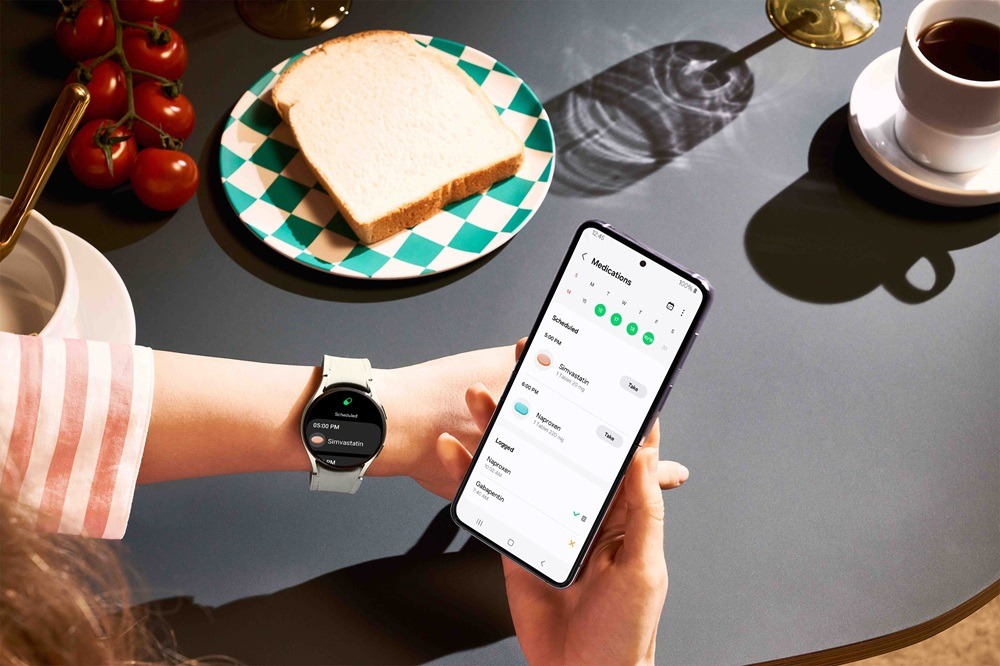
Following the recent design makeover, Samsung Electronics has made a significant advancement by introducing a new medication monitoring feature into its well-known Samsung Health app. To give users more control over monitoring their health, the functionality guarantees a seamless integration of various devices, services, and individuals. It will be available for the Galaxy Watch models with special wrist alerts, so users won’t miss their medication schedules.
The newly introduced monitoring feature allows Samsung Health users to effortlessly monitor both prescription and over-the-counter medications. Descriptions, potential adverse effects, and drug interactions are among the extensive details on medications that the application furnishes. To ensure precise differentiation, users may also record particulars such as the shape and color of their tablets.
In addition to providing basic information, the Medications feature enables users to customize notifications for medication refills and intake. Intelligently prioritized, these notifications provide reminders ranging in severity from “gentle” to “strong” according to the criticality or urgency of a specific prescription.
Samsung is reportedly working on the Samsung Ring, which could measure heart rate and offer other features like wireless payments, etc. The device is still rumored, and there’s no official confirmation about it yet. However, it is expected to launch in the next couple of years.
By including this feature, Samsung Health strengthens its commitment to offering an overall wellness experience. Already, the application provides advanced health services, such as mindfulness programs, sleep management, and irregular heart rhythm detection. The addition of Medication tracking guarantees that users can now seamlessly incorporate medication management into their comprehensive journey toward health and well-being.
The feature will first roll out in the US later this week and is expected to come to other regions shortly. All smartphones running Android 8.0 or later with Samsung Health version 6.26 will get the feature. However, the availability may vary with the device model. For Wear IS devices the Watch must run Wear OS 4.0 or later to get the feature. Such feature additions make Samsung Health an irreplaceable app on smartphones. The leading features of the app enable users to lead healthier lifestyles.
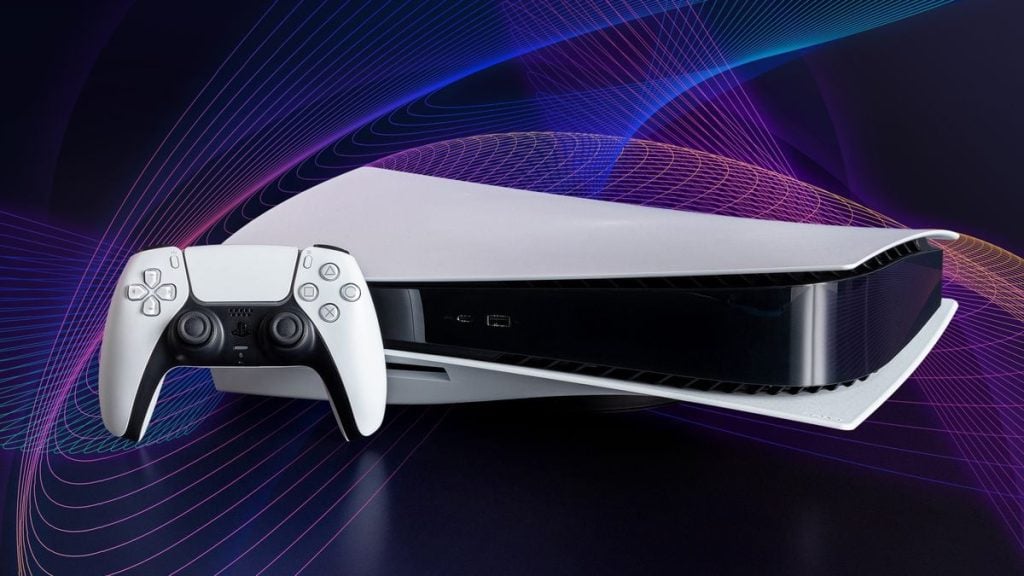
The ninth generation console wars are still in full swing, with Sony, Microsoft, and Nintendo are fiercely competing to sell more products and reach as many users as possible. Sony currently holds the lead in this race, thanks to its longstanding exclusive games strategy. This approach clearly works, as seen in the recent sales numbers for the PlayStation 5, according to the company’s report. Here are the details…
Sony’s PlayStation 5 Surpasses 50 Million Units with The Help of Exclusive Titles
The Sony PlayStation 5 is making waves in the gaming console market. Moreover, there are many factors that make the company’s job easier. For example box struggles to bring out exclusive games, even with its numerous game studios and Game Pass service. Also Sony is doing well because the upcoming Nintendo Switch 2 isn’t out yet, making the competition easier for them.
Of course, this situation is reflected in reports as well. In July, Sony announced the sale of 40 million PS5 units. Now, they have revealed that this number has reached 50 million. Additionally, we have just entered the holiday season. It’s anticipated that the company will capitalize on the shopping excitement during this time, boosting these numbers even further.
However, if we set aside what will happen in the future and focus on what has already happened, an incredible picture emerges. Selling around 10 million PlayStation 5 units in approximately 120 days is a remarkable achievement even for Sony. If we base it on the dates of Sony’s last two announcements and determine the difference as 120 day, we can estimate that PlayStation 5 units were sold at a rate of about 3,472 per hour.
If we break it down to minutes, this translates to approximately 208 consoles per minute. Achieving such numbers is a remarkable feat for any company. It’s important to note that without an official detailed report from Sony, these figures may vary slightly in reality.
Battlegrounds Mobile India (BGMI), a localized version of the globally popular PUBG Mobile, is a battle royale game specifically tailored for the Indian gaming community. It’s known for its intense multiplayer matches, immersive graphics, and regularly updated content that keeps the game fresh and engaging for its vast player base. The game, since its introduction, has become a staple in the Indian mobile gaming scene, hosting numerous tournaments and events that have further solidified its position in the gaming community.
The 2.9 update of BGMI, themed “Frozen Kingdom,” brings an exciting array of winter-themed rewards and updates to the game. A major highlight of this update is the return of the M416 and AKM Glacier skins, available through the special Winter Crate. Alongside these, the crate also includes the QBZ Iceberg Arcade skin and other unique rewards.
The M416 Glacier skin, a fan favorite, and the AKM Glacier skin are coveted items in the BGMI community. Their availability in the Winter Crate has been eagerly anticipated since the update’s announcement. The Winter Crate event began on December 16, 2023, and will conclude on January 25, 2024, aligning with the end of the 2.9 update.
Players looking to acquire these skins can follow these steps:
How to Get AKM Glacier Skin in BGMI:
Open BGMI and navigate to the ‘Crates’ option in the upper right corner of the launch screen
Select the Winter Crate
Choose to open the crate once for 60 UC or 10 times for 540 UC
The AKM Glacier skin is guaranteed on the 150th crate opening, though players might get lucky and receive it sooner
How to Get M416 Glacier Skin in BGMI:
Open BGMI and then navigate to the ‘Crates’ option in the upper right corner of the launch screen
Select the Winter Crate
Choose to open the crate once for 60 UC or 10 times for 540 UC
The M416 Glacier skin is guaranteed on the 180th crate opening, but there’s a chance of acquiring it earlier
Players should note that these skins require a significant UC investment. The Winter Crate also contains other rewards like the Frigid Beast Set and Cover, Iceberg Arcade QBZ Skin, Bony Totem Backpack, Mini Cyclops Ornament, Mega Yeti Parachute, and materials necessary for upgrading the skins.
Upgrading the skins further enhances their appearance, adding unique animations for kill feeds, hit boxes, and loot boxes. This, however, necessitates additional UC for the required materials. Given the variable nature of drawing costs from the crate, players are advised to spend UC carefully to balance the desire for these exclusive items with the potential expense involved.
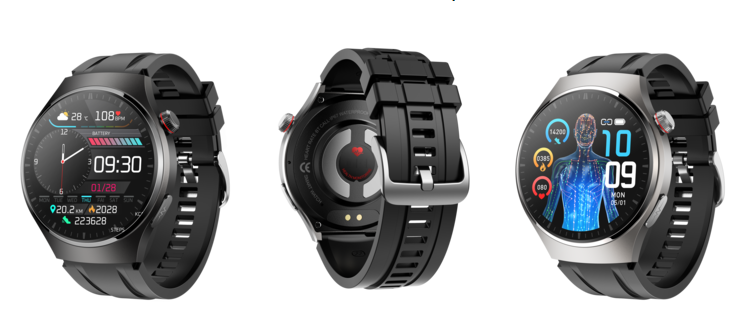
The Kospetfit iHeal 5 smartwatch is being offered with several health monitoring features and is quite affordable. The iHeal 5 comes with ECG, blood pressure, and blood sugar monitoring, as well as many other functions. It provides both health and fitness features but its accuracy and reliability are yet to be independently verified. It is also not yet an approved medical product.
Features
The new Kospetfit iHeal 5 provides body temperature measurement and sleep monitoring. It has several sports modes and supports Bluetooth calling as well as smartphone notifications. The smartwatch is also equipped with an alarm clock, calculator, and several other functionalities. The extensive ECG human cardiac cycle monitoring offered by the smartwatch enables the user to get a detailed analysis that can be viewed via a smartphone.
The iHeal 5 smartwatch is equipped with a 1.43-inch AMOLED display with 3D glass in a metal casing. The AMOLED display ensures a clear, high-definition image quality. The smartwatch comes in Silver Black and Dark Black color options. The borderless design concept of the smartwatch, together with its high-definition touchscreen and 3D glass coverage reflect exquisite craftsmanship. The meticulously polished body of the watch offers a natural transition, bringing a better design sense and broader vision.
Pricing & Availability
The Kospetfit iHeal 5 smartwatch is available directly from Kospetfit at a starting discounted price of $44.99. The original price of the Kospetfit iHeal 5 smartwatch is $149.99. The manufacturer is offering free shipping for the smartwatch. Kospetfit is also offering a 1-year warranty for the iHeal 5. It is expected that the availability of the iHeal 5 will extend to Amazon as other models from the brand are already on the platform.
The Zeekr 007 sedan is a high-end EV from the Geely Group. The battery options of the EV have been revealed by the governmental regulator. The Zeekr 007 will feature a 75.6kWh LFP battery and a 100kWh ternary NMC battery pack. The range of the two battery options is dependent on the powertrain and lies between 688km and 870km.
Features
The Zeekr sub-brand of the Geely Group was launched in 2021. It sells in China, Europe, Central Asia, and the Middle East. The Zeekr 007 is the fourth vehicle in its growing lineup of EVs. Zeekr has previously delivered the 001, 009, and X models to different markets.
The model has been previously revealed to have both a 4WD and an RWD variant with 475kW and 310kW respectively. The 75.6kWh LFP battery RWD variant has a range of 688km, while the corresponding 100kWh ternary battery option has a range of 870km. The 4WD drivetrain is only available with a 100kWh battery pack which gives it a range of 770km. It is noted however that the range of the 4WD version of the Zeekr 007 will depend on rims and the optional sport package.
The Zeekr 007 is a mid-size sedan with dimensions of 4,865 x 1900 x 1,450 mm. It has a wheelbase of 2,928mm and the model adopted a brand new design language created by Stefan Seilaff and the Zeekr Design Center Team in Gothenburg, Sweden. The interior of the EV features a 15.05-inch display with Kr GPT AI integrated and a Qualcomm Snapdragon 8295 chip. The Zeekr 007 will be available in four trim options namely WE RWD, ME RWD, ME 4WD, and YOU 4WD.
Pricing
In China, the Zeekr 007 will be priced between 224,900 yuan ($31,700) and 334,900 yuan ($47,200). Sales will open in January 2024 for customers in China, while Kazakhstan is speculated to be the next market to sell the Zeekr 007. Europe and other markets within Zeekr’s current reach are expected to get the model later in 2024.
We use cookies on our website to give you the most relevant experience by remembering your preferences and repeat visits. By clicking “Accept”, you consent to the use of ALL the cookies.
This website uses cookies to improve your experience while you navigate through the website. Out of these, the cookies that are categorized as necessary are stored on your browser as they are essential for the working of basic functionalities of the website. We also use third-party cookies that help us analyze and understand how you use this website. These cookies will be stored in your browser only with your consent. You also have the option to opt-out of these cookies. But opting out of some of these cookies may affect your browsing experience.
Necessary cookies are absolutely essential for the website to function properly. This category only includes cookies that ensures basic functionalities and security features of the website. These cookies do not store any personal information.
Any cookies that may not be particularly necessary for the website to function and is used specifically to collect user personal data via analytics, ads, other embedded contents are termed as non-necessary cookies. It is mandatory to procure user consent prior to running these cookies on your website.