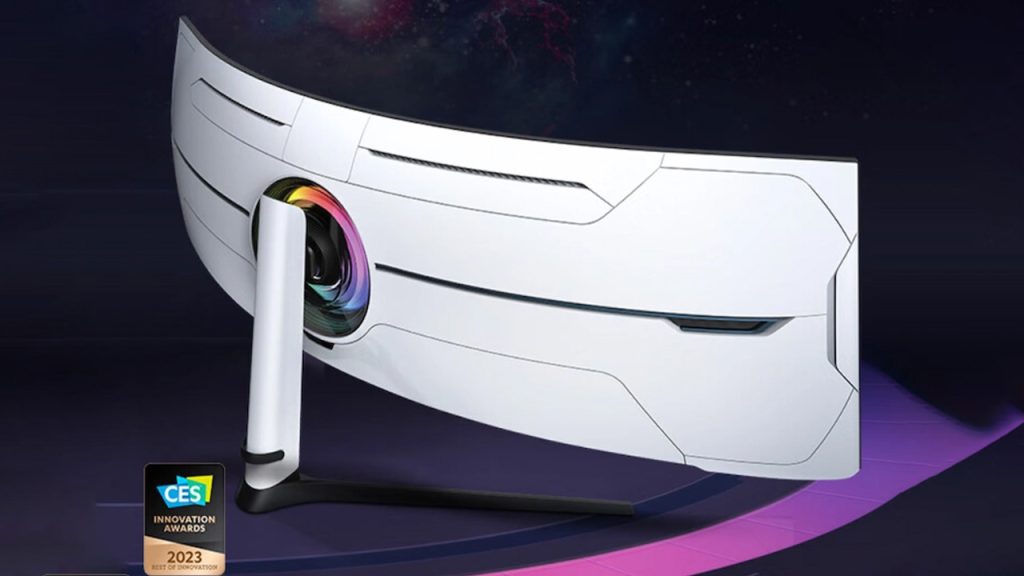
Samsung keeps expanding its product line. Even though we mostly talk about the company’s smartphones, the Korean tech giant has many different products. These range from the Bespoke smart fridge to projectors. Most recently, they added a new item. Samsung launches Neo G9 G95NC, a 57-inch dual 4K 240Hz monitor with DP 2.1. Here are the details…
Samsung Odyssey Neo G9 G95NC: 57-Inch Curved Monitor with 4K Resolution and 240Hz Refresh Rate
Samsung has launched a new monitor called the Odyssey Neo G9 (G95NC). It has a 57-inch screen, dual 4K resolution, and a 240Hz refresh rate. It is powered by a Mini LED panel with quantum dot technology, which makes colors look vibrant and blacks look deep. The monitor also has a 1ms response time and supports HDR1000, which ensures smooth gameplay and accurate HDR visuals.
The Neo G9 (G95NC) also features a number of gaming-centric features, such as a built-in FPS counter, a motion blur reduction mode, and a KVM switch. It also has a wide range of connectivity options, including DisplayPort 2.1, HDMI 2.1, and USB Type-C. Other key features of the Samsung Neo G9 (G95NC) include:
An ultra-wide 32:9 aspect ratio and a resolution of 7680×2160
Mini LED backlight technology with 2393 backlight zones
A million-level contrast ratio
A refresh rate of 240Hz
A color gamut of 95% of the DCI-P3 color space
DisplayHDR 1000 certification
US Price and Availability Announced
The Samsung Neo G9 (G95NC) is priced at 19.999 yuan in China. It is also available for purchase now through Samsung’s official website and authorized retailers in US at $2,199.99. The monitor is expected to be released in other regions in the coming months.
Samsung continuously provides software updates for Wi-Fi-equipped home appliances, from washing machines to refrigerators. Similarly, it has recently released a new software update for Bespoke washing machines in South Korea and Europe, bringing an intriguing new feature.
What’s New in the Update?
The new feature is called ‘Microplastic Reduction Course’ and allows the machines to reduce cloth friction and microplastic generation by up to 60%. This course uses a special technology in washing machines called “EcoBubble” technology, which helps the machines reduce friction and microplastic generation.
How to install the new update?
According to the official blog of the company, only models produced after 2021 will have this update and feature. To install this feature, users must accept the push notification on the washing machine or SmartThings, which will automatically trigger the update.
By the end of this month, Samsung Electronics plans to introduce various features like the refrigerator’s “AI Saving Mode” and Stick Cleaner’s “Bespoke Jet AI,” which will allow you to call or receive text notifications while cleaning. The company also claims that since 2019, they have updated the functions of home appliances by 400 times.
Other than that, Miyoung Yoo (Vice President of Samsung Electronics) said, “We wanted to reduce the burden on the environment by allowing consumers who own existing products, not new products, to easily use the microplastic reduction course through software updates.”
This means we can expect more updates in the future.
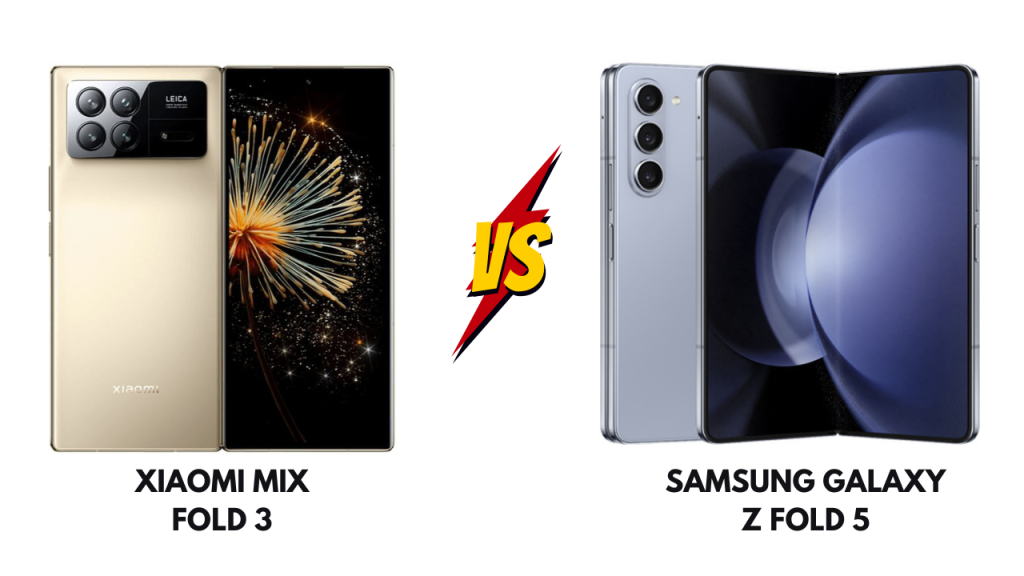
Foldable smartphones have transformed the way we perceive and use our devices, offering an innovative blend of cutting-edge technology and sleek design. Xiaomi, known for pushing the boundaries of innovation, recently introduced its latest foldable device, the Xiaomi Mix Fold 3. But how does it stack up against one of the foldable pioneers, Samsung’s Galaxy Z Fold 5?
In this article, we delve into the features, specifications, and value proposition of these two foldable giants, aiming to determine whether the Xiaomi Mix Fold 3 offers a better value proposition than the Galaxy Z Fold 5.
Design and Build
Both the Mix Fold 3 and Galaxy Z Fold 5 share a common feature: a folding hinge mechanism. This hinge allows the foldable screens to be positioned at various angles and ensures a gap-free closure when folded. If you want to learn more about how the waterdrop hinge works, you can read this article.
Mix Fold 3 takes the lead in terms of thickness. It measures just 10.9mm when folded, compared to the Z Fold 5’s 13.4mm. When opened, the Mix Fold 3 is an impressive 5.6mm, outshining the Z Fold 5’s 6.1mm. These millimeters might seem insignificant, but they affect the device’s feel in the hand and pocket.
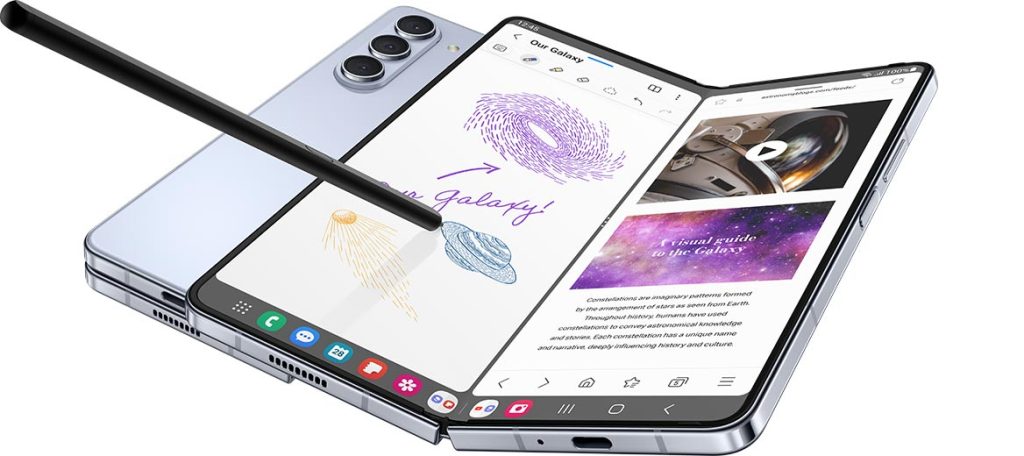
Interestingly, both devices weigh almost the same. The Z Fold 5 weighs 253 grams, while the Mix Fold 3 is slightly heavier at 255 grams. Foldables can feel a bit heavy, but that’s a compromise for the expansive screens they offer. While the Galaxy Z Fold 5 has the advantage of S Pen compatibility (sold separately), this feature is absent in the Mix Fold 3.
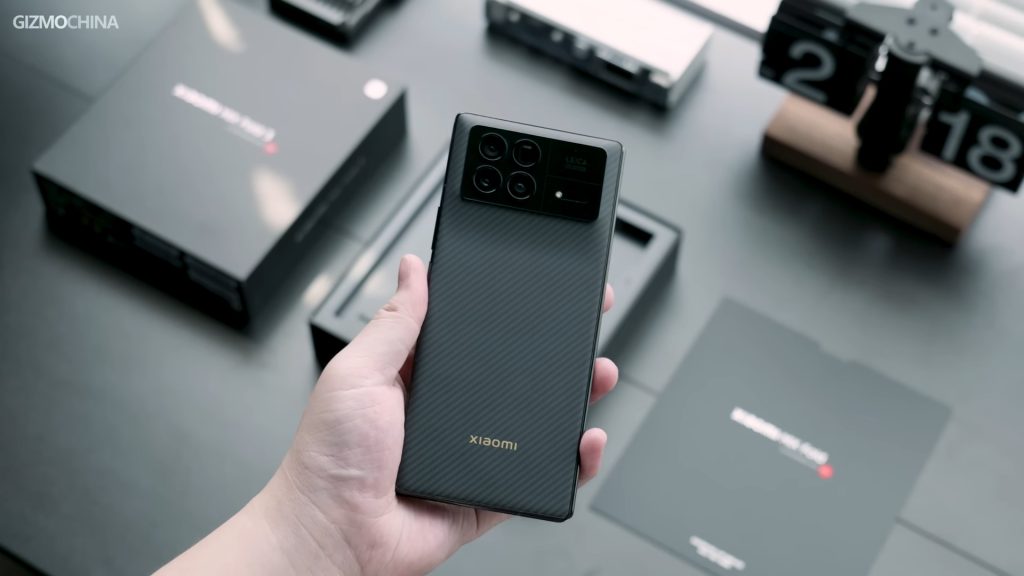
For a closer look at the design, check out our hands-on video with the Mix Fold 3.
Here, the Mix Fold 3’s slim and elegant design clearly positions it as the superior choice in aesthetics when compared to the Galaxy Z Fold 5.
Display
When making a side-by-side comparison, the sizes of both the inner and cover displays are important. The Mix Fold 3 boasts a large 8.01-inch inner AMOLED display, enhancing multimedia and multitasking experiences. Its cover display measures 6.52 inches, making it suitable for quick tasks and notifications without unfolding.
Conversely, the Galaxy Z Fold 5 offers a 7.6-inch Dynamic AMOLED 2X inner display, promising vibrant visuals, while its 6.7-inch cover display provides a more conventional smartphone feel when folded.
So, the Mix Fold 3 has a slight edge over the Z Fold 5 in terms of day-to-day usage, mainly due to its larger inner display. Since foldable phones are often chosen for their expansive screens, the Xiaomi Mix Fold 3 is definitely a better option.
Durability
Another talking point is durability. Foldables are still relatively new, and one of the significant concerns is how often you can fold and unfold these devices before they give in. Xiaomi promises a whopping 500,000 folds for the Mix Fold 3. That’s more than double what Samsung and Google are putting on the table.
But here’s a grain of salt — real-world durability often varies from these numbers. Only time will tell who holds up better. Notably, Samsung takes the lead in water resistance with its IPX8 rating, an attribute that ensures the Galaxy Z Fold 5 can withstand accidental encounters with liquids.
Camera Capabilities
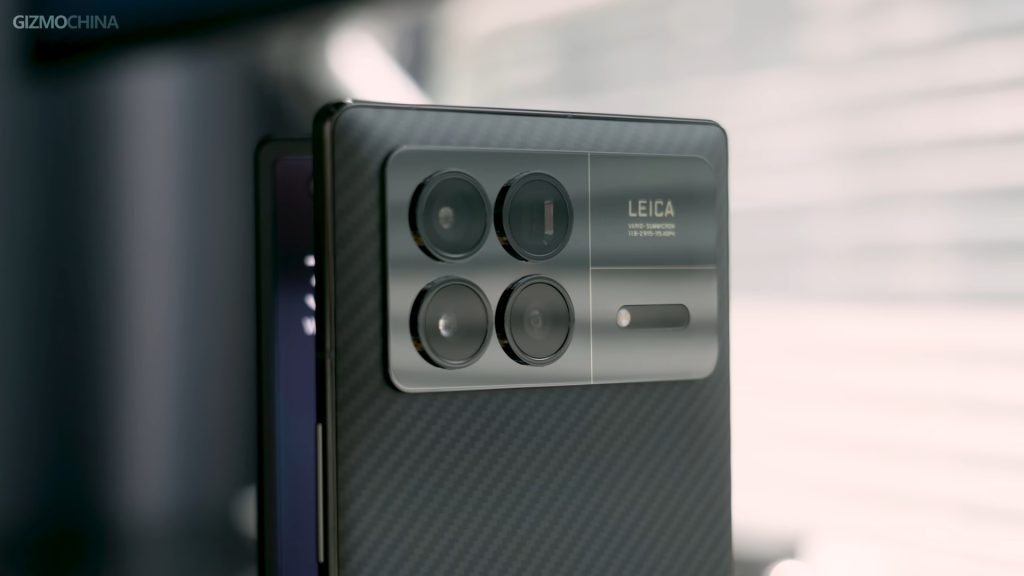
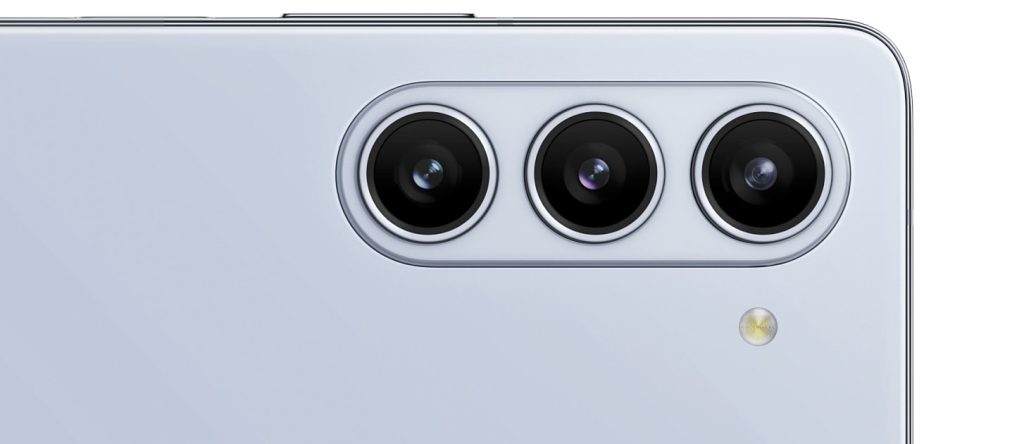
When it comes to camera capabilities, the Xiaomi Mix Fold 3 truly stands out. Xiaomi’s collaboration with Leica has elevated the Mix Fold 3’s photography prowess, positioning it as a strong contender in the camera department. One of the standout features is the incorporation of periscope camera technology within its 5x telephoto lens. This unique addition allows for impressive optical zoom capabilities, making distant shots more accessible and clear.
The Mix Fold 3 features a quad-camera setup, including a 50-MP main lens for high-resolution shots, a versatile 12-MP ultra-wide camera, a 10MP periscope lens (115mm) for extended reach, and an additional 10-MP telephoto lens (75mm) with optical image stabilization for steady distant shots. Additionally, there’s a 20-MP selfie camera.
Comparatively, the Samsung Z Fold 5 also boasts a strong triple camera setup with a 50-MP main lens, a 10-MP telephoto lens, and a 12-MP ultra-wide lens.
Early photo samples indicate that the Xiaomi Mix Fold 3 has impressive camera capabilities.
While real-world testing is crucial, on paper, the Mix Fold 3 is a clear winner here. Do wait for our full review soon on our YouTube channel.
Performance and Power
The Qualcomm Snapdragon 8 Gen 2 chipset, which powers both the Xiaomi Mix Fold 3 and the Galaxy Z Fold 5, ensures quick performance and seamless multitasking. The Mix Fold 3 offers up to 16GB of RAM, providing an extra edge in memory-intensive tasks.
With its higher RAM allocation, the Mix Fold 3 holds a clear advantage in the performance category, making it the superior choice in this aspect.
Battery and Charging
Battery life is crucial, especially for power users. The Mix Fold 3 is equipped with a 4800mAh battery, supporting 67W wired charging and 50W wireless charging. Xiaomi claims that the device can be fully charged in just 40 minutes, making it a convenient choice for those on the go.
On the other hand, the Galaxy Z Fold 5 offers a smaller 4400mAh battery, 25W wired charging, and 15W wireless charging.
With its larger battery and faster charging, the Mix Fold 3 clearly takes the lead in this department, catering to users seeking efficiency and extended usage.
Software Experience: MIUI vs. One UI
Software plays a significant role in the overall user experience. The Mix Fold 3 runs on MIUI Fold 14, based on Android 13, while the Galaxy Z Fold 5 operates on One UI 5.1.1, also based on Android 13. Both UIs offer distinct features and customizations.
One UI is known for its user-friendly interface and multitasking capabilities, which complement the foldable design. MIUI Fold 14 brings Xiaomi’s unique flavor to the foldable experience.
The choice between the two largely depends on personal preference and familiarity.
Value Proposition: Is the Mix Fold 3 the Winner?
Starting at a price of $1,239, the Mix Fold 3 offers a considerably better value, especially when compared to the starting price of $1,799.99 for the Galaxy Z Fold 5.
With comparable or potentially better specifications and a significantly lower price, the Mix Fold 3 offers exceptional value for users seeking high performance without overspending.
However, availability could be a deciding factor since Xiaomi is not available in many regions while Samsung is available practically everywhere.
Final Verdict
The Galaxy Z Fold 5 and Xiaomi Mix Fold 3 possess distinct strengths and appeal.
While the Galaxy Z Fold 5 caters to those valuing features such as IPX8 rating and S Pen support, the Xiaomi Mix Fold 3 strikes a balance between specifications and affordability. In the Chinese market, the Mix Fold 3 will gain prominence due to Xiaomi’s strong local presence and tailored offerings.
Outside China, factors like global availability, after-sales support, and brand recognition might favor the Galaxy Z Fold 5. Real-world experience often depends on factors such as software integration and customer support, which can outweigh technical specifications.
In an ideal scenario where both devices are accessible, my preference would lean towards the Xiaomi Mix Fold 3.
*Please Note: When you buy something using the links in our articles, we may earn a small commission at no cost to you.
After a three-year hiatus, Honor has confirmed its entry into the Indian smartphone market. Former Realme CEO Madhav Seth is also involved in the venture as the new CEO of Honor in India. In a new update, the company has announced a key partnership with PSAV Global, which will help it to quickly expand its presence in the country.
Honor’s partnership with PSAV Global will give it access to PSAV’s extensive distribution network and supply chain expertise. PSAV Global is a local firm with a network of over 5,000 retailers and distributors in more than 100 cities. The partnership will also see PSAV provide Honor with marketing, services, and distribution solutions.
Honor said that the partnership will help it to establish its product lineup, partnerships, manufacturing, services, and distribution networks in India. This collaboration is in line with the Indian government’s push for technological self-sufficiency, and it marks a significant milestone in that direction.
To put it concisely, PSAV Global will manage Honor’s daily operations in India until the company establishes its own local setup. This involves tasks like importing devices, establishing distribution networks, and offering marketing and warranty support. This arrangement frees up the HonorTech team to concentrate on broader aspects like product innovation, marketing strategies, and financial matters.
Honor has been independent from Huawei since 2020. PSAV Global has been the official distributor of Honor products in India since then, including tablets, laptops, and wearables. It will now continue to be the official distributor of Honor smartphones in India.
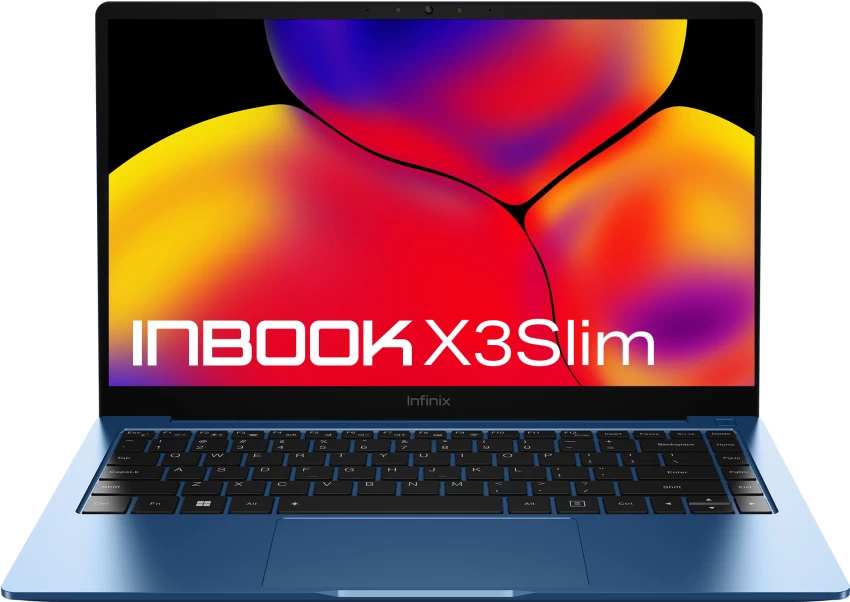
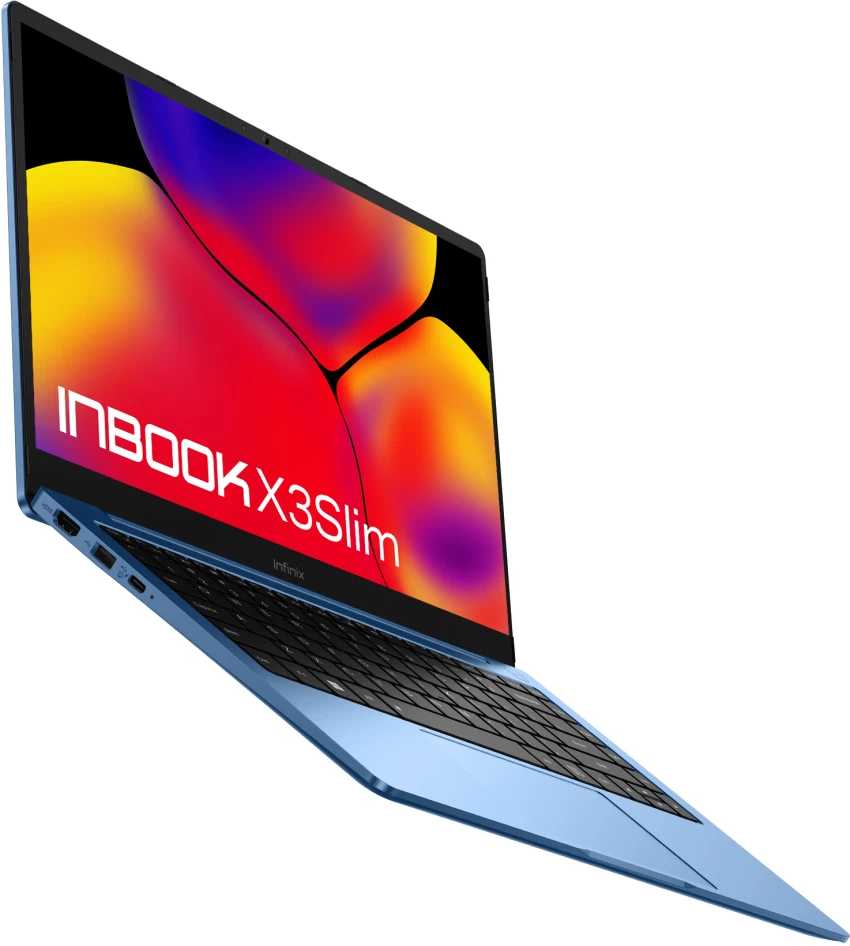
Infinix has officially introduced the INBook X3 Slim laptop in India, sticking to its planned schedule. While it shares many similarities with its predecessor, the X3 Slim brings several noteworthy enhancements that set it apart within its price segment.
Infinix INBook X3 Slim specs
The Infinix INBook X3 Slim features a 14-inch Full HD display with excellent color accuracy, offering 100% sRGB coverage and 72% NTSC, along with a brightness of 300 nits. Under the hood, it comes with various processor options, including the 12th Gen Intel Core i3-1215U running up to 4.4GHz with Intel UHD Graphics, the 12th Gen Intel Core i5-1235U clocked up to 4.4GHz, and the Core i7-1255U reaching 4.7GHz with Iris Xe Graphics.
You can opt for configurations with 8GB or 16GB of LPDDR4X RAM and storage choices of 256GB or 512GB NVMe PCIe 3.0 SSD. It comes pre-installed with Windows 11 Home. For video calls, it sports a 720P HD Webcam with dual-star LED fill lights for better visibility.
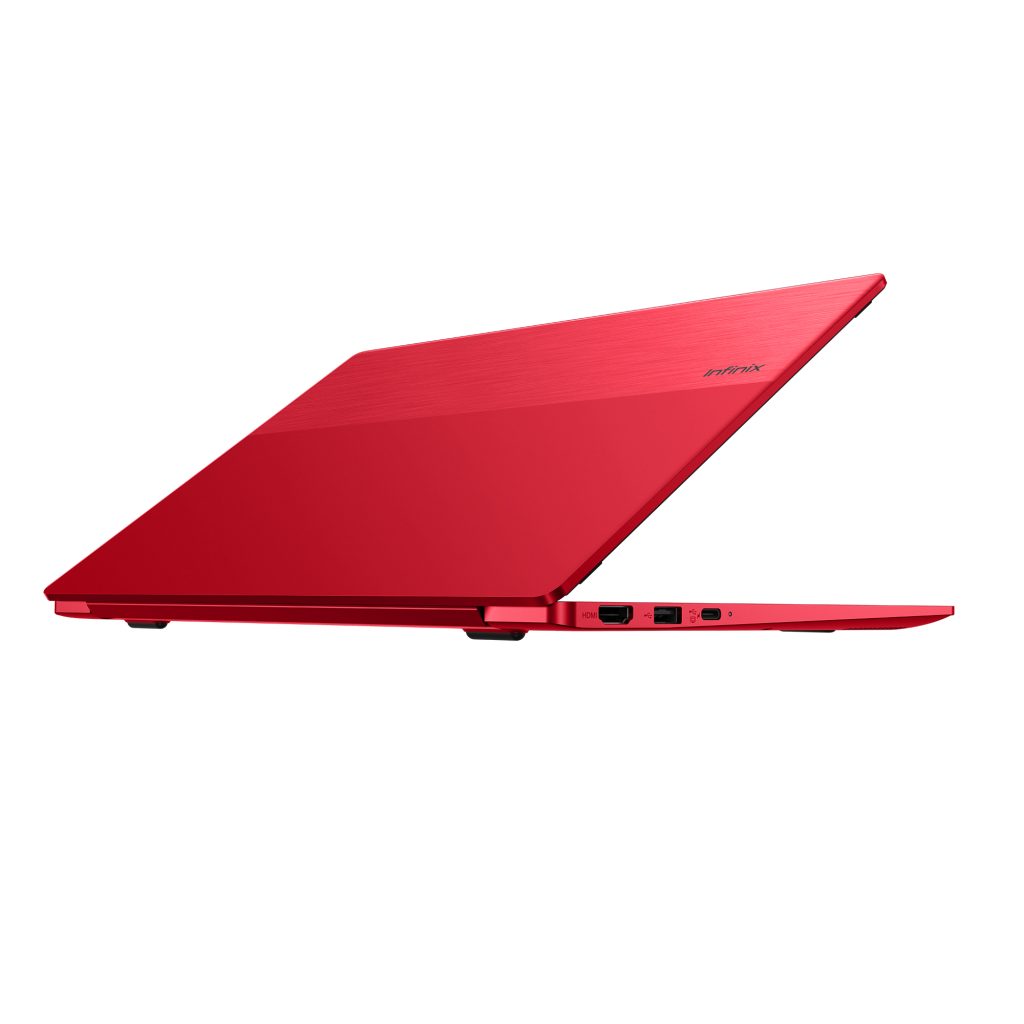
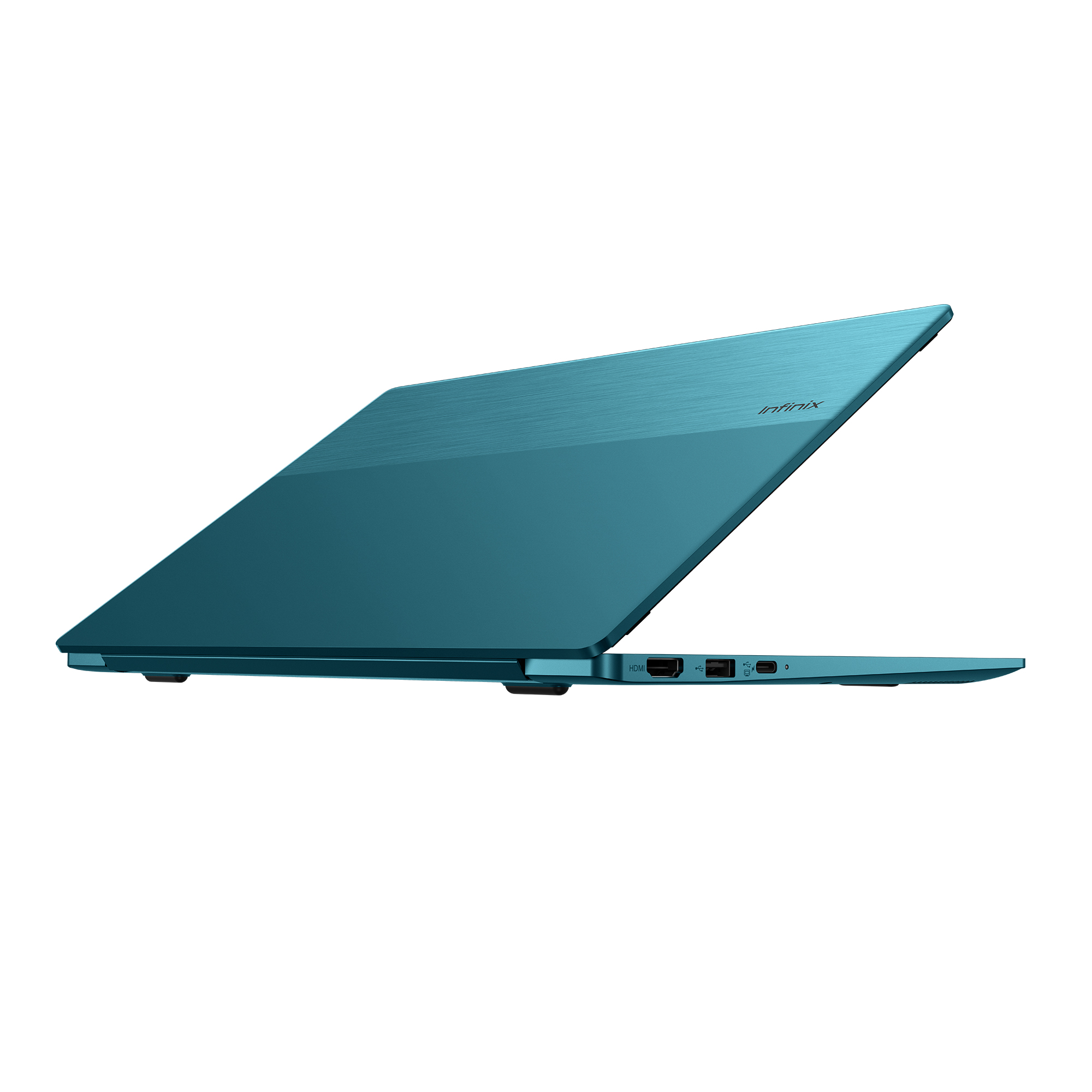
Connectivity options include Wi-Fi 6 supporting both 2.4GHz and 5GHz bands, along with Bluetooth 5.1. In terms of ports, it offers 1 x USB-C that supports both charging and data transfer, another USB-C exclusively for data transfer, 2 x USB3.0 ports, 1 x HDMI 1.4, and 1 x SD card slot.
In terms of dimensions, it measures 323.3 x 211.1 x 14.8 mm and weighs 1.24kg. It also includes a 3.5mm headphone/microphone jack, stereo speakers, two digital microphones, and DTS audio processing for enhanced sound quality. The laptop is powered by a 50Wh battery, which supports 65W PD 3.0 Type-C fast charging. It offers up to 10 hours of video playback, making it suitable for on-the-go use.
Pricing and availability
The Infinix INBook X3 Slim is available in Red, Green, Grey, and Blue colors. You can find the pricing listed below.
The 8GB + 512GB i3 model is priced at Rs. 33,990.
The 16GB + 512GB i5 model comes in at Rs. 39,490.
The 16GB + 512GB i7 model is available for Rs. 49,990.
Starting on August 25th, you can buy the laptop from Flipkart. Additionally, prospective buyers can take advantage of extra bank discounts and an exchange offer that goes up to Rs. 9,500.
OnePlus Nord 2 was released in July 2021. It has been two years since the device was launched, and OnePlus is still rolling out updates for the phone. On August 21, OnePlus announced the release of OxygenOS 13 F.47 for the OnePlus Nord 2. The update is currently available in the India region, with a global release arriving soon. The changelog for the device is provided below.
The latest patch contains the August Security Update to protect your device from security vulnerabilities. This update is mainly focused on security fixes to protect your data from breaches. For those unaware, the OnePlus Nord 2 is said to receive security patches up until July 2024. When the device was announced, the company mentioned that the smartphone would receive two major OS updates and three years of security patches. This means that the OnePlus Nord 2 might still receive security patches until it reaches its three-year completion date. The phone came out with Android version 11 and is now running on Android 13.
Those who cannot see the update on their device can go to Settings > About Phone > Check for Updates. The patch will be visible with the build version of DN2101_11.F.47. Additionally, you can submit bug reports by opening Google Dialer and typing *#800#. This option is currently available only in India.
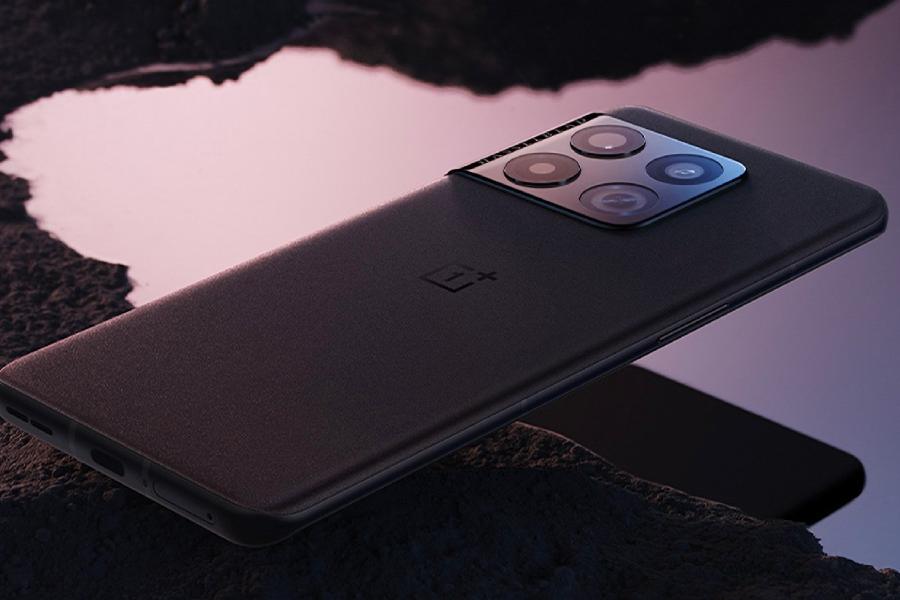
In related news, OnePlus 10 Pro has also received the latest OxygenOS 13 update with an August 2023 security patch and bug fixes. The full details about the patch can be found here.
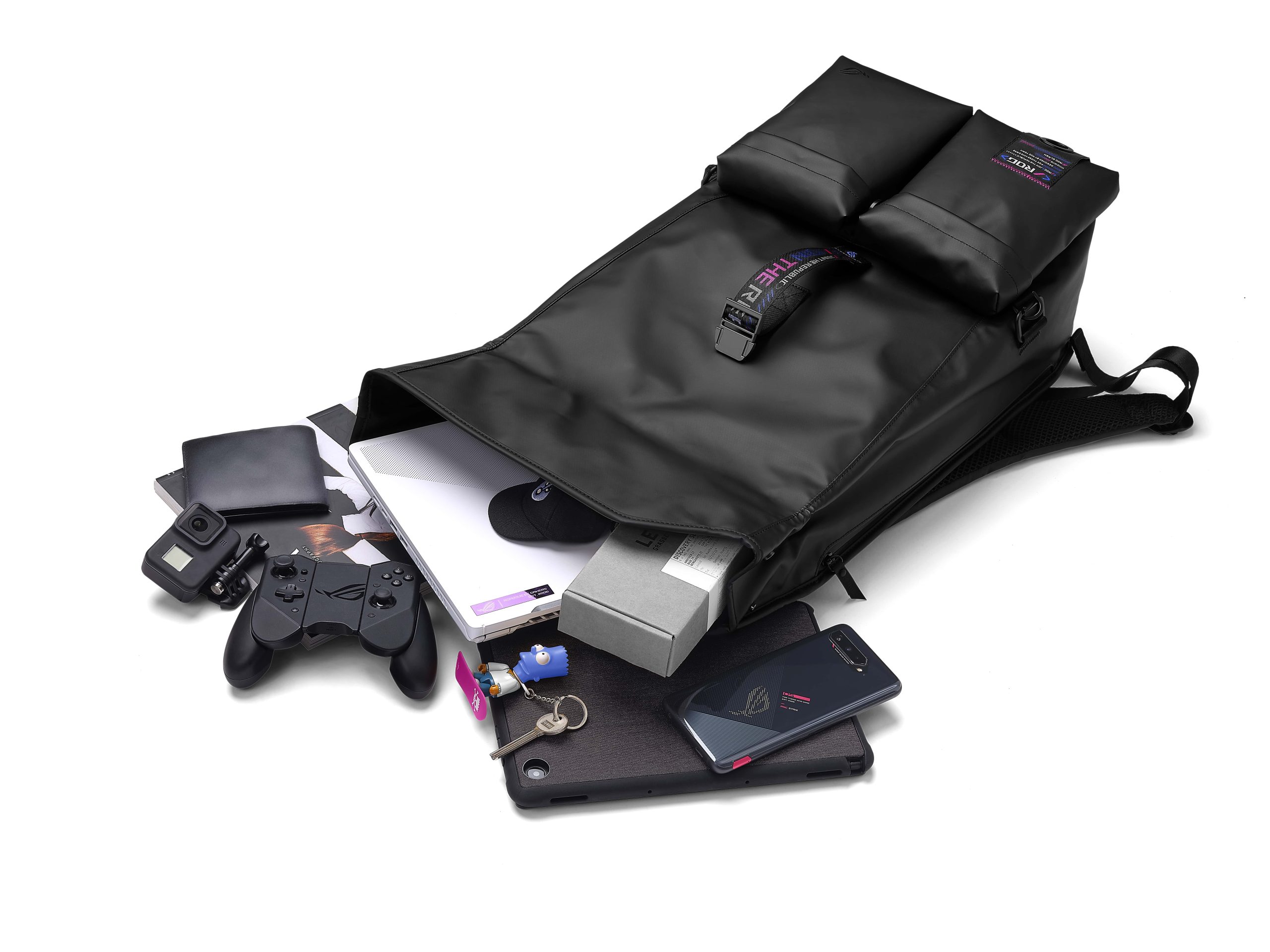
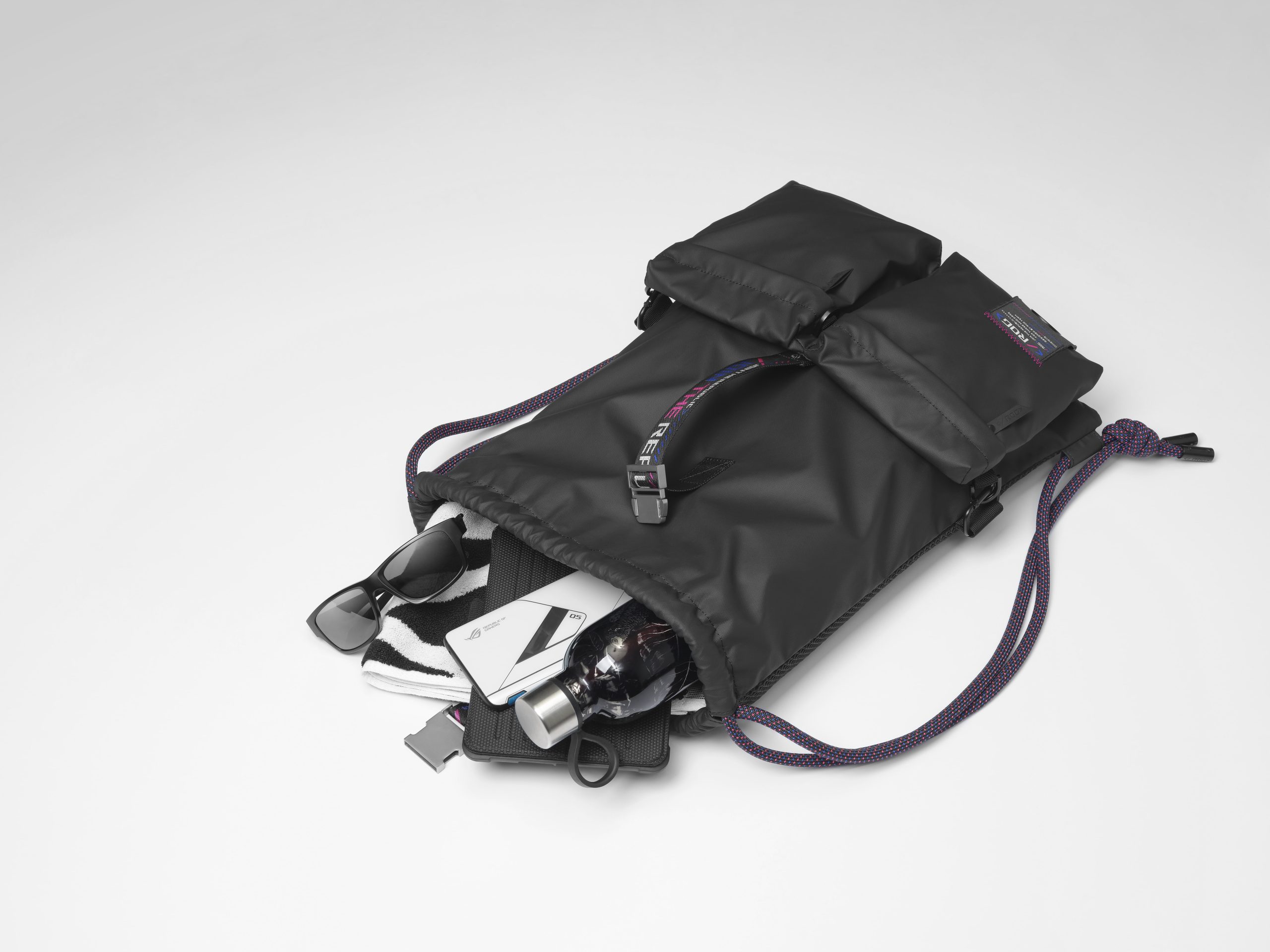
ASUS has expanded its lineup of ROG (Republic of Gamers) accessories in India. The company is releasing new backpacks and drawstring bags from its ROG Slash series of accessories. So let’s have a look.
ASUS ROG Slash Backpack & Slash Drawstring Bag
The Taiwanese tech giant’s latest lineup of Slash accessories includes the Slash Backpack and Slash Drawstring Bags. These are designed with bold color schemes and durable materials for gamers. With the new accessories, ASUS is also trying to define the current fashion trend revolving around gaming. It has added elements from themes surrounding esports and cyberpunk. This can be seen in the Violet Red and Electric Blue color scheme that pays homage to some of the original esports team colors, Red vs Blue.
Asus ROG Slash BackpackAsus ROG Slash Drawstring
Furthermore, the ROG Slash is defined by bold colors and code-inspired design. For durability and convenience, the new accessories offer adjustable straps, multiple compartments, water-repellent TPU materials, and more. ASUS ROG Slash Backpack features 19.4 liters of cargo space, which can house a 17-inch laptop and more. The backpack offers multiple internal pockets to keep items separate from one another. Other notable features include a 360-degree snap hook and a detachable sling.
Meanwhile, the Slash Drawstring bags also feature water-repellent polyester and breathable mesh. The stylish design is complemented by a zinc alloy buckle and two-tone rope with a ROG Slash pattern. This bag offers three ways of carrying, which include over the shoulder, by hand, or across the body. The ROG Slash Backpack is going on sale in India for 6,999 INR, while the ROG Slash Drawstring Bag has a 2,999 INR price tag.
Making a shift to a Foldable world with Galaxy Z Fold5 or Galaxy Z Flip5 from iPhone, but unsure about the experience? Then you should not worry, as the famous Try Galaxy app has received Galaxy Z Fold5 and Z Flip5 support. Now, interested users can experience the new foldable flagship smartphones straight from iPhone.
The Try Galaxy App needs two different iPhones to fully mimic the Galaxy Z Series experience. It enables the users to explore apps and widgets present on Galaxy Fold devices. Further, all the major modes and features are now available to try on iPhone. The user can enjoy the FlexCam mode which enhances the selfie experience.
It even replicates the Immersive Screen and the ability to seamlessly multitask. The ability to view video content while maintaining work productivity side-by-side is another extensive feature.
Samsung’s Galaxy ecosystem across its wearables, tablets, and buds works seamlessly across the Galaxy Phones. The ability to Quick Share files between near and dear ones, and the sync between Samsung Health’s body composition data when paired with Galaxy Watch. There are several other features that are part of the device that are actually hauled to the Try Galaxy App.
The App is launched in 2022 to showcase Galaxy S23 experience in 2022. The app seems to have worked for Samsung as it has garnered over 7 million downloads. It supports over 20 languages including Korean, Czech, Hungarian, Latin American Spanish, and Russian. Interested users can try and enjoy the Galaxy Z Fold 5 benefits by visiting the webpage and installing the app.
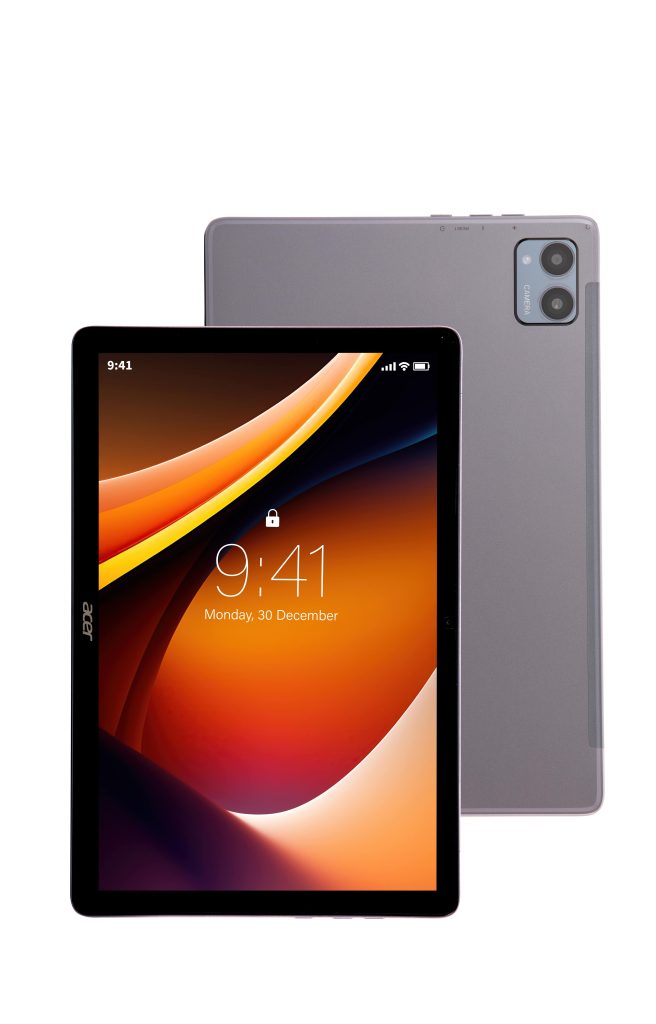
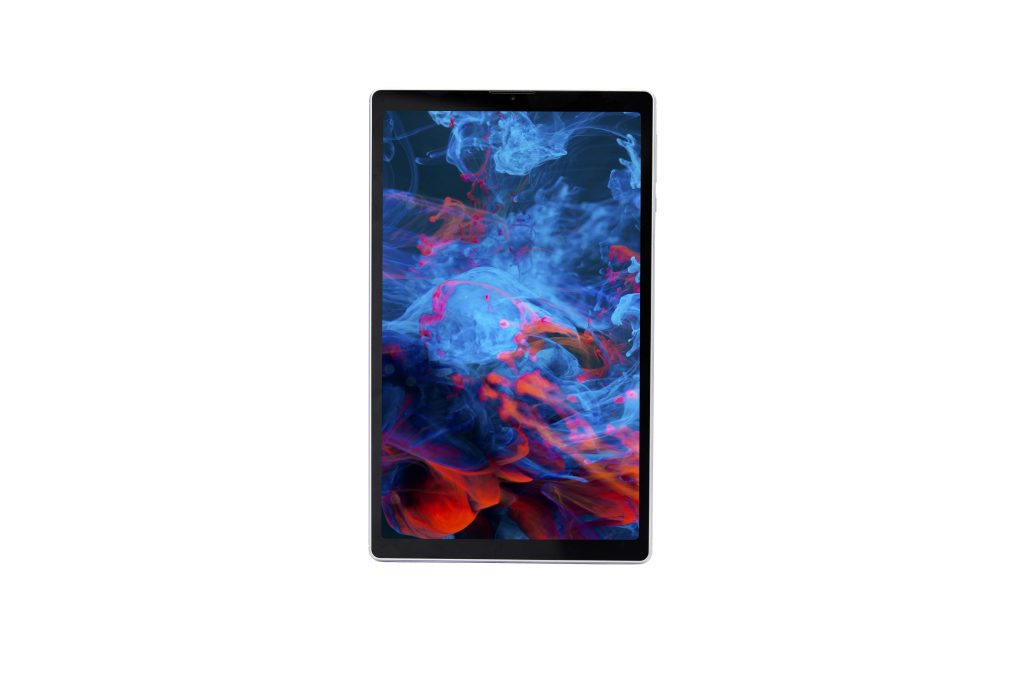
Acer has released two brand-new tablets in the Indian market. The company has announced the new One 10 and One 8, which are a pair of budget-grade tablets that are built to offer performance and portability to meet various users’ needs. So here are all the details.
One 10
Acer One 10 & One 8
The Acer One 10 sports a tall 10.1-inch WUXGA IPS Incell Panel technology, while the One 8 tablet features a compact 8.7-inch WXGA+ IPS display. Both of the devices run on the Android 12 operating system and are equipped with the MediaTek MT8768 octa-core processor. The chipset will also be paired with 4GB of LPDDR4 RAM (optional 6GB RAM) and 64GB of flash memory on the One 10. On the other hand, the One 8 model will offer 3GB of LPDDR4 RAM (optional 4GB RAM).
Buyers can further expand the storage by another 1TB thanks to a microSD card slot. For photography, the Acer One 8 features a 2-megapixel selfie camera and an 8-megapixel shooter on the rear. Meanwhile, the One 10 houses a 5-megapixel selfie shooter and a 13-megapixel dual camera setup with a Sony IMX sensor. Other notable features include 4G support, WiFi, and Bluetooth 5.0.
One 8
Pricing & Availability
The One 8 has a starting price tag of 12,990 INR, while the One 10 model will be sold in India for 17,990 INR. Acer will be selling the two tablets from its official website, Acer Exclusive Stores, and E-stores in the region.
The Vivo V29e is all set to go official on Aug. 28 in India. The official landing pages of the phone available on Flipkart and Vivo India’s official website have already confirmed some of the key features and designs of the phone. A new report by TheTechOutlook has leaked more details about the smartphone than were known before.
Vivo V29e specifications leaked
Vivo V29e
According to the publication, the Vivo V29e will arrive with a 6.78-inch AMOLED display that offers an FHD+ resolution, a 120Hz refresh rate, up to 1,300 nits of brightness, 360Hz PWM dimming, and a 93.3 percent screen-to-body ratio. The phone will have a slim profile of 7.57mm and weigh 180.5 grams. According to the brand, it will be the slimmest curved-edge display phone in its price segment.
The Snapdragon 695 chip will power the Vivo V29e. It will come in two options, such as 8GB RAM + 128GB storage and 8GB RAM + 256GB storage. The device will offer up to 8GB of virtual RAM. It will house a 5,000mAh battery with 44W fast charging.
Photography will be one of the strengths of the Vivo V29e. The device will feature a 64-megapixel main camera with OIS support and an 8-megapixel ultra-wide snapper on the back. The phone promises impressive night portrait shots and will also have a new India-exclusive wedding-style portrait photography feature. On the front, the device will be equipped with an eye-autofocus-enabled 50-megapixel selfie snapper.
Vivo V29e price in India
Vivo has confirmed that the Vivo V29e will be priced between Rs 25,000 (~$300) and Rs 30,000 (~$360). It will be available in Artistic Blue and Artistic Red (with color-changing back) color options.
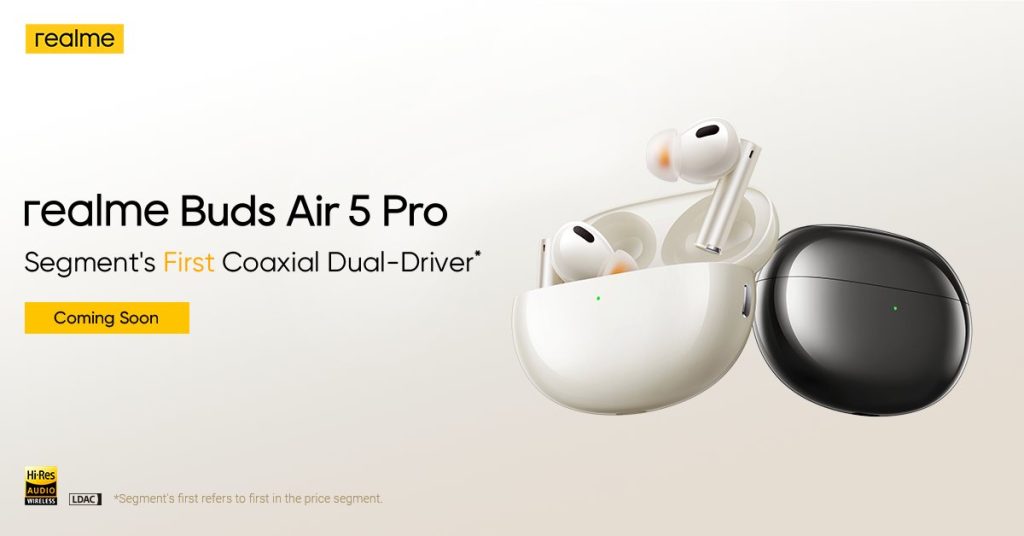
Realme is preparing to unveil the Realme 11 5G and 11x 5G smartphones in India tomorrow, along with the introduction of the Realme Buds Air 5 series earbuds at the same event. Just before the launch, the Indian price tag for the Realme Buds Air 5 has emerged online.
Realme Buds Air 5 Pro
Spotted by one of our readers, a now-deleted Flipkart listing has revealed that the Realme Buds Air 5 will be priced at Rs. 7,999. Although the pricing might be more than what customers expected, it does make sense considering the specs onboard like 50dB ANC, LDAC support, and dual audio driver.
That being said if the price tag throws a wrench in your plans to buy a new pair of earbuds, you don’t have to worry as the brand will also be launching the comparatively cheaper Realme Buds Air 5 earbuds tomorrow. It will have a lot of bells and whistles like 50dB ANC etc, however, some features could be missing, like a dual driver setup, and spacial audio.
Realme Buds Air 5
Realme Buds Air 5 Pro specs
The Realme has a powerful 11mm bass driver and a 6mm tweeter onboard. It features 50dB active noise cancellation, and environmental noise cancellation for calling thanks to the three mics on each earbud. Moreover, these earbuds support Spatial audio and the LDAC codec.
The Realme Buds Air 5 Pro offers an impressive battery life, providing a total of 40 hours of usage when you combine the case and earbuds. They are designed to be water-resistant, making them suitable for workouts or unexpected rain.
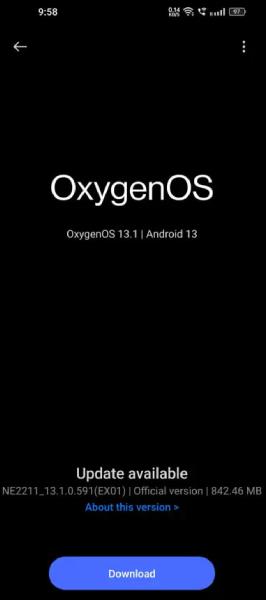
OnePlus 10 Pro, the company’s last year flagship, is getting a new software update. The latest OxygenOS 13.1.0.591 update for 10 Pro was announced on the OnePlus community forums and is currently being rolled out to users in India.
The update comes with firmware version NE2211_13.1.0.591(EX01) and includes a security patch for August 2023. This firmware also resolves a specific problem where the dial pad might not be reachable when making phone calls. The update is around 842.46MB in size.
OnePlus 10 Pro NE2211_13.1.0.591(EX01)
System
Integrates the August 2023 Android security patch to enhance system security.
Fixes an issue where the dial pad might not be accessible during phone calls.
The brand has already started rolling out the update, but it will only reach a small percentage of users at first. The wider rollout will happen in a few days.
If the update doesn’t fix the issue of the dial-pad not being accessible during phone calls, users in India can submit bugs by opening the Google Dialer and typing *#800#. This will open a menu where they can submit their bug report. For users in other regions, they can provide their feedback directly in the community’s announcement thread or submit a form: link.
Vivo Y series gets a new smartphone almost every month. Recently, the brand unveiled the Vivo Y77t in China with a Dimensity 7020 processor. The company also launched the Vivo Y78+ (t1) version earlier this week. Now, another Vivo smartphone has been spotted on BIS India as well as the Bluetooth SIG website, hinting imminent launch. Vivo Y17s could be a new mid-ranger from the brand. Here are the details.
The Vivo Y17s has recently been certified by the Bluetooth SIG, bearing the model number V2310. This certification confirms that the device has Bluetooth version 5.0. The same model number, V2310, has also been certified by the Bureau of Indian Standards (BIS).
While the BIS listing does not disclose any specific details about the device, it does confirm that the Vivo Y17s is slated for a release in India. This is not the first time that the Vivo Y17s has been certified by any regulatory body. A previous TKDN listing, spotted by The Tech Outlook, reveals the device will only support 4G connectivity.
The handset’s launch date in India is still unknown, but it is likely to be released in the coming months. Judging by the moniker, the Vivo Y17s appears to be a refresh over the Vivo Y17. However, it’s also possible that these two phones are entirely unrelated, especially considering that the Vivo Y17 was launched four years ago.
Similar to other models within the Vivo Y series, the Vivo Y17s is likely to be a lower mid-range smartphone with modest specifications. One can expect a large display with at least a 90Hz refresh rate, along with a 5,000mAh battery and a less powerful MediaTek processor. Further details about the device are expected to emerge in the coming days, so stay tuned for updates!
Boat has launched a bunch of new products this month in the Indian market including the Rockid Rush limited edition kids headphones, the Wave Sigma smartwatch, and the Aavante Bar 520 soundbar. The brand has now also introduced a new smartwatch called Boat Wave Neo Plus.
Boat Wave Neo Plus specs
The Boat Wave Neo Plus comes with a clear 1.96-inch HD screen offering a peak brightness of 550 nits. You can choose from a wide range of watch faces to personalize your device.
One useful feature is its Bluetooth calling support, allowing you to make and receive calls directly from the watch. It runs on the Crest Plus OS and supports AI voice assistants for convenient voice commands.
You can save up to 10 contacts on the Quick Dial Pad for easy access. It offers more than 700 sports modes for tracking your activities and is dust and water-resistant (IP67).
For health tracking, it monitors your heart rate, SpO2 levels, sleep, and offers breathing exercises. It also has features like camera control, music control, weather updates, alarms, timers, a stopwatch, and a find my phone feature.
With a 260mAh battery, it can last up to 7 days on a single charge. However, if you use Bluetooth calling frequently, it will last around 2 days before needing a recharge.
Price & availability
Available for an introductory price of Rs. 1,599, the Boat Wave Neo Plus smartwatch comes in a range of colors, including Sage Green, Marigold Blue, Cherry Blossom, and Active Black. It can be purchased starting today, from both Flipkart and the official Boat website.
In May, Poco unveiled the Poco F5 and the Poco F5 Pro flagship phones. While the F5 is available in India and other markets, the F5 Pro was not released in India. A fresh development reveals that the company could be working on a new F-series flagship phone.
Yesterday, at the POCO Partners SEA Forum in Bangkok, Thailand, Poco confirmed a key detail about its next flagship phone. The brand confirmed that it will be launching a new phone featuring the Dimensity 9200 Plus chipset.
Redmi K60 Ultra
Poco did not confirm the name of its upcoming D9200+ phone. Since most of the recent Poco phones are rebranded versions of the Redmi / Xiaomi phones available in other markets, it is likely that the said device could also be a rebranded edition of an existing Redmi / Xiaomi phone.
Redmi has recently released the Redmi K60 Ultra in the Chinese market. A tweaked version of the phone offering better cameras will debut as the Xiaomi 13T Pro in the global market. There is a possibility that the K60 Ultra may have a global variant with Poco branding.
Since the specs are good enough to consider it an F-series phone, it is likely that the device could be called the Poco F5 GT. Here is a look at the specs of the Redmi K60 Ultra.
Redmi K60 Ultra specifications
The Redmi K60 Ultra has a 6.67-inch OLED panel that offers a 1.5K resolution and a 144Hz refresh rate. The Dimensity 9200 Plus chip-powered phone ships with up to 24 GB of LPDDR5x RAM, up to 1 TB of UFS 4.0 storage, and a 5,000mAh battery with 120W charging. It has a 50-megapixel (OIS) + 2-megapixel (ultra-wide) + 2-megapixel (macro) triple camera unit and a 20-megapixel front camera. It runs on MIUI 14-based Android 13 and has an under-display fingerprint scanner.
The Xiaomi 13T Pro, which is expected to debut on Sept. 1, will pack the same specs. However, it is said to be equipped with a 50-megapixel (Sony IMX707, main) + 50-megapixel (telephoto) + 12-megapixel (ultra-wide) triple camera unit.
Volkswagen has started on a new path in its journey towards electric mobility with the production for the all-new ID.7 sedan at the Emden plant in Germany. This move comes at an important time for the company, following a brief disruption due to insufficient demand for the ID.4 model earlier this June.
The ID.7 features a 77-kWh battery base option, with an option to upgrade to 86 kWh
The ID.7’s arrival holds a lot of importance for the German auto giant. With a small production run already launched, Volkswagen is counting on the ID.7, along with the ID.4, to enhance demand, and they are now accepting orders in Germany with deliveries likely to start this fall.
Built on the MEB platform, the ID.7 brings promising features such as a 77-kilowatt-hour battery, expected to deliver a driving range of 382 miles in the European WLTP test cycle. An even more impressive 86 kWh battery option is in the pipeline, which could extend the range to 435 miles, highlighting Volkswagen’s commitment to efficiency and innovation.
Notably, the ID.7 will introduce the new APP550 electric motor, delivering up to 210 kW, marking an upgrade from the previously used 150 kW motor. This, coupled with possible all-wheel drive versions, signals an exciting advancement in electric vehicle dynamics.
However, the journey ahead depends on the demand for the ID.4 and the new ID.7. The recent production glitches have led to a cautious approach, with the third shift postponed for the fall. The ID.7’s scheduled launch in North America in 2024, along with local production for the Chinese market through joint ventures, highlight Volkswagen’s global ambitions in front of the world.
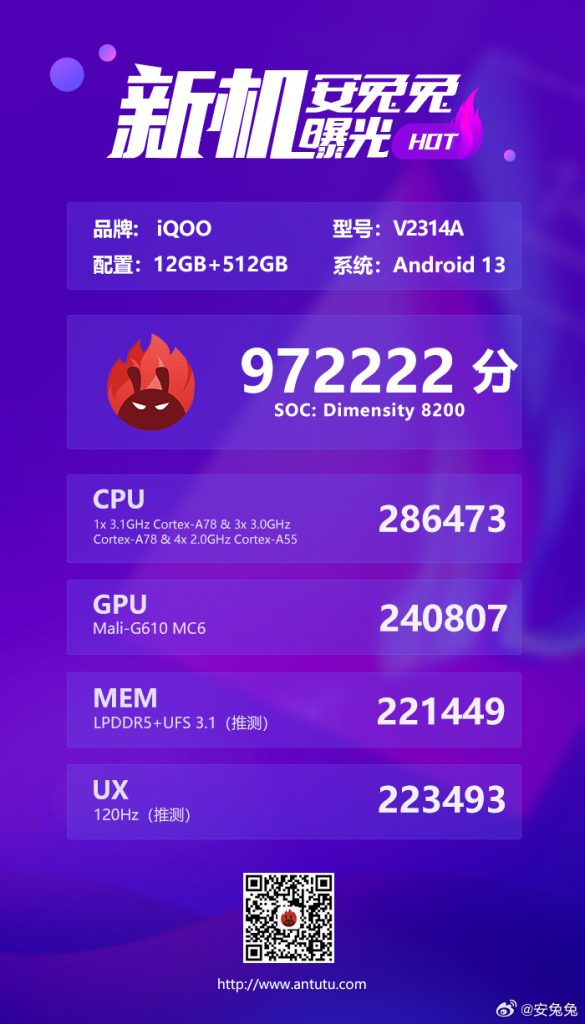
iQOO is reportedly planning to announce the iQOO Z8 and Z8x smartphones in early September in China. Reports have revealed that the devices have model numbers, such as V2314A and V2312A, respectively. Both models have already appeared on Geekbench and have received China’s 3C certification. Now, the Z8 has appeared on AnTuTu to confirm some of its key details. In addition, a Chinese tipster has leaked the specifications of both smartphones.
iQOO Z8 AnTuTu listing
iQOO Z8 AnTuTu listing
The iQOO Z8 scored 286,473, 240,807, 221,449, and 223,943 in AnTuTu’s CPU, GPU, memory, and UX tests, respectively. Hence, it managed to record a total score of 972,222. The listing reveals that the Z8 is equipped with a 120Hz screen, a Dimensity 8200 chip, 12 GB of LPDDR5 RAM, 512 GB of UFS 3.1 storage, and Android 13.
The iQOO Z8 will come with up to 12 GB of RAM, up to 512 GB of storage, and a 5,000mAh battery with 120W fast charging, On the other hand, the iQOO Z8x will arrive with 12 GB of RAM, up to 256 GB of storage, and a 6,000mAh battery with 44W fast charging. It seems like iQOO has chosen to downgrade the fast charging capabilities from 80W in the iQOO Z7x to a lower value in the Z8x.
For photography, the iQOO Z8 will arrive with a 16-megapixel front camera and a 64-megapixel (main, with OIS) + 2-megapixel (depth) dual-camera system. The iQOO Z8x will have an 8-megapixel selfie camera and a 50-megapixel + 2-megapixel dual-camera system. Both phones offer other common features, such as OriginOS 3.0-based Android 13, a 3.5mm audio jack, and a side-facing fingerprint scanner.
As per a recent report, the iQOO Z8 will be available in black, blue, and green shades. It seems that the Z8 will compete with the Dimensity 8200 Ultra-powered Redmi Note 12T Pro in the Chinese market.
Apple is pushing its mobile payment service, Apple Pay, in a big way, and they’re using the catchy tagline “#PayTheAppleWay.” So how does this work? For every $100 paid using the app, Apple gets 15 cents. It doesn’t sound like much, but this could make them $4 billion this year!
Apple Pay is poised to be the biggest competitor to Google Play soon
People love Apple Pay. Why? You don’t even need to pull out your iPhone if you have an Apple Watch. Just tap, and you’re done. No more dropping credit cards while everyone behind you gets impatient. Most stores accept it, so Apple is promoting it with TV ads. In one ad called “The Dance,” a woman struggles with her credit card, while another shopper easily uses Apple Pay. The message? You know it.
Another ad, called “Captcha,” shows a woman failing to prove she’s human online. She gives up and finds another website where she can pay with Apple Pay. Just one tap, and she’s done!
The “Pay the Apple Way” campaign is happening in the U.S. and the U.K. The company’s making this big push because the payment service is part of their second-largest business, Services, which made $21.21 billion last quarter. That’s an 8.2% increase from last year!
This new thing isn’t about selling more iPhones. It’s about getting people to use the service regularly. The company isn’t just promoting a way to pay; it’s changing the way we shop and pay for things every day. It’s more than a business for the trillion dollar company; it’s a big step into the future.
Tesla is now taking firm action against employees leaking images and videos of the Cybertruck. A leaked internal email, posted on Twitter, has revealed that the company is warning employees and contractors of immediate “site removal” if caught filming inside Gigafactory Texas.
The Employees will be removed from the site if they are caught taking pictures of the truck
The measures are not unprecedented, as protecting proprietary information is a common practice among corporations. However, it does signal the lengths to which companies like Tesla are willing to go to protect their innovations.
The leaked email reportedly stated the possibility of issuing photo passes or stickers to appropriate personnel in the future, a measure to balance security concerns with business needs.
In the past months, there have been numerous leaks from the factory, providing enthusiasts with insights into the progress of the Cybertruck’s production. With production expected to start later this year and the first handover event possibly happening towards the end of Q3 2023, it appears that Tesla is tightening its control over information flow.
These measures raise important questions about the balance between employees’ rights and corporate security. At least one ruling by the National Labor Relations Board has upheld employers’ restrictions on cell phone usage on premises in specific sections, a sign of the broader acceptance of such practices.
The Cybertruck, with 1.9 million reservations and anticipated to have a significant impact on Tesla’s brand, is undoubtedly a critical project for the company. As it moves closer to production, the focus on security is likely to remain a prominent aspect of its development.
Xbox has announced a new addition to their gaming accessories: the Series X Console Wraps. Aimed at both affordability and customization, this launch may change how gamers personalize their consoles.
The Xbox skins catalog will definitely expand in the future to include newer designs
Available for pre-order starting today, there are three designs to choose from. The Starfield design costs $49.99, while the Arctic Camo and Mineral Camo options are priced at $44.99 each. These wraps are set to launch in the US, Canada, and Europe in the coming months. The wraps are carefully designed to fit the Series X console without affecting its performance. They ensure proper airflow and stability, emphasizing both form and function.
One noteworthy aspect of these console wraps is their nod to sustainability. By allowing gamers to modify their existing consoles, Xbox is promoting a greener alternative to buying new, special edition consoles.
The Starfield-inspired wrap, with its high-tech feel, offers a unique twist on console customization. On the other hand, the Arctic and Mineral Camo designs provide subtler but equally engaging options for gamers looking to add some flair to their consoles.
The wraps’ introduction offers a fresh way for gamers to express individuality without a hefty price tag. It also aligns with a growing trend in the industry towards more eco-friendly choices. It’s worth watching how this product is received by the gaming community, as it might influence how customization and sustainability are approached in the future.
We use cookies on our website to give you the most relevant experience by remembering your preferences and repeat visits. By clicking “Accept”, you consent to the use of ALL the cookies.
This website uses cookies to improve your experience while you navigate through the website. Out of these, the cookies that are categorized as necessary are stored on your browser as they are essential for the working of basic functionalities of the website. We also use third-party cookies that help us analyze and understand how you use this website. These cookies will be stored in your browser only with your consent. You also have the option to opt-out of these cookies. But opting out of some of these cookies may affect your browsing experience.
Necessary cookies are absolutely essential for the website to function properly. This category only includes cookies that ensures basic functionalities and security features of the website. These cookies do not store any personal information.
Any cookies that may not be particularly necessary for the website to function and is used specifically to collect user personal data via analytics, ads, other embedded contents are termed as non-necessary cookies. It is mandatory to procure user consent prior to running these cookies on your website.