Motorola is all set to launch its Moto X40 smartphone in the Chinese market today, i.e., 15th December. As the name indicates, the device will launch as a successor to the Moto X30 that was launched last year.
The Lenovo-owned company is no longer using the Edge branding in China. So, some rumors indicate that the Moto Edge 40 Pro smartphone will go official as Moto X40 in the Chinese market.
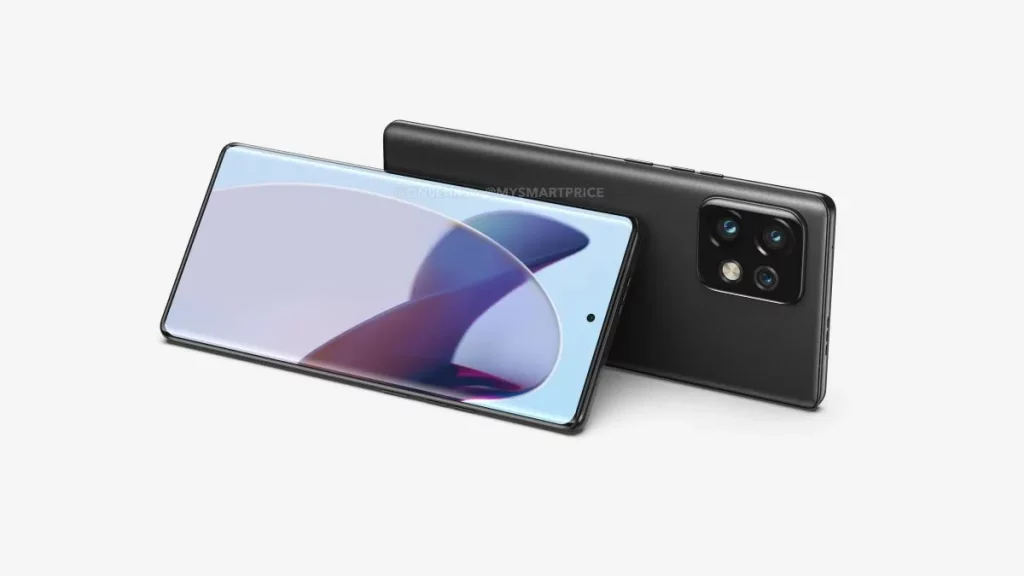
Moto X40 Render by OnLeaks and MySmartPrice
The launch event will take place in the Chinese market today, but information about the live feed remains unknown. We will update this post with more details about the live event if or when it becomes available.
There are some specs and features that have already been confirmed by the company. The Moto X40 will feature a 6.67-inch OLED display with curved edges, offering a Full HD+ screen resolution and a 144Hz refresh rate. Under the hood, the device will come powered by the Qualcomm Snapdragon 8 Gen 2 processor.
As for the memory, the phone will come packed with up to 16GB of LPDDR5x RAM and up to 512GB of internal storage. In the camera department, it features a 50MP + 50MP + 2MP triple-camera setup on the back with support for 4x optical zoom.
The smartphone will be running the Android 13 operating system out-of-the-box with the company’s own Mu UI 5.0 custom interface on top. The IP68-rated device also has support for an under-display fingerprint sensor. It will come in two models in terms of battery capacity — 4,500mAh and 5,000mAh, with support for 68W and 125W fast charging.
Back in May 2022, a Realme device with model number RMX3576 was spotted in the database of China Telecom. Not only did it list all of its specifications, but it also confirmed that the phone will be called the Realme V23i when it comes out in China. The company was supposed to release the device in May, but it looks like they pushed it back. Now, the company has quietly unveiled it as an entry-level 5G phone in the home market. Here is all the information on the specifications, features, and price of the Realme V23i.
Realme V23i specifications and features
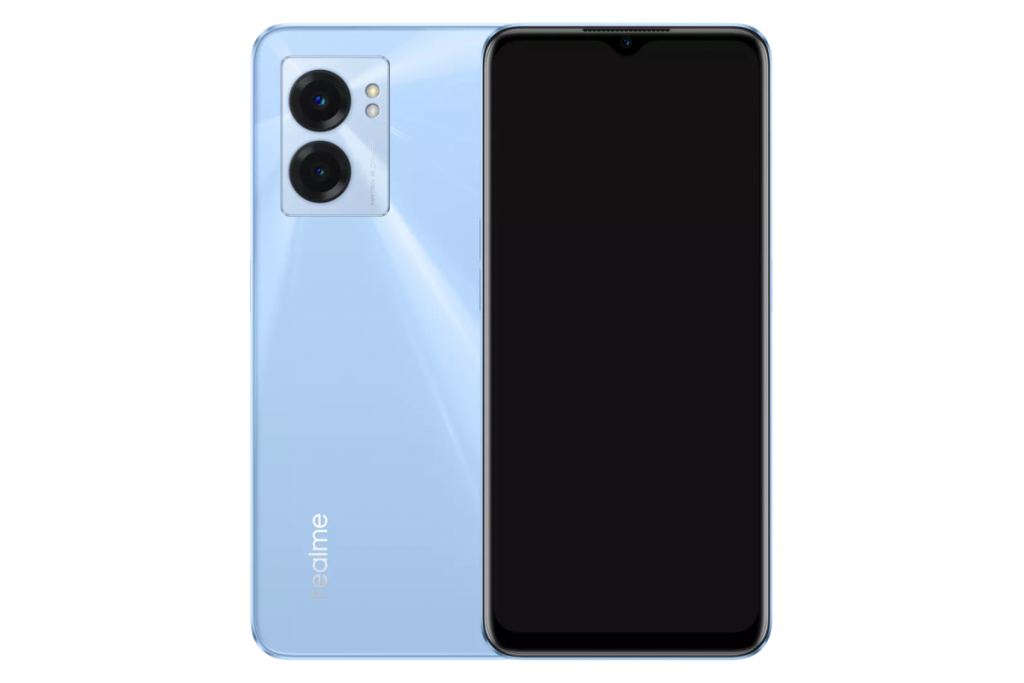
Realme V23i 5G
The Realme V23i has a 6.56-inch LCD screen that produces an HD+ resolution of 1612 x 720 pixels and a 90Hz refresh rate. It will have an 8-megapixel selfie camera and a 13-megapixel (main) + 2-megapixel dual-camera setup.
The V23i is powered by the Dimensity 700 chipset and 4 GB of RAM. The device offers 128 GB of internal storage and a microSD card slot for additional storage. It runs on Realme UI 3.0 and Android 12 OS.
The device packs a 5,000mAh battery, which offers only 10W charging. It features a side-mounted fingerprint scanner. It measures 163.8 x 75.1 x 8.0mm and weighs around 185 grams.
Realme V23i price and availability
The Realme V23i is priced at 1,399 Yuan (~$201) for the sole 4GB+128GB edition. It comes in Mountain Blue and Jade Black colours. It is unclear whether the V23i will be released in markets outside of China.
Tipster Digital Chat Station revealed that Vivo will soon unveil the Vivo X Flip clamshell phone in China. It will be the company’s first-ever flip phone with a foldable screen. Soon after revealing the existence of the device, the tipster shared a schematic to showcase a design. At the same time, another tipster shared a simulated image of the X Flip based on the real device.
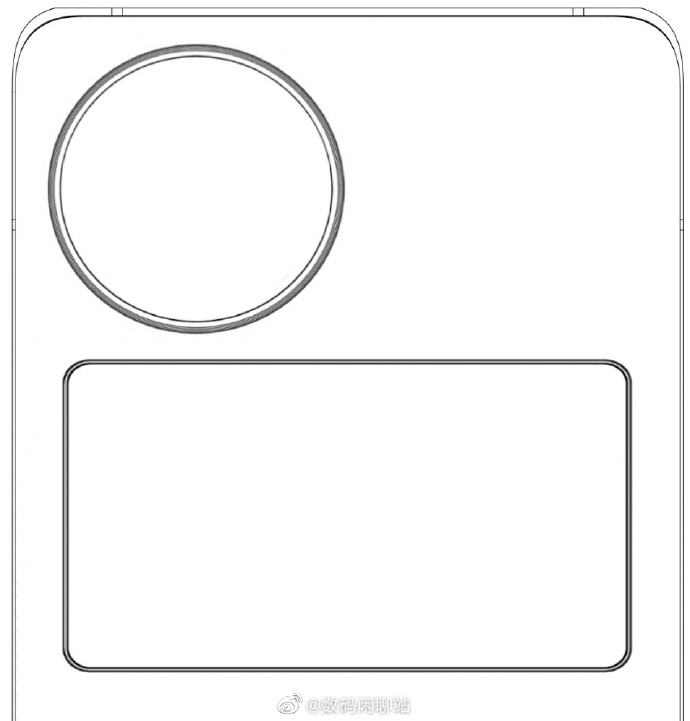
Vivo X Flip schematic by Digital Chat Station
The schematic and the render reveal that the Vivo X Flip’s back will have a round-shaped camera module, which seems to house a triple camera unit. On its right, there is a triple LED flash and the ZEISS logo.
Below the camera module, there is a rectangle-shaped cover display. The remaining half has the Vivo logo. The right edge of the device will have a volume rocker and a power key.
VIvo X Flip simtulated image
Apart from the chipset, nothing else is known about the specifications of the Vivo X Flip. The flip phone is expected to come equipped with the Snapdragon 8 Plus Gen 1 chipset. Hopefully, upcoming reports will reveal more information about the X Flip. In all likelihood, the device may become official by early 2023 on the home market. At present, it is unclear whether it will be released on the global market.
In related news, Vivo is likely to unveil the Vivo S16e, S16, and S16 Pro smartphones in China this month. The Exynos 1080, Snapdragon 870, and Dimensity 8200 chipsets, respectively, will power the three phones, according to reports.
The official renders of the Vivo S16 Pro have revealed that it will have a punch-hole OLED display on the front and a triple camera unit on the back. The S16 is also expected to sport a similar design. Readers can visit this post to read the leaked specifications of the Vivo S16 and S16e.
The Vivo S16 series is expected to launch soon in China since the company has already started teasing its arrival. The first teasers that have been released give a good look at the Vivo S16 Pro’s design from all angles. Reports have revealed that the lineup will also include the Vivo S16e and the Vivo S16. A new report by 91mobiles has revealed the entire specifications of the Vivo S16 and S16e.
Vivo S16 specifications (rumored)
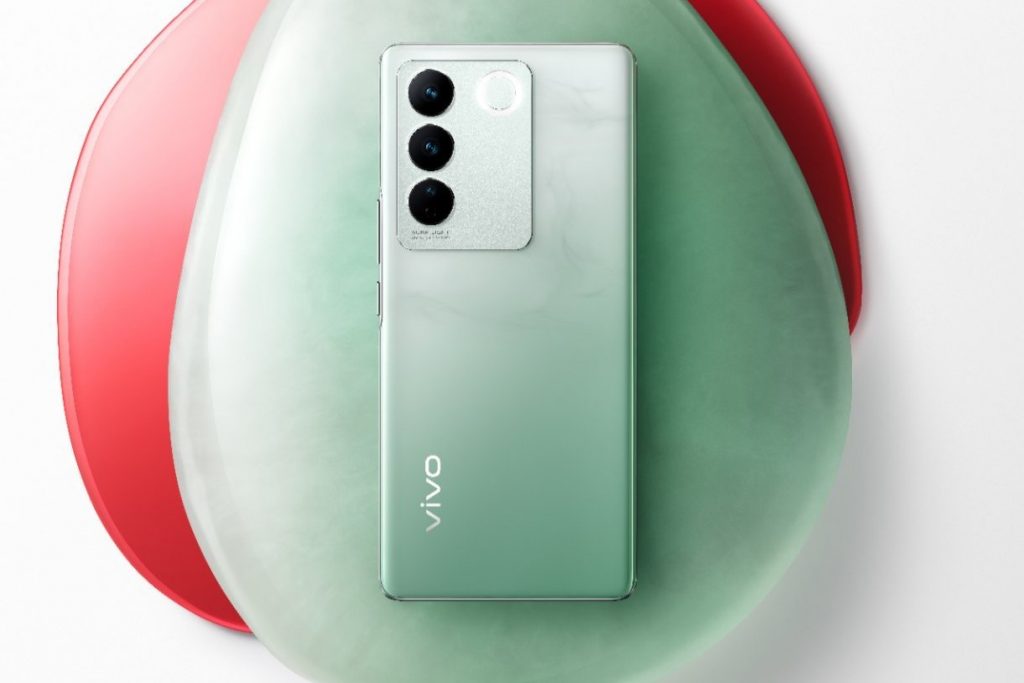
Vivo S16 Pro
The report reveals that the Vivo S16 will have a 6.78-inch AMOLED display that produces a Full HD+ resolution of 1080 x 2400 pixels and a 120Hz refresh rate. Under the hood, the device is powered by the Snapdragon 870 mobile platform. It is expected to arrive with up to 12 GB of RAM and 512 GB of internal storage.
On the front, it will have a 50-megapixel selfie camera. Its back panel will feature a 64-megapixel primary camera, an 8-megapixel ultra-wide lens, and a 2-megapixel macro camera. The device will pack a 4,600mAh battery with 66W fast charging. It measures 164.1 x 74.8 x 7.4mm and weighs 182 grams.
Vivo S16e specifications (rumored)
The Vivo S16e will feature a 6.62-inch AMOLED display that produces an FHD+ resolution of 1080 x 2400 pixels and a 120Hz refresh rate. As reports have claimed, the S16 will feature the Exynos 1080 chipset. It will arrive with up to 12 GB of RAM and 256 GB of native storage.
The device will feature a 16-megapixel camera for selfies. Its rear shell will have a 50-megapixel primary camera and a pair of 2-megapixel cameras for depth and macro shots. It is also tipped to house a 4,600mAh battery and support 66W rapid charging. Its dimensions are 164.1 x 74.8 x 7.4mm and weighs around 182 grams.
Both devices will arrive with an under-display fingerprint sensor and NFC. These devices are expected to run on the OriginOS 3-based Android 13 OS.
Xiaomi officially announced its top-tier flagship phones for 2023. The Xiaomi 13 Series includes the amazing Xiaomi 13 Pro: a premium flagship with very few rivals and maxed-out specifications. A few days ago, OPPO launched a new high-end phone as well, even though it is not its main flagship for 2023 as the Find X6 Series will debut in the first quarter of next year. We are referring to the OPPO Reno9 Pro Plus, the most advanced Reno phone ever seen, with flagship-class specifications. While it may be kinda obvious to a lot of people which one is the best, it is harder to decide which one to buy if we consider that these phones are sold in different price ranges but they offer similar performances. Here is a comparison between the main specifications of the Xiaomi 13 Pro and the OPPO Reno9 Pro Plus that will help you.
Even though it is a more affordable device, the OPPO Reno9 Pro Plus is way better than the Xiaomi 13 Pro if we talk about the design. It has an amazingly thin body with a thickness of just 8 mm and a weight of 192 grams, it is very elegant and it has a minimalistic camera module. But with the Xiaomi 13 Pro, you get better materials and better build quality. It is a phone with a ceramic back and an aluminum frame, with a front glass protected by Gorilla Glass Victus. It is also waterproof with the IP68 certification: finally, Xiaomi released a waterproof phone! On the other hand, it is thicker, heavier, and even uglier in my honest opinion.
Display
The display found on the Xiaomi 13 Pro is superior to the one found on the OPPO Reno 9 Pro+. It is an OLED panel able to show up to one billion colors with a diagonal of 6.73 inches, a Quad HD+ resolution of 1440 x 3200 pixels, the LTPO technology enabling an adaptive refresh rate from 1 to 120 Hz, Dolby Vision support, HDR10+ certification, and an in-display fingerprint reader. However, the OPPO Reno 9 Pro Plus does not have a disappointing display: it sports an AMOLED panel showing up to one billion colors with a diagonal of 6.7 inches, a Full HD+ resolution of 1080 x 2412 pixels, a 120 Hz refresh rate, HDR10+ certification, and an in-display fingerprint scanner.
Specs & Software
The Xiaomi 13 Pro is equipped with a better processor, the best out there alongside the Dimensity 9200. We are talking about the new Snapdragon 8 Gen 2 built with a 4 nm production process and sporting an octa-core architecture, running at a max frequency of 3.2 GHz. Alongside the chipset, there are up to 12 GB of RAM and up to 512 GB of UFS 4.0 native storage. But the OPPO Reno9 Pro+ is not so far with its Snapdragon 8+ Gen 1 chipset built at 4 nm and running at a max frequency of 3 GHz. Further, it has a higher quantity of RAM: 16 GB, alongside 512 GB of native UFS 3.1 storage. Both phones run Android 13 out of the box, but with different user interfaces on top: MIUI 14 and ColorOS 13, respectively.
Camera
The camera hardware of the Xiaomi 13 Pro beats the OPPO Reno9 Pro Plus easily. It has a triple camera made in cooperation with Leica including a 50.3 MP 1-inch main sensor with OIS (the Sony IMX989), a 50 MP telephoto lens with 3.2x optical zoom, and a 50 MP ultrawide shooter. The OPPO Reno 9 Pro Plus sports a 50 MP main sensor (the Sony IMX890) aided by OIS and the MariSilicon X proprietary NPU enhancing night photography. However, the secondary sensors are poor: an 8 MP ultrawide camera and a 2 MP macro lens.
The Xiaomi 13 Pro has a bigger battery, however, the difference is not big. But it charges a lot quicker thanks to 120W fast charging.
Price
The starting price of the Xiaomi 13 Pro roughly translates into $745/€700 (8/128 GB), while the OPPO Reno 9 Pro Plus starts from about $649/€610 (16/256 GB). Which one would you pick?
Nubia is gearing up to launch a new flagship smartphone in China, dubbed Nubia Z50. The company has confirmed the handset will debut in its home country on December 19 with a Snapdragon 8 Gen 2 SoC and a 5000mAh battery. Ahead of its formal debut, the smartphone has surfaced on the 3C certification site with 80W charging.
Nubia Z50 with model number NX711J has passed through China’s compulsory 3C certification. The listing suggests the handset will come with an 80W charger. Previously, Nubia revealed the Z50 will pack a 5000mAh and will be powered by the latest Snapdragon 8 Gen 2 SoC.
The company has also revealed that the smartphone will come with a new 35mm custom optical system where the light input exceeds 1-inch primary camera sensor. In addition, the device would support Starry Sky Photography and offer different types of photography modes.
Other specifications of the smartphone are still under wraps. We are bound to learn all details about it on December 19.
To recall, Z50’s predecessor—Nubia Z40S— launched with a 6.67-inch OLED display offering a Full HD+ resolution, a 144Hz refresh rate, a 480Hz touch sampling rate, and a maximum brightness of 1,000 nits. Under the hood, it is powered by the Qualcomm Snapdragon 8+ Gen 1 chipset, coupled with LPDDR5 RAM and UFS 3.1 onboard storage.
For photography, the smartphone features a custom-made 35mm 64-megapixel Sony IMX787 primary camera with an f/1.6 aperture and OIS support, a 50-megapixel ultra-wide unit, and an 8-megapixel periscope telephoto sensor. There’s a 16-megapixel snapper for selfies and video calls.
The device runs the Android 12 operating system with the company’s own MyOS 12 custom skin on top. It is backed by a 5,000mAh battery with support for 80W/120W fast charging.
Taiwanese tech giant ASUS has unveiled the VivoWatch 5 AERO wristband in China. The VivoWatch 5 AERO is touted to be the world’s first wristband that supports fingertip pulse index measurement. The new ASUS health and fitness wearable is equipped with a medical-grade triode single-lead ECG electrical sensing element. It also has a PPG optical sensing element with two channels.
The smart wearable segment of the tech industry is in continuous evolution. The inclusion of fingertip pulse test support is yet another milestone. The VivoWatch 5 AERO features a pulse wave index testing capability and it can assess the health status of the user.
Furthermore, the new ECG function has gotten the requisite certification, in addition to blood oxygen monitoring. The user of the smart wristband can easily measure these health parameters through their fingertips. This can confirm heart rate, relaxation index, sleep quality, and other health and fitness metrics.
The VivoWatch 5 AERO is also a fitness wearable. It can record your running speed, distance covered, travel path, and pace running, amongst several supported features. There are several sports modes available including swimming, yoga, jogging, and walking.
The wristband has a battery life of 7 days on a single charge and it weighs just 30g. It is rated 5ATM and is protected even when submerged underwater. The Asus VivoWatch 5 AERO supports magnetic charging.
The new Asus health and fitness wristband is already on sale in China for 840 yuan (~$121). The wristband can be purchased from leading e-commerce platforms in the country.
The innovative fingertip pulse test available with the wearable is its major talking point. This health feature is expected to drive demand for the product in China and even beyond. Asus is yet to provide any details about the global availability and pricing of the new wristband.
Samsung is working hard to update all its eligible devices to Android 13. The brand recently released stable One UI 5 update for the mid-range Galaxy M32 4G and a few other smartphones. Now, the software update is making its descent to three more smartphones. The devices being updated are the Galaxy A71 5G, Galaxy S10 Lite, and the Tab S7 Fe. Here are the details.
Galaxy A71 5G debuted in 2020 with Android 10 and now the handset is receiving the latest Android 13 update. The smartphone is getting its third major update with firmware number A716BXXU6EVL2. The software is currently rolling out in UAE, with a wider rollout projected to begin soon.
The One UI 5 update for Galaxy A71 5G comes with many cool features as well as the December security patch. The 4G version of the handset has already received the stable build of software in November.
As mentioned, the Samsung Galaxy S10 Lite, which was launched in early 2020 with Android 10, is now being updated to Android 13 (One UI 5). The update is being seeded to the unlocked and Vodafone-branded phones in the Netherlands with firmware version G770FXXU6HVK5. Unlike the A71 5G, S10 Lite does not get the December security patch.
The latest One UI 5 update is also rolling out to Samsung Galaxy Tab S7 FE. The Android 13-based software for the tablet arrives with a firmware version T736BXXU1CVL1. The initial rollout is so far limited to the UK, however, other regions should get the OTA soon. The update comes bundled with the November 2022 security patchset.
Samsung is reportedly planning to launch new affordable A-series smartphones in India this week. The budget smartphones—Galaxy A04 and A04e— will debut in the country with a price tag of less than Rs. 10,000. The two handsets have already debuted in the global market so we have a good idea about their specifications. Here are all the details.
News agency IANS, citing industry sources, claims the Galaxy A04 and A04e will be launching in India this week, priced under Rs. 10,000. The smartphones will arrive with RAM Plus feature, supporting up to 8GB RAM. This feature basically allows users to add virtual RAM storage to their phones as per their usage.
Galaxy A04e
The exact launch date of the two handsets is yet to be known. Samsung India hasn’t confirmed any details yet. It’s possible the company will silently launch the smartphones. In any case, let’s have a look at their specifications.
Samsung Galaxy A04 and A04e Specifications
Both Samsung Galaxy A04 and A04e come with a 6.5-inch LCD panel with an Infinity-V notch. The screen supports a typical 60Hz refresh rate and HD+ resolution. On the front, they have a 5-megapixel selfie camera.
For photography, both smartphones feature a dual-camera system with an LED flash on the back. The Galaxy A04 has a 50-megapixel main camera with an f/1.8 aperture while the A04e has a 13-megapixel primary sensor. Both have a 2-megapixel depth sensor. The handsets run on Android 12 OS with One UI Core 4.1 on top.
Galaxy A04 is powered by an octa-core processor, likely the Exynos 850. The A04e, on the other hand, features an unknown octa-core Soc. The devices draw power from a 5,000mAh battery. Other features include dual-SIM support, 4G VoLTE, Wi-Fi 802.11ac, Bluetooth 5.0, GPS, a USB-C port, and a 3.5mm headphone jack.
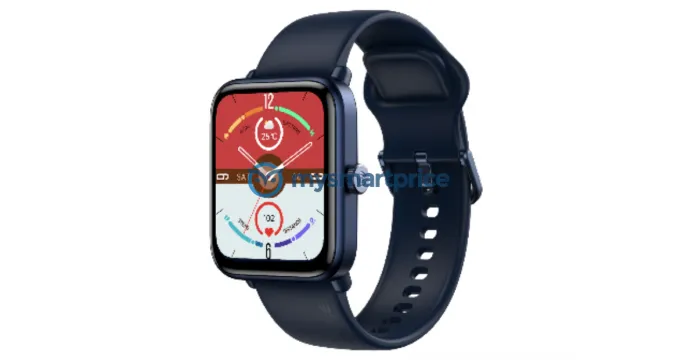
Noise is reportedly gearing up to launch a new smartwatch under its Colorfit Pro 4 series. The wearable will be called Colorfit Pro 4 Alpha and it is tipped to feature a 1.78-inch AMOLED display with a 60hz refresh rate. The company is yet to officially confirm any details about the device. But ahead of it, a new report claims the Noise wearable will launch in India on December 16 with smart touch technology. Let’s look at the details.
MySmartPrice, citing sources, claims the Noise Colorfit Pro 4 Alpha will debut in India on December 16. The publication says the wearable will debut with new smart touch technology, which will allow users to turn off the watch’s display by putting their palms on the screen. In addition, it will come with a single tap-to-wake option.
The smartwatch will be available for purchase in India by the end of December through Amazon and GoNoise’s official website. The price of the upcoming smartwatch is yet to be known. However, we can expect it to be an affordable smartwatch.
A recent report revealed the watch will come with a 1.78-inch AMOLED display that supports Always on Display (AOD) functionality and have 2.5D curved glass. The screen could have a 60Hz refresh rate and 368 x 448-pixel resolution.
Leaked renders reveal the Colorfit Pro Alpha will have a square dial that resembles the Apple watch. It has a physical button on the right side. The smartwatch is said to have Tru Sync technology for Bluetooth calling via Bluetooth 5.3.
In addition, the wearable will support fast charging and will be able to go from 0 percent to 50 percent in only 30 minutes. Moreover, Noise ColorFit Pro 4 Alpha could offer a seven-day battery life.
An Indiegogo crowdfunding program has been initiated for the ChaiBot Smart Tea Machine. The new smart tea-producing machine features a self-cleaning mode and also supports mobile app control. The new ChaiBot tea machine uses loose tea leaves or tea bags to make up to six cups of tea simultaneously. You can customize the settings to deliver your favorite brew at any time using the companion mobile application.
The ChaiBot Smart Tea Machine is manufactured by BrewConcepts and it offers fresh tea brew from several options (tea bags, tea leaves, and other ingredients). It can also be used to produce macha and milky chai teas with a consistent flavor guaranteed. In addition, the tea production process provides more than 39% more antioxidants.
In terms of the speed of production, the Smart Tea Machine is up to four times faster than using a kettle, which is impressive. The machine can also keep your tea hot for up to two hours. The brewing process, according to Brewconcepts, is efficient and can be automated. The dimensions of the ChaiBot Smart Tea Machine are 310 x 172 x 366mm and it weighs 4.5kg.
One of the highlights of the ChaiBot Smart Tea Machine is its self-cleaning mode which puts the entire machine in top shape at all times. Color options available for the device are black, white, or green ABS plastic body options. In addition, the brewing equipment consists of glass and steel components.
The Indiegogo campaign requires a pledge of $185 which chalks off 26% off its original price. The gadget will be available in the global market but the earliest deliveries are expected in March 2023.
Geely has unveiled the Panda Mini EV – its smallest Geely vehicle yet. The Geely Panda Mini EV was initially expected to come under the Geometry brand but was rather unveiled under the parent company. The Panda Mini will enter the market next year and it heavily draws its design from the Panda theme.
The Panda Mini EV comes in the black and white accent of the panda. It has a black roof and beautiful, round headlights. It is a two-door, four-seat city vehicle with a length of 3,065mm. It can be easily parked even in very tight spaces. The car is equipped with a panoramic glass roof with several warm color options that accentuate the panda-like look. The wheels are designed to bear a semblance to the panda’s paw prints and its front bumper reflects this. There is a trim at the bottom of the front bumper that looks like a panda’s ears. The headlights and taillights bear a semblance to the panda’s eyes.
In terms of power, the Panda Mini EV is equipped with a 30kW electric motor and a LFP battery manufactured by Guoxuan Hi-Tech. The range of the new EV is 150km which is decent for daily city commutes and even inter-city one-way movements.
The Panda Mini, when it arrives, will compete with some hugely successful compact EVs already in China. Some of these models include the Kiwi EV, the Baojun, and the Wuling Mini EV. Notwithstanding, the Panda Mini EV comes into the market with a great competitive advantage and a cute design.
There is no confirmed pricing information for the Panda Mini at this time. It is however speculated that it could be priced between $5,700 and $7,200 depending on the trim. Geely says the car will go on sale in 2023 and heavily targets the younger demographics of the Chinese market.
Vivo is readying the successor of the Vivo S15 series and the new lineup could debut by the end of this month. The series could include three smartphones— Vivo S16 Pro, S16, and S16e. The standard model was recently spotted on Geekbench with Snapdragon 870 SoC. And now the Pro model has also surfaced on the benchmarking site, hinting at a few key specifications. Here are the details.
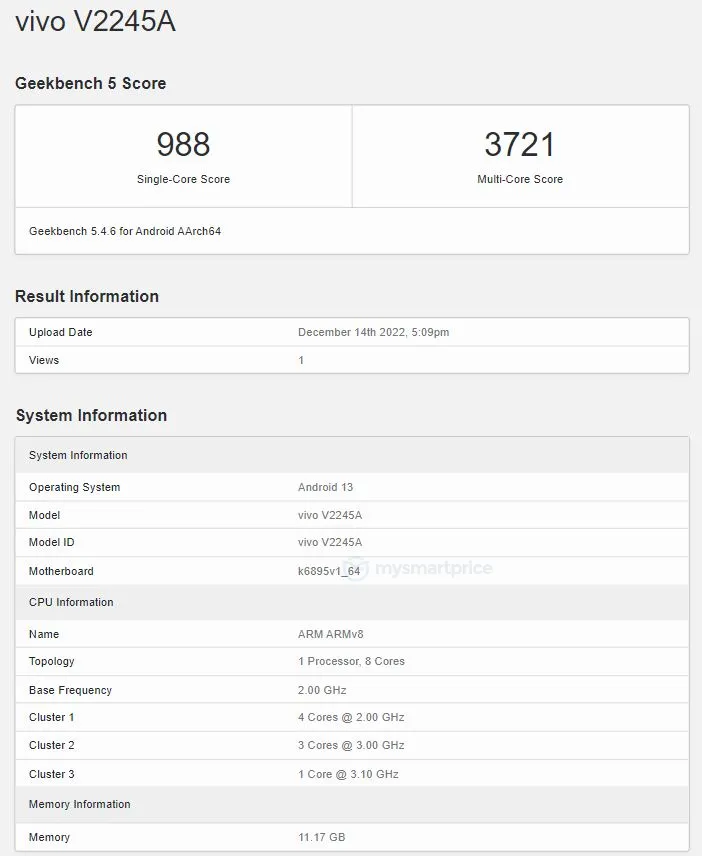
A Vivo smartphone bearing the model number V2245A has appeared on the Geekbench website. Previous listings reveal the model number belongs to the Vivo S16 Pro. The benchmarking site reveals the handset will be powered by an octa-core chipset with a core frequency of 2GHz.
The chipset has four CPU cores clocked, 3 at 3GHz and one at 3.10GHz. This could be a Dimensity 8200 SoC. The Vivo S16 Pro could also boot Android 13 out-of-the-box and pack 12GB of RAM. The handset has received a single-core score of 988 points and a multi-core score of 3,721 points.
Vivo recently confirmed that the Vivo S16 series will debut ahead of the Chinese New Year, which is on January 22. Multiple leaks and rumors claim the handset will be launched by the end of December.
In addition, the company shared official images of the S16 Pro, revealing its design. Vivo also revealed that the upcoming series will arrive with a 50MP front-facing camera and an OIS-assisted main camera. The lineup will also have a soft light portrait feature for the front and rear cameras. It’s likely that Vivo S16e will miss out on these features.
Leaks reveal the vanilla model will be equipped with a Snapdragon 870 processor and the S16e will feature the Exynos 1080 chip. The exact launch date of the series is still unknown. We should be getting an official announcement soon.
We have been hearing about the Vivo S16 series for a long time. Today, one of the company executives officially confirmed the arrival of these smartphones.
Interestingly, he also revealed the design of one of the models by sharing promotional images. That’s not all, he also disclosed certain features and shared camera samples.
Let’s check out all the official details regarding the upcoming Vivo S16 series.
The information about the Vivo S16 series comes from Jia Jingdong. He is the Vice President and General Manager of Brand and Product Strategy at Vivo.
He says that the Vivo S16 series will be launched ahead of the Chinese New Year, which falls on January 22. According to rumors, the successor of the Vivo S15 series will be debuted by the end of December.
The images shared by the exec seem to be of the Vivo S16 Pro. The design of this very same phone just leaked yesterday via 3D CAD renders. It will be available in two colors (green and gradient).
The exec confirms that the series will be powered by a MediaTek Dimensity 8200 SoC and a Qualcomm Snapdragon flagship chip. As per leaks, the Pro model in the pictures will house the MediaTek chipset, while the vanilla variant and S16e will be powered by Snapdragon 870 and Exynos 1080 chips, respectively.
Finally, the executive reveals that the series will feature a 50MP front-facing camera and an OIS-assisted main camera. The series will also come with a soft light portrait feature for the front and rear cameras. This explains the LED ring light on the back.
It is worth noting that not all three phones will arrive with the aforementioned camera features. They will be likely limited to the Pro or both vanilla and Pro models.
We expect Vivo to announce the launch date soon. At the same, we are also looking forward to more teases and leaks.
Samsung is expected to unveil its next-generation flagship Galaxy S-series smartphones in February next year. The lineup comprising regular, Plus, and Ultra variants have already appeared in leaked renders as well as on Geekbench benchmarking platform and FCC certification website. The Ultra model also bagged TENAA certification earlier this week.
After appearing on Thailand’s NBTC certification site earlier today, the Samsung Galaxy S23 has now bagged Bureau of Indian Standards (BIS) certification. It is listed with model number SM-911B/DS and was first spotted by tipster Mukul Sharma aka stufflisting. The listing does not reveal any key specifications but hints at an imminent launch of the smartphone.
As per past leaks and rumours, the regular Galaxy S23 will ditch the rectangular camera island on the back panel. It will feature a 6.1-inch FHD+ AMOLED display with a 120Hz refresh rate. The smartphone will reportedly be powered by a Snapdragon 8 Gen 2 SoC under the hood. It will pack up to 12GB RAM and 256GB internal storage. The Galaxy S23 is tipped to feature a triple rear camera setup of 50MP, 12MP, and 10MP sensors. It will reportedly be backed by a 3,900mAh battery unit with support for 25W fast charging. The device will ship with Android 13-based OneUI 5.0 out of the box. Past report suggests that the Samsung Galaxy S23 series could come with 8K video recording at 30 frames per second.
We will learn more details about the Samsung Galaxy S23 series including its launch event in the coming weeks.
Western Digital has launched new storage solutions in India. These include four new SanDisk Pro-Grade devices i.e. PRO-G40 SSD, G-DRIVE Enterprise Class Desktop Hard Drive, G-RAID Shuttle SSD, and PRO-DOCK 4. The storage devices provide multiple facilities to the user. Western Digital says that they are aimed at content creators and professionals. The goal is to help users store and manage content. Read on to know what the storage devices offer out of the box.
The SanDisk Professional PRO-G40 is the most rugged SSD storage device from the brand to date. It features an IP68 certification letting users carry in the rain. The device is 1800kg crush resistant and drop-resistant up to 3 meters. The PRO-G40 has a Thunderbolt 3 and a USB 3.2 Gen 2 port. The former offers read/write speeds of 2,700 MB/s and 1,900 MB/s respectively. The cold aluminium core helps maintain super-fast transfer speeds. WD claims that the storage device can transfer 50GB files in 30 seconds.
The SanDisk Professional G-DRIVE Enterprise Class Desktop is basically a hard drive. It has a premium and elegant form factor. There is a single USB-C port that is claimed to offer 280 MB read and write speed per second.
The SanDisk Professional G-RAID Shuttle SSD is an 8-bay solid-state storage that is designed for convenient transport between the production site and the studio for post-production. It has Thunderbolt 3 and USB-C connectors with the former offering read speeds up to 2800 MB/s. The device has up to 32TB of storage that is capable of transferring 4K, 8K, VR, HDR, and high-frame-rate content. The Thunderbolt 3 port can be used to connect up to five devices at once.
Lastly, the SanDisk Professional PRO-DOCK 4 is a four-bay reader docking station. It has a Thunderbolt port. The storage solution can be used to offload four SanDisk Professional PRO-READER devices simultaneously.
The SanDisk PRO-G40 SSD and PRO-DOCK 4 are priced at Rs 34,999 and come with a 5-year warranty. The G-DRIVE Enterprise Class Desktop HDD starts at Rs 19,999 for 4TB with a 3-year warranty. The G-RAID SHUTTLE SSD carries a starting price tag of Rs. 3,99,999 in India with a 5-year warranty.
All the newly announced storage devices are available for purchase through the Western Digital Store (Andheri West), authorized SanDisk Professional retailers, e-tailers, and distributors across India.
JBL has just announced that it is celebrating a new notable milestone in the Indian market. The company has claimed that it has sold 200 million headphones in the region. So here are all of the details.
For those unaware, the known audio based company is a HARMAN Internation sub brand, which is a Samsung Electronics subsidiary that also makes its own audio products from the Harmon Kardon brand. Now, JBL is celebrating a new milestone as it achieves the sales of more than 200 million units of headphones in India alone. The company claims that this was achieved by accurately anticipating customer demands and growing headphone market with its high quality audio products.
Furthermore, the pandemic in 2020 led to a major jump in trends like HD music streaming, in game music consumption, podcasts, remote working, and conferencing, which lead to a boom in headphones sales. The company is also expecting a market growth of an impressive 17.6 percent between now and 2028. This news also arrives as JBL’s headphones overtook Sony in terms of global sales volume in the second quarter of this year. In other words, this made the company the number one global audio brand.
The company adds that it not only focused on high audio fidelity but also catered to various types of users ranging from athletic/fitness enthusiasts, audiophiles, and even gamers. They also focused on younger individuals that were now experiencing high quality audio for the first time. Apart from quality, one could also expect the brand to offer other features like comfort, customization, innovation, and sustainability as well.
The fake and annoying comments that are posted under the comments section of other creators’ videos have come to the notice of many people. By using a YouTube video’s comment section, some people also attempt to spam others. After receiving so much attention from the creators, the brand is now finally implementing security steps to prevent these spam comments. In case a comment spammer is found to be breaking any guidelines, YouTube has stated that they would start issuing warnings to them.
If the user continues to publish inappropriate comments, YouTube may prohibit them from posting for up to 24 hours, according to a post made at TeamYouTube and signed “Rob.” According to Rob’s post, “Our testing has shown that these warnings/timeouts lower the risk that people would leave violative comments again.” Currently, the notice is only accessible for English comments, but Rob says they plan to expand it to additional languages soon. Additionally, the business has enhanced its capacity to recognise bots in live chats and spam in comments.
This year, a number of creators, including Jacksepticeye, MKBHD, and Linus Tech Tips, have all produced videos about comment spam. Although spam can take many different forms, you might encounter waves of copied-and-pasted remarks, remarks that impersonate well-known producers, or scams involving products like Robux. YouTube has responded by introducing a method to make comment moderation more stringent and is eliminating techniques that allow people to mimic creators. Now, it is also adding a notice for spammers. We really hope these steps would lower the spam rates.
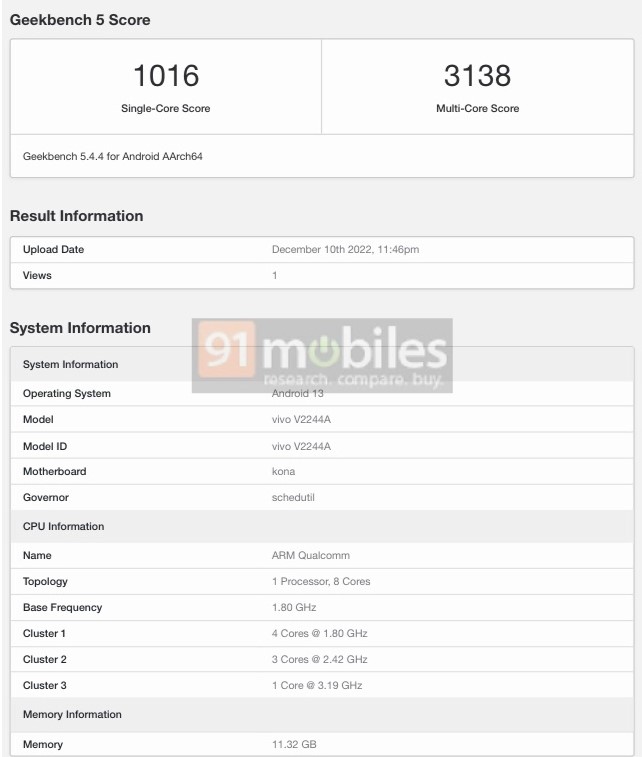
Yesterday Vivo S16 was spotted in leaked renders. Today, the standard Vivo S16 has appeared on the Geekbench database. It is listed with model number V2244A and the benchmarking platform reveals key specifications of the device. Rumours suggest that the Vivo S16 series will debut in China by the end of this month. The smartphones will arrive as the successor to the S15 series that was announced earlier this year.
As per the Geekbench database, the Vivo S16 is listed with a motherboard codenamed ‘kona’. It corresponds to the Qualcomm Snapdragon 870 SoC. The chipset comprises four cores at 1.80GHz, three cores at 2.42GHz, and a prime core at 3.19GHz. The device will pack 12GB RAM and we can expect more options at launch. The benchmark listing reveals that the smartphone will run on Android 13 OS out of the box. The Vivo S16 scores 1,016 and 3,138 points in Geekbench’s single and multi-core tests.
Apart from the aforementioned details, the rest of the specifications of the Vivo S16 remain a mystery. The smartphone appeared on 3C certification with the same model number last month. It revealed that the device will come with support for 80W charging. The upcoming offering is tipped to come in Black, Blue, and Purple colours. The Vivo S16 is speculated to come with a high-refresh-rate display and triple rear cameras as its predecessor. On the other hand, the Vivo S16 Pro is rumoured to be powered by a Dimensity 8200 SoC.
We expect more details about the Vivo S16 to surface online in the coming weeks.
Samsung is gearing up to release multiple smartphones in the coming days. They range from entry-level devices to flagship models.
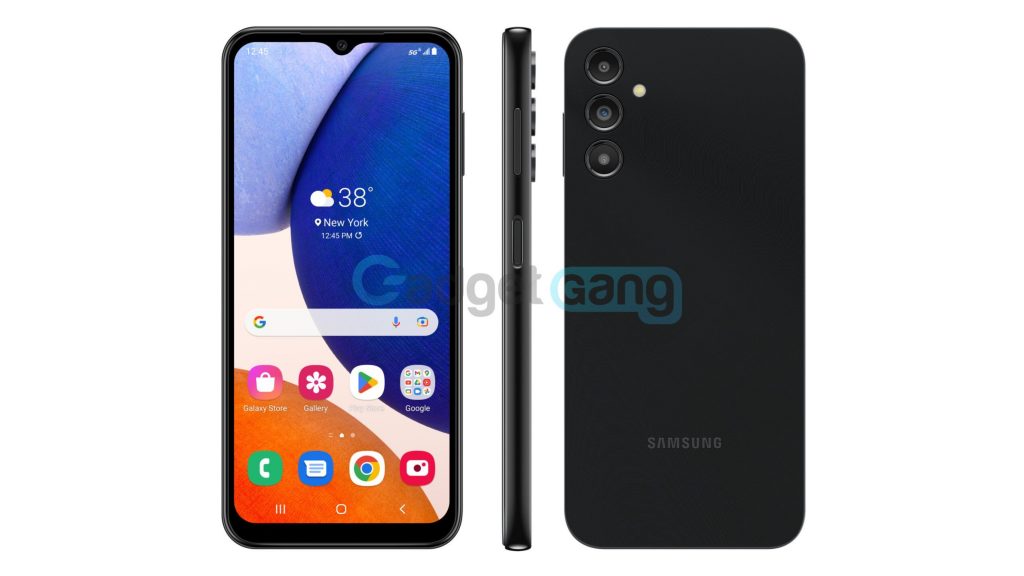
One of these handsets is Galaxy A14 5G. Now, according to new findings, there will also be a 4G variant of this phone. Let’s take a look at all the known details.
The upcoming Galaxy A14 (4G variant) has been spotted on multiple certification agencies, such as FCC, TÜV Rheinland, and UL Demko. According to the listings, the smartphone bears model number SM-A145.
These listings also reveal certain features of the phone. For instance, the device will measure 167.7 X 78.8 X 11.8mm in dimensions.
It will ship with a charger bearing model number EP-T1510. For the unaware, this is the standard Samsung 15W adapter.
Further, it will house a vertically aligned camera setup on the rear. In some markets, it will also arrive with NFC for contactless payments.
Last but not least, it will come with dual-band WiFi and will draw energy from a 5,000mAh battery.
It’s not known when this handset will be made official. Like most Galaxy A series phones, this one will be likely announced via press release.
We use cookies on our website to give you the most relevant experience by remembering your preferences and repeat visits. By clicking “Accept”, you consent to the use of ALL the cookies.
This website uses cookies to improve your experience while you navigate through the website. Out of these, the cookies that are categorized as necessary are stored on your browser as they are essential for the working of basic functionalities of the website. We also use third-party cookies that help us analyze and understand how you use this website. These cookies will be stored in your browser only with your consent. You also have the option to opt-out of these cookies. But opting out of some of these cookies may affect your browsing experience.
Necessary cookies are absolutely essential for the website to function properly. This category only includes cookies that ensures basic functionalities and security features of the website. These cookies do not store any personal information.
Any cookies that may not be particularly necessary for the website to function and is used specifically to collect user personal data via analytics, ads, other embedded contents are termed as non-necessary cookies. It is mandatory to procure user consent prior to running these cookies on your website.