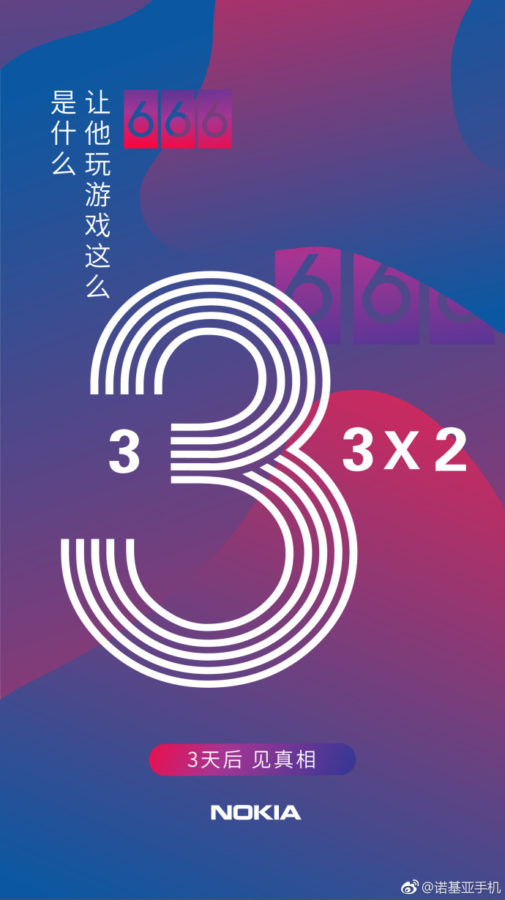
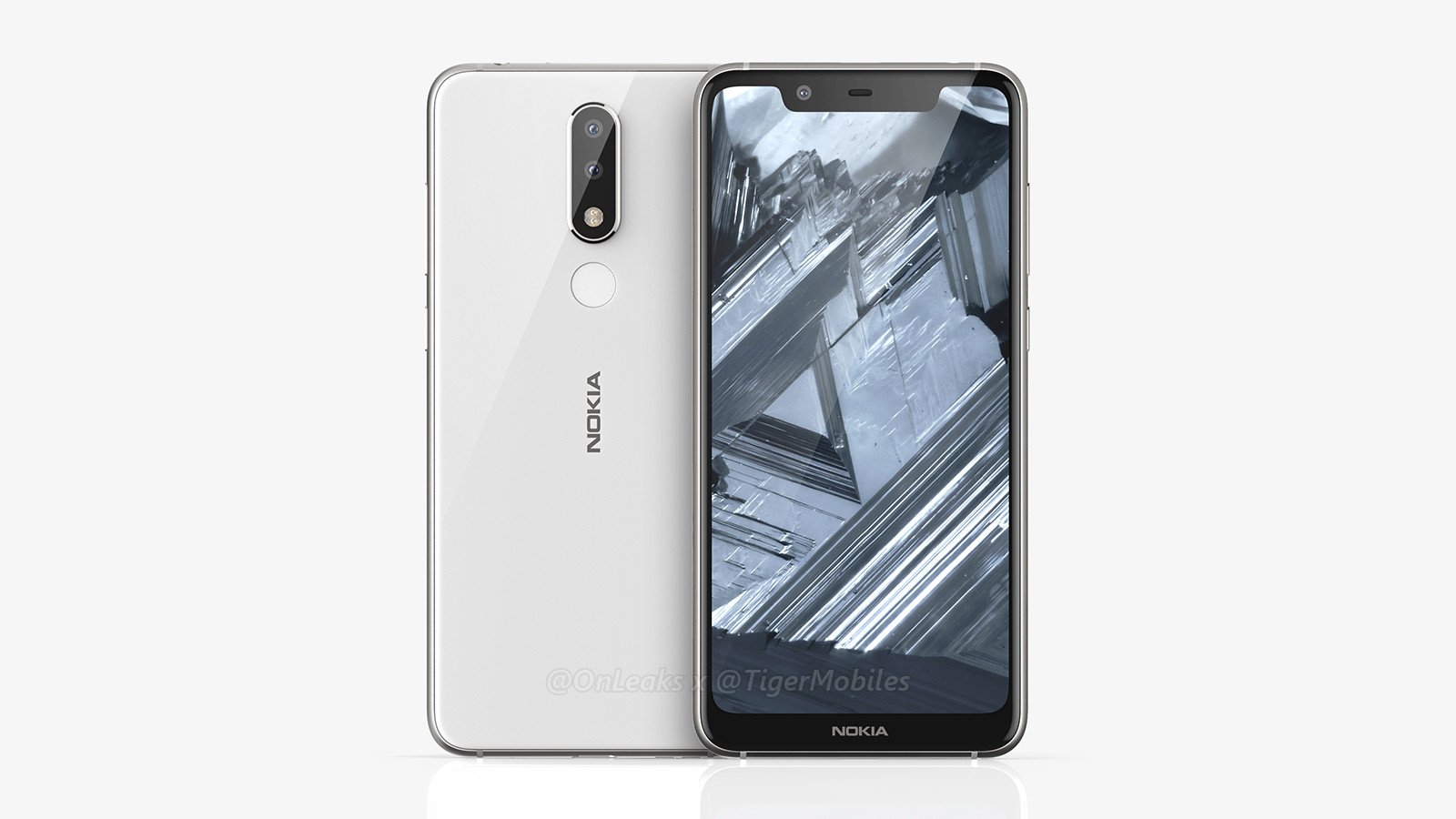
Nokia mobile has taken to its official Weibo account to announce it has an event slated for July 11. News of the upcoming event already surfaced a few days ago but the poster now confirms it.
Although Nokia Mobile hasn’t announced what will be launching, most people believe it is the Nokia X5/5.1Plus, its second phone with a notched display.
The Nokia X5 first surfaced in leaked renders shortly after HMD global’s launch event in Russia where it announced the Nokia 2.1, Nokia 3.1, and Nokia 5.1. The specifications of the Nokia X5 were then revealed on TENAA confirming it would be arriving in China.
The poster teases some features of the phone. A translation of the text written in Chinese does mention something about gaming. So the phone probably has a powerful processor suitable for gaming. TENAA already revealed the phone comes with a 2.0GHz octa-core processor.
With HMD Global turning to MediaTek for some of its new phones, we won’t rule out the Nokia X5 coming with one. Did I hear someone say Helio P60? Maybe, maybe not. We’ll know on Wednesday.
Other than the Nokia X5, we also think HMD Global will announce the Nokia 8110 4G at the 8PM (local time) event. The phone already hit TENAA a few days ago and all that is left is a proper launch.
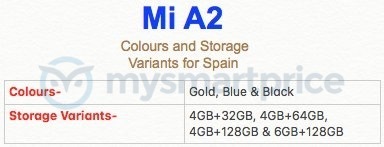
According to a new report from MySmartPrice, Xiaomi Mi A2 will officially land in Spain on July 25. If the report is to be believed, the second Xiaomi device with Android One on board is closer than we expected. Indeed, the latest rumors suggested that the device would enter the global market in August. According to the source, the Android One handset will be launched in three color variants: Gold, Blue, and Black. Further, it will be available in four memory configurations which will be the following:
4 GB of RAM and 32 GB of internal storage
4 GB RAM and 64 GB ROM
4 GB RAM and 128 GB ROM
6 GB RAM and 128 GB ROM
In case you do not know, Xiaomi Mi A2 is a re-branded Mi 6X and the only difference between the two handsets is that the first has Android One while the second is dedicated to the Asian market and it features the MIUI like all other Xiaomi devices. The display of Xiaomi Mi A2 will have a size of 5.99 inches and a Full HD+ resolution of 1080 x 2160 pixels.
There will also be a powerful Snapdragon 660 SoC by Qualcomm and a dual camera setup with 12 and 20 MP resolution with f/1.8 aperture. The battery will be 3010 mAh and the operating system will be based on Android 8.1 Oreo.
3D facial recognition can be defined as the safest and most innovative authentication method on mobile devices, but Samsung is yet to adopt this tech in its flagships. Instead, the company has stuck to iris scanners for the Galaxy Note 8 and Galaxy S9 line-ups, which allows unlocking phones by recognizing the user’s eyes. However, none of these two authentication methods is usable in every scenario and none of them can provide the maximum level of security. For example, the iris scanner does not work well with certain kind of glasses, while Face ID does not work while the user is lying on a bed.
Now, Samsung has filed a new patent at the United States Patent and Trademark Office (USPTO) which highlights a very innovative biometric camera. It is a combo sensor which combines the iris scanner and facial recognition, so it can do both the things. It is able to emit near-infrared light to the user and it contains an extended depth of field (EDOF) lens which can shoot photos at a very close distance to the subject while keeping it sharp. The sensor will be able to filter out ambient light and it is also expected to be able to convert optical images to electronic signals in order to process every image in the best way.
The sensor will also rely on a wide database of recognized iris data in order to perform the authentication. Unfortunately, this is only a patent and it does not give any info about the first device which will feature this new technology. According to speculations, it is impossible that we will see it on the Galaxy Note 9 and it is unlikely that it will come on the Galaxy S10 line-up. Still, iris scanner remains a very safe and reliable method of authentication after all.
8 Xiaomi phones have started receiving a new important update. We are referring to the Global Beta of the MIUI 10, the latest Android customization by the Chinese company announced on May 31 together with the Xiaomi Mi 8 line-up. The new Global Beta has been launched in India on the Redmi S2 days ago, and now it is finally expanding to several other devices.
The new firmware brings the number of version to 8.7.5 and, given that it is the Global version, it contains Google’s main apps such as the Play Store. The Xiaomi phones updated to the new MIUI 10 Global Beta are Xiaomi Mi6, Mi Mix 2, Redmi S2, Redmi Note 5 Pro (known as Redmi Note 5 in some markets), Mi Mix 2S, Mi 5, Mi Note 2 and Mi Mix.
Soon, the firmware will expand to more devices too. In order to update your handset, you need to adhere to the beta testing phase and you will install a ROM which may be unstable under some aspects. If you are on MIUI 7, 8 or 9 stable version, you need to update via fastboot after unlocking the bootloader, while if you already have the Global Beta ROM based on the MIUI 9 you just need to launch the Updater app.
Remember Xiaomi’s new brand, POCOPHONE? When we first covered it, we mentioned the first phone under the brand already got certified at Taiwan’s NCC. The phone has now been spotted at the FCC.
The POCOPHONE phone has the model number M1805E10A but the model name in the cover letter provided by Xiaomi says the model number is M1805D1SG. However, the FCC-ID (2AFZZ-XMSE10A) for both devices are the same.
[envira-gallery id=”200100″]
The cover letter also mentions a few specifications. The phone will support both 2.4GHz and 5GHz Wi-Fi bands and Bluetooth. It will also support LTE Band 40 but will be disabled by software, since it isn’t used in the US.
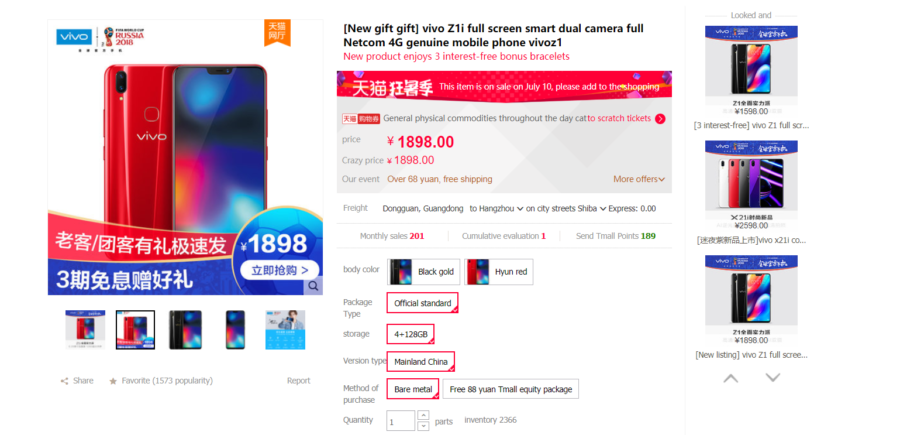
The Vivo Z1i is the second phone in Vivo’s new Z-series. It was announced earlier this week and is now available for purchase, starting today.
The ¥1898 (~$285) phone comes with a Snapdragon 636 processor, 4GB of RAM, and 128GB of storage. It has a 6.26-inch full HD+ display with a notch at the top.
It also has dual rear cameras 13MP + 2MP arranged vertically and a 16MP front-facing camera that resides within the notch. There are a number of camera features which include a beauty mode and face recognition. It also has a rear-mounted fingerprint scanner.
The Vivo Z1i has a game mode that blocks notifications from interrupting your games. This feature is customizable and you can set which calls and notifications are allowed to pass through.
Science and Knowledge is a YouTube channel which often publishes concept videos about upcoming flagships phones based on the existing information. Three days ago, the channel has published a new concept video showing the LG V40 ThinQ. Note that the video only reflects the designer’s thoughts about the upcoming flagship and it has not to be considered an official video. According to Science and Knowledge, the V40 will have even narrower bezels than V30 and G7. t will be fully borderless on three sides and there will not be a chin, unlike the other Android phones with borderless designs.
LG V40 ThinQ will only have one bezel on the upper part which will contain the earpiece, selfie camera and other sensors. According to the designer, the backplate will be made of glass, while the frame will be made of metal just like other LG flagships. The power key is placed on the back side and it doubles as a fingerprint reader. There is also a dual camera setup in a vertical configuration, a laser autofocus mechanism, and a rear LED flash. The volume balancer has been placed on the right side, while on the lower border there are a microphone, a speaker grille, and a USB Type-C port to charge the device.
https://www.youtube.com/watch?=50&v=fd9zrorzHt0
LG V40 ThinQ concept phone has both the IP68 certification (which makes it fully waterproof and dustproof) and the military certification (MIL-STD-810G) like rugged phones. It boasts a 6.1-inch display with a Quad HD+ resolution and HDR10 technology for richer colors, as well as a 90.2 percent screen-to-body ratio (still lower than the latest Oppo and Vivo flagships). It is equipped with an octa-core Snapdragon 845 chipset by Qualcomm, 6 or 8 GB of RAM and 64, 128 or 256 GB of internal storage depending on the configuration. The dual camera has 23 and 19 MP resolution with OIS and PDAF, while the front camera has 16 MP.
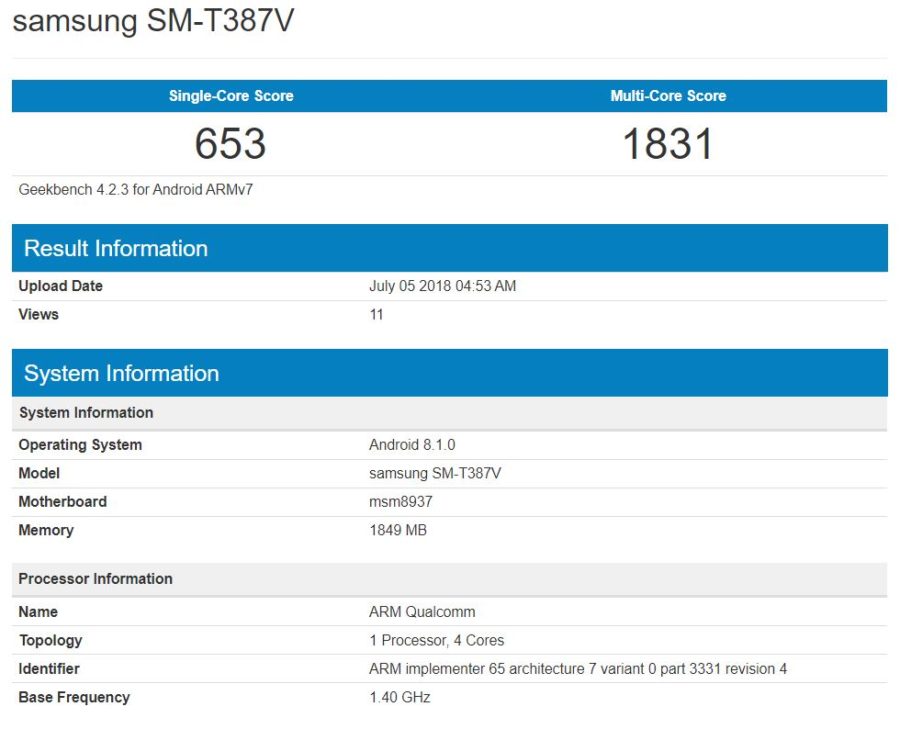
Besides the alleged Galaxy Tab Advanced 2, 2 XL and Tab S4, Samsung seems to be preparing another affordable Android tablet: a new Samsung Galaxy Tab A which may be called Tab A2. It is supposed to be the successor of the cheapest tablet by the Korean of last year, given that the latest model from the Tab E series was released back in 2015 with Android Lollipop out of the box (Android KitKat for Europe). The alleged new tablet has just been spotted on Geekench in which it is identified by the model number SM-T387V.
This, together with other previous leaks, makes us suppose that the Korean company is planning to launch a new very affordable tablet soon. From what Geekbench shows, the specs of the new Samsung Galaxy Tab A2 are disappointing, but it may be cool if the tablet will be sold at a very low price. According to the benchmarking platform, the model sports an octa-core Snapdragon 430 SoC by Qualcomm clocked at 1.4 GHz. It is actually one of the cheapest chipsets by the San Diego giant as only the rarely used Snapdragon 200 series and the Snapdragon 425 SoC are less powerful than this one.
The SoC has been paired with just 2 GB of RAM, while the operating system installed is Android 8.1 Oreo, the latest stable version available. The operating system should be customized with the Samsung Experience UI just like every Samsung tablet. The latest info appeared on Geekbench about the alleged Samsung Galaxy Tab A2 is the score obtained. The tablet has scored 653 points in single-core performance and 1831 points in multi-core. Given these low-end specs, we suppose that this will be the 8-inch version of the tablet, and we believe there will also be a more powerful variant with a 10.1-inch display, a better Qualcomm Snapdragon SoC, and more RAM.
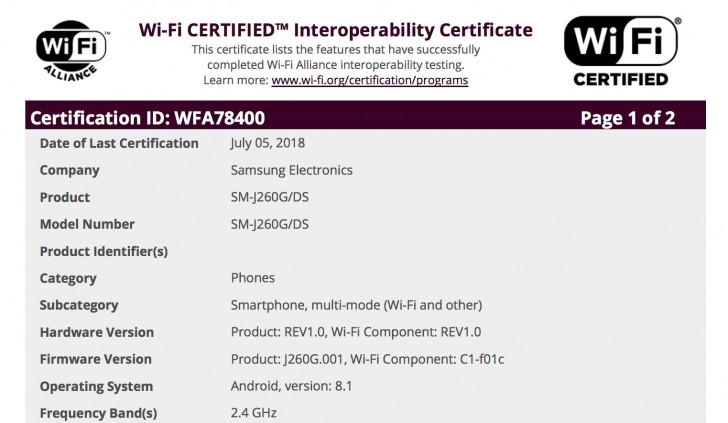
The first Android Go smartphone by Samsung has just received the official certification by Wi-Fi Alliance. It has been spotted on the Wi-Fi Alliance listings with the model number SM-J260G/DS. The latest two letters of the model number indicate that the device will sport a dual SIM slot. Further, the listing mentions the support to the 2.4G band for Wi-Fi networks which indicates the absence of dual-band technology.
At last, it reveals that the operating system installed will be based on Android 8.1 Oreo. From what the latest leaks showed, the Samsung Android Go phone will have the enlightened operating system out of the box, but it will be the first Android Go device to feature a customized user interface. Indeed, it should include Samsung Experience UI instead of being a stock Android phones.
It is expected to come as the Samsung Galaxy J2 Core. It is rumored to pack a quad-core entry-level SoC alongside 1 GB of RAM and 16 GB of internal storage. Its main camera should have an 8 MP resolution, while its front snapper should be 5 MP. At last, there should be a 2600 mAh battery which should provide a long-lasting battery life due to the efficient components. At the moment, its launch date is not known yet.
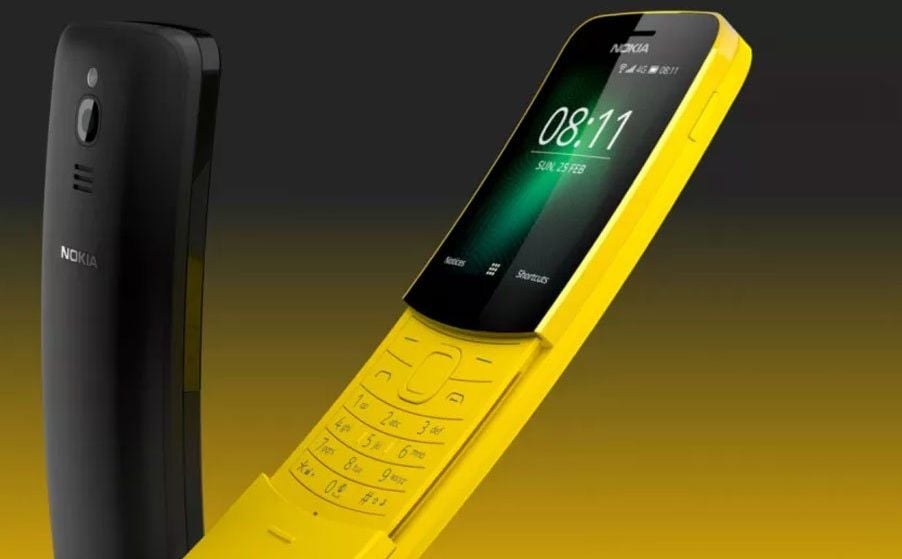
With the official launch of the JioPhone 2, it has been confirmed that WhatsApp will finally make its way on KaiOS phones, and HMD Global’s Chief Product Officer Juho Sarvikas published a Twitter post in which he confirmed that even the new banana phone Nokia 8110 will get the support to the most used messaging app. In case you do not know, WhatsApp has only been available on Android, iOS and Windows Phone in the last period, and it has been dismissed for every other OS. But soon it will come again on another operating system, and it is an OS dedicated to old-school feature phones.
KaiOS is a fork of Firefox OS on which Google has invested $22 billion to bring several of its most important apps. Soon, it will be possible to use WhatsApp even on feature phones like Nokia 8110 which boast an important advantage over traditional smartphones. We are referring to the battery life, as without a big touchscreen display and with low-end components, they can last for ages on a single charge. Juho Sarvikas has implicitly confirmed the arrival of WhatsApp on the Nokia 8110 through the tweet below.
You will only be able to use WhatsApp with the classic 3×4 keyboard of this device, but thanks to its 4G connection it will be fast and reliable. Among the other specs, the banana phone features a 2.4-inch display showing images at a resolution of 240 x 320 pixels. It has a dual-core Qualcomm Snapdragon 205 chipset, 512 MB of RAM And 4 GB of internal storage expandable with a micro SD up to 64 GB. It only has a single camera on its back with a 2 MP resolution with a flashlight and a battery with a capacity of 1500 mAh. The handset has been launched in Europe with a price tag under €100 (lastly in Italy for €89).
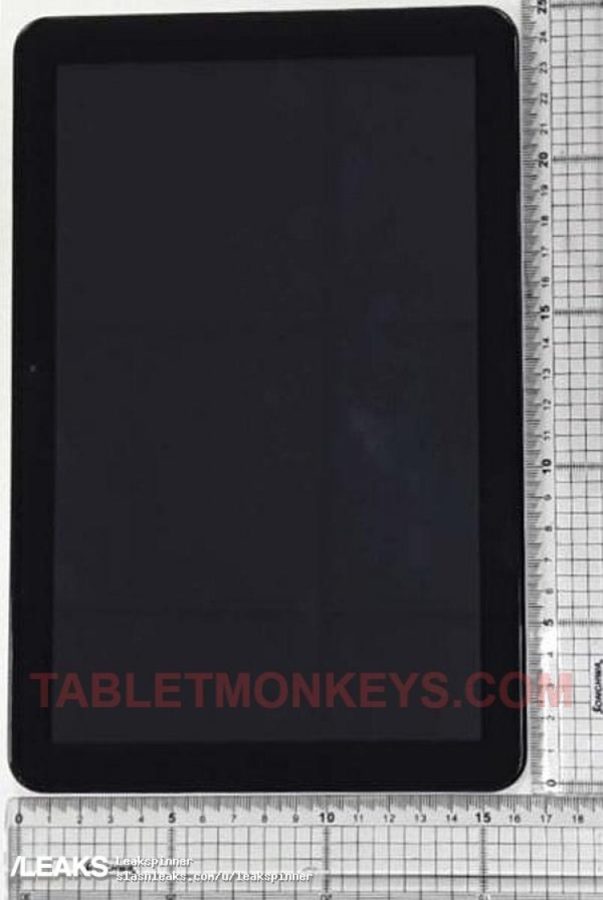
Other than the Galaxy Tab S4, Samsung also has another tablet under development called the Galaxy Tab Advanced 2. A live photo of the tablet has surfaced online alongside a number of key specs.
The image shows only the front of the Galaxy Tab Advanced 2. There is nothing spectacular about it. All you have is thick black bezels around the 10.1-inch display. However, if you are familiar with Samsung tablets, you will notice there is a key change in the design.
The Galaxy Tab Advanced 2 in the image above doesn’t have a physical home button nor does it have capacitive buttons. This is not unusual as early Samsung tablets released before 2014 didn’t have a physical home button nor capacitive keys. Instead, they had on-screen keys. However, this new tablet will have the same on-screen keys as Samsung’s latest devices.
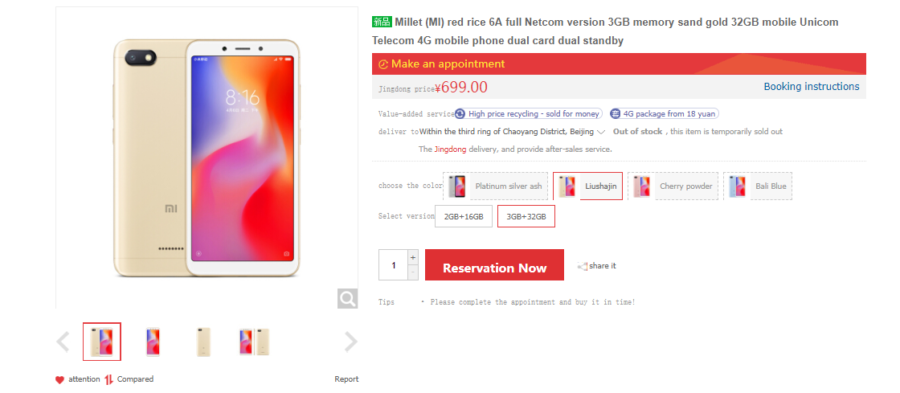
When Xiaomi announced the Redmi 6A, it launched with 2GB RAM and 16GB of storage. Starting on Tuesday, July 10, the Redmi 6A will now be available in a 3GB RAM + 32GB ROM variant.
The new variant has been listed on JD.com and will sell for ¥699 (~105), ¥100 (~$15) less than the base variant (3GB RAM + 32GB) of the Redmi 6.
The Redmi 6A has a 5.45-inch HD+ display and is powered by a 12nm Helio A22 processor clocked at 2.0GHz. It has a single 13MP rear camera and a 5MP front-facing camera with portrait mode. To keep the price low, the Redmi 6A doesn’t have a fingerprint scanner but comes with Ai face unlock.
It also has an AI assistant that helps with translations, exchange rate conversion, and can even identify the calories in your food simply by pointing the camera at the food.
There is Wi-Fi, Bluetooth 4.2, a hybrid dual SIM slot, and a 3.5mm audio jack. Surprisingly, Xiaomi has removed the IR sensor (and on the Redmi 6), so you won’t be able to use this to control your electronics. The Redmi 6A runs Android 8.1 Oreo and comes with a 3,000mAh battery.
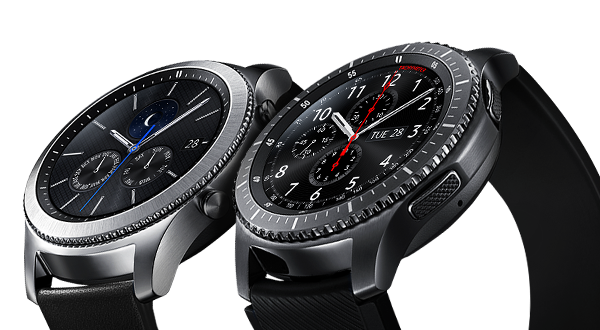
Samsung’s smartwatches are known to run a wearable version of its Tizen OS and have the prefix “Gear” in their name. That may be changing with its next smartwatch.
About Gear S4 (probably called Galaxy Watch) Based on Android Wear, 470mAh battery, PLP package, it is expected to have new UX interaction and blood pressure measurement.
According to China-based leaker – Ice Universe (@UniverseIce on Twitter), the Gear S4 may launch as the Galaxy Watch and will be based on Android Wear or Wear OS as it is now known. He also revealed some few specifications about the watch.
Gear S3 successor may launch as Galaxy Watch
The Galaxy Watch will come with a 470mAh battery. This is 90mAh bigger than that of the Gear S3 Classic and Gear S3 Frontier. Samsung will also use PLP (Panel Level Package) process for the manufacturing. This makes the processor slimmer and also saves cost. The watch will also have a new UX interaction and be able to measure blood pressure.
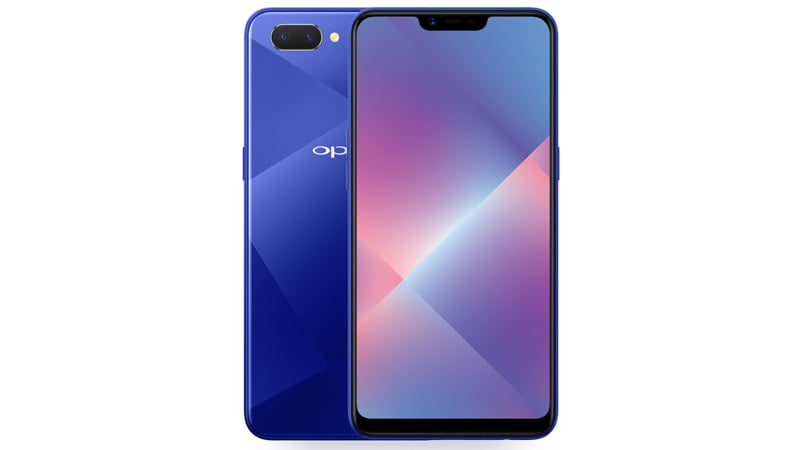
Expanding the portfolio of devices in its A-series, Oppo has announced a new smartphone — Oppo A5. Prior to this, the company had launched Oppo A1 and Oppo A3 smartphones.
The smartphone, which recently received TENAA certificate in China, has now been listed on the company’s official website in India. From the listing, it seems that the Oppo A5 will be available for purchase from 13th July.
Oppo A5 features a 6.2-inch HD+ FullView display with 2.5D curved glass, 19:9 aspect ratio. Keeping the trend in mind, the company has also offered a notch on top of the display. Under the hood, it is powered by Qualcomm‘s Snapdragon 450 octa-core processor clocked at 1.8GHz along with Adreno 506 GPU.
The phone packs 4GB RAM and 64GB of storage along with support for microSD card that enables users to further expand the device’s storage capacity up to 256GB. Coming to the optics, the smartphone features a dual camera setup at the back, consisting of a 13-megapixel primary sensor and a 2-megapixel secondary sensor.
On the front side, the device comes equipped with an 8-megapixel snapper with f/2.2 aperture for taking selfies and video calling. The front-facing camera also comes with AI beautify features that intelligently recognizes 296 facial features.
As the smartphone doesn’t come with a fingerprint sensor, we are expecting that the phone has support for Face Unlock feature. Connectivity options on the device include 4G VoLTE, Wi-Fi 802.11 b/g/n, Bluetooth 4.2, GPS + GLONASS, and USB OTG.
The smartphone runs on ColorOS 5.1 out of the box, which is based on Android 8.1 Oreo operating system. The device is fuelled by a 4,230mAh battery that claims to offer 14 hours of video playback and 11 hours of gaming.
The Oppo A5 has been priced at 1,500 Yuan, which roughly converts to $226. It will be available for purchase in China from 13th July in two color options — Blue and Pink. There’s no information available regarding the phone’s availability in other markets.
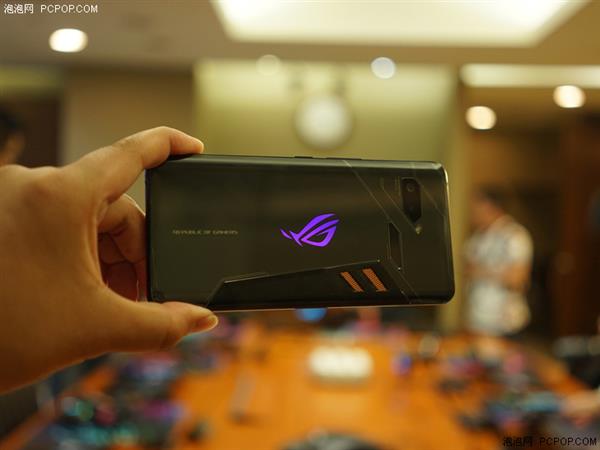
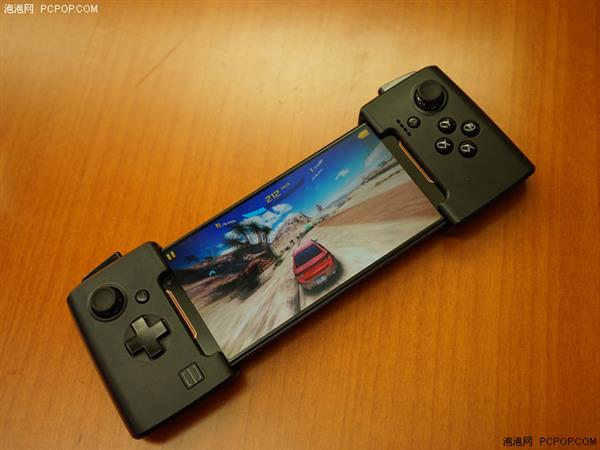
Gaming smartphones are gradually turning into a trend that will soon have the major players in the smartphone industry onboard. If our memory serves us right, the Razer phone was the first model to be unveiled with a build and specs tailored for extreme gaming. Xiaomi’backed Black Shark joined the party earlier this year and then Taiwanese phone maker ASUS joined the bandwagon with its “Republic of Gamers” (ROG) branded gaming phone which was launched earlier this year.
During the launch of the Zenfone 5Z, ASUS made some disclosures concerning its plans to launch the ROG phone in India. ASUS CEO Jerry Shen is reported to have hinted that flagship gaming machine will be launched in the third quarter in India. He also added that the phone will be priced higher than the Zenfone 5Z that is also a flagship phone. The Zenfone 5Z’s price starts at Rs 29,999 ($436) which is super cheap compared to the OnePlus 6. The CEO also added that the key to the ROG phone’s success is the 8GB RAM and 512GB storage it packs which is better than some PC.
We should add also that the ASUS ROG gaming smartphone offers several features such as the custom Optiflex which is the company’s technology that speeds up the phone. The smartphone equally packs an expansive 6-inch AMOLED display with a resolution of 2,160 x 1,080pixels. The device is powered by a 2.9GHz Qualcomm Snapdragon 845 processor. The high CPU clock speed is in order to provide a “seamless” gaming experience. The phone gets its power from a 4,000 mAh and also supports Quick Charge 4.0 with the capability to charge the device from 0-66 percent in 30 minutes. There is also a featured tagged HyperCharge that prevents the device from heating during charging. ASUS also adopted some design features to make gaming easier like placing the USB port for charging on the side of the smartphone to make it easier to plug and play while using the smartphone. The features go on and one. You can read more from our launch article from here. The device is expected to be priced around Rs 50,000 ($727) in India.
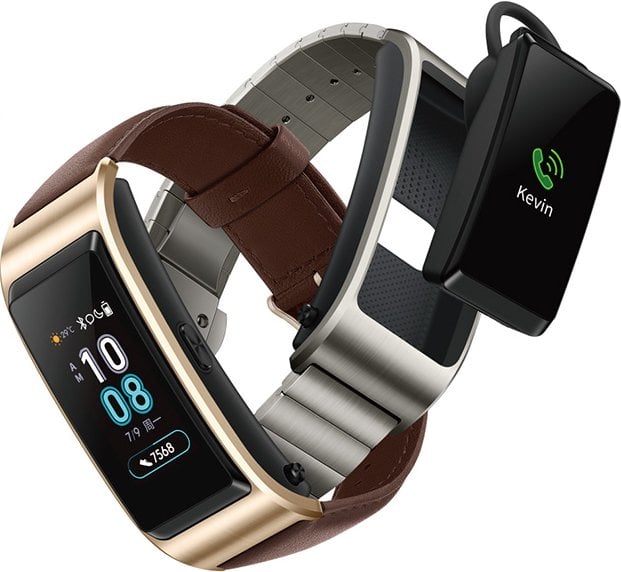
Huawei is working on a new 2-in-1 wearable device — Huawei Talkband B5, which is the successor of the Huawei Talkband B3 that was launched about two years ago. Now, the press render of the device has leaked online through Evan Blass, showing us what the device will look like.
From the leaked image, it seems that this is a 2-in-1 device that can be used as a fitness tracker as well as a single-ear Bluetooth headset. When attached to the wristband, it can be used as a fitness tracker, but when detached, it becomes a single-ear Bluetooth headset which can be used to take calls.
The design language of the upcoming wearable device from China-based Huawei is similar to its predecessor, with some minor changes. It appears that the device will be offered in two color options — Gold and Silver with the option to have a leather strap or a metal band. The earpiece part of the device will come in black color, regardless of the color variant.
While we now know that the device will look like, there is no information available about the device’s specifications. From the leaked image, it’s pretty clear that the Talkband B5 will come with an elongated touchscreen, which is probably an OLED display. It supports Bluetooth connectivity and also shows various notifications.
The Talkband B3 had 128KB RAM, 16MB of external storage and 512KB internal storage. It packs 91mAh battery that the company claimed could deliver a maximum of 6 hours of talk time. Just like the Talkband B3, the Talkband B5 is also expected to be compatible with both Android as well as the iOS operating system.
At this time, it is not known when the company is planning to officially launch the Huawei Talkband B5 but we are expecting the device to launch soon, within a month or two.
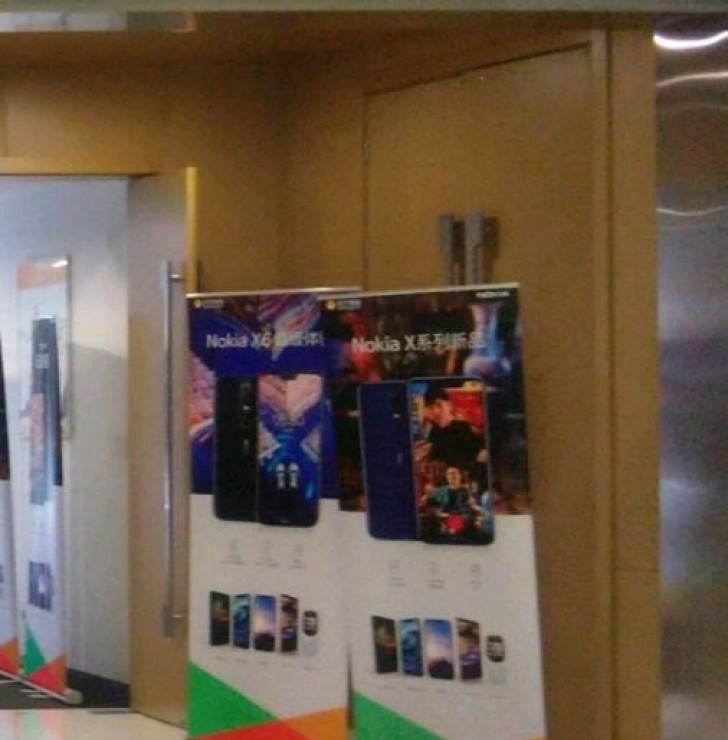
HMD Global had launched the Nokia X6 as the first Nokia smartphone with notched display design in May this year. Rumors have been claiming that the Finnish firm will be expanding the X series by launching more phones with notched display design. Recent leaks have revealed that Nokia 5.1 Plus (aka Nokia X5) is next notched phone from the firm. A leaked photo of the promo poster of the smartphone has appeared on Baidu forum. The leakster who has revealed the image claims that the Nokia X5 will be launching on July 11 along with its pricing. He has also claimed that Nokia smartphones Snapdragon 710 and Snapdragon 845 are also slated to debut in the coming months.
According to the leakster, the Nokia X5 will be announced on July 11. Its 32 GB and 64 GB storage models are expected to be respectively priced at 799 Yuan (~$120) and 999 Yuan (~$150). It seems that the Nokia X5 will be arriving in China with an attractive price tag. However, the Finnish firm is known for launching its smartphones with costlier pricing outside of China.
The TENAA listing of the smartphone has revealed that it will be coming with a 5.86-inch HD+ resolution display that will offer 19:9 aspect ratio. A 2.0 GHz octa-core processor is expected to be present under the hood of the phone. It is expected to arrive in RAM options such as 3 GB, 4 GB and 6 GB and storage options like 32 GB and 64 GB.
It will be featuring a 13-megapixel primary sensor in its dual camera setup. For selfies, it has a frontal shooter of 8-megapixel. It will be powered by 3,000mAh battery. The Android 8.1 Oreo OS will be preinstalled on the phone. The other features of the phone include microSD card slot, a rear-mounted fingerprint reader and color options like blue, blue and white.
Coming back to leaked information that has appeared on Baidu, the leakster claims that the SD710 and SD845 Nokia phones are also slated to debut in the third quarter of the year. Rumors have it that the Nokia X7 is another X-series phone from the company. There is a possibility that Nokia X7 could be the upcoming Snapdragon 710 powered smartphone from the firm.
As far as the Snapdragon 845 powered Nokia flagship is concerned, it is speculated to arrive with exciting features such as in-display fingerprint scanner and topnotch cameras. It is speculated to debut as Nokia A1 Plus.
As the race for a slice of the smartphone market intensifies, phone makers are looking at different markets that can best help them sell more phones. Xiaomi as now unveiled the latest Mi 8 flagship in Hong Kong. The product went on sale earlier today with a high level of interest as shown in the picture slash shared by Senior VP, Wang Xiang. Despite the hot weather, fans trooped in to have a peek at the leek device and perhaps, pick up theirs. The high traffic was witnessed in the two Mi home stores in Hong Kong.
The Mi 8 is made available in 6GB + 64GB and 6GB + 128GB versions. The 6GB + 64GB version is priced at HK$3,399 (~$433 based on current exchange rate) while the 6GB + 128GB version will sell for HK$3,699 (~$471). Considering the specs and build quality of the Mi 8, you’ll agree this is an amazing price. If the OnePlus 6 is a flagship killer, the Mi 8 killed the OP6 with its pricing and even design (some will argue about this.
As a reminder, the Xiaomi Mi 8 offers users a 6.21-inch Super AMOLED display with Full HD+ resolution of 2248 x 1080 pixels and an aspect ratio of 18.7:9. The device equally features a glass back panel on top a 7000-series aluminium frame. A Snapdragon 845 chipset powers the flagship while it gets its interface from the Android Oreo-based MIUI 10. The device also dazzles in the camera sensors it packs, dual rear cameras and you get to refill it’s 3400mAh battery with the Quick Charge 4+ fast charging technology. Other amazing features onboard the affordable flagship include dual-frequency GPS, dual-SIM support, 4G VoLTE, Wi-Fi 802.11ac NFC, Bluetooth 5.0, and 3.5mm audio jack. We still expect the device to be rolled out in more markets globally at any moment.
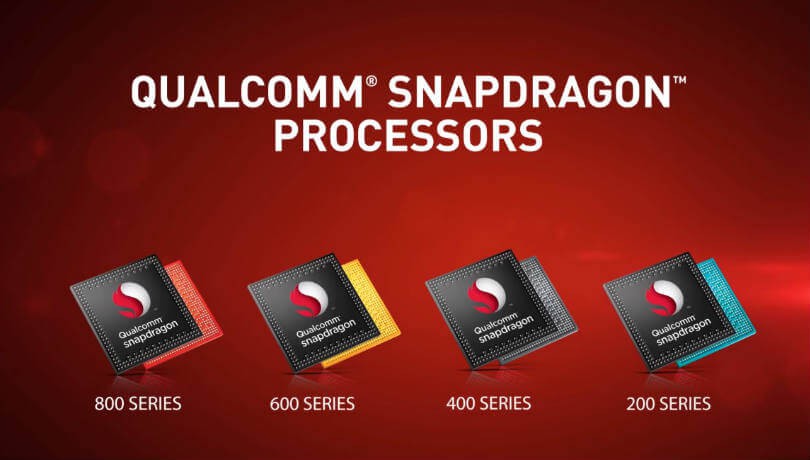
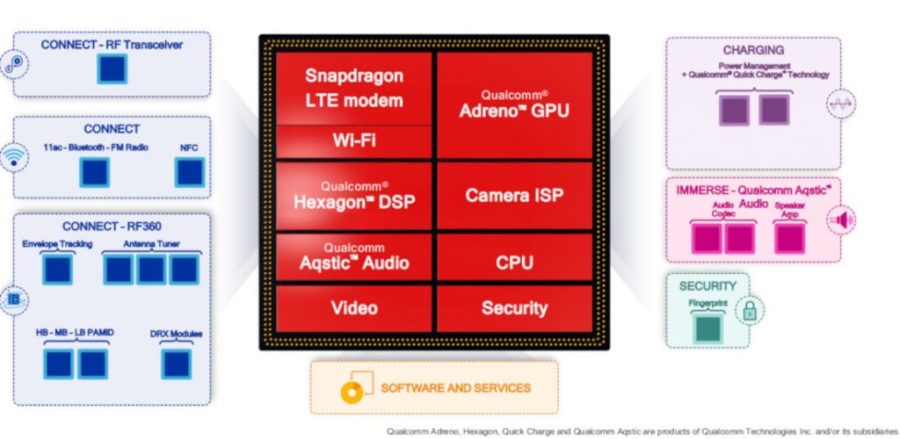
There’s no doubt that Qualcomm is the king of mobile processors and the company has managed to penetrate all the three major segments in the market: high-end, mid-range, low-end. Mediatek has been giving tough competition to the US based chip maker in the budget and mid-range markets but even in these two segments, the company has managed to gain ground in recent times, all thanks to its efficient set of processors from the 600 and 400 series. However, sometimes it could be hard keeping a track of where each processor stands in the series. So, this article aims to improve your understanding of the processor that goes inside your smartphones, specifically ones from the Qualcomm Snapdragon series.
It was necessary to write this article because Qualcomm’s Snapdragon series naming isn’t as straightforward as you might think. For example, the newly announced Snapdragon 632 isn’t really better than the Snapdragon 630 (apart from its custom CPU cores advantage) that was announced way back in May 2017. Logically, considering the naming scheme, we would immediately assume that the SD632 is the better chipset but that’s not really the case. Similarly, the Snapdragon 450 chipset that was announced back in June 2017 is very similar to Snapdragon 625, despite being from a low-end 400 series.
Specifically, we will be taking a look at six processors for mid-range smartphones from Qualcomm, namely the Snapdragon 660, Snapdragon 636, Snapdragon 632, Snapdragon 630, Snapdragon 625, and also the Snapdragon 450.
We can divide these processors into further two sections for ease of understanding: Upper mid-range and mid-range.
Upper mid-range has two main chipsets: Snapdragon 660 and Snapdragon 636. I know many would argue that there’s the Snapdragon 710 chipset too, but with 10nm manufacturing node and custom Kryo 360 cores that are based on Cortex A75, we can no longer call it a mid-range chipset. At best, we could say it’s a premium mid-ranger but with such high-end specs, it’s more close to the 800 series flagships than the 600 series chipsets.
Coming back to the 600 series chipsets, in the mid-range segment, we can include four SoCs, namely, Snapdragon 630, Snapdragon 632, Snapdragon 625, and Snapdragon 450. Again, many could argue that the 450 is from the low-end series and doesn’t really deserve to be called as a mid-range processor. But for reasons mentioned below, I feel that the 450 is better placed in the mid-range segment rather than the budget series.
Now that we have placed these processors in their respective subsections, let’s take a look at each section in detail. First, let’s take a look at the upper mid-range processors.
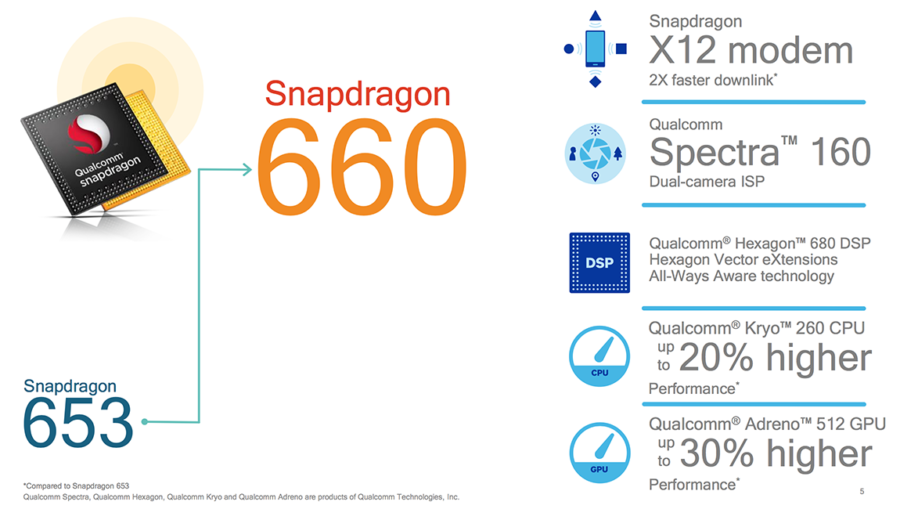
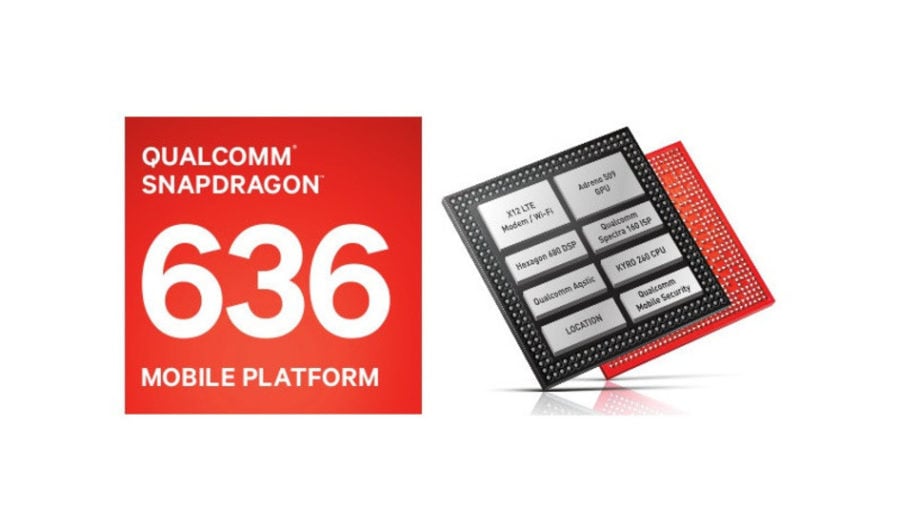
Snapdragon 660 and Snapdragon 636 are two of the most powerful processors in the 600 series from Qualcomm. These 2017 processors are unique in the sense that they have custom cores, a first in the 600 series. Specifically, the Snapdragon 660 that was announced back in May 2017 was the first 600 series chip to use custom Kryo cores. Snapdragon 636 joined the lineup later in October. Given that they were going to power the best mid-rangers in the market, it made sense why Qualcomm would use custom cores in these two chipsets. However, this year, in June, Qualcomm made another entry in the lineup with the Snapdragon 632 and surprisingly, even this new chipset boasted eight custom kryo cores. Why surprising? Because, despite its 632 name, this particular chip is going to power the cheaper mid-rangers of 2018 and is better put as an upgrade to the Snapdragon 625 instead of the SD630. We’ll talk about these processors in detail in the next section but now, let’s come back to the two power packed processors of 600 series, the SD660 and SD636.
Snapdragon 660 & 636:
Snapdragon 660 and 636 are really very close brothers. From their names, many would assume that the SD632 or SD630 are closer to SD636 than SD660. But it’s the opposite case here. In fact, this is another example why Qualcomm needs to better their naming strategy. Personally, I would have called SD636 more like SD646 or something closer to SD660.
There are only four minor differences between the Snapdragon 660 vs Snapdragon 636.
Clock speed of Kryo 260G performance clusters (2.2GHz vs 1.8GHz)
GPU: Adreno 512 vs Adreno 509
LPDDR4 @ 1866MHz vs LPDDR4 @ 1333MHz
Display Support: QHD vs FHD+ (18:9) | External Support: 4K vs 1080p
Apart from these, the two processors share the same specs. So, both feature the same semi-custom Kryo 260 cores in a 4+4 cluster. There are 4 x Kryo Gold cores and 4 x Kryo Silver cores based on Cortex A73 and Cortex A53 respectively. Only the performance cores are clocked at different frequencies (2.2GHz vs 1.8GHz). It might also be worth mentioning that these two are manufactured on the 14nm LPP process, but then, all of the SoC’s considered in this article are based on 14nm manufacturing node.
There’s difference in the GPU as well. The Snapdragon 660 features the more powerful Adreno 512 vs 509 on the SD636. I couldn’t find a lot of details about the Adreno 509, but we know that it’s based on 14nm process like the 512 (and unlike the Adreno 510 which was based on 28nm). Despite being placed below the 510 in naming, in terms of performance, the Adreno 509 could be better. It’s also going to be more efficient. But Adreno 512 is definitely the better GPU of the two, with a appox. clock speed of 800MHz, with around 240 GFlops.
Another difference is the support for dual channel LPDDR4@1866MHz vs LPDDR4@1333MHz on SD660 vs SD636. However, both support RAM up to 8GB and eMMC as well as UFS storage.
Coming to the similarities, the core specs are the same for both the chips. So apart from the same Kryo 260 cores inside, you get the same X12 LTE modem with Cat. 13/ 12 support (150Mbps uplink | 600Mbps downlink ) and 3 x 20MHz CA. There’s the Hexagon 680 DSP, Qualcomm’s Spectra 160 ISP with ClearSight technology, 24MP single camera support and 16MP dual camera support. The chip supports video capture and playback at up to 4K UHD @ 30fps resolution. Both the chips support Quick Charge 4.0 and machine learning frameworks like Tensorflow, caffe via Snapdragon Neural Processing Engine.
In short, you can call the Snapdragon 636 as the efficient (lite) version of the Snapdragon 660!
Snapdragon 630:
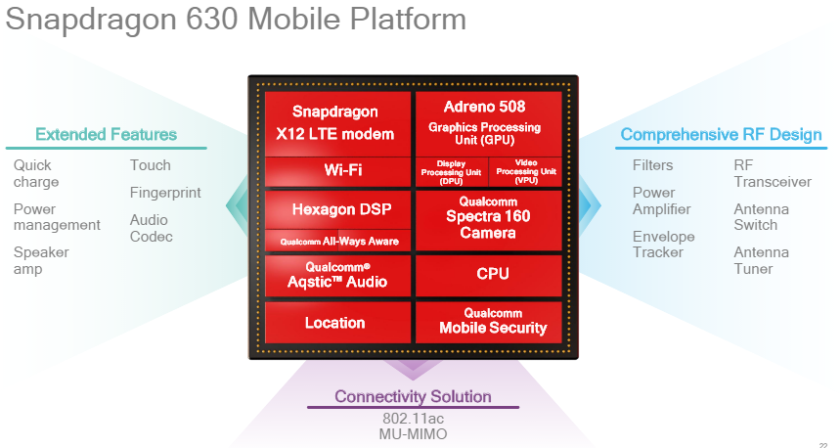
Notice how I skipped SD632? It’s better suited with SD625 and SD450! Snapdragon 630 has most of the bells and whistles of Snapdragon 636 but it’s much slower because of its octa-core Cortex A53 cores. You really miss out on the A73 based performance cores here but it’s good for efficiency. So, if Snapdragon 636 was the lite version of SD660, then SD630 is kind of the lite and efficient version of the SD636.
SD630 features eight Cortex A53 cores with 4 x A53 @ 2.2GHz and 4 x A53 @ 1.8GHz. So, performance is just average but Adreno 508 is pretty decent and offers up to 30% graphics and enhanced gaming performance as compared to Adreno 506 inside the SD626. Apart from the significant decrease in CPU performance, rest of the specs are quite similar to the above two SoCs.
So the Snapdragon 630 supports Qualcomm’s Neural processing engine, X12 LTE with Cat. 13/ 12 downlink / uplink, 24MP single camera with Spectra 160 ISP (ClearSight tech), LPDDR4 @ 1333MHz with up to 8GB RAM support and eMMC / UFS storage support, 4K UHD capture and playback, and up to FHD+ display.
Note that dual camera support on the SD630 goes down to dual 13MP setup instead of dual 16MP on SD660 and SD636.
What makes SD630 closer to SD636 than SD632 or 625 is that it comes with support for Qualcomm’s Neural Processing Engine (for AI). Plus, you have Quick Charge 4.0 support too!
It is worth mentioning that SD660, SD636, and SD630 are the only three SoCs in the 600/400 series to support AI via NPE and Quick Charge 4.0. In terms of connectivity, these three support BL 5.0, and USB 3.1.
SD660
SD636
SD630
RELEASE:
May 2017
Oct. 2017
May 2017
Process
14nm
14nm
14nm
CPU
4 x KryoG 260 @2.2GHz +4 x KryoS 260 @1.8GHz
4 x KryoG 260 @1.8GHz +4 x KryoS 260 @1.8GHz
4 x A53 @ 2.2GHz + 4 x A53 @ 1.8GHz
GPU
Adreno 512
Adreno 509
Adreno 508
MODEM
X12 LTE (Cat. 13 = 150Mbps Uplink / Cat. 12 = 600Mbps Downlink) + 3 x 20MHz CA
X12 LTE (Cat. 13 = 150Mbps Uplink / Cat. 12 = 600Mbps Downlink) + 3 x 20MHz CA
X12 LTE (Cat. 13 = 150Mbps Uplink / Cat. 12 = 600Mbps Downlink) + 3 x 20MHz CA
DSP
Hexagon 680
Hexagon 680
Hexagon 642
CAMERA
24MP Single | 16MP Dual | Spectra 160
24MP Single | 16MP Dual | Spectra 160
24MP Single | 13MP Dual | Spectra 160
VIDEO
4K UHD @ 30fps encode and decode
4K UHD @ 30fps encode and decode
4K UHD @ 30fps encode and decode
DISPLAY
QHD
FHD+
FHD+
CONNECTIVITY
BL 5.0, USB 3.1, QC 4.0
BL 5.0, USB 3.1, QC 4.0
BL 5.0, USB 3.1, QC 4.0
Snapdragon 632, Snapdragon 625, & Snapdragon 450:
Snapdragon 632 is really the star of the lower mid-range series. Qualcomm’s strategy was pretty simple: It took Snapdragon 625 and boosted its CPU performance with custom Kryo cores. That’s it! Everything else is the same!
SD632
So the SD632 has 4 x Kryo 250 Gold performance (A73) cores at 1.8GHz and 4 x Kryo 250 Silver efficient (A53) at 1.8GHz instead of the 8 x Cortex A53 @ 2.0GHz cores on the SD625. Rest of the specs are exactly the same, including the Adreno 506 GPU. I have not really considered SD626 in this article because this particular chip hasn’t managed to get a lot of support from market players. Most companies are still opting for SD625 over 626 and the difference isn’t really significant.
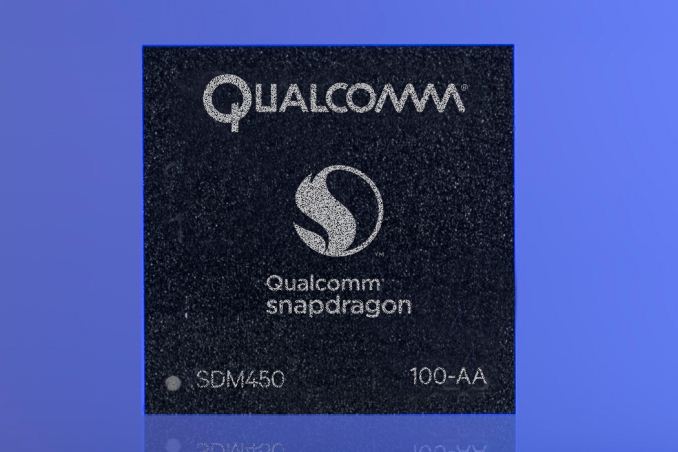
We can actually bring Snapdragon 450 too in this comparison! The SD450 is basically a lower clocked version of the Snapdragon 625, with 8 x Cortex A53 cores at 1.8GHz instead of 2.0GHz. Another difference would be in video encoding and decoding resolutions. So, SD632, SD625 can encode and decode videos at 4K UHD @ 30 fps while the SD450 can only do it in FHD+ @ 60fps.
Now coming to their similarities in specs, SD632 vs SD625 vs SD450 have the following common features.
Adreno 506 GPU (clock speeds may differ)
Hexagon 546 DSP
24MP single cam | 13MP dual cam support
FHD+ Display support
X9 LTE Cat 13/ 7 (150Mbps uplink | 300Mbps downlink), 2 x 20MHz CA
Quick Charge 3.0
USB 3.0
In terms of Bluetooth connectivity, Snapdragon 632 did get an upgrade to the new 5.0 version. The SD625 and 450 chips support BL 4.1+ LE.
So, in this section, SD632 is the best chip, and SD625 could be called as the lite version of SD632 and SD450 as the lite version of SD625.
X9 LTE (Cat. 13 = 150Mbps Uplink / Cat. 7 = 300Mbps Downlink) + 2 x 20MHz CA
X9 LTE (Cat. 13 = 150Mbps Uplink / Cat. 7 = 300Mbps Downlink) + 2 x 20MHz CA
X9 LTE (Cat. 13 = 150Mbps Uplink / Cat. 7 = 300Mbps Downlink) + 2 x 20MHz CA
DSP
Hexagon 546
Hexagon 546
Hexagon 546
CAMERA
24MP Single | 13MP Dual
24MP Single | 13MP Dual
24MP Single | 13MP Dual
VIDEO
4K UHD @ 30fps encode and decode
4K UHD @ 30fps encode and decode
FHD+ @ 60fps encode and decode
DISPLAY
FHD+
FHD
FHD
CONNECTIVITY
BL 5.0, USB 3.0, QC 3.0
BL 4.1+, USB 3.0, QC 3.0
BL 4.1+, USB 3.0, QC 3.0
This article was not meant to be exhaustive. I may not have considered each and every minute differences between these chipsets but organising Qualcomm’s Snapdragon processors based on their specifications instead of their names was essential. As you might have realised now, SD632 and SD450 are way more similar than what you might have thought before and Snapdragon 630 is quite closer to SD636 than SD625.
I personally believe its very important to understand the processors that power your smartphones and this article was meant to be a rough guideline of where each Snapdragon mid-range SoC stands in the entire lineup.
Please let me know your thoughts on this article as well as the Snapdragon chip lineup.
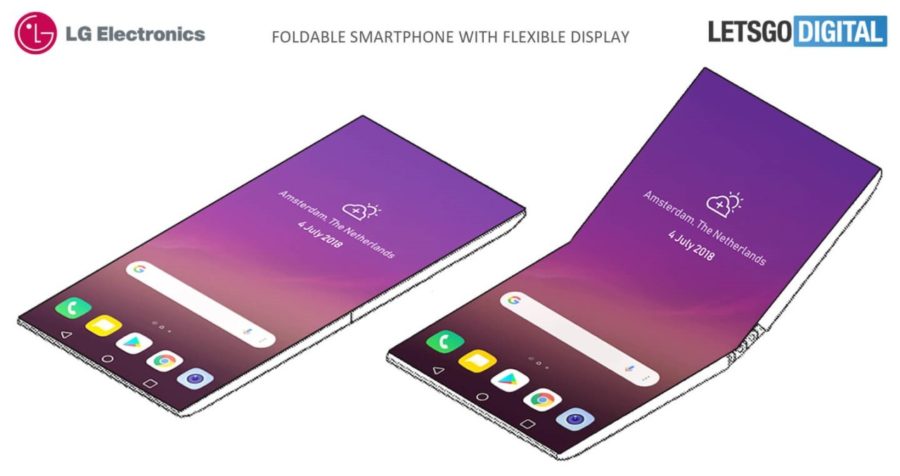
Flexible smartphones have been in works but we are yet to see a commercially available foldable smartphone in the market. Currently, a couple of smartphone manufacturers, including Samsung, Huawei and Motorola are working on such smartphones.
Now, it seems that LG is also planning to enter the game of manufacturing foldable smartphone. The company has filed for a patent for a smartphone that shows the device’s body with flexible display. The patent was originally filed with the US Patent and Trademark Office in late-2017 and is described as a “mobile terminal”, which is a technical description for smartphones.
The device shown in the patent looks like a large version of a regular smartphone that would fold vertically. It will have a hinge mechanism that moves apart as the device folds, aiming to prevent damage to the display. It is said that the phone would be held shut by magnets and that the display would turn on automatically when the hinge is open.
According to the patent, the foldable smartphone will come with two mics, dual loudspeakers, and dual antennas. One camera will be placed on the outside of the closed display so that the users can take photos of the display while it is closed.
Currently, the company has not described how the user is intended to interact with such a device. It seems that the manufacturers are seeing the foldable smartphones as the next big thing and want to get on this trend as soon as they can.
If the reports are to be believed, then Samsung is planning to launch its foldable smartphone in January 2019 during the Consumer Electronics Show, ahead of the Galaxy S10 launch at Mobile World Congress. On the other hand, China-based Huawei is also gearing up to launch its foldable smartphone next year.
We use cookies on our website to give you the most relevant experience by remembering your preferences and repeat visits. By clicking “Accept”, you consent to the use of ALL the cookies.
This website uses cookies to improve your experience while you navigate through the website. Out of these, the cookies that are categorized as necessary are stored on your browser as they are essential for the working of basic functionalities of the website. We also use third-party cookies that help us analyze and understand how you use this website. These cookies will be stored in your browser only with your consent. You also have the option to opt-out of these cookies. But opting out of some of these cookies may affect your browsing experience.
Necessary cookies are absolutely essential for the website to function properly. This category only includes cookies that ensures basic functionalities and security features of the website. These cookies do not store any personal information.
Any cookies that may not be particularly necessary for the website to function and is used specifically to collect user personal data via analytics, ads, other embedded contents are termed as non-necessary cookies. It is mandatory to procure user consent prior to running these cookies on your website.