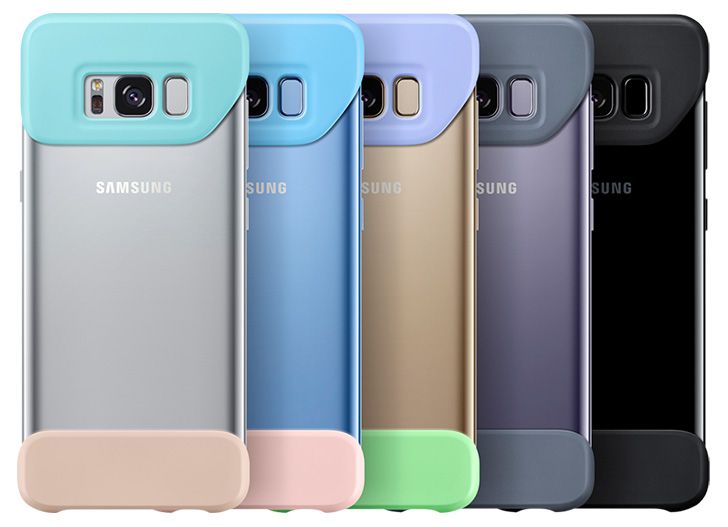
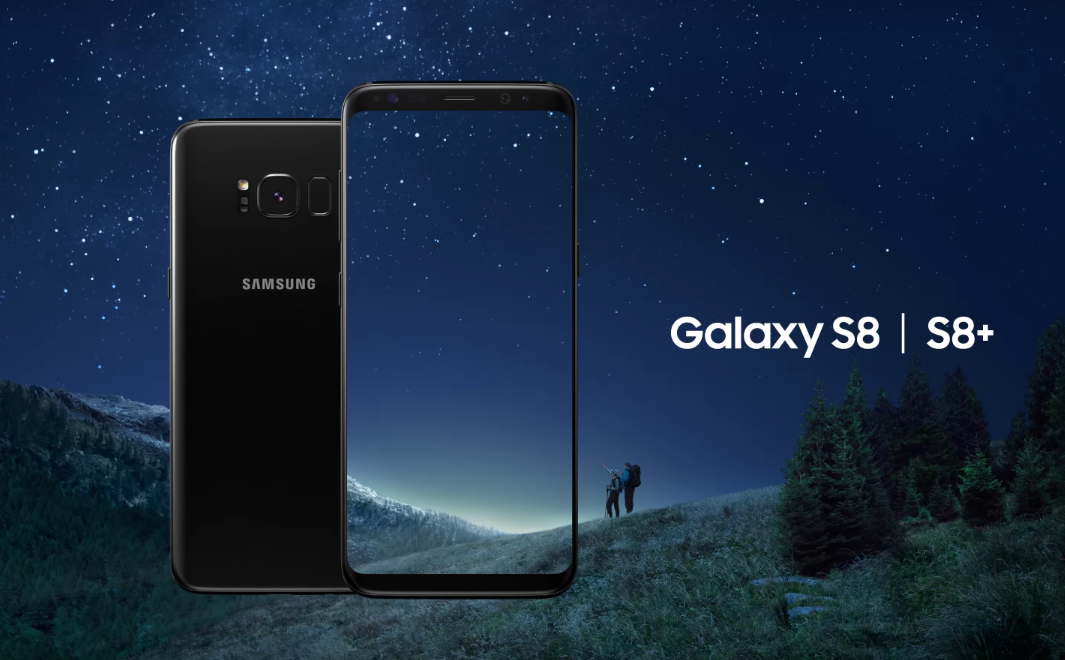
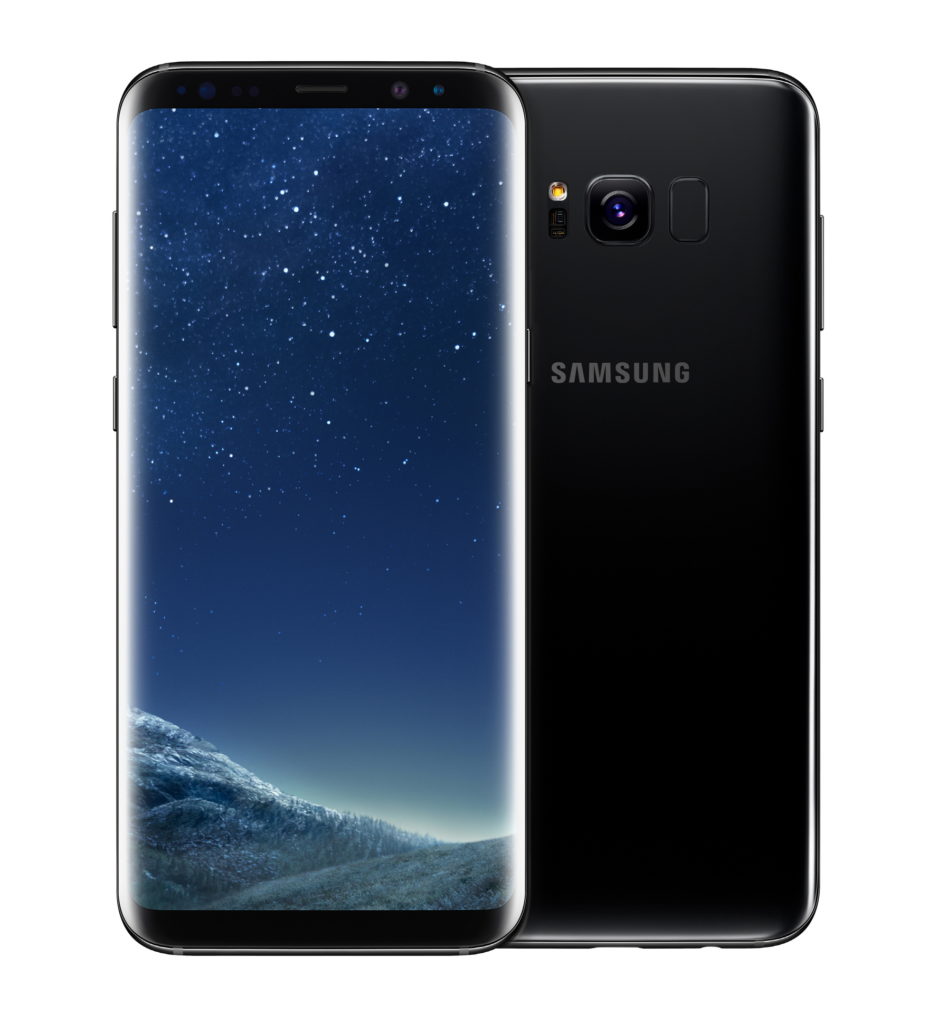
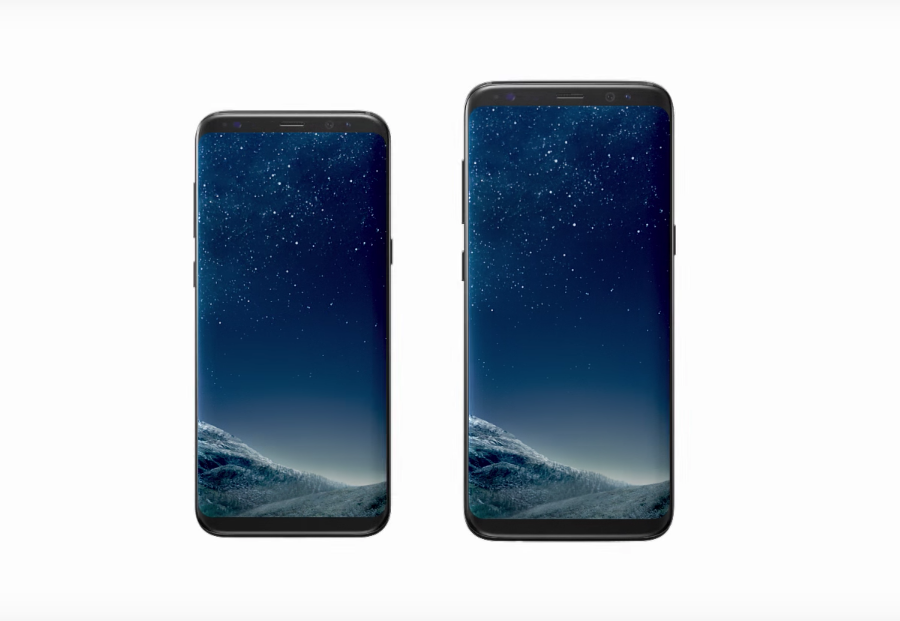
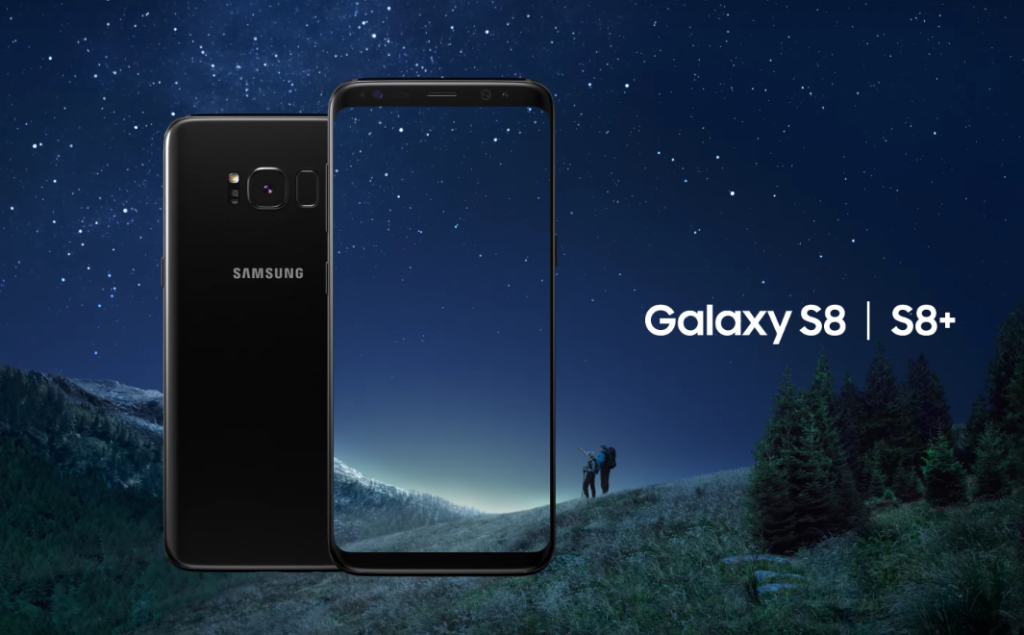
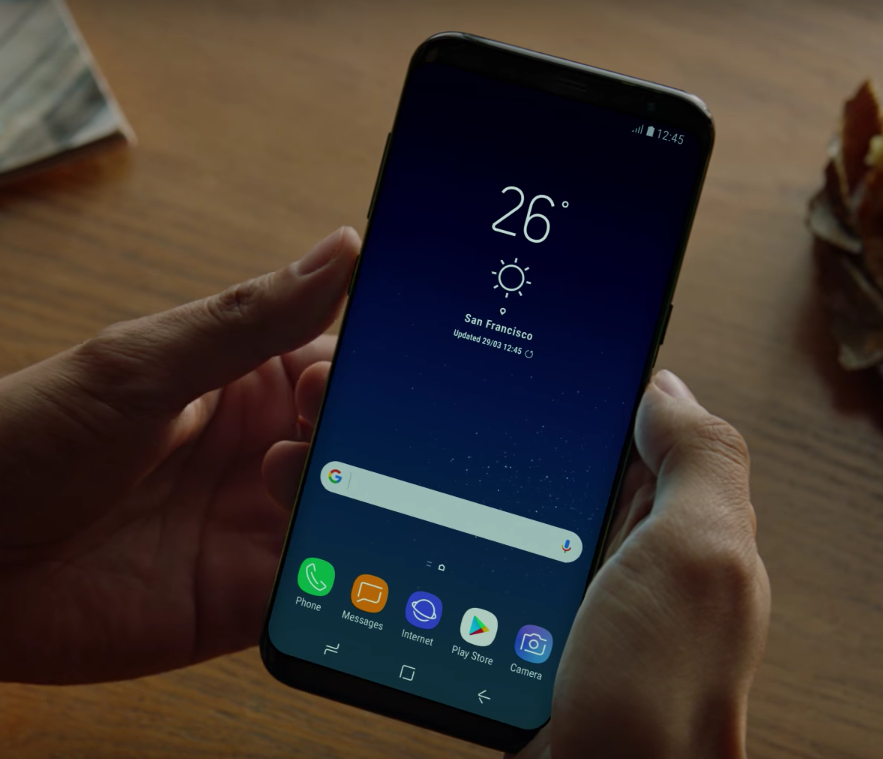
Samsung has announced a couple of cases and covers for Galaxy S8 and Galaxy S8+ flagship phones. Both phones are aesthetically beautiful as they feature a widescreen with super-slim bezels and their rear sides are flanked with glass panel. The various cases that have been announced for Galaxy S8 duo such as Clear View Standing Cover, Alcantra Cover, and Keyboard Cover do not hamper their beauty, but the only word that can be best used to describe the Galaxy S8 2Piece Cover is – Ugly.
The 2Piece Cover is rumored to be priced around $20. It features two clip-on parts, one for the top and the other one for the bottom. It comes in multiple colors. As it can be seen in the image of the 2Piiece Cover, a major portion of the glass back of Galaxy S8/S8+ remains exposed. Also, there is a risk of getting those pieces detached instantly when the handset is dropped. It is interesting to note that the 2Piece Cover was internally called as “bikini case.”
This is how Samsung advertises the 2Piece Cover for Galaxy S8 and S8+ on its official site, “Liven up your phone with colorful shapes. The complementary hues of each cover add a unique geometric vibe that enhances Galaxy S8 and S8+’s design while the suction pads make the pieces attach and detach with ease.” On the contrary, the image showing the Galaxy S8 and S8+ wearing the 2Piece Cover show how ugly they appear. It can be easily assumed that the $20 2Piece Cover will do no good in protecting a $749 priced Galaxy S8 flagship phone when it drops.
The 2Piece Cover is already receiving poor reception from the audience. Cases and covers are meant to protect and amplify the beauty of the phone. However, the 2Piece Cover for Galaxy S8 and Galaxy S8+ seems to fail in both aspects. Hence, we wonder whether it will attract many buyers. What about the rest of the Galaxy S8 accessories? Well, they all seem to appear fine.
What do you think about the Galaxy S8 2Piece Cover? Will you buy it for you Galaxy S8? Do let us know your thoughts by posting your comments below.
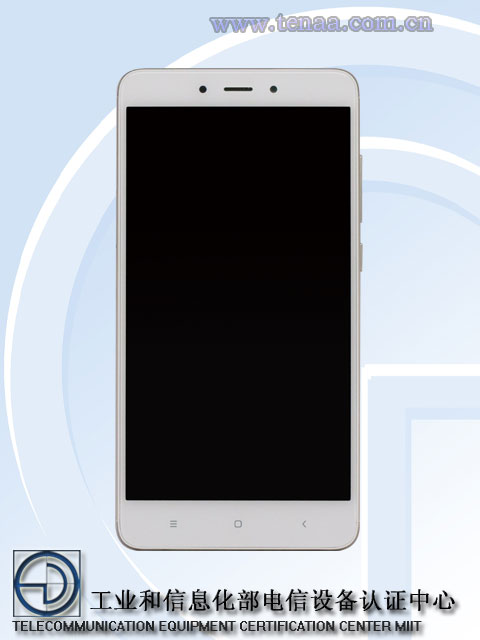
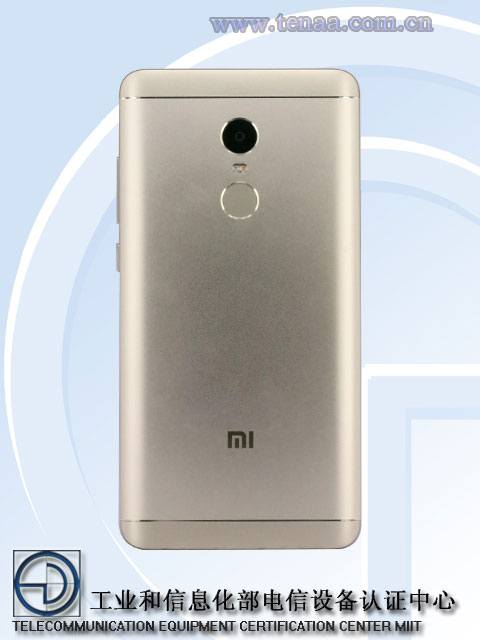
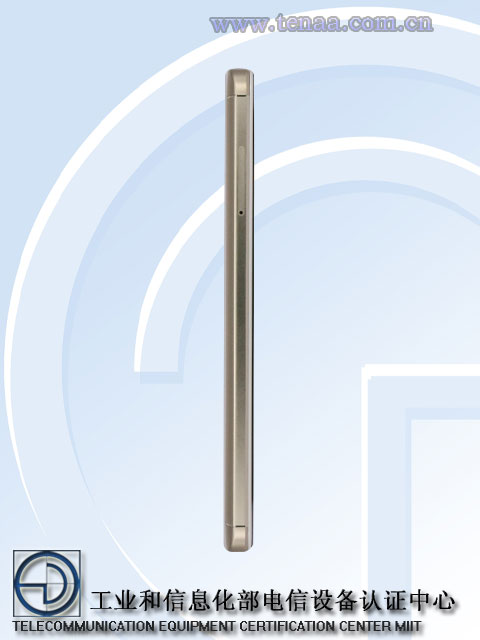
A new Xiaomi Redmi Note 4X version that looks like a higher version has appeared on China’s Telecom regulatory agency’s (TENAA) website after it was certified by the agency. This is coming barely two months after the device was quietly released by Xiaomi in China.
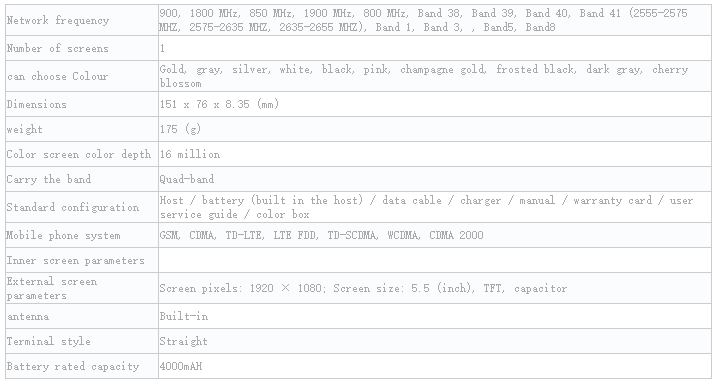
The new version of the Redmi Note 4X, which comes with the model number MBT6A5, is obviously a higher version of the smartphone considering it is listed as having 4GB of RAM and 64GB of storage. Another proof that it is a higher version is the deca-core 2.0GHz processor it is listed with. The earlier Redmi Note 4X model comes sporting an octa-core Snapdragon 625 chipset clocked at 2.0GHz.
Other specs listed with the new TENAA certified Redmi Note 4X include, a 5.5-inch TFT display with Full HD resolution, a large 4,000mAh battery, 13MP rear camera sensor and 5MP front camera. The device also comes with a rear-mounted fingerprint sensor.
As stated, the device is listed wit a deca-core chip and MedaiTek is the one known for using deca-core processors but there isn’t a MediaTek SoC clocked at 2.0GHz. The Helio X20 has a clock frequency of 2.1GHz so, it is likely there is an error or the chip is indeed an Helio X20 with a slightly reduced frequency.
Another striking thing of note on the specs list is the number of colour options the device will come in. A total of ten colour variants are listed and they include Gold, Gray, Silver, White, Black, Pink, Champagne Gold, Matte Black, Dark Gray, Cherry Blossom. Since the cost of using a MediaTek chip is lower than a Qualcomm variant, we really don’t expect a steep price increase on this version when it is launched.
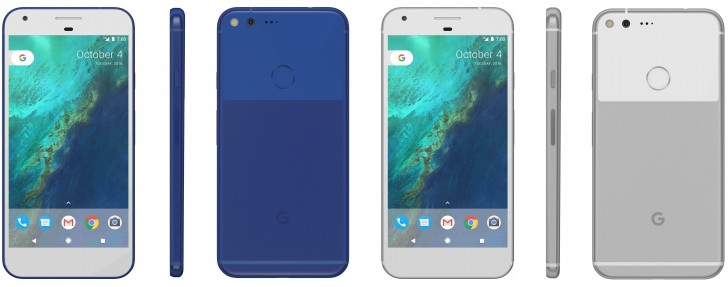
Google had launched the Pixel and Pixel XL smartphones in October 2016. Even though these phones were launched six months ago, they are not easily available for purchase. The search engine giant has not yet revealed the number of Pixel units that it has sold so far. However, a report that has surfaced today provides an answer on it.
The Pixel and Pixel XL phones are advertised as “made by Google” devices, but tech enthusiasts know it well that HTC has manufactured them. A report that has emerged from Commercial Times, a Chinese media, states that HTC has shipped 2.1 million units of both smartphones since fall 2016. The number do appear impressive, but it does not seem to be a major threat for the smartphone market leaders like Apple and Samsung.
The Pixel and Pixel XL phones are not available in numerous markets. Since they are available in fewer markets, Google could only reach 2 million sales mark for these phones. Since the Taiwanese tech company has already won a two-year contract, it will be collaborating with Google once again to build the next generation Pixel phones this year.
The Pixel 2 and Pixel XL 2 are speculated to be codenamed as Muskie and Walleye. Both phones are rumored to be driven by Snapdragon 835 SoC and are likely to feature an enhanced rear-facing camera for advanced low light photography.
The report further states that there is stiff competition on the company that will manufacture Pixel 3 phones that will release in 2018. LG, TCL and Coolpad the three companies battling it out to win a contract with Google to build the 2018 Pixel phones. It seems that LG may successfully clinch the deal and market pundits have predicted that Google will sell around 5 million Pixel 3 phones in 2018.
We advise our readers to take this report with a grain of NaCl since Google has not released an official sales report for its Pixel and Pixel XL phones. The current shortage of Pixel phones is such that customers have to wait around 4-5 weeks to receive their order. Hence, the search giant company needs to improve the shipments of its Pixel phones that would help them reach a better sales number.
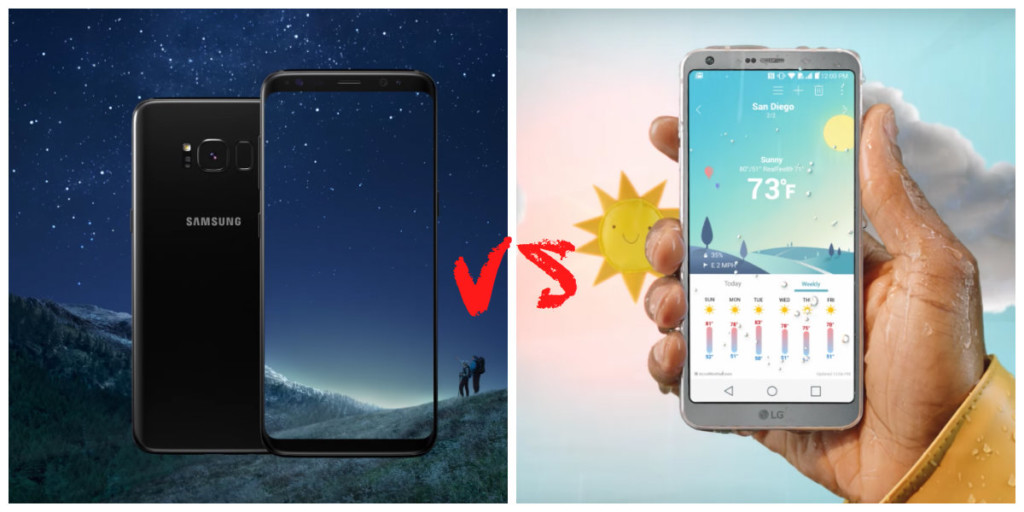
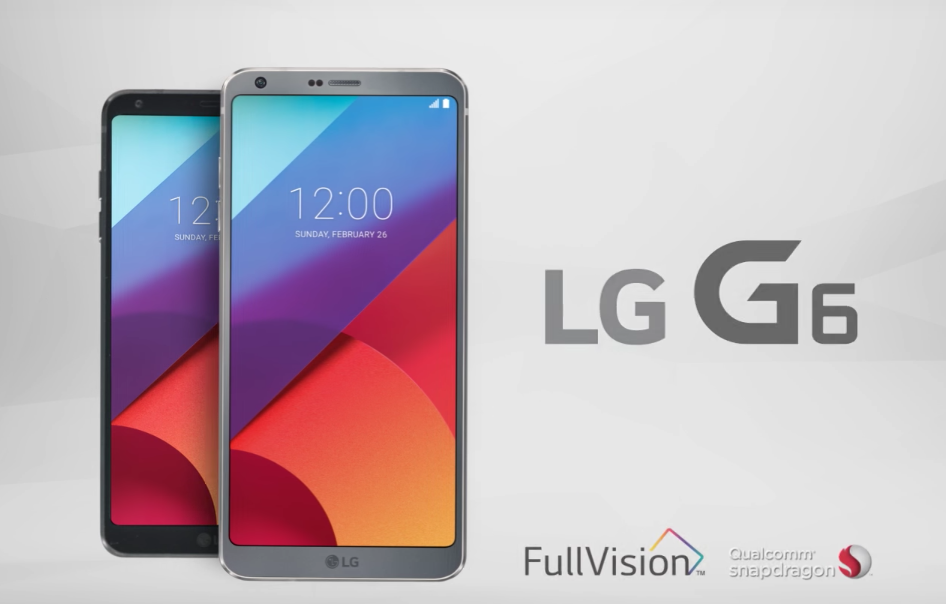
After hundreds of leaks and rumors, the Samsung Galaxy S8 is finally official. This is one of the most important phones in the history of the South Korean company, given that it’s the first major flagship after the huge debacle with the Samsung Galaxy Note 7. So far, the company seems to have done a very good job with the S8, at least on paper, and that’s why let’s check out Samsung Galaxy S8 versus its most direct rival, the LG G6. Both phones are different in multiple aspects but the Galaxy S8 vs LG G6 comparison will highlight where they are similar as well.
Samsung Galaxy S8 vs LG G6: Design
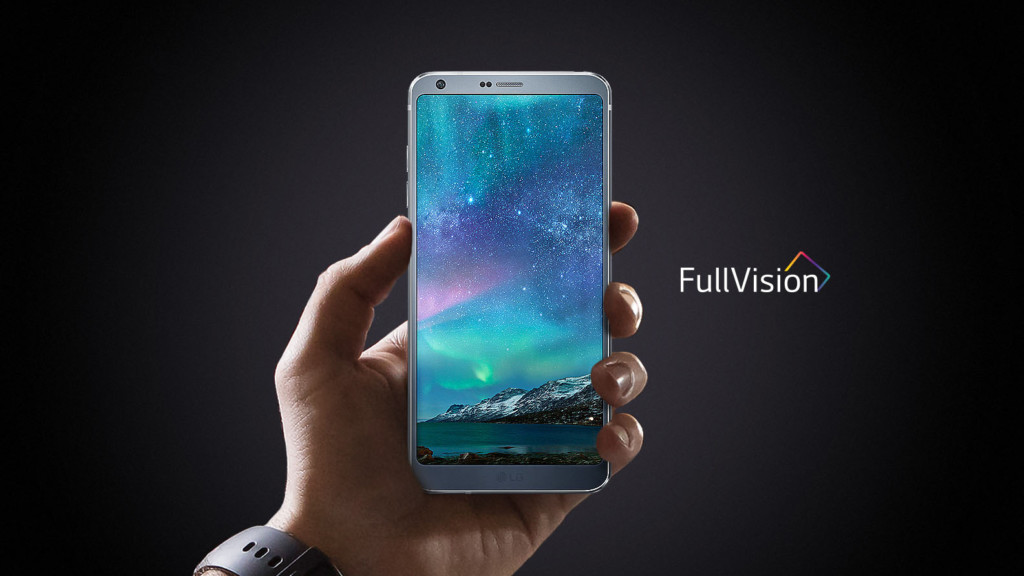
Design-wise, the Samsung Galaxy S8 looks like the winner. The LG G6 and the Galaxy S8 have very similar basic design and it’s clear that both the companies are trying to limit the front bezels as much as possible. But the S8 comes with dual curved display, which limits its bezels as well as makes the phone look better than the G6.
Coming to the back, the Galaxy S8 comes with a glass body, much like the LG G6. So, both should attract a bit of fingerprint. But in my personal opinion, the back of the Galaxy S8 looks a bit messy, especially because of its weird fingerprint placement. The LG G6 looks much better in this regard with a bit of symmetry thanks to the dual cameras at the back.
[envira-gallery id="124715"]
In case you noticed, both phones have onscreen buttons to minimize the bezels on board.
The dimensions are almost the same, including the thickness. However, the S8 is lighter in terms of weight.
Samsung Galaxy S8 vs LG G6: Display
The display is one of the highlights of both the models. The bezels are limited, which means you get more real estate in a relatively small body.
Galaxy S8
LG G6
The screen on the S8 is an inch larger, featuring a 5.8-inch display (2960 x 1440p) as opposed to the 5.7-inch one on the LG G6 (2880 x 1440p). Both have slightly different screen resolutions and their aspect ratios are also different. The aspect ratio on the S8 is a bit weird:- 18.5:9. The LG G6 has an 18:9 screen.
Samsung Galaxy S8 vs LG G6: Specs
This is really where the S8 blows LG G6 away. First of all, the phone boasts of the brand new 10nm Snapdragon 835 @ 2.3GHz / Exynos 9 @ 2.3GHz CPU options, both of which are the two best Android processors in the market right now. On the other hand, the LG G6 features the capable yet old Snapdragon 821.
SAMSUNG GALAXY S8
LG G6
DIMENSIONS & WEIGHT
148.9 x 68.1 x 8.0 mm, 155 grams
148.9 x 71.9 x 7.9 mm, 163 grams
DISPLAY
5.8-inch 2960 x 1440p (570 ppi)
OLED
5.7-inch 2880 x 1440p (564 ppi)
GG3
CPU
Qualcomm Snapdragon 835 @ 2.3 / Exynos 9 @ 2.3
Qualcomm Snapdragon 821 @ 2.35GHz
MEMORY
4GB + 64GB
MicroSD: Yes
4GB + 32GB / 64GB
MicroSD: Yes
CAMERA
12MP f/1.7 OIS
8MP f/1.7 Front Camera
Dual 13MP f/1.8, PDAF, 1/3" sensor
5MP Front f/2.2
BATTERY
3000mAh
Fast Charging
Wireless Charging
3300mAh
OS
Android 7 Nougat
Android 7 Nougat, LG 6.0 UI
SPECIAL FEATURES
IP68 Certification
IP68 Certification
COLORS
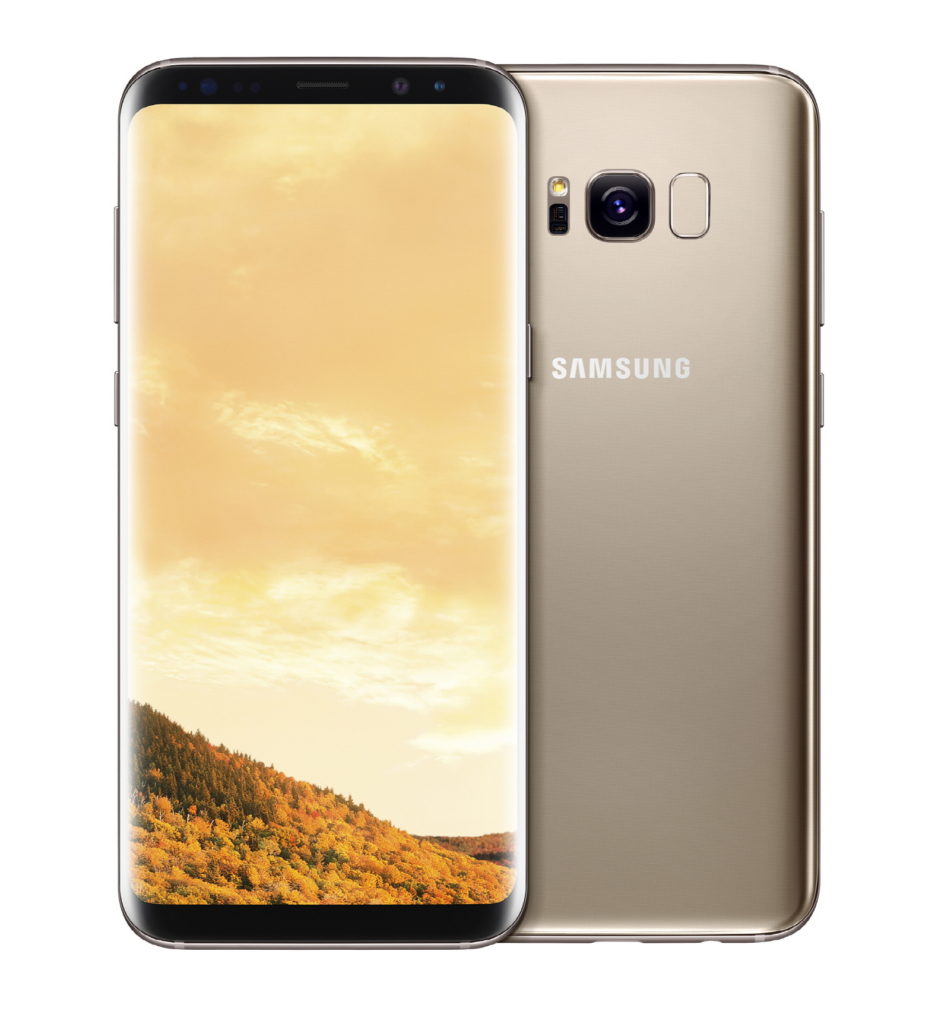
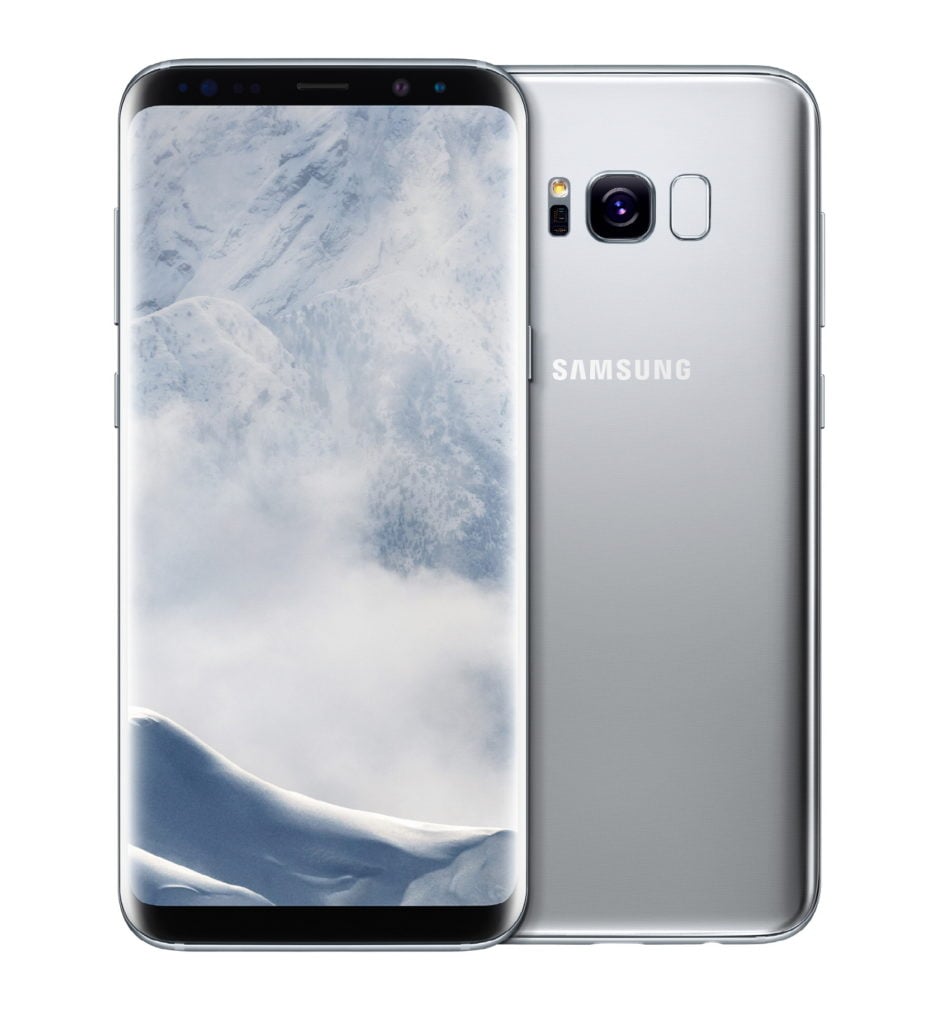
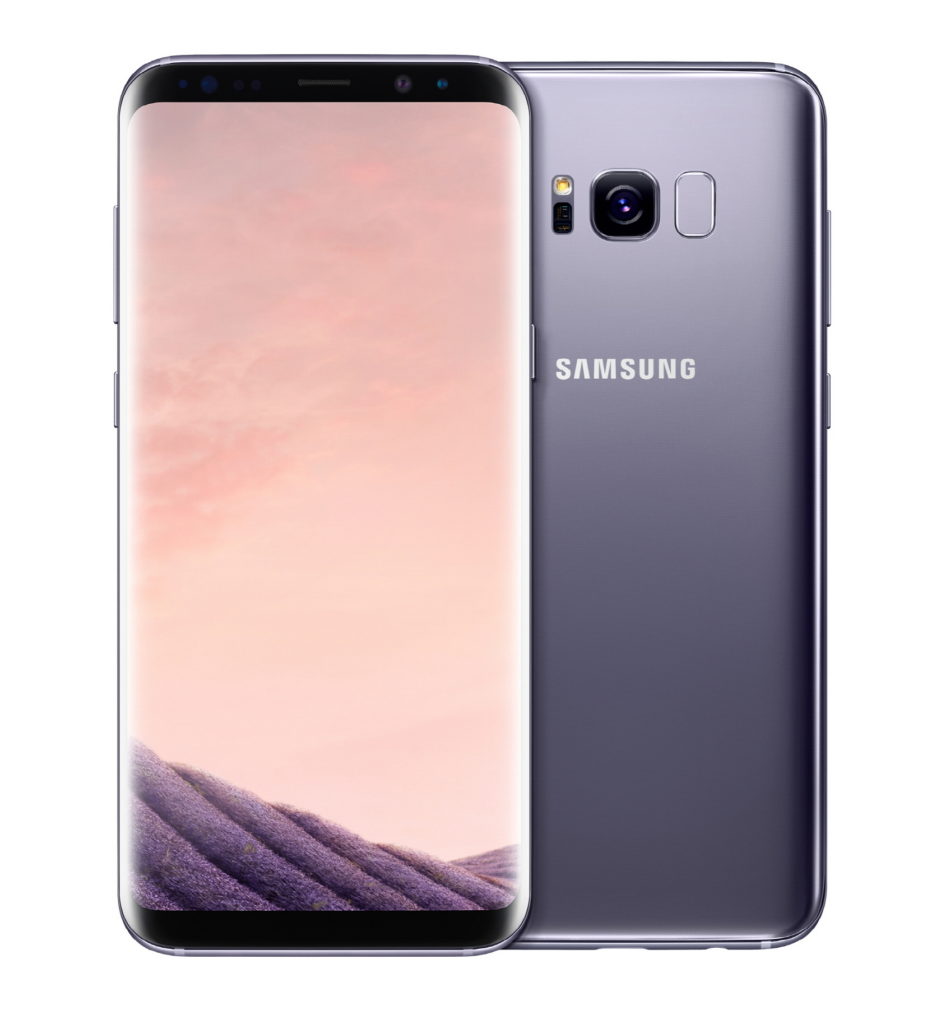
Midnight Black, Orchid Gray, Arctic Silver, Coral Blue and Maple Gold.
Black, White, Titanium
PRICE
$750 (Expected)
$720
Both phones have 4GB + 64GB memory options with MicroSD expansion. However, it’s very likely that the S8 comes with a 6GB RAM version in China, which is still unannounced officially.
The battery on board the Galaxy S8 is smaller at 3000mAh. It’s one of the areas where the S8 lacks the punch on paper. To compensate, there’s fast charging as well as wireless charging. The LG G6 has a slightly larger 3300mAh battery with fast charging. Only after a real world test can we decide which one has the better battery life.
Other features on the S8 include IP68 certification, the brand new Bixby assistant, face recognition and Cat. 16 Gigabit LTE support (only in certain models). On the other hand, the LG G6 has IP68 certification as well as Google Assistant.
Samsung Galaxy S8 vs LG G6: Camera
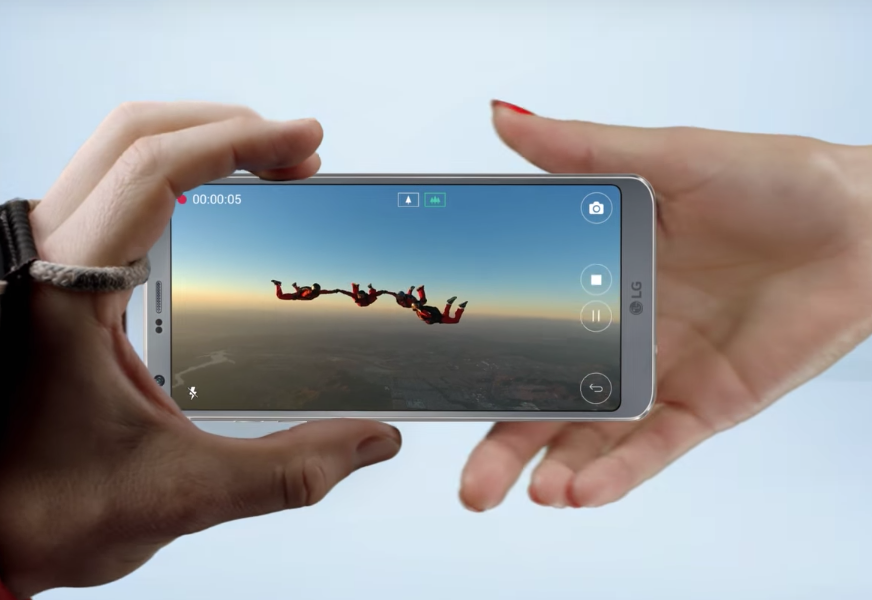
For some reason, the Galaxy S8 retains the same capable camera as in the S7 Edge. Now, the S7 Edge had one of the best cameras of its time — a 12MP f/1.7 OIS setup. But the Google Pixel managed to top that after its launch. Samsung has promised faster and better performance with the same setup through software optimizations, but we can’t say how much better it is, as compared to the already powerful S7 Edge’s camera setup. In comparison, the LG G6 takes a leap in the camera department as compared to G5, its predecessor, with a dual 13MP f/1.8 setup. The photos from the setup come out pretty good. But only a real life camera comparison would give us better insight on who’s better.
Galaxy S8 Camera App
LG G6 Camera App
Up front, the S8 has a capable 8MP f/1.7 camera while the LG G6 features a 5MP f/2.2 setup.
Samsung Galaxy S8 vs LG G6: Price
Galaxy S series has always been one of the priciest of Galaxy models in the market. The same continues with the S8, as the expected starting price is around $750. If this is the case, the LG G6 should be a bit cheaper, coming at around $720.
Samsung Galaxy S8 vs LG G6: Conclusion
If you are obsessed about the specs, the Galaxy S8 is definitely the phone for you. In fact, considering the specs, features, infinity display and the small price difference between the S8 and the G6, the former seems to offer better value for your money.
Samsung also unveiled the Galaxy S8 Plus today which could actually be called a Galaxy S8 with a large display and battery. The flagship lives up to its name, coming with a plus-size build. The Samsung Galaxy S8 Plus packs similar design and hardware like the S8 save for a few differences in the battery capacity and display size.
Samsung Galaxy S8 Plus Specifications
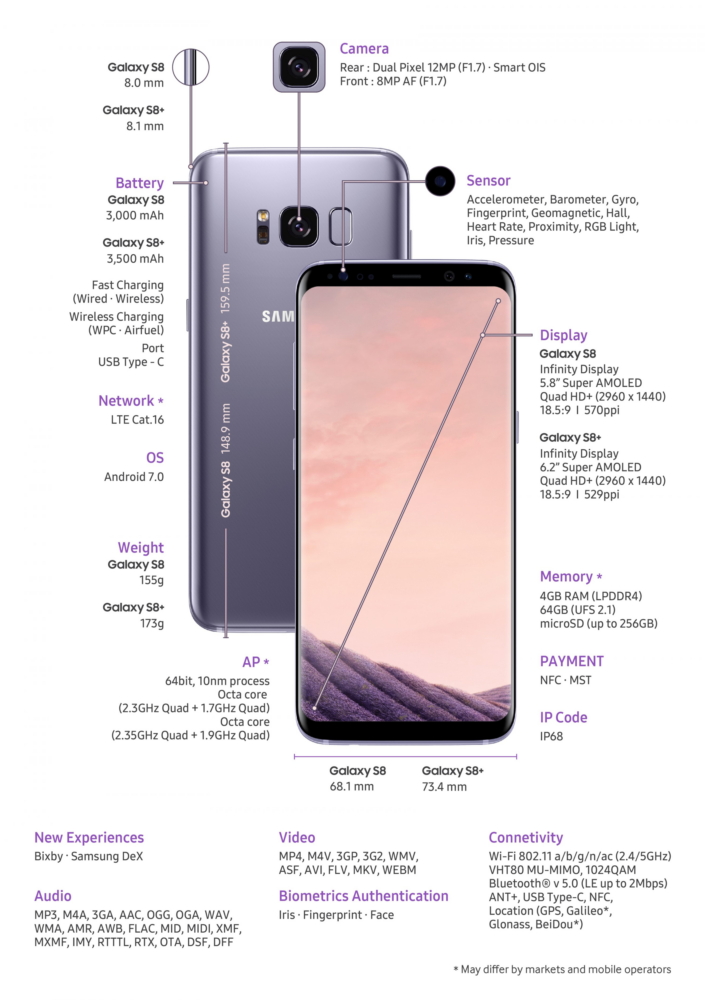
The Samsung Galaxy S8 Plus features a superior 6.2-inch Super AMOLED display with a resolution of 2960 x 1440 pixels and 529ppi. On the Galaxy S8 Plus, Samsung is also offering two versions which would be sold separately in specific regions. There is a Snapdragon 835-powered version which comes with an octa-core processor clocked at 2.35GHz. There is also an Exynos 8895-powered version equally clocked at 2.35GHz. Both the Snapdragon and Exynos versions come with 4GB of RAM and 64GB internal storage which can be expanded up to 256GB via microSD.
The camera configuration is the same as on the Galaxy S8 sporting a 12MP rear sensor with optical image stabilisation (IOS), LED flash and a f/1.7 aperture. Up front, users get an ample 8MP frot-facing camera with f/1.7 aperture and autofocus. There is an iris scanner at the top bezel up front and the device equally has a rear-mounted fingerprint sensor which also unlocks the phone.
The Samsung Galaxy S8 Plus packs a larger 3,500mAh battery under its hood. The flagship comes with a larger dimension measuring 159.5 x 73.4 x 8.1 mm. Since it packs a larger battery, it is a little weightier at 173g. You also get such stunning features like an IP68 water and dust resistance, Wireless charging support, LTE Cat.16, Bluetooth 5.0, Wi-Fi a/b/g/n/ac, NFC, MST for Samsung Pay, USB Type-C port and lots more. Samsung still retained the 3.5mm audio jack on the Galaxy S8 Plus. The Galaxy S8 Plus runs on Android 7.0 Nougat as well.
Pricing & Availability
Samsung also did not announce the official price of the Galaxy S8 Plus but the plus-size flagship will join its sibling in going up for pre-order tomorrow, March 30. It will also be available in Black, Gray, Silver, Blue and Gold variants. If you’re buying the Galaxy S8 Plus, you equally qualify to get a free Gear VR headset with a controller and a set of games. The Galaxy S8 and S8 Plus will be available in stores from April 21.
SAMSUNG GALAXY S8
Galaxy S8 Plus
DIMENSIONS & WEIGHT
148.9 x 68.1 x 8.0 mm, 155 grams
159.5 x 73.4 x 8.1 mm, 173g grams
DISPLAY
5.8-inch 2960 x 1440p (570 ppi)
OLED
6.2-inch 2960 x 1440p (529 ppi)
OLED
CPU
Qualcomm Snapdragon 835 @ 2.3 / Exynos 9 @ 2.3
Qualcomm Snapdragon 835 @ 2.3 / Exynos 9 @ 2.3
MEMORY
4GB + 64GB
MicroSD: Yes
4GB + 64GB
MicroSD: Yes
CAMERA
12MP f/1.7 OIS
8MP f/1.7 Front Camera
12MP f/1.7 OIS
8MP f/1.7 Front Camera
BATTERY
3000mAh
Fast Charging
Wireless Charging
3500mAh
Fast Charging
Wireless Charging
OS
Android 7 Nougat
Android 7 Nougat
SPECIAL FEATURES
IP68 Certification
IP68 Certification
COLORS
Midnight Black, Orchid Gray, Arctic Silver, Coral Blue and Maple Gold.
Midnight Black, Orchid Gray, Arctic Silver, Coral Blue and Maple Gold.
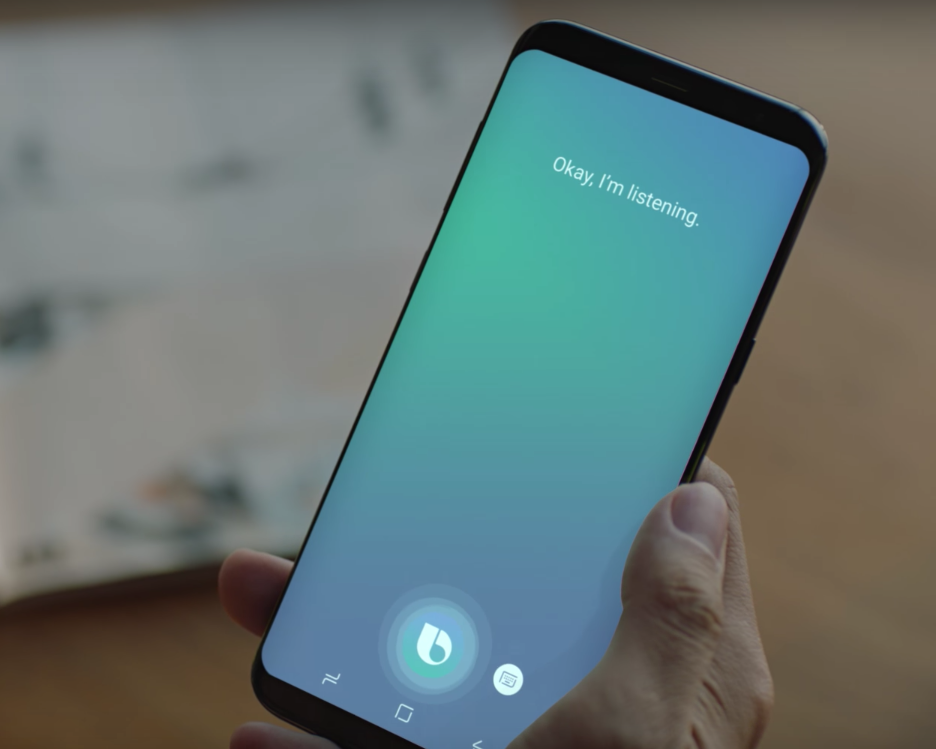
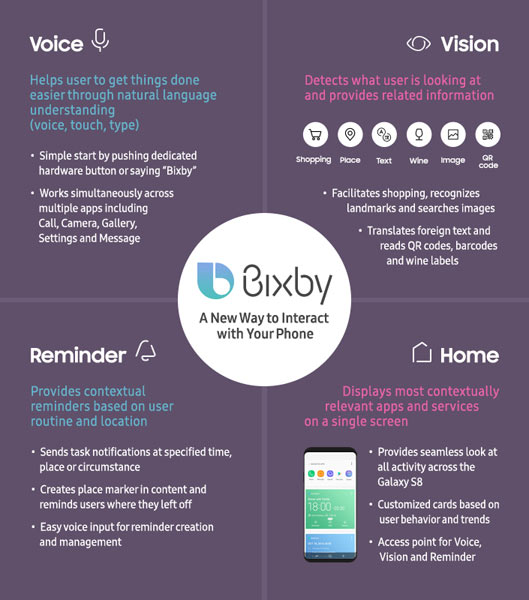
After tons of leaks, Samsung has finally announced the Galaxy S8 and Galaxy S8+ flagship smartphones. For better user experience on the new Galaxy S8 duo, the South Korean company has included the all new Bixby AI assistant.
Here is what Samsung has to say about the new virtual assistant, “Bixby is not an ordinary voice assistant, but rather an intuitive and comprehensive interface that leverages contextual awareness to learn users’ habits and respond accordingly.” It seems it is indeed a new way to interact with the phone.
The other existing virtual assistants such as Siri, Google Assistant, Alexa and Cortana fetch information on the web and then answer the query of the user. Bixby is different as it is not a search engine. It is an assistant and it is aimed towards simplifying the user experience while using the phone, apps and services.
It is built to assist users in almost everything they do on the device such as cropping an image or sharing a captured image on social site. Bixby can be launched through the dedicated button present below the volume rockers and users can simply call “Bixby” to launch it. Bixby provides users with four main features:
Bixby has the ability to understand natural language, Through voice commands, Bixby can perform various tasks with Samsung apps like phone, SMS, contacts, reminders, gallery, settings, and camera. If Bixby is unable to understand the language of the user, it will prompt user to provide more information to finish the task. At the beginning, Bixby will carry support for languages like U.S. English and Korean. Bixby is expected to support Chinese and U.S. Spanish in the near future.
Bixby Vision
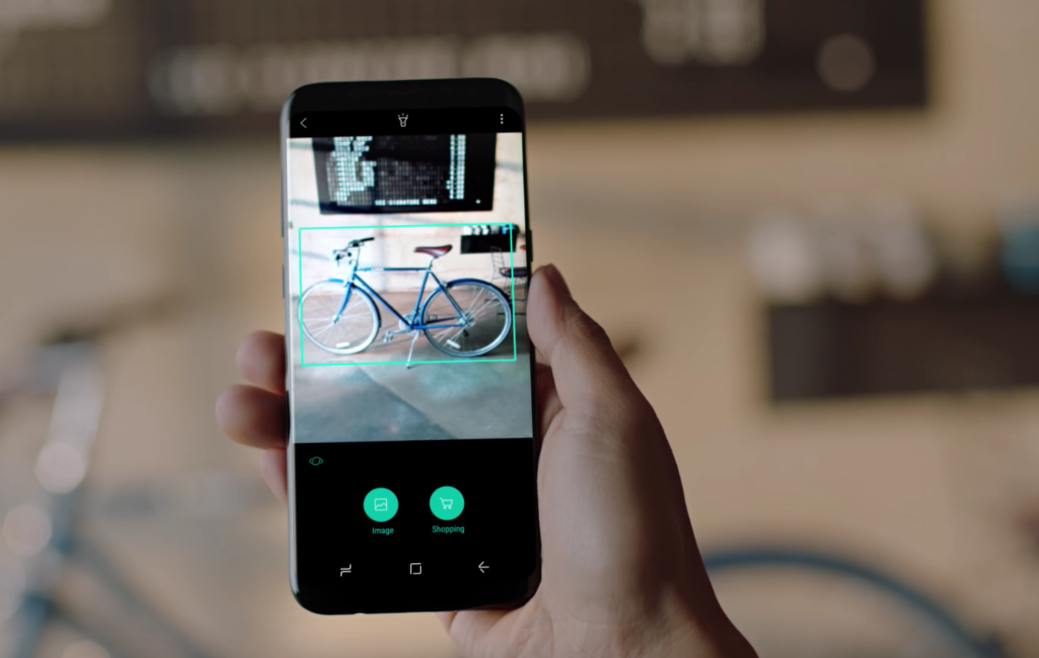
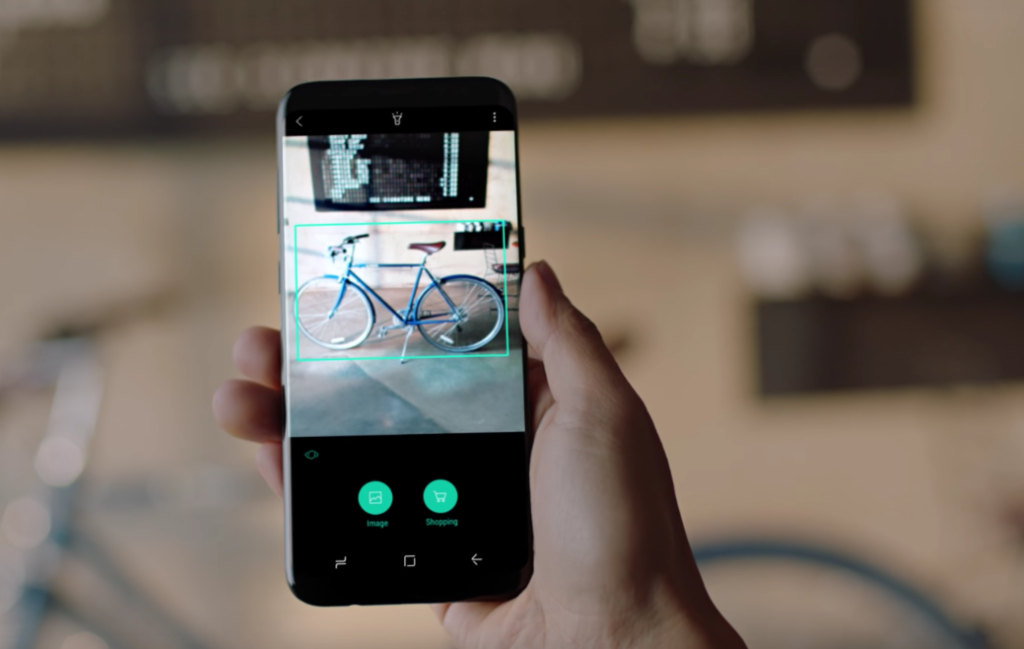
Bixby Vision make use of the augmented reality camera to identify the objects users are looking at in real time and then provide relevant information to the user. It can be launched within the camera app or through the Bixby Home. It can also translate text, scan QR codes and identify locations all inside the camera app. Bixby Vison can be used by pointing the camera at an object and wait for the information it provides.
Bixby Reminder
Based on the routine and location of the user, Bixby is smart enough to provide contextual reminders. Users can create task alerts at specified time, place or circumstance. It can also create place marker in content like books or videos and remind users where they left off.
Bixby Home
Bixby Home is a common place in the form a single screen to see all the contextually relevant apps and services. Every time it is accessed, it arranges information on the basis of the schedule, routine and personality of the user.
Bixby is an ambitious effort from Samsung, but it currently works with around 10 Android apps from Samsung. At the Samsung Galaxy S8 Unpacked event, the company claimed that Bixby would work with third party apps as well as Samsung Connect smart home devices.
After much speculations, rumours and leaks, South Korean tech giant Samsung has officially launched the Galaxy S8 along with the Galaxy S8 Plus in a ceremony today. The Samsung Galaxy S8 launch is the biggest event the tech giant is hosting since the Galaxy Note 7 saga so, the event was a highly anticipated one. As you already know, the Galaxy S8 and S8 Plus were billed to be the first smartphones to pack Qualcomm’s latest Snapdragon 835 chipset and indeed they were launched with the powerful flagship chip. But whether you’ll get to buy the Snapdragon 835-powered version of the S8 or S8 Plus will depend on where you live.
Design & Hardware
The Samsung Galaxy S8 features a design which isn’t entirely different from its predecessors but it comes with an unusually high screen-to-body ratio. A large display ensured the traditional home button which sits at the front of the screen under the display was absent. Instead, the Galaxy S8 features a virtual home button. The bezels are thin and the display is a curved one.
On the specifications, the Galaxy S8 sports a 5.8-ich Super AMOLED display with a resolution of 2960 x 1440 pixels and 570ppi. The processor is an octa-core Snapdragon 835 chipset clocked at 2.35GHz on some version while there is another version powered by Samsung’s own Exynos 8895 chip also clocked at 2.35GHz. The United States will get the Snapdragon 835-powered version while other international countries would get the Exynos 8895-powered version. China is said to also get the Qualcomm-powered version but there is no official word on that yet. Both versions are backed by 4GB of RAM while there is 64GB of storage onboard which is expandable via a microSD slot.
Camera, Battery
On the camera aspect, the Galaxy S8 packs a 12MP rear camera with a f/1.7 aperture, OIS and LED flash and at the front, there is an 8MP selfie camera with a f/1.7 aperture and autofocus. We are yet to see camera samples of theGalaxy S8’s camera but we believe it would be a very powerful setup. Keeping the lights on is a generous 3000mAh battery which should do a good job in that regard.
Connectivity, Other Features
Other features include a USB Type-C port, NFC and MST for Samsung Pay, IP68 water and dust resistance and yes, it still packs a 3.5mm headphone jack. There is also a wireless charging support as well as Cat. 16 LTE. Others include Bluetooth 5.0 which is capable of streaming to two devices at the same time and Wi-Fi a/b/g/n/ac. The Galaxy S8 isn’t too wide despite its large size, packing a dimension of 148.9 x 68.1 x 8 mm and it weighs just 155g. The device runs on Android 7.0 Nougat out-of-the-box and also comes with Samsung’s new Bixby Assistant which is launched by pressing a dedicated physical button located on the side of the phone.
Pricing & Availability
As for the pricing, Samsung left that out unfortunately but the Galaxy S8 is expected to start at around $750. Both the Galaxy S8 and S8 Plus will be up for pre-order as from tomorrow, March 30 while they will be officially released in the US on April 21. Each pre-order qualifies you to get a free Gear VR headset with a controller and a set of games. The Galaxy S8 and S8 Plus will be available in black, gray, and silver in the US while Gold and blue are the options on the international edition.
SAMSUNG GALAXY S8
Galaxy S8 Plus
DIMENSIONS & WEIGHT
148.9 x 68.1 x 8.0 mm, 155 grams
159.5 x 73.4 x 8.1 mm, 173g grams
DISPLAY
5.8-inch 2960 x 1440p (570 ppi)
OLED
6.2-inch 2960 x 1440p (529 ppi)
OLED
CPU
Qualcomm Snapdragon 835 @ 2.3 / Exynos 9 @ 2.3
Qualcomm Snapdragon 835 @ 2.3 / Exynos 9 @ 2.3
MEMORY
4GB + 64GB
MicroSD: Yes
4GB + 64GB
MicroSD: Yes
CAMERA
12MP f/1.7 OIS
8MP f/1.7 Front Camera
12MP f/1.7 OIS
8MP f/1.7 Front Camera
BATTERY
3000mAh
Fast Charging
Wireless Charging
3500mAh
Fast Charging
Wireless Charging
OS
Android 7 Nougat
Android 7 Nougat
SPECIAL FEATURES
IP68 Certification
IP68 Certification
COLORS
Midnight Black, Orchid Gray, Arctic Silver, Coral Blue and Maple Gold.
Midnight Black, Orchid Gray, Arctic Silver, Coral Blue and Maple Gold.
After years of accelerated growth, China’s economy started showing signs of decline in the past two or three years. In order to reboot the economy, a new model known as Internet Plus was formulated in 2015. China’s Internet Plus model involves the integration of mobile Internet, cloud computing big data, and the Internet of Things with modern manufacturing, to encourage the healthy development of e-commerce, industrial networks, and Internet banking, and to get Internet-based companies to increase their presence in the international market.
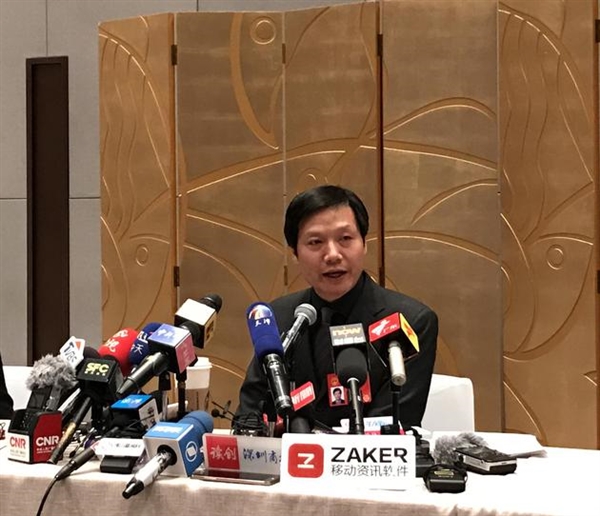
Lei Jun – File Photo
One company which has successfully adopted this business model is Xiaomi, offering the best product at affordable prices. Xiaomi CEO Lei Jun believes startups in emerging markets like India who are enterprising enough to offer the best products at low prices would beat off competition easily. Lei Jun made this statement while speaking at the Global Business Summit in New Dehli, India on Monday.
Xiaomi was one of the first companies to have adopted the model to help improve its earnings and it has been a successful story all the way. The innovative tech company started in the traditional way, creating awareness through word-of-mouth marketing and later they adopted an internet -based sales model which effectively ensured the pricing was in the hands of the company. The internet marking model ensured middlemen were removed from the mix in arriving at the final price which would then be a little higher than the production cost.
The success of the innovative Chinese brand in India is a pointer to the effectiveness of the Internet Plus model in emerging economies. In India alone, Xiaomi achieved an annual revenue of over $1 billion in 2016 and emerged as the top selling smartphone brands online as well as the second largest smartphone brand in India in the fourth quarter of last year. The company even has two factories in the fast-growing Asian country of which the first was opened in 2015 and the second last year. The phones sold in India and some other countries where Xiaomi has got some presence were manufactured in its India factories. The company is even eyeing control of 50% share of the local offline market in addition to its successful online model.
The success has benefitted the local populace as Xiaomi has presently created up to 7500 jobs in the country and Lei Jun projects that figure will rise to 20,000 jobs in the next three years. The Chinese tech czar enjoins enterprises in emerging market to stay committed to innovation, focus on user experience and never sacrifice quality or efficiency.
“Companies in emerging markets need to offer their consumers a compelling vision so that they not only solve problems today, but even address problems on the horizon,” Lei added.
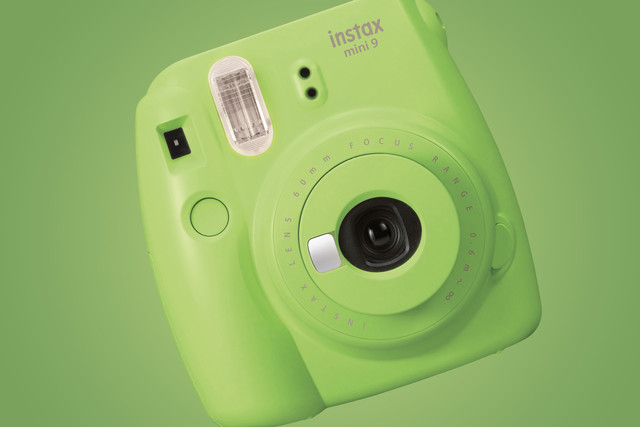
Instant cameras used to be really popular before the word “selfie” came into existence. Now we have smartphones with cameras that can compete with some DSLRs and tons of image sharing sites. So you’d think instant cameras are dead and buried, right? Turns out Fujifilm, one of the biggest names in photography at a time thinks there is still a market for them. The Japanese corporation recently announced the Instax Mini 9, its latest instant camera.
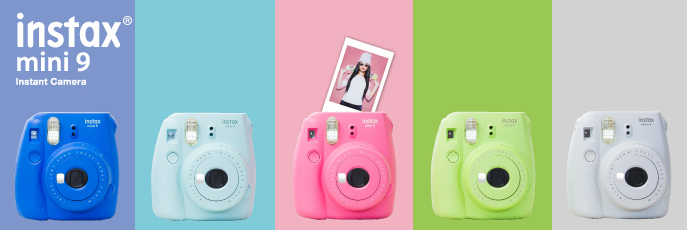
The Instax Mini 9 is an upgrade to the well-received Instax Mini 8 released back in November 2012. Both cameras actually share the same design. The new model brings new features such as High Key Mode which lets you take brighter images; a selfie mirror; and a detachable close-up lens.
While those upgrades sound pretty nice, what may get people to buy the Instax Mini 9 are the cute colors options it has. There is Cobalt Blue, Flamingo Pink, Smokey White, Ice Blue, and Lime Green. When it goes on sale on April 9, the Cobalt Blue and Smokey White variants won’t be available for purchase. You will have to wait till June to get your hands on them.
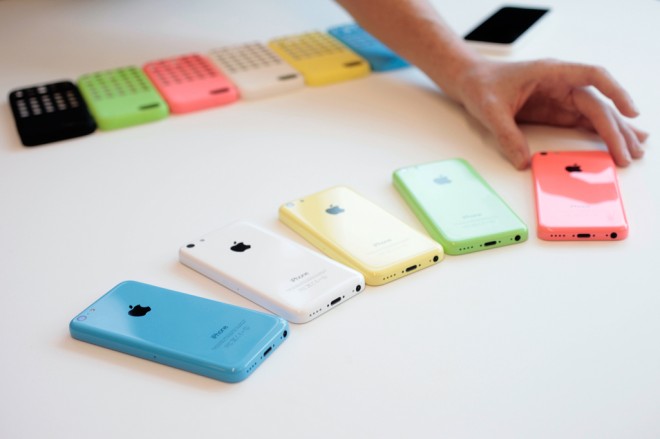
The competition just keeps getting keener and more interesting by the day. Smartphone manufacturers are daily experimenting with different ways they could outwit each other in the race to the top. The competition is now on all fronts; RAM size, processor, display size and type, design and now the smartphone color options consumers get to choose from are ever increasing.
Basically, statistics have shown that the most popular smartphone color around is black and that is followed by white color. Apart from these two smartphone colours, which have been regulars, the past year saw a number of new colors emerging which left the norm and surprisingly they’ve been receiving widespread acceptance. The new color options we have seen the past one year are quite many but basically, we’ll be looking at those used on smartphones with the all-metal body, particularly the flagships. During this period we have seen smartphones in green, blue, red, rose gold colors and there was also the Mocha brown variant we saw on the Huawei Mate 9 but that wasn’t popular per se.
[envira-gallery id=”124597″]
BLUE
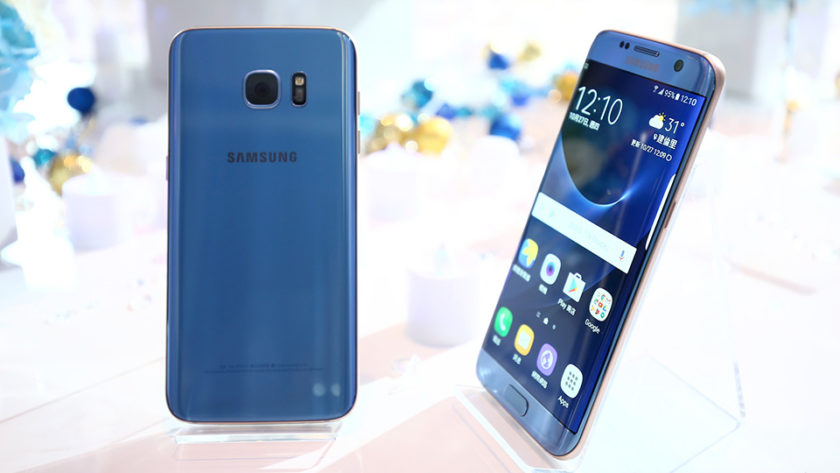
Blue has been one stand out color option during this period under review. A couple of years back, we would have thought colors like blue were only reserved for low-end and mid-range smartphones with a plastic body but flagships like the Honor 8 sported a blue variant and that didn’t make it look less premium. Calling it Sapphire blue only added some flavor to the name. Google Pixel and Pixel XL also came with a bright, vivid blue variant. Samsung also added a Coral Blue variant to the Galaxy S7 Edge lineup recently and it added more sleekness to the flagship.
RED
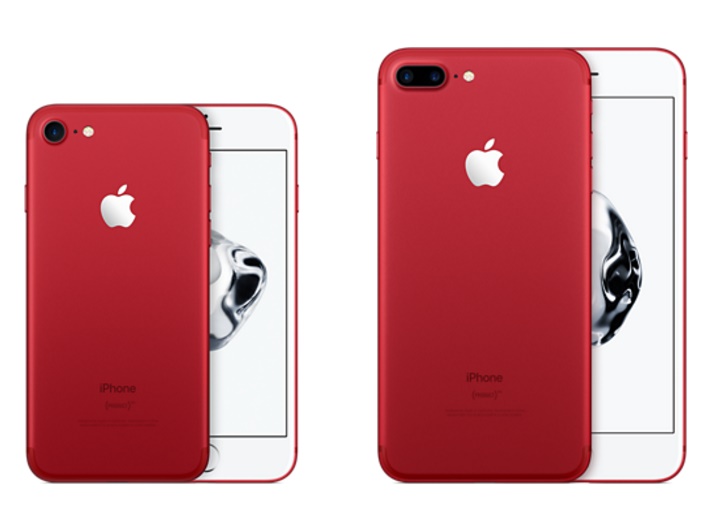
One of the smartphone colors that has become trendy within the last one year is red and this is a popular one. Just recently, Apple introduced a red variant to the iPhone 7 and 7 Plus and the response was tremendous. OPPO also gave the OPPO R9 and R9 Plus a red paint job that looks very attractive. Earlier on, HTC had released the HTC 10 and Desire 830 with one of the available color options being red on both models. Perhaps the most defining smartphone which made red phones a lot more special is the red variant of the Huawei P9 which received lots of positive appraisals. Huawei chose to continue the same trend on the P10 by including a red variant to its range. Red seems to be hot in 2017 and expect a few more models in this shade in the coming months. If you missed, even the local manufacturer UMi has a Red UMI Z variant.
GREEN
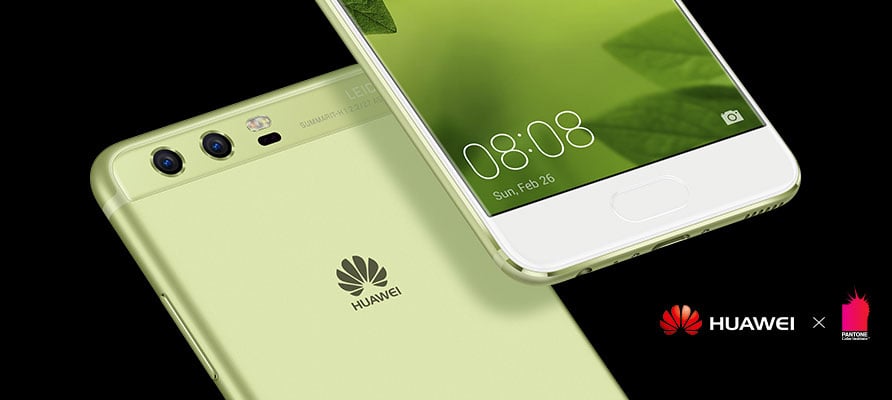
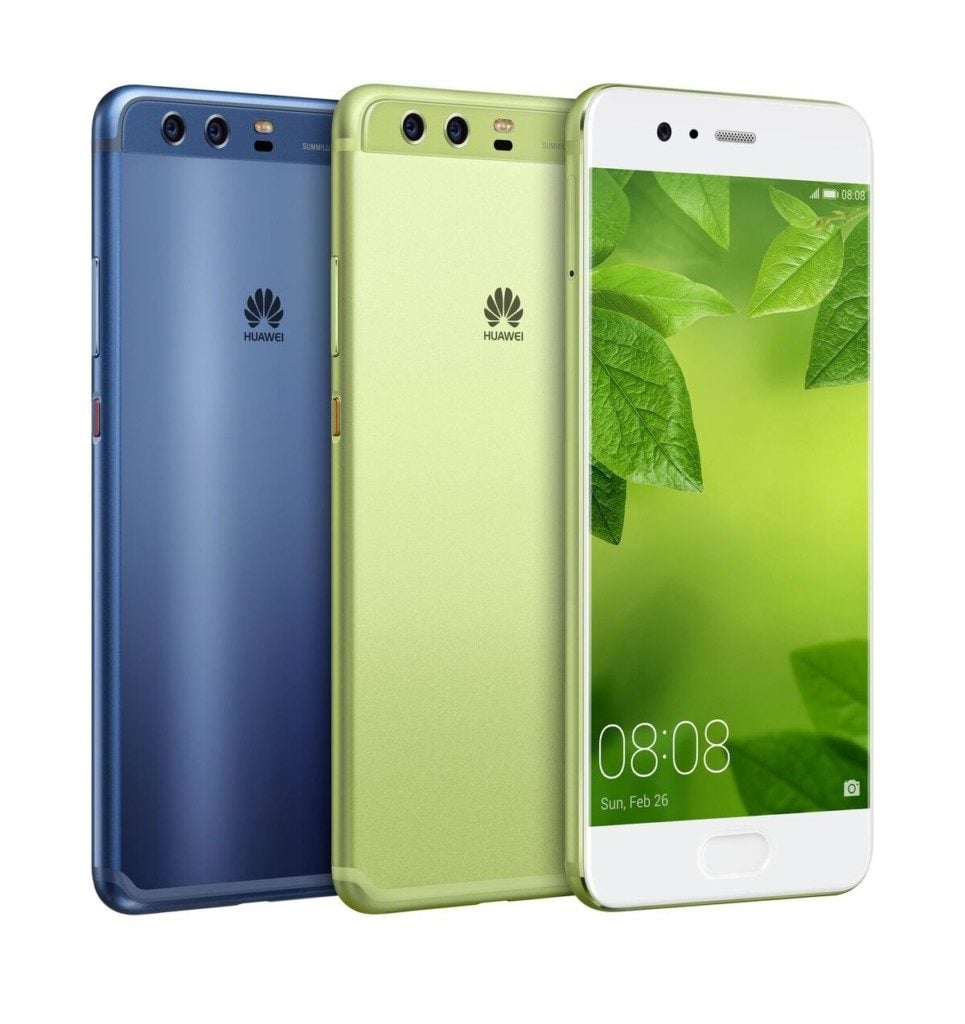
Another popular color which was found on smartphones this last year was Green. There seems to be an ongoing green revolution presently. Huawei also included a green color variant on the P10 which was also done on the P9. Just days back, OPPO added a new green variant to the R9 and R9 Plus. At CES 2017, Xiaomi unveiled three new color variants for the Mi Note 2 and one of them was a green but all three are yet to be available commercially. So, it won’t be surprising if we see more green colored smartphone in 2017.
We could go on and on, there are colors aplenty which stood out during the last one year. Remember Xiaomi also unveiled a purple variant of the Mi Note 2 at CES as well as a pink variant? Rose gold is another shade of gold which is more like pink and has become a regular option on smartphones in the past couple of years. The Mi Note 2, Meizu Pro 6, iPhone 7, OPPO R9 and R9 Plus, Samsung Galaxy S7 and S7 Edge and several other high-end smartphones featured a rose gold variant in their lineup. This trend will continue in 2017 as well.
We look forward to several more unique color options in the upcoming smartphones. Already, there are rumors presently that Xiaomi is planning to make the Mi 6 available in a range of color options and we really can’t wait to see that happen. Perhaps, you too can tell us in the comment section, the color option that catches your fancy presently.
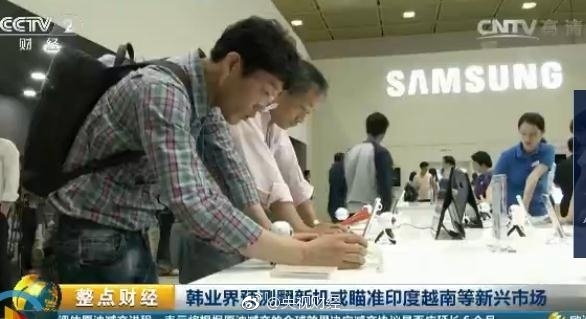
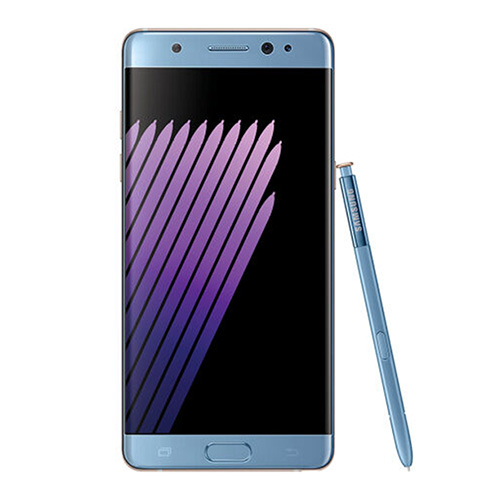
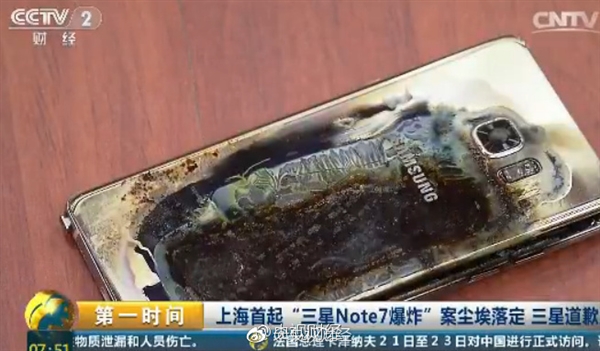
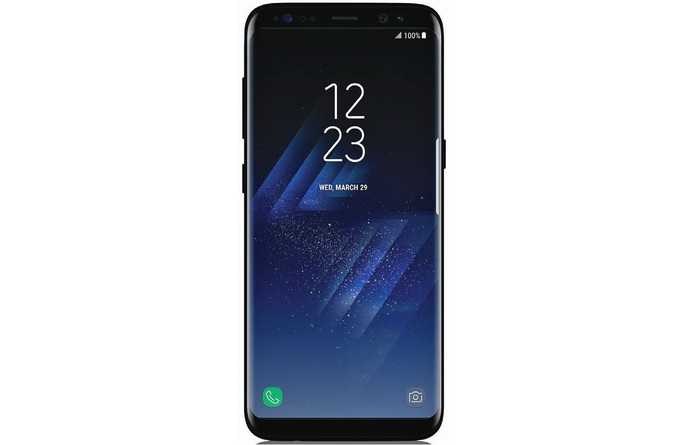
The last may not have been heard about the ill-fated Samsung Galaxy Note 7 which was subjected to a global recall following the battery defect that resulted in several recorded explosion cases. It was reported recently that Samsung had confirmed plans to sell refurbished units of the Galaxy Note 7 in select markets around the world. The Korean giant did not reveal specifics as to when the device will ship or the price and regions where it would be sold.
A new report has, however, revealed some details about the proposed launch and its likely price. According to the report aired on China’s CNTV, the refurbished Note 7 would hit the market by June this year and the product will sell in emerging markets like India, Vietnam, Africa and so on where customer place more emphasis on price than any other consideration. That is not to say safety would not be a priority, Samsung has added an extra level of security to forestall any mishap in the future.
The report also gave some insight on the likely price tag of the Galaxy Note 7 and it is expected to be 3 to 5% cheaper than the original price. For a refurbished smartphone, the price may still be too high but that may not play a big role in the long run. However, the figure may be inaccurate, we hope it would be available for up to half the initial price.
While some may be wondering why Samsung chose to use the Note 7 again, the report also revealed that they were compelled by Korean environmental law. Under Korean laws, the metal components used on smartphones must be recycled and used twice. So, if Samsung had crushed all the recalled units as some would have wanted, the company could face a huge fine. We are talking about over 4 million units here.
Today is a big day for Samsung and for Samsung fans and other tech enthusiasts. Today, Samsung takes off the wraps on its new flagships, the Galaxy S8 and the Galaxy S8+. It has been like an endless wait for ages with all the teases and leaks and juts right before the launch, we get another leak. This time revealing a nearly complete specification sheet of both phones.
The info comes from TENAA (China’s equivalent of the FCC) and it answers all the question about the phones’ specifications.
Samsung Galaxy S8 Specs
The Galaxy S8 is the smaller of the two variant and can be termed the direct successor to the Galaxy S7 and S7 Edge. According to the TENAA listing, it sports a 5.8-inches (Super) AMOLED display with a resolution of 2960 x 1440 (WQHD+). This resolution is said to be user adjustable based on a recent leak. Owners of the S8 will be able to switch from the above resolution to either FHD+ (2280 x 1080) or HD+ (1480 x 720).
There will be two memory configurations: a 4GB RAM + 64GB model and a 6GB RAM + 128GB model. Both models can be expanded via a MicroSD card slot that accepts up to 256GB cards. Since this is the Chinese variant, the Galaxy S8 is powered by the Snapdragon 835 chipset clocked at 2.45GHz.
Samsung has equipped the S8 with a 3000mAh battery and pre-installed the phone with Android 7.0 Nougat. The phone weighs 152g and has a dimension of 148.9×68.1×8.0 (mm).
The listing also shows what’s in the box alongside the phone. Buyers will get a charger, a data cable, an OTG adapter, and a pair of earphones. The earphones are definitely the AKG earphones rumored to come with the device.
According to the information on TENAA, only the black variant of the Galaxy S8 will be available in China.
Samsung Galaxy S8+ Specfications
The Galaxy S8+ sports the same resolution as the S8 but gets a larger 6.2-inch display. It is powered by the same 2.4GHz processor and comes with same memory configuration mentioned above. It’s own listing however reveals the camera details. The S8+ will have a single 12MP sensor on the rear and an 8MP sensor in front. Chances are that these are the same sensors on the Galaxy s8 too.
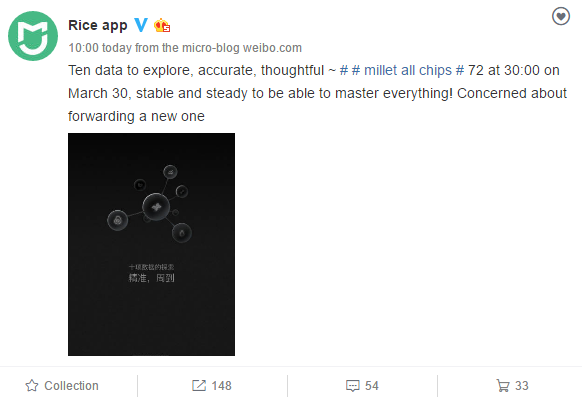
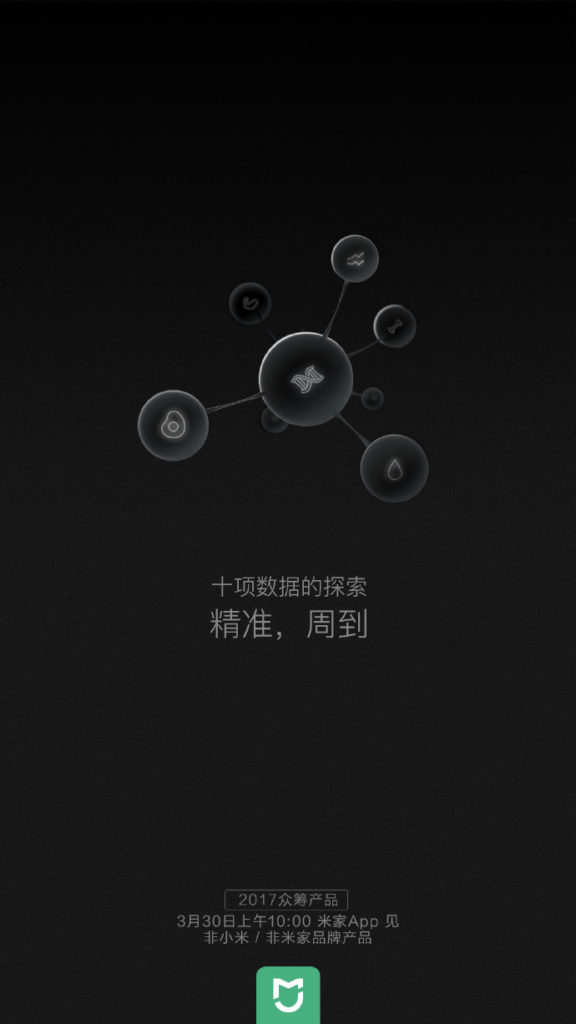
Looks like Xiaomi‘s smart home brand will be unveiling two new products tomorrow March 30 at 10 AM. Yesterday we reported on an upcoming MIJIA product which is likely a heart rate or blood pressure monitor and is the brand’s 73rd product. The 72nd crowdfunding product is also on its way and Xiaomi has repeatedly teased posters about the upcoming product.
It is sometimes a herculean task grabbing what Xiaomi is pointing at with the teasers and this is one of such times. However, from what we can gather from the three different posters that have so far being released about the product, the product is likely another of Xiaomi’s health and fitness product, perhaps a smart body scale. The body scale will measure vital statistics such as weight, water level (hydration), bone mass, visceral fat, basal metabolic rate, body mass index (BMI), and other parameters.
The product will likely be a smart gadget that will be able to connect to the Mi app via a smartphone. We’ll get to know more about the product tomorrow when it will launch.
The list of new features the expected Xiaomi Mi 6 is rumoured to launch with keep getting bigger by the day. Indeed, the Mi 6 holds lots of expectations from Xiaomi fans since it is the company’s first flagship for the year and there seem to be surprises aplenty.
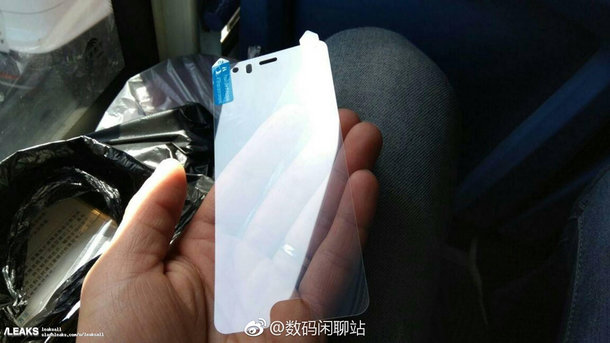
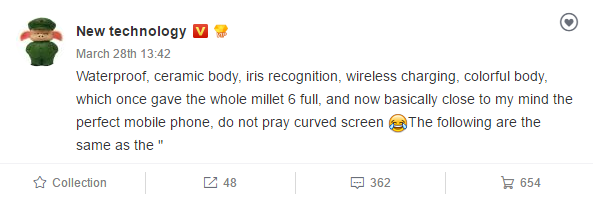
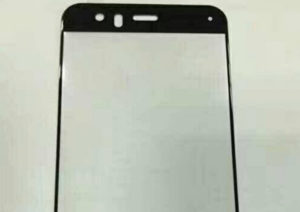
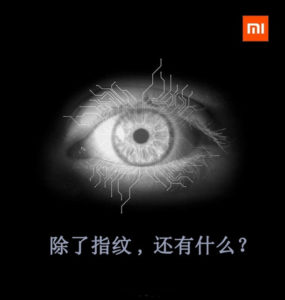
Just yesterday, we got a leaked image said to be the Mi 6’s SIM card tray which reveals a stunning detail about the Xiaomi flagship. The SIM tray showed us that the Mi 6 would likely be water resistant and in effect be without the 3.5mm audio jack. While we are yet to digest that, a new rumour has emerged on Weibo hinting at the presence of an iris recognition technology among other features on the Mi 6. To buttress this, a set of leaked photo of the Mi 6 display glass panel and tempered glass protective cover were shown, revealing openings for the iris scanner at the front.
Also, the Xiaomi flagship is said to use a ceramic body which is similar to what the Mi Mix and a version of the Mi 5 featured. Although Ceramic glass will give the Mi 6 a more premium, sleeker look, it is slow to produce, so fans may experience scarcity of the device. We hope it gets featured on perhaps the topmost model only while we get a metal clad variant which is likely the case since the flagship is also rumoured to come with a colourful body.
Since the Mi 6 would be waterproof, it means the charging port has to be taken care of, literally covered up and Xiaomi will likely do that by making the Mi 6 charge wirelessly. A wireless charging feature is another innovative feature the Mi 6 is rumoured to pack. We don’t know for sure if that means it won’t have a wired charging feature, anyway.
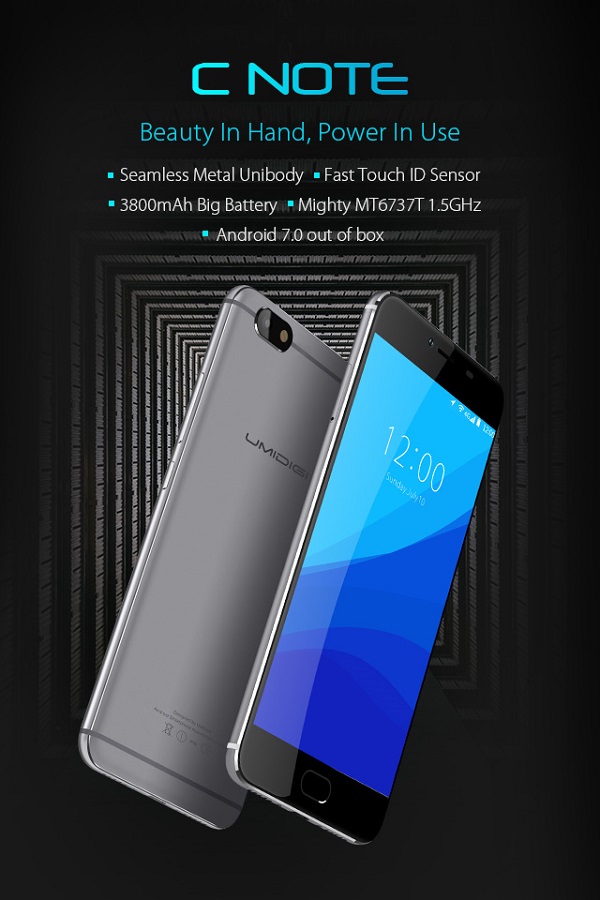
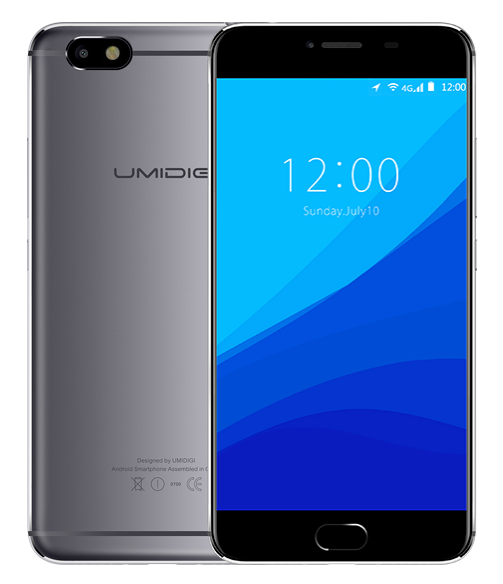
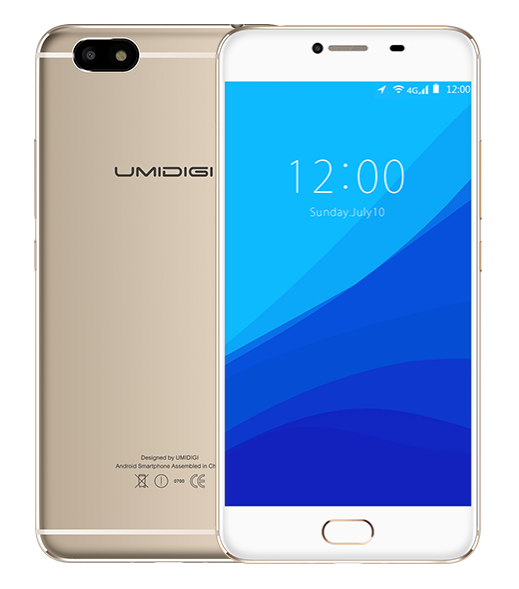
UMDIGI’s new phablet, the C NOTE can be pre-ordered now. With an affordable pricing of $139, the smartphone offers comes with metal unibody design and impressive specs.
The C NOTE has a 5.5-inch Sharp IGZO 2.5D arc display that offers a full HD resolution of 1,920 x 1,080 pixels. Its sports narrow bezels and provide a high screen-to-body ratio.
The MediaTek MT6737T chipset featuring a 1.5 GHz quad-core processor is present under the hood of this phone. The chipset is accompanied by 3 GB of RAM. The native storage offered by the UMIDIGI C NOTE is 32 GB and for additional storage, it supports up to 256 GB of microSD card.
UMIDIGI has included a 13-megapixel camera Samsung S5K3L8 sensor on the rear panel of the phablet. It is coupled with features like Phase Detection Autofocus technology and dual-LED flash. The company claims that its “Professional Camera Mode” feature for its rear camera can shoot DSLR-like photos. For snapping selfies, it comes with a 5-megapixel frontal shooter.
It is a dual-SIM smartphone that carries support for 4G LTE connectivity. It features a front-mounted fingerprint scanner that is fast enough to unlock in 0.1-0.3 seconds. The C NOTE features the stock version of the latest Android 7.0 Nougat OS,
Even though it is a low-priced smartphone, the C NOTE sports a well-crafted aluminum alloy unibody design boasts a precise curve. it has a slim profile of 8.3 mm even though it houses a 3,800 mAh battery. According to the Chinese manufacturer, the battery that is manufactured by Sony is large enough to last for up to 2 days. It measures 154.7 x 76.6 mm and its weight is 172 grams.
The actual price of the UMIDIGI C NOTE is $150, but for customers who pre-order can avail it under a discounted pricing of $139. It is available in color choices like Gray and Gold.
Samsung has been in the news since several months. In the second of 2016, it was in the headlines for the Galaxy Note 7 debacle. And from the last quarter of 2016 until today, the rumor mill has been consistently revealing leaked photos and specifications of the Galaxy S8 and Galaxy S8+ that are going to be officially unveiled today. The Seoul-based tech giant is also in the news today for denying a replacement device for a faulty Galaxy S7 Edge to a Singaporean man unless he signs a non-disclosure agreement that states that he won’t be publicly criticizing Samsung over the faulty device.
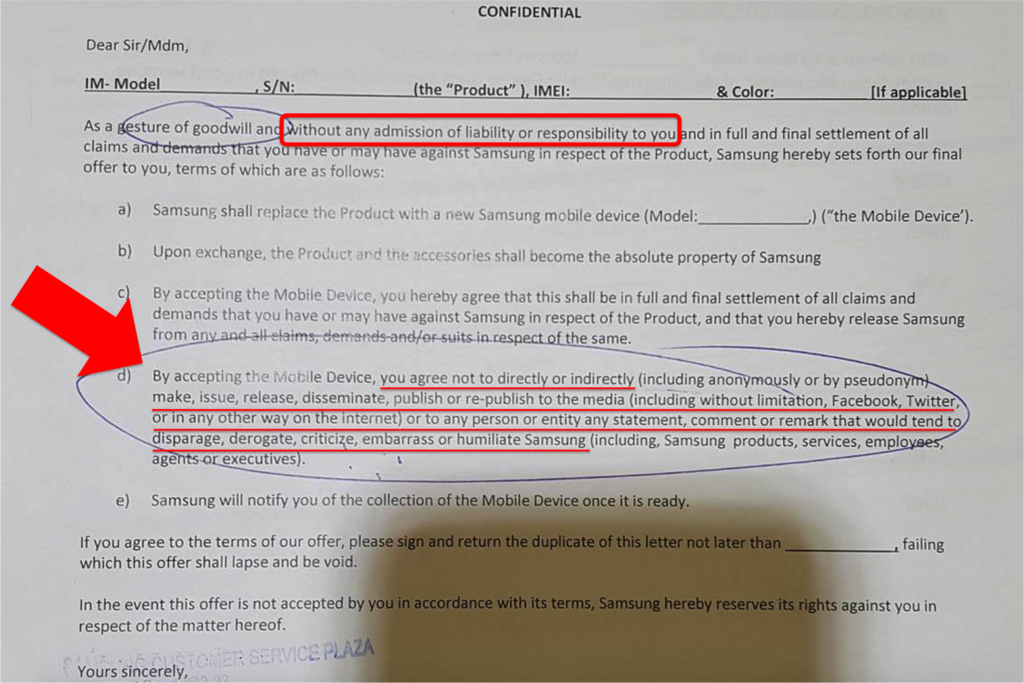
Lim Dao Qing Brian From Singapore had purchased the Galaxy S7 Edge on Feb. 17. The S7 Edge could last only till Feb. 23 as it died after overheating. It could never turn on again. He went to the Samsung store to get it exchanged under warranty. However, in order to avail an exchange, Lim was asked to sign a non-disclosure agreement, which includes the following text:
“By accepting the Mobile Device, you agree not to directly or indirectly (including anonymously or by pseudonym) make, issue, release, disseminate, publish or re-publish to the media (including without limitation, Facebook, Twitter, or in any other way on the internet) or to any person or entity any statement, comment or remark that would tend to disparage, derogate, criticize, embarrass or humiliate Samsung (including, Samsung products, services, employees, agents or executives).”
Even though Lim was trying to avail a replacement as his S7 Edge is in warranty, Samsung’s NDA states that it “is a gesture of goodwill” on its part to provide him with an exchange. Here is the snapshot by Lim that shows Samsung’s NDA:
Since Lim refused to sign the NDA, he was not provided with a replacement phone for this faulty Galaxy S7 Edge. On sending an email to Samsung to address the issue, he was assured that someone was looking to the matter. On March 24, Lim contacted Samsung Mobile Singapore on Facebook and he was told that the customer care will look into the issue and get back to him next week.
Since there was no update from Samsung, Lim sent an image of the NDA to Samsung Mobile Singapore on Facebook. He was replied that the “this is a standard agreement and procedure between Samsung and our customer as one-to-one exchange is only applicable under special circumstances such as your case.”
The text on the NDA clearly suggests that after the Galaxy Note 7 fiasco the South Korean company does not want to get publicly criticized and get into a new controversy for a faulty device. It is not known for how long the company has been asking its customers to sign a NDA to exchange a faulty phone. Also, it is yet to be known whether Samsung’s customers outside of Singapore have also been also been asked to sign such an agreement.
The Samsung Galaxy S8 is coming to town soon and so, we expect the rumour mill to remain agog every hour until the flagship drops. The latest news, call it rumour if you like, we are getting about the Galaxy S8 comes in from South Korea and isn’t a cheering news. There are indications that Samsung may not have enough units after all to meet the potentially high global demand for the smartphone.
This is said to be as a result of the slow production rate of the Qualcomm Snapdragon 835 chipset which debuts on the Galaxy S8 and S8 Plus. The Snapdragon 835 is manufactured on a smaller but more efficient 10nm wafer which is slower than on the 14nm or higher processes. Accordingto industry sources familiar with Samsung’s operations in South Korea, even the Exynos 8895 faces similar shortage issues since it uses a similar 10nm FinFet technology process.
This production snag may result in both versions coming out short of the expected number of units that would at least meet some of the demands for the smartphones. The Samsung Galaxy S8 and S8 plus are expected to launch with some topnotch features, including an iris scanner, Samsung’s AI assistant named Bixby, a large display with high screen-to-body ratio and virtual control buttons. We don’t know how true this latest information is because earlier reports had hinted that the SD 835 chip’s production wasn’t experiencing any shortage and that Samsung even plans to sell up to 60 million units of the Galaxy S8 globally.
Well-known leakster, Evan Blass has revealed that the next flagship smartphone from the company is called HTC U. In January, HTC had released a Snapdragon 821 powered HTC U Ultra smartphone. So, if the regular phone from the Taiwanese tech giant is called U Ultra, it is likely that the flagship phone would be arriving as HTC U. It is codenamed as HTC Ocean.
HTC had released HTC U Play alongside the HTC U Ultra smartphone. If HTC releases HTC U flagship smartphone, it would become the third smartphone to from its new U series of smartphones. According to Blass, the HTC U would be arriving with a 5.5-inch screen that will carry a quad HD resolution of 2,560 x 1,440 pixels. Since it’s a flagship phone, it would be fueled by Snapdragon 835 chipset.
A feature that will set the HTC U apart from other flagship phones is present in its metallic frame. The feature is called Edge Sense that depends on the sensors present on the metallic frame of HTC U. These sensors can be used by users for carrying various kinds of customizable gestures like squeezing, swiping and pinching on the left and right sides of the phone.
The HTC U will be running on Android 7.1 Nougat that is customized with HTC Sense 9 UI. For photography, it will be coming with a 12-megapixel Sony IMX362 sensor on its rear. The front-side of the phone would be featuring a 16-megapixel Sony IMX351 sensor. It is expected to come in two storage models of 64 GB and 128 GB. It would be also featuring a microSD card slot. There is no information on the battery of the phone.
According to Blass, the HTC U is slated for an announcement in the middle or at the end of April. The phone is expected to be available for purchase by May.
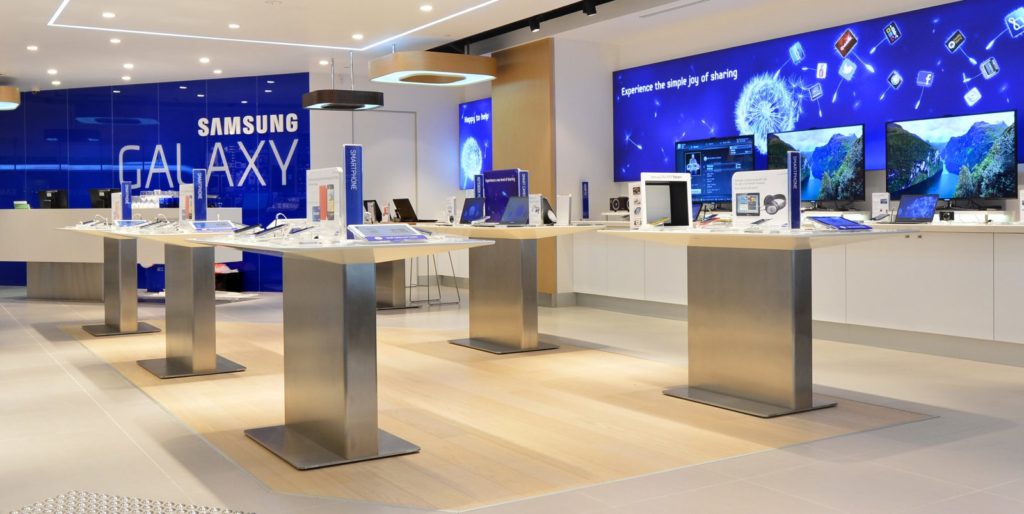
Samsung may soon become synonymous with fire both literally and figuratively. The company’s products are hot selling like burning flames, it has its tentacles spread around the world like wildfires and its products are going up in flames. Well, the last one is a little bit exaggerated, pun intended. The Galaxy Note 7 fire issue is still very fresh in our mind and now, a Samsung experience centre in Singapore is reported to have gone up in flames Tuesday morning.
This is happening just a day before Samsung officially unveils its revolutionary flagship which it hopes will help us forget the Note 7 and its penchant for going up in flames. The cause of the store’s fire outbreak was yet to be ascertained as at the time of reporting but it wasn’t a serious one. Shops around the mall where the Samsung Experience centre was located had to close temporarily, though. This was more of a safety procedure than for any other reason.
The expected Galaxy S8 & Galaxy S8+
The fire occurred in the early hours before opening hours but was extinguished by the shop’s water sprinklers. A statement issued by the Korean giant acknowledge the incident and disclosed that investigations are ongoing in conjunction with the authorities to determine the cause of the fire and to ascertain the level of damage.
Meanwhile, the shop will remain closed temporarily while the investigation is on but should open in time for the Galaxy S8 sales which would likely not commence immediately after the launch but sometime in April.
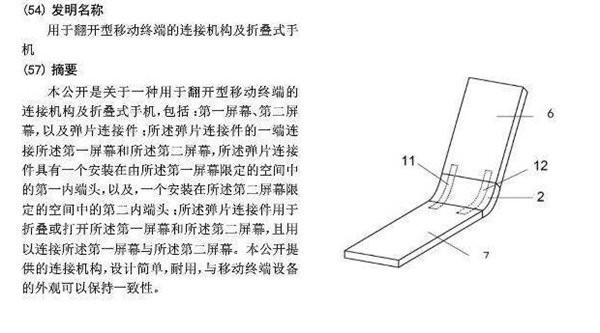
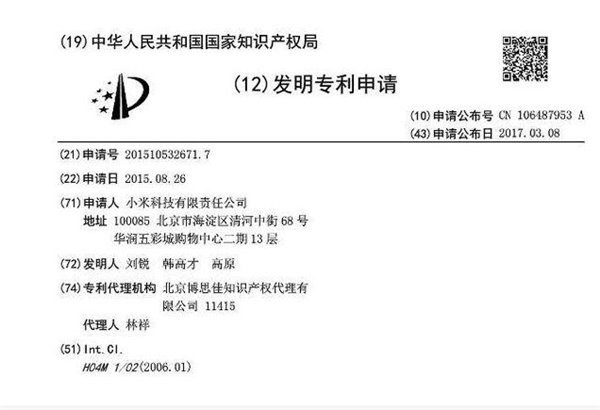
Smartphones with foldable displays are showing prospects of being a trend that would take the industry by storm in the near future. Samsung first unveiled its own foldable phone at CES 2013 called Galaxy X and ever since we had seen patent filings, leaks and rumors but no launch date yet. LG also has a patent for a foldable smartphone, also OPPO, Nokia and a host of others are also working on their foldable phone. Now, Chinese innovative tech company Xiaomi seems to be thinking in that direction.
A recent patent filing in China has revealed that Xiaomi has got a foldable smartphone in the works. From the details contained in the document, the phone has two displays which can be folded together. It includes an input section for typing and a display section. The device won’t open up flat as it an only be opened up to 160 degrees and not 180 degrees.
The patent filing only reveal that Xiaomi has got a foldable smartphone in development but as to when it would be launched, that we can’t tell. Already, the company has got a flexible display technology which it used on the Mi Note 2 so it may be easier to adapt that technology in the development of a foldable smartphone.
We use cookies on our website to give you the most relevant experience by remembering your preferences and repeat visits. By clicking “Accept”, you consent to the use of ALL the cookies.
This website uses cookies to improve your experience while you navigate through the website. Out of these, the cookies that are categorized as necessary are stored on your browser as they are essential for the working of basic functionalities of the website. We also use third-party cookies that help us analyze and understand how you use this website. These cookies will be stored in your browser only with your consent. You also have the option to opt-out of these cookies. But opting out of some of these cookies may affect your browsing experience.
Necessary cookies are absolutely essential for the website to function properly. This category only includes cookies that ensures basic functionalities and security features of the website. These cookies do not store any personal information.
Any cookies that may not be particularly necessary for the website to function and is used specifically to collect user personal data via analytics, ads, other embedded contents are termed as non-necessary cookies. It is mandatory to procure user consent prior to running these cookies on your website.