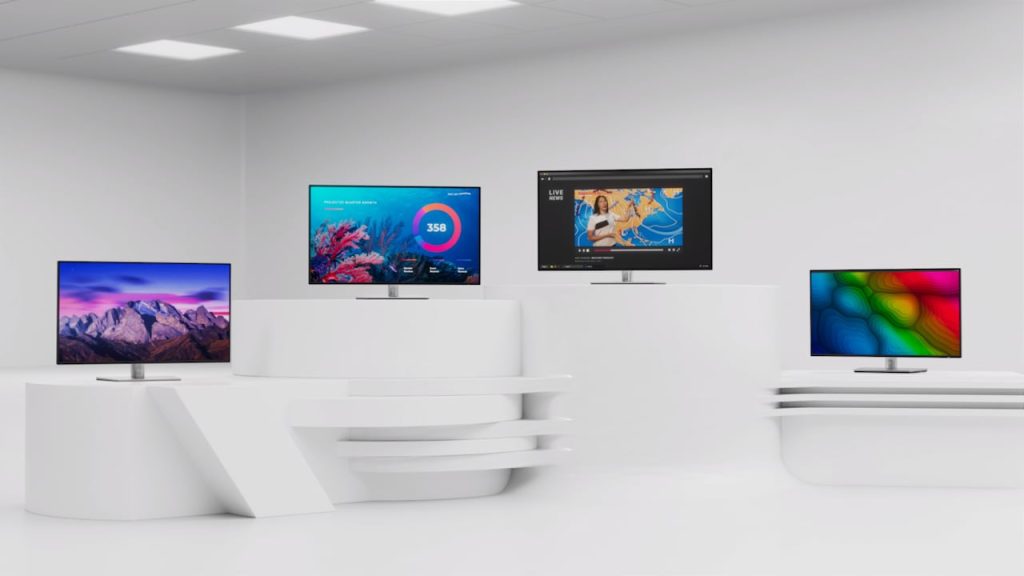
Dell, a multinational technology company, offers a wide range of computing products and solutions. Their product lineup includes laptops, desktops, workstations, servers, storage solutions, networking equipment, and monitors.
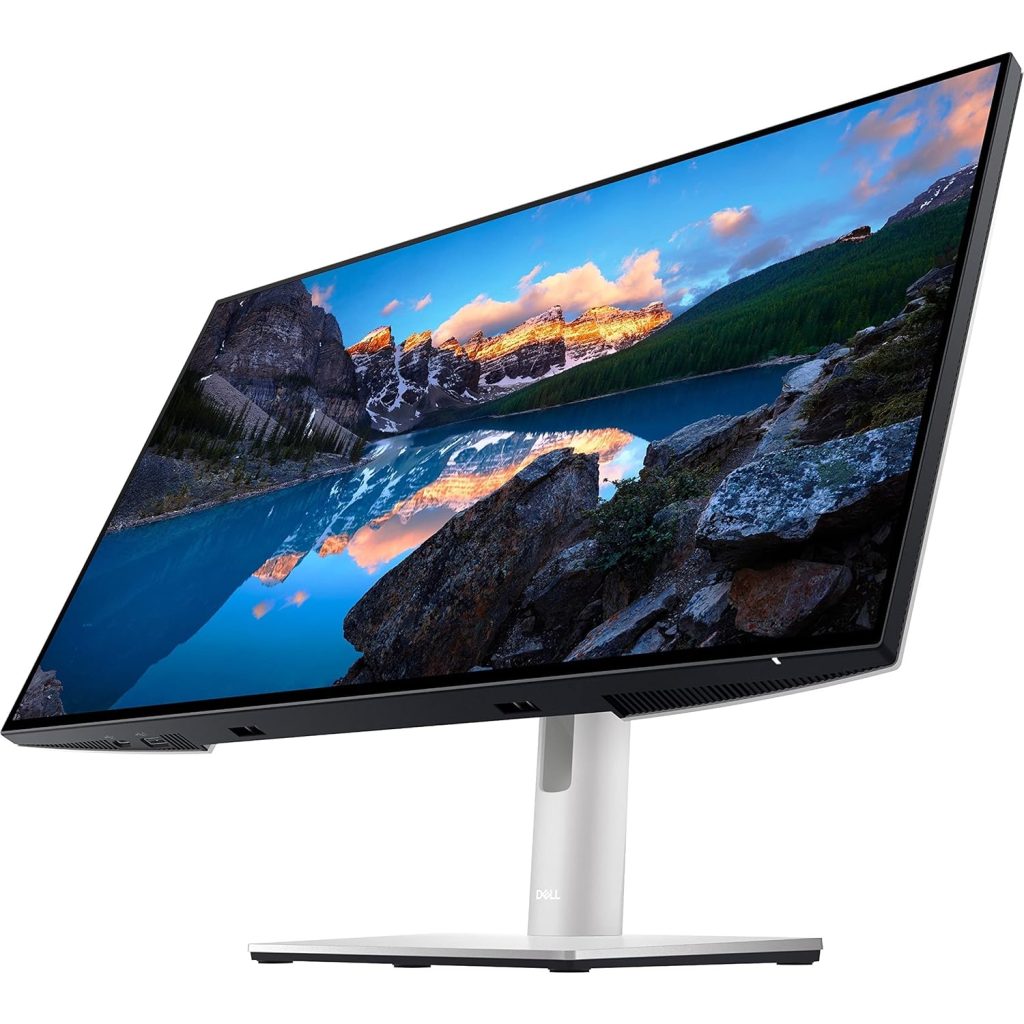
Earlier today, the company introduced two new high-refresh-rate UltraSharp series monitors, the U2424H and U2424HE, priced at 2499 yuan ($341) and 2799 yuan ($382) respectively. These monitors will be available for purchase on Tmall starting from October 24th.
Dell U2424H/U2424HE Monitors Key Features:
Both monitors feature a 23.8-inch IPS display with a resolution of 1920×1080, a 120Hz refresh rate, 250 nits brightness, and excellent color performance, including 100% sRGB, 100% BT.709, and 85% DCI-P3 coverage. They also offer impressive color accuracy with a ΔE of less than 2, capable of displaying approximately 16.79 million colors.
Both the U2424H and U2424HE monitors feature a stylish design with ultra-narrow bezels and a platinum silver finish. They offer versatile adjustability options, including a 150mm height adjustment, a tilt range from -5° to 21°, swivel from -45° to 45°, and a full 90° rotation. The U2424HE is slightly heavier, weighing approximately 3.98 kg, while the U2424H weighs 3.52 kg.
These monitors stand out due to their ALS ambient light sensor, enabling automatic screen brightness adjustment based on surrounding light levels. They also feature advanced blue light reduction technology, claiming to reduce harmful blue light by 65%. Notably, these monitors have received certification from TÜV Rheinland in Germany for their performance in these aspects.
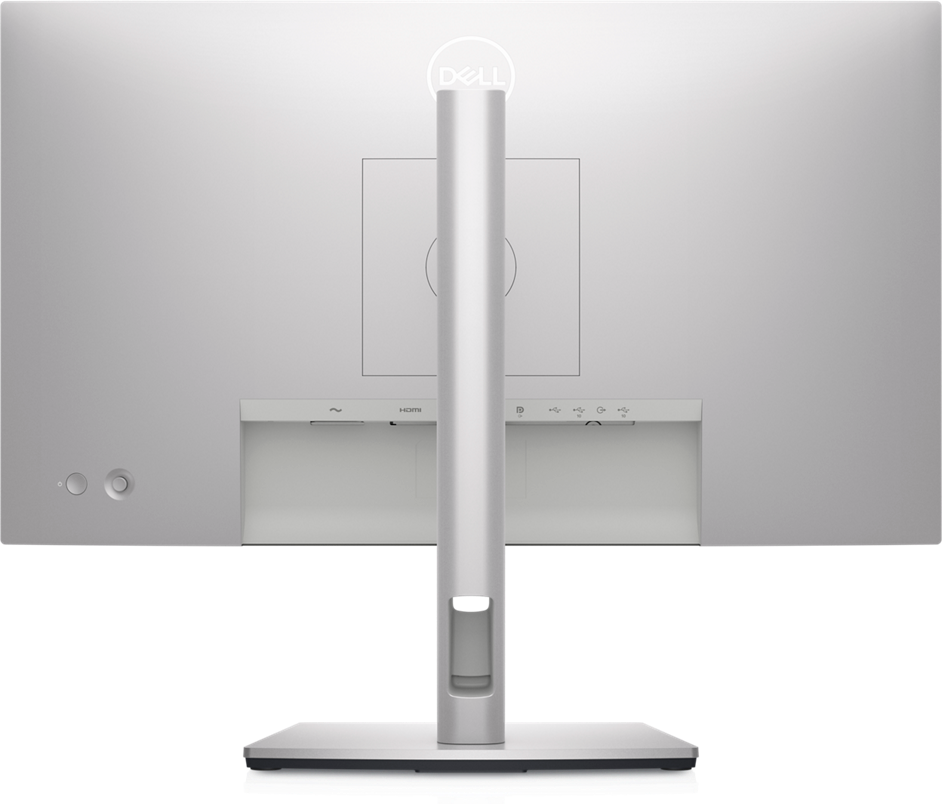
The U2424HE model offers a wide range of connectivity options, including a Kensington lock, HDMI and DP inputs, USB Type-C 90W power input, 10Gbps USB Type-C and Type-A ports (both second-generation USB 3.2), an audio port, and an RJ45 port with 2.5G capacity.
This model also supports KVM switch functionality, allowing users to control multiple devices with a single keyboard and mouse. In contrast, the U2424H lacks certain features such as 90W charging, RJ45 port, and KVM switch, which are present in the U2424HE.
Last month, Dell also launched a 24-inch USB-C Hub monitor in India, featuring 10-point multitouch support and an Ethernet port.
AMD recently pulled the curtain back on its latest offering for mobile gaming: the Radeon RX 7900M GPU. While it’s a powerhouse chip featuring 72 compute units and 16GB of GDDR6 RAM, what sets it apart is AMD’s focus on maximizing FPS in 1440p gaming, rather than chasing the 4K dream. This could be a game-changer for the average gamer who’s more interested in a smooth gaming experience than in pixel-perfect visuals.
The mobile GPU consumes up to 180 watts of power, which is quite high
Unlike its competitor, NVIDIA‘s RTX 4080 mobile chip, which has a power draw of 110 watts, the RX 7900M isn’t shy about its energy appetite, consuming up to 180 watts. However, it’s not without justification: AMD claims that its new chip can outperform the RTX 4080 by 7% in average frame rates. For instance, in games like Starfield, AMD says their chip could provide a 27% better performance.
But the RX 7900M isn’t just about raw power; it’s also about smart tech. AMD’s FSR 3 (FidelityFX Super Resolution) upscaling technology promises to give a significant FPS boost in games, making it a practical choice for gamers who don’t want to compromise on performance. Although the chip falls a bit short in ray-traced games against NVIDIA’s offering, it excels in rasterized games.
Adding to its catalogue, AMD has teamed up with Alienware to integrate the RX 7900M and its Ryzen 9 7945HX processor into the upcoming m18 laptop. This machine is not just about the specs, but also about creating an ecosystem where each component complements the other. The m18 laptop, featuring an 18-inch QHD+ display and up to 64GB of RAM, is expected to hit the market in the last quarter of 2023.
Ford‘s recent recall of 34,762 Mustang Mach-E electric crossovers has caught the attention of not just the EV industry, but also the general public. While the immediate concern is vehicle safety, this incident serves as a crucial reminder of the technological challenges that manufacturers face as they transition to electric vehicles.
The contactors that have to be replaced serve as the connection between the battery and motors
The recall focuses on the high-voltage battery main contactors in specific models manufactured between May 2020 and May 2022. The National Highway Traffic Safety Administration (NHTSA) indicates that fast charging and aggressive acceleration can cause these contactors to overheat. Overheating could lead to a sudden power loss, raising the risk of a crash.
Most articles emphasize the defect and the recall’s impact on Ford’s reputation, especially considering the automaker leads in recalls this year with 46, affecting nearly 5 million vehicles in the U.S. But let’s dig deeper. The contactors are essential components in an EV’s high-voltage system. They act as a bridge for electricity between the battery and the motors. They also serve as a safety switch, breaking the connection in emergencies. This recall underscores the need for technological innovation in even the most basic, yet critical, components of electric vehicles.
Ford has been proactive, offering to replace the problematic junction box for free and stating they are not aware of any accidents stemming from this defect. However, after reports of power loss even post-software updates, the NHTSA has initiated an investigation into Ford’s handling of the recall.
Don’t get us wrong – Ford’s recall is indeed a setback, but it can also be viewed as a pivotal moment for the industry to take a step back and focus on the fundamentals of EV technology. That’s probably the real moral of this story.
Ever think about ditching your car for something more maneuverable and eco-friendly on city streets? You’re not alone. Electric bikes are making headlines as the new go-to for short city trips, and Decathlon, a household name in outdoor gear, is hopping on the trend in style.
The bike is merely 15 kilograms in a medium size
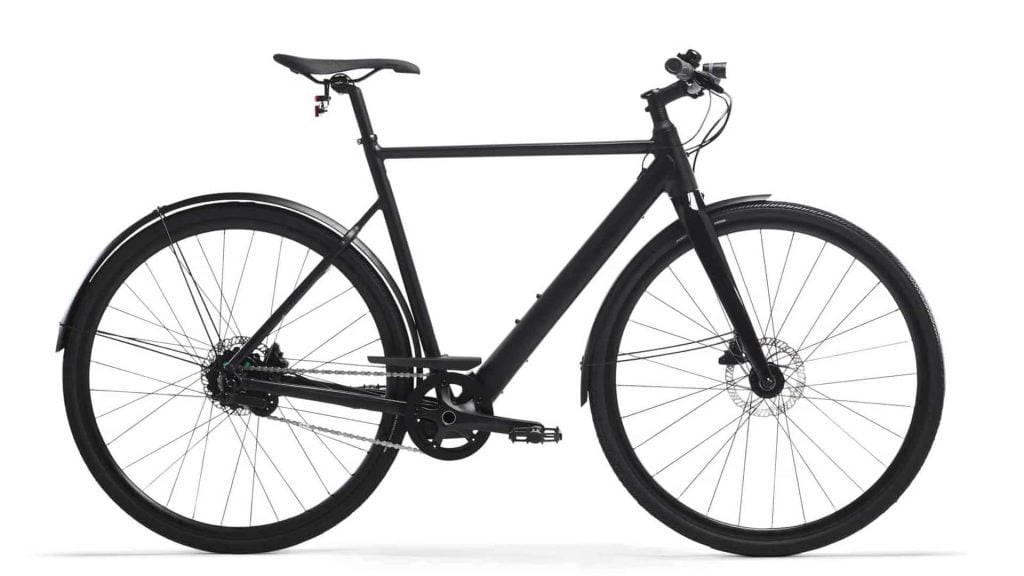
The French retail giant, known for its budget-friendly, high-quality outdoor equipment, is not new to the cycling game. But their latest offering, the B’Twin Speed 900E, is redefining what an e-bike can be. Unlike the clunky and obviously electronic two-wheelers, this bike’s all-black design and slim build makes it a wolf in sheep’s clothing. You wouldn’t even guess it’s an e-bike at first glance.
And it’s not just about looks. The Speed 900E weighs just 15 kilograms in a medium size, thanks to its innovative use of carbon fiber and aluminum. Combine this with its Mahle X35+ hub motor that churns out 250 watts of power, and you’ve got yourself a electric bike that can get you places without breaking a sweat.
The bike offers three levels of pedal assistance to let you tailor your ride. Need to go faster? Crank up the assist. Just cruising? Lower it down. The built-in 36-volt battery claims to cover 50 miles on a moderate 50% assist setting. Push it to full throttle, though, and you’ll need a recharge after just 19 miles. It’s a trade-off, but one that gives you the freedom to choose how you ride.
What’s the dent in your wallet for this urban jewel? Priced at roughly $2,000 USD, it’s certainly not the cheapest bike out there. But with built-in features like hydraulic disc brakes, puncture-resistant tires, and even an integrated tracking system via Decathlon’s Mobility App, it could be the smartest investment for hassle-free city commuting you’ll make this year.
Artificial intelligence and robotic technologies are advancing every day. As a result, we frequently write about robots developed by Boston Dynamics, Xiaomi, and Samsung. Even though we might not see these advancements in our daily lives beyond robotic vacuums, the business world is rapidly adopting them. For instance, Amazon has recently enhanced its warehouse robots, making them faster and even more intelligent. Here are the details…
Amazon’s New Sequoia Robotics System Promises to Improve Worker Efficiency and Health
The world’s largest digital shopping platform, Amazon, operates in many countries. What sets the company apart from its competitors is that in addition to its open marketplace, it has its own warehouses and distributes products from these warehouses in the locations it operates.
This not only improves customer satisfaction but also reduces delivery waiting times. For instance, even if a product is more expensive on another platform, I prefer to purchase it from Amazon if it’s sold there. Of course, this presents another operational challenge for the company: managing warehouse operations. Fortunately, Amazon addresses this issue with robotic and artificial intelligence technologies.
Amazon has announced a new robotics system called Sequoia, which is designed to improve worker efficiency and health, as well as lead to higher customer satisfaction. Sequoia is a set of integrated robotics systems that includes mobile robots, gantry systems, robotic arms, and a new ergonomic employee workstation.
Sequoia works by having mobile robots transport containerized inventory directly to a gantry. The gantry can either restock totes or send them to an employee to pick out the inventory that customers have ordered. Sequoia allows Amazon to identify and store inventory up to 75% faster than it could before, and it reduces the time it takes to process an order through a fulfillment center by up to 25%.
Sequoia is also designed to improve worker safety and health. The system brings totes of products to workers at a comfortable height, between their thighs and chest. This reduces the amount of bending and overhead reaching that workers have to do, which can help to prevent injuries. Amazon says that recordable incident rates were down 15% and lost-time incident rates were down 18% at Amazon Robotics sites in 2022, compared with non-robotics sites.
Amazon has not yet announced any plans for a wider rollout of Sequoia, but the system is currently operating in a Houston, Texas fulfillment center.
Emdoor, a Chinese company known for its Mini-PCs and tablet business, is venturing into the handheld gaming device market with a device powered by Intel’s upcoming Meteor Lake-H processor. The company showcased the device at the Hong Kong Electronics Fair 2023 event.
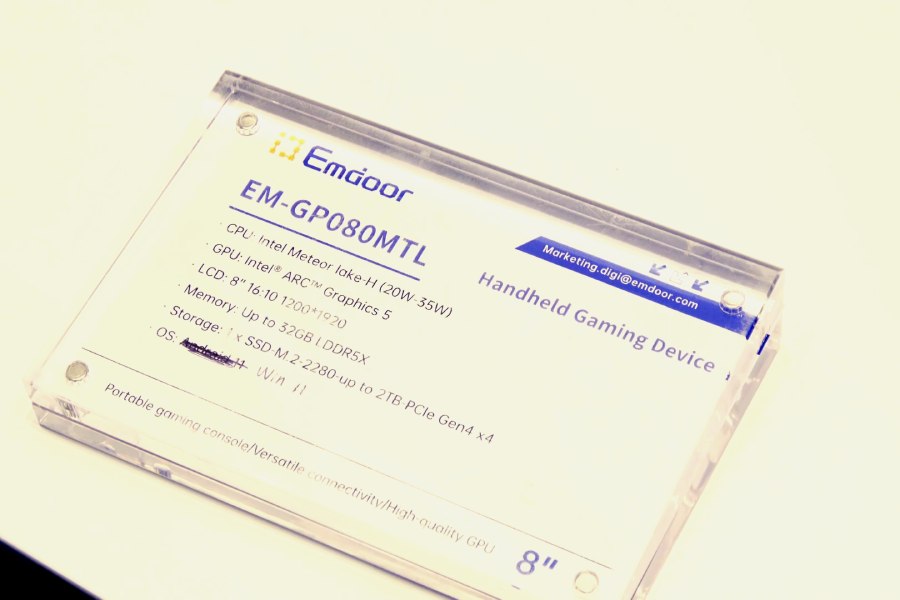
The device doesn’t have a unique design, but it does have some custom features, such as a built-in stand. However, the most notable feature is the new Meteor Lake H-processor with an Intel Arc 5 integrated graphics card.
It has a TDP of 20W to 25W, which is higher than the Steam Deck (9W) and the ASUS ROG Ally (15W). However, Emdoor says that the CPU package power fluctuates between 2W to 5W when the system is in an idle state or operating within its custom UI overlay.
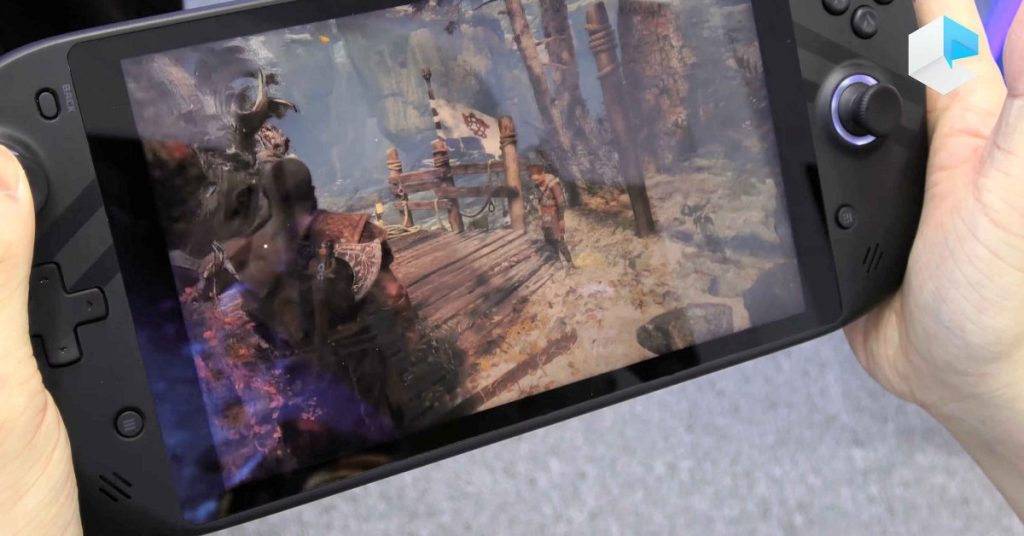
Emdoor has not released any performance numbers for the device yet, but the Xe-Cores in the Arc 5 integrated graphics card are expected to be powerful enough to run today’s latest AAA games. A video from Notebook Italia shows God of War running smoothly on the device.
Additionally, the device features an 8-inch screen with a 1920 x 1200 resolution, up to 32GB of LPDDR5X RAM, and up to a 2TB PCIe Gen 4×4 SSD.
The Emdoor handheld gaming device is expected to compete with the ASUS ROG Ally, the Nintendo Switch, and the Valve Steam Deck.
Recently, Nothing opened the doors to its first exclusive service center in India. Now, the Carl Pei-helmed company has announced a partnership with a leading electronics retail chain Croma in the country. Basically, this means that customers will be able to purchase Nothing products from select Croma stores. Nothing’s devices have been exclusive to Flipkart since the beginning. The Phone (2) was the first to be available from Vijay Sales in July this year. Read on to know what the Croma partnership means for customers.
Nothing partners with Croma
As mentioned earlier, Nothing as well as CMF by Nothing devices will be available from Tata-owned Croma retail outlets across the country. As a part of the partnership, Nothing is offering Rs 3,000 discount on the purchase of the Phone (2) from Croma to exclusive ICICI Bank cardholders.
Speaking on the partnership, Nothing India GM and VP Manu Sharma said that India is a pivotal market for the company and the collaboration with Croma is a collective effort to offer their products to a whole new audience.
This isn’t the first time, Nothing has focussed on the Indian market. The brand conducted a special event called Nothing Care Camp last month to deliver better customer service. It is now held at the exclusive service center in Bengaluru every second Saturday and Sunday. The Nothing executive previously stated that the company aims to extend its exclusive service center to 20 in 2024 and 35 in 2025.
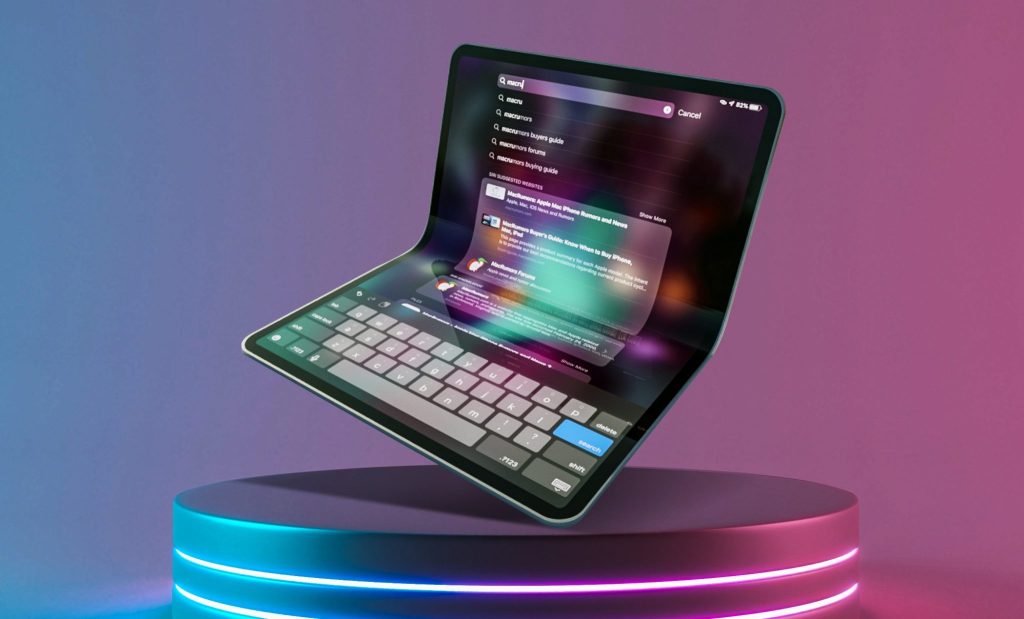
In the world of foldable devices, Apple has long been missing from the scene, leaving Samsung, Google, Huawei, Honor, and Motorola to dominate the market. However, Apple is now gearing up to make its presence felt by taking a unique approach – entering the foldable arena through the door of tablets. Instead of chasing the trend of foldable smartphones, Apple is expediting the development of a foldable iPad, aiming to lead the way in an untapped foldable tablet market.
Apple is Accelerating the Development of the Foldable iPad
Despite the undeniable success of foldable smartphones, with a Canalys report projecting the introduction of 37 new models in 2023 alone, Apple has chosen to remain on the sidelines. This growing sector now commands a 5% share of the global premium smartphone market, a significant increase from a mere 0.3% in 2019. Nonetheless, Apple’s delay in entering the foldable market has been viewed as a missed opportunity.
Recent reports from DigiTimes indicate that Apple is now changing its strategy to seize a fresh opportunity in the foldable tablet segment. Apple is closely collaborating with its suppliers, with the goal of starting small-scale production of a foldable iPad by late 2024, potentially launching it by the end of 2024 or early 2025. Even analyst Ming-Chi Kuo predicted the same a few months back and according to him, the foldable iPad will also feature a lightweight carbon fiber kickstand.
Insiders have revealed that Apple has been working on this project since 2023 and has secured key design and functionality patents. The patent sketches reveal a sleek foldable tablet with a flexible hinge mechanism, exuding a slim, stylish aesthetic with Apple’s signature finesse.
In a market dominated by foldable smartphones, Apple’s pivot towards foldable tablets could prove to be a game-changer. With competitors already making their mark in foldable technology, Apple’s entry could bring fresh innovation and competition to the foldable tablet sector.
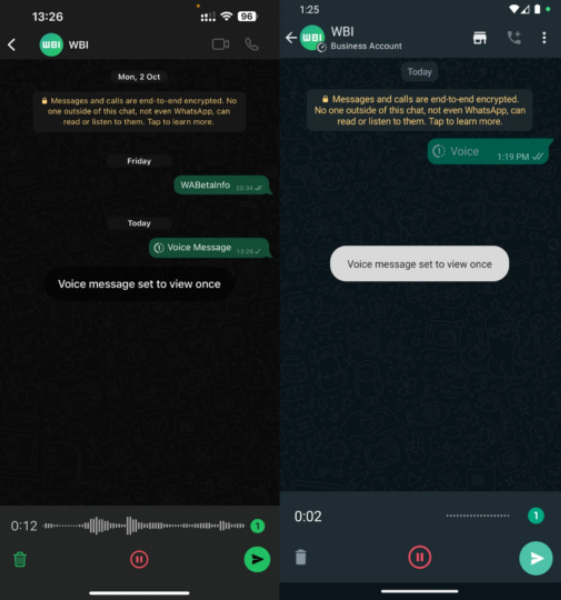
WhatsApp has introduced a new self-destructing audio message feature to its beta app on iOS and Android. This feature allows users to send audio messages that disappear after the recipient has played them once.
The feature was first spotted by WABetaInfo, which learned that some users running the latest version of WhatsApp Beta are able to send self-destruct audio messages. It is currently accessible to select testers on WhatsApp beta for Android 2.23.21.15 and 2.23.22.4 as well as WhatsApp beta for iOS 23.21.1.73.
The feature works in the same way as the existing “View Once” feature for photos and videos, which was introduced in 2021. This means that the recipient cannot save, or forward your sent audio message.
To send a self-destructing audio message, users simply need to tap the “1” button next to the send button. This will enable the “View Once” feature for the audio message. And once the recipient has played the message, it will disappear from their chat.
It is not yet known when WhatsApp will make the self-destructing audio message feature available to the public, but it is a welcome addition for users who want to share private information that they do not want to be saved or shared by others.
In related news, WhatsApp recently introduced a PassKey-based login for Android users. This new feature will provide users with a more secure and convenient way to log in to their WhatsApp accounts, without the need for traditional passwords or two-factor SMS authentication.
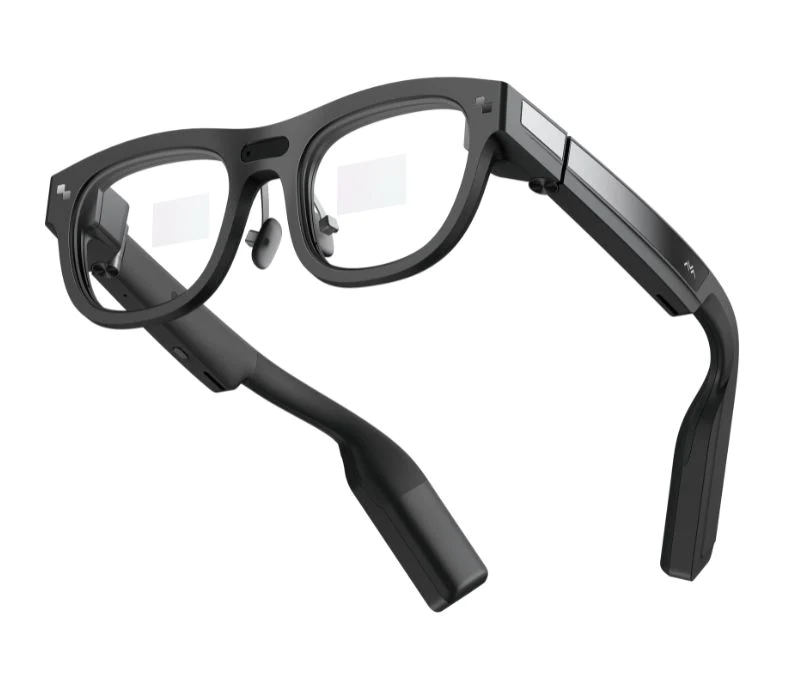
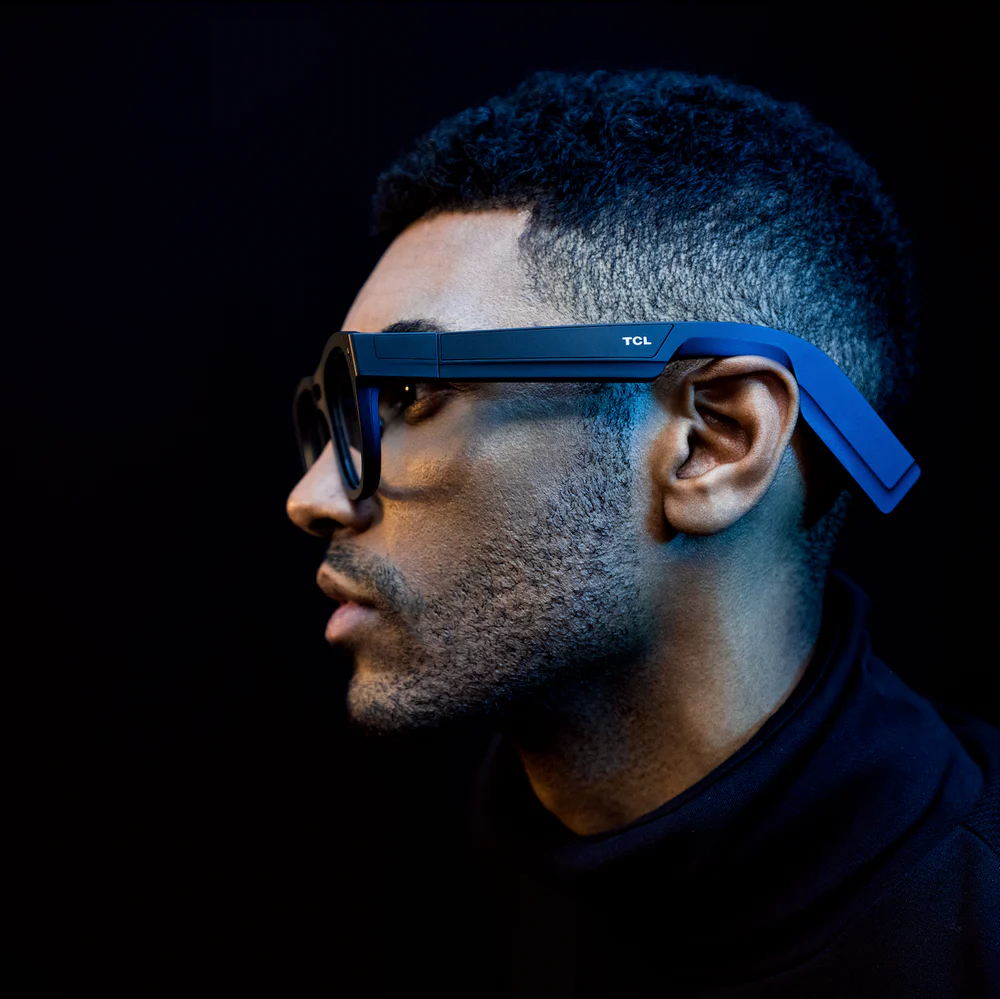
Chinese electronics giant TCL first announced the RayNeo X2 AR glasses at CES 2023 in January. Ordinarily, many would have thought the AR glasses were just a concept product that may not hit store shelves. However, the company has launched the RayNeo X2 in its home market of China where it is now available to pre-order.
The RayNeo X2 features a pair of Micro-LED displays with impressive specifications, including a peak brightness of 1,000 nits and an outstanding contrast ratio of 100,000:1. Each display operates at a resolution of 640 x 480 pixels per eye, offering a 25-degree field of view (FoV) with 32 pixels per degree (PPD). Powering these impressive features is the Qualcomm Snapdragon XR2 platform, supported by 6 GB of RAM and 128 GB of storage. The device is equipped with a 590 mAh battery that can provide up to 3 hours of continuous usage.
In terms of design, the AR glasses are lightweight, tipping the scales at just 119 grams. They also include a 16 MP front-facing camera capable of capturing 1080p video at 30 FPS. For audio, the RayNeo X2 combines stereo speakers with three microphones, ensuring high-quality audio transmission.
Pricing & Availability
As for the price, the TCL Rayneo X2 AR glasses carry a retail price tag of 4,499 Yuan (approximately $617) in China. The smart glasses are expected to eventually make it to other markets. Already, it is listed on TCL’s US website which is an indication that the product will be available in other markets outside China. t
Vivo is already set to unveil the flagship X100 series by the end of the year. Rumors and leaks have been circulating about the upcoming offerings consistently revealing various details including battery, processor, charging speed, and more. Now ahead of the launch, the Vivo X100 has bagged 3C certification in China confirming its charging details. Read on to know more below.
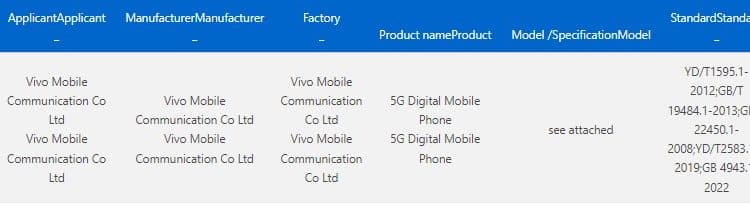
Vivo X100 appears on 3C
The Vivo X100 is listed on 3C certification website with model number V2309A. Meanwhile, the charging adapters have model numbers V12060L0A0-CN / V12060LIH0-CN1 / V12060LIA0-CN / V12060LIH1-CN indicating that the phone may ship with any one of those. All the adapters support up to 120W fast charging thus confirming the charging speed on the standard X100. However, like its predecessor, the upcoming offering will miss out on wireless charging.
Apart from the 3C certification, a new leak by Digital Chat Station which is now deleted revealed that the Vivo X100 may be announced in two variants – one with a curved display, a 5,400mAh battery with support for 100W charging and another model with a flat OLED display, a smaller battery, and 120W charging.
Meanwhile, as per past reports, the Vivo X100 Pro is tipped to be backed by a 5,100mAh battery with support for 120W wired and 50W wireless charging. On the other hand, the X100 Pro+ will reportedly have a 5,400mAh cell with support for 100W wired and 50W wireless charging.
The Vivo X100 is expected to debut in the third week of November.
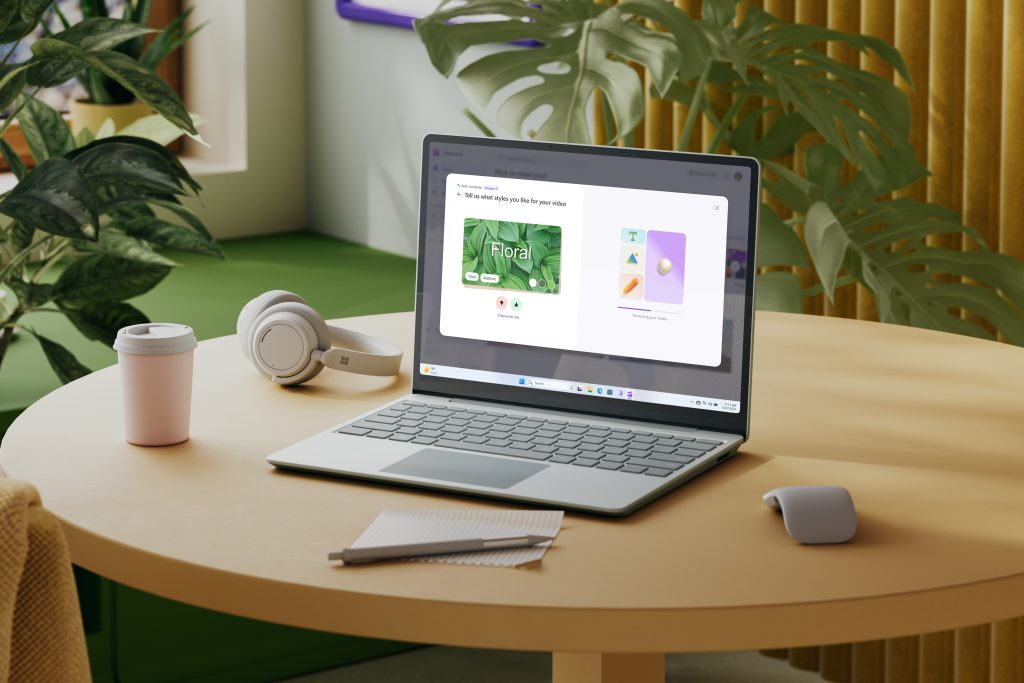
At its annual hardware event held last month, Microsoft announced a host of Surface devices. Now the Redmondo-based company has brought the Surface Laptop Go 3 to the Indian market. It arrives as the successor to last year’s Surface Laptop Go 2. The Surface Laptop Go is the lightest and most portable Surface offering from the company. Read on to know more about the latest edition below.
Microsoft Surface Laptop Go 3 specifications and features
Microsoft Surface Laptop Go 3
The Microsoft Surface Laptop Go 3 has a 12.4-inch display bearing a resolution of 1,536 x 1,024 pixels. It offers touchscreen functionality along with 330 nits peak brightness, and Gorilla Glass protection. On the audio front, the laptop is equipped with Omnisonic speakers with Dolby Audio premium and dual far-field studio mics. There is a 720p front-facing camera. The Surface Laptop Go 3 features a fingerprint scanner embedded in the power button with Windows Hello authentication.
Under the hood, the Microsoft Surface Laptop Go 3 is equipped with a 12th generation Intel Core i5 processor paired with Intel Iris Xe GPU onboard. It packs up to 16GB LPDDR5 RAM and 512GB SSD. The device is powered by a 40Wh battery cell that is claimed to offer 15 hours of usage. Software-wise, it runs on Windows 11 OS with the company’s AI companion called Microsoft Copilot.
Connectivity options on the Surface Laptop Go 3 include a USB-C port, USB-A port, 3.5mm jack, WiFi-6, Bluetooth 5.1, and a Surface Connect port.
Microsoft Surface Laptop Go 3 price in India
Under the Surface Laptop Go 3 series, the pricing for various configurations is as follows:
Intel Core i5, 8GB RAM, 128GB SSD: Priced at Rs. 82,135 for the Surface for Business users only
Intel Core i5, 8GB RAM, 256GB SSD: Priced at Rs. 98,562 for the Surface for Business, and Rs. 80,999 for the Surface for Consumer.
Intel Core i5, 16GB RAM, 256GB SSD: Priced at Rs. 117,817 for the Surface for Business, and Rs. 1,00,999 for the Surface for Consumer.
Intel Core i5, 16GB RAM, 512GB SSD: Priced at Rs. 133,884 for the Surface for Business users only
The Microsoft Surface Laptop Go 3 comes in platinum color only. The laptop is available for pre-orders starting today with sales commencing November 9 from Reliance Digital, Croma, Amazon, and Vijay Sales. Those who pre-book will be eligible for exclusive promotions including a complimentary Marshall Major IV Wireless Headset and a 1-month free subscription for Microsoft 365 and PC Game Pass.
Oppo is apparently working on a new smartphone model from its popular A series. The new device in question is the Oppo A59 5G, which was recently spotted in a couple of certification platforms. This means that its launch could be near.
Oppo A59 5G Spotted on Bluetooth SIG and BIS
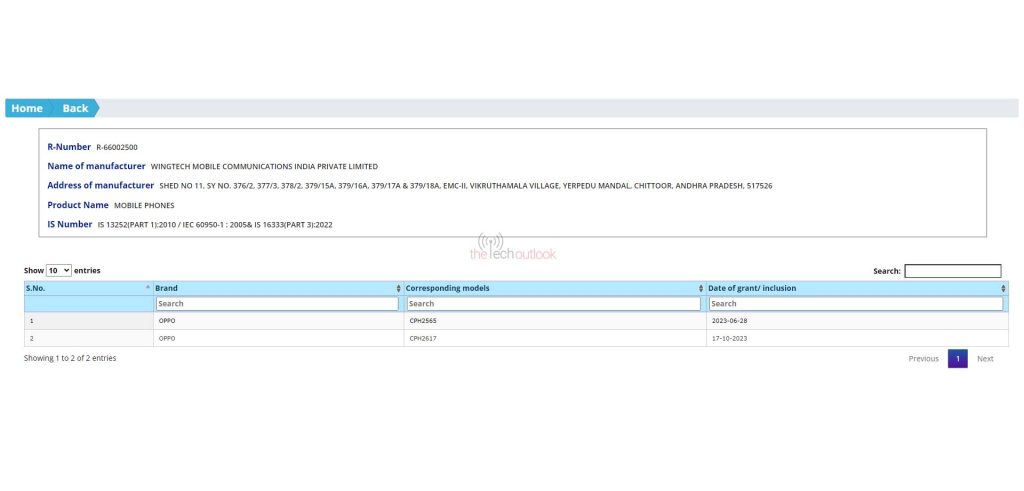
The Chinese tech giant’s upcoming A59 5G model had recently surfaced on the BIS (Bureau of Indian Standards) and the Bluetooth SIG certification platform. On the former, the A59 can be seen carrying the model number CPH2617. The BIS listing basically confirms that the smartphone will be launching in the Indian market in the near future.
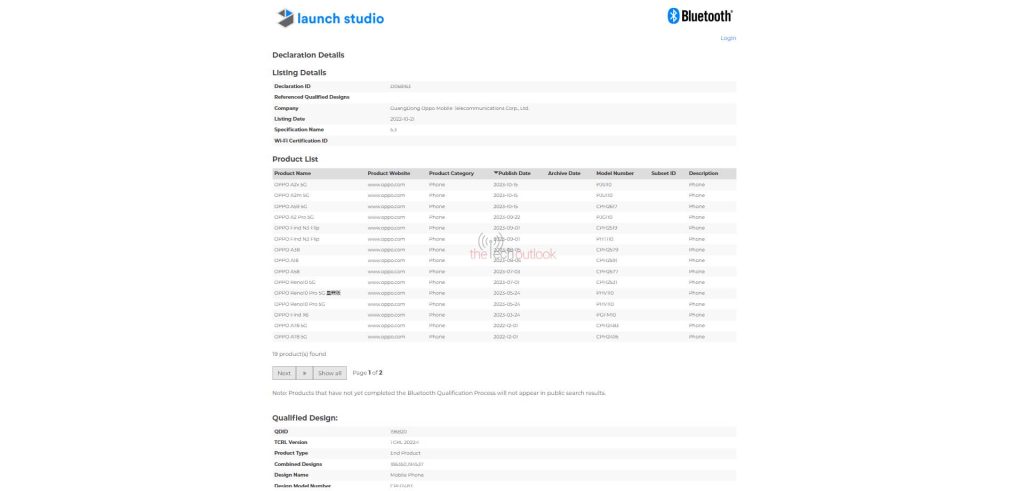
On the other hand, this model number was also reflected on the Bluetooth SIG certification as well. The online database confirms that the Bluetooth 5.3 version. Unfortunately, neither of the two platforms has revealed any finer details regarding this device. So its design, specifications, pricing, or launch details are still at large. But we can assume that it will feature upgrades over its predecessor, the A58 5G model.
The Oppo A58 5G sports a 6.56-inch IPS LCD panel, 90Hz refresh rate, and HD+ resolution. Under the hood, it features a MediaTek Dimensity 700 SoC that is paired with up to 8GB of RAM and 256GB of internal storage. The rear packs a 50-megapixel dual camera setup, while the front houses an 8-megapixel selfie shooter. A large 5,000mAh battery pack powers this device, which also supports 33W fast charging. So there are likely some upgrades in specs and slight updates in design.
Apple is one of the world’s largest technology companies, with a user base reaching hundreds of millions. This means even the company’s services have their own economy. For instance, the App Store is a billion-dollar revenue source that hosts numerous companies and individual developers. However, as Spider-Man fans would remember, “With great power comes great responsibility,” and the tech giant seems to be facing some issues with the responsibility aspect. According to recent reports, Apple has dismissed several members of its App Store team in China due to “business misconduct” and “sexual assault.” Here are the details…
Apple Investigates App Store Team for Business Misconduct and Sexual Assault Allegations
We closely follow technology companies, which operate in many different countries around the world and consist of vast teams and departments. Therefore, although it’s unfortunate, scandals sometimes emerge. For instance, we recently reported the arrest of Vivo’s regional CFO in India, along with other executives, due to a $120 million money laundering case. Now, it has come to light that Apple has fired multiple App Store employees after an investigation revealed business misconduct and allegations of sexual assault.
Based on the information provided, Apple conducted a year-long internal investigation that revealed various misdeeds. These included improper contact with mobile game developers, sexual assault, and more. The company first became aware of the issue during an internal audit in 2022 and has since conducted a thorough investigation. More than half a dozen staff members from the App Store business team in China were implicated in this investigation. However, only five of them were dismissed over this period.
Unfortunately, the specific nature of the business misconduct is unclear. However, one of the issues involves bending the rules of the App Store. The individuals under investigation help developers get their apps approved for listing in the store, offer advice on how to increase app revenue, and decide which apps to feature on the App Store’s main home pages. Although at first glance this may not seem too bad, listing an app without proper scrutiny and boosting it with various information appears to have led to unfair competition.
Of course, this wasn’t the only instance where ethical lines were crossed. It was reported that Apple employees accepted “complimentary meals and nightclub outings from these parties,” in return for potential exposure and editorial promotion in the App Store. However, it’s important to emphasize that none of the individuals involved in the investigation had the power to directly approve or reject apps from the App Store. Yet, some of the dismissed employees had roles that could influence decisions. I’m sure you’ve also thought about how easily certain things can be done from the inside at your workplace. The situation here is no different.
Apple has stringent rules regarding certain communications. For instance, App Store review and editorial staff are not permitted to meet with developers unless they have prior approval. While those in “developer relations and business management” can meet with developers, they must not accept expensive gifts or meals. If you think what I’ve mentioned so far is bad, a report revealed that Apple dismissed an App Store employee last year over allegations of sexual assault on another employee.
An employee from Apple’s structure in China, which has been described as “corrupt”, has allegedly sexually assaulted an employee at Mihoyo. For those who may not know, Mihoyo is a Chinese game developer famous for its popular mobile game, Genshin Impact. Sadly, the details of this heinous crime are unknown. Despite the best efforts of some reputable peers in the tech media, the fired employee did not respond to a request for comment, and Mihoyo’s spokespeople did not respond to multiple requests for comment.
Apple’s statement on the subject is as follows:: “Without commenting on the specific allegations of this report, Apple expects its employees worldwide to abide by its very strong ethics and business conduct policies. We thoroughly investigate reports of improper conduct and when appropriate will not hesitate to take immediate action up to and including termination.”
The firing of these employees is a reminder that even the biggest and most successful tech companies are not immune to misconduct. It is also a reminder that Apple is committed to creating a safe and inclusive workplace for all employees.
Xiaomi had unveiled the Redmi Note 13 lineup in China back in September 2023. The company is planning on releasing these devices globally, including in the Indian market. Now, a recent sighting on a certification platform has revealed some details regarding the upcoming global variant of the Redmi Note 13 Pro+ ahead of any official announcement.
Redmi Note 13 Pro+ spotted on FCC
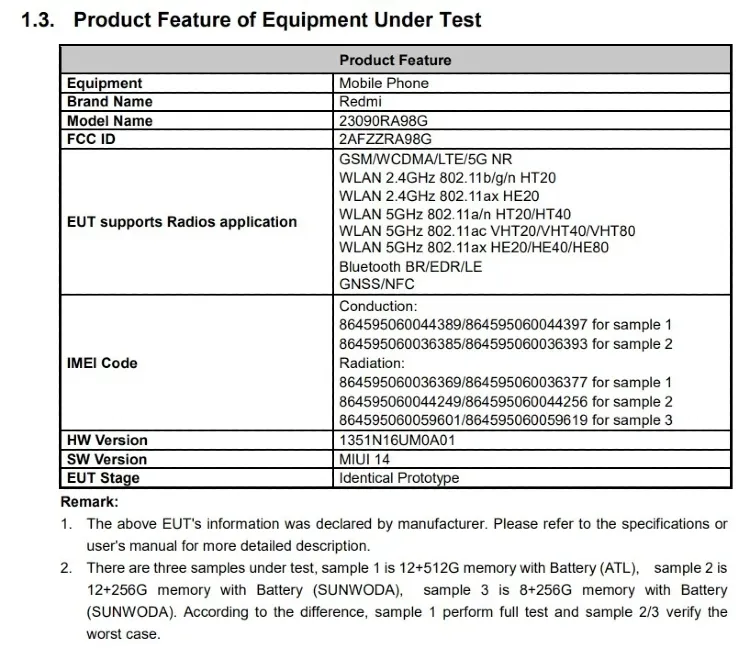
The new smartphone had surfaced on FCC certification. It was spotted carrying the model number 23090RA98G. Furthermore, the online listing has revealed the storage options of the Redmi Note 13 Pro+. This device will apparently come in three storage configurations, including 8GB + 256GB, 12GB + 256GB, and 12GB + 512GB. The smartphone is also expected to run on Android 13 OS based MIUI 14 custom skin out of the box.
The FCC listing revealed that the Redmi Note 13 Pro+ will support 5G and 4G LTE networking along with dual band WiFi, Bluetooth, NFC, and GPS. Earlier today, we reported on the base Note 13 model also surfacing on the FCC platform. The Redmi Note 13 Pro model has also surfaced on Korea’s NRRA certification earlier this week.
Based on what we know so far, the device sports a tall 6.67-inch AMOLED display that supports FHD+ resolution, 120Hz refresh rate, and Corning Gorilla Glass Victus. Under the hood, it is equipped with the MediaTek Dimensity 7200 Ultra SoC. A large 5,000mAh battery pack powers this handset, which supports an impressive 120W fast charging. The rear packs a 200-megapixel triple camera setup, while the front houses a 16-megapixel selfie shooter.
The Internet Giant is set to make its manufacturing debut in India starting with Pixel smartphones. Following, “encouraging responses” from the audience in the country, Google has finally made up its mind to debut production in India. The company intends to enhance its presence in India’s smartphone market.
Under the “Make in India” initiative, Google will start producing the Pixel 8 series in the country from 2024 onwards. They will mend a partnership with international contract manufacturers for smartphone production.
Speaking at a Google for India event, Rick Osterloh, senior vice president of devices and services, said, “India is a priority market for Pixel smartphones, and we’re committed to bringing the best of our hardware and underlying built-in software capabilities to people across the country,” and further added, “We are partnering with international and domestic partners to produce Pixel smartphones locally. It’s an early step towards expanding our production here to meet the local demands for Pixel devices and even more importantly it’s a huge step forward in Google’s commitment to India.”
India is a major market for Google Services and is investing over $10 billion in the country in the next few years. It is a major boost for the country’s digital economy. Like Apple, we hope Google will ramp up its production capacity in India over time.
Other Announcements at the 9th Google for India Event
Following the new production spheres in India, the company is also bringing pre-approved credit lines from banks. It will enable Google Pay users to access “formal credit” easily while ensuring privacy safeguards.
In partnership with Axis My India media company, Google introduced a new app called “a.” to enlighten people about various social welfare programs, employment opportunities, and health benefits.
Google also introduced an initiative called DigiKavach in collaboration with industry partners to secure users from online fraud.
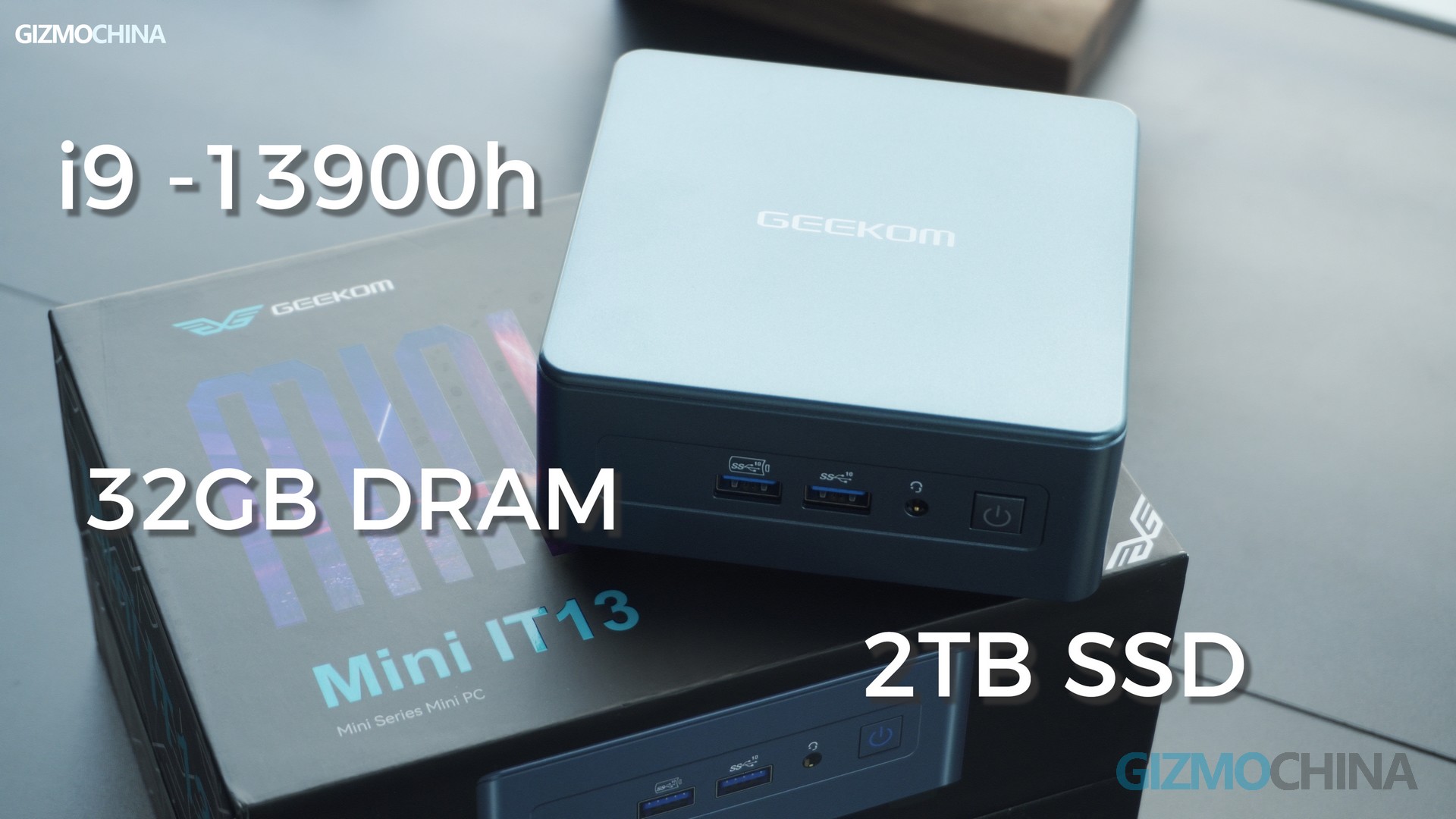
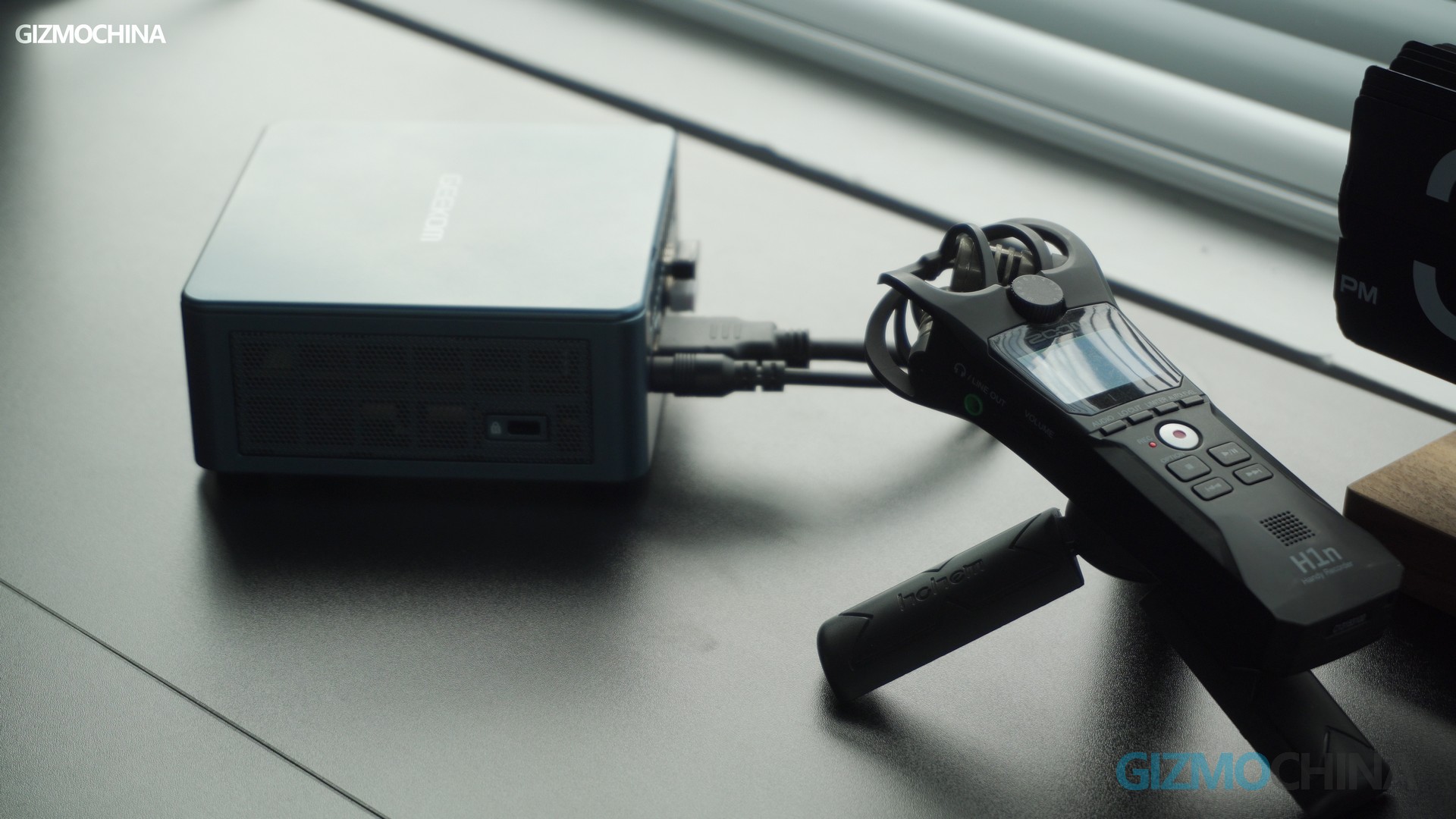
Today I got my hands on the latest mini PC from GEEKOM – the mini IT13. This is the first mini PC powered by the latest INTEL 13th CORE processor we’ve ever reviewed. And luckily I got the highest version. The tiny box down below is a monster PC with an i9-13900h CPU, 32g RAM, and 2TB SSD. It might be also the most powerful mini PC that you can find on the market. After having it for tests and daily uses, I would say that this little bomb is truly impressive. So I can’t wait to introduce it to you guys.
Unboxing
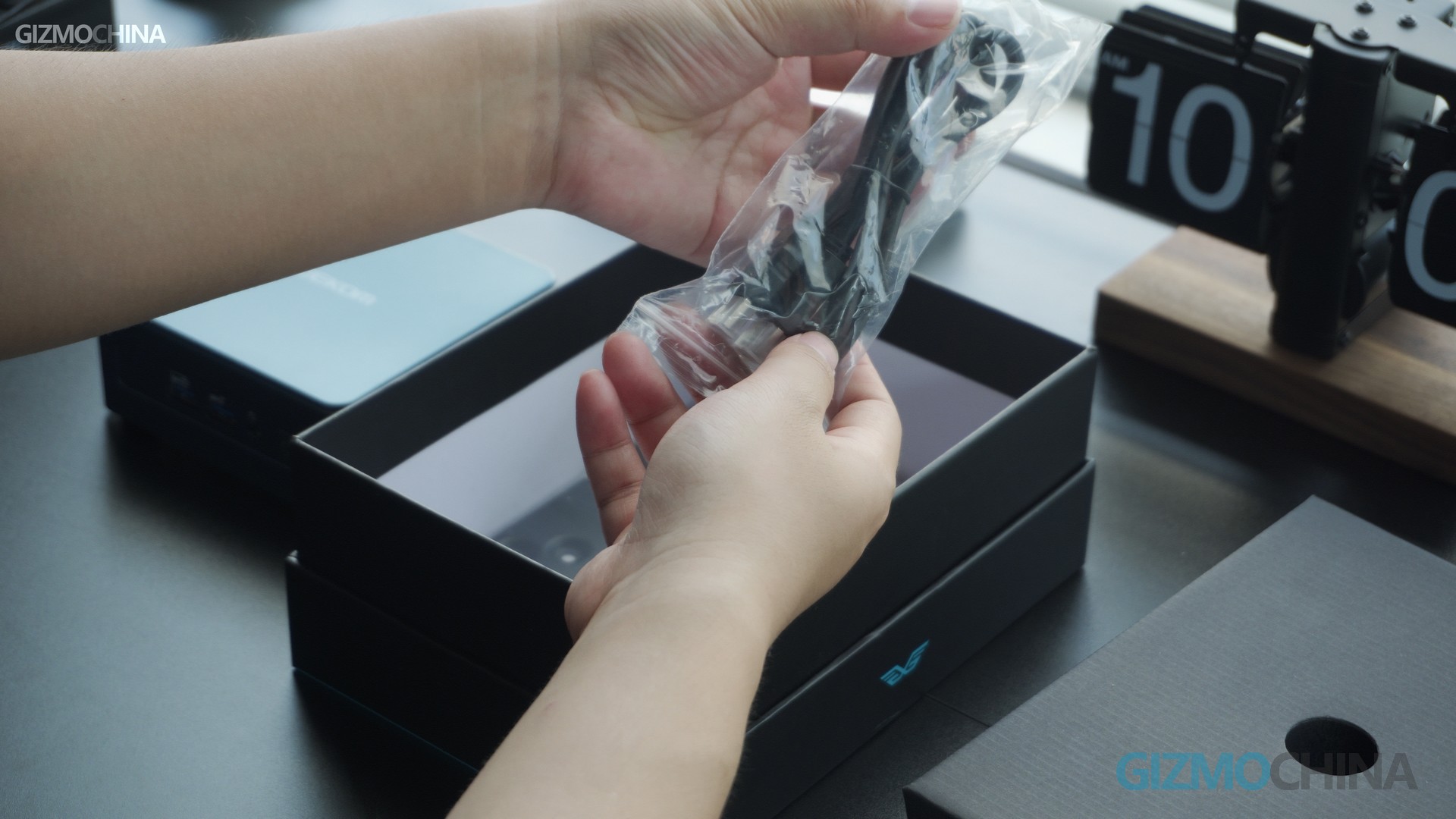
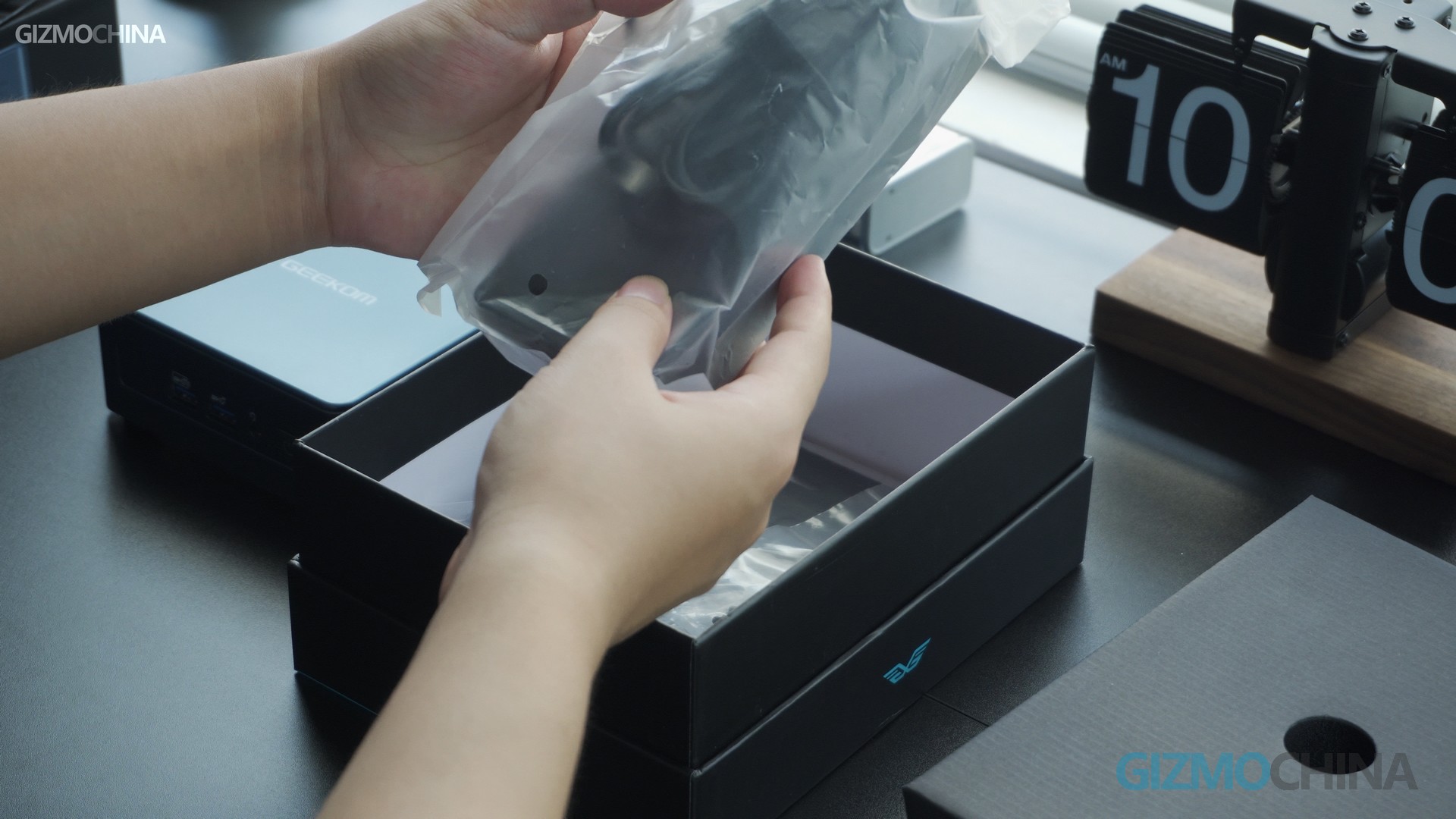
In terms of packaging, the mini IT13 is packaged in a compact color box. Open it and I can see the mini-PC, and underneath it are some accessories, including a 120w power adapter that supports wide-range inputs, a HDMI cable, a User Manual, and a VESA Mount. The VESA Mount can secure the unit to the back of most monitors, collecting and hiding the cables in a good way. So by far, GEEKOM has done a really good job with all the accessories.
Design
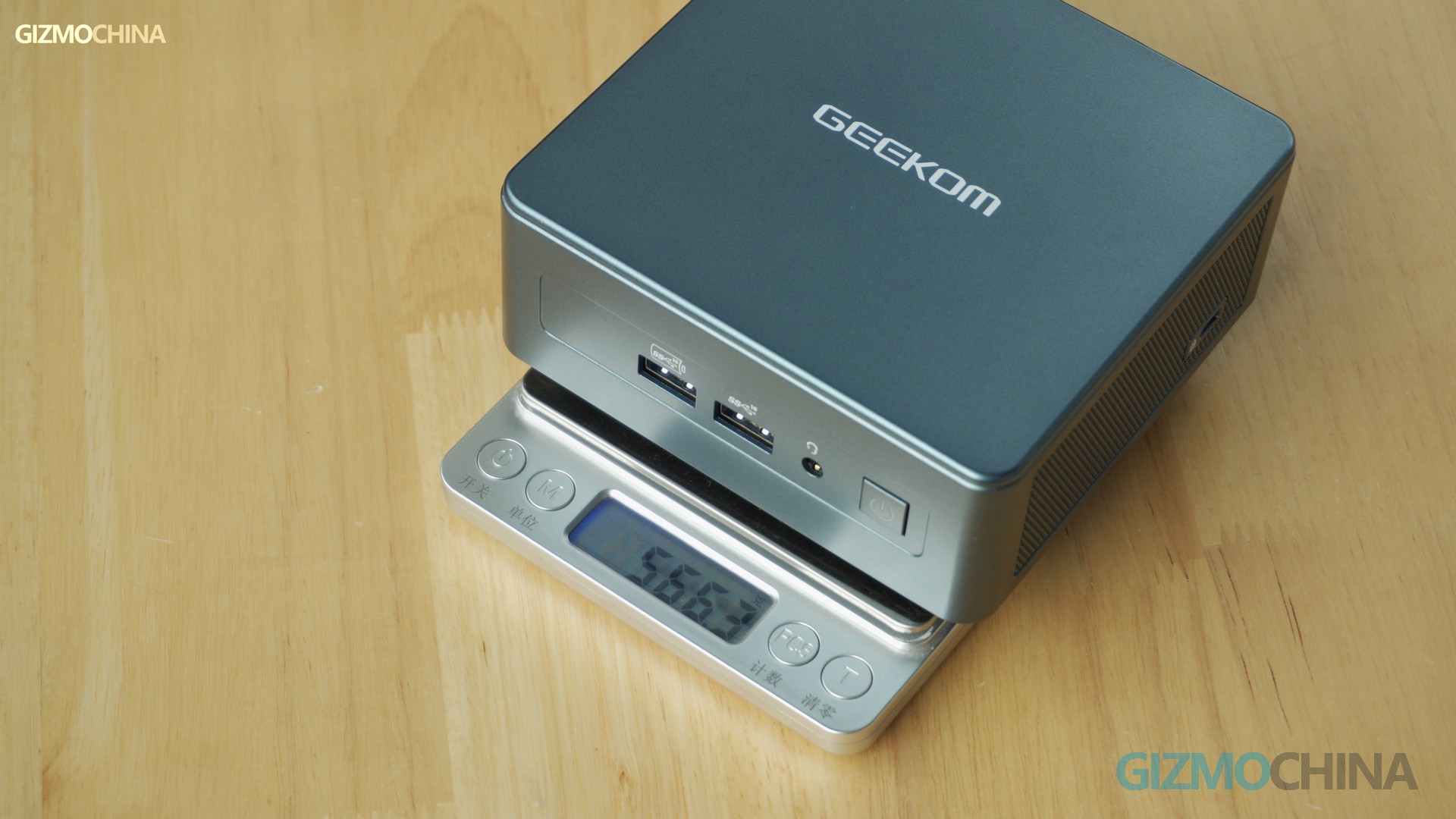
The mini IT13 is made of metal in most of the body, everything I can touch is made of metal, but it only weighs 652g, which is much lighter than most laptops, So it’s pretty easy to carry on the go.
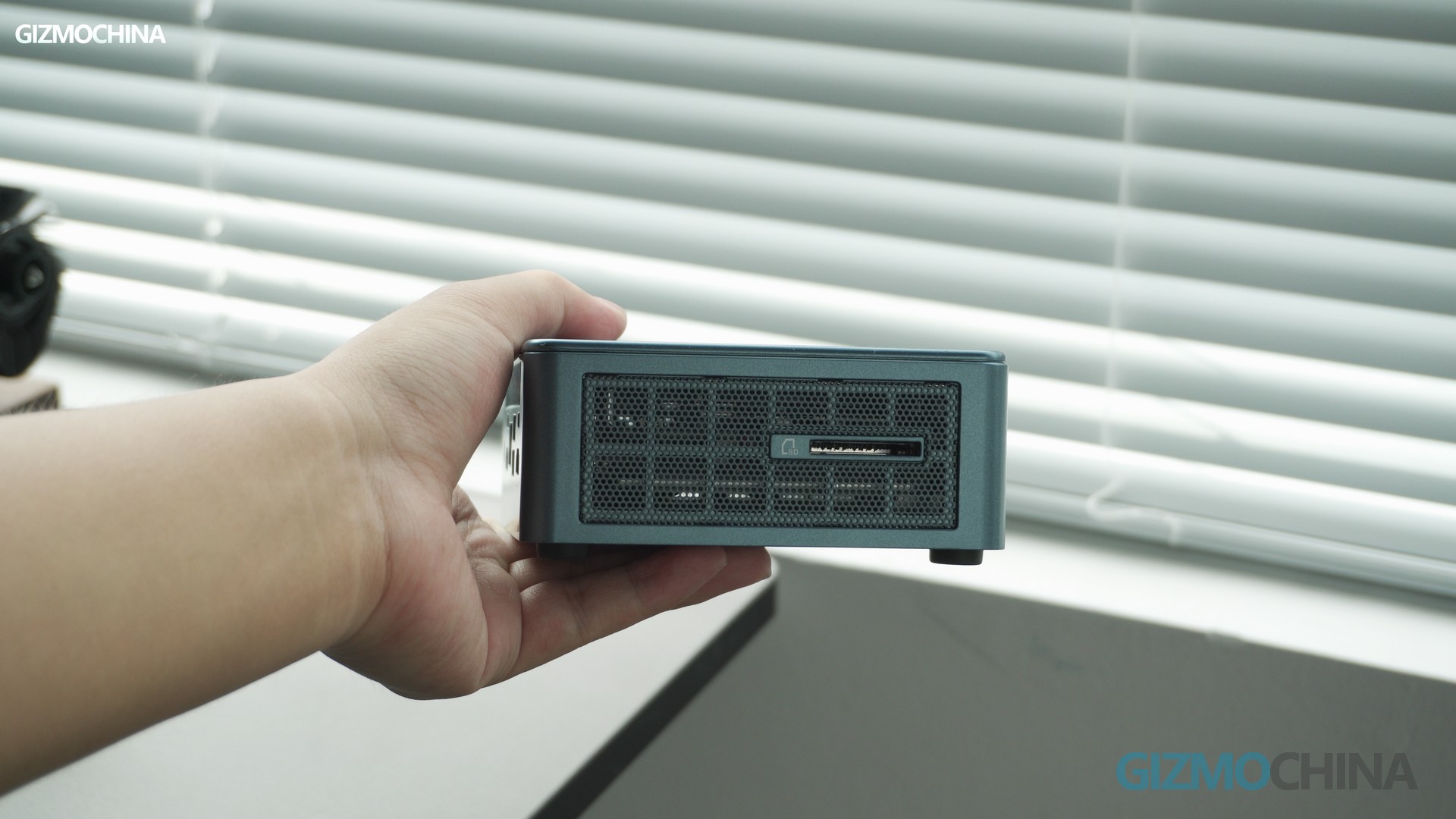
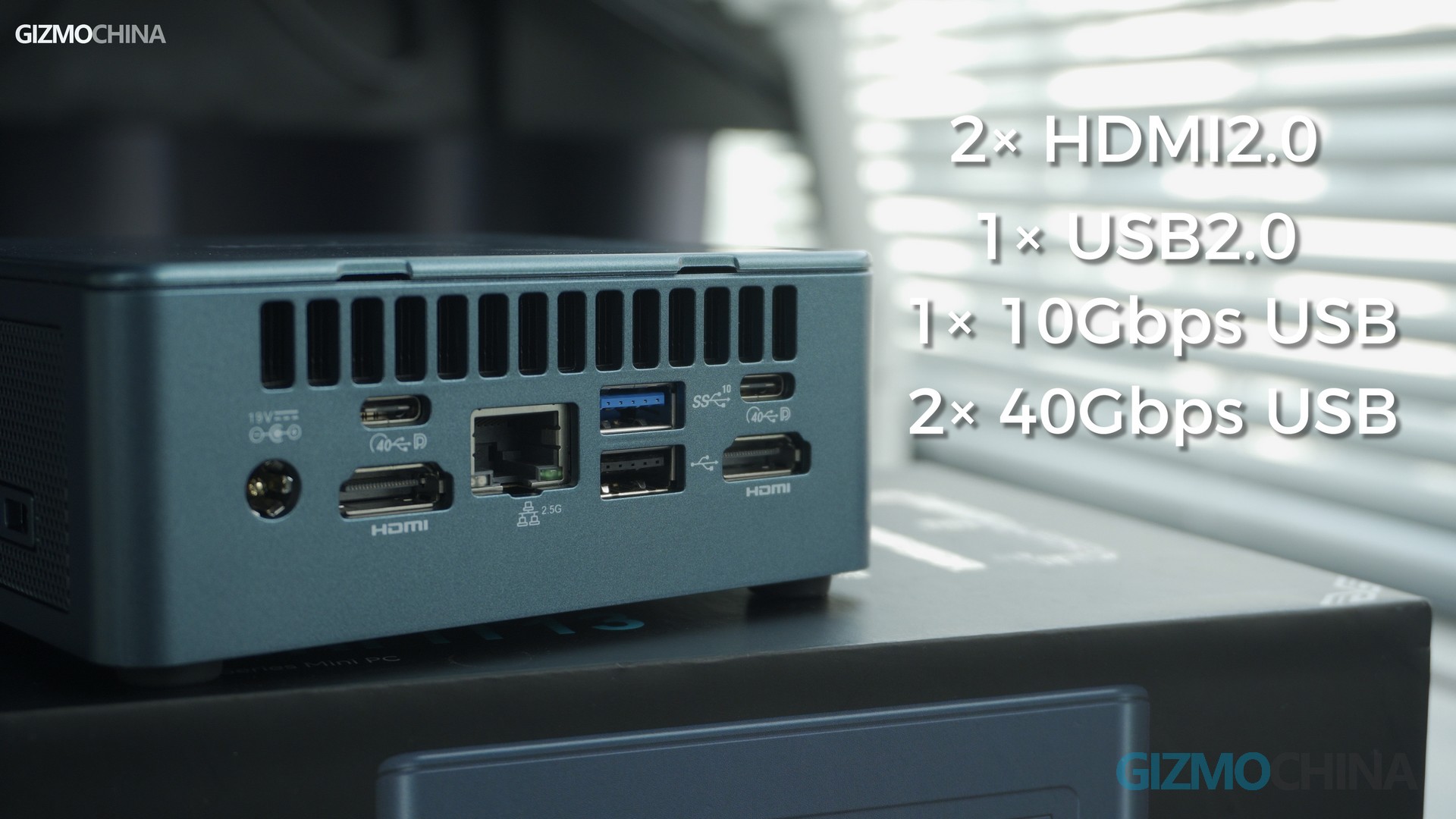
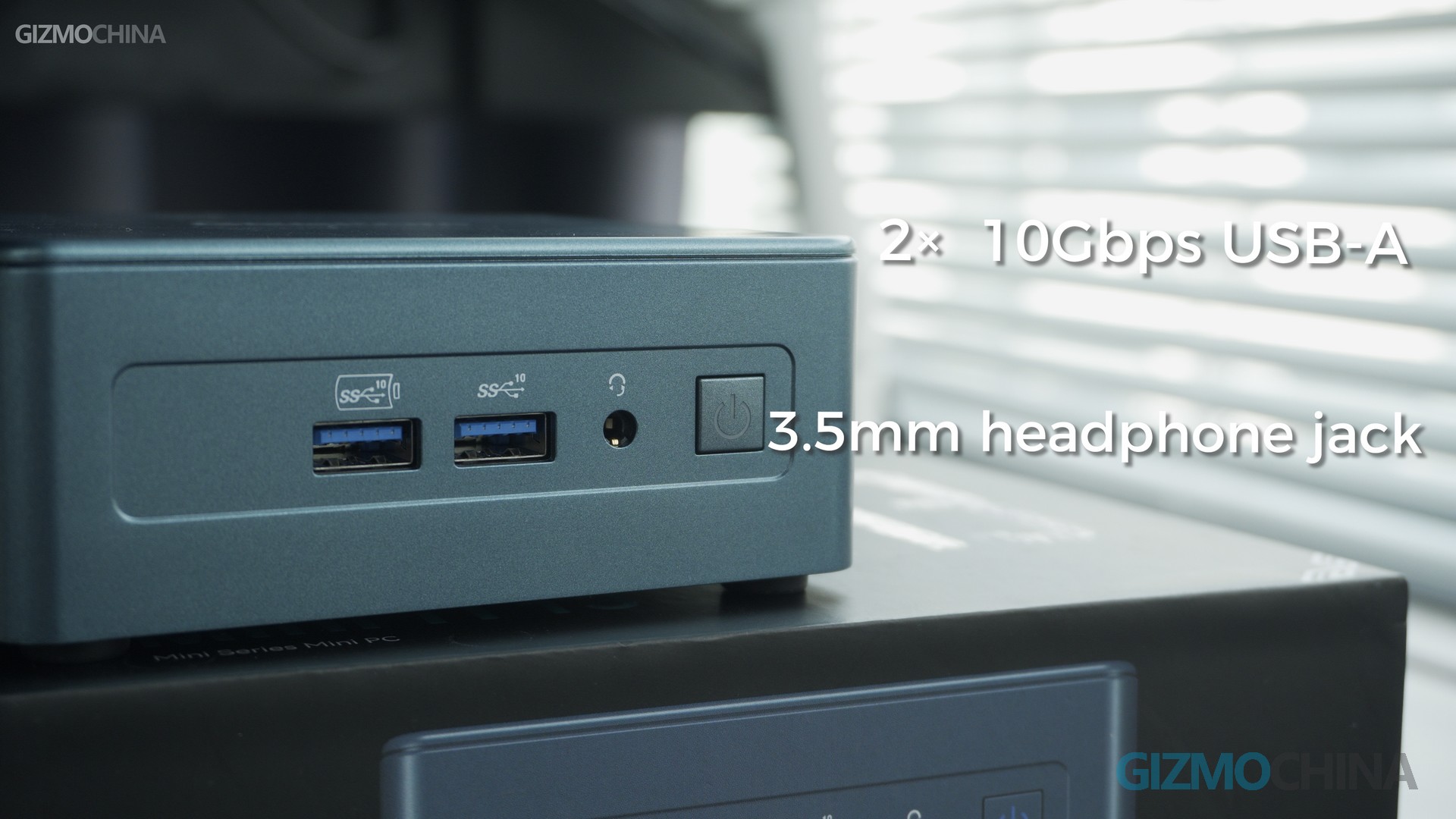
And it’s so compact that it even fits in my satchel well! The mini IT13 has the Geekom logo on the top, and there are two air inlets on both the left and right. The right metal grills have an SD card slot. The main IO panels are on the front and back; there are two 10Gbps USB ports on the front as well as a 3.5mm headphone jack. And on the back there are 2*hdmi2.0 ports, a USB2.0, another 10Gbps USB-A type, as well as 2 special type-C ports, also called USB-4.0, supporting up to 40Gbps. They are particularly powerful for supporting connecting graphic card docks.
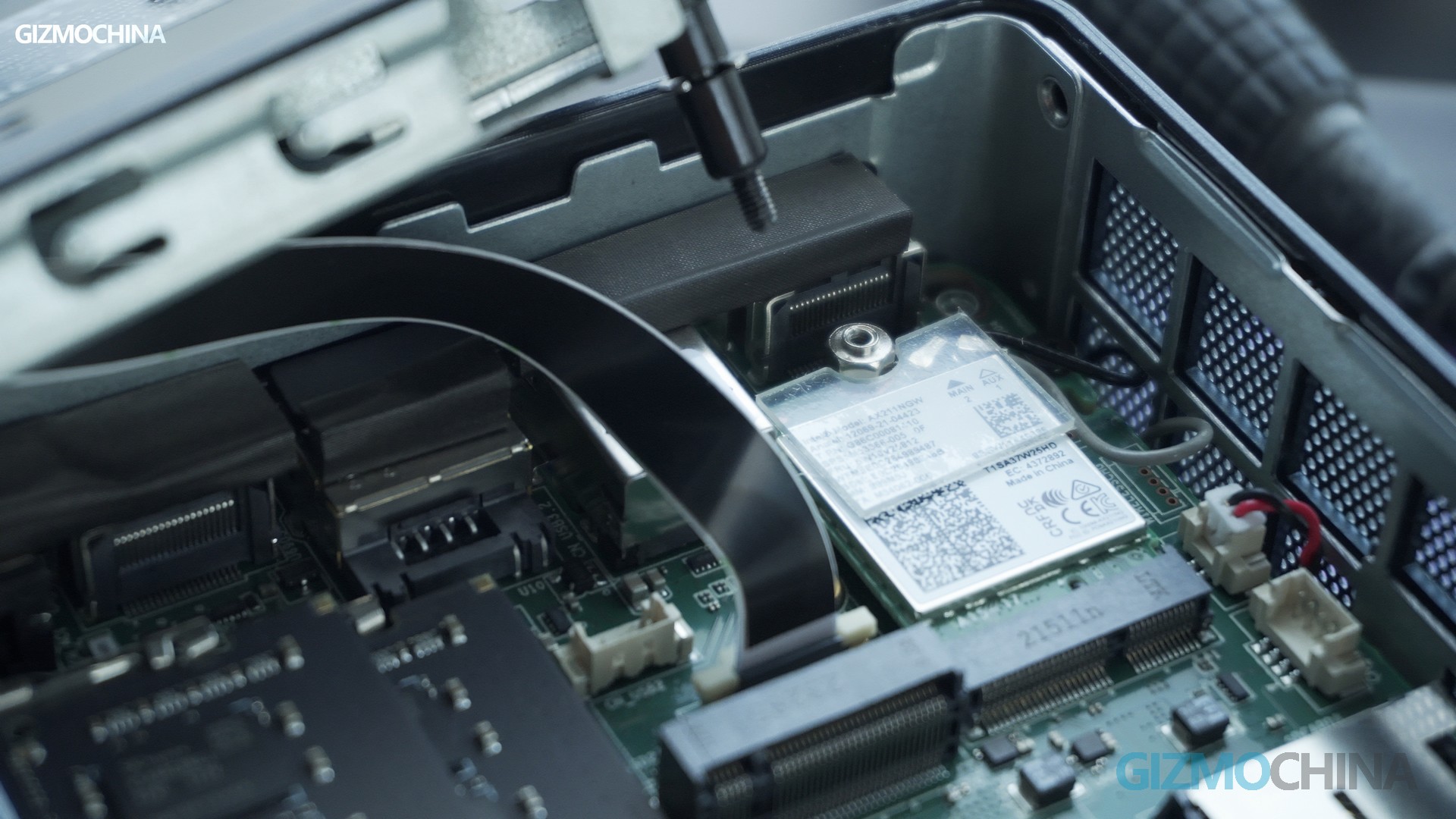
In terms of network support, the mini IT13 comes with an AX211 WiFi kit and a LAN port that supports a wired network of up to 2.5Gbps. With all these interfaces, you can have quite a lot of possibilities with the mini IT13.
Internal Structure
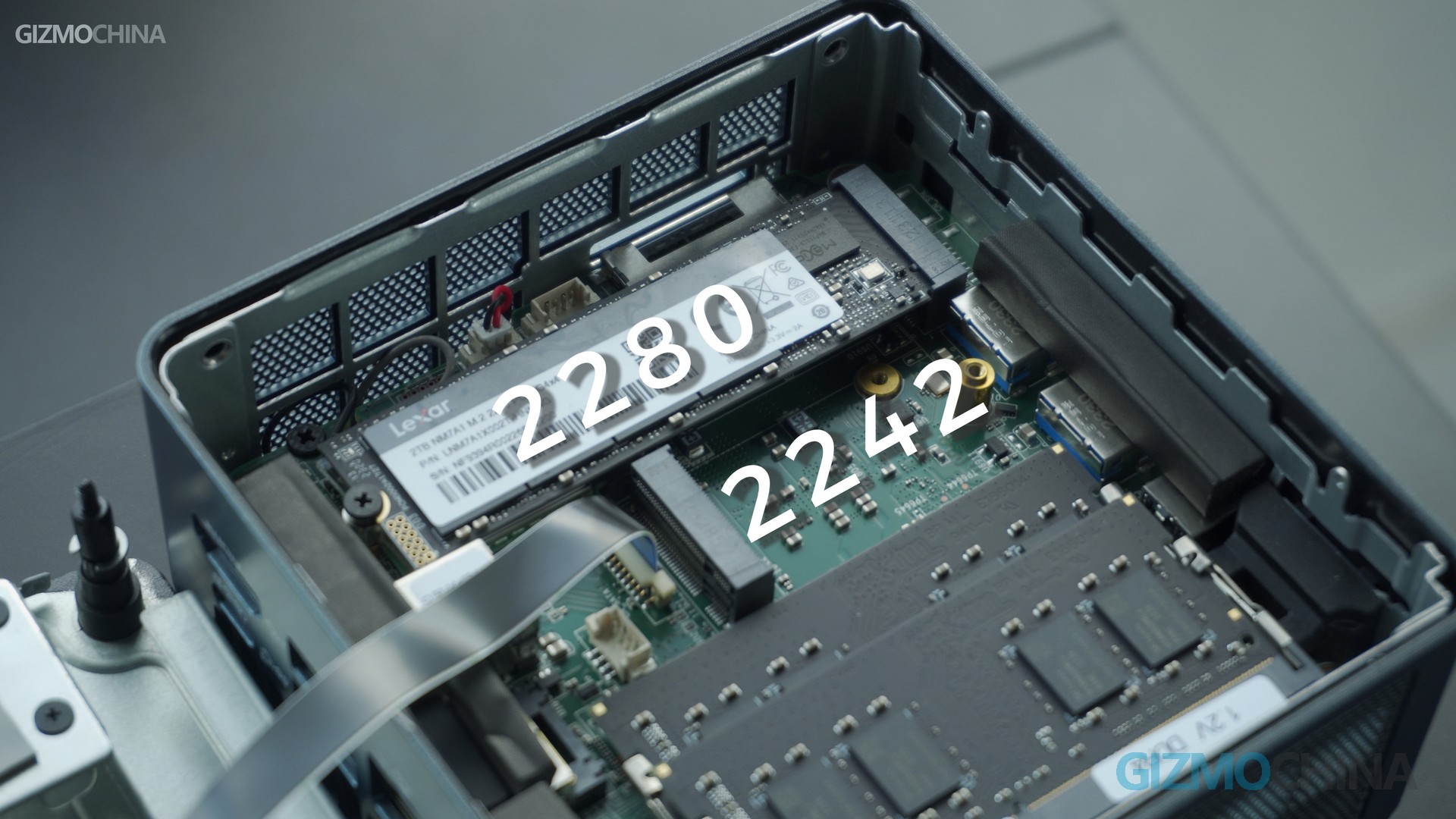
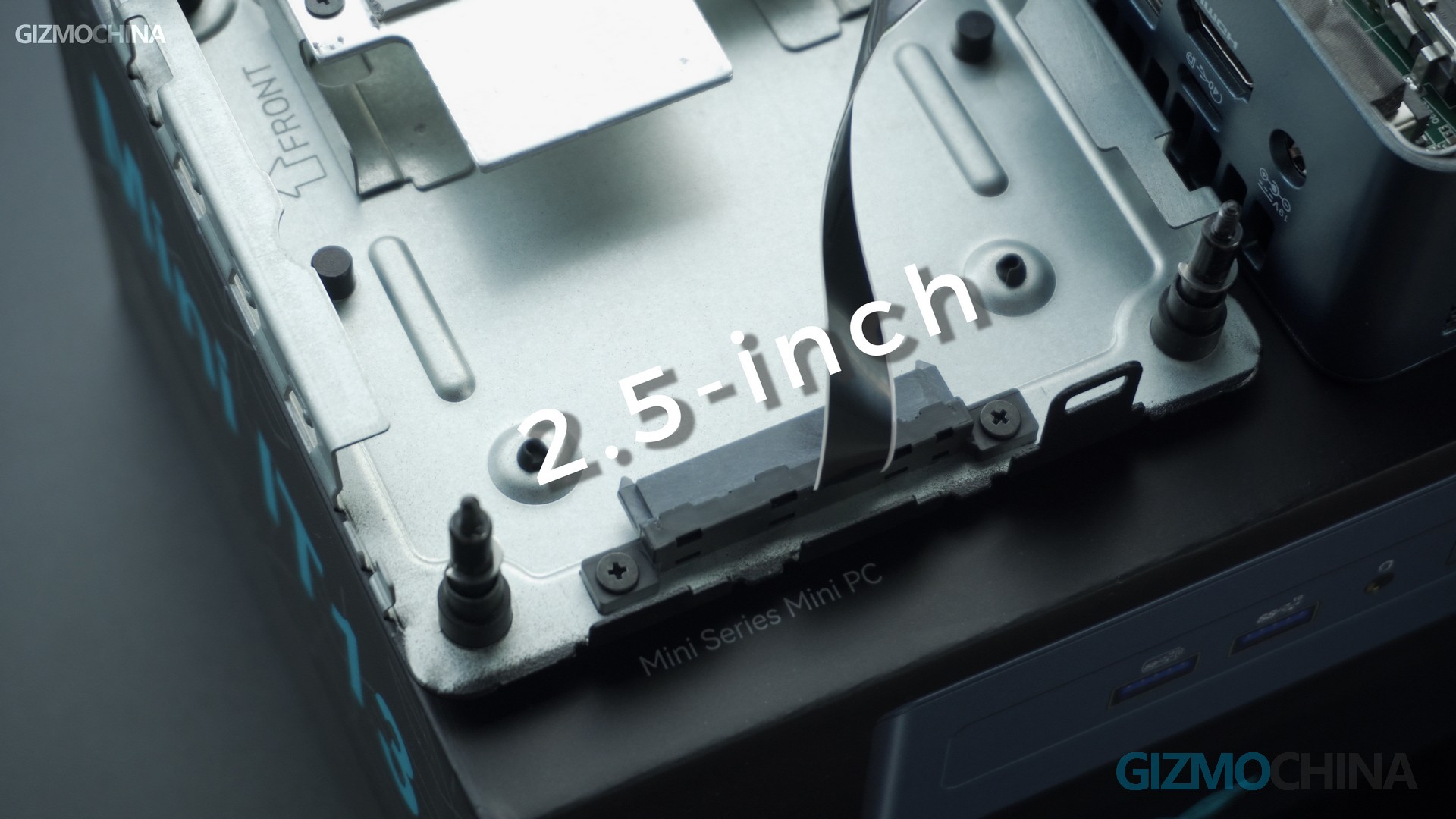
One of the things I like about the internal structure of the mini PC is that, it supports multiple storage options. The 2TB variant comes with a 2280 NVME SSD, and you can add an extra 2242 SATA SSD or a 2.5″ SSD on your own to expand the total storage. It’s also worth noting that the mini IT13 has an exclusive cooling structure for the hard drives. good job! GEEKOM.
Considering the compact size of the mini IT13, I would say that its expandability and connectivity are perfect, and the high-speed interface can also significantly improve efficiency when used with the i9-13900h.
If you look closely, the mini IT13 has a metal frame that completely surrounds the board, so even if you shake the PC violently, it won’t rattle, that means I can put the mini IT13 in my backpack and take it on the go without worrying about anything.
Performance
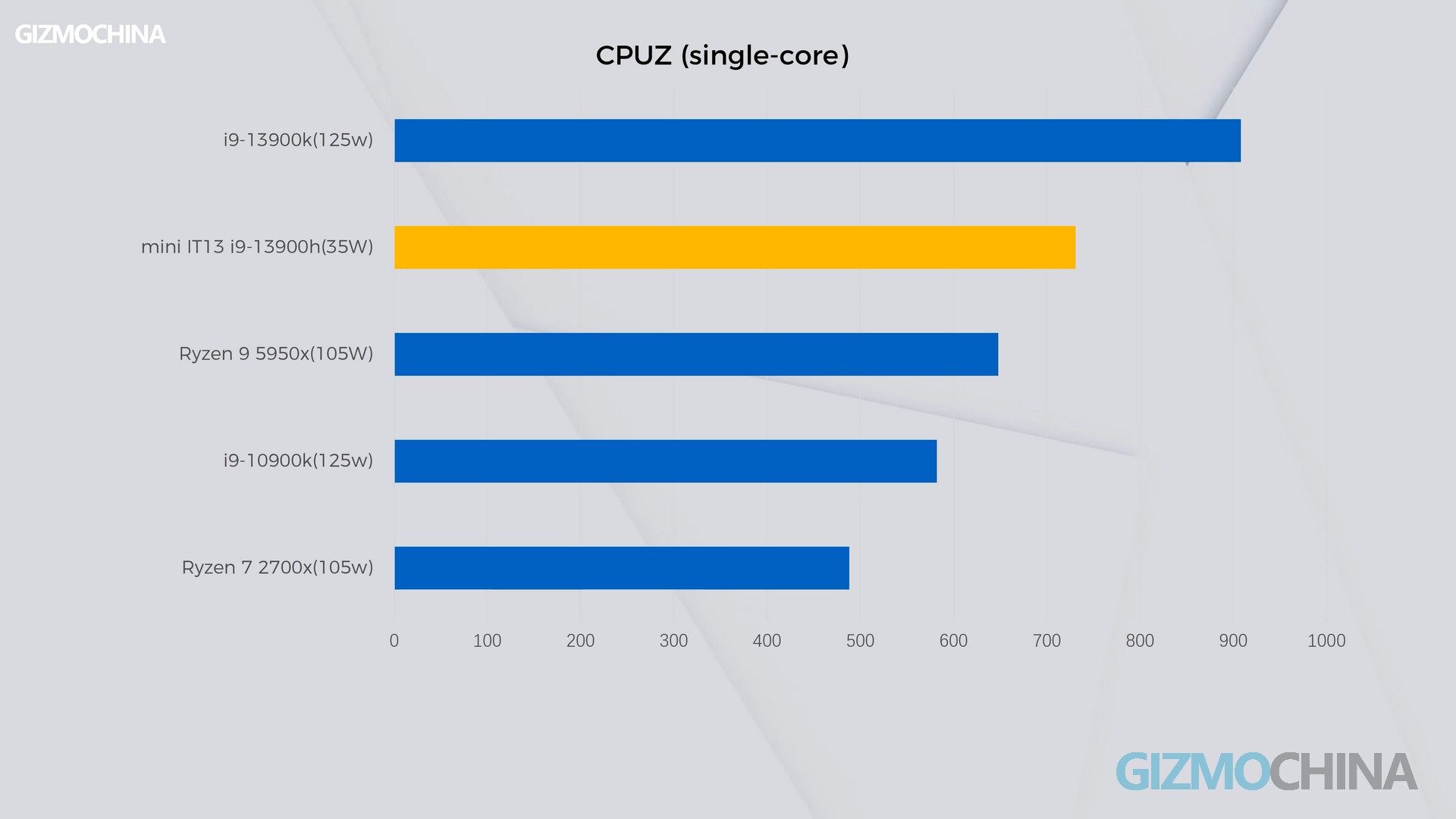
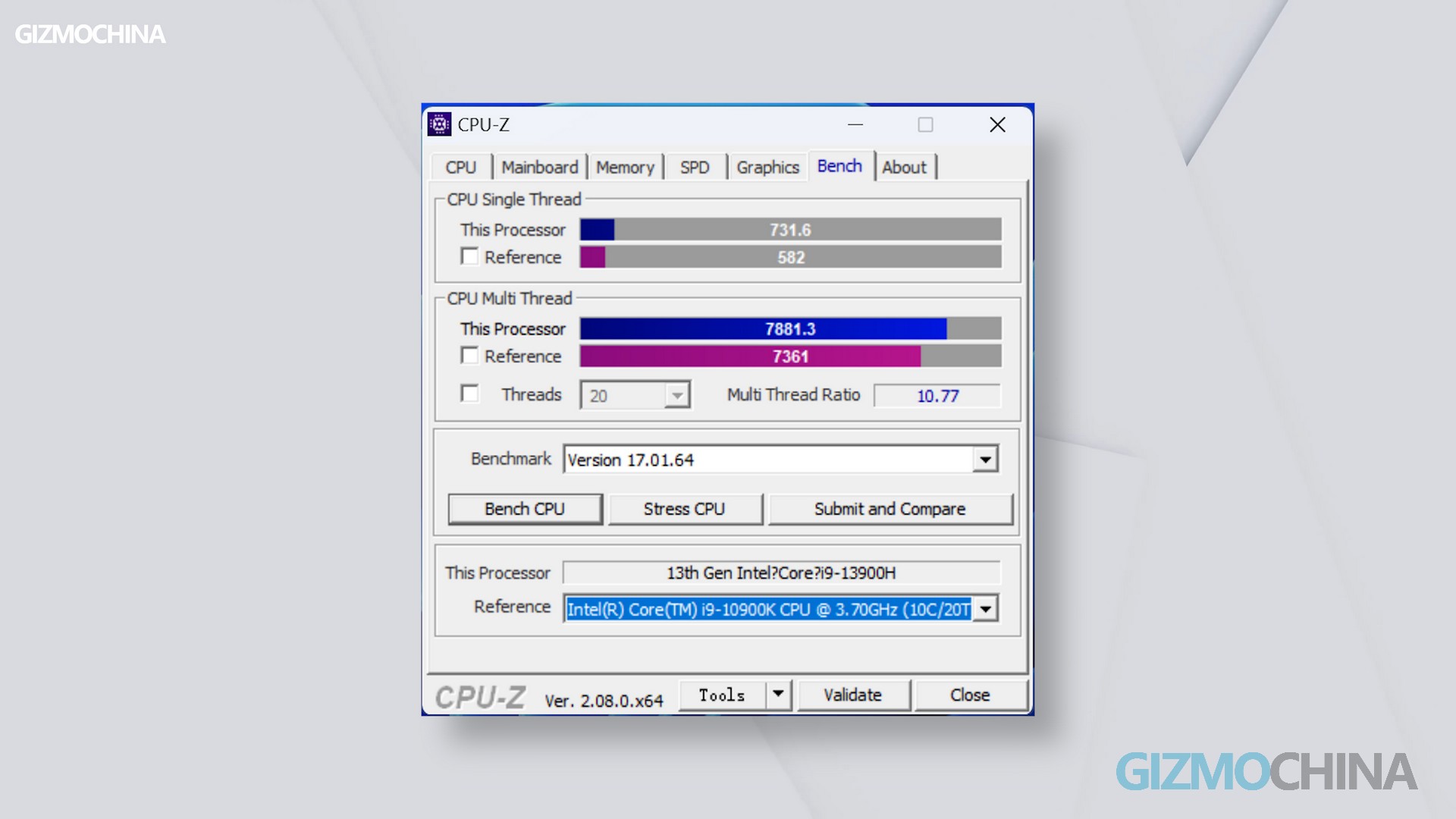
The mini IT13 is powered by a 14 Cores 20 Threads i9-13900h processor, that’s pretty insane for a mini PC. Thanks to the Raptor Lake-H series’s great power efficiency and the 14 cores, the latest i9-H CPU achieves a multi-core performance of 7881 in the CPUZ test, which is 7% ahead of the desktop i9-10900k with the same 20 Threads. Performance is 7% ahead, the highlight is single-core performance. Compared to the i9-10900k, the i9-13900h in the mini PC is 25% ahead.
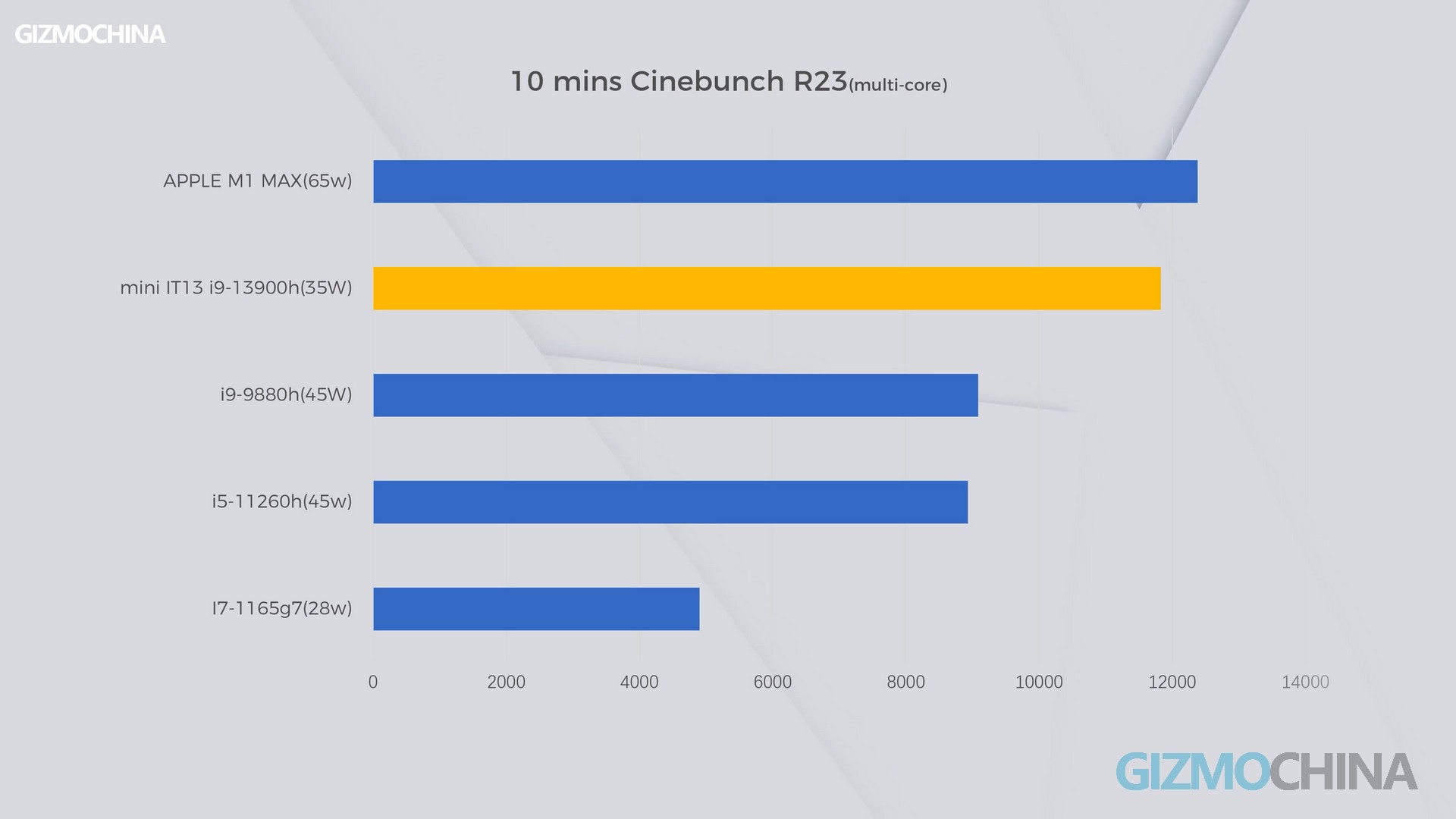
Well In the Cinebunch R23 test, the mini IT13 scores 11,800 in multi-core performance, which is more than enough to handle most complex tasks.
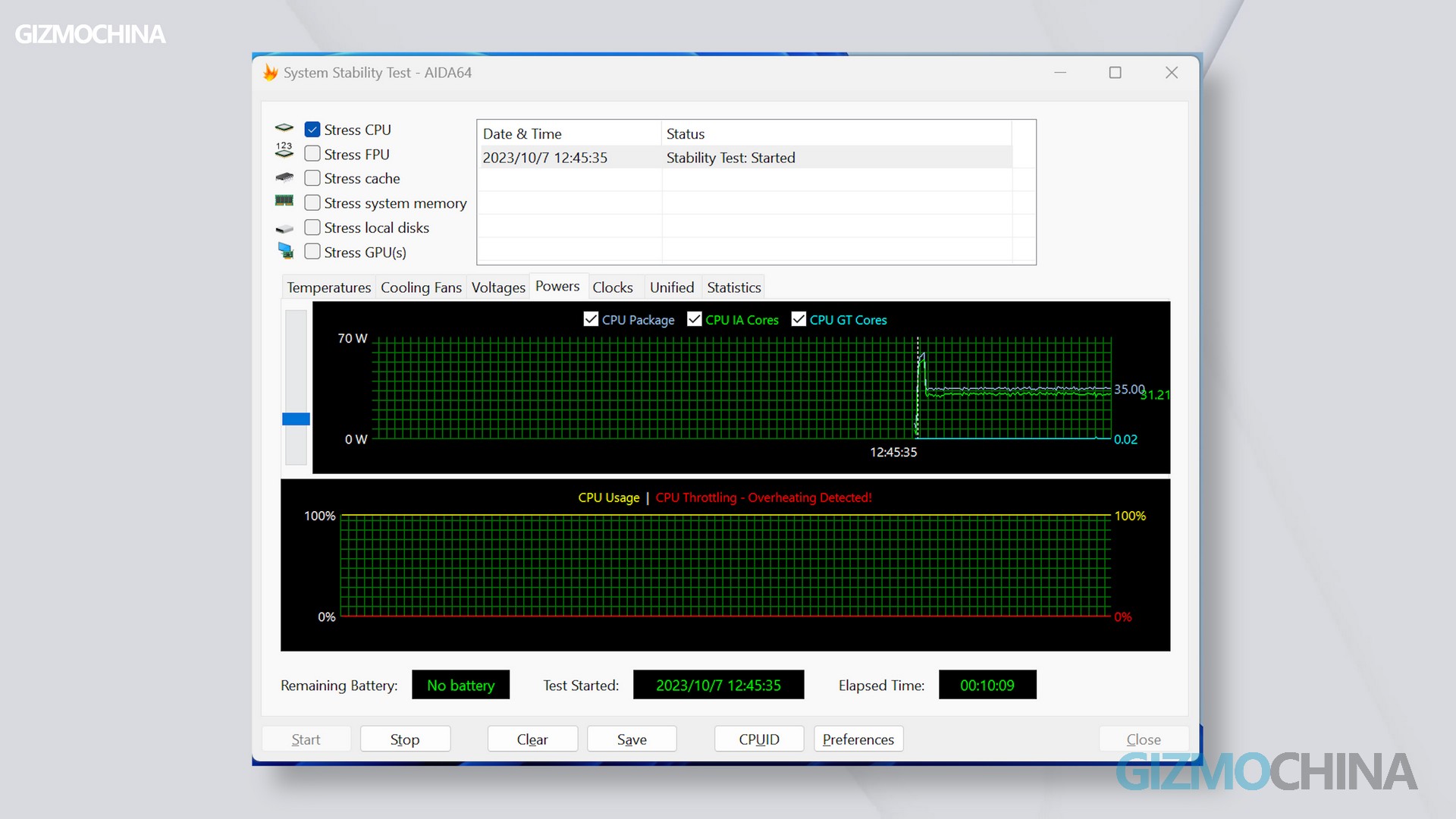
I’m actually more concerned about the power consumption and temperature than its performance. In the CPU stress test, the mini IT13’s i9-13900h power consumption reached 60w in the first second, and then the power consumption stayed at 35w. And after a 10-minute CPU stress test, the power consumption stably remained at 35w.
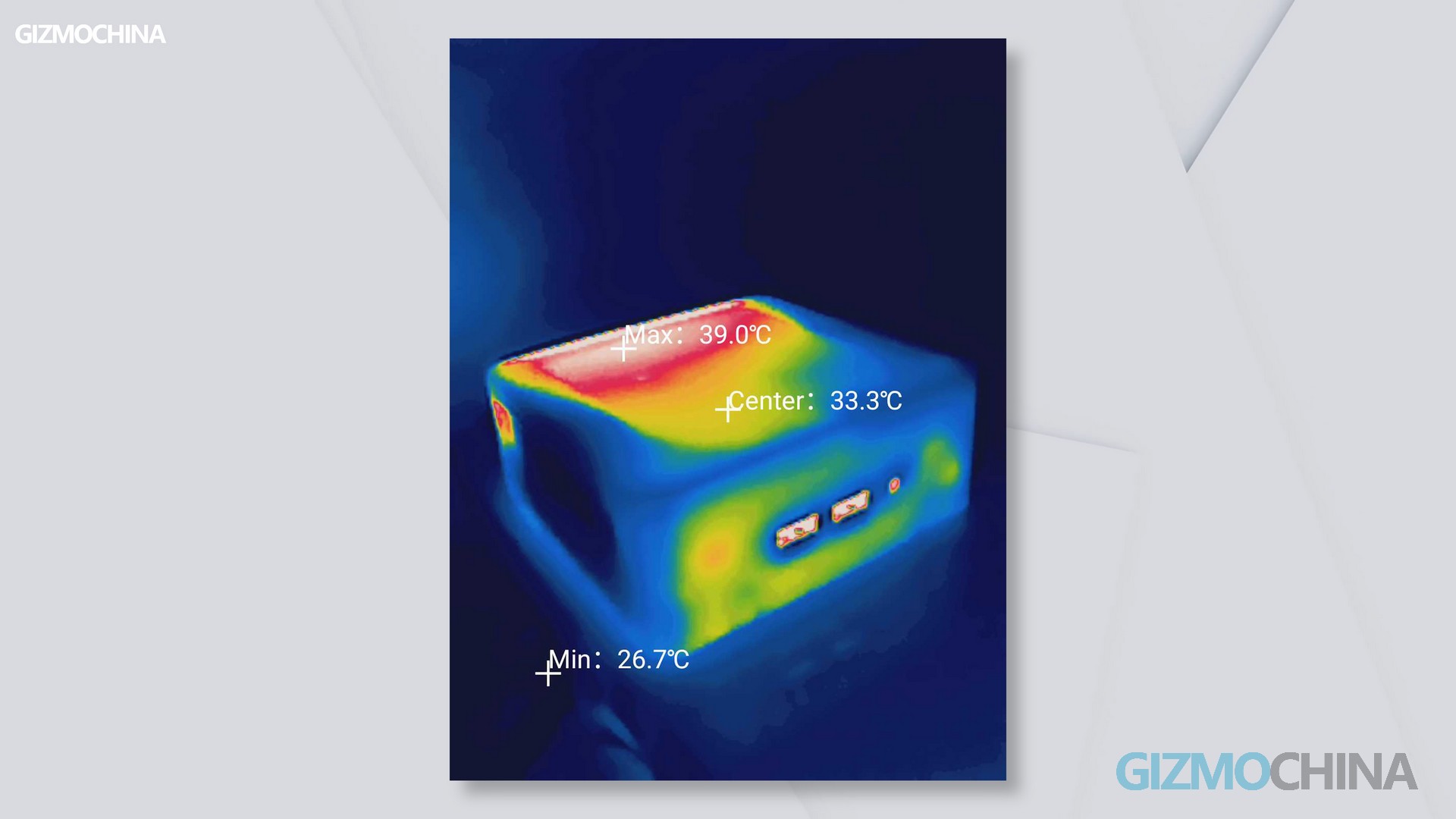
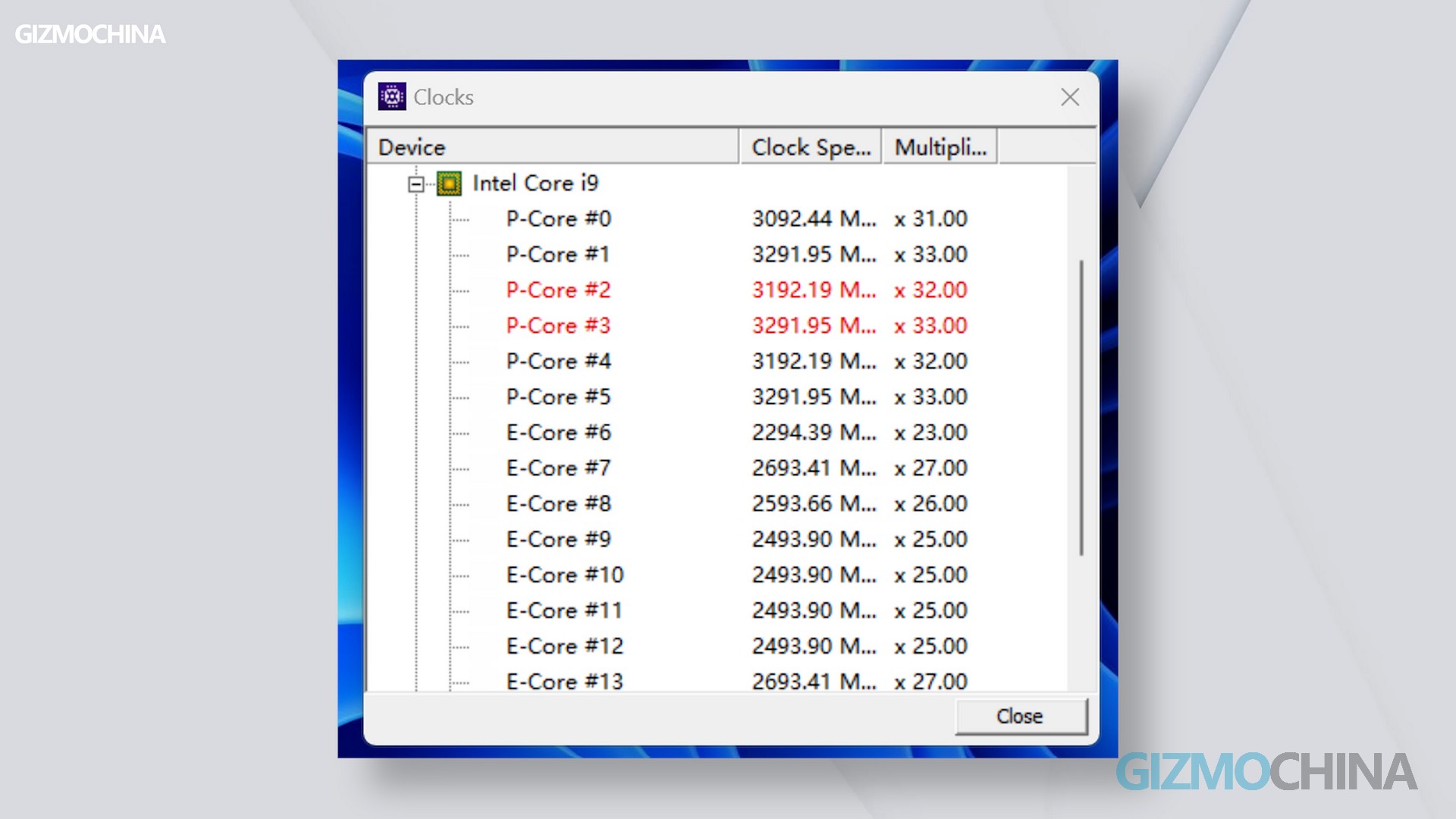
and the CPU package temperature stayed close to 80°C. The CPU’s p-core was running at 3.3ghz and the e-core was running at 2.5 GHz, while the surface temperature of the mini IT13 was only 40°C.
The thermal performance of the mini IT13 is truly excellent, considering the i9-13900h has a very powerful performance at 35w output. Of course, if you are a geek user, you can also try to unlock the power limits to get a higher CPU performance. It’s also worth mentioning that the noise control of the mini IT13 is very good, you can barely hear the noise during daily use. You do hear the fan noise when doing complex tasks, but to my surprise, the noise of the mini IT13 is different from the harsh centrifugal fan on a laptop, it is more similar to a 12cm fan on a PC. So, there’s nothing for me to complain about here.
Running Noise – Please check out the review video
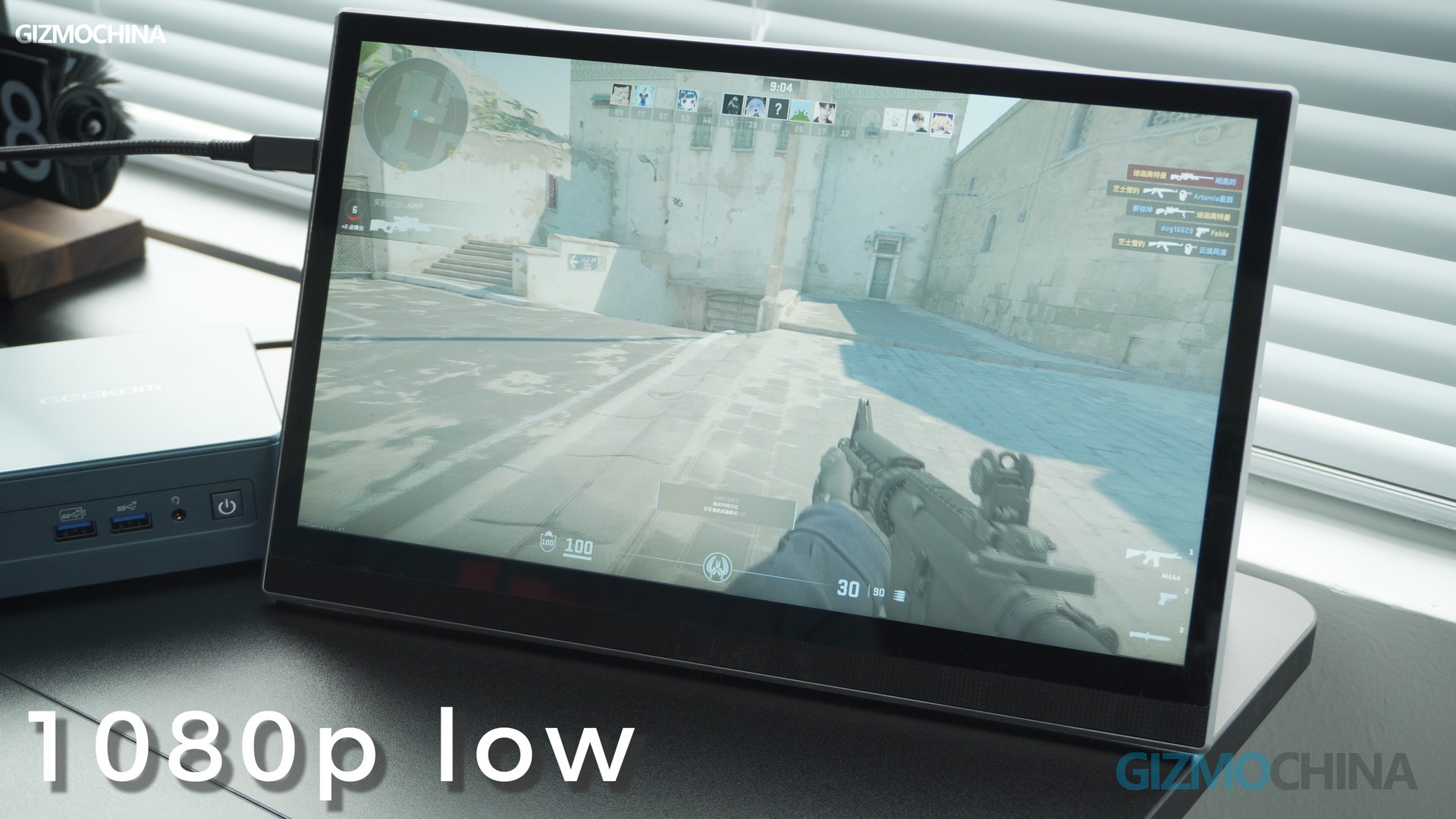
About the GPU, it’s our old friend – the 96EU INTEL Xe GPU. In the gaming test, I first tested the GPU in Counter-Strike 2, with the screen set to 1080p low setting, it ran at 80-110 fps, and I did complete a couple of headshots during the game, which was pretty good.
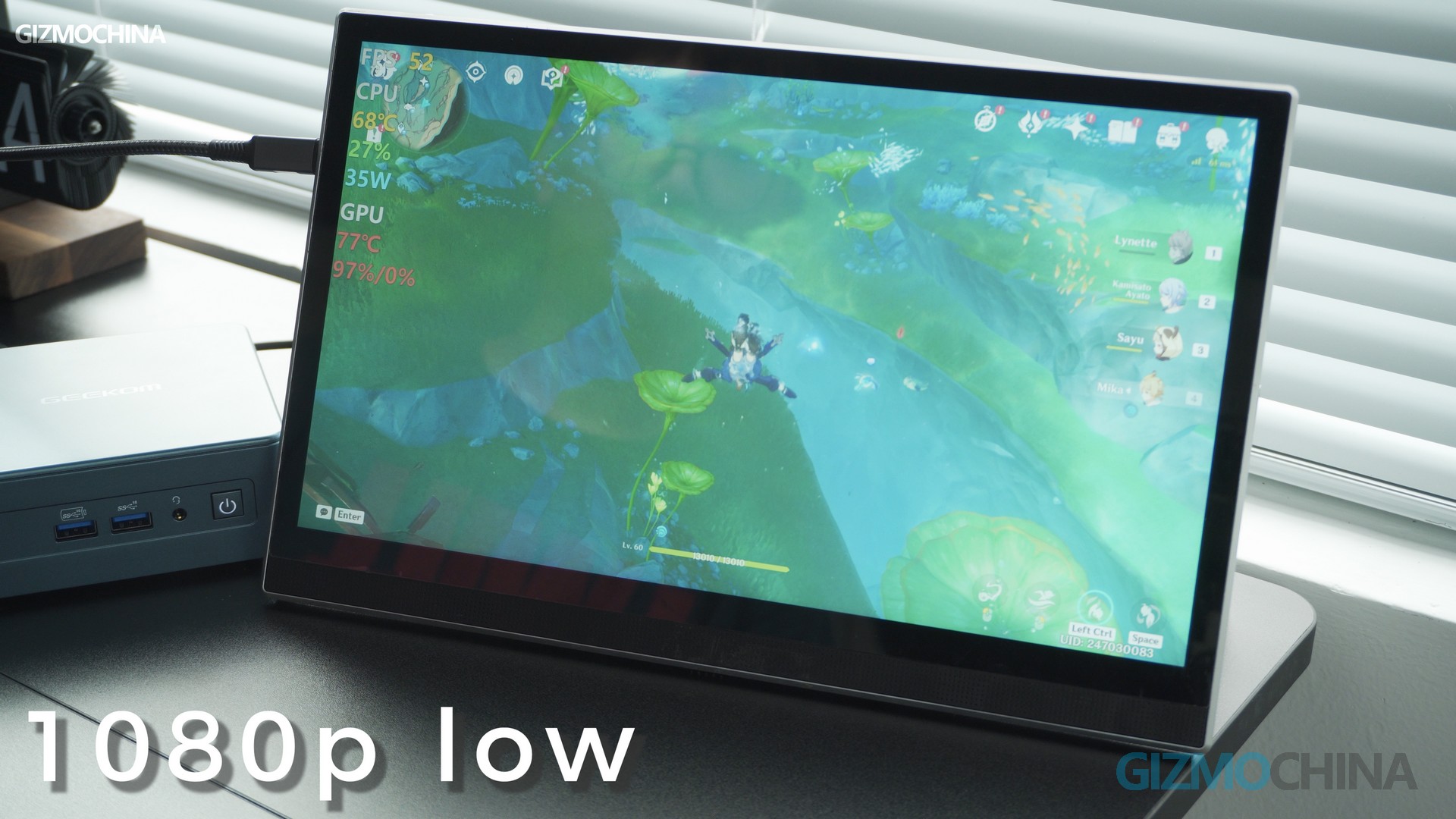
In Genshin Impact at 1080p low setting, we tested in the Fontaine area, the frame rate was around 50fps and the gaming experience was relatively smooth. Overall, thanks to the mini IT13’s dual-channel 3200MHz RAM, the GPU performs quite well, and the mini IT13 has very good temperature control when gaming. No kidding, the mini IT13 can be your gaming PC if you play games that don’t require super high graphics.
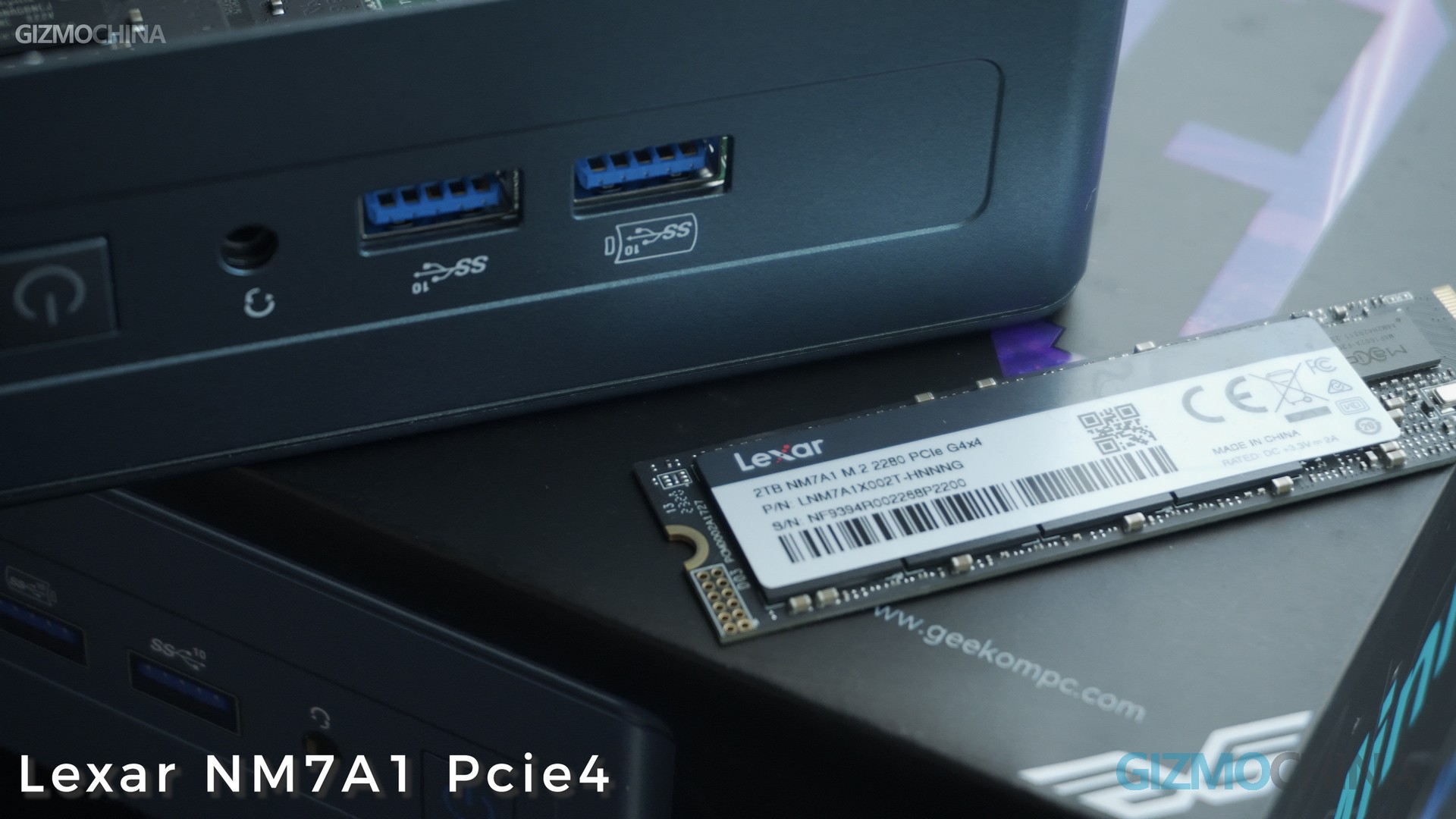
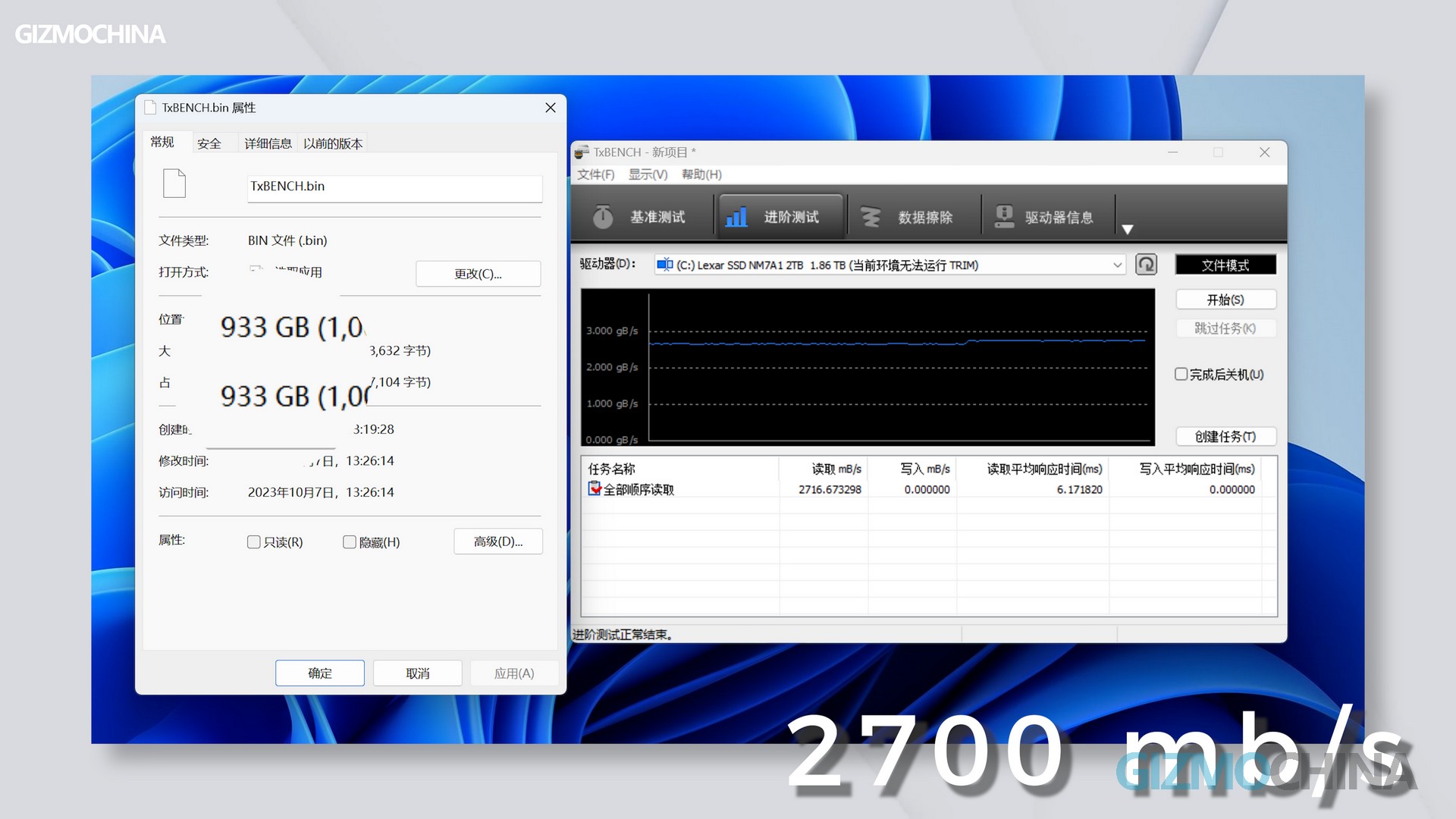
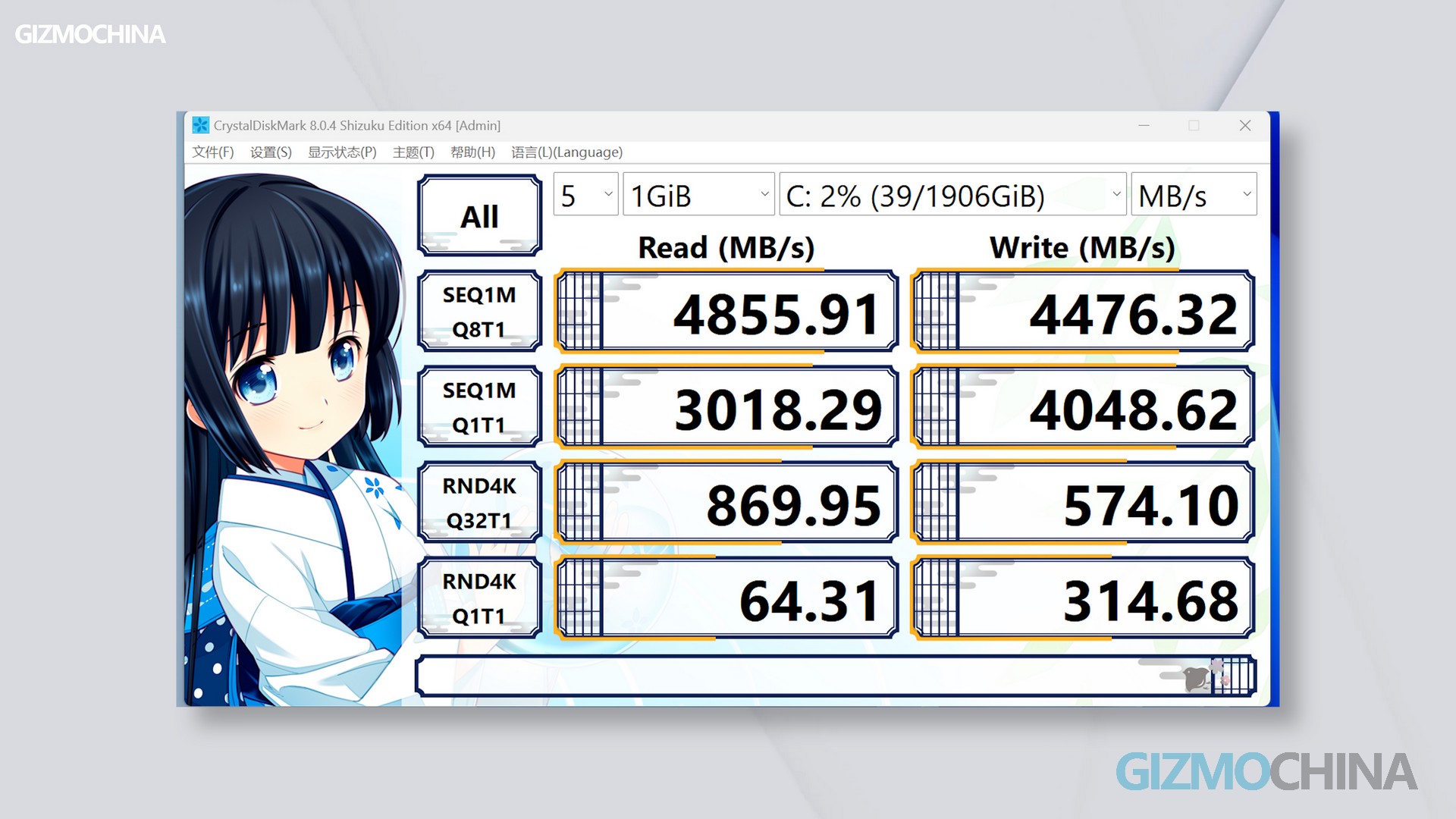
Another thing that interests me is the 2TB SSD. The mini IT13 uses a Lexar MN7A1 PCIE4 SSD. There are no details of the specific SSD variant, but most likely this is an OEM product that is not for the retail market.
In the actual test, the performance of this hard disk is very good, it has very fast read and write speed, which fits well with our imagination about PCIE 4.0 SSD. I also tried some extreme tests, in the 1000GB of large file reading, it still kept 2700MB/S in the whole test. Personally, I’m very satisfied with the SSD offered by the mini IT13 at this price.
User Experience
The mini IT13 does have a very good user experience, the i9-13900H is even more powerful than the big PC I’m using, when running complex tasks, this CPU does bring higher efficiency. It also has a reasonable combination of parts and components: The chip brings powerful performance, while the 32G dual-channel memory offers great support for multitasking, and the 2TB SSD has enough space to store the data generated by CPU computing. Meanwhile, there are 2 extra storage expansion ports, and high-speed ports make mini IT13 a good enough replacement for a traditional PC. And if you really need extra graphic performance, the USB-4 can also add those graphic card docks in, no matter for gaming or AI-tasking.
All in all, I have no reason to say no to a super-powerful mini PC like this. If you guys are interested in the Geekom mini PC, the brand now offers a nice discounted price with coupon codes, either by heading to the official store or Amazon.
WHERE TO BUY
Check out the Geekom | MINI IT13 mini PC @Geekom official with US$40 off coupon code: Gear Seekers, or @Amazon with US$40 off coupon code: GSGEEKOM
Following various rumors and teasers, the Oppo Find N3 has finally been unveiled in the Chinese and the global market. This announcement also marks the first time the brand has launched a horizontally folding smartphone outside of its home market, so here are all the details.
Oppo Find N3 Design and Display
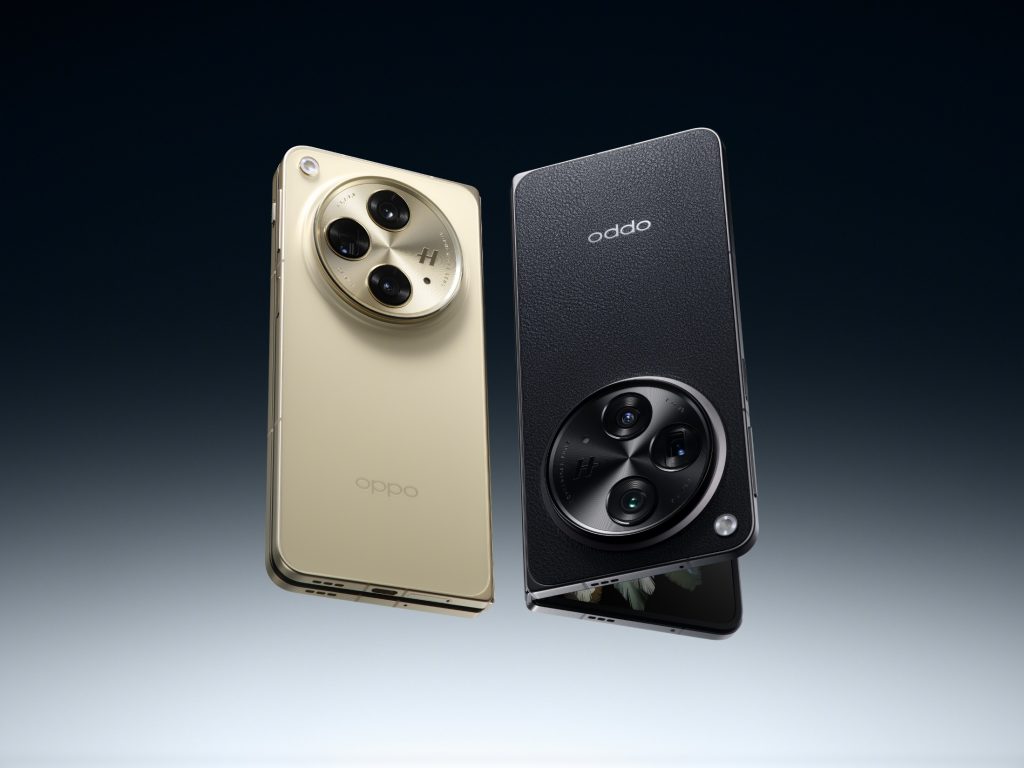
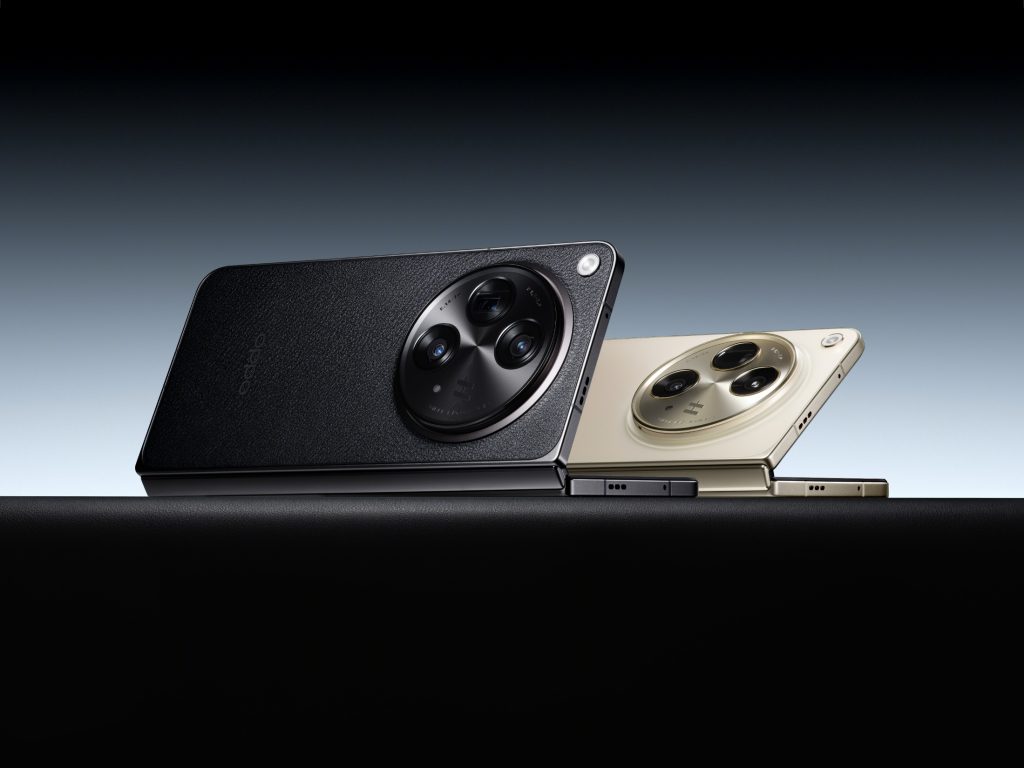
The Find N3 from the Chinese tech giant features a notebook-like design with a tall primary display and a narrower cover screen on the outside. On the rear, there is a large circular camera island, while the front houses a punch-hole cutout for the selfie camera. The back panel also comes in two variants, which include a matte glass finish and vegan leather.
Its primary panel is a tall 7.82-inch AMOLED display that has a 2440×2268 resolution, dynamic 1-120Hz refresh rate, and 2,800 nits of peak brightness. Meanwhile, the cover display is a shorted 6.31-inch AMOLED panel that has a 2484 x 1116 resolution, 10-120Hz dynamic refresh rate, and a similar peak brightness. Both displays also support Dolby Vision, 2,800 nits of peak brightness, and LTPO 3.0 technology.
Specs and Features
Under the hood, the Oppo Find N3 will be equipped with a Qualcomm Snapdragon 8 Gen 2 SoC that is paired with up to 16GB of LPDDR5X RAM and up to 1TB of UFS 4.0 storage. A 4,805mAh battery pack powers the latest foldable phone, which also supports 67W SuperVOOC fast charging. The company claims that the Find N3 can be fully charged in just 42 minutes. This smartphone runs on Android 13 OS based ColorOS 13.2 custom skin out of the box.
Thanks to its design, the Oppo Find N3 can offer up to three windows on the screen at any given moment. In other words, you can view content vertically and horizontally. Oppo claims that this essentially makes it a 15-inch virtual screen. There are some apps that already support split screen view like Microsoft 365, which lets users edit two documents side by side. You can even view two pictures simultaneously from the Gallery.
Camera
During the global launch live stream, Oppo claimed that the Find N3 features one of the most advanced camera systems on a smartphone. The rear features a Hasselblad branded camera module. The primary sensor is a 48-megapixel Sony LYTIA-T808 pixel stacked sensor that has a 1/1.43-inch size. With the new pixel architecture, the company aims to deliver improved image quality and light sensitivity on this camera. It is also equipped with a 49-megapixel ultra wide angle lens that has a 1/2-inch size, 14mm f/2.2 aperture, and supports autofocus.
Lastly, there is a 64-megapixel 1/2-inch sensor that features 3x optical zoom, a 70mm focal length, and a f/2.6 aperture with stabilization as well. It even supports hybrid zoom of up to 6x or 145mm. For selfies and video calls, both the primary and cover display features a camera. The one on the external screen is a 32-megapixel sensor, while the main display has a 20-megapixel shooter.
Pricing and Availability
The Oppo Find N3 arrives in multiple color options, namely Black, Red, Green, and Gold. The Black and Red options feature vegan leather, while the Green and Gold feature a matte glass finish. The camera module on the Gold variant also matches the rear panel, unlike the other three variants. The device has a starting price tag of 2,399 Singapore Dollars (roughly 1,745 US Dollars) for its global 16GB RAM + 512GB model, while the Chinese variant includes a 1TB top end model. Pre-orders of this device will kick off tomorrow.
Amid all the focus on Oxygen OS 14, the OnePlus developers are managing to bring timely updates for smartphones. The company is bringing a new firmware update for the OnePlus Nord 2. The OxygenOS 13 F.48 brings the latest October 2023 Android Security Patch for the India Variant.
Following the OnePlus Nord 3 update, the update is now rolling out for the OnePlus Nord 2. The OEM is bringing back-to-back updates for the compatible smartphones. below is the official change log for OxygenOS 13 F.48:
It is an incremental update and will made available to a broader audience only when the software passes successful verification on the smaller audience. So, it may take a couple of days to weeks for the update to reach each unit.
You can manually check for the update by heading to Settings > About > Software Update. If users encounter any issue or bug while using the new firmware, they can also submit the feedback via OnePlus Community or Google Dialer.
OxygenOS 14 Update Program
OnePlus is diligently rolling out the Android 14-based OxygenOS 14 Open Beta and Closed Bta updates for compatible devices. The update program is already live for devices such as the OnePlus 11, OnePlus 11R, OnePlus 10 Pro, OnePlus 10, OnePlus Nord 3, and others.
in the coming days, we expect a stable Oxygen OS 14 build for the OnePlus 11 series as it has already received the Open Beta 3 build a couple of days ago.
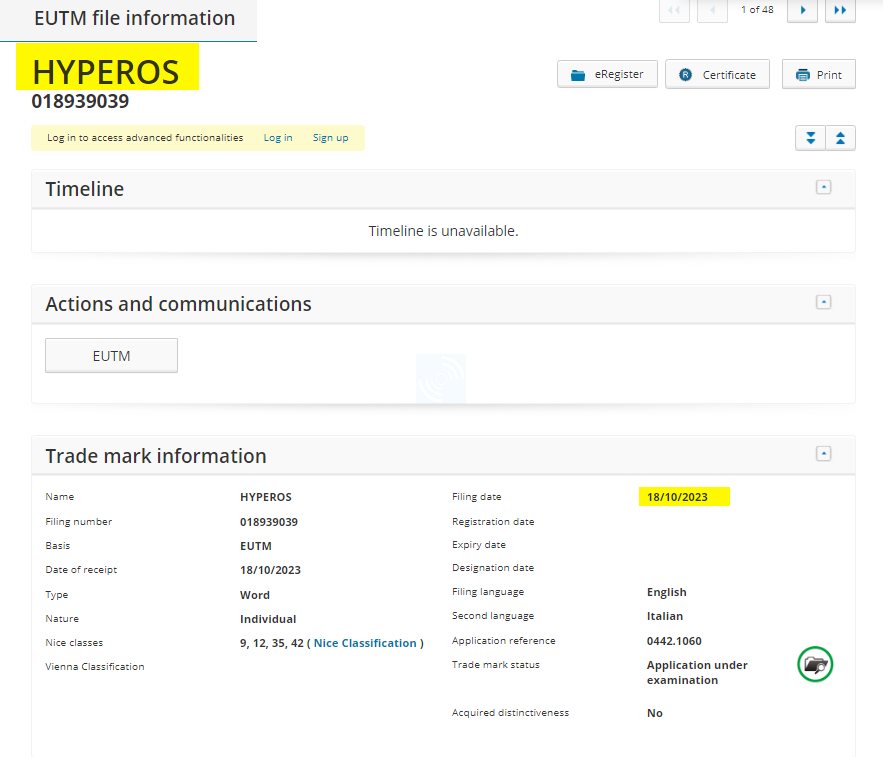
Ditching MIUI 14, Xiaomi confirmed its new in-house skin – HyperOS a few days ago. The new indigenously developed Hyper OS seems to first debut with the Xiaomi 14 series. It appears the company aims to develop a whole new user experience by incorporating Hyper OS with custom SoC (in the future). Surprisingly, the new OS Skin trademark listing surfaced on EUIPO which does confirm its global availability.
Xiaomi Inc. files the trademark and the whole case is represented by Lane Intellectual Property (Ireland) Limited. Under the description, the new OS Skin is categorized under multiple tags such as Computer software applications, downloadable; mobile software applications; processors/central processing units, operating system programs, and much more.
Considering these categories, the new HyperOS seems to align with Xiaomi’s rumored plan for custom SoCs. The Hyper OS trademark is currently in the initial stages and may take some time before actual registration.
While confirming the HyperOS, Xiaomi Global’s VP said the new OS Skin will eventually replace the MIUI in the coming months or years. It will first launch with the Xiaomi 14 Series, while other devices will receive an OTA update. Details about the compatibility with old Xiaomi smartphones are yet unconfirmed, but there’s a leaked list of smartphones that are expected to receive the update. Even information about its availability on Poco and Redmi smartphones is currently unavailable.
Xiaomis CEO, Lei Jun further added that the new system architecture was “completely rewritten,” and will “prepare a public base for the Internet of Everything for tens of billions of devices and tens of billions of connections in the future.”
There will be improved customization features, fonts, templates, widget options, and more. The OS will not only run Smartphones but will power its IoTs, other wearable devices, and the upcoming first-ever electric vehicle too. As per recent leaks, the HyperOS seems to offer a more streamlined UX than the MIUI 14.
We use cookies on our website to give you the most relevant experience by remembering your preferences and repeat visits. By clicking “Accept”, you consent to the use of ALL the cookies.
This website uses cookies to improve your experience while you navigate through the website. Out of these, the cookies that are categorized as necessary are stored on your browser as they are essential for the working of basic functionalities of the website. We also use third-party cookies that help us analyze and understand how you use this website. These cookies will be stored in your browser only with your consent. You also have the option to opt-out of these cookies. But opting out of some of these cookies may affect your browsing experience.
Necessary cookies are absolutely essential for the website to function properly. This category only includes cookies that ensures basic functionalities and security features of the website. These cookies do not store any personal information.
Any cookies that may not be particularly necessary for the website to function and is used specifically to collect user personal data via analytics, ads, other embedded contents are termed as non-necessary cookies. It is mandatory to procure user consent prior to running these cookies on your website.