Advertisement

Microsoft’s next Xbox console could launch in 2028, court docs show

Microsoft is reportedly planning to release a successor to the Xbox Series X|S in 2028, according to court documents filed in the ongoing legal battle between Microsoft and the Federal Trade Commission (FTC).

Microsoft Xbox 2028

The documents include a chat log from May 2022 in which Microsoft executives discuss their plans for future consoles. One executive referenced “the plan for 2028” when asking if the Xbox business would retain its existing console model or “force a Windows-like flexible/capabilities-like model.”

Corporate VP of gaming ecosystems Kevin Gammill answered by saying Microsoft had “already started this journey ” toward more flexibility with the Xbox One and Xbox One X and, more recently, with the current-gen Xbox Series X|S. He added that the plan is to be more flexible with “gen 10” while still offering a clear target for developers “to take advantage of unique hardware capabilities.”

If the successor to the Xbox Series X|S does launch in 2028, it would put the generation around eight years, tying it with the Xbox 360 for the longest such lifespan of an Xbox system.

However, we’ll have to take all this with a grain of salt for now, as these internal chats were never meant to be publicized. That said, the 2028 launch target is consistent with statements made by Microsoft’s lawyers in June, suggesting that the company is indeed targeting a 2028 start for the next generation of Xbox consoles. The latest court documents also hint that Microsoft is considering releasing different versions of its next Xbox console or making it more modular, similar to a PC.

Related:

(Via)

New Xbox Series X and Controller Designs Leak, Reveal Sleek New Look and More Features

The ninth-generation console wars are in full swing. Although Sony is currently leading the race with its PlayStation 5, Microsoft is hot on its heels, working to close the gap with its Xbox Series S and Series X. Wondering what those efforts entail? You’re in the right place, because the FTC’s Microsoft case has revealed a new disc-less Xbox Series X design along with a new gyro controller. Here are the details….

Xbox Series X and Controller Getting a Redesign in 2024, According to Leaked Documents

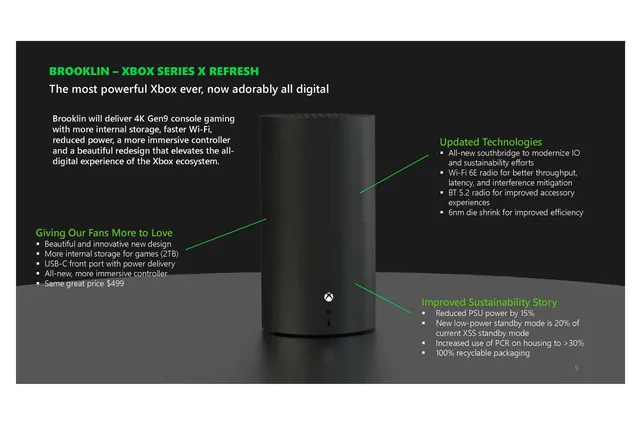
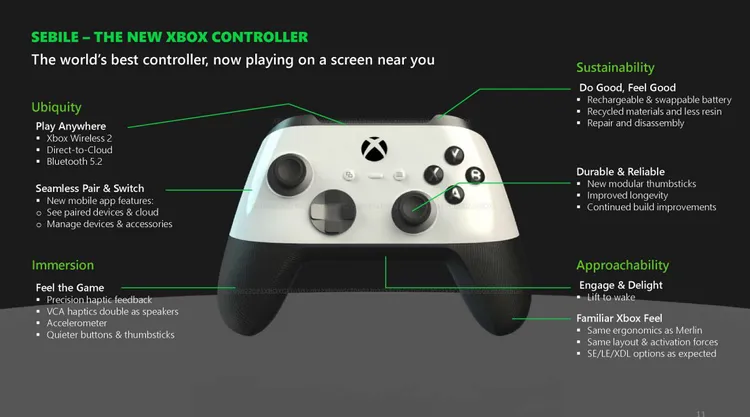
FTC documents have revealed a lot of new details about Microsoft and Xbox. For example, we had previously reported on how the Microsoft responded to the PlayStation 5 announcement and the price increase that occurred last year. Now, there’s an even more significant development. The documents disclosed plans for a cylinder-shaped ‘all-digital’ 2TB Xbox Series X codenamed “Lockhart, as well as a new controller with modular thumbsticks in 2024.

Xbox series X

Ironically, the new Xbox will no longer be a box. Starting from 2024, it will be shaped like a black cylinder. However, the most notable feature of this console isn’t its shape. Microsoft is saying goodbye to the Blu-ray disc drive with this product. In today’s world where games have mostly gone digital, this seems pretty normal and acceptable. However, it also eliminates some advantages.

For example, if you’ve been an Xbox user for the past few generations and own physical game discs, you can currently play them on the Series X. Unfortunately, the cylindrical design will take that capability away from you. Of course, if you’re like many of us and prefer streaming content rather than using Blu-ray discs, and you don’t own physical game discs, this could even be a cost-effective choice for you. This is because Blu-ray discs are still quite expensive.

Using this technology costs console manufacturers between $50 to $100. For example, Sony sells the disc version of the PlayStation 5 for $500, while the disc-less version is priced at $400. In other words, the new Xbox Series X could be priced $50 to $100 cheaper than the current model. Still documents suggest that Microsoft is targeting the same $499 launch price of the Xbox Series X.The console will also feature a new, more efficient and quieter cooling system.

Of course, the cooling system isn’t the only thing that’s changing. The device will also support Wi-Fi 6E and include a Bluetooth 5.2 radio. Additionally, the company is reducing the size of the existing die to 6nm to improve efficiency. According to Microsoft’s document, the PSU will also see a 15 percent reduction in power usage.

The new controller, which has the codename “Sebille,” will include Bluetooth 5.2 and an updated “Xbox Wireless 2” connection. Microsoft has also mentioned that the controller will offer “precision haptic feedback” and that its “VCA haptics will double as speakers.” Additionally, the controller will have quieter buttons and thumbsticks, a rechargeable and swappable battery, modular thumbsticks, and a “lift to wake” feature.

Both the new Xbox Series X and its accompanying controller are expected to launch in early 2024. However, Microsoft has not yet officially announced the new products, but the leaked documents from the FTC case suggest that they are real and that they are coming soon.

RELATED:

(via)

Google Tensor G4 specs leak: Hardware-based ray tracing GPU onboard

A recent report has dashed earlier expectations of the Google Tensor G4 being a groundbreaking in-house custom chip. Instead, it appears the Tensor G4 will bring only modest improvements compared to the upcoming Tensor G3, slated to debut alongside the Pixel 8 series on October 4th.

Tensor

That being said, tipster @Tech_Reve has leaked more details about the chip on X (Twitter). As per the leak, it looks like the Tensor G4 isn’t straying far from its Samsung Exynos roots. It’s sticking with a tried-and-true 3-core design with Cortex-X4, Cortex-A720, and Cortex-A520 cores. The core count remains a mystery, however, we can expect these new chips to provide slightly improved performance.

As for the GPU, the leaker claims that the Tensor G4 will feature the Immortalis-G715 GPU, which was launched by ARM back in June of 2022. ARM claims that this new GPU provides 15% improved performance across a wide range of applications. Another key standout feature here is the hardware acceleration for ray tracing.

That being said, there is also some disappointing news. According to the leaker, Google is opting for Samsung’s 4LPP+ node (4 nanometers), the same as the Exynos 2400. It looks like Google isn’t keen on using Samsung’s cutting-edge 3GAP node (3 nanometers) while knowing that almost all of the competition would have a 3nm chip in their devices by that time.

The hope for a TSMC-made in-house Tensor chip has been pushed back to Tensor G5, which is expected to power the Pixel 10 series smartphone.

RELATED:

(Source)

Samsung sued by ASUS over 4G & 5G patent infringement

ASUS has just filed a new lawsuit against Samsung. The company is alleging that the South Korean tech giant has infringed on its wireless communication technology patents that are based on 4G and 5G networking.

ASUS lawsuit targets 4G/5G smartphones like the Galaxy Z Flip 5

The news arrives from a DigiTimes report. ASUS is apparently suing Samsung because it violated its wireless communications technology on smartphones like the Galaxy Z Flip 5. The Taiwanese electronics maker filed the lawsuit after it failed to reach an agreement regarding the licensing fees for its patent with Samsung. The patent was filed by the ASUS Technology Licensing and Innovative Sonic Limited, which owns all of the brand’s patents. This lawsuit was filed against Samsung Electronics in the Eastern District of Texas (U.S. Patent No. 10,187,878).

Samsung Sued by ASUS

The patent describes a “method and apparatus for improving a transmission using a configured resource in a wireless communication system” and even mentions Samsung’s 4G and 5G smartphones. According to RPX Insight, the patent is a standard essential patent and the patent will usually take years before the lawsuit gets settled. It remains to be seen what actions both companies will take now. So stick around for more as we will be providing updates when additional information is available regarding this matter.

RELATED:

(Via)

iPhone 15 doesn’t meet expectations, says Honor CEO

In September, Huawei and Apple both launched new smartphone series, the Mate 60 and iPhone 15, respectively. Traditionally, other brands avoided releasing products in the same month as these industry giants. However, Honor broke this trend by introducing its foldable smartphone, the Honor V Purse, on September 19th at 7 PM CST.

Honor CEO on iPhone 15

Zhao Ming’s Perspective: What’s Missing in iPhone 15?

In a recent interview, Honor’s CEO Zhao Ming shared his views on the iPhone 15 series. Ming acknowledged Apple’s significant role in the smartphone industry but expressed that the latest iPhone updates seemed to offer only incremental improvements.

He emphasized that today’s market craves genuine innovation beyond just performance and camera improvements, expressing that predictability in product announcements can lead to disappointment.

Zhao Ming acknowledged the potential for success in the iPhone 15 but observed that Apple’s reputation as an industry innovator appears to be declining. He believes that this changing landscape presents an opportunity for other smartphone brands to introduce fresh perspectives and breakthrough products in the market.

Honor aims to stand out in the market with its new foldable smartphone, the Honor V Purse. This device distinguishes itself through its slim design, measuring under 9mm in thickness, making it one of the thinnest foldable phones available.

Honor V Purse Concept Unveiled

The Honor V Purse also offers a unique feature, enabling users to customize its external screen to match various handbag styles, catering to fashion-conscious tech enthusiasts.

Further details about the Honor V Purse will be revealed during its official launch event.

(Source, Via)

FTC Documents of Microsoft Case Showcases How Microsoft Reacted to Sony’s PS5 Announcement and Price Hike

Competition is undoubtedly one of the best things that can happen for us consumers. Just like how we at Gizmochina closely monitor our competitors and try to be better than them, technology companies also keep a close eye on their rivals and their moves, shaping strategies accordingly. The result is products with better performance and more competitive prices. The recent FTC versus Microsoft (Xbox) case has showcased how a tech giant closely observes its competitor PS5 and tailors its strategies accordingly. Here are the details…

This Microsoft Xbox Was Quick to Respond to Sony’s PS5 Announcement and Price Hike, Emails Show

The ninth-generation console wars are in full swing. In this context, Microsoft’s Xbox Series S/X and Sony’s PS5 are fiercely competing to become the best-selling console. Moreover, the anticipated release of the Nintendo Switch 2 is expected to add a new dimension to the competition, much like it did in 2017. Have you ever wondered how these companies are reacting to each other’s new products and moves? The recent FTC vs. Microsoft case has shed light on this.

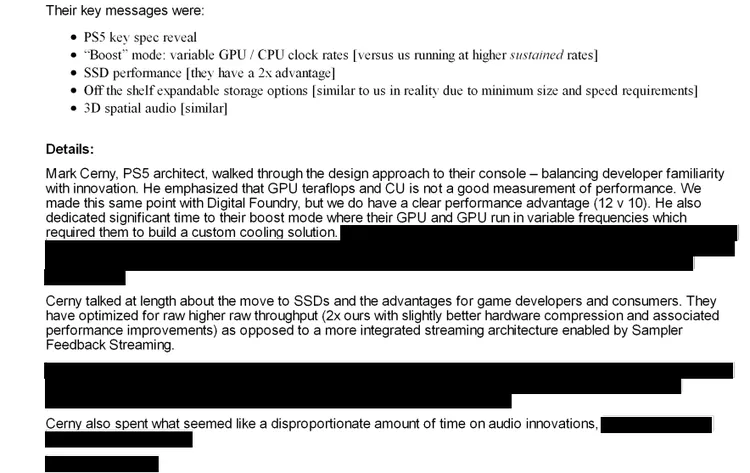
If you remember the launch period of the PlayStation and Xbox, both consoles were announced just a few days apart and videos explaining their features were released. Case evidence reveals a series of emails exchanged among Xbox executives that shed light on how they reacted to these announcements. For example, there is an email from Liz Hamren, who was the Head of Platform Engineering and Hardware at Xbox at the time, pointing out the strong and weak points of the PS5 compared to their own products.

In the email, Hamren starts off by praising the SSD of the PS5. Although this is unsurprising, he manages to disappoint Xbox users when discussing teraflops. As you may know, the Xbox Series X has 12 teraflops of power, while the PlayStation 5 has only 10 teraflops. This has been frequently pointed out by both Xbox fans and the media. However, the email states that “GPU teraflops and CU is not a good measurement of performance.”

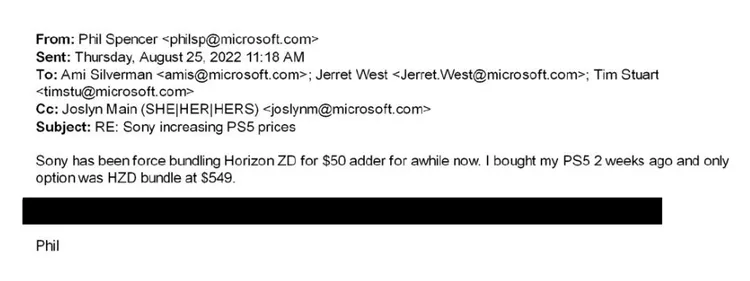
In the email exchange, the topic of Sony’s increase in PlayStation prices last year is also discussed. When Sony announced the price hike, Tim Stuart, the CFO of Xbox, reached out to Phil Spencer and Microsoft’s CFO Amy Hood. Stuart noted that the Xbox team had foreseen this development and was swiftly putting a plan into action now that they had official confirmation. Although much of the email conversation is redacted, it’s evident that Spencer is advocating for a gamer-centric approach to any potential price changes.

Ami Silverman, who was then in charge of Microsoft’s consumer sales and marketing, agreed with Spencer’s sentiments. Silverman responded, “Excellent points. Let’s maintain our focus on the gamer community. We’re not out of the woods yet, and this could be our moment to either win over fans or risk falling behind as a mere follower.”

Microsoft’s reaction to Sony’s PS5 announcement and price hike shows that the company is well aware of the competitive landscape in the video game industry. Microsoft is also clearly committed to remaining competitive with Sony in terms of both price and performance.

RELATED:

(via)

Google Pixels start receiving September 2023 Update

After a slight delay, the September 2023 update for Pixel smartphones and tablets is finally here. The update is now live for Pixel 4a, Pixel 5, Pixel 5a, Pixel 6 Series, Pixel 7 Series, Pixel Tablet, and Pixel Fold. The carrier-locked Pixel devices are also receiving the update in the US. This time Google didn’t add any feature enhancement for the Pixels, but did add plenty of security fixes via the Android September 2023 security patch and separate Pixel Security update.

Must See: Google Pixel Watch 2 will offer a new metal slim band accessory

There are a bunch of improvements and fixes at the Android OS level for the issues having high severity. Another critical issue with ARM architecture with ID CVE-2023-4211 is fixed via the latest update.

It is now rolling out to all the users across the globe, the Pixel Tablet is receiving firmware TQ3A.230901.001.B1 and the Pixel Fold is enjoying TQ3C.230901.001.A1 firmware. Details for other devices are listed below:

Global

  • Pixel 4a (5G):    TQ3A.230901.001
  • Pixel 5:                TQ3A.230901.001
  • Pixel 5a (5G):    TQ3A.230901.001
  • Pixel 6:                TQ3A.230901.001
  • Pixel 6 Pro:         TQ3A.230901.001
  • Pixel 6a:              TQ3A.230901.001
  • Pixel 7:                TQ3A.230901.001
  • Pixel 7 Pro:         TQ3A.230901.001
  • Pixel 7a:              TQ3A.230901.001
  • Pixel Tablet:       TQ3A.230901.001.B1
  • Pixel Fold:          TQ3C.230901.001.A1

Japan

  • Pixel Fold:          TQ3C.230901.001.A2

T-Mobile & MVNOs, Google Fi (US)

  • Pixel 6:                TQ3A.230901.001.C1
  • Pixel 6 Pro:         TQ3A.230901.001.C1
  • Pixel 6a:              TQ3A.230901.001.C1

Verizon & MVNOs (US)

  • Pixel 4a (5G):    TQ3A.230901.001.C2
  • Pixel 5:                TQ3A.230901.001.C2
  • Pixel 5a (5G):    TQ3A.230901.001.C2
  • Pixel 6:                TQ3A.230901.001.C2
  • Pixel 6 Pro:        TQ3A.230901.001.C2
  • Pixel 6a:             TQ3A.230901.001.C2
  • Pixel 7:               TQ3A.230901.001.C2
  • Pixel 7 Pro:        TQ3A.230901.001.C2
  • Pixel 7a:             TQ3A.230901.001.C3
  • Pixel Fold:          TQ3C.230901.001.B1

The OTA update is rolling out in phases and may take some time to reach each device depending upon carrier and device. The users can manually check for the update by heading to Settings > About > Check for updates. Interested users can directly flash the OTA update by downloading the respective files from here.

Moto Edge 40 Neo Indian price leaks ahead of September 21 launch

After the European launch of the Motorola Edge 40 Neo smartphone earlier this month, the Indian debut is on the horizon. The official Indian launch is pegged for September 21. Ahead of the launch, tipster Abhishek Yadav has revealed how much the phone will cost in the country.

Motorola Edge 40 Neo

As per Abhishek, the Moto Edge 40 Neo will be priced at Rs 24,999 in India, making it the cheapest device in the Edge series. However, being more affordable does not mean that the device lacks charm. It comes with a beautiful curved display offering 10-bit color along with a capable mid-range processor. Keep reading to learn more about the smartphone.

Moto Edge 40 Neo specs

The Moto Edge 40 Neo features a 6.55-inch pOLED display with Full HD+ resolution, delivering crisp visuals at 2400 × 1080 pixels and a high pixel density of 409ppi. The display boasts a smooth 144Hz refresh rate and an ultra-responsive 360Hz touch sampling rate. It achieves a peak brightness of 1300 units and utilizes a 10-bit panel for vibrant visuals.

Motorola Edge 40 Neo

Under the hood, the Moto Edge 40 Neo is powered by the MediaTek Dimensity 7030 chipset, crafted on a 6nm process, and accompanied by a Mali G610 GPU for efficient performance. It offers memory options of 8GB or 12GB of LPDDR4X RAM and storage choices of 128GB or 256GB of uMCP storage.

The device runs on Android 13 and ensures future updates, including Android 14 and Android 15, in addition to three years of security updates. In the camera department, it boasts a 50MP primary camera with OIS and a 13MP ultra-wide-angle lens that supports macro and depth modes. On the front, there’s a 32MP selfie camera for high-quality self-portraits.

The Moto Edge 40 Neo is equipped with a robust 5000mAh battery and supports 68W TurboPower fast charging via a USB 2.0 Type-C port. Security features include an in-display fingerprint scanner for quick and secure access. The device offers an immersive audio experience with stereo speakers featuring Dolby Atmos audio and Moto Spatial Sound.

RELATED:

(Source)

Windows and Surface leader Panos Panay is leaving Microsoft, reportedly heading to Amazon

Panos Panay, the chief product officer at Microsoft, is leaving the company after nearly 20 years. Panay’s departure comes at a critical time for Microsoft, as it is preparing to launch a new generation of Surface devices on September 21.

Panas Panay Leaves Microsoft

In an email to employees, Rajesh Jha, Microsoft’s vice president of experience and devices, said that Panay “has decided to leave Microsoft after nearly 20 years.” Satya Nadella, CEO of Microsoft, commented on the departure, saying:

“Thank you, Panos, for your impact on our products, culture, company, and industry over the past two decades. I’m grateful for your leadership, support, and all you’ve done for Microsoft and our customers and partners. As Rajesh stated, we remain steadfast and convicted in our strategy and Yusuf Mehdi will take lead on our Windows and Surface businesses and products externally.”

Panay joined Microsoft in 2004 and quickly rose through the ranks. He was instrumental in the development of the Surface line of devices, which debuted in 2012. The Surface line includes a variety of devices, including laptops, tablets, and desktops. 

In 2018, Panay was promoted to chief product officer of Microsoft. In this role, he was responsible for overseeing the development of both hardware and software products. He played a key role in the development of Windows 11, which was released in 2021.

Panay is known for his passion for products and his ability to connect with customers. He is also known for his ability to create a culture of innovation and collaboration within Microsoft.

In a post on X (formerly Twitter), Panay says “he’s “decided to turn the page and write the next chapter,” adding that he’s “forever grateful for my time at Microsoft and the amazing people I had the honor to make products with.”

Microsoft has announced that Panay’s many roles will be taken on by different people. Pavan Davuluri will continue to oversee the development of experiences across Windows, client, and cloud devices. Microsoft is also creating a new Windows and Web Experiences Team, with members such as Shilpa Ranganathan and Jeff Jonhson reporting to Mikhail Parakhin. Finally, Yusuf Mehdi will take on the role of managing the Windows and Surface businesses with OEM and retail partners.

What’s next for Panos?

Well, it doesn’t take long to figure out where he’s going next. According to Bloomberg, Panay is joining Amazon to lead its Alexa and Echo division. He will replace Dave Limp, the Amazon executive previously in charge of Alexa and Echo, who announced his retirement last month.

Limp left big shoes to fill, but Panay is a well-respected executive with a proven track record. It’s not clear what Panay’s job title will be at Amazon, and both companies declined to comment on Bloomberg’s report. Ironically, both Amazon and Microsoft have fall hardware events scheduled this week. So it will be interesting to see how Panay’s move impacts the two companies.

Related:

(Via)

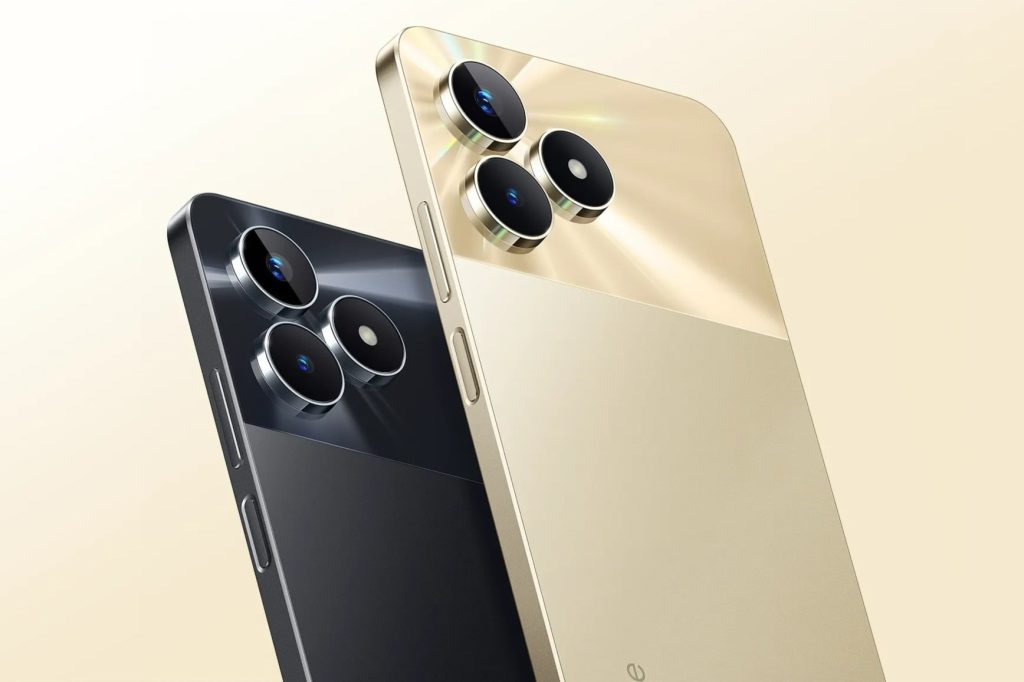
Realme C53 6GB RAM & 128GB storage config finally launched in India

Back in July, Realme launched the C53 smartphone in India. The smartphone was made available in two storage configurations: 4GB + 128GB and 6GB + 64GB. Now, the brand has added another storage option with 6GB RAM & 128GB storage.

Realme C53 (India)

The 6GB RAM + 128GB storage variant of the Realme C53 is set to hit the Indian market at a price of Rs 11,999. Commencing tomorrow, on September 20th, this smartphone will be exclusively accessible for purchase on both Flipkart and the Realme Store, starting from 12:00 PM. As an inaugural offering, Realme is extending a generous discount of up to Rs 1000 on transactions made with ICICI, HDFC, and SBI Debit and Credit Cards.

For those seeking alternative configurations, the Realme C53 also offers a 4GB RAM + 128GB storage option, priced at Rs 9,999, as well as a 6GB RAM + 64GB storage version, available at Rs 10,999.

Realme C53 specs

The Realme C53 boasts a 6.74-inch LCD display with an HD+ resolution of 1600 x 720 pixels. It features a smooth 90Hz refresh rate, an impressive 180Hz touch sampling rate, and up to 560 nits of brightness.

Realme

In the camera department, it sports a capable 108MP primary camera along with a monochrome sensor, ensuring quality photography. On the front, it houses an 8MP selfie camera.

Under the hood, the Realme C53 is powered by the Unisoc T612 chipset, complemented by LPDDR4x RAM for efficient multitasking. It offers ample storage with eMMC 5.1 technology.

Connectivity options include support for dual SIM cards, 4G, dual-band WiFi, Bluetooth 5.0, a MicroSD card slot for expandable storage, a 3.5mm headphone jack for audio, and a USB Type-C port for charging and data transfer. Keeping the device running is a 5,000mAh battery, which supports 18W fast charging. It runs on the Android 13 operating system with the Realme UI T Edition.

RELATED:

(Source)

OnePlus Pad Go will bundle a 2.4K Resolution Display

OnePlus debuted its maiden tablet in India a couple of months ago (here’s its review), and now the company is eyeing its second tablet – the OnePlus Pad Go launch in India. The upcoming tablet is set to entertain the mid-range market with its high-end display and specifications. Following the trend from the past few days, OnePlus has teased its display features on the official product landing page on the OnePlus website.

Must See: OnePlus unveils OxygenOS 14 Open Beta rollout Timeline

The company confirms the presence of a 2.4K display resolution for a better viewing experience. In a recent interview, OnePlus President and COO, Kinder Liu also shed some light on the device’s display specifications. He confirmed a 7:5 aspect ratio panel which is quite similar to the OnePlus Pad.

There are sparse details about the technical details of the OnePlus Pad Go, but it is confirmed to be affordable and will budge competition in the mid-range segment.

OnePlus Pad Go Specifications and Features (Expected)

OnePlus Pad Go is expected to launch in a “Twin Mint” color finish which offers both matte and glossy finish.

The possibility for the 3.5mm jack is quite low; Meanwhile, it will ship with Android 13-based OxygenOS 13. OnePlus Pad Go will offer some exciting features that will enhance the sync between your OnePlus phone and tablet. The users would be able to sync clipboard content, and share files easily, and will offer the ability to use hotspots directly from the tablet. Other features such as screen mirroring, notifications sync, and call management will be part of the OnePlus Pad Go.

It is launching on September 22 in India and is likely to carry a price tag of around Rs 30,000 (~$240).

Related Stories:

Alleged Xiaomi Civi 4 IMEI database listing reveals model number, launch timeframe

Xiaomi has a busy schedule until the end of the year. On Thursday (Sept. 21), its sub-brand Redmi will announce three smartphones, such as the Redmi Note 13 5G, the Redmi Note 13 Pro 5G, and the Redmi Note 13 Pro+ 5G. In November, the brand is expected to unveil the Xiaomi 14 and the Xiaomi 14 Pro flagship phones. In December, the company is expected to take off covers from the Redmi K70e, the Redmi K70, and the Redmi K70 Pro. In 2024, the company is expected to announce the Xiaomi 14 Ultra, MIX Fold 4, and MIX Flip 4 in the first half of 2024. A new report reveals that a Civi-branded phone will also debut within the same timeframe.

Xiaomi Civi 4 launch timeframe (rumored)

Xiaomi CIvi 4 IMEI databse listing
Xiaomi CIvi 4 IMEI data listing

GSMChina has come across a new Xiaomi device with model number 24031PN0DC in the GSMA IMEI database. While the listing does not mention the name of the device, the publication claims that it is the Xiaomi Civi 4.

The report claims that, like the predecessor CIVI models, the Civi 4 will remain exclusive to the Chinese market. The “2403” digits in the model code hint that the device may launch in March 2024 in China. Like the existing Civi phones, the Civi 4 will be a female-focused smartphone.

Hence, it is expected to arrive with a beautiful design, a powerful chipset, and impressive selfie and rear cameras. According to reports, a brand-new Qualcomm chip with the part number SM7550 powers the device. Rumors have it that the chip will be called the Snapdragon 7 Gen 3 when it breaks cover.

Unfortunately, details about the remaining specifications of the Xiaomi Civi 4 are not known yet. In Chinese culture, the number 4 is associated with bad luck, so there’s a possibility that Xiaomi might opt to name the device the Xiaomi Civi 5 instead. It is recommended to stay tuned for additional updates to gather more information.

RELATED:

(via)

Alleged New Redmi Note 13 Models Hit India’s BIS

Redmi is teasing features of the upcoming Remdi Note 13 series via its official handles on Weibo. A lot has been revealed officially by these teasers in recent weeks. Meanwhile, two new smartphone models – 2312DRAABI, and 2312FRAFDI which allegedly belong to the Redmi Note 13 series have surfaced on India’s BIS certification.

Must See: Redmi Note 13 Pro+ Camera Details And Processor Teased Ahead Of Launch

The listing didn’t reveal anything, but by decoding the model numbers we found that the smartphones are slated for launch by the end of this year. Some users are expecting the Redmi Note 13 to bit early to compensate for the insignificant sales by its predecessor in the ongoing fiscal year. Surprisingly, the new series is launching in China on September 21. However, nothing is official about the two models, so we suggest taking these with a grain of salt in the ocean.

There are already plenty of rumors and leaks about the Redmi Note 13 series carrying different model numbers. We have extracted the specification details to better understand what to expect from the upcoming Redmi Note series.

Redmi Note 13 Series Specs

Redmi confirmed the launch of three different models including Redmi Note 13 Pro, Redmi Note 13 Pro+, and Redmi Note 13 Yibo edition. The smartphone will likely embed into the Redmi Note 13 Pro+ and Redmi Note 13 Pro, respectively.

The Redmi Note 3 Pro will bundle an FHD+ display carrying an in-display fingerprint scanner. Meanwhile, the Redmi Note 13 Pro Plus is likely to pack a curved display of curved display offering 1800 nits peak brightness, 1920Hz PWM dimming, and DC dimming.

Redmi note 13 Pro

As per recent leaks, the Redmi Note 13 Pro Series packs a 200MP Samsung HP3 Discovery edition as the primary sensor. The Pro Plus variant would come with Optical Image Stabilisation (OIS).

The Redmi Note 13 Pro will house a 5000 mAh battery with 67W wired fast charging the Redmi Note 13 Pro Plyus will house a 5120 mAh battery with 120W fast charging.

The pricing details are not available, but we expect the series to start retailing at ~$170. The smartphones will launch by the end of this year, but we expect it to launch in India next month due to the upcoming festive season.

RELATED:

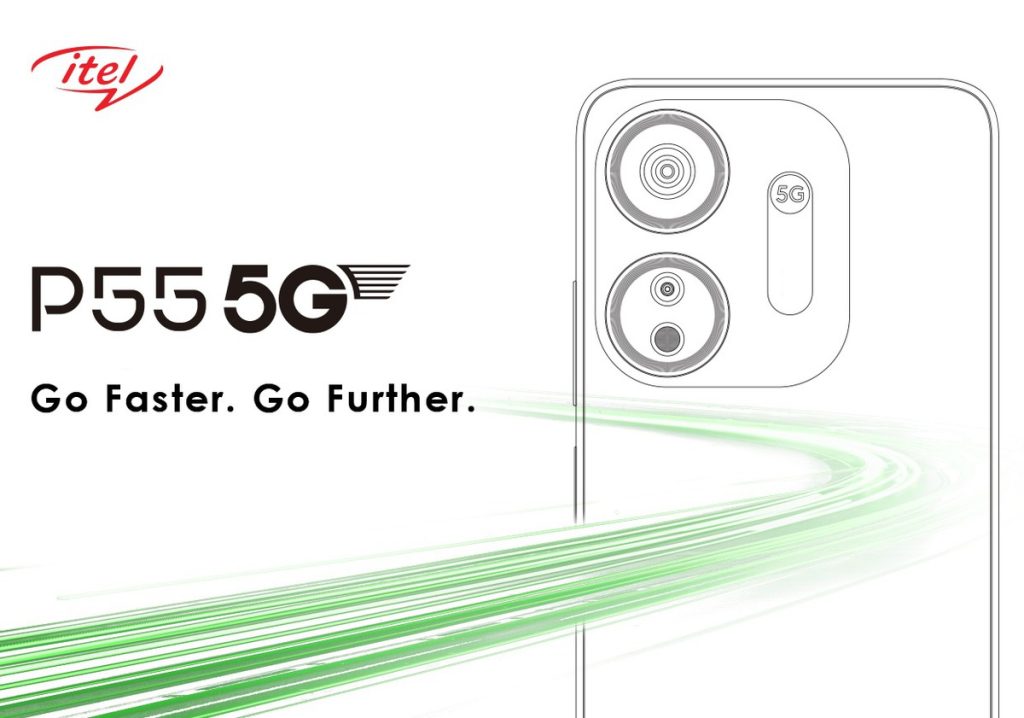
Itel P55 set to launch as India’s first 5G phone under Rs. 10,000

Itel, the affordable smartphone maker owned by Transsion Holdings (the parent company behind Infinix and Tecno), is ready to launch a new smartphone in India called the Itel P55. Notably, it is expected to be the country’s only 5G-enabled smartphone priced under Rs. 10,000 (approximately $125).

Itel is yet to reveal the launch date for the upcoming smartphone but has confirmed it will bring 5G to the masses. The under Rs. 10,000 market in India does not have many great options. You get to choose from a few Redmi and Poco smartphones. Some Samsung phones, like the Galaxy F04 and Galaxy M13, are also available in the same range but none of them support 5G. Itel wants to change that with the Itel P55.

Itel P55

We are not sure what specifications this phone will bring. The teaser image shared by the brand showcases a dual camera system on the back but that’s about it. As a budget phone, Itel P55 might bring a lower-end Unisoc processor, paired with a 5,000mAh battery. An official announcement should be around the corner.

The Itel P55 will follow the launch of the Itel S23+, which debuted earlier this month with a large 6.78-inch FHD+ AMOLED curved display, featuring a 59-degree curvature. This device also features a Unisoc T616 (12nm) processor, 8GB LPDDR4X RAM, and 256GB UFS 2.0 storage. The Itel S23+ is powered by a 5000mAh battery with 18W charging support and boasts a 50MP primary camera setup on the rear.

RELATED:

Oppo A2x and A2m launching soon with identical specs, suggests TENAA

Oppo recently launched the A2 Pro in China with some premium specifications, including a 120Hz OLED display, Dimensity 7050 SoC, and 64MP camera setup, and more. The company might also be gearing up to launch two new phones in the A series, dubbed Oppo A2x and A2m. These two phones have been recently spotted on the TENAA certification website with similar specifications. Here are the details.

The Oppo A2m was spotted on TENAA with model number PJU110, while the A2x has been labeled PJS110. Both these phones are reportedly for the Chinese market. We see the handsets adopt a familiar design, featuring two rings on the back and what looks like a waterdrop notch on the front.

Oppo A2x and Oppo A2m

They both feature a 6.56-inch LCD panel that offers an HD+ resolution of 720 x 1612 pixels. Both phones are listed by the authority with a 2.2GHz octa-core processor, however, the exact name of the chipset is anyone’s guess.

The SoC on the two phones will likely be paired with 8 GB / 12 GB of RAM and 128 GB / 256 GB of internal storage. Both Oppo A2x and A2m are listed on TENAA with a 5,000mAh battery but their charging capabilities remain unknown. On the software, the OPPO A2x and A2m will run Android 13, likely with a layer of ColorOS 13 on top. As far as the cameras are concerned, both models get a 5MP shooter on the front with a 13MP primary sensor on the rear.

Officially, Oppo is yet to reveal anything about the two smartphones. Judging from the specifications, they look like budget phones priced under $150. More details should emerge soon. Stay tuned!

RELATED:

(Source) (Via)

Renowned Chinese tipster reveals more details of the Redmi Note 13 series ahead of launch

Chinese tech giant Xiaomi recently confirmed that it would be launching the next-generation Redmi Note 13 series later this week. The company has also confirmed the presence of three models in the series – Redmi Note 13 Pro, Redmi Note 13 Pro Plus, and Redmi Note 13 Yibo Edition. However, the company has been silent about the vanilla Redmi Note 13 which may be announced at a later date.

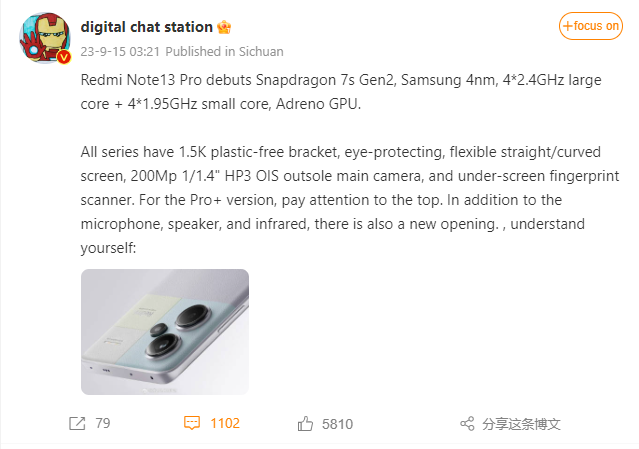
Chinese tech blogger Digital Chat Station has shared further details of the Redmi Note 13 series. The tipster confirmed that the models will be powered by the Snapdragon 7s Gen 2. The new chipset will be built on Samsung 4nm silicon and features four large cores with a clock frequency of 2.4GHz as well as four energy-efficient cores clocked at 1.95GHz each. The chip is also equipped with an X62 modem and FastConnect 6700 connection system, as well as three 12-bit ISPs that support up to 200 MP shooting. The Octa-core chipset also pairs with an Adreno GPU.

The entire Redmi Note 13 series will also have an eye-protecting flexible screen without plastic brackets. The Redmi Note 13 Pro is said to feature a flat screen while the Note 13 Pro+ will reportedly pack a curved screen. For optics, the premium smartphones will be equipped with a 200-megapixel HP3 outsole sensor jointly customized by Samsung’s ISOCELL. The device will also feature an under-screen fingerprint sensor.

Redmi note 13 Pro

In addition, DigitalChatSattion also disclosed that the Note 13 Pro+ will also have a new opening in addition to the openings for microphone, speaker, and infrared remote control. There are also speculations that the Pro+ will equally come with IP68 dustproof and waterproof will be added.

We expect to find out the actual details of the Redmi Note 13 Pro series when it is announced on September 21.

RELATED:

MatePad Pro 13.2 launch date confirmed, arriving as Huawei’s largest-ever tablet

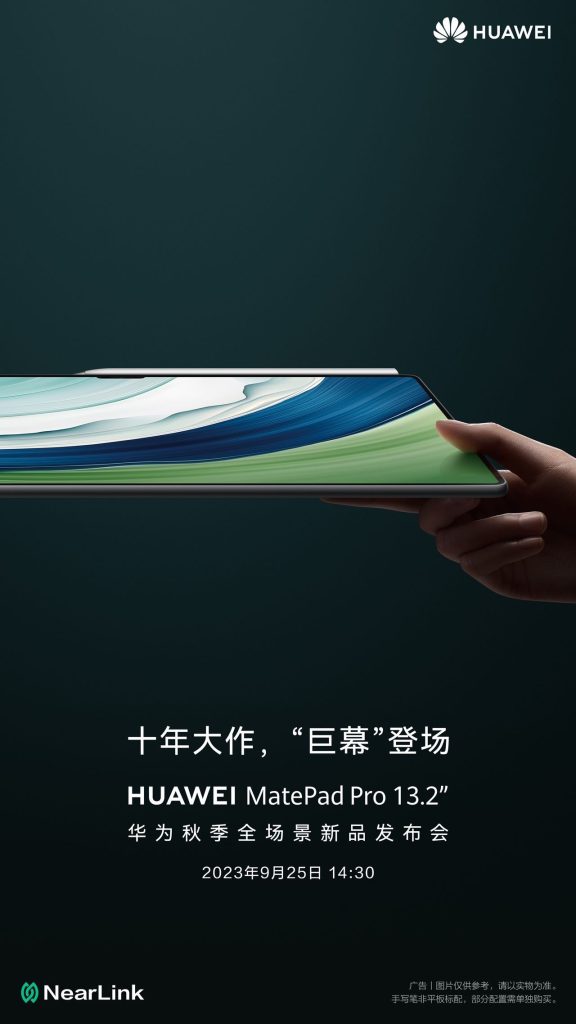
Huawei has confirmed that it will unveil the MatePad Pro 13.2 tablet on September 25 in China. Featuring a massive 13.2-inch screen, the MatePad Pro 13.2 is the largest tablet in Huawei’s history. Here is a look at what to expect from the device.

Huawei MatePad Pro 13.2 key features

Huawei MatePad Pro 13.2

The official poster suggests that the MatePad Pro 13.2 will have a thin and lightweight design with an ultra-narrow bezel around the screen. With its larger display, it is expected to achieve an outstanding screen-to-body ratio, potentially setting a new standard in its category.

The inclusion of a larger display notch suggests that the MatePad Pro 13.2 could be equipped with a dual-camera setup along with 3D ToF-like components for 3D face recognition, face payment, and air gesture support for hands-free operation. It is being said that the MatePad Pro 13.2 may feature the Kirin 9000s chipset, which also powers the Mate 60 lineup and Mate X5 foldable phone.

The inclusion of the NearLink StarLight logo on the poster suggests that the MatePad Pro 13.2 will be equipped with StarLight connection technology, a recently introduced short-range wireless technology that combines the strengths of Bluetooth and Wi-Fi. It boasts several advantages, including 60% lower power consumption, six times higher speed, 1/30th the delay, and support for a greater number of network connections than traditional wireless connections.

it appears that the MatePad Pro 13.2 will support a new stylus with reduced latency thanks to StarLight connection technology, offering a writing experience comparable to using physical paper and pen while conserving battery life. The MatePad Pro 13.2 is also said to support wireless charging. In addition, it may feature a dual-camera setup featuring an ultra-wide lens on the back.

RELATED:

Redmi Note 13 Pro+ will be an IP68-rated device, confirms Redmi

Redmi has made an official announcement about the Redmi Note 13 Pro+, revealing that it now comes with IP68 dust and water resistance, making it the first Redmi Note series phone to come with such an IP rating. According to well-known Chinese tipster Digital Chat Station, the extra opening at the top of the Redmi Note 13 Pro+ serves as a pressure relief valve, which plays a crucial role in achieving the IP68 dustproof and waterproof rating.

Redmi Note 13 Pro+ IP68 rating details

Redmi Note 13 Pro Plus IP68
Redmi Note 13 Pro Plus =

Redmi’s General Manager, Lu Weibing, recently penned a detailed article explaining the three key improvements made to achieve the IP68 rating for the Redmi Note 13 Pro+. These enhancements include the following changes:

  1. Structural Reinforcement: The phone includes 19 custom structural components, such as multi-layer screen protection, a double-layer back cover, and sealed details like the SIM card holder and ejector pin hole.
  2. Internal Strength: It features Corning Gorilla Victus Glass and reinforced key structures with a high-strength aluminium alloy frame, strengthened corners, and a thicker motherboard. Stainless steel and polymer buffer glue improve drop resistance.
  3. Rigorous Testing: The Redmi Note 13 Pro+ underwent 10 extra airtightness tests, including Type-C boards, earpieces/speakers, and frame components, ensuring 100 percent compliance with the IP68 standard.

Redmi has already confirmed that the Redmi Note 13 Pro+ features the Dimensity 7200 Ultra processor, built on TSMC’s 4nm process. As per the TENAA listing, the device is expected to arrive with up to 16 GB of RAM and up to 1 TB of storage. It is expected to pack a 5,120mAh battery with 120W fast charging support.

In earlier teasers, Xiaomi announced that the Redmi Note 13 Pro series features a 200-megapixel Samsung HP3 Discovery Edition main camera sensor. The device is also equipped with a curved-edge AMOLED display that offers a 1.5K resolution on the front. The screen also supports a peak brightness of 1800 nits, 1920Hz high-frequency dimming, and an in-screen fingerprint scanner.

RELATED:

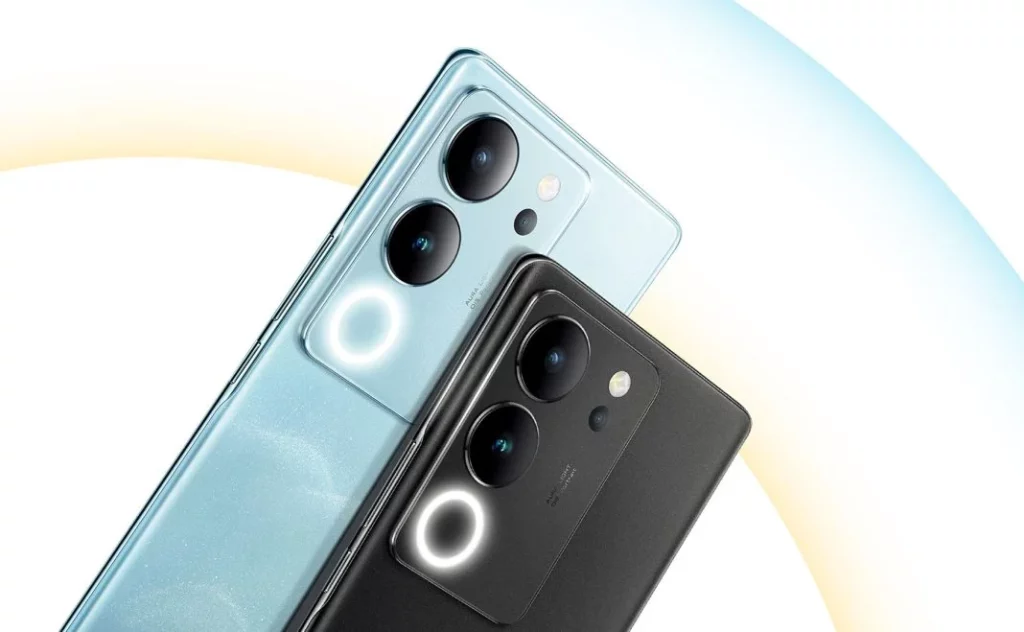
Vivo V29 & V29 Pro expected price and camera details revealed ahead of launch in India

According to a recent report, Vivo’s V29 5G series expected price and camera details in India have surfaced online. For those unaware, the company is preparing to launch its V29 5G and V29 Pro 5G smartphones in India. Numerous leaks about the devices have led us to believe that the official launch would be near the end of September 2023.

Vivo-V29-5G

A recent report by MySmartPrice reveals that the price of the V29 5G series is said to be under Rs. 40,000 in India. The report also suggests that the upcoming Vivo V29 5G smartphone is expected to be launched with the ‘Majestic Red’ color variant (Inspired by India). On the other hand, the Vivo V29 Pro will be equipped with Sony’s IMX663 50MP primary camera sensor having a focal length of 50mm. It is worth noting that the company has yet to make an official statement regarding the release of these smartphones in the Indian market. Based on the timeline, we expect that the official announcement will occur shortly.

The Vivo V29 has already been released in the global markets. Those wondering what the hype is all about can check the specifications of these devices below.

Vivo 29 5G Specifications

The Vivo 29 5G comes with a 6.78-inch 1.5K AMOLED display and a high refresh rate of 120Hz. It is equipped with a 4,600mAh battery, which supports 80W fast charging, accompanied with a VC Bionic Cooling system to manage heat. Under the hood, the device is powered by a Qualcomm Snapdragon 778G chip and 12GB of RAM. The smartphone operates on Android 13-based FunTouch OS (Operating System) with 256GB of storage.

Vivo 29 Pro 5G Specifications

A recent Geekbench listing indicates that the global model of Vivo 29 Pro features the Dimensity 8200 chip and could also come with a 4,600mAh battery. The device is rumored to have a 6.78-inch AMOLED display with a 2800 x 1260 pixel resolution and a 120Hz refresh rate. We expect to receive more information on the devices before the official launch in India. So Stay tuned.

RELATED:

(Source)

Redmi showcases Note 13 Pro+ camera quality with new travel filters before the official launch

Redmi is gearing up to launch the Note 13 series on 21 September in China. Earlier this month, the Redmi Note 13 series models appeared in TENAA’s database, revealing some key information about the device.

Now, according to a recent Weibo post, the company has shared a couple of camera photo samples with its 200-megapixel primary camera. Let’s go ahead and take a look at the sample images.

Redmi Note 13 Pro+ camera shots and travel filters

As we can see from the camera shots above, these images were captured using the Redmi Note 13 Pro+. It appears that the company is making efforts to enhance camera quality and optical image stabilization (OIS). The post also mentions the inclusion of travel filters to improve image aesthetics. These filters include Warm Green, Forest Green, Negative, and Vivid, each offering unique textures and visual effects. It’s worth noting that the Pro+ variant is rumored to feature a leather back with raised camera rings, while the Pro model has a glass back with a raised camera island.

Furthermore, the Redmi Note 13 Pro+ will come equipped with a 5,120mAh battery and 120W fast charging support. Under the hood, Pro+ will be powered by a MediaTek Dimensity 7200-Ultra chip.

On the other hand, the Redmi Note 13 Pro variant has been recently listed on the Geekbench website with model number 2312CRAD3C. The listing shows that the 13 Pro is running on the Snapdragon 7 Gen 2 SoC and has 16GB of RAM. As for the display, Redmi has previously stated that the smartphone features a flat AMOLED display with a 5,000mAh battery and 67W fast charging.

RELATED:

(Source 1,2)