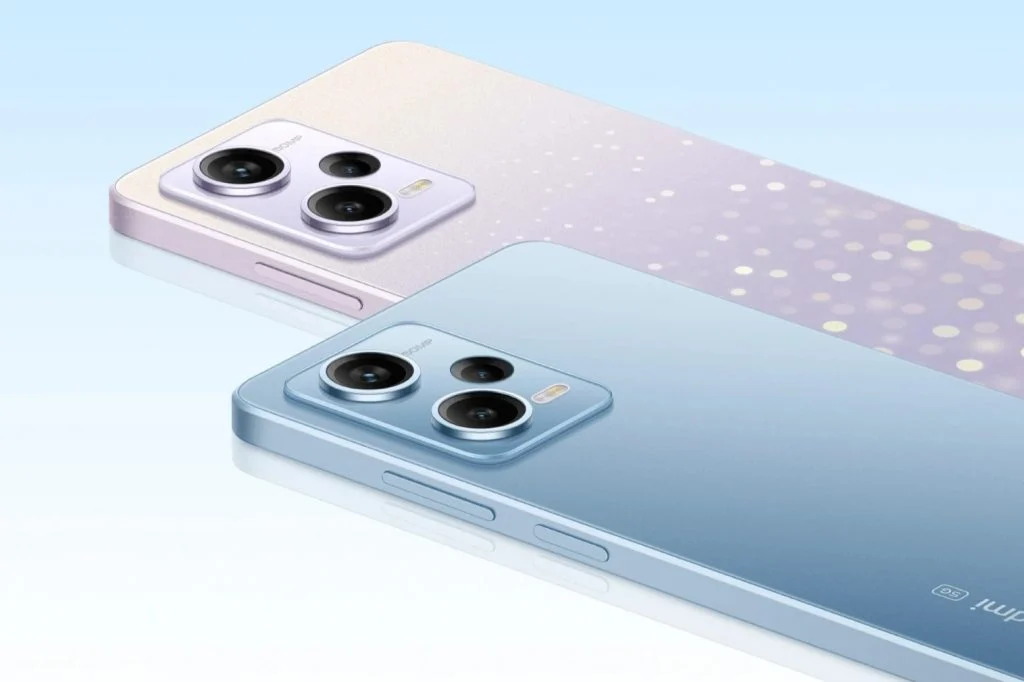
In the technological space, new innovations happen every day, so what’s on top today may not be on top tomorrow. Last month, Honor unveiled the Magic V2, the thinnest book-style foldable smartphone to date, measuring an impressive 9.9mm when folded. But now Xiaomi is coming for that title on August 14 with its latest Mix Fold 3.
Xiaomi Mix Fold 3 also brings a new hinge
Xiaomi just gave us a sneak peek into the Mix Fold 3’s design and thickness. As per the company, the foldable smartphone will be a super slim 4.93mm when unfolded, and when folded, it’ll be impressively sleek at 9.8mm. To put that in context, the previous Mix Fold 2 (review) was 5.4mm and 11.2mm in comparison. And then there’s the thinnest horizontal foldable out there, the Honor Magic V2, measuring 4.7mm unfolded and 9.9mm folded.
Xiaomi Mix Fold 3 brags a new hinge this time, which is made out of high-strength steel and wear-resistant carbon ceramic. It has a 3-stage connecting rod design that is more complex with 14 movable parts and 198 parts total. Teasers have revealed the Mix Fold 3 sports a glossy rectangular camera island on the back panel. There are three camera sensors on its back with a periscope lens and an LED flash unit.
Earlier reports have also hinted at a few Mix Fold 3 specs. The phone is rumored to have a 4,800mAh battery with 50W wireless charging and 67W wired charging. It is also supposed to be powered by the Snapdragon 8 Gen 2 processor and have 512GB/1TB of Universal Flash storage.
The phone is launching on August 14 and Xiaomi may launch other devices along with it. Stay tuned for the updates.
Huawei recently introduced NearLink, its latest generation of short-range wireless connection technology. Short-range communications are wireless technologies that allow devices to connect to each other over a short distance. One of the most common examples of short-range communication is Bluetooth. But Huawei’s new NearLink technology is claimed to be significantly faster than Bluetooth. And it has the potential to be used as a standard connection technology for future devices.
This is a significant achievement for Huawei, as it has been blacklisted by the US government. However, Huawei remains a major player in the global tech industry, and NearLink is a sign that the company is still innovating despite its challenges.
Huawei’s NearLink could be a game changer
NearLink is the result of a collaborative effort between more than 300 leading enterprises and institutions from around the world. It combines the strengths of traditional wireless technologies like Bluetooth and Wi-Fi, resulting in a much faster, more reliable, and more energy-efficient connection.
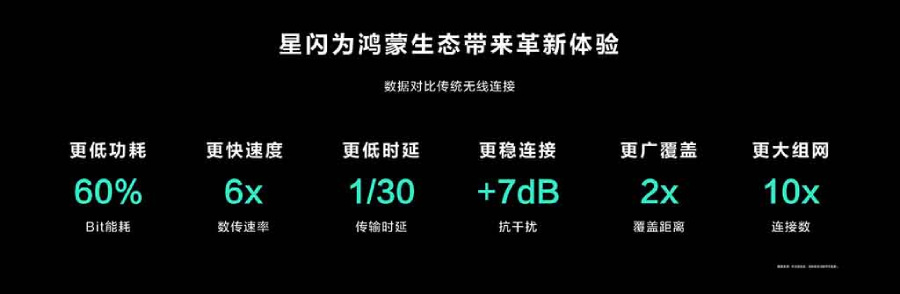
NearLink is six times faster than Bluetooth and has a latency of just 1/30th of a millisecond. This makes it ideal for applications that require high-speed data transfer and low latency, such as augmented reality and virtual reality. NearLink also supports up to 10 times more group connections than Bluetooth, making it well-suited for multi-device applications like smart home systems and industrial automation. Also, energy consumption has decreased by up to 60%.
Huawei says NearLink can be used in a variety of scenarios, including consumer electronics, smart homes, electric vehicles, and industrial smart manufacturing.
But Huawei is not the only company working on new short-range wireless connection technologies. Apple has its own technology called Ultra Wideband (UWB). Other companies, such as Qualcomm and MediaTek are also involved in the development of this field. However, NearLink appears to be an advanced short-range wireless connection technology that has the potential to become the standard for future devices.
The original Redmi Pad was released in October of last year with the Helio G99 SoC and an IPS LCD display. Leaks suggest that a next-generation tablet is also scheduled to be released sometime this year. While early details hinted that it would be called the Redmi Pad 2, a new report claims that the device will be branded as the Redmi Pad SE. Redmi has yet to confirm the release of the new slate, but it appears that we won’t have to wait much longer, as it has received another global certification.
Redmi Pad SE could be a solid budget tablet
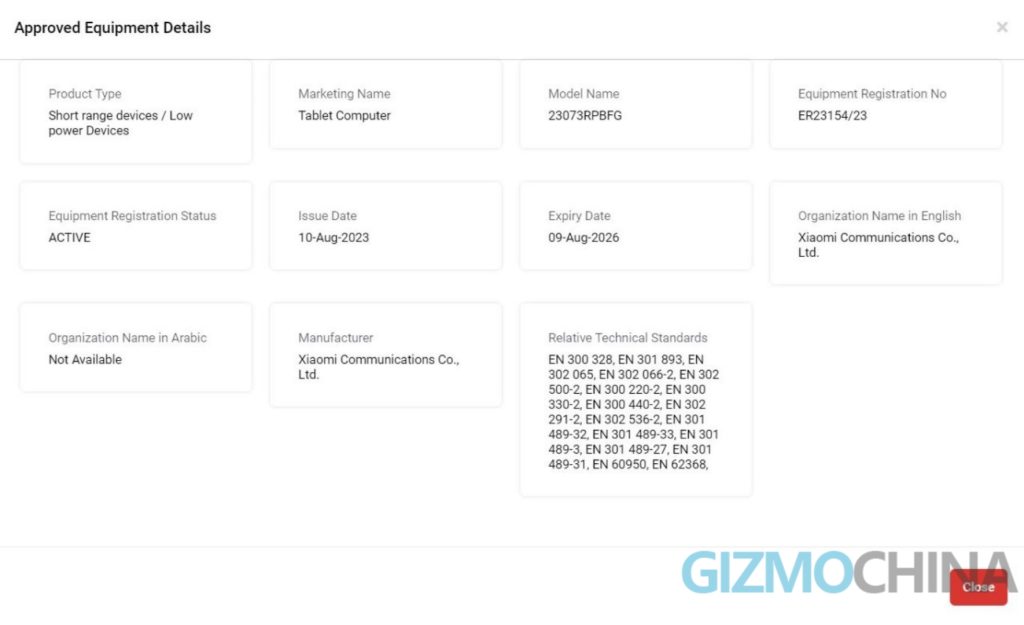
The Redmi Pad SE has received TDRA approval with the model number 23073RPBFG. As usual, the certification listing didn’t reveal anything interesting apart from the manufacturer details, which in this case is Xiaomi, and the model number. However, the certification suggests that the Redmi Pad SE is inching toward its global launch.
While we don’t have an official confirmation regarding the tablet’s launch, reports claim it will launch alongside the Xiaomi Pad 6 Max, the Xiaomi MIX Fold 3 foldable phone, and the Redmi K60 Ultra flagship in August in China. MIX Fold 3’s launch is happening on August 14 so we might not have to wait for long.
Last month, the Redmi Pad SE (formerly Redmi Pad 2) bagged FCC certification, which also revealed it will come in variants, such as 4 GB RAM + 64 GB storage, 4 GB RAM + 128 GB storage, and 6 GB RAM + 128 GB storage. The slate is said to run on MIUI 14, based on Android 13.
Other reports claim Redmi’s upcoming tablet will get an around 10-inch IPS LCD display with 2K resolution and a 90Hz refresh rate. Geekbench reveals it will have the Snapdragon 680 chipset under the hood, paired with LPDDR4x RAM. Fueling the tablet may be an 8,000mAh battery with support for 22.5W fast charging.
The Redmi Pad SE should be launched in multiple markets. Are you excited about the new budget tablet?
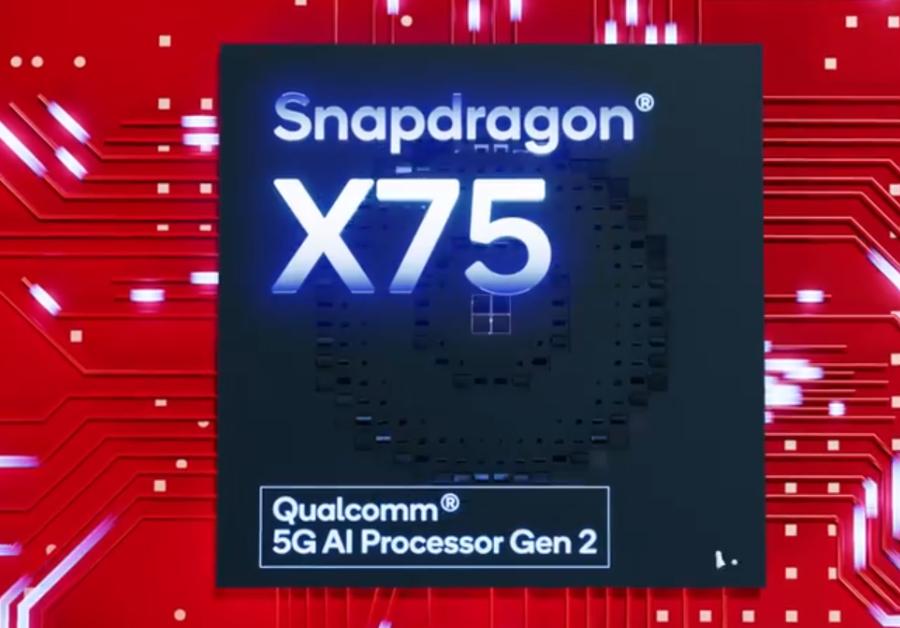
Qualcomm Technologies has set a new world record for sub-6 GHz 5G download speeds with its new Snapdragon X75 5G Modem-RF System. The modem achieved an impressive 7.5 Gbps downlink speed.
Qualcomm announced the Snapdragon X75 5G Modem-RF System at MWC in February 2023. The X75 is the successor to the Snapdragon X70, which is found in the Galaxy S23 series and other Snapdragon 8 Gen 2-powered devices. Qualcomm’s latest test of the X75 shows that the company is still looking for breakthrough performance and striving for the best of its hardware.
Qualcomm Snapdragon X75 modem achieves an incredible download speed
The Snapdragon X75 was able to achieve this speed by leveraging 300 MHz of spectrum. The modem also utilized 4x carrier aggregation (4xCA) across 4 Time Division Duplexing (TDD) channels in a single downlink connection, along with the use of 1024 quadrature amplitude modulation (QAM). These techniques were tested in a 5G standalone (SA) network configuration to achieve a whooping speed of 7.5 Gbps.
Qualcomm has said that these capabilities of the Snapdragon X75 will allow for a much better user experience, faster download speeds, better network handling, efficiency, and more. The modem is ready to make its debut in future flagships and it will be able to handle any network-related task that you throw at it.
Qualcomm has confirmed that phones with the Snapdragon X75 5G Modem will be available in the second half of 2023. This is exciting news, as the X75 is a major upgrade over the previous generation of modems.
T-Mobile recently achieved a download speed of 3.3 Gbps on the Galaxy S23, which uses the Snapdragon X70 modem. The X75 is expected to offer over twice that speed, at 7.5 Gbps. This is a significant improvement, and it will make a big difference for users who demand the fastest possible data speeds.
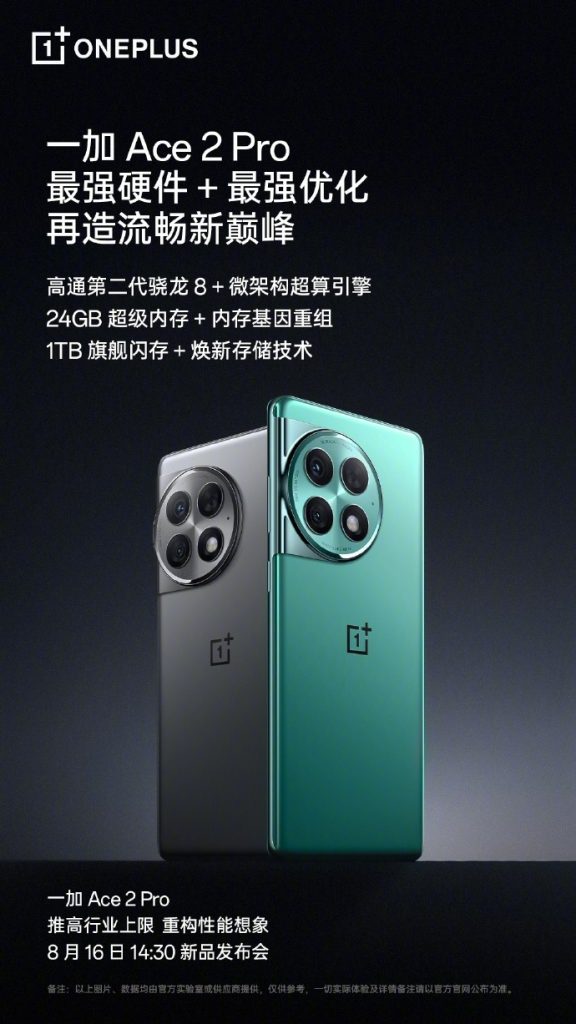
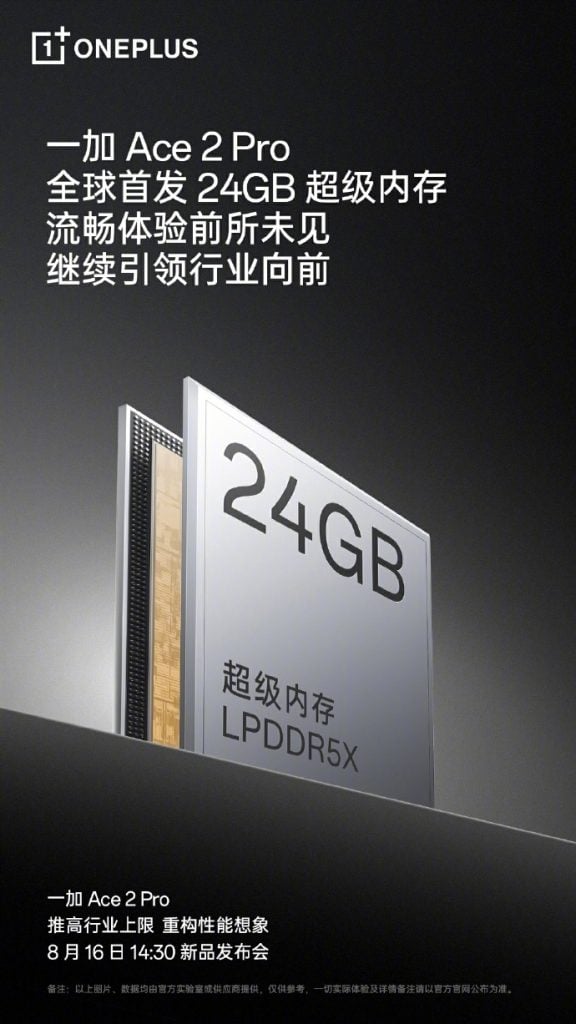
OnePlus is all set to launch the Ace 2 Pro, a new addition to its Ace series, in China. The device is scheduled to launch on August 16, 2023, at 2 PM local time in China. It’s anticipated to share a similar design with the previously released OnePlus Ace 2. Ahead of the launch, the company is teasing some of the key specs of the device on Weibo.
OnePlus Ace 2 Pro memory specs (confirmed)
According to a recent teaser, the upcoming Ace 2 Pro smartphone is set to achieve a remarkable feat as the world’s first device (mass-produced) to feature 24GB LPDDR5X RAM. The device will also feature 1TB UFS 4.0 flash storage.
The RAM will be produced by SK Hynix and according to OnePlus, Ace 2 Pro will utilize “Memory Gene Recombination” technology and promises efficient memory usage and faster data read performance, allowing 41 apps to run in the background for 72 hours. TÜV Rheinland has certified the phone for a smooth performance over 48 months.
Previously, the ZTE’s Nubia brand introduced the RedMagic 8S Pro+ with 24GB/1TB storage but that hasn’t gone on sale yet. Additionally, Realme is also reportedly planning to release a 24GB RAM smartphone.
OnePlus Ace 2 Pro key specs
Coming to the other specs, OnePlus has already confirmed that the Ace 2 Pro will feature the powerful Snapdragon 8 Gen 2 SoC and a 6.74-inch 120Hz 1.5K OLED display with HDR10+ and 450 ppi density.
The smartphone will run on Android 13, offer RAM choices of 24GB, 12GB, and 16GB, and be supported by a 5000mAh battery with a remarkable 17-minute full charge time using the included 150W GaN charger. It will come in Cyan and Grey colors.
As the launch date approaches, more leaks are expected to surface, so stay tuned for updates.
Keychron makes some of the most interesting keyboards we see out there. The brand has keyboards that split in two, ones that are fully customizable, and it even recently unveiled its first mechanical gaming keyboard. If this isn’t enough, the brand has today launched the Keychron K11 Pro as its new Alice-style mechanical keyboard that comes with an ergonomic build and a shorter axis. Here are the details.
Keychron K11 Pro features and pricing
The Keychron K11 Pro is an Alice-style keyboard, featuring a layout that you’d find very different from your standard keyboard. Its keys are split into two halves and are slightly angled to offer a more ergonomic typing experience. Despite this design, the keyboard frame itself remains a single, cohesive piece. Because this keyboard contains angled keys separated by an inverted V, you can naturally rest your wrist and type more ergonomically.
The new K11 Pro Alice mechanical keyboard supports both Bluetooth and wired connections. It is compatible with both Mac and Windows computers. It comes with Jiadalong short axis 2.0 switches and LSA height two-color injection PBT keycaps. It is the first low-profile QMK/VIA wireless custom mechanical keyboard with a 65% Alice layout. It comes with premium features, including double-shot PBT keycaps, and a rotary encoder knob.
The keyboard has powerful ultra-low-power ARM architecture MCU equipped with 128K flash that will provide more flexibility. It is claimed to have a polling rate of 1000 Hz on wired mode right out of the box.
Keychron K11 Pro has been launched in China today for 448 Yuan ($62). It is also available for purchase in the global market with a price tag of $94.
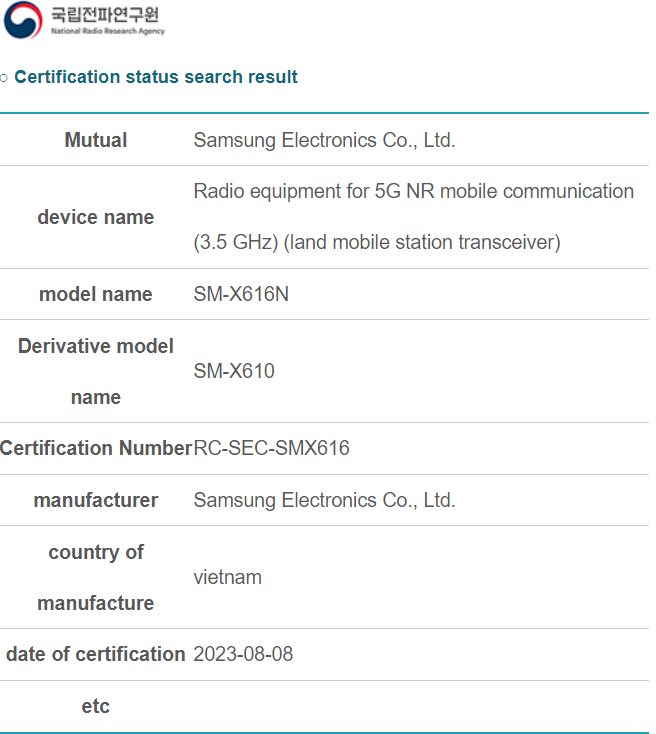
Samsung is preparing to launch the Galaxy Tab S9 FE series across the globe, and several rumors and leaks pertaining to its specifications and other details are all over the internet. The lineup is expected to feature the standard Galaxy Tab S9 FE and Galaxy Tab S9 FE Plus bearing model numbers SM-X616 and SM-X516. It has already appeared on FCC, and other leaks also confirmed its specification and design. The tablet appeared on NRRA Korea just a few hours ago, confirming its global launch.
As per the listing, the country of the manufacturer is listed as Vietnam and the tablet supports 5G connectivity. Apart from the confirmation that the launch is nearing, there are hardly any other details.
Both models have also been spotted on the brand’s official website. Further, its leaked renders confirm some aspects of its design. As per previous leaks and FCC listing, the Galaxy Tab S9 FE and FE+ appear to feature S-Pen support. Both the models will have dual rear cameras and are expected to couple Exynos 1380 processor, 8GB RAM, and 128GB internal storage. The Galaxy Tab S9 FE+ will bundle 45W fast charging, meanwhile, the Galaxy Tab S9 FE will feature 25W fast charging support with an EP-TA800 adapter.
Micromax used to be a major player in India’s smartphone market, even surpassing Samsung at one point. However, the brand couldn’t maintain its momentum after Xiaomi entered the country. The competition significantly reduced Micromax’s sales, and the company soon decreased the number of new phones it produced. However, it appears that the former market leader wants to make a comeback in the market, but not as a smartphone maker. Instead, the brand is reportedly placing its bets on electric vehicles.
Micromax could be eyeing electric two-wheelers
TechCrunch reports Micromax is looking to enter the electric vehicle market. To support its upcoming venture, the homegrown brand has made a number of internal changes. These changes involve eliminating dozens of jobs at its headquarters in Gurugram, as well as at branch offices across India. Micromax has reportedly downsized its teams in sales, product development, testing, research and development, and logistics, among other aspects of the business.
In the EV space, Micromax may be eyeing to manufacture two-wheelers. This segment is currently dominated by the companies like Ola, Ather, and even Hero Electric. However, Micromax maybe able to cut through if it launches the right product with the right pricing.
Sources tell TechCrunch that Micromax has already begun renovating one of its offices in Gurugram to start work on its new EV market project. However, there are few employees left at Micromax to staff the business transition.
Micromax’s last smartphone launch was in April, and the brand has yet to transition to 5G. If Micromax is moving into the EV market, does that mean we won’t see any more smartphones from them? And even if we don’t, would you care? Let us know in the comments.
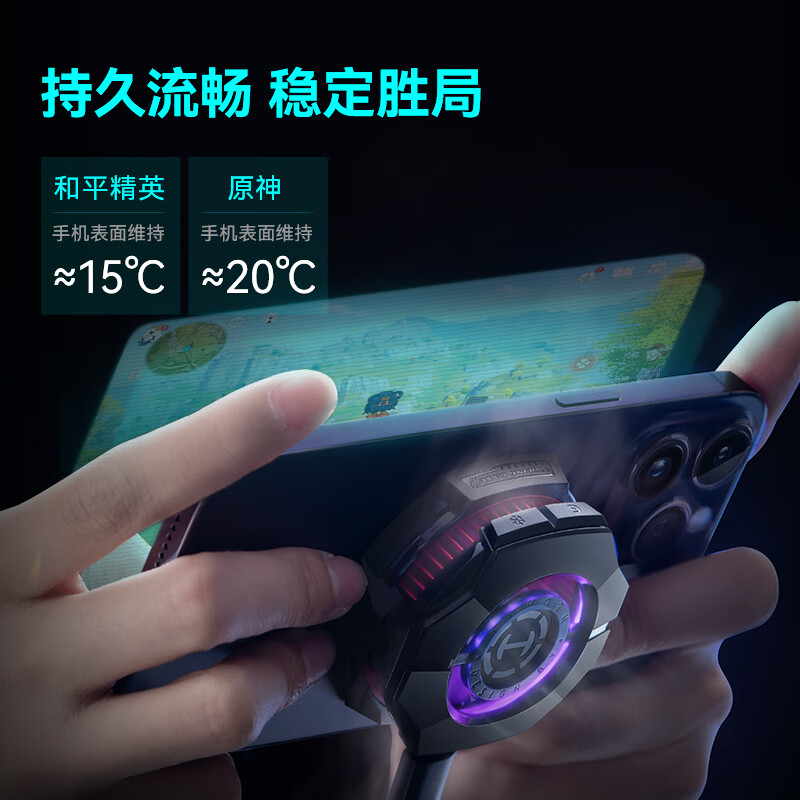
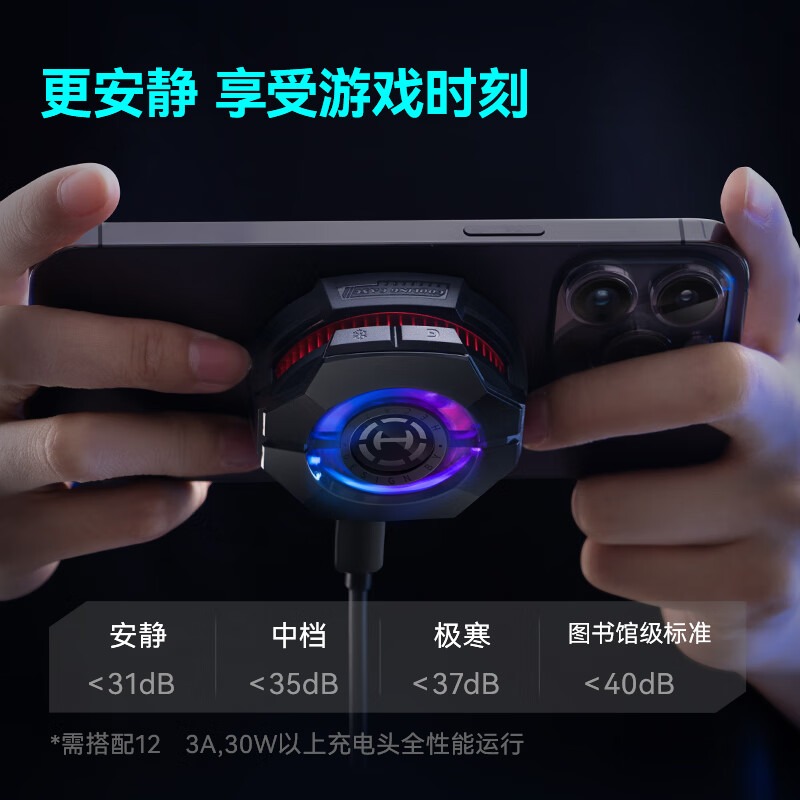
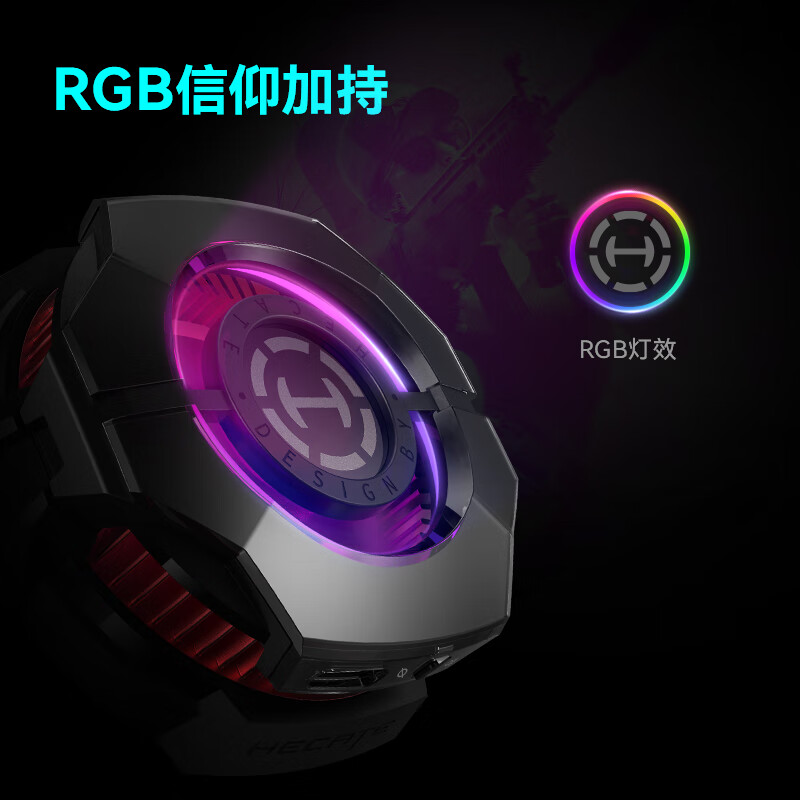
Edifier HECATE has unveiled its newest innovation: the C4 and C4 Pro magnetic smartphone coolers. These accessories are now up for pre-order on various e-commerce platforms in China. The base variant is priced at 199 yuan ($28) while the Pro variant is priced at 249 yuan ($34). Edifier also launched a new mechanical keyboard HECATE G4K with 1ms latency yesterday.
Edifier HECATE C4 and C4 Pro Magnetic Coolers specifications:
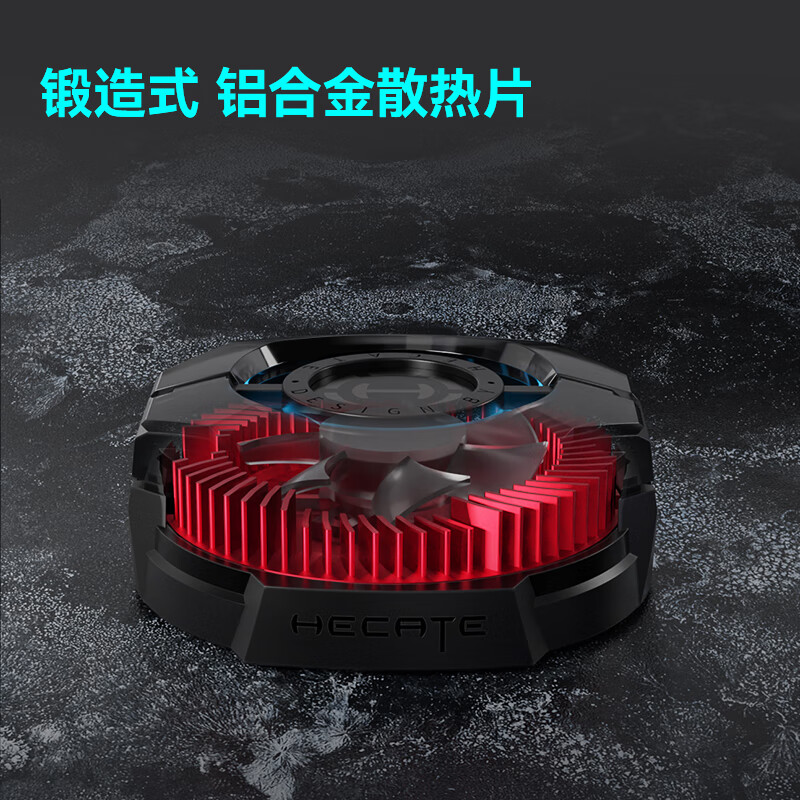
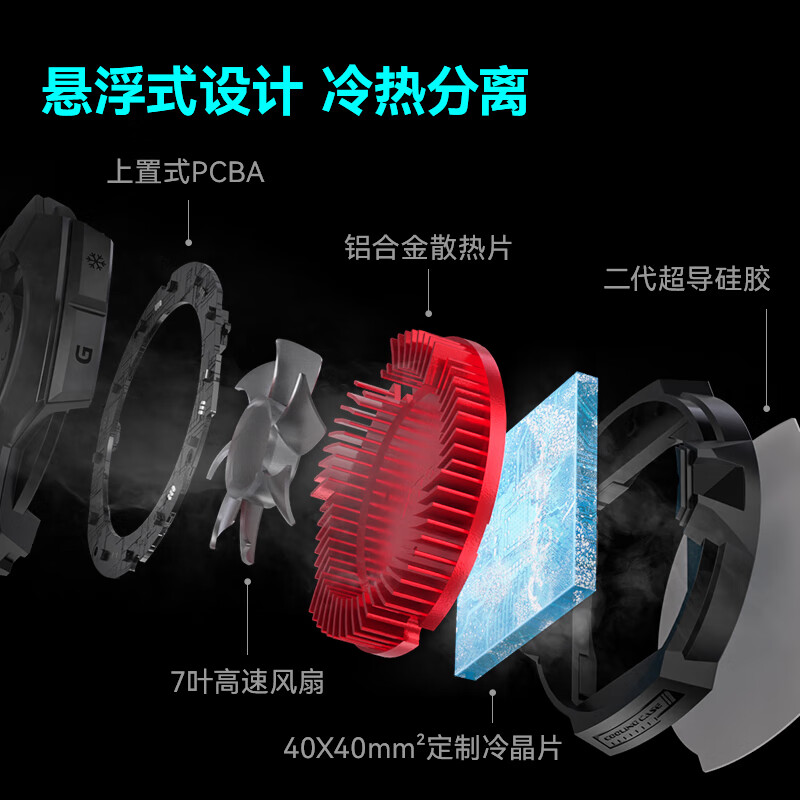
The Edifier HECATE C4 cooler boasts a 40×40 square millimeter cooling chip that delivers a robust 27W cooling power. According to official details, this cooling marvel can slash temperatures by 25°C in just 15 seconds. It combines a 7-blade 5500 RPM high-speed fan with aluminum alloy cooling fins, a design that proves effective even during intense gaming sessions. During resource-intensive gaming like Game for Peace and Genshin Impact, the phone maintains cool temperatures of around 15°C and 20°C respectively, at a room temperature of 25°C.
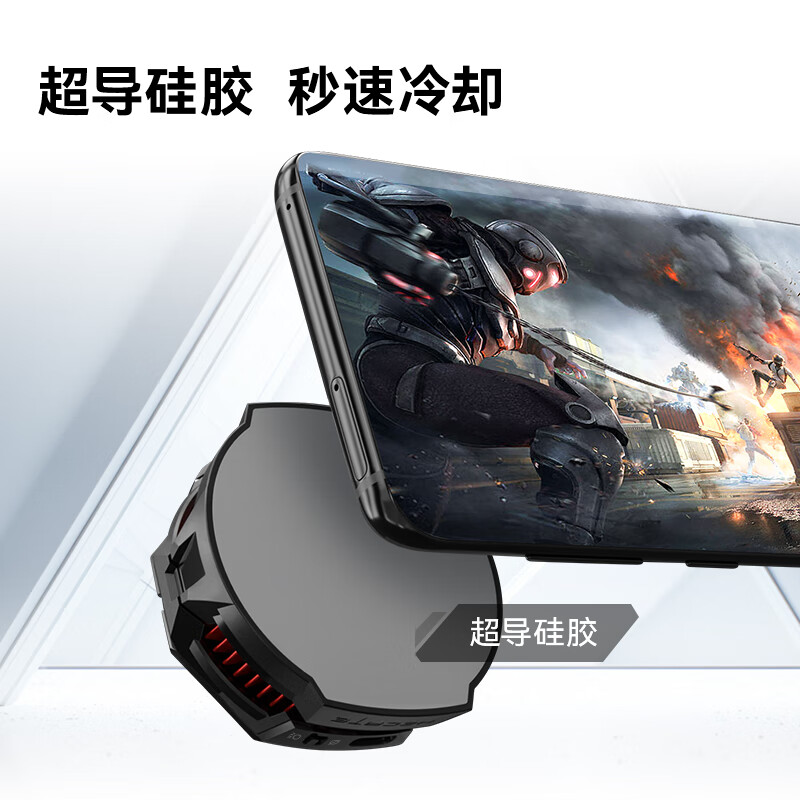
Weighing in at a mere 87g, the C4 cooler ensures comfort and adaptability. With its three-level adjustment feature and floating design, it’s a breeze to customize your cooling experience. Plus, the inclusion of superconducting silicone gel guarantees a seamless fit for both Apple and Android phones, making it a versatile choice for gamers across platforms. And let’s not forget the added touch of style – the C4 cooler comes equipped with captivating RGB lighting effects that enhance the gaming ambiance.
For those who seek a bit more, Edifier offers the C4 Pro cooler. This advanced model supports 15W wireless charging capability and also has a total cooling power output of 35W. Despite the upgrade, the weight remains modest at approximately 88g. OnePlus has also recently launched a liquid cooling accessory that can reduce the temp up to 34°C.
Recently Samsung unveiled the Galaxy Z Fold 5 and the Galaxy Z Flip 5 in the global markets. Both devices have been up for pre-orders in multiple countries across the globe. The fifth-generation Foldales smashed pre-order records in its home country with the Flip 5 more popular than the Fold 5. Now, the brand has announced that India is the latest market where the devices have secured record bookings.
Samsung Galaxy Z Fold 5, Z Flip 5 record pre-booking in India, the sale date announced
Samsung revealed that the company received 1,00,000 pre-bookings for the Galaxy Z Fold 5 and Galaxy Z Flip 5 in India. This was achieved in the first 28 hours of the opening of the pre-booking window on July 27th. The latest generation Z Fold 5 and z Flip 5 surpassed the last year’s Z Fold 4 and Z Flip 5. The figure is 1.7 times higher than the pre-bookings Samsung received for the last year’s models.
It’s worth noting that Samsung did not exactly reveal the pre-order numbers as of today for the fifth-generation foldable in India. They are only for the first 28 hours when the pre-order window opened and not for the two weeks till today. Samsung Southwest Asia CEO JB Park hopes that the new devices will help mainstream foldable and also help consolidate their leadership in India.
Some customers who pre-ordered the Galaxy Z Fold 5 and Z Flip 5 will get their units delivered on August 11. Additionally, Samsung also revealed that both foldable phones will be available for purchase starting August 18 at leading online and offline stores across the country. The Galaxy Z Flip 5 starts at Rs 99,999 whereas the Z Fold 5 starts at Rs 1,54,999 for the base variants. You can go through the full specifications of the Galaxy Z Flip 5 here and Galaxy Z Fold 5 here.
The importance of chip development and production is growing every day. Technology companies recognize this and often invest in this area to secure their future. For example, even though Samsung is based in South Korea, they have even a chip factory in the US. Now, the company has added another investment to its portfolio with its biggest rival. Apple and Samsung plan to invest in SoftBank Group’s chip design company, Arm, before its expected public launch in September. Here are the details…
SoftBank’s Arm IPO to Draw Billions in Investments from Apple and Samsung
Apple and Samsung re set to make strategic investments in SoftBank Group’s chip design company, Arm, before its much-anticipated initial public offering (IPO) in September. According to the latest reports, Arm had been in talks with the two companies for several months. Arm is currently leading supplier of chip designs for smartphones, tablets, and other devices.
Its technology is also used in data centers and other high-performance computing applications. The company is valued at around $35 billion, and the IPO is expected to raise billions of dollars. The SoftBank has been under pressure to raise cash, and the sale of Arm would be a major windfall. SoftBank acquired Arm in 2016 for $32 billion, and it has been looking to sell the company for several years. he IPO is expected to be one of the biggest tech listings of the year.
In addition to Apple and Samsung, Arm is also in talks with other potential investors, including Nvidia and Intel. The company is expected to announce the final list of investors in the coming weeks.
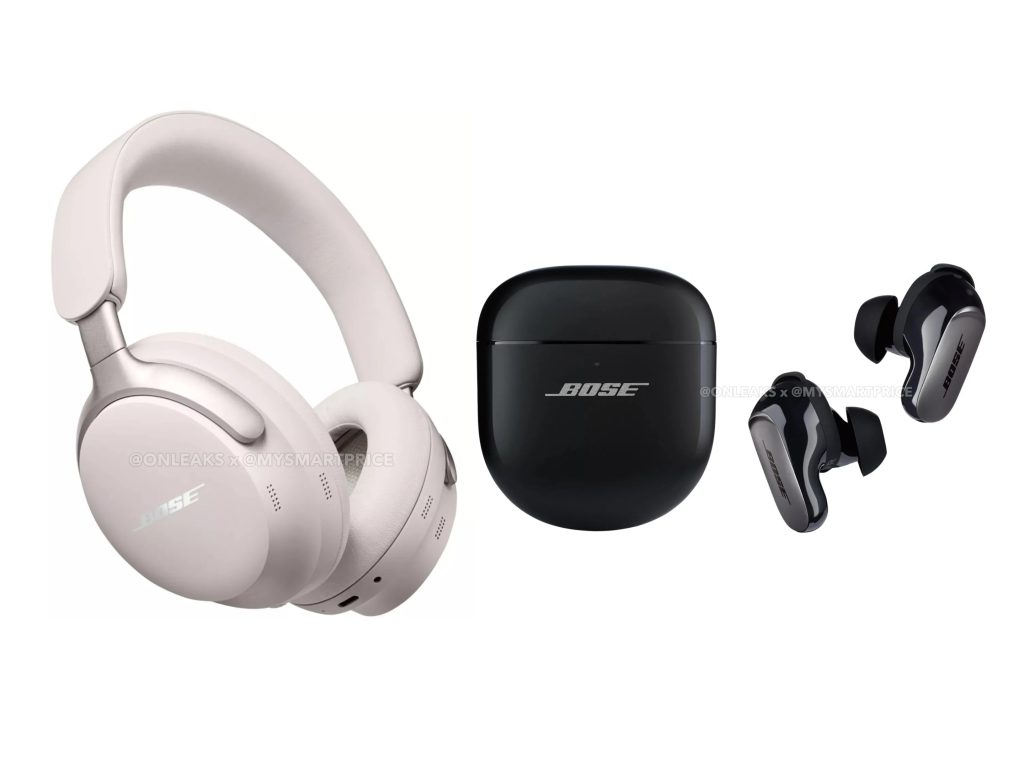
Audio maker Bose is reportedly working on two new devices in the company’s QuietComfort lineup. These are said to be the QuietComfort Ultra over-ear headphones and the QuietComfort Ultra TWS earbuds. Now, both devices have surfaced in leaked renders, courtesy of reliable tipster Steve Hemmerstoffer (aka onleaks). The TWS earphones will likely arrive as the successor to the Earbuds II that debuted last September. The leaked images give us a good look at the audio devices.
The Bose QuietComfort Ultra are over-ear headphones. They feature the same design as other QuietComfort headphones. The leaked renders reveal a large ear cup with a cushion that should offer a comfortable wearing experience for longer hours of usage. It’s likely that the headphones also feature an adjustable headband. The Bose QuietComfort Ultra is seen with physical buttons that will enable users to control the music playback and adjust the volume. There is also a USB-C port for connectivity.
As for the Bose QuietComfort Ultra Earbuds, they retain the same design as the Earbuds II. The TWS earphones look slimmer with a semi-in-ear design. There are slightly angled silicone ear tips and a small hook on the top for a better and more secure fit.
Both the Bose QuietComfort Ultra and Ultra TWS Earbuds will be available in Black and White color options. The key specifics of the upcoming audio devices remain under the wraps for now.
Meanwhile, a report from Deallabs reveals that the Bose QuietComfort Ultra headphones will e priced at EUR 499.95 whereas the Ultra Earbuds will cost EUR 349.95 in France. The brand is also rumored to be launching another QuietComfort headphones priced at EUR 399.
Disney+ is bringing some changes to its subscription service. The platform is planning to raise its prices while also fighting against the notorious account sharing that is rampant across any subscription-based model.
Disney+ follows Netflix’s footsteps
During its recent earnings call, Disney CEO Bob Iger announced that the ad-free model of the Disney+ premium tier will see a price hike. Starting October 12, Disney+ will now cost 13.99 US Dollars over the current 10.99 US Dollars. Similarly, even Hulu is bumping the price of the ad-free tier to 17.99 US Dollars per month. But it’s not all bad news, the company is offering customers who are willing to bundle services.
A new Duo Premium subscription will roll out soon, which brings both ad-free tiers of Disney+ and Hulu for 19.99 US Dollars. Furthermore, it was also announced that the ad-enabled model will go live in Europe and Canada for just 8 US Dollars. Disney seems to be taking a page from Netflix’s playbook by cracking down on account sharing.
The company is working to fix this issue soon and is “actively exploring ways to address account sharing and the best options for paying subscribers to share their accounts with friends and family.” As per the announcement, these changes will likely go live sometime next year.
Wearable devices have become a crucial part of our daily lives in a world where technology is connecting us more and more. From fitness trackers to smartwatches, these devices offer a variety of functions. However, a new and fascinating form factor has recently emerged in the world of wearable tech: Smart Rings.
In this comprehensive article, we delve into what smart rings are, how they work, their advantages and disadvantages, and how they differ from other wearable devices.
What Are Smart Rings? How Do They Work?
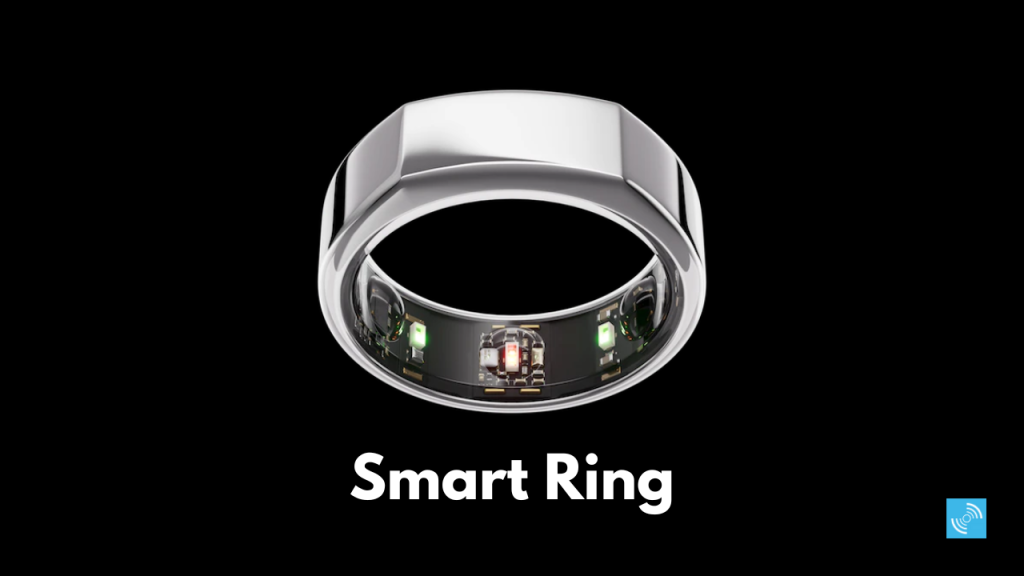
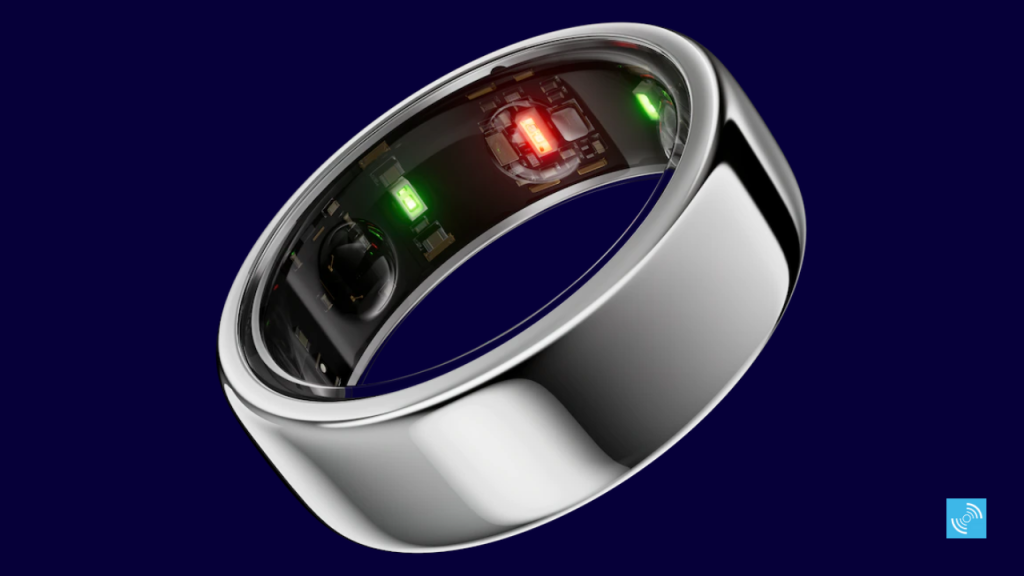
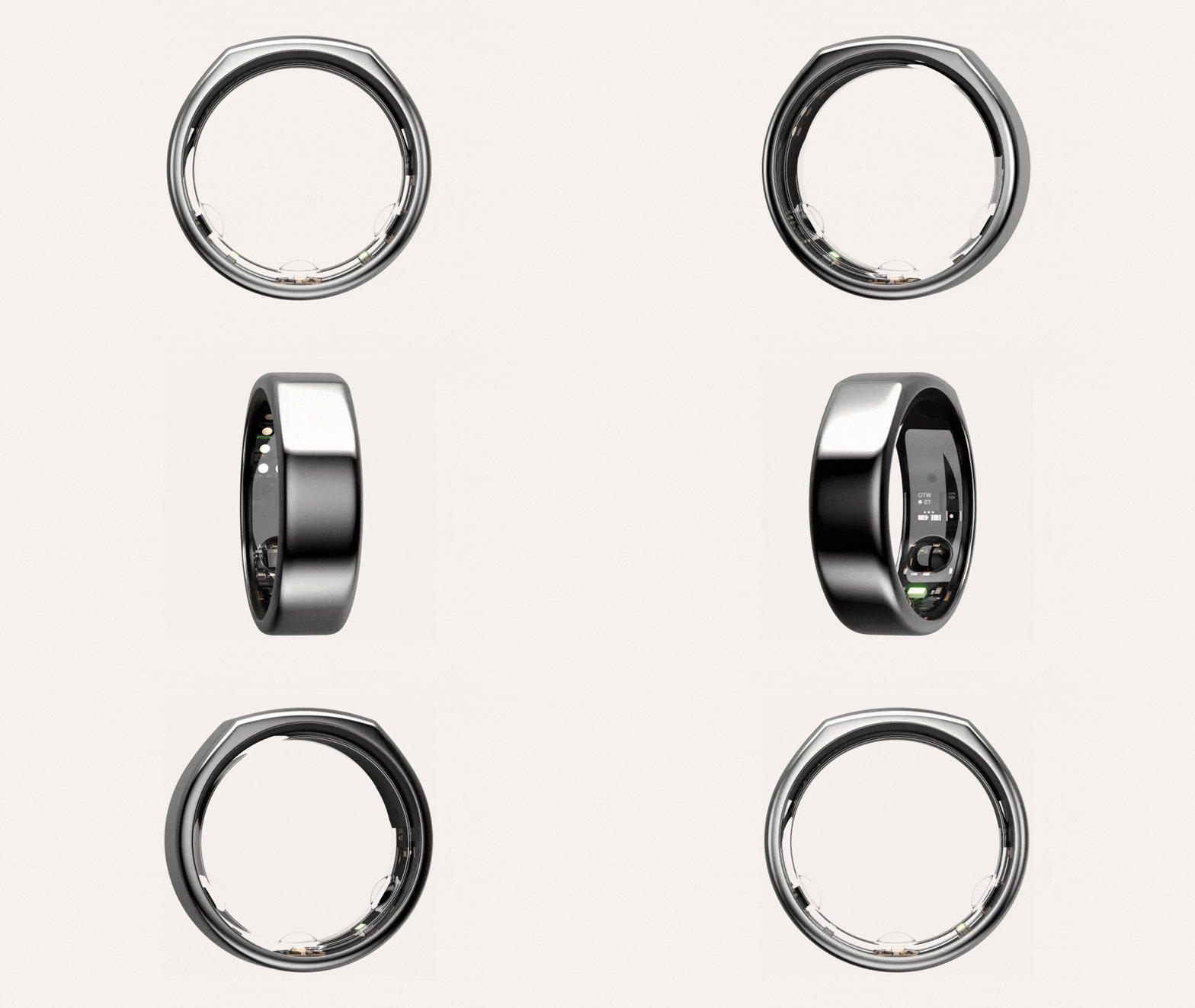
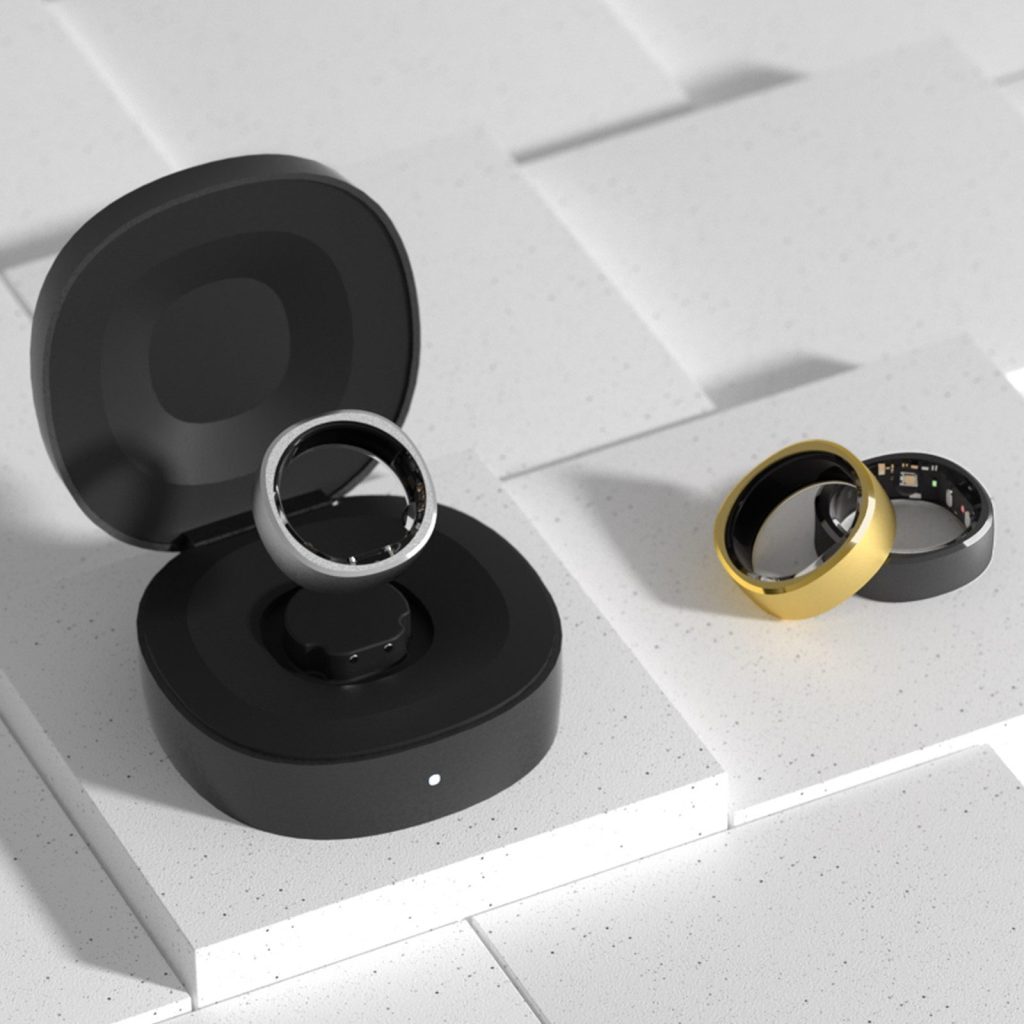
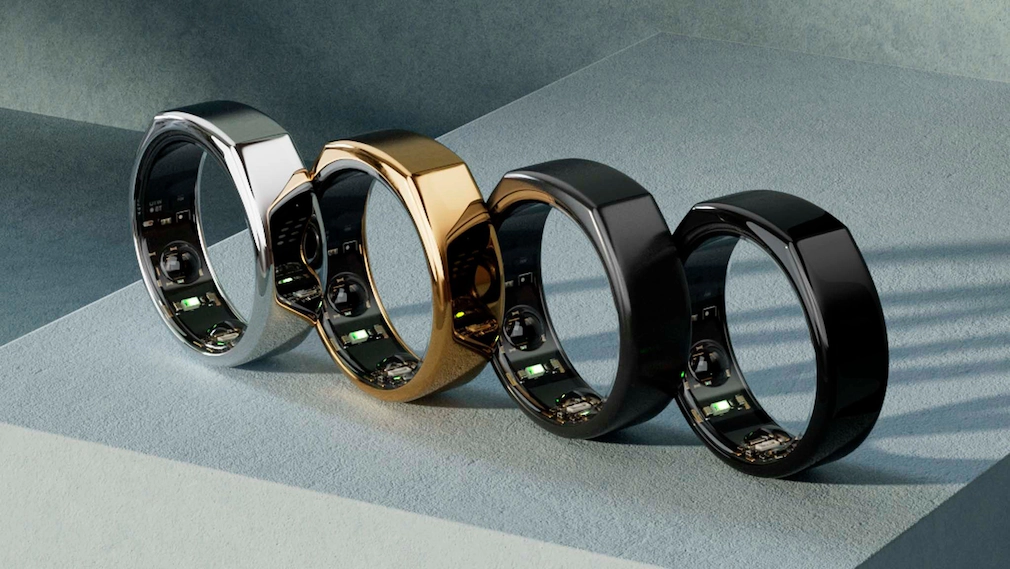
A smart ring is essentially a miniature wearable computer that fits on your finger. Despite their small size, these gadgets are powerful, equipped with various sensors, and can perform a myriad of functions similar to larger wearable devices.
Smart rings work by connecting to other smart devices like smartphones via wireless communication protocols such as Bluetooth or NFC (Near Field Communication). The ring’s sensors collect data, which is then processed and relayed to an app on the connected device. The data, depending on the smart ring’s purpose, can range from tracking your heart rate and sleep patterns to recognizing hand gestures to control smart home devices.
What Does a Smart Ring Do?
Smart rings have a wide range of functionalities, which are primarily based on the sensor types and software algorithms they use.
Here are some common uses:
Health and Fitness Tracking: Like other wearable fitness trackers, smart rings can monitor physical activity, heart rate, sleep patterns, blood oxygen levels, and stress levels.
Smart Home Control: Some smart rings are capable of controlling other smart home devices, enabling users to adjust their thermostat, turn off lights, or even change TV channels with a simple hand gesture.
Contactless Payments: Certain smart rings come with built-in NFC that allow users to make contactless payments, adding to their convenience.
Notification Alerts: Many smart rings have the capability to alert you to incoming calls, messages, or other important notifications.
Smart Ring Advantages
Discreet and Convenient: Smart rings are less obtrusive than smartwatches or fitness bands. Their compact form makes them a convenient and discreet wearable tech option.
Extended Battery Life: Due to their smaller size and specific functionalities, smart rings often offer extended battery life, with some models lasting up to a week on a single charge.
Fashionable Accessory: Smart rings blend technology with fashion. They come in a variety of designs, often indistinguishable from regular jewelry, allowing users to flaunt their tech without compromising style.
Smart Ring Disadvantages
Limited Display Capabilities: Due to their compact size, smart rings typically don’t have screens. This means users must rely on a connected smartphone for any data viewing or interaction.
Limited Storage and Processing: Given their size, smart rings don’t have the extensive storage or processing capacities of other wearables. They rely more heavily on paired devices for data processing and storage.
Price: Smart rings can be more expensive than other wearable devices due to the advanced technology packed into a tiny form factor.
Adaptability: As a relatively new technology, some users might find it challenging to incorporate smart rings into their routine or to find the right size and style for their preferences.
How are Smart Rings Different from Other Wearables?
While smart rings and other wearables like smartwatches and fitness bands share similar functionalities, there are several aspects that set smart rings apart:
Form Factor: Smart rings are significantly smaller and less noticeable than other wearable devices. Their compactness and subtlety can be a selling point for those who prefer minimalistic devices.
Purpose-Specific Uses: While smartwatches and fitness bands strive to be all-in-one devices, smart rings tend to focus on specific functionalities. Whether it’s tracking vital signs, making contactless payments, or controlling smart devices, each smart ring caters to particular user needs.
Fashion Factor: In the aesthetics department, smart rings score higher. They fit right in with other jewelry and can be worn for fashion as well as function.
Comfort and Ease of Use: For those who find wristbands irksome or distracting, smart rings offer a comfortable alternative.
Discretion: Smart rings offer a level of discretion that larger wearables can’t match. Their alerts are subtle, and their ability to blend in as regular jewelry makes them less conspicuous.
Smart rings create a fascinating fusion of fashion, functionality, and subtlety, establishing a distinctive position among wearables. They embody the true essence of wearable technology, seamlessly integrating into our daily routines.
Smart Rings are Gaining Popularity as a Category
Several brands, both established and emerging, are venturing into this space, offering innovative products and solutions. Each smart ring tries to set itself apart. For example, the Oura ring has been on the market for a while and is a pretty well known name in the industry right now. But there are emerging ones too, like Ringconn, which is reportedly designed by a medical professor and also provides detailed and accurate sleep tracking and other health metrics. Some smart ring brands even focus on specific functions, like payments.
Most smart rings like this one from Ringconn looks like regular ring on the outside
So let’s look at some of the popular rings.
Popular Smart Rings
Oura Ring: Known for its sleep tracking and health insights, providing detailed information about sleep quality, readiness, and activity levels.
Ringconn: Designed by a medical specialist, providing detailed and accurate sleep tracking and other health metrics in this industry.
Motiv Ring: A fitness tracking ring that monitors heart rate, steps, and even has security features for online accounts.
McLEAR Ring: Popular for its contactless payment feature, allowing users to make transactions with a simple tap.
Ringly: Designed mainly for women, Ringly offers notifications and tracks basic activities, merging style with functionality.
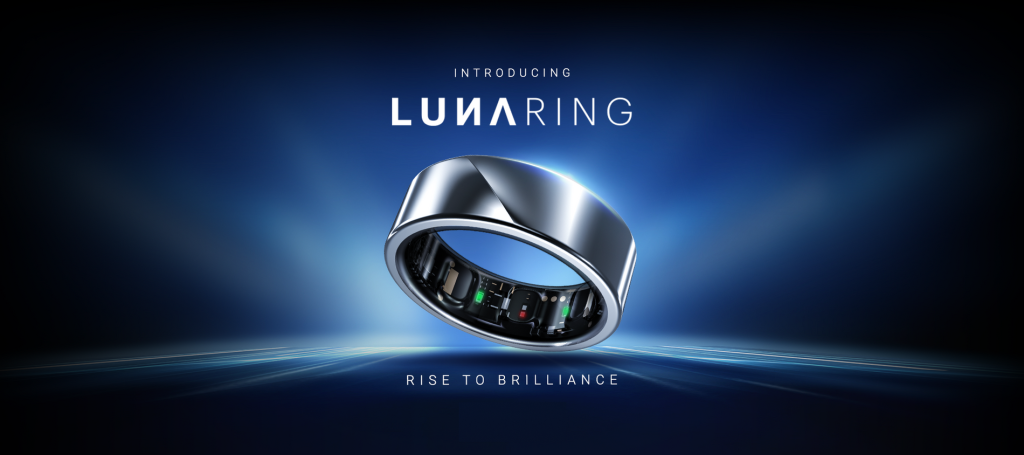
Noise Luna Ring: A recent entrant in India, the Luna Ring offers over 70 health metrics, including heart rate monitoring, temperature sensors, and more.
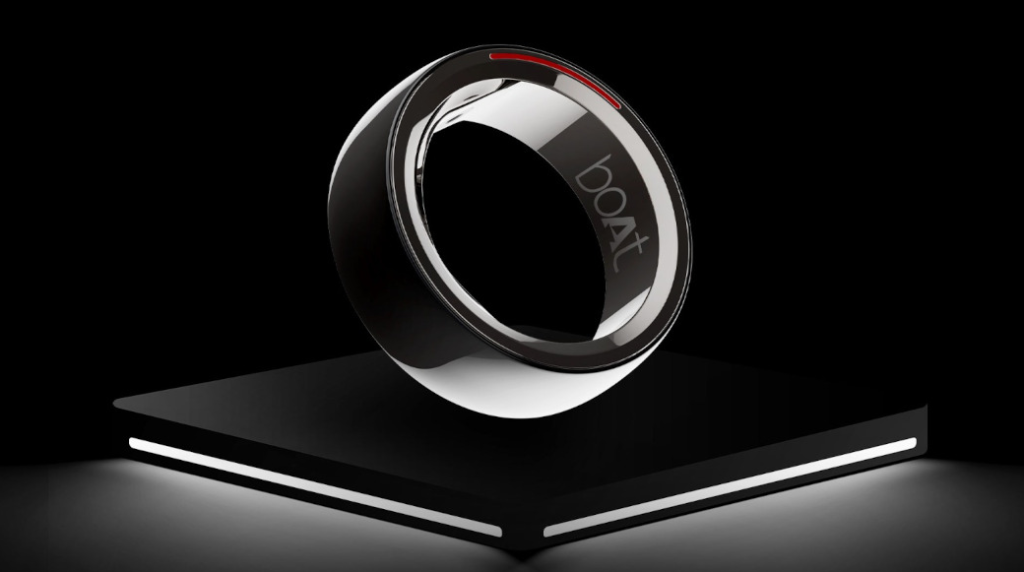
boAt Smart Ring: Indian brand boAt is also set to release the boAt Smart Ring with health-related functions. Made from metal and ceramic, it includes sensors for heart rate, SpO2 levels, sleep monitoring, and more.
Another popular ring is currently in its development phase, and since the company is a tech giant, it is likely going to make the smart ring category mainstream.
We are talking about none other than the Samsung Galaxy Ring. According to recent reports, Galaxy Ring’s development stage is almost at its end, and it is likely to go into mass production very soon. But since these wearables need a lot of certifications, the Galaxy Smart Ring is expected to launch in 2024, probably alongside the Galaxy S24 series.
A World Turning Smart
Smart rings are just the tip of the iceberg in the rapidly expanding arena of smart devices. From smart glasses that provide real-time information overlays to smart shoes that track your steps and running posture, everything is becoming ‘smart.’ These devices not only offer convenience but are also paving the way for a future where technology is seamlessly integrated into our daily routines.
As we enter a world where everything is connected, expect more smart categories like smart rings to evolve in the coming years.
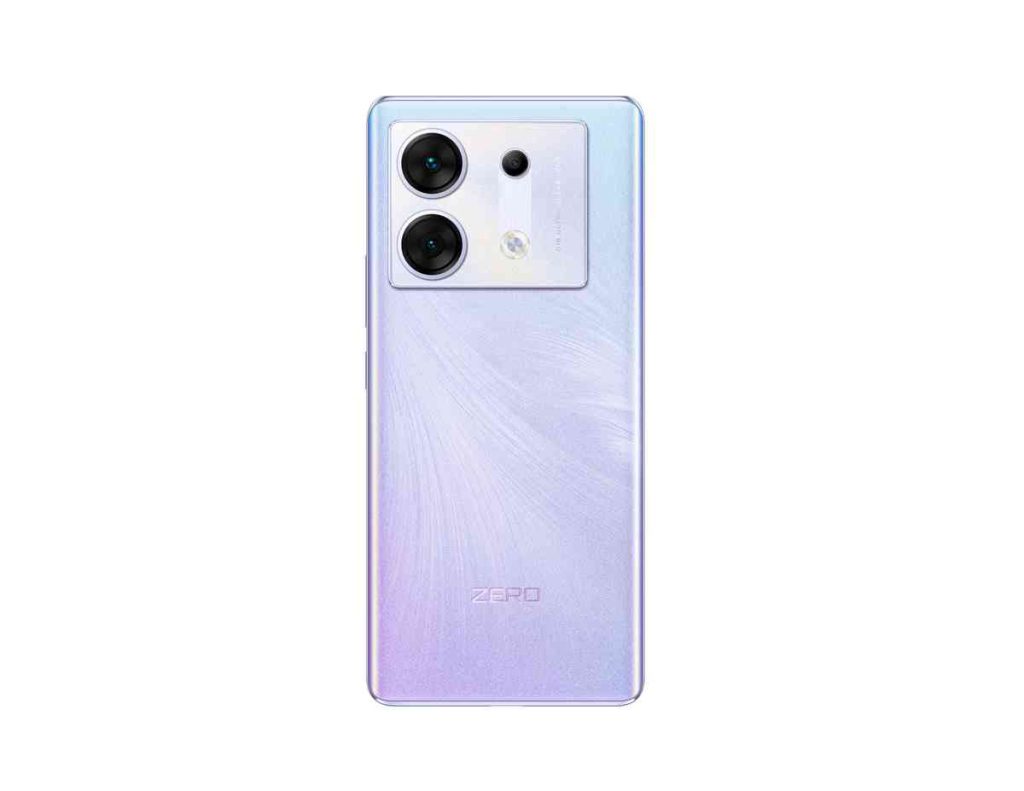
Infinix is set to launch a new smartphone in India. It will be a new addition in the company’s Zero series. The upcoming offering is confirmed to be the Infinix Zero 30 5G. The brand has revealed some key details of the device as well as shared images revealing its design and color options. The Infinix Zero 30 5G has already appeared on Geekbench, Bluetooth SIG, and Google Play Console certification websites.
Infinix Zero 30 5G to launch in India, key specs teased
Infinix has confirmed that the Zero 30 5G will debut in India by the end of this month. It will sport a 10-bit AMOLED display with 60-degree curvature. The teaser image of the phone reveals a rectangular camera module housing three sensors along with an LED flash. We could also spot OIS text confirming its presence. The back panel flaunts a gradient pattern and it will is seen in Gold and Blue color options. Infinix says that the Zero 30 5G will arrive in glass as well as leather finish back panel options. Both the display and back panel will be shielded by Corning Gorilla Glass 5 for protection against accidental damages.
The core specifications of the Infinix Zero 30 5G have not been revealed. The Google Play Console listing of the smartphone revealed a 1,080 x 2,400-pixel display resolution. The same certification as well as the Geekbench database mention that the upcoming offering will be powered by a MediaTek MT6891Z/CZA SoC which corresponds to the Dimensity 1100. It will pack 8GB RAM and run on Android 13 OS out of the box.
We should learn more details about the Infinix Zero 30 5G in the coming days.
Foldable smartphones are known to offer some innovative tech but also have its own share of drawbacks. These models are typically classed among the most expensive mobile devices and are not very durable either. But while the pricing issue will likely take some time, the Samsung Galaxy Z Fold 5 takes on the latter notion with its Herculean build.
Is the Samsung Galaxy Z Fold 5 just built different?
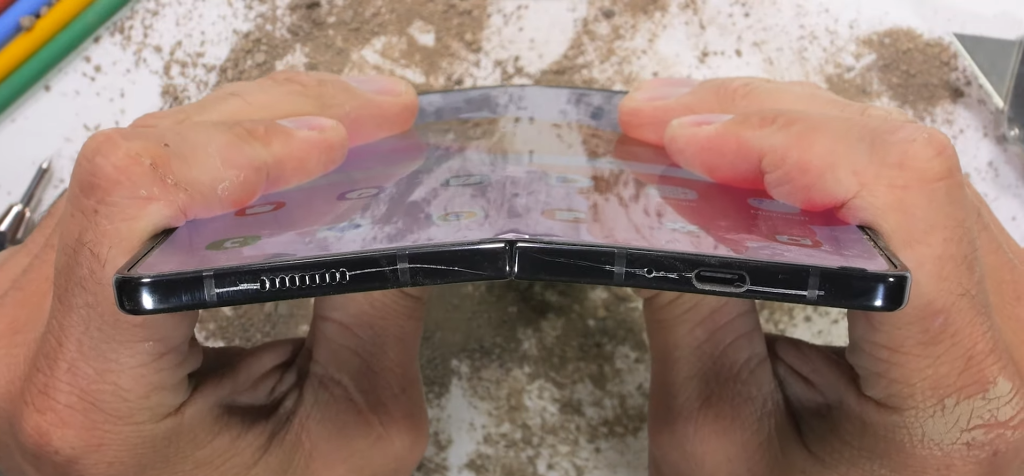
In a recent JerryRigEverything video, the South Korean tech giant’s Galaxy Z Fold 5 garnered a positive review in the durability test. The video shows Zack putting the foldable phone through a number of different endurance tests. This ranges from a scratch test, a dust folding test, and a burn test. The Galaxy Z Fold 5 survived all of these tests and managed to work normally for the most part.
However, the most interesting part of the video was the bend test. To check if the ultra-premium device can survive bending in the opposite direction, Zack bent the device when it is closed and opened. This is the test that the Google Pixel Fold and the Motorola Razr+ didn’t survive. On the other hand, the Galaxy Z Fold 5 managed to get through this test without breaking a sweat.
The device didn’t break from anywhere or face any major crack or snap. So safe to say, this foldable phone will not let you down. In his own words, the device defies all expectations since its beyond what Samsung intended the phone to survive.
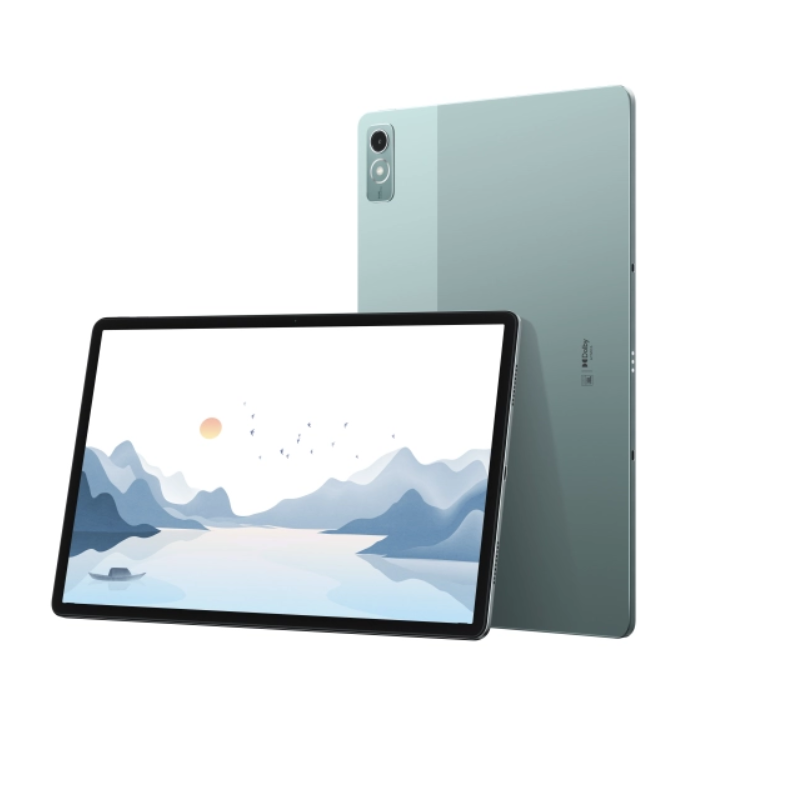
The Lenovo Xiaoxin Learning tablet has been launched in China and is available for pre-order starting today. The tablet will have a 12.7-inch display that resembles paper and TUV Rheinland-certified eye protection for students to meet their educational needs.
The device is ideal for educational purposes as it has a Student Mode, a dedicated learning mode giving options to limit certain apps, adjust night display settings, and daily screen time. The display has a paper-like screen and hardware of low-level blue light, reducing strain on the eyes. Xiaoxin rolls out over 50,000 worth of courses and is backed by a two-year warranty. The tablet also supports IPv6 and manageable parental controls with Wi-Fi and Bluetooth connectivity options.
Lenovo Xiaoxin Learning Tablet Key Specs
The tablet runs on a 2.6GHz speed 8 CPU core processor and 8GB RAM with a 16:10 LCD display with a resolution of 2944 x 1840 pixels, providing users with an appealing visual experience on its 12.7-inch screen. It also has reduced its screen light reflection by 80 percent for a safe user experience. The device is known for its multitasking and learning abilities, and having a storage capacity of 128GB is the cherry on top. The battery capacity is over 10,000 mAh, allowing users to watch videos for roughly 8 hours on a single charge. It runs on an Android-based operating system and is relatively lightweight, weighing just around 1kg. The tablet has a USB-C port, which is used for charging, as well as an audio port. For sensors, it features a compass, gyroscope, light sensor, and GPS navigation.
Pricing And Availability
You can reserve the tablet now for just 2499 Yuan (roughly $346) in China. If you pre-order, you’ll also get a bunch of learning content worth 50,000 Yuan (roughly $6936). This will include AI learning tools, a tablet stand, and a protective case.
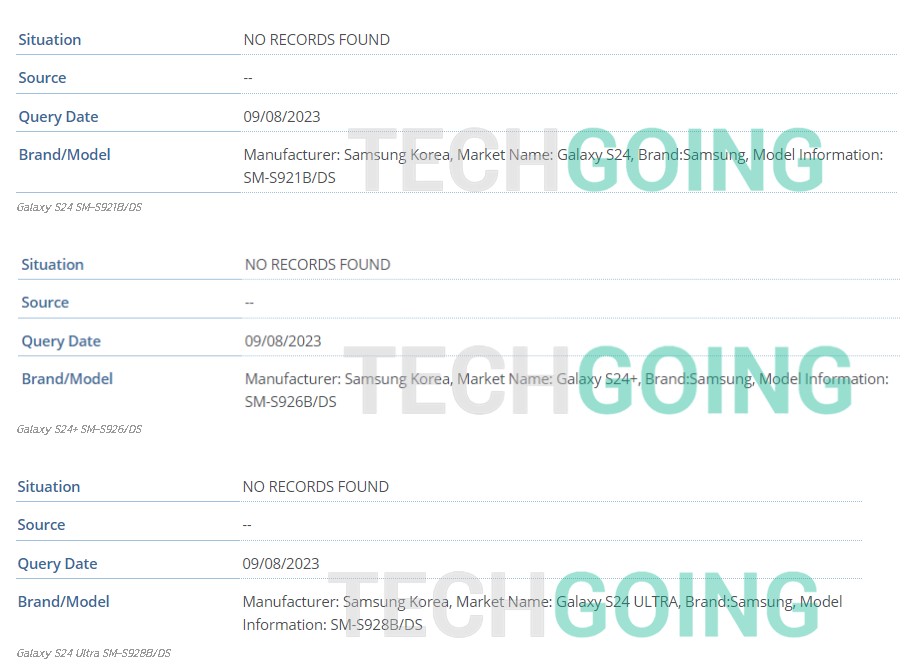
Samsung follows a ritual of launching its flagship Galaxy S-series in February every year. There are still months to go for the next-generation Galaxy S24 lineup. However, the S24 series devices have already been doing the rounds of the rumor mill for the past few months. Now, the phones have been spotted on GSMA’s IMEI database along with their model numbers.
Samsung Galaxy S24 series appears on the IMEI database
This year’s Samsung Galaxy S23, S23+, and S23 Ultra have model numbers S911B/DS, SM-S916B/DS, and SM-S918B/DS respectively. They will get their successors next year. On the IMEI database, the Galaxy S24 has a model number SM-S921B/DS. The Galaxy S24+ and S24 Ultra are listed with model numbers SM-S926B/DS and SM-S928B/DS respectively. The appearance of the Galaxy S24 series on IMEI confirms that the devices have undergone testing and are expected to arrive in the market in Q1, 2024.
The Samsung Galaxy S24+ US variant recently appeared on the Geekbench benchmarking platform with Snapdragon 8 Gen 3 SoC, 8G RAM, and Android 14 OS. As per multiple reports, the Galaxy S24 series will be powered by the unannounced Snapdgraon 8 Gen 3 and Exynos 2400 chipsets depending on the market region. The Plus and Ultra variants are also expected to support faster charging speeds potentially maxing at 65W thanks to the stacked battery tech.
The Samsung Galaxy S24+ and S24 Ultra are tipped to be backed by 4,900mAh and 5,000mAh batteries respectively. On the imaging front, the Ultra model will reportedly sport a 50MP 3x upgraded telephoto camera compared to the current S23 Ultra.
Porsche is developing an all-electric version of its popular Boxster sports car, which is expected to go on sale in 2024 or 2025. The new EV will be based on a dedicated electric sports car platform that Porsche is developing in collaboration with Audi. It will be the first all-electric Porsche sports vehicle, and it is expected to be a key part of the company’s plan to electrify its entire lineup by 2030. Most recently, the Porsche Boxster has been spotted charging, revealing some details about its battery pack. Here are the details…
Porsche Boxster EV to Have 80+ kWh Battery, 400 Horsepower
The Porsche Boxster was seen plugged into a 200 kW charger, which suggests that it has an 80+ kWh battery. This would be in line with other electric sports cars, such as the Tesla Model 3 Performance and the Audi e-tron GT. Even though an 80+ kWh battery might seem like a small detail at first, it’s actually very important. It can give a car a longer driving distance.
This matters for people who want to drive far without worrying about their car losing power. For instance, a Tesla Model 3 Long Range with an 82 kWh battery can go over 350 miles. But, a Nissan Leaf with a 40 kWh battery can only go a bit over 150 miles. Also, if you think about the speed of a Porsche Boxster, you can see why a big battery is crucial. You can watch the entire video in German below.
The Boxster EV is expected to have a single electric motor that powers the rear wheels. It is rumored to have a power output of around 400 horsepower, which would make it comparable to the current gas-powered Boxster GTS. The EV is also expected to have a range of over 200 miles on a single charge.
Porsche has not released any official details about the Boxster EV’s design, but spy photos have revealed that it will have a similar overall shape to the current Boxster. It is expected to have a more aerodynamic body with a sloping roofline and a wider stance. The interior is also expected to be updated with a more modern design and new technology features.
Xiaomi is rolling out a new variant of its popular Redmi Note 12 Pro 5G smartphone. The latest model includes higher RAM and storage capacity. This new variant will now sit as the top-end version, so let’s have a look.
The Chinese tech giant is rolling out the new Redmi Note 12 Pro 5G with 12GB of RAM and 256GB of internal storage. This model carries a price tag of 28,999 INR, although users can avail an instant discount of 3,000 INR if they have an HDFC bank credit card, ICICI bank credit card, or from the ICICI net banking. Furthermore, the brand is also offering the Redmi Buds 4 Active that is worth 1,399 INR for 1,199 INR if purchased with the smartphone.
The smartphone can be bought with up to 9 months of No Cost EMI and even brings exchange offer discounts as well. Redmi Note 12 Pro 5G 12GB + 256GB variant will go on sale via offline retailers, Flipkart, and the company’s official website. It is available in multiple color options, namely Glacier Blue, Onyx Black, and Stardust Purple.
Redmi Note 12 Pro 5G Specifications
The Redmi Note 12 Pro 5G sports a 6.67-inch AMOLED display that has a Full HD+ resolution, 120Hz refresh rate, and HDR10+. Under the hood, it is equipped with the MediaTek Dimensity 1080 SoC and is powered by a large 5,000mAh battery pack that supports 67W fast charging. The rear features a 50-megapixel triple camera setup, while the front houses a 16-megapixel selfie shooter.
We use cookies on our website to give you the most relevant experience by remembering your preferences and repeat visits. By clicking “Accept”, you consent to the use of ALL the cookies.
This website uses cookies to improve your experience while you navigate through the website. Out of these, the cookies that are categorized as necessary are stored on your browser as they are essential for the working of basic functionalities of the website. We also use third-party cookies that help us analyze and understand how you use this website. These cookies will be stored in your browser only with your consent. You also have the option to opt-out of these cookies. But opting out of some of these cookies may affect your browsing experience.
Necessary cookies are absolutely essential for the website to function properly. This category only includes cookies that ensures basic functionalities and security features of the website. These cookies do not store any personal information.
Any cookies that may not be particularly necessary for the website to function and is used specifically to collect user personal data via analytics, ads, other embedded contents are termed as non-necessary cookies. It is mandatory to procure user consent prior to running these cookies on your website.