Advertisement

Oppo Reno 8 Pro India launch near as phone receives BIS certification

Oppo is gearing up to launch its latest Reno 8 series of smartphones later today (23rd May 2022) in its home market of China. However, prior to its release, the device was also spotted on BIS certification, which hints that it will launch in India soon as well.

The upcoming smartphone was spotted on BIS by known tipster Mukul Sharma, who shared this news on Twitter. As of right now, it is confirmed that the Chinese smartphone maker will launch the Reno 8 series with three models, including a base variant, a Pro, and a Pro Plus version as well. So while the company has not shared any details regarding an Indian launch yet, this certification shows that the new devices will also be arriving to the Indian market soon.

The Reno 8 Pro was listed on BIS carrying the model number CPH2357. But unfortunately, the certification database does not reveal any finer details regarding this handset or when it may possibly be launching in the region. From what we know so far, the base Reno 8 is expected to sport a 6.43 inch AMOLED display that has a Full HD+ resolution. On the back, it will feature a triple camera setup and will be available in multiple color options like Clear Sky Blue, Slightly Drunk (Machine Translation), and Night Tour Black.

OPPO-Reno8-Pro

Under the hood, the Oppo Reno 8 Pro is set to be the first smartphone in the world that features Qualcomm’s new Snapdragon 7 Gen 1 SoC that is based on the 4nm process node from Samsung. Along with this processor, the device will also come with the brand’s in house MariSilicon X NPU as well. So stick around for more, as we will be covering the launch event later today.

RELATED:


Poco C40 gains TDRA certification, Global launch near

The Poco C40 was recently spotted on the National Broadcasting and Telecommunications Commission (NBTC) and Bureau of Indian Standards (BIS) websites and now the smartphone has visited UAE’s TDRA website. The agency has granted approval to the smartphone. However, the certification did not reveal any specification of the handset.

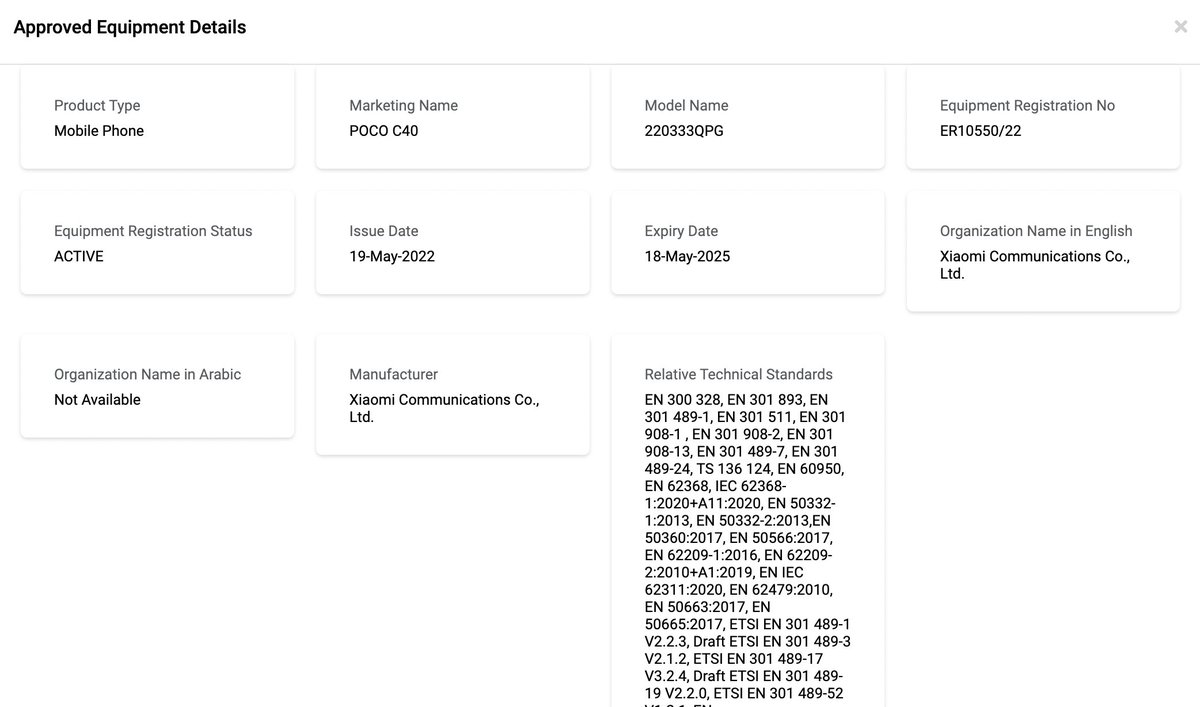
According to tipster Mukul Sharma, the Poco C40 has been spotted on the TDRA (Telecommunications and Digital Government Regulatory Authority) UAE website. Although the listing did not reveal any specifications of the smartphone, it does hint at an imminent launch of the new Poco phone. The upcoming smartphone has been listed on the TDRA website with model number 220333QPG and the model name “Poco C40”.

poco c40 tdra

Poco also recently confirmed through a community forum post that two new smartphones, dubbed Poco C40 and Poco C40+ will soon join the smartphone brand’s affordable C-series lineup.

Poco C40 was also spotted on NBTC and BIS websites with the same model number. Poco is yet to reveal the launch and specifications of the smartphone, however, we do know some details about its specification, thanks to leaks and Rumors.

Poco C40 Specifications (Rumored)

According to previous leaks, the Poco C40 is going to be powered by an unusual processor, and it’s not Qualcomm, MediaTek, or a Unisoc SoC, but an entry-level JR510 SoC. The upcoming Poco smartphone is also expected to run MIUI Go out of the box. MIUI Go is said to be a special version of the MIUI operating system. It will be comparatively lighter than the regular OS.

Xiaomi Poco C40

The smartphone will have support for WiFi 2.4GHz and 5.0GHz. Previous listings have confirmed that the handset will only have 10W charging. It will measure 167.18 x 76.87mm (length x width).

The company has not revealed the price of the device yet, however, judging from the specs, it is likely to be priced under $128.

Related:

Infinix Hot 12 Play launched in India with 90Hz display, 6000mAh battery, and more

Earlier this month, Infinix unveiled the Infinnix Hot 12 Play in Thailand. A few days after that, the brand has now debuted the handset in India as planned. The smartphone offers features like a Unisoc chipset, a high refresh rate display, and a large battery. Let’s take a look at its specs along with its pricing and availability in India.

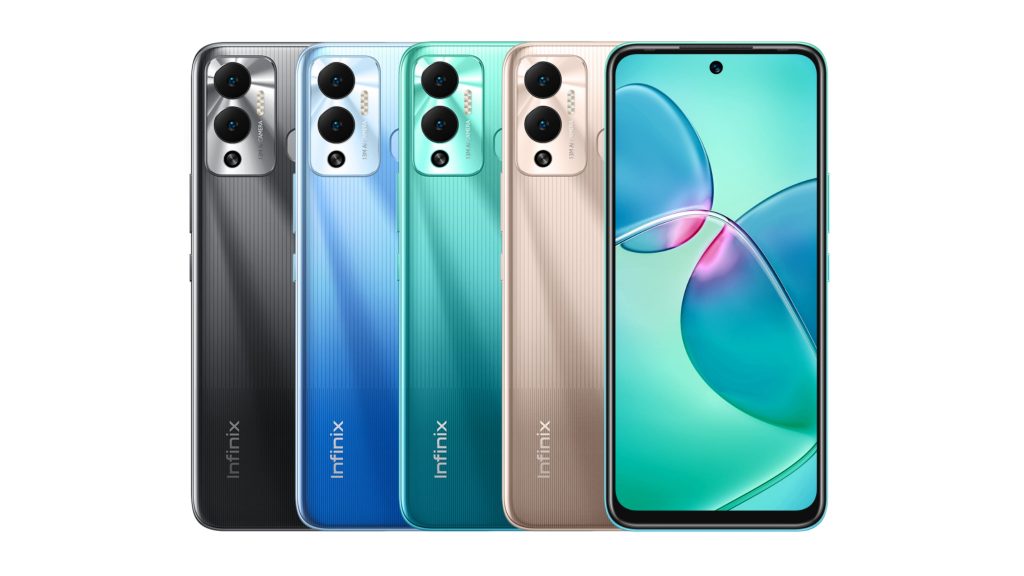
Infinix Hot 12 Play

Infinix Hot 12 Play Specifications and Features

The Infinix Hot 12 Play is built around a 6.82-inch display with a centered punch hole. The LCD panel sports a resolution of 1612 x 720 pixels (HD+), a 90Hz refresh rate, and a 180Hz touch sampling rate.

It comes powered by a Unisoc T610 SoC. As for software, the device boots XOS 10 based on Android 11.

Talking about optics, it houses a dual-camera system on the rear comprising a 13MP primary sensor and an AI lens. On the front, it has an 8MP snapper for selfies and video calls.

As far as connectivity is concerned, it arrives with dual SIM card slots and offers support for 4G, single-band WiFi, Bluetooth, GNSS, and USB Type-C. The handset also comes with a 3.5mm headphone jack, a dedicated MicroSD card slot, and a rear-mounted fingerprint sensor.

The smartphone gets its juice from a  6,000mAh battery and supports 10W standard charging. Finally, it measures 170.47 x 77.60 x 8.32mm in dimensions and weighs 194.9g.


Infinix Hot 12 Play Price and Availability in India

The Infinix Hot 12 Play is priced at ₹8,499 ($110) for the sole 4GB + 64GB memory configuration. It can be availed in either Daylight Green, Horizon Blue, or  Racing Black color options.

The device will be available for purchase starting May 30 via Flipkart.


RELATED:


Redmi Note 11T Pro+ packs self-developed Surging P1 chip with 120W fast charging support

Xiaomi is all set to launch its latest smartphone lineup tomorrow, i.e., on the 24th May in its home country China — Redmi Note 11T series. The lineup will include three phones — Redmi Note 11T, 11T Pro, and 11T Pro+.

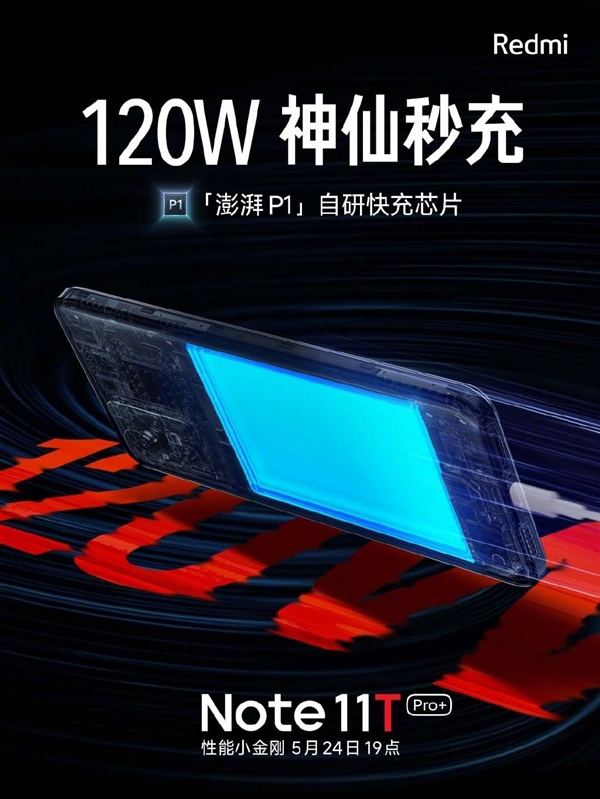
Now, just a day before the official launch, the company has shared a new teaser poster revealing some key details about the phone’s battery and charging capabilities.

Redmi Note 11T Pro Plus Surging P1 Chip

The company has confirmed that the top-end model in the upcoming series, Redmi Note 11T Pro+, will come packed with the self-developed Surging P1 chip for the fast charging technology, and the device will also support 120W fast charging.

It also claims that the smartphone will focus more on battery health and come with special optimizations. It will support charging even at a low temperature of -10°C and feature a USB Type-C port with platinum coating for corrosion resistance.

Xiaomi has also revealed that the Redmi Note 11T series smartphones will come IP53 rating, making them splash and dust resistant. There will be reinforced protection at the four corners and will have a Gorilla Glass protection for the screen.

The Redmi Note 11T Pro+ will feature a 6.6-inch 144 Hz FHD+ IPS LCD display with industry-leading LTPS technology, a 20.5:9 screen aspect ratio, and DC dimming support. It has been confirmed MediaTek’s Dimensity 8100 5G chipset, which is manufactured by TSMC on their power-efficient 4nm nodes.

It will come with a triple camera setup on the back, consisting of Samsung’s 64MP ISOCELL GW1 primary sensor that features a 1/1.72 sensor size to let more light in and 1.6μm pixel pitch numbers to improve low-light night shots.

RELATED: 

Motorola Razr 3 might be the first Snapdragon 8 Plus Gen 1-powered foldable phone

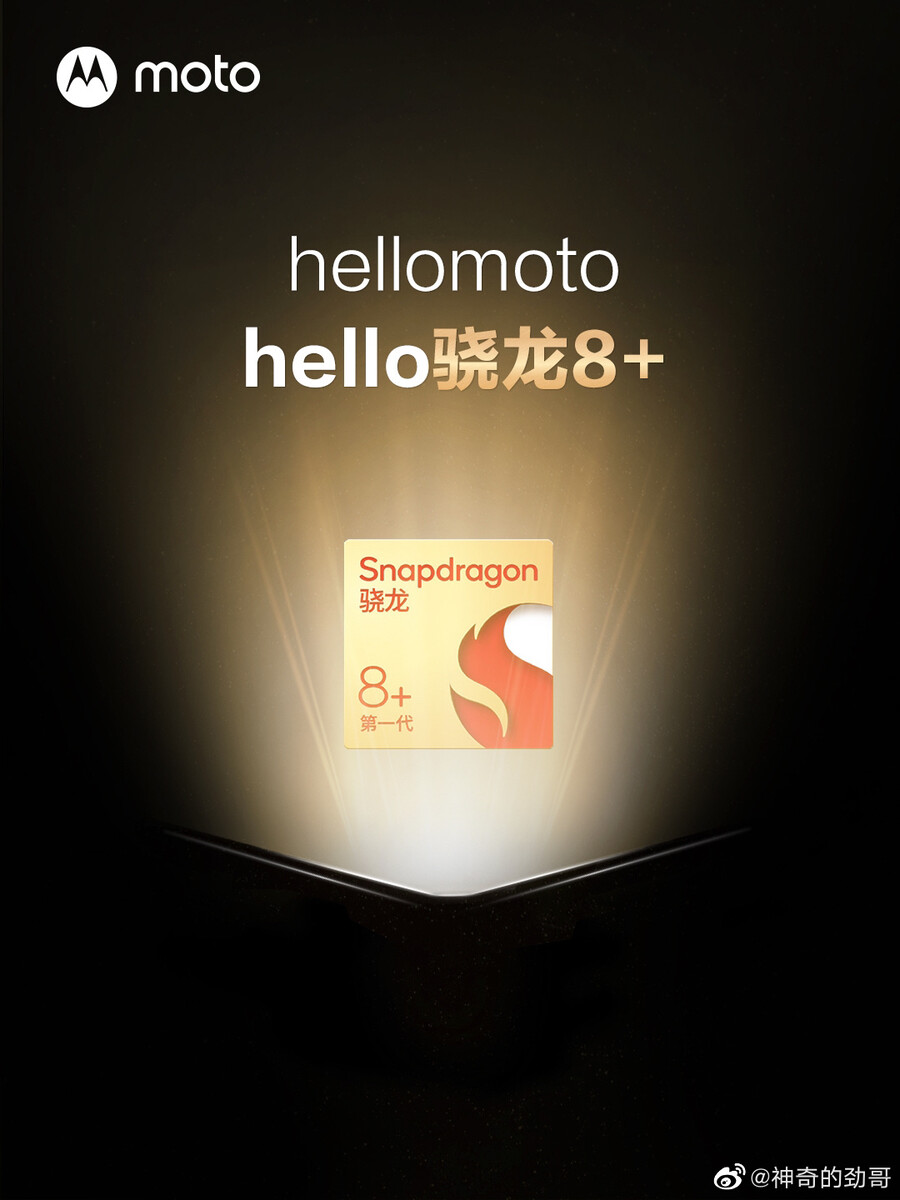
Motorola Razr 3 could be the first foldable that will be powered by Snapdragon 8 Plus Gen 1. The company has shared a poster on Weibo teasing its upcoming Snapdragon 8+ Gen 1 smartphone which is likely to be the Razr 3. The rumors about Motorola’s upcoming foldable have been around for quite a long time and now the company has sort of confirmed that with the new poster.

Motorola’s general manager Shen Jin has shared a poster on Weibo that not only teases the imminent arrival of the Motorola Razr 3 but also reveals that it will be powered by Qualcomm’s newly launched processor.

moto razr 3 poster Sd8+
Shen Jin via Weibo

The poster did not mention Motorola Razr 3 specifically but seeing the design of the phone, it’s obvious that it could be nothing else but the upcoming Razr. Shen Jin made the post with the caption “We have hidden an Easter egg in this new poster, can you see it?”. The easter he is talking about is Moto’s upcoming foldable whose V shaped outline is visible on the bottom of the poster.

Snapdragon’s new processor will definitely give Motorola Razr 3 an upper edge over other foldables. The Snapdragon 8 Plus Gen 1 is built on TSMC’s 4nm process and boasts 10% greater CPU performance, 10% quicker graphics, and up to 30% better power efficiency than its predecessor.

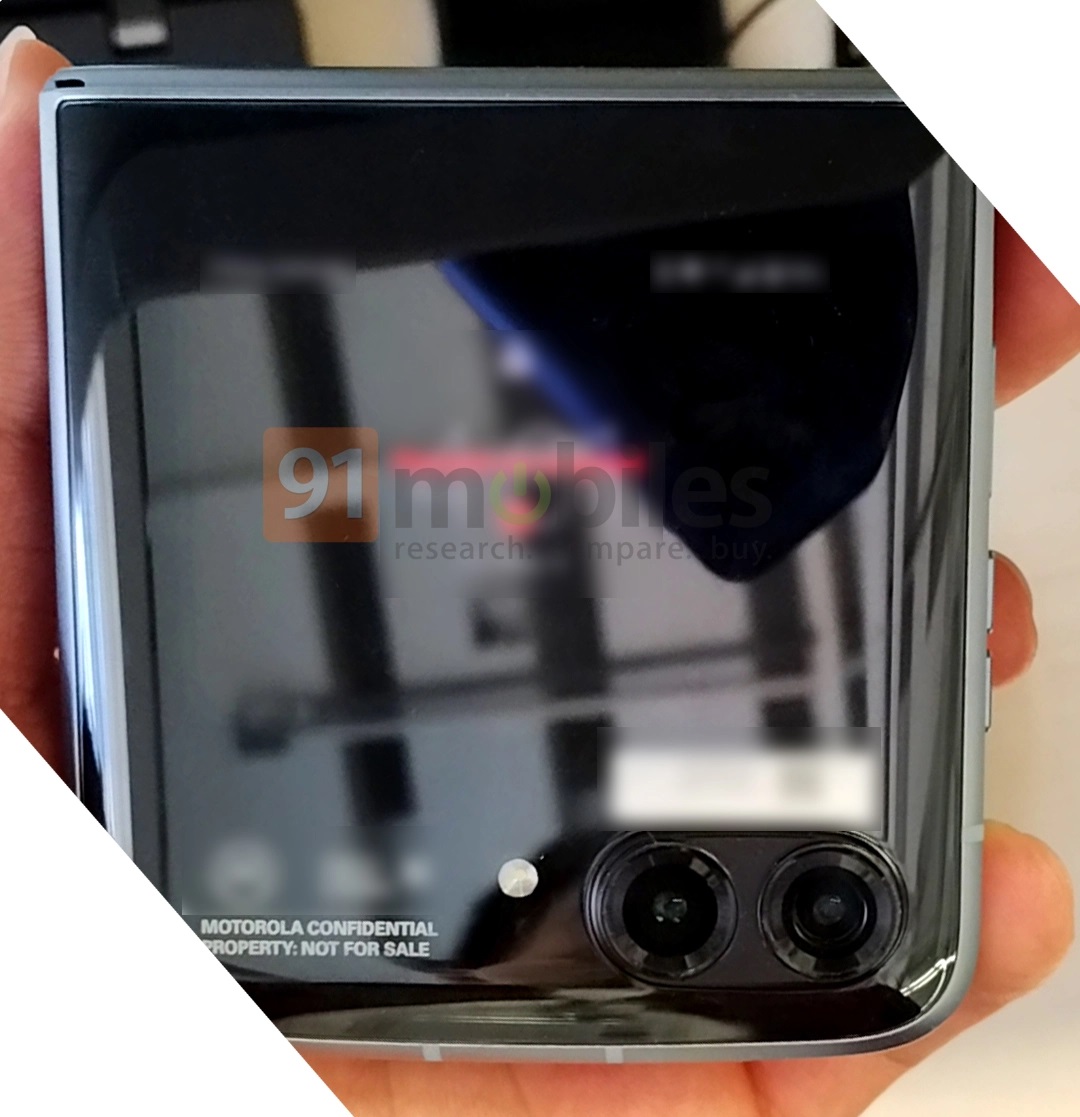
Motorola Razr (Maven) live shot by 91mobiles

Previous reports have suggested that Motorola’s upcoming clamshell will have a 6.7-inch foldable screen and a bigger 3-inch cover display. The internal display of the phone is expected to carry support for a 120Hz refresh rate offering Full HD+ resolution.

The foldable could arrive with a 32-megapixel front camera and a 50-megapixel main camera and a 13-megapixel ultrawide lens.

According to rumors, Motorola’s next foldable will be released in China in the last week of July or early August. It is likely to hit the international market in August.

Tecno POVA 3 live shots emerge before May 25 launch

Tecno is scheduled to announce the POVA 3 smartphone on May 25 in the Philippines. The Facebook handle of the brand already has the design and a couple of key features of the smartphone. Now, tipster Paras Guglani has shared live shots of the smartphone.

The Tecno POVA 3 images show that it will be sporting a large-sized punch-hole display on the front. Its rear shell has a triple camera unit with a quad-LED flash unit alongside. The back panel of the device seems to have a matte finish with a slightly glossy vertical stripe in the middle.

Tecno Pova 3 specifications

The Tecno Pova 3 has a 6.95-inch IPS LCD panel that offers a Full HD+ resolution of 1080 x 2400 pixels and a 90Hz refresh rate. It has a front-facing camera of 8-megapixel. The back panel of the device has a 50-megapixel primary camera. It is coupled with a pair of 2-megapixel cameras.

The Helio G88 chipset is present under the hood of the POVA 3. It houses a behemoth 7,000mAh battery, which carries support for 33W fast charging. The device runs on the Android 12 OS with HiOS on top. It offers other features such as a side-facing fingerprint canner, graphite cooling, DTS stereo speakers, Z-axis linear motor, and a microSD card slot.

In the Philippines, it is likely to carry a price tag of 8,999 PHP (~$172). The Electric Blue edition of the phone will be a limited variant priced at 9,399 PHP. It will also come in Tech Silver and Eco Black.

According to the tipster, the Tecno POVA 3 will debut in India next month. India may receive only the 6GB+128GB edition of the device. The POVA 3 color variants for India will be called Black Sea, Silver Sea, and Blue Sea.

RELATED:

Xiaomi partners with Leica to develop a flagship smartphone launching in July

Xiaomi has today officially announced its partnership with Leica, under which the company has been developing a new smartphone that is set to launch in a couple of months.

The Chinese company confirmed its “long-term strategic cooperation” with Leica and has revealed that they have been co-developing a flagship smartphone which will be officially launched in July this year.

Xiaomi Leica Partnership

This marks the fourth company Leica has collaborated with for mobile imaging after Sharp, Huawei, and Panasonic. However, Xiaomi has not revealed anything related to the upcoming flagship smartphone.

Given that the phone is set to launch in a couple of months, we expect it to come powered by the recently announced Qualcomm Snapdragon 8+ Gen 1 processor. Lei Jun, CEO of Xiaomi, has said that the partnership will provide a strong boost to the company’s imaging strategy without revealing the details.

Xiaomi appears to be following the footsteps of other Chinese brands to offer a distinguishing feature on its flagship or premium smartphone to make it stand out among devices from other brands.

The trend was started by Huawei in 2016 when the company partnered with Leica for the camera features on its flagship smartphones. OnePlus and OPPO have also teamed up with Hasselblad, while Vivo has partnered with Zeiss.

While the company has not revealed, the upcoming smartphone is likely to be the Xiaomi 12 Ultra, and if the rumors are anything to go by, then the device appears to be packed with features compared to other premium phones.

RELATED: 

Xiaomi Band 7 NFC specifications emerge through retail box images

The Xiaomi Band 7 fitness tracker is all set to launch tomorrow (May 24) along with the Redmi Note 11T series of smartphones in China. Ahead of its launch, the retail box images of the Band 7 NFC have appeared to reveal its key specifications. It will succeed the last year’s Xiaomi Band 6 series.

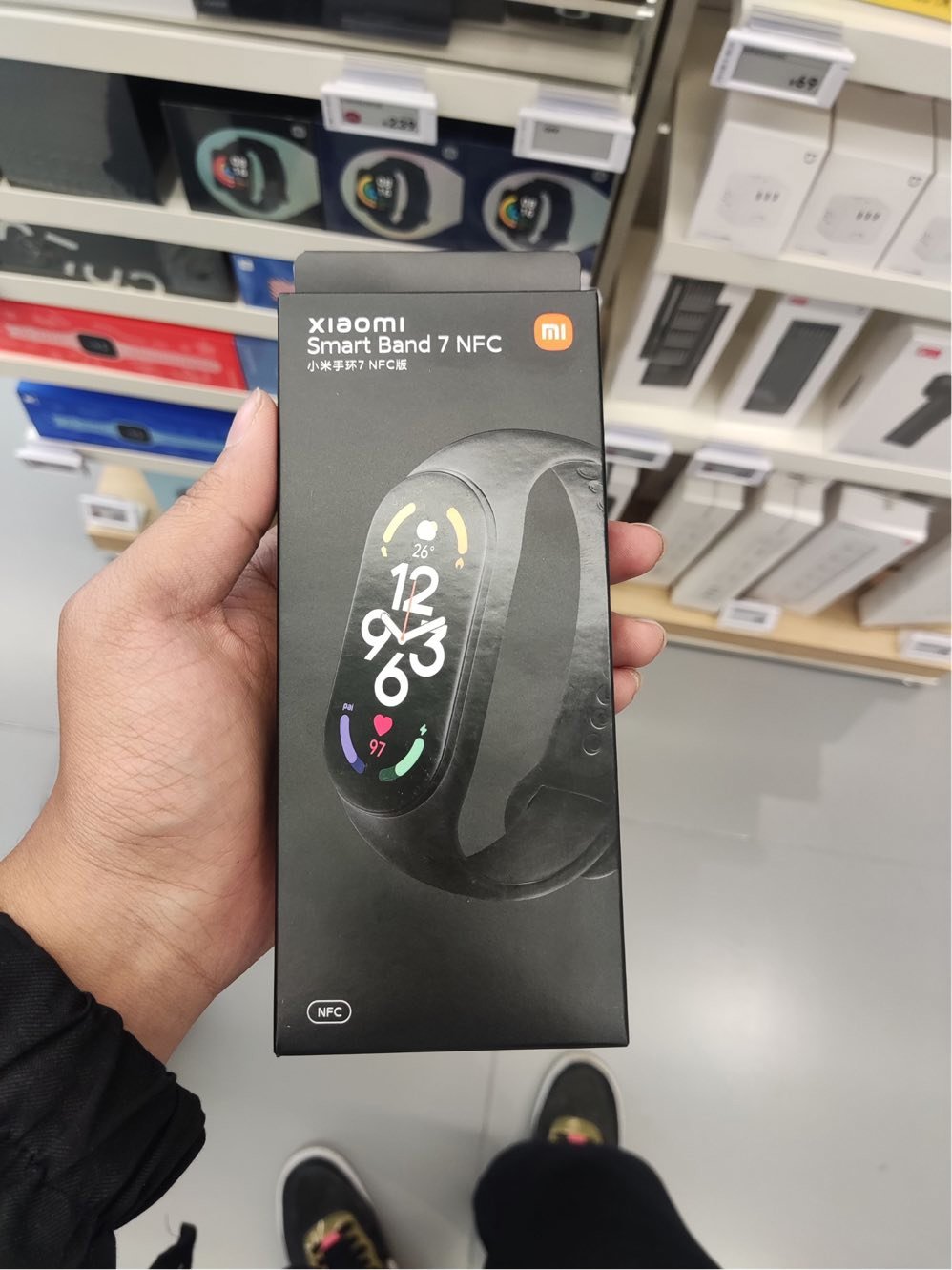
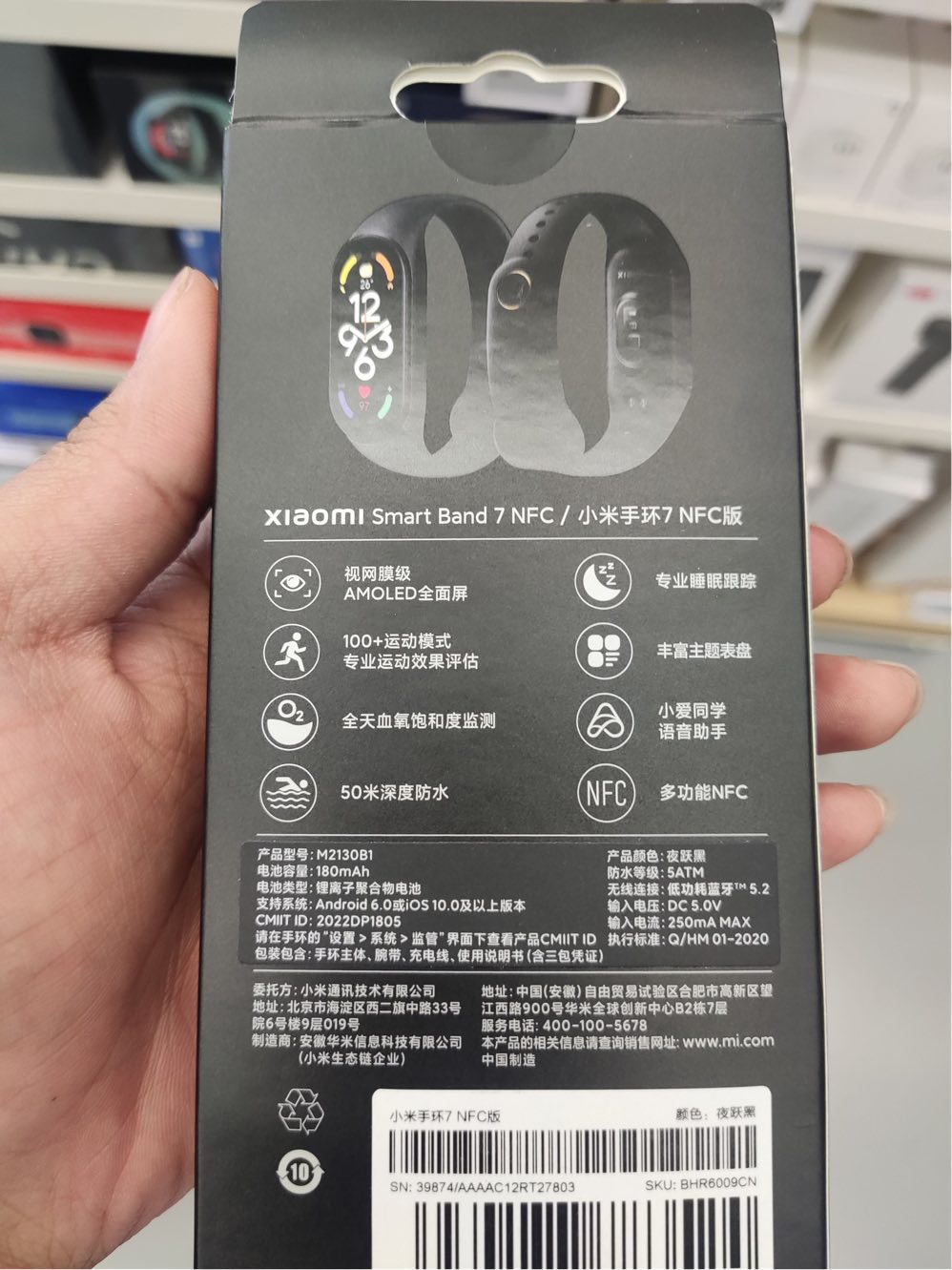
Xiaomi will be offering a regular version of the Band 7 and an NFC-enabled variant. The leaked images reveal that the model number is M23130B1, and it is compatible with devices running on Android 6.0 or above and iOS 10.0 or higher.

Xiaomi Band 7 NFC leak

The Band 7 NFC will come with a 5ATM water-resistant chassis. The fitness tracker features an AMOLED display and packs a 180mAh battery. Xiaomi has already confirmed that it will be offering a 1.62-inch display on the Band 7. To recall, the Band 6 featured a smaller 1.56-inch AMOLED panel and a 125mAh battery.

Xiaomi Band 7 NFC leak 1

The Band 7 NFC will come with support for the Xiao AI assistant and watch faces. When it comes to health and fitness, it will offer features like a heart rate tracker, continuous SpO2 tracking, sleep tracking, and 100+ sports modes. Xiaomi has confirmed that a vibration warning will be displayed on the device if the blood oxygen content falls below 90 percent. While it is not mentioned in the retail box images, the Band 7 is likely to carry support for GPS connectivity.

Rumors have it that the Band 7 NFC will be available for 269 Yuan (~$40). The official teasers have revealed that Xiaomi will be offering its silicon straps in different colors such as blue, light brown, green, orange, white, and black. Its retail package will include the Band 7 capsule, wrist strap, charging cable, and instruction manual.

RELATED:

MediaTek Dimensity 1050 announced with mmWave and sub-6GHz 5G connectivity support

MediaTek has been gaining market share thanks to its Dimensity series processors, and now the Taiwanese company has expanded its portfolio with the launch of another chipset, dubbed MediaTek Dimensity 1050.

The chipset is basically a lower specced version of the Dimensity 1100 SoC, but it is also the company’s first processor to come with dual mmWave and sub-6GHz 5G connectivity.

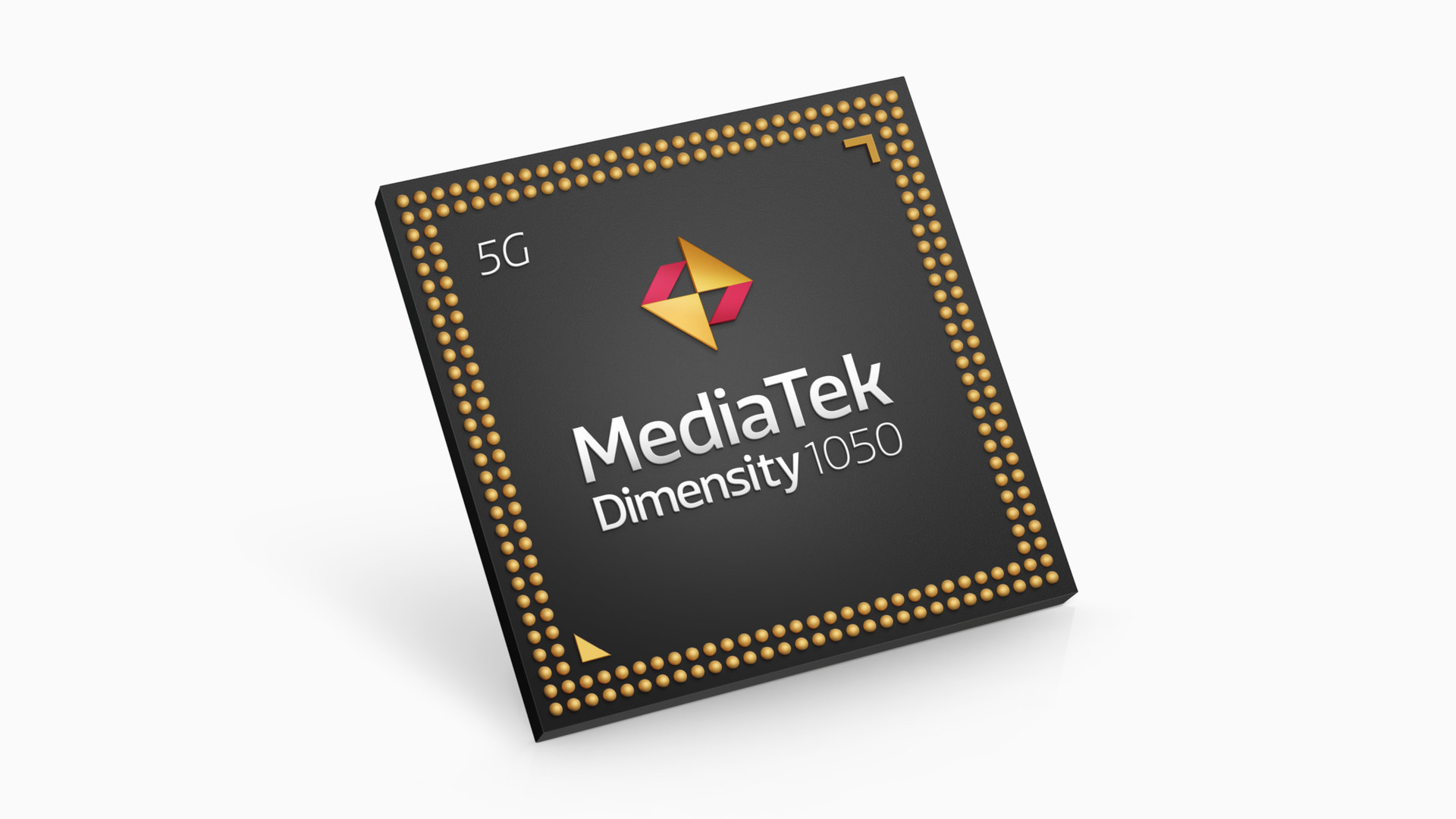
MediaTek Dimensity 1050

The MediaTek Dimensity 1050 is an octa-core processor built using a 6nm process and has two ARM Cortex-A78 performance cores clocked at 2.5GHz. While the company hasn’t mentioned efficiency cores, they are likely to be six ARM Cortex-A55.

It also packs ARM Mali-G610 for graphics processing and has support for MediaTek’s HyperEngine 5.0 suite for providing additional optimization tools and features for better gaming performance.

The processor comes with support for Full HD+ resolution screens with up to 144Hz refresh rate along with support for hardware-accelerated AV1 video decoding, HDR10+ playback, and Dolby Vision.

It offers 3CC carrier aggregation on the sub-6GHz (FR1) spectrum and 4CC carrier aggregation on the mmWave (FR2) spectrum, and is claimed to deliver up to 53% faster downlink speeds compared to LTE + mmWave aggregation. It also supports Wi-Fi 6E and 2×2 MIMO antenna for superfast Wi-Fi connectivity.

The company has not revealed more information about this processor but has said that devices powered by the MediaTek Dimensity 1050 will be available in the market sometime between July and September this year.

RELATED: 

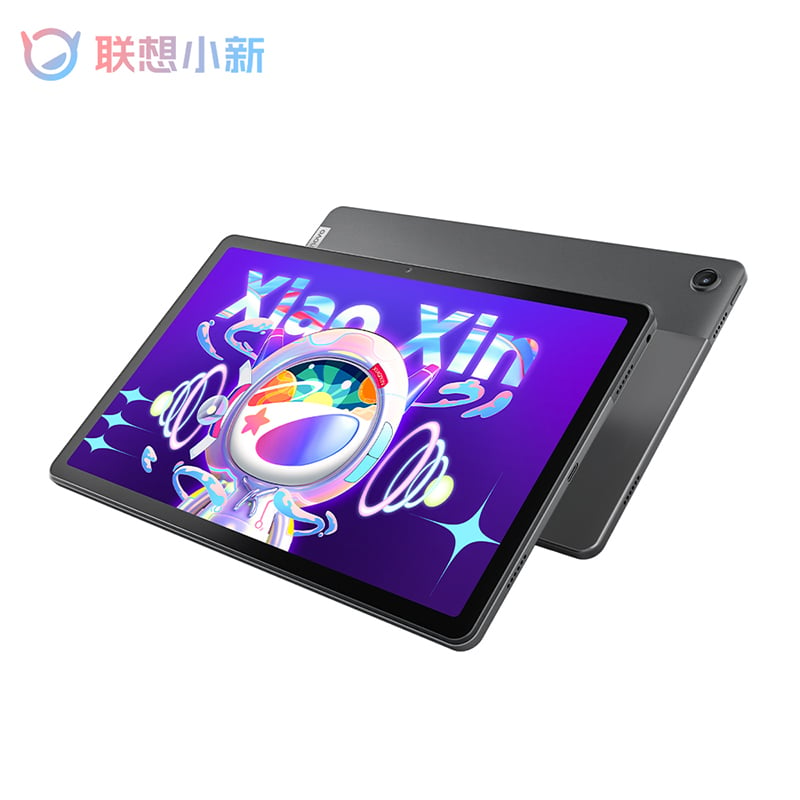
Lenovo Xiaoxin Pad 2022 launched with 10.6-inch display, Snapdragon 680

In October 2021, Lenovo unveiled the Xiaoxin Pad 2021 tablet powered by the Snapdragon 662 chipset in China. Now, the company has unveiled the Xiaoxin Pad 2022 as its successor in the home market. Here are all the details on the specifications, features, and price of the Xiaoxin Pad 2022.

Lenovo Xiaoxin Pad 2022 specifications and features

The Lenovo Xiaoxin Pad 2022 features a 10.6-inch LCD panel that offers a resolution of 2000 x 1200 pixels. It has a front camera of 8-megapixel, and its back panel also features an 8-megapixel snapper without an LED flash.

The Snapdragon 680 chipset is at the helm of the Xiaoxin Pad 2022. It comes with 4 GB / 6 GB of RAM and 64 GB / 128 GB of native storage. For additional storage, it is equipped with a microSD card slot. The tablet comes preinstalled with Android 12 OS.

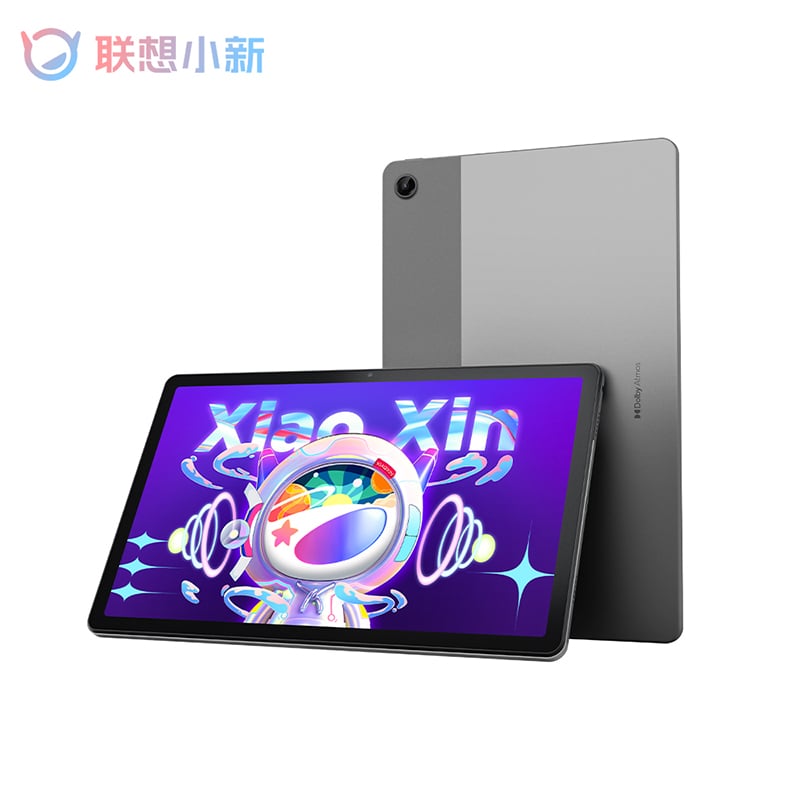
Lenovo Xiaoxin Pad 2022

The Xiaoxin Pad 2022 has a 7,700mAh battery to keep the lights on. At present, there is no clear information on the fast-charging capabilities of the device. It measures 251.2 x 158 x 7.45mm and weighs 465 grams. The other features of the tablet include quad speakers with Dolby Atmos support, Wi-Fi 802.11ac, Bluetooth 5.1, and a USB-C port.

Lenovo Xiaoxin Pad 2022 price and availability

Lenovo is yet to reveal the price of the Xiaoxin Pad 2022. The JD listing of the device reveals that it will arrive in gray and blue colors. Its predecessor model was rebranded as the Lenovo Tab P11 in markets outside China. Hence, it is likely that the Xiaoxin Pad 2022 may arrive with the Lenovo Tab P12 name in global markets.

RELATED:

Vivo T2 5G launch date postponed, here’s when it will be unveiled

Vivo was expected to unveil the Vivo T2 5G today (May 23) in China. However, the company has confirmed through its Weibo handle that its launch has been postponed. It confirmed that its launch has been pushed to the coming month (June).

Due to force majeure, the Vivo T2 5G launch event has been postponed to 7 PM (local time) on June 6 in China. It appears that the company may have postponed due to the COVID-19 resurgence in the country. The Vivo T2 5G will be arriving as the successor to last year’s Vivo T1 5G, which featured the Snapdragon 778G chipset.

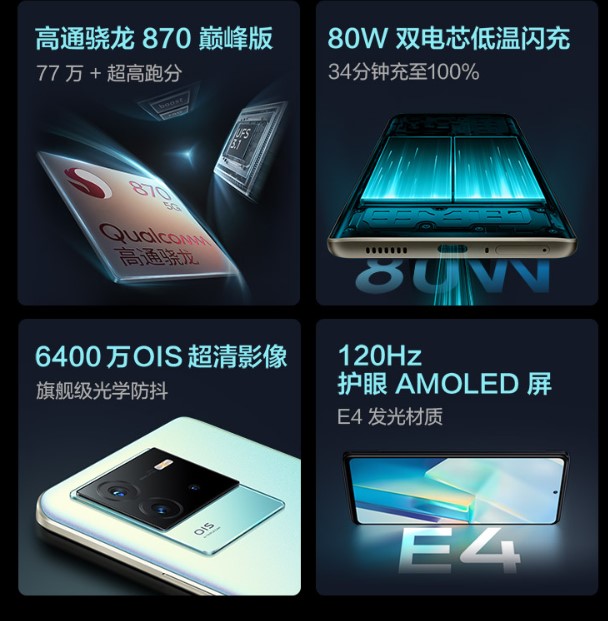
The Vivo T2 5G product page, available on JD.com, has revealed some of its key specifications. As can be seen in the post below, it will be arriving with an AMOLED E4 screen that offers a 120Hz refresh rate and will be powered by the Snapdragon 870 chipset. For photography, it will feature an OIS-enabled 64-megapixel main camera. The device will have support for 80W fast charging.

VIvo-T2-details

Reports have claimed that the Vivo T2 5G will be a rebranded version of the iQOO Neo 6 SE. The iQOO smartphone features a 6.62-inch AMOLED FHD+ 120Hz screen, a 16-megapixel front-facing camera, and a 64-megapixel (main, with OIS) + 8-megapixel (ultrawide) + 2-megapixel macro camera.

The Neo 6 SE is powered by the Snapdragon 870 chipset and up to 12 GB of LPDDR4x RAM. The device ships with up to 256 GB of UFS 3.1 storage. The device packs a 4,700mAh battery that supports 80W fast charging. It runs on the Android 12 OS, which is overlaid with the iQOO UI. For security, it features an in-screen fingerprint scanner. It carries a starting price of 1,999 Yuan (~$299).

RELATED:

Watch Oppo Reno 8 Series Launch Event Livestream Here

Oppo is holding a launch event for its highly anticipated OPPO Reno 8 series in China tomorrow May 23rd (Monday) at 7 pm Beijing Time (UTC +8) / IST 4:30 pm / GMT 11 am. 

The upcoming Reno 8 series will arrive as the successor to last year’s Reno 7 series and will consist of a standard, Pro, and Pro+ variant. 

The entire event will be live streamed online for the general public to tune in. To watch the launch event, you can head on over to the link below on May 23rd, 2022 7 pm Beijing Time (UTC +8) sharp to follow the announcement.


Link to live stream here.


So before the official launch event, we compiled all the highlighting features that we know about the OPPO Reno 8 series so far.

Design and display

The OPPO Reno 8 series is expected to feature a squarish-shaped protruding camera island on the top left corner of the back panel. All three smartphone models have a boxy form factor with flat edges on the sides.

OPPO-Reno8-series

As per an earlier TENAA listing, the Reno 8 and Reno 8 Pro+ are tipped to feature a 6.43-inch and 6.7-inch FHD+ AMOLED display with a 90 or 120Hz refresh rate. Both the regular and Pro variants have a punch-hole cutout at the top left corner with the former also having a thicker bottom chin. The Pro+ variant will come with a centre-aligned punch-hole camera cutout. All three smartphones are expected to be equipped with an in-screen fingerprint scanner.

Specs

As confirmed earlier by OPPO, the Oppo Reno 8 Pro will be world’s first smartphone to feature’s Qualcomm’s latest Snapdragon 7 Gen 1 chipset. Meanwhile, leaks reveal that the OPPO Reno 8 will reportedly be equipped with a MediaTek Dimensity 1300 processor whereas the Pro+ variant is to be powered by the Dimensity 8100 SoC. The TENAA listings also reveal that the standard and Pro+ models will be backed by a 4,500mAh battery with support for 80W fast charging.

OPPO-Reno8-Pro
Oppo Reno 8 Pro in Sky Blue.

To learn more about what we know of the OPPO Reno 8 series so far, head on over to roundup article here. And stay tuned to our coverage on the OPPO Reno 8 series launch on Monday for more details such as the official pricing of the lineup in China!

RELATED:

World’s first USB-C AirPods showcased by guy who made the first USB-C iPhone

Apple’s laptops, iPads, iPhones, and AirPods are charged via their lightning ports circuitry. They lack the globally acceptable USB ports which will enhance their versatility, it seems.

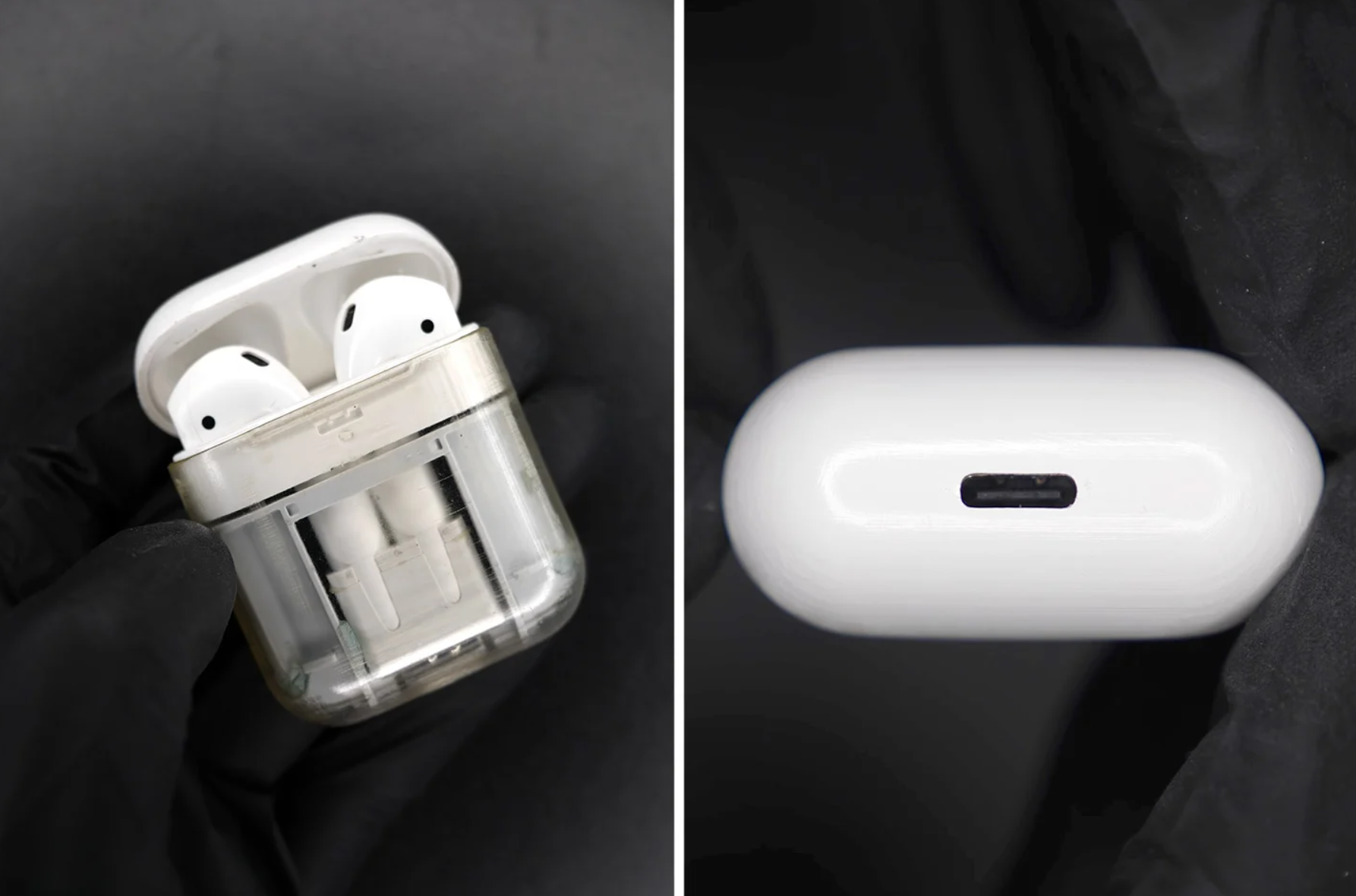
Designer Ken Pillonel is someone who is not comfortable with the absence of USB-C support for his beloved Apple products. He has continued to seek ways to incorporate USB-C support for Apple devices. Pillonel has now modified his AirPods to support USB-C charging and data transfer.

Pillonel is a master’s degree student in robotics at the Swiss Federal Institute. In 202, he designed the world’s first USB-C iPhone after engineering the feature into an iPhone and removing its lightning port. The USB-C port on the iPhone could be used for data transfers as well as charging the device. He has now replicated the feat in his AirPods. The USB-C AirPods are indistinguishable from the regular Apple AirPods except for the presence of USB-C charging.

The AirPods are pretty much smaller and involved a more careful decoupling by the inventor. Pillonel opened the plastic housing for the lightning port ribbon. He then replaced the lightning port with his USB-C ribbon. Pillonel has stressed that the process of replacing the lightning port is a complicated one. It is also an expensive task to make a custom USB-C ribbon. Now, Pillonel says that he uses the same USB-C cord to charge his MacBook, iPhone, and the AirPods.

There are speculations that Apple will transition to USB-C next year due to pressure from some quarters including the EU. Pillonel’s efforts have provided some illumination on that possibility, going forward. If indeed Apple ditches its proprietary lightning port for the USB-C, it will have to do adjustments to its AirPods as well.

RELATED:


(source)


Goodix debuts new Bluetooth LE SoCs and ToF solutions

Gadgets today are made up of multiple chips and sensors to provide their end-users with a smooth and seamless experience. One of the companies at the helm of these cutting-edge sensors and chips is Goodix Technology which supplies components to major players in the industry like Samsung, Google, Xiaomi, etc.

Goodix MWC 2018

The brand is best known for its in-display fingerprint sensors, however, in recent years, it has expanded its portfolio by heavily investing in the development of Bluetooth LE, NB-IoT, health monitoring solutions, etc. Now, the company has released new Bluetooth LE SoC dubbed the GR5526 series and a Time of Flight (ToF) solution. So let’s take a look at what these new chips are capable of.

Goodix GR5526 Bluetooth LE SoC series

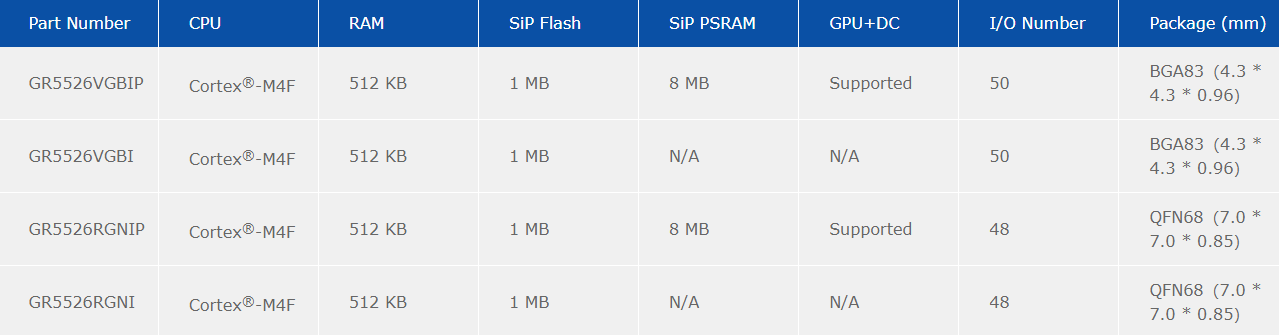
The new GR5526 series SoCs are low-power Bluetooth 5.3 supported SoCs with ARM Cortex]-M4F core at their center. The company claims that the GR5526 series “can be configured as a Broadcaster, an Observer, a Peripheral and a Central while supporting the use of the combinations of all these roles”.

It comes with a dedicated GPU enabling it to output display with up to 454×454 and 30FPS. It is also up to 30% more power-efficient than its predecessor making it ideal for high-end smartwatches, human interface devices (HIDs), and IoT products.

ToF solution

The newly announced Time of Flight solutions by Goodix is a 3D sensing solution combining the ToF image sensor and a laser driver allowing for more accurate photo bokeh effects, and faster-focusing capability at night or in low light situations. It also offers better ambient light suppression, anti-interference, and high dynamic range (HDR). This technology will most likely be implemented in smartphones, drones, etc.

Other than these launches, insiders have also informed us that Goodex’s health solution will be featured in the highly anticipated Xiaomi Mi Band 7 which is set to launch on May 24.

Why was the Official “Nokia Mobile” WeChat Account Rebranded to “HMD Technologies”?

As of recent, Chinese netizens have noticed the official WeChat account for “Nokia Mobile” has seemingly disappeared. Instead, the official WeChat account was renamed to “HMD Technologies Limited”, which is the name of its parent company, HMD Global.

Nokia to HMD Wechat
(WeChat message translated in red box) Nokia Mobile has been renamed to HMD Technologies

As to the reason why, the Chinese news site, ITHome, had reported that in September 2021, the Nokia Mobile Smartphone division had initiated a social media account migration as part of restructuring the company’s business in China. And in the process of this migration, the WeChat account has transferred from the Nokia Mobile Beijing Limited Corporation to the HMD Technologies Shenzhen Limited Corporation. For context, HMD is the parent company of Nokia smartphones.

Nokia HMD logo
Nokia and HMD logos

The Nokia brand has been well known ever since the 1990s for their mobile phones that were always portable as you could easily fit them into a pocket, unlike your conventional landline phones used to make calls. 

But over the course of the 2010s, the corporation had gone ended its golden era of sales, as the company was bought over from Microsoft in 2014 to produce Windows Lumia smartphones, that were of no success, and then the Nokia brand was bought back by Finland-based company, HMD Global to revive the brand in smartphone space in 2016. 

Since the HMD Global buyback, the Nokia branded smartphones have gotten a good reputation for running on stock Android. But sales wise the Nokia smartphone division of today does not high figures or market share of its competitors like Samsung, Xiaomi or Oppo. The Nokia smartphones sales are currently doing just enough numbers to barely get by. 


RELATED:

(Via)

Android 11 is the most widely distributed version of Android, installed on over 28.3% of total Android handsets

Google launched its most hyped Android version 12 last year. The update carried many changes and was well-liked by the users. However, according to the 2022 Android distribution chart, Android 12 is not the most popular OS. That title goes to Android 11.

To recall, Google used to regularly update distribution stats each month. The stats revealed which versions of Android had how much market share, allowing us to track how often a system update was rolling out. However, Google stopped updating this data because it started getting used for comparison to Apple‘s substantially higher adoption rate for new iOS versions.

Recently, Google again started updating the Android distribution chart, but this time it uploads it on Android Studio. The chart is currently updated every six months to a year, with the most recent update arriving in November and a fresh version arriving on May 9.

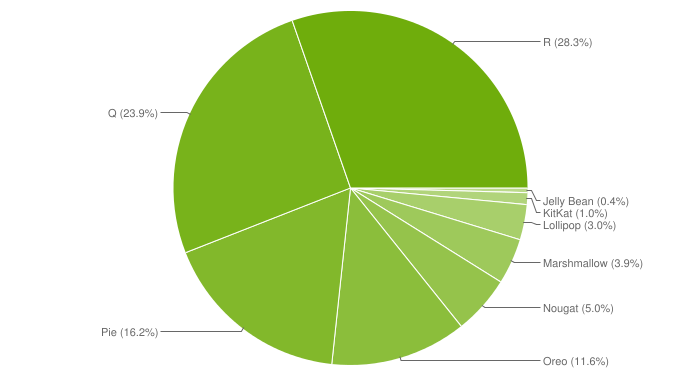
According to the new distribution data (via 9to5Google) for 2022, Android 11 is now the most widely spread version of Android, with approximately 28.3 percent of Android handsets running it. Android 11 is closely followed by Android 10 with 23.9% of the market share.

android-distribution-chart-may-2022
Source: 9to5Google

Third, on the stream, is Android 9 Pie with 16.2% of the market and Android 8 Oreo is next with 11.6%. You can see that with each older version, the numbers go down. This should not come as a surprise because a new Android version is released every year and most people update to the latest one.

Related:


Indonesia’s Smartphone Market saw an 11.5% increase YoY in Q1 2022 with OPPO on top: Report

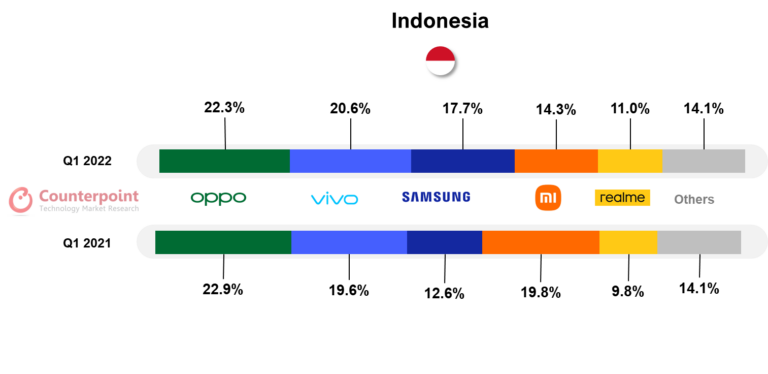
The Indonesia smartphone market has witnessed a huge 11.5 percent increase in the first quarter of 2022, as per a report by Counterpoint Research. Oppo became the key player and led the market with a 22.3% share, while Vivo secured the second spot. Samsung took third place in the segment, whereas Xiaomi and Realme managed to get into the top fourth and fifth positions, respectively during the quarter.

A report from Counterpoint research says that Indonesia’s smartphone market grew 11.5% YoY in Q1 2022. The reason behind this increase is said to be the economic recovery of the country that started in the second half of 2021.

Indonesia-smartphone-Q1-2022
source: Counterpoint Research

Unlike the US and European countries, The Indonesian smartphone market is dominated by Mid-range smartphones under $249. The market is flocked by Chinese OEMs like OPPO, Vivo, Xiaomi, and realme.

OPPO remained the largest contributor in the first quarter of 2022 with a 22.3% share, however, its lead over rivals Vivo and Samsung has shrunk, the report states. Vivo’s Y and V series maintained its popularity in the low-tier and mid-tier markets and helped the company acquire 20.6% of the market.

Samsung took the third spot in terms of market share in Indonesia. The company recorded a 5.1 percent annual growth with a 17.7 percent market share. On the other hand, Xiaomi and Realme captured the fourth and fifth spots in the country’s smartphone market with 14.3 percent and 11 percent market share, respectively in Q1 2022.

“Indonesia’s smartphone market will have a promising 2022 ahead. OEMs will continue to launch new models, bring more affordable 5G smartphones and drive online channel sales by partnering with e-commerce portals.” said Febriman Abdillah, Senior Analyst at Counterpoint Research. “The $150-$249 price range could become the fastest growing smartphone segment, accounting for 35% of the market.” Abdillah added.

Related:

Honor 70 Pro, Honor 70 Pro+ 3C certified, fast charging capabilities revealed

On May 30, Honor will take off the covers from the Honor 70 series of smartphones in China. Reports have claimed that the lineup includes three devices: the Honor 70, Honor 70 Pro, and Honor 70 Pro. The Honor 70 lineup will compete with the OPPO Reno8 series, Vivo S15 series, and Redmi Note 11T lineup, all of which are set to launch in the domestic market later this month. Ahead of the launch, the alleged Honor 70 Pro and 70 Pro+ smartphones have surfaced in the database of the 3C certification platform. The 3C listings of both devices have revealed the fast-charging capacities of both smartphones.

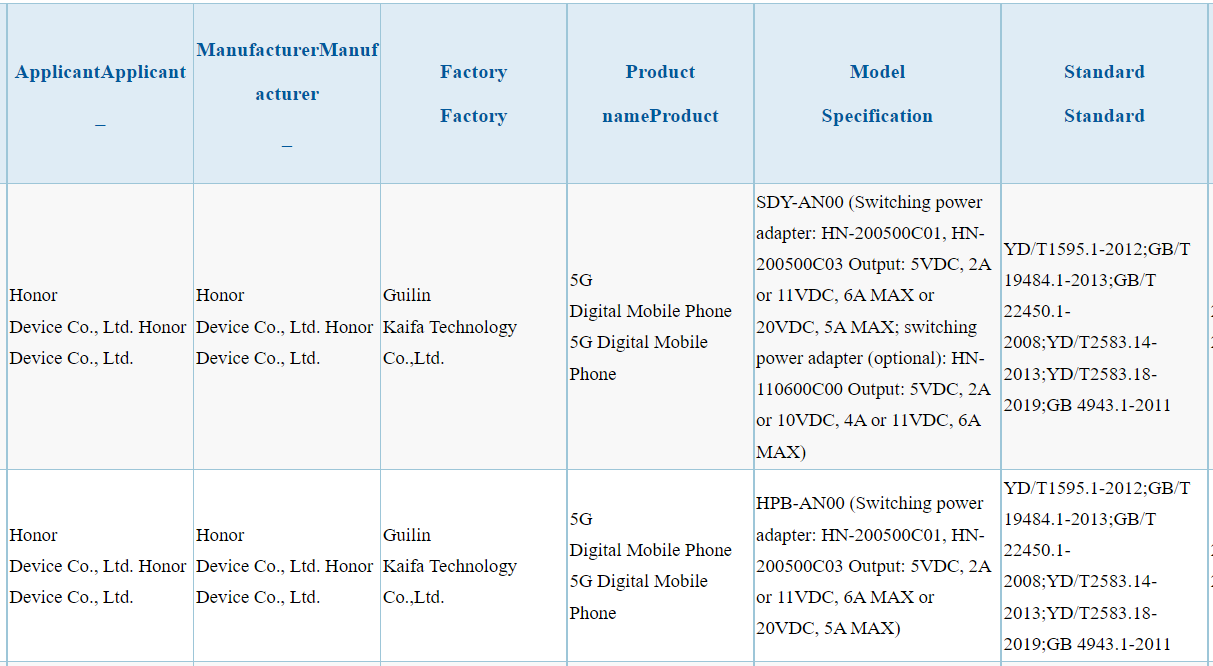
Two upcoming Honor phones with SDY-AN00 and HPB-AN00 model numbers have been approved by the 3C authority. According to tipster WHYLAB, these phones will debut as the Honor 70 Pro and Honor 70 Pro+.

Honor 70 Pro and Honor 70 Pro+ 3C certification

The 3C listings reveal that both devices will carry support for 100W wired charging. It is likely that both models will soon appear in the database of the TENAA certification site with their key specifications in the next few days. Earlier this month, an Honor phone with the FNE-AN00 model number and 66W fast charging support was spotted at 3C certification. Speculations are rife that it could be the vanilla Honor 70.

Honor 70 series specifications (rumored)

The Honor 70 will arrive with an FHD+ OLED display, whereas the Honor 70 Pro and Pro+ will house an FHD+ OLED LTPO panel. The Honor 70 will feature the Snapdragon 7 Gen 1 and a 4,800mAh battery. The Honor 70 Pro will be equipped with the Dimensity 8100 and Dimensity 9000 chipsets, respectively. Both phones may feature a 4,600mAh battery.

Honor 70 and Honor 70 Pro

The Honor 70 will come with a 108-megapixel + 8-megapixel + 2-megapixel triple camera unit. The Honor 70 Pro will feature a 50-megapixel (Sony IMX766) + 50-megapixel ultrawide + 8-megapixel (telephoto) triple rear cameras. Instead of the 8-megapixel telephoto camera on the Honor 70 Pro, the Pro+ model will have a 12-megapixel telephoto camera.

RELATED:

Vivo Y72t launched with Dimensity 700, 6,000mAh battery, 50MP camera

Vivo has silently unveiled a new mid-range phone named the Vivo Y72t in China. The 5G-ready smartphone comes equipped with a huge battery, an FHD+ display, and a 50-megapixel main camera. Here is all the information on the specifications, features, and price of the Y72t.

Vivo Y72t specifications and features

The Vivo Y72t has a 6.58-inch LCD screen with a Full HD+ resolution of 1080 x 2400 pixels, a 20:9 aspect ratio, 401 ppi pixel density, a refresh rate of 60Hz, and a screen-to-body ratio of 92 percent. The device measures 163.87 x 75.33 x 9.17mm and weighs around 200 grams.

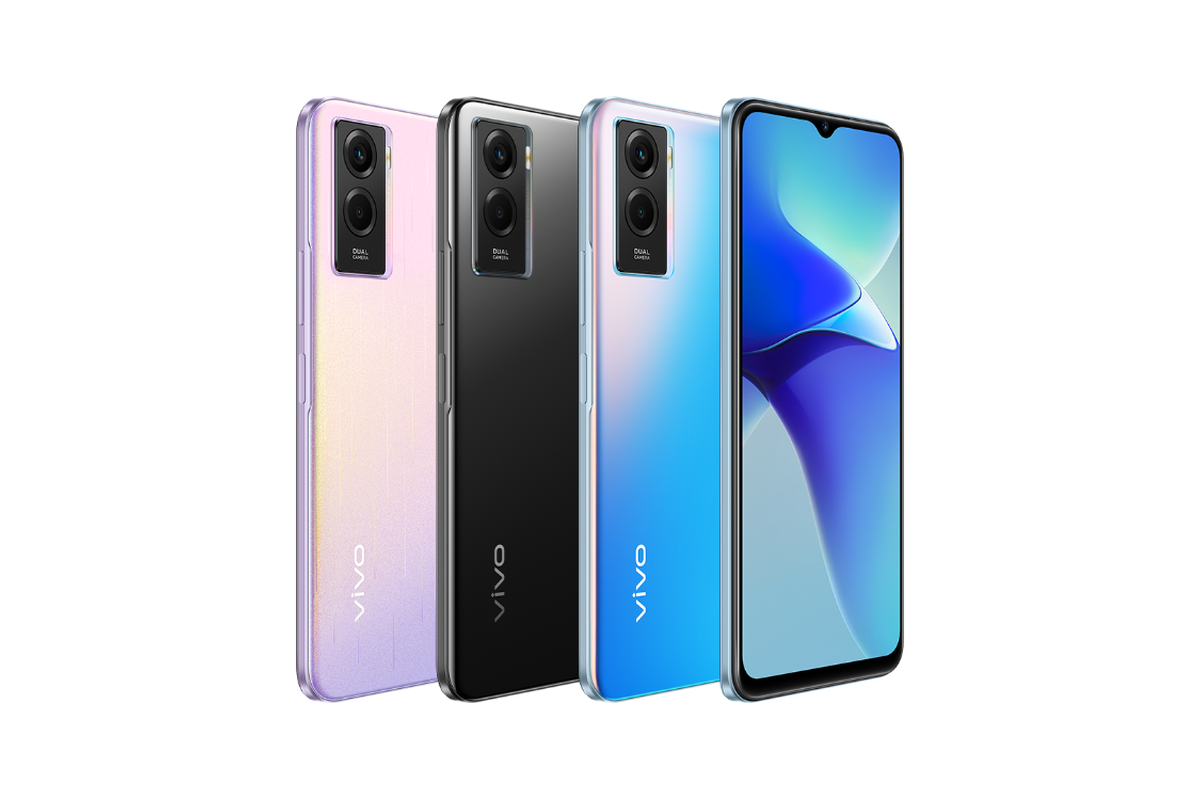
Vivo Y72t
Vivo Y72t

The display notch of the Vivo Y72t features an 8-megapixel selfie camera. Its rear camera setup has a 50-megapixel primary camera and a 2-megapixel macro camera. Both cameras support Full HD video recording. The device runs on the Android 11 OS and OriginOS 1.0. For security, it has a side-mounted fingerprint scanner.

The Vivo Y72t is powered by the Dimensity 700 chipset. It comes with up to 8 GB of LPDDR4x RAM and 128 GB of UFS 3.1 storage. It houses a 6,000mAh battery that supports 18W fast charging. It offers other features such as a dual SIM slot, 5G, Wi-Fi 802.11ac, Bluetooth 5.1, GPS, a USB C port, and a 3.5mm audio jack. The Y72t is a rebranded version of the Vivo Y55s 5G, which was announced in December 2021 in China.

Vivo Y72t price and availability

The Vivo Y72t will be available for pre-order from tomorrow (May 23) in China. It comes in two variants: 8 GB RAM + 128 GB storage and 8 GB RAM + 256 GB storage. They are priced at 1,399 Yuan (~$209) and 1,599 Yuan (~$239), respectively. It can be purchased in Interstellar Powder (pink gradient), Deep Sea Black, and Blue Sea colors.

RELATED:

Mysterious Snapdragon 8+ Gen 1 phone spotted with highest AnTuTu score

Qualcomm recently unveiled the Snapdragon 7 Gen 1 and Snapdragon 8+ Gen 1 chipsets. The SD8+G1, as the name suggests, is a flagship chip that promises 10 percent faster performance than the Snapdragon 8 Gen 1. AnTuTu has shared the benchmark scores of an unknown smartphone powered by the new flagship SoC. Here is all the information that has surfaced through the AnTuTu listing.

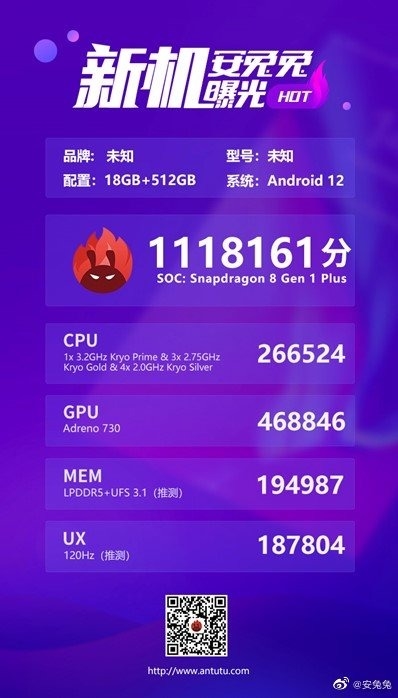
The mysterious smartphone featuring the SD8+G1 chip has a 120Hz refresh rate display, 18 GB of LPDDR5 RAM, and 512 GB of UFS 3.1 storage. It runs on the Android 12 OS. The device scored 266,524 points in the CPU test. It recorded 468,846, 194,987, and 187,804 points in the GPU, memory, and UX tests. It managed to record a total score of 1,118,161.

Snapdragon 8 Plus Gen 1 AnTuTu
Snapdragon 8 Plus Gen 1 phone’s AnTuTu listing

Some of the smartphones that are expected to feature the SD8+G1 chip include the ASUS ROG Phone 6, Realme GT 2 Master Edition, Motorola Edge 30 Ultra, Xiaomi 12 Ultra, OnePlus 10 Ultra, iQOO 10 series, Samsung Galaxy Z Flip 4, and Galaxy Z Fold 4. The first phone powered by the SD8+G1 is expected to debut in the next few weeks in China.

The Snapdragon 8+ Gen 1 Plus chipset has one 3.2GHz Kryo Prime core, three 2.75GHz Kryo Gold cores, four 2.0GHz Kryo Silver cores, and Adreno 730 graphics. According to AnTuTu, the memory and UX scores are basically the same as the current performance offered by the SD8G1 chip. However, the CPU and GPU scores have improved by 20,000 to 30,000 points.

While the SD8G1 is a good chip, phones powered by it tend to heat up and consume more battery juice while gaming and multitasking. The SD8+G1 built with TSMC’s 4m process is expected to produce less heat. According to Qualcomm, the overall power efficiency has increased by 15 percent compared to SDG81.

RELATED: