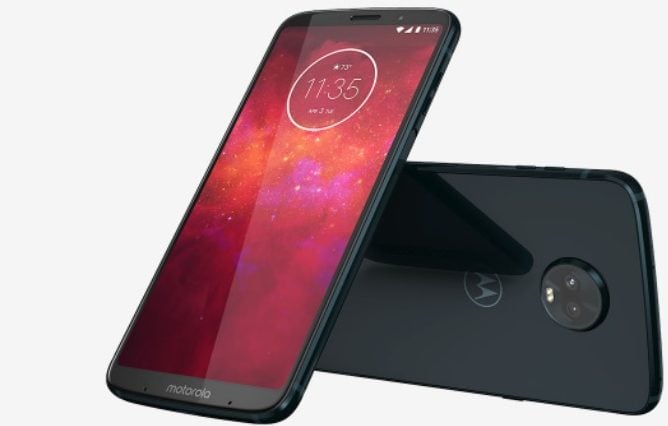
Lenovo-owned Motorola had unveiled the Moto Z3 Play smartphone in Brazil earlier in this month. Various retailers in the U.S. have already started with the pre-orders of the Z3 Play. The official site of the Motorola in the U.S. has stated that it will be begin with the shipments of the smartphone on July 2. The U.S. is not the only country that will be receiving the smartphone in early July. Citing information received from retail sources, an Indian publication has claimed that the Moto Z3 Play will be debuting in India in the first week of the coming month.
In Brazil, the Moto Z3 Play carries a pricing of BRL 2,299 (~$608). There is no information available on the cost of the Indian edition of the smartphone. It is speculated that it could be priced around Rs. 40,000 (~$587).
The Moto Z3 Play house a 6-inch AMOLED MaxVision display that supports 18:9 aspect ratio and FHD+ resolution of 2160 x 1080 pixels. The Snapdragon 636 chipset that includes an octa-core processor that clocks at 1.8 GHz present under its hood. It features 4 GB of RAM and comes in 32 GB and 64 GB storage models.
The handset is loaded with the latest Android Oreo OS. It is driven by a 3,000mAh batter. For photography, it houses a dual camera setup with a 12-megapixel primary sensor and a 5-megapixel secondary sensor. It has a front-facing camera of 8-megapixel. Like the predecessor model, the Z3 Play also carries support for Moto Mods accessories.
The Moto Z3 Play was introduced in a single color option of Deep Indigo. Motorola has just released the new Onyx Black color edition of Z3 Play in Brazil. There is no information available on whether other markets will be also receiving the new color variant.
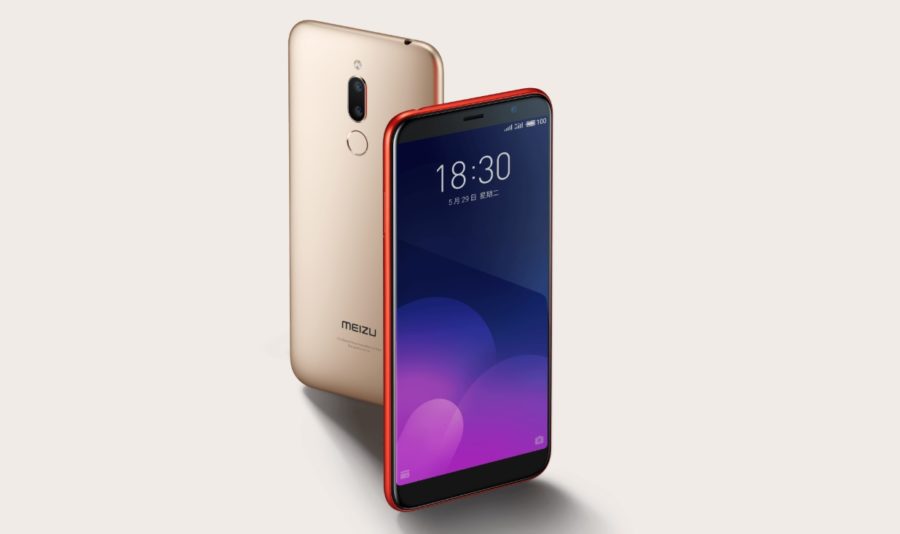
Meizu, the Chinese manufacturer, which already has a presence in India but has not been active in the country, is reportedly planning to launch its budget smartphone Meizu M6T in India. The smartphone was originally launched in May in China.
According to the report, the Meizu M6T could soon launch in India and the China-based company is in talks with Flipkart for selling the device in India. The report adds that initially the phone will be exclusively available through Flipkart but later it could be available with an offer from Reliance Jio.
The Meizu M6T features a 5.7-inch HD+ display with screen resolution of 1440 x 720 pixels. Under the hood, the smartphone is powered by MediaTek MT6750 octa-core processor clocked at 1.5GHz along with Mali T860 GPU.
The phone comes with two memory configuration — 3GB RAM with 32GB internal storage and 4GB RAM and 64GB internal storage. There’s also a microSD card slot that enables users to further expand the phone’s storage up to 128GB.
On the camera front, the smartphone sports a dual rear camera comprising a 13-megapixel primary sensor with f/2.2 aperture, LED flash, and Sony IMX278 and a 2-megapixel secondary camera with f/2.4 aperture. On the front side, it has an 8-megapixel camera for selfies and video calling, with f/2.0 aperture.
Connectivity options on the device include 4G VoLTE, Bluetooth 4.1, WiFi 802.11 a/b/g/n, GPS/AGPS and a micro USB port. It also has a fingerprint sensor on the back panel. The smartphone runs on Android 7.0 Nougat operating system out of the box with Flyme OS 6.2 on top and is backed up by a 3,300mAh non-removable battery.
In China, the 3GB RAM model is priced at 799 Yuan (approx. $122) while the 4GB RAM costs 1,099 Yuan (approximately $168). We are expecting similar pricing for the smartphone in the Indian market as well. Going by the specifications, we expect the smartphone to fall under the budget segment and will compete against the likes of Xiaomi Redmi 5, Oppo’s Realme 1, among others.
TENAA images of the Huawei Nova 3 have appeared online, and the photos confirm a similarity between the phone and the Nova 3e/P20 Lite.
The Nova 3 will come with a glass and metal sandwich design with the same reflective appearance as the P20 Lite. There are two cameras arranged vertically and positioned on the left corner. The device also has a rear-mounted fingerprint scanner.
[envira-gallery id=”198058″]
The picture of the front shows the display turned off, so we can’t confirm if the display has a notch. But we won’t be surprised if it does seeing as the front camera, earpiece and sensor are all positioned in the middle. The power button and volume rocker are on the right side of the phone and images of the sides show the dual rear cameras have a slight bump.
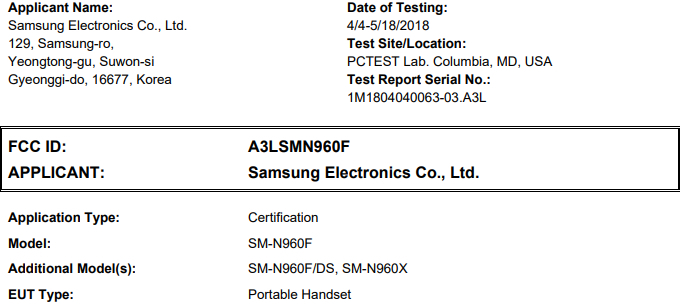
A new Samsung phone that has a model number of SM-N960F has received approval from the Federal Communications Commission (FCC) in the U.S. The Galaxy Note 8 that had launched in the previous year had a model number of SM-N950. Hence, it seems that the FCC approved SM-N960F could be the upcoming Samsung Galaxy Note 9.
Just as the SM-N950F was a non-US variant of the Galaxy Note 8 that had made its way to Europe and Australia. So, the SM-N960F could be the variant of Galaxy Note 9 that could be heading to those markets. Since it is a non-US model, it could be powered by the Exynos 9810. Unfortunately, the FCC documents do not contain any information on the specifications of the Note 9.
As it can be seen above FCC has also approved SM-N960F/DS (single-SIM and dual-SIM versions) and SM-N960X. The latter model could be an Asian variant of the Note 9 as the SM-N950 Galaxy Note 8 was released in Asia.
The Galaxy Note 9 that will be releasing in the U.S. may have a model number of SM-N960U. This variant has not appeared at the FCC yet, but this may happen soon. FCC had reportedly received the SM-N960F Galaxy Note 9 in April. However, it has been certified by the agency only today. This suggests that Samsung was ready with a near-final of the phablet by April. Hence, there is a possibility that the Galaxy Note 9 renders that were leaked by OnLeaks in the recent past could be showing the actual design of the phone. Appearance-wise, there won’t be any design change on the Note 9 compared to the predecessor model.
Last year, the SM-N950U Galaxy Note 8 was approved by the end of July and the phone was made official around a month later in August. Rumors have it that Samsung will be announcing the Galaxy Note 9 on Aug. 9. Hence, there is a possibility that the SM-N960U Galaxy Note 9 for the U.S. may get approved at the start of the coming month.
The Samsung Galaxy Note 9 may arrive with 6.4-inch S-AMOLED Infinity Display, Exynos 9810 / Snapdragon 845 SoC, 6 GB of RAM, 256 GB of storage and 3,850mAh battery. Some countries may receive 512 GB model of the Note 9 that may feature 8 GB of RAM.
The blockbuster movie Jurassic World 2 recently made its debut in theatres in China on June 15 and the revenue from the movie has been outstanding. The movie is said to have raked in $112 million on opening weekend in mainland China alone. Such is the popularity of the movie and Huawei is trying to benefit from the movie’s popularity with the launch of a new Honor 7X Jurassic World Limited Gift Box Edition.
As the name implies, the new edition is just the regular Honor 7X with its gift box design with the Jurassic World theme. The device also seems to come with a couple of Jurassic Park-themed wallpapers inside but most of the tweaks are in the design. No, you wouldn’t pay a higher amount to grab this limited edition as it still adopts an almost similar pricing to its predecessor. The new Jurassic World edition is presently available on Jingdong (JD.com) for just 1099 yuan (~$167) which is even lower than the price the 4GB+32GB variant was sold last year October after it was launched. The new edition is only available in Aurora Blue colour and 4GB + 32GB memory.
As a reminder, the Honor 7X smartphone features a 5.93-inch display with 18:9 aspect ratio and full-HD+ (1080×2160 pixels) resolution. It runs the Android 7.0 Nougat-based EMUI 5.1 custom UI and is powered by the octa-core HiSilicon Kirin 659 SoC paired with a 4GB RAM. The device is available in three storage variants of 32GB, 64GB and 128GB expandable up to 256GB. Keeping everything running is a 3340mAh battery. There is a dual camera setup at the rear consisting of a 16MP main sensor and a 2MP secondary sensor. There is also an 8MP front-facing shooter onboard. The Honor 7X is available in Gold, Blue, and Black.
Huawei’s Honor sub-brand was originally an online-only brand to cater to the younger generation. However, it has shifted changed its direction and is creating an offline presence by opening physical stores and experience centers. It opened its newest store in Vietnam, the first in the country, a few days ago.
The new experience store will sell Honor products released in the country and also have on display other products not yet launched in Vietnam such as the Honor MagicBook.
Honor is expanding its presence outside of China. According to its president, Zhao Ming, sales from overseas has increased by 100% in the last five months and they expect it to rise in the second half of the year. It currently makes up 20% of its total sales, a figure they expect to rise by the end of the year.
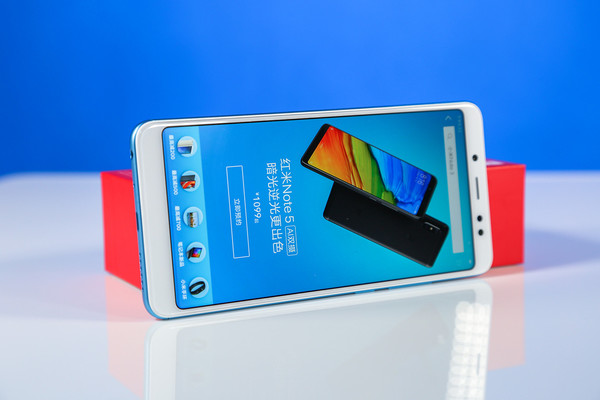
When Apple released a Red variant of the iPhone 8 back in April this year, Xiaomi had teased a Red variant of the Redmi Note 5 which had just been released back then. The Chinese tech giant has now officially unveiled the Redmi Note 5 Flame Red colour variant which will go on sale tomorrow (June 26) at 10 AM.
The new variant isn’t expected to be any different from the regular model, except for the new paint job. A Flame Red coating would give the variant a sexy look. With this new addition, the Redmi Note 5 is now available in four different colour variants. The device was made available during its launch in Black, Gold and Blue colour options.
Apart from the colour, the specifications will remain the same which includes a 5.99-inch FHD+ Fullview display with a resolution of 2160 x 1080 pixels and a 2.5D Curved glass on top. The device is powered by a Snapdragon 636 chipset paired with 3GB/4GB RAM. The main highlight of the Redmi Note 5 is perhaps the AI capable cameras it packs. The front panel of the Redmi Note 5 includes a soft LED flash-enabled 13MP selfie camera that carries support for AI portrait mode. The selfie camera also features pre-HDR which allows it to intelligently detect the background light to capture amazing selfie shots in dim-light conditions by accordingly configuring the front LED flash. The front-facing camera can also capture full HD videos.
In addition, the Redmi Note 5 features an aluminium unibody with an AI-driven dual rear camera arrangement at the top left corner. The camera is stacked vertically with the LED flash sitting between both rear shooters. The Redmi Note 5’s AI Dual Camera comprises a 12MP primary sensor that has a pixel size of 1.4micron and f/1.9 aperture along with a 5MP secondary depth of field sensor. It is equipped with features like dual autofocus, EIS (Electronic Image Stabilization), HDR, Burst Mode and Panorama. The dual rear cameras can also capture amazing AI driven portrait shots by naturally blurring the background. Apart from shooting full HD videos, it can also record 720p slow-motion videos. There is also a rear-mounted fingerprint sensor.
The new Redmi Note 5 Red variant is available in the 4GB 64GB variant and will retail for 1399 Yuan ($213) in China. The model will go on sale across various platforms like Jingdong, Tmall, Mi home, Mi mall and other places simultaneously at 10 AM tomorrow (June 26).
Following the release of the iPhone X, face unlock has become a popular feature Android manufacturers include in their devices. Although, only a few ones like the Mi 8 Explorer Edition and the OPPO Find X offer the same level of security as the iPhone X.
HMD Global will be following the footsteps of other manufacturers by rolling out the feature to a number of its phones via an update according to a new report.
@deepalakshmii Nokia 8 Sirocco, Nokia 7 plus and the new Nokia 6, as well as the Nokia 8 will get face unlock as an OTA update in the coming months
The info comes from a Twitter response to a user asking if the face unlock update is available for the Nokia 8. The official Nokia Mobile account replied that it would get the update in the coming months along with other devices. These other devices are the Nokia 8 Sirocco, the Nokia 7 Plus, and the Nokia 6.1.
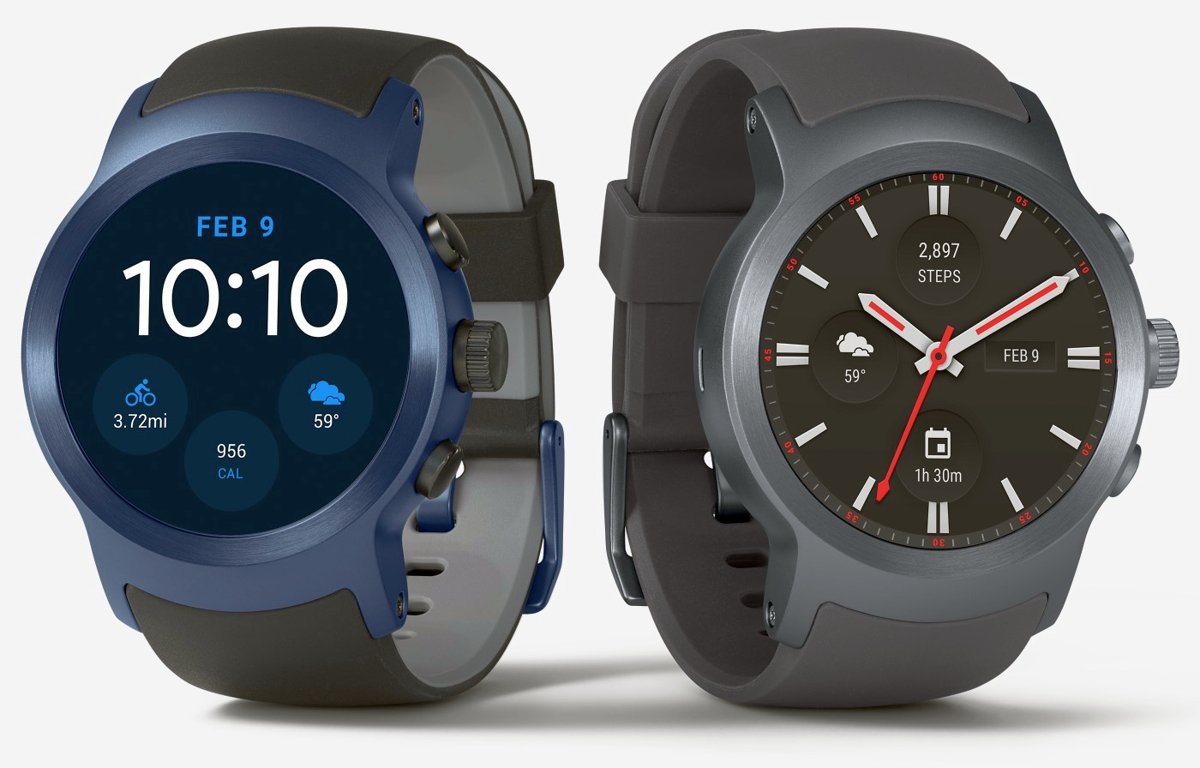
There have been reports of LG working on two new Wear OS smartwatches. Both watches were seen on the website of the FCC weeks ago but there is still no info on a release date. A new report has surfaced revealing what may be the name of one of the watches.
A couple of weeks ago, LG was granted a trademark in Korea for the word “Libre” for its smartwatches. This has led to speculations that one of the watches, most likely the sports variant will launch as the LG Watch Libre.
LG Watch Libre may replace 2017’s LG Watch Sport
The word Libre loosely translates to the state of being free, (being) at liberty, or having freedom. Not to be confused with the word “free” which means not required to pay for something. Libre is similar to the root of the English word “Liberty”.
So it shouldn’t be surprising that the sports model is called Libre. Although, I think the LG Watch Liberty sounds like a better name. There is no confirmation yet, so this is pure speculation.
Huawei’s Nova series is the company’s range of affordable mid-range models. Huawei recently launched the Nova 3E which is actually the Huawei P20 Lite hitting some regions under a different moniker. Now, there are indications the Chinese market leader is about launching the Nova 3. The company has commenced the release of teasers about the device. A new Weibo post on the official Huawei Phone Weibo handle confirms the existence of the Nova 3 as the post was made using the device and the company has selected a new brand ambassador, likely for the Nova 3 launch. A leaked teaser poster which also emanated from Weibo has unmasked what is said to be the rear design of the Huawei Nova 3.
The Huawei Nova 3 leaked photo only shows the rear panel and the similarity between the design and that of the P20 Lite is glaring. Unfortunately, the front design wasn’t featured but we expect something similar, perhaps with a notch at the top of the display. Huawei might decide to ditch the notch on this one, though.
The specs of the device are still unknown but its predecessor, the Nova 3E comes with 5.8-inch full-screen design with a screen ratio of 19:9 and a resolution of 2280×1080 pixels. The device also weighs just 145g. We don’t expect the Nova 3 design to be any different. However, the device said to go by the codename “Paris” is expected to be fired up by a Kirin 710 chipset and will run Android 8.1 Orea with EMUI 8 custom skin. Huawei is expected to launch the device in July
(source)
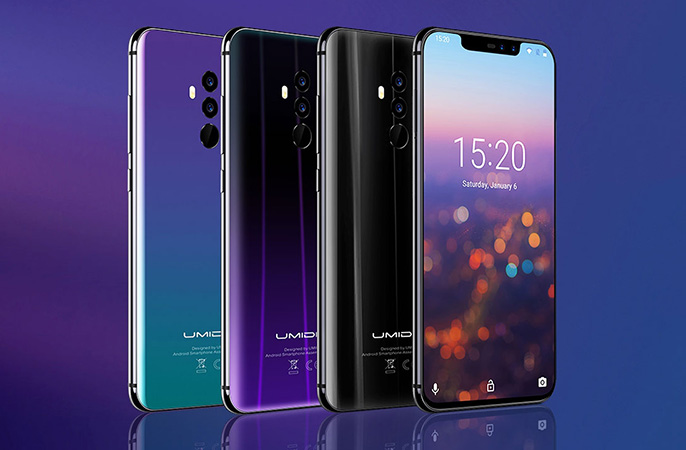
Gizmochina along with Gearbest is conducting 1 unit Umidigi Z2 phone as giveaway gift to a lucky reader. Like always, you just have to follow the steps mentioned on the Gleam widget to get a chance to win this amazing gift.
Umidigi Z2 has 6.2-inches IPS, LCD, FHD+ display, powered by a MediaTek Helio P23. It is housed in an aluminum alloy and glass body. It offers 6GB of LPDDR4X, 1600MHz RAM along with 64GB of onboard memory that can further be expanded up to 256GB. On the photography front, the UMIDIGI Z2 phablet houses a 16MP+8MP dual-camera and 16MP+8MP dual camera for selfies and face-to-face video chatting. The Umidigi Z2 runs Android 8.1 Oreo operating system and is backed by a 3850mAh Li-Poly (Lithium Polymer) battery.
The Umidigi Z2 has a $50 discount on Gearbest now:
Share this giveaway contest on Facebook, Twitter and Reddit;
Leave comments at the end, tell us which is your favorite product at discount price.
Terms & Conditions:
1. The giveaway is an international giveaway. 2. We are not responsible for lost shipments. 3. We are not responsible for any duties, import taxes that you may incur. 4. We reserve all rights to make any changes to this giveaway. 5. The prize will be shipped in a month when the giveaway end.
Just follow the steps mentioned in the Gleam widget to participate in the giveaway.
We have to come to a stage where smartphone users are split into two groups: those who hate the notch and those who don’t mind it. I still haven’t come across someone who said he or she was a big fan of the notch design, but I’m sure there are people who love the notch design too.
But why are smartphone companies obsessed with this infamous notch? Despite the strong criticism, more and more smartphones are shipping with the notch design and the numbers are only going to increase in the coming months.
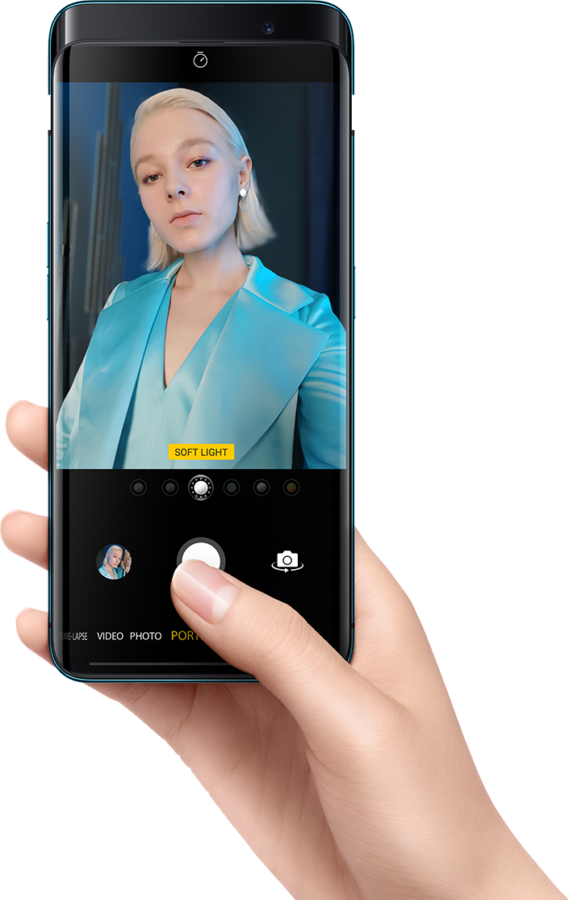
If you are thinking that mechanical sliders from OPPO and Vivo phones are going to replace the notch in the long run, think again. For reasons that I’ll mention down below, I doubt mechanical sliders are the future. They are cool without doubt, but may not be something that you would like to see on a smartphone and here’s why.
Before I start rambling about what’s wrong with mechanical camera sliders, I would have to clear this one thing: I find them really cool and futuristic. Yes, they look futuristic but they are likely not going to be on your future smartphones.
I would have to agree that OPPO and Vivo have really wowed us this year. They have managed to do what even the big conglomerates like Samsung, Apple, and Sony couldn’t do. At an age where smartphone design innovation has become more or less stagnant, OPPO’s Find X and Vivo’s Nex models have refreshed our imaginations.
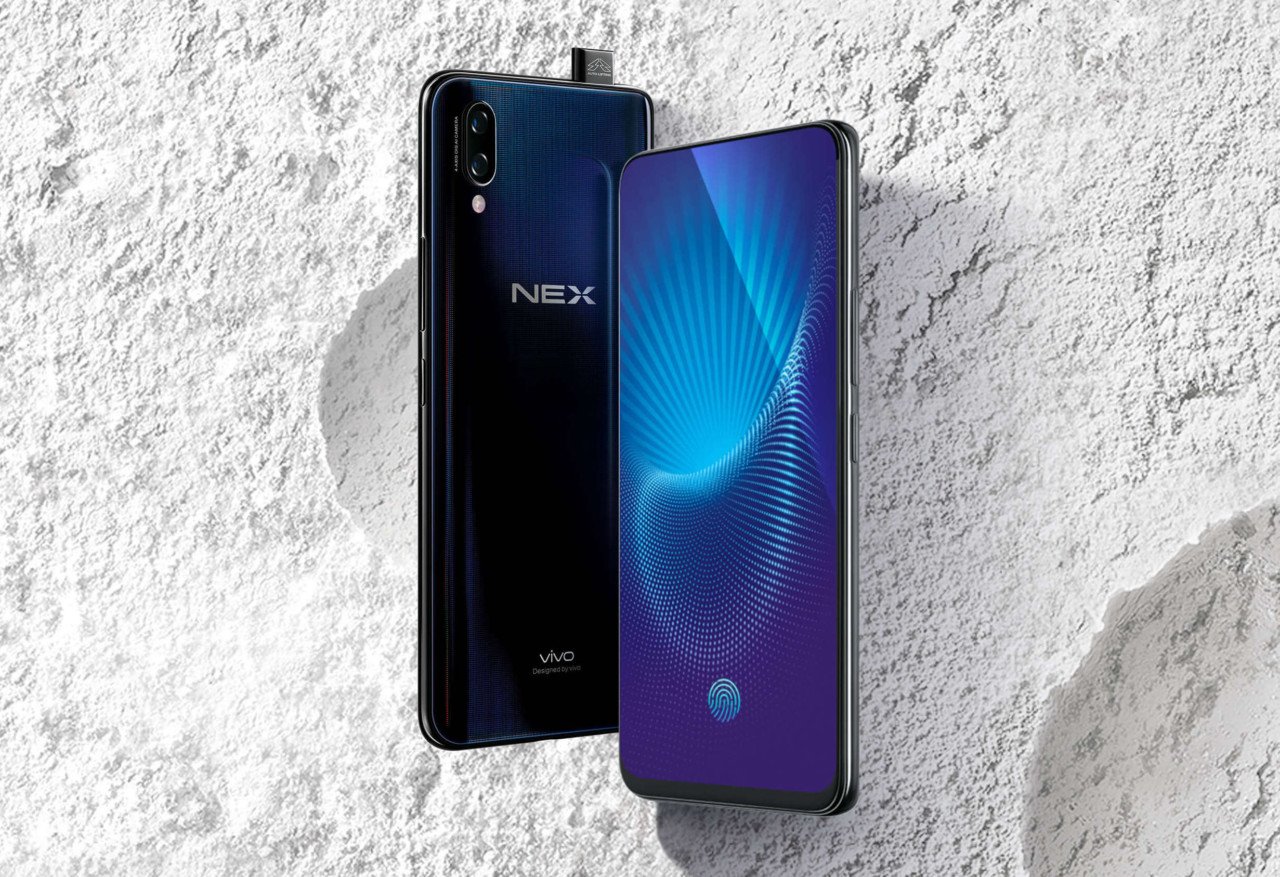
Vivo Nex Elevating Camera
Who would have thought sliding cameras were the future and we would see it on flagships in 2018? But our obsession with full screen displays really necessitated something like this. And both OPPO and Vivo have managed to implement this design pretty well. After all, how cool is it to see your smartphone automatically pop up the camera and put it back in, all within a second or two. The overall process is seamless and credit has to be given where its due! Well done OPPO!
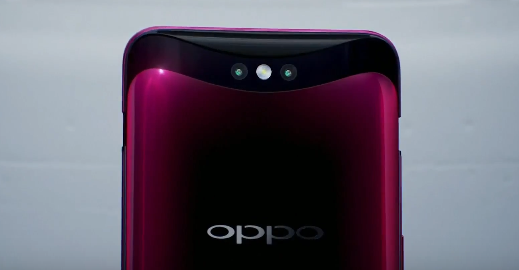
OPPO Find X Camera Slider
A sliding camera that pops up automatically and goes back in seamlessly looks really, really cool and it’s something that you would love to showcase it among your friends. But is it really better than the notch?
I think not.
First let’s see what sliding cameras bring to the table.
An amazing and beautiful full screen display on the front.
A cool and futuristic looking unique design.
Now, let’s see what it takes away from the phone. It’s much more than you can imagine.
Durability:
What are the chances that your camera breaks off from your phone? Wait, you didn’t think this was a possible scenario right? If you think the chances are rare, think again! Just think how many times has your smartphone almost slipped off your hands while using the camera. I consider myself to have pretty sturdy hands but even I have managed to drop all of my smartphones at least a couple of times during my usage.
Not only that, a moving part is always going to be less durable and that’s a fact. Considering how we are using our smartphones nearly 10-12 hours a day at least, we want our smartphones to be sturdier and less susceptible to any kind of damage. Heck, recent smartphones are even waterproof / water resistant, even when the possibility of water ruining our phones are quite rare. So, we like to be safe right? But with a sliding camera, it looks like we are going a step behind.
Not to mention the possibility of dust accumulating in the sliding component. Remember, these are all automatically controlled by software, so what happens when the slider stops working for some reason? Do we stop using the camera?
Now I know that both OPPO and Vivo must have really tested their sliding components for durability. They must have considered a lot of scenarios and I’m sure these designs have passed their stress test. The sliders worked pretty well in the units that were sent for review, but when you mass produce the same designs, we’ll have to wait and see what issues crop up with these sliders. I’m not expecting manufacturing defects in general, but there are a lot of factors at play with a sliding component, and we’ll have to wait and see how durable they in your everyday usage.
Battery Life:
Any added motorised component puts a strain on your battery. And in case of smartphones, saving juice is of utmost importance. But with a motorised sliding camera, we’ll have to see how their batteries perform. Specifically for the OPPO Find X, which has to slide up the camera housing anytime you want to unlock your phone and when it could be as much as hundreds of times in a day, it must really take a toll on the battery life. Unlike the Vivo Nex, the housing is pretty big on the Find X, so battery life is something that we’ll have to keep a close eye about the device. To make matters worse, there’s no fingerprint sensor (Vivo Nex has an in display sensor), so Face Recognition is a must for unlocking the device! Every single time you unlock you phone, there camera housing has to pop and go back in again.
Camera Sensor:
Sliding cameras are cool, but can they really keep up with the huge sensors on phones like the Huawei P20 Pro or the Galaxy S9+?
The internals of a smartphone have to be really optimised to make sure you can cram in the best components without taking too much space. For example, it isn’t the case that we don’t have sensors that can take DSLR like photos on a smartphone too. But they come at a cost — these sensors are large and would take up a lot of space inside, which isn’t practically optimum. This is the same reason why we don’t have gigantic 5000mAh battery on every phone out there (well, we do have a few but they are basically phones that focus on maximising battery life and not really flagships).
With a motorised sliding component in the picture, the already tight space inside a smartphone gets even more cramped. This means smartphone manufacturers have to make room by cutting out somewhere to ensure everything fits in this tight space. Now you know why we have protruding cameras… But with the Vivo Nex or the OPPO Find X, the camera sensors cannot be too large, at least not as large as the competition. So, it remains to be seen how the cameras on these sliding components perform in day to day usage, especially in comparison to other premium flagships. On paper, the camera setup on the Find X looks pretty good, but we know specs are just a small part of the equation. Only real life camera samples will show us the real camera prowess.
So, it really boils down to what you are willing to give up for a full screen design. OPPO Find X and Vivo Nex have revolutionary smartphone designs but they are not without their own set of flaws. For a full screen display, you might have to sacrifice on a few essential areas like battery life, camera quality and even durability. Personally, despite being a big fan of the Find X’s design, I would prefer a display with thin bezels but with an amazing camera, long battery, and most of all, durability. If I am going to shell out nearly y$600 or more on a phone, I would want to keep the phone around for a few months at least. Considering how this design makes it really hard to add a case to the phone, it further increases my scepticism of its durability.
All this being said, I would have to conclude by saying that OPPO Find X and Vivo Nex takes our dream of having full screen smartphones a lot further. Once you get used to seeing full screen design on smartphones, it’s only a matter of time until other manufacturers really work hard to get this design right!
But we are not there yet. We still have a long way to go to get the right full screen design but until then, I would prefer a notch over a motorised pop up camera slider on my smartphone for the above mentioned reasons.
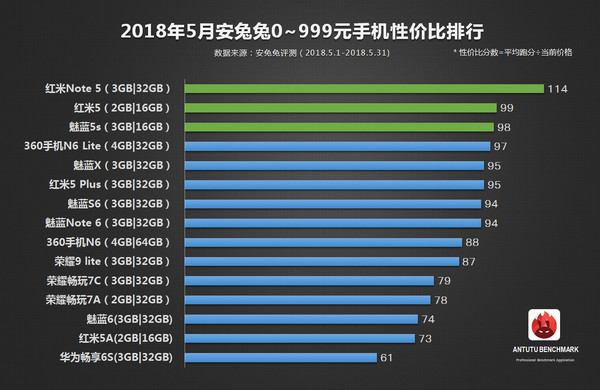
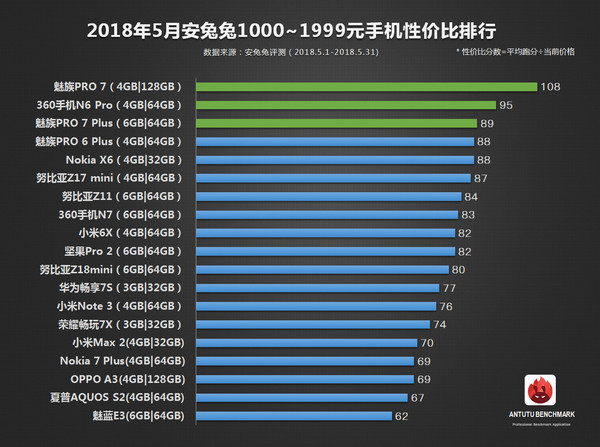
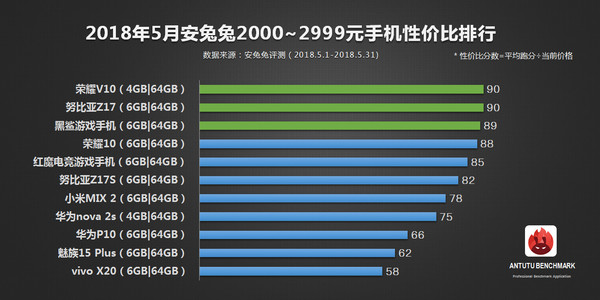
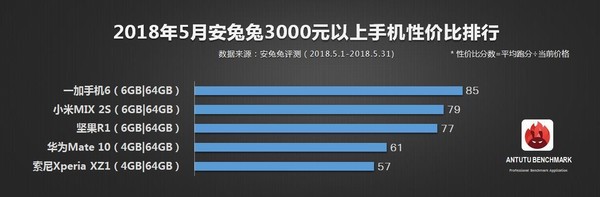
Benchmarking outfit AnTuTu has released a comprehensive list of the top-selling cost-effective models in various price categories in the month of May. The list contains several models, including the Redmi Note 5 and a few surprises like the Meizu Pro 7. The ranking of the best value for price ratio is calculated using the phone’s AnTuTu average score which is a factor of the chipset divided by the current price on the brand’s official flagship stores on Jingdong (JD.com).
The lists are for the most cost-effective models during the period ranging from May 1 to May 31 in four different price categories such as 0-999 yuan, 1000 yuan – 1999 yuan, 2000 yuan – 2999 yuan and over 3000 yuan category. Xiaomi is known for its pocket-friendly phones so, it isn’t much of a surprise that the Redmi Note 5 (3GB+32GB) tops the 0-999 yuan price category offering users a new Snapdragon 636 chip and 3GB RAM for less than 1000 yuan ($152). This is followed by the Redmi 5 (2GB+16GB). Other models include the Meizu M5s (3GB+32GB), 360 N6 Lite, Meizu X, Redmi 5 Plus, Honor 9 Lite and even the Redmi 5A (2GB+16GB).
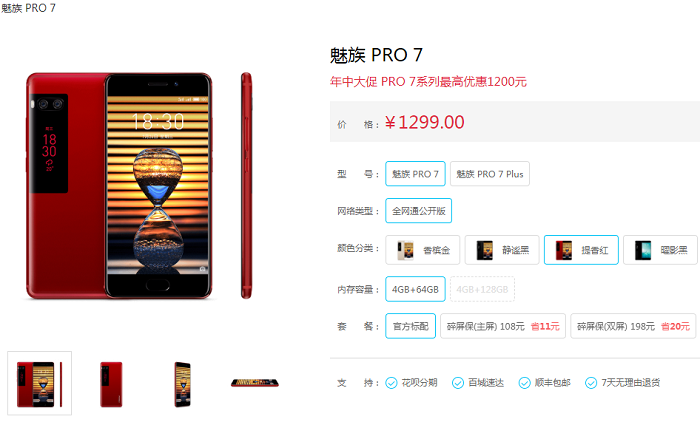
The 1000-1999 yuan price category sees the Meizu Pro 7 make a surprise appearance onboard the list. The 4GB+128GB version of the Pro 7 sits atop the price category as the best cost-effective model in May. This may be unconnected to the present selling price which is just around $300 for a phone with such a massive storage. The Meizu Pro 7 Plus (6GB+64GB) version is also priced in this category and is one of the cost-effective phones last month in China. The list also includes the Meizu Pro 6 Plus from 2016 and most spectacularly, the newly released Nokia X6. Other top-selling models in this price category include the Nubia Z17 mini, Xiaomi Redmi 6X, Mi Note 3, Mi Max 3, Nokia 7 Plus, Sharp AQUOS S2, OPPO A3.
2000 to 2999 yuan
In the 2000 – 2999 yuan price range, there are a total of 11 models on the list. Among them is the Honor V10 (4GB+64GB which is priced at 2299 yuan ($351) as well as the Nubia Z17 (6GB+64GB) with the same 2299 yuan ($351), both having 90 points. The list also has the Snapdragon 845-powered Black Shark gaming phone (6GB+64GB) which is priced at 2999 yuan ($458).
More than 3,000 yuan
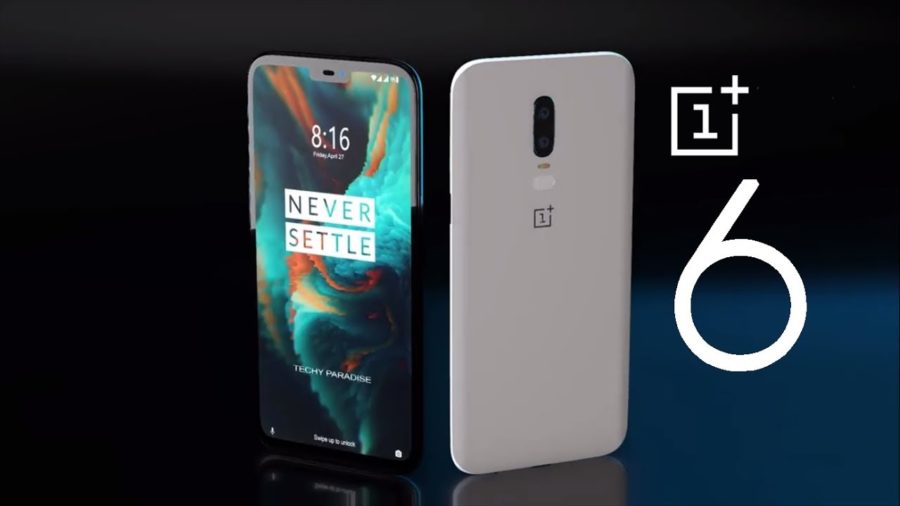
Finally, the phones priced above 3000 yuan have five models considered to be cost-effective. The OnePlus 6 (6GB+64GB) version occupies the first spot in this category means it is the best cost-effective flagship model selling above 3000 yuan ($458) presently. Others include the Mi Mix 2s (6GB+64GB), Smartisan R1 (6GB+64GB), Huawei Mate 10 (4GB+64GB) and Sony Xperia XZ1 (4GB+64GB).
The good thing is some of these models are available to buy outside China like the OnePlus 6, Mezu Pro 7/7 Plus, the Redmi Note 5 and other Xiaomi models. In some cases, the prices on offer still give good value for money like the Redmi Note 5 which sells for around $189.99 on third-party retail websites. The OnePlus 6 has already launched globally and is selling amazingly well as a result of its cost-effective pricing when compared to the solid build and well-loaded specs lineup.
The Meizu Pro 7 and Pro 7 Plus were expected to be game changers by Meizu. Both phones launched with an extra-screen on the back but that didn’t help them sell. The failure of the Meizu Pro 7 series led to a massive price slash by retailers and even Meizu itself, and the resignation of a few executives.
Less than a month after the Meizu Pro 7 went on sale, third-party sellers began to cut the price of the phone. China Telecom cut the price of the Pro 7 by ¥300 and that of the Pro 7 Plus by ¥400. Over the past few months, the prices have reduced further. As at the time of the 618 shopping festival, both phones were selling for half of their original price tags.
Speaking on the official Meizu forum, the CEO has admitted to being in charge of the Pro 7 series and its inventory during production. He also added that, following the failure of the Pro 7 series, they will be more conservative regarding the Meizu 16 slated for an August release.
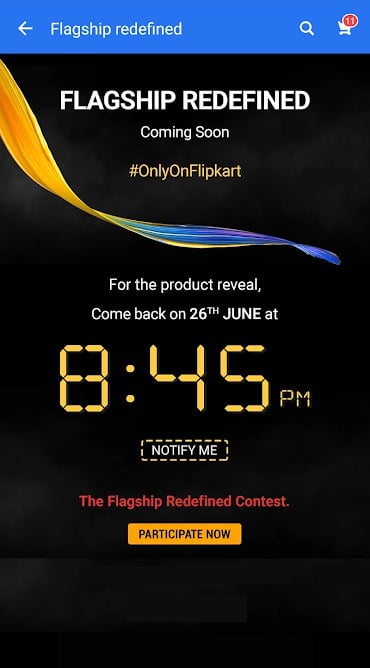
ASUS had introduced the ZenFone 5Z flagship phone alongside ZenFone 5 and ZenFone 5Q smartphones at the Mobile World Congress (MWC) 2018 in February. Today, popular Indian retailer Flipkart has released a teaser to hint that the ZenFone 5Z may go official tomorrow.
Since the below teaser states that the new smartphone that will go official tomorrow will be a flagship device, it seems that the ZenFone 5Z will be announced tomorrow. Also, the colorful stripe present on the teaser is similar to the one found on the wallpaper of ZenFone 5Z. The Flipkart-exclusive flagship phone will be unleashed tomorrow at 8:45 PM in India (local time). Even the timing hints that the Snapdragon 845 powered ZenFone 5Z will be arriving tomorrow.
The ASUS ZenFone 5Z features a notched IPS LCD display of 5.2 inches that supports Full HD+ resolution and 18.7:9 aspect ratio. The Snapdragon 845 chipset is present under the hood of the ZenFone 5Z. It will is equipped with up to 8 GB of RAM and up to 256 GB of storage.
The Sony IMX363 12-megapixel primary sensor + 120-degree 8-megapixel secondary sensor dual camera setup is available on the rear side of the ZenFone 5Z. An 8-megapixel camera is available at the frontside of the phone. A 3,300mAh battery is present inside the phone. The handset is preinstalled with ZenUI based Android Oreo.
There is no information available on the pricing of ZenFone 5Z for India. Earlier in this month, it was introduced with a price tag of 499 euros (~Rs. 39,700_ for the model that features 64 GB of storage and 6 GB of RAM in Italy. The Taiwanese company is running an offer in Europe which allows customers to purchase the smartphone with a discounted price tag of 449 euros (~Rs. 35,700) if the order is placed before July 15. ASUS is yet to debut ZenFone 5 and 5Q smartphones in India.
On the same day Huawei‘s sub-brand Honor started selling its Honor 7C smartphone in India, the company announced a permanent price cut of Rs. 1,000 on Honor 7X in the Indian market.
Honor 7X, which was launched in India around six months ago for a starting price of Rs. 12,999, has now received a price cut of Rs. 1,000 and is now available for purchase for just Rs. 11,999 while the 64GB storage model costs Rs. 14,999. It is available exclusively through online retailer Amazon India.
Along with the price cut, the smartphone has also received a new software update which brings EMUI 8.0 based on Android 8.0 Oreo operating system. The update introduces several new features, including Face Unlock and Ride Mode.
Further, the software update also brings AR Lens, which enhances a scene from the camera app before the user clicks the photo. UPI payments will also become easier, as EMUI 8.0 will allow Paytm users to assign a fingerprint shortcut that opens to the app’s payment section.
Honor 7X, which is the successor of the Honor 6X, features a 5.93-inch Full HD+ full-screen display with narrow bezels and 18:9 aspect ratio with a screen resolution of 1080 x 2160 pixels and a 2.5D screen on top.
Under the hood, the smartphone is powered by an octa-core Hisilicon Kirin 659 chipset along with Mali T830 MP2 GPU. It packs 4GB of RAM and comes in two options in terms of internal storage — 32GB and 64GB. It also supports storage expansion through microSD card up to 256GB.
The phone comes with dual-camera setup, featuring a 16-megapixel and 2-megapixel sensors on the back and an 8-megapixel camera sensor on the front for taking selfies and video calling. It runs on Android 7.0 Nougat operating system out of the box with EMUI 5.1 UI on top and is powered by a 3,340mAh battery.
In the last year, Xiaomi has focused on opening more offline stores in the markets its present in. It now has tens of store in China and India and has a number of stores in Europe. Last weekend, it announced the opening of a new Mi Store in Spain.
Xiaomi’s New Store in Madrid, Spain
The new store in Spain is its fifth in the European country and its fourth in the city of Madrid. This is just eight months after its entry into the country. The new store is located near the Puerta del Sol Square and is the largest in the country with a 200 meter-square area.
Xiaomi offers a number of its products in Spain but it is still significantly small compared to China or India. The Mi MIX 2s, Redmi S2, and Redmi Note 5 (Pro) are some of the new smartphones available for purchase in Spain. It also sells the Mi Scooter, electric toothbrush, and security and action cameras.
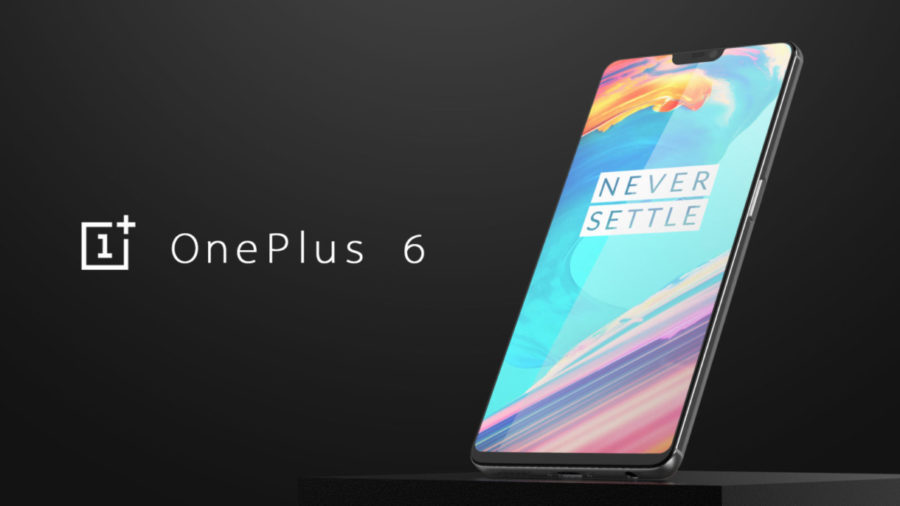
After floating around the rumor mill for quite a long time, the hotly-anticipated OnePlus 6 smartphone was finally unveiled in May this year. There are no prizes for guessing that the OnePlus 5T successor didn’t come bearing an affordable price tag.
Much to the chagrin of budget-conscious buyers who have been waiting to get their hands on the OnePlus 6 smartphone with bated breath, the phone didn’t come cheap. In fact, you’d have to shell out a whopping $698.62 to pre-order the EU version of the OnePlus 6 smartphone on Banggood.
While the feature-laden nature of the phone justifies its dizzying price tag, this also implies that a lot of smartphone lovers will not be able to buy the OnePlus 6 smartphone. But fret not, we’ll show how you can get a significant discount on the phone’s original asking price without breaking much of a sweat.
You can save a considerable amount of money – $188.63, to be precise, just by applying coupon code ‘BGON6EU’ at the time of checking out. In other words, you can bring your grand total down to only $509.99 just by using the aforesaid coupon code.
The OnePlus 6 is an irresistible smartphone, given that it sports a big 6.28 Inch Optic AMOLED 16M FHD+ display with a screen resolution of 2280 x 1080 pixels. While the display is protected by Gorilla Glass 5, the phone is housed in a robust aluminum alloy and glass body.
Furthermore, the OnePlus 6 packs a powerful Qualcomm Snapdragon 845 64-bit processor along with an equally competent Qualcomm Adreno 630 GPU, under the hood. The EU version comes with 6GB of LPDDR4X RAM and 64GB of non-expandable onboard storage.
The phone houses a 16.0MP (Sony IMX 398) + 20.0MP (IMX 376K) dual camera setup with f/1.7 aperture and dual LED flash on the back. Up front, it sports a 16.0MP (Sony IMX 519) camera for selfies.
Moreover, the phone runs OxygenOS based Android 8.1 Oreo OS and is backed by a built-in 3300mAh battery. On top of that, the device is crammed with all sorts of useful sensors including a fingerprint, gravity, P-sensor, L-sensor, compass, accelerometer, and gyroscope.
If you’re interested in buying the OnePlus at a discounted price, head straight to this link before the coupon code expires.
The OPPO Find X that was introduced through a global launch on June 19 in Paris, France. In collaboration with OPPO, Jingdong Mall had recently started the reservations of the smartphone in China. Today, OPPO has confirmed that the it will be holding an exclusive unveil event in China on June 29 to announce its arrival in the home country.
At the global launch of Find X, the Chinese manufacturer did not confirm on when it will be bringing the Find X to China. Today, it has confirmed through Weibo that there will be a domestic launch event in China at the 751D.PARK 79 on June 29 at 2:30 PM. It is the very same place where OPPO had announced the Find 7 smartphone four years ago.
OPPO has already revealed the full specifications and features of the Find X smartphone through its global launch. Hence, the upcoming launch event of China will confirm its pricing for the home market.
The OPPO Find X has 6.42-inch S-AMOLED dual-edge curved display that offers 19.5:9 aspect ratio and offers 93.8 percent screen-to-body ratio. The motorized camera assembly rises and retracts when the camera app is accessed or closed. The handset does not feature fingerprint scanner but is equipped with an advanced 3D facial recognition feature.
The Snapdragon 845 SoC is present under the hood of the Find X along with 8 GB of RAM. It has a native storage of 256 GB. It has a 3,730mAh battery to keep the lights on. At the front is a 25-megapixel camera and the rear panel houses 16-megapixel + 20-megapixel dual camera setup. The Color OS 5.1 flavored Android 8.1 Oreo is present on the Find X. The ColorOS 5.1 for Find X may include some exclusive new interactive features.
The Find X has a special variant called Find X Auomobili Lamborghini Edition that comes with 50W SuperVOOC fast charging. Also, it has a behemoth internal storage of 512 GB.
The regular Find X and the Lamborghini Edition are respectively priced at 999 euros (~$1,163) and 1,699 euros (~$1,979) in Europe. The European nations will be receiving it in August. The handset is also confirmed to arrive in North America, but further details on it are yet to be revealed. It will be announced in India on July 12.
Modding, a very strong reality in the Android world on Qualcomm Snapdragon SoCs, has always been a confined thing on Huawei and Honor devices due to the limitations of proprietary Kirin chipsets. Nobody would ever recommend you to get a Huawei phone or tablet if you wanted to become a modder: but from now, things are starting to change. Thanks to the new Project Treble by Google, it is possible to separate the Android core framework from the customizations, and this made possible to mod Huawei devices easily.
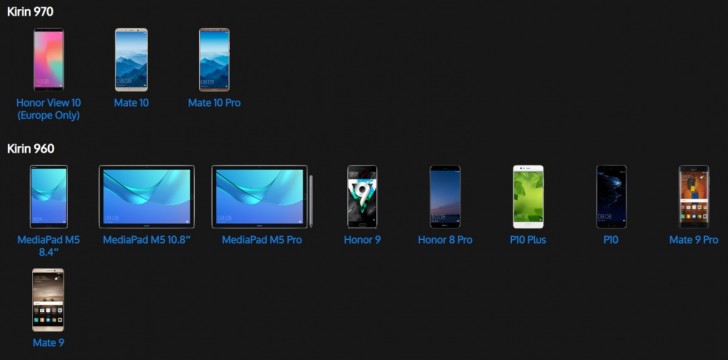
Team OpenKirin has launched a new AOSP project for several devices from the brand which can bring custom ROMs even to devices with Kirin chipsets. At the moment, it is possible to install three custom ROMs on several Huawei and Honor devices: LineageOS, CarbonROM, and Resurrection Remix. The list of eligible Huawei phones contains the Mate 10, Mate 10 Pro, P10, P10 Plus, Mate 9, Mate 9 Pro, P Smart, Mate 10 Lite and P10 Lite. The eligible Honor devices are Honor View 10, 9, 8 Pro, 7X and 6X. At last, there are also three tablets on the list: MediaPad M5 8.4, MediaPad M5 10.8 and MediaPad M5 Pro with stylus support.
The list contains a total of 17 devices and it is expected to be extended soon. All of the device in the list run EMUI 8.0 user interface which you can now replace with other ROMs. Note that Huawei has announced that it will ditch its own bootloader unlocking service on July 22 and in order to install one of the supported custom ROM you need to unlock the bootloader. So, if you do not install it before July 22, you will have to wait for third-party tools to be released. You can actually download the custom ROMs for your eligible device by heading on the official site of the OpenKirin AOSP project.
We use cookies on our website to give you the most relevant experience by remembering your preferences and repeat visits. By clicking “Accept”, you consent to the use of ALL the cookies.
This website uses cookies to improve your experience while you navigate through the website. Out of these, the cookies that are categorized as necessary are stored on your browser as they are essential for the working of basic functionalities of the website. We also use third-party cookies that help us analyze and understand how you use this website. These cookies will be stored in your browser only with your consent. You also have the option to opt-out of these cookies. But opting out of some of these cookies may affect your browsing experience.
Necessary cookies are absolutely essential for the website to function properly. This category only includes cookies that ensures basic functionalities and security features of the website. These cookies do not store any personal information.
Any cookies that may not be particularly necessary for the website to function and is used specifically to collect user personal data via analytics, ads, other embedded contents are termed as non-necessary cookies. It is mandatory to procure user consent prior to running these cookies on your website.