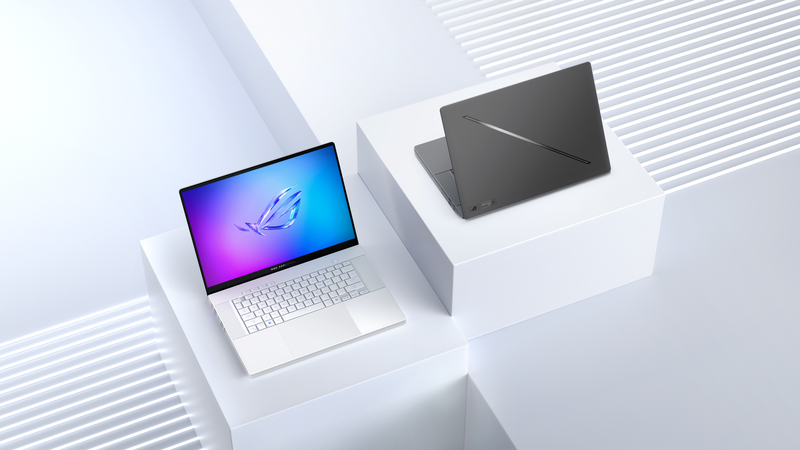
At Computex 2024, ASUS Republic of Gamers (ROG) has introduced the Zephyrus G16 (2024) GA605, a slim yet powerful gaming laptop. It has a CNC-milled aluminum chassis that houses a stunning 16:10 ROG Nebula OLED display with a 2.5K resolution, a 240Hz refresh rate, and G-SYNC compatibility for ultra-smooth visuals.
Powering the G16 is an AMD Ryzen 9 HX 370 processor with 24 threads, alongside an AMD Ryzen AI XDNA 2 NPU for a combined 81 TOPS of AI performance. This translates to faster photo and video editing, coding, and enhanced multitasking, even with AI-powered Windows Copilot tools.
The laptop comes with up to 32GB of LPDDR5X-7500 memory and supports the latest SD Express 7.0 standard making it ideal for creatives as well.
For graphics, the laptop has an NVIDIA GeForce RTX 4070 Laptop GPU that delivers exceptional performance with 321 TOPS of AI power and support for DLSS 3. The ROG Intelligent Cooling system is also in place with liquid metal and a tri-fan design to keep the thermals in check.
It’s also the first ROG laptop with WiFi 7 for ultrafast wireless connectivity. Additional features include Dolby Atmos audio, Hi-Res certification, Two-way AI noise cancellation, and a long-lasting 90Wh battery. Pricing and availability details are yet to be revealed by ASUS.
In related news, Asus has also unveiled the TUF Gaming A16 and A14 laptops as well as the ROG Prism Delta 2 gaming headsets at Computex. The laptops feature the new AMD Ryzen AI processors, paired with an RTX 4070 GPU, while the headset offers a long battery life of up to 110 hours, along with low-latency over 2.4GHz connectivity.
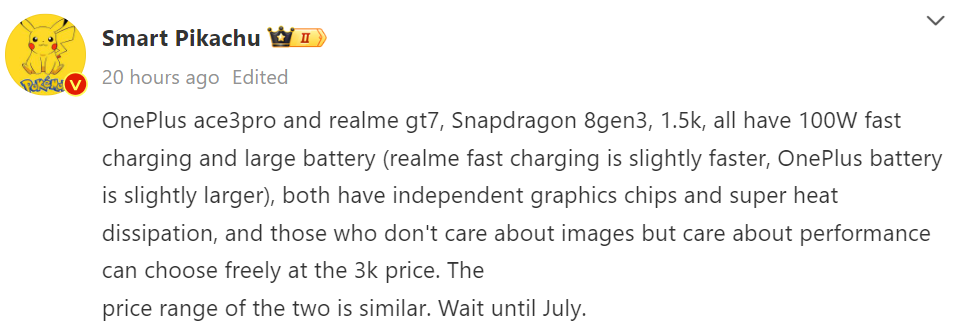
There have been reports that as many as four Chinese smartphone brands, such as OnePlus, iQOO, Realme, and Redmi are gearing up to launch affordable flagship phones in China. While the Redmi K70 Ultra is tipped to feature the Dimensity 9300+ chipset, the OnePlus Ace 3 Pro, iQOO Neo 9S Pro+, and the Realme GT 7 are all expected to feature the Snapdragon 8 Gen 3 chipset. Tipster Smart Pikachu has shared a few details about the OnePlus and Realme flagship phones and their expected price range.
Realme GT 7 moniker emerge
On June 20, Realme will launch the Snapdragon 8 Gen 3-powered Realme GT 6 for the global market. Speaking of the Chinese market, Realme unveiled the Realme GT 5 Pro in December 2023. This year, the brand has launched the Realme GT Neo 6 SE and GT Neo 6 phones in China. Early rumors suggested that the Realme GT 6 could be the name of the upcoming Realme flagship phone.
However, Smart Pikachu’s leaked information suggests that the brand may have decided to forego the Realme GT 6 branding and instead call it the Realme GT 7. Readers should note that the GT 7 moniker is not official yet. The brand has already confirmed that it will launch the Snapdragon 8 Gen 4-powered Realme GT 7 Pro by the end of this year, suggesting that the GT 7 could be the next phone.
OnePlus Ace 3 Pro, Realme GT 7 price: What to expect
The tipster revealed that the OnePlus Ace 3 Pro and Realme GT 7 have many similarities, making them ideal for users who prioritize performance. Both phones feature the Snapdragon 8 Gen 3 processor and 1.5K resolution screens (with one being curved and the other flat). They both support 100W fast charging, with Realme’s charging being slightly faster and OnePlus having a slightly larger battery.
Additionally, both models include a dedicated graphics chip and extensive cooling systems. For those who are not focused on camera performance and are looking at a price range of around 3000 Yuan (~$420), these two phones offer good options. Hence, it appears that the Ace 3 Pro and G7 could be priced between 3,000 Yuan (~$420) and 4,000 Yuan (~$560). Both phones are expected to break cover in July.
Scientists at Tsinghua University in China have achieved a breakthrough in artificial skin technology, developing the world’s first “electronic skin” with a bionic three-dimensional architecture. This innovation aims to mimic the remarkable capabilities of human skin in perceiving touch.
The design mimics the spatial distribution of mechanoreceptors found in human skin
Human skin is covered in a dense network of specialized cells called mechanoreceptors. These receptors are arranged in three dimensions, allowing us to distinguish between various sensations like pressure, shear (friction), and strain with exceptional accuracy. Current electronic skin technology falls short, unable to replicate this nuanced and simultaneous perception on a physical level.
Inspired by nature’s brilliance, Professor Zhang Yihui’s research team at Tsinghua University has devised a novel electronic skin design that incorporates a three-dimensional architecture. This design mimics the spatial distribution of mechanoreceptors found in human skin, like Merkel cells and Ruffini corpuscles. The result is a device capable of independently measuring pressure, friction, and strain at a physical level – a significant leap forward in artificial touch technology.
This bionic electronic skin is meticulously crafted with three distinct layers, mirroring the structure of human skin:
Epidermis: The outermost layer, resembling the texture of human skin’s surface.
Dermis: The middle layer, where most sensors and circuits reside. This layer features a unique eight-arm cage structure housing the force-sensing unit. This highly sensitive unit, positioned close to the surface, effectively detects external forces.
Subcutaneous Tissue: The bottom layer, replicating the texture of the underlying tissue in human skin.
By combining this three-dimensional electronic skin with advanced deep machine learning algorithms, the research team has achieved a remarkable feat. Their creation can not only perceive touch but also analyze an object’s modulus (stiffness) and local principal curvature (shape) through simple contact.
This groundbreaking research, titled “A Three-Dimensionally Architected Electronic Skin Mimicking Human Mechanosensation,” was published in the prestigious scientific journal Science on May 30, 2024. The development holds immense potential for various applications, including prosthetics that offer a more natural sense of touch for amputees and robots with enhanced tactile capabilities.
Were you one of those people who were worried that the new Call of Duty won’t make it to PlayStation? Well, Black Ops 6 “Call of Duty: Black Ops 6” has officially landed on the PlayStation store, confirming its availability for both PS4 and PS5 consoles. This news comes after the game’s previous release on Steam and Xbox stores.
The news comes after the game’s previous release confirmation for Steam & Xbox
The pre-launch buzz surrounding Black Ops 6 has been intense, fueled in part by a cryptic teaser video featuring historical figures like US President Bush, Secretary of Defense Rumsfeld, and Saddam Hussein, interspersed with explosions. This, coupled with earlier leaks, suggests the game might be set during the Gulf War, potentially including missions based on the 9/11 attacks.
Adding to the excitement, Microsoft recently confirmed that Black Ops 6 will be included in the launch lineup for Xbox Game Pass. For even more details, fans should tune in to the upcoming Xbox games conference on June 10th. Here, we can expect news not only about Black Ops 6, but also about the next installments in popular franchises like Gears of War and Doom. Additionally, the conference will unveil release dates for highly anticipated titles such as Microsoft Flight Simulator 2024, Avowed, and Indiana Jones and the Great Circle. Stay tuned to Gizmochina for further updates after the Xbox conference!
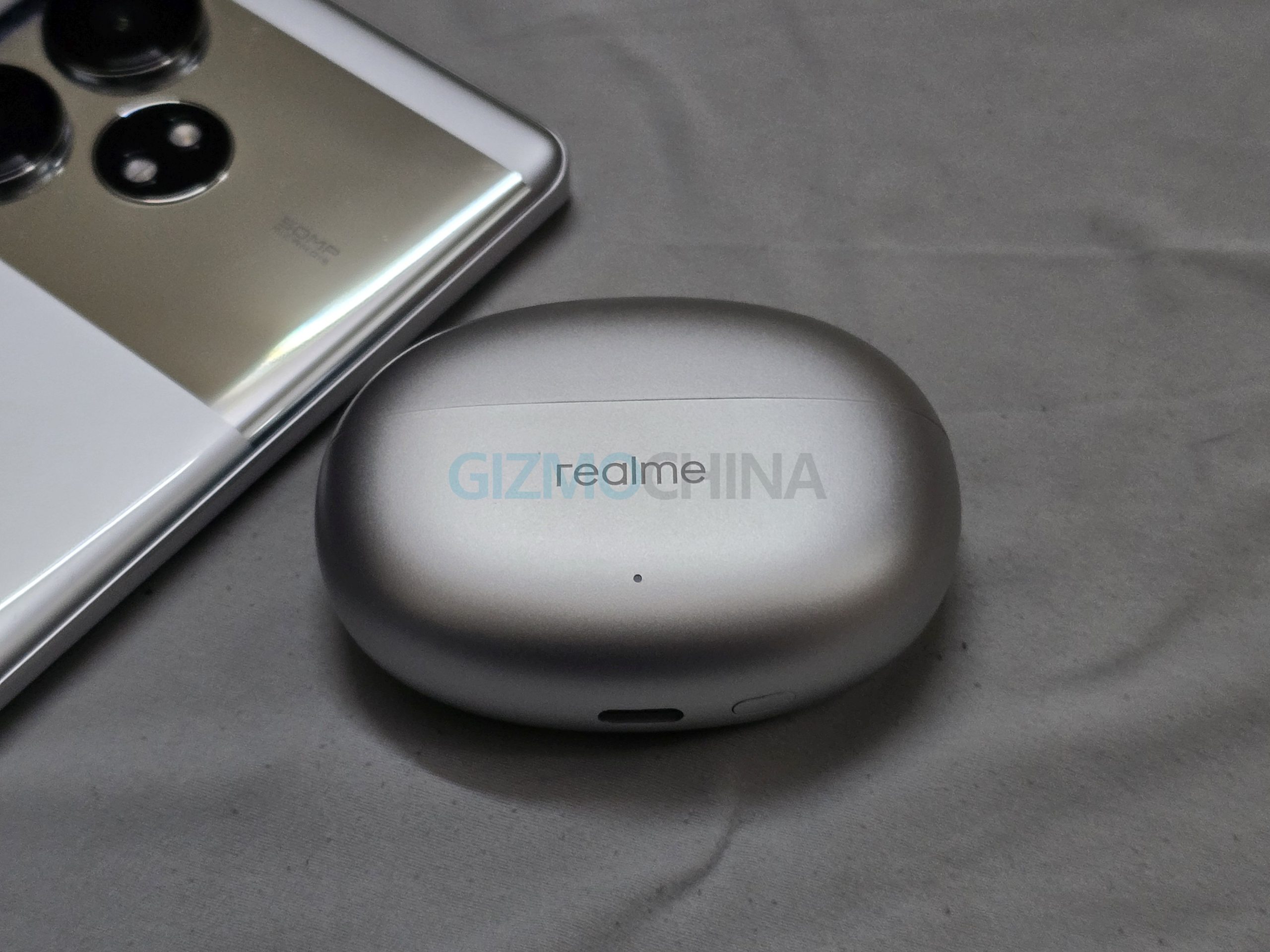
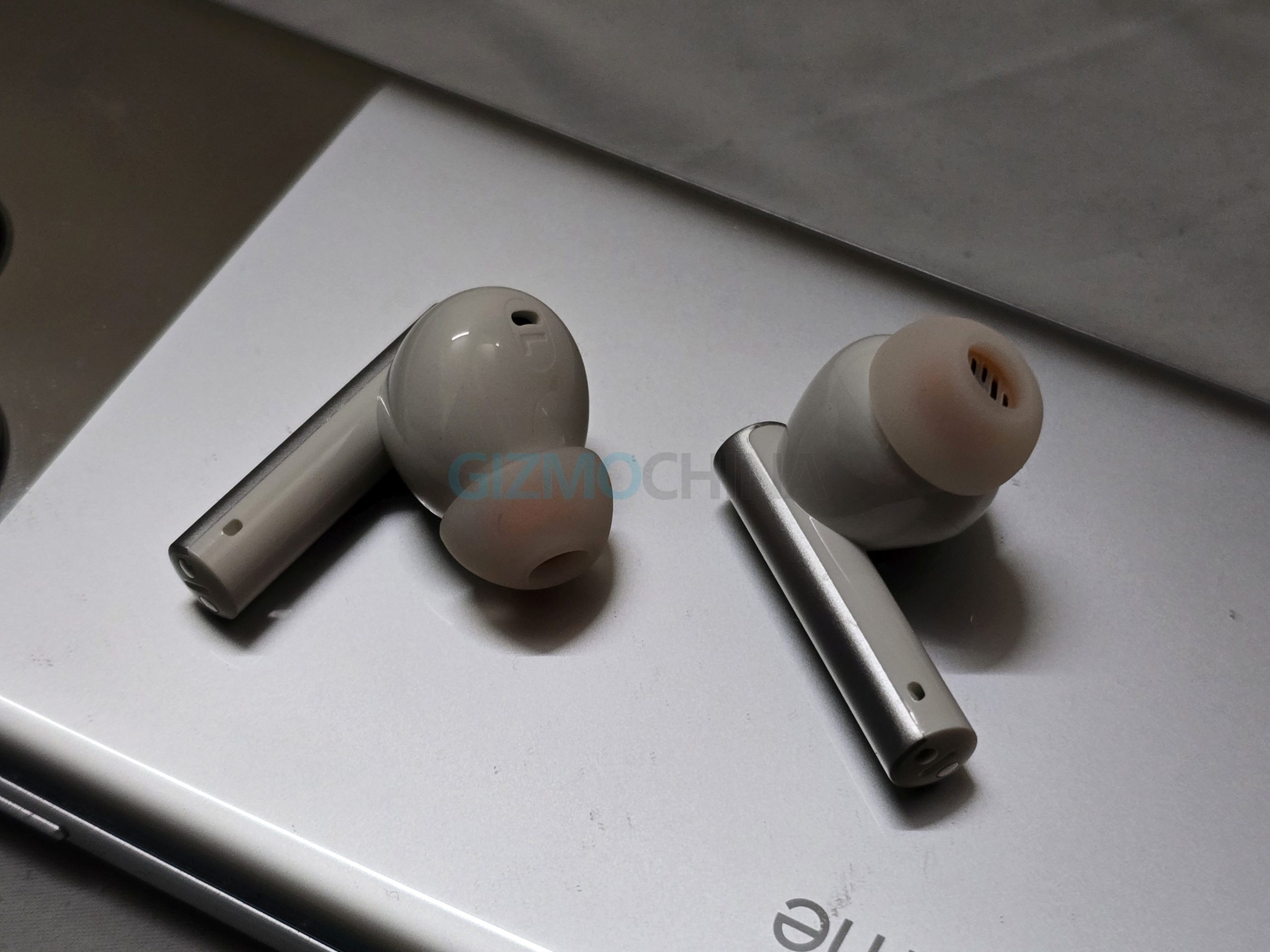
The Realme Buds Air 6 is the latest addition to Realme’s AIOT portfolio, featuring an impressive array of capabilities aimed at delivering a superior audio experience. Having used these earbuds for around two weeks, I am impressed by their performance across various metrics. From sound quality and noise cancellation to battery life and design, the Realme Buds Air 6 excels in all departments.
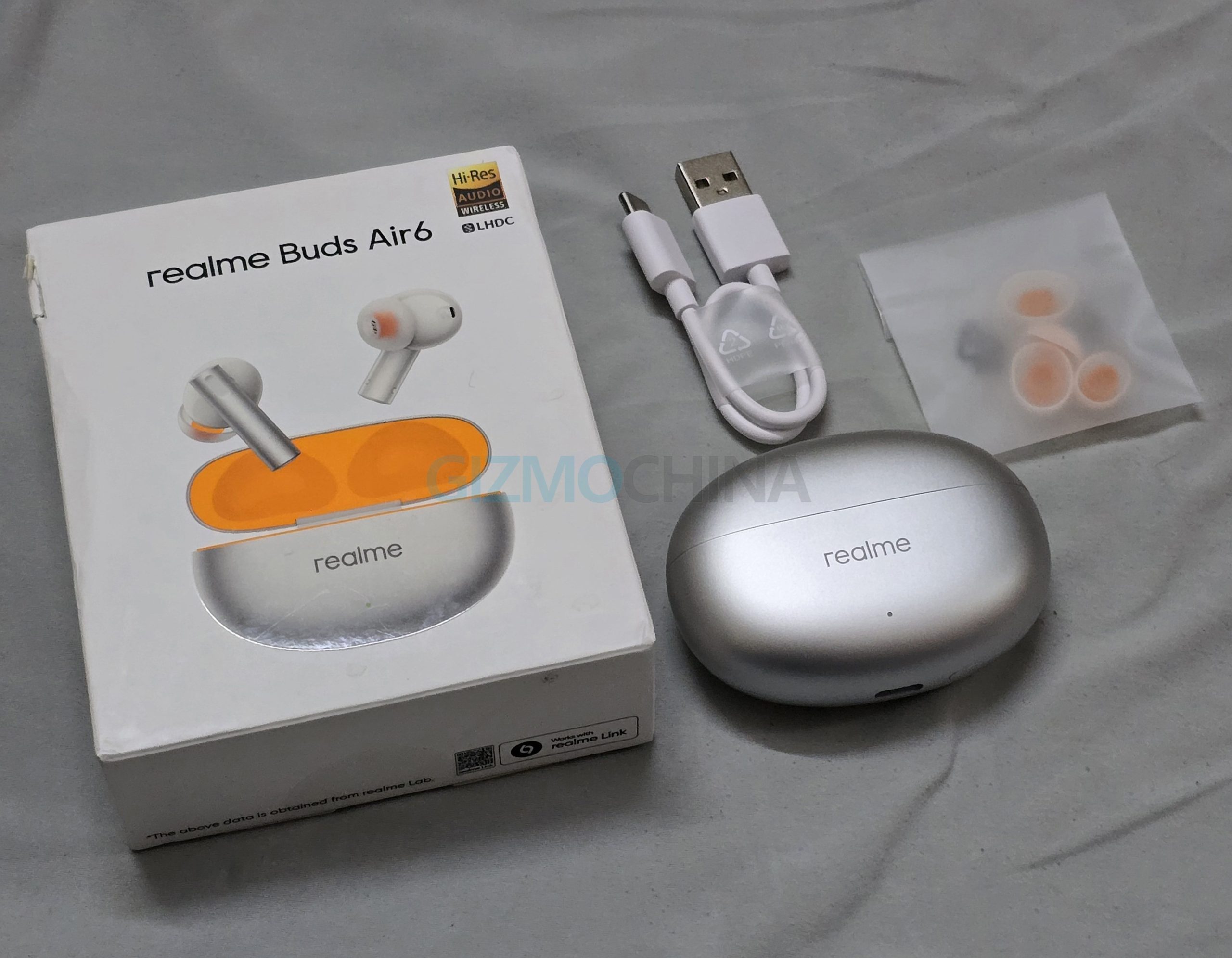
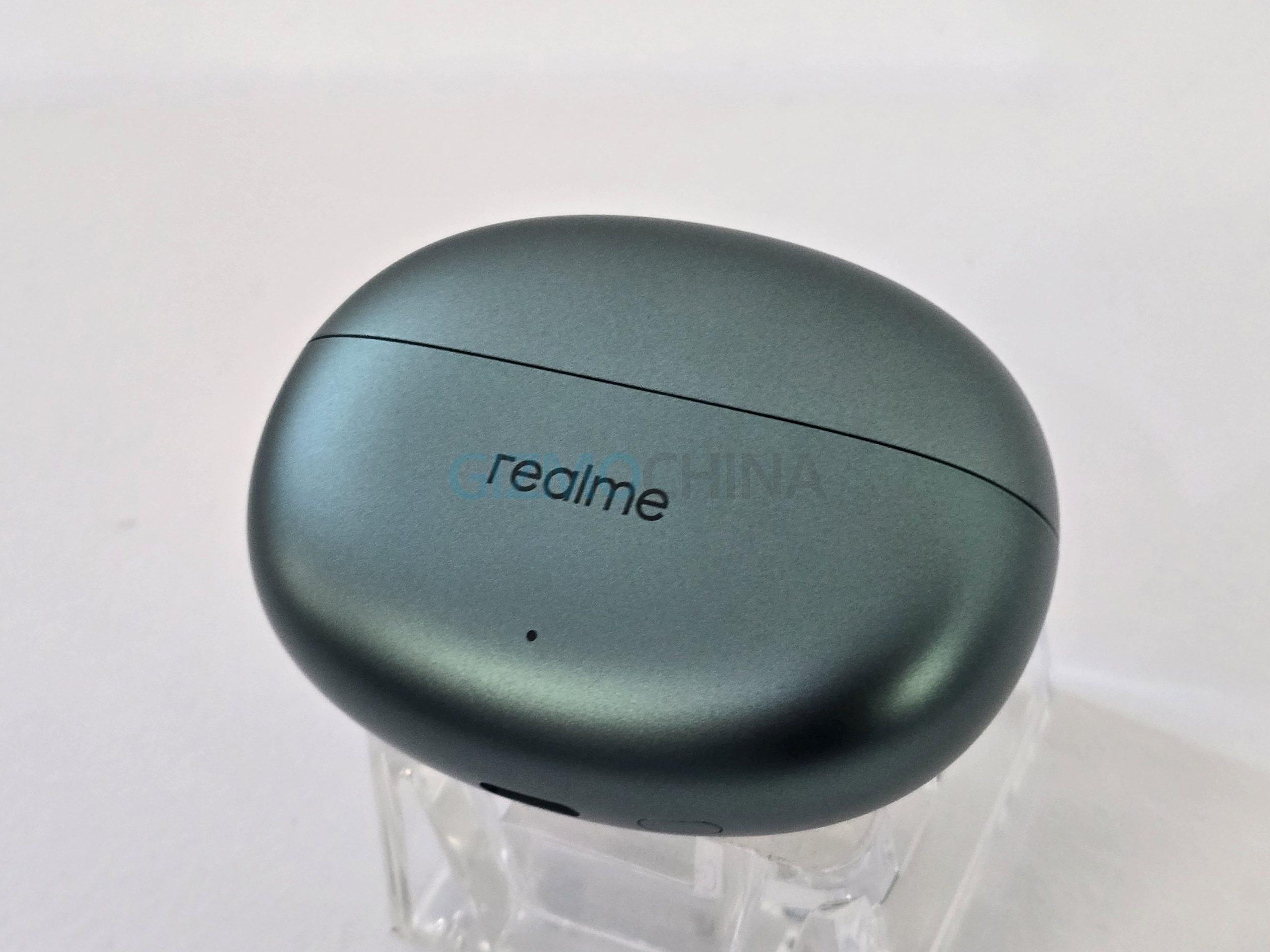
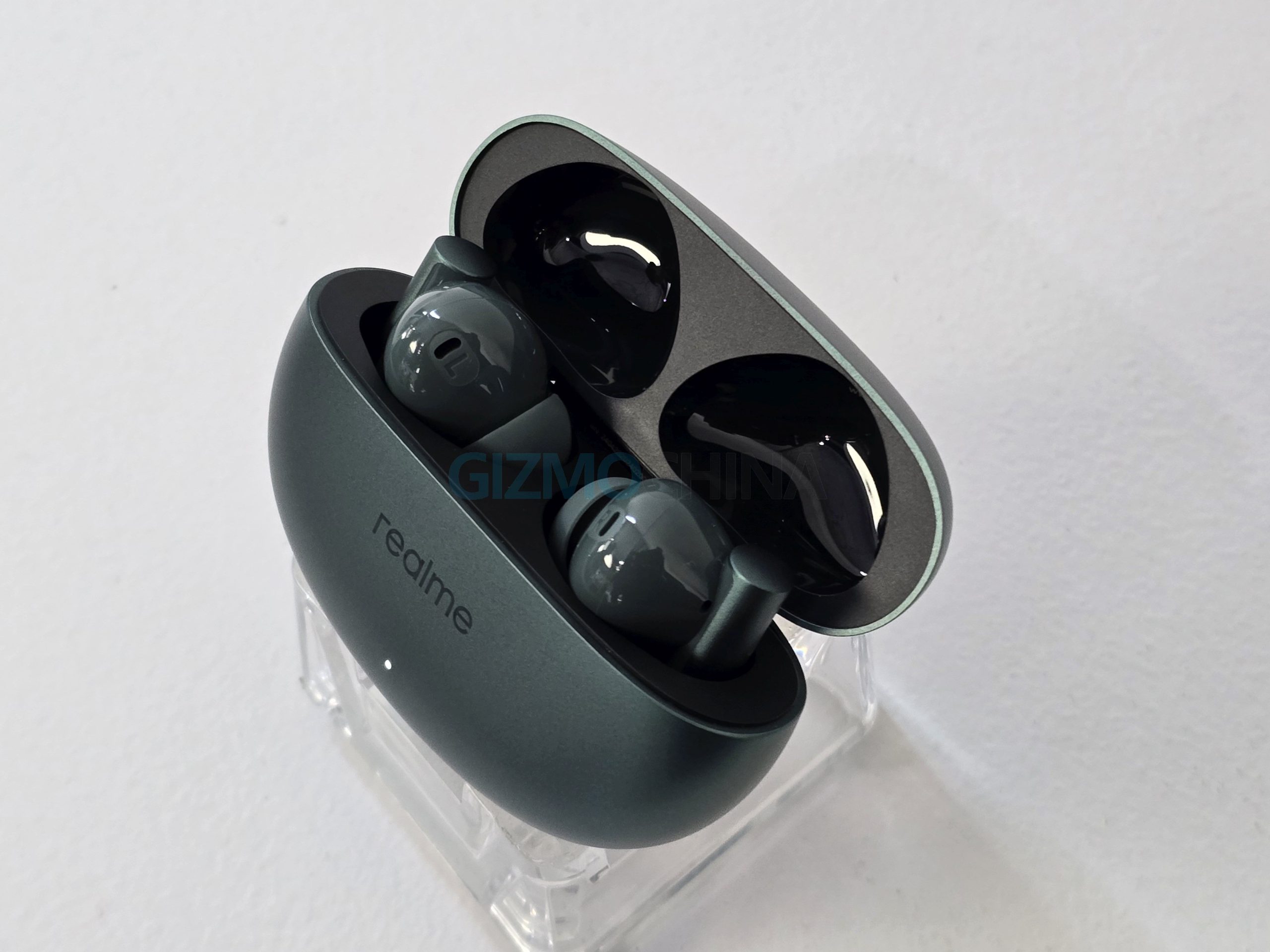
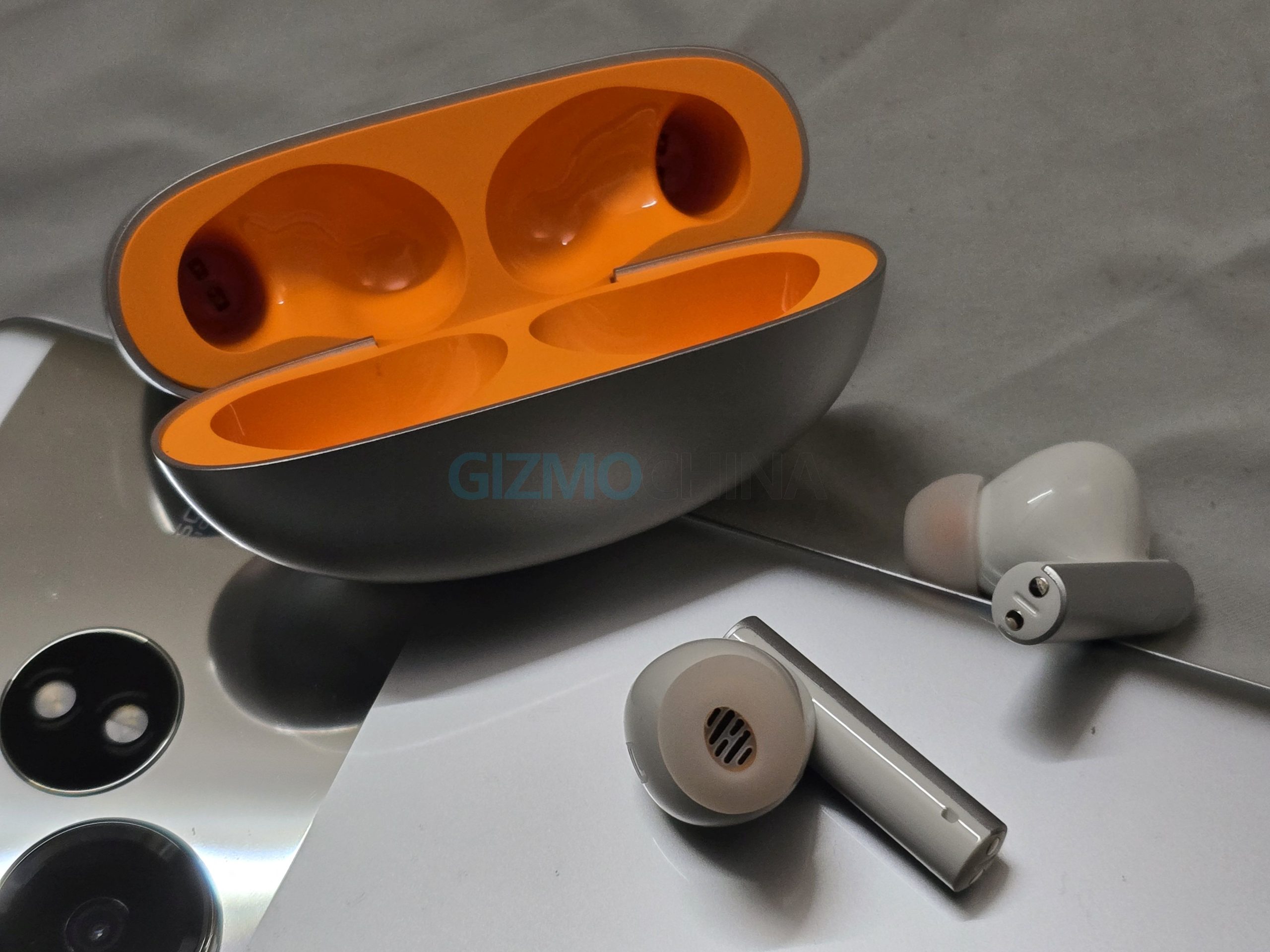
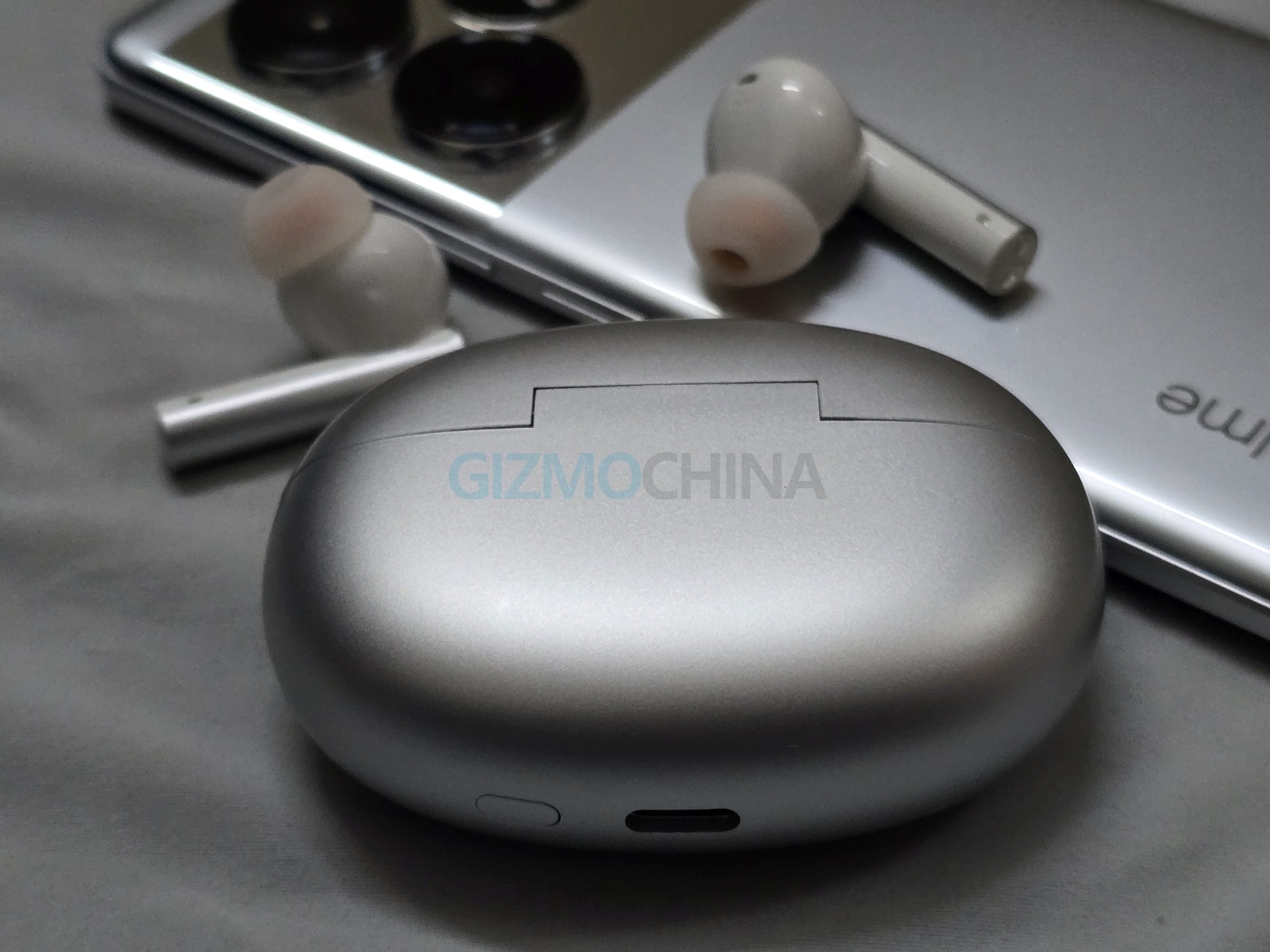
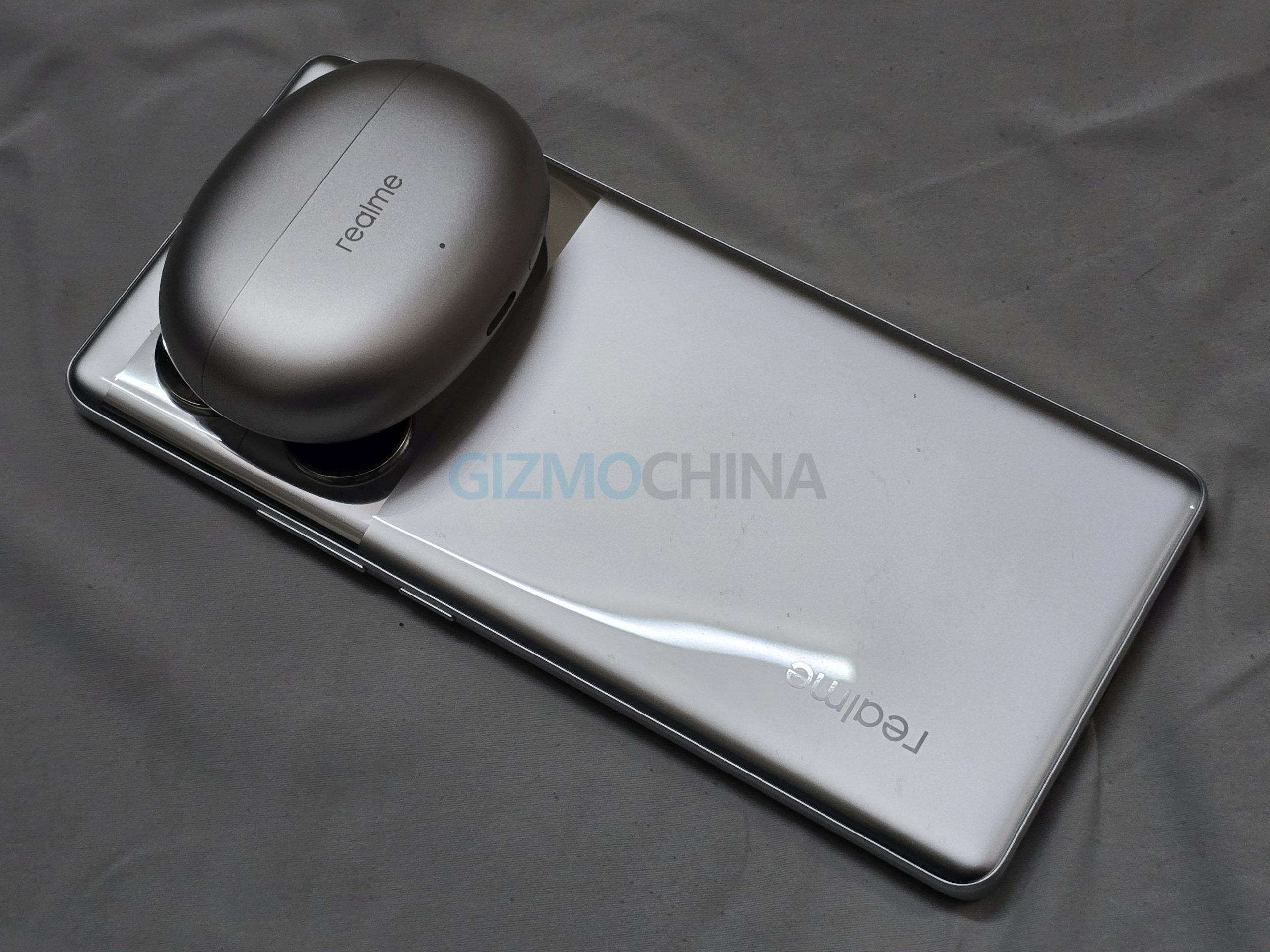
The Buds Air 6 does not look too different from its predecessor. The pebble-shaped device feels smooth to hold and offers a comfortable grip. At the bottom, it features a USB-C port and a physical button for Bluetooth pairing. It comes in two shades, such as Forest Green and Flame Silver. I prefer the silver variant, which has orange-colored internals. Whether it is a workout session or a rainy day, the IP55-rated Buds Air 6 can handle it all without compromising performance.
The Buds Air 6’s retail package includes the Buds Air 6, extra ear tips, a USB-A to USB-C cable, and a user guide. I recommend buyers to consider using a silicone case to protect the charging case from scratches and other damage, ensuring long-term durability and maintaining the device’s aesthetics.
2. Sound Quality
Realme Buds Air 6
One of the standout features of the Realme Buds Air 6 is its hi-res certification and LHDC 5.0 high-definition audio decoding. This guarantees professional sound quality, and the earbuds do not disappoint. The 12.4mm mega titanizing driver delivers robust and clear audio. The dynamic bass boost technology intelligently adjusts the bass intensity according to the audio source, ensuring balanced sound quality across different frequencies.
Realme Buds Air 6
Listening to music on the Buds Air 6 is a delight. The titanium-coated diaphragm produces crisp high-end sounds, and the individual rear cavity design further improves low and midrange frequencies, providing a theatre-like audio experience. Whether it is classical, rock, or pop, every genre sounded impeccable, with full bass, a majestic sound field, and clear vocals.
3. Noise Cancellation
The noise cancellation capabilities of the Buds Air 6 are exceptional. Equipped with 50dB active noise cancellation, these earbuds effectively minimize ambient noise. The dual hybrid noise-cancelling microphone design, featuring feedforward and feedback microphones, detects and cancels out external sound waves efficiently.
In practical use, noise cancellation was particularly effective in noisy environments like public transport and busy streets. The smart adaptive noise cancellation further enhances this by adjusting the noise reduction depth based on the environment, ensuring optimal noise reduction without compromising user comfort. The 4000Hz ultra-wideband noise cancellation marks a significant improvement, making it a perfect choice for those who require a quiet listening experience.
4. Battery Life
Battery life is another area where the Buds Air 6 shines. With a theoretical battery life of 40 hours of playback, these earbuds are built to last. Each earbud is equipped with a 58mAh battery, and the charging case has a 460mAh battery. This setup provides ample usage time, with up to 6.5 hours of playback on a single charge and up to 40 hours with the charging case when noise cancellation is off.
The 10-minute fast-charging capability of the Buds Air 6 provides up to 7 hours of music playback, which is incredibly convenient for quick top-ups. During my usage, I rarely found myself worrying about battery life, even on extended trips.
5. Additional Features
The Realme Buds Air 6 supports Bluetooth 5.3, ensuring a stable and fast connection within a 10-metre range. The 55ms low latency is good for gamers and those who watch videos frequently. Activating the gaming mode reduced latency significantly, providing a more immersive experience without noticeable lag or disconnection issues.
Google Fast Pair makes the initial setup process straightforward, and the intelligent touch controls allow for easy management of calls, music, and noise cancellation modes without using the phone. The customizable gestures in the app add another layer of convenience, making these earbuds user-friendly and adaptable to individual preferences.
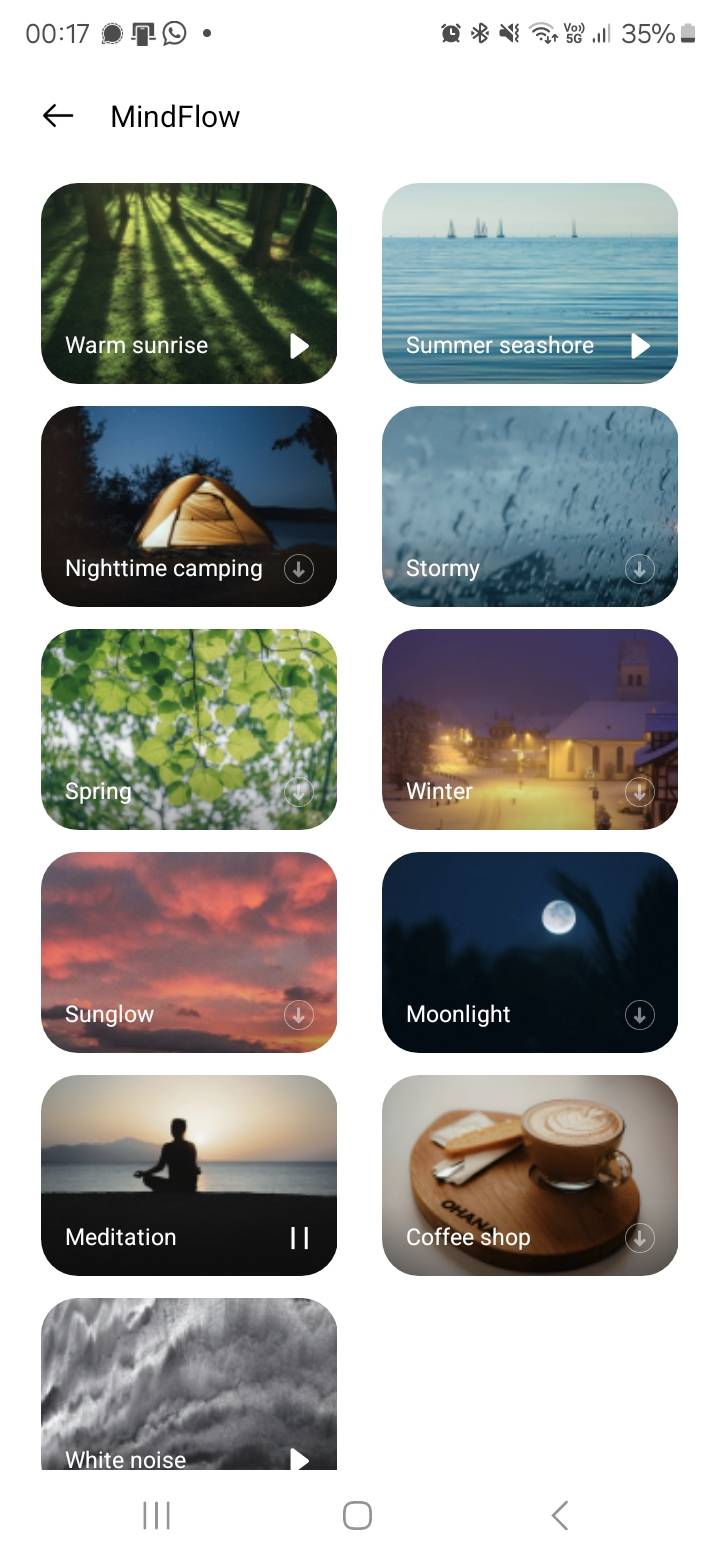
The Mindflow mode (available via the Realme Link app) offers over 10 high-quality audio tracks for various activities like exercising, working, meditating, or napping, helping users achieve deep immersion quickly.
Voice assistant support, OTA upgrades, equalizer options, and wearing detection further add to the convenience. The earbuds’ intelligent touch controls are responsive and easy to use, with options for play/pause, call management, noise cancellation mode switching, and more.
One of the key features that’s lacking on the Buds Air 6 is dual device connectivity. This feature is available on the Buds Air 6 Pro, which is currently only available in the Chinese market.
6. Realme Buds Air 6 price in India
The Realme Buds Air 6 is available for Rs 3,299 (~$40) in India. It can be bought in two shades: Forest Green and Flame Silver.
In conclusion, the Realme Buds Air 6 offers a comprehensive and premium audio experience. With its high-definition audio decoding, exceptional noise cancellation, long battery life, low latency, and smart design, it stands out as a top contender in the true wireless earbuds market. Whether you are a music enthusiast, a gamer, or someone who values quality and convenience in everyday use, the Buds Air 6 is an excellent choice. Realme has truly outdone itself with this product, setting new standards in the audio accessory market.
Disclaimer: All of the opinions in this Realme Buds Air 6 TWS earbuds review are mine and based on my own experiences. There has been no editorial input from Realme.
Caution: While TWS earbuds offer a convenient and immersive audio experience, it is important to exercise caution when using earphones for extended periods. Prolonged exposure to loud volumes can lead to potential hearing damage over time. We recommend adhering to safe listening practices by keeping the volume at a moderate level and taking regular breaks to allow your ears to rest. Your auditory health is paramount, so remember to prioritize responsible listening habits.
Xiaomi is developing the next generation of the Pad 6 family, the Pad 7 series. After analyzing the HyperOS software, the XiaomiTime team offers us some surprising information. Several hints have been spotted that the Xiaomi Pad 7 series is being developed. The previous Pad 6 series appeared in HyperOS software around 2022 November-December. The early discovery of the new tablets in HyperOS software officially confirms that these new tablets could be launched even earlier. The specifications of the Xiaomi Pad 7 series are not yet known, but a lot of information has been leaked about which regions these tablets will be sold in.
Xiaomi Pad 7 series coming
The Xiaomi Pad 6 series was announced in April 2023. This series initially consisted of 2 different models: Xiaomi Pad 6 and Xiaomi Pad 6 Pro. A long time after the announcement of this series, Xiaomi added a new model to the Pad 6 series under the name Pad 6S Pro. The Xiaomi Pad 6S Pro was basically the same device as the Pad 6 Pro. Now Xiaomi has started developing the Pad 7 series, indicating that the devices could be launched in Q3 2024. Let’s examine the information provided to us by the HyperOS code!
Xiaomi Pad 7 series HyperOS code
The XiaomiTime team has confirmed that the Xiaomi Pad 7 has the codename “uke” and the internal model number “O82“. At the same time, the codename of the Xiaomi Pad 7 Pro is also revealed, the top model of the series has the codename “muyu” and the internal model number “O81“.
Moving on to the regions where the devices will be unveiled, we come to a surprising fact. For the first time, Xiaomi has decided to launch its premium Pro tablet in the global market. This surprises everyone a lot. Xiaomi Pad 7 Pro will be officially available in many countries including Turkey. Of course, we have to mention that the Pad 7 Pro will not be introduced in India, which might be sad news for fans in India. Different from the Pad 7 Pro, the Xiaomi Pad 7 will be available in India and users all over the world will be able to buy this unique tablet.
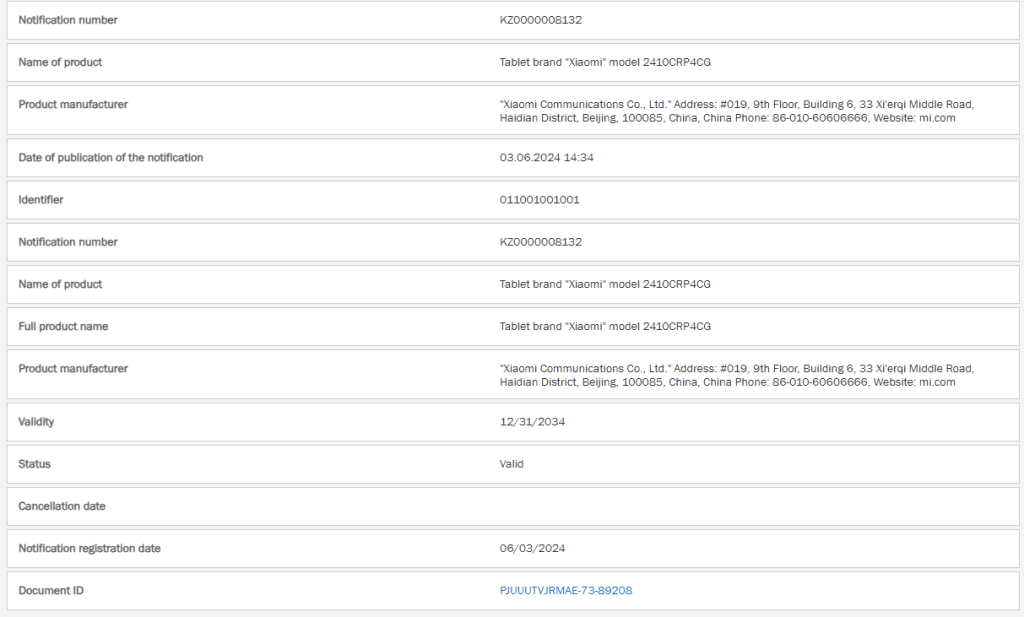
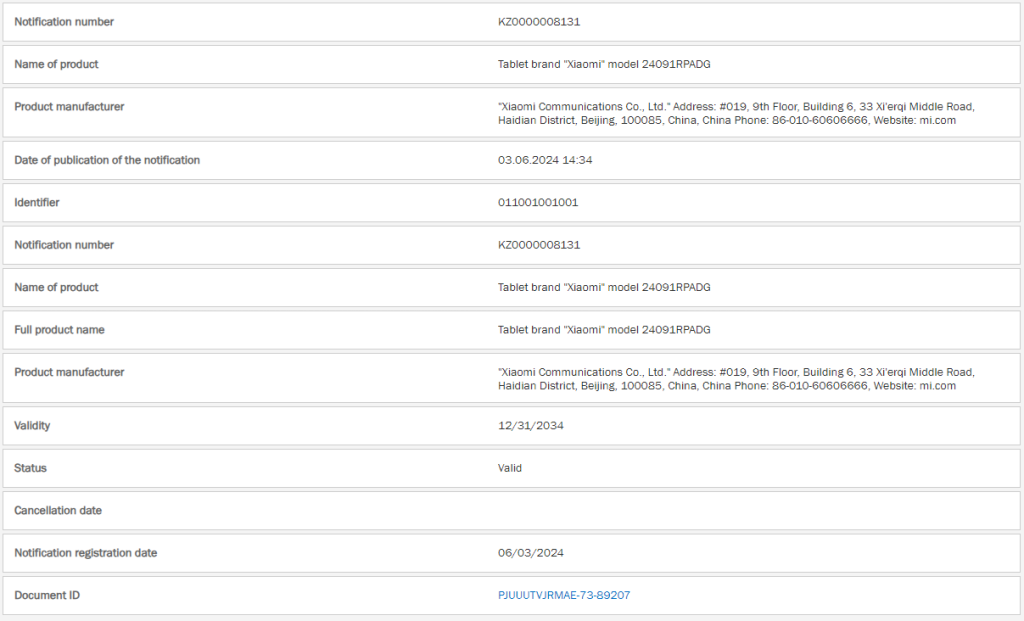
Xiaomi Pad 2410CRF4CGXiaomi Pad 24091RPADG
Recently, two mysterious Xiaomi Pad models passed the EEC certification. XiaomiTime has now taken the secret out of the darkness by referring to these models. The new tablets are expected to be introduced with the Xiaomi 15 series. Of course, this is not an official launch date. Please wait patiently.
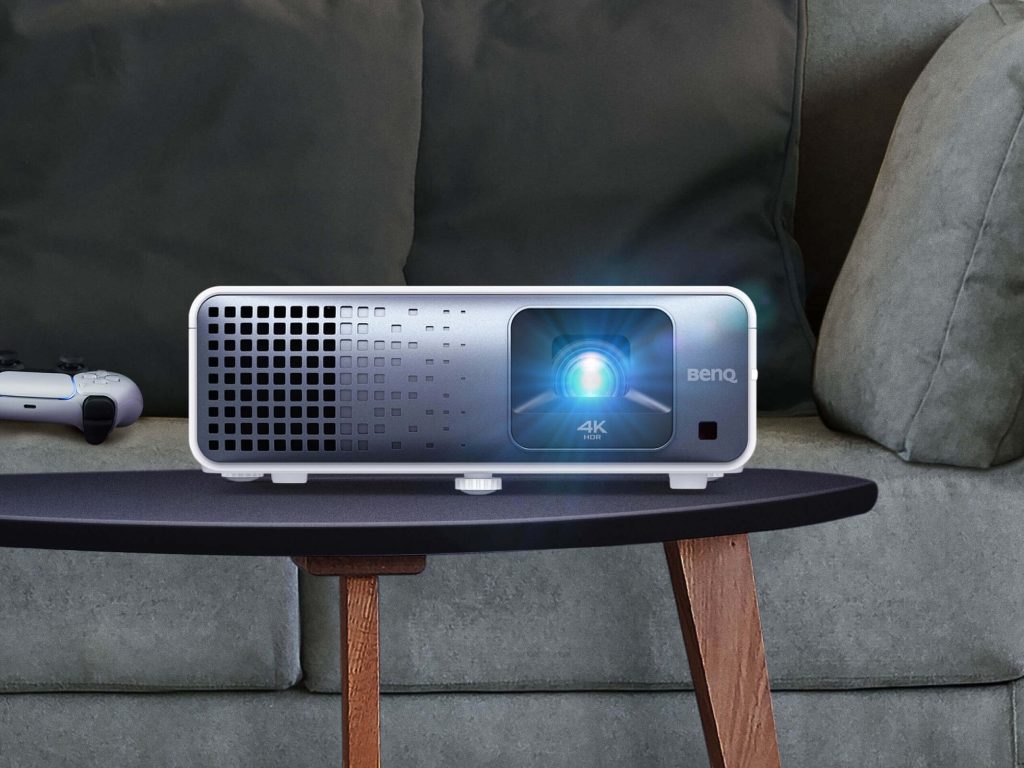
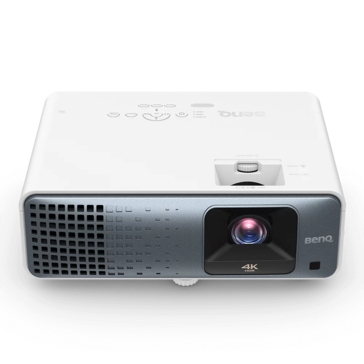
Chiense projector manufacturer BenQ has unveiled the TK710 and TK710STi laser projectors have been unveiled. The new models are described as casual gaming projectors and offer multiple HDR game modes, a 4ms input lag, and dual HDMI ports.
The BenQ TK710 and the TK710STi both come with a laser light source that can deliver up to 3,200 lumens brightness and has a life cycle of up to 20,000 hours. The new DLP projectors can throw images up to 150 inches (380 cm) wide with a 16:9 aspect ratio.
The models are claimed to have a native 4K UHD resolution, though the 3,840 x 2,160 pixels measurement and their low price point suggest that these are possibly pixel-shifting models. They have a 600,000:1 contrast ratio and come with a Lightsource Dimming tool, as well as 95% Rec.709 color gamut coverage.
BenQ TK710 gaming projector
The new BenQ DLP models offer gaming features including HDR game modes, an input lag of 16.7 ms for 4K @ 60Hz resolution, and 4.2 ms for 1080P @ 240Hz. There are two HDMI (2.0b/HDCP2.2) ports on the projectors for connectivity. Both models also feature a built-in 5W speaker, HDMI eARC with support for Dolby Atmos, USB-A 2.0, and RS232 ports.
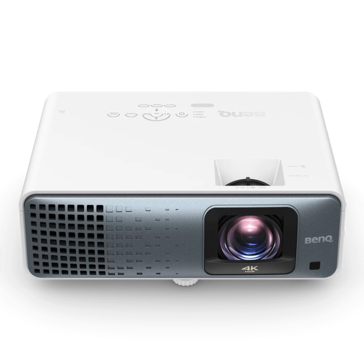
BenQ TK710 STi gaming projector
The BenQ TK710 projector has a 1.15-1.5 throw ratio and can achieve 1.3x zoom, while the TK710STi has a 0.69-0.83 throw ratio with 1.2x zoom. The models also come with picture-perfecting tools such as vertical/ horizontal keystone correction, and vertical lens shift for the standard model.
Pricing & Availability
The QS02 Android dongle is present in the STi model but is omitted in the standard model. Customers can now purchase the BenQ TK710 and TK710STi Casual Gaming Projectors in several markets for $1,799/ €1,499/ £1,399/ AU$3,499 and $1,999/ €1,599/ £1,599, respectively.
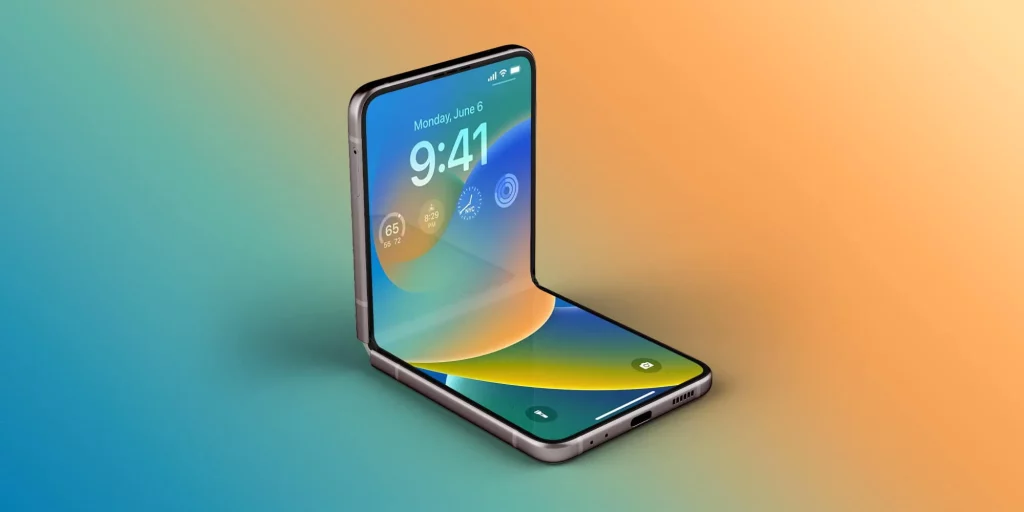
Apple is finally dipping its toes into the foldable phone market, and they’re bringing in the big guns to help. Korean media outlet TheElec reports that Apple has tapped Samsung Display and LG Display to develop foldable screen panels for its upcoming devices.
Samsung, a leader in foldable phone technology, is likely to develop a foldable panel for a device in the 7-inch to 8-inch range, hinting at Apple’s first foldable iPhone. This phone-sized foldable would be similar in size to the iPad mini and could potentially boast a design that folds horizontally or vertically, with Samsung prepping solutions for both.
LG Display, on the other hand, seems to be tackling the larger foldable territory. Their project involves a 10-inch foldable panel, speculated to be destined for a new iPad. This foldable iPad is expected to integrate seamlessly with the existing iPad ecosystem.
However, Apple isn’t rushing things. A major hurdle for the company seems to be the crease that appears on current foldable displays. Apple has reportedly informed both panel makers that eliminating this crease is crucial for them to consider launching a foldable device.
The launch timeframe for these foldable Apple devices remains uncertain. Industry insiders speculate that a 2026 release might be too ambitious, pushing the target date back to 2027. This could coincide with the 20th anniversary of the iPhone and the 10th anniversary of the first OLED iPhone, making it a significant year for Apple.
This news is exciting for Apple fans and the tech industry as a whole. Apple’s entry into the foldable market could push the technology further, leading to better designs, more durable screens, and innovative functionalities. With Samsung and LG‘s expertise on board, these foldable Apple devices have the potential to be game-changers.
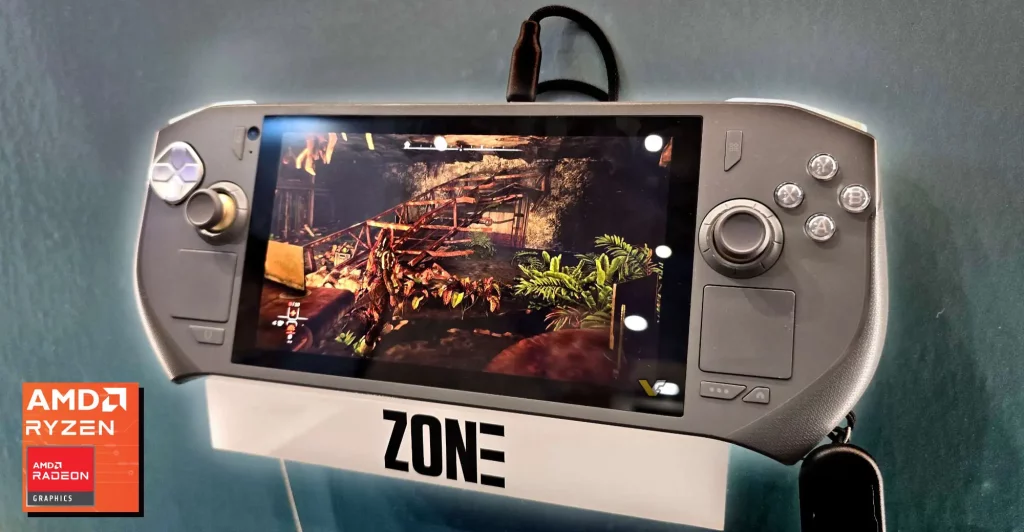
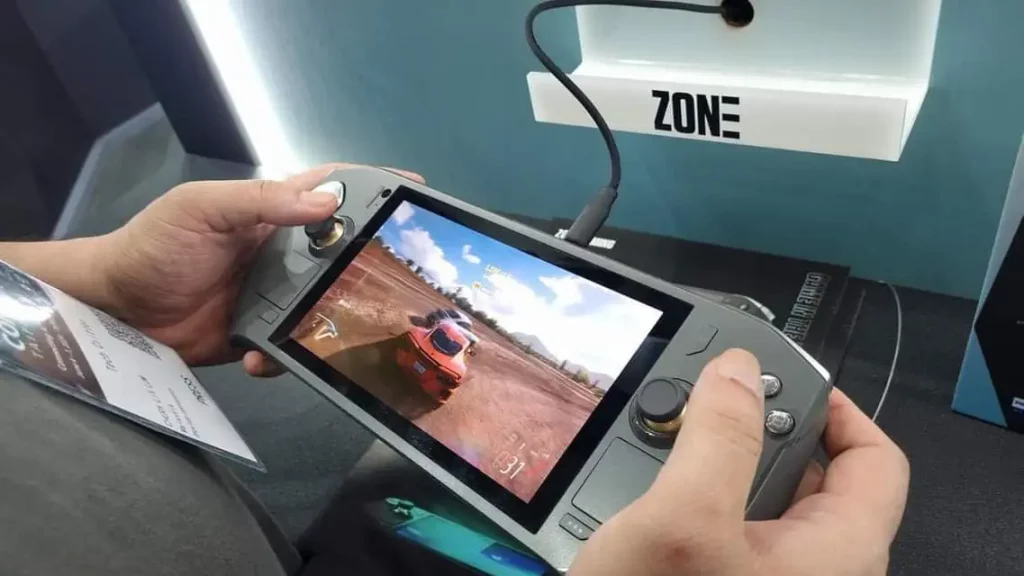
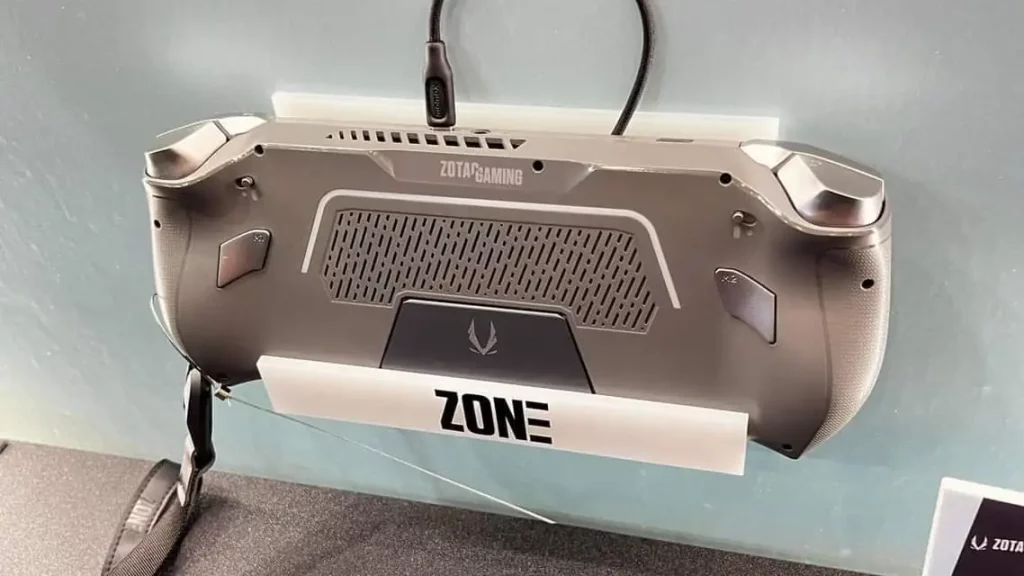
Zotac unveiled the ZONE handheld game console during the Taipei International Computer Show. The ZOTAC ZONE is expected to be officially released in September 2024.
The ZOTAC ZONE handheld game console is powered by the AMD Ryzen 7 8840U processor and the Radeon 780M core graphics. Although the official TDP of the model has not been released, it is speculated that the default will be 15W while the maximum TDP is 28W. The gaming handheld has a 7-inch AMOLED native screen with a 120Hz display refresh rate and 800 nits of peak brightness. The handheld does not support variable refresh rate and this could be problematic when playing some games. This is because it uses a MIPI screen. The handheld has 16GB LPDDR5X memory and its M.2 2280 slot offers at least 512GB PCIe 4.0 x4 SSD.
The dimensions of the ZOTAC ZONE are 310 x 135 x 40mm and it comes with relatively large bezels. It weighs about 700g and is larger than some of the popular gaming handhelds in the market such as the Steam Deck and ROG Ally X. The ROG Ally X however comes with a much larger battery capacity (64%) than the ZOTAC ZONE. The model supports HDR output and also comes with a Control Hall effect joystick and a two-stage adjustable Hall trigger.
The ZOTAC ZONE game handheld console runs on Windows 11 Home Edition and is equipped with a 48.5Wh lithium-ion battery. The price of the ZOTAC ZONE game handheld console is projected at about $800 with a September official release date. More optics about the ZOTAC ZONE will surface as we inch closer to its official release.
The vivo X100 Ultra achieved a remarkable milestone just one hour after its official launch. The smartphone grossed over 500 million yuan ($69 million) in sales in just one hour of its unveiling. Official sales figures released by vivo point to the impressive sales accomplishment for the flagship smartphone. This translated to between 62,000 and 72,000 units of the smartphone that were sold within one hour after its launch.
The vivo X100 Ultra smartphone is powered by a Qualcomm Snapdragon 8 Gen 3 SoC. It also features a 1-inch gimbal-level main camera and a Blueprint imaging chip V3+ with support for ultra-long range telephoto stage shooting. It has a 6.78-inch screen with a 20:9 screen ratio and a 120Hz refresh rate. The peak brightness of the smartphone is 3,000 nits with a pixel density of 517 ppi. The dimensions of the vivo X10 Ultra are 164.07 x 75.57 x 9.23 mm and it weighs 229g. The X100 Ultra has a 5,500mAh battery with support for wired and wireless charging at 80W and 30W speeds respectively. The new smartphone is rated IP68 and IP69 for dust, water resistant setup.
The vivo X100 Ultra has received two version updates to optimize the imaging effect and optimize the screen display. Three variants of the X100 Ultra were available at launch namely 12GB + 256GB, 16GB + 512GB, and 16GB + 1TB. The prices of the variants are 6,499 yuan ($897), 7,299 yuan ($1,007), and 7,999 yuan ($1,104). The vivo X100 Ultra can be purchased from online retail platforms such as JD.com.
Tech giant Huawei is taking a strong stance against trademark infringement, filing a lawsuit against two individuals, Gao and Li, in Beijing’s Haidian District People’s Court. The lawsuit accuses them of illegally using the “Huawei” trademark and engaging in unfair competition, potentially misleading consumers.
Huawei Demands 750,000 Yuan in Compensation for Trademark
According to court documents, Huawei is seeking compensation of 750,000 yuan (roughly $1,03,541) for economic losses and litigation expenses. The lawsuit demands a complete halt to the defendants’ infringing activities and any actions that create consumer confusion about their products’ connection to Huawei.
This isn’t the first time Huawei has had to defend its trademark. Earlier this year, they successfully sued Hanmai Cosmetics and Jixi Clothing in Shanghai for a similar offense. The defendants were found to be operating a “Kubalo Flagship Store” on Tmall, a popular Chinese e-commerce platform, and using “Huawei” for promotional purposes. The court ruled in favor of Huawei, awarding them 10 million yuan (roughly $1.4 million) in compensation for economic losses and applying punitive damages.
The current lawsuit highlights the ongoing battle tech companies face against trademark infringement. Counterfeit products and misleading marketing tactics can damage a brand’s reputation and potentially lead to customer dissatisfaction. Huawei’s decisive action sends a clear message that they will not tolerate such activities.
The lawsuit details require the defendants to submit their response within 15 days after the notice period expires, followed by a 30-day window for evidence presentation.
This case serves as a reminder for both consumers and businesses. Consumers should be vigilant when shopping online or offline, carefully checking brand names and product details to avoid unknowingly purchasing counterfeits. Businesses, on the other hand, need to be mindful of trademark laws and ensure their marketing practices are ethical and compliant.
At Computex, MSI has unveiled its collaboration with gaming giant Bethesda to create a new Fallout-themed MSI Claw gaming console. The brand has also unveiled its new MSI Claw 8 AI+, which also features Fallout-themed aesthetics.
MSI Claw 8 AI+ console details:
The design of this console is inspired by the game’s Vaults, the Pip-Boys worn by Vault dwellers, and robots, making it a dream item for Fallout fans. The console also comes on the heels of the popular TV adaptation of Fallout, which has refreshed the interest of many in the franchise.
Other than the exterior, the console has also made some changes on the hardware level. It still has a D-pad, XYAB buttons, joysticks, and triggers with a hall effect, however, it now features a bigger 8-inch FHD display with 1920 x 1080 pixels resolution and 500 nits brightness. The panel offers full coverage of the sRGB color gamut.
The Intel Meteor Lake Core Ultra 7 155H CPU is replaced by Intel’s upcoming Lunar Lake CPU, and the console has a powerful “Cooler Boost Hyperflow” cooling system that uses two fans and two heat pipes. Tom’s Hardware has reported that the will also have a bigger 80 Whr battery replacing the 53Whr on the original, and come with two Thunderbolt 4 ports.
MSI Claw Fallout 4 Limited Edition:
MSI will also be launching a Fallout-themed Claw A1M console. This basically means that the Fallout 4 Limited Edition console will essentially be a skin for the current-gen A1M console.
In terms of specs, it has an Intel Core Ultra 5 135H or Core Ultra 7 155H processor, paired with 16GB RAM and up to 1TB storage. The display measures 7 inches and provides an FHD resolution with 120Hz refresh rate. The console has a Thunderbolt 4 port, a microSD card slot, a 3.5mm headphone jack, and stereo speakers.
After the release of the Moto Edge Ultra, Edge Pro, and Edge Fusion, the brand has now added another smartphone to the lineup called the Motorola Edge (2024). This device is the successor to the Edge (2023), which made its debut back in October 2023. The new model comes with an improved processor as well as an improved primary camera.
Motorola Edge (2024) specs:
The Motorola Edge (2024) comes with a 6.6-inch pOLED display, with a resolution of 2400 × 1080 pixels and a 144Hz refresh rate. The panel offers 10-but colors with up to 1300 nits peak brightness and gorilla glass 3 protection.
Under the hood, the device houses a Snapdragon 7s Gen 2 processor with a peak clock speed of 2.4GHz. It is paired with an Adreno 710 GPU. Compared to the Dimensity 7030 SoC on last year’s model, the Snapdragon 7s Gen 2 offers about 22% improvement in multi-core performance and 11% in GPU performance. The processor is paired with 8 GB LPDDR4X RAM and 256GB UFS 2.2 storage.
For optics, the phone has used a 50MP Sony LYT-700C sensor as its primary camera, which is an improvement over the 50 MP Omnivision OV50A sensor used in last year’s model. It has an aperture of f/1.88 and optical image stabilization. The second camera on the back is a 13 MP ultra-wide unit with an f/2.2 aperture and the capability to take macro shots. On the front, the phone uses a 32 MP selfie snapper with f/2.4 aperture and Quad Pixel Technology (pixel binning).
The phone runs Android 14 and packs a 5,000mAh battery with support for 68W fast charging and 15W wireless charging. Other highlights include dust and water resistance (IP68) rating, 5G connectivity (SA/NSA), Dual 4G VoLTE, Wi-Fi 6E 802.11ax (2.4GHz/5GHz), Bluetooth 5.2, GPS, USB Type-C, NFC, and stereo speakers with Dolby Atmos. The phone also has a customizable Quick Button which can be used as a shortcut to launch the camera, gallery or other apps.
Pricing & availability
The Motorola Edge (2024) is priced at USD 549.99 and will be released on June 20. You can find it on Amazon.com, Best Buy, and motorola.com first, then later on T-Mobile, Metro by T-Mobile, Spectrum, Consumer Cellular, and Straight Talk, Total By Verizon, and Visible. Canadians can expect availability on motorola.ca and select carriers and retailers in the coming months.
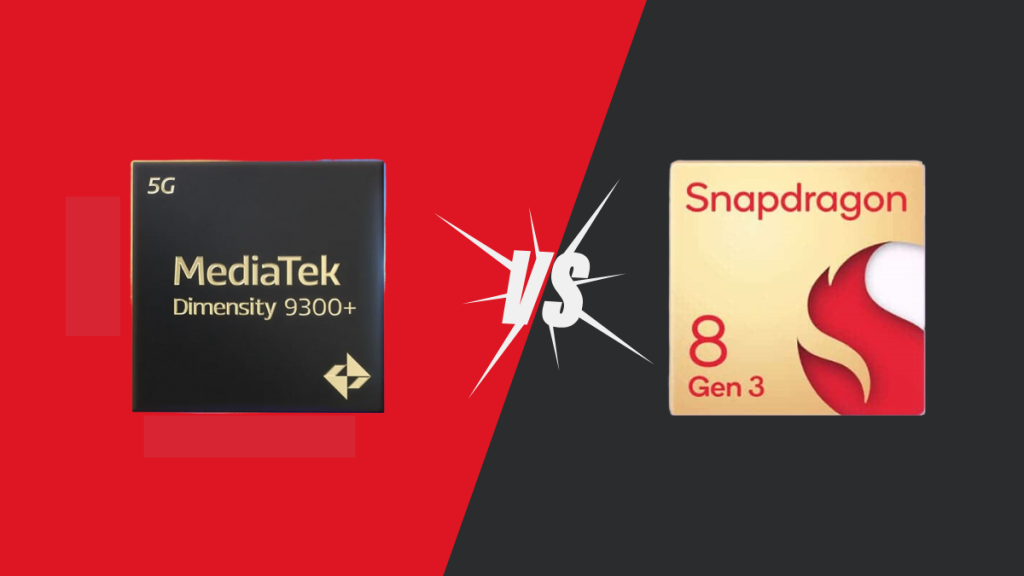
MediaTek announced its Snapdragon 8 Gen 3 chip in May this year, while Qualcomm’s Snapdragon 8 Gen 3 was released in October 2023. Both are flagship chipsets with amazing capabilities, powering a host of flagships from major smartphone brands.
The two flagship processors are built on the same TSMC’s 4nm process but have different core configurations and hardware components. If you’re looking to buy a flagship device but can’t decide between these two chips, see the comparison below to find the right choice for your needs.
Dimensity 9300+
Snapdragon 8 Gen 3
Process Node
TSMC 4nm
TSMC 4nm
CPU Cores
8
8
CPU Architecture
1 x Cortex-X4 @ 3.4 GHz 3 x Cortex-X4 @ 2.85 GHz 4 x Cortex-A720 @ 2.0 GHz
1 x Cortex-X4 @ 3.25 GHz 3 x Cortex-A720 @ 3.15 GHz 2 x Cortex-A720 @ 2.96 GHz 2 x Cortex-A520 @ 2.27 GHz
GPU
Mali-G720 Immortalis MP12
Adreno 750
NPU
MediaTek NPU 790 Ray tracing support Global illumination
Qualcomm Hexagon NPU Ray tracing support Global illumination
Memory
Up to 24 GB LPDDR5T @ 4800 MHz
Up to 24 GB LPDDR5X @ 4800 MHz
Storage
UFS 4.0
UFS 4.0
Camera Support
Up to 320MP camera sensor support MediaTek Imagiq 990 (18-bit) 8K @ 30 FPS, 4K @ 60 FPS
Up to 200MP camera sensor support Qualcomm Spectra (18-bit) 8K @ 30 FPS, 4K @ 120 FPS
Display
4K @ 120 Hz, WQHD @ 180 Hz
4K Ultra HD @ 60 Hz, QHD+ @ 144 Hz
Connectivity
MediaTek 5G R16 modem Wi-Fi 7 Bluetooth 5.4
Snapdragon X75 5G modem Wi-Fi 7 Bluetooth 5.4
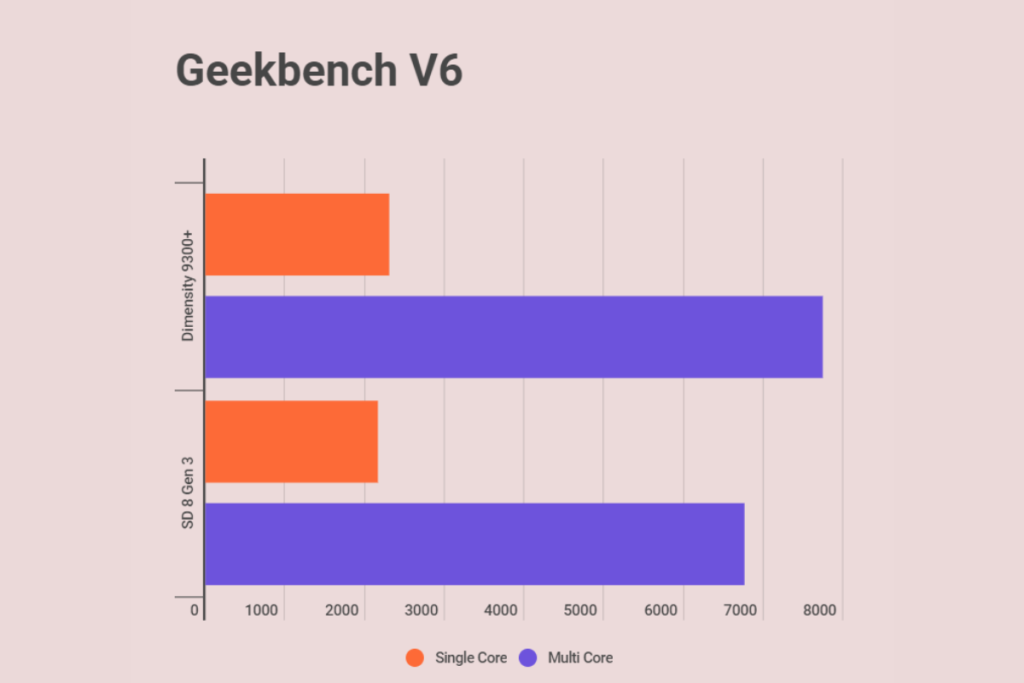
Dimensity 9300+ vs Snapdragon 8 Gen 3: Benchmarks
Geekbench V6
Geekbench V6
Dimensity 9300+
SD 8 Gen 3
Single Core
2313
2164
Multi Core
7743
6756
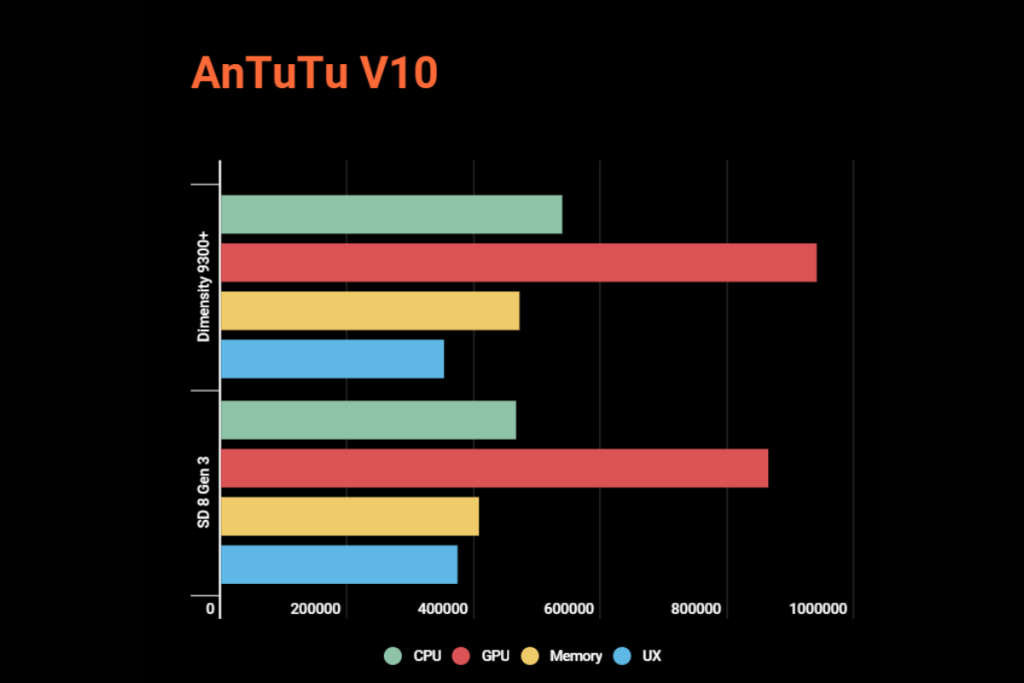
AnTuTu V10
AnTuTu V10
Dimensity 9300+
SD 8 Gen 3
CPU
538809
466396
GPU
940944
865562
Memory
472337
406965
UX
353177
373825
Total Score
2305267
2112748
The Dimensity 9300+ is slightly ahead of the Snapdragon 8 Gen 3 on both Geekbench and AnTuTu benchmarks.
Dimensity 9300+ vs Snapdragon 8 Gen 3: CPU, GPU & NPU
The Dimensity chip is equipped with four powerful Cortex-X4 cores, while the Snapdragon 8 Gen 3 has one. However, the latter has more Cortex-A720 cores, which is slightly less powerful than Cortex-X4 but is more power efficient.
The Snapdragon 8 Gen 3 also has two power-efficient Cortex-A520 cores.
The core configuration suggests the Dimensity 9300+ will lead the performance game, but the Snapdragon 8 Gen 3 should offer a good balance of performance and battery. It also depends on the software optimizations, among many other factors.
The Dimensity 9300+ is head-to-head with the Snapdragon 8 Gen 3 in the CPU performance, but there’s a significant gap in the GPU performance. The Dimensity chip disappoints when it comes to sustaining a heavy GPU workload, but it’s still one of the best here.
Most modern chips, including the Dimensity 9300+ and Snapdragon 8 Gen 3, have NPUs to support generative AI models and allow users to perform on-device AI tasks. The importance of NPUs is only going to grow over time as smartphone companies adopt more and more AI features. Hence, it’s good to have a chip with powerful AI capabilities.
Dimensity 9300+ vs Snapdragon 8 Gen 3: Memory
Dimensity 9300+ and Snapdragon 8 Gen 3 support UFS 4.0 storage for faster file access to files. They come with LPDDR5X RAM clocked at 4800 MHz for fast app loading and switching.
So, as far as the storage and memory technologies are concerned, there isn’t a clear winner here, as both share the same technologies.
Dimensity 9300+ vs Snapdragon 8 Gen 3: Multimedia
The Dimensity 9300+ features an in-house Imagiq 990 ISP, while the Snapdragon 8 Gen 3 has a Spectra ISP. While both are 18-bit ISPs, the Dimensity chip supports more camera resolution, a 320MP single camera sensor (vs 200MP in SD 8 Gen 3).
Both chipsets are capable of taking 8K videos at 30 frames per second (fps). However, the Snapdragon chip can take 4K videos at 120 fps, which is limited to 60 fps in the Dimensity chip.
Both chips have great ISP and excellent imaging capabilities. Hence, everything boils down to the camera sensors used in the device.
Dimensity 9300+ vs Snapdragon 8 Gen 3: Display
Both chips support up to 4K display resolution, but the Dimensity chip offers a higher refresh rate of up to 120Hz (vs. 60 Hz in SD 8 Gen 3). Also, the QHD+ resolution in the Snapdragon chip is limited to 144Hz (vs. 180Hz in Dimensity 9300+).
The chips support various HDR formats, such as HDR10 and HDR10+, which enhance the viewing experience with richer colors and contrasts.
Dimensity 9300+ vs Snapdragon 8 Gen 3: Connectivity
The Dimensity chip features a MediaTek 5G R16 modem, while the Snapdragon 8 Gen 3 uses in-house X75 5G mode. Although the modems are different, there isn’t any major differentiation on the connectivity part.
Both chips support 5G, Bluetooth 5.4, and up to Wi-Fi connectivity. They also support necessary positioning technologies, including GPS, BeiDou, Glonass, Galileo, QZSS, and NavIC.
Dimensity 9300+ vs Snapdragon 8 Gen 3: Which is Better?
Dimensity 9300+ and Snapdragon 8 Gen 3 offer a nearly matched CPU performance, competing closely in single-core and multi-core benchmarks. However, on the GPU front, the Snapdragon chip is clearly ahead of the Dimensity 9300+, but the latter is still one of the best.
The Dimensity chip does a respectable job when it comes to gaming, but the Snapdragon 8 Gen 3 is a better option, in my opinion. However, the difference is unnoticeable in regular usage.
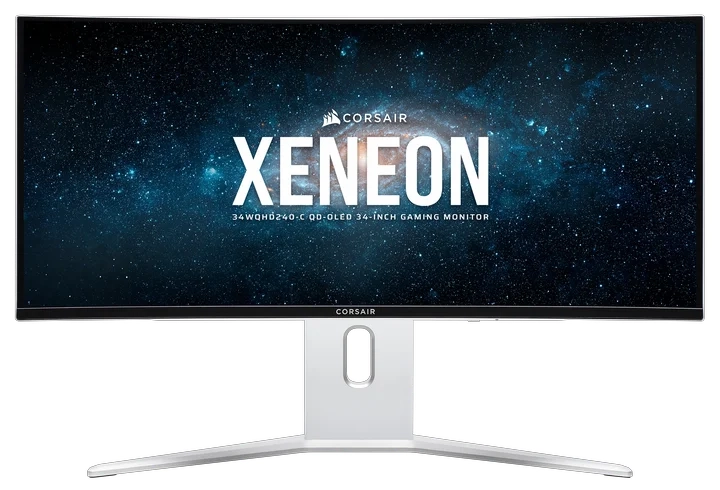
It seems like all gaming brands are going all-in for gaming monitors during this Computex. Corsair also unveiled its latest weapon for gamers at the Computex 2024 Taipei International Computer Show: the XENEON 34WQHD240-C gaming monitor. This curved display boasts a massive 34-inch screen with a WQHD resolution (3440 x 1440 pixels) for stunning visuals and ample workspace.
The low response time translates into a super responsive gaming experience
But the real showstopper is the lightning-fast 240Hz refresh rate, ensuring silky smooth visuals even in the most intense games. And to top it off, the XENEON 34WQHD240-C boasts a near-instantaneous 0.3ms gray-to-gray (GtG) response time, eliminating motion blur for a truly responsive gaming experience.
The monitor utilizes a cutting-edge QD-OLED panel, offering an 1800R curvature for a truly immersive viewing experience. This panel boasts exceptional color reproduction, covering 99% of the DCI-P3 color gamut, making games and content look vibrant and lifelike. The contrast ratio is a staggering 1,500,000:1, delivering deep blacks and brilliant whites for incredible image depth. Peak brightness reaches up to 1000 nits (at 3% APL), perfect for HDR content. To further enhance the HDR experience, the XENEON 34WQHD240-C is DisplayHDR True Black 400 certified.
Connectivity is well covered with two HDMI 2.1 ports, a single DisplayPort 1.4, and a USB Type-C port with DisplayPort alternate mode. This USB Type-C port even offers 65W reverse power delivery, potentially eliminating the need for a separate charger for your laptop.
The monitor also features a built-in USB hub with four USB Type-A 3.1 ports, providing additional connection options for peripherals. Additionally, it supports KVM functionality, allowing you to easily switch between multiple PCs connected to the monitor using a single keyboard and mouse. To sweeten the deal, Corsair is backing the XENEON 34WQHD240-C with a 3-year zero burn-in and zero bad pixel warranty, giving you peace of mind for your investment.
According to a report by TheInformation on June 4th, Apple is reportedly in negotiations with China Mobile, the world’s largest mobile network operator by subscriber base, to launch its Apple TV+ video streaming service in China.
Over 200 million Chinese mobile users will get to enjoy Apple TV+
The current status of the talks remains unclear, but a successful agreement would grant Apple TV+ access to a massive audience – over 200 million Chinese mobile users. If negotiations go Apple’s way, Apple TV+ would become the only American streaming service to operate within China’s borders.
This potential move comes after a period of relative dormancy for Apple’s subscription services in China. Since 2017, Apple hasn’t launched any new subscription or media services in the mainland. However, recent signs suggest a renewed push – reports indicate Apple is also exploring ways to bring services like Apple Arcade and Fitness+ to the Chinese market.
The Information further highlights a key agreement Apple has reached with tech giant Tencent. This deal allows Tencent to offer a selection of its popular applications on Vision Pro, Apple’s upcoming mixed reality headset, specifically for the Chinese market. Apple CEO Tim Cook has previously confirmed a Chinese launch for Vision Pro later this year.
The report also mentions Apple’s efforts to navigate China’s strict content censorship regulations. To ensure compliance and successful service launches, Apple is reportedly seeking a local partner to assist with operating its subscription services, including Apple TV+ and Apple Arcade, within China.
For reference, the high-end version of the latest Apple TV 4K (7th generation) with an A15 Bionic chip and 128GB of storage reached a price of 1,161 yuan during China’s major shopping event, Double 11, last year. For comparison, the official US price is $149 (roughly 1,080 yuan at the time). Additionally, the monthly subscription fee for Apple TV+ is $9.99 (currently around 72 yuan), while the Apple One bundle costs $19.95 per month (approximately 145 yuan).
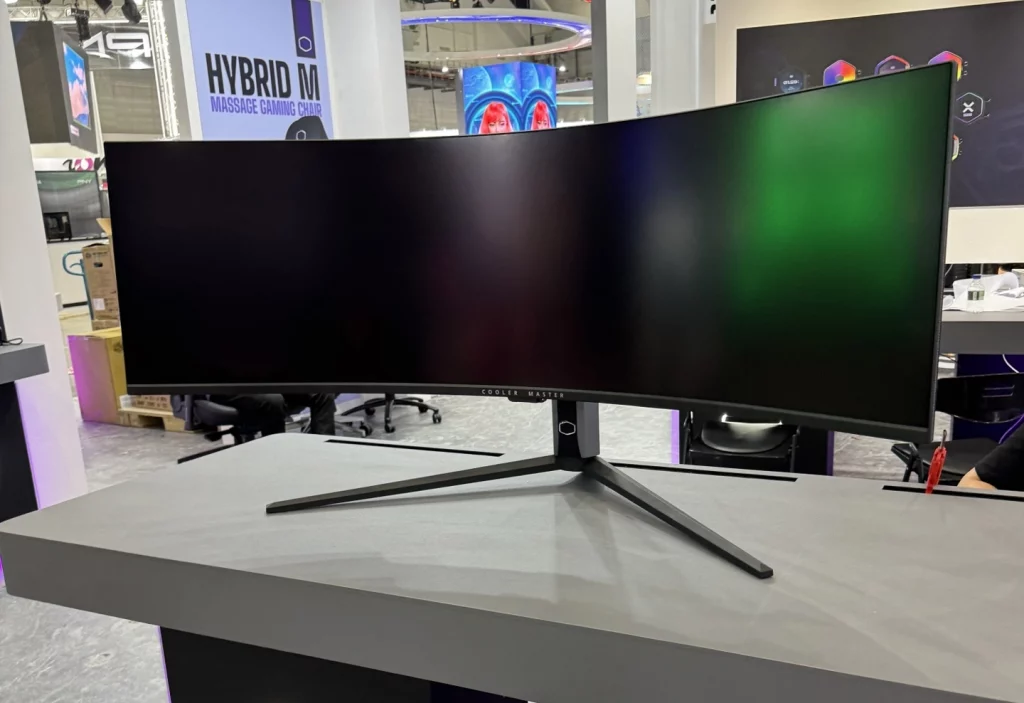
Immersive entertainment takes one step forward with Cooler Master‘s latest display, unveiled at the Computex 2024 Taipei International Computer Show – the GP57ZS. This behemoth boasts a massive 54-inch curved Mini LED panel. While detailed specs haven’t been officially revealed by Cooler Master, information gleaned from the display itself confirms a “dual 4K” resolution, technically known as DUHD (7680 x 2160 pixels). This translates to incredible image clarity and sharpness, ideal for displaying intricate details in games or high-resolution design work.
The monitor has 2304 backlight zones, which means high contrast and HDR performance
The GP57ZS embraces a curved VA panel with a 1000R curvature, similar to the Samsung Odyssey Neo G9 and Acer Predator Z57 monitors. This curvature closely mimics the natural curve of the human eye, promoting a more comfortable and immersive viewing experience, especially for extended gaming sessions or design work.
Another key detail confirmed on the monitor itself is the presence of 2304 backlight zones. This suggests excellent contrast and HDR (High Dynamic Range) performance, with deep blacks and vibrant highlights for a truly lifelike image.
However, a crucial detail remains unconfirmed – the refresh rate. The competing Samsung Odyssey Neo G9 offers a buttery smooth 240Hz refresh rate, while the Acer Predator Z57 settles for a 120Hz refresh rate. It’s unclear yet what refresh rate Cooler Master will ultimately choose for the GP57ZS.
Regardless of the refresh rate, the Cooler Master GP57ZS, with its massive size, high resolution, curved VA panel, and extensive backlight zones, promises to be a strong contender in the premium display market. Stay tuned for further updates as Cooler Master unveils the complete specifications of this impressive monitor.
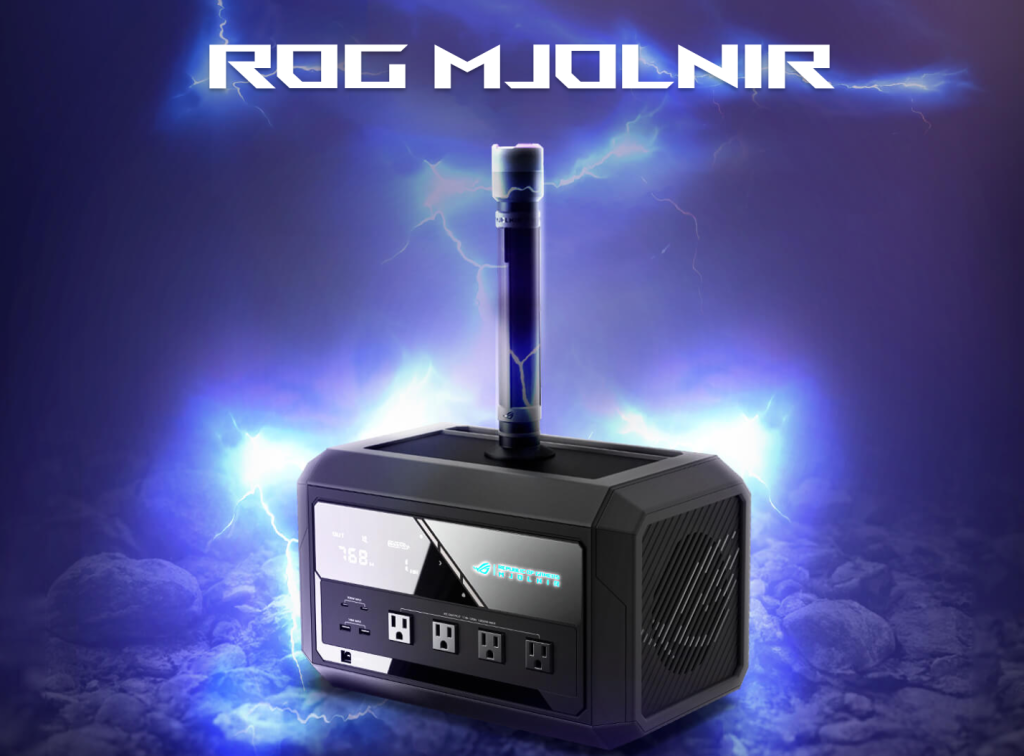
ASUS has unveiled the specifications of its new portable UPS system named the ROG Mjolnir Portable Gaming UPS. let’s check out what this UPS system has to offer.
A portable UPS system with Type-A & Type-C ports
This is designed in the shape of Thor’s hammer which may help you carry it around. However, the company has not yet revealed the weight of the product. It equips a 768Wh capacity battery, that can reportedly run a GeForce RTX 4080 system for 1 hour while gaming. It also offers a 10ms quick switchover time.
There is an LCD display that shows you the power draw in real-time alongside the total energy left in it.
In terms of output, you get 4 x AC power sockets in addition to two Type-A and two Type-C ports. It offers 100W PD fast charging output to your supported devices. In addition, you also get Qi2 wireless charging with MagSafe compatibility with this hammer-shaped ROG UPS system. So you can also take it outside with you and use it as a power bank for your portable devices such as phones and laptops. It also supports solar recharging for some extra battery life for your devices.
It also comes with a flashlight that can magnetically attach to the handle and light up the room during a power cut.
It equips an LFP (Lithium-iron phosphate) battery that has many advantages over other lithium batteries. This battery technology is safer as it contains no oxygen. Additionally, an LFP battery retains its life better over time as compared to Li-ion batteries. So, the ROG Mjolnir Portable Gaming UPS could be beneficial for long-term usage.
Pricing and availability
The company has not revealed the price tag yet. The product is mentioned as “Coming Soon” on the company’s website.
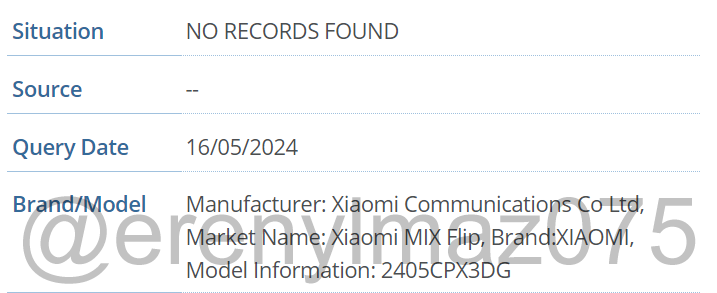
Xiaomi is preparing to launch the 14T series and MIX Flip in the global market. We know the specifications of the smartphones along with the leaks about them. Xiaomi 14T and 14T Pro will come with powerful MediaTek SOCs and the special foldable device MIX Flip will come with Snapdragon 8 Gen 3. Xiaomi fans are eagerly awaiting the official unveiling of these models. Today, a user named Erencan Yilmaz on X (formerly Twitter) shared that the Xiaomi 14T, Xiaomi 14T Pro and MIX Flip have been registered in the IMEI database.
Xiaomi 14T series and MIX Flip are coming soon
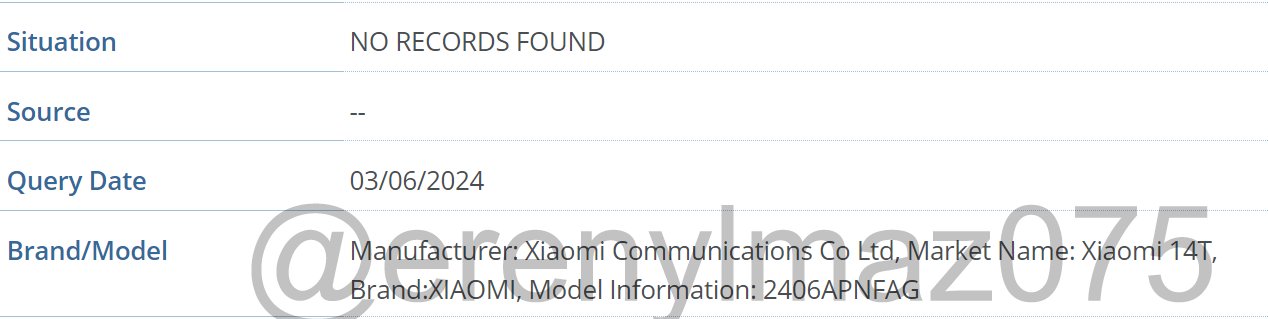
Xiaomi 14T series and MIX Flip are clearly visible in the GSMA IMEI database, indicating that these devices will be introduced in the near future. The IMEI database gives us 3 different model numbers: 2406APNFAG, 2407FPN8EG and 2405CPX3DG. The first model number belongs to the Xiaomi 14T, the second to the Xiaomi 14T Pro, and the last to the MIX Flip. These are assigned to the Global versions of the devices. The presence of these model numbers officially confirms that the devices will be sold in the global market. As Erencan Yilmaz said, the Xiaomi 14T series and MIX Flip will be available for purchase by users all over the world. Of course, we need to add the following: These smartphones will not be sold in India.
Xiaomi MIX Flip 2405CPX3DGXiaomi 14T 2406APNFAGXiaomi 14T Pro 2407FPN8EG
Xiaomi 14T series specifications have already been leaked. The top-end model of this series, the Xiaomi 14T Pro, will feature the MediaTek Dimensity 9300. The 14T Pro is expected to be a much better smartphone than its Chinese variant, the Redmi K70 Ultra. Because compared to the Redmi K70 Ultra, the new 14T Pro will come with an improved telephoto camera and wireless charging support. Redmi K70 Ultra will not have a telephoto camera. The K70 Ultra also lacks wireless charging support.
We said that the most affordable model of the series, Xiaomi 14T, was spotted in the Xiaomi HyperOS source code with the codename “degas” and the internal model number “N12A”. The 14T’s specifications are not fully known, but we expect it to have a powerful MediaTek SOC. Basically, the Xiaomi 14T should come with features similar to those of the Xiaomi 14T Pro.
Come to the MIX Flip, it will have dual cameras on the back, with the main camera featuring a 50MP Light Hunter 800 sensor. The auxiliary camera is the OV60A Telephoto sensor with a resolution of 60MP. With this sensor, MIX Flip will have 2X optical zoom capability and should have a zoom capability far better than the competitors. It’s also worth noting that the MIX Flip uses the Snapdragon 8 Gen 3 processor. As for the launch date of the devices, the Xiaomi 14T series and MIX Flip are expected to be introduced between August and September. On the other hand, the Xiaomi 15 series will be announced in October.
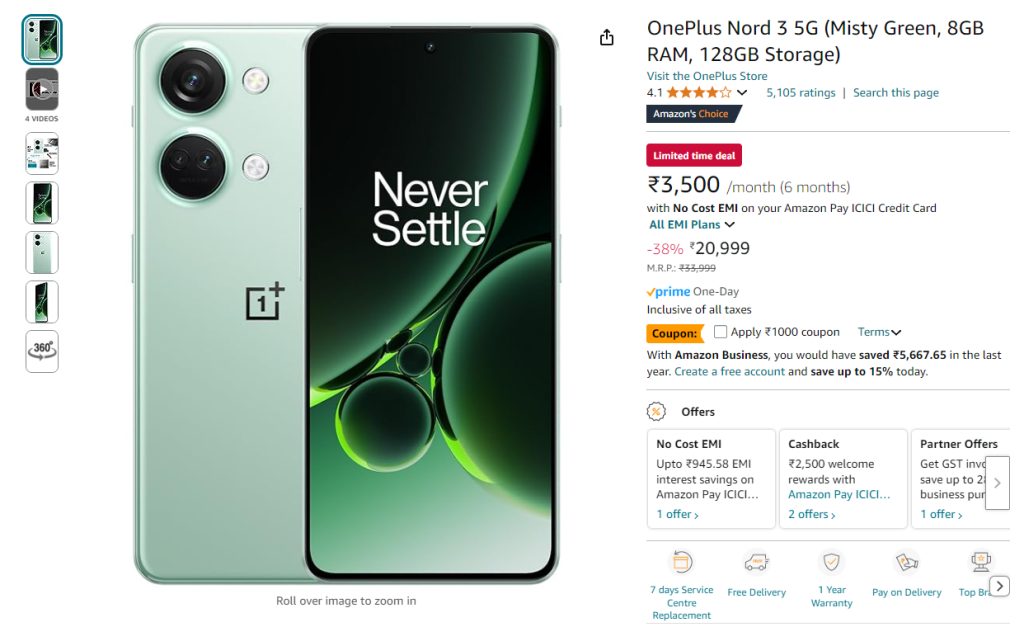
OnePlus is working on the Nord 4 smartphone which could debut in the coming months. Ahead of that, the brand has heavily reduced the price of the OnePlus Nord 3 in India.
The OnePlus Nord 3, which debuted with a price tag of Rs 33,999 in July 2023 is currently selling on Amazon India for as low as ₹20,000. The Nord 3 8GB RAM + 128GB storage model is available for ₹20,999, with an additional onsite coupon of ₹1000. Including the coupon, the price of the OnePlus Nord 3 comes down to ₹19,999.
This is the lowest price the phone has ever sold for. That being said, is it a smart choice for this price? Well, the answer is an easy yes. It is an awesome deal as buyers looking for a OnePlus phone below the ₹20,000 price mark usually have to settle for the OnePlus Nord CE 3 Lite. Specs-wise, the Nord 3 is vastly superior to the CE 3 Lite.
It has a more powerful processor, a better display, better cameras, and a better battery with faster charging. In addition to all that, the OnePlus Nord 3 comes with an alert slider, which you won’t find anywhere else for this price tag. So if you are in the market for an affordable device around ₹20,000, the Nord 3 is currently the best deal that you can get. You can find the detailed spec sheet of the device below.
OnePlus Nord 3 specs:
The OnePlus Nord 3 features a 6.74-inch 1.5K AMOLED display with a 120Hz refresh rate. It is powered by the MediaTek Dimensity 9000 SoC and Mali-G710 10-core GPU.
The camera setup includes a 50MP primary Sony IMX890 sensor with OIS, an 8MP ultra-wide Sony IMX355 sensor, and a 2MP macro camera. For selfies, there is a 16MP front camera. The device offers up to 16GB of RAM and 256GB of internal storage.
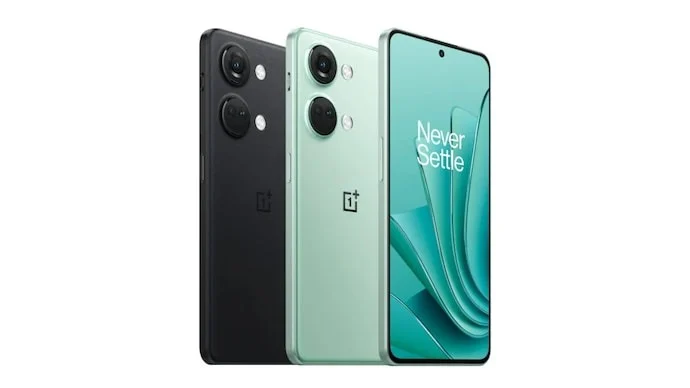
Running on Android 13-based OxygenOS 13.1, the Nord 3 provides a smooth user experience. It has a 5,000mAh battery with 80W SUPERVOOC fast charging. Connectivity options include 5G SA/NSA, Dual 4G VoLTE, USB Type-C, Bluetooth 5.3, Wi-Fi 6, GPS, and NFC. The phone is available in Misty Green and Tempest Gray.
We use cookies on our website to give you the most relevant experience by remembering your preferences and repeat visits. By clicking “Accept”, you consent to the use of ALL the cookies.
This website uses cookies to improve your experience while you navigate through the website. Out of these, the cookies that are categorized as necessary are stored on your browser as they are essential for the working of basic functionalities of the website. We also use third-party cookies that help us analyze and understand how you use this website. These cookies will be stored in your browser only with your consent. You also have the option to opt-out of these cookies. But opting out of some of these cookies may affect your browsing experience.
Necessary cookies are absolutely essential for the website to function properly. This category only includes cookies that ensures basic functionalities and security features of the website. These cookies do not store any personal information.
Any cookies that may not be particularly necessary for the website to function and is used specifically to collect user personal data via analytics, ads, other embedded contents are termed as non-necessary cookies. It is mandatory to procure user consent prior to running these cookies on your website.