Advertisement

Honor MagicBook Pro 16 laptop with 24 GB non-binary RAM & Intel Core Ultra processor debuts in China

Last month at MWC 2024, Honor unveiled its MagicBook Pro 16 AI-powered laptop featuring Intel’s new Core Ultra processors. It has now debuted in China, standing out as the first laptop to use a non-standard non-binary RAM capacity of 24GB (LPDDR5X-6400).

Honor MagicBook Pro 16

This new non-binary capacity, along with 12GB and 48GB is expected to become more prevalent for laptops in the coming days, providing customers with a relatively affordable option to get a higher memory variant, rather than just doubling the capacity.

The 24GB RAM configuration is currently available for pre-reservation with the Intel Core Ultra 5 125H chip. At MWC, the brand revealed that the laptop also has a higher-end configuration powered by a Core Ultra 7 155H and an Nvidia RTX 4060 GPU.

The laptop offers a 16-inch 3072 x 1920 resolution display with up to 165Hz refresh rate, 16:10 aspect ratio, 100% coverage of the sRGB and DCI-P3 color spaces, and a peak brightness of 500 nits. The laptop caps out at 32GB of RAM and 1TB of storage, so it likely won’t have a 48GB RAM variant. Other than that, it has a large 75Wh battery, a fingerprint reader, a 3.5 mm jack, an HDMI, a Thunderbolt 4, and a USB 3.2 Gen 2 Type-C.

RELATED:

(via)

Vivo X Fold 3 to launch in China on March 26

Vivo is gearing up to launch its X Fold 3 series and we finally have a launch date to look forward to. The company today confirmed that the new X Fold 3 line foldable phones will launch in China on March 26.

A lot has been revealed about the devices in the past few days. Just last week, a leak revealed the official marketing material of the smartphone, giving us a sneak peek at most of the features.

It reveals that the upcoming foldables feature an ultra-thin body with a lightweight design. In fact, when unfolded, it’s said that both the X Fold 3 and X Fold 3 Pro will be thinner than the 2015 Vivo X5 Max, which is currently the world’s thinnest phone at 5.1mm.

Moreover, the X Fold3 Pro will be the first foldable phone to come with the Snapdragon 8 Gen 3 chipset, while the X Fold 3 is expected to feature the Snapdragon 8 Gen 2. Both phones have also appeared on AnTuTu and Geekbench benchmarking platforms, respectively.

The X Fold 3 series will also feature impressive screens, including an 8.03-inch Samsung E7 AMOLED main screen with 2K resolution, 3,000 nits peak brightness, and an ultrasonic fingerprint scanner. The inner screen will measure 6.5 inches and will also have an ultrasonic scanner.

In terms of cameras, both the X Fold3 and 3 Pro will have a 50MP main shooter, a 50MP ultrawide lens, and a 64MP periscope module, all equipped with OIS. They will also come with Vivo’s in-house V3 imaging chip.

On the software side, the phones will run on OriginOS 4 based on Android 14, while the battery capacity will be 5,500 mAh, supporting 120W wired and 50W wireless charging.

The Vivo X Fold 3 is rumored to be priced at around CNY 7,999 ($1,113), while the X Fold 3 Pro may cost CNY 9,999 ($1,391) for the base variant.

Related:

Vivo Officially Unveils the Pad 3 Pro Tablet Alongside TWS 4 Earphones on JD.com

Vivo officially unveiled two exciting new products yesterday, products that were previously been spotted on certification websites and leaks – the Pad 3 Pro tablet and TWS 4 earphones. The Pad 3 Pro is labelled as a productivity powerhouse, equipped with the Dimensity 9300 processor and a gorgeous 13-inch, 3.1K eye-protecting display with a smooth 144Hz refresh rate. Vivo claims to have optimized the OriginOS 4 tablet system for the Pad 3 Pro, with the Blue Heart large model at its core. A massive 11500mAh battery is designed to keep it going for quite some time, while an 8-speaker panoramic acoustic system will ensure rich audio.

Vivo Pad 3 Pro

For those who crave productivity on the go, the Pad 3 Pro offers a suite of features including voice recognition and text transcription, atomic note management, communication sharing, a built-in vivo office suite, and multi-device interconnection. Additionally, Lanxin Xiao V’s “text and picture complement each other and mind map” functionality helps unlock creativity. In the single-core and multi-core tests of Geekbench, the Pad 3 Pro scored 2223 and 7547 points, respectively.

Vivo TWS 4

The TWS 4 earphones are a pretty solid release on their own, considering they sport the first-ever ceramic tungsten acoustic diaphragm, promising exceptional sound quality. Active noise cancellation goes up to 55db and is further enhanced by AI for improved vocal clarity, better ambient sound transmission, and superior wind noise resistance. The Hi-Fi version boasts the cutting-edge third-generation Qualcomm S3 audio platform, perfect for gamers with its 44ms low latency. These feather-light earphones (4.8 grams per bud) offer a remarkable battery life of 45 hours, with 11 hours of continuous listening on a single charge. Those are quite impressive numbers on paper.

RELATED:

(Via)

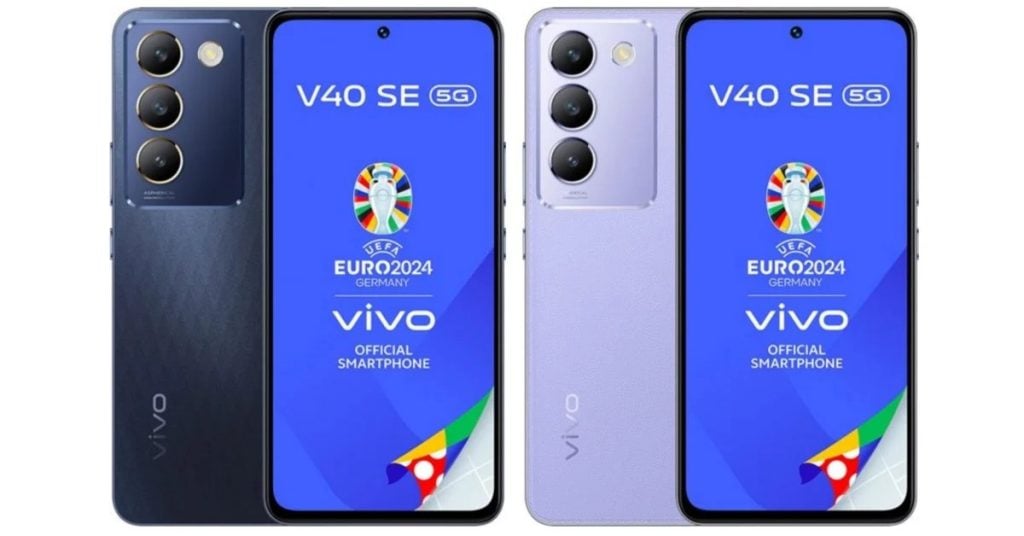
Vivo V40 SE leaks in full with specs and renders, could be a rebranded Y200e 5G

Vivo V30 series smartphones made its global debut not long ago. However, there’s already news floating about the upcoming V40 series. The Vivo V40 SE, for instance, has been seen in certifications like Bluetooth SIG and GCF. Now, a leak by Appauls has revealed the smartphone’s renders and specifications.

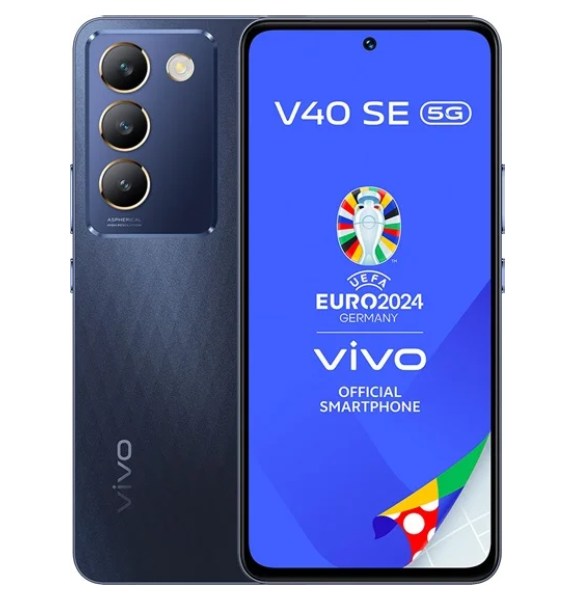
Vivo V40 SE Renders

Vivo V40 SE Renders and Specifications

The leaked renders show the phone’s design much different from the V30 series. But it’s surprisingly similar to the recently launched Vivo Y200e 5G. Particularly, the V40 SE’s blue color option looks strikingly alike, and it may also come in a light purple shade.

Not only the design, but the phone’s specifications also don’t seem to differ much from the Y200e. The Vivo V40 SE is rumored to be powered by the Snapdragon 4 Gen 2 chip, the same as the Y200e, along with LPDDR4X RAM and UFS 2.2 ROM.

On the front, it’s said to feature a 6.67″ AMOLED display offering FHD+ (2400×1080 pixels) resolution and a 120Hz refresh rate.

Camera-wise, the phone may debut with a rear setup consisting of a 50MP main lens, an 8MP ultra-wide-angle lens, and a 2MP lens for portrait or macro shots. The front will likely have a 16MP selfie camera. It will also include an in-display optical fingerprint sensor for security.

Moreover, the phone is rumored to pack a 5000mAh battery with 44W fast charging support, and possibly an IP54 protection rating. Other rumored features of the device include MicroSD for storage expansion up to 1TB, Dual SIM support, Wi-Fi 5GHz, Bluetooth 5.0, USB-C 2.0, and GPS.

All the rumored specifications of the Vivo V40 SE seem quite similar to those of the Vivo Y200e. So it appears like a re-branded device.

Price and Launch (Expected)

As for the price, the report suggests that the V40 SE’s 8/256GB configuration will be priced within the EUR 250 – EUR 300 range. 

While the phone’s official launch date remains under wraps, it has a UEFA Euro 2024 wallpaper with Vivo as the official smartphone brand. The Champions League will start on June 14th, so we can expect Vivo V40 SE’s launch around that time.

Related:

Vivo X Fold 3 Pro design officially revealed along with a bunch of key specifications

Vivo plans to launch the Vivo X Fold 3 series smartphones soon. Currently, we know that the lineup will include a vanilla X Fold 3 and an X Fold 3 Pro model. A recent press leak revealed the camera details of the X Fold 3 Pro model, and now, Jia Jingdong, Vivo’s Vice President, has shared more details about the X Fold 3 series, while also revealing what the X Fold 3 Pro looks like.

In a post on Weibo, Jia Jingdong has claimed that the X Fold 3 series will be the “thinnest and lightest” flagship foldable device yet. The foldables will also be quite powerful, featuring a Snapdragon 8 Gen 3 chipset under the hood.

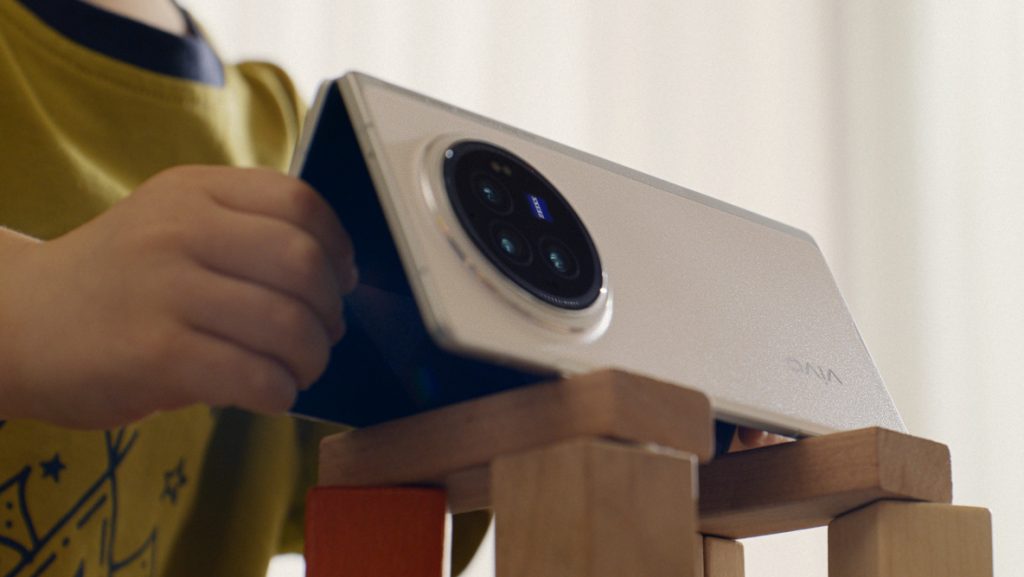
Vivo X Fold 3 Pro

Along with the camera samples of the Vivo X Fold 3 Pro, he has also shared three product images of what appears to be the X Fold 3 Pro.

Additionally, Jia has revealed that the AnTuTu score of the device exceeds 2.17 million. It features a large 8.03-inch Samsung E7 screen and it inherits the superior imaging capabilities of the vivo X100 series, equipped with Zeiss T* lenses, a 50 million pixel primary camera, and Vivo’s V3 imaging chip.

The foldable is also quite tough thanks to the “Armor Feather” body structure, designed specifically for foldables, earning it the world’s first foldable SGS five-star anti-drop certification, along with IPX8 water resistance.

The phones will have a “Blue Ocean” battery system onboard to tackle the issue of battery life, promising long-lasting performance even under extreme conditions. Last, but not least, Vivo’s “Blue Heart” AI model will be integrated into these upcoming foldable. The brand is yet to reveal the exact launch date among many other key details, so stay tuned for more.

RELATED:

Steam Set a New Record of 36 Million Concurrent Players This Week

Steam is a popular digital video game distribution platform developed by Valve Corporation. It allows users to purchase, download, manage, and play video games. It also provides online features such as matchmaking, achievements, and community features. It’s been around for quite a while now, but new records are being made on the platform every single year. The platform has witnessed a surge in online activity, breaking its record for peak concurrent players for three consecutive weeks.

For three straight weeks, Steam had its highest concurrent players ever

  • March 2nd: 34,298,950 concurrent users
  • March 10th: 35,385,530 concurrent users (previous record)
  • March 18th: New Record! 36,354,393 concurrent users

Given below are the top 10 games played during the last 24 hours.

  1. CS:GO (Counter-Strike: Global Offensive) – 1,425,033 players
  2. DOTA 2 – 725,429 players
  3. PUBG (PlayerUnknown’s Battlegrounds) – 706,785 players
  4. Apex Legends – 434,411 players
  5. Jedi Fallen Order 2 (presumably Star Wars Jedi: Fallen Order 2) – 378,370 players
  6. Escape from Tarkov (likely reference to the game) – 276,440 players
  7. Source SDK Base 2007 (game development toolkit) – 216,523 players (interesting outlier)
  8. Rainbow Six: Siege – 201,933 players
  9. GTA 5 – 185,713 players
  10. Baldur’s Gate 3 – 149,943 players

Counter Strike started gaining popularity after the second iteration of the game launched, running on the Source 2 Engine. The rest of the list also highlights some changes compared to the previous day (March 11th). Previously popular titles like “Phantom Parlu” and “Last Era” dropped out of the top 10, with “Phantom Parlu” falling to 11th place (138,585 players) and “Last Era” reaching a peak of 119,642 players in the last 24 hours.

RELATED:

(Via)

After Netflix, LinkedIn might be Adding Games to Its Platform

You might have to add this news to the list of news you weren’t expecting to read today. LinkedIn is adding a surprising twist to its platform – games. The professional networking giant, which is typically known for helping make career connections and sharing advice, is trying to add puzzles to its platform as a method of boosting user engagement. Kind of crazy, right?

Adding games to LinkedIn will be a controversial move, only time will tell

Inspired by the viral success of Wordle and other brainteasers on the web, LinkedIn is developing its own puzzle games titled “Queens,” “Inference,” and “Crossclimb.” These casual games aim to “unlock a bit of fun, deepen relationships, and spark conversations” among users, according to a LinkedIn spokesperson.

LinkedIn

While there’s no official launch date yet, the concept involves integrating these puzzles within the LinkedIn experience. One interesting possibility being explored is to organize player scores by workplace, potentially creating a light-hearted competition between companies. This move might seem unexpected, but it might be deeper than that. Non-gaming platforms are increasingly recognizing the power of casual games to boost user engagement.

LinkedIn’s potential entry into gaming tells us how companies are trying their best to enhance the user experience and keep people engaged. Past attempts include online education features, a news operation, and incorporating video tools to attract creators and influencers. Will this work? Will LinkedIn’s puzzle games be a hit? Only time will tell.

RELATED:

(Via)

OnePlus Ace 3V confirmed to launch in China on March 21

OnePlus has been giving sneak peeks of the Ace 3V’s features through various teasers over the last few days. Now, they’ve officially confirmed the launch date for the smartphone in China, which is set for March 21 – this Thursday.

OnePlus Ace 3V Launch China

The Ace 3V will be powered by the new Snapdragon 7+ Gen 3 chip from Qualcomm, which is being unveiled at an event later today. The SoC will be paired with up to 16GB of LPDDR5x RAM and 512GB of UFS 4.0 storage

In terms of design, the phone looks quite different from its predecessor. It has a vertical camera stack in a single isle, and compared to Ace 2V, the camera rings are smaller. You’ll also find an alert slider on the left side, and the phone will be available in violet, black, and likely a white color variant.

OnePlus Ace 3V Specifications (Rumored)

Apart from these details, OnePlus hasn’t officially confirmed much else about the device. However, the phone is rumored to feature an OLED panel offering 1.5K resolution and 120Hz refresh rate. 

As for photography, the phone is said to have a 50-megapixel (Sony IMX890, OIS) + 8-megapixel (ultra-wide) + 2-megapixel (macro) triple camera system on the back, and a 16-megapixel selfie camera. 

Moreover, the phone’s battery life is expected to be better than that of the OnePlus 12. So far rumors reveal a 5,500 mAh battery capacity, which is 100 mAh more than the 12’s. And the device is likely to get 100W charging support. 

You can expect the phone to boot on OxygenOS 14 based on Android 14. Lastly, rumors suggest that the OnePlus Ace 3V may be launched globally as the OnePlus Nord CE 4, which is slated to debut in India on April 1st.

Related:

(Via)

Blackview Oscal Modern 8 is a budget phone with Unisoc T616, Android 13 starting at $95.99

Chinese smartphone manufacturer Blackview has unveiled the Oscal Modern 8, a budget model that presents a decent specs array and a budget price tag. The introductory offer of the smartphone which is powered by Unisoc’s T616 SoC is just under $100 for the lower configuration model.

Oscal Modern 8

Features

The new Oscal Modern 8 runs on the Android 13-based DokeOS 4.0 mobile operating system. It has a 6.75-inch IPS display with a resolution of 1600 x 720 pixels. It also crams a generous 6,000mAh battery under the hood with 18W fast charging support.

The Unisoc T616 chipset powering the device is an entry-level processor that offers some good performance specs. The Modern 8 has gone through some reliability testing and it came out with some remarkable results including an AnTuTu score of 285,000. The smartphone features a 50MP Samsung ISOCELL JN1-based rear camera and an 8MP Samsung ISOCELL 4H7 front camera. The rear camera was unveiled in 2021 and has a 1/2.76-inch sensor as well as a pixel size of 0.64 micrometer. The smartphone can achieve a peak brightness of 450 nits and a display refresh rate of 90Hz.

The Oscal Modern 8 smartphone has an integrated cooling system that keeps it cool even during CPU-intensive activities. The 6,000mAh battery can be used for gaming for up to 8 hours on a single charge while it achieves up to 744 hours on standby mode. Connectivity options for the Oscal Modern 8 are the basics but the smartphone does not support NFC and 5G network connectivity. Three color options namely Ash Grey, Ripple Blue, and Wisteria Purple are available for customers to choose from.

Blackview Oscal Modern 8

Pricing & Availability

The Oscal Modern 8 smartphone is being offered at an introductory discounted price up till March 27. The 8/128GB model retails for $95.99 while the 8/256GB version of the smartphone is priced at $108.21. The early bird discount regime for the Oscal Modern 8 is 52% and it can be purchased online via AliExpress.

Related:

Baseus launched its Bowie E10 TWS with 12mm drive and 30 hours battery life, and an initial price of 169 Yuan (~$23)

Baseus recently launched the Baseus Bowie E10 TWS earbuds in China. These pair of earbuds offer a 12mm dynamic drive and 30 hours of total playback time. This product comes with four different color options including purple, white, and black, namely Bright Moon White, Floating Powder, Stardust Purple, and Star Black.

Baseus Bowie E10 specs & features:

The product is built with ABS and polycarbonate material, which are durable and quite lightweight. As a result, the earbuds weigh only 3.5 grams each and the overall weight of the case is 40 grams.

For connectivity, the Baseus Bowie E10 supports Bluetooth 5.3 and offers 10 meters of range. For the gamers out there, this earphone offers a 60 ms low latency which is certainly not the best, but is a good one at its price point. For reference, the vivo TWS 3e, which was launched in December last year, offers a slightly better 55ms latency and was priced at 179 Yuan (10 Yuan higher).

The battery life of the earbuds without the charging case is 7.5 hours and 30 hours altogether, at 70% volume. The earbuds come with 40 mAh batteries each and the case has a 400mAh battery. The case has a Type-C interface for charging and takes around 1.5 hours for a full charge. It comes with a 0.3m cable inside the box.

Alongside SBC, this pair of earbuds also support AAC audio codec for better audio transmission when connected to a compatible device and cover 20Hz to 20 kHz range of frequencies.

Pricing:

This true wireless earphone is now available on JD.com and is priced at 169 Yuan, which is equivalent to $23 or 1990 INR.

Related:

Vivo V30 & V30 Pro now on sale in India with 10% Instant discount

Last week, Vivo debuted its V30 series smartphones in India consisting of two models: Vivo V30 and V30 Pro. These devices are now available to purchase in India through multiple channels.

Vivo V30

Vivo V30 series pricing & availability

The vanilla V30 model comes in three configurations: 8GB + 128GB for Rs 33,999 ($410), 8GB + 256GB for Rs 35,999 ($435), and 12GB + 256GB model for Rs 37,999 ($460).

The V30 Pro model on the other hand comes in two configurations: 8GB + 256GB and 12GB + 512GB which cost Rs 41,999 ($505) and Rs 46,999 ($565), respectively. The Vivo V30 Pro is available in Andaman Blue as well as Classic Black, while the vanilla model comes with an additional Peacock Green color option. Both of these devices are currently available to buy through Flipkart and the Vivo India website.

Using HDFC & SBI cards for the purchase will get customers a 10 percent instant discount on Flipkart. The same offer is available for HDFC and ICICI bank card users on Vivo’s official website and stores.

Vivo V30 series specs:

The Vivo V30 Pro features a 6.78-inch curved AMOLED screen with a 120Hz refresh rate, HDR10+, 1.5K resolution, and a peak brightness of 2800 nits. It’s powered by the MediaTek Dimensity 8200 SoC, supported by up to 12GB of RAM and up to 512GB of UFS 3.1 storage.

Vivo V30 Pro

The device includes a triple rear camera setup: a 50-megapixel main camera with OIS and Zeiss optics, a 50-megapixel telephoto lens with 2x optical zoom, and a 50-megapixel ultra-wide lens. The front camera also boasts a 50-megapixel sensor. This setup is notable for its three 50-megapixel sensors, a feature typically seen in flagship models.

A 5,000mAh battery with 80W fast charging, Android 14 with FunTouch 14, IP54 water and dust resistance, an in-display fingerprint scanner, and LED ring lighting are among its key features.

Vivo V30 Pro

The standard Vivo V30 shares the 6.78-inch display and 120Hz refresh rate with the Pro but has an FHD+ resolution and a Qualcomm Snapdragon 7 Gen 3 SoC. It also runs on FunTouch OS 14, includes a 5,000mAh battery with 80W charging, and promises two Android and three years of security updates.

The rear cameras include a 50-megapixel primary and ultra-wide sensors, and a 2-megapixel portrait lens, deviating from the Pro’s telephoto option. The front has a 50-megapixel camera. This version lacks the Zeiss bokeh and processing features. It maintains the IP54 rating, HDR10+, ring LED lighting, and an in-display fingerprint scanner.

RELATED:

Huawei Nova 12s pre-sales begin in Mexico: Specs and design revealed

Earlier this week, we spotted Huawei’s upcoming smartphone, the Nova 12s in the IMEI database. Now, the company has quietly opened the pre-sales for the device in Mexico.

A microsite dedicated to the Nova 12s has now gone live in Mexico, revealing key specifications, images, and some exciting pre-order benefits for early buyers.

Huawei Nova 12s Pre-sale Mexico

Huawei Nova 12s Design and Specifications

The design of the Nova 12s closely resembles that of the Nova 12 Lite. That is, it features a pill-shaped camera setup on the back, accommodating three sensors. And the edges are flat, with a slight curve at both ends for better grip and comfort.

Besides the design similarities, other features of the device also align with the Nova 12 Lite. Huawei says the Nova 12s is equipped with 8GB of RAM, 256GB of storage, and a front-facing 60MP selfie camera with wide-angle capabilities.

The device also supports 66W SuperCharge Turbo fast charging. Additionally, the Nova 12s will be available in Blue and White color variants, with a sleek design boasting a 6.88mm thickness and 168g weight.

These specifications are very similar to those of the Nova 12 Lite, suggesting that the 12s might be a rebranded version for the global market. If this holds true, we can also expect a Snapdragon 778G 4G processor, a 4500mAh battery, and a rear camera system featuring a 50MP primary sensor.

Pre-Sale Details and Freebies

As for the pre-order details, Mexican residents interested in the Huawei Nova 12s can secure their device by paying a small deposit of 10 MXN. The full price of the phone will be officially announced on March 21st, 2024. 

Pre-sale orders will remain open until 9 PM on March 21st, with shipping expected to begin on April 1st. Huawei is even offering a 20% discount coupon code for those interested in getting the Nova 12s.

But that’s not all — early buyers will also be rewarded with two free gifts — Huawei FreeBuds SE 2 in Glacial Blue and a Huawei Band 2 (available in all colors).

Related:

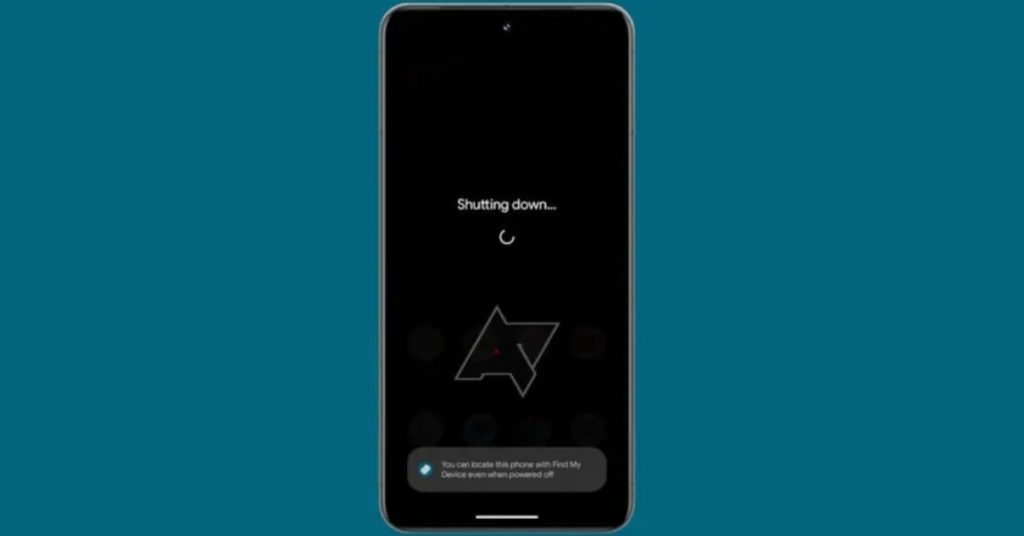
Android 15 lets you find your smartphone even when it is powered off

Finding a misplaced or lost Android phone can be a frustrating experience, particularly when the device is switched off. Google’s Find My Device system, although useful, has its limitations, especially when the device isn’t connected. With Android 15, Google aims to tackle this issue by introducing a new Powered Off Finding API.

A recent report by Android Police sheds light on how the API could assist in locating devices even when they’re switched off. Essentially, the system works by storing pre-computed Bluetooth beacons within the memory of the Bluetooth controller.

android 15 powered off finding

However, there’s a catch: specialized hardware is required for the device to power the Bluetooth controller, allowing it to function even when the phone is completely powered off. Consequently, a small reserve of battery may also be necessary for this feature to operate.

Although initial rumors suggested this feature might debut with the Pixel 9, the Android Police report now indicates that the Pixel 8 could also benefit from it upon updating to Android 15.

In addition to hardware requirements, significant software engineering efforts are necessary to support the Bluetooth Finder HAL (Hardware Abstraction Layer). Users must also ensure they’ve updated to Android 15 and have the latest version of Google’s Find My Device system.

Unfortunately, older devices such as the Pixel Fold, Pixel 7 series, and Pixel 6 series are less likely to receive this functionality. It’s unclear whether these devices lack the necessary hardware or if the limitations are purely software-based. 

However, there’s a possibility that this feature could be extended to select older devices in the future, particularly for recent high-end models like the Pixel Fold.

Related:

(Source)

OnePlus signals potential exit from India’s TV and Monitor market, removes categories from website

A report last year suggested that OnePlus might be pulling out of the smart TV market in India. It seems that might be true now, as the company has removed the TV and Displays sections from its website.

If you visit the TV section on the OnePlus India website now, you’ll be redirected to a 404 error page. There’s also no mention of the TV category on the OnePlus Store page or menu. However, the company has yet to remove its mention from the site’s footer.

OnePlus exits India TV market

OnePlus entered the smart TV market in India in 2019 with the OnePlus TV Q1 series. Since then, they’ve introduced several affordable and mid-range models. However, they haven’t launched any new TVs in India since last year. This could be because of the company’s plan to exit from the TV business.

Additionally, it seems that OnePlus might also be exiting the monitor market in India, as there are no listings for monitors on the site. They only released two products in this segment, the X 27″ and E 24″, back in December 2022, with no new launches since then.

The same report from last year also suggested that alongside OnePlus, Realme might also be leaving the Indian TV market. This decision comes as a surprise, considering their TVs were reportedly doing well in the smart TV segment.

According to a Counterpoint Research study from 2022, OnePlus was one of the fastest-growing smart TV brands that year. Despite this, it seems they’re now stepping back from the TV business in India. Xiaomi now remains one of the major smartphone brands in India that continues to sell TVs.

However, do note that there’s no official statement from OnePlus regarding its exit from the TV and Display business in India. So it’s best to wait for the company’s official decision before drawing any conclusions.

Related:

Xiaomi launches Smart Camera C500 Pro in Europe

Xiaomi has expanded its range of smart home products in Europe with the launch of the Smart Camera C500 Pro. It’s a 360-degree rotatable camera that is now available for purchase in countries like France, Spain, Germany, Italy, and the UK. So let’s delve into its details here.

Xiaomi Smart Camera C500 Pro Specifications

The Xiaomi Smart Camera C500 Pro has a 5MP camera that delivers 3K resolution footage in HDR mode for high-quality images. The camera also includes an ultra-low light mode for color footage in dim settings and an IR illuminator for clear black-and-white images in complete darkness.  

For a comprehensive view of your space, it also offers a 360° horizontal and 114° vertical pan and tilt function. But if you want some privacy, there’s a physical lens shield that can you swipe up to hide the camera. 

Additional features of the Xiaomi C500 Pro include a microphone and speaker for two-way communication, dual-band Wi-Fi support, and fully encrypted data transfers with optional cloud storage for added security.

The Smart Camera C500 Pro can be controlled via the Mi Home app. Users can also configure settings like motion detection, noise alerts, and customized monitoring zones within the app. The camera is also compatible with Amazon Alexa and Google Assistant for voice control options.

Pricing and Availability

The Xiaomi Smart Camera C500 Pro is currently priced at €69.99 in France, Spain, Germany, and Italy, and £59.99 in the UK.  There has been no announcement regarding its availability in other markets as of now.

Related:

(Via)

OnePlus Nord CE 4 variants leaked ahead of launch

On April 1, OnePlus will unveil the OnePlus Nord CE 4 smartphone in India. The device’s landing page, available on Amazon, has revealed its chipset, RAM, storage type, and color variants. With several days remaining for the launch, the rumor mill is bound to leak details about the Nord CE 4. A new leak, courtesy of tipster Mukul Sharma, has revealed the variants of the Nord CE 4.

OnePlus Nord CE 4 variants (rumored)

OnePlus-Nord-CE-4-India-Launch
OnePlus Nord CE 4

OnePlus has already confirmed that the Nord CE 4 will be equipped with LPDDR4x RAM and UFS 3.1 storage. The brand also confirmed that the device will arrive with 8 GB of RAM and 256 GB of built-in storage. This, according to the tipster, is the topmost configuration of the Nord CE 4.

Sharma revealed that the base variant of the Nord CE 4 will have 8 GB of RAM and 128 GB of built-in storage. The company has already revealed that the device will offer 8 GB of virtual RAM and feature the Snapdragon 7 Gen 3 chip. After the recently unveiled Vivo V30, the Nord CE 4 will be the second smartphone to arrive with the said chipset in the country.

For more storage, the OnePlus Nord CE 4 will offer a microSD card slot. It is officially known to arrive in two shades, such as Dark Chrome and Celadon Marble. To recall, the Nord CE 3 was announced with a starting price of Rs 26,999 in July last year in India. The Nord CE 4 is expected to arrive with similar pricing in the country.

As per reports, the Nord CE 4 could be a rebranded version of the Oppo K12, which is expected to launch soon in China. The K12’s leaked specifications include a 6.7-inch FHD+ 120Hz AMOLED display, a Snapdragon 7 Gen 3 chip, 16 GB of RAM, 512 GB of RAM, a 16-megapixel front camera, and a 50-megapixel + 8-megapixel + 2-megapixel triple camera unit.

RELATED:

(source)

Samsung Galaxy A35 and A55 displays and cameras earn praise from DxOMark

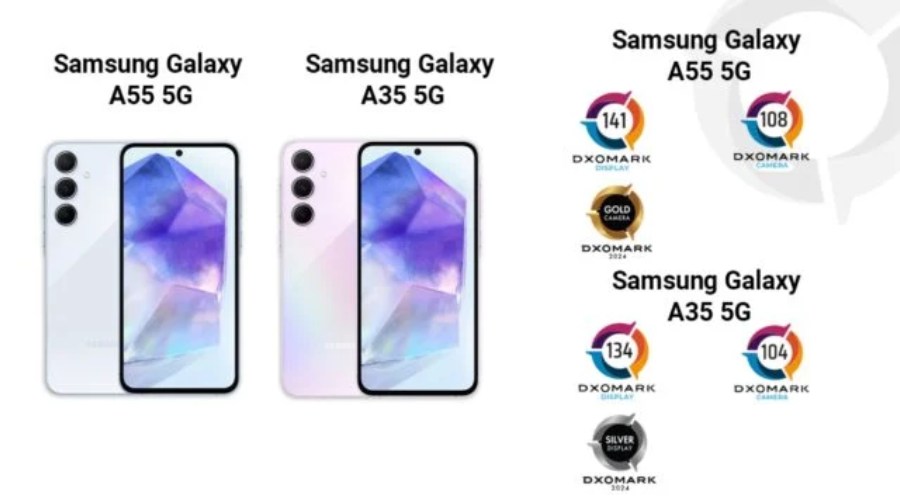
Earlier this week, Samsung launched the Galaxy A35 and A55 smartphones globally. Shortly after their launch, DxOMark, a renowned authority in camera and display assessments, gave positive reviews for both phones.

DxOMark named the Galaxy A35 and A55 as display champions in their respective price ranges. The A35 leads among phones priced below $400, while the A55 takes the top spot for devices priced at $500 or lower.

According to DxOMark’s tests, the Galaxy A35 boasts a peak brightness of 1344 nits, while the A55 achieves an impressive 1638 nits. For comparison, last year’s Samsung flagship, the Galaxy S23, reached 1600 nits in DxOMark’s evaluation. So it’s a remarkable feat for mid-range smartphones to match flagship levels of brightness.

DxOMark testers also praised the excellent color accuracy of both phones across different lighting conditions, along with their commendable performance in HDR video playback.

Furthermore, the Galaxy A35 secured the second-best camera ranking in its price category. It particularly excels in outdoor photography and video recording within its price range.

However, the Galaxy A55 ranked fifteenth in its segment for camera performance. While it performs well under standard conditions, the phone reportedly struggles with backlighting, low-light scenarios, and capturing scenes with motion.

Samsung Galaxy A35 / A55 Specifications

For a quick spec rundown on what they bring, both the Galaxy A smartphone comes with a 6.6-inch Super AMOLED display with Full HD+ resolution and 120Hz refresh rate. 

In terms of performance, the Galaxy A55 is powered by an Exynos 1480 chip and comes with up to 12GB of RAM and 256GB of internal storage. 

The Galaxy A35, on the other hand, gets its horsepower from Exynos 1380 and is coupled with up to 8GB of RAM and 256GB of internal storage. 

Camera-wise, you get a 50MP primary with OIS, 12MP ultrawide, and a 5MP shooter on the A55. While the Galaxy A35 has a 50-megapixel main sensor that is paired with an 8-megapixel ultra wide-angle shooter, and a 5-megapixel macro camera.

Both of them are powered by a 5000mAh battery that supports 25W wired charging.

Related:

(Via)

Redmi Note 13 Turbo / Poco F6 may feature the new Snapdragon 8s Gen 3 chip

Redmi is reportedly working on a new Note 13-series phone for the Chinese market. So far, the brand has launched multiple Note 13-series phones, such as the Redmi Note 13 5G, Note 13 Pro 5G, Redmi Note 13 Pro+ 5G, Redmi Note 13R, and Redmi Note 13R Pro. The upcoming Redmi Note 13 Turbo will be the most powerful phone in the series, as it is now tipped to feature the Snapdragon 8-series chipset.

Redmi Note 13 Turbo chipset tipped

Redmi unveiled the Redmi Note 12 Turbo with the Snapdragon 7+ Gen 2 chipset in March 2023 in China. A rebranded version of the phone, named the Poco F5, was announced for the global market in May 2023. Reports suggest that the upcoming Redmi Note 13 Turbo, which will be a China-exclusive phone, will be repackaged as the Poco F6 in the global market.

Qualcomm is expected to announce the Snapdragon 7+ Gen 3 on March 18 in China. The US-based chip maker is also expected to unveil the Snapdragon 8s Gen 3, which is said to be an underclocked version of the Snapdragon 8 Gen 3 (tentative name), in the coming days.

Redmi Note 13 Turbo chipset

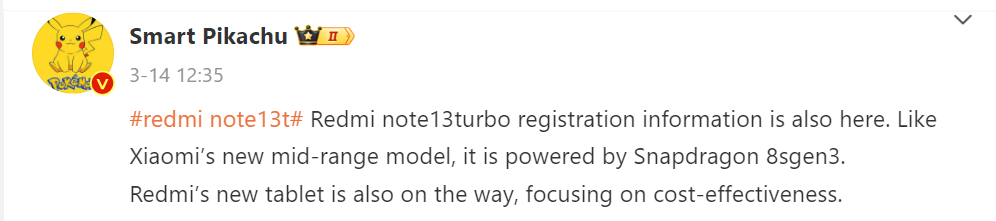
Initial reports suggested that the Note 13 Turbo might use the Snapdragon 7+ Gen 3 since the Note 12 Turbo used the Snapdragon 7+ Gen 2. However, the Snapdragon 8s Gen 3 chip will power the Note 13 Turbo, according to a leak by tipster Smart Pikachu. As can be seen in the image, the leaker has also claimed that Redmi’s new tablet is also coming soon. It remains to be seen whether the Note 13 Turbo and the new tablet break cover together in April.

Now that the Note 13 Turbo is said to arrive with the Snapdragon 8s Gen 3, the Poco F6, being its rebranded version, may feature the same chip. Probably, it may debut in April or May on the global market.

In the Chinese market, the Redmi Note 13 Turbo will rival other Snapdragon 8s Gen 3 phones, such as the iQOO Z9 Turbo and the Realme GT Neo 6.

RELATED:

Realme GT Neo 6 with Snapdragon 8s Gen 3 spotted on AnTuTu, launch could be imminent

Realme recently confirmed that it will unveil the Realme GT Neo 6 SE soon in the Chinese market. The brand has also revealed that the device will come equipped with the Snapdragon 7+ Gen 3. According to reports, apart from the SE model, the company also plans to launch the Realme GT Neo 6 with a new Snapdragon 8-series chip onboard. In February, a Realme device with model number RMX3851 was spotted on Geekbench with the new chip. Now, the same device has appeared on AnTuTu, indicating that its launch could be drawing near.

Realme GT Neo 6 AnTuTu listing

Realme GT Neo 6 AnTuTu listing

Realme announced the Realme GT 5 Pro with the Snapdragon 8 Gen 3 in December 2023. Before its official announcement, the device was spotted on AnTuTu with an impressive score of 2.2 million. As can be seen in the screenshot above, the Realme GT Neo 6 with the Snapdragon 8s Gen 3 (tentative name) onboard has scored 1,846,775 points on AnTuTu.

Reports surrounding the Snapdragon 8s Gen 3 claim that it will be an underclocked version of the Snapdragon 8 Gen 3. According to reports, the S8sG3 will include a prime CPU core clocking at 3.01GHz, 3 x Cortex-A720 operating at 2.61GHz, and three Cortex-A520 running at 1.84GHz. It is expected to feature Adreno 735 graphics.

As far as the specs of the Realme GT Neo 6 are concerned, it is expected to arrive with an OLED panel that offers a 1.5K resolution and a 144Hz refresh rate. The device is expected to ship with up to 24 GB of RAM and up to 1 TB of storage. It is also expected to feature a 50-megapixel main camera with OIS support and offer 100W charging.

Apart from China, the Realme GT Neo 6 is expected to release in multiple markets. The reason behind this is that the device was recently approved by certification platforms, such as Europe’s EEC, India’s BIS, and Indonesia’s TKDN.

In China, the Realme GT Neo 6 is expected to face competition from rumored Snapdragon 8s Gen 3 phones, such as the iQOO Z9 Turbo and the Redmi Note 13 Turbo.

RELATEFD:

(via)

OnePlus Buds V up for Pre-order in China, could be a rebranded Oppo Enco Buds 2 Pro

OnePlus is preparing to launch the OnePlus Ace V3 smartphone in China. The phone is said to debut next week and will be the first device to be powered by the Snapdragon 7+ Gen 3 SoC. Alongside the new phone, it looks like the brand will also be unveiling a new pair of earbuds in its domestic market called the OnePlus Buds V.

Oppo Enco Buds 2 Pro

These new earbuds are already available for pre-order in China, with a silhouette that teases their design. From the looks of it, they are likely a rebrand of the Oppo Enco Buds 2 Pro, which debuted in Malaysia back in January. You can check out the features of the Oppo Enco Buds 2 Pro to get an idea of what to expect from the OnePlus Buds V.

Oppo Enco Buds 2 Pro specs:

The Enco Buds 2 Pro earbuds have a sleek semi-in-ear design with angled silicone tips and a stem, along with an IP55 dust and water resistance rating.

For sound quality, they feature a 12.4mm dynamic driver, Dolby Atmos, and Dirac Audio Tuner. They come with dual microphones and AI algorithms that help reduce background noise during calls, with a low-latency mode of 94ms for gaming. They support Bluetooth 5.3 for connecting to two devices simultaneously. Battery life is solid, offering up to 38 hours of use with the charging case, and 8 hours per earbud on a single charge.

RELATED:

(Source)