Advertisement

Sony’s PlayStation 5 Pro Specs leaked, might be more focused on GPU than CPU

After introducing the PlayStation 5 in late 2020, people have been discussing the possibility of an upgraded version called the PlayStation 5 Pro. Rumors suggest that this upgraded console might become available around the end of 2024. Some recent reports have shared a few details about the potential specifications of Sony‘s PlayStation 5 Pro.

Sony PlayStation 5
Sony PlayStation 5

In a new video from RedGamingTech, they mentioned that the PS5 Pro could continue using the AMD Ryzen Zen 2-based APU. The report suggests that the Zen 2-based CPU has 8 cores and 16 threads, which is the same as the regular PS5. RedGamingTech isn’t sure why Sony chose Zen 2 instead of AMD Ryzen Zen 4.  However, leaks indicated that the CPU clock speed would be bumped up to 4 GHz, which might be enough to reach the desired FPS target. This also means that this time around, the Pro model will be heavily focused on the GPU.

Furthermore, the PS5 Pro could arrive with an increased ROP (Render Output Unit), thanks to 30 active workgroup processors (60 compute units). For those unaware, the base model of PS5 has 64 ROPs present in the system, and the Pro version might arrive with 64, 96, and 128 ROPs. In general, it means more graphic performance is coming to the PS5 Pro. Lastly, the device is said to come with 16GB of GDDR5 memory.

These specifications are based on the leaks, and in the future, Sony might make a few modifications to the specs. So, stay tuned for more news on PlayStation 5 Pro.

RELATED:

(Via)

Samsung Galaxy S24 Ultra’s concept renders reveal thicker bezels compared to competitors

Samsung is gearing up to launch Galaxy S24 Ultra near the first quarter of 2024. As the launch draws near, numerous leaks and reports have surfaced online. In a recent report by ICE UNIVERSE, it is said that the Galaxy S24 Ultra will feature a flat screen. Consequently, holding it in hand might be more uncomfortable compared to curved-screen smartphones.

Galaxy S24 Ultra updated renders

According to earlier reports, the device’s dimensions are stated to be 162.3 x 79 x 8.6mm. ICE UNIVERSE has indicated that the width of 79mm for the S24 Ultra is accurate, and this measurement was obtained from the screen details. The leaker is worried about the phone’s design, describing it as unfriendly to users because it might be less comfortable to hold in one hand.

Aside from being uncomfortable to hold, the tipster also pointed out that the Galaxy S24 Ultra will have thicker bezels compared to its competitors like the iPhone 15 Ultra and Xiaomi 14 via renders based on leaks and rumors. This might be a turn-off for many customers as we expect flagship devices to have razor-thin bezels.

However, we should wait for more reports to decide whether the Galaxy S24 Ultra will share the same design and pattern as mentioned by the tipster. For those wondering what this device has to offer, the specs about the phone can be found below.

Galaxy S24 Ultra Key Specs

The device is rumored to feature an OLED display powered by the upcoming Snapdragon 8 Gen 3 or the Exynos 2400 SoC. A report also suggests that the Exynos 2400 processor is said to arrive in European and Southeast Asian regions. In contrast, the Snapdragon 8 Gen 3 will be offered in American markets. About the rear camera, the phone is speculated to come with 200MP (main, with OIS), 12MP (Ultra-wide), 10MP (telephoto), And 50MP (periscope). Lastly, the device will be equipped with a 5000mAh battery with 45W charging support.

RELATED:

Qualcomm’s custom Oryon Cores could delay Snapdragon 8cx Gen 4 launch

Qualcomm and MediaTek are both eager to compete with Apple’s M-series processors. Qualcomm, which has been in this field for longer and is more ambitious, announced its Oryon processor in 2022 as a competitor to Apple’s silicon. However, developing in-house cores is more difficult than it seems. Although Qualcomm dominates the 5G baseband market, it is rumored to be having problems developing its own Oryon cores, which could delay the launch of the Snapdragon 8cx Gen 4.

Qualcomm Oryon Cores Delay

Snapdragon 8cx Gen 4 may face delay

Qualcomm’s Snapdragon 8cx Gen 4 is said to be available in three configurations. The most capable configuration will have a 12-core CPU, with eight performance cores and four power-efficiency cores. However, tipster @Tech_Reve says that Qualcomm is reportedly having problems developing the in-house cores for this chip. The tweet does not provide any details about the problems though.

This is not surprising, as other companies have also struggled to develop in-house cores. Samsung tried to compete with Apple’s M-series chips with its own Mongoose cores, but it eventually gave up and went back to using ARM designs. Google has also delayed its own custom chip by a year, and other companies like Xiaomi and OPPO have abandoned development altogether.

An early engineering sample of the chip suffered from performance issues in Geekbench 5, and there have been no follow-up results since then. This suggests that Qualcomm has been unable to fix the problems.

The Snapdragon 8cx Gen 4 was originally scheduled to launch in 2023, but it may now be delayed until 2024. This is because Qualcomm may want to wait until after Apple releases its M3 chip. If Qualcomm sticks to its original launch timeline, it will be significantly behind Apple’s M1 and M2 chips.

Hopefully, Qualcomm will be able to iron out the problems with the Snapdragon 8cx Gen 4 before it launches. Otherwise, it could be a disappointment for the ARM-powered notebook space.

Related:

(Via)

Realme GT 5’s primary camera, connectivity features officially confirmed

Realme will unveil the Realme GT 5 on Aug. 28 in China. Ahead of the launch, the company has been confirming some of the key features of the GT 5. Here is a look at all the details that the brand has confirmed.

Realme GT 5 to feature 50MP main camera

Today, the brand confirmed that the Realme GT 5 will be equipped with an OIS-enabled 50-megapixel Sony IMX890 primary camera. Although the manufacturer has not yet confirmed the specifications of the GT 5’s additional cameras, it appears that a 2-megapixel macro camera and an 8-megapixel ultra-wide lens will join the IMX890.

Realme has confirmed that the Realme GT 5 will come with support for Wi-Fi 7 connectivity. The device will feature independent antennas for Wi-Fi and Bluetooth to prevent cross-interference. Additionally, in-house Wi-Fi 7 enhancements will lead to a reduction of 20ms in average game latency compared to its predecessor. Furthermore, there will be a 50 percent surge in throughput for weak signals.

The company has also confirmed that the Realme GT 5 will support the advanced triple-frequency GPS positioning system. It combines three GPS frequencies, namely L1, L2, and L5, along with a four-frequency Beidou configuration comprising B1I, B1C, B2a, and B2b signals. This intricate setup allows for unparalleled accuracy in navigation, even down to specific lanes.

As far as other specs are concerned, the Realme GT 5 will arrive with a 6.7-inch OLED FHD+ 144Hz refresh rate, a Snapdragon 8 Gen 2 chip, up to 24 GB of LPDDR5x RAM, up to 1 TB of UFS 4.0 storage, Realme UI 4.0-based Android 13, and a rear-facing RGB light unit. It will come in two variants: a 4,600mAh battery with 240W charging and a 5,240mAh battery with 150W fast charging.

RELATED:

Samsung Galaxy Z Fold 5 teardown reveals new shock dispersion layer

The Samsung Galaxy Z Fold 5 is the company’s newest foldable phone, and it’s one of the best on the market. Samsung says that both the Galaxy Z Fold 5 and Z Flip 5 meet durability expectations. They have Armor Aluminum frames, Corning Gorilla Glass Victus 2 protection for the cover screens and back panels, and an IPX8 rating for water resistance.

In addition, Samsung has added an extra layer to the phone’s foldable displays that is said to offer improved shock dispersion. Zack Nelson aka JerryRigEverything, a popular YouTuber who tears down phones, has taken the Samsung Galaxy Z Fold 5 apart and shown the company’s new shock dispersion layer.

Taking apart a foldable phone is difficult, as shown in JerryRigEverything’s video (linked above). After heating up the corners of the inner displays and removing the plastic bumper, Nelson found it difficult to remove the display from the frame without damaging it. 

Regardless, Nelson was able to remove the screen, revealing Samsung’s new shock dispersion layer. It appears to be a piece of black foam with circular cutouts. It is hard to understand how this works or if it will actually improve the phone’s durability. We may have to wait for a drop-test video to see how effective it is.

Nelson admitted that it is now obvious why Samsung does not talk much about the shock dispersion layer because it is not very exciting. Moreover, the hinge is another more talked-about upgrade this year, and JerryRigEverything found that it has a lot of moving parts.

Samsung explained in a video that the hinge has a dual rail structure that helps to diffuse external impacts. This is evident from the sheer number of screws, springs, and other small components that make up the three-part hinge. One of the main complaints about Samsung’s previous foldable phones was the hinge gap. Fortunately, the company’s engineers have made progress on this front and the phone can finally lay flat when it folded.

Related:

Redmi K70 Pro could be equipped with metal frame, telephoto camera with 3x zoom

Redmi is reportedly planning to launch the Redmi K70e, Redmi K70, and Redmi K70 Pro by the end of this year. These devices are said to be equipped with the Dimensity 8300, Snapdragon 8 Gen 2, and Snapdragon 8 Gen 3 chipsets, respectively. In a recent Weibo post, tipster Digital Chat Station revealed (via. TechGoing) a few new details about the K70.

Redmi K70 Pro could be first K-series phone with telephoto camera

Redmi K60 Pro
Redmi K60 Pro

It can be said based on DCS’ Weibo post that the Redmi K70 Pro will be almost a premium device featuring a metallic middle frame, promising better durability than its predecessor. The leak also suggests that the K70 Pro could be the first-ever Redmi K-series phone to feature a telephoto camera. It seems that the telephoto snapper supports 3x optical zoom.

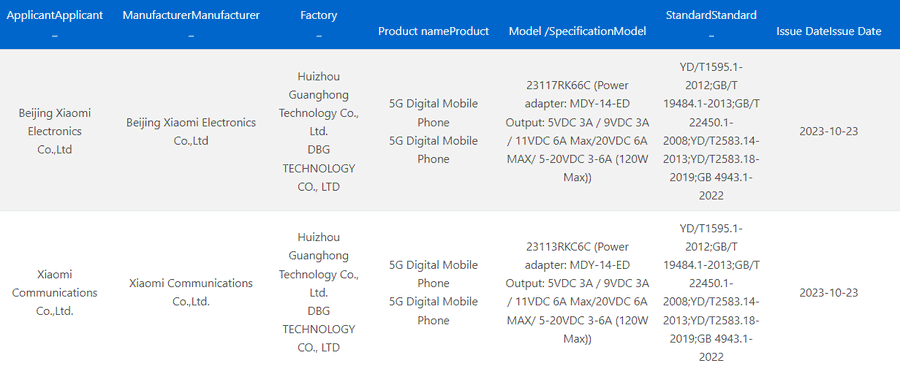
Reports have claimed that the 23117RK66C, 2311DRK48C, and 23113RKC6C model names belong to the Redmi K70e, K70, and K70 Pro, respectively. DCS previously claimed that the K70 Pro (23113RKC6C) will have the upcoming Snapdragon 8 Gen 3 onboard, but its recent Geekbench listing revealed that it has a Dimensity 9200+ chip.

Commenting on the tipster, Kacper Skrzypek said that the listing has a minor issue. On Geekbench, the 23113RKC6C Redmi phone is labelled “Corot,” a designation already associated with the Redmi K60 Ultra (23078RKD5C). The tipster claims that the device’s model has likely been faked, as there is no indication of a newer model within the ROM. This doesn’t necessarily rule out the launch of 23113RKC6C, but he is skeptical that the 23113RKC6C device is truly “Corot.”

As per other reports, the Redmi K70 Pro will have a flat display that offers a 2K resolution and possibly a 120Hz refresh rate. Under the hood, it may feature the Snapdragon 8 Gen 3 chip, up to 24 GB of LPDDR5x RAM, 1 TB of UFS 4.0 storage, and a 5,120mAh battery with 120W fast charging. It may come with MIUI 14-based Android 13 and an in-screen fingerprint scanner. The K70 Pro may get rebranded as the Poco F6 Pro in the global market.

RELATED:

(via)

Zenfone 10 could be last generation as Asus’ continues its organizational restructuring

Asus, a prominent name in the world of PCs and smartphones, has raised eyebrows with its unexpected organizational restructuring. Despite promising no job cuts, the company has proceeded to reduce its workforce in different departments. This has led to confusion and speculation about the company’s strategic motives, its consequences for employees, and its trajectory. The report also states that the Taiwanese company has decided to axe its Zenfone series of smartphones.

Asus’ organizational restructuring results in layoffs

Asus logo
\

In June, Asus released an internal letter to its employees announcing an upcoming organizational restructuring. Despite assuring its employees that there would be no job loss, it reportedly reduced its workforce in the PC department in July. This affected employees in both Taiwan and Suzhou, China. However, the company’s downsizing efforts have not ceased with this move.

Recently, an individual with knowledge of the situation revealed that several units within the commercial department were informed that a significant reduction would occur, affecting teams such as engineers and procurement, resulting in a 50% workforce reduction.

Initially, Asus had communicated plans for the commercial computer team to transition to the mobile phone product department. Nonetheless, individuals familiar with the matter highlighted that some employees who had recently been integrated into the mobile phone unit were still subjected to layoffs.

The company had indicated that it would attempt to internally place affected employees in vacant positions. However, the report states that the HR department is not actively pursuing this and instead expects employees to find suitable internal openings on their own.

ASUS Zenfone 10
ASUS Zenfone 10

The reasons behind the layoff of employees who were integrated into the mobile phone unit only to be later laid off were also brought to light by an insider. As it is known, Asus’ mobile phones are categorized into the ROG and Zenfone series. However, the latest Zenfone 10 model is projected to be the last generation in this series. Consequently, the Zenfone team will either be integrated into other departments or directly merged into the ROG team in the future. It is expected that the current round of layoffs in Asus’ commercial department will continue until next month.

RELATED:

(source)

Xiaomi Router AX3000T with Wi-Fi 6 support launched in China for 189 yuan ($26)

Xiaomi unveiled its latest router, the AX3000T, priced at an introductory 189 yuan ($26), before eventually retailing at 249 yuan ($34).

Xiaomi Router AX3000T key features:

The router promises superior performance by supporting the next-gen Wi-Fi 6, delivering remarkable wireless speeds of up to 3000 gigabits. Specifically, when leveraging both 2.4GHz and 5GHz frequencies, the speeds can peak at 2976Mbps.

The AX3000T router offers a notable “2+1” 5GHz antenna setup with Xtra Range technology. This design enhances signal strength, similar to having an additional antenna. It effectively overcomes issues like weak 5G signals through walls and eliminates dead zones within homes.

The AX3000T router is equipped with the advanced MediaTek Filogic 820 platform, featuring a 1.3GHz dual-core A53 processor. This powerful hardware enables smooth performance, lower CPU usage, and stable connectivity for up to 128 devices, making it suitable for tech-heavy households. Additionally, the router includes 256MB RAM to enhance its overall performance.

The AX3000T router features four full-gigabit Ethernet ports that support dual WAN and LAN port aggregation. This is useful for households with multiple broadband connections. When combined with a dual-gigabit Ethernet-compatible NAS, users can create a high-speed 2-gigabit private cloud drive.

The router also offers the mixed Mesh networking feature for Xiaomi/Redmi WiFi 6 routers, which can handle up to 10 devices. It ensures a seamless, millisecond-level transition between devices.

Additionally, the AX3000T has built-in security measures, such as automatic interception of unauthorized internet access and app/website access restrictions. NFC quick connect, IPTV network television and multi-platform gaming acceleration are among its other key offerings.

As per Xiaomi’s official Weibo announcement, pre-orders for the AX3000T have started and it’s available on platforms including Xiaomi Mall, Xiaomi Youpin, JD.com, Tmall, and Pinduoduo.

RELATED:

Oppo Find N3 Flip Roundup: Everything from Specs, Design to Expected Pricing

Oppo makes stalwart foldables but almost none of them make it out of China. The one device that did step into the global market was Oppo Find N2 Flip. The Galaxy Z Flip 4 rival debuted with a neat design and durable hinge. It also had a large cover screen that lets you do a lot without opening the phone.

Oppo is now ready to bring the Find N3 Flip to China on August 29, and hopefully, it will also make its global debut sometime later this year. The new foldable gets some design changes and upgraded specifications, which could make it a worthy Samsung Galaxy Z Flip 5 competitor. Read this roundup to find out what’s new in Oppo’s newest foldable.  

Design and Display

Oppo Find N2 Flip (review) was the company’s first attempt at making a clamshell foldable and it nailed it (almost). The sleek design of the smartphone made it appealing and the large cover screen gave it an edge over other alternatives in the market. Unlike the Galaxy Z Flip 4, the Find N2 Flip folds perfectly flat, leaving no gap in its fold.

The upcoming Find N3 Flip doesn’t look the same as its predecessor but it’s also not very different. The handset retains the rectangular cover screen on the side but gets a new circular camera module. The new module features three camera sensors and there is also a Hasselblad branding. Notably, Find N3 Flip is not going with a larger cover screen like some of its competitors. Samsung’s Galaxy Z Flip 5 has a larger outer display that covers the entire half of the phone, while Motorola’s Razr 40 Ultra has a wider cover screen that takes up more of the front of the phone.

So far, we don’t know if the Find N3 Flip will have any changes to its hinge. The Find N2 Flip has a new Generation Flexion Hinge, which is a version of the Find N2’s hinge that has been adapted for the smaller phone. It’s been rated for 216,000 actuations and can hold the phone in place at any angle between 45 and 110 degrees. This allows for some interesting use cases with the camera, such as tripod mode, waist-level shooting, and even camcorder mode.

The display specifications of the smartphone are anyone’s guess at the moment. It should be similar to the Find N2 Flip, which has a 6.8-inch AMOLED screen bearing an FHD+ resolution, an adaptive refresh rate of 120Hz, 1,600 nits peak brightness, and HDR support. The phone has a large 3.26-inch secondary AMOLED display with a 60Hz refresh rate and a resolution of 720 x 382 pixels.

Other Specifications

The upcoming flip phone will come equipped with the MediaTek Dimensity 9200 SoC, paired with 16GB of RAM. The device is also expected to feature a larger 4,800mAh battery compared to its predecessor’s 4,300mAh battery. It will also support 67W fast charging, as confirmed by a 3C certification.

oppo_find_n3_flip

The Find N3 Flip boasts a triple camera setup, with rumors suggesting a 50-megapixel primary sensor with Optical Image Stabilization (OIS) as the star attraction. While details about the other sensors remain undisclosed, Oppo has confirmed that the flip phone will be the first in the series to include a portrait camera lens. The company has also shared some camera samples, although they appear to be edited and may not accurately represent the actual camera quality.

Expected Pricing

Similar to many other specifications of the phone, its pricing remains undisclosed as of now. It is expected to be priced in line with the Find N2 Flip. For reference, the Find N2 Flip is priced at Rs. 89,999 in India for the 8GB RAM + 256GB storage variant, which roughly converts to $1,175 USD. The phone is offered in three color options: Black, Gold, and Purple.

RELATED:

Get $100 OFF on Xiaomi Mix Fold 3 Premium Foldable smartphone (Coupon)

Giztop is giving a $100 discount on the Xiaomi Mix Fold 3 Premium Foldable smartphone. You can get $100 OFF on this phone by using the coupon code: MF3100. Please note that the coupon expires on August 31.

WHERE TO BUY
Xiaomi Mix Fold 3 at $1499 @Giztop

Xiaomi Mix Fold 3, is a cutting-edge smartphone with a dual-screen design that presents a 6.56-inch external Flexible AMOLED screen with a 120Hz display frame rate, complemented by a stunning 8.03-inch 2K+ UltraVision Display internally, boasting a 120Hz frame rate as well.

The Mix Fold 3 features a professional Original Color Screen with a DCI-P3 color gamut and a remarkable 8,000,000:1 contrast ratio, ensuring captivating visuals. HDR10+ and Dolby Vision support further enhance the display, offering unparalleled brightness up to 2600nit even under direct sunlight.

Powered by the Qualcomm Snapdragon 8 Gen 2 Processor, this smartphone excels with its octa-core processing unit reaching 3.36 GHz. Paired with up to 16GB of LPDDR5X RAM and up to 1TB of UFS 4.0 storage, the device effortlessly handles tasks and stores your data securely.

Capture exceptional moments with the 50MP Sony IMX800 primary camera featuring OIS and large pixel output. The triple-camera setup includes a 10MP telephoto ultra-wide snapper and a telephoto camera with 5x optical zoom. The cover display accommodates a 20MP front camera for high-quality selfies.

Equipped with a dual-battery design totaling 4800mAh, the Mix Fold 3 supports 67W fast wired charging, Quick Charge 4+, and Power Delivery 3.0, ensuring rapid recharges. The inclusion of WiFi 7, WiFi 6 Plus, and multi-function NFC provides advanced connectivity options.

Noteworthy features include the side-mounted fingerprint reader for quick and secure unlocking, a butterfly-type cooling system combining VC liquid cooling, thermal gel, and graphite sheets to manage heat efficiently, and Harman Kardon tuned quad speakers delivering immersive audio experiences.

The Xiaomi Mix Fold 3 embodies innovation and performance in every aspect, from its powerful processor to its dual-display system. Experience the future of mobile technology and enjoy a host of advanced features in one remarkable device.

Sony Xperia 5 V NA variant visits Geekbench with Snapdragon 8 Gen 2 SoC

Sony has announced that the Xperia 5 V smartphone will be launching in Japan on September 1. The device is also expected to arrive in markets outside of Japan. Now, the North American variant of the device has been spotted on Geekbench revealing its performance along with some key specs.

Sony Xperia 5 V Geekbench

According to Geekbench test results, the Xperia 5 V (XQ-DE54) will feature a Snapdragon 8 Gen 2 processor with a 2.02GHz base clock and a 3.19GHz boost clock. The variant spotted on Geekbench has 8GB of RAM, and features an Android 13-based operating system. In performance tests, it achieved scores of 1,453 in the single-core test and 4,556 in the multi-core test. The listing does not reveal any further information.

That being said, the recently leaked video teaser does reveal a bunch of details about the smartphone. Like the fact that the device will have a boxy design and a pill-shaped camera module. There will be two sensors on the back with Zeiss T* coated lenses.

The device is also expected to feature a 3.5mm audio jack and a side-mounted fingerprint sensor. The handset will offer 33W fast charging support as per the 3C certification listing. Rumors also say that we can expect up to 16GB RAM onboard the smartphone. More details will be revealed at the September 1 launch event, so stay tuned.

RELATED:

(via)

Lenovo Tab P12 with Dimensity 7050 will be available in India from September 5

Last month, Lenovo introduced the new Tab P12 tablet for the EU. Now, a new Flipkart poster has revealed that the tablet is coming to India next month.

As per a report by TheTechOutlook, a new Lenovo Tab P12 has been spotted on Flipkart. The poster mentions that the sale of this tablet will start at 12 PM on September 5.

Pricing of the tablet is yet to be announced, however, it starts at €399 in the EU. You can check out the specs of the tablet below.

Lenovo Tab P12 specs

The Lenovo Tab P12 features a sizable 12.7-inch LTPS LCD display with a resolution of 2944 x 1840. It has a 60Hz refresh rate and a pixel density of 273ppi. It has Quad JBL speakers. On the camera side, it boasts a 13MP front-facing camera with an RGB sensor and a wide field of view. The rear setup includes an 8MP autofocus camera with an LED Flash.

Lenovo

Under the hood, the tablet is powered by the MediaTek Dimensity 7050 processor, paired with an Android 13-based operating system. The Tab P12 will receive two years of OS updates and four years of security patches. It comes in two memory variants: 4GB RAM with 128GB storage and 8GB RAM with options for either 128GB or 256GB storage. The tablet supports expandable storage through a MicroSD card slot.

Lenovo Tab P12

The tablet incorporates various sensors, including an accelerometer G sensor, RGB sensor, gyroscope, E-compass, and a hall sensor. For added security, a fingerprint sensor is integrated into the power button. Connectivity options include Wi-Fi 6, dual-band Wi-Fi, and Bluetooth v5.1. It features a USB Type-C 2.0 port. With a robust 10200mAh battery, the device offers up to 10 hours of video playback. It will come in two elegant colors: Storm Grey and Oat.

RELATED:

(Source)

Huawei Darren Smart Desk Lamp 3 Pro with 96 lamp beads launched for 329 yuan ($45)

Huawei and Darren have teamed up to release a smart desk lamp, named Huawei Smart Selection Darren Smart Desk Lamp 3 Pro. This lamp is now up for public testing on Huawei’s online store. Initially priced at 429 yuan ($58), it’s now on offer for 329 yuan ($45) during testing.

Huawei Smart Selection Darre Smart Desk Lamp 3 Pro key features:

The smart lamp showcases a minimalist design, measuring approximately 210 x 480 x 250mm, suitable for diverse home settings. Crafted from eco-friendly ABS material, it adheres to environmental standards.

The lamp incorporates patented spring pivot joints, facilitating adjustments of up to 60° forward/backward, 160° upward/downward, and 170° left/right for the lamp head. This adaptability accommodates personalized lighting angles according to height and posture. Foldable for compact storage, it optimizes space utilization.

The lamp’s robust base ensures secure placement on any surface. Its touch-sensitive panel presents buttons for power, reading modes, screen reading, light formulas, and night light, accompanied by a brightness adjustment slider. This interface allows various operations including light control, dimming, night light activation, and network setup through short presses, long presses, and swipes.

The standout feature of this desk lamp is its third-generation SSDT Stereoscopic Light. Unlike earlier versions, this uses 96 lamp beads for side emission. As a result, it increases light coverage by 100%, cuts down shadowy areas by half, and boosts uniformity by 1.2 times. This technology allows it to provide even lighting for desks as long as 1.2 meters.

This smart lamp also introduces “Smart Eye Management.” Users can set rest reminders and even get reports on their lighting usage, helping them monitor their eye health. An added benefit is its intelligent photosensitivity. This means the lamp can detect changes in room lighting and adjust its brightness accordingly.

It supports instant smartphone connectivity and integration with other smart home devices. The lamp offers interactive touch controls and one-touch smart connection, but this function is exclusively available on smartphones equipped with HarmonyOS 2.0.0 and later versions.

RELATED:

(Via)

New iQOO Z8 and Z8x leak reveals complete specifications

iQOO is set to launch several new smartphones this month. The brand is gearing up for the release of the iQOO Z7 Pro in India on August 31st. On the same day, in China, the Vivo sub-brand will introduce the iQOO Z8 and iQOO Z8x. These two new mid-range phones are expected to offer good performance for their respective price points. While we await their launch, a tipster has shared the complete specifications for these devices. Here are the details.

Tipster Ishan Agarwal has shared the complete specifications of the upcoming iQOO Z8 and iQOO Z8x on X (formerly Twitter). The iQOO Z8 features a 6.64-inch LCD display with a 120Hz refresh rate. It will feature a dual camera setup on the rear, headlined by a 64MP main camera with image stabilization and a 2MP portrait camera. There’s also a 16MP front camera for selfies and video calls. Inside, the iQOO Z8 is equipped with a Mediatek Dimensity 8200 chipset for fast performance.

iQOO Z8

You can choose between models with up to 12GB of RAM and 512GB of storage, which is expandable to a massive 1TB via MicroSD card. The phone runs on a 5,000mAh battery and supports incredibly fast 120W charging.

The iQOO Z8x shares many of the same features, such as the 6.64-inch 120Hz LCD display and a 2MP portrait camera. However, it uses a Snapdragon 6 Gen 1 chipset and offers up to 12GB of LPDDR4X RAM with 256GB of UFS 2.2 storage, also expandable to 1TB. This phone has a larger 6,000mAh battery but supports only 44W charging

Both phones include a 3.5mm headphone jack, a side fingerprint sensor, NFC, and IR control. It operates on OriginOS 3.0 based on Android 13.


RELATED:

(Source)

Redmi K70 Pro Spotted On Geekbench Revealing Processor, RAM Details

Xiaomi sub-brand Redmi is expected to launch the Redmi K70 series later this year. The lineup will arrive as the successor to the Redmi K60 series that debuted last December. The Redmi K70 series phones have started doing the rounds on the rumor mill since last month. Now the Pro variant in the lineup has appeared on the Geekbench benchmarking platform revealing its core specifications. 

Redmi K70 Pro spotted on Geekbench

The Redmi K70 Pro has been listed on the Geekbench database with the model number 23113RKC6C. This is the same model number that had also been spotted on the IMEI database in June along with two more K70-series devices. 

The benchmarking platform mentions the motherboard codenamed Corot on the K70 Pro and it comprises of four cores clocked at 2GHz, three cores at 3GHz, and one primary core ticking at 3.35GHz. This corresponds to the MediaTek Dimensity 9200+. The Geekbench listing reveals 16GB RAM onboard. It will run on Android 13 OS out of the box. 

In the Geekbench’s single-core and multi-core tests results, the Redmi K70 Pro scored 1,882 and 4,536 points respectively. The listing does not reveal any additional details of the upcoming smartphone. 

Previously, reliable tipster Digital Chat Station revealed the key specifications of the Redmi K70 Pro. As per him, the device is supposed to be powered by the upcoming Snapdragon 8 Gen 3, however, the Geekbench listing contradicts it. The smartphone is tipped to be backed by a 5,120mAh battery unit with support for 120W fast charging. Additionally, it is said to feature a flat display bearing a 2K resolution and 120Hz refresh rate.  

Related:

Via

OnePlus 12, Realme GT 5 Pro tipped to offer dust, water-resistance at 4K yuan ($550)

By the year’s end, OnePlus is gearing up to unveil the OnePlus 12, whereas Realme is poised to release the Realme GT 5 in China on August 28. The Pro variant of the latter is anticipated to debut later this year or in early 2024. Recent insights from the Digital Chat Station on Weibo have shed light on the specifications of these phones.

OnePlus 12 and Realme GT 5 Pro key specs tipped

DCS OnePlus 12 Realme GT 5 Pro specs leak

According to DCS, both the OnePlus 12 and Realme GT 5 Pro are targeting the 4k yuan ($550) price segment. They’re likely to share several attributes, including a 2K display, an OV64B periscope camera, a metal frame in the middle, 50W wireless charging, and a dust and water-resistant body. However, the exact level of water and dust resistance, marked by the IP rating, remains uncertain.

Earlier information from the same source indicated similar specifications for the two phones. However, the OnePlus 12 seems to stand out in a few areas: better heat management, camera enhancements in partnership with Hasselblad, and some unique custom features. In terms of appearance, both phones will have distinct rear designs.

The OnePlus 12 is speculated to have a curved AMOLED screen, boasting a 2K resolution, coupled with ultra-high frequency dimming. It’s expected to run on the Snapdragon 8 Gen 3 chipset, paired with up to 24GB LPDDR5x RAM and up to 1TB UFS 4.0 storage.

OnePlus 12

The phone should have a 5,400mAh battery, offering 100W wired and 50W wireless charging. Camera-wise, it might come with a 50MP main Sony IMX9-series sensor with OIS, complemented by an ultra-wide lens and a 64MP OmniVision OV64B periscope camera with 3x zoom.

On the other hand, the Realme GT 5 Pro, while maintaining similarities in display, processor, memory, storage, and battery to the OnePlus 12, will also offer its unique design and camera setup.

It’s also noteworthy that from the following year, both OnePlus and Realme are planning to rely solely on Snapdragon chipsets for their devices. OnePlus 12 global launch is expected to happen in January next year.

RELATED:

(Via)

Realme Buds Air 5 early bird sale is live in India, Check details

Earlier this week, Realme launched the Buds Air 5 series earbuds along with the Realme 11 5G & 11x 5G smartphone in India. Starting today, the Realme Buds Air 5 is available to purchase in the country, and currently, the brand is offering it at early bird pricing.

Realme Buds Air 5

Realme Buds Air 5 price & availability

The Realme Buds Air 5 has a price tag of Rs 3,699 in India. However, it is currently selling for an early-bird price of Rs. 3,699. This sale will last till midnight. Interested readers can buy the earbuds from Flipkart and Realme’s website.

Realme Buds Air 5 specs

The Realme Buds Air 5 earbuds offer 50dB active noise cancellation, a 12.4mm titanized driver for powerful sound, Bluetooth 5.3 for strong wireless connections, AAC and SBC audio codec support, touch gesture controls, and six microphones with AI ENC noise reduction for clear calls. They boast a 45ms super low latency gaming mode for gamers and allow customization through the realme Link app, including noise cancellation settings and updates.

Realme Buds Air 5

These earbuds can connect to two devices simultaneously and are IPX5 water-resistant, suitable for exercise and outdoor use. They provide up to 7 hours of playback without noise cancellation (AAC format) or 4.5 hours with it, with the charging case extending playback to 38 hours. A 10-minute charge yields up to 7 hours of playback for both earbuds and the case.

RELATED:

Tesla’s India entry plan could lead to lower EV import taxes

The Indian government might be considering lowering the import tax on electric vehicles (EVs) for automakers that partner with a local manufacturing unit. Currently, the import tax on EVs in India is 100% for cars that cost more than ₹33 lakhs (about $42,000) and 70% for the rest. However, according to an exclusive report by Reuters, if the new policy is implemented, electric vehicle makers may have to pay an import tax as low as 15% to the Indian government.

This comes after Tesla, the electric car company founded by Elon Musk, is planning to enter the domestic market in India. “There is an understanding with Tesla’s proposal and the government is showing interest,” the Reuters report cited the official familiar with the development.

Indian Goverment Lower EV Tax

However, the Commerce Ministry of India and Tesla have not yet commented on the plan. Finance Minister Nirmala Sitharaman also said to Reuters that there is “no proposal in front of me” to reduce import duties on EVs.

Less Import Duty on EVs in India means?

If the Indian government reduces import taxes on electric vehicles, it will also lower the cost of these vehicles in the domestic market. This could force local carmakers to start manufacturing more EVs, as they will be more competitive with imported models. 

The lower import taxes would also encourage other global automakers to enter the Indian market, which is the third-largest car market in the world. This would be a major boost for the Indian EV market, which is still in its early stages of development.

“The lower import taxes could help Tesla sell its full range of models in India, and not just the new car it wants to make locally”, Reuters cited another official.

Tesla has been trying to enter the Indian market for several years. In 2021, the company tried to persuade the Indian government to lower the import duty on electric vehicles (EVs) from 100%. However, the talks between Tesla and the government collapsed when the government insisted that Tesla commit to local manufacturing first.

More recently, Tesla has told Indian officials that it is willing to set up a local factory in India and produce a new EV priced around $24,000. This would be roughly 25% cheaper than Tesla’s current entry-level model. The new EV would be for both the Indian market and export.

Related:

(Via)

Corsair Elgato Facecam Pro, the world’s first 4K60 webcam launched in China

Corsair‘s Elgato has launched the Facecam Pro, the world’s first 4K60 video recording webcam, in China. The 4K webcam was announced last year at $299, while the standard Elgato Facecam retails for $129. This webcam appeals to video enthusiasts seeking hassle-free, high-resolution captures due to its large sensor, auto-focus lens, and advanced image processor for clear videos.

Corsair Elgato Facecam Pro

Elgato Facecam Pro specifications:

The Elgato Facecam Pro features a studio-grade f/2.0 21mm Elgato auto-focus lens with manual adjustment within a 10 cm / 4-inch to infinity focus range. It offers a 90-degree field of view angle and uses a 1/1.8-inch Sony STARVIS sensor, making it suitable for both wide shots and group calls.

It’s designed to give the user little to no lag, thanks to its ability to send 4K60 video via USB 3.0. Even if you’re using software that isn’t compatible with 4K, the Facecam Pro can smartly adjust to 1080p60 quality, ensuring you always get the best.

The Facecam Pro comes with the Camera Hub software, enhancing user control comparable to a DSLR camera. This software allows adjustments in settings like field of view, exposure, and white balance. The webcam’s advanced sensor and Image Signal Processor (ISP) enable seamless cinematic techniques such as panning and zooming while maintaining image quality.

GeForce RTX GPU users can enhance video quality through NVIDIA Broadcast, utilizing AI for background changes and high-quality blurring. Settings can be saved on the Facecam Pro for easy transitions between computers.

Corsair Elgato Facecam Pro

Elgato’s Camera Hub software is accessible via the Stream Deck console, offering real-time control of Facecam Pro settings for seamless integration in a studio environment. The Camera Hub plugin from the Stream Deck store enables simple activation of preset panning, tilting, and zooming effects using one-touch controls.

Julian Fest, Elgato’s executive, described the Facecam Pro as a groundbreaking webcam advancement that caters to creators, remote workers, and various users.

RELATED:

(Via)

*Please Note: When you buy something using the links in our articles, we may earn a small commission at no cost to you.

OnePlus Ace 2 Pro’s Rain Water Touch Feature Explained: How Does It Work?

Today, smartphones can do almost everything, from taking high-quality photos to running powerful applications. But these exceptional handheld devices have a basic problem: they’ve struggled to operate properly when their screens are wet. Most of us have tried to use our phones in the rain or with wet fingers, only to be met with frustration. OnePlus aims to tackle this with its “Rain Water Touch” feature. But what is it, and how does it work?

smartphone wet screen

The Wet Screen Problem

Before delving into OnePlus’s solution, it’s essential to understand the problem. Most smartphones use what’s called capacitive technology for their touchscreens. When you touch these screens, a small electrical charge is transferred from your finger to the screen, which the phone detects and processes as a touch.

However, water also conducts electricity. So, when the screen is wet, the phone often gets confused. It can’t tell whether the electrical charge is coming from your finger, a raindrop, or a mix of both. This is why your phone sometimes acts strangely or becomes unresponsive when the screen is wet.

OnePlus Ace 2 Pro teased with "Rainwater Touch Control" tech

OnePlus’s Rain Water Touch

With the release of the OnePlus Ace 2 Pro, the company introduced a new technology designed to solve the wet screen issue: the Rain Water Touch feature. This isn’t just about making the screen water-resistant. It’s about ensuring that the touchscreen understands your touch even when there’s water on the screen.

How Does Rain Water Touch Feature Work?

OnePlus’ approach is a combination of smart software and hardware adjustments. They’ve implemented a custom chip and developed special algorithms (or sets of rules) that help the phone differentiate between the electrical signals from water and those from a finger.

To simplify, think of it this way: every time you touch the screen, your phone sees a certain “pattern” of electricity. With this feature, the phone can distinguish the water on the screen as a different pattern. The Rain Water Touch technology is like a smart filter. It can recognize and ignore the patterns from water, only responding to the patterns from your fingers.

OnePlus rain water touch feature

The benefits of this technology are clear. For users living in places with frequent rain or those who love the outdoors, this means no more waiting for the screen to dry or wiping it constantly. Your phone remains usable, rain or shine.

Furthermore, as we increasingly rely on our smartphones for everything, from navigation to communication, having a device that can function optimally in all conditions becomes crucial.

What About Other Phones?

The challenge of wet screens isn’t unique to OnePlus. But as of now, most phones don’t handle this problem very well. Without technology similar to Rain Water Touch, they continue to misinterpret or ignore touches on a wet screen. This can be especially problematic in emergencies or situations where quick phone access is necessary.

OnePlus showcased the power of Rain Water Touch by comparing the OnePlus Ace 2 Pro against the iPhone 14 Pro in a simulated rainy situation. While the iPhone struggled with water-induced glitches, the OnePlus device sailed through. This hands-on demonstration highlighted how the Rain Water Touch feature can turn a rainy day from frustrating to functional.

In Conclusion

The Rain Water Touch feature by OnePlus is a step towards making our devices even more reliable and user-friendly. It’s a reminder that while there are always new and exciting features being added to smartphones, sometimes, addressing a simple issue can be just as impactful.

As technology continues to evolve, it’s innovations like these — ones that solve real-world, everyday problems — that make a difference.

RELATED: