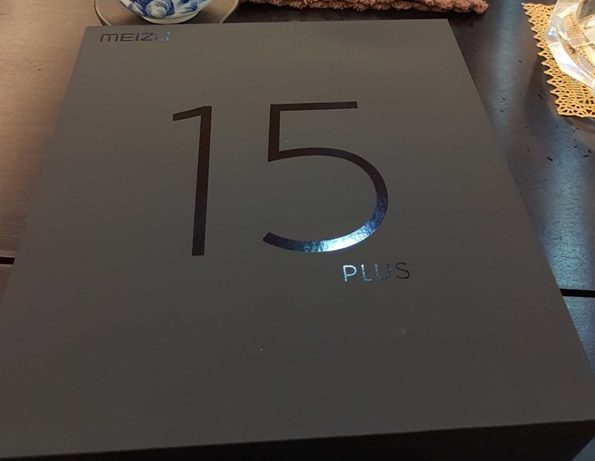
Meizu will be 15 years next year and to celebrate it, it will release a special flagship or rather two special flagships. Founder and CEO of the Chinese manufacturer Jack Wong (Huang Zhang) took to Weibo to reveal the name of the phone by posting the picture of a phone’s retail box with Meizu 15 Plus inscribed on it.
The “Plus” in the name means there will most probably be a second variant called the Meizu 15.
The Meizu 15 and Meizu 15 Plus are expected to feature full-screen displays and may likely be the first from Meizu to do so. Meizu is more or less the only major Chinese manufacturer without a full-screen phone at the moment.
Meizu’s CEO said in a different post that manufacturing the phone is taking long, so it will be launched next year Spring (probably before or after the Spring Festival), which is around mid-February.
Meizu was founded in 2003 and began as a manufacturer of MP3 players before switching to MP4 players in 2006. It didn’t begin making smartphones until 2008. So not only is next year its 15th anniversary, it is also its 10th year anniversary as a smartphone manufacturer.
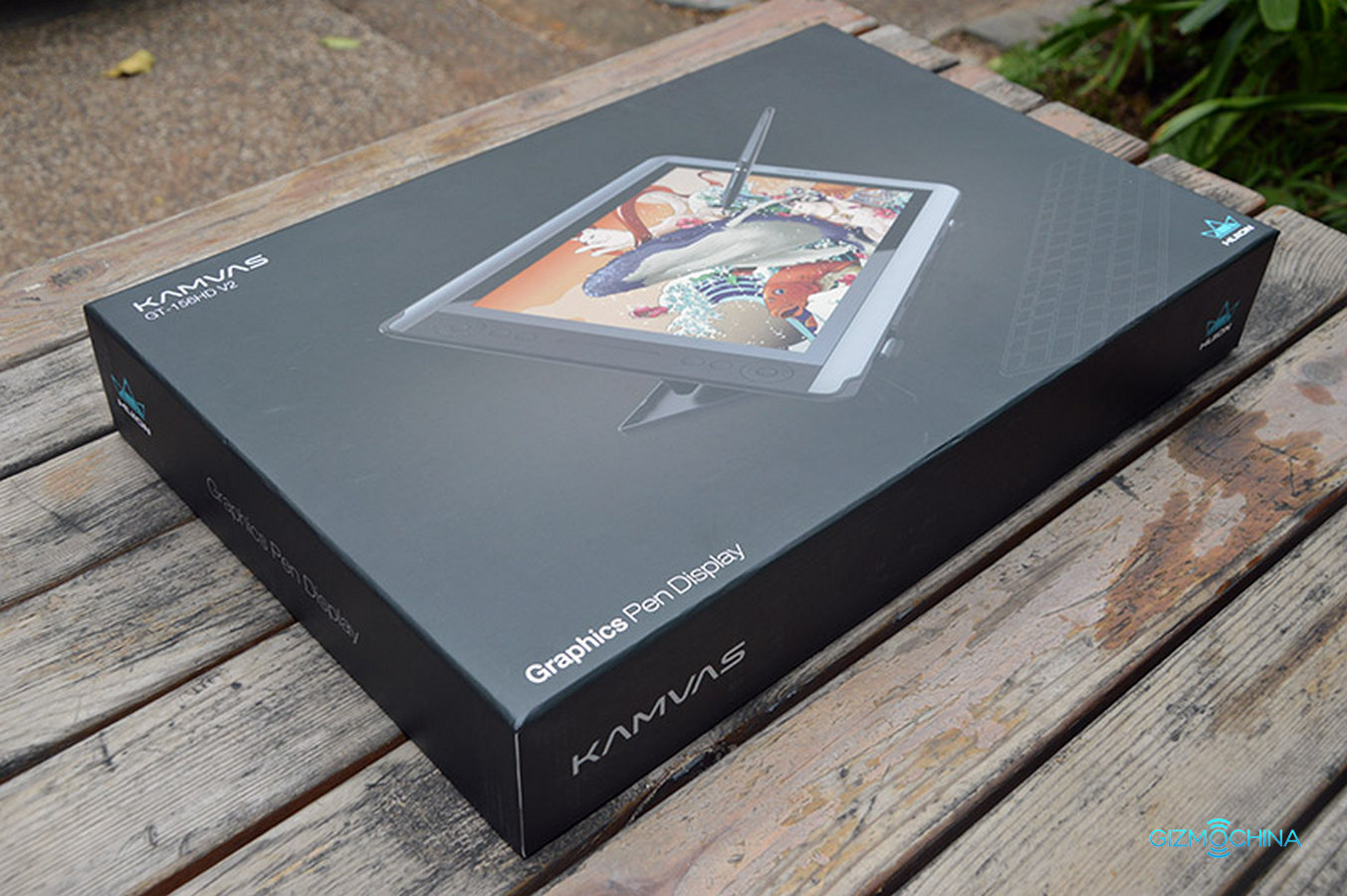
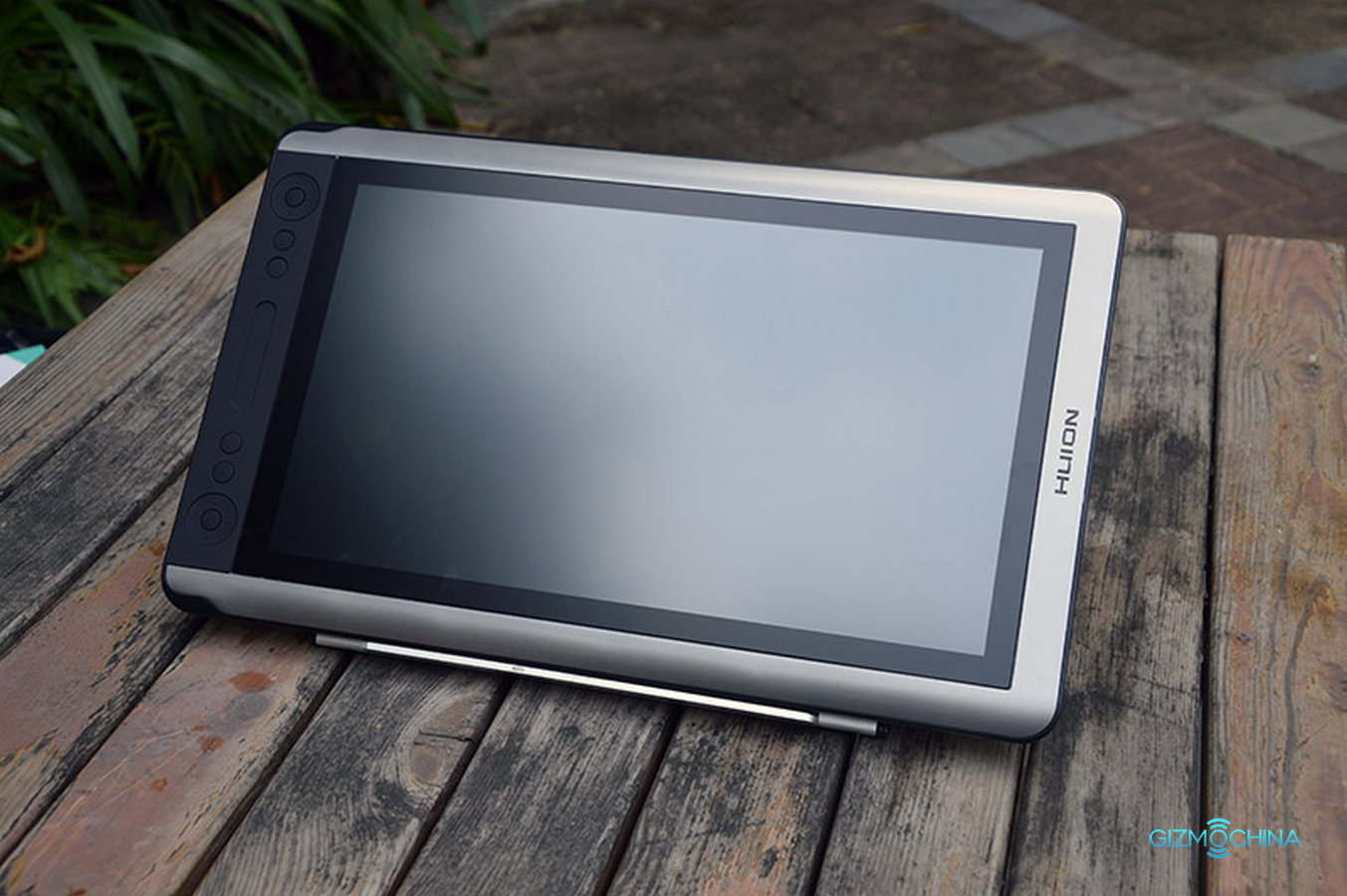
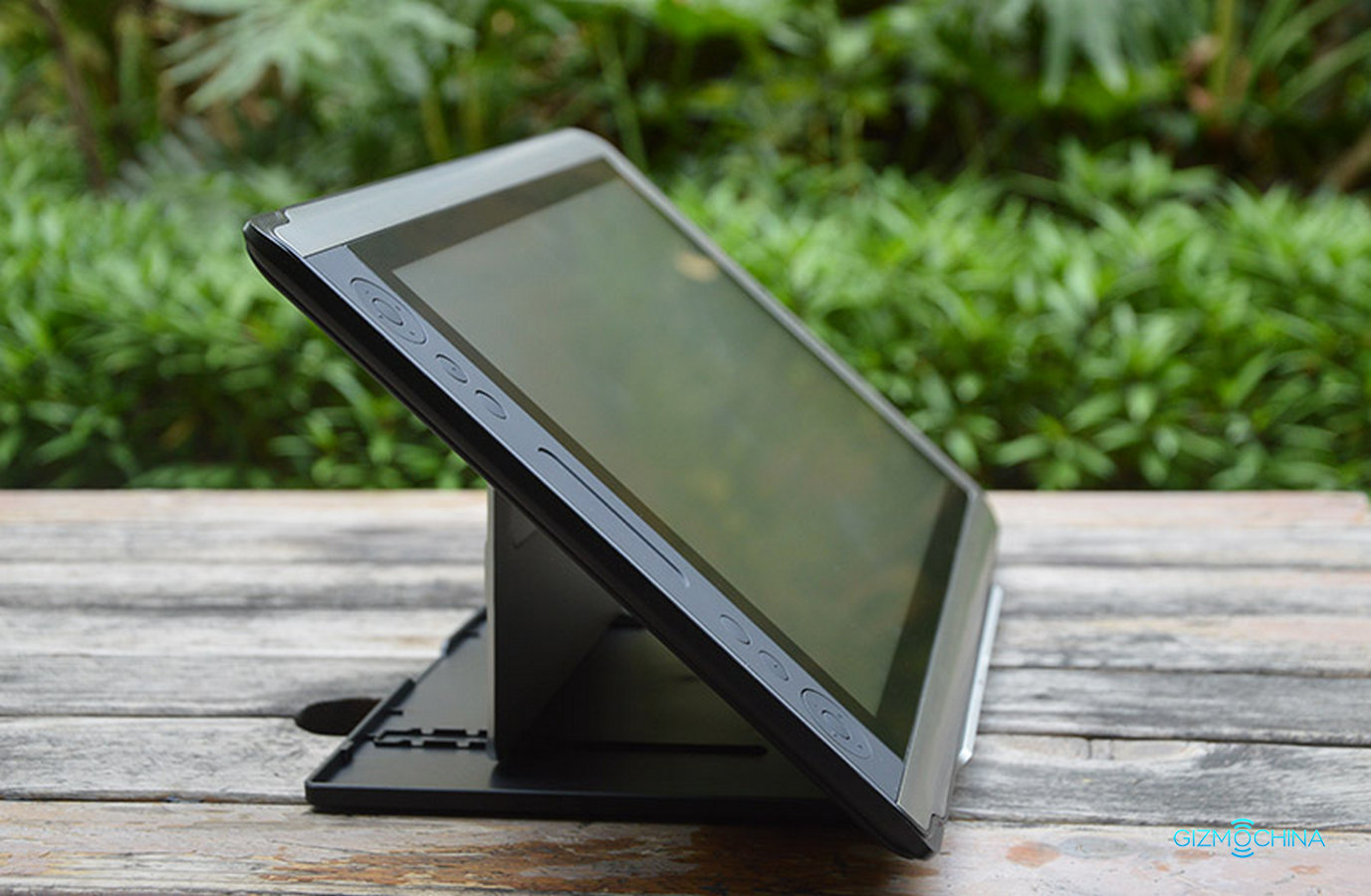
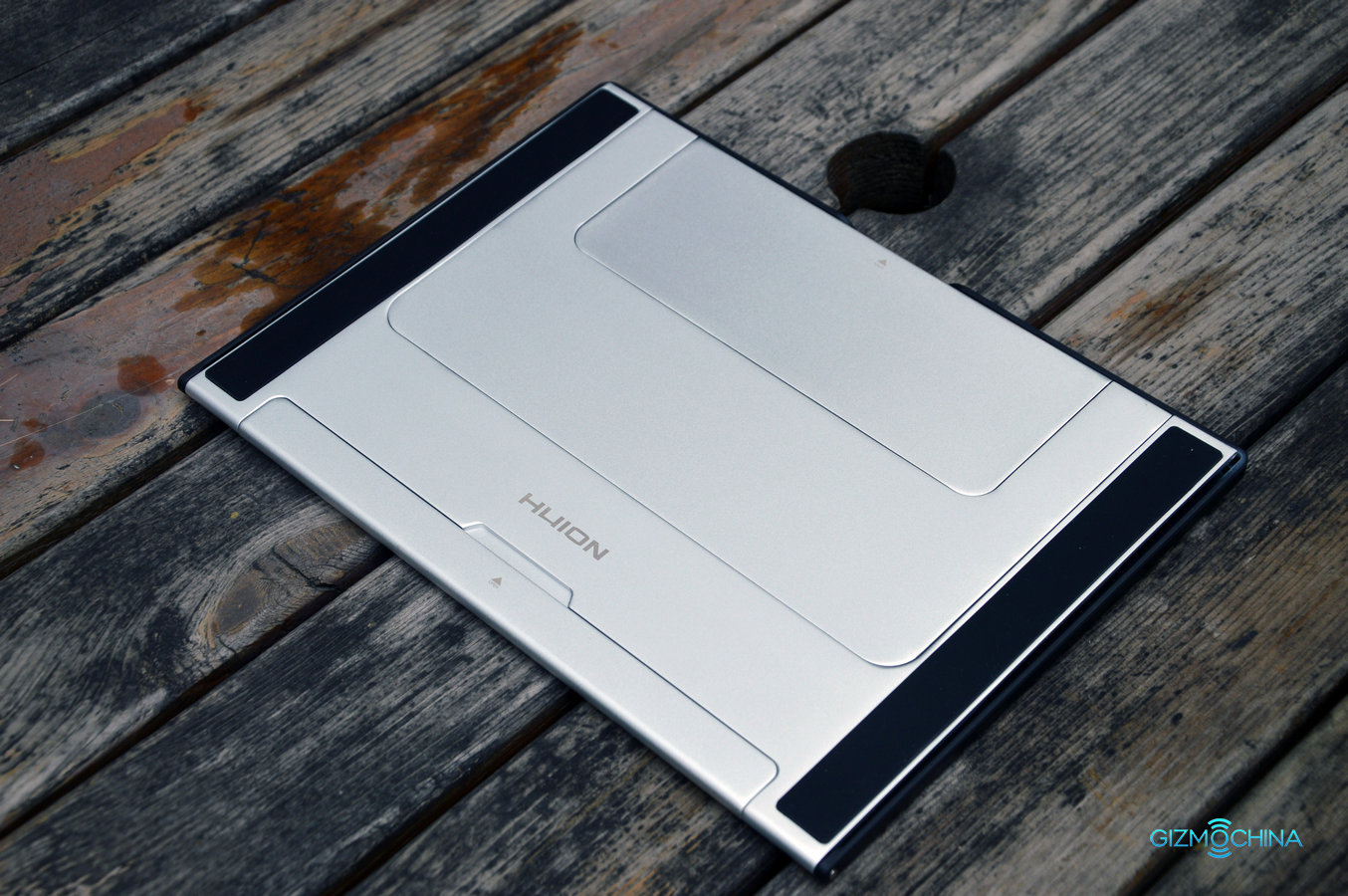
We are used to getting our hands on different smartphones and tablets on a regular basis, but this time around, what we have with us is a slightly different device. We have got the Huion Kamvas GT 156HD v2, which is basically a large 15.6-inch display for people who love digital painting. In case you are still confused as to what this device does, then consider the Huion Kamvas as a competitor to the popular Wacom. You might have definitely heard about how good Wacom styluses and pen tablets are, and if you know who Wacom is and what it does, then consider Huion as a cheaper option to the Wacom tablets.
To be honest, we are not professional digital painters. But given that this is a niche device and comes from China, we thought it’s definitely worth getting our hands on. What makes Huion devices special is that its cheaper than Wacom without sacrificing on portability and features.
The size of the Huion Kamvas GT 156HD V2 is actually pretty great! It’s not too large and weighs around 1.5Kgs, making it possible for you to carry around the tablet wherever you go. If you are someone who doesn’t like working on small screens, this size is ideal. Further, those who are used to painting on their 22-inch tablets at home, the smaller but comfortable 15.6-inch size is much better than say an 11inch or a 13inch screen tablet on the go.
The key dimensions of the tablet are as follows:
Weight: 1.5kg
Dimensions: 432 x 264 x 14.8mm
Active Area: 344.2 x 193.6mm
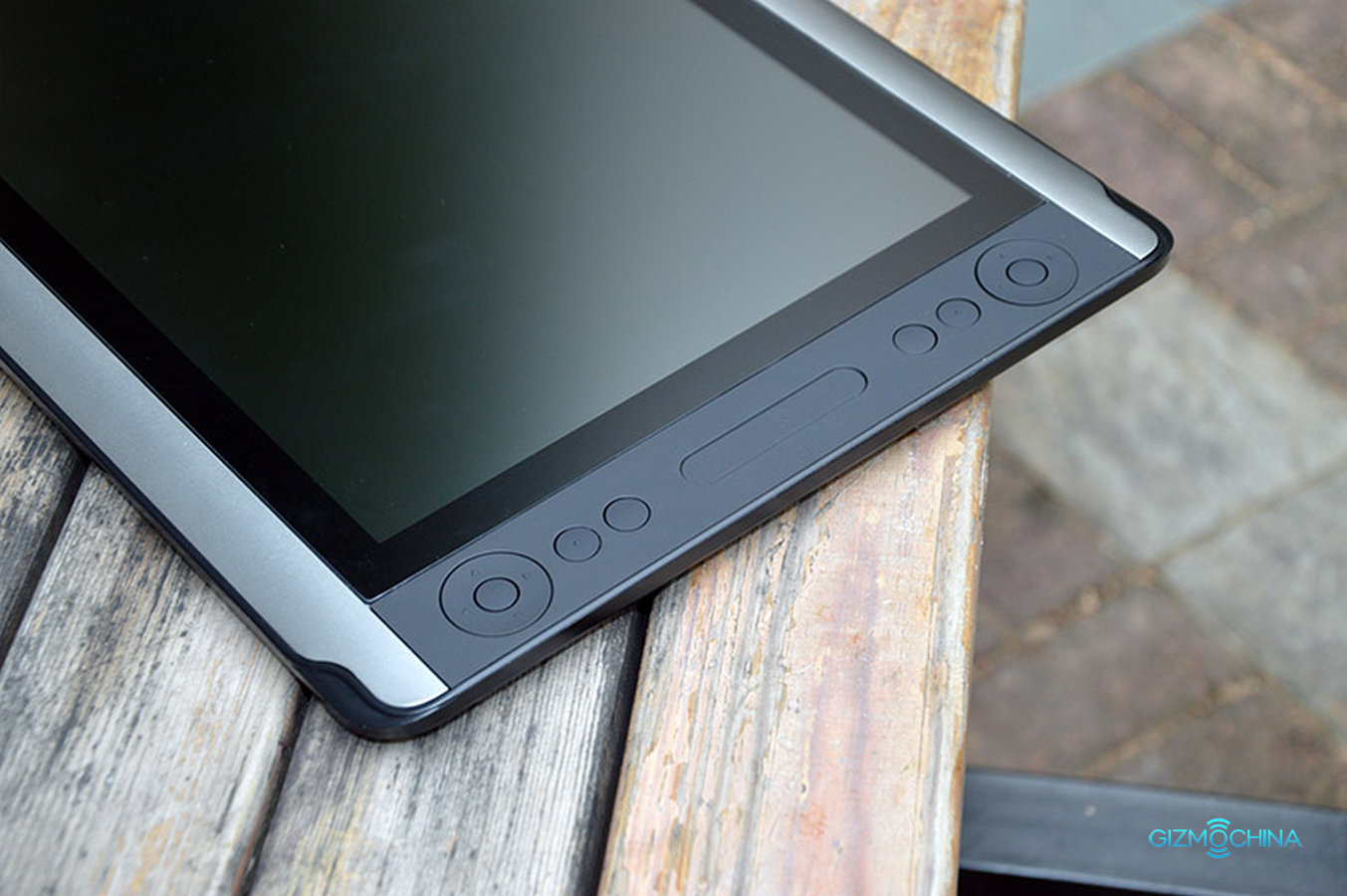
The tablet is great for painting because it supports 8192 levels of pressure sensitivity. So, it’ll be easier to draw on the screen with utmost precision. Further, the touch bar is upgraded from 8 levels to 24 levels and there are 14 user-defined shortcuts / express keys to make your experience smooth and easy.
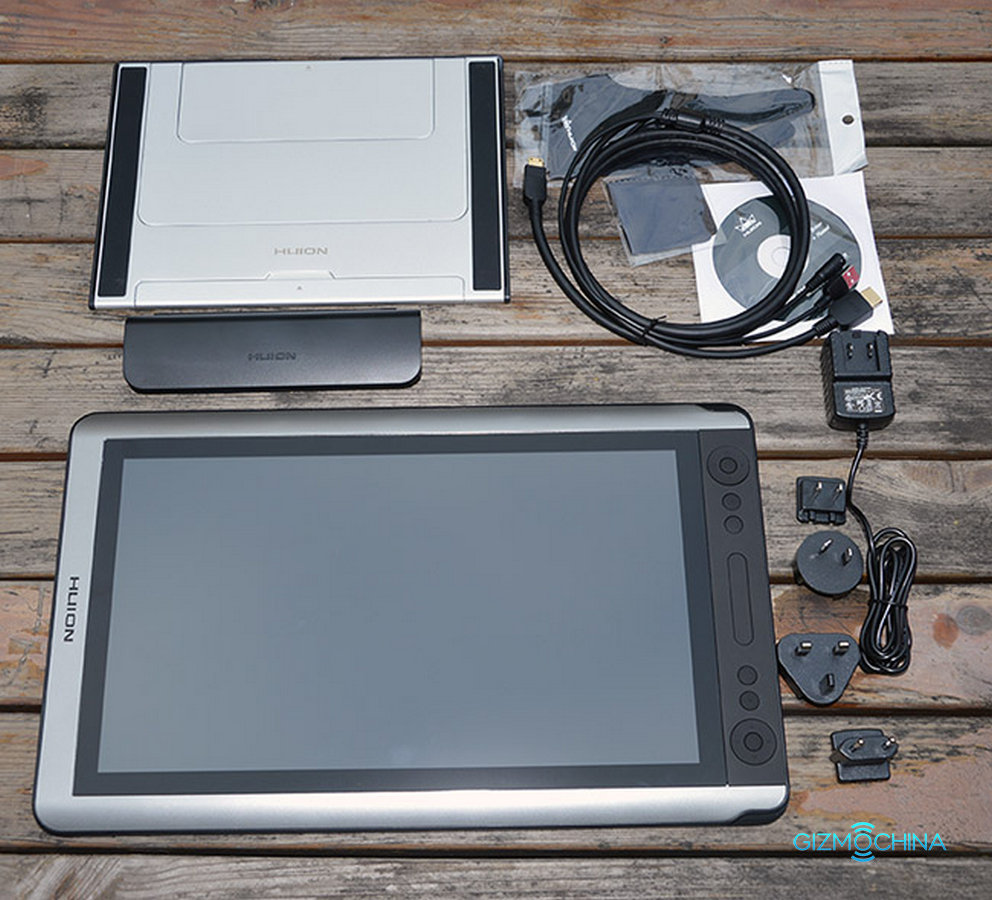
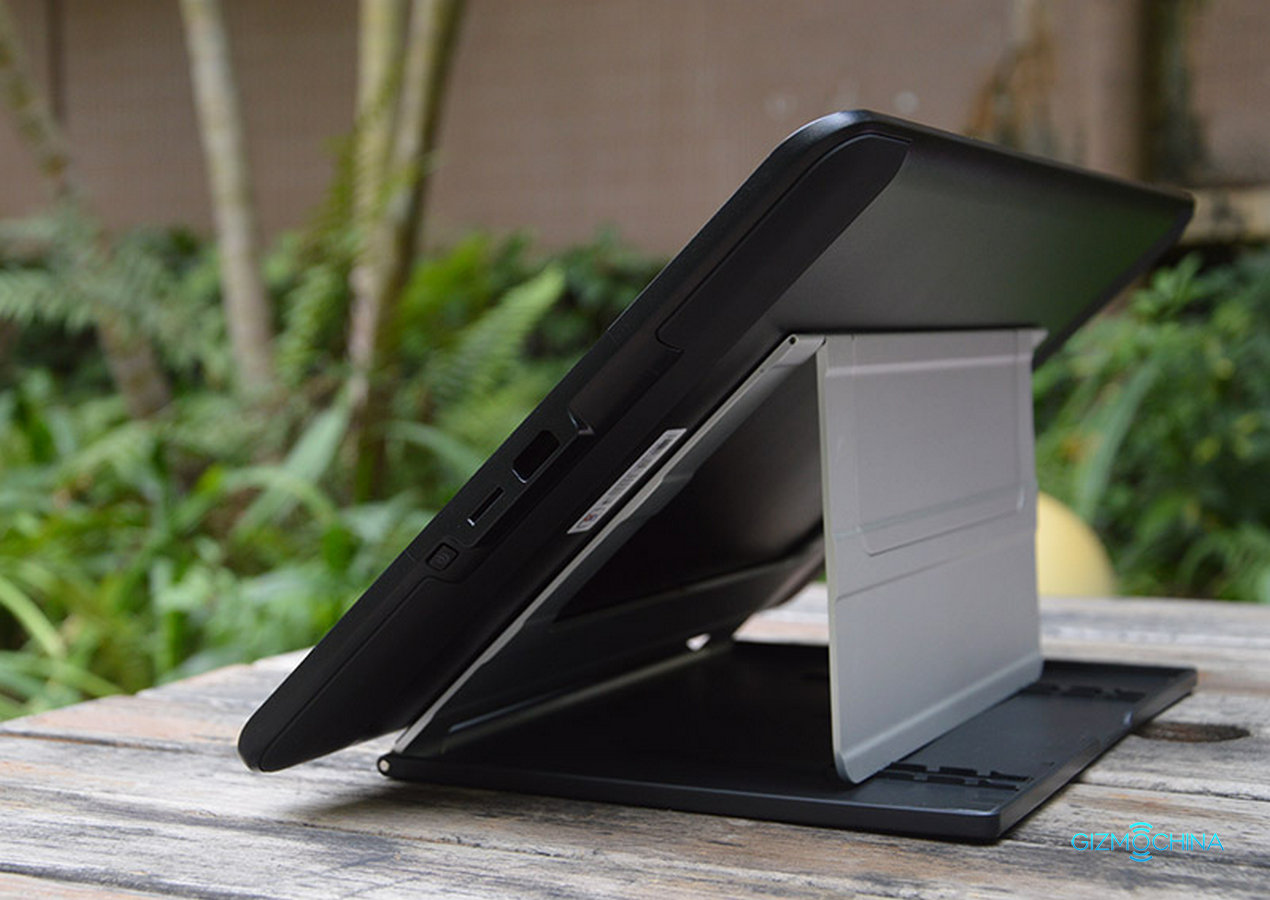
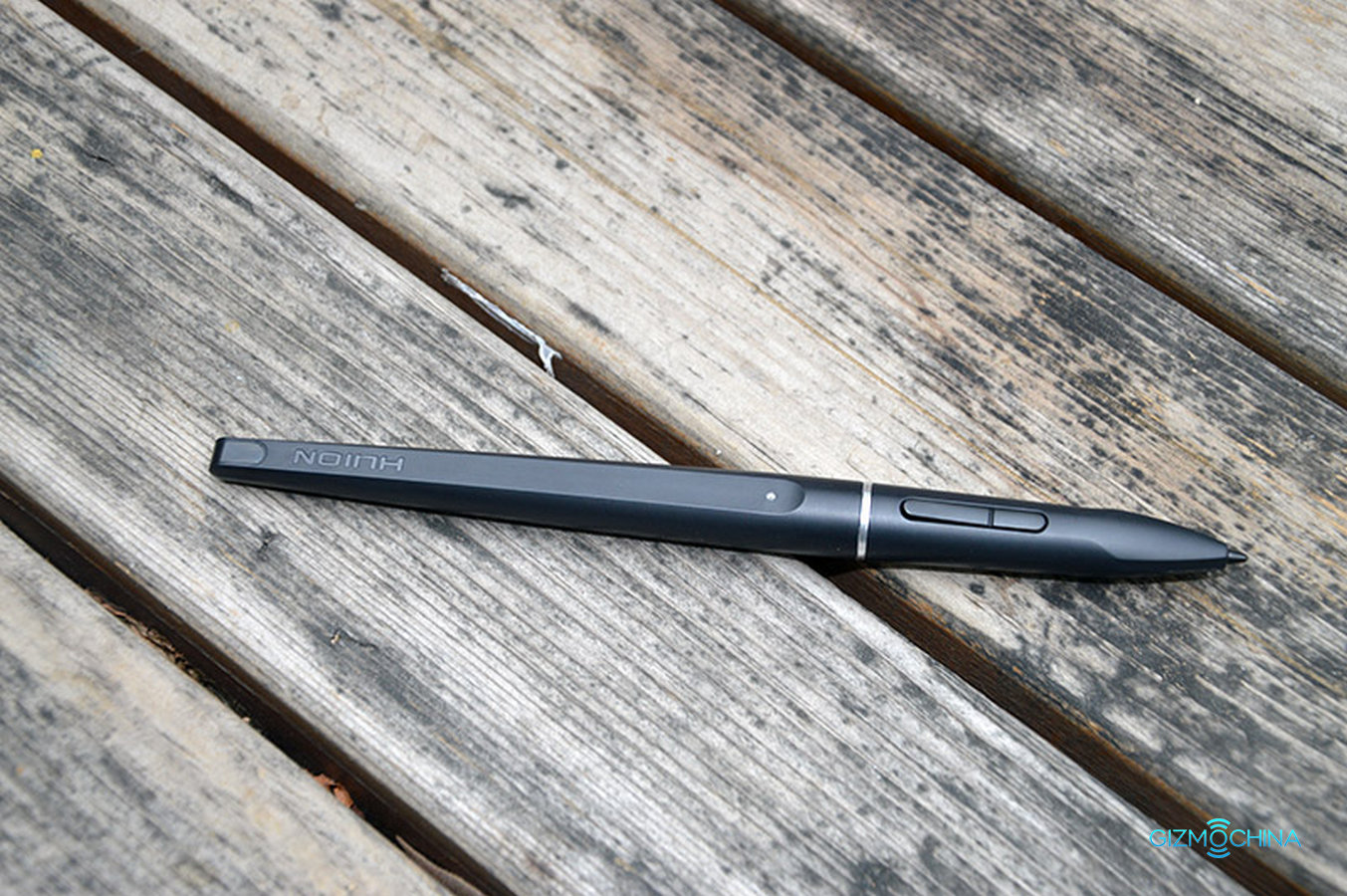
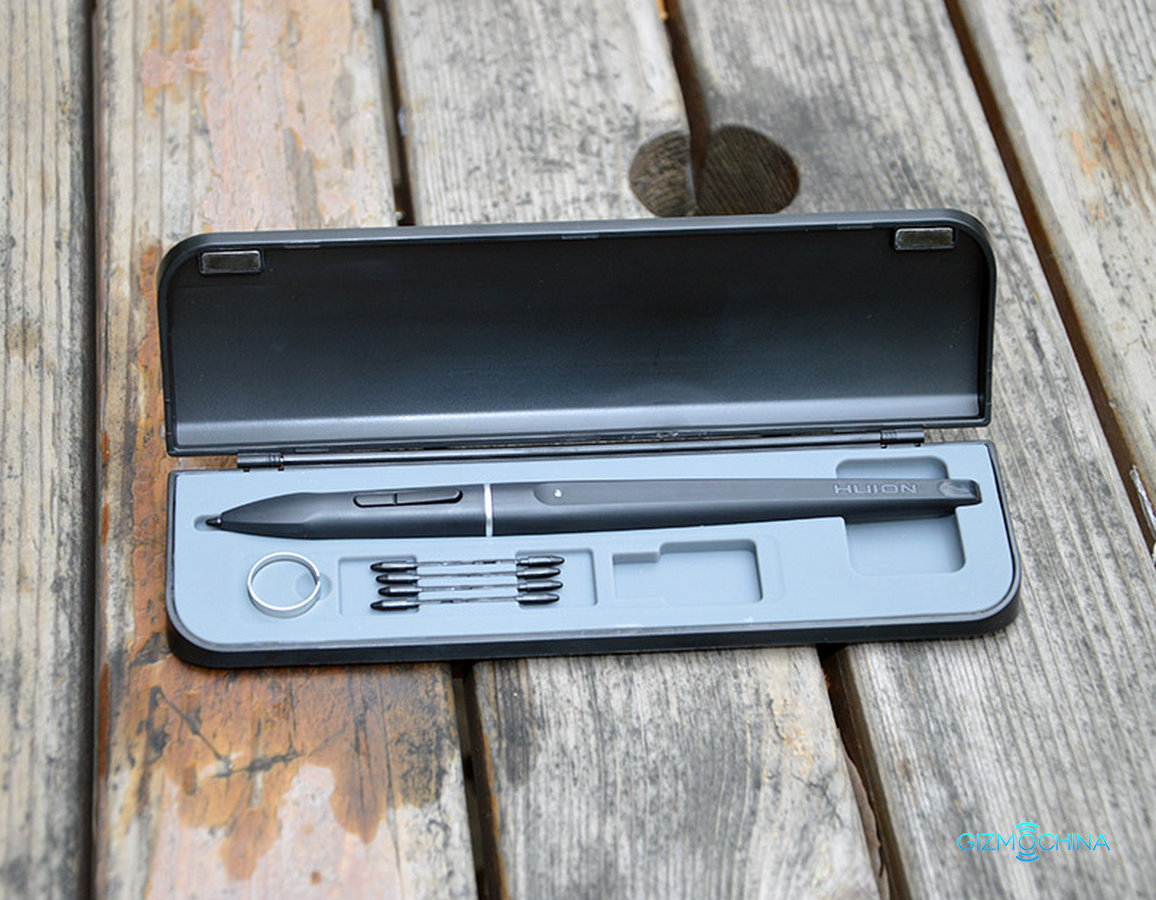
What makes the Huion Kamvas 156HD V2 tablet so great is that its the complete package. So, you don’t have to hunt for a compatible pen or a stylus to complete your portable graphics tablet setup. Everything is covered by the company, which includes a two-level adjustable stand and a digital pen with 8 additional nibs.
In fact, this is a list of everything that you get inside the box:
Huion KAMVAS GT-156HD V2 Tablet Monitor
3-in-1 Cable(HDMI, Power, and USB Cables Included)
As you can see, this is practically everything that you need to start digital painting on the go. The pen is great and straight lines and curves are very easy to draw on the screen. The pressure sensitivity works well and the overall experience is good. You can definitely work on the go with this tablet. The stand is sturdy and holds the tablet at two different angles, adapting to your needs.
Overall, for $500, the Huion KAMVAS GT 156HD V2 tablet is a pretty good tablet for artists who are looking for a cheaper and portable tablet monitor.
You can check more pictures down below, or check this product on Huion official site.
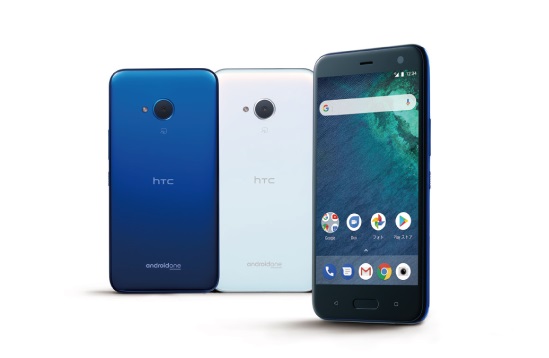
A new HTC device with model number X2-HT has been seen on Geekbench. The HTC X2-HT is shown to run Android 8.0 Oreo, have 4GB of RAM, and be powered by a Snapdragon 660 processor leading some to believe it is a successor to the HTC U Play. Rather, it is actually the HTC X2 launched in Japan today or better still the HTC U11 Life for Japan.
Geekbench has been reported to wrongly list the Snapdragon 630 as the Snapdragon 660 and that error was confirmed when the U11 Life launched with the former rather than the latter.
The HTC X2 is the Android One edition of the phone that is why it runs pure Android 8.0 Oreo out of the box. However it differs from the U11 Life in terms of RAM and storage. It packs 4GB of RAM and 64GB of storage instead of 3GB RAM and 32GB ROM.
The rest of the specs are the same. It has a 5.2” FHD display, a front mounted fingerprint scanner, and 16MP cameras on both sides. There is a MicroSD card slot for expansion, NFC, Bluetooth 5.0, and dual band Wi-Fi.
The HTC X2 packs a non-removable 2600mAh battery and has an IP67 rating. There is no 3.5m audio jack but a 3.5mm to USB-C adapter should be included in the box.
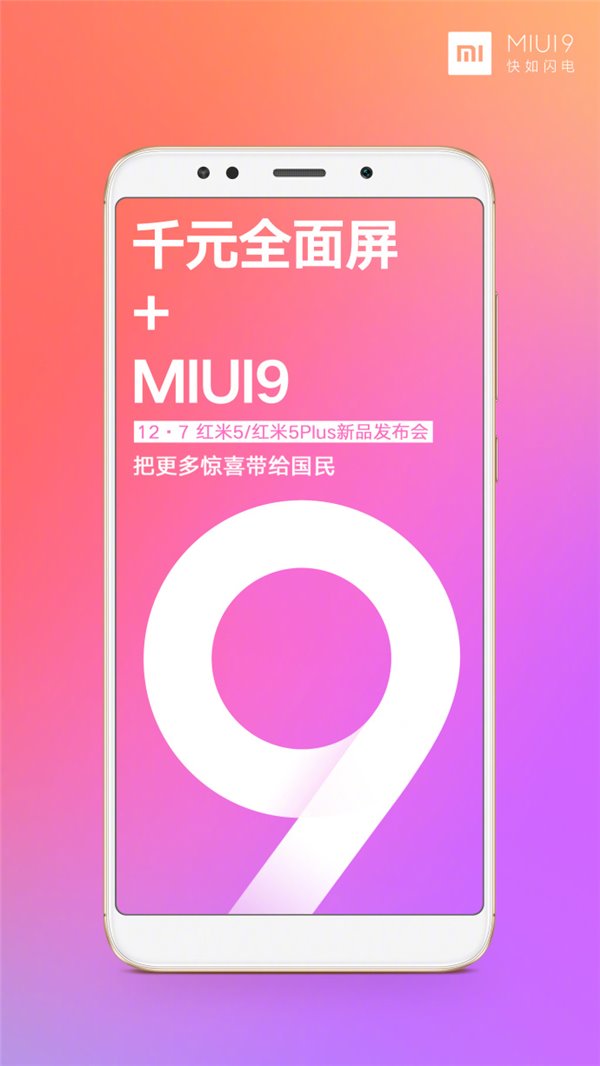
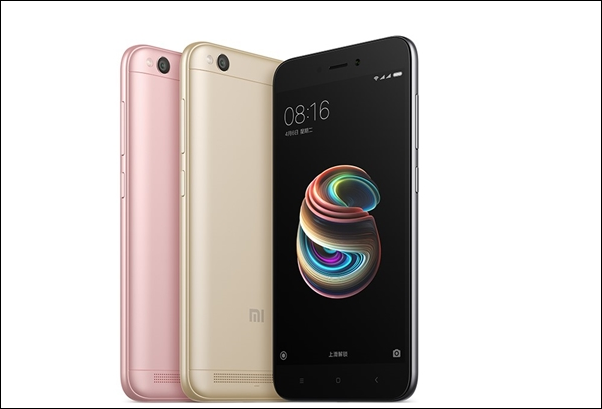
Xiaomi is all set to launch the Xiaomi Redmi 5 and Redmi 5 Plus smartphones at a launch event on December 7. While we already know what to expect from the smartphones, new details have now surfaced online.
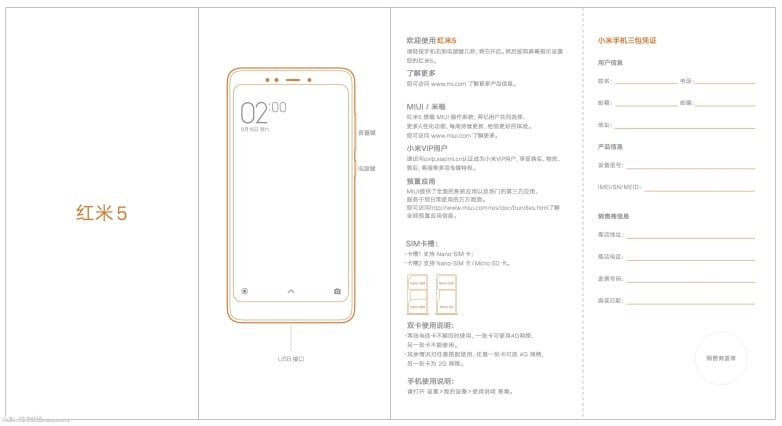
The Xiaomi Redmi 5’s manual has been leaked online which reveals that the smartphone will have a hybrid Dual-SIM configuration. Thus, users will be able to either use dual SIMs or one SIM and one microSD card. However, there is a disclaimer that only one SIM card can use 4G network.
The leaked manual also reveals that the phone has three circular sensors placed on the top bezel. This could mean that the device will have a soft front-facing selfie light, along with a front-facing snapper and a proximity sensor.
Xiaomi has posted an image on microblogging platform Weibo, confirming that the Redmi 5 and Redmi 5 Plus will come with company’s latest MIUI 9 out-of-the-box. The MIUI 9 is based on Android 7.1.2 Nougat operating system.
The Redmi 5 will feature a 5.7-inch HD+ display with screen resolution of 1440 x 720 pixels and an aspect ratio of 18:9. Under the hood, it will be powered by the Qualcomm Snapdragon 450 processor — the first chipset in the Snapdragon 400 series that is using a 14mm process technology.
The smartphone is expected to pack 3GB of RAM and 16GB of internal storage. There will be another variant with 3GB RAM and 32GB onboard storage. The device will come with a 12-megapixel camera sensor at the back and a 5-megapixel front-facing snapper.
The Redmi 5 Plus is expected to come with a 5.99-inch screen that will have a Full HD+ resolution of 2160 x 1080 pixels and an 18:9 aspect ratio. It will be powered by Snapdragon 625 processor, the same one that is powering the Redmi Note 4 smartphone. The phone will come with a dual camera setup at the back, featuring a 12-megapixel primary sensor and a 5-megapixel secondary sensor.
According to the previous reports, the Redmi 5 is reportedly going to be priced at 699 Yuan (approximately $106) while the Redmi 5 Plus could be priced at 999 Yuan (approximately $151).
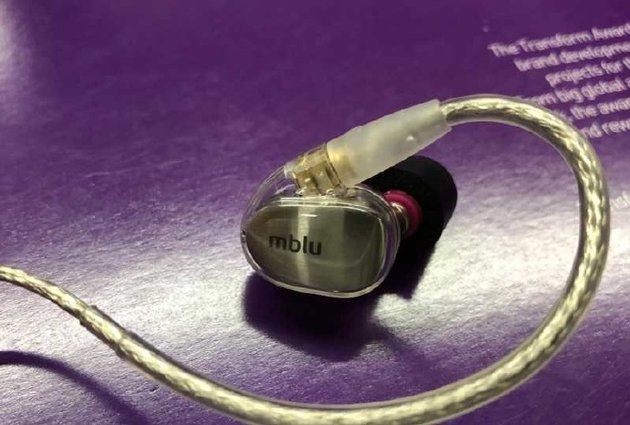
More evidence is emerging which indicates that Meizu is planning to rename its Blue Charm division to mBlu. The latest piece of evidence is the picture of a Meizu earphone having the word mBlu inscribed on it. Our focus isn’t on the sleek design of the wired headphone, Meizu is known for great headsets but is no the name inscribed on the earpiece.
Meizu had reorganised the company into three divisions, Meizu, Blue Charm and Flyme divisions. The Meizu division oversees the flagship smartphones while the Blue Charm division handles mid-range and budget models and the Flyme division handles the software aspect. However, not long after the reorganisation, words filtered out that Charm Blue would soon be renamed. We had also seen a Meizu bezel-less smartphone named mBlu Zero. Meizu recently renamed its Charm Blue website as mBlu.com. So, this joins the trail of evidence gravitating towards a new, renamed mBlu brand.
We have also seen a new set of logos which suggest the company is experimenting with a new logo for the rebranded Blue Charm. There is no definite logo just yet. The company could unveil the rebranded name and logo this December as the Charm Blue brand clocks three years on December 18. Meizu could roll out the drums to unveil the new rebranded Charm Bue division with new products on that date. Data shows the Meizu Blue Charm brand has been a successful one with up to 45 million units of the Blue Charm smartphones shipped so far. The Blue Charm Note series has also seen up to 20 million shipments during this period. From all indications, the new mBlu brand will also include all other accessories like headphones manufactured by Meizu. However, we are yet to see an invitation to any event from Meizu.
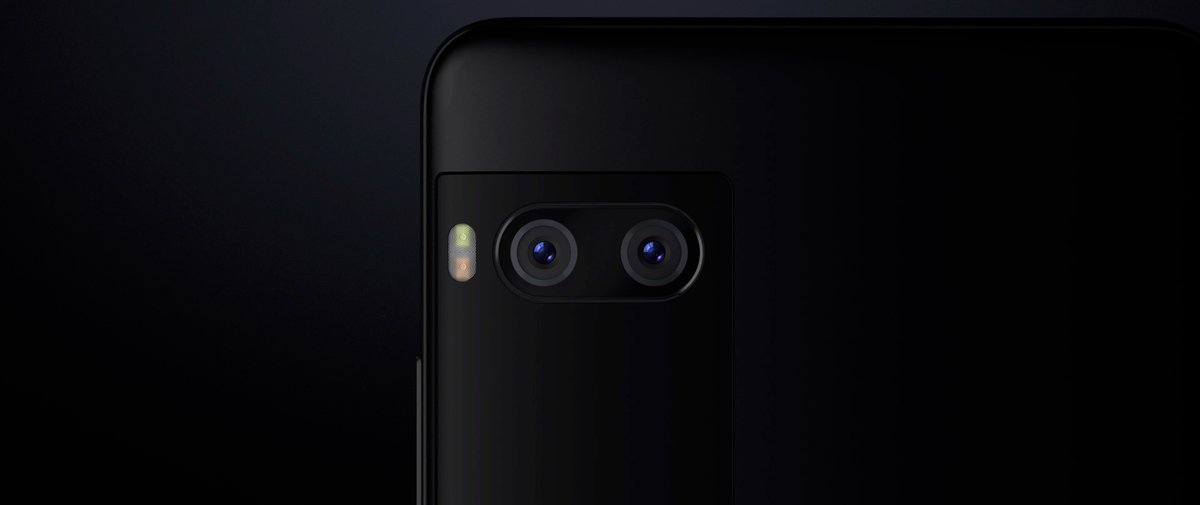
The PRO7 Plus (and PRO7) is Meizu’s first dual camera smartphone. It has dual 12MP f/2.0 Sony IMX368 cameras in the monochrome + RGB configuration. How do the cameras perform? Not so well for a flagship according to DxOMark.
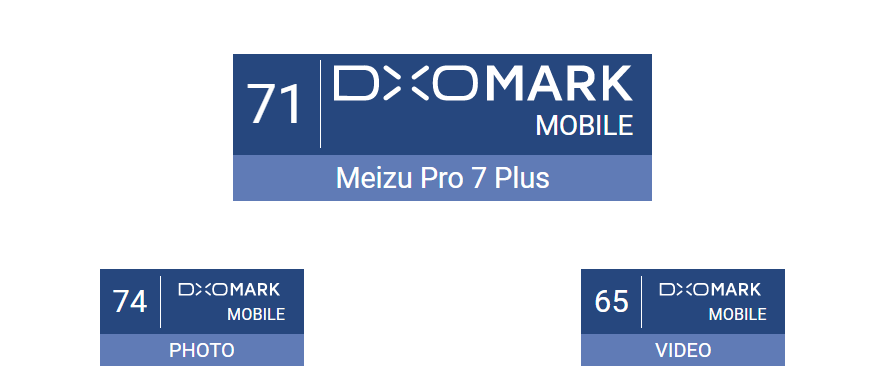
The camera ranking labs has given the PRO7 Plus an overall score of 71 points. According to DxOMark, the cameras take still photos well. Features like exposure, autofocus, flash and noise are also said to be fairly good. However, the phone fails when it comes to shots of artifacts. Below is their official statement on the matter:
Artifacts, however, are one of its major problems, especially in the case of inconsistencies in the clarity of the entire picture; the pictures taken are sometimes partially or completely damaged, unable to display any images, and still others have been taken at an extremely low resolution, what reason.
DxOMark also scored the Meizu PRO7 Plus low in videos. Total score is put at 65 points. It performs well when the lighting is well-balanced and also gets praise for its rich and well-saturated colors. Its weakness when it comes to video recording is autofocus which drops after initially locking at the beginning of the shoot.
The scores might not be terrible but they are disappointing seeing as the Pro 6s has a DxOMark score of 85. Other old phones that the PRO7 Plus fails to beat include the Samsung Galaxy S6 and the iPhone 6s.
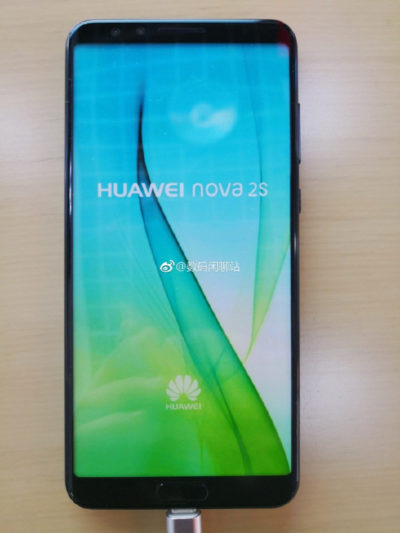
Looks like Huawei is intent on revolutionizing the smartphone industry by bringing flagship chipset on mid-range models. The tech giant launched the Honor V10 a few days back and included the flagship Kirin 970 on the smartphone. Despite the flagship specs and sleek full-screen design, the Honor V10 features an affordable price tag starting at around $400. A fresh leak has emerged showing the Huawei Nova 2S model with a similar full-screen design as the V10 and a flagship Kirin 960 chip among other awesome features.
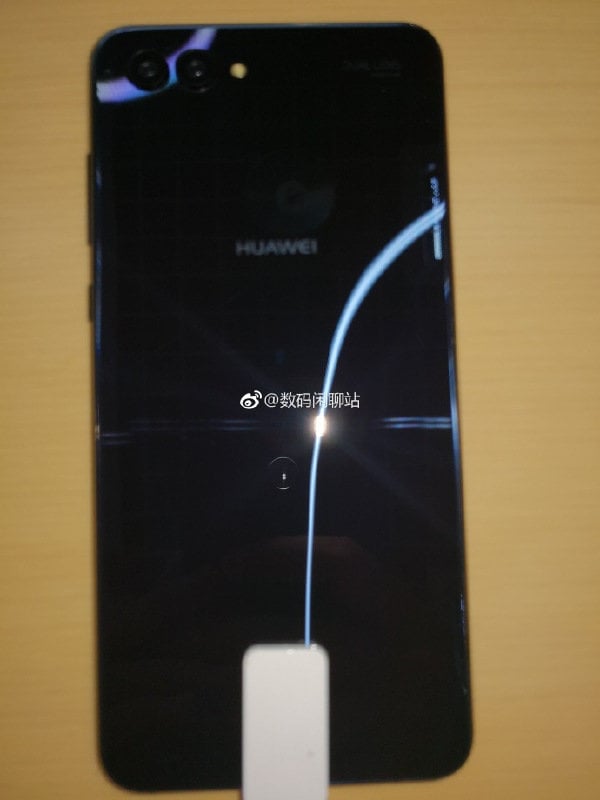
The Nova series is a mid-range series with the latest being the Nova 2 and Nova 2 Plus launched about six months ago. Both models sport dual rear cameras and the leaked photos of the Nova 2s shows that it is also coming with dual cameras at the rear. The leaked photos also show that we should be looking forward to an 18:9 aspect ratio full-screen smartphone and just like the V10, there is a front home button despite the narrow bottom bezels.
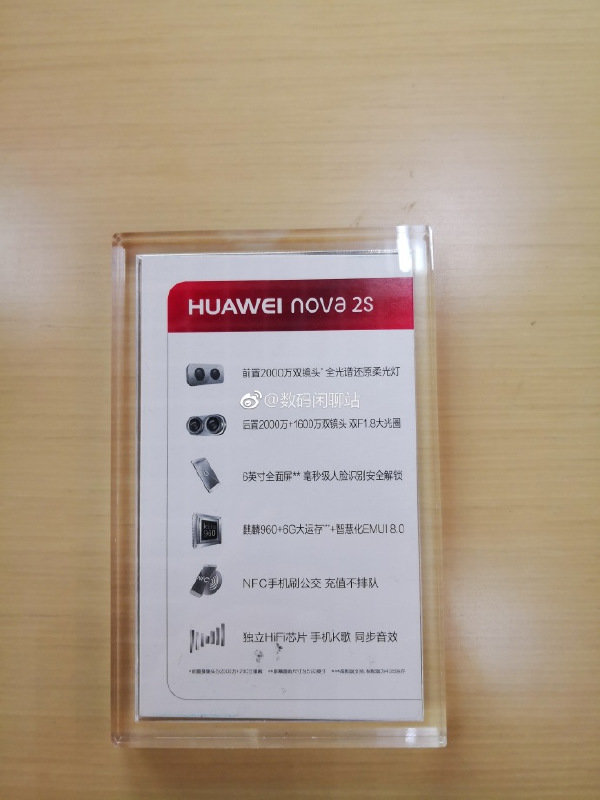
The key specifications f the Nova 2S also feature on one of the leaked shots. From the listing, we can grab that the Nova 2s will come with a 6-inch display and would be powered by last year’s flagship Kirin 960 chipset paired with 6GB of RAM. The dual camera on the device is a 20MP + 16MP combination reminiscent of the Honor V10’s. In addition, the rear cameras also have an f1.8 aperture apiece. Further, there is a dual 20MP camera setup at the front, making the device a quad-camera packing model. The smartphone is also expected to pack the EMUI 8.0 UI based on Android Oreo. There is facial recognition and you also get NFC for contactless payment as well as a built-in Hi-Fi chip. The device is expected to be launched in December. What a way to wrap up the year for Huawei?
Qualcomm’s next flagship chipset is he Snapdragon 845. Details of the Mobile Platform expected to be unveiled in December have leaked online.
According to the source, even though major foundries have begun 7nm trials, the flagship chips for next year will be built using the 10nm process and that includes Qualcomm’s Snapdragon 845 mobile platform too. However, the SD845 will use LPE and not LPP like the Exynos 9810.
The Snapdragon 845 will remain an octa-core processor. Four of them will be the Cortex-A75 and the other four will be Cortex-A53 cores. The SD845’s GPU will be an Adreno 630.
The chipset will have support for up to 25MP dual front and dual rear cameras, have a X20 baseband, support for 802.11 ad Wi-Fi, and have a maximum download speed of 1.2Gbps.
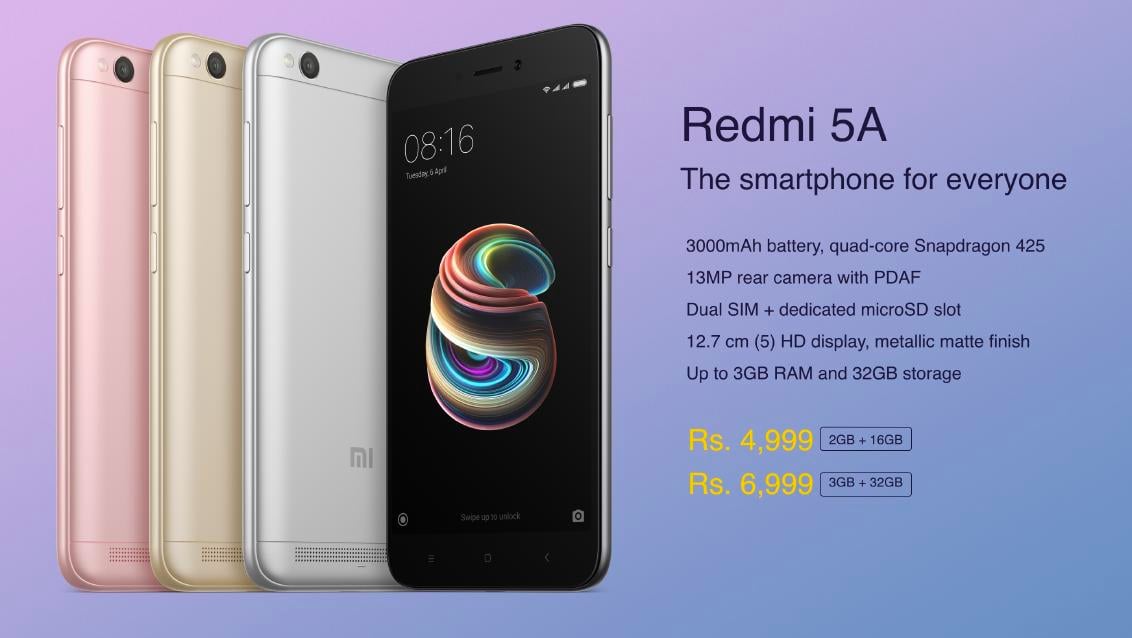
Today, Xiaomi has officially unveiled the Redmi 5A as “the smartphone for everyone.” The smartphone was first announced in China in October and now it has landed in India with some customizations to suit the Indian markets.
Xiaomi Redmi 5A Specifications and Features
The Xiaomi Redmi 5A measures 140.4 x 70.1 x 8.4mm and its weight is 137 grams. It has a metallic matte finish and comes in three color choices such as Elegant Gold, Dark Grey and Rose Gold.
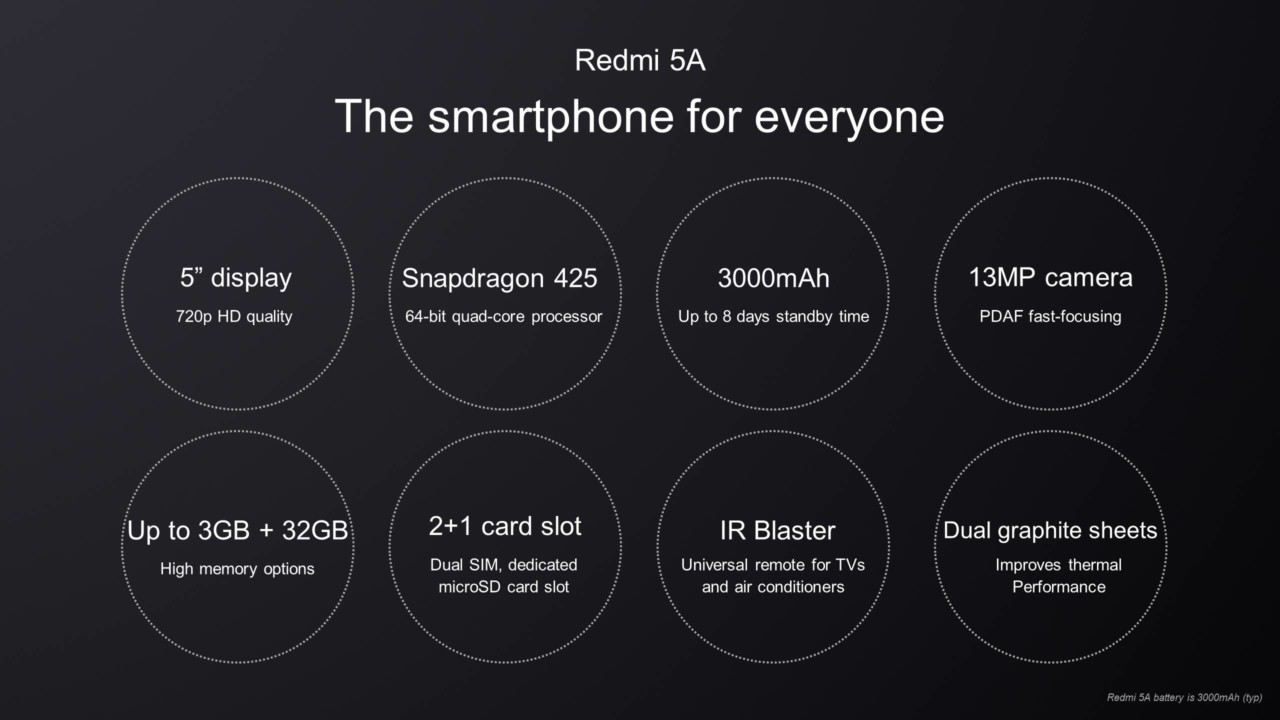
The Redmi 5A features a 5-inch display that produces an HD resolution of 720 x 1280 pixels. It is powered by Snapdragon 425 chipset that features a 1.4 GHz quad-core processor. This chipset is also found under the hood of other smartphones like Redmi Y1 Lite, Redmi 4A, Motorola Moto E4, ASUS ZenFone 4 Max and so on. Considering the warm weather conditions in India, Xiaomi has included dual pyrolitic graphite sheets inside the Redmi 5A that can reduce its temperature by at least 1-degree Celsius.
The Redmi 5A comes in two models such as 2 GB of RAM + 16 GB of storage and 3 GB of RAM and 32 GB of storage. The Redmi 4A and the Redmi 5A for China feature hybrid dual-SIM slot, but the Indian variant features a dedicated for microSD card apart from dual-SIM slots.
A 3,000mAh battery that powers the Redmi 5A offers 8 days of standby time, 21 hours of music playback and 7 hours of video playback. The Redmi 5A is bundled with a redesigned power charger that can stand up to 380V and it can also withstand power fluctuations.
For photography, the Xiaomi Redmi 5A has an f/2.2 aperture 13-megapixel rear-facing camera and a 5-megapixel front camera. The 5-element rear lens is equipped with features like LED flash, HDR, Panorama, PDAF and Beauty Filter. It features a 5-megapixel selfie camera.
It also equipped with a IR blaster that can be used for controlling devices like AC, TV or set-top box. The smartphone will come preinstalled with Android 7.1.2 Nougat skinned with MIUI 9.
Xiaomi Redmi 5A Pricing and Availability
The 2 GB RAM + 16 GB storage and 3 GB RAM + 32 GB storage models are respectively priced at Rs. 5,999 and Rs. 6,999 in India. Apart from Mi.com and Mi Home stores, it will be exclusively available through Flipkart. The sales of Redmi 5A will begin on Dec. 7 at 12 PM. Subsequently, it will be also available through other offline partner stores.
Since Xiaomi has now become the number smartphone brand in India, the Chinese firm is providing the base model of Redmi 5A with a discounted price of Rs 4,999 (~$77) for its first 5 million buyers. This makes it the cheapest Xiaomi smartphone ever in India.
What is your opinion on the attractive pricing of Redmi 5A? Will it allow the company to achieve another milestone in 2018? Share us your thoughts by adding your comments below.
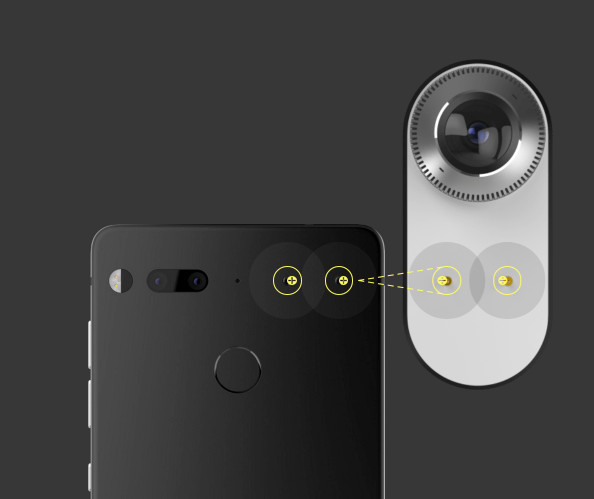
When the Essential Phone was released, the camera was the one feature that people complained about. Essential promised to fix it via software updates and it did.
The camera app has received multiple updates since the phone launched which have greatly improved its performance. However, Essential is not done with it yet as it has released yet another update which brings a number of new features and fixes.
The key feature in the new camera update is Portrait Mode. Yes, the Essential PH-1 can now take images with the bokeh effect. The photo below is a sample taken with the phone after the update.
Other new features the update brings are exposure compensation for all regular camera modes and a reduction in JPEG compression to improve image quality.
If you own an Essential Phone, just head to the Play Store and update your camera app under the “My Apps” tab.
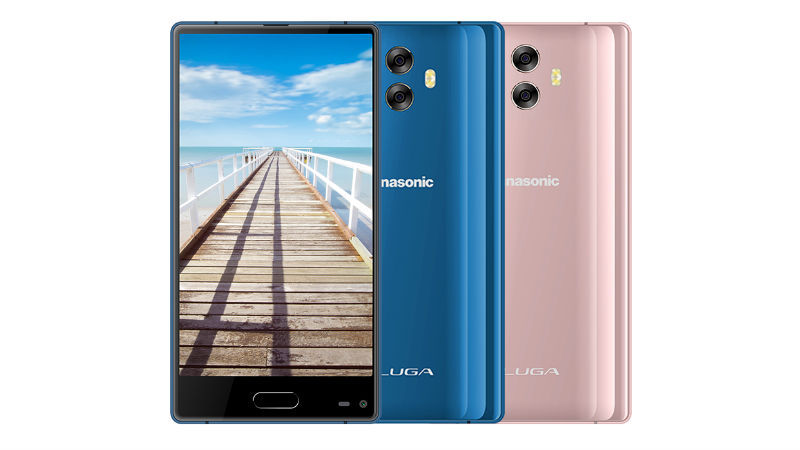
Panasonic has unveiled a new tri-bezeless smartphone called Eluga C in Taiwan. The other USP of the phone is that it features dual rear cameras.
Panasonic Eluga C Specifications and Features
The 5.5-inch display of the Eluga C is surrounded by slim-sized bezels on its top, left and right sides. The screen that carries support for HD resolution of 720 x 1280 pixels offers 450 nits of brightness. Below the display is the physical Home button that is embedded with a fingerprint scanner that can be used to unlock the phone in just 0.3 seconds.
The MediaTek MT6750T chipset that features a 1.5 GHz octa-core processor powers the Eluga C smartphone along with 4 GB of RAM. The onboard storage available on the phone is 64 GB and it also carries support for up to 256 GB of microSD card on its external storage slot. It houses a 3,000mAh battery that can be charged using a 7.5W charger.
The Eluga C’s dual camera system features an f/2.2 aperture 13-megapixel senor and an f/2.2 aperture 5-megapixel sensor. The selfie camera of 8-megapixel is placed on the bottom bezel of the phone.
The tri-bezeless Eluga C features a metallic frame and it has a glass panel on its rear. The thickness of the smartphone is only 5.1mm. The smartphone is now available for pre-booking in Taiwan with a price tag of TWD 6,000 (~$199). It is available in Blue and Pink color options. As of this writing, there is no confirmation on the other markets that will be receiving the Panasonic Eluga C.
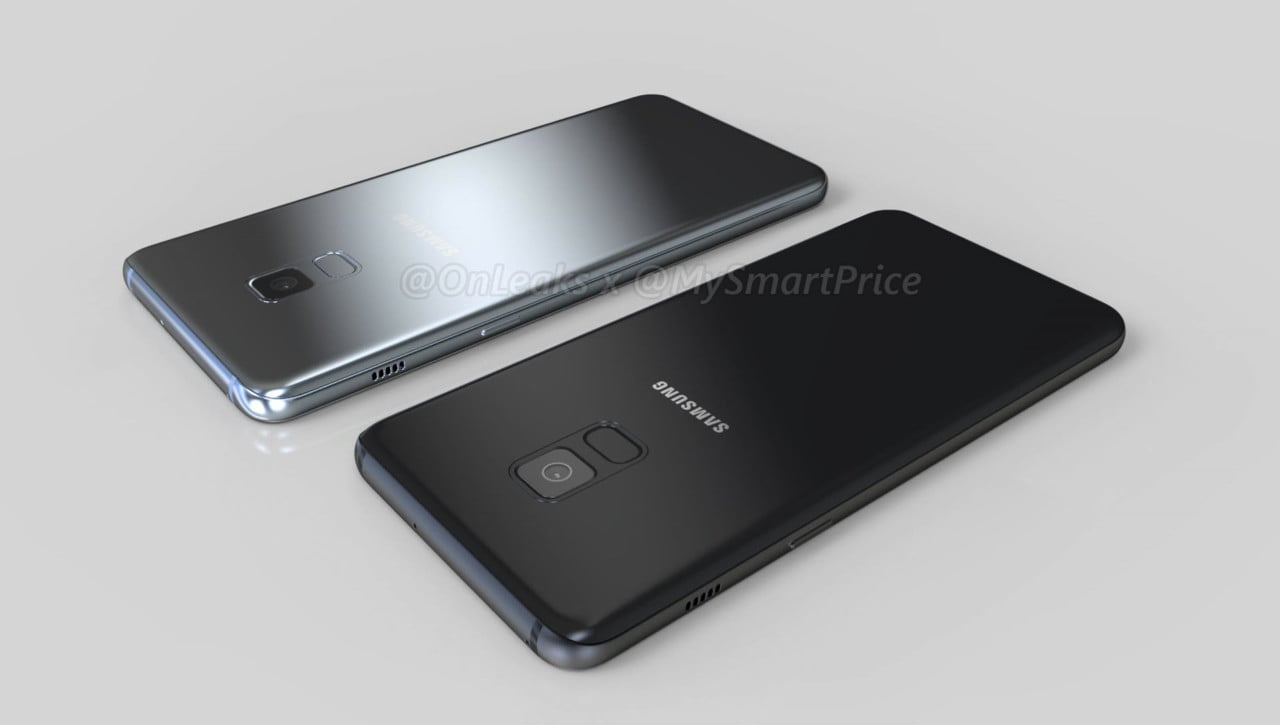
The Galaxy A5 (2018) and Galaxy A7 (2018) smartphones are speculated to get introduced with Infinity Display design either in the next month or January 2018. However, other rumors have claimed that these phones may get unveiled as Galaxy A8 (2018) and Galaxy A8 Plus (2018) and they would be marketed as midrange versions of the Galaxy S8 and Galaxy S8+ flagship phones. Samsung seems to be modifying its strategy for mid-range smartphones as fresh information suggests that the Galaxy A7 (2018) or Galaxy A8 Plus (2018) will not be made available in many markets in the Europe.
It means that the Galaxy A5 (2018) or Galaxy A8 (2018) could be widely available in the Europe. The release of the 6-inch Galaxy A7 (2018) is likely to be limited to three European markets such as Germany, Poland and Russia. However, it is expected to be widely available in Asia, where smartphones with large-sized displays are popular.
The Galaxy A5 (2018) that is rumored to feature a 5.5-inch Infinity Display is expected to be more popular in Europe. The rumor mill has been silent on the existence of Galaxy A3 (2018) which indicates that the Galaxy A5 (2018) may arrive as a primary Galaxy A in the market.
We advise our readers to digest the above report with the pinch of salt. The rumors surrounding the 2018 Galaxy A smartphones may sound confusing, but it seems certain that the South Korean company is reviewing its strategy for mid-range phones.
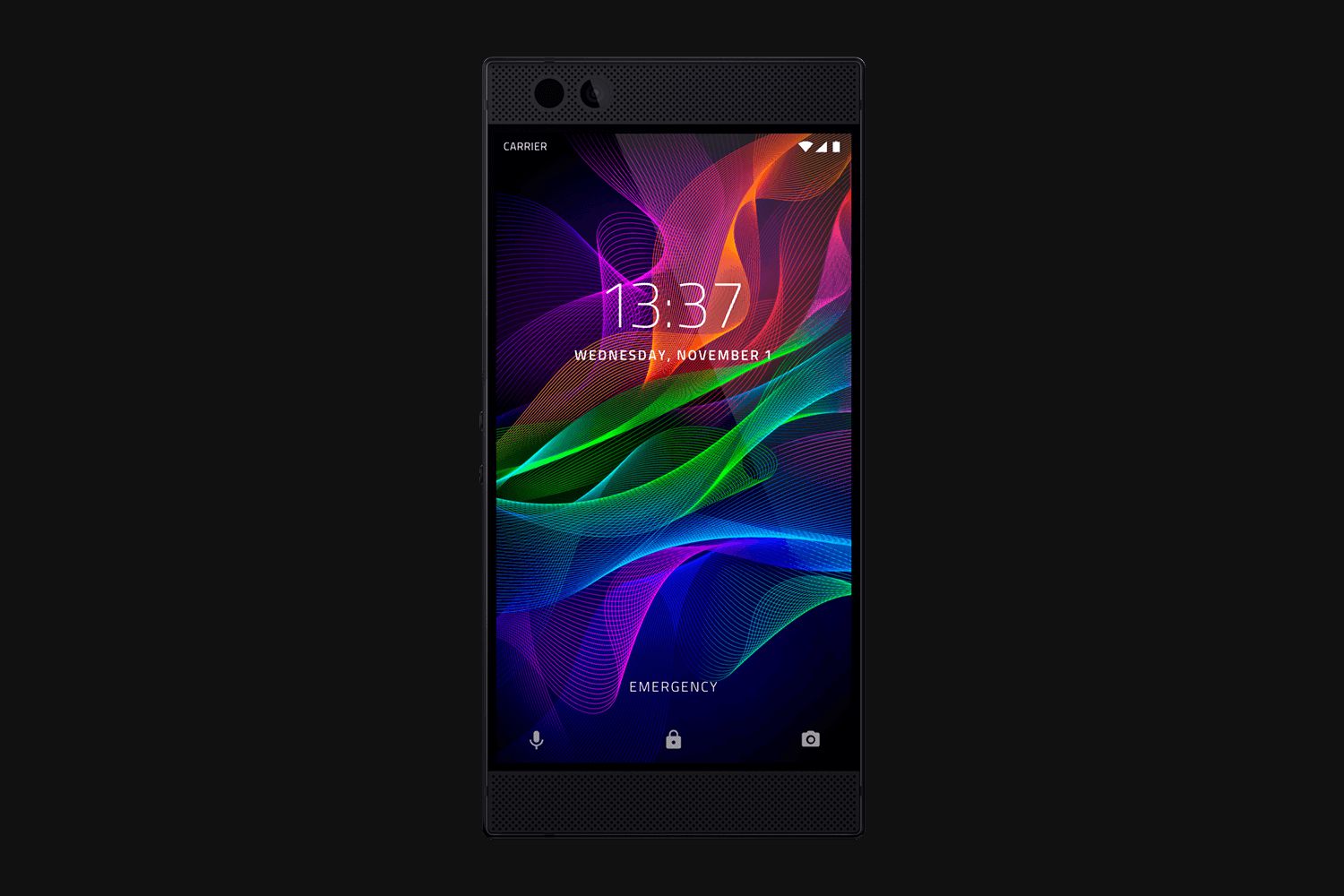
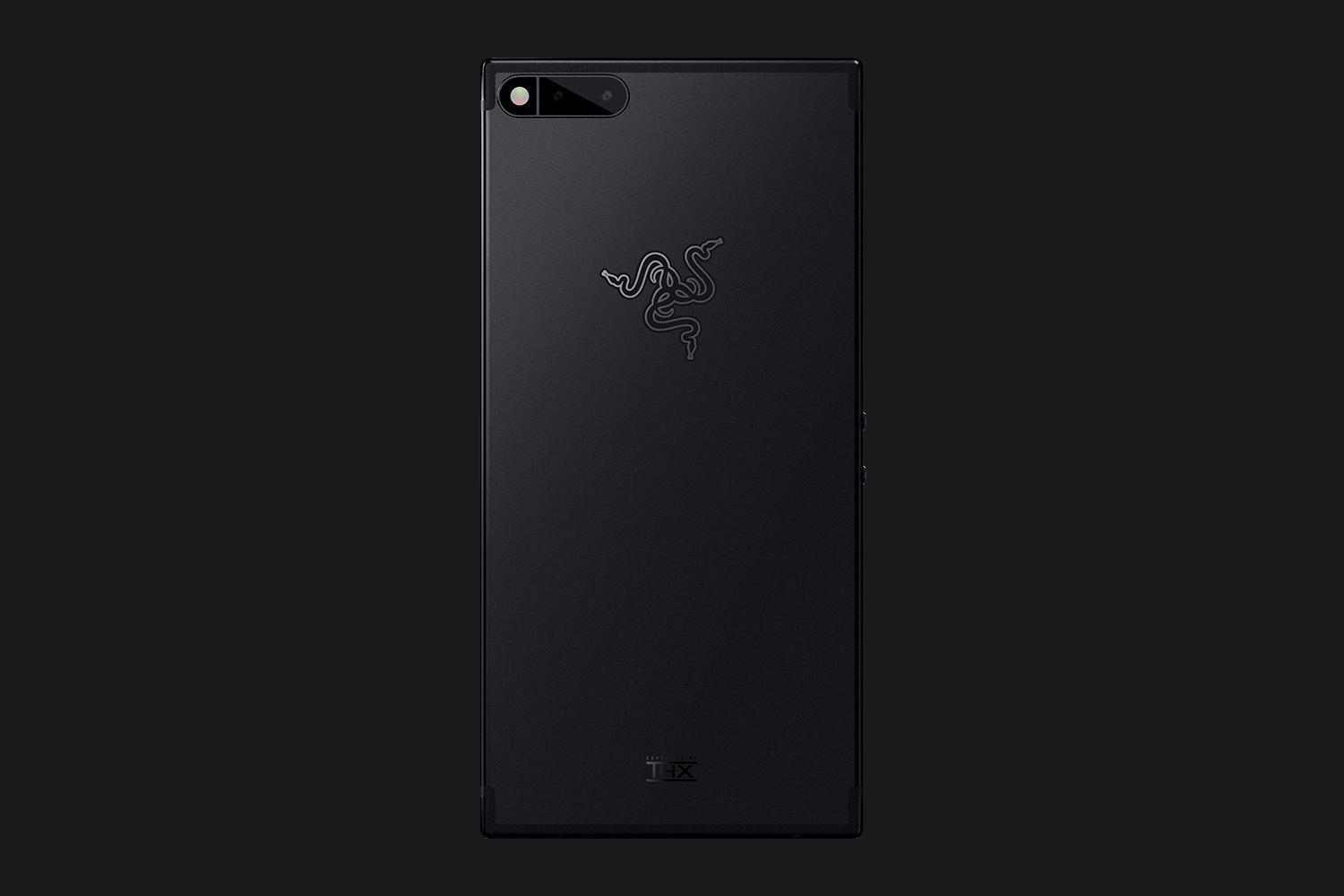
JerryRigEverything is keeping up with the name of his YouTube channel. The dude is sure ensuring every smartphone on planet Earth gets rigged. The latest smartphone to go through his durability test and teardown treatment is the newly launched Razer phone. The teardown video details the process for opening up the smartphone considering that there are absolutely no visible screws on the phone. The screws, a combination of Philips and T5 screws, are hidden under the plastic grill which covers the front-facing stereo speakers both at the top and bottom end. The phone is held in place using clasps and friction rather than with adhesive and so can easily be opened using a pry tool after all the screws have been removed.
Opening up the phone reveals the presence of a massive heat pipe found directly under the display consisting of quite a decent amount of copper, covered with a second copper layer. Thermal paste is also used to improve the heat conduction of the copper pipe with the chipset. This isn’t the first time we’re seeing heat pipe inside a smartphone but that of the Razer model is considerably larger than the ones on other smartphone and would invariably result in better heat dissipation. The ribbon cables connecting the battery and display to the motherboard were also observed to be detachable. This sure makes for an easy disassembly if peradventure the phone is to be repaired or screen changed as a result of damage.
The Razer phone comes with two speakers and from the inside, we can see that the speaker cones are made from rubber. this will prevent the sound quality from getting distorted even if moisture somehow finds its way inside the speaker housing. Both speakers are of almost equal sizes and should output similar sound quality. The charging port is located at the bottom of the smartphone, as well as the vibrator. The vibrator is somewhat smaller than those of other smartphones and could go unnoticed when the phone is set to vibrate only. You can check out the teardown video from below.
The current trend in the smartphone market is the full-screen display with minimum bezels surrounding it. While most of the smartphone manufacturers are launching such devices, Sony is yet to embrace the new trends.
As per the reports, Sony is gearing up to launch a successor of Xperia XZ Premium smartphone, which is expected to comes with a bezel-less display. Recently, there were rumours that Sony is completely redesigning its smartphone lineup for the next year, and now more information regarding this design policy change is available.
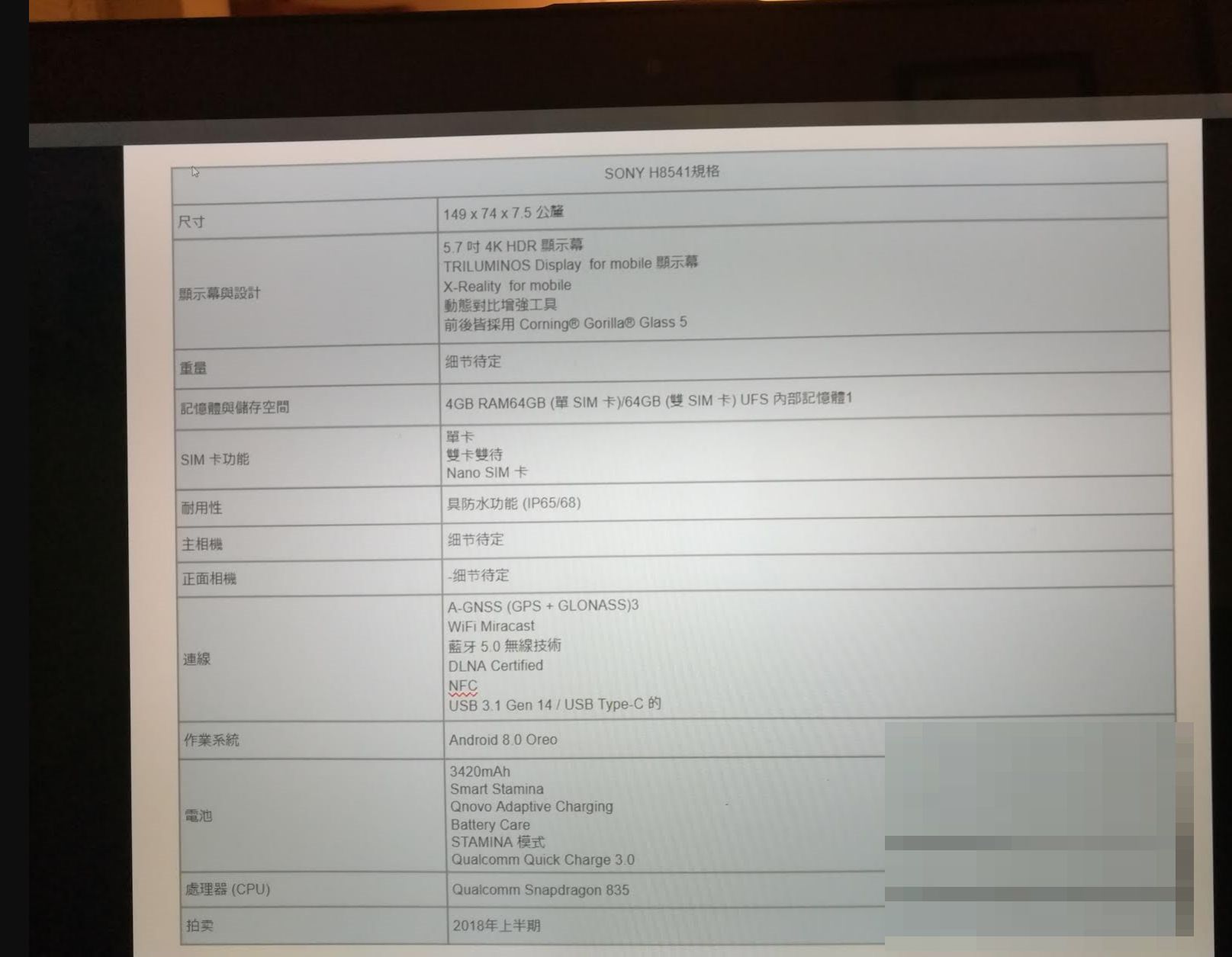
An image has surfaced online which reveals the specifications of an upcoming smartphone from Sony with model number H8541. The smartphone in question is believed to be the next flagship device from the company.
The phone is said to feature a 5.7-inch 4K HDR TRILUMINOS display, which is the same technology used in Sony Xperia XZ1. For the protection of display, there is a layer of Corning Gorilla Glass 5 on top. As per the report, the smartphone will be powered by Qualcomm‘s Snapdragon 835 processor, along with 4GB of RAM and 64GB of internal storage.
Connectivity options on the device include Wi-Fi, Bluetooth 5.0, NFC, GPS + GLONASS and USB Type-C. The phone is also said to be IP65/68 certified, ensuring dust and water resistance.
However, what’s interesting is the phone’s measurements. The upcoming Sony H8541 measures 149 x 74 x 7.5mm, which is smaller and thinner than the current Xperia XZ Premium, measuring 156 x 77 x 7.9mm. The slimness of the phone is intact, even though the upcoming device boasts a much larger display.
The smartphone will be running Android 8.0 Oreo operating system out-of-the-box and will be powered by a larger 3,420mAh battery which also supports Qualcomm’s Quick Charge 3.0 technology for fast charging.
It will be interesting to see the new design of the smartphones from Sony next year. We believe it’s just a matter of few weeks before we start seeing leaks surrounding Sony’s upcoming smartphones.
We are assuming that this Sony H8541 smartphone will be launched in early 2018 given that the flagship devices after MWC 2018 are likely to be powered by the Snapdragon 845 processor.
In January, Google had confirmed that Huawei is working on its own Daydream Virtual Reality (VR) headset. However, since then, there has been no major update on the arrival of VR headset by Huawei. Now that the device has received FCC (Federal Communications Commission) certification in the U.S., the launch of the Huawei branded Daydream VR seems to be close at hand.
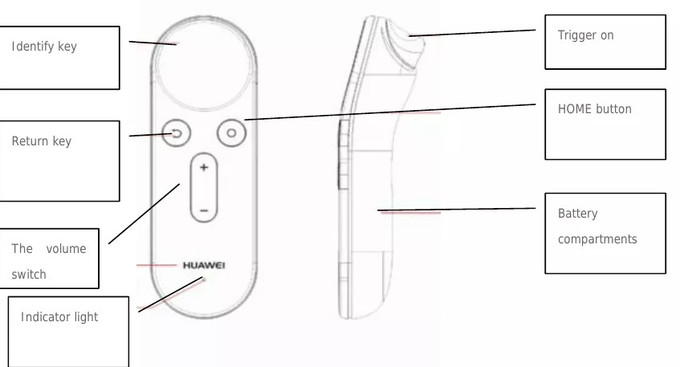
An item dubbed as “virtual reality handle” along with some images has surfaced in FCC documents. It seems to be a controller as it appears quite similar to the one that is available with Google’s Daydream VR. Its top portion could be touch-sensitive and it seems to feature buttons for Home, Return and volume.
The FCC documents reveals that apart from controlling the sound, the volume buttons can be also used for answering or rejecting phone calls while using the VR headset. This suggests that the upcoming VR headset by Huawei is not a standalone device, but it will require users to put their smartphone inside the device and use its screen to show Daydream compatible content.
The FCC documents do not contain images of the VR headset. Even though Google had shown what the VR headset by Huawei would look like earlier this year, the Chinese manufacturer may have modified the design of the device.
As of this writing, only Mate 9 and Mate 9 Porsche Design are certified as Daydream VR ready phones by Huawei. It is likely that the recently launched Mate 10 and Mate 10 Pro would also bag the certification. Since there are not many Daydream ready Huawei phones in the market, its upcoming VR headset will be compatible with phones from other brands.
The Consumer Electronics Show (CES) 2018 will be held in January 2018. It is likely that Huawei’s Daydream VR headset may get showcased at CES 2018. If not, the company may make it official at the Mobile World Congress (MWC) 2018 event in February 2018.
Xiaomi India is gradually acquiring a reputation for generating media hype around its products and other of its activities, especially on Twitter. The brand has kept the media abuzz for a while now regarding a new smartphone that would be launched in India on November 30. The phone was simply identified as Desh Ka smartphone, a code-name which translates to “Country’s smartphone”.
Xiaomi India markets the product as a new one that would be hitting India on that day and some of its features include an affordable price, large RAM, a big battery and so on. Well, if you are looking out for a new smartphone, that may not happen as the identity of the Desh Ka smartphone has been uncovered. The smartphone is more or less the Xiaomi Redmi 5A hitting India for the first time. This latest information was spotted from the source code of Xiaomi’s teaser page for the event and it contains the “Redmi 5A” name.
Thebudget Redmi 5A is already on sale in China since October when it was quietly unveiled. Creating so much hype around the launch of a smartphone that was quietly listed up for sale in China is a pointer to how Xiaomi considers India as an important market in the entry-level and mid-range segment. This could also be Xiaomi way of trying to get into the consciousness of those who are yet to embrace the smartphone revolution, especially in rural India. Studies have shown that there are still many people in India using feature phones despite the enormous number of persons already using smartphones.
We must point out that we couldn’t find the original article on the source link provided by GSMArena or set our eyes on the source code itself. The article seems to have been pulled down. But the Redmi 5A had all along been suspected as the smartphone that would be launched today in India. Well, except Xiaomi will be unveiling an entirely new model alongside the Redmi 5A. Whatever smartphone that would be unveiled today is already revealed as a Flipkart exclusive.
Samsung isn’t all about smartphone as the world’s top smartphone vendor also has interests in electronics, display panels, and semiconductor manufacture. Samsung is even a leading name in advanced semiconductor technology and is responsible for the manufacture of the Qualcomm Snapdragon 835 chip using the first-generation 10-nanometer (nm) FinFET process technology. The tech giant has now announced that its foundry has started mass producing System-on-Chip (SOC) products built on its second generation 10nm FinFET process technology as well as a 10LLP (Low Power Plus).
The 10 LPP process technology further provides for up to 10% increase in performance as well as 15% lower power consumption when compared with the first generation 10nm process technology called 10LPE (Low Power Early). The new process is derived from the 10LPE technology which has already been perfected, the new technology offers competitive advantages by greatly reducing turn-around time from development to mass production. It also ensures significantly higher initial manufacturing yield.
The System-on-Chip (SoCs)designed with the 10LPP process technology will power digital devices scheduled to launch early next year. The process is also expected to become more widely available throughout the year as a result of the better yield and perhaps cheaper cost than the current flagship chips manufactured using the 10nm FinFET process technology. The tech giant also disclosed that they are still intensifying efforts to further pilot the evolution of the 10nm technology down to 8LPP to offer customers distinct competitive advantages for a wide range of applications.
Samsung has also announced that its newest manufacturing line, S3, which has been under construction in Hwaseong, Korea, is now ready to commence production of process technologies including 10nm and below. The S3 plant is Samsung Foundry’s third fab, the first being S1 located in Giheung, Korea and S2 in Austin, Texas, US. It is worthy of note that the much touted Samsung 7nm FinFET process technology with EUV (Extreme Ultra Violet) will also be mass produced at S3.
Yesterday, OnePlus launched the OnePlus 5T in China. While the launch comes 2 weeks after its release in New York, fans in China got a compensation.
The OnePlus 5T will not only be available in Midnight Black but will also come in a new Lava Red variant which will be exclusive to China. The Lava Red OnePlus 5T will however be limited to the 8GB RAM + 128GB ROM version.
If you are a fan of OnePlus and a lover of red, you can now pre-order the exclusive color variant from Oppomart. Price is $699 and estimated shipping date is beginning of December.
The OnePlus 5T is a refreshed version of the OnePlus 5. It brings a number of key upgrades such as a 6.01” Optic AMOLED FHD+ display with an 18:9 aspect ratio. It also swaps out the 20MP f/2.6 zoom lens from the dual camera combo on the rear for another 20MP sensor but with a larger f/1.7 aperture.
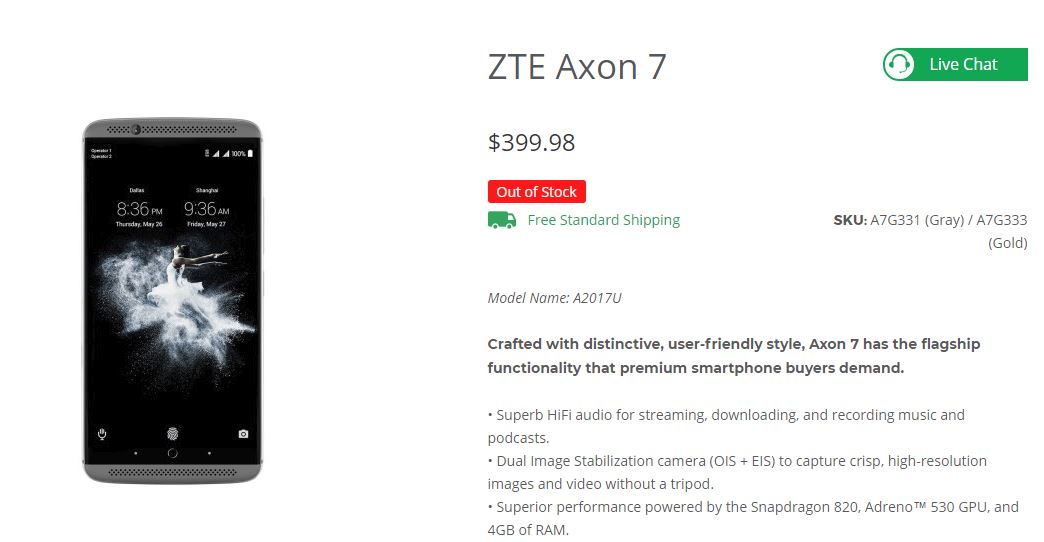
The ZTE Axon 7 is no longer available for buying in the U.S. as it has gone out of stock. When a Redditor got in touch with ZTE’s customer service department to enquire on the restocking of Axon 7, he was told that it “will not be available for sale going forward.” The Axon 7 is a year and a half old now and since the Chinese firm had recently tweeted that it will be releasing a successor phone its 2016 flagship, the rumor mill is now speculating that the company may be preparing the launch of the rumored ZTE Axon 8 smartphone.
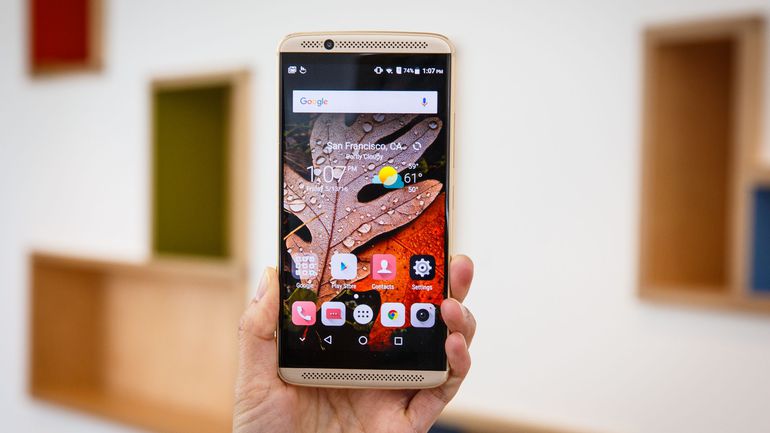
ZTE’s official US e-store is no longer selling the Axon 7. However, it is still available for purchase in limited quantities on Amazon through a third-party seller. The device is now listed as “Discontinued” on GearBest. The ZTE Axon 7 features a 5.5-inch QHD AMOLED display, Snapdragon 820, 4 GB RAM, 64 GB storage, 20-megapixel rear camera, 8-megapixel selfie camera and 3,250mAh battery.
In June, a device speculated as ZTE Axon 8 was spotted on GFXBench as ZTE A2018. The GFXBench listing had revealed that it features Snapdragon 821 and 128 GB storage, but most of the other specs were same as Axon 7. In May, the ZTE A2018 was also spotted on TENAA with dual rear cameras featuring a 20-megapixel sensor and a 12-megapixel sensor. It had also revealed that the smartphone is powered by Snapdragon 821 chipset.
Apart from the above mentioned GFXBench and TENAA listing, there is no fresh information available on the alleged ZTE Axon 8 smartphone. Hence, we will have to wait more for details to surface to confirm the existence of the Axon 8.
Huawei released the Honor Magic as a sort of concept device. It has a beautiful and unique design as its eight edges are curved and is one of Huawei’s truly intelligent smartphones.
When it launched almost a year ago, the Honor Magic was priced at ¥3699 (~$560). For the first time since its release, the Magic has gotten an official price cut and a huge one at that.
The Honor Magic will now sell for ¥2699 (~$409). Interested buyers can purchase the Magic at the new price not only on the official Huawei online store (Vmall.com) but also on JD.com, TMall.com, and Suning.com.
For those who have forgotten the specs, the Honor Magic packs a 5.09” 2K AMOLED display, 4GB of RAM and 64GB of storage. It is powered by the Kirin 950 processor.
It has dual 12MP f/2.2 rear cameras in the monochrome + RGB configuration and an 8MP f/2.0 front facing camera. Battery capacity is 2900mAh with support for super fast charging (90% in 30 minutes).
The Honor Magic doesn’t have a MicroSD card slot but has an audio jack, a USB-C port, NFC, Bluetooth 4.2, and dual SIM support. It also has face unlock and a bunch of pretty interesting software features.
We use cookies on our website to give you the most relevant experience by remembering your preferences and repeat visits. By clicking “Accept”, you consent to the use of ALL the cookies.
This website uses cookies to improve your experience while you navigate through the website. Out of these, the cookies that are categorized as necessary are stored on your browser as they are essential for the working of basic functionalities of the website. We also use third-party cookies that help us analyze and understand how you use this website. These cookies will be stored in your browser only with your consent. You also have the option to opt-out of these cookies. But opting out of some of these cookies may affect your browsing experience.
Necessary cookies are absolutely essential for the website to function properly. This category only includes cookies that ensures basic functionalities and security features of the website. These cookies do not store any personal information.
Any cookies that may not be particularly necessary for the website to function and is used specifically to collect user personal data via analytics, ads, other embedded contents are termed as non-necessary cookies. It is mandatory to procure user consent prior to running these cookies on your website.