The Meizu 16 was supposed to launch on August 8 but it appears Meizu has brought it back by a week. The Chinese manufacturer has sent out invites for an event on July 30.
As you already know Meizu is always extra with its invites and this time it has sent a bottle of shampoo along with the invite. The shampoo brand is Heads and Shoulders and we think it is a joke teasing other manufacturers whose phones have a notch or how the bezels on the Meizu 16 and Meizu 16 Plus are small.
[envira-gallery id=”203380″]
The Meizu 16 and Meizu 16 Plus will both come with Snapdragon 845 processors. They will also have AMOLED displays with the Plus variant coming with a 6.5-inch screen and the regular model having a 6.0-inch screen.
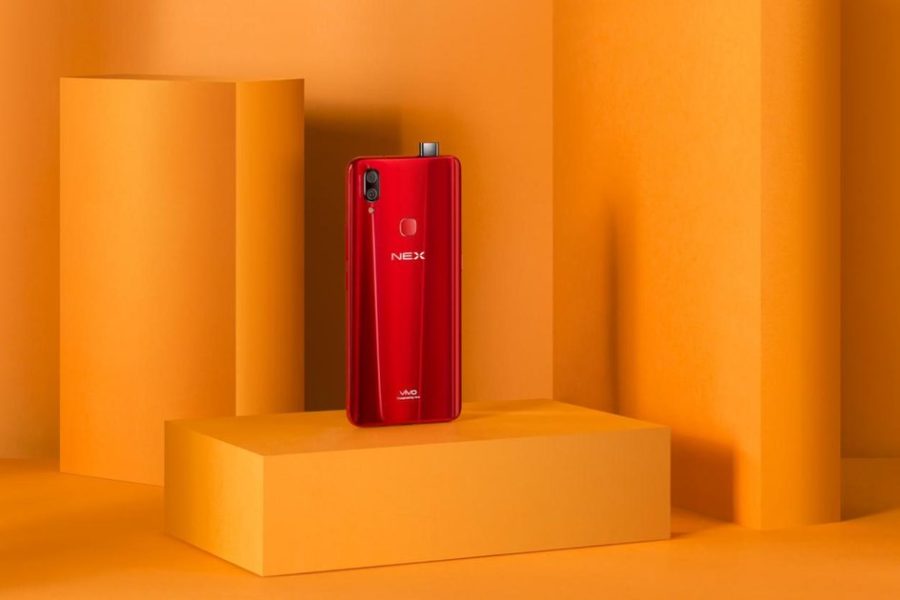
Earlier this month, Vivo announced the Ruby Red color variant of its flagship Vivo NEX smartphone that comes with an innovative design featuring a pop-up front-facing camera. Now, the company has announced that the Vivo NEX Ruby Red color variant is available for purchase in China.
The Ruby Red color variant of the Vivo NEX comes in two models — one with 128GB internal storage and another with 256GB storage. The 8GB RAM with 128GB internal storage model is priced at 4,498 Yuan (approximately $662) and the 8GB RAM + 256GB storage model costs 4,998 Yuan, roughly $736.
The phone’s body is made up of glass and is coated using the microcrystalline technology. The rear-mounted fingerprint sensor is also coated in Ruby Red color as well as the sides, including the volume rocker and other buttons.
The smartphone comes with a 6.59-inch Super AMOLED Ultra FullView “Zero Screen” Display with a screen-to-body ratio of 91.24 percent and 2316 x 1080 pixels screen resolution. All the sensors on the device are hidden under the display and instead of an earpiece, the phone comes with a Screen SoundCasting Technology.
Under the hood, the device is powered by Qualcomm‘s Snapdragon 845 processor clocked at 2.8GHz, along with Adreno 630 graphics processor. It packs 8GB RAM and comes with 128GB of internal storage. Vivo has not launched the 256GB storage variant nor the Snapdragon 710 SoC variant in India.
In the camera department, the smartphone features a dual camera setup on the back, consisting of a 12MP primary Sony IMX363 sensor with 1.4μm pixels, f/1.8 aperture, and four-axis optical image stabilization and a 5MP secondary sensor with f/2.4 aperture.
On the front side, there’s an 8MP snapper that comes with an elevating mechanism. The front-facing snapper automatically rises and hides on opening and closing the camera app, and also makes a sound to notify the user. This is done using micro-stepping motors with independent drive ICs and precision control algorithms.
The device features a third-generation in-display fingerprint scanning technology that improves the screen unlock time by 10 percent and increases the overall experience of phone unlocking. The company is actively working on improving the fingerprint scanner and has already rolled out a couple of updates improving the performance of the scanner.
It also comes with Vivo Game Engine, which is made in partnership with Tencent Games that aims to provide an immersive gaming experience based on software and hardware optimization. Further, the Vivo NEX also features 7.1-channel 3D audio, thanks to dtsX partnership. It also has Vivo Hi-Fi V1 System In Package technology for hi-fi quality sound through earphones.
The phone also comes equipped with a personal voice assistant — Jovi, which works on artificial intelligence technology. It supports several functionalities such as smart map reading, encyclopedia, shopping, translation, scanning, and screen recognition among others.
Connectivity options on the devices include Dual 4G VoLTE, Wi-Fi 802.11 ac (2.4GHz / 5GHz) 2×2 MIMO, Bluetooth 5 LE, GPS + GLONASS, and USB Type-C. It has Vivo’s newly designed custom user interface Energy UI with AI technology, running on top of Android Oreo operating system. The device draws power from a 4,000mAh battery with 22.5W fast charging support.
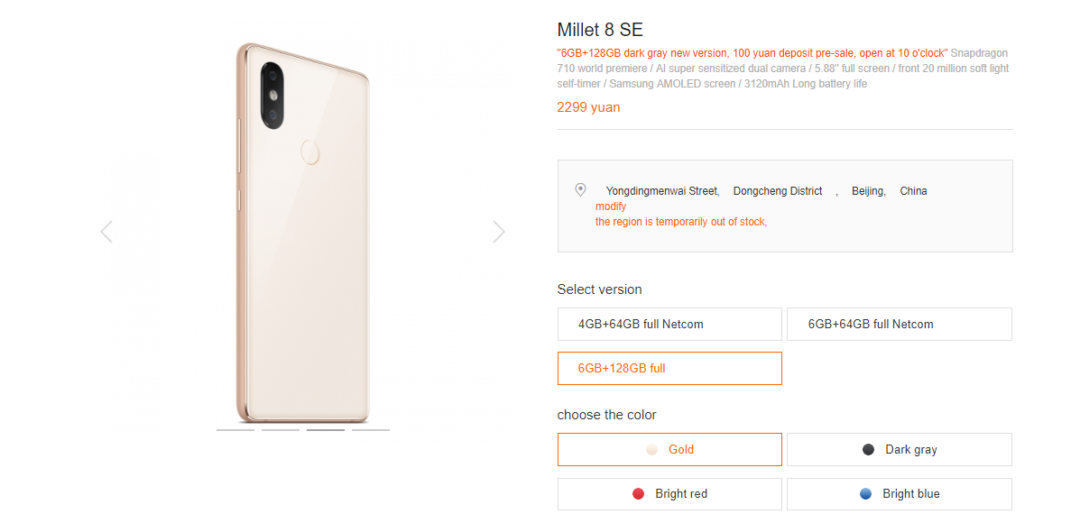
When the Mi 8 SE was unveiled in May, it was available in two variants – a 4GB RAM + 64GB version and a 6GB RAM + 64GB version. Now, both variants have been joined by a third which has 6GB of RAM and 128GB of storage.
The new variant will sell for ¥2299 (~$338) and will be available in gold, dark gray, bright red, and bright blue. Apart from the increase in storage, it has the same specs as the other variants.
The Mi 8 SE is the first phone in the world to come with a Snapdragon 710 processor. It has a 5.88-inch FHD+ Samsung AMOLED display. It also has a notch at the top of the screen.
On the back are dual 12Mp + 5MP cameras with AI features, portrait mode, and lots of beauty modes. The selfie camera is a 20MP sensor with AI portrait mode, HDR, and soft light.
ZTE is already back to manufacturing phones now that the ban has been lifted. A new phone with model number A0722 has been seen on TENAA and it packs mid-range specs.
The ZTE A0722 has a 5.45-inch 1440 x 720 display. It is powered by a 1.4GHz octa-core processor. We believe this is one of the Snapdragon 400 series. It will come in 3GB and 4GB RAM variants with 32GB and 64GB of storage respectively.
ZTE is keeping things simple by putting just a single 13MP sensor on the rear and a 5MP front-facing camera. It will come with Android 8.1 Oreo and pack a 3100mAh battery.
[envira-gallery id=”203365″]
Provided images show the phone has a red power button which is on the right and a rear-mounted fingerprint scanner. The rear camera is also at the top left corner and the back seems to be made of plastic.
Xiaomi’s Mijia platform has grown to become an online store for practically all your needs. The platform now sells clothes, toys electronics, drinks, foods, and even pet items. However, none of these costs as much as one of its latest products – a house furniture set.
The house furniture set is actually made by a partner company based in Hangzhou, China. It is a 25-piece furniture set that includes a living room set, a dining set, a bedroom set, and a home office set.
The whole set has the same theme. All the pieces of furniture are made from European Elm trees with PVD gold-plated non-slip feet. Those with cushions such as the chairs and headboard contain SINOMAX high-density foam and are covered in orange or brown American cowhide leather.
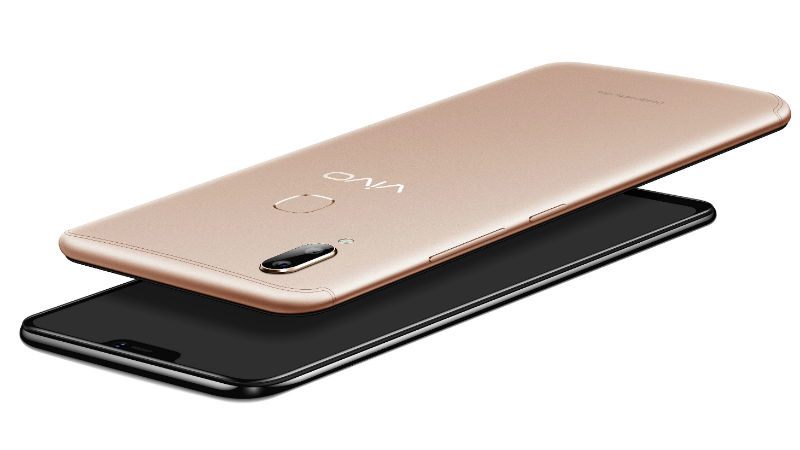
The Vivo V9 Youth which was launched in India sometime in April has just gotten its second price drop in two consecutive months. The device which is actually the budget model of the Vivo V9 was announced with a starting price of 18,990 (~$276). The device then received its first Rs. 1000 price cut in June, a month after its launch in India. The device as of today just got another Rs. 1,000 price cut, bringing the final price down to Rs. 16,990 (~$247).
For those not fully acquainted with the device, the Vivo V9 Youth features a 6.3-inch notched display that supports Full HD+ resolution of 2280 x 1080 pixels. The Full View 2.0 display offers an aspect ratio of 18:9. The device is powered by a Snapdragon 450 SoC that includes a 1.8 GHz octa-core processor. The company had used the same SoC to power the discontinued Vivo V7+ smartphone from last year. The chipset is paired with 4 GB of RAM and it comes with a native storage of 32 GB. For additional storage, users can make use of a microSD card on this phone. Keeping the lights on is a modest 3,260mAh battery. The phone gets its interface from the Android 8.1 Oreo-based FunTouch OS 4.0.
Furthermore, the Vivo V9 Youth features a 16-megapixel selfie camera on the front side whereas the backside is fitted with a 16-megapixel + 2-megapixel dual camera setup. The camera lacks support for 4K video shooting but comes with features like AI Beauty, Bokeh mode and AR stickers. In addition, the V9 Youth packs a rear-mounted fingerprint sensor.
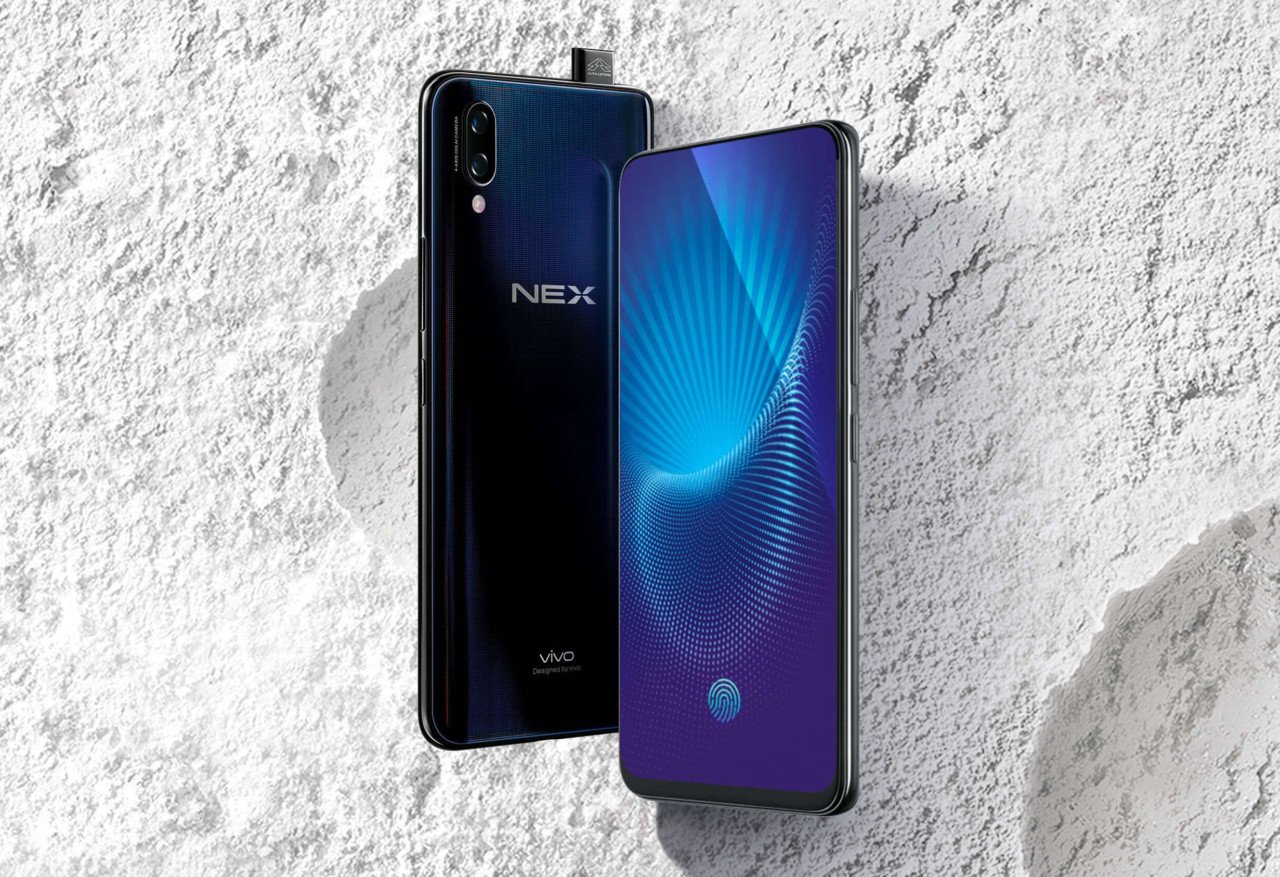
Earlier this year, Vivo launched its flagship smartphone Vivo NEX, which comes with the unique elevating front-facing camera. After launching the smartphone in China and India, the company has now officially launched the device in Taiwan.
Today, at a press conference, Vivo finally launched Vivo NEX with 8GB RAM and 128GB storage in Taiwan for a price of NT$21,990, which roughly converts to $719. The phone will be available for pre-order till 30th July. The Snapdragon 710 variant of the smartphone won’t be available in Taiwan.
The smartphone boasts a 6.59-inch Super AMOLED Ultra FullView “Zero Screen” Display with a screen-to-body ratio of 91.24 percent and 2316 x 1080 pixels screen resolution. All the sensors on the device are hidden under the display and instead of an earpiece, the phone comes with a Screen SoundCasting Technology.
Under the hood, the device is powered by Qualcomm‘s Snapdragon 845 processor clocked at 2.8GHz, along with Adreno 630 graphics processor. It packs 8GB RAM and comes with 128GB of internal storage. In the camera department, there’s a dual camera setup on the back, consisting of a 12MP primary Sony IMX363 sensor with 1.4μm pixels, f/1.8 aperture, and four-axis optical image stabilization and a 5MP secondary sensor with f/2.4 aperture.
On the front side, there’s an 8MP snapper that comes with an elevating mechanism. The front-facing snapper automatically rises and hides on opening and closing the camera app, and also makes a sound to notify the user. This is done using micro-stepping motors with independent drive ICs and precision control algorithms.
The device features a third-generation in-display fingerprint scanning technology that improves the screen unlock time by 10 percent and increases the overall experience of phone unlocking. The company is actively working on improving the fingerprint scanner and has already rolled out a couple of updates improving the performance of the scanner.
Connectivity options on the devices include Dual 4G VoLTE, Wi-Fi 802.11 ac (2.4GHz / 5GHz) 2×2 MIMO, Bluetooth 5 LE, GPS + GLONASS, and USB Type-C. The device measures 162 × 77 × 7.98 mm and weighs 199 grams. It runs Android 8.1 Oreo operating system out-of-the-box with FunTouch 4.0 UI and is powered by a 4,000mAh battery with 22.5W fast charging support.
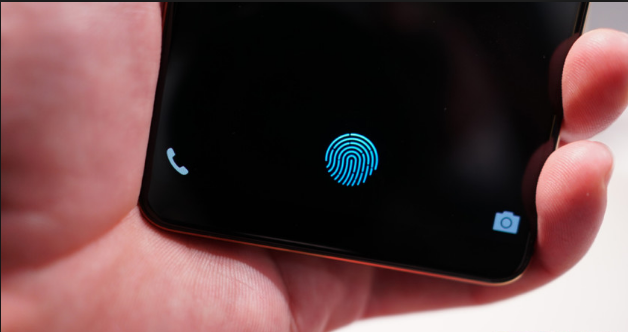
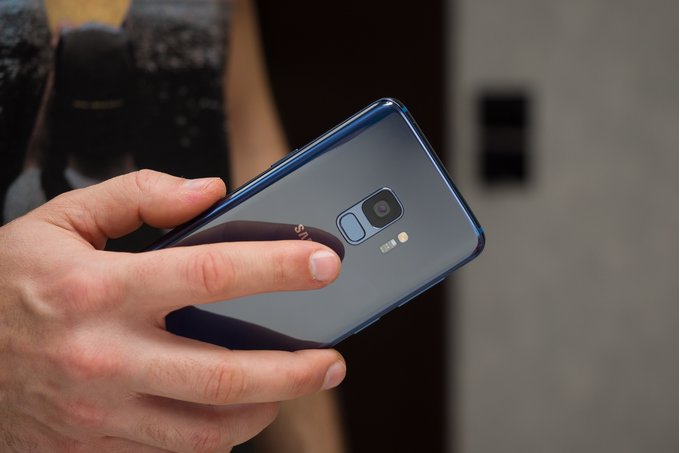
Samsung isn’t expected to launch the Galaxy S10 flagship series until next year but already, rumours have started trickling gradually about the models. As is regular with the Galaxy S series, the Korean company is said to be planning once again to release the Galaxy S10 in two models – the Galaxy S10 and Galaxy S10 Plus. If news from the South Korean supply chain is anything to go by, the device would sport an innovative ultrasonic in-display fingerprint sensor.
You would agree that the in-display technology is not a new thing in the smartphone market as some Chinese models such as the Vivo NEX, Mi 8 Explorer Edition and Huawei Mate RS already feature the in-display fingerprint technology. The technology is yet to catch up with so many OEMs as several new models like the latest OPPO Find X didn’t adopt it. But the rumour says Samsung is working on a faster, more reliable ultrasonic in-display fingerprint recognition solution which would differentiate the sensor in the Galaxy S10 flagship series which is different from the one on the models we know of. It is said that this ultra-advanced biometric sensor is not going to be manufactured by Goodix and Synaptics which is known to be the manufacturer of the optical-based component used by Vivo, Xiaomi, and Huawei. Samsung biometric sensor is most likely to be produced by Taiwan’s General Interface Solution (GIS).
It has been speculated before now that the Galaxy S10 flagship series would house three different smartphones and from all indication, the 6.1 and 6.4-inch or so AMOLED screens models would be embedded with the ultrasonic in-display fingerprint sensors. while the low-end 5.8-inch model would come with the normal rear-mounted fingerprint scanner. Industry sources also point out that, the high-end device in the S10 series – 6.1-inch and 6.4-inch models would have more units produced with about 34-36 million units out of the estimated 40 million units to be produced. The trimmed down model will get just 4 million units.
Samsung has released its first video ad for the Galaxy Note 9. The video advert is actually a teaser and doesn’t show the phone at all but actually teases a primary feature of the device.
The 30-second long video shows what it is like to have your phone running low on battery at a terribly inconvenient time. The individual in the video frantically tries to make the battery of his/her phone last longer by reducing brightness, closing apps, turning off location and Wi-Fi and even plugging it into a power bank, but the phone still dies.
Apparently, you wouldn’t have to experience this “traumatic” experience with the Galaxy Note 9. It has been revealed that Samsung’s next flagship will come with a 4,000mAh battery. When it launches on August 9, which the video confirms, the Galaxy Note 9 will be the Note device with the biggest battery.
Huawei has been on a roll with its EMUI 8.0 update. It has been pushing out the update which also brings Android 8.0 Oreo to a number of its devices. While a large percentage of these devices were released in the last one year, Huawei has now extended the update to older devices.
About a month ago, it announced that phones like the 2015 Mate 8 and 2016’s Honor Note 8 will get updated to Android 8.0 Oreo. And true to its words, the update is now available for these devices and more. The announcement was made yesterday on Weibo.
If you own the following devices you should check for the EMUI 8.0 (Android 8.0) update:
Last year, OPPO had launched OPPO R11s and R11s Plus smartphones with upgraded specifications in the latter half of 2017 after launching the OPPO R11 and R11 Plus phones in June. Hence, the rumor mill been speculating that the upgraded OPPO R15s and R15s Pro may arrive in the next few months since the company had launched OPPO R15 and R15 Pro phones in March this year. Kumamoto Technology, a leakster from China has shared an image seems to have been snapped during a media event in the country. OPPO seems to be one of the sponsors of the event as the banners of the company can be seen in the image. What’s interesting about the image is that it features R17 billboards too. This suggests that the company has already started teasing the R17 smartphone in the home country. Probably, it may launch OPPO R17 and R17 Pro as the successor editions of R15 and R15 Pro.
As of this writing, there is no information available on the specs of the OPPO R17. In the recent, multiple Chinese leaksters including Kumamoto Technology have claimed that OPPO and Vivo could be the first companies to launch smartphones with 10 GB of RAM. Apart from sharing the above image, the leakster has once again shared his previous Weibo post in which he had claimed that smartphone featuring 10 GB RAM may launch by the end of the year.
He could be hinting that the OPPO R17 will come with 10 GB of RAM. However, it seems unlikely because the R15 duo feature 6 GB of RAM. Since the R-series of devices are not flagship phones from the company, there is a possibility that there could be another 2018 flagship phone from the company that will feature 10 GB of RAM. It is speculated that it could be equipped with Snapdragon 710 SoC.
A couple of unidentified OPPO phones such as PBBM00 / PBBT00, PBCM00 / PBCT00, PACT20 and PACM20 have surfaced on TENAA in the recent weeks. Probably, these may include the upcoming OPPO R17 and R17 Pro smartphones.
ZTE was given a lifeline by the U.S government a couple of weeks back by lifting the ban earlier placed on the sale of US technology to the company. It has now emerged that it isn’t going to be a rollercoaster ride for the Chinese company as the lifting of the ban was tied to several conditions. One of the conditions, according to a source familiar with the matter is that ZTE will need to re-brand its smartphone division.
As it stands, ZTE will need to change the name of its smartphone business. That means dropping the name ZTE from the smartphone brand in order to distinguish it from its network infrastructure business. The reason given for this directive is that the authorities still don’t trust the Chinese firm’s network business and considers it as a threat to national security. On the other hand, the company’s smartphones enjoy some level of trust since they make use of US-owned technologies such as Qualcomm’s processors and are thus, safe to use.
Recall that Huawei’s phones were discouraged from being used in the U.S because the technology onboard like the Kirin chipset is owned by the Chinese giant. As a result, the U.S government and her agencies believe Huawei phones can be used to spy on U.S citizens. In this case, ZTE doesn’t seem to have much of an option than to comply since they depend on US carriers to sell most of their devices in the country. Additionally, the company will need to restructure the management team for its consumer business, stationing the new management team outside of China. One wonders the new name the company would adopt after the rebranding. Perhaps, you could suggest one you consider fitting for the longstanding brand. Do well to drop your thoughts in the comment section.
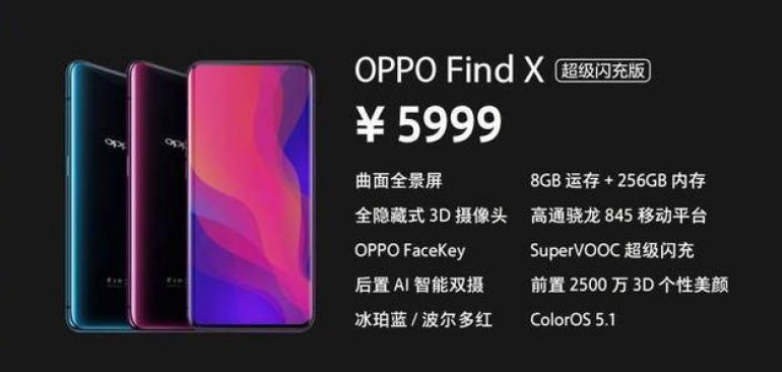
When OPPO unveiled the Find X, it also announced a Lamborghini Edition. Apart from the Lamborghini branding, the special edition also comes with OPPO’s Super VOOC charging technology which has a power rating of 50W (10V/5A). It also has a smaller 3400mAh battery (which is actually two 1700mAh batteries according to OPPO) and comes with 8GB of RAM and 512GB of storage. But there is a third variant- the Find X Super Flash Edition.
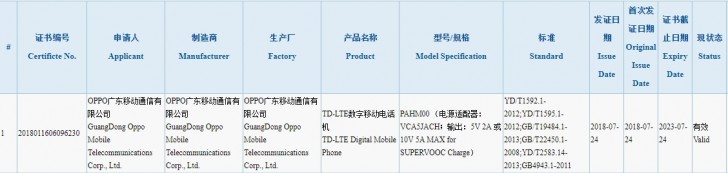
Apparently, the Find X Super Flash Edition supports Super VOOC charge like the Lamborghini Edition. It is also the variant that comes with 8GB of RAM and 256GB of storage. Although OPPO announced it at the launch in China, it is not yet on sale and even just got its 3C certification.
The 3C certification page shows it has the model number PAHM00 which is similar to the regular variant’s PAFM00 and PAFT00 model numbers. It also shows that its charger supports 10V 5A max for Super VOOC charge.
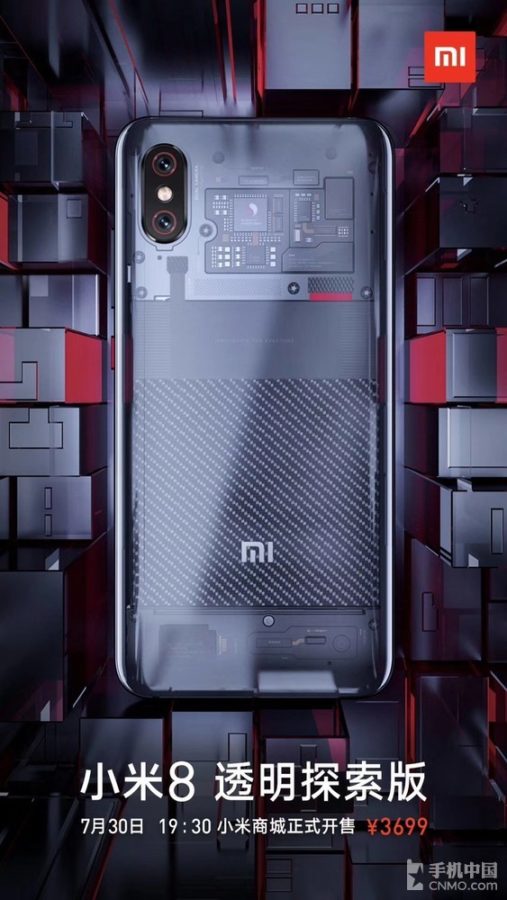
Xiaomi Mi 8 Exlorer Edition was announced alongside the Mi 8 and Mi 8SE. While the other models have been on sale since their launch on May 31, the Mi 8 Explorer Edition only went on sale July 24. Considering the high approval rating the device got, the first sale was concluded within a short time with all units sold out. Xiaomi has now revealed that the Mi 8 Explorer Edition will be available on Xiaomi Mall from July 30 with a 3,699 yuan (~$545) price tag. This is a considerably modest price for a device with such specs. Comparably, the Mi 8 6GB + 256GB version comes in at 3,299 yuan (~$486), so you decide.
Among its stand out features is a translucent glass back which shows the internal components in a beautiful way. The device doesn’t feature a fingerprint sensor at the back instead, the Mi 8 Explorer Edition has an on-screen fingerprint reader that enables users to unlock the phone by a simple touch. The display is equipped with a highly sensitive pressure sensor, so with just a light touch the fingerprint is scanned and the device unlocked. The device supports Face ID and also onboard is a Snapdragon 845 chipset.
The Mi 8 Explorer edition is fuelled by a 3000mAh battery with support for Quick Charge 4.0+ fast charge. The device is only available in 8GB + 128GB memory configuration. So, you’ll agree it is a bang for your bucks at just $545. There is still no word on when the device will be available outside China. Whenever it does, the price will definitely be slightly higher but if you are getting it from third-party retailers, the retail price might burn a hole in your pocket.
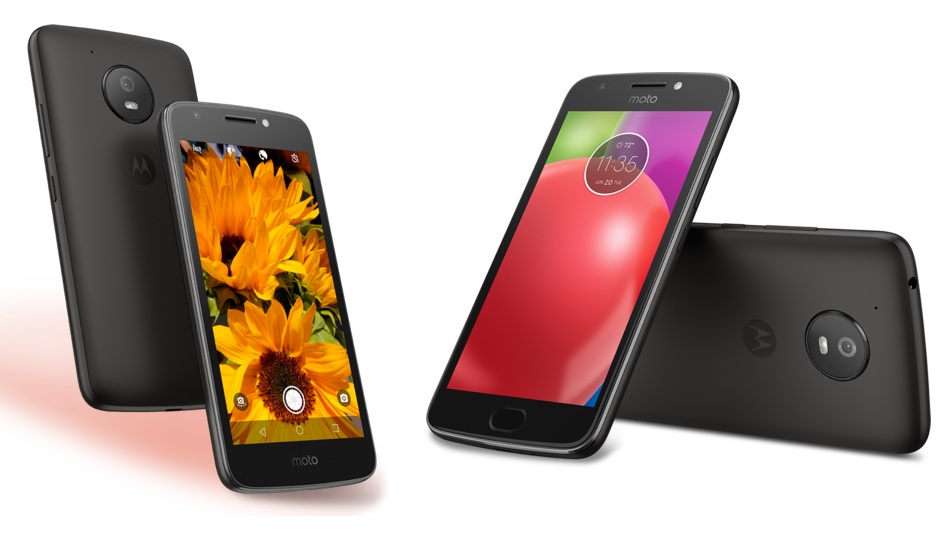
Lenovo-owned Motorola, which has already launched Moto G6 and Moto G6 Play smartphones in India, is now preparing to launch yet another phone in the Indian market — Moto G6 Plus.
Announcing this, Motorola tweeted, “It’s time to ask for more from your smartphone. Get ready to say hello to the #MotoG6Plus, which is #BuiltForMore with a smart camera and serious performance! Stay tuned.”
Currently, there’s no information available about the phone’s pricing but given that the India pricing of Moto G6 and G6 Play starts at Rs. 11,999 and Rs. 13,999, we are expecting the Moto G6 Plus to be priced around Rs. 20,000.
The Moto G6 Plus comes with a larger 5.9-inch MAX Vision Full HD+ display with 2160 x 1080 pixels screen resolution, 18:9 aspect ratio and Gorilla Glass 3 protection. The glass on the back panel is also protected by a layer of Gorilla Glass.
Under the hood, the device is powered by Qualcomm‘s Snapdragon 630 octa-core processor clocked at 2.2GHz along with Adrenographicsaphic processor. It comes in two variants — 4GB RAM with 64GB internal storage and 6GB RAM with 128GB internal storage. There’s also a microSD card support for up to 128GB of storage expansion.
Coming to the optics, there’s a 12-megapixel primary sensor with f/1.7 aperture and a 5-megapixel secondary sensor on the back. There’s an 8-megapixel front-facing snapper with an LED flash for taking selfies and video calling.
There’s a fingerprint sensor on the back side, embedded inside the Moto logo, even though the phone supports Face Unlock feature. Connectivity options include dual-SIM card slots, Bluetooth, Wi-Fi, GPS and a USB Type-C port for charging and data transfer.
The smartphone runs on Android 8.1 Oreo operating system out-of-the-box and is powered by a 3,200mAh battery with support for Motorola’s TurboPower that claims to deliver 7 hours of usage on a charge of 15 minutes.
Samsung Display has announced a new flexible OLED panel that is unbreakable. The panel has been certified by Underwriters Laboratories, a testing company for the Occupational Safety and Health Administration (OSHA) of the U.S. Department of Labor.
The flexible display is said to be developed with an unbreakable substrate and covered with a window that is securely adhered to it. In the case of the unbreakable panel, that window is fortified plastic, unlike most modern displays that are covered with glass.
Hojung Kim who is the GM of Communications at Samsung Display said: “The fortified plastic window is especially suitable for portable electronic devices not only because of its unbreakable characteristics but also because of its lightweight, transmissivity, and hardness, which are all very similar to glass,”.
From the above statement, one shouldn’t be able to tell it is not glass and it should also offer the same scratch resistivity provided by other glass coverings.
The display was put through a series of tests such as 26 successive drop tests from a height of 1.2 meters (almost 4ft) and temperature tests at 71° and -32°. The display is also said to have survived a 1.8 meters drop test.
There is no info as to when we should expect the display to start showing up in devices but seeing as Samsung Display is a huge moneymaker for the electronics giant, we may see it appear in devices next year.
Samsung has been working on its foldable smartphone for quite some time and according to the reports, the South Korean giant will unveil the smartphone early next year. Till now, it was believed that the upcoming Samsung foldable smartphone will be called Galaxy X but that might not be the case.
A tweet from Chinese tipster suggests that the phone could be the part of Samsung’s upcoming Galaxy F series. The Samsung’s Galaxy F series is said to be “super” high-end, which fits the price range for the upcoming foldable smartphone. According to the previous reports, the Samsung’s foldable smartphone will be priced somewhere between $1500 and $2000.
The foldable smartphone from Samsung is said to be the most premium mobile phone from the company, above the Galaxy S-series and Galaxy Note series, which justifies the super high-end tag for the Galaxy F-series. But since there’s no evidence, take this information with a pinch of salt.
Also, there are reports that the company is also working on Galaxy R and Galaxy P series for the Chinese market and there’s a possibility that the Galaxy F is an extension of that and could be a China-exclusive smartphone lineup. The Galaxy R and Galaxy P series are for the low-range and mid-range offerings in China from the South Korean firm.
Samsung is currently gearing up to launch its next flagship smartphone — Galaxy Note 9, which is scheduled to get announced on 9th August in New York. The phone’s specs, feature, and pricing information have already been leaked online.
While the Galaxy Note 9 launch is yet to take place, reports about the company’s next year’s flagship smartphone — Galaxy S10 are already surfacing. Recently, it was reported that the phone will have an ultrasonic fingerprint sensor embedded under the display. It is expected to get launched at MWC 2019.
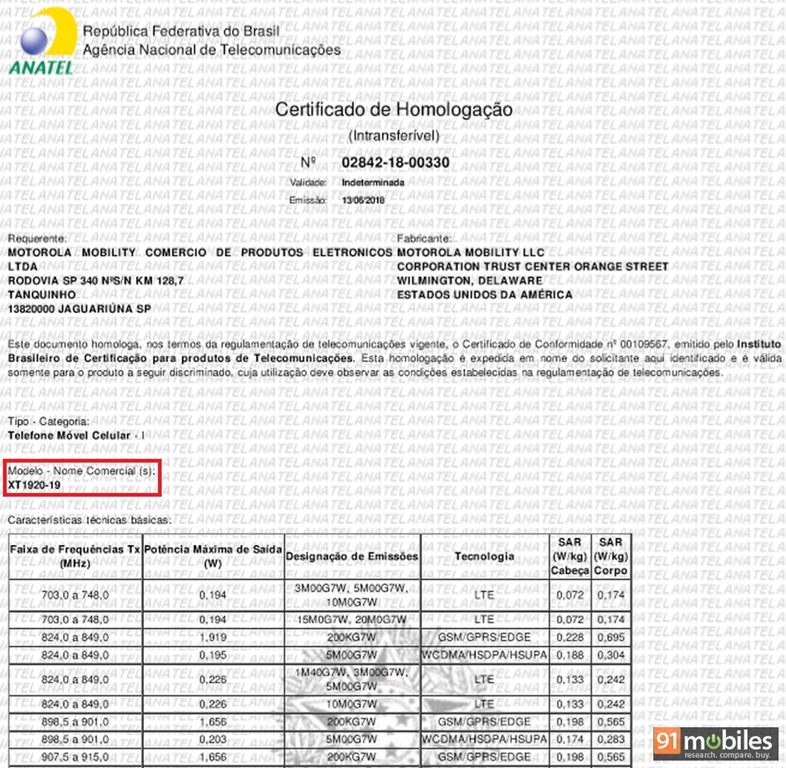
Last year, Motorola had launched Moto C and Moto C Plus with entry-level specs. Recent reports suggest that the Lenovo-owned company is now prepping up to debut the successor Moto C2 smartphone. Last month, a Motorola phone with XT1920 model number was approved by Eurasian Economic Commission (EEC). It is speculated that this phone would be arriving in the market as Moto2. A regional variant of the same phone that has a model number of XT1920-19 has been approved by Brazil based National Telecommunications Agency (ANATEL). Now that EEC and ANATEL bodies have certified Moto C2, it seems that its launch may not be far away.
The ANATEL certification has revealed only few specs of the XT1920-19 Motorola phone. The handset supports dual-SIM capabilities and 4G LTE connectivity. Through the EEC certification it has been revealed that the handset will be featuring 1 GB of RAM and 16 GB of native storage. These specs suggest that it may arrive as an Android Go phone.
The Moto C2’s EEC certification had also revealed that it measures 147.88 x 71.22mm and it will be housing a 2,000mAh or 2,1000mAh battery. This indicates that the handset could be equipped with a 5-inch or 5.2-inch display.
Motorola Moto C2 Leaked Renders
Motorola has recently launched the Moto E5 Play as its first Android Go smartphone in the European and Latin American markets. The handset features 5.3-inch 18:9 display, 8-megapixel rear camera, 5-megapixel front camera and rear-mounted fingerprint scanner. The other specs of the Moto E5 Play Android Go edition are not known yet.
Is Motorola planning to launch another Android Go phone in quick succession? It is advisable to wait for further reports to confirm it. There is no confirmation on the launch date. However, there is a possibility that the Moto C2 could be unveiled alongside Motorola One Power Android One smartphone through its forthcoming Aug. 2 launch event. In related news, Motorola One Power, Moto Z3 Play and Moto E5 Plus have received TENAA certifications which indicates that these phones will be unveiling soon in China.
If you’re a cost-conscious buyer looking to get your hands on high-end products without emptying your pocket, we got good news for you. Banggood is giving big discounts on a slew of products that have been split into various categories in a bid to aid the search process.
As part of the promo dubbed ‘Enjoy New Intelligent Life,’ Banggood is giving buyers an opportunity to win free gifts and get up to a whopping $220 off. Let’s delve straight into the details.
This New Arrival section features a slew of recently added products. More importantly, all items covered in this category carry heavily discounted price tags. For the sake of an instance, you can get $13.5 off on the BlitzWolf BW-SDB1 smart soundbar, which usually sells for $89.99 on Banggood.
The discount can be received by applying a coupon code, which will be valid only for US warehouse. You can bring your grand total down to just $76.50 with the help of the aforementioned coupon, which is likely to expire soon.
Aside from that, you can get a considerable 37% off on the BlitzWolf BW-LT8 LED desk lamp, which would normally set you back $25.20 on Banggood. Thanks to the discount, the LED cabinet light bar is now up for grabs at a discounted price of just $15.99.
The next category comprises a myriad of creative Bluetooth devices including the BW-BR3 Bluetooth V4.1 aptX music receiver, the BW-BR2 Bluetooth V4.1 aptX music receiver transmitter, and the BlitzWolf BW-BR4 music receiver transmitter. You can also get a 34% off on the BW-AS1 wireless Bluetooth speaker.
The rest of the products have been separated into two sections including Porous Smart Socket and Smart Home Products. You can follow this link to check out all the products and take advantage of the discount before the promo wraps up.
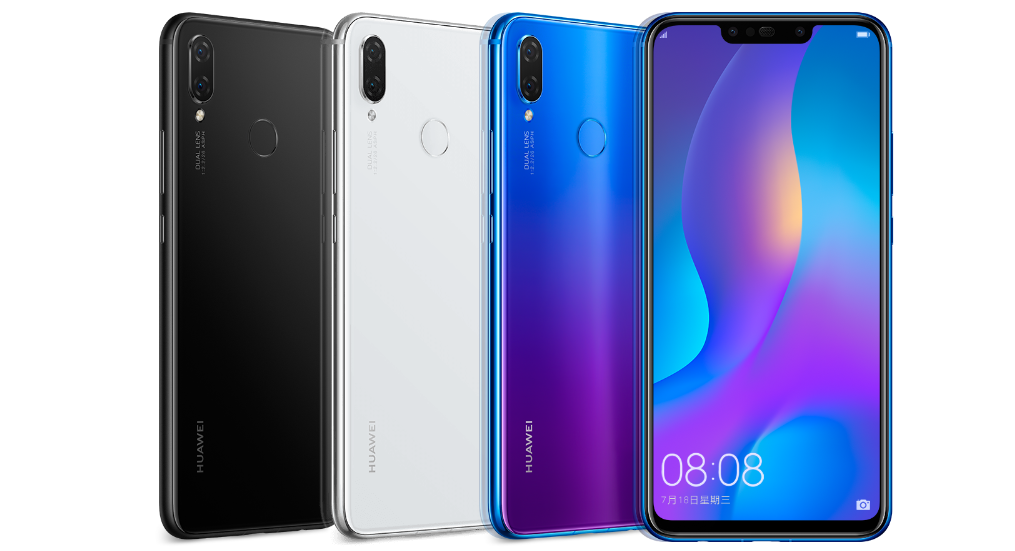
After the launch of Honor 9N in India a couple of days back, it’s parent company Huawei has today launched two upper mid-range smartphones in India — Huawei Nova 3, and Nova 3i. Both the smartphones were launched in China last week.
The Huawei Nova 3 features a large 6.3-inch Full HD+ display with 19.5:9 aspect ratio and 2340 x 1080 pixels screen resolution. Under the hood, it is powered by the company’s own flagship chipset Kirin 970 AI, which is coupled with 6GB RAM and 128GB storage.
There’s a microSD card slot that enables to expand the phone’s storage capacity to up to 256GB. The device also comes with the company’s recently launched GPU Turbo technology that promises a 60% increase in performance and 30% battery saving.
Coming to the photography, the smartphone comes with a 16-megapixel primary sensor and a 24-megapixel secondary camera sensor on the back, with one being a color sensor and other being monochrome. It has f/1.8 aperture lens, PDAF, contrast AF, AI scene recognition, short video effects via AI and even HDR Pro at the hardware level.
On the front side, there’s a 24-megapixel primary sensor with f/2.0 sensor and a 2-megapixel secondary sensor that supports AI features as well as an enhanced beauty mode. The phone also supports IR face unlock and 3D face recognition payments.
Connectivity options on the device include Dual 4G VoLTE, WiFi 802.11ac (2.4GHz/5GHz), Bluetooth 4.2 LE, GPS, and USB Type-C. The smartphone features 3D Emoji AR support and runs on Android 8.1 Oreo operating system based EMUI 8.2 user interface. It is fueled by a 3,750mAh battery that supports fast charging.
On the other hand, the Nova 3i features a 6.3-inch Full HD+ with 2340 x 1080 pixels, 19.5:9 aspect ratio, and 2.5D curved display. Under the hood, it is powered by Kirin 710 octa-core processor along with 4GB RAM and 128GB internal storage with microSD card support up to 256GB.
There’s a dual camera setup at back with 16-megapixel primary sensor and a 2-megapixel secondary sensor. On the front side, there’s a 24-megapixel primary sensor and a 2-megapixel secondary sensor. Connectivity options on the device include Dual 4G VoLTE, Wi-Fi 802.11 ac (2.4GHz / 5GHz) 2×2 MIMO, Bluetooth 4.2 LE, and GPS + GLONASS.
Just like Nova 3, this one also comes with GPU Turbo feature. It also has a fingerprint sensor on the back for added security. The phone runs on Android Oreo operating system with the company’s own custom interface EMUI 8.2 on top. The device is powered by a 3,340mAh battery.
Both the smartphones will be exclusively available for purchase in India through Amazon India. The Nova 3 will go on sale from 23rd August and the Nova 3i will go on sale from 7th August. Pre-bookings for both devices have already started. While the Nova 3 is priced at Rs. 34,999 ($509), the Nova 3i will be available in Black, White and Blue colors for Rs. 20,990 (approximately $306).
We use cookies on our website to give you the most relevant experience by remembering your preferences and repeat visits. By clicking “Accept”, you consent to the use of ALL the cookies.
This website uses cookies to improve your experience while you navigate through the website. Out of these, the cookies that are categorized as necessary are stored on your browser as they are essential for the working of basic functionalities of the website. We also use third-party cookies that help us analyze and understand how you use this website. These cookies will be stored in your browser only with your consent. You also have the option to opt-out of these cookies. But opting out of some of these cookies may affect your browsing experience.
Necessary cookies are absolutely essential for the website to function properly. This category only includes cookies that ensures basic functionalities and security features of the website. These cookies do not store any personal information.
Any cookies that may not be particularly necessary for the website to function and is used specifically to collect user personal data via analytics, ads, other embedded contents are termed as non-necessary cookies. It is mandatory to procure user consent prior to running these cookies on your website.