Last week, Vivo announced the Vivo X20 Plus UD as the world’s first smartphone with an in-screen fingerprint scanner. Since, it’s actually a revamped Vivo X20 Plus, there wasn’t so much to be excited about. However, our interest piqued when photos of the display panel of its successor, the Vivo X30 surfaced online.
Today, a new photo has leaked and this time it shows a working prototype. The picture shows Vivo’s brand ambassador, Lu Han, holding the alleged Vivo X30. If you zoom in closer, you should see the iPhone X-like notch at the top.
Thanks to the tri-bezel-less design, the Vivo X30 will likely have a smaller form factor than its predecessor. This is due to the removal of the area usually reserved for the top bezel. The small notch at the top is now home to the front camera, earpiece, and sensor. However, unlike the iPhone X, there is still a small bezel at the bottom.
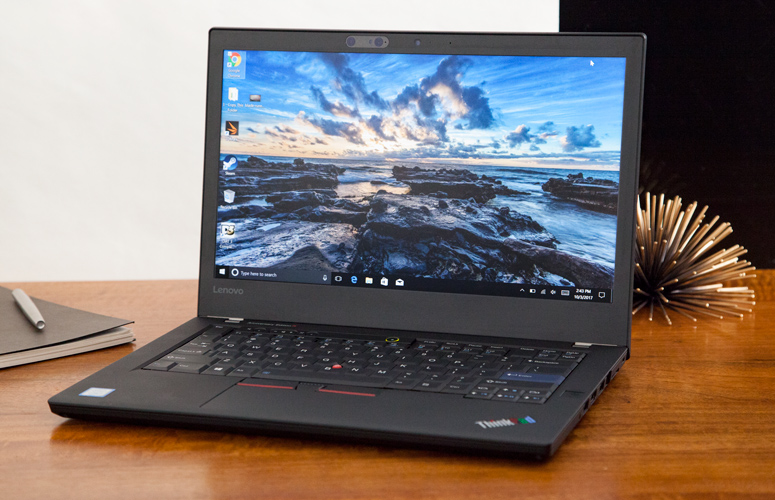
Lenovo‘s laptop business can be credited to be the aspect which keeps the company afloat despite a turbulent era which the smartphone arm faced recently. The company is only second to HP in terms of market shares in the laptop business. One attractive feature of Lenovo’s laptop line is the Fingerprint authentication which it packs. But recently Lenovo has acknowledged that the fingerprint authentication software dubbed Fingerprint Manager Pro (version 8.01.86) has security holes that allow attackers to access any system equipped with the application. The Lenovo Fingerprint Manager Pro is a utility that allows users to log into their laptop and configured websites by using the fingerprint. The affected family models include Lenovo’s ThinkPad, ThinkCentre, and ThinkStation laptops.
A statement released by Lenovo reads thus, “A vulnerability has been identified in Lenovo Fingerprint Manager Pro. Sensitive data stored by Lenovo Fingerprint Manager Pro, including users’ Windows logon credentials and fingerprint data, is encrypted using a weak algorithm, contains a hard-coded password, and is accessible to all users with local non-administrative access to the system it is installed in.”
The vulnerability was reportedly discovered by Jackson Thuraisamy, a senior security consultant with Security Compass. The vulnerability does not affect Lenovo’s laptops running Microsoft Windows 10.1 because Windows 10 comes with support for fingerprint reader technology. However, it affects a dozen Lenovo laptop models that run versions of Microsoft Windows 7, 8 and the 8.1 operating system. The statement also lists the models affected to include;
If you own any of the Lenovo models listed above, you need not worry as the company has created a fix in form of an update. Customers who own any of the affected models are urged to update Fingerprint Manager Pro to version 8.01.87 or later.
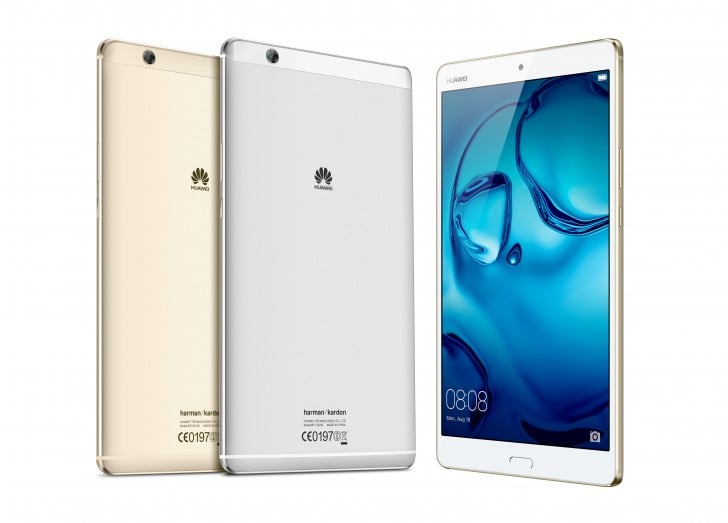
Huawei’s is preparing for the release of its new tablet – the MediaPad M5. The 8.4” model was recently seen on FCC’s website a few days ago. Now, its 3D renders alongside that of the 10.1” model have surfaced online.
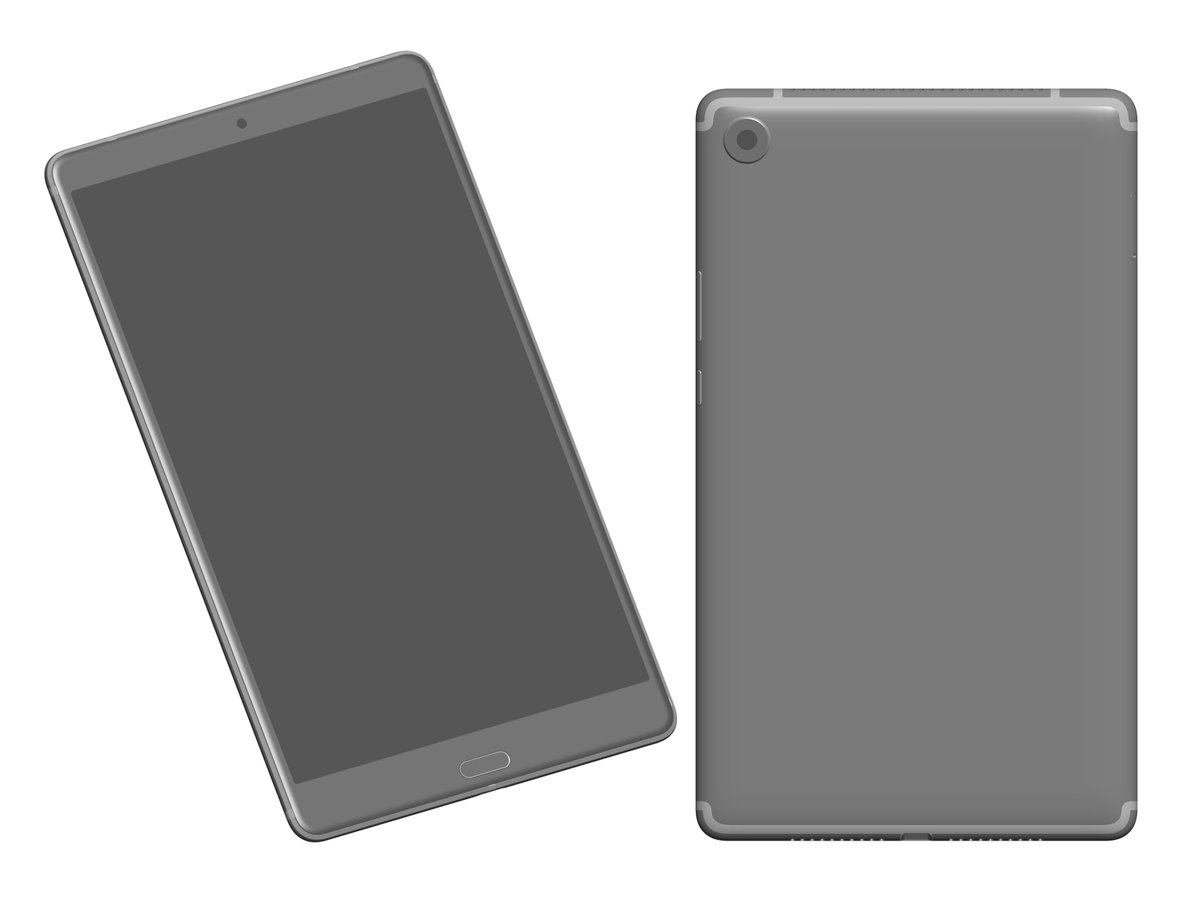
MediaPad M5 (8.4” Model)
The 8.4” MediaPad M5 has a pill-shaped button on the lower bezel. This will double as the home button and fingerprint scanner just like that of the MediaPad M3. There is also a front-facing camera sitting in the center of the top bezel.
While there is no significant change on the front, the back has been redesigned. The rear camera now sits at the top left corner and is slightly raised. Huawei has also ditched the chrome top and added antenna lines in the familiar U-design.
On the right hand side lies the power button and volume rocker and on the left is a SIM tray. There is a USB-C port at the bottom and it is flanked by speaker grilles on each side. There is also a speaker grille at the top but sadly there is no 3.5mm audio jack.
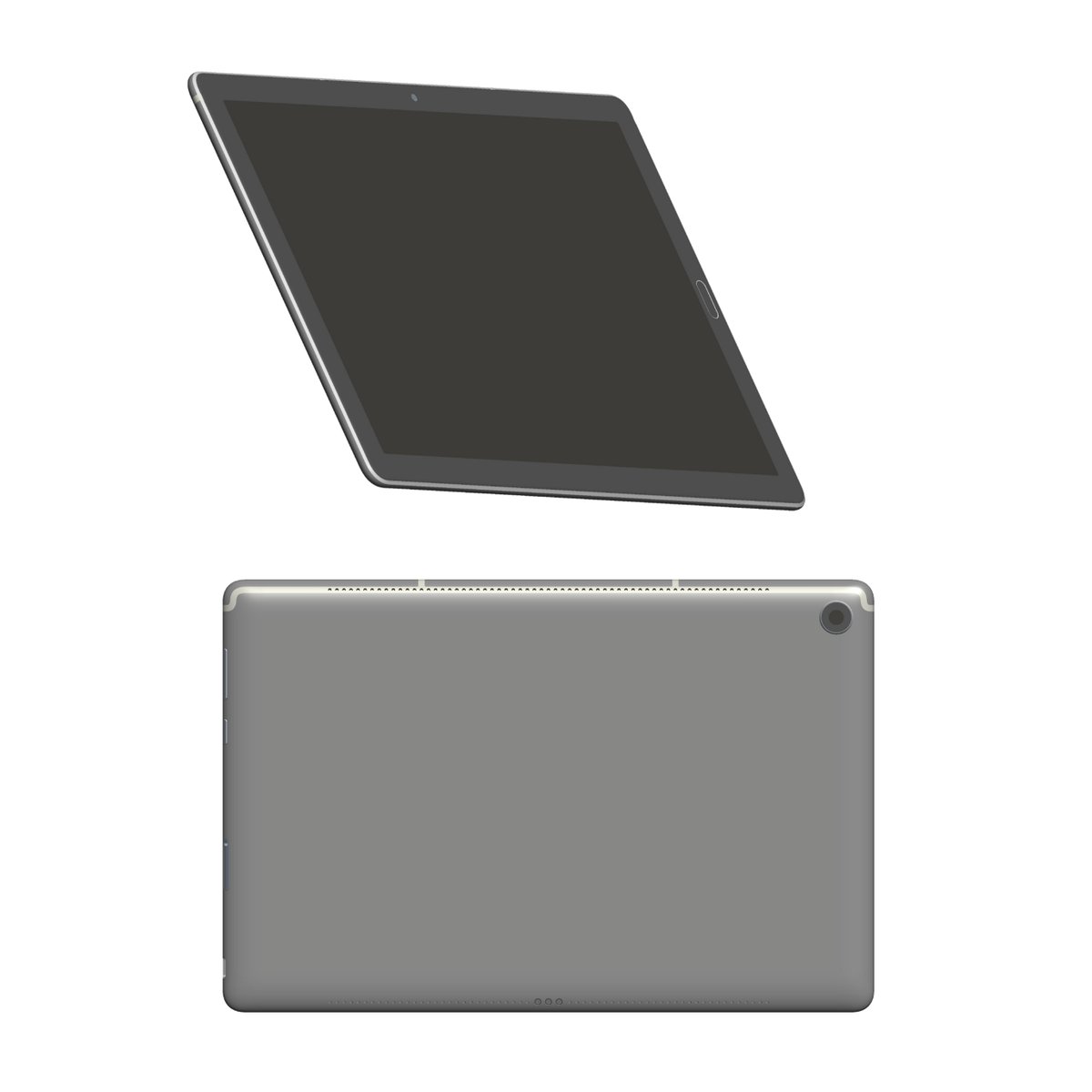
MediaPad M5 (10.1” Model)
The bigger MediaPad M5 has received a slight redesign on the front. On the previous model, the home button sits at the bottom when held in landscape mode, the M5 now has its own on the right side (bottom when in portrait).
The reason for this is most likely because the 10.1” model will now come with a fingerprint scanner. Since landscape mode is the most practical way to use a tab this big, especially when consuming media content, your thumb naturally rests on the right. This makes it easy to unlock when picked up.
There are a bunch of changes on the rear too. The speaker grille is now one long line line at the top instead of two short lines at the bottom. There are also three connection pins at the bottom. Power button and volume rocker are still on the right though.
Although, the renders show all the sides, there is no sign of a USB-port for charging as well as a 3.5mm audio jack. This is a 3D render, so it is likely an incomplete drawing. That should explain the missing USB port, though we won’t rule out the removal of the audio jack.
Meizu kicked off the year with the much-awaited Meizu M6s, its first full-screen smartphone. However, most folks have their eyes set on the arrival of the Meizu 15 Plus, its anniversary flagship.
The Meizu 15 Plus’ existence was first revealed last year by the CEO of Meizu himself. While it was just a photo of the retail box, many more unofficial leaks have come after that.
New leaks have surfaced online and it shows the Meizu 15 Plus and another phone – the Meizu 15 Pro. Initially, we thought that the second variant of the Meizu 15 Plus would be called the Meizu 15 but that doesn’t seem to be the case.
Since both phones are sort of like the direct successors to the PRO 7 and PRO 7 Plus, it makes sense as to why they are going with the names Meizu 15 PRO and Meizu 15 (PRO) Plus.
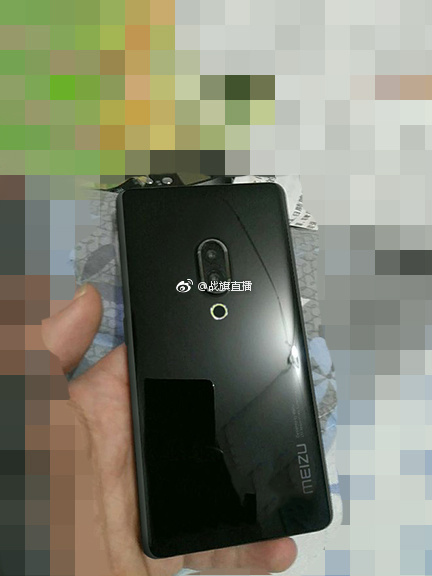
The new leaks are photos of the rear of both phones. They are nearly identical save for the design of the dual cameras. The first image below is said to be the that of the Meizu 15 PRO.
Meizu 15 PRO
It appears the rear is glass or ceramic judging from its reflective nature. It has the same ring flash design we have seen on previous leaks but the dual cameras are positioned a bit lower and the housing is slightly raised. It is also said to have a smaller screen. Surprisingly, some of the earlier leaks we have seen of the Meizu 15 Plus also show the cameras are raised.
The image below is that of the Meizu 15 Plus according to the source. The material is also reflective but not as much thanks to the fingerprint smudges. The dual cameras on this unit are flush with the rest of the body. There is also a ring flash below the setup.
Meizu 15 Plus
Contrary to early leaks that said/showed the Meizu 15 Plus will retain the physical mBack button, new reports say otherwise. The button is said to be absent on both the Meizu 15 Plus and Meizu 15 PRO. That has led to moving the fingerprint scanner on both phones to the side – beneath the power button like in the Meizu M6s.
To sum this up, these leaks are unconfirmed at the moment but they may also be the real deal but not the final device. It is not unusual for a manufacturer to have several prototypes of a phone before settling on a final design.
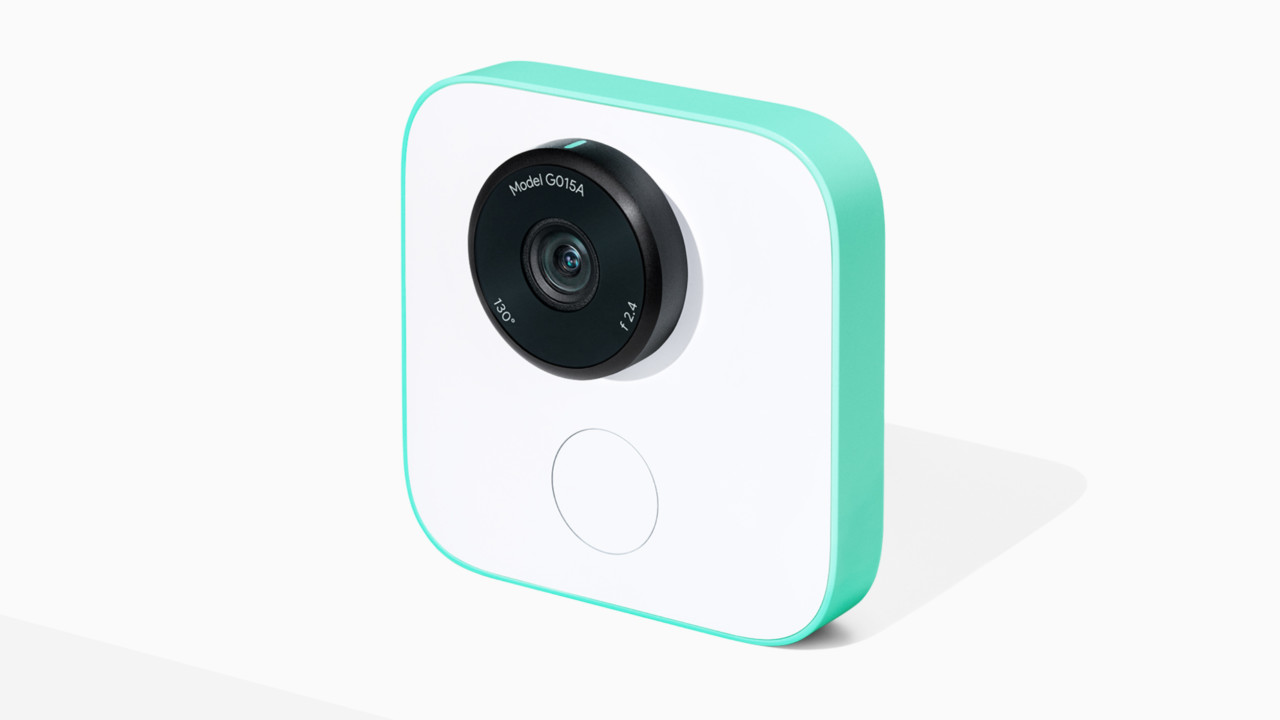
After unveiling Google Clips camera in October last year at the Pixel 2 launch event, the company has now finally made the device available for purchase in the United States. Priced at $249, it seems that the buyers will have to wait for a few weeks for it to arrive.
Depending on the address, the delivery date for the pre-ordered devices ranges from late February to early March. At the time of writing this, it seems that Google has stopped taking orders for the Clips camera. Interested users can now join a waitlist and they will receive an email once Clips is available again.
For those who are not aware, Google Clips is a small camera device that uses artificial intelligence to take the right picture when it sees something interesting. The square-shaped camera, which measures about 2-inch, comes with a 12-megapixel sensor and 130-degree field of view. It automatically shoots images and small video loops.
The device packs 16GB of internal storage, which can save up to 3 hours of selected video. While some people are concerned about the idea of a Google camera that’s always watching them, the company has clarified that the device does all of its work with its own hardware, and doesn’t send anything out to external servers.
In a separate blog post, Google has explained that it has trained the device’s artificial intelligence system using photography experts to identify the best shots. Due to this, the company believes that Clips should get smarter with its pictures and videos with more and more usage.
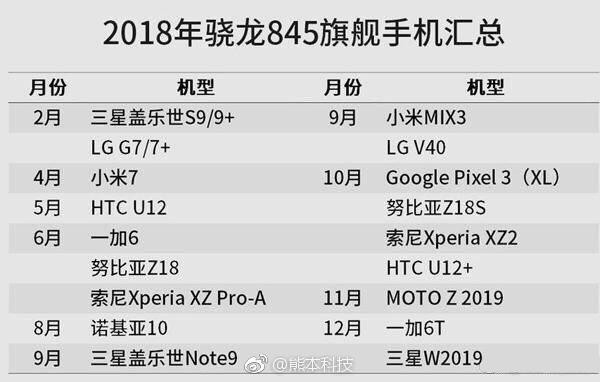
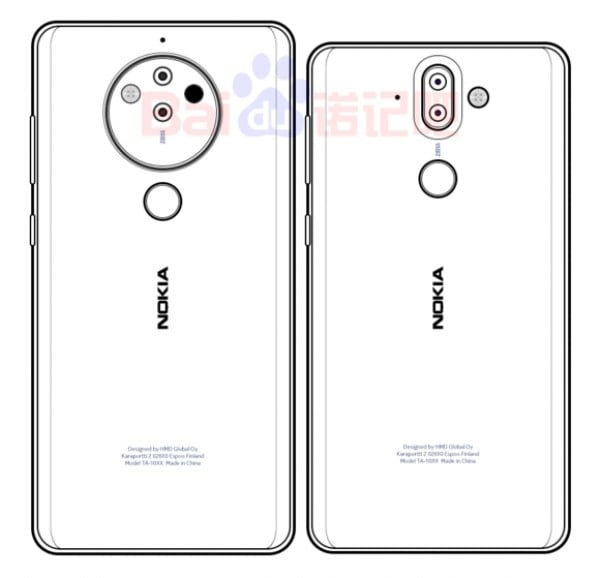
Recently a tipster who claimed to have got knowledge of all the Snapdragon 845 smartphones released a list which contains the Nokia 10 as one of the models that would be launched packing Qualcomm’s 2018 flagship System-0n-Chips. The Nokia 10’s schematics, albeit crude and unlikely, had also been the subject of a recent leak, pointing at a revolver-like camera setup. Now, a new drawing purported to be that of the Nokia 10 flagship has leaked.
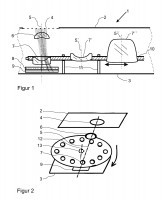
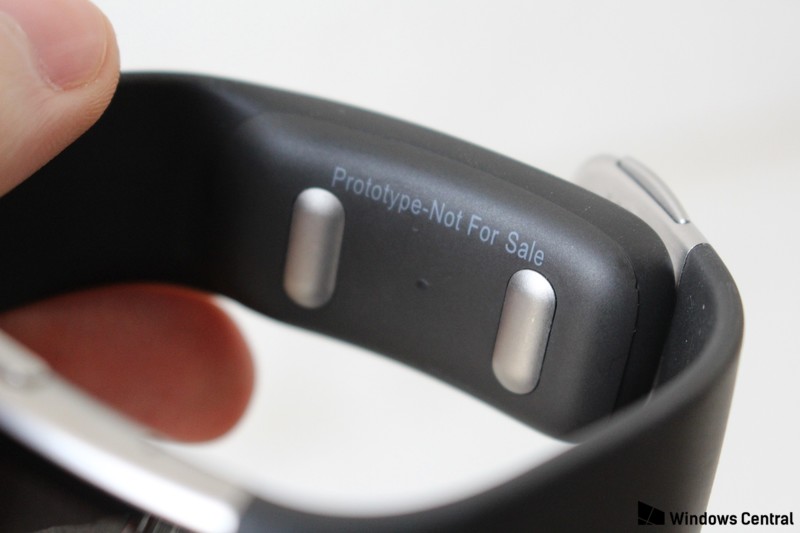
The drawing only reveals what the device looks like from the rear and what stands out there is the camera design. The sketch is attributed to an industry insider who based the drawing on leaked information and a recent ZEISS patent (find below) for a mobile multi-lens camera solution. The technology at play utilizes an array of additional lenses ( number 7) having different focal lengths and mounted on a rotating lens base (number 10), which sits between the camera sensor (number 9) and a normal fixed lens (number 6).
According to the source, the Nokia 10 Camera module will likely look like a Dual-lens Camera with the middle lens working as the main camera while the others will be hidden inside a module and may be rotated to change the focal length and still work in combination with the main camera. The sketch also shows the presence of an independent secondary camera sitting on the very top of the said module. We don’t know what its function would be in the presence of other lenses. Here are the sketches of Zeiss’ patented camera design.
Other details of the Nokia 10 are still based on speculations as Nokia is yet to confirm the existence of the device or even the unusual camera design. There are suggestions that the Nokia 10 could make its debut at IFA 2018 in Berlin this September. So, it may still be a long way from becoming official, and there are definitely lots of more leaks coming. We’ll keep you updated here on Gizmochina as soon as new details emerge.
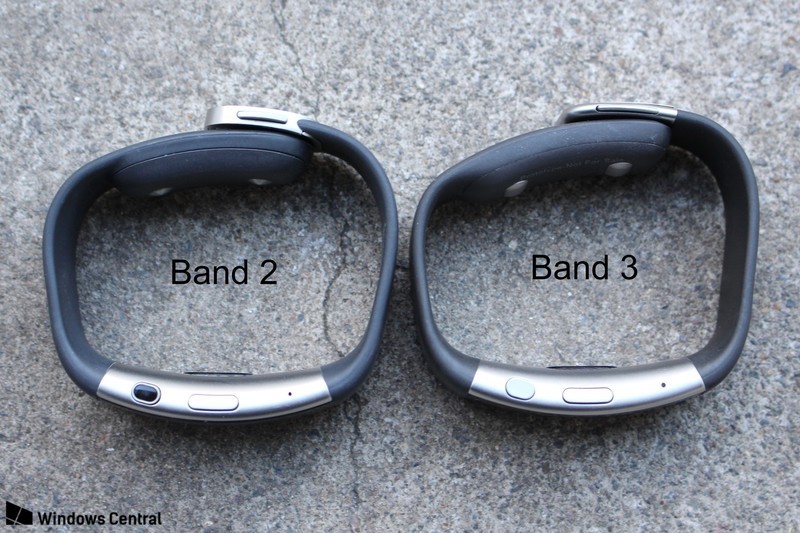
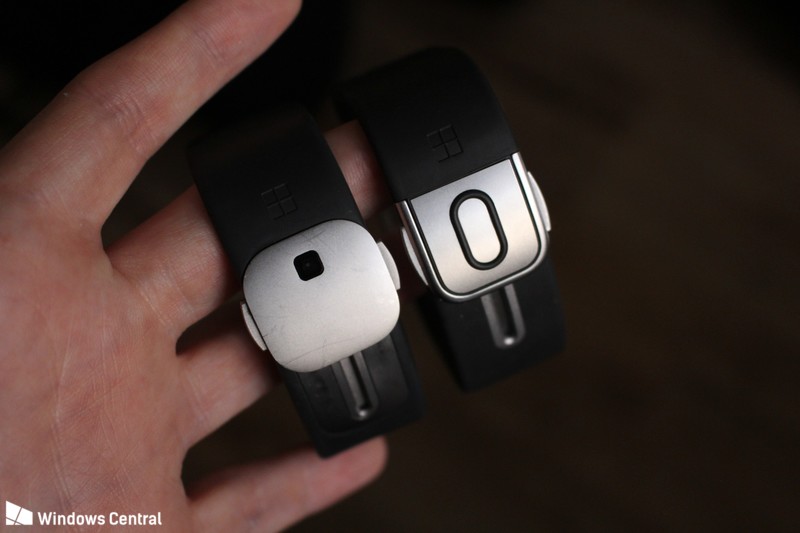
It’s been more than a year since Microsoft cancelled the Microsoft Band lineup forever. Although the Band 2 was one of the greatest fitness trackers in the market, the Redmond giant decided not to believe in its wristbands line anymore. But it seems that the Band 3 was already finished and almost ready to launch around that time. Our colleagues from Windows Central got their hands on a prototype of the canceled Band 3 and they reviewed it. From the review, we can clearly deduce that the Microsoft Band 3 is a solid improvement over its predecessor.
First of all, the Microsoft Band 3 is more comfortable to wear due to a slimmer bulk at the back, and it is also more compact too. Besides a slimmer clasp, there is also an action button which is not coated in black anymore, and these are the most important differences when it comes to aesthetics. Talking about the performances, the charging time has been improved: this wristband only takes an hour to go from 10 percent to 100 percent, while its predecessor needed one hour and a half. The Band 2 was water-resistant, but the Band 3 is fully waterproof: this means that it could be used even while swimming.
There are two new sensors on the Microsoft Band 3: electrocardiogram and RFID sensors which enable the RFID tag support. Among the most important new features, there is the swimming exercise tracking and an enhanced well-being tracking. The rest of the sensors are exactly the same which were present in the Band 2 without any miss. The smart band seems to have the same dimensions (12.8 x 32 mm) except for the thickness, and it has a curved AMOLED display just like its predecessor, with a resolution of 320 x 128 pixels. To connect to the phones, it features the Bluetooth 4.0 Low Energy connectivity. According to Windows Central, Microsoft Band 3 would have been the best smart band ever made by Microsoft but alas, not all good products see the light of the day!
Head over to the source link below to check out their full review of the device and see what you missed!
Huawei P10 successor, which was believed to have been named Huawei P11, will now reportedly be called Huawei P20. Roland Quandt has revealed through Twitter that the Huawei‘s next device won’t be called Huawei P11 and instead it will be named as Huawei P20.
Further, in a separate tweet, he has revealed the Huawei P20’s different variants, along with their code names and color options. The phone will be launched in three variants — Huawei P20, P20 Plus, and P20 Lite.
The standard edition, Huawei P20 is codenamed “Emily” and will be available in Ceramic Black and Twilight colors. The P20 Plus, which is codenamed “Charlotte”, will also be available in Ceramic Black and Twilight colors while the P20 Lite, codenamed “Anne”, will be offered in three colors — Midnight Black, Klein Blue, and Sakura Pink.
Earlier, it was reported that the company has trademarked the name “Huawei P20” and an importer in Israel also revealed the next flagship will be called Huawei P20. Later, we started seeing test pages for the Huawei P11 and Huawei P12 on the official website.
Then, it was revealed that the Chinese-giant has trademarked the name “Huawei P11” in the US, UK, Taiwan, and Hong Kong. The trademark for the “Huawei P11” name was filed as far back as 2015 in Europe, while the “Huawei P20” trademark was filed only in the United States. Now, it seems that the company has finalized to go with the P20 series.
The device is expected to come with thinner bezels than its predecessor, Huawei P10. It is expected to be powered by the company’s own latest Kirin 970 AI chipset and would run the latest EMUI 8.0 which is based on Android 8.0 Oreo operating system.
While the device was expected to be unveiled at the upcoming Mobile World Congress in Barcelona, fresh information suggests that Huawei and LG will not be launching their next-generation flagship phones at MWC 2018 to avoid clashing with Galaxy S9 and Galaxy S9 Plus. Instead of P20 series, Huawei could announce tablets and 2-in-1 notebooks at the MWC.
Meizu is set to unveil a new stable version of the user interface Flyme 6 on January 30. We are talking about the Spring Stable version, but new updates will also roll out to the users who adhered to the beta testing phase. Considering that this is an important version of the UI, it will include a big change log with many important features. The most important one is Meizu Pay: the payment system has been adapted to the new user interface and it will work perfectly with the new update. A new “Game Mode 2.0” will be present in the new firmware, but it will only be supported by Meizu X and Meizu E2. There are two major improvements in this update: it increases the fluidity of the OS and reduces memory consumption.
Some anomalies in the game mode have been fixed, as well as some bugs with the camera and the problems with the vibration seen in the previous version of the firmware. Flyme 6, according to the changelog, has solved the problem related to an excessive battery drain when the phones are in standby mode and in some other scenarios. The system stability and the smoothness have been improved as well with the new user interface. On Meizu M6, a vertical multi-tasking mode has been added, and there are also some additional bug fixes.
Besides unlocked units, carrier-branded units of these phones will be updated to Flyme 6 Spring stable version too: Meizu M3 Note, M5 Note, M6 Note, E2, Pro 7 Standard Edition, M6, M5 and M5s. Note that, according to a new teaser, Meizu was expected to unveil Flyme 7 on February 24 but that unfortunately turned out to be false. If Flyme 7 is to be released in the coming months, it should likely be on the Meizu 15, which is the next flagship of the company dedicated to its 15th anniversary (it will come together with a Plus version).
The presence of Xiaomi at Mobile World Congress 2018 which will be held in Barcelona from February 26 has been confirmed, but according to new rumors, Xiaomi Mi 7 might not be unveiled at the trade show. A high-ranking company employee who has decided to stay anonymous has declared that no major announcements will be made at MWC 2018 by this company, and this means that neither Xiaomi Mi Mix 2S / 3 should be launched at this event.
Xiaomi Mi7 would not be the only flagship to skip the MWC 2018. It has already been hinted that Huawei P11, unlike last year, will not be showcased in Barcelona. Neither will LG present its G7, which should be replaced by an advanced version of LG V30 with artificial intelligence. The only flagship confirmed for the trade show is the Samsung Galaxy S9, which will be unveiled on February 25.
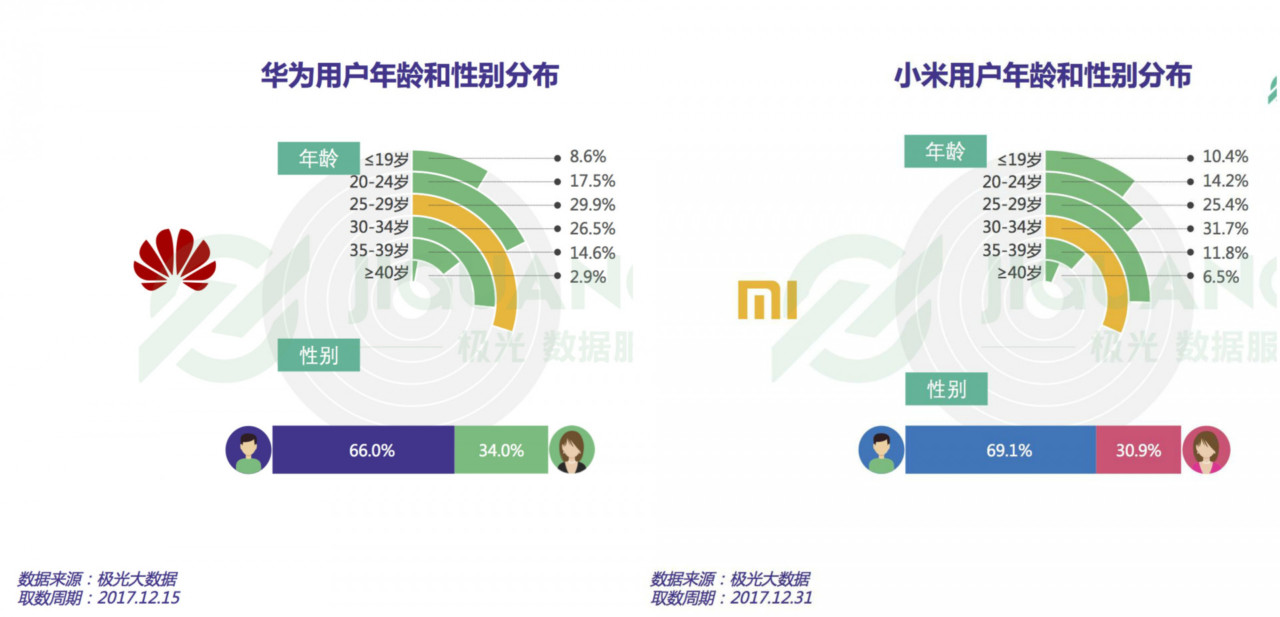
A Chinese research firm Jiguang data has published two research papers centered on two of the biggest players in the Chinese smartphone market- Xiaomi and Huawei. The research analyzes the brands’ users, showing what connects them and what separates them and was conducted on users in China. One aspect that caught our attention in the report was the aspects users of both brands based on gender and age.
The research data shows that Xiaomi ‘s fans are overwhelmingly male which is 69.1% of the entire number of fans the company commands. On the other hand, Huawei’s male fan base isn’t as much as Xiaomi but is still higher, pegged at 66%. Apart from that, the finding also shows that most of Xiaomi’s users are concentrated in the 30-34 age bracket (31.7%), followed by 25-29 years (25.4%). Users above 30 accounted for 50% of Xiaomi’s user base. On the other hand, 44% of Huawei’s users were revealed to be older than 3. years, while Huawei users under 25 accounted for only 26.1%.
There are other demographics such as apps preference by users based on gender, the city of residence where the cities were categorized into three tiers; 1st tier, 2nd Tier, and 3rd tier. Other categories taken into consideration in the research include selfie and beautification apps, as well as online video, were significantly less popular than the national average, showing there is still room for growth among the younger population for both tech giants.
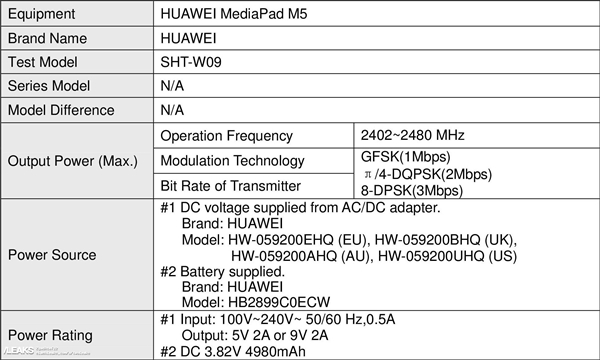
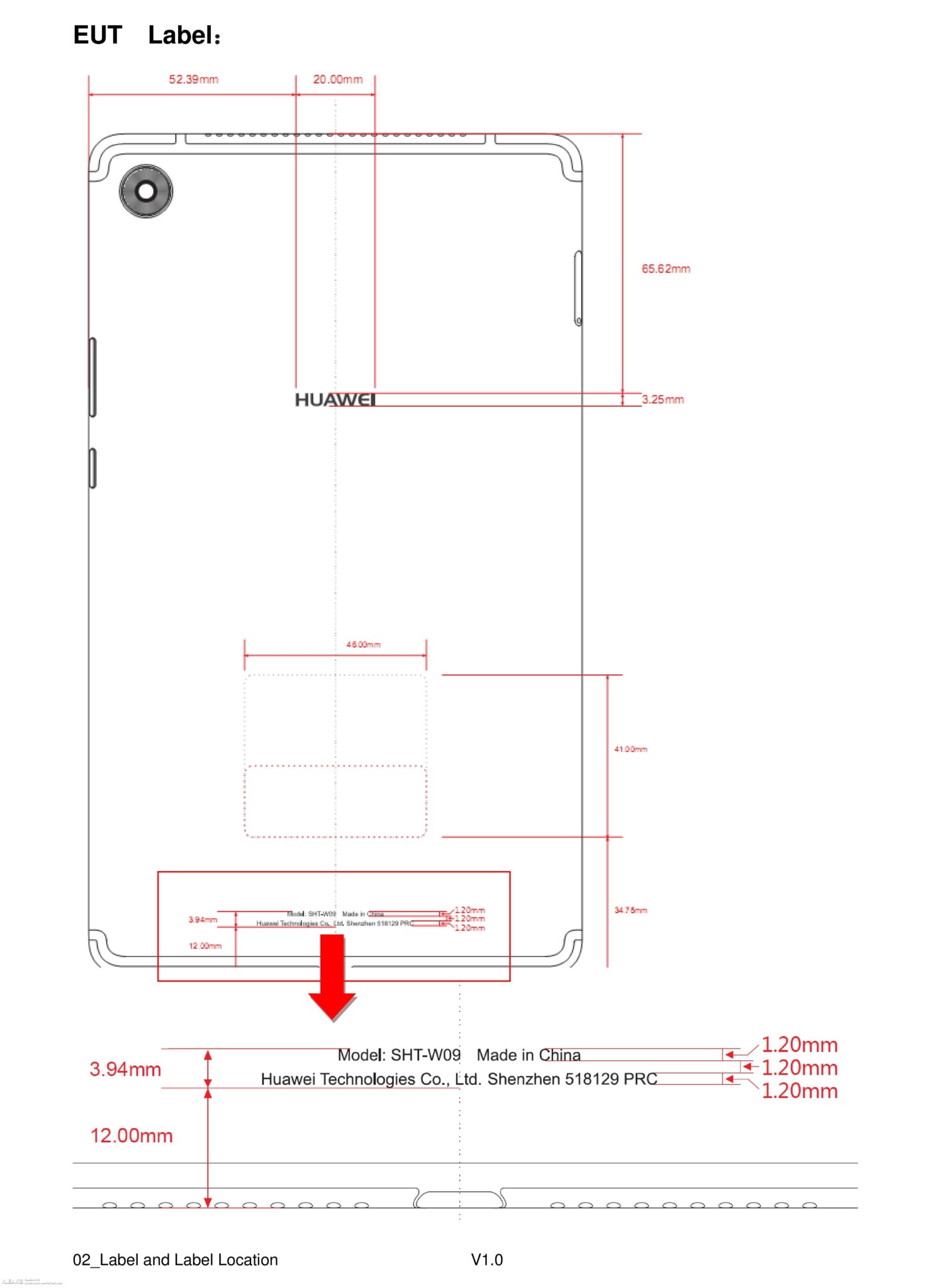
Huawei is expected to upgrade its tablet series with a new MediaPad M5. The M5 would be a successor to the MediaPad M3 which was first launched in 2016. The Huawei MediaPad M5 has now received certification from the US Federal Communications Commission (FCC) which is a signal that Huawei intends to launch the device in the U.S.
FCC’s listing usually reveals only a few specifications of the device and in this case, it shows that the model would be fuelled by a 4,980mAh battery and the schematics of the device was also featured on the FCC listing, showing it would have a metal body. The schematics also reveal the presence of hidden U-shaped antenna band, SIM slot located on the right side when viewed from the rear aspect while the volume rocker and power buttons are on the right side. We also take note of a rear camera which is located at the upper left corner, a bit closer to the edge than its predecessors. Thankfully, the MediaPad M5 specifications had leaked in the past so we’ll have to rummage through our archive to get further details of what to expect.
The MediaTek M5 will feature an 8.4-inch display with a resolution of 2560 x 1600 pixels just like the M3. The tablet would be powered by the last year’s flagship Kirin 960 chipset. The device will also feature a fingerprint sensor, USB Type-C port, stereo speakers, and Cat. 4 LTE modem. Providing the interface would be EMUI 6.0 based on Android Oreo. The device is expected to be launched anytime soon. We cannot rule out an MWC 2018 unveiling even though Huawei is yet to officially disclose if that would happen.
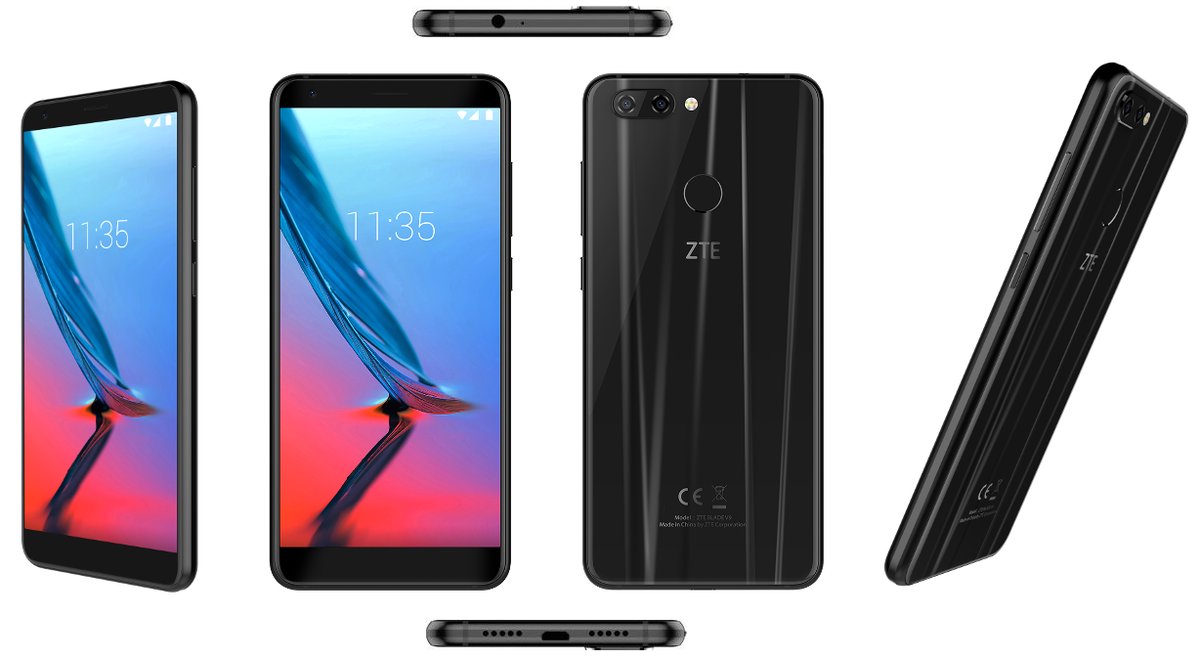
ZTE basically has two smartphone lineup; the Axon series and Blade series. While the Axon smartphones are mainly devoted to the flagship and sometimes mid-range models, the Blade series are more pocket-friendly. Just as we are expecting the Aon 9 flagship, ZTE is also planning to unveil a Blade V9 smartphone and that model has just got the nod of U.S Federal Communications Commission (FCC).
ZTE Blade V9 Renders
The ZTE Blade V9’s promotional materials were recently leaked on ZTE’s Spanish website, perhaps to generate some publicity for the upcoming smartphone. The model’s present appearance on FCC’s website is an indication that it would be released soon in the U.S where ZTE currently enjoys some appreciable amount of patronage. The leaked materials which appeared on ZTE’s Spanish website had shown that the Blade V9 will sport an all-glass body both at the front and back, with its display standing at 5.7 inches. The device will feature a Full HD+ resolution with the 18:9 aspect ratio which would make it ZTE’s first full-screen mid-range model. The device would be powered by a Qualcomm Snapdragon 450 processor and there would be three RAM sizes of 2GB, 3GB, and 4GB. The device will also come in 16GB, 32GB, and 64GB storage variants. At the rear, the ZTE Blade V9 will pack a dual camera setup consisting of a 16MP primary sensor with autofocus, an LED flash, and a f/1.8 aperture, and a secondary 5MP fixed-focus sensor. Up front, there would be a 13MP camera. Other details include; a 3.5mm headphone jack, a hybrid SIM slot, a rear fingerprint sensor, and a 3,200mAh battery.
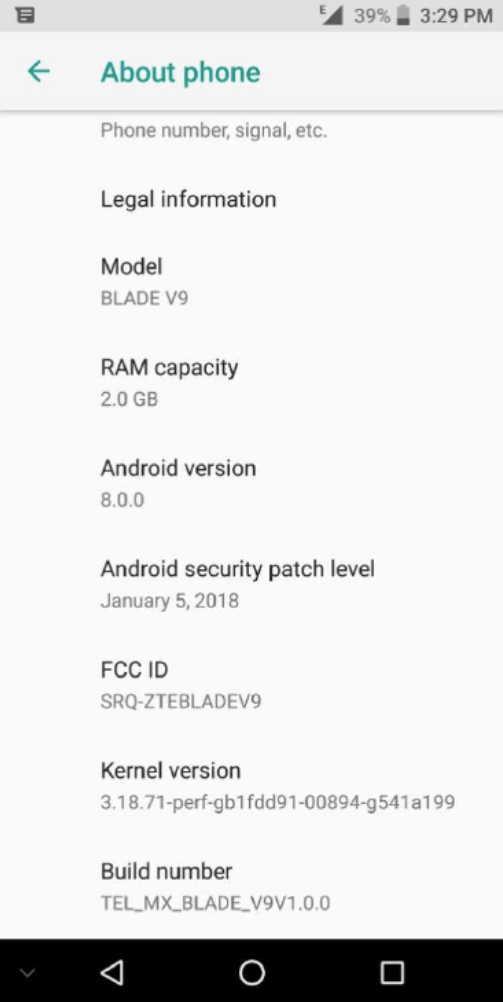
The FCC listing doesn’t reveal much about the device. It only shows that the Blade V9 would run Android 8.0 Oreo out of the box and confirms the existence of a 2GB RAM variant. The device recently received Bluetooth certification and it was revealed to support Bluetooth 4.2. We still can’t say when ZTE would unveil the smartphone. It was initially expected to go official at CES 2018 but that didn’t happen. We may just see it launched at MWC 2018. We are not so sure of that, though.
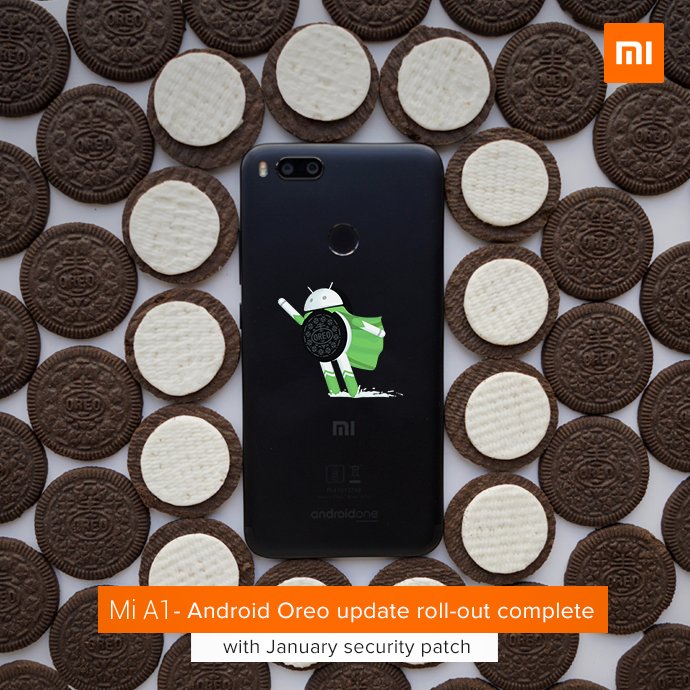
A few days ago, Xiaomi again announced a temporary suspension of the Android Oreo update for the Mi A1. Latest report says the update is now back and comes with a number of fixes.
This is the third time Xiaomi is rolling out the update for the Android One smartphone. In the past 2 weeks, it has halted the roll-out, citing bugs as the reason for doing so. Below is the change-log for the new update:
Optimize audio parameters.
Remove the “quick charge” on the lockscreen when charging.
Integrate the performance optimization of MIUI.
Fix “bluetooth power consumption issue”.
Add Korean input method.
Fix “the dialer icon is missing after the upgrade”.
Xiaomi‘s partner Huami, best known for the Mi Band 2 and its Amazfit Sports smartwatch line up, recently filed for a $150 million US IPO with the US Securities and Exchange Commission. The terms of the Huami IPO has now been announced by the Chinese wearable manufacturer. This is coming two weeks after filing its IPO application with SEC.
Huami plans to raise $110 million by offering 10 million ADSs at a price range of $10 to $12. In this context, ADSs stand for American depositary shares and they are U.S. dollar-denominated equity shares of a foreign-based company available for purchase on an American stock exchange. American Depositary Shares (ADSs) are issued by depository banks in the U.S. under an agreement with the issuing foreign company. According to IPO experts Renaissance Capital, Huami would command a fully diluted market value of $662 million at the midpoint of the proposed range. The details also include that the shares would be categorized as Class A and Class B based on the value of each unit.
The company plans to get listed on the world’s largest stock exchange, the New York Stock Exchange (NYSE) under the symbol HMI. This is contrary to earlier information that Huami would be listed on Nasdaq Stock Exchange, the second-largest exchange in the world. Credit Suisse Securities (United States), Citigroup Global Markets Inc., and Huaxing Securities (Hong Kong) are the joint bookrunners (underwriters) on the deal. The IPO is expected to price during the week of February 5, 2018. Selling shareholders of Wal-Mart will also provide the underwriters with an option to purchase up to 1.5 million additional ADSs in the event of an oversubscription.
Google’s Chrome OS has seen much development over the years since it was first announced. Now available on two major hardware devices – laptops and desktops (Chromeboxes), it may be coming soon to a third category – tablets.
It is no news that Android has taken a turn for the worse on tablets. Sales have declined over the years and the experience is no different from what you get on a phone. So apart from the larger screen, there is no big advantage in productivity. What if we swapped the Android OS for Chrome OS? What are the benefits?
First, that screen estate can be put into good use as Chrome OS is a desktop style operating system. You also have free-floating resizeable windows open at the same time unlike Android’s split-screen multitasking which is limited to just two apps.
Chrome OS is one of the most secure operating systems at the moment. Updates are not reliant on manufacturers like Android but handled by Google. Software update support, according to Google, is for five years which is more than you can get on most Android devices.
Apart from Chrome extensions, you also have access to all the apps on the Play Store. So you see, you are not really losing anything. Battery life is also amazing.
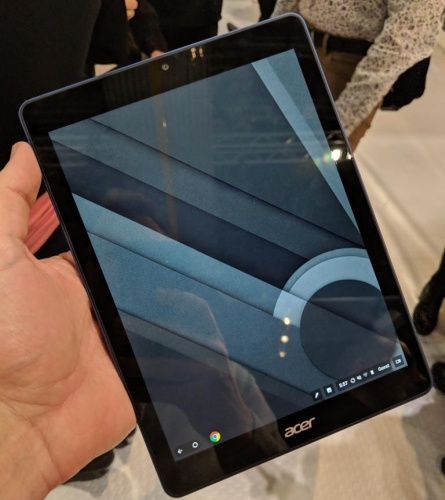
On Thursday, Twitter user @Alister_Payne tweeted a photo of an Acer tablet running Chrome OS seen at an event in the UK. This is the first public appearance of a tablet running Chrome OS.
Sadly, no specification details were given but the tablet does look to be sporting a 9.7” display with a 4:3 aspect ratio. There is also a front camera at the top for video calls.
Motorola skipped the Play series last year, instead we got a new “S” sub-series, at least for the G5 and G5 Plus. This year the series is making a comeback and renders of the Moto G6 Play have leaked online. These renders come a few days after that of the Moto E5 and are from the same source too.
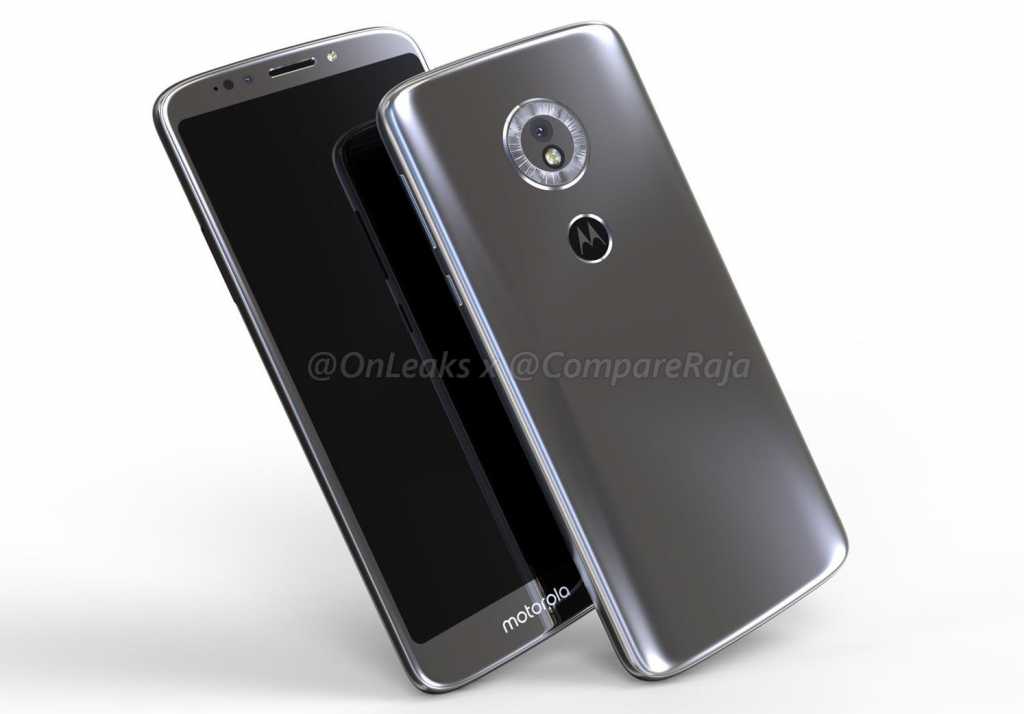
From the images, it appears skipping a year has done the Play series some good. The Moto G6 Play is shown to sport an 18:9 display, though the bezels are not as small as we have seen on other devices.
There is no physical home button on the chin, which in some models double as a fingerprint scanner. Instead, it is home to the manufacturer’s name which makes us wonder why the size wasn’t reduced a bit more. The forehead on the other hand is moderately sized. It is home to a notification LED, sensors, front camera, and the earpiece. It also has a LED flash on the right.
The rear of the Moto G6 Play doesn’t look bad either. The phone is curved on both sides to allow for a better grip. Leaker @OnLeaks says its made of glass but we think this is just polished metal. Motorola doesn’t use glass for the entry-level and lower mid-range category and it doesn’t seem it will be doing that soon.
For the camera setup, Motorola is sticking to its circular design but its switching to that of the Moto X4; which has vertical strokes surrounding the circle housing the sensor and flash. Beneath the camera is the famous Motorola batwing logo. There are rumors that this will be the new home of the fingerprint scanner. While that will definitely be cool, best believe not all models will have a fingerprint scanner.
The rest of the design are not out of the usual. Volume rocker and power button are on the right side, 3.5mm audio jack sits at the top, and there is a micro USB port at the bottom.
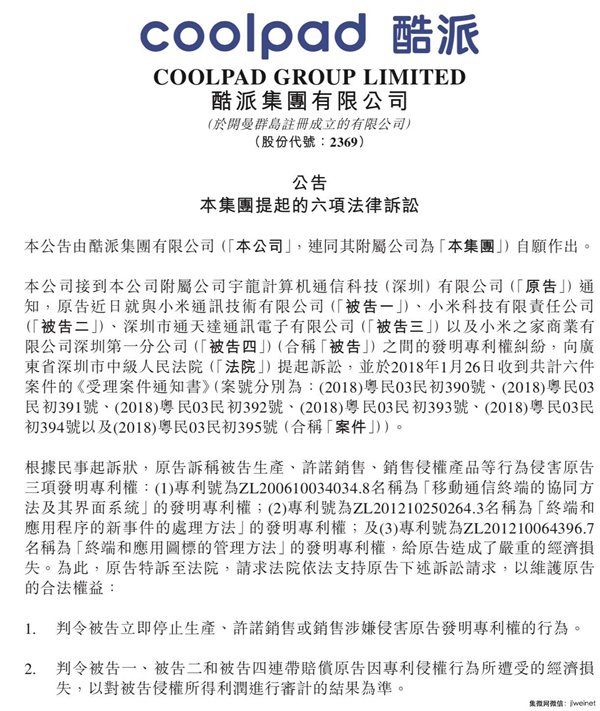
Yulong Computer Communications Technology (Shenzhen) Co. Ltd, a subsidiary of the Coolpad Group has sued Xiaomi and three others to court over alleged patent infringements.
The defendants are Xiaomi Communications Technology Co., Ltd (1), Xiaomi Technology, Co, Ltd (2), Shezhen Tongtianda Electronics Co. Ltd (3), and the first branch of Xiaomi Co. Ltd Shenzhen (4).
According to the lawsuit, the plaintiff (Yulong) claims that the defendants produced, promised to sell, and sold products that infringed on three of its patents. The patents are listed below:
Patent No. ZL200610034034.8
Patent No. ZL201210250264.3
Patent No ZL201210064396.7
All three patents are said to relate to app icon management, notifications, and system UI.
Yulong says the patent infringements has caused it serious losses and is demanding that the court grants an immediate order stopping the defendants from the production, promise to sell, and selling of the products that infringe on its patents.
It also requests that the first and fourth defendants should pay compensation for the losses it has suffered, bear the full cost of legal fees, notarization fees, and other reasonable fees paid towards stopping the patent infringement.
The case has been accepted at the Guangdong Province Intermediate People’s Court but hearing on the matter hasn’t begun.
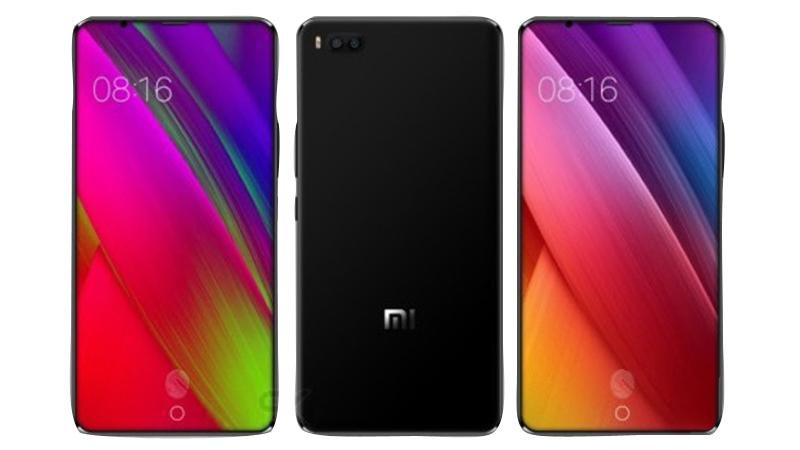
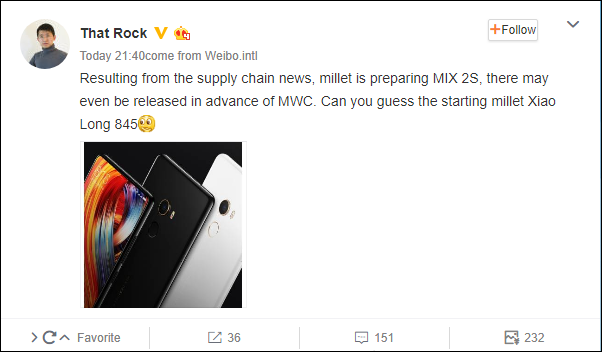
We recently got wind of speculations that China’s Xiaomi Inc. would be launching a new Mix 2S along with the Mi 7. The Xiaomi Mi Mix 2S is no doubt an upgraded version of the flagship Mi Mix 2 which was unveiled last year. Xiaomi was tipped to release the device at MWC 2018 but there is a new rumor in town that the Mix 2S may just drop well before the start of MWC 2018.
The source of the rumor happens to be a Weibo tipster who confirmed that Xiaomi is planning the launch of the Mix 2S and that it may even be launched before MWC 2018. He didn’t reveal any further details but asked readers to guess which of the upcoming models would be Xiaomi’s first Snapdragon 845 -powered model. There is no doubt the Mi 7 will covet that crown even though we don’t know the processor the Mi2S would pack. It is unlikely, though, that XIaomi would utilize a Snapdragon 845 chip on the model when a Mi Mix 3 is still expected to be launched, packing an SD 845 chip, later this year.
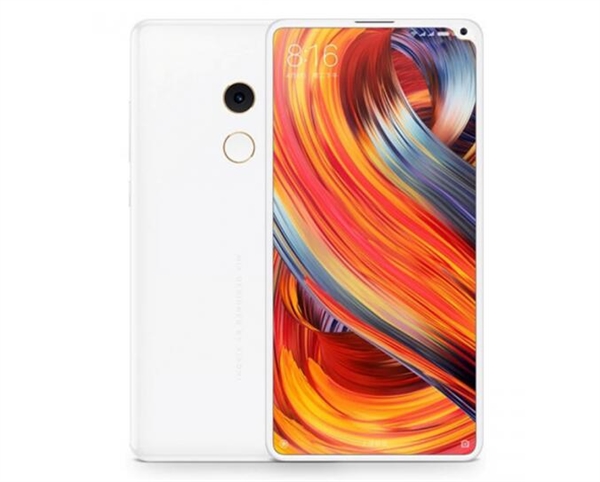
For the avoidance of doubt, there is no official confirmation of the existence of a Mi Mix 2S. The render of the device which was spotted online recently looked like that of the iPhone X which was photoshopped. But a second picture housing the renders of the device appeared on Slashleak (picture below). As can be seen, the Xiaomi Mi Mix 2S screen accounts for almost 100% of the device with some more reduction in the bezels compared to the Mix 2.
The front camera is located on the top right corner in this case as against the bottom right on the Mix and Mix 2. As a result, there is an awkward-looking notch on the right side. The bottom bezel also looks more narrow than that of the top edge since the front camera is redeployed to the top. At the rear, the design isn’t different from the Mix 2, with a single rear camera, rear fingerprint sensor with 18K gold decorative ring around the rear camera and a ceramic body. The design looks just perfect for an offshoot of the Mix 2 but still, neither the design or the device itself is yet to be confirmed. The device is expected to be priced around 4000 Yuan.
After launching Nokia 7 last year, HMD Global is now preparing to launch its bigger variant — Nokia 7 Plus. The phone, which appeared last month in the Nokia’s unreleased camera app, has now been spotted on benchmarking site Geekbench.
This is the first time that the information regarding the upcoming Nokia 7 Plus has surfaced online. While we were expecting the phone to pack bigger display and a better processor, nothing was known apart from the phone’s name.
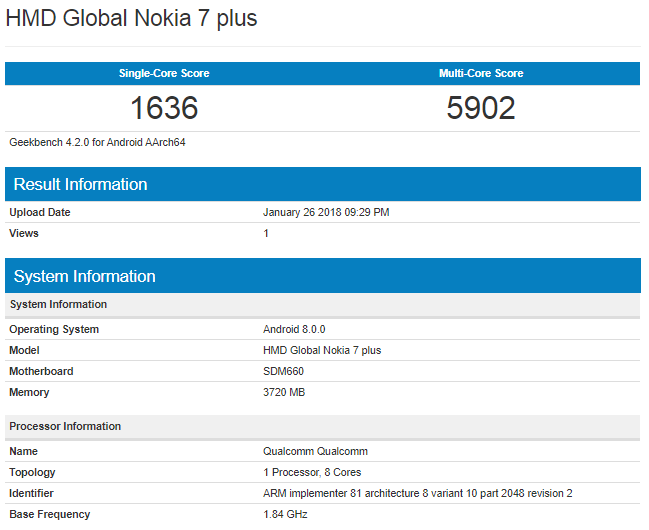
Now, the benchmark listing of the Nokia 7 Plus reveals that the phone will be powered by Qualcomm’s Snapdragon 660 octa-core processor along with 4GB RAM. It also reveals that the device will run Android 8.0 Oreo operating system out-of-the-box.
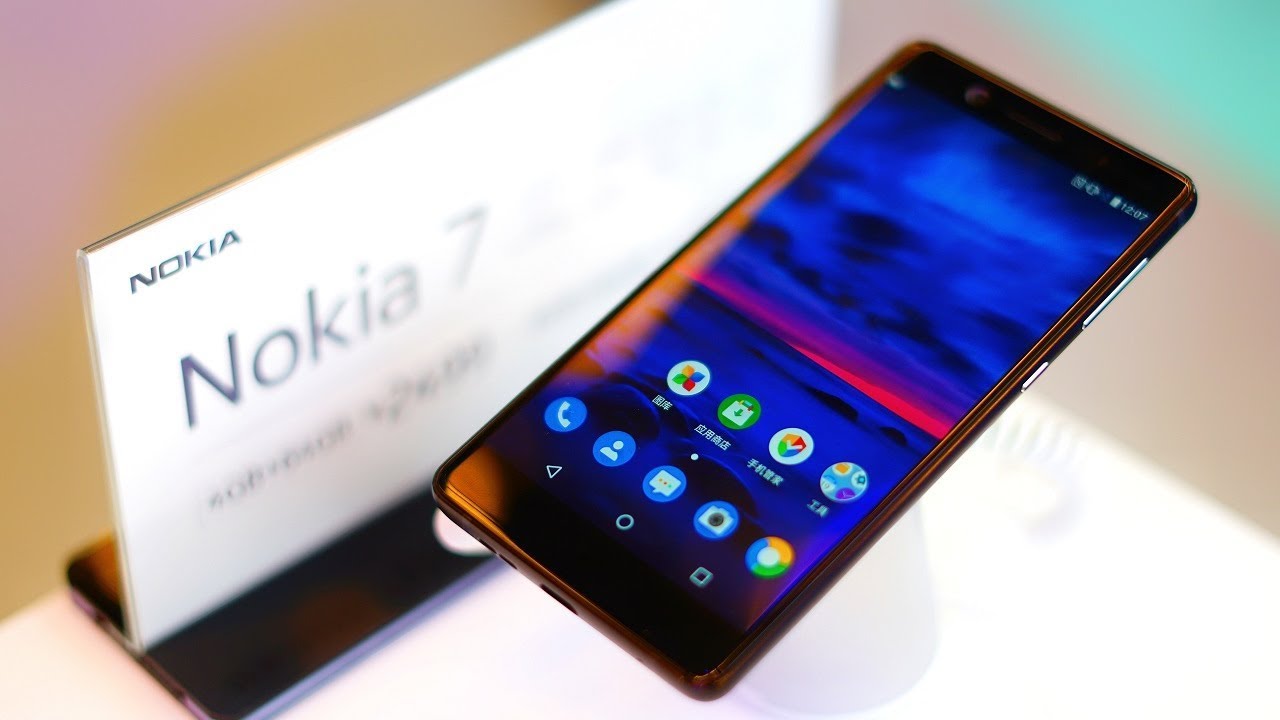
In comparison, the Nokia 7, which was launched in China in October last year, is powered by Qualcomm Snapdragon 630 processor and 4GB/6GB RAM. It features a 5.2-inch Full-HD IPS display with a layer of Gorilla Glass on top.
In the benchmark results of the Nokia 7 Plus, the phone scores 1636 in the single-core test while the score for the multi-core test stands at 5902. No more information is available at this time regarding this phone.
While we don’t expect the Nokia 7 Plus to make its debut at the Mobile World Congress, there’s a possibility that the company could announce the phone at MWC for the global market given that Nokia 7 is still China exclusive.
The company is likely to launch its next flagship phone — the Nokia 9, among others at MWC 2018. The Finland-based company is also expected to announce Smart Home products at the February 25 press event.
Apart from the flagship Nokia 9, HMD Global could also take the wraps off Nokia 1 as well as the Nokia 6 (2018) for the global market. We also expected to see the launch of Nokia 3310 4G as well as the Nokia 7’s global rollout, as the phone has only been launched in China. We’ll have to wait until the event to find out the company’s plan for the year.
We use cookies on our website to give you the most relevant experience by remembering your preferences and repeat visits. By clicking “Accept”, you consent to the use of ALL the cookies.
This website uses cookies to improve your experience while you navigate through the website. Out of these, the cookies that are categorized as necessary are stored on your browser as they are essential for the working of basic functionalities of the website. We also use third-party cookies that help us analyze and understand how you use this website. These cookies will be stored in your browser only with your consent. You also have the option to opt-out of these cookies. But opting out of some of these cookies may affect your browsing experience.
Necessary cookies are absolutely essential for the website to function properly. This category only includes cookies that ensures basic functionalities and security features of the website. These cookies do not store any personal information.
Any cookies that may not be particularly necessary for the website to function and is used specifically to collect user personal data via analytics, ads, other embedded contents are termed as non-necessary cookies. It is mandatory to procure user consent prior to running these cookies on your website.