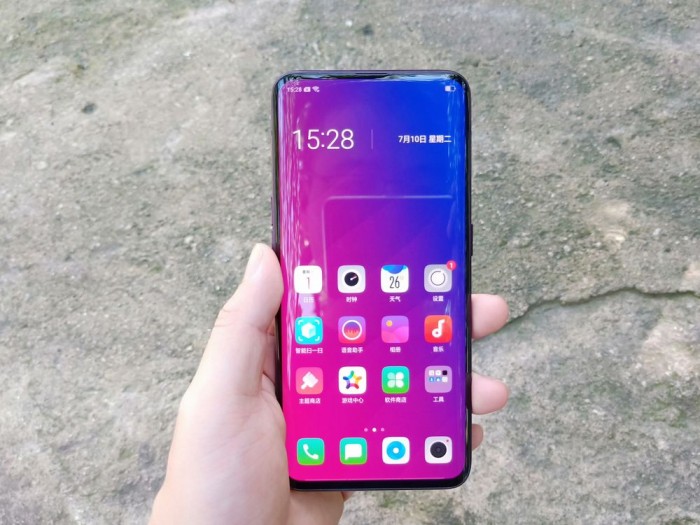
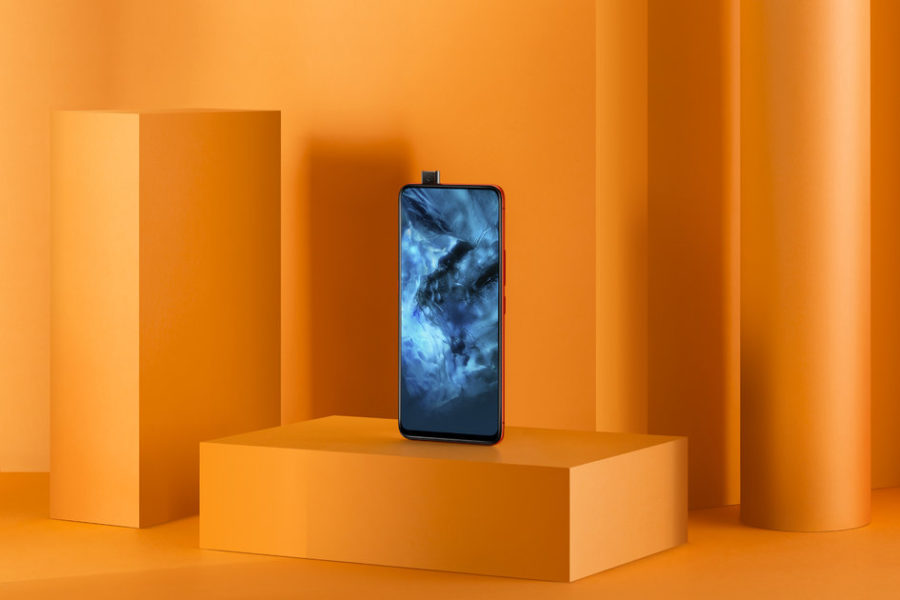
Last week, the Oppo Find X smartphone was made available for purchase in China for the first time. Now, the Oppo’s flagship smartphone will again go on sale tomorrow in China. The company has already received more than 630,000 registrations for the upcoming sale.
Just like the first sale, the Oppo Find X will be sold in only one variant — Standard edition and will be available in two color options — Bordeaux Red and Glacier Blue, for a price of 4,999 Yuan, which roughly converts to $749.
The standard version of the Oppo Find X features a 6.42-inch Full HD+ S-AMOLED display with 19.5:9 aspect ratio. The display is touted as the world’s first smartphone to come with a screen-to-body-ratio of 93.8 percent.
Under the hood, it is powered by Qualcomm Snapdragon 845 processor along with 8GB RAM and 128GB of internal storage. Powered by 3730mAh battery with VOOC fast charging support, the smartphone runs on ColorOS 5.1 AI Smart custom UI based on Android 8.1 Oreo operating system. The company says that the OS will learn usage habits, preload common applications, and make the app start faster.
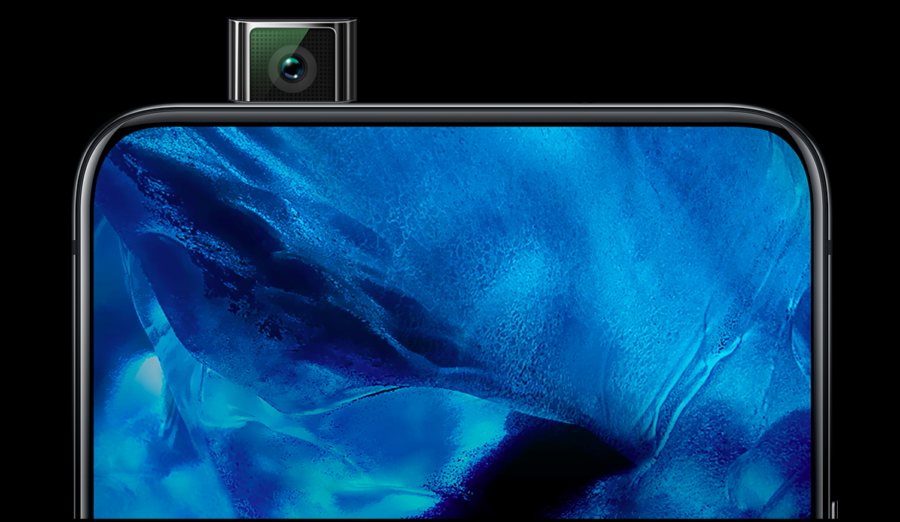
It comes with a motorized sliding mechanism, which equips both — front as well as rear cameras. It equips the front camera and 3D face scanning sensors for unlocking the phone, as well as the dual rear cameras and LED flash.
The 3D face unlock feature, which Oppo calls O-Face Recognition, uses 3D Structured Light Technology which scans 15,000 facial points. The company claims that it is 20 times safer than fingerprint recognition for unlocking the phone.
The dual camera setup consists of a 16-megapixel + 20-megapixel sensors on the back with OIS and artificial intelligence features. The front-facing camera sensor is of 25-megapixel for taking selfies. It comes with multiple 3D portrait lighting features and Omoji, which is Oppo’s own take on the iPhone X’s emojis.
The other variants of Oppo Find X, including the 256GB storage version with 50W SuperVOOC flash charging, and the OPPO Find X Lamborghini Edition with 512GB internal storage, will be available for purchase in August in China.
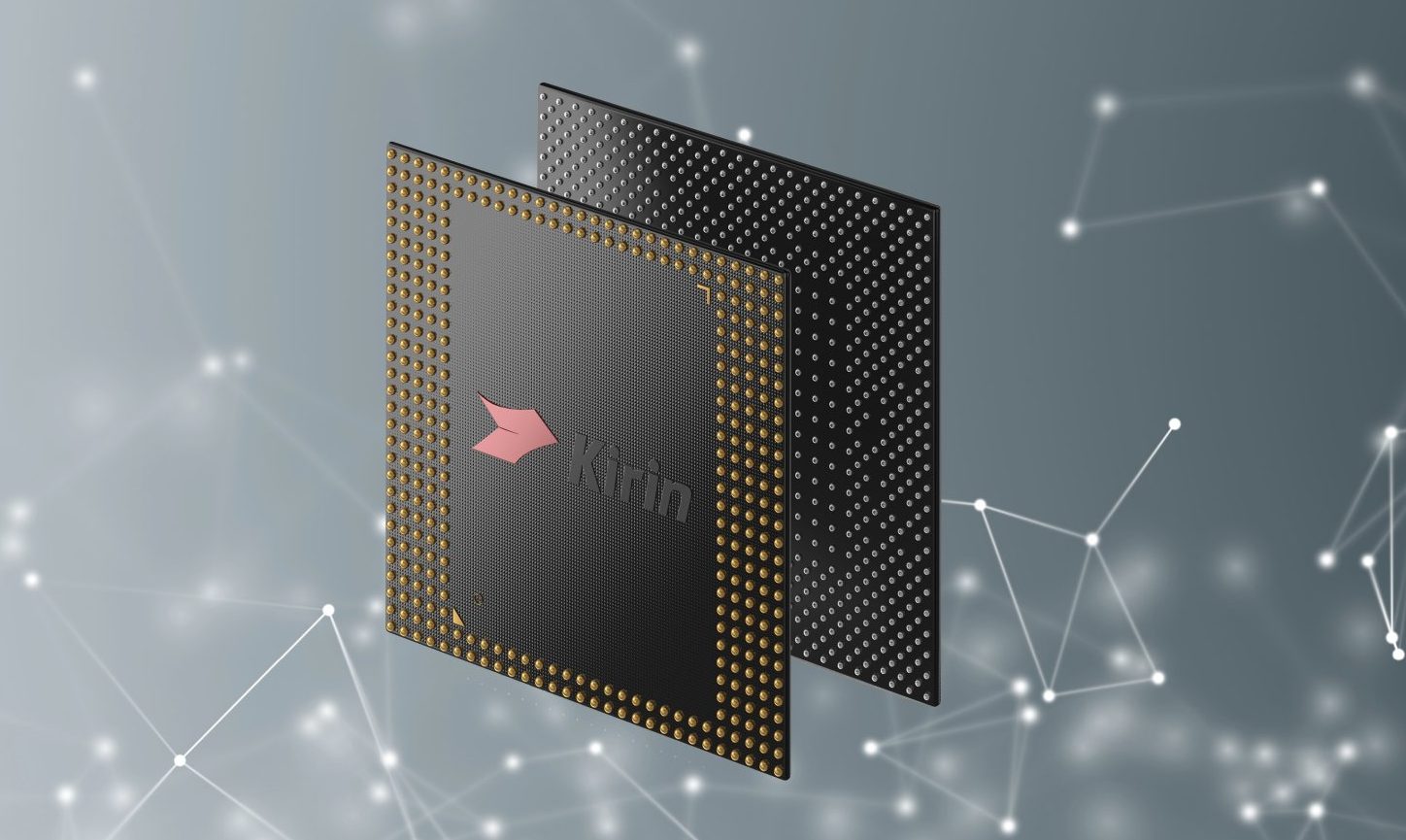
Yesterday, along with a couple of smartphones and a wearable device, China-based Huawei also launched its new processor — Kirin 710, the company’s first processor made using the 12nm design process. Now, the upcoming flagship processor from the company — Kirin 980, is slated to launch at IFA in Berlin in September this year.
The Kirin 980 will be the successor of the Kirin 970 chipset that is currently powering the company’s high-end smartphones. Once launched, the HiSilicon Kirin 980 will be powering flagship and high-end smartphones from Huawei and Honor.
However, at this time, there is no official information available about the Kirin 980 chipset. Earlier, we reported that the Kirin 980 will be manufactured by TSMC and it will be made using the same 7nm process used for Apple’s A12 processor. Further, the chipset will also feature a new Cambrian NPU from Cambricon Technologies.
The new Cambrian AI processor is said to provide 5 trillion calculations per watt and will be available in dual, quad, and octa-core variants depending on the level of AI processing required. The flagship chipset will also have ARM’s core A75 CPU cores but will feature Huawei’s own GPU, a first for the company.
The upcoming Kirin 980 is expected to power Huawei’s Mate 20 series smartphones following its announcement later this year. It is also expected to be powering the next-generation Huawei P-series smartphones. The AnTuTu listing of the Mate 20 Pro reveals what the chipset is capable of, registering a remarkable benchmarking score of 356,819.
Recently, Huawei launched Kirin 710, competing with Qualcomm’s recently launched Snapdragon 710 that is manufactured using the 10nm process. The chipset consists has four Cortex-A73 cores clocked at 2.2GHz and four Cortex-A53 cores clocked at 1.7GHz. The GPU, ARM Mali G5, is said to be 1.3 times better than that of the Kirin 659 and 1x more energy efficient.
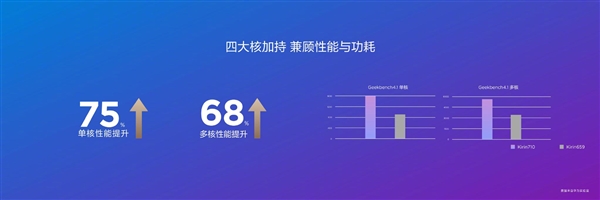
In terms of performance, the Kirin 710’s single-core performance is said to be 75% higher than that of the Kirin 659 while for multi-core performance, it offers a 68% increase in performance. The image signal processor and digital signal processor have also seen improvements and enhance the performance of the camera in low-light conditions.
Apart from Kirin 980, the Chinese company is also reportedly working on another chipset — Kirin 1020, which is said to be twice as powerful as the company’s current flagship chipset Kirin 970. As per the reports, it will go into mass production once the first 5G network launches, and will soon after be used in the company’s smartphones.
Toughened Gorilla Glasses by Corning have been protecting smartphone displays since many years. In July 2016, Corning had introduced Gorilla Glass 5. Most of the recent flagship and high-end phones come with Gorilla Glass 5 protection. Today, Corning has announced the arrival of Gorilla Glass 6 through a press release. The company claims that it istwo times stronger than its predecessor as it is made out of entirely new material.
A recent survey has revealed that people drop their smartphones at an average of 7 times in a year. To ensure that the next-generation of smartphones are well-protected from drops, Corning has introduced the Gorilla Glass 6. The company claims that Gorilla Glass 6 which is made out of entirely new glass composition is so strong that it could break after 15 drops from a height of 1 meter. In simpler terms, the Gorilla Glass 6 is more resistant to damage than its predecessor. The new chemical composition makes it possible to increase the compression levels of the Gorilla Glass 6 because of which it does not break easily even after multiple drops.
Most smartphone OEMs are now launching smartphones with elongated form factor in order to house tall aspect ratio display. Moreover, many premium phones do not feature metal unibody design, but they come with glass backs. The inclusion of glass rear also promotes wireless charging on new phones. Hence, smartphone OEMs also ensure that their phones are fitted with highly durable glass panels so that they do not break easily. The newly introduced Gorilla Glass 6 can offer right kind of screen protection and tougher glass rear for upcoming smartphones.
Corning has been providing its Gorilla Glass panels for over 6 billion devices across more than 45 well-known brands. Currently, the company is evaluating by seeking assistance from multiple customers. It is expected to be available on forthcoming devices that will be arriving in the near future. There is a possibility that the flagship phones arriving in 2019 may come equipped with Gorilla Glass 6.
Meizu’s CEO Jack Wong has been sharing information about the upcoming flagship smartphones — Meizu 16 and Meizu 16 Plus, as well as it’s mid-range offering Meizu X8. Recently, he shared the camera samples of the Meizu 16, which revealed some key specs of the camera configuration.
Now, Jack Wong has suggested the pricing structure of the company’s upcoming smartphones. A user on Meizu Forums claimed to know the pricing of the upcoming smartphones from the company. He said that the SD845 model with 6GB RAM and 64GB storage will cost 2,399 Yuan ($356); 6GB RAM and 128GB storage model will be priced at 2,699 Yuan $400); the 8GB RAM and 128GB storage model will cost 2,999 Yuan ($445).
Further, he said that the Meizu 16 Plus 8GB RAM and 128GB storage variant will be priced at 3,299 Yuan ($489) and the 8GB RAM and 256GB storage model will cost 3,599 Yuan ($534). Also, the Snapdragon 710 SoC variant will be priced at 1,699 Yuan ($252) for the 6GB RAM + 64GB storage while the 6GB RAM and 128GB storage model will cost 1,999 Yuan ($296).
In response to that Meizu CEO Jack Wong said that the Meizu X8, which will be powered by Qualcomm Snapdragon 710 processor, will be priced between 1,500 Yuan to 2,000 Yuan. However, this was already revealed by Jack Wong a couple of weeks ago.
He also claimed that the performance of X8 will be better than the Xiaomi Mi 8 SE, ultimately claiming the X8 will offer better value-for-money. He also revealed that the pricing of the SD710 version of Meizu 16 will be 500 Yuan more than the pricing of Meizu X8. If Meizu X8 is priced at 1,799 Yuan, the Meizu 16 SD710 model will cost 2,299 Yuan. Earlier, he had said that the pricing of Meizu 16 series will not exceed 4,000 Yuan.
He further added that if Xiaomi wants to reduce the price of Xiaomi Mi 8, it will have to reduce it by 300 Yuan to match the pricing of Meizu 16. Jack Wong seems to be very confident about the company’s upcoming smartphones and has been making claims about its performance along with comparing it with Xiaomi’s flagship device Mi 8.
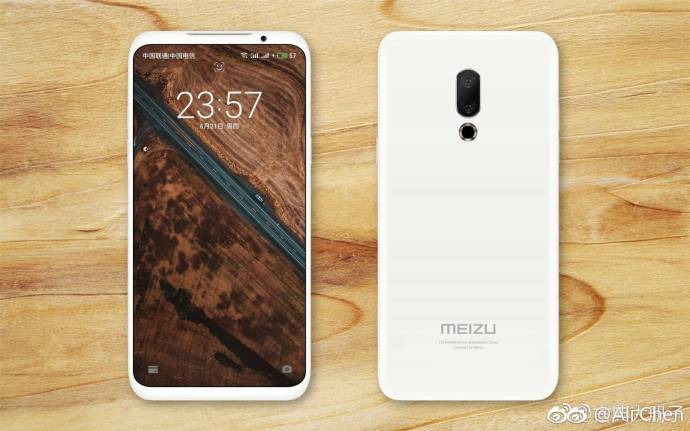
The Meizu 16 series smartphones are expected to come with a notchless full-screen display with a high screen-to-body ratio. Both the models will be powered by Qualcomm‘s Snapdragon 845 octa-core processor. However, there’ll be another variant of Meizu 16 powered by Snapdragon 710 SoC.
It is also confirmed to come with an in-display fingerprint sensor, dual rear cameras, and support for wireless charging. The rear camera will reportedly feature a 12-megapixel primary sensor with f/1.8 aperture. Another model named Meizu X8, a mid-range offering from the company, which will be powered by Snapdragon 710 processor but won’t feature the in-display fingerprint sensor.
While the smartphones are expected to launch next month, the company has not yet revealed the launch date. Earlier Meizu CEO had suggested August 26 as the launch date but several reports suggest early August launch date. We should get the launch date information for the Meizu 16 series in the coming days.
After the success of Razer Phone in 2017, three smartphones dedicated to gamers have been launched in 2018. Three of these phones have already hit the shelves: Razer Phone, Xiaomi Black Shark, and Nubia Red Magic, while Asus ROG Phone is yet to be made available, even though it was launched back in June.
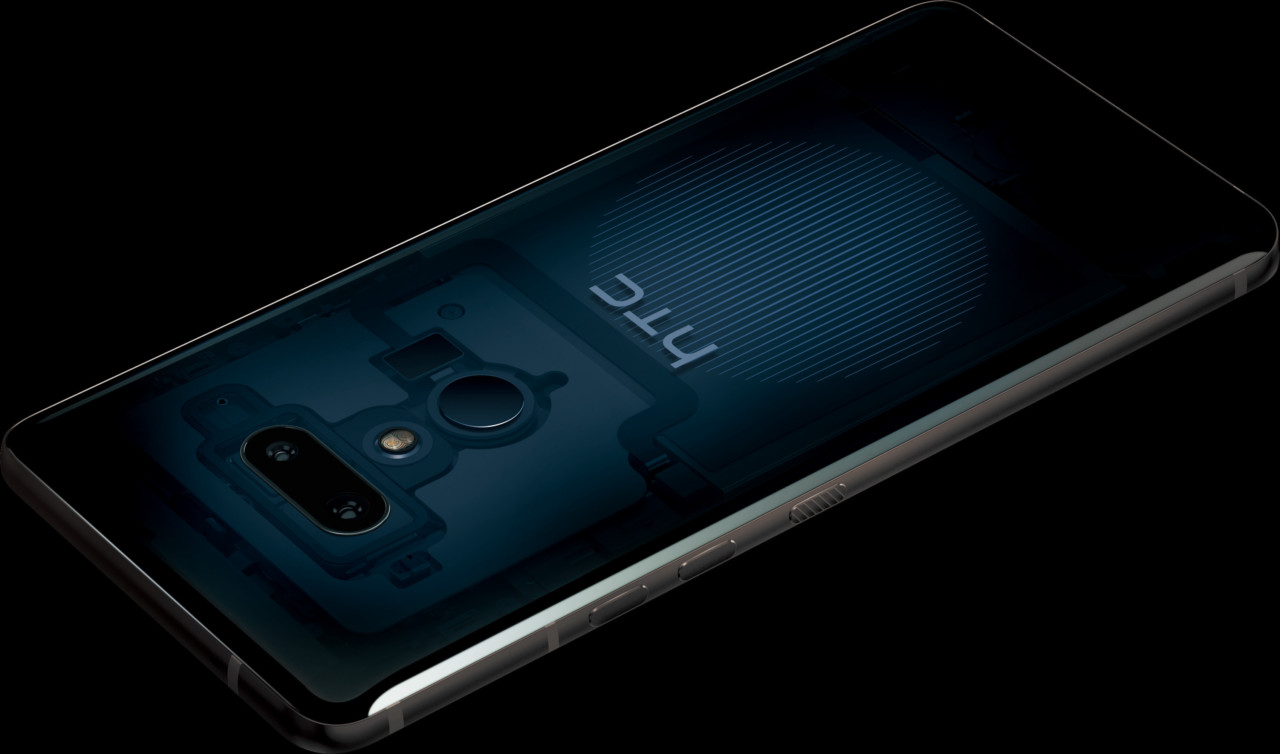
But we already know that it will debut in India in this quarter, and it will also launch in the U.S. In the meantime it seems that even HTC is planning to release a gaming phone. After confirming Exodus, its first phone dedicated to the blockchain, the Taiwanese company has revealed that it will also launch a gaming phone, but it will take time. In the press conference related to the launch of the U12+ Mayday limited edition Taiwan, the head of HTC Taiwan Chen Bajun said that the company will collaborate with mobile games makers in the future.
At the moment the company is still in an early phase of the relationship with these companies, so we think that it is unlikely that its first gaming phone will hit the market before 2020. Chen Bojun also said that the company will release new phones in Q3 and Q4 2018.
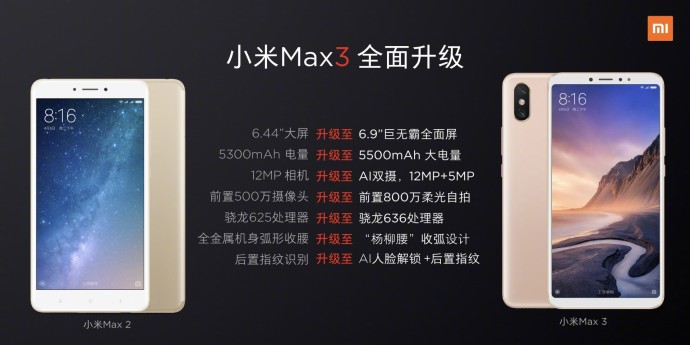
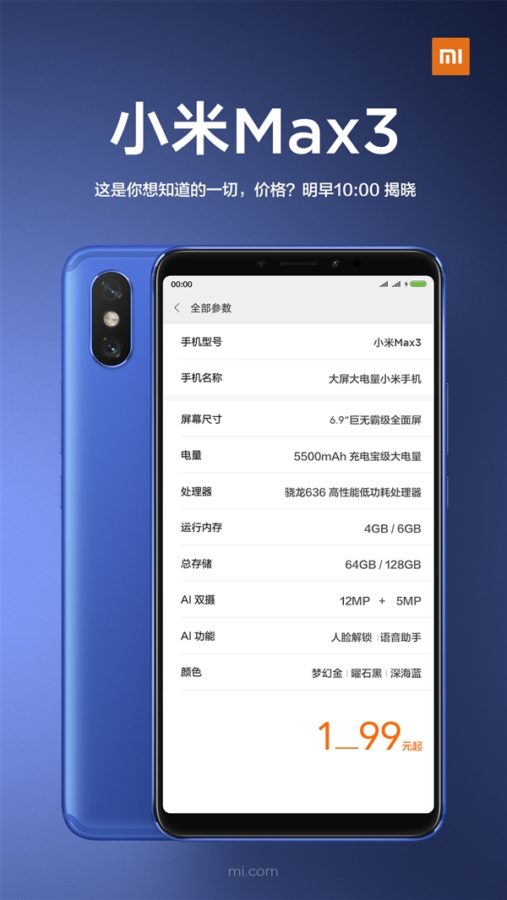
After several weeks of leaks, Xiaomi has unveiled the highly anticipated Xiaomi Mi Max 3 smartphone. Compared to the predecessor Mi Max 2, its successor has arrived with improvements in 7 departments such as design, display, battery, rear camera, front camera, processor, and additional biometric recognition feature.
Design
The Xiaomi Mi Max 3 that measures 176.2 x 87.4 x 8mm is slightly bigger and thinner than the Mi Max 2 with dimensions 174.1 x 88.7 x 7.6mm. The size of the phone is similar to a traditional 6.3-inch smartphone.
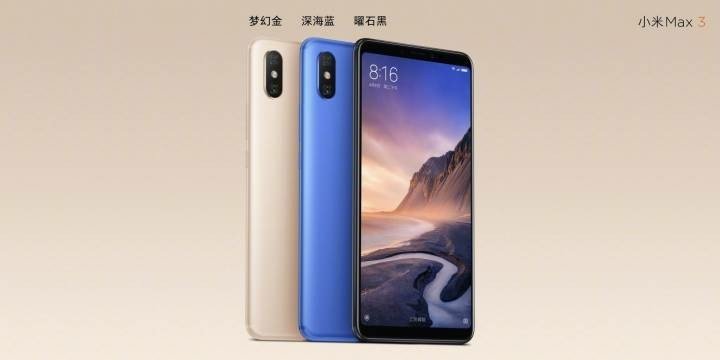
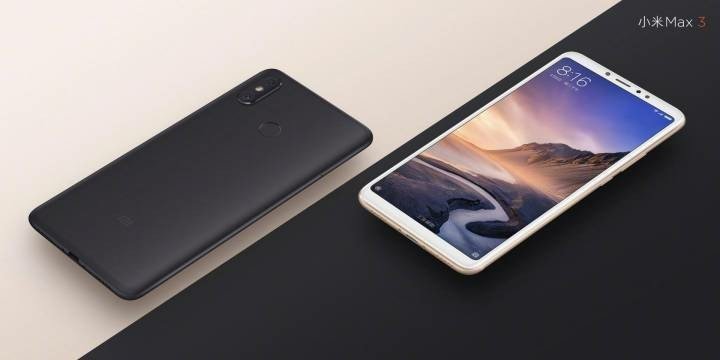
By reducing the upper bezel by 4.7mm, the lower one by 7mm and narrowing the chassis by 1.3mm, Xiaomi has managed to pack a huge display of 6.9 inches on the Mi Max 3. Like the predecessor model, the Mi Max 3 also features a full unibody design and its thin profile makes it comfortable to hold with one hand. The three color variants of the Mi Max 3 are Black Stone, Deep Sea Blue and Dream Gold.
Display
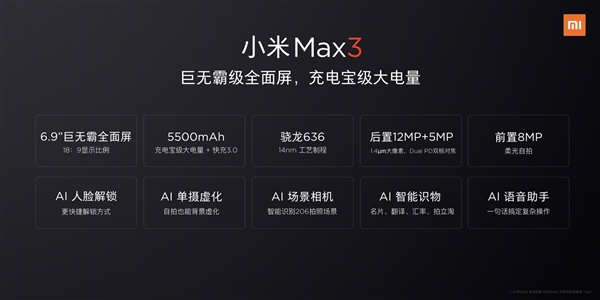
The Xiaomi Mi Max 3 features a huge display of 6.9 inches that offers an aspect ratio of 18:9 along with FHD+ resolution of 2160 x 1080 pixels. According to Xiaomi, the Mi Max 3 offers a screen-to-body ratio 85.19 percent.
Compared to the Mi Max 2, the company has increased the screen’s brightness by 19 percent on the Mi Max 3 and also it offers 50 percent higher contrast. It offers 17 percent more color gamut than the Mi Max 2. It goes without saying that the large display offers a better viewing experience. The smartphone also supports display features like split-screen and picture-in-picture.
Battery
The Mi Max 3 has a 5,500mAh battery which means it includes 200mAh more power than the predecessor model. The gigantic battery makes it possible to use the smartphone for 2 days with charging it once. It offers a standby time of one month.
Moreover, the smartphone also includes support for Quick Charge 3.0 allows it to gain 71 percent of battery juice by charging it for an hour. Xiaomi has also included reverse charging feature on the Mi Max 3 through which it can be used for charging other devices like phones, smartwatches, Bluetooth headsets and so on.
Processor
The original Mi Max and Mi Max 2 were both powered by Snapdragon 625. The newer Mi Max 3 has arrived with Snapdragon 636 that delivers 40 percent better performance than SD625. The 14nm SoC consumes less power and delivers smoother performance while multitasking on the phone.
The 128 GB storage model of the Mi Max 3 has 6 GB of RAM whereas the base variant of 64 GB has 4 GB of RAM. For enhanced gaming experience on games like Arena of Valor, the Mi Max 3 supports high frame multi-core multi-threading and offers gaming features like game toolbox, one-click acceleration, screen and video capture as well as quickly reply on WeChat.
Cameras
The Xiaomi Mi Max 3 features 12-megapixel + 5-megapixel AI dual camera with a pixel size of 1.4μm along with dual PD dual-core focus that offers faster and accurate autofocus. The AI driven rear cameras also supports better low-light photography, up to 206 kinds of scene detection, object recognition and portrait shots. Here are some of the camera samples released by Xiaomi:
The frontside of the smartphone is fitted with an 8-megapixel selfie camera along with a dedicated soft-light LED flash. With AI onboard, the selfie camera of the Xiaomi phablet can capture selfie shots with bokeh effect.
Other Features
Like the Mi Max 3, the successor phone is equipped with dual speakers for stereo sound output while watching movies and enjoying games. The handset is preinstalled with Android 8.1 Oreo and the latest edition of MIUI which also brings along Xiao AI voice assistant.
Apart from the rear-mounted fingerprint scanner, the Mi Max 3 also carries support for face unlock through the front camera. The other features available on the smartphone are microSD slot, 4G VoLTE, dual-SIM support, Wi-Fi 802.11ac, Bluetooth 5.0, GPS, USB-C and 3.5mm audio jack
The 64 GB storage + 4 GB RAM and 128 GB storage + 4 GB variants of the Mi Max 2 were respectively made available for 1,699 Yuan (~$252) and 1,999 Yuan. (~$296) Even though the Xiaomi Mi Max 3 comes with many improvements, it has arrived with the same pricing as the predecessor model.
The 64 GB storage + 4 GB RAM and 128 GB storage + 6 GB models of the Mi Max 3 carry respective price tags of 1,699 Yuan (~$252) and 1,999 Yuan. (~$296). Starting from July 20, the Mi Max 3 will be available for buying through multiple platforms in China such as Xiaomi Home, Gome, Suning, Xiaomi Mall app, Tmall, Jingdong and other online and offline stores.
Xiaomi will be holding a launch event for the Mi Max 3 today evening at 7:30 PM in China. Xiaomi President Lin Bin has claimed on Weibo that it will be announcing “one more thing” at the event. What could it be? Snapdragon 710 edition of Mi Max 3 or the release date of Xiaomi Mi 8 Explorer Edition? Before drawing conclusions, it is advisable to wait for the event to go live.
This year can be referred to as the year of the notch since most smartphone manufacturers have launched one or two phones sporting the cut out made famous by Apple. HMD Global, not wanting to miss out on the trend, first announced the Nokia X6 in May and has now followed it with a second device, the Nokia X5.
The Nokia X5, like the Nokia X6, is only available in China at the moment but there are rumors it will be available in other markets but as the Nokia 5.1 Plus.
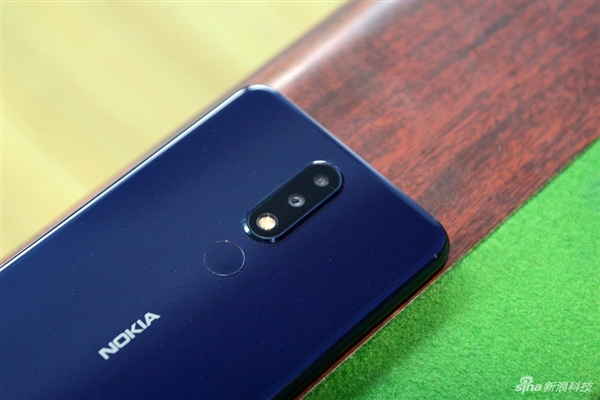
Hands-on photos of the Baltic Sea Blue variant have surfaced online and they look good. The Nokia X5 and Nokia X6 both have the same display size and the same battery but the former has a wider notch. The wider notch doesn’t mean the earpiece is bigger or Nokia has fit an extra camera sensor. They are all the same as that of the X6.
[envira-gallery id=”202016″]
The Nokia X5 has glass on both sides which isn’t a common sight in phones in its price range. Its dual rear cameras are slightly raised and it also has a rear-mounted fingerprint scanner. The physical buttons are on the right, SIM tray sits on the left, USB-C port and speaker at the bottom and 3.5mm audio jack at the top.
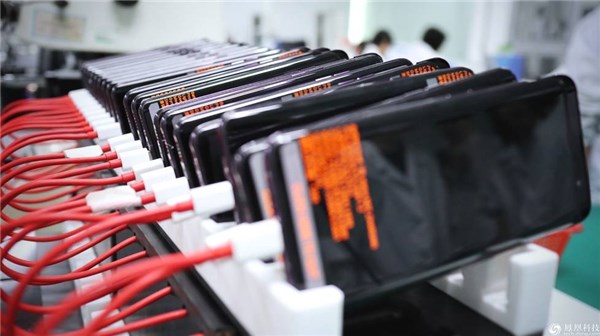
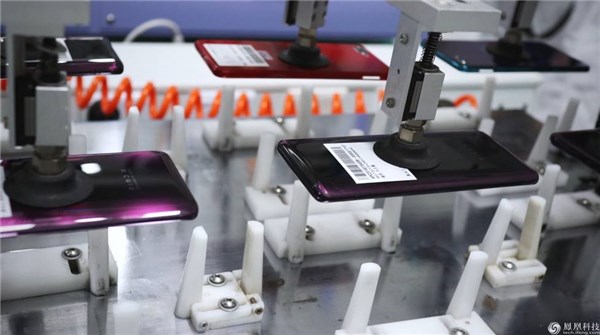
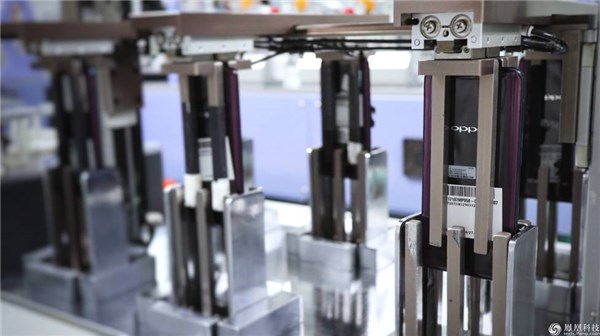
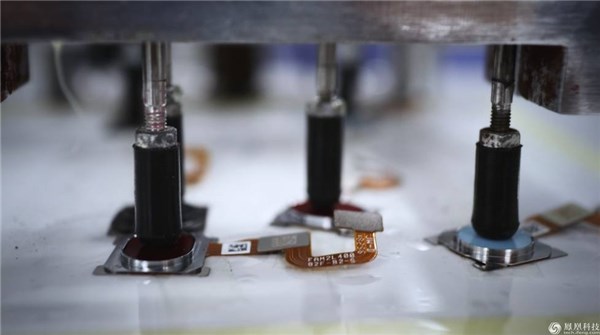
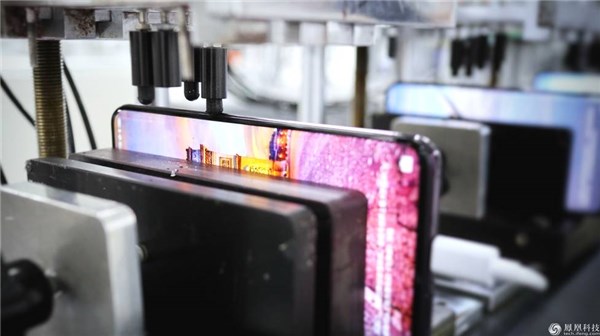
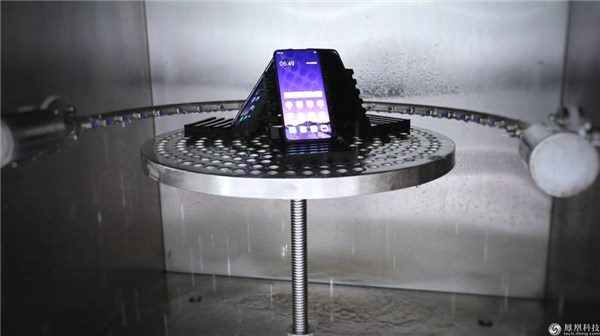
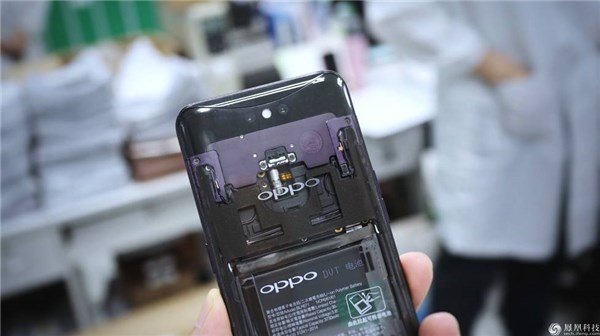
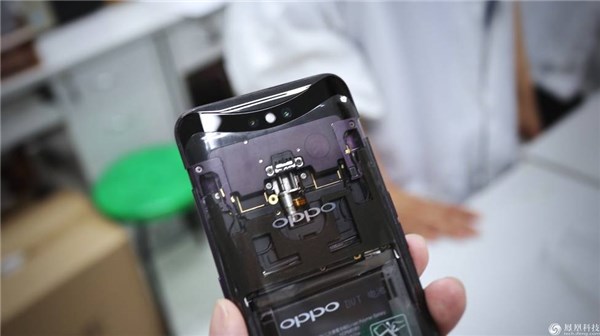
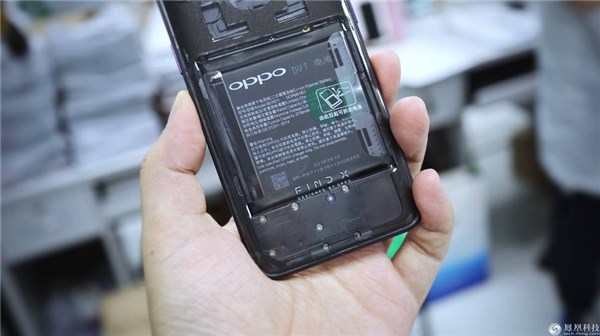
OPPO‘s much-anticipated flagship dubbed OPPO Find X only went on sale in China only a few days ago. Jut after its first sale, a team of tech geeks from Phoenix Technology were given the opportunity to tour OPPO’s manufacturing plant in China where the Find X is manufactured. The tour gives a glimpse of how the device is manufactured and there is no doubt about the quality of the process.
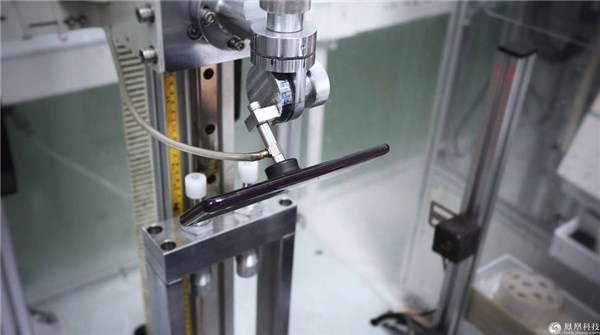
The OPPO Find X is subjected to several durability tests during the manufacturing process. One of the tests is the drop test where the device was dropped from a height of about one metre. The device was also subjected to a rain test where some amount of water like raindrops were showered on the device in order to show it has some level of waterproofing. However, OPPO didn’t tout the Find X as a waterproof device. But from the test, we can see the device may likely be splash proof. In addition, the power buttons, charging port are also tested to ensure they meet specifications.
The Find X teardown has already met with us so we know already what lies inside the device. Here again, the internals is shown under the translucent glass back which could be before the back was coated. Perhaps, OPPO may release a translucent glass variant in the future. One main feature of the Find X is the slider mechanism and we are once again assured of the quality of the slider which OPPO claims can last up to 150 times daily usage for 5 years.
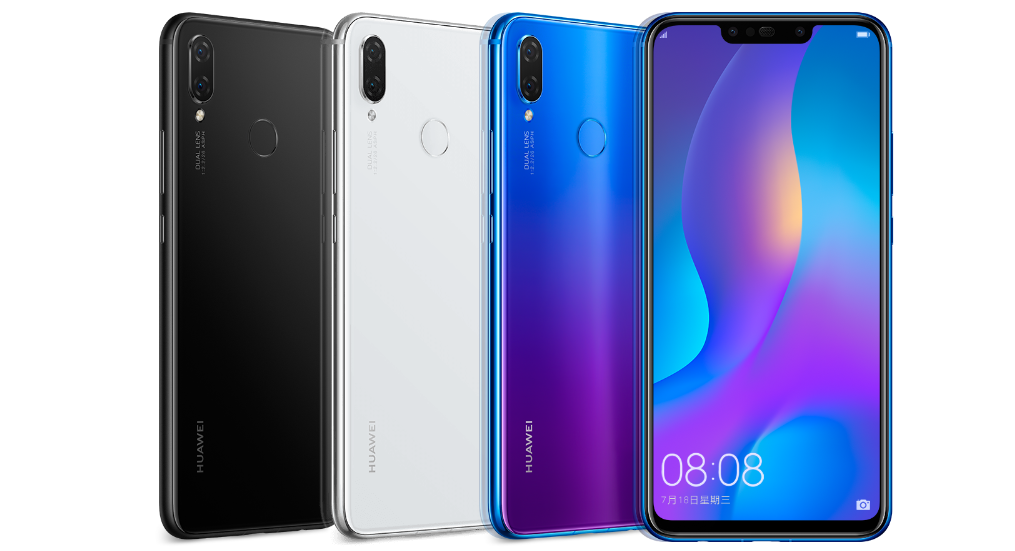
Huawei had a launch event today where it announced a bunch of new products such as the Kirin 710, the Talkband 5, and the Nova 3. It also announced a second phone, the Nova 3i. The Nova 3i comes with lots of interesting features but the most important one is its processor which is the just announced Kirin 710.
Nova 3i Design
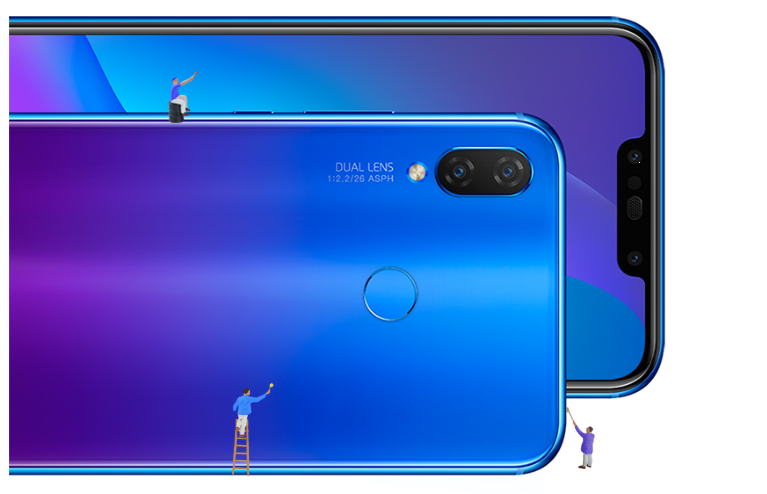
The Nova 3i doesn’t have a look we haven’t seen before from Huawei or Honor. There is a notch, dual rear cameras in the same iPhone X style a lot of its phones use, and glass on both sides.
Nova 3i Specs
The phone has a 6.3-inch 19.5:9 FHD+ display. Paired with the Kirin 710 is 4GB of RAM and 128GB of storage or 6GB of RAM and 64GB of storage. That is no mistake. The 6GB model does have less storage. However, the official site says there is a 6GB + 128GB model too. All models have support for storage expansion (256GB max.)
The Nova 3i comes with four cameras – two on each side. The notch is home to a 24MP sensor and a 2MP secondary sensor. Huawei says it can identify 8 different scenes and has an “HDR Pro backlight mode”. The phone also comes with Qmoji, Huawei’s take on the iPhone X’ Animoji.
The rear cameras, on the other hand, are a 16MP sensor and a 2MP sensor. The cameras can identify up to 22 different scenes and have a bunch of professional shooting modes. It can also record slow-motion videos at 480fps.
Even with the new chipset, the Nova 3i still comes with Bluetooth 4.2. There is also aptX and aptX HD audio for high-quality audio streaming. The phone has a 3340mAh battery, dual SIM support (nano only) and runs EMUI 8.2 based on Android 8.1 Oreo.
Huawei has finally taken the wraps off the Huawei Nova 3 and Nova 3i smartphones in China today. Unlike the earlier smartphones in this series which were essentially mid-rangers, the company has boosted the new Nova 3 model with the flagship AI enabled Kirin 970 chipset inside. Not just that, the phone supports the recently announced GPU Turbo technology as well, making it a power packed smartphone for a pretty aggressive price tag.
The Huawei Nova series has always focused on the camera experience. The same applies with the new Nova 3 as well. Like the Nova 2S that was announced back in December 2017, the new model features 4 cameras in total, two on the front and two on the back. This will ensure that you’ll be able to capture good quality selfies with bokeh from both the ends.
Huawei Nova 3 Design
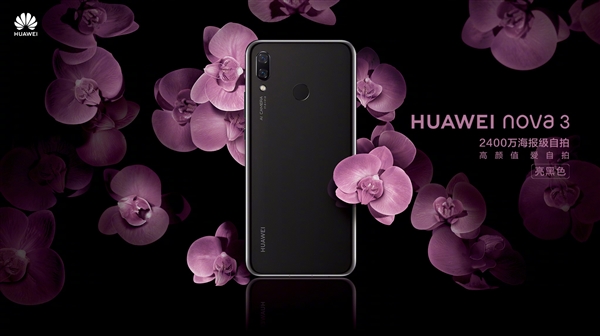
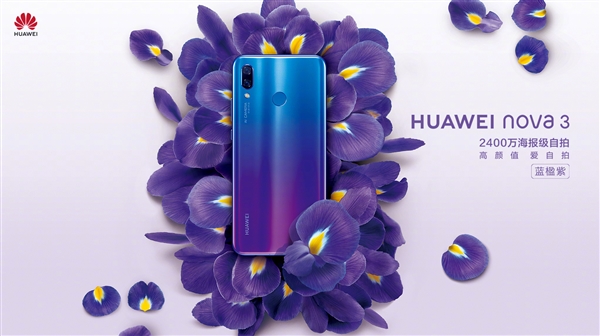
Huawei has decided to stick with glass on the new model, like its recent releases. So, the Huawei Nova 3 comes with 3D double curved glass on both the sides. The glass at the back features high refractive index and comes in four color options: Black, light blue, primrose gold, and blue-violet (similar to the shade on the gradient Aurora P20 pro).
Up front, you have a notch which houses a number of sensors like ambient light, proximity, IR light sensor for 3D face recognition, dual cameras (on either sides) and earpiece. So, its bigger than some notch phones like the OnePlus 6.
Huawei Nova 3 Specs
The Huawei Nova 3 is quite loaded in terms of specs. The phone features a large 6.3-inch display with 19.5:9 aspect ratio and 2340 x 1080p resolution. The phone supports IR face unlocks and even 3D face recognition payments. Note that there’s a fingerprint sensor on the back as well. The front camera is made up of a 24MP f/2.0 sensor along with a secondary 2MP sensor. The front camera supports AI features as well as an enhanced beauty mode.
The rear camera is composed of a 16MP +24MP dual camera setup (Color + B/W sensors) with f/1.8 aperture lens, PDAF, contrast AF, AI scene recognition (22 categories and 500 different scenes), short video effects via AI and even HDR Pro at the hardware level. This is said to bring HDR mode in the preview window as well as while shooting videos.
As for the hardware inside, the Nova 3 boasts of the flagship Kirin 970 AI chipset inside with 6GB of RAM and 64GB / 128GB of internal storage options. The storage can be further expanded up to 256GB via MicroSD. There’s a pretty decent 3750mAh battery inside that should last up to a day as well as a dedicated 3.5mm headphone jack. Note that the phone comes with support for GPU Turbo which should ensure smooth gaming experience on its large screen.
Other notable features of the Nova 3 include 3D Emoji AR support, Android 8.1 based EMUI 8.2 UI, USB Type-C, and dual SIM support. It’s worth mentioning that some of the features like 3D face recognition payments and AI short video effects will not be available at launch. Instead, these features will rollout in future updates.
Huawei Nova 3 Price & Availability
The Nova 3 is priced at 2999 Yuan for the 6+128GB edition for all the four colors. Note that the Primrose Gold is a special edition model, but the pricing remains the same. It could be a limited edition model.
The phone goes on sale on July 19 (tomorrow) at 10:08AM via Vmall.
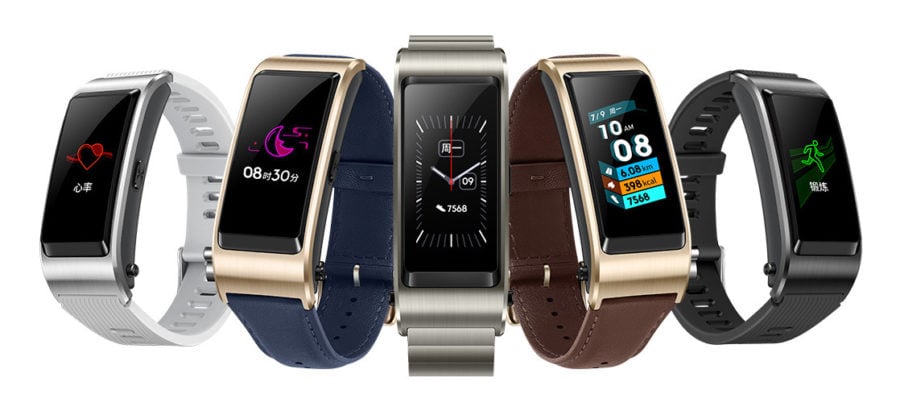
Last week, Huawei had revealed its new wearable device — Huawei TalkBand B5, which is the successor of the TalkBand B3 that was launched in 2016. Today, along with the Nove 3, Nova 3i and Kirin 710 processor, Huawei officially launched the TalkBand B5.
As for the pricing, the Sports version of the Huawei TalkBand B5 is priced at 999 Yuan, which roughly converts to $149 while the Business variant of the wearable device is priced at 1,199 Yuan, that is roughly $178. There’s also a third variant, Fashion version, which costs 1,499 Yuan (approximately $223).
The TalkBand B5 comes with an ungraded 1.13-inch full color touch display with 2.5D curved glass and 300 × 160 pixels screen resolution. The display is about 2.4 times bigger than its predecessor and can display contents of WeChat and QQ as well as schedule, SMS and news, among others.
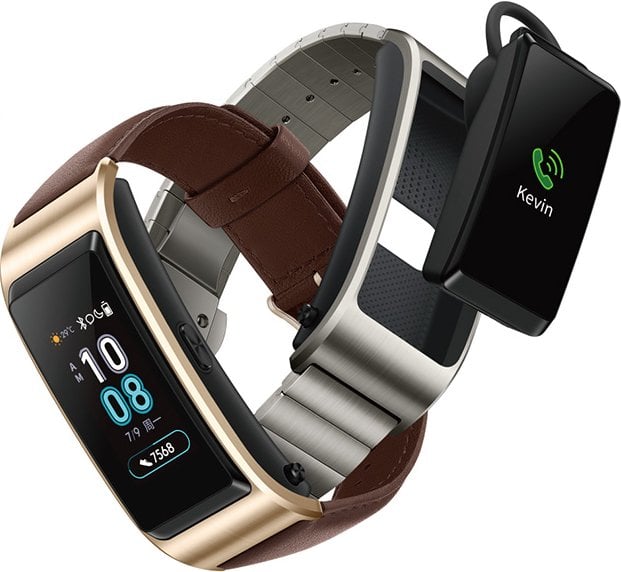
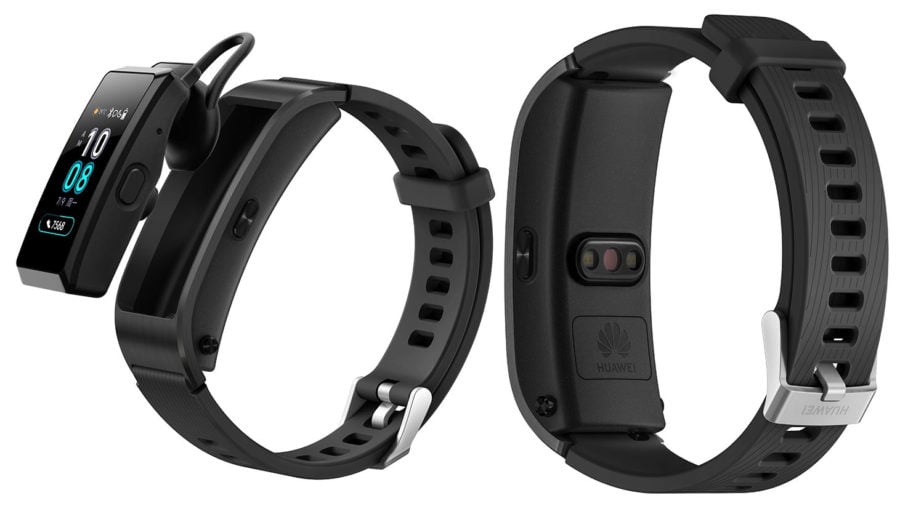
It is a 2-in-1 device that can be used as a fitness tracker as well as a single-ear Bluetooth headset. When attached to the wristband, it can be used as a fitness tracker, but when detached, it becomes a single-ear Bluetooth headset which can be used to take calls.
The pop-up Bluetooth headset has a trip-core audio chip with high-definition voice and dual microphone with noise reduction. It has caller ID support, call mute function as well as speed dial option. There’s a built-in triple-core audio chip that supports dual MIC noise reduction.
The wearable device also comes with Huawei TruRelax Technology that analyses heart rate variability and accesses the user’s stress status. Further, the device offers breath training for relaxing. The Huawei TruSleep 2.0 uses cardiopulmonary coupled dynamics spectrum (CPC) to monitor complete sleep structure including deep sleep (REM). It analyzes the sleep pattern of the user and also offers personalized sleep recommendations.
The Huawei TruSeen 2.0 heart rate technology offers 24-hour continuous heart monitoring when running, walking, cycling and more activities. Along with step counting, calorie calculation, and distance measurement, it also enables users to set up a running plan based on heart rate evaluation, V02max, recovery time suggestion and more.
The device also comes with features such as reminders, voice assistants, alarm clocks, remote control for media content, phone finder, etc. The Huawei TalkBand B5 has IP67 rating for dust and water resistance. The Talkband B5 connects via Bluetooth 4.2 to devices that are running Android 4.4+ and iOS 9.0 and above. It is powered by a 108mAh battery that can provide talktime of about 6 hours on a single charge.
The Huawei TalkBand B5 comes in Sports Edition with strap in three colors — Ash, Black and Brown color. On the other hand, the Business Edition comes with a metal strap. There are also optional 18mm straps in silicone, leather and stainless steel for a premium look.
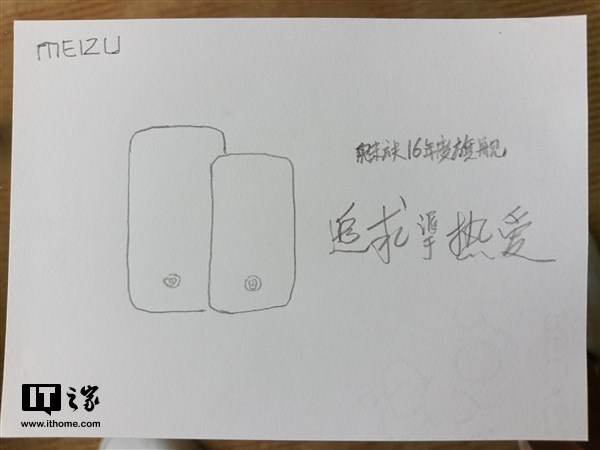
Huang Zhang, the founder of Meizu has revealed a hand-drawn Meizu 16 sketch in the Meizu community today. The sketch sort of confirms that the device would come in two models and the two models will feature on-screen fingerprint sensors. The Meizu CEO further hinted that the smartphone would be released next month. From the sketch, the two model would come in different screen size, which is supposedly the Meizu 16 and 16 Plus. Alongside the sketch was a very brief note “the pursuit comes from love”.
Before now, reports have it that, the Meizu flagship will use an OLED display, COF package, and supports AOD screen fingerprint unlocking. The device would be fuelled by the popular standard Qualcomm Snapdragon 845 processor and wouldn’t use the full-screen design, unlike the 16 Plus that sports a full 6.5 inches screen.
Meizu is expected to hold a news conference next month at Beijing Bird’s Nest where it would launch the Meizu 16 series models. The series comprises of the 16 and 16 Plus as well as the Meizu X8.
We have been waiting for Huawei to announce a new processor for its mid-range devices for months now. The Kirin 659 which it announced last year has appeared in so many phones, its hard to keep track. So it comes as a sigh of relief to know it now has a new mid-range processor – the Kirin 710.
The Kirin 710 is Huawei’s first 12nm chipset. The smaller size means there should be a significant improvement in power consumption and performance when compared to the 16nm Kirin 659.
In terms of performance, the Kirin 710’s single-core performance is said to be 75% higher than that of the Kirin 659 while for multi-core performance, it offers a 68% increase in performance
The chipset consists of four Cortex-A73 cores clocked at 2.2GHz and four Cortex-A53 cores clocked at 1.7GHz. The GPU is an ARM Mali G5 which is said to be 1.3 times better than that of the Kirin 659 and 1x more energy efficient. It also has support for LTE Cat. 12 and Cat. 13 and dual-SIM dual-4G VoLTE.
Xiaomi’s Mi Max series always featured one of the biggest smartphone displays of its time and the same will continue in 2018 as well. After today’s official confirmation from the company, we now know for sure that the Mi Max 3 will feature a monstrous 6.9-inch display that should cater to your gaming and entertainment needs. But the Mi Max series is not just known for its huge displays, it’s also famous for its extravagant battery capacities. The Mi Max 3 is no exception with the company confirming that it will come with a massive 5500mAh battery to ensure that the phone’s large screen is powered for a very long time!
Almost everything about the phone is known via official teasers, leaks, and rumours. Hence, it’s time for a Mi Max 3 specs rumour roundup article to see what’s in store for us on July 19.
Gone are the days when companies used to protect their upcoming smartphones to ensure there’s enough excitement during the launch event. Now, there’s a growing trend among smartphone makers to reveal almost everything about the device before it goes official. The same is applicable with the Mi Max 3 as well. Xiaomi has already shown us its design, specs, and teased a few features giving us a clear picture of the handset.
Xiaomi Mi Max 3 Design
Apart from the Mi Mix series, rest of Xiaomi’s smartphones have featured standard designs. In case of the Mi Max 3, Xiaomi is adopting the exact same design as the Mi 6X. This means that you get a top left placed dual camera setup with flash in between, center placed fingerprint sensor at the back, and up front, thin bezels on the top and the bottom. In short, consider the Mi Max 3 as an enlarged version of the Mi 6X.
While Xiaomi is yet to officially announce a price tag for the Mi Max 3, it has confirmed that it will be under 2000 Yuan (~$300). This is likely for the highest end model, i.e. 6GB+128GB edition, which would be a pretty good deal!
To recall, the Xiaomi Mi Max 2 was launched in two models like 4 GB RAM + 64 GB storage and 4 GB RAM + 128 GB storage with respective pricing of 1,699 Yuan (~$253) and 1,999 Yuan (~$298). So, the company seems to be aiming for a similar pricing strategy this year as well.
But this year, for this price, there will be big upgrades as compared to its predecessor like in the processor department (SD636 vs 625), display (6.9 vs 6.4), battery (5500 vs 5300mAh), and even the cameras (12+5 dual cams vs 12MP single cam).
The Honor Note 10 is an upcoming phablet from Huawei’s subsidiary Honor. The device has been in the news in recent weeks with leaks covering specs, color variants, and a special Rolls Royce Edition. Now live photos of the device have surfaced and we get to have a good look at the display.
The Honor Note 10 is said to pack a 6.9-inch AMOLED screen. That is the same size as Xiaomi’s Mi Max 3 which launches tomorrow. However, these live photos of the Note 10 show the device is wider than that of the Mi Max 3.
[envira-gallery id=”201943″]
So if they do have the same screen size why does the Honor Note 10 look wider? We came up with two plausible reasons. First, the angle the photos were taken makes it appear so. Second, the Honor Note 10 doesn’t have an 18:9 aspect ratio.
If you remember, the Huawei Mate 10 doesn’t have an 18:9 aspect ratio but it has smaller bezels more or less the size of the Mate 10 Pro which has an 18:9 aspect ratio. We want to believe the same design has been used for the Honor Note 10.
In the pictures, the phone is shown side-by-side with the Nintendo Switch. The Switch has a 6.2-inch screen but thanks to the huge bezels surrounding it, it is bigger than the Honor Note 10.
Vivo NEX, the smartphone which comes with a pop-up front-facing camera, is all set to be launched globally this month. In line with that, the Vivo NEX will also be available for purchase in Taiwan from 30th July for a price of NT$2,1990, roughly $718, which is about $45 more than Chinese pricing.
However, according to the report, the Vivo NEX will be available for purchase in Taiwan on 30th July through a limited sale with just 1,000 units. Apart from Taiwan, the smartphone is also slated to launch in Russia, Malaysia, Hong Kong, and India by the end of this month.
The Vivo NEX series was first announced in China in two variants — NEX S and NEX A. Both the variants are the production version of the Vivo Apex concept smartphone that was showcased earlier by the Chinese company.
The highlight of the Vivo NEX smartphones is the whopping 91 percent screen-to-body ratio and a motorized pop-up front camera for taking selfies and video calling. It also comes with an under-display fingerprint reader. Both the smartphones feature a 6.59-inch Super AMOLED Full HD+ display with 1080 x 2316 pixels screen resolution with 18:9 aspect ratio.
Under the hood, the NEX S is powered by Qualcomm Snapdragon 845 octa-core processor clocked at a maximum frequency of 2.8GHz. It packs 8GB RAM and comes in two internal storage options — 128GB and 256GB. On the other hand, the NEX A is powered by the recently launched Snapdragon 710 processor with a 2.2GHz clock speed. This one comes with 6GB RAM and 128GB of internal storage.
In the camera department, the smartphone features a dual camera setup on the back, consisting of a 12MP primary sensor and 5MP secondary sensor. On the front side, there’s an 8MP snapper that comes with an elevating mechanism.
As for the software, both the smartphones are running on Android Oreo operating system out of the box. The phone also comes with Vivo Game Engine, which is made in partnership with Tencent Games that aims to provide an immersive gaming experience based on software and hardware optimization.
Connectivity options on the devices include Dual 4G VoLTE, Wi-Fi 802.11 ac (2.4GHz / 5GHz) 2×2 MIMO, Bluetooth 5 LE, GPS + GLONASS, and USB Type-C. Both the smartphones are fuelled by a 4,000mAh battery with 22.5W fast charging support.
The Vivo NEX will be officially available for pre-orders in India through online marketplace Amazon from 19th July. While the company has not yet revealed Indian pricing, several reports suggest that the pricing will start from INR 48,990 which roughly translates into $715.
BlackBerry’s Indian licensee Optiemus is expected to launch two new phones this year. Ever since news of the two devices surfaced, they have been referred to as the BlackBerry Ghost and Ghost Pro. Apparently, those are their codenames and a new leak has revealed their official names.
The Blackberry Ghost will launch as the BlackBerry Evolve
The leak comes from Evan Blass who first informed us about the existence of both phones months ago. According to a tweet from him yesterday, the BlackBerry Ghost will launch as the BlackBerry Evolve and the Ghost Pro will launch as the BlackBerry Evolve X.
Apparently the Ghost and Ghost Pro from India's Optiemus are coming to market as the BlackBerry Evolve and Evolve X.
Both the Evolve and the Evolve X are expected to come with 18:9 displays and powerful Snapdragon processors. A few weeks ago, Evan Blass also revealed the Ghost (Evolve) will pack a 4000mAh battery. The rest of the specs are still unknown and so is a release date.
Meizu is preparing to launch its next flagship smartphone series — Meizu 16 in August. The company will be launching Meizu 16 and Meizu 16 Plus, and ahead of the phone’s launch next month, most of the details related to the smartphone have leaked online.
While we already know that the upcoming flagship smartphone will have a dual camera setup, the latest information reveals that the primary camera on the back side will feature a 12-megapixel sensor with f/1.8 apreture.
Further, it is said that the company’s mBack button will have a new evolutionary version and will ditch the dot design. There’s a possibility that the company could introduce a new gesture recognition feature.
Recently, Meizu CEO Jack Wong shared camera samples of the upcoming flagship smartphone Meizu 16. The indoor sample photo looks impressive with a high level of accuracy in colour reproduction and the clarity is vivid.
Meizu is expected to launch two smartphone in its Meizu 16 series — Meizu 16 and Meizu 16 Plus and even though both device will have narrow bezels and high screen-to-body ratio, the smartphones will not feature a notched display.
Under the hood, both smartphones will be powered by Qualcomm‘s Snapdragon 845 octa-core processor, clocked at a maximum frequency of 2.8GHz. This is the same chipset that powers most of the flagship smartphone launched this year.
The company’s CEO has already revealed that there’ll be an 8GB RAM + 128GB internal storage model, which is likely to be the high-end variant of the Meizu 16. The smartphone is also confirmed to come with an under-display fingerprint sensor.
It will also come with dual rear camera setup and support for wireless charing. However, there’ll be another model named Meizu X8, a mid-range offering from the company, which will be powered by Snapdragon 710 processor and won’t feature the in-display fingerprint sensor.
Recently, Meizu CEO Jack Wong had said that the most powerful version of the upcoming flagship smartphones will not cost more than 4000 Yuan, which roughly translates to $514 while the Meizu X8 is said to cost between 1,500-2,000 Yuan ($226-300).
The Meizu 16-series as well as the Meizu X8 are slated to launch next month. While Jack Wong has revealed that the Meizu 16 will be launched on 26th August, the company has not yet made the launch date official.
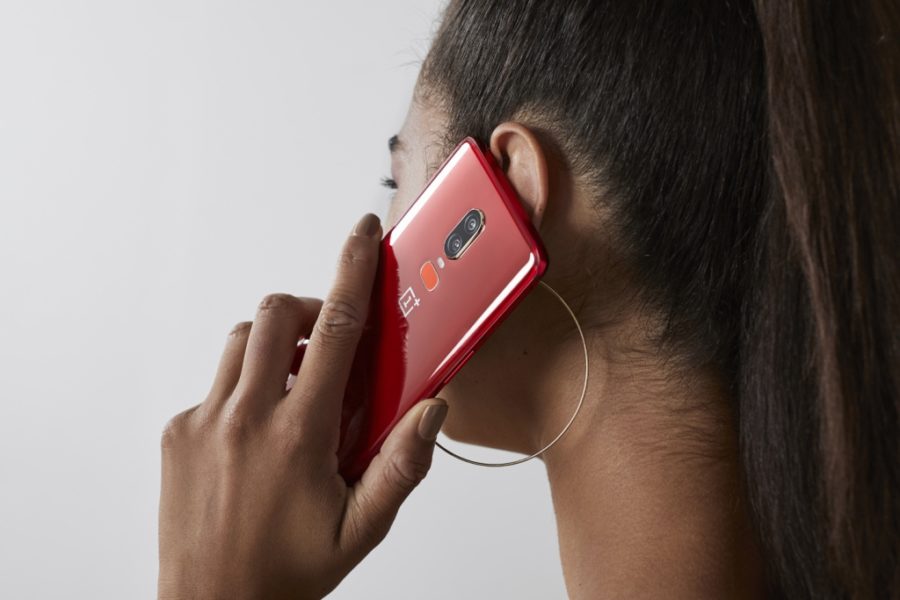
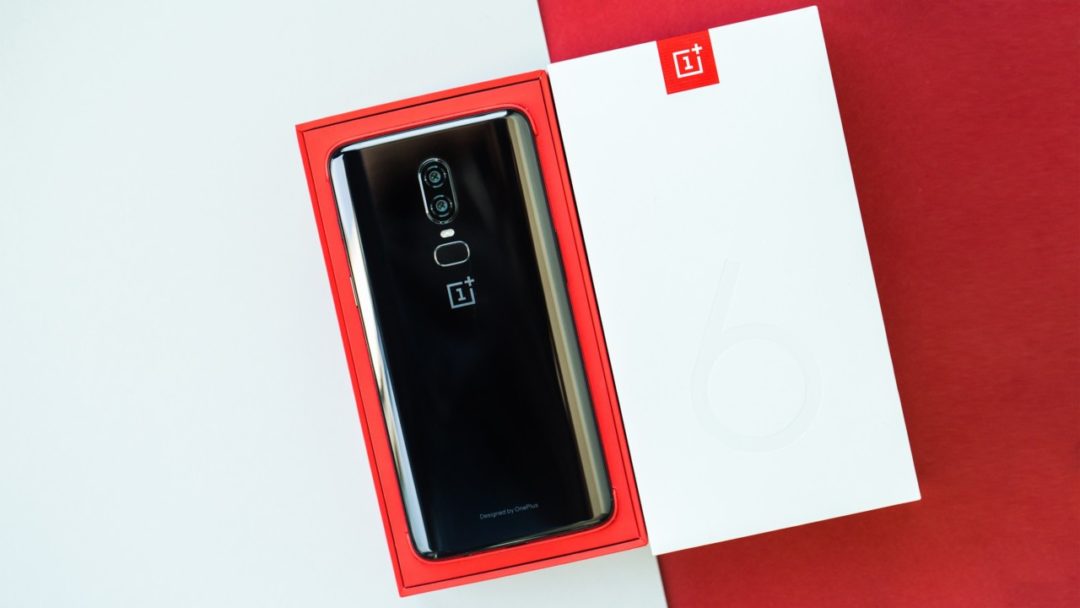
OnePlus 6, the long-awaited successor of the OnePlus 5 series was launched in May this year. As expected, the feature-laden phone turned out to be an instant hit among smartphone lovers who prefer a big-screen phone.
On the downside, the OnePlus 6 does not come cheap. In fact, it will set you back $790.99 on Banggood. Much to the chagrin of budget-conscious buyers who aren’t willing to shell out that kind of money on a smartphone, the Shenzhen-based Chinese smartphone manufacturer does not plan to lower the phone’s original asking price anytime soon.
If you’ve restlessly been waiting to get your hands on the OnePlus 6 smartphone without emptying your pocket, you’ve come to the right place. We’ll show how you can save a considerable amount of money on the phone’s steep retail price without breaking much of a sweat.
You can apply coupon code ‘OP717BG’ during the checkout process to bring your grand total down to just $569.51. In other words, you can get a massive $221.48 off on the OnePlus 6 smartphone simply by applying the aforesaid article.
At this considerably dropped price, the OnePlus 6 is quite a bargain since it offers a slew of top-end specifications and features including a big 6.28 inches Optic AMOLED 16M FHD+ (2280 x 1080 pixels) display. The phone is housed in a sturdy aluminum alloy and glass body which is further enhanced with an eye-catching full-screen display.
Furthermore, the OnePlus 6 is powered by a Qualcomm Snapdragon 845 64-bit processor and it packs a Qualcomm Adreno 630 graphics processing unit, under the hood. The phone offers 8GB of RAM and a hearty 128GB of non-expandable onboard storage.
On the photography front, the OnePlus 6 smartphone houses a 16.0MP+16.0MP dual-camera setup on the back. Up front, it sports a 20.0MP camera with dual LED Flash for selfies and face-to-face video chatting.
You can head straight to this link in order to check out the full specification and apply the coupon code, which is slated to expire on July 31st.
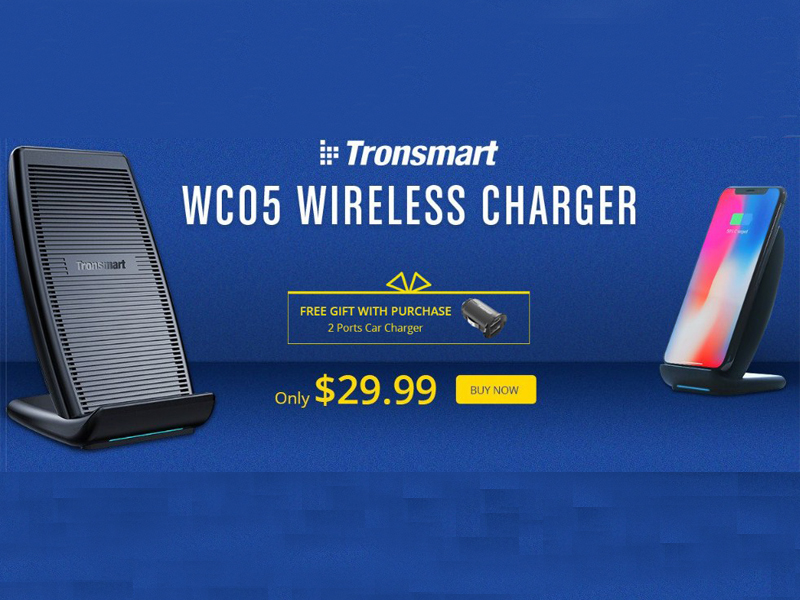
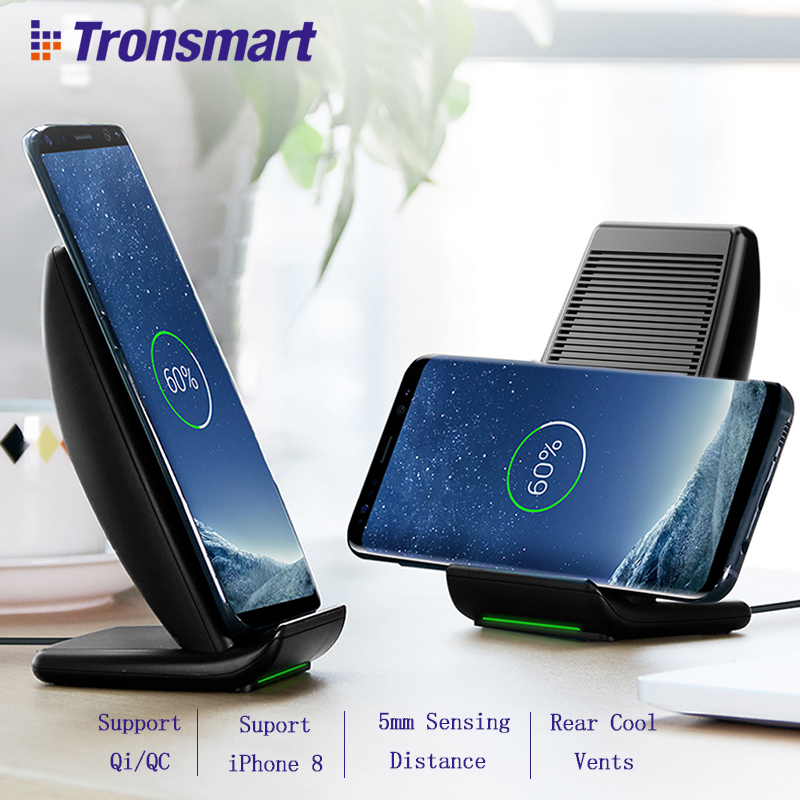
If you’re looking for a fast wireless charger for your smartphone that doesn’t empty your pocket, look no further. The Tronsmart WC05 dual coil fast wireless charger supports a broad range of smartphones including the iPhone X / 8 / 8 Plus and the coveted Samsung Galaxy series. It can charge all Qi-enabled phones.
More importantly, the WC05 will not set you back a pretty penny thanks to a considerable 33% discount offered by GeekBuying on the device’s original asking price. The Tronsmart-branded wireless charger normally carries a price tag of $44.53, but the Chinese online store will be selling it at a slashed price of just $29.99 for a limited period of time.
Despite its massively reduced price, the Tronsmart WC05 is quite a powerful wireless charger that provides 7.5W, 10W & 5W output, and delivers optimal charging speed after detecting your devices. It also gives you the freedom to rest your mobile device in vertical and horizontal position based on your convenience.
The WC05 wireless charger is built using premium materials and it features a rear cooling vent that enables stable faster charging, dual coil, non-slip rubberized coating, and a discreet LED indicator. The device comes with a USB Type-C charging port, PCB, and a 65-degree stand pad.
You can follow this link to check out more details and take advantage of the discount before the promo comes to an end in 5 days. GeekBuying is also handing out 2 ports car charger as a free gift with purchase.
We use cookies on our website to give you the most relevant experience by remembering your preferences and repeat visits. By clicking “Accept”, you consent to the use of ALL the cookies.
This website uses cookies to improve your experience while you navigate through the website. Out of these, the cookies that are categorized as necessary are stored on your browser as they are essential for the working of basic functionalities of the website. We also use third-party cookies that help us analyze and understand how you use this website. These cookies will be stored in your browser only with your consent. You also have the option to opt-out of these cookies. But opting out of some of these cookies may affect your browsing experience.
Necessary cookies are absolutely essential for the website to function properly. This category only includes cookies that ensures basic functionalities and security features of the website. These cookies do not store any personal information.
Any cookies that may not be particularly necessary for the website to function and is used specifically to collect user personal data via analytics, ads, other embedded contents are termed as non-necessary cookies. It is mandatory to procure user consent prior to running these cookies on your website.