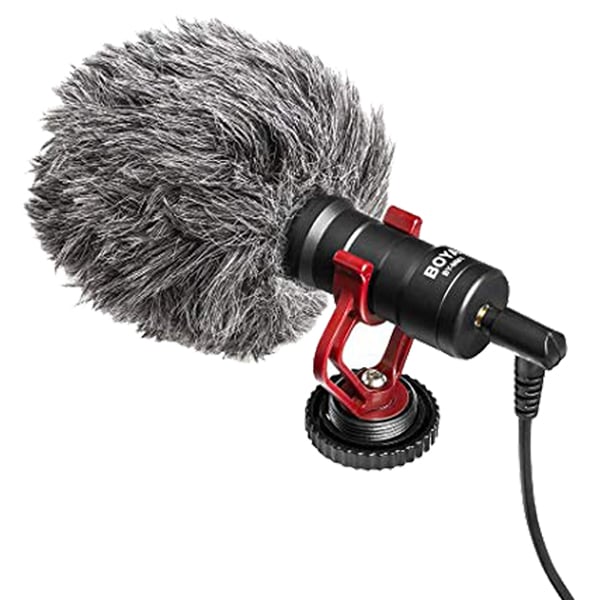
Equipped with top-end electret condenser, the BOYA BY-MM1 Mini is an irresistible cardioid microphone. It boasts an impressive array of features that breathe new life into the sound quality of videos thanks to its built-in microphones. On top of that, the BY-MM1 Mini comes with TRRS and TRS cable that you can use to connect it to smartphones, cameras, PCs, audio recorders, camcorders and a slew of other recording devices that have 3.5mm connector.
Aside from that, the BY-MM1 Mini features a furry windshield that reduces the wind and other natural noises during outdoor recording. It comes with a shockproof mount so that you can safely and securely mount the mic on phone holder, and camera hot shoe mount. The BY-MM1 Mini doesn’t require a battery to draw its juices so you can simply plug it and start using it. Despite being housed in a sturdy metal body, this cardioid microphone is compact and lightweight so that you can take it everywhere you go with a portable carrying bag.
While you’d normally end up spending a fortune on a professional cardioid microphone, the BOYA BY-MM1 Mini can now be yours at a dropped price of just $26.99 on TomTop. This is a significant 46 percent reduction in the device’s original asking price.
The product’s size is 8.1 x 2.2cm / 3.2 x 0.9″(L x D) and it weighs in at just 50g (1.8oz). You can head straight to this link to check out more details and get your hands on the BOYA BY-MM1 Mini cardioid microphone at an unbeatable price.
Regrettably, there were only 150 pieces remaining for this Flash Sale at the time of writing. Note that the promotion sale is slated to end on February 7th.
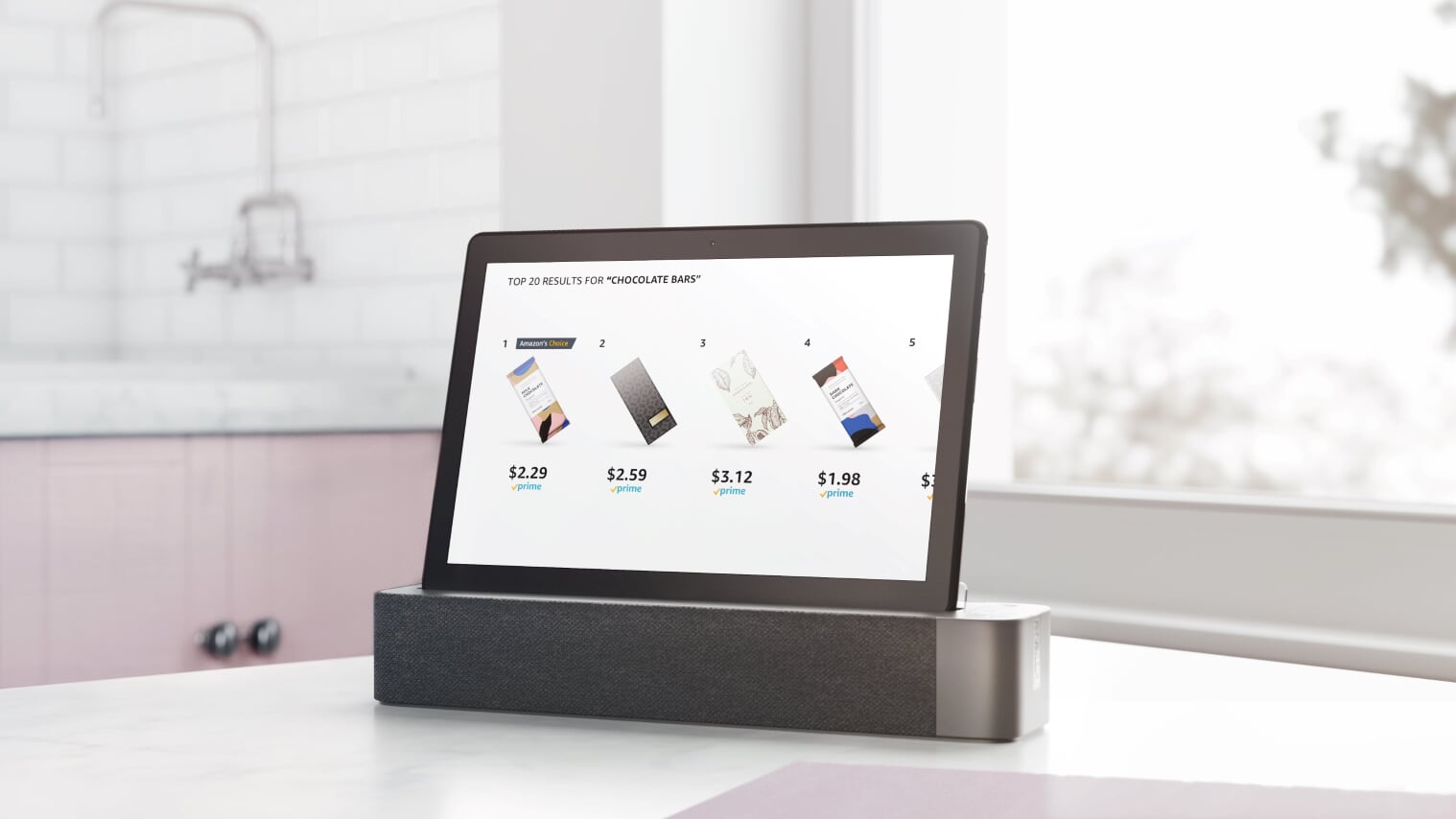
Lenovo has announced the Lenovo Smart Tab Android tablet at the the Consumer Electronics Show (CES 2019) tech trade show in Las Vegas, U.S. What makes this Lenovo device different from other Android tablets in the market is that it comes with a speaker dock and it is also integrated with Amazon Alexa voice assistant.
Lenovo Smart Tab M10 and P10 Specifications and Features
The Lenovo Smart Tab features a 10-inch screen and when it set on the Lenovo Smart Dock, it can function like Amazon Echo Show. The M10 and P10 are the two variants of the Lenovo Smart Tab. The P10 model comes with better specs and design when compared with the M10 variant. The tablet is equipped with Dolby Atmos technology driven front-facing speakers. A pair of 3-watt speakers present inside the Smart Dock offers louder audio output. The tablet can be easily attached to the Smart Dock through its pogo pins. The dock acts as a charger for the tablet.
The Lenovo Smart Tab M10 measures 9.56x 3.31 x 0.31 inches and it weighs 1.05 pounds. The M10 which comes with a slate black finish features a 10-inch IPS LCD display that produces full HD resolution of 1920 x 1080 pixels. It is fueled by Snapdragon 450. The 16 GB and 32 GB models of M10 respectively feature 2 GB and 3 GB of RAM. For photography, it is equipped with 2-megapixel front camera and 5-megapixel rear camera. It receives power from 4,850mAh battery.
The dimensions of the Lenovo Smart Tab P10 are 9.56 x 6.57 x 0.27 inches and weighs 0.97 pounds. The P10 comes with an aurora black dual glass design. It also features 10.1-inch full HD IPS LCD display and Snapdragon 450 chipset. It comes with up to 4 GB of RAM and up to 64 GB of storage. There is a front camera of 5-megapixel and rear camera of 8-megapixel on the device. It is packed with a 7,000mAh battery.
Both the Lenovo Smart Tab M10 and P10 tablets come loaded with Android 8.1 Oreo OS. The Smart Dock measures 2.57 x 11.16 x 1.96 inches and weighs 1.76 pounds.
Lenovo Smart Tab M10 and P10 Pricing and Availability
The 16 GB and 32 GB Lenovo Smart Tab M10 models are respectively priced at $200 whereas the P10 model has a starting price of $300, The Chinese manufacture will begin pre-orders of the Smart Tab on Tuesday and its shipments will begin later this month or early in the coming month.
Apart from its telecommunication equipment, Huawei is better known globally for its smartphones coming out with increasing innovative features. The Chinese company also has its tentacles spread towards the manufacture of laptops, tablets and other gadgets. At the ongoing CES 2019, the company has unveiled two of its gadgets for the US market. Huawei technically cannot sell its phones in the US so, we are not referring to its latest cool flagship phones but the MateBook 13 laptop as well as the MediaPad M5 Lite tablet.
Both the MateBook 13 laptop and MediaPad M5 Lite tablet were launched no too long ago in China and now the company is making them available in the US. Let’s take a brief look at the features of both gadgets.
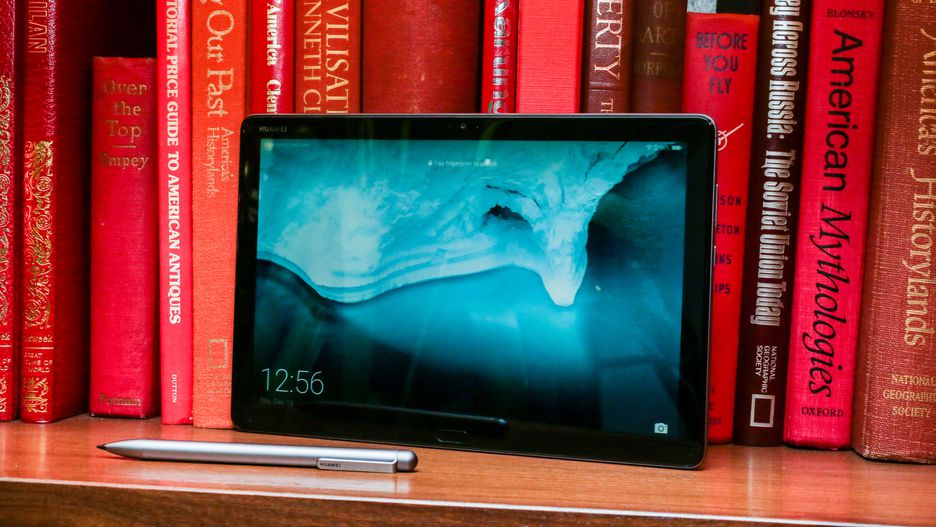
Huawei MediaPad M5 Lite
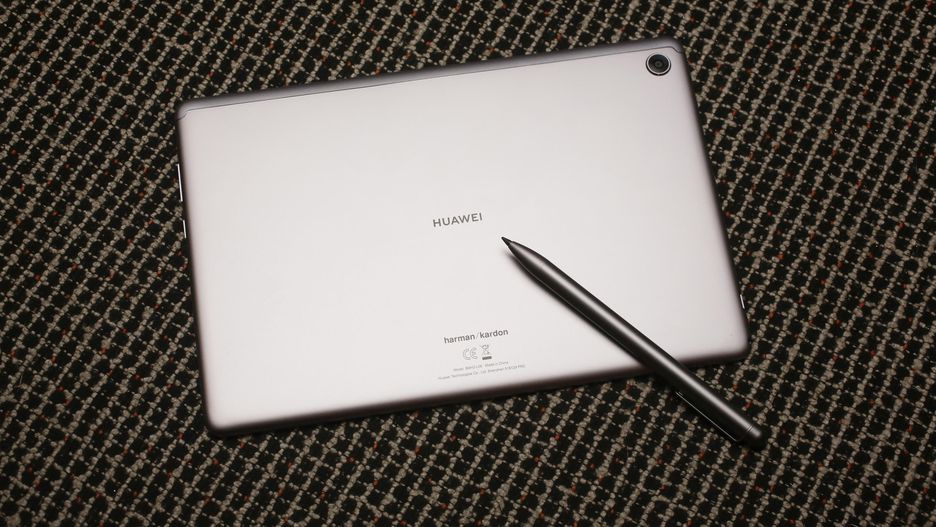
The MediaPad M5 Lite comes with a similar design as the MediaPad M5 but the model is a trimmed down version just as the name suggests. The tablet features an aluminium unibody and a 10.1-inch display but this time around, the orientation of the Huawei logo is changed to a landscape direction while the physical home button is also positioned in the same direction. The display adopts a 16:9 aspect ratio and has a resolution of 1920 x 1200 pixel resolution. Do note that the M5 Lie resolution is slightly lower than that of the MediaPad M5. The M5 Lite also comes with a less powerful Hisilicon Kirin 659 SoC and is available in two memory variants. There is a 3GB RAM+32GB storage model as well as a 4GB RAM+64GB storage variant. The MediaPad M5 Lite also comes with four speakers crafted by Harman Kardon and they work in sync with Huawei’s Histen 5.0 sound system to deliver 3D surround sound. It is equally bundled with an M-Pen Lite stylus which offers 2,048-levels of pressure compared to the regular M5’s 4,096-levels. The stylus is only available in some region and looks like the US is inclusive.
Furthermore, the tablet packs a mammoth 7500mAh battery which should provide enough juice to power long multimedia and gaming sessions. Providing the interface is the Android 8.0 Oreo-based EMUI 8.0 OS. The tablet also comes with a dedicated “Kids Corner” interface as well as some novel behaviour-focused controls such as the ability to detect when the tablet is too close to a face, the ambient light is below a certain threshold or if the tablet’s being used from an “unhealthy” angle, such as overhead. In such circumstances, it will then pop up a little warning animation in the corner, which expands to the entire screen if not heeded.
The tablet is available in Champagne Gold and Space Grey colours. The MediaPaad M5 Lite is expected to become available at the end of January and would retail for just $299 in the US. This is a pretty good bargain at that price.
Huawei MateBook 13
Talking about the MateBook 13 laptop, it adopts Huawei’s family-style full-screen design, with narrow bezels around it. The left and right-side bezels are just 4.4 mm while the laptop has a screen ratio of 88%. As the name implies, it packs a 13-inch IPS glossy screen with a resolution of 2160×1440 pixels (3:2). The display has a 178-degree wide-angle view, 1000:1 contrast, typical brightness of 300nits and minimum of 240nit, but the screen does not support touch control. The laptop has a thin 14.9mm metal body and weighs just 1.28kg. The body is manufactured using diamond cutting technology, supplemented by delicate sandblasting technology with well-chamfered edges.
The Matebook 13 is powered by the latest eighth-generation Intel Core i7-8568U (Whiskey Lake) processor with the lower model utilising an Intel Core i5-8265 chipset. The laptop is also equipped with an NVIDIA MX 150 discrete graphics, 2GB GDDR5 independent graphics memory, thermal design power consumption 25W, with LPDDR3 memory.
On the internals, it has a shark fin fan 2.0 smart cooling system, dual fan separation heat source, seven sensors real-time temperature control. The battery capacity is 41.838Whr (3670mAh/11.4V), the theoretical battery life is about 10 hours, and it can be used for 2.5 hours after charging for 15 minutes. The interface has only two USB-Cs with data transfer and charging on the left side, data transfer and DisplayPort output on the right side, and a 3.5mm headset. Other aspects, it packs a full-size island chocolate keyboard, power button which also doubles as a fingerprint sensor, dual-band 802.11ac Wi-Fi and Bluetooth 5.0, 1MP camera, dual speaker, dual microphone, Dolby Atmos sound.
The MateBook 13 will be available at the end of January starting at $1,000 with integrated graphics and $1,300 for the model with discrete. Because of the discrete graphics option, the MateBook 13 isn’t fanless like the X models, which makes it thicker, and it scales back to two speakers from four. It will come in Space Gray for a Core i7 or silver for a Core i5 with prices starting at just under $1,000.
TCL said it would announce new Alcatel-branded phones at CES 2019 and it just did. The Alcatel 1x (2019) and the Alcatel 1c (2019) are its latest unveilings and they are pretty much entry level phones.
Alcatel 1x (2019)
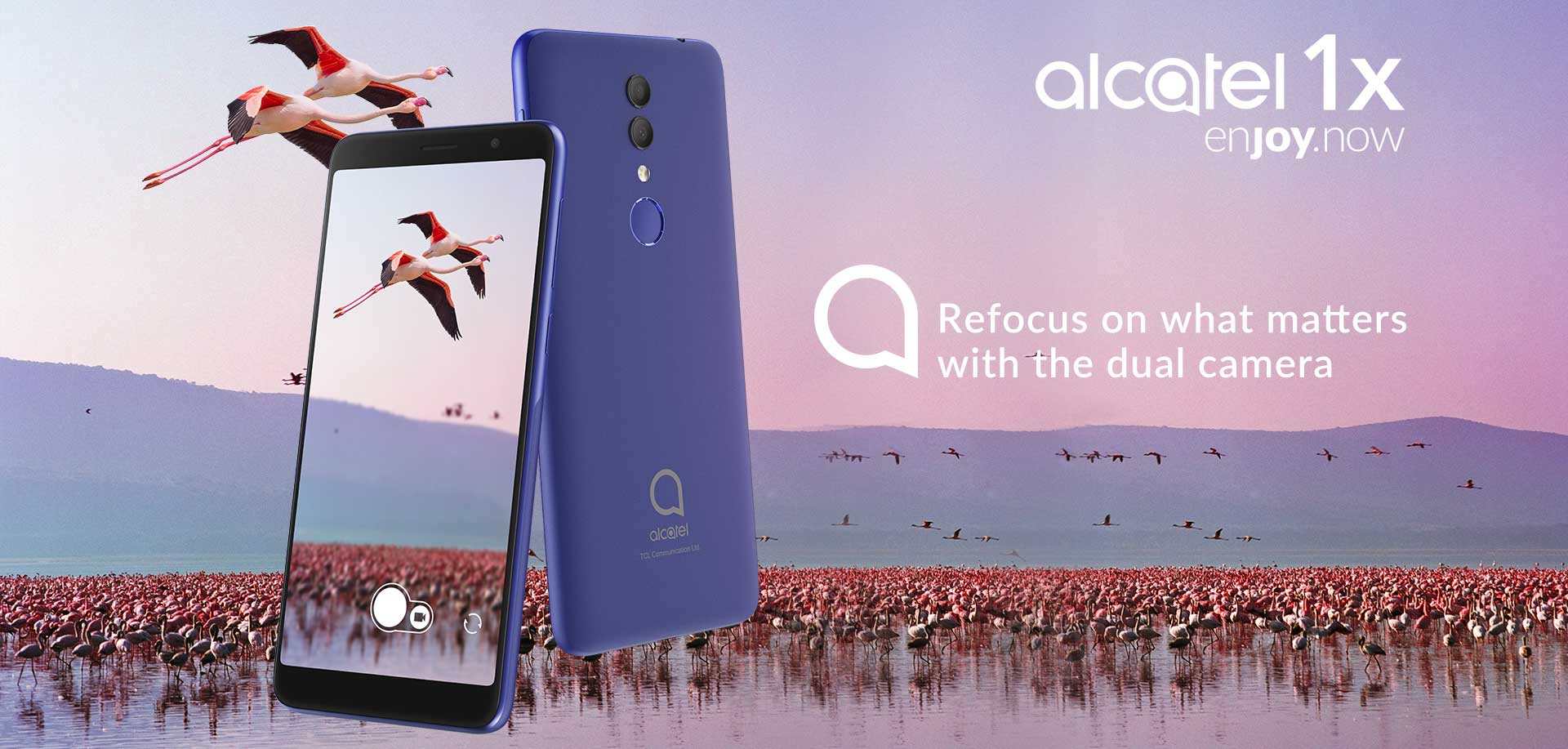
This is a successor to last year’s model. The new model comes with a number of upgrades with respect to design and even some important specs but if you are expecting a significant improvement in performance, then you will be disappointed as it comes with the same MT6739 processor as last year’s model. However, the SoC is now clocked higher at 1.5GHz. You still get 2GB of RAM and 16GB of expandable storage (128GB Max).
The Alcatel 1x (2019) now has a bigger and sharper 5.5-inch HD+screen with an 83% screen-to-body ratio. The display is covered by Asahi’s Dragontrail Glass (2.5D). It still has a 13MP rear camera but it is now joined by a 2MP secondary sensor for capturing depth of field details for portrait images.
The 8MP front-facing camera on last year’s model has been swapped for a 5MP sensor which has support for Face Key (Face Unlock) and screen flash. There will be a variant with a rear-mounted fingerprint scanner and another without. The phone will also have support for NFC, hybrid dual SIM (nano only), Bluetooth 4.2, and FM radio.
The 1x (2019) still ships with Android 8.1 oreo like its predecessor but it comes with a larger 3,000mAh battery. It will be available in Pebble Blue and Pebble Black in a finish that is scratch and slip-resistant and also hides fingerprint smudges.
TCL will launch the phone in Africa, Europe, the Middle East, and North America later this quarter and it will sell for €120.
Alcatel 1c (2019)
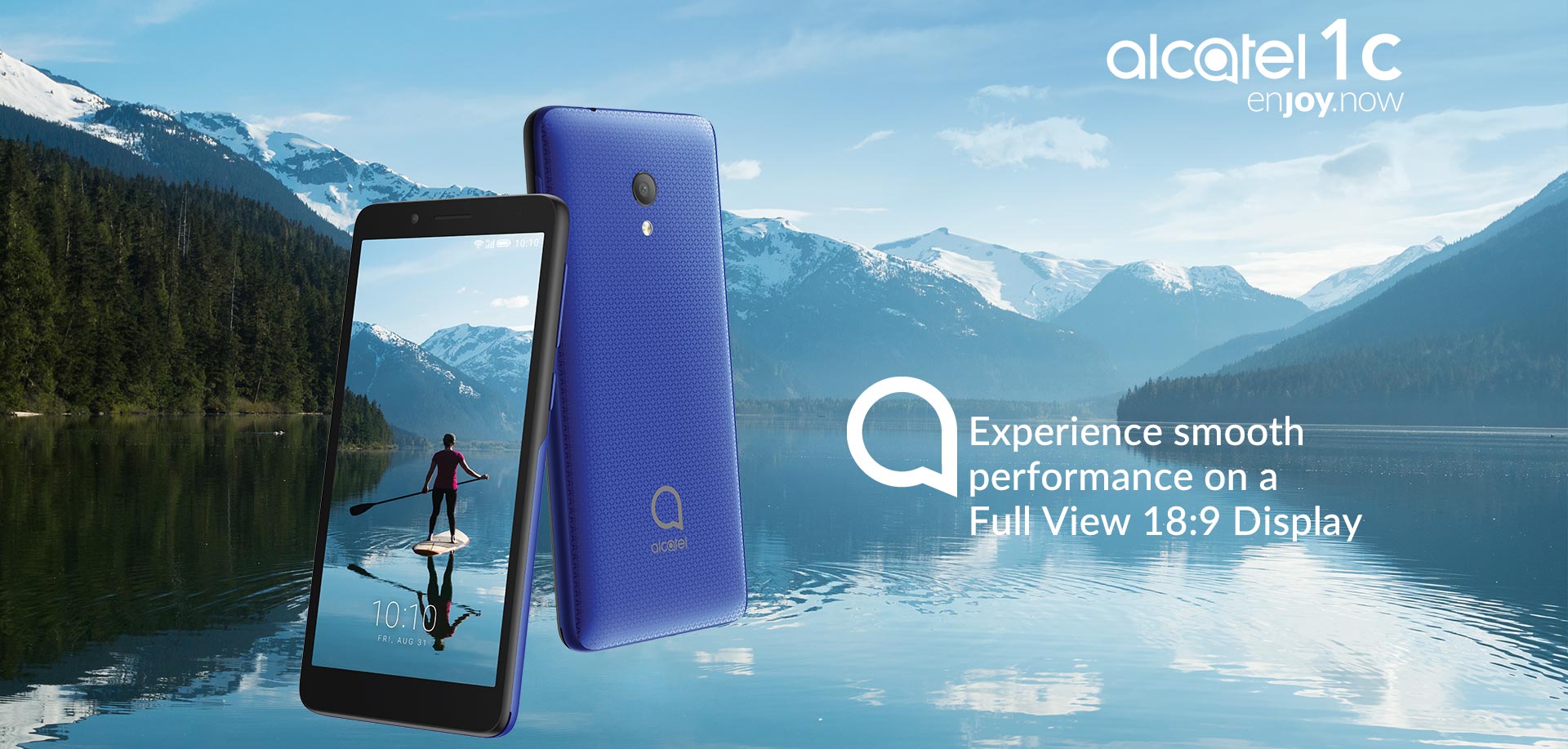
The Alcatel 1c (2019) is an Android Go phone with a 5.3-inch 960 x 540 18:9 screen. It is also covered with a 2.5D Dragontrail glass and it has a micro-texturing finish on the back that is slip-resistant and provides a comfortable grip.
The 1c is powered by the Spreadtrum SC7731E, a quad-core processor clocked at 1.3GHz. There is 1GB of RAM and 8GB of expandable storage (32GB max.). The rear camera is a 5MP f/2.4 fixed focus sensor interpolated to 8MP while the front-facing camera is a 2MP sensor interpolated to 5MP. There are a bunch of camera modes including a social mode that makes sharing to social media easy.
There is support for dual SIM (nano only), Bluetooth 4.2, and 2.4GHz WiFi. It packs a 2,000mAh battery with no support for fast charging. It also doesn’t support LTE. The Alcatel 1c (2019) has an FM radio, a 3.5mm audio jack, and an LED flash. It runs Android 8.1 Oreo (Go Edition) and will be available in Volcano Black and Enamel Blue.
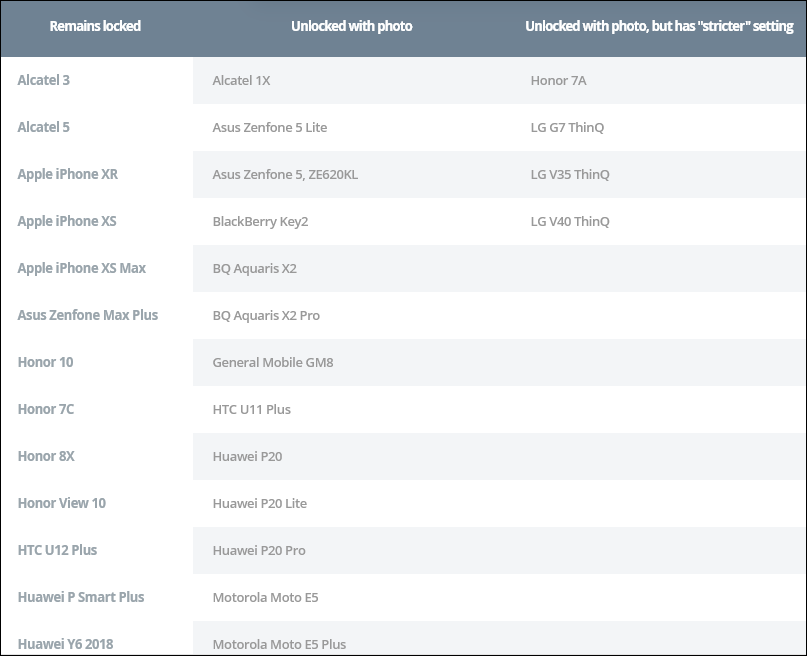
Face Unlock is gaining wide popularity and that could be attributed to Apple’s use of the technology on the iPhone X and subsequent models. However, recently, the technology has come under close scrutiny due to the penchant to getting fooled by a representation of the owner’s face. Recently, Forbes conducted a test where a portrait of one of its author was 3D printed and the portrait was used to unlock all the Android phones tested. Turns out you don’t even need to go to such hassle as a new study has shown that a high-quality photo of the owner can unlock most of the facial recognition-packing phones around.
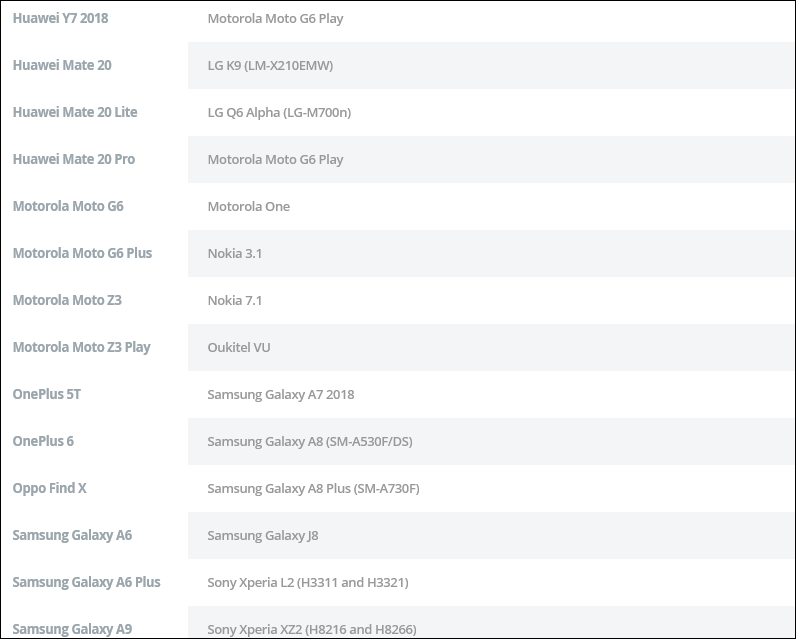
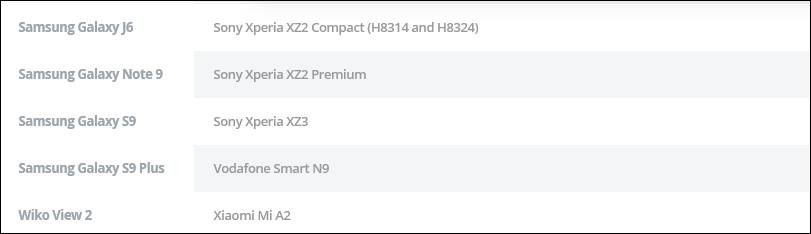
The test carried out by the Dutch Consumentenbond organization discovered that out of a total of 110 devices that were tested, 42 could be unlocked with a high-quality photo of the owner. Surprisingly, this figure includes flagship as well as midrange and budget models from Huawei, Xiaomi, Nokia, Lenovo, Alcatel, BlackBerry, HTC and Sony among others. Flagship models such as the Huawei P20 Pro, HTC U11 Plus, and Sony’s Xperia XZ2 series were all found wanting in this regard. The list also contains midrange models like Samsung Galaxy A8, Xiaomi’s Mi A2 etc.
A number of devices also held their ground and came out unopened by the photo such as the budget Alcatel 3V. Others include Honor 10, HTC U12 Plus, Huawei Mate 20 series, OnePlus 5T, OnePlus 6, and Samsung’s 2018 flagships. Do note that most of the phones that were not unlocked came with dedicated hardware for facial recognition. In addition, all Apple 2018 models also came out strong as had earlier been discovered in previous tests. Notwithstanding, it still holds true that face unlock shouldn’t be trusted for digital security. You can check out the list of the models and how they fared from the table below (Credit- Android Authority).
Xiaomi has taken the wraps off a new pair of truly wireless earbuds albeit quietly. The Mi Bluetooth Earphones Air is its second truly wireless earbuds and just like the first one, it is inexpensive.
The Mi Bluetooth Earphones Air comes in black and white color variants but when it goes on sale on Friday, January 11, only the white variant will be available for purchase. The earbuds each weigh 5.8 grams and 58 grams with the charging case. Unlike the AirDots, this should be more comfortable to wear and shouldn’t feel heavy since it has a stem and weight distribution should be better.
The earbuds have touch controls for answering/ending calls, waking up Xiaomi’s Xiao AI voice assistant, activating noise cancellation, and controlling playback. The Mi Bluetooth Earphones Air will also automatically pause playback when you pull it out of your ears and if they are idle for more than 30 minutes, they automatically go into sleep mode.
Charging the Mi Bluetooth Earphones Air only takes 1 hour and last 3 hours on a single charge for calls and 10 hours for music playback. Xiaomi says the earbuds are compatible with iOS and Android devices and has an IPX4 rating.
[envira-gallery id=”231317″]
The specification page says the phone connects via Bluetooth 4.2 and not Bluetooth 5.0 and the model number TWSEJ01JY is different from that of the Freedom Buds Pro (TWSEJ03LM) on the Bluetooth SIG website. So this is definitely a different model entirely and not the Freedom Buds Pro/AirDots Pro.
Late last year, Qualcomm released a list of 19 OEMs who it says are already committed to its 5G vision for 2019. However, the US chipmaker has expanded its projections of the number of phone models that would use its 5G chip. According to the US fabless chipset manufacturer, “more than 30 commercial 5G mobile devices” are expected to land using the company’s hardware this year, and the majority of them will be phones.
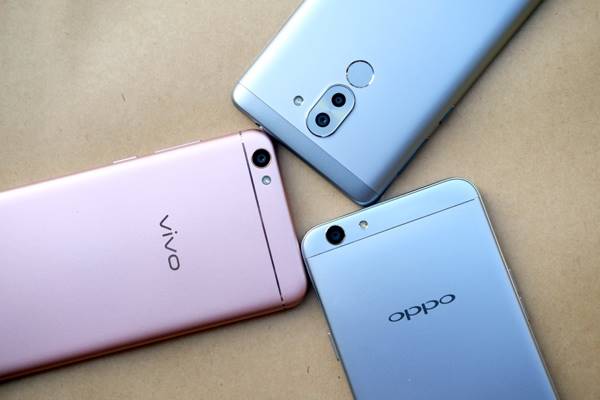
Earlier on, the company had reeled out the 19 partners to include popular brands such as ASUS, Xiaomi, OnePlus, OPPO, Vivo, HMD, HTC, Sony, Sharp, LG and Motorola. Others include Fujitsu, computer networking firm Netgear, wireless communications equipment maker Sierra and a couple of names that don’t sound familiar as far as mobile phones are concerned. The company didn’t disclose the other company that would jack up the number of gadgets that would pack a Snapdragon 855 processor to thirty. The SD 855 chipset features the Snapdragon X50 modem which will power the 5G technology.
The number of 5G partners Qualcomm already has onboard looks higher than those who were early adopters when 4G LTE started landing back in 2011. This massive push to 5G may be a way OEMs and carriers hope to counter the slumping smartphone market. The company believes its SoC, modem, and RF solutions, are the best and doesn’t think any other chipmaker can mount any competition in that regard. Already, MediaTek has exited the flagship chipset segment and may be a long time away from 5G. So, Qualcomm believes virtually all 5G mobile devices launched in 2019 will be built on its 5G solutions.
Last week, Xiaomi announced that its Redmi line of affordable smartphones will become a separate brand much like Honor is to Huawei. On Thursday, the very first Redmi smartphone following the announcement will be unveiled and there is already so much anticipation in the air.
Although we already know what the Redmi phone looks like thanks to official images shared on the web by Xiaomi’s own executives, that isn’t stopping them from dropping more teasers of the phone.
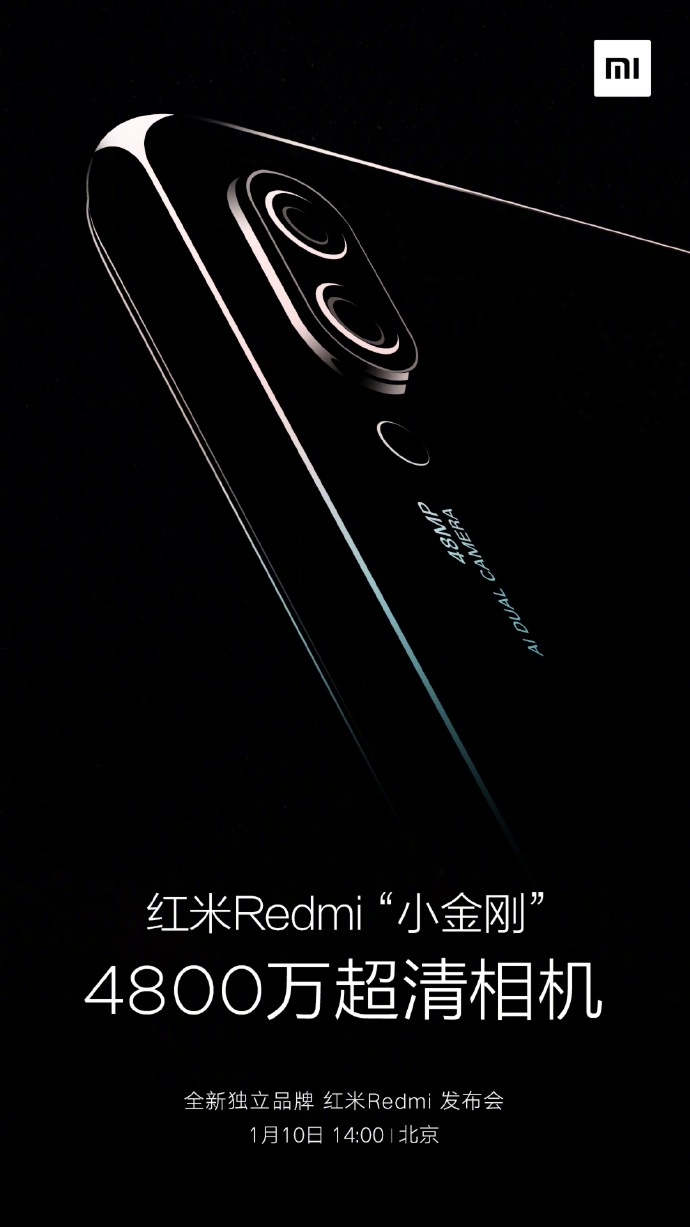
The latest teaser was shared on Twitter by Donovan Sung (@donovansung), the global spokesperson for Xiaomi. The tweet confirms the Redmi phone will have 48MP AI Dual Camera setup and also includes a picture of the black variant of the phone.
The picture shows the dual cameras which are arranged vertically and slightly raised. There is a LED flash below the setup and the words “48MP AI DUAL CAMERA” are engraved right underneath.
A similar poster was shared on Weibo but it reveals more details such as the phone’s nickname “King Kong” and also the time for the launch which is 1400hrs China local time (0600hrs GMT).
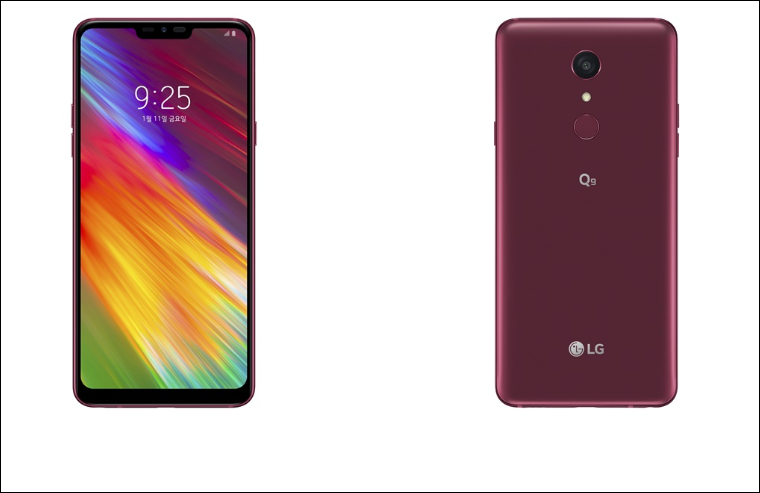
Three months after the device first popped up in leaks, LG has officially unveiled the LG Q9. The Q9 is basically a rebranded G7 Fit but it enters the market under the Q series.
Specs wise, the G7 and Q9 are very much identical but the colour options have been enhanced to be more appealing especially to the young folks. The phone is aimed at students and isn’t billed to go on sale until July 11 (that’s not a mistake). Since the new school term commences in August, the timing may just be perfect. The price tag is also pretty decent considering the features. The Q9 will cost KRW 500,000 in South Korea which around $445.
The LG Q9 sports a 6.1-inch FullVision display that is pretty sharp due to the QHD+ resolution of 3120x1440pixels it packs. The screen is HDR10-enabled to boot. The device also utilises the 19.5:9 aspect ratio which means it fits the palm comfortably. The device comes with a dimension of 153.2×71.9×7.9mm while it weighs 159g. On the camera end, the LG Q9 packs an 8MP wide-angle sensor at the front for selfies while at the rear is a 16MP shooter. The device is powered by a Qualcomm Snapdragon 821 chipset paired with 4GB of RAM and there is 64GB of storage onboard. The Q9 gets its interface from the Android 8.1 Oreo OS and packs a 3000mAh battery under its hood.
Further, the Q9 comes with LG’s trademark Quad DAC for high-quality wired audio as well as a powerful Boombox speaker if you want to play the music loudly. The phone also comes with IP68 waterproof build as well as the MIL-STD-810G build standard which makes it drop-resistant. There is also a microSD slot, Bluetooth 5.0, USB Type C with Quick Charge support, a rear fingerprint reader, a dedicated Google Assistant key, LG Pay support and a 3.5mm audio receiver.
Pricing and Availability
The LG Q9 comes in three cool and attractive colours namely, Carmine Red, New Aurora Black and New Moroccan Blue. The device will become available on the three big Korean carriers on July 11 ahead of the start of a new school year in late August.
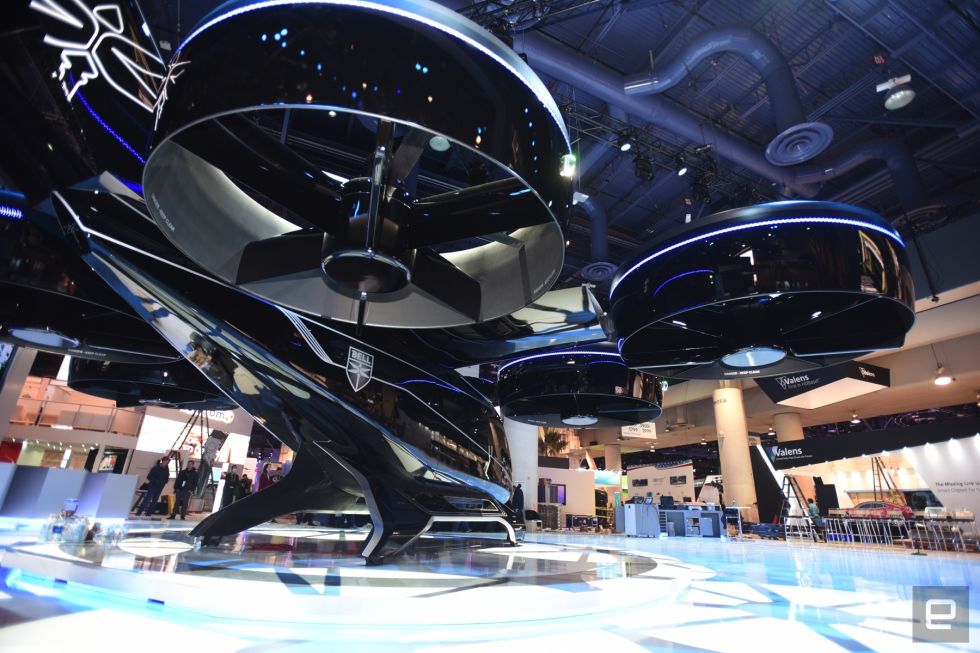
One major challenge faced in big cities is traffic congestion. Several ways have been recommended to tackle this challenge such as the use of bikes. Air transportation is also being looked at and in this regard, ride-hailing firm Uber’s flying taxi partner Bells has taken to CES 2019 to showcase the design of its air taxi. The taxi is dubbed Bell Nexus and is a five-person hybrid-electric powered vehicle with six tilting ducted fans capable of vertical takeoff and landing.
The Bell Nexus was first revealed at CES last year but the only the cabin but this time around a complete prototype is being shown off. The company plans to have the Nexus operational by the “mid-2020s” but no definite date has been fixed, according to Bell’s director of innovation, Scott Drennan. “This is not a toy. This is an aircraft you would feel safe and comfortable bringing your family into,” the director said. We won’t be seeing a working prototype anytime soon as that will be done closer to its official launch.
Bell CEO Mitch Snyder recognise the need to solve transportation challenges in the vertical dimension as space at the ground level becomes limited. “The industry has anticipated the reveal of our air taxi for some time, so Bell is very proud of this moment. We believe the design, taken with our strategic approach to build this infrastructure, will lead to the successful deployment of the Bell Nexus to the world.” he added.
Apart from Bell, Uber is also working with a number of companies on its future air taxi service. Uber showcased one of its air taxi prototypes at its Uber Elevate Summit, and it has said it aims to have aircrafts available for commercial operations by 2023. Uber views the revealing of Bell’s design a “major step” in its effort to develop “an on-demand Uber Air network.”
360 Mobiles will launch a new smartphone tomorrow and based on the teaser, we think it is a gaming smartphone.
360 Mobiles took to Weibo to tease the launch of a new product tomorrow, 9th of January. The teaser poster shows a plaque with a rifle on it. The rifle is the hint that this is most likely a gaming smartphone and should be able to run games like PUBG and Fortnite.
There isn’t any info on what the phone looks like and what specs it will pack but since the launch is tomorrow, we don’t mind waiting. However, we expect it to pack a big battery and a capable processor.
The Samsung Galaxy S10 Lite will be announced along with Galaxy S10 and Galaxy S10 Plus smartphones in the coming month. Rumors have it that the South Korean company will be unveil the Galaxy S10 series on Feb. 20. Today, the Galaxy S10 Lite smartphone has appeared on Geekbench to confirm it key specs.
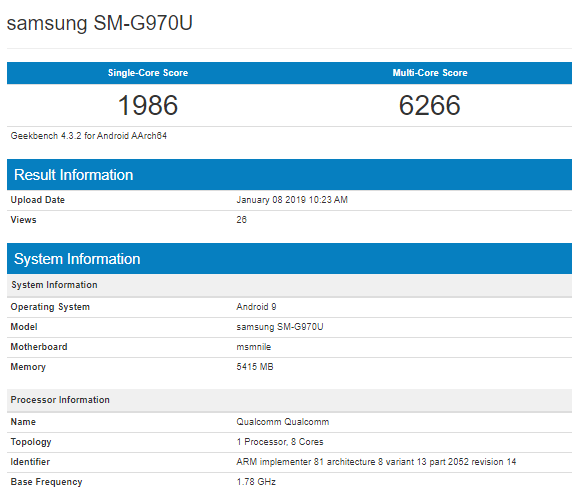
As it can be seen in the below image, a Samsung phone with model number SM-G970U has appeared on Geekbench. Recent reports have revealed that the model number belongs to the S10 Lite which is the lowest configuration model in the Galaxy S10 series.
The Galaxy S10 Lite is fueled by “msmnile” processor. Leaks from last year have revealed that the 7nm Snapdragon 855 is codenamed as “msmnile.” The SoC of the Galaxy S10 Lite is assisted by 6 GB of RAM. The handset is loaded with Android 9 Pie OS.
In the single-core and multi-core tests of Geekbench, the smartphone has respectively scored 1986 and 6266. These benchmarking scores are lower than what the Snapdragon 855 and 6 GB RAM powered Xiaomi Cepheus scored on Geekbench. The Cepheus believed to be the upcoming Xiaomi Mi 9 phone.
The SM-G970 belongs to the unlocked version of the Galaxy S10 Lite for the U.S. Previous reports have revealed that the S10 Lite is fitted with a 5.8-inch S-AMOLED Infinity Display that supports 18.5:9 aspect ratio and full HD+ resolution. The S10 Lite will be drawing power from 3,100mAh battery. The smartphone to be release in variants such as 4 GB RAM + 64 GB storage, 6 GB RAM + 64 GB storage and 6 GB RAM + 128 GB storage.
The back panel of the phone will be featuring a dual camera setup. A single camera will be available on the frontside of the phone. Like the Galaxy A7 (2018) smartphone from last year, the Galaxy S10 Lite will be featuring a side-mounted fingerprint sensor. In the U.K., the smartphone will be available with a price tag of 699 pounds (~$892). In the U.S., it could be priced between $650 and $750. The glass-bodied S10 Lite is rumored to hit the market in multiple colors like yellow, white, black, green and blue.
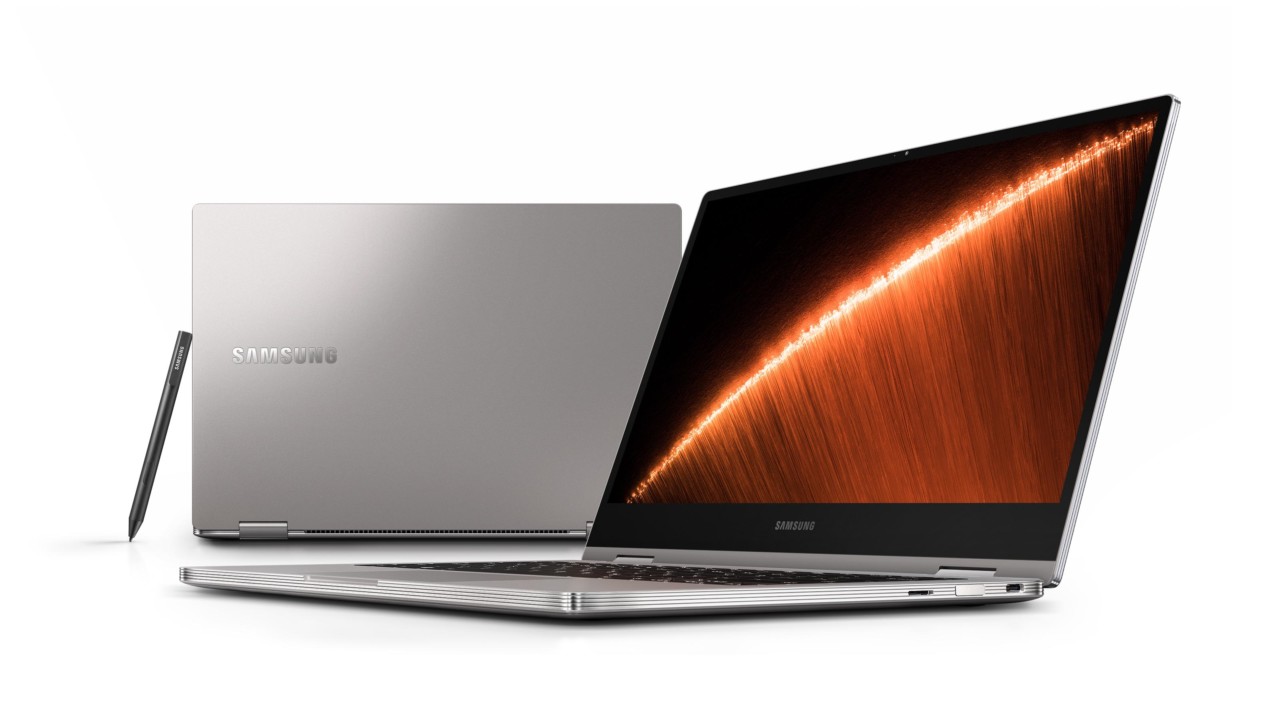
After announcing its new gaming laptop at the Consumer Electronics Show 2019 in Las Vegas, Samsung also launched its new Samsung Notebook 9 Pro convertible which comes with fixes for issues present in the previous model.
First thing first — the look. The Notebook 9 is now looking more like a premium flagship laptop. The company has ditched sloping curves and painted plastic in favor of sharper edges and aluminum build which actually looks and like aluminum.
The design changes made by the South Korean company is a big step forward and makes it feel like a true flagship laptop from the company — something that was missing in the previous model.
Coming to the specifications, the Samsung Notebook 9 Pro comes with a 13.3-inch Full HD (1080p) display that is now surrounded by thinner bezels. It is powered by a quad-core 8th-generation Intel Core i7-8565U processor and packs 8GB of RAM and 256GB of PCIe NVMe SSD storage.
As for connectivity ports, there are two Thunderbolt 3 USB Type-C ports on one side of the case, and a regular USB-C port, a headphone jack, and a microSD card slot on the other side. The power button comes embedded with Windows Hello fingerprint reader.
The Samsung Notebook 9 Pro is a 2-in-1 convertible device with a touchscreen that can be flipped around to convert into a tablet. The company is including an “Active Pen” stylus in the box for sketching and jotting down notes.
The laptop measures 12.1 x 8.1 x 0.55 inches and weighs 2.84 lbs. As for the battery, it is powered by a 55Wh battery that supports fast charging. Samsung has not yet revealed information regarding the pricing and exact availability dates for the Notebook 9 Pro. However, the company has said that it will be available in early 2019.
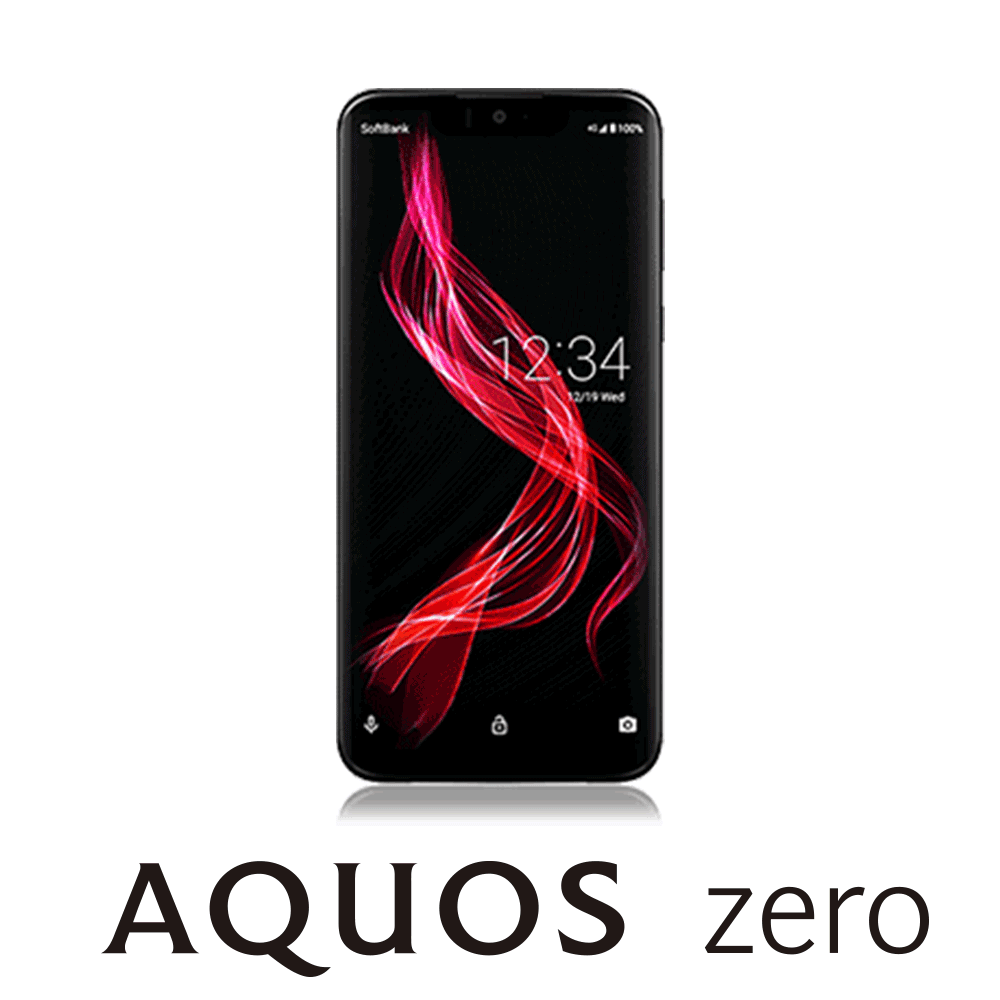
The AQUOS Zero smartphone has gone official in Taiwan. Sharp claims that it is the world’s lightest 6-inch smartphone. It features a notched display, a Snapdragon 845 chipset and a powerful rear camera.
Sharp AQUOS Zero Specifications and Features
Weighing only 146 grams, the AQUOS Zero smartphone comes equipped with a lightweight 6.2-inch OLED display by Sharp, a highly durable chassis with magnesium alloy frame and fiber back and a 3,130mAh battery. The display of the AQUOS Zero supports QHD+ resolution of 2992 x 1440 pixels, DCI-P3 wide color gamut and Dolby Vision HDR image technology. The screen is shielded by Corning Glass 5 3D curved glass.
The Snapdragon 845 mobile platform and 6 GB of RAM are present under the hood of the device The two charging ICs present on the device helps in heat dissipation which makes it possible to enjoy games and play videos while it is being charged. It has an internal storage of 128 GB. The handset lacks support for microSD card. The smartphone is loaded with Android 9 Pie OS which is customized with Sharp’s UI.
The rear side of the Sharp AQUOS Zero features a 22.6 super wide-angle lens with f/1.9 aperture with anti-shake feature for capturing stabilized videos. There is an f/2.2 aperture 8-megapixel wide-angle front-facing camera. Sharp’s AI tech brings scene recognition for both cameras. The smartphone carries support for single SIM, 4G LTE, Wi-Fi 802.11ac, Bluetooth 5.0, GPS and NFC. The AQUOS Zero features face recognition as well as a rear-facing fingerprint reader. For audiophiles, the smartphone produces stereo audio with support for Dolby Atmos. Lastly, it is an IP68 certified device which protects it from damage caused by dust and water contact.
Sharp AQUOS Zero Price and Release Date
The AQUOS Zero has arrived in Taiwan with a price tag of NT$ 19,990 (~$648). The smartphone will be available for purchase from Jan. 15 in Taiwan.
TVs are one of the main sights at CES, so it’s no surprise that the big names are announcing new models already. We particularly love the LG Signature and now Sony has announced a slate of super-sized models for its Master series.
Sony’s new TVs are categorized into two – the Z9G which is an 8K LCD series and the A9G which is a 4K OLED series. Both are amazing in their own ways.
Z9G
The Z9G series comes in 98” and 85” models. These are the first 8K TVs from Sony made for consumers and the manufacturer claims there are new technologies that help it achieve its impressive picture quality.
The Z9G series have an LCD display, so the OLED’s acoustic Surface Audio+ technology can’t work. However, Sony found a way to replicate the audio experience so it feels like the sound is coming from the display. To achieve this, there are two speakers above and below the screen for a total of four front-facing speakers.
Sony also says the Z9G series can upscale 4K content to near-8K quality thanks to a proprietary algorithm.
A9G
The A9G model comes in 77”, 65”, and 55” models. Since the panel is OLED, you can be sure of getting true blacks, super-wide viewing angles, and great contrast. The A9G also appears to have thinner bezels and according to Sony, when mounted, the TV “appears to be floating on the wall, leaving only the brilliance of its picture”.
The Z9G and A9G both run Android TV (Oreo) and Sony says they offer better performance than older models. Sony hasn’t said anything about the price of the TVs and when they will be available for purchase.
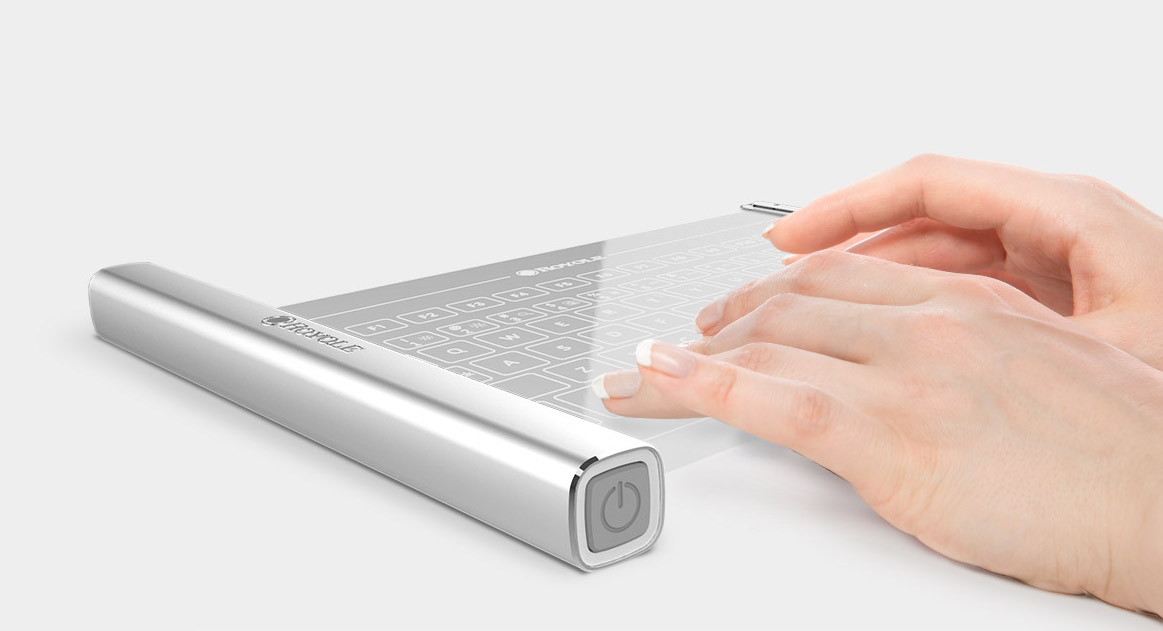
Sometime late last year, a company relatively unknown until that time, made the headlines of nearly all tech blogs around the world. After all, Royole, a startup had managed to beat the South Korean giant Samsung in releasing the first commercial foldable smartphone in the market. Now, the company decided to showcase its best products at CES 2019 and among them was a flexible rollable QWERTY keyboard.
The rollable QWERTY keyboard is basically a transparent and thin layer of a sheet that features full-fledged QWERTY keys. You just have to lay it out on a flat surface and connect to your device wirelessly via Bluetooth. After use, just push the button on the keyboard twice and it neatly rolls up into a compact form factor. The typing experience might not be as good as a regular keyboard but since its rollable, it’s extremely portable.
Unfortunately, no word on its pricing yet. All we know is that the keyboard will hit the markets sometime in Q2 2019 via Royole’s own site and sellers like Amazon.
Apart from this cool little keyboard, Royole also showcased their smart speaker with a built-in curved 7.8-inch display. You can watch movies, or see what’s being played on the speakers on the display. What’s even cooler is the fact that it will come with an 8MP pop-up camera which can rotate up to 180 degrees to take selfies or make video calls. You get Alexa and Google Assistant built-in which will also help you to control your smart home devices.
Finally coming to the smart touch selfie stick, it features multi-touch sensors on its handle to navigate through the in-camera features of the connected smartphone. This ones already available for purchase in China via Brookstone and will hit the US in 2019.
Apart from these, the Flexpai foldable phone was showcased at the event along with existing products from the company like its digital writing pad called RoWrite and its 3D entertainment headset called Moon.
The rise of Android phones has no doubt have some effects on Apple‘s iPhone sales globally. Just last week Wednesday, the US company announced that it is slashing its revenue forecast for the first fiscal quarter (2018Q4) to $84 billion, down from the previous forecast of between $89 billion and $93 billion. The company also adjusted its gross sales margin to 38%, compared to the previous forecast of 38% to 38.5%. The announcement saw Apple’s stock price plummeting by 10% the following day. Apple’s CEO Tim Cook n an open letter to investors marshalled out several factors that were responsible for the company’s revenue to fall short of expectations. Some of the reasons adduced include a lower-than-expected iPhone sales, poor performance in the Chinese market, and a stronger US dollar.
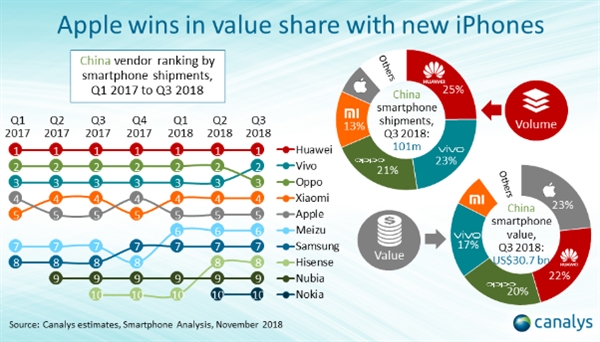
Despite the revelation of the poor performance in the Chinese market, a fresh report by research firm Canalys shows that Apple’s performance in the Chinese market in the previous quarter (2018Q3) was good, at least in terms of revenue. The report put the gross revenue of the Chinese smartphone market was 30.7 billion US dollars, and just five brands enjoy the larger share of this bounty, namely Apple, Huawei, OPPO, Vivo and Xiaomi. Among the lot, Apple and Huawei grabbed the largest revenues, with Apple’s revenue accounting for 23% of the total revenue while Huawei had a 22% share. It should be noted that Apple’s impressive performance is mainly due to the release of iPhone XS, iPhone XS Max at the end of the quarter, and the popularity of older models such as iPhone X and iPhone 8. While Huawei is benefiting from the hot sale of P20 and P20 Pro and the strong performance of its Honor branded mobile phones.
In terms of shipments, Huawei topped the market with an estimate of 101 million shipped units, representing 25% market share. This is closely followed by Vivo with a 23% market share, Oppo with 21% market share and Xiaomi with a 13% market share. Apple came in at the fifth spot but higher revenue than the rest. The report by Canalys also shows that Samsung came in at the seventh spot in China despite maintaining its lead in the global market. Finally, Nokia also broke into the top 10 phone makers in China in terms of market share in Q3 2018. As it stands, Apple, Samsung and Nokia are the only three foreign mobile phone vendor with substantial influence in China. This again put a spotlight on the growth of Chinese domestic brands.
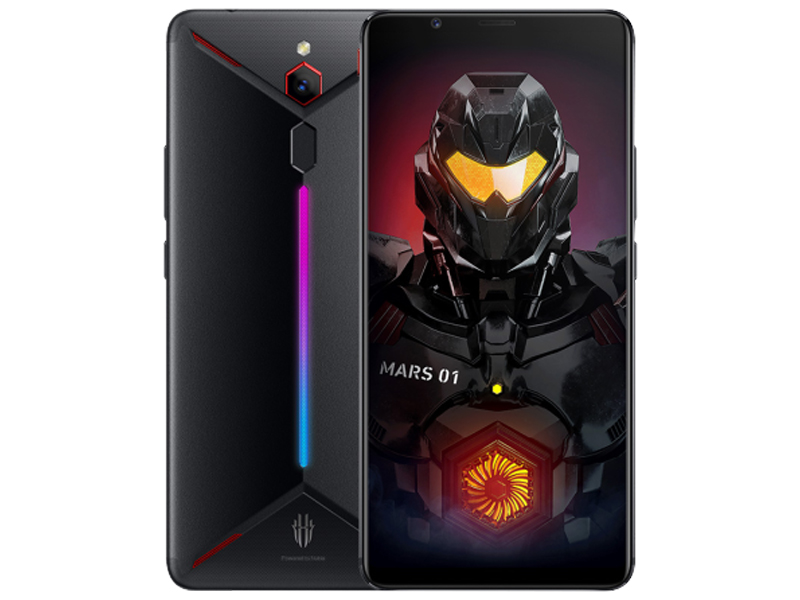
Yesterday we reported that Nubia would be at this year’s edition of CES showing off its latest gaming smartphone, the Red Magic Mars. The manufacturer has now announced the release date for the phone in new markets.
If you live in the US, Nubia says the Red Magic Mars will be available for purchase starting January 31 for $399. This comes as a surprise since Nubia didn’t officially launch the original Red Magic in the US save for when people could pre-order it on Indiegogo.
Now, residents of the US will be able to buy the phone on the dedicated website for Nubia’s gaming smartphones, redmagic.gg. The $399 price is for the base model which has 6GB of RAM and 64GB of storage. Nubia says the 8GB RAM + 128GB and 10GB RAM + 256GB models will also be available but their prices have not been announced yet.
The phone will also go on sale in Europe on the same day but Nubia didn’t reveal the price. The official press statement also says it will be available in other regions too but doesn’t say when.
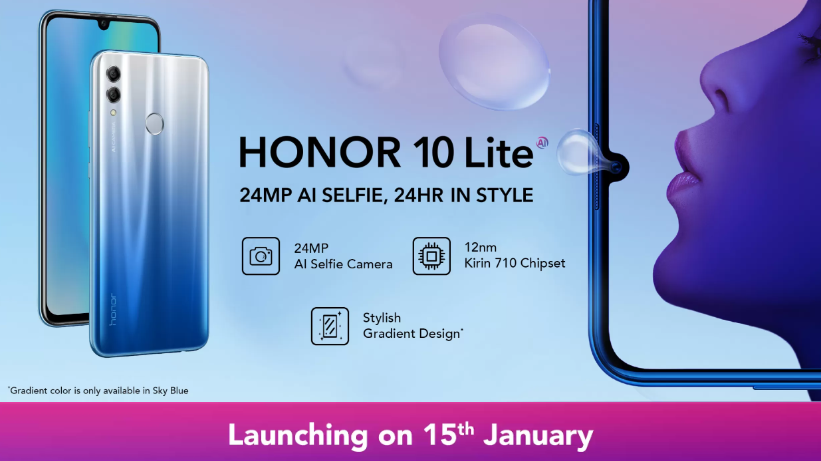
In November, Honor had introduced the Honor 10 Lite smartphone in China. A recent report had claimed that the Honor 10 Lite will be releasing in India by mid-January. A landing page for the smartphone has appeared on Flipkart which indicates that the online retailer will be exclusively selling it in India. The landing page on Flipkart has confirmed that the Honor 10 Lite will be unveiled on Jan. 15.
The Honor 10 Lite is advertising the 24-megapixel selfie camera, Kirin 710 chipset and stylish gradient design as its three main features. Whether there is bright or low light, the Honor 10 Lite can capture enhanced AI driven selfies. It can detect 200 scenarios across 8 modes.
The landing page of the Honor 10 Lite on Flipkart reveals that its Kirin 710 chipset can deliver better performance than phones powered by Snapdragon 636, Snapdragon 660 and Helio P60. The Kirin 710 chipset on the Honor 10 Lite will be assisted by 4 GB of RAM. It will be arriving with an inbuilt storage of 64 GB.
The Honor 10 lite features a TUV Rheinland certified 6.21-inch IPS LCD dewdrop display that offers 91-precent screen-to-body ratio, 19.5:9 aspect ratio and full HD+ resolution. The smartphone will be available in Black, Blue and Sky Blue color gradient options. Other specs of the phone include 13-megapixel + 2-megapixel dual camera setup, EMUI 9.0 based Android 9 Pie OS and 3,320mAh battery. In China, the 4 GB RAM + 64 GB storage edition of the Honor 10 Lite was introduced with a price tag of 1,399 Yuan (~$204; Rs.14,000). There is no information on the pricing of the smartphone for the Indian market.
Honor is also expected to debut a new smartphone at 8 PM in India today. However, there is no confirmation on which phones will be made official tonight.
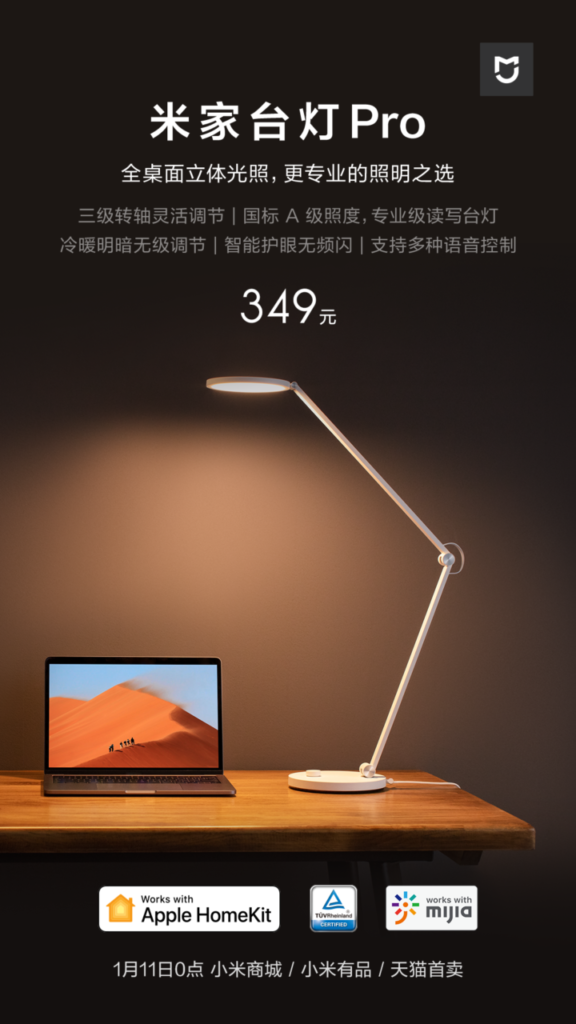
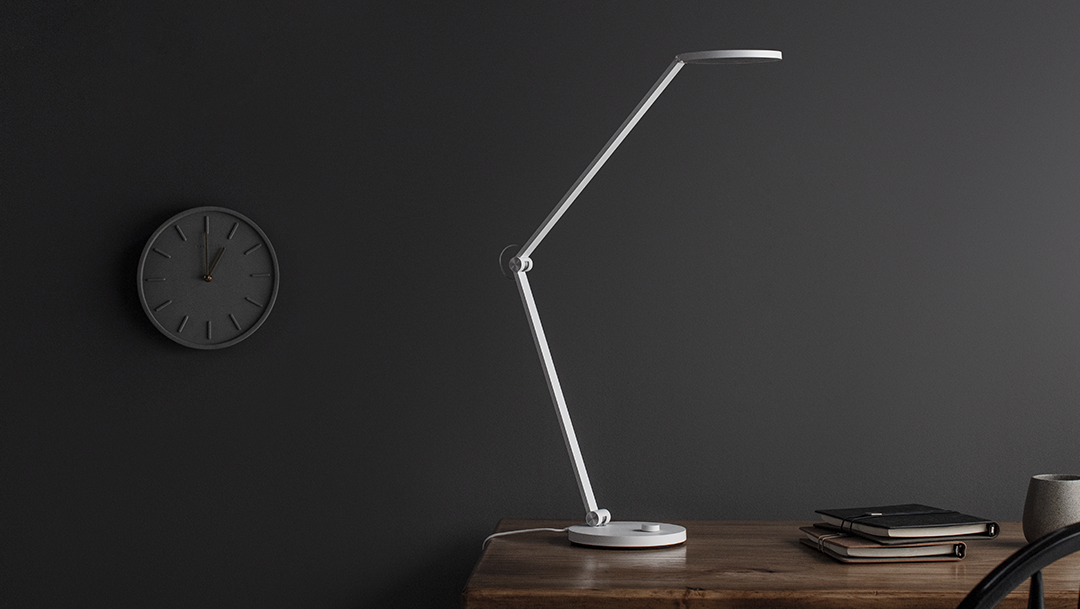
Along with the Bluetooth Headset Air and XiaoAi Speaker HD, Xiaomi has also announced its new Mi Table Lamp Pro in China. Priced at 349 Yuan, which roughly converts to $51, the device will be available for purchase from 11th January through Xiaomi Mall and Tmall.
The Mi Table Lamp Pro, which comes with a three-stage adjustable shaft design, is claimed by the company to have been certified by the German TUV Rhein Eye Comfort Certification for safety. Further, it has the same design as Mi LED Smart Table Lamp that has won three international design awards –iF Design Gold Award, Japan Good Design Award, and Red Dot Award.
Offering large illumination range, it also supports color temperature and smart brightness adjustment. It also comes with smart connectivity features which enable users to control other smart home devices as well. The Mi Table Lamp Pro has a LED area of 116mm and is claimed to offer two times more brightness compared to the Mi Table Lamp.
The company says that it is using a stroboscopic constant current analog dimming mechanism instead of the PWM dimming for low brightness. It also supports multiple modes of lighting which can be switched based on different situations that ultimately reduces eye fatigue and protects eyesight.
Further, Xiaomi claims that it can also achieve high-intensity light and the color restoration is close to the sunlight and reproduces the original color seen under the blue sky. Because of the three-shaft adjustable design, the Mi Table Lamp Pro’s arm can reach up to 66cm and the maximum diameter of the irradiation area can reach 125cm.
The Mi Table Lamp Pro can also be controlled through Mijia App as well as Apple Home. For connectivity, it supports Wi-Fi as well as Bluetooth and can easily be connected with other smart home devices through the Mijia App. Since it also supports Apple HomeKit, it can be controlled using Apple Home app as well as Siri on iPhone, iPad, Apple Watch and Mac.
We use cookies on our website to give you the most relevant experience by remembering your preferences and repeat visits. By clicking “Accept”, you consent to the use of ALL the cookies.
This website uses cookies to improve your experience while you navigate through the website. Out of these, the cookies that are categorized as necessary are stored on your browser as they are essential for the working of basic functionalities of the website. We also use third-party cookies that help us analyze and understand how you use this website. These cookies will be stored in your browser only with your consent. You also have the option to opt-out of these cookies. But opting out of some of these cookies may affect your browsing experience.
Necessary cookies are absolutely essential for the website to function properly. This category only includes cookies that ensures basic functionalities and security features of the website. These cookies do not store any personal information.
Any cookies that may not be particularly necessary for the website to function and is used specifically to collect user personal data via analytics, ads, other embedded contents are termed as non-necessary cookies. It is mandatory to procure user consent prior to running these cookies on your website.

 It boasts an impressive array of features that breathe new life into the sound quality of videos thanks to its built-in microphones. On top of that, the BY-MM1 Mini comes with TRRS and TRS cable that you can use to connect it to smartphones, cameras, PCs, audio recorders, camcorders and a slew of other recording devices that have 3.5mm connector.
 The BY-MM1 Mini doesn’t require a battery to draw its juices so you can simply plug it and start using it. Despite being housed in a sturdy metal body, this cardioid microphone is compact and lightweight so that you can take it everywhere you go with a portable carrying bag.